Author: Aubrey Whelan

  • Drugs took both her sons and her leg. Now, Kelly Wyatt is committed to staying sober.

    Drugs took both her sons and her leg. Now, Kelly Wyatt is committed to staying sober.

    Kelly Wyatt winced as a nurse unwrapped layers of gauze from her left leg, exposing the massive wound beneath.

    Yellow and red and gray, weeping plasma and agonizingly painful at the slightest touch, it covered almost the entirety of the end of her leg — the site of the amputation she had undergone four years before.

    Emergency room doctors at the time had warned her that if the drugs she was using didn’t kill her, her wounds would.

    Now Wyatt is 14 months into recovery from an addiction to fentanyl, a potent synthetic opioid, and xylazine, an animal tranquilizer never approved for human use. The emergence of xylazine, known as “tranq” on the streets, early in the decade marked the beginning of a dangerous new era for Philadelphians addicted to illicit opioids.

    Tranq users developed skin lesions that became gaping wounds, though exactly how is still unclear. As the medical establishment scrambled to respond, amputations more than doubled among people addicted to opioids between 2019 and 2022.

    Wyatt, 52, is among hundreds of Philadelphians facing lifelong medical needs from tranq, as the latest wave of the area’s drug crisis has seen a rapidly evolving succession of veterinary and industrial chemicals compound the dangers of the powerful opioids being sold on the streets.

    Some have become regular patients in burn units and wound care clinics at area hospitals, among the only places capable of treating severe tranq injuries.

    As part of its ongoing coverage of the area’s drug crisis, The Inquirer followed Wyatt for more than a year as she went through early recovery and worked with doctors to heal her wound.
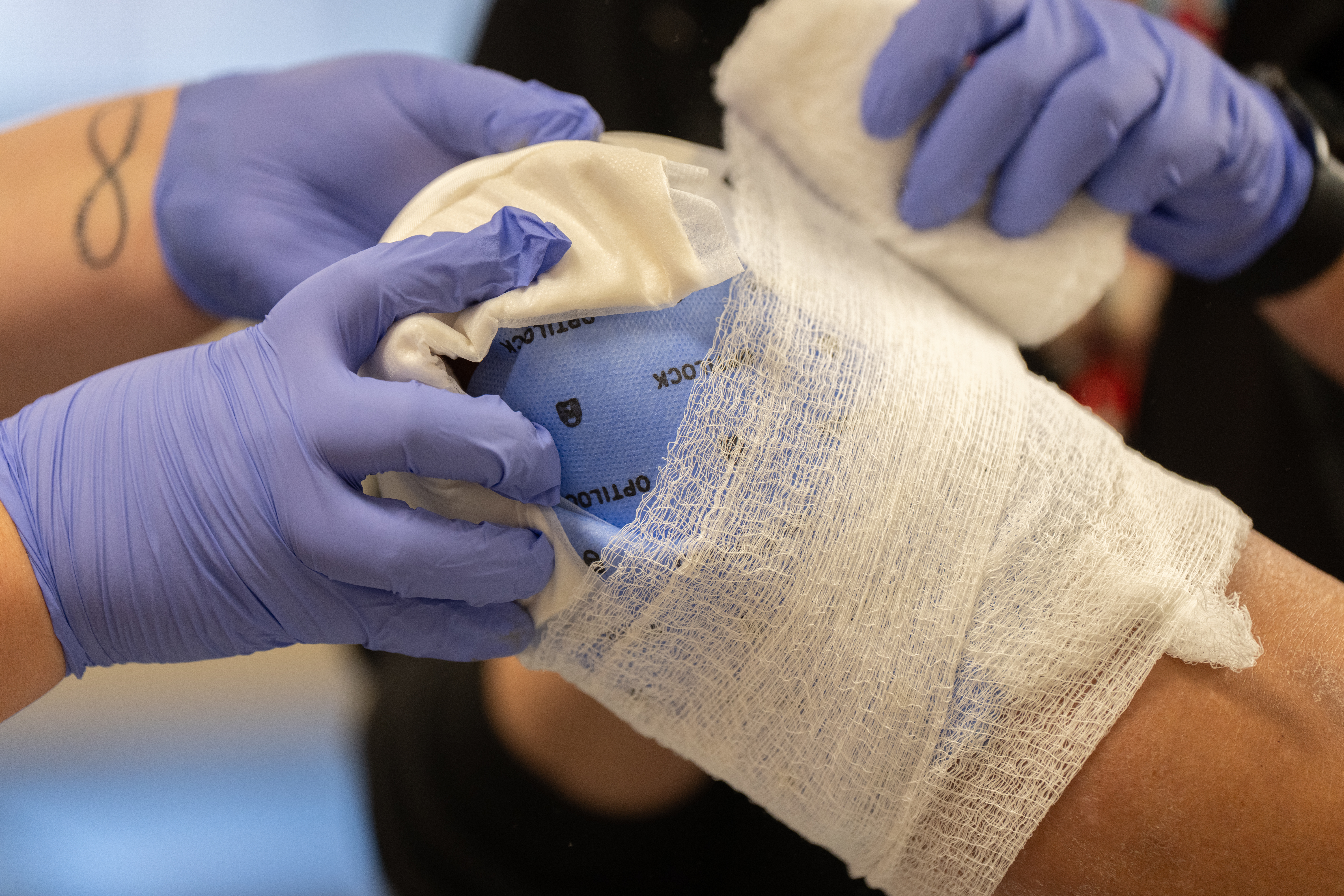
    Kelly Wyatt receives treatment at Jefferson Einstein Philadelphia Hospital’s Center for Wound Healing in Philadelphia in November.

    Wyatt initially shrugged when the small sores had emerged on her legs, only to watch them grow into massive abscesses, resulting in an amputation below her knee. Her ongoing tranq use prevented the wound on her left leg from healing properly. Even after recent months of sobriety and careful treatment, doctors are still warning her that they may have to amputate more of her leg.

    But Wyatt’s tranq wounds go still deeper.

    Over the last several years, both of her sons had spiraled into addiction. By January, both of them were dead.
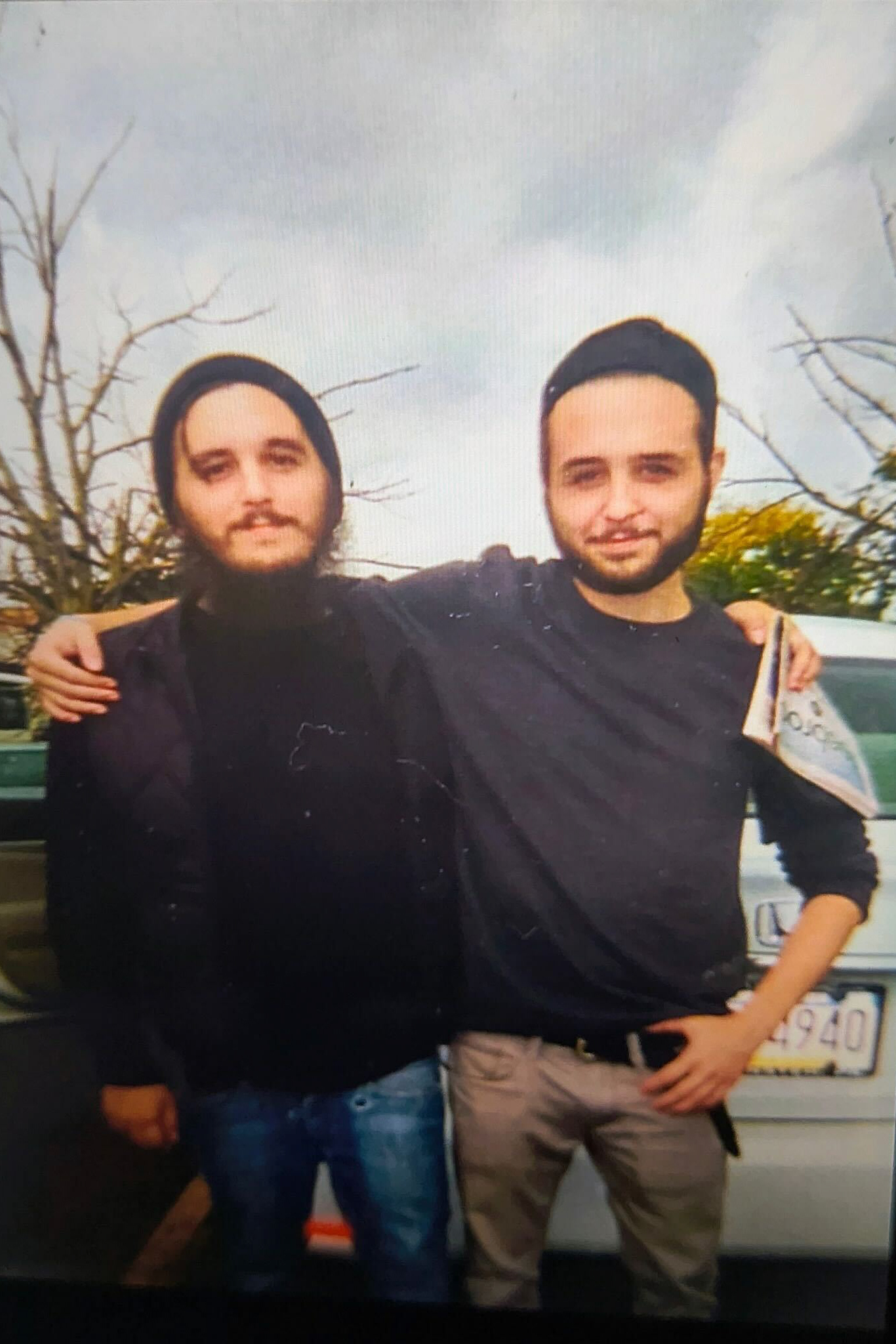
    A family photo of Dakota Wyatt, left, and Tyler, right.

    Spiraling into addiction

    Several members of Wyatt’s family have struggled with addiction.

    Wyatt experimented with drugs as a teenager, but was sober during her kids’ early childhoods. She didn’t drink alcohol, let alone seek out illicit drugs, after giving birth to her eldest son, Dakota, at 18. She raised two sons and a daughter in a neighborhood near Pennypack Park.

    Her days had a familiar rhythm: packing lunches, picking the kids up from school, watching them play together at the local park. In her spare time, she dabbled in mixed-media art, designing the window displays at the downtown restaurant where she worked for years. One Philadelphia Flower Show-themed display had a working waterfall.

    Her youngest, Tyler, was a happy child, grinning wide in every school picture and sharing inside jokes and a love for music with his brother. Dakota, more sensitive, had struggled with anxiety from an early age; Wyatt remembers him asking her at bedtime what the family would do if their house burned down in the night. But he could always make her laugh, and she and the boys would sing along to the same music in the car: ’90s alt-rock, Johnny Cash, the local hip-hop station.

    In 1999, she divorced their father. A few years later, at 28, she took her first Percocet pill, an opioid painkiller approved for medical use that is widely abused as a street drug. She had just started working at a bar, and the long hours were wearing on her.

    With the pills, “I could get more cleaning done, I could push my body more,” she said. “And it snowballed.”

    She was not aware when her sons began using drugs themselves in their teenage years. “I didn’t know for a long, long time,” she said.

    Afterward, Wyatt tried to help them seek treatment, even while her own drug use increased, she said.

    But a series of traumatic life events resulted in all falling deeper into addiction together.

    Wyatt’s ex-husband died following long-standing health issues, including diabetes.

    Then Dakota, who drove a Zamboni at a local ice rink, was injured in an accident at work — losing the tips of his fingers while cleaning the machine. He had been using more opioids to deal with the pain.

    Wyatt began buying drugs with him in Kensington, at the vast open-air drug market that is the epicenter of Philadelphia’s opioid crisis. “It was normalizing — I’m his mom and I’m with him in that crazy environment. I’m sure it made him feel like it was OK. And I regret that,” Wyatt said.

    “I regret a lot of stuff. But that was the beginning.”
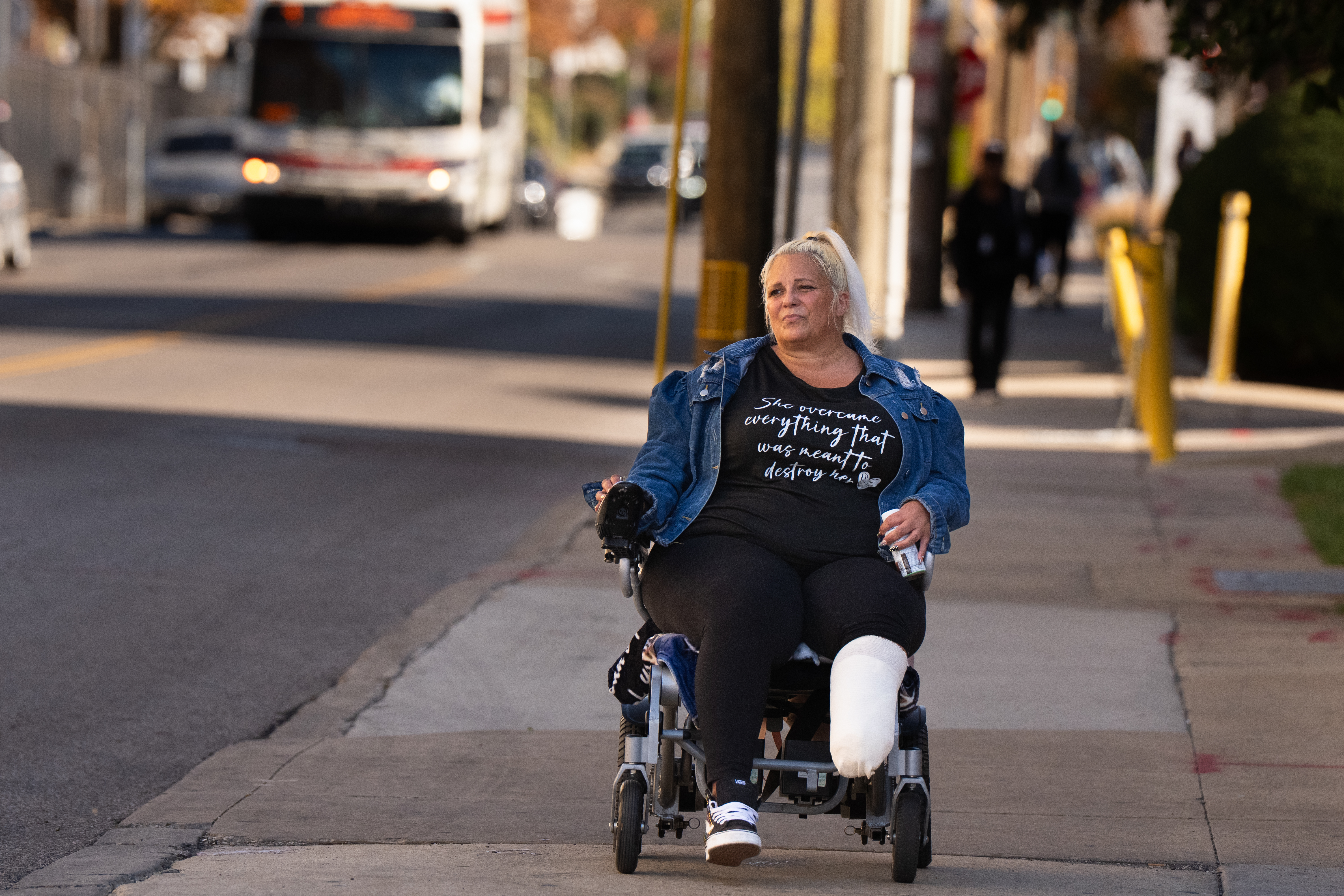
    Kelly Wyatt leaves her wound care appointment at Jefferson Einstein Philadelphia Hospital’s Center for Wound Healing in November.

    Tranq warning signs

    It was the mid-2010s, and the drugs on the street were changing. The stronger synthetic opioid fentanyl was just emerging; dealers chanted “fetty-fetty-fetty” on the corners to draw in customers.

    And then Wyatt began hearing talk of “tranq” getting mixed into the drug supply.

    That was around the time that Dakota developed wounds on his arm, open sores that would not close. Wyatt found small wounds on her arms and legs — “like melon-ball scoops.”

    One day, she saw a flier, handed out by health authorities in Kensington, warning that tranq can cause skin lesions.

    “All of a sudden,” she recalled, “things made sense.”

    But her addiction was so severe that she was afraid to stop using the fentanyl-tranq mix now prevalent in the illicit drug market. She fixated on avoiding xylazine’s severe withdrawal symptoms — chills, sweating, anxiety, and agitation — which don’t respond to traditional opioid withdrawal medications. She worried about seeking treatment with no guarantee of relief.

    By the time Wyatt was admitted to a hospital in 2021, she was hallucinating from sepsis, a severe complication from an infection that can lead to organ failure, shock, and death.

    When she woke up eight days later, a doctor told her she was at risk of having one leg amputated, and maybe both. “Please let me keep as much of my leg as possible,” she recalls begging a doctor who wanted to remove her entire leg.
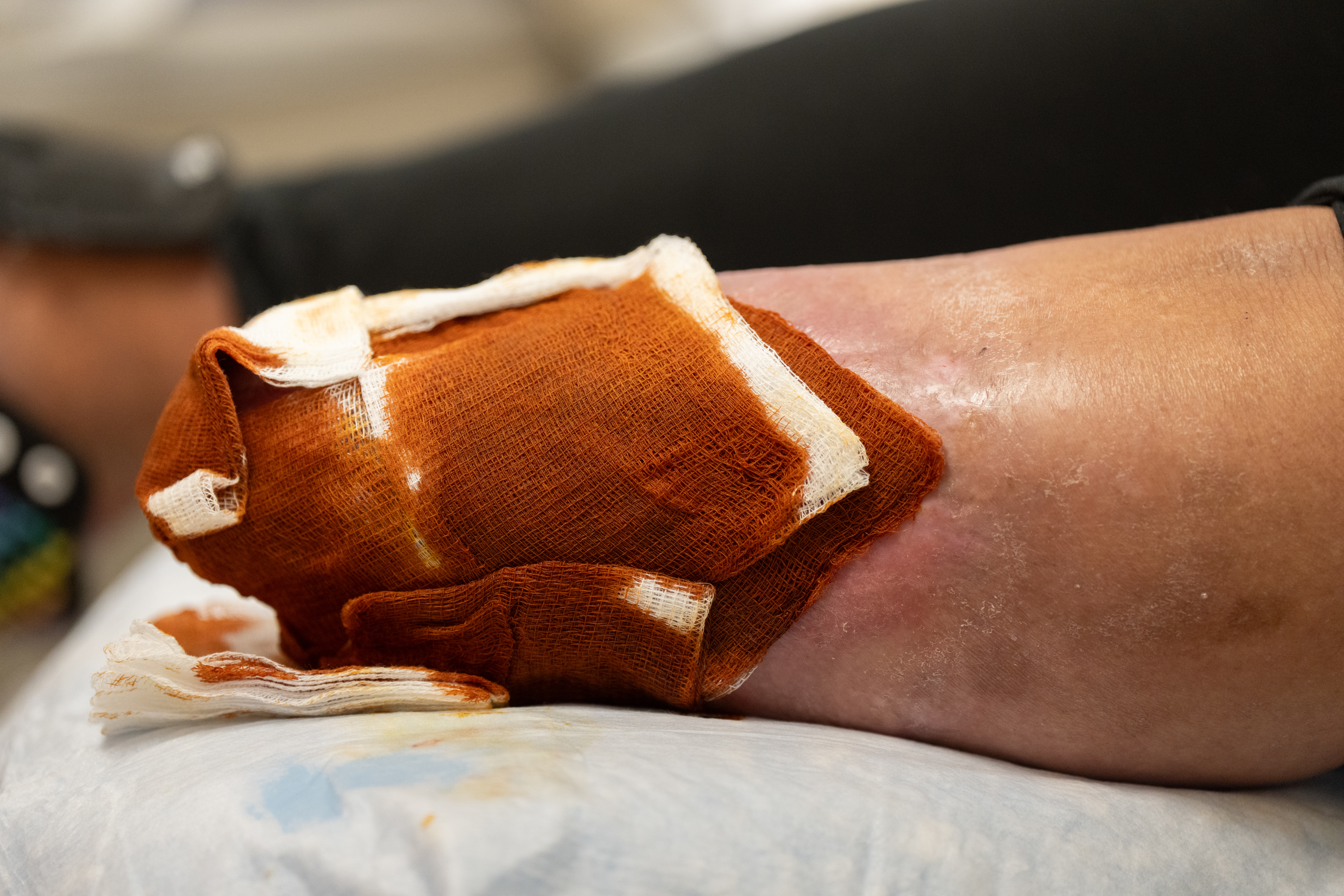
    Kelly Wyatt receives treatment for a serious xylazine wound at the site of her amputation at Jefferson Einstein Philadelphia Hospital’s Center for Wound Healing in November.

    “The doctor thought I should get the whole leg cut off. The other thing I could do was amputate below the knee, and then get tons of operations for the infection,” she said.

    Her oldest son’s tranq wounds had also worsened. Dakota had wounds on his legs and an arm, which was eventually amputated later that year. He also suffered a heart infection linked to his drug use, and needed a valve replacement.

    After a month in the hospital, he came home and continued using drugs.

    He developed new lesions. Maggots ate at his rotting skin. Wyatt cleaned the bugs out of his wounds.

    Wyatt tried bargaining with her son, promising they could get addiction treatment together. She offered to get him enough drugs that he wouldn’t enter withdrawal while waiting for care at the hospital. Sometimes, he managed to stay at the hospital for a few hours, but never longer.

    “He was too embarrassed to go anywhere, he was too afraid to get clean, and he was too afraid to be sick. He told us he would rather die than go through withdrawal again,” she said. “A couple times, he asked me if I wanted to just shoot up and lay down and die with him.”

    “‘I want to live,’” she recalls telling him, “‘and I don’t want to live without you.’”
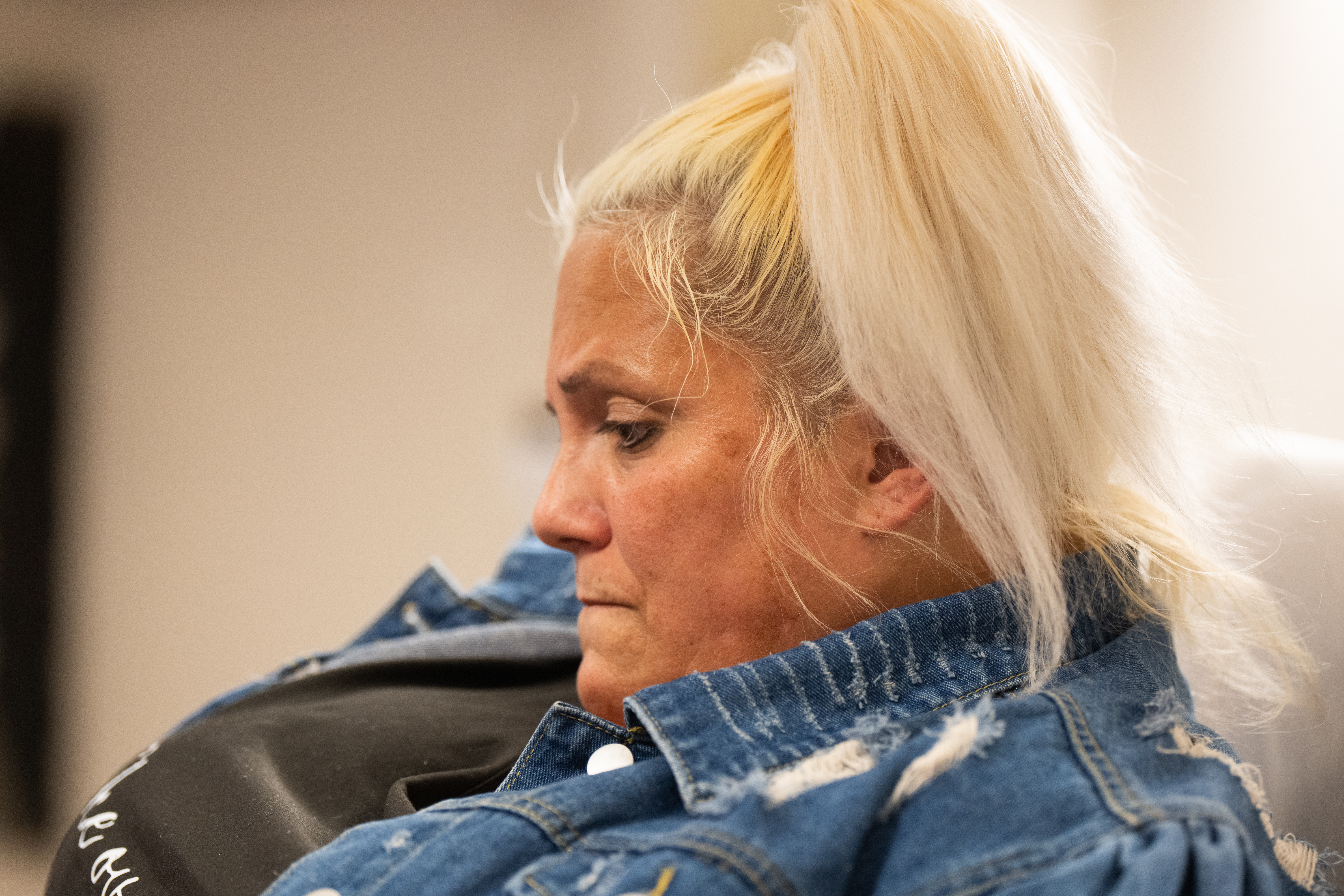
    Kelly Wyatt waits for treatment for a serious wound on her leg at Jefferson Einstein Philadelphia Hospital’s Center for Wound Healing in November.

    Loss and recovery

    One night in January 2024, Dakota was having trouble breathing and seemed to be hallucinating, speaking nonsense. He asked Wyatt to call an ambulance to the house.

    Dakota died before the family reached the hospital. His cause of death was listed as drug intoxication.

    Wyatt believes ongoing health issues from his wounds hastened his death. Her grief intensified her own drug use, leading to more xylazine wounds. The wound that had opened near her amputation grew worse.

    A month after Dakota’s death, she entered drug treatment. After three months, she relapsed and overdosed on cocaine and fentanyl. Her first thought after waking up was to use again, but instead she chose rehab.

    “I didn’t want to die,” Wyatt said. “I didn’t want to be in pain anymore.”

    She arrived at the Behavioral Wellness Center at Girard in July 2024, hoping to enter outpatient rehab.

    Instead, physicians recommended their inpatient clinic that could also treat her wounds, one of the few such facilities in Philadelphia.
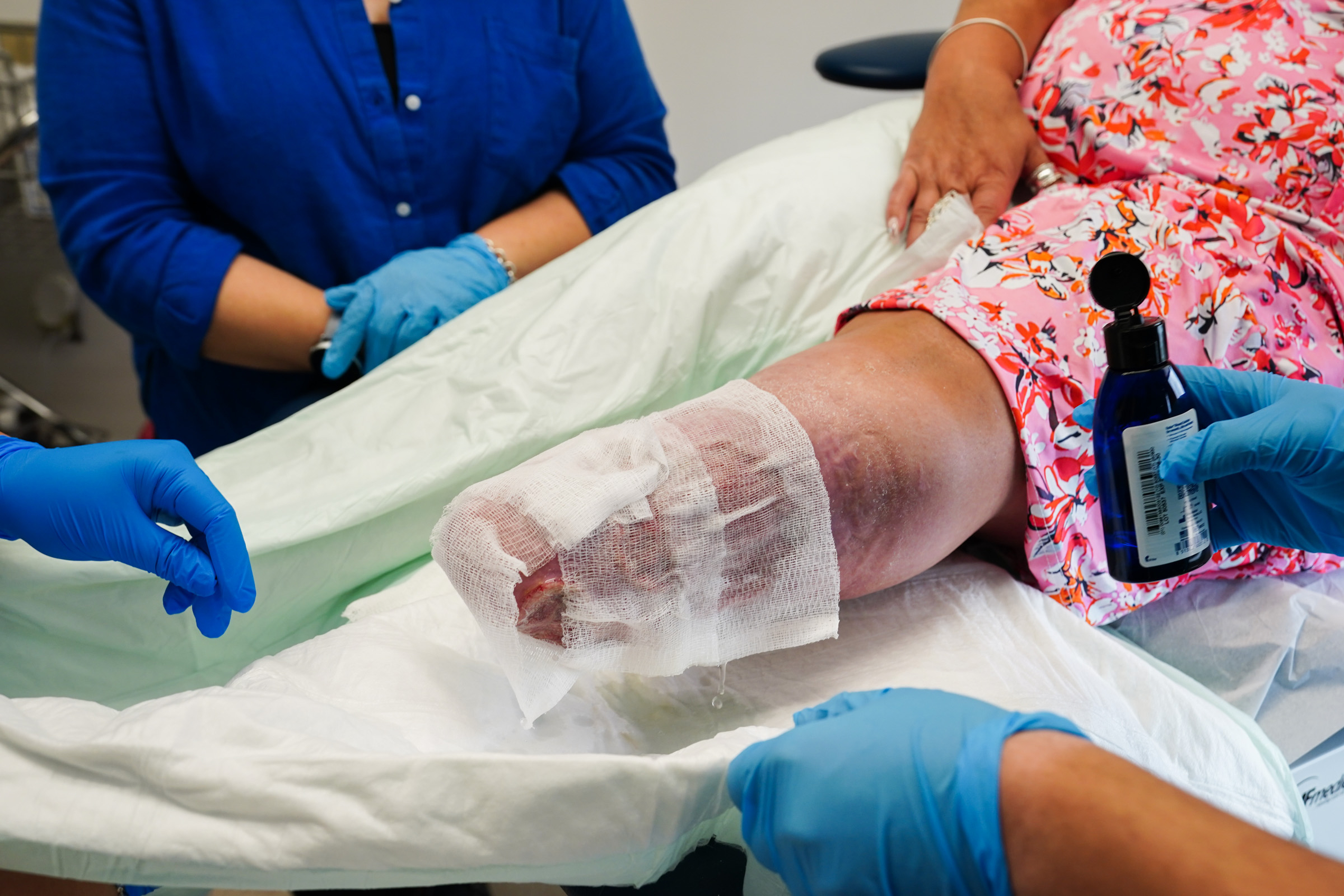
    In August 2024, Kelly Wyatt attended a wound care appointment as part of her inpatient care at Girard Behavioral Health, one of a few addiction rehabs in the city that can treat xylazine wounds.

    Wyatt was living there and undergoing treatment a month later, in August 2024, when she wheeled her motorized wheelchair into a clinic room and took deep breaths as nurses carefully peeled back layers of moisturized gauze on her left leg, cleaning the wound.

    Still in the shaky early months of recovery, and needing to remain in inpatient rehab, she remained worried about Tyler, who was still using drugs.

    “He was the primary caretaker of his brother. They would be in their room, getting high together. And now he’s just in that room by himself, day in and day out,” she said in an interview that summer.

    “I kept saying, ‘I think I should go home to him.’ And everybody kept saying to me, ‘You have to work on yourself first. He’ll be fine,’” she later recalled.

    “And then he wasn’t fine.”
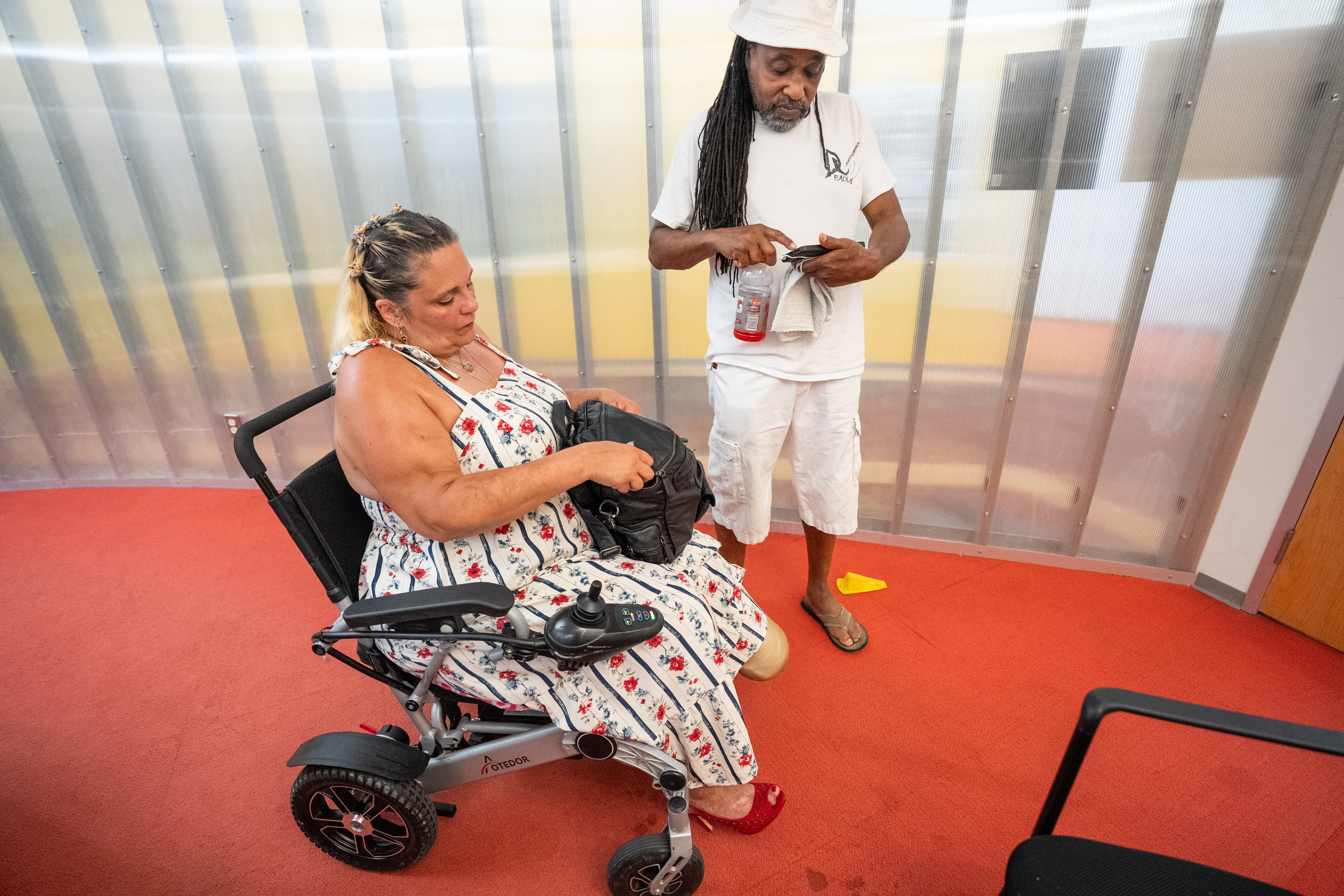
    Kelly Wyatt and her partner Randy Stewart at the headquarters of Resources for Human Development, which runs the skilled nursing and inpatient addiction treatment center where Wyatt sought treatment this winter.

    A mother’s guilt

    Wyatt was still in rehab in January 2025 when her partner, Randy Stewart, called. He hadn’t seen Tyler in hours and thought he might have left the family’s house.

    Wyatt called several hospitals and then asked Randy to check the bathroom in the back of the house.

    He found Tyler on the floor.

    “I just thought, God, please no,” Wyatt said. “Not again. You can’t do this to me again.”

    Tyler’s cause of death was also listed as “drug intoxication.”

    He died at 27, a year and 10 days after his brother.

    Wyatt is still wracked by guilt. Guilt that she used drugs with her sons. That she used drugs at all. That she wasn’t there when either of her boys died. That her daughter, who does not use drugs, stopped speaking to her. Sometimes, she dreams about her children and wakes up screaming.

    As she continues treatment, Wyatt said, she hopes her story will help other families struggling with addiction, especially the realities of tranq use.

    “Sometimes I’m embarrassed to talk about it. But I feel like I have to,” she said. “Because people need to know. If one person sees this and gets some medical care, gets any kind of help, I would be happy.”
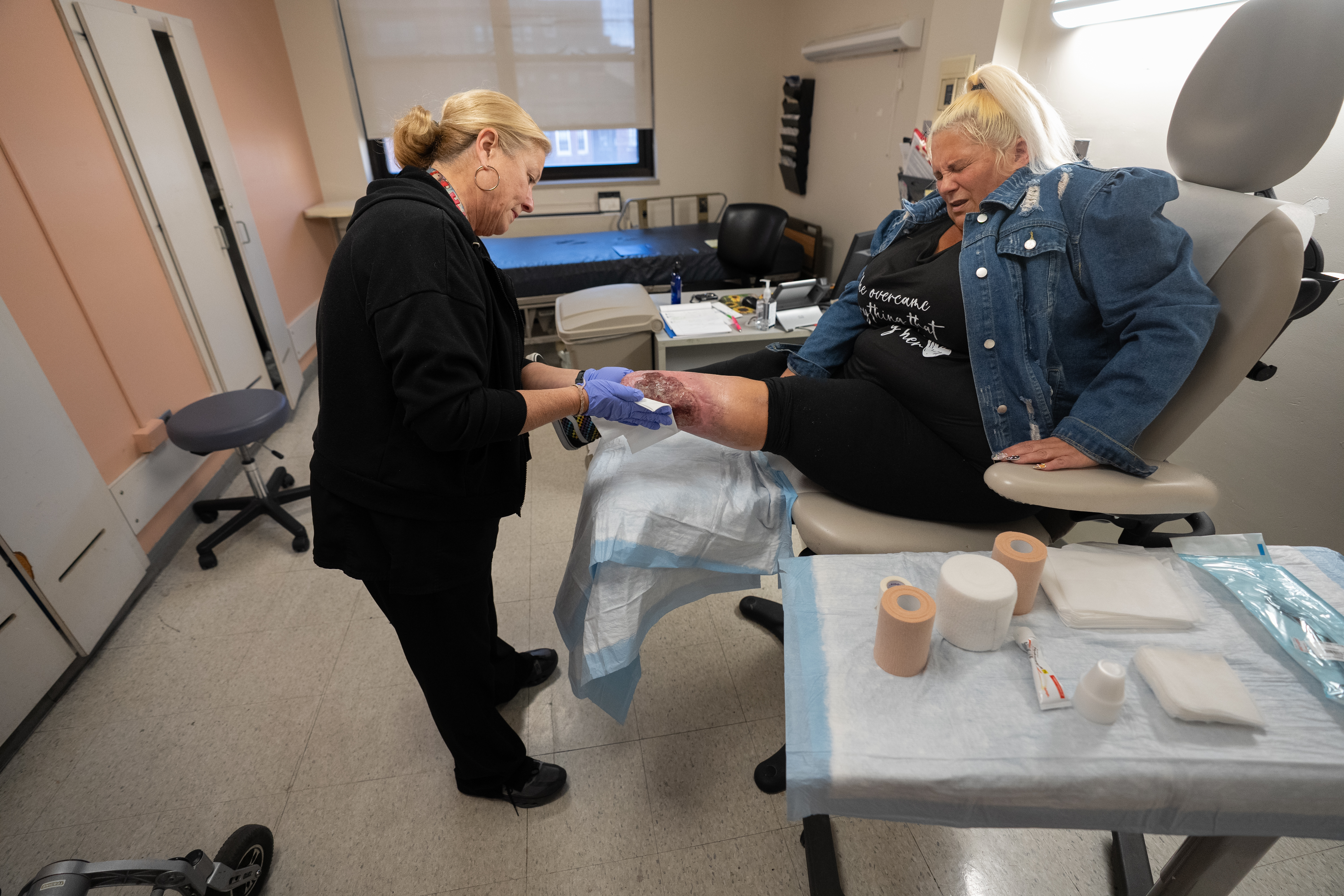
    Heidi Hunt, a wound care-certified registered nurse, cleans the wound on Kelly Wyatt’s leg at Jefferson Einstein Philadelphia Hospital’s Center for Wound Healing in November.

    Treating tranq’s wounds

    For Wyatt, maintaining her recovery from addiction and caring for her wounds are full-time occupations that sometimes are in conflict.

    Methadone, the opioid addiction treatment drug that has helped Wyatt curb cravings for more than a year, can be dispensed only at special clinics.

    Wyatt’s clinic journey meant three hours a day on a bus where she couldn’t keep her leg elevated. The wound worsened until she was able to switch to a closer methadone clinic.

    Wyatt relies on Stewart to help her move around her home, where the only bathroom that she can access is the one where Tyler died.

    “Cleaning, taking care of me, changing my wound dressings, talking about my sons — he calms me down. It’s been a lot, and he’s really done a lot,” she said.
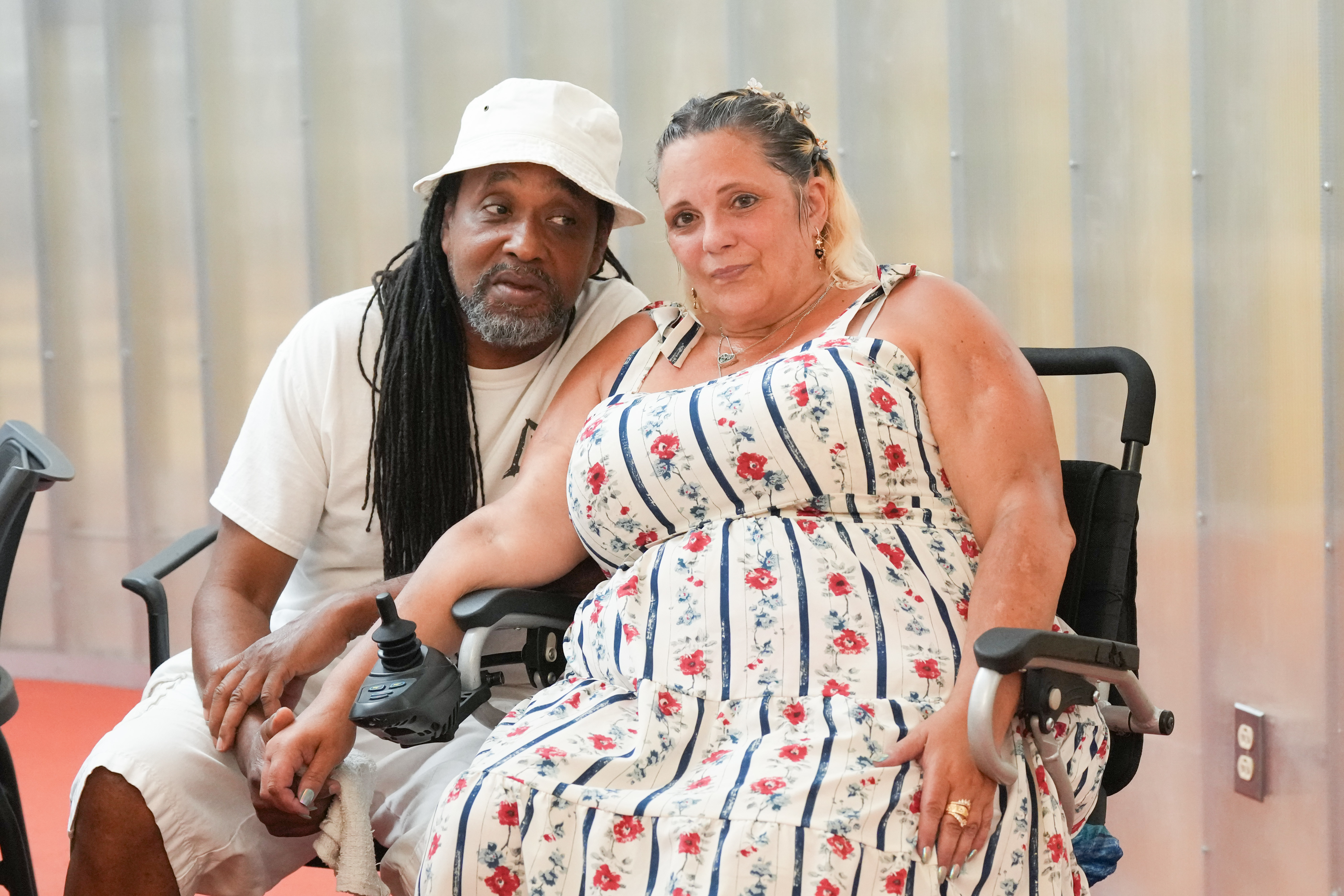
    Kelly Wyatt and her partner Randy Stewart in July.

    Once a week, Wyatt travels to Jefferson Einstein Philadelphia Hospital’s Center for Wound Healing for wound care.

    At a recent appointment, nurse practitioner Danielle Curran scraped away infected skin, measured the wounds, cleaned and re-bandaged her lesion.

    In between office visits, nurses also go to her home to clean and re-bandage her wound twice weekly. Several times this year, Wyatt has undergone debridement surgery to remove more damaged skin under anesthesia.

    If the treatments manage to shrink her wound, Curran said, Wyatt could try a skin graft and eventually receive a prosthetic leg that could help her get around more easily.

    Curran has treated about 20 xylazine patients at the clinic over the last few years. About 10, including Wyatt, are still getting regular care. Others have relapsed and returned to the streets. Several have died of overdoses.

    She is relieved that, as Philadelphia’s opioid crisis continues to evolve, tranq is becoming less prevalent. But it has been replaced in street drugs by another animal tranquilizer, medetomidine, which does not appear to cause flesh wounds but, rather, agonizing withdrawal symptoms. Skin lesions among opioid users have decreased in the last year.

    Yet Curran still insists on seeing patients like Wyatt with xylazine wounds weekly, trying to help them through their injuries and hopefully their recovery, too. “I like to be another person holding them accountable, to stay on the path. We try to give them that support.”

    Sometimes, that support means simply reminding Wyatt how far she has come in the four years since the amputation, and now 14 months of sobriety.

    At a recent appointment, after carefully scraping dead skin away from Wyatt’s leg with a small curette, Curran walked through her next steps: A disinfecting gel to keep bacteria out of the wound. A course of antibiotics to avoid infection. Another debridement surgery, in a few weeks.

    “As a rule of thumb,” Curran told a reporter, “it’s very hard to give timelines for wound care, because of all the things that could possibly go wrong. A wound this size, though? It could take years.”

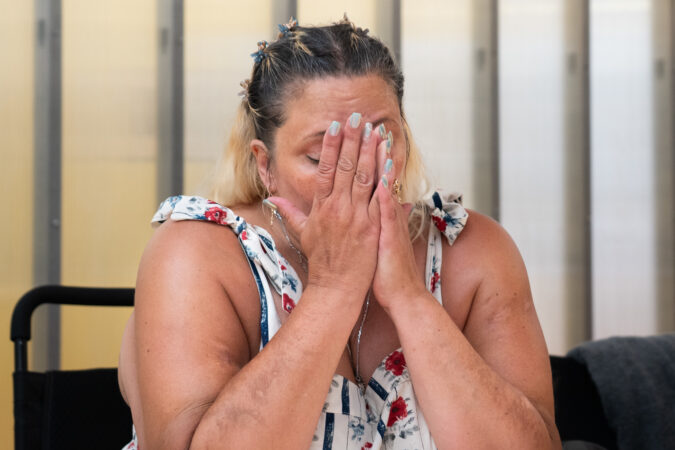
    Wyatt began to cry. “It’s already been four years,” she said.

    Curran turned to her. “You’ve made so much progress,” she said gently. “Give yourself time.”
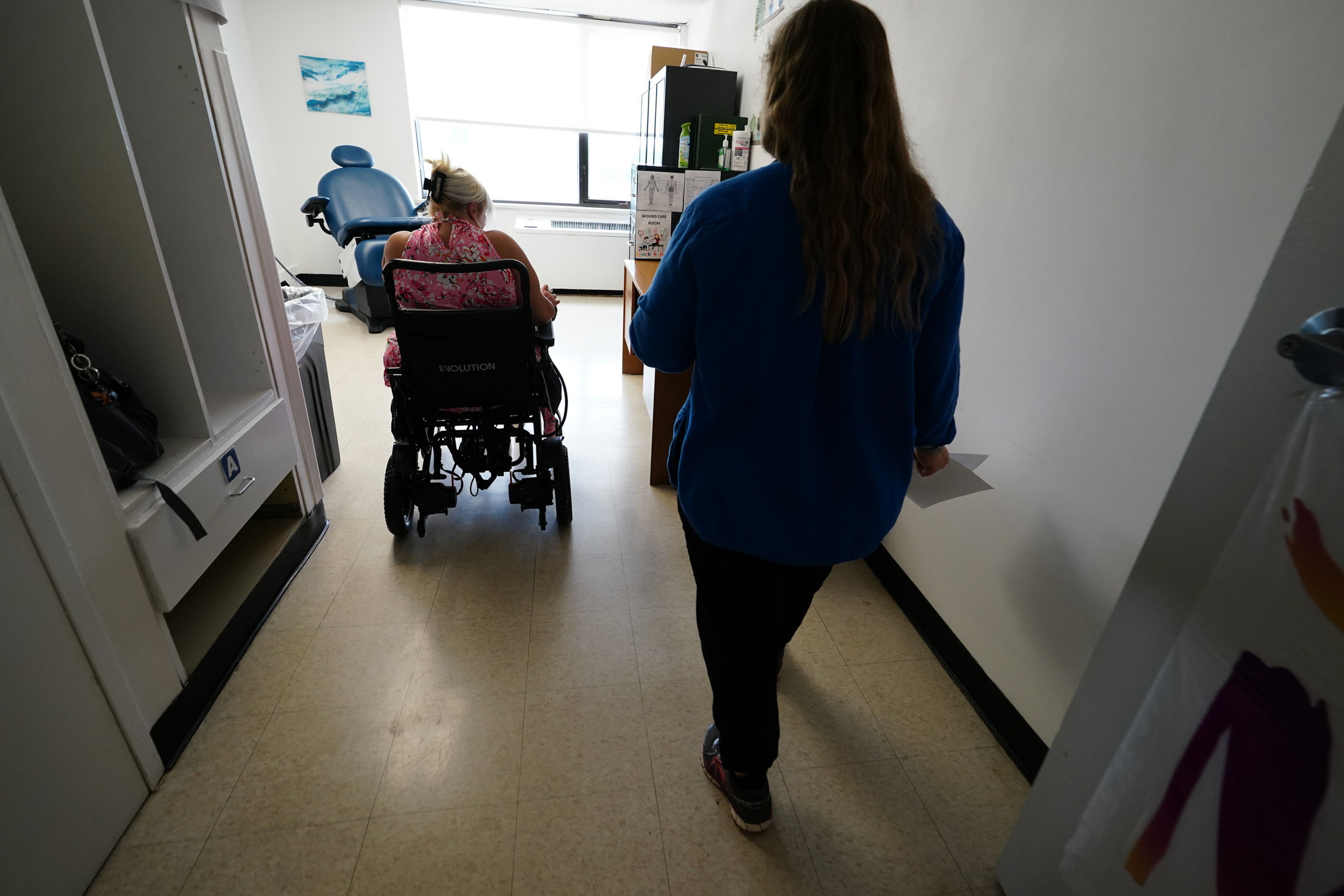
    Kelly Wyatt enters the wound care clinic at Girard Behavioral Health in August 2024.

    Editor’s note: This story has been updated to clarify the name of the Jefferson Health clinic where Kelly Wyatt received wound care.
  • Inside a Kensington wound care clinic

    Inside a Kensington wound care clinic

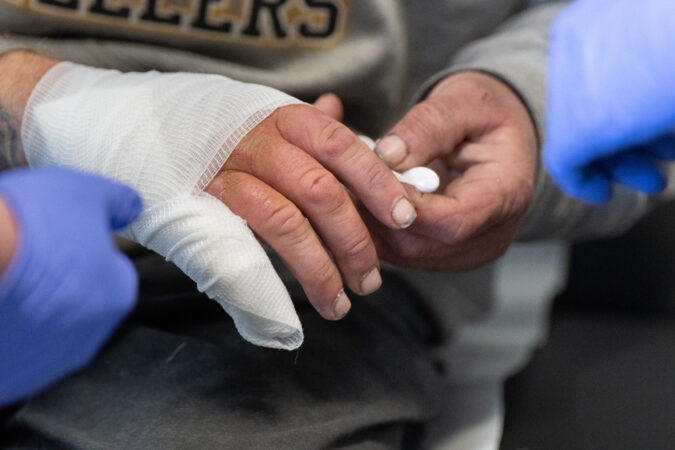
    In a small clinic room at Mother of Mercy House on Allegheny Avenue in Kensington, Emma Anderson unwrapped a bandage from a man’s swollen hand.

    “It hurts really bad in the cold,” the man said, wincing at the inflamed wound that covered most of a right-hand finger.

    Cleaning it with saline solution proved so painful that Anderson, an EMT and St. Joseph’s University student, let the patient take the lead, wiping carefully at the yellowish-white tissue at the center of the wound.

    It was his second time attending the wound care clinic at Mother of Mercy, the Catholic nonprofit that twice a week opens its doors to people with addiction dealing with the serious skin lesions, caused by the animal tranquilizer xylazine, that can develop into wounds so severe the only treatment is amputation.

    Called “tranq” on the streets, xylazine was never approved for human use and has wreaked havoc across the city since dealers began adding it to fentanyl to extend the opioid’s short-lived high.

    In the five years since it emerged as a threat, amputations among opioid users have more than doubled. The Philadelphia drug supply is now changing again, and though emergency rooms in the last year have treated fewer xylazine wounds, the crisis is far from over.

    The man who visited Mother of Mercy’s clinic on a recent Tuesday, who gave only his first name, Steven, because of the stigma surrounding drug use, noticed the alarming wound on his hand a few weeks ago.

    Steven had seen people sleeping on the streets with flies hovering around their gaping wounds. He had hoped that he could avoid a wound himself: He smokes fentanyl, instead of injecting it, and knows that injection drug users are generally at a higher risk for skin infections. But, like many people who smoke their drugs, he had developed a wound anyway.

    “Believe it or not,” Steven said, between deep breaths during the painful cleaning, “I actually was an EMT myself at one point.”

    ‘How did we let it get this bad?’

    Mother of Mercy, founded in 2015 in Kensington, partners with St. Joseph’s Institute of Clinical Bioethics to host the clinics. The institute, headed by Father Peter Clark, a Jesuit priest and a bioethicist at several area hospitals, has long held a monthly health clinic at the nonprofit’s Kensington headquarters.

    In the last year, they expanded the program to offer more wound care opportunities to a community increasingly in need of them.

    Father Peter Clark, the director of the Institute of Clinical Bioethics at St. Joseph’s University, and Ean Hudak, a St. Joseph’s student and staffer at the Mother of Mercy House wound care clinic, assist a person who had fallen unconscious on Allegheny Avenue in Kensington.

    “To be physically down here in the heart of it, and seeing it on a weekly, monthly basis, it opens your eyes. How did we let it get this bad?” said Steven Silver, the assistant director of research and development at St. Joseph’s, who was welcoming clients at the door on a recent clinic day.

    The program is staffed by medical students and undergraduates, all trained in wound care. Many say the work they do at the clinic is unlike any medical training they’ve been offered at school.

    Undergraduates like Anderson and Ean Hudak, who takes shifts at the clinic in between applying to nursing schools, say they’re hoping to use their experience as they pursue careers in the medical field.

    On Tuesdays and Thursdays, organizers serve hot meals and wait in the small clinic room for patients to trickle in, usually about 20 a week.

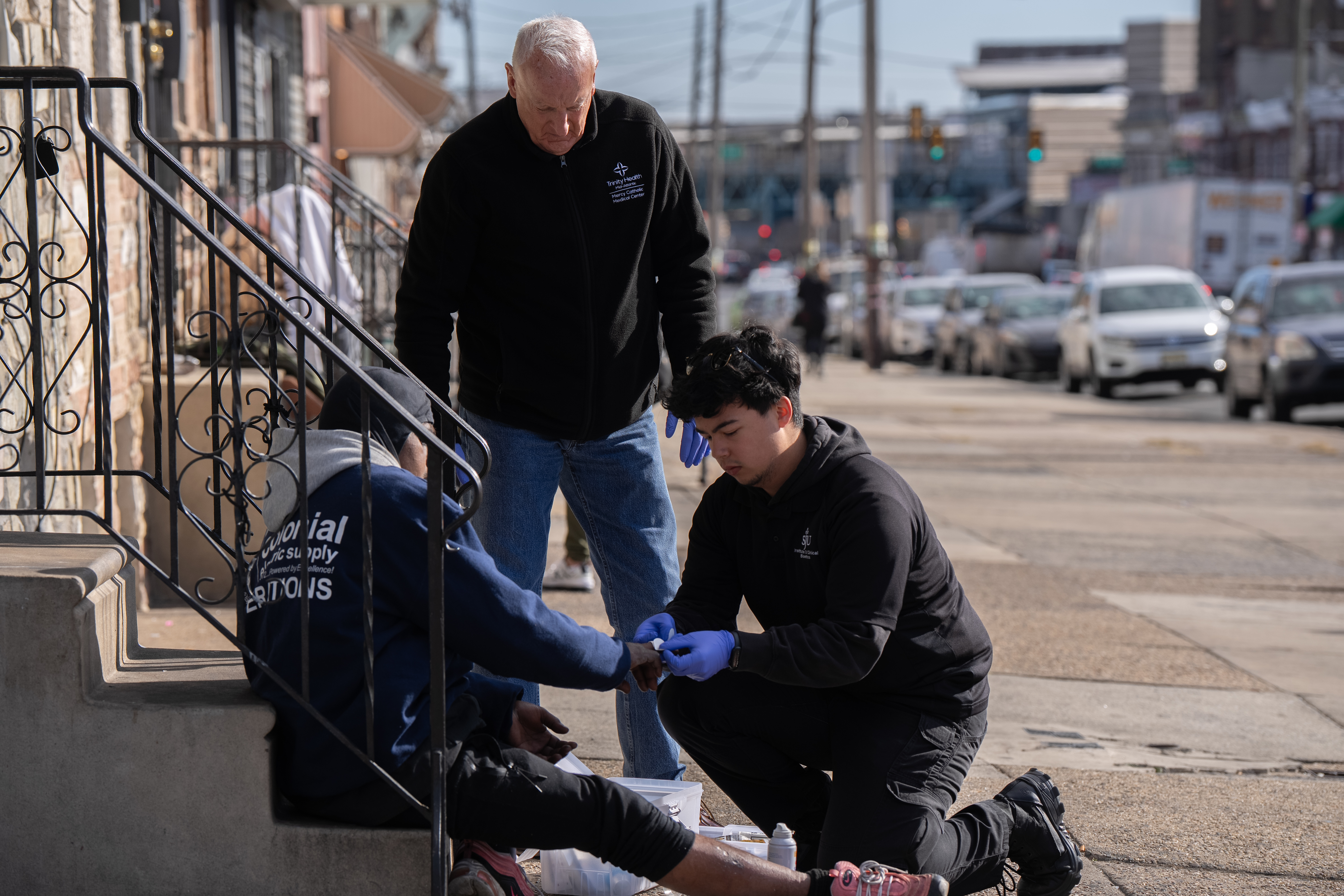
    Once a month, the team takes to the streets with wound care supplies, such as bandages, saline sprays, and antiseptic cleansers. They look for people on the streets who may not be able to reach the clinic.

    Clark said the clinic stepped up its hours in an effort to help patients keep their wounds clean more consistently — and hopefully prevent more amputations. “It’s increasing [patients’] ability to know what to do and how to keep the wounds clean — hopefully to help them out,” he said.

    The trust factor

    This year, medetomidine, another animal tranquilizer that causes severe withdrawal, has supplanted xylazine’s dominance in the Philadelphia area drug supply. Fewer patients addicted to opioids are visiting emergency rooms with soft-tissue damage, according to city data.

    But it’s unknown how medetomidine affects those wounds, and there are still enough people suffering from them in Kensington, the epicenter of the city’s opioid crisis, that the clinic felt it necessary to increase its hours.

    Hosting more frequent clinics also deepens relationships with patients. “People are coming back, which is good,” Clark said. “The trust factor is a huge issue.”

    Many of the clinic’s patients avoid hospitals, fearing long waits for care: “At the ERs, they wait eight hours and they sign themselves out, or they’re coming down from a high, and nobody’s taking care of the withdrawal,” Clark said. “It’s a big mess.”

    At the clinic, staff are regularly on the phone with wound care physicians at Temple University Hospital, who can flag patients with xylazine wounds and get them prompt care before they enter withdrawal, he said.

    They also connect patients with housing, inpatient rehabs, and hospital care, for those with wounds too serious for the clinic to handle.

    Several weeks ago, they called an ambulance to get a man with a wound that exposed his bone to the hospital.

    Staff collect data to share with area hospitals so physicians can get a better understanding of the situation on the street — measuring patients’ wounds, collecting demographic data, and asking patients about which drugs they use.

    Each leaves the clinic with a hospital bracelet documenting the care they’ve received so staff can keep track of their care from week to week.

    ‘It’s always an uphill battle’

    Not all patients at the clinic are suffering from xylazine wounds. On a recent weekday, one man asked for help bandaging scrapes on his knuckles. He’d tried to fight someone who was stealing his belongings.

    Another man said he’d been robbed and pepper-sprayed and asked staff to help wash the last traces of Mace out of his eyes.

    As staffers looked for eyedrops among their medical supplies, Clark poked his head into the room. “We need someone with Narcan,” he said, referring to the opioid overdose-reversing spray.

    Across the street, a man was slumped on a stoop, unresponsive.

    Clark and Hudak dodged cars on Allegheny Avenue, knelt down by the man, and managed to gently shake him awake.

    Slowly, he revived enough to speak a bit and showed them a wound on his leg, which they cleaned and wrapped in gauze. “You have some cracked skin — do you want us to put some moisturizer on your hands?” Hudak asked.

    With temperatures dropping, the team is worried that patients’ skin will dry out, making their wounds more painful. (The summer months present a different challenge, with wounds leaking fluids.) And many patients may be too cold to travel to the clinic, making the monthly street rounds even more crucial.

    “It’s always an uphill battle,” Hudak said.

  • ‘It feels like deliberate gaslighting’: A Drexel autism expert discusses the CDC’s new website on vaccines and autism

    ‘It feels like deliberate gaslighting’: A Drexel autism expert discusses the CDC’s new website on vaccines and autism

    On Nov. 19, a webpage at the Centers for Disease Control and Prevention was updated with a stunning reversal of the agency’s long-held — and scientifically backed — position on vaccines and autism.

    Previously, the CDC has noted on its website that decades of research show no link between receiving vaccines and developing autism.

    Now, the site reads: “The claim ‘vaccines do not cause autism’ is not an evidence-based claim because studies have not ruled out the possibility that infant vaccines cause autism.”

    A header on the webpage still reads “Vaccines do not cause autism.”

    But the phrase is followed by an asterisk leading to another statement explaining the header remains “due to an agreement with the chair of the U.S. Senate Health, Education, Labor, and Pensions Committee that it would remain on the CDC website.”

    The chair is Sen. Bill Cassidy (R., La.), who made his confirmation vote for Health and Human Services Secretary Robert F. Kennedy Jr. contingent on that agreement.

    The move was met with outrage from public health experts who say that Kennedy, a longtime anti-vaccine advocate, is risking lives by calling vaccines’ safety into question. The New York Times reported two days later that he had personally ordered the website changed.

    Diana Robins, the director of the A.J. Drexel Autism Institute at Drexel University, which studies autism from a public health perspective, spoke with The Inquirer about the update and what it means for public health.

    This interview has been lightly edited for clarity and brevity.

    Question: Take us through the update on the CDC’s website about vaccines and autism.

    Answer: The frightening thing, to me, is if a person who is not really familiar with the science reads this website, there is a lot of convincing-sounding language. It feels like deliberate gaslighting.

    It’s using terms they’ve learned from scientists over the last several months — “gold-standard science” and “evidence-based claims” — and using them in directly inaccurate ways.

    The very first key point at the top of the page says, “The claim ‘vaccines do not cause autism’ is not an evidence-based claim because studies have not ruled out the possibility that infant vaccines cause autism.”

    Part of what makes that so egregious is that scientists believe in the scientific process. Unfortunately, the federal administration is weaponizing the fact that scientists won’t come out and say it has been proven. A scientist will never say we have 100% ruled out all possibilities. Something we think we know could change tomorrow when we learn something new.

    But there are dozens of studies over many, many years that fail to show a link between vaccines and autism. All the studies that are rigorous and methodologically sound fail to show a link between vaccines and autism. That is unequivocal.

    Q: What’s the danger in changing the CDC’s language around vaccines?

    A: Vaccines save lives. Vaccines are one of the frontline public health strategies to support health in the population. We’re already seeing what happens when vaccine compliance goes down, when there’s an erosion of the public confidence in vaccines.

    There have been measles outbreaks in the last year in the United States. Some kids just get sick and they get better, but some kids have serious illnesses and occasionally die. And it’s not just measles. We’re vaccinated against a lot of life-threatening diseases.

    The cost is a huge shift in public health, and the protective factor that vaccines give us against life-threatening illness.

    If you told me that reading books past 10 p.m. might cause autism, I would say there’s probably not a lot of cost if you stop reading books at 9:59. But not vaccinating children? The costs are huge. Even one death that’s preventable is a tragedy.

    And there will be a lot of preventable serious illness and death if parents don’t vaccinate their children.

    Q: How does this affect the public’s view of federal health agencies?

    A: I think it makes it very difficult for people to know what to trust. And there is already decreased trust in the medical community, scientific community, higher education broadly.

    If pages like this are intermingled with legitimate pages, how will people know which ones are the accurate pages and which are the ones with gaslighting and anti-science? I think people will likely lose their faith in the CDC altogether, which is a terrible blow to the public health of the whole country. If we can’t trust our Centers for Disease Control, who can we trust?

    Q: How can scientists communicate accurate medical information with the public?

    A: One thing I think is slightly heartening in the face of this devastation is that professional societies and organizations that are medical or scientific are all aligned. There have been so many statements that came out within the first day of this, and they are fully aligned in agreement. The only differences are in which words they yell the loudest.

    You can usually not get scientists to agree to anything in a day. That means a lot. It’s the responsibility of all the legitimate scientists and public health experts to try to combat that misinformation every which way we can.

    [At the A.J. Drexel Autism Institute], we’re trying to do more outreach to the public. We actually developed some vaccine info sheets just a couple months ago that are posted on our website. We have a new website … that brings together all of the information.

    Vaccines are one of our biggest public health successes. If we roll those back, we have stepped back decades in the health of our country. It’s that big. It’s that serious.

  • A New Jersey organ donation nonprofit is accused of ordering an organ recovery to go forward after a patient ‘reanimated’

    A New Jersey organ donation nonprofit is accused of ordering an organ recovery to go forward after a patient ‘reanimated’

    The president of a major New Jersey organ donation nonprofit told a subordinate at a Camden hospital to continue procuring organs from a patient thought to be dead — after that person “reanimated” during the organ recovery process, federal lawmakers alleged in a letter made public Wednesday.

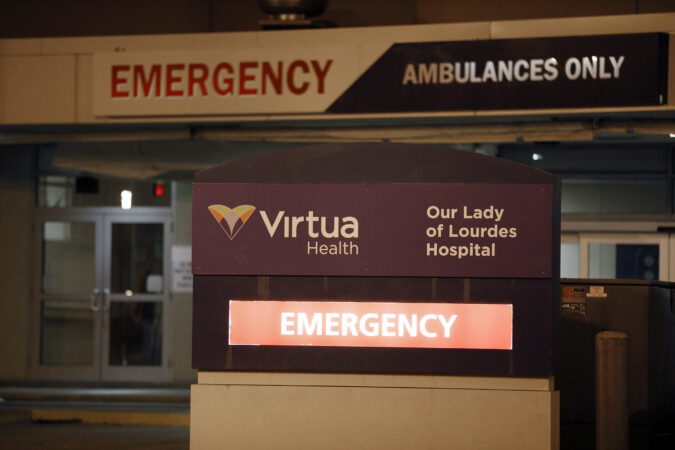
    Instead, hospital staff at Virtua Our Lady of Lourdes Hospital intervened to stop the procedure, members of the House Committee on Ways and Means said in the letter, dated Nov. 19.

    The committee, which has been investigating malpractice among organ donation nonprofits, said it was probing allegations that the New Jersey Organ and Tissue Sharing Network, or NJ Sharing Network, engaged in a number of questionable practices.

    The letter said whistleblowers accused the organization of disposing of organs meant for research, pressuring families to donate organs from patients who had revoked their organ donor status, and skipping over patients on a waiting list for donated organs.

    The committee said that, in some cases, NJ Sharing Network could be violating federal law.

    NJ Sharing Network and Virtua Health did not immediately return requests for comment Thursday.

    The House’s probe into NJ Sharing Network’s practices comes after years of scrutiny for the nation’s organ donation system and amid investigations into several other organ donation organizations by the committee. The Washington Post reported that as early as 2022, Senate investigators found 70 people had died after organ donation organizations failed to screen donated organs for cancer and other diseases.

    This year, the federal Department of Health and Human Services said it had found evidence that an organ donation organization in Kentucky, West Virginia, and Ohio had initiated organ procurement procedures on at least 28 patients who might not have been dead. The organ donations ultimately did not continue.

    In September, the Post reported, a former NJ Sharing Network staffer named Patrek Chase filed a lawsuit against the nonprofit and two other organ donation organizations, alleging that they had collected organs that weren’t appropriate for transplants in order to pull in more Medicaid reimbursements.

    Organ donation organizations are under intense pressure to find healthy organs for a growing population of people who need them, said Arthur Caplan, a bioethics professor at New York University who previously worked at the University of Pennsylvania.

    “A lot of these pressures may lead to some bad behavior,” he said.

    He advised Congress as it set up the nation’s organ donation system in the 1980s, but said certain aspects of the system need to be examined now. For one, it may be too big — fewer organ procurement organizations might result in a more efficient system with better-trained staff, he said.

    Some organizations do not obtain enough organs to serve patients in need, he said.

    “It’s been tolerated for a while, and it needs to be explained,” he said. “And for the ones that are doing well, what are they doing well? Are any of them pushing too hard? We want to protect grieving families and make sure people who want to be donors have their wishes honored.”

    Still, he said, Congress’ scrutiny of malpractice in the industry comes alongside a reluctance to spend more money to improve the system.

    “There are also congressional inquiries saying, ‘Why aren’t you getting more organs? And we’re not giving you any more money for training or anything else,’” he said. “The pressure is coming in both directions.”

    Given the need for organs, he said, he was concerned that news of malpractice could turn people away from donating organs.

    “We need more organ donors. It sounds bananas, in context,” he said. But, he said, if more people donated their organs — and the donation system undergoes necessary reforms — pressures to procure organs might ease.

    Allegations of malpractice

    The House committee wrote in its letter to NJ Sharing Network that the organ procurement case at Our Lady of Lourdes took place in summer 2025, about two weeks before the committee informed the organization it was investigating allegations of malpractice there.

    The patient was on “life-sustaining” therapy, the committee wrote, and NJ Sharing Network asked the person’s family for consent to remove the organs for donation. Though pronounced dead before the “organ recovery process” began, the patient “reanimated” during the process, the committee wrote.

    The committee did not specify at what point the person reanimated, what signs of life were exhibited, or whether the patient was injured during the process.

    The NJ Sharing Network administrator on call contacted the nonprofit’s president, Carolyn Welsh, and asked what to do, the committee wrote.

    The committee said it had “obtained information” that Welsh told her staff to go ahead with the organ recovery process. Hospital staff, however, stepped in and stopped the process, the committee said — though, afterward, Welsh’s staff kept pressuring hospital staff to continue.

    Whistleblowers also told the House panel that emails linked to the donation case were deleted and that the donor’s record may have been tampered with, the committee wrote.

    Caplan said it was difficult to comment on the case without more information on the patient or the person’s condition.

    Patients who are candidates for organ donation are seriously ill or injured, and “reanimation” does not necessarily mean that a person instantly regained consciousness, he said. It could mean that a person’s heart regained some electrical activity and pumped for several more hours, he said.

    It is crucial for doctors to be properly trained on when and how to declare a patient dead, Caplan said, and sometimes making that call can be difficult. Conditions like a drug overdose or a drowning in very cold water can make it difficult to gauge brain death or heart stoppage.

    Allocating organs

    Citing public records from federal health agencies, the committee said that, about a quarter of the time, NJ Sharing Network allocated organs for transplant “out of sequence” — skipping over people on waiting lists for organ transplants, and doing so more often than some peer organizations.

    Sometimes, allocating organs out of sequence is necessary, the committee wrote, such as when an organ is reaching the maximum amount of time that it can be preserved outside a person’s body and must be implanted as soon as possible. But a staffer at the New Jersey organization allegedly sent organs to “friends in the industry” at a list of “aggressive centers,” the committee wrote.

    It was unclear what was meant by “aggressive centers.”

    The committee said that it had received information that skirting typical allocation procedures for just one case meant that “several individuals” waiting for organs had died, several had been removed from the organ wait list because their medical conditions worsened, and more than 100 people who were skipped over are still on the list.

    The committee said that it was also concerned NJ Sharing Network had kept information from the panel after an earlier request for documents. The committee asked for more documents and communications from the organization and requested interviews with more than two dozen staff.

  • Temple’s College of Public Health has a new building where students can simulate patient interactions in a restaurant, ER, or rowhouse

    Temple’s College of Public Health has a new building where students can simulate patient interactions in a restaurant, ER, or rowhouse

    For years, students at Temple University’s College of Public Health trekked to classes and met professors across two campuses and 10 buildings in North Philadelphia.

    That changed this school year when the college finally moved into its own building, the first dedicated to public health since its founding in 1966.

    Paley Hall is an expansion and renovation of the former Samuel L. Paley Library, which sat at the heart of Temple’s main campus on North Broad Street.

    Jennifer Ibrahim, the college’s dean, spoke with The Inquirer about the new building and amenities designed for public health studies, including a “simulation” space with a replica park, restaurant, emergency room, and even a rowhouse where students can act out interactions with patients. The interview was lightly edited for length and clarity.

    Why did Temple pick the former Paley library for the new College of Public Health building?

    About eight years ago, we started the conversations about renovating Paley to become the new home of the School of Public Health. It’s at the center of campus, and public health has so many collaborations with medicine, with dentistry, with public policy, with law, that it felt really special and appropriate, given how collaborative and interdisciplinary we are.

    Once Paley Hall was gutted, the beauty of the building was that it was created to hold books — to bear the weight of books. That allowed us to add two more floors and extend an east wing and a west wing, significantly increasing the square footage, and that made the building large enough for our different academic units to move into.

    How does consolidating academic departments into one space help students and faculty?

    We have so many different disciplines — public health, social work, nursing, speech, physical therapy, occupational therapy, athletic training, recreational therapy. And we have been in as many as 11 buildings over the history of the college on the main campus, but also on the health science campus [farther north on Broad Street]. It’s not that far, but it does create challenges for collaboration.

    Jennifer Ibrahim, dean of Temple University’s College of Public Health, spoke with The Inquirer about the college’s new headquarters on Temple’s main campus.

    That ability to bump into one another in the same physical space — just having those impromptu conversations brings a warmer human element to the interactions that we have.

    What are some of the amenities in the new building?

    There’s a couple of interesting spaces in the building. We have four classrooms in the building, and then we have the Aramark Community Teaching Kitchen, which is a kitchen space with capacity for 24 students to be learning.

    The simulation center is at the heart of it. This was a collaboration from faculty across all of our disciplines.

    When individuals have an acute injury, or a chronic condition, what we aim to do is get them back into the community and back into their social support system.

    So about 40% of our simulation center is a community. There’s an ambulance bay, there’s a park, there’s a restaurant, there’s a corner grocery store, there’s a replica rowhouse, there’s a street, there’s a sidewalk — all of that allows students to practice safely before they go out and work with our community partners, to learn and to receive feedback.

    The other half of our simulation center is more traditional. We have an inpatient and an outpatient area where students will be interacting with simulated patients as well as mannequins to help them learn [bedside manner].

    We’re really excited for our disciplines to come together and get creative about ways that we can better prepare students for what it’s going to be like when they enter the workforce. We also feel that we have an obligation to our local and regional workforce, that we are putting out the best-prepared students to hit the ground running.

    What does Temple’s investment in a project like Paley Hall say about its commitment to public health as a profession?

    We know that there is an evidence base for what works and what doesn’t work.

    We have an obligation to educate the public.

    We have an obligation to conduct research to advance the evidence of what we know does and does not work.

    We have an obligation to develop policy with our elected officials to figure out what can we do to protect the population in any way that we can.

    I think Temple’s investment in this space is a statement about the importance of public health and health professionals more broadly.

    Now is the time that we have to double down on our investments in public health, and Temple has done just that.