Category: Business

Business news and market updates

  • Citizens Bank CEO talks about record business profits, data centers, and Phillies’ prospects

    Citizens Bank CEO talks about record business profits, data centers, and Phillies’ prospects

    Big U.S. banks have hit record stock-market highs this month, with hopes for cheaper money from Federal Reserve rate cuts outweighing fears of war, tariffs, and rising prices.

    Citizens Financial Group stock topped $65 for the first time Tuesday, as the owner of Citizens Bank reported higher-than-expected profits. Citizens, based in Providence, R.I., is one of a dozen U.S. banks with a thousand or more branches. With rivals Wells Fargo, PNC, and TD, it controls more than half of Philadelphia-area bank deposits.

    Like its rivals, Citizens has boosted profits by targeting more affluent Americans and their businesses, while shutting some branches. Wall Street is happy: The share price has gone so high, Citizens can afford to buy other banks, analyst David J. Long wrote in a report to clients at Raymond James & Associates on Jan. 23.

    Locally, Citizens is best known as the longtime sponsor of the Phillies ballpark, under a $95 million deal expiring in 2028.

    Bruce Van Saun, chief executive of Citizens Bank’s parent, Citizens Financial Group, since it went public in 2013, agreed to answer questions about business and consumers, whether the data-center boom is for real, and hopes for the Phillies’ 2026 season. Answers edited for clarity and brevity.
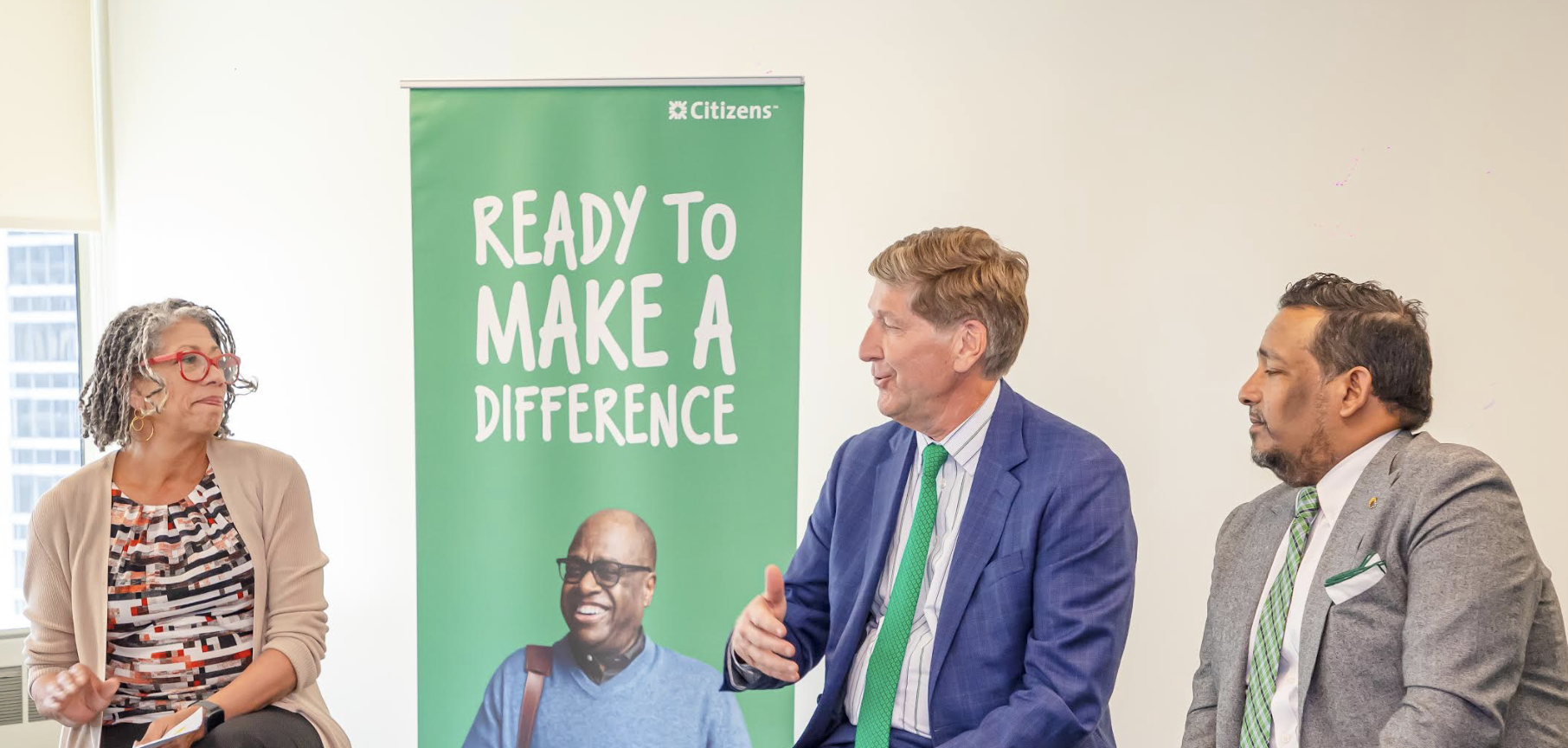
    Bruce Van Saun (center, blue jacket), chief executive of Citizens Financial Group, with Leslie Winder (left), a director of the nonprofit Urban Affairs Coalition of Philadelphia, and Arun Prabhakaran, coalition president and former chief of staff to Philadelphia District Attorney Larry Krasner, in March 2025.
    Was business hurt by trade and tariff costs, inflation, or the labor market slowdown?

    The very biggest companies have more diversification and more ability to withstand choppy waters. The smaller the business, the less diversified it is and the more impacted it is by exogenous factors.

    But most middle-market companies have had a successful year. They have come through the pandemic closings, the bout with high inflation, the higher interest rates, then the tariffs.

    Businesses had to become more adaptable and better at scenario planning, at predicting what events will do to their suppliers. Companies have sharpened how they manage real estate, digital technology, and now AI. And they locked in very attractive financing when rates were lower.

    What about the middle class, homebuyers, credit card borrowers?

    People lost a little purchasing power. People are eating out a little less. They are taking fewer trips.

    But we are not seeing a lot more loan delinquencies. Prices go up more than wages, but they are still saving for kids’ education and retirement. Maybe they are taking a home-equity line of credit.

    As economic growth stabilizes and inflation comes down, you’ll see wages increase and people get to a place where they feel better.

    Which sectors are improving?

    Tech-related, health-related show a lot of strength and resilience. Aerospace and the whole military defense sector, companies like Day & Zimmerman [which makes ammunition for the U.S. and clients such as Israel]. There are many wars going on; people need their armament. We’ve seen pretty dynamic strength last year.

    Transportation and logistics — road construction — is pretty strong.

    And data center construction. I hope Pennsylvania gets its share.

    Is Pennsylvania a good place for data centers? How do you overcome local opposition?

    There is a general NIMBY attitude: ‘I like to play on my phone and get the advantages of Microsoft Copilot and AI. Just don’t put a data center near me to use a lot of power.’ There’s controversy around that.

    But if you look at the investment and jobs that go with data centers — they need access to low-cost energy and water — then look at Pennsylvania with its natural gas and its nuclear plants like Three Mile Island. Data centers need low-cost energy and water. Pennsylvania has it.

    Will 2026 improve on last year?

    Our returns should continue to go up. Our net interest margin [the difference between what banks charge borrowers and what they pay depositors] widened last year, and we expect it will be up this year. And all our businesses are demonstrating loan growth.

    Whom do you lend to?

    We serve the middle market, from $25 million in revenues up to corporations with around $3 billion in yearly sales. PNC and Wells Fargo [are larger, but] we aren’t playing the game materially differently from what they offer. If a company wants to finance more, they go to maybe JPMorgan or Bank of America.

    We started building a private bank [focused on business owners and wealthy professionals] a couple of years back. Now we have $14 billion in deposits, $7 billion in loans, $10 billion in client investments, just in that unit. And growing faster than we projected, with more accretion to our bottom line.

    We help our clients become more successful: ‘Here’s an acquisition idea. Here’s a working-capital idea.’ That level of personalized attention has been a winning strategy for us.

    U.S. software start-ups, and biotech centers like Philadelphia, staggered a bit when the best-known tech banks failed in 2023. JPMorgan bought First Republic, but you hired a lot of their staff. How’s that going?

    What First Republic did really well for company founders was advice banking, wealth needs, family financial planning. And we invested heavily in technology to get to the service levels First Republic was famous for. We took on 150 of their people, teams of strong, highly regarded wealth managers, and added private bankers, to locate with our banking teams. That group is now 550 people.

    We went into areas where they were strong — Boston, New York, Palm Beach, and three areas of Northern California. We had to add teams in Southern California — San Diego, Orange County, and one in Los Angeles.

    But not Philly?

    Philly is high on the list of new markets we want to attack with that approach. There is a cadre of successful people here. We want to be known as the bank for successful people.

    Gov. Josh Shapiro talks about a Pennsylvania manufacturing revival. What signs do we see that’s happening?

    We are positioning ourselves for a lot of inbound investments. President Donald Trump is going to our allies in Japan and South Korea to invest and bring skilled jobs into our country to be more self-sufficient in manufacturing — in steel, in shipbuilding, for example. It all sounds good on paper. I think it will come.

    Why do car factories and other big manufacturers open down South, instead of in Pennsylvania?

    They find the states willing to take a fresh look at how much bureaucracy they have and cutting it back. You are competing with Texas, Virginia, the Carolinas, which are very successful at attracting industry. I don’t think Pennsylvania will want to miss out.

    What will it take to bring the World Series back to Philly, which increases fan and ad spending?

    We are hopeful the Phillies have a great offseason. I’m a little disappointed [Bo] Bichette went to the Mets. But, hey, they signed J.T. [Realmuto]. John [Middleton, the Phillies’ lead owner] is very committed to fielding a winning team. Go Phils!


  • CHOP launches Philly-area autism therapy network in partnership with Soar Autism Centers

    CHOP launches Philly-area autism therapy network in partnership with Soar Autism Centers

    The Children’s Hospital of Philadelphia and Denver-based Soar Autism Centers have opened in Newtown the first of five planned early childhood autism centers in the Philadelphia region and expect the network could grow to more than 30 centers, officials said.

    The 50-50 joint venture is designed to reduce wait times for therapy and to make it easier for families to access multiple types of therapy at one location while remaining connected to CHOP specialists.

    “It can take a year to get into therapy on a regular basis,“ an extremely long time in a young child’s neurological development, Soar cofounder and CEO Ian Goldstein said.

    Such wait times continue to frustrate families despite dramatic growth in the autism-services sector over the last 15 years or so, as states mandated insurance coverage and diagnosis rates soared with more awareness and an expanded definition of autism.

    Nationally, applied behavioral analysis, commonly known as ABA therapy, has become popular for autism treatment, increasing nationally by 270% between 2019 and 2024, according to Trilliant Health, a Nashville data analysis firm. The volume of services provided locally — where companies including ABA Centers, Helping Hands Family, and NeurAbilities Healthcare have expanded — was not available.

    The increase in diagnoses has outpaced the growth in available services, said Matthew Lerner, an autism expert at Drexel University, who is not involved with the newly launched CHOP-Soar Autism Centers.

    When Lerner moved to the Philadelphia region from Long Island in 2023 and started getting plugged into the autism network, a few clinicians here would ask if he could connect patients with services in New York.

    “I was coming from eastern Long Island, two hours east of New York City, and people were like, do you know anyone closer to you?” he recalled.

    CHOP’s road to a joint venture with Soar

    The freestanding, 10,000 square-foot clinic that opened on Jan. 5 in suburban Bucks County near CHOP Pediatric Primary Care Newtown has 35 to 40 rooms and an indoor playground for therapeutic uses.

    CHOP, among the largest children’s health systems in the country, has long been concerned about limited access to autism care in the region, said Steve Docimo, CHOP’s executive vice president for business development and strategy.

    The nonprofit has provided diagnostic services, but not the forms of therapy that the CHOP-Soar centers will offer. “The threshold to doing this on our own has always been high enough that it hasn’t been a pool that we’ve jumped in,” he said.

    CHOP was in talks with Soar for three years before agreeing to the 50-50 joint venture with the for-profit company. CHOP’s investment will be its share of the startup costs for CHOP-Soar locations.

    The partnership plan calls for five locations in the first two years. The partners did not say where the next four centers will be.

    Soar has 15 locations in the Denver area, which has about half the population of the Philadelphia region, Goldstein said.

    That comparison implies that the CHOP-Soar partnership could grow to 30 centers, Goldstein added. He thinks the region’s needs could support additional expansion, saying the total could reach “into the dozens.”

    The first CHOP-Soar Autism Center opened this month in Newtown. Shown here is the reception area.

    That’s assuming CHOP-Soar provides high quality care for kids, an appealing family experience, and a system of coordinated care: “There will be a need to do more than five, and I think we’re jointly motivated to do so,” Goldstein said.

    The CHOP-Soar approach

    Families seeking care for an autistic child typically have to go to different places to get all the types of therapy they need.

    Families “get behavioral analytics in one place, occupational therapy somewhere else, and speech language pathology in another place,” Docimo said.

    Soar brings all of that together in one center. “If it can be scaled, this will fill a gap in our region in a way that I think will work very well for these families,” he said.

    CHOP-Soar centers will emphasize early intervention and treat children through age six. “The brain has its greatest neuroplasticity” up to age 3, “so waiting a year is a really big deal,” Goldstein said. “You’re missing out on that opportunity to really influence the child’s developmental trajectory at a young age.”

    Some autism services providers focus on ABA therapy, which breaks social and self-care skills, for example, down into components and then works discretely on each.

    But Soar offers what Goldstein described as “integrated, coordinated care for the child.” That includes speech, occupational, and behavioral therapies.

    With CHOP, medical specialties, such as genetics, neurology, and gastrointestinal care, can be tied in as well, Goldstein said.

    It’s rare for autism providers to offer a wide variety of commonly needed services under one roof, said Lerner, who leads the A.J. Drexel Autism Institute’s Life Course Outcomes Research Program.

    He said Soar’s evidence-based, multidisciplinary approach has a lot to offer the region.

    “A person diagnosed with autism will have complex care needs throughout their life, and a one-size-fits-all, one-intervention approach will not work,” he said.

  • How some Philly-area workers make $100,000 without a bachelor’s degree

    How some Philly-area workers make $100,000 without a bachelor’s degree

    Can you make $100,000 a year in the Philadelphia area without a four-year college degree?

    Yes. But it’s not common.

    “There is no magic wand to get to a six-figure salary,” said Cynthia Figueroa, who leads workforce development nonprofit JEVS Human Services. “There’s a lot of steps that have to happen along the way.”

    Companies including IBM, Delta, and Google have dropped degree requirements in recent years. Locally, Pennsylvania Gov. Josh Shapiro slashed college degree requirements for most state jobs in 2023, and Mayor Cherelle L. Parker has advanced an effort to do the same for some city jobs. Meanwhile, more are pursuing vocational training, the Wall Street Journal reported, as some in Gen Z turn to the trades amid the rising cost of college.

    Data center technicians are increasingly in demand, don’t require a college degree, and can make a six-figure salary after some experience. And store managers at Walmart, who often don’t have college degrees, can make $128,000 before bonuses.

    But who actually makes $100,000 or more in the Philadelphia area without a four-year degree and what does that path look like? The Inquirer took a look at the data.

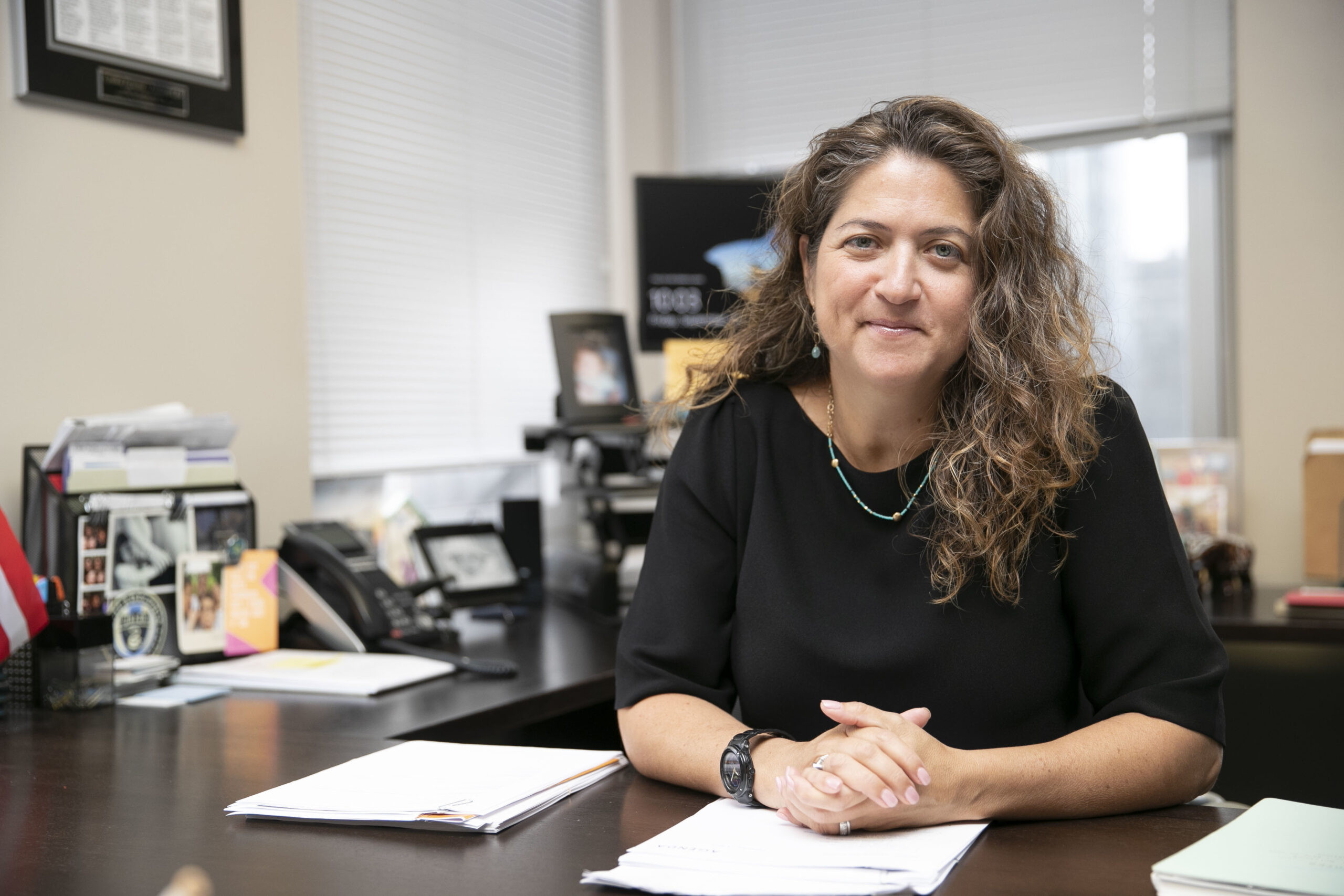
    Cynthia Figueroa poses for a portrait in Philadelphia in 2019. She is the CEO and president of JEVS Human Services.

    What industries pay $100,000-plus without a bachelor’s degree?

    Among the Philadelphia metro area’s 3.97 million workers, the vast majority who make a six-figure salary have at least a bachelor’s degree, according to Census data compiled by IPUMS USA at the University of Minnesota. The metropolitan area includes 11 counties in Pennsylvania, New Jersey, Delaware, and Maryland.

    Roughly 159,000 people made $100,000 or more without a four-year college degree in 2024, the data indicates. (That includes people with an associate’s degree.)

    window.addEventListener(“message”,function(a){if(void 0!==a.data[“datawrapper-height”]){var e=document.querySelectorAll(“iframe”);for(var t in a.data[“datawrapper-height”])for(var r,i=0;r=e[i];i++)if(r.contentWindow===a.source){var d=a.data[“datawrapper-height”][t]+”px”;r.style.height=d}}});

    “There is potential” for high earning without college, but it’s not typical, said Sean Vereen, president and CEO of career-focused education nonprofit Heights Philadelphia.

    “We know that not everybody wants to go to college, but particularly the way the economy in this region is constructed, that college degree still is very useful,” said Vereen.

    But the majority of the workforce in the Philadelphia metro area lacks a bachelor’s degree. Only about 7% of them reach the high-earning $100,000-plus bracket.

    It’s more common in jobs where salaries overall tend to be higher, such as management, business, and finance. About 51,000 Philly-area people in those jobs with less than a bachelor’s degree earned $100,000 or more in 2024.

    window.addEventListener(“message”,function(a){if(void 0!==a.data[“datawrapper-height”]){var e=document.querySelectorAll(“iframe”);for(var t in a.data[“datawrapper-height”])for(var r,i=0;r=e[i];i++)if(r.contentWindow===a.source){var d=a.data[“datawrapper-height”][t]+”px”;r.style.height=d}}});

    What industries are adding more $100,000 jobs?

    Still, more opportunities for people without a four-year degree could be on the horizon.

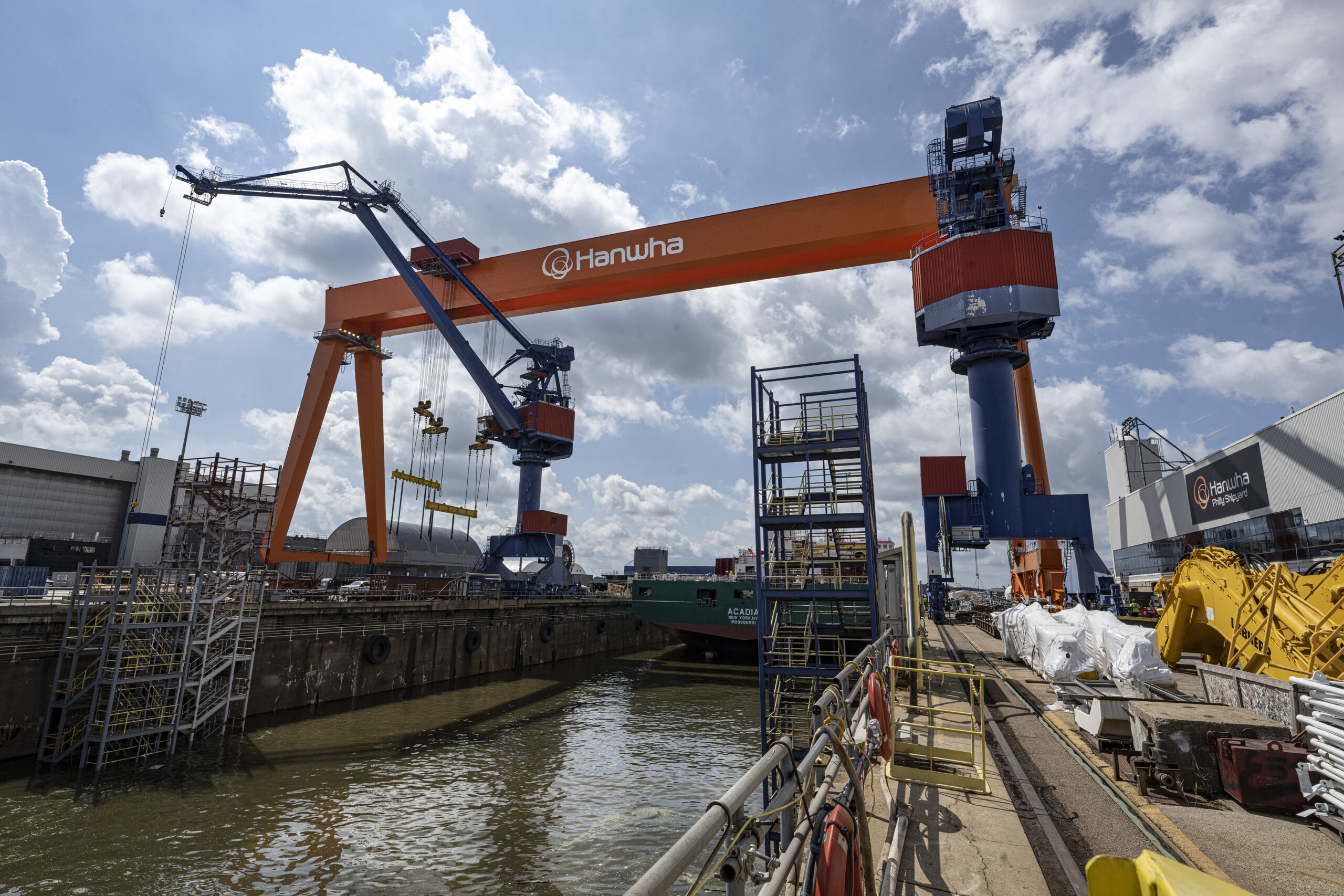
    Shipbuilding is having a resurgence in Philadelphia’s Navy Yard, and more electricians, carpenters, and welders will be needed, said Figueroa.

    Among Philadelphia construction workers, including carpenters and welders, more than 11,000 do not have a bachelor’s degree and make at least $100,000 annually.

    Hanwha plans to expand its shipbuilding operations in Philadelphia and will need to hire. That includes positions requiring considerable math skills, said Figueroa, of JEVS. The organization is currently figuring out how to get job-training graduates into opportunities.

    Philadelphia Works, the city’s workforce development board, is working closely with Hanwha, CEO and president H. Patrick Clancy said.

    “Our goal is to do more of the pre-apprenticeship,” Clancy said. “They have a lot of people interested in applying for their roles, but not all of them are passing the math and reading [requirements].”

    The newly repainted Goliath Crane is shown July 16, 2025, at the Hanwha Philly Shipyard in Philadelphia.

    Last year, a Brookings Institution report highlighted enterprise digital solutions (business software), specialized manufacturing (like producing parts for medical devices or industrial electronics), and biomedical commercialization (life sciences businesses) as areas where Philadelphia residents should be able to find good jobs. Many jobs in those sectors don’t require a college degree.

    “We need to be focused on creating the right kinds of jobs,” said Chellie Cameron, CEO and president of the Chamber of Commerce for Greater Philadelphia, which is now focusing on the areas Brookings identified.

    The right kinds of jobs, Cameron said, are not minimum-wage positions. They “start at a place where people can earn a family-sustaining wage and have access to pathways for promotion and making more money over the course of their career.”

    Paths and training for high-earning jobs

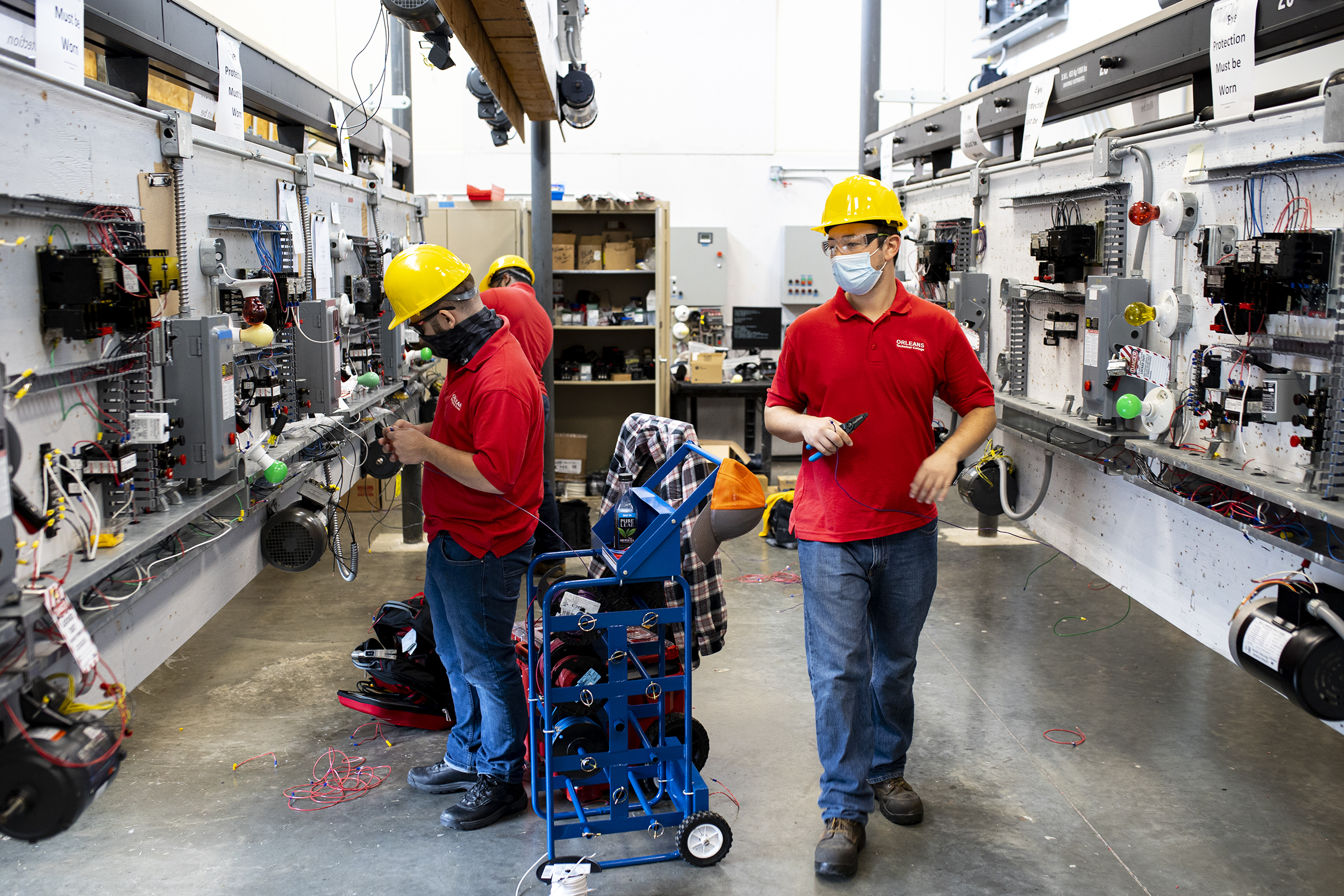
    Orleans Technical College in Northeast Philadelphia, run by JEVS, trains people for building trades and healthcare professions. It had 379 students last year. Tuition ranges from roughly $13,000 to $25,000, but most students get financial assistance and typically leave with $6,000 or less in debt.

    Residential and commercial electrician Dan Finke, 25, of Abington, (right), is learning about motor controls with fellow classmates at Orleans Technical College, in Northeast Philadelphia on a Friday in September 2020.

    “There’s still very much the physical application of running wire, bending metal,” said Figueroa, and many medical tasks seem to be AI-proof for now. “At the end of the day, you need somebody who is taking the blood pressure next to the bed, and who is drawing the blood.”

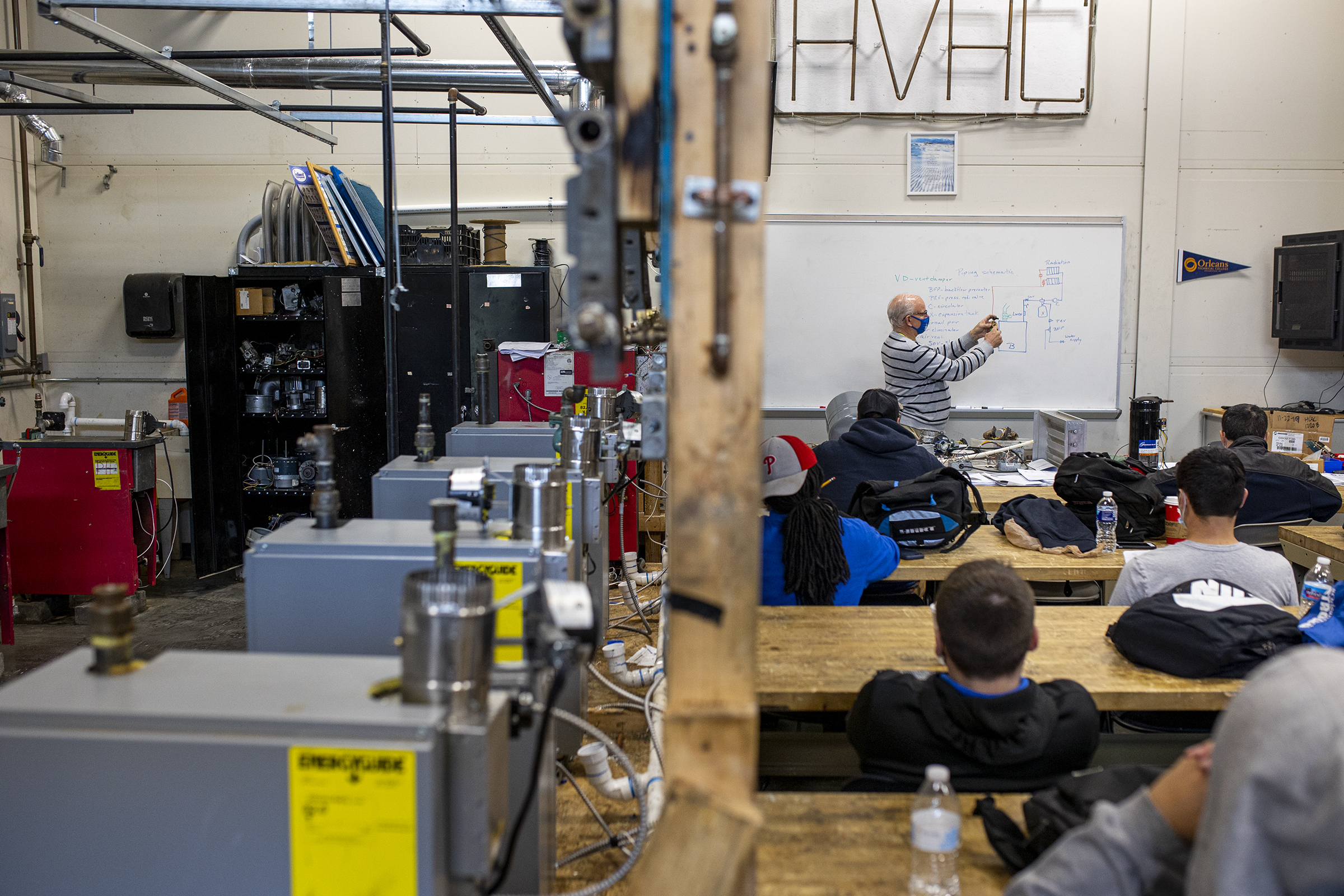
    Construction management and HVAC students can expect starting salaries around $75,000 and $60,000 respectively. Those who work overtime can make even more, Figueroa noted, and pay also increases over the course of a career.

    That’s not a six-figure salary on Day One, she acknowledged. But college graduates can make a similar amount in their first job, and “they have this enormous debt” from their schooling.

    Lou Abruzzese, HVAC Instructor, is teaching his class about hydronics at Orleans Technical College, in Northeast Philadelphia on Friday, Sept. 25, 2020.

    Orleans also offers healthcare training for clinical medical assistants and practical nursing. Starting salaries for those jobs are generally around $44,000 and $64,000 respectively.

    “Going from an hourly wage — at like a Target, McDonald’s, Walgreens, what have you — to salaried, hopefully with benefits, is a huge first step,” Figueroa said.

    Connecting people to employment also means addressing barriers like lacking a driver’s license, needing childcare, financial literacy, or housing support, says Clancy. Pursuing training might mean going without paid work for weeks or months, which can be a challenge. Philadelphia Works has some funds available to pay people during their training.

    Sean Vereen is the president and CEO of Heights Philadelphia.

    Young adults need to be aware of opportunities, too, said Vereen. For instance, he said, sterilization technician is a good job within a hospital, but young people may not know it’s a path available to them without going to college.

    And sometimes young people need to catch up before training for jobs in the trades, Vereen says. “We’ve heard things like, ‘The kid coming from the school district doesn’t have strong enough math skills to take the test for the building trades,’” he said.

    “You need basic academic skills that are about math and reading and reading comprehension,” he said. “We don’t get away from giving kids basic knowledge.”

  • How Americans are using AI at work, according to a new Gallup poll

    How Americans are using AI at work, according to a new Gallup poll

    American workers adopted artificial intelligence into their work lives at a remarkable pace over the past few years, according to a new poll.

    Some 12% of employed adults say they use AI daily in their job, according to a Gallup Workforce survey conducted this fall of more than 22,000 U.S. workers.

    The survey found roughly one-quarter say they use AI at least frequently, which is defined as at least a few times a week, and nearly half say they use it at least a few times a year. That compares with 21% who were using AI at least occasionally in 2023, when Gallup began asking the question, and points to the impact of the widespread commercial boom that ChatGPT sparked for generative AI tools that can write emails and computer code, summarize long documents, create images, or help answer questions.

    Home Depot store associate Gene Walinski is one of the employees embracing AI at work. The 70-year-old turns to an AI assistant on his personal phone roughly every hour on his shift so he can better answer questions about supplies that he is not “100% familiar with” at the store’s electrical department in New Smyrna Beach, Fla.

    “I think my job would suffer if I couldn’t because there would be a lot of shrugged shoulders and ‘I don’t know’ and customers don’t want to hear that,” Walinski said.

    AI at work for many in technology, finance, education

    While frequent AI use is on the rise with many employees, AI adoption remains higher among those working in technology-related fields.

    About 6 in 10 technology workers say they use AI frequently, and about 3 in 10 do so daily.

    The share of Americans working in the technology sector who say they use AI daily or regularly has grown significantly since 2023, but there are indications that AI adoption could be starting to plateau after an explosive increase between 2024 and 2025.

    In finance, another sector with high AI adoption, 28-year-old investment banker Andrea Tanzi said he uses AI tools every day to synthesize documents and data sets that would otherwise take him several hours to review.

    Tanzi, who works for Bank of America in New York, said he also makes uses of the bank’s internal AI chatbot, Erica, to help with administrative tasks.

    In addition, majorities of those working in professional services, at colleges or universities or in K-12 education, say they use AI at least a few times a year.

    Joyce Hatzidakis, 60, a high school art teacher in Riverside, Calif., started experimenting with AI chatbots to help “clean up” her communications with parents.

    “I can scribble out a note and not worry about what I say and then tell it what tone I want,” she said. “And then, when I reread it, if it’s not quite right, I can have it edited again. I’m definitely getting less parent complaints.”

    Another Gallup Workforce survey from last year found that about 6 in 10 employees using AI are relying on chatbots or virtual assistance when they turn to AI tools. About 4 in 10 AI users at work reported using AI to consolidate information or data, to generate ideas, or to learn new things.

    Hatzidakis started with ChatGPT and then switched to Google’s Gemini when the school district made that its official tool. She has even used it to help with recommendation letters because “there’s only so many ways to say a kid is really creative.”

    Benefits and drawbacks of AI adoption

    The AI industry and the U.S. government are heavily promoting AI adoption in workplaces and schools. More people and organizations will need to buy these tools in order to justify the huge amounts of investment into building and running energy-hungry AI computing systems. But not all economists agree on how much they will boost productivity or affect employment prospects.

    “Most of the workers that are most highly exposed to AI, who are most likely to have it disrupt their workflows, for good or for bad, have these characteristics that make them pretty adaptable,” said Sam Manning, a fellow at the Centre for the Governance of AI and co-author of new papers on AI job effects for the Brookings Institution and the National Bureau of Economic Research.

    Workers in those mostly computer-based jobs that involve a lot of AI usage “usually have higher levels of education, wider ranges of skill sets that can be applied to different jobs, and they also have higher savings, which is helpful for weathering an income shock if you lose your job,” Manning said.

    On the other hand, Manning’s research has identified some 6.1 million workers in the United States who are both heavily exposed to AI and less equipped to adapt. Many are in administrative and clerical work, about 86% are women, and they are older and concentrated in smaller cities, such as university towns or state capitals, with fewer options to shift careers.

    “If their skills are automated, they have less transferable skills to other jobs and they have a lower savings, if any savings,” Manning said. ”An income shock could be much more harmful or difficult to manage.”

    Few workers are concerned about AI replacing them

    A separate Gallup Workforce survey from 2025 found that even as AI use is increasing, few employees said it was “very” or “somewhat” likely that new technology, automation, robots, or AI will eliminate their job within the next five years. Half said it was “not at all likely,” but that has decreased from about 6 in 10 in 2023.

    Not worried about losing his job is the Rev. Michael Bingham, pastor of the Faith Community Methodist Church in Jacksonville, Fla.

    A chatbot fed him “gibberish” when he asked about the medieval theologian Anselm of Canterbury, and Bingham said he would never ask a “soulless” machine to help write his sermons, relying instead on “the power of God” to help guide him through ideas.

    “You don’t want a machine, you want a human being, to hold your hand if you’re dying,” Bingham said. “And you want to know that your loved one was able to hold the hand of a loving human being who cared for them.”

    Reported AI usage is less common in service-based sectors, such as retail, healthcare, or manufacturing.

    Home Depot did not ask Walinski to use AI when he got a job at the store last year, after a decades-long career in the car business. But the home improvement giant also did not try to stop him and he is “not at all worried” that AI will replace him.

    “The human interface part is really what a store like mine works on,” Walinski said. “It’s all about the people.”

  • Carney says Canada has no plans to pursue free trade agreement with China as Trump threatens tariffs

    Carney says Canada has no plans to pursue free trade agreement with China as Trump threatens tariffs

    TORONTO — Canadian Prime Minister Mark Carney said Sunday his country has no intention of pursuing a free trade deal with China. He was responding to U.S. President Donald Trump’s threat to impose a 100% tariff on goods imported from Canada if America’s northern neighbor went ahead with a trade deal with Beijing.

    Carney said his recent agreement with China merely cuts tariffs on a few sectors that were recently hit with the taxes.

    Trump claims otherwise, posting, “China is successfully and completely taking over the once Great Country of Canada. So sad to see it happen. I only hope they leave Ice Hockey alone! President DJT”

    The prime minister said under the free trade agreement with the U.S. and Mexico there are commitments not to pursue free trade agreements with nonmarket economies without prior notification.

    “We have no intention of doing that with China or any other nonmarket economy,” Carney said. “What we have done with China is to rectify some issues that developed in the last couple of years.”

    In 2024, Canada mirrored the United States by putting a 100% tariff on electric vehicles from Beijing and a 25% tariff on steel and aluminum. China had responded by imposing 100% import taxes on Canadian canola oil and meal and 25% on pork and seafood.

    Breaking with the United States this month during a visit to China, Carney cut its 100% tariff on Chinese electric cars in return for lower tariffs on those Canadian products.

    Carney has said there would be an initial annual cap of 49,000 vehicles on Chinese EV exports coming into Canada at a tariff rate of 6.1%, growing to about 70,000 over five years. He noted there was no cap before 2024. He also has said the initial cap on Chinese EV imports was about 3% of the 1.8 million vehicles sold in Canada annually and that, in exchange, China is expected to begin investing in the Canadian auto industry within three years.

    Trump posted a video Sunday in which the chief executive of the Canadian Vehicle Manufacturers’ Association warns there will be no Canadian auto industry without U.S. access, while noting the Canadian market alone is too small to justify large scale manufacturing from China.

    “A MUST WATCH. Canada is systematically destroying itself. The China deal is a disaster for them. Will go down as one of the worst deals, of any kind, in history. All their businesses are moving to the USA. I want to see Canada SURVIVE AND THRIVE! President DJT,” Trump posted on social media.

    Trump’s post on Saturday said that if Carney “thinks he is going to make Canada a ‘Drop Off Port’ for China to send goods and products into the United States, he is sorely mistaken.”

    “We can’t let Canada become an opening that the Chinese pour their cheap goods into the U.S,” U.S. Treasury Secretary Scott Bessent said on ABC’s This Week.

    “We have a (United States–Mexico–Canada Agreement), but based off — based on that, which is going to be renegotiated this summer, and I’m not sure what Prime Minister Carney is doing here, other than trying to virtue-signal to his globalist friends at Davos.”

    Trump’s threat came amid an escalating war of words with Carney as the Republican president’s push to acquire Greenland strained the NATO alliance.

    Carney has emerged as a leader of a movement for countries to find ways to link up and counter the U.S. under Trump. Speaking in Davos before Trump, Carney said, “Middle powers must act together because if you are not at the table, you are on the menu” and he warned about coercion by great powers — without mentioning Trump’s name. The prime minister received widespread praise and attention for his remarks, upstaging Trump at the World Economic Forum.

    Trump’s push to acquire Greenland has come after he has repeatedly needled Canada over its sovereignty and suggested it also be absorbed into the United States as a 51st state. He posted an altered image on social media this week showing a map of the United States that included Canada, Venezuela, Greenland and Cuba as part of its territory.

  • They’ve outsourced the worst parts of their jobs to tech. How you can do it, too.

    They’ve outsourced the worst parts of their jobs to tech. How you can do it, too.

    Artificial intelligence is supposed to make your work easier. But figuring out how to use it effectively can be a challenge.

    Over the past several years, AI models have continued to evolve, with plenty of tools for specific tasks such as note-taking, coding, and writing. Many workers spent last year experimenting with AI, applying various tools to see what actually worked. And as employers increasingly emphasize AI in their business, they’re also expecting workers to know how to use it.

    “I think 2025 was just a taste of what’s to come. Folks were figuring out how to deploy AI for productivity,” said Wade Foster, CEO of workflow automation platform Zapier.

    The number of people using AI for work is growing, according to a recent poll by Gallup. The percentage of U.S. employees who used AI for their jobs at least a few times a year hit 45% in the third quarter of last year, up five percentage points from the previous quarter. The top use cases for AI, according to the poll, was to consolidate information, generate ideas, and learn new things.

    The Washington Post spoke to workers to learn how they’re getting the best use out of AI. Here are five of their best tips. A caveat: AI may not be suitable for all workers, so be sure to follow your company’s policy.

    Automate your inbox

    Managing your email is a pain. And while email providers offer tools to help, AI can do even more, Foster said.

    Create an AI agent or use an AI app that can sort, organize, and prioritize your inbox based on simple commands. Think of it as creating a complex set of rules that automate which folders emails go to, how they’re labeled, and whether they’re marked as urgent. Instead of creating a rigid list of keywords or contacts, use natural language to identify topics or issues you need to track.

    AI can also automatically draft responses to specific types of emails you regularly get. For example, AI can draft a response directing people to the career website anytime someone asks about job openings, Foster said.

    “You can get pretty darn close to an automated inbox,” he said.

    To automate, you’ll need tools by services like Zapier, which offers limited free versions and premium options, or SaneBox and Superhuman, both of which have tiered pay options.

    Create a personal assistant

    AI can be particularly useful in getting you up to speed, prioritizing tasks, and tracking progress, several workers said.

    Helen Lee Kupp, cofounder and CEO of virtual community and nonprofit Women Defining AI, said she built an “AI chief of staff” at the beginning of the year to prioritize tasks. She speaks to Claude voice mode in the mornings, which then structures her day. To build it, she asked the bot to create an AI assistant and provided a list of parameters and attached work documents. She then edited the instructions and pasted it into a Claude Project, generating a customized bot she can reuse.

    “It’s really nice in the morning to be able to dump whatever’s on my brain and have a first draft of here’s how we think of priorities,” she said.

    Another option: Build a daily briefing agent that sends an email with a to-do list and important updates from your email and calendar, Foster said. To do this, make a custom GPT (you’ll need ChatGPT Plus, which costs $20 a month) by clicking “explore GPTs” on the sidebar and then “create.” To automate your briefing, connect ChatGPT to your email and calendar, but beware of security and privacy risks. Prompt it to email you every morning with specific details around the information you want, Foster said. You can also create a daily to-do app. You may need additional tools or a hosting service to do this, but ChatGPT can provide instructions.

    To avoid giving ChatGPT access to your accounts, manually upload your calendar, task list, or select communications and prompt it to prioritize from there.

    Build what you need

    To solve specific problems, several workers said they built custom apps and tools using chatbots and simple commands to generate code, a concept known as vibe coding. Michael Frank, co-founder and CEO of agentic AI risk platform Radiant Intel, said he’s used Claude Code and app builders like Google Antigravity to build an app that aggregates local news for him. But people can build apps to help them learn a new skill or provide feedback on their work to improve, he said. Think about your mistakes or time-intensive tasks and build something for that, he said.

    “These are not going to radically transform anyone’s life, but can it make you 5, 10, or 15% more productive? Absolutely,” he said.

    Lee Kupp said she’s used AI platform Gumloop, which has a limited free option and doesn’t require coding knowledge, to build an AI agent that monitors a Slack channel for website feedback and logs problems into a tracker. For Alexander K. Moore, assistant professor of marketing at the University of Illinois at Chicago, Replit and Claude Code helped him quickly build customized webpages to more efficiently conduct surveys.

    You can also build a customized dashboard on Claude to track sales, customer satisfaction, the performance of a product or feature, or other key metrics, said Jhalak Rawat, chief operating officer at manufacturing AI start-up Soff. Tell it to provide action items to improve them. Use the dashboard to help get your next promotion, she added.

    “It’s a good way to show the work you do,” she said. And “it takes one prompt, which takes 10 minutes to write.”

    Warm your cold intro

    Before pitching a new client or connecting with a new colleague or other professional contacts, use AI to find commonalities to break the ice, Rawat said.

    She uses Comet, Perplexity’s AI browser, to find commonalities between her and another person based on their LinkedIn profiles and information available on Google. She once was able to connect to the CEO of a company she wanted to target because Comet told her that he was a pizza lover who once led a pizza company — a detail buried in a podcast. That tasty tidbit provided a way to warm her cold intro. This can also help when people are trying to meet new contacts for a career switch.

    Enhance your meeting notes

    Meeting notes and transcriptions from video meeting providers usually fall by the wayside, several workers said. But they’re more likely to refer to their notes if they actually take them.

    So they use Granola, an AI-powered notepad that enriches meeting notes without an AI bot showing up as a participant (there’s an option to notify others it’s in use). It transcribes the meeting and follows the structure of your notes, adding detail and action items. You can even write notes before the meeting or ask questions about a meeting or explore trends within your meetings. Foster said he’s used it to identify topics for social media posts within his conversations. Granola can also coach people, he said.

    “People take it as face value,” he said. “With AI, it has a neutrality to it.”

    One bonus tip: Make your AI chatbots less sycophantic, which Moore says results in straightforward feedback. In ChatGPT, go to personalization options by clicking your name in the lower left corner of the screen. In the “custom instructions” and “more about you” sections, emphasize accuracy, clear reasoning, and explanation over flattery, praise, and agreeing with you. Tell it to push back and be blunt. Moore offers a sample prompt on his Substack post, “Tell me the truth! or How to get your AI to stop telling you what you want to hear.”

    The toughest part about learning how to effectively use AI at work is starting, workers said. But once you get going, it gets easier.

    “Don’t overthink it,” Lee Kupp said. “Pick one [large language model] and get started.”

  • These prophets of economic doom are worried about another collapse

    These prophets of economic doom are worried about another collapse

    Dean Baker has earned a reputation for predicting economic catastrophe, and he tries to follow his own advice.

    After the economist warned of a stock bubble in the late 1990s, he rebalanced his investments to reduce exposure to the market. Several years later, he became concerned that soaring home values would fall to earth, so he and his wife sold their condo in Washington.

    He was right both times: The dot-com bubble burst in March 2000, and D.C.-area home prices crested in 2006 before slumping toward the depths of the Great Recession in 2009.

    Now Baker, who’s a distinguished senior fellow at the Center for Economic and Policy Research, has that foreboding feeling again.

    Investment in artificial intelligence has propelled the stock market to record highs, but he’s shifting his investments to be less exposed to what he considers to be an AI bubble edging closer to popping. “I don’t make a point of coming up with a negative forecast,” he said. “I just try to have open eyes on the economy, and sometimes I see something that other people don’t.”

    Baker is among a select group of people with track records of foreseeing major economic train wrecks. These proven prophets of doom are winning attention in online posts and media interviews, as more people begin to wonder if the AI boom is too good to be true. That’s giving economic groundhogs like Baker a chance to spread their market wisdom more widely or actively cultivate big new audiences.

    Michael Burry, whose mid-2000s bet against the housing market inspired Michael Lewis’ 2010 book, The Big Short, triggered headlines across financial news outlets in November when his hedge fund Scion Asset Management disclosed it was betting that the stock prices of AI darlings Nvidia and Palantir will fall significantly over the next few years.

    The same month, Burry, who didn’t respond to a request for an interview, started a Substack newsletter that often predicts an AI-catalyzed market implosion. It has more than 195,000 subscribers and is called Cassandra Unchained, after the princess of Greek myth cursed to foresee the future but to always be ignored.

    “OpenAI is the next Netscape, doomed and hemorrhaging cash,” Burry wrote in a post on X last month that was viewed more than 2 million times, likening the maker of ChatGPT to a casualty of the dot-com bubble. (The Washington Post has a content partnership with OpenAI.)

    Although voices of caution are having a moment, that doesn’t mean they’re winning the argument. James Chanos, the founder and managing partner of Kynikos Associates, who bet on the fall of energy giant Enron, said in an interview that market contrarians are often disregarded.

    Short-sellers like himself are often viewed “as the village idiots or Dr. Evil,” he said, either wrongheaded or trying to manipulate the market. “There’s kind of no in-between,” said Chanos, who prefers to see himself and others as “financial detectives” hunting for bad actors, fraud or froth that should be cleared away.

    A 2025 Harvard and Copenhagen Business School study of the beliefs of market experts during periods of boom and bust suggests that questioning market optimism is a good idea. “Optimism portends crashes: the most bullish forecasts predict the highest crash risk,” the authors found. In most cases, the authors said, “optimism remained unchecked until well after the crash.”

    Other economists have identified key factors that indicate a crisis could be around the corner. A 2020 study of postwar financial crashes around the world by economists at Harvard, the National Bureau of Economic Research, and the Copenhagen Business School found that “crises are substantially predictable.” When credit and asset prices grow rapidly in the same sector — conditions the researchers term a “red zone” — there was a probability of about 40% of a financial crisis starting in the next three years, they concluded.

    A tech-fueled surge in share prices over recent years has driven the total value of the stock market to far outweigh U.S. economic input, an imbalance that has come before previous downturns. But a report issued Jan. 9 by Goldman Sachs Research said many features of past bubbles are absent.

    Corporate debt is relatively low in historical terms, and most of the S&P 500’s 18% returns last year came from increased profits, not investors marking up valuations, the report said. Double-digit earnings growth is “providing the fundamental base for a continued bull market,” wrote Ben Snider, chief U.S. equity strategist. The report forecast that U.S. stocks would continue to grow in value this year.

    When Andrew Odlyzko — an emeritus professor of mathematics at the University of Minnesota who has studied economic bubbles and has a history of recognizing warning signs before a crash — started getting calls from journalists asking about a potential AI bubble in 2024, he dismissed the idea. At the time he reasoned it wouldn’t be systemically devastating if a big company like Google, Microsoft, or Meta made an expensive technological bet that flopped.

    But things have changed in the past year and a half, Odlyzko said. “Now the investments are exceeding the capacity of these platform companies to finance them out of their cash flow, and they are drawing in other sectors of the economy,” he said.

    He pointed to Meta’s recent deal to develop a $30 billion data center project in Louisiana, in which the project’s debt is held in a separate entity off Meta’s books. Such deals remind Odlyzko of the creative financing that led to the Great Recession in 2007.

    “If — or more precisely, I’m pretty confident when — things collapse, the spillover effects will be much more substantial, much more deadly,” he said.

    Today’s rush to build AI data centers also reminds Odlyzko of the 19th-century railway mania in Britain, a bubble of speculation on new railroad infrastructure. Both frenzies are creating “big infrastructure … that’s actually drawing on other parts of the economy,” he said.

    Chanos makes comparisons between today’s AI fever and the 1990s tech boom, as both bull markets have centered on big ideas: AI today and the internet’s beginnings decades ago. In the short term, many early internet businesses cratered, even though the technology worked out in the longer term.

    Artificial-intelligence technology “is real and probably will be very important, but lots and lots of companies that claim they’re a great business … are probably not going to be great businesses,” Chanos said.

    What’s different is that it’s now much easier for retail investors to jump into the stock market with the rise of stock-trading apps like Robinhood. Chanos said he’s “seeing more and more speculation in terms of retail investors who only know markets that generally go up, and if they go down, they go down for just a short period of time.”

    Baker is one of those retail investors who’s preparing for the worst, as he has before — although he hasn’t always had perfect timing. He pulled back his portfolio a couple of years before the dot-com bubble burst in March 2000 and sold his D.C. condo in 2004, about two years before home prices started falling in the region.

    Although discussion about predicting market slumps often frames the events as bad, Baker thinks an AI crash could do the U.S. some good.

    A slump could lead to a reallocation of resources in the economy, perhaps toward other sectors like manufacturing or healthcare, he said. “There’s all sorts of things you could better use those resources for if the AI really doesn’t make sense,” Baker said.

  • A bigger, more electric Philly Auto Show follows a volatile year for the industry

    A bigger, more electric Philly Auto Show follows a volatile year for the industry

    Volatility. Tariffs. EV rebates. Affordability.

    These are the buzzwords surrounding the automobile industry as 2025 gives way to 2026. But you probably won’t hear too much about them at the 2026 Philly Auto Show, where beginning Saturday the Auto Dealers Association of Greater Philadelphia shines up the best and lets thousands of visitors check everything out, with only the pressure of other visitors waiting for their turn.

    Show enthusiasts who’ve been missing the big events from pre-pandemic days will have a reason to smile. The show will cover almost 700,000 square feet, five more brands are joining in at the Pennsylvania Convention Center, and the electric vehicle ride program will have doubled.

    “It’s wonderful to be able to fill the building again,” said Mike Gempp, executive director of the dealers association, which puts on the show. “You gotta wear comfortable shoes, for sure.”

    The added nameplates you’ll see will be Genesis, Lincoln, Lucid, Polestar, and Volvo. This allows the footprint to grow quite a bit since all of last year’s makes are back, making the largest number (27) since 2020.

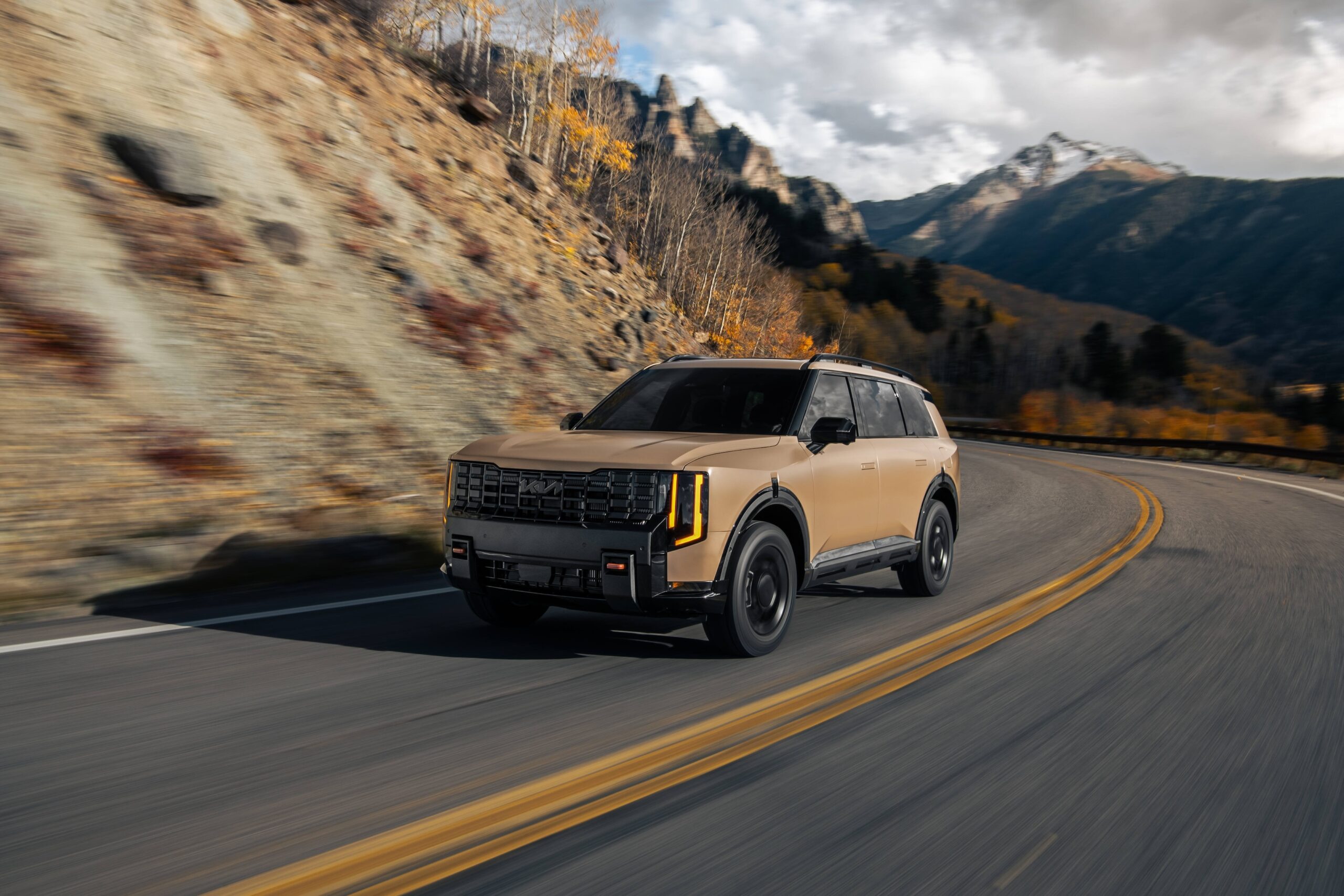
    The redesigned 2027 Kia Telluride three-row SUV is one of the main attractions among new vehicles at the 2026 Philly Auto Show.

    The latest vehicles are the main draw, of course. Some that are attracting interested buyers, Gempp says, are: the redesigned 2026 Subaru Outback SUV; the reborn 2026 Honda Prelude Hybrid sports coupe, last seen long before hybrids were a big thing, in 2001; the redesigned Ford Maverick hybrid small pickup; and the 2027 Kia Telluride.

    Other attention-getting vehicles expected at the show include the Chevrolet Corvette, Ineos Grenadier, Jeep Recon, Lotus Emira, McLaren 750S, and Subaru BRZ tS.

    Coming off a steady rise in sales — up 3.3% in the nation and 1.2% in the region, Gempp said — the industry has been fighting tariff and EV rebate uncertainty since the Trump administration took office. But just over 16.3 million vehicles were sold in 2025, according to Cox Automotive, the highest number since the pandemic arrived.

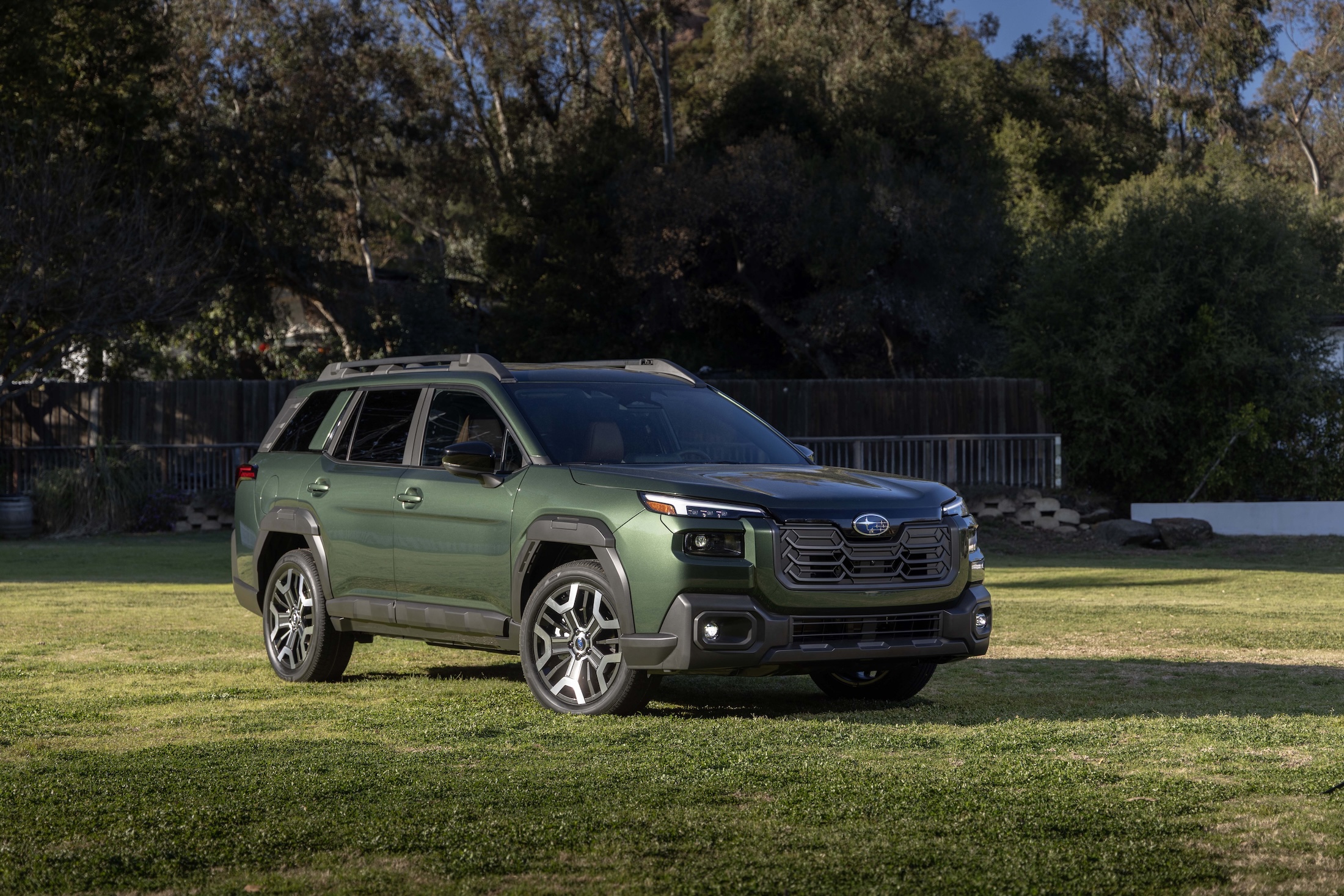
    The Subaru Outback has become an iconic SUV in the United States. The redesigned 2026 model will be on display at the Philly Auto Show Saturday, Jan. 31, through Sunday, Feb. 8.

    EVs: The future and the present

    Despite the end of rebates, electric vehicles may still be an attractive proposition in 2026. Manufacturers have new EV models coming to market, Cox Automotive executive analyst Erin Keating said, and without rebates to lower the prices, dealers will have to make them attractive to consumers.

    “I really wouldn’t count EVs out,” Keating said, especially as more are coming to the used market.

    EVs will figure into the show heavily. The indoor E-Track allowing visitors to ride in 20 different kinds of EVs is doubled in size and now features eight brands: Cadillac, GMC, Lucid, Kia, Polestar, Tesla, Toyota, and Volvo.

    But the E-Track is not all EVs, as there will be plug-in hybrids to ride in as well, like the Kia Sportage, Toyota RAV4 and Prius, and Volvo XC60.

    Gempp sees the E-Track as a chance to teach visitors about the different kinds of powertrains available in modern vehicles.

    Now that EVs are not as big a focus for manufacturers, Gempp sees technological innovations as a major area of industry attention. He points to the Lincoln Nautilus, with a 48-inch screen running pretty much the width of the entire dashboard.

    The Lincoln Nautilus shows how far screens have come in modern vehicles, with a 48-inch touchscreen spanning the dashboard. It will be on display at the 2026 Philly Auto Show, now that Lincoln is back at the show.

    Switch to hybrids

    Gempp sees hybrids drawing renewed attention from manufacturers. There’s no plugging in these models, just electric motors and batteries that supplement the engine, taking advantage of braking energy and adding that back into the power supply, saving fuel in the process.

    “The manufacturers are refocusing on hybrids, and pulling away from concentration on EVs that we saw in the last few years because the incentives have gone away, because the penalties for carbon credits have gone away, there’s very little incentive for manufacturers to introduce or sell EVs” said Sam Fiorani, vice president of global vehicle forecasting for AutoForecast Solutions in Chester Springs.

    All that refocusing is needed as the industry outlook grows cloudy. With tariffs and subsequent price adjustments, along with general economic uncertainty, Keating expects sales to fall to 15.8 million, while Fiorani is a little more optimistic that they’ll be just under 16.2 million.

    Affordability remains as the final question mark.

    “The biggest thing weighing down the economy going forward is how tariffs of ’25 will affect pricing in ’26,” Fiorani said. “We’ve already seen the manufacturers of all products absorb these costs as much as they can so we’re going to start seeing some of these costs being pushed onto the consumer.”

    Show events

    But we can take our minds off all that at the auto show, enjoying some of the exhibits that take the event beyond sitting inside stationary vehicles.

    Here are some of the other attractions planned:

    Camp Jeep will be back

    The lines are generally long at the 30,000-square-foot space, where visitors can ride in a Jeep Wrangler Unlimited, Grand Cherokee Trailhawk, Grand Cherokee L, Compass, or Gladiator over a track that adds a breakover log crawl and a 25-degree wedge to an 18-foot mobile hill and stair climber. Nearby, Kiddie Camp Jeep will give future customers a chance to maneuver mini Jeep ride-on toys.

    Stellantis will host outdoor drive events

    Unlike the indoor tracks, here licensed drivers 18 and up are able to choose from 10 Stellantis vehicles to test drive around Philly: Alfa Romeo Giulia and Tonale PHEV, Dodge Durango SRT, Ram 1500 and 2500, Chrysler Pacifica, FIAT 500e, and Jeep Wrangler, Gladiator, and Grand Cherokee.

    The Antique Automobile Club of America display at the 2023 Auto Show at the Pennsylvania Convention Center.

    Unusual autos and antique cars draw fans

    Exotics Row will feature the kinds of cars most of us only dream about, and classics displays from Antique Automobile Club of America and Delaware Valley Triumphs bring back memories of what neighborhood streets once looked like.

    Buick will showcase the first-ever concept vehicle, the Y Job, built in 1938. It premiered plenty of groundbreaking features, like a power convertible top, power door locks, automatic transmission, and retractable headlights.

    Heroes Highway is added this year

    In this new area, meant to celebrate first responders, kids of all ages can enjoy an interactive display of police, fire, and rescue vehicles. Qualified first responders will be able to enter the show for free on Feb. 6.

    A big year for Philly history

    Route ’26 showcases the events surrounding Philadelphia and American history, marking the 250th anniversary of the signing of the Declaration of Independence. Events on display include Wawa Welcome America, the 2026 MLB All-Star Game and All-Star Week festivities, and TED Democracy: Founding Futures at the Kimmel Center for the Performing Arts.

  • This company says it has produced the holy grail of batteries

    This company says it has produced the holy grail of batteries

    If you can believe the ambitious claims in a slickly produced video released Jan. 4 ahead of the CES technology show in Las Vegas, a battery revolution is coming this year that could upend the EV market and eventually usher in a new era of fast-charging, long-range cars and trucks.

    The high-end electric motorcycle maker Verge Motorcycles and its spin-off motor company Donut Lab say they’re selling the world’s first EV powered by a “solid-state” battery — a much-hyped, long-promised type of battery that packs more power than standard cells, if companies could figure out how to design and mass-produce it.

    But Verge and Donut Lab have offered no evidence and few details about their battery claims. The proof, they say, will come when customers start to receive the $30,000 electric motorcycles they are selling now and plan to deliver by the end of March. Scientists are skeptical, and the controversy illustrates the long and troubled history of companies that have tried — and so far failed — to develop a technology sometimes lauded as the holy grail of batteries.

    Solid-state batteries are similar to the standard lithium-ion batteries found in phones, laptops, and electric cars, but they replace liquid electrolytes with solid materials that, theoretically, could allow them to store more energy, charge faster, and last longer, while lowering their fire risk. Researchers have struggled to develop solid-state batteries that combine all these benefits and work consistently in the real world. Even if they succeeded, companies would have to spend years and billions of dollars overhauling battery factories to mass-produce solid cells instead of batteries that use liquid electrolytes.

    Global car companies including Toyota, Nissan, and Hyundai have promised to release long-range EVs with solid-state batteries for years — but they’ve pushed back their release dates so many times that it has become a joke in the auto industry. Battery giants including Samsung, Panasonic, and CATL, and well-funded solid-state start-ups such as QuantumScape and Solid Power, are also working on the technology, targeting mass production in the next few years and churning out a steady stream of patents and peer-reviewed papers.

    Donut Lab, a Finnish start-up with fewer than 100 employees that announced its existence 14 months ago, says it has beaten its rivals with an “all-solid-state battery” that CEO Marko Lehtimäki says makes no trade-offs whatsoever: It stores about twice as much energy per pound as a typical EV battery, charges from zero to 100% in five minutes, can last 100,000 charge cycles, loses almost no capacity in the bitter cold of minus 22 degrees or the boiling heat of 212 degrees, uses no rare or “geopolitically constrained” materials, and is cheaper than standard lithium-ion cells.

    The start-up has raised nearly $60 million from investors like Risto Siilasmaa, the former chairman of Finnish cell phone giant Nokia, who now sits on Donut Lab’s board of directors.

    “Extraordinary claims require extraordinary evidence,” said Paul Braun, a professor and director of the Materials Research Laboratory at the University of Illinois at Urbana-Champaign. “While no laws of physics appear to be broken, I need to see a lot more data before I am convinced the battery technology is real.”

    Kelsey Hatzell, an associate professor at Princeton University who heads a materials science lab that works on solid-state batteries, said the no-downside combination of properties Donut Lab has promised “sounds impossible.” She added that if the cells could be mass-produced in Finland, where Lehtimäki said they’re starting to be built, “that would be shocking to me.”

    Lehtimäki declined to reveal any data or details about the battery, arguing that Donut Lab needs to protect its trade secrets. But, he said, manufacturers have been testing his batteries under nondisclosure agreements, and outside groups he declined to name would validate his claims in the coming weeks.

    In the meantime, Verge is taking orders in the United States and Europe for an electric motorcycle that starts at $29,900 and promises to charge from zero to 80% in under 10 minutes and travel over 200 miles on a single charge thanks to its new solid-state battery. It’s an overhauled version of the company’s TS Pro motorcycle, whose previous battery had the same range and price but weighed more and charged in 35 minutes. A new long-range version starts at $34,900 and promises to travel 370 miles on a single charge.

    The standard TS Pro has been on the market since 2022. It holds a Guinness World Record for the longest electric motorcycle trip on a single charge, reaching 193 miles on a loop around London last year. The promised improvements in the overhauled TS Pro are plausible, according to Braun, but don’t require solid-state batteries.

    “It might be hard, however, everything stated (except cost) could be done with high-end conventional cells,” he said in an email.

    Whether or not Verge and Donut Lab deliver, scientists and companies will continue to study solid-state batteries.

    “There’s a real need for energy-dense solid-state batteries,” Hatzell said. “I do think they’re going to exist one day, and there’s been significant progress in the last decade.”

    She envisions solid-state batteries being used in flying drones, autonomous robots, and other products for which consumers might be willing to pay more to pack as much energy into as little battery weight as possible.

    Niche, high-performance electric motorcycles also make sense as an early use for solid-state batteries, according to Braun. Eventually, they could take over the luxury EV market, or even the mass market for electric cars and trucks — but they may never get cheap enough or good enough to knock out standard lithium-ion batteries, Braun said.

    “Regular batteries are getting better,” he said. “Maybe solid-state costs never quite get down there, and so they’re only [used] at the highest performance regime.”

    But Lehtimäki, like many battery entrepreneurs before him, insists the solid-state revolution is nigh.

    “We would be just stupid to go and say some lies in front of the whole world where, in a matter of weeks, people will be opening these battery packs and scanning these cells,” he said in a phone interview with The Post. “We don’t need to go and scam people. … Every single thing I said in the video is not an exaggeration of any kind. It’s fact, and people will be shocked.”

  • New grocery stores are coming to Chester County. Here’s what and where.

    New grocery stores are coming to Chester County. Here’s what and where.

    From national chains to homegrown operations, as Chester County continues to grow, so too do the grocery store offerings.

    Here’s a look at some of the stores opening around the county.

    Kimberton Whole Foods expanding

    This spring, locally owned Kimberton Whole Foods will open its largest location in the county in Eagleview Town Center. Construction began in 2024, roughly 20 years after the location in Kimberton Village opened at a former hardware store.

    “We look forward to serving Eagleview and the surrounding communities with healthy, locally sourced grocery options in a customer-focused environment,” Ezra Brett, chief operations officer for Kimberton Whole Foods, said in a statement.

    The new 14,000-square-foot facility will continue the store’s offerings of organic produce, grass-fed meats, specialty cheese, grab-and-go meals, and more.

    The store will join the growing Eagleview Town Center, which offers restaurants, salons and spas, professional offices, daycares, and more.

    West Chester Cooperative slated for opening

    West Chester is slated to get a brick-and-mortar member-owned grocery this year, with West Chester Cooperative at 204 W. Market St.

    Permits were submitted to the borough in December, according to the grocery’s website.

    The cooperative kicked off more than a decade ago, formed by a group of borough residents who wanted sustainable, local alternatives to chain grocery stores.

    Over the next 10 years, the group launched outreach efforts, opened a pop-up market, and did curbside pickup and limited in-store shopping hours. In 2022, it reached 500 member-owners.

    The grocery will be open to all shoppers, but member-owners will receive select benefits.

    Kennett Square is also getting its own cooperative grocery store

    West Chester isn’t the only municipality in Chesco getting a different model of grocery store. Also nearly a decade in the works, Kennett Square’s Kennett Community Grocer is expected to open this spring at 625 E. Cypress St.

    Renovations began in 2025, and the store will offer locally grown produce; dairy, eggs, and meat from county farms; local baked goods and prepared foods; pantry staples from local producers; and a cafe for community members. It will also hold educational and other events led by healthcare professionals and farmers.

    “It felt like doing this was to highlight for everyone that we have this precious land that’s quite beautiful, that is very bountiful with products, not just mushrooms, but meat, dairy, produce, fruit, vegetables,” said Edie Burkey, president of the nonprofit board leading the grocer. “We felt that bringing people together for the common cause of supporting the land that we’re very, very proud to be part of was a good thing.”

    Farmers will get a free cup of coffee at the cafe, which will sell locally roasted coffee, and local teas and honey. The store hopes to partner with the high school’s culinary students for an internship program. Products that don’t sell will be donated to organizations like Philabundance’s Mighty Writers, Children’s Advocacy Centers of Pennsylvania, and others, Burkey said.

    “We all eat, and to create a community around eating — things that are grown around here — and protecting the land so that maybe farmers don’t sell their land to developers, you’re just creating a sense of community in and around an activity that is so vital to every part of your day, every day of the year,” Burkey said.

    Other national chains coming to the county

    Meanwhile, bigger chains are also looking to call the county home. Phoenixville could see two national stores coming in the coming months.

    Construction for an Aldi, an international discount supermarket, began over the summer at 297 Schuylkill Road.

    Meanwhile, Sprouts Farmers Market, the Arizona-based organic and natural grocery store, is also eyeing a location in Phoenixville. Most of the grocer’s local footprint is within Philadelphia, but a Phoenixville location would broaden the store’s reach further west.

    The Phoenixville location is proposed at 808 Valley Forge Road, where the former Royal Bank used to sit. It would operate 7 a.m. to 10 p.m. daily, next to an indoor self-storage facility.