Category: Business

Business news and market updates

  • Trump’s newest tariffs could face legal challenge, though time is short

    Trump’s newest tariffs could face legal challenge, though time is short

    President Donald Trump’s new tariffs are not legally justified, according to several prominent economists and trade experts, who say there is no sign of the profound international financial problems that such measures were intended to remedy.

    Hours after the Supreme Court invalidated the emergency tariffs that he imposed last year, Trump on Friday invoked a 1974 law to announce a new 10% global import tax, later raising it to 15%. The president cited a provision known as Section 122 that authorizes temporary restrictions on imports to deal with “fundamental international payments problems.”

    In an official proclamation, the president said the nation’s “balance of payments,” a comprehensive account of Americans’ financial transactions with foreigners, was suffering “a large and serious deficit.” And he listed a number of metrics reflecting a deteriorating U.S. financial posture.

    The law does not define “balance-of-payments deficit,” and economists disagree about what should be included in the term. But several critics, including the International Monetary Fund’s former chief economist and a prominent conservative legal commentator, disputed the president’s claim. Trump wrongly conflated an alleged payments deficit with the merchandise trade deficit that he targeted last year with his first set of comprehensive tariffs under the International Emergency Economic Powers Act (IEEPA), they said.

    “The U.S. does not have a ‘payments’ problem. It can finance its trade deficits,” Gita Gopinath, the former IMF official, now teaching at Harvard University, wrote on X.

    Added Andrew McCarthy, a former federal prosecutor, writing in the conservative National Review: “These new tariffs are even more clearly illegal than Trump’s IEEPA tariffs.”

    Opposition to the new import taxes erupted even before they took effect at 12:01 a.m. on Tuesday. The outcry suggested that the president, still smarting from his 6-3 Supreme Court defeat, could face renewed legal jeopardy over the centerpiece of his economic agenda.

    “I do anticipate a lawsuit,” said Scott Lincicome, vice president of general economics for the Cato Institute and a former trade lawyer.

    U.S. importers would have the right to sue once they paid the tariffs. Liberty Justice Center, the nonprofit public-interest law firm that represented several small businesses in one of the tariff cases decided by the Supreme Court, said Monday that it is “closely monitoring” the president’s latest actions.

    “We will ensure that whatever authority the executive branch relies on, it follows the rules Congress actually wrote and the constitutional guardrails that protect our system of separated powers,” said Sara Albrecht, the center’s chairman.

    The debate over the Section 122 levies shows that questions of law and economics will continue to dog Trump’s bid to remake the global trading system. This time, there is no question that Congress has delegated to the president the power to levy tariffs — only under what circumstances. At issue are complex definitional questions of international economics and the legislative intent behind the wording of an untested provision in U.S. trade law.

    Time may also be a factor. The Section 122 tariffs expire after 150 days unless Congress votes to extend them, which is unlikely.

    Judges might be reluctant to “second guess” the president’s judgment on whether a balance-of-payments problem exists, said John Veroneau, a lawyer who served as deputy U.S. trade representative under President George W. Bush.

    Still, the administration’s newfound reliance upon Section 122 reverses the legal arguments it made last year. Defending the president’s emergency tariffs, Justice Department attorneys told an appeals court that Section 122 did not apply to Trump’s trade deficit concerns, which were “conceptually distinct from balance-of-payments deficits.”

    The White House declined to elaborate on the president’s Feb. 20 proclamation and fact sheet, which blamed a loss of domestic manufacturing for an excessive number of dollars leaving the country. Problems with the nation’s balance of payments can “endanger the ability of the United States to finance its spending, erode investor confidence in the economy, and distress the financial markets,” the proclamation said.

    Congress passed the Trade Act of 1974 when the United States was dealing with a distinctly different set of economic issues. In 1971, President Richard M. Nixon abruptly ended the convertibility of dollars into gold, marking the end of the Bretton Woods system of fixed exchange rates.

    At the time, foreign central banks were rushing to trade their unwanted dollars for gold, threatening to deplete U.S. financial reserves.

    There’s no sign of that sort of crisis today. The dollar has dropped about 10% over the past year, but it remains above its level for most of the decade leading to 2015. There’s certainly no sign of the “imminent and significant depreciation” that Section 122 requires.

    But even some Democrats say the administration is reacting to worrisome financial ailments.

    Economist Brad Setser, who served in the Treasury Department under President Barack Obama, said the global economy is characterized by dangerous imbalances.

    For years, the U.S. has run a deficit in its current account, the broadest measure of the nation’s trade balance, while China has run a mirror-image surplus. To keep running a large trade deficit, the U.S. must attract financing from abroad. So far, it’s been able to do that, which is why many analysts do not share the administration’s urgency.

    But the nation’s net international investment position — which balances the value of foreign stocks and bonds owned by Americans against what foreigners own in this country — is also deteriorating. That figure reached negative $26.7 trillion last year, down sharply in recent years.

    Some of that decline reflects foreigners’ large purchases of U.S. stocks, which have outperformed other markets, and thus is not a problem, Setser said. But the deterioration in the investment account also stems from the growth in the U.S. external debt, which carries a rising interest burden.

    “At this level of the current account [deficit], U.S. external debt will tend to rise. The external position will tend to weaken, which is one definition of a balance-of-payments problem,” he said. “The debt position does worry me.”


  • Food companies simply can’t get enough of the word ‘simply’

    Food companies simply can’t get enough of the word ‘simply’

    Food companies are trying to keep it simple.

    Simply was the hottest word at an annual packaged-food and staples conference in Orlando last week. It’s become the preferred label for a new wave of products containing fewer, more natural ingredients — from beverages to peanut butter.

    Kraft Heinz Co. is putting a spotlight on its Simply line of ketchup that uses cane sugar instead of high-fructose corn syrup. Coca-Cola Co. now has Simply Pop, a prebiotic soda line with no added sugar, which was added last year to its existing Simply line of fruit juices and drinks. And PepsiCo Inc., which is in the midst of overhauling its snacks and lowering prices, has expanded its own Simply line of products that has no artificial colors or flavors.

    PepsiCo has expanded its own Simply line of products that has no artificial colors or flavors, such as Simply NKD Doritos and Cheetos, made by Frito-Lay, a division of PepsiCo.

    While simply has long been a popular marketing term in the industry, it’s making a resurgence as companies look to navigate pressure from Washington, which blames processed foods for health problems including obesity and diabetes, and a growing number of consumers who are scrutinizing ingredient lists. An added bonus: Companies can often charge more for “clean label” products.

    PepsiCo is updating its packaging to emphasize “simple ingredients based on nature,” chief executive Ramon Laguarta said last week at the Consumer Analyst Group of New York conference. The company updated its Lay’s brand last year and added a “naked” line of Doritos and Cheetos to its Simply portfolio without any artificial colors or flavors. It’s also revamping its Tostitos line of corn chips.

    “We’re changing the image. We’re making it more natural,” Laguarta said.

    Simply is also playing a key role at Kraft Heinz, as the maker of Jell-0 and Lunchables discards a previous plan to split up the company and instead looks to revitalize its brands. It’s starting with ketchup.

    “We’re just really getting started with this Simply platform and this organic platform that I think shows really great promise,” Kraft Heinz chief executive officer Steve Cahillane said Thursday in Orlando. But he noted that Kraft Heinz doesn’t plan to reformulate its entire portfolio.

    “Some consumers are willing to pay for that increased cost that comes with Simply and some are not,” he said.

    The meaning of “simply” has evolved for food companies over time, prompting the need for rebranding in some cases.

    JM Smucker Co. decided to create a new Jif Simply line of peanut butter, which has a shorter list of ingredients. It’s phasing out an earlier iteration, called Simply Jif, that had lower levels of sodium and sugar than regular Jif but still contained ingredients like fully hydrogenated vegetable oils.

    Smucker CEO Mark Smucker said the new Jif Simply is a “very basic formula that obviously is responding to consumer trends.”

    The new peanut butter still has lower sodium and sugar, and comes in three formulations: unsweetened, sweetened, and crunchy. It’s made from roasted peanuts, palm oil, salt, and sugar in the sweetened version.

    The new Jif Simply line “has already received strong retailer acceptance,” he said.

  • Small businesses, don’t expect tariff relief anytime soon | Expert Opinion

    Small businesses, don’t expect tariff relief anytime soon | Expert Opinion

    The U.S. Supreme Court dealt a blow to President Donald Trump’s tariff plan last week. But if you’re a small-business owner who’s been affected by tariffs, don’t get too excited.

    This fight is far from over. And so is the uncertainty. Even when courts push back, presidents retain enormous tariff authority — and small businesses should assume continued volatility.

    The president had imposed tariffs on a number of countries under the International Emergency Economic Powers Act (IEEPA), which authorizes him to “declare a national emergency and regulate or block commercial and financial transactions with foreign nations deemed an unusual, extraordinary threat to U.S. national security, foreign policy, or the economy.”

    The Supreme Court upheld previous lower court rulings that said he exceeded his authority to do so. But President Trump has vowed to continue the fight. He’s far from finished.

    For starters, he’s able to raise tariffs under the 1930 Smoot-Hawley Act. This law allows the U.S. to impose tariffs (up to 50%) on imports from countries that “discriminate” against U.S. goods through unfair duties, taxes, or regulations. It requires an investigation and a time-limit but it pretty much leaves the entire decision up to the president.

    The problem for President Trump is that imposing tariffs under Smoot-Hawley requires Congressional approval which is far from guaranteed, even though his party holds slim majorities in both the House and Senate, given the pushback he’s received from other Republicans on his past tariff actions.

    The president can also take advantage of Section 122 of the Trade Act of 1974. This legislation gives “balance-of-payments” authority to the executive office and allows him to impose a 15% tariff on countries as he chooses. He used this authority last week to raise the global tariff the U.S. charges to other countries from 10% to the maximum 15%. Unfortunately for him, there’s a 150-day limit to this tariff, unless Congress approves an extension which is, as mentioned previously, far from assured.

    Finally, the president can invoke Section 232 of the Trade Expansion Act of 1962, along with Section 301 of the Trade Act of 1974. Both allow the president to impose tariffs on selected sectors and industries. These laws were behind the tariff increases enacted by the Biden Administration in 2024 on steel, aluminum, semiconductors, electric vehicles, critical minerals, and solar cells. To play this card, investigations are required along with public comment, but once those rules are satisfied the executive office has a lot of flexibility.

    All of these are strategies that the president could use. And — as he’s proven — he’ll fight anyone in court who challenges him, a process that could easily extend beyond his current administration.

    It’s why Secretary Treasury Scott Bessent told CNBC in December that the Trump administration would be able to replicate tariffs even if it loses at the Supreme Court. As recently as Friday, Bessent said, “The overall tariffs, at the end of the day, will be unchanged.”

    So what do to? The smartest small businesses aren’t waiting for Washington. They’re restructuring supply chains now. You can do the same.

    Investigate bonded warehouses and free trade zones where you can bring your goods tariff-free and defer their impact until you ship product out of the warehouse, hopefully at a future time when rates are lower or there’s more clarity.

    Use organizations like the World Trade Center Association and tools like the Make Onshoring Great Again portal to find alternate suppliers and products, both domestic and foreign.

    Selectively pass down price increases based on individual customer profitability analysis, rather than broadly.

    Lean into technology in an effort to increase the productivity of your workers in order to better control or even reduce overheads.

    Try to do more assembly and manufacturing here in the U.S. All of these moves are what my smartest clients are doing in order to mitigate the uncertainty.

    Can you expect a refund? Don’t hold your breath. Refunds need to come from the importer/exporter of record, which is generally the company that handled the transaction at the port. Most of these companies I know are not structured to apply for refunds on such a scale, even if there was a process in place (which there isn’t).

    The Supreme Court has “remanded this back down to the lower courts to decide if refunds will be issued and without knowing for certain, many believe that the refunds will not be issued retroactively,” Lori Mullins of Rogers & Brown, a customs brokerage firm in Charleston, told CNBC on Friday. “For importers hoping for refunds the answer is yes, we have a ruling but we do not have a ruling on if any refunds will be granted. That will be handled by a lower court at a future date/time.”

    The Trump administration is wiping their hands clean of orchestrating a tariff refund, saying, effectively that it’s not up to them, it’s up to the lower court. In his dissent, Justice Brett Kavanaugh noted the ruling lacked any refund guidance, and he stated that the refund process may be a “mess.”

    Lawsuits already filed by larger corporations will take years to sort out. Smaller companies — lacking resources — will have a much bigger hill to climb, if that hill even exists. If you’re expecting a retroactive refund, you’re planning on a hope strategy — not a business strategy.

    Whether you agree with the president’s tariff strategy or not is beside the point. What matters is this: Tariff policy has become a tool of both trade and politics.

    That means volatility is now structural, not temporary. Which means the impact of tariffs on your small business isn’t going to change anytime soon.

    Uncertainty? That much is certain.

  • Use tariffs on enemies, not friends, manufacturers’ leader urges Trump at Philly business meeting

    Use tariffs on enemies, not friends, manufacturers’ leader urges Trump at Philly business meeting

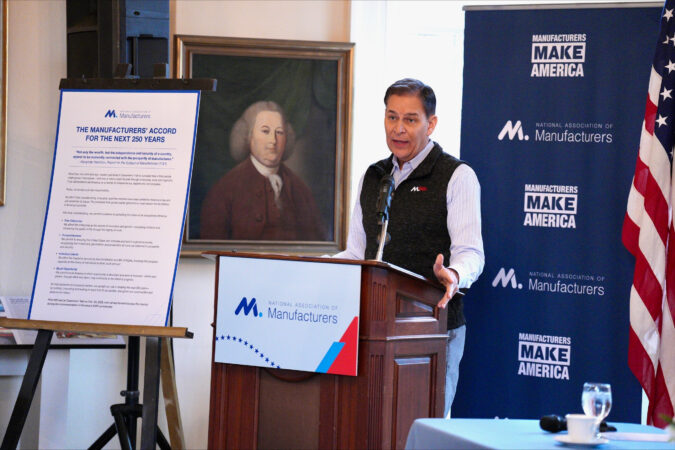
    As the U.S. Supreme Court was announcing its 6-3 decision that President Donald Trump exceeded his powers by imposing “emergency” tariffs, the nation’s top manufacturing lobbyist was in Philadelphia rallying support for a pro-factory agenda.

    Jay Timmons, president of the National Association of Manufacturers, says the factory revival Trump and his recent predecessors have championed has been aided by Trump’s business tax cuts and pro-fossil fuel agenda. But, he said, mass worker deportations or rapidly-changing import taxes are not helping.

    Timmons appealed to leaders of Philadelphia’s port, shipbuilders, regional Chamber of Commerce, and other industry group leaders to embrace his group’s pro-factory agenda at Carpenters Hall. He made a similar appeal at Cleveland’s Rock & Roll Hall of Fame earlier in the week, and heads to the Carolinas next week.

    Jay Timmons, president of the National Association of Manufacturers, was at Carpenters’ Hall in Philadelphia with area business leaders on the day the U.S. Supreme Court announced its tariffs decision.

    After the Supreme Court ruled against Trump, Timmons said in a statement that industry shares Trump’s goal of strengthening U.S. manufacturing, and wants to work with Congress and Trump on more “durable” ways to do that. While Trump had boosted tariffs on U.S. neighbors and longtime allies, Timmons said, NAM’s position is that “if tariffs are utilized as a tool, they should be targeted to countries engaged in specific unfair trading practices,” especially countries where government controls production, which would include China and Russia.

    He agreed to take questions from The Inquirer.

    The conversation has been edited for clarity and length.

    U.S. Sen. Joe Grundy, the Bristol mill owner who founded the Pennsylvania Manufacturers’ Association, led the pro-tariff movement long before President Trump. Has your group always backed high tariffs?

    No, ours was founded as a free-trade organization. Thomas Dolan, our first president, was a woolen manufacturer from Philadelphia. We wanted to open markets and sell our stuff in other countries.

    The president is obviously a fan of tariffs; that is a tool he has chosen to use.

    Can American manufacturing become a larger sector of the economy again, as President Trump promised?

    We’re on the launch pad, we are ready to go. We’re seeing success in terms of lowering the costs of doing business, in our tax code, in regulatory modernization, in energy development.

    This year we are focused on other issues we would like to see addressed, hopefully in a bipartisan way. We want to see legal reform of the permitting process, so we are not constantly in court trying to reach a final decision on whether an industrial project can move forward.

    Do you want the federal government to override state and local building limits on industry?

    State and local need to have a say, but the process needs to be streamlined.

    I served in Gov. George Allen’s administration in Virginia. His focus was on working together to attract jobs, communicating in a simultaneous manner. We attracted record investment and job creation [without damaging] air and water quality.

    We need to [fix] the regulatory morass in Washington. Right now, several agencies have a say on a project. An agency reviews it, that takes months. Then another agency, and another.

    Won’t you need more federal workers to do reviews all at once?

    Whatever it takes. We aren’t saying we want a compromise on health and safety. We’re saying do it in an expeditious manner.

    Virginia is one of the big states for data centers. Are there too many?

    I don’t share this [concern], but there are folks concerned about the rising costs of electricity and putting that blame on AI data centers.

    Demand will increase. You’ll have issues of local concern. But we have to supply more power, which means states have to step up and work with the utilities to improve transmission, the power grid; and the federal government should have a role.

    What recent U.S. energy developments are you applauding?

    Pennsylvania has led the way, with natural gas clearly helping the U.S., in terms of energy dominance and exports. Oil, also. Even nuclear is getting a kick start.

    Southern Co. led the way with that, restarting a [uranium power] plant in Georgia. That is hard, it takes a long time. Also the small reactors, we don’t have a clue yet [if those will be deployed in large numbers] but it could be helpful.

    What are your priorities to make manufacturing grow more rapidly?

    First, to help us expedite investing in the U.S., which tax [cuts] have done.

    Second is hiring and workforce development. We have 433,000 open jobs in the sector. Our goal is obviously to train more potential manufacturing workers. Apprenticeship programs — we have our own — need to expand dramatically.

    And third, we want to see a reliable and consistent immigration policy that focuses on the needs of our country. We’ve endorsed the Dignity Act.

    The Dignity Act, from Reps. Maria Elvira Salazar (R., Fla.) and Veronica Escobar (D., Texas), would let immigrant workers, who pay a fine and taxes, buy work permits; and mandate employers E-Verify job applicants. Is that like the Reagan reforms?

    Reagan, directionally, was correct on immigration.

    We are a nation of immigrants. We are a melting pot and that is what has made us successful.

    Things are different today with public opinion. You have to focus on very narrow objectives that are directly related to the economic life of this country, because that’s what the president and Congress want to do.

    What’s your goal for trade and tariffs?

    To see certainty and predictability. The administration has been very focused on finding access to markets overseas, which is also one of NAM’s founding principles.

    The U.S.-Mexico-Canada Agreement is up for renewal. [Negotiators] are dealing with transshipments from China through Canada and Mexico, which obviously was not our intent for the agreement. Getting another agreement is going to be really important for manufacturers who have used provisions to move manufacturing from China into the U.S.

    When do you expect signs of increased factory investment and hiring in this second Trump term?

    Rewind to 2017, we got tax cuts, regulatory modernization, and [faster] energy production. You saw three or four years later the highest employment growth in 21 years, the highest wage growth in 15 years. If you get the policies right it gives you an advantage. That’s our goal.

    We have the rocket, but it needs fuel, and a clear sky. We need [to resolve] immigration, workforce development, and trade certainty.

  • It’s not too early to be thinking about your new deck | Expert Opinion

    It’s not too early to be thinking about your new deck | Expert Opinion

    Despite our region’s snowy winter, it’s not too soon to be thinking about outdoor entertaining in the spring. Build (or rebuild) a deck off your home, and you’ll have a spot for grilling or chilling.

    But it takes a lot of planning and money to create one, whether you hire a local business or — for the super-handy — put one in yourself. Here’s what to consider.

    What kind of deck?

    The size and type of your home often determine the type of deck you need. But for most homes, these outdoor spaces tend to be either the same width or slightly less wide than the structure they serve. You don’t want a deck that dwarfs your house — a 20,000-square-foot deck would look ridiculous on your 1,500-square-foot bungalow.

    If you already have an older deck with visible signs of rotting wood or sagging supports, you might need to replace it. “People don’t always understand that decks have a life cycle, like roofs,” said Michael Beaudry, executive vice president of the North American Deck and Railing Association, a nonprofit membership association offering education and credentialing to industry members. “It’s usually a question of repair or replace.”

    Decking materials range from pressure-treated lumber to pricier composites (recycled wood and plastic like Trex, Fiberon, and TimberTech) to expensive wood species like cedar, redwood, or teak. A decking contractor can show you samples and go over factors such as durability and cost.

    You can check out Consumer Reports’ ratings of decking materials to compare prices, features, and maintenance. The big advantage of going with composite materials is that they’re maintenance-free.

    Layout considerations

    Your yard’s size, elevation, drainage, and tree cover will greatly affect how you design your deck. If your outdoor space slopes, a multilevel deck can step down with your yard. If existing trees don’t shade your deck, you can add a pergola, awning, or other way of shielding yourself from the sun. If your neighbors can see into your yard, you might angle the deck differently or install a privacy hedge just off the deck.

    Most decks are rectangular or square, but they can be almost any shape you’d like, including triangular or round.

    Construction and permitting

    Building a new deck is as much an engineering job as a construction one. If you’re installing a new one, in most areas it’ll need to be permitted and inspected, and you might consider hiring an architect or landscape architect to help with the plans.

    It takes engineering and knowledge of load-bearing principles and building materials to create a safe, stable deck. The grade of the wood or composite material, the spacing of the joists, beams, and posts, and the overall design of the deck impacts how much weight it’ll hold.

    “It’s important to think about what you want on your deck — a hot tub, seating for a bunch of people,” Beaudry said. “A good deck builder tends to overbuild, using two-by-eight boards when the project only calls for two-by-sixes.”

    Most decks are designed to support 60 pounds per square foot including the weight of the deck (the “dead load”) as well as whatever people and things you put on it (the “live load”). Decks require adhering to local building and safety rules and regulations. These range from HOA size limits to setback distances or structural requirements set by your city, town, or even neighborhood. The height of railings and the placement of and pitch of stairs may also be dictated by local code.

    Don’t hire a deck builder unless the company will navigate the permitting process for you.

    How to find a deck builder

    Many general contractors, fence builders, and carpenters also build decks as part of larger projects. But if you need a new deck or a complete replacement of an existing one, you might as well go with a company that specializes in them. Until April 5, Inquirer readers can access Checkbook’s ratings of local deck builders at Checkbook.org/Inquirer/decks.

    Once you’ve identified some possible contractors, ask them lots of questions. Go over your plans and ideas with them, and ask about their experience with your type of job. These conversations will likely provide you with lots of new ideas.

    Get references and check them. Ask past customers if the company gave them money-saving solutions, if the work was as attractive and as well done as expected, whether it passed inspection on the first try, if the company stuck to its agreed-upon prices, and whether it minimized disruption to their lives.

    To protect your finances against big damage claims, ask companies for proof that they carry general liability and workers’ compensation insurance.

    Get a solid contract

    Get at least three fixed-price bids; it’s the only way to make sure you don’t overpay. Get a formal contract in writing specifying payment terms, deadlines, and who will be doing the work. It should include a detailed description of the work, including drawings of deck plans, and details on building products.

    The contract should include start and end dates, and a warranty on work and materials, preferably one lasting several years.

    Insist that the contract include requirements that the company obtain and pay for necessary permits, and arrange for government inspections, if required. The contractor also should obtain approvals by any homeowners’ association or historic district.

    Arrange to pay as little as possible until the work is finished and you are satisfied. If your job requires a lot of materials, it’s reasonable to pay a deposit against these expenses. But paying for everything or almost everything at the end gives you the most leverage to get the work done properly.

    Deal promptly with problems. Understand that no one can anticipate every possibility. If problems happen, work with your contractor to reach a solution.

    Delaware Valley Consumers’ Checkbook magazine and Checkbook.org is a nonprofit organization with a mission to help consumers get the best service and lowest prices. It is supported by consumers and takes no money from the service providers it evaluates.

  • Temple Health reported a $50.5 million operating loss in the first half of fiscal 2026

    Temple Health reported a $50.5 million operating loss in the first half of fiscal 2026

    Temple University Health System had a $50.5 million operating loss in the six months that ended Dec. 31, the Philadelphia nonprofit told bond investors Monday. In the same period the year before, Temple reported a $13.5 million operating gain.

    Here are some details on Temple results:

    Revenue: Total revenue reached $1.64 billion, up 7.3% from the year before. Patient revenue rose 8% due mostly to increased outpatient revenue from Temple’s pharmacy business, infusions, and same-day surgeries. Two hits to revenue were a $14.3 million decrease in state funding and decline in the number of transplants, which bring in large amounts of revenue. Temple said it expects both of them to rebound in the remainer of fiscal 2026.

    Expenses: Temple attributed some of its loss in the first six months of fiscal 2026 to $20 million in extra expenses associated with the opening of its new Woman & Families Hospital, a $7.2 million increase in medical liability expenses, and a $6.4 million increase in losses under its Medicaid contract with Health Partners Plans.

    Notable: Despite its operating loss, even on a cash basis, Temple financial reserves increased to more than $1 billion as of Dec. 31. Most of the gain came from investments. The reserves equal the amount of money needed to keep the health system operating for 119 days if no more revenue came in. At the end of 2024, that figure was 113 days.

  • Union membership dipped in Pa. and N.J. amid Trump’s anti-labor push, data suggests

    Union membership dipped in Pa. and N.J. amid Trump’s anti-labor push, data suggests

    Following several years of major worker organizing efforts and high-profile strikes, 2025 brought a change in momentum for the labor movement. President Donald Trump’s administration sought to end federal workers’ union contracts and, through a firing, left the National Labor Relations Board without a quorum and unable to make decisions.

    But the percentage of workers who are union members nationwide has stayed pretty steady in the last year, new data shows. And in Pennsylvania and New Jersey, union membership rates fell.

    In 2025, 10% of the country’s total workforce was part of a union, compared to 9.9% in 2024, according to new data from the U.S. Bureau of Labor Statistics. It’s the first time since 2020 that the rate has inched up — albeit slightly — instead of down.

    However, BLS noted, this year’s estimates are not fully comparable to past years because they are based on a BLS survey that is missing October figures due to the government being shut down in October and part of November.

    In the past year, there have been “a lot of kind of anti-labor efforts coming out of the White House,” said Todd Vachon, assistant professor of labor studies and employment relations at Rutgers University.

    Despite those efforts Vachon said, “labor has pretty much maintained the same at the national level. … The Trump attacks haven’t really had any effect yet, at least in the first year.”

    window.addEventListener(“message”,function(a){if(void 0!==a.data[“datawrapper-height”]){var e=document.querySelectorAll(“iframe”);for(var t in a.data[“datawrapper-height”])for(var r,i=0;r=e[i];i++)if(r.contentWindow===a.source){var d=a.data[“datawrapper-height”][t]+”px”;r.style.height=d}}});

    Union membership rates dropped to an all-time low nationwide in 2023 and remained pretty similar in 2024. During those years, roughly one in 10 U.S. workers was part of a union.

    When BLS first started recording this data in 1983, about two in 10 U.S. workers were unionized. There were 17.7 million unionized workers in 1983 and 14.7 million last year.

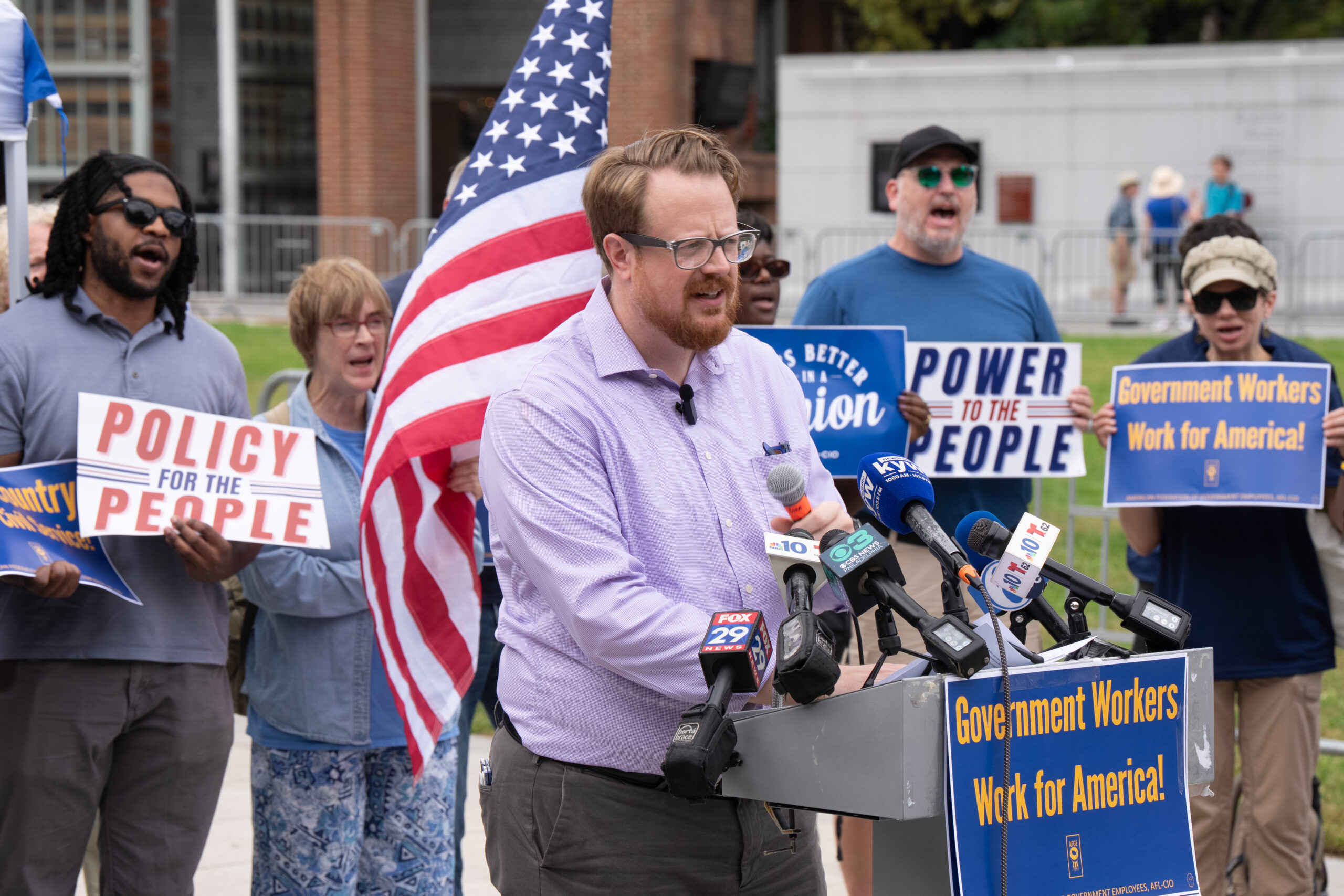
    Danny Bauder, president of the Philadelphia Council AFL-CIO, speaks at an event supporting federal workers in October.

    Unionizing in N.J. and Pa.

    In New Jersey, 14.7% of workers were unionized last year, and in Pennsylvania, it was 10.9%.

    In both states, that was a decline of around one percentage point from 2024, but BLS noted that state-level data “should be interpreted with caution,” due to the shutdown-related incomplete data.

    window.addEventListener(“message”,function(a){if(void 0!==a.data[“datawrapper-height”]){var e=document.querySelectorAll(“iframe”);for(var t in a.data[“datawrapper-height”])for(var r,i=0;r=e[i];i++)if(r.contentWindow===a.source){var d=a.data[“datawrapper-height”][t]+”px”;r.style.height=d}}});

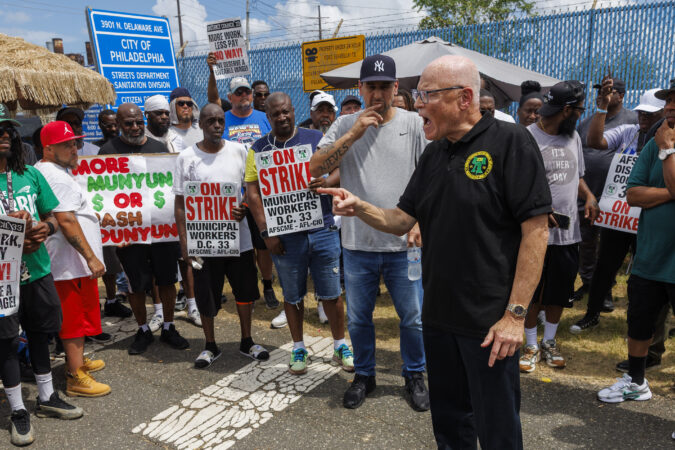
    Some local labor action highlights from this past year include:

    What happened in labor organizing last year?

    The Trump administration moved to end union contracts for government workers, amid a push to reshape the federal government.

    Some 271,000 federal jobs were cut between January and November. Meanwhile, the union membership rate in the public sector increased by 0.7% nationally in the last year according to the new BLS data.

    Vachon notes that the vast majority of public sector workers are at the municipal level, not federal.

    “The hiring of police, and teachers, and sanitation workers across the thousands of cities around the U.S. more than compensated for [cuts at the federal level], because we see an increase in the public sector,” he said.

    Trump also fired a member of the National Labor Relations Board (NLRB) early last year, which left it without a quorum to issue rulings. In some cases that can slow down the formation of a new union — at the Amazon-owned Whole Foods in Philadelphia, for example.

    The number of union elections overseen by the NLRB declined last year and the overall number of workers involved in those elections dropped too, according to the nonpartisan Center for American Progress.

    “A huge percentage of new union organizing is required every year just to maintain the same level of unionization, because of the churning and the growth of the overall labor force,” said Vachon. “If the labor force is not growing, then you can actually see increases in union density.”

    And unions are being cautious of reaching out to the NLRB under the Trump administration, he notes.

    “There’s a fear [that] if something gets sent up to the NLRB that the ruling is going to set a precedent that makes it even more difficult to organize,” said Vachon. “It’s kind of had a dampening effect in that way.”

  • This Mennonite pastor’s kid made a Wall Street fortune, hired hundreds, and is rebuilding Kennett Square

    This Mennonite pastor’s kid made a Wall Street fortune, hired hundreds, and is rebuilding Kennett Square

    After John Michael Bontrager came home to Pennsylvania from Wall Street to start an advice firm for big investors, he located his company in Kennett Square, “America’s Mushroom Capital” and the most populous of the old factory and farming towns along Old Baltimore Pike in southern Chester County.

    Bontrager and those who joined him prospered. In 2018, he stepped down as founding head of investment-risk adviser Chatham Financial, which now employs 850 at its campus just east of the square-mile borough of 7,500.

    Now, he’s devoting himself to the redevelopment of Kennett Square and nearby towns.

    Using his own fortune, donations, and state and local government funds, Bontrager and his allies have developed a string of projects — restaurants, hotels, and nonprofits — under the loose umbrella of his Square Roots Collective. Their affiliates have purchased 2% of the town’s houses to redevelop as rentals. Their goal: Make the area more attractive to college-educated young people, while also boosting the quality of life for longtime residents and working people.

    Last year Bontrager announced his ALS diagnosis. He has recruited staff and allies, including family members, former Chatham employees, and a multi-ethnic group of Southern Chester County professionals to build Square Roots into a movement that can survive him.

    In December, the borough council endorsed Bontrager’s “public, cultural, and social impact initiatives,” calling them “key to shaping the inclusive community.” They voted unanimously to ceremonially rename Birch Street, an industrial road Bontrager has visibly transformed, as “Bontrager Walk.”

    In local government meetings and town election campaigns, some residents have expressed concerns about Square Roots’ concentration of power and conflicts of interest.

    Bontrager agreed to take questions at his Kennett Square office. His daughter, newly designated co-CEO Stephanie Almanza, and his chief of staff, Luke Zubrod, a Chatham Financial alumnus who serves on the borough planning commission, sat in.

    The conversation has been edited for length and clarity.

    Why did you start local projects while you were still building your company?

    [I wanted] to convince people we wanted to hire, between the ages of 25 and 33, that Kennett is a reasonable place for them to live. How do we make this attractive for people to move here and to bring people who grew up here back?

    Thirty years ago when I came here, it was a great community for families. But it was harder to convince singles and couples with no kids.

    I read sociology, for example Chuck Marohn’s Confessions of a Recovering Engineer; Yoni Appelbaum’s Stuck about zoning; The Logic of Failure by a German neuroscientist [Dietrich Dorner].

    The elements I came up with: A community is totally interconnected, people and organizations. All decisions have ripple effects. When communities focus only on solving the near term problem, it’s probably not going to be good.

    For example, we have about 30% of Chester County “preserved.” Well, it’s great to have open space. But if you take a third of your land out of commission, without providing for housing, housing prices will go up dramatically. And taxes.

    Mike Bontrager (center, in grey jacket) with family members (from left) Stephanie, Kymm, Luis, Cruz, Katherine, Mason, Mike, Dot, Lauren, and Willie.
    How do you solve issues in concert?

    Collaboration, trust, working together. A lot of elected officials are volunteers. It’s easier to focus on one issue at a time and react to the three or four people who show up at your meeting with pitchforks.

    Of course you want a say over what happens in your neighborhood. But the consensus favors the status quo, the entrenched interest.

    Not everyone loves what we’re doing. Luke, Stephanie, and myself have said, ‘Let’s understand people’s concerns. We’re neighbors.’ We listen; we have a lot of meetings.

    What are the institutions you’ve set up?

    The Square Roots Collective is our brand for all the activities. It includes Square Roots Community Initiative, a 501(c)4 nonprofit that’s the umbrella group. There’s our for-profit businesses; the profits go to support the nonprofits. We donated more than $1 million last year to nonprofits and projects in the area.

    On Birch Street, there’s our offices, and the Creamery [converted from an old condensed-milk plant site], which we started as a beer garden in 2016, it’s now a restaurant, and Artelo, the art hotel.

    We are also working on the Francis, an eight-room hotel in the middle of town. And we are opening a really cool cocktail bar, the Star and Lantern [referencing the Underground Railroad and the area’s abolitionist history] in 2027. And we are preparing Opus, a restaurant.

    On the nonprofit side, there’s the Kennett Trails Alliance, a 14-mile loop. About half is open, and we have easements for most of the rest, not all. It connects some of the open spaces, the Brandywine Creek, Anson B. Nixon Park, the YMCA.

    And there’s Voices Underground, an organization we initiated in partnership with Lincoln University and Longwood Gardens, elevating the stories of the Underground Railroad.

    Artelo Hotel Kennett Square, which has works by local artists in each room. This is “Floating Free,” by Philadelphia artist Philip Adams.
    Your groups own about 40 of the 2,000 or so houses in the borough. Is there a shortage of affordable rentals, given demand from mushroom farms and other industry?

    Yes. What we have is tenant housing, market rate, including some we rent to area charitable and community groups [for their clients].

    How did you decide to start Chatham in 1991?

    When I was 13, I worked for an appliance repairman, John Schmucker. He was brilliant at fixing washers, dryers, dishwashers. But he was a disastrous business guy. He never collected. I saw building a business is very different from being smart and an expert.

    My father was a Mennonite pastor in Christiana, Lancaster County. I went to Lancaster Mennonite School. I went to Wheaton College in Illinois. I was so naive; I had never met a real professional.

    I would sign up for any kind of recruiter interview. I eventually went to see someone who worked for Chemical Bank [predecessor of JPMorgan Chase]. I got a job offer.

    I joined this new unit selling these emerging derivatives — interest-rate swaps, currency and commodity hedging — to help clients manage the risks.

    There were products that were inappropriate for most investors. Municipalities got in trouble buying things that didn’t need, where the banks took out a lot of money.

    People needed advice. I loved helping clients, maybe it was a big company, or maybe an oil distributor in Queens who needed to hedge his fuel-pricing risk.

    Why did you return to this area from New York?

    My wife wanted to move back to our families. In August 1991, I bought a place in Cochranville. We had a satellite dish that brought in Telerate [a stock-tracking service], which was just a year old. That’s what made it possible to do this work anywhere. I started over the garage, me and my dog.

    It turned out to be the best time to start a derivatives advisory business. There were a lot of properties available from [recently failed] savings-and-loans at cents on the dollar, and someone figured out a legal structure that allowed real estate investments trusts to go public. We did their hedging. Same with private equity.

    I called a few of my old clients, Milton Cooper at Kimco Realty Trust, we helped him go public, he recommended us. We advised [mortgage-bonds pioneer Ethan Penner] on the first mortgage-backed securities. In 1994, I cold-called a young associate at a firm buying failed S&L loans. He hired us to hedge. That was Jon Gray, who worked his way up and is expected to be the next CEO of Blackstone.

    We mastered hedge accounting. We had more derivative hedging experts than anyone. The Big Four accounting firms and their clients found we spoke their language.

    By 2000, we had built a real business. We moved to Kennett because it was a larger town [and closer to Philadelphia and its airport].

    How did you prepare your work to go on after you left, under your successor Matt Henry?

    At Chatham, I wanted us to be internally owned, the people who are joining should reap rewards. I did not want any outside investors. [Employees own most of the stock, and elect top officers.]

    I have been diagnosed with ALS, which is a pretty devastating diagnosis. I don’t how long I will be able to be actively involved. I still get to do purposeful work with people I love. Isn’t that what we all want? So I’m going to go until I can’t.

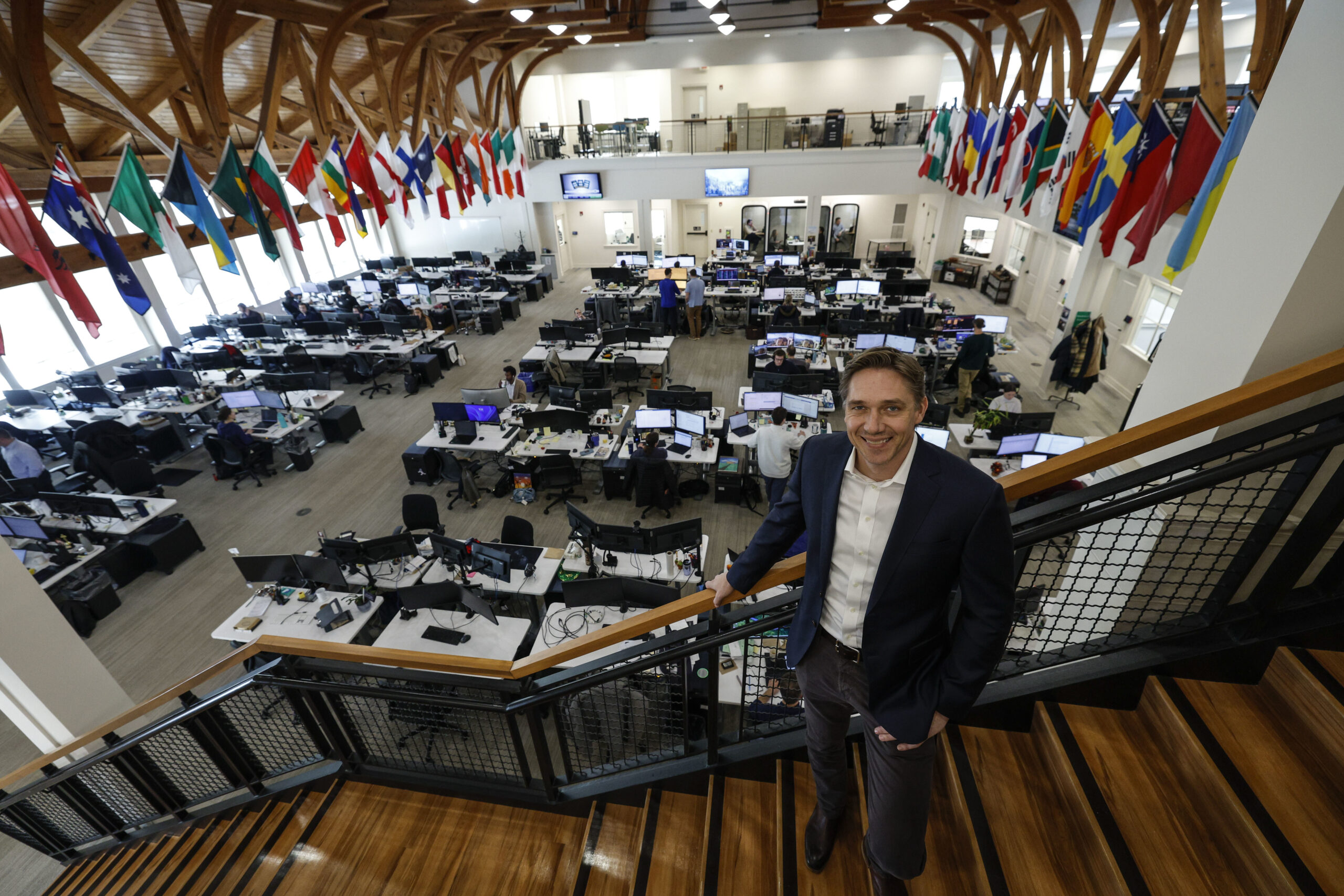
    CEO Matt Henry of Chatham Financial center, just outside Kennett Square.
  • Rich world’s growing civil unrest has an insurance sting

    Rich world’s growing civil unrest has an insurance sting

    A category of insurance risk that hardly existed a little over a decade ago has morphed into a meaningful source of losses for the industry.

    Claims tied to SRCC — strikes, riots, and civil commotion — are emerging as a growing headache for insurers as episodes of unrest increasingly lead to the destruction of property in Western democracies. Howden Re estimates that insured losses related to SRCC soared from negligible levels in 2013 to more than $8 billion between 2020 and 2024.

    SRCC losses are prone to huge swings between years, with single events often changing the landscape significantly. After relatively few claims globally in 2025, Howden Re told Bloomberg it’s now expecting the United States to see a clear increase in SRCC losses this year.

    “We live in a time of heightened risk,” said David Flandro, head of industry analysis and strategic advisory at Howden Re. And the flare-ups making news headlines in the U.S. are “clearly indicative of a broader trend,” he said.

    Civil unrest is on the rise globally, a development that has coincided with a measurable increase in levels of inequality and polarization in some of the world’s richest countries. In most Western nations, for example, the majority of citizens no longer expect to see any growth in generational wealth, according to the Pew Research Center.

    Rising political division is adding to SRCC risks in both Europe and the U.S., according to Verisk Maplecroft. However, the sharpest increase in protest sizes is taking place in the U.S., Verisk said in December.

    When it comes to ranking countries with the greatest SRCC risk, the U.S. is the No. 1 Western democracy and sits at No. 5 overall, putting it ahead of Pakistan, Bangladesh, and India, according to first-quarter data provided by Verisk Maplecroft. France ranks seventh. SRCC models take into account not just the risk of unrest, but also the cost of replacing property that’s damaged.

    “It’s fair to say that the SRCC risk landscape has fundamentally changed,” said Torbjorn Soltvedt, associate director of political violence at Verisk.

    For a long time, insurers have offered protection against SRCC at no extra cost. However, elevated risk environments mean this is becoming less common and property insurers have begun excluding or restricting coverage for SRCC from their policies, according to Cara Brown, deputy head of terrorism and political violence at insurer Chubb.

    SRCC coverage is generally bolted on to other insurance policies, though there’s evidence that the rise in such risks is prompting companies to start seeking specific cover. At the same time, Howden Re said already back in 2023 that insurers were starting to charge “significant additional premiums” for SRCC coverage, with retail assets among the most affected.

    Over two-thirds of multinational corporations already use political risk modeling tools, a trend Howden Re says is rising. And in 2024, Lloyd’s of London — the 338-year-old insurance market — assigned SRCC risk its own code. In 2025, Verisk released its first SRCC catastrophe model, focused on the U.S. market.

    Reinsurer Swiss Re says it received only a “couple dozen SRCC claims in the early 2000s and that number gradually increased into the hundreds. We have continued to see a couple hundred per year in recent years,” which is “indicative of the market trend.”

    A changing U.S.

    In the U.S., several data-tracking services show that the number of political protests is on the rise. Meanwhile, perceptions of the U.S. are changing, says Stephen M. Davis, senior fellow at Harvard Law School’s program on corporate governance and cofounder of the United Nations’ Principles for Responsible Investment.

    Viewing the U.S. as a “safe haven is a thing of the past,” he said. That’s because there’s a “policy volatility that now exists,” which can be seen “internally as well as externally.”

    It’s a sentiment that’s been playing out in markets, as some institutional investors in Europe look for ways to reduce their exposure to the U.S.

    For insurers, calculating reliable loss risks is proving hard to model, and Soltvedt notes that protests don’t always lead to property damage. For example in Minnesota, where Immigration and Customs Enforcement officers killed two U.S. citizens, protesters have conducted themselves in a way that’s resulted in “limited direct impacts on commercial property or private property so far,” he said.

    The Trump administration is now retreating from its immigration-enforcement blitz in Minnesota, pulling back after more than two months of operations.

    But given the overall pace of growth in SRCC, the probability that a single event might result in more than $5 billion of losses can no longer be ignored, according to Verisk Maplecroft. In some areas, SRCC loss risks may even exceed those brought on by natural catastrophes, it said.

    SRCC as a standalone insurance product “used to be a very niche, small class of business,” said Srdjan Todorovic, head of political violence and hostile environment solutions at Allianz Commercial. But a number of big events in recent years “hit the industry pretty badly and sobered up the market.”

  • Big Tech is taking on more debt than ever to fund its AI aspirations

    Big Tech is taking on more debt than ever to fund its AI aspirations

    Big Tech is taking on record levels of debt, marking a new chapter in the artificial intelligence boom as names such as Oracle, Alphabet, and Meta pour big money into massive data centers and the energy systems needed to run them.

    Technology companies issued a record $108.7 billion in corporate bonds in the last three months of 2025, according to data from Moody’s Analytics. That’s the largest total for any quarter and roughly double that of the previous three months. And the trend is extending into 2026: Some $15.5 billion in bonds were issued in the first two weeks of the year alone.

    For now, investors are assuaged by the eye-popping cash flow numbers from major tech companies. In the past 20 years, Big Tech companies including Google, Microsoft, Meta, Amazon, and Apple have built what are arguably the most profitable business models in history. In the third quarter, Google brought in just over $100 billion, with a margin of over 30%. All five are trillion-dollar companies, as are such AI darlings as Nvidia, Broadcom, and TSMC.

    But some economists and business analysts say the massive new bonds are spreading risk throughout the economy, with hundreds of billions being spent on a technology whose profit-making potential is not yet clear.

    “It’s a lot of debt, and a lot of it all of a sudden,” said Mark Zandi, chief economist for Moody’s. When companies are funding risky ventures with debt “it does put the broader financial system at risk. If the financial system is at risk, then the broader economy is.”

    A bond is a form of debt that companies or governments can use to raise large sums of money, typically from investment banks or private-equity firms, to be paid back with interest. They historically have been used to fund major infrastructure projects such as power plants, natural gas drilling operations, or offshore wind farms — projects with large up-front costs that are expected to generate revenue for many years. Once issued, a bond can be bought, sold, or packaged into other debt products, which can end up in the portfolios of unrelated investments such as pension funds.

    Automakers, utilities, and other mainstays of heavy industry have historically been the biggest issuers of corporate bonds, Moody’s data shows. Analysts note that in past technology build-outs, such as the rise and rapid investment in internet-based companies in the 1990s, companies didn’t have to spend nearly as much on infrastructure.

    That has now changed, given the unprecedented energy demands of running and training AI algorithms. While tech companies took on more debt, adjusting for inflation, in 2021 than in 2025 — with a total of $296.6 billion in 2025 dollars issued that year — interest rates were significantly lower at the time. That made financing debt cheaper.

    “The technology industry has gone from being an also-ran in terms of corporate debt, to becoming the largest player of investment-grade corporate debt, out of nowhere, compared to two years ago,” said venture capitalist Paul Kedrosky.

    Because training and running AI algorithms take up much more computing power and energy than previous forms of technology, staying ahead in the AI race costs billions. Google, Microsoft, Amazon, and Meta indicated in company announcements that they planned to collectively spend well over $300 billion on AI data centers in 2025 alone.

    If they continue to spend at that rate, they may have to take on even more debt.

    “If these companies are so profitable, why are they using debt?” Kedrosky said. “It gives you a sense of the scale of what’s going on.”

    Amazon spokesperson Amy Diaz said the proceeds from Amazon’s bond issuance in November are being used to support business investments, capital expenditures, and repayment of earlier debt, adding that the company regularly evaluates its operating plan to make financing decisions. (Amazon founder Jeff Bezos owns the Washington Post.)

    Representatives from Alphabet, Meta, and Oracle either declined to comment or did not answer questions. An Apple spokesperson referred to the company’s SEC filing, which states that proceeds from the bond issuance would be used for “general corporate purposes” including stock buybacks and unspecified capital expenditure, among other uses.

    Among large tech companies, Meta used the most debt to fund its data center build-out in 2025, according to Moody’s. The social media company has invested deeply in AI in a race to become the leading AI assistant for companies and everyday people, putting it in a tight race with Microsoft, Apple, and Alphabet.

    Mark Mahaney, who has covered tech companies for more than two decades and is now managing director at the investment bank Evercore ISI, views the bonds as part of a strategy by tech firms to raise money without degrading their stock price. Bond offerings are a sign that management is “confident or cocky” about their future, as they’ve taken on debt that requires steady cash flow to pay down, Mahaney said.

    Also loading up on debt is Oracle, which issued some $25.75 billion in bonds last year as it seeks to become the AI computing power provider of choice. In September it disclosed a $300 billion deal with OpenAI, prompting an immediate 36% spike in its stock price that briefly made founder Larry Ellison the richest man in the world. (The Post has a content partnership with OpenAI.)

    But in the ensuing weeks investors became uncomfortable with Oracle’s debt. Citi analyst Daniel Sorid told CNBC in December that there was something “inherently uncomfortable” about the “enormous” amount of capital Oracle will require.

    The stock has declined about half from its Sept. 10 peak. Bondholder Ohio Carpenters’ Pension Plan recently sued Oracle and several investment banks, alleging that Oracle failed to disclose how much debt it needs.

    “The sheer scale of new debt issuance has forced investors to reassess whether the economics of relentless AI [spending] are truly sustainable,” said Thomas Urano, chief investment officer at Sage Advisory in Austin.

    Urano added that many of the companies getting AI-driven investment are part of the infrastructure that enables today’s AI chatbots and other applications, which cannot be immediately monetized.

    “This creates a paradox: The strategic case for AI is compelling, but the revenue model is still evolving,” Urano said.

    At least one firm has raised the prospect of getting government support to build out more data centers. OpenAI’s chief financial officer, Sarah Friar, said in November that it will require “innovation” on the finance side, with government providing a “backstop” or “guarantee.” Her comments triggered backlash from politicians and tech critics, who questioned whether taxpayers should take on some of these private companies’ risk. Friar and CEO Sam Altman both later clarified that they weren’t seeking federal guarantees for OpenAI data centers specifically, although Altman did say in a lengthy social media post that a government-funded “strategic national reserve of computing power” would make sense.

    The Trump administration has gone all in on AI, pushing aside concerns within the MAGA movement and seeking to sweep away regulations that it says hamper innovation. But neighbors of the vast warehouses of computer chips that form the technology’s backbone — including in conservative states — have objected to how the facilities sap power from the grid, guzzle water to stay cool, and secure tax breaks from local governments. President Donald Trump has recalibrated his approach, pushing tech companies to fund their own power.

    “Historically, when we’ve had major bubbles they’ve tended to be about real estate, or technology, or government policy,” Kedrosky said. “This is the first bubble in history that combines all of these things.”