Category: Business

Business news and market updates

  • A nearly 250-year-old hospital’s closure was announced on this week in Philly history

    A nearly 250-year-old hospital’s closure was announced on this week in Philly history

    In the wake of the U.S. Bicentennial, in which Philadelphia was at the center of a yearlong celebration of the country’s 200th birthday, one of the city’s contributions to public health was put on the chopping block.

    On Feb. 15, 1977, city officials confirmed that Mayor Frank Rizzo was closing Philadelphia General Hospital.

    The poorhouse

    Philadelphia General Hospital traced its lineage back to 1729, predating even the revered Pennsylvania Hospital, which was founded in 1751 and is generally considered the nation’s first chartered hospital.

    Philadelphia General Hospital was originally established at 10th and Spruce Streets as an almshouse, also known as an English poorhouse.

    “The institution reflected the idea that communities assume some responsibility for those unable to do so themselves,” Jean Whelan, former president of the American Association for the History of Nursing, wrote in 2014.

    The almshouse was used as housing for the poor and elderly, as well as a workhouse. It also provided some psychiatric and medical care.

    It moved in the mid-1800s into what was then Blockley Township, at what is now 34th Street and Civic Center Boulevard, and began offering more traditional medical services. The Blockley Almshouse’s barrage of patients and their variety of maladies helped it naturally grow into a teaching tool for nursing and medical students.

    And by turn of the 20th century, it had become a full-blown medical center, made official by its new name: Philadelphia General Hospital.

    But it held onto its spirit.

    Its doors were open to anyone who needed care, no matter that person’s race, ethnicity, class, or income.

    Healthcare was a given. Workers saw it as a responsibility.

    Even if it wasn’t always the best care.

    Poor health

    The hospital relied on tax dollars, and as a result was often short on staffing and low on supplies. It was a source of political corruption, scandal, and discord among its melting pot of patients.

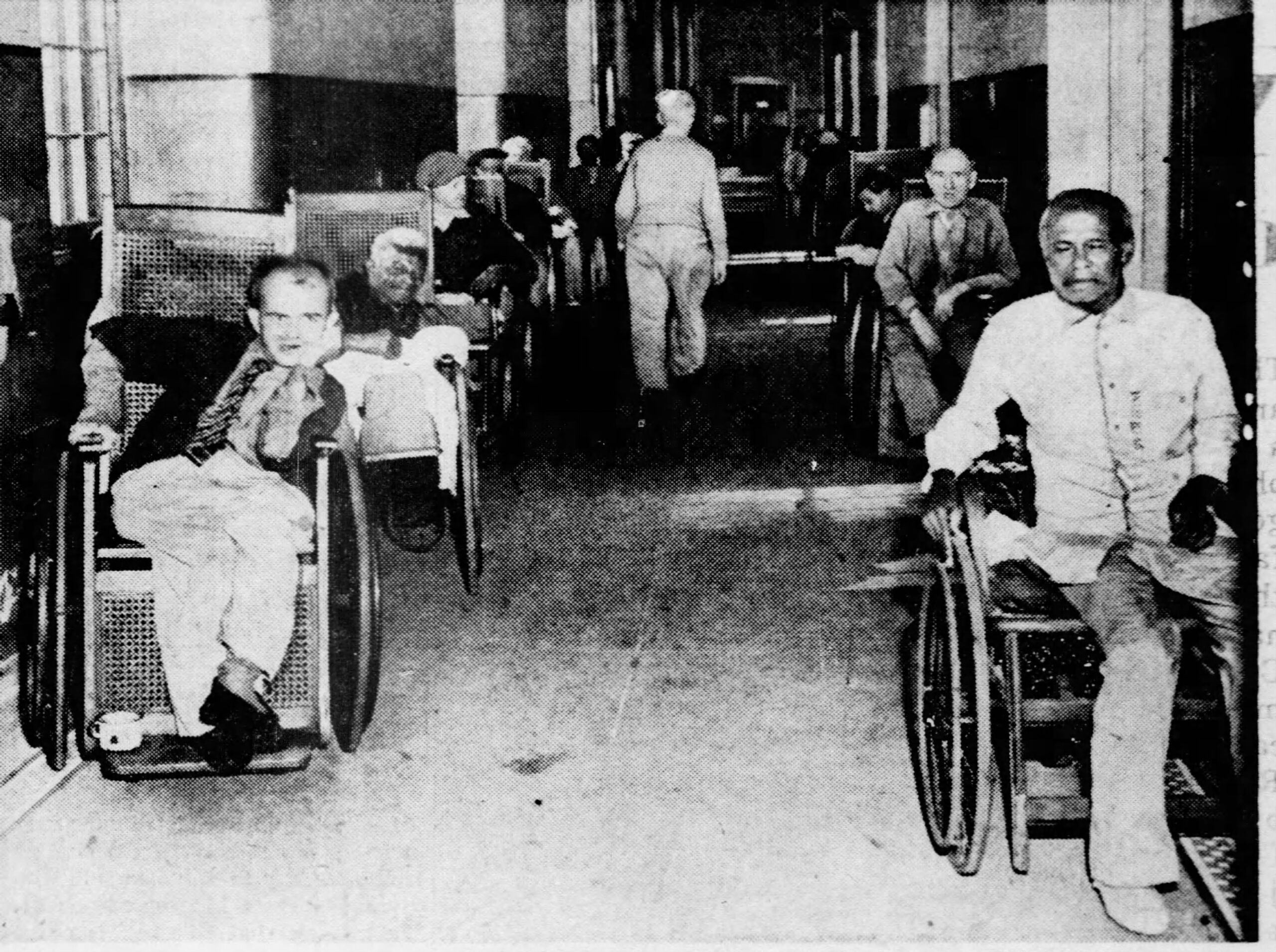
    Patients in the hallways of Philadelphia General Hospital in the 1940s.

    Eventually, it collapsed under the weight of its mission.

    Its facilities became outdated, its services could not keep up, and its role as educator was outsourced to colleges and universities.

    Philadelphia General Hospital’s closure left a gaping hole in available services in West Philadelphia. It was no longer there to help support the uninsured.

    Before it officially closed in June 1977, it was considered the oldest tax-supported municipal hospital in the United States.

    “There’s a common misunderstanding that PGH recently has become a poor people’s hospital,” said Lewis Polk, acting city health commissioner, in 1977. “It’s always been a poor people’s hospital. The wealthy never chose to go there.”

    Its old grounds are now occupied by several top-rated facilities, including Children’s Hospital of Philadelphia and the University of Pennsylvania medical campus.

    A historical marker there notes Philadelphia General Hospital’s nearly 250 years of service to the community.

  • A $105-million mixed-use complex with apartments set to rise in the shadow of Willow Grove mall

    A $105-million mixed-use complex with apartments set to rise in the shadow of Willow Grove mall

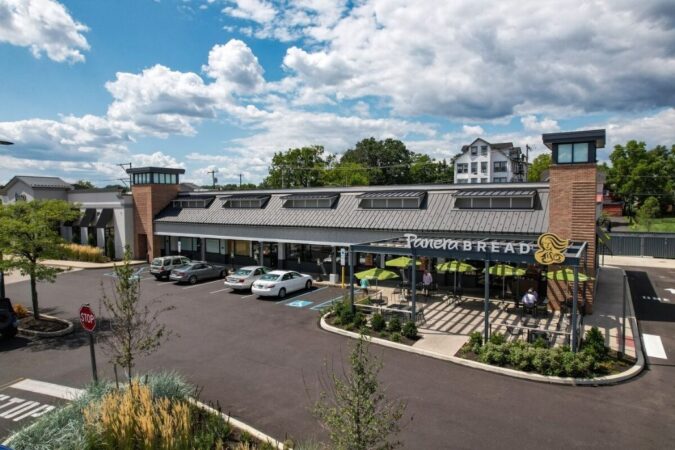
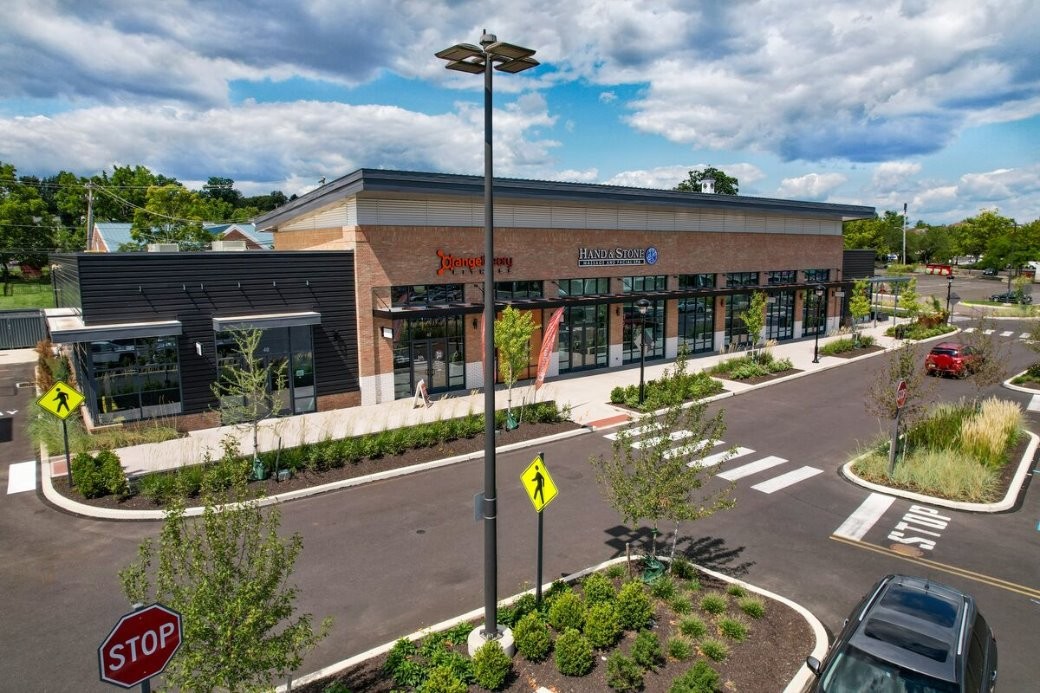
    A shopping center in the shadow of Willow Grove Park Mall will soon undergo a $105-million “transformation” with new apartments and shops, says the developer behind the project.

    Starting this summer, about 130,000 square feet of the Willow Grove Shopping Center will be demolished to build a mixed-used complex with 261 residential units and 35,000 square feet of new retail space, said Mark Brennan, vice president of regional development for Federal Realty Investment Trust.

    It will mark the latest stage in a multiphase redevelopment of the outdoor center, which is located across the street from the mall.

    A rendering of what Federal Realty Investment Trust plans to build at the Willow Grove Shopping Center.

    Across the Philadelphia region, similar mixed-use complexes have increasingly been built around thriving shopping destinations, such as King of Prussia, where thousands of new apartments have risen in recent years.

    Elsewhere, town-center-like developments have replaced dead malls. In Delaware County, a $120-million complex with apartments, restaurants, and shops sits on the site of the former Granite Run Mall, which was demolished a decade ago.

    Mixed-use projects have also been proposed for the Exton Square Mall and at the old Echelon Mall in Voorhees. (In both locations, apartments have already been built on other parts of the property.)

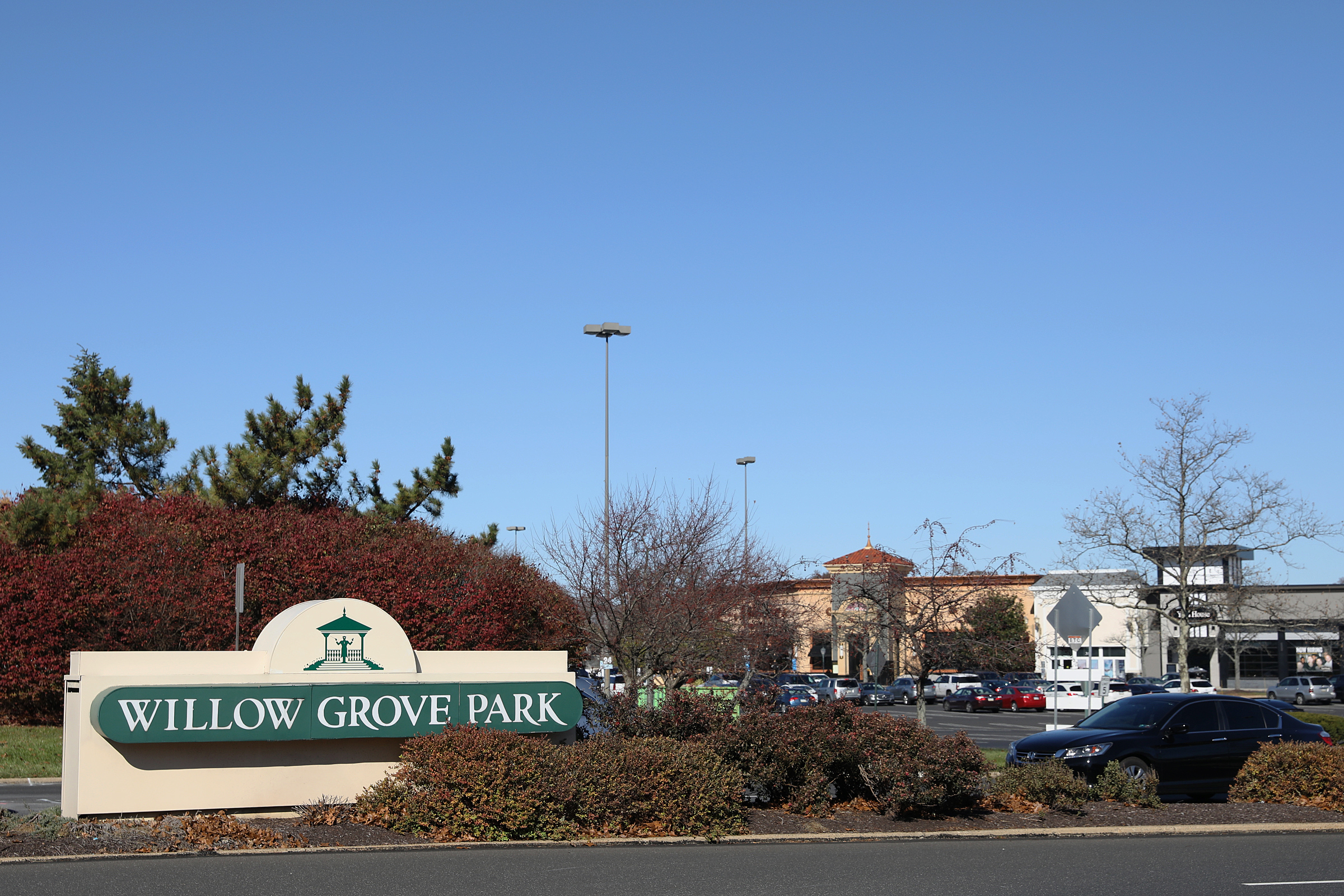
    A spokesperson for PREIT, which owns Willow Grove Park Mall, did not return a request for comment. In a 2022 shareholders’ report, PREIT executives called the complex “one of our leading suburban Philadelphia assets,“ with an occupancy rate of more than 96%.

    The Willow Grove Park Mall is pictured in 2019.

    Across Moreland Road, Brennan is confident his shopping-center redevelopment will be met with high demand.

    Since the pandemic, the Montgomery County community has “really come alive,” due in part to its proximity to the city and to suburban employment centers, said Brennan, who is based in Wynnewood. And people who are moving out of the city or looking to downsize are particularly interested in moving to mixed-use developments, he said.

    The center’s proximity to SEPTA’s Willow Grove train station, and major highways, including the Pennsylvania Turnpike, will make it particularly appealing, as will its mix of “highly curated” shops, Brennan said.

    Across the street from the mall, the Willow Grove Shopping Center is set to undergo a $105-million transformation with apartments and new retail.

    The center’s existing tenants, which include Marshalls and Five Below, will remain open during construction, Brennan said.

    He expects the project to be complete sometime in 2028.

    “These sort of multifaceted, multiphased development projects do take quite a bit of time and planning,” Brennan said. “We’re really excited to get to the next phase of this transformation.”

  • Sponsors are becoming more visible at the Winter Olympics with product placement and arena shoutouts

    Sponsors are becoming more visible at the Winter Olympics with product placement and arena shoutouts

    MILAN — Eileen Gu and all the other freestyle skiers wait for their scores by a large Powerade-branded cooler, then glide away without taking a drink.

    Bottles of the blue sports drink are stacked in hockey penalty boxes. Even the tissues in figure skating’s drama-packed “Kiss and Cry” area are branded.

    One way the Olympics generally stand out is by the absence of advertising on courses, rinks, and slopes. But increasingly at the Milan Cortina Games, sponsors are creeping into the action.

    “We continue to open up those opportunities for partners,” International Olympic Committee marketing director Anne-Sophie Voumard said Wednesday, noting sponsor products can now “organically be present” more widely.

    The change has seemingly accelerated since French luxury goods maker LVMH prominently placed its Louis Vuitton brand at the opening ceremony of the 2024 Paris Olympics.

    “It seems like there’s been an increasing need and desire from the sponsors for the IOC to show greater value in the TOP [the Olympic partners] program,” Terrence Burns, who has worked for the Olympic body in marketing and consulted for sponsors and hosting bids, told the Associated Press.

    There’s product placement on TV, even if it is still restrained compared to most American sports. Spectators inside the Olympic arenas hear shout-outs by the announcers and see logos on the big screen.

    It’s all happening as sponsors eye fresh opportunities for the 2028 Los Angeles Olympics.

    The IOC is looking to create extra value in its TOP program, which has been a financial success for the organization over four decades. There are 11 TOP sponsors in Milan, after peaking at 15 in Paris. Revenue in 2025 dropped a bit to $560 million in cash and services compared to $871 million in 2024.

    Watching a hockey game in the arena is different

    An Olympic hockey game looks clean and non-commercial on TV to NHL fans used to seeing sponsors on the boards. It’s a little different in the venue.

    “This is the Corona Cero wave!” roars an announcer, attaching an alcohol-free beer brand to efforts to liven up fans at a quiet afternoon game with a wave around the arena.

    An automaker gets a mention with the “Stellantis Freeze Cam” and an interview with a boxer during the intermission between periods is “thanks to Salomon,” a skiwear brand that signed a sponsor deal with the Milan Cortina organizing committee.

    Burns thinks the logos in Olympic arenas are a morale booster for sponsors, but worth relatively little compared to the big campaigns they typically launch in the year before the Games.

    “I think it’s a psychological ‘Attaboy’ to see your brand on a board somewhere in and around the Olympics,” Burns said. ”I get it, but show me how that helps you sell more things.”

    A long-term trend ahead of the 2028 Los Angeles Olympics

    The Olympic Charter, a kind of constitution for the Games, says any logo in an Olympic venue must be approved “on an exceptional basis,” but the IOC has gradually relaxed its restrictions.

    “The Olympic world moves slow, and it should. It’s a 3,000-year-old brand, so they’ve got to be careful with it,” Burns said.

    Barely a decade ago, the “clean venue” policy was so strict that IOC staff checked the hand dryers in arena bathrooms to make sure they had their manufacturer’s brand covered with tape.

    For the Tokyo Olympics in 2021, restrictions on athletes promoting their personal sponsors on social media were relaxed after a legal challenge in Germany.

    The Paris Olympics saw medals delivered to the podium in Louis Vuitton-branded boxes before athletes were handed a phone for “the Olympic Victory Selfie, presented by Samsung,” a new tradition that’s continued at the Milan Cortina Games.

    Voumard, the IOC’s marketing director, acknowledged the need to “be mindful of the legacy of those [Olympic] Games and the uniqueness of the presentation.”

    New opportunities

    The Los Angeles Olympics will break new ground on sponsorship.

    For the first time, the IOC has approved the selling of naming rights for venues in a pilot program. The volleyball venue in Anaheim will keep its Honda Center name, just like it does for NHL games, and Comcast is putting its brand on a temporary arena for squash.

    Until now, stadiums named for sponsors have had to switch to generic names for the Olympics. The O2 Arena in London became the North Greenwich Arena for basketball and gymnastics in 2012, and a raft of French soccer stadiums got new names for 2024.

    Burns predicts the IOC might come under pressure from Los Angeles organizers to take further sponsor-friendly steps, and might need to push back on some requests to protect the Olympic brand.

    “It’s not unreasonable to think that LA would look to what happened in Paris with Louis Vuitton or even Samsung on a podium,” Burns said.

    “It’s their fiduciary responsibility to try to make as much money as they can. So they’re going to be looking for any and all opportunities to generate incremental revenue from sponsors. That’s the IOC’s role as a franchisor to protect that.”

  • Pa. and N.J. call it gambling. Trump calls it finance. A high-stakes fight over prediction markets is underway

    Pa. and N.J. call it gambling. Trump calls it finance. A high-stakes fight over prediction markets is underway

    A high-stakes fight is brewing between President Donald Trump’s administration and states such as Pennsylvania and New Jersey over the regulation of prediction markets, the online platforms that allow users to wager on everything from sports and elections to the weather.

    States that have legalized sports betting in recent years say prediction markets amount to unauthorized gambling, putting consumers at risk and threatening tax revenues generated by regulated entities like casinos.

    But the Trump administration this week said the federal government was the appropriate regulator, siding with the industry’s argument that the markets’ “event contracts” are financial derivatives that allow investors to hedge against risks.

    The chair of the federal Commodity Futures Trading Commission on Tuesday said the CFTC had filed a brief in federal court to “defend its exclusive jurisdiction” to oversee these markets, amid litigation between state governments and platforms such as Kalshi and Polymarket.

    Prediction markets “provide useful functions for society by allowing everyday Americans to hedge commercial risks like increases in temperature and energy price spikes,” CFTC Chairman Mike Selig said in a video posted on X.

    New Jersey collected more than $880 million in gaming tax revenues last year, while Pennsylvania brought in almost $3 billion, according to regulators. The revenues fund property tax relief programs and the horse racing industry, as well as programs for senior citizens and disabled residents.

    Pennsylvania’s gaming regulator has previously warned that prediction markets risk “creating a backdoor to legalized sports betting,” without strict oversight.

    The state Gaming Control Board’s Office of Chief Counsel told The Inquirer Wednesday that it sees a distinction between certain futures markets — like those for agricultural commodities, which have long been regulated by the CFTC — and “event contracts” tied to “the outcome of a random Wednesday night NBA basketball game.”

    Representatives for Gov. Josh Shapiro of Pennsylvania and Gov. Mikie Sherrill of New Jersey, both Democrats, didn’t respond to requests for comment.

    But former New Jersey Gov. Chris Christie — a Republican who worked to legalize sports betting while in office and who’s now advising the American Gaming Associationsaid Tuesday on X that the Trump administration is trying to “grow the size of the federal government & their own power while trying to crush states rights and take advantage of our citizens.”

    Beyond the courts, the GOP-led Congress could also choose to step in. Some Republican lawmakers have expressed concerns about a “Wild West” in prediction markets, notwithstanding Trump’s support for the industry.

    Sen. Dave McCormick (R., Pa.) welcomed the CFTC’s announcement, writing on X that prediction markets “offer tremendous benefits to consumers and businesses.”

    “A consistent, uniform framework for derivatives is essential to supporting U.S. markets,” he said.

    The CFTC’s action means the federal government is backing an industry in which the Trump family has a financial stake. The agency’s brief supports Crypto.com, a platform that last year partnered with the Trump family’s social media company to launch a prediction market.

    Ethics experts have said the Trump family’s ties to Crypto.com create a conflict of interest. The White House denies that and says the president’s holdings are in a trust controlled by his children.

    Winding through courts

    The U.S. Supreme Court in 2018 struck down a federal law that prohibited sports betting in most states, paving the way for states to legalize it. Pennsylvania and New Jersey both enacted laws authorizing sports gambling and imposing requirements on betting operators such as taxation on gaming revenues, consumer protection rules, and licensing fees.

    Despite state laws, prediction markets now operate nationwide — even in states that prohibit gambling altogether, like Utah.

    New York-based Kalshi launched its platform in 2021. The CFTC initially opposed Kalshi’s election-related contracts, but in the fall of 2024 the company won a case in which courts found the regulator failed to show how the platform’s “event contracts” would harm the public interest. Kalshi users proceeded to trade more than $500 million on the “Who will win the Presidential Election?” market.

    Then came sports contracts. In January 2025, following the CFTC’s protocols, Kalshi “self-certified” that its contracts tied to the outcome of sports games complied with relevant laws.

    The company has since offered event contracts on everything from the Super Bowl to Olympic Male Curling. Some established sportsbooks like Fanatics and DraftKings have also jumped into prediction markets.

    About 90% of Kalshi’s trading volume is tied to sports, the Associated Press reported.

    States have tried to intervene. In March, New Jersey’s gaming regulator ordered Kalshi to cease and desist operations in the Garden State, alleging the company issued unauthorized sports wagers in violation of the law and state Constitution.

    Kalshi filed a lawsuit, and a federal court issued an injunction prohibiting New Jersey from pursuing enforcement actions. Kalshi and other platforms have filed suits against other states, and courts have issued conflicting rulings.

    The CFTC said it filed a brief in one such suit this week.

    “To those who seek to challenge our authority in this space, let me be clear: we’ll see you in court,” Selig, the Trump-appointed CFTC chairman, said Tuesday.

    It could ultimately reach the U.S. Supreme Court.

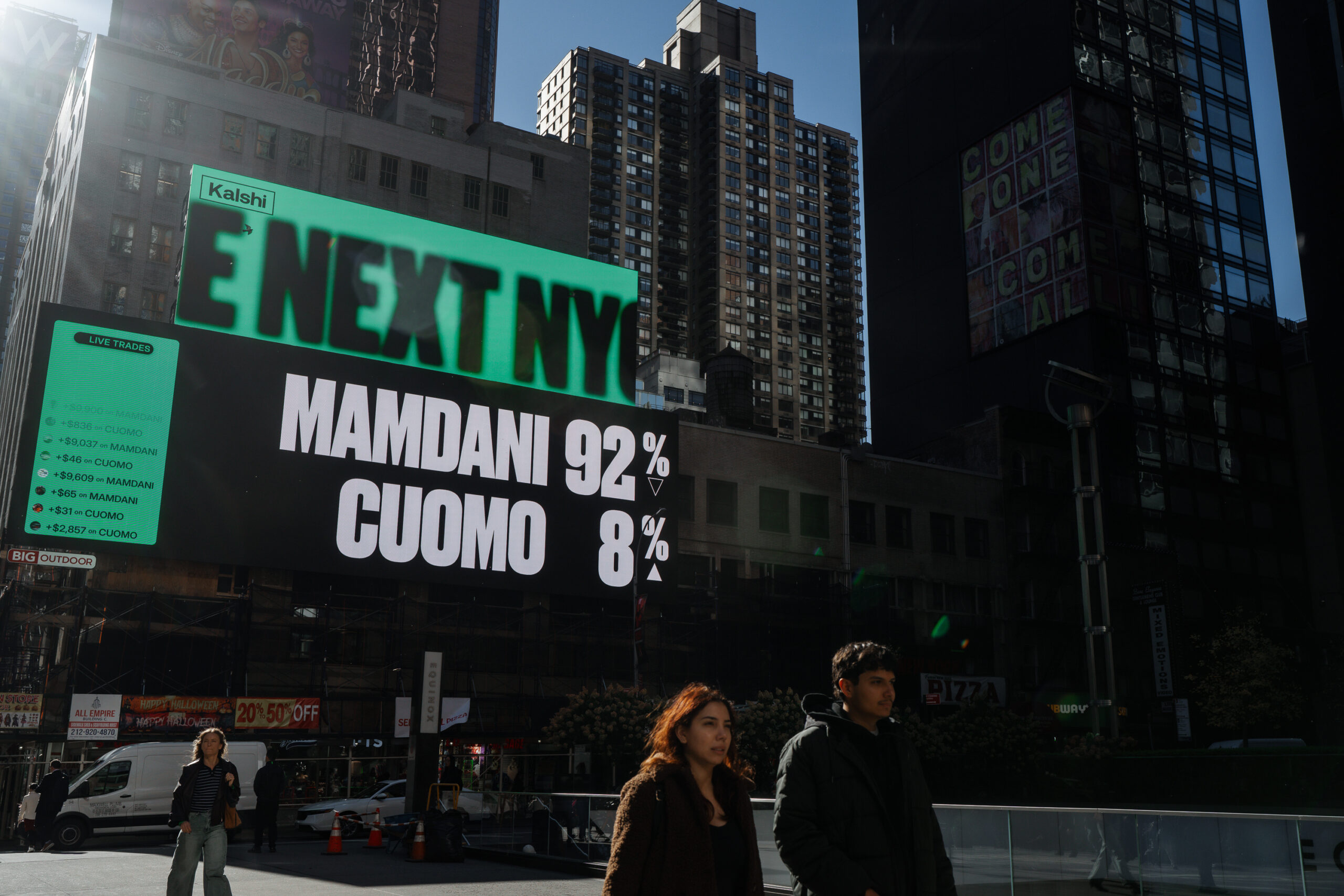
    Advertisements by the company Kalshi predict a victory for Zohran Mamdani in the New York City mayoral election before the votes are counted and polls close, Tuesday, Nov. 4, 2025, in New York.

    ‘Event contracts’

    At issue is whether the “event contracts” offered by prediction markets amount to gambling — regulated by states — or, as Selig says, financial instruments “that allow two parties to speculate on future market conditions without owning the underlying asset.”

    Platforms like Kalshi say they are similar to stock exchanges, where people on both sides of a trade can meet — and therefore subject to federal regulation of commodities. Unlike a casino, the platforms say, they don’t win when customers lose.

    Pennsylvania regulators see it differently.

    The state Gaming Control Board told The Inquirer Wednesday that it takes issue with “‘prediction markets’ allowing any consumer, age 18 years old or older, to purchase a ‘contract’ on any potential future event occurring, even when that event does not have any broad economic impact or consequence, such as the outcome of a random Wednesday night NBA basketball game.”

    (Under Pennsylvania law, gambling is limited to those who are 21 or older.)

    “The Board believes that is not what the Commodities Exchange Act contemplated when it was enacted by Congress and established the CFTC and is, in fact, gambling,” the board’s Office of Chief Counsel said in a statement.

    If the courts side with the Trump administration, states worry that tax revenues from regulated sportsbooks would fall and customers would be vulnerable to markets they say are easily exploited by insiders.

    “If prediction markets successfully carve themselves out of the ‘gaming’ definition, they risk creating a parallel wagering ecosystem where bets on sports outcomes occur with significantly less oversight regarding potential match-fixing,” Kevin F. O’Toole, executive director of the Pennsylvania Gaming Control Board, wrote in an October letter to the state’s congressional delegation.

    For example, the gaming board has the ability to penalize licensed operators if they violate state regulations, O’Toole wrote, “something that an operator who ‘self-certifies’ their contracts/wagers [under CFTC rules] would never be subjected to.”

    O’Toole said the board’s regulatory role in this area is limited to sports wagering, but he added that markets on non-sports related events — he cited examples from Polymarket such as whether there will be a civil war in the United States this year — are equally “if not more troubling.”

    The CFTC says it is capable of overseeing the industry. “America is home to the most liquid and vibrant financial markets in the world because our regulators take seriously their obligation to police fraud and institute appropriate investor safeguards,” Selig wrote in a Wall Street Journal opinion piece this week.

  • Tariffs paid by midsize U.S. companies tripled last year, a JPMorganChase Institute study shows

    Tariffs paid by midsize U.S. companies tripled last year, a JPMorganChase Institute study shows

    WASHINGTON — Tariffs paid by midsize U.S. businesses tripled over the course of the past year, new research tied to one of America’s leading banks showed on Thursday — more evidence that President Donald Trump‘s push to charge higher taxes on imports is causing economic disruption.

    The additional taxes have meant that companies that employ a combined 48 million people in the U.S. — the kinds of businesses that Trump had promised to revive — have had to find ways to absorb the new expense, by passing it along to customers in the form of higher prices, employing fewer workers, or accepting lower profits.

    “That’s a big change in their cost of doing business,” said Chi Mac, business research director of the JPMorganChase Institute, which published the analysis Thursday. “We also see some indications that they may be shifting away from transacting with China and maybe toward some other regions in Asia.”

    The research does not say how the additional costs are flowing through the economy, but it indicates that tariffs are being paid by U.S. companies. The study is part of a growing body of economic analyses that counter the administration’s claims that foreigners pay the tariffs.

    The JPMorganChase Institute report used payments data to look at businesses that might lack the pricing power of large multinational companies to offset tariffs, but may be small enough to quickly change supply chains to minimize exposure to the tax increases. The companies tended to have revenues between $10 million and $1 billion with fewer than 500 employees, a category known as “middle market.”

    The analysis suggests that the Trump administration’s goal of becoming less directly reliant on Chinese manufacturers has been occurring. Payments to China by these companies were 20% below their October 2024 levels, but it’s unclear whether that means China is simply routing its goods through other countries or if supply chains have moved.

    The authors of the analysis emphasized in an interview that companies are still adjusting to the tariffs and said they plan to continue studying the issue.

    White House spokesperson Kush Desai called the analysis “pointless” and said it didn’t “change the fact that President Trump was right.” The study showed that U.S. companies are paying tariffs that the president had previously said would be paid by foreign entities.

    Trump defended his tariffs during a trip to Georgia on Thursday while touring Coosa Steel, a company involved in steel processing and distribution. The president said he couldn’t believe the Supreme Court would soon decide on the legality of some of his tariffs, given his belief that the taxes were helping U.S. manufacturers.

    “The tariffs are the greatest thing to happen to this country,” Trump said.

    The president imposed a series of tariffs last year for the ostensible goal of reducing the U.S. trade imbalance with other countries, so that America was not longer importing more than it exports. But trade data published Thursday by the Census Bureau showed that the trade deficit climbed last year by $25.5 billion to $1.24 trillion. The president on Wednesday posted on social media that he expected there would be a trade surplus “during this year.”

    The Trump administration has been adamant that the tariffs are a boon for the economy, businesses, and workers. Kevin Hassett, director of the White House National Economic Council, lashed out on Wednesday at research by the New York Federal Reserve showing that nearly 90% of the burden for Trump’s tariffs fell on U.S. companies and consumers.

    “The paper is an embarrassment,” Hassett told CNBC. “It’s, I think, the worst paper I’ve ever seen in the history of the Federal Reserve system. The people associated with this paper should presumably be disciplined.”

    Trump increased the average tariff rate to 13% from 2.6% last year, according to the New York Fed researchers. He declared that tariffs on some items such as steel, kitchen cabinets, and bathroom vanities were in the national security interest of the country. He also declared an economic emergency to bypass Congress and impose a baseline tax on goods from much of the world in April 2025 at an event he called “Liberation Day.”

    The high rates provoked a financial market panic, prompting Trump to walk back his rates and then engage in talks with multiple countries that led to a set of new trade frameworks. The Supreme Court is expected to rule soon on whether Trump surpassed his legal authority by declaring an economic emergency.

    Trump was elected in 2024 on his promise to tame inflation, but his tariffs have contributed to voter frustration over affordability. While inflation has not spiked during Trump’s term thus far, hiring slowed sharply, and a team of academic economists estimate that consumer prices were roughly 0.8 percentage points higher than they would otherwise be.

  • How the rich pass on their wealth. And how you can too

    How the rich pass on their wealth. And how you can too

    NEW YORK — Death and taxes may be inevitable. A big bill for your heirs is not.

    The rich have made an art of avoiding taxes and making sure their wealth passes down effortlessly to the next generation. But the tricks they use to expedite payouts to heirs and avoid handing money to the government — can also work for people with far more modest estates.

    “It’s a strategic game of chess played over decades,” says Mark Bosler, an estate planning attorney in Troy, Mich., and legal adviser to Real Estate Bees. “While the average person relies on a simple will, the well-to-do utilize a different playbook.”

    Consider a trust

    First, consider the facts: Despite widespread misconceptions, only estates of the very richest Americans are generally subject to taxes. At the federal level, estates of over $15 million typically trigger taxes. At the state level, 16 states and the District of Columbia do collect estate or inheritance taxes, according to the Tax Foundation, sometimes with lower exemptions than the IRS, but still at thresholds targeting millionaires.

    While most people can pass on what they have without worrying about their heirs being caught in a web of taxes, it can require planning to escape a messy process that can hold up estates for years and cost families significantly in court fees and lawyer bills.

    The solution at the center of many estate planners’ designs is a trust.

    Though trusts conjure images of complex arrangements utilized by the uber-rich, they are relatively simple tools that can make sense for many people. They come with expense, often costing thousands of dollars in lawyer fees to set them up. But for a retired couple with a paid-off house, 401(k)s and a portfolio of investments, they can ease the passing of assets to heirs.

    Among the reasons: Even if you aren’t leaving enough behind to trigger taxes, your estate can get tied up in probate court, which typically assesses fees based on an estate’s total value.

    “You are leaving what might have gone to your children or other loved ones to attorneys and the courts,” says Renee Fry, CEO of Gentreo, an online estate planner based in Quincy, Massachusetts. “Anywhere from 3[%] to 8% of an estate might be lost.”

    Trusts can allow an estate to sidestep court altogether and to shield it from public view by keeping details out of public records. Some people also use them to protect their savings if they someday need nursing home care and would prefer to qualify for a government-paid stay under Medicaid instead of paying themselves.

    Pass on stocks virtually tax-free

    Imagine being an investor in a stock like Nvidia that has soared in recent years. Now imagine being able to reap the profit of selling your shares without paying tax.

    It’s possible with one caveat: You have to die.

    That scenario, known in estate lingo as “step-up,” allows many rich families to grow their wealth while ensuring their heirs won’t be saddled with the bill.

    It works like this: Say your savvy uncle bought 100 shares of Nvidia when it began trading in 1999 at $12 a share. Between splits and a soaring price, that $1,200 investment would be worth more than $9 million today. If he left it all to you, you could sell the shares owing little or no tax because gains are calculated from the day he died, not the day he bought it.

    Benjamin Trujillo, a partner with the wealth advisory firm Moneta, based in St. Louis, Mo., says it all seems “like a magic trick.” And it’s completely legal.

    “Wealth transfer looks like smoke and mirrors,” Trujillo says. “Assets like stocks can quietly grow for decades and, when they’re inherited, the tax bill often disappears.”

    Lawmakers have sometimes proposed limits on the “step-up” rule, but at least for now, it remains, making it one of the biggest not-so-secret weapons in the arsenals of those looking to create generational wealth. If stocks aren’t your forte, “step-up” applies to other types of investments too, including artwork, real estate, and collectibles.

    Keep up to date on beneficiaries

    Ever get a prompt on one of your accounts asking you to name a beneficiary? It’s more than a confusing (or annoying) nudge from your brokerage. Estate planners say it is one of the simplest ways to ease the transfer of assets to loved ones after you die.

    Regulations vary from place to place, but many banks and brokerages allow you to name a beneficiary to whom the funds will be transferred to upon your death.

    “One of the easiest ways to transfer assets hassle-free,” says Allison Harrison, an attorney in Columbus, Ohio, who focuses on estate planning.

    Beneficiary designations generally override wills, so it’s important to make sure yours are up to date to avoid the mess of having, say, an ex-spouse end up with everything you saved.

    All of this requires planning, but experts say investing a little time in mapping out your estate is one of the moves that separates the rich from the less well-off.

    “Wealthy families plan,” says Fry. “They don’t leave assets and decisions unprotected.”

  • David J. Farber, celebrated Penn professor emeritus and pioneering ‘uncle’ of the internet, has died at 91

    David J. Farber, celebrated Penn professor emeritus and pioneering ‘uncle’ of the internet, has died at 91

    David J. Farber, 91, formerly of Landenberg, Chester County, celebrated professor emeritus of telecommunication systems at the University of Pennsylvania, former professor of computer science at Carnegie Mellon University and the University of Delaware, professor at Keio University in Japan, award-winning pioneer in pre-internet computing systems, entrepreneur, and known by colleagues as the “uncle” and “grandfather” of the internet, died Saturday, Feb. 7, of probable heart failure at his home in Tokyo.

    A longtime innovator in programming languages and computer networking, Professor Farber taught and collaborated with other internet pioneers in the 1970s, ’80s, and ’90s. He helped design the world’s first electronic switching system in the 1950s and ’60s, and the first operational distributed computer system in the 1970s.

    His work on the early Computer Science Network and other distributive systems led directly to the modern internet, and he taught many influential graduate students whom he called the “fathers of the internet.” He was thinking about a World Wide Web, he said in a 2013 video interview, “actually before the internet started.”

    “Farber may not be the father of the internet. But he is, at least, its uncle,” Penn English professor Al Filreis told the Daily News in 1998. “Few have paid such close attention for so long to new trends in the information age.”

    Colleagues called him “part of the bedrock of the internet” and a “role model for life” in online tributes. Nariman Farvardin, president of the Stevens Institute of Technology in Hoboken, N.J., said: “Professor Farber did not just witness the future, he helped create it.”

    In 1996, Wired magazine said Professor Farber had “the technical chops and the public spirit to be the Paul Revere of the Digital Revolution.”

    He joined Penn as a professor of computer science and electrical engineering in 1988 and was named the endowed Alfred Fitler Moore professor of telecommunication systems in 1994. He left Penn for Carnegie Mellon in 2003 and joined Keio in 2018.

    Gregory Farrington, then dean of Penn’s School of Engineering and Applied Science, told The Inquirer in 1996: “He’s one of the most engaging, imaginative guys who sometimes alternates between great ideas and things that sound nuts. And I love them both. His life is an elaboration on both.”

    He was a professor at Delaware from 1977 to 1988 and at the University of California Irvine from 1970 to 1977. Among other things, he created innovative computer software concepts at UC Irvine, studied the early stages of internet commercialization at Delaware, and focused on advanced high-speed networking at Penn. He also directed cyber research laboratories at every school at which he worked.

    He earned lifetime achievement awards from the Association for Computing Machinery, the Board of Directors of City Trusts of Philadelphia, and other groups, and was inducted into the Internet Society’s Hall of Fame in 2013 and the Stevens Institute of Technology Hall of Achievement in 2016.

    Stevens Institute also created a “societal impact award” in 2003 to honor Professor Farber and his wife, Gloria. “I think the internet has just started,” he said in 2013. “I don’t think we’re anywhere near where it will be in the future. … I look forward to the future.”

    Professor Farber earned grants from the National Science Foundation and other organizations. He received patents for two computer innovations in 1994 and earned a dozen appointments to boards and professional groups, and an honorary master’s degree from Penn in 1988.

    He advised former President Bill Clinton on science and engineering issues in the 1990s and served a stint in Washington as chief technologist for the Federal Communications Commission. Clinton called him a “pioneer of the internet” in a 1996 shoutout, and Professor Farber testified for the government in a landmark technology monopoly court case against Microsoft Corp.

    Professor Farber (left) worked with Professor Jiro Kokuryo at the Keio University Global Research Institute in Tokyo.

    He championed free speech on the internet, served on technical advisory boards for several companies, and wrote or cowrote hundreds of articles, papers, and reports about computer science.

    He was featured and quoted often in The Inquirer and Daily News, and lectured frequently at seminars and conferences in Japan, Europe, Australia, and elsewhere around the world. He wrote an email newsletter about cutting-edge technology that reached 25,000 subscribers in the 1990s, and he liked to show off his belt that held his cell phone, pager, and minicomputer.

    He cofounded Caine, Farber, & Gordon Inc. in 1970 to produce software design tools and worked earlier, from 1957 to 1970, on technical staffs for Xerox, the Rand Corp., and Bell Laboratories. In a recent video interview, he gave this advice: “Learn enough about technology so that you know how to deal with the world where it is a technology-driven world. And it’s going to go faster than you ever imagined.”

    David Jack Farber was born April 17, 1934, in Jersey City, N.J. Fascinated by gadgets and early computers in the 1940s, he built radios from wartime surplus components as a boy and helped make a unique relay device with a punch card in college. “The card reader was three feet big, but it worked,” he told the Daily News in 1998.

    Professor Farber enjoyed time with his family

    He considered being a cosmologist at first but instead earned a bachelor’s degree in electrical engineering and a master’s degree in math at Stevens.

    He met Gloria Gioumousis at Bell Labs, and they married in 1965. They had sons Manny and Joe, and lived in Landenberg from 1977 to 2003. His son Joe died in 2006. His wife died in 2010.

    Professor Farber enjoyed iced coffee and loved gadgets. He was positive and outgoing, and he mixed well-known adages into humorous word combinations he called “Farberisms.”

    He was an experienced pilot and an avid photographer. In 2012, to honor his son, he established the Joseph M. Farber prize at the Stevens Institute for a graduating senior.

    Mr. Farber was an experienced pilot who could fly solely on cockpit instruments.

    “He was bold,” his son Manny said. “He connected to a lot of people and was close to his friends. He worked on big projects, and it wasn’t just theoretical. He built things that work.”

    In addition to his son, Professor Farber is survived by his daughters-in-law, Mei Xu and Carol Hagan, two grandsons, and other relatives.

    A memorial service is to be held later.

  • Silicon Valley is building a shadow power grid for data centers across the U.S.

    Silicon Valley is building a shadow power grid for data centers across the U.S.

    The GW Ranch project approved on 8,000 windswept acres of West Texas will look like many of the other data centers that have sprung up across the country to support Silicon Valley’s ambitions for artificial intelligence. Dozens of airplane-hangar-size warehouses packed with computing hardware will consume more power than all of Chicago.

    But it’s missing one standard feature: The mammoth project, recently green-lit by state environmental regulators, won’t need new power lines to deliver the electricity that it guzzles. GW Ranch will be walled off from the power grid and generate its own electricity from natural gas and solar plants installed on site.

    GW Ranch is set to become part of a shadow power grid emerging across the country with potentially far-reaching consequences for the U.S. electricity system and environment.

    After the rapid growth of data centers triggered pushback from politicians, utilities, and local residents over the pressures they place on the grid, tech companies are now building their own fleet of private power plants, mostly fueled by natural gas.

    Dozens of sprawling off-grid data center projects are planned across Texas, New Mexico, Pennsylvania, Wyoming, Utah, Ohio, and Tennessee, according to a review of regulatory filings, permits, earnings call transcripts, and other documents by the energy industry research firm Cleanview. Several are already under construction.

    Companies rushing to develop the facilities include Meta, ChatGPT-maker OpenAI, business software provider Oracle, and oil giant Chevron. (The Washington Post has a content partnership with OpenAI.)

    The off-grid projects already approved by state energy and environmental regulators could power all of New York City several times over, a vast new energy infrastructure that will bring huge new industrial facilities to communities across the country and increase U.S. emissions of carbon dioxide and other air pollutants. A handful of states have passed laws to encourage off-grid data centers by loosening rules around who can build power plants and where they can be located.

    The projects are sparking alarm from El Paso to Davis, West Virginia, from residents unhappy to learn that gas plants large enough to fuel major cities are set to sprout in places they were never expected.

    “This came out of nowhere,” said Amy Margolies, a resident fighting an off-grid data center planned near Davis, in one of West Virginia’s major tourism corridors. The project was permitted to operate a gas plant large enough to generate roughly equivalent power to that used by every home in the state. It is being propelled by a 2025 state law that eased approvals for off-grid data centers.

    “They removed local control completely for this speculative gold rush,” Margolies said. “Everything is shrouded in secrecy, and the public is removed from the process.”

    The idea of taking data centers off-grid is the latest in a line of provocative strategies adopted by the tech industry in its pursuit of more electricity that also includes reviving old nuclear plants, backing long-shot fusion energy schemes, and planning to plunk down hundreds of compact nuclear power plants in communities across the U.S. But while these approaches are fossil fuel-free, most of the sector’s immediate investments will be in gas power, driving up the planet-warming emissions the companies long promised to take a lead in curbing.

    Billions of dollars are now being invested in power plants for off-grid data centers, even though key engineering challenges have not been solved, according to veteran energy developers.

    Most of the projects rely on natural gas because the variable output of solar and wind is difficult to manage without the grid as backup. But the most efficient gas turbines are back-ordered for years, forcing developers to use more wasteful and polluting equipment.

    “It is catastrophic for climate goals,” said Michael Thomas, founder of Cleanview, which has identified 47 behind-the-meter projects nationwide.

    Others warn that off-grid projects could struggle to keep the lights on. Gas plants typically spend a third or more of the year down for maintenance, but data centers generally operate around the clock. “I get that cost is no object for these companies and they just want to get online,” said Jigar Shah, an energy entrepreneur who helped manage federal energy investments for the Biden administration. “But they have not figured out even with unlimited funds how to make these plants run with 24/7 reliability.”

    Shah said the projects could also drive up prices for customers who still use the power grid, as developers outbid utilities for equipment and leave other ratepayers to bear the costs of maintenance for older energy infrastructure. “This whole thing feels like a fairy tale concocted on the back of a napkin,” he said.

    Developers of the projects have said they can use backup generators or gas plants to keep data centers operating without interruption. President Donald Trump and White House officials have argued that loosening regulations that gave utilities a monopoly over power generation will make electricity more abundant and protect ordinary consumers.

    “President Trump’s vision really since the beginning of the administration is … ‘Let the AI companies become power companies. Let them stand up their own power generation as they built side by side with these new data centers,’” said David Sacks, Trump’s AI and crypto czar, during a podcast interview at the World Economic Forum meeting in Davos, Switzerland, last month. “We get this infrastructure, [and] residential rates don’t go up.”

    Silicon Valley’s build-out of AI infrastructure is “too onerous for the power grid to take on,” said Kevin Pratt, chief operating officer of Pacifico Energy, the energy developer building GW Ranch in Texas. “We were hearing, ‘We want you to build these projects, but the utility can’t give us the power we need. What can you do?’”

    The off-grid strategy appears to have worked for Elon Musk. In 2024, his company xAI got a Memphis data center up and running in months — instead of the more typical years — in part by largely sidestepping the grid and powering the facility with dozens of portable gas generators.

    Last month, the Environmental Protection Agency ruled the setup illegally breached emissions rules, and required the company to get permits. But tech industry officials say xAI had put rivals on notice that unless companies found work-arounds to lengthy wait times for power grid hookups, they risked being left behind.

    The fallout is now reverberating in places like Tucker County, W.Va. Residents learned through a legal notice in the community newspaper the Parsons Advocate that developer Fundamental Data was seeking to build a massive, off-grid data center with a large gas plant on a ridgeline near Davis.

    The state law promoting such projects strips local officials of their usual authority to vet and approve new developments if these proposals are related to data center campuses using off-grid power. Fundamental Data received a state environmental permit for the gas plant over the loud objections of residents and officials in surrounding communities.

    The company declined to say how many gas turbines it plans to use or what kind they will be. It would not comment on whether the data center would be for AI development, crypto mining, or something else.

    “As designed, it is intended to operate independently and does not rely on ratepayer-funded infrastructure or impact existing residential customers,” Fundamental Data said in a statement.

    The project is one of at least three large off-grid data center developments that builders are pursuing in West Virginia under its 2025 law. One of the others, the Monarch Compute Campus in Mason County, will initially use gas to generate enough electricity to power 1.5 million homes, plans say, and later quadruple its output. That would see the site generate and consume several times the total electricity consumption of West Virginia residents.

    The major tech companies that will tap this shadow grid are mostly keeping their names off the projects while developers go through the messy process of permitting, overcoming community opposition and construction.

    Meta is one exception. Through a subsidiary, it is working with natural gas colossus Williams on a project called Socrates in New Albany, Ohio, that will install a pair of off-grid gas power plants that will each sprawl across 20 acres. Williams says it will be operational this year.

    The social media giant has another off-grid project in El Paso, Texas, where it is working with the local utility to create a large gas generating facility by linking together 813 modest generators. Local officials and activists have protested the plan, alleging that Meta won lucrative city and county incentives after leaving the impression its data center campus would be powered by clean energy.

    Meta’s local partner, El Paso Electric, wrote in regulatory filings first reported on by the Texas Tribune that using solar panels and battery storage “would require thousands of acres adjacent to the Data Center site which are not available.”

    Meta said that the fossil fuel power used in El Paso will be paired with purchases of renewable energy. “As with all of our data centers, including dozens of renewable projects throughout Texas, we work to add energy to the grid and match our data center’s electricity use with 100% clean, and renewable energy,” company spokesman Ryan Daniels said in an email.

    Oracle and OpenAI are also developing off-grid power plants for their data centers. Construction is underway at their Stargate Project Jupiter campus in New Mexico, which will be powered by massive natural gas systems.

    OpenAI chief executive Sam Altman is an investor in aerospace firm Boom Supersonic, which has refashioned a jet engine design to power off-grid data centers. The first batch will go to developer Crusoe, which is building one of the world’s largest data center campuses in Wyoming.

    Despite the immense capital invested and shovels in the ground, the AI industry’s off-grid plans do not compute for some veterans of big energy projects.

    Developers are “trying to rush to market with a bunch of clankety old stuff that was headed to the scrapyard, or with dozens to hundreds of small generating units strung together,” said Aaron Zubaty, CEO of California-based Eolian, which builds large energy installations.

    Those untested designs will inevitably develop maintenance problems that cause cost overruns, malfunctioning equipment and unanticipated outages, Zubaty said. He predicted that spending on the projects may be more likely to pay off by creating pressure on utility companies to accommodate more data centers on the grid.

    “If you are a utility, this can’t be your future,” he said. “You can’t have your biggest customers never need you again.”
  • Why it’s becoming so expensive to buy a car in America

    Why it’s becoming so expensive to buy a car in America

    It can be a shock shopping for a new car these days.

    The pandemic shortages are over. Dealer lots are stocked. Customers can find the colors and options they want.

    But prices have never been higher — and the auto loans bigger and longer than ever to make it pencil out.

    The average sticker price for a new car or truck now sits above $50,000 — about 30% more than in 2019. Even with incentives and specials, the out-the-door price reached above $50,000 for the first time in September and stood at $49,191 in January — a record for the typically sluggish sales month, according to Cox Automotive.

    That’s helped push the average monthly payment to buy a new vehicle to an all-time high of a little over $800, according to J.D. Power.

    Some customers go further. About 1 in 5 new auto loans have monthly payments of at least $1,000, S&P Global said, projecting that share could double by year’s end.

    “We are approaching a threshold that a lot people don’t want to go over,” said Patrick Manzi, chief economist at the National Automobile Dealers Association.

    The auto industry is increasingly worried how much more consumers can take. Signs of stress are growing. Severely delinquent auto loan rates have soared to levels last seen during the pandemic shutdown. Affordability was a buzzword at the 2026 North American Dealers Association conference in Las Vegas earlier this month. And there is growing talk about the need for automakers to offer more budget-friendly vehicles, especially when little relief is to be found in the used-car market, with average prices of about $25,000.

    “There is no doubt that affordability is front of mind,” said Mike Manley, chief executive of AutoNation, one of the nation’s largest auto retailers, speaking to analysts on an earnings call earlier this month.

    The question that the industry is asking, said Tyson Jominy, senior vice president at J.D. Power for automaker data and insights: “Is there a breaking point where you just push prices past what the average consumer can afford?”

    Sales remain strong, for now. Automakers are coming off their best year since the pandemic, selling 16.2 million vehicles in the United States.

    But sales are projected to slump to 16 million this year, according to NADA.

    One big change is that carmakers have largely abandoned entry-level vehicles in recent years.

    The last car with an asking price under $20,000 — the subcompact Nissan Versa, at $17,390 — ended production in December. Other affordable subcompacts have disappeared in the last couple of years, such as the Mitsubishi Mirage, Kia Rio, Hyundai Accent, and Chevrolet Spark.

    “Americans just don’t want them,” said Jessica Caldwell, head of insights at Edmunds, the car-buying research company.

    They want SUVs and crossovers.

    A decade ago, the American market was about evenly split between cars and light trucks. Today, the light truck category — which includes SUVs — makes up about 8 in 10 of sales. Crossover SUVs, such as the Honda CR-V, account for nearly half of vehicles sold.

    Under $30,000 “is the new threshold for affordability,” said Manzi of NADA.

    That reality surprises many consumers, who might buy a new car every six to eight years.

    “It’s not something you shop for every day and so you come back a few years later and get real sticker shock,” said Erin Keating, executive analyst at Cox Automotive.

    It’s a common complaint, said Caldwell.

    “That’s what we hear from so many consumers,” she said. “People don’t like it. They’re not happy with how much cars costs.”

    Affordability was cited as the biggest obstacle for people who planned to buy a car in the near future, according to a survey recently released from credit reporting agency TransUnion.

    Automakers have managed to pay less attention to the entry-level market because luxury vehicles, with higher profit margins, continue to sell.

    The U.S. economy has seen a widening divide between the fortunes of its top earners and everyone else, creating the so-called K-shaped economy. And cars are no exception.

    At end of last year, vehicles priced over $70,000 were staying about the same amount of time on dealer lots as cars under $70,000. And buyers with household incomes above $150,000 accounted for 29% of all car purchases, up from 18% in 2020.

    “Wealthier customers are driving this,” Manzi said.

    New car buyers are also getting older, another sign of rising costs.

    Nearly half of all new car registrations last year came from people 55 and older, according to S&P Global data.

    A buyer’s average age was 51, according to J.D. Power. It was 50 before the pandemic.

    Twenty-five years ago, the average buyer was a little over 43 years old.

    Meanwhile, the other end of the car-buying market appears to be struggling.

    The average auto loan now runs for 68.8 months — more than five years.

    A growing share of auto loans now go for 84 months or longer. These seven-year loans made up 11.7% of the market last year, nearly double the share in 2019, according to J.D. Power.

    “We’ve already pushed things pretty far,” Jominy said. “How much further can they go?”

    Bad auto loans are becoming more common. The share of auto loans that were 90 days past due, known as severely delinquent, reached 8.6% early last year — levels last seen briefly in 2020 and then after the 2008-2009 financial meltdown, according to Federal Reserve Bank of Philadelphia data. The growth in bad loans is from borrowers with low credit scores.

    “That’s that K-shaped economy. That’s kind of the reality,” Manzi said. “Wages haven’t kept up.”

    Vehicle prices have surged even though carmakers have been absorbing most of the cost of President Donald Trump’s tariffs, auto analysts said. It’s unclear how much longer they can do that.

    “At some point we’ll have to see tariff price increases,” Caldwell said.

    U.S. automakers also need to tackle affordability if they hope to keep out ultra-low-cost Chinese car manufacturers, said Keating of Cox Automotive.

    Auto analysts didn’t think the United States would welcome these foreign carmakers anytime soon. But Canada recently relaxed its tariff rules for Chinese electric vehicles.

    U.S. automakers are slowly starting to pay attention to pricing.

    Chevrolet has been touting its Trax crossover, which starts at $21,700. Car and Driver recently named the 2026 Trax its Best Crossover SUV.

    “It shows that it can be done,” Jominy said.

    The Ford Maverick pickup — which looks like a baby version of the Ford Ranger — starts at $28,145. And Ford announced earlier this month that it planned to offer several more vehicles under $40,000 by 2030.

    Honda also is evaluating its lineup.

    “With average new car prices hitting record highs across the industry, cost is a growing concern, and we want the Honda and Acura brands to continue to be recognized for delivering incredible value to our customers,” said Lance Woelfer, sales vice president for American Honda.

    No one expects a return of the $20,000 car. Instead, carmakers appear to be pinning their hopes on small SUVs.

    “That’s the new front door to the industry,” Tominy said.

  • U.S. trade deficit slipped lower in 2025, but gap for goods hits a record despite Trump tariffs

    U.S. trade deficit slipped lower in 2025, but gap for goods hits a record despite Trump tariffs

    WASHINGTON — The U.S. trade deficit slipped modestly in 2025, a year in which President Donald Trump upended global commerce by slapping double digit tariffs on imports from most countries. But the gap in the trade of goods such as machinery and aircraft — the main focus of Trump’s protectionist policies — hit a record last year despite sweeping import taxes.

    Overall, the gap between the goods and services the U.S. sells other countries and what it buys from them narrowed to just over $901 billion, from $904 billion in 2024, but it was still the third-highest on record, the Commerce Department reported Thursday.

    Exports rose 6% last year, and imports rose nearly 5%.

    And the U.S. deficit in the trade of goods widened 2% to a record $1.24 trillion last year as American companies boosted imports of computer chips and other tech goods from Taiwan to support massive investments in artificial intelligence.

    Amid continuing tensions with Bejing, the deficit in the goods trade with China plunged nearly 32% to $202 billion in 2025 on a sharp drop in both exports to and imports from the world’s second-biggest economy. But trade was diverted away from China. The goods gap with Taiwan doubled to $147 billion and shot up 44%, to $178 billion, with Vietnam.

    Economist Chad Bown, senior fellow at the Peterson Institute for International Economics, said the widening gaps with Taiwan and Vietnam might put a “bull’s-eye’’ on them this year if Trump focuses more on the lopsided trade numbers and less on the U.S. rivalry with China.

    In 2025, U.S. goods imports from Mexico outpaced exports by nearly $197 billion, up from a 2024 gap of $172 billion. But the goods deficit with Canada shrank by 26% to $46 billion. The United States this year is negotiating a renewal of a pact Trump reached with those two countries in his first term.

    The U.S. ran a bigger surplus in the trade of services such as banking and tourism last year — $339 billion, up from $312 billion in 2024.

    The trade gap surged from January-March as U.S. companies tried to import foreign goods ahead of Trump’s taxes, then narrowed most of the rest of the year.

    Trump’s tariffs are a tax paid by U.S. importers and often passed along to their customers as higher prices. But they haven’t had as much impact on inflation as economists originally expected. Trump argues that the tariffs will protect U.S. industries, bringing manufacturing back to America and raise money for the U.S. Treasury.