Category: Business

Business news and market updates

  • Philly’s economy is among the nation’s strongest for the first time in generations | Expert Opinion

    Philly’s economy is among the nation’s strongest for the first time in generations | Expert Opinion

    Philadelphia is a happening place. No, I’m not referring to the winning sports teams or the great restaurants. I’m talking about the economy. For the first time in generations, Philadelphia’s economy is among the nation’s strongest.

    Among the 25 largest metropolitan areas in the country with populations of more than 3 million, Philly enjoyed the strongest job growth last year. Soak that in for a second. Our hometown’s economy grew faster than those of high-flying cities such as Atlanta, Dallas, Denver, and Phoenix.

    This economic success is also evident in the major development projects underway across the region, including the redevelopment of the old oil refinery in Southwest Philly, the planned transformation of the area around the stadiums, and all the action at Penn’s Landing, in Center City, and the Science Center.

    To be transparent, Philadelphia’s economy looks good, in part, because the nation’s economy is struggling to create jobs. Since so-called Liberation Day in April, when President Donald Trump announced massive tariffs on all our trading partners, many nervous businesses stopped hiring, and job growth has come to a standstill.

    Some industries are actually suffering serious job losses, especially those on the front lines of the global trade war, including manufacturing, agriculture, transportation, and distribution. These are big industries in many parts of the South and Midwest, but not in Philadelphia.

    Federal government jobs have also been hit hard by the Trump administration’s workforce cuts, which began soon after he took office a year ago. Of course, the broader Washington, D.C., area has struggled with these job losses. These positions were also important to many communities across the country, but less so in Philadelphia.

    window.addEventListener(“message”,function(a){if(void 0!==a.data[“datawrapper-height”]){var e=document.querySelectorAll(“iframe”);for(var t in a.data[“datawrapper-height”])for(var r,i=0;r=e[i];i++)if(r.contentWindow===a.source){var d=a.data[“datawrapper-height”][t]+”px”;r.style.height=d}}});

    Eds and meds

    In fact, Philadelphia’s economy is fortunate to be powered by education and healthcare — eds and meds — the only industries consistently adding to payrolls nationwide. The largest employers in the region are world-class institutions of higher education and healthcare providers, including the University of Pennsylvania, Thomas Jefferson University, the Children’s Hospital of Philadelphia, and Temple University.

    Employers in eds and meds are especially attractive, as demand for the services they provide is fueled by the insatiable need for highly educated workers in the age of artificial intelligence, and the inexorable aging of the population. Baby boomers have aged into their 60s and 70s and will require high-quality healthcare for years to come. And since healthcare is largely delivered in person, it is less vulnerable to losing jobs to AI.

    These large institutions employ workers of all skill levels. There are highly trained physicians, nurses, and researchers, as well as middle-skilled technicians and administrators, and lesser-skilled maintenance workers. An entire economy can be built on eds and meds, and that’s Philadelphia.

    The Philadelphia region also has the good fortune of being home to successful companies across a diverse range of industries. Examples include the media giant Comcast, the financial services powerhouse Vanguard, the global software company SAP, and the technology giant Siemens.

    Cost of living

    It isn’t cheap to live and work in Philadelphia, but it is highly affordable when compared to neighboring New York and D.C. For example, the typical-priced home in Philadelphia costs about $400,000, which is almost four times the typical household income. In D.C., houses typically cost close to $600,000, or 5.5 times income, and New York house prices exceed $1 million, or 10 times income.

    I could go on, but I’m beginning to sound like a Chamber of Commerce, and Philadelphia certainly has big challenges. The nation’s universities and research centers are facing large budget cuts and heightened federal scrutiny. This is a huge shift from the financial largess from D.C. they’ve come to rely on.

    Challenges and what’s ahead

    Poverty and all the attendant social ills, like crime and drug use, are also long-standing problems in the city. Although the poverty rate has dipped a bit recently, close to one-fifth of the city’s residents live below the poverty line, a disturbing stat. Of the nation’s big cities, only Houston has a higher rate.

    The high poverty rate is the result of a complicated brew of factors, but the severe shortage of rental housing for lower- and middle-income residents is one of them. Putting up more homes is a priority for the city’s mayor, and with good reason.

    The city’s high wage tax remains a barrier to even stronger growth. It is encouraging that it has declined since peaking more than 40 years ago, but it remains prohibitively high, hindering the city’s efforts to attract workers back into its office towers. The lower-taxed suburban Pennsylvania counties are the key beneficiaries.

    It won’t be easy for Philadelphia to consistently remain among the nation’s best-performing economies. We need to support our institutions of higher education and healthcare, work to address poverty, and make it more affordable to live and work here. If we do, we have a good chance of always being in the mix. Kind of like our Eagles.

  • 2026 Toyota GR86: Plenty of fun, if you toss your EZPass

    2026 Toyota GR86: Plenty of fun, if you toss your EZPass

    2026 Toyota GR86 Premium: As fun as it looks?

    Price: $38,809 as tested. Black dual exhaust added $1,700; Performance Package, $1,500; fancy paint, $475; floor mats, $299.

    What others are saying: “Highs: Genuinely rewarding to drive, one of the last manuals available, remarkably affordable. Lows: Noisy cabin on the interstate, we dare you to sit in the back, unexciting exhaust note,” says Car and Driver.

    What Toyota is saying: “Level up your drive.”

    Reality: Even funner, ‘til you get on the highway.

    What’s new: The GR86 gets a new Yuzu Edition for 2026, with yellow paint and black seats. Otherwise it’s pretty much as before, since its redesign in 2022.

    It’s a twin to the Subaru BRZ.

    Competition: In addition to the Subaru, there are the BMW 2 Series, Honda Civic Si, Mazda Miata, Mini Cooper, and Volkswagen GTI.

    Up to speed: The 2.4-liter four-cylinder engine makes 228 horsepower and gets the little sports car to 60 mph in 5.4 seconds, says Car and Driver, and I believe it. I’d think it’s a little faster, but we’ll stick with the facts.

    It’s truly a sporty car to drive. It’s fine for passing on Interstate highways and such but it’s really at home on the back roads, racing up hills and back down again.

    Shifty: You can get a GR86 with a stick, but Mr. Driver’s Seat didn’t. The six-speed automatic transmission is a nice facsimile, with Park up in the right corner so it looks like it COULD be a stick. I actually spent a couple seconds looking for a clutch until I realized there wasn’t one.

    The shifter then snakes through Reverse and Neutral to get to Drive, another bit of stick-shift cosplay.

    The manual setting works nicely, and really makes the little car even that much more fun. Use the lever to augment the engine’s power for any country road antics and you’ll feel nicely rewarded.

    On the road: Did someone say fun? The rear-drive GR86 has plenty of it, snaking through turns and sliding around corners even at fairly low speeds, so you can feel like it’s a blast even when not going much beyond 40 or 45 mph — although faster is funner.

    Less fun is the time spent on the highway; I found myself getting a bit of a headache during half-hour trips on Route 202 between King of Prussia and West Chester.

    Off the road, the GR86 is great companion for tight parking lots, thanks to a turning radius of 35 feet and change.

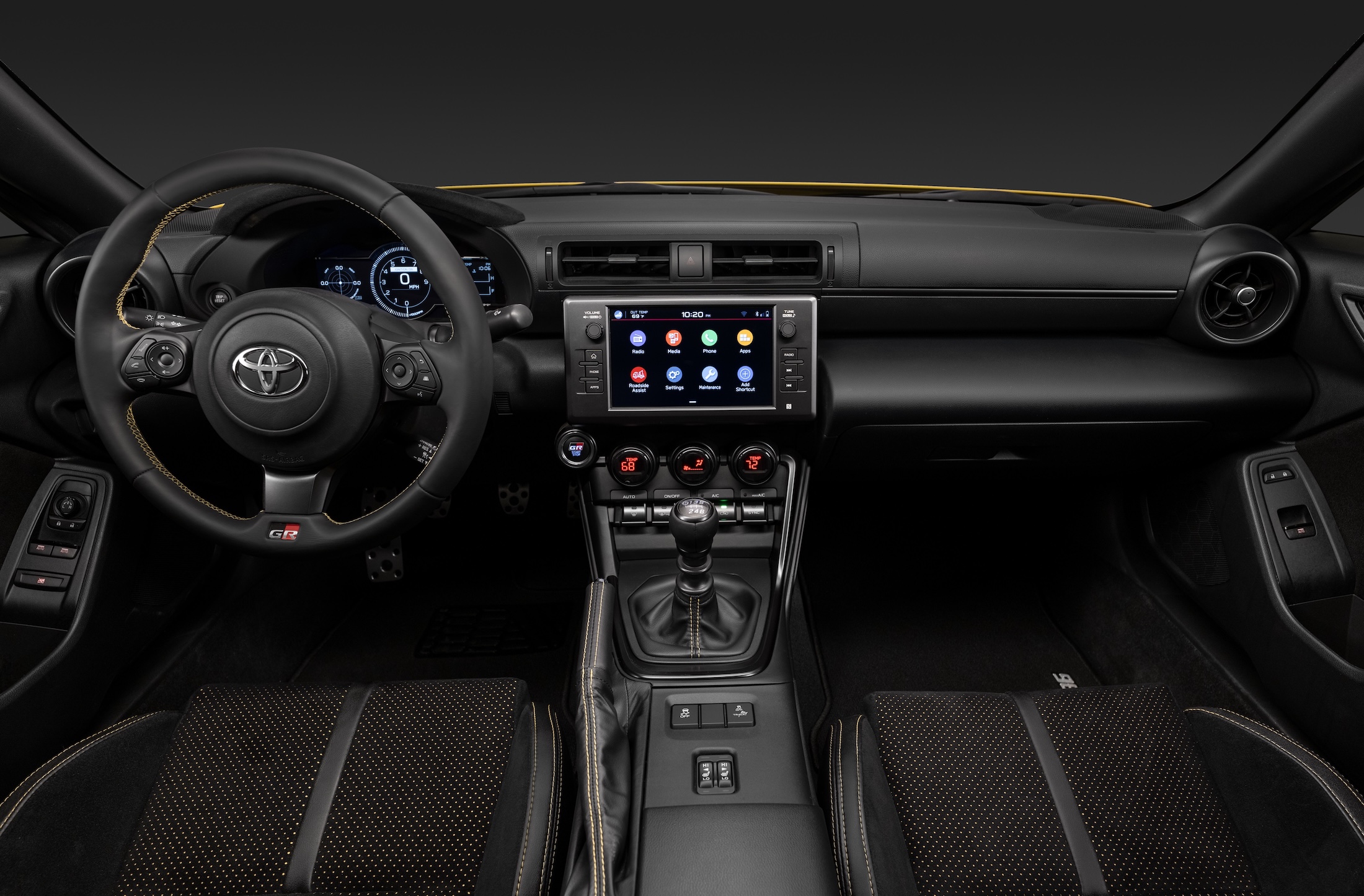
    The interior of the Toyota GR86 is snug and retro fun, unless you’re sat in the back. Then it’s snug, retro, and not at all fun.

    Driver’s seat: The cloth seats offer great support and are comfortable enough. They feel firm and a little crowded, so some people might not appreciate the big wings. The Lovely Mrs. Passenger Seat found them as nice as I did.

    The manual controls adjust height, fore-aft, and backrest simply.

    The gauges and steering wheel controls are old-fashioned, looking like last-gen Lexus dials, but I call old-fashioned a good thing these days.

    Friends and stuff: There’s a rear seat but it’s pretty cruel. Guests would have been harmed in the making of this review.

    I finally build up the nerve to try it out on Day 6. The ceiling is so low that I had to cant my head to the side. Foot room and legroom look impossible, but I could actually get my legs in there by setting the front seat a few notches up from normal. But when I did that and tried out the front, my legs were more cramped than on a Frontier flight.

    I would say only put kids in the back. Or maybe kid, singular.

    Cargo space is 6.26 cubic feet. (I didn’t round it because you’ll need every .01 cube.) The seat folds (all in one complicated-to-open piece) to create more luggage space.

    In and out: In and ouch. It’s way down there and requires a bit of undignified squatting, twisting, ducking, and scooching.

    Play some tunes: Sad. Tinny. Sound gets a C grade, probably one of the lowest I’ve ever assigned.

    Last-gen controls. You definitely won’t be distracted playing around with the touchscreen, though there is one, because it’s 2026 and I think it’s law now or something.

    Keeping warm and cool: The heater controls feature dials for temperature and fan speed and buttons inside the dials for blower choice. It’s such a small car that it runs hot; the seat heaters offer nice support when it’s not too cold out, but the switches are awkwardly built into the armrest.

    Fuel economy: I averaged about 26 mpg in spirited drives around Chester County’s old country roads every chance I could get. I would actually park and wait for certain roads to clear and then go make the most of the exhaust note. I guess the dual exhausts are worth $1,700.

    Where it’s built: Ota, Gunma, Japan

    How it’s built: Consumer Reports predicts the GR86 reliability is a 4 out of 5.

    In the end: Definitely lots of joy to be had here, and I could get behind buying a GR86. But with the Mini Cooper and Volkswagen GTI, you get fun and some practicality as well, plus the delight doesn’t diminish at highway speeds.

  • In a Facebook Marketplace and Depop world, Philly Craigslist still endures

    In a Facebook Marketplace and Depop world, Philly Craigslist still endures

    Every morning, Julie Parlade, a 34-year-old stylist from Springfield, wakes up and does what most millennials do. She reaches for her phone and checks her apps. Instagram, Gmail, maybe the news. Then she checks one more: Craigslist. Yes, that Craigslist. The classified advertisement website that was popular in the early aughts and 2010s. She checks it later in the day, too, pretty much whenever she has downtime. “It’s so automatic for me,” she said. “I have an obsession.”

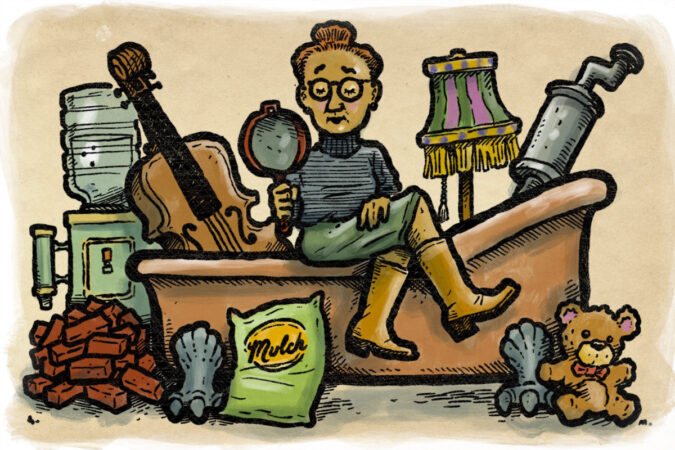
    Parlade mostly sticks to the free section, where she has scored everything from a pair of Frye boots in perfect condition to an entire set of Le Creuset cookware. Half of her house is furnished from the Craigslist free section: the clawfoot tub in the bathroom, the subway tile in the kitchen, the mid-century modern furniture in the living room.

    She started using Craigslist around 2010, first for jobs and apartments, and never really stopped. Today, it’s still her go-to source for secondhand items, despite the rise of other online marketplaces like Depop and Facebook Marketplace. “Everyone uses Craigslist,” Parlade said, “so I feel like I’m able to get better things. It’s a much broader net.”

    Does everyone still use Craigslist? Maybe not everyone, but more people than you might think. Despite its reputation as a digital relic, Craigslist draws more than 105 million monthly users, making it the 38th most popular website in the United States, according to internet data analytics company SimilarWeb.

    And in Philadelphia , the site remains a daily resource for people seeking work, housing, materials, and other necessities. University of Pennsylvania professor Jessa Lingel, 42, who interviewed hundreds of Craigslist users in Philadelphia for her book An Internet for the People: The Politics and Promise of Craigslist, says the platform functions as a kind of parallel infrastructure to more polished platforms, particularly for people with fewer financial resources. “Craigslist still has a role to play for a lot of Philadelphians who are just trying to live their everyday lives,” Lingel said.

    Access to affordability

    That role shows up most clearly in the kinds of jobs and housing that still circulate through Craigslist. Lingel, who lives in North Philadelphia, said many of the users she interviewed relied on the site to find warehousing shifts, construction work, and short-term gigs paying around $20 an hour — work that rarely surfaces on platforms like LinkedIn or Indeed because “those other platforms haven’t called those folks in,” she said.

    The same pattern holds for housing. Affordable apartments and private rooms for rent still appear regularly on Craigslist, posted by college students seeking temporary roommates or by landlords unwilling to pay higher listing fees. As one of Lingel’s interviewees put it, the cheap housing is on Craigslist, not Redfin. He called Craigslist the “poor people’s internet,” Lingel said.

    Craigslist does not release detailed user data, so there’s no way to know how many Philadelphians still rely on the site. But, said Lingel, given that Philadelphia is the second-poorest big city in the country, it would not be surprising if “the poor people’s internet” remained especially relevant here. “Craigslist is gritty,” Lingel said, “and so is Philly.”

    Privacy protection and net nostalgia

    For some Philadelphians, the appeal of Craigslist isn’t affordability so much as how little of themselves it asks for in return. Unlike newer marketplaces that tether buying and selling to social profiles, Craigslist allows users to remain largely invisible — no profile photos, no friend networks, no algorithm stitching transactions back to a personal identity.

    It harkens back to a simpler time on the internet, and, according to Lingel, holds special appeal for young tech skeptics who “are more ideologically attached to Craigslist.” .

    “The comparison that I think of is children of the ’80s going to ’50s- themed diners and getting really into Lindy Hop. It’s like, ‘Oh, this is a vision of the internet that I want to have experienced but have not.”

    That simplicity is precisely what draws people like Raquel Glassman, a cofounder of a local kombucha company from Port Richmond, who mostly uses Craigslist to give things away. When she’s decluttering, she’ll box up items, leave them on the sidewalk with a handwritten “free” sign, snap a photo, and post it online. “It’s always gone within the day,” she said.

    If Glassman, 31, is going to sell an item, she likes that she can do it anonymously on Craigslist. Facebook Marketplace is more efficient, she says, but it’s not a great place to go if you don’t want your aunt to know that you’re getting rid of the “ugly lamp” she gave you. “She’ll see it on my Facebook because we’re friends,” said Glassman. “You put that on Craigslist if you want to sell that.”

    IRL effects

    But the funny thing about Craigslist is that while it lets you be a stranger online, it forces you to be your full self in real life, and some people prefer that. According to Lingel, hobbyists such as musicians and car enthusiasts are among the most active Craigslist users.

    Indeed, two of the most popular “For Sale” subcategories on Philly Craigslist are auto parts and instruments — both of which benefit from face-to-face transactions. They allow sellers to avoid shipping costs and allow buyers to inspect their purchases. As Michael Lesco, a 33-year-old musician and marijuana dispensary manager said, “If I’m going to put $300 into something, I want to meet you in person and put the money in your hand.”

    Like Parlade, Lesco also makes good use of Craigslist’s free section. Last summer, he used it to get mulch and brick for the garden he was building in the abandoned lot next to his house in West Philly. The project could’ve easily cost $5,000. Instead, he and his wife did it for less than the cost of their West Philly Tool Library membership. “We could not have done it without Craigslist,” Lesco said.

    Parlade’s most recent Craigslist score was also construction-related: free drywall from a contractor. “We’re going to use it to fix my dad’s house,” she said. Craigslist, she added, is “almost like a service.”

  • Grandson of the inventor of Reese’s Peanut Butter Cups accuses Hershey of cutting corners

    Grandson of the inventor of Reese’s Peanut Butter Cups accuses Hershey of cutting corners

    The grandson of the inventor of Reese’s Peanut Butter Cups has lashed out at the Hershey Co., accusing the candy company of hurting the Reese’s brand by shifting to cheaper ingredients in many products.

    Hershey acknowledges some recipe changes but said Wednesday that it was trying to meet consumer demand for innovation. High cocoa prices also have led Hershey and other manufacturers to experiment with using less chocolate in recent years.

    Brad Reese, 70, said in a Feb. 14 letter to Hershey’s corporate brand manager that for multiple Reese’s products, the company replaced milk chocolate with compound coatings and peanut butter with peanut butter creme.

    “How does The Hershey Co. continue to position Reese’s as its flagship brand, a symbol of trust, quality and leadership, while quietly replacing the very ingredients (Milk Chocolate + Peanut Butter) that built Reese’s trust in the first place?” Reese wrote in the letter, which he posted on his LinkedIn profile.

    He is the grandson of H.B. Reese, who spent two years at Hershey before forming his own candy company in 1919. H.B. Reese invented Reese’s Peanut Butter Cups in 1928; his six sons eventually sold his company to Hershey in 1963.

    Hershey said Wednesday that Reese’s Peanut Butter Cups are made the same way they always have been, with milk chocolate and peanut butter that the company makes itself from roasted peanuts and a few other ingredients, including sugar and salt. But some Reese’s ingredients vary, Hershey said.

    “As we’ve grown and expanded the Reese’s product line, we make product recipe adjustments that allow us to make new shapes, sizes and innovations that Reese’s fans have come to love and ask for, while always protecting the essence of what makes Reese’s unique and special: the perfect combination of chocolate and peanut butter,” the company said.

    Brad Reese said he thinks Hershey went too far. He said he recently threw out a bag of Reese’s Mini Hearts, which were a new product released for Valentine’s Day. The packaging notes that the heart-shaped candies are made from “chocolate candy and peanut butter creme,” not milk chocolate and peanut butter.

    “It was not edible,” Reese told the Associated Press in an interview. “You have to understand. I used to eat a Reese’s product every day. This is very devastating for me.”

    The U.S. Food and Drug Administration has strict ingredient and labeling requirements for chocolate. To be considered milk chocolate, products must contain at least 10% chocolate liquor, which is a paste made from ground cocoa beans and contains no alcohol. Products also must contain at least 12% milk solids and 3.39% milk fat.

    Companies can get around those rules by using other wording on their packaging. The wrapper for Hershey’s Mr. Goodbar, for example, contains the words “chocolate candy” instead of “milk chocolate.”

    Reese said Hershey changed the recipes for multiple Reese’s products in recent years. Reese’s Take5 and Fast Break bars used to be coated with milk chocolate, he said, but now they aren’t. In the early 2000’s, when Hershey released White Reese’s, they were made with white chocolate. Now they’re made with a white creme, he said.

    Reese said Reese’s Peanut Butter Cups sold in Europe, the United Kingdom, and Ireland are also different than U.S. versions. On Wednesday, a package advertised on the website of British online supermarket Ocado described the candy as “milk chocolate-flavored coating and peanut butter crème.”

    In a conference call with investors last year, Hershey chief financial officer Steven Voskuil said the company made some changes in its formulas. Voskuil did not say for which products but said Hershey was very careful to maintain the “taste profile and the specialness of our iconic brands.”

    “I would say in all the changes that we’ve made thus far, there has been no consumer impact whatsoever. As you can imagine, even on the smallest brand in the portfolio, if we were to make a change, there’s extensive consumer testing,” he said.

    But Brad Reese said he often has people tell him that Reese’s products don’t taste as good as they used to. He said Pennsylvania-based Hershey should keep in mind a famous quote from its founder, Milton Hershey: “Give them quality, that’s the best advertising.”

    “I absolutely believe in innovation, but my preference is innovation with quality,” Reese said.

  • Mark Zuckerberg quizzed on kids’ Instagram use in social media trial

    Mark Zuckerberg quizzed on kids’ Instagram use in social media trial

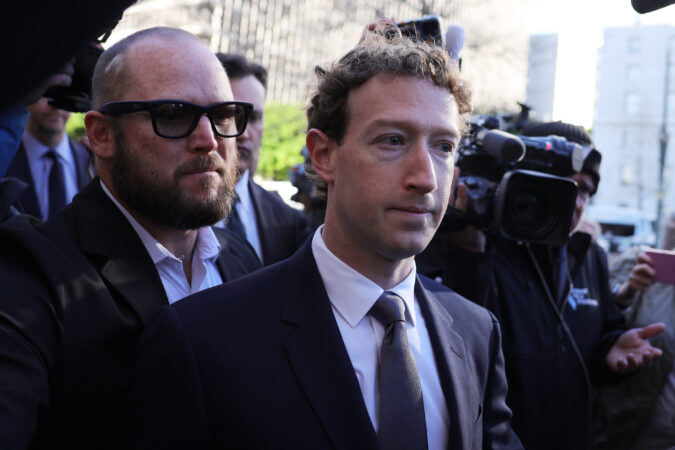
    LOS ANGELES — Mark Zuckerberg and opposing lawyers dueled in a Los Angeles courtroom on Wednesday, where the Meta CEO answered questions about young people’s use of Instagram, his congressional testimony and internal advice he’s received about being “authentic” and not “robotic.”

    Zuckerberg’s testimony is part of an unprecedented social media trial that questions whether Meta’s platforms deliberately addict and harm children.

    As of early afternoon, Zuckerberg has not directly answered the central question of the case: whether Instagram is addictive. The plaintiff’s attorney, Mark Lanier, asked if people tend to use something more if it’s addictive.

    “I’m not sure what to say to that,” Zuckerberg said. “I don’t think that applies here.”

    Attorneys representing the plaintiff, a now 20-year-old woman identified by the initials KGM, claim her early use of social media addicted her to the technology and exacerbated depression and suicidal thoughts. Meta Platforms and Google’s YouTube are the two remaining defendants in the case, which TikTok and Snap have settled.

    Beginning his questioning, Lanier laid out three options of what people can do regarding vulnerable people: help them, ignore them, or “prey upon them and use them for our own ends.” Zuckerberg said he agrees the last option is not what a reasonable company should do, saying, “I think a reasonable company should try to help the people that use its services.”

    When he was asked about his compensation, Zuckerberg said he has pledged to give “almost all” of his money to charity, focusing on scientific research. Lanier asked him how much money he has pledged to victims impacted by social media, to which Zuckerberg replied, “I disagree with the characterization of your question.”

    Lanier questioned the Meta CEO extensively about a comment he made during a past congressional hearing, where he said Instagram employees are not given goals to increase amount of time people spent on the platform.

    Lanier presented internal documents that seemed to contradict that statement. Zuckerberg replied that they previously had goals associated with time, but said he and the company made the conscious decision to move away from those goals, focusing instead on utility. He said he believes in the “basic assumption” that “if something is valuable, people will use it more because it’s useful to them.”

    Lanier also asked Zuckerberg about what he characterized as extensive media training, including for testimonies like the one he was giving in court. Lanier pointed to an internal document about feedback on Zuckerberg’s tone of voice on his own social media, imploring him to come off as “authentic, direct, human, insightful and real,” and instructing him to “not try hard, fake, robotic, corporate or cheesy” in his communication.

    Zuckerberg pushed back against the idea that he’s been coached on how to respond to questions or present himself, saying those offering the advice were “just giving feedback.”

    Regarding his media appearances and public speaking, Zuckerberg said, “I think I’m actually well known to be sort of bad at this.”

    The Meta CEO has long been mocked online for appearing robotic and, when he was younger, nervous when speaking publicly. In 2010, during an interview with renowned tech journalists Kara Swisher and Walt Mossberg, he was sweating so profusely that Swisher asked him if he wanted to “take off the hoodie” that was his uniform at the time.

    Lanier spent a considerable stretch of his limited time with Zuckerberg asking about the company’s age verification policies.

    “I don’t see why this is so complicated,” Zuckerberg said after a lengthy back-and-forth, reiterating that the company’s policy restricts users under the age of 13 and that they work to detect users who have lied about their ages to bypass restrictions.

    Zuckerberg mostly stuck to his talking points, referencing his goal of building a platform that is valuable to users and, on multiple occasions, saying he disagreed with Lanier’s “characterization” of his questions or of Zuckerberg’s own comments.

    Zuckerberg has testified in other trials and answered questions from Congress about youth safety on Meta’s platforms. During his 2024 congressional testimony, he apologized to families whose lives had been upended by tragedies they believed were caused by social media. But while he told parents he was “sorry for everything you have all been through,” he stopped short of taking direct responsibility for it. This trial marks the first time Zuckerberg stands before a jury. Once again, bereaved parents are sitting in the courtroom audience.

    The case, along with two others, has been selected as a bellwether trial, meaning its outcome could impact how thousands of similar lawsuits against social media companies are likely to play out.

    A Meta spokesperson said the company strongly disagrees with the allegations in the lawsuit and said they are “confident the evidence will show our longstanding commitment to supporting young people.”

    One of Meta’s attorneys, Paul Schmidt, said in his opening statement that the company is not disputing that KGM experienced mental health struggles, but rather disputing that Instagram played a substantial factor in those struggles. He pointed to medical records that showed a turbulent home life, and both he and an attorney representing YouTube argue she turned to their platforms as a coping mechanism or a means of escaping her mental health struggles.

    Zuckerberg’s testimony comes a week after that of Adam Mosseri, the head of Meta’s Instagram, who said in the courtroom that he disagrees with the idea that people can be clinically addicted to social media platforms. Mosseri maintained that Instagram works hard to protect young people using the service, and said it’s “not good for the company, over the long run, to make decisions that profit for us but are poor for people’s well-being.”

    Much of Mosseri’s questioning from the plaintiff’s lawyer centered on cosmetic filters on Instagram that changed people’s appearance — a topic that Lanier is sure to revisit with Zuckerberg. He is also expected to face questions about Instagram’s algorithm, the infinite nature of Meta’s feeds and other features the plaintiffs argue are designed to get users hooked.

    Meta is also facing a separate trial in New Mexico that began last week.

  • Fred Mann, former assistant managing editor at The Inquirer and retired vice president of communications at the Robert Wood Johnson Foundation, has died at 75

    Fred Mann, former assistant managing editor at The Inquirer and retired vice president of communications at the Robert Wood Johnson Foundation, has died at 75

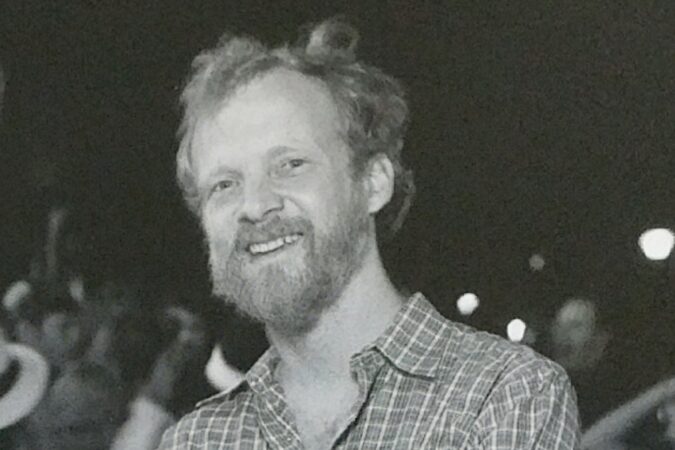
    Fred Mann, 75, formerly of Wayne, retired vice president of communications at the Robert Wood Johnson Foundation, former vice president of national programming at Knight Ridder Digital and assistant managing editor at The Inquirer, freelance reporter, mentor to many, onetime baker, and longtime pickup baseball player, died Friday, Feb. 13, of complications from Alzheimer’s disease at Woodridge Rehabilitation & Nursing Center in Berlin, Vt.

    Mr. Mann was many things to many people all the time. He advocated for hundreds of healthcare-related philanthropic projects for the Princeton-based Robert Wood Johnson Foundation and, as vice president of communications, served as its liaison with the media and public from 2006 to his retirement in 2019. “Health is more than just going to the doctor or staying out of the hospital,” he told The Inquirer in 2016. “Health is reflected in everything we do.”

    At The Inquirer from 1983 to 2006, Mr. Mann was features editor, editor of the Sunday magazine, assistant managing editor, and the first general manager of Philly.com, now Inquirer.com. He championed women’s ascension in the newsroom and established online standards and practices in the 1990s that remain relevant in today’s digital landscape.

    “Fred was the best boss I ever had,” said Avery Rome, who succeeded him as editor of the Sunday magazine. “Working for him was a team effort and a pleasure. He readily gave credit to other people and appreciated their input.”

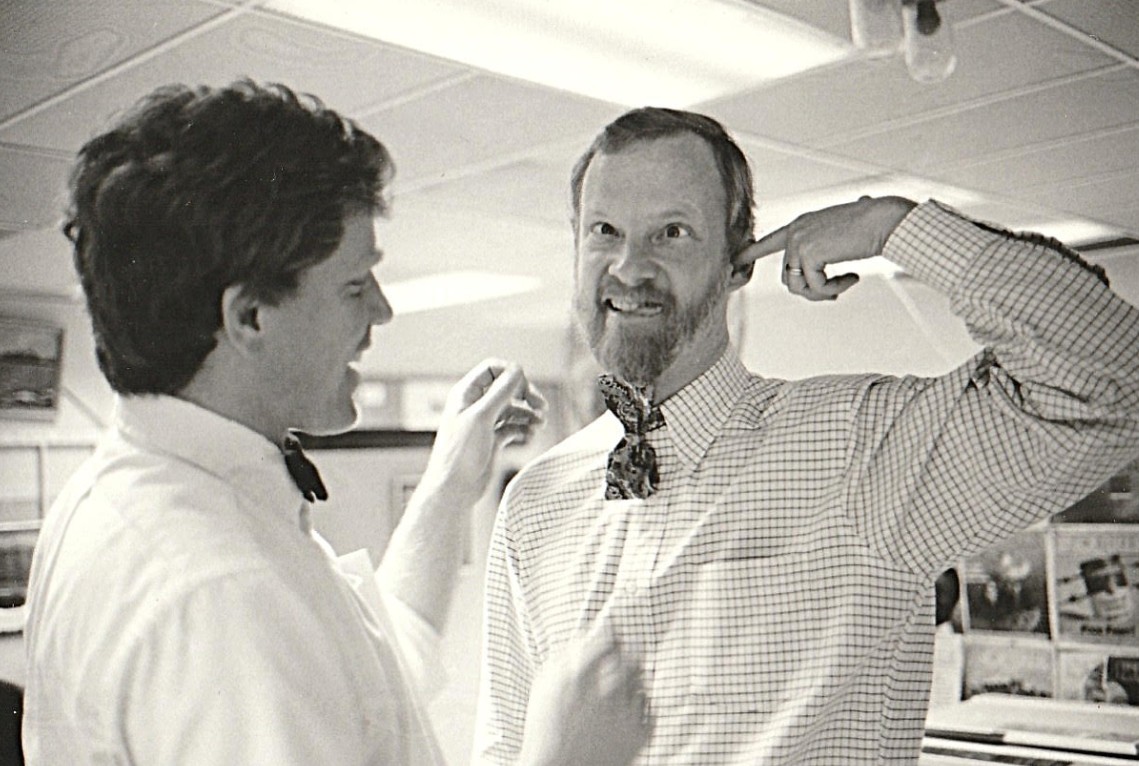
    Mr. Mann (right) and Inquirer colleague Art Carey both wore bow ties on this day.

    Other former colleagues called Mr. Mann a “talent magnet” and “one of a kind” on Facebook. His son Ted said: “He was good at taking leaps. He was bold, always looking for something different.”

    In a 2006 letter of recommendation for a former colleague, Mr. Mann said: “I have learned that hiring the right people is probably the single most important accomplishment an executive can make. Find great talent, nurture it, let it bloom, and then try to keep it. That was my strategy. And I must say, it was a recipe that worked and brought a great deal of reflected glory and success to me personally.”

    As editor of The Inquirer’s Sunday magazine from 1986 to 1992, Mr. Mann penned a weekly message to readers on Page 2. In November 1986, he wrote about the differences in celebrating Thanksgiving in California as a boy and in Philadelphia as an adult. “Thanksgiving was made for crispness,” he said, “for changing seasons, for wood stoves. … It’s the day that makes the hassles of life back East all worthwhile.”

    He wrote his farewell Sunday magazine column on Jan. 19, 1992, and praised his staff for “offering important, in-depth stories that teach and inform our readers, and mixing in others that entertain and delight. … I think we’ve taught. I hope we’ve delighted a few times.”

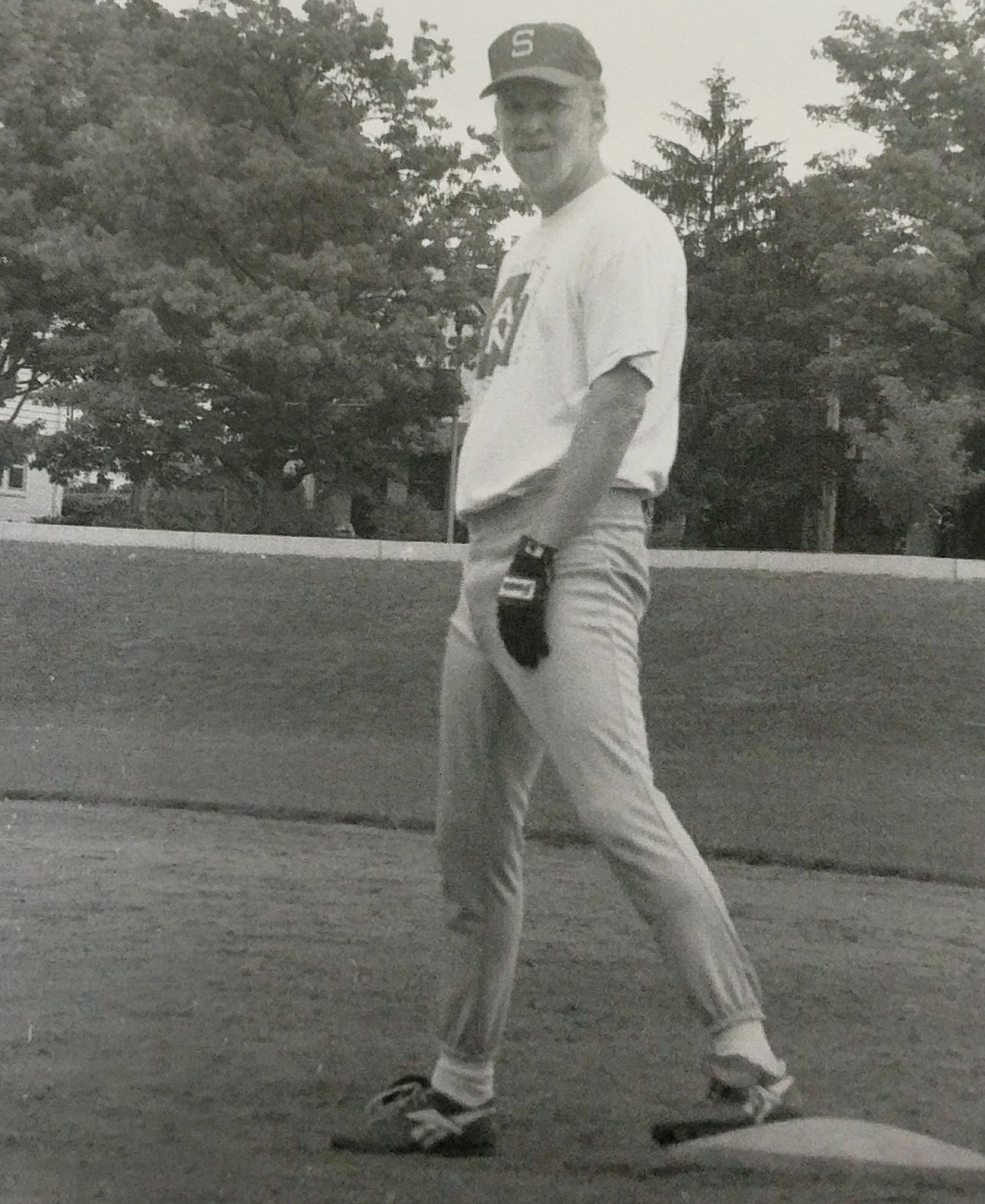
    Mr. Mann spent a lot of time on baseball fields.

    He worked on several Pulitzer Prize-winning projects at The Inquirer and edited its annual fall fashion supplement as features editor. In 1995, he started managing what was then Philly.com and Knight Ridder’s national innovations in online publishing.

    Former Inquirer colleagues noted his “smile and easy manner,” “integrity and good judgment,” and “easy grace, puckish humor, and boundless devotion to family and friends” in Facebook tributes. Longtime friend and colleague Dick Polman said: “He had great story instincts and could sell the stories to reporters. He was good at managing up and down.”

    Former Inquirer writer Joe Logan called him “a prime example of everything that was right and good and rewarding about working at The Inquirer during those years.”

    Before The Inquirer, Mr. Mann spent three years as national editor and opinion editor at the Hartford Courant. In the mid-1970s, he worked for the Day in New London, Conn., cofounded the California News Bureau, and sold stories from Los Angeles, San Diego, and elsewhere to The Inquirer, the Courant, and other newspapers around the country.

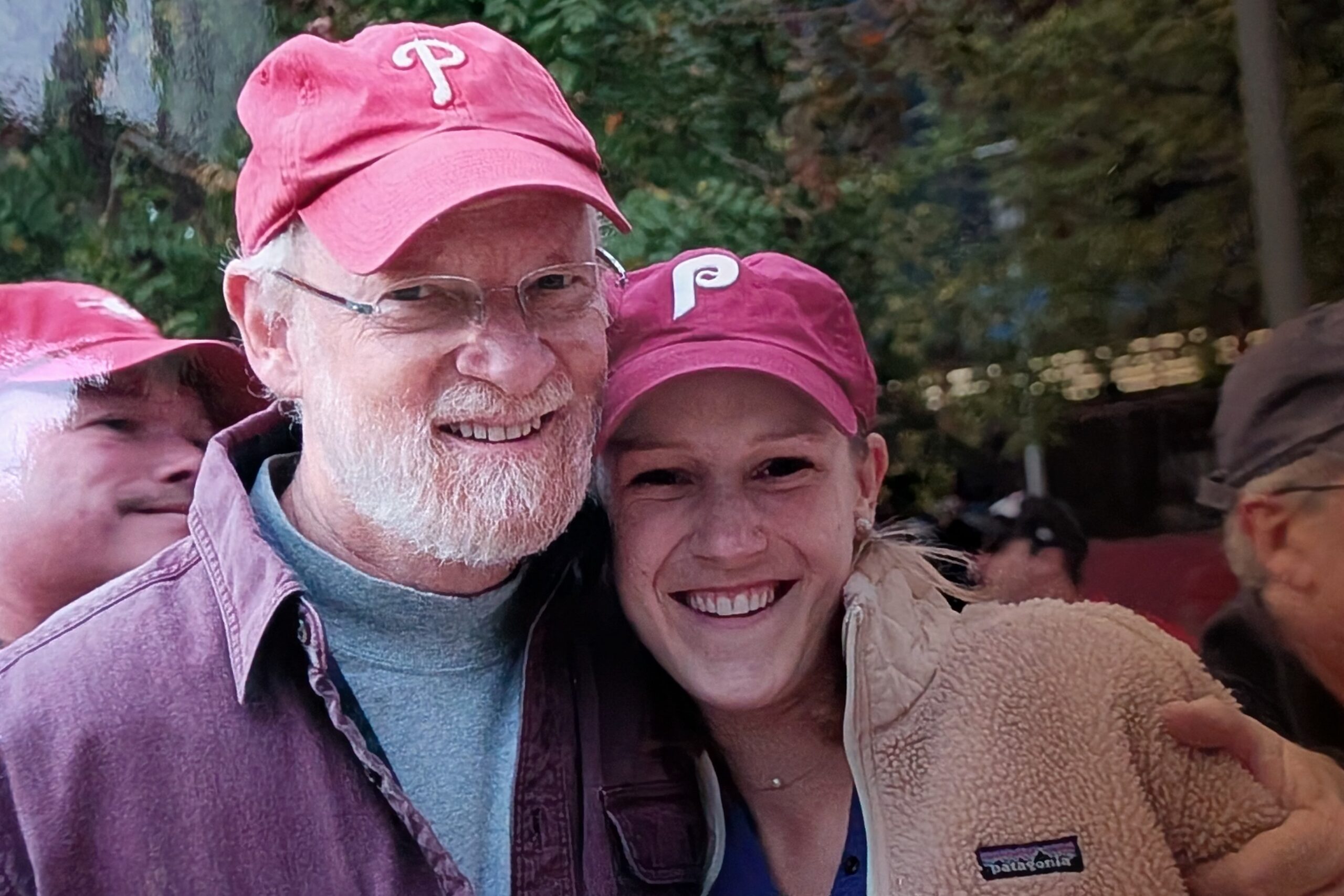
    Mr. Mann and his daughter, Cassie, watched the Phillies in World Series games together.

    He also wrote freelance articles for Time magazine and was press secretary for Connecticut Sen. Lowell P. Weicker Jr. for three years. Later, he was a founding board member of the Online News Association, onetime president of the Sunday Magazine Editors Association, and on boards of the Communications Network, the Internet Business Alliance, and other groups.

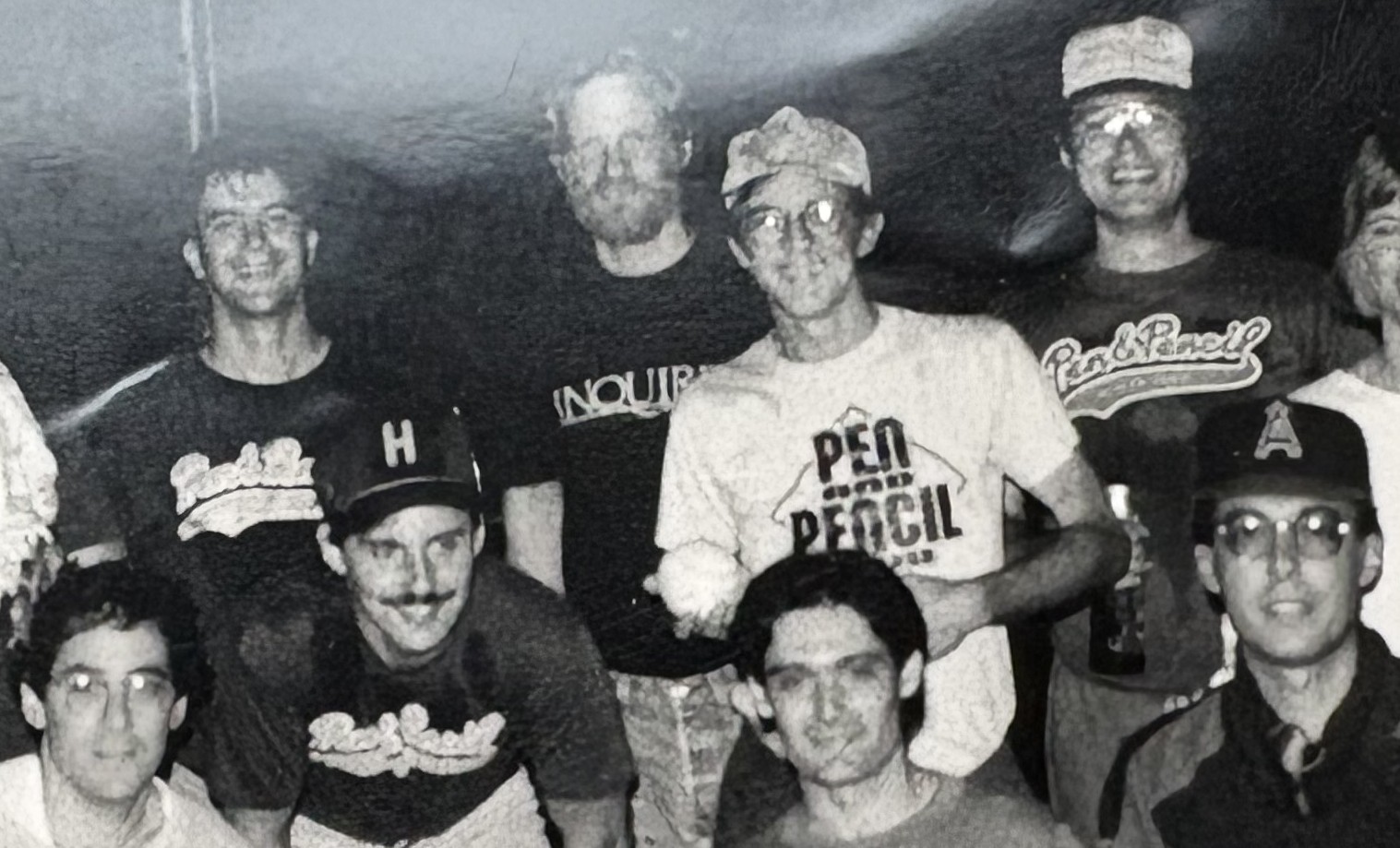
    He bounced around the world for a few years after graduating from Stanford University in 1972 and even opened a bakery with friends in Connecticut. He played third base in dozens of Sunday morning slow-pitch baseball games over the years and won a league championship with the Pen and Pencil Club softball team in the early 1980s.

    “I don’t know why he loved baseball so much,” said his son Jason. “But I know I love it because of him.”

    Frederick Gillespie Mann was born Nov. 28, 1950, in Yonkers, N.Y. His father was Delbert Mann, an Oscar-winning TV and film director, and the family moved to Los Angeles when Mr. Mann was young.

    Mr. Mann (rear, second from left) won a softball championship with the Pen and Pencil Club team in the early 1980s.

    He delivered newspapers, graduated from Beverly Hills High School, and earned a bachelor’s degree at Stanford. He married Robin Layton, and they had sons Ted, Jason, and Lindsay and a daughter, Cassie.

    After a divorce, he married Nicole O’Neill in 1994, and welcomed her children, Andy, Hilary, and Brette, and their children into his family. He and his wife lived in Wayne before moving to Greensboro, Vt., in 2019.

    Mr. Mann enjoyed hikes in the woods with his dogs, card games and board games with family and friends, reading about history, and touch football games on Thanksgiving. He listened to the Beatles and knew every word to the soundtrack of My Fair Lady.

    He reveled in his “long days of glorious raking” in Rosemont and Wayne, and said in a 1989 column: “When all you’ve known is palm trees, piling up tons of autumn foliage is more blessing than burden.”

    He coached Little League baseball players, followed the Boston Red Sox closely, and attended memorable Phillies games with his children. On many Monday afternoons, he impressed teammates and opponents alike with his corner jump shots in basketball games at the Philadelphia Athletic Club.

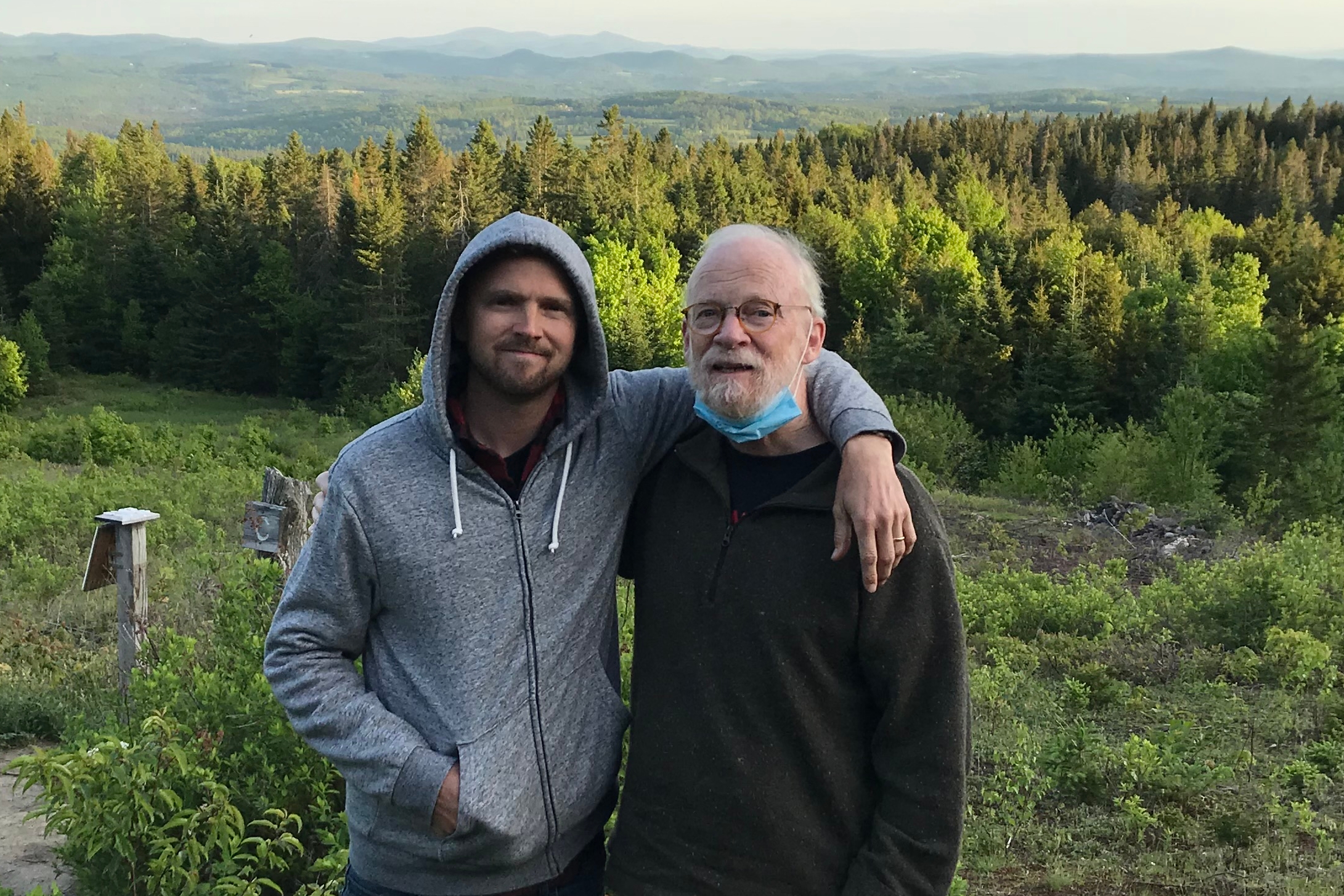
    Mr. Mann and his son Lindsay enjoyed time in the countryside.

    “He was fun and funny,” his daughter said, “loved and loving.”

    Former Inquirer managing editor Butch Ward said on Facebook: “Fred Mann brightened every room he entered.” Former Inquirer columnist Steve Lopez said: “The very thought of Fred puts a smile on my face.”

    In addition to his wife, children, and former wife, Mr. Mann is survived by grandchildren, two brothers, and other relatives. A sister died earlier.

    A celebration of his life is to be held later.

    Donations in his name may be made to the Lenfest Institute for Journalism, 100 S. Independence Mall West, Suite 600, Philadelphia, Pa. 19106.

    Even in sad times, said longtime friend Dick Polman, Mr. Mann shared his “irrepressible wit.”
  • QVC Group faces $30 million ‘unjustified termination’ lawsuit after report of potential bankruptcy

    QVC Group faces $30 million ‘unjustified termination’ lawsuit after report of potential bankruptcy

    QVC Group has been hit with a $30 million lawsuit amid broader financial problems for the West Chester-based home shopping network.

    The company is considering filing for Chapter 11 bankruptcy to reorganize billions in debt, Bloomberg reported last week.

    Antthony Mark Hankins, a Savannah, Ga.-based fashion designer who had a 31-year on-air career with HSN until he was terminated in July, filed the lawsuit last week against the network and its parent company, QVC Group, according to federal court documents.

    Hankins seeks at least $30 million in damages for what his attorneys describe in the documents as an “abrupt and unjustified termination” that “reflects a pattern of discriminatory treatment, retaliatory conduct, and operational mismanagement.” The lawsuit is filed in the U.S. District Court for the Eastern District of Pennsylvania.

    QVC Group spokespeople and general counsel did not return requests for comment. HSN operated out of a studio in St. Petersburg, Fla., until about a year ago, when it moved to QVC’s West Chester campus.

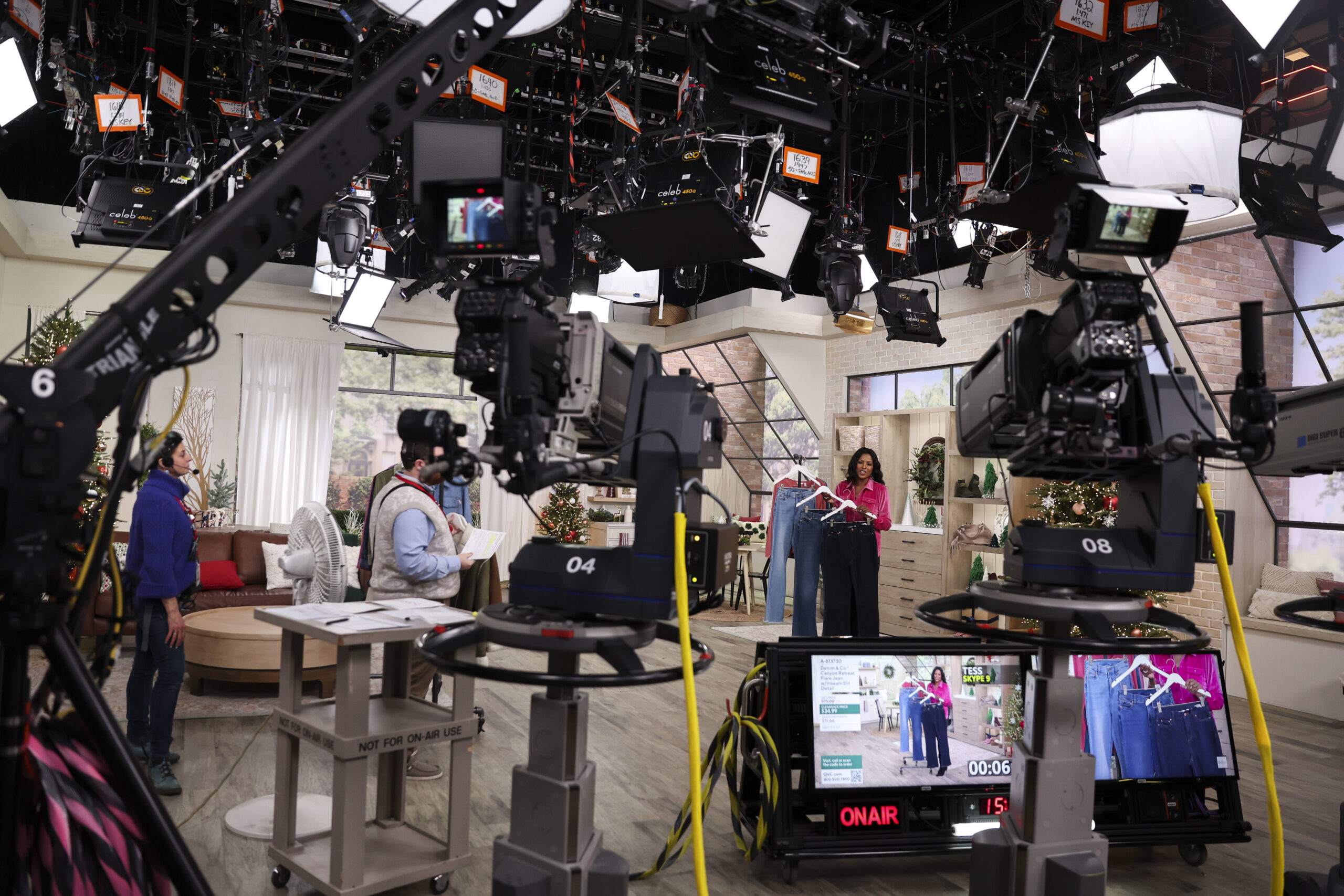
    A show is filmed at QVC’s studios in West Chester in 2023.

    Between 2023 and 2025, HSN executives reduced Hankins’ airtime and decreased promotion of his brand, Antthony Design Originals, to focus on a “TikTok-centered business model,” according to the designer’s lawsuit. As a result, he says his gross sales last calendar year were $13.24 million, more than $2 million less than projected. When he was more supported by the network, he said, his sales outperformed expectations.

    Hankins, who is Black, also says the company discriminated against him based on race, including by promoting him more heavily during Black History Month, firing him without cause, and immediately pulling him off the air despite decades of strong performance, according to the lawsuit.

    In the documents, Hankins also alleges breach of contract, defamation, interference with third-party business relationships, and misappropriation of his name and likeness in advertisements.

    In a Facebook post on his business page, Hankins said the lawsuit “is about standing up for the values my brand was built on, protecting my legacy, and ensuring that fairness and accountability matter — especially for creators who have given decades of their lives to their work.”

    Hankins’ attorney, Samuel B. Fineman of Semanoff Ormsby Greenberg & Torchia in Huntingdon Valley, did not return a request for additional comment.

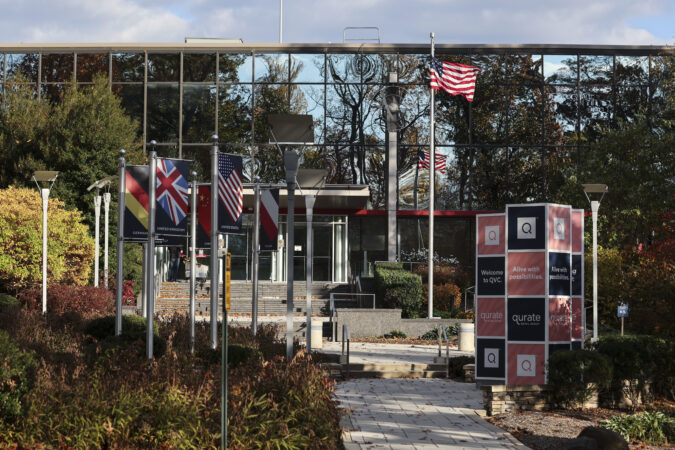
    A QVC logo is shown outside its studios in an undated file photo. The company has been based in West Chester for more than 30 years.

    QVC has been based in West Chester for more than three decades, and merged with HSN as part of a $2 billion deal in 2017.

    The networks’ parent company, which rebranded as QVC Group last year, has struggled recently amid stiff competition from e-commerce and social-media platforms like TikTok Shop.

    Its revenue and operating income have been on the decline, and fewer people are shopping. As of September, about 7 million customers had made a purchase on the networks in the past year, down from 8.1 million in fiscal year 2023.

    The company is set to release its fourth quarter 2025 earnings report next week.

    According to Bloomberg’s report last week, company executives were talking with creditors about a potential bankruptcy, but had not made a decision on whether to file.

    A search for “QVC Group” in online court records did not show any bankruptcy filings as of Wednesday.

  • Johnson & Johnson will spend $1 billion on a cell therapy plant in Montgomery County

    Johnson & Johnson will spend $1 billion on a cell therapy plant in Montgomery County

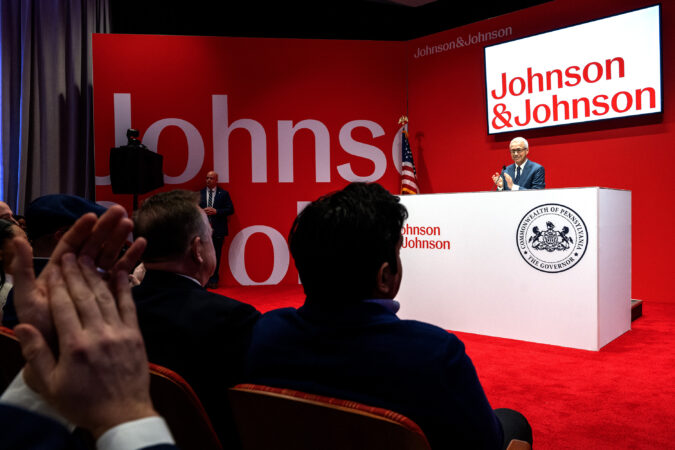
    Johnson & Johnson plans to spend more than $1 billion to build a cell therapy manufacturing facility in Montgomery County near Spring House, the New Jersey pharmaceutical and medical supplies giant said Wednesday.

    The Lower Gwynedd Township plant, part of an effort by the company to invest $55 million in the U.S. by early 2029, is expected to employ 500 people when fully operational in 2031, J&J said.

    The facility at 1201 Sumneytown Pike will add to J&J’s capacity to make cell therapy treatments for cancer, with a focus on multiple myeloma. That’s a type of cancer that attacks white blood cells in the bone marrow. Cell therapy is the use of engineered immune cells to treat disease.

    “Pennsylvania’s proud manufacturing legacy, from steel to today’s medicines and medical technologies and Johnson & Johnson’s roots here for seven decades, are part of why we are investing here.” Joaquin Duato, J&J’s chairman and CEO, said.

    Duato spoke during an event at the company’s Spring House research and development campus, where 2,500 scientists work in 70 laboratories. The Montgomery County site is J&J’s largest R&D center and it’s “where most of our discovery efforts start,” Duato said.

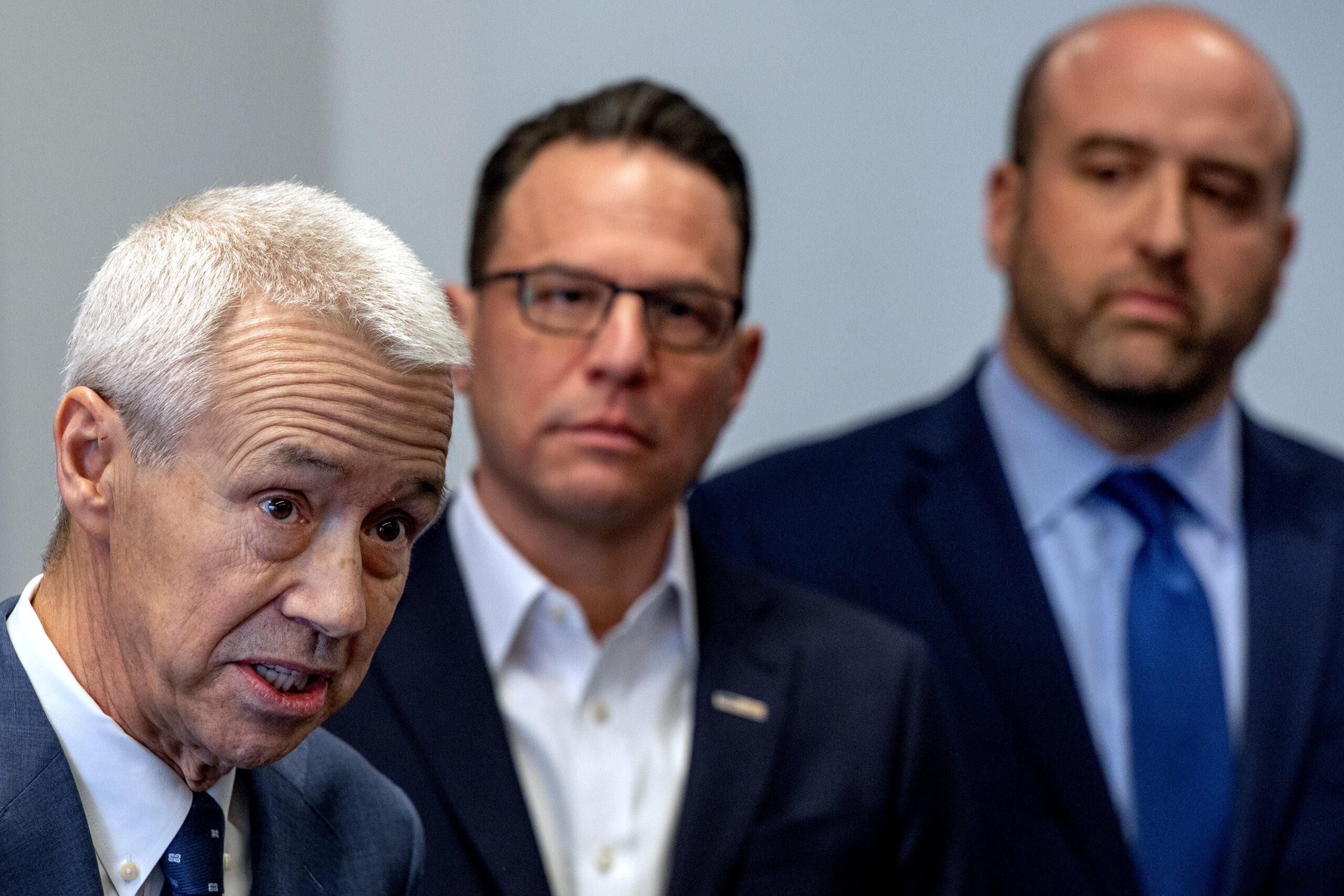
    The company based in New Brunswick, N.J., employs 5,885 people at 10 Pennsylvania facilities, according to the office of Gov. Josh Shapiro. The Shapiro administration has offered $41.5 million in state support for the J&J project.

    “With this investment, we are further cementing our place as a leader in life sciences,” Shapiro said. He said his administration’s efforts to cut red tape are among the reasons companies like J&J “are choosing to double down on their investments” in Pennsylvania.

    Eli Lilly & Co. last month announced plans to build a $3.5 billion pharmaceutical plant in the Lehigh Valley to expand manufacturing capacity for next-generation injectable weight-loss medicines.

    GSK said in September that it will build a biologics factory in Upper Merion Township, but did not specify how much it would spend there. That project is part of GSK’s plan to spend $1.2 billion on advanced manufacturing facilities.

    Johnson & Johnson chairman and CEO Joaquin Duato (left), was joined by Gov. Josh Shapiro and Pa. Dept. of Community and Economic Development Secretary Rick Siger (right) on Wednesday when J&J announced it will spend $1 billion on a cell therapy plant on its campus in Lower Gwynedd Township.

    Merck, another New Jersey-based drug giant, last year announced plans for a $1 billion factory and lab near Wilmington. Merck also has major operations in Montgomery County, which is among the top-ranked counties nationally for pharmaceutical manufacturing jobs.

    J&J has a long legacy in the Philadelphia region. Among its major acquisitions here was the 1959 purchase of McNeil Laboratories, which later developed Tylenol. The pain reliever is still made at a plant in Fort Washington.

    Other major Philadelphia-area J&J deals include the 1999 purchase of Centocor, one of the country’s first biotech companies, and the 2012 deal for Synthes Inc., a Swiss medical device maker with its North American headquarters and major operations here.

    Separately from the new cell therapy manufacturing facility, J&J has two expansion projects planned for the Spring House R&D site.

    One is a new cell engineering and analytical sciences facility. The other is focused on CAR-T testing and manufacturing during research and development, with the goal of creating personalized therapies more quickly and efficiently. The company did not disclose the cost of those projects.

  • After 20 years of growth, this Philadelphia-born company says it’s ready to help in the caregiver crisis

    After 20 years of growth, this Philadelphia-born company says it’s ready to help in the caregiver crisis

    Just over 20 years ago, when Geoff Gross founded Medical Guardian, his vision was to empower older adults to live more independently.

    The company launched in 2005 out of Gross’ apartment in Center City with a focus on emergency response for seniors and individuals with disabilities.

    “At the time, the industry was largely reactive and built around moments of crisis,” he said.

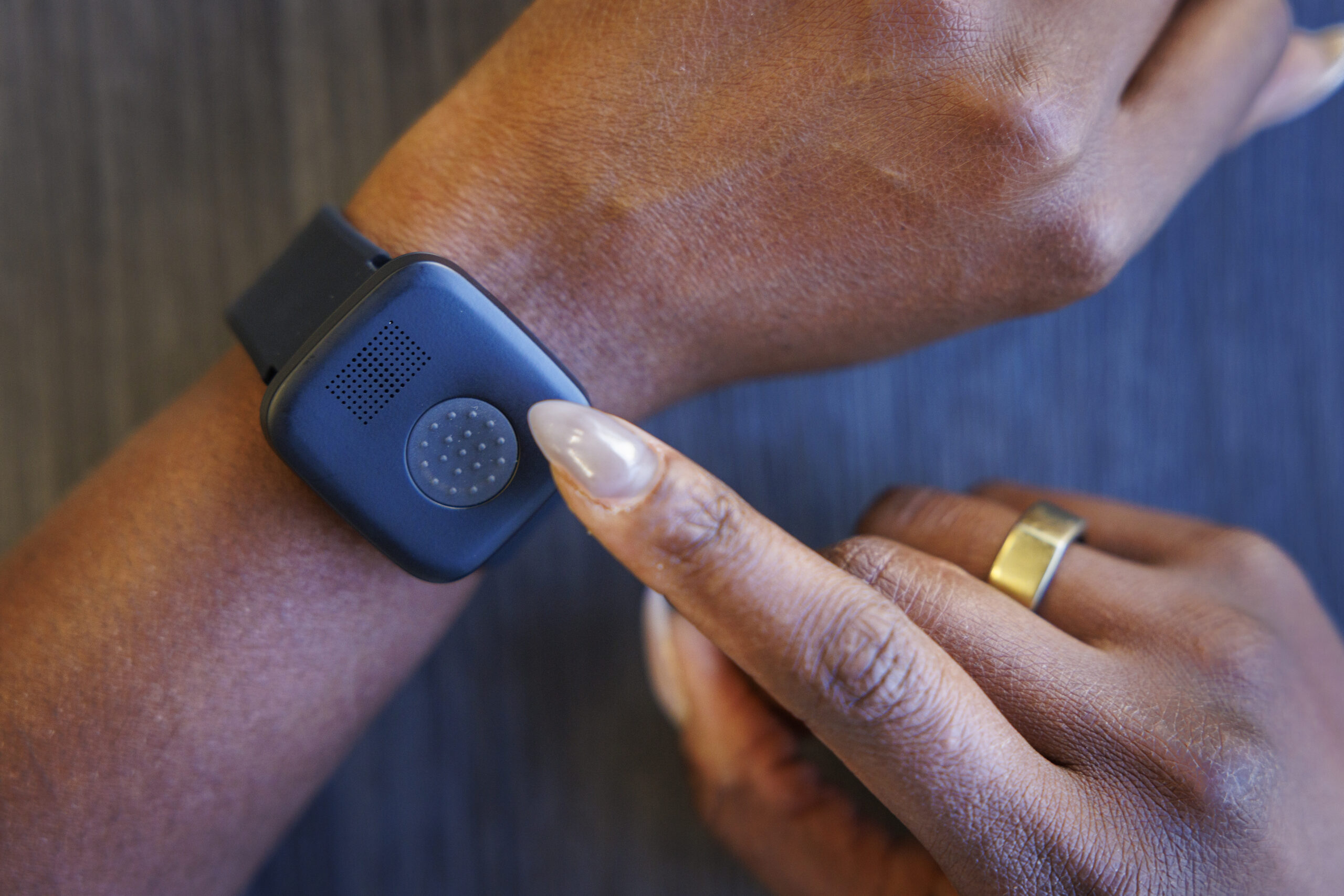
    It now has 630,000 active members, who can choose from lightweight medical alert devices worn as a necklace or on the wrist. One of them, which looks like any other smartwatch on first glance, allows users to track health and activity stats.

    The company employs more than 600 people and is approaching $250 million in annual revenue. Gross said it is poised to step in as aging-in-place becomes an urgent challenge facing families, healthcare systems, and policymakers.

    By 2034, the number of older adults in the U.S. will surpass the number of minors for the first time in history, according to the U.S. Census Bureau. Simultaneously, families and caregivers are experiencing increased demands, and traditional care models are proving to be less sustainable. Over 53 million Americans serve as unpaid family caregivers, according to a recent study from the Shirley Ryan AbilityLab, and they provide an estimated $600 billion worth of unpaid labor each year.

    “Caregiving is now widely recognized as a public health, workforce, and economic issue, not just a personal one,” Gross said. “Burnout, anxiety, and sleep deprivation are increasingly common, yet caregivers are still underserved by technology that focuses almost entirely on emergencies instead of daily reassurance and support.”

    From peace of mind to longevity

    Gross founded Medical Guardian based on a “simple but deeply personal belief” that “people deserve to age with confidence, dignity, and the freedom to live life on their own terms,” he said.

    That was informed by his family’s experience with Gross’ grandmother, Freda, a retired nurse who lived alone later in life and experienced frequent falls. “She was fiercely independent, but those moments created real anxiety for our family,” he said.

    She became Medical Guardian’s first member.

    The MGMini Lite by Medical Guardian.

    “People who are older, frail, or have a disability or chronic illness” need to be able to easily, reliably contact family or emergency services, said Richard C. Wender, who chairs the Department of Family Medicine and Community Health at the University of Pennsylvania’s medical school.

    He recommends choosing a system that’s affordable and delivers on promises made. These services can offer more independent options for vulnerable individuals.

    “Most people want the same things as they get older, as they did before: control over their daily lives, privacy, and the ability to remain in their own homes and communities for as long as possible,” Gross said. “When done thoughtfully, connected health and safety tools can remove barriers rather than impose them.”

    People often find Medical Guardian through referrals from adult children, caregivers, clinicians, and community organizations, Gross said. He noted that such decisions are “often made collaboratively, and our approach is designed to reflect that reality.”

    The company also does direct-to-consumer marketing, as well as social media advertising and influencer outreach. And it works closely with health plans, providers, senior living operators, and state programs focused on helping aging adults remain safely at home.

    “That blend of consumer and healthcare channels mirrors how aging and caregiving actually happen, in real homes, with real families, over time,” Gross said.

    Gross says Medical Guardian members have shared feedback that their devices’ biggest impact is not a dramatic moment, but the everyday reassurance.

    Medical Guardian’s MGMini device, which is worn around the neck.

    “Feeling steady taking a shower, walking outside without hesitation, or knowing help is there if something feels off,” Gross said. “Those small moments of confidence shape how people experience independence.”

    With that in mind, one of the company’s goals is to support people earlier — before a fall, a health scare, or a rushed decision.

    “Our services often come years before in-home care or assisted living, which gives us the opportunity to build trust while people are still living independently and confidently,” he said.

    Medical Guardian also has wellness advocates, many of whom have social work backgrounds, as well as emergency response specialists and care teams.

    “Our platforms use data, automation, and intelligence to notice patterns and surface insights, but when something matters, a real person is always involved,” Gross said.

    Philly-based medical device competes with Big Tech watches

    Many of the people answering Medical Guardian’s emergency calls, building its software, supporting members, and working with health plans are doing so from Philadelphia, where the company is headquartered. More than half its employees are based in the area.

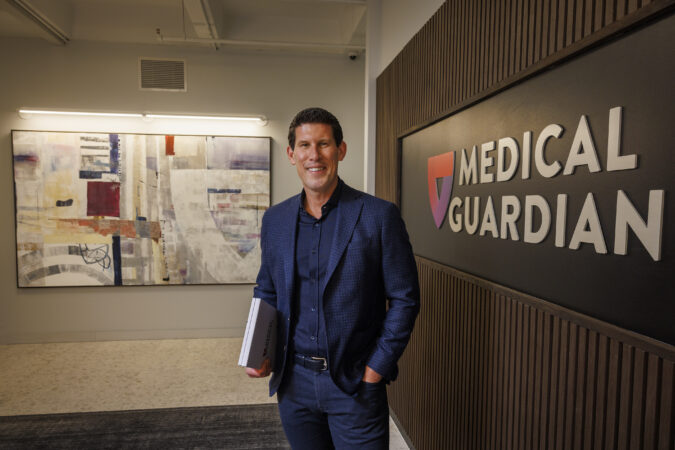
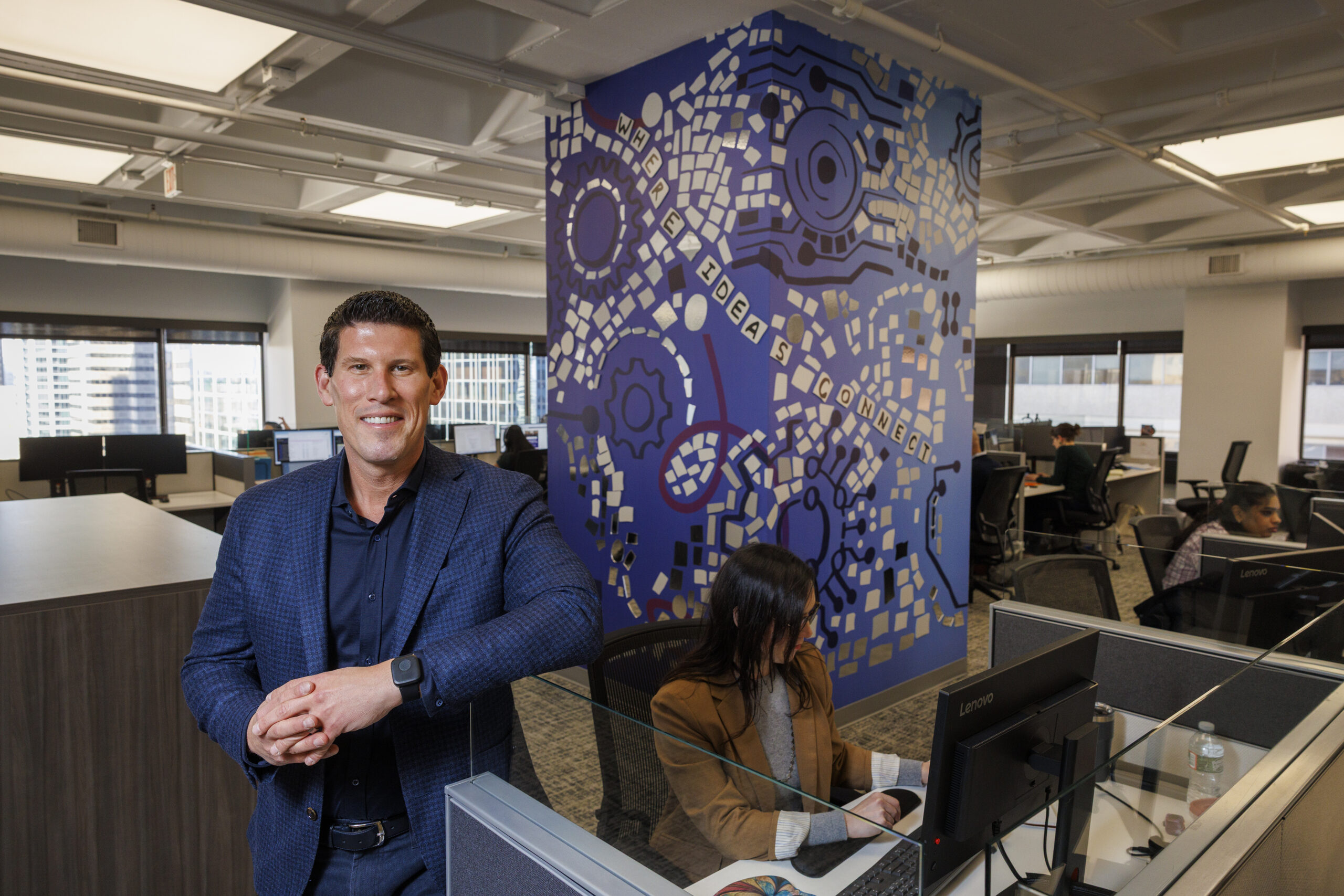
    Geoff Gross, CEO of Medical Guardian, in the Technology Product Innovation Lab at the company’s Center City Philadelphia office.

    “We’ve built and scaled this company in Philly, and that matters to us,” Gross said. “There’s a strong work ethic here, a deep healthcare ecosystem, and a sense of community responsibility that aligns with our mission.”

    Some of Medical Guardian’s partners are based in the region — such as AmeriHealth Caritas, Independence Blue Cross, and Jefferson Health.

    Some may feel that an Apple Watch can do as much as one of Medical Guardian’s devices by providing vital stats, location tracking, and communication capabilities. But Gross said Medical Guardian’s products offer a unique alternative.

    “Many of our members do not want dozens of apps or daily charging. They want something reliable, intuitive, and built for real life, especially in moments when clarity and speed matter,” he said.

    Gross cited that Medical Guardian can monitor location and, when appropriate, biometrics like oxygen levels or blood pressure. That’s not meant to overwhelm people with data but to create meaningful context for families and care teams.

    “For many older adults,” he said, “that focus on usefulness over features is more appealing than a general-purpose smartwatch that tries to do everything.”

  • Sheetz wants to move into Delaware County, home of Wawa

    Sheetz wants to move into Delaware County, home of Wawa

    Sheetz could soon stake a claim in Delaware County, extending its reach into the Philadelphia region.

    The Altoona-based convenience store chain, which opened its first store in the Philly suburbs last week, has submitted a sketch plan application to build a 6,000-square-foot location in Chadds Ford.

    It would be Sheetz’s first outpost in Wawa’s home county.

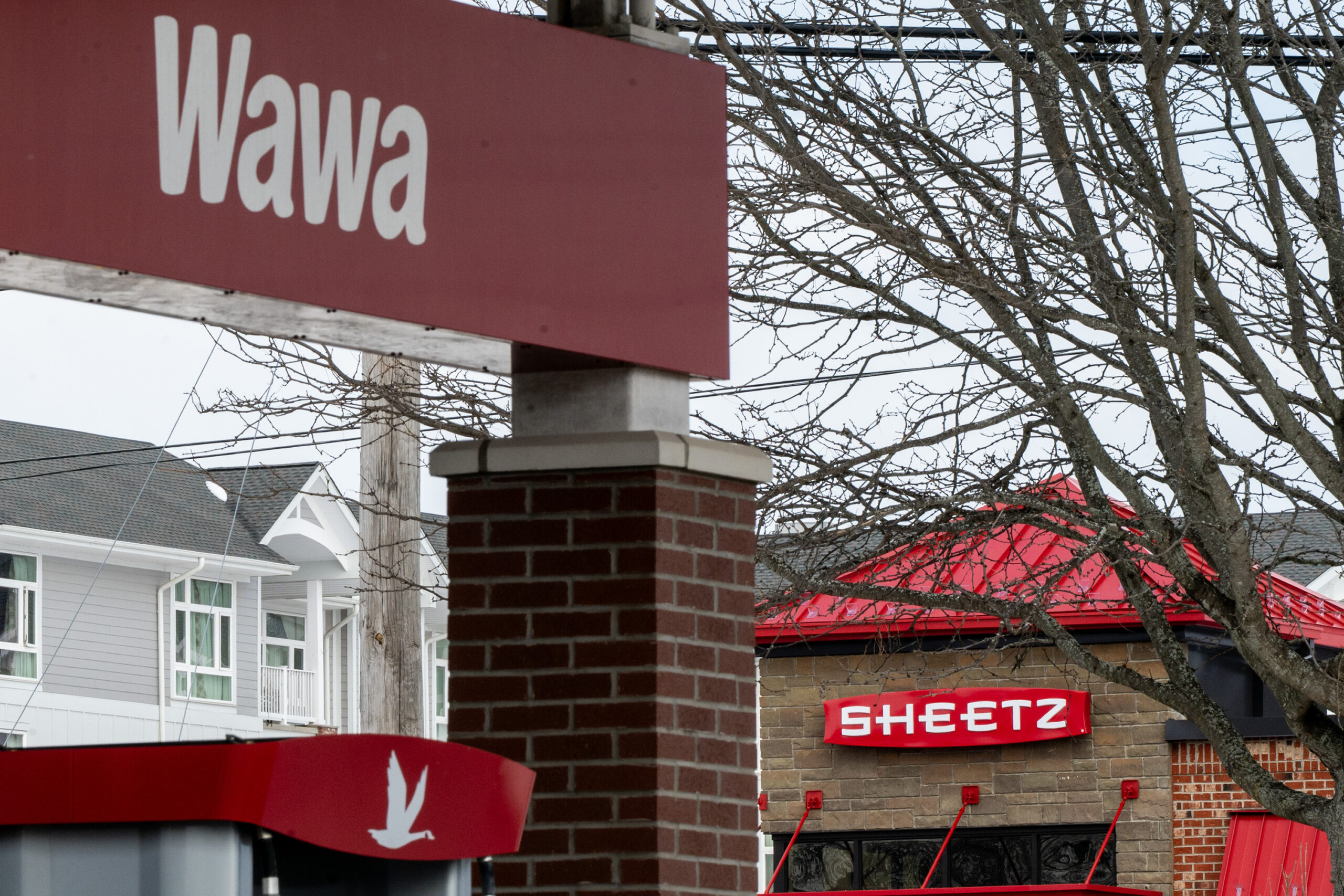
    A Sheetz and Wawa now sit across the street from each other in Limerick Township, Montgomery County.

    If approved, the store would be constructed about five miles down the road from Wawa’s corporate headquarters, and across the county from the site of Wawa’s first store, in Folsom.

    The Sheetz would be in the Village at Painters’ Crossing shopping center near the intersection of U.S. Routes 1 and 202, according to the application. Sheetz would take over a parcel in the northeast corner of the complex that is currently occupied by a vacant former bank and a closed Carrabba’s Italian restaurant.

    Along with Sheetz’s usual offerings of made-to-order food, grab-and-go snacks, and drinks, the outpost would include indoor and outdoor seating, two mobile-order pickup windows, and six gas pumps, according to the application. It would not include a drive-through.

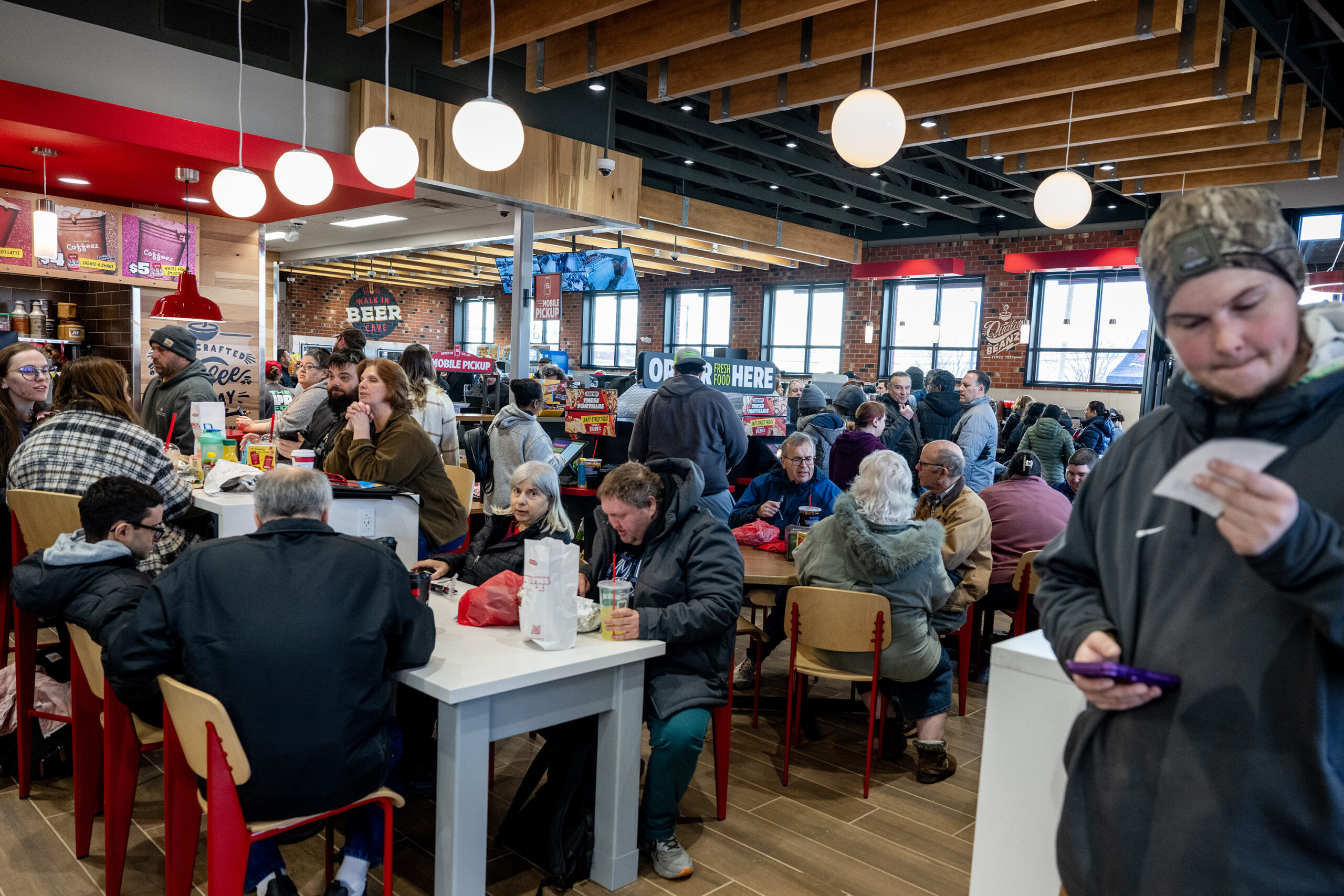
    Customers crowd into the indoor dining area at the new Sheetz in Limerick Township that opened last week.

    Nick Ruffner, Sheetz public affairs manager, declined to provide additional information about the proposal, saying in a statement that “it is still very early in the process.”

    Zoning changes and other approvals would be required before anything is built, Chadds Ford Township solicitor Michael Maddren said. As of Tuesday, Sheetz had only submitted the sketch plan, which was discussed at a planning commission meeting earlier this month, Maddren said.

    At the meeting, township officials did not express strong opinions about the sketch, Maddren said: “We need a little more detail.”

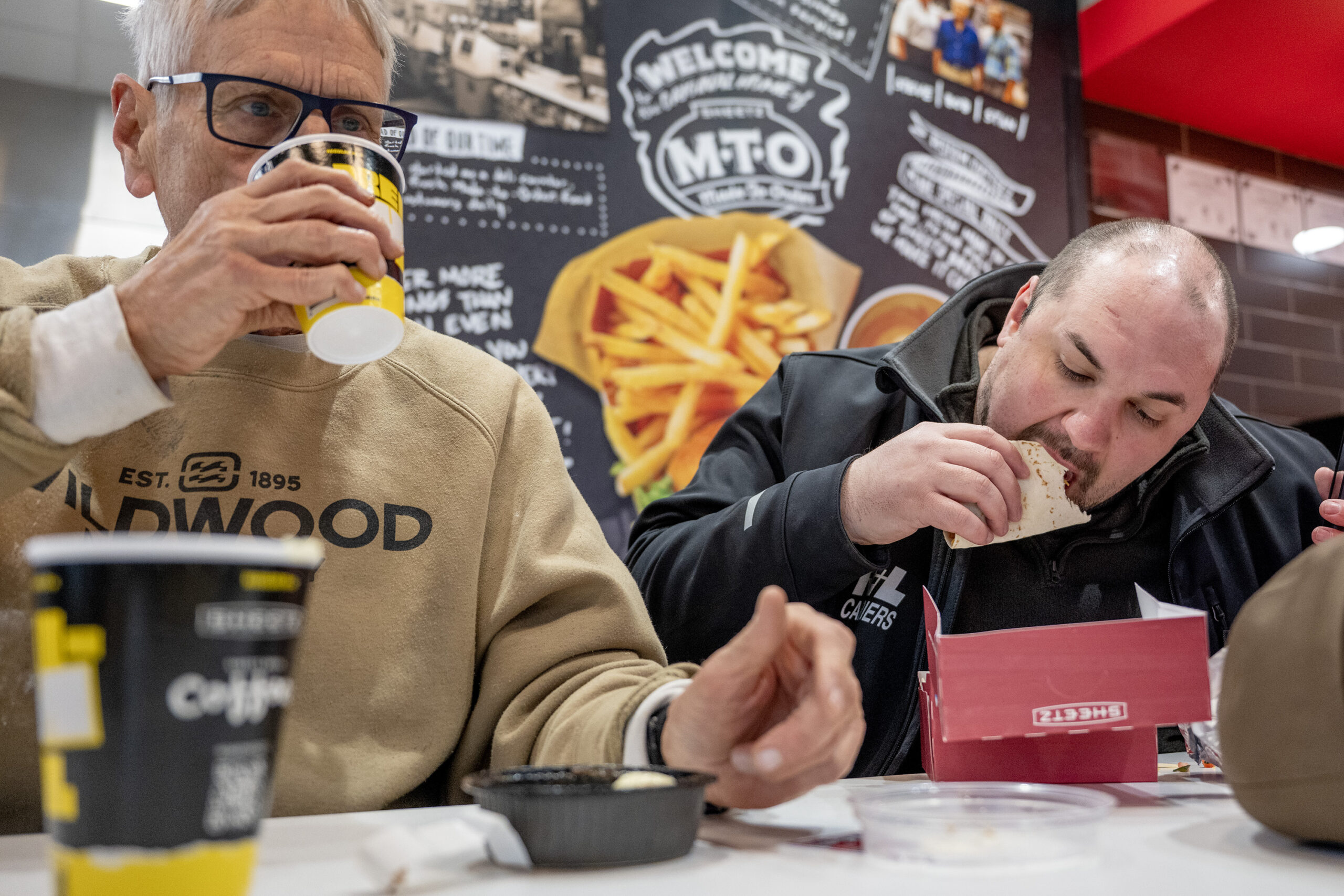
    Craig Scott (left) of Wayne and Dave Swartz (right) of Collegeville had breakfast at last week’s grand opening of the first Sheetz in the Philadelphia suburbs.

    If the Chadds Ford project moves forward, Sheetz could establish a foothold in three of Philly’s four collar counties: Along with its new Limerick, Montgomery County location, Sheetz also has expressed interest in building a store in Chester County.

    In the fall, company officials submitted a sketch plan to Caln Township officials, proposing a location at the site of a shuttered Rite Aid on the 3800 block of Lincoln Highway in Downingtown, according to the township website.

    After years of Sheetz opening stores in Western and central Pennsylvania, and Wawa expanding closer to Philly, Sheetz and Wawa’s footprints have increasingly overlapped in recent years.

    A Wawa opened outside Harrisburg in 2024, marking the chain’s first central Pennsylvania location. It is down the street from a Sheetz.

    Wawa made the first move: In 2024, it opened its first central Pennsylvania location within eyesight of a Sheetz. Since then, Wawa has opened 10 stores in the region, with plans to add 40 more there in the next five years.

    Both chains also have expanded beyond Pennsylvania.

    Sheetz now has more than 800 stores in seven states. Wawa has nearly 1,200 stores in 13 states.