Category: Business

Business news and market updates

  • Google Workspace can save small-biz owners time and money. Here’s how. | Expert opinion

    Google Workspace can save small-biz owners time and money. Here’s how. | Expert opinion

    When it comes to office software, people generally think first of Microsoft. But the reality is that Google Workspace is used by over 11 million paying organizations and boasts more than 3 billion monthly active users globally.

    Many of my small-business clients use Google Workspace to send emails, create documents and spreadsheets, host meetings, and store files. And yet most are only scratching the surface. It’s often frustrating to witness so many businesses not taking advantage of all the capabilities of Google Workspace, even though they’re paying for it. That’s a waste of money.

    If used the right way, Google Workspace can scale right along with the growth of your business, provide excellent collaboration features, and can be cost-effectively managed and secured without requiring expensive IT firms.

    For starters, centralize everything.

    If you’re going to use an office platform like Google Workspace, it’s best to lean into it fully. Mollie Plotkin, who runs a successful talent and speaker agency in Philadelphia, says Google Workspace is the “shared backbone” of her company. She uses Google Meet, Calendar, Chat, and Drive to “create an ecosystem” so that everything is in one place.

    “Work is much more manageable when everyone had equal access to the same systems regardless of where they were working,” she said. “Instead of relying on multiple versions of files being e-mailed around, our teams work from one live document at a time, which dramatically reduces confusion and duplication.”

    Plotkin also says that her internal team saves time on searching and improves efficiencies by consolidating all files and data in one place.

    “Important information lives in shared spaces instead of individual inboxes, which makes collaboration faster and prevents bottlenecks,” she said. “We use shared templates, collaborative planning documents, and centralized project tracking so our team can move quickly without reinventing processes each time.”

    Cheryl Friedenberg, a founder of High Key Impact, a digital marketing firm in Blue Bell, says that sharing calendars has significantly reduced “all the back and forth” for scheduling client calls and managing deadlines.

    “Google Drive and Docs make sharing files simple, without endless email chains,” she said. “There’s no confusion about versions or missing attachments.”

    Friedenberg always tells her clients to go the extra yard and make sure to also use Gmail within their own website domain and not as just a Gmail address.

    “Using a generic @gmail.com address on proposals, invoices, or your website can make your business look less professional,” she said.

    Automate everywhere

    Once your team is using Google Workspace as a primary office management tool, it’s important to start automating tasks wherever possible.

    Milan Baria, who runs Blueclone Networks, an IT services firm in Princeton, says that with Google Workspace you don’t need a developer to automate repetitive tasks. “We use simple scripts to bridge the gap between Google Sheets and Gmail to automate client follow-ups.”

    Andy Williamson, one of the founders of Wilmington-based training firm ONLC, says that Google Workspace Studio, with Apps Script, lets a non-technical user describe a workflow in plain English and have it built.

    “The new agents can read the email that came in, decide what kind of request it is, draft the reply, pull the right doc, and only come back to you when something actually needs a person,” he said.

    Williamson says that it’s not difficult to create automation so that a company’s data power dashboards or other applications.

    “Apps Script used to be just for programmers, but this has been changing recently,” he said. “Everyone in the business is becoming an agent builder, not just the developers.”

    Leverage AI

    Even if you’re not ready to automate with agents, Google Workspace comes with many AI features right out of the box.

    Friedenberg says that by leveraging AI, a user can turn a simple prompt into a fully designed presentation in minutes.

    “You’re starting with something polished instead of a blank page,” she said.

    In addition, and instead of hiring a videographer, Friedenberg encourages her clients to use Google Workspace to make short professional-looking video.

    “You can make a spokesperson-style video without being on camera,” she said. “The voice-overs sound natural enough that most viewers wouldn’t know they were AI-generated. Many small-business owners don’t realize it’s already included in a tool they’re probably already paying for.”

    Joe Henderson, a Philadelphia-based expert with Google premier partner Promevo, says that another underused application is Google’s Notebook LM, a premium feature with many paid Google Workspace plans.

    “Notebook LM is an AI research assistant that analyzes your documents, then generates summaries, answers questions, creates study guides, timelines, podcasts, and other content based solely on your uploaded sources,” he said. “Our clients use it to input raw documents, industry articles, vendor videos, and automatically turn that chaotic information into easy-to-understand explainer videos, short audio podcasts, quizzes, and custom study guides. It’s like a proactive operational brain sitting within Google Workspace.”

    Finally, lean into Workspace’s IT management tools

    Baria says that most owners don’t realize that they easily can restrict Workspace access based on the user’s location or device security status like any experienced IT professional.

    “High-level security isn’t just for enterprises,” he said. “Small businesses can set up simple rules that prevent employees from accidentally emailing out sensitive information, and use Workspace’s license and user management tools to eliminate unnecessary applications and archive user accounts to save hundreds, even thousands, of dollars a year.”

    Plotkin agrees.

    “You don’t need a massive IT department or expensive infrastructure,” she said. “Workspace allowed us to add team members, improve collaboration, and manage more clients without drastically changing our operational structure.”
  • Two more Philly-area oral and maxillofacial surgery practices have joined a New Jersey group

    Two more Philly-area oral and maxillofacial surgery practices have joined a New Jersey group

    MAX Surgical Specialty Management, a private-equity backed company consolidating oral and maxillofacial surgery groups in the Northeastern U.S., has acquired two more practices in the Philadelphia area.

    The latest deal, announced Friday, gives the Hackensack, N.J., firm 12 surgeons at 12 locations in Pennsylvania. Surgeon Jason M. Auerbach founded MAX in 2022 with private-equity backing and entered Pennsylvania two years later.

    The two newly acquired practices have six offices in Bucks and Chester Counties.

    Oral and Maxillofacial Surgeons P.C. has three surgeons, and offices in Doylestown, Quakertown, Warminster, and Chalfont. Oral Associates of the Main Line has two surgeons and offices in Exton and Paoli.

    MAX did not disclose financial terms of the transactions.

    In addition to New Jersey and Pennsylvania, MAX has practices in Connecticut, New York, and Vermont. The company — a management services organization — is majority-owned by its physicians, Auerbach said.

    Oral and maxillofacial surgeons work at the crossroads of dentistry and medicine. Most have dental degrees, but some also have medical degrees. They remove wisdom teeth, install dental implants, repair facial traumas, and treat jaw injuries, among other services.

    North Jersey origins

    Auerbach founded Riverside Oral Surgery in Bergen County in 2007 and grew it to 12 locations before founding MAX with private equity partners. Part of his motivation was to create a home for independent physicians, Auerbach said in a May interview.

    The Philadelphia region still has a high concentration of independents, with strong patient demand. “It’s hard nowadays to be an independent oral-maxillofacial surgeon, in terms of the complexities in running a healthcare business,” Auerbach said.

    Robert Mogyoros, whose Greater Philadelphia Oral Surgery is in Elkins Park, said he valued his independence above all, but decided to look for a group to join after the business side had gotten too challenging.

    Physician groups get better prices from vendors, better deals with insurers, and have an upper hand in physician and employee recruitment, said Mogyoros, who became part of MAX last July.

    “What attracted me to MAX was that it’s doctor-driven and doctor-run,” he said in a May interview.

    Rothman and Kim Oral & Maxillofacial Surgery, with offices in Northeast Philadelphia and Cinnaminson, was MAX’s first acquisition in Southeastern Pennsylvania. That deal also happened last year when MAX announced that it had borrowed $77 million to support growth.

    When doctors sell their practices to MAX, they typically invest about 30% of the value into MAX, Auerbach said. MAX’s outside investors are MedEquity Capital near Boston, RF Investment Partners in New York, and Kian Capital in Charlotte, N.C.

    Editor’s note: This article was update to correct the year when MAX made its first Pennsylvania acquisition.

  • What the Supreme Court’s ruling in the Cook case means for Federal Reserve independence

    What the Supreme Court’s ruling in the Cook case means for Federal Reserve independence

    WASHINGTON — The Supreme Court on Monday said the Federal Reserve, unlike any other agency in Washington, has a measure of independence from the presidency and day-to-day politics. But the court didn’t define to what extent.

    The case is the latest round in an unprecedented fight between the Fed and President Donald Trump. More political interference at the Fed could upend financial markets around the world, which closely follow its interest rate moves.

    Trump has repeatedly demanded that the central bank cut its key interest rate to lower borrowing costs for homeowners, businesses, and even the government itself. Trump sought to fire a Fed governor, Lisa Cook, last August after accusing her of mortgage fraud — a charge she denies. Cook was appointed by former President Joe Biden and removing her would give Trump the opportunity to name a more amenable official in her place.

    In a 5-4 decision, the court ruled that the president cannot fire the seven members of the Fed’s board of governors without a clear cause. The decision endorses the Fed’s independent structure even as the court eliminated such protections for leaders of other agencies, including the Federal Trade Commission, whom the president can fire at-will.

    “That’s a big deal,” said Scott Alvarez, the central bank’s former top lawyer. “That’s one of the things that makes the Fed independent.”

    While the decision is a boost for the Fed, it does leave Cook vulnerable to further attempts by the Trump administration to fire her. Trump said on his social media site, Truth Social, that “we will take appropriate action immediately” to remove Cook. But for now, she will keep her job while the case is fought in lower courts.

    The court said the Fed’s independent structure is constitutional

    In a separate case Monday, the justices ruled 6-3 that the Constitution allows the president to fire the heads of federal agencies that had previously been considered independent. But in the Cook case, the court carved out a clear exemption for the Fed.

    The Fed has a “unique historical status and role,” Chief Justice John Roberts wrote, similar to the First and Second Banks of the United States that existed in the early 1800s and that operated “at a deliberate remove from the ordinary political process.”

    If the president could fire a Fed governor for any reason, it would undermine that official’s ability to make decisions independently, Roberts wrote.

    The ruling provides some additional protection for new chair Kevin Warsh, who was nominated by Trump but has said that getting inflation back to the Fed’s 2% target is his top priority. About half the Fed’s policymakers support a rate hike to achieve that goal, while Trump has spoken out against hikes.

    Still, Kathryn Judge, a law professor at Columbia University, said the justices’ decision to strike down the independence of other agencies erodes the Fed’s standing by leaving it as the only remaining such body in Washington. The principle of independent, non-political judgment has been undercut, she added.

    “Fed independence lives on for another day, but is not as robust as it was prior to these decisions,” she said.

    Cook and other governors are still vulnerable

    And the court did not fully close the door on Trump’s efforts to fire Cook. Trump’s lawyers accepted that Trump could only fire her “for cause,” but they argued that the White House could define the cause and it couldn’t be second-guessed by courts.

    The Supreme Court instead said that “for cause” likely involved serious misconduct that wasn’t related to their professional duties, but didn’t provide much detail. More importantly, they also threw out the higher standard that Cook’s lawyers had pushed, which would have allowed governors to only be fired for inefficiency, neglect of duty, or malfeasance on the job. Since the alleged mortgage fraud occurred before she joined the Fed, such a standard would have likely shut down the case.

    The court also said that Cook had to be given formal notice of her firing — the president only announced it last August on Truth Social — and an opportunity to formally respond, though the court did not specify what the process should look like. Indeed, Roberts included a footnote in his opinion noting that nothing forbids Trump from “trying again” to fire her, provided she is given proper notice and a chance to contest it.

    Why the Fed’s independence matters

    The court battle will likely further define the boundaries of Fed independence.

    The Fed wields extensive power over the U.S. economy. By cutting the short-term interest rate it controls — which it typically does when the economy falters — the Fed can make borrowing cheaper and encourage more spending, accelerating growth and hiring. When it raises the rate — which it does to cool the economy and combat inflation — it can weaken the economy and cause job losses.

    Economists have long preferred independent central banks because they can more easily take unpopular steps to fight inflation, such as raise interest rates, which makes borrowing to buy a home, car, or appliances more expensive.

    The importance of an independent Fed was cemented for most economists after the extended inflation spike of the 1970s and early 1980s. Former Fed Chair Arthur Burns has been widely blamed for allowing the painful inflation of that era to accelerate by succumbing to pressure from President Richard Nixon to keep rates low heading into the 1972 election. Nixon feared higher rates would cost him the election, which he won in a landslide.

    Paul Volcker was eventually appointed chair of the Fed in 1979 by President Jimmy Carter, and he pushed the Fed’s short-term rate to the stunningly high level of nearly 20%. (It is currently 3.6%.) The eye-popping rates triggered a sharp recession, pushed unemployment to nearly 11%, and spurred widespread protests.

    Yet Volcker didn’t flinch. By the mid-1980s, inflation had fallen back into the low single digits. Volcker’s willingness to inflict pain on the economy to throttle inflation is seen by most economists as a key example of the value of an independent Fed.

  • Comcast plans no big change for its 15,000 Philly workers as company splits in two

    Comcast plans no big change for its 15,000 Philly workers as company splits in two

    Comcast, the $125 billion-a-year media and communications giant based in Philadelphia, is planning to split into two publicly traded companies, one based on the NBCUniversal media group, the other focused on broadband and wireless services.

    Comcast’s consumer and business services and NBCUniversal media now face “distinct” opportunities that are best pursued separately, Brian L. Roberts, chief executive since 2002, told investors in a conference call.

    Shares of Comcast, which had recently been trading near a 10-year low, jumped as much as 17% on the news, before closing at $24.22, a 4.5% gain for the day but well below the stock’s highs earlier this year.

    The split reverses major Comcast media acquisitions.

    “We previously believed that scale and diversification benefits warranted operating these businesses as one company; we’ve now simply changed our mind about that,” said Michael Cavanagh, the former chief financial officer of both Comcast and JPMorgan Chase & Co., who became Comcast’s co-CEO last fall.

    “We’ve now concluded that future success for each of our businesses will depend on focus, speed, and strategic flexibility that this separation will unlock,” said Cavanagh, who will head NBCUniversal, based at 30 Rockefeller Center in New York, after the split.

    Comcast will retain the consumer and business services that employ the majority of the company’s 180,000 workers, including most of its 15,000 Philadelphia-area staff and managers.

    Michael Angelakis when he was CFO of Comcast in 2009. He is returning, this time as CEO, as the company divests NBCUniversal and Sky.

    Comcast’s CEO after the split will be Michael Angelakis, a Gladwyne resident, who was Comcast’s chief financial officer from 2007 to 2015 and has since headed tech investment firm Atairos while also advising Comcast.

    Comcast’s acquistion of NBCUniversal, announced in 2011 and financially structured by Angelakis, was “a brilliant success financially” since Comcast got a bargain price as it was the first multibillion-dollar acquisition after the Great Recession, telecommunications analyst Craig Moffett told clients in a report Monday.

    But it didn’t make much sense strategically, Moffett added. While original media and theme parks did little to boost cable sales, the combination turned investors off, depressing the share price.

    Angelakis’ return to Comcast is “the best part” of the “wonderful, overdue” breakup decision, Moffett said. He noted that the two successor companies were themselves unlikely to become takeover targets in the near future as it would endanger the tax-free structure of the spin-off and likely require long, expensive work to persuade national and state regulators.

    Angelakis told investors on the call: “This place was my home for many years. It’s great to be here. It feels familiar and exciting at the same time.”

    The planned move comes after Comcast announced in November 2024 that it was spinning off cable networks such as USA, Oxygen, E!, SYFY and Golf Channel, as well as CNBC and MSNBC into a new company, Versant. Movie ticketing platform Fandango and the Rotten Tomatoes movie rating site were also included. Versant went public in January at around $45 a share; it has lately traded around $36.

    Like other cable companies, Comcast in recent years has shifted its business emphasis away from traditional cable toward streaming and other sources of revenue, such as its movie studio, theme parks and home wireless and internet services.

    Media and entertainment company NBCUniversal includes a theme parks division, Universal film and television studios, NBC and Telemundo networks, Peacock, and Bravo. Its portfolio will now include European media business Sky.

    Comcast will continue providing internet and phone services to residential and business customers.

    Once the transaction is complete, Comcast shareholders will own shares in both Comcast and NBCUniversal. The separation is expected to be completed in about a year. It still needs final approval from Comcast’s board and is subject to regulatory approvals.

    Comcast expects to keep a stake of up to 19.9% ownership position in NBCUniversal for up to one year after the spinoff is complete.

    The Associated Press contributed to this report.

  • Comcast plans to split into two public companies by spinning off NBCUniversal and Sky

    Comcast plans to split into two public companies by spinning off NBCUniversal and Sky

    Comcast is planning to split itself into two publicly traded companies, one focused on media that would include NBCUniversal and Sky and the other focused on broadband and wireless services.

    The company said Monday that its board and management team think each company will be better positioned to pursue its own strategic priorities, invest for growth and create long-term shareholder value as independent entities.

    The planned move comes after Comcast announced in November 2024 that it was spinning off cable networks such as USA, Oxygen, E!, SYFY and Golf Channel, as well as CNBC and MSNBC into a new company. Movie ticketing platform Fandango and the Rotten Tomatoes movie rating site were also included.

    Like other cable companies, Comcast in recent years has shifted its business emphasis away from traditional cable toward streaming and other sources of revenue, such as its movie studio, theme parks and home wireless and internet services.

    Media and entertainment company NBCUniversal includes a theme parks division, Universal film and television studios, NBC and Telemundo networks, Peacock, and Bravo. Its portfolio will now include European media business Sky.

    Comcast, based in Philadelphia, will continue providing internet services to residential and business customers.

    Comcast co-CEO Mike Cavanagh will become the CEO of NBCUniversal. Comcast’s former Chief Financial Officer Michael Angelakis will become the CEO of Comcast, following completion of the separation. In the interim, he will serve as a strategic adviser.

    Comcast Chairman and co-CEO Brian Roberts will continue to be actively involved in the leadership of Comcast and NBCUniversal, working in partnership with the CEOs of both companies.

    “Comcast will continue to build on its leadership in connectivity, while NBCUniversal, together with Sky, will have the scale, brands, content and financial resources to compete as a premier global media and entertainment company,” Cavanagh said in a statement.

    Once the transaction is complete, Comcast shareholders will own shares in both Comcast and NBCUniversal. The separation is expected to be completed in about a year. It still needs final approval from Comcast’s board and is subject to regulatory approvals.

    Comcast expects to keep a stake of up to 19.9% ownership position in NBCUniversal for up to one year after the spinoff is complete.

    In premarket trading, Comcast shares surged 24%.

  • Incyte is built to grow, says the company’s CEO, who sold previous biotechs for billions

    Incyte is built to grow, says the company’s CEO, who sold previous biotechs for billions

    Bill Meury got the call early last year after the last company he ran got sold for $3 billion. Billionaire biotech investor Julian C. Baker asked Meury: Would you be interested in running Incyte, a 2,800-person, publicly traded drug developer in Wilmington with $5 billion in yearly sales?

    Under its previous CEO, Hervé Hoppenot, Incyte had multiplied sales of its breakout drug Jakafi (“JACK-ah-fye”), which treats blood cancers and transplant conditions. The company plowed revenues into hiring scientists, building labs, buying smaller businesses, and testing new products against the day Jakafi’s key patent runs out in 2028.

    But new Incyte products were coming to market slowly. Shares peaked at over $130 in 2017, then fell into the $50s by early 2025, when Meury took over that June.

    Meury’s signing-year compensation at Incyte was valued at over $30 million, mostly in stock grants and in options vesting over six years. (Hoppenot was given $17 million for his retirement year.)

    With Meury as CEO — and Baker, whose firm is its largest investor, succeeding Hoppenot as board chair — Incyte shares have again topped $100 a share. Investors are hoping that Incyte delivers the drugs it has been readying for market — or that the company gets sold at a premium price like Meury’s previous employers Anthos, Karuna, Allergan, and Forest Labs.

    Baker is also a director and investor in Madrigal Pharmaceuticals, a $1 billion (yearly sales), $12 billion (stock value) company based in Conshohocken, best known for Rezdiffra, which treats liver disease.

    Meury, who has been building a top management team with new chief financial, human-resources, and strategy officers, took questions from The Inquirer in his office atop Incyte’s glass-fronted hillside headquarters near U.S. Route 202.

    The interview has been edited for clarity and brevity.

    Why did you take this job?

    I did a great deal of diligence. I found their pipeline [of new therapies] was fundamentally under-appreciated. The company has excellent R&D and commercial capabilities. It has excellent potential products in three of the strongest areas of biotech — oncology, hematology, immunology — really good areas for long-term growth.

    That’s ultimately what companies solve for. When you have products, you win.

    Don’t all big pharma companies have that?

    Incyte has top-10 pharma scientists without the bureaucracy. Our researchers punch above our weight. Incyte is not a diversified giant, but it’s not a small start-up either. We avoid the downsides of both.

    Just for one example, Patrick Mayes, our chief scientific officer, is out of the University of Pennsylvania. We have a very capable group of scientists — biologists, chemists, translational researchers, drug developers. We are able to colocate here in Wilmington, which results in faster iteration.

    We have a lot to prove over the next couple of years. If we can advance half our assets through Phase 3 [clinical trial] to FDA approval of some scientifically and medically important products, Incyte will be much larger.

    I believe we have the potential to double or triple [sales] in five to seven years.

    For example?

    We are developing the first oral-targeted treatment for pancreatic cancer, which has been considered an undruggable target for decades.

    This is the Everest of oncology. Our scientists designed a small molecule to target KRAS G12D, a protein that causes [cancerous] cells [to reproduce uncontrollably]. We are in a race to be No. 1 with an approved treatment.

    And we have therapies for a group of blood cancers and for colorectal cancer. These are first-in-class molecules that can make a pronounced difference for those cancers.

    How can anyone avoid the ‘bureaucracy’ you say slows successful organizations?

    You can’t solve bureaucracy through structure and process. You have to solve through the attitudes of exceptional leaders. Hervé built a great culture on good hiring decisions. You have a bunch of people that trust each other.

    Failure is always right around the corner. Management has to be self-aware, to know the strengths and weaknesses of the employees. We are not running the company from 30,000 feet.

    Do you expect your board and major shareholders will want you to sell Incyte, like your previous companies?

    In general, companies can have two value-creation paths: There’s the independent path, and then there’s merger and acquisition.

    The only path that a management team controls is the independent path. We are focused on running the company, building a great business for the employees, customers, physicians, and patients — and for the shareholders.

    It hurts companies when there is a merger and acquisition theme all around them. If [buyers with offers] approach us, we have to listen. But we are building this company for the next decade. Most people want to work with a company that wants to be around in 10 years.

    You’re not antimerger. On June 16, you agreed to buy Vega Therapeutics for up to $2 billion.

    Vega has a novel compound [a treatment for an inherited blood disease] that we believe has potential sales of over $1 billion. If we can do several deals like this that fit one of our categories, in this case hematology, we will do them. These will never be more important than internal R&D, but each can be a multiplier for our business, with the right risk-and-reward profile.

    By the time Jakafi loses exclusivity in December 2028 — and it may go beyond that — we will have $3 billion to $4 billion in non-Jakafi revenues.

    Americans aren’t happy with the cost and availability of medical care, including drugs. Do you see any hopeful signs?

    Three things have to be in place for biopharma to thrive: First, patent and trademark laws have to be predictable. Second, pricing policy has to be balanced. Third, FDA has to run effectively. There have been headwinds, but I think those pillars will be in place as disruption settles.

    Are U.S. consumers and employers subsidizing world drug development with our high prices?

    It’s true there’s an imbalance. But Americans have access to the best medical care in the world, such as novel cancer treatments.

    But we have to get a better framework for global pricing. You’d like to see prices outside the U.S. come up, if they are going to moderate inside the U.S.

    Can the U.S. compete with China?

    China will be a source of innovation and competition. We have four or five major biotech centers in the U.S. They have 15. China is here to stay. For the U.S. to remain the leader, we have to create an environment where biotech can continue to thrive.

    Incyte was founded in 2002 by scientists from Wilmington-based DuPont, but recent plans to grow your space stalled. Will Incyte keep growing here?

    In the last two years we have added more than 150 [in Delaware] and anticipate adding another 250 [by 2031]. We will be here for as long as I’m here. The biotech labor market is not as strong as Boston, but it is strong here, with Thomas Jefferson and Penn in Philadelphia, and Johns Hopkins in Baltimore.

    We’ll grow somewhere else if we have to. I’m not religious about it. But the base of this company is here in Wilmington.

  • U.S. refinery accidents, including in Pa., raise questions about cost impact as fuel demand rises

    U.S. refinery accidents, including in Pa., raise questions about cost impact as fuel demand rises

    A leak and then a fire that stalled production at Delta Air Lines’ Monroe Energy oil refinery in Delaware County is just one of several unplanned stoppages that have dented U.S. oil production this summer, even as companies work to keep up with shifting supply and demand from the Iran war.

    A welcome drop in U.S. gas prices “masks” a string of U.S. supply issues that put stress on fuel markets, Industrial Info Resources told clients in a note last week.

    Beyond the stoppage at the 200,000-barrels-a-day Trainer plant, problems include:

    Fire at Delta Air Lines’ Monroe Energy refinery in Trainer, Delaware County, on Friday.

    In all, U.S. refineries can produce up to 18 million barrels a day.

    Refinery margins tripled after the U.S. and Israel attacked Iran in February and the Strait of Hormuz closed, and refineries felt pressure to boost production during what is normally the spring “maintenance season” of reduced production, said Stephen Schork, cofounder of the daily Schork Report on energy markets, based in King of Prussia.

    During the missile attacks, “crude oil went as high as $120-$130 a barrel; jet fuel traded at $180-$190 a barrel,” tripling the usual profit margins, Schork said. “More than half the jet fuel on the East Coast comes from the Monroe refinery.”

    Gasoline and diesel was also in high demand, he said.

    “When you can make $50 [in profit] a barrel, you will be running that refinery as hot as you can,” Schork said. But “when you run as complex a piece of engineering as a refinery at nearly 100% capacity, the risk of unscheduled maintenance is increased.”

    With prices now dropping, pressure from short-term shutdowns should be less, he said.

    Overall, petroleum prices that spiked during the war have dropped since the U.S.-Iran ceasefire began bringing back oil refining and shipping in nations that had been attacking each others’ oil infrastructure.

    The Brent crude benchmark price of oil fell to near prewar levels for the first time since the U.S. and Israel attacked Iran at the end of February and Iran retaliated with attacks on U.S. allies.

    U.S. gasoline prices fell below $4 a gallon in late June, according to AAA.

    But with the U.S. Strategic Petroleum Reserve half depleted to prevent prices from rising higher in the near future and oil-thirsty countries scouring the globe for new supplies, the industry is sensitive to slowdowns. President Donald Trump’s energy adviser, Kevin Hassett, has said he’s confident reserves are adequate.

    Monroe confirmed an internal leak at the Trainer facility on Tuesday, six months after addressing a long-running gasoline leak at its Aston tank farm.

    Industry sources say the plant leak shut the plant’s distilleries, which process up to 200,000 barrels of oil a day, much of it for jet fuel, to help Delta control the cost of keeping its commercial jets flying.

    According to a Monroe Energy statement, a process pump at the Trainer plant caught fire Thursday, injuring a worker. County officials said two others were treated for heat effects after refinery staff and volunteer fire companies mobilized to fight the blaze. Monroe said air monitoring showed no risk to people outside the plant. The fire is under investigation.

    Firefighters outside the plant noticed smoke rising from the refinery at 11:30 a.m. Tuesday, even before reports began flowing in from neighboring fire companies and Delaware County emergency workers, who urged residents to shelter in place, according to a statement by the Upper Chichester Volunteer Fire Co.

    The fire was declared under control, and the shelter order lifted at 2:54 p.m.

    In line with company policy not to discuss operations, a Monroe spokesperson declined to estimate when the plant would be fully back online.

    The earthquake this week in Venezuela, an oil source for East Coast U.S. refiners, did not disrupt production at the nation’s main Paranagua oil complex, but the second-largest concentration, at Morón, was temporarily stopped, Reuters reported. The loss of electric power and other infrastructure damage across Venezuela is expected to slow tanker shipments out of the stricken nation.

  • Urban Outfitters’ Navy Yard headquarters is growing as the company adds employees

    Urban Outfitters’ Navy Yard headquarters is growing as the company adds employees

    The Navy Yard got a new boat this month. It isn’t a military ship and won’t be setting sail.

    The decommissioned 1977 tugboat, now painted in Urban’s signature yellow and marked by its logo, is now permanently stationed outside the company’s headquarters — as a sort of mascot, to company cofounder and CEO Dick Hayne.

    The tugboat’s arrival coincides with a momentous anniversary for Urban: the company’s 20th year at the Navy Yard. Urban staff started relocating 500 employees there in 2004, and the headquarters was fully operational by 2006. Now it has 15 buildings and just over 2,500 employees.

    And the company is continuing to grow.

    Urban Outfitters chief development officer Dave Ziel stands with a retired tugboat the company acquired for display at its Navy Yard headquarters.

    Urban’s newest addition at the Navy Yard is a 117,000-square-foot photo studio building, which opened in April.

    Urban announced earlier this month that it plans to hire at least 450 workers at the Navy Yard and at least 600 at a new Bucks County facility, which is set to open by 2028. Gov. Josh Shapiro joined Hayne for the news conference, and lauded the business as a home-grown global company bringing jobs to Pennsylvania.

    “We intend to stay here,” said CEO Hayne. “We have no thought of leaving.”

    How Urban grew from Philly roots to global retailer

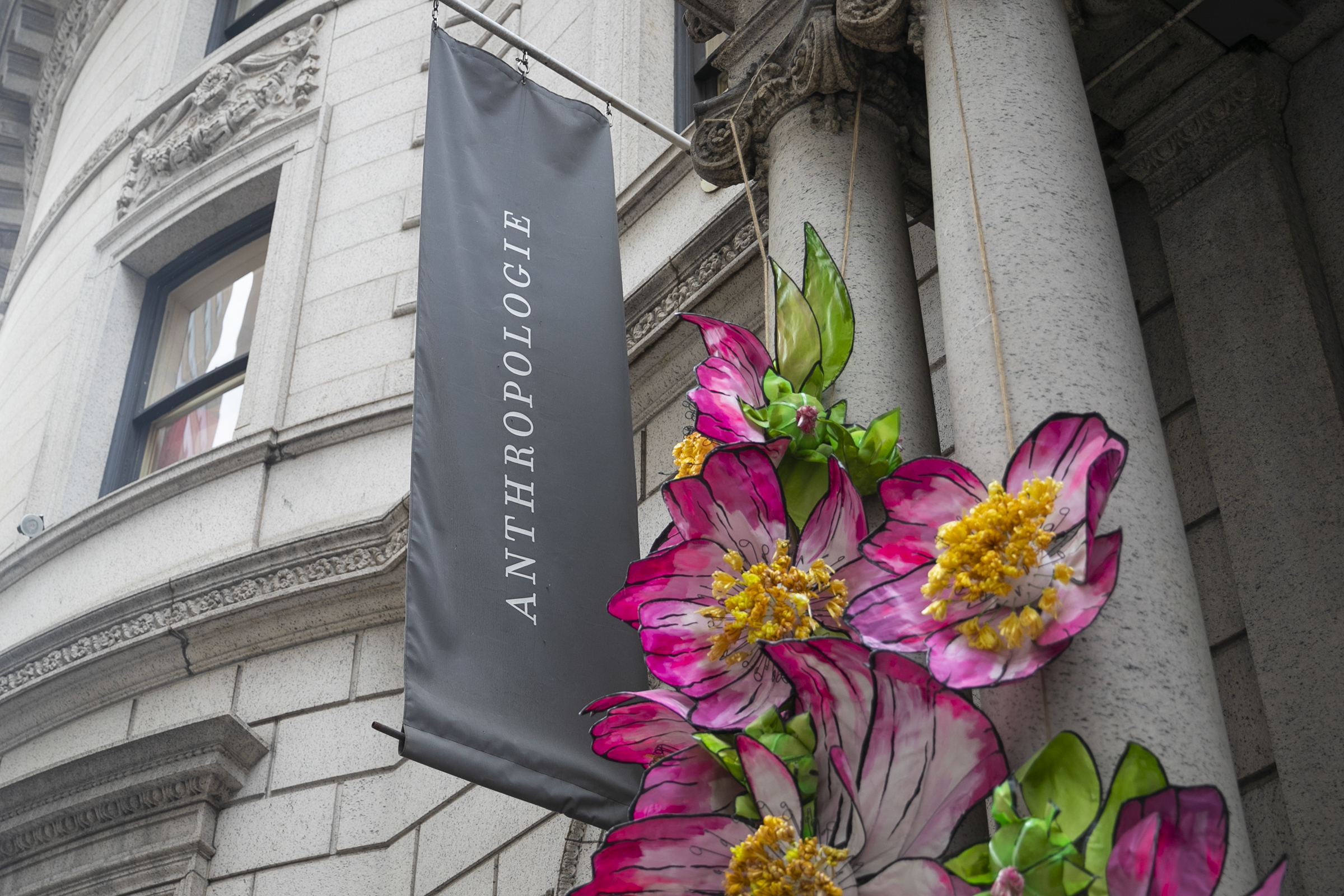
    Urban was founded in 1970. The company’s roots are in West Philadelphia, where it opened its first store, a Free People. It now has almost 800 stores across the globe under the brand names Urban Outfitters, Free People, FP Movement, and Anthropologie.

    Walking into an Urban store doesn’t feel like stepping into a Macy’s where there are racks of clothes and bright fluorescent lighting, said senior analyst Gerard Machado at RetailStat.

    “It’s not like you’re running an errand to get something,” said Machado. “You might want to spend a little time looking at things. That’s a unique feature of Urban Outfitters.”

    Similarly, customers who wander into Anthropologie find artfully arranged dinner plates and glassware amid scented candles — not just items stacked in rows on shelves.

    Analysts say Urban is one of the more successful names in retail today, with strong sales numbers, loyal customers, and the ability to market to different audiences with its multiple brands. The company competes with the likes of J.Crew, Abercrombie & Fitch, Uniqlo, Ralph Lauren, Zara, and H&M.

    The company grew profits by more than 15% in its most recent fiscal year, with nearly $465 million in net income in the year ending Jan. 31.

    The Anthropologie store at 18th and Walnut Streets in Center City is shown in this 2020 file photo.
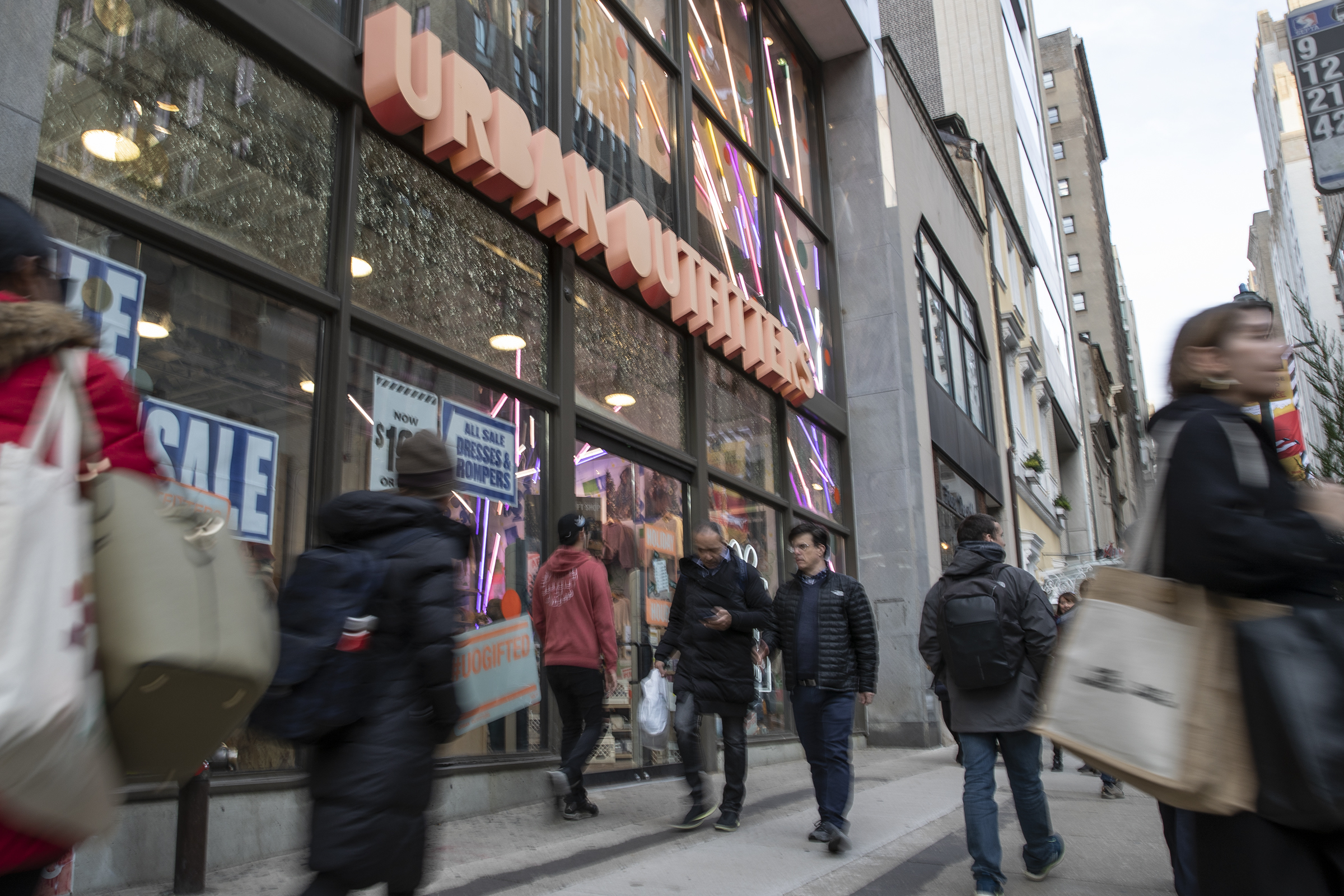
    People walk outside the Urban Outfitters store near 16th and Walnut Streets in Center City in November 2019.

    One key feature of Urban is that it’s experimental and innovative, said Neil Saunders, a retail analyst and managing director at GlobalData. Nuuly, the company’s clothing rental platform, which launched in 2019, is one of the “very few players that’s really successful” in that industry, he said. For $98 a month, subscribers get six fashionable items delivered to their door, which they can wear for a month and then ship back.

    But there have been financial hurdles, too.

    The Urban Outfitters brand struggled with declining sales in recent years. Gen Z consumers migrated “heavily into ultra fast fashion,” said Machado, and the brand didn’t adapt quickly enough. As merchandise piled up in inventory, Urban cut prices, which consumers grew to expect.

    To turn the brand around, the company set out to rebuild relationships with customers, bring on more items attractive to Gen Z, and engage with customers on platforms they were already on, like TikTok and YouTube, The Inquirer reported in 2023. The company hired a new president to helm the brand in 2024, and it returned to profitability last year.

    (function(){function e(){window.addEventListener(`message`,function(e){if(e.data[`datawrapper-height`]!==void 0){var t=document.querySelectorAll(`iframe`);for(var n in e.data[`datawrapper-height`])for(var r=0,i;i=t[r];r++)if(i.contentWindow===e.source){var a=e.data[`datawrapper-height`][n]+`px`;i.style.height=a}}})}e()})();

    Tariffs have also pushed the company to adapt in part by negotiating better terms with vendors, shipping items by sea instead of air, and slightly adjusting pricing.

    There have been workforce challenges too. In 2020, when a racial reckoning erupted in the country and seeped into corporate offices following the killing of George Floyd, Urban saw criticism from within its own workplace. Reports emerged of employees allegedly racially profiling customers as potential shoplifters, and some employees said people of color faced challenges to advancing their careers at the company, or reporting discrimination.

    “Since 2020, we have prioritized creating a culture of inclusion and belonging at our home office, in our stores, and at our facilities,” said Meaghan Condon, Urban’s director of communications and impact, in an emailed statement this month. She said that includes training for new hires and managers focused on inclusivity.

    Another key ingredient in the company’s culture: the Hayne family.

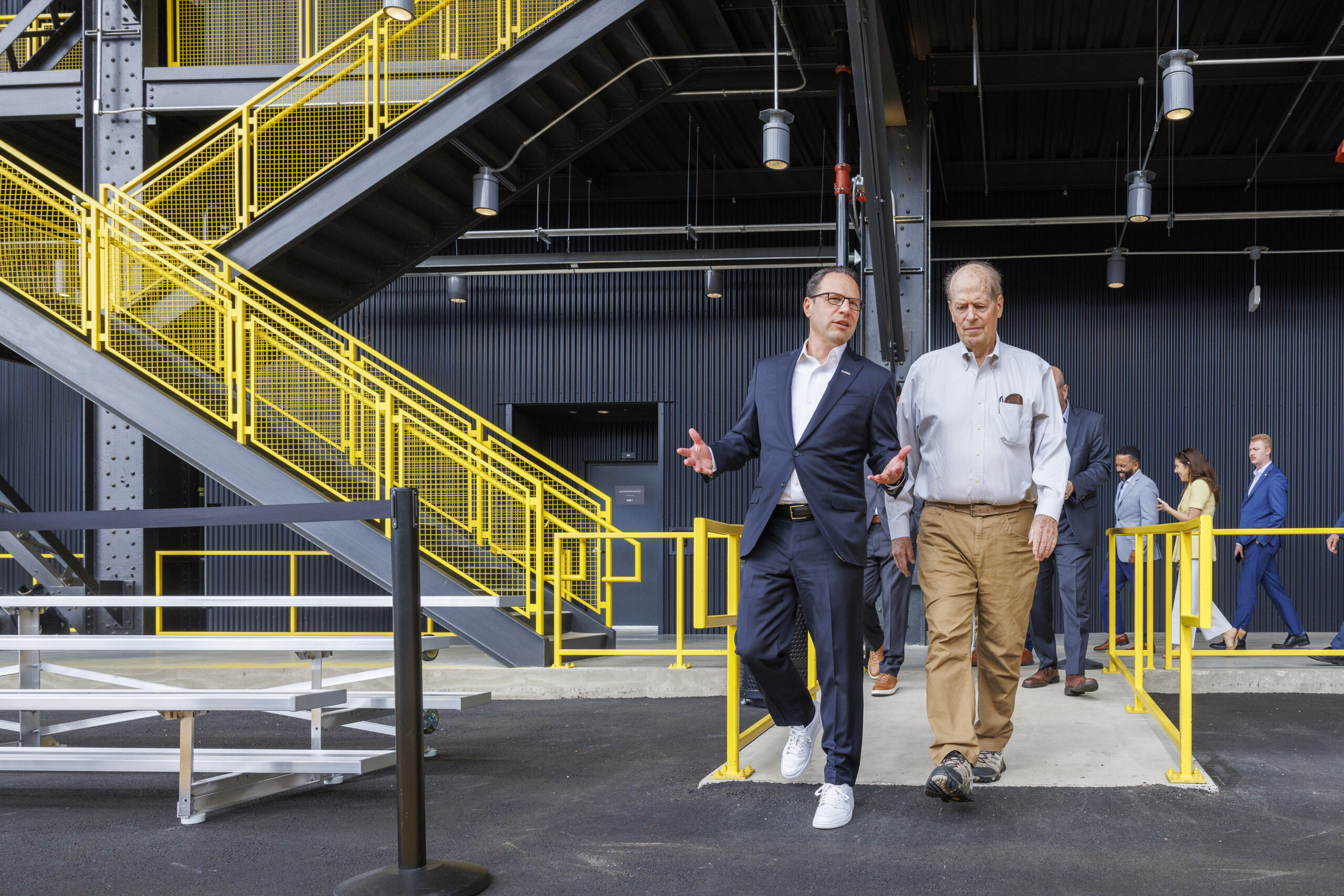
    Pennsylvania Gov. Josh Shapiro (left) with Urban Outfitters CEO Dick Hayne at the company’s newest building, which houses photo studios. They held a press conference in June to announce Urban Outfitters’ plans to hire over 1,000 new employees.

    Cofounder and CEO Dick Hayne’s son, Dave, is chief technology officer and president of Nuuly, and his nephew, Azeez Hayne, is chief administrative officer. His wife, Meg, is Urban’s co-president and chief creative officer.

    Together, Meg and Dick Hayne own roughly a quarter of the company shares, according to recent company filings.

    Frank Conforti, chief operating officer and co-president at Urban, said the family ties are an asset and part of the culture.

    Having a cofounder still at the helm has allowed Urban to focus on long-term strategy and take calculated risks, said Conforti, such as launching Nuuly. Investors weren’t all in on the idea to begin with.

    Now Nuuly has over 450,000 active subscribers — more than doubling that number since 2023.

    “We sort of don’t rest on what we did yesterday,” said Conforti. “It’s not about yesterday’s bestsellers.”

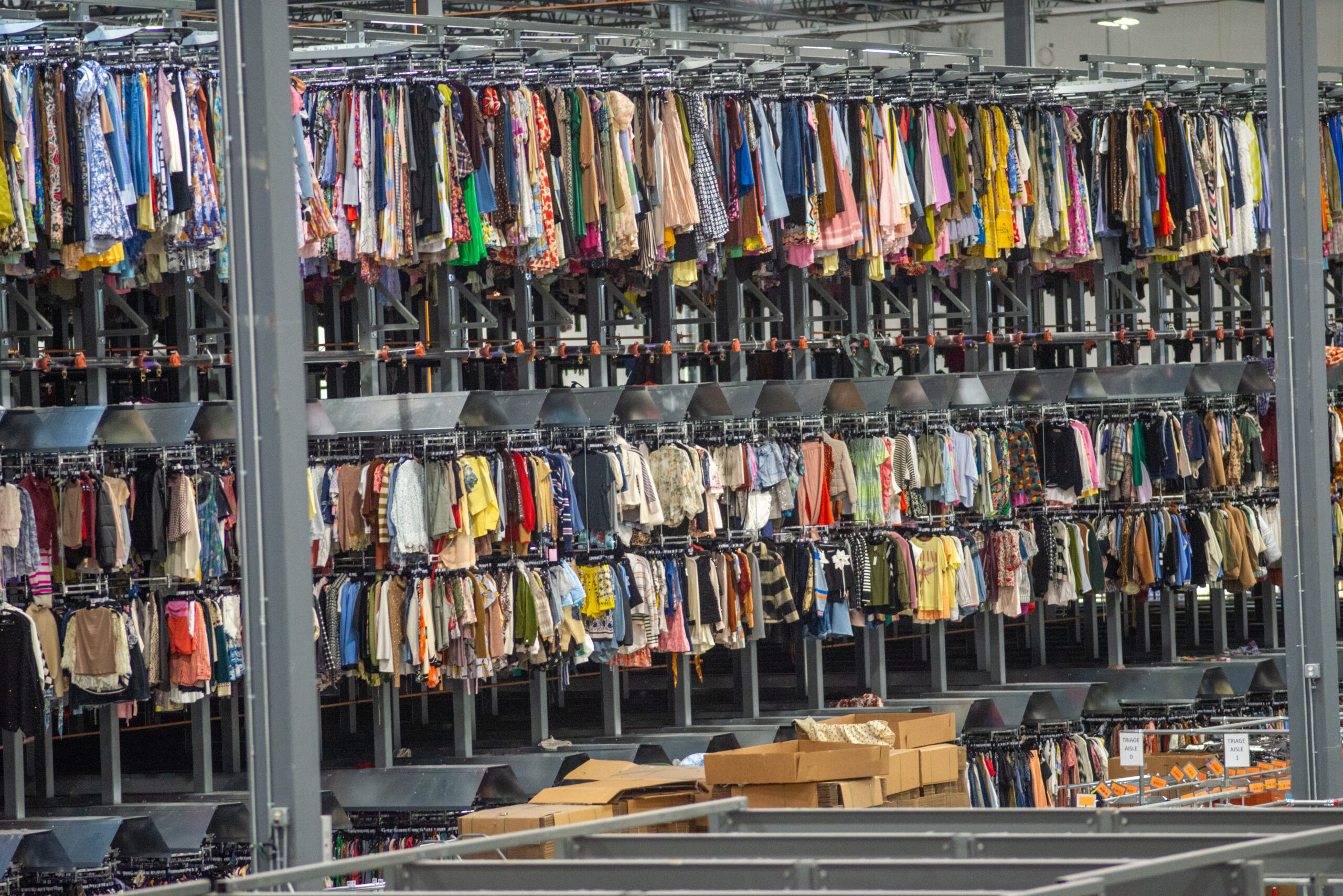
    Racks of clothing inside the Nuuly warehouse in Levittown, Pa., last year. Nuuly is a clothing rental subscription service that offers a variety of styles, sizes, and brands.

    A more efficient process

    In Urban’s newest building at the Navy Yard, rows and rows of wheeled clothing racks are spread across several rooms. Industrial metal shelves are filled with sneakers, sandals, and handbags. Lamps and armchairs wait to be photographed for e-commerce.

    The space was once used for building and housing ship components, noted Jennifer Calliagas, Urban’s North America director of planning, who led the new building’s development. Urban bought it from Rhoads Industries in 2016 for an undisclosed sum.

    Urban spent about $40 million to fit the space for its needs, which included stripping the building down to its structure, said chief development officer Dave Ziel. Construction started last year, and Urban employees began working in the space by mid-April.

    Inside the new building are adjoining rooms to seamlessly carry out the photography process: Clothing, shoes, and accessories are received in one room, then moved into the next room to be styled, and finally to the studio where they’re photographed. Staging areas are set up to portray bedrooms and bathrooms, functioning kitchens were built for cooking food to show in photos, and plants are on hand to finish off the staged living spaces.

    The Inquirer was not permitted to photograph the studios because the merchandise had not yet been released publicly.

    Not long ago, the company’s photo work was done in rented studios in New York City, Calliagas said, or scattered across the company headquarters.

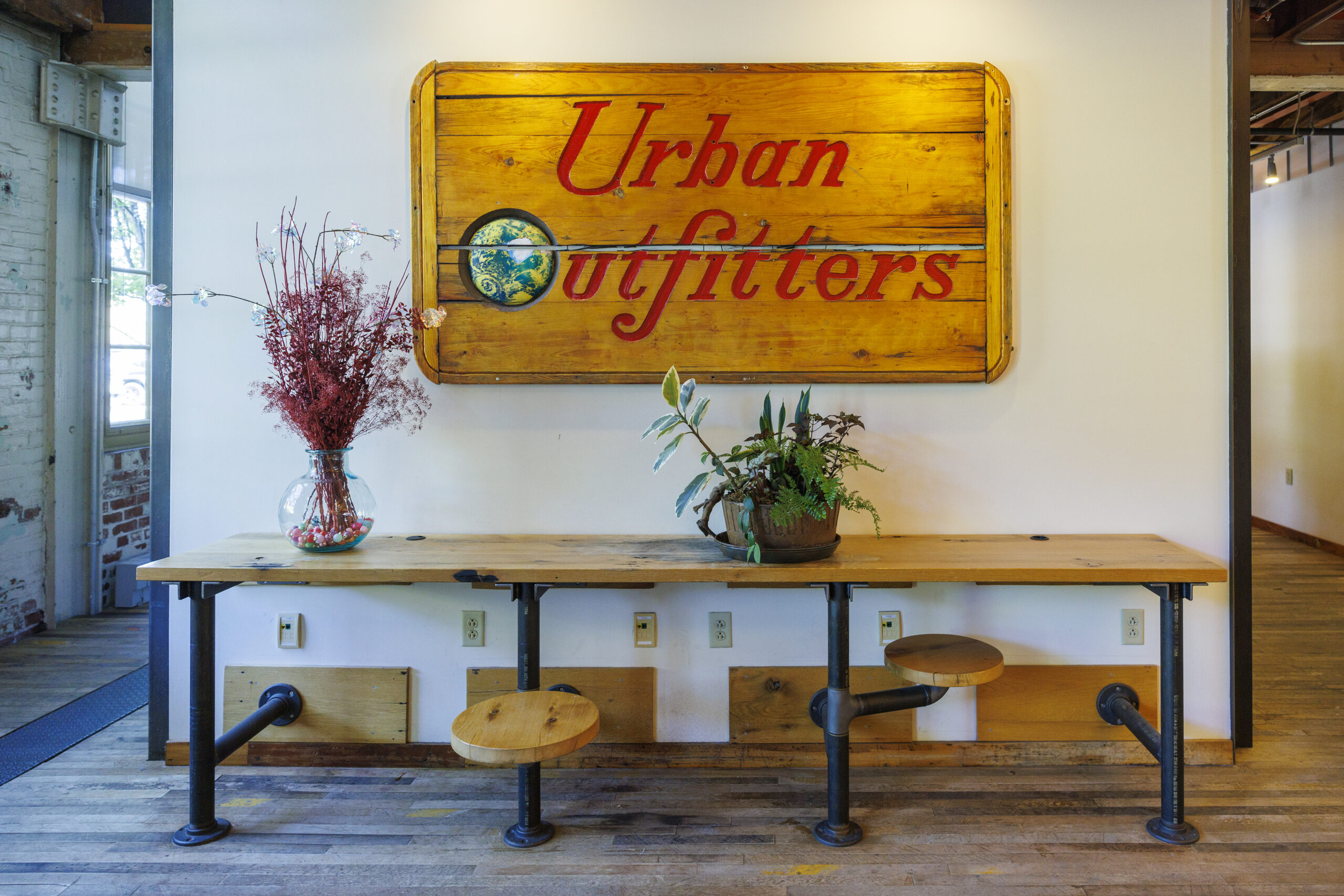
    Vintage signage from the early days of Urban Outfitters, now displayed in the company’s Navy Yard headquarters.
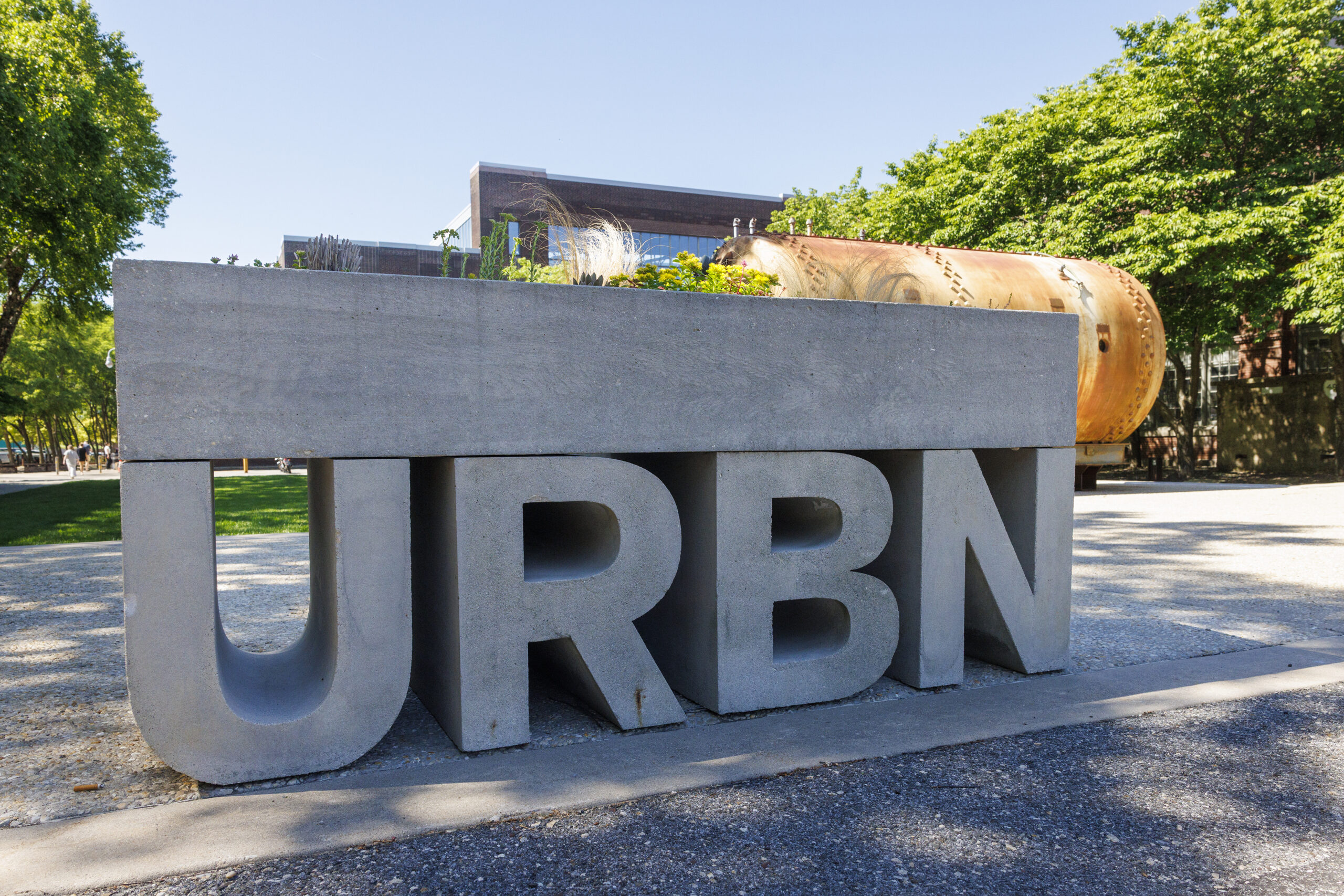
    Massive outdoor signage marks Urban Outfitters’ presence at the Navy Yard.

    “Anthropologie, for instance … would be receiving in one area and then going to another building for style-outs, and then sometimes going back into another building for shooting,” Calliagas said. “It was a really inefficient process.”

    At the Navy Yard, the company’s brands are housed in separate buildings, in part because they each “speak to their customer” in a different way, said Oona McCullough, executive director of investor relations. She called this kind of separation “states’ rights.”

    Consolidating the photo work under one roof has freed up space in other buildings, said Ziel, which is helpful for the continued growth of brands.

    “The brands are still growing pretty aggressively,” said Calliagas.

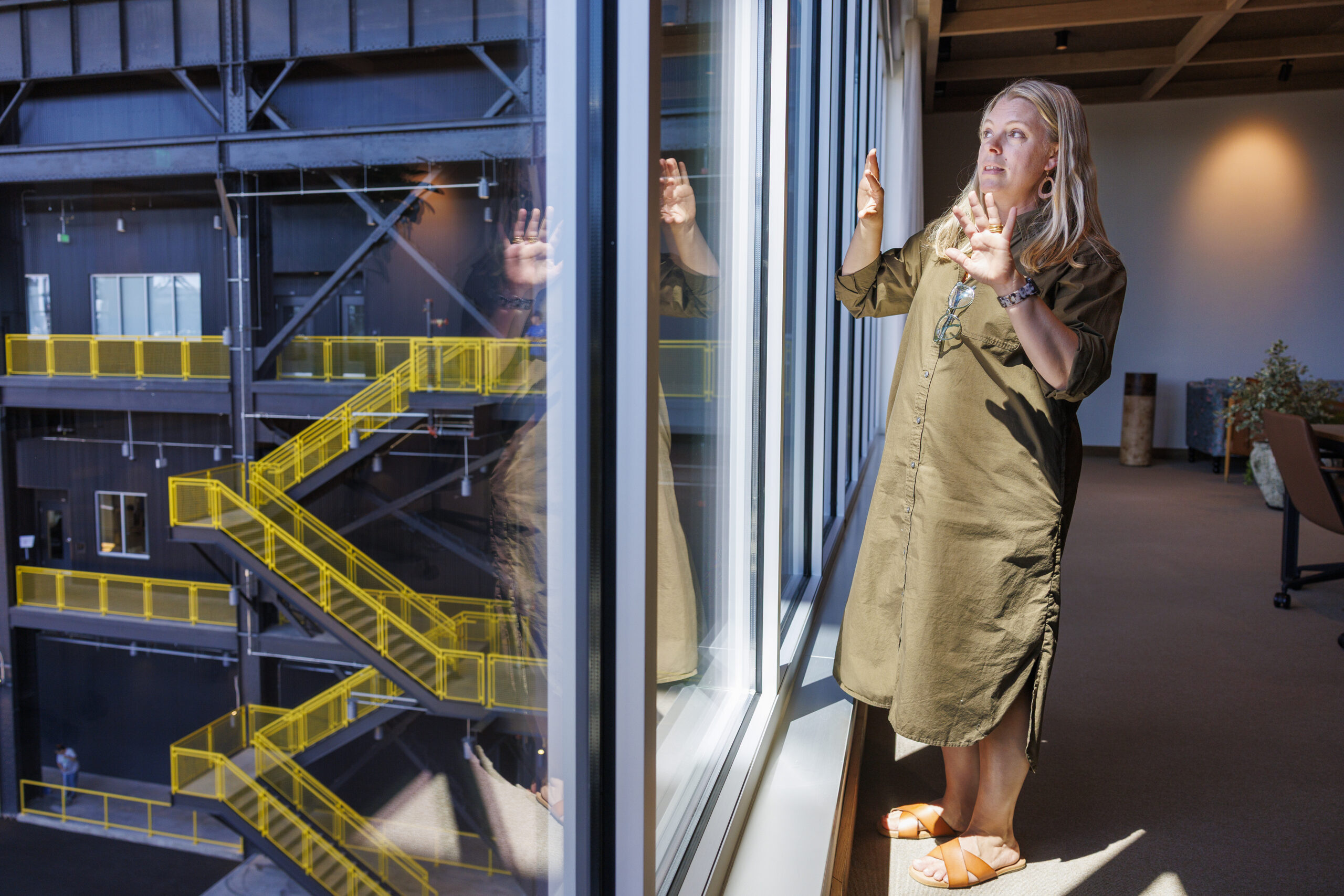
    Jennifer Calliagas, director of planning for North America, discusses how the company will use its photo studios at its newest building in the Navy Yard.

    A campus with more possibilities

    Conforti refers to the headquarters as a “campus,” with a “youthful” and “very collegiate” atmosphere. When bankers or investors visit the headquarters, “we tell them to dress down casual,” he said. “They drop their tie.”

    In keeping with standards set long ago by Google and other Silicon Valley tech companies, the campus is full of amenities. The newer ones include pickleball courts, a basketball court, and a walking track. And there’s plenty of green space for employees to walk their dogs, which are welcome in the workplace.

    Most people work in the office at least three days a week, said Conforti.

    “We’re not the most red-tape, bureaucratic company,” he said. “There’s just nothing like being here on campus getting things done. There’s an efficiency to it — and there’s a community.”

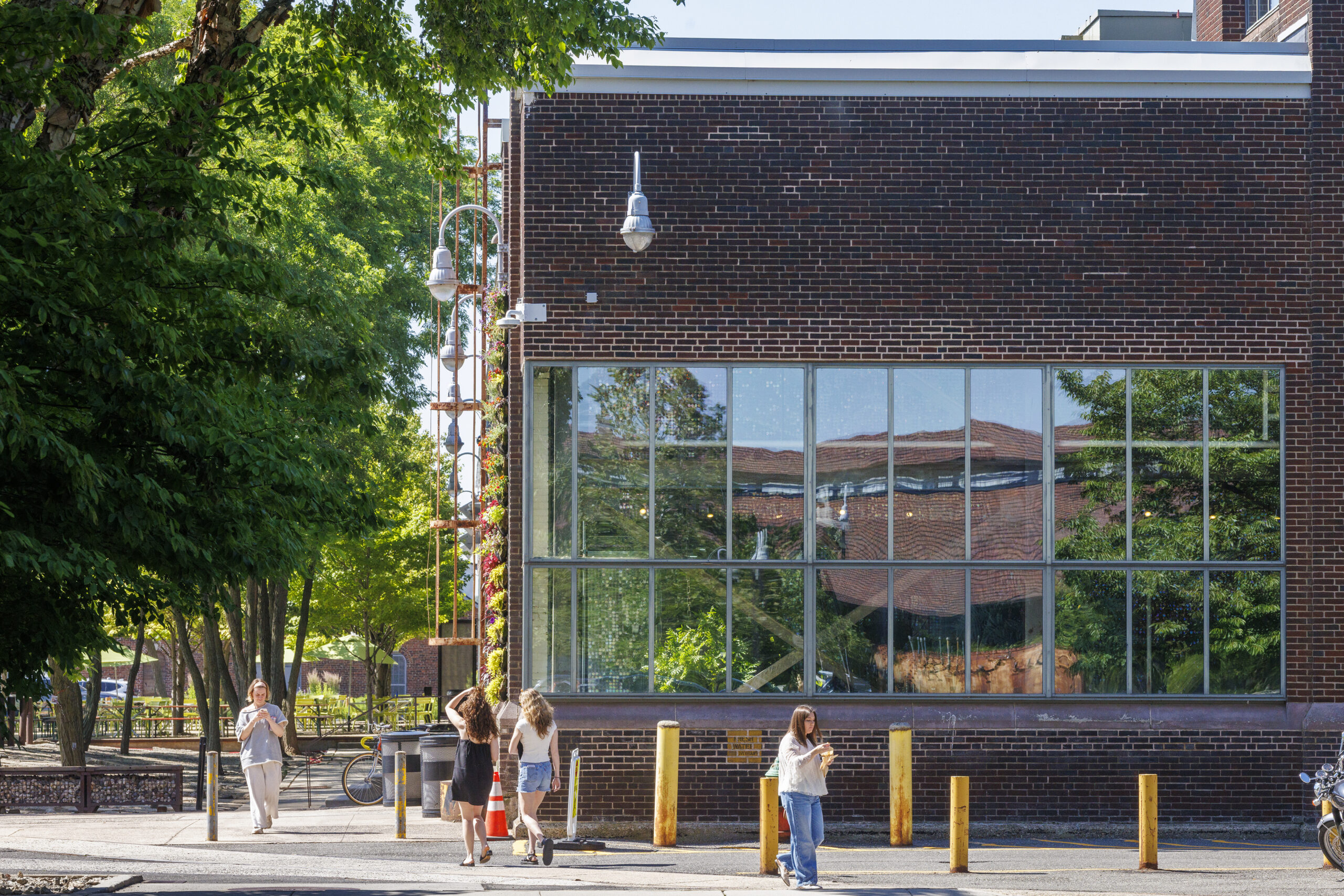
    People walk to and from the building that houses Urban Outfitters’ cafeteria, which is open to employees and the public.

    On a recent Monday, Urban’s cafeteria was just about to start serving warm lunches, and a few dozen people waited in line, while others roamed the large building with its decorative pools. Some wore U.S. Navy uniforms — the cafeteria is open to the public. Options included pizza, Teriyaki beef rice bowls, and grab-and-go items like ice cream bars and boxed sushi.

    CEO Hayne stopped in for a bag of chips and a wrap, seemingly unnoticed.

    At the June news conference, he recalled his first impression of the Navy Yard over 20 years ago: “I drove down Broad Street, came in Kitty Hawk [Avenue], looked at all these beautiful old brick buildings from the turn of the 20th century, and I said ‘sold!’”

    When Ziel, Urban’s chief development officer, first came to the Navy Yard with Hayne, he said, “there was nobody here.”

    “There was a raccoon — that was who I saw when we looked at the first buildings,” said Ziel, who has led the company’s real estate development.

    Decades later, Ziel still sees more opportunities for growth. “I have a couple excess buildings up my sleeve.”

  • Center City snack shop Nuts To You tries TikTok Shop as it pivots toward its next 50 years

    Center City snack shop Nuts To You tries TikTok Shop as it pivots toward its next 50 years

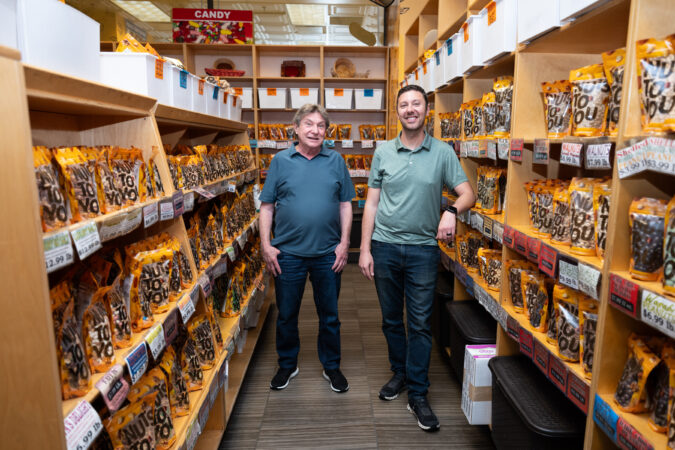
    On 20th Street between Market and Chestnut, much has changed in the past 50 years. One tenant that hasn’t: Nuts To You. The snack shop, wrapped in yellow wallpaper speckled with walnuts, remains packed with shelves of nuts, candy, and dried fruit galore.

    Nuts To You, a snack haven owned by the same family for three generations, is celebrating 50 years in Center City. Since its first location opened in 1976, Nuts To You has survived the rise of the internet, and the emptying of the business district in a post-pandemic Philadelphia, building decades-long customer relationships on the way.

    Pulling off such a feat is “rare, and it’s really hard,” according to Erika Tapp Duran, director of Temple University’s Small Business Development Center.

    Nuts To You freshly roasts their nut products at a warehouse in Frankford. Over the years they have broadened their inventory to include freshly popped popcorn (also made in-house), as well as chocolates, candy, dried fruit, and almost anything else one could find in a kitchen pantry.

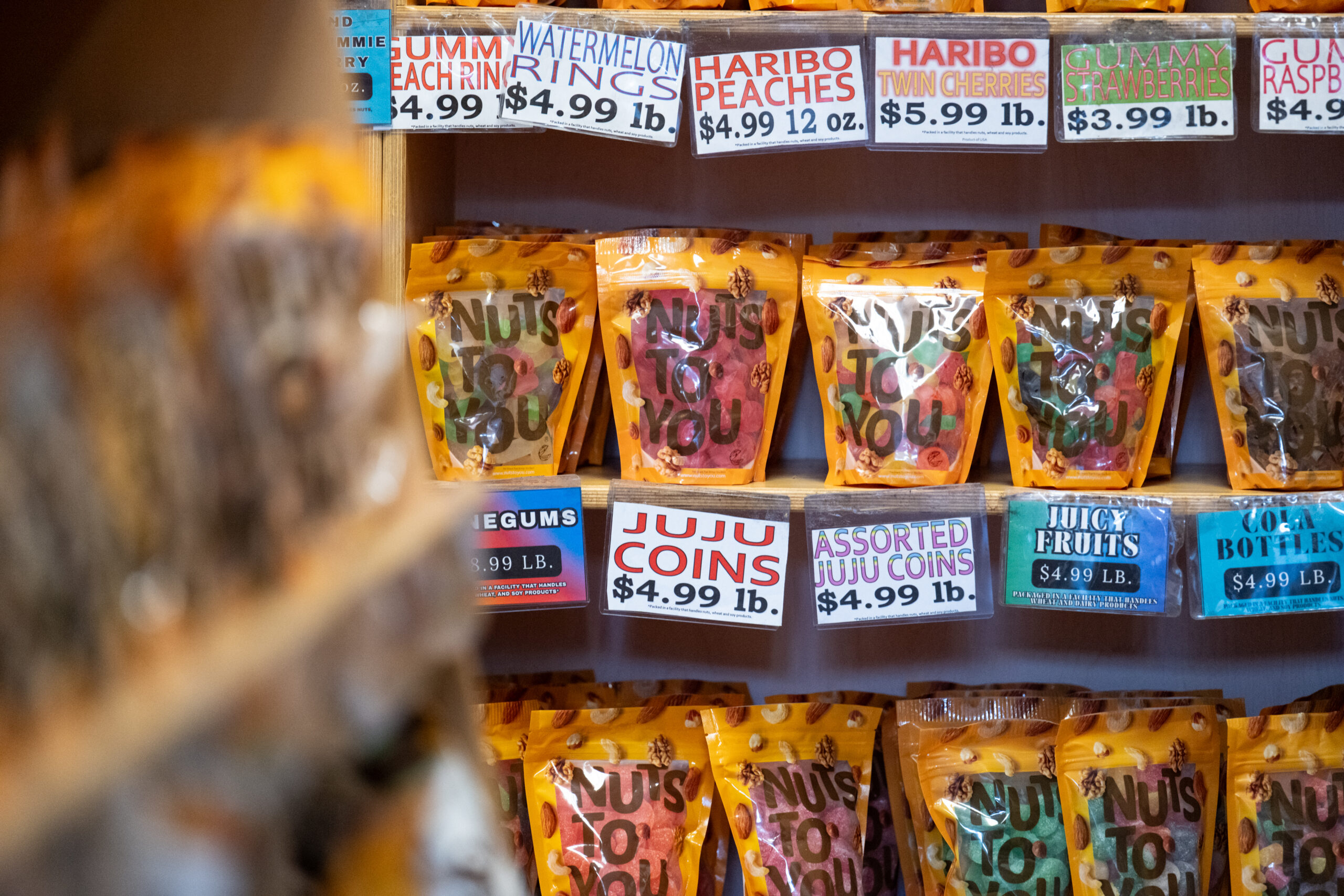
    Gummy candies sold at Nuts To You, a family-owned and operated snack store.

    They sell those products out of three city storefronts: on 20th Street near Rittenhouse Square, 16th and Market Streets on the ground floor of Centre Square; and Seventh and Walnut Streets in Washington Square West.

    But the brick-and-mortar business has changed. In 2018, Nuts To You had six physical stores, and its leaders were considering expanding into Washington, D.C.

    “We used to have lines during lunch rush,” said Justin Bernstein, who co-owns the business with his father, Howard Bernstein. “That just doesn’t exist anymore.”

    The location beneath Centre Square has a front-row seat to the evolution. At the end of 2025, the office building had the highest vacancy rate in Center City. Developers are now planning to convert it into a mixed-use complex with apartments and luxury hotel rooms. With three years left on that lease, Nuts To You is uncertain about the 16th and Market store’s future.

    But for now, “We’re still here,” said Justin, who has spent most of his life as part of Nuts To You. “We’re still going.”

    Fewer walk-ins and a digital pivot

    James Troutman, 77, a regular at the Seventh and Walnut Street location, piled bags of rolled oats, cashews, peanuts, walnuts, and sunflower seeds into his gray backpack as he left the store on a Tuesday morning. He’ll later combine those ingredients into his daily homemade cereal, which he has been making from Nuts To You products for decades.

    “That’s why I’m so young looking!” Troutman joked.

    Employees said this location, the company’s most popular, draws an estimated 100 customers a day. But Nuts To You is not immune to the struggles facing brick-and-mortar businesses. In-person sales are down 30% to 40% from pre-pandemic levels, which the owners attribute to less foot traffic as more people have remote or hybrid work arrangements.

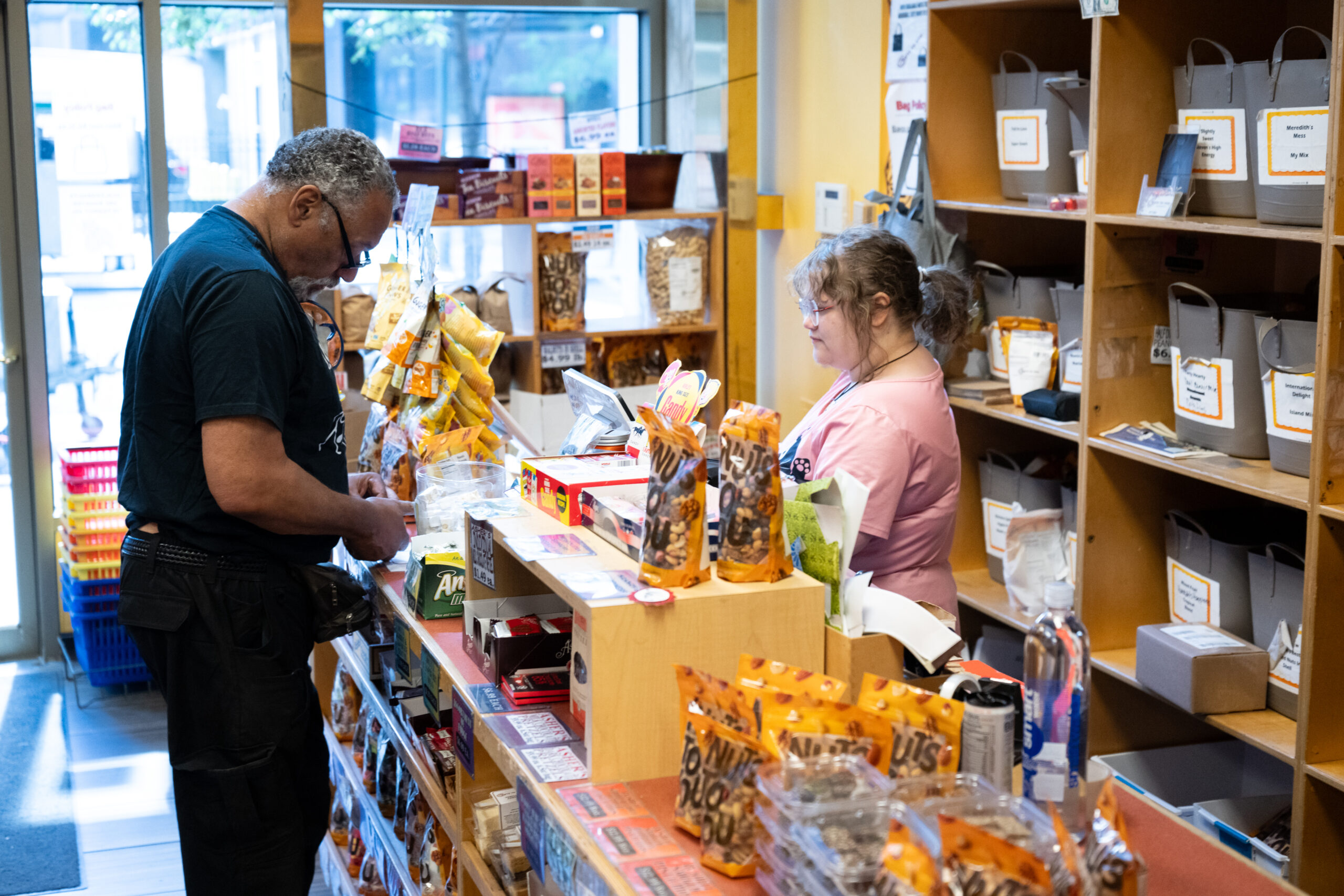
    Anthony Feaster (left) makes a purchase with the help of employee Brianna Boyko at the 16th and Market Streets Nuts To You.

    The entry of big retail competitors into Center City has also changed the business.

    “Fifty years ago, there was nobody selling this product,” said Howard. “CVS and all those drug stores didn’t have full lines of nuts and candy.”

    For Nuts To You, the decline in foot traffic has been offset by an increase in online sales. The company launched its website in 2010, but was only making about $100 to $200 a day online before the pandemic. Within two days of COVID-19-related lockdowns taking effect, sales increased to $3,000 a day.

    Now, 40% of Nuts To You’s sales come from its website, and the company has forayed into selling on TikTok. As of June, only about 1% of their sales come from TikTok Shop, but Justin said that’s already more than expected.

    In lieu of the nuts and oats that traditional walk-in customers buy, online customers tend to purchase sugar-free products or nostalgic novelties like wax bottles or Sugar Daddies.

    “Think about all the things that have changed for consumers in the last five or six years, and then multiply that out over 50 years,” said Temple’s Tapp Duran. “You have to be able to pivot.”

    Howard says that Nuts To You’s popularity has stemmed from its business strategy, which he defines as “largest variety, lowest prices, highest quality.” This may have been true for many years. Though, with larger retailers’ entry into Center City — Justin cited Trader Joe’s in 2003 and Target in 2016 — it has been difficult to beat corporate giants on prices.

    However, the owners say what they can still ensure is quality — “That’s what our customers expect,” Justin said. They source their walnuts and pistachios from small growers in California, with whom they’ve maintained yearslong connections.

    “We don’t want to switch to another brand, even though I could save a dollar,” said Howard. “Most customers appreciate that.”

    In addition to greater competition and a changing retail landscape, Nuts To You has faced challenges common among small businesses in 2026.

    Within the past few months, they’ve joined the ranks of small businesses who were sued for violating the Americans With Disabilities Act, based on allegations that the Nuts To You website relied on a visual interface that was inaccessible to individuals who are blind or use screen readers. Another lawsuit came out of a Proposition 65 claim — a law that requires products sold in California to warn consumers for potential exposure to dangerous chemicals — leading Nuts To You to adopt a disclaimer on its website.

    “You think you’re OK, we’re running smooth, we know our expenses, then all of a sudden you get served papers,” said Justin. “And it’s like, what?”

    Generations of work

    For years, Basheer Ali, 65, has been traveling from Southwest Philly to the Center City Nuts To You stores for his fresh nuts and candy. Employees there have helped him navigate a diabetic diet, introducing him to sugar-free chocolate pretzels.

    “The people need these kinds of stores,” Ali said.

    The company sees very little employee turnover, Justin said. At least half its 19 employees worked at the company for more than a decade.

    Regina DeLeon, manager of the Washington Square West location, has been with the company for 26 years. When prompted by a customer, she recalled Nuts To You’s founder and first-generation owner, Manny Radbill.

    Radbill predicted in 1975 that nuts were going to be the next health craze. He wasn’t wrong: In 1992, a study found an association between nut consumption and a lower risk of coronary heart disease, which kicked off decades of research on the health benefits of eating nuts.

    With the help of Radbill’s daughter, Caryn, and her then-husband Howard, they opened that first store on South 20th Street, which is still in operation today.

    Justin first entered the family business when he was 2 years old, pushing buttons on the cash register. Howard required him to gain outside experience first, but Justin said, “I always kind of knew this is what I wanted to do.”

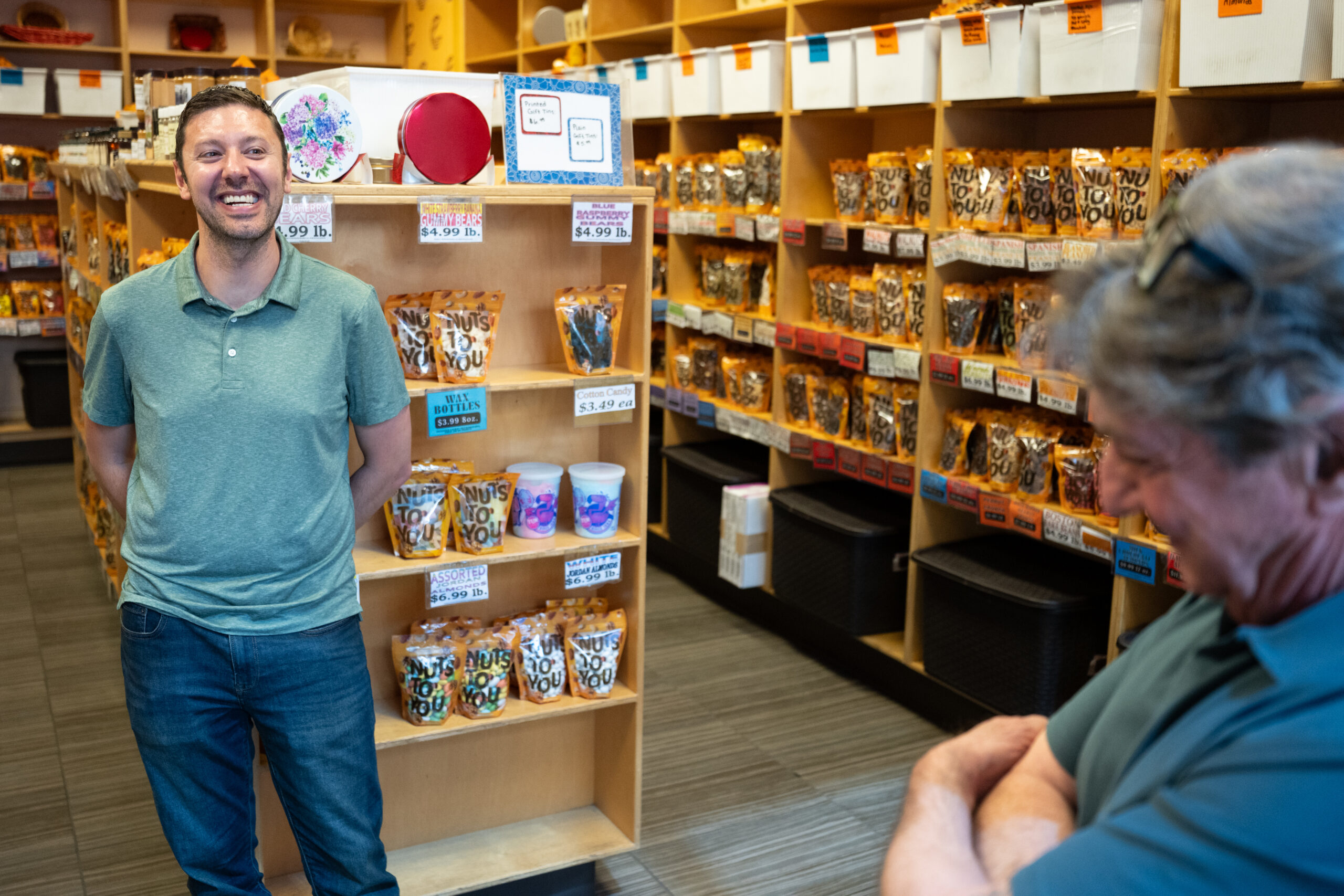
    Justin Bernstein smiles at his father, Howard Bernstein, inside one of their three Center City Nuts To You stores.

    So, after his college graduation and a brief stint at Boscov’s, about 20 years ago Justin joined Nuts To You and has since become co-owner.

    As iconic family businesses like Di Bruno Bros. have been acquired, buyers have approached the Bernsteins, but Howard and Justin decided against it. They entertained one offer, but the deal-breaker was a requirement to close all of the physical stores — the owners refused to put their staff out of jobs.

    Over their 50 years in business, Justin said he is most proud of staying family owned.

    “We’ll see what happens, what the future holds,” said Justin. “At least another 20 years, call it.”

  • Walmart unveils ‘store of the future’ concept in Bucks. We tried it out.

    Walmart unveils ‘store of the future’ concept in Bucks. We tried it out.

    Grocery stores are constantly trying to reinvent the wheel.

    Consumers have been introduced to googly-eyed robots roaming aisles, the expansion of self-checkout, the rollback of self-checkout, and increasingly fast grocery delivery in recent years, as major grocers try to stand out in an industry known for low profit margins.

    Not to be left behind, Walmart has touted a “store of the future” concept for years as it opens and remodels hundreds of locations, including 32 in Pennsylvania this year, to have better layouts and services that aim to make the shopping experience seamless.

    “By modernizing our stores, we’re making shopping faster, easier, and more convenient, all while empowering our teams to serve customers better and creating local opportunity,” said Annie Walker, senior vice president of the East Business Unit at Walmart, in a statement announcing the Pennsylvania investments this year.

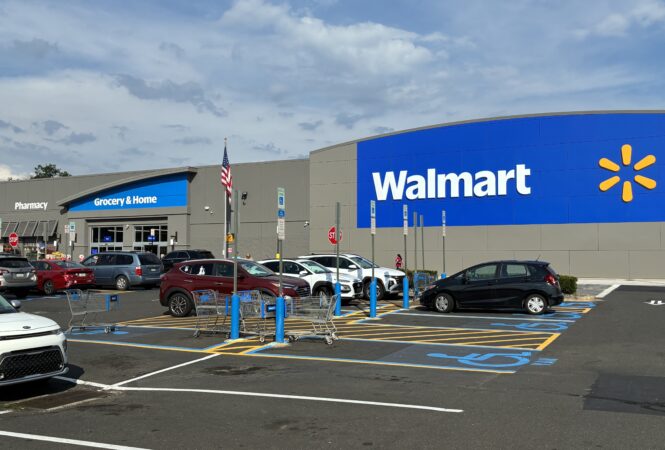
    The Walmart Supercenter in Warminster is the latest “store of the future,” unveiling its remodel this month.

    I tried it out to see what the future holds for shoppers. Spoiler alert: It’s nothing out of The Jetsons, but a handful of customers told me they liked the improvements nonetheless.

    “A lot of stuff is different, but it’s easier to find things,” said Cuong Kim, 41, of the new layout, walking out with a bag of toiletries.

    Sparky, where are the fiber gummies?

    Walking in, the store doesn’t feel that different from counterparts in South Jersey or Philadelphia. The polished concrete floors remain the same and there are an Auntie Anne’s and a Subway near the entrance.

    Still, I could see the company followed through on its “elevated assortment of healthy foods” promise. There were meat and cheese snack packs galore, along with a wide range of ready-to-eat salads and sandwiches in the grab-and-go section.

    Because better online/in-store integration is part of the company’s “store of the future” pitch, I brought an admittedly specific grocery list with me to test out Sparky, the company’s generative AI shopping assistant launched last year, another trend major retailers are adopting.

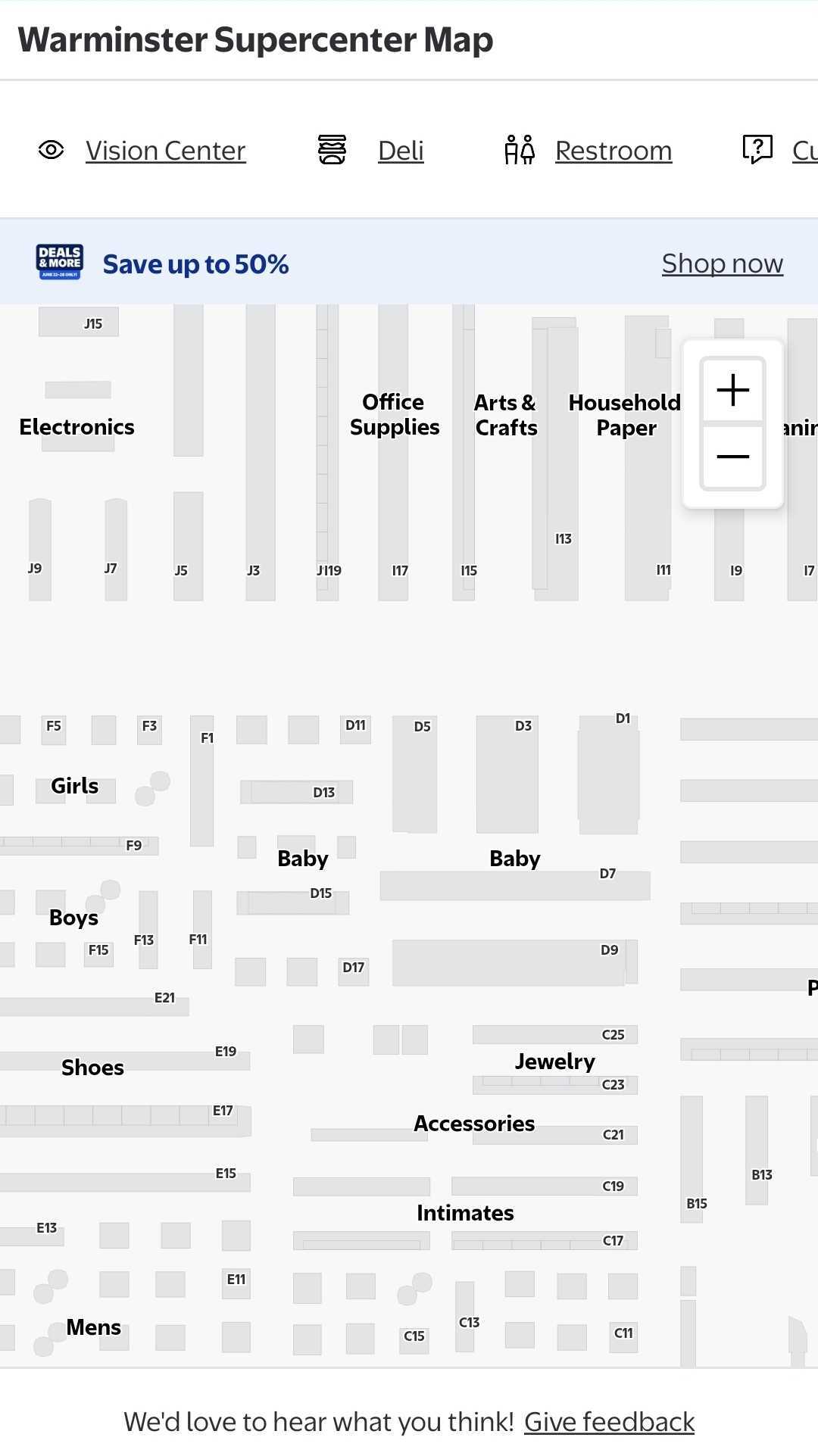
    Though the Walmart app provided a handy static map of the store, Sparky was not helpful in helping me find mango pulp for a cheesecake I’m making or my fiber gummies, which I will need if my rich dessert plans move forward.

    A static map of the Warminster Walmart in the app.

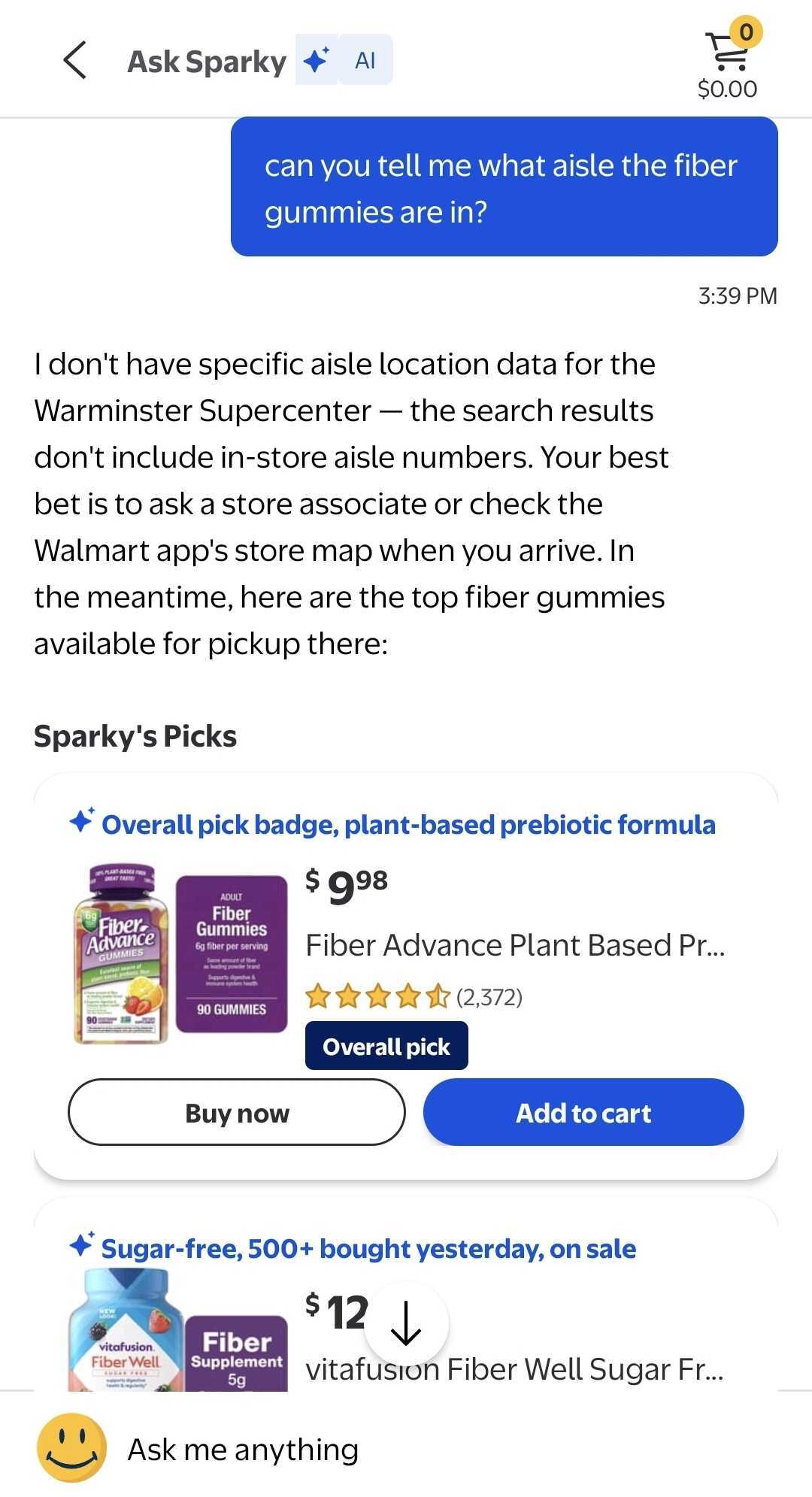
    While Sparky pointed me to several fiber gummy brands, it was less helpful in telling me what aisle they were in.

    “Your best bet is to ask a store associate or check the Walmart app’s store map when you arrive,” Sparky said.

    Sparky, Walmart’s AI shopping assistant, doesn’t know what aisle the fiber gummies are in.

    On the mango pulp front, Sparky showed me several options, which got my hopes up because I’d never used this item and was worried it might be hard to find.

    Alas, none of Sparky’s suggestions were in the store, but could be shipped by the next day — helpful information if I weren’t already on site.

    To be fair, one shopper told me that while Sparky doesn’t have a 100% hit rate, it is not a total dud.

    He was right. Seltzer, another item on the list, was in aisle A22.

    As I walked around the store, I noticed some aisles, like the beverage sections, could fit three shopping carts across. That’s some Costco-level width and another “store of the future” feature.

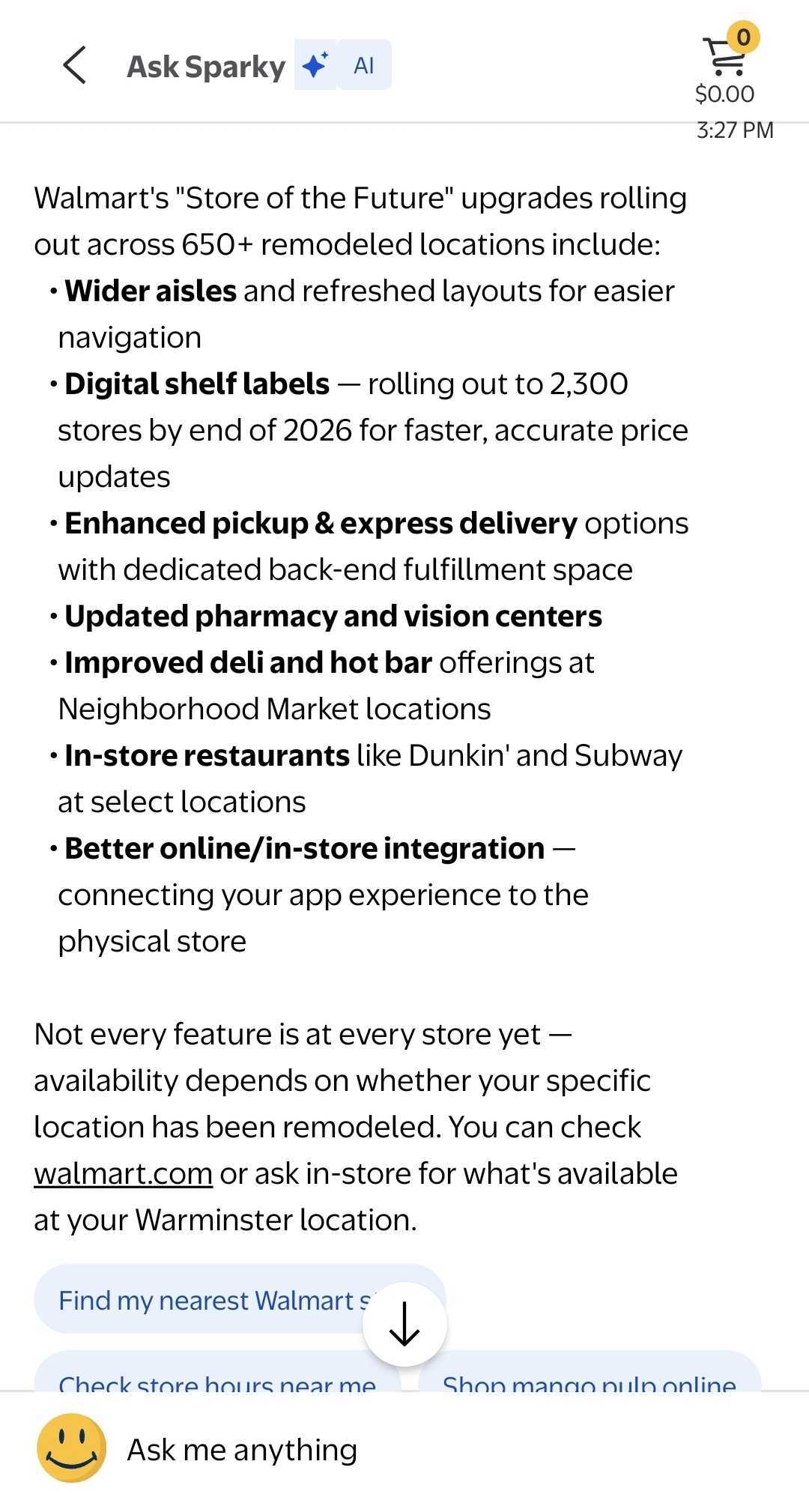
    Even so, wider lanes, a semi-useful shopping assistant, and more snack packs didn’t make my shopping experience feel that futuristic, so I asked Sparky: “What’s new about my Walmart? I heard it’s the store of the future but not sure what’s changed.”

    It reiterated some of what I’d already seen and highlighted the enhanced pickup and express delivery services. I recently had a laptop charger delivered from a different Walmart location and I can confirm it arrived in less than an hour.

    Sparky lays out the store of the future upgrades.

    Ol’ Sparky, however, warned me “not every feature is at every store yet.” For example, Walmart plans to roll out digital shelf labels that allow rollbacks and price changes to appear in real time, but were nowhere to be found in Warminster.

    I also asked an employee what was new with the store to fact-check Sparky.

    “It’s little things,” said the cheerful associate. “There’s more [grab and go] coolers, more cash registers, and a bigger electronics section.”

    A reminder that no one knows a store better than the people who work there.

    What we learned

    It seems the people who would get the most use out of Sparky are those ordering online for delivery or planning their haul ahead of time, checking to see if their desired items are in store. These features, however, are not exclusive to the 32 Walmarts up for a makeover.

    Yet while not exactly futuristic, shoppers in Warminster certainly appreciated the less tech-centered changes, such as the added breathing room as they shopped in clearly labeled sections.

    Kim, the shopper who traveled from Northeast Philadelphia for his haul, also reminded me that sometimes the most seamless shopping experience is pretty simple. He’s not an app user like some of the other customers I talked to. But he travels to Warminster because very few items require waiting for an associate to unlock them from glass cases.

    “It’s easier to shop here,” he said. “In Philly, they lock everything up.”