On Friday, Drexel defeated Elon, 68-59. After starting out 0-2 in Coastal Athletic Association play, the Dragons have rattled off eight wins in their last 10 conference outings.
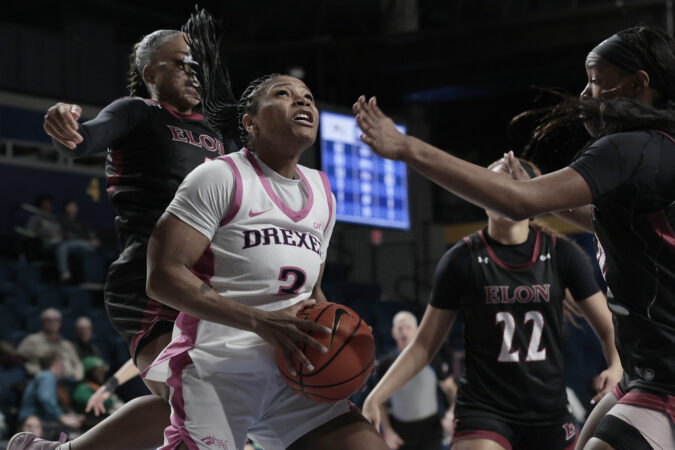
The Dragons (15-8, 8-4 CAA) pushed their lead to 19 points late in the third quarter behind fifth-year guard Amaris Baker’s 27 points. The Phoenix cut Drexel’s lead to single-digits in the fourth, but ultimately dropped their ninth consecutive game to the Dragons.
Drexel currently sits in fifth place in the CAA standings with six games remaining. If Drexel can clinch a top four seed in the conference, the team will receive a first-round bye in the CAA Tournament.
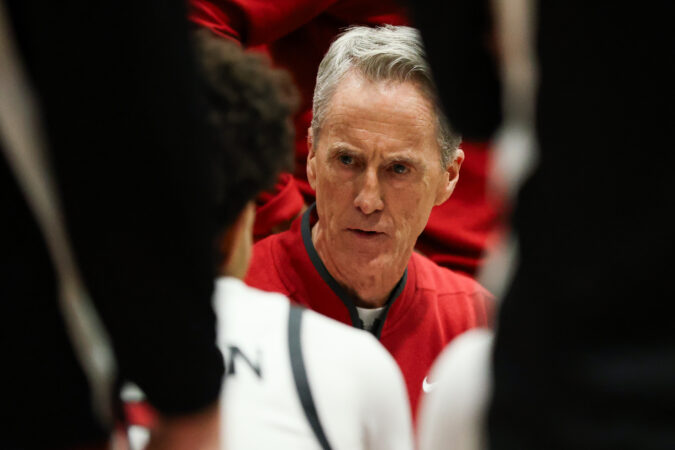
“Every game at this point is going to be a position game for us,” said Drexel coach Amy Mallon. “I think that really has to be the mentality of this team. … We always take it game by game and possession by possession, but they have to understand right now where we are and where we fall.”
Local leaders
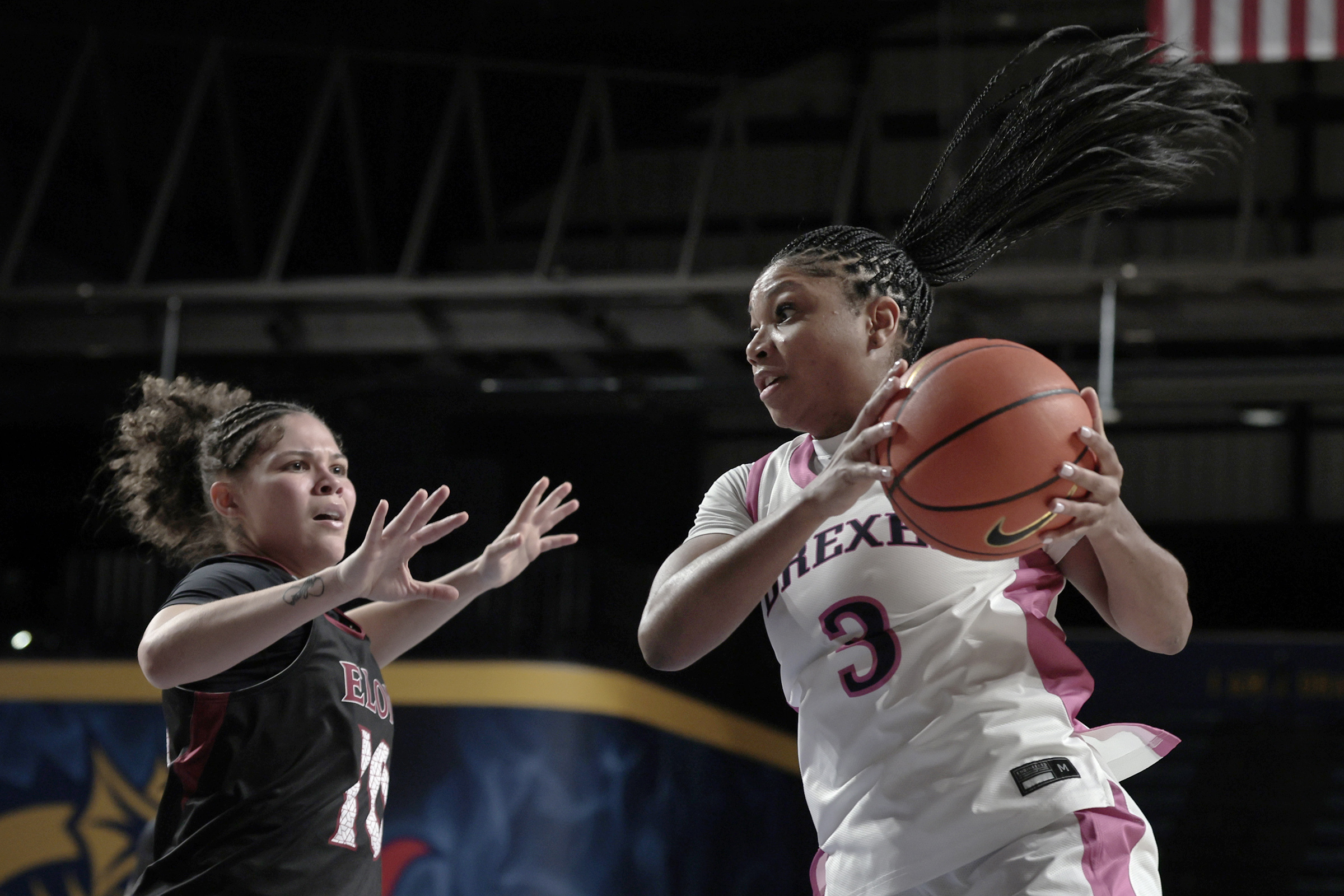
Baker, the CAA’s leading scorer and a Cardinal O’Hara graduate, notched her 14th game this season scoring at least 20 points. She also logged five rebounds and two assists.
“[Baker’s] composure this year with what she’s seen as one of the best players in the league, as far as scoring — they’re keying in on her every week,” said Mallon. “So the fact that she’s still capable of putting up the numbers she has been able to put up just goes to show the discipline she has.”
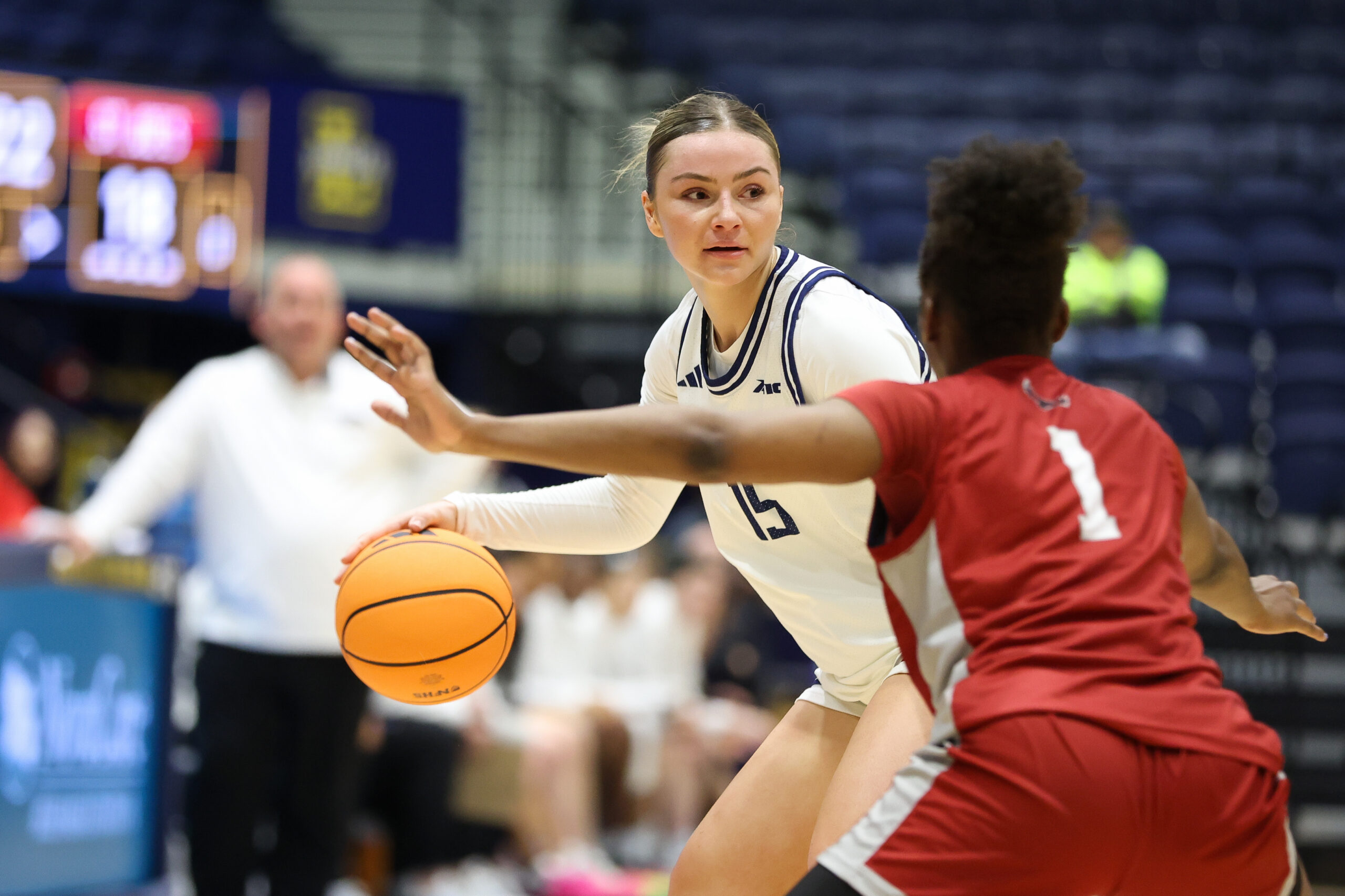
Drexel’s Amaris Baker (right) is the leading scorer in the CAA.
Behind her in the stat sheet was another local product, Archbishop Wood’s Deja Evans. The junior forward logged 14 points and a team-high seven rebounds. Evans’ efforts on the board were a major factor in Drexel winning the rebounding battle, 31-20.
After trailing big in the third quarter, Elon made the game competitive in the fourth behind freshman center Tamia Watkins. The three-time CAA rookie of the week scored 10 of her team-high 16 points in the final period.
Elon cold from deep
The Dragons were perfect from deep through the first quarter, shooting 4-for-4 from three-point range. Baker made two of those threes.
Meanwhile, Elon’s (11-13, 6-6) shooting woes started early and carried throughout the game. The Phoenix shot 23.8% from deep compared to Drexel’s 63.6% from three
“We mostly just locked in on defending them outside the three, and when we’re in our 2-3 [zone defense], we just were moving well together, and we’re just communicating well together,” said Evans.
The Dragons turned the ball over 10 times in the first half, taking a nine-point lead to the half. In the second half, Drexel cleaned up their ball security, turning it over nine times.
‘Staying composed’
A 12-0 run powered by Watkins helped Elon cut Drexel’s lead to six points with just over four minutes to go.
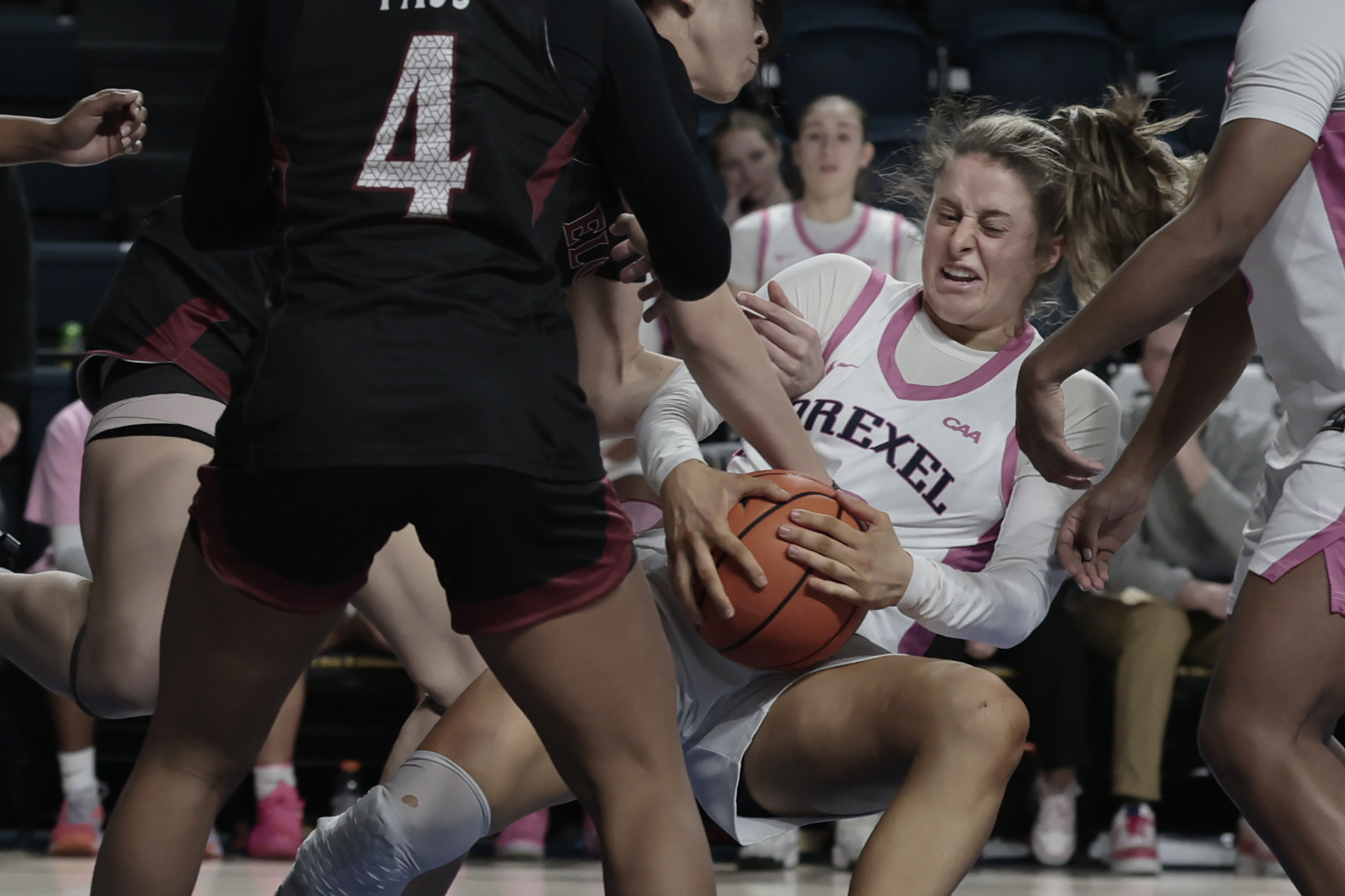
Drexel’s Laine McGurk (center) falls backward trying to control a loose ball against Elon.
Eight of Drexel’s 15 points in the fourth quarter came from the line to help the Dragons outlast the Phoenix.
“In a fourth quarter, they go on a run, and you can sustain and make sure you stay disciplined. Teams are going to have runs,” said Mallon. “I thought we did a nice job staying composed, understanding what needs to be done.”
Up next
Drexel goes on the road next Friday to face Hampton for a second time this season (7 p.m., FloCollege).
It certainly did not feel like baseball weather. Fans were bundled up in coats and blankets and hand warmers were the most coveted item of the day as mounds of snow sat behind the dugouts.
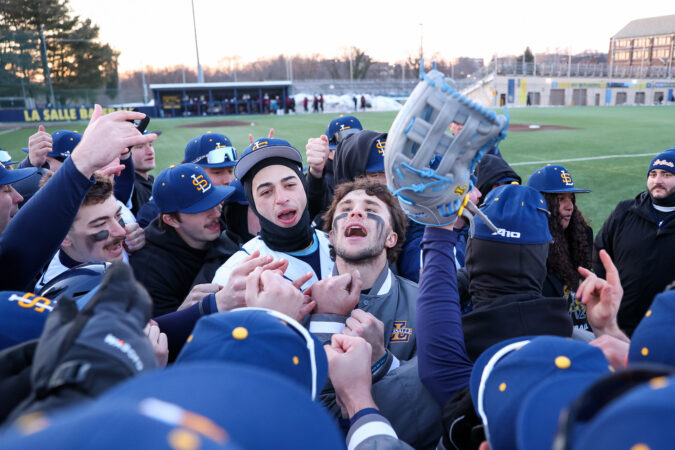
Despite the 35 degree weather, there was an undeniable excitement in the air at Hank DeVincent Field — and for good reason.
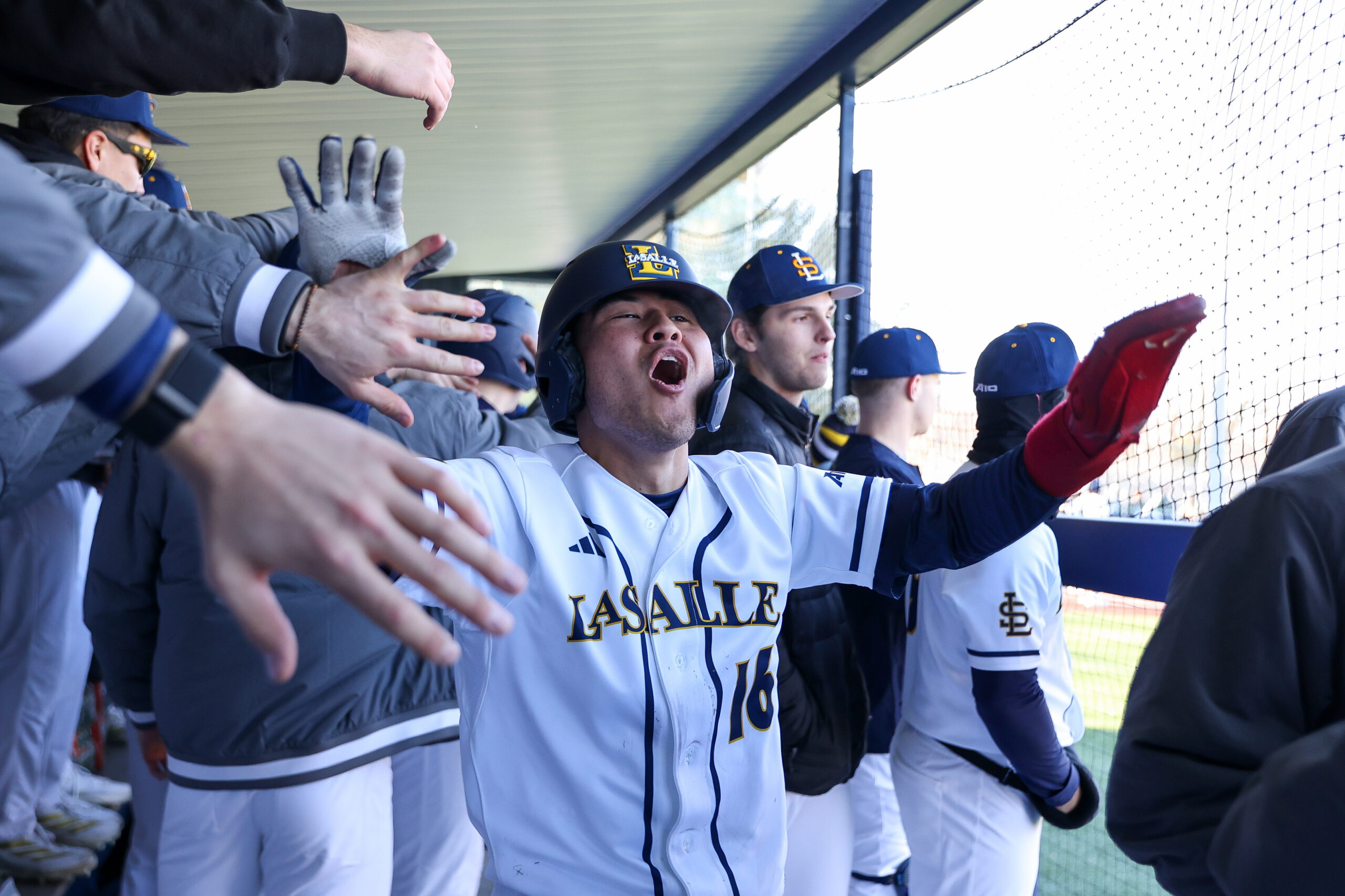
La Salle baseball was back for the first time in 1,728 days.
The Explorer program shut down following the 2020-21 season but returned Friday for the first time since May 9, 2021, to face Maryland Eastern Shore. In front of a dedicated crowd braving the cold, La Salle beat the Hawks 27-10 to welcome the program back to the diamond.
“This is almost six years in the making for me and two years in the making in this most recent run,” said head coach David Miller. “It’s just a lot of hard work with these kids.”
La Salle’s on-field performance certainly left a strong first impression for fans, many of whom were getting their first look at Explorer baseball. They recorded 19 hits, led by second baseman Daniel Perez, who went 4-4 with a home run and three RBIs. Right handed pitcher Shawn Karpaitis threw five innings and gave up one run in relief after UMES tied the game at eight in the second inning.
While the outcome is a bright spot for the program, the atmosphere brought even more excitement.
A major tenet of La Salle’s three-step plan to bring back baseball was getting the field up to Division I standards. The program made sure there was new padding in the outfield and got the scoreboard up to date. The season-opener was not initially supposed to be in North Philadelphia, but issues with UMES’ field moved the first series of the year to La Salle.
And the Explorer faithful were ready to support their program.
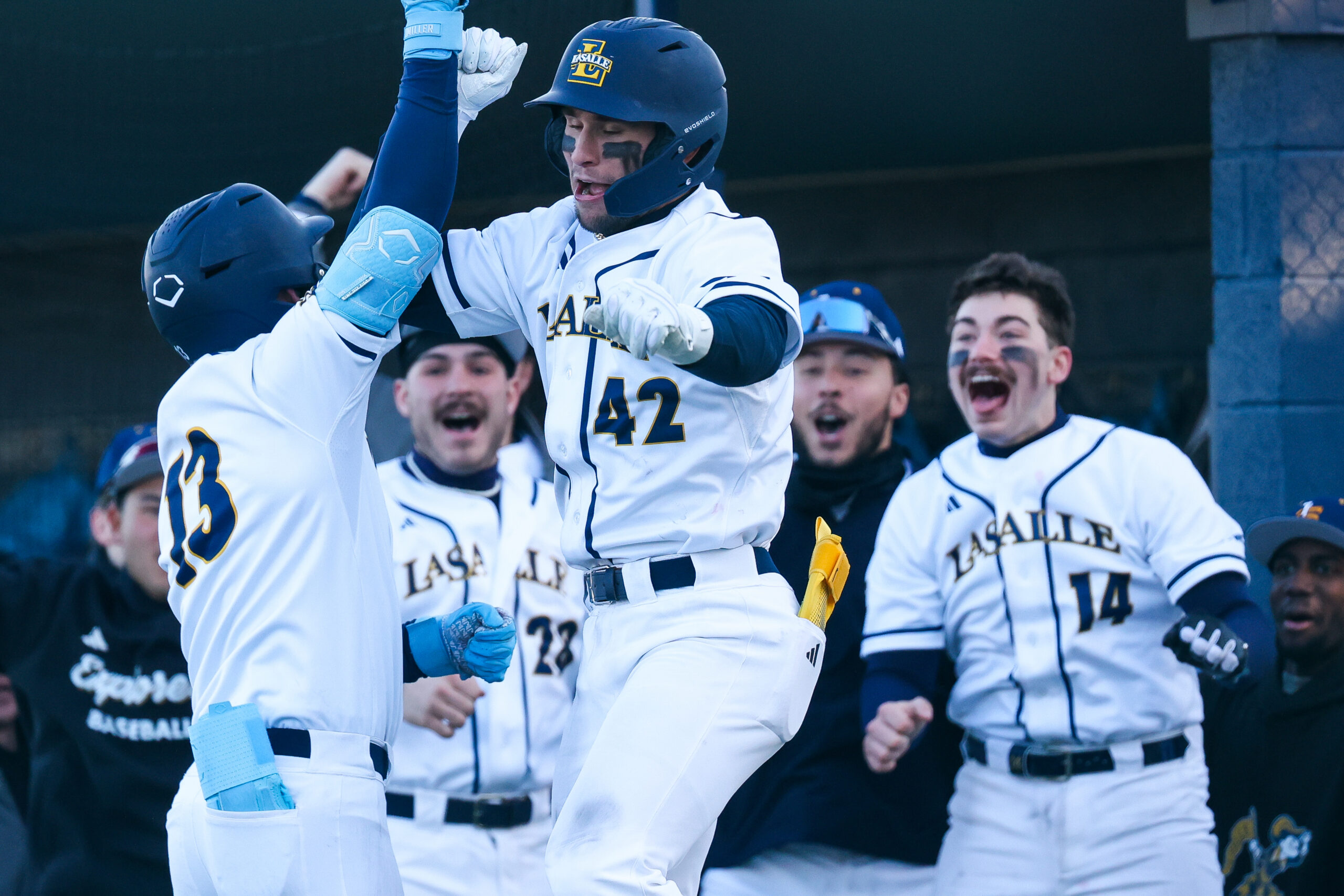
La Salle outfielder Kosei Suzuki reacts after scoring during the first inning against the Maryland Eastern Shore Hawks at Hank DeVincent Field.
Fans filled bleachers behind the home dugout and parents occupied the grass along the first base line.
“There’s a lot of excitement around the program,” said Ed Litsky, father of freshman pitcher Josh Litsky. “I know from a parent perspective there’s a lot of excitement. The coaches and players seem really into it. It’s just amazing.”
The baseball team also got immense support from fellow student athletes. They helped fill the bleachers and the standing area to provide a boost to the players and even offered some heckling of the Hawks.
“Other student athletes on campus were all very supportive today, coming to my office in the morning and wishing us luck,” Miller said. “I know I saw rugby out here, girls lacrosse, soccer and a couple of fraternities heckling a bit.”
The players enjoyed a chance to usher in a new era of La Salle baseball. Some, like center fielder Chase Swain, had been waiting since 2019 to play for the Explorers, while others, like Perez, followed Miller after he raved about his time at La Salle.
“Coach Miller always talked about [La Salle] at Manhattan,” Perez said. “I knew the program had shut down and he has a lot of good words to say about this program. I knew he wanted to come back here and it sucked that when I hit the portal last year, I probably would have come here if there was a team. It’s just super special to be able to play for him.”
La Salle’s Jayden Novak (left) celebrates with teammate Chase Swain during the fifth inning against Maryland Eastern Shore on Friday.
Friday wasn’t about the past. La Salle is excited about its future and a chance to kick-starting a new era.
“It’s a great day for La Salle Athletics and it’s a great day for La Salle baseball,” Miller said. “[The fan support] is Philly in a nutshell.”
Every once in a while, Kevin Willard loves when the shot clock expires before a Villanova shot attempt.
There really is a time and place for everything.
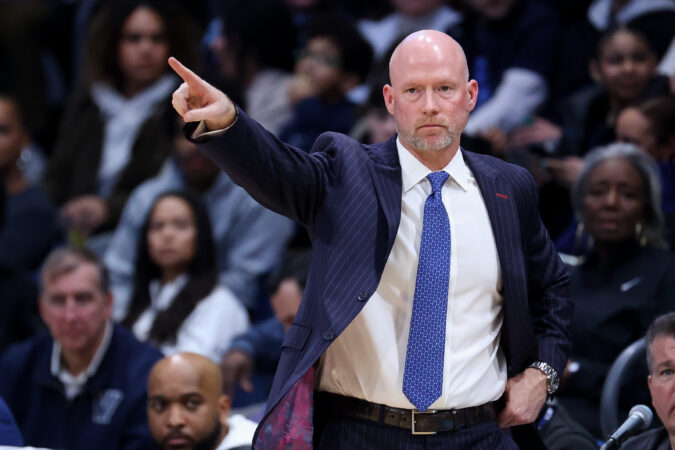
“Everyone will say, ‘You’re nuts,’” Willard said Tuesday night after Villanova rallied late to beat Marquette. “It takes 30 seconds; it sets up our defense. The worst thing you can do is come down and jack up a shot with 2 seconds on the shot clock, long rebound, your defense isn’t set. I’d rather have a shot-clock violation, set my defense up, have them work for 25 seconds, and then take 30 seconds and the game’s over.”
Villanova has taken its share of violations in the second half of victories this season. There were two during a 12-point win over Seton Hall on Feb. 4 while the Wildcats held leads of 14 and 12 inside of five minutes. They took one vs. Providence up by 19 points with four minutes left. They took one vs. Butler while ahead by 12 with 2½ minutes to go. And they had three during their Big East opener on Dec. 23, when they built a big lead over Seton Hall on the road and won by eight.
To be clear, there were no such violations during Tuesday’s win. So how did we get to this topic? Willard was asked after the game about tempo and whether he thought the team could play a little faster. The Wildcats are ranked 337th by KenPom’s adjusted tempo metric and 296th in average possessions per game (68.4).
Willard, who has the Wildcats at 19-5 overall and 10-3 in the Big East entering Saturday’s game at Creighton, is a passionate talker of tempo. He went on a mini rant about the subject in April at his introductory news conference at Villanova. He focuses on defensive tempo, he explained then, the amount of time it takes for an opponent to get off a shot. On the offensive side, the difference between shot speed from top to bottom is only a matter of a few seconds, he said.
“You know the difference between the 20th fastest team and us?” Willard asked Tuesday. “1.6 seconds.”
By average number of possessions, the difference between Villanova at 297th and the 100th-ranked team (Miami) is just four possessions.
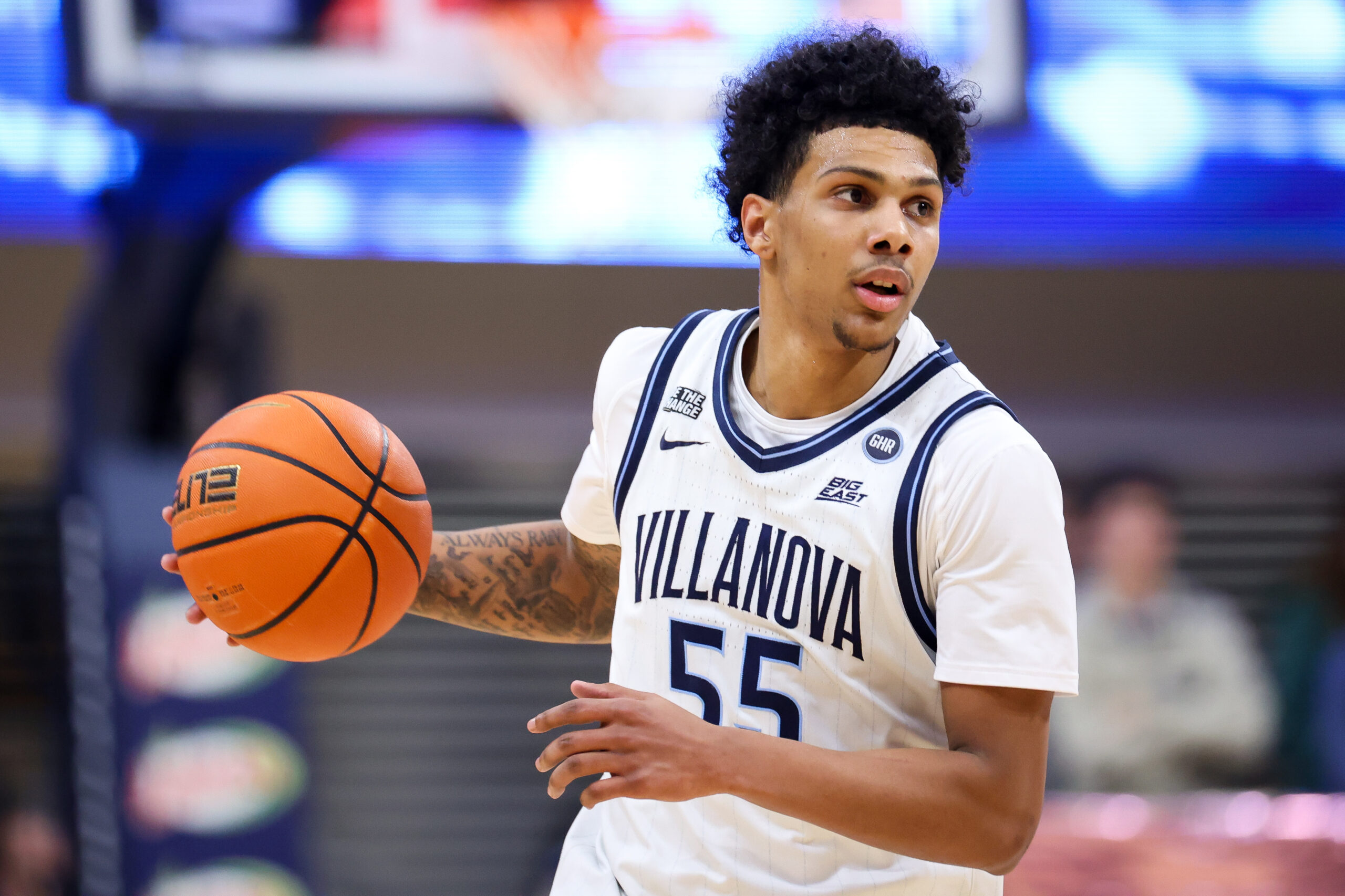
Freshman point guard Acaden Lewis is charged with setting Villanova’s tempo on offense.
“I have a young team, and when we get up I’m going to control the ball and take the air out of the ball,” Willard said. “That’s one of the reasons why our tempo is so low is if you watch any time we’ve gotten up more than 12, I’ve taken the air out of the ball and we have run the clock down. One of the easiest ways to lose leads is to take quick shots.
“I think we play pretty fast. It’s not like he walks the ball up,” Willard said, pointing to freshman point guard Acaden Lewis. “It’s not like we’re ever walking the ball up. It’s 1.6 seconds. Everyone gets stuck on that tempo s—.”
Less than a month of regular-season basketball remains, so it feels like a good time to round up who could win Big 5 awards.
Let’s start with the coaches. The easy answer here is Villanova sweeping. Willard is on his way to stopping the three-year NCAA drought on the men’s side. Denise Dillon has her fifth 20-win season in six years as Wildcats coach. But those are the obvious answers partially because they coach teams that entered the season with at-large NCAA Tournament chances.
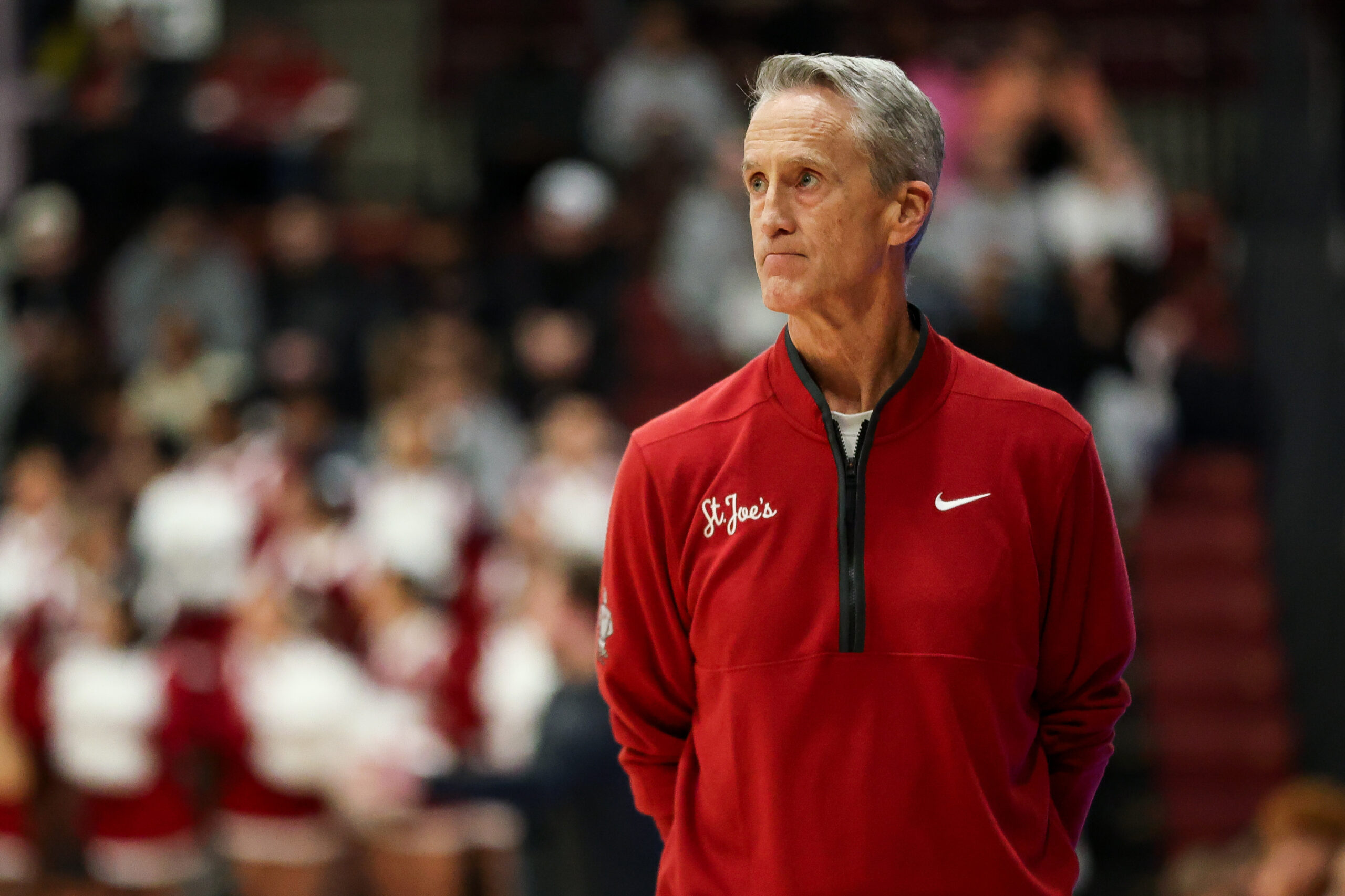
But how about Mountain MacGillivray, the La Salle women’s coach? The Explorers went 4-15 in the Atlantic 10 last season. They’ve nearly doubled that total so far in 2025-26 and still have five games left. And what about Adam Fisher? The Temple men’s coach had to rebuild another roster in the offseason and has the Owls at 7-4 in the American Conference and in the mix. Or Steve Donahue, who stepped into a weird situation at St. Joseph’s, got off to a slow start, and has the Hawks in fourth place in the A-10?
La Salle’s Ashleigh Connor is guarded by St. Joseph’s Rhian Stokes on Jan. 28.
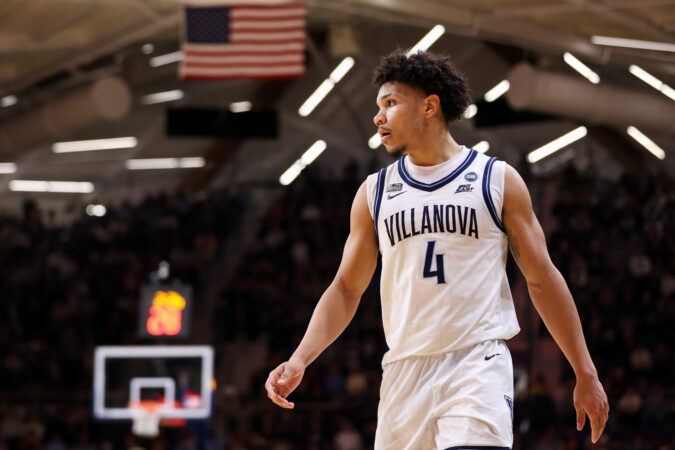
As for player of the year on the men’s side, Villanova’s Tyler Perkins and Lewis have good arguments, as do Penn’s Ethan Roberts, Derek Simpson of St. Joe’s, and Temple’s Derrian Ford. On the women’s side, it might be Villanova sophomore Jasmine Bascoe’s award to lose. But La Salle’s Ashleigh Connor is having a great season, as is Drexel’s Amaris Baker and Gabby Casey of St. Joe’s.
The Villanova women won by 40 Wednesday night at Xavier and Bascoe reached the 1,000-point plateau in less than two full seasons. The Wildcats are rolling. They’re 13-3 in the Big East and firmly in second place, two games clear of Seton Hall in the loss column.
But they’re also firmly on the NCAA Tournament bubble. ESPN’s latest bracketology had the Wildcats as a No. 10 seed and in the “last four byes” group. The projected field capped just six spots behind them.
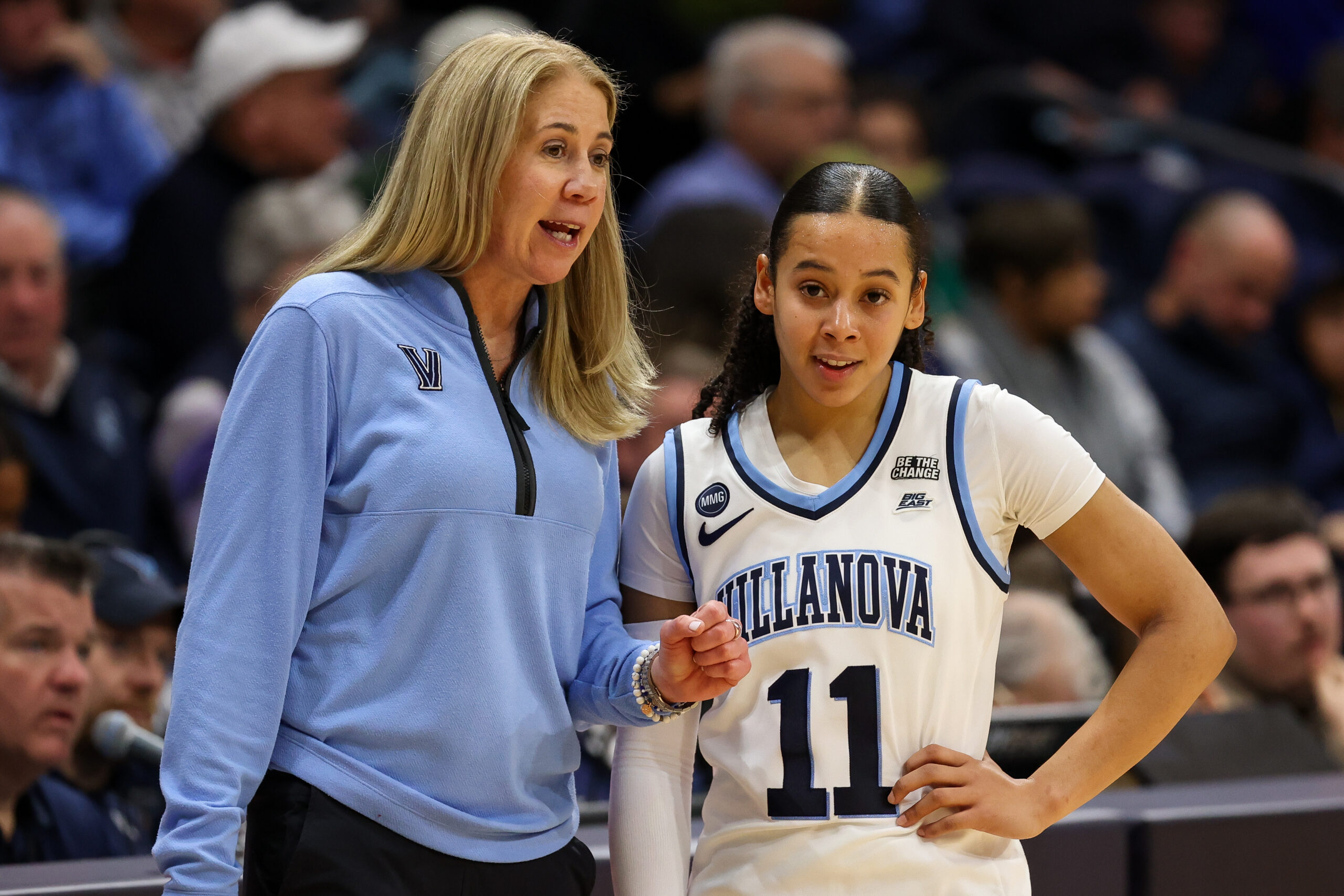
Villanova coach Denise Dillon with her star guard, Jasmine Bascoe.
Like the men, the women are in Omaha, Neb., this weekend. They play a Creighton team on Sunday that they already beat by 10 at home. It’s not a great time to have a slip-up, because after that it’s the annual home game vs. No. 1 UConn, which is undefeated and already beat Villanova by 49. Just two games are on the schedule after that: a home game vs. fourth-place Marquette and a road showdown at Seton Hall. Then comes the conference tournament.
Since we last took stock of the Big 5 men’s teams, a few more got on the positive side of .500 in league play, which brings a better possibility of running the table come conference tournament time.
What’s Torvik’s math — which is based on thousands of simulations — for the rest of the pack?
Penn: 10.1%
Drexel: 3%
Temple: 2.9%
St. Joe’s: 2.6%
La Salle: 0.1%
The Big 5’s streak of no men’s teams looks like it’s ending. Just don’t count on Villanova having any company at the dance.
When the NCAA decided to go all-in on Division I women’s college basketball by adding a national championship tournament in 1981-82, it marked a fascinating turnaround. By grabbing the reins from the Association for Intercollegiate Athletics for Women — the longtime governing body of women’s hoops — the NCAA set out to make the game bigger and better forever.
The sport did change, vastly. Television exposure finally found big-name programs. Title IX brought more girls and women into play, literally and figuratively. All-American players and Hall of Fame-worthy coaches promulgated. What should not be lost is this: the roots of the game were plentiful, but none more important than what grew strong at schools throughout this tri-state region.
Here, programs and players were so impactful that to ignore the flood of talent became indefensible by 1982. So, the NCAA bit.
Before the dynasties at UConn and Tennessee, there were giant-killers on the courts of tiny Immaculata and Cheyney State.
Before there was a Geno Auriemma or Pat Summitt, there were legendary coaches like the Mighty Macs’ Cathy Rush and Cheyney’s C. Vivian Stringer. Rush’s and Stringer’s reputations and extraordinary programs surely caught the attention of the NCAA as they traveled the path to the Naismith Basketball Hall of Fame.
Before there were all-Americans like Dawn Staley, Maya Moore, and Caitlin Clark, future Hall of Famer Theresa Shank-Grentz and the fabulous talent, Yolanda Laney, were dealing here in the Delaware Valley.
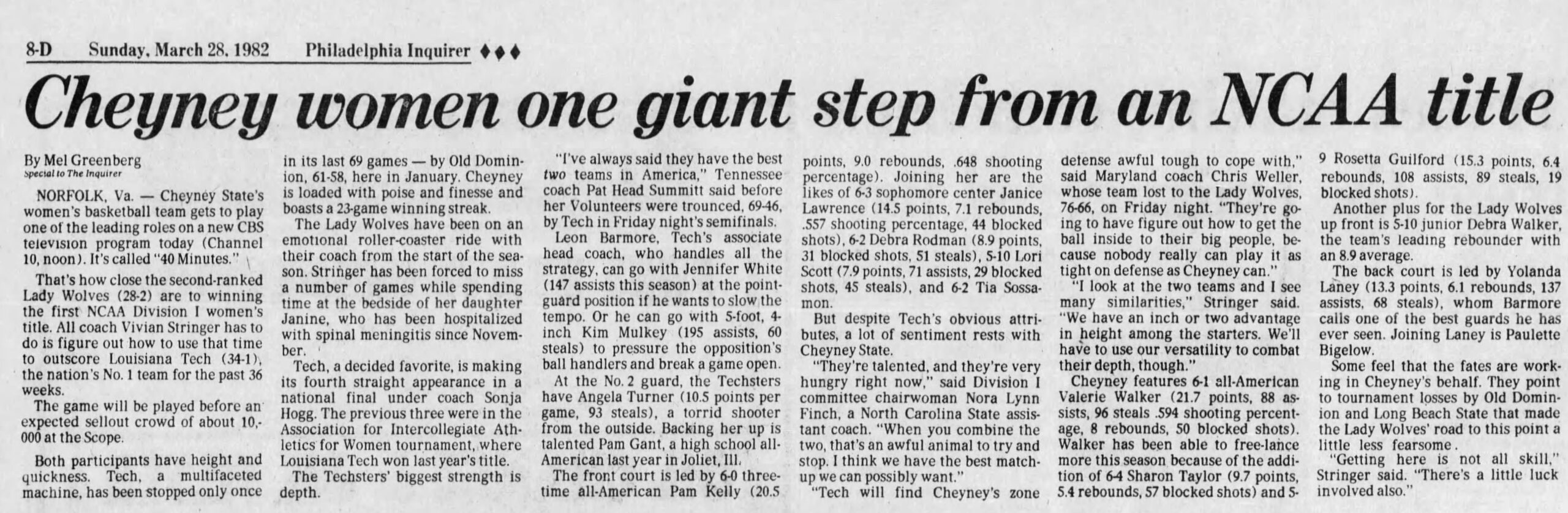
A clipping from The Philadelphia Inquirer’s sports section on March 28, 1982, when Yolanda Laney, C. Vivian Stringer, and the Cheyney State women’s basketball team was headed to the championship game of the first NCAA women’s basketball tournament.
Shank-Grentz, star of the Mighty Macs’ improbable AIAW championships, helped put a school of fewer than 3,000 students on the map. The Macs ruled the game for a near decade, winning three AIAW crowns while reaching five consecutive AIAW Final Fours.
At even tinier Cheyney State, the All-American Laney and other talents who desired to play for Stringer helped the nation’s oldest historically Black college or university become the first HBCU to play in an NCAA Division I national championship game. Stringer’s team, with not one athletic scholarship to give, made that possible in 1982.
“When you look at our team, we were part of God’s plan … a team of All-American, all-state players turning down scholarships [from larger schools] but we had one common denominator, and that was the great Vivian Stringer,” the team’s star center, Valerie Walker, said in her acceptance speech at the Women’s Basketball Hall of Fame ceremony in 2024. The Lady Wolves were enshrined as “Trailblazers of the Game.”
The NCAA certainly was watching and calculating how to build off the growing women athletes’ import. But it arguably would not have had the curiosity or the vision if Greenberg had not provided the cohesiveness and foresight to champion programs, big and small.
The Philadelphia Inquirer’s women’s basketball savant did so by founding his national poll 50 years ago. By connecting the dots of powerhouses across the country, the poll allowed teams, whether big, small, or minuscule, to bring into focus what previously had been a guessing game of who, what, and why which teams and trends mattered. The clarity benefited not only the programs, but the players, recruits, fans, and media from coast to coast.
Claire Smith and Mel Greenberg, Hall of Famers and former Inquirer writers.
Greenberg gave even the most accomplished chroniclers of women’s hoops — as well as newbies such as this reporter — a divining rod. His informative and increasingly powerful poll beautifully grew in strength alongside the game. Local teams certainly benefited, as Greenberg shone a light on both with his polling and prose.
He helped me, a frenemy at the late, great Philadelphia Bulletin, appreciate the bushels of all-American players, future Hall of Fame coaches, and prominent teams that dominated the AIAW right in our own backyards. From Rutgers to Maryland, Cheyney State to Penn State, and rising Big 5 women’s teams, it fascinated me to see the seeds that one day sprouted so prominently.
To say that I saw the important contributions of the local teams growing the women’s game as clearly as did Greenberg would be beyond impudent. Rather, following the game in and around the immediate area as well as following the pollmeister was an education, one I and others needed to appreciate why the NCAA move was inevitable.
I missed seeing the Mighty Mac era by mere years. Still, I often was reminded of the footprints left during their legendary run through the ’70s. Greenberg, a walking encyclopedia of the sport, can to this day bring to life any tale about the Macs, starting with the 1972 team that won the first women’s national basketball championship.
Though I came to the job too late to witness the Mighty Macs magic, I saw what followed in their footsteps. For a similar miracle was unfolding at Cheyney State where Stringer was building a national behemoth at the tiniest of schools (today’s enrollment at Cheyney, which is now known as Cheyney University, is less than 1,000 students).
John Chaney, the Hall of Famer and Philly legend who was the coach of the men’s team at Cheyney when Stringer was leading the women there, knew which team was the stronger draw. “We were ranked No. 1 in Division II, but we’d play the first game so that we would have somebody there by halftime,” Chaney, laughing, told me for a column written for the New York Times. “The real show was our women’s team. They didn’t come to see me; they came to see Vivian!”
Former Temple coach John Chaney (left) shares stories with Rutgers coach C. Vivian Stringer and Nike executive Ralph Greene. Chaney and Stringer coached the men’s and women’s teams at Cheyney State in the 1980s.
It always was standing-room-only in Cheyney’s compact Cope Hall, for the scribes and fans had a sense that what they were watching was special: Two Hall of Fame coaches in the making. Oh, and one Hall of Fame team. For Stringer’s 1981-82 team that finished the season ranked No. 2 in the nation.
That final standing in the polls reflected Cheyney’s having come within one win of claiming the first-ever women’s NCAA championship. Though the team lost to Louisiana Tech in the final, just getting there was the ultimate victory.
In those days, Stringer spoke of how her Lady Wolves had to sell cookies, cakes, and sandwiches to raise funds to travel to Norfolk, Va., for that first Final Four.
That Cheyney team finished 28-3. The 11 players and coaching staff were honored years later by the Women’s Basketball Hall of Fame in 2024. The team also was nominated for the Naismith Basketball Hall of Fame in 2025.
Alas, those David and Goliath stories no longer happen in a world where a Cheyney State or Immaculata wouldn’t even dream of being allowed to compete at a Division I championship level. Big universities and programs awash with NIL money now gobble up the best players in the land. The little guys play in lower divisions, noses pressed against windows of the massive arenas holding tournaments made possible by the Immaculatas and Cheyney States, the Cathy Rushes and Vivian Stringers … and Mel Greenberg’s vision of what could be.
The Dragons were dominated by Monmouth from tipoff, losing 93-73. The Hawks’ 93 points were the most points allowed by Drexel this season.
The Dragons trailed by as many as 27 points in the second half.
“Today, it stings, and frankly … I want it to sting because hopefully that adversity can propel us forward. So we need to sit in this a little bit. That’s how you grow,” said Drexel coach Zach Spiker.
Drexel has lost two of its last three and have dropped to fifth in the Coastal Athletic Association standings. The top four seeds in the CAA receive a bye in the conference tournament.
Monmouth’s McLain shows out in return
Entering Thursday’s game, Drexel (13-13, 7-6 CAA) boasted a balanced offense with five players scoring at least nine points a game. Their leading scorer in the blowout loss was not one of their usual five.
Sophomore guard Dillon Tingler, who was averaging 3.6 points before facing Monmouth, led the way for the Dragons with a career-high 19 points and six rebounds. Sixteen of Tingler’s points came in the second half.
Drexel’s usual suspects also made their way into the box score. Junior guard Shane Blakeny, the team’s leading scorer, notched 17 points and forward Victor Panov added 14.
Meanwhile, the Hawks (13-12, 7-4) were willed by a new face to the lineup.
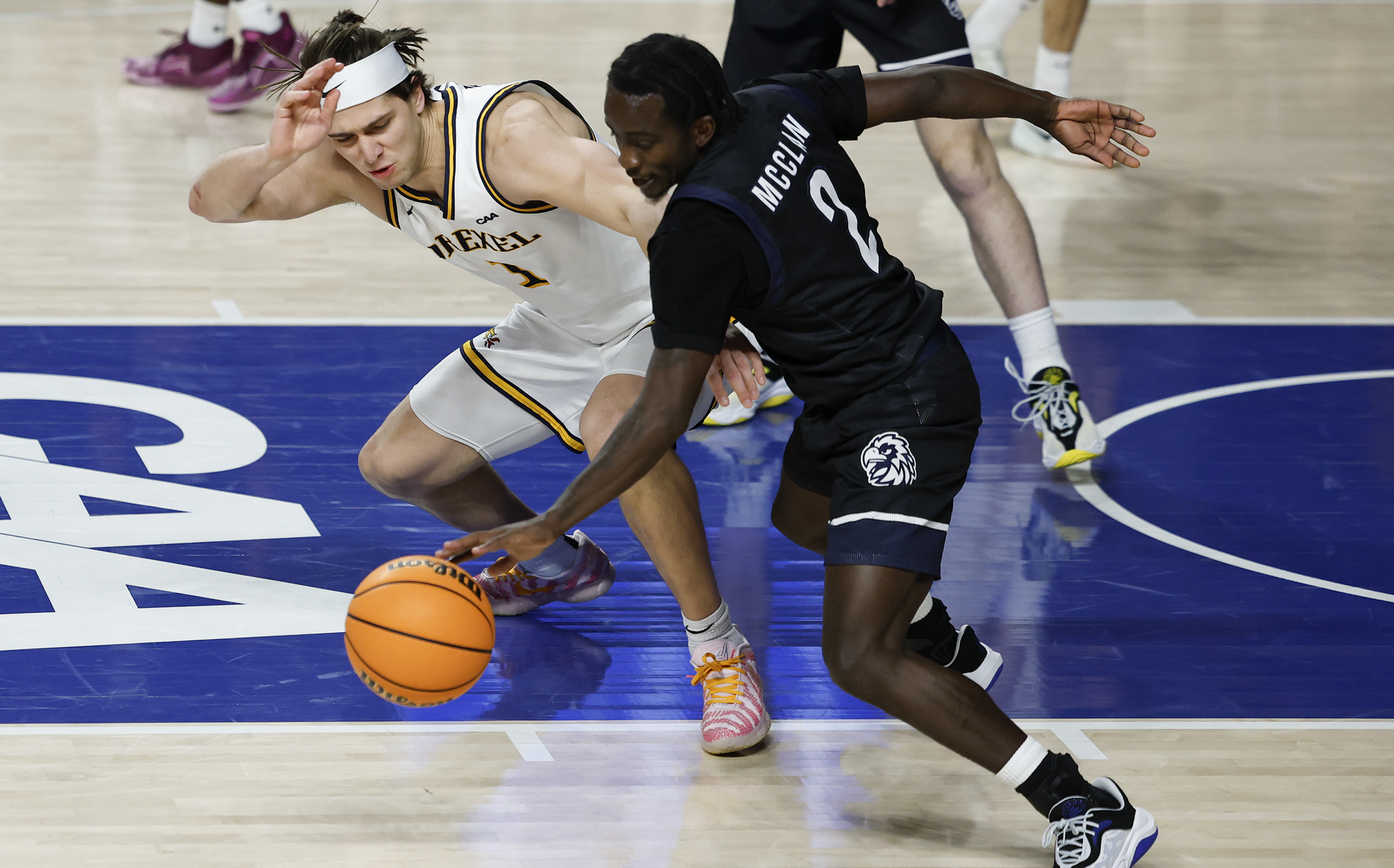
Kavion McClain, a shifty 5-foot-10 point guard, led the way for Monmouth with 20 points, six assists, and three steals. Thursday was just McClain’s second game of the season. The NCAA forced McClain to sit out until now due to a former teammate at Abilene Christian being indicted in a point-shaving scandal.
“They have good basketball players, right?” said Spiker. “And they’ve added another good basketball player to that lineup. When you do that, you become more dynamic.”
Drexel doomed by drought
Drexel played without fifth-year big man Garfield Turner. Although the center has only started in three games this year, he averages 19 minutes — the most by a center on the team.
Spiker did not comment on Turner’s absence, but noted the team “hope[s] to get him back soon.”
Without Turner, Monmouth consistently outrebounded Drexel. The Hawks outrebounded the Dragons 23-12 in the first half, with 11 of their 45 points coming on second chance buckets.
With just over 12 minutes to go in the first, Drexel senior guard Eli Beard made his second three-pointer to bring the Dragons’ deficit to 21-14. After Beard’s bucket, Drexel did not score for the next seven minutes while Monmouth continued to build its lead.
Drexel forward Victor Panov (left) loses the ball while being defended by Monmouth guard Kavion McClain during the second half on Thursday night.
Defensive breakdown
From a Jan. 8 win over Stony Brook through the end of the month, Drexel allowed just 56.3 points per game, winning six of seven in the process. The Dragons also had the best defensive effective field goal percentage in the NCAA in January .
Through their first three games in February, Drexel is allowing 85.3 points. Despite missing Garfield’s defensive presence , it was the Hawks’ starting backcourt that made Drexel pay.
“Defensively, we did some things [well],” said Spiker. “Anything that we did well, we didn’t sustain. And to win a game, you got to sustain.”
Up next
Drexel goes back on the road to face Stony Brook on Monday (8 p.m., CBS Sports Network).
Jill Bodensteiner is stepping down from her post as St. Joseph’s athletic director, according to an announcement from the university on Thursday.
Bodensteiner is set to become the next commissioner of the Horizon League. Her last day at St. Joe’s will be April 15.
Eric Laudano, St. Joe’s executive senior associate athletics director, will serve as interim athletic director while a search is conducted, the school said in a release.
An Indiana native, Bodensteiner will take over a league headquartered in Indianapolis. She has been the AD on Hawk Hill since June 2018.
St. Joe's athletic director Jill Bodensteiner is leaving the school for another opportunity, according to a source.
“Jill is a national leader in intercollegiate athletics,” St. Joe’s president Cheryl A. McConnell said in a statement. “We are profoundly grateful for her vision, dedication and service to the Hawks. She leaves our athletics program strong and well-positioned for continued success. We wish her the best on her return home to Indiana and her role with the Horizon League.”
Bodensteiner’s tenure at St. Joe’s started with a bang. She fired longtime men’s basketball coach Phil Martelli less than a year after taking over as athletic director. She replaced Martelli with Billy Lange, whose six-year run ended in the fall when he abruptly left the program for an assistant’s role with the New York Knicks. Lange posted an 81-104 record with the Hawks.
Though the men’s program has failed to get back to prominence in the new era of college basketball, St. Joe’s has had successful runs in non-revenue sports like field hockey, which played in the national championship game in 2024; men’s and women’s lacrosse, which made inaugural NCAA Tournament appearances; and baseball, which won the Atlantic 10 regular-season title in 2023.
Kevin Ibach reached a milestone as Tampa Bay Rays assistant general manager in September 2020. The Rays defeated the Toronto Blue Jays in the wild-card round, marking the first time in Ibach’s 20-year career in baseball that he made it past the opening round. Before the team opened its next series against the New York Yankees, though, Ibach received news that crushed his mood.
La Salle, his alma mater, was shutting down its baseball program after the 2020-21 school year. Ibach played middle infield for the Explorers from 1996-2000, but the program that helped forge his baseball career was suddenly on its way out.
The Rays reached their second World Series that year, but the success was stained for Ibach.
“I have a ring to this day from that journey and at the same time, it was the low point,” Ibach said. “A program that I cared so much about. Four years that were instrumental in my life and my development that probably led me to my job today. Getting that email that they were shutting the doors was pretty disheartening.”
When Ashwin Puri took over as La Salle’s athletic director in July 2023, he ensured that those doors did not stay closed. With a three-phase plan centered on facility upgrades, fundraising and fan experience, Explorers baseball was officially welcomed back in April 2024, targeting a return this year.
“What I soon realized after being here for two or three months was that every other conversation was about baseball,” Puri said. “I don’t know if it was fate or chance, but I felt an amazing sense of pride and connection to the university. A lot of people love baseball and care about baseball.”
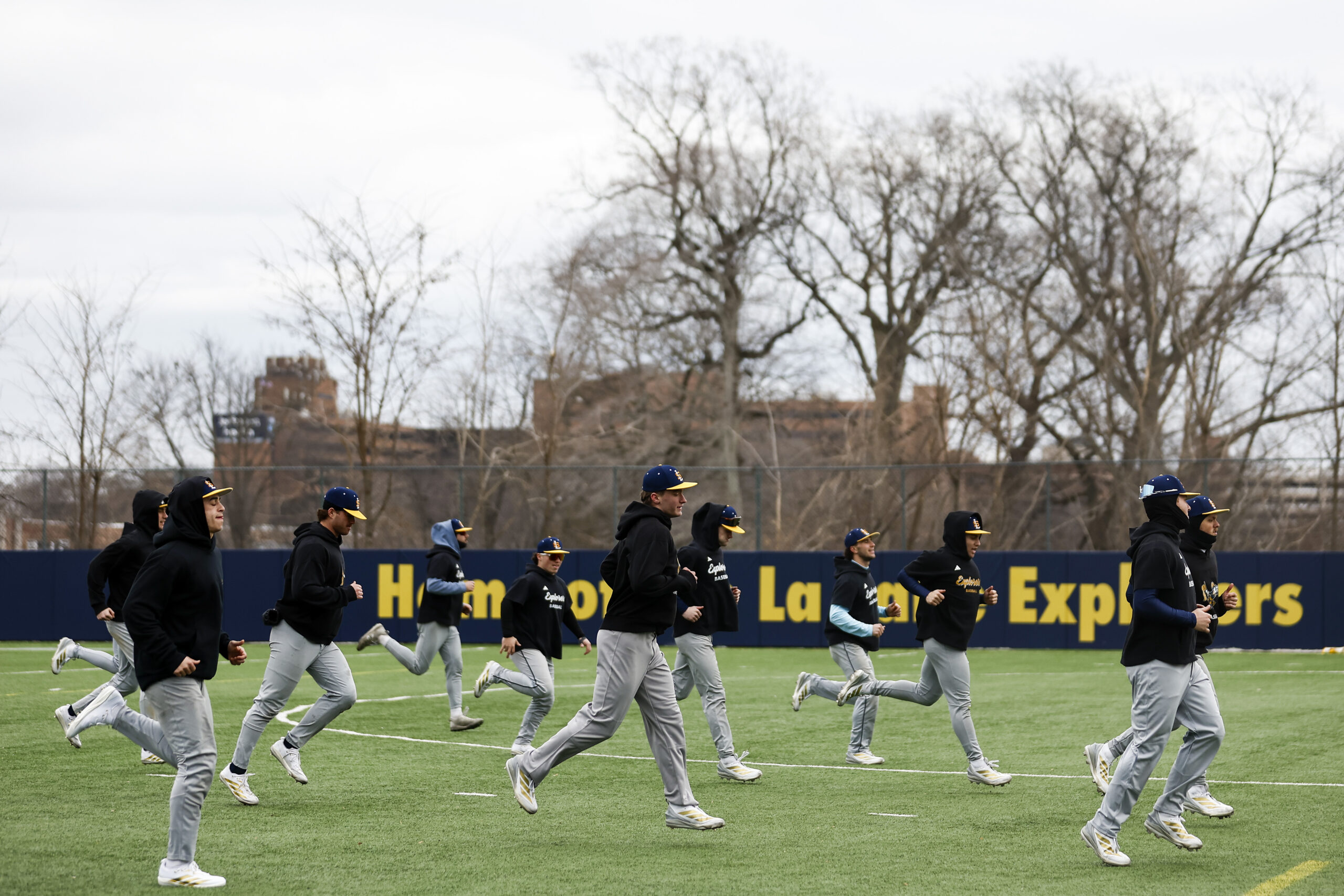
La Salle spent 2025 preparing to throw its first pitch in four years. Now, the program’s return is right around the corner. The Explorers will open their season against Maryland Eastern Shore on Friday (2 p.m.) at Hank DeVincent Field.
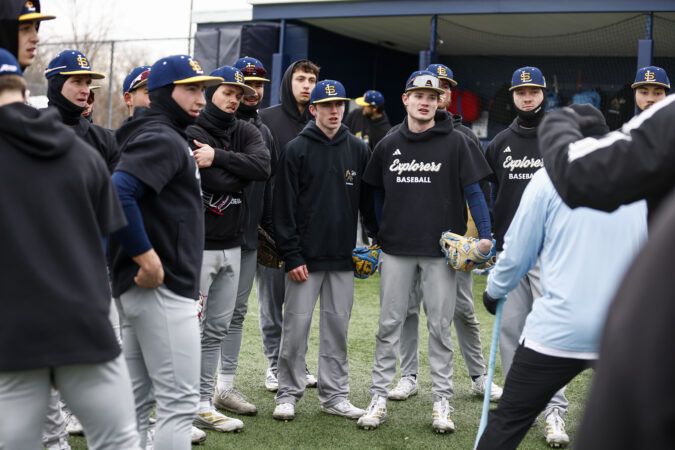
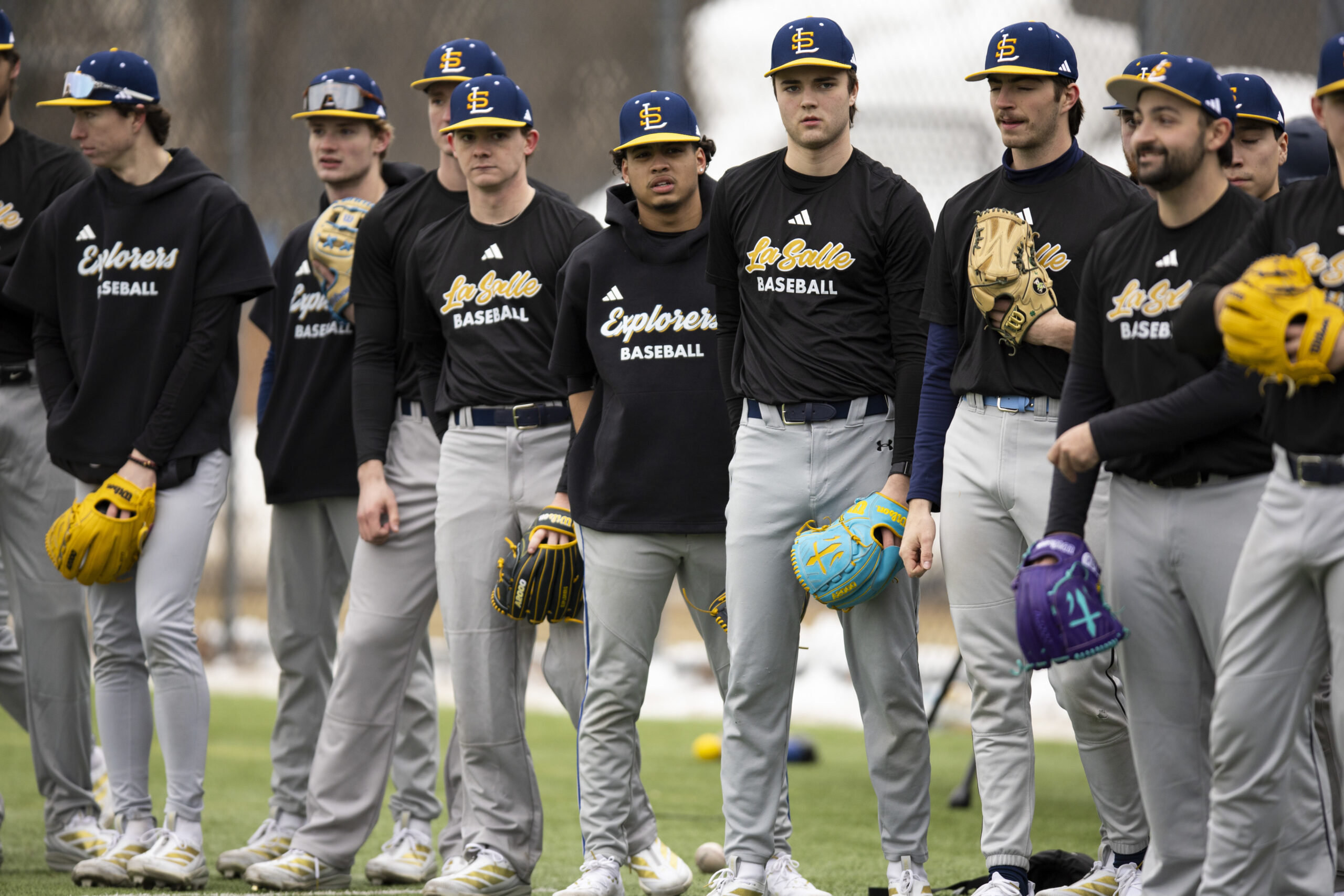
La Salle baseball players practicing Wednesday at Hank De Vincent Field.
Coach David Miller constructed a roster that is ready to write a new chapter of La Salle baseball while remembering the history that brought the Explorers to this point.
“It’s going to be a lot of hard work that everybody collectively did to make this happen,” Miller said. “That first pitch, hopefully that first win, it’s going to be a great day for La Salle athletics.”
Bringing a vision to life
The main step in getting the program off the ground was improving the stadium and facilities while raising the necessary funds. An alumni advisory board formed to lead the operation helped focus on alumni outreach, and after a few months the progress in donations became notable.
“When baseball came back, there was a small group of us that were excited to have the program back,” said Bill Watts, who played at La Salle from 1991-94 and serves on the advisory board. “Ashwin reached out and asked, ‘Would you be willing to be part of the rising here?’ I thought about it for a while and talked it over with some of my teammates and decided if we did it, we needed to do it the right way.”
The feedback and excitement from alumni have been encouraging. More than 200 former players and alumni attended a “La Salle first pitch” dinner as an official welcome back for the program. While the program may have taken a few years off, the history and tradition carried on.
The Explorers held alumni games in 2023 and 2024 at Hank DeVincent Field. La Salle made its conference tournament nine times before the program shut down. In its last season, La Salle finished with 32 wins, the most in program history.
It is important, Puri said, that the program’s history is remembered in a new era.
“I think history is a big part of it, but we also want to do things a little different this time,” Puri said. “We are going to take baseball very seriously. We are going to invest and we want to compete.”
Building the team
To put a team back on the field, Puri and the advisory board knew it started with one man: Miller.
Miller was named La Salle’s head coach in 2018 and had the Explorers on an upward trajectory before the program shut down. They went 14-41 in his first season, then improved to 25-31 in 2019. After a shortened 2020 season, Miller led La Salle to one of its best performances in program history in 2021, finishing 32-21. Miller was named Atlantic 10 coach of the year and believed he was on the verge of accomplishing something special.
That momentum was halted when the program shut down.
Miller coached at Manhattan for two years before he got the offer to return to La Salle. Despite having to take a year off from coaching in 2025, the former Penn Charter coach decided it was worth it.
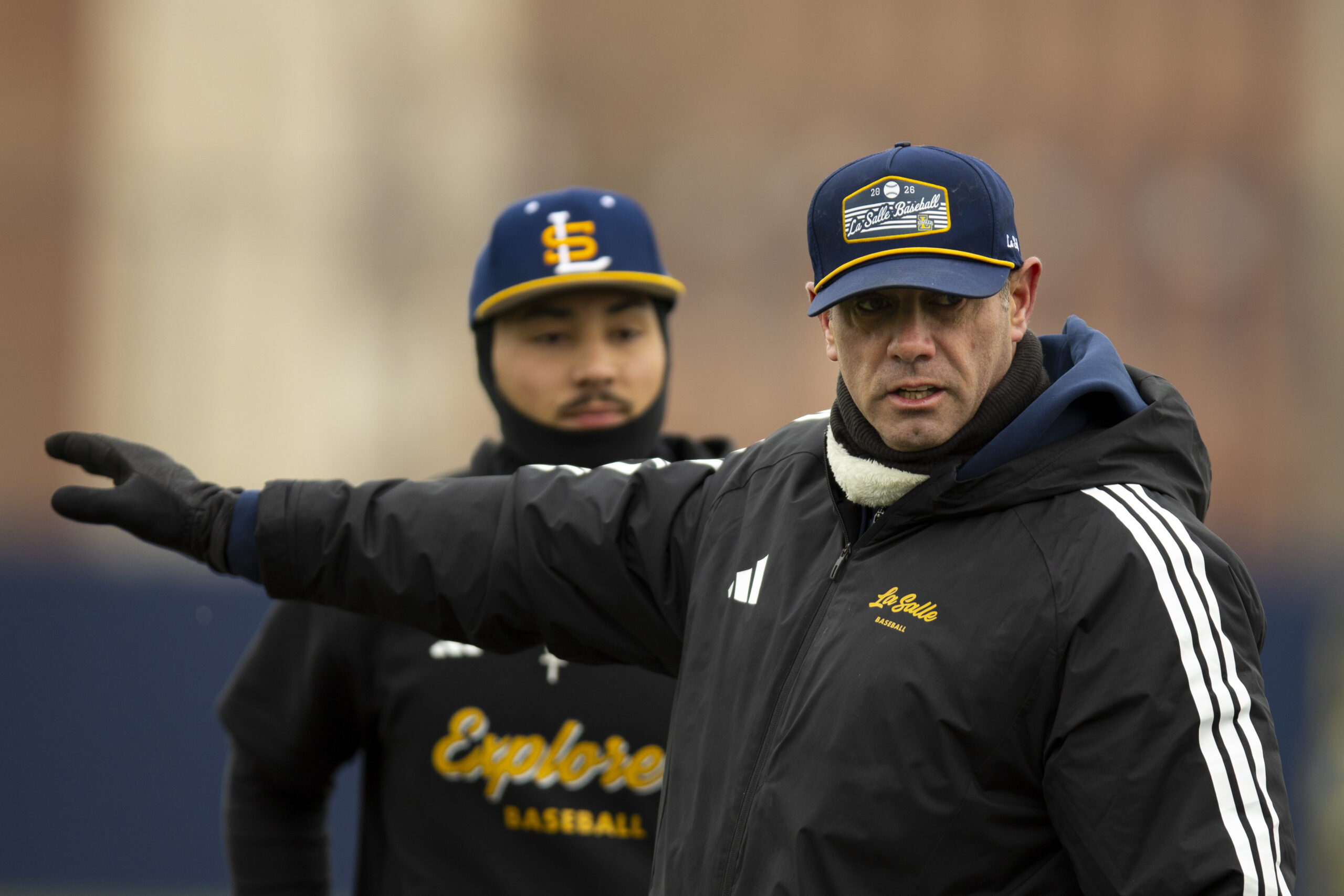
David Miller returned to La Salle as the head coach, after serving at the helm for four seasons before the program was cut.
“There’s just something about this place that draws me,” Miller said. “It’s like home to me. When my time is up here, I want La Salle baseball to be a destination baseball program in the northeast. And I don’t see why we can’t be.”
With Miller back at the helm, the next step was putting the roster together. It was no easy task, considering he was starting from scratch.
La Salle netted the 17th-ranked recruiting class by Perfect Game in 2025, bringing in 36 commitments. Next, its attention turned to the transfer portal.
The Explorers brought in seniors who were looking for one more season to play college baseball or underclassmen seeking a fresh start. For utility man Chase Swain, a transfer from West Virginia, playing at La Salle brings his college career full circle.
“I was committed here for like two years in high school,” said Swain, who played at Woodstown High. “… [The program getting cut] threw everything into a tailspin for me, recruiting-wise. So this place coming back, it was always in the back of my mind. I wonder what it would have been like there. I stayed loyal and the second that they brought it back, it was like a light bulb went off in my head, and I thought I would really enjoy playing there.”
Underdog mentality
With a completely new team, the players understand that expectations from the outside are low. The Explorers know a restarted program won’t be picked as a preseason favorite in the Atlantic 10 Conference, but they are using that as a chip on their shoulders and carrying an underdog mentality into the season.
Because of the weather, La Salle has been forced to travel about an hour away to find an indoor facility for practice. The team has embraced the challenges.
La Salle coach David Miller says his team is “more excited now than ever to play.”
“I think we can take the motivation of being a gritty program because we don’t have all the facilities and everything that a lot of other schools have in Division I baseball,” said shortstop Justin Szestowicki, a transfer from Elon out of Kingsway High. “But I think we take that as an advantage. We have more of a chip on our shoulder, just knowing that, based on our opportunities to create a grittier play style, instead of just being taken care of all the time, we have to take some accountability for ourselves to be successful.”
The players and coaches counted down the days until Friday, when they can say La Salle baseball is back and the two-year rebuilding process has come to fruition.
Miller is ready to show the college baseball world who the Explorers are.
“You’re seeing all these high-profile fans from Tennessee and LSU saying, ‘La — who?’” Miller said. “And we embrace that. That’s now my hashtag for the year. We’re going to show you who it is. These kids are more excited now than ever to play, because all the vision that we talked about, and getting them to see what’s coming, is here.”
Ibach added: “I think that a lot of players who will be playing can take that inspiration to show the world, show the city, that La Salle baseball’s back on the map.”
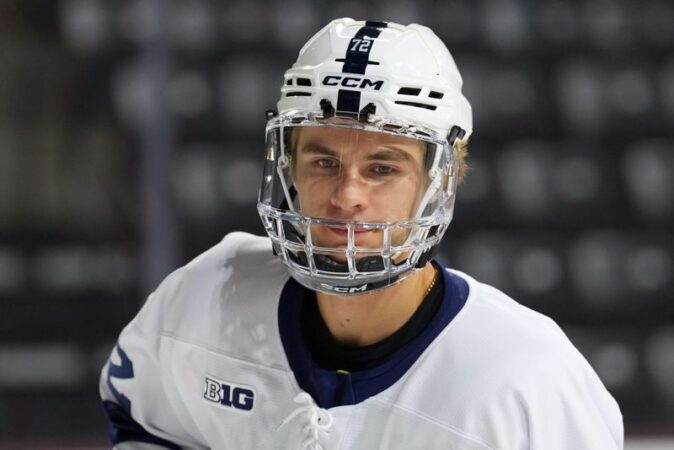
Penn State hockey star Gavin McKenna, the projected No. 1 pick in the 2026 NHL draft, will be due in court next on March 11, according to Centre County Courthouse documents.
McKenna, who is facing three charges relating to an alleged assault in State College on Jan. 31, was initially set to have his preliminary hearing on Wednesday. He is alleged to have punched a 21-year-old man twice in the face, resulting in a fractured jaw that required corrective surgery. According to police, the incident occurred after a verbal exchange between the two on the 100 block of South Pugh Street in the hours after Penn State’s outdoor hockey game against Michigan State at Beaver Stadium.
The preliminary hearing’s postponement comes less than a week after prosecutors dropped an initial felony charge of aggravated assault. The Centre County District Attorney’s Office and State College Police said in a statement that “a review of the video does not support a conclusion that Gavin McKenna acted with the intent to cause serious bodily injury or with reckless indifference to the value of human life,“ which is the standard for probable cause for aggravated assault in Pennsylvania.
McKenna, 18, now faces a misdemeanor charge of simple assault, as well as charges of harassment and disorderly conduct for engaging in fighting. The simple assault charge carries a maximum of two years in prison, while fines are attached to the three charges. He remains released on $20,000 unsecured bail.
With the preliminary hearing postponed, McKenna is expected to play for the No. 6 Nittany Lions on Friday at No. 2 Michigan, a source confirmed to the Inquirer. That game will mark Penn State’s first action since the alleged assault. Penn State’s regular season ends on March 6, with the Big Ten tournament set to commence on March 11, the same day as McKenna’s preliminary hearing.
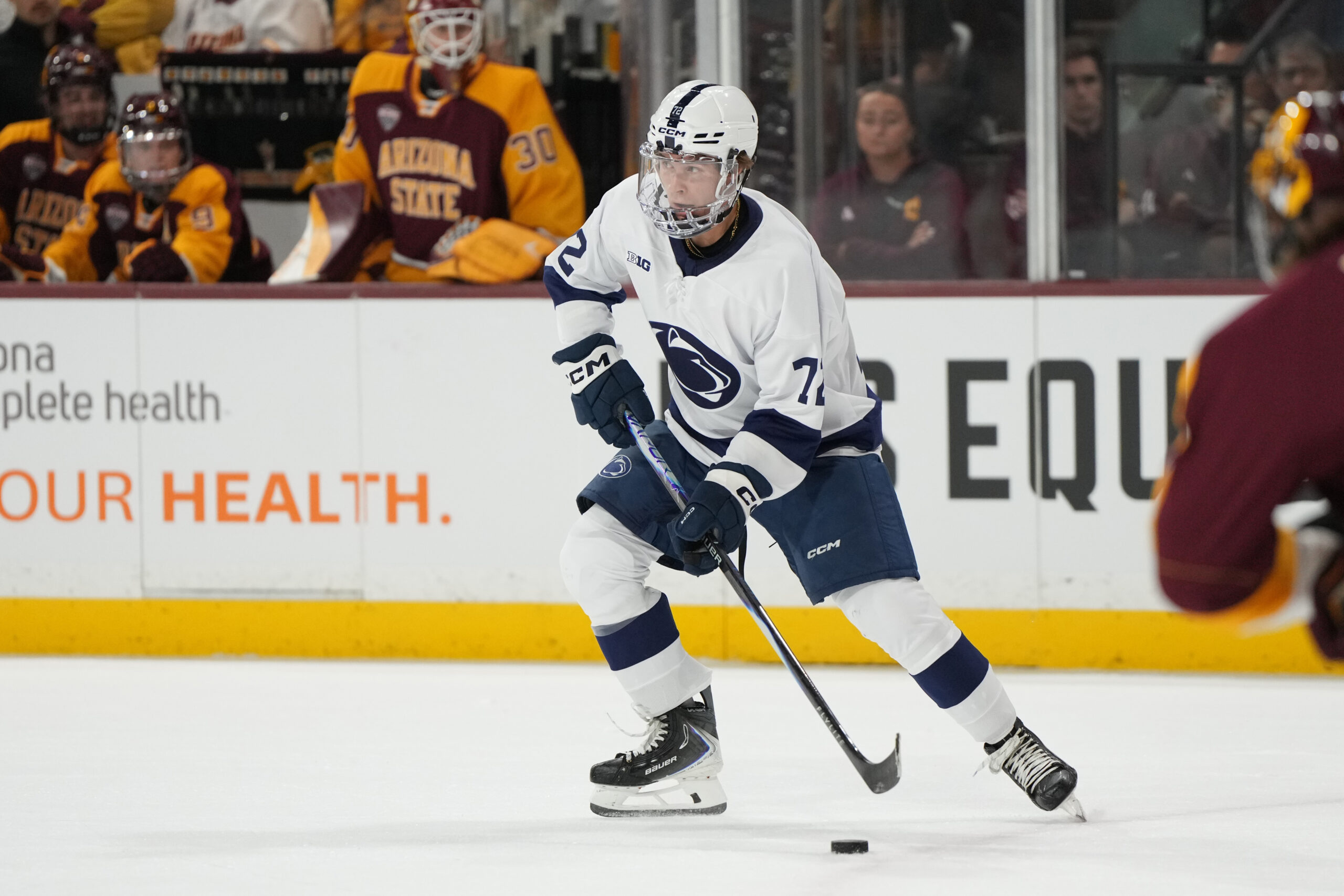
Penn State’s Gavin McKenna, who is projected to be the No. 1 pick in this year’s draft, has 32 points in 24 games so far as a freshman.
“We are aware that charges have been filed; however, as this is an ongoing legal matter, we will not have any further comment,” Penn State said in a statement on Feb. 4.
McKenna’s adviser Pat Brisson has not commented publicly on the matter.
A native of Whitehorse, Yukon, the Canadian winger is ranked No. 1 on the NHL’s 2026 Central Scouting list among North American skaters. After a new rule was passed granting Canadian Hockey League players NCAA eligibility this season, McKenna left the CHL in the summer to play college hockey.
McKenna, a freshman, is one of the biggest recruits to ever play college hockey and one of the faces of the changing landscape of the sport. He has 11 goals and 32 points in 24 games this season for Penn State, which reached its first Frozen Four in school history last season and entered this season as one of the favorites to win the national championship.
St. Joseph led Fordham by 15 points on Tuesday night at Hagan Arena. After a crushing loss to George Mason three days earlier, the Hawks were on the verge of forcing a blowout against a team that had won just three Atlantic 10 games entering the contest.
Then the Rams began mounting a comeback and the Hawks had no chance to stop it. After knocking down 50% of its shots in the first half, St. Joe’s went mute as it made 7 of 24 shots (29.17%) in the second. Guard Austin Williford, who finished with a career-high 19 points, scoring 17 in the first 20 minutes, did not get another bucket until four minutes remained in the game.
Guard Jaiden Glover-Toscano scored all of his 10 points in the first half. The stagnant offense resulted in a 68-64 loss.
“Obviously the second half was not one of our better efforts offensively,” coach Steve Donahue said. “I thought we competed at a high level. Guarding was very physical, but we did not do a good job handling that in the second half, and allowed their physicality to just take us out of our rhythm.”
However, St. Joe’s (15-10, 7-5 A-10), which is now riding a two-game skid, is still in contention for a coveted top-four seed to earn a double bye in the conference tournament next month.
Game-changing moment
St. Joe’s attacked Fordham’s zone with ease for the first 20 minutes of play. Glover-Toscano scored 10 points in the first 14 minutes.
Then Williford, who has become a regular in the starting lineup, made a layup and nailed three consecutive three-pointers. His play made up for scoring leader Derek Simpson not scoring a bucket in the first half.
“I think he’s got a great future ahead of him,” Donahue said. “Even he’ll say the second half wasn’t his best, it wasn’t our best, and it got us tonight.”
St. Joe’s coach Steve Donahue says his team was making “uncharacteristic” errors in Tuesday’s loss to Fordham.
St. Joe’s success ended after Fordham (13-12, 4-8) switched up its defenses in the second half. The Rams made it difficult for the Hawks to run their offense. They ended the second half with nearly as many turnovers (six) as field goals (seven).
“That’s a sign we’re not in rhythm or there’s no synergy in the offense.” Donahue said. “When you take one with 10 or 12 [seconds] left there, you’re kind of open. We’ve done that to ourselves a few times this year. My job is to get us out of this.”
The A-10 race
St. Joe’s dropped its second straight game in a similar fashion. The Hawks allowed George Mason to snag a win after holding a second half lead on Saturday. In that loss, they shot 29.03%, despite grabbing 20 offensive rebounds.
After winning seven of eight before Saturday’s loss, St. Joe’s looked poised to earn a fourth-place finish, which is the final spot for a double bye in the A-10 tournament.
Now, Davidson, Duquesne, and Dayton all trail St. Joe’s by a game in the standings. The Flyers and Wildcats face another on Sunday, while Duquesne plays on Saturday. There’s a chance there could be a three-way tie for fourth place by the end of this weekend.
With six games remaining, Donahue is looking to get St. Joe’s back to how his team was playing in January.
“This is A to B. This is the stuff we talked about. Now we’ve got to live it,” Donahue said. “We were uncharacteristic [on Tuesday] in some ways. In particular, on the offensive end. For the next eight days, you have to do a great job.”
Up next
The Hawks will visit St. Bonaventure (14-10, 3-8) on Feb. 18 (7 p.m., ESPN+).
In the rotunda of the Finneran Pavilion late Tuesday night, the longest tenured Villanova player paused to crane his head toward the ceiling, toward the national championship, Final Four, and Big East championship banners that hang there in V formation, like a flock of birds in flight. On this Wildcats team, he’s the one whose name is called last in the pregame introductions.
He’s the one everyone knows a little better than everyone else on the roster. For a program once accustomed to having its stars stay for three years, four years, sometimes even five, it has to be jarring that Tyler Perkins, a junior who transferred from Penn in 2024, is the closest thing to a keeper of that flame.
“I take pride in it,” he said. “Last year, I was able to learn a lot about this place from guys like Eric Dixon, Jordan Longino, guys who have been here for three years, five years. I was able to pick their brains. Just walking these halls, looking at these banners, it makes you hungry. You want to bring it back to this place.”
The whole idea of a player recognizing and appreciating a particular program’s history and culture seems quaint in this era of college basketball. It certainly doesn’t have the pull and power that it once did.
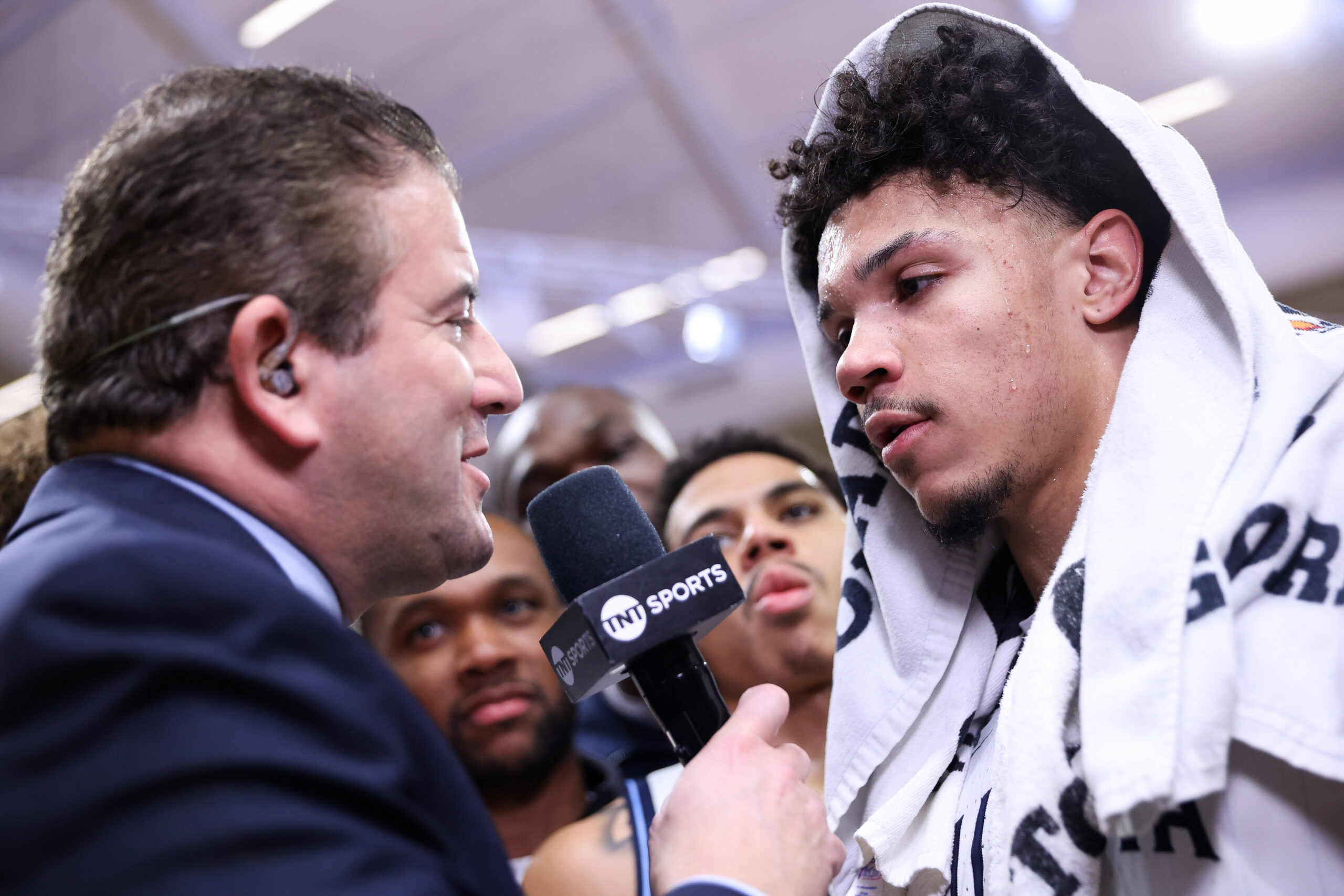
Tyler Perkins (right) is interviewed by Andy Katz after Villanova’s 77-74 win against Marquette at the Finneran Pavilion on Tuesday.
Now, paying players is an above-board course of action, athletes pass through the transfer portal like it’s an open doorway, and the story that played out at the Pavilion on Tuesday, in Villanova’s 77-74 victory over Marquette, showed just how much everything has changed.
Perkins pretty much saved the Wildcats, now 19-5 and on track for their first NCAA Tournament appearance in four years, from losing a Big East game to a lesser opponent. He scored a team-high 22 points, hit three late three-pointers to help ’Nova quickly wipe out a nine-point deficit, grabbed six offensive rebounds, and blocked a three-point attempt by the Golden Eagles’ Adrien Stevens on the game’s final possession.
It was the kind of performance that a savvy upperclassman — Josh Hart, Mikal Bridges, Collin Gillespie, Dixon — once would have delivered for Villanova … except in this case, the savvy upperclassman is a kid who has been on campus less than two years, and he was having a lousy defensive game until he snuffed Stevens’ shot at the end.
“Once he figures out he can affect the game without shooting or having to shoot, that’s when he’s going to take a monster step,” Wildcats coach Kevin Willard said. “And he’s starting to get there. He is.”
Willard is so certain that Perkins will become a great player that, after the Wildcats’ win over Seton Hall last week, he didn’t back away from comparing him to Hart — a first-team All-American and a national champion at ’Nova, a nine-year NBA vet and an invaluable piece of a New York Knicks team that could reach the Finals.
During Tuesday’s postgame media availability, Willard playfully chided Perkins for his mostly poor defense against Marquette, then pointed out that Hart’s all-around game is what made him such a headache when Willard, while at Seton Hall, was coaching against him.
“I tell the story all the time,” Willard said. “One of the last times we played against him, I called timeout, and I cursed out my team. I was like, ‘Can somebody please stop Josh Hart?’ And he hadn’t taken a shot. He hadn’t taken a shot, and they’re all looking at me like, ‘Well, he’s not shooting.’ He’s got three steals. He’s got four offensive rebounds. He’s got five assists. And he didn’t take a shot. That’s why he’s in the NBA.
Villanova coach Kevin Willard believes Tyler Perkins shares many of the same qualities as former Wildcats guard Josh Hart.
“He” — he tipped his head to the right, toward Perkins — “can do that. He just has to figure it out at times, ‘I don’t need to shoot the ball to be out here and be effective.’ Because he does so many other things.”
Perkins has met Hart just once — last September, when Hart and Jalen Brunson returned to campus to record an episode of their podcast, The Roommates Show. Their on-paper profiles are practically identical. Both are from the Washington area.
They are about the same height (6-foot-4) and roughly the same weight (210-215 pounds). The biggest difference, at the moment anyway, might be that the conditions that allowed Hart to develop over his four seasons at Villanova, from 2013 to 2017, are harder to replicate. These days, it takes a welcoming atmosphere; a rewarding athletic, academic, and social experience … and, of course, a big, fat check.
"It's February basketball. You're going to have to grind and find ways to win. Watching Marquette's last five games, Shaka's done a great job with that group, especially on the defensive end. But we found a way, that's all that matters." -Coach Willard
Make no mistake: The money is and will be the major motivator for keeping a promising basketball player on any campus. A program that wants to keep a star into his senior season is going to have to pony up accordingly. But those first two factors still matter some, at least some of the time, and apparently to Perkins.
“I don’t really care about all the extra stuff that’s going on in college basketball right now,” he said. “I find joy in playing the game, and I felt like this place was the most comfortable place for me to play.”
Imagine the comfort he’ll feel a year from now, two years from now, three, if he can stand inside the Pavilion, look up at that ceiling, and see a banner he helped to hang.