Category: Columnists

  • Susie Wiles reveal: Trump thinks Putin wants all of Ukraine

    Susie Wiles reveal: Trump thinks Putin wants all of Ukraine

    During the Christmas holidays, the word peace makes a frequent appearance, in sermons and carols and frequent performances of Handel’s Messiah, with its glorious Hallelujah Chorus praising “the Prince of Peace.”

    That makes it even more infuriating to watch President Donald Trump demanding that Ukraine (and American’s European allies) agree to a so-called peace deal by the new year that guarantees more war and killing. Equally depressing is to watch much of the media buy the premise that the U.S. and Russia are actually conducting peace talks.

    Baloney. What is going on in Berlin, Miami, Washington, and Moscow is a Trump-led farce. Ukrainian President Volodymyr Zelensky and European leaders are forced to play along lest POTUS cut off crucial U.S. intelligence sharing and halt critical (but limited) sales of U.S. weaponry. They know Trump seeks a deal, any deal, even one on Kremlin terms, in order to claim he achieved peace in Ukraine. Yet the gleam of a Nobel Peace Prize and rare earth business deals with Moscow override any concerns about helping Moscow crush Kyiv.

    Vladimir Putin, on the other hand, has shown no interest in negotiating, but just waits for more Trump concessions. Any deal that protects Kyiv’s future will be rejected by Vladimir Putin, but Trump, following past practice, will likely blame Ukraine.

    That is why many more Americans, and security conscious Republicans in Congress must recognize that Trump is no worldly prince (or king) of peace. Rather, he is a poseur who must be prevented from sacrificing Ukraine on the altar of his ego and endangering the security of Europe and the United States.

    You doubt me? Then read Part Two of the notorious Vanity Fair interviews with Trump’s chief of staff and right-hand woman Susie Wiles, in which she reveals Trump’s mindset regarding Ukraine. Despite debates within Trump’s team over whether Putin wants the whole of Ukraine, she admits, “Donald Trump thinks he wants the whole country.”

    In an interview with Vanity Fair, White House chief of staff Susie Wiles said of the president’s talks with Vladimir Putin about Ukraine: “Donald Trump thinks he wants the whole country.”

    Vanity Fair asked Secretary of State Marco Rubio if he felt the same. He responded that, after watching Putin repeatedly reject freezing the war at the line of conflict, “You do start to wonder, well, maybe what this guy wants is the entire country.” Presumably, the secretary has bothered to read Putin’s speeches in which the Kremlin leader has said over and over again that Ukraine has no right to be a state,

    However, Rubio has been pushed aside as negotiator in favor of the supremely naive and ill-informed real estate mogul Steve Witkoff, who keeps insisting Putin wants peace, an argument repeated by POTUS. Trump initially signed off on a 28-point “peace” plan that was handed by a Putin emissary directly to Witkoff.

    Even though Zelensky and European leaders have gotten some of the most egregious points eliminated, the two biggest obstacles still remain: Putin’s demand that Kyiv turn over critical territory that Russia hasn’t been able to capture in nearly four years, and strategic guarantees of Western military aid to prevent Russia from violating any agreement.

    On both sticking points, the Trump negotiators continue to play into Putin’s hands.

    On the question of territory, what Putin demands is that Kyiv turn over a belt of fortified cities on high ground in the Donetsk region. Moscow has been unable to make major territorial gains in this area since near the beginning of the war, and the gains they have made have incurred terrible Russian casualties.

    This belt “is not easy to conquer because [its cities are] well fortified militarily and naturally due to the landscape,” I was told by Yehor Cherniev, deputy chairman of the Committee on National Security and Defense of the Ukrainian parliament. “It would cost the Russians thousands and thousands of lives and months if not years to take it. I don’t see any compromise on this.”

    From left, German Chancellor Friedrich Merz, British Prime Minister Keir Starmer, Ukrainian President Volodymyr Zelensky, and French President Emmanuel Macron meet at 10 Downing Street, in London earlier this month.

    Yet Putin has persuaded Witkoff to demand that Kyiv turn it over for nothing, which would leave the flat farmlands of central Ukraine open to further Russian attack.

    Compounding the insult, Witkoff has proposed that the area be made into a “demilitarized zone” from which Ukrainian troops would withdraw but Russian troops not enter. No one who has read anything on recent history could be unaware that Putin has zero respect for such nonsense. “We know the Russians would just use this to infiltrate soldiers in civilian clothing and then seize control of the area,” Cherniev said by phone from Kyiv. “It would just be a trap.”

    The second, enormous sticking point, concerns security guarantees for Ukraine in case Putin violates any agreement.

    Putin has broken every accord Russia has signed with modern-day Ukraine. This includes, most notoriously, the 1994 Budapest Memorandum, in which Ukraine handed over its Soviet-era nuclear weapons in return for pledges from Moscow, Washington, and London that Kyiv’s sovereignty would be respected.

    No wonder Zelensky insisted on Monday: “There is one question I — and all Ukrainians — want to get an answer to. If Russia again starts a war, what will our partners do?”

    Putin has made clear he accepts no NATO membership, no Western military guarantees and only a shrunken, disarmed Ukrainian military. As for the Witkoff team, they concur on no NATO membership for Ukraine, but have offered only puffery in its stead.

    The big headline has been that Trump would agree to “Article 5-like” guarantees, a reference to the provision in NATO that an attack on one requires help from every member. But Trump has played up the ambiguity of Article 5, which doesn’t specify that the help needs to be military. “Depends on your definition,” he said in August. “There’s numerous definitions of Article 5.”

    Moreover, Sen. Lindsey Graham (R., S.C.), a golf buddy of Trump, has made clear, that even if the Senate approves security guarantees, it wouldn’t be a treaty but “a congressional blessing, statutory in nature.”

    A “blessing” won’t help Ukraine if Russia pauses, regroups, and attacks again.

    It fascinated me that, after revealing Trump’s awareness of Putin’s goals, Wiles told Vanity Fair she thought Trump’s greatest achievement of 2025 was acting as “an agent of peace.”

    The president’s claim that he ended eight wars is braggadocio: No wars were ended, including in Gaza, where a ceasefire is tottering. The list includes long-standing disputes that remain and outbreaks of fighting that continue, and even a Pakistan-India outbreak, where New Delhi denies Trump played a role in settling it down.

    But if POTUS wants to be known as a peacemaker in Ukraine, it will only happen if he helps Ukraine convince Putin that a unified West will not permit Russia to crush Ukraine. That would require arming Ukraine to the hilt with U.S. and European weapons paid for by Europe, backed with frozen Russian assets or the European Union’s shared budget. It would also require U.S. enforcement of current and future sanctions, which the White House isn’t doing.

    Most of all it would require Trump to pressure Putin, which he shows no signs yet of doing. The Russian despot is vulnerable economically and militarily, and Ukraine won’t lose if POTUS doesn’t betray the country. But Putin will only be persuaded to cease fire if Trump joins Europe in convincing him he can’t afford to continue the fight.


  • Political theater at the Pa. Society, more bad ideas from Council, and preservation done right | Shackamaxon

    Political theater at the Pa. Society, more bad ideas from Council, and preservation done right | Shackamaxon

    This week’s Shackamaxon goes to the Pennsylvania Society dinner in Manhattan, explores more Council shenanigans, and extolls an example of positive preservation.

    We’re all pals here

    I made a rookie mistake while attending my first Pennsylvania Society retreat in New York City last week: I arrived far too late. Instead of attending the various parties hosted by lobbyists and law firms, which is where the real political news is found, I covered the signature gala at the recently reopened Waldorf Astoria.

    Former Ed Rendell right-hand man, Comcast executive, and onetime Canadian ambassador, David L. Cohen, was honored with the nonprofit organization’s Gold Medal. Both Cohen and Gov. Josh Shapiro gave speeches praising the value of bipartisanship. In fact, bipartisanship seemed to dominate the air at the event — despite the rising division in just about every other aspect of political life.

    Where was this bipartisan love over the summer, as Pennsylvanians waited for months for a state budget? Where was the political collegiality when local governments and school districts were forced to shutter services or take out loans, and transit riders faced brutal service cuts?

    Apparently Champagne, cigars, cocktails, and filet mignon are a necessary component to talking productively with the other side.

    Lacking these amenities in the General Assembly, Harrisburg politicians chose vitriol over working together. Beyond the infamous Joe Pittman speech where the Senate majority leader showed how much he resents the southeastern part of the commonwealth he’s supposed to help lead, our local politicians also engaged in a blatantly partisan strategy to secure sustainable transit funding, one that ultimately failed.

    In one of the most boneheaded political moves I’ve ever seen, Pennsylvania Democrats openly bragged they hoped the brutal SEPTA cuts would help them make political gains. While they succeeded in forcing local Republican senators like Joe Picozzi, Frank Farry, and Tracy Pennycuick into making a bad vote to divert transit funding to roads in other parts of the state, this strategy only inflamed partisan tensions, making a deal less likely.

    A closed off entrance to the Feinstein Building at Hahnemann University Hospital in 2019.

    At it again

    I really try to avoid having Jeffrey “Jay” Young, the City Council member representing North Philadelphia’s 5th District, make a weekly appearance in this column, but he makes that very difficult. His latest bad idea is to ban housing on and around the campus of what had been Hahnemann University Hospital.

    To be clear, the loss of Hahnemann is an absolute tragedy. My eldest was born there, and the attentive care she and my wife received was excellent. Yet the hospital is closed, and it has been closed for more than five years at this point. There are no plans to reopen it. In fact, the property was sold earlier this year to Dwight City Group. The developer told my colleague Jake Blumgart they were avoiding high-end apartments.

    With a location right next to a subway station, midmarket housing is an ideal way to ensure the property does not become a source of blight over time. The former hospital’s neighbors include the Convention Center, the Pennsylvania Academy of the Fine Arts, a couple of highway ramps, and a ton of parking lots.

    Young claims his bill is meant to “promote job creation.” Maybe for zoning lawyers, but not for anyone else.

    St. John’s Baptist Church, at 13th and Tasker Streets, is being transformed into apartments.

    Preservation done right

    St. John’s Baptist Church at 13th and Tasker Streets has an interesting story that follows the demographic shifts of its neighborhood over the 132 years it housed a congregation. Thanks to a pragmatic local preservation law, the building should avoid demolition and remain standing for years to come.

    In the late 1800s, immigrants from Europe, in particular from Roman Catholic Italy, were flocking to South Philadelphia for work and opportunity. Some viewed this trend with consternation. They saw Protestant Christianity as integral to being an American, and they sought to convert the new residents.

    This process was called “Christian Americanization.” A cross-denominational effort led to the establishment of “missions” to reach these groups. St. Thomas, built in an Italianate style, was a part of this movement.

    Originally a Reformed Episcopal Church, the building was later transferred to a Baptist denomination. The Baptists had bilingual Italian clergy and were thought to be better suited to evangelizing the new residents. In the 1950s, the church diversified. It became known as a house of prayer for all people, and welcomed its new, non-Italian neighbors to its pews — in particular, Burmese and Indonesian immigrants, many of whom came to America specifically to practice their faith.

    The congregation’s last pastor was Tony Campolo, an evangelical leader who eschewed a megachurch pulpit and televised program in favor of the itinerant preaching popular among earlier leaders in that tradition. He exhorted his fellow Christians to set aside conservative politics in favor of social justice.

    Campolo died last year, not long after the church closed its doors. A fuller history of the congregation can be found in its historic nomination.

    While many houses of worship end up demolished after years of plans and negotiations fail to come to fruition, St. John’s will not join their ranks. That’s because of a 2019 law passed by City Council, which makes it easier to reuse historically protected buildings, like churches. While the project of turning a place of worship into apartments may seem daunting, other conversions in the city have worked out well.

    If the purpose of preservation is to deepen the link between past and present, this pragmatic approach is the right way forward.

  • Can the Brown University tragedy bring the left and the right together?

    Can the Brown University tragedy bring the left and the right together?

    Let’s start with the easy part. There is absolutely no evidence so far to suggest that the shooter at Brown University targeted Alabama native Ella Cook — one of two students who died in the massacre last Saturday — because of her political opinions.

    That’s what several right-wing commentators said, noting that Cook had been vice president of the College Republicans at Brown. Cook “was targeted for her conservative beliefs, hunted, and killed in cold blood,” the national chairman of the College Republicans wrote in a post on X, which has garnered nearly two million views.

    Please. We still don’t know who opened fire in a classroom building at Brown, or why. It’s reckless — and cynical — to pretend that we do.

    But behind every crazed conspiracy theory lies a small grain of truth. Conservative students are not in danger for their lives, but they do experience ostracism and discrimination. People who claim otherwise are like climate change deniers, except in this case the naysayers are on the left.

    I’m on the left, too. And it’s time for us to come clean about the biased environments we have created.

    I feel that every time I hear a colleague say all Trump voters are white supremacists or fascists. I feel it when students email me to complain about the left-wing groupthink in their classes.

    And I feel it, most of all, when they come out to me as Trump supporters in my office, with the door closed. I plead with them to share their views with others, which is the only way we learn anything. But they tell me the cost would be too high: They’d be vilified and canceled.

    A poster seeking information about the shooting suspect is seen on the campus of Brown University on Wednesday.

    That’s why so many Republicans disdain higher education. They know that we abhor their views, and they return the favor.

    Now they’re trying to impose their will upon us. Start with President Donald Trump’s “compact,“ which is really just an act of extortion: Do what we say, or we’ll cut off your funding. I’m glad that Brown — like Penn — rejected it, but schools with smaller endowments might face a more difficult choice when deciding whether to do so.

    Then there are state measures restricting instruction about race and gender. The logic goes like this: You taught things we didn’t like, so we’re going to prevent you from teaching about them at all.

    Remember the adage about two wrongs? We seem to have forgotten it. Liberals created an intolerant atmosphere on our campuses. In response, conservatives are taking political measures to silence us.

    It’s time to end this madness. And perhaps we can use the Brown tragedy to do just that.

    The other student who was murdered was a naturalized U.S. citizen from Uzbekistan, Mukhammad Aziz Umurzokov. He survived a serious childhood illness and wanted to become a doctor, so he could assist other people who had suffered like he did.

    You haven’t heard a lot about Umurzokov in right-wing media, which has been busy memorializing Ella Cook. But neither have my fellow liberals made much mention of Cook; instead, they have been commemorating the remarkable life of Mukhammad Umurzokov.

    Imagine a national day of mourning, where we switched all of that up. In Congress and in statehouses, Democratic leaders would hoist large blow-up pictures of Cook — the kind you see in sports stadiums — to memorialize her. And GOP officials would do the same for Umurzokov.

    That would require courage on both sides, which is in short supply these days.

    Democrats would need to celebrate a brave churchgoing conservative who bucked the dominant liberal consensus on campus. And Republicans would need to challenge their party’s nativist and anti-Islamic rhetoric by praising a young Muslim immigrant who wanted to do good in and for America.

    They would also have to call out the conspiracy theorists in their midst. Political violence is real, but there’s no evidence that Ella Cook was killed because of her politics. Honest Republicans know that. They need to say it.

    And maybe, just maybe, that can begin the healing that our battered nation so desperately needs. We simply cannot make anything better by hating on each other.

    At our schools and universities, we’ll resolve to welcome all points of view. Instead of maligning the other side — or trying to censor it — we’ll bring different sides together.

    And we will educate a new generation of citizens, who have both the will and the skill to converse across their differences. That will be a great way to remember Ella Cook and Mukhammad Umurzokov. And it will make America great, too. For all of us.

    Jonathan Zimmerman teaches education and history at the University of Pennsylvania. He is the author of “Whose America? Culture Wars in the Public Schools”.

  • You may not have healthcare but you can get into a national park for free on Trump’s birthday

    Soon, you may no longer be able to afford healthcare since Republicans have once again blocked efforts to subsidize the Affordable Care Act.

    The most recent government shutdown became the longest in history because Democrats insisted on continuing to fund healthcare while the GOP balked. The Republicans won. America lost.

    But don’t despair.

    When President Donald Trump’s 80th birthday rolls around on June 14 — which happens to coincide with Flag Day — you will be able to visit a national park for free.

    See? Trump really is making America great again.

    Kidding aside, most of us aren’t going to mark Trump’s birthday — he hasn’t earned that from us. He can accept all the fake awards he wants, but he’s no hero. He’s a billionaire who has the nerve to claim that “the word affordability is a Democrat scam.” Remember that the next time you’re at the grocery store. Trump promised to bring down costs. It hasn’t happened.

    President Donald Trump picks up his FIFA Peace Prize medal before the draw for the 2026 soccer World Cup at the Kennedy Center in Washington, in December.

    Trump also said he would fix healthcare. That hasn’t happened either. He said he was going to fix the situation at the border. We now have masked ICE agents terrorizing undocumented immigrants and U.S. citizens alike. Entry into America is for sale y’all. As long as you have $1 million to pay for a green card. Make that a gold car with Trump’s image on it. Next up, a Trump platinum card.

    The president’s actions remind me of a narcissist whose world begins and ends with himself. This nation, however, is expansive and needs a president who puts the American people first. That’s not what we have with Trump. He demonstrates that over and over again.

    His administration’s decision to make entrance at national parks free on his birthday wouldn’t be quite as egregious if it hadn’t also revoked free admission for visitors on not one, but two federal holidays that honor Black history — Juneteenth and the Rev. Dr. Martin Luther King Jr.’s birthday. It feels like just another way to antagonize African Americans who still haven’t gotten over his calling Somalis “garbage” and saying they should leave the country.

    But wait, there’s more.

    The Trump administration has ordered the Park Service to clear the shelves of its gift shops, bookstores, and concession stands of any merchandise that runs afoul of its anti-diversity, equity, and inclusion policies. Employees have until Dec. 19 to get rid of any of the so-called offending merchandise. (Note: Let us know when the fire sale is and we’ll take it off your hands.)

    Trump only wants to present a sanitized version of American history: So no mention of slavery and Jim Crow and that sort of thing. But lots of red, white, and blue like he sells in his Trump store.

    As with practically everything else he sticks his suspiciously bruised hand into, he’s making a mess of things at the National Park Service.

    And I’m not just talking about the way officials have slapped the president’s scowling face on the prized annual park pass. An environmental group is suing him for that. I hope the lawsuit wins. I’d love to get one to give as a present for Christmas but I’m not doing it if his face is on it.

    A 2026 America the Beautiful National Park Service annual pass features President Donald Trump’s portrait. The Center for Biological Diversity sued the Trump administration, saying the pass must have a contest winner photo taken in federal lands, as deemed by federal law.

    The Trump administration also has cut numerous jobs and services at national parks, imposed a $100 fee for foreign visitors to certain parks, and stripped conservation protections for public land. I shudder to think about what could be next. Selling off national parks to the highest bidder? I wouldn’t put it past him to try it. We’ve seen what he did to the East Wing of the White House.

    Healthcare premiums for more than 24 million Americans may soon skyrocket without government subsidies to bring down costs for everyday people. Remember who is to blame when your insurance premiums suddenly spike.

    The day can’t come soon enough when Trump is finally out of office for good. That’s when we, the people, can set about undoing all the damage he has done.

    And that includes reinstating admission fees at national parks on Trump’s birthday.

  • 2026 Volkswagen ID.4: Large and in charge?

    2026 Volkswagen ID.4: Large and in charge?

    2026 Volkswagen ID.4 AWD Pro S: Bigger is better?

    Price: It starts at $54,095 for this higher-end model tested.

    Conventional wisdom: Car and Driver likes the ID.4’s “good price, good range, good space.” They complained that the “infotainment system is still wonky, base model lacking in range, it’s not the GTI of EVs.”

    Marketer’s pitch: “The future of driving is here. And it’s electric.”

    Reality: The driving experience can be awkward, but there may be another big reason to avoid ID.4.

    Catching up: So we’ve already tested a bargain-priced Chevrolet Equinox, and a Hyundai Ioniq 5 that’s a fairly nice price match for the ID.4.

    What’s new: After upgrades in performance for 2024, the ID.4 only gets an adapter for Tesla Superchargers for the 2026 model year.

    Competition: In addition to the above models, there are the Ford Mustang Mach-E, Honda Prologue, Kia EV6, Mini Countryman EV, Subaru Solterra, and Tesla Model Y.

    Up to speed: Like most EVs, the ID.4 makes quick work of getting on the move. I could pull in front of cars I would never consider when driving most gasoline-engine vehicles, and passing could be a real treat.

    The 335 horses available in the all-wheel-drive version tested get the EV SUV to 60 in a quick 4.8 seconds, according to Car and Driver.

    Rear-drive models offer 282 horses and a 0-60 time of 7.3 seconds.

    Back down again: The ID.4 has a one-pedal feature, which allows for driving without using the brake much at all. Unfortunately, it required so much foot pressure to get moving that it made me nervous in parking lots, worried I would overcompensate and smash into something. Without that feature on, pulling out is easier, but when it’s time to slow down, the brakes are exposed as the indifferent bastards that they are.

    Shifty: The twisty stalk gear selector in last week’s Hyundai Ioniq 5 impresses, but a similar setup in the ID.4 irked me. The type on the ID.4 is subtle and easy to misunderstand; Hyundai makes it obvious what to do with theirs.

    On the road: Drive mode control is tucked away in the touchscreen, but it’s easy to get to and to follow. Sport mode did tighten up the steering and boost the acceleration but the suspension became so firm I felt like I was driving a brick, and the ID.4 hit potholes with a thud.

    Because the ID.4 is larger, the drive experience had a Jeep feel without any of the retro touches or quirky handling that add a sense of fun. Even the ID.Buzz minivan is a better drive.

    The 2026 Volkswagen ID.4 interior is definitely a hip place to be in all black, but function and comfort are lacking.

    Driver’s Seat: The speedometer and gauges also disappoint. The diminutive through-the-steering-wheel display can be difficult to inform at a glance. The long-ago Chevrolet Spark and Sonic sported a similar motorcycle-esque unit, but those were easy to read.

    Seat comfort is also lacking; the Driver’s Seat is almost rock hard without wings or bolsters to hold you in place.

    Later that day I became even more annoyed when the seat lumbar support seemed to be knuckling my kidneys. Try as I might I couldn’t release the pressure. Soon I realized that the massage feature somehow activated itself and proceeded to give me the saddest massage I have gotten in a long time.

    Friends and stuff: The rear seat offers plenty of legroom and foot room. Headroom is not bad but I expected more from this tall vehicle.

    The rear seat seems angled a little far back for me and matches the front for comfort, or lack thereof.

    Cargo space is 30.2 cubic feet behind the rear seat and 64.2 with the seat folded, the giant among the three EVs tested, and similar to a Volkswagen Tiguan.

    In and out: It’s only a tiny step up into the ID.4.

    Play some tunes: The giant 12.9-inch touchscreen offers quick access to most of the usual functions, and the home screen features big, clear icons for all the choices.

    The touchscreen’s stand-up iPad-like configuration provides a nice way to hold your hand in place while selecting functions, and that makes operation easier.

    I neglected to note the sound from the Harman Kardon stereo system. It’s scored an A- in other VW SUVs and an A+ in the EV ID.Buzz minivan. I’d lean toward the lower score; Mr. Driver’s Seat would have been typing furiously about the sound if it were an A+.

    Keeping warm and cool: The ID.4 continues with the tiny touchslider thingies to adjust the temperature, and also activate the HVAC screen controls. These were the most cumbersome part of the screen, not quite user-friendly for adjustment on the fly.

    The required buttons for front and rear defroster are on the left with the light control. It works in the sense that we’re supposed to use the lights when the wipers are on, but not in the sense of being away from the touchscreen where the rest of the HVAC controls are.

    The big touchscreen means the center vents have been pushed disappointingly far down on the dashboard. It made cooling down difficult after one humid post-YMCA adventure, and the ambient temperature may have only been about 70 degrees.

    Fuel economy: The range advertised in the vehicle was about 260 miles, but it seemed to exceed that more than a few times.

    Where it’s built: Chattanooga, Tenn.

    How it’s built: The ID.4 gets a 2 out of 5 reliability rating from Consumer Reports.

    I don’t usually delve into recalls too deeply — the Sturgis family Kia Soul has been recalled nearly half a dozen times, but has never shown any of the potential problems so it’s just another inconvenience.

    But Do Not Drive orders have been issued for the ID.4 for the second time, this time for wheels that could fall off — the first was for potential fire hazards in 2023. And I’ve collected anecdotal information on ID.4 troubles.

    In the end: Hyundai has proven themselves over and over again in the EV world, and the Chevrolet might be worth a look. But I’d leave the ID.4 alone.

  • This hut at the Christmas Village sells 300 to 500 packages a day. Nobody knows what’s inside of them.

    This hut at the Christmas Village sells 300 to 500 packages a day. Nobody knows what’s inside of them.

    Emma Zielinski wasn’t sure how her business selling unclaimed mystery mail would fare at the Christmas Village in Philadelphia this year, or if she’d even be accepted into the holiday market at all.

    “I didn’t think they’d take us because we’re not handmade, but when I picked up my vendor badge, they were like, ‘We’ve been waiting for you to apply!’” she said.

    As it turns out, thousands of people from across the region have also been waiting for the chance to buy orphaned packages that never found their way home and nobody went to look for — the contents of which remain shrouded to both Zielinski and the buyers until after they are purchased.

    “The Christmas Village has really turned my business upside down,” she told me. “I don’t think anyone realized this was going to happen.”

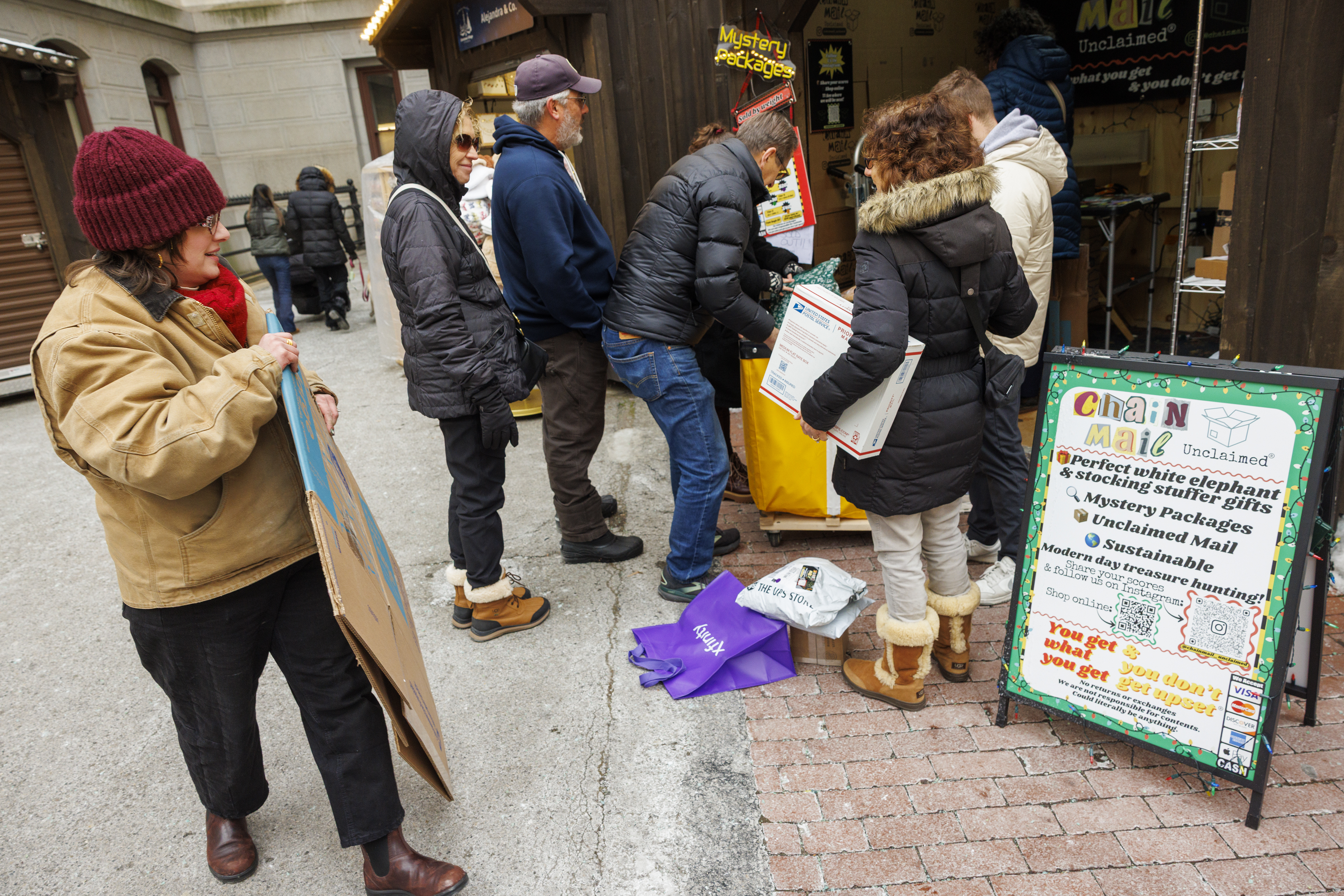
    Emma Zielinski, owner of Chain Mail Unclaimed, opens for business at the Christmas Village at City Hall.

    From boxes to heavily-taped-up opaque bags, Zielinski is selling about 300 to 500 items a day, each between $10 and $40 a pop, based on weight. On the opening weekend for her Chain Mail Unclaimed hut, which is located in the interior courtyard of City Hall, she sold two weeks of inventory in just two days — and business hasn’t slowed down since.

    Philadelphians, she’s found, are always up for a good surprise.

    “They are down to party and see what’s going on,” Zielinski said. ”It’s a really good vibe in Philly when we do events, people are a lot of fun and up for trying something new and playing along.”

    The element of surprise

    When I arrived around 1 p.m. on Thursday, I was shocked to find Chain Mail Unclaimed had one of the only lines at the Christmas Village, aside from the ever-popular raclette cheese stand.

    “To be compared to the raclette stand is quite an honor,” Zielinski said.

    As I was waiting in line, a young man who’d just purchased a package opened it on the spot and pulled out what appeared to be a spandex elf suit — in a women’s medium.

    “At least it’s seasonally appropriate,” I said.

    When my turn came, I dug in a large bin and rustled through a couple shelves with the crowd, massaging the bags and shaking the boxes to see if I could prognosticate what was inside of them. Unlike Christmas at home, these tactics are totally fair game at Chain Mail Unclaimed.

    Mayumi Burgess takes a guess at what’s inside a package for sale at Chain Mail Unclaimed.

    I was pretty sure one of the packages had wicker baskets in it, and another, a pair of shoes, but beyond that it was hard to decipher the contents. All of the $10 items were gone, so I settled on two $15 packages and one for $20. All three are soft goods in opaque bags secured with clear tape, two of which came from the U.S. Postal Service and one from the UPS Store.

    Beyond that, I know nothing about them. Even the sender and intended recipient’s names have been artfully covered up with Chain Mail Unclaimed stickers by Zielinski and her crew.

    I intend to give one package to my husband (he signed up to deal with the consequences of marrying a total rando) and one each to my Secret Santa recipients at our respective family gatherings.

    I can’t wait to see what’s inside. I’m getting older and by the time Christmas rolls around, sometimes I forget what I’ve bought people anyway, but with this it’s guaranteed to be a surprise for the recipients and for me.

    I mean, these gifts could literally be anything! They could contain lost Inca gold, the French crown jewels stolen from the Louvre, or a heretofore unknown Dunlap broadside printing of the Declaration of Independence.

    Emma Zielinski, owner of Chain Mail Unclaimed, unloads merchandise at her booth at the Christmas Village at City Hall.

    Of course, they could be total rubbish or completely embarrassing. I hope my beloved, self-proclaimed “spinster aunt” isn’t going to open a gift of lacy red lingerie before our entire family this Christmas, but sometimes, these are the chances we take in life, and actually, that would be pretty entertaining.

    Because part of the fun of giving a gift like this is getting to tell the story behind it, which is why I pshawed a fellow customer in line who requested that I open my packages on the spot.

    “Ma’am, these are gifts,” I said, before walking away with my treasures.

    ‘The tip of the iceberg’

    Zielinski, of Lawrenceville, N.J., said she was inspired to create her business after seeing a video of someone on social media visiting a similar pop-up shop at a farmers market in Paris.

    She was already attending vendor events in the region for her permanent jewelry business, Off the Chain Studios, and thought this could be a good companion to it.

    “It’s exciting, it builds a crowd, and it’s also an entirely different crowd,” Zielinski said. “The person who gets a bracelet welded on won’t necessarily buy an unclaimed package.”

    Chain Mail Unclaimed — a name that’s a nod to both her original business and the archaic tradition of chain mail letters — opened in April 2024. Zielinski started with pop-up shops at area weekend events like the Trenton Punk Rock Flea Market and the Northern Liberties Night Market before leveling up to the multiweek Christmas Village in Philadelphia this year.

    At left is Emma Zielinski, owner of Chain Mail Unclaimed, a business in the City Hall courtyard of the Christmas Village, looks on as customers sort through packages.

    She works with a broker who deals with warehouses across the country where mail sits unclaimed, overstocked, or returned and then gets auctioned off.

    “The amount of unclaimed packages is insane. This is the tip of the iceberg, if they don’t get bought, they get incinerated,” she said. “I think we’ve all returned something, but you don’t think what the next step is.”

    Zielinksi said she was already aware of human overconsumption as a whole, having been a fashion school student, but she told me this business gives her a whole new perspective.

    “People question the legality — yes, it’s legal. Where do you think it goes? It doesn’t just go somewhere and live a happy life, it gets thrown out,” she said.

    And suddenly, I was transported to the Island of Misfit Toys from Rudolph the Red-Nosed Reindeer, and my heart ached. Charlie-in-the-box deserves a happy life too, darn it, especially around the holidays!

    ‘Who ordered these?’

    Zielinski usually orders six months of stock, or 24 pallets, at a time, but the Christmas Village has upended her business and she’s ordered three times that in the last two weeks alone. Her broker is now on stand-by for the remainder of the season and her staffing has tripled to match the demand.

    “People are excited this is here. It also fills a great white elephant gift niche,” she said. “It takes the responsibility off of you if you don’t know what to get someone and it’s a fun talking point.”

    Mayumi Burgess and her husband, Alfonso Burgess, of Philadelphia, look for mystery packages sold by weight at the Chain Mail Unclaimed business at the Christmas Village at City Hall.

    Packages are typically sold through her website as well, but right now that’s on pause as she tries to keep the Christmas Village stocked. Sometimes she’ll get big items she can’t sell in a palette, like furniture, and she works with Habitat for Humanity and local nonprofits to give those things away.

    Zielinski swears she doesn’t open any package before she sells it, nor does she keep any for herself (“I am a total maximalist so once I get started, I could not stop”), but she does love hearing about what her customers received.

    So far, the most impressive find was an 18-karat gold diamond bracelet that retails for $4,000.

    And the strangest?

    “It was a set of animal pregnancy tests, which really took me back,” she said. “Who ordered these? What are the circumstances? I need to know the backstory. That part drives me crazy.”

    Emma Zielinski, owner of Chain Mail Unclaimed, opens for business at the Christmas Village at City Hall.

    Zielinski said what’s considered a good find is also very subjective. The other day, a woman opened a package and discovered a deadbolt inside. She told Zielinski her door’s been blowing open and it was just what she needed.

    “Once, a girl got the perfume she wears,” Zielinski said. “It’s bizarre, but sometimes these items find their way back to where they’re supposed to be.”

  • In 2026, America needs an anti-AI party | Will Bunch Newsletter

    Sometimes a terrible year can end with a moment of uplift. This actually happened in the last days of 1968, when Apollo 8 took the first humans in orbit around the moon and sent wonder back to a planet struggling with assassinations and riots. Alas, 2025 seems not such a year. A world already reeling from two mass shootings half a world apart learned Sunday night that Hollywood icon Rob Reiner and his wife Michele had been murdered in their home, allegedly by their own son. Boomers like me saw our own journey in that of Reiner — playing a young campus liberal, then taking down the pomposity of classic rock before both an unprecedented streak of classic movies and unparalleled social and political activism. He had more to give, and leaves a void that can’t truly be filled.

    If someone forwarded you this email, sign up for free here.

    Americans fear AI and loathe its billionaires. Why do both parties suck up to them?

    Time’s 2025 person of the year are the architects of AI, depicted in this painting by Jason Seiler. The painting, with nods to the iconic 1932 “Lunch atop a Skyscraper” photograph, depicts tech leaders Mark Zuckerberg, Lisa Su, Elon Musk, Jensen Huang, Sam Altman, Demis Hassabis, Dario Amodei, and Fei-Fei Li.

    “This is the West, sir. When the facts become legend, print the legend.”journalist in the 1962 film, The Man Who Shot Liberty Valance

    The top editors at Time (yes, it still exists) looked west to Silicon Valley and decided to print the legend last week when picking their Person of the Year for the tumultuous 12 months of 2025. It seemed all too fitting that its cover hailing “The Architects of AI” was the kind of artistic rip-off that’s a hallmark of artificial intelligence: 1932’s iconic newspaper shot, “Lunch Atop a Skyscraper,” “reimagined” with the billionaires — including Elon Musk and OpenAI’s Sam Altman — and lesser-known engineers behind the rapid growth of their technology in everyday life.

    Time’s writers strived to outdo the hype of AI itself, writing that these architects of artificial intelligence “reoriented government policy, altered geopolitical rivalries, and brought robots into homes. AI emerged as arguably the most consequential tool in great-power competition since the advent of nuclear weapons.”

    OK, but it’s a tool that’s clearly going to need a lot more work, or architecting, or whatever it is those folks out on the beam do. That was apparent on the same day as Time’s celebration when it was reported that Washington Post editors got a little too close to the edge when they decided they were ready to roll out an ambitious scheme for personalized, AI-driven podcasts based on factors like your personal interests or your schedule.

    The news site Semafor reported that the many gaffes ranged from minor mistakes in pronunciation to major goofs like inventing quotes — the kind of thing that would get a human journalist fired on the spot. “Never would I have imagined that the Washington Post would deliberately warp its own journalism and then push these errors out to our audience at scale,” a dismayed, unnamed editor reported.

    The same-day contrast between the Tomorrowland swooning over the promise of AI and its glitchy, real-world reality felt like a metaphor for an invention that, as Time wasn’t wrong in reporting, is so rapidly reshaping our world. Warts and all.

    Like it or not.

    And for most people (myself included), it’s mostly “or not.” The vast majority understands that it’s too late to put this 21st-century genie back in the bottle, and like any new technology there are going to be positives from AI, from performing mundane organizing tasks that free up time for actual work, to researching cures for diseases.

    But each new wave of technology — atomic power, the internet, and definitely AI — increasingly threatens more risk than reward. And it’s not just the sci-fi notion of sentient robots taking over the planet, although that is a concern. It’s everyday stuff. Schoolkids not learning to think for themselves. Corporations replacing salaried humans with machines. Sky-high electric bills and a worsening climate crisis because AI runs on data centers with an insatiable need for energy and water

    The most recent major Pew Research Center survey of Americans found that 50% of us are more concerned than excited about the growing presence of AI, while only 10% are more excited than concerned. Drill down and you’ll see that a majority believes AI will worsen humans’ ability to think creatively, and, by a whopping 50-to-5% percent margin, also believes it will worsen our ability to form relationships rather than improve it. These, by the way, are two things that weren’t going well before AI.

    So naturally our political leaders are racing to see who can place the tightest curbs on artificial intelligence and thus carry out the will of the peop…ha, you did know this time that I was kidding, didn’t you?

    It’s no secret that Donald Trump and his regime were in the tank from Day One for those folks out on Time’s steel beam, and not just Musk, who — and this feels like it was seven years ago — donated a whopping $144 million to the Republican’s 2024 campaign. Just last week, the president signed an executive order aiming to press the full weight of the federal government, including Justice Department lawsuits and regulatory actions, against any state that dares to regulate AI. He said that’s necessary to ensure U.S. “global AI dominance.”

    This is a problem when his constituents clearly want AI to be regulated. But it’s just as big a problem — perhaps bigger — that the opposition party isn’t offering much opposition. Democrats seem just as awed by the billionaire grand poobahs of AI as Trump. Or the editors of Time.

    Also last week, New York Democratic Gov. Kathy Hochul — leader of the second-largest blue state, and seeking reelection in 2026 — used her gubernatorial pen to gut the more-stringent AI regulations that were sent to her desk by state lawmakers. Watchdogs said Hochul replaced the hardest-hitting rules with language drafted by lobbyists for Big Tech.

    As the American Prospect noted, Hochul’s pro-Silicon Valley maneuvers came after her campaign coffers were boosted by fundraisers held by venture capitalist Ron Conway, who has been seeking a veto, and the industry group Tech:NYC, which wants the bill watered down.

    It was a similar story in the biggest blue state, California, where Gov. Gavin Newsom in 2024 vetoed the first effort by state lawmakers to impose tough regulations on AI, and where a second measure did pass but only after substantial input from lobbyists for OpenAI and other tech firms. Silicon Valley billionaires raised $5 million to help Newsom — a 2028 White House front-runner — beat back a 2021 recall.

    Like other top Democrats, Pennsylvania Gov. Josh Shapiro favors some light regulation for AI but is generally a booster, insisting the new technology is a “job enhancer, not a job replacer.” He’s all-in on the Keystone State building massive data centers, despite their tendency to drive up electric bills and their unpopularity in the communities where they are proposed.

    Money talks, democracy walks — an appalling fact of life in 2025 America. In a functioning democracy, we would have at least one political party that would fly the banner of the 53% of us who are wary of unchecked AI, and even take that idea to the next level.

    A Harris Poll found that, for the first time, a majority of Americans also see billionaires — many of them fueled by the AI bubble — as a threat to democracy, with 71% supporting a wealth tax. Yet few of the Democrats hoping to retake Congress in 2027 are advocating such a levy. This is a dangerous disconnect.

    Time magazine got one thing right. Just as its editors understood in 1938 that Adolf Hitler was its Man of the Year because he’d influenced the world more than anyone else, albeit for evil, history will likely look back at 2025 and agree that AI posed an even bigger threat to humanity than Trump’s brand of fascism. The fight to save the American Experiment must be fought on both fronts.

    Yo, do this!

    • I haven’t tackled much new culture this month because I’ve been doing something I so rarely do anymore: Watching a scripted series from start to finish. That would be Apple TV’s Pluribus, the new sci-fi-but-more-than-sci-fi drama from television genius Vince Gilligan. True, one has to look past some logistical flaws in its dystopia-of-global-happiness premise, but the core narrative about the fight for individualism is truly a story of our time. The last two episodes come out on Dec. 19 and Dec. 26, so there’s time to catch up!
    • The shock and sorrow of Rob Reiner’s murder at age 78 has, not surprisingly, sparked a surge of interest in his remarkable, and remarkably diverse, canon of classic movies. His much-awaited sequel Spinal Tap II: The End Continues began streaming on HBO Max just two days before his death. Check it out, or just re-watch the 1984 original, which is one of the funniest flicks ever made, and which is also streaming on HBO Max and can be rented on other popular sites. Crank it up to 11.

    Ask me anything

    Question: What news value, not advertising value, is accomplished by publicizing every one of Trump’s insane rantings daily? — @bizbodeity.bsky.social via Bluesky

    Answer: This is a great question, and the most recent and blatant example which I assume inspired it — Trump’s stunningly heartless online attack against a critic, Hollywood icon Rob Reiner, just hours after his violent murder — proves why this is a painful dilemma for journalists. I’d argue that Trump’s hateful and pathologically narcissistic post was a deliberate troll for media attention, to make every national moment about him. In a perfect world, it would indeed be ignored. But it was highly newsworthy that his Truth Social post was so offensive that it drew unusual criticism from Republicans, Evangelicals, and other normal supporters. We may remember this is as a political turning point. Trump’s outbursts demand sensitivity, but that Americans elected such a grotesque man as our president can’t easily be ignored.

    What you’re saying about…

    It’s been two weeks since I asked about Donald Trump’s health, but the questions have not gone away. There was not a robust response from readers — probably because I’d posed basically the same question once before. Several of you pointed to expert commentary that suggests the president is experiencing significant cognitive decline, perhaps suffering from frontotemporal dementia. Roberta Jacobs Meadway spoke for many when she lambasted “the refusal if not the utter failure of the once-major news outlets to ask the questions and push for answers.”

    📮 This week’s question: We are going to try an open-ended one to wrap up 2025: What is your big prediction for 2026 — could be anything from elections to impeachment to the Eagles repeating as Super Bowl champs — and why. Please email me your answer and put the exact phrase “2026 prediction” in the subject line.

    Backstory on how I covered an unforgettable year

    Rick Gomez, who travelled 65 hours by bus from Phoenix, Ariz., holds an AI photo composite poster of Donald Trump, in Washington, the day before Trump took the Oath of Office to become the 47th president of the United States.

    Barring the outbreak of World War III — something you always need to say these days — this is my final newsletter, or column, of 2025, as I use up my old-man plethora of vacation days. To look back on America’s annus horribilis, I thought I’d revive a feature from my Attytood blogging days: a recap of the year with the five most memorable columns, not numbered in order of significance. Here goes:

    1. A year that many of us dreaded when the votes were counted in November 2024 began for me with a sad reminder that the personal still trumps the political, when my 88-year-old father fell ill in the dead of winter and passed away on March 11. I wrote about his life, but also what his passion for science and knowledge said about a world that, at the end of his life, was slipping away: Bryan H. Bunch (1936-2025) and the vanishing American century of knowledge.
    2. Still, Donald J. Trump could not be ignored. On Jan. 19, I put on my most comfortable shoes (it didn’t really help) and traipsed around a snowy, chilly Washington, D.C. as the about-to-be 47th president made his “forgotten American” supporters wait on a soggy, endless line for a nothingburger rally while the architects of AI and other rich donors partied in heated luxury, setting the tone for a year of gross inequality: American oligarchy begins as Trump makes billions while MAGA gets left out in the rain.
    3. One of the year’s biggest stories was Trump’s demonizing of people of color, from calling Somali immigrants “garbage” to his all out war on DEI programs that encouraged racial diversity, when the truth was always far different. In February, I wrote about the American dream of a young man from Brooklyn of Puerto Rican descent and his ambition to become an airline pilot, who perished in the D.C. jet-helicopter crash. His remarkable life demolished the MAGA lie about “DEI pilots.” Read: “Short, remarkable life of D.C. pilot Jonathan Campos so much more than Trump’s hateful words.”
    4. If you grew up during the 1960s and ‘70s, as I did, then you understand the story of our lifetimes as a battle for the individual rights of every American — for people to live their best lives regardless of race or gender, or whether they might be transgender, or on the autism spectrum. I wrote in October about the Trump regime’s consuming drive to reverse this, to make it a crime to be different: From autism to beards, the Trump regime wages war on ‘the different
    5. A grim year did end on one hopeful note. Trump’s push for an authoritarian America is faltering, thanks in good measure to the gumption of everyday people. This month, I traveled to New Orleans to chronicle the growing and increasingly brave public resistance to federal immigration raids, as citizens blow whistles, form crowds and protest efforts to deport hard-working migrants: In New Orleans and across U.S., anger over ICE raids sparks a 2nd American Revolution

    What I wrote on this date in 2021

    On this date four years ago, some of us were still treating Donald Trump’s attempted Capitol Hill coup of Jan. 6, 2021 like a crime that could be solved so that the bad guys could be put away. On Dec. 16, 2021, I published my own theory of the case: that Team MAGA’s true goal was provoking a war between its supporters and left-wing counterdemonstrators, as a pretext for sending in troops and stopping Congress from finishing its certification of Joe Biden’s victory. That didn’t happen because the leftists stayed home. More than 1,000 pardons later, check out my grand argument: “A theory: How Trump’s Jan. 6 coup plan worked, how close it came, why it failed.”

    Recommended Inquirer reading

    • Only one column this week, as this senior citizen was still recovering from that grueling trip to New Orleans. On Sunday, I reacted with the shock and sadness of seeing a mass shooting at my alma mater, Brown University. I wrote that in a nation with 500 million guns, it’s a virtual lock that some day our families — nuclear or extended, like the close-knit Brown community — will be struck by senseless violence. And I took sharp issue with Trump’s comment that “all you can do is pray.” There is much that can and should be done about gun safety.
    • Sometimes the big stories are the ones that play out over decades, not days. When I first started coming regularly to Philadelphia at the end of the 1980s, the dominant vibe was urban decline. The comeback of cities in the 21st century has altered our world, for good — but a lot of us old-timers have wondered: Just who, exactly, is moving into all these new apartments from Center City to Kensington and beyond? Last week, The Inquirer’s ace development reporter Jake Blumgart took a deep dive into exactly that — highlighting survey results that large numbers are under 45, don’t own a car, and moved here from elsewhere, and telling some of their stories. Local journalism is the backbone of a local community, and you are part of something bigger when you subscribe to The Inquirer. Plus, it’s a great Christmas gift, and you’ll get to read all my columns in 2026. See you then!

    By submitting your written, visual, and/or audio contributions, you agree to The Inquirer‘s Terms of Use, including the grant of rights in Section 10.

  • Mass shooting at Brown U.: When gun heartbreak comes home

    Mass shooting at Brown U.: When gun heartbreak comes home

    There are roughly 343 million of us in America — a nation where diversity runs from Alaska’s frigid glaciers to the sweaty honky-tonks of Key West, and where the political divides run even deeper. And yet there is one thing that unites all of us.

    One day, one way or another, in a land with more firearms than people, gun violence is going to come home.

    At about 5:45 p.m. Saturday, after spending an afternoon offline untangling strings of lights and, finally, admiring the glow of a lit Christmas tree, I looked back at my phone and a brief moment of holiday joy in what has been a very rough 2025 vanished into the void. There had been a mass shooting at Brown University, my alma mater.

    What unfolded over the next few hours on national TV was both stunning and a numbingly familiar ritual: the news conference where the mayor announces that two students have been killed and nine others seriously wounded; the phone interviews with terrified undergrads locked down in darkened dorm rooms, furniture pushed hard against the door; the grainy video of a male gunman clad in black.

    The only real difference from Uvalde or Leland, Miss., was a personal one: Picturing mentally the moments of horror inside the building where college friends like my junior and senior-year roommate and my girlfriend learned to build everything from artificial limbs to nuclear power plants, just blocks from the newsroom where I’d toiled until 2 a.m. putting out the Brown Daily Herald, and the hockey rink where I’d go early with my history book to save seats right behind the penalty box.

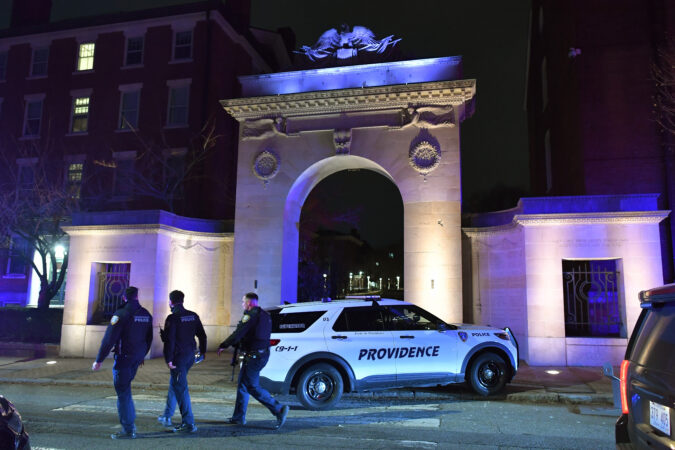
    Police gather on Waterman Street in Providence, R.I., on Saturday, during the investigation of a shooting.

    As I write this on a snowy and overcast Sunday morning, we still don’t know the names of the two students who were murdered during a finals-week study group inside the Barus and Holley engineering building, let alone the twisted motives of whoever killed them. Yet, to anyone who’s been part of the Brown community, as I’ve been since I studied in Providence from 1977-81, it feels as if relatives have been senselessly taken from us.

    That’s because the Brown community is a family — a large, messy one where people fight and bicker all the time (as I myself did back in August, when I ripped the current administration for a compromise with the Trump regime), a trait which tends to make students and alums love it even more. There’s a reason that some folks call Brown “the happy Ivy” — a communal bond that one lunatic with one of as many as 500 million guns in America tried to shatter in a few horrifying minutes.

    But that’s what every mass shooting is, in one way or another: an attack on community, the very essence of being human, committed by one atomized individual who’s lost that connection and who has easy access to a weapon that lets him shatter it for everyone else.

    I understand what some of you are thinking. Brown may be a happy place but it is also an elite one, which rejects nearly 95% of the hopeful young people who apply there. Is a shooting on an Ivy League campus bound to get more media attention than one at an HBCU homecoming, let alone a working-class community? Sure, but a mass shooting at Brown is also a grim reminder of a cross that we all bear — every class, race, and religion — in a nation that’s jumped onto the wrong track.

    Brown University is a messy, happy family, but so was the Church of Jesus Christ of Latter-day Saints near Flint, Mich., where a gunman killed four people in September before setting the place on fire, and so was the birthday party in Stockton, Calif., where three children were gunned down in August, or October’s alumni celebration at a bar on Saint Helena Island, S.C., where four people were senselessly murdered.

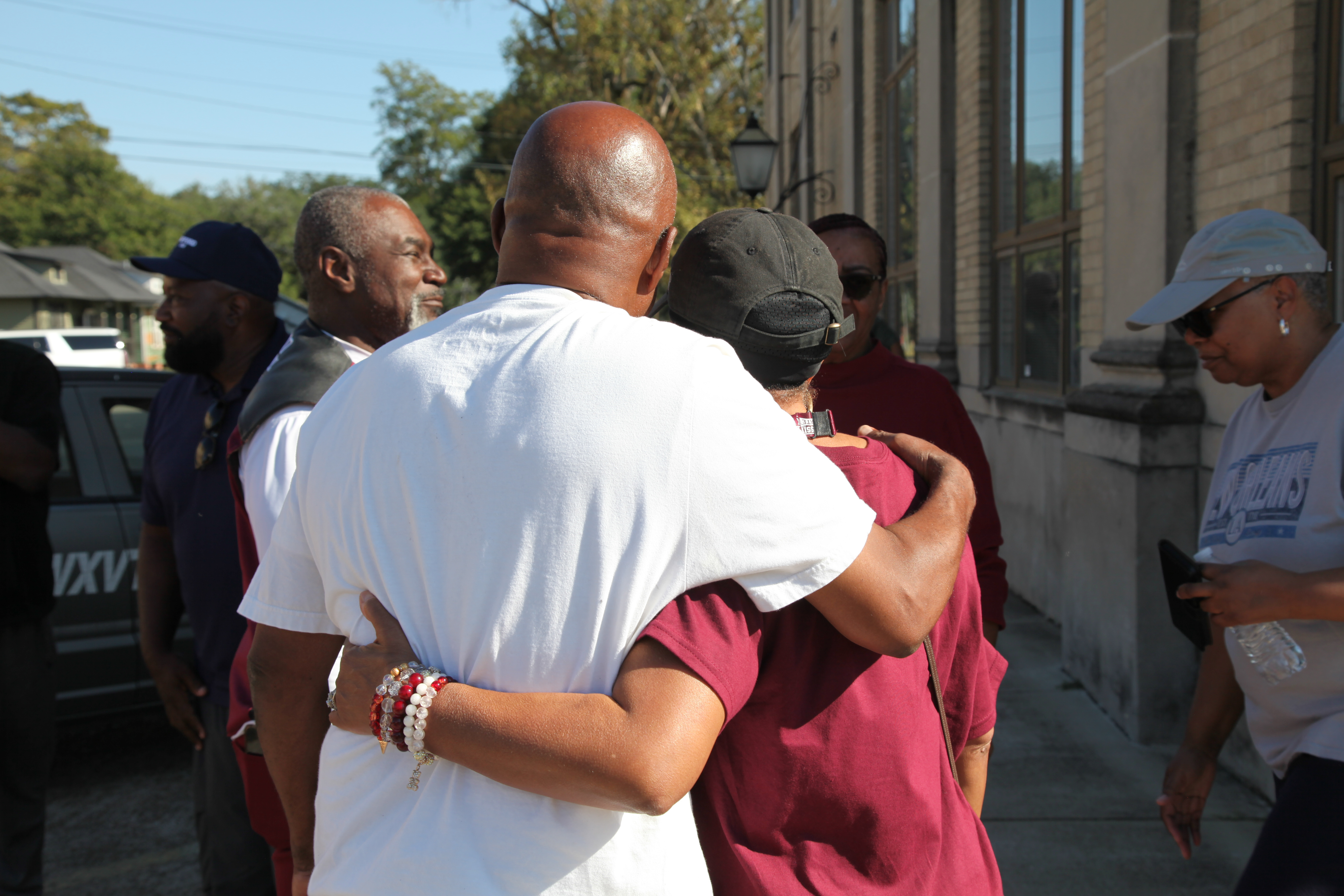
    Friends and family of victims of a shooting at a high school homecoming celebration embrace in downtown Leland, Miss., on Oct. 11.

    No family is safe in the United States as long as we continue to lead the world in manufacturing two things: weapons of mass murder, and the unvarnished rage and alienation that pulls the trigger. Or as long as our so-called leaders pretend there is nothing that can be done, aside from muttering empty prayers as blood dries on a sidewalk.

    A mass shooting at an Ivy League university is something that even gets the attention of our president as he shuttles between weekend golf outings. Donald Trump, after honing his uncanny knack for making things worse by posting and un-posting incorrect information on Truth Social, told reporters on a tarmac that “all we can do right now is pray for the victims, and for those that were very badly hurt.”

    No, Mr. President, that is not all you can do.

    You could, for starters, ask Congress to ban the kinds of assault weapons that aren’t used to hunt deer yet are all too effective at mowing down college students or grade-schoolers — something that actually happened, imperfectly but with positive results, in this country from 1994 until 2004.

    But a POTUS who’s very busy micromanaging his obscenity of a new White House ballroom has no time or interest in curbing the uniquely American curse of gun violence. To the contrary, Trump has — nearly 11 months into his second term — taken a series of actions to ensure it’s easier for fugitives or people with severe mental illness to purchase firearms, and for gun buyers to avoid child-safety devices.

    That does seem par for the course for our golfing president. Why would a man who wantonly murders people on Caribbean boats and is OK with foreign-aid cuts that have already killed hundreds of thousands of sick or starving children in Africa or Asia get worked up about some inconvenient carnage at a college engineering lab?

    Trump’s mini-me, Vice President JD Vance, also weighed in as he always does (as caught by menswear guru and internet sage Derek Guy) after an American mass shooting — with thoughts and prayers and assurance that he is “monitoring” a situation that, by implication, he is helpless to do anything to prevent.

    Still, the vice president’s thoughts and prayers for the Brown shooting seemed especially galling since this — unless I’m mistaken — is the very same JD Vance who in 2021, boosting his pro-Trump bona fides, told a right-wing gathering that “universities are the enemy.”

    Look, let’s be clear: We have no idea yet who the Brown University shooter is, although a “person of interest” has now been taken into custody. The shooter could be a student angry over a grade or perceived disrespect, or someone with deranged thoughts that don’t neatly fit into our tribal politics. Or, it could be someone who buys into the Trump/Vance hate speech that elite universities are “woke” enemies of the people. Either way, in a better world, a true leader might wake up rethinking his despicable past words toward a community that is deeply suffering.

    Looking back on my own experience, I think the reason that Brown is “the happy Ivy” is because — more than its rival schools — the university has since the 1960s walked the walk on the best and truest mission of higher education. That is teaching young people to think for themselves, with a curriculum that encourages engineers to study poetry and poets to study oceanography. It’s what makes Brown great, and what authoritarians like Trump and Vance can’t stand.

    There’s never been a Brown alumni president, but if there was — and maybe this is a little boosterism — I’d like to think they’d been taught that it’s wrong to lie to America that there is nothing you can do to curb violence. And that they’d understand that a true leader is the one who builds up our communities, not tear them down.

    I mourn today for my Brown family, but until we find the moral courage to do something about gun violence in America, no family can feel safe.

  • At the border, fear and uncertainty as Trump seeks to remake the immigration court system

    At the border, fear and uncertainty as Trump seeks to remake the immigration court system

    EL PASO, Texas — A small group of immigrants gathered in the lobby of the Richard C. White federal building downtown here on a cool early morning in November. They waited to be allowed up to the seventh floor, where they would appear before a judge as their case made its way through the immigration system.

    Among them were Noemi and her 6-year-old daughter, Abigail. They had driven more than four hours to get to their court date and were hoping to head back the same day. While Noemi was soft-spoken, Abigail was sharp and spirited, more than willing to answer all the questions she was being peppered with by strangers.

    She spoke about where she was from (El Salvador), her favorite show (Bluey), about school (It’s all right), and about her older best friend (She’s 8).

    Abigail has been in the U.S. since 2021, arriving with her mother in search of a better life. They were welcomed by a Biden administration that, despite its many faults, initially asserted an immigration policy that was deeply humanitarian.

    But that was then.

    While the immigrants sat and waited, Sigrid González introduced herself. She was a volunteer doing court accompaniment. They could not offer legal advice but were there to observe and help immigrants plan — did they bring a car? Do they have kids in school? Do they know whom to call? — in case they were detained.

    “ICE is here. They have a list. We don’t know who they will take,” González said. “This is not to frighten you, but to let you know.”

    Later, as the elevator doors opened on the seventh floor, a group of about half a dozen Immigration and Customs Enforcement agents were indeed there. Dressed as civilians but still in uniform: blue jeans, sneakers, and dark jackets.

    El Paso has not seen the kind of excessive use of force seen in places like New York, but as in immigration courtrooms across the country, ICE agents stand in wait to arrest people who are following the rules.

    Immigration and Customs Enforcement agents escort a detained immigrant into an elevator after he exited a New York immigration courtroom in June.

    The government’s strategy is to ask the court to dismiss an immigrant’s case, making them eligible for expedited removal, a relatively quick process under which a noncitizen can be deported back to their country, potentially without any additional immigration court hearings, Emmett Soper, a former immigration judge in Virginia, told me.

    In practice, however, ICE agents regularly detain immigrants regardless of a judge’s decision on dismissal.

    “I denied every single motion to dismiss. I set the case for a further hearing. I gave all the required advisal, things like that,” Soper said. “Every single person was arrested, to my knowledge, after I denied the motion to dismiss.”

    The Trump administration is not stopping at ignoring due process, it is also working to reshape the immigration court system. Soper is one of about 100 immigration judges fired this year. There is no explanation for the dismissal of the judges, other than many of them having a record seen as out of step with the administration’s hard-line approach.

    Instead of an experienced jurist like Soper, who took the bench in 2017 and understands that every case should be given a fair hearing according to the law, Department of Homeland Security Secretary Kristi Noem is looking for people who want to be a “deportation judge” and want “to restore integrity and honor to our Nation’s Immigration Court system.”

    In case there was any doubt what the Trump administration wants to restore, DHS clarifies in a recruitment ad: “Defend your communities, your culture, your very way of life.”

    As Abigail sat next to her mother inside Judge Judith F. Bonilla’s courtroom, coloring an image of two cats sitting side by side handed to her by the court clerk, it was hard to see what the White House is so afraid of.

    Noemi was so concerned about her legal case that she would only speak with me on the condition that her last name not be used. She did not have a lawyer. The judge asked her a series of questions and she responded in turn: She had no family in the U.S., she had not been a victim of a crime, it was her first time in the country, she had never been arrested. She was not afraid to go back to El Salvador.

    It was clear from her answers that Noemi did not want to fight her case.

    The only relief available for her, the judge said, was voluntary departure. If she took that option, Noemi waved her right to appeal but it left the door open for them to return legally in the future.

    “I want voluntary departure,” she said.

    Noemi and her daughter had 90 days to leave the U.S.

    Outside the courtroom, Noemi met with González, who asked her if she wanted to share any contact information in case they were detained by ICE. Noemi looked confused.

    “I have voluntary departure; can they still take me?” she asked. Based on experience, González did not hesitate to answer: “Yes.”

    I have been thinking for weeks about Noemi’s face at that moment. How to describe what it looks like when someone who has gone through the legal process and made peace with the fact she cannot stay in the U.S. must still face the random cruelty of an administration that sees her and her 6-year-old as a threat.

    Crestfallen, Noemi shared her information with González.

    Across the hall, the ICE agents began to move toward the elevator. Apparently, they were leaving. Everyone around Noemi and Abigail sighed in relief. The mother and daughter were not among those taken, which that day included a man and a mother and her older son.

    As Noemi and Abigail left the federal building to drive back home through the west Texas desert — back to the life they had built for themselves over four years and now had 90 days to leave — the only thing I could think was, how does this benefit America?

    More from the border: Trump may have shut down the border to asylum-seekers, but he can’t end immigrants’ hope

  • The ‘resign-to-run’ rule is a rare case where Philly provides a national model for good government. Why change it?

    The ‘resign-to-run’ rule is a rare case where Philly provides a national model for good government. Why change it?

    Here we go again.

    A proposal in City Council aims to amend the so-called resign-to-run rule that requires elected city officials to give up their seats if they want to run for another office.

    Philadelphia voters have already rejected a similar plan twice, once in 2007 and again in 2014. A third attempt stalled out in Council in 2020.

    Councilmember Isaiah Thomas, who proposed eliminating the rule last year, is back with a modified measure that would allow city officeholders to keep their seats while running for a state or federal office. They would still have to resign to run for another city office, such as mayor.

    Sorry, councilman, but there’s no such thing as being a little bit pregnant. Many of the same good government reasons that require resigning to run for another office still hold.

    Namely, running for office is a full-time job. The fundraising, campaign stops, debates, and town halls that take place during the day, nights, and weekends leave little time for officials to do the six-figure day job they were elected to do.

    Depending on the office, running for a statewide or federal seat could also require additional travel across the state that would further distract from serving the constituents the official was elected to represent.

    There would also be the temptation to use taxpayer-funded city resources — including the car, office, and staff — to help with the campaign. That is in addition to the taxpayer-funded salary and benefits elected city officials would collect while campaigning for a higher office.

    Lastly, the elected official could also leverage their position against other candidates to benefit themselves or donors.

    City Councilmember Isaiah Thomas said he would like to see the “resign-to-run” rule eliminated, but for now he was trying to strike a compromise.

    The arguments for allowing an elected official to remain in office while campaigning for another job just don’t hold up.

    The main argument is that it will allow more competition. For example, Thomas said some of his Council colleagues may have entered the race to replace retiring U.S. Rep. Dwight Evans — a five-term Democrat from the 3rd District — if they did not have to resign.

    But even under the current rule, there is no lack of competition for Evans’ seat. Eleven people have already announced their candidacy, and the primary is not until May 19.

    The diverse field already has a number of excellent candidates, including several who have never run for office before. Voters will have plenty of good options.

    Thomas argued voters would benefit if the field included Council members. “There could be even more great candidates,” he said in an interview.

    Thomas said city officials faced an uneven playing field, since state and federal elected officials do not have to resign to run for another office. That is true.

    Three of the congressional candidates hold state elected office. But the better reform is to require state and federal elected officials to resign to run for another office.

    As the saying goes, two wrongs don’t make a right.

    Voters are already fed up with professional politicians. It is even more annoying when an official gets reelected and months later launches a bid for another office.

    Even with the current rule, there is no lack of competition for retiring U.S. Rep. Dwight Evans’ seat, Paul Davies writes. Eleven candidates so far are vying to succeed the five-term Democrat from the 3rd District.

    That scenario may soon play out with Gov. Josh Shapiro. He faces reelection in November, and many assume he will run for president in 2028. That means if Shapiro is reelected governor, he could spend much of the first half of his second term campaigning in Iowa, New Hampshire, and beyond.

    After then-New Jersey Gov. Chris Christie launched his first bid for president, he would go on to spend 262 full or partial days out of the state in 2015. He traveled with a security detail that included New Jersey state troopers driving black SUVs with the state’s license plates, costing taxpayers more than $600,000.

    Likewise, when then-U.S. Sen. Marco Rubio (R., Fla.) ran for president in the same election cycle, he missed 50% of the votes in the Senate.

    Thomas conceded it would be difficult to balance city duties while running for an office that would require campaigning across the state. But he said city officials running for a congressional seat in Philadelphia while holding office would “not miss a beat.”

    That may be true since Council doesn’t meet in the summer. But that’s an argument for making Council a part-time job, especially since they can, and some do, hold second jobs.

    Philadelphia’s resign-to-run rule was added to the Home Rule Charter in 1951. At the time, the Committee of Seventy, a nonpartisan organization established in 1904 to combat corruption, strongly supported the rule.

    After then-New Jersey Gov. Chris Christie launched his first bid for president, he would go on to spend 262 full or partial days out of the state in 2015, Paul Davies writes.

    Any measure that prevents corruption still seems like a good idea. But surprisingly, the good-government group’s position has “evolved,” Lauren Cristella, the head of the Committee of Seventy, said in a statement.

    The organization “reluctantly” supported the repeal of the rule in 2014, citing the need for more competition.

    But Philadelphia voters rejected the effort. Just as they did in 2007.

    This time, the Committee of Seventy said it would only support ending the resign-to-run rule if it was part of a broader reform package that includes term limits and “stronger safeguards for ethical, transparent government.”

    The Committee of Seventy said the proposed change in its current form only serves the “political interests, but not the public interest.”

    Rest assured, if the resign-to-run rule were modified to allow city officials to run for state and federal office, it would just be a matter of time before Council tried to repeal it altogether.

    Even Thomas said he would like to see the rule eliminated, but for now, he was trying to strike a compromise.

    Philadelphia has long been criticized as being “corrupt and contented.” But reforms like resign-to-run and the city’s strict campaign finance regulations passed a decade ago are models of good government.

    Indeed, only a couple of cities and states have a resign-to-run rule. Philadelphia should champion its position as a good-government leader.

    Harrisburg — which has no such measure and some of the worst campaign finance rules — would benefit from following the city’s lead.

    The country needs more good government, not less.