Category: Health

  • ‘Everywhere chemicals’ are in our food, decades after scientists recognized dangers

    ‘Everywhere chemicals’ are in our food, decades after scientists recognized dangers

    CARY, N.C. — Earl Gray was astonished by what he found when he cut into the laboratory rats. Some had testicles that were malformed, filled with fluid, missing, or in the wrong place. Others had shriveled tubes blocking the flow of sperm, while still more were missing glands that help produce semen.

    For months, Gray and his team had been feeding rats corn oil laced with phthalates, a class of chemical widely used to make plastics soft and pliable. Working for the Environmental Protection Agency in the early 1980s, Gray was evaluating how toxic substances damage the reproductive system and tested dibutyl phthalate after reading some early papers suggesting it posed a risk to human health.

    Sitting on a screened porch on a humid summer day more than 40 years later, Gray recalled the study and the grisly birth defects. “It was in enough animals, so we knew it wasn’t random malformations,” said Gray, 80, who retired after nearly 50 years with the agency.

    Gray and other scientists were awakening to the potential dangers of phthalates, which were making their way into nearly every human being on the planet as plastics became a way of life in the 20th century.

    Yet even as the dangers became more evident, the Food and Drug Administration, the EPA, and other regulators made only piecemeal efforts to limit their use over the next 50 years. This inaction allowed companies to continue to churn out millions of tons of phthalates for plastics manufacturing, leading these “everywhere chemicals” to become pervasive.

    Today, most people are exposed to phthalates when they eat. Although industry has largely eliminated their use in food packaging — once one of the most common uses — phthalates are used in factories that make food, accumulating at high levels in ultra-processed foods. They also enter the environment through products including medical equipment, vinyl flooring, cars, cosmetics, and cheap plastic goods like shower curtains.

    A large body of science has linked phthalates to a variety of serious health conditions, including premature birth and infertility. Studies have also tied the chemicals to neurodevelopment issues like ADHD. In April, a study led by New York University attributed 350,000 deaths from heart disease globally to phthalates exposure. And a University of Miami study linked phthalates’ disruption of hormones to breast cancer, a leading cause of death for women globally.

    The costs to society are huge. A 2024 NYU-led study that cataloged health effects from phthalates exposure in the United States — including contributions to diabetes levels and infertility — estimated that dealing with phthalate-related diseases cost $66.7 billion in a single year. That is triple the economic impact of health impacts from “forever chemicals,” another class of chemicals widely implicated in disease. Treating all cancer, by comparison, costs the U.S. $209 billion annually, according to one estimate by the government-run National Cancer Institute.

    The sporadic attention regulators have paid to this issue has allowed far more of these chemicals to circulate than what many experts consider safe. Many scientists say phthalates should have been banned or severely limited two decades ago and compare regulators’ slow response to delays in protecting the public from cigarettes and asbestos.

    “If I was in charge, would I have removed it from products? Yes,” said Shanna Swan, an epidemiologist with the Icahn School of Medicine at Mount Sinai. “The only thing you can do is ban it.”

    There was already “sufficient evidence” in the 2000s that pregnant women’s exposure to phthalates harmed fetal development, Swan said. At that time, studies by Swan and others found “phthalate syndrome” — telltale genital malformations — in humans that were similar to what Gray and others had found in rats.

    “When you already see things in humans, that is too late,” said Maricel Maffini, an independent biochemist, who has worked with major corporations and nonprofit chemical advocacy groups. “When we see effects in humans, it is because we didn’t do a good job years earlier.”

    After years of delay, federal regulators began limiting phthalates use in children’s toys in 2009, eventually banning eight compounds. The EPA is scrutinizing seven additional phthalates, but any possible action would be years away. Even the chemical Gray served to rats — dibutyl phthalate — is still on the market for use in adhesives and paints.

    Industry associations say that their voluntary actions have already reduced public exposure to these chemicals.

    By the mid-2000s, manufacturers had removed phthalates from plastic cling wrap. The FDA has worked with drug companies since 2012 to phase out two varieties, but others continue to be used. And in 2022, the agency granted a request from vinyl plastic manufacturers to withdraw approvals for 25 little-used phthalates in food packaging and manufacturing.

    Industry groups say they have been unfairly portrayed as exposing the public to phthalates.

    “It is a myth that consumer exposure to phthalates is through food packaging,” said the American Chemistry Council, the trade group that represents major phthalate manufacturers, in a statement.

    These actions have reduced public exposure, but scientists say the current phthalate levels remain dangerous, especially for pregnant women and children.

    “There are chemicals that in very, very, very small concentrations at certain times in your life will have a profound effect,” Maffini said. “We cannot go back and rewire the brain. We cannot go back and get the testes to be developed in a different way.”

    The Washington Post spoke to 14 current and former regulators at the FDA and the EPA, who blamed an institutional culture based on weak laws and a fear of litigation for why they did not ban or restrict phthalates, as well as two dozen outside scientists and other experts.

    Former regulators blame the decades of inaction on laws that did not require regulators to reexamine older chemicals that were introduced before the health dangers were known. Agency officials also feared that studies showing a link to disease would not hold up in court and companies would challenge regulators for taking action without a legal mandate.

    The fact that the FDA, the EPA, and the Consumer Product Safety Commission all regulate chemicals in some fashion means that no single agency takes responsibility for all the ways people are exposed to phthalates, experts say.

    “For the last 120 years of the modern chemical age, the country’s chemical safety laws were either nonexistent, ineffective, or rendered unusable, until only nine years ago,” said Michal Freedhoff, President Joe Biden’s EPA assistant administrator for chemical safety. “EPA will need to play catch-up for a very long time.”

    In 2016, federal officials began to implement a 2016 amendment to the Toxic Substances Control Act that requires the EPA to systematically review chemicals already on the market. A similar process is being undertaken at the FDA, though it is not legally mandated.

    Former FDA officials, including those who oversaw chemicals that come in contact with food, defended the agency’s past approach as being based on the best available science at the time.

    “Within the confines of the statute and the available science, they are making the best decisions they can,” said Dennis Keefe, who headed the FDA’s Office of Food Additive Safety from 2011 until 2022.

    The FDA takes decisive action when it is presented with clear proof of harms, Keefe said, and some studies may raise safety concerns but stop short of definitive proof.

    The Health and Human Services Department did not respond to questions about the history of its approach to the chemicals, but spokesman Andrew Nixon said in a statement, “The FDA continues to work to better understand the safety and use of the nine phthalates still authorized for use in food contact applications, and phthalates are included on FDA’s list of chemicals in the food supply that are under review.”

    EPA spokeswoman Brigit Hirsch said in a statement that before 2016, the law “did not provide a specific process or timeline for assessing and managing unreasonable risks from existing chemicals.” The agency is now prioritizing existing chemicals for review, she said, evaluating their harm and creating rules to manage unreasonable risk.

    A century of exposure

    Late 1800s-1940s: Phthalates, which are derived from petroleum, predate modern American regulation by decades. The chemicals were being commercially produced in the U.S. and Japan by the 1930s.

    Plastic — invented in the late 1800s — was still in its infancy then. Early uses include camera film and Bakelite, an extremely hard plastic. For decades, Bakelite rotary phones and radios were the most common plastic items in an American home.

    When World War II created a shortage of rubber for U.S. military equipment, scientists turned to phthalates, which make a rubberlike material when added to plastic, particularly vinyl and PVC.

    1950s: After the war ended, the U.S. reoriented its newfound plastics manufacturing might toward an ever-increasing number of consumer products containing phthalates — rubber ducks, vinyl flooring, Dow Chemical’s Saran wrap — with little regulation.

    In 1958, Congress directed the FDA to review new chemicals for use in food packaging and processing equipment — but the Food Additives Amendment grandfathered in approvals for most chemicals already broadly in use. Among them was di(2-ethylhexyl) phthalate (DEHP), the most commonly used phthalate and one of the most toxic, according to peer-reviewed studies by Gray and many other scientists.

    1960s-1970s: The publication of Rachel Carson’s Silent Spring in 1962 led to a growing public awareness of the harms resulting from the use of pesticides. The EPA was established in 1970 but did not initially regulate chemicals already on the market. Scientists noticed the reproductive effects of phthalates on animals as early as the 1970s, but their research drew little public attention.

    1980s-1990s: After Gray’s early experiments, a scientist named Theo Colborn embarked on a pioneering research program focused on chemicals that short-circuit the hormone system, including pesticides and DEHP, but later expanding to other phthalates and plastic additives.

    Colborn co-wrote the 1996 book Our Stolen Future, which helped bring hormone-disrupting chemicals to public awareness, with pressure mounting over the next decade.

    2000s: Amid concern over phthalates’ impact on children, the 2008 Consumer Product Safety Improvement Act banned DEHP and two other phthalates in toys like rubber ducks and dolls. A decade later, the Consumer Product Safety Commission banned using five additional phthalates in toys after determining they harm male reproductive systems.

    To date, the commission’s actions on children’s toys stand out as one of the few limits that regulators have placed on phthalates.

    Joint custody

    The federal government has divided the primary responsibility for regulating phthalates between the FDA, which polices exposure to chemicals through food, drugs and cosmetics, and the EPA, which oversees them elsewhere, including in the environment.

    For decades campaigners focused on food packaging, but companies have voluntarily addressed that concern. Nestlé, considered a leader in setting food standards, began limiting phthalates in its products in the mid-2000s, according to Stephen Klump, who helped develop tests for phthalates in his 21 years at the company. It gradually ratcheted up restrictions on its suppliers, banning the chemicals by 2018. The rest of the industry followed, Klump said.

    The FDA, however, still allows nine phthalates to be used in factories processing food.

    “You have hoses that are loaded with phthalates, you have plastic tanks that stuff is stored in, you have pumps that are plastic — that’s where you get a lot of phthalates,” said Tom Neltner, a longtime chemical campaigner and chemical engineer who worked in food manufacturing.

    The American Chemistry Council said the FDA has approved using certain phthalates in food-contact applications like tubing, conveyor belts, and vinyl gloves, concluding that dietary exposures do not exceed safe levels.

    “The leadership in FDA, both political and the senior career leadership, for decades in the food safety space, didn’t think chemicals merited much attention,” said Jim Jones, who was brought in as a deputy commissioner to overhaul food safety at the agency in 2023 after a career at the EPA.

    Five phthalates that predate the 1958 food additives law, including DEHP, remain on the market. Four additional phthalates still in use were subsequently approved by the agency, though scientists say those approvals rely on outdated science.

    Monsanto’s 1961 application to the FDA for the use of dicyclohexyl phthalate (DCHP) in food packaging and adhesives, obtained through a Freedom of Information Act request, relied heavily on a 1956 German study of 1,400 rats supported by Bayer (which acquired Monsanto in 2018). That study primarily looked at what doses of certain phthalates would kill them, or severely affect body and organ weight.

    Gray chuckled at the study’s unsophisticated toxicology, noting it showed only how a rat would drop dead with a single dose. “It just shows things have improved quite a bit because that’s useless,” he said.

    DCHP remains approved for use in contact with food.

    Keefe agreed the science used in older applications “wasn’t that developed.”

    Under the current process, teams of evaluators try to determine the level at which a chemical has no negative effect, and then estimate an even lower safe exposure threshold.

    Historically, the agency has reconsidered legacy chemicals only on an ad hoc basis, which often happens when there is a citizen petition to reconsider a chemical, “a health concern” or public outcry, or “new evidence,” said Carrie McMahon, who worked in the Office of Food Additive Safety reviewing ingredients during her 20-year FDA career before retiring this year.

    Susan Mayne, who was the director of food safety and nutrition at the FDA until 2023, said she went to Congress many times in her eight years there to request additional funding for post-market reviews of chemicals but never got it. “We were really at the mercy of what Congress would give that particular office,” she said. She said Congress also rebuffed the FDA’s efforts to charge companies a user fee to fund reviews, as is done for drugs.

    One central issue in a lawsuit pushing for the FDA to revoke the approvals for dozens of phthalates is the standard that there be “reasonable certainty of no harm” for a chemical to be allowed on the market. Environmental groups argue that a substance should be banned if there is significant doubt about its safety.

    But for reevaluating chemicals already in use, FDA officials require proof that a substance causes harm before removing it, a harder bar to clear.

    FDA employees said the agency’s conservative approach requires clear evidence to ban or restrict chemicals, relying mostly on animal experiments rather than the many epidemiological studies showing links between exposure to phthalates and reproductive problems.

    Despite voluntary corporate efforts, the chemicals are still making their way into consumers’ bodies: Centers for Disease and Control Prevention survey data show remnants of phthalates in virtually all Americans’ urine.

    Last year, the Biden administration reorganized the food safety division, now called the Human Foods Program, which will set out to reevaluate old chemicals, including phthalates.

    Health and Human Services Secretary Robert F. Kennedy Jr. has vowed to continue those reviews. President Donald Trump’s proposed budget asks for an additional 70 employees and $49 million to address “unsafe additives in our food supply.”

    A moving target

    While phthalates regulation has historically fallen mostly on the FDA, some experts say the EPA should now bear more responsibility since phthalates in the environment could be contaminating food before it’s even processed or packaged. Studies have shown the chemicals are broadly present in the environment, including in dust, rivers, and cow feed.

    “Saying it’s food and pointing to the people who regulate food is not solving the problem. In fact, it’s distracting people from what the problem actually is,” said Mitchell Cheeseman, who worked at the FDA for 20 years and led its Office of Food Additive Safety.

    For years, the EPA did little to regulate phthalates. In 1984 the agency set guidelines for plastics makers that put limits on discharging certain chemicals into waterways but put off action on phthalates.

    In 1992, the agency established a limit on DEHP for drinking water, based primarily on data about the chemical’s cancer risk, but did note the potential reproductive concerns, according to Betsy Southerland, former science and technology director in the EPA’s Office of Water. Only in 2015 did the EPA recommend limits, in voluntary guidelines, for manufacturers discharging five phthalates.

    Southerland said the agency failed to protect the public. “We knew about it in 1984,” said Southerland, who joined the EPA’s water office that year.

    The EPA started to review seven phthalates under the first Trump administration and has found that two of them pose a risk to factory workers, but not the public.

    But now the EPA’s chemical office has proposed reversing the Biden-era approach for evaluating toxic substances, potentially narrowing what exposure routes it considers and limiting broader actions on phthalates.

    Finding safer alternatives

    Other governments have taken a more aggressive approach to regulating phthalates.

    European Union regulators have placed much heavier restrictions on common phthalates, because they damage the reproductive system, operating under the precautionary principle that action should be taken when any activity raises the threat of serious harm to human health or the environment, even if there is not full scientific certainty.

    The EU has banned four phthalates in all but a narrow set of circumstances. And it has banned three additional phthalates in children’s toys and at least 12 in cosmetics.

    “A law, a regulation, is always stronger than everything that you can achieve with voluntary agreements among the industry,” said Anne-Sofie Backär, executive director of ChemSec, a European advocacy group.

    Safer Products for Washington is a program that focuses on preventing pollution and finding safer substitutes in the state. It assesses chemical classes and uses, rather than individual substances, said Marissa Smith, a toxicologist and the program’s technical lead, comparing a chemical’s hazardous properties to alternatives. If a safer substitute is available, then the chemical is phased out.

    Launched in 2019, the program reviews a new batch of chemical uses every five years. In its first round it found at least seven safer alternative chemicals for phthalates in vinyl flooring and a dozen alternatives for cosmetics. Sealants, caulks, and adhesives are now under scrutiny.

    Toxic-Free Future executive director Laurie Valeriano, who campaigned for the law, said this approach avoids the federal system’s pitfalls because comparing chemicals’ relative dangers is far easier than studying potential human exposure.

    Smith said some substitutes might still pose health risks.

    “That’s kind of a hard pill to swallow,” she said. “But it doesn’t mean that we still can’t make progress.”

    Gray said he was pleased the EPA is using his research in its current assessments of phthalates, as are governments around the world. But he acknowledged regulators have taken too long to act.

    “Why it took so long?” Gray asked. “I don’t know.”

    Studies show levels of phthalate exposure are declining in Americans’ urine. A Harvard study found that markers of DEHP in the urine of 1,900 people in Boston fell by at least 11.9% from 2000 to 2017, although levels of some substitutes rose. But that does not erase the fact that regulators failed for decades to protect pregnant women and children from high levels of exposure, Gray said.

    Gray’s own children had mostly grown up by the time he knew enough to be worried, meaning that he and other parents unknowingly dosed their children with phthalates over and over again.

    “There were decades where the exposures were really high,” he said. “You don’t know what the consequences of those exposures were.”

    Sitting on his neighbor’s porch, Gray recalled giving his children rubber duckies to play with in the bath. The danger now seems so clear: They were 40% phthalates.


  • Forty years after a brain injury changed this veteran’s life, a Jefferson program helped him rebuild

    Forty years after a brain injury changed this veteran’s life, a Jefferson program helped him rebuild

    When Scott Edgell was discharged from the military after a service-related head injury at age 20, he thought he would resume life as normal.

    But over the next four decades, the Lancaster County man was troubled by frequent migraines, memory problems, dizziness, irritability, and balance issues. Even everyday activities, like grocery shopping or eating at a restaurant, became overwhelming.

    “I didn’t understand what was happening to my body,” said Edgell, who is now 57.

    He realized the head injury he suffered while serving in the military was to blame after watching the 2015 movie Concussion, but struggled to find doctors who knew how to help him.

    Just as he started to lose hope in late 2023, he learned about a Jefferson Health program in Willow Grove for veterans and first responders with traumatic brain injuries (TBIs). The clinic provides physical and cognitive rehabilitation to participants over a three-week intensive outpatient program.

    Edgell is among the estimated one in four veterans who have had a TBI. More than half a million U.S. military members have been diagnosed with the injury since 2000, according to the Department of Defense.

    Many suffer TBIs as a result of combat-related incidents, exposure to blasts during explosions, training accidents, and vehicle crashes.

    While some patients can recover completely, up to 30% of those with mild TBIs, also commonly called concussions — which account for the vast majority of TBI cases — experience long-term symptoms.

    The lasting effects of TBIs are often overlooked among veterans because of the injury’s invisibility. Yet they can be life-altering, affecting employment, personal relationships, and overall quality of life.

    Veterans with a TBI had suicide rates 55% higher than veterans without the injury, one study found.

    Jefferson’s program, called the MossRehab Institute for Brain Health, was founded in 2022 and has treated roughly 100 patients. It runs on donations — the biggest being from the veterans’ wellness nonprofit Avalon Action Alliance, which has provided $1.25 million annually.

    Donations allow them to offer the program at no out-of-pocket cost to veterans and first responders, and cover housing, transportation, and meals during the three weeks.

    “I walked in those doors at the lowest part of my life,” said Edgell, who participated in June 2024.

    Though there’s no cure for his injury, the program has helped him rebuild his life.

    “All you can do is learn to manage your symptoms,” he said.

    Edgell and his family, including his wife Tami, stepdaughter Monica Bressler, son-in-law Kenny Bressler, and granddaughter Hayvin.

    The program

    Edgell entered the MossRehab program in June 2024 as part of a cohort of four.

    The first step in his rehab was learning about what was happening to his brain.

    His accident occurred back in 1989, when a steel hatch swung shut and hit him in the back of the head during a training exercise at Fort Riley, Kan.

    Doctors at the time provided memory exercises, mental health support, and physical rehabilitation to improve his gait, but nothing brought him back to baseline.

    Edgell managed to push through his memory problems in college by putting in extra effort into studying, and ultimately became an electronics engineer.

    However, it became harder to cope with the symptoms as he got older.

    Even brief outings would exhaust him to the point of needing days to recover.

    When his wife, Tami, would ask what she could do to help him, he wouldn’t know what to say.

    One therapist at the program offered him a helpful analogy: If a normal brain is like a six-burner stove, then having a brain injury is like being down to only three burners.

    “You’re trying to do everything with two or three burners that you would normally do with six, and your brain just becomes very fatigued and overwhelmed,” Edgell said.

    The program teaches participants to adapt to their brain’s new way of functioning, whether through physical rehabilitation for symptoms such as dizziness, or cognitive rehabilitation to address issues affecting attention, concentration, memory, and mood.

    “We’re basically retraining the brain to do something that it’s having difficulty doing because of an injury,” said Yevgeniya Sergeyenko, a physical medicine & rehabilitation physician and clinical director of the program.

    Since treatment for TBIs revolves around managing the symptoms — which can vary widely between patients — the program has staff across an array of specialties that patients see throughout their three-week stay.

    One provider helped Edgell, who was struggling to get more than a few hours of sleep a night, find medication to help him sleep.

    A physical therapist, meanwhile, assisted with his balance and core structure, so he could walk and move around more easily.

    Others taught Edgell exercises to improve his dexterity, speech, and memory.

    Army veteran Scott Edgell participates in a cohort session at the MossRehab Institute for Brain Health.

    Some forms of therapy were less conventional.

    There was horticultural therapy — a therapy that involves working with plants — which Sergeyenko said has been shown to lower blood pressure and is intended to help with emotional regulation.

    Patients also did yoga and other mindfulness and movement activities intended to calm the nervous system.

    Edgell said yoga wasn’t his favorite, but he found art therapy helped him communicate more openly.

    One of the exercises at the start of the program asked him to draw a tree. He drew one that “was not doing very well,” he said.

    At the end of the three weeks, he drew a lush version full of leaves. The framed drawing now hangs in his dining room.

    “I look at that everyday to see where I came from,” he said.

    Army veteran Scott Edgell shows drawings of trees representing himself during a cohort session at the MossRehab Institute for Brain Health.

    Outcomes

    Program organizers say returning to a pre-injury baseline is not always a realistic goal.

    “There’s not a medicine that you can give that’s going to make all of your brain injury symptoms subside,” said Kate O’Rourke, the program director at the clinic.

    The program aims to improve function and quality of life.

    As of September, the last time outcome statistics were compiled, 82 patients had gone through the three-week intensive. Sixty-five percent saw significant reduction in their symptoms, as measured by their Neurobehavioral Symptom Inventory scores — which assesses a patient’s severity of neurobehavioral symptoms from 0 to 88. The average reduction was 13.26 points.

    Ninety-nine percent of patients reported that they personally felt they improved after the program.

    Current patients (Jeff Todd Malloch and Jessica Mack) and Army veteran Scott Edgell participate in a cohort session with his therapy dog, Lars, at the MossRehab Institute for Brain Health.

    Edgell regularly reaches out to staff for advice, and meets with the program’s alumni in monthly conference calls.

    He still has bad days sometimes, but he’s able to manage them better.

    Before, when he would go to a grocery store or restaurant, he would become overwhelmed by the noise, lights, and commotion.

    “I couldn’t catch my triggers before I fell off the cliff,” Edgell said.

    He was only able to leave the house four to five times a month.

    Working with a service dog at MossRehab inspired him to get one of his own.

    Now, when he starts to react, a golden doodle named Lars will nudge him, giving him a moment to let his brain calm down.

    Edgell and his service dog, a golden doodle named Lars.

    Today, he’s able to leave the house more frequently and for longer.

    He and his wife have reconnected with friends and engaged more in social activities.

    “I still get tired, I still need breaks, but my recovery time is a lot faster, and it’s not nearly as devastating,” Edgell said.

  • 10-year-old boy severely burned in Northeast Philadelphia plane crash reunites with bystander who saved him

    10-year-old boy severely burned in Northeast Philadelphia plane crash reunites with bystander who saved him

    Ramesses Dreuitt Vazquez scooted his wheelchair on a Mount Airy playground, pressing the ground with his sneakers to approach the man credited with saving his life.

    Caseem Wongus had last seen the child staggering from a flaming car after a medical jet torpedoed onto Cottman Avenue in Northeast Philadelphia, blasting wreckage into the neighborhood around the Roosevelt Mall and killing all six people onboard.

    Now the 10-year-old Philadelphia boy smiled through his scars, reaching his arm out to greet Wongus, who bent down and hugged him.

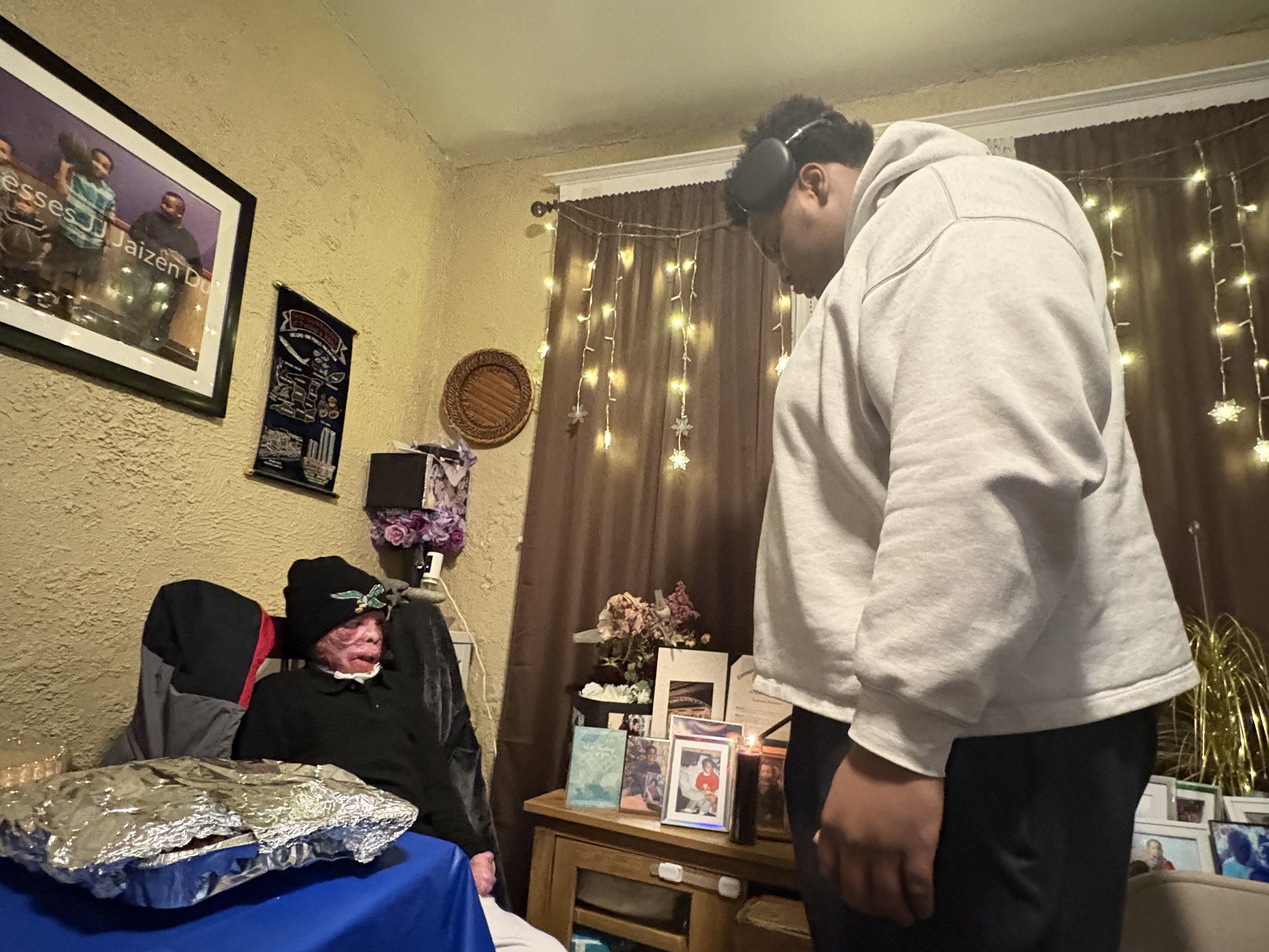
    Wongus, 26, was nervous to see Ramesses, unsure what to expect. On the night of the Jan. 31 crash, Wongus used his jean jacket to smother flames on Ramesses’ back. He then comforted Ramesses in the back seat of a police cruiser as they raced to St. Christopher’s Hospital for Children. The child’s clothes had burned away; his sneakers had melted to his feet from the heat.

    In the 10 months afterward, Ramesses fought for his life at a Boston hospital. He had 42 surgeries for burn wounds that affected 90% of his body, and had fingers and ears amputated. He was moved to a rehabilitation hospital in South Jersey before being released earlier this month.

    He reunited with his rescuer on Tuesday night at an event to mark what would have been the 38th birthday of Ramesses’ father, Steven Dreuitt Jr., who died when the car he was driving caught on fire.

    Family and friends gathered on the park’s basketball court to release balloons.

    Wongus asked Ramesses how he felt about getting swag from the Philadelphia Eagles and Phillies while in the hospital. “I’m really not much of a baseball fan; I’m more of an Eagles fan,” replied Ramesses, wearing a knit Eagles hat.

    The boy’s light and casual tone made Wongus smile.

    “I’m glad to see him with his family and to see how well he’s doing — seeing him just trying to function as a kid again and scooting around in the wheelchair on the basketball court,“ Wongus said.

    The balloon release was organized by Alberta “Amira” Brown, 60, Dreuitt’s mother and Ramesses’ grandmother. During the balloon release, she and Ramesses’ mother thanked Wongus for saving him.

    “If it wasn’t for this person here, Ramesses would not be here today,” Brown said, as family and friends applauded.

    Brown also asked those in attendance to support her son’s other child, Dominick Goods, an 11th grader at Imhotep Institute Charter High School in East Germantown.

    Both grandsons, she said, need the community’s love and support: “I have one that is completely, completely mentally distraught and one is physically distraught.”

    Dominick, who is Ramesses’ half brother, lost his father and his 34-year-old mother in the plane crash. Dominique Goods Burke, who was engaged to Dreuitt, was in the car’s passenger’s seat. The Mount Airy couple had picked up Ramesses from his mother’s home in Germantown and then headed to the Roosevelt Mall to run an errand. Goods Burke escaped from the car with severe burns and internal injuries.

    Dominick turned 16 two weeks before his mother died in April at Thomas Jefferson University Hospital.

    “I want each and every one of you to imagine what a 15-year-old kid went through that night, being left home alone and waiting for his parents and his brother to come home, and no one ever did,” Brown said.

    “Don’t forget my grandson Dominick. I beg of you,” she said.

    Dominick Goods, 16, lost both of his parents in the jet crash in Northeast Philadelphia on Jan. 31. The teen and his family gathered at a Mount Airy playground to celebrate what would have been his father’s 38th birthday. The teen’s grandmother, Alberta “Amira” Brown (right), asked those gathered to support him.

    After watching balloons float skyward amid shouts of “Happy birthday, Steven,” Dominick drifted away from the crowd of about 40 people for a few moments alone.

    Ramesses, bundled under a fuzzy white blanket, playfully chased after his mother, Jamie Vazquez Viana, in his wheelchair, teasing about rolling over her feet.

    “Hey, that’s not fair,” she said.

    She declined to talk to a reporter but has shared some details of her son’s recovery on a GoFundMe page.

    “Ramesses is my little warrior who fought death and won, but he now faces a lifetime of reconstruction surgeries, intense therapy, and long-term burn care,” Vazquez Viana wrote.

    Wongus smiled through tears as he watched Ramesses chat with his 12-year-old cousin, Anthony “AJ” Jenkins, about video games. His cousin, who gave him an Xbox game for his birthday in October, asked if he had been playing it.

    Ramesses explained why he had not. “I have to sign in and put in my dad’s email and his number and all that, and I don’t have that,” Ramesses told his cousin.

    Jenkins, a seventh grader who is one of Brown’s seven grandchildren, said he cried during the balloon release, envisioning his uncle watching them.

    Family, friends and community members came out for the balloon release to celebrate the life and birthday of Steven Dreuitt Jr., who would’ve turned 38 on Dec. 23. He died in the Jan. 31 plane crash in Northeast Philadelphia.

    “I imagined in my mind that my uncle asked God, `Can I just look down there for a minute?,’ and he sat on the clouds and he watched as his balloons came up to him,” Jenkins said.

    Later in the evening, at his grandmother’s house, Dominick lit a candle for his father, while Ramesses looked on.

    Jenkins said he again pictured his uncle’s spirit. This time, clasping both his sons’ hands to help them light it.

    Ramesses Dreuitt Vazquez, 10, watches his older brother, Dominick Goods, 16, light a candle to remember their father, Steven Dreuitt Jr., who died in the Jan. 31 plane crash in Northeast Philadelphia. The brothers celebrated what would have been their father’s 38th birthday on Dec. 23.

    Jenkins said he is awed by his cousins’ physical and emotional strength. Ramesses “keeps pushing hard” to get stronger, even though his father is gone. Dominick had clung to hope that his mother would survive and was devastated, the cousin said.

    “It’s been really hard for him. I couldn’t be in that place. I’d be stuck. I couldn’t be strong enough,” Jenkins said. “They inspire me to be a better person. I want to show my uncle and his two sons that I am working hard for them.”

    Before heading over to the playground on Tuesday evening, Dominick gave Ramesses an early Christmas gift.

    Ramesses’ eyes grew wide as his mother helped him unfurl tissue paper to reveal a coveted pair of 2025 Air Jordan 8 “Bugs Bunny” Nike sneakers.

    “You like them. I can see it on your face,” his mother said.

    “I’m gonna hide them,” Ramesses replied. He didn’t want anyone to take them from him.

  • 19 states and D.C. sue the U.S. Department of Health and Human Services over a move that could curtail youth gender-affirming care

    19 states and D.C. sue the U.S. Department of Health and Human Services over a move that could curtail youth gender-affirming care

    NEW YORK — Pennsylvania and New Jersey, along with 17 other states and the District of Columbia, on Tuesday sued the U.S. Department of Health and Human Services, its secretary, Robert F. Kennedy Jr., and its inspector general over a declaration that could complicate access to gender-affirming care for young people.

    The declaration issued last Thursday called treatments like puberty blockers, hormone therapy and surgeries unsafe and ineffective for children and adolescents experiencing gender dysphoria, or the distress when someone’s gender expression doesn’t match their sex assigned at birth. It also warned doctors that they could be excluded from federal health programs like Medicare and Medicaid if they provide those types of care.

    The declaration came as HHS also announced proposed rules meant to further curtail gender-affirming care for young people, although the lawsuit doesn’t address those as they are not final.

    Tuesday’s lawsuit, filed in U.S. District Court in Eugene, Ore., alleges that the declaration is inaccurate and unlawful and asks the court to block its enforcement. It’s the latest in a series of clashes between an administration that’s cracking down on transgender healthcare for children, arguing it can be harmful to them, and advocates who say the care is medically necessary and shouldn’t be inhibited.

    “Secretary Kennedy cannot unilaterally change medical standards by posting a document online, and no one should lose access to medically necessary healthcare because their federal government tried to interfere in decisions that belong in doctors’ offices,” New York Attorney General Letitia James, who led the lawsuit, said in a statement Tuesday.

    The lawsuit alleges that HHS’s declaration seeks to coerce providers to stop providing gender-affirming care and circumvent legal requirements for policy changes. It says federal law requires the public to be given notice and an opportunity to comment before substantively changing health policy — neither of which, the suit says, was done before the declaration was issued.

    A spokesperson for HHS declined to comment.

    HHS’s declaration based its conclusions on a peer-reviewed report that the department conducted earlier this year that urged greater reliance on behavioral therapy rather than broad gender-affirming care for youths with gender dysphoria.

    The report questioned standards for the treatment of transgender youth issued by the World Professional Association for Transgender Health and raised concerns that adolescents may be too young to give consent to life-changing treatments that could result in future infertility.

    Major medical groups and those who treat transgender young people have sharply criticized the report as inaccurate, and most major U.S. medical organizations, including the American Medical Association, continue to oppose restrictions on transgender care and services for young people.

    The declaration was announced as part of a multifaceted effort to limit gender-affirming healthcare for children and teenagers — and built on other Trump administration efforts to target the rights of transgender people nationwide.

    HHS on Thursday also unveiled two proposed federal rules — one to cut off federal Medicaid and Medicare funding from hospitals that provide gender-affirming care to children, and another to prohibit federal Medicaid dollars from being used for such procedures.

    The proposals are not yet final or legally binding and must go through a lengthy rulemaking process and public comment before becoming permanent. But they will nonetheless likely further discourage healthcare providers from offering gender-affirming care to children.

    Several major medical providers already have pulled back on gender-affirming care for young patients since Trump returned to office — even in states where the care is legal and protected by state law.

    Medicaid programs in slightly less than half of states currently cover gender-affirming care. At least 27 states have adopted laws restricting or banning the care. The Supreme Court’s recent decision upholding Tennessee’s ban means most other state laws are likely to remain in place.

    Joining James in Tuesday’s lawsuit were Democratic attorneys general from California, Colorado, Connecticut, Delaware, Illinois, Maine, Maryland, Massachusetts, Michigan, Minnesota, New Jersey, New Mexico, Oregon, Rhode Island, Vermont, Wisconsin, Washington and the District of Columbia. Pennsylvania’s Gov. Josh Shapiro also joined.

  • I’m a doctor. Here are 11 foods I recommend to fight inflammation.

    I’m a doctor. Here are 11 foods I recommend to fight inflammation.

    Q: Are anti-inflammatory diets backed by science? Can some foods really cause inflammation in my body?

    A: When my patients ask me about anti-inflammatory diets, they’re usually expecting me to talk about turmeric or the latest viral green drink. Lists of “toxic” foods are popular on social media — followed by advice to start the day with things like celery juice to help you “detox.” And while I’d love to say that a cup of blueberries a day will “turn off” inflammation, that’s not what the evidence shows.

    When researchers follow people for years or run clinical trials, it’s a dietary pattern that matters — not whether you drank ginger tea each day.

    The anti-inflammatory diet that multiple studies have shown works best is actually quite simple: vegetables, legumes, whole grains, olive oil, nuts, and fish. In one Spanish clinical trial, people were asked to eat more of these foods — and less processed meat and ultra-processed foods — and then watched as their inflammatory markers improved and their risk of heart attack and stroke fell.

    It’s essentially the Mediterranean diet. And — just to be clear — the Mediterranean diet is just a name. Its principles can be applied to many cuisines, from Mexican and Indian to Greek and Italian.

    While there’s no single magic solution, I’m going to share with you the foods scientists have linked to lower inflammatory markers in the blood. Think of these foods as a backbone to building a healthier habit.

    Anti-inflammatory foods

    These foods are rich in anti-inflammatory compounds, such as vitamins, beta-carotene, polyphenols, omega-3 fatty acids, and, of course, fiber. Aim to incorporate a variety of them into your routine most days of the week. When you’re planning a meal, think about emphasizing lots of plants, color and healthy fats.

    • Whole grains, such as whole wheat, oats or brown rice
    • Legumes, such as lentils, black beans and tofu
    • Probiotic foods, such as Greek yogurt or kefir
    • Green leafy vegetables, such as spinach or kale
    • Green or black tea, or coffee
    • Dark yellow vegetables, such as sweet potatoes, carrots or pumpkin
    • Spices, such as turmeric, ginger and garlic
    • Flavonoid-rich fruits, such as berries and citrus
    • Nuts and seeds, such as walnuts, almonds and chia seeds
    • Extra-virgin olive oil as your main cooking oil
    • Fatty fish, such as salmon or mackerel

    Pro-inflammatory foods

    These are the foods to treat more as occasional guests. In studies, they’ve been linked to cancer, heart disease, and the metabolic syndrome. That doesn’t mean you have to ban them outright. I encourage patients to think about how often these foods show up on their plates and whether there’s room to start making small swaps so they aren’t the main sources of your nutrients.

    • Ultra-processed foods, such as chips, packaged crackers, many frozen meals, and instant foods
    • Refined carbohydrates, such as white bread, sugary breakfast cereals or pastries
    • Red and processed meats, such as bacon, sausage, hot dogs, and deli meats
    • Sugar-sweetened beverages, such as sodas, sweet tea, and energy drinks
    • Fried foods and those high in trans fats and saturated fats, such as those found in many fast-foods and baked goods

    How foods can trigger inflammation in your body

    The idea that food can trigger inflammation in our bodies is backed by a growing body of science. Researchers can measure inflammation using blood tests for markers such as C-reactive protein or interleukin 6. Certain foods trigger bursts of sugar and triglycerides in the bloodstream, and the body responds by generating inflammation. When we eat those foods frequently, that inflammation can persist in our bodies at a low level.

    This can have far-reaching impact: In 2018, one team found that people who ate more foods associated with these inflammatory blood markers were more likely to develop unique colon cancers containing a particular bacteria, Fusobacterium nucleatum. The findings suggested that inflammation from the food we eat alters the gut microbiome and can contribute to how certain cancers develop.

    • An inflammatory diet has also been linked to:
    • A higher risk of obstructive sleep apnea
    • Developing gout, a type of inflammatory arthritis
    • Having a stroke or heart attack
    • More depressive symptoms and use of antidepressants
    • Dementia of all causes, including Alzheimer’s

    What I want my patients to know

    Think about what you’re going to add instead of subtract. Pick one of your go-to dinners: Can you add one extra serving of vegetables? How about a serving of fruit at lunchtime? Frozen veggies and canned beans are great add-ins that don’t break the bank. You can still enjoy foods you love while supporting an overall healthy pattern of eating — and you don’t need to chase every new anti-inflammatory tonic the internet throws at you.

    Trisha Pasricha is an assistant professor of medicine at Harvard Medical School and author of the forthcoming book “You’ve Been Pooping All Wrong.”

  • From undercover stings to a marijuana museum: Inside the haphazard crackdown on Pennsylvania’s smoke shops

    From undercover stings to a marijuana museum: Inside the haphazard crackdown on Pennsylvania’s smoke shops

    The word was out among Chester County teens: West Grove Smoke Shop wasn’t checking IDs.

    “Many students frequented it,” a student told a Pennsylvania State Police officer investigating how scores of local high schoolers were getting their hands on an array of marijuana products. “So many, in fact, that there were long lines at the smoke shop after school.”

    The tip — revealed in a grand jury report released in October — launched one of the largest stings of smoke shops in Pennsylvania this year. While those shops are allowed to sell hemp-based THC products that fall below a certain potency threshold, undercover detectives found widespread deception. After investigators made purchases from 19 stores in Chester, Delaware, and Lancaster Counties, lab tests determined all but one were selling unregulated marijuana falsely labeled as hemp.

    It was a striking, if rare, example of local law enforcement cracking down on smoke shops selling hemp-based THC products, which an Inquirer investigation this year found are often just black market weed, sometimes contaminated with harmful toxins and chemicals. Several teens in Chester County told police they got sick from such products, with one landing in the hospital.

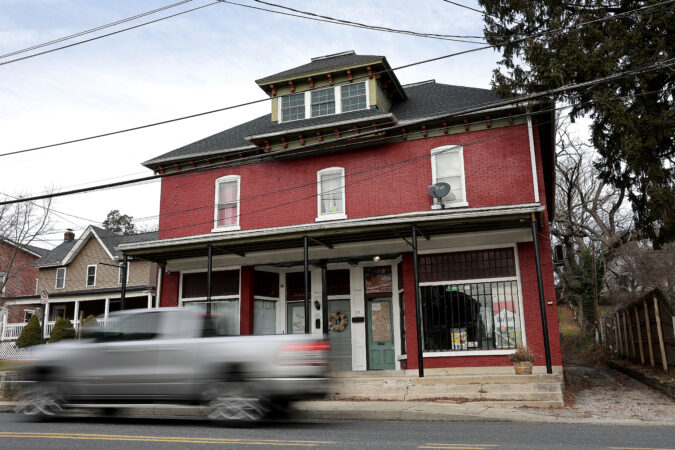
    A view looking into the front window of the former West Grove Smoke Shop in West Grove, on Sunday, Dec. 21, 2025.

    Confusion over federal hemp law, and the inability of lawmakers in Harrisburg to pass regulations in a state lacking a recreational cannabis program, has led to smoke shops popping up all over Pennsylvania. But the emerging effort to police these shops has so far been inconsistent and haphazard.

    Philadelphia City Councilmember Katherine Gilmore Richardson has advanced a series of bills designed to crack down on scofflaw operators, who typically pull fraudulent grocery store licenses to open up shop. An Inquirer analysis found that the city has taken a stricter approach to smoke shops that operate under grocery store permits while peddling drug products and paraphernalia — with investigators doubling violations for improper licensing over the last two years.

    “[It] marks important progress in the city’s efforts to better enforce against illegal smoke shops and nuisance businesses devastating our neighborhoods,” Gilmore Richardson said.

    But block after city block, smoke shops remain open and continue to operate with relative impunity — sometimes within view of a similar shop that authorities have closed down.

    Many use thinly veiled references in their names, such as “High Time Convenience” or “Hi Baby,” the latter featuring a logo meant to resemble the popular RAW rolling paper brand. Since 2022, nearly 100 zoning permits filed by the Frankford-based permit expediter Tina Accounting & Tax Services on behalf of would-be grocery store proprietors were later cited by inspectors as invalid, an Inquirer analysis found. (“There is no assumption that they are aware that these businesses may later become nuisance businesses,” a city official said.)

    With the city short of investigators, many shops simply reopen even after they are shut down. Philadelphia has cited at least 42 stores, many of them smoke shops, for resuming operations after receiving an official shutdown order from inspectors over the last two years. One store, Market Mini Mart, located in the shadow of the 52nd Street El station, was cited 10 times for illegally reopening, records show.

    City officials said the lack of a specific “smoke shop” permit makes it difficult to track the scope of the problem. Yet an Inquirer analysis of the city’s list of top 35 “nuisances businesses” found more than a third either had “smoke shop” in their names or advertised drug paraphernalia.

    Going after technical violations remains one of the few tools available to local authorities, short of conducting raids and lab tests to determine if the over-the-counter products comply with federal law.

    The supply line for smoke shops, however, could dry up next year. A provision in a federal spending bill would ban intoxicating THC products derived from hemp nationally, potentially closing a loophole that has created a glut of these quasi-legal products across the country.

    The grand jury investigation acknowledged that the growing number of smoke shops presents a daunting challenge. The lead investigator in the Chester County case “quickly realized the sheer number was overwhelming, and many stores were interconnected, operating across multiple counties,” according to the grand jury report.

    That investigation resulted in the September arrest of Satish Parsa, 33, the owner of three establishments, including the West Grove Smoke Shop, a redbrick storefront that now sits empty. Parsa faces more than 60 counts of drug trafficking and related charges, according to court records.

    His attorney, Elliot Marc Cohen, said Parsa, who has pleaded not guilty, intends to “vigorously” fight the prosecution.

    Ellie Siegel, CEO of Longview Strategic, a Philadelphia-area cannabis consultancy firm, argued that selective enforcement is ineffective.

    When the federal ban goes into effect late next year, she reasoned, many smoke shops will shut down as the supply line dries up, while others will attempt to pivot toward the regulated marijuana market.

    “The manufacturers won’t have a way to manufacture the intoxicating hemp products they’re making now,” she said. “It’s the closing of a loophole.”

    A sample of hemp-based THC flower that was purchased by The Inquirer and sent for lab testing this summer.

    The rise and fall of the Philly smoke shop

    In interviews with about a half dozen Philly-area smoke shop owners over the last month, several told The Inquirer that they are bracing for closure, saying survival is nearly impossible in an already saturated market.

    Others said they are confident they can endure.

    On South Street, more than a dozen smoke shops crowd the mile-long stretch east of Broad Street. The longtime operator of Munchies Reloaded recalled thriving years when bongs and pipes brought in roughly $600,000 annually, before he expanded into hemp.

    Now, he said, business has plunged nearly 80%. City inspectors have increasingly fined and shuttered stores for selling glassware used for smoking. Those items are easier to classify as “drug paraphernalia” prohibited by city codes, rather than quasi-legal hemp, which is superseded by federal laws.

    “There used to be good money in it,” said the store owner, who declined to give his name. “Now there is no money.”

    Smoke shops proliferated during the pandemic, often launched by marijuana enthusiasts, immigrant entrepreneurs, or small grocers looking to replace revenue lost to increasingly strict tobacco sale regulations.

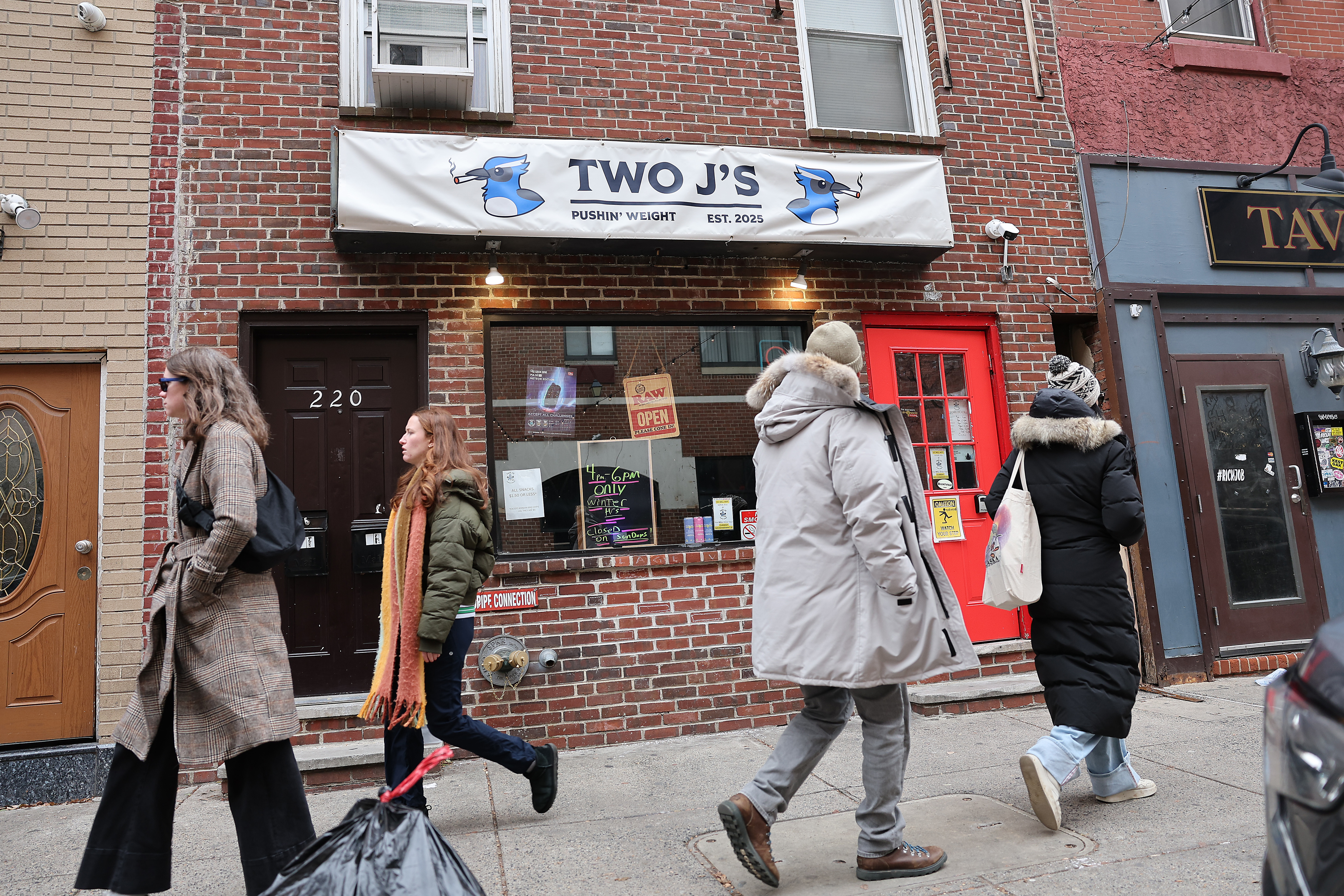
    Pedestrians walk along South Street by Two J’s Pushin’ Weight shop in Philadelphia, on Sunday, Dec. 21, 2025.

    Some shop owners have migrated to Philadelphia from the New York City area, lured by lower rents and higher demand in a state without legal recreational cannabis. A business permit for Green Broad Smokeshop on Broad Street, for instance, lists an owner based in Queens.

    At the peak, a single shop could net between $250,000 and $1 million annually, depending on foot traffic and product line, according to two owners who spoke with The Inquirer on the condition they not be named so they could speak frankly about their businesses. Low overhead and high demand made for a tempting copycat model — a cheap pound of hemp might cost $600 in bulk but retail for more than $5,500.

    On the same block as Munchies Reloaded, Abtein Jaeger and his brother in January opened Two J’s Pushin’ Weight. Jaeger said he sources high-grade hemp from West Coast farmers, positioning his store as a premium dispensary amid competitors selling a lower-quality product.

    He said he is upbeat about surviving a potential crackdown on stores like his next year.

    “It’s not the worst thing in the world,” Jaeger, 34, said.

    He added that he would comply with any testing requirements and try to apply for a license, and that he already enforces a 21-plus age limit.

    Reforming the Wild West of weed

    Unlike in state-run cannabis programs, which mandate costly contaminant testing, hemp products need only carry a certificate of authenticity showing the flower tested under 0.3% Delta-9 THC at harvest.

    The Inquirer, in its investigation earlier this year, commissioned a lab to test 10 products. Nine of them exceeded that limit, and most were tainted with banned pesticides, harmful mold, or heavy metals. Manufacturers had also used forged certificates to make their products appear safe and legitimate, The Inquirer found.

    But the complexity of federal drug law makes it difficult to prove products are illegal, as many hemp-based products use THC variants like Delta-8 or Delta-10 that are not specifically banned.

    For now, most shop owners say, local police leave them alone. Undercover stings, like those led in the suburbs, remain rare because they demand expensive lab testing and significant resources.

    One South Street establishment has a singular strategy for surviving a potential crackdown.

    South Street Cannabis Museum, whose logo includes a Liberty Bell festooned with marijuana leaves, exhibits a small collection of Reefer Madness-era newsprint, historical pamphlets, and other weed-themed memorabilia.

    Exterior view of South Street Cannabis Museum in Philadelphia, on Sunday, Dec. 21, 2025.

    “We are a museum, first and foremost, where we can engage with the public about the history, science, culture, and art of cannabis,” said owner Kristopher Wesolowski, 42, a former neuroscience lab manager and event planner, who pivoted into hemp sales after the pandemic.

    The back half of the museum is a gift shop where visitors can buy hemp-derived THC flower under glass display cases.

    “It’s almost like a simulated dispensary,” Wesolowski said. “But it’s not like some spot where people can just go and get high. … You can get historically stoned at our museum, in a sense.”

    Like other proprietors, Wesolowski said the hemp industry has been “screaming for regulation,” as “bad actors” gave well-intentioned store owners a bad name.

    But he also cautioned that overregulation would only create new problems, like increasing demand for unpredictable designer drugs on the black market.

    “When you close one door, another will open,” he said. “And that one might be a little bit more dangerous.”

    This article was supported by the Fund for Investigative Journalism

  • Philadelphia sues drugmakers and pharmacy benefit managers over high insulin costs

    Philadelphia sues drugmakers and pharmacy benefit managers over high insulin costs

    Philadelphia is suing a host of drug manufacturers and pharmacy benefit managers in federal court, alleging that they conspired to increase insulin prices to drive sky-high profits as patients struggled to afford life-saving medications.

    City officials said rising diabetes medication prices have caused the city to “significantly overpay” for diabetes medication for city employees and their families, noting in a news release that insulin prices have increased from $20 per vial in the 1990s to $300 to $700 per vial today.

    About 14% of adults in Philadelphia have diabetes, the city said.

    “Philadelphia suffers from one of the highest rates of diabetes in the United States, especially in our Black and brown communities,” Health Commissioner Palak Raval-Nelson said in a statement.

    “When people cannot afford their insulin, they frequently go without or cut back, leading to disastrous consequences both for themselves and Philadelphia as a whole. Their lives are degraded, and we all pay the associated health costs.”

    The suit, filed Tuesday, follows similar litigation filed by District Attorney Larry Krasner in 2024. Hundreds of companies, unions, and other local and state governments, including Bucks County, have also filed suit alongside Philadelphia as part of a wide-ranging lawsuit in federal court in New Jersey, the city said.

    In the suit, the city accuses drugmakers and pharmacy benefit managers, or PBMs, of colluding to drive up profits on diabetes drugs. PBMs work with drug manufacturers, insurers, and pharmacies, negotiating prices and developing formularies — lists of prescription drugs that are available on a given insurance plan.

    To ensure their drugs were included on formularies, drug manufacturers increased prices on diabetes drugs and then paid “a significant, yet undisclosed” portion of the resulting profits back to the PBMs, the city’s lawsuit said.

    That meant lower-priced or generic diabetes medications received “less favorable placement” on formularies, passing higher costs onto consumers, according to the lawsuit.

    The suit names nearly two dozen prominent drugmakers and PBMs, including Eli Lilly & Co., Optum RX, Sanofi, Novo Nordisk, and CVS Caremark. Optum officials did not immediately return a request for comment.

    In a statement, a Lilly spokesperson said the company has worked for years to lower costs for people with diabetes by capping prices at $35 per month. The average out-of-pocket Lilly insulin cost was $14.86 a month for patients in 2024, the spokesperson said.

    “These copycat lawsuits are baseless,” the spokesperson wrote.

    Sanofi officials declined to comment on the allegations but said in a statement their “pricing practices have always complied with the law.” The company said it works to lower costs for patients, but that in the U.S. healthcare system, “savings negotiated by health insurance companies and PBMs” aren’t often reflected in patients’ co-pays.

    CVS officials said in an email that “pharmaceutical companies alone” are responsible for setting insulin prices and that they would welcome efforts from drug manufacturers to lower prices.

    “Allegations that we play any role in determining the prices charged by manufacturers for their products are false, and we intend to vigorously defend against this baseless suit,“ officials said.

    Novo Nordisk officials similarly called the allegations in the suit “meritless” and said the company has a number of initiatives to make insulin more affordable for patients.

    Staff writer Sarah Gantz contributed to this article.

  • Republican former senator Ben Sasse says he has terminal cancer

    Republican former senator Ben Sasse says he has terminal cancer

    Former Republican senator Ben Sasse of Nebraska said Tuesday that he was diagnosed with terminal cancer and suggested he would not have long to live.

    “Last week I was diagnosed with metastasized, stage-four pancreatic cancer, and am gonna die,” Sasse wrote in a lengthy social media post Tuesday morning. “Advanced pancreatic is nasty stuff; it’s a death sentence. … Death is a wicked thief, and the bastard pursues us all. Still, I’ve got less time than I’d prefer.”

    Sasse, 53, was first elected to the Senate in 2014 as a political newcomer — he had previously served as president of Midland University in Nebraska. Sasse handily won reelection in 2020 but resigned from his seat partway through his second term to become president of the University of Florida. Sasse abruptly stepped down from that post last summer, citing concerns about his wife’s health.

    Nearly a year and a half later, Sasse said it was he who was facing grim news about his health. His terminal diagnosis, he wrote Tuesday, was “hard for someone wired to work and build, but harder still as a husband and a dad.”

    “I can’t begin to describe how great my people are. During the past year, as we’d temporarily stepped back from public life and built new family rhythms, [my wife] Melissa and I have grown even closer — and that on top of three decades of the best friend a man could ever have,” Sasse wrote.

    He continued by listing the achievements of his three children and hinted at undergoing possible treatments.

    “I’m not going down without a fight. One subpart of God’s grace is found in the jaw-dropping advances science has made the past few years in immunotherapy and more,” he wrote. “Death and dying aren’t the same — the process of dying is still something to be lived. We’re zealously embracing a lot of gallows humor in our house, and I’ve pledged to do my part to run through the irreverent tape.”

    After Donald Trump was elected to his first term in 2016, Sasse became an outsider in his own party. He was one of a handful of Republican senators who regularly spoke out against Trump and who tied Trump’s rhetoric and actions to the violent siege of the U.S. Capitol on Jan. 6, 2021. Trump periodically attacked Sasse, ridiculing him as “the least effective” GOP senator and calling him a “RINO,” or Republican in name only.

    Sasse was also one of the few GOP senators who supported moving forward with Trump’s impeachment trial. Because of that, Sasse faced the threat of censure in 2021 from the Nebraska Republican Party, which accused Sasse of, among more than a dozen purported offenses, having “persistently engaged in public acts of ridicule and calumny” against Trump. Sasse pushed back in a video message directed at party leaders.

    “Let’s be clear: The anger in this state party has never been about me violating principle or abandoning conservative policy. I’m one of the most conservative voters in the Senate. The anger’s always been simply about me not bending the knee to … one guy,” he said then.

    Ultimately, the Nebraska GOP voted to rebuke Sasse, stopping short of a censure. Though Sasse at one point considered leaving the Republican Party, he said he would remain “committed to the party of Lincoln and Reagan as long as there is a chance to reform.” In subsequent years, he described himself as an “independent conservative.” Earlier this month, he was named a nonresident senior fellow at the American Enterprise Institute, a conservative think tank.

    Public figures from across the political spectrum responded to Sasse’s announcement on Tuesday to wish him well.

    “I’m very sorry to hear this Ben. May God bless you and your family,” Vice President JD Vance wrote on X.

  • Feeling wonder every day improves our health. Here’s how to do it.

    Feeling wonder every day improves our health. Here’s how to do it.

    I just had a most eventful week.

    I watched in horror as a terrible storm in the Mediterranean dashed a ship against a rocky coast, forcing its crew and passengers into a desperate attempt to save themselves and rescue their cargo.

    I soared with the birds among snow-covered peaks in the Rockies, marveling at the many shades of white and blue.

    And I joined picnickers on a serene hillside along the Hudson River, where I watched the sunlight and clouds play above a sheep pasture and a tiny village beyond it.

    What’s more, I did all of this in just 90 minutes at the National Gallery of Art in Washington. I took the museum’s “Finding Awe” tour and, with the help of staff, unlocked a sense of wonder I did not know I could feel while looking at art — in this case, a 1772 shipwreck scene by Claude-Joseph Vernet, a 1946 abstraction by Georgia O’Keeffe, and an 1860 landscape by Jasper Francis Cropsey.

    The West and East Buildings of the National Gallery of Art.

    The National Gallery, working with University of California at Berkeley psychologist Dacher Keltner, has so far hosted 36 awe tours for the 800 people lucky enough to get a slot. You can also take a self-guided awe tour using the museum’s tools, or apply the same techniques to experience wonder while looking at art anywhere.

    A growing body of evidence demonstrates that the experience of awe that visual arts can trigger has mental and physical health benefits for us. They are similar to the restorative effects produced by awe-inspiring natural settings, such as a mountain vista or open sea, but we can access them more easily. The best part is you don’t need to know anything about the art you are looking at.

    “In some ways I think it’s actually easier if you don’t have an understanding,” National Gallery of Art Director Kaywin Feldman told me, because “that moment of ‘oh my goodness’ is part of wonder. You have to sort of stop in your tracks, have that moment of surprise.”

    This was excellent news for me, because that one semester of art history I took in college didn’t stick. Until now, the primary feeling I’ve had when visiting a museum has been drowsiness. I call it “museum head.” I race through one of the world’s best collections — the Louvre, the Uffizi, the Prado, the Met — and glimpse as many works of art as I can take in until, overstimulated and overwhelmed, I find a seat near the gift shop and wait for the others in my party to finish.

    But now I know the cause of museum head: I was doing it all wrong. The way to experience awe in visual art — in fact, the way to experience awe in any setting — is to slow down. The point is not to see it all but to see a few things, or even one thing, deeply.

    Kaywin Feldman, director of the National Gallery of Art, talks about a self-portrait by Rembrandt.

    Feldman’s first such awe experience came in Padua, Italy, when she was 22 and, though hungry, tired, and dirty from her travels, she decided to see the Giotto de Bondone frescoes in the Scrovegni Chapel. “When I walked out of that chapel, I felt like I was walking on a cloud,” she recalled. “I thought life was so beautiful, such a gift. I fell back in love with humanity and felt such optimism for the future.”

    Since then, she has made it her life’s work to help others experience such moments of wonder. She told me she once kicked a pair of donors off a Florence art tour when they declined to visit the Uffizi because they already “did it” decades earlier. “You’re there to have an experience, not to check something off the list.”

    To illustrate, she took me to see a 1659 self-portrait by Rembrandt and instructed me to study his face, brightly lit while all else in the painting was in shadow. His dark eyes locked on mine even as I moved from side to side. I studied the wrinkles in his forehead, the folds under the eyes, the loose flesh in the pallid cheeks. I could see a blood vessel on his bulbous nose, the whiskers of his thin beard and the individual curls in his hair. I saw sadness and maybe worry in that face.

    After I took that in, Feldman explained the sadness. Rembrandt, 53 in the portrait, had just gone bankrupt and had to move from his home and sell his possessions. He had lost his wife and several children and had a financial dispute with a partner. “He’s looking at you and connecting and asking you to acknowledge him,” she said. For her, the wonder comes from this “direct connection with somebody who is no longer alive.”

    I held the great man’s gaze from across the centuries and I felt a chill. This connection to immortality made my daily vanities and worries seem small and insignificant. It reminds us, as Feldman put it, that we are “part of something bigger.”

    Physiological responses

    New research out of King’s College London gauged people’s physiological responses while they viewed works by Paul Gauguin, Vincent van Gogh, Edouard Manet, and Henri de Toulouse-Lautrec for 20 minutes. The study, now in preprint, found that participants’ levels of the stress hormone cortisol dropped by 22% on average, while markers of inflammation dropped even more sharply and heart rhythms indicated greater relaxation.

    This is consistent with other recent research connecting immersion in visual art to human flourishing, including by reducing pain and illness, raising levels of neurotransmitters associated with well-being such as serotonin and oxytocin, and increasing feelings of altruism and cooperation.

    “Simply slowing down to take in the simple beauties around us is an antidote to the moral ugliness of our attention-captured, online life, and visual art and the spaces of such contemplation a gym for such training,” Keltner writes in a forthcoming book.

    “It’s mind-blowing,” the Berkeley psychologist told me, “that experiencing awe standing in front of a painting makes you feel more compassionate … and it makes you more interested in being a good citizen.”

    In a sense, science is catching up with philosophy. The 13th-century thinker Albertus Magnus wrote that “wonder is defined as a constriction and suspension of the heart caused by amazement at the sensible appearance of something so portentous, great, and unusual, that the heart suffers a systole.”

    So how can we induce that systole, or contraction, of the heart?

    Nathalie Ryan, who runs the “Finding Awe” project, poses in front of “Autumn — On the Hudson River,” an 1860 painting by Jasper Francis Cropsey.

    For some, awe will be found in the oldest art, which allows us to meet the ancients. For others it will be in the Impressionists, because they are crowd pleasers. Some find it standing back from a piece and thinking abstractly, while others find it by studying intricate detail. In all cases, it’s better if you don’t read up on the work of art beforehand, or even read the label. Just stop at something that catches your eye — and study it for 10 minutes or longer.

    Nathalie Ryan, who runs the “Finding Awe” project at the National Gallery, has been working with the Harvard Graduate School of Education to bring the concept of “slow looking” to the art world.

    “The research that we’ve done for years with Harvard has shown that the longer you look at something and give it your attention and really work to make sense of it yourself and connect, the more curious you become,” Ryan said. Curiosity, in turn, leads you to states of wonder and awe.

    So Ryan and colleague Cassandra Anderson start the awe workshops with breathing exercises and a 15-minute icebreaker in which participants describe to each other moments of awe they have experienced. She then turns to the session’s piece of artwork, starting with 35 minutes of quiet meditation (“linger in the pleasure of just looking … taking in all the details of this work”) followed by a group discussion about emotions and impressions and possible symbolism and metaphors. Only when that is done does Ryan take 15 minutes to provide information about the work’s history and common interpretations, which participants then reflect on for the final 15 minutes.

    In terms of brain science, Keltner explained, the slow looking activates the amygdala, which processes emotions, and the periaqueductal gray matter, which regulates autonomic functions such as heart rate and breathing.

    “You let those images and forms move into your feelings, and you remember things, and it calls to mind images of your childhood or a place you’ve been, and you start to transport,” he said. But once you start learning about the work’s history, the action moves to the prefrontal cortex and its organizing function — and the awe process quiets down.

    The National Gallery produced a set of two dozen flash cards that allow people to take a self-guided awe tour. The selections range from the 17th to the 21st century and each contains a series of prompts to help you find awe.

    Johannes Vermeer’s A Lady Writing comes with a prompt to “write a letter to your future self.” John Constable’s Cloud Study encourages us to go outside and watch the clouds and “contemplate their transient beauty.” Archibald John Motley Jr.’s Portrait of My Grandmother invites us to “remember a mentor’s advice” and contemplate “how might you pass this wisdom along.”

    Some of the works inspire awe by conveying the power of nature, or the moral beauty of its subject, or by making us contemplate spirituality or themes of life and death. But in all cases, Ryan said, “it’s a way of looking more deeply at ourselves and coming to understand ourselves in relationship to this world.”

    If you can’t visit the National Gallery, you can use these prompts when looking at art wherever you live. Just find something that resonates with you — and skip the audio tour.

    Hits and misses

    After the Rembrandt, my awe guides took me to see a work by sculptor Dario Robleto, Small Crafts on Sisyphean Seas. It is an intricate collection of seashells, urchin spines and teeth, coral, tusks, claws, butterfly wings, and more, all arranged with precision and symmetry. The artist intended it as his “gift for the aliens, when we meet them,” as Feldman explained it. For some, it might provoke awe-inspiring thoughts about space and extraterrestrial life and induce them, as the flash card put it, to “meditate on the interconnectedness of all things.” But I found it a bit too abstract to transport me. We moved on, sampling other works featured in the finding-awe tours.

    I felt more of a connection when we visited O’Keeffe’s A Black Bird With Snow-covered Red Hills. Here, I was soaring with an oddly shaped bird in a blue sky, looking down at the blue fading to white where two snow-covered hillsides formed a “V.” It was exhilarating. And puzzling. After a few minutes, Ryan gave me some context: The bird was a nod to the artist’s late husband, Alfred Stieglitz, called by the nickname “Old Crow,” who had died just before O’Keeffe painted the work. Some see loneliness and loss. O’Keeffe herself described “the snow-covered hills holding up the sky,” and the black bird “always there, always going away.”

    I came still closer to finding awe in Vernet’s The Shipwreck, which the artist paired with a tranquil harbor scene as pendants, Moonlight. The latter filled me with calm: A full moon illuminated the sea, which made barely a ripple as it touched the shore, where people slept, smoked, washed, or stood around a campfire.

    But the tranquility only accentuated the terror in the shipwreck scene, where people clung to the crow’s nest of the submerged ship and tried to slide down a rope to safety. Huge waves crashed on the nearby rocky shore, winds splintered the bough of a tree, and a lightning bolt made a fiery patch in an otherwise dark sky.

    After I took in the scenes, Ryan explained that Vernet, influenced by Edmund Burke’s Philosophical Inquiry Into the Origins of Our Ideas of the Sublime and the Beautiful, was contrasting calm beauty with the frightful sublime. A quarter-millennium later, the terror still chilled me.

    Claude-Joseph Vernet’s “Moonlight,” also a 1772 painting, is paired with his work “The Shipwreck” at the National Gallery.

    It was in Cropsey’s Autumn — On the Hudson River, however, that I found my true awe moment. The massive panorama, five feet high and nine feet across, invited me in and held me there.

    I was on a shaded hillside on a warm autumn afternoon, looking down toward the village and river beyond. I heard a gurgling waterfall in the foreground and smelled the earthy decay of fallen trees and leaves. A trio of hunters enjoyed a picnic on a blanket, a bottle of wine in their basket, while their dogs rested. I moved on into the scene, past the red-winged blackbird and the paper birch, past the cattle in the stream and the sheep dotting the pasture, to the kids and dogs on a wooden bridge. Ahead of me, a man on horseback passed a log cabin and headed down the road toward the village, where wood smoke rose from chimneys. Sailing ships and steamboats plied the river, framed by low clouds on the far shore and a rocky mountainside. Streaks of sunlight streamed from behind a cloud, igniting the gold and scarlet leaves.

    It brought me thoughts of my grandparents’ house in the woods, then thoughts of my grandfather, and of how his love of the land became part of my life. I wanted to linger in the now-lost woodlands and wetlands in the painted landscape. In my chest, I felt a deep yearning, almost an ache.

    The National Gallery staff, in its follow-up surveys of awe tour participants, found that 95% of respondents sought more awe in their daily lives, and half reported that they experienced more awe. I can confirm these findings.

    In the days after my visit, I found myself pausing to marvel at things I often take for granted: A Christmas fern poking through the snow, the intricate forms of lichens on a tree, a sweet birch clinging to a rocky hillside, the pink and orange in a winter sunset, the power of a house-rattling windstorm. The more you seek awe, the more you find it.

  • 7 home remedies to try for a sore throat

    7 home remedies to try for a sore throat

    Woke up to a sore, scratchy throat? You may want to blame it on dry air, but it’s usually a sign your body is fighting a viral infection.

    “The top five causes of a sore throat are a virus, a virus, a virus, a virus, and a virus,” said Elisabeth Fowlie Mock, a family physician and director at the American Academy of Family Physicians. The culprits that can trigger a sore throat include rhinoviruses (the most common cause of colds), influenza, coronavirus, and respiratory syncytial virus.

    Throat pain is often your first symptom because viruses first latch on in this area of your body, said Benjamin C. Tweel, an assistant professor of otolaryngology at the Icahn School of Medicine at Mount Sinai.

    “The virus is getting into the cells lining the throat, and it’s probably causing an inflammatory response in your body’s immune system,” said Tweel, also the medical director for the department of otolaryngology at Mount Sinai Health System. When the body recognizes a viral intruder, lymphatic tissue in the back of the nose and throat swells and becomes inflamed, causing pain, the experts said.

    “Every so often, your body fights it off, and you don’t get the full-blown thing,” Mock said. Other times, the classic symptoms of an upper respiratory infection follow, including a runny nose, congestion, and cough.

    Throat pain from an upper respiratory infection usually gets better within one week, according to the Centers for Disease Control and Prevention. Over-the-counter pain relievers such as ibuprofen or naproxen can help, and they may have an advantage over medications such as acetaminophen, Tweel noted, because they reduce pain and inflammation. And of course, there are some home remedies that may soothe your pain. Here are a few to consider:

    Saltwater gargle

    Salt water has long been considered a tried-and-true approach for sore throats, and there is some scientific research to support it. A small 2019 randomized controlled trial, published in the Journal of Complementary and Alternative Medical Research, found that people with nonbacterial sore throats who gargled with salt water had less severe pain and difficulty swallowing one week later compared with those who used thymol solution, a type of antiseptic gargle or mouthwash.

    It’s possible salt helps reduce tissue swelling in the throat, said Cameron Wick, an otologist and neurotologist at University Hospitals. “When you do a saltwater rinse, it’s basic high school chemistry and the whole process of osmosis,” he said. “Some of the water in the cells in your throat actually come out of your tissue and go into the salt solution, so that decreases some of the inflammation.” Saltwater gargling “probably also helps wash out debris and virus particles,” Tweel added.

    The research is limited, but saline gargling “is highly unlikely to be harmful,” Mock said. “It might help a little bit, and it’s probably not going to hurt.” A safe ratio is 1 teaspoon of salt for every 8 ounces of warm water, Wick said.

    Saltwater rinses may have other benefits. If you’re experiencing thick mucus, congestion, or symptoms of allergies, an over-the-counter saline spray or nasal irrigation device can clear out your nasal passages for easier breathing, Wick said. These products also help hydrate the nasal passages and reduce swelling.

    Only use water that is distilled, sterile, or boiled and cooled in nasal irrigation devices, since tap water may contain germs that are dangerous if they enter your sinuses.

    Honey

    Honey is known for its antibacterial properties, Wick said, and its thickness may shield your sore throat from further irritation. It should feel good on the throat or a mucosal membrane, he explained. Honey acts as a barrier, so the throat isn’t “exposed to the elements in general and passing liquids and air.”

    There’s some research to support honey’s use for the relief of upper respiratory infection symptoms such as a sore throat and cough. One small 2023 study also found that gargling with honey — 15 milliliters of honey mixed in 5 ml of water — helped ease pain from a tonsillectomy, or surgery to remove the tonsils.

    Honey can also be an option for children with sore throats and coughing who are at least 1 year old. The American Academy of Pediatrics recommends it instead of over-the-counter medications for children, since there’s little evidence cold medicine offers much benefit to kids younger than 6.

    “As long as they’re over 1 year old, a little bit [of honey] in warm liquid or a teaspoon of honey” may help ease kids’ sore throats and help them sleep better, Mock said. You should never give honey to babies under 12 months because of the risk of infant botulism, a rare but dangerous condition.

    Tea

    Sipping a cup of tea feels good on a sore throat, but not all types are recommended when you have an upper respiratory infection.

    “Make sure it’s a non-caffeinated tea,” Wick said. “Black teas, those really tannic teas, often have a relatively high caffeine level, and caffeine does things to your kidneys that makes you urinate more and can actually dehydrate you.”

    There have been limited studies linking herbal teas to reduced throat pain; chamomile, ginger, and turmeric tea are particularly good options, Wick said.

    To give your tea a sore throat-soothing boost, squeeze in honey and lemon. The citrus fruit “adds vitamin C, which has immune support, and increases saliva production,” Wick said. The latter is beneficial because it may help saliva glands in your mouth and throat (there are “hundreds of minor ones underneath the mucosal surface,” he said) flush themselves, so “rather than thick, congested mucus, it’s thinner, and the body can handle it more.”

    Warm beverages

    If you’re not a tea drinker, other warm beverages such as warm water, bone broth, vegetable broth or soup may be similarly soothing. “There’s a kind of calming effect that occurs with warm water,” Wick said.

    Warm beverages may also be easier to drink and thus can increase your overall hydration. “[This] is probably one of the better things you can do for a sore throat,” Tweel said. “The drier you are, the worse your throat is going to be.”

    Plus, as long as it doesn’t contain ingredients that irritate the throat, soup can be comforting, Mock added.

    Cool foods

    Some people prefer cool foods such as ice chips or ice pops for a sore throat, especially if they’re experiencing more significant throat pain, Wick said. After a tonsillectomy, “kids get to binge on ice cream and Popsicles. Usually that is because the coolness calms down those pain fibers and nerve endings,” he said.

    There’s little research on cold foods for sore throats caused by upper respiratory infections, but some studies suggest cooling therapies might help ease throat discomfort after medical procedures such as intubation and surgery.

    Using a humidifier

    Dry air can make your nose, mouth, and throat feel scratchy and uncomfortable. “This is part of the reason why people feel worse sometimes immediately after flying on a plane,” Tweel said. Running a cool-mist humidifier or vaporizer may ease some of that scratchiness when you have a sore throat.

    The big caveat is you have to keep these devices clean. “I personally don’t use one because I find it hard to keep it sanitized,” Tweel said. Mold and bacteria can proliferate in portable humidifiers, and breathing in that germ-containing mist could make you sick.

    The CDC recommends cleaning your humidifier regularly according to the manufacturer’s instructions, emptying the water tank daily, and using distilled or boiled and cooled water, which are less likely to cause germ growth.

    If cleaning a humidifier feels too burdensome, you can get similar benefits from a steamy shower or inhaling the steam that comes off boiling water or a cup of tea, Tweel said.

    Lozenges

    For adults, lozenges or cough drops “help your throat produce more saliva,” Tweel said, which can in turn reduce dryness. “So much of the soreness [of a sore throat] is being dry or dehydrated,” he said, “so if you can do anything to combat that dryness, it will be helpful.”

    There are many varieties available, and “essentially whatever feels good is worthwhile,” Tweel said, but some people are partial to the cooling sensation from menthol or eucalyptus lozenges.

    Lozenges or cough drops shouldn’t be given to children under 4 years old, since they are choking hazards.

    When to see your doctor for a sore throat

    A sore throat typically lasts a few days, then starts to get better, Mock said. After that, you’re likely to have a runny nose and congestion, followed by a chest cough. “That’s a normal upper respiratory infection,” she said. “As long as it’s progressing and not getting worse, [the virus] can take a week or two to run its course.”

    But a sore throat sometimes warrants a doctor visit. You should make an appointment with your primary care practitioner if you have a fever along with throat pain, severe pain, or difficulty breathing or swallowing, or if you notice white patches on the back of your throat or “any major asymmetry, meaning a size difference between your tonsils,” Wick said. These might signal a bacterial infection such as strep throat, which may require antibiotics.

    Long-lasting throat pain is also worth getting checked out. “Should you have a severe sore throat for more than seven days? No, it should be getting better by then,” Mock said.