Playing music, dancing, creating art — and even playing some types of video games — aren’t just immersive and emotionally rewarding. They may actually slow down brain aging, a new study suggests. By analyzing brain activity data, the researchers found that engaging in creative pursuits of all kinds is linked to a younger-looking brain. The study was published by Nature Communications in October.
“This is not just a solution for the da Vincis of the world. Anyone can benefit from having a creative hobby, not just geniuses or professional artists,” said study author Agustín Ibáñez, director of the Latin American Brain Health Institute at Universidad Adolfo Ibáñez. “We are living in a world full of stress, uncertainty, and despair. Creating a little bubble through art or music can have a positive impact on your brain health.”
Delayed aging
The researchers analyzed imaging data of brain activity taken from 1,467 healthy participants from around the world, including tango dancers, musicians, visual artists, and strategy video game players. To quantify brain aging, they used brain clocks, which are computational models that can estimate the difference between a person’s chronological age and their brain’s biological age.
“We use brain connectivity metrics to predict your brain age, and there is a gap between this estimated age and your real age,” Ibáñez said. “This gap is informative for assessing accelerated or delayed brain aging.”
Accelerated aging of the brain, as indicated by a person’s brain appearing older than their actual age, has been observed in some people with psychiatric and neurological conditions. In the current study, Ibáñez and his colleagues wanted to investigate what other factors are associated with delayed brain aging.
The researchers found that all four creative and challenging pursuits they looked at — dance, music, visual art, and strategy video games — were associated with delayed brain aging. And greater expertise and performance level seemed to help. Experts with years of practice had younger brains compared with hobbyists. Out of all participants, highly skilled tango dancers seemed to have the most youthful brains — an average of seven years younger than their chronological age.
However, even participants who learned a creative skill managed to reap some antiaging benefits. The researchers trained 24 people to play “StarCraft II,” a video game that requires strategic thinking and imagination. A control group was trained in “Hearthstone,” a rule-based video game with limited improvisation and creative play. After 30 hours of training, spread over three to four weeks, the “StarCraft II” group showed slower brain aging compared to the “Hearthstone” group.
The study used strong, well-validated methods, and its findings align with previous research showing that participation in the arts is related to younger biological age, said Daisy Fancourt, a professor of psychobiology and epidemiology at University College London.
“There have been increasing studies identifying associations between arts engagement and both cognitive preservation and delayed time to dementia onset,” said Fancourt, who was not involved in the research. “So while replication of the findings in this new paper in other data sets will be important, they overall reinforce the importance of continued research on the health benefits of the arts.”
Protective effects even from passive activities
Even taking in art made by others — such as going to a concert or play — may have protective effects that help buffer against age-related cognitive decline. Other research suggests such receptive arts engagement may help preserve cognitive function in later life.
In a 2022 study, Jill Sonke, a research professor in the Center for Arts in Medicine at the University of Florida, and her colleagues analyzed data from 4,344 older adults based on six cognitive tests given in 2004 and 2011. While test performance slightly declined overall in the seven years from baseline to follow-up, engaging in receptive arts activities (such as going to a concert, play, or museum) for up to three hours a week was associated with better subsequent memory.
A more recent study published in 2025 found that engaging in cognitively stimulating activities has a wide array of cognitive benefits, such as improved memory, better language ability, and improved executive functioning.
The findings originate from the Long Life Family Study, a research project focused on families that have multiple people living into their 90s to uncover the biological, environmental, and behavioral factors that contribute to healthy aging. Older adults without a history of family longevity who frequently participated in hobbies such as reading and attending concerts, plays and musicals were able to match the same level of good cognitive functioning as those with familial longevity.
“Even if you don’t have exceptional longevity in your family, what our results show is that you still can improve your chances for cognitive health by taking part in cognitively stimulating activities,” said Stacy Andersen, an assistant professor of medicine at Boston University’s Chobanian & Avedisian School of Medicine, and lead author of the September study. “There’s no time like the present to learn something new — like photography or how to play guitar — that can also help protect your future brain.”
How to benefit from creative arts
Here are some tips from experts on nurturing a creative activity:
Cultivate your flow state. Ibáñez thinks creativity’s power comes from entering the flow state, where stress and time fade away. Lean into activities and experiences that keep you fully engaged and deeply focused. “To truly have a creative experience demands focus, attention, and practice,” he said.
Participate in a hobby club or group. Having strong social connections is also linked to healthy aging, and a shared creative activity is one way to bond with others in your community.
Combine creativity with movement. “Some hobbies such as dance not only engage the mind but also engage the body,” Andersen said. “Anything that keeps your heart healthy is going to also help keep your brain healthy.”
Know that it’s never too late. Being excited to work on a creative project or hobby can provide a strong sense of purpose and fulfillment, particularly in retirement. At age 54, Sonke learned how to sing and play guitar. “It was just amazing taking up a new art form in midlife,” said Sonke, now 59. “I don’t strive to be a professional musician, but it is a huge part of my life now.”
“The arts are phenomenally multimodal, in that they give us so many different kinds of benefits at the same time,” Sonke said. “They can engage us with information, physical movement, and uplifting activities that contribute to reduction of stress and improvement in mental health.”
How can I organize my day so I can feel as good as possible?
The morning routines and “biohacks” you see on social media can seem extreme and often oversell the science. But consistent daily routines do matter.
Routines are linked to better health, academic success, and even resilience. We can all take simple steps to synchronize our activities with our circadian rhythms and biology. Small tweaks in the timing of things can pay off.
I analyzed dozens of studies to separate hype from science, and here’s my straightforward advice for a healthier day: Maximize your efforts in the morning — that’s when much of the magic can happen for your health and productivity. And be consistent with your nighttime rituals. The quality of your sleep, and your subsequent day, depend on it.
Here’s a science-backed daily schedule to try. Think of it as a template to help you plan a healthier day.
Early morning
Goal:Get sunlight or light exposure early, engage in physical activity, and fuel up with protein and fiber. It may not be possible to pull all these off each morning — like if you’re a caregiver or have a long commute — but try to check as many of these boxes as possible.
7 a.m.: Outdoor exercise then shower. If getting outside for an early walk or run is a nonstarter for you, think about investing in a light box to boost sunlike exposure and trying a quick and easy routine indoors to get your blood moving, like the 7-minute workout.
8 a.m.: Eat a high-fiber, high-protein breakfast (aim for 25-30 grams of protein). Studies have found that when people pump up the protein at breakfast — think eggs, yogurt, and whole grains — they feel fuller and snack less later in the day. And getting in your daily coffee in the morning, before noon, is linked to a 16% lower risk of dying from all causes compared with people who sip throughout the day.
8:30-9 a.m.: Morning commute or settle in for the day if you work from home.
Why this works: Going outside first thing is key. Exposuretoblue light halts melatonin production (the sleep hormone) and has been shown in randomized controlled trials to improve alertness, productivity, and depression.
You’ll get bonus points if you exercise with a friend: A workout buddy boosts accountability, and social connectedness is an underappreciated key to longevity and happiness.
And about those cold showers that are all the hype on social media: If you enjoy them, sure. But the data on cold water immersion isn’t slam dunk, and cold plunges may actually undo the benefits of strength training.
Late morning
Goal: This is the most productive window of your day, so tackle activities requiring greatest focus.
9 a.m.-noon: Write the essay, read the stack of scientific papers piled on your desk, or finish working on that budget you’ve been procrastinating. Personally, this is when I leave my smartphone in another room and nix notifications.
Why this works: Our alertness and intellectual performance peak as we approach midday. Riding the high of your early morning cortisol (and your first coffee), this is the window when you’re bringing your A-game.
While you’re working, set a 50/10 timer for micro-breaks. A meta-analysis showed that a 10-minute or less break every hour — to stretch, stroll around the cubicles, or do a brief meditation exercise — can enhance, not hurt, performance.
Afternoon
Goal: Counter that post-lunch inertia with a brisk walk — not more caffeine. Then tackle simple tasks.
Noon: Eat with a friend, family member, or colleague if you can, then take a 15-30-minute walk.
1-4 p.m.: Now’s the time to get those mindless errands (or worse, mind-numbing meetings) out of the way.
Why this works: Decision fatigue builds as the day goes on. We’re all susceptible: A 2019 study published in JAMA Network Open found that as the afternoon wears on, primary care doctors are less likely to order breast and colorectal cancer screening tests for their patients than in the morning — and perhaps more interestingly, patients are also less likely to follow through with future screenings if that first appointment is in the afternoon.
High-stakes moments are better scheduled earlier, but you can help counter the fatigue with a post-lunch walk outdoors. Pro-tip: If the weather is bad, a 10-minute walk inside will help control your blood sugar after the meal, so still prioritize movement.
Evening
Goal: Eat early and start winding down.
5 p.m.: Pick up the kids, drive home, prep dinner, and pair your evening grind with a joy snack. I enjoy a fun podcast, calling my mom, or even just doing random acts of kindness for my fellow commuters like pausing to allow someone to cut in.
5:30 p.m.: Aim to eat within an 8 to 10-hour window each day, so chow down on the earlier side. If this time frame isn’t doable, try to eat ideally at least two hours before bedtime.
8 p.m.: Think of this as your digital sunset — minimize screens and dim household lights, which can suppress melatonin.
Why this works: Evidence for intermittent fasting is most promising when we’re talking about an eating window of 8-10 hours within a day. The exact same meal can raise your blood sugar more at night than if you ate it early in the morning due to circadian effects.
Bedtime
Goal: Avoid alcohol and vigorous exercise, and build in a nightly ritual to quiet the mind.
9 p.m.: Take a warm bath one hour before bed or slip on some cozy socks.
9:30 p.m.: Engage in a short mindfulness or journaling exercise.
10 p.m.: Lights out. The next seven to nine hours are for you and your pillow.Nighty-night.
Why this works: In my ideal schedule, I would have showered after my morning workout, so if you already bathed once, no need to repeat. Instead, wear some warmer clothes to start getting your body ready to sleep. This trick can be as effective as melatonin to help you fall asleep quicker by helping your core temperature drop.
A randomized controlled trial found that mindfulness exercises — even starting with just five minutes daily — helped improve sleep quality compared with standard sleep hygiene education offering tips such as dimming lights and avoiding alcohol or caffeine at night. Journaling can also help the mind unwind: Studies have found that actually writing a gratitude letter to someone specific (regardless of whether you send it) is more effective than making a simple gratitude list.
I also love to write a specific to-do list about the coming days. It helps alleviate nighttime worry, and a 2018 study found that people who do this fall asleep faster.
What I want my patients to know
New routines don’t stick overnight. A classic study found that it takes on average 66 days of practicing a new dietary or physical behavior each day before it becomes a habit. This routine is a great goal. But some days, with my two toddlers in the mix, work deadlines, and ruthless Boston traffic, I don’t nail it.
You need to make it easy to make it last. So choose one habit and list every barrier that will keep you from hitting the mark. Then presolve each one. Is it too cold to go for a jog early in the morning? Find a good 30-minute cardio routine on YouTube that you can do in your bedroom.
Don’t have time for a 15-minute walk after lunch? Turn one of your afternoon calls into a walking-and-talking meeting (a personal favorite), or take a smaller win with a 5-minute lap around the building.
Riddle Hospital was cited by the Pennsylvania Department of Health for failing to properly monitor a patient’s vital signs in the emergency department earlier this year.
The incident was among six times inspectors visited the Media hospital, which is owned by Main Line Health, to investigate potential safety problems.
Here’s a look at the publicly available details:
Jan. 10, 2025: Inspectors came to investigate a complaint but found the hospital was in compliance. Complaint details are not made public when inspectors determine it was unfounded.
June 30: Inspectors cited the hospital for failing to properly monitor a patient’s vital signs while waiting for care in the emergency department. Inspectors found that a patient was evaluated in the emergency department as a triage level 3, meaning their vital signs should be checked every four hours. Records show the patient’s vital signs were documented at 12:40 a.m., and not again until almost seven hours later. Administrators reviewed the hospital’s emergency triage policies and retrained staff.
Aug. 13: Inspectors came to investigate a complaint but found the hospital was in compliance.
Sept. 15: Inspectors came to investigate a complaint but found the hospital was in compliance.
Sept. 18: Inspectors visited for a special monitoring survey and found the hospital was in compliance.
Sept. 18: Inspectors followed up on the June citation regarding vital sign monitoring and found the hospital was in compliance.
A second woman is accusingPhiladelphia doctor John Smyth Michel, the medical director and owner of Excel Medical Center, of sexual abuse. She said Michel touched her inappropriately when she worked for him several years ago, according to a recent court filing by the Philadelphia District Attorney’s Office.
Prosecutors charged Michel with felony rape and sexual assault earlier this yearafter a female patient said he raped her during an October 2024 office visit.
Michel, 55,of Jenkintown, told police and state medical licensing authorities that he had sex with the 39-year-old patient, but he claimed it was consensual, criminal and state licensing records show.
The new accusations involve a former female employee who worked for Michel as a medical assistant from 2015 to 2019 at his East Mount Airy office on Stenton Avenue and at another location in Germantown on Chelten Avenue.
She recently told law enforcement authorities that beginning in 2018 Michel touched her breasts over her clothing on multiple occasions while she was working in the office. He additionally groped her vagina over her clothing before she quit in 2019.
The accusations have not resulted in new charges at this time, but the investigation remains ongoing, according to Marisa Palmer, a spokesperson for the DA’s office.
Prosecutors are seeking to introduce the groping accusations as evidence to bolster its sexual assault case against Michel, given there were no witnesses to the alleged rape.
“The incidents reveal a common plan, scheme or design on the part of the defendant to engage in unlawful and similar nonconsensual sexual conduct with vulnerable women in his medical offices,” Assistant District Attorney Eamon Kenny wrote in a Nov. 24 court motion.
The judge presiding over the criminal case must decide whether to grant Kenny’s motion and put the 34-year-old former employee’s accusations before jurors at trial.
The Inquirer does not identify alleged victims of sexual assaultwithout their permission.
Michel did not return phone calls and emails from The Inquirer this week. His criminal defense lawyer, Andrew Gay Jr., declined to comment Wednesday.
Michel founded Excel Medical Center, whichgrew to more than a dozen medical clinics located throughout the city, with about 20,000 patients and 200 employees.
Last month, Excel’s general manager wrote a letter to patients informing them the practice “will be ceasing operations” as of Dec. 1. “We truly value the trust you have placed in us for your care,” the manager stated in the Nov. 11 letter obtained by The Inquirer.
A woman who answered the phone at Excel’s main location in West Mount Airy on Thursday said the practice was not taking any new patients in preparation of closing. She said the practice might resume operations and accept new patients after the new year. Michel’s lawyer declined to comment when asked about the practice’s status.
The criminal case, which is pending in Common Pleas Court, involves a then-38-year-old patient.
According to police and court records, she accused Michel of kissing her during a May 2024 exam at his East Mount Airy location.
She told him “no,” left the office, and did not report the kissing incident.
About five months later, she went to an appointment at Michel’s North Philadelphia office on West Diamond Street. During the Oct. 14, 2024, visit, she says Michel raped her with such force that her head banged twice against the exam room wall.
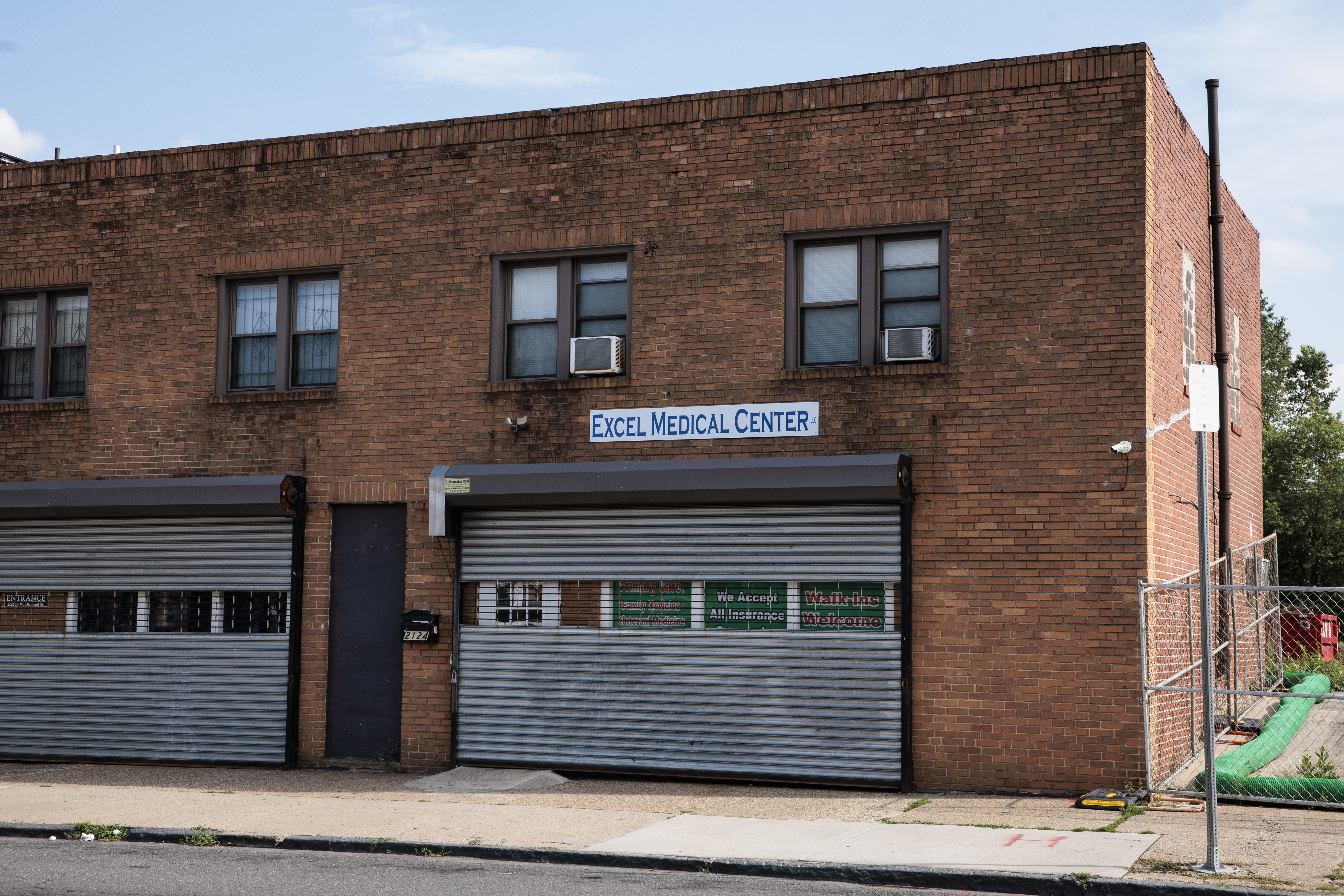
The exterior of Excel Medical Center at 2124 Diamond Street in Philadelphia.
In early November 2024, she told her husband what had happened and subsequently filed a police report. Michel was arrested and charged about three months later.
Michel’s trial was initially slated for Dec. 9, but during a hearing on Monday, a judge postponed it until Feb. 17 after the DA’s office asked for more time to investigate, court records show.
Michel’s suspension nears end
In June, the State Board of Osteopathic Medicine, which regulates and oversees licensure of osteopathic doctors like Michel, disciplined him for having sex with a patient — a violation of state regulations.
He apologized to the board in a letter, saying, “I fully acknowledge that I crossed a professional boundary” and is “profoundly contrite.”
The board suspended his medical license for six months, followed by 18 months of supervised probation, and fined him $4,000. Michel’s suspension is set to end on Dec. 11.
If convicted in the criminal case, Michel could permanently lose his medical license.
In an e-mailed statement on Thursday, the Pennsylvania Department of State, which oversees professional licensing boards, said its prosecution division “continues to closely monitor Dr. Michel’s criminal charges and review his compliance with the terms of the consent agreement.”
Abuse in office hallways
The accusations outlined in Kenny’s motion include new details of sexual misconduct. The former employee said Michel approached her from behind to “grab her breast over her shirt.”
She was stunned and “hated the feeling,” but she feared losing her job so she didn’t say anything to him.
Once, he simultaneously “cupped” her breast and vagina over her clothes with his hands. She turned around and screamed at him to stop touching her, according to the motion. He replied, “`You know you want it and you know you like it,’” she recounted.
She said she couldn’t quit because she needed the income and told her co-workers about the abuse. Those colleagues helped her “avoid him” while at work. She also told her husband, though she persuaded him not to confront Michel.
She resigned in 2019 after landing a new job. They had no contact until this year when he texted her.
When she asked why he wanted to talk to her after so much time had passed, Michel texted nevermind, the former medical assistant told prosecutors. She then wrote back, “explaining how she felt about his abuse all these years later, that the thoughts of it still traumatized her.”
Inquirer staff writer Chris Palmer contributed to this article.
As health and human services secretary, Robert F. Kennedy Jr. wields one of the louder megaphones the federal government has. Yet he insists he doesn’t want to impose his opinions on Americans.
“I don’t think people should be taking medical advice from me,” Kennedy told a Democratic congressman in May.
Kennedy once expressed different views — for example, about the need to proselytize about exercise. As he said on a podcast, he wants to use the “bully pulpit” to “obliterate the delicacy” with which Americans discuss fitness and explain that “suffering” is virtuous.
“We need to establish an ethic that you’re not a good parent unless your kids are doing some kind of physical activity,” Kennedy told the podcaster in September 2024.
The Department of Health and Human Services is tasked with communicating information to protect and improve the health and well-being of every American. It provides reminders about vaccinations and screenings; alerts about which food is unsafe; and useful, everyday tips about subjects such as sunscreen and, yes, exercise.
Under Kennedy’s watch, though, HHS has compromised once-fruitful campaigns promoting immunizations and other preventive health measures. On Instagram, the agency often emphasizes Kennedy’s personal causes, his pet projects, or even the secretary himself. Former agency employees say communications have a more political edge, with “Make America Healthy Again” frequently featured in news releases.
Interviews with over 20 former and current agency employees provide a look inside a health department where personality and politics steer what is said to the public. KFF Health News granted many of these people anonymity because they fear retribution.
One sign of change is what is no longer, or soon will not be, amplified — for instance, acclaimed anti-smoking campaigns making a dent in one of Kennedy’s priorities, chronic disease.
Another sign is what gets commemorated. On the official HHS Instagram account this year, out were posts saluting Juneteenth and Father’s Day. In, under Kennedy, were posts marking President Donald Trump’s birthday and Hulk Hogan’s death.
Commenting on such changes, HHS spokesperson Andrew Nixon said in an email that “DEI is gone, thanks to the Trump administration.”
Some elected officials are pointedly not promoting Kennedy as a source of healthcare information. Regarding the secretary’s announcement citing unproven links between Tylenol and autism, Senate Majority Leader John Thune (R., S.D.) told MSNBC (now called MS NOW) that, “if I were a woman, I’d be talking to my doctor and not taking, you know, advice from RFK or any other government bureaucrat, for that matter.” (Thune’s office did not respond to a request for comment.)
At leastfourpolls since January show trust in Kennedy as a medical adviser is low. In one poll, from the Economist and YouGov, barely over a quarter of respondents said they trusted Kennedy “a lot” or “somewhat.”
The department’s online messaging looks “a lot more like propaganda than it does public health,” said Kevin Griffis, who worked in communications at the CDC under President Joe Biden and left the agency in March.
Transition to a new administration
The new administration inaugurated dramatic changes. Upon arrival, political appointees froze the health agency’s outside communications on a broader scale than in previous changeovers, halting everything from routine webpage updates to meetings with grant recipients. The pause created logistical snafus: For example, one CDC employee described being forced to cancel, and later rebook, advertising campaigns — at greater cost to taxpayers.
Even before the gag order was lifted in the spring, the tone and direction of HHS’ public communications had shifted.
According to data shared by iSpot.tv, a market research firm that tracks television advertising, at least four HHS ads about vaccines ended within two weeks of Trump’s inauguration.
“Flu campaigns were halted” during a season in which a record number of children died from influenza, Deb Houry, who had resigned as the CDC’s chief medical officer, said in a Sept. 17 congressional hearing.
Instead of urging people to get vaccinated, HHS officials contemplated more-ambivalent messaging, said Griffis, then the CDC’s director of communications. According to Griffis, other former agency employees, and communications reviewed by KFF Health News, Nixon contemplated a campaign that would put more emphasis on vaccine risks. It would “be promoting, quote-unquote, ‘informed choice,’” Griffis said.
Nixon called the claim “categorically false.” Still, the department continues to push anti-vaccine messaging. In November, the CDC updated a web page to assert the false claim that vaccines may cause autism.
Messaging related to tobacco control has been pulled back, according to Brian King, an executive at the Campaign for Tobacco-Free Kids, as well as multiple current and former CDC employees. Layoffs, administrative leaves, and funding turmoil have drained offices at the CDC and the Food and Drug Administration focused on educating people about the risks of smoking and vaping, King said.
Four current and former CDC employees told KFF Health News that “Tips From Former Smokers,” a campaign credited with helping approximately a million people quit smoking, is in danger. Ordinarily, a contract for the next year’s campaign would have been signed by now. But, as of Nov. 21, there was no contractor, the current and former employees said.
Nixon did not respond to a question from KFF Health News regarding plans for the program.
“We’re currently in an apocalypse for national tobacco education campaigns in this country,” King said.
Kennedy’s HHS has a different focus for its education campaigns, including the “Take Back Your Health” campaign, for which the department solicited contractors this year to produce “viral” and “edgy” content to urge Americans to exercise.
An earlier version of the campaign’s solicitation asked for partners to boost wearables, such as gadgets that track steps or glucose levels — reflecting a Kennedy push for every American to be wearing such a device within four years.
The source of funds for the exercise campaign? In the spring, leadership of multiple agencies discussed using funding for the CDC’s Tips From Former Smokers campaign, employees from those agencies said. By the fall, the smoking program had not spent all its funds, the current and former CDC employees said.
Nixon did not respond to questions about the source of funding for the exercise campaign.
Food fight
At the FDA, former employees said they noticed new types of political interference as Trump officials took the reins, sometimes making subtle tweaks to public communications, sometimes changing wholesale what messages went out. The interventions into messaging — what was said, but also what went unsaid — proved problematic, they said.
Early this year, multiple employees told KFF Health News, Nixon gave agency employees a quick deadline to gather a list of all policy initiatives underway on infant formula. That was then branded “Operation Stork Speed,” as if it were a new push by a new administration.
Marianna Naum, a former acting director of external communications and consumer education at the FDA, said she supports parts of the Trump administration’s agenda. But she said she disagreed with how it handled Operation Stork Speed. “It felt like they were trying to put out information so they can say: ‘Look at the great work. Look how fast we did it,’” she said.
Nixon called the account “false” without elaborating. KFF Health News spoke with three other employees with the same recollections of the origins of Operation Stork Speed.
“Things that didn’t fit within their agenda, they were downplayed,” Naum said.
For example, she said, Trump political appointees resisted a proposed news release noting agency approval of cell-cultured pork — that is, pork grown in a lab. Similar products have raised the ire of ranchers and farmers working in typically GOP-friendly industries. States such as Florida have banned lab-grown meat.
The agency ultimately issued the news release. But a review of the agency’s archives showed it has not put out news releases about two later approvals of cell-cultured meat.
Wide-ranging layoffs have also hit the FDA’s food office hard, leaving fewer people to make sure news gets distributed properly and promptly. Former employees say notices about recalled foods are not circulated as widely as they used to be, meaning fewer eyeballs on alerts about contaminated ice cream, peaches, and the like.
Nixon did not respond to questions about changes in food recalls. Overall, Nixon answered nine of 53 questions posed by KFF Health News.
Pushing politics
Televised HHS public service campaigns earned nearly 7.3 billion fewer impressions in the first half of 2025 vs. the same period in 2022, according to iSpot data, with the drop being concentrated in pro-vaccine messaging. Other types of ads, such as those covering substance use and mental health, also fell. Data from the marketing intelligence firm Sensor Tower shows similar drops in HHS ad spending online.
With many of the longtime professionals laid off and new political appointees in place atop the hierarchy, a new communications strategy — bearing the hallmarks of Kennedy’s personality — is being built, said the current and former HHS employees, plus public health officials interviewed by KFF Health News.
Whereas in 2024, the agency would mostly post public health resources such as the 988 suicide hotline on its Instagram page, its feed in 2025 features more of the health secretary himself. Through the end of August, according to a KFF Health News review, 77 of its 101 posts featured Kennedy — often fishing, biking, or doing pull-ups, as well as pitching his policies.
By contrast, only 146 of the agency’s 754 posts last year, or about 20%, featured Xavier Becerra, Kennedy’s predecessor.
In 2024, on Instagram, the agency promoted Medicare and individual insurance open enrollment; in 2025, the agency has not.
In 2024, the agency’s Instagram feed included some politicking as Biden ran for reelection, but the posts were less frequent and often indirect — for instance, touting a policy enacted under Biden’s signature legislation, the Inflation Reduction Act, but without mentioning the name of the bill or its connection to the president.
In 2025, sloganeering is a frequent feature of the agency’s Kennedy-era Instagram. Through the end of August, “Make America Healthy Again” or variants of the catchphrase featured in at least 48% of posts.
Amid the layoffs, the agency made a notable addition to its team. It hired a state legislative spokesperson as a “rapid response” coordinator, a role that employees from previous administrations could not recall previously existing at HHS.
“Like other Trump administration agencies, HHS is continuously rebutting fake news for the benefit of the public,” Nixon said when asked about the role.
On the day Houry and Susan Monarez, the CDC leader ousted in late August, testified before senators about Kennedy’s leadership, the agency’s X feed posted clips belittling the former officials. The department also derisively rebuts unfavorable news coverage.
“It’s very interesting to watch the memeification of the United States and critical global health infrastructure,” said McKenzie Wilson, an HHS spokesperson under Biden. “The entire purpose of this agency is to inform the public about safety, emergencies as they happen.”
‘Clear, powerful messages from Bobby’
Kennedy’s Make Our Children Healthy Again report, released in September, proposes public awareness campaigns on subjects such as illegal vaping and fluoride levels in water, while reassuring Americans that the regulatory system for pesticides is “robust.”
Those priorities reflect — and are amplified by — cadres of activists outside government. Since the summer, HHS officials have appeared on Zoom calls with aligned advocacy groups, trying to drum up support for Kennedy’s agenda.
On one call — on which, according to host Tony Lyons, activists “representing over 250 million followers on social media” were registered — famous names such as motivational speaker Tony Robbins gave pep talks about how to influence elected officials and the public.
“Each week, you’re gonna get clear, powerful messages from Bobby, from HHS, from their team,” Robbins said. “And your mission is to amplify it, to make it your own, to speak from your soul, to be bold, to be relentless, to be loving, to be loud, you know, because this is how we make the change.”
The communications strategy captivates the public, but it also confuses it.
Anne Zink, formerly the chief medical officer for Alaska, said she thought Kennedy’s messaging was some of the catchiest of any HHS director.
But, she said, in her work as an emergency physician, she has seen the consequences of his health department’s policies on her puzzled patients. Some question vaccines. Children show up with gastrointestinal symptoms Zink says she suspects are related to raw milk consumption.
“I increasingly see people say, ‘I just don’t know what to trust, because I just hear all sorts of things out there,’” she said.
KFF Health News is a national newsroom that produces in-depth journalism about health issues and is one of the core operating programs at KFF — the independent source for health policy research, polling, and journalism.
David E. Loder, 71, of Flourtown, longtime attorney at Duane Morris LLP, multifaceted trustee and board member, education advocate, mentor, and volunteer, died Thursday, Oct. 23, of complications from lymphoma and scleroderma at his home.
A graduate of Germantown Friends School and what is now the University of Pennsylvania’s Carey Law School, Mr. Loder spent 43 years, from 1982 to his retirement in 2024, as an associate, partner, and chair of the health law group at the Duane Morris law firm. He became partner in 1989 and helped the health law practice gain national recognition for its success.
Mr. Loder and his team represented the Hospital and Healthsystem Association of Pennsylvania, the Pennsylvania Trauma Systems Foundation, and other medical providers in all kinds of consequential litigation. In 2006, he helped local hospitals win a multimillion-dollar settlement with an insurance company. In 2010, he supervised a case that successfully revived a state abatement program that alleviated medical malpractice costs for physicians and hospitals.
In a tribute, former colleagues at the Pennsylvania Trauma Systems Foundation praised “his ability to see both the legal complexities and the human dimensions of every situation.”
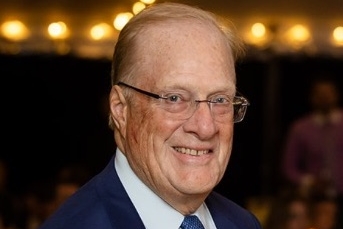
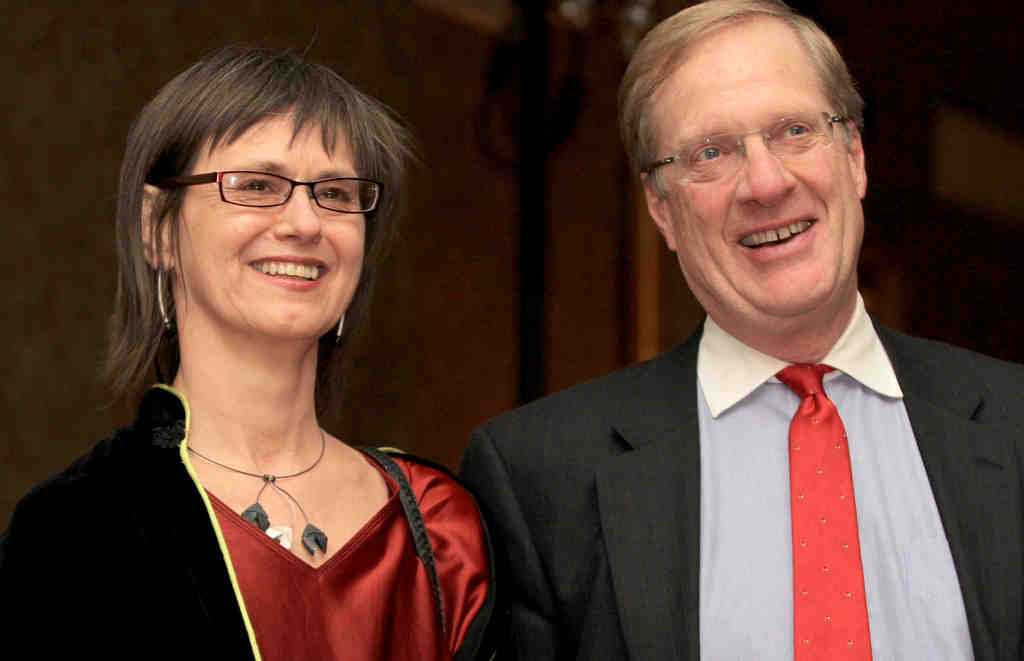
Mr. Loder stands with Blanka Zizka , the Wilma Theater’s artistic director, at an event in 2018.
He was adept in vendor contract law, board governance, policy development, and human relations issues. He took special interest in doctor-patient relations and told the Daily News in 2016: “While it is critical that the healthcare provider convey necessary and accurate information to patients concerning their health condition, it is also important to remain sensitive to the patient’s interest and willingness to hear such information.”
Matthew A. Taylor, chair and chief executive officer at Duane Morris, said in a tribute: “He was one of the nation’s most respected healthcare lawyers.”
Mr. Loder also represented the Philadelphia Zoo, homeowners fighting increased property assessments, participants in gestational-carrier programs, and other clients. “He was a shrewd judge of character,” said his son Kyle. “He was thoughtful and strategic. He became a confidant and adviser to many of his clients.”
John Soroko, chair emeritus at Duane Morris, said in a tribute: “Dave had a unique ability to turn friends into clients. But, even more importantly, to turn clients into friends.”
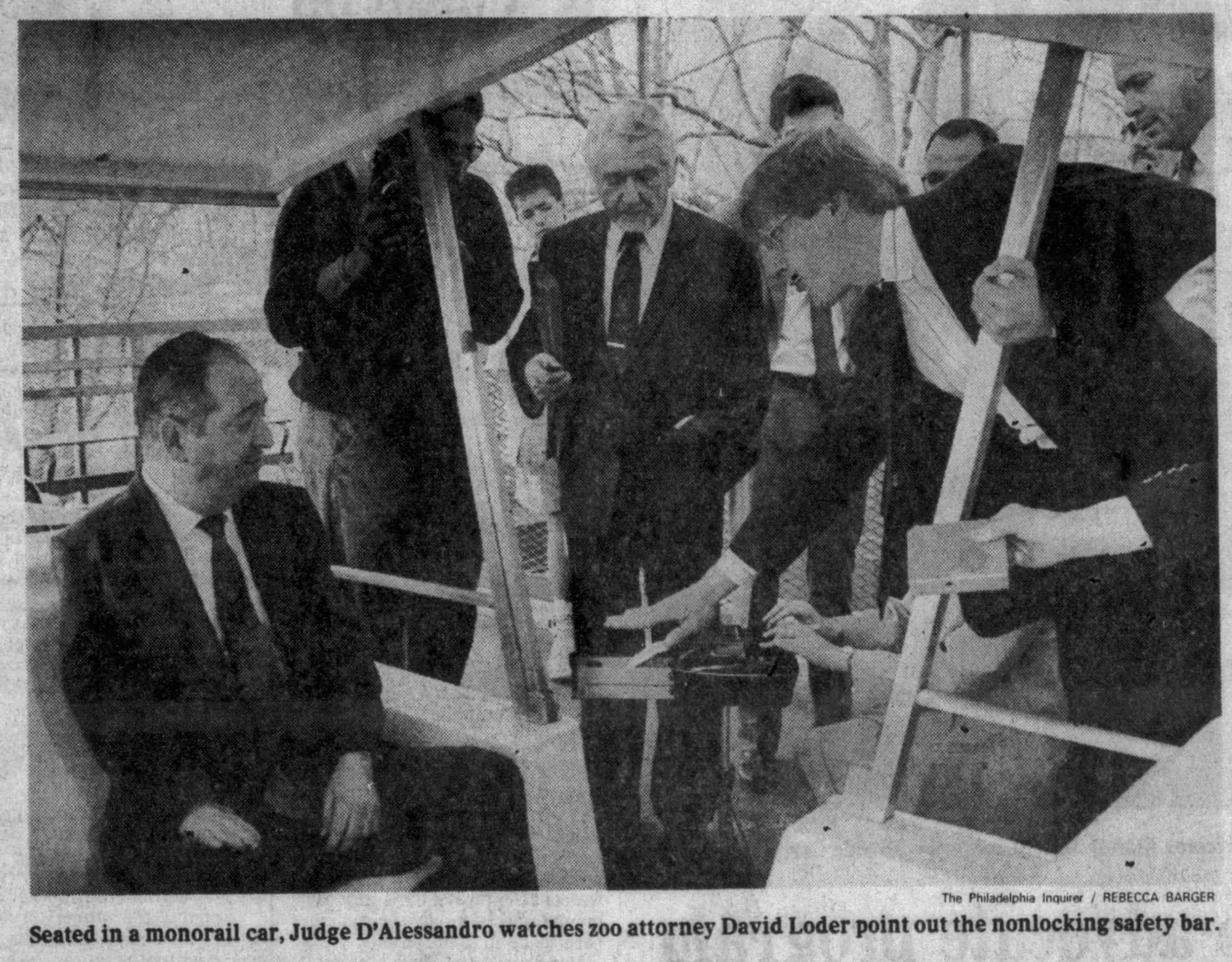
This photo of Mr. Loder (right) representing the Philadelphia Zoo appeared in The Inquirer in 1989.
Away from the law firm, Mr. Loder was chair of the board for the Wilma Theater and served on boards at Germantown Friends, the old University of the Sciences, the World Affairs Council of Philadelphia, and other groups. He was a trustee at the Dolfinger-McMahon Foundation and the Christian R. and Mary F. Lindback Foundation, and represented the Lindback regularly at its annual distinguished educators awards ceremony.
“There’s a firm belief in the importance of excellence in education in the public schools,” he told The Inquirer at the 2016 Lindback ceremony. In 2017, he said: “All of us need to recognize that the Philadelphia public schools are serving an incredibly important function.” In 2018, he said: “People need to know that there are some exceptional educators in Philadelphia public schools.”
He mentored many other lawyers and volunteered to help students in need. In online tributes, friends noted his “kind advice,” “voice of reason and compassion,” and “sense of humor, keen intellect, love of sports, and limitless knowledge on so many topics.”
In 1998, he was featured in an Inquirer story about the challenges parents face when dealing with young children stuck inside during the cold winter months. He said: “I find that if you can get the kids down by 6 p.m. and have a glass of wine in front of the fireplace, it gets you through.”
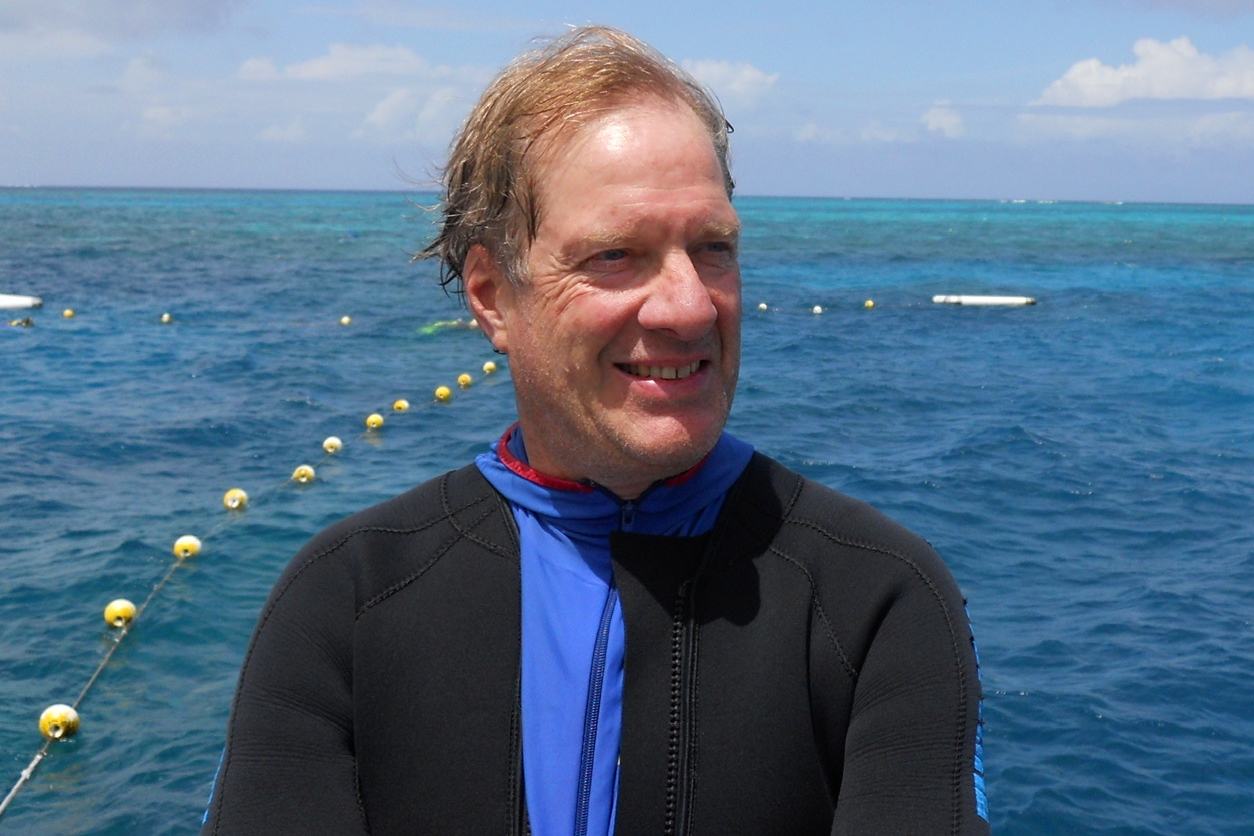
Mr. Loder enjoyed sports and the outdoors.
His family said in a tribute: “He took life seriously but never too seriously, and his warmth, humor, guidance, and generosity will be remembered.”
David Edwin Loder was born April 22, 1954, in Yalesville, Conn. His father, noted theologian Theodore Loder, moved the family to West Mount Airy when Mr. Loder was a boy, and he graduated from Germantown Friends in 1972.
He starred in football, basketball, and baseball in high school, and went on to play basketball and earn a bachelor’s degree in political science at Wesleyan University in Connecticut in 1977. He worked briefly after college as a high school history teacher, served an independent study fellowship in Poland, earned his law degree at Penn in 1981, and studied international law at the London School of Economics and Political Science.
He married Nadya Shmavonian, and they had sons Marek and Kyle, and a daughter, Julya, and lived in Philadelphia and Flourtown. After a divorce, he married Jennifer Ventresca and welcomed her children into the family.
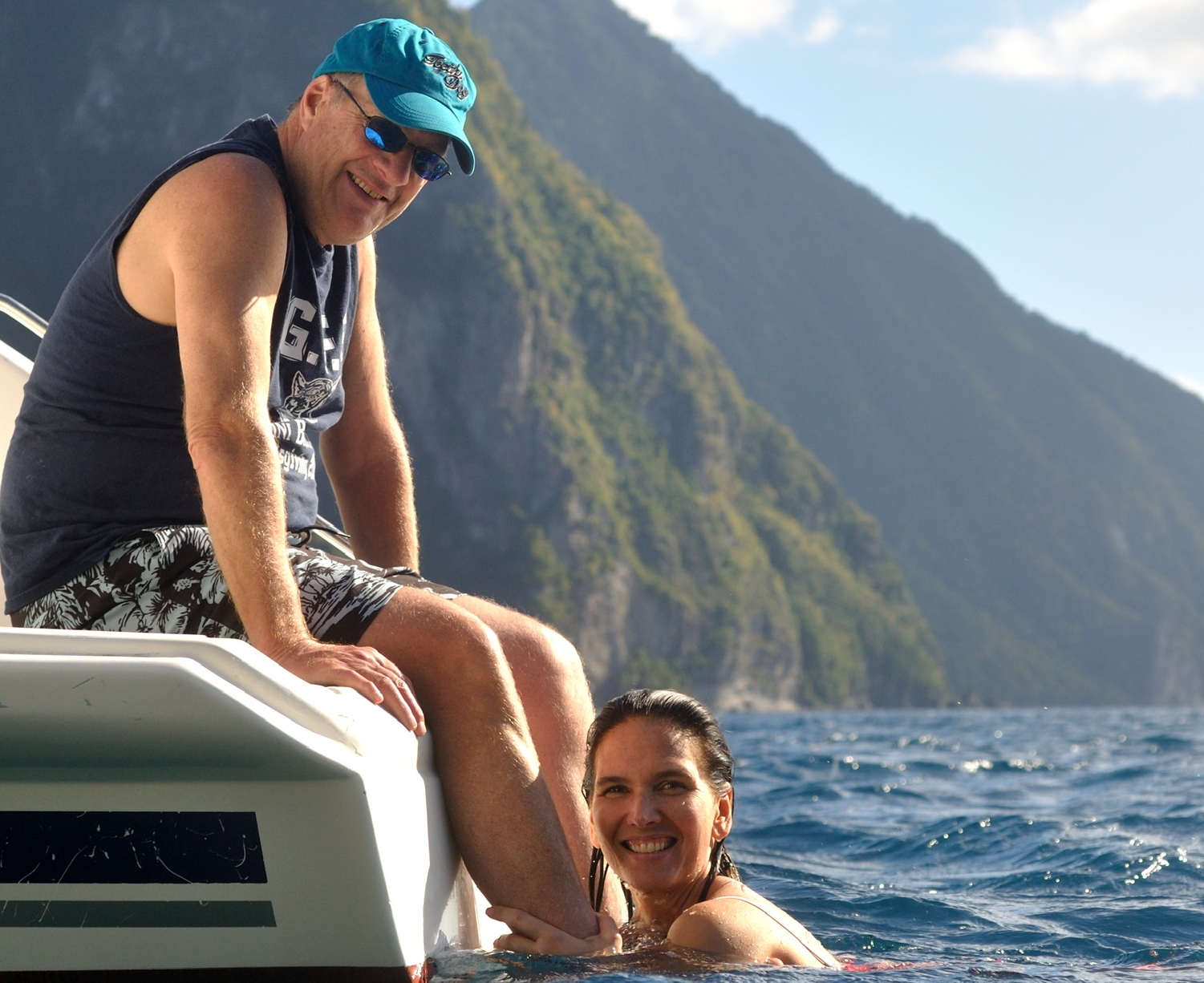
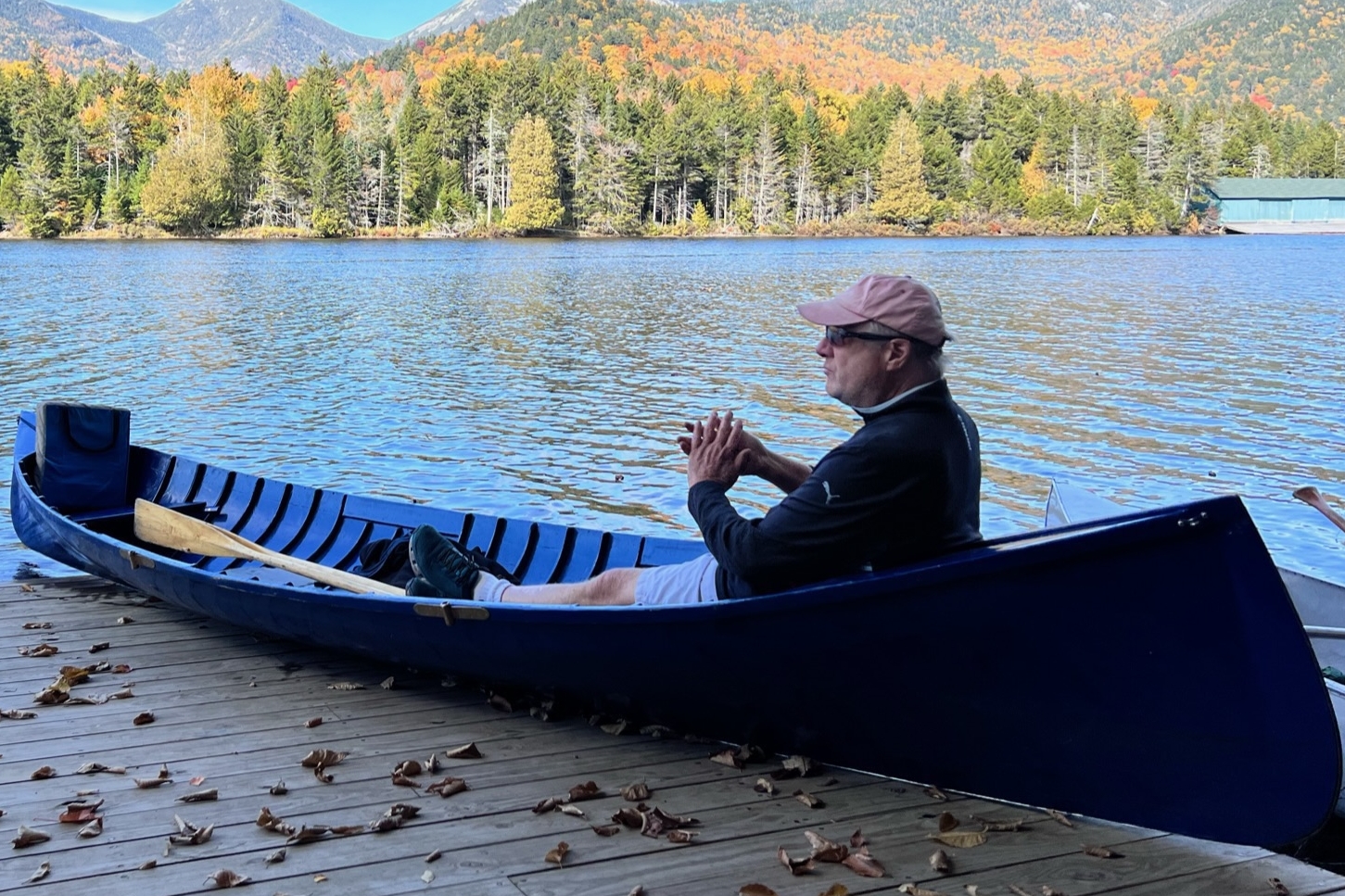
Mr. Loder liked hiking in New York’s Adirondack Mountains and relaxing at his getaway home on Long Beach Island.
Mr. Loder enjoyed tennis, squash, and golf at the Philadelphia Cricket Club. He liked hiking in New York’s Adirondack Mountains and relaxing at his getaway home on Long Beach Island, N.J.
He doted on his family and Labrador, and played cards every month for years with an eclectic group of old friends.
“David embodied the values of faith, service, and integrity,” his family said. His son Kyle said: “He was magnetic, gracious, thoughtful, and curious. He was easy to talk to.”
In addition to his wife, children, and former wife, Mr. Loder is survived by a granddaughter, a sister, two brothers, and other relatives.
Mr. Loder “was magnetic, gracious, thoughtful and curious,” his son Kyle said.
A memorial service and celebration of his life were held earlier.
Donations in his name may be made to the Penn Medicine Scleroderma Center, Attn: Amanda Hills, 3535 Market St., Suite 750, Philadelphia, Pa. 19104.
Several parents asked for my opinion when the Food and Drug Administration recently announced a warning label on acetaminophen for its alleged link to autism, and when the agency supported the use of leucovorin as an autism treatment despite a lack of scientific evidence. And I am sure I will get questions about the Centers for Disease Control and Prevention’s new claim on its website that the link between vaccines and autism cannot be “ruled out.”
As a developmental and behavioral pediatrician who cares for many children on the autism spectrum, I love to talk with families about what they’re hearing.
Families with children on the spectrum can feel whiplashed by online “influencers” hawking different theories, products, and alternative treatments. These families want to do everything they can to support their children, and so they seek out information everywhere they can find it.
Families look for alternatives because many of our current treatments are not effective for all children, and even those that work well can require intensive effort from teachers, therapists, and caregivers. As a clinician, I try to share the available evidence with families so they can make informed decisions.
Hype for particular treatments and theories about autism’s rise are not new. But when the highest officials in government shout about autism from the rooftops and the internet is awash in “information” untethered from scientific proof, it is more important than ever for clinicians and public health officials to approach parents with compassion, honesty, and evidence.
At Children’s Hospital of Philadelphia (CHOP), Pediatric Health Chat is tracking medical myths and rumors, including those about autism. Based on that data and conversations with parents, here are the top five things I wish my families knew:
1. Autism is not an epidemic
While it is true the number of children with autism spectrum disorder continues to rise across all sociodemographic groups, there is no evidence a single environmental toxin or other factor is the cause. In fact, the strongest studies show that most of the rise in autism over the past 20 years is due to increased recognition of the condition that has meant earlier, incorrect diagnoses can be set aside; and the fact that more characteristics and behaviors are known to be signs of autism. So, while autism diagnoses are rising, there is no evidence of an epidemic — autism is growing, but it’s not a sudden outbreak like COVID .
2. Vaccines do not cause autism
The myth that vaccines cause autism originated in a British study back in the 1990s on just 12 children that was so fraudulent, the journal that published it wound up retracting it. Some people continue to insist that because autism has continued to increase — and new vaccines have been developed — there must be some kind of a link. But just because two things occur at the same time does not mean that one causes the other. (A classic example is that both ice cream purchases and drownings increase in the summer, but no one is claiming that ice cream causes drowning!)
As CHOP’s Vaccine Education Center lays out, there have been numerous, well done studies that have not found a link between vaccines and autism. Vaccines save lives, and the evidence in favor of vaccine safety with respect to autism is overwhelming. I encourage all of my patients’ families to vaccinate their children. I am proud to say that I vaccinate my own children following recommended schedules — to protect them from preventable infections.
3. Acetaminophen does not cause autism
While a few small studies have found an association between prenatal acetaminophen use and autism, the largest and strongest studies have found no association. Studies that do not include factors like why the pregnant person is taking acetaminophen or whether siblings are on the autism spectrum may inaccurately conclude that acetaminophen is a cause when it is not. The truth is that high fevers during pregnancy are known to be dangerous, and acetaminophen, the active ingredient in Tylenol, is the safest medication we have for treating fever. I would have no hesitation recommending acetaminophen during pregnancy as needed.
4. Leucovorin is not a proven treatment for autism
Last spring, a news story appeared about a child who became more verbal after taking leucovorin (also known as folinic acid, a medication that is used for cancer patients undergoing chemotherapy). Since that time, requests from families in the autism community to begin leucovorin have skyrocketed. Yet the evidence for leucovorin’s effectiveness is incredibly limited. For example, children in placebo groups — those that didn’t get any leucovorin — showed similar gains as those that got it. Some families dropped out of the trials because their children became more aggressive while receiving leucovorin. We need larger, well designed, randomized control trials before I would feel comfortable recommending leucovorin to my patients.
5. So-called facilitated communication does not help children with autism
Several decades ago, facilitated communication (in which a facilitator touches a patient to “help them spell” on a keyboard or letter board) was thoroughly debunked by studies proving the facilitator was guiding responses, not helping the person to truly communicate their own thoughts.
Yet facilitated communication (FC) has made a comeback in the form of other “therapies” like supported typing and through the “Telepathy Tapes” podcast. However, these are just FC by another name and are also unsupported by evidence.
On the other hand, augmentative or alternative communication, through which individuals themselves use alternative strategies or “talker” devices to express themselves (instead of having a facilitator physically help them), is strongly supported by evidence. While I understand why families want to give their children every opportunity to express themselves, I strongly urge them to go with the methods that are proven to help them achieve their goals.
Most troubling to me is that woven through all these myths and misinformation is the implicit belief that individuals with autism lack value, or that they cannot lead happy, successful lives. While some individuals on the autism spectrum struggle to live independently and may have some challenging behaviors, all these people are worthy of dignity and respect. Continuing to find ways to best support people with autism and their families, to allow them to reach their highest potential, needs to be the focus.
Editor’s note: Pediatric Health Chat is an online initiative at Children’s Hospital of Philadelphia taking aim at the latest myths and misconceptions about children’s health.Kate E. Wallis, MD, MPH, is a developmental behavioral pediatrician with the Division of Developmental and Behavioral Pediatrics at Children’s Hospital of Philadelphia.
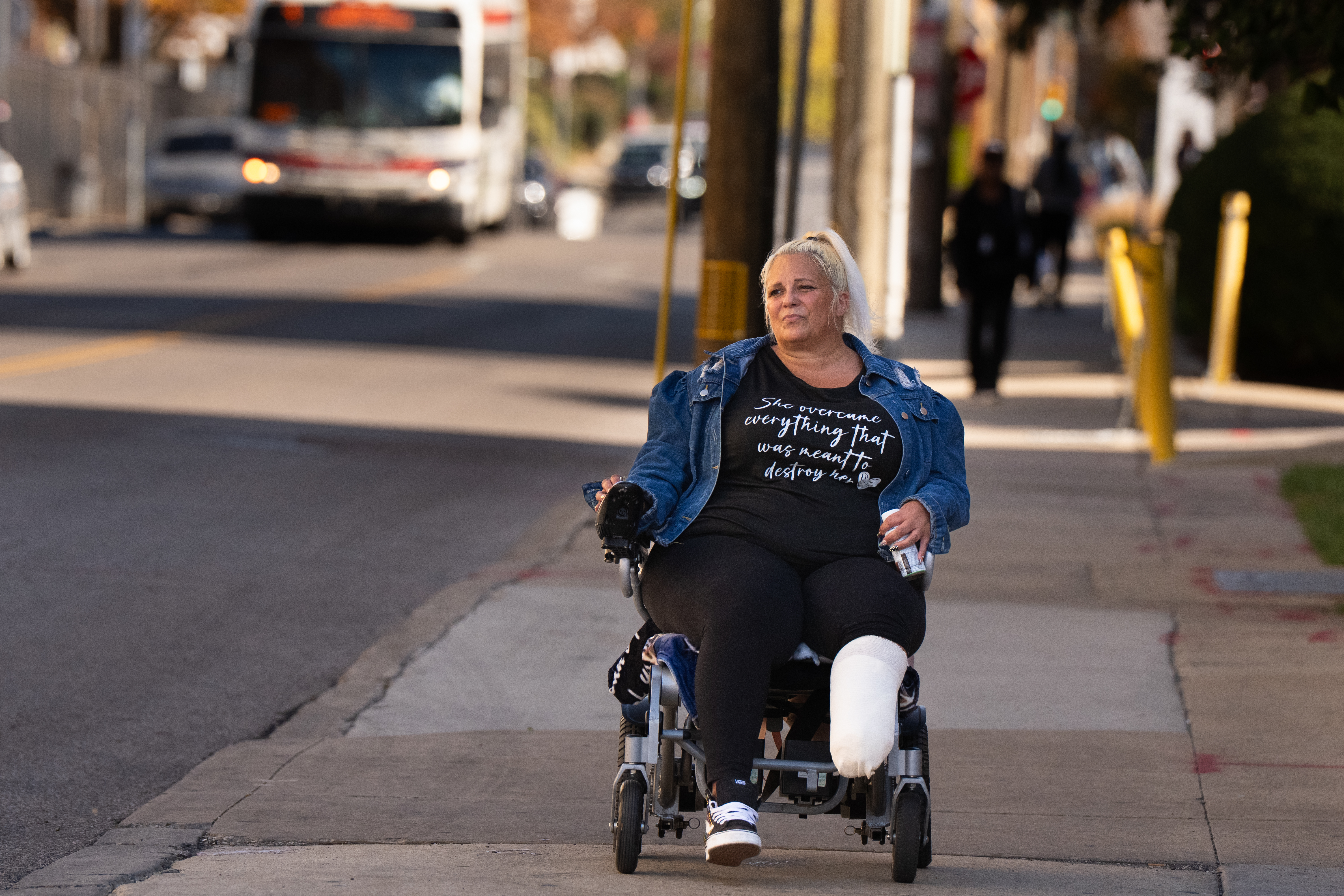
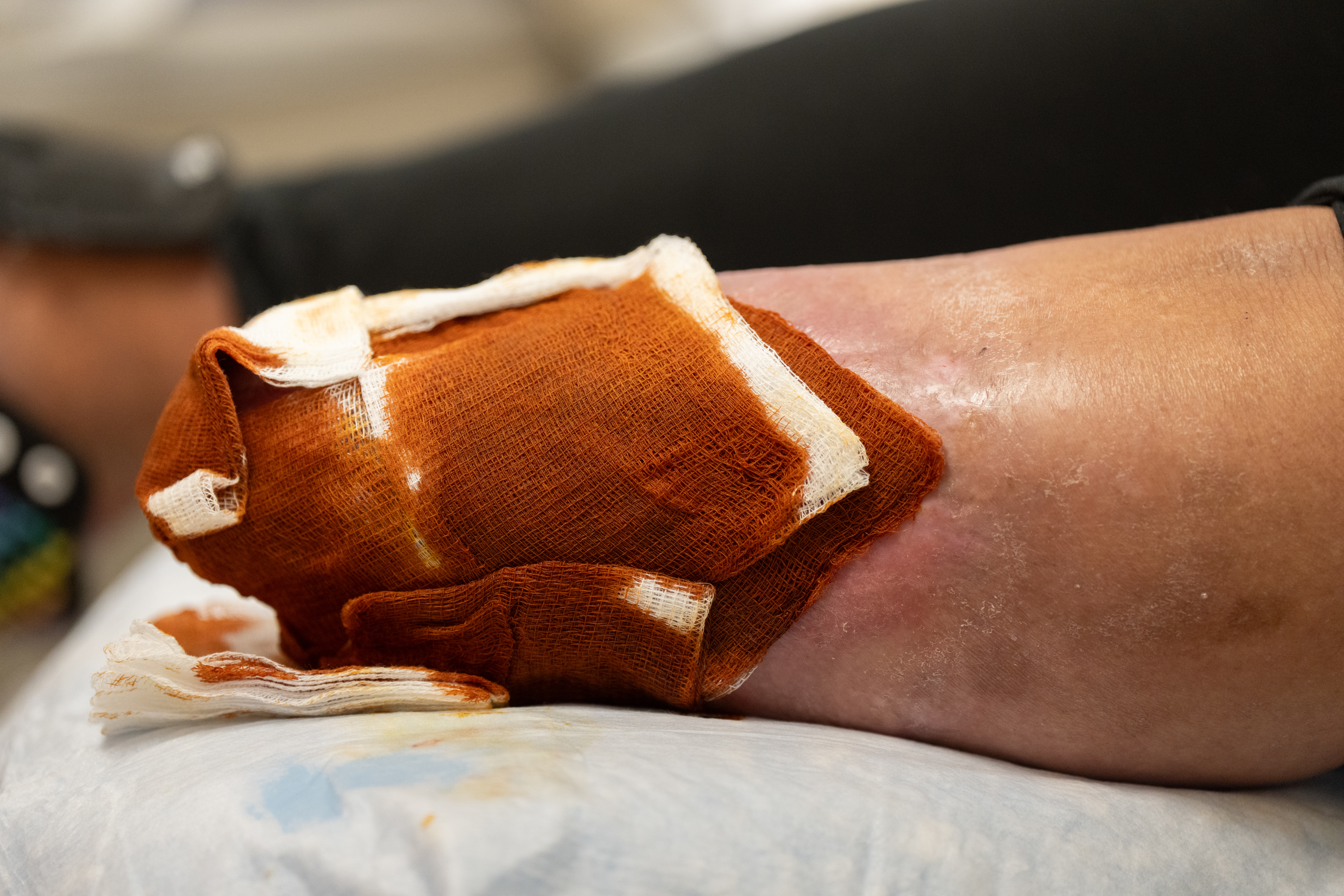
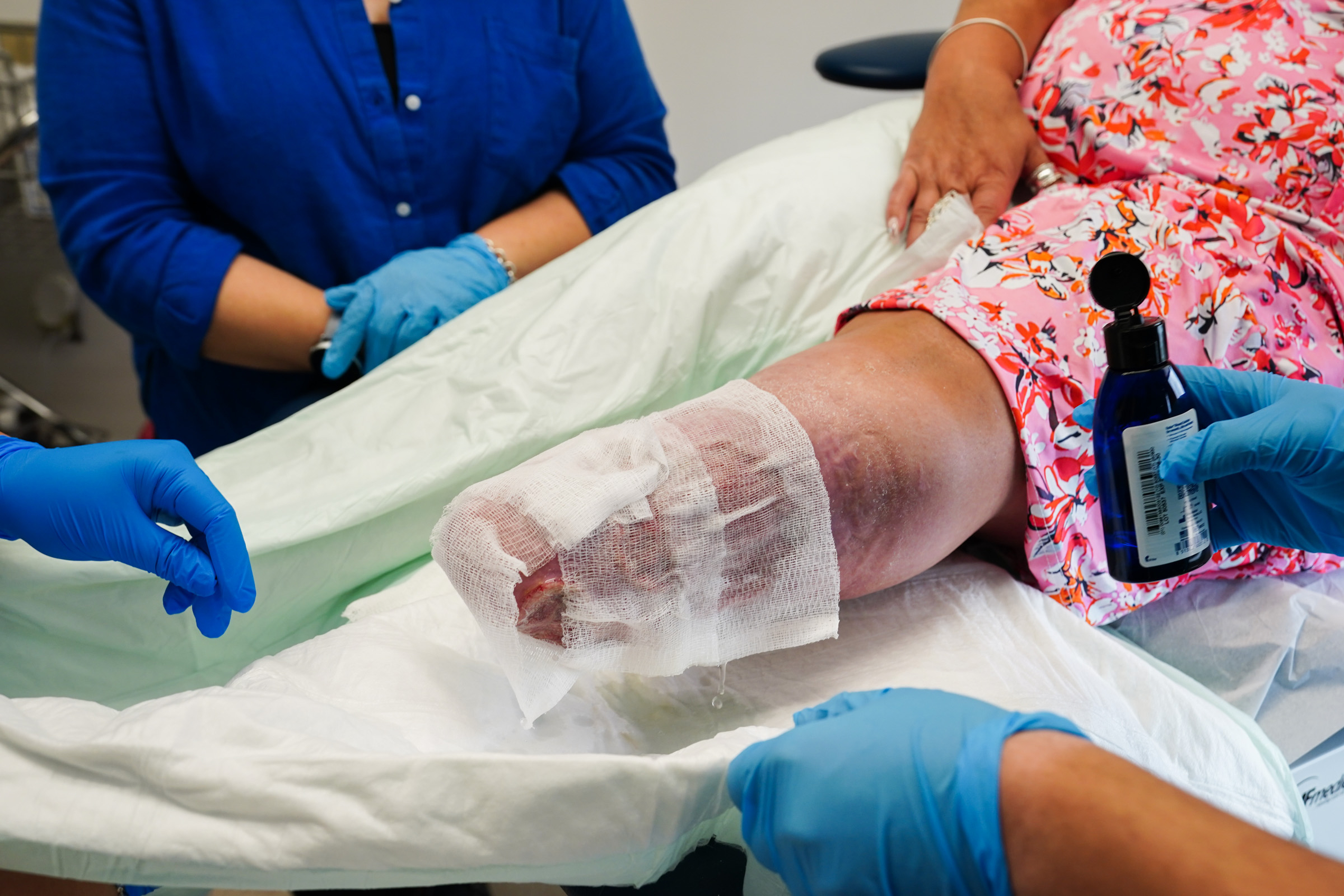
Kelly Wyatt winced as a nurse unwrapped layers of gauze from her left leg, exposing the massive wound beneath.
Yellow and red and gray, weeping plasma and agonizingly painful at the slightest touch, it covered almost the entirety of the end of her leg — the site of the amputation she had undergone four years before.
Emergency room doctors at the time had warned her that if the drugs she was using didn’t kill her, her wounds would.
Now Wyatt is 14 months into recovery from an addiction to fentanyl, a potent synthetic opioid, and xylazine, an animal tranquilizer never approved for human use. The emergence of xylazine, known as “tranq” on the streets, early in the decade marked the beginning of a dangerous new era for Philadelphians addicted to illicit opioids.
Wyatt, 52, is among hundreds of Philadelphians facing lifelong medical needs from tranq, as the latest wave of the area’s drug crisis has seen a rapidly evolving succession of veterinary and industrial chemicals compound the dangers of the powerful opioids being sold on the streets.
Some have become regular patients in burn units and wound care clinics at area hospitals, among the only places capable of treating severe tranq injuries.
As part of its ongoing coverage of the area’s drug crisis, The Inquirer followed Wyatt for more than a year as she went through early recovery and worked with doctors to heal her wound.
Kelly Wyatt receives treatment at Jefferson Einstein Philadelphia Hospital’s Center for Wound Healing in Philadelphia in November.
Wyatt initially shrugged when the small sores had emerged on her legs, only to watch them grow into massive abscesses, resulting in an amputation below her knee. Her ongoing tranq use prevented the wound on her left leg from healing properly. Even after recent months of sobriety and careful treatment, doctors are still warning her that they may have to amputate more of her leg.
But Wyatt’s tranq wounds go still deeper.
Over the last several years, both of her sons had spiraled into addiction. By January, both of them were dead.
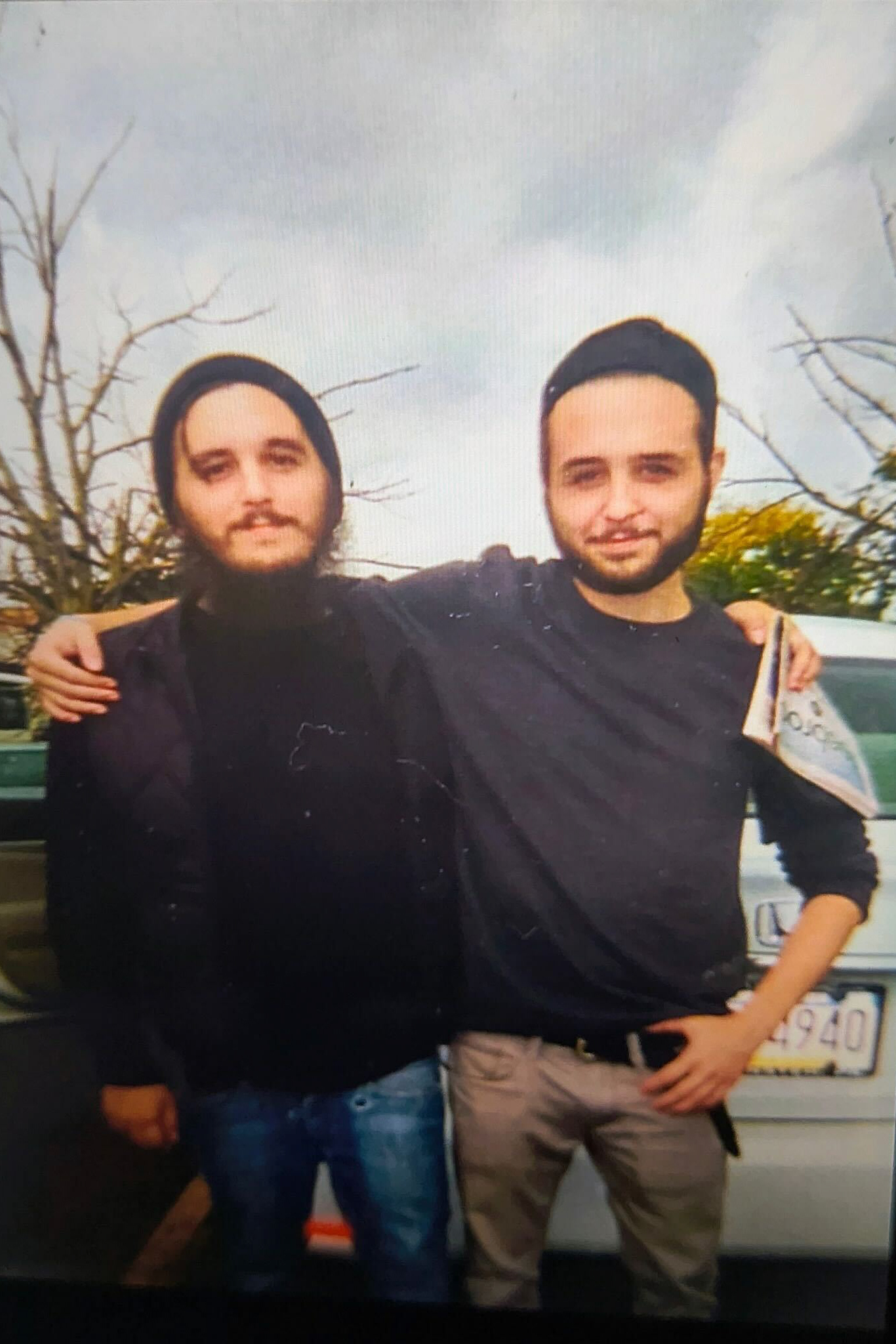
A family photo of Dakota Wyatt, left, and Tyler, right.
Spiraling into addiction
Several members of Wyatt’s family have struggled with addiction.
Wyatt experimented with drugs as a teenager, but was sober during her kids’ early childhoods. She didn’t drink alcohol, let alone seek out illicit drugs, after giving birth to her eldest son, Dakota, at 18. She raised two sons and a daughter in a neighborhood near Pennypack Park.
Her days had a familiar rhythm: packing lunches, picking the kids up from school, watching them play together at the local park. In her spare time, she dabbled in mixed-media art, designing the window displays at the downtown restaurant where she worked for years. One Philadelphia Flower Show-themed display had a working waterfall.
Her youngest, Tyler, was a happy child, grinning wide in every school picture and sharing inside jokes and a love for music with his brother. Dakota, more sensitive, had struggled with anxiety from an early age; Wyatt remembers him asking her at bedtime what the family would do if their house burned down in the night. But he could always make her laugh, and she and the boys would sing along to the same music in the car: ’90s alt-rock, Johnny Cash, the local hip-hop station.
In 1999, she divorced their father. A few years later, at 28, she took her first Percocet pill, an opioid painkiller approved for medical use that is widely abused as a street drug.She had just started working at a bar, and the long hours were wearing on her.
With the pills, “I could get more cleaning done, I could push my body more,” she said. “And it snowballed.”
She was not aware when her sons began using drugs themselves in their teenage years. “I didn’t know for a long, long time,” she said.
Afterward, Wyatt tried to help them seek treatment, even while her own drug use increased, she said.
But a series of traumatic life events resulted in all falling deeper into addiction together.
Wyatt’s ex-husband died following long-standing health issues, including diabetes.
Then Dakota, who drove a Zamboni at a local ice rink, was injured in an accident at work — losing the tips of his fingers while cleaning the machine. He had been using more opioids to deal with the pain.
Wyatt began buying drugs with him in Kensington, at the vast open-air drug market that is the epicenter of Philadelphia’s opioid crisis. “It was normalizing — I’m his mom and I’m with him in that crazy environment. I’m sure it made him feel like it was OK. And I regret that,” Wyatt said.
“I regret a lot of stuff. But that was the beginning.”
Kelly Wyatt leaves her wound care appointment at Jefferson Einstein Philadelphia Hospital’s Center for Wound Healing in November.
Tranq warning signs
It was the mid-2010s, and the drugs on the street were changing. The stronger synthetic opioid fentanyl was just emerging; dealers chanted “fetty-fetty-fetty” on the corners to draw in customers.
And then Wyatt began hearing talk of “tranq” getting mixed into the drug supply.
That was around the time that Dakota developed wounds on his arm, open sores that would not close. Wyatt found small wounds on her arms and legs — “like melon-ball scoops.”
One day, she saw a flier, handed out by health authorities in Kensington, warning that tranq can cause skin lesions.
“All of a sudden,” she recalled, “things made sense.”
But her addiction was so severe that she was afraid to stop using the fentanyl-tranq mix now prevalent in the illicit drug market. She fixated on avoiding xylazine’s severe withdrawal symptoms — chills, sweating, anxiety, and agitation — which don’t respond to traditional opioid withdrawal medications. She worried about seeking treatment with no guarantee of relief.
By the time Wyatt was admitted to a hospital in 2021, she was hallucinating from sepsis, a severe complication from an infection that can lead to organ failure, shock, and death.
When she woke up eight days later, a doctor told her she was at risk of having one leg amputated, and maybe both. “Please let me keep as much of my leg as possible,” she recalls begging a doctor who wanted to remove her entire leg.
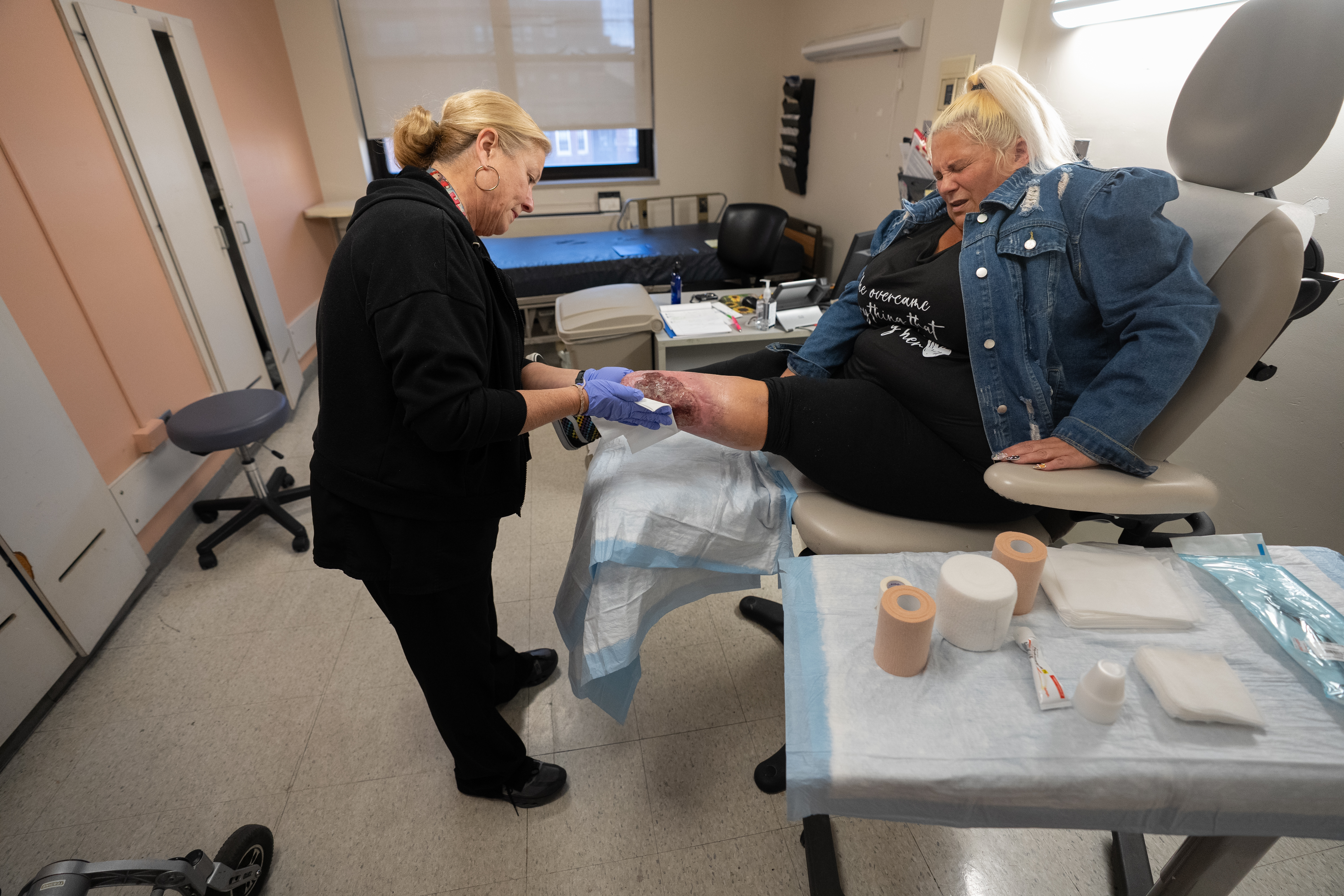
Kelly Wyatt receives treatment for a serious xylazine wound at the site of her amputation at Jefferson Einstein Philadelphia Hospital’s Center for Wound Healing in November.
“The doctor thought I should get the whole leg cut off. The other thing I could do was amputate below the knee, and then get tons of operations for the infection,” she said.
Her oldest son’s tranq wounds had also worsened. Dakota had wounds on his legs and an arm, which was eventually amputated later that year. He also suffered a heart infection linked to his drug use, and needed a valve replacement.
After a month in the hospital, he came home and continued using drugs.
He developed new lesions. Maggots ate at his rotting skin. Wyatt cleaned the bugs out of his wounds.
Wyatt tried bargaining with her son, promising they could get addiction treatment together. She offered to get him enough drugs that he wouldn’t enter withdrawal while waiting for care at the hospital. Sometimes, he managed to stay at the hospital for a few hours, but never longer.
“He was too embarrassed to go anywhere, he was too afraid to get clean, and he was too afraid to be sick. He told us he would rather die than go through withdrawal again,” she said. “A couple times, he asked me if I wanted to just shoot up and lay down and die with him.”
“‘I want to live,’” she recalls telling him, “‘and I don’t want to live without you.’”
Kelly Wyatt waits for treatment for a serious wound on her leg at Jefferson Einstein Philadelphia Hospital’s Center for Wound Healing in November.
Loss and recovery
One night in January 2024, Dakota was having trouble breathing and seemed to be hallucinating, speaking nonsense. He asked Wyatt to call an ambulance to the house.
Dakota died before the family reached the hospital. His cause of death was listed as drug intoxication.
Wyatt believes ongoing health issues from his wounds hastened his death. Her grief intensified her own drug use, leading to more xylazine wounds. The wound that had opened near her amputation grew worse.
A month after Dakota’s death, she entered drug treatment. After three months, she relapsed and overdosed on cocaine and fentanyl. Her first thought after waking up was to use again, but instead she chose rehab.
“I didn’t want to die,” Wyatt said. “I didn’t want to be in pain anymore.”
She arrived at the Behavioral Wellness Center at Girard in July 2024, hoping to enter outpatient rehab.
Instead, physicians recommended their inpatient clinic that could also treat her wounds, one of the few such facilities in Philadelphia.
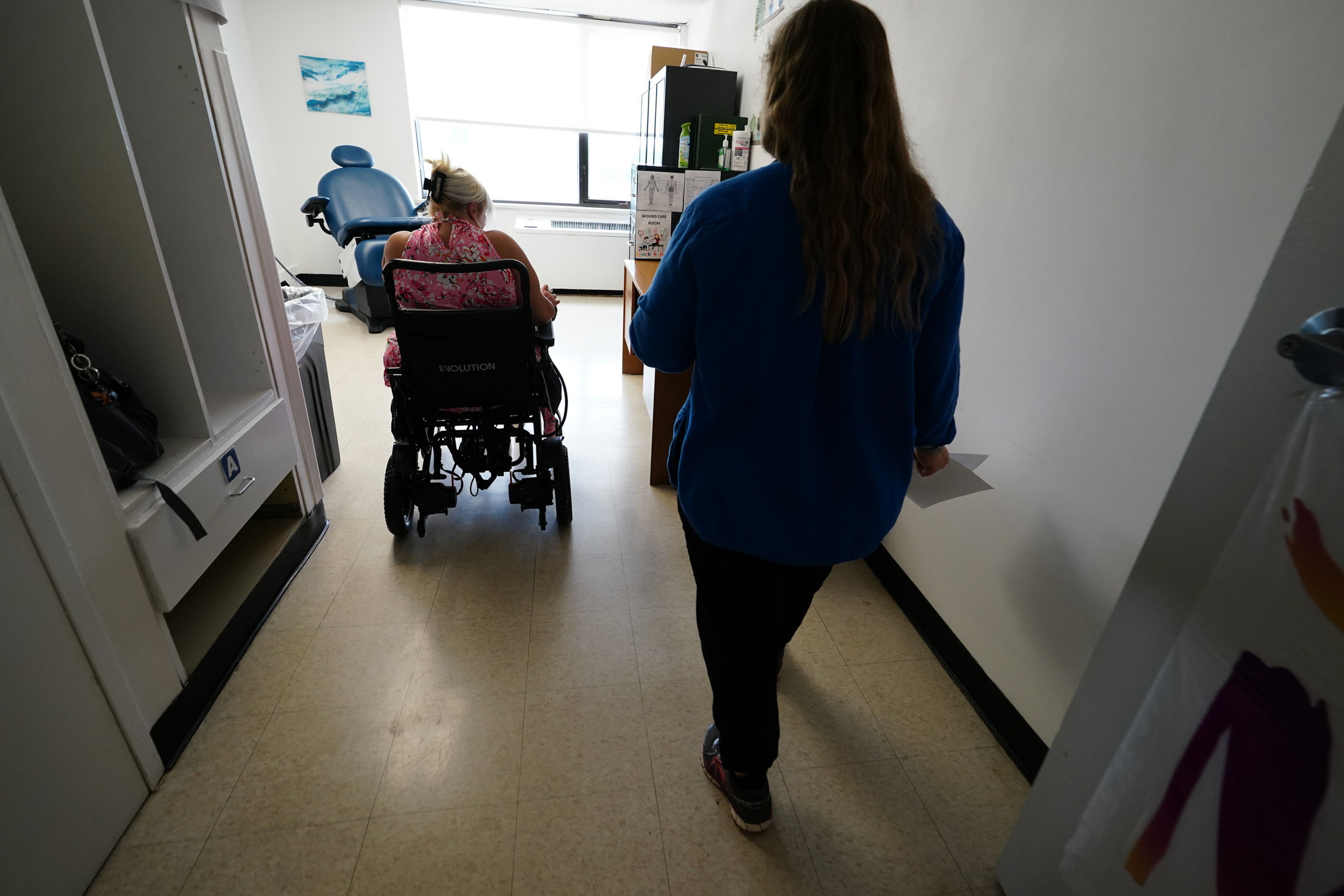
In August 2024, Kelly Wyatt attended a wound care appointment as part of her inpatient care at Girard Behavioral Health, one of a few addiction rehabs in the city that can treat xylazine wounds.
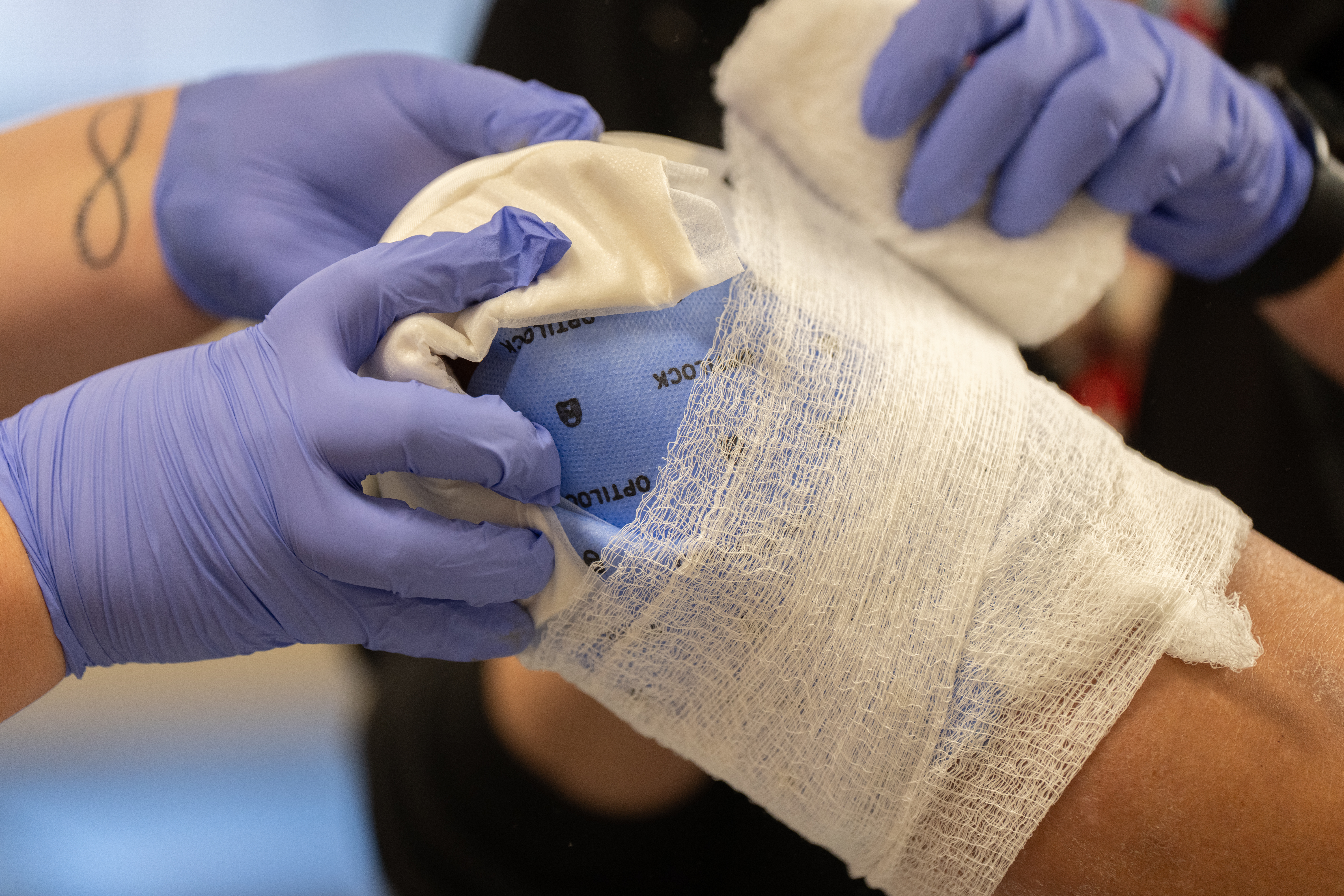
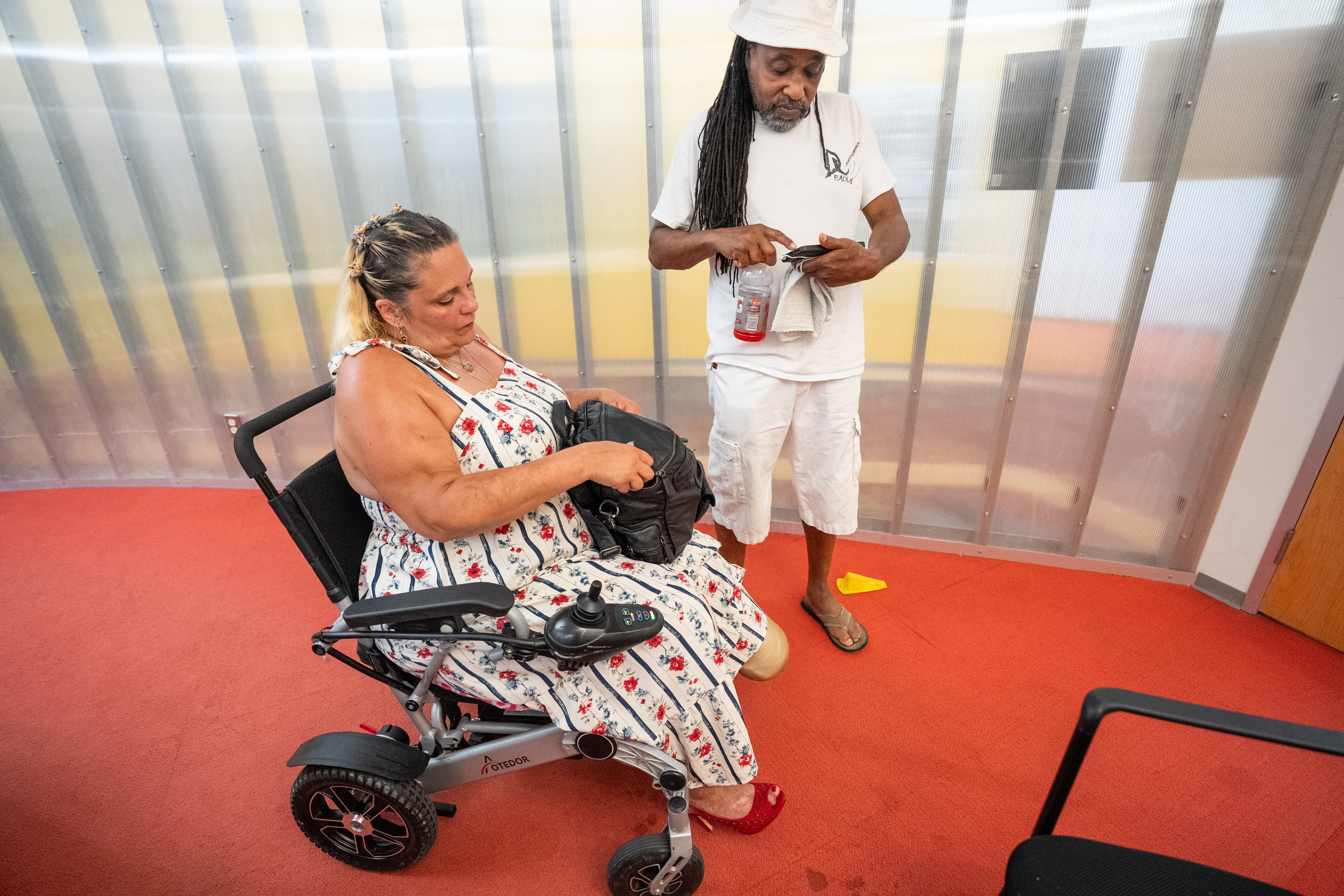
Wyatt was living there and undergoing treatment a month later, in August 2024, when she wheeled her motorized wheelchair into a clinic room and took deep breaths as nurses carefully peeled back layers of moisturized gauze on her left leg, cleaning the wound.
Still in the shaky early months of recovery, and needing to remain in inpatient rehab, she remained worried about Tyler, who was still using drugs.
“He was the primary caretaker of his brother. They would be in their room, getting high together. And now he’s just in that room by himself, day in and day out,” she said in an interview that summer.
“I kept saying, ‘I think I should go home to him.’ And everybody kept saying to me, ‘You have to work on yourself first. He’ll be fine,’” she later recalled.
“And then he wasn’t fine.”
Kelly Wyatt and her partner Randy Stewart at the headquarters of Resources for Human Development, which runs the skilled nursing and inpatient addiction treatment center where Wyatt sought treatment this winter.
A mother’s guilt
Wyatt was still in rehab in January 2025 when her partner, Randy Stewart, called. He hadn’t seen Tyler in hours and thought he might have left the family’s house.
Wyatt called several hospitals and then asked Randy to check the bathroom in the back of the house.
He found Tyler on the floor.
“I just thought, God, please no,” Wyatt said. “Not again. You can’t do this to me again.”
Tyler’s cause of death was also listed as “drug intoxication.”
He died at 27, a year and 10 days after his brother.
Wyatt is still wracked by guilt. Guilt that she used drugs with her sons. That she used drugs at all. That she wasn’t there when either of her boys died. That her daughter, who does not use drugs, stopped speaking to her. Sometimes, she dreams about her children and wakes up screaming.
As she continues treatment, Wyatt said, she hopes her story will help other families struggling with addiction, especially the realities of tranq use.
“Sometimes I’m embarrassed to talk about it. But I feel like I have to,” she said. “Because people need to know. If one person sees this and gets some medical care, gets any kind of help, I would be happy.”
Heidi Hunt, a wound care-certified registered nurse, cleans the wound on Kelly Wyatt’s leg at Jefferson Einstein Philadelphia Hospital’s Center for Wound Healing in November.
Treating tranq’s wounds
For Wyatt, maintaining her recovery from addiction and caring for her wounds are full-time occupations that sometimes are in conflict.
Methadone, the opioid addiction treatment drug that has helped Wyatt curb cravings for more than a year, can be dispensed only at special clinics.
Wyatt’s clinic journey meant three hours a day on a bus where she couldn’t keep her leg elevated. The wound worsened until she was able to switch to a closer methadone clinic.
Wyatt relies on Stewart to help her move around her home, where the only bathroom that she can access is the one where Tyler died.
“Cleaning, taking care of me, changing my wound dressings, talking about my sons — he calms me down. It’s been a lot, and he’s really done a lot,” she said.
Kelly Wyatt and her partner Randy Stewart in July.
Once a week, Wyatt travels to Jefferson Einstein Philadelphia Hospital’s Center for Wound Healing for wound care.
At a recent appointment, nurse practitioner Danielle Curran scraped away infected skin, measured the wounds, cleaned and re-bandaged her lesion.
In between office visits, nurses also go to her home to clean and re-bandage her wound twice weekly. Several times this year, Wyatt has undergone debridement surgery to remove more damaged skin under anesthesia.
If the treatments manage to shrink her wound, Curran said, Wyatt could try a skin graft and eventually receive a prosthetic leg that could help her get around more easily.
Curran has treated about 20 xylazine patients at the clinic over the last few years. About 10, including Wyatt, are still getting regular care. Others have relapsed and returned to the streets. Several have died of overdoses.
She is relieved that, as Philadelphia’s opioid crisis continues to evolve, tranq is becoming less prevalent. But it has been replaced in street drugs by another animal tranquilizer, medetomidine, which does not appear to cause flesh wounds but, rather, agonizing withdrawal symptoms. Skin lesions among opioid users have decreased in the last year.
Yet Curran still insists on seeing patients like Wyatt with xylazine wounds weekly, trying to help them through their injuries and hopefully their recovery, too. “I like to be another person holding them accountable, to stay on the path. We try to give them that support.”
Sometimes, that support means simply reminding Wyatt how far she has come in the four years since the amputation, and now 14 months of sobriety.
At a recent appointment, after carefully scraping dead skin away from Wyatt’s leg with a small curette, Curran walked through her next steps: A disinfecting gel to keep bacteria out of the wound. A course of antibiotics to avoid infection. Another debridement surgery, in a few weeks.
“As a rule of thumb,” Curran told a reporter, “it’s very hard to give timelines for wound care, because of all the things that could possibly go wrong. A wound this size, though? It could take years.”
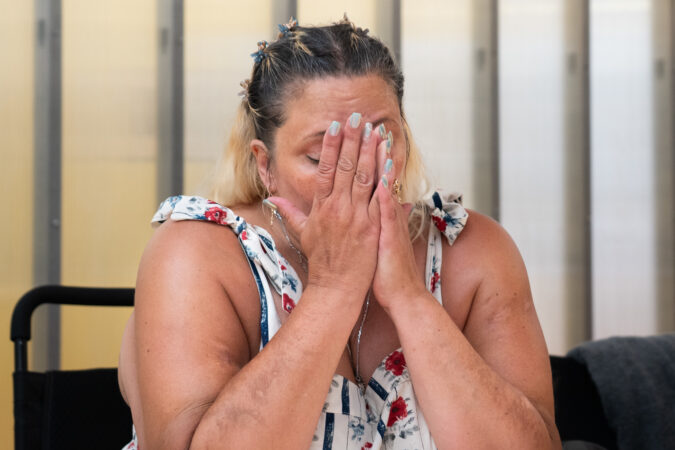
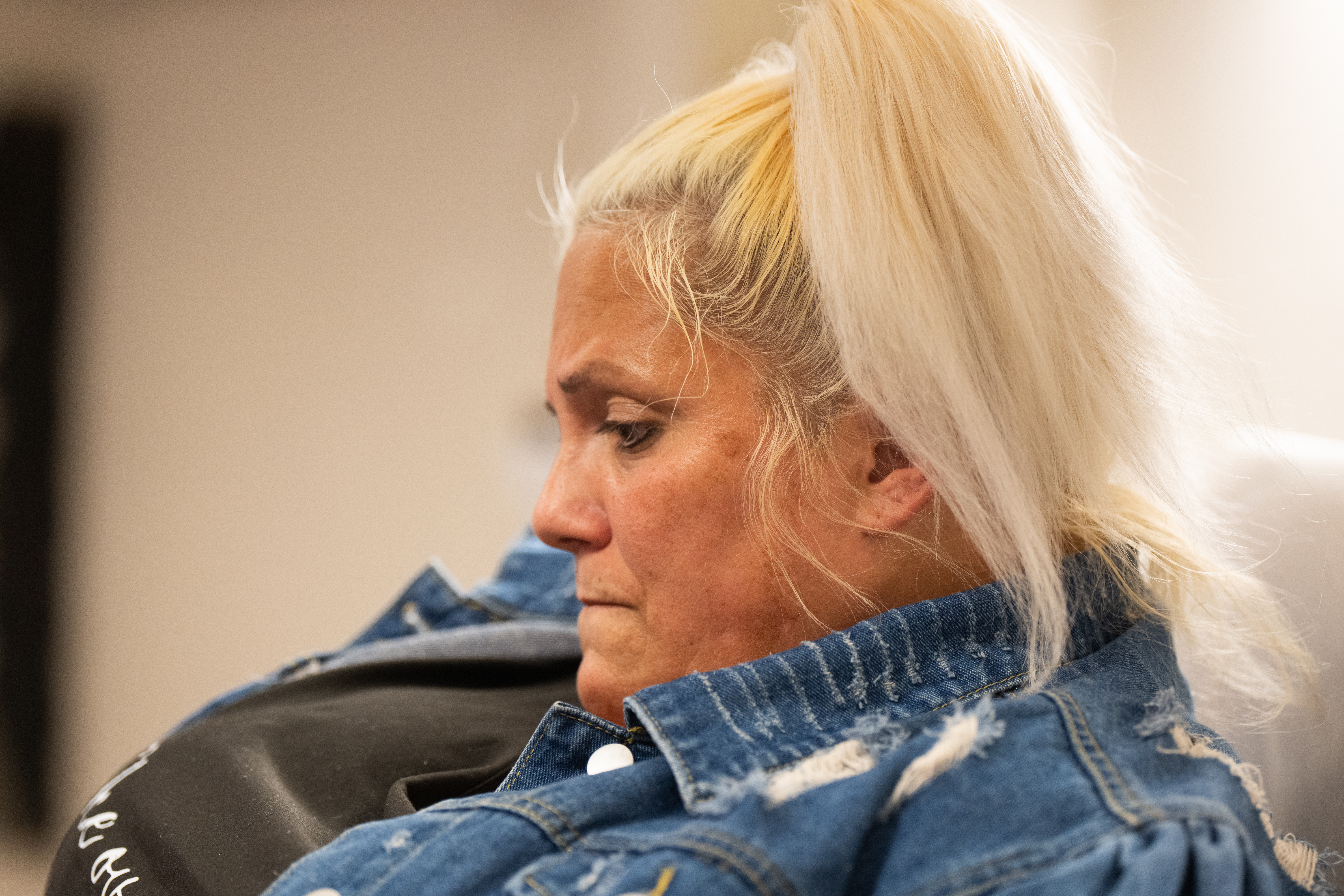
Wyatt began to cry. “It’s already been four years,” she said.
Curran turned to her. “You’ve made so much progress,” she said gently. “Give yourself time.”
Kelly Wyatt enters the wound care clinic at Girard Behavioral Health in August 2024.
Editor’s note: This story has been updated to clarify the name of the Jefferson Health clinic where Kelly Wyatt received wound care.
On a recent Thursday evening in downtown Washington, I took a deep breath and walked into a bar. I joined a couple dozen other women who were milling around making small talk and ordering drinks, waiting for the more formal portion of the evening to begin.
I was there to make friends.
When I first moved to D.C. at age 23, I immediately met lots of new people who were in the same boat. Many of my fellow interns were new to the city, and we were all game for adventures. These days I still have close friends, but many of us have busy jobs and young children. Some have moved away. It can be hard to even schedule a phone call to catch up.
I find myself craving the easy friendships of my early 20s. Could I find that again?
The meetup I was attending was organized by RealRoots, one of a number of startups aimed at making us less lonely. Even before the pandemic, Americans were spending less time with friends. By 2023, the U.S. surgeon general warned we were in a loneliness epidemic and that the health risks of isolation were akin to smoking.
The good news is there’s now less stigma in admitting you want to make friends, especially since the pandemic, RealRoots CEO and co-founder Dorothy Li told me.
“We were all lonely together for two years,” she said, and many of us have begun rebuilding social lives at the same time.
I consulted experts about how to both make new friends and reconnect with old ones. Here’s what I learned.
Be vulnerable
I went into the RealRoots event with a healthy dose of skepticism. I was told that I would be matched with a curated group of women based on my responses to a personality quiz and an interview with an artificial intelligence assistant named Lisa who detected my “social vibe.” (I was “grounded, thoughtful, and warm” — thanks, Lisa!)
“I totally get it,” Li said when I told her about my doubts. “Human connection needs to be in real life.” But the planning and logistics of matching people who are similar and finding times on their calendars? That, she said, “can be done seamlessly by AI.”
The women at my meetup included a former professional ballroom dancer, a nurse who loves her work with dementia patients, and an aid worker about to leave for a work trip to Sudan.
Everyone had different reasons for being there. One woman worked from home and felt isolated, especially since becoming pregnant. Another wanted to push out of her comfort zone and meet new people. A third said she had social anxiety and felt this took the pressure off.
After mingling, moderators led us through a series of questions, whichstarted like corporate icebreakers (what are your hobbies?) but got progressively more personal (what’s something you’re good at?), finally building to the last question: What’s something you’re struggling with right now?
I searched my mind for something that wouldn’t feel too revealing. These were basically strangers, after all. But then someone talked about her fertility issues. Another was going through a difficult divorce. Another had a serious illness. I quietly reassessed. When it was my turn, I no longer felt the need to hold back. I talked about my insecurities as a mom. I felt myself starting to cry as I explained my fears about how my anxiety would affect my daughter. I was met with so much empathy.
When I told Li I felt close to all the women by the end of the night, she told me that’s the point.
“When you start talking about the things that are actually on your mind, everyone can relate,” Li said.
Vulnerability invites vulnerability. This rule also applies when trying to deepen friendships.
For journalist Billy Baker, after getting married, having kids and relocating to the suburbs, he realized that many of his high school and college friends couldn’t be part of his daily life anymore. He set out to build a community where he lived, and the first step was to reach out to people he felt a connection to, and to tell them that. It was intentional and a little scary, but worth it, he said.
“Vulnerability for me was always rewarded,” said Baker, author of the book We Need to Hang Out: A Memoir of Making Friends.
Do things you want to do anyway
When Baker was working on his book about friendship, he was trying to nail down exactly what draws us to other people. He found that a shared interest or activity worked particularly well as a first step. For instance, he would often run into a guy at the gym, so he started asking him to meet up there to work out together.
“Pickleball has changed senior friendship,” he said. “Is it pickleball they love or is it having this activity that they enjoy, and finding others who also enjoy it and then they’re off for coffee?”
Baker says if you choose something you want to do anyway, you’ll probably meet people with a shared interest, and even if you don’t you’ll still have a good time.
Put friendship on the to-do list — near the top
Baker learned that he couldn’t just assume friendships would happen to him — he needed to take initiative.
“We were never taught to prioritize friendship,” Baker said. For him, this journey began when his editor asked him to write about how many men let friendships lapse in middle age. Even though Baker had always been social, he realized he had been prioritizing his work and family and neglecting to make time for friends.
“The gift I gave myself is to put friendship on the to-do list every day alongside eating well, taking care of my family, taking out the trash, all those things,” Baker said. “It needs to be a part of our daily life if you really are going to reap the benefits.”
Baker’s solution was to take inspiration from a group of men in his town with a tradition called “Wednesday nights” — a weekly promise of getting together. Baker created his own version of it, and said it was awkward at first. But eventually, genuine connections formed.
At the end of my conversation with Baker, he gave me a challenge: Was there anyone I could think of who I wanted to be closer to?
I thought of a colleague I have been casual friends with for a few years. I always delighted in running into her in the hallways or at parties, but we had never gotten together just us. Baker encouraged me to ask her to hang out.
I felt a familiar creeping fear as I reached out to her — what if she was too busy, or didn’t feel the same friendship vibe I did? What if we did hang out and had nothing to say?
I asked her, my colleague Rachel Kurzius, to get lunch on a Sunday. We chatted for two hours that felt like 20 minutes. We bonded over talking about books and our kids and the surprising number of things we had in common, and it really feels like the start of a friendship. Similar to Baker, I was rewarded by vulnerability.
If you’re contemplating taking the first step, just do it. The odds are stacked in your favor.
“We like people who like us,” Baker said. So make the first move.
After my RealRoots meetup, I declined to join RealRoots’ six week series — like a kickball league, there was a cost, and it didn’t fit into the budget this month — but I was still grateful for the opportunity to meet people. A few days later, I ran into one of the women from the group at a workout class, and we greeted each other like old friends.
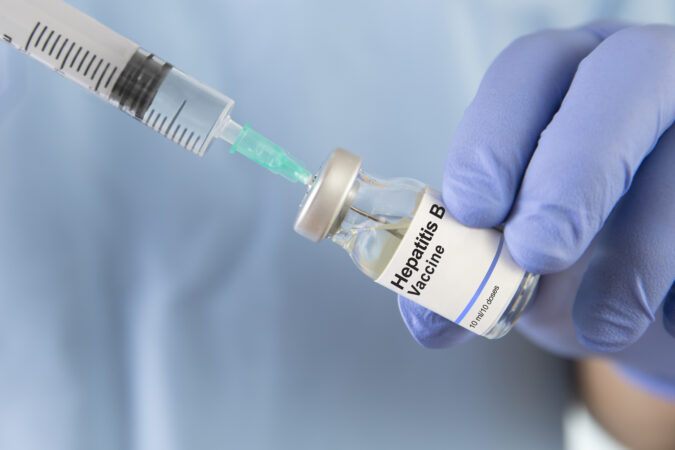
The nation’s top vaccine advisory panel is expected to debate whether to delay the first dose of the hepatitis B shot on Thursday.
The immunization, developed in Philadelphia and long recommended for all U.S. infants at birth, protects against a disease that can do permanent damage to the liver, and for which there is no cure.
The shot is widely considered safe and effective, but who should receive it, and when, has come under scrutiny by President Donald Trump’s administration.
The Advisory Committee on Immunization Practices (ACIP), an independent panel of experts reconstituted this past summer to include several vaccine skeptics, had tabled a vote on this topic in September. It is now scheduled to spend Thursday discussing the vaccine, according to a draft agenda of the group’s two-day December meeting.
Vaccine experts and patient advocates have previously advocated against delaying the birth dose, citing concerns that unvaccinatedchildren could be at risk of contractingthe highly contagious virus.
Starting in 1991, the first dose of the hepatitis B vaccine has been universally recommended for all newborns within 24 hours of birth. Rates of infection among children and teens have since dropped by 99%.
Prior to the universal birth dose recommendation, about half of infections in children were acquired from mothers infected with the virus, the Centers for Disease Control and Prevention found.
The virus spreads through contact with blood and other body fluids.
The virus can be transmitted from mother to baby, as well as through a variety of household sources, such as personal items like toothbrushes and razors that become contaminated with blood.
The virus cannot be spread through casual contact such as hugging, touching, or sharing utensils, but it can be spread through open wounds.
Patients can take antiviral treatments to help control the virus, but there is no cure.
The panel has previously considered delaying the birth dose until one month of age.
ACIPpreviously debated delaying the first dose of the vaccine until one month of age for most babies.
Some members had suggested the dose for newborns should instead be given only to the populations most at risk.
The ACIP considered recommending doctors vaccinate only those newborns whose mothers test positive for the virus, and having the other babies wait a month for their first dose.
Trump separately stated in a news conference, without citing scientific evidence, that he thinks newborns should no longer universally receive the shot and children should wait until age 12. Experts criticized Trump for incorrectly suggesting that hepatitis B is only transmitted sexually.
Experts are concerned about a potential change to the guidelines.
Experts worry that delaying the vaccine could affect its ability to prevent transmission of the virus from mother to baby. “If you wait longer than 24 hours, then the vaccine doesn’t work as well,” Chari Cohen, president of the Hepatitis B Foundation, told The Inquirer in an interview earlier this fall.
Even if the ACIP were to recommend vaccinating only babies whose mothers have the virus, some cases could be missed. Universal testing for the virus has been recommended since the 1990s, but 15% to 16% of women still do not get tested.
Such a policy also would not account for other exposures. Su Wang, a New Jersey physician who treats patients with hepatitis B and herself has the disease, told The Inquirer earlier this year that she likely caught hepatitis B as a child living with her grandparents. Her parents tested negative. “There are a lot of exposures that we aren’t testing for,” she said.
The vaccine is a Philadelphia success story.
The hepatitis B virus was first discovered by Baruch Blumberg, a scientist at Fox Chase Cancer Center, in 1967.
He went on to win a Nobel Prize for that work, and later cocreated and developed the vaccine,which continues to be manufactured in and around the region.
The Hepatitis B Foundation is also locallybased, in Doylestown.