Category: Nation & World

  • France restricts public drinking and outdoor sports as heat wave bakes parts of Europe

    France restricts public drinking and outdoor sports as heat wave bakes parts of Europe

    PARIS — France sizzled Sunday, canceling trains, concerts, and sports events and cracking down on public drinking as an exceptional heat wave unfurled across parts of Europe. Multiple drownings were reported as people sought relief in whatever water they could find.

    About a third of France is under ‘’red alert″ heat and temperatures reached 104 degrees Fahrenheit in some areas, in a country where air-conditioning isn’t widespread. The forecast for Monday is even hotter.

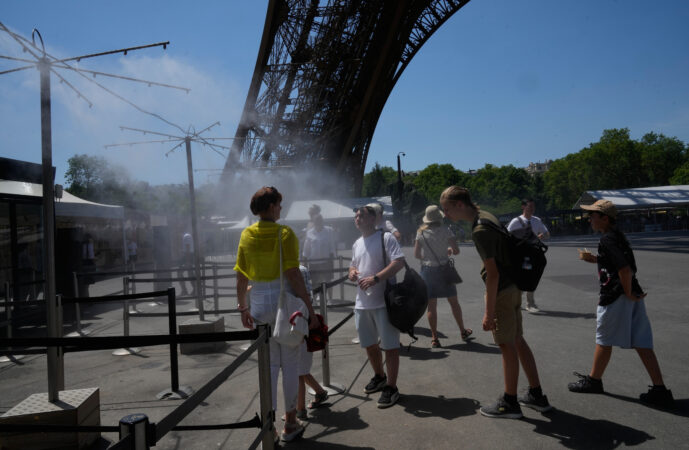
    The Eiffel Tower and other Paris venues set up misting stations to cool crowds, among a raft of measures introduced by authorities to minimize risks. Tourists in Rome dunked in fountains. Spain’s Basque Country canceled some sports and cultural events.

    More than 200,000 people across Europe died from heat-related causes over the last four years, and most of the fatalities were preventable, the World Health Organization’s Europe office said this month. More above-average temperatures are expected this summer, which can cause heat exhaustion and life-threatening heat stroke.

    Human-caused climate change is tied to increasing extreme weather events and U.N. climate agency projections say the next five years should shatter more heat records. A rapid study found that human-caused climate change was responsible for killing about 1,500 people in an unusually early European heat wave in May.

    In this latest European hot spell, French media reported that four children drowned Saturday. Summer drownings are an annual problem that health authorities say worsens during hot spells.

    Solstice parties draw large crowds in extreme heat

    France’s annual Music Day on Sunday was of particular concern. The nationwide summer solstice celebration involves thousands of concerts in village squares, rave venues, and Paris clubs, bringing communities together and increasingly drawing British and other international visitors. Some of the concerts outside Paris were canceled.

    The French government banned public drinking in ’’red alert″ zones, and ordered organizers of music day events to limit alcohol consumption to “preserve emergency services and allow medics to concentrate on taking care of the most vulnerable.”

    Scores of French trains were canceled, and the national rail authority dispatched thousands of extra staff to deal with potential problems as the heat threatened rails and electrical cables.

    Authorities are notably worried about people living in the baking streets, and elderly people in nursing homes or isolated in their homes. About 15,000 older people died in France in a 2003 heat wave that became a national reckoning.

    The government mobilized emergency services and military forces for reinforced wildfire readiness, imposed tightened surveillance of water supplies to France’s many nuclear reactors, and ordered 845 schools to close Monday.

    Spain, Italy, Germany swelter as tourists seek relief

    Spain kicked off the summer with large parts of the country on alert due to temperatures expected to hover around 104 F — even in the interior of Basque Country, a northern region that typically experiences cooler temperatures.

    Authorities have suspended outdoor sports and cultural activities in the region. The heat wave is expected to scorch Spain at least through Wednesday.

    In Italy, authorities expanded heat warnings — referred to locally as “red flags” — to eight cities Sunday in northern and central parts of the country. Temperatures there are mostly in the high 90s to low 100s F.

    At one farm outside Milan, owners set up fans and sprinklers to keep cows cool, while visitors to Milan Fashion Week huddled under parasols and clutched fans. In Rome, tourists dunked their arms and occasionally their faces into the city’s famed fountain pools.

    The German Weather Service is forecasting temperatures of up to 98 F for Monday and Tuesday, and up to 102 F Wednesday.

    A 23-year-old man drowned Saturday in a lake near Rheinstetten in the southwestern region of Baden-Württemberg, the German news agency dpa reported. Three other people are missing after swimming in the Rhine River, a police spokesperson told dpa.

    Britain’s weather office has issued an “extreme heat” warning for much of southern England and parts of Wales from Monday until Thursday, saying temperatures could reach 100 F. The current record for a June day is 96 F, reached in 1976.

    Thunderstorms also threatened regions in Germany and Poland.

    French Prime Minister Sebastien Lecornu convened a new government heat crisis meeting Sunday, and ordered government ministers to plan for better adapting France to heat waves in the future — including “via air-conditioning, if necessary.”
  • Vance meets top Iranian officials as U.S. tries get negotiations back on track

    Vance meets top Iranian officials as U.S. tries get negotiations back on track

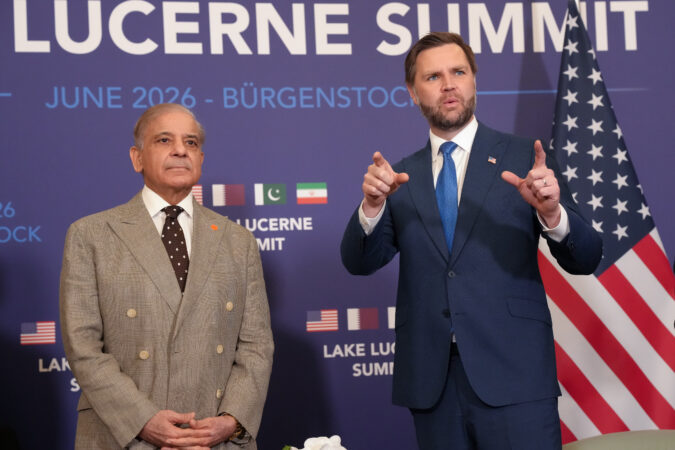
    OBBUERGEN, Switzerland — High-level U.S.-Iran talks on their interim deal to end the war had a tense start Sunday in Switzerland as Tehran took offense at comments by President Donald Trump, who threatened to attack and told Iran’s president to watch what he says.

    The comments from afar — on social media and to news outlets — complicated efforts by Vice President JD Vance and mediators Pakistan and Qatar to keep Iran engaged in discussions meant to address thorny issues like Tehran’s nuclear program, the Strait of Hormuz, and the unfreezing of billions of dollars in Iranian assets.

    Before anything, however, Iran wants to discuss Lebanon, where Israel’s military has been fighting the Iranian-backed Hezbollah militant group, since the deal halts conflict on all fronts.

    “Iran must immediately stop their highly paid PROXIES in Lebanon from causing trouble,” Trump said on social media. “If they don’t, we’ll hit Iran very hard again, just like we did last week, only harder!!!”

    “They would do better to be careful about their statements,” Iran’s lead negotiator, Mohammad Bagher Qalibaf, said on X after Trump’s comments. “Our armed forces are prepared to respond to them in a different manner. They may keep talking, it is we who act.”

    Iranian state media said talks had entered a “difficult phase” and recessed after the “publication of an insulting message by the U.S. President.” The Iranian delegation then met with Qatari mediators and left the negotiating site, state media said.

    Vance and U.S. negotiators including Steve Witkoff and Jared Kushner, Trump’s son-in-law, had met with Qalibaf and Foreign Minister Abbas Araghchi for what Iranian state media said was about 80 minutes.

    An official with knowledge of the talks later told the AP the Iranian delegation remained engaged in the talks and has not indicated to mediators any intention to leave. The official requested anonymity due to the sensitivity of the talks.

    Iran’s focus on Israeli strikes in Lebanon

    Negotiators are in a 60-day sprint to reach an agreement on the technical details that hold massive implications for the world economy and global security.

    “The question before us now is how much more can we accomplish together? Can we turn over a new leaf?” Vance said as the talks began, and asked whether they could “change relations in the Middle East permanently.”

    The U.S. wants Iran locked into negotiations over its nuclear program amid concerns it may be used for military purposes, which Iran denies. Vance also wants Tehran to commit to keeping open the Strait of Hormuz, which Iran on Saturday claimed to close. The U.S. has disputed that, saying shipping traffic continued Sunday.

    But Iranian Foreign Ministry spokesperson Esmail Baghaei told the state news agency that Tehran first wants talks to focus on the conflict in Lebanon.

    A renewed ceasefire in Lebanon, brokered on Saturday, appeared to be holding, and Israel’s military said it would lift movement restrictions for residents near the border with Lebanon on Monday morning — another sign of calm.

    But neither Israel nor Hezbollah is a signatory to the U.S.-Iran deal, and Israeli Prime Minister Benjamin Netanyahu has vowed to keep his forces in southern Lebanon until any threat to Israel is eliminated. Hezbollah has refused to halt attacks unless Israel commits to withdrawing.

    Sharp words exchanged over Iran’s nuclear program

    The agreement signed by Trump and Iranian President Masoud Pezeshkian immediately allows Tehran to sell its oil freely and paves the way for Iran to tap into billions of dollars in assets that are currently frozen.

    It also calls for Iran to dilute its stockpile of highly enriched uranium, believed to be buried under nuclear sites that were targeted in U.S. strikes a year ago.

    Pezeshkian, however, declared Sunday that “we will never back down from the right to enrich uranium, and the other side is also forced to accept it,” according to Iran’s state media.

    Trump, in a telephone interview with Fox News, later warned that the Iranian president should watch what he says and threatened to take over Iran, in comments relayed by a Fox correspondent.

    Iran had cautiously approached the talks given its previous experience with U.S. negotiations on the nuclear issue, which twice in the past year were interrupted by military strikes.

    The deal has stirred much controversy

    Vance has said he planned to be in Switzerland for “a day or two,” leaving much of the detailed negotiations to be led by Witkoff and Kushner. His role in the talks has heightened scrutiny at a time when he’s considering a 2028 presidential campaign.

    Trump and Vance have come under searing criticism from parts of their own party for the deal, with Republican hard-liners unfavorably likening it to the nuclear agreement signed by the Obama administration that Trump and Republicans have insisted did nothing to terminate Iran’s nuclear program.

    The new agreement says commercial vessels can pass through the Strait of Hormuz for 60 days without charge, but does not preclude future fees imposed by Iran. Trump made his own threat Saturday to levy U.S. tolls if there is no deal with Iran in 60 days, insisting that the money would be for “services rendered as the Guardian Angel to the countries of the Middle East.”

    The Trump administration has been working to reassure global markets that the war has been merely a blip on oil prices, as Americans complain about high gasoline prices ahead of peak summer travel. After the deal was announced, oil futures dropped almost 8%.

    Markets were expected to closely track the progress of talks when they opened for trading Sunday evening.

  • Trump, claiming vandalism, says reflecting pool will be drained

    Trump, claiming vandalism, says reflecting pool will be drained

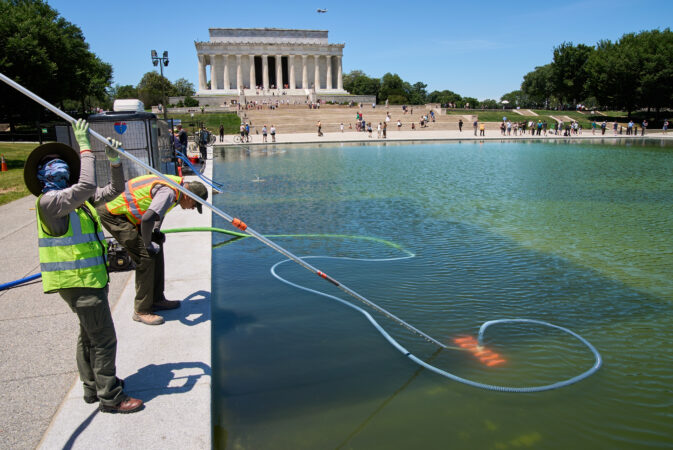
    WASHINGTON — President Donald Trump said on Saturday that “multiple individuals” had been arrested for vandalizing the Lincoln Memorial Reflecting Pool, and that problems with a more than $14 million renovation project had become so severe that the pool would have to be at least partly drained for “necessary repairs.”

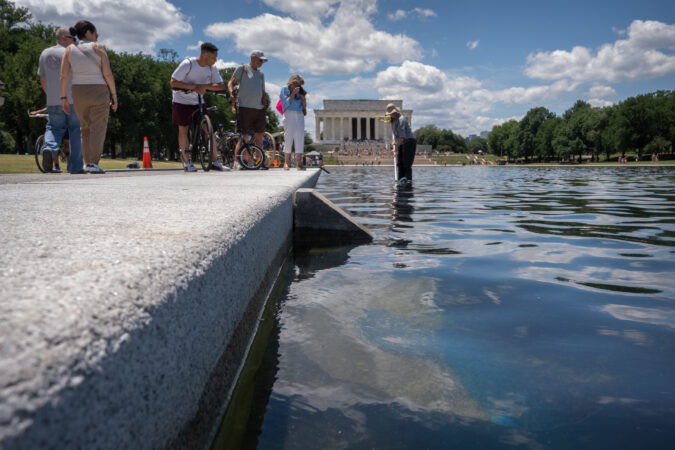
    The president’s announcement late Saturday, made on social media, was his starkest acknowledgment of the pool’s rapid deterioration in recent days. The water this week became covered by clouds of blooming algae, which were obscuring a floor that had just been painted a shade that Trump has called “American flag blue.” The paint then began to peel off, making it a tourist destination for unusual reasons.

    Among those accused of vandalism was David Carter Hearn, 67, a cyclist and three-time Olympian as a canoeist who says he stopped at the site Friday just to have a look, then reached down to touch a strip of peeling blue paint mixed with the algae.

    The U.S. Park Police arrested Hearn shortly after, accusing him of destroying government property, a crime that can carry up to a 10-year prison sentence. Hearn denies the charge.

    “I was just a curious, concerned citizen,” he said in an interview. “I guess I was there at the wrong place, wrong time.”

    The administration has not released the names of others accused of vandalizing the pool, a crime that Trump said Saturday could lead to “years in jail.” In a later post, he said without evidence that vandals had “poured corrosive and destructive chemicals into the Pool.”

    The project, one of many Trump is undertaking around the capital as the United States nears its 250th birthday, has faced intense scrutiny, including from engineers and other experts who warned that the hastily undertaken project was unlikely to undo the problems that have plagued the pool for decades. A construction company tied to Trump was awarded a no-bid contract and painted the bottom of the pool.

    Trump said Saturday that he had met with contractors earlier in the day to discuss the state of the pool.

    The Interior Department said this week that agency workers had “killed the algae” that had expanded with heat and humidity. But on Friday afternoon, the water was stained by clumps of algae where National Park Service staff members had scrubbed away bright green blooms along the bottom of the basin. The pool’s new coating was also missing large sections, including a gap roughly the size of a park bench. Underneath appeared to be the original concrete basin.

    Hearn, of Bethesda, Maryland, said that he was on a 50-mile bike ride before stopping at the pool, and that Park Police officers detained him for more than four hours Friday at a facility south of the National Mall without allowing a phone call. They also did not say more about why he had been arrested, he added. The White House and Park Police did not respond to requests for comment.

    Late Friday, Trump claimed on social media that the “inside surface that was just installed” had been damaged by vandals.

    Hearn said that he had “reached into the water to feel the characteristics” of a dislodged paint piece “still attached to the bottom.” He compared his actions to those of Jonathan Karl, an ABC News reporter who lifted a detached piece of paint at the pool Thursday in a video the news organization published.

    “I didn’t remove anything,” Hearn said. “I was bending and feeling this 2-millimeter-thick, rubbery flap.”

    Until his retirement 18 months ago, Hearn ran a company selling special materials for building canoes. That, he said, made him particularly interested in the materials contractors had used before the paint at the base of the pool began peeling.

    Hearn said that he had already received offers of pro bono representation following his arrest.

    “I’m getting a lot of support from my community,” he added.

    This article originally appeared in The New York Times.

  • No end in sight for U.S. military mission along border with Mexico

    No end in sight for U.S. military mission along border with Mexico

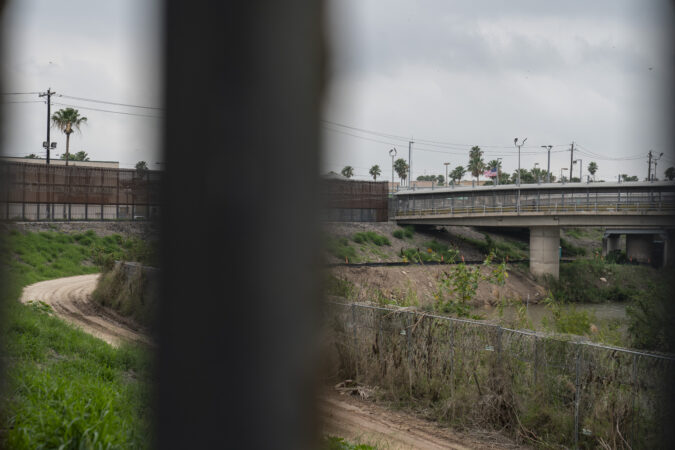
    WASHINGTON — For more than a year, the Pentagon has deployed about 9,000 active-duty troops along nearly 2,000 miles of the southwest border to confront migrants, smugglers, and drug cartels.

    The troops are still there — at a cost of tens of millions of dollars each week — even though the Trump administration months ago largely achieved its goal of slashing illegal crossings.

    The military patrols, working closely with Customs and Border Protection as well as the Mexican military, have pushed Mexican cartels and smugglers into more remote mountainous areas to evade detection.

    But threats to U.S. troops are on the rise, U.S. officials say.

    Some members of Congress have questioned whether the patrols are the best use of active-duty troops who would otherwise be training for deployments to Eastern Europe, the Middle East, or the Indo-Pacific. Lawmakers and independent analysts have voiced concerns that the border missions will distract from training, drain resources, and undermine readiness.

    The mission marked a milestone late last month when its third commander, Maj. Gen. Curtis D. Taylor of the Army’s 1st Armored Division, took control of one of the centerpieces of the Trump administration’s Western Hemisphere security policy.

    Challenges abound for the troops involved in the mission, which the military calls Ardent Vanguard.

    Cartel activity increased along the border in February after Mexican forces, aided by the CIA, killed a notorious Mexican cartel leader known as El Mencho. Soon after, U.S. service members discovered that their phones had been hacked, and they began receiving threatening messages, congressional officials said.

    “I’m very concerned about this operation and the safety of our Marines,” Rep. Sara Jacobs (D., Calif.), who sits on the Armed Services Committee, said at a hearing in March. “Our service members did not sign up for immigration enforcement, and this political stunt is putting their lives at risk.”

    While U.S. forces deployed to the southern border use several counterdrone systems, the general in charge of helping defend U.S. territory said that many troops lacked adequate technology for patrols.

    “It presents us a different challenge,” Gen. Gregory M. Guillot, head of the military’s Northern Command, said at a security conference in Tampa, Fla., last month. He noted the overall increase in anti-drone technology.

    Unlike the drone wars on the battlefields of Ukraine or Iran, there have been no drone attacks on either side of this border conflict and no U.S. casualties, military officials say.

    The mission to detect and interdict illegal activity across hundreds of miles of desert and mountainous frontier has also become a high-stakes proving ground for emerging technology, including counter-drone devices, remotely guided sea vessels, and advanced sensors.

    Guillot said at a change-of-command ceremony in Arizona last month that the military had for the first time conducted joint patrols with Mexican soldiers using encrypted radios and high-energy lasers to knock down potentially hostile cartel-operated drones.

    “My mission is to control the border,” Maj. Gen. David W. Gardner, commander of the 101st Airborne Division, said in a phone interview from Fort Huachuca, Ariz., before handing off the operation to Taylor. “We remain focused on the mission of sealing the border.”

    Asked about confronting the drones and other security threats posed by Mexican cartels, Gardner said that U.S. forces had disabled or knocked down drones that the cartels use to find new smuggling routes around the U.S. patrols.

    “The illicit actors are finding it more and more difficult to accomplish their objectives,” Gardner said.

    Sen. Jack Reed (D., R.I.), the top Democrat on the Armed Services Committee, expressed concern at a hearing last month that the border mission was siphoning money from important training missions. He said the Army faced a nearly $2 billion budget shortfall largely because the Department of Homeland Security had not reimbursed it for border-support missions.

    “I have received concerning reports about the potential for canceling training rotations, grounded flight hours, and reduced Guard and Reserve training resources,” Reed said, referring to the National Guard and Army Reserve. “These are real costs for real units.”

    But several commanders and some troops stationed along the border said in interviews — some of them recent — that serving in one of Trump’s highest-priority missions gave them purpose. They are using many of their skills — route planning, mission rehearsals, patrols, and surveillance flights — in the real world against criminal smuggling gangs and Mexican drug cartels, instead of just practicing at their home bases or in exercises, they said.

    There is no end in sight for the military mission on the border. The Pentagon said last May that the first four months of the operation cost $525 million. But the department declined to say what the total cost was now.

  • Zelensky returns Poland’s highest honor after Polish leader revokes it in a spat over history

    Zelensky returns Poland’s highest honor after Polish leader revokes it in a spat over history

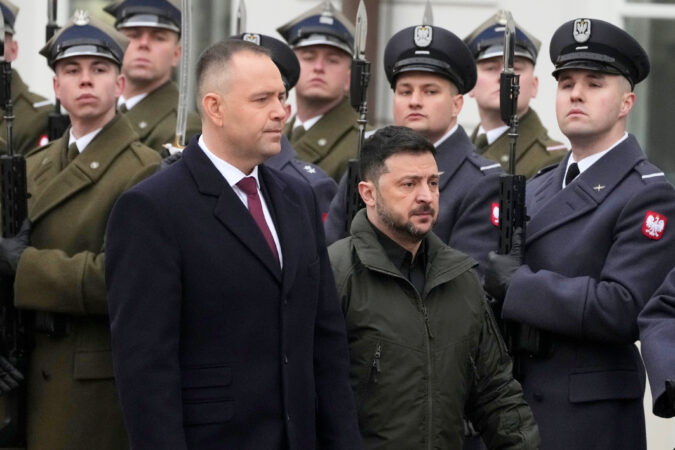
    WARSAW, Poland — Ukrainian leader Volodymyr Zelensky has returned Poland’s highest state honor, after the Polish president stripped him of the award as a politically charged dispute over World War II history resurfaced.

    Ukrainians believed the order “was meant for the Ukrainian People and our army,” Zelensky wrote in a social media post explaining the gesture. “Today, I sent the Order back to the President of Poland. I believe the future will confirm the respect Ukrainians deserve.”

    The message published on X is accompanied by photos of the Polish order and a postal receipt that it was about to be mailed to the Polish presidential office.

    President Karol Nawrocki decided to strip Zelensky of the Order of the White Eagle over the Ukrainian leader’s decision to name a military unit after a Ukrainian paramilitary organization accused of massacring Poles during WWII.

    Former Polish President Andrzej Duda bestowed the award on Zelensky in 2023 for services to security, resilience, and the defense of human rights.

    Zelensky issued a decree on May 26 naming a unit of Ukraine’s Special Operations Forces after the Ukrainian Insurgent Army, or UPA, which operated during the 1940s and 1950s and has been accused in Poland of mass killings.

    “For the majority of Polish society, the Ukrainian Insurgent Army remains above all a formation responsible for cruel crimes against the citizens of the Polish Republic during World War II,” Nawrocki said in a 13-minute address on social media.

    Zelensky’s move reopened old wounds in Poland

    The Ukrainian decree was met with widespread criticism in Poland, which has hosted millions of Ukrainian refugees and is a key supporter of Kyiv as it has battled Russia’s four-year invasion. However, Nawrocki is a nationalist politician who has exploited anti-Ukrainian sentiment for electoral gain. Ukrainians in Poland have been facing increasing prejudice despite their contributions to the economy.

    The decision to revoke the honor did not mean Poland’s support for Ukraine in its defense against Russia would decrease, Nawrocki said.

    Ukraine is grateful to Poland for its support, and would stay open to resolve historical differences with Poland, Zelensky wrote Saturday in his post. “I am proud of our people and of EVERY Ukrainian warrior.”

    Ukrainian Presidential Office chief Kyrylo Budanov wrote on Telegram that Nawrocki’s decision was “an unfriendly act toward our people” and “a gift to the Moscow aggressor, which will certainly use it against both of our countries.”

    Four Ukrainian officials including Budanov said they would return state honors that Poland had issued them.

    Some in Ukraine criticized the decision to return the Polish honors.

    Arseniy Yatsenyuk, Ukraine’s former prime minister, wrote on X that one “harmful and incorrect decision by the current president of Poland cannot be corrected by other incorrect decisions of ours.”

    Calls to resolve differences

    Poland is scheduled to host a major event on Ukraine’s postwar reconstruction next week, which Zelensky was expected to attend.

    Polish Prime Minister Donald Tusk, a political rival of Nawrocki, urged the two leaders to “tone down emotions, not stoke tensions.”

    “The front line runs elsewhere,” Tusk wrote on social media Friday night, adding that the row between Poland and Ukraine “delights Putin and shocks our allies.”

    Zelensky’s May decree said the designation was meant to restore military traditions and recognize the unit’s performance in defending Ukraine’s territorial integrity and independence.

    The UPA fought for Ukrainian independence against both Nazi Germany and Soviet forces. But it has been accused of killing tens of thousands of Poles, mostly in the Nazi-occupied regions of Volhynia and Eastern Galicia. In 2016, the Polish Parliament recognized the crimes committed by UPA as genocide.

    Ukrainians say armed formations on both sides, including the UPA and Polish underground forces, were involved in attacks and reprisals that led to large-scale civilian casualties among Poles and Ukrainians.

    Poland and Ukraine had recently made progress on the issue of exhumation of Polish victims. A December meeting between the two presidents in Warsaw had signaled progress on historical reconciliation.

  • Trump deepens the dustup with Italy’s Meloni, who says his ‘unprovoked attacks are senseless’

    Trump deepens the dustup with Italy’s Meloni, who says his ‘unprovoked attacks are senseless’

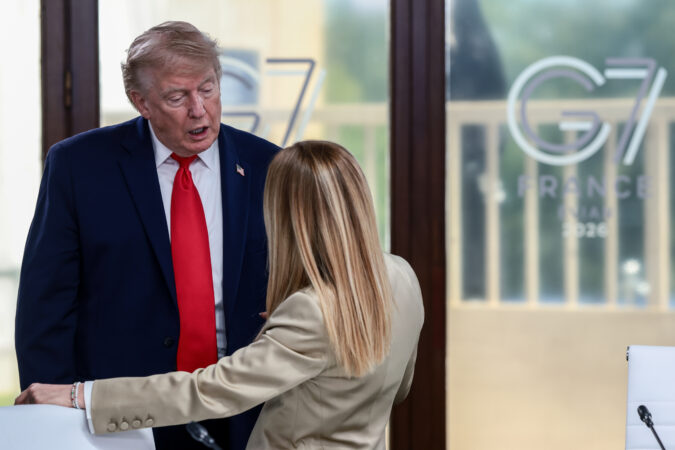
    WASHINGTON — President Donald Trump on Saturday lashed out at Italian Prime Minister Giorgia Meloni, insisting that she asked “over and over” for a photo with him at the recent Group of Seven summit and criticizing what he said was Italy’s lack of cooperation during the Iran war.

    The remarks deepen the spat that began this week with the Republican president’s interview with an Italian broadcaster, during which Trump claimed Meloni “begged” for the photo during the G7 meeting in France. Meloni has called that “completely fabricated.” The dustup led Italy’s foreign minister to cancel a planned trip to the United States as Meloni’s government lined up in her defense.

    “Italian Prime Minister Gigiorgia Meloni asked, over and over, for a picture with me during the G-7 meeting in France,” Trump wrote on his social media platform while spending the weekend at the Camp David presidential retreat. He misspelled her first name in the initial post, which he later corrected.

    He continued: “She is doing poorly in Italy with her level of popularity, possibly because she turned down the United States of America, a Country that truly loves and protects Italy, when it came to denying Iran from obtaining or developing a Nuclear Weapon (But so did NATO, for that matter!).”

    Meloni soon responded, saying in a statement to Trump that “these constant, unprovoked attacks are senseless.”

    “As for my popularity, being your friend certainly has not helped it, nor does it depend on my relationship with you. My popularity depends on my ability to defend Italy’s national interest, and that is exactly what I have always done,” Meloni said in a post on Instagram. She added that “in any case, my popularity is none of your concern. I suggest you focus on yours.”

    Trump’s initial comments were aired Friday on the La7 network. A correspondent had asked the president about Ukraine, but Trump raised Meloni and made the claim about the photo. Trump said he was not obliged to take the picture with her but that he felt sorry for her and agreed, La7 said. The broadcaster put a dubbed version of the conversation online, but not the original English audio.

    In his post, Trump also complained that Meloni would not allow the U.S. to use Italy’s landing strips or runways during the Iran war even though the U.S. is a leader in defense spending among NATO allies. That is a long-standing complaint about the military alliance and one that Trump raised before his White House meeting Wednesday with NATO Secretary-General Mark Rutte and the NATO summit in Turkey next month.

    Italy, a key logistics hub for the U.S., declined in March to allow American bombers headed for the Middle East to use a base in Sicily without parliamentary approval. It was a decision reflecting constitutional constraints and strong domestic opposition to the war. Meloni has insisted that any use of Italian bases for offensive operations would require parliamentary backing.

    Trump vented his frustration about Meloni and on Saturday claimed that she “wants to be friends again” in light of the initial deal between the U.S. and Iran to end the war.

  • Trump tries to blame Reflecting Poll woes on vandalism, announces ‘multiple arrests’

    Trump tries to blame Reflecting Poll woes on vandalism, announces ‘multiple arrests’

    WASHINGTON (AP) — President Donald Trump on Saturday announced that federal authorities had made “multiple arrests” of people he said were vandalizing the Reflecting Pool as he struggled to explain why the $14-million-plus rehabilitation project he launched for the nation’s 250th anniversary seemingly backfired.

    Trump said his predecessors had let the pool turn an algae-stained green and that he’d line it with “American flag blue” so it better reflected the Washington Monument. But after the new pool was unveiled, its blue tinge quickly became a familiar green. Workers treated it with chemicals to kill the algae, but then the painted blue lining on the bottom began to peel.

    On Friday night, Trump posted about the pool.

    “We’ve had some real problems with Vandalism at the beautiful Reflecting Pool,” he posted on his social media site Friday night. ”Just like three days ago, they destroyed the grass outside of the Pool, they’ve also done everything possible to hurt the inside surface that was just installed.”

    He offered no details to substantiate his claim.

    Agencies responsible for law enforcement and upkeep on the National Mall — the U.S. Park Police, National Park Service and Interior Department — did not respond to requests for comment. Trump on Saturday followed up by saying Park Police “have arrested multiple individuals for vandalizing our Nations magnificent Reflecting Poll,” meaning Pool.

    He went on: “Who would do such a thing? These are very serious crimes having to do with the destruction of National Monuments. Years in jail!”

    One man arrested was David Hearn, 67, of Bethesda, Md., who owned a company that made composite used to build watercraft. He said he stopped by the pool during his 64-mile bike ride Friday to see what was going on.

    Hearn, a former Olympic canoe racer, told the Associated Press that he reached into the pool because he wanted to examine the peeling new coating. He said he briefly touched a chunk that was still attached to the side of the pool, then let go shortly after a park worker told him to.

    But, Hearn said, he was then detained by National Guard troops and Park Police for five hours before being released Friday night.

    “I’m a curious citizen,” Hearn said in a telephone interview. “I reached down to see what it felt like. It was very rubbery.”

    The Washington Post first reported Hearn’s arrest, and he said he has a date to appear in court next month and is looking for legal help.

    Even if someone pulled ribbons of paint from the side of the pool, it would not explain the clouds of algae in green water and swaths of loose blue paint detached from the bottom.

    Trump insisted something nefarious has been going on at the scene. “No different than the chemicals that were used on the National Mall, they used something similar in the Reflecting Pool to try to destroy and demean our beautiful work,” he posted Friday evening.

    That was an apparent reference to the discovery of large numbers etched in discolored grass on the National Mall the week before: “86 47.” Authorities said the numbers could have been meant as a threat to Trump, the 47th president. The number 86 can be slang for “getting rid of.” They are investigating.

    Trump’s claims came after days of negative attention to the state of the pool, which has drawn television cameras and curious onlookers.

  • Trump threatens to charge U.S. tolls in Strait of Hormuz if final Iran deal not reached in 60 days

    Trump threatens to charge U.S. tolls in Strait of Hormuz if final Iran deal not reached in 60 days

    TYRE, Lebanon — Iran on Saturday said it closed the Strait of Hormuz because of Israel’s attacks in Lebanon and warned that while negotiators were going to Switzerland for talks with the United States on their interim agreement, not much is likely to happen if the fighting doesn’t stop.

    U.S. President Donald Trump, in response, threatened to impose American tolls in the crucial waterway if a final deal with Iran isn’t reached in 60 days, saying the money would be for “services rendered as the Guardian Angel to the countries of the Middle East.” His social media post underscored that the agreement calls for toll-free travel for 60 days.

    The announcements indicated a rough start to technical-level U.S.-Iran talks that key mediator Pakistan said will begin Sunday, with Qatari mediators also participating.

    U.S. Vice President JD Vance left for Switzerland on Saturday evening, just as Iranian state TV posted video showing Iran’s negotiators arriving there. They include parliamentary Speaker Mohammad Bagher Qalibaf, Foreign Minister Abbas Araghchi, and central bank and oil officials, among others. The deal calls for billions of dollars of Iran’s assets to be unfrozen.

    Talks were meant to start Friday, but the Iranians initially canceled their plans to attend because of escalating fighting in Lebanon. Negotiators for the U.S. and Qatar, with help from Iran, worked out an agreement between Israel and Hezbollah to tamp down hostilities, according to U.S. and regional officials who were not authorized to comment publicly and spoke on the condition of anonymity.

    Vance told reporters he would be in Switzerland “for a day or two” but was optimistic on making progress in the nuclear talks and on a ceasefire in southern Lebanon.

    Negotiations toward a final agreement will begin once key commitments are upheld, Iranian Foreign Ministry spokesperson Esmail Baghaei said. If they are not, “the memorandum of understanding as a whole will be jeopardized.”

    Strait once again becomes a challenge

    But the strait has emerged again as a focus. Iran’s joint military command said it was closed because of the U.S. “clear breach of its commitments” by failing to end the war. The interim deal is meant to stop fighting on all fronts.

    The U.S. disputed Iran’s announcement.

    “Iran does not control the Strait of Hormuz. Traffic continues to flow, and U.S. forces are monitoring the situation to ensure this remains the case,” said Capt. Tim Hawkins, a spokesperson for U.S. Central Command. The military said that 55 merchant ships transited Saturday with more than 17 million barrels of oil.

    The global economy braced for more uncertainty.

    Ships began transiting after the interim U.S.-Iran agreement was signed earlier in the week, a milestone that left plenty of questions unanswered. The U.S. lifted its blockade of Iran’s ports and now allows Tehran to sell its oil freely — terms that have left some in the U.S. Congress asking whether the war was worth it.

    Vance earlier confirmed that top negotiators Jared Kushner and Steve Witkoff were already in Switzerland and working through technical details of anticipated negotiations on Iran’s nuclear program. The interim deal gives negotiators 60 days to reach a nuclear agreement, but the issue is intricate and the time can be extended.

    Israeli attacks in Lebanon kill at least 16

    A Hezbollah official told the Associated Press that Iran informed the militant group that Tehran will not reopen the strait until Israel announces publicly that it will comply with a “comprehensive ceasefire” in Lebanon and an end to military operations there. The official spoke on condition of anonymity because he was not authorized to speak publicly.

    The official said Hezbollah will commit to a ceasefire if Israel does.

    An Israeli military official, speaking on condition of anonymity in line with regulations, later said the military had received “updated directives from the political echelon to cease fire.” The official said the military is operating in a defensive manner in Lebanon, which includes the right to respond to Hezbollah attacks.

    The official also said five Israeli soldiers had been killed in the past 48 hours in southern Lebanon.

    Earlier Saturday, Israeli strikes on southern Lebanon killed at least 16 people, including two children, hours after reports emerged of a ceasefire agreement there. Seven people were trapped under rubble after strikes hit the southern city of Nabatiyeh and nearby villages, Lebanon’s National News Agency said.

    The death toll in the latest war between Israel and Hezbollah has surpassed 4,000, Lebanon’s health ministry later announced.

    An Israeli military official said Hezbollah fired more than 50 projectiles at Israeli forces in southern Lebanon overnight. Israel’s army said it struck dozens of Hezbollah targets and militants.

    On Friday, the Israeli ambassador to Washington, Yechiel Leiter, said Israel “remains firmly committed to an immediate ceasefire” if Hezbollah honors the agreement and ceases hostilities.

    Earlier Saturday, Hezbollah said it had committed to the ceasefire but blamed Israel for violating it Friday night and said it would repel attacks by Israeli troops.

    Conflict could sink the US-Iran deal

    Neither Israel nor Hezbollah are signatories to the deal between the U.S. and Iran.

    Hezbollah and Israel went to war two days after the U.S. and Israel launched strikes on Iran on Feb. 28, with Hezbollah firing rockets and drones at northern Israel and Israel seizing large swaths of southern Lebanon.

    A new round of U.S.-backed talks between the Lebanese government and Israel is expected in Washington next week.

    Israeli Prime Minister Benjamin Netanyahu has vowed to keep Israeli forces in southern Lebanon until any threat to Israel is eliminated. Hezbollah has refused to halt its attacks unless Israel commits to withdrawing from Lebanon.

    Fighting continues near the Israel-Lebanon border

    A strike on Lebanon’s Barish village killed four members of a family: parents and two children. In Arab Salim village, a body was pulled from a destroyed house, and in Doueir and Kfar Rumman villages, drone strikes killed a person on a motorcycle and a Lebanese soldier. Nine people were killed in strikes in Qannarit, Sohmor, and Shehour villages.

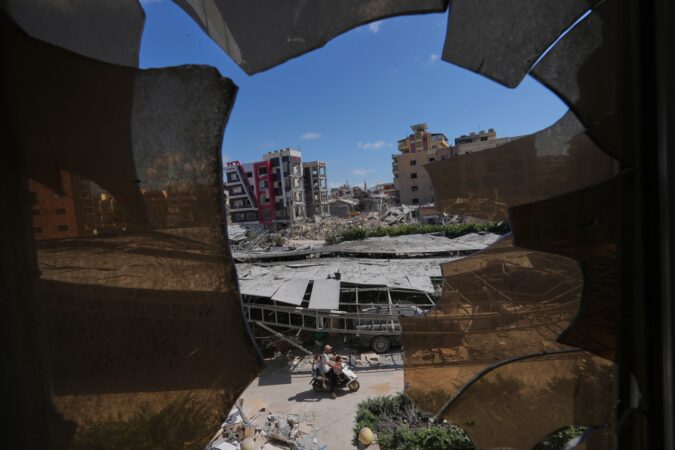
    Israeli jets flew low over the coastal city of Tyre. Residents told the Associated Press they were relieved that Tyre had been spared in recent days, but now they were reminded that the war is not over.

    “Our entire lives would change if there’s a ceasefire,” said one resident, Hussein Khoshman.

    Some residents of northern Israel doubted the fighting would stop. “I don’t believe in a ceasefire because it doesn’t exist,” said Miriam Hod in Metula.

  • President Donald Trump unveils the new Air Force One, a converted Qatari jet

    President Donald Trump unveils the new Air Force One, a converted Qatari jet

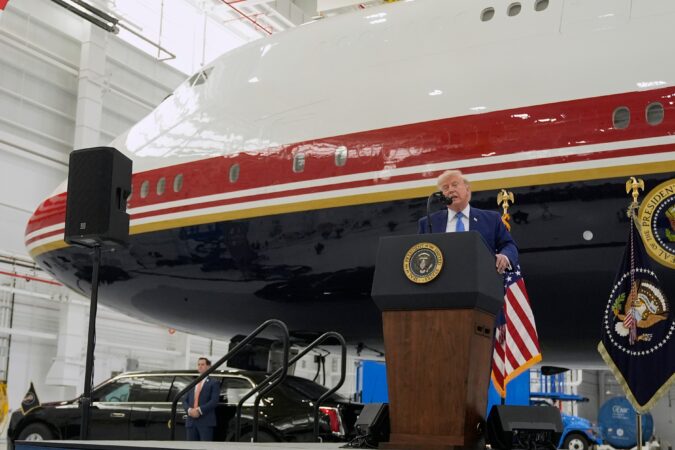
    ANDREWS AIR FORCE BASE, Md. — President Donald Trump on Friday showed off the new Air Force One, a formerly Qatari-owned jumbo jet that has been converted into the official U.S. presidential aircraft.

    The new aircraft eschews the Kennedy-era robin’s egg blue exterior of the old plane for a bolder look, with the underbelly of the plane painted navy blue with a red stripe above it. The plane’s left side, where the president boards, features the presidential seal, while the tail of the aircraft has a massive American flag on it.

    “This plane was transformed into a flying White House at a level of luxury that nobody has ever seen before,” Trump said from inside the massive Andrews Air Force Base hangar, as a couple of hundred assembled Air Force personnel looked on. He spoke after stepping off the new plane in a dramatic flourish, as his signature tune “God Bless the USA” played.

    He confirmed that he would be taking the new jet to the NATO summit in Ankara, Turkey, next month and indicated he would be returning to China “at some point,” presumably a reference to the Asia-Pacific Economic Cooperation summit that China is hosting in November. His return from the Group of Seven summit in France this week was the last planned trip aboard the old Air Force One, he said.

    “Now, when we land at airports in London and in Germany and different places, nobody tops this one, and that’s the way we have to have it for our country,” Trump said, noting that the colors and the design were to “my taste, I will say.”

    He added that the new Air Force One will do a flyover during the July 4 celebrations next month.

    The gift from Qatar is serving as a so-called “bridge” aircraft to carry the president until the new planes ordered directly from Boeing arrive. That delivery is currently slated for 2028.

    The administration formally accepted a luxury Boeing 747 jet from Qatar last year to be used as the presidential airplane, despite questions about the ethics and legality of accepting such an expensive gift from a foreign government. Trump has insisted in the past that he would not fly around in the Qatari jet once he leaves office and said it would instead be donated to a future presidential library.

    Trump on Friday said the U.S. was in a “little bit of a logjam” as they awaited the delivery of the new jets directly from Boeing, which had originally been scheduled for 2024 but have been delayed. He recalled asking the emir of Qatar for use of one of their planes.

    “See, a normal president wouldn’t do this. A normal president wants to stay away from aircraft,” Trump said Friday. “But our country has to be represented properly.”

    The Air Force said in a news release Friday that any plane deemed Air Force One “must meet rigorous security requirements” and that the Qatari plane “was modified under a disciplined engineering approach that prioritized these exact core capabilities above all else.” The Air Force also said “much of the previous head of state interior layout” of the plane was kept intact.

    The Air Force has said in the past that security modifications to the jet would cost less than $400 million.

    Trump’s efforts to reimagine the presidential airplane date back to his first administration, when he directed that an incoming fleet of new jets would adopt a color scheme that was nearly identical to that of his personal airplane. Then-President Joe Biden reversed the decision in March 2023 as an Air Force review suggested that the darker colors could increase costs and delay delivery of the new jets, but once Trump returned to office, he returned to his desired colors for the plane.

    Other government jets that carry other top administration officials will also use the similar red, white, and navy color scheme, the Air Force said earlier this year.

    An Air Force spokesperson, who spoke on condition of anonymity to discuss sensitive plans, told the Associated Press that the two current planes, known as VC-25As, will not be retiring. Instead, they will remain in the fleet until the new Boeing planes, referred to as VC-25Bs, come into service, the spokesperson said.

    It is unclear how the older jets will be used but the spokesperson said that both the Qatari jet as well as the VC-25As will be available for use and “the Presidential Airlift Group will select the appropriate aircraft for each mission based on operational requirements.”

  • U.S. intelligence warns Israel is likely to undermine Iran peace deal, officials say

    U.S. intelligence warns Israel is likely to undermine Iran peace deal, officials say

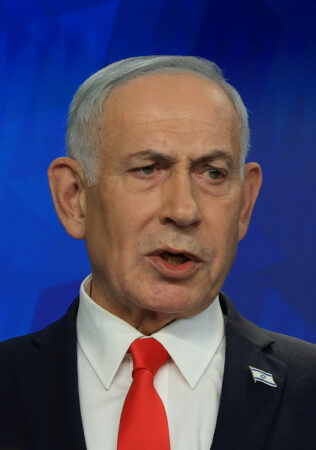
    U.S. intelligence agencies have warned the Trump administration that Israeli Prime Minister Benjamin Netanyahu is likely to take steps that will undermine President Donald Trump’s effort to reach a lasting peace deal with Iran, as the Israeli premier faces intense political pressure to continue waging his country’s war in Lebanon, current and former U.S. officials said.

    Israel appears intent on maintaining military operations against Iran’s proxy Hezbollah in Lebanon, an aim that would flout a core element of the fledgling agreement that calls for an end to hostilities in that country, according to intelligence reports, including one circulated this week, said the officials.

    The analysis comes at a moment of growing tension between Netanyahu’s government and Trump administration officials, who have publicly warned Israel against launching attacks against Hezbollah that might derail Trump’s deal.

    On Friday, Israel launched airstrikes across southern Lebanon in response to a Hezbollah drone strike that killed four Israeli soldiers. As clashes continued, U.S. and Iranian officials said they postponed talks due to begin in Switzerland on Friday. Vice President JD Vance, who was to lead the U.S. delegation, postponed his trip.

    If Netanyahu redoubles his military campaign in Lebanon, he would not only threaten the framework for an agreement signed by the United States and Iran on Wednesday, but he could rupture the relationship with an American president that has been integral to his political fortune.

    Speaking at a news conference in France on Wednesday to announce the U.S.-Iran “memorandum of understanding,” Trump said that he has a “little dispute over Lebanon” with Netanyahu and has urged the Israeli leader to not “knock down a building every time somebody walks into it that’s from Hezbollah.”

    The new U.S. intelligence report concludes that in the face of national elections this fall, Netanyahu’s political survival is linked to showing his domestic audience that he will not withdraw troops from Lebanon and that he is intent on escalating the fighting with Hezbollah, said one U.S. official familiar with the report. The official, like others interviewed, spoke on the condition of anonymity because of the matter’s sensitivity.

    The U.S. intelligence report also describes Israel’s frustration with the terms of the Trump peace memorandum, which undermine its broader objective of maintaining maximum pressure on Tehran, according to a current and former official.

    The report conveys Israel’s perception that the agreement could constrain its ability to defend itself against Hezbollah, one former official said.

    Trump administration officials insist that the terms do not prevent Israel from retaliating against Hezbollah if fired upon and that Netanyahu’s concerns pale in comparison to the need to complete a deal and reopen the Strait of Hormuz to stave off a global economic crisis.

    The report reflected that any suspension of hostilities or withdrawal from Lebanon will be seen in Israel as a defeat for Netanyahu, said the current official.

    “Israeli military activity in Lebanon is for the sole purpose of defending Israeli citizens from continuous attacks by Hezbollah,” said a senior Israeli government official, speaking on the condition of anonymity according to the government’s protocol, in response to a request for comment about the U.S. intelligence analysis.

    Popular opinion in Israel remains highly supportive of efforts to dismantle Hezbollah, the Iranian proxy group that joined its partner, Hamas, in attacking Israel with rockets in October 2023.

    Tens of thousands of Israelis displaced from their homes in the country’s north by drones and missile strikes have demanded that Netanyahu decimate Hezbollah, and he has come under withering criticism from across the domestic political spectrum for failing to eliminate the militant threat.

    Fully 70% of Jewish Israelis support intensifying the fight against Hezbollah, according to a May poll by the Institute of National Security Studies, a leading Israeli think tank, and Israeli political analysts widely say that a military pullback would be interpreted by voters as a sign of defeat.

    Even if Israel does not escalate fighting in Lebanon by bombing the southern suburbs of Beirut, Hezbollah’s seat of power, its refusal to withdraw troops from the country’s south is likely to doom the fragile accord between the U.S. and Iran, a second U.S. official said, offering an independent analysis.

    “Continuing to occupy part of Lebanon is a recipe for disaster,” said the official. “Without a full Israeli withdrawal, the likelihood of resumed hostilities between the [Israeli military] and Hezbollah is all but certain.”

    Israeli cabinet officials are standing their ground. “For every tear shed by an Israeli mother, a thousand Lebanese mothers should cry. All of Lebanon should burn,” National Security Minister Itamar Ben Gvir said Friday on social media.

    Netanyahu is risking “huge friction” with Trump, who undertook the war with Iran on Feb. 28 at the Israeli leader’s urging and soon found himself mired in a conflict that has cost tens of billions of dollars, sent global gas prices soaring, and saw the deaths of 13 U.S. troops, said Danny Citrinowicz, a former Israeli military intelligence analyst.

    “Bibi’s in a very tough situation,” said Citrinowicz, now senior researcher at the Tel Aviv-based Institute for National Security Studies, using the nickname of the Israeli prime minister. “He’s seeing his greatest rival, the Iranian regime, being strengthened by the U.S. administration — and he cannot do anything about it.”

    On two consecutive weekends this month, Netanyahu launched airstrikes against Beirut in response to Hezbollah provocations that threatened to jeopardize Trump’s fragile deal. The strike on June 7 triggered Iran to launch ballistic missiles in retaliation, and tensions were defused only when the White House intervened. Israel struck Beirut again Sunday, hours before the Trump administration pushed through the memorandum of understanding with Tehran.

    Even after the deal was signed, Netanyahu and his allies have remained defiant, insisting they will not withdraw troops from southern Lebanon and would continue carrying out strikes even if that angered Trump.

    The White House threw a brushback pitch.

    “Donald J. Trump is the only head of state in the entire world who is sympathetic to the nation of Israel at this moment in time, and he happens to be the head of state of the world’s superpower,” Vice President JD Vance told reporters in the White House press briefing room Thursday. “If I was in the cabinet of the Israeli government, I might not be attacking the only powerful ally that I have anywhere left in the entire world.”

    The Israel Defense Forces occupy more than 200 square miles of Lebanese territory and have forced more than 1 million residents from their homes — though some have returned — to create what it calls a depopulated “security zone.” More than 3,000 people have been killed by the Israeli campaign since it began in mid-March, according to Lebanese authorities.

    “We will stay in the Lebanon security buffer zone for as long as necessary,” Netanyahu told reporters in Jerusalem this week. On some issues, “we see less eye to eye,” Netanyahu said, referring to his relationship with Trump.

    Harrison Mann, a former U.S. Army officer who served as an analyst at the Defense Intelligence Agency, said the U.S. intelligence reporting captures a key incentive driving Netanyahu’s policy decisions.

    “Permanent war — and territorial expansion — have been the animating forces of Israeli politics for years. It’s no surprise that with elections coming up, Netanyahu has to prove he can do these better than his opponent,” Mann said.

    But Trump has leverage over Israel.

    “The U.S. can cut off munitions, jet fuel, and maintenance support, limiting the scope of any Israeli offensive, freeze critical intelligence sharing, or withdraw U.S. forces currently deployed to project Israeli airspace, raising the cost of any Israeli war,” Mann said.

    U.S. presidents have largely avoided such actions, though some have taken notable steps during moments of tension with the Israeli government.

    President Dwight D. Eisenhower threatened Israel with sanctions if it didn’t remove troops from the Sinai Peninsula in 1956. President Ronald Reagan delayed the delivery of advanced F-16 fighter jets in 1981 in response to Israel’s surprise bombing of an Iraqi nuclear reactor. And President George H.W. Bush withheld housing loan guarantees in an effort to force Israel to stop building new Jewish settlements in the West Bank and Gaza.

    “If you ask me, ‘Has an American president ever threatened to impose real costs and consequences on Israel in real time?’ the answer would be no,” said Aaron David Miller, a senior fellow at the Carnegie Endowment for International Peace who has advised both Democratic and Republican administrations.

    But if Iran does not constrain Hezbollah‘s attacks on northern Israel, “I don’t care what Trump says, Netanyahu is going to respond,” he said.