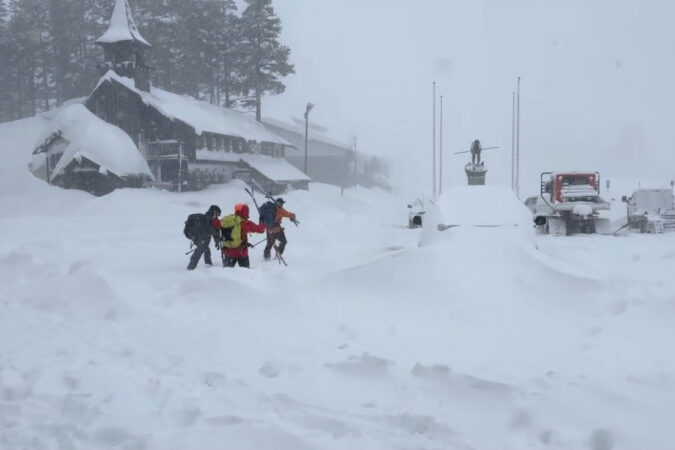
NEVADA CITY, Calif. — Crews found the bodies of eight backcountry skiers near California’s Lake Tahoe and were searching for one more after they were caught in an avalanche, the nation’s deadliest in nearly half a century, authorities said Wednesday.
Authorities said the skiers had little time to react.
“Someone saw the avalanche, yelled avalanche, and it overtook them rather quickly,” said Capt. Russell “Rusty” Greene, of the Nevada County sheriff’s office.
Six from the guided tour were rescued six hours after the avalanche hit Tuesday morning during a three-day trek in Northern California’s Sierra Nevada, as a monster winter storm pummeled the West Coast.
Nevada County Sheriff Shannan Moon said investigators would look into the decision to proceed with the trip despite the forecast for relentless weather.
Authorities have told the families the mission has moved from rescuing people to recovering bodies, Moon said during a news conference.
The victims, including three guides, were found fairly close together, Greene said. The dead and missing include seven women and two men, ranging in ages from 30 to 55. The crews have not yet been able to remove the victims from the mountain because of the extreme conditions, the sheriff said.
Three to six feet of snow has fallen since Sunday, when the group started its trip. The area was also hit by subfreezing temperatures and gale force winds. The Sierra Avalanche Center said the threat of more avalanches remained Wednesday and left the snowpack unstable and unpredictable in an area known for its steep, craggy cliffs.
Rescuers were guided by beacons and a cell phone in dangerous conditions
Rescuers reached the survivors just before sunset on Tuesday.
The skiers all had beacons that can send signals to rescuers and at least one of the guides was able to send texts, but it wasn’t clear if they were wearing avalanche bags, which are inflatable devices that can keep skiers near the surface, Greene said.
While they waited to be rescued, the survivors used equipment to shelter themselves and fend off temperatures dipping below freezing. The survivors located three others who had died during the wait, Moon said.
Rescuers used a snowcat to get within 2 miles of the survivors, then skied in carefully so they didn’t set off another avalanche, the sheriff said.
One of those rescued remains in a hospital Wednesday, Moon said.
The area near Donner Summit is one of the snowiest places in the Western Hemisphere and until just a few years ago was closed to the public. It sees an average of nearly 35 feet of snow a year, according to the Truckee Donner Land Trust, which owns a cluster of huts where the group was staying near Frog Lake.
The avalanche is the deadliest in the U.S. since 1981, when 11 climbers were killed on Mount Rainier, Wash. Each winter, 25 to 30 people die in avalanches in the U.S., according to the National Avalanche Center.
It was the second deadly avalanche near California’s Castle Peak this year, after a snowmobiler was buried by one in January.
Skiers were heading for the trailhead when the avalanche struck
Greene said authorities were notified about the avalanche by Blackbird Mountain Guides, which was leading the expedition, and the skiers’ emergency beacons. The sheriff’s office said Tuesday night that 15 backcountry skiers had been on the trip, not 16 as initially believed.
One skier had pulled out at the last minute, Moon said.
Authorities were waiting to release the victims’ names to give the families time. “They’re still reeling,” Moon said. “I could not imagine what they’re going through.”
The skiers were on the last day of the backcountry trip and had spent two nights in the huts, said Steve Reynaud, an avalanche forecaster with the Sierra Avalanche Center. He said the area requires navigating rugged mountainous terrain. All food and supplies need to be carried to the huts.
Reaching the huts in winter takes several hours and requires backcountry skills, avalanche training and safety equipment, the land trust says on its website.
The area near Donner Summit was closed for nearly a century before it was reopened by the land trust and its partners in 2020. Donner Summit is named for the infamous Donner Party, a group of pioneers who resorted to cannibalism after getting trapped there in the winter of 1846-1847.
Blackbird Mountain Guides said in a statement that the group, including four guides, was returning to the trailhead when the avalanche occurred.
When asked what went through her mind as her staff and volunteers responded to the scene, Moon said she was hoping they would be able to make it there safely. Once they did, she said she was “immediately thinking of the folks that didn’t make it, and knowing our mission now is to get them home.”
The Department of Homeland Security has halted almost all travel amid the ongoing standoff over its funding, restricting the ability of hundreds of Federal Emergency Management Agency staff members to move in and out of disaster-affected areas, according to emails and documents obtained by the Washington Post.
Much of the department ran out of money over the weekend after negotiations stalled between the White House and Democratic lawmakers over restrictions on federal immigration enforcement. It is normal for the department to stop employees from traveling across the country for various assignments, such as trainings, during a funding lapse, 10 current and former FEMA officials said. But it is unusual for a government shutdown to impede ongoing disaster recovery efforts, the officials explained, saying it further reflects sweeping policies instituted under Homeland Security Secretary Kristi L. Noem.
Typically, FEMA staffers who work on disasters are able to travel to and from ongoing recovery projects regardless of DHS funding issues. And a current veteran officials said that disaster travel is always allowed because it is mission-critical.
In a statement, DHS criticized Democratic lawmakers over the stalled funding negotiations and said the department and FEMA are coordinating closely to “ensure effective disaster response under these circumstances.”
“During a funding lapse, FEMA prioritizes life safety and property protection. FEMA continues mission-essential operations for active disasters, including immediate response and critical survivor assistance,” FEMA spokesperson Daniel Llargués said in the statement. “While some non-essential activities will be paused or scaled back, FEMA remains committed to supporting communities and responding to incidents like Hurricane Helene.”
Congressional Democrats have demanded new restrictions on federal immigration agents after federal personnel killed Alex Pretti and another U.S. citizen, Renée Good, in Minneapolis in January.
On Tuesday night, DHS sent out an email ordering a stop to all travel, including for disaster-related work, sparking confusion across FEMA as teams continue to respond to 14 ongoing disaster declarations as a result of brutal winter storms that hit parts of the country last month. In another message obtained by the Post, a FEMA official said that “ALL travel stopped” and noted that 360 people who were slated to go to trainings and other assignments had to stand down. People who were supposed to deploy could begin some work virtually, but DHS now had to sign off on their in-person assignment, the message said.
The next morning, officials within DHS and FEMA had to scramble and negotiate guidance for how disaster-specific workers could continue to travel, according to an official familiar with the situation.
“In most cases, FEMA’s ability to deploy staff to active disaster response and recovery operations is not impacted by a DHS funding lapse,” said former FEMA administrator Deanne Criswell. “Those personnel are funded through the Stafford Act’s Disaster Relief Fund, which is specifically designed to ensure continuity of operations during emergencies. If DHS experiences a shutdown, FEMA employees supported by the Disaster Relief Fund should still be able to travel and carry out response missions.”
Emails and documents obtained by the Post show that FEMA officials must submit a justification to DHS headquarters explaining why a staffer needs to travel during the funding lapse, including employees who are paid through the Disaster Relief Fund. Officials also have to state whether the travel is “mission essential,” meaning it involves the “safety of human life or protection of property.”
“DHS imposing restrictions on FEMA’s ability to deploy our response/recovery workforce slows us down and limits our ability to respond quickly and effectively to the needs of impacted states and communities,” said one official in a region still cleaning up from the heavy onslaught of sleet and snow.
According to one email sent Tuesday night, agency staff members currently deployed in another region that was hit particularly hard can continue assisting communities. But those who were slated to travel to these locations after Thursday can no longer do so. Employees who were on a rotation — perhaps home for a week to see family or go to the doctor — are not able to return to their job under the order.
These rotations are critical to disaster work because they enable people who have been working nonstop to take a break and then come back to their work. FEMA is also required to relieve employees who have been working too long in a state where they do not live.
In the email, FEMA staff members who had not yet begun their deployments or returns from rotation were directed to cancel their travel and notify their point of contact to “receive updated reporting instructions.”
“Additional agencywide information will be forthcoming,” it read.
The snag with some FEMA employees being unable to travel for disaster work, take breaks or relieve their colleagues adds to the beleaguered agency’s long list of operational issues since President Donald Trump took office for a second time and his appointees implemented significant changes in how the agency functions.
The travel pause has also halted some of FEMA’s other critical work, such as leading exercises and assessments for emergency plans and procedures at nuclear facilities, and flood-mapping meetings with communities, according to an email obtained by the Post and an agency official familiar with the situation. That “will delay flood map updates, which directly impacts people waiting on new maps for any number of reasons,” the official said.
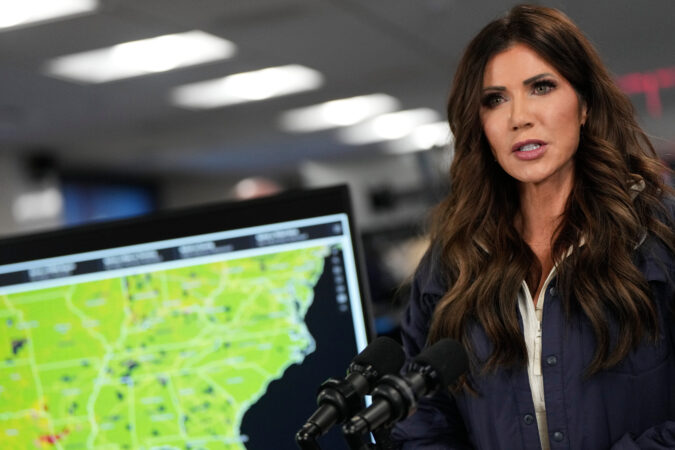
As the winter storms barreled in last month, Noem, who has been spearheading many of FEMA’s staffing reductions and reforms, was particularly hands-on, embedding at the agency’s headquarters, hosting a call with governors to show her support and holding news conferences with FEMA staff members in front of maps laying out where the weather would hit.
DHS also made a big push to pre-position teams, millions of ready-made meals and liters of water, blankets, and hundreds of generators in several states that were expected to be slammed.
That’s why instituting travel restrictions when staffers are still working on these storm responses is even more frustrating, several current employees said.
“They are just trying to make it hurt, and the only people they are hurting are survivors and FEMA employees,” one veteran official said. “They just pull new rules out every day.”
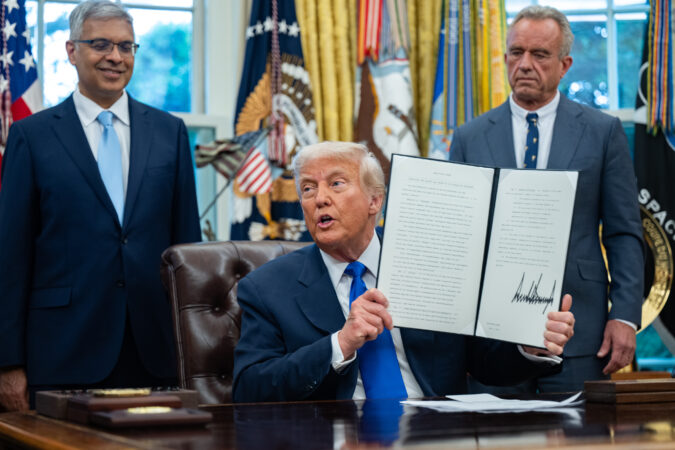
Jay Bhattacharya, a top Trump administration health official and an outspoken critic of the Centers for Disease Control and Prevention’s response to the coronavirus pandemic, will lead the CDC on an acting basis, according to four people who spoke on the condition of anonymity to describe personnel moves.
Bhattacharya, who will continue his role as director of the National Institutes of Health, replaces Jim O’Neill, who had served as the CDC’s acting director. O’Neill, who had also served as the deputy secretary of the Department of Health and Human Services, will be nominated to run the National Science Foundation after he declined a potential ambassadorship to the Organization for Economic Cooperation and Development, two of the people said.
The installation of Bhattacharya at the CDC is the latest move by the White House and Health Secretary Robert F. Kennedy Jr. to shake up HHS’s leadership team ahead of the midterms, as the Trump administration seeks to stabilize a department rattled by internal fights and controversial messages.
The New York Times first reported that Bhattacharya would serve as the acting head of CDC, which is charged with protecting Americans from health threats and issues recommendations on vaccines and other public health matters. Trump officials have said they are planning to find a full-time CDC director, a post that requires Senate confirmation. Susan Monarez, who was confirmed as CDC director in July, was ousted less than a month later after clashing with Kennedy over his plans to change vaccine policies.
Bhattacharya, a Stanford University physician and economist, rose to prominence during the pandemic by arguing that the government’s response to the outbreak was too harsh, a stance that put him at odds with public health leaders who said his proposals would imperil the most vulnerable Americans. He co-wrote the Great Barrington Declaration, which was published in October 2020 and called for an end to coronavirus shutdowns. The declaration drew rebukes from government officials — a clash that ultimately boosted his profile and helped draw the support of Kennedy, a fellow critic of the government’s pandemic response.
“The CDC peddled pseudo science in the middle of a pandemic,” Bhattacharya wrote on X in 2024, criticizing agency leaders’ past claim that widespread masking could end the coronavirus outbreak.
As CDC’s acting head, Bhattacharya is poised to oversee the agency’s vaccine recommendations, which have emerged as a political flash point as Kennedy has worked to roll them back over the objections of public health leaders. A KFF poll published this month found that 47% of U.S. adults now trust CDC for reliable information on vaccines, down from 85% in early 2020.
Bhattacharya has said he supports vaccination for childhood diseases.
“I think the best way to address the measles epidemic in this country is by vaccinating your children for measles,” Bhattacharya said at a Senate hearing this month.
Bhattacharya and other NIH leaders in January also published a commentary in the journal Nature Medicine that criticized the public health response to the pandemic led by other agencies.
“Many of the recommended policies, including lockdowns, social distancing, school closures, masking, and vaccine mandates, lacked robust confirmatory evidence and remain the subject of debate regarding their overall benefits and unintended consequences,” they wrote. “Where enforced, vaccine mandates contributed to decreased public confidence in routine voluntary immunizations.”
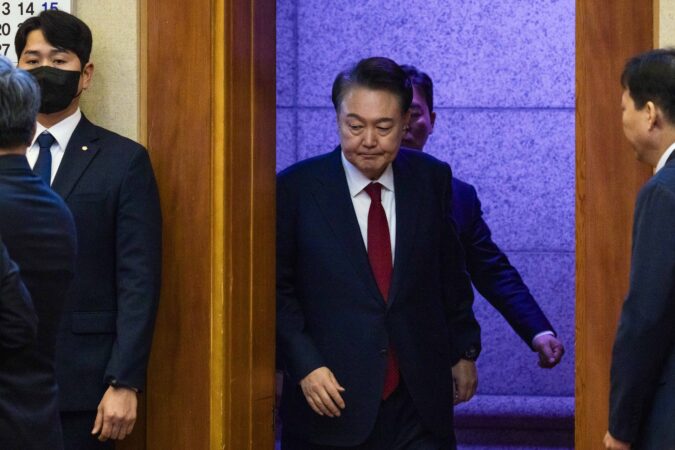
SEOUL — A South Korean court is set to issue its verdict Thursday in the insurrection case against the country’s impeached president, who declared martial law in an alleged power grab in late 2024, and now faces the death penalty or life imprisonment if convicted.
The impeached president, Yoon Suk Yeol, has been on trial for his failed attempt to install a military-led government in the democratic country late one night in December 2024. Yoon is charged with numerous crimes, including organizing an insurrection — which under South Korean criminal law carries possible sentences of life imprisonment, with or without labor, or death.
Prosecutors have requested the death sentence.
The case marks a pivotal moment in South Korea’s relatively young democratic history, which dates to 1987 after a democratic uprising toppled a brutal military-led government under Chun Doo-hwan. Chun was sentenced to death in 1996 after being convicted on similar insurrection charges for seizing power during a coup in 1979. On appeal, the sentence was commuted to life imprisonment, and he was later pardoned.
Yoon’s conviction would uphold the rule of law and reaffirm the nation’s democratic system and principles, democracy advocates and experts say.
“The conviction of an ex-president demonstrates that no one is above the law,” said Andrew Yeo, a senior fellow at Brookings Institution’s Center for Asia Policy Studies in Washington, adding: “The conviction of Yoon through the judicial process reflects South Korea’s democratic resilience.”
If convicted, Yoon, too, ultimately could be spared execution.
South Korea has not carried out an execution since 1997 and is widely regarded as a country where, for all practical purposes, the death penalty is banned.
A death sentence for Yoon, nonetheless, would be highly symbolic as delivering accountability for a head of state who went rogue and attempted to use military force to halt operations of the legislature, seize control of the National Election Commission and arrest political opponents.
“In practical terms, a death sentence would almost certainly remain symbolic, but the symbolism would be immense,” said Hannah Kim, a political scientist at Sogang University in Seoul. “It would reflect a judicial judgment that a ‘palace coup’ led by the constitutional guardian of the state is not just political misconduct, but a direct attack on constitutional sovereignty and the democratic order.”
A lesser sentence of life in prison would still convey the seriousness of Yoon’s actions but would reflect “a degree of pragmatism among the justices,” Yeo said, especially in a deeply polarized country still reeling from the fallout of the declaration of martial law.
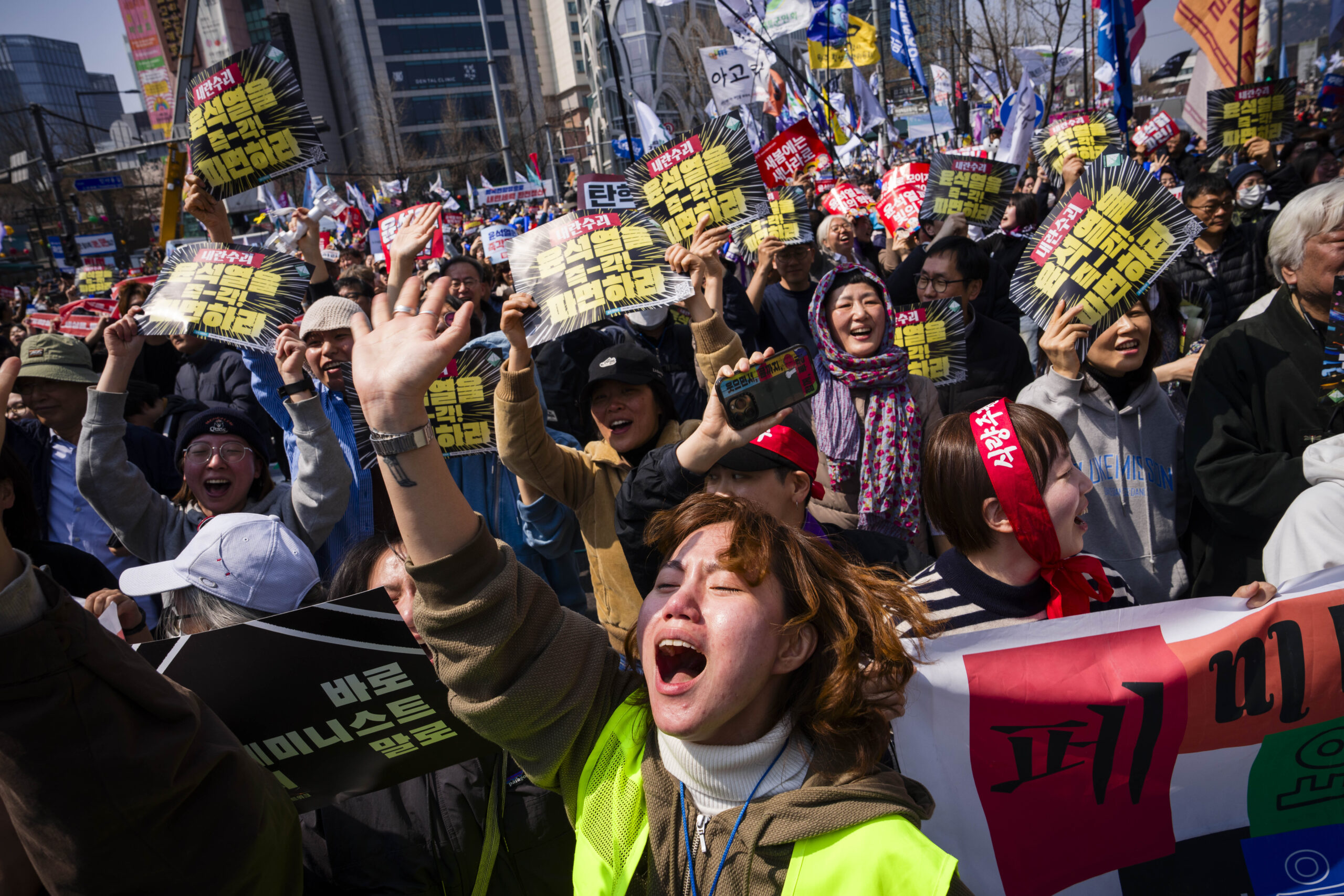
Jeong Hye-won (center) and other protesters celebrate on April 4, 2025, in Seoul after the removal of Yoon from power by South Korea’s Constitutional Court.
Two top aides to Yoon have been convicted on charges related to the decree of martial law. Former Prime Minister Han Duck-soo was sentenced last month to 23 years in prison for his role. Han is appealing the ruling. And former Interior Minister Lee Sang-min last week was sentenced to seven years in prison. He is also appealing the ruling, according to national media reports.
In both cases, the court deemed the declaration of martial law an act of insurrection, which legal experts said was a key determination that could seal Yoon’s conviction Thursday.
Yoon is facing eight separate trials stemming from his decree, but the insurrection case to be decided Thursday is the most consequential. Last month, a Seoul court sentenced him to five years in prison for abuse of power, obstruction of justice and falsifying documents, meaning Yoon will not go free even if acquitted.
For many South Koreans, Yoon’s insurrection trial may feel familiar.
Yoon is expected to stand in Courtroom 417 of the Seoul Central District Court, the same room where Chun, wearing a light blue prison jumpsuit, was sentenced to death nearly 30 years ago.
During their sentencing request last month, prosecutors argued Yoon deserved the harshest possible penalty, citing the need to stop “history from repeating itself.” They referred to Chun’s case and South Korea’s authoritarian past.
Yoon has denied all charges and contends that martial law was a legitimate exercise of the president’s emergency powers. Yoon has said that he declared martial law to confront the opposition-controlled National Assembly, which he said was paralyzing his administration through repeated efforts to impeach top officials. He has denied that the brief deployment of troops to the National Assembly was an act of insurrection.
Yoon’s late-night decree on Dec. 3, 2024, made in a televised address, prompted thousands of protesters to mass outside the National Assembly and demand a return to democratic governance.
As soldiers and police surrounded the National Assembly complex, lawmakers scaled the walls to bypass them. In defiance of the decree’s ban on political activity, they voted to reverse Yoon’s decision. And despite a gag order on the press, reporters from traditional and independent media alike flooded the scene and delivered live reports.
Yoon lifted his order six hours later, but the incident shocked and outraged the nation — now a thriving democracy where political protests and marches of all stripes are a weekly occurrence — and it spurred South Korea’s most harrowing political crisis in decades.
Yoon was impeached with his presidential powers suspended less than two weeks later, and ultimately removed from office.
Yoon, formerly the nation’s top prosecutor, was a divisive president during his more than 2½ years in power. Rather than seeking to unify the deeply divided nation, Yoon instead appealed to his conservative base, exacerbating polarization and often deadlocking with opposition lawmakers.
South Korean presidents are often disgraced. Nearly every president since South Korea’s democratization has become embroiled in scandals involving corruption, bribery, embezzlement, or abuse of power.
Yoon’s downfall, however, stands apart even by South Korean standards, as the first democratically elected president to impose martial law and the first sitting president to face a criminal investigation.
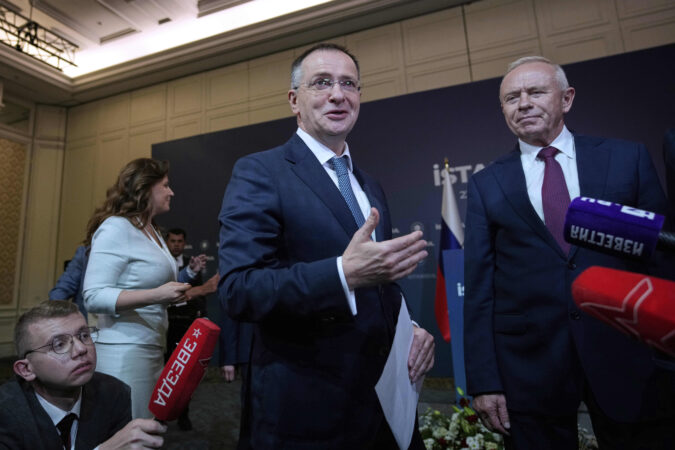
U.S.-mediated talks between Moscow and Kyiv in Geneva, Switzerland, broke off on Wednesday without any significant progress or indication that Russia was ready to step back from its maximalist demands for subjugating Ukraine.
The head of the Russian delegation, Vladimir Medinsky, tersely said the talks had been “difficult but businesslike” and had ended after just two hours of discussions on Wednesday following longer conversations the previous day.
The reappearance of Medinsky, known to be a hard-line aide to Russian President Vladimir Putin, as head of the Kremlin’s delegation had signified that Russia was digging in its heels on core demands — including significant cuts to the Ukrainian military, the dismantling of Ukrainian President Volodymyr Zelensky’s government and guarantees for Ukraine’s neutrality, analysts said.
Moscow has insisted that these steps are required to address what it describes as the “root causes” of the war. Ukraine’s position is that Russia’s invasion was unprovoked and that Moscow should end its illegal war of aggression and remove its troops that are occupying Ukrainian territory.
Russian analysts said Moscow’s demands encompassed a far wider spectrum of issues than the territorial swaps proposed by President Donald Trump’s administration as a path to end the war.
“As long as there is an armed anti-Russia on Ukrainian territory, there can be no peace,” said Sergei Markov, a pro-Kremlin political analyst. “I don’t think anyone had any big hopes that the talks would end in success. The positions are very, very far from each other.”
“The idea of territorial swaps for peace is not Russia’s idea,” Markov added. “It is Trump’s.”
Proponents of territorial exchanges envision that Russia would withdraw from some areas it occupies in Ukraine in exchange for Ukraine withdrawing its military from parts of the heavily fortified Donbas area, which Putin has failed to capture during four years of full-scale war.
Zelensky’s administration has previously said it could agree to withdraw troops from the Donbas area. But Kyiv has said it would agree to a pullback only if the region becomes a demilitarized zone and if the United States first provides legally watertight security guarantees.
Zelensky told reporters on Wednesday that the talks on “political” issues such as Russian demands for Ukraine to withdraw its forces from “the east” were “not easy” and that differences remain. But Zelensky also sought to put a positive spin on some of the trilateral discussions between Russia, the United States and Ukraine in Geneva, saying they had been “constructive” on ways to monitor any potential ceasefire.
Zelensky appealed again at the Munich Security Conference over the weekend for U.S.-backed guarantees before he signs on to any deal with Russia to end the war. “Those guarantees answer the main question: how long there will be no war again,” he said then.
The direct talks between Russia and Ukraine have stalled for weeks over core differences, namely territorial concessions, control of Europe’s largest nuclear power plant, which is occupied by Russia in Ukraine’s Zaporizhzhia region, and questions about Western guarantees for Kyiv, according to two European diplomats who spoke on the condition of anonymity to discuss sensitive diplomacy.
“So far the Russian position is no boots on the ground from NATO allies, so there are outstanding points: territory, security guarantees and the future of the Zaporizhzhia plant,” one of those diplomats said. “Those are the big sticking points, so we need to see if it really happens.”
In meetings with U.S. officials late last year, Ukraine’s chief European backers were encouraged by the U.S. interest in playing a role in securing a settlement to the war. France and Britain have led a coalition of allies planning ways to provide Ukraine with a U.S.-backed bulwark against future attack, including with some European troops and air or sea power.
Still, the Trump administration appeared to want to sign a deal before fully committing, while Kyiv has maintained it needs the Western protection baked into any settlement, the diplomats said. Russia, meanwhile, has ruled out any presence of Western soldiers in Ukraine.
Zelensky, who met with Secretary of State Marco Rubio over the weekend, has stressed Kyiv’s refusal to cede territory in the east that Russia does not militarily control and said Ukraine could only hold elections if there is a ceasefire.
Analysts said it was clear the Kremlin had no intention of making any concessions.
“As long as Putin is in power, Russia isn’t paralyzed by widespread protests, and there is at least some money left in the budget for weapons, the war will continue,” said Tatiana Stanovaya, a senior fellow at Carnegie Russia Eurasia Center, in a post on X. “The Kremlin will not make significant concessions even if faced with a protracted financial and economic crisis.”
“That means there will be no final settlement either now or in the foreseeable future,” Stanovaya added. “Negotiations may intensify, a short-term ceasefire is possible, and documents may even be signed. But overall, this simulation of negotiations can only lead to the simulation of a ceasefire and the simulation of a settlement.”
Russia has been facing increasing economic pressure after the U.S. administration imposed tough new sanctions on Russia’s two biggest oil companies, Rosneft and Lukoil, in October.
The measures caused Russian oil revenue to plummet as Moscow was forced to accept discounts of more than $20 per barrel on its exports. Economists have warned of a nonpayment crisis as the economy grinds to a halt amid high inflation and high interest rates of 15.5% imposed by the Central Bank.
Analysts say there are concerns in the Kremlin that Moscow could face a narrowing window to reach an advantageous deal because the Trump administration could grow distracted as midterm elections near — and then potentially could be weakened by the results.
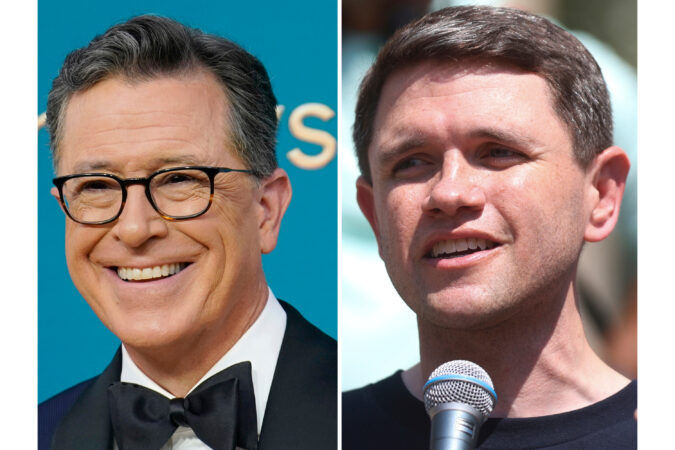
Stephen Colbert isn’t backing down in an extraordinary public dispute with his bosses at CBS over what he can air on his late-night talk show.
On The Late Show Tuesday, Colbert said he was surprised by a statement from CBS denying that its lawyers told him he couldn’t show an interview with Democratic Texas Senate candidate James Talarico — which the host said had happened the night before.
He then took a copy of the network statement, wrapped it in a dog poop bag, and tossed it away.
Colbert had instead shown his Talarico interview on YouTube, but told viewers why he couldn’t show it on CBS. The network was concerned about FCC Chairman Brendan Carr trying to enforce a rule that required broadcasters to give “equal time” to opposing candidates when an interview was broadcast with one of them.
“We looked and we can’t find one example of this rule being enforced for any talk show interview, not only for my entire late-night career, but for anyone’s late-night career going back to the 1960s,” Colbert said.
Although Carr said in January he was thinking about getting rid of the exemption for late-night talk shows, he hadn’t done it yet. “But CBS generously did it for him,” Colbert said.
Not only had CBS been aware Monday night that Colbert was going to talk about this issue publicly, its lawyers had even approved it in his script, he said. That’s why he was surprised by the statement, which said that Colbert had been provided “legal guidance” that broadcasting the interview could trigger the equal time rule.
“I don’t know what this is about,” Colbert said. “For the record, I’m not even mad. I really don’t want an adversarial relationship with the network. I’ve never had one.”
He said he was “just so surprised that this giant global corporation would not stand up to these bullies.” CBS is owned by Paramount Global.
Colbert is a short-timer now at CBS. The network announced last summer that Colbert’s show, where President Donald Trump is a frequent target of biting jokes, would end in May. The network said it was for economic reasons but others — including Colbert — have expressed skepticism that Trump’s repeated criticism of the show had nothing to do with it.
This week’s dispute with Colbert also recalls last fall, when ABC took late-night host Jimmy Kimmel off the air for a remark made about the killing of conservative activist founder Charlie Kirk, only to reinstate him following a backlash by viewers.
As of Wednesday morning, Colbert’s YouTube interview with Talarico had been viewed more than five million times, or roughly double what the comic’s CBS program draws each night. The Texas Democrat also reported that he had raised $2.5 million in campaign donations in the 24 hours after the interview.
The Minneapolis-based artist can’t unsee the impact ICE and directives from President Donald Trump’s administration’s have had on her hometown in recent months.
“I don’t really know anyone whose life hasn’t been affected by the occupation in a tangible way,” she said. “Many people I know are volunteering to deliver meals, patrol schools, drive folks to work, and serve as peaceful observers — which is what both Renee Good and Alex Pretti were doing when they lost their lives at the hands of ICE agents.”
The independent graphic designer thought about ways she could get involved when it hit her. She’s joining a larger tradition of subversive font design.
Haddican, whose work focuses on typography, branding, and packaging, thought back to Moontype, a font created by designer Olli Meier that autocorrects “bad words,” like hate, into “good words,” like love.
Then she thought about language and its use today.
“It’s become impossible to ignore how blatantly the Trump administration is misusing language in order to control and distort the narrative,” she said. It clicked.
“Wouldn’t it be cool if you could change someone else’s words?” Haddican said. “I decided that the best practical use of this font feature would be a practical joke.”
This month, she launched Times New Resistance, a parody of the commonly used Times New Roman font, which autocorrects a slew of specific words as they’re typed. Notably, Times New Roman is the new (and old) official font of the State Department.
Using Times New Resistance, the term ICE autocorrects to “the Goon Squad.” Trump autocorrects to “Donald Trump is a felon.” Gay becomes “gay rights are human rights.” Illegal alien becomes “human being.”
Kingsley Spencer, a creative director and designer based in Jacksonville, Fla., says using the State Department’s own font is part of what makes Haddican’s font so powerful.
“Using technology as a form of commentary against a political regime that decided to weaponize Times New Roman as a form of culture shaping is sharp for a designer,” he said. “I love how direct and comical it is.”
The font is free, “just like America used to be,” Haddican‘s website says. She said Monday that it has been downloaded about 600 times so far. She describes it as a “social commentary meant to autocorrect the autocrats.”
The hope is that some users might secretly install the font onto the computers of “an ICE apologist,” or “morally bankrupt American” as a way of unleashing mischief.
To the untrained eye, the typeface looks like Times New Roman in the font menu — there’s just a sneaky extra space between the words Times and New. But it’s likely many downloads are by like-minded supporters who want to enjoy the font for themselves.
The technology behind the font is simple.
Haddican modified an existing open-source typeface that resembles Times New Roman and programmed the substitutions. She said the hardest part was deciding which autocorrections to make.
“I know I’ve done an imperfect job. The corrections are a mixture of serious stuff (for example, the word ‘good’ autocorrects to ‘Renee Good was murdered by ICE’) and things that I find funny, like changing ‘Stephen Miller’ to ‘Nosferatu,’” she said.
“The first draft was significantly more profane, but I toned it down. I wanted to offend people by speaking truth to power, not for swearing like a sailor.”
Spencer said the font uses something in the typography world called ligatures, which replaces a set of recognized characters with a single character phrase. An example of this is when you type a fraction or date in a document and it’s automatically formatted.
Haddican joins a group of other typography artists who have made jokes, social commentary, or both through text.
Times Newer Roman is a typeface created by the Brooklyn-based art collective MSCHF (pronounced mischief) in 2018 that looks identical to Times New Roman, except each character is 5% to 10% longer, making essays appear slightly longer without changing formatting rules.
It was billed as a font that could help students cheat on term papers. The font takes jabs at academic productivity culture, using typographic invisibility that’s undetected by the untrained eye.
Sang Mun, a designer and former National Security Agency contractor, created a subversive “surveillance proof” font called ZXX in 2013. The fonts were created to be legible to the human eye, but difficult for surveillance software used by Google and other companies to scan text to read.
More mainstream examples include Shepard Fairey, the artist behind OBEY and President Barack Obama’s iconic HOPE graphic, who is known for his use of single phrases and high-contrast graphics to make political propaganda-style art. In the 2024 presidential election, Fairey made a Kamala Harris poster that said FORWARD in the same style as his Obama art.
On social media, reception for Haddican’s font has been strong, garnering over 6,000 likes on Instagram and hat tips from fellow designers.
“I think just about anything can be a form of resistance, and I believe that humor and playfulness are powerful tools for pushing back against oppression and authoritarianism,” Haddican said. “The trickster (e.g. Bugs Bunny) always beats the martyr (e.g. Elmer Fudd) in the end.”
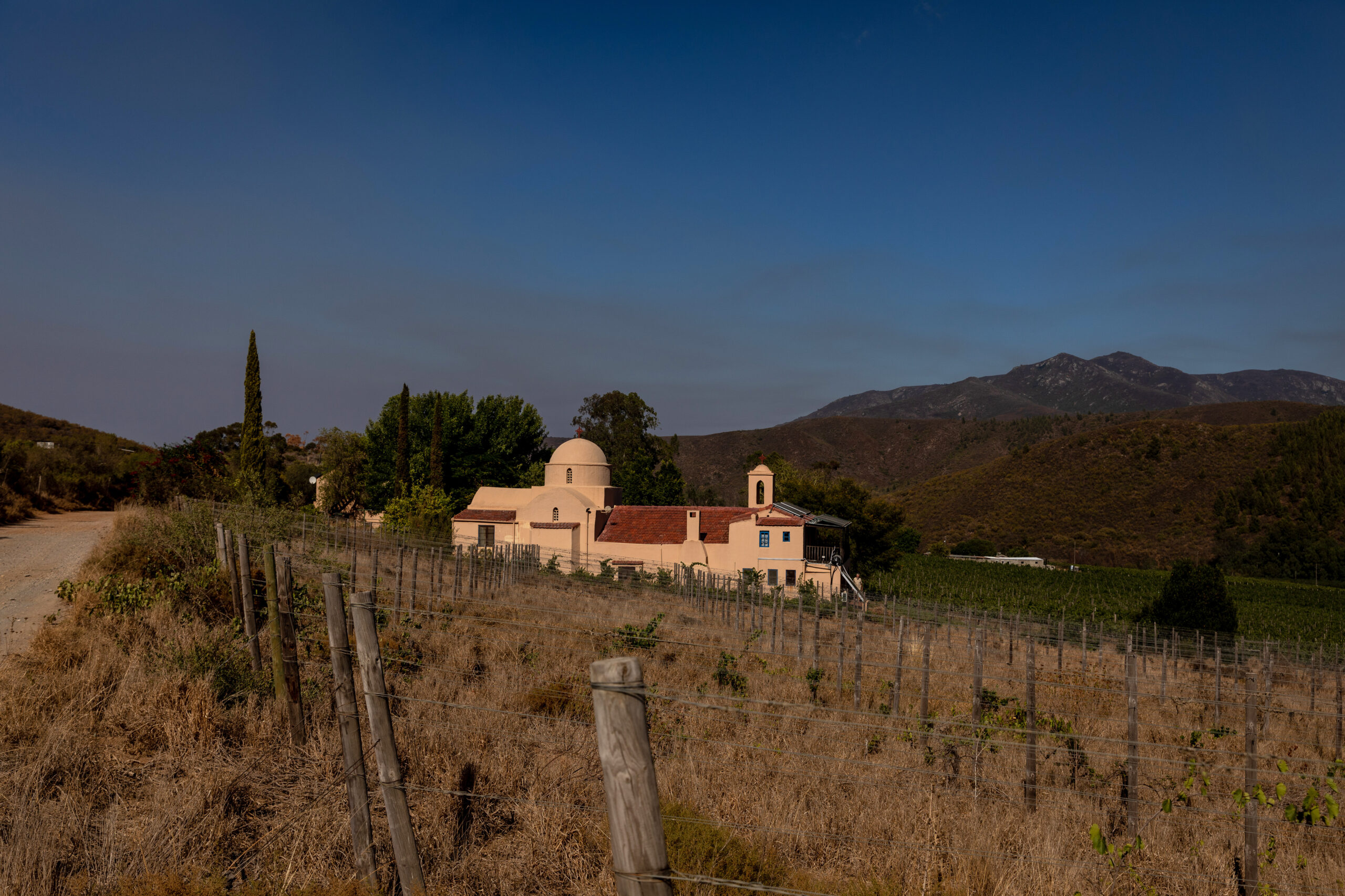
Deep in South Africa’s wine country near the town of Robertson, past rows of tin shacks and up a gravel road where barefoot children play, sits a little piece of Russia.
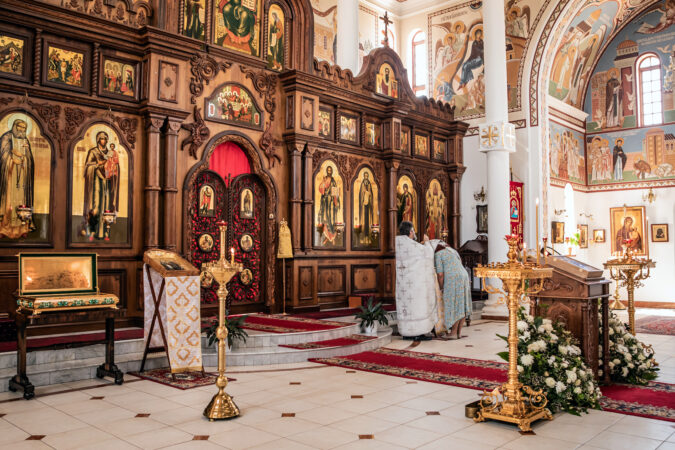
The apricot-hued building with its curved dome proclaims its affiliation with the Moscow Patriarchate of the Russian Orthodox Church on a sign in Afrikaans. The interior is adorned with icons, rugs, and candle stands, things more familiar to a place of worship in, say, St. Petersburg than South Africa’s Western Cape. But the outpost is just one of hundreds of similar churches that have spawned across Africa.
The continent has long been a target for Russia. The Soviet Union supported decolonialization and aided new independent states during the Cold War while the West engendered mistrust with policies such as doing little to oppose apartheid in South Africa.
Now, faced with more sanctions over its war in Ukraine and a new geopolitical era, Moscow is trying to leverage its old, soft power ties again in the absence of any significant economic hard power.
Recent years have seen China dominate, becoming Africa’s biggest trading partner and investing in roads, railways, and ports. The broader aim might be diplomatic, to garner international support from a continent with 54 votes at the United Nations. The Kremlin and its proxies, though, are also leaning on African countries for recruits to bolster its army and the workforce making munitions it uses in Ukraine.
“Russia is trying to develop its policy of influence in all African countries,” said Thierry Vircoulon, coordinator of the Observatory of Central and Southern Africa at the French Institute of International Relations, known as IFRI. “They want to project the image of a great country that is friendly to all Africans.”
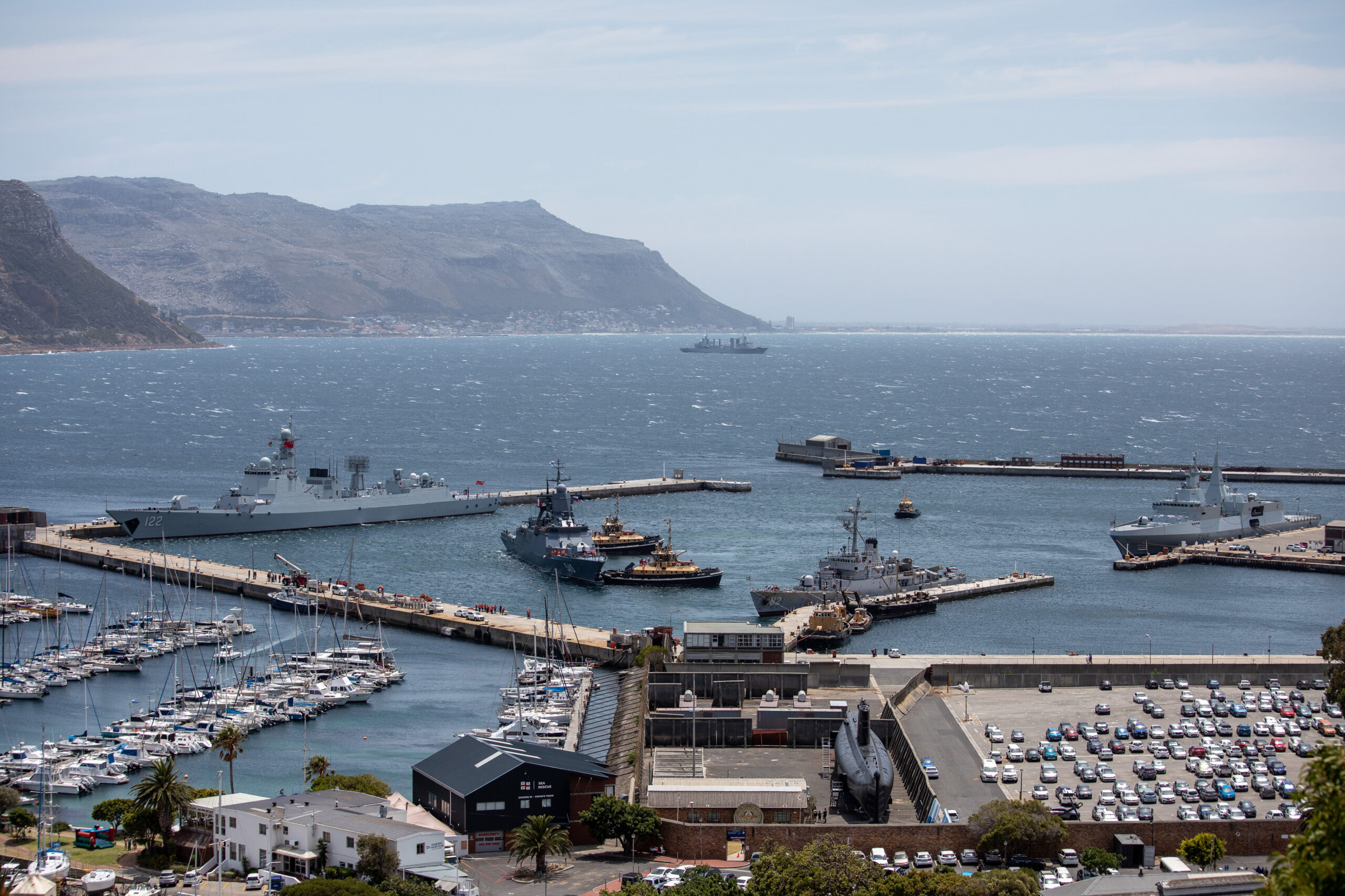
A Chinese destroyer and Russian and Iranian corvettes at Simon’s Town harbor in Cape Town on Jan. 9 ahead of multinational naval exercises.
President Vladimir Putin recently created a Kremlin department to coordinate Russia’s interactions and policies with nations personally selected by him. There will be a special team to look after Africa policy, two people familiar with the situation said.
Early on in its war against Ukraine, there were donations of a small amount of fertilizer and grains to African nations to help alleviate shortages caused by the full-scale invasion in February 2022. More recently, Putin ordered ships to sail around Africa, ostensibly to help countries such as Morocco and Senegal map out their stocks of fish.
What’s increasingly visible is the linguistic and cultural push. Russia has opened seven centers known as Russian Houses across the continent and plans more, holding talks over a new site in Namibia in early December. Russian, meanwhile, is being introduced at universities in cities including Abidjan in Ivory Coast and Harare in Zimbabwe.
In 2024, the foundation led by Putin’s daughter Katerina Tikhonova opened a lecture hall at Cheikh Anta Diop University in Dakar, Senegal, to facilitate the teaching of the language.
More than 32,000 students from Africa are currently studying at Russian universities, Russian Foreign Minister Sergey Lavrov said in December. Since 2020, the number of scholarships allocated to the African continent in Russia has nearly tripled, reaching more than 5,300 places. They are following in the footsteps of African leaders, many of whom had military or academic training in the USSR.
The Russian embassy in South Africa posted an advertisement for them in December and a politician in Lesotho facilitated sending students to Moscow-based Synergy University earlier in the year.
And, of course, there’s religion — a way of wielding influence going back to Christian missionaries in colonial times. In less than three years, the Russian Orthodox Church expanded to at least 34 countries in Africa from four, grew the number of clergy to 270 and registered 350 parishes and communities as of June 2024, the latest figures available from the church.
The geographical expansion might be the most significant in the Russian Orthodox Church’s history, Yuri Maksimov, chairman of the Africa Exarchate’s mission department, wrote in a 2025 academic paper.
The Russians attracted priests with better salaries, promises of church construction and rapid promotion, according to a study by Father Evangelos Thiani, an academic and Kenyan priest in the Greek Orthodox Church.
Russian orthodoxy welcomed Alexey Herizo, a Madagascan priest in the capital, Antananarivo, with “open arms.” He did online training with a seminary in Moscow, then practical training on site in 2023 for three months before being ordained as a deacon and then a priest within a few days.
That was after years of waiting for the Greek Orthodox Church to accept him, said Alexey, his religious name. The salaries provided by the Russian church allow us “to live decently, take care of our family’s health, and provide for our children’s education,” he said.
The church in Robertson affiliated with the Moscow Patriarchate of the Russian Orthodox Church.
Expanding outreach
It’s hard to estimate the number of worshipers the church has now in communities where religion and social conservatism play a large role in everyday life. The church on the outskirts of Robertson, a town named after a Scottish protestant, switched to the Russian branch of the Orthodox faith in 2022. It’s now home to a small congregation of largely white, Afrikaans-speaking South Africans.
While Russian Orthodox churches in South Africa have mainly recruited from Afrikaans communities, with its conservative values appealing to elements of that group, they have also been seeking to add to their numbers with outreach programs to rural, Black communities.
The expansion is aimed at “trying to pull more countries into their orbit,” said Tom Southern, director of special projects at the Centre for Information Resilience, who has looked at the growth. “It’s like spiritual colonialism.”
Russia’s longstanding ties with Africa loosened following the collapse of communism as the country turned to the West. The continent came back into focus after Putin annexed Crimea in 2014 and relations with the United States and Europe soured.
A report by the European Parliament said Moscow has military cooperation agreements with 43 African countries and is a key supplier of arms. Wagner Group paramilitaries were active trying to fight rebels in places like Mali, though the group has since been disbanded and folded into the government’s Africa Corps. Companies linked with Wagner, meanwhile, had contracts across the continent in security, oil services, and gold mining.
African countries have vast economic and human potential and are playing an increasingly significant role in global politics, Putin said in a written address to the plenary session of the Russia-Africa Partnership Forum conference in Cairo in December. Lavrov, his foreign minister, told the event that Russia plans to have trade missions operating in 15 African countries by the end of 2026.
A Russian warship in January joined naval exercises held off the coast of South Africa along with vessels from China, Iran, and the United Arab Emirates. The Russian embassy said they focused on maritime security.
Russia’s renewed push into Africa lacks the financial resources of its geopolitical rivals, though. While China is sub-Saharan Africa’s biggest trade partner, Russia ranks 33rd and is superseded by the UAE, U.S., Japan, and eight European nations.
China has built infrastructure in nations from Cameroon to Kenya while the UAE and other wealthy gulf states have become major sources of foreign money in recent years. The European Union is the biggest investor in South Africa and 600 American companies operate in the country.
Putin hosted a Russia-Africa summit in 2019 attended by 43 heads of state, while the second one in 2023 attracted just 17. The Kremlin blamed the low attendance on “unprecedented pressure” from the U.S. and its allies.
There’s an increasing effort to counter that. With President Donald Trump upending the world order with trade tariffs, rivalry with China and more recently the capture of Venezuela’s president, Russia is trying to assert its narratives in Africa.
The state-owned Sputnik news service is hiring South African journalists and in 2026 plans to open a bureau in the country. It would be the second in Africa, following Ethiopia in early 2025, said Viktor Anokhin, who will run the operation. “Our main goal, as it always has been, is to provide an alternative source of news,” Anokhin said when called by Bloomberg. “A balanced offering.”
Recruiting manpower
Russia has sponsored disinformation campaigns and stoked instability in conflict-ridden nations, according to research groups including the European Council on Foreign Relations. The country is also accused of using Africans to aid its war effort in Ukraine.
One of them was Alabuga Start, a recruitment arm of Russia’s Alabuga Special Economic Zone in Tatarstan. It set itself a target of hiring thousands of African women between the ages of 18 and 22, saying they will work in fields such as hospitality and construction.
Most of the young women end up in a military equipment factory, according to the authors of three reports from organizations including the Institute for Science and International Security.
“African women typically don’t have access to as many opportunities in life, opportunities to get a well-paying job, opportunities to get an education, opportunities to travel,” said Spencer Faragasso, a senior research fellow at Washington-based ISIS. “The Alabuga Start program really provides on the surface all those benefits. But in reality, they’re working in a drone production factory.”
Alabuga didn’t respond to requests for comment, while the Russian embassy in South Africa said in August it had no evidence that the rights of those recruited by Alabuga were being violated, describing reports as “biased.”
On the battlefield, Ukraine estimates that more than 1,400 Africans are fighting for Russia. Kenya’s foreign minister said in November at least 200 Kenyans had been recruited to Russia’s military, often after being told they would work as security guards or drivers.
A report this month by All Eyes on Wagner, a nonprofit research group, said Russia has recruited from about 35 African countries and provided the names of about 300 Africans killed while fighting for Russia.
In South Africa, where fighting for a foreign military or assisting it is a crime, a daughter of former President Jacob Zuma is being investigated by the police for allegedly helping to recruit about 20 men for Russia’s military. She told them they were going on a bodyguard training course.
Separately, South Africa arrested and charged state radio presenter Nonkululeko Mantula and four men she allegedly recruited for the Russian military. Her trial is due to start in April. Bloomberg reported on Jan. 7 that Russia targeted South African video gamers as part of the recruitment drive, according to documents involving two men who left to fight.
South Africa, Kenya, and Botswana have announced investigations into how their nationals became involved in fighting for Russia. South Africa and Lesotho have publicly warned against accepting some job opportunities and scholarships in Russia.
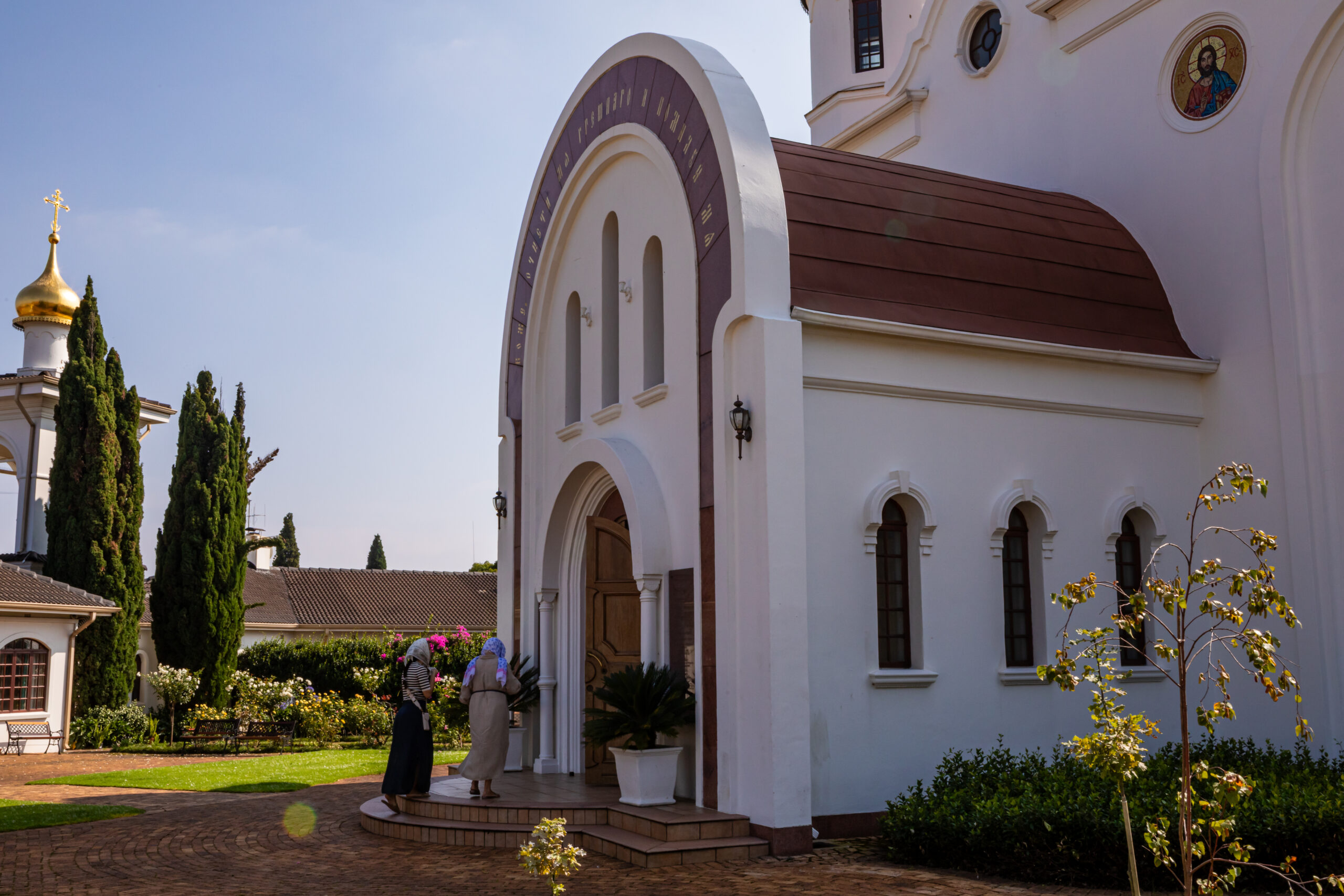
Worshipers enter the Cathedral of St. Sergius of Radonezh on the outskirts of Johannesburg.
Religious leaders
The widening footprint of the church is symbolic of Russia’s desire to sway Africans to its cause.
In a 2022 news conference to celebrate the first year of work in Africa, Leonid Gorbachov, the then Patriarchal Exarch of Africa, said the church works with Russian government agencies and was in talks with the government about the exarchate’s needs.
“It is religious leaders in Africa who remain the most trusted and respected, with religion taking center stage in politics, elections and developmental concerns,” Father Thiani, the Kenyan priest and academic, wrote in the July 2024 paper published by Studies in World Christianity. “The use of religion for entering Africa is therefore an ideal form of Russian soft power.”
Churches now range from rural outposts in Kenya, Madagascar and the one in Robertson to the St. Sergius of Radonezh cathedral on the outskirts of Johannesburg, which is adorned with grand golden cupolas. Founded in 2003, it was — until the establishment of the Africa Exarchate — the only Russian Orthodox Church in sub-Saharan Africa.
The activities of the Russian Orthodox Church have raised concerns in a number of countries outside Africa.
The Czech government placed Patriarch Kirill of Moscow on its sanctions list in April 2023. It cited his support for the invasion of Ukraine, a country who’s church declared full independence from the Moscow patriarchate in 2022.
In Moldova, a former Soviet state with eyes on EU membership, the government has described the Moscow-linked church as a tool of Russian influence aimed at spreading propaganda and causing instability.
Priests spoken to by Bloomberg denied the church expansion in Africa was related to Russia’s political objectives.
Nicholas Esterhuizen, who runs the Saint John of The Ladder Church above a café in Cape Town, said ties with Russia were spiritual and “transcend the current political climate.”
“If the state is the problem, if the state is at war, why do you need to draw the church into the state? The president is not a leader of the church,” said Daniel Agbaza, a Russian Orthodox priest in Nigeria, where a new church is being built in Benue State. “Because it is called Russian does not mean that it is a Russian government church.”
DNA from gloves found a few miles from the Arizona home of Nancy Guthrie did not match any entries in a national database, authorities said Tuesday, the 17th day of her disappearance.
“There were no DNA hits in CODIS,” the Pima County Sheriff’s Department said, referring to the national Combined DNA Index System.
“At this point, there have been no confirmed CODIS matches in this investigation,” the department said, suggesting that other DNA samples had been put through the system.
CODIS is a storehouse of DNA taken from crime suspects or people with convictions. Any hits could identify possible suspects in Guthrie’s disappearance.
The sheriff’s department said it’s looking to feed DNA evidence into other “genetic genealogy” databases. It did not elaborate.
Investigators, meanwhile, were seen inspecting exterior cameras at a neighbor’s house Tuesday. Vehicles were also arriving and departing from Guthrie’s Tucson-area home while a thick line of news media watched from the street.
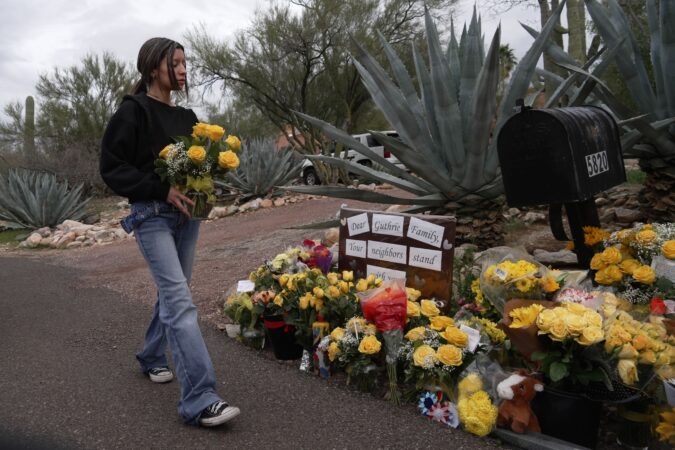
The 84-year-old mother of NBC Today co-anchor Savannah Guthrie was reported missing from her home on Feb. 1 after spending the previous night with family, police said. Her blood was detected on the porch.
A porch camera recorded video of a man with a backpack who was wearing a ski mask, long pants, a jacket and gloves. The FBI said the suspect is about 5 feet, 9 inches tall with a medium build.
Gloves were found about 2 miles from Guthrie’s home. The FBI has said that the gloves appeared to match those worn by the man in the video.
“There is additional DNA evidence that was found at the residence, and that is also being analyzed,” the sheriff’s department said.
In addition, the department said it’s working with experts to try to locate Guthrie by detecting her heart pacemaker.
Parsons Corp. said its BlueFly device, which weighs less than a pound and has a range of up to 218 yards, can detect signals from wearable electronics and medical devices. The company said the technology has been used from the air and on the ground in Arizona. It declined further comment about the search.
The sheriff’s department released numbers to show how the public is reacting to Guthrie’s disappearance and the appeal for any information. There were 28,000 phone calls from Feb. 1-16, a 54% increase over the same period a year ago. Not all calls were tips.
Savannah Guthrie posted an Instagram video Sunday in which she issued an appeal to anyone with information about what happened to her mother.
“It is never too late to do the right thing,” she said. “And we are here. And we believe in the essential goodness of every human being, that it’s never too late.”
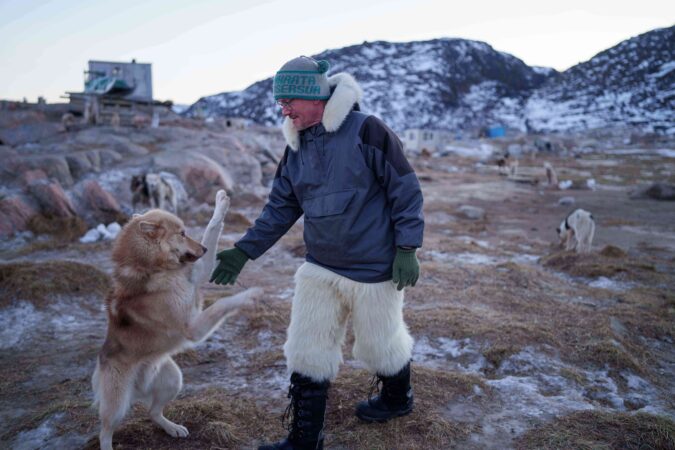
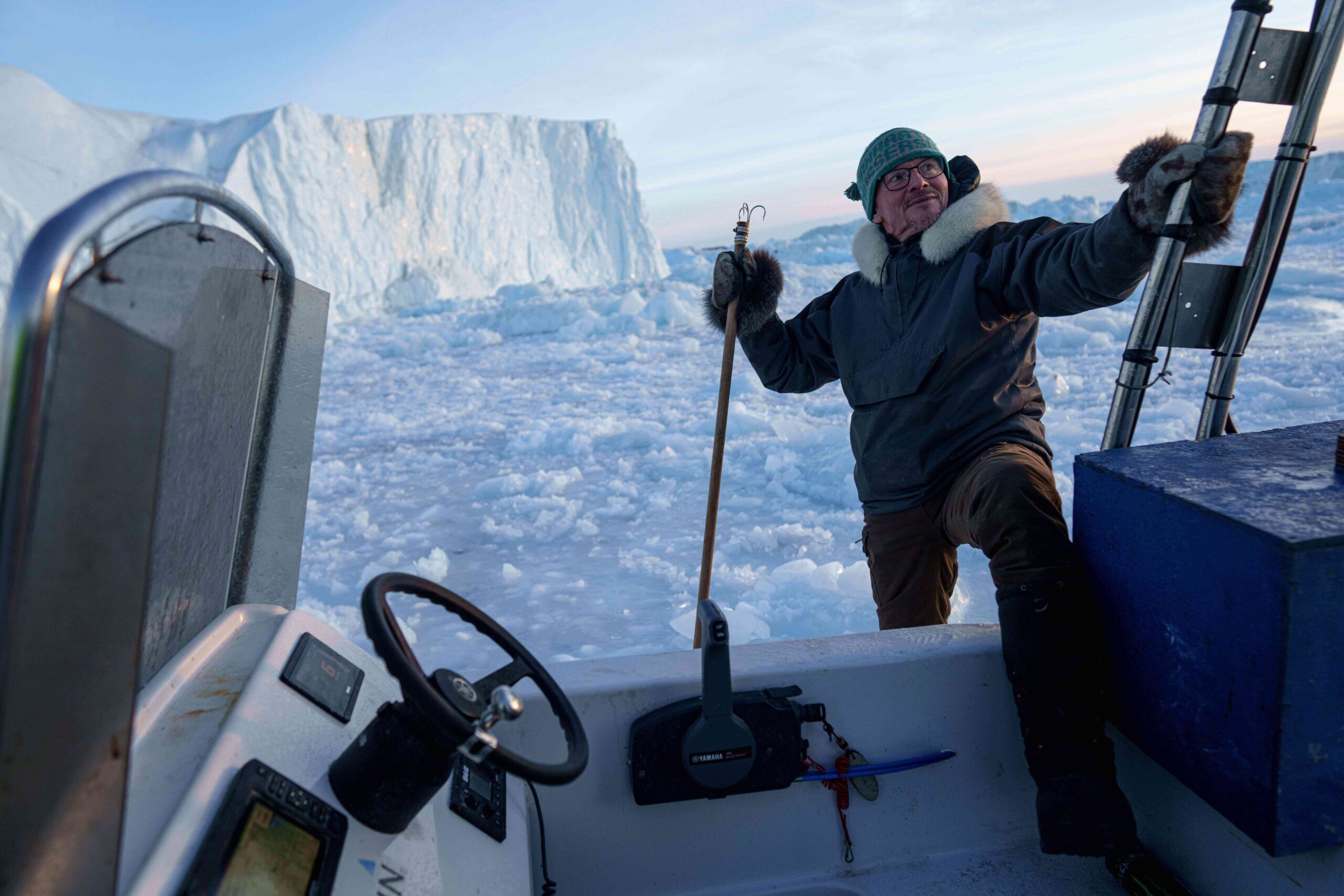
ILULISSAT, Greenland — When he was growing up in a village in northern Greenland, Jørgen Kristensen’s closest friends were his stepfather’s sled dogs. Most of his classmates were dark-haired Inuit; he was different. When he was bullied at school for his fair hair — an inheritance from the mainland Danish father he never knew — the dogs came to him.
He first went out to fish on the ice with them alone when he was 9 years old. They nurtured the beginning of a lifelong love affair and Kristensen’s career as a five-time Greenlandic dog sled champion.
“I was just a small child. But many years later, I started thinking about why I love dogs so much,” Kristensen, 62, told the Associated Press.
“The dogs were a great support,” he said. “They lifted me up when I was sad.”
For more than 1,000 years, dogs have pulled sleds across the Arctic for Inuit seal hunters and fishermen. But this winter, in the town of Ilulissat, around 186 miles north of the Arctic Circle, that’s not possible.
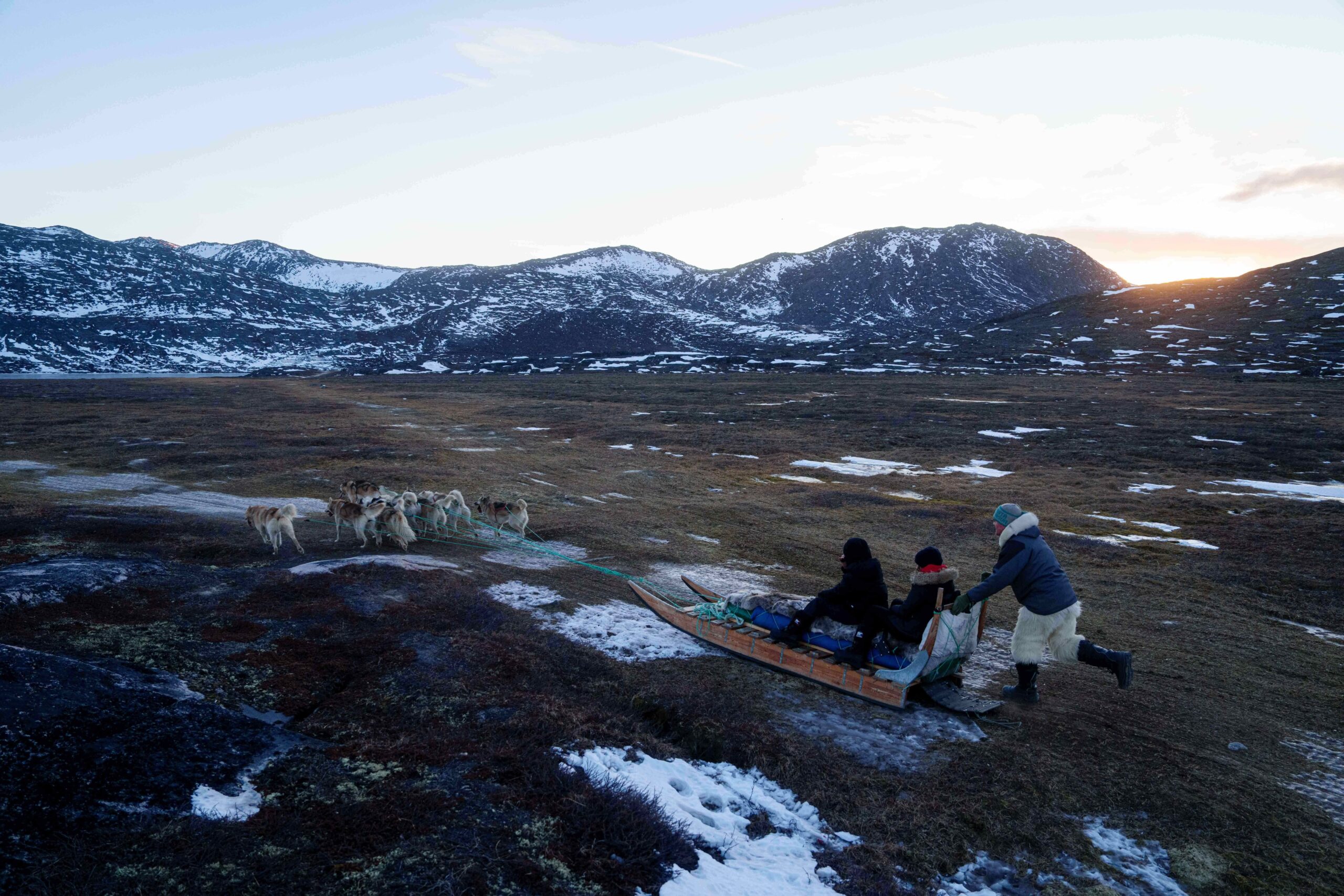
Instead of gliding over snow and ice, Kristensen’s sled bounces over earth and rock. Gesturing to the hills, he said it’s the first time he can remember when there has been no snow — or ice in the bay — in January.
The rising temperatures in Ilulissat are causing the permafrost to melt, buildings to sink, and pipes to crack but they also have consequences that ripple across the rest of the world.
The nearby Sermeq Kujalleq glacier is one of the fastest-moving and most active on the planet, sending more icebergs into the sea than any other glacier outside Antarctica, according to the United Nations cultural organization UNESCO. As the climate has warmed, the glacier has retreated and carved off chunks of ice faster than ever before — significantly contributing to sea levels that are rising from Europe to the Pacific Islands, according to NASA.
Jørgen Kristensen rides with his sled dogs in Ilulissat, Greenland, on Jan. 27.
In the 1980s, winter temperatures in Ilulissat regularly hovered around -13 Fahrenheit in winter, Kristensen said.
But nowadays, he said, there are many days when the temperature is above freezing — sometimes it can be as warm as 50 degrees.
Kristensen said he now has to collect snow for the dogs to drink during a journey because there isn’t any along the route.
Although Greenlanders have always adapted — and could make dog sleds with wheels in future — the loss of the ice is affecting them deeply, said Kristensen, who now runs his own company showing tourists his Arctic homeland.
“If we lose the dog sledding, we have large parts of our culture that we’re losing. That scares me,” he told AP, pressing his lips together and becoming tearful.
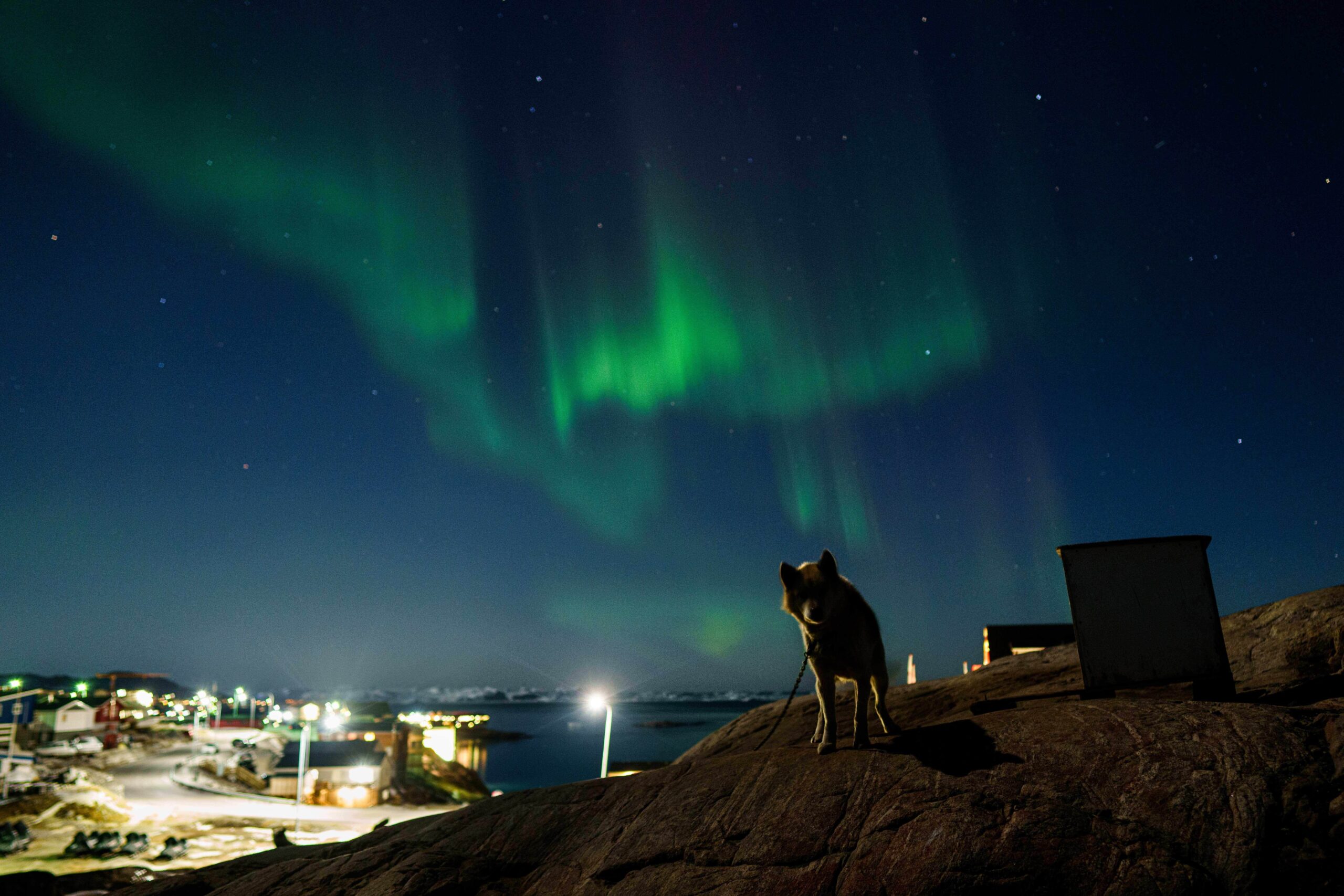
A sled dog stands as the northern lights shine over Ilulissat, Greenland, on Jan. 28.
The sea ice is disappearing
In winter, hunters should be able to take their dogs far out on the sea ice, Kristensen told AP. The ice sheets act like “big bridges,” connecting Greenlanders to hunting grounds but also to other Inuit communities across the Arctic in Canada, the United States, and Russia.
“When the sea ice used to come, we felt completely open along the entire coast and we could decide where to go,” Kristensen said.
This January, there was no ice at all.
Driving a dog sled on ice is like being “completely without boundaries — like on the world’s longest and widest highway,” he said. Not having that is “a very great loss.”
Several years ago, Greenland’s government had to provide financial support to many families in the far north of the island after the sea ice did not freeze hard enough for hunting, said Sara Olsvig, chair of the Inuit Circumpolar Council, which represents Inuit people from across Arctic nations.
The warming weather also makes life more dangerous for fishermen who have swapped their dog sleds for boats, because there is more rain instead of snow, said Morgan Angaju Josefsen Røjkjær, Kristensen’s business partner.
When snow falls and is compressed, air is trapped between the flakes, giving the ice its brilliant white color. But when rain freezes, the ice that forms contains little air and looks more like glass.
A fisherman can see the white ice and try to avoid it, but the ice formed from rain takes on the color of the sea — and that’s dangerous because “it can sink you or throw you off your boat,” said Røjkjær.
Climate change, Olsvig said, “is affecting us deeply,” and is amplified in the Arctic, which is “warming three to four times faster than the global average.”
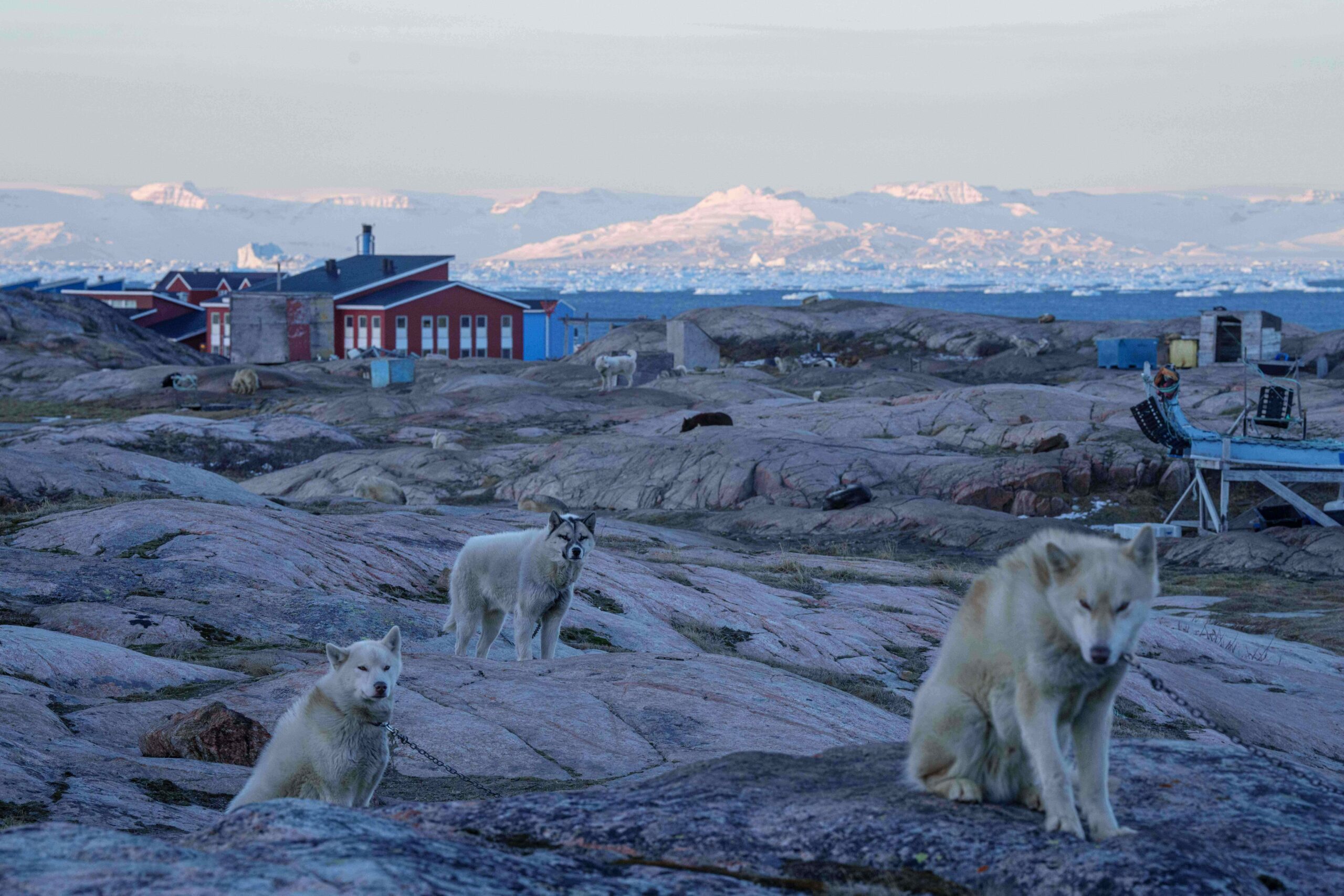
Greenlandic sled dogs stand in Ilulissat, Greenland, on Jan. 27.
The glaciers are melting
Over the course of his lifetime, the Sermeq Kujalleq glacier has retreated by about 25 miles, said Karl Sandgreen, 46, the head of Ilulissat’s Icefjord Center, which is dedicated to documenting the glacier and its icebergs.
Looking out of the window at hills which would normally be covered with snow, Sandgreen described mountain rock revealed by melting ice and a previously ice-covered valley inside the fjord where “there’s nothing now.”
Pollution is also speeding up the ice melt, Sandgreen said, describing how Sermeq Kujalleq is melting from the top down, unlike glaciers in Antarctica which largely melt from the bottom up as sea temperatures rise.
This is exacerbated by two things: black carbon, or soot spewed from ship engines, and debris from volcanic eruptions. They blanket the snow and ice with dark material and reduce reflection of sunlight, instead absorbing more heat and speeding up melting. Black carbon has increased in recent decades with more ship traffic in the Arctic, and nearby Iceland has periodic volcanic eruptions.
Many Greenlanders told AP they believe the melting ice is the reason Trump — a leader who has called climate change “the greatest con job ever” — wants to own the island.
Since Trump returned to office, fewer climate scientists from the U.S. have visited Ilulissat, Sandgreen said. The U.S president needs to “listen to the scientists,” who are documenting the impact of global warming, he said.
Jørgen Kristensen gets on a boat by an iceberg at Disko Bay near Ilulissat, Greenland, on Jan. 29.
Teaching children about climate change
Kristensen said he tries to explain the consequences of global warming to the tourists who he takes out on dog sled rides or on visits to the icebergs. He said he tells them how Greenland’s glaciers are as important as the Amazon rainforest in Brazil.
International summits, such as the United Nations climate talks in November in the Amazon gateway city of Belem, play a role, but it’s just as important to “teach children all over the world” about the importance of ice and oceans, alongside subjects like math, Kristensen said
“If we don’t start with the children, we can’t really do anything to help nature. We can only destroy it,” Kristensen said.