Category: Nation & World

  • Iran begins funeral rites for Ali Khamenei, supreme leader killed in war

    Iran begins funeral rites for Ali Khamenei, supreme leader killed in war

    For four months, Iran feared it was too dangerous to lay to rest Ayatollah Ali Khamenei, the country’s supreme leader who was killed in an airstrike on the first day of the joint U.S.-Israeli war.

    Now, shielded by a tentative truce — and perhaps by an America distracted by its 250th July Fourth celebration — millions of Iranians are expected to mourn over several days of funeral rites that will stretch across five cities and into neighboring Iraq.

    For the surviving Iranian regime, the funeral offers an opportunity to project power after withstanding months of war with Israel and the United States, but it will also be a high-profile test of the government’s postwar competence.

    Khamenei’s body was moved to Tehran, the capital, on Thursday for a private ceremony at the place where he was killed — the small compound that served as his office and residence.

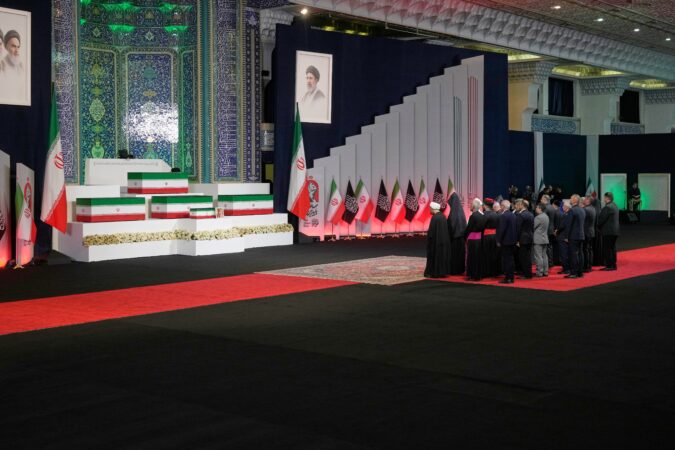
    On Friday, his coffin was moved to Grand Mosalla religious complex where it sat beside the coffins of other family members killed in the same strike, including his daughter and her husband. The smallest coffin was that of Khamenei’s granddaughter, who was 14 months old.

    Images distributed by state media showed foreign dignitaries, including leaders from Iraq, Qatar, and Tajikistan, as well as family members of the assassinated Hezbollah commander, Hasan Nasrallah, filing past the coffins as they arrived in Iran ahead of the funeral.

    Also shown paying his respects was the son of anti-Taliban Afghan commander Ahmed Shah Massoud.

    The funeral organizer said no officials were invited from Europe or the United States. Official banners prepared for the event declared “We must rise” and carried the image of a red fist.

    Security was expected to be tight, with sections of the capital Tehran already going into lockdown Friday.

    Parliament Speaker Mohammad Bagher Ghalibaf, who has been a key figure in peace talks with the U.S., issued a statement on Thursday calling on the Iranian people to “rise up and convey the nation’s call for bloodshed.”

    “Iran stands on the threshold of creating one of the greatest scenes in its history, a day when a nation, with hearts full of love, loyalty, and the pain of separation, comes to bid farewell to a great man,” Ghalibaf said.

    The cavernous prayer hall where Khamenei’s coffin was put on display Friday to lie in state was named after his predecessor, Ayatollah Ruhollah Khomeini, who led the country’s Islamic revolution, took power in 1979, and died a decade later.

    Khamenei led the Islamic Republic for 37 years, through wars and uprisings, and years of enmity and tangled negotiations with Washington over Iran’s nuclear program. Under his leadership, Iran repressed freedoms domestically and expanded its role as the patron of violent proxy militant groups, including Hezbollah and Hamas, which it used to confront the U.S. and Israel.

    Khamenei was killed in the opening hours of a war that has transformed Iran yet again, devastating the country’s infrastructure and leadership ranks, but ultimately seeming to strengthen its position regionally and in ceasefire talks with the U.S. — notably because of its leverage over the Strait of Hormuz.

    As Iranians mourn their assassinated leader, they and observers around the world will be watching the funeral for signals about the surviving regime, which is younger and even more hard-line. Among the top questions is whether Khamenei’s son and successor, Mojtaba, will appear in public for the first time since his father’s death.

    Mojtaba is believed to have been seriously injured in that strike, including serious damage to his face. His wife, Zahra Haddad Adel, was also killed.

    Mojtaba Khamenei has been living under intense security measures given the expectation that he, too, will be a target for assassination.

    Even in peacetime, he kept a low profile. He has only been photographed in public a few times and, before his designation as the new leader, most Iranians had never heard him speak publicly.

    Up until now, Iranians who support their government say they understand why their supreme leader has been unable to appear in public. But the further the country moves away from active war, the more people may demand an appearance.

    “If he doesn’t show up, it does become significant,” said Norman Roule, a former CIA officer who worked on Iran for decades, adding that the move would indicate that he is breaking from the rule of his father in which revolutionary symbolism was critically important.

    If Khamenei does appear — in person or by video — experts will be scouring images for clues about his injuries, officials said, while also searching for broader signs of the regime’s cohesion and capabilities.

    Observers will also be tracking the scale of the event, including whether the government can orchestrate convincing shows of public support beyond the tightly controlled capital. They will also be monitoring how much security is mobilized.

    And as the country shifts away from a war footing, its economic challenges will become more pronounced. Inflation has skyrocketed, and energy exports fell to near zero for weeks. The country’s industrial sector was heavily damaged by U.S. and Israeli strikes.

    Over Ali Khamenei’s decades as supreme leader, public dissatisfaction with the Iranian system grew, triggering repeated waves of protests. And in the past five years, demonstrations seemed to threaten the Islamic Republican at least twice.

    In each instance, Khamenei ordered violent crackdowns with escalating cruelty to clear city streets. The most recent crackdown in January is estimated to have killed thousands of people over just three days, a remarkable scale of brutality.

    After the mourning ceremonies in Tehran, Khamenei’s body will be taken to the holy Iranian city of Qom, then on to neighboring Iraq where crowds will gather in the holy Shiite cities of Najaf and Karbala, before he is finally laid to rest in his hometown, the eastern Iranian city of Mashhad.

    The ceremonies will present a serious logistical challenge for the Iranian regime. Local officials in Tehran say they are expecting crowds of up to 20 million.

    Authorities are keen to avoid the kind of chaotic scenes that marked previous burials. Eight people were trampled to death when Khomeini was buried in 1989. And dozens were killed in 2020 during crowd crushes at the funeral for Maj. Gen. Qasem Soleimani, then Iran’s most powerful military commander, who was killed in a U.S. drone strike ordered by U.S. President Donald Trump.

  • U.S. officials believed Israel was plotting to kill Iranian negotiators

    U.S. officials believed Israel was plotting to kill Iranian negotiators

    WASHINGTON — U.S. officials believed that Israel might have been plotting to kill Iran’s top negotiators while Washington was engaged with Tehran in delicate talks this spring to reach an interim peace deal, according to current and former U.S. officials.

    Killing senior Iranian leaders had been part of Israel’s strategy from the start of the war. But America’s concerns about the targeting of two particular Iranian officials — Abbas Araghchi, Iran’s foreign minister, and Mohammad Bagher Ghalibaf, the speaker of the parliament — spiked during delicate ceasefire negotiations that began in April.

    Fearful that an Israeli assassination effort would doom the negotiations, the United States, according to some of the officials, went so far as to ask other countries in the region to warn Iran about the possibility Israel could target the two officials.

    U.S. officials acknowledged that during the intense phase of the war, Araghchi and Ghalibaf, as senior government officials, could have been legitimate targets for Israel, which was intent on toppling Iran’s hard-line government. But after the negotiations started in earnest in April, U.S. officials believed that any attempt to kill the Iranian leaders would end the talks and reignite the fighting.

    The war began Feb. 28 with an Israeli strike that killed the supreme leader, Ayatollah Ali Khamenei, and other top officials, based in part on U.S. intelligence.

    While U.S. strikes focused on Iran’s navy and missile forces, Israel prioritized targeting the leadership in the early phase of the war, intent on killing as many high-ranking officials as it could.

    That included killing potentially more pragmatic leaders that the Trump administration had hoped to negotiate with, such as Ali Larijani, Iran’s top national security official, and Kamal Kharazi, a former Iranian foreign minister. Both men were involved in the negotiations with the United States when they were killed in Israeli airstrikes.

    The Trump administration’s suspicions about the possible Israeli plot to kill the two top negotiators show how the U.S. and Israeli war aims, which were close at the very beginning of the war, quickly diverged radically. And while the United States wanted a peace agreement, Israel has been skeptical from the initial cessation of hostilities in April.

    The initial two-week ceasefire in April was met with grudging Israeli official support and broad public concern in Israel that the United States was ending the war too early. Rather than being driven from power, the theocratic government of Iran had become even more hard-line, and Iran’s Revolutionary Guard had only consolidated its control over the country.

    Araghchi and Ghalibaf have been the key officials negotiating with various countries in the region to reach a ceasefire and then a more lasting peace with the United States. In June, the United States and Iran reached a framework agreement that sought to open the Strait of Hormuz and set the outline for follow-on talks on Tehran’s nuclear program.

    Officials and commentators in Israel viewed the initial agreement as a disaster, because it did not accomplish their country’s war aims of forcing regime change, destroying Iran’s proxy forces, and seriously damaging its missile program. Israeli officials also worried the agreement would put billions of dollars into Iran, allowing it to quickly rebuild after the war and without meaningfully restricting its nuclear ambitions.

    A spokesperson for the Israeli Embassy in Washington declined to comment.

    Asked about Israeli plans and the warning to Iran, a U.S. official noted that talks between American and Iranian delegations continue and that Steve Witkoff, a special envoy, and Jared Kushner, the president’s son-in-law, had productive meetings in Qatar. President Donald Trump, the official said, wants the peace process “to play out.”

    The Wall Street Journal reported in March that Israel had Araghchi and Ghalibaf on a target list but temporarily removed them as the United States discussed beginning negotiations with Iran.

    A U.S. official and a Middle East official said that the Trump administration learned around that time that at least Ghalibaf was on an Israeli targeting list and asked Israel to refrain.

    Ghalibaf was nearly killed in both the 12-day war in June 2025 and again in this year’s conflict, when Israel targeted a secret meeting of senior government officials in a bunker under a mountain, according to three senior Iranian officials and public comments by officials. In both incidents, Ghalibaf was rescued from under the rubble, the officials said.

    “Today, Mr. Ghalibaf and Mr. Araghchi and other members of the negotiating team have put their lives on the line, knowing the grave security risks, and this is called a real sacrifice, not political maneuvering,” Mohsen Zanganeh, a lawmaker, told local media in late April after the Islamabad meeting.

    During the negotiations, Iran has taken precautions aimed at making it more difficult for Israel to strike at senior officials.

    In April, Ghalibaf was set to travel to Islamabad to meet with Vice President JD Vance. But Iranian security officials were concerned that Israel would use the opportunity to assassinate Ghalibaf or Araghchi to derail the talks, the officials said.

    Iranians sought guarantees from the United States, through Pakistani and Qatari intermediaries, that Israel would not carry out any covert operations targeting the Iranian delegation, the officials said.

    Pakistani fighter jets escorted the Iranian airplanes carrying a delegation of more than 70 Iranians from the border of Iran to Islamabad and back again when the session was over.

    But on the way back to Tehran, an Israeli security threat emerged.

    Iran’s security forces notified the plane carrying Ghalibaf back to Tehran that they had picked up intelligence that Israel planned to attack the plane and that two Israeli fighter jets had entered Iran’s airspace from its western border near Iraq, the two officials said.

    Mahdi Mohammadi, a senior adviser for Ghalibaf, who accompanied him to Islamabad, confirmed this account on his social media page. The plane made an emergency landing in the city of Mashhad, Iran’s closest airport to the Pakistani border, and the Iranian delegation traveled some eight hours by land back to Tehran, Mohammadi and the two officials said.

    But the officials have continued to travel.

    In late May, Ghalibaf and Araghchi flew to Qatar for talks and then traveled to Switzerland in June for a second in-person meeting with Vance and the American delegation.

    This article originally appeared in the New York Times.

  • Trump returns to Mount Rushmore after years of hinting he belongs there

    Trump returns to Mount Rushmore after years of hinting he belongs there

    He hasn’t explicitly said that he wants to be added — at least not in public.

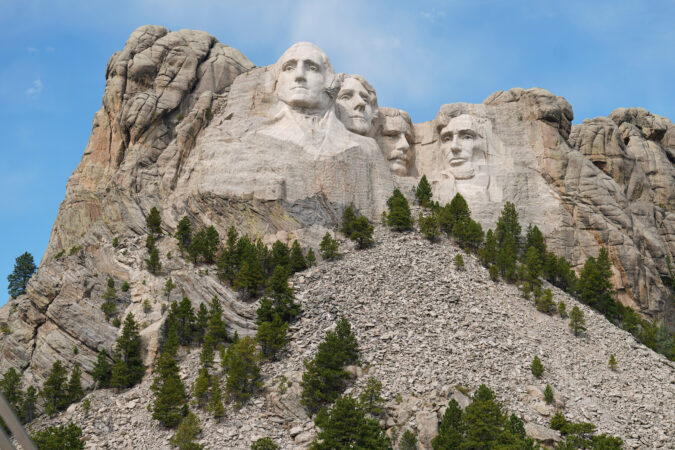
    But on the eve of the nation’s 250th anniversary, President Donald Trump was returning to Mount Rushmore after nine years of flirting with the idea of having one more face join the four presidents: his own.

    Ahead of his visit to the national memorial on Friday, his White House said that adding Trump’s face would be a welcome development — even though officials at Mount Rushmore have long said the monument cannot be carved further.

    “There would be no better addition to the iconic Mount Rushmore than the 45th and 47th President of the United States, Donald Trump,” said Taylor Rogers, a White House spokesperson, in a statement to the Washington Post.

    For a president who has had a golden statue of himself erected at his golf resort and his name and image affixed to buildings, government programs, U.S. passports, digital and physical coins, roads, and an airport, the landmark represents a rare limit: No presidential order or act of Congress can create more carvable rock.

    It has been on his mind. As recently as five weeks ago, the president — twice in one evening — posted to Truth Social digital mock-ups of his face next to the mountainside carvings of George Washington, Thomas Jefferson, Theodore Roosevelt, and Abraham Lincoln.

    Soon after he first took office, Trump told a congresswoman in private that joining them was his dream. When that Republican congresswoman, Kristi L. Noem, became South Dakota governor and gave Trump a sculpture depicting his face on Mount Rushmore next to Lincoln’s, he put it on display at his Mar-a-Lago office.

    He last visited the monument six years ago, delivering a speech on July 3, 2020, that sought to rally supporters around a law-and-order message central to his unsuccessful reelection campaign.

    On Friday, “beneath the towering faces of four of America’s greatest presidents, President Trump will deliver a historic address commemorating the nation’s 250th anniversary and charting a course for America’s next chapter,” Freedom 250, the White House-created organization heading up the semiquincentennial celebrations, wrote in an announcement of Trump’s Mount Rushmore appearance.

    Two people with knowledge of the event planning, including a senior White House official, said there would not be a projection of Trump’s face on Rushmore during the Friday night celebration.

    Trump, as he has danced around the idea of being added to Mount Rushmore since first taking office, has never batted it down.

    “Never suggested it,” he wrote on Twitter in 2020 in response to a New York Times report that said a White House aide had inquired with Noem’s office about the process of carving additional presidents. But Trump continued: “Although, based on all of the many things accomplished during the first 3½ years, perhaps more than any other Presidency, sounds like a good idea to me!”

    A year earlier, when asked by the Hill if he’d like to see his face carved there, Trump replied that he didn’t want to say: “If I answer that question, ‘Yes,’ I will end up with such bad publicity.”

    At a 2017 rally in Youngstown, Ohio, Trump declared that each of the presidents on Mount Rushmore “believed in protecting American industry.” He told the audience that he should “ask whether or not you think I will someday be on Mount Rushmore,” but that he would face blowback for positing such a question.

    “If I did it joking, totally joking, having fun, the fake news media will say, ‘He believes he should be on Mount Rushmore,’” Trump said. “So I won’t say it, OK? I won’t say it.”

    Trump’s allies have kept hope alive, however, even as Mount Rushmore officials and engineers who have long monitored the rocks there say it isn’t possible.

    Days after he was sworn in for a second time, Rep. Anna Paulina Luna (R., Fla.) in January 2025 filed a bill directing the Interior Department to begin the process of having Trump’s face carved onto Mount Rushmore. Around the same time, a Fox News panel, including former White House press secretary Kayleigh McEnany and former representative Jason Chaffetz (R., Utah), cheered on the idea. McEnany said it would be “epic” to have Trump’s face added for the country’s 250th anniversary — which would have left a year and a half to do so.

    Last July, Rep. Andy Ogles (R., Tenn.) sent a letter to Interior Secretary Doug Burgum asking him to “explore” adding Trump, saying that “past bureaucratic resistance or political discomfort” should not stop the process.

    And Burgum himself, contradicting what past National Park Service officials had said, last year told Trump’s daughter-in-law and Fox News host Lara Trump that it wasn’t out of the question.

    “Well, they certainly have room for it there,” Burgum replied when she asked if the United States would ever see Trump added to Mount Rushmore.

    In 2018, the public information officer at Mount Rushmore, Maureen McGee-Ballinger, told the Sioux Falls Argus Leader that “there is no more carvable space up on the sculpture,” adding that the rock to the left of Washington can’t be carved into, and what appears to be space next to Lincoln is “beyond the sculpture” and an “optical illusion.”

    Staff at Mount Rushmore and the National Park Service did not immediately respond to a request for comment on whether the memorial’s geology had changed since.

  • Belgian diamond group that won tariff relief gifts Trump a lavishly encrusted ring

    Belgian diamond group that won tariff relief gifts Trump a lavishly encrusted ring

    BRUSSELS — Dozens of diamonds spell out two giant letter T’s next to the Stars and Stripes and “1776” and “2026.” Dozens more frame the numbers 45 and 47 in the shape of Superman’s logo. A diamond-winged eagle carries a ruby shield and clutches an olive branch of emeralds, below a radiant “250” and atop the phrase “250 YEARS USA” etched in 18-karat gold.

    All told, 321 diamonds, 56 sapphires, 13 emeralds and six rubies encrust the watch-sized gold ring presented this week to Bill White, the U.S. ambassador to Belgium, to give to President Donald Trump.

    “A very special thank you to my friends from Antwerp for the magnificent Freedom 250 ring,” Trump said in a prerecorded video message during an event marking America’s 250th birthday in Brussels.

    Isidore Mörsel, president of the Antwerp World Diamond Center, or AWDC, gifted the ring on behalf of the centuries-old diamond community in the Belgian port city, a central node in the worldwide trade of the precious stones that found itself struggling last year under the weight of Trump’s sweeping trade war.

    “May this ring serve as a lasting reminder that true partnership like the finest natural diamonds are formed under pressure, endure the test of time, and shine brightest when built on trust,” Mörsel said. The ring’s interior is engraved with the phrase “Crafted in Antwerp for Donald John Trump.”

    In dollar terms, the ring’s value pales beside gifts like the $400 million plane donated by Qatar that Trump ordered converted into a new Air Force One. But it’s a glitzy window into the role that ostentatious – and almost always gilded — gifts are playing for those seeking to curry favor with the U.S. president.

    A White House official, speaking on the condition of anonymity to discuss the matter, said Thursday that the ring has not been presented to Trump yet.

    Ring is latest in Trump’s break with White House custom

    The gift comes months after Belgium’s diamond industry won the removal of U.S. tariffs on diamond imports. In September, AWDC said it had “succeeded in securing a zero percent import tariff” on Antwerp’s annual export of more than $2 billion of polished diamonds to the U.S. A spokesperson for the group said on Thursday that the AWDC provided “input” to the European Commission as it negotiated with Trump on a broad deal on tariffs in 2025, but did not itself lobby the administration.

    U.S. presidents have considerable discretion to accept gifts from domestic and foreign sources and may determine themselves whether a gift was meant for them personally or the nation. The exception is those from foreign governments, which are prohibited by the foreign emoluments clause of the Constitution without congressional assent, though presidents could use personal funds to reimburse the Treasury for the full value of an official gift if they wish to retain it.

    Personal gifts are also supposed to be registered on the president’s annual financial disclosure. Trump’s 2025 disclosure, released this week, revealed a $250,000 gift of a sculpture depicting his triumphal gesture after surviving a 2024 assassination attempt at a campaign rally in Butler, Pa., and tickets to 10 sporting events, including 10 to the upcoming World Cup final in New Jersey from FIFA’s Gianni Infantino, valued at a collective $15,000.

    Four U.S. ethics experts told the Associated Press that Trump has broken with decades-old custom in the White House to avoid accepting such gifts.

    Ring’s value estimated at $25,000-$35,000

    To forge the ring, the AWDC turned to David Gotlib, an Antwerp-based high-end jeweler whose cufflinks can sell for more than 15,000 euros ($17,000).

    Neither AWDC nor Gotlib would provide a valuation of the ring, but two independent jewelers told AP they estimated the value between $25,000 and $35,000.

    Paris- and London-based jewelry consultant Alexander Levinson calculated the cost at $25,928, while David Saad, a third-generation luxury jeweler in Canada, priced the ring between $33,000 and $35,000. Both said half the cost was in materials, half in labor.

    After the ring was presented on a star-spangled stage in Brussels, musician Alexis Wilkins, the girlfriend of FBI Director Kash Patel, sang the U.S. national anthem to more than 8,000 people drinking Budweiser and bourbon from Tennessee and Kentucky.

    White said he raised more than $5.5 million for the 250th anniversary event from corporate sponsors like defense industry titans Lockheed Martin and Northrop Grumman and tech firms like Intel, Google, and Meta, as well as the European chocolate companies Leonidas and Ferrero. AWDC said it contributed funds, too.

    “The media was asking, ‘Why does it have to be so big?’” White said of the event. “Because we are the United States of America!”

    Meanwhile, the fate of the ring is not currently clear.

    On Wednesday, White posted a photo online of himself wearing the ring and giving a thumbs-up. The post has since been deleted.

  • Venezuelan earthquake survivors search for missing pets in an unexpected place: McDonald’s

    Venezuelan earthquake survivors search for missing pets in an unexpected place: McDonald’s

    CARABALLEDA, Venezuela — Hope came in the strangest of places: a Venezuela McDonald’s.

    Gabriela Alves found herself embracing her 6-year-old dog Buddy on Thursday in the fast-food outlet after a week of searching for the white pup that went missing when two earthquakes devastated the South American nation on June 24.

    The restaurant, next to the ruins of collapsed state housing complexes, has become a de facto hospital for earthquake victims, as well as a center for locating and treating missing pets in the seaside city of Caraballeda, which was devastated by the natural disaster. Neighbors call it “Hospital McDonald’s.”

    “This is a miracle,” Alves said, arms wrapped around the dog with an IV in one of his legs on a table next to restaurant workers selling soft-serve ice cream. “We’ve lost everything material, but at least we’re both alive.”

    The makeshift hospital was born one day after the back-to-back earthquakes killed at least than 2,295 people and wounded 11,000, according to Venezuelan officials. Many more families were left scrambling to find their missing loved ones, including cats and dogs lost in the rubble.

    Angel Matute and 70 other veterinarians, students, doctors, and civilian volunteers traveled from the western city of Barquisimeto. The team was looking for a place to sleep, store equipment, and shelter from heavy tropical rain when they found one of the only operational facilities within the chaos. The Golden Arches.

    They set up shop in the restaurant, which still had running air-conditioning, and began distributing medical supplies and treating human patients while also becoming a place for treating injured pets and seeking dogs and cats that were still missing.

    “For us, a pet is one more human life,” said Matute, who coordinates rescue efforts in the McDonald’s where the volunteers also sleep. “There are animals that are more human than humans themselves.”

    Matute was among dozens of bustling volunteers on Thursday treating dogs and cats alongside search teams ordering hamburgers and french fries. His group, which has rescued 140 animals and treated 60 more, plans to continue reuniting owners with missing pets until their assistance is no longer needed.

    Alves turned to Hospital McDonald’s when she was desperately searching for her beloved dog.

    Alves was at a family member’s house when the quakes shook northern Venezuela. Hours later, she jumped on her motorcycle and frantically rushed to her home to save Buddy, but all she found were ruins.

    The 36-year-old Venezuelan said she heard the McDonald’s had become a place to look for lost pets and began making daily laps. She would swing by the restaurant to check if the volunteers had found any white dogs before returning home to yell, “Buddy, Buddy,” hoping to hear a bark. For more than a week, she was met with silence.

    “We’re all living one day at a time,” she said Thursday. “Today, I returned and I truly can tell you I had lost all hope.”

    She persisted, though, and picked through the ruins, pulling clothes from her mother’s room, the only area of the home still accessible. Then she heard a distant bark, looked down and saw Buddy’s white ear through a crack in the concrete.

    Alves screamed for help and nearby rescuers ran to her. They broke a hole in the wall and pulled the dust-covered dog from the debris. Alves sobbed as she cradled Buddy, swaddled in a pink blanket and licking her arm. Hours later, veterinarians at Hospital McDonald’s checked Buddy for injuries after eight days trapped in the rubble.

    “Right now, with all the tragedy of the earthquake, it’s one positive thing in all the bad,” Alves said, still embracing her dog. “He’s like my doggie Band-Aid.”

  • D.C. official tells Trump to build his arch somewhere else

    D.C. official tells Trump to build his arch somewhere else

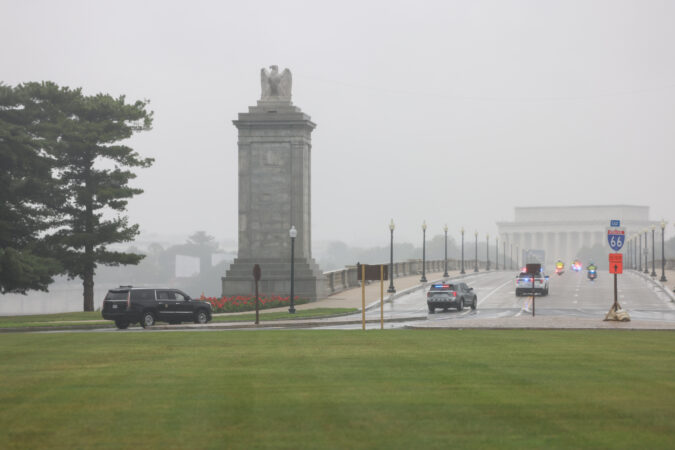
    The Trump administration should pick an “alternative site” for President Donald Trump’s planned 250-foot-tall triumphal arch, a Washington, D.C., official told the administration last month, warning that Trump’s plan to build the structure by Arlington National Cemetery would be “divisive.”

    David Maloney, the city’s historic preservation officer, said the plan to build in Memorial Circle — a traffic roundabout across the river from the Lincoln Memorial — would “severely damage an exceptional cultural landscape and one of the most important symbolic places in the nation.”

    Maloney instead suggested a different spot that he said would be a better fit for the towering arch: an empty traffic oval located on South Capitol Street between Nationals Park and Audi Field.

    “It would create an energizing focal point for a still-emerging neighborhood, suitable for a celebratory crowd,” Maloney wrote to the National Park Service in a June 26 letter posted by a federal commission reviewing the project. An arch located there could become a symbol of “sports triumph” linked with the nearby stadiums, he said, “and importantly, it would enhance the historic L’Enfant Plan and the city’s monumental landscape rather than detracting from it.”

    Rodney Mims Cook Jr., a Trump appointee who chairs the U.S. Commission of Fine Arts, had previously identified that site as a prospective location to build a triumphal arch.

    Washington Mayor Muriel E. Bowser’s office declined to comment on the proposal from Maloney, who has served as the city’s historic preservation officer since 2007. The historic preservation office does not always speak for the mayor and has some degree of autonomy in its work, city officials said.

    Bowser has sought to strike a balance with Trump as he attempts to remake parts of Washington, encouraging him to tend to long-delayed repairs to local fountains. She has avoided public battles with the president over some of his more controversial changes to the city and its historic buildings, such as Trump’s demolition of the East Wing to build an expansive White House ballroom.

    Trump last year proposed building a triumphal arch to honor the nation’s 250th anniversary, arguing that it was an overdue addition to Washington.

    “We’re the only important and major city that doesn’t have one,” Trump said in the Oval Office in May. He also touted his plan to make it bigger than the 164-foot-tall Arc de Triomphe in Paris.

    “We have to do slightly larger … otherwise you’d all be disappointed in me,” the president said, alluding to his propensity for large construction projects. “But it’s even far more beautiful.”

    Historic preservationists and advocacy groups have opposed the project, warning that the large arch — Trump’s most significant effort to change Washington’s skyline — would alter the city’s historic views.

    Military veterans also have sued to block it, warning that the towering structure would harm their experience of visiting the nearby national cemetery. A federal judge is weighing the case.

    The Commission of Fine Arts, which Trump has packed with allies, has approved the project. A second federal panel, the National Capital Planning Commission, is scheduled to weigh the proposal Thursday.

    Federal officials have also laid out an aggressive timetable to potentially complete work on the arch before Trump’s term ends, which would involve 20 hours per day of construction on the arch, year-round.

    Maloney, who declined an interview, has also questioned the Trump administration’s process to build the arch, criticizing the 10-day window for public comment. He also said that outside experts had been wrongly excluded from a federally required process, known as a Section 106 review, to consider the arch’s potential effects on historic properties.

    Trump officials have declined to include a half-dozen historic preservation and advocacy groups in the process. All of the excluded organizations, which have historically offered input on past federal projects, have sued the Trump administration over the president’s construction and renovation projects.

    The review process “is clearly an exercise designed to shield this controversial project from genuine public and expert scrutiny, rather than to reduce its harmful impacts on our shared heritage, which is owned by the public,” Rebecca Miller, the executive director of the DC Preservation League, wrote in a June 15 letter to the Park Service.

    Maloney also warned that Memorial Circle is somewhat removed from Washington’s downtown, limiting potential visitors if an arch is built there. He compared it to the sites of other major memorials — such as the Arc de Triomphe in Paris and the 9/11 Memorial in New York City — that are better woven into their city’s fabric.

    “The location does not suggest a likelihood of success for a celebratory monument,” Maloney wrote in his June 26 letter to the Park Service.

  • Older adults turn to ‘Golden Girls’ housing

    Older adults turn to ‘Golden Girls’ housing

    Shirley Jennett, a retired nurse, loves her spacious ranch-style house in Denver, with its big backyard and gazebo.

    “I want to stay here,” she vowed. “And die here.”

    She might pull that off. In relatively good health, Jennett still drives to lunch with friends, does her own housekeeping and grocery shopping, and plows through a book a day, usually a mystery. But her children worry about her living alone at 89, especially since she has had a couple of falls.

    Enter her new housemate, Susan Beese. Despite working four days a week in retail, Beese could no longer afford her nearby one-bedroom apartment as the rent topped $1,500 a month. She moved out, first staying with friends and then in what she delicately called “a senior women’s facility.”

    Now Beese, who is 79, pays Jennett $800 monthly for a bright two-bedroom space, with a bath and a kitchen, on the lower level of her house. As part of the agreement the housemates worked out, she helps plant and water Jennett’s garden, takes out the trash, and cooks occasional meals.

    “It’s been a lifesaver,” Beese said. Jennett even welcomed her dog.

    Meet the real-life Golden Girls. In the much-loved 1980s sitcom, still in perpetual reruns, the four wisecracking women who share a house in Miami met through an ad on a supermarket bulletin board.

    In Denver, the housing matchmaker was Sunshine Home Share Colorado, a local nonprofit that Alison Joucovsky, a senior services administrator, founded in 2016 when the problem became urgent. “My phone was ringing off the hook,” she said, recalling anxious pleas from older residents spending most of their Social Security checks on rising rent or facing yearslong waiting lists for subsidized senior housing.

    Home sharing “is a really efficient way to create affordable housing and to support older people who want to age in place,” Joucovsky said. Carefully vetting both “home providers,” who may be rattling around in family houses now too big and too empty, and “home sharers” seeking reasonable rents, Sunshine facilitated 31 shares last year, a record for the nonprofit.

    “The cost of developing and building new housing is astronomical, and so is the length of time it takes,” said Laura Fanucchi, president of the National Shared Housing Resource Center and an administrator with HIP Housing, a home-share organization in San Mateo County, Calif. “Why not make use of existing housing stock?”

    About 55 organizations around the country offer these services — and demand is growing, driven by housing shortages, rising rents, and sales prices that affect both the old and the young. Legislators in several states are working to promote home sharing as an option. (Personal care is not part of these arrangements.)

    The need is acute. About one-third of households headed by someone 65 or older were “cost-burdened” in 2024, according to an analysis by the Harvard Joint Center for Housing Studies. That means they spent more than 30% of their income on housing.

    Although nearly 80% of those people were homeowners, the center found, an increasing proportion are still paying off mortgages or home equity loans, and most contend with higher taxes, utility and maintenance costs, and insurance premiums.

    “A lot of the people calling me to complain about property taxes and inflation are senior citizens on fixed incomes whose children have left, and maybe their spouse has died,” said Pennsylvania state Rep. Abby Major, a Republican, who has co-sponsored a bill that would facilitate home sharing. “They’re a single older adult living in a four-bedroom house.”

    Yet most don’t want to relocate. Even if they do, many older adults will find that downsizing has also become prohibitively expensive, as home prices rise and very low interest rates become a memory.

    Younger people are similarly cost burdened, including 37% of those aged 25 to 34, and 31% of those 35 to 44, the Joint Center has reported. Home sharing can benefit both older homeowners who need income and people of any age in search of lower-cost housing.

    To help increase their reach, some home-share programs now supplement or replace the traditionally labor-intensive matching process with online platforms. (For-profit companies like Nesterly or Roommates.com also facilitate shared housing.)

    “It’s like online dating, except that people who have rooms can meet people who need rooms,” said Candice Smith, executive director of HomeShare Oregon. “And it’s a lot more secure.” HomeShare’s online platform has drawn close to 7,000 providers and seekers over five years.

    Further support has come from the city of Portland, which this year announced a pilot program to pay $1,000 to homeowners who make a spare room available (or $1,500 for two rooms) through qualified home-share programs.

    In addition, legislators in several states have introduced or passed bills that prohibit municipalities from unduly restricting homeowners who want to rent spare rooms to nonfamily members. Sponsors in Pennsylvania and Connecticut actually call them Golden Girls bills, and they’ve drawn bipartisan support.

    “So many young people have basically given up on buying a home,” said Colorado state Rep. Manny Rutinel, a Democrat. He helped pass a 2024 law prohibiting cities and counties from limiting the number of unrelated people who could live together in a single dwelling.

    In Pennsylvania, state Rep. Tarik Khan steered a similar bill through the House in June; it awaits a Senate vote. “It doesn’t make sense that your cousin can move in but someone unrelated to you can’t,” said Khan, a Democrat.

    The Pennsylvania bill caps the number of nonfamily occupants in a home at five; Connecticut’s limit would be three. That bill passed the Senate in April, and then died without a vote in the House. But the bill sponsors plan to reintroduce it next session.

    Home sharing can’t solve the housing crisis, its fans acknowledge. But it could make a dent, potentially unlocking thousands of spare bedrooms across the country without requiring new construction that would change the character of neighborhoods.

    Admittedly, matching homeowners with those who want to rent a room becomes a delicate process. Home-share staff members typically interview the individual parties, run background checks, verify incomes, coordinate initial phone calls and meetings, and mediate if problems later arise.

    They also help applicants sift through the myriad lifestyle preferences that can torpedo a match. “Living together isn’t easy,” Fanucchi said. Will the home provider accept smokers, pets, visitors? Does the sharer work from home? Or need to park a car? Who sets the thermostat?

    Sometimes the agreement includes a “service exchange,” in which the newcomer does a few hours of chores such as snow shoveling, shopping, or some meal preparation in return for reduced rent.

    Jenlyn and Larry Boyer, for instance, have lived in their ranch house in suburban Broomfield, Colo., for 31 years and never want to leave. But Jenlyn Boyer, who is 80, has “gotten unsteady” and uses a walker. Her husband, 70, suffers chronic fibromyalgia pain and needs a wheelchair.

    Because they now pay for tasks that they used to undertake themselves, and because inflation has undermined their finances, “I had an epiphany,” Jenlyn Boyer said. “We need more help and we need more money.”

    Six months ago, through Sunshine Home Share, they met a 46-year-old graduate student whose monthly rent had doubled to an unmanageable $2,000.

    The student moved into their furnished downstairs bedroom/family room with a bathroom, a small refrigerator and a microwave. In exchange for about 10 hours of dishwashing a month, she pays a reduced rent of $600.

    The additional income has helped the Boyers cover expenses like van repairs and wheelchair batteries. But they also enjoy chatting with their new housemate.

    “She turns out to be just a gem,” Boyer said. “We laugh together a lot.”

    This article originally appeared in the New York Times.

  • Philly can’t force ICE agents to unmask, federal judge rules

    Philly can’t force ICE agents to unmask, federal judge rules

    Philadelphia can’t prevent U.S. Immigration and Customs Enforcement agents and other federal officers from concealing their identities, a federal judge ruled Thursday.

    U.S. District Judge Chad F. Kenney issued an order preventing Mayor Cherelle L. Parker’s administration and District Attorney Larry Krasner’s office from barring federal law enforcement officers from wearing masks, intentionally covering their badges, or using unmarked vehicles.

    The U.S. Constitution’s Supremacy Clause prevents states — or a city in this case — from imposing requirements on how federal agencies carry out their duties, the judge appointed by President Donald Trump said.

    When City Council passed the bill in April as part of the ICE Out legislative package, the lawmakers “attempted to sidestep the Constitution’s clear mandate and disregarded this fundamental principle of law that has informed American jurisprudence for over 200 years,” Kenney’s opinion said.

    Parker allowed the bill to become law without her signature, following City Solicitor Renee Garcia’s advice that signing the bill “would send an inaccurate signal to the public that the Administration can legally and practically enforce” its provisions.

    “Mayor Cherelle Parker acted with civic wisdom and courage to stand up for the Constitution and follow the rule of law to where it led, despite what may have been strong personal inclinations to the contrary,” the judge said.

    While the ordinance’s requirements apply to all law enforcement, its inclusion in an “ICE Out” package suggested the city planned to be selective in its enforcement, Kenney said.

    And even though the ordinance hadn’t taken effect yet, the judge said, the city never said it wouldn’t attempt to enforce its provision. Krasner’s past statements vowing to “arrest” and “put handcuffs” on ICE officers who break state law, as well as his involvement in a progressive prosecutors’ group committed to such prosecutions, suggest the threat of enforcement is real, Kenney said.

    “The Department of Justice will keep fighting jurisdictions that try to obstruct President Trump’s immigration enforcement with policies that endanger agents and public safety,” a department spokesperson said.

    The city is reviewing the ruling and potential next steps, a law department spokesperson said.

    Kenney showed an “unnecessary urgency” from the beginning of the case, Krasner said.

    “The red-hot rush of this federal district court judge, a Delaware County Republican appointed by Donald Trump, was predictable,” the district attorney said.

    Defending the ordinance put Parker and her administration in an awkward position. City Council passed the legislation with a veto-proof supermajority as part of a seven-bill package.

    The ordinance at the heart of the litigation made it a crime for law enforcement officers, including Immigration and Customs Enforcement agents, to wear face coverings or conceal personal identifiers like badges and nameplates while carrying out their official duties in Philadelphia, and required officers to identify themselves. It also prohibited the use of unmarked vehicles.

    The bill included exceptions allowing officers to wear masks in certain circumstances, such as medical emergencies or SWAT operations.

    An officer could face up to 90 days in jail plus a fine for violating the ordinance.

    The other bills prohibit federal immigration agencies from staging raids on city-owned property, ban discrimination on the basis of citizenship status, and prohibit the city from engaging in most forms of information-sharing with ICE.

    The legislation also codified some of Philadelphia’s long-standing sanctuary city status, which a recent poll found most city residents support.

    Parker signed the six other bills, which will take effect Tuesday.

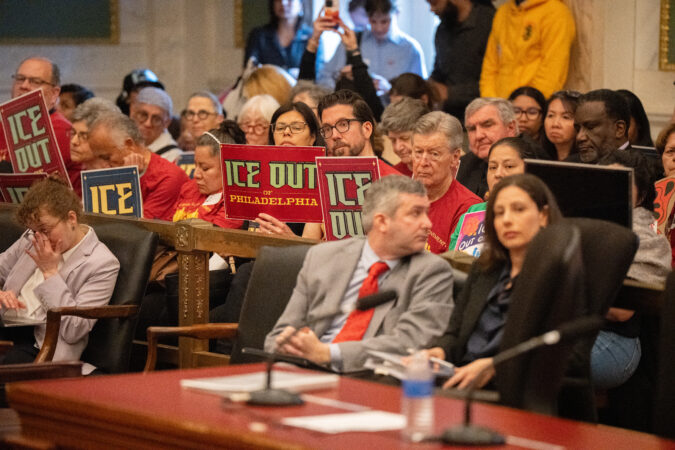
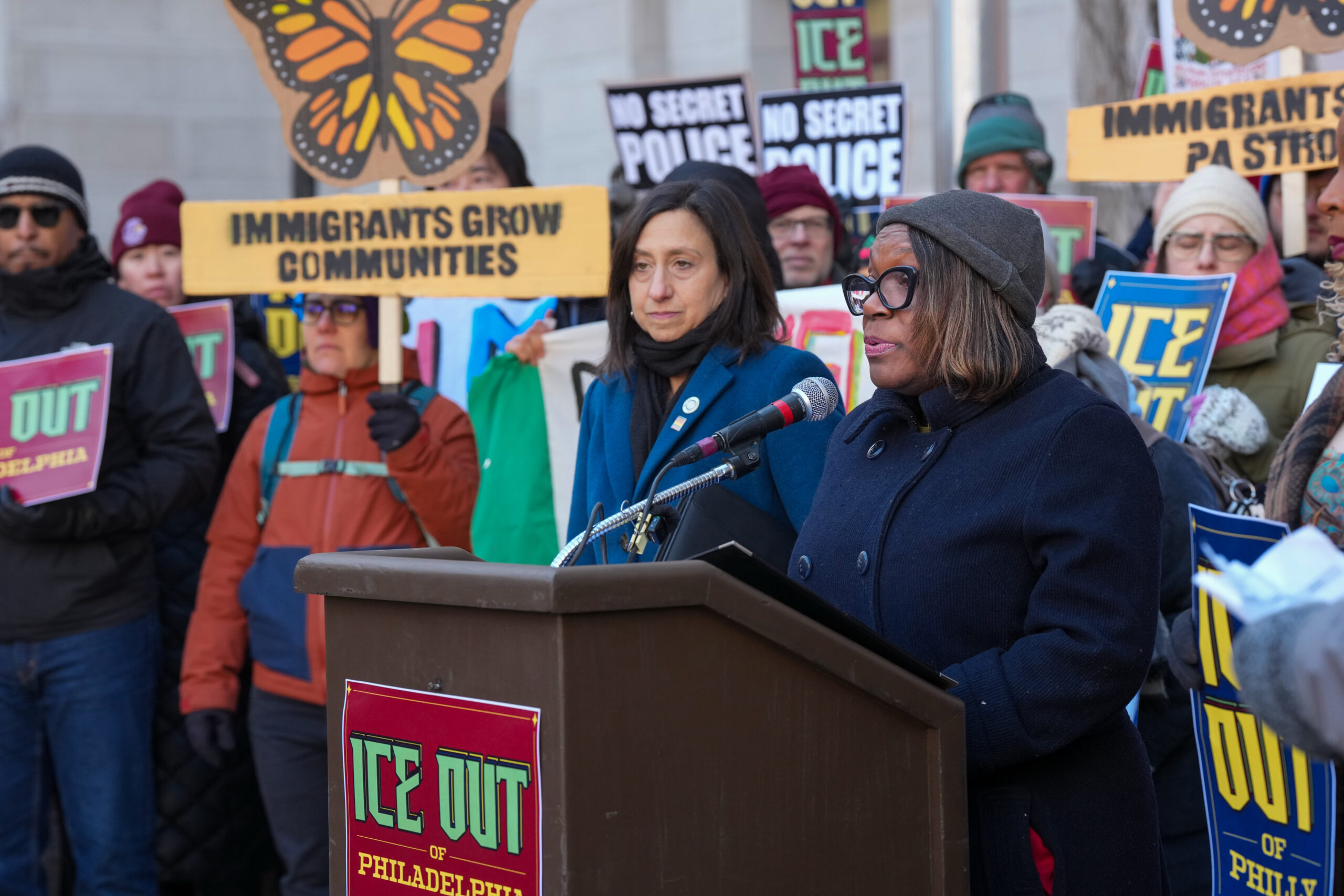
    Kendra Brooks shown here during a press conference at City Hall to announce a package of bills aimed at pushing back against ICE enforcement in Philadelphia, January 27, 2026.

    The Justice Department sued the city, Parker, Krasner, and Garcia in federal court in Philadelphia last month and requested an injunction on the enforcement of the masking bill.

    Officials from various federal agencies told the court the bill would harm their operations and officers.

    Members of the public routinely dox ICE agents, who are later subject to threats, John Rife, acting director of ICE’s Philadelphia field office, said in a filing.

    “Facial coverings reduce the risk of officers’ personal identities being shared publicly, which helps ensure that officers’ privacy and safety, and that of their family members, remains intact,” Rife said.

    The city argued the litigation was premature as the ordinance hasn’t gone into effect and there was no attempt to enforce it.

    The city also said federal agents had applied “aggressive enforcement tactics behind the mask of anonymity, undermining public safety and trust.”

    But Kenney’s opinion said, “there can be no public interest” in enforcing a provision that violates the Constitution.

    It doesn’t make sense that the city can’t hold federal officers to the same standard it holds its own police department to, Councilmember Rue Landau, who authored the bills with fellow progressive Kendra Brooks, said in a statement.

    The Trump administration has sued other jurisdictions, including New Jersey, over similar requirements. In April, the U.S. Court of Appeals for the Ninth Circuit found that a California bill requiring agents to “visibly display identification” was unconstitutional.

    On Tuesday, a federal judge in Richmond enjoined Virginia from enforcing a law barring ICE agents from covering their faces.

    “It’s unfortunate the Parker administration’s own doubts were used against the bill in this injunction,” Brooks said in a statement. “No one else is dealing with that dynamic in their lawsuits.”

  • The Supreme Court tackled race, history, and the law in fraught and reflective major rulings

    The Supreme Court tackled race, history, and the law in fraught and reflective major rulings

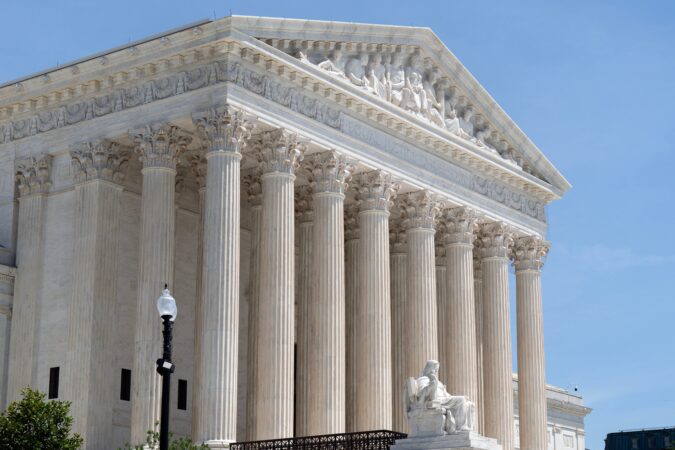
    WASHINGTON — The Supreme Court just wrapped up a term that yielded significant rulings in cases involving race and discrimination that could have lasting effects on U.S. politics and society.

    Justices were at times bitterly divided — and critical of one another — in rulings that winnowed key provisions of a landmark voting rights law, allowed the government to revoke protections for some immigrants, and even challenged the historic understanding of birthright citizenship for the children of immigrants.

    The decisions come at a moment when long-standing debates over race and identity have turned toward immigration, increasing racial diversity, and the fairness of policies meant to prevent and redress discrimination.

    “This term, we saw a Supreme Court that is moving quickly to eradicate legal protections in ways that will leave vulnerable communities exposed to the harsh winds of discrimination and hatred that we continue to see across the country today,” Kristen Clarke, general counsel for the NAACP and the former head of the Justice Department’s civil rights division during the Biden administration, told the Associated Press.

    Here is a breakdown of the latest decisions involving race and what they may mean going forward:

    The temporary protected status case

    The court allowed the government to end deportation protections for Haitians and Syrians in the U.S. who have fled violence and natural disaster. President Donald Trump’s administration revoked the temporary protected status last year.

    With the president’s more than decadelong track record of denigrating developing nations and immigrants who come to the U.S. from Africa, Asia, Latin America, and the Middle East, attorneys for some affected migrants contended that the government could not cancel the designations, in part because Trump’s comments about immigrants were racist.

    “The true reason for the termination is the president’s racial animus towards non-white immigrants and bare dislike of Haitians in particular,” Geoffrey Pipoly, an attorney for the Haitian nationals in the case, said during April oral arguments in the case, Mullin v. Doe. The attorneys noted that, during his second presidential campaign, Trump claimed immigrants “are poisoning the blood of our country” and suggested in another instance that migrants have “bad genes.”

    Federal authorities denied prejudice played a role in the decision and argued that TPS was supposed to end but has lasted more than a decade in some cases.

    In writing for the 6-3 conservative majority, Justice Samuel Alito said none of the cited statements was “overtly racial,” reasoning that any of Trump’s actions could have been taken without racial animus and attributing his anti-immigrant comments to “political discourse.”

    That’s not how the court’s liberal minority saw the situation.

    “The references — of filth, disease, and primitiveness — are shot through with racial stereotypes and tropes. It is hard to imagine the statements being made today of any White community,” Justice Elena Kagan wrote in her dissent.

    The birthright citizenship case

    In one of the highest-profile cases of the term, the court reaffirmed that the 14th Amendment to the U.S. Constitution means all people born in the U.S. are citizens.

    On his first day in office last year, Trump signed an executive order seeking to restrict birthright citizenship to the children of U.S. citizens, a move that civil rights groups challenged as unconstitutional and racist.

    In his majority opinion, Chief Justice John Roberts traced the arc of birthright citizenship — a principle that all people born on U.S. soil are citizens — from its origins in English common law to its codification in the 14th Amendment.

    Roberts noted that race and citizenship had been fiercely debated in courts, speeches, Congress, and battlefields because of Black Americans’ fight for freedom from slavery.

    Freed Black Americans did not receive citizenship as a “reward,” Roberts wrote, but because “the Amendment recognized their rightful claim to birthright citizenship simply and solely by virtue of their having been born on American soil.”

    The 6-3 ruling was a blow to the Trump administration, which has made restricting immigration its central goal.

    “The clause does not extend citizenship to the children of temporary visa holders or illegal aliens,” U.S. Solicitor General John Sauer argued before the court in April.

    Justice Clarence Thomas agreed and wrote in his dissent that African descendants of enslaved people in the U.S. are a unique case separate from the children of tourists or people in the country illegally.

    “Blacks were entitled to citizenship because they were Americans. They had no other homeland, owed no allegiance to any foreign power, and were subject to no other authority,” Thomas wrote.

    In a stark move, liberal Justices Ketanji Brown Jackson and Sonia Sotomayor directly criticized Thomas’ claim in a joint opinion.

    “The Reconstruction Amendments were an anticaste, antisubordination reset for the Nation, not a mere spot treatment for the dark stain of slavery,” they wrote.

    The voting rights case

    The Supreme Court handed down a decision in April that gutted a key provision of the Voting Rights Act meant to remedy efforts to disenfranchise minority voters. Among the methods the law permitted to stop voting discrimination in states was the creation of majority-minority congressional districts.

    In the majority opinion, Alito found that because race and partisan voting behavior were so intertwined, it was unfair to conclude that a partisan gerrymander of a state’s congressional districts could be racist, given there may be other reasons for the map’s results.

    Alito reasoned that “in a state where both parties have substantial support and where race is often correlated with party preference,” partisan actors can “easily exploit” laws meant to protect minority political participation for disingenuous reasons.

    The liberal justices balked at the logic and criticized the conservative majority for harming minority representation in politics and culture. They believed that the law’s provisions were still necessary to prevent discrimination by states and worried about the fallout from its removal.

    “The consequences are likely to be far-reaching and grave,” Kagan wrote in her dissent. “Today’s decision renders Section 2 all but a dead letter. In the states where that law continues to matter — the states still marked by residential segregation and racially polarized voting — minority voters can now be cracked out of the electoral process.”

    The decision has had profound impact on the political landscape, with nearly a dozen Southern states immediately taking steps to redistrict and eliminate majority-Black districts.

  • Trump administration proposes a rule it says could save Medicare patients $1.1 billion on drugs

    Trump administration proposes a rule it says could save Medicare patients $1.1 billion on drugs

    WASHINGTON — The Trump administration proposed a new rule on Thursday to keep hospitals from charging markups on discounted drugs for Medicare patients and says that could save consumers $1.1 billion next year, according to estimates obtained by the Associated Press.

    The rule would apply to hospitals that serve low-income patients under what is known as the 340B program, which lets hospitals buy outpatient prescription drugs at discounted prices. But in many cases, hospitals can bill insurers at rates that exceed those costs, allowing hospitals to keep the difference and resulting in higher costs to patients.

    Under the proposed rule, the Centers for Medicare & Medicaid Services would change the formula for what hospitals participating in the program can get reimbursed, in an effort to cut costs for patients.

    The Republican administration has sought to show during an election year that it is tackling the challenges of affordability for U.S. families at a time when rising healthcare costs are driving financial strains for households and the government alike. While the administration has taken several steps it says will save money on medical treatment, it is unclear how much savings might ultimately materialize based on the complexity of the country’s healthcare system.

    The American Hospital Association said the proposed rule would compound the financial pressures its members face.

    “These proposals will undermine the ability of hospitals to maintain essential services and protect affordable access to care for those who depend on the 340B program,” said Ashley Thompson, the group’s senior vice president for public policy analysis and development.

    There is the risk that hospital systems could see their revenues decrease, which could have consequences in the communities they serve. The 340B program was initially designed as a way for healthcare providers to stretch scarce federal resources to better serve more patients. But it has long been at the center of a lobbying battle between hospitals and pharmaceutical companies, with each side attempting to enlist lawmakers in maintaining or changing the benefit.

    The agency estimates that the average older adult with Medicare Part B coverage who is administered one of these drugs would save $800 a year in co-payments. That would work out to a total savings of $1.1 billion for everyone with that coverage.

    The savings over 10 years could total about $20 billion, according to a White House official who requested anonymity to discuss the rule before the official announcement. The official said the proposed rule was not previewed for hospital groups before the release.

    In a policy draft of the rule, the administration gave a specific example of how the current system works for the prostate cancer drug Lupron Depot. Hospitals under the 340B program can acquire a dose for roughly $700, but they can receive about $4,000 in Medicare reimbursement for administering it and an additional $1,000 from the patient co-payment.

    The proposed rule would cut by roughly 40% that amount that hospitals in the discounted drug program could be paid through Medicare programs. If approved, the rule would go into effect at the start of next year.

    In 2018 during President Donald Trump’s first term, his administration tried to enact this same type of rule to reduce Medicare payments to hospitals. But the Supreme Court ruled in 2022 that the government could not provide a separate reimbursement plan for 340B hospitals.

    The president signed an executive order in April 2025 to survey how much hospitals spend to buy drugs. The result of that survey led to the proposed rule, which would cap Medicare reimbursement for participating hospitals at the average sales prices, minus 33.4%. The reason that the average reimbursement rate would be cut is because the hospitals acquired the drugs at discounted prices.