Category: Nation & World

  • As the Pentagon stays quiet, AP reconstructs a U.S. strike that killed over 100 Iranian children

    As the Pentagon stays quiet, AP reconstructs a U.S. strike that killed over 100 Iranian children

    JERUSALEM — It was the deadliest reported strike in the U.S.-Israeli war against Iran. Most of the victims were children.

    In almost any other conflict, these haunting truths would be seared into national memory. Yet more than 120 days since at least one U.S. missile struck an Iranian primary school, there remains no final accounting of what happened.

    The Trump administration has yet to directly accept the blame or formally release findings of a Pentagon investigation into the bombing, even though the military possessed evidence almost immediately that the site of the school had been struck, a U.S. official with knowledge of the situation, who spoke on condition of anonymity in order to discuss an ongoing investigation, told the Associated Press.

    The AP has reconstructed the story of the attack, beginning in the schoolyard on the morning of Feb. 28, drawing from open-source information, video footage, human rights reports, and interviews with researchers and civilians inside and outside Iran to reveal previously unreported details about the bombing in Minab, including the diversity of children killed.

    Still, many details about the blast remain elusive, as a lack of information from the Pentagon and politicization of the attack by Iran’s theocracy have complicated independent reporting efforts. That has created an accountability vacuum, leaving the families of the victims without resolution. Among the mysteries remaining are the number of munitions that hit the school and a complete list of the dead.

    When asked last week about the incident, President Donald Trump said he hadn’t read the Pentagon’s report and had seen nothing to make him believe the U.S. had carried out the attack.

    “I don’t know that they’re ever going to solve that problem in terms of whose fault was it, because there were missiles flying all over the place,” he said. “I don’t think it was us.”

    Iran’s mission to the United Nations did not respond to a request for comment from the AP.

    Video evidence, interviews and other sources yield a fuller picture

    The reconstruction draws from interviews with U.S. officials, Iranian human rights workers, a resident of Minab, an international representative of the Coordinating Council of Iranian Teachers’ Trade Union, and researchers from major international rights groups.

    Several people who spoke to the AP were in direct contact with the families of victims and rescuers who rushed to the scene. Most requested anonymity for fear of retribution against them and those with whom they spoke.

    Parents called to pick up their kids, then bomb fell

    Skies over the city of Minab, located in southeastern Iran about 16 miles from the Strait of Hormuz, were clear and bright on the morning of Saturday, Feb. 28, a school day in Iran. It was Ramadan.

    Students of the Shajareh Tayyebeh school, Farsi for “Good Tree,” jostled past the colorful murals lining the schoolyard and into the building. Boys and girls filtered into separate spaces with brightly painted desks.

    The school they entered was one of over 30 with the same name established to serve children from families closely tied to Iran’s paramilitary Revolutionary Guard or other state institutions, said Shiva Amelirad, the international union representative who also worked as a teacher in Iran for 18 years and has been in contact with people in Minab.

    Though most schools in Iran operate within guidelines proscribed by the Islamic Republic, the Shejareh Tayyebeh schools were more explicitly oriented toward reproducing and reinforcing the Guard’s worldview, she said, adding that children are civilians regardless of their family backgrounds, and “any attack targeting a school is unequivocally condemnable.”

    The school lay within the same walled compound as a Guard base, according to an AP assessment of satellite imagery and open-source mapping. It was once part of that neighboring base, before it was fenced off and converted over a decade ago.

    Though some of its pupils were the children of Guard officers working on the nearby base, others were local children from Minab, which is populated predominantly by people of the majority-Sunni Baluch ethnic minority who often face repression from the Iranian government, said the Balochistan Human Rights Documentation Network.

    Hundreds of students are believed to have been inside the building by the time teachers and administrators received the news that bombs had begun falling on Tehran around 9:40 a.m.

    Teachers and administrators thought it prudent to send the children home. They called parents on landline phones, summoning them for an early pickup, two people told the AP. A recently released report by Airwars, a London-based independent group that tracks recent conflicts, also found that parents were called to pick up their children.

    At 10:15 a.m., Iran’s state media sent out an advisory, closing schools across the country.

    One father, who lived a short distance away, went immediately to pick up his 10-year-old son, said a resident of Minab, who relayed the stories of several families to the AP. The AP verified details of the residents’ stories against available lists of the dead and rights groups’ chronologies of the day’s events.

    The father noticed his 6- and 7-year-old relatives among the students waiting for their parents, said the resident. He asked them if they’d like a ride home and they said no, that their own father was on the way.

    He left with his child and headed to the supermarket. Ten minutes later, he heard the explosions.

    Multiple munitions pummeled the compound, striking at least five buildings, according to an AP analysis of satellite imagery. Hundreds of pounds of explosives collapsed the school.

    A tiny arm, suspended in the rubble

    The father raced back to a scene of chaos, where onlookers gathered, screaming, as men pawed through smoking rubble to dig out bodies, according to video of the aftermath circulated by Iranian state media.

    Eventually, the father made out two burned figures he believes were those of his relatives, but he couldn’t be sure.

    People kept coming. One man from a nearby Sunni village arrived to search for his nephew after receiving a panicked call from the boy’s mother. In the rubble, he found her dead son.

    Rescuers found small backpacks and children’s drawings, colored pencils and worksheets. Gently suspended, a tiny arm lay in the wreckage.

    Men carried disfigured limbs and torsos to the local hospital, said the Balochistan Human Rights Documentation Network, whose staff spoke with two families of those killed. The AP has not been able to verify how many munitions specifically hit the school, but the attack had left flesh so mutilated that many body parts were unrecognizable.

    By the end of the day, doctors at the hospital estimated they had at least 108 bodies, but cautioned that it was likely an undercount, said the resident of Minab.

    By the next day, state media was saying around 150 had been killed. Soon, it was reporting a death toll of 168.

    “They called the kids martyrs”

    Three days after the bombing, state TV showed thousands of Iranians packing a Minab roundabout, where the crowds faced a podium and a large portrait of Ayatollah Ruhollah Khomeini, the late founder of the Islamic Republic.

    The gathering might have been mistaken for a demonstration, if it were not a funeral. All the parents of victims, regardless of ethnicity or religion, had to participate, said the Minab resident. Most women in the crowd wore the black chador garment customary to the Islamic Republic, even though it’s not typically worn by Baluch people at funerals.

    Parents were told they’d be permitted to take their children’s bodies back to their villages and conduct their own observances, said the resident. In the end, though, many decided to bury their children together.

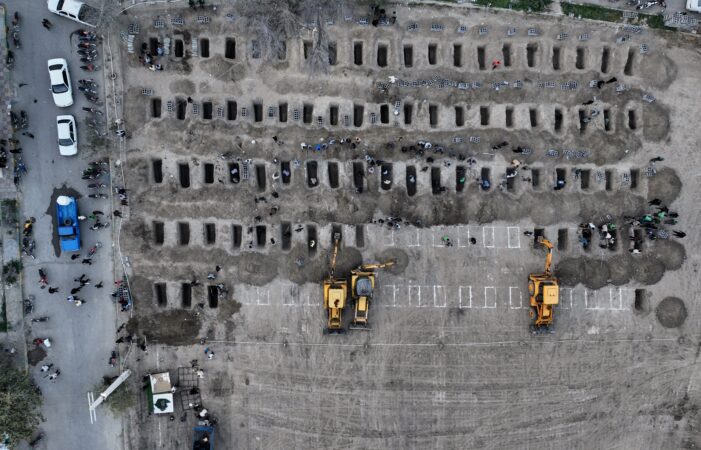
    In footage captured by drone cameras and circulated by state media, workers broke ground on an earthen lot, creating a grid of tiny, identical, unmarked graves.

    “The state media advocated a narrative based on IRGC interest,” said Amelirad. “You can tell because they called the kids martyrs.”

    The story grows harder to tell

    Strikes continued to ravage Iran, targeting more sites in the opening days than the start of recent U.S. or Israeli military campaigns, including in Gaza, an Airwars analysis found.

    Racing to document the ongoing bombardment, journalists and rights groups struggled to verify details from Minab. They had no access to the target site. Government restrictions in Iran prevented most foreign journalists from entering the country. The opening day of the war, Iran shut down the internet, making it nearly impossible to hear from ordinary civilians.

    As the war progressed and the Strait of Hormuz became a major battlefield, the situation in the province grew more tense, said the resident. All branches of the military were deployed heavily in the area. Families of the victims feared retribution for speaking out. People were reportedly being detained for trying to communicate with foreign media.

    That left Iran’s government in control of the messaging around the strike.

    Iran’s soccer team wore golden “#168” pins on their jackets upon their arrival at the FIFA World Cup.

    The Iranian team negotiating for a pause to the war with the U.S. named itself “Minab 168.”

    The children were depicted as animated Lego figures in viral videos made by pro-Iran groups trolling the U.S.

    “In the aftermath of the attack, Iranian authorities … exploited the suffering of victims’ families and surviving children for propaganda purposes,” wrote Amnesty International in a March report investigating the deaths.

    Through it all, there remained no public list of the names of the dead.

    The Pentagon finds clues in archive

    Locked out of Iran, researchers focused on the question of responsibility.

    Iran blamed the U.S. Trump cast doubt on American culpability and pointed the finger at Iran. Defense Secretary Pete Hegseth said only that the Pentagon was investigating.

    Internally, the U.S. military knew more than it initially let on. The clues were buried in their archives.

    When the news first surfaced, the U.S. military knew they had conducted strikes in the vicinity — though it took the military time to verify the Iranian claims that a school was struck and begin a formal investigation, said a U.S. official with knowledge of the situation, who spoke on condition of anonymity to discuss the ongoing inquiry.

    It appears that while the building housing the school was identified as such by one analyst as early as seven years ago, that discovery was not sufficiently made known across different intelligence and military staffs and agencies, the U.S. official said.

    Ultimately, the building was not known among target developers as a school, revealing potential systematic shortfalls in the target analysis and review process, they said.

    One former Pentagon official, similarly speaking on condition of anonymity, said the bombing came as a natural result of changes made by the Trump administration to reduce staff to mitigate civilian harm and Hegseth’s emphasis on lethality.

    When Hegseth took charge, he slashed the size of an office called the Civilian Protection Center of Excellence, created at the direction of Congress in late 2022. That stopped the office’s work on updating “no-strike lists,” which are lists of protected sites such as hospitals, schools, churches, and mosques, that the Pentagon keeps, said Wes Bryant, who began working at the office in 2024 as the branch chief of Civil Harm Assessments.

    When he was working at the Pentagon, it was well known that the list was out-of-date, he said.

    The search for more answers from Minab

    In the last weeks, researchers have made some progress. Airwars, the conflict research group, spent months combing through open-source information to verify the identity of victims. The group determined the names and identities of 157 of the dead, including 123 children, all 13 or younger, and 34 adults. Among the adults are 26 school staff members (one of whom was pregnant) and five parents — each of whom lost at least one child.

    The group puts the death toll between 157 and 168 and says between 95 and 111 people were injured.

    It’s unclear when the formal results of the military’s Minab investigation will be published. Much of the investigative work has been completed, but the U.S. military’s Central Command, which commissioned the investigation, is currently reviewing the findings.

    Hegseth said last week the report would be divulged “when the appropriate time is right.”

    Findings from similar past investigations have been more timely. When a Hellfire missile killed 10 civilians in Kabul, Afghanistan, on Aug. 29, 2021, the Defense Department claimed responsibility and gave details on its operations in less than a month.

    Some members of Congress still push for transparency.

    In a recent interview, Sen. Mike Rounds, a Republican from South Dakota and a member of the Armed Services and Intelligence committees, said Congress has not gotten enough information on the bombing and expected a full report.

    The issue “has not gone away,” he said.
  • Couple climbs needle of Empire State Building

    Couple climbs needle of Empire State Building

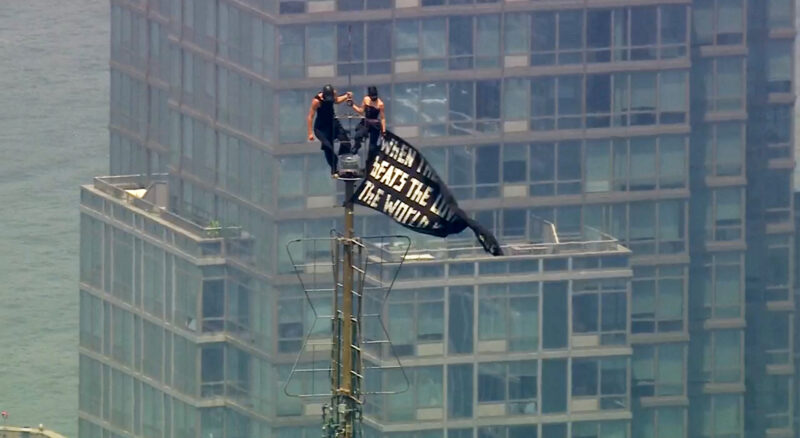
    NEW YORK — A couple known for scaling tall buildings climbed to the top of the needle of the Empire State Building on Wednesday and unfurled a large black banner that flapped in the breeze, about 1,450 feet above the city.

    The couple, Angela Nikolau, 33, and Ivan Beerkus, 32, were taken into custody after the stunt, according to a law enforcement official. Nikolau, according to a police document, was charged with burglary — defined in New York state as unlawfully entering a building with the intent to commit a crime. It was not immediately clear whether Beerkus was also charged.

    Late Wednesday morning, Nikolau posted a video on her Instagram account that showed a vertiginous view from a narrow platform and that was captioned “Currently at the Empire State Building.”

    The message on the banner read: “When the power of love beats the love of power the world knows peace.”

    As they stood atop the skyscraper, Beerkus proposed to Nikolau, the law enforcement official said. A photo Nikolau posted to Instagram shows Beerkus getting down on one knee.

    The law enforcement official gave Nikolau’s first name as Angelina and Beerkus’ surname as Kuznetsov, which appears to be his birth surname.

    The couple were the subjects of a 2024 documentary, “Skywalkers: A Love Story,” about their romance and quest for thrills and fame. In 2022, they climbed Merdeka 118 in Malaysia, which is more than 2,000 feet tall.

    The Empire State Building’s needle, which houses communications equipment and a very tall antenna, rises about 200 feet above the top floor of the building.

    Climbers with a banner atop the spire of the Empire State Building in Manhattan, on Wednesday, July 1, 2026. After making the ascent, the man proposed to the woman on a tiny platform, 1,450 feet above the city. (Dave Sanders/The New York Times)

    It is a surface that is not frequently scaled. In 1994, the French climber Alain Robert did so, according to the Guinness World Records website.

    New York City’s skyscrapers and monuments, however, have long been magnets for climbers.

    Their attempts have ranged from the modest to the truly harrowing.

    In 1918, Harry Gardiner, nicknamed “the Human Fly,” climbed the Soldiers’ and Sailors’ Memorial Arch at Grand Army Plaza in Brooklyn; it is all of 80 feet high.

    Philippe Petit walked a tightrope between the towers of the World Trade Center in 1974.

    In 2008, after three people — one of whom was Robert — climbed the New York Times Building in a matter of weeks, the Times removed some of the horizontal rods that climbers had used to scale it.

    In 2014, a teenager from New Jersey climbed to the spire of the Freedom Tower, which was built on the site of the twin towers.

    Jason Barr, an economics professor at Rutgers University who has studied skyscrapers, said that the initial plans for the Empire State Building did not include a spire or antenna, but after the construction of the Chrysler Building, with its distinctive crown, the building was redesigned to include a mooring mast that would stretch into the sky.

    “These spires are designed partly for aesthetic reasons but also partly for advertising reasons, like, ‘Look at the top of my building’,” Barr said.

    In recent years, artists and exhibitionists have called their unsecured and usually illegal ascents “rooftopping,” documenting the climbs on social media. Aside from structures in New York and Malaysia, Nikolau and Beerkus, have ascended buildings and constructions sites in China and Europe, sometimes with legal repercussions.

    But there have been sanctioned climbs of skyscrapers, too. In 2023, actor Jared Leto scaled 18 floors of the Empire State Building, from the 86th floor to the 104th floor, with permission, to promote a world tour for his band Thirty Seconds to Mars.

    He performed one of the band’s songs from the 104th floor, an unofficial landing off limits to the public.

    This article originally appeared in The New York Times.

  • A major Russian attack kills 21 in Kyiv as Ukrainian strikes batter Moscow’s oil sector

    A major Russian attack kills 21 in Kyiv as Ukrainian strikes batter Moscow’s oil sector

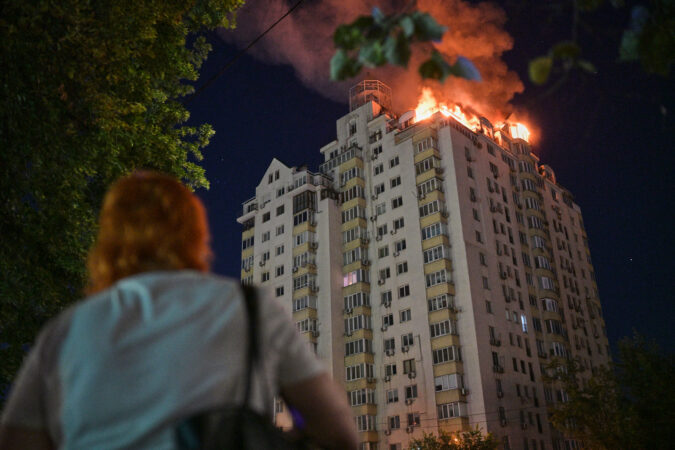
    KYIV, Ukraine — Russia hammered Kyiv in an 11-hour drone and missile attack overnight into Thursday morning, killing at least 21 civilians in the city and injuring scores more in what Moscow said was retaliation for Ukrainian strikes on Russian oil facilities.

    Loud explosions shook the Ukrainian capital, where more than 50,000 people sheltered in subway stations after authorities issued air raid warnings, the Kyiv Metro said. Emergency crews dug through the rubble of collapsed and charred apartment buildings all day in search of victims.

    Russia’s Defense Ministry said in a statement that the bombardment was in response to Ukraine’s recent barrage of long-range strikes, which have caused severe fuel shortages and put pressure on President Vladimir Putin.

    Ukraine’s frequent attacks inside Russia — described by Ukrainian President Volodymyr Zelensky as a 40-day blitz — have especially targeted oil refineries, causing a fuel crisis that has frustrated Russians already feeling the war’s economic toll.

    More than four years after Moscow’s full-scale invasion of its neighbor, Ukraine’s technological advances in drone engineering have in recent months given it an edge, analysts and Western officials say. Its strikes on supply routes behind the front line have robbed the Russian army of momentum on the battlefield and made its progress slow and costly, they say.

    Kyiv’s forces have especially targeted supplies to Crimea, triggering the worst fuel crisis on the Black Sea peninsula since it was illegally annexed by Russia in 2014 and delivering a blow to the Kremlin’s narrative that Moscow is winning the war.

    Ukrainian officials say they are trying to force Putin to the negotiating table, but so far Moscow’s response has been to hit back.

    Diplomatic efforts to end the war, most recently by the Trump administration, haven’t produced results. President Donald Trump and Zelensky are expected to attend next week’s NATO summit in Turkey.

    Putin thinks that time is on his side, that Western support will peter out and that Ukraine’s resistance will eventually collapse under pressure from strategic bombing, analysts say.

    Ukraine’s top diplomat says it was a ‘night of horror’ in Kyiv

    The attack killed 21 people in Kyiv, according to the country’s Emergency Service. More than 90 others were reported injured.

    Foreign Minister Andrii Sybiha said it was a “night of horror” in the capital, which had a prewar population of roughly 3 million people.

    Flashes from exploding drones and missiles lit up the night, and loud booms echoed through Kyiv. Tracers from air defense fire streaked through the air as a huge pall of black smoke rose into the sky.

    More than 30 locations across the city reported damage, including about 20 residential buildings, authorities said.

    Kyiv resident Serhii Budko said three or four ballistic missiles hit his district of the city. “We were inside the shelter and felt the shelter shaking — the ceiling and floor, everything,” the 24-year-old said.

    In Kyiv’s Desnianskyi district, residents were trapped inside a damaged nine-story building, and in the Darnytskyi district, most of a nine-story building collapsed.

    In Ukraine’s central Dnipropetrovsk region, meanwhile, a Russian strike killed a 7-year-old girl and wounded four other people, including an 11-year-old girl, all members of the same family, regional head Oleksandr Hanzha said.

    The bombardment was “exclusively against military or military-linked targets,” Kremlin spokesperson Dmitry Peskov said.

    Russia’s aerial attacks on Ukraine have repeatedly hit civilian areas. More than 16,000 Ukrainian civilians have been killed in the war, according to the United Nations.

    No reliable figures are available for battlefield casualties in the war. A report earlier this year by the Center for Strategic and International Studies, a think tank, estimated that up to 1.8 million soldiers have been killed, wounded, or gone missing on both sides, with Russian troops accounting for most of that number.

    Ukrainian officials urge countries to provide more air defenses

    The attack used “high-precision long-range weapons” and drones to strike weapons factories and energy facilities in and around Kyiv, and “military airfield infrastructure” in other parts of Ukraine, the Russian Defense Ministry’s statement said.

    In all, Russia fired 74 missiles and 496 drones in the attack, Ukraine’s air force said.

    Ukraine’s air defenses have improved throughout the war, especially in countering Russian drones. But it is harder to stop ballistic missiles, which accounted for roughly a third of the missiles fired overnight.

    Sybiha, the Ukrainian foreign minister, said in April that the country’s weapons factories meet up to 75% of its military’s needs. But he and other Ukrainian officials have pleaded with partner countries to supply more Patriot systems that offer the best protection from Russian aerial attacks.

    Ukraine attacks another Russian oil refinery

    Ukrainian forces struck one of Russia’s largest oil refineries overnight in the Nizhny Novgorod region east of Moscow, starting a fire, Ukraine’s General Staff said.

    Also, Ukrainian forces struck a railway bridge over the Siverskyi Donets River in the Russian-occupied Luhansk region, it said. The bridge was used by Russian forces to transport personnel, weapons, and military supplies, according to the General Staff.

  • Conservative education warriors have reshaped GOP politics — even if their crusades often fail

    Conservative education warriors have reshaped GOP politics — even if their crusades often fail

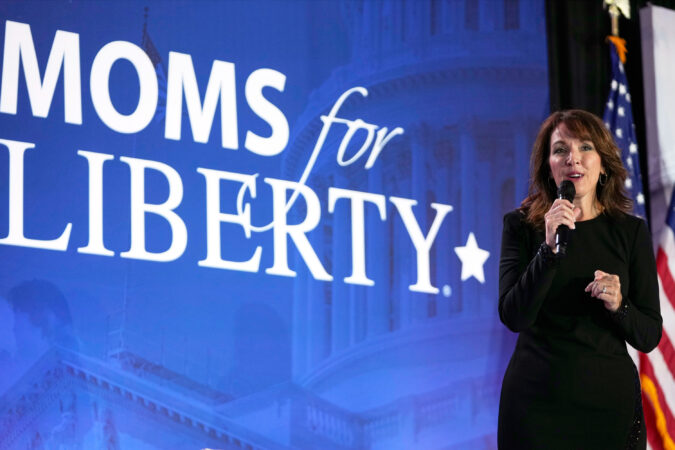
    Since its founding in 2021, the educational advocacy group Moms for Liberty has been mobilizing conservative mothers across the country against school curriculum they deem indoctrinating, un-American, anti-Christian and antithetical to their understanding of family values.

    They’ve targeted books that explore LGBTQ themes, transgender athletes and curriculum they deride as critical race theory or as too focused on diversity, equity and inclusion. More broadly, they claim to be fighting to protect their parental rights to control what their children learn.

    Members of Moms for Liberty have earned seats on school boards, garnered national media attention and infiltrated the highest levels of conservative policymaking. According to cofounder and CEO Tina Descovich, she has visited President Donald Trump’s White House more than a dozen times.

    Moms for Liberty has also made waves in the Philadelphia suburbs, especially in Bucks County, which boasted the largest leadership team of any chapter in the country by April 2025. At a Harrisburg-area event last October, Descovich said, “I am very familiar with Bucks County. Before I knew it existed, I knew the [Bucks County] Beacon existed because they were writing trash pieces about us.”

    Groups like Moms for Liberty have proved effective at making political noise — and even notching some policy wins, at least temporarily. Yet, the group is really just a continuation of a decades-long crusade by conservative white women to weaponize public education in the service of a right wing agenda. While it has largely failed to transform American curriculum, this push has turned these women into key figures in Republican politics who have made fighting the culture wars a GOP priority.

    The modern conservative movement since World War II owes much of its success to the work of grassroots education warriors.

    These women proudly embraced traditional gender roles. They saw them as a marker of success because many women in their mothers’ generation had to work outside of the home to make ends meet in the Great Depression and wartime years.

    Even as some of these conservative women became full-time political activists, they claimed the mantle of traditional homemakers and mothers — which aroused charges of hypocrisy from critics. Yet, they argued that their advocacy work in the traditionally male world of politics and education policy was wholly consistent with traditional gender roles because protecting innocent children from worldly dangers was a natural role for women and mothers.

    At their kitchen tables and in PTA meetings across the country, these “suburban warriors” launched far-reaching campaigns against sex education, multicultural curriculum and other aspects of schooling they deemed antithetical to traditional American values.

    In the 1970s and 1980s, as the political parties realigned, these conservative education warriors emerged as a crucial Republican constituency and a core part of the New Right coalition. These white women were galvanized by the recent gains of the civil rights movement, the Supreme Court’s Roe v. Wade decision — which provided a right for women to have legal abortions under certain circumstances — and debates over the proposed Equal Rights Amendment to the U.S. Constitution, which they claimed (without evidence) would decimate the female homemaking role.

    These recent changes threatened to disrupt what the conservative women argued were divinely inspired gender roles, which were embodied by the “traditional” nuclear family of a working male breadwinner, a female homemaker and kids. They feared that big government-backed forces might take away this ideal life, which many had only recently achieved.

    Increasingly, these women looked to public schools as the place to fight their crusade. Taxpayers funded the schools and they were responsible for shaping the next generation of Americans outside of parental control.

    In 1974, the education wars burst onto the national stage in Kanawha County, W.Va., thanks to an ugly and violent struggle over school textbooks. The controversy began after Alice Moore, a 29-year-old mother and the lone woman on the county school board, objected to a newly adopted language arts curriculum she deemed indoctrinating, racially divisive and steeped in “secular humanism.”

    This latter concept wasn’t new. It dated to the late 19th century, and argued that people could gain knowledge through reason, intellect and logic rather than relying upon religious teaching.

    Yet in the 1970s conservatives thrust it into the spotlight, because they needed a fresh villain. Tried-and-true messaging on anticommunism had grown stale. But pushing secular humanism as the latest liberal conspiracy aligned with the New Right’s renewed focus on faith, family and traditional gender roles, while energizing Christian conservatives.

    Moore and her allies saw secular humanism as increasingly influential in education — and as incredibly hostile to Christianity and their narrow definition of divinely inspired traditional family values. It further alarmed them because they saw secular humanism as teaching students to challenge their parents’ authority. Within a few years, the once obscure concept would become the New Right’s star bogeyman.

    Made By History sponsors. FOR USE ON MADE BY HISTORY STORIES ONLY.

    Throughout the fall of 1974, Moore read excerpts from the textbooks before the school board. She singled out Black nationalist Eldridge Cleaver, whose writings allegedly produced “racial hatred” toward white people. She also took issue with “dialectology,” a study of dialects that included lessons on African American vernacular — what she called “ghetto dialect” — that she believed to be antithetical to American speech.

    By October, the controversy had produced two shootings, dozens of arrests and multiple rounds of bombings, boycotts and school bus blockades.

    Moore’s crusade against secular humanism in West Virginia quickly caught the attention of national conservative organizations. The Heritage Foundation featured Kanawha County in its 1976 study, “Secular Humanism and the Schools: The Issue Whose Time Has Come.” Phyllis Schlafly — the country’s most famous antifeminist at the time — jumped into the fray, claiming that public education promoted “a tolerance of violence, theft, adultery, obscenity, profanity, and blasphemy.”

    In part because organizations like the Heritage Foundation and Schlafly’s Eagle Forum highlighted Moore’s activism for like-minded conservative women, it inspired conservative mothers across the country to wage their own crusades against dirty textbooks. In the ensuing years, they launched repeated battles against seemingly subversive curriculum.

    In 1983, in rural East Tennessee, fundamentalist mother Vicki Frost waged her own legal battle against the Hawkins County school board after discovering objectionable material in her daughter’s reading textbook, including alleged depictions of telepathy, witchcraft and black magic that violated her religious beliefs.

    In Mozert v. Hawkins County Board of Education — a case that became known as “Scopes II” because of Hawkins County’s proximity to the original Scopes Trial — Frost and her fellow plaintiffs alleged that the school board’s policies violated the First Amendment’s Free Exercise Clause. Their legal counsel came courtesy of Concerned Women for America, whose founder Beverly LaHaye took Frost on a national speaking tour to publicize the alleged dangers of modern textbooks. Although the plaintiffs lost their case on appeal, LaHaye deemed the case a “PR success” that “identified us as a friend of the family.”

    The result epitomized the outcome of the broader education wars. Fighting against offensive school curricula turned many conservative women into key figures in the culture wars, with substantial reach and political impact. They quickly become politically astute grassroots organizers who leveraged their identities as white Christian homemakers and mothers to argue for an educational system rooted in Christianity, the traditional nuclear family and American exceptionalism.

    The impact of these organizers, however, hasn’t necessarily come in the classroom. Most of Moore’s “dirty books” found their way into the Kanawha County curriculum. Frost and the plaintiffs in Hawkins County ultimately lost their case on appeal. In recent years, the majority of school board candidates backed by Moms for Liberty have similarly suffered defeat.

    Yet, these organizers have been able to mobilize thousands of culturally conservative women — particularly other white Christian mothers — and bring them into the Republican Party. Their involvement has driven the GOP to make the culture wars a key component of the party’s identity.

    These earlier crusaders also created a language that remains a staple of conservative critiques of public education to the present day. More than five decades after Moore’s war, conservative organizations continue to emphasize “parental rights,” “family values” and “school choice” in their efforts to influence American education.

    When groups like Moms for Liberty claim that public schools are indoctrinating children with “woke” ideologies such as critical race theory, they rely upon a well-established playbook that conservative women have drawn upon for more than half a century. Despite mixed results in America’s actual classrooms, their political activism has proved a tried-and-true means for both enflaming public opinion and solidifying the role of self-proclaimed traditional mothers and homemakers within modern conservatism.

    Allen Fletcher is a public historian and journal editor with research interests in Appalachia, gender and the history of American education. His current book, Building Schools, Building Communities: Appalachian Women and the Struggle for Educational Change, is under contract with LSU Press.

    Made by History takes readers beyond the headlines with articles written and edited by professional historians. Opinions expressed do not necessarily reflect the views of The Inquirer.

  • U.S. and Iran meet with mediators in Qatar

    U.S. and Iran meet with mediators in Qatar

    U.S. and Iranian negotiators were in Qatar on Tuesday as both sides were set to hold talks with mediators, after a surge of attacks in recent days over the Strait of Hormuz threatened to derail efforts to agree on a lasting peace deal.

    Steve Witkoff and Jared Kushner, two of President Donald Trump’s closest advisers, were to meet with the prime minister of the Persian Gulf state, Sheikh Mohammed bin Abdulrahman Al Thani, a U.S. official said. The official added that the U.S. and Iranian delegations would hold separate talks with Qatari and Pakistani mediators today.

    Iran and Qatar said no direct, high-level meetings between the U.S. and Iranian officials were planned and that the discussions would instead be conducted via Qatari intermediaries. The negotiations would focus on implementing the preliminary ceasefire deal reached two weeks ago, the spokespeople for both countries’ foreign ministries said separately.

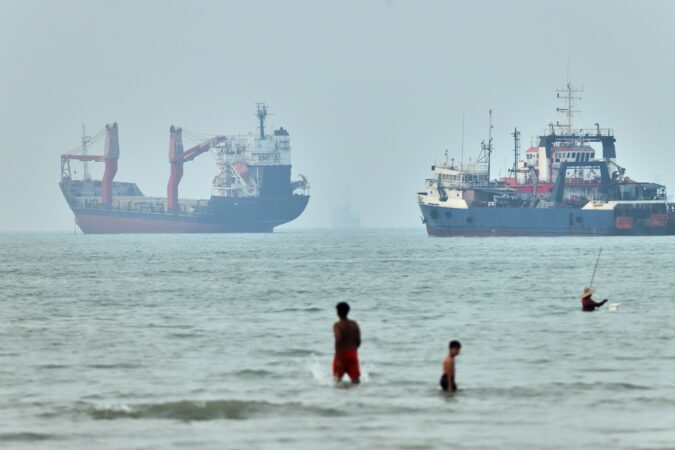
    The absence of face-to-face talks underscores the depth of the distrust between the United States and Iran, after negotiators met in Switzerland in June. The meetings follow a dayslong flare-up of hostilities over the strait, a key transit route for oil and gas shipments that Iran effectively blockaded during the war.

    The preliminary ceasefire largely deferred discussion of the toughest topics, including Iran’s nuclear program and U.S. sanctions on Iran, and allotted 60 days for the countries to reach a comprehensive, long-term deal. But the two sides have been unable to agree even on the meaning of the ceasefire agreement.

    U.S. officials also hoped that the pact would lead to the full reopening of the strait to its prewar status, when ships transited for free. Iran, however, has insisted that the agreement gives it substantial authority over the waterway and has threatened ships that do not travel on Iranian-mandated routes.

    Iran and Oman, a U.S. ally, are advancing a plan to collect payments for ships moving through the strait, despite U.S. objections, according to an Iranian official and four diplomats with knowledge of the matter.

    The latest round of hostilities began Thursday when the U.S. military said Iran had attacked a cargo ship hours after Iran warned that vessels could only travel through its waters in the strait. The ship was transiting through an alternative route near the Omani coast.

    U.S. officials also blamed Iran for another attack Saturday. The U.S. retaliated by striking what it said were Iranian military sites, and Iran responded by carrying out drone and missile strikes against U.S. targets in Bahrain and a Kuwait.

    The clashes ended Sunday, but neither side has publicly acceded to the other’s demands on the strait.

  • Three words in the Declaration of Independence paint a cruel picture of Natives

    Three words in the Declaration of Independence paint a cruel picture of Natives

    McKaylin Peters, a 24-year-old Native American graduate student at Johns Hopkins University, still recalls when she first heard the words “merciless Indian savages.”

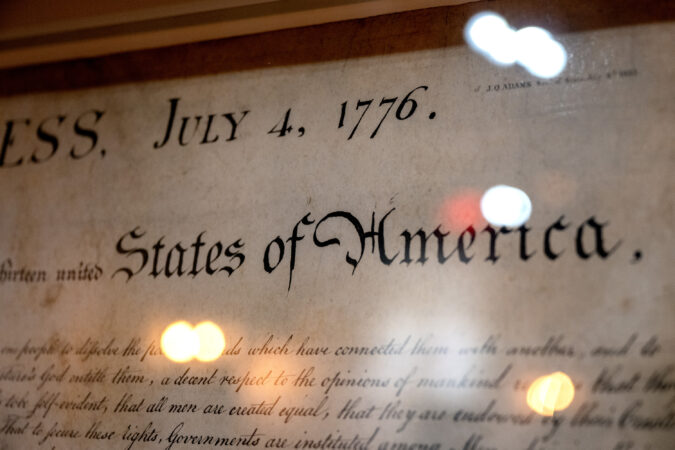
    Sitting in social studies class at her predominantly White middle school near Green Bay, Wisc. — a school that once used an image of an Indian as its mascot — she cringed when the teacher read a passage deep in the Declaration of Independence: “He has excited domestic insurrections amongst us, and has endeavoured to bring on the inhabitants of our frontiers, the merciless Indian Savages, whose known rule of warfare, is an undistinguished destruction of all ages, sexes and conditions.”

    Peters said she and the six other Native students in the class looked quietly at one another.

    “I was upset. It just rolled off her tongue very easily,” recalled Peters, a citizen of the Menominee Nation who is getting her master’s in organizational leadership. “It seemed like no one else was shocked except for us, the Indigenous students in the classroom. We were like, ‘Did she really just say that?’”

    As the United States marks the 250th anniversary of the Declaration — a document fundamental to the nation’s founding and still revered — Peters and other Native American scholars and tribal leaders are reflecting on the Founding Fathers’ use of the derogatory description for Indigenous people in 1776. Many note that while the Declaration promises that “all men are created equal,” its ideals were not extended to everyone.

    The document’s portrayal of Indigenous people helped establish a moral and legal framework that justified decades of devastating U.S. policies toward Native communities, according to historians. Celebrations of the 250th anniversary of the Declaration’s signing come amid a striking contrast: Native tribes are working to reclaim ancestral lands, revive lost languages, and preserve cultural traditions, while the Trump administration has sought to remove or downplay references to slavery, Native dispossession, and other dark chapters of U.S. history in parks and museums and on government websites.

    “It’s not just a line in an old document,” Peters said. “It’s a reminder that this country was built by declaring us less than human. When the Declaration of Independence calls us that, it’s a message that Native youth sadly still hear today in classrooms, policy debates, and in how society talks about us.”

    Many historians and Indigenous historians say the term “savages” did more than reflect 18th-century attitudes. It helped perpetuate stereotypes of Native Americans and contributed to their marginalization; centuries later, it adds to feelings, especially for Native youths, of being excluded from America’s national story. A 2022 study by Texas A&M University researchers found that the Declaration’s pejorative reference to Native Americans helped normalize a view of them as threats rather than as sovereign nations and peoples with rights.

    For many Native people, the meaning — and impact — of the phrase is emotional and complicated.

    Some discover the wording as adults and are appalled. Others see it as a reminder of racist attitudes and centuries of broken treaties, land theft, and forced assimilation. Some young people have reclaimed the epithet, debating it on social media and displaying it on T-shirts and tattoos as a symbol of resilience and empowerment. An Indigenous-led heavy metal band intentionally used the phrase as its name.

    “It’s become sort of an ironic touchstone,” said Kevin Gover, the Smithsonian Institution’s undersecretary for museums and culture. A citizen of the Pawnee Tribe of Oklahoma, Gover said he did not encounter the term until middle age. After his initial outrage, Gover said, he responded as many Native people do: by mocking it.

    “Even we, on the side of the descendants of those who were victimized, have to take a nuanced view,” said Gover, who is also the former director of the National Museum of the American Indian in D.C. “In many respects, it’s a badge of pride that our ancestors had the wherewithal to survive and allow us to be alive in this time.

    “We can acknowledge the wrong,” he said, “and be grateful for our ancestors’ fortitude.”

    Hartman Deetz, an enrolled member of the Mashpee Wampanoag — the Massachusetts tribe that famously helped the Pilgrims survive their first Thanksgiving in 1621 — said the wording reflects the opposite of how Indigenous people treated white settlers.

    “They were fed when they were starving, given hospitality by us, but they treated us in a way that was savage and merciless in the dispossession of our homelands,” said Deetz, who served as a consultant for an exhibition at the Museum of the American Revolution in Philadelphia about the Declaration and the history behind it. “It was framed in a way that justified the treatment they brought upon us, and it continues to this day in attempts to sell our sacred sites for copper mines and to drill for oil and mining on our lands.

    “The colonial enterprise hasn’t stopped,” he said. “There’s such a disregard for Natives to exist or have rights of where we do exist. That’s the legacy of these words.”

    The words originated in an early draft of the Virginia Constitution written by Thomas Jefferson, who later included it in the Declaration of Independence, which Congress adopted.

    Ironically, some historians say, the characterization of Native people contradicts Jefferson’s own views. In Notes on the State of Virginia, a book Jefferson wrote that laid out many of his views on race, government, and religious freedoms, he was “very sympathetic to Native people,” said Kevin Butterfield, a historian at the Library of Congress. Jefferson described Indigenous people as just, honorable and noble — a sharp contrast to the widespread European belief that Indigenous people were inferior.

    But Jefferson understood the Declaration was political rhetoric — a kind of “public relations piece,” said Butterfield, who is the acting chief of the Manuscript Division at the Library of Congress. He placed it near the end to bolster the case for independence.

    “He’s trying to paint the worst possible picture of how the king is approaching his interactions with the American colonists,” Butterfield said. “So he’s laying out horrible wartime atrocities from the Revolutionary War.”

    The description reflected colonial attitudes and the realities of frontier warfare, scholars say. Colonists were hostile toward Native Americans, who were powerful political and military figures and, just like other nations, protecting their sovereignty. Some Native nations had allied with the British — a move that many settlers resented — and many colonists also opposed King George III’s Proclamation of 1763, which barred settlement west of the Appalachian Mountains.

    Repeated violence between Indigenous people and settlers also helped shape the ideology behind the description, including the French and Indian War and Dunmore’s War in 1774, when Virginia colonists fought the Shawnee and Mingo to expand into the Ohio Valley, according to historians. In the summer of 1776, as the Declaration was drafted and adopted, a lesser-known conflict unfolded when Cherokee warriors attacked frontier settlements across parts of Virginia, North Carolina, South Carolina, and Georgia. Colonists responded by burning more than 50 Cherokee towns and driving Native people from their homes.

    By 1776, the Founding Fathers “understood their need to accuse the king of what they considered the ultimate crime — partnering with Indigenous peoples and arming them,” said Ned Blackhawk, a Native American author and Yale University historian. “So they created this vilification in the Declaration that, in many ways, was at odds with their experience of living alongside Natives for generations.”

    The rhetoric was part of a broader racial ideology taking shape during the Revolutionary era, said Blackhawk, an enrolled member of the Te-Moak Tribe of Western Shoshone Indians of Nevada.

    “They were deeply committed to Enlightenment principles, but those were restricted to people similar to themselves,” he said. “Native Americans became a foil in simplified and racialized ways.”

    Tracy L. Canard Goodluck, executive director of the Center for Native American Youth at the Aspen Institute, said she is disappointed the term is either glossed over or not taught in many school curriculums, its impact not discussed.

    It wasn’t until she was a student at Dartmouth College, she said, that she fully understood the context of the description. She was angry, but the new knowledge also awakened in her a passion for educating others about Indigenous history and mistreatment. Goodluck, a member of the Oneida Nation who is also Mvskoke Creek, said in her previous work as a teacher in Seattle and Albuquerque she taught about Indigenous people and the harsh characterization in the Declaration.

    “It shouldn’t just be about white history,” she said. “It should be about all history — the good, the bad, and the ugly.”

    She said it’s also important to educate the public, so every Fourth of July, she wears a T-shirt emblazoned with the phrase from the Declaration.

    “Those words served the purpose back then as a way to dehumanize Native people in this country,” said Goodluck. “We need to change that narrative. We’re still here. We’re doctors, lawyers, teachers and political leaders.

    “I am that merciless Indian savage who my ancestors prayed for to do great things.”

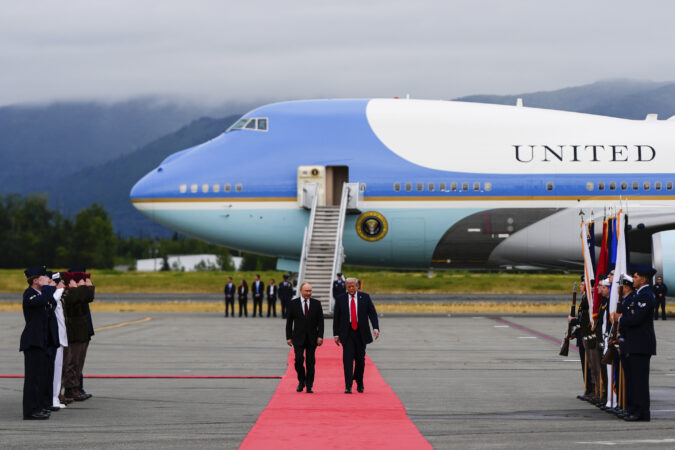
  • As war stalls, Putin concedes he never cut a deal with Trump in Alaska

    As war stalls, Putin concedes he never cut a deal with Trump in Alaska

    Russia’s war in Ukraine is stalling — on the battlefield and in the corridors of diplomacy.

    For months, high-ranking Russian officials insisted that a path to ending the war in Ukraine — largely on Moscow’s maximalist terms — had been decided at a meeting between President Vladimir Putin and President Donald Trump last August in Anchorage. Only Ukraine’s intransigence stood as an obstacle.

    But that narrative has unraveled — perhaps because the only way to get the United States to help broker a new deal is admitting there never was a previous one.

    In recent days, three top Russian officials accused the White House of not honoring the Alaska agreement. Foreign Minister Sergei Lavrov even speculated that the summit was a U.S. “ploy to buy time to rearm the Kyiv regime.”

    Secretary of State Marco Rubio, however, pushed back. “If there had been an agreement, we would have had an end of the war,” Rubio told reporters.

    “Russia wants the entirety of Donetsk to be turned over to them, among some other things,” he said, explaining Russia’s demand for more Ukrainian territory.

    After days of back-and-forth, Putin conceded the point, saying on Sunday that “there were indeed no agreements reached in Anchorage.”

    “The spirit of Anchorage — although it wasn’t expressed in any formal documents, and no one put any signatures down — in Anchorage we discussed certain possibilities for ending the crisis in Ukraine,” Putin told a state television reporter Sunday. “And the compromises discussed were precisely the proposals the American side made to us.”

    The contradictions started in Alaska immediately after the summit. Putin said an agreement that will “pave the path toward peace in Ukraine” was reached, while Trump said that while the meeting was “extremely productive … there’s no deal until there’s a deal.” Trump also told Fox News afterward that it was “up to Zelensky” now to get a deal done, referring to Ukrainian President Volodymyr Zelensky.

    The Russian leader’s decision now effectively to bury the Alaska summit, which the Kremlin and its propagandists had mythologized as a turning point, comes as Russian forces are largely stalled on the battlefield in Ukraine — a sharp change from the previous four summers when they made gains.

    Instead, the skies over Russia and the Ukrainian territory it occupies are increasingly crowded with advanced Ukrainian drones, signaling a new phase in which Russia is playing technological catch-up and regular Russian citizens are feeling the war intrude on their lives with gasoline shortages and disruptions to summer travel, including to occupied Crimea.

    Russian political analysts have interpreted the indirect spat between Rubio and Lavrov over the alleged deal as a sign that Ukraine has convinced Trump it can keep fighting — and that it can pose a serious threat to Crimea, which Russia illegally annexed in 2014, rather than surrendering the Donbas region, as Russia has demanded.

    Trump probably arrived in Anchorage believing that Ukraine’s defeat was inevitable and that the sooner it accepted terms, the better for everyone, Fyodor Lukyanov, a prominent foreign policy analyst who advises the Kremlin, wrote in an op-ed in a Russian publication.

    “The goal of Kyiv and the collective Brussels was to convince Trump that the belief in Ukraine’s inevitable defeat was mistaken,” Lukyanov wrote. “Ten months after the Anchorage summit, they succeeded in persuading him.”

    Since Alaska, no major breakthrough has materialized in Russia’s favor, Europe so far has managed to sustain its military and economic aid to Ukraine, and Trump has become distracted by Iran.

    “Diplomacy in the midst of hostilities is shaped by their outcome,” Lukyanov wrote. “If the balance of power — or the perception thereof — shifts, the understandings reached at an earlier stage lose their validity.”

    Ukraine’s push to impose a “logistical lockdown” on Crimea and Kyiv’s growing capability to strike deep inside Russia seem to be part of a 40-day blitz declared by Zelensky to “influence” Moscow to end the war.

    Continuing that pressure, Ukraine overnight launched dozens of drones at the Moscow region and struck Russia’s Dubna satellite communications center north of the capital. Zelensky said ​Russia uses the Dubna site for reconnaissance and coordination of its military activities in Ukraine.

    Andrei Vorobyov, governor of the Moscow region, confirmed the attack had occurred but said that an “administrative building was damaged by drone debris.”

    Amid chaotic scenes in Crimea, the Russia-installed authorities imposed a state of emergency in response to strikes on highways and bridges. There have also been blackouts that have prompted many summer visitors to return home.

    “He’s holding his own at least,” Trump said of Zelensky last week, speaking to reporters at the White House. “A lot of people dying on both sides, but I think he’s doing pretty well. You have to say he’s courageous, he’s got great equipment, he’s got great men, he’s got fighters.”

    Ukraine seems to have scaled drone production to a level that can sustain strikes on Russian cities hundreds of miles from the border, and that keeps the frontline kill zone stable. This means that ground action is drying up.

    “The war has markedly changed this year,” said Ruslan Leviev, an analyst with the Conflict Intelligence Team, a group that uses open-source data to track the Russian military.

    “It’s hard to say the battle initiative is on the Ukrainian side,” Leviev said, “but time is on Ukraine’s side — more problems keep arising for Russia, economically, politically, and militarily, and it’s all adding up.”

    Russian budget data indicates that its military recruited 71,216 men during the first quarter of 2026, compared with 89,601 over the same period last year, according to Janis Kluge, a Russia expert at the Berlin-based German Institute for International and Security Affairs.

    Recruitment stabilized somewhat in the second quarter, returning to around 30,000 contracts per month. But local media reports suggest the overall stream of recruits has slowed compared with previous years as the pool of men drawn by the enormous pay packages that eclipse regional Russian salaries appears to be shrinking.

    Rumors have circulated that Russia may declare a fresh mobilization after key parliamentary elections in the fall — the first since the war began — but politically that move could prove extremely costly for the Kremlin. The “partial mobilization” in 2022 drove tens of thousands of men to flee Russia. After four years of war, and mounting economic strain, the mood has soured considerably.

    Leviev and other analysts said that they doubt Moscow would call for full mobilization, since this would require significant financial resources to set up new formations, and train and equip them, and that such a move fundamentally wouldn’t unfreeze the line of contact. “At this pace, the war on the ground looks to us as a dead end,” Leviev said.

    This poses several challenges for Russia.

    Russia still holds an advantage in manpower, conventional arms, and ballistic missiles, which it continues to use against Ukrainian cities and infrastructure. But Ukraine’s relentless drone campaign, especially its use of medium-range drones, has chipped away at this advantage, complicating frontline logistics and driving up the costs for Moscow of supplying the front.

    Russia’s flagship air defense systems were designed for high-altitude targets like jets and ballistic missiles, not slow, low-flying drones. Interceptor missiles also cost many times more than the drones they shoot down, draining stocks at a rate Western officials have said may be unsustainable.

    In his remarks Sunday, Putin commented on the deteriorating situation in Crimea and the wider fuel shortage in Russia after weeks of silence.

    Addressing Ukraine’s drone campaign, Putin said that Russia needed to “significantly ramp up production of air defense systems.” He also pledged to ensure the supply of fuel to Crimea by land and sea but did not say how this would be accomplished.

    Putin also asserted that Kyiv had put forward what he called “new proposals” to curtail hostilities in four regions of eastern Ukraine — Kherson, Zaporizhzhia, Donetsk, and Luhansk — and agree to mutually halt long-range strikes.

    Putin, however, cast the offer as a distraction that would allow Ukraine to redeploy units from other regions to these four areas, relieving pressure along the nearly 800-mile frontline. He reiterated that Moscow aims to fight on.

    “We have some certainty regarding the challenges facing Putin, but what we can expect from him in response to these challenges remains unclear,” said Vladimir Pastukhov, a Russian political scientist and honorary senior research fellow at University College London.

    According to Pastukhov, Putin has several options to escalate the war, all fraught with risk. These include an attack on a NATO nation in the Baltics, the detonation of a tactical nuclear weapon in Ukraine, or a mass mobilization of Russian soldiers. Moscow could also adopt a hybrid strategy, potentially striking European military facilities supporting Ukraine.

    That would effectively be a limited, undeclared war on Europe, testing Trump’s loyalty to NATO allies.

    Putin could also pressure its ally Belarus to allow Russian forces to attack Ukraine from its territory, opening a new northern front.

    Putin on Sunday said Russia was expecting a resumption of U.S.-led peace talks and a visit to Moscow by U.S. envoys Steve Witkoff and Jared Kushner — once the “hot ​phase” of the Iran war is resolved.

    Lukyanov, the analyst, said Russia believes that Trump’s position on the war in Ukraine will shift again — as it has many times. “But first,” he wrote, “the White House must be brought to the understanding that a military victory for Russia’s adversaries is impossible.”

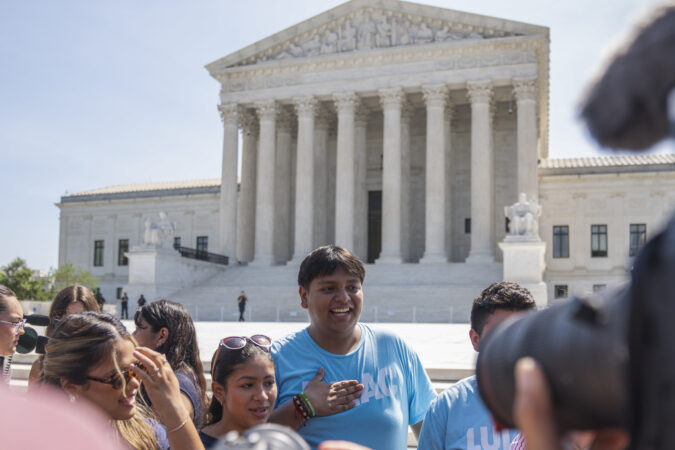
  • Supreme Court upholds birthright citizenship in momentous immigration ruling

    Supreme Court upholds birthright citizenship in momentous immigration ruling

    The Supreme Court upheld the principle of birthright citizenship in a ruling for the ages on Tuesday, affirming amid rancorous national debate that people born in this country are American citizens.

    The decision handed a key loss to President Donald Trump in a case that represented a major goal of his administration ― the denial of citizenship for children born on American soil to undocumented parents.

    Instead, the court upheld what has been recognized as the law of the land for nearly 160 years, enshrined in the Constitution by ratification of the 14th Amendment shortly after the Civil War.

    “Citizenship, then and now, was the right to have rights — to freely participate in our political community. The Framers of the Fourteenth Amendment extended that promise to ‘every free-born person in this land,’” Chief Justice John Roberts wrote for the court. “We keep that promise today.”

    The court ruled 6-3, with three conservative justices voting to let Trump’s proposed restrictions take effect.

    Reaction flooded in immediately, with Cathryn Miller-Wilson, executive director at HIAS Pennsylvania, the immigrant-support organization, saying the decision fell “on the right side of history.”

    “It shouldn’t be a surprise because birthright citizenship is enshrined in our Constitution,” she said of the decision. “But unfortunately there are many other things that have been enshrined that the Supreme Court has ignored. So it was a point of anxiety, I think, for all of us.”

    Trump’s planned restrictions had been blocked by lower courts and had not taken effect.

    The Pennsylvania Immigration Coalition, an advocacy organization based in Philadelphia, called the decision “a victory for families, for immigrant communities, and for the shared values that should guide our country: belonging, safety, and unity.”

    “Today’s decision affirms what our communities have always known: no child’s belonging should be up for debate,” said Jasmine Rivera, the coalition executive director.

    Democratic Gov. Josh Shapiro said on social media that Trump’s effort to end birthright citizenship was cruel and “goes against centuries of hard work to advance American freedom.”

    Days before the nation’s 250th birthday, Shapiro said, the court affirmed “that the fundamental promise of America still rings true — that this is a land of freedom and opportunity for all.”

    In New Jersey, one of the first states to sue over the issue, Attorney General Jennifer Davenport said she was thrilled by the decision.

    “The president cannot change our citizenship laws with the stroke of a pen. We stood up for the rule of law, we stood up for our residents, and we won,” said Davenport, an appointee of Democratic Gov. Mikie Sherrill.

    Meanwhile, House Speaker Mike Johnson (R., La.) said that he was “very disappointed” by the ruling, that it will subject the country to “serious challenges going forward and we’ll have to deal with that.”

    Johnson, who has worked as a constitutional lawyer primarily on religious issues, said the 14th Amendment is being abused by people who are coming to the U.S. to have children in a practice called birth tourism.

    U.S. Rep. Scott Perry, a York County Republican, railed against the court, saying that it had “failed the American people,” and that justices Roberts and Amy Barrett were joining an effort to protect birthright citizenship specifically for the children of undocumented immigrants.

    “Now, more than ever, we must ensure the security of our borders and to prevent those who wish to do us harm by exploiting our immigration system are unable to do so; which means closing EVERY. SINGLE. LOOPHOLE,” Perry said in a statement.

    U.S. Rep. Chrissy Houlahan, a Chester County Democrat, mentioned the path trod by her father, a Polish-born Holocaust survivor who emigrated to the U.S. as a child.

    “I’m deeply grateful for the Supreme Court’s protection of the 14th Amendment, and for all of the first-generation Americans who make our community stronger,” she said on social media.

    On April 1 the Supreme Court heard oral arguments on one of the most important cases of the time, one that had been expected to define who gets to be a citizen of the United States. Trump traveled to the court to hear the arguments in person, departing after government lawyers wrapped up their presentation.

    There was no indication at the time of how the justices might rule, though several of the justices seemed skeptical of the administration’s arguments and peppered government attorneys with sharp questions.

    When Solicitor General John Sauer argued that “we’re in a new world now,” Roberts responded, “It’s a new world. It’s the same Constitution.”

    On Tuesday, the longest-serving justice, Clarence Thomas, joined by Neil Gorsuch, offered a 91-page dissent, saying the ruling added “to the sad history of the Fourteenth Amendment, which was designed and understood to secure equal rights for the freed Blacks but has instead been repurposed for political projects that the Reconstruction Congress did not support.”

    On the day he was inaugurated for a second term in 2025, Trump signed an executive order to end birthright citizenship for children born in this country to undocumented immigrants. That marked an attempt to reverse legal and Constitutional precedent, which has long held that people born in the United States are U.S. citizens.

    The ACLU sued within hours, and New Jersey officials went to court the next day, with then-Attorney General Matt Platkin saying, “Presidents in this country have broad powers, but they are not kings.”

    Birthright citizenship, simply put, is the legal foundation under which American citizenship is automatically conferred upon people who are born in the United States, with limited exceptions. The formal term is jus soli, Latin for “right of the soil.”

    Automatic citizenship also extends to children who are born abroad to U.S. citizens.

    Birthright citizenship is guaranteed in the Constitution by the 14th Amendment, ratified in 1868 after the end of the Civil War. It says that “all persons born or naturalized in the United States, and subject to the jurisdiction thereof, are citizens of the United States and of the state wherein they reside.”

    Trump and other opponents argue that the practice encourages people to enter the country illegally, so that children who are born here will automatically gain American citizenship. Those citizens, at age 21, can sponsor close family members to live permanently in the United States.

    The Trump administration contended that birthright citizenship had limited intent, meant only to ensure that formerly enslaved people and their children were U.S. citizens.

    The administration focused on the clause “subject to the jurisdiction thereof,” saying that excludes people with temporary or unlawful presence. The president’s order would have denied citizenship to babies born in the U.S. unless at least one parent is a U.S. citizen or lawful permanent resident at the time of the birth.

    Trump’s opponents said reliance on those five words makes no sense, that of course people who live in the United States without permission are subject to its jurisdiction ― its laws, orders, and government regulations ― the same as everyone else.

    The administration also invoked the practice of birth tourism as a main argument for revocation, elevating what was a side issue to a central cause.

    Birth tourism is when people from other countries travel to the U.S. for the purpose of giving birth, thereby obtaining citizenship for their babies.

    It’s relatively rare, the high estimate at 26,000 births a year, from the Center for Immigration Studies, which advocates for low immigration. That’s a fraction of the roughly 3.6 million children born annually in the United States.

    In Pennsylvania, all eight Democratic federal lawmakers who represent the state opposed Trump’s attempt to end birthright citizenship.

    Along with 208 other Democrats in Congress, they signed an amicus brief in February arguing that the 14th Amendment set a “constitutional minimum — a floor — for birthright citizenship” and that the administration’s arguments were incoherent.

    The Democrats who signed were U.S. Sen. John Fetterman and U.S. Reps. Houlahan, Brendan Boyle, Dwight Evans, Madeleine Dean, Mary Gay Scanlon, Summer Lee, and Chris Deluzio.

    Some Republicans in Congress filed amicus briefs supporting Trump’s case, though none of the 11 Republicans representing Pennsylvania signed on to them.

    The Republicans argued that within the 14th Amendment, the words “subject to the jurisdiction” were key.

    “The Framers would have recoiled at the present debasement of citizenship, understanding that ‘jurisdiction’ requires more than mere physical presence,” they wrote. “It demands total allegiance to the sovereign. To hold otherwise places sovereignty, citizenship, and our nation’s survival in jeopardy.”

    Staff writers Andrea Padilla, Sam Janesch, and the Associated Press contributed to this article.

  • Pope promotes Italian nun to top migrant role in his first major appointment of a woman to Holy See

    Pope promotes Italian nun to top migrant role in his first major appointment of a woman to Holy See

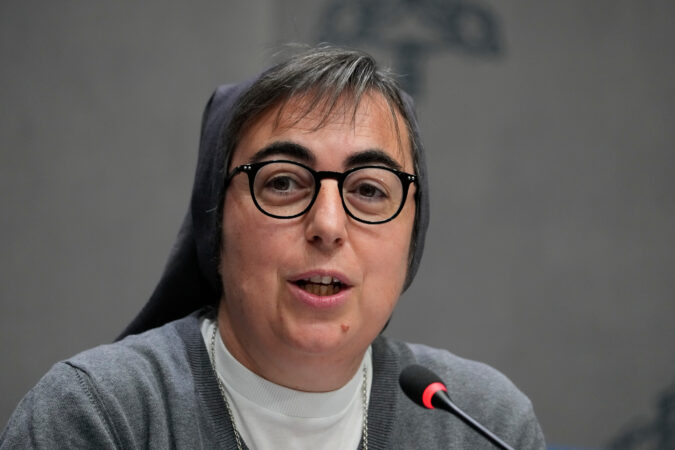
    ROME — Pope Leo XIV on Tuesday made his first major appointment of a woman to the Holy See hierarchy, promoting Italian Sister Alessandra Smerilli to head the Vatican office responsible for migrants, the environment, and development.

    Smerilli, an economist, is currently the No. 2 in the Dicastery for Promoting Integral Human Development. As prefect, she replaces the retiring Canadian Cardinal Michael Czerny, who turns 80 this month.

    With the appointment of Smerilli, Leo appears to be following suit of his predecessor, Pope Francis, who made a point of promoting women to top-level management positions within the Holy See as part of his response to calls by women for greater decision-making roles in the church.

    But Leo too is following Francis’ lead by simultaneously naming Cardinal Fabio Baggio as a “pro-prefect” of the office, where he is currently undersecretary.

    The dual nominations recognize that sometimes the role of a Vatican department head requires being an ordained priest and cardinal.

    Baggio was also given the mandate to head up the Vatican’s Borgo Laudato Si environmental educational center, at Castel Gandolfo, near Rome.

    The Catholic Church reserves the priesthood for men, and women have long complained of a second-class status despite carrying out the lion’s share of the church’s work running schools and hospitals and passing the faith on to younger generations.

  • Congo bans gatherings in areas far from Ebola outbreak. Some say it limits dissent

    Congo bans gatherings in areas far from Ebola outbreak. Some say it limits dissent

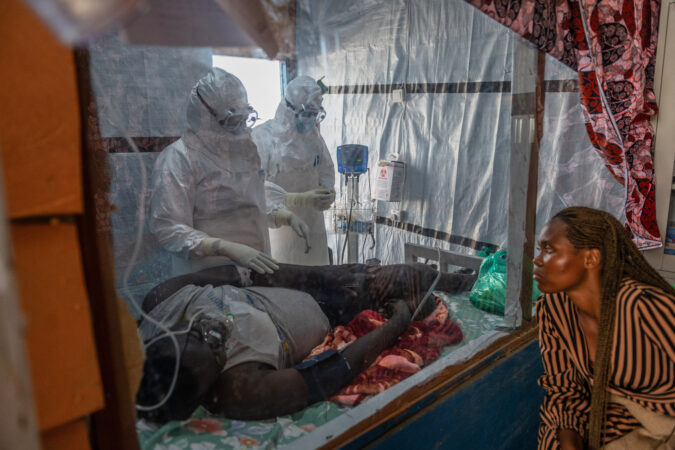
    KINSHASA, Congo — Opposition and civil society groups are protesting Congo’s new ban on public demonstrations and mass gatherings in the capital and other areas far from the country’s deadly Ebola outbreak, alleging that the decision aims to limit freedom of speech.

    The decision announced over the weekend came as the outbreak of a type of Ebola with no approved treatment or vaccine continues to grow, with 1,307 people infected and 377 dead across three provinces in eastern Congo. It could be the worst Ebola outbreak yet.

    Congo’s ministry of interior on Saturday said gatherings and demonstrations were forbidden in the provinces of Kinshasa, Tshopo, Haut-Uele, and Bas-Uele as fears grow about the outbreak spilling into new areas. None of the provinces have any confirmed cases.

    Separately, the mayor of ​Goma, eastern Congo’s largest city and now under the control of the Rwanda-backed M23 rebel group, also banned public gatherings and demonstrations, including celebrations linked to sports events, on Monday. Congo is in its first World Cup in over half a century.

    Congo’s political opposition has denounced the ban as unconstitutional. Prince Epenge, the spokesperson for the Lamuka coalition, has said the ban aims to prevent a planned demonstration in the capital, Kinshasa, early next month. The protest is against proposed constitutional changes that would allow Congo’s President Felix Tshisekedi to run for a third term.

    Civil society organizations also condemned the ban in a statement on Monday, citing freedom of speech and freedom of assembly.

    In a televised address on Monday evening, Tshisekedi announced a $319 million response plan to the Ebola outbreak, and called on people to respect health guidelines, report suspected cases, and not give in to misinformation. He did not directly address the bans.

    “Ebola is neither a rumor nor a source of shame,” Tshisekedi said. “It is a health emergency that demands responsibility, solidarity, and truth.”

    Health workers have reported some skepticism and attacks over Ebola from residents in the affected areas of Ituri, North Kivu, and South Kivu provinces.

    Cases also have been confirmed in neighboring Uganda, as well as one in France in a doctor who returned from Congo.

    The United Nations ​warned in a report on Tuesday that if the virus spreads into other neighboring countries, including Rwanda and Angola, it could cost Africa up to $3.6 billion and result in 328,000 job losses.

    More than a month into the outbreak, officials believe it continues to outpace response efforts and no one knows its true scale. They are yet to identify patient zero and struggle to trace contact cases.

    The World Health Organization has warned that violence from rebels in eastern Congo is complicating the response to the outbreak. In Ituri, attacks by the Islamic State group-backed Allied Democratic Force have cut off access to many villages and forced people to flee their homes, adding to already overcrowded camps of people displaced by years of conflict.