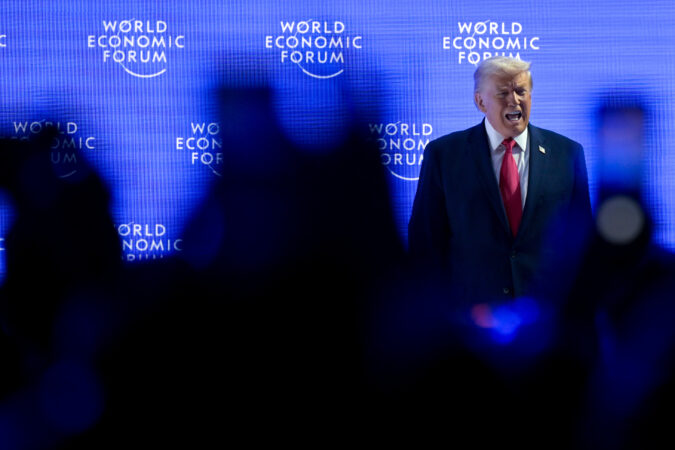
DAVOS, Switzerland — President Donald Trump insisted Wednesday that he wants to “get Greenland, including right, title and ownership,” but said he would not use force to do so while repeatedly deriding European allies and vowing that NATO should not try to block U.S. expansionism.
In an extraordinary speech at the World Economic Forum, the president said he was asking for territory that was “cold and poorly located.” He said the U.S. had effectively saved Europe during World War II and even declared of NATO: “It’s a very small ask compared to what we have given them for many, many decades.”
The implications of his remarks were nonetheless enormous, potentially rupturing an alliance that has held firm since the dawn of the Cold War and seemed among the globe’s most unshakable pacts.
NATO was founded by leading European nations, the U.S. and Canada. Its other members have been steadfast in saying Greenland is not for sale and cannot be wrested from Denmark. That means the Davos meeting could be just the beginning of a larger standoff that may eventually reshape geopolitics worldwide.
A Danish government official told The Associated Press after Trump’s speech that Copenhagen is ready to discuss U.S. security concerns in the Arctic. But the official, who was not authorized to comment publicly and spoke on condition of anonymity, underscored the government’s position that “red lines”— namely Denmark’s sovereignty — must be respected.
Trump urged Denmark and the rest of NATO to stand aside, adding an ominous warning.
“We want a piece of ice for world protection, and they won’t give it,” Trump said. “You can say yes, and we will be very appreciative. Or you can say no, and we will remember.”
Despite that, he also acknowledged: “We probably won’t get anything unless I decide to use excessive strength and force where we would be frankly unstoppable. But I won’t do that, OK?”
“I don’t have to use force,” he said. “I don’t want to use force. I won’t use force.”
Instead, he called for opening “immediate negotiations” for the U.S. to acquire Greenland.
“This enormous unsecured island is actually part of North America,” Trump said. “That’s our territory.”
Trump suggests Europe is fizzling while U.S. booms
The president has spent weeks saying that the U.S. will get control of Greenland no matter what it takes, arguing that Washington should be in charge there to counter threats in the surrounding Arctic sea by Russia and China. His Davos remarks articulated what that push for control might entail more clearly than before, however.
Danish Foreign Minister Lars Løkke Rasmussen said he was encouraged by Trump’s comment about not using U.S. military force but called other parts of the speech “a way of thinking about territorial integrity that does not match the institutions we have.”
“Greenland is part of NATO. Denmark is part of NATO, and we can exercise our sovereignty in Greenland,” Løkke Rasmussen said.
In his remarks, Trump also argued that the U.S. is booming and its economy is strong, in sharp contrast to Europe.
“I want to see Europe go good, but it’s not heading in the right direction,” said Trump, who also noted, “We want strong allies, not seriously weakened ones.” He said of European economies, “You all follow us down, and you follow us up.”
Trump turned the Davos gathering upside-down even before he got there.
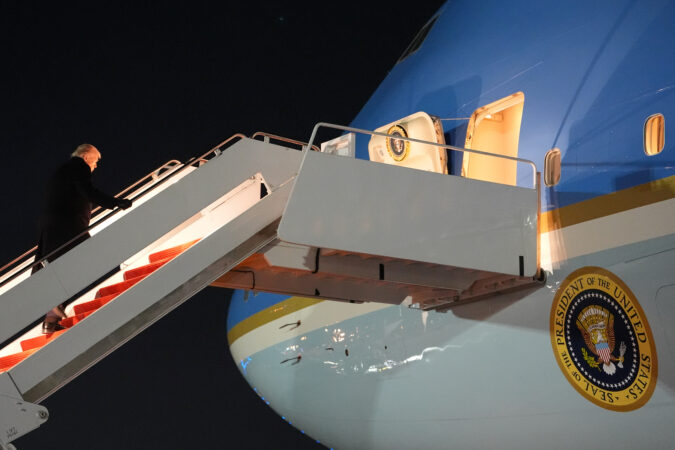
His arrival was delayed after a minor electrical problem on Air Force One forced a return to Washington to switch aircraft. As Trump’s motorcade headed down a narrow road to the speech site, onlookers — including some skiers — lined the route. Some made obscene gestures, and one held up a paper cursing the president.
Billionaires and top executives nonetheless sought seats inside the forum’s Congress Hall, which had a capacity of around 1,000, for Trump’s keynote address. When he began, it was standing room only. Attendees used headsets to listen in six languages besides English, and the reaction was mostly polite applause.
More than 60 other heads of state are attending the forum. After the speech, Trump met with the leaders of Poland, Belgium and Egypt and again repeated that the U.S. would not be invading Greenland.
“Military is not on the table. I don’t think it will be necessary,” Trump said, suggesting that the parties involved would use better judgment.
Trump said the tariffs would start at 10% next month and climb to 25% in June.
The president in a text message that circulated among European officials this week linked his aggressive stance on Greenland to last year’s decision not to award him the Nobel Peace Prize. In the message, he told Norway’s prime minister, Jonas Gahr Støre, that he no longer felt “an obligation to think purely of Peace.”
Even before his speech, Trump’s Greenland ambitions were rankling Europe.
British Prime Minister Keir Starmer vowed during his weekly questioning in the House of Commons, “Britain will not yield on our principles and values about the future of Greenland under threats of tariffs, and that is my clear position.”
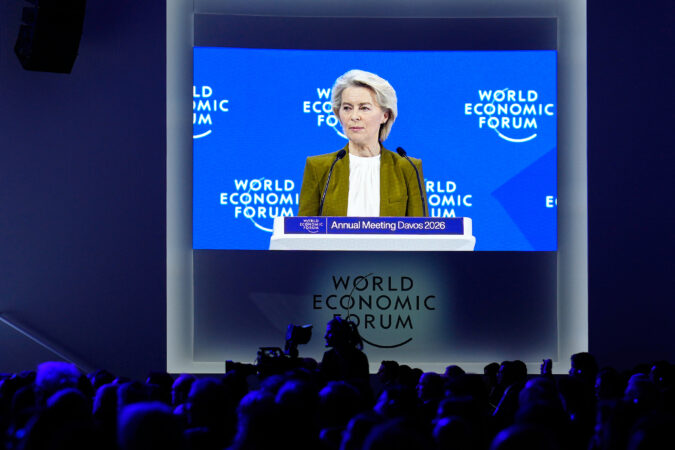
French President Emmanuel Macron, in his address to the forum, urged rejecting acceptance of “the law of the strongest.” European Commission President Ursula von der Leyen warned that should Trump move forward with the tariffs, the bloc’s response “will be unflinching, united and proportional.”
The U.S. stock market, meanwhile, recovered on Wednesday from its worst day since October, as Trump’s talk of Greenland-related tariffs spooked investors.
Trump’s housing plan overshadowed
The White House had insisted Trump would focus his Davos address on how to lower housing prices in the U.S. That was part of a larger effort to bring down the cost of living, which continues to rise and threatens to become a major liability for the White House and Republicans ahead of November’s midterm elections.
Greenland instead carried the day, with Trump lashing at Denmark for being “ungrateful” for the U.S. protection of the Arctic island during the World War II. He also mistakenly referred to Iceland, mixing up that country with Greenland four times during his speech and for the fifth time since Tuesday.
When he finally did mention housing in his speech, Trump suggested he did not support a measure to encourage affordability. He said bringing down rising home prices hurts property values and makes homeowners who once felt wealthy because of the equity in their houses feel poorer.
Meanwhile, experts and economists are warning that Trump’s Greenland tariff threat could disrupt the U.S. economy if it blows up the trade truce reached last summer between the U.S. and the EU.
Promoting the ‘Board of Peace’
On Thursday, Trump plans to attend an event focused on the “Board of Peace,” meant to oversee a U.S.-brokered ceasefire in the Israel-Hamas war in Gaza. It could possibly take on a broader mandate, potentially rivaling the United Nations. Some European nations have so far been non-committal about participating.
“You know, the United Nations should be doing this,” Trump said Wednesday of his efforts to halt the fighting in Gaza and other conflicts around the world.
Yvonne St Cyr strained her body against police barricades, crawled through a broken Senate window, and yelled “push, push, push” to fellow rioters in a tunnellike hallway where police officers suffered concussions and broken bones.
She insisted she did nothing wrong. A federal judge sentenced her to 30 months in prison and imposed $2,270 in financial penalties for her actions at the U.S. Capitol on Jan. 6, 2021, declaring: “You have little or no respect for the law, little or no respect for our democratic systems.”
St Cyr served only half her sentence before President Donald Trump’s January 2025 pardon set her and almost 1,600 others free.
But her story doesn’t end there. St Cyr headed back to court, seeking a refund of the $2,270. “It’s my money,” the Marine Corps veteran from Idaho said in an interview with the Washington Post. “They took my money.” In August, the same judge who sentenced her reluctantly agreed, pointing to a legal quirk in her case.
“Sometimes a judge is called upon to do what the law requires, even if it may seem at odds with what justice or one’s initial instincts might warrant. This is one such occasion,” U.S. District Judge John D. Bates wrote in an opinion authorizing the first refund to a Jan. 6 defendant.
The ruling revealed an overlooked consequence of Trump’s pardon for some Jan. 6 offenders: Not only did it free them from prison but it emboldened them to demand payback from the government.
At least eight Jan. 6 defendants are pursuing refunds of the financial penalties paid as part of their sentences, according to a Post review of court records; judges agreed that St Cyr and a Maryland couple should be reimbursed, while five more are appealing denials. (St Cyr and the couple are still waiting to receive their payments, however.) Others are filing lawsuits against the government seeking millions of dollars, alleging politically tainted prosecutions and violations of their constitutional rights. Hundreds more have filed claims accusing the Justice Department, the FBI and other law enforcement agencies of inflicting property damage and personal injuries, according to their lawyer.
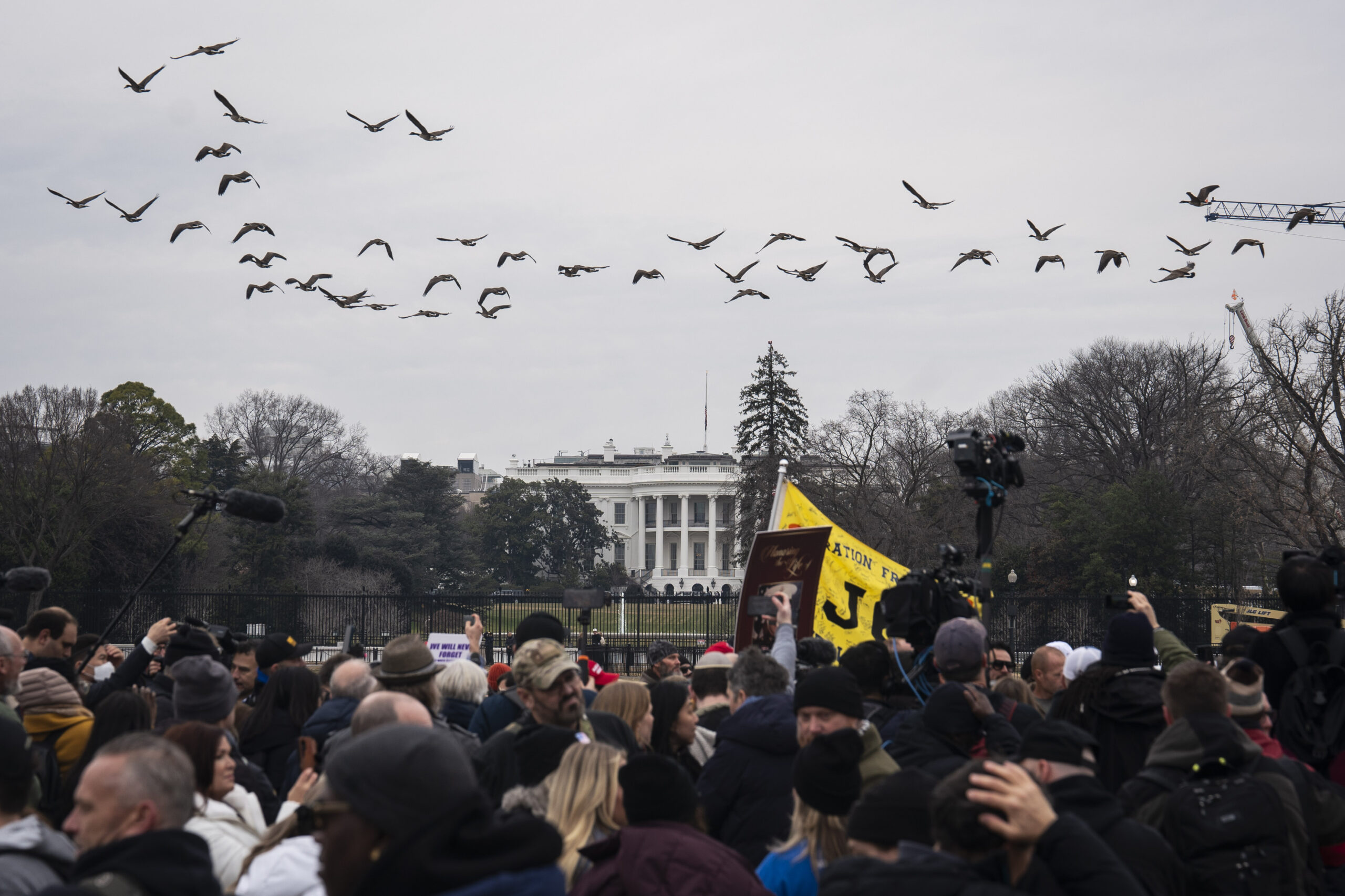
People walk from the Ellipse to the Capitol Building in Washington, D.C., last Jan. 6, the fifth anniversary of the Capitol attack.
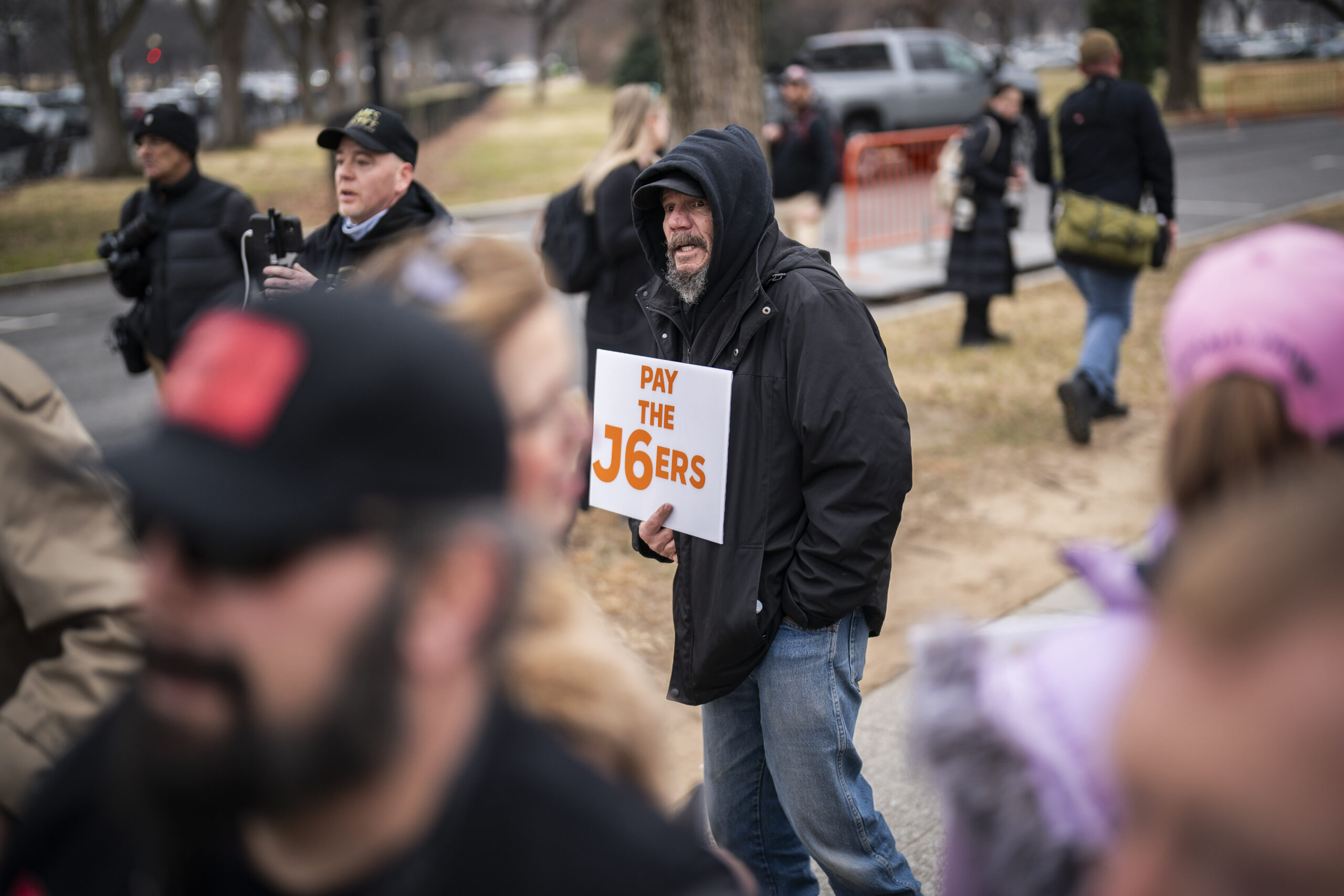
The efforts are the latest chapter in an extraordinary rewriting of history by the president and his allies to bury the facts of what happened at the Capitol, sustain the false claim thatthe 2020 election was rigged, and recast the Jan. 6 offenders as victims entitled to taxpayer-funded compensation.
“Donald Trump and the DOJ want taxpayers to reimburse a violent mob for the destruction of the U.S. Capitol. The Jan. 6 nightmare continues,” said Rep. Joe Morelle (D., N.Y.), the top Democrat on the House Administration Committee, which oversees the Capitol’s security and operations.
The pro-Trump mob that ransacked the Capitol caused almost $3 million in damage, according to a 2022 estimate by the Justice Department. The losses included smashed doors and windows, defaced artwork, damaged furniture, and residue from gas agents and fire extinguishers.Defendants were sentenced to more than $1.2 million in restitution and fines, according to a tally by the Post.
But the government recovered less than $665,000 of those court-ordered payments, according to a source with firsthand knowledge who spoke on the condition of anonymity because of fear of retaliation. Sen. Alex Padilla (D., Calif.) and Sen. Sheldon Whitehouse (D., R.I.) are pushing legislation — backed by some law enforcement officers who defended the Capitol on Jan. 6 — to block government payouts to rioters. Without any Republican cosponsors, the legislation is not expected to proceed.
“The audacity of them to think they didn’t do anything, or to think that they’re right and then get their money back,” said former Capitol police officer Harry Dunn, who attended the sentencing of St Cyr and other Jan. 6 offenders. “It’s frustrating and it should not happen. They should have to pay more.”
‘It’s a principle thing’
Stacy Hager, a 62-year-old former warehouse supervisor, made his first trip to Washington, D.C., for the Jan. 6 rally. The lifelong Texan wasn’t that interested in politics before, but he was certain that Donald Trump was the rightful winner of the 2020 election.
Wearing a Trump hat and waving the Texas flag, Hager took photos and videos of himself roaming through the Capitol. He was convicted on four misdemeanor charges related to disorderly conduct and trespassing; he paid $570 in penalties and served seven months in prison, a punishment he describes as totally unjust and “a living hell.”
Hager still believes, fervently, that fraud marred the 2020 vote and that Trump won, though no new evidence has surfaced to contradict the findings of Justice Department officials, cybersecurity experts, and dozens of judges appointed by Democrats and Republicans alike.
Hager spent seven months in prison for his role in the Jan. 6, 2021, attack. Now that he has been pardoned, he is seeking a refund of the $570 in court-ordered penalties he paid.
“You tell me why I shouldn’t be entitled to getting my money back,” Hager said. “The government took money from me for doing the right thing, for standing up for the people’s vote. That’s the reason we were there — for a free and fair election.”
About one month after Trump’s pardon in January 2025, Hager was the first of the Jan. 6 defendants to ask for his money back, court records show. “It’s a principle thing,” Hager said. Among the other defendants seeking refunds: A Utah man who forfeited almost $63,000he made from selling videos recording some of the worst violence at the Capitol. A Georgia teenager who paid $2,200 in fines after heshoved a police officer and sat in Vice President Mike Pence’s chair in the Senate chamber.
While the charges and punishments vary, the defendants seeking refunds share one legal quirk: All of them were appealing their convictions when Trump pardoned them on Jan. 20, 2025. After the pardon, courts vacated their convictions and dismissed their indictments following requests from federal prosecutors, as the Justice Department that once prosecuted the Jan. 6 defendants now takes their side.
It’s routine for a criminal defendant who has paid financial penalties to get the money back if the conviction is vacated and the case is dismissed. But the attack halting the peaceful transfer of power for the first time in American history pushed the criminal justice system into uncharted territory.
And now, the legal debate over whether certain Jan. 6 defendants should receive refunds is forcing courts to weigh two obscure Supreme Court decisions — 140 years apart — involving a pardoned Confederate sympathizer and a woman convicted but later acquitted of sexually assaulting her children.
Judges who have denied refunds have all referenceda case brought by John Knote, whose West Virginia property was confiscated and sold for $11,000 under a law empowering the Union to seize Confederate property. Citing President Andrew Johnson’s pardon of former Confederates on Christmas Day 1868, Knote asked the court to reimburse him $11,000. The Supreme Court ruled in 1877 that money deposited in the U.S. treasury could not be returned without an act of Congress.
People walk from the Ellipse to the Capitol Building in Washington, D.C., last Jan. 6, the fifth anniversary of the Capitol attack. The pro-Trump mob that ransacked the Capitol caused almost $3 million in damage, according to a 2022 estimate by the Justice Department.
Jan. 6 defendants, however, are looking to a much more recent Supreme Court opinion — written by liberal icon Ruth Bader Ginsburg — to bolster their argument that the government owes them money. In that 2017 case, Colorado resident Shannon Nelson paid about $700 in penalties before her sexual assault conviction was overturned on appeal. At a later trial, she was acquitted of the alleged crimes against her children. The high court said Nelson was now “presumed innocent” and entitled to a refund.
In approving St Cyr’s request for reimbursement, Bates referred to the Nelson case 39 times. The other D.C. District Court judge who has ruled in favor of refunds for Jan. 6 defendants, Chief Judge James E. Boasberg, also cited the Nelson case in December. “When a conviction is vacated, the Government must return any payments exacted because of it,” he wrote.
Hager returned to Washington this month to gather with other Trump supporters to mark the fifth anniversary. He and other Jan. 6 defendants stay in close touch online.
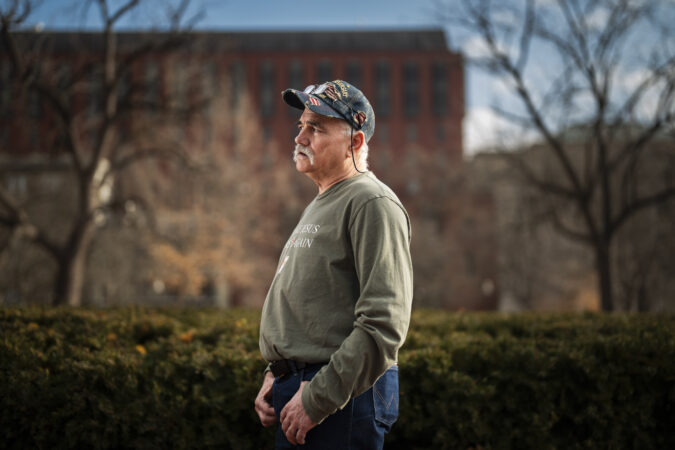
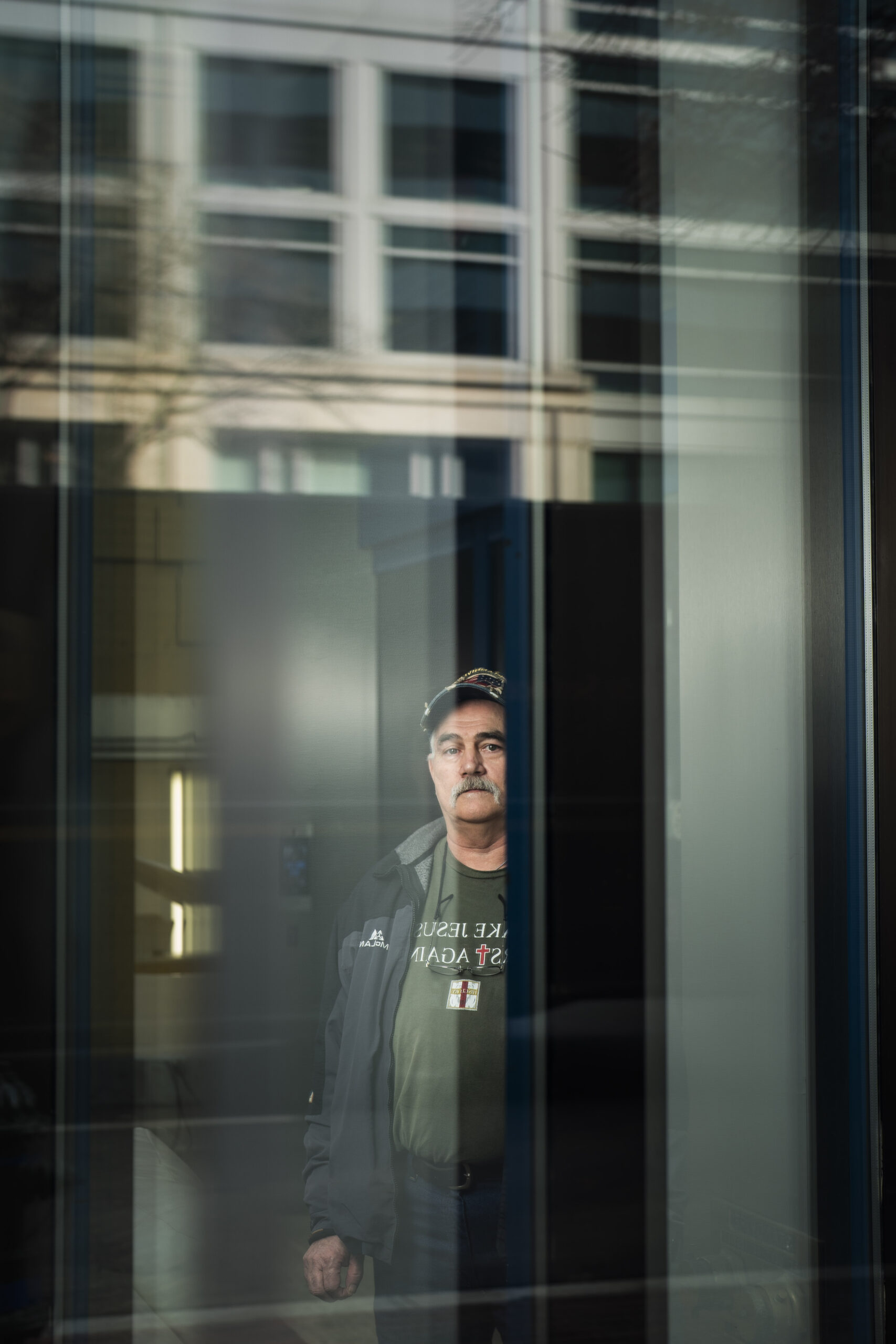
“We’re like a family,” Hager said, wearing a weathered baseball cap celebrating America’s 250th birthday and a T-shirt proclaiming his love for Jesus Christ. “We have a great bond, the kind that political persecution forms.”
Had gun, would travel
Andrew Taake’s journey through the criminal justice system illustrates one of the most dramatic twists in a Jan. 6 case. He attacked police officers with bear spray and a “whiplike weapon,” according to a plea agreement he signed in 2023. Now he is suing the federal government for $2.5 million, claiming his civil rights were violated by a wrongful prosecution and mistreatment in prison.
Taake was on pretrial release on a pending charge of online solicitation of a minor when he traveled from Houston to Washington, D.C., in January 2021. He attended the “Stop the Steal” rally headlined by Trump and was among the first to breach the restricted area around the Capitol. One of the police officers who said Taake assaulted him with bear spray, Nathan Tate, filed a statement in court that said the experience left “a lifelong scar.”
“He came to the Capitol with multiple weapons,” Tate wrote. “He was not there for peaceful protest. He was there to be violent. He should not be allowed to claim victimhood today.”
Taake pleaded guilty to one count of assaulting, resisting or impeding law enforcement officers using a dangerous weapon. He was sentenced in 2024 to 74 months in prison.
His prison time was cut short by Trump’s pardon. Two weeks later, he was taken into custody by Houston-area law enforcement on the 2016 child solicitation charge. He pleaded guilty to a second-degree felony, was sentenced to three years in prison and was ordered to register as a sex offender.
But because Taake had already served more than three years in the Jan. 6 case, he got credit for time served and did not return to prison, records show. In September, he filed a lawsuit against the federal government that tells a very different story than the plea deal.
In the suit filed in D.C. District Court, Taake claims he used the bear spray to protect a fellow protester and that another officer disfigured his hand by stomping on it. He accuses prosecutors of using false evidence and manipulating him into the plea deal. In prison, he said he was mistreated by medical staff and assaulted by other inmates. “He should be compensated for his pain and suffering because it doesn’t get much worse than that,” said Taake’s lawyer, Peter Ticktin, a longtime Trump ally.
Tate, who now who works as a social studies teacher in La Plata, Md., was shocked to hear about Taake’s lawsuit. “He can say my allegations are false but it’s documented, you can literally see what took place,” he said. “It was real for me.”
In the most far-reaching effort on behalf of Jan. 6 offenders, Missouri lawyer Mark McCloskey is trying to build support for a government-backed compensation panel, similar to the fund that has distributed billions of dollars to families of victims in the Sept. 11, 2001, attacks. McCloskey attracted national attention in 2020 when he and his wife pointed guns at Black Lives Matter protesters marching past their home; they pleaded guilty to firearms charges but were pardoned by the Missouri governor.
McCloskey said he has advocated for the Jan. 6 fund in four meetings with Justice Department officials, including Ed Martin, the director of a unit tasked with investigating Trump’s political opponents.
Martin, who helped plan and finance Trump’s rally that preceded the rampage through the Capitol, has said publicly that he supports “reparations” for Jan. 6 defendants.
Trump also has expressed support for government payouts. Asked about compensating Jan. 6 offenders in a March 2025 Newsmax interview, Trump said, “Well, there’s talk about that. … A lot of the people in government really like that group of people. They were patriots as far as I was concerned.”
But McCloskey is still waiting for the Justice Department to act. “We have had all positive responses but until President Trump pulls the trigger, it isn’t going to happen,” McCloskey said. “The president needs to take a position on it.”
In December, McCloskey sought to build momentum by posting a photo of himself on social media that he said showed him delivering claims to federal law enforcement agencies from about 400 Jan. 6 clients. The property damage and personal injury claims — a prerequisite to filing lawsuits against the government under the Federal Tort Claims Act — describe homes ransacked during arrests, lost jobs, and broken families, McCloskey said.
The White House and the Justice Department declined to comment on McCloskey’s efforts.
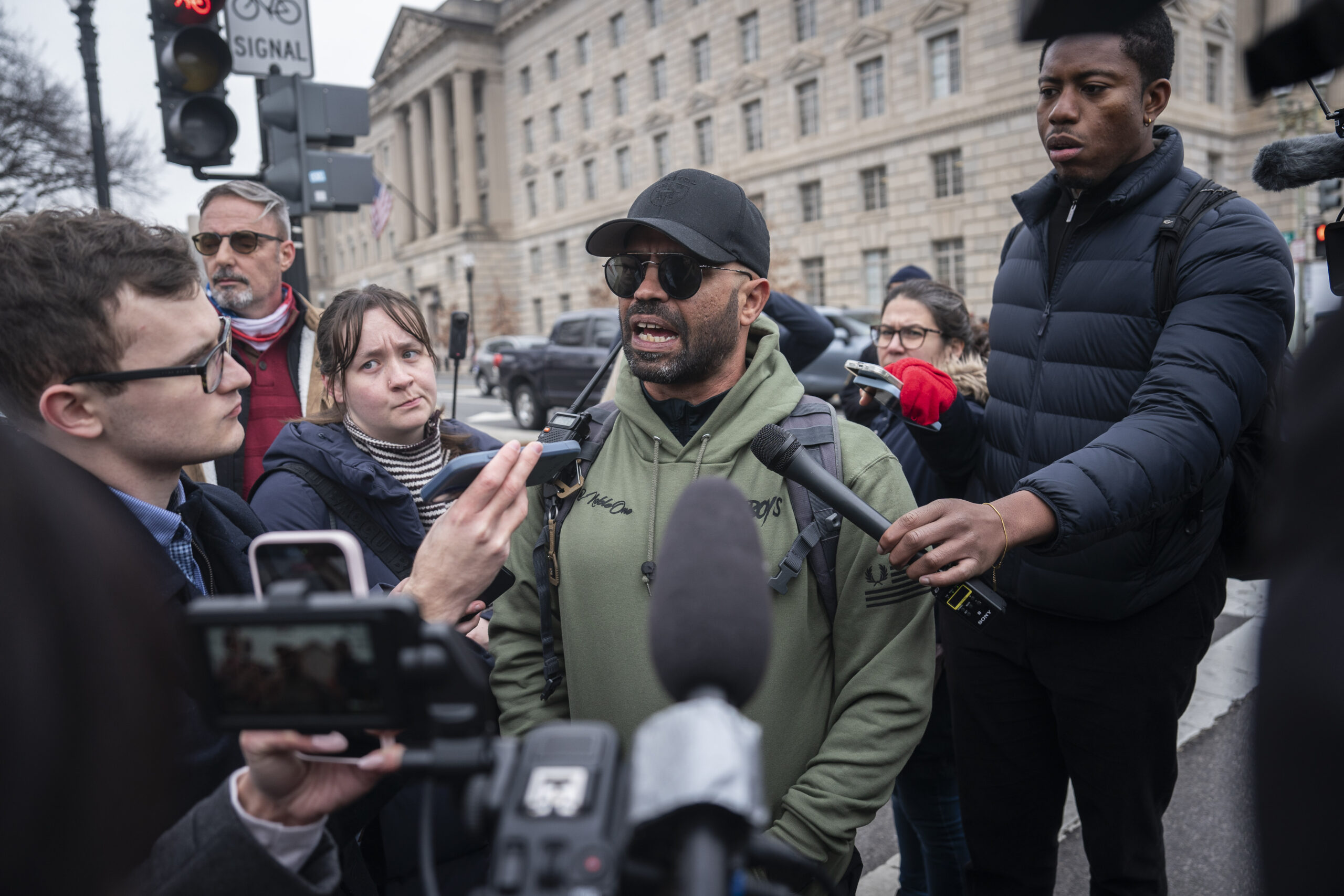
Another Jan. 6-related lawsuit against the federal government comes from several leaders of the Proud Boys who were found guilty of engaging in a seditious conspiracy to keep Trump in power despite his electoral defeat. The suit seeking $100 million, filed in federal court in Florida last year, echoes Trump’s claims that the investigation into the Jan. 6 attack was illegitimate and politically motivated.
Former Proud Boys leader Henry “Enrique” Tarrio speaks at the Jan. 6 anniversary rally this month.
The lead plaintiff, Henry “Enrique” Tarrio, called for charges against Jan. 6 prosecutors when he addressed the gathering in Washington, D.C., to mark the fifth anniversary this month. “The thing I am searching for,” Tarrio said, “is retribution, retaliation.”
Since Trump returned to office one year ago, many Jan. 6 prosecutors have been fired or resigned. Hager’s prosecutor, Adam Dreher, was demoted to Superior Court last year, he said, in retaliation for his work on Jan. 6 cases. He left the department a few months ago to return to his home state of Michigan and practice law. The Justice Department declined to comment on Dreher’s record.
Dreher was an administrative law judge in Detroit on Jan. 6, 2021. The riot at the Capitol inspired him to come to Washington as a federal prosecutor, he said, just as years earlier, the Sept. 11, 2001, terrorist attack moved him to join the military.
“It made me want to be part of trying to help things get back to normal, to hold people accountable and make sure the rule of law was something we could rely on,” he said. “That all we did is being unraveled has been very difficult to watch.”
WASHINGTON — President Donald Trump’s plane, Air Force One, returned to Joint Base Andrews about an hour after departing for Switzerland on Tuesday evening.
White House press secretary Karoline Leavitt said the decision to return was made after takeoff when the crew aboard Air Force One identified “a minor electrical issue” and, out of an abundance of caution, decided to turn around.
A reporter on board said the lights in the press cabin of the aircraft went out briefly after takeoff, but no explanation was immediately offered. About half an hour into the flight reporters were told the plane would be turning around.
Trump will board another aircraft and continue on with his trip to the World Economic Forum in Davos.
The two planes currently used as Air Force One have been flying for nearly four decades. Boeing has been working on replacements, but the program has faced a series of delays. The planes are heavily modified with survivability capabilities for the president for a range of contingencies, including radiation shielding and antimissile technology. They also include a variety of communications systems to allow the president to remain in contact with the military and issue orders from anywhere in the world.
Last year, the ruling family of Qatar gifted Trump a luxury Boeing 747-8 jumbo jet to be added into the Air Force One fleet, a move that faced great scrutiny. That plane is currently being retrofitted to meet security requirements.
Leavitt joked to reporters on Air Force One Tuesday night that a Qatari jet was sounding “much better” right now.
Last February, an Air Force plane carrying Secretary of State Marco Rubio to Germany had to return to Washington because of a mechanical issue. In October, a military plane carrying Defense Secretary Pete Hegseth had to make an emergency landing in United Kingdom due to a crack in the windshield.
Lindsey Halligan, a Trump administration lawyer who was named head of a key U.S. attorney’s office in Virginia last year with instructions to seek criminal charges against President Donald Trump’s perceived political adversaries, left her post at the Justice Department on Tuesday.
Halligan’s departure followed a pair of extraordinary moves by two federal judges who issued court orders hours earlier saying they intended to replace Halligan at the helm of the U.S. attorney’s office for the Eastern District of Virginia and threatening disciplinary sanctions for any government lawyer who continued to refer to her as U.S. attorney in legal filings.
The separate actions by Chief Judge M. Hannah Lauck and Judge David J. Novak, who were nominated by President Barack Obama and Trump, respectively, signaled a breaking point for the federal bench in the Eastern District of Virginia months after Halligan was disqualified from serving as U.S. attorney in the high-profile office.
The orders intensified a battle playing out nationwide between the executive and judicial branches over how the nation’s 93 U.S. attorneys can be appointed for temporary terms without Senate confirmation. And they had posed obstacles for Halligan — who had no prosecutorial experience before she was installed in the job — as she attempted to carry out Trump’s directions to levy criminal charges against two of his perceived political foes: former FBI director James B. Comey and New York Attorney General Letitia James.
Halligan, in a statement, accused the district’s federal judges of a campaign to pressure her to leave after the court ruling declaring her appointment was invalid. She said that effort had diverted “time and resources from public safety responsibilities.”
It was unclear Tuesday night who would be in charge of the U.S. attorney’s office. The Justice Department this month dismissed the first assistant U.S. attorney, Robert K. McBride, who would have automatically assumed the top job under federal law. A Justice Department spokesperson did not immediately respond to requests for comment.
Halligan is the third Trump-appointed U.S. attorney pick to leave their post in the face of a growing body of court rulings that have deemed their appointments illegal.
Alina Habba, a former Trump lawyer he picked to lead the U.S. attorney’s office in New Jersey, resigned last month after a monthslong legal battle over whether she was lawfully serving in that role.
While the Justice Department continues to appeal the decision, Habba stepped down and moved to another role in the Justice Department.
Julianne Murray, another contested pick, resigned her post as U.S. attorney in Delaware days afterward. Before her appointment, she had served as the state’s Republican Party chairwoman.
Attorney General Pam Bondi praised Halligan for her service in a statement Tuesday.
“While we will feel her absence keenly, we are confident that she will continue to serve her country in other ways,” Bondi said. “The circumstances that led to this outcome are deeply misguided. We are living in a time when a democratically elected President’s ability to staff key law enforcement positions faces serious obstacles.”
Several judges had suggested for weeks that Halligan should resign and sharply questioned her continued use of the U.S. attorney title after an out-of-district judge, Cameron McGowan Currie, ruled in late November that the Trump administration had used an unlawful maneuver to install Halligan.
On Tuesday, Lauck directed the court’s clerk to publish the U.S. attorney job posting in local newspapers, asking anyone interested to apply by Feb. 10. “The position of United States Attorney for the Eastern District of Virginia is vacant,” reads a public notice posted on the court’s website Tuesday.
Lauck’s order marked an escalation, signaling active efforts by the judges to appoint the district’s top federal prosecutor under a federal law that gives them the power to do so after an interim U.S. attorney has been in office for 120 days. It was followed hours later with another order from Novak, who raised the threat of disciplinary action for anyone who described Halligan as the U.S. attorney in legal filings.
“No matter all of her machinations, Ms. Halligan has no legal basis to represent to this Court that she holds the position. And any such representation going forward can only be described as a false statement made in direct defiance of valid court orders,” Novak wrote. “In short, this charade of Ms. Halligan masquerading as the United States Attorney for this District in direct defiance of binding court orders must come to an end.”
The Trump administration has appealed Currie’s ruling, but it never requested a stay, so the ruling disqualifying Halligan remained in effect. Nonetheless, she continued to represent herself as the U.S. attorney in court filings.
This month, Novak ordered Halligan to explain why she continued to use the title, suggesting she may be making false or misleading statements. The Justice Department responded defiantly to that order last week, arguing that Currie’s ruling was not binding and that Novak had no authority to strike Halligan’s name from the signature block of Justice Department court filings.
The response, which accused Novak of making “rudimentary” legal errors and missing “elementary” legal principles, was written in a derisive tone unusual for a government lawyer addressing a federal judge.
Novak said in response that Halligan’s rhetoric was beneath the court’s dignity and more suitable for cable news. He said Halligan’s continued use of the U.S. attorney title after Currie’s ruling was an affront to the legal system.
“The Court cannot tolerate such obstinance, because doing so would undermine the very essence of the Rule of Law,” he wrote in Tuesday’s order. “If the Court were to allow Ms. Halligan and the Department of Justice to pick and choose which orders that they will follow, the same would have to be true for other litigants and our system of justice would crumble.”
Halligan’s nomination for a full term as U.S. attorney is pending in the Senate, and it was unclear Tuesday whether the White House also intended to withdraw it. Even if they don’t, the nomination is unlikely to move forward because it lacks support from Virginia’s two senators — Mark R. Warner and Tim Kaine, both Democrats — who have emphasized that the Eastern District of Virginia handles a complex portfolio of cases dealing with national security, leaks of classified information, and international terrorism.
In disqualifying Halligan last fall, Currie ruled that Halligan was never legally appointed to the position of interim U.S. attorney because the Trump administration had already named someone to that role — Halligan’s predecessor, Erik S. Siebert, who served a full 120-day term, from January to May 2025. The district judges then unanimously extended Siebert in the role at the Justice Department’s request, Novak wrote in his order.
But Siebert was forced out in September after declining to seek charges against Comey and James. Career prosecutors had recommended against pursuing the two cases because of insufficient evidence of wrongdoing. Trump then named Halligan, who promptly secured indictments against Comey, on allegations that he made false statements to Congress, and James, who was accused of mortgage fraud. Currie tossed both indictments after finding that Halligan was unlawfully appointed.
Halligan’s 120-day appointment concluded Tuesday.
Justice Department lawyers maintain that the statute allows for back-to-back interim appointments. But in addition to Currie, at least five other federal judges have rejected that argument while ruling on challenges to other Trump U.S. attorney appointees. In each case, the judges have said that if the attorney general could legally name a string of interim appointees, there would be no need for an administration to put a nominee up for a Senate vote.
Judges across the country have been cautious in exercising their authority to name replacements for the president’s picks. When New Jersey’s federal judges named a veteran federal prosecutor to replace Habba last summer, the Justice Department fired their pick within hours and undertook a series of legal maneuvers aimed at keeping Habba in the role.
Delaware’s chief federal judge began soliciting applications this fall to replace Murray in Delaware. But Murray resigned her post in December before a potential standoff with the administration could come to a head.
Judges in other districts have refused to reappoint Trump’s interim U.S. attorney picks but declined to choose replacements. The chief federal judge in Seattle issued an order last week soliciting applications to potentially appoint a new acting U.S. attorney there, when the interim appointment of Trump’s current pick expires next month.
WASHINGTON — President Donald Trump‘s pledge to provoke a sweeping tariff fight with Europe to get his way in taking control of Greenland has left many of America’s closest allies warning of a rupture with Washington capable of shattering the NATO alliance that had once seemed unshakable.
The European Union’s top official on Tuesday called Trump’s planned new tariffs over Greenland a “mistake” and questioned Trump’s trustworthiness. French President Emmanuel Macron said the EU could retaliate by deploying one of its most powerful economic tools, known colloquially as a trade “bazooka.”
The rising tensions concerning Greenland, and threats of a deepening trade war between the U.S. and Europe, caused global investors to shudder Tuesday, as stocks on Wall Street slumped.
Trump prides himself on ratcheting up pressure to try to negotiate through a position of strength. He was leaving Tuesday — the anniversary of his inauguration — for the World Economic Forum in Davos, Switzerland, a venue that offers Trump the chance to defuse tensions as quickly as he stirred them up.
But European leaders — digging in and vowing to defend Denmark and its control over semiautonomous Greenland — may be seeking just as hard to meet an extraordinary moment with a show of their fierce resolve.
That could hurt the chances of Trump finding a quick way to turn around the crisis. Greenland’s leader insisted on respect for its territorial integrity and said recognition of international law is “not a game.”
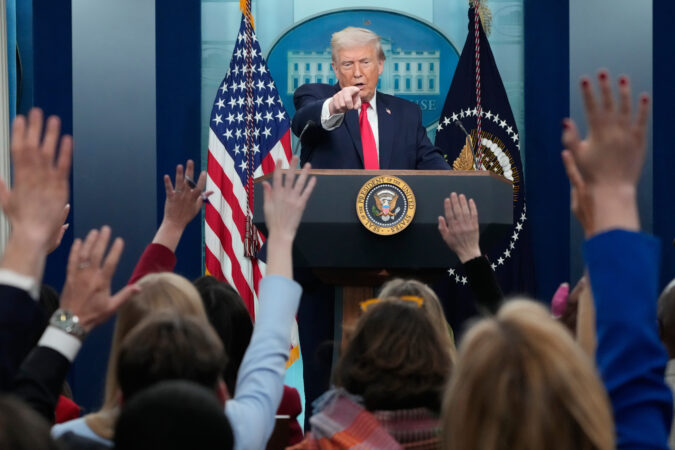
Trump made an unusual appearance in the White House briefing room and spoke at length while stocks fell. Asked how far he’d be willing to go to acquire Greenland, Trump said only, “You’ll find out.” He also mistakenly referred to Greenland as Iceland at one point.
Still, the president predicted there could be a deal in the making with allies. “I think that we will work something out where NATO is going to be very happy, and where we’re going to be very happy,” he said, without providing specifics.
Trump said he’d been encouraged that NATO had increased military spending, but he also belittled the alliance, saying other members may not protect Washington’s interests. The president suggested NATO members expect the U.S. to come to their rescue but “I just really do question whether or not they’ll come to ours.”
European Commission President Ursula von der Leyen pushed back against Trump’s announcement that, starting February, a 10% import tax will be imposed on goods from eight European nations that have rallied around Denmark. Greenland is a semiautonomous territory of Denmark, a NATO member.
“The European Union and the United States have agreed to a trade deal last July,” von der Leyen said in Davos. “And in politics as in business — a deal is a deal. And when friends shake hands, it must mean something.”
“We consider the people of the United States not just our allies, but our friends. And plunging us into a downward spiral would only aid the very adversaries we are both so committed to keeping out of the strategic landscape,” she added.
She vowed that the EU’s response “will be unflinching, united and proportional.”
Taking firmer stances defied the approach that many European leaders have offered since Trump returned to office. It had mostly entailed saying nice things about the president to try to stay in his good graces, while working furiously through other avenues to find compromise.
Trump says the U.S. needs Greenland to deter possible threats from China and Russia. But his continued insistence in recent weeks that anything short of the U.S. owning Greenland is unacceptable is testing the limits of the softer strategy.
Danish Prime Minister Mette Frederiksen said “the worst may still be ahead of us.” Speaking to parliament, she said “we have never sought conflict. We have consistently sought cooperation.”
‘Not a game’
Greenland’s Prime Minister Jens-Frederik Nielsen said at a news conference in the island’s capital, Nuuk, that “we need to have respect for international law and territorial integrity.” He said those principles should unite Western democratic countries, and said he was grateful for support from EU allies.
“International law, it’s not a game,” he said. “We have been a close and loyal ally to the United States, to NATO, through many, many, many years. We can do lots more in that framework. We are willing to cooperate much more, but of course in mutual respect, and if we cannot see that, it will be very difficult to have a good and reliable partnership.”
Trump’s threats have sparked outrage and a flurry of diplomatic activity across Europe, as leaders consider possible countermeasures, including retaliatory tariffs and the first-ever use of the European Union’s anti-coercion instrument.
Unofficially known as the “trade bazooka,” the anti-coercion instrument could sanction individuals or institutions found to be putting undue pressure on the EU. The EU has two other major economic tools it could use to pressure Washington: new tariffs, or a suspension of the U.S.-EU trade deal.
Macron warned in Davos that the additional tariffs could force the EU to use its anti-coercion mechanism for the first time against the United States.
“Can you imagine that?” he said, arguing that allied countries should be focusing instead on bringing peace to Ukraine. “This is crazy.”
In general, he said, the mechanism “is a powerful instrument and we should not hesitate to deploy it in today’s tough environment.”
Trump earlier posted a text message from Macron in which the French president suggested a meeting of members of the Group of Seven industrialized democracies in Paris after the Davos gathering. An official close to Macron, who spoke anonymously in line with the French presidency’s customary practices, confirmed the message shared by Trump is genuine.
In his latest threat of tariffs, Trump indicated that the import taxes would be retaliation for last week’s deployment of symbolic numbers of troops from the European countries to Greenland — though he also suggested that he was using the tariffs as leverage to negotiate with Denmark.
‘In the midst of a rupture’
Canadian Prime Minister Mark Carney, whose country is a founding NATO member, warned of global fissures beyond Greenland, suggesting it was an “illusion” and “fiction” that there remains a rules-based international order.
“Let me be direct: We are in the midst of a rupture, not a transition,” Carney said during a speech in Davos.
Belgian Prime Minister Bart De Wever said at Davos that Europe cannot be a “miserable slave’ to Trump.”
Others encouraged NATO leaders to stand up to Trump. Speaking on the sidelines of Davos, California Gov. Gavin Newsom slammed Europe’s response to Trump’s tariff threats as “pathetic” and “embarrassing,” and urged continental leaders to unite and stand up to the United States.
“It’s time to stand tall and firm, have a backbone,” Newsom, a Democrat, told reporters.
Greenland’s European backers have also looked at establishing a more permanent military presence to help guarantee security in the Arctic region, a key demand of the United States, Swedish Defense Minister Pål Jonson said.
In Moscow, meanwhile, Russian Foreign Minister Sergey Lavrov strongly denied any intention by Russia and China to threaten Greenland, while also describing Greenland as a “colonial gain” for Denmark.
Trump was asked Tuesday what would happen to his tariff threats related to Greenland if the Supreme Court rules against his ability to impose import tariffs as part of a case it is considering.
“Well, I’ll have to use something else,” Trump said. “We have other alternatives.” He didn’t respond when asked about using force.
President Donald Trump marked his first year back in office by presiding over a meandering, nearly two-hour-long press briefing to recount his accomplishments, repeating many false claims he made throughout 2025.
Among the topics about which he continued to spread falsehoods were the 2020 election, foreign policy, the economy, and energy.
Here’s a closer look at the facts.
2020 election
TRUMP, referencing former President Joe Biden: “… a man that didn’t win the election, by the way, it’s a rigged election. Everybody knows that now.
THE FACTS: This is a blatant falsehood that has been disproven many times over — the 2020 election was not stolen. Biden earned 306 electoral votes to Trump’s 232. He also won over 7 million more popular votes than Trump.
But Trump has been persistent in claiming that he won the 2020 race since its completion, even after he earned a second term in 2024, and has continued to claim the lead-up to the 2026 midterms.
Biden’s Electoral College victory was nearly the same margin that Trump had in 2016 when he beat Hillary Clinton 227 to 306 (304 after two electors defected). Biden triumphed by prevailing in key states such as Pennsylvania, Michigan, Wisconsin, Arizona, and Georgia.
Allegations from Trump of massive voting fraud have been refuted by a variety of judges, state election officials and an arm of his own administration’s Homeland Security Department. In 2020, then-Attorney General William Barr, a Trump appointee, told the AP that no proof of widespread voter fraud had been uncovered. “To date, we have not seen fraud on a scale that could have effected a different outcome in the election,” he said at the time.
International conflicts
TRUMP: “You have to understand, I settled eight wars.”
THE FACTS: This statistic, which Trump frequently cites as one of his accomplishments, is highly exaggerated. Although he has helped mediate relations among many nations, his impact isn’t as clear-cut as he makes it seem.
The conflicts Trump counts among those that he has solved are between Israel and Hamas, Israel and Iran, Egypt and Ethiopia, India and Pakistan, Serbia and Kosovo, Rwanda and Congo, Armenia and Azerbaijan, and Cambodia and Thailand.
There is far more work that remains before any declaration of an end to the war in Gaza and although Trump is credited with ending the 12-day war between Israel and Iran, this can be seen as a temporary respite from an ongoing cold war. Fresh fighting broke out last month between Cambodia and Thailand, and between Congolese forces and Rwanda-backed rebels.
The leaders of Armenia and Azerbaijan signed a deal aimed at ending a decades-long conflict at the White House in August. But the leaders have yet to sign a peace treaty and parliaments have yet to ratify it. After the April killing of tourists in Indian-controlled Kashmir pushed India and Pakistan closer to war than they had been in years, a ceasefire was reached. Trump claimed that the U.S. brokered the ceasefire and Pakistan thanked him, while India denied his claims.
Friction between Egypt and Ethiopia over the Grand Ethiopian Renaissance Dam is best described as heightened tensions, not war. There has been no threat of war between Serbia and Kosovo during Trump’s second term, nor has he made any significant contribution to improving relations in his first year back in the White House.
The economy
TRUMP: “We inherited, remember this — inflation was at a historic high. We had never had inflation like that. They say 48 years. But whether it’s 48 years or ever, we had the highest inflation, in my opinion, that we’ve ever had.”
THE FACTS: This is false. Biden-era inflation peaked at 9.1% in June 2022, a consequence of supply chain interruptions, potentially excessive amounts of government aid and Russia’s invasion of Ukraine driving up food and energy costs.
But Americans have known even worse and more sustained inflation than that. For example, higher than 13% in 1980 during an extended period of price pain. And by some estimates, inflation approached 20% during World War I.
Inflation had been falling during the first few months of Trump’s presidency, but it picked back up after the president announced his tariffs in April. It was at 2.7% as of December 2025.
Energy policy
TRUMP: “I say clean, beautiful coal. I never say the word coal, it has to be preceded by the words clean, beautiful coal.”
THE FACTS: The production of coal is cleaner now than it has been historically, but that doesn’t mean it’s clean.
Trump, however, continually omits this crucial context.
Planet-warming carbon dioxide emissions from the coal industry have decreased over the past 30 years, according to the U.S. Energy Information Administration. And yet United Nations-backed research has found that coal production worldwide still needs to be reduced sharply to address climate change.
Along with carbon dioxide, burning coal emits sulfur dioxide and nitrogen oxides that contribute to acid rain, smog and respiratory illnesses, according to the EIA.
Coal once provided more than half of U.S. energy production. Today, coal accounts for about 15% of U.S. electricity production.
California wildfires
TRUMP, discussing approvals for reconstruction after the 2025 Los Angeles wildfires: “… the 20,000 houses or more that burned down in Los Angeles because they didn’t have the water, they didn’t allow the water to come down from the Pacific Northwest. They routed the water into the Pacific Ocean … They didn’t want to do it. They want to protect the tiny little fish.”
THE FACTS: Trump again tried to blame the fact that some Los Angeles fire hydrants ran dry during last year’s wildfires on the state’s water policies that aim to protect endangered species, including a tiny fish known as the Delta smelt. Local officials say the hydrant outages occurred because the municipal system was not designed to deal with such a massive disaster.
Trump later ordered water released from two dams in California’s Central Valley agricultural hub, but the water never went to Los Angeles, instead going to a dry lake basin more than 100 miles away.
Most of California’s water comes from the north, where it melts from mountain snow and runs into rivers that connect to the Sacramento-San Joaquin River Delta. From there, much of it is sent farther south to farmers and cities like Los Angeles through two large pumping and canal systems. One is run by the federal government and the other by the state. Contrary to Trump’s claim, no water supply from the Pacific Northwest connects to California’s system.
WASHINGTON — U.S. military forces boarded and took control of a seventh oil tanker connected with Venezuela on Tuesday as part of the Trump administration’s broader efforts to take control of the South American country’s oil.
U.S. Southern Command said in a social media post that U.S. forces apprehended the Motor Vessel Sagitta “without incident” and that the tanker was operating in defiance of President Donald Trump’s “established quarantine of sanctioned vessels in the Caribbean.”
The military command did not say whether the U.S. Coast Guard took control of the tanker as has been the case in prior seizures. The Pentagon did not immediately respond to a request for more details. Southern Command said it had nothing to add to its post.
The Sagitta is a Liberian-flagged tanker and its registration says it is owned and managed by a company in Hong Kong. The ship last transmitted its location more than two months ago when exiting the Baltic Sea in northern Europe.
The tanker was sanctioned by the U.S. Treasury Department under an executive order related to Russia’s invasion of Ukraine in 2022.
The post from U.S. Southern Command indicated the ship had taken oil from Venezuela. It said the capture of the tanker “demonstrates our resolve to ensure that the only oil leaving Venezuela will be oil that is coordinated properly and lawfully.”
The military command posted what appeared to be aerial footage of the Sagitta sailing on the ocean, but unlike in prior videos the clip did not show U.S. forces flying toward it in helicopters or landing on the deck of the ship.
Since the U.S. ouster of Venezuela President Nicolás Maduro in a surprise nighttime raid on Jan. 3, the Trump administration has set out to control the production, refining and global distribution of Venezuela’s oil products.
Officials in Trump’s Republican administration have made it clear they see seizing the tankers as a way to generate cash as they seek to rebuild Venezuela’s battered oil industry and restore its economy.
Trump met with executives from oil companies nearly two weeks ago to discuss his goal of investing $100 billion in Venezuela to repair and upgrade its oil production and distribution. He said at the time that the U.S. expected to sell at least 30 million to 50 million barrels of Venezuelan oil.
Trump told reporters on Tuesday that the U.S. already has taken 50 million barrels of oil out of Venezuela.
“We’ve got millions of barrels of oil left,” he said at the White House. “We’re selling it on the open market. We’re bringing down oil prices incredibly.”
The first tanker was seized off the coast of Venezuela on Dec. 10. Most of the other tankers also have been captured in the waters near Venezuela, with the exception of the Bella 1, which was captured in the North Atlantic.
The Bella 1 had been cruising across the Atlantic and nearing the Caribbean when on Dec. 15 it abruptly turned and headed north, toward Europe. The ship was ultimately captured on Jan. 8.
The Pentagon plans to cut its participation in a range of NATO advisory groups, the latest sign of the Trump administration’s drive to scale back the U.S. military presence in Europe, according to multiple officials familiar with the matter.
The impending move affects about 200 military personnel and will mostly diminish U.S. involvement in the alliance’s 30 Centers of Excellence, which seek to train NATO forces on key elements of warfare such as naval combat, these people said. They spoke on the condition of anonymity to detail the U.S. administration’s plans.
Rather than withdraw all at once, the Pentagon intends not to replace personnel as their postings end, a process that could take years, according to one U.S. official familiar with the matter. U.S. participation in the centers isn’t ending altogether, two officials noted.
The move has been under consideration for months, according to two U.S. officials, one of whom said it is unrelated to President Donald Trump’s escalating threats to seize the Danish territory of Greenland. Trump’s provocations have drawn widespread condemnation from European leaders and many lawmakers in Congress, who fear the president risks causing irreparable and unnecessary damage to the NATO alliance.
Spokespeople for the Pentagon and nor NATO did not immediately respond to requests for comment.
Under Trump, the U.S. military has pulled back from Europe as the administration presses allies there to take greater control of the continent’s collective defense. Last year, for instance, the Pentagon abruptly announced it would withdraw a brigade of troops from Romania and cut security aid programs to the three Baltic nations that border Russia, whose yearslong invasion of Ukraine has spurred fears of a direct conflict between NATO and the Kremlin.
Under pressure from the Trump administration, the alliance agreed last summer to surge defense spending to 5% of GDP over the next 10 years, including 1.5% dedicated to infrastructure and other civilian projects.
Lawmakers — including some key Republicans — objected to the administration’s moves in Europe and are working to fund the impacted security assistance programs despite the Pentagon’s directives.
Members of Congress also have passed legislation that requires the Pentagon to consult with them before making any major reductions to U.S. military posture in Europe. The law specifies that requirement would apply only if the overall U.S. force posture in Europe were to fall below 76,000. It stands at roughly 80,000 now.
While the personnel eventually being withdrawn amount to a small share of troops the United States stations in Europe, some current and former officials said the U.S. pullout could have an outsize impact on the alliance by reducing valuable American military expertise.
“We have a lot of operational experience that some of our personnel contribute to these centers,” said Lauren Speranza, a senior Pentagon official during the Biden administration. “There would be a bit of a brain drain that would come with pulling U.S. personnel out.”
DEIR AL-BALAH, Gaza Strip — A Palestinian baby died from hypothermia on Tuesday in the Gaza Strip, underscoring the grim humanitarian conditions in the territory as world leaders were gathering at a Swiss resort where President Donald Trump’s Gaza ceasefire plan is high on the agenda.
Shaza Abu Jarad’s family found the 3-month-old on Tuesday morning in their tent in the Daraj neighborhood of Gaza City.
“She was freezing, and dead,” the baby’s father, Mohamed Abu Jarad, told the Associated Press by phone after a funeral. “She died from cold.”
The man, who worked in Israel before the war, lives with his wife and their seven other children in a makeshift tent after their house was destroyed during the war.
The family took the girl to the Al-Ahli hospital where a doctor pronounced her dead from hypothermia, said her uncle, Khalid Abu Jarad. Gaza’s Health Ministry confirmed that the baby died from hypothermia.
The family is among hundreds of thousands of people sheltering in tent camps and war-battered buildings in Gaza which experiences cold, wet winters, with temperatures dropping below 50 Fahrenheit at night.
As Palestinians in the war-ravaged enclave languish in displacement camps, Trump hopes to establish his new Board of Peace at the World Economic Forum in Davos. But the initiative, initially conceived to oversee the Gaza ceasefire, faces many questions over its membership and scope.
Israel on Tuesday began demolishing the Jerusalem headquarters of the U.N. agency for Palestinian refugees, pressing ahead with its crackdown against a body it has long accused of anti-Israel bias.
Shaza Abu Jarad was the ninth child to die from severe cold this winter in Gaza, according to the strip’s health ministry, part of the Hamas-run government and staffed by medical professionals. The U.N. and independent experts consider it the most reliable source on war casualties. Israel disputes its figures but has not provided its own.
More than 100 children who have died since the start of the ceasefire in October — a figure that includes a 27-day-old girl who died from hypothermia over the weekend.
The ceasefire paused two years of war between Israel and Hamas militants and allowed a surge in humanitarian aid into Gaza, mainly food.
But residents say shortages of blankets and warm clothes remain, and there is little wood for fires. There’s been no central electricity in Gaza since the first few days of the war in 2023, and fuel for generators is scarce.
The International Committee of the Red Cross said recent biting cold and rainfall in Gaza were “ultimately a threat to survival.”
Trump’s Board of Peace was initially seen as a mechanism focused on ending the Israel-Hamas war in Gaza.
But recent invitations sent to dozens of world leaders show that the body could have a far broader mandate of other global crises, potentially rivaling the U.N. Security Council.
Trump says the body would “embark on a bold new approach to resolving global conflict,” an indication that the body may not confine its work to Gaza.
During a White House press briefing on Tuesday, Trump was asked by a reporter whether the Board of Peace should replace the United Nations.
“It might,” Trump said. “The U.N. just hasn’t been very helpful. I’m a big fan of the potential, but it has never lived up to its potential.”
But he added, “I believe you got to let the U.N. continue, because the potential is so great.”
The panel was part of Trump’s 20-point ceasefire plan that stopped the war in Gaza in October. Many countries, including Russia, said they received Trump’s invitation and were studying the proposal. France said it does not plan to join the board “at this stage.”
ST. PAUL, Minn. — Federal immigration agents bashed open a door and detained a U.S. citizen in his Minnesota home at gunpoint without a warrant, then led him out onto the streets in his underwear in subfreezing conditions, according to his family and videos reviewed by the Associated Press.
ChongLy “Scott” Thao told the AP that his daughter-in-law alerted him on Sunday afternoon that U.S. Immigration and Customs Enforcement agents were banging at the door of his residence in St. Paul. He told her not to open it. Masked agents then forced their way in and pointed guns at the family, yelling at them, Thao recalled.
“I was shaking,” he said. “They didn’t show any warrant; they just broke down the door.”
“ICE is not doing what they say they’re doing,” St. Paul Mayor Kaohly Her, a Hmong American, said in a statement about Thao’s arrest. “They’re not going after hardened criminals. They’re going after anyone and everyone in their path. It is unacceptable and un-American.”
Encounter is caught on video
Thao, who has been a U.S. citizen for decades, said that as he was being detained he asked his daughter-in-law to find his identification but the agents told him they didn’t want to see it.
Instead, as his 4-year-old grandson watched and cried, Thao was led out in handcuffs wearing only sandals and underwear with just a blanket wrapped around his shoulders.
Videos captured the scene, which included people blowing whistles and horns and neighbors screaming at the more than a dozen gun-toting agents to leave Thao’s family alone.
Thao said agents drove him “to the middle of nowhere” and made him get out of the car in the frigid weather so they could photograph him. He said he feared they would beat him. He was asked for his ID, which agents earlier prevented him from retrieving.
Agents eventually realized that he was a U.S. citizen with no criminal record, Thao said, and an hour or two later, they brought him back to his house. There they made him show his ID and then left without apologizing for detaining him or breaking his door, Thao said.
Homeland Security defends the operation
The Department of Homeland Security described the ICE operation at Thao’s home as a “targeted operation” seeking two convicted sex offenders.
“The US citizen lives with these two convicted sex offenders at the site of the operation,” DHS said. “The individual refused to be fingerprinted or facially ID’d. He matched the description of the targets.”
Thao’s family said in a statement that it “categorically disputes” the DHS account and “strongly objects to DHS’s attempt to publicly justify this conduct with false and misleading claims.”
Thao told the AP that only he, his son, and daughter-in-law and his grandson live at the rental home. Neither they nor the property’s owner are listed in the Minnesota sex offender registry. The nearest sex offender listed as living in the zip code is more than two blocks away.
DHS later released the names and photos of two people it described as “violent illegal alien sexual offenders” that it was seeking to detain in St. Paul. Thao said he had never seen these men before and they did not live with him.
DHS did not respond to an earlier request from the Associated Press asking why the agency believed they were present in Thao’s home.
Thao’s son, Chris Thao, said ICE agents stopped him while he was driving to work before they went to detain his father. He said he was driving a car he borrowed from his cousin’s boyfriend, whose first name matches that of one of the men DHS said it was seeking. Chris Thao said he did not know the boyfriend’s last name.
Family fled Laos after helping U.S.
The family said they are particularly upset by ChongLy Thao’s treatment at the hands of the U.S. government because his mother had to flee to the U.S. from Laos when communists took over in the 1970s since she had supported American covert operations in the country and her life was in danger.
Thao’s adopted mother, Choua Thao, was a nurse who treated CIA-backed Hmong soldiers in the U.S. government’s “Secret War” from 1961 to 1975 against the communists, according to the Hmong Nurses Association website.
Choua Thao, who passed away in late December, “treated countless civilians and American soldiers, working closely with U.S. personnel,” her daughter-in-law Louansee Moua wrote on a GoFundMe page for the family.
ChongLy Thao says he’s planning to file a civil rights lawsuit against DHS and no longer feels secure to sleep in his home.
“I don’t feel safe at all,” Thao said. “What did I do wrong? I didn’t do anything.”