Category: New Jersey News

  • A South Jersey man died after Penn doctors failed to diagnose him in time. A blood test could have saved his life.

    A South Jersey man died after Penn doctors failed to diagnose him in time. A blood test could have saved his life.

    Each night, Louis-Hunter Kean spiked a fever as high as 104.5. He would sweat through bedsheets and shiver uncontrollably. By morning, his fever would ease but his body still ached; even his jaw hurt.

    He had been sick like this for months. Doctors near his South Jersey home couldn’t figure out why a previously healthy 34-year-old was suffering high fevers plus a swollen liver and spleen. In early 2023, they referred Kean to Penn Medicine.

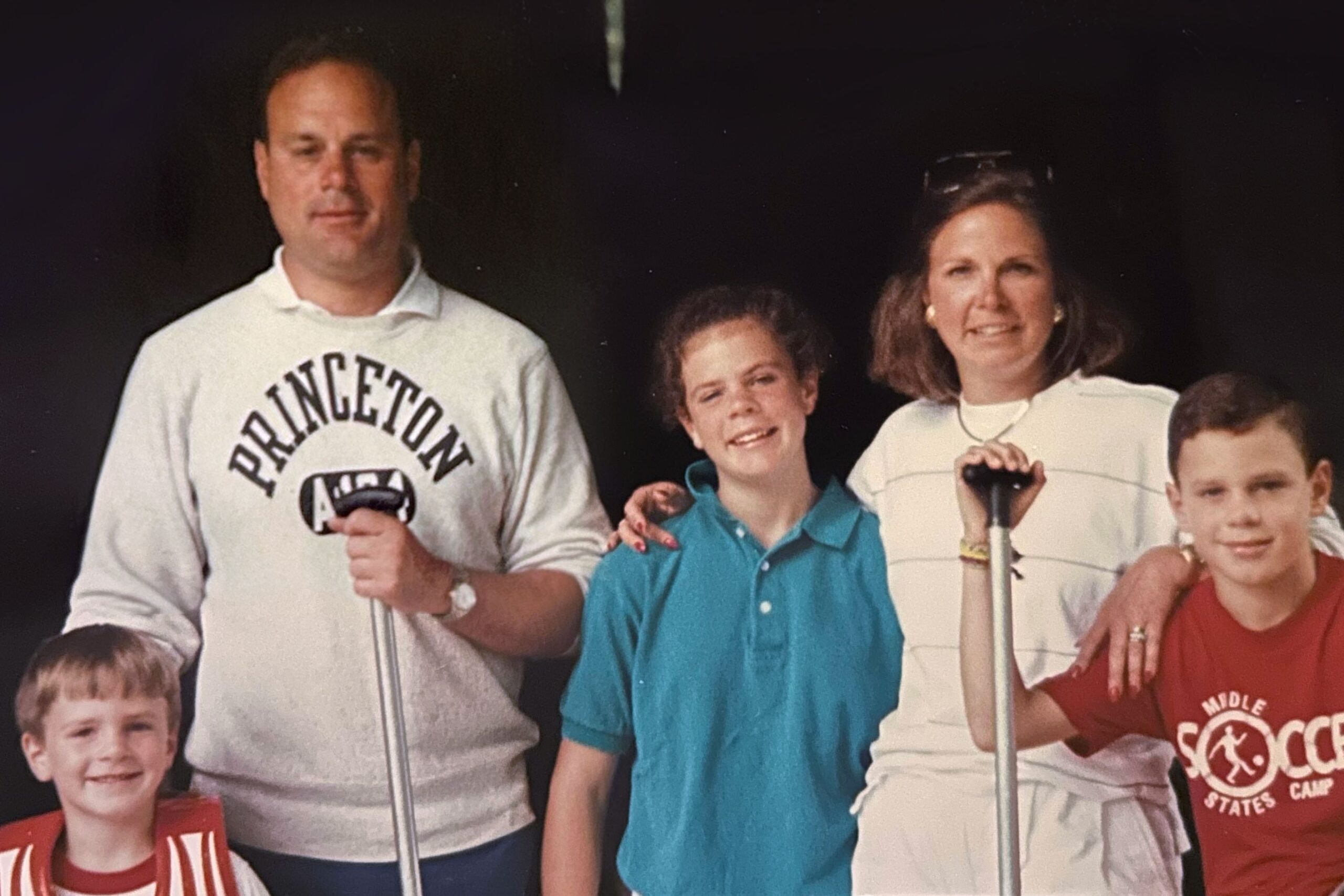
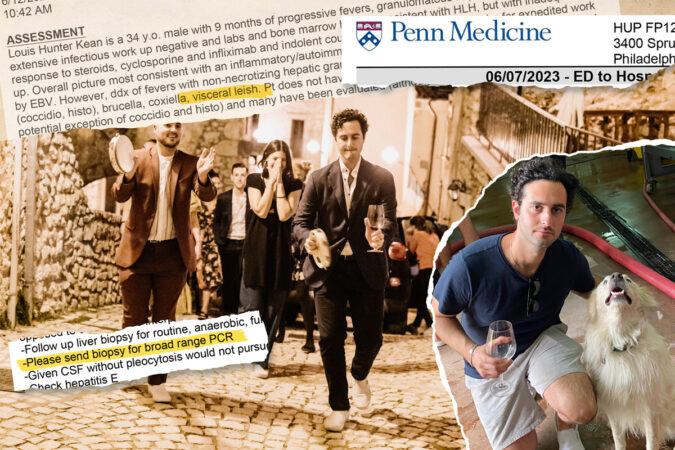
    Louis-Hunter Kean visiting a winery in the Tuscany region of Italy in September 2021. He first spiked a mysterious and persistent fever about a year later in August 2022.

    “These doctors are very sharp, and there are a lot of teams working on it,” Kean texted a friend after being admitted to the Hospital of the University of Pennsylvania (HUP) in West Philadelphia.

    Was it an infection? An autoimmune disease? A blood cancer? Over the next six months, at least 34 HUP doctors — rheumatologists, hematologist-oncologists, gastroenterologists, infectious disease and internal medicine specialists — searched for an answer.

    Kean was hospitalized at HUP five times during a six-month period in 2023. His electronic medical chart grew to thousands of pages.

    Along the way, doctors missed critical clues, such as failing to obtain Kean’s complete travel history. They recommended a pair of key tests, but didn’t follow up to make sure they got done, medical records provided to The Inquirer by his family show.

    Doctors involved in Kean’s care, including at Penn, prescribed treatments that made him sicker, said four infectious disease experts not involved in his care during interviews with a reporter, who shared details about his treatment. Penn doctors continued to do so even as his condition worsened.
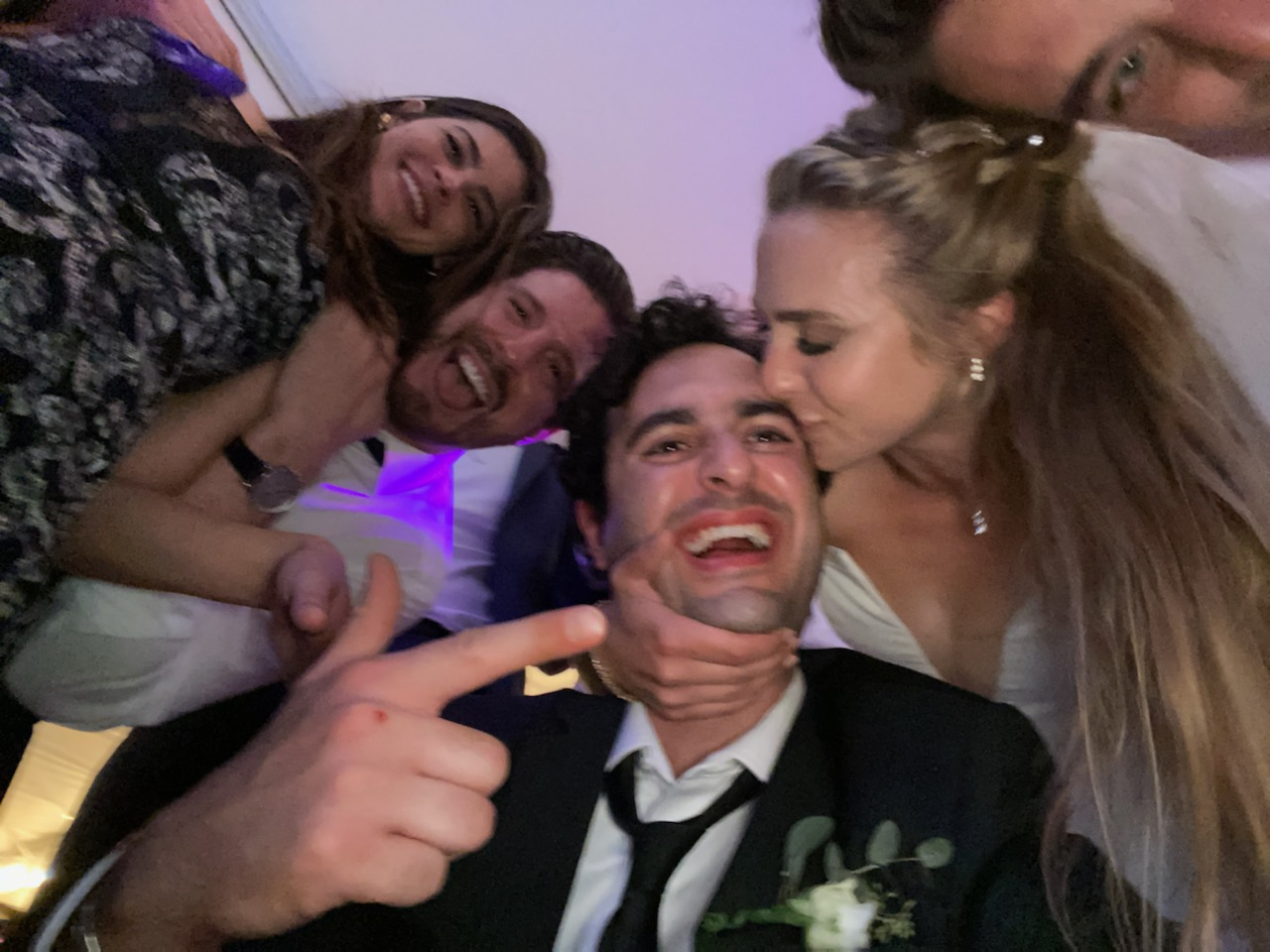
    Louis-Hunter Kean receives a kiss from bride Ashley Greyson at the October 2021 wedding of his close friend, Joshua Green. Green and Kean graduated from Haddonfield High School in 2007.

    “No one was paying attention to what the doctor before them did or said,” Kean’s mother, Lois Kean, said.

    “They did not put all the pieces together,” she said. “It was helter-skelter.”

    Kean’s family is now suing Penn’s health system for medical malpractice in Common Pleas Court in Philadelphia. The complaint identifies nearly three dozen Penn doctors, accusing them of misdiagnoses and harmful treatments. These physicians are not individually named as defendants.

    In court filings, Penn says its doctors did not act recklessly or with disregard for Kean’s well-being, and his case is not indicative of any systemic failures within its flagship hospital. A Penn spokesperson declined further comment on behalf of both the hospital and the individual doctors involved in Kean’s care, citing the pending lawsuit.

    The puzzle of Kean’s diagnosis finally came together in November 2023 after a Penn doctor, early in his career, sought help from the National Institutes of Health (NIH).

    An NIH doctor recommended a test that identified the cause: a parasite prevalent in countries bordering the Mediterranean Sea. Kean likely got infected while vacationing in Italy, four parasitic disease experts told The Inquirer.

    The infection, which is treatable when caught early, is so rare in the U.S. that most doctors here have never seen a case, the experts said.

    By the time Penn doctors figured it out, Kean’s organs were failing.

    Louis-Hunter Kean and his then-girlfriend Zara Gaudioso at a friend’s wedding in Tuscany in September 2021. Kean and Gaudioso got engaged in early 2023. Gaudioso was smitten by Kean’s good looks and sense of humor.
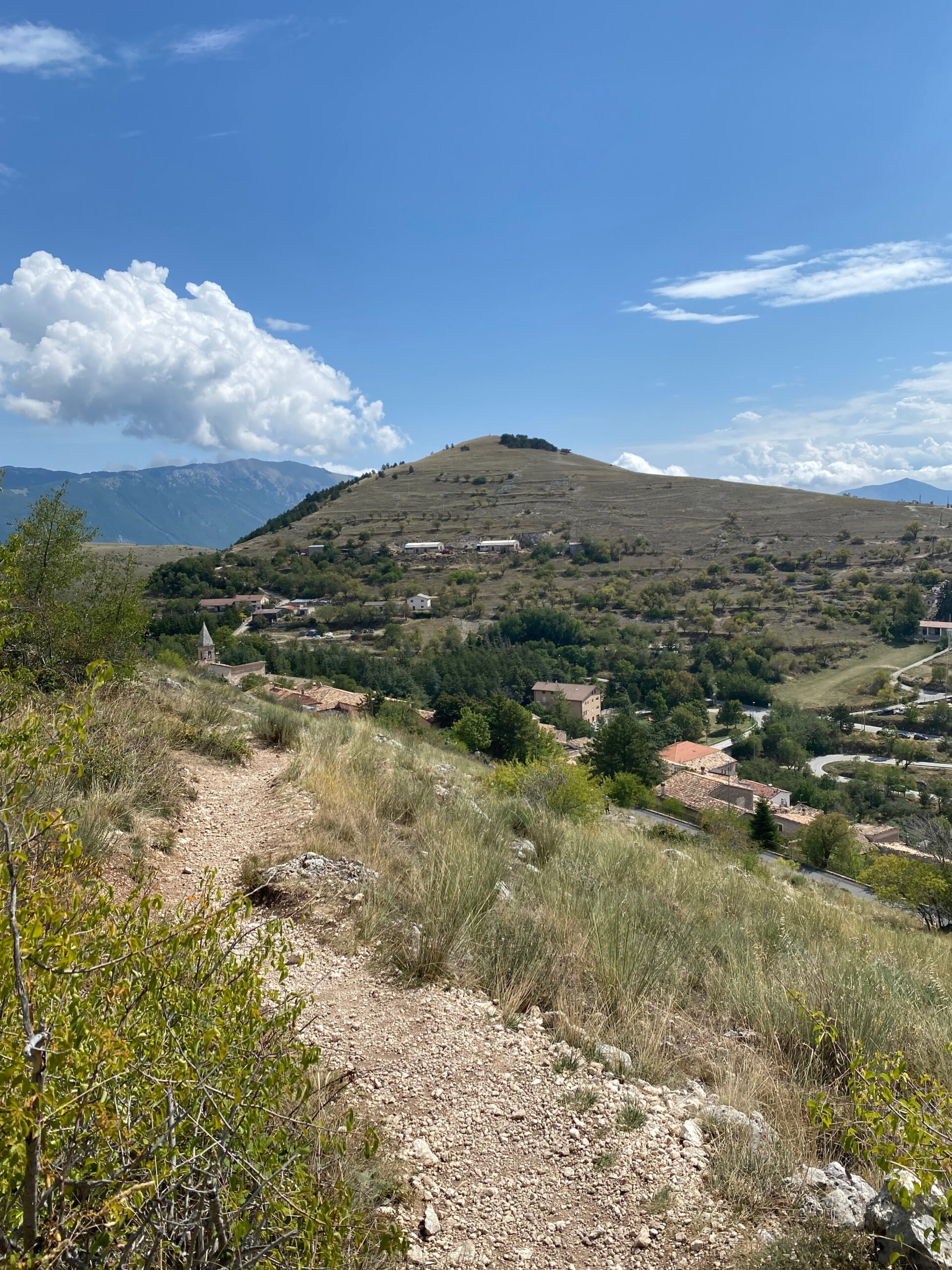
    While vacationing in Italy in September 2021, Louis-Hunter Kean and his friends hiked in the foothills of the Apennine Mountains and visited Gran Sasso and Monti della Laga National Park.

    A missed clue

    When a patient has an ongoing and unexplained fever, an infectious disease doctor will routinely start by taking a thorough travel history to screen for possible illnesses picked up abroad.

    A medical student took Kean’s travel history during his initial workup at HUP in June 2023. An infectious disease specialist reviewed the student’s notes and added a Cooper University Hospital doctor’s earlier notes into Kean’s electronic medical chart at Penn.

    Those records show Kean had traveled to Turks and Caicos with his fiancée in May 2022. The next month, he took a work trip out West, including to California, where he visited farms, but didn’t interact with livestock.

    This was not unusual for Kean, who worked with fruits and vegetables imported from around the world at his family’s produce distribution center on Essington Avenue in Southwest Philadelphia.

    Kean’s fiancée, Zara Gaudioso, said she repeatedly told doctors about another trip: In September 2021, about a year before his fevers began, they traveled to Italy for a friend’s wedding in Tuscany.

    The couple hiked remote foothills, danced all night in a courtyard, dined by candlelight surrounded by a sunflower farm, and slept in rustic villas with the windows flung open.

    “We told everybody,” Gaudioso said. “A lot of Americans go to Italy — it’s not like a third-world country, so I could see how it could just go in one ear and out the other.”

    But notes in Kean’s medical record from the Penn infectious disease specialist don’t mention Italy. Neither do the ones the specialist copied over from Kean’s infectious disease doctor at Cooper.

    Kean “does not have known risk factors” for exposure to pathogens, the Penn specialist concluded, except possibly from farm animals or bird and bat droppings.

    Still, the specialist listed various diseases that cause unexplained fever: Tick-borne diseases. Fungal infections. Tuberculosis. Bacteria from drinking unpasteurized milk.

    The possible culprits included a parasitic disease, called visceral leishmaniasis, transmitted by a bite from an infected sandfly. It can lie dormant for a lifetime — or, in rare cases, activate long after exposure, so it’s important for doctors to take extensive past travel histories, parasitic experts say.

    The parasite is widely circulating in Southern European countries, including Spain, Greece, Portugal, and Italy.

    “Mostly, people living there are the ones who get it. But it’s just a lottery sandwich, and there’s no reason that travelers can’t get it,” said Michael Libman, a top parasitic disease expert and former director of a tropical medicine center at McGill University in Canada.

    But few cases become severe. Hospitals in Italy reported only 2,509 cases of active infection between 2011 and 2016, affecting fewer than one in 100,000 people. Infections requiring hospital care in Italy began to decline after 2012, according a 2023 European study by the Public Library of Science (PLOS) journal Neglected Tropical Diseases.

    Caught early, visceral leishmaniasis is treatable. Without treatment, more than 90% of patients will die.

    In addition to fever, other telltale symptoms are swelling of the liver and spleen and low blood cell counts. Kean had all of those.

    A missed test

    The infectious disease specialist requested a test to examine tissue biopsied from Kean’s liver, which was damaged and enlarged. Lab results showed that immune cells there had formed unusual clusters — another sign that his body might be fighting off an infection.

    In her notes, the specialist identified “visceral leish” as a possible diagnosis, which repeated — via copy and paste — seven times in his medical record. Her request to “please send biopsy for broad-range PCR” repeated five times.

    That is a diagnostic (polymerase chain reaction) test that looks for the genetic fingerprint of a range of pathogens.

    The test comes in different versions: One looks broadly for bacteria. The other is for fungi. The broad fungal test can detect leishmania, even though it’s not a fungus. However, it’s not always sensitive enough to identify the parasite and can produce a false negative, experts said.

    The specialist’s chart note doesn’t specify which type she wanted done.

    It’s not clear if anyone asked. The test wasn’t done.

    Louis-Hunter Kean (right, with wine glass and tambourine) leads a wedding procession through the small stone village of Santo Stefano di Sessanio in Italy’s Abruzzo region in September 2021.

    She did not order a low-cost rapid blood test that screens specifically for leishmaniasis by detecting antibodies made by the immune system after fighting it. She also didn’t order a leishmania-PCR, which is highly targeted to detect the exact species of the parasite.

    Nor did the medical record show that the specialist followed up on the results of the broader test she requested, even though she saw Kean on nine of the 13 days of his first hospitalization at HUP in June 2023.

    Penn has a policy that a lead doctor on the patient’s case is responsible for making sure that recommended tests get done. The specialist was called in as a consultant on Kean’s case. During that June hospitalization alone, his medical chart grew to 997 pages.

    Patient safety experts have warned for years that electronic medical record systems — designed for billing and not for care — can become so unwieldy that doctors miss important details, especially with multiple specialists involved, or repeat initial errors.

    A seemingly innocuous step in charting — copying and pasting previous entries and layering on new ones — can add to the danger, patient safety experts say.

    That’s how the specialist’s mention of “visceral leish” and her test recommendation got repeated in Kean’s chart.

    Marcus Schabacker, president of ECRI, a nonprofit patient-safety organization based in Plymouth Meeting, said “copy and paste” in electronic medical records puts patients at risk of harm.

    “The reality is if you are reading something over and over again, which seems to be the same, you’re just not reading it anymore. You say, ‘Oh, yeah, I read that, let’s go on,’” said Schabacker, speaking generally about electronic medical record systems and not specifically about Kean’s case.

    Louis-Hunter Kean plays guitar in his younger years. He loved music and shared eclectic playlists with his friends.

    When treatments harm

    Penn doctors believed Kean had a rare, life-threatening disorder, known as hemophagocytic lymphohistiocytosis (HLH), in which the immune system attacks the body. Instead of fighting infections, defective immune cells start to destroy healthy blood cells.

    In most adults, the constellation of symptoms diagnosed as HLH gets triggered when an underlying disease sends the body’s immune system into overdrive. Triggers include a blood cancer like lymphoma, an autoimmune disease like lupus, or an infection.

    Penn doctors across three specialties — hematology-oncology, rheumatology, and infectious disease — were searching for the cause within their specialties.

    “His picture is extremely puzzling,” one doctor wrote in Kean’s chart. “We are awaiting liver biopsy results. I remain concerned about a possible infectious cause.”

    As HUP doctors awaited test results, they treated Kean’s HLH symptoms with high doses of steroids and immunosuppressants to calm his immune system and reduce inflammation.

    The treatments, however, made Kean highly vulnerable to further infection. And defenseless against another possible trigger of HLH: visceral leishmaniasis.

    At the time, a Penn rheumatologist involved in Kean’s care before his first hospitalization warned about steroids “causing harm” to Kean if it turned out he had an infection. He wrote, “please ensure all studies requested by” infectious disease are done, medical records show.

    Steroid treatments would allow the parasites to proliferate unchecked, experts said.

    “It’s unfortunately exactly the wrong treatment for parasitic disease,” said Libman, the leishmania disease expert at McGill University.

    As Kean grew sicker, he was readmitted to HUP for a third time in September 2023. He texted a friend: “I’m on more medications than I’ve ever been on and my condition is worse than it’s ever been.”
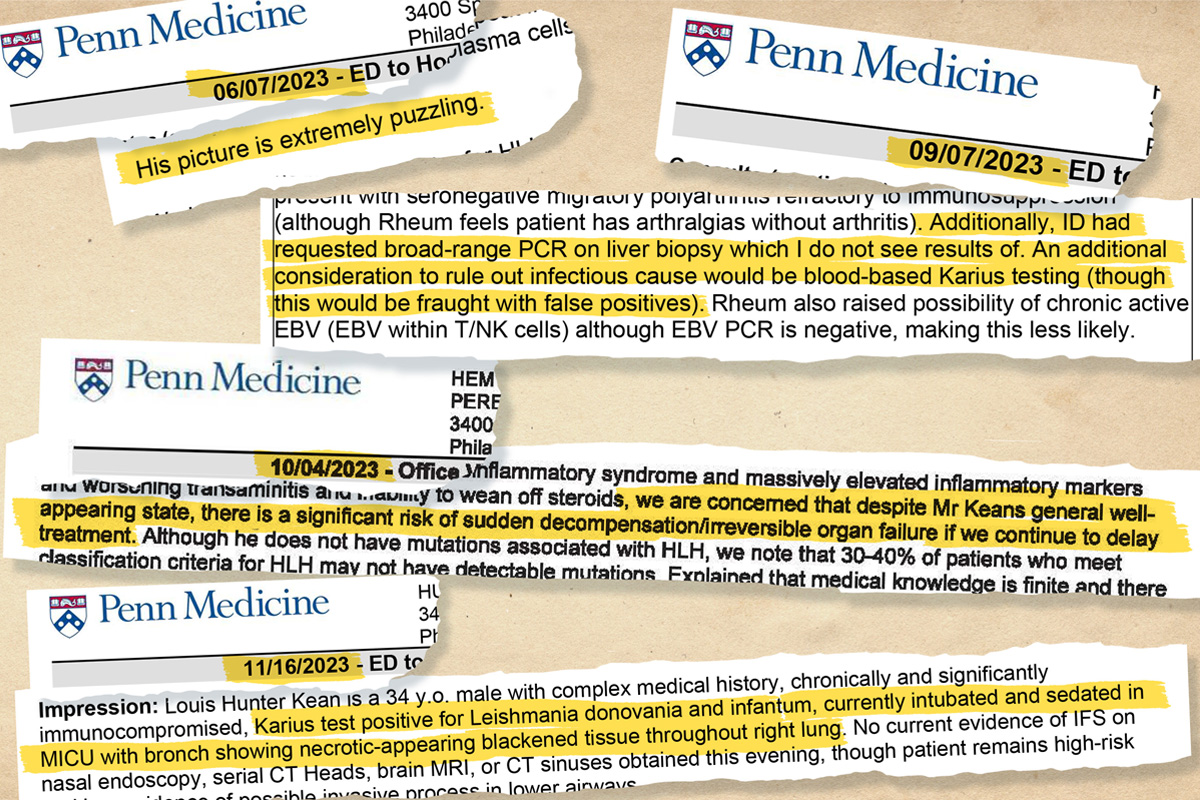
    A sampling of Louis-Hunter Kean’s electronic medical records, which ballooned to thousands of pages over five HUP hospitalizations within six months in 2023.

    Handoffs between doctors

    No single doctor seemed to be in charge of Kean’s care, his family said. And the number of specialists involved worried them.

    “Everyone just kept being like, ‘We don’t know. Go see this specialist. Go see that specialist,’” Kean’s sister, Priscilla Zinsky, said.

    By fall 2023, rheumatologists hadn’t found a trigger of Kean’s symptoms within their specialty. They turned to doctors specializing in blood cancer.

    During the handoff, three doctors noted that they didn’t see the results of the test requested by the infectious disease specialist back in June. They still thought it was possible that Kean had an infection, records show.

    One blood disorder specialist now suggested an additional test that screens for more than 1,000 pathogens, including leishmania.

    “An additional consideration to rule out infectious cause would be blood-based Karius testing (though this would be fraught with false positives),” wrote that doctor, who was still training as a hematologist-oncologist.

    A supervising physician reviewed the Sept. 8, 2023, note and signed off on it. The medical records don’t show any follow-up with infectious disease doctors, and the test wasn’t done at the time.

    In the coming days, blood cancer specialists struggled to find a link between Kean’s symptoms and an underlying disease.

    They thought he might have a rare form of leukemia, but tests weren’t definitive, Kean texted friends.

    Untreated HLH symptoms can lead to rapid organ failure, so doctors often start patients on treatment while trying to figure out the underlying cause, said Gaurav Goyal, a leading national expert on HLH, noting that it can take days to get test results.

    “You have to walk and chew the gum. You have to calm the inflammation so the patient doesn’t die immediately, and at the same time, try to figure out what’s causing it by sending tests and biopsies,” said Goyal, a hematologist-oncologist at the University of Alabama at Birmingham.

    Medical records show that Penn doctors feared Kean was at “significant risk” of “irreversible organ failure.”

    They suggested a more aggressive treatment: a type of chemotherapy used to treat HLH that would destroy Kean’s malfunctioning immune cells.

    In his medical record, a doctor noted that beginning treatment without a clear diagnosis was “not ideal,” but doctors thought it was his best option.

    Four parasitic disease experts told The Inquirer that chemotherapy, along with steroids and immunosuppressants, can be fatal to patients with visceral leishmaniasis.

    “If that goes on long enough, then they kill the patient because the parasite goes out of control,” Libman said, explaining that ramping up the HLH treatments weakens the immune system. “The parasite has a holiday.”
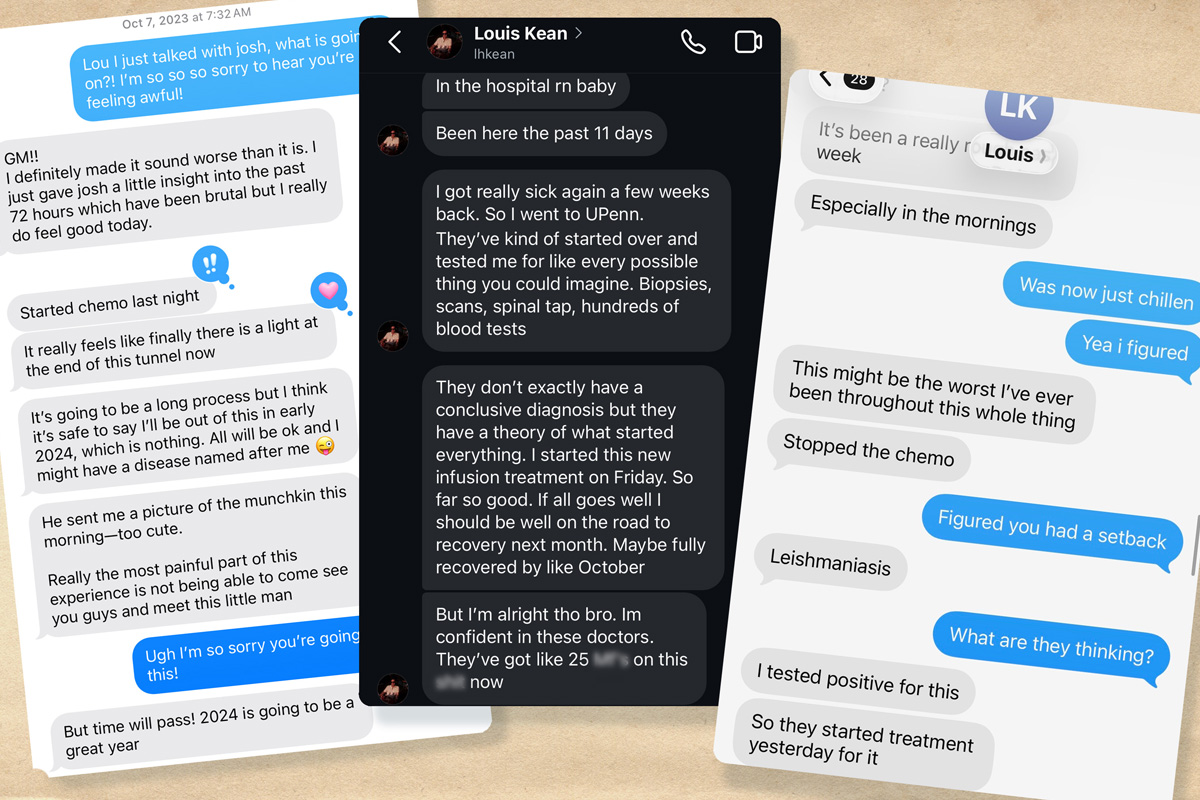
    A sample of text messages from Louis-Hunter Kean to friends during separate HUP hospitalizations over a six-month period in 2023.

    Chemo as last resort

    Kean banked his sperm, because chemo infusions can cause infertility. He told friends he trusted his Penn team and hoped to make a full recovery.

    “Started chemo last night. It really feels like finally there is a light at the end of the tunnel,” he texted a friend on Oct. 7, 2023.

    “I’m gonna get to marry my best friend, and I think I’m going to be able to have children,” Kean wrote in another text to a different friend.

    Kean spent nearly all of October at HUP getting chemo infusions. He rated his pain as a nine out of 10. His joints throbbed. He couldn’t get out of bed. He started blacking out.

    Doctors added a full dose of steroids on top of the IV chemo infusion. By the end of the month, Kean told a friend he feared he was dying.

    A year had passed since Kean first spiked a fever. He no longer could see himself returning to his former life — one filled with daily exercise, helping run his family’s produce store, nights out with friends at concerts and bars, and vacations overseas.

    Lethargic and weak, he could barely feed himself. His sister tried to spoon-feed him yogurt in his hospital bed.

    He started texting reflections on his life to friends and family, saying his illness had given him a “polished lens” through which he could see clearly. He wrote that their love felt “like a physical thing, like it’s a weighted blanket.”

    “I’ve lived an extremely privileged life. I don’t think it’s possible for me to feel bad for myself,” he said in a text. “And I don’t want anyone else to either.”
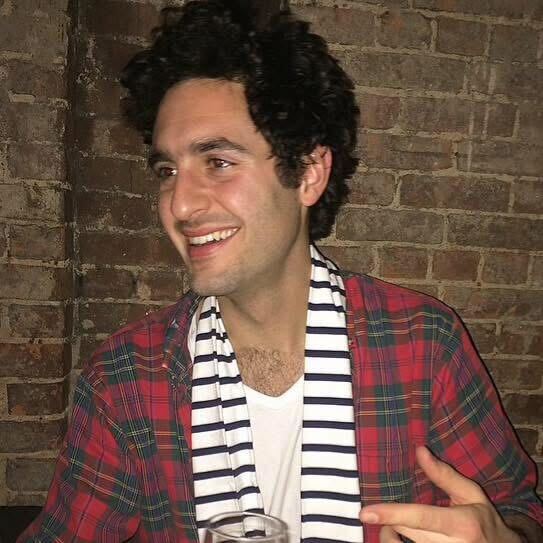
    Louis-Hunter Kean enjoying dinner out with his sister, Jessica Kean, in Manhattan in 2014. Friends and family described him as a “foodie” and health food advocate prior to the onset of his illness in August 2022.

    Puzzle solved

    One doctor involved in Kean’s care had seen him at Penn’s rheumatology clinic in early June 2023, just before his first HUP hospitalization. The doctor, a rheumatology fellow, urged him to go to HUP’s emergency department, so he could be admitted for a medical workup.

    The fellow remained closely involved in Kean’s care, medical records show. Also in his 30s, this doctor shared Kean’s interests in music, fashion, and the city’s restaurant scene, according to Kean’s family.

    “They had a rapport,” Kean’s father, Ted Kean, said. “Louis thought a lot of him, and he seemed to think a lot of my son.”

    By early November 2023, the rheumatology fellow was extremely concerned, medical records show.

    The chemo infusions weren’t helping. Kean still was running a fever of 103. The fellow wrote in his chart that he was worried Kean needed a bone-marrow transplant to replace his failing immune system.

    And doctors still didn’t know the root of his symptoms.

    The fellow contacted the NIH, medical notes show.

    An NIH doctor recommended a test to check for rare pathogens, including parasites that cause visceral leishmaniasis, according to family members present when the testing was discussed.

    The NIH-recommended Karius test was the same one suggested two months earlier by the Penn hematologist-oncologist in training, but with no follow-up.

    File of sign on front of Hospital of the University of Pennsylvania (HUP) taken on Tuesday, March 19, 2024.

    On Nov. 16, the fellow got the results. He went to Kean’s bedside.

    After five HUP hospitalizations over six months, a single test had revealed the cause of his illness: visceral leishmaniasis.

    Kean cried with relief and hugged the fellow, joined by his mother and sister.

    “‘You saved my life,’” Kean’s sister, Jessica Kean, recalled her brother telling the doctor. “‘Finally, we know what this is, and we can treat it.’”

    To confirm the results, Penn sent a fresh blood sample from Kean to a lab at the University of Washington Medical Center for a targeted and highly sensitive leishmania-PCR test created by pathologists there.

    Kean’s medical chart was updated to note that he traveled to “Italy in the past,” also noting he had visited Nicaragua and Mexico. A HUP infectious disease doctor consulted with the Centers for Disease Control and Prevention on antiparasitic medications.

    Meanwhile, Kean’s nose wouldn’t stop bleeding. He felt light-headed and dizzy, with high fever. Even on morphine for his pain, his joints ached.

    “I’ve been struggling, buddy,” he texted a friend on Nov. 20. “This might be the worst I’ve ever been.”

    By Nov. 22, he stopped responding to text messages. He began hallucinating and babbling incoherently, family members recalled. “Things went downhill very, very quickly, like shockingly quickly,” his sister, Priscilla Zinsky, said.

    When she returned on Thanksgiving morning, he was convulsing, thrashing his head and arms. “It was horrifying to see,” Zinsky said.

    Her brother had suffered brain bleeds that caused a stroke. His organs were failing. He had a fungal infection with black mold growing throughout his right lung, medical records show.

    Kean was put on life support, with a doctor noting the still-preliminary diagnosis: “Very medically ill with leishmaniasis.”

    “Prognosis is poor,” read the note in his Nov. 29, 2023, medical records.

    A few hours later, Kean’s family took him off life support. He died that day.

    “All of his organs were destroyed,” said Kean’s mother, Lois Kean. “Even if he had lived, he had zero quality of life.”
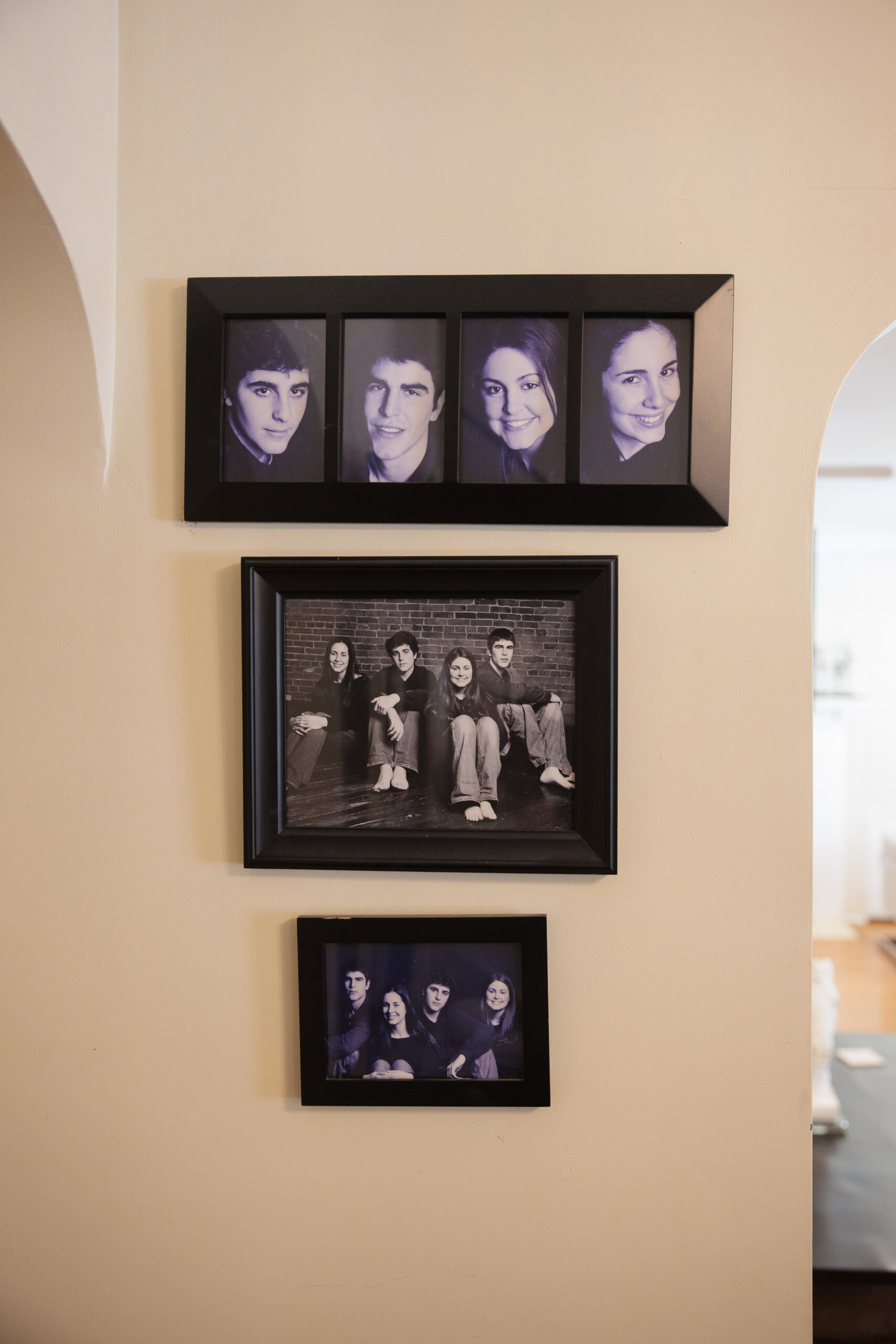
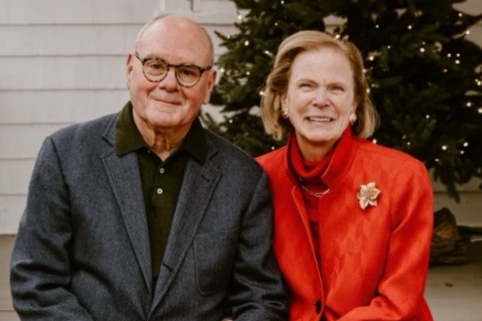
    Portraits of Lois and Ted Kean’s four children decorate a wall at their home in Haddonfield. Their son, Louis-Hunter, died after contracting visceral leishmaniasis, a parasitic infection he likely picked up in Italy. When caught early, it’s treatable with medication. It’s deadly without treatment.

    Post mortem

    The day after his death, HUP received confirmation from the Washington state lab that Kean had the most deadly species of leishmania, medical records show.

    It’s not clear why the parasites began to attack Kean a year after his return from Italy. Healthy people rarely develop severe disease from exposure to the deadly form of the parasite circulating outside the U.S., experts said.

    Most people infected by a sandfly “are probably harboring small amounts of the parasite” in their organs, according to Naomi E. Aronson, a leishmania expert and director of infectious diseases at the Uniformed Services University of the Health Sciences in Bethesda, Md.

    “Most of the time, you don’t have any problem from it,” Aronson said.

    Children under age 5, seniors, and people who are malnourished or immunodeficient are most susceptible to visceral leishmaniasis. Aronson said she worries about people who might harbor the parasite without problems for years, and then become immunocompromised.

    Libman, the parasitic expert from McGill, said he’s seen six to 10 patients die from visceral leishmaniasis because doctors unfamiliar with the disease mistakenly increased immunosuppressants to treat HLH during his 40 years specializing in parasite disease.

    “That’s a classic error,” he said.

    Kean’s case “should be a real clarion call” for infectious disease specialists and other doctors in the U.S., said Joshua A. Lieberman, an infectious disease pathologist and clinical microbiologist who pioneered the leishmania-PCR test at the Washington state lab.

    “If you’re worried about an unexplained [fever], you have to take a travel history that goes back pretty far and think about Southern Europe, Iraq, Afghanistan, India, and maybe even Brazil,” Lieberman said.

    In the wake of Kean’s death, his family was told that Penn doctors held a meeting to analyze his case so they could learn from it.

    An infectious disease doctor called Zinsky, Kean’s sister, to let her know about the postmortem review and shared that doctors discussed that Kean had likely picked up the parasite in Tuscany.

    “Why didn’t you guys have this meeting,” she asked, ”while he was alive?”

    Editor’s note: This story has been updated to clarify that ECRI President Marcus Schabacker was not speaking specifically on Kean’s case.

  • Cherry Hill is considering additions at two schools to ease overcrowding instead of redrawing school boundaries

    Cherry Hill is considering additions at two schools to ease overcrowding instead of redrawing school boundaries

    The Cherry Hill School District has decided against redrawing its elementary school maps to redistribute students and ease overcrowding.

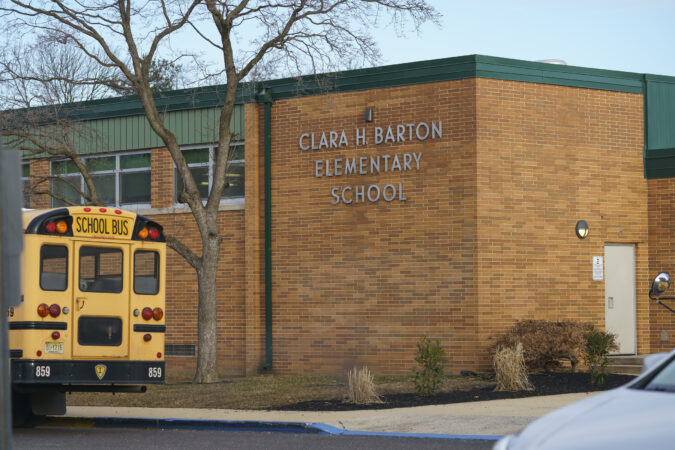
    Instead, the school board will consider adding additions to the two schools with the highest anticipated growth — Clara Barton Elementary and Rosa International Middle School — and continuing to monitor enrollment at four other elementary schools.

    The decision was announced Tuesday night when the district presented a highly anticipated report on rebalancing school enrollment. The South Jersey school system had been considering adjusting the boundaries assigned to each of its 12 elementary schools to handle an anticipated increase in students — a move that sparked opposition from some parents.

    The recommendation is “a huge win,” said Bruck Lascio, whose children attend Barton. “We’ll take their proposal.”

    What does the recommendation involve?

    “The administration is not recommending boundary adjustments at this time,” said George Guy, director of elementary education.

    Guy said both schools now potentially slated for expansion are expected to have a severe shortage of seats by the 2028-29 school year. Clara Barton would be 69 seats short, and Rosa Middle 51 seats, he said.

    The additions, if approved by the school board, would be ready for the start of the 2028-29 school year, Guy said.

    The report also recommends that the district monitor enrollment trends at Horace Mann Elementary, which is also expected to have more students than seats. And it calls for another demographic study in 2026-27 to assess needs at all schools.

    Guy left open the possibility that Mann could also get an addition to ease overcrowding. The district also plans to monitor enrollment at Joyce Kilmer, Richard Stockton, and Woodcrest Elementary Schools.

    Why was rebalancing under consideration?

    A demographic study conducted in 2024 showed that five of Cherry Hill’s 12 elementary schools are expected to have a total shortage of 337 seats in the 2028-29 school year, and prompted the school board to look into rebalancing.

    Cherry Hill began the rebalancing project with a possibility of changing the boundaries for students at five of its 12 elementary schools. Some elementary schools are nearing capacity, and a few have surplus seats.

    In developing a recommendation, Guy had to consider parameters set by the board. It was also important to consider transportation and avoid having students spend longer periods of time on buses.

    Board president Gina Winters said the board basically had two choices: shift students where there were available seats or add more capacity to keep students in their neighborhood schools.

    Rosa International Middle School in Cherry Hill.

    Changing the boundaries would have affected 534 children in the district, which enrolls about 11,000 students, Guy said. Clara Barton and James Johnson Elementary Schools would have faced the biggest impact, he said.

    The sprawling 24.5-mile community of nearly 75,000 is divided into elementary school zones. Most students are assigned to a neighborhood school within two miles of where they live.
    The district also dismissed possible relocation of some special education programs to ease overcrowding because that would further stress students and staff, Guy said.
    Guy said creating new English as a second language (ESL) programs at more schools was also considered, but that option was rejected because it would not have adequately addressed the overcrowding.

    Also under consideration was converting the Arthur Lewis administration building to an elementary school, which could accommodate about 200 students.

    How much would the plan cost?

    Guy said the additions are expected to cost between $5 million and $7 million each. The cost would be funded using interest earnings from the district’s $363 million bond referendum approved in 2022, he said.

    According to Guy, the costs would not affect the property tax rate. Winters said there could be additional budget costs in the future to hire additional teachers and administrators.

    How did parents react to the proposal?

    Parents who had lobbied heavily against having their children moved because they like the convenience of neighborhood elementary schools welcomed the recommendations.

    “We love our school,” said Katie Daw, whose children attend Clara Barton in the township’s Erlton section. “This is the best-case scenario.”

    Marie Blaker said she had braced for bad news Tuesday. She is part of a Clara Barton group that has organized other parents.

    “We didn’t think it was going to go like this,” Blaker said. “I’m thrilled they listened to us.”

    What’s next?

    The nine-member board did not vote on the recommendations Tuesday night. Winters said the board appeared to support the recommendation.

    Winters said public hearings would be held at Barton and Rosa. A final plan is expected by the summer, at which point the board will vote on the proposal.

    Guy has said officials are not yet examining future enrollment needs at the remaining middle schools and high schools.

    “The reality is that we will be faced with very difficult decisions,” board member Renee Cherfane said.

  • Robert E. Booth Jr., pioneering knee surgeon and celebrated antiquarian, has died at 80

    Robert E. Booth Jr., pioneering knee surgeon and celebrated antiquarian, has died at 80

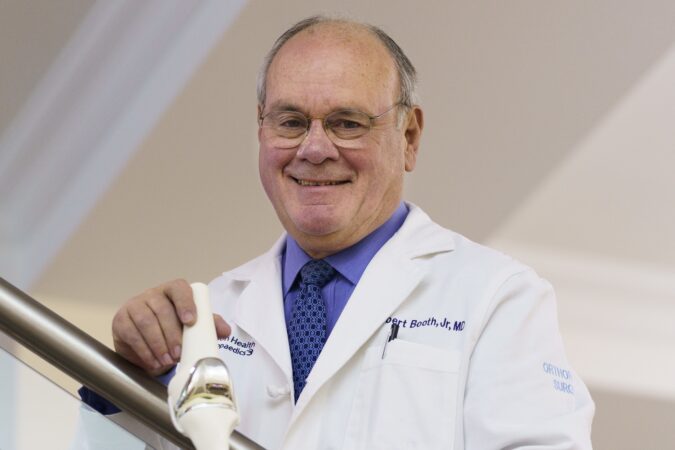
    Robert E. Booth Jr., 80, of Gladwyne, renowned pioneering knee surgeon, former head of the Department of Physical Medicine and Rehabilitation at Pennsylvania Hospital, celebrated antiquarian, professor, researcher, writer, lecturer, athlete, mentor, and volunteer, died Thursday, Jan. 15, of complications from cancer at his home.

    Born in Philadelphia and reared in Haddonfield, Dr. Booth was a top honors student at Haddonfield Memorial High School, Princeton University, and what is now the Perelman School of Medicine at the University of Pennsylvania. He was good at seeing things differently and went on to design new artificial knee joint implants and improved surgical instruments, serve as chief of orthopedics at Pennsylvania Hospital, and mentor celebrated surgical staffs at Jefferson Health, Aria Health, and Penn Medicine.

    He joined with two other prominent doctors to cofound the 3B orthopedic private practice in the late 1990s and, over 50 years until recently, performed more than 50,000 knee replacements, more than anyone, according to several sources. Last March 26, he did five knee replacements on his 80th birthday.

    In a tribute, fellow physician Alex Vaccaro, president of Rothman Orthopaedic Institute, said: “He restored mobility to thousands, pairing unmatched technical mastery with a compassion that patients never forgot.”

    In a 1989 story about his career, Dr. Booth told The Inquirer: “It’s so much fun and so gratifying and so rewarding to see what it means to these people. You don’t see that in the operating room. You see that in the follow-ups. That’s the fun of being a surgeon.”

    Friends called him “a legend in his profession” and “a friend to everyone” in online tributes. He was known to check in with patients the night before every surgery, and a colleague said online: “Patients were all shocked by his compassion.”

    Dr. Booth was also praised for his organization and collaboration in the operating room. “His OR was a clinic in team work and efficiency,” a former colleague said on LinkedIn.

    He told Medical Economics magazine in 2015: “I love fixing things. I like the mechanics and the positivity of something assembled and fixed.”

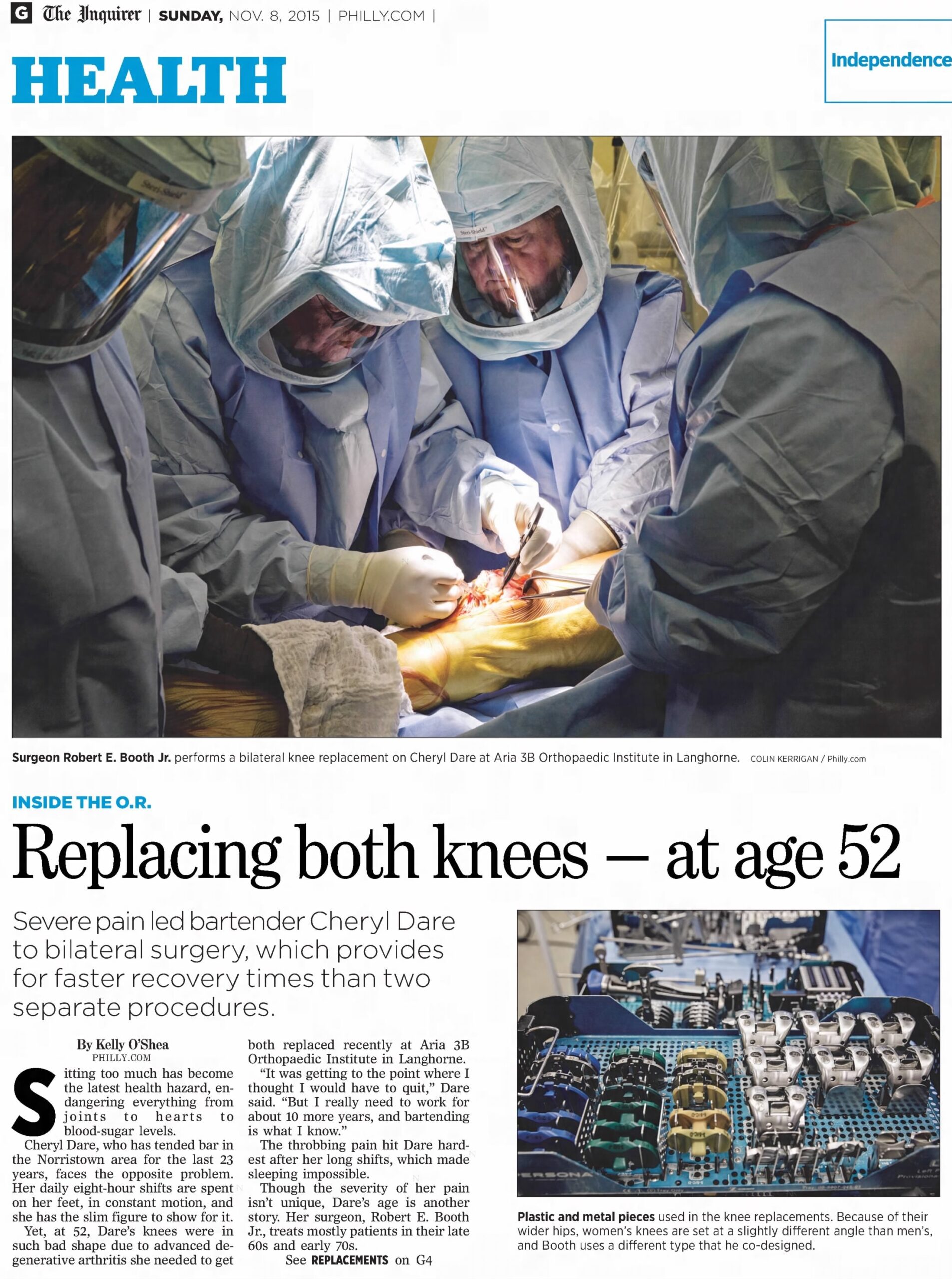
    This article about Dr. Booth’s practice was published in The Inquirer in 2015.

    His procedural innovations reduced infection rates and increased success rates. They were scrutinized in case studies by Harvard University and others, and replicated by colleagues around the world. Some of the instruments he redesigned, such as the Booth retractor, bear his name.

    He was president of the Illinois-based Knee Society in the early 2000s and earned its 2026 lifetime achievement award. In an Instagram post, colleagues there called him “one of the most influential leaders in the history of knee arthroplasty.”

    He was a professor of orthopedics at Penn’s school of medicine, Thomas Jefferson University Hospital, and the old Allegheny University of Health Sciences. He loved language and studied poetry on a scholarship in England after Princeton and before medical school at Penn. He told his family that his greatest professional satisfaction was using both his “manual and linguistic skills.”

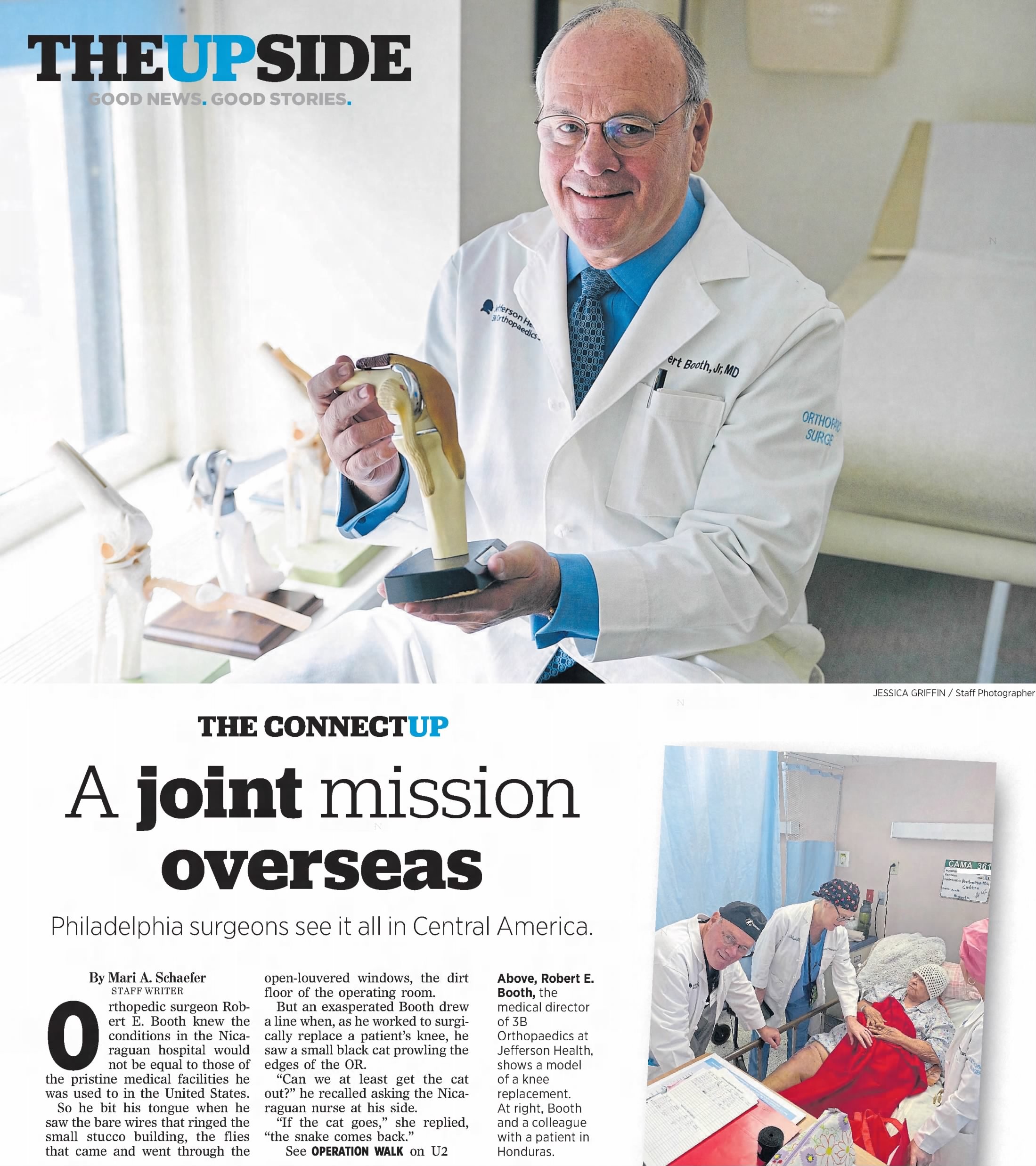
    He was onetime president of the International Spine Study Group and volunteered with the nonprofit Operation Walk Denver to provide free surgical care for severe arthritis patients in Panama, Guatemala, Honduras, Nicaragua, and elsewhere. Colleagues at Operation Walk Denver noted his “remarkable spirit, profound expertise, and unwavering commitment” in a Facebook tribute.

    This story about Dr. Booth’s charitable work abroad appeared in The Inquirer in 2020.

    At home, Dr. Booth and his wife, Kathy, amassed an extensive collection of Shaker and Pennsylvania German folk art. They curated five notable exhibitions at the Philadelphia Antiques Show and were recognized as exceptional collectors in 2011 by the Philadelphia Society for the Preservation of Landmarks.

    He lectured widely about art and antiques, and wrote articles for Magazine Antiques and other publications. He was president of the American Folk Art Society and active at the Philadelphia Museum of Art, the Metropolitan Museum of Art in New York, and the Canterbury Shaker Village in New Hampshire.

    “He was larger than life for sure,” said his daughter, Courtney.

    Robert Emrey Booth Jr. was born March 26, 1945, in Philadelphia. He was the salutatorian of his senior class and ran track and field at Haddonfield High School.

    Dr. Booth enjoyed time with his family.

    He earned a bachelor’s degree in English at Princeton in 1967, won a letter on the swimming and diving team, and played on the school’s Ivy League championship lacrosse team as a senior. He wrote his senior thesis about poet William Butler Yeats and returned to Philadelphia from England at the suggestion of his father, a prominent radiologist, to become a doctor. He graduated from Penn’s medical school in 1972.

    “I always liked the intellectual side of medicine,” he told Medical Economics. “And once I got to see the clinical side, I was pretty well hooked.”

    He met Kathy Plummer at a wedding, and they married in 1972 and had a daughter, Courtney, and sons Robert and Thomas. They lived in Society Hill, Haddonfield, and Gladwyne.

    Dr. Booth liked to ski and play golf. He was an avid reader and enjoyed time with his family on Lake Kezar in Lovell, Maine.

    “He was quite the person, quite the partner, and quite the husband,” his wife said, “and I’m so proud of what we built together.”

    Dr. Booth and his wife, Kathy, married in 1972.

    In addition to his wife and children, Dr. Booth is survived by six grandchildren and other relatives.

    A private celebration of his life is to be held later.

    Donations in his name may be made to Operation Walk Denver, 950 E. Harvard Ave., Suite 230, Denver, Colo. 80210.

  • A West grad’s ode to Eagles tailgates | Inquirer Cherry Hill

    A West grad’s ode to Eagles tailgates | Inquirer Cherry Hill

    Hello, Cherry Hill! 👋

    A West grad’s latest project explores the religious-like experience of Eagles fandom. We take a peek. Also this week, we’re following the latest on the Kibitz Room closure, plus the former Lone Star Steakhouse is one step closer to being demolished.

    If someone forwarded you this email, sign up for free here.

    A West grad explores the religious-like experience of Eagles fandom

    A photo of Eagles fans tailgating from Mike Cordisco’s “Sermon on the Lot.”

    The Eagles aren’t the reigning Super Bowl champs anymore, but a new photo project by a Cherry Hill native explores a question about our fandom: Is it akin to religious fervor?

    Photographer Mike Cordisco set out to document Eagles fans and their tailgates, going beyond the stereotypical rowdy image and leaning into the religious-like experience of “sacred Sundays.” He’s compiled them into a 98-page book called Sermon on the Lot, which showcases photos of fans outside the Linc between 2018 and 2025.

    “On Sundays, you go to Mass,” Cordisco said. “But in Philly, you go to the parking lot and tailgate an Eagles game.”

    Some of Cordisco’s work is on display at Unique Photo in Center City through mid-March.

    Read more about the West grad and what inspired his latest project.

    💡 Community News

    • Reminder for residents: The extended deadline to pay the first half of this year’s township tax bills is next Wednesday.
    • A Cherry Hill man is mourning the death of his father, who died in a fire at their Main Street home on Jan. 31. In the aftermath, Hazem Abdalla, 27, wants people to remember his father, Eid, for his life, not his death. Eid was born in Egypt, where he started a construction company before moving to New Jersey for his sons to get a better education. Eid, who was 69, had previously worked as a taxi driver and a chef at the former Cherry Hill Diner. A crowdfunding campaign has raised more than $40,000 for funeral and rebuilding costs. The cause of the fire, which also damaged a neighbor’s house, is still under investigation. (NJ Pen and Fox 29)
    • After being empty for nearly 20 years, the former Lone Star Steakhouse building on Route 38 is closer to being demolished. A court recently ruled that the derelict building qualified as abandoned and that an uncontested foreclosure could move forward. The roughly 5,700-square-foot building has been vacant since 2007. (Courier Post)
    • Skechers is gearing up for a mid-spring opening at Garden State Pavilions, a company spokesperson confirmed. The shoe and apparel retailer will open between Five Below and Staples, taking over 8,500 square feet.
    • The Cherry Hill Fire Department is hosting a child safety seat event on Friday from 9 a.m. to noon at the Deer Park Station.

    🏫 Schools Briefing

    • About 500 East students walked out of school Friday morning as part of a student-organized ICE protest that lasted about one hour. “We need to make sure that ICE understands that we’re watching, we’re listening, and we’re not going to stop fighting back until they leave the innocent people in our communities alone,” one of the organizers said. (Eastside)
    • A settlement agreement has been reached between Cherry Hill Public Schools and the Zionist Organization of America, which filed a complaint in June 2024 on behalf of an East student. In the complaint, the Zionist Organization alleged that the school district retaliated against the Jewish student, who reported alleged antisemitic harassment. Under the settlement, the student’s disciplinary record is being expunged. (Philadelphia Jewish Exponent)
    • Reminder for families: Monday is a makeup day for one of last month’s snow closures. There’s no school for students on Tuesday for the Lunar New Year, but teachers will report for an in-service day. See the district’s full calendar here.

    🍽️ On our Plate

    • Two weeks after The Kibitz Room abruptly closed, former owner Brandon Parish said he is working to reopen the beloved deli “under a new entity.” An attorney for the deli, now owned by Brandon’s mom Sandy Parish, filed for Chapter 7 bankruptcy protection on Friday.
    • Fast-casual takeout eatery Rice & Spud Station opened last week at 404 Marlton Pike East in Saw Mill Village. The Halal eatery serves loaded baked potatoes, rice bowls, and desserts.
    • In case you missed it, Bahama Breeze’s parent company last week announced the upcoming closure of all the remaining tropical restaurant’s outposts by early April, including at the Cherry Hill Mall.
    • Cherry Hill real estate developer Shamikh Kazmi is looking to expand his Yum Grills brand to 200 locations, largely in the Philadelphia area, with around 15 slated to open in the next few months. The expansion of the new fast-food eatery that serves smash burgers, cheesesteaks, and loaded french fries is expected to cost $60 million. It’s unclear if any locations will be in town. (Philadelphia Business Journal)
    • The owners of Old World Italian eatery Il Villaggio are gearing up to open Duo Restaurant & Bar in Westmont this month.

    🎳 Things to Do

    🏺 Galentine’s Pottery Class: Try your hand at ceramics at this intro class, which also includes sparkling cider, for anyone 13 and older. ⏰ Friday, Feb. 13, 6 p.m. 💵 $125 📍Hugs Ceramics

    💃 Valentine’s Social Dance: If dancing is more your style, this event kicks off with a group class before segueing into a social dance with a DJ and light snacks. ⏰ Friday, Feb. 13, 7-10 p.m. 💵 $20 📍Storm BDC

    ❤️ Valen-Wine Celebration: Yogi Berra Lodge No. 3015 is hosting a Valentine’s-themed event complete with dinner, dessert, and wine. ⏰ Friday, Feb. 13, 7-11 p.m. 💵 $45 📍American Legion Post #372

    🫖 Tea Party Fundraiser: Monday is the deadline to register for this library fundraiser, which includes afternoon tea, a Jane Austen movie, and a fascinator make-and-take. ⏰ Sunday, March 1, 1-4 p.m. 💵 $35 📍Cherry Hill Public Library

    🏡 On the Market

    A four-bedroom home with an indoor hot tub

    The home’s two-story family room has a hot tub, wet bar, and ample windows.

    Located in the Ridings of Fox Run, this four-bedroom home has had just one owner since it was built in 1978. Among its most unique features is a two-story family room with an eight-seat hot tub and a wet bar. A second-floor library looks onto the airy space. There’s also a dining room, a family room with a fireplace, and an eat-in kitchen with granite countertops on the first floor. Upstairs, the primary suite has skylights, a gas fireplace, and a jacuzzi. Outside, the wooded property has a deck and a koi pond.

    See more photos of the property here.

    Price: $879,000 | Size: 3,467 SF

    🗞️ What other Cherry Hill residents are reading this week:

    By submitting your written, visual, and/or audio contributions, you agree to The Inquirer’s Terms of Use, including the grant of rights in Section 10.

    This suburban content is produced with support from the Leslie Miller and Richard Worley Foundation and The Lenfest Institute for Journalism. Editorial content is created independently of the project donors. Gifts to support The Inquirer’s high-impact journalism can be made at inquirer.com/donate. A list of Lenfest Institute donors can be found at lenfestinstitute.org/supporters.

  • A look at how Ventnor is completely rebuilding its boardwalk

    A look at how Ventnor is completely rebuilding its boardwalk

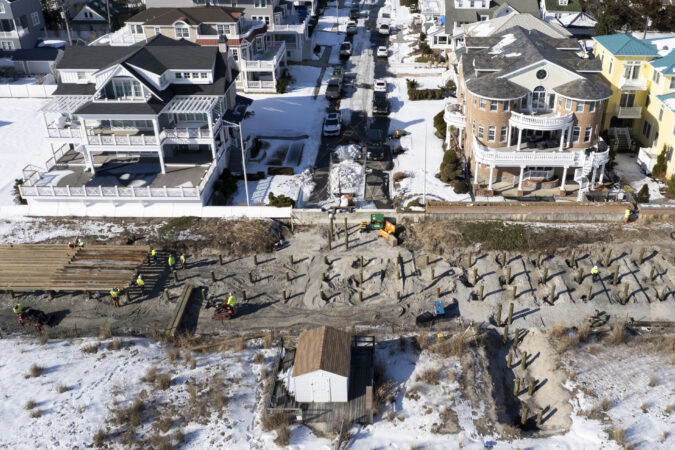
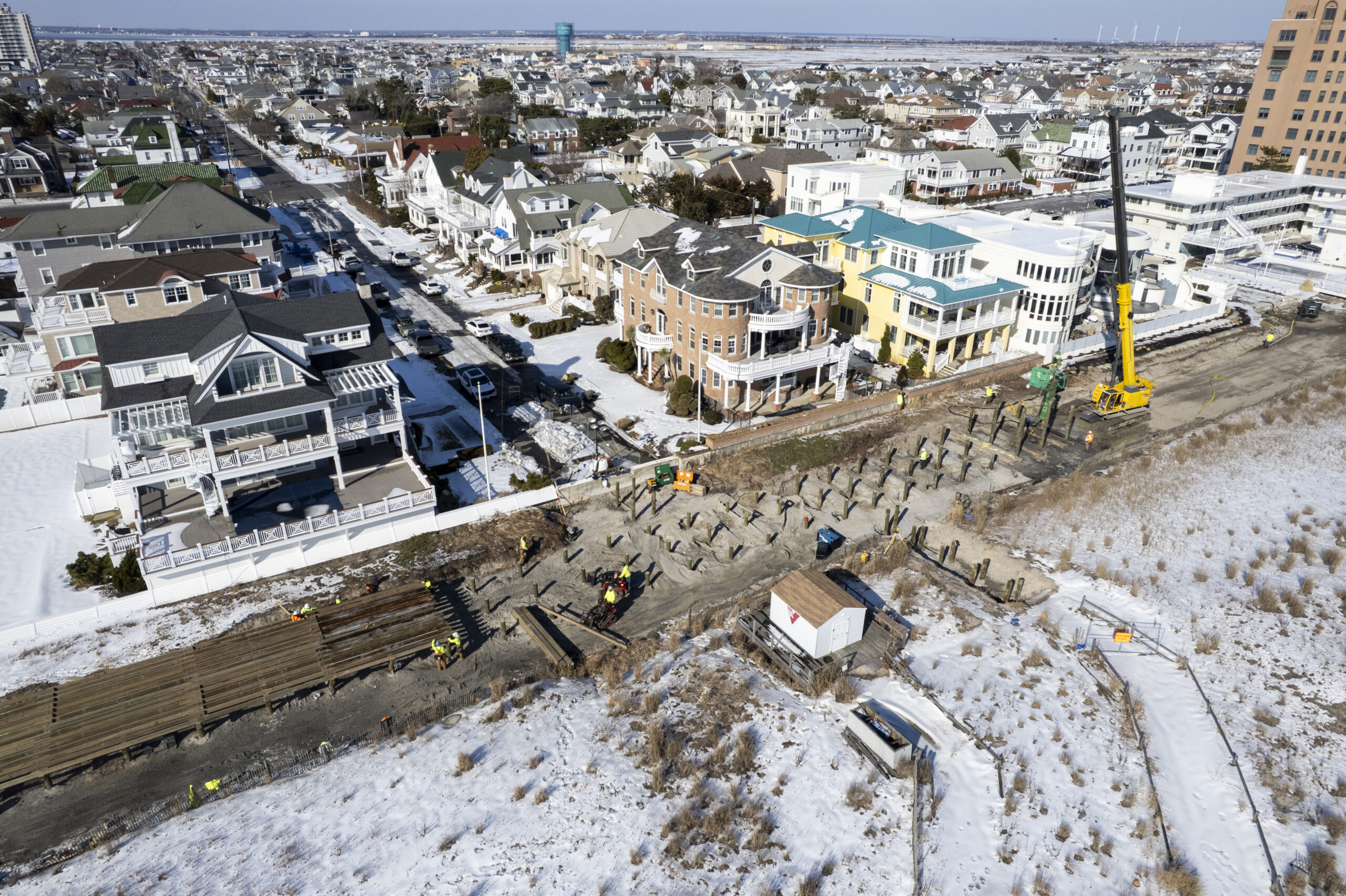
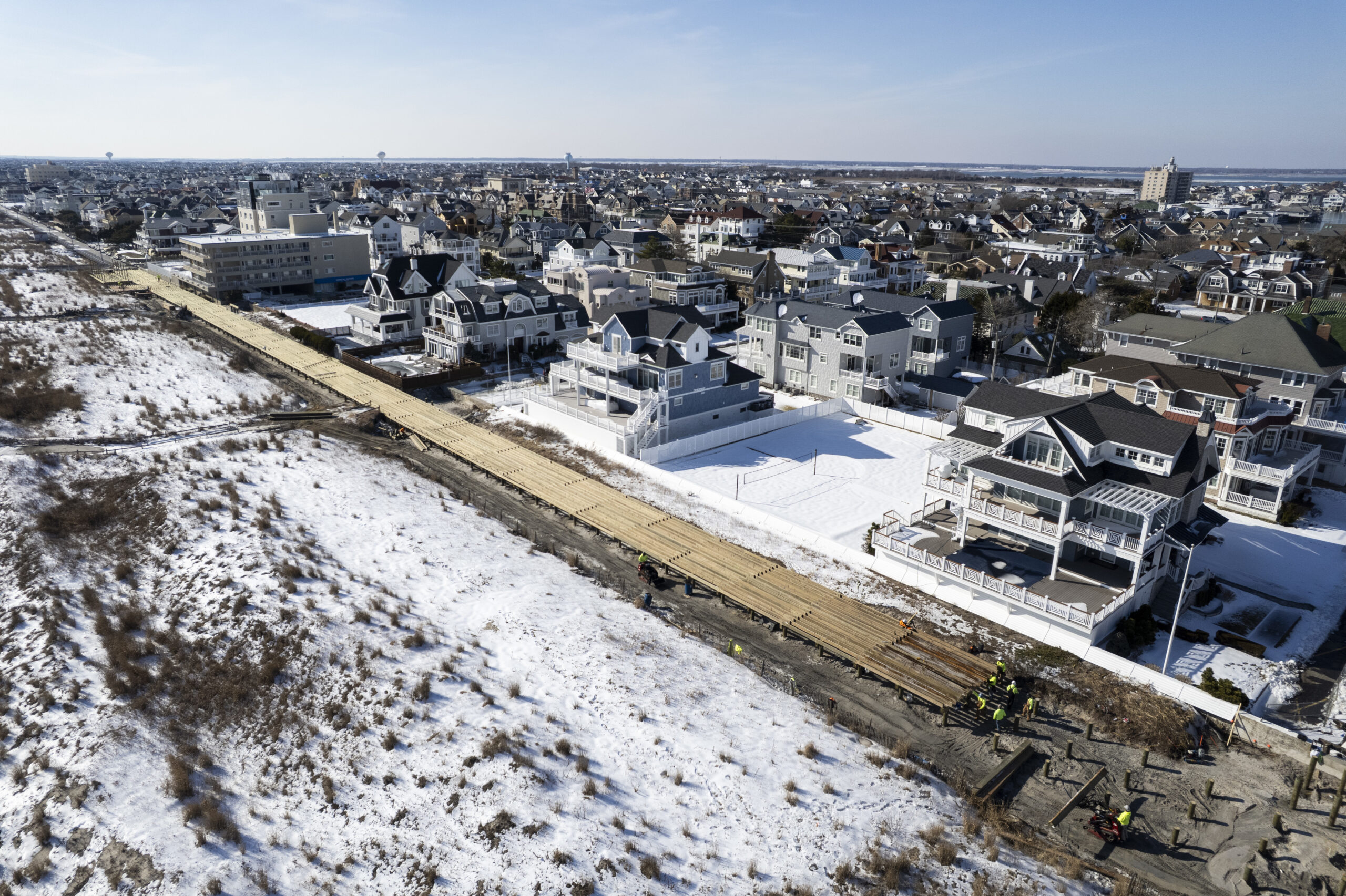
    VENTNOR, N.J. — They demolished the existing boardwalk from the tennis courts to the fishing pier, north to south, and now they are building their way back up.

    Financed mostly with federal funds granted to New Jersey from the COVID American Rescue Plan, Ventnor and other Shore towns like Ocean City, North Wildwood, Atlantic City, and Wildwood have set out to redo or upgrade their iconic pathways.

    Ventnor is using $7 million in federal funds and bonded for about $4 million more, officials said.

    Will this stretch of boardwalk reconstruction be done by Memorial Day?

    Construction continues on the boardwalk on Wednesday, Feb. 4, 2026, in Ventnor City, N.J.

    “It’s always a worry,” Ed Stinson, the Ventnor city engineer, said in an interview late last month. “We’ve had multiple meetings with the contractor [Schiavone Construction], one as recent as three weeks ago. In all the meetings, he’s said it’ll be complete and open before Memorial Day.”

    The reconstruction has delivered a seven-block offseason interruption in a walkway that is popular year-round.

    Work will stop for the summer, city officials say. In the fall, a second 13-block section, from Suffolk Avenue to the Atlantic City border at Jackson Avenue, will begin. There is currently no funding or plan for the boardwalk from Cambridge south to the Margate border, said Stinson.

    The biggest change people will notice is that the original and distinctive angled herringbone decking pattern of the boardwalk is being replaced with a straight board decking. Ultimately, it came down to cost over tradition.

    “There was discussion about it,” said Stinson. “There’s additional lumber that’s wasted when you do the herringbone, and the labor to cut that material. The additional material costs were significant. It’s a waste of tropical lumber. The only reason to go herringbone is tradition and appearance.”

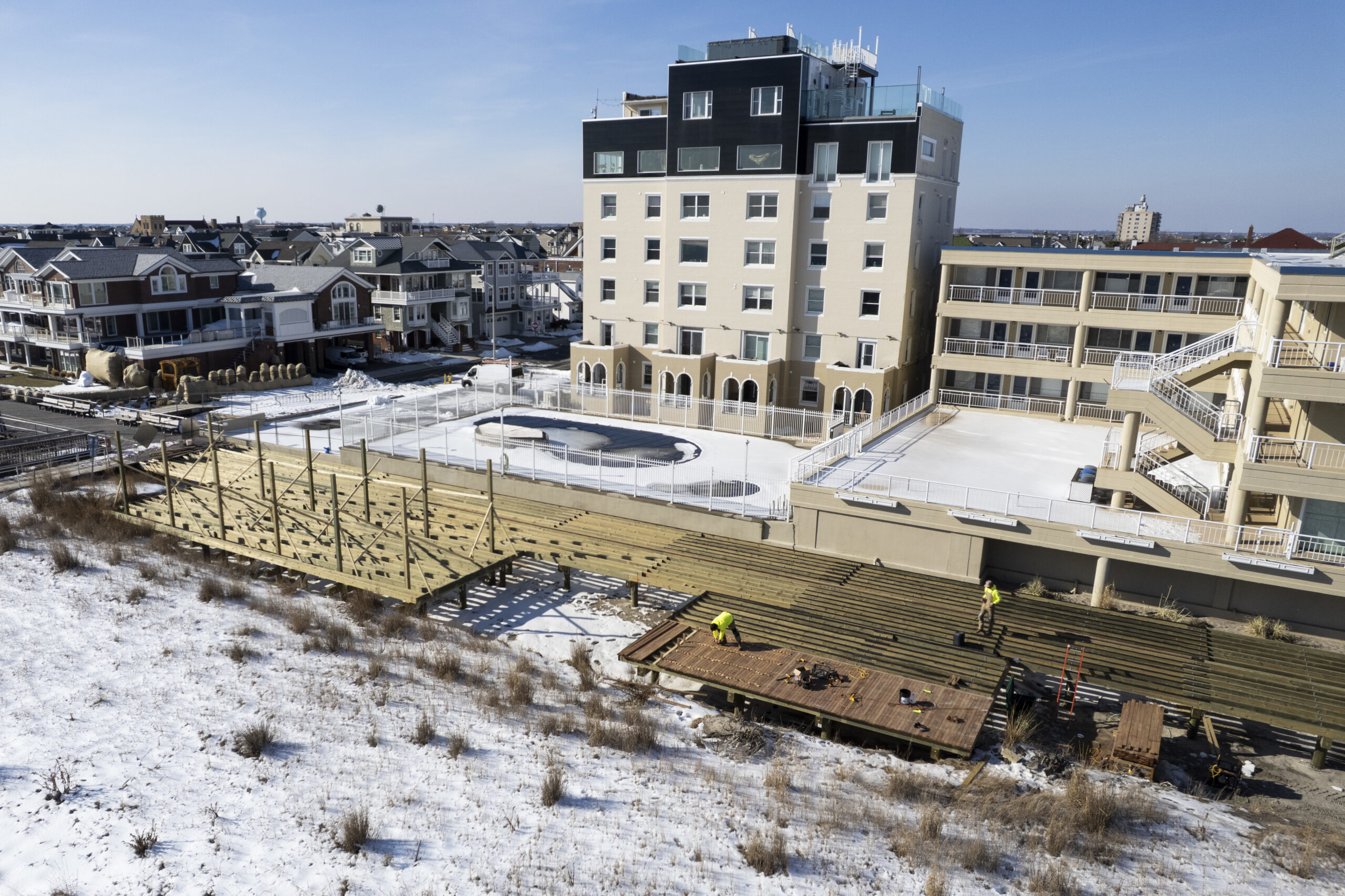
    The reconstruction has delivered a seven-block offseason interruption in a walkway that is popular year-round. Work will stop for the summer, city officials say.

    Other differences are changes in lighting (lower, more frequent light poles) and some enhancements of accessible ramps. The existing benches, with their memorial plaques, will be back.

    To demolish the boardwalk, the contractor cut the joist and the decking in 14-foot sections, “swung it around, carried it over to the volleyball court,” Stinson said, on Suffolk Avenue.

    “That’s where they did their crushing and loading into the dumpsters. They worked their way down and followed that with the pile removing.”

    The original herringbone pattern can be seen on the left, compared with the new straight decking pattern on the new construction side.

    The other massive job was excavating the sand that had accumulated under the boardwalk. “They screened it, cleaned it, and put it down there,” on the beach in piles. It will be spread around above the tide line, Stinson said.

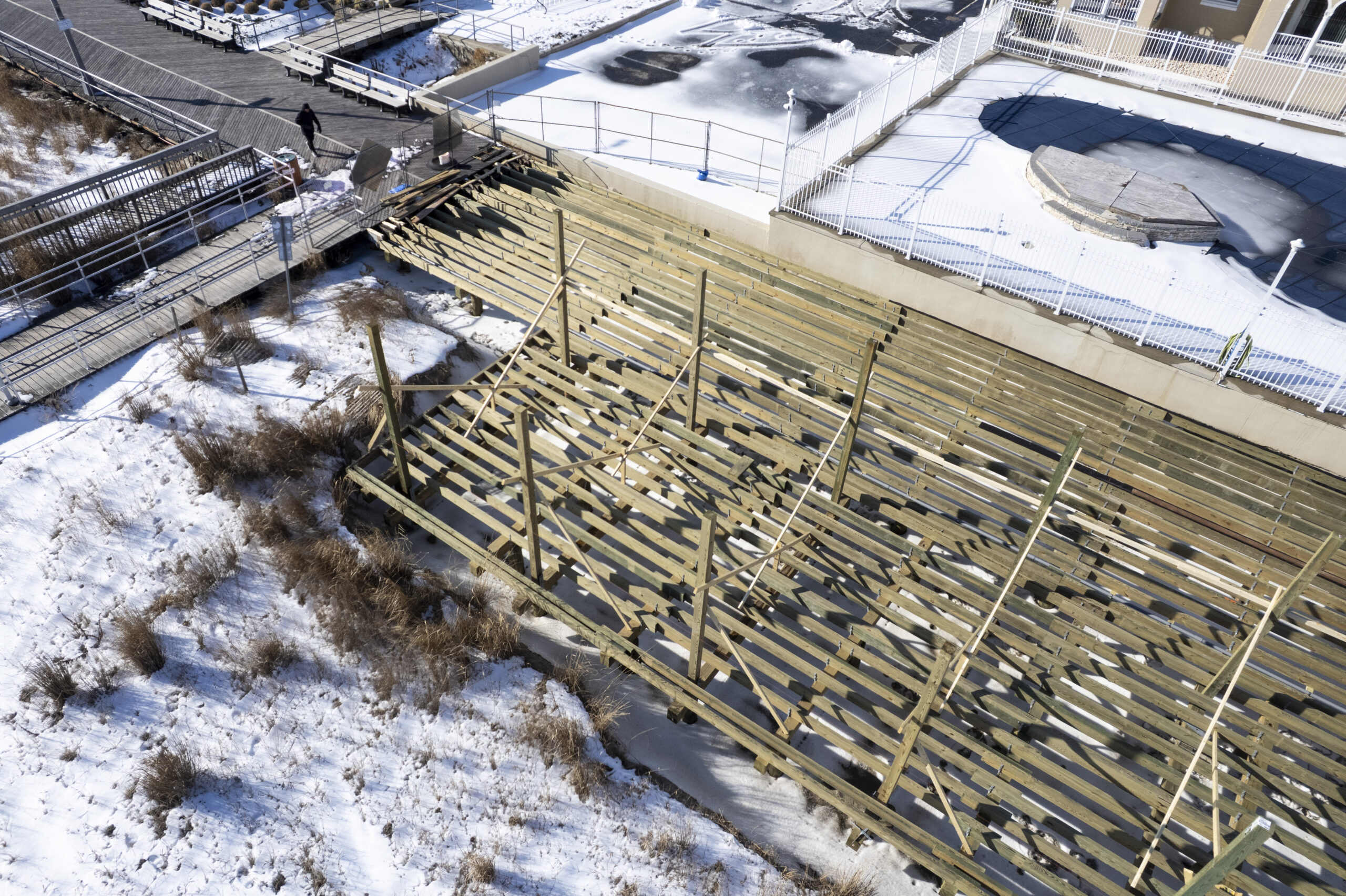
    Once the excavation was down, the pile driving crew set out beginning at the south end and working their way toward Suffolk Avenue. “Then the framing crew came in and started framing,” Stinson said. On Feb. 2, the third team began its work: the decking crew.

    The weather has slowed the pace, Stinson said. “They were doing about 20 to 24 piles a day,” he said, a pace that dropped to about nine piles a day after the snowstorm and ice buildup.

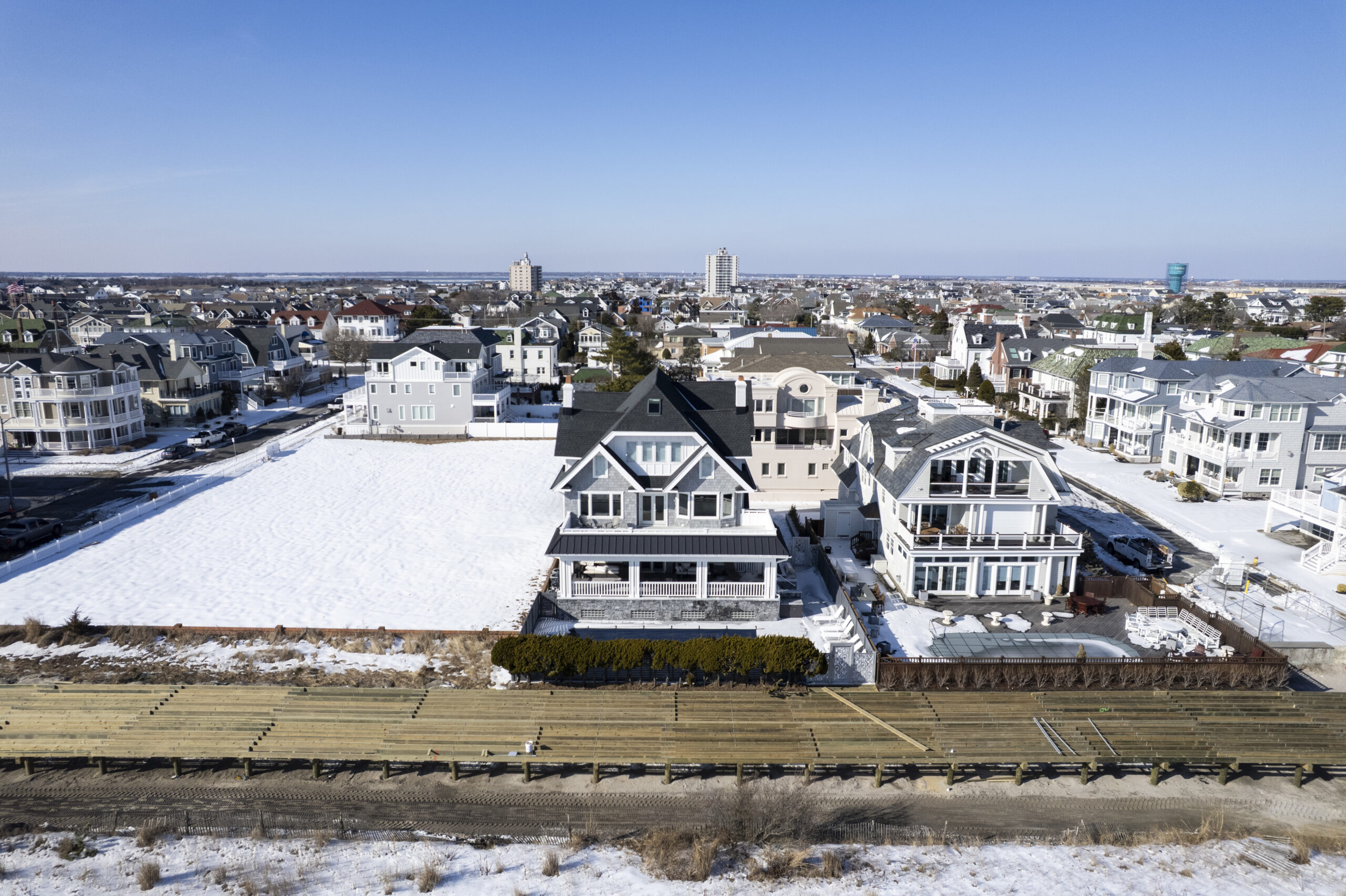
    The framing crew installs pile caps, 8-by-14 beams that run across the boardwalk atop the pilings. The decking crew follows behind them, installing the wood, a tropical wood known as Cumaru. The use of Brazilian rainforest lumber at one time inspired protests, but that has not been an issue this time.

    Construction continues on the boardwalk on Wednesday, Feb. 4, 2026, in Ventnor City, N.J.

    Ventnor’s boardwalk, which links to Atlantic City’s famous walkway, dates to 1910. It was rebuilt twice before: once after the hurricane of 1944 and again after the March storm of 1962. Margate, on the southern end, never rebuilt its boardwalk after 1944.

    Stinson said the tropical wood is noted for its “denseness and durability. It does not last forever.”

    In all, $100 million of American Rescue funds was set aside by Gov. Phil Murphy for a Boardwalk Fund and awarded to 18 municipalities, including, as Stinson said, “anybody who has anything close to a boardwalk.”

    Brigantine, with its promenade, received $1.18 million. Ocean City, in the process of rebuilding a portion of its north end boardwalk, received $4.85 million.

    The two biggest recipients were Asbury Park and Atlantic City, each receiving $20 million. Atlantic City has completed a rebuilding of its Boardwalk to stretch all the way around the inlet to Gardner’s Basin. Wildwood, with $8.2 million, has undertaken a boardwalk reconstruction project, and North Wildwood, receiving $10.2 million, is rebuilding its boardwalk between 24th and 26th Streets, combining the herringbone pattern with a straight board lane for the tram car.

    Although the timing of the reconstruction was no doubt prompted by the availability of the federal funds, Stinson said Ventnor’s boardwalk had shown signs of age.

    “We’ve been into some significant repairs on the boardwalk,” Stinson said. “Those have increased every year. We were getting into pile failures. It was due. I don’t know if the city would have tackled it without the [federal] money.”

    Ventnor’s boardwalk, which links to Atlantic City’s famous walkway, dates to 1910. It was rebuilt twice before: once after the hurricane of 1944 and again after the March storm of 1962.
  • Former federal workers are taking up local government jobs

    Former federal workers are taking up local government jobs

    Some federal workers aren’t leaving public service altogether. They’re landing jobs in local government.

    A job-seeking platform managed by national nonprofit Work for America is helping some workers find those new roles. The service is relatively new but predates President Donald Trump’s efforts to shrink the federal workforce in 2025.

    Some 350 workers with federal job experience in Pennsylvania and 169 in New Jersey have used the platform, called Civic Match, since it was founded in November 2024.

    Nearly 900 state and local government roles in Pennsylvania have been posted on the platform since its start and 42 in New Jersey.

    And, according to new data, 187 former federal workers across the U.S. have used the site and landed jobs in state or local government.

    While that’s a small fraction of the total federal workers who have left their jobs in the last year amid the Trump administration’s shake-up of the workforce, the new data shed light on where workers are landing after leaving government positions.

    The federal government cut 271,000 jobs from January through November last year. That included workers who were laid off, left of their own accord, or took a government incentive to resign.

    In October, just after Trump’s deferred resignation program took effect, Pennsylvania and New Jersey lost roughly 6,000 federal jobs.

    There really isn’t a centralized place where someone looking for a state or other local government job can go, said Caitlin Lewis, executive director at Work for America. The platform is open only to job seekers who have federal work experience or who lost their jobs because of federal funding cuts, but Lewis hopes to open it up to others in the future.

    Who are these federal workers?

    Austin Holland was working in the U.S. Department of Housing and Urban Development last year, when federal workers were instructed to begin working in the office full-time. He had been working remotely from Lancaster much of the time and commuting to Washington, a few days per pay period. Relocating to D.C. wasn’t feasible for him.

    “I really enjoyed my federal job, and I had imagined that it was kind of something I was going to do for my entire career,” he said. “I was struggling with losing that and trying to figure out ‘Where is my career going from here?’”

    Holland estimates that he joined the Civic Match platform in early 2025. Through a virtual job fair, he made a connection that ultimately led to a job at the Pennsylvania Housing Finance Agency. He took a pay cut but was able to stay in Lancaster — and in public service.

    Before leaving his job at the Environmental Protection Agency, Andrew Kreider uploaded his resume to Civic Match and attended some of the platform’s webinars.

    “It was refreshing and validating to have such high-quality hiring officials participating,” Kreider said. “I think it helped remind those of us who maybe were a little bit disillusioned — or were feeling traumatized by what we had just been through — that there were places where we could continue to serve where we wouldn’t be subject to what we were going through at the federal level.”

    Kreider, who lives in Chester County, also used LinkedIn to look for jobs and searched government websites. He ultimately landed a communications director job with Chester County, which he found on the county’s job listing board.

    He’s been in the new job for roughly two months and says some days are “completely overwhelming.”

    Andrew Kreider in Philadelphia in April 2025.

    “County governments do a lot of work with not as many resources as federal agencies tend to have,” he said. “I’m working as a communication director for an organization three times the size of the one I came from, but I’m making significantly less money and sort of being responsible for communications related to far more things.”

    He’s taken a pay cut but said he loves the new job.

    “It’s been, for me, an affirmation of how many good people there are who just want to help,” Kreider said. “I’m surrounded by people who come into work every day to serve their neighbors and their communities.”

    On a recent Thursday afternoon in February, Civic Match had seven jobs posted in Philadelphia. Available positions with the city included a chief epidemiologist, a director of tax policy, and a director of adult education.

    The majority of the 187 platform users who have found jobs — 63% — are workers with at least eight years of public sector experience, according to new data from Work for America. Roughly 40% found jobs in human resources or other operations-related roles.

    One-third of those hired have relocated for their new jobs out of state, with 22% reporting a move of over 100 miles from their previous position.

    Their federal experience came from a range of departments, including the Departments of Health and Human Services, Housing and Urban Development, and Transportation, as well as USAID, the General Services Administration, and the Environmental Protection Agency.

    The aim of Work for America is to curb staffing shortages in local governments and help speed up their hiring process, Lewis said.

    “Unlike the private sector, government does not really think about its employer brand and marketing itself as a potential employer,” she said. “Individual local governments don’t have the same amount of resourcing to actually think about expressing an employee value proposition and really marketing to folks who could be great fits for roles that they have open.”

  • Weekend to stay frigid, forecasters say, but heat wave to near 40 may arrive on Wednesday

    Weekend to stay frigid, forecasters say, but heat wave to near 40 may arrive on Wednesday

    The frigid temperatures, the blocks of ice clogging the Delaware and Schuylkill Rivers, and the mounds of snow piled high in driveways and parking lots across the Philadelphia region are not likely to change much Sunday and Monday, Zack Cooper said Saturday afternoon.

    Cooper, a meteorologist at the National Weather Service in Mount Holly, said to expect a high of just 18 degrees on Sunday, a significant drop from Saturday’s high of 28. For Monday’s return to work for many, the weather service predicts a high of 36.

    “It’s been a long time since we’ve seen this type of prolonged stretch of cold weather,” Cooper said. “It’s been about 10 years.”

    The good news, he said, is that the temperature should peak for the week at near 41 on Wednesday. More good news, he said, is that the daytime highs are expected to reach above freezing for the rest of the week, 36 on Tuesday, Thursday, and Friday, and 38 on Saturday. But the nighttime lows should still dip below the freezing point of 32 degrees.

    In that case, Cooper said, some of the ice will melt during the warmer daytime hours but not enough to cause widespread flash flooding near rivers, lakes, and streams. A slow warmup, with warmer days and colder nights, is always best, he said.

    That’s also important regarding the giant snow piles around town because Friday was the 12th consecutive day of a snowpack of at least 5 inches at Philadelphia International Airport. In 2014, the weather service issued warnings of flash floods along the Delaware River south of Trenton after a rapid warmup, and a presidential disaster declaration was needed in 1996 when melting ice jams caused major flooding along the Delaware and the Susquehanna Rivers.

    It’s been a rough February so far for Philadelphia area residents. Daily average temperatures have been below freezing every day since Jan. 23, and the region went nine days, from Jan. 24 to Feb. 2, without reaching 32 degrees at all.

    Last week, a barge heading north got stopped in the ice on the Delaware River, ferry service was halted in the Delaware Bay due to ice, and the Coast Guard had to deploy a 175-foot-long cutter to smash up ice floes in the Delaware all the way up to Trenton.

    Cooper said the recent nine-day stretch of temperatures below freezing is likely among the top 10 longest local cold snaps on record. The last period of such frigidity, he said, was an eight-day stretch in 2015.

    As for the wind chills, Saturday night could reach minus 13 degrees. Sunday could go to minus 12, and Monday could be minus 3. High wind warnings are expected to be lifted on Sunday. No snow is expected next week.

    So what should folks do until Wednesday? Hang in there, Cooper said. “We take weather as it comes,” he said. “It’s ever-changing, and you have to adapt and adjust.”

    And if it does reach 41 on Wednesday, Cooper said, “It will feel nice.”

  • The hierarchy of newspaper photographs

    The hierarchy of newspaper photographs

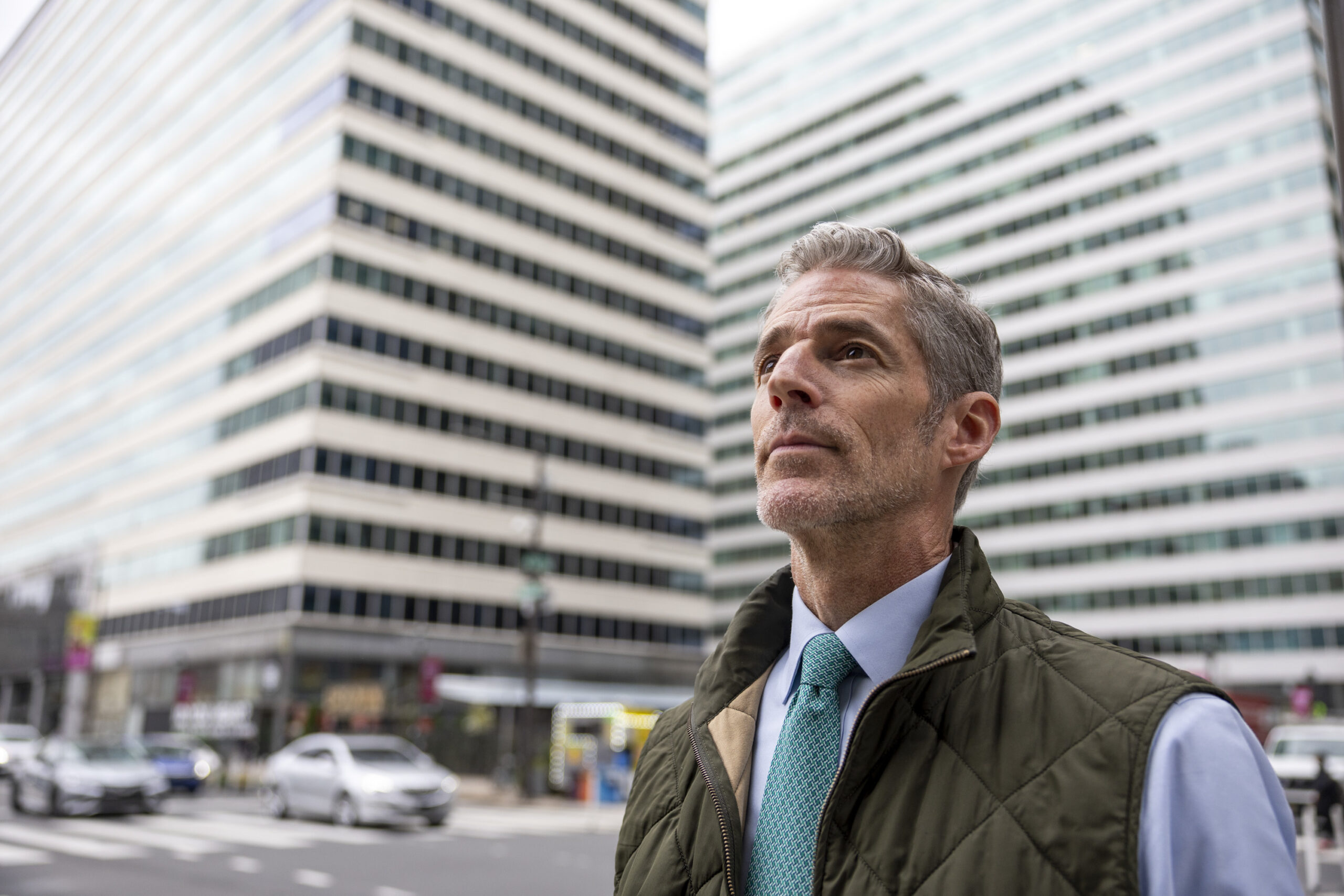
    My assignment that day was pretty typical for a newspaper photographer: show the reader what the person a reporter is profiling looks like. And maybe what they do and where they do it.

    Newly-inaugurated Mayor Joi Washington at Media Borough Hall.

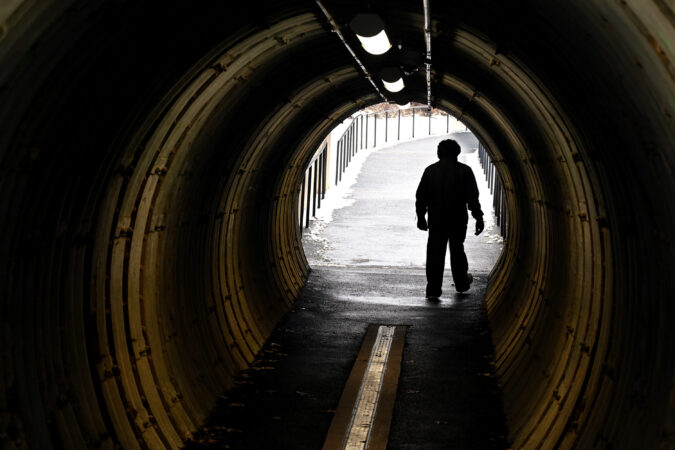
    Having accomplished that task, I headed out looking for something else to photograph in the snow, and ended up at a pedestrian passage way.

    As I made a picture of a person silhouetted in the corrugated metal culvert, the first thing I thought of was an old friend and photo editor Joe Elbert who famously said there are four categories in the “hierarchy” of newspaper photographs, lowest to highest: informational, graphic, emotional, and intimate.

    In just a few hours I had knocked out his “lower” two types.

    I made a few pictures that report “just the facts” without much flavor or fanfare. Then I found a visually appealing scene and waited until I could turn it into a well composed, interesting image. Graphic, even.

    I thought of Joe again as we learned on Wednesday that the Washington Post laid off a third of its journalists, including all of the staff photographers and half the photo editors.

    Joe was the photo editor at the Post from 1988 through 2007. Under his direction the paper won four Pulitzer Prizes, and many other awards, all for work that epitomizes that highest category of intimate photographs.

    It’s easy to feel nostalgic for those “glory days,” but I mourn that almost an entire section of the newspaper is now gone.

    Post photographers were still creating those most intimate images of Joe’s hierarchy. They were still making the reader feel something that allows us to connect with lives beyond our own, to empathize, and to care.

    Since 1998 a black-and-white photo has appeared every Monday in staff photographer Tom Gralish’s “Scene Through the Lens” photo column in the print editions of The Inquirer’s local news section. Here are the most recent, in color:

    February 2, 2026: A light-as-air Elmo balloon rolls along a sidewalk in Haddonfield, propelled by the wind as Sunday’s heavy snow starts to turn to ice and sleet.
    January 26, 2026: The President’s House in Independence National Historical Park hours Jan, 22, after all historical exhibits were removed following President Trump’s Executive Order last March that the content at national parks that “inappropriately disparage” the U.S. be reviewed. The site, a reconstructed “ghost” structure titled “Freedom and Slavery in the Making of a New Nation” (2010), serves as a memorial to the nine people George Washington enslaved there during the founding of America.
    January 19, 2026: A low-in-the-sky winter sun is behind the triangular pediment of the “front door” of the open-air President’s House installation in Independence National Historical Park. The reconstructed “ghost” structure with partial walls and windows of the Georgian home known in the 18th century as 190 High St. is officially titled, “Freedom and Slavery in the Making of a New Nation” (2010). It is designed to give visitors a sense of the house where the first two presidents of the United States, George Washington and John Adams, served their terms of office. The commemorative site designed by Emanuel Kelly, with Kelly/Maiello Architects, pays homage to nine enslaved people of African descent who were part of the Washington household with videos scripted by Lorene Cary and directed by Louis Massiah.
    Deepika Iyer holds her niece Ira Samudra aloft in a Rockyesque pose, while her parents photograph their 8 month-old daughter, in front of the famous movie prop at the top of the steps at the Philadelphia Art Museum. Iyer lives in Philadelphia and is hosting a visit by her mother Vijayalakshmi Ramachandran (partially hidden); brother Gautham Ramachandran; and her sister-in-law Janani Gautham who all live in Bangalore, India.
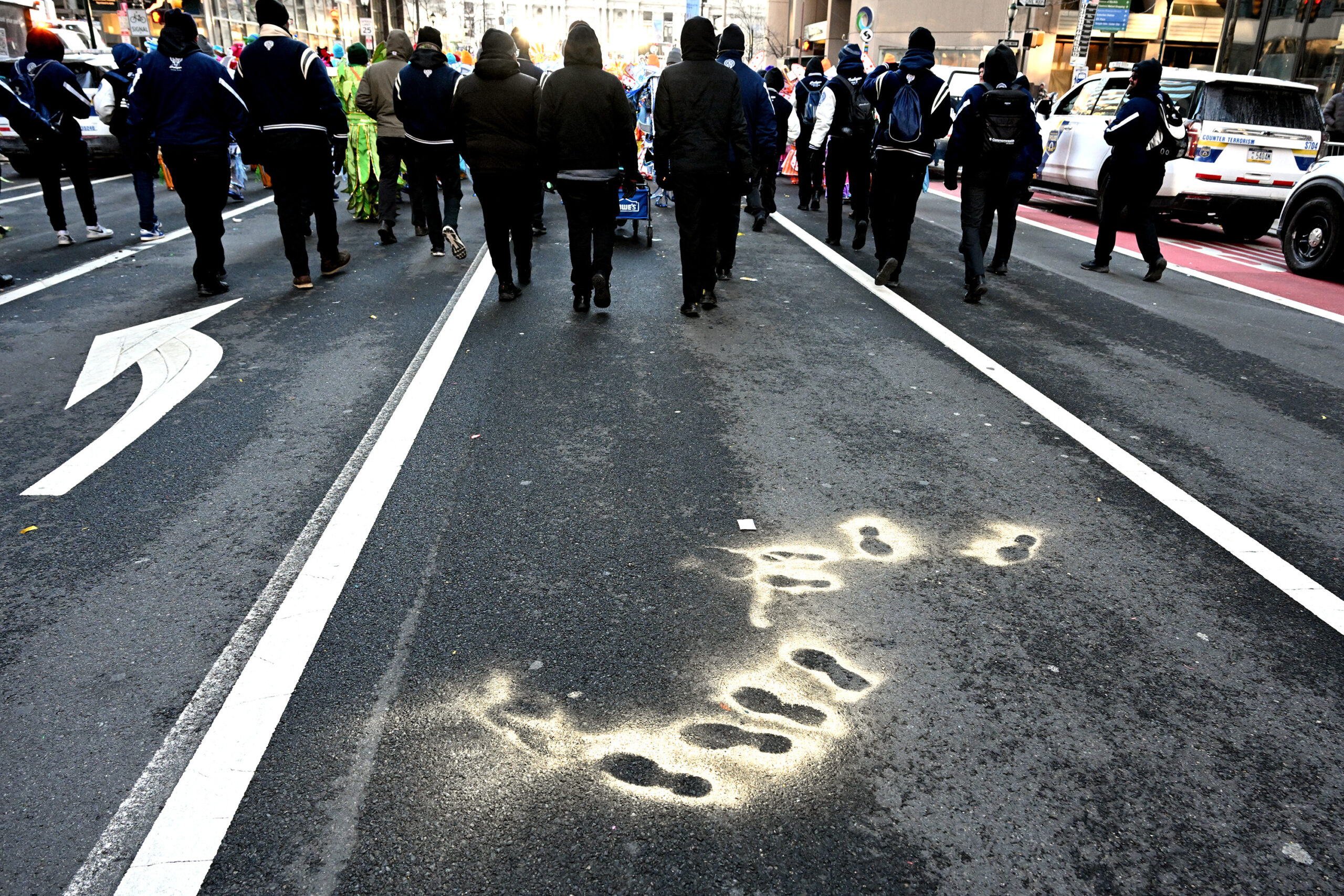
    January 5, 2026: Parade marshals trail behind the musicians of the Greater Kensington String Band heading to their #9 position start in the Mummers Parade. Spray paint by comic wenches earlier in the day left “Oh, Dem Golden Slippers” shadows on the pavement of Market Street. This year marked the 125th anniversary of Philly’s iconic New Year’s Day celebration.
    Dec. 29, 2025: Canada geese at sunrise in Evans Pond in Haddonfield, during the week of the Winter Solstice for the Northern Hemisphere.
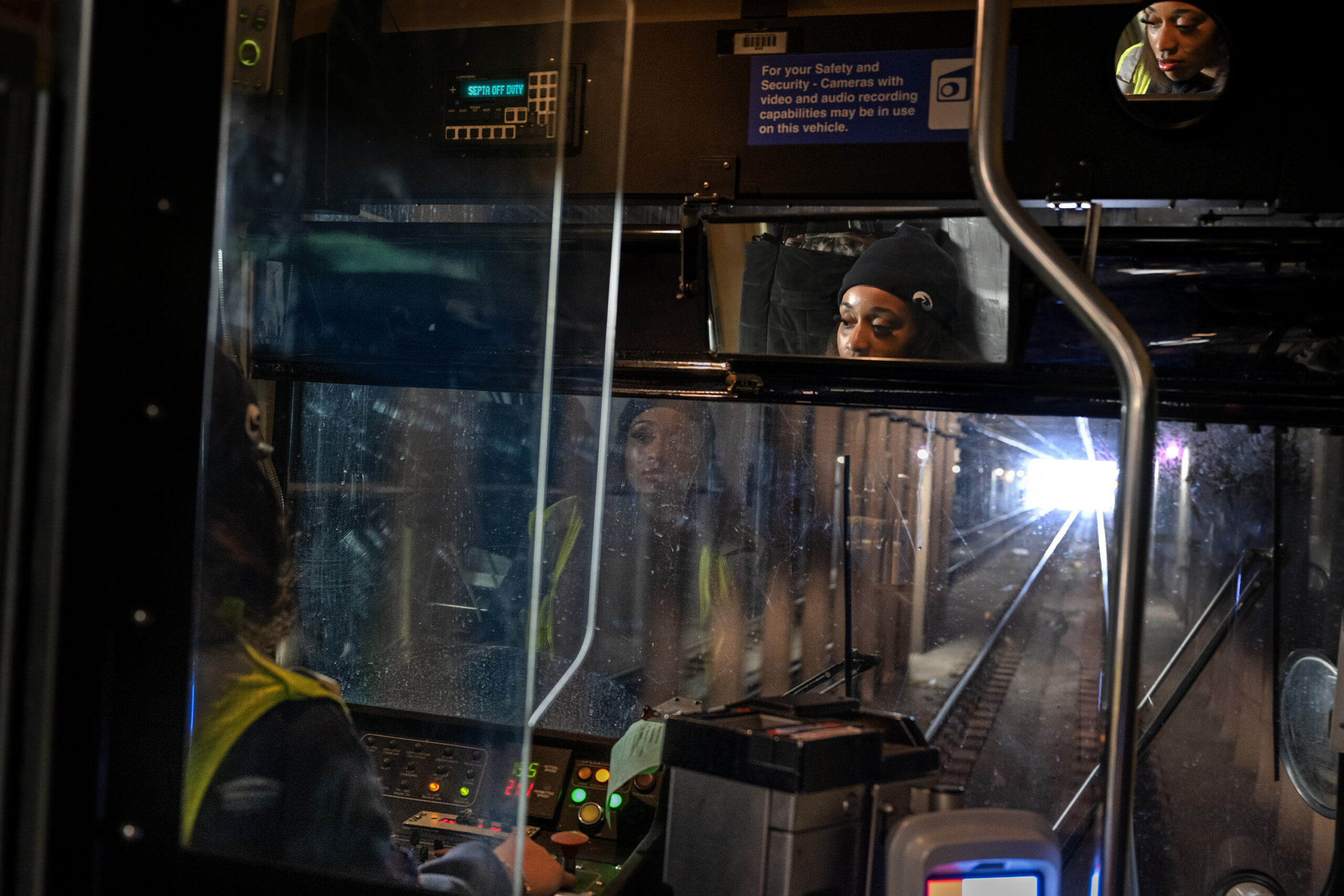
    December 22, 2025: SEPTA trolley operator Victoria Daniels approaches the end of the Center City Tunnel, heading toward the 40th Street trolley portal after a tour to update the news media on overhead wire repairs in the closed tunnel due to unexpected issues from new slider parts.
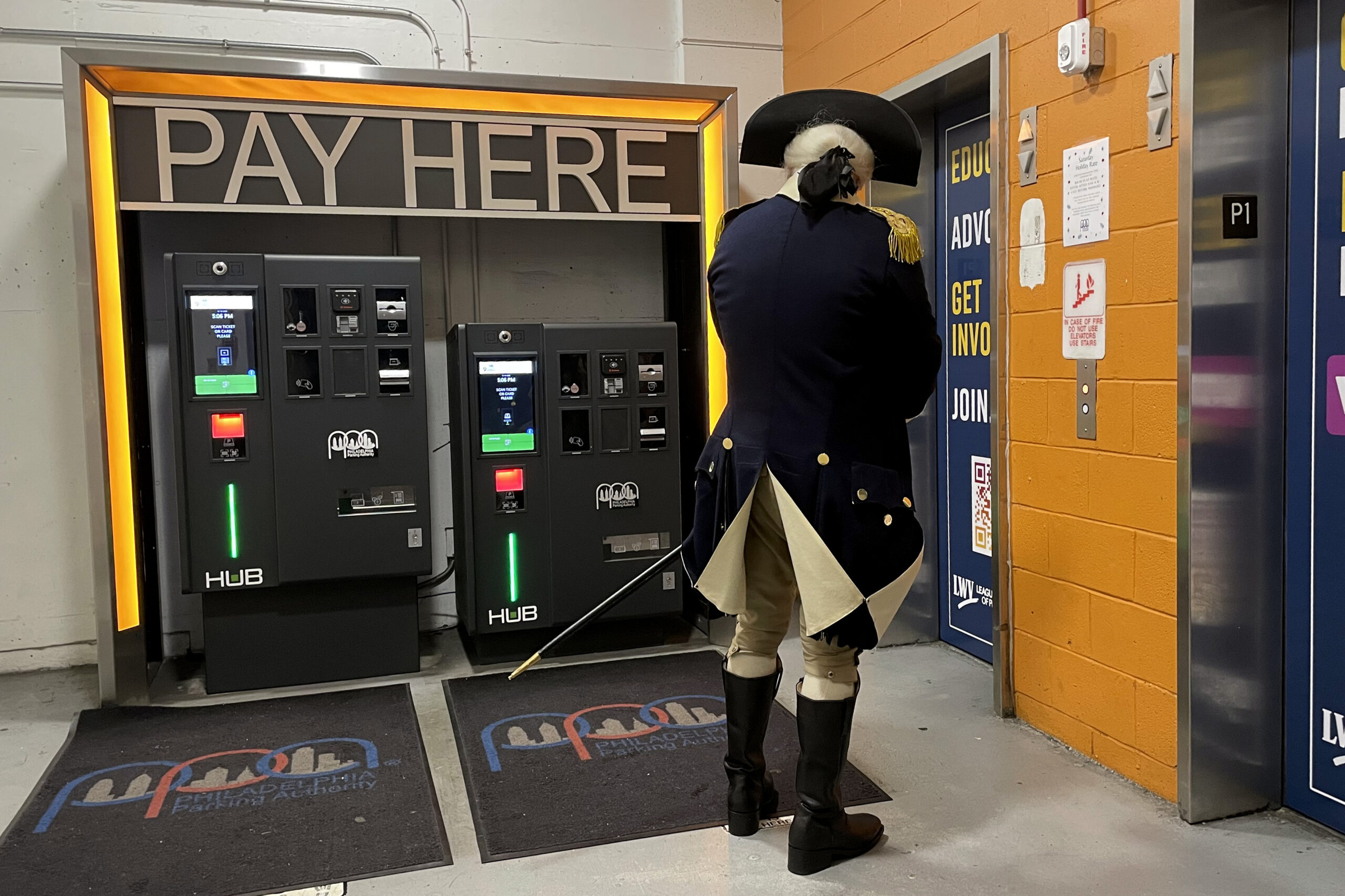
    December 15, 2025: A historical interpreter waits at the parking garage elevators headed not to a December crossing of the Delaware River, but an event at the National Constitution Center. General George Washington was on his way to an unveiling of the U.S. Mint’s new 2026 coins for the Semiquincentennial,
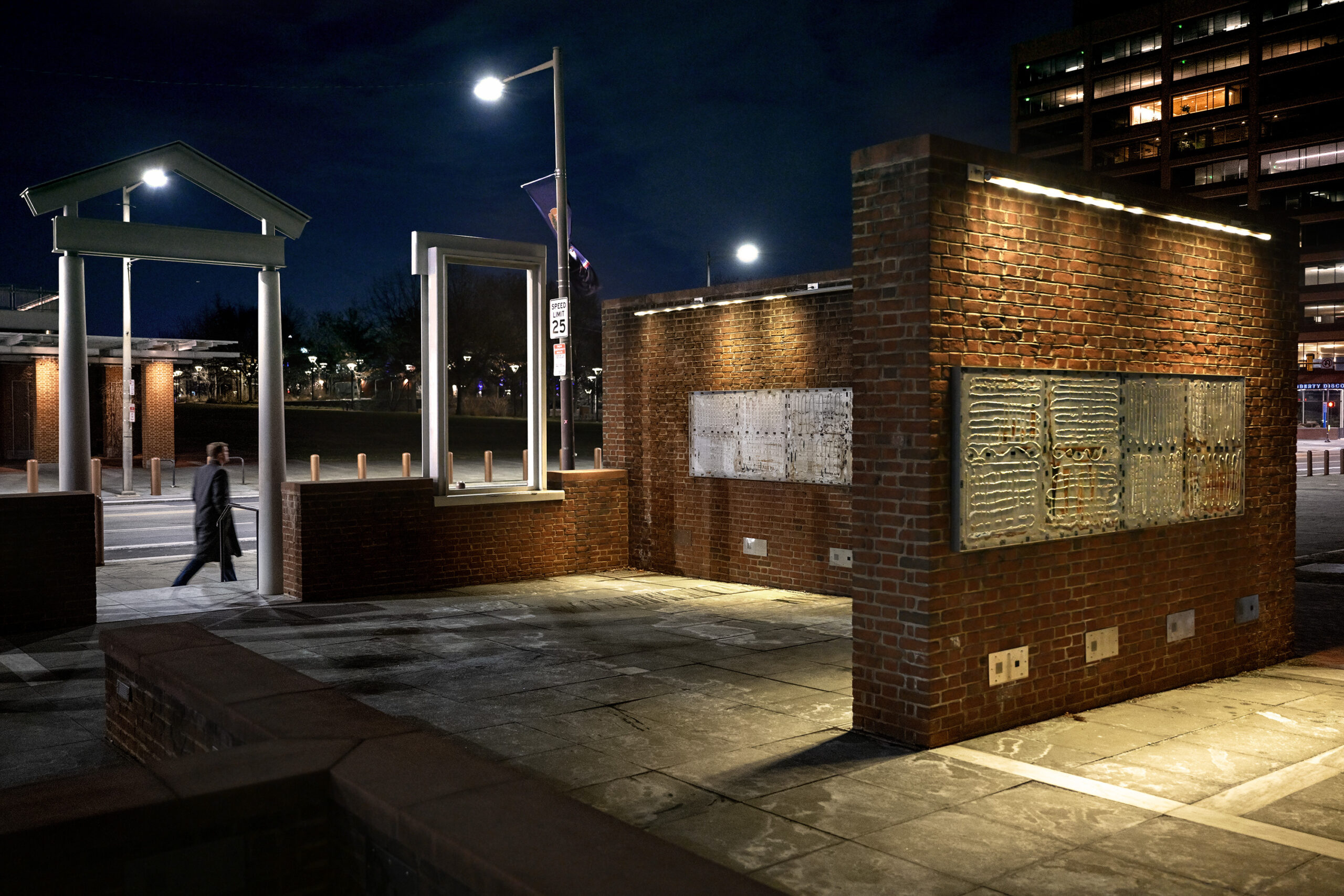
    December 8, 2025: The Benjamin Franklin Bridge and pedestrians on the Delaware River Trail are reflected in mirrored spheres of the “Weaver’s Knot: Sheet Bend” public artwork on Columbus Boulevard. The site-specific stainless steel piece located between the Cherry Street and Race Street Piers was commissioned by the City’s Public Art Office and the Delaware River Waterfront Corporation and created and installed in 2022 by the design and fabrication group Ball-Nogues Studio. The name recalls a history that dominated the region for hundreds of years. “Weaver’s knot” derives from use in textile mills and the “Sheet bend” or “sheet knot” was used on sailing vessels for bending ropes to sails.
    November 29, 2025: t’s ginkgo time in our region again when the distinctive fan-shaped leaves turn yellow and then, on one day, lose all their leaves at the same time laying a carpet on city streets and sidewalks. A squirrel leaps over leaves in the 18th Century Garden in Independence National Historical Park Nov. 25, 2025. The ginkgo (Ginkgo biloba) is considered a living fossil as it’s the only surviving species of a group of trees that existed before dinosaurs. Genetically, it has remained unchanged over the past 200 million years. William Hamilton, owner the Woodlands in SW Phila (no relation to Alexander Hamilton) brought the first ginkgo trees to North America in 1785.
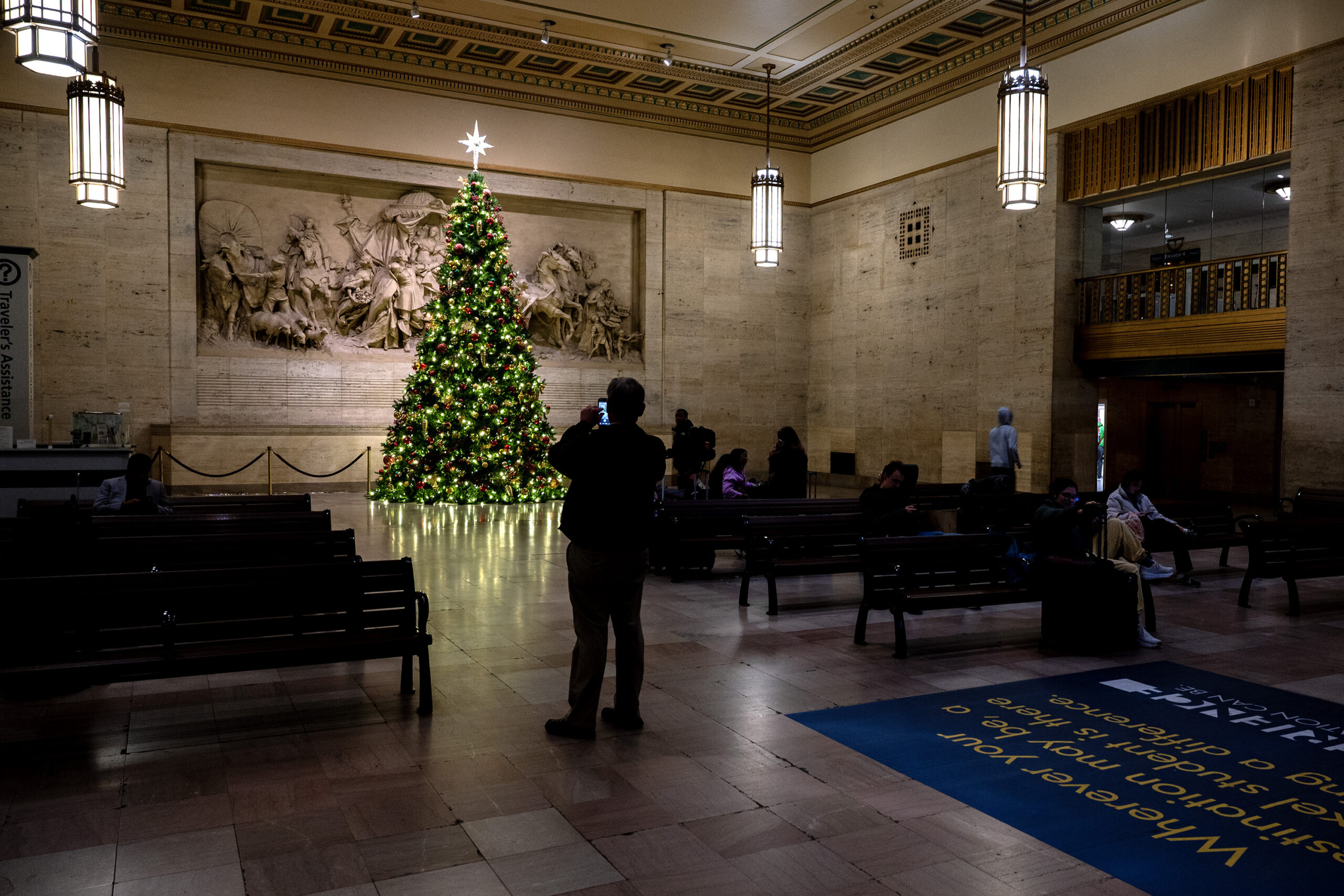
    November 24, 2025: The old waiting room at 30th Street Station that most people only pass through on their way to the restrooms has been spiffed up with benches – and a Christmas tree. It was placed there this year in front of the 30-foot frieze, “The Spirit of Transportation” while the lobby of Amtrak’s $550 million station restoration is underway. The 1895 relief sculpture by Karl Bitter was originally hung in the Broad Street Station by City Hall, but was moved in 1933. It depicts travel from ancient to modern and even futuristic times.
    November 17, 2025: Students on a field trip from the Christian Academy in Brookhaven, Delaware County, pose for a group photo in front of the Liberty Bell in Independence National Historical Park on Thursday. The trip was planned weeks earlier, before they knew it would be on the day park buildings were reopening after the government shutdown ended. “We got so lucky,” a teacher said. Then corrected herself. “It’s because we prayed for it.”
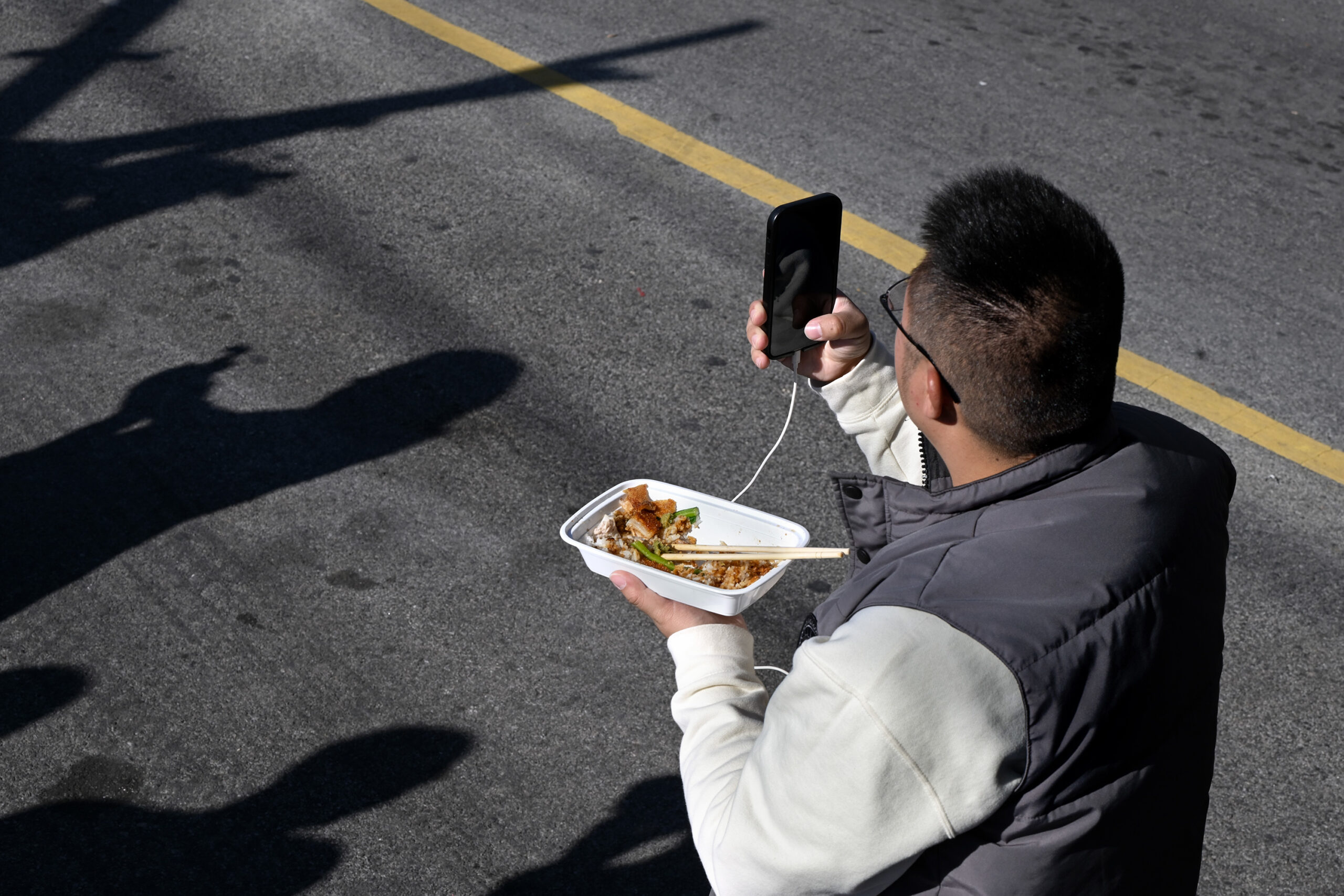
    November 8, 2025: Multitasking during the Festival de Día de Muertos – Day of the Dead – in South Philadelphia.
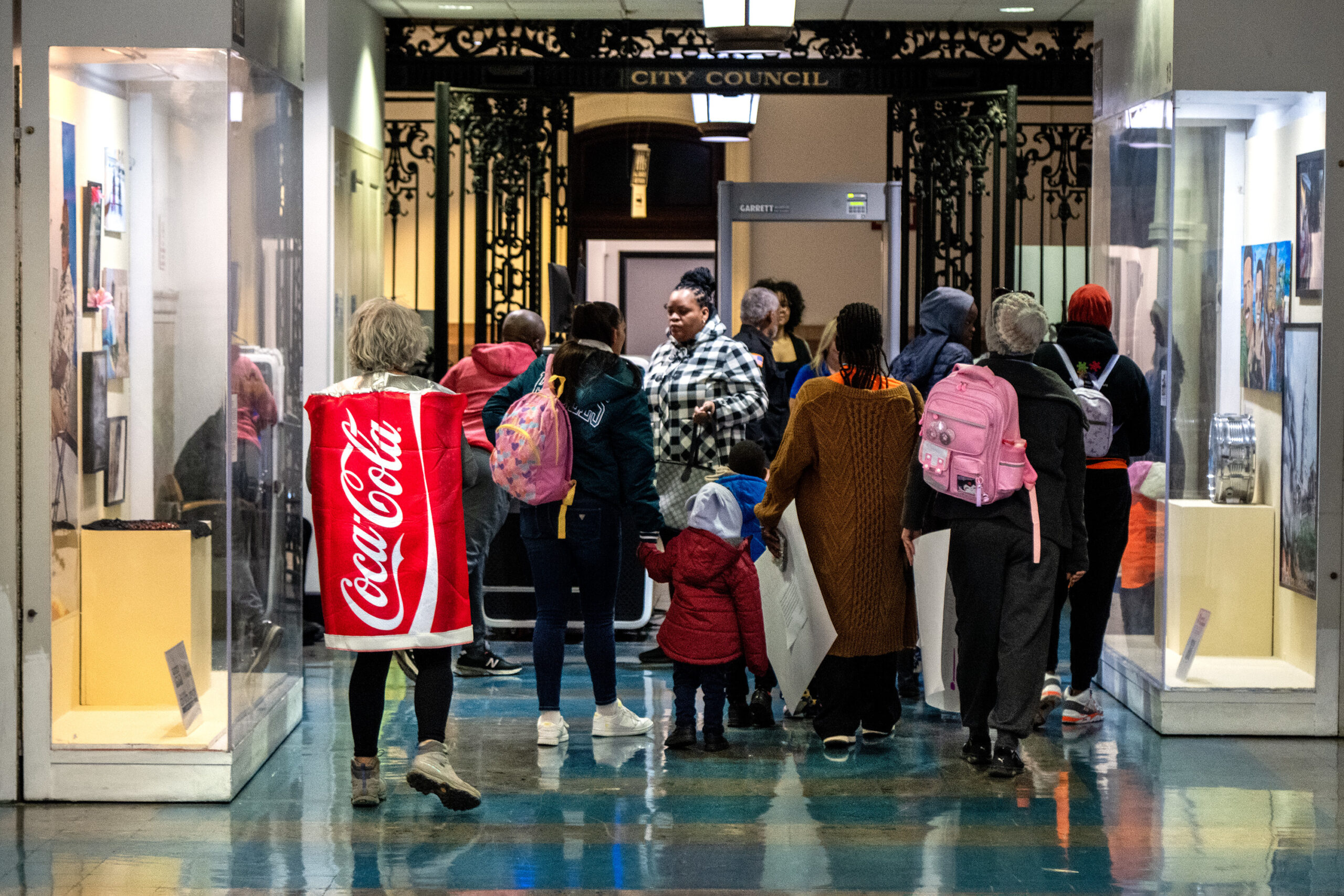
    November 1, 2025: Marcy Boroff is at City Hall dressed as a Coke can, along with preschoolers and their caregivers, in support of former Mayor Jim Kenney’s 2017 tax on sweetened beverages. City Council is considering repealing the tax, which funds the city’s pre-K programs.

    » SEE MORE: Archived columns and Twenty years of a photo column.

  • As a hotel looms, a tiny Ocean City neighborhood behind the old Gillian’s fears losing its small-town feel — and its sunrise

    As a hotel looms, a tiny Ocean City neighborhood behind the old Gillian’s fears losing its small-town feel — and its sunrise

    OCEAN CITY, N.J. — Marie Crawford was immediately charmed in 2021 when she and her soon-to-be-surfer husband Rich moved into their historic house in the literal shadow of Gillian’s Wonderland Pier.

    They’d come from Blue Bell, Pa., to live year-round by the ocean, and landed with an amusement park right up the street.

    “The ball drop, that was what we heard from my house,” she said, referring to the 130-foot-high Drop Tower ride. “It was, ‘Ah, ah, ahhhhhhhh,‘” she said, imitating the screams she would sometimes hear.

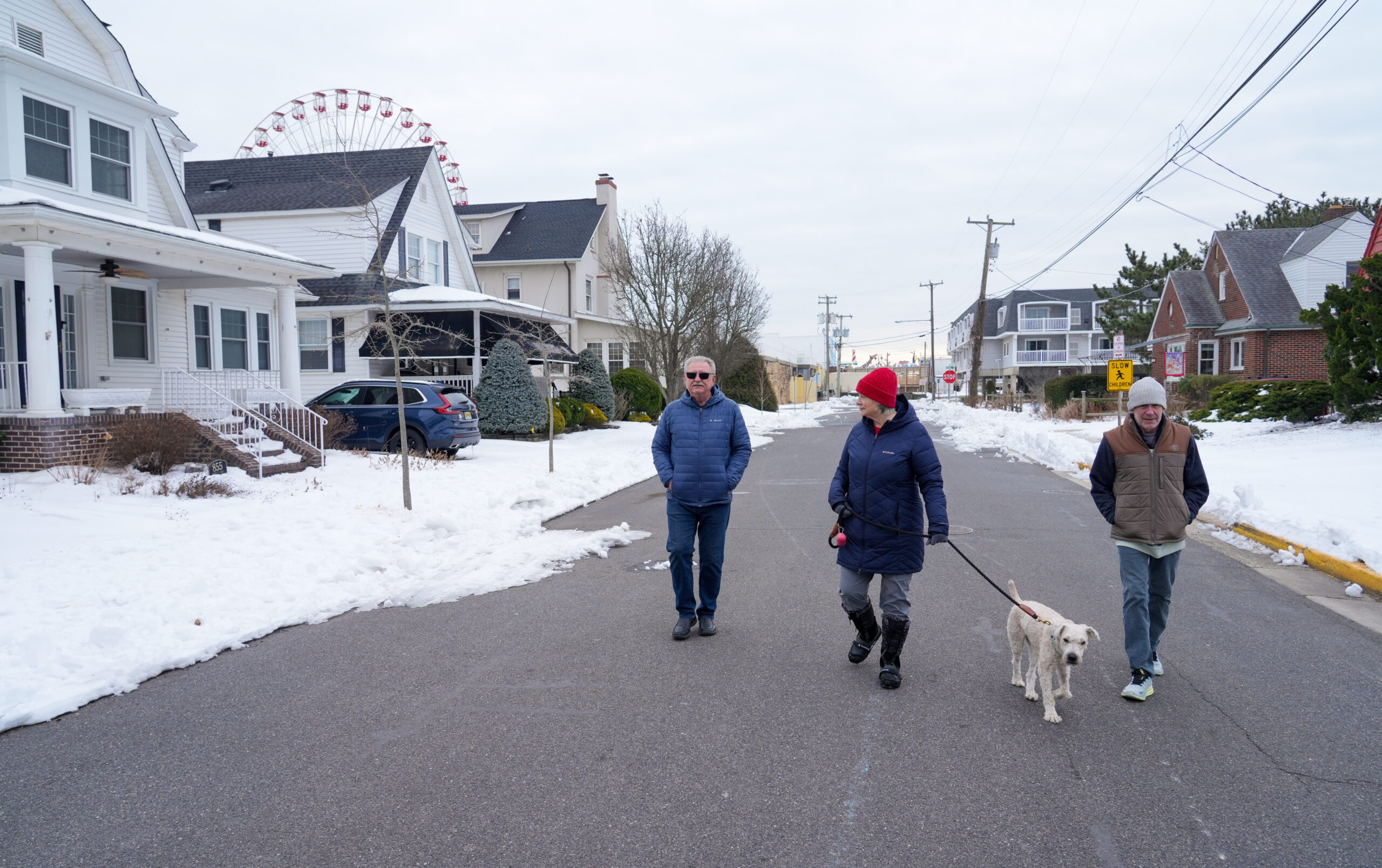
    Jack Gutenkunst, left, Marie Crawford and her husband Richard with Shiloh, a 9-year-old soft coated wheaten terrier, walk along Plaza Place, in Ocean City, Tuesday, Feb. 3, 2026.

    “It was so beautiful and romantic. On our porches, we would hear the ocean, not the amusement park. There were families, babies in strollers, coming up the street, flowing up to Wonderland. We were kind of ambassadors.”

    Now, more than a year after the closing of Gillian’s, the residents are faced with the possibility of a seven-story hotel they fear will block their sun, bring traffic to their streets, and threaten the small-town charm they found in their little pocket of Ocean City.

    “It’s just another example of maximizing, pushing,” said Rich Crawford, Marie’s husband, who programs music for his family’s Christian radio station, WDAC, located in Lancaster, Pa. In his 60s, Rich fell in with Ocean City’s surfing crowd and unexpectedly grew to love his little community.

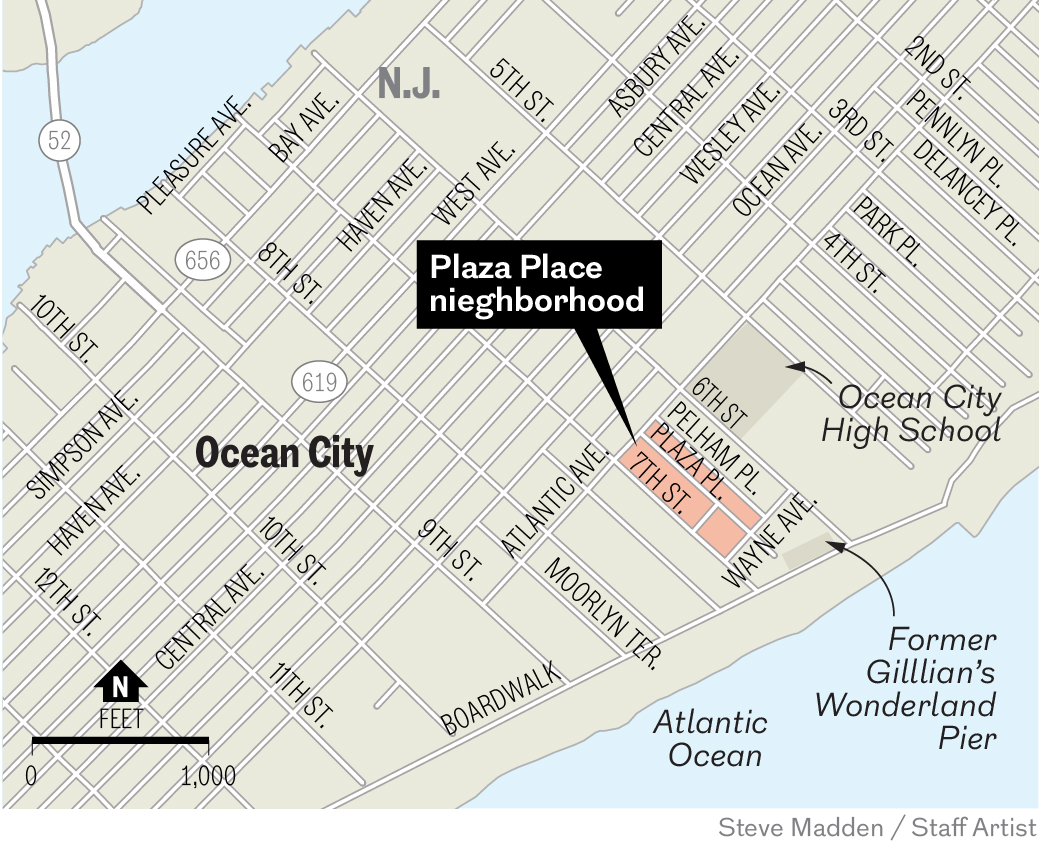
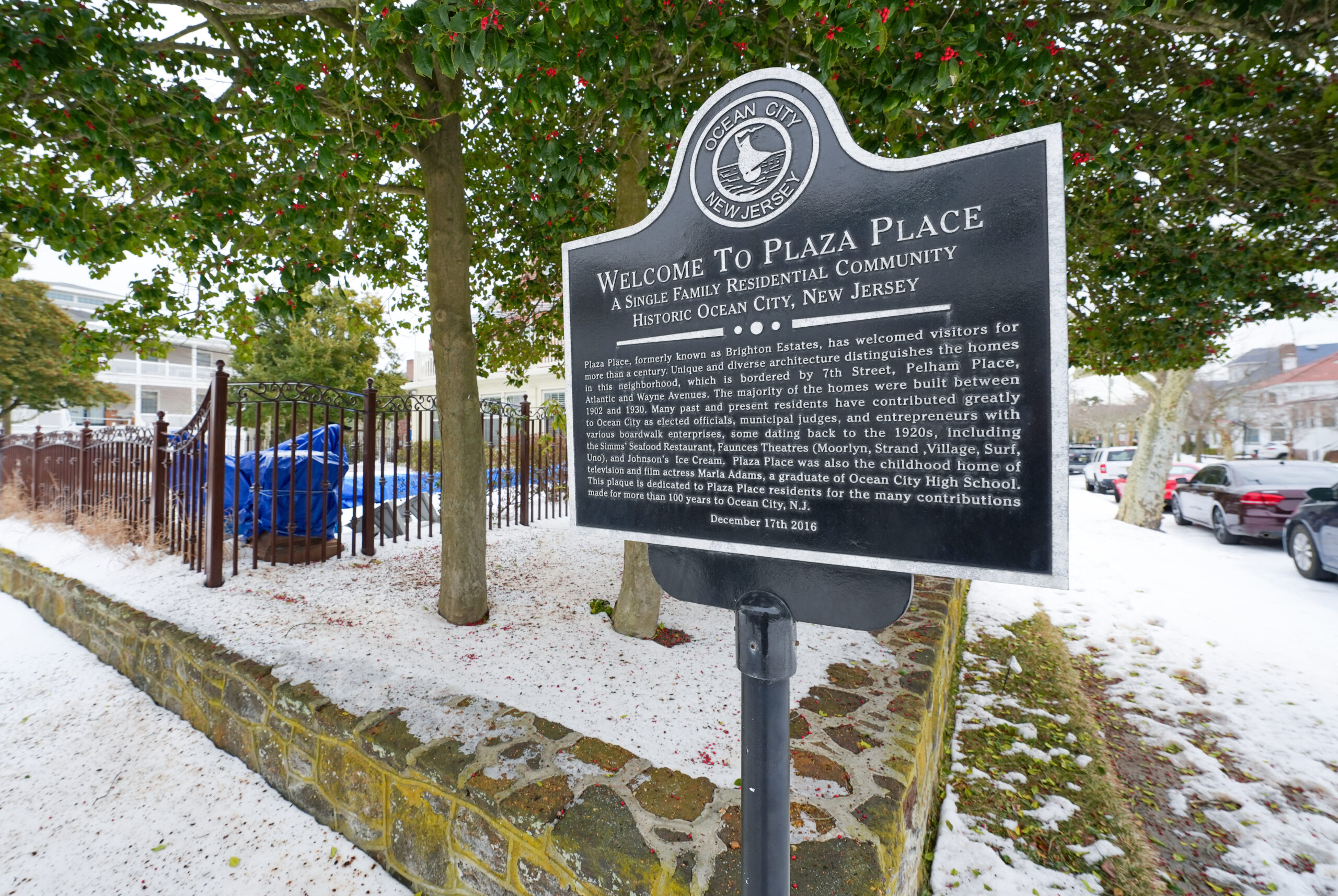
    The Crawfords’ neighborhood of 100-year-old homes and 153 trees is called Plaza Place, which is one block each of Pelham Place, Plaza Place, and the north side of Seventh Street, between Wayne Avenue and Atlantic.

    Across Wayne Avenue, toward the ocean, was Wonderland. On a clear day, a red ball of sun creeps up above the boardwalk and peeks into their little neighborhood.

    On Pelham Place, residents each also own a two-foot- wide stretch of land across the street from their houses, a quirk of their deeds originally designed to prevent the rooming houses on Plaza Place that backed up against Pelham Place from using Pelham as an alleyway for their trash. There are dedicated gardeners on the streets who turn those strips into showpieces.

    The sun sets behind the Ferris wheel on the final day for the beloved Wonderland Pier in Ocean City Sunday, Oct. 13, 2024.

    Neighbor Barb Doctorman, whose family owns the Islander store on the boardwalk, said she used to take her children up on the Ferris wheel and peer down at their neighborhood. So lush, it looked like a forest, she said.

    “I looked up the impact of a high-rise,” said Doctorman. “We’re going to lose some sun. The airflow is going to be totally changed from what it was. There’s a heat radiant that comes off it.”

    Her husband, Doc, said: “We want something up there, but we know there could be more of a draw to that boardwalk than just the hotel.”

    Marie Crawford (left) holds the leash of Shiloh, a 9-year-old soft-coated wheaten terrier, while standing with her husband Richard (center) and neighbor Jack Gutenkunst at the end of Pelham Place in Ocean City.

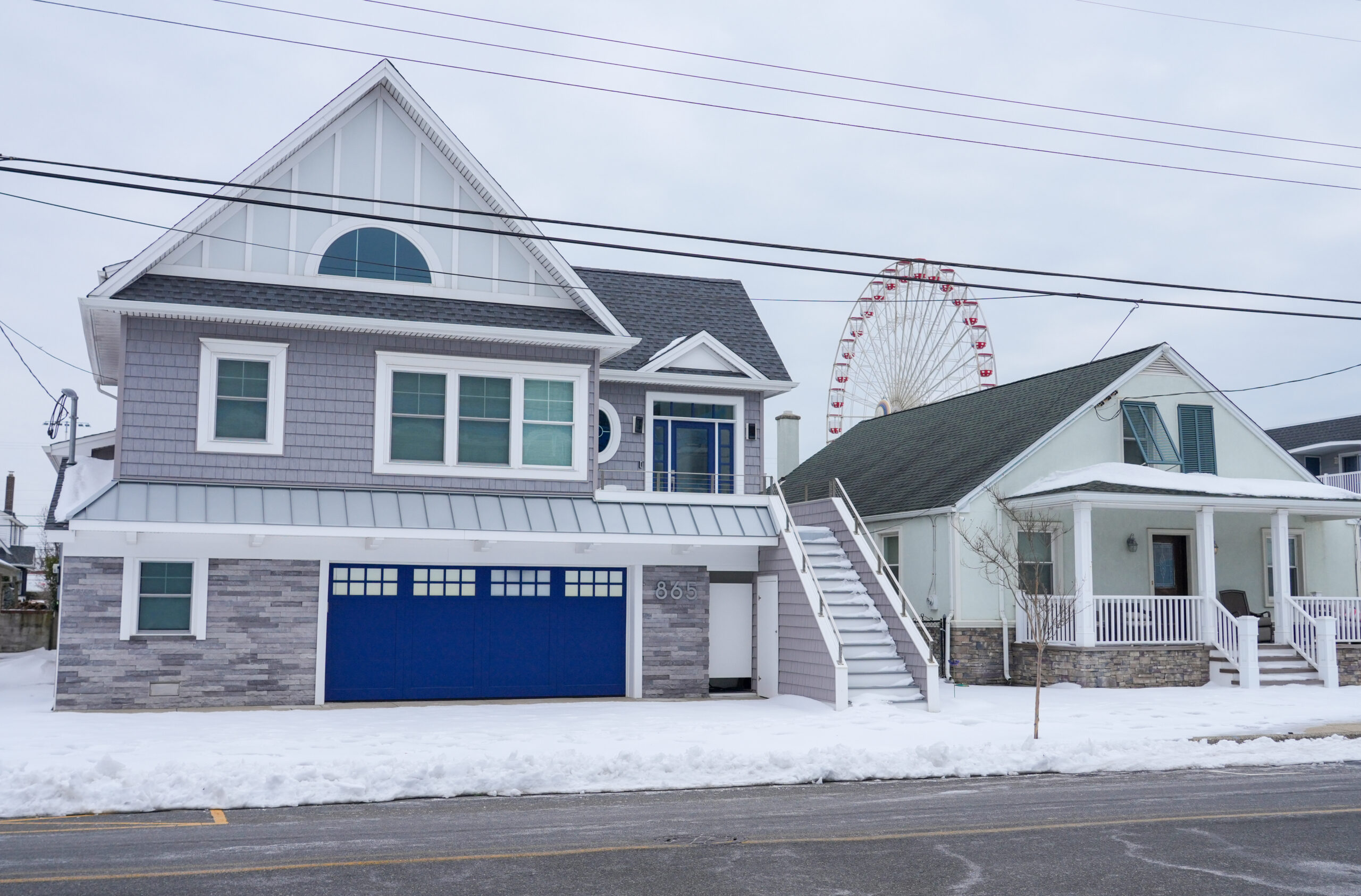
    The land is owned by developer Eustace Mita, who has proposed Icona in Wonderland, a 252-room hotel that would preserve the Ferris wheel, carousel, and some kiddie rides.

    So far, the city has not declared the site in need of rehabilitation, as Mita has requested, or otherwise moved to rezone the area to allow a hotel.

    Merchants have begged the city to allow the hotel, and described how their businesses have suffered since the closure of Wonderland. Some residents have clung to the idea that an amusement park can return, though those numbers are dwindling.

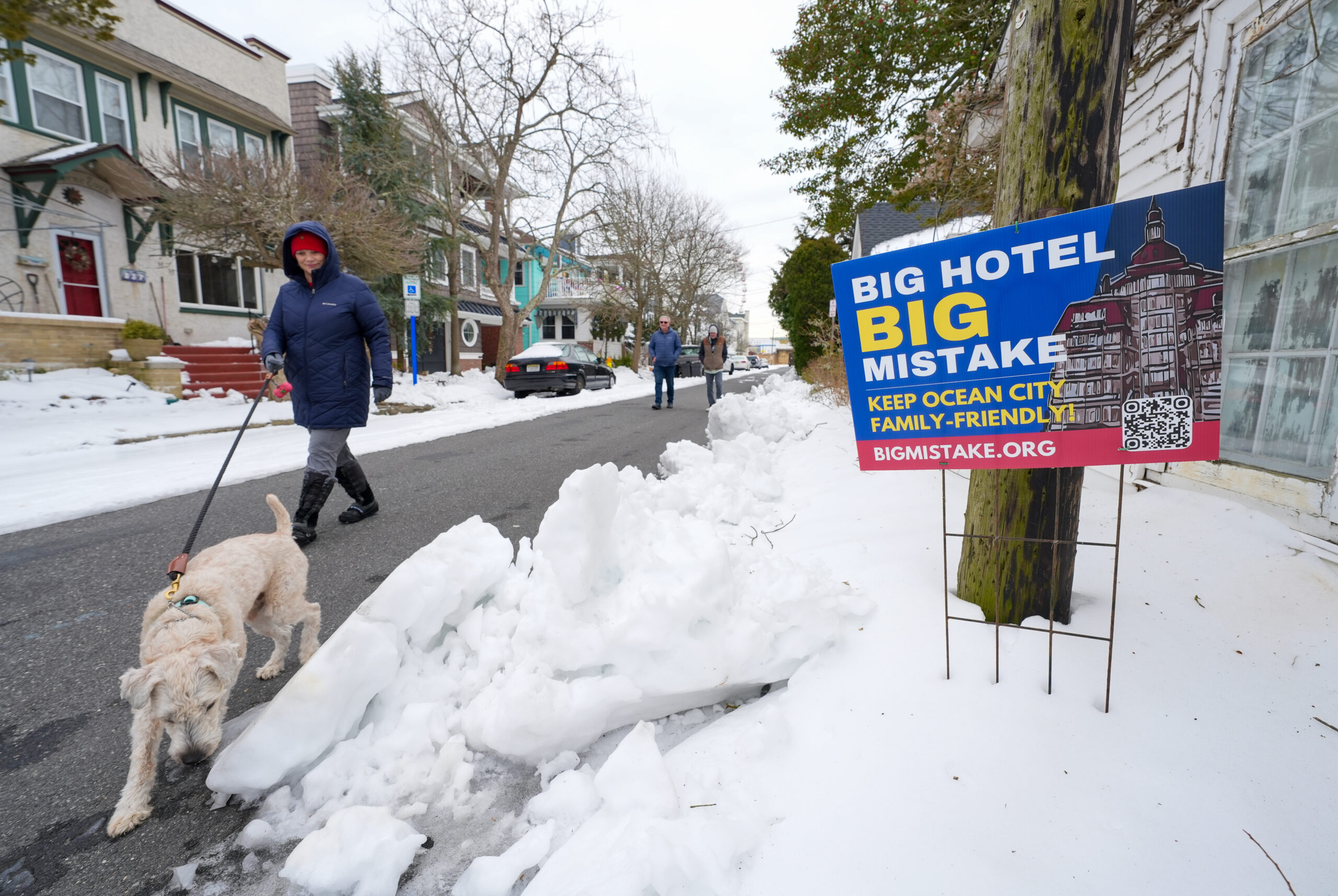
    Marie Crawford, her husband Richard, right, along with Shiloh, a 9-year-old soft coated wheaten terrier, and their neighbor Jack Gutenkunst, walk past a sign against the development of a hotel at the site of the old Wonderland Pier on the boardwalk in Ocean City, Tuesday, Feb. 3, 2026.

    In Plaza Place, the opposition is less sentimental, more practical. They fear traffic, and the shadow from a neighboring seven-story hotel. Like residents in other towns who fought dunes, they fear the loss of the ocean breeze, or a shift in wind patterns that will affect surfing at the popular Seventh Street Beach.

    “It’s got that old feel to it, and everybody’s house is different,” said Marie Crawford, who bought her Craftsman Colonial on the north side of Pelham for $905,000 in 2021. She estimates it’s worth $2.5 million now. There are about 60 homes in the Plaza Place civic association.

    The association is one of several groups that are prepared to go to court if the city tries to change the zoning to allow a hotel, without going through a thorough master plan process, said Jack Gutenkunst, the Plaza Place Association president.

    While Wonderland brought thousands of people on a summer night, the pier itself had no parking. So people parked elsewhere and excitedly walked through their neighborhood on their way to the rides. People on their porches called out, “Have a blessed evening,” and chatted the night away, said Crawford. The hotel proposal calls for parking underneath the structure.

    A sign stands near the historic neighborhood behind the old site of the Wonderland Pier in Ocean City, Tuesday, Feb. 3, 2026. Residents are against the development of a hotel at the boardwalk site.

    Crawford stressed that it’s not a case of selfish NIMBY, Not In My Backyard. Despite Ocean City’s decades-old pattern of replacing single-family homes with duplexes, there are nearly 1,400 homes over 100 years old still left in Ocean City, said Bill Merritt, president of Friends of OCNJ History & Culture.

    Being a block from the boardwalk, and living in a beach town, does not mean the neighborhood’s purpose is primarily hospitality, said Crawford. Its distinct, increasingly rare Jersey Shore character deserves to be valued, she said.

    “It’s height. It’s chaos. It’s the change in culture,” she said, when asked what specifically worries her about the hotel. “It’s a transient population coming through here for three nights at a time. That’s in the hospitality district. We are not the hospitality district.”

    The neighborhood behind the old Wonderland Pier site on the boardwalk in Ocean City, Tuesday, Feb. 3, 2026. Residents are against the development of a hotel at the boardwalk site.

    The demolish-and-rebuild mania that took over a lot of the rest of the island has mostly left Plaza Place alone, though residents acknowledge that is also a threat to their way of life. They also fear a hotel will prompt Plaza Placeans to sell.

    “It’s a Norman Rockwell painting, it just is,” Councilman Keith Hartzell says in the documentary Plaza Place: The Enigmatic Street, a locally made short film about the neighborhood. “It’s right here in Ocean City, and you kind of don’t expect it, when there’s two streets away a bunch of duplexes.”

    Hartzell, who is running for mayor against incumbent Jay Gillian, the former owner of Wonderland who sold to Mita, says he hopes to negotiate with Mita over height, parking, and other issues before considering any kind of zoning allowance or rehabilitation designation. A city council-appointed subcommittee tasked with assessing the boardwalk’s usage as a whole is holding a public meeting at 10 a.m. on Feb. 7 at the city’s library.

    The residents of Plaza Place worry about the survival of the hidden little neighborhood by the beach they fell in love with. “The neighborhood is so beautiful and so old,” said Marie Crawford. “If the hotel goes in, the dramatic change that will be for all of us with the traffic, the tone of the neighborhood — you’re going to see people sell. That threatens the neighborhood. The people won’t want to stay.”

  • A dash of snow, an Arctic chill, and 55 mph wind gusts are possible this weekend in Philly

    A dash of snow, an Arctic chill, and 55 mph wind gusts are possible this weekend in Philly

    By now Arctic air may qualify for a frequent-visitor pass around here, but the version coming this weekend will be of a different quality and have a particular sting.

    “It’s going to be a slap in the face,” said Cody Snell, a meteorologist with the National Oceanic and Atmospheric Administration’s Weather Prediction Center.

    After a day in which highs will be around freezing on Friday — a solid 10 degrees below normal — some nuisance snow is possible late in the day or evening and early Saturday, and maybe even squalls. Then temperatures are going to tumble through the teens in the wake of another potent Arctic front.

    They might not see 20 degrees in the Philly region until Monday.

    Adding bite will be winds that could gust to 55 mph, and the National Weather Service says wind chills of 10 and 15 below are likely Saturday in the immediate Philly area. The agency has issued an “extreme-cold warning” — a relatively new addition to the advisory list — in effect Saturday afternoon through Sunday morning. Wind chills of 17 below zero are possible, and winds could gust to 55 mph, the weather service says.

    Said Ray Martin, a lead meteorologist at the weather service office in Mount Holly, “It’s going to be awful.” Among the recent sequence of Arctic invasions, “it looks like the worst.”

    In short, that unusually tenacious snowpack that was left over from the 9.3 inches of snow and white ice that fell on Jan. 25 and has since mutated into a form of frozen slurry will be spending at least another weekend in Philly.

    What’s more, it’s likely to be a harvest weekend for the ice that is solidifying upon the region’s waterways, a growing concern.

    A warm-up is due to begin Monday and pick up steam during the workweek, with highs maybe reaching 40 degrees on Thursday. But it may encounter some resistance, and another storm threat might be brewing for next weekend, forecasters say.

    The snowpack already has achieved an elite status

    Friday marked the 12h consecutive day in which the official snow cover at Philadelphia International Airport, measured daily at 7 a.m., was at least 5 inches.

    In the 142-year period of record, that ties for seventh place for a snow-cover duration of that depth.

    “To hold on to a snowpack like this is unusual,” said Johnathan Kirk, senior hydrologist at NOAA’s Middle Atlantic River Forecast Center, in State College, Pa., which is keeping a close eye on the waterway icing.

    The Schuylkill in Philly is ice-covered, as is the Delaware River from Trenton to Washington Crossing.

    In addition to an eight-day stretch when temperatures failed to reach 30, the durability is related to the 2 or so inches of sleet that capped the snow on Jan. 25. Sleet is white ice that melts more slowly than snow.

    The dry and cold air has been a natural preservative; snow and ice melt more readily when the air is moist.

    Another factor was the impressive liquid content of the snow and sleet, Snell said. The frozen mass contained 1.39 inches of liquid, the weather service said, comparable to what is contained in 15 to 18 inches of snow.

    As temperatures finally nudged above freezing, some melting did occur this week, which would explain that unsightly slushy porridge at Philly intersections. However, the official snow depth lost only an inch between Jan. 27 and Wednesday.

    The snowpack may receive a fresh frosting Friday night into early Saturday with up to an inch of snow, Martin said, but it’s not going to have the same staying power.

    What’s different about this Arctic air mass

    Any snow that falls is likely to get blown away in a hurry, Martin said, as winds will pick up before daybreak Saturday and gusts howl to 50 mph by late morning.

    Typically, cold air pours into the region from the northwest and becomes modified as it passes over land, the Great Lakes, and the mountains.

    This is going to be a straight-up Arctic shot. It will come more or less from the north, and the icy lakes are not going to do much to impede it, said Matt Benz, senior meteorologist at AccuWeather Inc.

    The weather center’s Snell said a weak storm system moving off the Atlantic coast is forecast to blow up as it interacts with warm Gulf Stream waters. The differences between the cold high pressure with its heavier air over the East and the lighter air of the storm are going to place the Philadelphia region in a frigid sandwich.

    Heavier air tends to rush toward lighter air, like air escaping from a punctured tire.

    A thaw is coming to Philly, eventually

    Just how warm it gets next week remains unclear, AccuWeather’s Benz said.

    “Arctic air is hard to dislodge sometimes,” he said, adding that recent model trends suggest the warm-up will not be quite as robust as expected earlier.

    A wild card would be a potential storm next weekend. The European forecast model was seeing rain and 60 degrees, Martin said, while the U.S. model was suggesting a blizzard.

    His take: “I have no clue at this point.”

    An anniversary of note

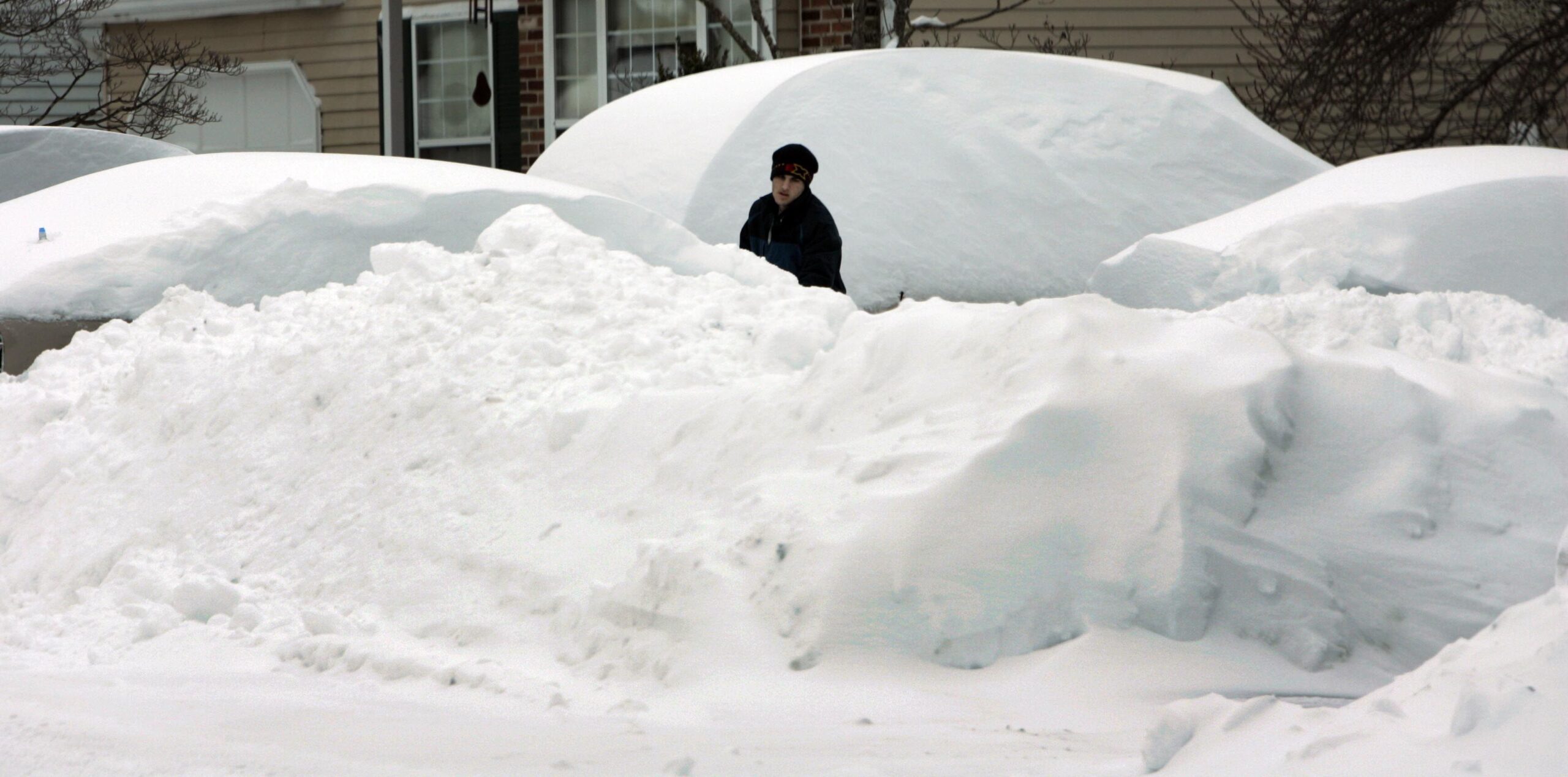
    On Feb. 5, 2010, 6.6 inches of snow fell upon the airport, the beginning of an unprecedented siege in which 44.3 inches accumulated in a six-day period.

    A man shovels cars out under mountains of snow in West Bradford Township, Chester County, during the incredible snow siege of February 2010.

    Twelve days after the snow stopped, the official snow depth was down to 4 inches.