Pest control companies routinely use traps baited with rodenticide to kill rats and mice found in homes, restaurants, and businesses throughout the Philadelphia area, but a recent Rutgers University study suggests those companies face a gnawing problem.
Researchers discovered that mice in Philadelphia, Trenton, and suburbs like Levittown and New Hope harbor genetic mutations that shield them from standard chemical baits.
In fact, a majority of house mice sampled from Northeast urban areas, including Manhattan and other New York City boroughs, carried at least one mutation linked to rodenticide resistance — a clear sign that pests are actively evolving to survive common poisons.
Rats presented a different problem. While they lacked the chemical-resistant mutations found in mice, the study’s author suggests they possess the cognitive sophistication to outsmart and evade traps entirely.
Lead author Jin-Jia Yu, a postdoctoral researcher in Rutgers’ entomology department, said the findings indicate that pest control companies might need to develop different strategies.
Yu conducted his research with the supervision of another of the paper’s authors, Changlu Wang, an entomologist in the same department.
Published in the April issue of Pest Management Science, the peer-reviewed study was launched after frustrated pest control professionals repeatedly approached the Rutgers lab, reporting that rodents routinely survived multiple treatments.
“For the house mouse, we saw much more mutations rather than Norway rats,” Yu said. Norway rats are the common brown rat often seen in sewers.“Genetic mutation is not that special in these creatures. But we found that the house mouse shows a lot of genetic mutations related to rodenticide resistance.”
Rodents are a bigger problem in cities
This study focused on urban rodents. It found that mice in bigcities such as Philly and New York had a high frequency of mutations of a certain gene.
Rodents are a bigger problem in cities than more rural areas. Data cited in the study indicate that an average of 12% of all households experience rodent sightings. But major metropolitan areas reporter higher rates, including Philadelphia (29%), Washington (20%), and Manhattan (15%).
Yu said that similar studies of mutations in house mice and Norway rats were conducted in Europe and that research in the U.S. has been limited. One study in 2009 did find some rats in England with mutations that made them resistant.
However, Yu said there had been no such studies in the Northeast.
It has long been known that rodents developed resistance to the rodenticides developed in the 1950s. So more potent compounds were created in the 1970s and include brodifacoum, bromadiolone, difenacoum, and difethialone.
The poisons contain anticoagulants that interfere with the activation of vitamin K reductase (VKOR), an enzyme essential for blood to clot. Eating the bait leads to fatal internal bleeding.
The Rutgers team looked for mutations in the gene known as VKORC1 that makes the enzyme.
Pest control companies, as well as the Philadelphia Department of Public Health, sent the researchers the tails of caught rodents. Yu said his research was possible only with their help.
A rare mouse mutation in Philly
The researchers analyzed DNA from 147 house mice and 143 Norway rats collected in New York, New Jersey, Pennsylvania, and Washington, D.C.
Among house mice, 84% carried at least one mutation in the VKORC1 gene. Nearly 70% carried mutations known to help mice survive rodenticides.
Of 24 mice collected in Philadelphia, the majority had a mutation and five had two. One mouse had a rare mutation.
Of 20 mice collected in Trenton, 10 had two mutations. Lansdale, Levittown, and New Hope had one mouse each with a mutated VKORC1 gene.
About 35% of the Norway rats also carried mutations. However, scientists do not yet know whether those mutations result in resistance in the rats.
Mice, Yu said, might be genetically adapting faster than rats because they are curious and more likely to eat unfamiliar food, including rodent bait.
However, rats will avoid new objects, including live traps, and learn from their encounters.
In other words, not only aremice mutating to survive, but ratsmay be learning to avoid entrapment.
EAST RUTHERFORD, N.J. — Benjamin Klevge, a soccer fan from Pamiers, France, had the front-facing camera open on his phone and a wide smile on his face. He crouched down, struggling to fit the Statue of Liberty into the frame.
It wasn’t the actual Statue of Liberty, though. It was a 60-foot replica, encrusted with more than 1 million green jelly beans, towering above the entrance to a three-story candy store.
And Klevge wasn’t in New York. He wasn’t even outdoors. He was roaming the gaping halls of the American Dream, a three-million-square-foot megamall in East Rutherford, N.J. He took more pictures in front of an indoor water park a few steps away as a Backstreet Boys song from the previous century played over the loudspeakers.
“C’est magnifique,” he said, before switching to English. “It’s beautiful.”
Fans who attended the opening match of this World Cup this month in Mexico City could wander a warren of neighborhood streets alive with music and the smell of grilled meat on their way to the iconic Estadio Azteca.
Other citadels of soccer — whether Maracanã Stadium in Rio de Janeiro, which hosted the 1950 and 2014 finals, or Madrid’s Santiago Bernabéu, where the final was played in 1982 — are similarly embedded in dense, urban landscapes, helping to animate the heartbeats of their respective cities.
Then there’s MetLife Stadium — or “New York New Jersey Stadium,” as World Cup officials have poetically rebranded it for the summer — which will host eight matches in this tournament, including the final.
For fans accustomed to ballparks with more of the local flavor outside, it has become a punchline. They deride it as a remote island in a sea of asphalt, an inaccessible behemoth surrounded by swampland and a tangle of highway. And for the most part they’re right.
But there’s another island out there.
On Tuesday, before a match between France and Senegal, Klevge and thousands of others fans flooded the American Dream mall, which is connected to the stadium by an elevated footpath, and tried to make the best of an odd situation.
Children from France kick play during a World Cup watch party at American Dream earlier this month.
“Exit?” Klevge asked a reporter after taking his selfies and apologizing for his limited English. He tapped two fingers on his lips. “For smoking?”
Erected in 2021, the American Dream is the second-largest shopping mall in the country. It has hundreds of stores, several dozen eateries and a host of attractions not commonly found indoors: a go-kart track, a water park, a ski slope and five roller coasters.
This month, the air-conditioned cathedral to commerce represents the only public gathering space — besides the generic official “fan zones” immediately outside the stadium — accessible to the 82,500-capacity stadium by foot.
“It’s kind of confusing. We’re just in a mall,” said Dawda Daye, 30, a Senegalese fan from Houston, who arrived there by taxi with his wife. “But it’s convenient, and everyone seems to be enjoying it and having fun.”
Indeed, fans of both teams on Tuesday — just like the crowds supporting Brazil and Morocco over the weekend — seemed open to embracing the weirdness of the setting. The resulting rowdy energy was similar to the atmosphere at any major soccer match around the world — just entirely different.
Three hours before kickoff, four men in French jerseys juggled a plush soccer ball, purchased moments earlier from an Ikea kiosk, outside a Verizon store.
A Senegalese drum troupe rapped out a mesmerizing beat for a swaying group of soccer fans marching near the cash register of a Mrs. Field’s cookie stand.
The sunlit space normally containing the mall’s NHL regulation-size ice rink had been converted into a sort of simulation of a beer garden, filled with picnic tables where scores of fans clapped and sang. Above them towered a screen roughly the size of the penalty area on a soccer field that displayed a video feed of the very same picnic zone they were in — meaning the fans were cheering real-time images of themselves cheering.
“In the U.S., everything is bigger,” said Benoit Berthier, 39, a Frenchman working in Montreal, who was eating a pastry at a cafe a few steps away. “But what they did inside is good. If you have one thing you know how to do in America, it’s entertain.”
In a food court connected to H Mart, the Korean American grocery chain, two men wearing the jersey of Rayan Cherki, a young French star, blew into vuvuzelas as they squeezed between groups munching on traditional Korean snacks.
On the third floor — there are five levels to the American Dream — a trio of Frenchman puzzled over a digital map of the shopping center, tapping on the screen to find a place to eat.
“This kind of mall is unusual for French people,” said Gérald Grégoire, 52, one of the fans. “What’s most surprising is the size of the parking lot.”
Three friends kick a small soccer ball in the American Dream parking garage.
During American football season, when the New York Jets and the New York Giants share MetLife Stadium, the parking lots there can hold close to 30,000 cars, a perfect setting for that quintessentially American sports tableau: tailgating.
A handful of World Cup stadiums — like Lincoln Financial Field, where opposing fans played drinking games together before a match — are allowing tailgating this summer. MetLife is not one of them.
“We heard there was no tailgating, so we said, ‘OK, we’re not going to the stadium, we’re going to the mall,’ ” said Carlos Orbe, 35, who was visiting from Tampa, Fla., with his fiancée, Julia Szenberg.
Undeterred, the two grabbed a case of hard seltzers, took a cab to the American Dream and found some space between a row of parked cards in the mall’s indoor parking complex.
They stood in a circle with a dozen or so other fans, sipping their drinks and periodically kicking a soccer ball that bounced their way. Asked about the people in the juggling circle, Szenberg, 36, who was born in Paris, shrugged.
“We don’t know them,” she said. “But now they’re our family. This is the real American dream, happening in the mall parking garage.”
MARGATE, N.J. — Hillary Bor had had enough of running the acclaimed Pumpkin BYOB in Philly after two decades.
Around the time Pumpkin closed in 2024, she uprooted her life and moved to the Shore full time. Also around this time, she fell in love with Tim Nedzwecky, whom she met through their respective white pit bulls, Piggy and Loki.
They hadn’t planned to launch a food venture, but when Scott Bonar, of Scott’s Dock on the bay in Margate, talked about wanting a food option, the pieces fell together.
Dogs. The Shore. A view.
Thus was born Dock Dogs (hot dogs with a view), a permanent fixture next to Scott’s Dock, with a complimentary lovely sunset over the bay.
Tim Nedzwecky and Hillary Bor, the former owner of Pumpkin BYOB in Philadelphia, opened Dock Dogs on the bay in Margate.
“We wanted to do something together,” Bor said. “He asked us, ‘You guys want to do food?’”
Hot dog stands have a history in Margate. There’s Junior’s nearby and the old Lenny’s, famous for its pepper hash, which was set up back in the 1960s and 1970s near Lucy the Elephant. Now, Dock Dogs has started carrying — by popular demand — the pepper hash from the original Lenny’s outside Philadelphia.
But does running a hot dog cart, even one with a beautiful view, offer fulfillment after owning Pumpkin BYOB with its elevated cuisine and prime South Street Graduate Hospital location, for 20 years?
Bor does not hesitate to answer.
“This is so fulfilling,” said Bor, who rides a bike everywhere and still doesn’t own a car. Plus, “I get to be with my soulmate. I get to be with wonderful people to work with. We get to be on the water.”
“It’s a dream come true,” said Nedzwecky.
Tim Nedzwecky and Hillary Bor at their hot dog stand on the bay in Margate, Docks Dogs. Bor is the former owner of Pumpkin BYOB in Philadelphia, which closed in 2024.
Dock Dogs has a menu item in memory of Scott’s mother, Robin, a familiar face around the marina, who died in 2021: Robin’s Reuben with Swiss cheese, sauerkraut, and Russian dressing. ($12).
The Windy Dog with mustard, relish, onions, peppers, pickles, celery salt, tomatoes, and a side of Lenny’s pepper hash, at Dock Dogs in Margate, opened by Hillary Bor, the former owner of Pumpkin BYOB in Philadelphia, and partner Tim Nedzwecky.
All hot dogs are Hebrew National and served on Martin’s potato rolls with kettle chips, pickles, and coleslaw.
There’s chicken and egg salad options (no hot dog) as well, and the Keeper, a crab cake shaped like a hot dog ($22). The Captain’s Choice ($14) has bacon, barbecue sauce, and cheddar and a “simple sailor” hotdog with choice of ketchup, mustard, relish, sauerkraut, and sriracha is $10.
They’re hoping people come for the food as well as the vibe. Mondays are for families, with face painting and other kid-friendly activities out back, where picnic tables line the docks. You can come by boat. Wednesdays feature a house band.
There’s also a “Hook the hot dog” game that carries a prize.
The response has been enthusiastic.
“Saturday night, the vibe here, it was so special,” said Nedzwecky. “Everybody, the kids, were dancing.”
“We were looking at each other like, ‘Oh my God it’s amazing.’, ” said Bor.
“It makes us really happy,” said Nedzwecky. “People are saying this is exactly what this area needed.”
VENTNOR, N.J. — The e-bike revolution will not be coming to Ventnor’s famously chaotic boardwalk. The city banned motorized bicycles decades ago, and raised the penalties in 2023, citing dangers from the speeds and heavier bicycles.
Ocean City tried doing the same in 2024, but reversed course on the lowest speed e-bikes after an outcry, particularly from seniors who have grown to cherish the electric bikes that take them farther and faster, and against the wind without breaking a sweat.
Wildwood allows them but has a 10 mph speed limit for any vehicle. Atlantic City prohibits them.
But while boardwalk rules vary, the state’s e-bike law, passed in January with a grace period through July 19, requires New Jerseyans with e-bikes to register them and, in some cases, purchase insurance.
The law was adopted amid a sense of urgency after a 13-year-old Scotch Plains boy on an electric bike was killed in a collision with a landscaping truck. Earlier this month, Chase Sudano, 16, a rising wrestling star at St. Augustine Prep, was killed after he collided with a UPS delivery truck in Southhampton, Burlington County.
The law defines two classes of e-bikes: low-speed, where the motor assists only while pedaling and shuts off when the bicycles reaches 20 miles per hour, and a motorized bicycle that is throttle-capable of assisted speeds up to 28 miles per hour.
All users of both categories must have a permit or driver’s license and wear helmets. Nobody under 15 can ride one at all.
‘It’s a mess’
So far, there is no way to actually comply. The state’s own Motor Vehicle Commission website has no way to register an e-bike. The state now says it will begin taking appointments only after the grace period ends.
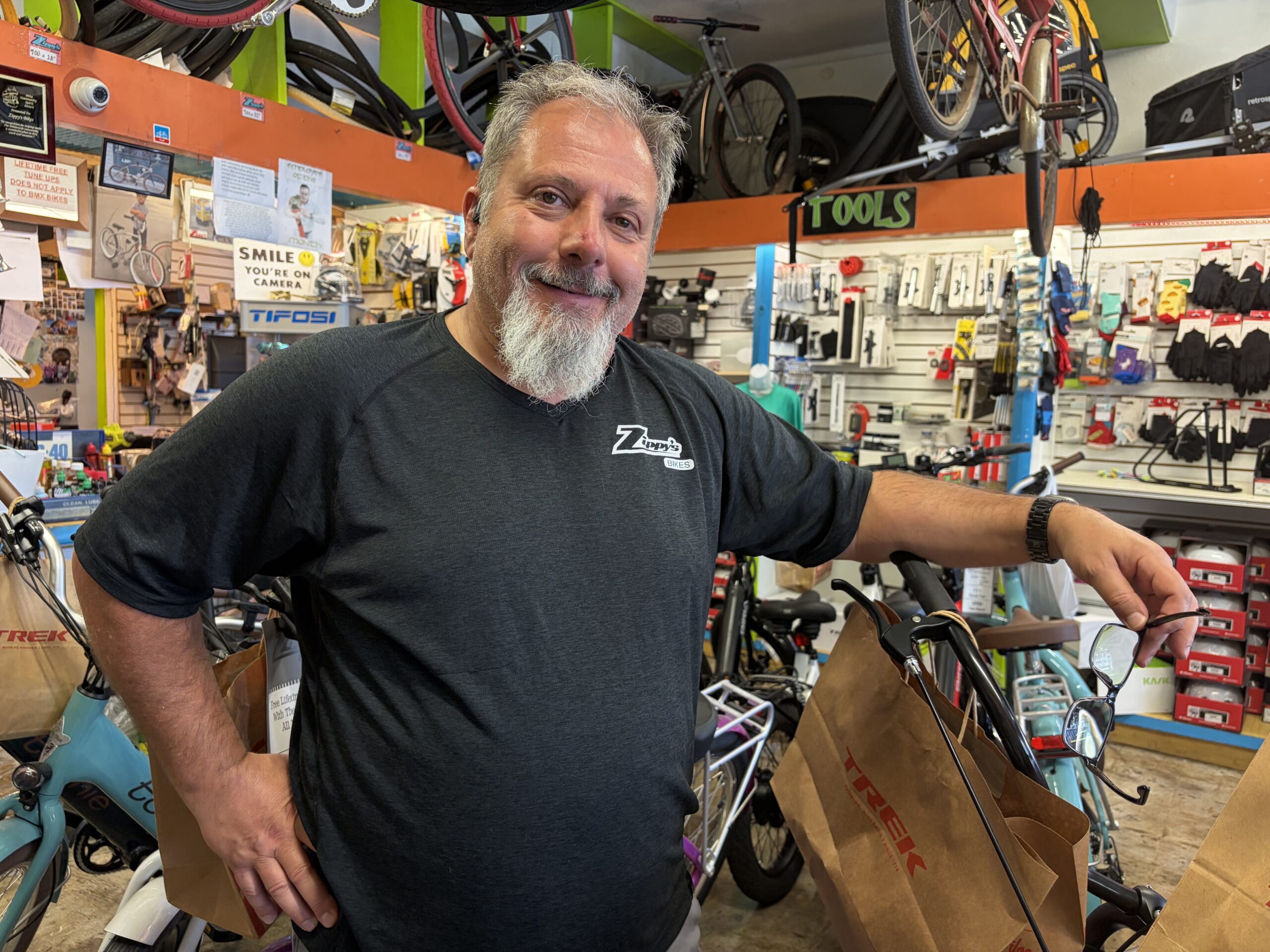
Scott Chambers, owner of Zippy’s Bikes in Wildwood, says the new e-bike law in New Jersey “is a mess,” with no way for people to comply with registration requirements, and confusion over other issues.
“It’s a mess,” said Scott Chambers, owner of Zippy’s Bikes in Wildwood. “It’s so overwhelming because they created this law, I don’t want to say haphazardly, but they rushed it.”
Crawford said his customers are reluctant to buy an e-bike until they know they can ride it in compliance with the law.
He says the law doesn’t mention e-tricycles, so it’s not clear where those might fall. (The state now says the law does not apply to e-tricycles.)
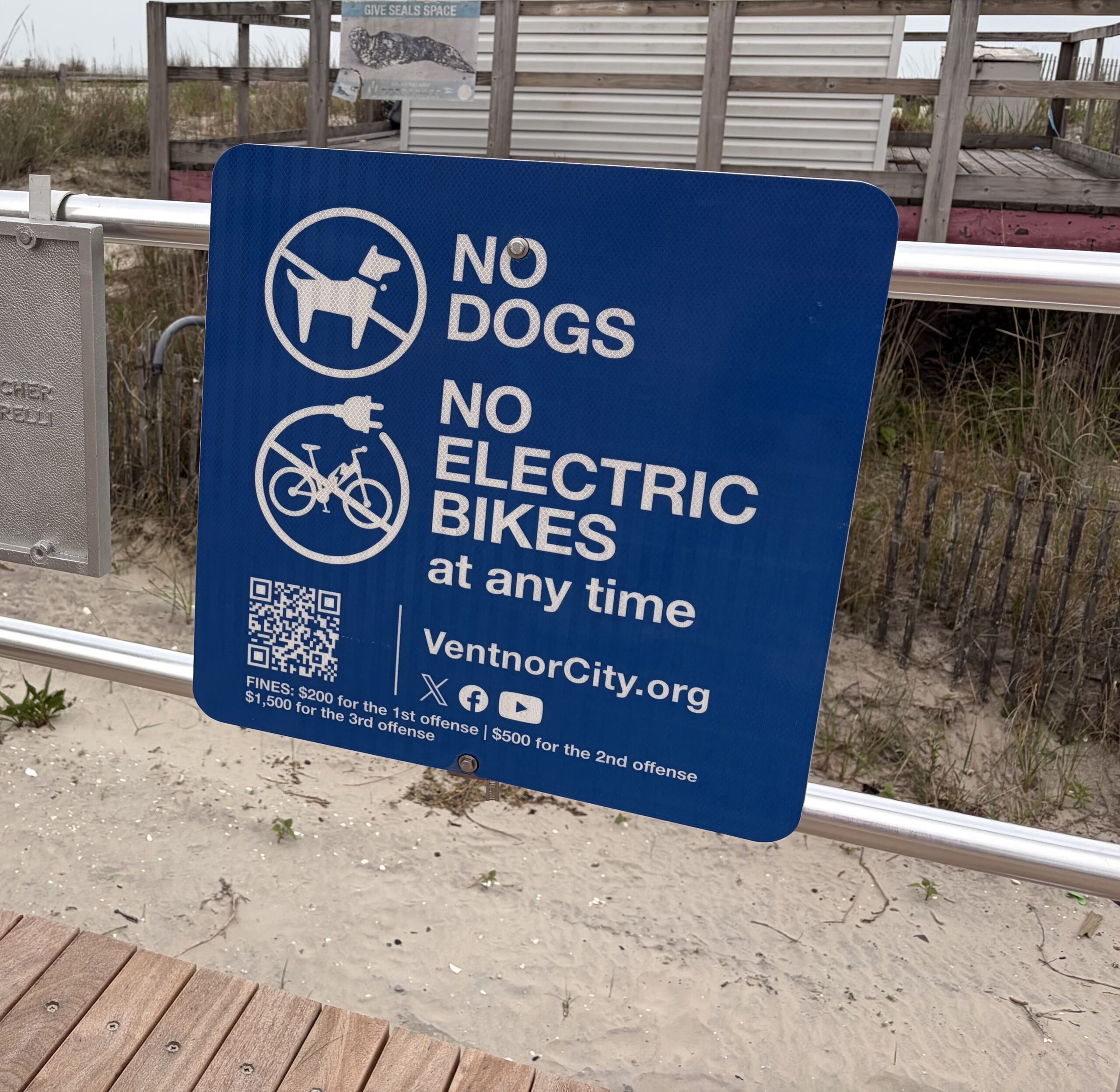
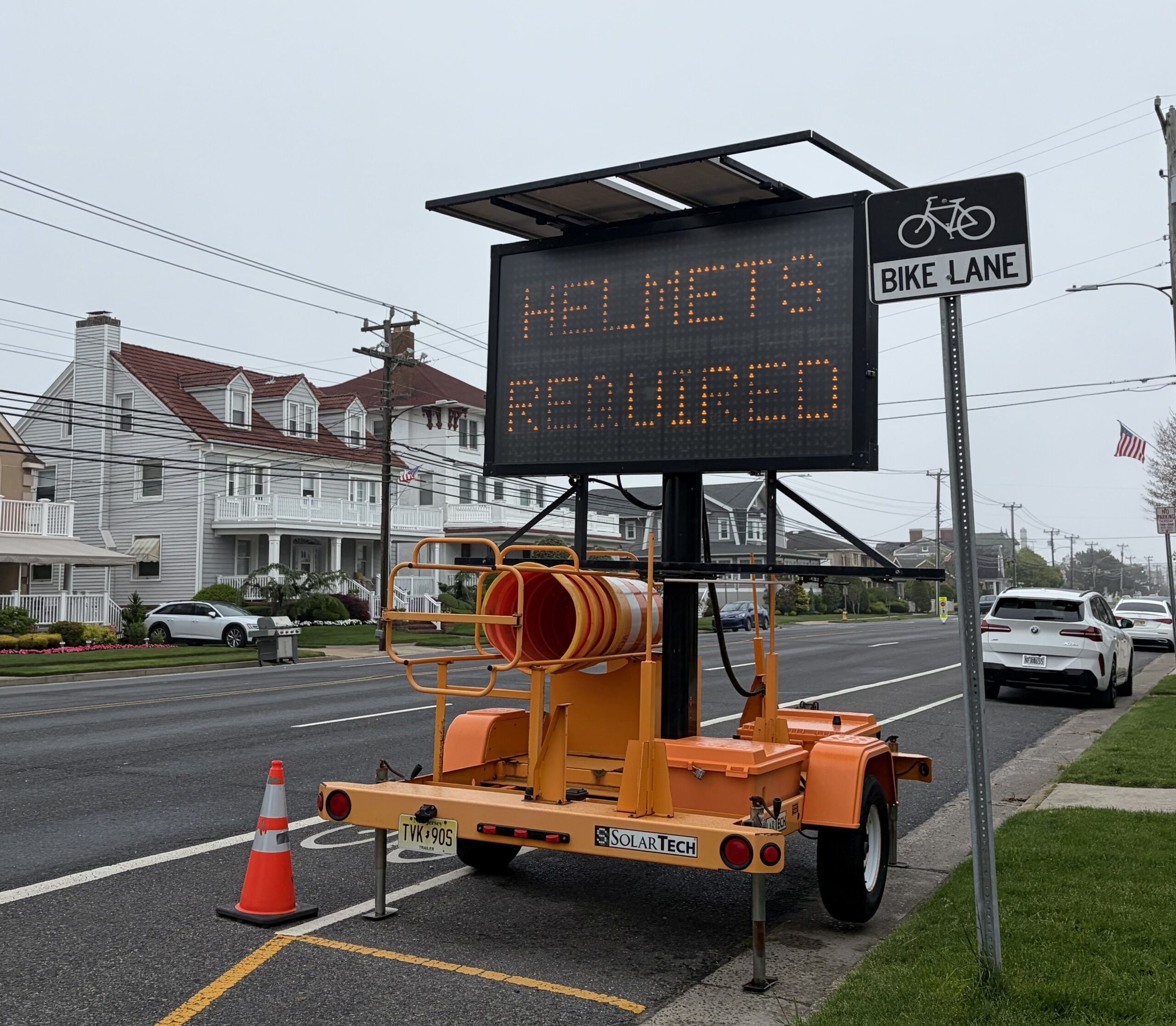
In Ventnor, there’s a big electronic sign on Atlantic Avenue alerting people to the new law’s helmet, insurance, and registration requirements. A new sign was added to the Boardwalk itself, highlighting two prohibited categories: e-bikes and dogs.
Ventnor police Lt. Bryan Gaviria says the department will have its hands full, educating and, at some point, enforcing the new e-bike law.
But first, he said, they need some answers themselves.
“We’re absolutely waiting for clarity all around,” he said, adding that the city’s bicycle officers are choosing to ride on non-electric bikes because they don’t want to be out of compliance themselves, and they don’t want to be on e-bikes while enforcing an e-bike ban.
Ventnor installed this sign on the Boardwalk warning that electric bikes were prohibited (as well as dogs). The state’s new e-bike law goes into effect July 19, but Pennsylvanians will not be required to register their e-bikes while in New Jersey, the state says.
Waiting on the state
The state recently clarified some of the issues that were causing confusion.
William Connolly, the press secretary for the N.J. Motor Vehicle Commission, says the MVC will begin offering appointments for e-bike licensing and registration in July. The law’s grace period ends July 19.
“We will be making an announcement later this month about when appointments will become available, along with offering newly updated resources and step-by-step guidance for e-bike licensing and registration,” he said.
He said the delay was due to the “extensive IT upgrades” required for new licensing and registration systems, educational resources and testing procedures, not to mention buying new materials such as “specialized license plate stickers,” that will have to be displayed on the registered bikes.
“We are establishing a first-of-its-kind, comprehensive process for e-bikes,” he said.
Ventnor installed this electronic sign on Atlantic Avenue to educate people about the state’s new e-bike law. Pennsylvanians will not be required to register their e-bikes while in New Jersey, the state says.
Connolly said there is one category of e-bikes that will not require insurance, though they will still require registration: the lowest speed e-bikes.
“These are the low-speed e-bikes with a motor that provide pedal assist only when the rider is pedaling and cease to provide assistance when the e-bike reaches 20 mph,” he said.
So what if you’re visiting the Shore and bring an e-bike?
Connolly said: “E-bike registration through the New Jersey MVC is only available to New Jersey residents.” Meaning, Pennsylvanians can bring their bikes and use them without registering them.
But bicycle advocates say the law is confusing, because it also states that any bike must display a sticker showing that it is registered.
While the law was prompted by a series of crashes, and particularly by the ubiquitous use by teenagers, it has been seniors that have taken to the e-bikes and urged towns to let them ride on their boardwalks.
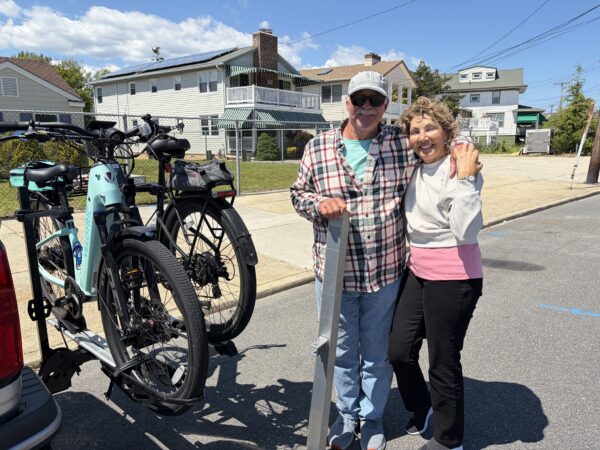
Annamarie, 70, and Mike Carr, 71, of Ventnor are best known for the Jagielky’s candy shops they own, but it’s e-bikes that have become their passion.
Loading their bikes back onto their truck in Ocean City, where they began and ended a bike ride around various bridges, Mike Carr said he’d be sure to wear a helmet, because he believes that will be the thing that officers will focus in on in the beginning.
Annamarie said, “Sure we’re upset,” about not being able to ride on Ventnor’s boardwalk, but they recognize the risks from people going too fast, particularly on electric scooters.
E-bikes have allowed the couple to go on numerous bike rides a week, for upward of 30 or more miles. They’d never do that on a regular bike.
“We parked here, we went the whole length of the boardwalk, we went down to 29th Street, we went back to Haven Avenue, came back and went over the bridge to go see the birds,” Mike said, describing the couple’s route that day.
With the e-bikes, they don’t have to worry about the wind, he said. The couple will typically go 13 miles an hour.
They are hooked on the freedom, distance, and exhilaration that e-bikes have given them, even as they passed 70. They ride all over the bridges of the barrier islands.
Mike’s got some of his regular routes timed so that he can get over the bridge without getting a red light and without automobile traffic catching him from behind. “When we’re going into Longport, you turn around, you look at the light. When it’s red, you have four minutes to get over. You hit the throttle and you go as fast as you can.”
He said they’ll try to register the bicycles and comply with the law, once they’re able to:
“I’ll have to wear a helmet because I’m guessing they’ll look for the guys with no helmet, pull them over.”
E-bike riders can sign up for direct updates from MVC here.
As a U.S. Army soldier in Afghanistan in 2013, Dan Kovalik got used to the adrenaline rush of bullets whizzing by while on patrol. Risking his life was part of his job as he radioed in Apache helicopters to protect other soldiers.
But by the time he retired from the Army in 2018, his 23 years of military service had taken their toll. He had been diagnosed with post-traumatic stress disorder and was rated 80% disabled by the U.S. Department of Veterans Affairs. Kovalik moved back to his hometown of Johnstown, Pa., where he struggled to find the sense of purpose and camaraderie that had come so easily in the military.
“I was looking for ways to be part of the community,” Kovalik said. “Church. The VFW. Then I tried jiujitsu.”
Kovalik, 49, shared his story Saturday from the deck of the USS New Jersey, the decommissioned Navy battleship in Camden. The battleship was host to dozens of fans of and participants in Brazilian jiujitsu — a martial art that uses grappling and leverage to subdue opponents — for a day of competition.
It was part of a two-day jiujitsu seminar and fundraiser put on by the We Defy Foundation, a Texas-based nonprofit that provides qualified combat veterans with free local jiujitsu classes and mentors who help them reintegrate into civilian life. Veterans must have been honorably discharged and have a VA disability rating of at least 80%.
“The physical execution and mental chess game helps me to focus,” Kovalik said. “That, and just going out for a beer or dinner with friends afterwards.”
Omar Feliciano, a 33-year-old Marine Corps veteran from Brooklyn, wins his match against Matthew Castillo, with Prodigy BJJ, at the We Defy Foundation jiujitsu event at the USS New Jersey in Camden on Saturday, June 20, 2026.
The program has over 500 veterans currently enrolled, We Defy Foundation executive director Kevin Linderman said. About 70% of those who enroll complete the one-year program.
“What makes it so different is, you have to do it with someone else,” Linderman said of jiujitsu. “When you’re grappling, you’re connecting with someone deeply. You’re both getting better through the process. It’s physical, and you’re learning how to operate under stress.”
It’s also one more way to fight an ongoing crisis, Linderman said. Though military veterans made up 7.6% of the U.S. population in 2020, they accounted for 14% of suicides, according to research published in the National Library of Medicine. The suicide rate among veterans is 1.5 times higher than that of the overall population, after adjusting for age and sex, researchers noted.
Though prevention efforts have shown some success, nearly 6,400 veterans died by suicide in 2023 — the most recent year for which data were available — according to the Department of Veterans Affairs.
Omar Feliciano of Brooklyn, N.Y., said he found Brazilian jiujitsu after struggling to process a traumatic event he witnessed while in the Marines.
“It really affected my sleep, my relationships with people,” Feliciano said. “I was irritable for no particular reason.”
After another Marine recommended the We Defy Foundation, Feliciano applied. Now, Feliciano benefits from the structure of attending jiujitsu class twice a week, keeping him physically active and building camaraderie with other people in his community.
The 33-year-old mechanical engineer said jiujitsu is helping him be a better father. He fought — and won — a jiujitsu match Saturday.
“We’ve seen that it has a significant impact in reducing PTSD, depression, and anxiety,” said Linderman, 52, who came to the sport in 2015 while dealing with multiple deaths among his family and friends. Much like the veterans he helps, Linderman said, he was caught in a “rumination cycle,” and he quickly learned that an evening of grappling with opponents was a great way to break that cycle.
Ethan Wanner, 21, of Williamsport, Pa. and Tried and True Gym, celebrates after winning his match against Josh Newhart, with 10P Bethlehem, at the We Defy Foundation jiujitsu event at the USS New Jersey in Camden on Saturday, June 20, 2026.
The foundation was formed in 2015 by Army veterans Alan Shebaro and Joey Bozik. Though Bozik lost part of one arm and both legs from the blast of a roadside bomb in Iraq, he learned how to adapt his body to the martial art. In the process, Bozik regained much of the community he had been missing, Linderman said.
As the COVID-19 pandemic waned, interest in the group accelerated, Linderman said. The organization has gotten $250,000 a year in financial backing from Facebook head Tom Alison. With 2,000 people moving through the program so far, interest is only growing. Linderman estimated that there are hundreds of thousands of Iraq or Afghanistan veterans who qualify for the program — including some who are struggling to find connection in civilian life.
“I think that a way for people to stay connected to each other is one of the most important things right now,” Linderman said.
The Odunde Festival began in 1975 as a community event in South Philadelphia inspired by Yoruba traditions from Nigeria. It has since grown into one of the largest Black cultural festivals in North America.
“Odunde”is often translated as “the celebration has arrived.” The festival is rooted in the Yoruba New Year celebration and honors African heritage, history, and spirituality.
LEFT: Vonetta Jones, (from left), Cynthia Johnson and Alexis Murray. RIGHT: Lea and Damon Cunningham and their grandson, Noah, 6.
As a photographer working a Sunday-to-Thursday shift for decades, I’ve covered this and many other Sunday ethnic, religious, historic, and cultural festivals — always with a street-photographer vibe.
When I was assigned to photograph stylish clothing last Sunday — festivalgoers are known for expressing their cultural identity, heritage, and pride through fashion — I saw it as fun challenge to work outside my comfort zone and channel a bit of Philly influencer Big Rube or Humans of New York creator Brandon Stanton.
LEFT: Penny Thompson RIGHT: Kelvin Beck
Something I am always asked when speaking to camera clubs or groups of amateurs photographers is: “Do you have to ask people permission to take their picture?” Others ask, “Do you need to get their names?” The most consistent question, though, is: “How do you approach people you don’t even know?”
Joe Quinones.
I am not an extrovert, but early on I realized that “hiding” behind my camera gave me the confidence to meet and build rapport with strangers.
LEFT: Partners Julian Livingston (left) and Nyobi Nashedeem-Murphy (right) and Nyobi’s mother, Stacey Daniels. RIGHT: Tyanna Man and Bella Reina (right).
After years of doing it, talking to people has never been a concern. But using a flash outdoors to fill in shadows while also worrying about visual variety — different ages, genders, couples, individuals, and backgrounds — was not the way I usually work.
LEFT: Angelina Fletcher (left) and her niece and nephew, Leah Fletcher and TJ Fletcher. RIGHT: Jamar Williams and Jamar, Jr., 9.
I think it turned out OK, and I look forward to trying something similar with my visual coverage of the many events ahead this summer. Bring on the World Cup, America 250, the All-Star Game, and everything else.
Since 1998 a black-and-white photo has appeared every Monday in staff photographer Tom Gralish’s “Scene Through the Lens” photo column in the print editions of The Inquirer’s local news section. Here are the most recent, in color:
Following the Eagles’ Super Bowl LIX win, Deptford High School students Hunter Thomas and Dominic Alia made an Instagram fan page for then-rookie edge rusher Jalyx Hunt, who played a key role in wrecking Kansas City Chiefs quarterback Patrick Mahomes’ night.
Just over a year later, Hunt showed up to the high school graduation of the “Jalyx Hunt enthusiasts.”
On Thursday, while waiting to receive his diploma, Thomas received a text from his mother. Hunt, whom Thomas invited, was sitting in the away stands of Deptford’s football stadium. He waved to the Eagle, who signaled right back at Thomas and his friend, Antoine Sims.
“After that, my head starts spinning,” Thomas told The Inquirer. “There’s no freaking way that he actually came.”
Thomas first met Hunt at last year’s Eagles Autism Challenge. There, he showed the edge rusher the fan page called @jalyxhunt_enthusiast. Hunt loved it and followed the account back. Since then, Thomas and Alia have exchanged direct messages with Hunt, wishing him happy birthday and sending him messages throughout the season.
Before the Eagles’ final regular-season game this past season, a 24-17 loss to the Washington Commanders, Hunt met Thomas and Alia above the tunnel to sign Thomas’ jersey. “Always love,” Hunt, who recognized the pair, signed. “Go birds!”
When graduation came around, Thomas had an extra ticket, so he thought to text his favorite player first. To his surprise, Hunt responded that he would be able to come. Immediately, Thomas employed his sister to decorate his graduation cap, complete with Hunt’s No. 58 and a throwback Eagles logo.
In a post to his Instagram story on Thursday, Hunt shared a photo of his view from the Deptford stands. “I’m locked,” he wrote, tagging the fan account which now sits at roughly 1,000 followers.
“I get my diploma, and my mom, because she’s a teacher, she gives it to me,” Thomas said. “I hug her, and when I walk back to my seat, I point out to Jalyx. He points back. When I did it, I was just thinking, ‘I got to show him some love.’”
Jalyx Hunt with Hunter Thomas at Thomas’ high school graduation.
After all his classmates’ names were called and his cap was thrown, Thomas made his way over to Hunt, who was now sitting with Thomas’ father. Hunt caught up with Thomas, telling him that he was cheering loudly when Thomas received his diploma. Eventually, Thomas found Alia on the field and the three posed for photographs.
“There’s a lot of NFL players with all this clout, and their heads are so big, and then he’s just the most down-to-earth [person],” Thomas said. “He’s like, ‘Yes I play football, but I’m still a normal guy at the end of the day.’
“He’s one of the nicest people I’ve ever met in my life. Me and Dom said, after we were like, ‘This is like a memory that we’re going to have forever.’”
Vineland’s public school teachers are having an easier timewith the question of what to wear to work — at least for the final days of the school year.
In a move to boost morale in the South Jersey school system and make teachers’ lives easier this spring during a hectic testing period, the district eased its dress policy to allow denim jeans until the end of the school year on June 25.
Teachers love it and hope it will continue in September.
“It’s one small way to make the world of work a little friendlier,” said Vineland Education Association president Louis Russo, a social studies teacher. “It’s one small thing off of their shoulders.”
Teachers Andrea Ruiz (left) and Elaine Petrini (right) at Rossi Elementary in Vineland on June 9. The teachers are allowed to wear jeans until the end of the school year.
School board president Cedric Holmes said the Cumberland County district notified employees when they returned from spring break in April that they could wear jeans any day of the week under a pilot program.
Holmes said there had been rumblings among staff because the district — the largest in Cumberland County, with 11,000 students — had to extend the school year to make up snow days. Vineland‘s June 25 last day of school isamong the latest in the region.
The months following spring break are among the toughest with students undergoing standardized state testing, Holmes said. There are also end-of-the year field trips and outings when it makes sense to allow more relaxed clothing, he said.
“It was important to the board that staff felt that we saw the stress of all of that of this as a practical way to give a morale boost for the end of the year,” Holmes said.
Teachers typically dress a bit more formally for school.According to Vineland’s policy, female teachers must wear skirts, slacks, skorts, or dresses with blouses or sweaters, or school uniform. The skirt, skort, or dress should not exceed three inches above the knee.
Male staffers can wear suits or slacks with jackets and ties, sweaters, school uniform, or sports or dress shirts. Deemed unacceptable for both are sneakers, flip-flops, bedroom slippers, combat boots, and work boots. There are exceptions for teachers attending field trips or who work in specialized areas such as health and physical education or arts.
The district also has a uniform policy for students, but Holmes said that has been relaxed and the board also plans to reexamine that policy.
New Jersey’s 600 school districts set their own policies for staff and students.
Steve Baker, a spokesperson for the New Jersey Education Association, which represents 200,000 teachers and support staff, said the union supports the efforts in Vineland “to develop policies that help create a positive learning and working environment for students and staff.“
On a busy morning last week at Anthony Rossi Elementary in Vineland, third-grade teacher Jeffrey Martine stood in front of the class dressed in khaki shorts, a button-down blue dress shirt, and slip-on loafers. As an added bonus, it was a dress-down day, which allowed teachers to wear casual attire beyond jeans.
Jeffrey Martine, a teacher at Rossi Elementary in Vineland, greets a student at the school last week.
“If you do your job well, you have to be able to move,” Martine said. “I’m all about comfort.”
Students in Martine’s gifted and talented class were spread around the room working on a project in small groups. Some sat at desks making posters, while others were stretched out on the floor.
“I don’t think professionalism and comfort are mutually exclusive,” Martine said. “Teachers should be judged more on how they interact with their students than the pants they select.”
Holmes acknowledged the dress code was outdated and revisions are needed. The board plans to review the changes implemented this spring and may allow teachers to wear jeans during the new school year, he said.
“It was time for a change,” said Kaitlynn Rossi, a long-term substitute teacher. “People don’t dress like that.”
Teacher dress codes have evolved nationally over the years, especially during the pandemic, when more casual attire was the norm.
Based on responses from teachers around the world, the website We are Teachers in 2024 compiled a list of “16 Ridiculous Dress Code Rules for Teachers You Won’t Believe Are Real.” The list included prohibiting hats, capri pants, pants with pockets, UGGs, hoodies, or dark underwear.
In Philadelphia, where classes ended last week, there is no system-wide dress code for staff. Arthur Steinberg, president of the Philadelphia Federation of Teachers, which represents about 14,000 teachers, counselors, nurses, secretaries, and other workers, said employee dress typically does not come up as an issue.
School board president Cedric Holmes at Rossi Elementary in Vineland last week. Holmes said the teacher dress code policy was relaxed in an effort to improve morale at the end of the school year.
Holmes said teachers have responded well to the changes in Vineland and there have been few infractions, like torn or ripped jeans.
Before Vineland implemented the pilot dress code, teachers were allowed to wear jeans only for special days. The schools sponsor fundraisers that allow teachers to pay $2 to wear jeans. Students are allowed to wear jeans on dress-down days determined by their school principal, and they do not have to pay.
Fourth-grade teacher Andrea Ruiz said dressing more casually helps her students see her differently. A sign in her classroom says: “Be the best version of you.” She enjoys sitting with students on the carpet in her classroom or playing kickball on the playground.
“We’re meeting them where they are,” said Ruiz, who was wearing a gray T-shirt and striped pants. “It’s definitely something different for us.”
Teacher Kaitlynn Rossi with students at Rossi Elementary in Vineland last week.
Timothy Purnell, executive director of the New Jersey School Boards Association, said a decision as simple as allowing jeans can have an impact on the learning environment.
“If jeans support a positive environment during testing, that’s a local call we respect,” Purnell said.
Russo believes a less-stringent dress code will help attract and retain younger teachers amid a national teacher shortage. He wants them to still dress in a manner that gets respect from students.
“We just have to find the right balance,” Russo said.
Staff writer Kristen A. Graham contributed to this article.
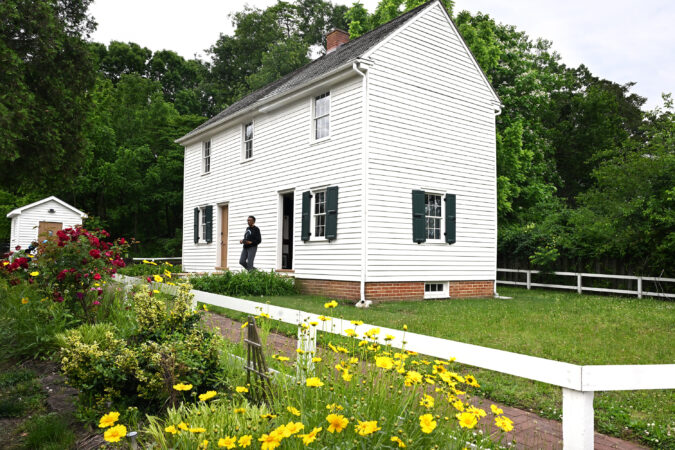
LAWNSIDE — For nearly 200 years, the historic Peter Mott House — believed to have once served as a stop on the Underground Railroad — has managed to withstand the encroachment of the outside world.
In the 1950s, construction of the New Jersey Turnpike brought a heavily used trafficway within just a few hundred feet of the home.There was the time, in the 1980s,when a developer bought up a patch of surrounding land with plans to raze the structure and build housing units. And the arrival of the COVID-19 pandemic in 2020 left the home shuttered for three years — and its future temporarily uncertain.
Now, the New Jersey Turnpike Authorityplans to soon begin work on a $2 billion project to expand the turnpike, which would bring the highway — currently located just 220 feet from the Mott House — 12 feet closer to the building.
The plans have prompted a wave of pushback from a small but vocal group of Lawnside residents, who fear that vibrations from the construction could damage the nearly two-century-old structure and that already “deafening” traffic noise in the area could become unbearable.
Already, says Linda Shockley, the longtime president of the Lawnside Historical Society, which owns and maintains the Mott House, it can be difficult for visitors to hear over the hum of the turnpike. The back of the house, which boasts a quaint patio, is essentially unusable without the use of microphones, she said — and this is to say nothing of the potential environmental and safety implications of bringing a heavily traversed highway even closer to a residential area.
The expansion, which also includes plans to widen nearby Warwick Road, has become — in Shockley’s words — “like a sword of Damocles hanging over us.”
“What are you doing and when are you going to do it?” Shockley said. “And what say do we have over how it’s done?”
Traffic on the New Jersey Turnpike passes at the end of a cul-de-sac near the historic Peter Mott House in Lawnside, N.J.
Theconstruction arrives at a seminal moment for the historic borough, which this year is celebrating the 100th anniversary of its incorporation.
Originally settled by formerly enslaved people who escaped or were freedand considered the first independent, self-governing African American community north of the Mason-Dixon Line, Lawnside has long boasted a historical significance far outsizing its modest 1.4-square-mile footprint.
In the 1930s, it was home to a bustling entertainment district, drawing high-profile acts such as Ella Fitzgerald and Billie Holiday. Three decades later, Lawnside’s school district became one of the first U.S. governmental entities to declare the Rev. Dr. Martin Luther King Jr.’s birthday a holiday.
No aspect of Lawnside’s history, however, has remained as vital to its identity than the Mott House, the onetime home of Peter Mott,a free Black farmer, preacher, and abolitionist, who, along with wife Elizabeth, was a conductor on the Underground Railroad.
Built around 1845, the home is Lawnside’s oldest known house and is widely believed to have been a refuge for enslaved people traveling from the South — making it a strong symbol for the community at large.
“This town has been a beacon of hope for African Americans,” said Darryl Lee Dozier, 60, a longtime Lawnside resident. “To be able to walk outside and say, ‘Harriet Tubman came through this town’ — that’s iconic, man.”
At least 18 municipalities across Salem, Gloucester, Camden, and Burlington Counties will be affected by the turnpike project, but the proximity of the Mott House — as well as a neighboring housing development — to the construction has stoked fears that it will be uniquely vulnerable. State officials say they are working closely with local leaders to ensure that any adverse effects of the project are minimal.
(function() { var l = function() { new pym.Parent( ‘peter-mott__graphic’, ‘https://media.inquirer.com/storage/inquirer/ai2html/peter-mott/index.html’); }; if(typeof(pym) === ‘undefined’) { var h = document.getElementsByTagName(‘head’)[0], s = document.createElement(‘script’); s.type = ‘text/javascript’; s.src = ‘https://pym.nprapps.org/pym.v1.min.js’; s.onload = l; h.appendChild(s); } else { l(); } })();
AECOM, the infrastructure firm handling the engineering work for the turnpike project, told The Inquirer recently that Lawnside qualifies for noise barriers to help alleviate the effects of the project, and that “vibration monitoring,” as well as inspections, would be conducted throughout the course of the project.
“Should the vibrations for any reason exceed a threshold that would cause concern, then the activities would pause and we’d figure out what’s going on,” said Matthew Rao, a project manager with AECOM.
New Jersey Assemblyman William F. Moen Jr., who grew up in the area, said he has been engaged in conversations with the New Jersey Turnpike Authority about the project since 2020 and has been cognizant of the questions raised by Shockley and others.
“I’m acutely aware of her concerns, and I think they’re valid,” he said. “This is the time to be talking about those things, and making sure, to the extent that they can be, that they’re reflected in the final plan of what’s going to happen.”
Still, many in Lawnside remain wary.
Kia Jones at her home next door to the Peter Mott House in Lawnside, N.J. Tuesday, May 26, 2026. Plans to expand the nearby New Jersey Turnpike have left local residents concerned about how it could affect a beloved institution as well as neighboring homes.
Despite meetings with officials, said Kia Jones, 60, whose home sits near the proposed turnpike expansion, residents have largely felt powerless throughout the process.
“Their whole attitude seems to be, ‘It’s a done deal — we’re just talking to you because we have to, but nothing’s going to change,’” she said.
For some in this South Jersey borough of roughly 3,000 residents, meanwhile, the expansion raises unmistakable echoes of the 1950s, when construction of the turnpike left a profound impact on the community.
At the time, America’s vast network of highways was displacing — and often targeting — Black communities across the country.
Initially, Shockley said, only six homes in Lawnside were supposed to be affected by the turnpike’s creation. But by the time it opened in November 1951, she said, 27 families had been affected.
“Some people’s houses were purchased, some houses were condemned,” Shockley said. “I’ve seen pictures of houses on flatbed trucks, being moved.”
(It was not lost on some in Lawnside, Shockley points out, that the turnpike conveniently curves around the nearby Tavistock Country Club, a private golf club founded in 1920.)
Though few in Lawnside are old enough to remember the turnpike’s arrival, many have felt the ripples.
Lorraine Pollitt, 70, a lifelong Lawnside resident, grew up hearing about her great-grandparents’ farm, which, she said, had fallen in the turnpike’s right-of-way and, as a result, had to be sold.
Seventy-five years later, Pollitt said, the expansion project feels like more of the same.
“Just taking more from us here,” she said. “It’s always something.”
For Shockley, who has served as president of the historical society since 1994, the effort to preserve and protect the Mott House has been a nearly 40-year endeavor.
She first got involved in the late 1980s, when a local developer, Mark DeFeo, received permits from the borough to raze the house in order to build a small housing development.
A group of residents organized to try to stop the home’s demolition, and Shockley — who was raised in Lawnside and had recently moved back from New York — joined the effort.
It took three years and considerable legal wrangling, but the developer eventually agreed to sell the home to the group for $1.
For its efforts, Shockley later told the New York Times, the group found itself in possession of “a decaying, vacant house … in danger of collapsing.”
In the years since, however, the historical society, buoyed by a dedicated collection of volunteers, has turned the property into a gem that has garnered national renown. The group has raised hundreds of thousands of dollars toward upgrades and repairs through grants and donations.
The house opened to the public in 2001, and, today, it offers a variety of programming, including a weeklong summer camp for middle schoolers on the history of the Underground Railroad, sitting on both the national and state registers of historical places.
In her mid-30s when she joined the effort, Shockley is now in her 70s, her hair flecked with gray. She retired in 2021 from her job at the Dow Jones News Fund, a journalism nonprofit foundation.
“Don’t tell anyone,” she joked one morning recently, from a seat inside the Mott House, “but I’m getting older.”
Linda Shockley, president of the Lawnside Historical Society, at the Peter Mott House in Lawnside, N.J. Tuesday, May 26, 2026. Shockley has served as president of the local historical society since 1994.
But while there is still work to be done, she remains dedicated to doing it — one more battle in a long string of them.
“Ask anybody who’s trying to do anything with historic buildings, or restore history or culture, and you find that, yeah, there’s always something — and there are always threats to it,” she said.
Officials of the Pennsylvania and New Jersey Turnpikes have chosen a design to replace the 70-year-old bridge over the Delaware River linking the toll roads: a six-lane span that would be built about 195 feet north of the existing one.
Called a ”tied-arch” bridge, the $1.6 billion replacement would be cheaper than other styles considered and can be built fastest, said John Boyer, senior engineer for the Pennsylvania Turnpike Commission.
“Shorter time frames mean less disruption to local businesses and daily life for the communities in this area,” said Boyer, the manager of the joint project.
Because the new bridge would be farther from the existing Delaware River Bridge than alternatives, traffic can keep flowing as it’s built, he said.
Planners for years have known that the region would need a new turnpike bridge because of exponential growth in traffic volume, especially trucks.
Freight volumes nationally are projected to grow by 73% by 2050, with warehouses on both sides of the river relying on crossing.
Before the nearby I-95/Pennsylvania Turnpike interchange opened in 2018, an average of 42,000 vehicles a day crossed the four-lane Delaware River Bridge. Now, that’s up to around 70,000. By 2050, projections say an average 93,000 vehicles will need to traverse the replacement.
The surfaceof a tied-arch bridge provides tension to resist the horizontal forces pressing on either end of the arch, like the taut string that connects a bow. It requires less sturdy foundations than a bridge supported by cables.
“You can be build those river piers while you’re building the arch structure off-site,” Boyer said. When the piers are ready, the arch can be brought in by barge and “you can essentially jack it and elevate it up into place,” he said.
Federal authorities approved a new span in 2003, but the project was put on hold because of problems paying for it.
As congestion increased on the repaired bridge, more traffic capacity became imperative, officials said.
Because the earlier federal approval was so old, officials had to start again with a new environmental impact statement and design studies. Last year, turnpike officials settled on two options.
Now, they’re finishing up the environmental impact statement, with formal public hearings scheduled for the winter.
Turnpike officials expect the Federal Highway Administrationto make a decision on the project around April 2028.
The two states’ turnpike agencies will finance the balance. Borrowing would be backed by toll revenue, but both say the bridge project won’t increase tolls for drivers.