Category: News

Latest breaking news and updates

  • Lindsey Halligan out as U.S. attorney following pressure from judges

    Lindsey Halligan out as U.S. attorney following pressure from judges

    Lindsey Halligan, a Trump administration lawyer who was named head of a key U.S. attorney’s office in Virginia last year with instructions to seek criminal charges against President Donald Trump’s perceived political adversaries, left her post at the Justice Department on Tuesday.

    Halligan’s departure followed a pair of extraordinary moves by two federal judges who issued court orders hours earlier saying they intended to replace Halligan at the helm of the U.S. attorney’s office for the Eastern District of Virginia and threatening disciplinary sanctions for any government lawyer who continued to refer to her as U.S. attorney in legal filings.

    The separate actions by Chief Judge M. Hannah Lauck and Judge David J. Novak, who were nominated by President Barack Obama and Trump, respectively, signaled a breaking point for the federal bench in the Eastern District of Virginia months after Halligan was disqualified from serving as U.S. attorney in the high-profile office.

    The orders intensified a battle playing out nationwide between the executive and judicial branches over how the nation’s 93 U.S. attorneys can be appointed for temporary terms without Senate confirmation. And they had posed obstacles for Halligan — who had no prosecutorial experience before she was installed in the job — as she attempted to carry out Trump’s directions to levy criminal charges against two of his perceived political foes: former FBI director James B. Comey and New York Attorney General Letitia James.

    Halligan, in a statement, accused the district’s federal judges of a campaign to pressure her to leave after the court ruling declaring her appointment was invalid. She said that effort had diverted “time and resources from public safety responsibilities.”

    It was unclear Tuesday night who would be in charge of the U.S. attorney’s office. The Justice Department this month dismissed the first assistant U.S. attorney, Robert K. McBride, who would have automatically assumed the top job under federal law. A Justice Department spokesperson did not immediately respond to requests for comment.

    Halligan is the third Trump-appointed U.S. attorney pick to leave their post in the face of a growing body of court rulings that have deemed their appointments illegal.

    Alina Habba, a former Trump lawyer he picked to lead the U.S. attorney’s office in New Jersey, resigned last month after a monthslong legal battle over whether she was lawfully serving in that role.

    While the Justice Department continues to appeal the decision, Habba stepped down and moved to another role in the Justice Department.

    Julianne Murray, another contested pick, resigned her post as U.S. attorney in Delaware days afterward. Before her appointment, she had served as the state’s Republican Party chairwoman.

    Attorney General Pam Bondi praised Halligan for her service in a statement Tuesday.

    “While we will feel her absence keenly, we are confident that she will continue to serve her country in other ways,” Bondi said. “The circumstances that led to this outcome are deeply misguided. We are living in a time when a democratically elected President’s ability to staff key law enforcement positions faces serious obstacles.”

    Several judges had suggested for weeks that Halligan should resign and sharply questioned her continued use of the U.S. attorney title after an out-of-district judge, Cameron McGowan Currie, ruled in late November that the Trump administration had used an unlawful maneuver to install Halligan.

    On Tuesday, Lauck directed the court’s clerk to publish the U.S. attorney job posting in local newspapers, asking anyone interested to apply by Feb. 10. “The position of United States Attorney for the Eastern District of Virginia is vacant,” reads a public notice posted on the court’s website Tuesday.

    Lauck’s order marked an escalation, signaling active efforts by the judges to appoint the district’s top federal prosecutor under a federal law that gives them the power to do so after an interim U.S. attorney has been in office for 120 days. It was followed hours later with another order from Novak, who raised the threat of disciplinary action for anyone who described Halligan as the U.S. attorney in legal filings.

    “No matter all of her machinations, Ms. Halligan has no legal basis to represent to this Court that she holds the position. And any such representation going forward can only be described as a false statement made in direct defiance of valid court orders,” Novak wrote. “In short, this charade of Ms. Halligan masquerading as the United States Attorney for this District in direct defiance of binding court orders must come to an end.”

    The Trump administration has appealed Currie’s ruling, but it never requested a stay, so the ruling disqualifying Halligan remained in effect. Nonetheless, she continued to represent herself as the U.S. attorney in court filings.

    This month, Novak ordered Halligan to explain why she continued to use the title, suggesting she may be making false or misleading statements. The Justice Department responded defiantly to that order last week, arguing that Currie’s ruling was not binding and that Novak had no authority to strike Halligan’s name from the signature block of Justice Department court filings.

    The response, which accused Novak of making “rudimentary” legal errors and missing “elementary” legal principles, was written in a derisive tone unusual for a government lawyer addressing a federal judge.

    Novak said in response that Halligan’s rhetoric was beneath the court’s dignity and more suitable for cable news. He said Halligan’s continued use of the U.S. attorney title after Currie’s ruling was an affront to the legal system.

    “The Court cannot tolerate such obstinance, because doing so would undermine the very essence of the Rule of Law,” he wrote in Tuesday’s order. “If the Court were to allow Ms. Halligan and the Department of Justice to pick and choose which orders that they will follow, the same would have to be true for other litigants and our system of justice would crumble.”

    Halligan’s nomination for a full term as U.S. attorney is pending in the Senate, and it was unclear Tuesday whether the White House also intended to withdraw it. Even if they don’t, the nomination is unlikely to move forward because it lacks support from Virginia’s two senators — Mark R. Warner and Tim Kaine, both Democrats — who have emphasized that the Eastern District of Virginia handles a complex portfolio of cases dealing with national security, leaks of classified information, and international terrorism.

    In disqualifying Halligan last fall, Currie ruled that Halligan was never legally appointed to the position of interim U.S. attorney because the Trump administration had already named someone to that role — Halligan’s predecessor, Erik S. Siebert, who served a full 120-day term, from January to May 2025. The district judges then unanimously extended Siebert in the role at the Justice Department’s request, Novak wrote in his order.

    But Siebert was forced out in September after declining to seek charges against Comey and James. Career prosecutors had recommended against pursuing the two cases because of insufficient evidence of wrongdoing. Trump then named Halligan, who promptly secured indictments against Comey, on allegations that he made false statements to Congress, and James, who was accused of mortgage fraud. Currie tossed both indictments after finding that Halligan was unlawfully appointed.

    Halligan’s 120-day appointment concluded Tuesday.

    Justice Department lawyers maintain that the statute allows for back-to-back interim appointments. But in addition to Currie, at least five other federal judges have rejected that argument while ruling on challenges to other Trump U.S. attorney appointees. In each case, the judges have said that if the attorney general could legally name a string of interim appointees, there would be no need for an administration to put a nominee up for a Senate vote.

    Judges across the country have been cautious in exercising their authority to name replacements for the president’s picks. When New Jersey’s federal judges named a veteran federal prosecutor to replace Habba last summer, the Justice Department fired their pick within hours and undertook a series of legal maneuvers aimed at keeping Habba in the role.

    Delaware’s chief federal judge began soliciting applications this fall to replace Murray in Delaware. But Murray resigned her post in December before a potential standoff with the administration could come to a head.

    Judges in other districts have refused to reappoint Trump’s interim U.S. attorney picks but declined to choose replacements. The chief federal judge in Seattle issued an order last week soliciting applications to potentially appoint a new acting U.S. attorney there, when the interim appointment of Trump’s current pick expires next month.

  • Trump’s Greenland threats spark outrage and defiance from EU, testing longtime NATO alliances

    Trump’s Greenland threats spark outrage and defiance from EU, testing longtime NATO alliances

    WASHINGTON — President Donald Trump‘s pledge to provoke a sweeping tariff fight with Europe to get his way in taking control of Greenland has left many of America’s closest allies warning of a rupture with Washington capable of shattering the NATO alliance that had once seemed unshakable.

    The European Union’s top official on Tuesday called Trump’s planned new tariffs over Greenland a “mistake” and questioned Trump’s trustworthiness. French President Emmanuel Macron said the EU could retaliate by deploying one of its most powerful economic tools, known colloquially as a trade “bazooka.”

    The rising tensions concerning Greenland, and threats of a deepening trade war between the U.S. and Europe, caused global investors to shudder Tuesday, as stocks on Wall Street slumped.

    Trump prides himself on ratcheting up pressure to try to negotiate through a position of strength. He was leaving Tuesday — the anniversary of his inauguration — for the World Economic Forum in Davos, Switzerland, a venue that offers Trump the chance to defuse tensions as quickly as he stirred them up.

    But European leaders — digging in and vowing to defend Denmark and its control over semiautonomous Greenland — may be seeking just as hard to meet an extraordinary moment with a show of their fierce resolve.

    That could hurt the chances of Trump finding a quick way to turn around the crisis. Greenland’s leader insisted on respect for its territorial integrity and said recognition of international law is “not a game.”

    ‘We will work something out’

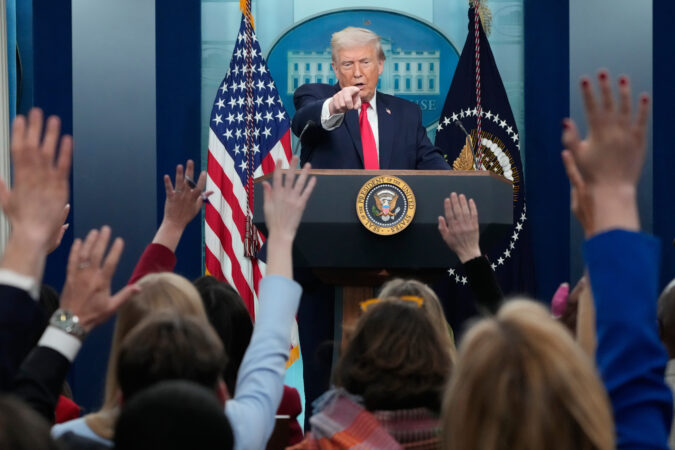
    Trump made an unusual appearance in the White House briefing room and spoke at length while stocks fell. Asked how far he’d be willing to go to acquire Greenland, Trump said only, “You’ll find out.” He also mistakenly referred to Greenland as Iceland at one point.

    Still, the president predicted there could be a deal in the making with allies. “I think that we will work something out where NATO is going to be very happy, and where we’re going to be very happy,” he said, without providing specifics.

    Trump said he’d been encouraged that NATO had increased military spending, but he also belittled the alliance, saying other members may not protect Washington’s interests. The president suggested NATO members expect the U.S. to come to their rescue but “I just really do question whether or not they’ll come to ours.”

    European Commission President Ursula von der Leyen pushed back against Trump’s announcement that, starting February, a 10% import tax will be imposed on goods from eight European nations that have rallied around Denmark. Greenland is a semiautonomous territory of Denmark, a NATO member.

    “The European Union and the United States have agreed to a trade deal last July,” von der Leyen said in Davos. “And in politics as in business — a deal is a deal. And when friends shake hands, it must mean something.”

    “We consider the people of the United States not just our allies, but our friends. And plunging us into a downward spiral would only aid the very adversaries we are both so committed to keeping out of the strategic landscape,” she added.

    She vowed that the EU’s response “will be unflinching, united and proportional.”

    Taking firmer stances defied the approach that many European leaders have offered since Trump returned to office. It had mostly entailed saying nice things about the president to try to stay in his good graces, while working furiously through other avenues to find compromise.

    Trump says the U.S. needs Greenland to deter possible threats from China and Russia. But his continued insistence in recent weeks that anything short of the U.S. owning Greenland is unacceptable is testing the limits of the softer strategy.

    Danish Prime Minister Mette Frederiksen said “the worst may still be ahead of us.” Speaking to parliament, she said “we have never sought conflict. We have consistently sought cooperation.”

    ‘Not a game’

    Greenland’s Prime Minister Jens-Frederik Nielsen said at a news conference in the island’s capital, Nuuk, that “we need to have respect for international law and territorial integrity.” He said those principles should unite Western democratic countries, and said he was grateful for support from EU allies.

    “International law, it’s not a game,” he said. “We have been a close and loyal ally to the United States, to NATO, through many, many, many years. We can do lots more in that framework. We are willing to cooperate much more, but of course in mutual respect, and if we cannot see that, it will be very difficult to have a good and reliable partnership.”

    Trump’s threats have sparked outrage and a flurry of diplomatic activity across Europe, as leaders consider possible countermeasures, including retaliatory tariffs and the first-ever use of the European Union’s anti-coercion instrument.

    Unofficially known as the “trade bazooka,” the anti-coercion instrument could sanction individuals or institutions found to be putting undue pressure on the EU. The EU has two other major economic tools it could use to pressure Washington: new tariffs, or a suspension of the U.S.-EU trade deal.

    Macron warned in Davos that the additional tariffs could force the EU to use its anti-coercion mechanism for the first time against the United States.

    “Can you imagine that?” he said, arguing that allied countries should be focusing instead on bringing peace to Ukraine. “This is crazy.”

    In general, he said, the mechanism “is a powerful instrument and we should not hesitate to deploy it in today’s tough environment.”

    Trump earlier posted a text message from Macron in which the French president suggested a meeting of members of the Group of Seven industrialized democracies in Paris after the Davos gathering. An official close to Macron, who spoke anonymously in line with the French presidency’s customary practices, confirmed the message shared by Trump is genuine.

    In his latest threat of tariffs, Trump indicated that the import taxes would be retaliation for last week’s deployment of symbolic numbers of troops from the European countries to Greenland — though he also suggested that he was using the tariffs as leverage to negotiate with Denmark.

    ‘In the midst of a rupture’

    Canadian Prime Minister Mark Carney, whose country is a founding NATO member, warned of global fissures beyond Greenland, suggesting it was an “illusion” and “fiction” that there remains a rules-based international order.

    “Let me be direct: We are in the midst of a rupture, not a transition,” Carney said during a speech in Davos.

    Belgian Prime Minister Bart De Wever said at Davos that Europe cannot be a “miserable slave’ to Trump.”

    Others encouraged NATO leaders to stand up to Trump. Speaking on the sidelines of Davos, California Gov. Gavin Newsom slammed Europe’s response to Trump’s tariff threats as “pathetic” and “embarrassing,” and urged continental leaders to unite and stand up to the United States.

    “It’s time to stand tall and firm, have a backbone,” Newsom, a Democrat, told reporters.

    Greenland’s European backers have also looked at establishing a more permanent military presence to help guarantee security in the Arctic region, a key demand of the United States, Swedish Defense Minister Pål Jonson said.

    In Moscow, meanwhile, Russian Foreign Minister Sergey Lavrov strongly denied any intention by Russia and China to threaten Greenland, while also describing Greenland as a “colonial gain” for Denmark.

    Trump was asked Tuesday what would happen to his tariff threats related to Greenland if the Supreme Court rules against his ability to impose import tariffs as part of a case it is considering.

    “Well, I’ll have to use something else,” Trump said. “We have other alternatives.” He didn’t respond when asked about using force.

  • Fact check: Trump highlights familiar false claims as he reviews his first year back in office

    Fact check: Trump highlights familiar false claims as he reviews his first year back in office

    President Donald Trump marked his first year back in office by presiding over a meandering, nearly two-hour-long press briefing to recount his accomplishments, repeating many false claims he made throughout 2025.

    Among the topics about which he continued to spread falsehoods were the 2020 election, foreign policy, the economy, and energy.

    Here’s a closer look at the facts.

    2020 election

    TRUMP, referencing former President Joe Biden: “… a man that didn’t win the election, by the way, it’s a rigged election. Everybody knows that now.

    THE FACTS: This is a blatant falsehood that has been disproven many times over — the 2020 election was not stolen. Biden earned 306 electoral votes to Trump’s 232. He also won over 7 million more popular votes than Trump.

    But Trump has been persistent in claiming that he won the 2020 race since its completion, even after he earned a second term in 2024, and has continued to claim the lead-up to the 2026 midterms.

    Biden’s Electoral College victory was nearly the same margin that Trump had in 2016 when he beat Hillary Clinton 227 to 306 (304 after two electors defected). Biden triumphed by prevailing in key states such as Pennsylvania, Michigan, Wisconsin, Arizona, and Georgia.

    Allegations from Trump of massive voting fraud have been refuted by a variety of judges, state election officials and an arm of his own administration’s Homeland Security Department. In 2020, then-Attorney General William Barr, a Trump appointee, told the AP that no proof of widespread voter fraud had been uncovered. “To date, we have not seen fraud on a scale that could have effected a different outcome in the election,” he said at the time.

    International conflicts

    TRUMP: “You have to understand, I settled eight wars.”

    THE FACTS: This statistic, which Trump frequently cites as one of his accomplishments, is highly exaggerated. Although he has helped mediate relations among many nations, his impact isn’t as clear-cut as he makes it seem.

    The conflicts Trump counts among those that he has solved are between Israel and Hamas, Israel and Iran, Egypt and Ethiopia, India and Pakistan, Serbia and Kosovo, Rwanda and Congo, Armenia and Azerbaijan, and Cambodia and Thailand.

    There is far more work that remains before any declaration of an end to the war in Gaza and although Trump is credited with ending the 12-day war between Israel and Iran, this can be seen as a temporary respite from an ongoing cold war. Fresh fighting broke out last month between Cambodia and Thailand, and between Congolese forces and Rwanda-backed rebels.

    The leaders of Armenia and Azerbaijan signed a deal aimed at ending a decades-long conflict at the White House in August. But the leaders have yet to sign a peace treaty and parliaments have yet to ratify it. After the April killing of tourists in Indian-controlled Kashmir pushed India and Pakistan closer to war than they had been in years, a ceasefire was reached. Trump claimed that the U.S. brokered the ceasefire and Pakistan thanked him, while India denied his claims.

    Friction between Egypt and Ethiopia over the Grand Ethiopian Renaissance Dam is best described as heightened tensions, not war. There has been no threat of war between Serbia and Kosovo during Trump’s second term, nor has he made any significant contribution to improving relations in his first year back in the White House.

    The economy

    TRUMP: “We inherited, remember this — inflation was at a historic high. We had never had inflation like that. They say 48 years. But whether it’s 48 years or ever, we had the highest inflation, in my opinion, that we’ve ever had.”

    THE FACTS: This is false. Biden-era inflation peaked at 9.1% in June 2022, a consequence of supply chain interruptions, potentially excessive amounts of government aid and Russia’s invasion of Ukraine driving up food and energy costs.

    But Americans have known even worse and more sustained inflation than that. For example, higher than 13% in 1980 during an extended period of price pain. And by some estimates, inflation approached 20% during World War I.

    Inflation had been falling during the first few months of Trump’s presidency, but it picked back up after the president announced his tariffs in April. It was at 2.7% as of December 2025.

    Energy policy

    TRUMP: “I say clean, beautiful coal. I never say the word coal, it has to be preceded by the words clean, beautiful coal.”

    THE FACTS: The production of coal is cleaner now than it has been historically, but that doesn’t mean it’s clean.

    Trump, however, continually omits this crucial context.

    Planet-warming carbon dioxide emissions from the coal industry have decreased over the past 30 years, according to the U.S. Energy Information Administration. And yet United Nations-backed research has found that coal production worldwide still needs to be reduced sharply to address climate change.

    Along with carbon dioxide, burning coal emits sulfur dioxide and nitrogen oxides that contribute to acid rain, smog and respiratory illnesses, according to the EIA.

    Coal once provided more than half of U.S. energy production. Today, coal accounts for about 15% of U.S. electricity production.

    California wildfires

    TRUMP, discussing approvals for reconstruction after the 2025 Los Angeles wildfires: “… the 20,000 houses or more that burned down in Los Angeles because they didn’t have the water, they didn’t allow the water to come down from the Pacific Northwest. They routed the water into the Pacific Ocean … They didn’t want to do it. They want to protect the tiny little fish.”

    THE FACTS: Trump again tried to blame the fact that some Los Angeles fire hydrants ran dry during last year’s wildfires on the state’s water policies that aim to protect endangered species, including a tiny fish known as the Delta smelt. Local officials say the hydrant outages occurred because the municipal system was not designed to deal with such a massive disaster.

    Trump later ordered water released from two dams in California’s Central Valley agricultural hub, but the water never went to Los Angeles, instead going to a dry lake basin more than 100 miles away.

    Most of California’s water comes from the north, where it melts from mountain snow and runs into rivers that connect to the Sacramento-San Joaquin River Delta. From there, much of it is sent farther south to farmers and cities like Los Angeles through two large pumping and canal systems. One is run by the federal government and the other by the state. Contrary to Trump’s claim, no water supply from the Pacific Northwest connects to California’s system.

  • U.S. forces seize seventh sanctioned tanker linked to Venezuela in Trump’s effort to control its oil

    U.S. forces seize seventh sanctioned tanker linked to Venezuela in Trump’s effort to control its oil

    WASHINGTON — U.S. military forces boarded and took control of a seventh oil tanker connected with Venezuela on Tuesday as part of the Trump administration’s broader efforts to take control of the South American country’s oil.

    U.S. Southern Command said in a social media post that U.S. forces apprehended the Motor Vessel Sagitta “without incident” and that the tanker was operating in defiance of President Donald Trump’s “established quarantine of sanctioned vessels in the Caribbean.”

    The military command did not say whether the U.S. Coast Guard took control of the tanker as has been the case in prior seizures. The Pentagon did not immediately respond to a request for more details. Southern Command said it had nothing to add to its post.

    The Sagitta is a Liberian-flagged tanker and its registration says it is owned and managed by a company in Hong Kong. The ship last transmitted its location more than two months ago when exiting the Baltic Sea in northern Europe.

    The tanker was sanctioned by the U.S. Treasury Department under an executive order related to Russia’s invasion of Ukraine in 2022.

    The post from U.S. Southern Command indicated the ship had taken oil from Venezuela. It said the capture of the tanker “demonstrates our resolve to ensure that the only oil leaving Venezuela will be oil that is coordinated properly and lawfully.”

    The military command posted what appeared to be aerial footage of the Sagitta sailing on the ocean, but unlike in prior videos the clip did not show U.S. forces flying toward it in helicopters or landing on the deck of the ship.

    Since the U.S. ouster of Venezuela President Nicolás Maduro in a surprise nighttime raid on Jan. 3, the Trump administration has set out to control the production, refining and global distribution of Venezuela’s oil products.

    Officials in Trump’s Republican administration have made it clear they see seizing the tankers as a way to generate cash as they seek to rebuild Venezuela’s battered oil industry and restore its economy.

    Trump met with executives from oil companies nearly two weeks ago to discuss his goal of investing $100 billion in Venezuela to repair and upgrade its oil production and distribution. He said at the time that the U.S. expected to sell at least 30 million to 50 million barrels of Venezuelan oil.

    Trump told reporters on Tuesday that the U.S. already has taken 50 million barrels of oil out of Venezuela.

    “We’ve got millions of barrels of oil left,” he said at the White House. “We’re selling it on the open market. We’re bringing down oil prices incredibly.”

    The first tanker was seized off the coast of Venezuela on Dec. 10. Most of the other tankers also have been captured in the waters near Venezuela, with the exception of the Bella 1, which was captured in the North Atlantic.

    The Bella 1 had been cruising across the Atlantic and nearing the Caribbean when on Dec. 15 it abruptly turned and headed north, toward Europe. The ship was ultimately captured on Jan. 8.

  • Disabled Delaware immigrant ordered back to Ecuador at climactic hearing on Tuesday

    Disabled Delaware immigrant ordered back to Ecuador at climactic hearing on Tuesday

    A disabled Ecuadorian immigrant who was arrested and detained by ICE after he flagged down an officer in September was ordered back to his homeland on Tuesday.

    Victor Acurio Suarez, who is 52 but childlike and unable to live on his own, was issued an order of voluntary departure by Immigration Judge Dennis Ryan.

    That is not the same as an order of deportation, but for migrants in detention it has the same practical effect. If Acurio Suarez were to refuse to leave voluntarily, the order would convert to a deportation order, which carries consequences including fines and a bar on reentry.

    “It’s not good news,” his attorney, Kaley Miller-Schaeffer, said shortly after the video hearing concluded.

    She plans to quickly appeal to the Board of Immigration Appeals, which can review decisions by immigration judges. It is uncertain if an appeal would be successful.

    The judge denied her client’s request for asylum, which can be granted to migrants who could face persecution in their home countries because of their race, religion, nationality, politics, or membership in a particular social group. Acurio Suarez was beaten by gangs who preyed upon his disabilities, his attorney said.

    Miller-Schaeffer said she was not able to speak with her client after the ruling. His brother, Lenin Acurio Suarez, was still processing the decision, she said.

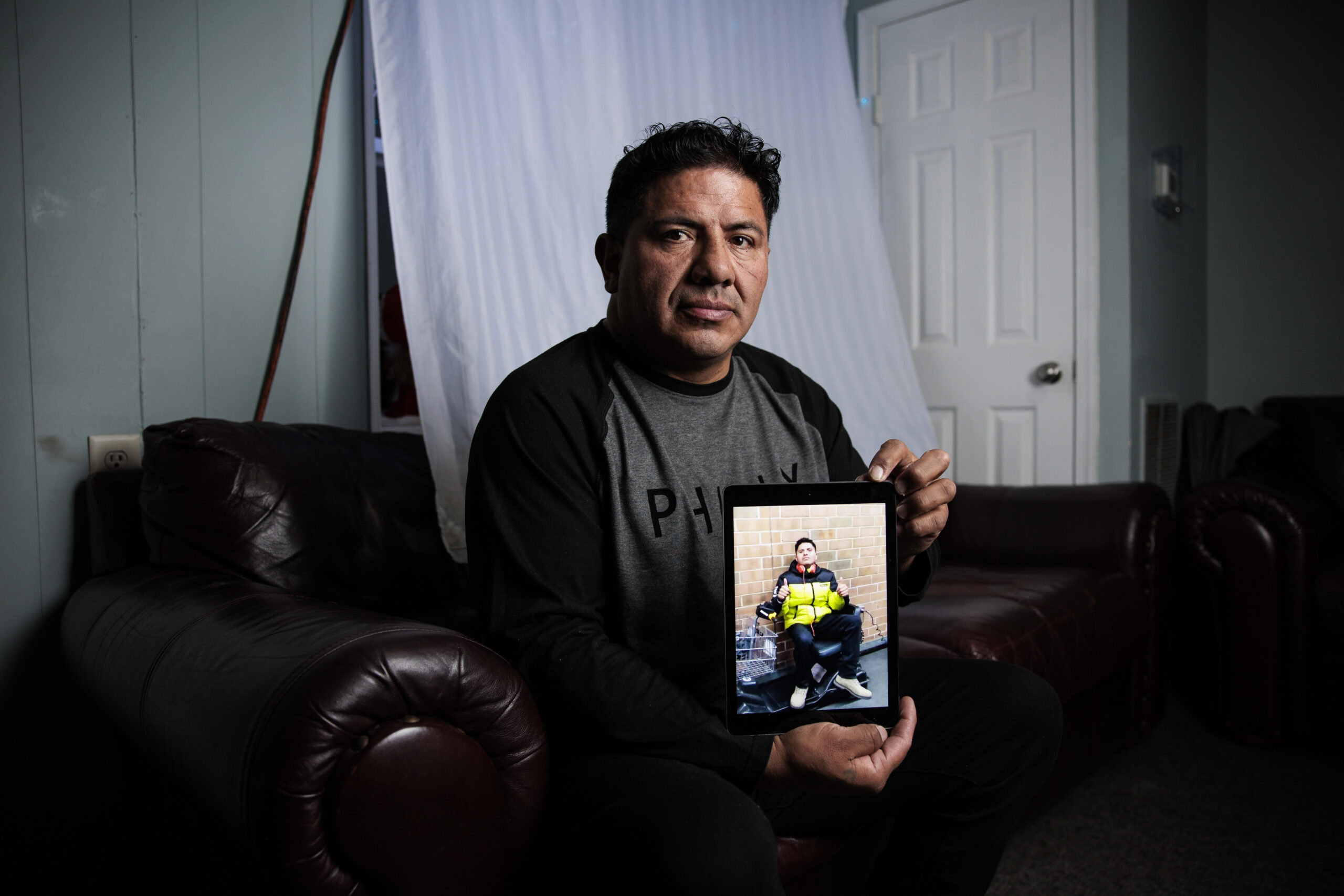
    Lenin Acurio Suarez holds a photograph of his brother, Victor, at his home on Wednesday, Dec. 10, 2025 in Seaford. Victor was arrested by ICE in Seaford, De.

    Victor Acurio Suarez’s case drew support from Delaware Gov. Matt Meyer, who wrote to the judge that it would be “cruel” and “egregious” to deliver the Seaford resident to gang violence. Meyer also advocated for Acurio Suarez in social media posts, calling his arrest and detention “deeply disturbing” and arguing that with no criminal history, not even a traffic violation, Acurio Suarez “poses no threat to public safety.”

    The governor’s office did not immediately reply to a request for comment on Tuesday.

    Acurio Suarez has long been cared for by his brother, Lenin Acurio Suarez, who said in an interview last month that Victor Acurio Suarez did not realize he was in immigration custody when he was taken to the Moshannon Valley Processing Center in Pennsylvania. He thought he was on vacation, provided with three free meals a day and allowed to buy snacks and kick a soccer ball.

    He was arrested on Sept. 22 in a Lowe’s parking lot near the brothers’ home in Seaford when he tried to flag down a U.S. Immigration and Customs Enforcement agent, apparently thinking the officer could help him find work.

    In the past, someone with Acurio Suarez’s profile might have been allowed to live at home as the case moved forward in immigration court. That has changed as President Donald Trump has pressed his mass-deportation agenda, and mandatory detention policies have swelled the number of people in custody.

    His case, Miller-Schaeffer said earlier, is a prime example of how Trump administration policy shifts have encouraged ICE to detain even the most vulnerable and to treat potential discretionary relief as irrelevant in a bid to boost deportations. Her Sept. 30 request to have Acurio Suarez released to the care of his brother while his immigration case went forward was denied.

    A medical assessment submitted for his asylum application said Acurio Suarez has autism and aphasia, a language disorder that affects his ability to produce or understand speech.

    David W. Baron, the doctor who did the assessment, said Acurio Suarez cannot safely live on his own. He requires supervision to perform daily hygiene activities or cook and has a hard time communicating his needs to others, a condition made worse by being in an unfamiliar setting while in detention, where he does not have access to the support needed for his neurocognitive disabilities.

    At an earlier court hearing, Miller-Schaeffer said, she watched as Acurio Suarez struggled to answer basic questions. He told the judge he didn’t know if he had an attorney or know what an attorney does.

    His ability to testify was so limited, she said, that the judge allowed his brother to take the stand to explain his sibling’s experience and situation.

    Acurio Suarez can recall big events in his life, she said. He remembers being beaten by gangs, but he couldn’t tell you exactly when that occurred.

    He worked at odd jobs in Ecuador before coming to this country.

    Records show that on Aug. 2, 2021, the brothers were stopped by the U.S. Border Patrol as they tried to enter the United States near Eagle Pass, Texas.

    Lenin Acurio Suarez was issued a notice to appear in court and released, and his immigration case was later dismissed.

    Victor Acurio Suarez was ordered deported and subsequently returned to Ecuador on Sept. 24. Three days later, for reasons that are unclear, the deportation order was found to have been issued incorrectly, and Acurio Suarez was brought back by authorities to the U.S.

    In October 2021, he was granted temporary permission to stay in the country. He had filed his asylum case by the time that permission expired a year later.

    Last year, according to an ICE report, on Sept. 22 an ICE team was conducting operations in Seaford, a southern Delaware city of 9,000 where 13% of the population is foreign-born.

    The ICE officer wrote that he was looking for a place to park in the Lowe’s lot when a man in paint-stained clothing, Acurio Suarez, approached him. Acurio Suarez waved his hand, signaling the officer to come to him, according to the ICE report.

    The officer kept going, then stopped his car and watched Acurio Suarez from another lot. Acurio Suarez tried to hail other cars, and could be seen talking to people who were loading lumber onto a trailer in the parking lot, he said.

    It looked as if Acurio Suarez was trying to find daily work, which is why he tried to get the ICE officer to stop his vehicle, the report said.

    It is common for undocumented immigrants seeking a day’s pay to wait in the parking lots of big home-improvement stores like Lowe’s and Home Depot, hoping to connect with building contractors who need laborers.

    Lenin Acurio Suarez said his brother cannot hold a full-time job, and is able only to handle small tasks, provided someone is beside him giving directions.

    A second ICE officer arrived, and both parked their cars near where Acurio Suarez had left his lunch box. Acurio Suarez walked back toward the officers, and one of the agents approached and questioned him.

    Acurio Suarez told the agents he had no identification or immigration documents and was placed in handcuffs.

  • Pentagon moves to cut U.S. participation in some NATO advisory groups

    Pentagon moves to cut U.S. participation in some NATO advisory groups

    The Pentagon plans to cut its participation in a range of NATO advisory groups, the latest sign of the Trump administration’s drive to scale back the U.S. military presence in Europe, according to multiple officials familiar with the matter.

    The impending move affects about 200 military personnel and will mostly diminish U.S. involvement in the alliance’s 30 Centers of Excellence, which seek to train NATO forces on key elements of warfare such as naval combat, these people said. They spoke on the condition of anonymity to detail the U.S. administration’s plans.

    Rather than withdraw all at once, the Pentagon intends not to replace personnel as their postings end, a process that could take years, according to one U.S. official familiar with the matter. U.S. participation in the centers isn’t ending altogether, two officials noted.

    The move has been under consideration for months, according to two U.S. officials, one of whom said it is unrelated to President Donald Trump’s escalating threats to seize the Danish territory of Greenland. Trump’s provocations have drawn widespread condemnation from European leaders and many lawmakers in Congress, who fear the president risks causing irreparable and unnecessary damage to the NATO alliance.

    Spokespeople for the Pentagon and nor NATO did not immediately respond to requests for comment.

    Under Trump, the U.S. military has pulled back from Europe as the administration presses allies there to take greater control of the continent’s collective defense. Last year, for instance, the Pentagon abruptly announced it would withdraw a brigade of troops from Romania and cut security aid programs to the three Baltic nations that border Russia, whose yearslong invasion of Ukraine has spurred fears of a direct conflict between NATO and the Kremlin.

    Under pressure from the Trump administration, the alliance agreed last summer to surge defense spending to 5% of GDP over the next 10 years, including 1.5% dedicated to infrastructure and other civilian projects.

    Lawmakers — including some key Republicans — objected to the administration’s moves in Europe and are working to fund the impacted security assistance programs despite the Pentagon’s directives.

    Members of Congress also have passed legislation that requires the Pentagon to consult with them before making any major reductions to U.S. military posture in Europe. The law specifies that requirement would apply only if the overall U.S. force posture in Europe were to fall below 76,000. It stands at roughly 80,000 now.

    While the personnel eventually being withdrawn amount to a small share of troops the United States stations in Europe, some current and former officials said the U.S. pullout could have an outsize impact on the alliance by reducing valuable American military expertise.

    “We have a lot of operational experience that some of our personnel contribute to these centers,” said Lauren Speranza, a senior Pentagon official during the Biden administration. “There would be a bit of a brain drain that would come with pulling U.S. personnel out.”

  • Baby dies from cold in Gaza as leaders meet to discuss Trump’s Board of Peace

    Baby dies from cold in Gaza as leaders meet to discuss Trump’s Board of Peace

    DEIR AL-BALAH, Gaza Strip — A Palestinian baby died from hypothermia on Tuesday in the Gaza Strip, underscoring the grim humanitarian conditions in the territory as world leaders were gathering at a Swiss resort where President Donald Trump’s Gaza ceasefire plan is high on the agenda.

    Shaza Abu Jarad’s family found the 3-month-old on Tuesday morning in their tent in the Daraj neighborhood of Gaza City.

    “She was freezing, and dead,” the baby’s father, Mohamed Abu Jarad, told the Associated Press by phone after a funeral. “She died from cold.”

    The man, who worked in Israel before the war, lives with his wife and their seven other children in a makeshift tent after their house was destroyed during the war.

    The family took the girl to the Al-Ahli hospital where a doctor pronounced her dead from hypothermia, said her uncle, Khalid Abu Jarad. Gaza’s Health Ministry confirmed that the baby died from hypothermia.

    The family is among hundreds of thousands of people sheltering in tent camps and war-battered buildings in Gaza which experiences cold, wet winters, with temperatures dropping below 50 Fahrenheit at night.

    As Palestinians in the war-ravaged enclave languish in displacement camps, Trump hopes to establish his new Board of Peace at the World Economic Forum in Davos. But the initiative, initially conceived to oversee the Gaza ceasefire, faces many questions over its membership and scope.

    Israel on Tuesday began demolishing the Jerusalem headquarters of the U.N. agency for Palestinian refugees, pressing ahead with its crackdown against a body it has long accused of anti-Israel bias.

    Shaza Abu Jarad was the ninth child to die from severe cold this winter in Gaza, according to the strip’s health ministry, part of the Hamas-run government and staffed by medical professionals. The U.N. and independent experts consider it the most reliable source on war casualties. Israel disputes its figures but has not provided its own.

    More than 100 children who have died since the start of the ceasefire in October — a figure that includes a 27-day-old girl who died from hypothermia over the weekend.

    The ceasefire paused two years of war between Israel and Hamas militants and allowed a surge in humanitarian aid into Gaza, mainly food.

    But residents say shortages of blankets and warm clothes remain, and there is little wood for fires. There’s been no central electricity in Gaza since the first few days of the war in 2023, and fuel for generators is scarce.

    The International Committee of the Red Cross said recent biting cold and rainfall in Gaza were “ultimately a threat to survival.”

    Trump’s Board of Peace was initially seen as a mechanism focused on ending the Israel-Hamas war in Gaza.

    But recent invitations sent to dozens of world leaders show that the body could have a far broader mandate of other global crises, potentially rivaling the U.N. Security Council.

    Trump says the body would “embark on a bold new approach to resolving global conflict,” an indication that the body may not confine its work to Gaza.

    During a White House press briefing on Tuesday, Trump was asked by a reporter whether the Board of Peace should replace the United Nations.

    “It might,” Trump said. “The U.N. just hasn’t been very helpful. I’m a big fan of the potential, but it has never lived up to its potential.”

    But he added, “I believe you got to let the U.N. continue, because the potential is so great.”

    The panel was part of Trump’s 20-point ceasefire plan that stopped the war in Gaza in October. Many countries, including Russia, said they received Trump’s invitation and were studying the proposal. France said it does not plan to join the board “at this stage.”

  • SEPTA Regional Rail delays this morning are due to a train pulling down overhead wires

    SEPTA Regional Rail delays this morning are due to a train pulling down overhead wires

    SEPTA Regional Rail riders experienced significant delays — at times, 30 minutes to an hour — at the peak of morning rush hour on Tuesday morning, after a train pulled electrical wires down.

    A West Trenton Line train struck overhead electrical wires near Wayne Junction train station in the Nicetown section of Philadelphia at 7:45 a.m., said SEPTA officials.

    The train lost power and was tangled in the wires it had pulled down.

    Marie Pollock, 24, who was on board, felt the train start to gradually slow down before quickly and forcefully coming to a stop. Pollock could see wires hitting the train windows and noted that other passengers were startled during the collision.

    “We were keeping the doors closed because it was so cold,” Pollock said. “We were on kind of a hill, so there wasn’t any room for SEPTA to get a shuttle, and the power was out on both tracks, so we couldn’t get a typical rescue train to us.”

    Pollock, who had already been waiting a half-hour in 20-degree chill for her 6:17 a.m. West Trenton Line train before the ordeal, said passengers waited inside the stuck train for an hour and a half.

    SEPTA crews had to cut through the downed wires to free the train and then used a diesel-powered train to tow the disabled one to Wayne Junction, where passengers took other trains into Center City.

    Pollock’s four-hour journey didn’t end until 10 a.m. when she finally arrived at Jefferson Station.

    Since then, service interruptions have been occurring primarily on the Warminster, Lansdale/Doylestown, and West Trenton lines. However, delays cascade throughout the rail system, leading to 15 to 45-minute delays on other lines, said SEPTA spokesperson Andrew Busch.

    “Repairs are still continuing,” Busch said Tuesday afternoon, “but service has improved. Some minor delays, and we are advising passengers to plan for some extra time during rush hour, but we expect the evening commute to be better than this morning.”

    There is currently no timeline for completed repairs.

    SEPTA urges riders to use the SEPTA mobile app and septa.org for the latest updates.

    Today’s service interruptions follow a streak of solid performance by SEPTA after months of disruptions while SEPTA rushed to inspect and repair a fleet of 223 trains after five caught fire last year.

  • Penn calls federal commission’s request for personal employee information ‘unconstitutional,’ ‘disconcerting’ and ‘unnecessary’

    Penn calls federal commission’s request for personal employee information ‘unconstitutional,’ ‘disconcerting’ and ‘unnecessary’

    The University of Pennsylvania in a legal filing Tuesday pushed back against a federal commission’s demand that in effect would require it to turn over lists of Jewish faculty, staff, and students, calling the request “unconstitutional,” “disconcerting,” and “unnecessary.”

    The filing comes in response to a lawsuit filed against the university in November by the Equal Employment Opportunity Commission, asserting that Penn failed to comply with its subpoena. The commission is seeking employees’ names, home addresses, phone numbers, and email addresses to further an investigation it began in 2023 over the school’s treatment of Jewish faculty and other employees regarding antisemitism complaints that emerged following Hamas’ attack on Israel.

    In its quest to find people potentially affected, the commission demanded a list of employees in Penn’s Jewish Studies Program, a list of all clubs, groups, organizations, and recreation groups related to the Jewish religion — including points of contact and a roster of members — and names of employees who lodged antisemitism complaints. It also sought names of participants in confidential listening sessions held by the school’s task force on antisemitism.

    The request has spurred a backlash from some student and faculty groups, including Penn’s chapter of the American Association of University Professors, arguing that the names and personal information should not be turned over to the government.

    Penn has refused to provide the information, and the school doubled down on that position in Tuesday’s legal filing.

    “The EEOC insists that Penn produce this information without the consent — and indeed, over the objections — of the employees impacted while entirely disregarding the frightening and well-documented history of governmental entities that undertook efforts to identify and assemble information regarding persons of Jewish ancestry,” the university wrote in its filing. “The government’s demand implicates Penn’s substantial interest in protecting its employees’ privacy, safety, and First Amendment rights.”

    Also on Tuesday, the Penn Faculty Alliance to Combat Antisemitism, a group of more than 150 primarily Jewish professors, filed a brief in support of the university’s decision not to comply with the commission’s demand.

    “While the Alliance supports the EEOC’s efforts to combat antisemitism at Penn, its members are gravely concerned that the scope of the EEOC subpoena … invokes the troubling historical persecution of Jews and threatens the personal security of the Alliance’s members,” the group wrote in the brief.

    The alliance includes members who have had concerns about antisemitism at Penn, including faculty who were harassed online after attending a trip to Israel following Hamas’ Oct. 7, 2023, attack on the country, said Claire Finkelstein, a professor at Penn Carey Law School, member of the alliance, and faculty director of the Center for Ethics and the Rule of Law.

    Among its members are faculty “who have been really on the side of remediating antisemitism, do not believe that concerns about antisemitism are pretextual, do not think that it is a sham issue, and think there are real … issues to address at universities in general.”

    Finkelstein said the alliance has not taken a position on whether the EEOC’s investigation is warranted or needed.

    But the group is adamantly opposed to the subpoena and believes it could discourage membership in Jewish groups at Penn. In its brief, the group notes “the dark historical legacy associated with government lists of Jews,” including how Nazis “frequently demanded that others identify the Jews among them.”

    Penn said in its filing that it had complied with the subpoena except for the list of names and contacts, noting it had provided over 900 pages of materials to the commission. The school noted that it even offered to send notices to all employees about the EEOC’s request to hear about antisemitism concerns with the commission’s contact information.

    The university also asserted that the commission’s demand “is a particularly unjustified use of enforcement authority given the weakness of the underlying charge.”

    The commission, the university argued, has not identified a “single allegedly unlawful employment practice or incident involving employees.”

    “The charge does not refer to any employee complaint the agency has received, any allegation made by or concerning employees, or any specific workplace incident(s) contemplated by the EEOC, nor does it even identify any employment practice(s) the EEOC alleges to be unlawful or potentially harmful to Jewish employees,” Penn said in its response.

    The original complaint was launched by EEOC Commissioner Andrea Lucas, now chair of the body, on Dec. 8, 2023, two months after Hamas’ attack on Israel that led to unrest on college campuses, including Penn’s, and charges of antisemitism. It was also just three days after Penn’s then-president, Liz Magill, had testified before a Republican-led congressional committee on the school’s handling of antisemitism complaints; the testimony drew a bipartisan backlash and led to Magill’s resignation days later.

    Lucas, whom President Donald Trump appointed chair last year, also brought similar antisemitism charges against Columbia University that resulted in the school paying $21 million for “a class settlement fund.”

    EEOC complaints typically come from those who allege they were aggrieved. Lucas, according to its complaint, made the charge in Penn’s case because of the “probable reluctance of Jewish faculty and staff to complain of harassing environment due to fear of hostility and potential violence directed against them.“

    The commission’s investigation followed Lucas’ complaint to the commission’s Philadelphia office that alleged Penn was subjecting Jewish faculty, staff, and other employees, including students, “to an unlawful hostile work environment based on national origin, religion, and/or race.”

    The allegation, the complaint said, is based on news reports, public statements made by the university and its leadership, letters from university donors, board members, alumni, and others. It also cited complaints filed against Penn and testimony before a congressional committee.

    In its brief, the faculty alliance also asserted that the commission could have used other voluntary and informal methods to obtain contact information for Penn faculty and staff, such as setting up a website where people could report concerns.

    Finkelstein, the Penn law professor, said she understands that the commission generally guarantees anonymity to witnesses or complainants, but leaks can occur.

    “When state force extracts sensitive, personal details, those details could (and often do) become public, turning group members into targets for their enemies,” the group states in its filing.

    Penn has done a lot to address antisemitism concerns, said Brian Englander, president of the alliance and a professor of clinical radiology who has been at Penn for 22 years.

    In its brief, the alliance listed antisemitic incidents that occurred on Penn’s campus in 2023, including a swastika left on a Penn building and messages that Penn called antisemitic that were light-projected onto several Penn buildings.

    “Penn is a very different place than what we were experiencing in the fall of 2023,” he said.

    Finkelstein agreed.

    “Penn is not Columbia or Harvard or UCLA,” she said. “The problems that have appeared on those campuses have been much more extreme than what happened on Penn’s campus.”

    “I also think there may be a limit to what university leadership can do in the face of widespread antisemitism that has really affected university campuses all over the country.”

    But there is always room for improvement, she said.

    “To the extent that there is an atmosphere that has made Jewish students and faculty feel unwelcome, or not heard, or vilified, that is something the university has to continue to address and I believe they will continue to address it,” she said.

    Finkelstein was among about 40 faculty who took a four-day, personal trip to Israel in January 2024 and said hey felt attacked for supporting academics there and trying to learn more about the Oct. 7 attacks. An Instagram account by Penn Students Against the Occupation was critical of the trip and accused faculty of “scholasticide.” The EEOC referred to that incident in its complaint.

    “My dean got hundreds of letters,” she said, protesting faculty going on the trip.

    Englander said there probably are members of the alliance who would be interested in talking to the commission.

    “But they would want to do it voluntarily,” he said.

    The alliance, he said, is “straddling this middle line” in that it supports Penn’s refusal to turn over the names, but also recognizes “that antisemitism is a massive problem in the United States right now.”

    “So having government support, whatever the motivation for that, is meaningful,” he said.

  • PennDot plans changes to U.S. 30 interchanges in Chester County

    PennDot plans changes to U.S. 30 interchanges in Chester County

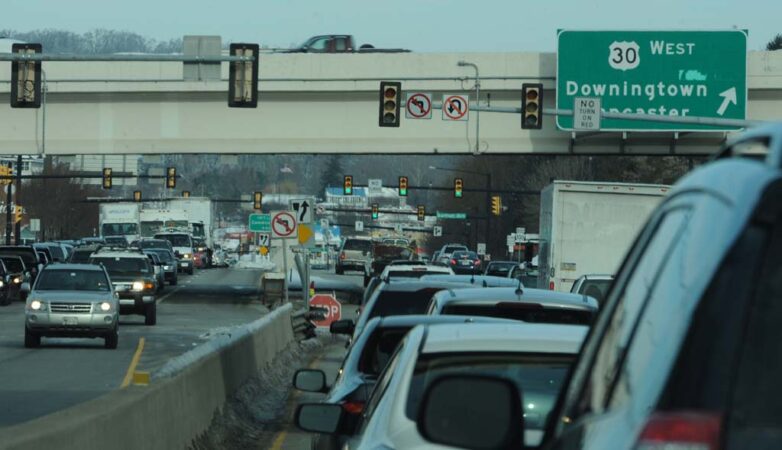
    Changes are coming to several interchanges in Chester County that could affect commuters in roughly a decade, under projects aimed at improving a 7.5-mile stretch of U.S. Route 30.

    Pennsylvania’s Department of Transportation is nearing the end of the conceptual design period for proposed changes to interchanges affecting Caln, East Brandywine, Easttown, West Brandywine, Uwchlan, and Downingtown in a project that seeks to reduce traffic congestion and collisions.

    PennDot presented the alternatives for the eastern section of the bypass during an online session last week. An in-person poster session is scheduled for Tuesday evening at Pope John Paul II Regional Catholic Elementary School in West Brandywine. But breaking ground remains years out: Construction is expected to start in spring 2034, costing roughly $874 million. The federal government is slated to pick up the bulk of the cost, with the state taking a sliver, officials said last week.

    “The purpose is to provide a safe and efficient transportation system by improving safety, reducing future congestion, accommodating planned growth, and improving deficiencies,” said Bruce Masi, consultant project manager with GFT, an engineering consulting firm.

    The eastern section of the Coatesville-Downingtown bypass corridor runs from just west of the Reeceville Road interchange, east to the Quarry Road interchange, where it becomes the Exton Bypass, heading toward U.S. Route 202.

    Changes to U.S. 30

    Under the plan, PennDot would widen the road by up to 35 feet. It would also introduce flexible-use lanes on the left sides to function as needed during high traffic volume.

    A regional transportation center, based in King of Prussia, would monitor the flexible lane through cameras along the route. The flexible lane would likely be used eastbound during the morning commutes, and westbound in the evenings. But it could also be used to facilitate traffic flow after crashes or incidents, Masi said.

    Heading west, the flexible lane would begin around the Quarry Road interchange and taper back to a median as you approach State Route 82. Heading east, it would return to a median around the Exton Bypass.

    Changes to access points

    When it comes to actually getting on U.S. 30, changes are coming at different junction points: Reeceville Road, Pennsylvania Routes 340, 322, and 133, and Norwood Road.

    Masi presented a slew of options for Norwood Road and Route 113’s interchange, which PennDot is accepting public comment on.

    One alternative would leave the existing location for westbound and eastbound on- and off-ramps, updated to meet current standards. It would also create two new “movements” that do not currently exist: Drivers headed west would exit onto a bridge that crosses over U.S. 30, and then tie back in with State Route 113; another ramp would run drivers eastbound. This model has the fewest predicted crashes, and wiggle room for cars to weave, but would potentially have a higher environmental impact.

    “What that does is creates a full interchange — all movements at 113, but in this alternative, we retain the Norwood Road ramps as well,” Masi said.

    Other alternatives would remove the existing ramps at Norwood Road for the public, and traffic using those ramps would redistribute through the region, Masi said.

    Removing the ramps on Norwood Road would also go against the wishes of the public, emergency services, and the municipalities. PennDot was looking to mitigate those effects, Masi said.

    In another alternative, Norwood House Road would be relocated north of an existing apartment complex, into the side of a hill.

    The last alternative would tweak the configuration of Norwood House Road to use it as a direct connection between Norwood Road and State Route 113.

    While PennDot awaits public review and input on Norwood Road, its selected alternatives would affect several other interchanges.

    Near Caln, at Reeceville Road, PennDot would replace the current structure and add traffic lights for westbound and eastbound drivers on Reeceville Road.

    Fisherville Road would be relocated north, to sit between the CVS and Wawa, but a remnant of the road would connect to the existing properties.

    On State Route 340 between Caln and Downingtown, PennDot would scale up the current interchange for longer ramps, and add a single-lane roundabout to eliminate the traffic signal at the U.S. 30 westbound intersection.

    West Bondsville Road would be moved north to maintain access to residences.

    Continuing east, State Route 322 around Downingtown would create a new traffic flow with traffic lights at either end of the interchange, to prevent left-turning cars from crossing paths with approaching vehicles. The change would affect drivers stopping for coffee or gas at the Royal Farms or heading to PennDot’s park-and-ride, however. It would become a right-turn-in and right-turn-out only traffic flow.

    Lloyd Avenue would also be relocated.

    What comes next

    Electronic comments are being taken through Feb. 6. Paper comment forms are available at Tuesday’s open house.

    Property impacts are not yet known, officials said. If a property is needed for the project, PennDot will reach out.

    Once PennDot closes out its conceptual design, it will start preliminary engineering and environmental evaluation. The public will be able to weigh in again between that period and the final design period, before the plans go out for construction bids.

    This suburban content is produced with support from the Leslie Miller and Richard Worley Foundation and The Lenfest Institute for Journalism. Editorial content is created independently of the project donors. Gifts to support The Inquirer’s high-impact journalism can be made at inquirer.com/donate. A list of Lenfest Institute donors can be found at lenfestinstitute.org/supporters.