Category: News

Latest breaking news and updates

  • Trump and Greenland: All the questions you’re scared to ask your friends

    Trump and Greenland: All the questions you’re scared to ask your friends

    If you’re starting to absorb the headlines, or embarking on your early-week doomscroll, you’re probably seeing a lot about Greenland.

    President Donald Trump’s longtime interest in the Arctic island seems to be louder — and bolder — than ever, sparking a major geopolitical standoff.

    But how did it all start? And where do things stand? Here are all your questions answered, so you’re prepared the next time someone asks you about Greenland.

    How did Denmark acquire Greenland?

    Greenland has been home to native peoples who crossed the Arctic from what is now Canada, Norse settlers, Lutheran missionaries, and U.S. military personnel who used it as a base to protect the United States from Nazi Germany and the Soviet Union.

    As for when Denmark stepped in, the short answer is that Denmark’s control started with a colonial settlement, was formalized in 1953, and the agreement has since evolved into a self-governing structure with the Danish.

    In the 1700s, a Danish missionary arrived in Greenland and started lining up settlements and establishing Danish colonization. Through most of the 18th and 19th centuries, Greenland was controlled by the Danish. The relationship was formally recognized by Denmark after World War II. In 1953, the island was fully incorporated as a Danish territory, giving Greenlanders Danish citizenship.

    Things changed in the late 1970s. In 1979, Greenlanders voted in favor of home rule, establishing a local government. In 2009, Greenland earned even more autonomy, achieving self-government status. This stands today, with Greenland remaining part of Denmark but overseeing its own internal affairs. Denmark oversees defense and diplomacy issues, unless the regions opt to partner on an issue.

    Is Greenland bigger than the United States?

    Greenland is pretty big, but not bigger than the United States

    It is considered one of the biggest places in the world by geography and is about 20 times the size of Denmark, according to the territory’s tourism website. The island stretches about 836,000 square miles.
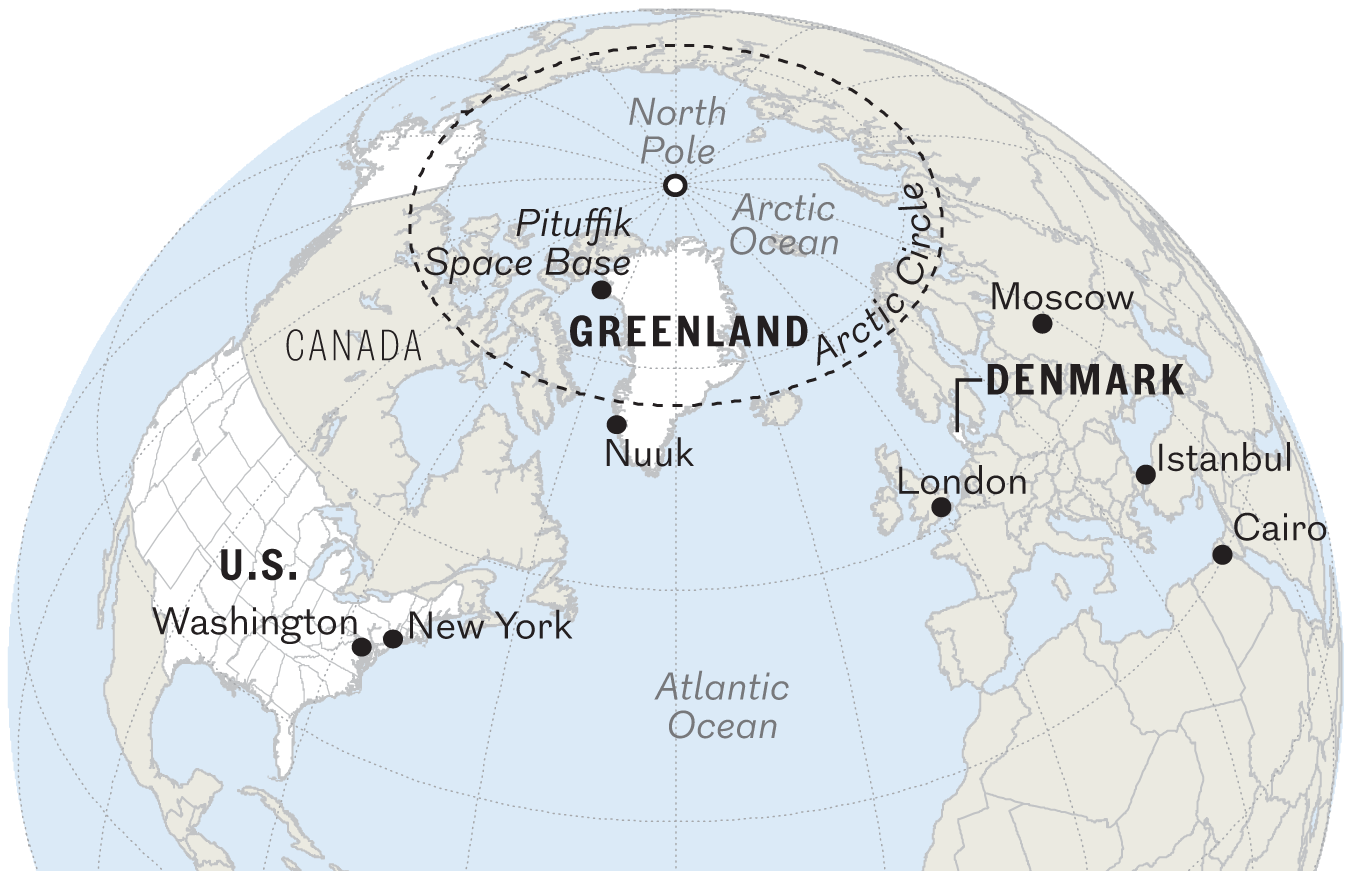
    Map of Greenland, the U.S., and Denmark.

    It is the world’s largest island that isn’t a continent and is larger than France, Germany, Spain, and the United Kingdom combined. It is also larger than the state of Alaska.

    But, no, it’s smaller than the contiguous United States. All in all, the United States is about 4.5 times larger than Greenland.

    Still, a lot of people ask this question (it’s a top Google result surrounding Greenland) because map distortions make it appear a lot bigger than it is.

    The island has a population of roughly 56,480, according to the CIA. It is among the least densely populated countries in the world.

    What natural resources does Greenland have?

    Greenland is home to a bounty of natural resources, including oil, gas, and rare earth minerals. Those minerals are used for making batteries, electric vehicles, and other high-tech items, according to the New York Times. Currently, China dominates the global market for those minerals, meaning there is a reliance on China to source them.

    Vice President JD Vance has touted Greenland’s “incredible natural resources” in the past. Last year, Republican senators held a hearing focused on Greenland’s importance and its rare earths.

    But Greenland has only a few roads and ports, and environmentalists are opposed to developing on the island. That means mining and oil extraction in Greenland may not be productive.

    Does the U.S. military have a base in Greenland?

    Yep.

    Formerly known as the Thule Air Base, the Pituffik (pronounced bee-doo-FEEK) Space Base was renamed in 2023 during the Biden administration to honor the native Greenlandic community and history.

    It is the northernmost U.S. military installation and serves as an early warning missile detection site for North America. It is currently undergoing major upgrades.

    How long has Trump talked about wanting Greenland?

    It’s been awhile.

    Trump first floated the idea of “buying Greenland” during his first term, comparing it to a “real estate deal.” When Danish leaders rejected his idea, he canceled a scheduled visit to Denmark in 2019.

    When Trump began his second term, he spoke increasingly about his interest in the United States controlling Greenland, citing national security reasons.

    But critics say his real intentions stem from personal feelings.

    Is this really about Trump not winning the Nobel Prize?

    Trump linked his aggressive stance on Greenland to last year’s decision not to award him the Nobel Peace Prize, telling Norway’s prime minister that he no longer felt “an obligation to think purely of Peace,” in a text message released Monday and verified by the White House.

    Trump’s text to Jonas Gahr Støre, which he sent on Sunday, came a day after the president announced a 10% import tax on goods from the eight nations that have rallied around Denmark and Greenland, including Norway.

    The text exchange, which was released by the Norwegian government, said in part: “Considering your Country decided not to give me the Nobel Peace Prize for having stopped 8 Wars PLUS, I no longer feel an obligation to think purely of Peace.” He concluded, “The World is not secure unless we have Complete and Total Control of Greenland.”

    The Norwegian leader said Trump’s message was a reply to an earlier missive sent on behalf of himself and Finnish President Alexander Stubb, in which they conveyed their opposition to the tariff announcement, pointed to a need to de-escalate, and proposed a telephone conversation among the three leaders.

    White House deputy press secretary Anna Kelly said of the text exchange that Trump “is confident Greenlanders would be better served if protected by the United States from modern threats in the Arctic region.”

    Norway has since reaffirmed its support for Denmark and Greenland.

    Also, for what it’s worth, the Nobel Peace Prize is awarded by an independent committee, not the Norwegian government.

    Trump has openly coveted the peace prize, which the committee awarded to Venezuelan opposition leader María Corina Machado last year. Last week, Machado presented her Nobel medal to Trump, who said he planned to keep it, though the committee said the prize cannot be revoked, transferred, or shared with others.

    Speaking Monday night to reporters before boarding Air Force One on his way back from Florida to Washington, Trump backtracked and said he didn’t “care about the Nobel Prize.”

    What is Trump saying about Greenland now?

    He’s doubling down.

    Monday night, Trump took to his Truth Social platform and made a series of posts about how there was “no going back” when it comes to his push to take control of the island. He also posted private text messages he received from French President Emmanuel Macron and the head of NATO, and an AI-generated image of the American flag over Greenland and Canada.

    Following Macron’s questioning of Trump’s approach, Trump suggested he could impose a 200% tariff on French wines.

    Trump also announced he would meet with “various parties” to discuss Greenland during the World Economic Forum in Davos, Switzerland, this week.

    On Tuesday, Trump held a nearly two-hour news conference, but largely did not acknowledge his stance on Greenland until asked by reporters.

    He repeated his position that the U.S. needs to take control of the territory for the sake of national security.

    “I think that we will work something out where NATO is going to be very happy and where we’re going to be very happy,” Trump said toward the end of the news conference.

    Macron this week called for an emergency meeting in Paris with European leaders to address tensions with the U.S. over Trump’s pursuit to acquire Greenland in addition to increasing tariffs.

    Trump told reporters he did not plan to attend the meeting and mentioned that Macron would not be leading France for much longer. Macron’s term ends in May 2027.

    Do other politicians agree with Trump?

    There is widespread disagreement over how Trump wants to handle Greenland.

    Secretary of State Marco Rubio said the president wants to buy it, while top aide Stephen Miller suggested the U.S. could seize it by force. Vice President Vance’s discussion with Danish leaders last week ended in “fundamental disagreement.”

    Several lawmakers across party lines have criticized Trump’s approach. GOP members, including Sen. Rand Paul of Kentucky and Rep. Mike Turner of Ohio, say the raised tariff threats could harm NATO and U.S. interests.

    Rep. Don Bacon (R., Neb.) said last week that he would consider impeaching Trump if the U.S. invaded Greenland, describing the idea as “utter buffoonery.”

    Sen. Lisa Murkowski (R., Alaska) called Trump’s coercive threats dangerous for alliances and “bad for America.” She and Sen. Jeanne Shaheen (D., N.H.) introduced bipartisan legislation that would prohibit the use of U.S. Defense or State Department funds to take control of Greenland or the sovereign territory of any NATO member state without that ally’s consent or authorization from the North Atlantic Council.

    How are Greenland residents responding?

    Copenhagen store owner Jesper Rabe Tonnesen wears a red cap for sale that he created with the slogans “Make America go away,” on the side, and on the front: “Nu det NUUK!,” a twist on the Danish phrase “Nu det nok,” meaning “Now it’s enough.”

    Unsurprisingly, they’re not happy!

    Over the weekend, hundreds of people in Greenland’s capital, Nuuk, braved near-freezing temperatures, rain, and icy streets to march in a rally in support of their own self-governance.

    Thousands of people also marched through Copenhagen, many of them carrying Greenland’s flag. Some held signs with slogans such as “Make America Smart Again” and “Hands Off.”

    A spoof Make America Go Away red cap in the style of Trump’s original MAGA campaign hat is surging in popularity in Denmark and has become a symbol of Danish and Greenlandic resistance.

    “This is important for the whole world,” Danish protester Elise Riechie told the Associated Press as she held Danish and Greenlandic flags. “There are many small countries. None of them are for sale.”

    The rallies occurred hours after a bipartisan delegation of U.S. lawmakers, while visiting Copenhagen, sought to reassure Denmark and Greenland of their support.

    This article contains information from the Associated Press.
  • Philly demonstrators block ICE garage at agency’s Center City headquarters

    Philly demonstrators block ICE garage at agency’s Center City headquarters

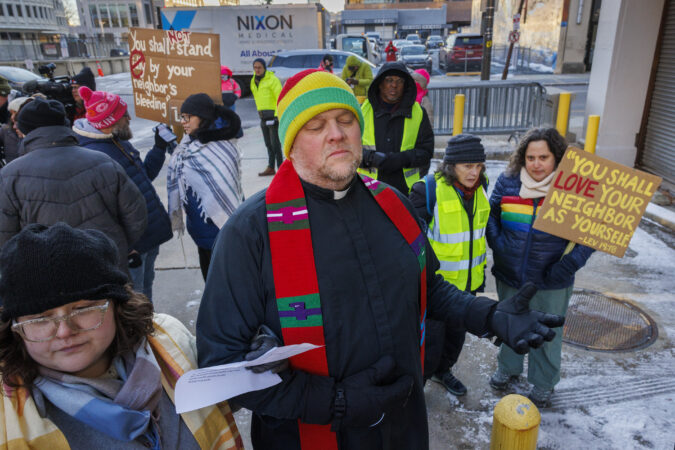
    About 30 demonstrators blocked the garage doors at the Philadelphia ICE office Tuesday morning, saying they intended to stop agency vehicles from going to “terrorize” local residents.

    Only one car attempted to leave, and Philadelphia police moved demonstrators aside so it could depart.

    No one was arrested.

    Organizers with No ICE Philly had pledged to block the garage until they were forcibly removed or arrested, but halted the protest after about two hours. They said that they had accomplished their goal, and that the bitterly cold weather was too harsh on demonstrators who are older or who have medical conditions.

    Demonstrators with No ICE Philly block the garage at U.S. Immigration and Customs Enforcement at 8th and Cherry Street, Philadelphia, Tuesday, Jan. 20, 2026.

    The temperature was about 15 degrees when the protest began shortly before 8 a.m.

    “All of us here have proven in our song and our prayer that we can slow down the machine of authoritarianism, of fascism, that we can delay the operations that will detain and kidnap and destroy our neighbors, our families, our community,” said the Rev. Jay Bergen, a leader of No ICE Philly and pastor of the Germantown Mennonite Church.

    The protest was the latest in a string of anti-ICE demonstrations and vigils in the Philadelphia region; another was planned in Norristown on Tuesday evening. In October, a No ICE Philly protest outside the agency headquarters erupted into physical confrontations with police, with several people knocked to the ground and four arrested.

    Immigration and Customs Enforcement officials did not reply to a request for comment Tuesday.

    The clergy-led protest was boosted by City Councilmember Nicolas O’Rourke, who is a pastor of the Living Water United Church of Christ in Oxford Circle.

    O’Rourke said that it was natural for him to join fellow clergy, that Tuesday’s action was part of a long tradition of faith leaders being at the forefront of the “struggle against oppression,” as led by the Rev. Dr. Martin Luther King Jr. and others.

    Philadelphia Police and Department of Homeland Security officers block demonstrators from No ICE Philly as they attempt to block vehicles from leaving the garage at U.S. Immigration and Customs Enforcement at 8th and Cherry Street, Philadelphia, Tuesday, Jan. 20, 2026.

    “We are a day after King’s day, and it’s important that we don’t just wax eloquent about the nice things that King said or the image that he’s been painted of now,” he said, “but we continue in that tradition of resisting the oppression as he saw it, we’re doing in our own time.”

    The group locked arms and sang, offering prayers and songs of peace and affirmation.

    The Rev. Hannah Capaldi, minister at the Unitarian Society of Germantown, noted that all around her were clergy of different faiths wearing collars, tallits, and stoles.

    “We’re saying, listen, we have some level of moral authority in this city, and we’re trying to tell you where to look and what to pay attention to,” she said.

    The Rev. Jonny Rashid, a protest organizer, outside of U.S. Immigration and Customs Enforcement at 8th and Cherry Street, Philadelphia, Tuesday, Jan. 20, 2026.

    Capaldi hoped to plant “seeds of resistance” in the broader public, encouraging people to get involved.

    “We need more people every day willing to do this,” she said, “to stand between the vehicles and the work that they’re doing to kidnap our neighbors.”

  • Daniel Segal, longtime Philadelphia attorney and community activist, has died at 79

    Daniel Segal, longtime Philadelphia attorney and community activist, has died at 79

    Daniel Segal, 79, of Philadelphia, cofounder and shareholder of the Hangley Aronchick Segal Pudlin & Schiller law firm, adjunct law professor at the University of Pennsylvania, former cochair of the Philadelphia Soviet Jewry Council, onetime board president at the Juvenile Law Center, mentor, and “mischievous mensch,” died Thursday, Jan. 8, of stomach cancer at his home.

    Born and reared in Washington, Mr. Segal moved to Philadelphia in 1976 to teach at what is now Penn Carey Law School. He went into private law practice in 1979, became cochair of a litigation department in 1993, and joined with colleagues in 1994 to establish Hangley Aronchick Segal & Pudlin.

    For more than 40 years, until his recent retirement, Mr. Segal handled all kinds of cases for all kinds of clients, including The Inquirer. He was an expert in juvenile law, defamation, the First Amendment, professional ethics, education, civil rights, and other legal issues.

    He was president of the board at the Juvenile Law Center and worked pro bono for years, beginning in 2009, to help represent more than 2,400 juvenile victims and win millions of dollars in settlements in what is known as the Luzerne County “kids-for-cash” case. In that case, two judges were convicted of taking kickbacks for illegally sending juveniles to two private for-profit detention facilities.

    “This is one of the worst judicial scandals in history,” Mr. Segal told The Inquirer in 2009. “The people you’re stepping on are the true, true little guys.”

    Mr. Segal was honored in 2010 by the Philadelphia Bar Foundation.

    Among his other notable cases are a 1985 workplace racial discrimination dispute, a 1990 libel case against The Inquirer, and a 2000 trial about the city taxing outdoor advertisers. “Dan Segal was a living testament to professional excellence,” said Mark Aronchick, his law partner and longtime friend.

    Law partner and friend John Summers said: “He was a great teacher and mentor.” Marsha Levick, cofounder of the Juvenile Law Center, said: “He was a brilliant, steady partner who made us smarter and kept us laughing.”

    Mr. Segal clerked for Chief Judge David Bazelon in the U.S. Court of Appeals for the District of Columbia Circuit in 1974 and for Supreme Court Associate Justice Thurgood Marshall in 1975. He was active with the Philadelphia Bar Association, Philadelphia Common Pleas Court, and the Penn Law School American Inn of Court.

    He wrote articles for legal journals and letters to the editor of The Inquirer and Daily News. He spoke at panels and conferences, earned honors from legal organizations and trade publications, and was named the Thomas A. O’Boyle adjunct professor of law at Penn in 1992.

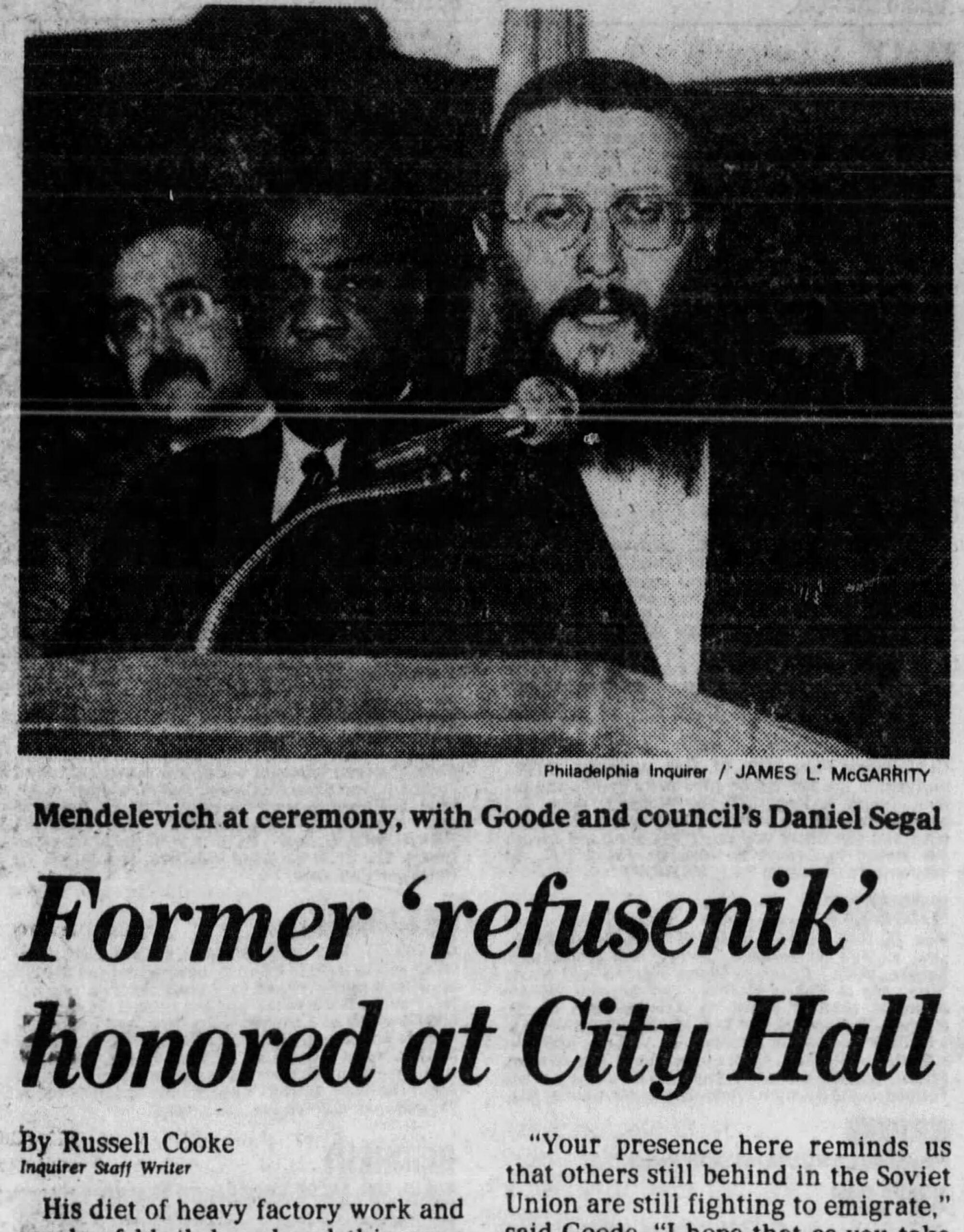
    This story and photo features Mr. Segal (left) and appeared in The Inquirer in 1984.

    The son of a rabbi, Mr. Segal was cochair of the Soviet Jewry Council in the 1980s, and he organized rallies and marches for social justice and human rights. He traveled to Israel often and to the old Soviet Union several times to secretly support Jews not permitted by government officials to immigrate to Israel.

    “We are persuaded that the Soviet Jews are pawns in the Soviet-American relationship,” he told The Inquirer in 1985.

    He served as president of the board of directors at what is now Jack M. Barrack Hebrew Academy and held leadership roles with the Jewish Community Relations Council, the New Israel Fund, Mazon: A Jewish Response to Hunger, and other organizations.

    Colleagues at the New Israel Fund praised his “characteristic kindness” and “gentle and sparkling humor” in an online tribute. They said: “He was everyone’s favorite board member.”

    Mr. Segal and his wife, Sheila, married in 1968.

    Mr. Segal enjoyed pranks and funny jokes, even at work, and neighbors called him Silly Dan. His son Josh said: “His warmth, humor, and humility meant that he could connect with just about anyone.” A friend said he was a “mischievous mensch.”

    He earned his law degree in 1973 and was executive editor of the Law Review at Harvard University Law School. He earned a bachelor’s degree in politics and economics at Yale University in 1968 and a master’s degree in international relations from the London School of Economics in 1969.

    He taught elementary school for a year in Washington and spent another year in Europe before moving to Philadelphia. “He taught us just how important it is to stand up for what is right,” his son Eli said, “and to do so not only with conviction but with humility and kindness, and without a thought of getting personal credit.”

    Daniel Segal was born July 4, 1946. He started dating Sheila Feinstein in ninth grade, and they married after college in 1968. They had sons Josh and Eli, and lived in Center City and Lower Merion before moving to Fairmount in 2018.

    Mr. Segal’s sons said: “Our dad showed us that relationships are the heart of a life well-lived by nurturing lifelong friendships.”

    Mr. Segal loved chocolate and ice cream. He recovered from a traumatic brain injury 20 years ago, and he and his wife traveled to Iceland, Peru, Vietnam, Europe, Japan, and elsewhere.

    He doted on his family and friends, and he and his wife rented vacation places every summer to bring his sons and their families together. “Neither of us were surprised that our dad always made our kids feel so loved,” his son Eli said. “Because that was just how he made us feel.”

    In addition to his wife and sons, Mr. Segal is survived by six grandchildren, a sister, a brother, and other relatives.

    Services were held Sunday, Jan. 11.

    Donations in his name may be made to the New Israel Fund, 1320 19th St. N.W., Suite 1400, Washington, D.C. 20036; and Mazon: A Jewish Response to Hunger, Box 6095, Albert Lea, Minn. 56007.

    Mr. Segal’s sons said: “He was always there for us and made clear that he always would be for as long as he could.”
  • Syrian military, Kurdish-led forces announce new truce after guards leave camp housing IS families

    Syrian military, Kurdish-led forces announce new truce after guards leave camp housing IS families

    RAQQA, Syria — Guards from the Kurdish-led Syrian Democratic Forces abandoned a camp Tuesday in northeast Syria housing thousands of people linked to the Islamic State group, and the Syrian military said that allowed detainees to escape.

    Hours later, the Syrian government and the SDF announced a new four-day truce after a previous ceasefire broke down. The two sides have been clashing for two weeks, amid a breakdown in negotiations over a deal to merge their forces together.

    The al-Hol camp houses mainly women and children who are relatives of IS members. Thousands of accused IS militants are separately housed in prisons in northeast Syria.

    Syria’s interior ministry accused the SDF of allowing the release of “a number of detainees from the ISIS militant [group] along with their families.” The AP could not independently confirm if detainees had escaped from the camps or how many.

    The SDF subsequently confirmed that its guards had withdrawn from the camp, but did not say whether any detainees escaped. The group blamed “international indifference toward the issue of the [IS] terrorist organization and the failure of the international community to assume its responsibilities in addressing this serious matter.”

    It said its forces had redeployed in other areas “that are facing increasing risks and threats” from government forces.

    An official with the U.S. military’s Central Command who spoke on condition of anonymity because they were not authorized to speak publicly said, “We are aware of the reports and are closely monitoring the situation.”

    The SDF and the government also traded blame over the escape Monday of IS members from a prison in the northeastern town of Shaddadeh.

    The Syrian defense ministry in a statement said it is prepared to take over al-Hol camp and the prisons and accused the SDF of using them as “bargaining chips.”

    Al-Hol holds tens of thousands of detainees

    At its peak in 2019, some 73,000 people were living at al-Hol camp. Since then the number has declined with some countries repatriating their citizens.

    Sheikhmous Ahmad, a Kurdish official overseeing camps for displaced in northeastern Syria, told the Associated Press that the al-Hol’s current population is about 24,000, about 14,500 of whom are Syrians and nearly 3,000 Iraqis.

    He added that about 6,500 from other nationalities are held in a highly secured section of the camp, many of whom are die-hard IS supporters who came from around the world to join the extremist group.

    Government and SDF trade blame over prison break

    Earlier Tuesday, Syria’s interior ministry said that 120 IS members had escaped Monday from the prison in Shaddadeh, amid clashes between government forces and the SDF. Security forces recaptured 81 of them, the statement said.

    Also Tuesday, the SDF accused “Damascus-affiliated factions” of cutting off water supplies to the al-Aqtan prison near the city of Raqqa, which it called a “blatant violation of humanitarian standards.”

    The SDF, the main U.S.-backed force that fought IS in Syria, controls more than a dozen prisons in the northeast where some 9,000 IS members have been held for years without trial.

    IS was defeated in Iraq in 2017 and in Syria two years later, but the group’s sleeper cells still carry out deadly attacks in both countries.

    Under a deal announced Sunday, government forces were to take over control of the prisons from the SDF, but the transfer did not go smoothly.

    New ceasefire deal announced

    The Syrian military announced Tuesday evening a new four-day ceasefire. The SDF confirmed the deal and said “it will not initiate any military action unless our forces are subjected to attacks.”

    Elham Ahmad, a senior official with the Kurdish-led local administration in northeast Syria, told journalists Tuesday that an earlier ceasefire had fallen apart after SDF leader Mazloum Abdi requested a five-day grace period to implement the conditions and Syrian Interim President Ahmad al-Sharaa refused.

    She blamed the government for violating the agreement but called for a return to dialogue.

    In response to a journalist’s question regarding whether the SDF had requested help from Israel — which previously intervened in clashes between government forces and groups from the Druze religious minority last year — Ahmad said “certain figures” from Israel had communicated with the SDF. She added that the SDF is ready to accept support from any source available.

    A statement from al-Sharaa’s office said that government forces will not enter Kurdish-majority areas until plans are agreed upon for their “peaceful integration” and that Kurdish villages will be patrolled by “local security forces drawn from the residents of the area.”

    It said Abdi will put forward nominees from the SDF for the posts of deputy defense minister, governor of al-Hassakeh province, representatives in the parliament, and for other positions in Syrian state institutions.

    SDF officials have expressed disappointment that the U.S. did not intervene on their behalf. The group was long the main U.S. partner in Syria in the fight against IS, but that has changed as the Trump administration has developed closer ties with al-Sharaa’s government.

    U.S. envoy to Syria Tom Barrack in a statement Tuesday urged the SDF to move forward with integration into the new Syrian government and army and appeared to warn the Kurdish-led force that no help would be coming from Washington if it continued fighting.

    He said SDF’s role as the primary anti-IS force “has largely expired, as Damascus is now both willing and positioned to take over security responsibilities” and that “recent developments show the U.S. actively facilitating this transition, rather than prolonging a separate SDF role.”

    Since toppling Bashar Assad in December 2024, Syria’s new leaders have struggled to assert full authority over the war-torn country. An agreement was reached in March that would merge the SDF with Damascus, but it didn’t gain traction.

    Earlier this month, clashes broke out in the city of Aleppo, followed by the government offensive that seized control of Deir el-Zour and Raqqa provinces, critical areas under the SDF that include oil and gas fields, river dams along the Euphrates and border crossings.

    Al-Sharaa postponed a planned trip to Germany Tuesday amid the ongoing tensions.

  • Researchers find Antarctic penguin breeding is heating up sooner, and that’s a problem

    Researchers find Antarctic penguin breeding is heating up sooner, and that’s a problem

    WASHINGTON — Warming temperatures are forcing Antarctic penguins to breed earlier and that’s a big problem for two of the cute tuxedoed species that face extinction by the end of the century, a study said.

    With temperatures in the breeding ground increasing 5.4 degrees Fahrenheit (3 degrees Celsius) from 2012 to 2022, three different penguin species are beginning their reproductive process about two weeks earlier than the decade before, according to a study in Tuesday’s Journal of Animal Ecology. And that sets up potential food problems for young chicks.

    “Penguins are changing the time at which they’re breeding at a record speed, faster than any other vertebrate,” said lead author Ignacio Juarez Martinez, a biologist at Oxford University in the United Kingdom. “And this is important because the time at which you breed needs to coincide with the time with most resources in the environment and this is mostly food for your chicks so they have enough to grow.’’

    For some perspective, scientists have studied changes in the life cycle of great tits, a European bird. They found a similar two-week change, but that took 75 years as opposed to just 10 years for these three penguin species, said study co-author Fiona Suttle, another Oxford biologist.

    Researchers used remote control cameras to photograph penguins breeding in dozens of colonies from 2011 to 2021. They say it was the fastest shift in timing of life cycles for any backboned animals that they have seen. The three species are all brush-tailed, so named because their tails drag on the ice: the cartoon-eye Adelie, the black-striped chinstrap and the fast-swimming gentoo.

    Warming creates penguin winners, losers

    Suttle said climate change is creating winners and losers among these three penguin species and it happens at a time in the penguin life cycle where food and the competition for it are critical in survival.

    The Adelie and chinstrap penguins are specialists, eating mainly krill. The gentoo have a more varied diet. They used to breed at different times, so there were no overlaps and no competition. But the gentoos’ breeding has moved earlier faster than the other two species and now there’s overlap. That’s a problem because gentoos, which don’t migrate as far as the other two species, are more aggressive in finding food and establishing nesting areas, Martinez and Suttle said.

    Suttle said she has gone back in October and November to the same colony areas where she used to see Adelies in previous years only to find their nests replaced by gentoos. And the data backs up the changes her eyes saw, she said.

    “Chinstraps are declining globally,” Martinez said. “Models show that they might get extinct before the end of the century at this rate. Adelies are doing very poorly in the Antarctic Peninsula and it’s very likely that they go extinct from the Antarctic Peninsula before the end of the century.”

    Early bird dining causes problems

    Martinez theorized that the warming western Antarctic — the second-fasting heating place on Earth behind only the Arctic North Atlantic — means less sea ice. Less sea ice means more spores coming out earlier in the Antarctic spring and then “you have this incredible bloom of phytoplankton,” which is the basis of the food chain that eventually leads to penguins, he said. And it’s happening earlier each year.

    Not only do the chinstraps and Adelies have more competition for food from gentoos because of the warming and changes in plankton and krill, but the changes have brought more commercial fishing that comes earlier and that further shortens the supply for the penguins, Suttle said.

    This shift in breeding timing “is an interesting signal of change and now it’s important to continuing observing these penguin populations to see if these changes have negative impacts on their populations,” said Michelle LaRue, a professor of Antarctic marine science at the University of Canterbury in New Zealand. She was not part of the Oxford study.

    People’s penguin love helps science

    With millions of photos — taken every hour by 77 cameras for 10 years — scientists enlisted everyday people to help tag breeding activity using the Penguin Watch website.

    “We’ve had over 9 million of our images annotated via Penguin Watch,” Suttle said. “A lot of that does come down to the fact that people just love penguins so much. They’re very cute. They’re on all the Christmas cards. People say, ‘Oh, they look like little waiters in tuxedos.’”

    “The Adelies, I think their personality goes along with it as well,” Suttle said, saying there’s “perhaps a kind of cheekiness about them — and this very cartoonlike eye that does look like it’s just been drawn on.”

  • Russia batters Ukraine’s power grid again as officials seek momentum in U.S.-led peace talks

    Russia batters Ukraine’s power grid again as officials seek momentum in U.S.-led peace talks

    KYIV, Ukraine — Russia bombarded Ukraine with more than 300 drones and ballistic and cruise missiles in its latest nighttime attack on the Ukrainian power grid, President Volodymyr Zelensky said Tuesday, as Moscow gives no public sign that it’s willing to end the invasion of its neighbor anytime soon.

    The attack knocked out heating to more than 5,600 apartment buildings in the capital, Kyiv Mayor Vitali Klitschko said. Nearly 80% of the affected buildings had recently had their heating supply restored after a major Russian barrage on Jan. 9 that plunged thousands of people into a dayslong blackout, he said.

    Ukraine is enduring one of its coldest winters for years, with temperatures in Kyiv falling to minus 4 Fahrenheit. At the same time, Russia has escalated its aerial attacks on the electricity supply, aiming to deny Ukrainians heat and running water and wear down their resistance almost four years after Moscow launched its full-scale invasion on Feb. 24, 2022.

    Meanwhile, Ukrainian officials are trying to keep up the momentum of U.S.-led peace talks. A Ukrainian negotiating team arrived in the United States on Saturday. Their main task was to convey how the relentless Russian strikes are undermining diplomacy, according to Zelensky.

    The Ukrainian leader said last week that the delegation would also try to finalize with U.S. officials documents for a proposed peace settlement that relate to postwar security guarantees and economic recovery. If American officials approve the proposals, the U.S. and Ukraine could sign the documents at the World Economic Forum in Davos, Switzerland, this week, he said.

    Kremlin spokesman Dmitry Peskov said Tuesday that presidential envoy Kirill Dmitriev plans to meet with some American representatives at Davos.

    He refused to name the officials Dmitriev would meet with, but media reports said they would include U.S. envoy Steve Witkoff and U.S. President Donald Trump’s son-in-law, Jared Kushner.

    Attacks described as ‘cruel’

    Ukrainian Foreign Minister Andrii Sybiha said his country needs urgent assistance and additional sanctions on Russia to make Moscow change course.

    Russian President Vladimir Putin’s “barbaric strike this morning is a wake-up call to world leaders gathering in Davos,” Sybiha said on X.

    U.N. Human Rights Chief Volker Türk said that he was outraged by the repeated large-scale attacks on Ukraine’s energy infrastructure, which especially affect children, older people, and those with disabilities.

    The strikes “can only be described as cruel,” he said in Geneva. “They must stop. Targeting civilians and civilian infrastructure is a clear breach of the rules of warfare.”

    Several electrical substations providing power vital for nuclear safety in Ukraine were affected, said Rafael Mariano Grossi, director-general of the International Atomic Energy Agency.

    Air defense systems are expensive

    Ukraine’s air force command said that 27 missiles and 315 drones were shot down or jammed, while five missiles and 24 drones hit 11 locations.

    The Russian Defense Ministry claimed that its forces targeted Ukrainian military and industrial installations as well as energy and transport infrastructure used by the Ukrainian armed forces.

    The constant attacks have stretched Ukraine’s air defenses and, according to Zelensky, some systems recently ran out of ammunition before a new shipment arrived.

    The fight is also expensive: the air defense ammunition that Ukraine used against the Russian missiles overnight cost about 80 million euros ($93 million), Zelensky said.

    Ukrainian air defenses are adopting a new approach, with the appointment of a new deputy air force commander, Pavlo Yelizarov, according to Zelensky.

    “This system will be transformed,” he said late Monday, without providing details.

    Ukraine relies on sophisticated air defense systems produced by Western countries, especially the U.S., to thwart Russia’s missile and drone attacks.

  • After a shooting in Hunting Park, a police officer fired at the suspect before arresting him

    After a shooting in Hunting Park, a police officer fired at the suspect before arresting him

    A Philadelphia police officer opened fire on a man Monday night after the man critically injured another person in Hunting Park, police said. The man, police said, was not hit.

    Officers were called about 8:30 p.m. to a Sunoco gas station in the 4100 block of North Broad Street for a report of a man with a gun, according to police Tuesday.

    When they arrived, police said, the officers saw multiple men arguing. The men quickly left the gas station and walked toward the intersection of Broad and Jerome Streets, where the fight turned physical, police said.

    A 29-year-old man drew a handgun and shot another man in the chest and groin. One of the officers fired at the alleged shooter, police said, but did not strike him.

    The alleged shooter ran away, but the officer caught and arrested him in the 1300 block of Jerome Street, police said. Nearby, beneath a parked vehicle, officers found a 9mm handgun.

    Paramedics took the victim to Temple University Hospital, where police said he was in critical condition Tuesday. His name was not released.

    Police did not release the name of the alleged shooter, who had not yet been formally charged, they said.

    The officer, a 36-year-old man with nine years on the police force, was not injured in the incident, police said. He has been placed on administrative duty pending an internal investigation, as per department policy when an officer discharges his gun.

  • Justice Department weighs rollback of gun regulations

    Justice Department weighs rollback of gun regulations

    The Justice Department is considering loosening a slate of gun regulations as it seeks to bolster support from ardent Second Amendment advocates, according to three people familiar with the changes who spoke on the condition of anonymity to discuss plans that have not been made public.

    Some of the changes are expected to ease restrictions on the private sale of guns and loosen regulations on shipping firearms.

    Other changes to Bureau of Alcohol, Tobacco, Firearms and Explosives regulations under consideration would change the types of firearms that can be imported and make licensing fees refundable. Officials are also expected to change the form required to purchase guns to have applicants list their biological sex at birth. The current form asks applicants to list their sex.

    Federal officials had considered announcing the changes to coincide with the National Shooting Sports Foundation gun trade show in Las Vegas, which began on Tuesday. Deputy Attorney General Todd Blanche is scheduled to speak at the annual show. The NSSF SHOT Show is one of the nation’s largest firearm trade shows, and Justice Department officials in both Democratic and Republican administrations have regularly attended it.

    But officials are still finalizing their new regulations and the timing of the announcement, the people familiar with the matter said.

    The back-and-forth over the rollout of the new gun rules highlights the Justice Department’s challenges as it seeks to placate a part of the president’s base that believes the administration has not been aggressive enough in easing firearm restrictions — while also preserving the law enforcement capabilities of ATF, which some gun rights advocates have sought to abolish.

    The Trump administration has installed prominent gun rights advocates in senior political positions, and the president has allied himself with conservative advocacy groups, such as Gun Owners of America. The administration has pushed to slash about 5,000 law enforcement officers from ATF, cutting the number of inspectors who ensure gun sellers are in compliance with federal laws.

    But some gun rights advocates have publicly expressed disappointment with Attorney General Pam Bondi, who as attorney general of Florida supported gun restrictions after the 2018 school shooting in Parkland.

    Bondi and the Trump administration have faced criticism for not going as far as some lawmakers and gun rights advocates have demanded.

    “The Biden Administration waged war against the Second Amendment, but that era has come to an end under Attorney General Bondi, who has led the Justice Department’s effort to protect the Second Amendment through litigation, civil rights enforcement, regulatory reform, and by ending abusive enforcement practices,” a Justice Department spokesperson said in a statement.

    “Whenever law-abiding gun owners’ constitutional rights are violated, the Trump Administration will fight back in defense of freedom and the Constitution.”

    Because ATF crafts regulations based on its interpretation of laws passed by Congress, Justice Department officials are allowed to amend its rules, though any changes risk legal challenges. ATF is part of the Justice Department, responsible for regulating the sales and licensing of firearms and working with local law enforcement to solve gun crimes. Federal and local law enforcement officials tout ATF’s gun tracing capabilities with helping to combat violent crime.

    In the first months of the Trump administration, the Justice Department proposed merging the Drug Enforcement Administration with ATF — a move that ATF’s backers feared would leave the agency powerless. Opponents of ATF, meanwhile, feared that the merger would give the agency too much power. The merger plans have not come to fruition and, instead, the Trump administration in November quietly nominated a respected ATF veteran to lead the agency.

    The nominee, Robert Cekada, is scheduled to have his hearing next month, and administration officials are worried about how the announcement of the new regulations could boost or hurt his nomination chances, according to one person familiar with the nomination process. Announcing the loosening of regulations ahead of his nomination hearing could risk the support of moderate Republicans, said the people, who spoke on the condition of anonymity to discuss personnel issues.

    Winning confirmation to serve as ATF director is notoriously difficult. Only two people have won Senate approval as director since the position began requiring Senate confirmation in 2006. During his first term, President Donald Trump had to pull a nominee, Chuck Canterbury, the former head of the national Fraternal Order of Police, because some conservative Republicans thought he would restrict gun rights.

    Trump had originally tapped FBI Director Kash Patel to simultaneously serve as ATF director. The Washington Post reported at the time that Patel never showed up to ATF headquarters and had scarce interaction with staff. The administration replaced Patel in early April with Army Secretary Dan Driscoll, who holds the two roles simultaneously. Cekada has been running the day-to-day operations of ATF since the ousting of the second-in-command at ATF in April.

    The nomination of Cekada was considered a win for Bondi, who had wanted a law enforcement veteran leading the agency. Some Second Amendment groups had pushed for an advocate at the head of the organization.

    Bondi pushed out ATF’s longtime general counsel and replaced her with a political appointee, Robert Leider — a former law professor who believes in a strict interpretation of the Second Amendment and has publicly written about how ATF too heavily regulates firearms.

    The Post reported this past summer that the U.S. DOGE Service sent staff to ATF with the goal of revising or eliminating at least 47 rules and gun restrictions — an apparent reference to Trump’s status as the 47th president — by July 4, according to multiple people with knowledge of the efforts. Those plan hit roadblocks, in part, because the political appointees failed to realize how complicated and legally cumbersome it is to amend regulations, according to one person familiar with the process.

    In addition to the regulatory changes, Leider and his team have been working to shrink the legally mandated 4473 Form that most buyers are required to fill out when purchasing a firearm, making it quicker to read and fill out the paperwork required to purchase and sell firearms.

    In December, Assistant Attorney General Harmeet K. Dhillon, who heads the Civil Rights Division, announced creation of a new Second Amendment group within her division focused on expanding gun rights. In its first days, the newly created group filed a lawsuit challenging an assault weapon ban in D.C.

    It’s unclear how much support Dhillon’s new group has received. Top Justice Department officials have not fully backed it, in part because Congress needs to approve the creation of a new section within the Civil Rights Division, according to people familiar with the group.

    Dhillon so far has not hired many attorneys with legal expertise in the Second Amendment to work in the group, the people said. Instead, she has used existing attorneys within the Civil Rights Department to staff some of the group’s projects.

    Top Democratic lawmakers on the Senate Judiciary Committee have questioned the creation and legality of Dhillon’s group.

    “Since President Trump took office, you have decimated the Division’s nonpartisan workforce and changed the Division’s enforcement priorities to serve the President’s agenda in lieu of our federal civil rights laws,” Sens. Peter Welch (D., Vt.) and Dick Durbin (D., Ill.) wrote in a letter to Dhillon this month. “The creation of the Second Amendment Section is another example of this profound retreat from the core mission of the Civil Rights Division.”

    Last week, the Justice Department’s Office of Legal Counsel issued an opinion saying that a federal ban on mailing firearms through Postal Service is unconstitutional. An OLC opinion is not binding, but it provides legal guidance across the federal government on how federal prosecutors view laws and signals the Justice Department’s future stances in court.

  • Frank P. Olivieri, longtime owner of Pat’s King of Steaks, has died at 87

    Frank P. Olivieri, longtime owner of Pat’s King of Steaks, has died at 87

    Frank P. Olivieri, 87 — whose uncle and father invented the steak sandwich and who ran the landmark Pat’s King of Steaks for nearly four decades — died Sunday, Jan. 18. He had been under care for dementia, said his son, Frank E. Olivieri, who has run the shop since his father’s 1996 retirement.

    Though the Olivieri name spread through Philadelphia over the years through various shops, Mr. Olivieri spent his entire working life at the intersection of Ninth, Wharton, and Passyunk in South Philadelphia. “I’m on my own little island,” he told The Inquirer in 1982.

    Pat’s King of Steaks, at Ninth Street, Wharton Street, and Passyunk Avenue, in 2020.

    The legend began in 1930 (in some accounts 1932) when Mr. Olivieri’s father, Harry, and his uncle, Pasquale “Pat” Olivieri, started selling hot dogs for a nickel at that corner. (Pat, the elder, got the naming rights.) One day, as the story goes, they got tired of eating hot dogs and bought a loaf of Italian bread and some steaks, sliced them up, and put them on the grill. (Cheesesteaks came along in 1951.) Curious cabdrivers begged for the sandwiches. “Pretty soon, they forgot all about the hot dogs and did nothing but steaks,” Mr. Olivieri told The Inquirer in 1982.

    Mr. Olivieri told The Inquirer that he started working at the stand at age 11, selling watermelon and corn on the cob out front. He turned down the opportunity to go to the University of Pennsylvania to become an attorney, and chose to go into the family business, his son said.

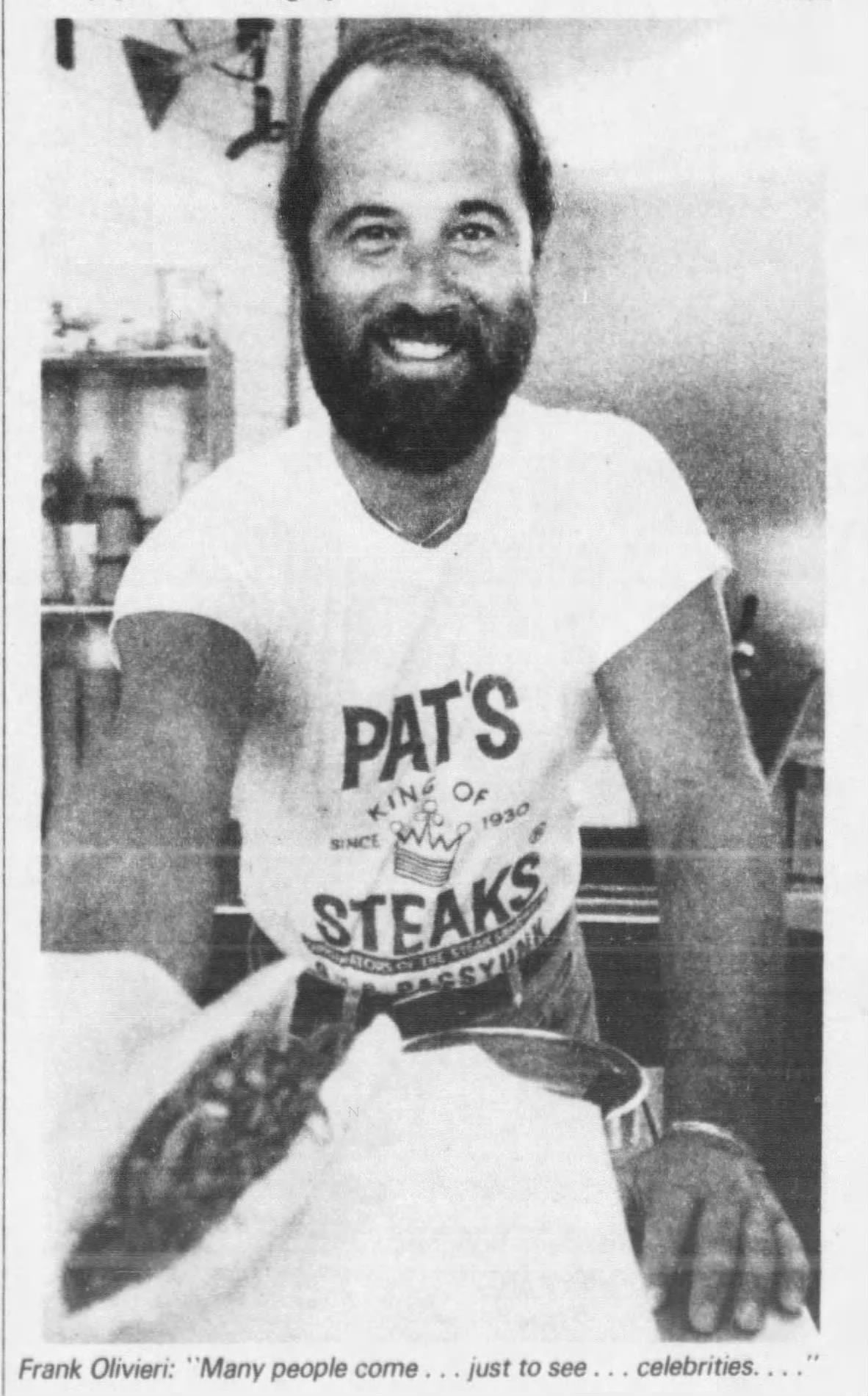
    Frank Olivieri working the grill at Pat’s King of Steaks in 1980.

    Pat Olivieri moved to California in the 1960s; he died in 1970. In 1967, father and son Harry and Frank Olivieri bought the original stand, while Pat’s son Herb obtained licensing and franchising rights to the name.

    Herb Olivieri opened Olivieri’s Prince of Steaks in Reading Terminal Market in 1982 and later ran a Pat’s location in Northeast Philadelphia (unaffiliated with the original). Herb’s son Rick owned sandwich shops, including the reflagged Rick’s Steaks at Reading Terminal, as well as stands at the Bellevue and Liberty Place food courts.

    Pat’s, meanwhile, had become a 24-hour destination. Limos and tour buses, then as now, roll up at all hours.

    Frank Olivieri (left) watching actor Bill Macy eating a cheesesteak from Pat’s King of Steaks in 1981. Macy was touring Philadelphia sites while starring at the Forrest Theater in a pre-Broadway run of “I Oughta Be in Pictures.”

    When Sylvester Stallone filmed part of Rocky outside of Pat’s in 1976, he invited Mr. Olivieri to a private party afterward.

    “I had to tell him I can’t go,” Mr. Olivieri recalled. “We didn’t get to be No. 1 by letting the business run itself.” Back then, Mr. Olivieri lived in Packer Park, kept a summer home in Brigantine, and was rarely more than an hour away.

    “I can be here any time,” he said. “And I am here lots and lots of the time.”

    In 1966, a competitor arrived across the street: Geno’s Steaks, owned by Joey Vento, a former Pat’s employee. The Pat’s-Geno’s rivalry — buzzing neon, dueling lines, endless debates over quality — is, in fact, wildly overblown. Current owners Frank E. Olivieri, popularly known as Frankie, and Geno Vento, Joey’s son, are good friends.

    Mr. Olivieri, who served for many years on the board of directors of Provident Bank, was a whiz with numbers, his son said. He also was an avid fisherman and yachtsman who had his captain’s license. “He also taught me everything I know about electrical work, plumbing, woodworking, and how to fix just about anything,” his son said. “The reason I know how to do all of that is because if he couldn’t do something himself, I had to learn how to do it. Without his guidance, I wouldn’t know how to do any of it.”

    Mr. Olivieri’s son recalls his father’s burgundy 1974 Corvette. “One of the happiest moments of my week was sitting in the passenger seat with him on Saturdays and Sundays,” he said. When they turned from Broad onto Wharton Street, “by the time we hit around 10th Street, I could already smell the onions cooking. He always had the T-tops off for me in the summer. That was my first introduction to being at the store.”

    Besides his son, Mr. Olivieri is survived by his wife of 65 years, Ritamarie; daughters Danielle Olivieri and Leah Tartaglia; 10 grandchildren; and three great-grandchildren.

    Viewing will be from 9 to 11 a.m. Friday, Jan. 23, at Baldi Funeral Home, 1327-29 S. Broad St. A prayer service and memorial tributes will begin at 11 a.m. The family requests donations to St. Maron Church, 1010 Ellsworth St., Philadelphia, Pa. 19147.

  • Mikie Sherrill takes oath as New Jersey governor, becoming the second woman to lead the state

    Mikie Sherrill takes oath as New Jersey governor, becoming the second woman to lead the state

    NEWARK, N.J. — Mikie Sherrill was sworn in as New Jersey governor Tuesday, becoming the second woman to govern the state and the first from the Democratic Party.

    Sherrill, who is also the first female veteran from either party to be elected to the office, broke tradition by opting to be inaugurated in her home county of Essex, in northern New Jersey, instead of the state’s capital city, Trenton.

    She took the oath at the New Jersey Performing Arts Center in Newark in the morning. Joined onstage by her family and high-profile Democrats, Sherrill spoke about her love for New Jersey and denounced President Donald Trump in a speech on Tuesday.

    She also gave two shout-outs to South Jersey, noting that she learned on the campaign trail that South Jerseyans say “pork roll” instead of “Taylor Ham.”

    “I have heard you in South Jersey, where you want jobs, transportation investments, innovative businesses, and not to be forgotten or left behind,” she also said.

    New Jersey Governor-elect Mikie Sherrill waves as she arrives for her inauguration, Tuesday, Jan. 20, 2026, in Newark, N.J. (AP Photo/Seth Wenig)

    She even referenced Philadelphia while talking about the founding of the United States — in a very Jersey way.

    “In fact, not too far away, in the greater Camden metropolitan region, in a place called Philadelphia, Thomas Jefferson wrote a declaration of our independence, marking the birth of this great nation,” she said.

    “This entirely unique and revolutionary declaration claims human beings had universal rights to life, to liberty, to the pursuit of happiness, not because of who their parents were, but because every human being is endowed with these rights by their creator, not by a king,” she added, and was met by applause.

    She drew parallels between England’s king at the founding of the United States and Trump, whom Democrats have criticized through “no kings” protests. Sherrill said Trump is “illegally usurping power, unconstitutionally enacting a tariff regime to make billions for himself and his family while everyone else sees their costs go higher.”

    Sherrill, a former Navy helicopter pilot, former federal prosecutor, and mother of four, was elected to Congress in 2018 and stepped down in November after winning the election, defeating Jack Ciattarelli, who had won the endorsement of Trump.

    Sherrill, whose closely watched candidacy drew significant national support, promised during her campaign that she would make New Jersey more affordable and would stand up to Trump.

    She told voters she would declare a state of emergency on utility rates on her first day in office, a promise she executed while still onstage for her inauguration speech right after being sworn in. She signed two bills: one freezing utility rates and the other encouraging more energy production in the state.

    White flowers lined the front of the stage, and large American and New Jersey flags served as a backdrop.

    Virginia Gov. Abigail Spanberger, Sherrill’s friend and former congressional colleague, was in attendance. Spanberger became Virginia’s first female governor on Saturday in a ceremony attended by Sherrill and other high-profile Democrats.

    New Jersey and Virginia were the only states to hold gubernatorial races last year, and the Democratic victories were viewed as a positive sign for the party heading into the midterms with Trump in the White House.

    Sherrill, who turned 54 on Monday, succeeds Gov. Phil Murphy, a Democrat who served two terms. It’s the first time the same party has held the governor’s mansion for three consecutive terms since 1970.

    After the ceremony, Sherrill was slated to head to Trenton to sign more executive orders before going back north for an inaugural ball Tuesday evening at the American Dream in East Rutherford.

    Sherrill’s lieutenant governor, Dale Caldwell, 65, was also sworn in Tuesday. Caldwell, a Middlesex County-based Methodist pastor, most recently worked as the first Black president of Centenary University. He has worked for state government, started nonprofits, and led charter schools.

    In his speech Tuesday, Caldwell said his father marched with the Rev. Dr. Martin Luther King Jr., whom he and Sherrill both mentioned in their speeches.

    “My father taught me that faith must be active, not passive. He taught me that justice is not an idea, it is a responsibility,” Caldwell said. “And he taught me that service is not optional, especially for those who have been blessed with opportunity.”

    Sherrill defied expectations on both sides of the aisle by winning what had been viewed as a competitive race by 14 points. Republicans had felt optimistic in part because the state shifted red in 2024, but those gains bounced back in November. The resident of Montclair similarly won a crowded primary by more than 100,000 votes in June.

    During her campaign, Sherrill repeatedly reminded voters of Ciattarelli’s ties to Trump and leaned into the president’s unpopularity in the state.

    Sherrill’s campaign repeatedly held events in Newark leading up to her election with the support of Newark Mayor Ras Baraka, a progressive who placed second in the Democratic primary.

    Her decision to be inaugurated up north was celebrated by Newark officials, but Trenton City Council member Jennifer Williams, a Republican, argued in an op-ed that it was an insult to Trenton.

    The governor-elect visited Camden on Monday to celebrate Martin Luther King Jr. Day and announced that she will divert resources to the city to honor the civil rights leader.

    Christine Todd Whitman, the first woman to serve as New Jersey governor, used the same venue as Sherrill when she was sworn in for her second term in 1998 while the war memorial in Trenton, the traditional site, was undergoing renovations.

    Whitman served as a Republican from 1994 to 2001 before joining the Bush administration and has since left the Republican Party for the Forward Party. She endorsed Sherrill’s candidacy.

    New Jersey Gov. Mikie Sherrill speaks after taking the oath of office during an inauguration ceremony, Tuesday, Jan. 20, 2026, in Newark, N.J. (AP Photo/Seth Wenig)