Philadelphia’s miles of trails draw a constant stream of runners, walkers, hikers, cyclists, and commuters.
Yet for years, city officials have depended on residents calling in or logging in to the 311 system to report trail issues before a crew was sent out.
Now, Philadelphia Parks and Recreation (PPR) is set to roll out the city’s first dedicated trail-maintenance crew, a pilot program funded by a $600,000 grant from the William Penn Foundation.
The money will fund a six-person team tasked exclusively with monitoring and maintaining multiuse trails that thread through 10 watershed-protecting parks.
Susan Buck, PPR’s deputy commissioner of operations, said the crew would launch this summer and resolve a long-standing logistical problem.
“The focus has always been on building the trails,“ Buck said. ”However, in recent years we would go to community meetings and hear more about trail maintenance.”
Right now, addressing a downed tree or a washed-out path means pulling staff away from recreation centers and neighborhood parks. A dedicated trail crew will ease that strain, she said, and position the city to address issues before they snowball into bigger problems.
Now, PPR can be proactive, she said.
Parks are priorities
The crew’s immediate priority will be to rotate through 10 watershed parks, such as Wissahickon Valley, Pennypack, Tacony Creek, and Cobbs Creek. Crews will also monitor the Schuylkill River Trail, which recently saw major repairs to sinkholes and storm damage.
Buck said the crew will initially be responsible for about 80 miles of trails.
The city has 166 miles of trails or more depending on what’s being counted. Overall, PPR manages asphalt, gravel, and dirt trails that residents use not only for recreation but for commuting and walking neighborhood to neighborhood.
The new crew will have skid-steer loaders, which are small versatile vehicles with mechanized arms and buckets used to clear, dig, grade, and lift. And they’ll have other equipment such as wood chippers and chainsaws.
For the average park-goer, it should translate to a smoother weekend run, daily commute, or less frustrating bike ride, Buck said.
“Overall, people will see safer trails and more enjoyable trails,” Buck added. “If you’re a runner or cyclist getting hit by overgrown brush, maybe we’ll be able to get to that faster. Ruts and divots should get filled in faster.”
By having a mobile team that can move from the Wissahickon to East Fairmount Park, the city aims to create a uniform experience for all users.
Buck has been working alongside Sarah Clark Stuart, the trails manager for the Streets Department.
The two are working toward a cost-sharing agreement betweenthe two departments to turn the pilot program into an annual part of the city budget.
That way the crew can continue to clear overgrown brush, haul away downed trees, fix washouts, tackle soil erosion, eliminate tripping hazards, and clean graffiti off signs.
The pilot program could use existing employees or result in new hires, she said.
‘Great cities have great parks’
Sara Stevenson, executive director of Friends of the Wissahickon (FOW), said the dedicated crew represents a shift in the way the city has viewed its natural assets. The nonprofit FOW helps manage the city-owned Wissahickon Valley Park.
The 2,000-acre park has more than 50 miles of paved and dirt trails. The new trail crew will be assigned to help with paved paths and major arteries like Forbidden Drive.
“It’s a great program,” Stevenson said. “The more we can invest in Parks and Rec, the better our city will be. This is a good step forward and a recognition of how important the trail system is.”
The Wissahickon relies on thousands of volunteers annually to pull invasive species, clear debris, and help with other maintenance. Stevenson said that the demands of maintaining sustainable trails requires a professional, daily presence.
“Great cities have great parks,” Stevenson said. “I think what we’ll see is a new standard of care … It’s an illustration that the city understands the value of the trail across the entire city.”
WASHINGTON — President Donald Trump declared during a marathon State of the Union on Tuesday that “we’re winning so much” — insisting he’d sparked an economic boom at home and imposed a new world order abroad in hopes it can counter his sliding approval ratings.
Trump’s main objective was convincing increasingly wary Americans that the economy is stronger than many believe, and that they should vote for more of the same by backing Republicans during November’s midterm elections. In all, Trump spoke for a record 108 minutes, breaking — by eight minutes — the previous time mark from his address before a joint session of Congress last year.
The president largely avoided his usual bombast, only occasionally veering off-script — mostly to slam Democrats. As he did during such addresses in his first term, Trump relied on a series of surprise special guests to dramatically punctuate his message. They included U.S. military heroes and a former political prisoner released after U.S. forces toppled Venezuelan President Nicolás Maduro.
Trump drew some of the loudest applause of the night when he invited the Olympic gold medal-winning U.S. men’s hockey team into the House chamber.
“Our country is winning again. In fact, we’re winning so much that we really don’t know what to do about it. People are asking me, ‘Please, please, please, Mister President, we’re winning too much. We can’t take it anymore,’” Trump said before introducing the team.
The hockey players, wearing their medals and “USA” sweaters, drew a bipartisan standing ovation. Trump pointed to the Democratic side of the chamber and quipped, “That’s the first time I ever I’ve ever seen them get up.”
In a made-for-TV moment, the president announced he would be awarding the Presidential Medal of Freedom, America’s highest civilian honor, to the hockey team’s goaltender, Connor Hellebuyck. He also bestowed the Purple Heart on Andrew Wolfe — a National Guard member who was shot while deployed on the streets of the nation’s capital. Wolfe made his first public appearance since then during the speech.
That scene recalled a similar surprise announcement in 2020, when Trump gave the Medal of Freedom to conservative radio host Rush Limbaugh during his State of the Union speech.
Trump vowed to plow ahead, using “alternative” laws to impose the taxes on imports and telling lawmakers, “Congressional action will not be necessary.” Trump argued that the tariffs are paid by foreign countries, despite evidence that the costs are borne by American consumers and businesses. “It’s saving our country,” he said.
The only Supreme Court justices attending were Chief Justice John Roberts, as well as Justices Brett Kavanaugh, Amy Coney Barrett and Elena Kagan. Trump greeted them personally before the speech, despite last week slamming Coney Barrett — who he appointed to the high court in his first term — for siding with the majority against his tariffs.
Democrats also stood for Trump vowing to halt insider trading by members of Congress. But Rep. Mark Takano, a California Democrat, yelled, “How about you first!” Rep. Rashida Tlaib, a Michigan Democrat, called out, “You’re the most corrupt president!”
When some heckling continued, Trump proclaimed, “You should be ashamed of yourselves.” Later, he pointed at Democrats and proclaimed, “These people are crazy.”
Democratic Rep. Al Green was escorted from the chamber early in the speech, after he unfurled a sign of protest that read “Black People Aren’t Apes!” That was an apparent reference to a racist video the president posted that depicted former President Barack Obama and First Lady Michelle Obama as primates in a jungle. Green was also removed during Trump’s address last year.
The president, meanwhile, was mostly optimistic and patriotic, but Trump struck a darker tone in large swaths of his speech to warn about the dangers posed by immigrants. He invited lawmakers from both parties to “protect American citizens, not illegal aliens” and championed proposals to limit mail-in ballots and tighten voter identification rules.
There also are persistent fears that tariffs stoking higher prices could eventually hurt the economy and job creation. Economic growth slowed in the last three months of last year.
It is potentially politically perilous ahead of November elections that could deliver congressional wins to Democrats, just as 2018’s blue wave created a strong check to his administration during his first term.
On Tuesday, Trump blamed his predecessor, former President Joe Biden, along with Democratic lawmakers in the chamber, saying they were responsible for rising prices and health care costs, two issues his political opponents have repeatedly raised against him.
“You caused that problem,” Trump said of affordability concerns. He added a moment later, “They knew their statements were a dirty, rotten lie.”
Trump also said he’d press tech companies involved in artificial intelligence to pay higher electricity rates in areas where their data centers are located. Such data centers tend to use large volumes of electricity, potentially increasing the cost of power to other consumers in the area.
Another notable off-script moment came as Trump was referencing prescription drug prices, saying, “So in my first year of the second term — should be my third term — but strange things happen,” prompting at least one chant in the chamber of “Four more years!”
Virginia Gov. Abigail Spanberger, who delivered the Democratic response to Trump’s speech, slammed the president’s aggressive immigration policies, his widespread cuts to the federal government and his tariffs.
“Even though the Supreme Court struck these tariffs down four days ago, the damage to us, the American people, has already been done. Meanwhile, the president is planning for new tariffs,” she said. “Another massive tax hike on you and your family.”
A warning to Iran
Trump’s address came as two U.S. aircraft carriers have been dispatched to the Middle East amid tensions with Iran. Trump said, “My preference is to solve this problem through diplomacy.”
“But one thing is certain, I will never allow the world’s number one sponsor of terror — which they are, by far — to have a nuclear weapon,” he added.
After two days of virtual classes, the School District of Philadelphia will return to in-person instruction on Wednesday.
More than a foot of snow was dumped across the city Sunday into Monday morning, prompting widespread closures. However, warmer temperatures on Monday helped to speed up snow removal.
The city offices and courts reopened on Tuesday, but the School District decided to stay virtual one more day.
Philadelphia trash and recycling collections will also resume Wednesday on a two-day delayed schedule, officials said.
The School District of Philadelphia will return to in-person operations tomorrow, February 25.
Why did the little seal pup leave the ocean, wander up the beach path, go one block up Middlesex Avenue, then cross three lanes of Long Beach Boulevard in Harvey Cedars?
Who knows?
Maybe it was just the long slick surface of post-storm snow and ice that urged the seal to keep going until a sunny spot in this beach town’s southbound slow lane invited her to stretch out.
Luckily for the gray seal pup, a landscaper on his way to plowing snow did not mistake her for a chunk of snow, and pulled over to block the roadway and help, Harvey Cedars Police Chief Robert Burnaford said Tuesday.
“At approximately 7 o’clock, an innocent bystander was driving by and saw the seal laying in the Boulevard,” Burnaford said by telephone.
“They called us, and the officers confirmed the seal was kind of just relaxing in the slow lane of Long Beach Boulevard,” the chief said. “Literally it crossed over three lanes of traffic to where it was finally hanging out.”
A member of Public Works wrapped the seal in his jacket and moved her to Middlesex Avenue, out of traffic, Burnaford said. The Marine Mammal Stranding Center responded and carried her to their truck, and then to their hospital in Brigantine.
A gray seal pup wandered off the beach in Harvey Cedars and ended up in the middle of Long Beach Boulevard on Tuesday, Feb. 24, 2026, a day after a snowstorm dropped a foot and a half of snow on the island.
The Stranding Center put it this way on Instagram: “POV: When your nap shuts down a whole street.”
The center said in social media statements that the pup had no injuries but was in “thin overall body condition.”
“She is currently resting comfortably in Pen 2 of the Pool House,” the center wrote.
Seal beachings are not uncommon at the Jersey Shore, but the animals rarely end up off the beach. Burnaford said that a seal once ended up in the driveway of an oceanfront home.
“They beach themselves to sun themselves,“ Burnaford said. ”Maybe she was sick and tired of the weather, trying to find another place.”
A gray seal pup wandered off the beach in Harvey Cedars and ended up in the middle of Long Beach Boulevard on Tuesday, a day after a snowstorm dropped a foot and a half of snow on the island.
Official totals put towns on Long Beach Island at around 18 inches of snow.
“It was icy and maybe [the seal] was able to slip and slide easier,” the chief said.
Five teenagers arrested during a protest in Quakertown last week face charges of aggravated assault and related crimes after a judge ruled Tuesday that prosecutors had presented sufficient evidence for the case against them to proceed, according to sources.
The teenagers had been held since Friday, when they were taken into custody after a scuffle with Quakertown police officers — including the department’s chief, Scott McElree.
Officials have released few details about the arrests, but two people with knowledge of the case who asked not to be identified to discuss an ongoing investigation confirmed the charges. The police department and the district attorney’s office have declined to disclose the teens’ names, ages, or charges they face.
After the more than three-hour hearing in Doylestown, which was closed to the public, prosecutors left the courtroom without answering questions. The teenagers’ parents, speaking through intermediaries, also declined to comment Tuesday.
But Ettore Angelo, a lawyer representing one of the teenagers, said his 15-year-old client had been released to her parents and placed on house arrest. He said she faces an aggravated assault charge — a felony offense that, if sustained in juvenile court, can carry a penalty of up to five years in a detention facility.
The teenagers who were arrested had been taking part in a protest of Immigration and Customs Enforcement that began at Quakertown Community High School and moved off campus to Front Street. Witnesses have said that a confrontation erupted there, in front of Sunday’s Deli and Restaurant.
Students at Quakertown Community High School took part in a protest of Immigration and Customs Enforcement that began at the school and moved off campus to Front Street.
McElree, the police chief, who was dressed in plain clothes, grabbed a teenage boy and placed a teenage girl in a chokehold, they said, prompting other students to intervene and a larger scuffle to break out.
Angelo said the central allegation against his client is that she struck McElree during the melee, an accusation she denies. He contended that students reacted in confusion and fear when a man rushed into the crowd.
He said McElree “put himself smack in the middle and created a melee” when he charged up to the teenagers while out of uniform and without announcing who he was. “I think he owes the community and these teenagers an apology,” the lawyer said.
He added that, in his view, some of the teenagers had acted instinctively to protect one another.
Speaking by phone Tuesday afternoon, a 17-year-old girl who participated in the protest but was not among those arrested described what she said had been a peaceful demonstration even as counterprotesters drove past in vehicles, honking and shouting.
The teen, who asked not to be identified for fear of retaliation, said teenagers were gathered on the sidewalk and speaking with a uniformed officer when a man pushed through the crowd and “barged onto the sidewalk.”
The man — whom she later learned was McElree — grabbed a teenage boy by the back of the neck, she said. “All the kids thought he was a counter protester,” she said. “So everyone started to protect their friends.”
The girl said she saw McElree throw one student to the ground and place another in a chokehold. At least three students were injured, she said — one with a broken nose and another who required stitches to his chin. McElree, too, was injured, she said, and left the scene bleeding from his head.
She recorded portions of the confrontation and shared the videos with The Inquirer.
“It was really scary, because it was a group of kids versus this really angry man,” the teen said, adding that it took what felt like several minutes for uniformed officers to step in. “It was the kids doing what the police should have.”
The girl said she did not realize that the man at the center of the fight was the police chief until she returned home and showed the footage to her father, who recognized McElree.
Manuel Gamiz, a spokesman for the district attorney’s office, said Monday that the investigation remains ongoing and that no additional information was available.
Police initially said an adult had also been arrested during the confrontation. But the district attorney’s office later said no adults had been charged in the melee.
Outside the courthouse and along the hallway leading to the courtroom of Denise M. Bowman, more than two dozen community members gathered in quiet support Tuesday. Some held handmade signs: “We support Quakertown students” and “Keep families together.”
Among them was Lolly Hopwood, 47, of Doylestown, who held a poster reading, “We stand with you.” She said she and others wanted to counter what she described as harsh online criticism directed at the families.
“There’s a lot of negativity online right now that the parents are seeing,” Ms. Hopwood said. “We wanted to show them the community is really here for them.”
On Monday night, the episode had spilled into borough politics. At a Quakertown council meeting, several residents called for the teenagers’ release and demanded the resignation of McElree, who also serves as the borough manager. After the public session, the council met privately with its attorney. As of Tuesday morning, it was unclear whether any action would be taken against the chief.
Members of the borough council and the borough’s attorney, Peter Nelson, did not respond to requests for comment on Tuesday.
A GoFundMe campaign created to help cover the teenagers’ legal expenses had raised more than $41,000 by Tuesday afternoon. The funds will be divided evenly among the five families, said Heidi Roux, director of immigrant justice at the Welcome Project PA, which organized the drive.
WASHINGTON — Defense Secretary Pete Hegseth gave Anthropic’s CEO a Friday deadline to open the company’s artificial intelligence technology for unrestricted military use or risk losing its government contract, according to a person familiar with their meeting Tuesday.
Defense officials warned they could designate Anthropic a supply chain risk or use the Defense Production Act to essentially give the military more authority to use its products even if it doesn’t approve of how they are used, according to the person familiar with the meeting and a senior Pentagon official, who both were not authorized to comment publicly and spoke on condition of anonymity.
The development, which was reported earlier by Axios, underscores the debate over AI’s role in national security and concerns about how the technology could be used in high-stakes situations involving lethal force, sensitive information, or government surveillance. It also comes as Hegseth has vowed to root out what he calls a “woke culture” in the armed forces.
“A powerful AI looking across billions of conversations from millions of people could gauge public sentiment, detect pockets of disloyalty forming, and stamp them out before they grow,” Amodei wrote in an essay last month.
The person familiar called the tone of the meeting cordial but said Amodei didn’t budge on two areas he has established as lines Anthropic won’t cross — fully autonomous military targeting operations and domestic surveillance of U.S. citizens.
The Pentagon objects to Anthropic’s ethical restrictions because military operations need tools that don’t come with built-in limitations, the senior Pentagon official said. The official argued that the Pentagon has only issued lawful orders and stressed that using Anthropic’s tools legally would be the military’s responsibility.
Anthropic will no longer be the only AI company approved for classified military networks
The Pentagon announced last summer that it was awarding defense contracts to four AI companies — Anthropic, Google, OpenAI, and Elon Musk’s xAI. Each contract is worth up to $200 million.
Anthropic was the first AI company to get approved for classified military networks, where it works with partners like Palantir. Musk’s xAI company, which operates the Grok chatbot, says Grok also is ready to be used in classified settings, according to the senior Pentagon official.
The official noted that the other AI companies were “close” to that milestone. SpaceX, Musk’s space flight company that recently merged with xAI, didn’t immediately return a request for comment Tuesday.
Hegseth said in a January speech at SpaceX in South Texas that he was shrugging off any AI models “that won’t allow you to fight wars.”
Hegseth said his vision for military AI systems means that they operate “without ideological constraints that limit lawful military applications,” before adding that the Pentagon’s “AI will not be woke.”
The defense secretary said that Grok would join the secure but unclassified Pentagon AI network, called GenAI.mil. The announcement came days after Grok — which is embedded into X, the social media network owned by Musk — drew global scrutiny for generating highly sexualized deepfake images of people without their consent.
OpenAI announced in early February that it, too, would join GenAI.mil, enabling service members to use a custom version of ChatGPT for unclassified tasks.
Anthropic calls itself more safety-minded
Anthropic said in a statement after Tuesday’s meeting that it “continued good-faith conversations about our usage policy to ensure Anthropic can continue to support the government’s national security mission in line with what our models can reliably and responsibly do.”
The uncertainty with the Pentagon is putting those intentions to the test, according to Owen Daniels, associate director of analysis and fellow at Georgetown University’s Center for Security and Emerging Technology.
“Anthropic’s peers, including Meta, Google, and xAI, have been willing to comply with the department’s policy on using models for all lawful applications,” Daniels said. “So the company’s bargaining power here is limited, and it risks losing influence in the department’s push to adopt AI.”
In the AI craze that followed the release of ChatGPT, Anthropic closely aligned with President Joe Biden’s Democratic administration in volunteering to subject its AI systems to third-party scrutiny to guard against national security risks.
Amodei, the CEO, has warned of AI’s potentially catastrophic dangers while rejecting the label that he’s an AI “doomer.” He argued in the January essay that “we are considerably closer to real danger in 2026 than we were in 2023″ but that those risks should be managed in a “realistic, pragmatic manner.”
Anthropic has been at odds with the Trump administration
This would not be the first time Anthropic’s advocacy for stricter AI safeguards has put it at odds with President Donald Trump’s administration. Anthropic needled chipmaker Nvidia publicly, criticizing Trump’s proposals to loosen export controls to enable some AI computer chips to be sold in China. The AI company, however, remains a close partner with Nvidia.
Trump’s Republican administration and Anthropic also have been on opposite sides of a lobbying push to regulate AI in U.S. states.
Trump’s top AI adviser, David Sacks, accused Anthropic in October of “running a sophisticated regulatory capture strategy based on fear-mongering.”
Sacks was responding on X to Anthropic cofounder Jack Clark, writing about his attempt to balance technological optimism with “appropriate fear” about the steady march toward more capable AI systems.
Anthropic hired a number of ex-Biden officials soon after Trump’s return to the White House, but it’s also tried to signal a bipartisan approach. The company recently added Chris Liddell, a former White House official from Trump’s first term, to its board of directors.
The Pentagon’s “breakneck” adoption of AI shows the need for greater AI oversight or regulation by Congress, particularly if AI is being used to surveil Americans, said Amos Toh, senior counsel at the Brennan Center’s Liberty and National Security Program at New York University.
“The law is not keeping up with how quickly the technology is evolving,” Toh wrote in a post on Bluesky. “But that doesn’t mean DoD has a blank check.”
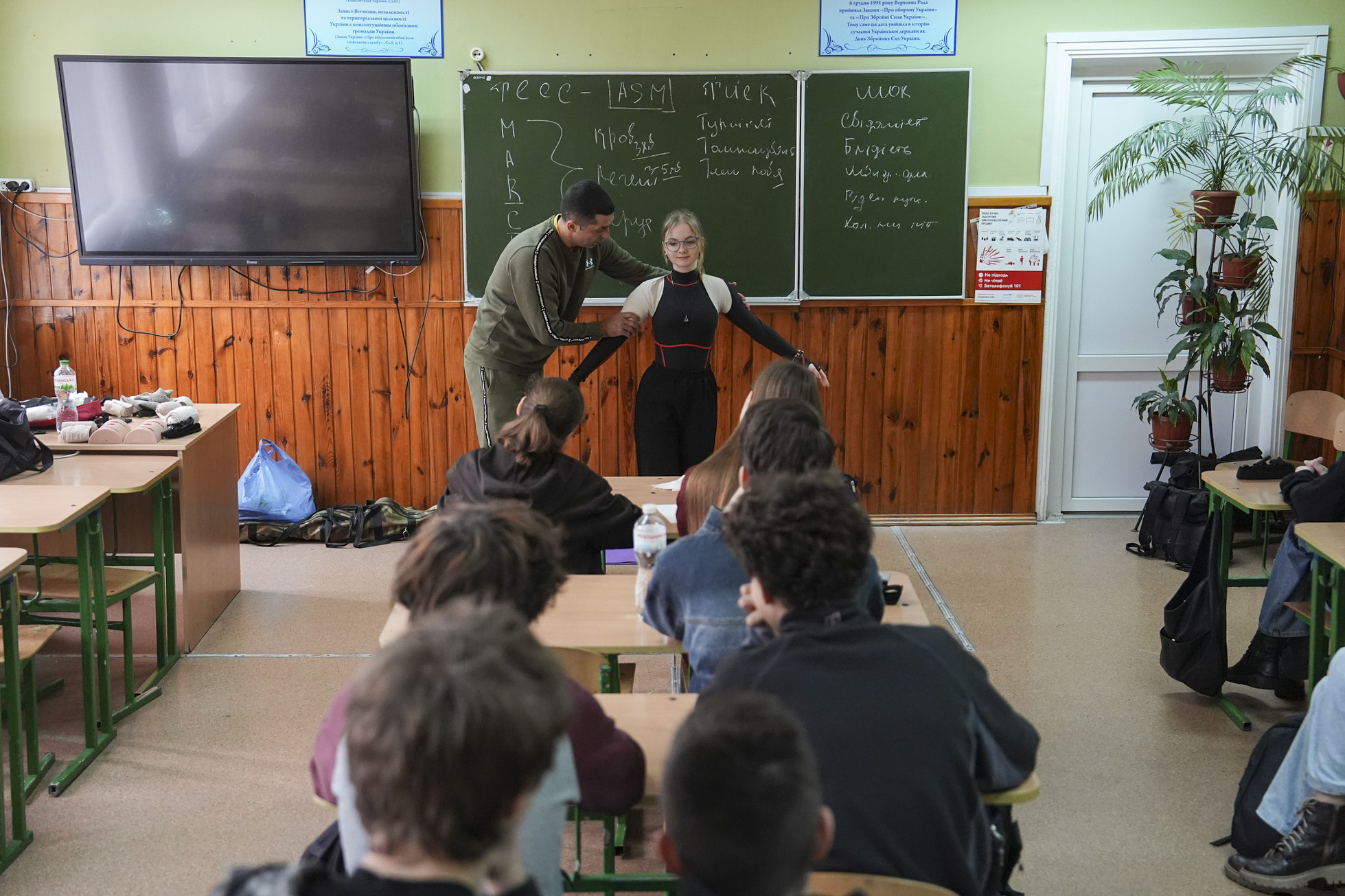
BUCHA, Ukraine — From her wooden schoolroom seat, Katya, 15, carefully eyes the assault rifles laid across the desks up front.
Her mind flashes to the Russian checkpoint four years ago.
She is crammed in the back of a neighbor’s car clutching her aunt’s cat as fear rises to her throat. Russian soldiers are pressed up against the car window, seething with anger, fingers on the triggers of their black guns.
The teacher’s voice snaps her back to the present.
“God willing, none of you will ever need the knowledge you gain here, not even once. But if, God forbid, it happens that you do need it — that you cross paths with these situations — it’s better that you know what needs to be done at any given moment,” he says. “Understood?”
Katya nods. She looks again at the training guns. She isn’t scared anymore. Scared is for 11-year-old Katya in the back seat of that car. Scared is for the little girl trembling in the basement, whose mother covered her with her body while Russian war planes circled overhead.
If Russian troops ever return to Bucha, Katya doesn’t want to be scared. She intends to be ready.
The teacher asks for volunteers to try loading a rifle. Katya’s hand shoots up.
As Russia’s full-scale invasion entered its fifth year Tuesday, Ukrainians were yearning for peace but also readying a new generation of defenders — a somber recognition that the Kremlin is still bombing civilians every night and pushing maximalist demands at the negotiating table. The war could go on for years, and even if a ceasefire is achieved, the Russian threat will live next door.
Katya and her classmates have come of age during wartime.
Denys Kovalenko shows how to apply bandages on Varvara Koval, 15.
In 2022, as tweens, they survived Russian occupation, made harrowing escapes from the front lines, and returned to find the bloodstained suburb of Bucha forever changed by the Russian massacre that unfolded on its streets in the first weeks of the war.
Now 15 and 16, they are still too young to enlist to fight but old enough to understand they soon may be called upon to join their parents and older siblings in protecting their country from a nuclear-armed neighbor intent on denying them an independent future.
While the United States escalates pressure on Kyiv to agree to a negotiated settlement, Ukraine is insisting on ironclad security guarantees — while preparing society to defend itself long term. That includes intensifying efforts to train its children on wartime readiness.
In classrooms across Ukraine, more than 385,000 teenagers are enrolled in a revamped, mandatory course on handling weapons, battlefield tactics, emergency medicine, mine safety, radio communication, and how to respond to attacks on energy infrastructure.
The course, called Protecting Ukraine, replaced a decades-old program that taught high-schoolers some basic weapons awareness but was largely a relic of the Soviet era that also involved dry lectures on military hierarchy and learning to march.
That curriculum was developed long before school hallways were adorned with photos of students and teachers killed by Russia, before air alerts sent children scrambling into basements, before sandbags lined school windows to protect them from blasts or classes were held in subways.
Ukraine’s Education Ministry invested $2.3 million in training teachers on the Protecting Ukraine program last year. “Our task was to form a defense mentality,” Education Minister Oksen Lisovyi said. “The need appeared, first of all of course, because of the military confrontation, terrorist threats and because Russia systematically terrorizes the civilian population.”
Students learn “how to protect one’s self, how to protect those who are close to you, how the Ukrainian army works, which role you could find for yourself if you’d choose to take that path,” Lisovyi said. “But first of all, of course, it’s about the preparation of the civilian population.”
Marina Kyziminska, 16, works with an assault rifle during class.
Rifles, tourniquets, and CPR
Most students in Katya’s classroom were in or near Bucha when Russian forces rampaged the Kyiv region in 2022, executing civilians before retreating from their failed campaign to seize the capital.
When the instructor tells the students just how quickly a green, or safe, zone can turn red, they know exactly what he means.
Katya shivered in a basement, replaying the happiest moments of her life as explosions shook her neighborhood.
Zhenya walked miles along the railway tracks to reach Ukrainian-controlled territory as Russian warplanes circled overhead.
A shell struck the eighth floor of Kyrylo’s apartment building but didn’t explode.
Vasylisa remembers fleeing her hometown in the eastern Donetsk region as a toddler, only to resettle outside Kyiv and watch the sky turn red as streets burned in 2022.
The instructor runs through the basics of trauma medicine: different kinds of tourniquets, how to put pressure on a major wound. He describes types of land mines, explains why radios are still used in an age of phones. He asks for volunteers for a CPR lesson. Katya and Vasylisa step to the front of the room. They giggle as Vasylisa lies down and Katya tips her chin back, opens her mouth, checking for obstruction.
Zhenya Grebelna (left) Varvara, Katya and Ria Shapirko learn how to use a tourniquet.
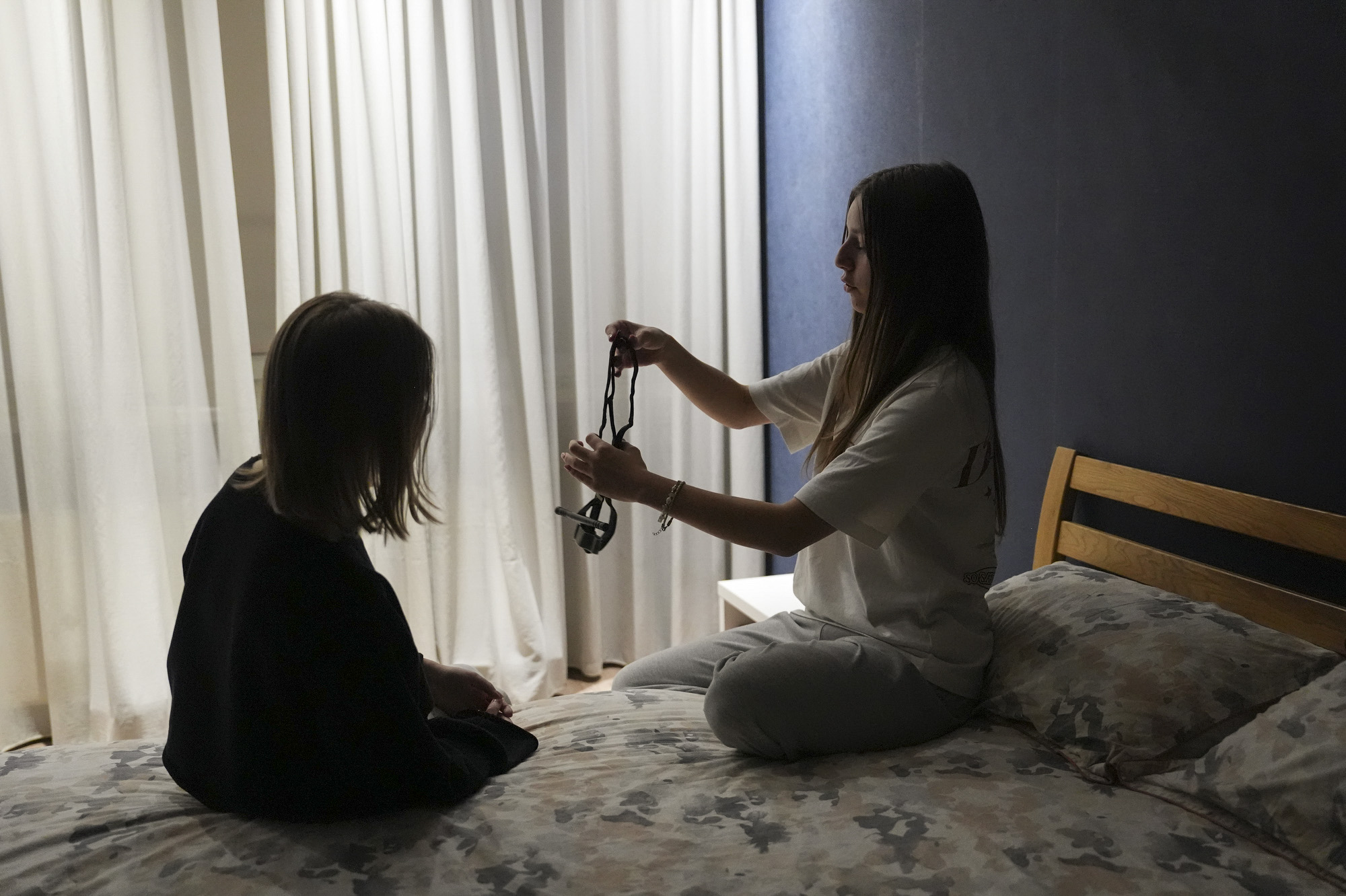
The students tie tourniquets to one another’s arms and practice twisting until they’re so tight they hurt. They remind each other to write down the time. They know that a tourniquet left on too long can lead to amputation.
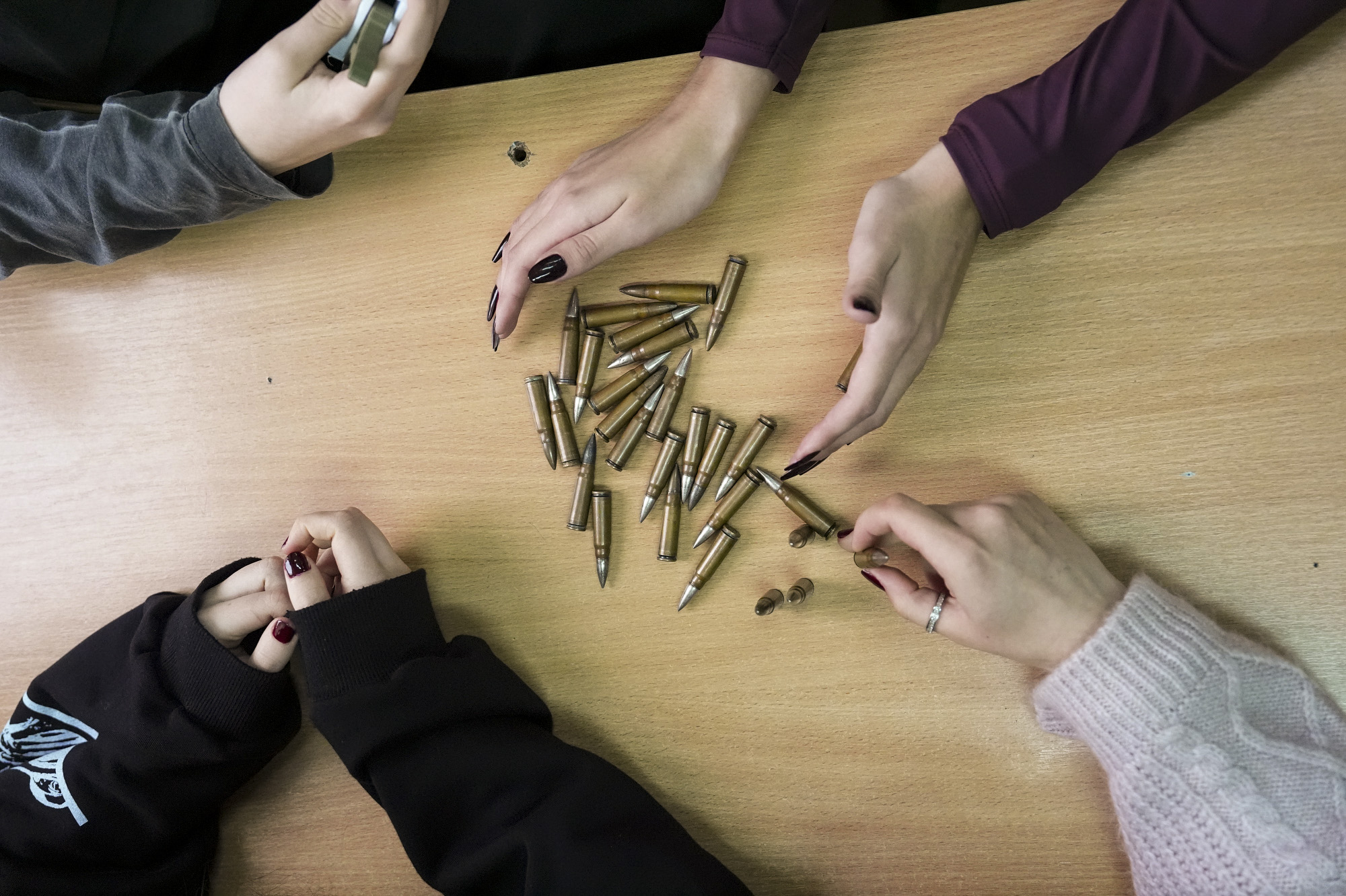
When they go to load rifles, Katya is confident. She shows the other girls how it’s done while a group of boys plays with their phones in the back. Other students race to see who can load bullets into a magazine fastest.
“I’m going to be dreaming about this already,” Katya says. Her friend Ria chimes in: “Like this, Katya: You wake up and we’re assembling a rifle on your bed!” The girls laugh. Their friend Varvara Koval takes a turn. Katya corrects her approach, takes the magazine and attaches it herself.
Bullets used in the weapons training.
The girls know that in schools in Russia, children their age are learning the same techniques. They know those kids are being taught that Ukraine is the aggressor, that Russia is liberating their territory by destroying it. They know that boys just a few years older than their classmates are being fitted for uniforms, crossing the border, killing Ukrainians and dying on Ukrainian land.
“While they are being taught how to properly plant mines, we are being taught how not to step on them,” Katya says of how she pictures Russian students. In a better world, she acknowledged, it would not be normal to load an assault rifle at school or tie a tourniquet on your friend’s arm.
“If no one were attacking our territory, or if Russia followed all the rules and conventions of conducting war, maybe we wouldn’t be learning this,” she adds. “But since they are striking civilian children just like us, we have to know all of this.”
Vasylisa shows younger sister Stasia how to apply a tourniquet at home.
Lost childhood
Katya grew up in this school. Her mom is a teacher here. She knows Bucha like the back of her hand. Vasylisa was never supposed to be here. Born in the eastern Donetsk region, she always dreamed of graduating from the same school as her father. War pushed her family out in 2014. They moved again and again, eventually settling in Irpin, just outside Kyiv.
On Feb. 23, 2022, as Russian forces massed on Ukraine’s borders, Vasylisa’s dad told her and her younger sister, Stasia, to prepare for the worst. Stasia, who was 9, burst out laughing.
The next morning, Russia invaded. Little information trickled in through their unstable internet connection, and what did was terrible: executions. Whole families shot as they tried to flee. Just across the field from them, they could hear a Ukrainian machine gun picking off Russian troops.
Bohdana Kolesnikova, right, with daughters Vasylisa and Stasia at home.
In early March, they fled, packing their dog, guinea pig and several neighbors into their car. The girls thought they were taking a so-called “green corridor” — a safe path toward Kyiv. Their parents knew no such route existed. The trip was a dangerous leap of faith.
Everything seemed to be on fire. They passed the mayor of Irpin hanging out of a car, a rifle in his hands. They eventually made it west, where their dad was quickly drafted to the military. The girls and their mom were stunned.
Back then, Vasylisa thought of the military almost as an extracurricular activity — something to do after school or work. “And now he was taken away, and there was a war,” she said. “I was afraid that … well, I was afraid for Dad. I was crying, talking to him, and he was trying to calm me down, but that only made me cry more.”
Eventually, the family settled into a new rhythm. They returned to the Kyiv region and moved to Bucha, where their dad is now based. Not everything Vasylisa is learning about war in school is new. Her dad taught her and Stasia some field medicine and asked them to always carry tourniquets when they go out. Last summer, they attended a camp where they practiced shooting.
Stasia, at 12, can already assemble and disassemble an AK M-479 in less than a minute.
“I get really upset when I realize that my teenage years are just slipping away like this and passing,” Vasylisa said through tears. “I’m now looking at my sister, who is 12 — the age I was then. And when I realize that she already feels kind of grown up, it makes me sad that I lost some years.”
Their dad has seen Russia’s war come to his family home twice. His daughters, he said, might still be children. But in an emergency, they should be ready to act as adults.
Vasylisa and Stasia with their dad.
Sounds of war
At school, the military lesson ends in the early afternoon. The class disperses, and the students zip up their backpacks, push past the younger kids through the hallways. Vasylisa goes to an English class. The other girls gather on the steps outside.
The first stop after school is the grocery store for cookies, candies, and tea. Varvara’s mom isn’t home from work yet, but she agreed the girls can hang out at their apartment so long as Varvara runs upstairs first to clean.
They kick their shoes off at the door and rush for the kitchen. They boil water. They crowd around the table. They hear an air raid siren and ignore it. They move to Varvara’s room, sit on her bed and floor. They don’t talk about guns or drones or soldiers or war. They talk about boys and girls and crushes and relationships.
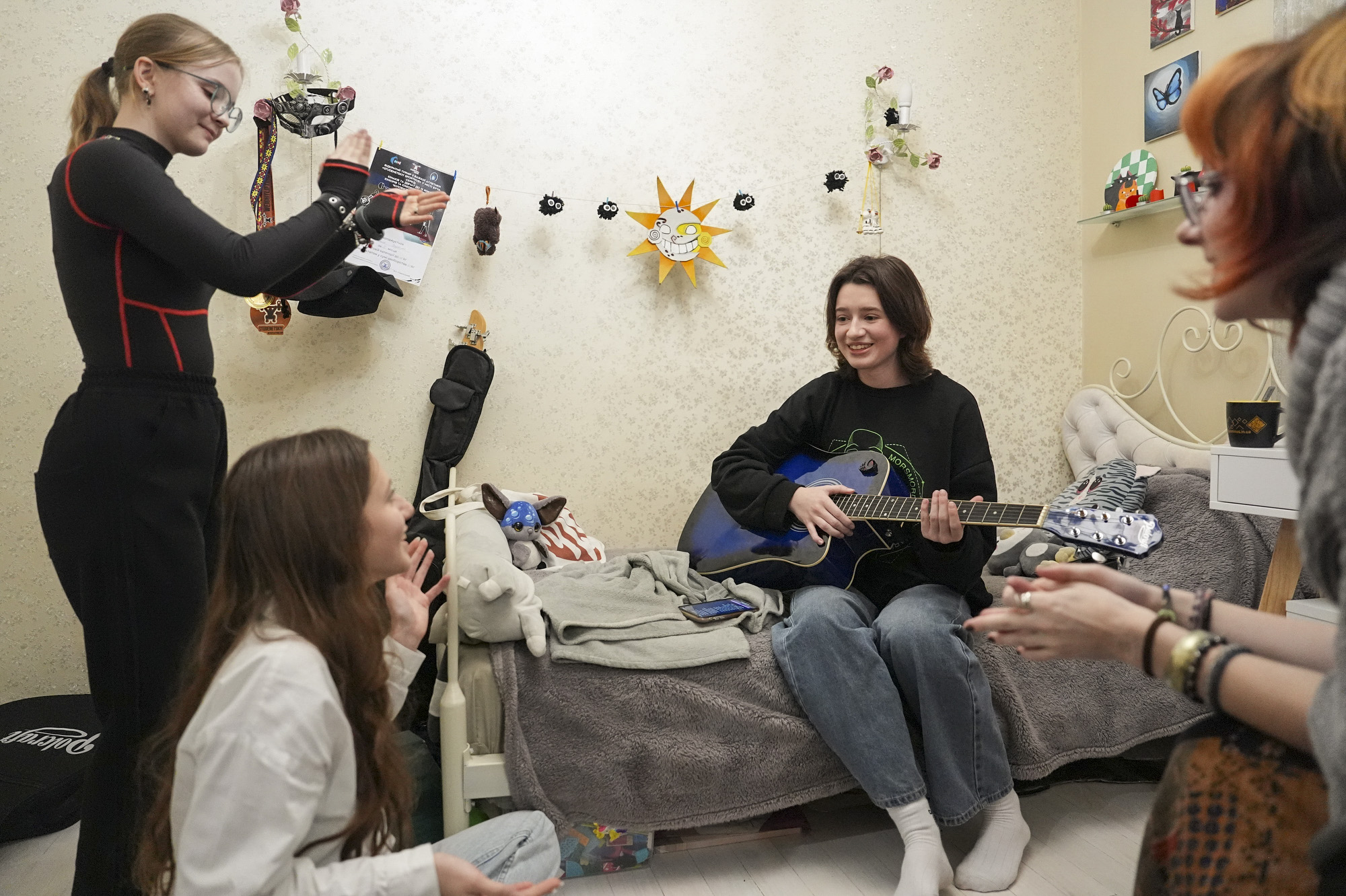
The girls in Varvara’s room.
They laugh at Varvara’s cat, Masha. Eventually, Ria picks up Varvara’s blue acoustic guitar and starts to strum. The girls quiet down. She begins to sing. They all join in.
When the song ends, they cheer and rush to hug her.
The air alert has stopped. For this moment, safe in Varvara’s room, they are just teenagers. They are young and happy and free. They could almost be anywhere.
But later that night, the sirens blare again. Russian missiles and drones soar overhead and crash into apartments and houses and a hospital and energy infrastructure. Four people are killed. Several children are wounded. Varvara moves from her bed to sleep on a bean bag in the hall. The girls all hope to survive another night, and meet in school again tomorrow.
GUADALAJARA, Mexico — Hugo Alejandro Pérez was in his house a few miles from the Mexican stadium that is slated to host FIFA World Cup games when gunfire and explosions erupted just outside his door.
The 53-year-old restaurant owner was already skeptical about his city, Guadalajara, hosting the international sporting event.
He saw a government that failed to fix basic things, like water service to his home, along with cartel violence in the surrounding state of Jalisco and shook his head. The surge of bloodshed this week following the Mexican military’s killing of the country’s most powerful cartel boss offered more confirmation of his doubts.
“I don’t think they should host the World Cup here,” Peréz said. “We have so many problems, and they want to invest in the World Cup? With all the violence, it’s not a good idea.”
Peréz joined other people Tuesday in questioning Guadalajara’s capacity to be a host city for the summer soccer competition, even as the Mexican government vowed that the international event — hosted jointly by Mexico, the United States and Canada — will not be affected.
President offers ‘every guarantee’ for World Cup
President Claudia Sheinbaum was asked at her daily news briefing what guarantees there are that World Cup matches will be held in Jalisco. “Every guarantee,” she said, adding that there was “no risk” for fans coming to the tournament.
Jalisco Gov. Jesús Pablo Lemus said he had spoken with local FIFA officials, who have “absolutely no intention of removing any venues from Mexico. The three venues remain completely unchanged.”
The same day, the Portuguese soccer federation said it was “closely monitoring the delicate situation” in Mexico.” Its national team was scheduled to play Mexico’s team in a friendly on March 28 at the newly renovated Azteca Stadium in Mexico City, which is scheduled to host the opening World Cup match on June 11.
Jalisco, in western Mexico, was already facing scrutiny. The state has been plagued by some of the starkest examples of cartel violence in recent years, including the discovery of a cartel killing site at a ranch last March and a crisis of disappearances.
The state, with Guadalajara as its capital, is the central hub for the Jalisco New Generation Cartel, whose leader Nemesio Oseguera Cervantes, or “El Mencho,” was killed Sunday in a capture attempt by the military.
The operation and waves of violence killed 70 people. Cartel gunmen set fire to cars to block streets in states across the country, namely Jalisco, and fought with Mexican forces into Monday as the government said the conflict was under control.
The death of Oseguera Cervantes came as Mexico’s government has stepped up its offensive against cartels in an effort to meet demands by U.S. President Donald Trump to crack down on criminal groups. The cartel, also known as CJNG, is one of the fastest-growing criminal networks in Mexico.
The White House confirmed that the U.S. provided intelligence support to capture the cartel leader and applauded Mexico’s army for taking down a man who was one of the most wanted criminals in both countries.
Drug lord’s death could lead to more violence
Peréz, the restaurant owner, also commended Sheinbaum’s efforts to go after cartels, saying the government has taken cartel violence more seriously than her predecessors. At the same time, he said, local authorities in Jalisco have fallen short in protecting civilians.
The root concern for many is that the death of “El Mencho” could pave the way for more violence. Killing capos, in what’s become known as the “kingpin strategy,” has been criticized by Sheinbaum herself because it can often spark internal conflict between cartel factions and push rival cartels to make territorial grabs.
Vanda Felbab-Brown, an academic at the Brookings Institution, said she doesn’t see more acts of “revenge” by the cartel as likely, but the future remains uncertain, especially after leading figures in both CJNG and the Sinaloa Cartel have been knocked out in recent years.
“If there is no clear line of succession (in CJNG), we might see a lot of fighting within the cartel, its breakup, and there are a lot of scenarios,” she said.
On Sunday, when firefights broke out between the cartel and soldiers, and gunmen began to burn a car just feet in front of Peréz’s house, he let people on the street scramble inside his home to seek cover. The fighting raged for an hour.
Now he says he doesn’t see the point of holding the games, adding that he doubts any of the money from the games will trickle down to businesses in working-class neighborhoods like his, even if they are just a 10-minute drive from the stadium. Similar tensions have simmered in Mexico City.
The World Cup is expected to be a $3 billion economic engine in Mexico, according to the Mexican Soccer Federation.
“It doesn’t help us residents at all, honestly. They should move it to Monterrey or Mexico City. But right now here, we’re not convinced,” he said. “Things aren’t in good enough shape for foreigners to be coming to Jalisco for an event like this.”
On Monday, some foreign tourists trapped in the violence in the city of Puerto Vallarta took to social media to warn of the violence, with a few remarking that they didn’t plan to return.
Hope of snapping back to normal
Despite that, Guadalajara was snapping back to its normal rhythm Tuesday. Many businesses opened their doors for the first time in two days, and streets were packed with traffic.
Workers were busy fixing up the exterior of the soccer stadium that will host World Cup matches. Cyclists zipped around outside the stadium, and parents played with children in parks.
Heavily armed police officers and National Guard members roamed the city, a sign for some that the government had the situation under control.
Juan Carlos Pila, a 55-year-old taxi driver, rolled his eyes at the reports of violence after spending two days waiting with his family for things to calm down. He said social media and local news outlets were overplaying the extent of the violence.
“People should come, man. Everyone is welcome,” he said.
Others, like Maria Dolores Aguirre, simply hoped for the best. Aguirre runs a small corner story in the cobblestoned tourist town of Tapalpa tucked away in Jalisco’s mountains, where Mexico’s military killed “El Mencho.”
Aguirre’s family business of over 50 years depends on the flow of tourists to the normally sleepy town. Now she worries bloodshed will deal a blow to her livelihood and change towns like hers.
“It’s going to affect us. It’s collateral damage,” Aguirre said. “The government is going to have to have a lot of security. … The entire world just saw what happened and, of course, people are going to think twice about coming.”
At this point, the prospect of a barely measurable snow Wednesday morning may seem like so much drizzle in the ocean.
However, given that a coating of snow could cover another harvest of stealth black ice in the morning as the snow melt refreezes overnight, motorists and pedestrians might want to exercise a measure of caution.
The forecasts are calling for a half-inch to maybe an inch in the Philly area.
For the record, the official total at Philadelphia International Airport was 14 inches. Of that, 7.5 inches fell on Monday, setting a record for the date. It was No. 16 on the all-time snowstorm list, and the first time in 33 years that a foot or more had fallen so late in the season.
The post-storm issues included contending with scores of downed trees throughout the region. A fallen tree in Radnor Township, Delaware County, still was affecting service on the Norristown High Speed Line.
Service still was still suspended on the Cynwyd Regional Rail line, SEPTA said, and other lines were operating with delays.
Airport operations were getting back to normal, said spokesperson Heather Redfern, flights having resumed Monday afternoon.
As for schools, they were opting for a variety of options from virtual learning (Philadelphia) to two-hour delays (Cherry Hill, Moorestown), to party’s over, get here on time (Upper Darby).
This may be the week of black ice in Philly
Invisible and insidious black ice, a dangerous slipping hazard, in all likelihood will be present through the workweek as the snow melt picks up speed during the day, with highs in the 40s, and temperatures falling below freezing at night.
More light snow, rain, or a snow-and-rain mix is possible Thursday into Thursday night, the weather service said. But odds are the immediate Philly area will see mostly rain, said Eric Hoeflich, a weather service meteorologist in Mount Holly.
After a modest warmup on a dry weekend, some computer models were hinting at more snow early next week as a storm moves east, but “not all the guidance is showing a significant system,” the weather service said in its afternoon discussion. “It’s definitely on our radar,” the agency said, but it doesn’t “appear to have potential for a ‘major’ event.”
In short, anything rivaling the Sunday-Monday storm would be, at the very least, unlikely.
Hoeflich said he spent 30 hours in the Mount Holly office, not leaving until 2 p.m. Monday. He said that the weather service provided air mattresses for him and other staffers and that his colleagues came armed with soft pretzels.
Sarah Johnson, the warning coordination meteorologist, brought pizza. Evidently carbs are a sine qua non of storm forecasting.
The developer of a “boutique data center” will look elsewhere after public outcry and a preemptive board of supervisors vote showed no appetite for the facility in North Coventry Township.
The data center, informally proposed by Envision Land Use, would have been situated adjacent to Route 100 at 299 W. Schuylkill Road, in an industrial lot sitting near a Peco utility substation and a residential development.
But swift and early public discontent — and the township’s leadership— stopped the data center before a formal application was even submitted to the Chester County municipality.
The township’s board of supervisors voted, 3-2, on Monday that they would reject a proposal for the site eyed by Envision Land Use, said Erica Batdorf, the township’s manager. It wasthe first data center to be proposed in North Coventry.
The board’s chair did not immediately respond to a request seeking comment.
Though the developer could still formally submit its plans, it will scrap them for the municipality, said Envision Land Use’s Reiss Rosenthal.
“[With] this much public pushback, we just thought at this time it didn’t make sense to try to go forward with this,” he said.
On Monday, the crowd of roughly 100 residents booed when the supervisors discussed pushing back the vote to a subsequent meeting, Rosenthal said.
The vote follows a growing public pushback of data centers in the region, particularly in Chester County. Last week, East Vincent’s planning commission told the township’s board of supervisors that it should reject a massive data center project there after months of tense public meetings. A proposed project in East Whiteland also saw backlash from residents last month after it sought to expand the footprint of its project.
There are more than 150 data centers in Pennsylvania and New Jersey.
Data centers are buildings or campuses that handle cloud-storage and computing needs of massive corporations, like Amazon, Google, Microsoft, or Meta.
And though those kinds of corporations are looking at setting up shop in Pennsylvania, at about 17 acresthe North Coventry project would have been smaller than its proposed counterparts in other pockets of Chester County, the developer said. These smaller centers have been around for longer than the ones making recent headlines, Rosenthal said.
The proposed site would have been a 120,000 square-foot three-story building, making it relatively small compared with the sprawling plans in East Vincent and East Whiteland, which would both exceed a million square feet.
Plans for the site say that it would have preserved and added trees and that its proximity to the Peco station would have required minimal additional power supply.
The proposed project would have been within the township’s residential zoning district that has an industrial overlay. It would have had six full-time employees.
“We were kind of surprised that this ended in a vote already,” Rosenthal said. “We thought it was possibly going to be a little bit more down the line, after we were able to meet with the neighbors as well as show our hands on what we were actually planning on doing.”