Category: News

Latest breaking news and updates

  • Muthoni Nduthu, killed in Bristol nursing home blast, remembered as a dutiful nurse and faithful mother

    Muthoni Nduthu, killed in Bristol nursing home blast, remembered as a dutiful nurse and faithful mother

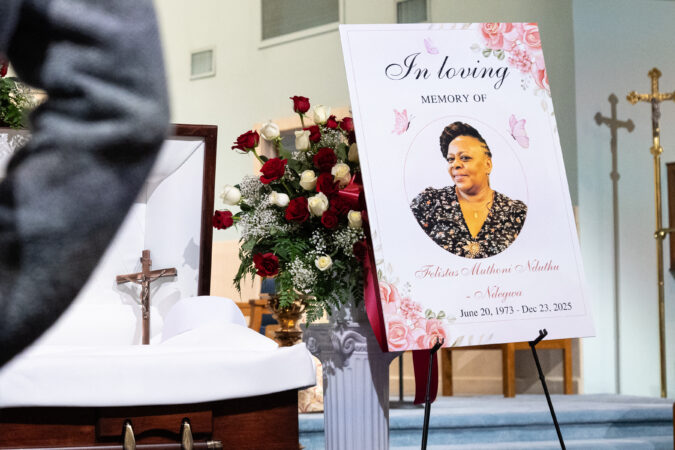
    A chorus of nurses called Muthoni Nduthu to service one last time Saturday at her funeral.

    “Nurse Muthoni, please report to duty,” the nurses repeatedly cried out, each time punctuated by a chime from a triangle. “You faithfully served your profession with dignity, compassion, and integrity. … Your fellow nurses will take over from here.”

    Nduthu — who was killed when an explosion just before Christmas razed the Bristol Health & Rehab Center in Lower Bucks County — was laid to rest Saturday, memorialized by family, friends from the tight-knit Kenyan community in the area, and a 50-person nurse honor guard as an exemplary healthcare professional, a doting and spirited mother, and a pillar of her community.

    “She was our anchor, our prayer warrior, and our safe place,” the oldest of her three sons, Clinton Ndegwa, wrote in a tribute read by a relative. “Though her absence leaves a space that cannot be filled, her love remains rooted in us. We carry her faith, her strength and her lessons forward.”

    During the funeral service at St. Ephrem Catholic Church in Bensalem, where Nduthu, 52, was a longtime member, she was remembered for her warmth and natural humor; her perseverance as an immigrant who went back to school for nursing while working full-time; her quiet, but constant, sacrifices for her family; and her cooking.

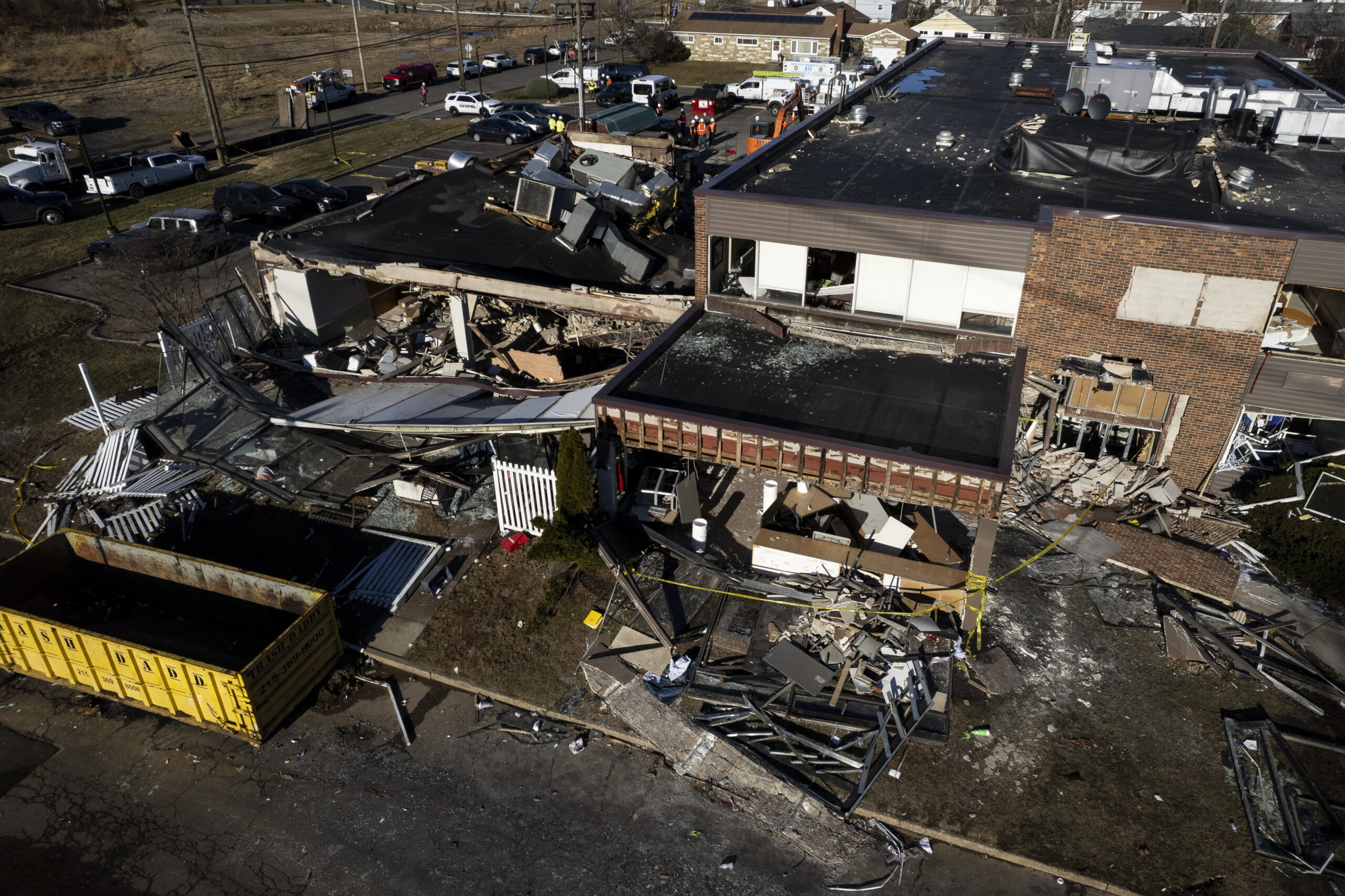
    The night before her Dec. 23 shift at the Bristol facility, formerly known as Silver Lake Healthcare Center, Nduthu prepared spiced chicken for her husband and sons to share on Christmas. The next day, she was working when a blast flattened a section of the nursing home just after 2 p.m., trapping dozens, hurling debris, and rocking nearby homes. Resident Ann Reddy was also killed, and about 20 others were injured. Earlier this month, another resident, identified as Patricia Mero, succumbed to injuries.

    Investigators work the scene at Bristol Health & Rehab Center on Wednesday, Dec. 24, 2025, in Bristol Township, Pa.

    Peco crews had responded to reports of gas odor hours before the explosion, and residents of the 174-bed nursing home told The Inquirer they had smelled gas in the days leading up to the disaster.

    The nursing home; its operator, Saber Healthcare Group; Peco; and others are facing lawsuits from survivors and their loved ones who say the explosion was the result of negligence. NBC10 reported that Nduthu’s husband, David Ndegwa, has also filed a lawsuit.

    The National Transportation Safety Board and a spokesperson for Saber said Friday that the investigation into what caused the explosion is ongoing.

    Nduthu and her family emigrated from Kenya to the Philadelphia area more than two decades ago, David Ndegwa wrote in a tribute. Once stateside, Nduthu pursued a nursing degree, “guided by her compassion and desire to serve others,” her eulogy read. She believed deeply in the power of education and hard work, her sons said.

    She “touched many lives through her kindness, generosity, and genuine care for others,” David Ndegwa wrote. “Her legacy lives on in our sons, in the friendships she nurtured, and in the strong foundation of family she built.”

  • Asked about anti-ICE protests, McCormick says ‘dehumanizing language’ is leading to violence

    Asked about anti-ICE protests, McCormick says ‘dehumanizing language’ is leading to violence

    In an interview with Pennsylvania’s two U.S. senators, CBS Evening News anchor Tony Dokoupil asked about “extreme rhetoric” in Minneapolis.

    “Where is the line,” Dokoupil asked, “between protected demonstrations, civil disobedience … and impeding ICE, which is breaking the law?”

    He did not specifically mention the Jan. 7 fatal shooting of 37-year-old Renee Good by a U.S. Immigration and Customs Enforcement agent.

    “The moment you start dehumanizing people, the moment you start calling people Hitler, the moment you start doing that, it’s a slippery slope to violence,” Republican U.S. Sen. Dave McCormick said during the exchange, which was telecast Friday. “So there’s a direct connection between the violent language, the dehumanizing language, and the actual violence.”

    The Trump administration has defended Good’s killing as an act of self-defense by ICE agent Jonathan Ross, who shot Good four times as she drove away from him, video of the incident showed.

    The Department of Justice has since signaled it will not investigate the shooting; rather, it has launched a probe into Democratic elected officials in Minneapolis.

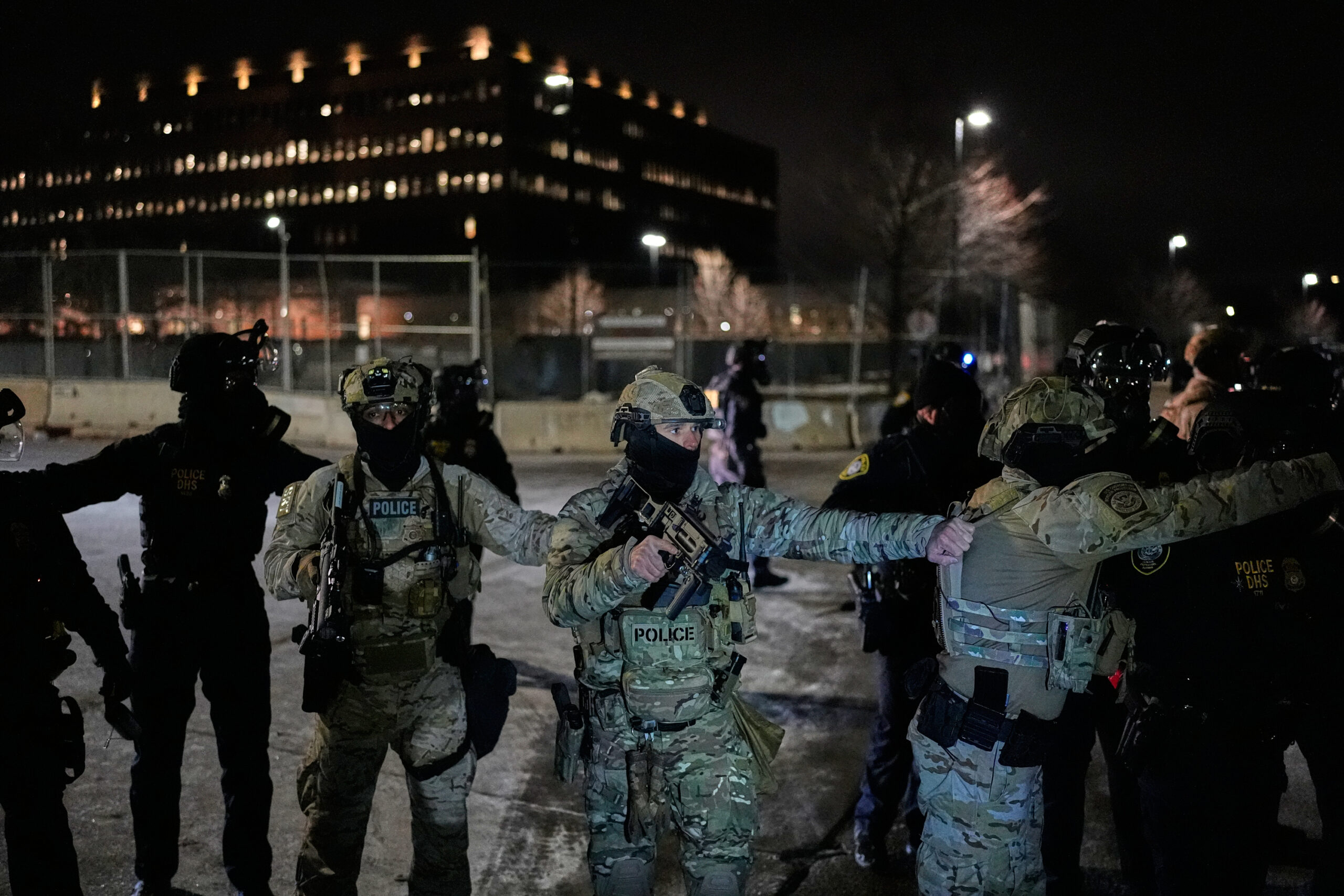
    Federal immigration officers confront protesters outside Bishop Henry Whipple Federal Building, Thursday, Jan. 15, 2026, in Minneapolis. (AP Photo/Yuki Iwamura)

    McCormick said that ICE agents have a responsibility to enforce the law.

    “The moment the protesters get in the way of the ICE officials actually enforcing the law … the moment that it starts to become physical, I think the risk of violence goes up,” he said.

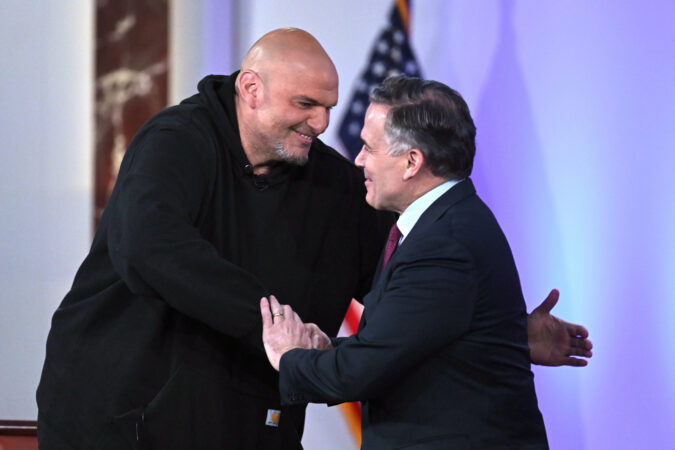
    The exchange was part of a wide-ranging interview, billed as a “lesson in bipartisanship,” that found McCormick and Democratic U.S. Sen. John Fetterman often agreeing on divisive topics.

    “I reject the extreme on both sides right now,” Fetterman said. “It was a tragedy. We all wish that woman was alive. But also, ICE has a job to do as well,” and everyone doesn’t need to agree on its tactics.

    Here are other moments that stood out from the 16-minute conversation held at U.S. Steel’s Mon Valley Works in West Mifflin, about 10 miles south of Pittsburgh.

    Acquiring Greenland

    Fetterman and McCormick both rejected the idea, proposed by President Donald Trump, that the U.S. may use military force to acquire Greenland. But both senators agreed that it makes sense for the U.S. to increase its presence there.

    “It’s also undeniable, that, one, this is not a brand-new conversation,” Fetterman said, adding that President Harry Truman and others had tried to buy Greenland. “So it’s not an absurd idea.”

    McCormick said he recently met the prime minister of Denmark, “and they are welcoming the United States playing a more active role.” He doesn’t believe the U.S. should use military force, he added, but “we ought to have a strategic foothold.”

    Fed Chair Jerome Powell

    The Justice Department, led by Attorney General Pam Bondi, recently subpoenaed Federal Reserve Chair Jerome Powell, head of the independent body that determines U.S. monetary policy. The inquiry is looking into Powell’s comments related to renovations of Federal Reserve buildings. Powell has said the probe was opened because Trump was angry that Powell would not cut interest rates when the president wanted him to.

    McCormick defended Trump’s right to criticize Powell, and said Powell should have raised rates faster and lowered them sooner. However, he emphasized Powell’s “mandate” to control federal interest rates.

    “The Fed has to be independent,” McCormick said. “It’s absolutely critical for our financial system.” He added that he does not believe Powell is “involved in any criminal activity.”

    Regulating social media

    Both of Pennsylvania’s U.S. senators support legislation to rein in social media companies, which have faced broad criticism for negatively impacting children and teens.

    “If there’s a friend who’s spending four or five hours a day with your kid, you really want to know who that friend is,” Fetterman said, “and that is social media right now, and it can be incredibly poisonous.”

    Pennsylvania Sens. Dave McCormick, left, and John Fetterman play with Fetterman’s three-legged dog, Artie, at Fetterman’s home in Braddock, Pa., on Feb. 2. (MUST CREDIT: Justin Merriman for The Washington Post)

    Fetterman won his 2022 Senate race against Republican Mehmet Oz after relentlessly trolling his opponent on social media, but he said he has seen the negative effect social media has had on his own family.

    Fetterman said Congress is not doing enough — and he would like to see a social media ban for children similar to what Australia recently implemented.

    Fetterman said he and Republican U.S. Sen. Katie Britt of Alabama are pushing the “Stop The Scroll Act,” which would create a mental health warning label for social media platforms.

    McCormick’s wife, Dina Powell McCormick, recently became president and CEO of Meta, Facebook’s parent company. But McCormick said he agrees that Congress needs to do more. He wants to eliminate social media for children under 14, make social media platform data available to researchers, and ban phones in schools that are funded by the federal government.

    Data centers

    Despite public skepticism over artificial intelligence data centers and their potential impact on energy prices, Pennsylvania Gov. Josh Shapiro has been a vocal supporter of companies building the centers in the state.

    McCormick said Pennsylvania is the country’s second-largest energy exporter, making the state “uniquely positioned to be the AI energy leader.”

    “But, yes, as we develop this huge infrastructure, we need to make sure that consumers aren’t stuck with raising energy increases,” McCormick added.

    The two senators also spoke about energy and healthcare costs, the steel industry, and other topics. The full interview can be viewed here:

  • Justice Dept. enters new territory with probe of Minnesota officials

    Justice Dept. enters new territory with probe of Minnesota officials

    President Donald Trump’s Justice Department crossed a new threshold with its criminal investigation of top Democratic elected officials in Minnesota, targeting vocal critics during a moment of crisis in which protesters and federal agents are clashing on icy city streets.

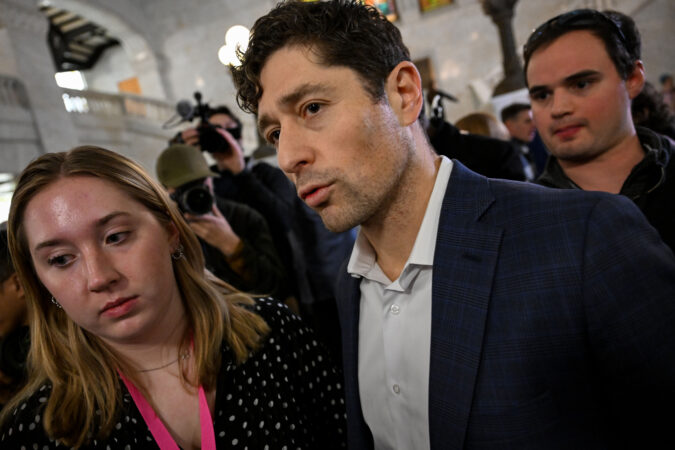
    The Twin Cities have been a tinderbox for more than a week since an Immigration and Customs Enforcement officer fatally shot a woman in her vehicle, with residents confronting ICE agents. Trump has raised the prospect of sending U.S. troops into the state, and the Justice Department escalated tensions Friday as it prepared to send subpoenas to Gov. Tim Walz and Minneapolis Mayor Jacob Frey, two of Minnesota’s highest-profile Democrats.

    The pair have loudly disparaged ICE’S presence in the state and the way Trump and his administration have defended the officer and sidelined state officials in an investigation into the shooting. The subpoenas the Justice Department is preparing to send suggest the agency is looking at whether Walz’s and Frey’s public statements about the administration’s actions amount to illegal interference with law enforcement.

    The administration has pursued numerous other Democrats and perceived adversaries, fulfilling Trump’s promises to prosecute his foes. However, the administration had not taken such forceful action against elected officeholders at a volatile moment when public safety was at issue — until now.

    To Trump’s allies, the latest investigation should serve as a warning to critics who they argue are inflaming matters with their rhetoric. Former Trump adviser Stephen K. Bannon said he believes Walz and Frey hit Trump’s “trip wire” with their heated comments and expects “intense prosecution.”

    “Walz and Frey should listen when the president says, ‘No games,’” he said.

    Trump’s critics warned in stark terms that he was crossing a dangerous line.

    “This is what totalitarianism looks like,” said Sen. Chris Murphy (D., Conn.). “Trump is now using the full, entire scope of the federal government in order to destroy and suppress dissent and compel loyalty.” Murphy said Minneapolis is a “test case” that will determine whether Trump tries the same approach elsewhere.

    The White House and Justice Department had no comment Friday on the probe of Walz and Frey, but Attorney General Pam Bondi posted on social media a “reminder to all those in Minnesota: No one is above the law.” Neither Walz nor Frey had been served with a subpoena by Friday evening, spokespeople for the officials said.

    Trump, who on Thursday threatened to invoke the Insurrection Act in Minnesota, which would enable him to deploy the military on U.S. soil, downplayed the prospect on Friday. “If I needed it, I’d use it. I don’t think there’s any reason right now to use it,” he told reporters.

    The Justice Department’s investigation of a governor and mayor is highly unusual. In the 1950s and 1960s, presidents used troops to enforce court desegregation orders in the face of defiance from some Southern governors. But the department did not press charges against them, said Steven Lawson, a history professor at Rutgers University.

    “The Justice Department’s Civil Rights Division did keep track of civil rights incidents in the South, but it did not prosecute or harass governors or mayors for their resistance,” he said by email.

    Trump’s administration is taking the opposite approach by going after those who have pilloried the president. Traditionally, the Justice Department has tried to insulate itself from the White House, but Trump has not shied away from getting involved in its investigations. In September, he took to social media to complain to Bondi that she wasn’t taking action against his political opponents.

    Many Minnesotans were angry when ICE sent thousands of agents to the state, and they launched widespread protests after an ICE officer fatally shot Renée Good. ICE’S presence and the demonstrations have put Minneapolis on edge, with residents blowing whistles and screaming at agents, and officers at times deploying tear gas. Demonstrations “remained peaceful until last night,” Minneapolis Police Chief Brian O’Hara said last weekend after 29 people were arrested and an officer was injured.

    Tensions rose again this week when an ICE officer shot a man in the leg.

    Soon after an investigation into Good’s shooting began, state officials said they were reluctantly withdrawing from it because the FBI was not sharing information with them. Separately, Minnesota Attorney General Keith Ellison sued federal officials this week to try to force ICE agents out of the state.

    Walz, the Democrats’ 2024 vice-presidential nominee, has been fiercely critical of ICE, as has Frey, who drew nationwide attention when he told ICE to “get the f— out of Minneapolis” following the shooting.

    Walz and Frey are being investigated under a law similar to one used against protesters whom federal officials have accused of impeding their work.

    “The administration is taking us back to the days of seditious libel, where people are prosecuted simply because they criticize the acts of government,” said Rep. Jamie Raskin (D., Md.), a former constitutional law professor who served on a congressional panel that investigated the Jan. 6, 2021, attack on the U.S. Capitol by a pro-Trump mob. “The Department of Justice has now been reduced to a completely political and partisan instrument of vendetta.”

    In a statement, Walz noted that Trump has gone after many others who have not done what he wants and said, “The only person not being investigated for the shooting of Renée Good is the federal agent who shot her.”

    Justice Department prosecutors pursued cases against former FBI director James B. Comey and New York Attorney General Letitia James, but judges dismissed the charges. The department has also conducted investigations of Sen. Adam Schiff (D., Calif.), who led Trump’s first impeachment as a member of the House, Federal Reserve Chair Jerome H. Powell, and several Democrats who told military members they could defy unlawful orders. He has also tussled with Democratic state officials such as California Gov. Gavin Newsom and Illinois Gov. JB Pritzker, and tried to withhold funds from them when they have fought his agenda.

    Frey wrote on the social media platform X that the investigation against him was “an obvious attempt to intimidate me for standing up for Minneapolis, local law enforcement, and residents against the chaos and danger this Administration has brought to our city.” He said he “will not be intimidated.”

    The administration’s pressure on Minneapolis ramped up further Friday when the Department of Housing and Urban Development said it was investigating the city over fair housing initiatives, probing for alleged violations of the Fair Housing Act and the Civil Rights Act.

    A Minneapolis spokesperson said the investigation “appears to be about politics, not affordable housing.”

  • More than 2 inches of snow fell outside Philly Saturday — and more may be coming

    More than 2 inches of snow fell outside Philly Saturday — and more may be coming

    The wet, hefty snowflakes that fell across the Philadelphia region Saturday blanketed buildings and streets with slushy snow — and more is predicted Sunday.

    While Saturday’s snowfall — recorded at about half an inch in the city, and topping two inches in the immediate suburbs — was melting by the afternoon, a new storm Sunday could bring another round.

    Forecasts for the city and surrounding suburbs project 1 to 3 inches.

    “Expect more snow tomorrow than what you saw today,” said Mike Lee, lead meteorologist at the National Weather Service in Mount Holly.

    Here’s what to know about the snow, and the chances for more this weekend.

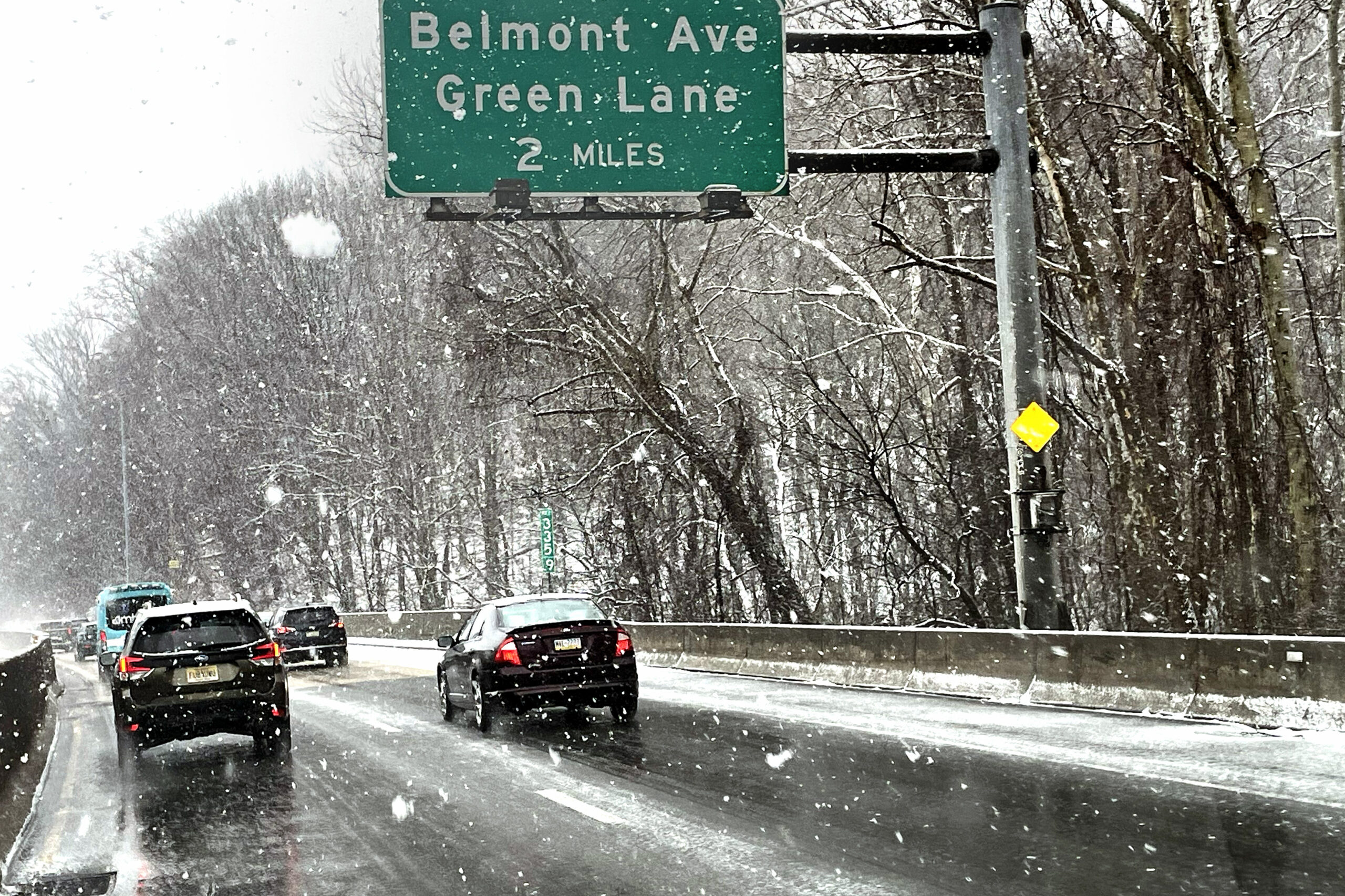
    Traffic on the eastbound Schuylkill Expressway (I-76) is moving slowly as snow falls in the region midday, Saturday, Jan. 17, 2026. Temperatures in the afternoon were expected to approach 40 degrees, so any precipitation that lingered was likely to turn to rain. Sunday will be colder, the source being a coastal storm.

    ‘Wet and slushy’

    With temperatures right around freezing, the snow that fell Saturday morning and early afternoon was “definitely wet and slushy,” Lee said.

    By midafternoon, the snow had stopped. Half an inch was recorded in Center City, while in the nearby parts of the collar counties, totals hovered around 1 to 2 inches, reaching 3 and 4 inches closer to the Lehigh Valley.

    While some of that snow was melting throughout the day Saturday, Lee noted that the melt could turn into black ice on roadways as temperatures fell at night.

    And Sunday offers another chance for snow to accumulate around the region, Lee said.

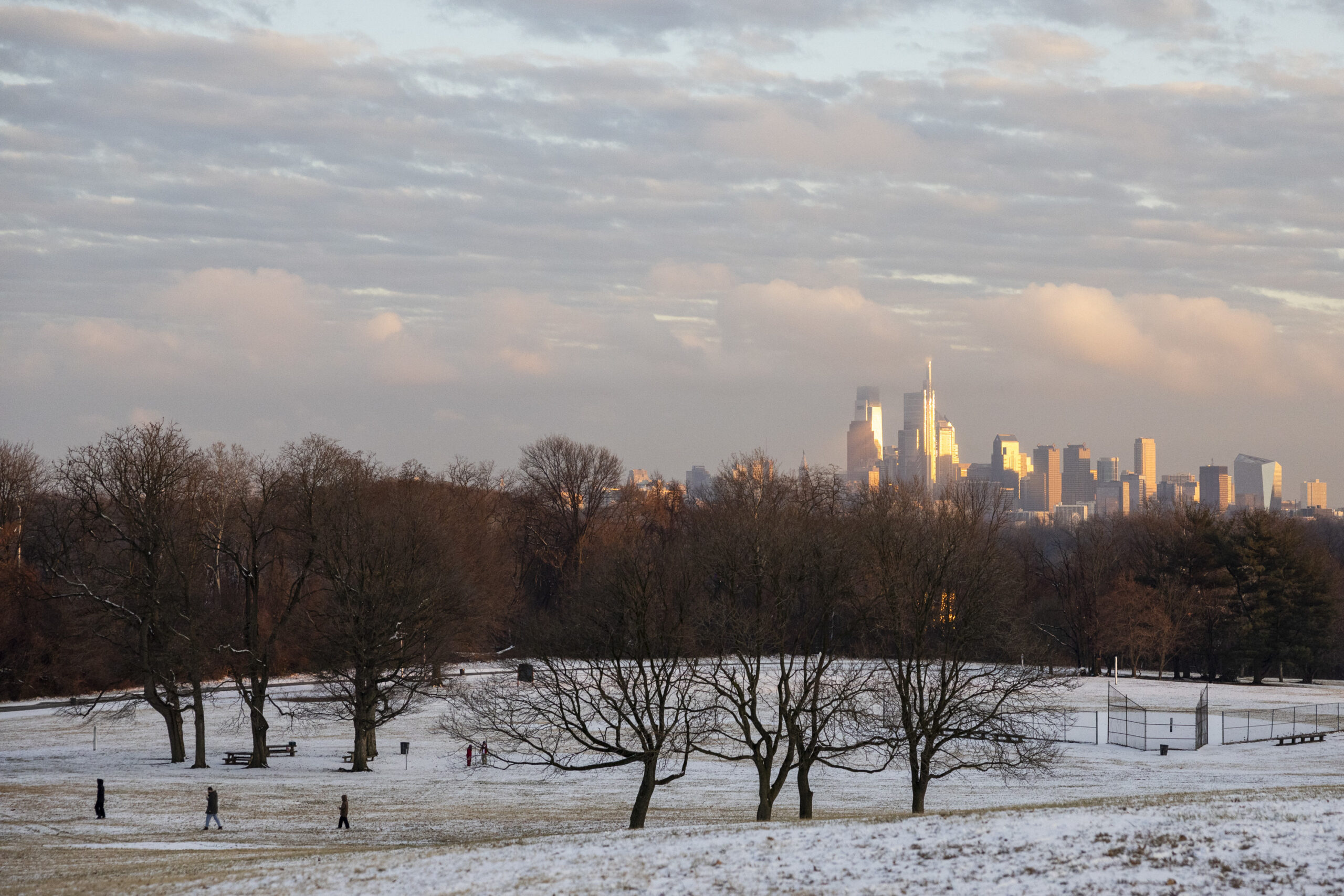
    Daniel Burton, of Wynnefield, is with his kids Apollo, 9, and Finley, 13, enjoying the snow at Belmont Plateau as the sunset lights up the Philadelphia skyline Saturday, Jan. 17, 2026.

    Will Philly get more snow Sunday?

    A coastal storm system that meteorologists have been tracking may bring more snow Sunday.

    “There’s a little bit better chance for the Philadelphia area” to get snow from that system, Lee said.

    Philadelphia and the Main Line could get 1 to 3 inches of snow Sunday, with snow predicted to start at daybreak and last through the evening, said Melissa Constanzer, senior meteorologist with AccuWeather.

    South Jersey could see the greatest totals, Constanzer said, given the coastal nature of the storm.

    “If you’re planning on going anywhere Sunday, expect travel to be impacted,” Constanzer said. Even if snow is not accumulating, she said, visibility could be a challenge.

    Crews should have time to clear roads by Monday morning, Constanzer said.

    That’s likely it for snow in the near future, with dry weather predicted to start next week, Lee said. Monday night is forecast to see the lowest temperatures of the season so far, reaching 13 degrees in Philadelphia, according to the weather service. The high Tuesday is forecast to top out at 23, with a low Tuesday night of 11.

    “It is going to be pretty cold,” he said.

  • Thousands march in Greenland to support Arctic island in the face of Trump’s threats to take it over

    Thousands march in Greenland to support Arctic island in the face of Trump’s threats to take it over

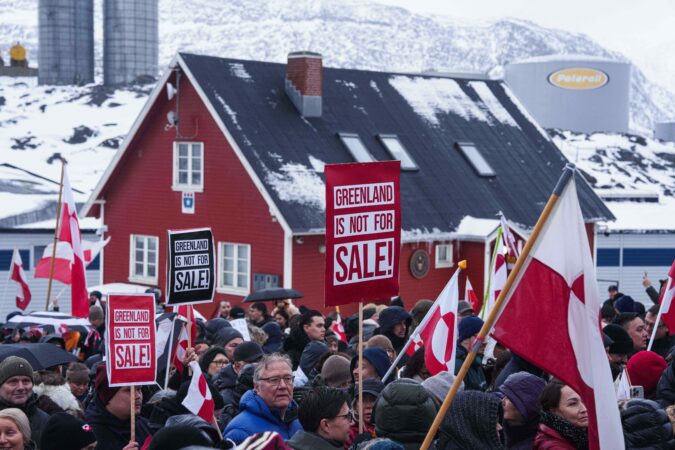
    NUUK, Greenland — Thousands of Greenlanders carefully marched across snow and ice to take a stand against U.S. President Donald Trump on Saturday. They held signs of protest, waved their national flag and chanted “Greenland is not for sale” in support of their own self-governance in the face of increasing threats of an American takeover.

    Just as they finished their trek from the small downtown of Greenland’s capital city Nuuk to the U.S. Consulate in rain and near-freezing temperatures, the news broke: Trump, from his golf course in sunny Florida, announced he will charge a 10% import tax starting in February on goods from eight European countries over their opposition to U.S. control of Greenland.

    “I thought this day couldn’t get any worse but it just did,” a stunned Malik Dollerup-Scheibel said after The Associated Press told him about Trump’s announcement. “It just shows he has no remorse for any kind of human being now.”

    Trump has long said he thinks the U.S. should own the strategically located and mineral-rich island, which is a self-governing territory of Greenland. Trump intensified his calls a day after the military operation to oust Venezuela’s Nicolás Maduro earlier this month.

    Dollerup-Scheibel, a 21-year-old Greenlander, and Greenland Prime Minister Jens-Frederik Nielsen were among what others described as the island’s biggest protest, drawing nearly a quarter of Nuuk’s population. Others held rallies and solidarity marches across the Danish realm, including in Copenhagen, as well as in the capital of the Inuit-governed territory of Nunavut in Canada’s far north.

    “This is important for the whole world,” Danish protester Elise Riechie said as she held Danish and Greenlandic flags in Copenhagen. “There are many small countries. None of them are for sale.”

    In Nuuk, Greenlanders of all ages listened to traditional songs as they walked to the consulate. Marie Pedersen, a 47-year-old Greenlander, said it was important to bring her children to the rally “to show them that they’re allowed to speak up.”

    “We want to keep our own country and our own culture, and our family safe,” she said.

    Her 9-year-old daughter, Alaska, crafted her own “Greenland is not for sale” sign. The girl said her teachers have addressed the controversy and taught them about NATO at school.

    “They tell us how to stand up if you’re being bullied by another country or something,” she said.

    Meanwhile, Tom Olsen, a police officer in Nuuk, said Saturday’s protest was the biggest he’s ever seen there.

    “I hope it can show him that we stand together in Europe,” he said. “We are not going down without a fight.”

    Tillie Martinussen, a former member of Greenland’s parliament, said she hopes the Trump administration will “abandon this crazy idea.”

    “They started out as sort of touting themselves as our friends and allies, that they wanted to make Greenland better for us than the Danes would,” she said as others chanted in the background. ”And now they’re just plain out threatening us.”

    She added that the push to preserve NATO and Greenland’s autonomy were more important than facing tariffs, though she added that she was not dismissing the potential economic impact.

    “This is a fight for freedom,” she said. “It’s for NATO, it’s for everything the Western Hemisphere has been fighting for since World War II.”

    But when the AP asked Louise Lennert Olsen what she would say to Trump, the 40-year-old Greenlandic nurse instead said she wanted to give a message to the American people.

    “I would really like them to support our wish to be Greenland as we are now,” she said as she marched through Nuuk. “I hope they will stand against their own president. Because I can’t believe they just stand and watch and do nothing.”

  • NASA’s new moon rocket heads to the pad ahead of astronaut launch as early as February

    NASA’s new moon rocket heads to the pad ahead of astronaut launch as early as February

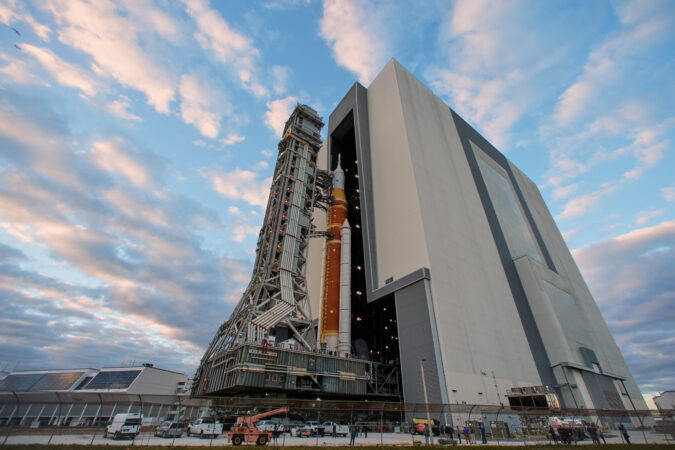
    CAPE CANAVERAL, Fla. — NASA’s giant new moon rocket headed to the launch pad Saturday in preparation for astronauts’ first lunar fly-around in more than half a century.

    The out-and-back trip could blast off as early as February.

    The 322-foot rocket began its 1 mph creep from Kennedy Space Center’s Vehicle Assembly Building at daybreak. The four-mile trek could take until nightfall.

    Thousands of space center workers and their families gathered in the predawn chill to witness the long-awaited event, delayed for years. They huddled together ahead of the Space Launch System rocket’s exit from the building, built in the 1960s to accommodate the Saturn V rockets that sent 24 astronauts to the moon during the Apollo program. The cheering crowd was led by NASA’s new administrator Jared Isaacman and all four astronauts assigned to the mission.

    “What a great day to be here,” said Reid Wiseman, the crew commander. “It is awe-inspiring.”

    Weighing in at 11 million pounds, the Space Launch System rocket and Orion crew capsule on top made the move aboard a massive transporter that was used during the Apollo and shuttle eras. It was upgraded for the SLS rocket’s extra heft.

    The first and only other SLS launch — which sent an empty Orion capsule into orbit around the moon — took place back in November 2022.

    “This one feels a lot different, putting crew on the rocket and taking the crew around the moon,” NASA’s John Honeycutt said on the eve of the rocket’s rollout.

    Heat shield damage and other capsule problems during the initial test flight required extensive analyses and tests, pushing back this first crew moonshot until now. The astronauts won’t orbit the moon or even land on it. That giant leap will take come on the third flight in the Artemis lineup a few years from now.

    Wiseman, pilot Victor Glover and Christina Koch — longtime NASA astronauts with spaceflight experience — will be joined on the 10-day mission by Canadian astronaut Jeremy Hansen, a former fighter pilot awaiting his first rocket ride.

    They will be the first people to fly to the moon since Apollo 17’s Gene Cernan and Harrison Schmitt closed out the triumphant lunar-landing program in 1972. Twelve astronauts strolled the lunar surface, beginning with Neil Armstrong and Buzz Aldrin in 1969. Only four moonwalkers are still alive; Aldrin, the oldest, turns 96 on Tuesday.

    “They are so fired up that we are headed back to the moon,” Wiseman said. “They just want to see humans as far away from Earth as possible discovering the unknown.”

    NASA is waiting to conduct a fueling test of the SLS rocket on the pad in early February before confirming a launch date.

    “We’ve, I think, zero intention of communicating an actual launch date” until completing the fueling demo, Isaacman told reporters.

    The space agency has only five days to launch in the first half of February before bumping into March.

  • EU, spurred by Trump, to sign mega free-trade deal with South America

    EU, spurred by Trump, to sign mega free-trade deal with South America

    BRUSSELS — The European Union’s leaders are set to sign a landmark trade agreement with South American nations to create what they have trumpeted as the world’s largest free-trade zone.

    This deal is more than 25 years in the making. But its culmination comes at a time when the EU is moving with a new, urgent sense of purpose, as President Donald Trump upends long-standing alliances and the norms of global trade.

    The EU voted this month, despite stiff opposition from some of its 27 nations, to approve the deal with the trade bloc known as Mercosur, which includes South America’s two biggest economies, Brazil and Argentina, along with Paraguay and Uruguay. EU leaders are headed to Paraguay on Saturday for a signing ceremony, after years of negotiations on the pact, which will cut tariffs on an array of signature products from Argentine beef to German cars.

    Along with Trump’s tariff blitz, his administration’s wavering interest in being responsible for European security and general disdain for the EU have spurred a push to “diversify” and “de-risk” from the United States. In other words, Europe is looking for other friends and hedging its bets.

    As jilted U.S. allies like Europe and Canada close ranks against Washington, the EU has sped up trade talks with Malaysia, the United Arab Emirates and other countries. In the fall, the EU inked a trade accord with Indonesia and now hopes to clinch a big one with India.

    European Commission President Ursula von der Leyen, head of the E.U.’s executive branch, has declared that Europe is charting its own course. “Only if we are economically strong, we can secure our independence,” she said before the trip to South America.

    European officials have emphasized the contrast between forming a free-trade zone of more than 700 million people and Washington imposing tariffs and threatening military power, as well as suspending cooperation not only on trade but also on climate, health and international aid.

    With South America balancing its interests vis-à-vis the United States and China, EU leaders have also cast the Mercosur deal as a way for the EU to assert itself as a global player — and a steady hand in troubled times.

    Still, Europe’s push to branch out from the U.S., its biggest export market for goods, has also created friction. The bloc has grappled with its own strained relationship with Beijing and economic competition from China. And securing the backing of all 27 EU member countries in trade negotiations is tough, given occasionally conflicting national priorities.

    The European Parliament must now ratify the Mercosur treaty, which could take months, and opponents, especially in France and Poland, are threatening to sink the deal.

    The accord has long faced opposition over environmental protection and deforestation concerns. In particular, farmers and beef and poultry producers also argue that the influx of cheaper goods from South America, with looser production standards, would dent their livelihoods.

    France, Poland, and Italy had sought to block or water down the deal over worries from farmers, a powerful lobby and economic pillar. But Trump’s tariffs and domestic political turmoil in France may have left Paris, historically an EU heavyweight, with little sway.

    For France’s EU neighbors, the state of international politics seems to have outweighed the traditional preference for consensus. “Other member states were of the view that we cannot really delay this much further, that there would be a huge loss of credibility for the European Union if it cannot go ahead at this time,” said Ignacio García Bercero, a former EU trade negotiator and senior fellow at Bruegel, a Brussels-based research institute.

    The Mercosur deal long predates Trump, Bercero said. “Now it is clear, however, that in the current geopolitical context, concluding this type of agreement is more important than ever,” he added. “When we are facing a very disruptive situation, not only with the United States, but also China, it becomes more important than ever to consolidate your trade agreements, to expand your alliances.”

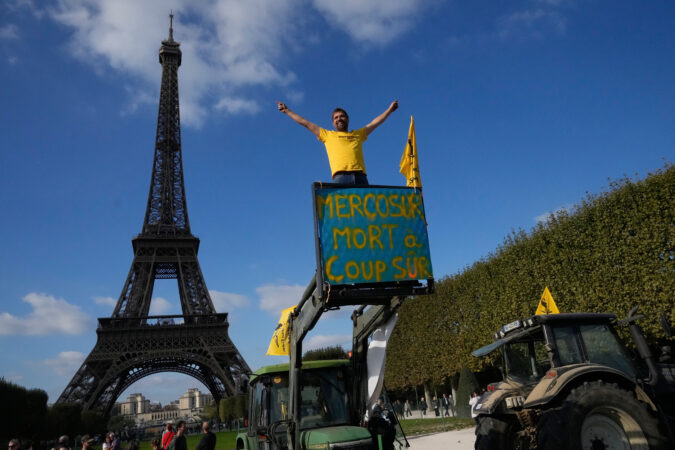
    As the E.U.’s 27 heads of state and government debated the deal in December, European farmers rumbled into Brussels on tractors to protest. French farmers did the same on the streets of Paris this week, blocking roads near the Eiffel Tower, and have pledged to clog the streets again next week in Strasbourg.

    Other industries, however, are keen to tap into the South American market, such as carmakers in Germany, which have been buffeted by Chinese competition and U.S. tariffs.

    The European Commission made 11th-hour concessions, including billions in agricultural aid, which brought Italian Prime Minister Giorgia Meloni onside and ultimately secured a majority for the political green light last week.

    The commission, which says it addressed grievances with safeguards and quotas on South American imports, will focus now on winning the support of the European Parliament, according to trade spokesman Olof Gill. Gill described the deal as “a geopolitical signal,” adding that the commission has “built in every necessary protection for our farmers.”

    European Council President António Costa, who is also attending the ceremony in Paraguay on Saturday, pledged in a statement that the deal would not only benefit European businesses but also “boost the EU’s sovereignty and strategic autonomy.”

    Confronted with Trump’s tariffs, EU leaders so far have averted a spiraling confrontation by signing a skeletal trade deal last year. Still, they have tried to show that they can lead in maintaining open and orderly global markets despite America’s protectionism.

    While Brussels has boasted that the Mercosur accord will create the largest free trade zone of its kind, economists expect only a limited boost for the EU economy. EU exports to Mercosur countries stood at around 55 billion euros in 2023, while exports to the U.S. in 2023 were over 500 billion euros.

    The deal will probably bring some benefits, by lifting barriers and encouraging higher EU exports, though its “overall economic impact remains modest,” analysts at ING, the global bank headquartered in Amsterdam, wrote this week. Even so, they added, the “true value of the deal goes beyond simple economics.”

    “It sends strong signals to the U.S. and China” that the EU is serious about curbing reliance, the ING analysis said, and it could create momentum to finalize other languishing talks, including with India: “For the EU, this is not just about trade — it’s about securing strategic resources and counterbalancing global competitors.”

    If ratified, the agreement would deepen EU ties to a region in which China is the largest trading partner and which the Trump administration has declared to be a U.S. sphere of dominance. Just this month, Trump ordered strikes on Venezuela, which borders Brazil, and U.S. forces captured President Nicolás Maduro.

    Venezuela was suspended from Mercosur about 10 years ago over trade and human rights commitments. Bolivia, which recently joined, can eventually join the EU trade deal.

  • Trump’s Twin Cities immigration crackdown has made chaos and tension the new normal

    Trump’s Twin Cities immigration crackdown has made chaos and tension the new normal

    MINNEAPOLIS — Work starts around sunrise for many of the federal officers carrying out the immigration crackdown in and around the Twin Cities, with hundreds of people in tactical gear emerging from a bland office building near the main airport.

    Within minutes, hulking SUVs, pickup trucks, and minivans begin leaving, forming the unmarked convoys that have quickly become feared and common sights in the streets of Minneapolis, St. Paul, and their suburbs.

    Protesters also arrive early, braving the cold to stand across the street from the fenced-in federal compound, which houses an immigration court and government offices. “Go home!” they shout as convoys roar past. “ICE out!”

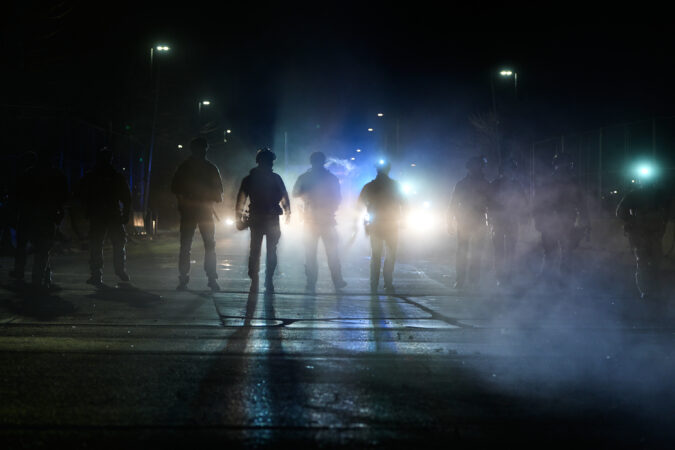
    Things often turn uglier after nightfall, when the convoys return and the protesters sometimes grow angrier, shaking fences, and occasionally smacking passing cars. Eventually, the federal officers march toward them, firing tear gas and flash grenades before hauling away at least a few people.

    “We’re not going anywhere!” a woman shouted on a recent morning. “We’re here until you leave.”

    This is the daily rhythm of Operation Metro Surge, the Trump administration’s latest and biggest crackdown yet, with more than 2,000 officers taking part. The surge has pitted city and state officials against the federal government, sparked daily clashes between activists and immigration officers in the deeply liberal cities, and left a mother of three dead.

    The crackdown is barely noticeable in some areas, particularly in whiter, wealthier neighborhoods, and suburbs, where convoys and tear gas are rare. And even in neighborhoods where masked immigration officers are common, they often move with ghostlike quickness, making arrests and disappearing before protesters can gather in force.

    Still, the surge can be felt across broad swaths of the Twin Cities area, which is home to more than 3 million people.

    “We don’t use the word ‘invasion’ lightly,” Minneapolis Mayor Jacob Frey, a Democrat, told reporters this week, noting that his police force has just 600 officers. “What we are seeing is thousands — plural, thousands — of federal agents coming into our city.”

    Those agents have an outsized presence in a small city.

    It can take hours to drive across Los Angeles and Chicago, both targets of Trump administration crackdowns. It can take 15 minutes to cross Minneapolis.

    So as worry ripples through the region, children are skipping school or learning remotely, families are avoiding religious services and many businesses, especially in immigrant neighborhoods, have closed temporarily.

    Drive down Lake Street, an immigrant hub since the days when newcomers came to Minneapolis from Norway and Sweden, and the sidewalks now seem crowded only with activists standing watch, ready to blow warning whistles at the first sign of a convoy.

    At La Michoacana Purepecha, where customers can order ice cream, chocolate covered bananas, and pork rinds, the door is locked and staff let in people one at a time. Nearby, at Taqueria Los Ocampo, a sign in English and Spanish says the restaurant is temporarily closed because of “current conditions.”

    A dozen blocks away at the Karmel Mall, where the city’s large Somali community goes for everything from food and coffee to tax preparation, signs on the doors warn, “No ICE enter without court order.”

    The shadow of George Floyd

    It’s been nearly six years since George Floyd was murdered by a Minneapolis police officer, but the scars from that killing remain raw.

    Floyd was killed just blocks from where an Immigration and Citizenship Enforcement officer shot and killed Renee Good, a 37-year-old American citizen, during a Jan. 7 confrontation after she stopped to help neighbors during an enforcement operation. Federal officials say the officer fired in self-defense after Good “weaponized” her vehicle. City and state officials dismiss those explanations and point to multiple bystander videos of the confrontation.

    For Twin Cities residents, the crackdown can feel overwhelming.

    “Enough is enough,” said Johan Baumeister, who came to the scene of Good’s death soon after the shooting to lay flowers.

    He said he didn’t want to see the violent protests that shook Minneapolis after Floyd’s death, causing billions of dollars in damage. But this city has a long history of activism and protests, and he had no doubt there would be more.

    “I think they’ll see Minneapolis show our rage again,” he predicted.

    He was right.

    In the days since, there have been repeated confrontations between activists and immigration officers. Most amounted to little more than shouted insults and taunting, with destruction mostly limited to broken windows, graffiti, and some badly damaged federal vehicles.

    But angry clashes now flare regularly across the Twin Cities. Some protesters clearly want to provoke the federal officers, throwing snowballs at them or screaming obscenities through bullhorns from just a couple feet away. The serious force, though, comes from immigration officers, who have broken car windows, pepper-sprayed protesters and warned observers not to follow them through the streets. Immigrants and citizens have been yanked from cars and homes and detained, sometimes for days. And most clashes end in tear gas.

    Drivers in Minneapolis or St. Paul can now stumble across intersections blocked by men in body armor and gas masks, with helicopters clattering overhead and the air filled with the shriek of protesters’ whistles.

    Shovel your neighbor’s walk

    In a state that prides itself on its decency, there’s something particularly Minnesotan about the protests,

    Soon after Good was shot, Gov. Tim Walz, a Democrat and regular Trump target, repeatedly said he was angry but also urged people to find ways to help their communities.

    “It might be shoveling your neighbor’s walk,” he said. “It might mean being at a food bank. It might be pausing to talk to someone you haven’t talked to before.”

    He and other leaders have pleaded with protesters to remain peaceful, warning that the White House was looking for a chance to crack down harder.

    And when protests do become clashes, residents will often spill from their homes, handing out bottled water so people can flush tear gas from their eyes.

    Residents stand watch at schools to warn immigrant parents if convoys approach while they’re picking up their children. They take care packages to people too afraid to go out, and arrange rides for them to work and doctor’s visits.

    On Thursday, in the basement of a Lutheran church in St. Paul, the group Open Market MN assembled food packs for more than a hundred families staying home. Colin Anderson, the group’s outreach director, said the group has seen a surge in requests.

    Sometimes, people don’t even understand what has happened to them.

    Like Christian Molina from suburban Coon Rapids, who was driving through a Minneapolis neighborhood on a recent day, taking his car to a mechanic, when immigration officers began following him. He wonders if it’s because he looks Hispanic.

    They turned on their siren, but Molina kept driving, unsure who they were.

    Eventually, the officers sped up, hit his rear bumper and both cars stopped. Two emerged and asked Molina for his papers. He refused, saying he’d wait for the police. Crowds began to gather, and a clash soon broke out, ending with tear gas.

    So the officers left.

    They left behind an angry, worried man who suddenly owned a sedan with a mangled rear fender.

    Long after the officers were gone he had one final question.

    “Who’s going to pay for my car?”
  • Why U.S. cities are reverting 1-way streets back to their original 2-way design

    Why U.S. cities are reverting 1-way streets back to their original 2-way design

    Excessive speeding was so common on parallel one-way streets passing a massive electronics plant that Indianapolis residents used to refer to the pair as a “racetrack” akin to the city’s famous Motor Speedway a few miles west.

    Originally two-way thoroughfares, Michigan and New York streets switched to opposite one-way routes in the 1970s to help thousands of RCA workers swiftly travel to and from their shifts building televisions or pressing vinyl records. But after the RCA plant closed in 1995, the suddenly barren roads grew even more enticing for lead-footed drivers — until last year, when city officials finally converted them back to two-way streets.

    “The opening and conversion of those streets has just been transformative for how people think about that corridor,” said James Taylor, who runs a nearby community center.

    Embracing the oft-repeated slogan that “paint is cheap,” transportation planners across the U.S. — particularly in midsize cities — have been turning their unidirectional streets back to multidirectional ones. They view the step as one of the easiest ways to improve safety and make downtowns more alluring to shoppers, restaurant patrons and would-be residents.

    A street design U-turn

    Dave Amos, an assistant professor of city and regional planning at California Polytechnic State University, said almost no major streets in the U.S. originated as one-way routes. Two-way streets were the standard, before mass migration to the suburbs prioritized faster commutes over downtown walkability.

    “One-way streets are designed for moving cars quickly and efficiently,” Amos said. “So when you have that as your goal, pedestrians and cyclists almost by design are secondary, which makes them more vulnerable.”

    But the propensity to speed isn’t the only reason one-way streets are viewed as less safe.

    Wade Walker, an engineer with Kittelson & Associates who has worked on street conversion projects in Lakeland, Fla., Lynchburg, Va.;, and Chattanooga, Tenn., said there is a misperception that one-way streets are safer because people on foot only have to look one direction to see the incoming traffic. The confusion arises when one-way streets combine with two-way streets to form a city grid, he said.

    Pedestrians crossing a signalized intersection of two-way streets can expect to encounter vehicles in a certain sequence: those turning left on green, traveling straight, and turning right on red. But when one-way streets are included, there are 16 potential sequences depending on the type and direction of the roads that intersect, Walker said.

    “It’s not the number of conflicts, it’s the way those conflicts occur,” he said.

    One way to divide a community

    Louisville, Ky., about two hours south of Indianapolis, has been restoring one-way streets to their original two-way footprints. The state is leading an ongoing project to reconvert a stretch along Main Street that passes such landmarks as the Louisville Slugger Museum, the KFC Yum! Center arena, and a minor-league baseball stadium.

    One of the city’s biggest redesigns is happening this year in the predominantly Black western part of the city, where many roads changed to one-way routes in the 1970s to feed a new interstate bridge over the Ohio River. However, it decimated neighborhoods and cut off the once-thriving community from downtown.

    “All those mom-and-pop shops and local businesses over time kind of faded because that connectivity got taken away,” said Michael King, the city’s assistant director of transportation planning. “It just feels more like, ‘This is a road to get me through here pretty quickly.’”

    Within three years after some of Chattanooga’s two-way streets were transformed into unidirectional ones, business vacancies skyrocketed and the University of Tennessee at Chattanooga became “landlocked” to prevent students from having to cross a dangerous road, Walker said.

    In 2022, almost two decades after the road was redesigned, he returned to find the college campus had expanded across it and business construction had surged.

    Converting streets and skeptics

    When Lynchburg, Va., launched a long-discussed plan to change its downtown Main Street back to two ways, Rodney Taylor voiced concerns that it would doom his restaurant by blocking delivery vehicles. After the city completed the section in 2021, he acknowledged the fears were unfounded.

    “An important thing to do is to admit when you’re wrong,” he said. “And I was just flat-out wrong.”

    Many residents also changed their tune in Austin, Texas, when the city began reconverting some of the one-way streets in its urban core, said Adam Greenfield, executive director with Safe Streets Austin.

    “It just worked,” said Greenfield, who is now lobbying the city to do away with all its one-way streets. “That’s what you’ll find with these conversions — they’ll be done and then instantly people will be like, ‘Why didn’t we do this 20 years ago?’”

    After Chicago went the opposite direction last year and suddenly changed some of its two-way streets to one-way in the busy West Loop restaurant district, a politician representing an adjacent area got numerous calls from confused constituents.

    “Even if this was the right move to make these streets one-way, it certainly doesn’t make sense to not ask the opinion of the neighbors,” Alderman Bill Conway said.

    Opportunity in Indianapolis

    Now that Indianapolis has finished the redesigns for Michigan and New York streets, there are 10 other conversions on tap next, said Mark St. John, chief engineer for the city’s Department of Public Works. The total cost for those projects is estimated at $60 million, with around $25 million of that from a 2023 federal grant.

    James Taylor, who runs the community center near the old RCA plant, said it is too early to know the full impact. Some business owners, however, have signaled construction plans along the redesigned streets, which Taylor says still feel a little strange.

    “I’ve been driving around that neighborhood for 30 years,” he said. “It’s all kind of familiar, but you’re coming at it from a whole different perspective.”

  • AP: Venezuelan leader Delcy Rodríguez has been on DEA’s radar for years

    AP: Venezuelan leader Delcy Rodríguez has been on DEA’s radar for years

    WASHINGTON — When President Donald Trump announced the audacious capture of Nicolás Maduro to face drug trafficking charges in the U.S., he portrayed the strongman’s vice president and longtime aide as America’s preferred partner to stabilize Venezuela amid a scourge of drugs, corruption, and economic mayhem.

    Left unspoken was the cloud of suspicion that long surrounded Delcy Rodríguez before she became acting president of the beleaguered nation earlier this month.

    In fact, Rodríguez has been on the radar of the U.S. Drug Enforcement Administration for years and in 2022 was even labeled a “priority target,” a designation DEA reserves for suspects believed to have a “significant impact” on the drug trade, according to records obtained by The Associated Press and more than a half dozen current and former U.S. law enforcement officials.

    The DEA has amassed a detailed intelligence file on Rodríguez dating to at least 2018, the records show, cataloging her known associates and allegations ranging from drug trafficking to gold smuggling. One confidential informant told the DEA in early 2021 that Rodríguez was using hotels in the Caribbean resort of Isla Margarita “as a front to launder money,” the records show. As recently as last year she was linked to Maduro’s alleged bag man, Alex Saab, whom U.S. authorities arrested in 2020 on money laundering charges.

    The U.S. government has never publicly accused Rodríguez of any criminal wrongdoing. Notably for Maduro’s inner circle, she’s not among the more than a dozen current Venezuelan officials charged with drug trafficking alongside the ousted president.

    Rodríguez’s name has surfaced in nearly a dozen DEA investigations, several of which remain ongoing, involving agents in field offices from Paraguay and Ecuador to Phoenix and New York, the AP learned. The AP could not determine the specific focus of each investigation.

    Three current and former DEA agents who reviewed the records at the request of AP said they indicate an intense interest in Rodríguez throughout much of her tenure as vice president, which began in 2018. They were not authorized to discuss DEA investigations and spoke on the condition of anonymity.

    The records reviewed by AP do not make clear why Rodríguez was elevated to a “priority target,” a designation that requires extensive documentation to justify additional investigative resources. The agency has hundreds of priority targets at any given moment, and having the label does not necessarily lead to being charged criminally.

    “She was on the rise, so it’s not surprising that she might become a high-priority target with her role,” said Kurt Lunkenheimer, a former federal prosecutor in Miami who has handled multiple cases related to Venezuela. “The issue is when people talk about you and you become a high-priority target, there’s a difference between that and evidence supporting an indictment.”

    Venezuela’s Communications Ministry did not respond to emails seeking comment.

    The DEA and U.S. Justice Department also did not respond to requests for comment. Asked whether the president trusts Rodríguez, the White House referred AP to Trump’s earlier remarks on a “very good talk” he had with the acting president Wednesday, one day before she met in Caracas with CIA Director John Ratcliffe.

    Almost immediately after Maduro’s capture, Trump started heaping praise on Rodríguez — this past week referring to her as a “terrific person — in close contact with officials in Washington, including Secretary of State Marco Rubio.

    The DEA’s interest in Rodríguez comes even as Trump has sought to install her as the steward of American interests to navigate a volatile post-Maduro Venezuela, said Steve Dudley, co-director of InSight Crime, a think tank focused on organized crime in the Americas.

    “The current Venezuela government is a criminal-hybrid regime. The only way you reach a position of power in the regime is by, at the very least, abetting criminal activities,” said Dudley, who has investigated Venezuela for years. “This isn’t a bug in the system. This is the system.”

    Those sentiments were echoed by opposition leader Maria Corina Machado, who met with Trump at the White House Thursday in a bid to push for more U.S. support for Venezuelan democracy.

    “The American justice system has sufficient information about her,” said Machado, referring to Rodríguez. “Her profile is quite clear.”

    Rodríguez, 56, worked her way to the apex of power in Venezuela as a loyal aide to Maduro, with whom she shares a deep-seated leftist bent stemming from her socialist father’s death in police custody when she was only 7 years old. Despite blaming the U.S. for her father’s death, she steadily worked while foreign minister and later vice president to court American investment during the first Trump administration, hiring lobbyists close to Trump and even ordering the state oil company to make a $500,000 donation to his inaugural committee.

    The charm offensive flopped when Trump, urged on by Rubio, pressured Maduro to hold free and fair elections. In September 2018, the White House sanctioned Rodríguez, describing her as key to Maduro’s grip on power and ability to “solidify his authoritarian rule.” She was also sanctioned earlier by the European Union.

    But those allegations focused on her threat to Venezuela’s democracy, not any alleged involvement in corruption.

    “Venezuela is a failed state that supports terrorism, corruption, human rights abuses, and drug trafficking at the highest echelons. There is nothing political about this analysis,” said Rob Zachariasiewicz, a longtime former DEA agent who led investigations into top Venezuelan officials and is now a managing partner at Elicius Intelligence, a specialist investigations firm. “Delcy Rodríguez has been part of this criminal enterprise.”

    The DEA records seen by AP provide an unprecedented glimpse into the agency’s interest in Rodríguez. Much of it was driven by the agency’s elite Special Operations Division, the same Virginia-based unit that worked with prosecutors in Manhattan to indict Maduro.

    One of the records cites an unnamed confidential informant linking Rodríguez to hotels in Margarita Island that are allegedly used as a front to launder money. The AP has been unable to independently confirm the information.

    The U.S. has long considered the resort island, northeast of the Venezuelan mainland, a strategic hub for drug trafficking routes to the Caribbean and Europe. Numerous traffickers have been arrested or taken haven there over the years, including representatives of Joaquín “El Chapo” Guzman’s Sinaloa cartel.

    The records also indicate the feds were looking at Rodríguez’s involvement in government contracts awarded to Maduro’s ally Saab — investigations that remain ongoing even after President Joe Biden pardoned him in 2023 as part of a prisoner swap for Americans imprisoned in Venezuela.

    The Colombian businessman rose to become one of Venezuela’s top fixers as U.S. sanctions cut off its access to hard currency and Western banks. He was arrested in 2020 on federal charges of money laundering while traveling from Venezuela to Iran to negotiate oil deals helping both countries circumvent sanctions.

    The DEA records also indicate agents’ interest in Rodríguez’s possible involvement in allegedly corrupt deals between the government and Omar Nassif-Sruji, the brother of her longtime romantic partner, Yussef Nassif. Nassif-Sruji and Nassif did not respond to emails and text messages seeking comment.

    Companies registered by the two brothers in Hong Kong received more than $650 million in Venezuelan government contracts between 2017 and 2019 to import food and dialysis medicine, according to copies of the contracts obtained in 2021 by Venezuelan investigative journalism outlet Armando.info.

    Taken together, the DEA investigations underscore how power has long been exercised in Venezuela, which is ranked as the world’s third most corrupt country by Transparency International. For Rodríguez, they also represent something of a razor-sharp sword over her head, breathing life to Trump’s threat soon after Maduro’s ouster that she would “pay a very big price, probably bigger than Maduro” if she didn’t fall in line. The president added that he wanted her to provide the U.S. “total access” to the country’s vast oil reserves and other natural resources.

    “Just being a leader in a highly corrupted regime for over a decade makes it logical that she is a priority target for investigation,” said David Smilde, a Tulane University professor who has studied Venezuela for three decades. “She surely knows this, and it gives the U.S. government leverage over her. She may fear that if she does not do as the Trump administration demands, she could end up with an indictment like Maduro.”