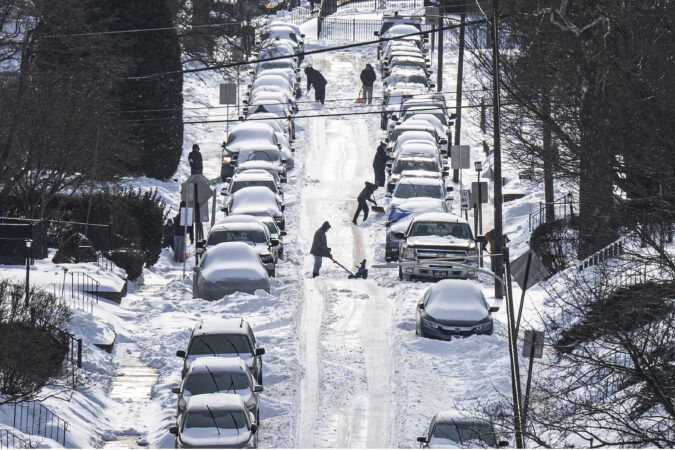
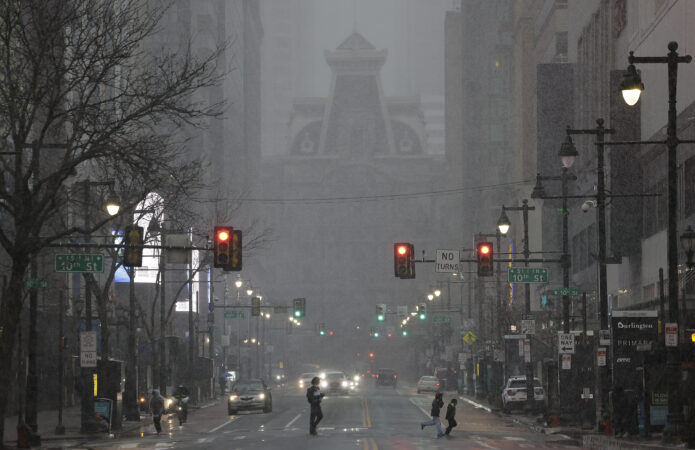
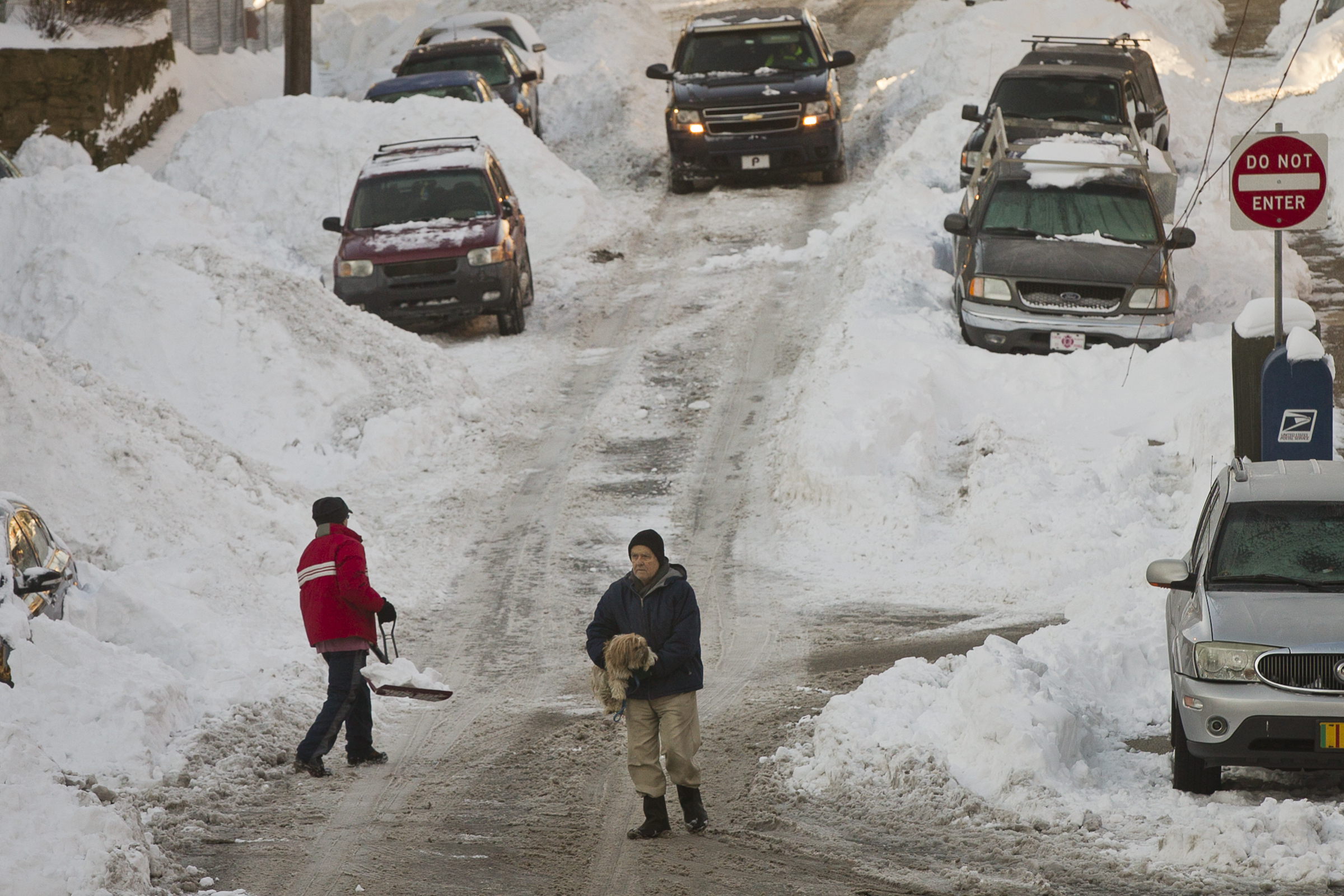
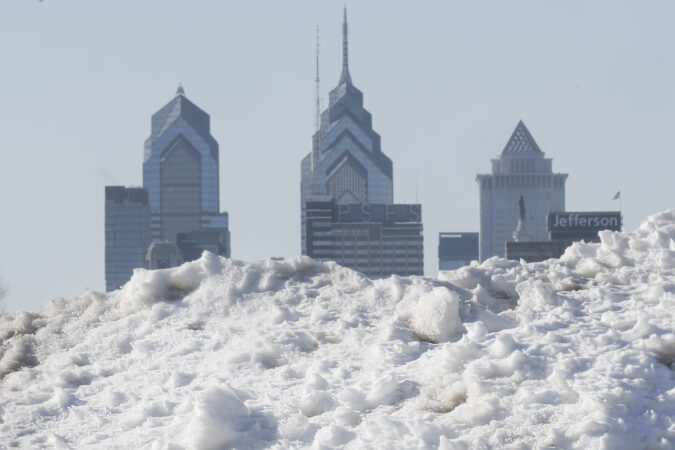
Collections are suspended Monday and Tuesday, the city announced. As of now, service will resume Wednesday on a two-day delay, with Monday collections picked up Wednesday and subsequent days following the same schedule.
“Mother Nature has spoken again and made it clear that winter is not over,” Mayor Cherelle L. Parker said during an emergency news conference Saturday, declaring a citywide snow emergency beginning 4 p.m Sunday.
The city is also suspending collections in rear driveways for the entire week, due to the possibility of trucks getting stuck in the snow. Residents are asked to set their materials in front of their homes for pickup.
“We do not plow out driveways. It makes it difficult for our trucks to navigate those areas,” said Carlton Williams, the director of the city’s Office of Clean and Green.
Second trash collection is also suspended this week.
Philadelphia, Bucks, Delaware, and eastern Montgomery Counties, and all of New Jersey and Delaware, are currently under blizzard warnings through 6 p.m. Monday. That’s prompted by forecast wind gusts of up to 45 mph, combined with the heavy snow. The western suburbs are covered by a winter storm warming, with slightly lower wind speeds forecast.
The storm is expected to begin as rain before shifting to snow by midday Sunday. It’s forecast to strengthen overnight, possibly at a rate of more than 2 inches an hour, which would make driving dangerous and nearly impossible.
The last time the city experienced more than two feet of snow was 2010, when nearly 29 inches fell in early February 2010. Over a five-day period, the city was buried under 44 inches of snow, which thankfully isn’t expected this time due to a warm-up in the middle of next week.
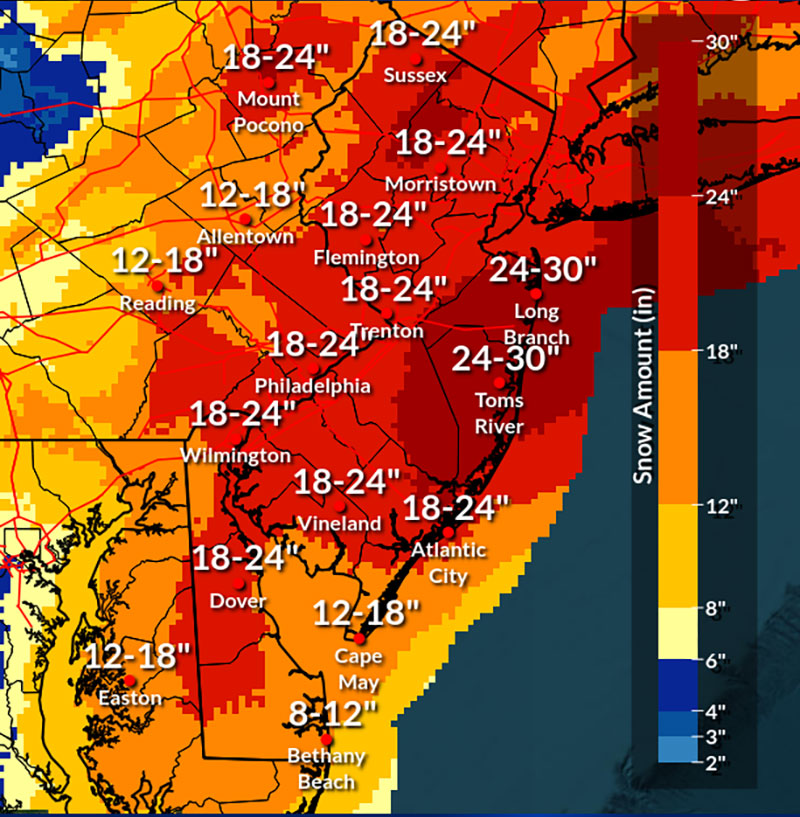
This time around, the Jersey Shore is expected to be hit hardest, with snowfall totals in and around Toms River forecast to reach as high as 30 inches.
The National Weather Service puts out forecasts for every few square miles of land in the United States four times a day through a system called the National Digital Forecast Database.
The maps below display that data. Use it to find how much snow is expected anywhere in the eastern United States. It will show the most recent forecast over the next few days.
(function () {window.addEventListener(‘message’, function (e) { var message = e.data; var els = document.querySelectorAll(‘iframe[src*=”‘ + message.id + ‘”]’); els.forEach(function(el) { el.style.height = message.height + ‘px’; }); }, false); })();
As a blizzard expected to dump significant snowfall on the region bore down, school districts across the region made the call: Monday classes are canceled — or shifted to online instruction.
The Philadelphia School District made the call early — on Saturday — calling a virtual instruction day for Monday.
“While we work to the greatest extent possible to keep schools open for in-person learning to accelerate student achievement, we also consider the staff members who are commuting from across the region and keep the safety of students and staff as our top priority,” Superintendent Tony B. Watlington Sr. said in a message to families and staff.
The district gave students one full snow day in January but has no more cushion built into its calendar to meet the Pennsylvania Department of Education’s requirement for 180 instructional days.
Any further inclement weather days will also be virtual learning days, Watlington said.
“After Monday, if schools need to remain closed due to inclement weather, the district will provide an update to parents, guardians and employees regarding remote learning,” Watlington said.
Among other districts that called for no school Monday: Camden, Cherry Hill, Evesham, Moorestown, and Washington Township in New Jersey; and Downington, Lower Merion, and Neshaminy in Pennsylvania.
Central Bucks, Pennsbury, Rose Tree Media, and Upper Darby moved to virtual instruction.
Snow began falling in Philly early Sunday evening and is expected to continue through Monday afternoon, with the heaviest snowfall overnight into the morning. Here’s the latest map.
A citywide snow emergency is in effect in Philadelphia, while both New Jersey and Delaware have declared a state of emergency.
DoorDash, the food delivery service, has suspended operations in Philadelphia and New Jersey amid the snow storm.
According to a company press release, DoorDash deliveries have ended as of 9 p.m. on Sunday and will not begin again until at least 12 p.m. Monday, depending on conditions at that time.
“We’re suspending operations across impacted areas to keep our community safe,” said company spokesperson, Julian Crowley, in a press release. “This is a serious storm — we’ll resume when it passes.”
At least 15,000 without power across Southern and Central New Jersey
At least 15,000 people were without power in Southern and Central New Jersey on Sunday evening around 8 p.m., according to outage maps from energy providers Jersey Central Power & Light and Atlantic City Electric.
In the Philadelphia area, as snow blanketed the region, roughly 1,500 Peco customers were affected by outages around 7:50 p.m., the company’s outage map indicated. Residents can monitor the company’s outage map to see where an outage has happened and the estimated restoration time.
Residents can receive outage alerts from Peco by texting “ADD OUTAGE” to 697326. To report an outage, text “OUT” to the same number or call 1-800-841-4141 or use the company’s online portal. For downed power lines, call the same number.
PSE&G customers in New Jersey can check the energy company’s outage map. As of 8 p.m., the utility provider had restored service to some 4,600 customers who had lost power on Sunday, according to a company press release. Around 8:50 p.m. nearly 2,800 customers were impacted by outages in the energy provider’s service area which includes parts of Burlington, Camden, and Gloucester Counties and stretches up to Newark.
To report an outage or downed line to PSE&G, call 1-800-436-7734. For hazards that result from a downed line, call 911, said Marijke Shugrue, senior director of communications at PSE&G during a virtual press conference on Sunday.
Never use a power generator indoors during an outage, said Shugrue.
Downed power lines can be very dangerous, and people should stay away from them, Shugrue added, advising people not to touch anything that is in contact with that downed line.
If you can smell gas indoors, exit the building, move at least 350 feet away and call 911, said Shugrue. Peco also advises customers to leave the area immediately if gas is suspected. For an emergency related to gas specifically, customers can call Peco at 1-844-841-4151.
Outside homes, snow should be cleared from pipes, vents, and meters so that carbon monoxide doesn’t accumulate inside, PSE&G advises.
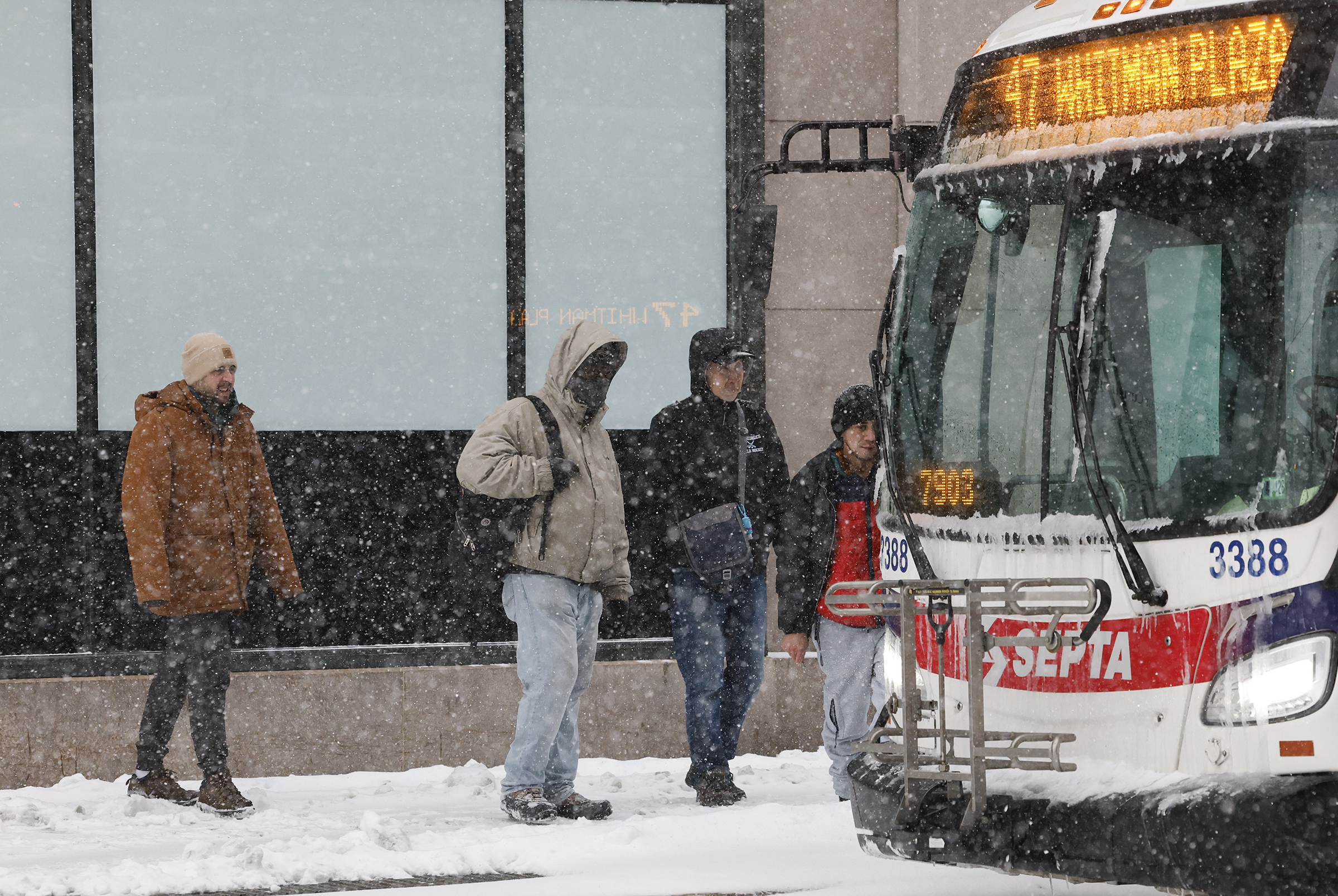
SEPTA riders board the 47 bus at 8th and Market Streets in January.
On Sunday evening SEPTA issued updated guidance on available service for the rest of the day.
All SEPTA bus routes will be suspended at 10 p.m. Sunday, the transit agency announced.
Regional Rail trains and the Norristown High Speed Line will operate until the end of scheduled service on Sunday evening.
The Center City Trolley Tunnel will close at 9 p.m. Sunday. Service on trolleys will continue until the scheduled end of service on Sunday evening or until conditions permit it.
The D Line Trolley route is currently being operated by a bus. That service will conclude at 10 p.m. Sunday and the trolley service by train will resume in the morning weather permitting.
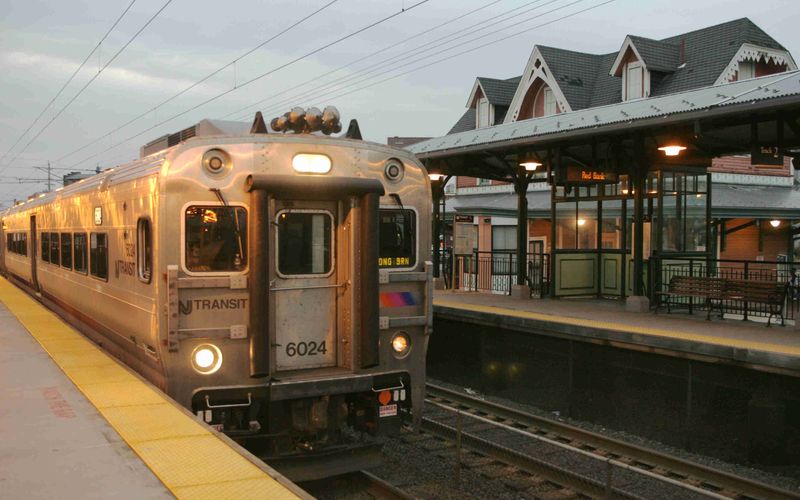
An NJ Transit train pulls into the Red Bank station.
NJ Transit will suspend its all rail service by 9 p.m. Sunday, the agency announced in a news release.
Earlier, the transportation agency stopped its bus, light rail, and Access Link services. Trains were initially excluded from the closures, but Gov. Mikie Sherrill warned the shutdown was likely.
Some routes will end service before 9 p.m., but no trains will leave their origin point after 9 p.m. Customers should check the transit authority’s website or social media for updates.
Bands of heavy snow moving across the Philly region
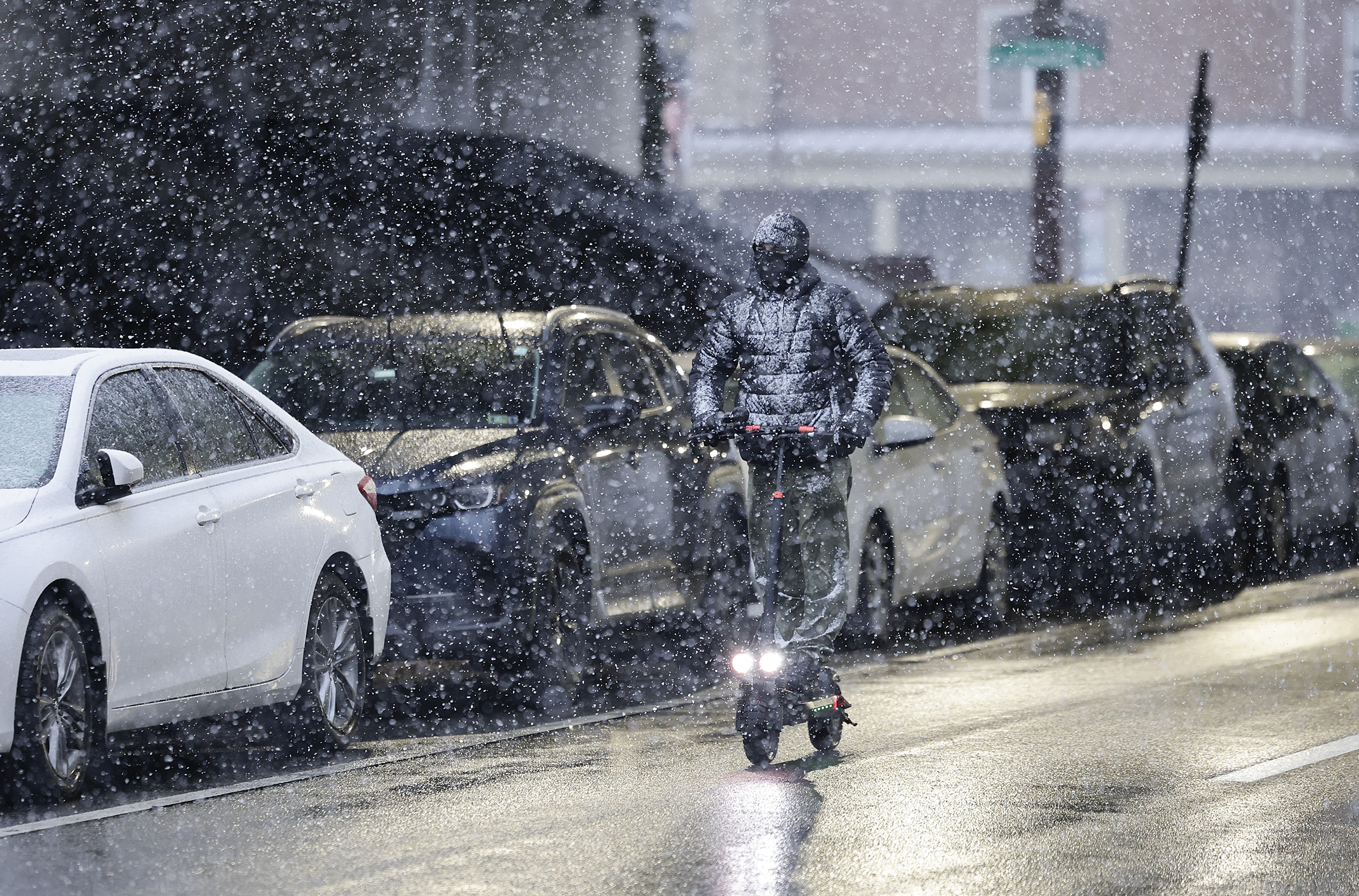
A man rides his scooter along N. 4th Street as snow falls.
Some “bands” of heavy snow were moving across the region Sunday evening, and that is likely to continue through the night, said Nick Guzzo, meteorologist with the National Weather Service in Mount Holly.
“Banding,” in which narrow corridors of heavy snow migrate from place to place, are common during winter storms. Areas under the bands can receive a quick couple of inches of snow.
By nightfall some totals of 1 to 2 inches were reported in the Philadelphia area and at the Shore. Forecasters said rates of two inches an hour were possible at times.
Totals are likely to vary around the region, in part to the randomness of banding, said Guzzo.
Banding or not, everyone is going to be seeing a whole lot of snow before it ends Monday, he said.
The weather service is calling for 12-18 inches in the immediate Philadelphia area, with as much as two feet in parts of South Jersey.
Some drifting is possible later when winds – gusting up to 45 mph inland, and 60 mph at the Shore – kick up and the snow becomes drier, said Guzzo.
(function () {window.addEventListener(‘message’, function (e) { var message = e.data; var els = document.querySelectorAll(‘iframe[src*=”‘ + message.id + ‘”]’); els.forEach(function(el) { el.style.height = message.height + ‘px’; }); }, false); })();
A slew of travel restrictions put in place across the Philly region
PennDOT reduced the speed limit on a number of Philadelphia-area highways Sunday evening, including I-95 and the Schuylkill Expressway.
The speed limit is now 45 mph on the following Philly-area roadways:
Interstates 76, 95, 295, 476, 676
U.S. Routes 1, 30, 202, 422
State Routes 63, 100 Spur and 309
PennDOT also issued Tier 4 restrictions on major roadways in Eastern Pennsylvania, which prohibits all commercial vehicles from driving. It also restricts buses, motorcycles, RVs, and passenger vehicles towing trailers.
New Jersey issued a travel ban on all non-exempt vehicles from driving on major roadways beginning at 9 p.m. The New Jersey Turnpike is not includes in the restriction.
Delaware issued Level 1 driving restrictions, which calls on residents residents not to drive “unless there is a significant safety, health, or business reason to do so.”
All Philadelphia City Council offices will be closed Monday as a massive winter storm makes its way across the region, President Kenayatta Johnson’s office announced Sunday afternoon.
A Public Health and Human Services Committee hearing on reproductive health scheduled to take place Monday will be postponed to a later day, .
Philadelphia Mayor Cherelle L. Parker had previously announced all city offices and schools would be closed Monday due to the storm.
Hundreds of flights canceled at Philadelphia International Airport
Philadelphia airport crew plow snow during last month’s storm.
356 flights had been cancelled at Philadelphia International Airport on Sunday as of 5 p.m., as snow started to blanket the city. Another 579 flights were cancelled for Monday, according to FlightAware, which tracks flights.
“Passengers should check on the status of their flights with their airlines—the airlines will also provide guidance on what passengers should do in the event their flights are cancelled,” said airport spokesperson, Heather Redfern on Sunday afternoon via email.
Some 40 million square feet need to be cleared at the airport when snow falls, including on airplane runways and taxiways. The airport also has an additional 11.9 million square feet of space on roadways, ramps and parking lots.
While airplanes are deiced by the airlines, the department of aviation is required to ensure runways and taxiways are clear.
More than two inches of dry snow or half an inch or wet snow trigger closing a runway, according to regulations by the Federal Aviation Administration (FAA), noted Redfern. Even if flights are canceled by airlines or in the event that the FAA issues a ground stop, the airport does not close, Redfern noted in January ahead of another snowfall.
The machinery that has been used at the airport to tackle snow in the past sports weather related names: Snow Angel, Ice Wookie, Multifarious, Snowmizer, Snow Slayer, Time Bandit, Arctic Fox, Snow Jawn, Nor’easter, Yeti, Storm Breaker, Terra Hawk, Silver Hawk, Heatwave, Tropic Breeze, and Heatmizer.
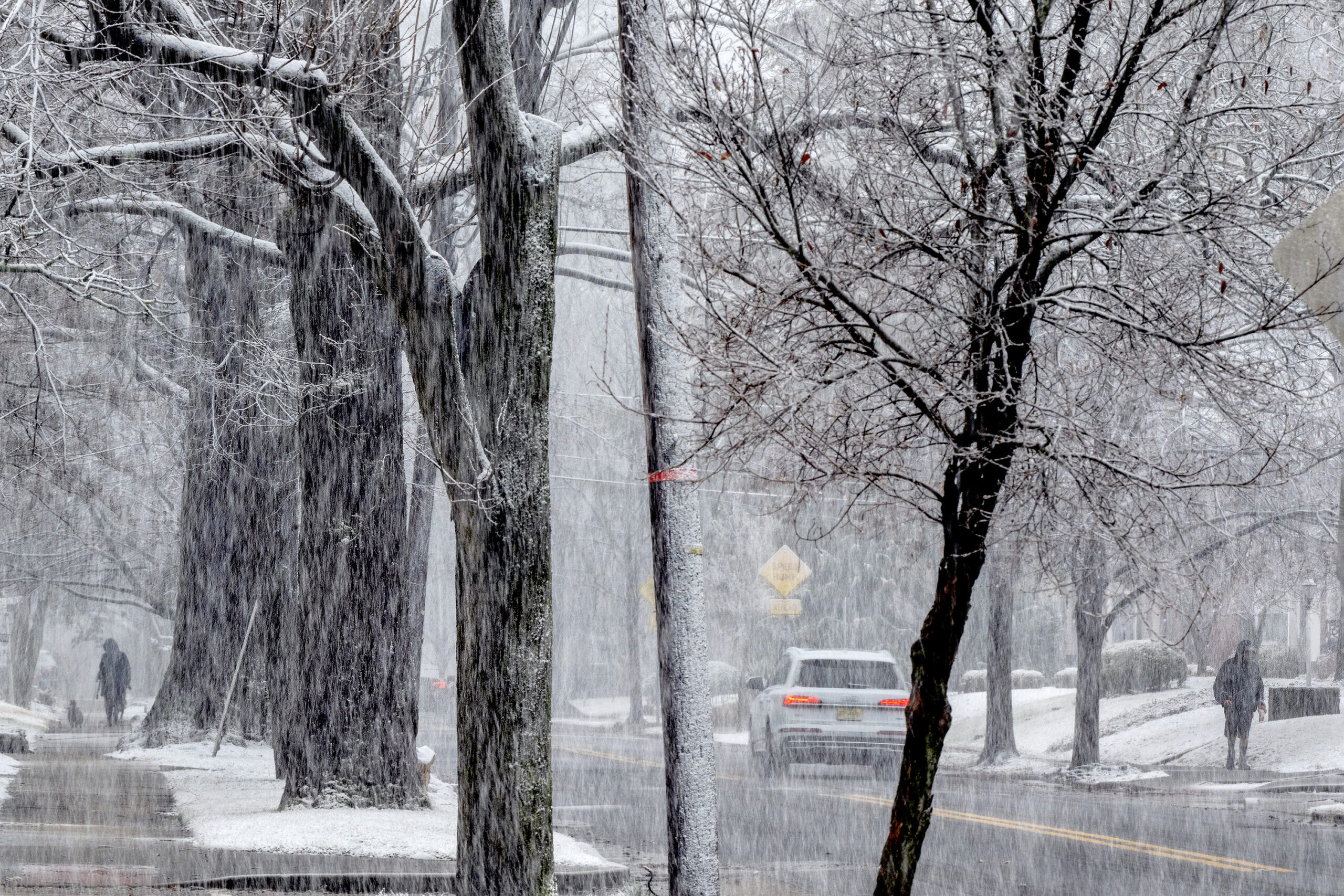
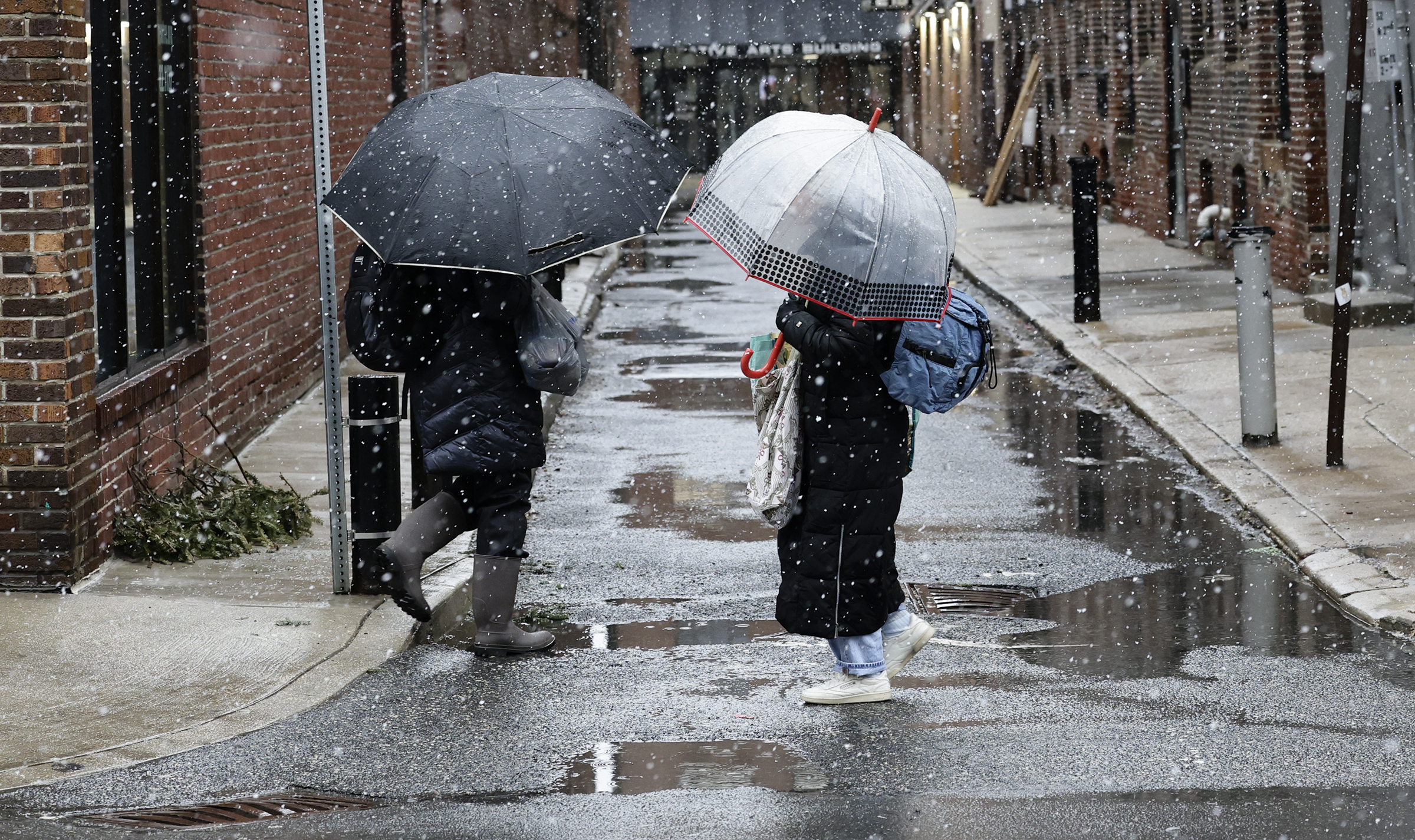
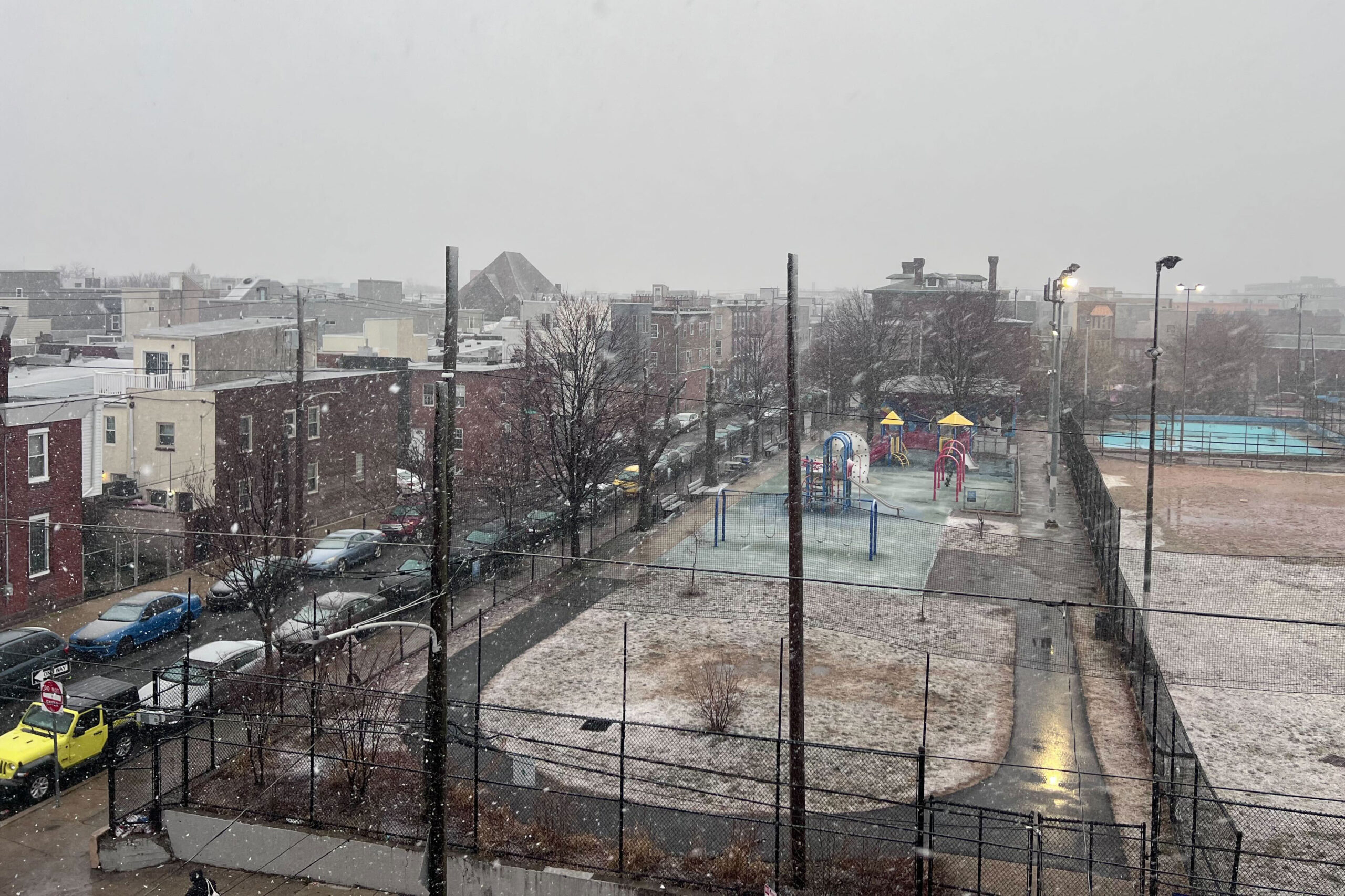
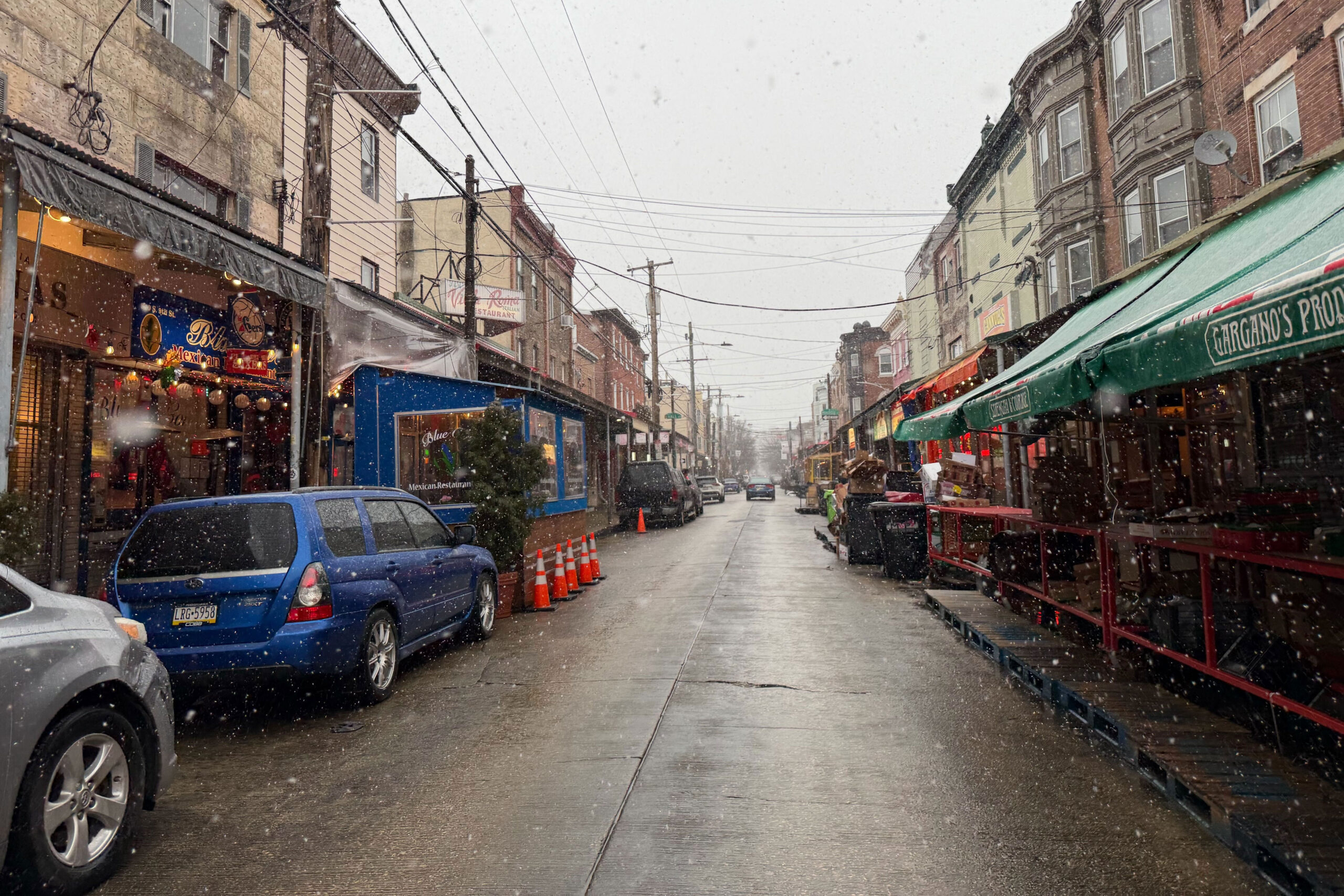
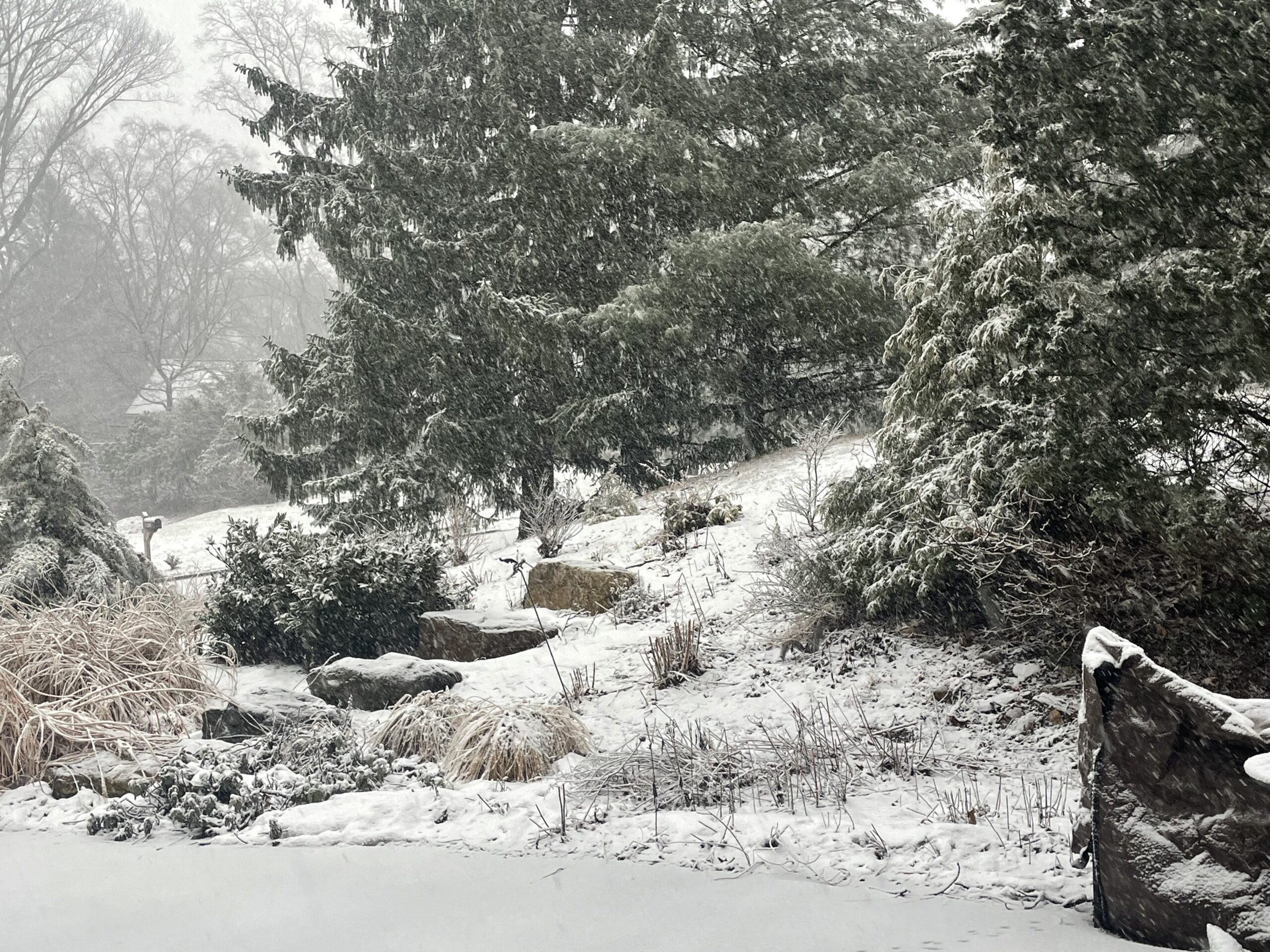
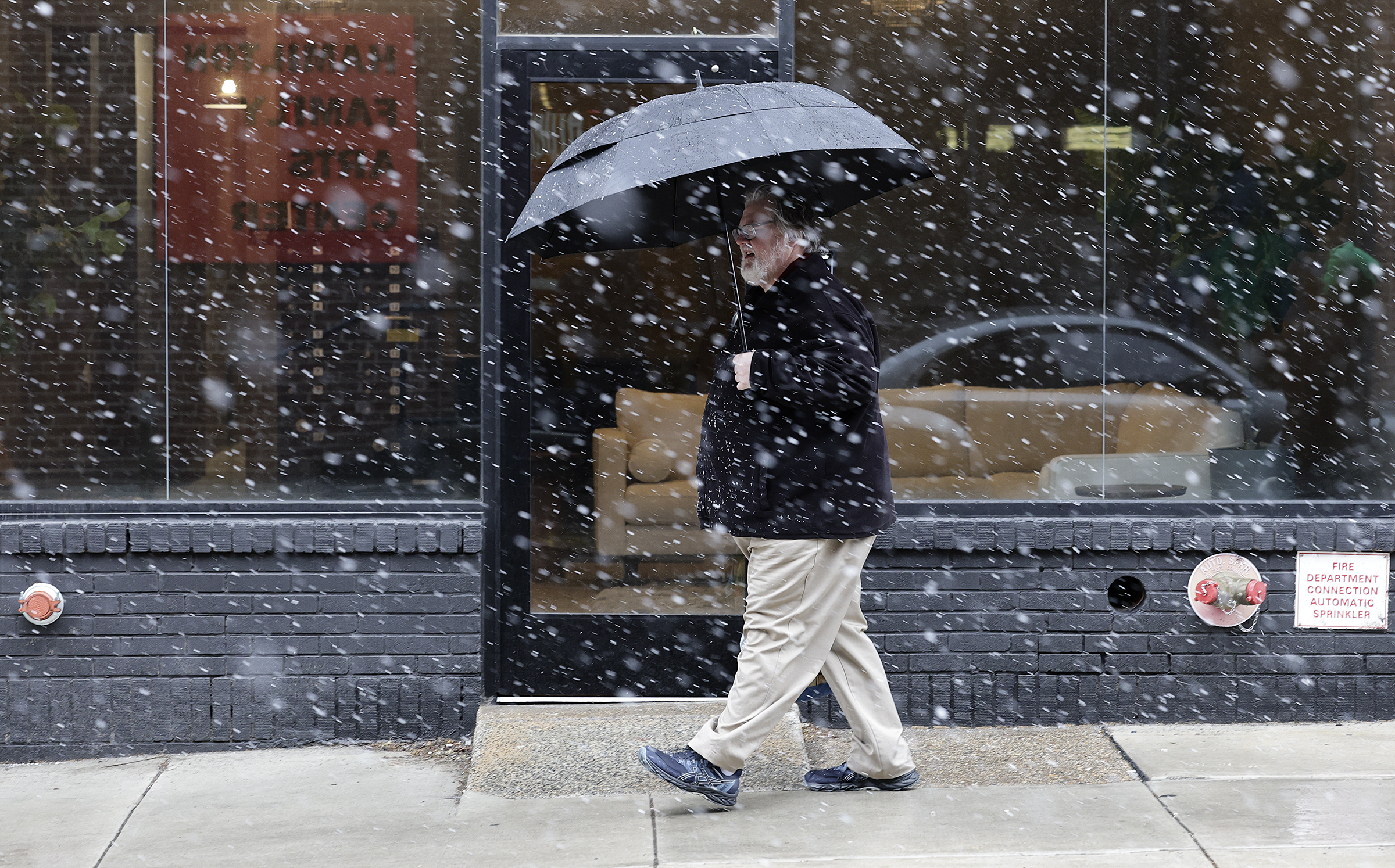
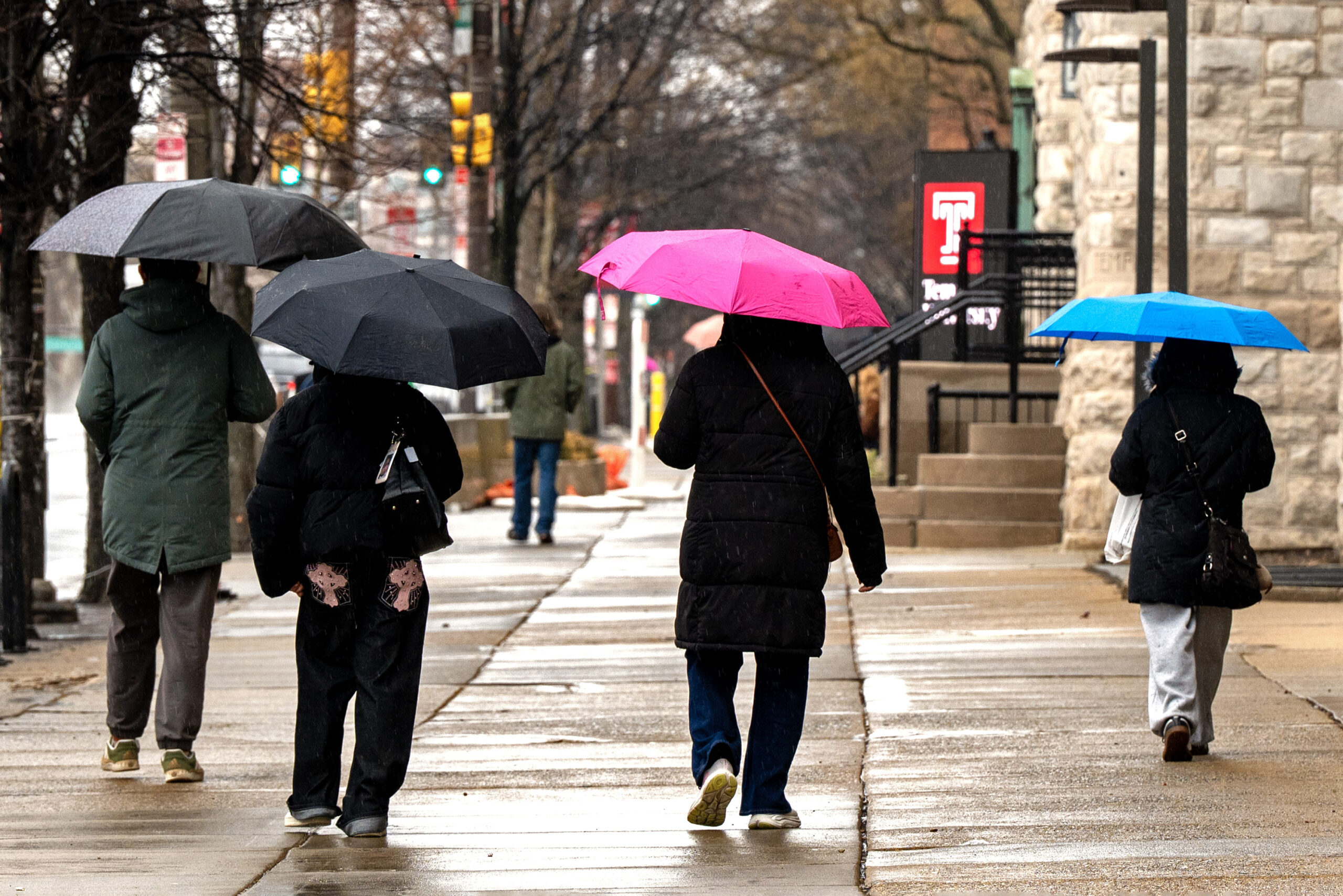
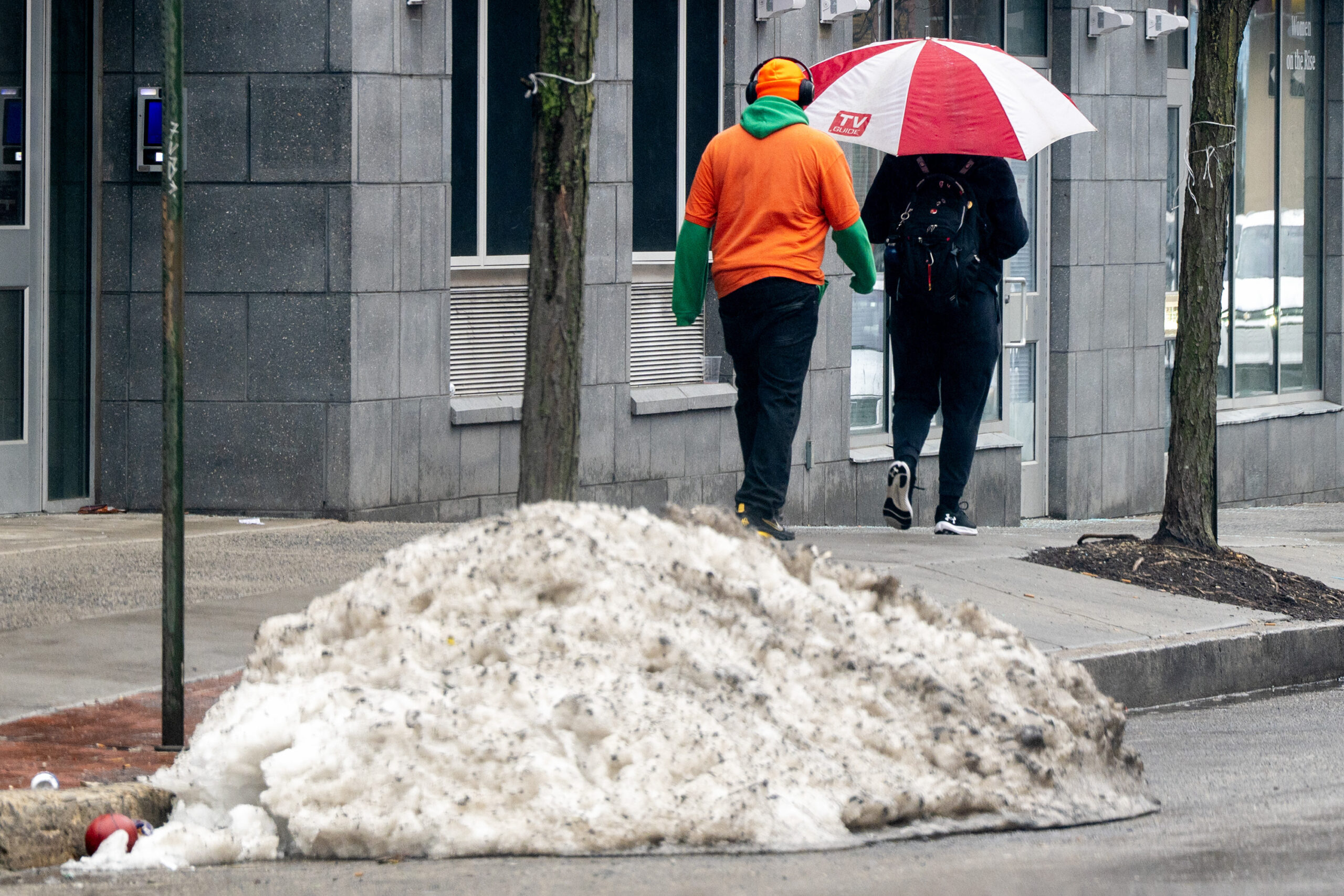
A man rides his scooter along N. 4th Street as snow falls Sunday. Rain turns into snow late Sunday afternoon in Haddonfield. Pedestrians use their umbrellas to shield themselves from the snow in Old City Sunday. Snow falls at Chew Playground in South Philadelphia. Rain shifts to snow in the Italian Market at 9th and Carpenter Streets.
// Timestamp 02/22/26 4:42pm
PSE&G prepares for outages due to ‘heavy wet snow and elevated winds’
Snow begins to pile up in Wayne, Delaware County Sunday afternoon.
Outages due to the snowstorm are expected, Brian J. Clark, senior vice president of PSE&G, the energy company based in Newark, said in a press conference around 3:45pm on Sunday.
PSE&G, which provides electricity and gas, services parts of Burlington, Camden, and Gloucester Counties.
“The increased heavy wet snow and elevated winds remain our major concerns,” said Clark on Sunday. “We may see large limbs and possible decayed trees fall and make contact with our lines.”
Roughly 3,000 PSE&G electric field personnel were on hand to help restore service on Sunday, which includes tree trimmers and line workers.
Restoring service includes clearing wires that have fallen and may be blocking roads, to ensure emergency responders can circulate. The utility company focuses on restoring service to “the largest blocks of customers first, and working concurrently with other crews downstream to restore individual homes and businesses,” said Clark.
Customers can check the company’s outage map to find out how long restoring service is estimated to take in their area.
“We’re fully staffed, which includes strategically placing folks at different points in our service territory to respond quickly to emergencies,” said Clark. “At PSE&G, our service to our customers, businesses and governmental locations is extremely important to us. Our team will be fully engaged around the clock until everyone is restored.”
‘Code Blue’ for Philadelphia, city to open warming sites
The Hub of Hope will serve as a warming site during the storm.
City officials on Sunday instituted a “Code Blue” that’s set to last until 9 a.m. Tuesday.
A Code Blue is declared when precipitation is falling and temperatures are 32 degrees or lower, or when temperatures feel close to or below 20 degrees due to the wind chill. The designation means that the city sends out outreach teams 24 hours a day to find people without shelter and take them to “safe indoor spaces.”
It also opens up additional shelter beds, and residents in emergency housing are allowed to stay inside all day. (Some shelters require residents to leave in the morning and return at night.)
On Sunday afternoon, the city announced that warming sites would open at several locations across the city on Sunday evening:
Hub of Hope, 4 p.m.: 15th Street trolley entrance in Dilworth Park, 1 S. 15th Street
Samuel Recreation Center, 7 p.m.: 3539 Gaul St.
Kensington Wellness Support Center, 9 p.m. to 9 a.m.: 265 East Lehigh Ave.
Prevention Point, 9 p.m. to 6 a.m.: 2913-15 Kensington Ave.
People who need shelter or who see someone sleeping outdoors should call the city’s homeless outreach hotline at 215-232-1984. People can also visit a homeless intake center; the city’s after-hours intake centers are open 24/7 during a snow emergency. The city will also open its Appletree Family Center at 1430 Cherry Street, at 6 p.m. through Monday.
The city said capacity at the warming centers is 280 and shelter beds also had room to take people; typically, the city operates 3,000 shelter beds year round and adds at least 400 extra during the winter. During Code Blue, another 50 beds are added.
Some advocates said early Sunday the city should do more to get people sleeping on the streets inside. Declaring an “enhanced Code Blue,” which typically occurs after three days of Code Blue conditions have passed, would open warming centers, which allow people spaces to sit to get out of the cold. During the last cold snap, libraries served as warming centers during the day and rec centers opened to shelter people at night.
Some staff at libraries said they had been overwhelmed during this month’s unusually long enhanced Code Blue, and that the city had not provided enough resources or staff to help warming center clients. Still, advocates for homeless Philadelphians say the warming centers are a lifeline in potentially dangerous weather conditions, especially for people who are wary of entering shelters.
Rain switches over to snow in Philly; nearly 2 inches already in Somers Point
Snow falls as a pedestrian walks along N. 2nd Street in Old City Sunday afternoon.
Rain began switching over to snow in Center City Philadelphia and across the region just before 4 p.m. Sunday as residents brace for snowfall totals of a foot or more.
The agency is still calling for 14 to 20 inches of snow to fall in and around Philly through Monday morning, with the heaviest snowfall expect to take place this evening.
Heavy snow could be seen on webcams up and down the Jersey Shore, from Wildwood to Seaside Heights, areas expected to be hit the hardest by the massive storm. All of New Jersey’s 21 counties are expected to get a foot or more of snow, Gov. Mikie Sherrill warned during a news conference earlier in the day.
Camden, other school districts announce snow closures
An Elmo balloon rolls along a sidewalk in Haddonfield during last month’s snowstorm.
As the blizzard bears down, school districts across the region have announced either pivots to virtual instruction or full closures.
Cherry Hill, Moorestown, and Evesham are closed, for instance; so are Lower Merion, Neshaminy and Downingtown. Pennsbury and Central Bucks have called virtual instruction days, while Upper Darby will move to a remote learning day.
Camden schools will be closed. The district has amended the school calendar, tacking on an extra day to the end of the school year. Elementary students will now finish the school year on June 24, and high school students on June 25.
In Delaware, all districts in New Castle County have announced they will be closed Monday. Because of Delaware’s state of emergency, it will be a true snow day for students – no Zoom required.
Philly residents ‘snowload’ ahead of Sunday’s storm
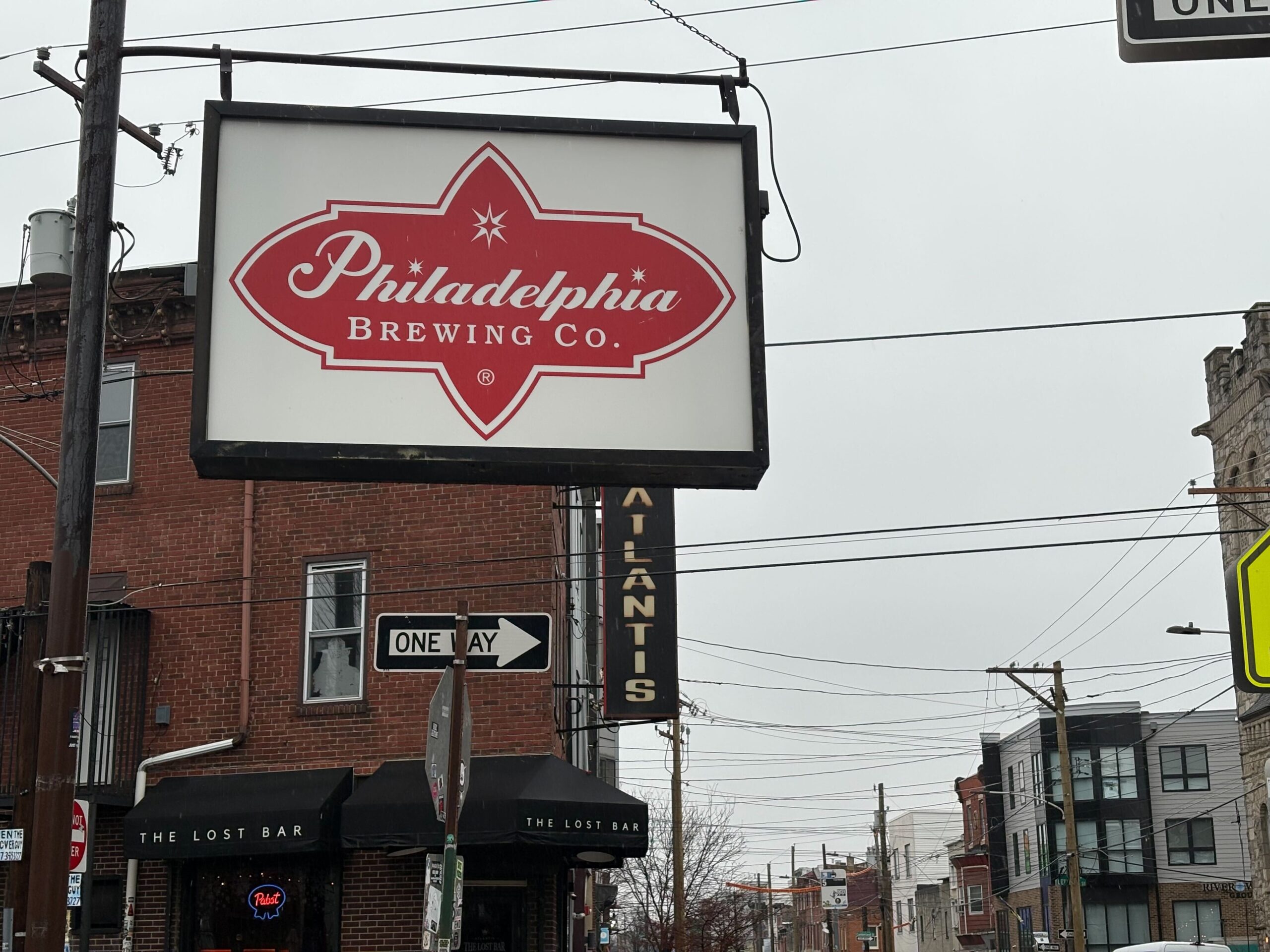
Philadelphia Brewing Co. on Frankford Avenue
The precipitation had yet to shift from rain to snow Sunday afternoon, but patrons at neighborhood bars were already buttoning up their beer coats.
It’s a phenomenon called a “snowload” — when people flock to barstools and find solace from bad weather at the bottom of a citywide special or hot toddy, according to Les & Doreen’s Happy Tap bartender Bill Coburn and others.
With the city shut down and some workplaces closed for inclement weather Monday, blizzards and beer just make for the perfect adult snow day, bargoers said.
“I think it comes from when you’re a kid — you have a snow day and you all go out somewhere, go sledding,” said James Brenner, 43, who lives above Atlantis, The Lost Bar in Kensington. “It’s just an adult version of that.”
Bartender Michelle Graser agreed – barhopping and snow frolicking brings out camaraderie between neighbors.
The crowds weren’t out in earnest just after noon Sunday; there were some stragglers who came to watch the U.S.A.-Canada Olympic men’s hockey matchup. Some of the bars expected business to pick up later Sunday evening and into Monday.
Nearly everyone who spoke with The Inquirer advised “snowload”-ers to tip their bartenders handsomely and avoid drinking and driving. Ideally, they said, to stick to your walkable, corner bar.
Slightly less snow in latest Philly forecast as heavy snow falls in Delaware
Still no snow in Philadelphia as of Sunday afternoon, but forecasters still predict about a foot will fall.
At midafternoon the nor’easter was intensifying off the coast of Virginia, and heavy snow had moved as far north as southern Delaware.
Rain continued in the Philly region, and snow was likely to hold off until 5 or 6 p.m., said Tom Kines, senior meteorologist with AccuWeather Inc.
AccuWeather’s forecast amount, 10 to 14 inches, was more conservative than the National Weather Service’s call for 14 to 20 inches. The weather service had shaved off a few inches from its earlier forecast as updated computer guidance was less bullish on the amounts.
Kines added that if the snow were to hold off until later, amounts would be lower.
(function () {window.addEventListener(‘message’, function (e) { var message = e.data; var els = document.querySelectorAll(‘iframe[src*=”‘ + message.id + ‘”]’); els.forEach(function(el) { el.style.height = message.height + ‘px’; }); }, false); })();
PATCO to operate on snow schedule Sunday and Monday
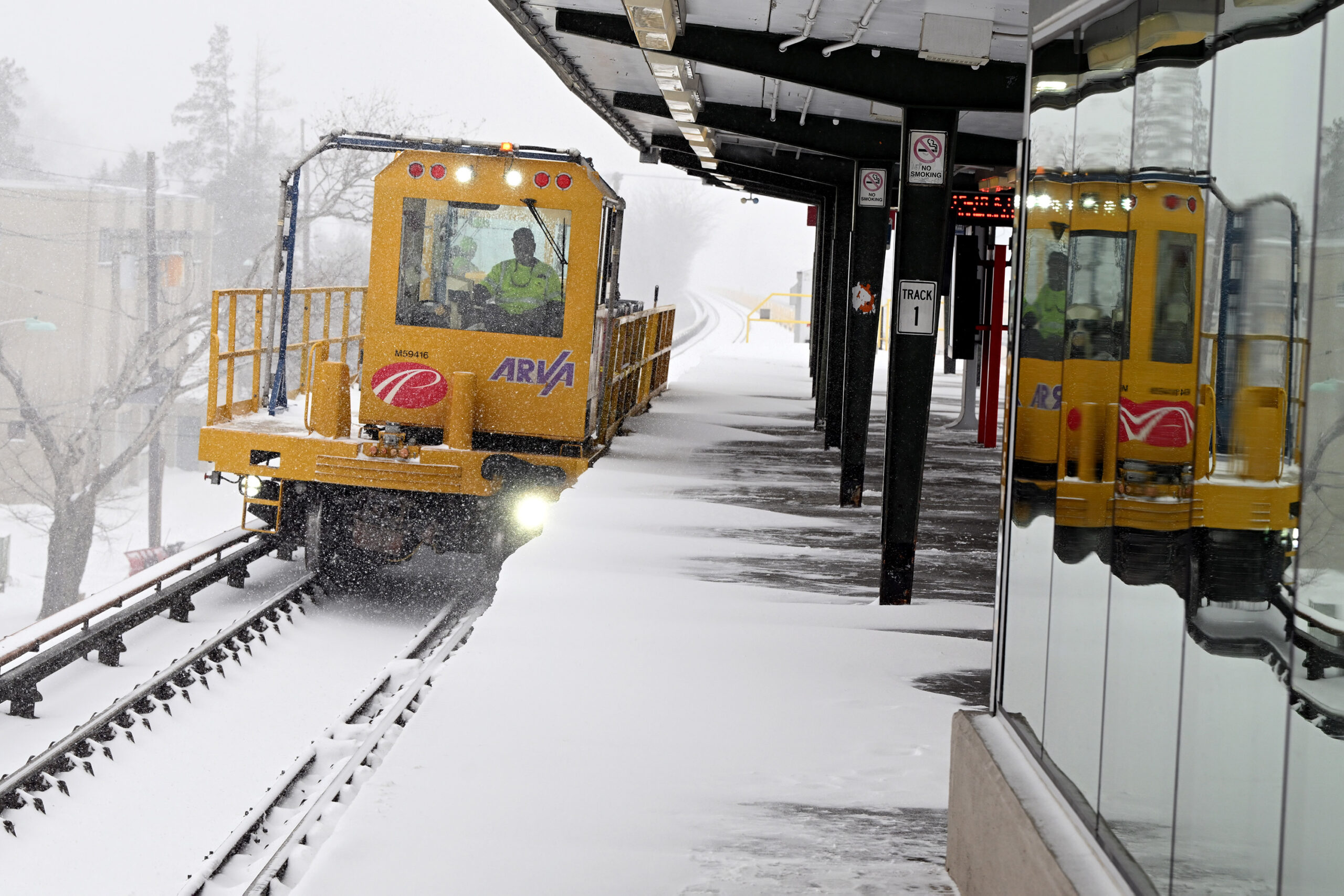
A track utility vehicle moves along the PATCO train line earlier this month.
PATCO trains will run at reduced speeds on Sunday and on an abbreviated schedule on Monday as the region braces for a significant winter storm.
On Sunday, trains will operate on a typical Sunday schedule but trips may take up to 10 minutes longer in order to maintain the safety of passengers and crew, the agency said.
On Monday, trains will operate every 12 minutes for most of the day, as opposed to the typical 5-7 minutes at peak times and every 15-30 minutes at other times.
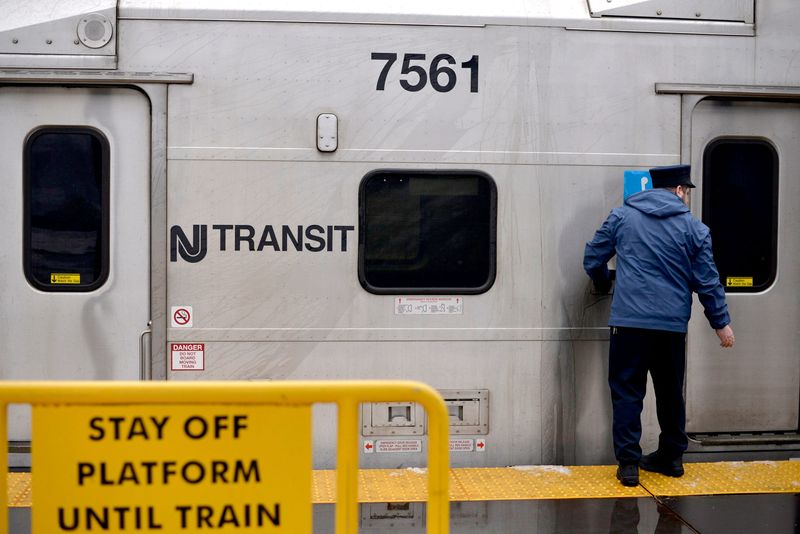
An NJ Transit employee opens a train door at the Hamilton Train Station.
NJ Transit will suspend its bus, light rail, and Access Link service at 6 p.m. Sunday, the agency announced.
Trains will continue to run, but both the agency and Gov. Mikie Sherrill warned a shutdown later this evening was likely.
Speed restrictions of 35 miles per hour will go into effect on the New Jersey Turnpike, Garden State Parkway, and other highways through the state at 3 p.m.
“In our last storm, I said, ‘don’t travel if you don’t have to.’ Now, I’m saying, ‘don’t travel tonight.’ It’s dangerous,” Sherrill said at a Sunday afternoon news conference.
‘These kind of winters were common when I was a kid’
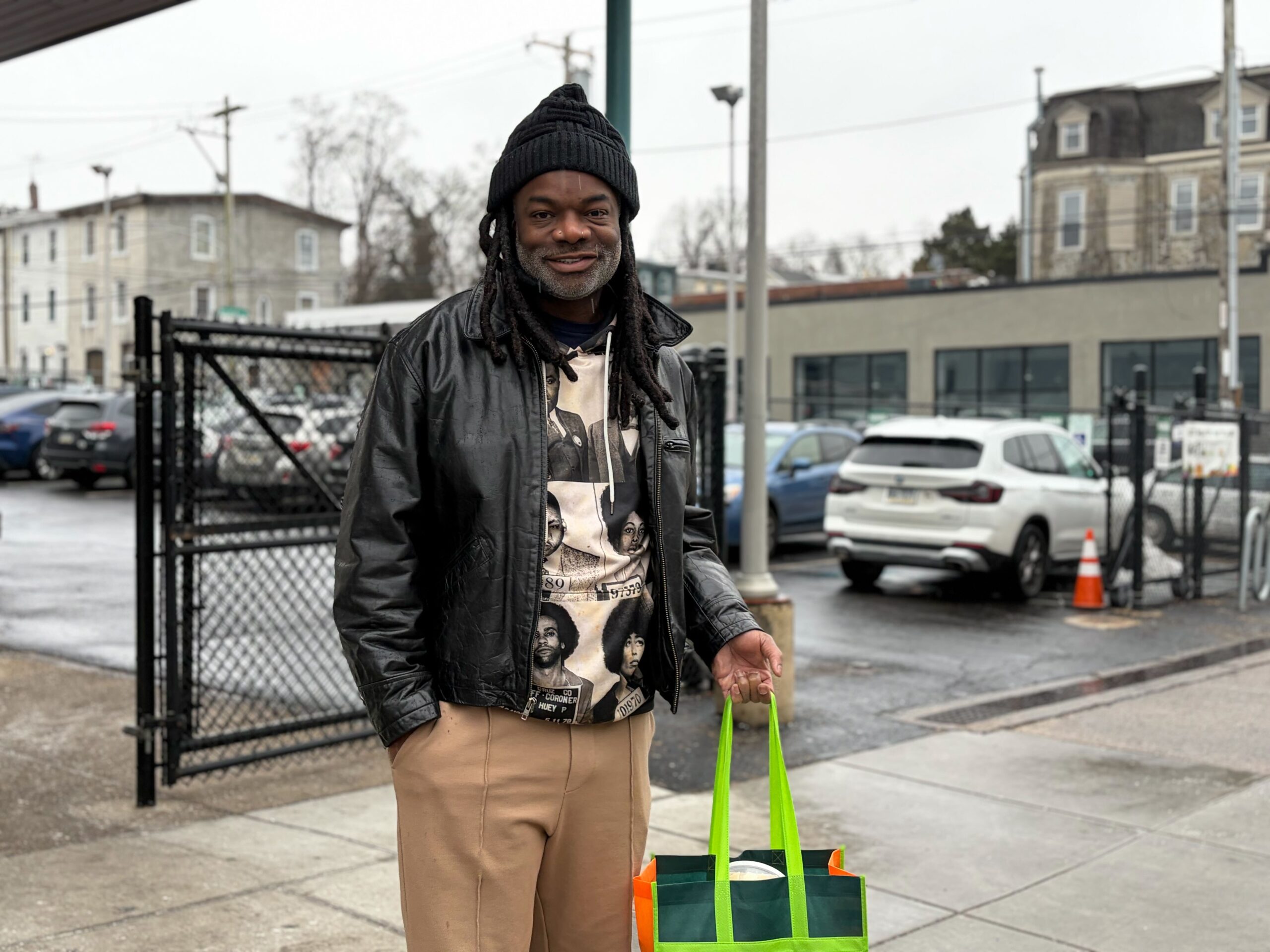
Eric Dobson, 57, went shopping for groceries in Germantown Sunday before the snowfall began.
Holding a single grocery bag, Eric Dobson, 57, was taking the impending storm with calm and nostalgia.
“These kind of winters were common when I was a kid,” said the Germantown resident. “I guess we have become soft, so we panic.”
With enough salt still stocked up at his home from last month’s storm, Dobson’s mind was on getting some groceries at the Germantown Weavers Way Co-op.
“I don’t know why we always get milk and bread in the storms,” said Dobson with a laugh. “I don’t even think we eat that much bread.”
A last-minute food craving sent Norman Bayard, 52, to the grocery store.
“I’m ready to hunker down,” Bayard said. “My family is at home; we have water and flashlights, but we didn’t have all the ingredients for the chili.”
Ashley Ellis Gitongu, 33, brought her three boys to the grocery store as a last outing before the storm.
“I’m not too worried, but we are going to be stuck inside for two days,” Gitongu said, looking at her 8- and 5-year-old boys roughhousing.
With schools closing in Philly, she predicts “a lot of arts and crafts are in our future.” Her husband, she said, will take the children sledding. But if snow fun isn’t possible, they found a solution during the last storm, turning their home into an “open house.”
“All the furniture is out of the way in the living room, so they can play soccer inside,” Gitongu said. “We have softballs, legos, anything to keep them active and distracted.”
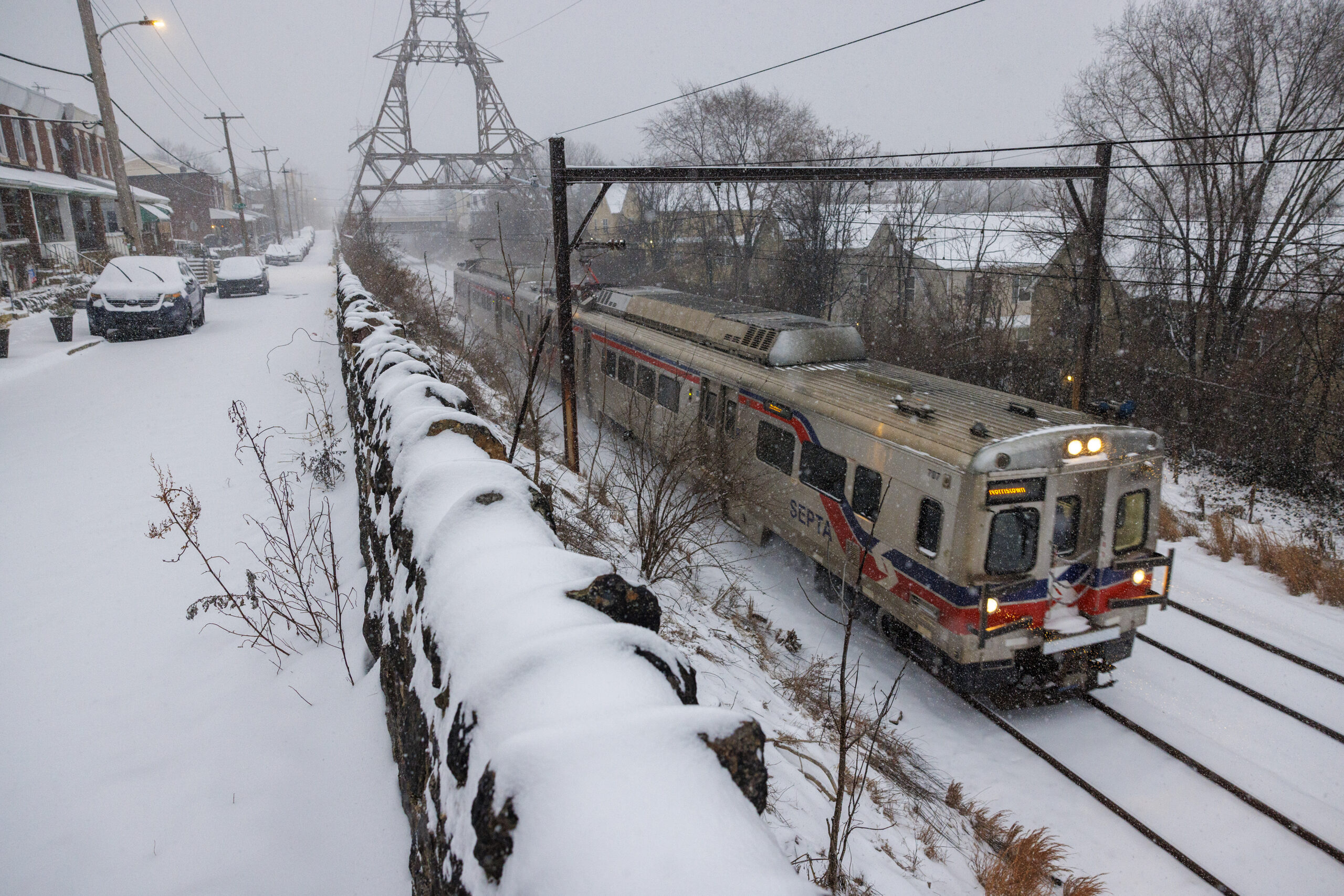
A SEPTA Regional Rail train heads through East Falls during a snowstorm last month.
As the region awaits the arrival of a snowfall that is expected to be in the double digits, SEPTA is warning riders that transit will be impacted.
“We want to be clear with our customers – there are going to be significant service disruptions,” said SEPTA General Manager Scott A. Sauer in a statement. “This is going to include delays, trip cancellations, and likely shutdowns of routes and entire modes of travel.”
Whenever possible, SEPTA will provide customers with at least two hours’ notice before service suspensions, the agency said.
SEPTA has also pretreated parking lots and tracks, tapping into the agency’s stock of 4,000 tons of rock salt. Depending on when the snow stops, SEPTA officials anticipate it could take until midweek to clear the nearly 300 Metro and Regional Rail stations throughout the five-county region.
Pennsylvania issues disaster declaration; commercial driving restrictions begin at 3 p.m.
A line of PennDot salt trucks line up ahead of a storm in December.
Gov. Josh Shapiro announced a disaster emergency during a new conference Sunday afternoon ahead of a massive snowstorm expected to blanket most of Eastern Pennsylvania, including Philadelphia.
The declaration allows state resources to be activated and enables local governments to activate their own emergency plans to respond to the storm, which is expected to drop a foot or more of snow in and around Philadelphia.
Shapiro said state officials expect the heaviest snow — potentially one to two inches an hour — to begin around 5 p.m., and urged drivers to travel only if absolutely necessary.
“I ask you to stay off the roads, particularly when the snow begins,” Shapiro said, “so that the plows can get out there, clear the roads and get you back moving as quickly as possible.”
PennDot Secretary Michael Carroll said commercial truck restrictions will begin at 3 p.m. He also said he expects tighter rules on more motorists during the heaviest portions of the storm.
Despite rain, more than a foot of snow still expected to fall in Philly
Rain falls Sunday afternoon on Cecil B. Moore Avenue in North Philadelphia.
Rain continued to fall Sunday afternoon with temperatures well above freezing, but forecasters say a drastic change for the worse is coming.
Blizzard warnings are in effect for the Philly region and all of New Jersey and Delaware for wind gusts to 45 mph and 14 to 20 inches of snow.
Those estimates may be “a bit high,” said Ray Martin, lead meteorologist with the National Weather Service Office in Mount Holly, but a “bit high” still would be quite a boatload of snow, the most since February 2010.
Sunday updated forecast from the National Weather Service.
Moderate to major flooding was forecast at the Shore with onshore winds howling up to 60 mph.
The snow will be wet and heavy, ideal for accumulating on trees and wires, and combined with the winds may cause some power outages.
This is the first time ever that all of New Jersey has been under a blizzard warning, said Judah Cohen, a Massachusetts Institute of Technology research scientist.
Philadelphia has not experienced a verifiable blizzard in 33 years. A blizzard is defined as heavy snow with winds of 35 mph an/or quarter-mile visibility for three consecutive hours.
(function () {window.addEventListener(‘message’, function (e) { var message = e.data; var els = document.querySelectorAll(‘iframe[src*=”‘ + message.id + ‘”]’); els.forEach(function(el) { el.style.height = message.height + ‘px’; }); }, false); })();
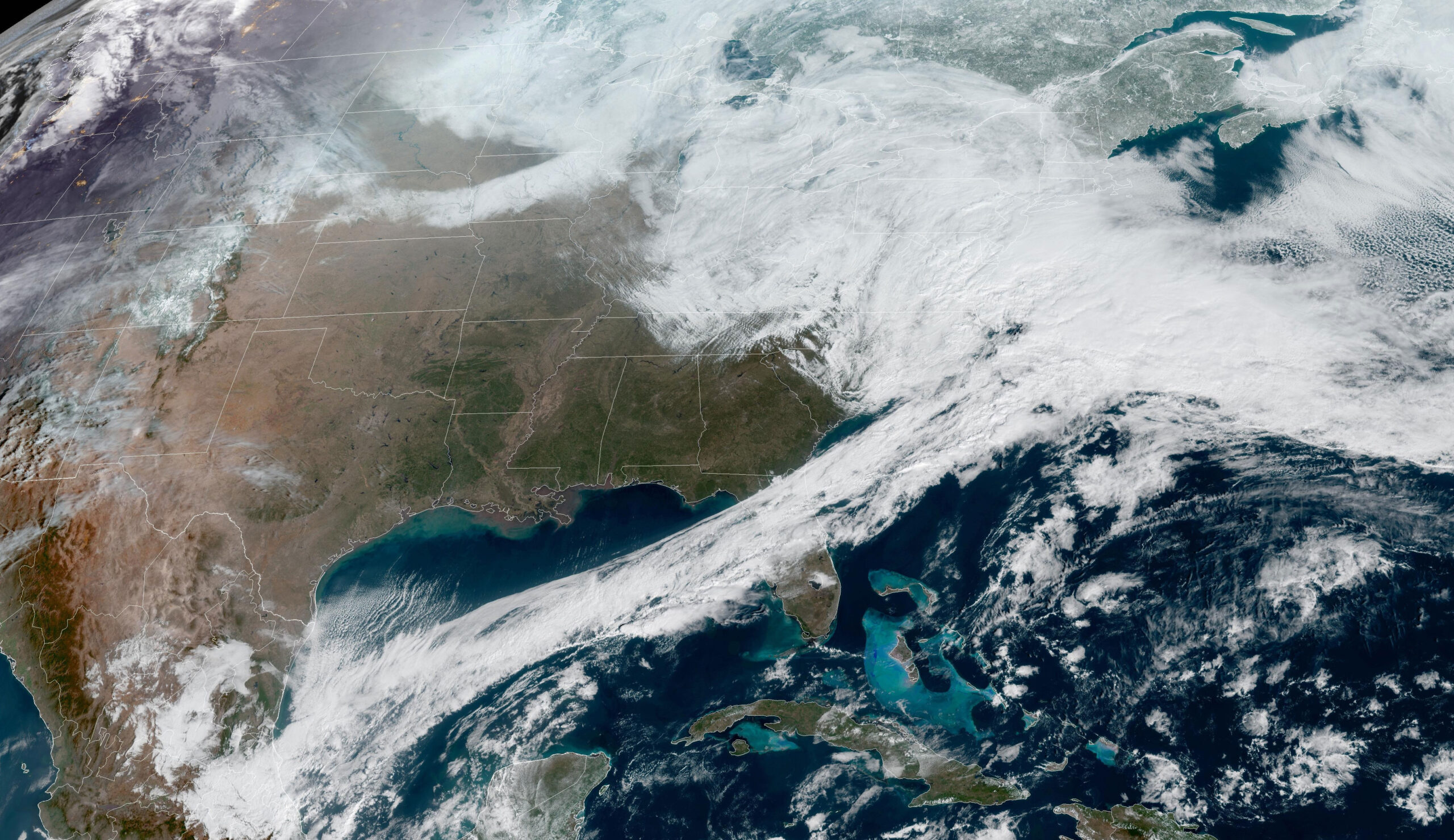
A satellite view of a massive winter storm making its way through the Northeast Sunday.
The storm developing off the Southeast Coast will qualify as a meteorological “bomb cyclone,” said Cody Snell, meteorologist with the Weather Prediction Center.
Just what does that mean? The technical description is on the geeky side — a barometric pressure drop of 0.7 inches in the center of a cyclone in a 24-hour period. Unofficially, it’s one mighty intense storm.
It so happens that the U.S. East Coast is in a prime area to experience the effects of those storms, according to the atmospheric scientists who are credited with minting the term in a 1980 paper, John Gyakum and Frederick Sanders.
The warm waters of the Gulf Stream are breeding grounds for potent storms that can form when cold air bounds off the coast.
Gyakum, a professor at McGill University in Montreal, recalled that well before the paper was published, the term “bomb” was used commonly in the halls of the Massachusetts Institute of Technology, where he was a grad student under Sanders.
The term has taken some blowback, but Gyakum argues that given the potential damage these storms can cause, “bomb” is appropriate.
Trash collection in Philly suspended through Wednesday
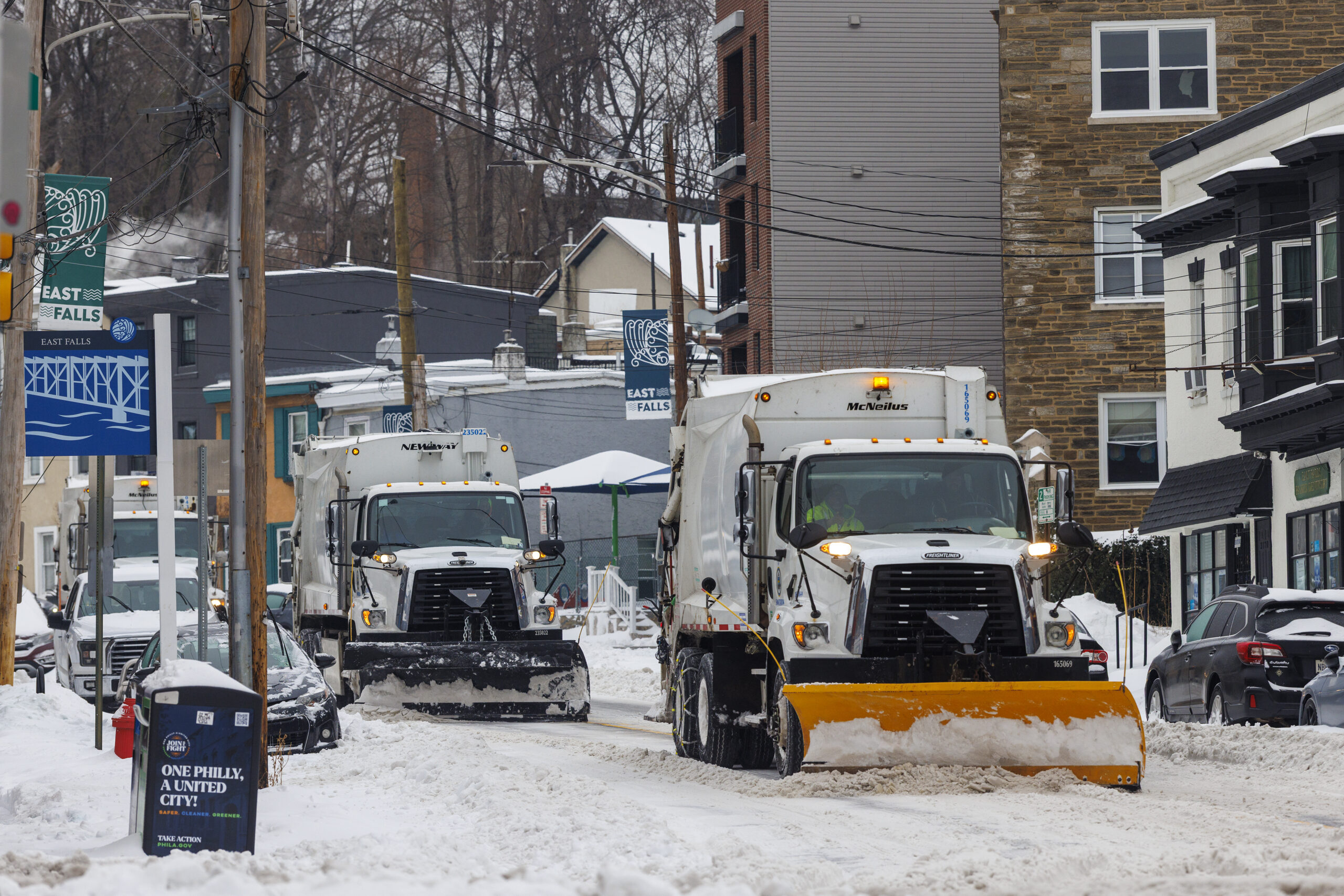
Sanitation Department trash trucks with plows clear snow during last month’s storm.
Trash and recycling collection in Philadelphia will be suspended the next few days as the city braces for as much as two feet of snow.
Collections are suspended Monday and Tuesday, the city announced. As of now, service will resume Wednesday on a two-day delay, with Monday collections picked up Wednesday and subsequent days following the same schedule.
The city is also suspending collections in rear driveways for the entire week, due to the possibility of trucks getting stuck in the snow. Residents are asked to set their materials in front of their homes for pickup.
Second trash collection is also suspended this week.
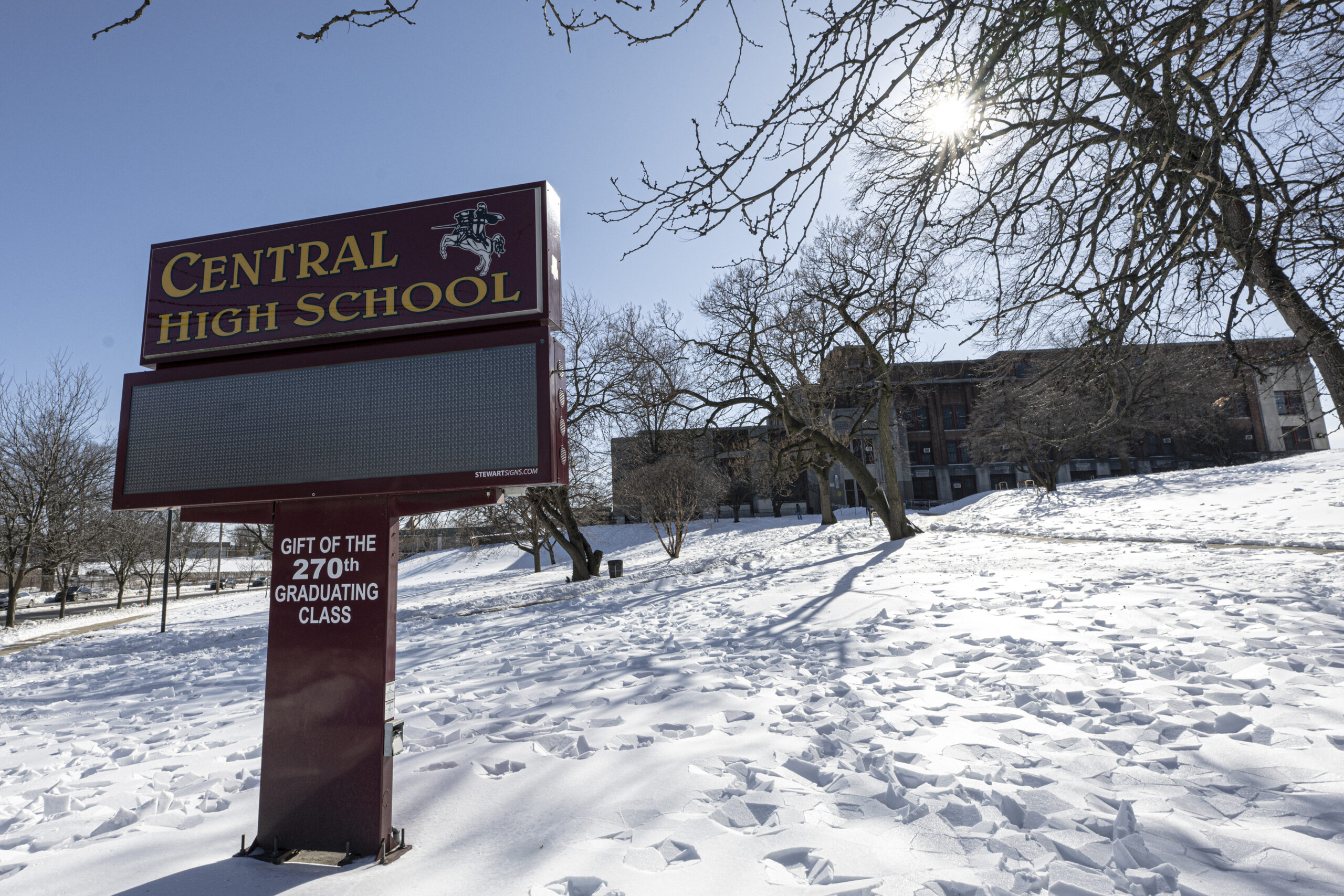
Central High School and the rest of the schools in Philly will be empty Monday.
With an eye toward the coming blizzard, the Philadelphia School District has already called a virtual instruction day for Monday.
All district offices will also operate virtually.
“While we work to the greatest extent possible to keep schools open for in-person learning to accelerate student achievement, we also consider the staff members who are commuting from across the region and keep the safety of students and staff as our top priority,” Superintendent Tony B. Watlington Sr. said in a message to families and staff.
The district gave students one full snow day in January, but has no more cushion built into its calendar. Any further inclement weather days will also be virtual instruction days, Watlington said.
“After Monday, if schools need to remain closed due to inclement weather, the district will provide an update to parents, guardians and employees regarding remote learning,” Watlington said.
Snowfall totals increase in latest forecasts; blizzard warnings expand
Up to two feet of snow could fall in Philly.
The National Weather Service expanded its blizzard warnings to include Philadelphia Sunday morning, as a “potentially historic winter storm” makes its way towards the Northeast.
Philadelphia, Bucks, Delaware, and eastern Montgomery Counties, and all of New Jersey and Delaware, are now under blizzard warnings through Monday.
Predicted snowfall has also increased in the past few hours, with as much as two feet of snow possible in the city. Winds gusts up to 60 mph and snowfall rates exceeding one to two inches per hour are also expected, forecasters said.
Blowing and drifting snow could create whiteout conditions, making driving dangerous and nearly impossible. The storm will certainly impact the Monday commute, with the strongest winds expected to occur Sunday night into the morning.
People are encouraged not to travel. Those who must do so should carry a winter survival kit.
“Travel could be very difficult to impossible,” NWS said. “Areas of blowing snow could significantly reduce visibility. The hazardous conditions will impact the Monday morning and evening commutes. Gusty winds could bring down tree branches and result in isolated power outages.”
Timing
Rain is expected to shift to snow by midday Sunday, and will continue through Monday afternoon. The heaviest snowfall is expected Sunday evening and overnight.
The blizzard warning remains in effect from 10 a.m. Sunday to 6 p.m. Monday.
The weather service included the Philly area in its blizzard warning after getting “higher confidence” data showing a likelihood of heavy snowfall and whiteout conditions in the region, said NWS meteorologist Ray Martin.
“Really, the bulk of the snow will start falling after sundown,” Martin said.
Philly snow emergency goes into effect Sunday afternoon; city government closed Monday as schools go virtual
Just as last storm’s snow has finally melted, Philly is expected to be covered with more than a foot of snow.
“Mother Nature has spoken again and made it clear that winter is not over,” said Mayor Cherelle L. Parker during an emergency press conference, declaring a citywide snow emergency, starting 4 p.m Sunday. “Yet another big winter storm is coming. It’s a major snow storm with real accumulation anticipated, and it’s heading our way.”
City government and courts will not open Monday, while public schools will switch to virtual learning. SEPTA riders should expect significant service disruptions over the next three days, said officials, who implored drivers to stay off the road Sunday.
Dominick Morales, the city’s emergency management coordinator, described the expected storm as “dangerous,” adding that heavy, wet snow could threaten trees and power lines.
“Dangerous because of the amount of snowfall that is being forecast in about a 24-hour period, but it’s also dangerous because of high winds — and for Philadelphia — near blizzard conditions. When this storm picks up, we have to take it seriously,” he said.
When all is said and done, the total snowfall may be closeto 18 inches in the city, and could surpass20 inches in South Jersey, where high winds are forecast to create blizzard conditions, according to the National Weather Service. Early Sunday morning, the weather service extended a blizzard warning to cover Philadelphia and Bucks and Delaware Counties, as well as eastern Montgomery County and all of South Jersey.
“It does look like it’s going to be quite an impactful storm for the whole [I-]95 corridor and further east,” said Sarah Johnson, warning coordination meteorologist at the weather service’s Mount Holly office, on Saturday.
This will lead to potentially dangerous driving conditions starting Sunday into Monday. And the Shore and Delaware Bay could experience flooding duringhigh tide Sunday evening.
The last time Philadelphia saw more than a foot of snow was 2016, when 22.4 inches fell in the city on Jan. 22-23.
Officially Philadelphia has not recorded a blizzard since March 1993.
To meet the criteria – three consecutive hours of winds of 35 mph or greater and/or heavy snow reducing visibility to a quarter mile for three straight hours – the conditions would have to be observed at the first-order measuring station, which is at Philadelphia International Airport.
The criteria weren’t met during the record 30.7-inch snowfall of Jan. 7-8, 1996, but at the time many meteorologists at the National Weather Service in Mount Holly argued that in the court of common sense it was indeed a blizzard.
It certainly acted and felt like on to those who experienced it.
Snow, after it hits 52 degrees? It’s happened before
On Saturday it reached 52 degrees in Philly as more snow vanished (not the mountains), and here we are a day later with a major snowstorm expected.
A warmup preceding a snowfall isn’t all that unusual this time of year, when the battles between the encroaching warm seasons and the retreating winter can be intense. Storms tend to form along thermal boundaries, and this is a prime for those contrasts. In today’s case an invasion of cold air is interacting with warmer air over the Atlantic Ocean.
Once powerful storms get going they can draw in cold air. Plus the upper air this time of year can be quite cold, and heavily falling snow can bring some of that to the surface.
One prime example of a snowstorm following a warmup occurred on Feb. 23, 1987. High temperatures the day before reached the low 50s. During the early morning hours of Feb. 23, heavy snow fell, accumulating 6.5 inches at Philadelphia International Airport, with totals several inches higher elsewhere in the city, and two feet in Downingtown.
On the plus side, a warmup after a snowfall isn’t all that unusual in late winter.
It abuts an internationally famous garden. It may well be the most affluent community in the nation that hosts a prison, a source of some unwanted attention a few years back.
And, according to recently released U.S. Census data, picturesque Pocopson Township is in a rarified zone for wealth in the eight-county Philadelphia region, with an annual median household income of $230,000.
Chester County towns dominated the top 50 list in ananalysis of incomes in the region’s municipalities — compiled from self-reported American Community Survey data — calculated for the five-year period that ended in 2024.
But the analysis also showed that not only has Bucks County been gaining star power, some of its towns may merit the label “Big Bucks County.”
Legendary locale New Hope and neighboring Solebury — places associated with Real Housewives of Beverly Hills alumna Yolanda Hadid and actor Bradley Cooper — are among the towns that have made significant moves up the income chart, compared with the five-year period that ended in 2014.
Inflation-adjusted median annual incomes jumped 58% in New Hope, to $175,000. Incomes were up nearly 30% in Solebury, to $196,000,among the highest in the region.
The national median income was around $80,000, according to census figures.
Income figures are estimates, rounded to the nearest hundred, and are subject to margins of error. A total of 286 municipalities were included in the analysis; those with fewer than 2,500 residents were excluded. Here are some key findings.
window.addEventListener(“message”,function(a){if(void 0!==a.data[“datawrapper-height”]){var e=document.querySelectorAll(“iframe”);for(var t in a.data[“datawrapper-height”])for(var r,i=0;r=e[i];i++)if(r.contentWindow===a.source){var d=a.data[“datawrapper-height”][t]+”px”;r.style.height=d}}});
Chester County still has the wealthiest towns
Chester County towns held six of the top 10 spots, including Birmingham, adjacent to Pocopson.
The county evidently is rich in an amenity attractive to the wealthy — and to others.
“Chester County has been a leader in terms of the amount of land preserved,” said Andrew Svekla, Office of Smart Growth manager with the Delaware Valley Regional Planning Commission. “The availability of open space is an amenity that everyone is looking for.”
While the natural environment is an understandable attraction, not everyone who spends time in Pocopson comes for the green space: The Chester County Prison has been a mainstay in the township since 1959.
In August 2023, Pocopson and Longwood Gardens became international news when inmate Danilo Cavalcante escaped and set off a two-week investigative frenzy that mutated into a massive exercise of Where’s Danilo? He spent time hiding in Longwood and was eventually captured in South Coventry Township, about 20 miles away.
Otherwise, the likes of Pocopson and Birmingham have not exactly been centers of media attention, and the towns even have avoided the development-vs.-open-space conflicts that have erupted elsewhere, said Matthew J. Edmond, executive director of the Chester County Planning Commission.
“They aren’t in the path of growth,” he said. “These areas are off the beaten path.” The residents represent a mix of old and new money, he said.
He likened Chester County to a macro-version of Lower Merion Township, where neighborhoods vary from ultra-wealthy Gladwyne to the middle-class sections of Ardmore.
While overall the county has the highest median income in the state, “when you get down to the granular level, it’s a very diverse county,” he said.
Incomes in other counties in the region have grown
The overall picture of wealth in the eight-county region was quite a diverse one in the census survey, ranging from Pocopson’s median income to the $40,000 levels of Camden, the City of Chester, and Darby Borough.
But the preponderance of the higher incomes clearly were west of the Delaware River.
Jersey’s wealthier municipalities tend to be clustered in the New York metro area, Svekla said, and only six were on the top 50 list in the Philly region. They included Camden County’s Haddonfield, with a median income of$200,500, and Moorestown, at$160,000 anda favorite of professional athletes. They include ex-Phillie Nick Castellanos, onetime 76er Ben Simmons, Flyers legend Bobby Clarke, and former Eagle Terrell Owens, who famously drew media attention by doing push-ups on his driveway.
It also is the home of Kevin Patullo, the Eagles’ former offensive coordinator whose house was pelted with eggs in October after one of the team’s lackluster performances.
Haddon Heights and Haddon Township did not join Haddonfield in the top 50 but were high on the list of towns where incomes had grown substantially in the last 10 years.
Other places that experienced substantial paycheck bumps in the last 10 years included the Blue Route towns of Conshohocken and West Conshohocken. Both are close to I-476 interchanges and have experienced growth spurts in population and wealth since the highway connecting the Pennsylvania Turnpike to I-95 opened in the 1990s.
Bucks lags in population growth, but not wealth
Led by Chester County, population increased in all eight counties between the 2010 and 2020 census counts. “We’re growing mainly due to international immigration,“ said Greg Diebold, the Delaware Valley planning commission’s senior data analyst.
“Bucks has been one of the slower-growing counties,” he said, having added only about 4% to its population between 2010 and 2020.
In terms of median-income growthover the last 10 years, however, it had seven municipalities in the top 20, more than any other county.
window.addEventListener(“message”,function(a){if(void 0!==a.data[“datawrapper-height”]){var e=document.querySelectorAll(“iframe”);for(var t in a.data[“datawrapper-height”])for(var r,i=0;r=e[i];i++)if(r.contentWindow===a.source){var d=a.data[“datawrapper-height”][t]+”px”;r.style.height=d}}});
Not all the gainers were wealthy towns
One Delaware County town, Upland Borough, adjacent to the City of Chester and the location of part of the closed Crozer-Chester Medical Center, made the biggest-growth list with incomes up more than 40% to $61,000.
Bankrupt Chester itself, with one of Pennsylvania’s highest poverty rates, reported a 10% gain, to $41,000.
However, half of the 10 towns where incomes decreased the most were in Delaware County.
Speaking to the region’s overall prosperity, fewer than 25% of the 286 towns showed drops in income in the period that ended in 2024, compared with the five-year period that ended in 2014.
And only 20% this time around reported incomes below the national median.
Its size is also a reason the Philadelphia School District wants to shut it down.
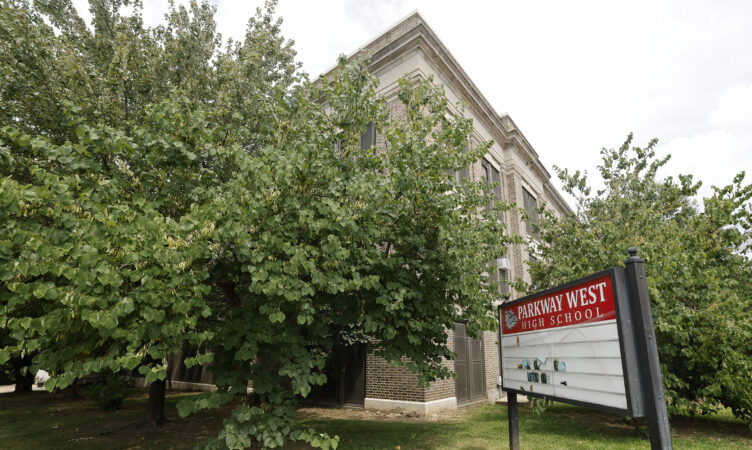
It is among the 20 schools the district is proposing to close, citing its low enrollment. The district plans to merge the Mill Creek magnet school into Science Leadership Academy at Beeber, two miles northwest in Overbrook. That move would dissolve the Parkway West name — and its storied history of alternative education, its supporters say.
Community members say the merger would do away with what makes Parkway West special and successful: the only curriculum in the city tailored for teens interested in becoming early childhood educators, specialty classrooms to support students with disabilities, and intimate class sizes that foster tight-knit relationships. And some say it would unfairly limit school options in West Philadelphia.
“It’s a safe environment — a small school which allows for greater touches, and you just don’t get swallowed up in the size of a big school,” said Earl Morgan, a Parkway West special education teacher who coaches three Hoya sports teams.
Morgan added: “We’re losing a real, safe alternative to private education in West Philadelphia.”
The district’s facilities plan, which the school board is expected to vote on this winter, looks to address systemic issues like declining enrollment, aging infrastructure, and disparate programming in part by targeting some schools with large numbers of empty seats. Parkway West is operating with 140 students, or 40% capacity; its 11th-grade class — possibly its last graduating cohort — has just 18 students. Comparatively, there are nearly 500 students at Beeber, which is 54% full.
Morgan said the proposal poses a “logistical nightmare.” Community members have raised concerns about safety and transportation woes to get children to Beeber. Inside Parkway West, emotions range from indifference to outrage, Morgan said.
The closure would leave “a hole” in the neighborhood, said Cecelia Thompson, a Mill Creek resident and former school board member who regularly interacts with the Parkway West community.
West Philadelphia is now staring down an educational landscape devoid of choice: The number of small, individualized magnet high schools, like Parkway West, in the area would shrink to one, while the district prioritizes reinvesting in neighborhood schools. The proposed school closures would disproportionately affect Black students, according to an Inquirer analysis, though the district says its plan is aimed at boosting opportunities and achievement.
This troubles City Councilmember Jamie Gauthier, whose district includes Parkway West and a handful of other schools affected by the plan.
“It feels like they’re hollowing out my district,” Gauthier said. “They’re essentially shuttering criteria-based schools that people value and that are accessible to Black and brown children in West and Southwest Philadelphia. They’re completely taking it away … or dumping them into much larger schools that are not going to provide the experience that people want.
“Those kids deserve to have high-quality options right where they live.”
The Parkway model was a pioneering approach to alternative education, hallmarked by nonconformism, wandering classrooms, and a casual, personable learning environment where students called teachers by their first names, alumni told The Inquirer. Shaunda Watson graduated from Parkway Gamma, which later became Parkway West, and said the program took her from a C average to honor-roll student.
“Students like me will get lost in larger classrooms,” Watson, 48, of West Philadelphia, said. She added: “We have students that are exceptional and they will get lost in the sauce if they have to go to neighborhood schools. I don’t think that’s fair.”
For Gamma graduate Shannon Sherrod, 54, of Delaware County, preserving the model is more important than the name: “It’s bittersweet. I hate to see it die off,” Sherrod said.
Amid the fight to maintain exhibits about enslaved people at the President’s House Site, congregants gathered Saturday at Tindley Temple United Methodist Church — a site with significant history of its own — to celebrate Black History Month.
“We are celebrating Black history because it’s not just cultural, it is protective,” said John T. Brice, lead pastor at the church in South Philadelphia. “When there is pressure to erase or water down our story, remembering becomes our resistance and resilience.”
Congregants watch a video of Rev. Jesse Jackson at the Citywide Black History Celebration at Tindley Temple United Methodist Church on South Broad Street in Philadelphia on Saturday, Feb. 21, 2026. Tindley is where “We Shall Overcome,” an anthem of the Civil Rights Movement, was written.
Tindley Temple United Methodist Church was founded by the Rev. Charles Albert Tindley, writer of an early version of the civil rights anthem “We Shall Overcome.”
For Brice, the nation’s story can be told in full only if it includes the contributions, struggles, and leadership of Black Americans not only in February, but every month of the year.
“Our contributions are too often minimized or left out of textbooks, public policy, and even Fifth and Market,” the site of the President’s House slavery exhibits that were removed earlier this month, Brice said. Many of the displays have been restored while litigation continues.
Timothy Welbeck, director of the Center for Anti-Racism at Temple University, said remembering painful history is a way of honoring the contributions of ancestors.
“In the birthplace of America, it is important to acknowledge that the first family owned people,” Welbeck said. “It’s important to honor this legacy because we had to fight for our humanity to be recognized. To tell America’s story completely, you have to acknowledge that history.”
Philadelphia-born Shakara Wilson-Fernandez, 22, sees the acknowledgment of Tindley’s contributions as a way of empowering younger generations.
“It warms my heart,” Wilson-Fernandez said Saturday during the service at the church.
“There are many things going on right now, and although not all of us might be Black, we all need empowerment.”
PJ Thomas agreed. To her, celebrating Black history in 2026 feels like celebrating and honoring the diversity of the country she loves.
“Despite what’s going on, we are still the United States of America,” Thomas said.
“We are still a country that celebrates our people’s history, the people that came through immigration and the people forced to come in distress, because we are all American and we all build this country together.”
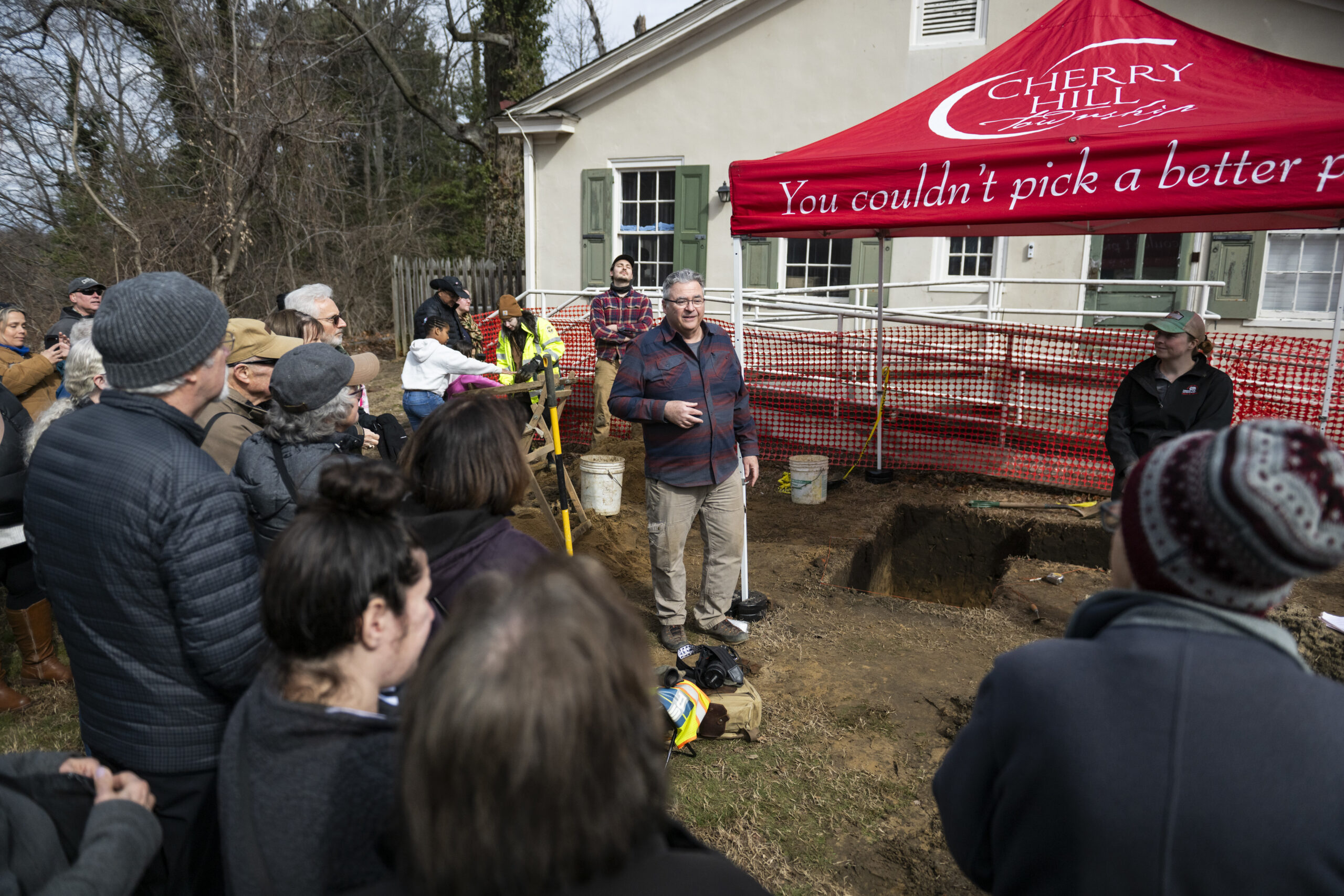
To the casual observer, it’s just an L-shaped hole in the ground, about 40 inches deep, showing two distinct layers of dirt.
But to the archaeologists who dug the hole, it’s a portal into the past going back thousands of years.
Croft Farm is a national historic site. Its owners during the mid-1800s helped Black people escape from slavery. The farmhouse, outbuildings, and 80 acres of the farm are now owned by Cherry Hill Township, part of a recreational and educational space for the public.
The darker brown top layer of “silty sand” contains artifacts from the last 300 years, an era when both enslavers and those dedicated to emancipation lived on the site, according to Matt Kraemer, 27, an archaeologist from Summit, N.J.
Below it, the lighter-colored layer has revealed artifacts from a time when the Lenni-Lenape Indigenous people lived on the land along the Cooper River, in what is now Cherry Hill.
“It’s a very significant site for the fact that it has a Native American component, plus everything the Evans family left behind,” Kraemer said Saturday.
Alanna-Corinne Konkisre (center), 9, of Gloucester County, sifts through dirt to find artifacts at Croft Farm in Cherry Hill, N.J. on Saturday, Feb. 21, 2026. Croft Farm, listed on the National Register of Historic Places, is now an active archaeological site due to the farm’s role during the time of the Underground Railroad.
The Evans family was part of the Quaker religious movement, and like many area Quakers of the time, owners Thomas Evans and his son Josiah were part of the New Jersey Abolition Society, “a group that advocated an end to slavery and also helped to maintain the Underground Railroad,” according to a history of Croft Farm provided by Cherry Hill Township.
Matthew Tomaso, senior director of cultural resource practices at PS&S, speaks to a crowd of people before the start of an archeological dig at Croft Farm in Cherry Hill, N.J.m on Saturday, Feb. 21, 2026. Croft Farm, listed on the National Register of Historic Places, is now an active archaeological site due to the farm’s role in the Underground Railroad.
The farm’s historical significance presents a great learning opportunity, said Matthew Tomaso, the archaeologist leading the project for PS&S, an architecture and engineering firm with a location in Warren Township.
A year ago, PS&S was brought in to oversee cultural resource management as the township sought to stop groundwater from entering the basement of the brick house on the property, Tomaso said.
That gave Tomaso and his team a chance to see what they might find that would shine a light on the property’s role as a station on the Underground Railroad.
Animal bones, pieces of pottery, and other artifacts help tell that story, Tomaso said, by showing the dietary patterns, habits, and traditions of the people living there at the time.
Nolan Arcinese (left) and Aaron Arcinese (right) look through dirt to find artifacts at Croft Farm in Cherry Hill, N.J., on Saturday, Feb. 21, 2026. Croft Farm, listed on the National Register of Historic Places, is now an active archaeological site due to the farm’s role during the time of the Underground Railroad.
That includes previously enslaved people known to have lived there, such as Joshua Sadler, as well as others who worked and lived on the farm, he said. Sadler went on to found nearby Sadlertown, a Black settlement located in what is now Haddon Township.
What they learn could be especially important since the Underground Railroad was not well documented at the time it was in operation, due to the need to maintain secrecy, Tomaso said.
Mostly, though, they have found bones, said Chelsea Carriere, 29, an archaeologist who called herself “the bone lady.”
Carriere explained that she was looking closely at cow, pig, and bird bone fragments — and the ways the animals were butchered nearly 200 years ago.
To her, the rough cuts on the bones show that these animals likely were raised on the farm or hunted, and were likely butchered on-site, rather than through a butcher shop.
“They were doing it themselves, and that suggests lower socioeconomic status,” Carriere said. Her team is still in the early stages of examining the artifacts.
To her, some of the most amazing finds so far were discovered deeper down in the dirt and would date back 2,000 or more years. These include a piece of argillite that she surmised was a spear point, and a basalt biface, an ancient tool that would have been used for cutting.
“This is a really good site,” Carriere said.
It was also a great experience Saturday for learners of all ages who listened to demonstrations and, with archaeologists’ guidance, used a sifter to search for artifacts in the dirt.
“I love to know what people were doing hundreds of years ago,” said Cherry Hill resident Debbie Kilderry, 71, as she watched children sift the soil.
She came to the site with two artifacts she had obtained — a small porcelain container and a stone — hoping that the archaeologists might have insights into their origins. Tomaso’s professional analysis: She had a real arrowhead, likely from the American West, and a cup once used for coffee cream.
To Kilderry, it is exciting to connect with those who came before her.
“I’m excited to see what they were doing, because they were people just like us — just with different inconveniences.”
Philadelphia and its suburbs are forecast to receive 16 to 22 inches of snow and face blizzard conditions beginning Sunday and continuing into Monday, with weather prediction models sharpening their focus as the storm approaches.
“Mother Nature has spoken again and made it clear that winter is not over,” said Mayor Cherelle L. Parker during an emergency press conference, declaring a citywide snow emergency, starting 4 p.m Sunday. “Yet another big winter storm is coming. It’s a major snow storm with real accumulation anticipated, and it’s heading our way .”
City government and courts will not open Monday, while public schools will switch to virtual learning. SEPTA riders should expect significant service disruptions over the next three days, said officials, who implored drivers to stay off the road Sunday.
Dominick Morales, the city’s emergency management coordinator, described the expected storm as “dangerous,” adding that heavy, wet snow could threaten trees and power lines.
“Dangerous because of the amount of snowfall that is being forecast in about a 24-hour period, but it’s also dangerous because of high winds — and for Philadelphia — near blizzard conditions. When this storm picks up, we have to take it seriously,” he said.
When all is said and done, the total snowfall may be closeto 18 inches in the city, and could surpass20 inches in South Jersey, where high winds are forecast to create blizzard conditions, according to the National Weather Service. Early Sunday morning, the weather service extended a blizzard warning to cover Philadelphia and Bucks and Delaware Counties, as well as eastern Montgomery County and all of South Jersey.
“It does look like it’s going to be quite an impactful storm for the whole [I-]95 corridor and further east,” said Sarah Johnson, warning coordination meteorologist at the weather service’s Mount Holly office, on Saturday.
This will lead to potentially dangerous driving conditions starting Sunday into Monday. And the Shore and Delaware Bay could experience flooding duringhigh tide Sunday evening.
While forecasters saw trouble brewing for several days, it was not clear how heavily the storm would affect Philadelphia, Johnson said.
“Pretty much throughout the week, we were aware that there was going to be this storm system off the coast. The question was just going to be how close to the coast it came,” she said.
The storm is expected to begin with a mix of snow and rain Sunday morning, with the potential for only rain falling before dawn. By early to midafternoon, that is forecast to change over entirely to snow, Johnson said.
The blizzard warning is in effect from 10 a.m. Sunday to 6 p.m. Monday.
“We are also going to be seeing some gusty winds with the heaviest snow amounts,” Johnson said. Wind speeds of up to 45 mph late Sunday and early Monday have the potential to cause blowing and drifting snow that may make it difficult to keep roads clear, according to the weather service.
The blizzard warning is in effect from 1 p.m. Sunday to 6 p.m. Monday.
Johnson emphasized that whatever the storm brings, it will be significant for Philadelphia.
“The period that we are most concerned about in terms of both snow rates and wind is Sunday evening through the morning on Monday,” she said.
The storm arrives while the administration is still stinging from criticism over what many perceive as a slow and ineffective response to the January snowstorm, the biggest to hit the city in a decade, which left many neighborhood streets and byways encased in snow and ice for 25 days.
On Saturday, Parker said the city would be ready.
More than 1,000 emergency city personnel, 800 snow removal vehicles, and a reserve of 25,000 tons of salt will be deployed, she said.
“I want to be very clear,” Parker said. “We will do whatever it takes, for however long it takes, to ensure that we have cleared our streets and are keeping Philadelphians safe.”
Snowfall rates could intensify to as much as two inches per hour Sunday afternoon into evening, Parker said.
“It’s going to be a big one, and we’re going to be ready for it,” said Carlton Williams, city emergency management director.
Williams said two high-powered melters, often capable of melting 135 tons of snow per hour, would be strategically placed near residential locations, where snow removal proves difficult, though he did not exactly say where. He said the city is also adding more locations for residents to pile snow.
Williams and other officials requested the public’s help, asking drivers not to block corners, which prevents ploughs from accessing snow-clogged streets. Deputy Police Commissioner John Stanford was clear about parking:
“You cannot save parking spots,” he said. “If we are called to a location for any cones, chairs, or any other items out there, we will remove them.”
All Philadelphia public school activities will be canceled Monday, officials said.
SEPTA is expecting major delays.
“There are going to be significant disruptions to service all throughout the duration,” said SEPTA General Manager Scott Sauer.
<iframe src="https://media.inquirer.com/nws-snow-map/inq-snow-map.html" scrolling="no" frameborder="0" width="100%"></iframe><script type="text/javascript">(function () {window.addEventListener('message', function (e) { var message = e.data; var els = document.querySelectorAll('iframe[src*="' + message.id + '"]'); els.forEach(function(el) { el.style.height = message.height + 'px'; }); }, false); })();</script>
In contrast to the very low temperatures for days after the Jan. 25 storm that dumped a foot of snow in areas around Philly, temperatures are expected to rise above freezing on Monday afternoon.
Higher temperatures later in the week may help melt the snow, as opposed to the long-lasting snowpack after the January storm.
Pennsylvania Gov. Josh Shapiro and New Jersey Gov. Mikie Sherrill urged residents in their states to stay off the roads during the storm.
On social media, Shapiro said state agencies are prepared to respond to the weather in Eastern and Southeastern Pennsylvania.
Our teams at @PEMAHQ, @PennDOTNews, and @PAStatePolice are prepared to respond to snow and winter weather across much of East and Southeast Pennsylvania beginning tomorrow afternoon and continuing through the overnight hours into Monday morning.
Sherrill on Saturday declared a state of emergency ahead of the storm.
She said at an afternoon news conference that it was the first time since 2022 that the National Weather Service had issued a blizzard warning along the coastline.
The state of emergency will go into effect at noon Sunday.
“I know we just got through a historic winter storm just a few weeks ago — we all did it together by heeding warnings, staying off the roads, and taking public safety seriously,” Sherrill said. “Now we have another serious winter storm on our hands, and my top priority is your safety.”
Officials urged people to stock up on essentials ahead of the storm, keep electronics like cell phones charged, and avoid driving once the snowfall begins.
NEWS: In preparation for the severe winter storm, I am declaring a State of Emergency across all 21 counties in New Jersey – effective at 12:00 PM on Sunday, February 22.
I urge New Jerseyans to use caution, stay off the roads, and follow all safety protocols during the storm.
Sherrill advised New Jerseyans to stay home and suggested watching the U.S. men’s Olympic hockey team play for gold Sunday, doing a puzzle, and eating chili.
Staff writer Stephen Stirling contributed to this article.
Trump administration officials have struggled to figure out how to increase U.S. military spending by a whopping $500 billion in their forthcoming budget, slowing the overall White House spending plan, four people familiar with the matter said.
President Donald Trump last month agreed to a roughly 50% funding boost sought by Pete Hegseth, the defense secretary, in the White House’s annual budget proposal. The idea ran into internal criticism from several other officials, including White House budget chief Russell Vought, who warned about its potential impact on the widening federal deficit, said the people, who spoke on the condition of anonymity to reflect internal deliberations.
Since Trump agreed to the higher number, White House aides and defense officials have run into logistical challenges surrounding where to put the money, because the amount is so large, the people said. The White House is more than two weeks behind its statutory deadline to send its budget proposal to Congress, in part because it is unclear how precisely to spend the additional $500 billion, according to the people familiar with the matter.
Senior Pentagon officials have consulted with former senior defense officials as they grapple with the challenge, said one person familiar with the matter. Part of the discussion centers on how much emphasis should go into buying weapons the military already uses versus investing in high-end technologies, such as artificial intelligence, that the Pentagon envisions as part of its future.
The roughly $900 billion defense budget approved last year was the largest in U.S. history. While other nations have also increased their military spending, the United States already spends more on defense than the next nine countries combined, according to 2023 data from the Peter G. Peterson Foundation, a nonpartisan think tank.
“I’m not surprised they’re having difficulty doing that,” said G. William Hoagland, senior vice president at the Bipartisan Policy Center, a nonpartisan think tank. “That’s an awful lot of money in one year.”
Spokespeople for the White House and the Defense Department declined to comment.
Trump, Hegseth, and many congressional Republicans have defended the proposed increase in the military budget as necessary to pay for an array of new priorities and confront foreign adversaries. Hegseth has said that the money would be spent “wisely” and that the larger budget would send “a message to the world.”
The forthcoming White House budget for fiscal 2027 will spell out the administration’s proposed spending levels across the government. It requires congressional approval to be enacted and faces long odds.
“This will allow us to build the ‘Dream Military’ that we have long been entitled to and, more importantly, that will keep us SAFE and SECURE, regardless of foe,” Trump said in a Truth Social post this month confirming his support for the $1.5 trillion budget number.
The Pentagon has been grappling with how to rapidly replenish expensive munitions that it has relied on heavily, including Tomahawk cruise missiles, Patriot missile-defense interceptors, and ship-launched munitions known as Standard Missile-6s, or SM-6s.
It also is wrestling with how to upgrade its Cold War-era nuclear weapons program with expensive next-generation systems like the B-21 bomber and the Columbia-class submarine. The aircraft, with an estimated cost of about $700 million each, is expected to replace the Air Force’s fleet of B-1 and B-2 bombers. The Columbia-class submarines are expected to cost at least $9 billion each.
Hegseth, upon taking office, directed each military service to look for budget reductions of 8%; the money could then be invested in other Pentagon priorities better aligned with Trump’s agenda. Hegseth bristled at the suggestion that such reprogramming should be considered cuts, saying he would be “reorienting” about $50 billion in defense spending that the Biden administration had planned.
More recently, Hegseth has called for “supercharging” the U.S. industrial base, seeking to speed up how quickly the military can field new weapons and other capabilities, in part by not relying as heavily on traditional defense contractors.
With such a significant jump in spending planned, it now appears that the Pentagon budget is detached from a new national defense strategy that Hegseth’s team released in January, said Mark Cancian, a retired Marine Corps colonel and senior adviser with the Center for Strategic and International Studies. That strategy calls for the Pentagon to focus first on defense in the Western Hemisphere, with less emphasis on Europe, Africa, and the Middle East.
It’s a “head-scratcher” that the Pentagon wants to spend so much money while also cutting back in those areas, Cancian said.
“If you’ve got a 50% budget increase, you don’t have to do any of that,” he said. “You’d be talking about all the new places you’d be making investments.”
The federal deficit, or the gap between what the government spent and what it collected in tax revenue, was $1.8 trillion last year. That number was down from the surges of red ink during the COVID years but up significantly from the standard deficit before the pandemic.
Vought, a deficit hawk, has long called for reducing federal spending while also supporting Trump’s general goal of rebuilding the American military. He was instrumental in securing additional funding for the military last year in the GOP’s tax bill, which bypassed the typical bipartisan process for setting military spending.
The increase in military spending alone would amount to one of the biggest federal programs. One Democratic plan to expand Medicare to cover dental, vision, and hearing benefits would cost $350 billion over the next decade, by comparison. If Congress were to spend an additional $500 billion every year on the military, the cost would be $5 trillion over the next decade. It is unclear if the Trump administration’s proposal is for an additional $500 billion just for next year, or $500 billion each year for a decade.
“I’m sure there are very difficult conversations happening right now. Obviously, it would have a huge impact,” said Charles Kieffer, who spent several decades across administrations in the White House Office of Management and Budget and working for Democrats on the Senate Appropriations Committee. “A 50% increase requires a completely different formulation for your priorities.”
Some experts in military spending panned the proposed increase as likely to increase fraud and waste. Julia Gledhill, a research analyst for the national security reform program at the nonpartisan Stimson Center, pointed to failed audits at the Pentagon and a lack of clear guardrails on much of the new military spending approved last year in the GOP’s One Big Beautiful Bill, which she said has been used like a “slush fund.”
“We don’t know what we’re already spending money on. We don’t have details on how the Pentagon is using its trillion-dollar budget,” Gledhill said. “How are you supposed to make educated, informed decisions about the military budget if you don’t know where it’s already going?”