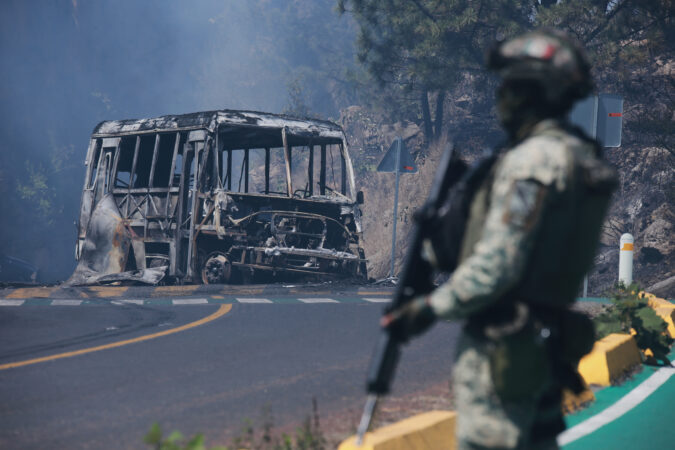
GUADALAJARA, Mexico — Mexico Security Secretary Omar García Harfuch said Monday 25 members of the National Guard were left dead in Jalisco in six separate attacks after the killing of Jalisco New Generation Cartel leader Nemesio Oseguera Cervantes.
Oseguera Cervantes, known as “El Mencho” was the boss of one of the fastest-growing criminal networks in Mexico, notorious for trafficking fentanyl, methamphetamine and cocaine to the United States and staging brazen attacks against government officials who challenged it.
He was killed during a shoot-out in his home state of Jalisco as the Mexican military attempted to capture him. Cartel members responded with violence across the country, blocking roads and setting fire to vehicles.
Also killed were a prison guard, an agent from the state prosecutor’s office and a woman whom García Harfuch did not identify. He also said some 30 criminal suspects were killed in Jalisco and four others were killed in Michoacan.
Several Mexican states canceled school on Monday, with local and foreign governments warning their citizens to stay inside after widespread violence erupted.
President Claudia Sheinbaum urged calm Monday and authorities said all of the more than 250 cartel roadblocks across 20 states had been cleared. The president was expected to address the situation at her daily news briefing Monday morning.
The White House confirmed that the U.S. provided intelligence support to the operation to capture the cartel leader and applauded Mexico’s army for taking down a man who was one of the most wanted criminals in both countries.
Mexico hoped the death of the world’s biggest fentanyl traffickers would ease Trump administration pressure to do more against the cartels, but many remained hunkered down and on edge as they waited to see the powerful cartel’s reaction.
Many fear more violence
The U.S. Embassy said via X that its personnel in eight cities and the state of Michoacan would shelter in place and work remotely Monday and it warned U.S. citizens in many parts of Mexico to do the same.
Cars began circulating in Guadalajara before sunrise Monday with the start of the work week, a notable change from Sunday when Jalisco’s state capital and Mexico’s second-largest city was almost completely shut down as fearful residents stayed home.
More than 1,000 people were stuck in Guadalajara’s zoo overnight, sleeping in buses. On Monday morning. mothers wrapped up in blankets carried their toddlers out of the buses for a much-needed bathroom break as police trucks guarded the area.
Luis Soto Rendón, the zoo’s director, said many had been trapped there since 9 a.m. the day before, when violence broke out in Jalisco and the surrounding states. Families were left stranded, trying to distract their children, as they decided they couldn’t return home in nearby states like Zacatecas and Michoacan.
“We decided to let people stay inside the zoo for their safety,” Soto said. “There are small children and senior citizens.”
Irma Hernández, a 43-year-old hotel security guard in Guadalajara, arrived at work early Monday morning.
She normally takes public transportation to work, but buses were not running and she had no way to cross the city. Her bosses organized a private car to pick her up. Her family, she said, was staying at home, too scared to leave.
“I am worried because I don’t know how to get home if something happens,” she said.
Passengers arriving at the city’s international airport Sunday night were told it was operating with limited personnel because of the burst of violence.
Authorities in Jalisco, Michoacan and Guanajuato reported at least 14 other people killed Sunday, including seven National Guard troops.
Videos circulating on social media Sunday showed tourists in Puerto Vallarta walking on the beach with smoke rising in the distance.
A blow against a cartel could be a diplomatic coup
David Mora, Mexico analyst for International Crisis Group, said the capture and outburst of violence marks a point of inflection in Sheinbaum’s push to crack down on cartels and relieve U.S. pressures.
U.S. President Donald Trump has demanded Mexico do more to fight the smuggling of the often-deadly drug fentanyl, threatening to impose more tariffs or take unilateral military action if the country does not show results.
There were early signs that Mexico’s efforts were well received by the United States.
U.S. Ambassador Ron Johnson recognized the success of the Mexican armed forces and their sacrifice in a statement late Sunday. He added that “under the leadership of President Trump and President Sheinbaum, bilateral cooperation has reached unprecedented levels.”
But it may also pave the way for more violence as rival criminal groups take advantage of the blow dealt to the CJNG, Mora said.
“This might be a moment in which those other groups see that the cartel is weakened and want to seize the opportunity for them to expand control and to gain control over Cartel Jalisco in those states,” he said.
“Ever since President Sheinbaum has been in power, the army has been way more confrontational, combative against criminal groups in Mexico,” Mora said. “This is signaling to the U.S. that if we keep cooperating, sharing intelligence, Mexico can do it. We don’t need U.S. troops on Mexican soil.”
‘El Mencho’ was a major target
Oseguera Cervantes, who was wounded in the operation to capture him Sunday in Tapalpa, Jalisco, about a two-hour drive southwest of Guadalajara, died while being flown to Mexico City, the Defense Department said in a statement.
During the operation, troops came under fire and killed four people at the location. Three more people, including Oseguera Cervantes, were wounded and later died, the statement said.
White House press secretary Karoline Leavitt said via X that the U.S. government provided intelligence support for the operation. “‘El Mencho’ was a top target for the Mexican and United States government as one of the top traffickers of fentanyl into our homeland,” she wrote. She commended Mexico’s military for its work.
The U.S. State Department had offered a reward of up to $15 million for information leading to the arrest of El Mencho. The Jalisco New Generation Cartel is one of the most powerful and fastest-growing criminal organizations in Mexico and began operating around 2009.
In February 2025, the Trump administration designated the cartel as a foreign terrorist organization.
Sheinbaum has criticized the “kingpin” strategy of previous administrations that took out cartel leaders, only to trigger explosions of violence as cartels fractured. While she has remained popular in Mexico, security is a persistent concern and since U.S. President Donald Trump took office a year ago, she has been under tremendous pressure to show results against drug trafficking.
The Jalisco cartel has been one of the most aggressive cartels in its attacks on the military — including on helicopters — and is a pioneer in launching explosives from drones and installing mines. In 2020, it carried out a spectacular assassination attempt with grenades and high-powered rifles in the heart of Mexico City against the then head of the capital’s police force and now federal security secretary.
Philly got its biggest snow in 10 years. This time nature will help with the cleanup.
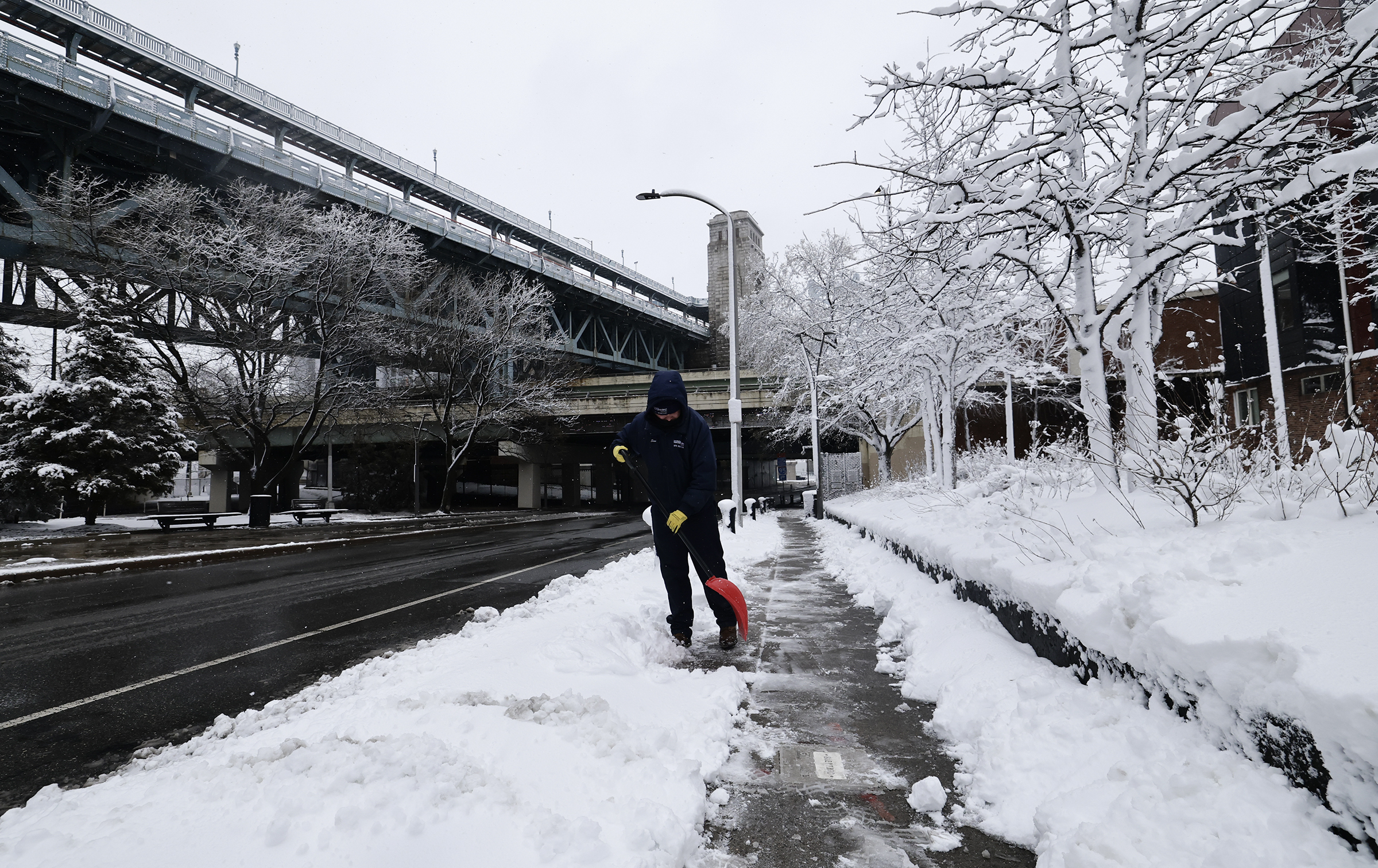
Sean Little of the Delaware River Waterfront Corporation shovels snow along the sidewalks on Race Street on Monday, Feb. 23, 2026.
If it wasn’t an actual blizzard, Philly’s biggest snowfall in a decade sure acted like one, and the weather the rest of this week isn’t expected to be particularly pleasant.
But in terms of disruption — not to mention aesthetics — this was in a wholly different category from the Jan. 25 siege of snow and ice. And the aftermath should not be anywhere near as punitive and burdensome.
Although the 14 inches measured officially at Philadelphia International Airport dwarfed the 9.3 inches of snow and sleet that accumulated in last month’s storm, Zach Schwartz, 33, was among those who found the picturesque snow more palatable than the attack of ice balls and an Arctic freeze.
“The last snowstorm was a tough time for everyone,” said Schwartz, who was at a Point Breeze playground helping a friend build an igloo for their kids, “and I think the city was kind of in shock a little bit.”
Philadelphia’s Office of Homeless Services said the city would maintain several 24-hour warming centers through Wednesday morning to help people stay out of the cold.
The city is already in a Code Blue, which is declared when precipitation is falling and temperatures are 32 degrees or lower, or when temperatures feel close to or below 20 degrees due to the wind chill.
During a Code Blue, the city sends outreach teams out 24 hours a day, looking for people without shelter and taking them inside. The designation also opens up 50 shelter beds, in addition to about 3,400 shelter beds available during the winter. Residents in emergency housing are also allowed to stay inside all day. (Some shelters require residents to leave in the morning and return at night.)
An “enhanced Code Blue” is declared when Code Blue conditions persist for three days, and the city opens up warming centers that offer a place to sit out of the cold, usually in libraries and rec centers. Some people experiencing homelessness who are wary about entering shelters opt for less-restrictive warming centers.
The city has not declared an enhanced Code Blue for this storm, but announced Sunday afternoon that it had planned to open warming centers at least overnight.
On Monday afternoon, OHS’s Instagram account posted an updated list of warming centers that will stay open until 9 a.m. Wednesday. The following centers are already open unless otherwise noted:
Pelbano Recreation Center, 8101 Bustleton Ave. (opens at 9 p.m. Monday)
Hub of Hope, 15th Street and John F. Kennedy Boulevard (enter at the 15th Street trolley station entrance in Dilworth Park)
Appletree Family Center, 1430 Cherry St.
Prevention Point, 2913-15 Kensington Ave.
Kensington Wellness Support Center, 265 E. Lehigh Ave.
Samuel Rec Center, 3539 Gaul St.
People who see someone on the streets in need of shelter, or who need shelter themselves, can call the city’s homeless outreach hotline at 215-232-1984.
Warmer weather is helping Philly’s cleanup, but so are lessons from the last storm
Mother nature’s above freezing temperatures largely aided Philadelphia’s snow removal operations Monday, but the city also adjusted its response after the prior storm cleanup left many residents chockfull of complaints.
Director of Clean and Green Initiatives Carlton Williams said the city secured three snow melters instead of just one, with two already on the road Monday, despite the much shorter notice of the storm.
“They’re located throughout the city of Philadelphia, because quite frankly, from the last storm, we are running out of places to place snow,” said Williams in a news conference, referring to the dozens of snow drop off sites, such as the Navy Yard. “We needed to be able to put it in a location where it doesn’t have to sit in somebody’s neighborhood.”
The city also added snow blowers to the mix of machines clearing the area around City Hall, said a city spokesperson.
The softness of the snow, compared to the hardened sleet from the last storm, has made it easier for the smaller snow clearing equipment to double back and tackle ADA ramps and crosswalks after the last bit of snow fell, according to the mayor’s office.
Even so, the city is slated to deploy crews of same-day-pay workers to manually shovel crosswalks, SEPTA stops, and ADA ramps that are hard to reach by machines as early as Tuesday.
The deployment of these reinforcements comes at a much faster clip than the previous storm, where some 300 additional workers helped chip away at persistent ice by hand more than a week after the snow fell.
Lee Paul and her puppy, Chay, check out the snow Monday near their Wayne Avenue apartment.
Lee Paul, 36, was not ready to step out of her Wayne Avenue apartment complex in the middle of a blizzard. But her four-month-old puppy had other plans.
“I had to take Chay to go to the bathroom,” said Paul, hands in her pockets and dreading the cold.
She hates winter, but is happy that living in a building meant no shoveling was in her future.
For Chay, this is all a new experience. He was thrilled to jump around in the snow, bury his paws over and over again, and catch tiny flakes with his nose for more than 10 minutes.
SEPTA resumes most services but Regional Rail remains suspended
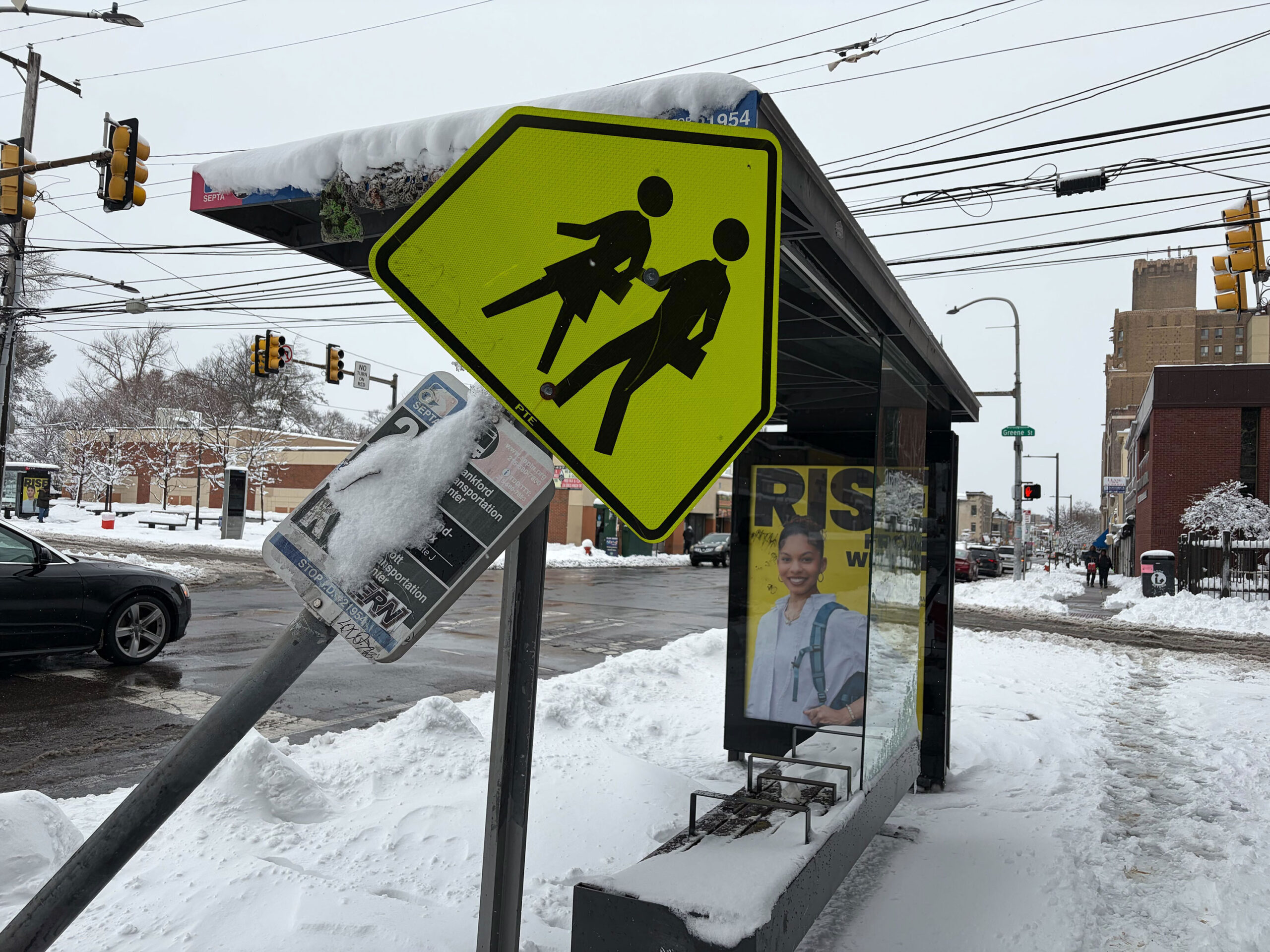
SEPTA bus stops, like this one in Germantown, sat empty most of Monday.
SEPTA has reopened its Center City trolley tunnel, and resumed service on more than 20 of its bus routes. However, Regional Rail service remained largely suspended as of Monday afternoon, SEPTA general manager Scott Sauer said.
“We’re hoping to have some Regional Rail service restored later this afternoon,” Sauer said Monday. “But I will caution: We will not be on a regular schedule.”
Just before 3 p.m., the agency restored operations on its Manayunk/Norristown line, a representative said.
The transit agency had inspectors and inspection trains working along Regional Rail lines evaluating them for any hazards, but their resumption was not immediately clear Monday afternoon. Sauer encouraged riders to follow SEPTA’s app and website for service updates as storm cleanup progresses.
“SEPTA has nearly 300 Regional Rail and metro stations, most with a variety of platforms and infrastructure, so we are working to clear those in the best effort possible,” Sauer said.
About 30 track inspectors were working to inspect SEPTA infrastructure, and roughly 700 in-house employees were working to clear the authority’s property of snow and other hazards, including downed trees. Sauer added that SEPTA has utilized “many, many tons” of rock salt to combat ice, and employed the use of all of its available heavy equipment to aid in cleanup.
“We’ve made service adjustments, and now it’s back to restoration,” Sauer said. “But all while keeping an eye on safety for both our customers and our employees.”
Light snow is possible Tuesday night. More next week?
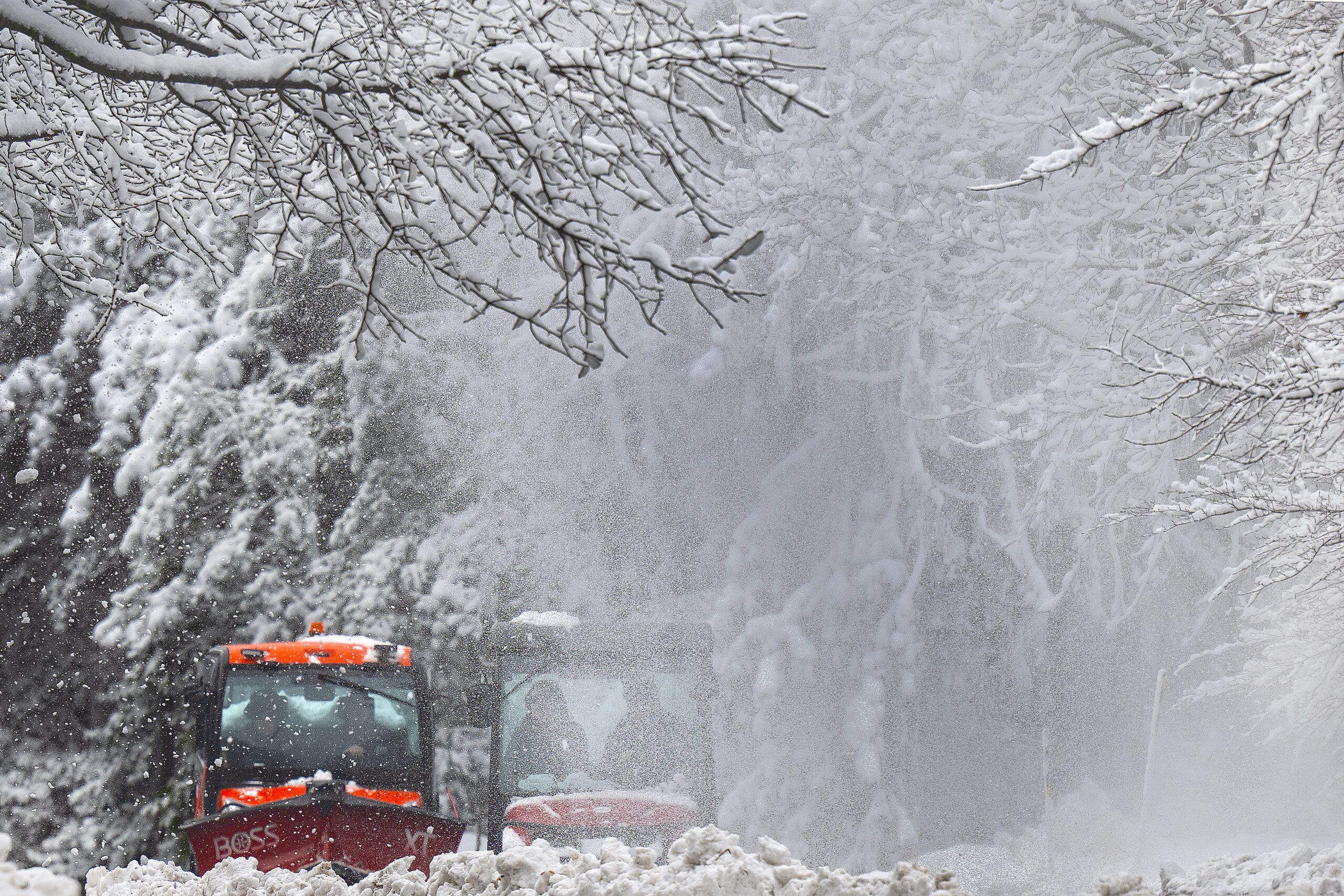
Snow removal vehicles plow at Swarthmore College Monday.
It won’t be a big deal, but a round of light snow is possible late Tuesday night and/or early Wednesday as a weak “clipper” system approaches from the west.
While temperatures on Tuesday will struggle to reach freezing and fall into the 20s at night and, thus, cold enough for snow, it shouldn’t accumulate more than an inch in the Philly region, forecasters say.
It will warm into the 40s on Wednesday, and given the strength of the February sun it should be a decent melting day.
More light precipitation, perhaps a mix of rain and snow, is possible Thursday, but that should be followed three consecutive dry days ,with high temperatures in the 40s to low 50s.
Another batch of chiller air could arrive in time for a storm to produce more snow early next week, said Tom Kines, senior meteorologist with AccuWeather Inc. But, yes, it’s way, way early.
At least by then, most of what fell Sunday and Monday should be liquefied.
Kines warned that in the meantime temperatures the next few nights are going to fall below freezing, turning some of that daytime melt into ice.
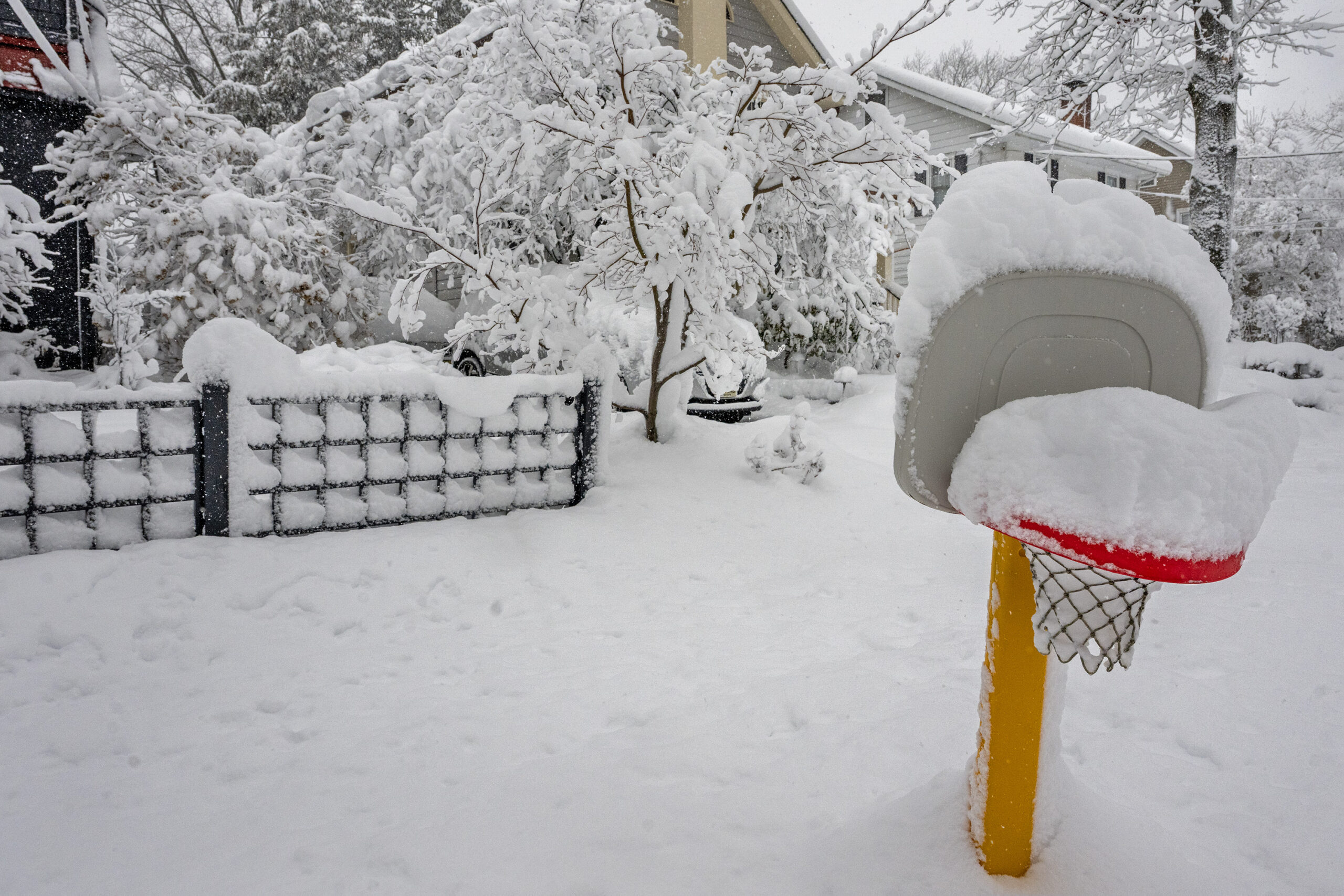
Snow fills a child’s basketball hoop in Haddonfield Monday.
More than 130,000 households across the Philadelphia region lost power last night due to the snowstorm.
Philadelphia households have mostly recovered from power outages on Monday, according to Peco, with only 213 active outages this afternoon.
South Jersey still has around 75,000 households currently without power, according to Jersey Central Power and Light, but that number has slowly decreased since this morning.
Outages in Atlantic City are still higher than they were this morning with 2,804 active outages, up from 1,892 around 7 a.m., according to Atlantic City Electric. Last night, more than 50,000 residents in Atlantic City lost power.
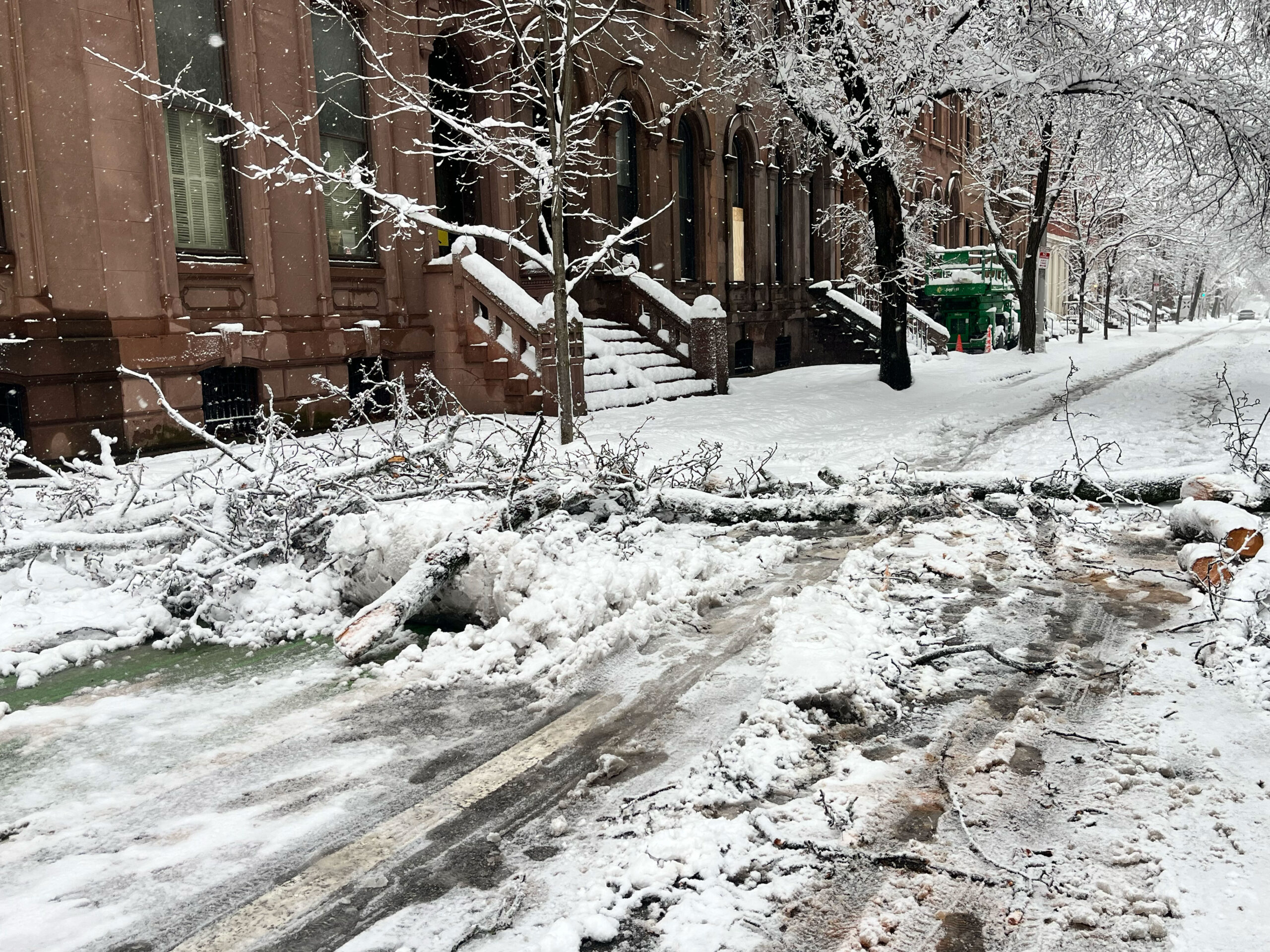
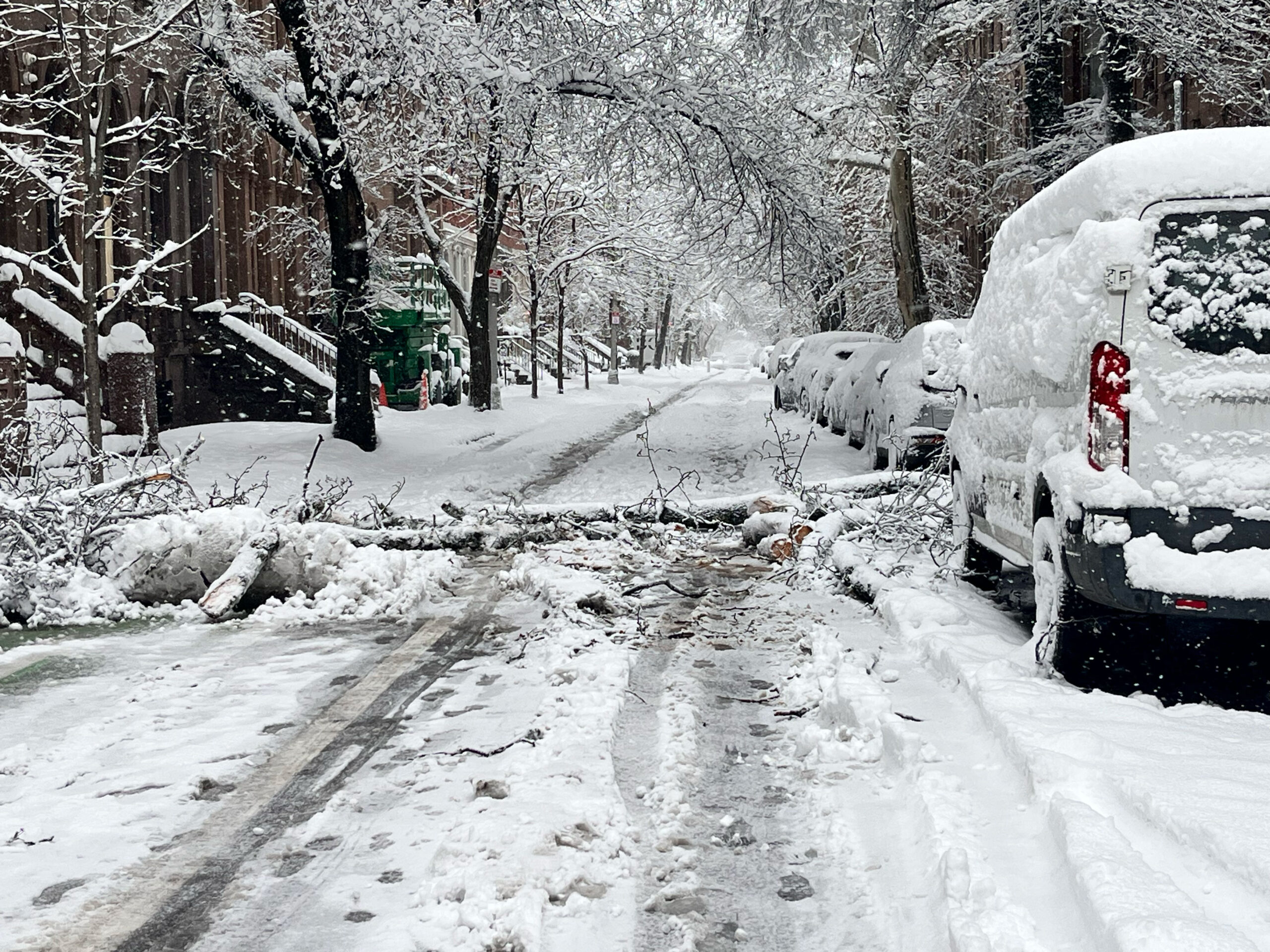
Wet snow brought down trees in Rittenhouse Square Monday.
At least 87 tress across the city were downed as a result of the storm as of Monday afternoon, and the city is working to determine which ones to prioritize clearing first, Parks and Recreation commissioner Susan Slawson said.
“We have four certified arborists that are actively inspecting reports of fallen trees to determine priority for clearance,” Slawson said Monday. “Everything is not a priority.”
Slawson asked for patience from city residents as the department works to clean up downed trees, and noted that some situations involving live wires require additional caution and coordination. Fallen trees blocking roadways, or those that have fallen on houses or cars, should be reported to 911, while those impacting power lines should be reported to Peco.
While the number of downed trees may rise in the immediate aftermath of the storm, Slawson said she expects officials will continue to monitor the situation in the coming weeks and months. Longer-term implications, she cautioned, are possible.
“This moisture, this snow, is going to continue to [have an] affect,” Slawson said. “Early on in the spring, we may continue to see trees come down, and it’s a direct result of all the storms that we’ve had.”
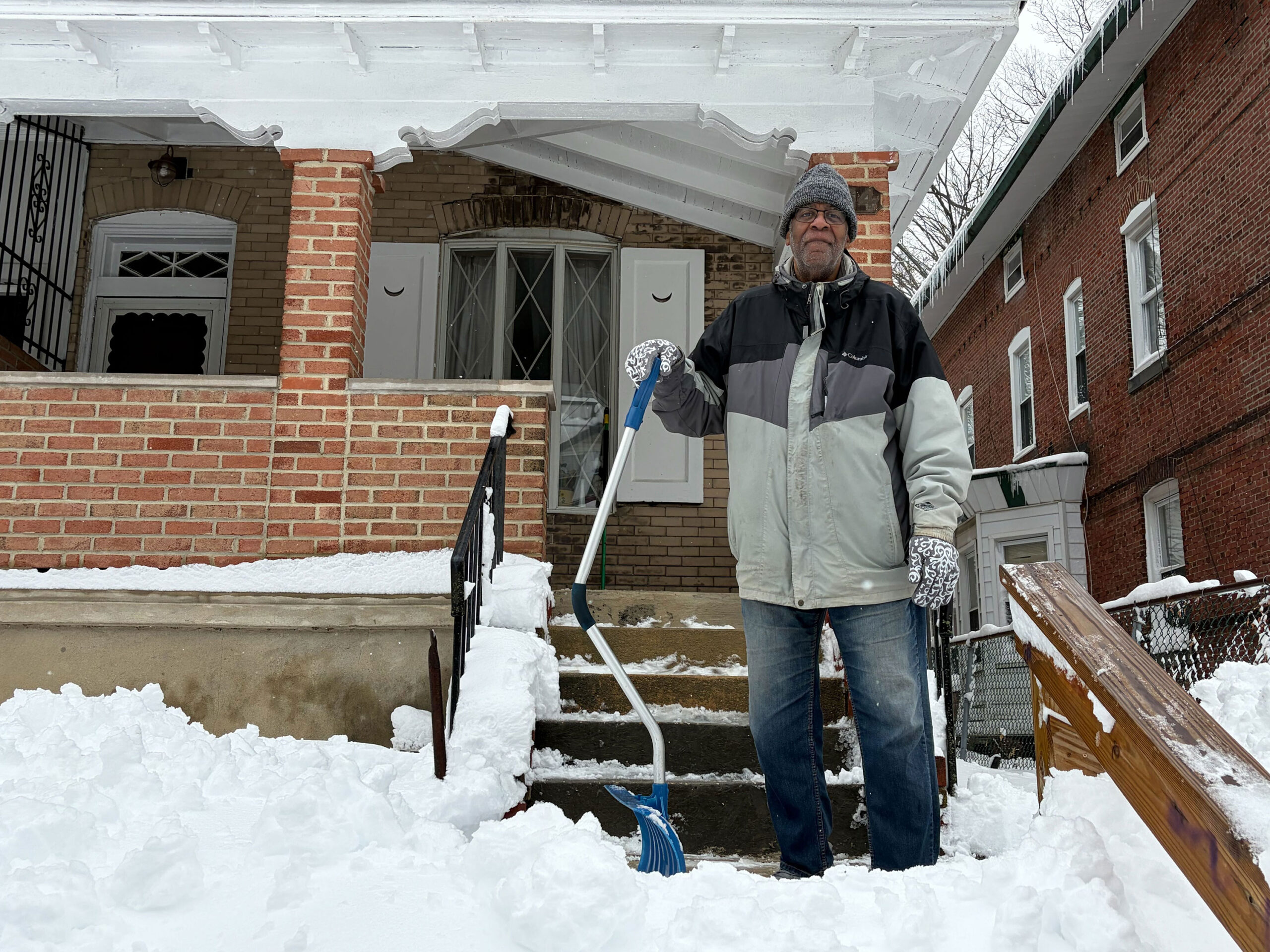
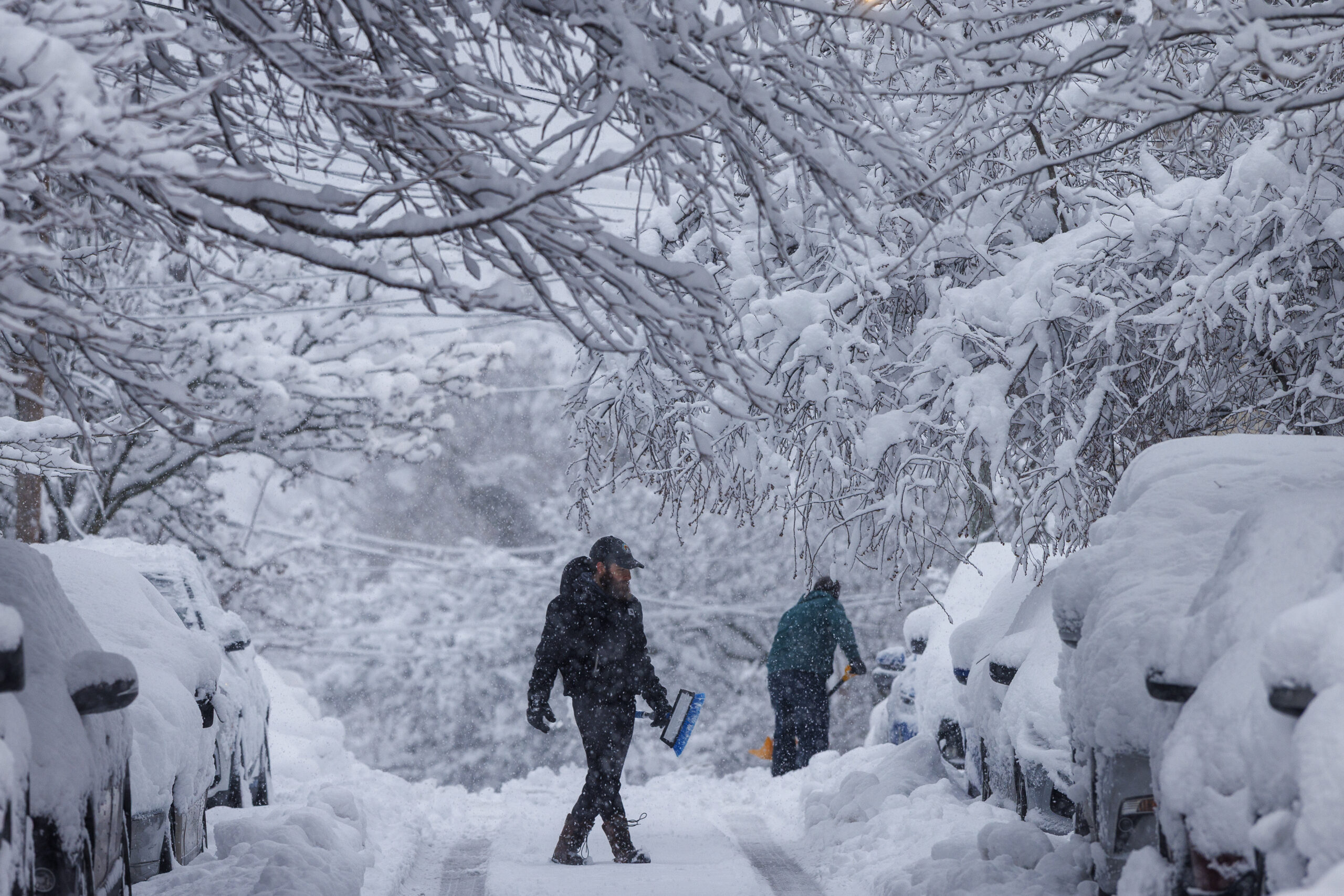
Ronald Barnard works to shovel outside his Coulter Street home in Germantown Monday.
Ronald Barnard has been shoveling outside his Coulter Street home for two hours. At 69, snow clean up requires twice the effort, he said.
“It’s just a lot,” Barnard said pointing to the surrounding unplowed sidewalks and ice covered road. “This snow is easier to push than the snow in January, but it’s more than I expected for sure.”
He likes doing the clean up himself. But when neighbors offer to help, he takes the chance to reminiscent about a better time, when “the city used to give us salt and even plow the two way street, but times have change.”
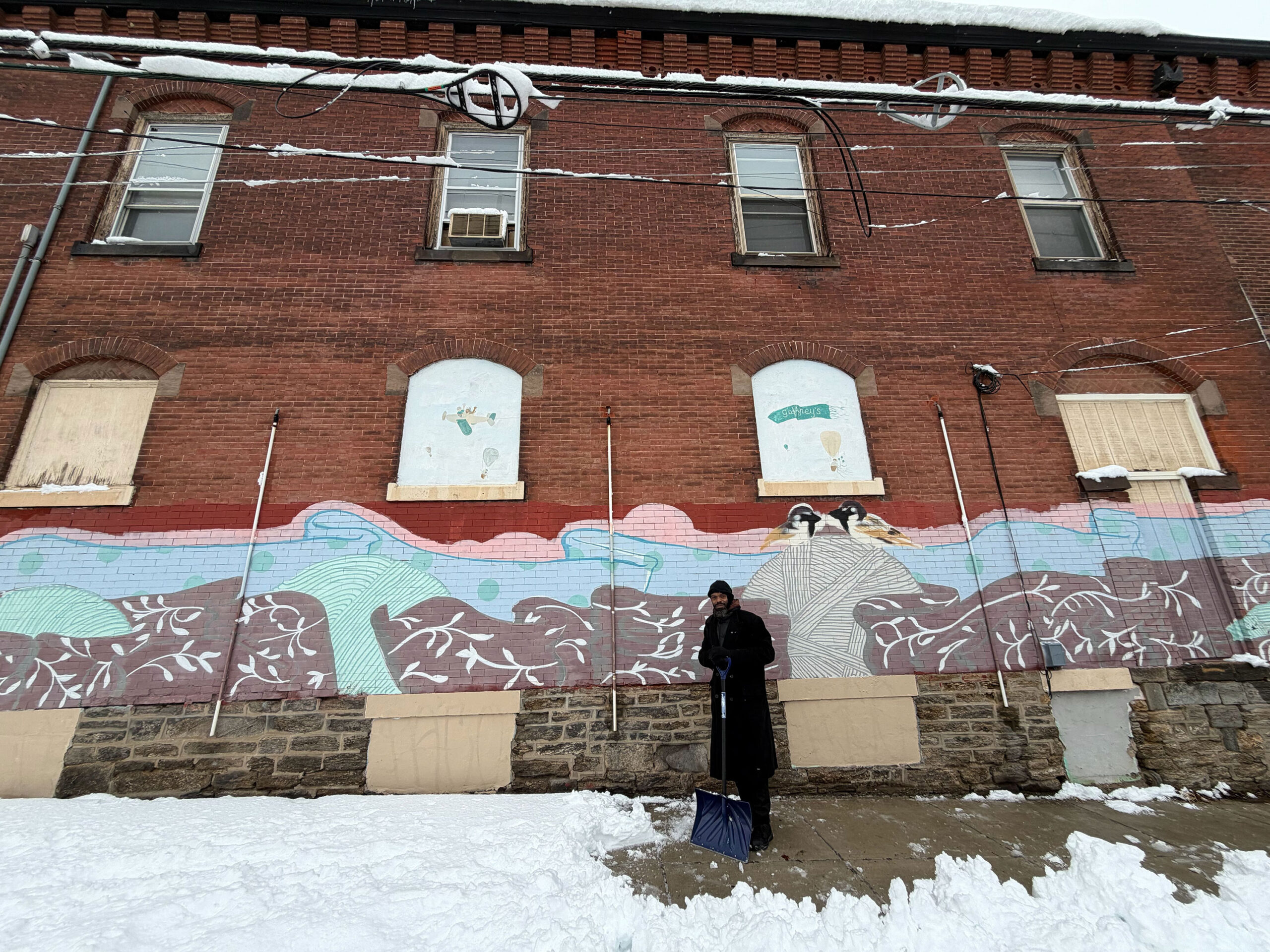
El Zahur shovels the sidewalk outside his Germantown property Monday.
A block down Germantown Avenue, El Zahur, 42, is having an easier time. City plow trucks have been driving by all morning, making the street clean.
“The administration dropped the ball last time, but she made out for it this time,” Zahur said, referring to Mayor Charelle L. Parker. “Before, the trucks were driving around with their plows up, but now they are doing a good job actually removing the snow.”
Regardless, he is still responsible for his corner property sidewalks, which proved to be a bit of a hazard.
“I have managed to stay out of the way from falling things,” Zahur said, as some snow rapidly fell off the roof into the sidewalk. “I don’t want nothing falling on me from three stories above.”
Weather Service cancels blizzard warnings for Philly and across the region
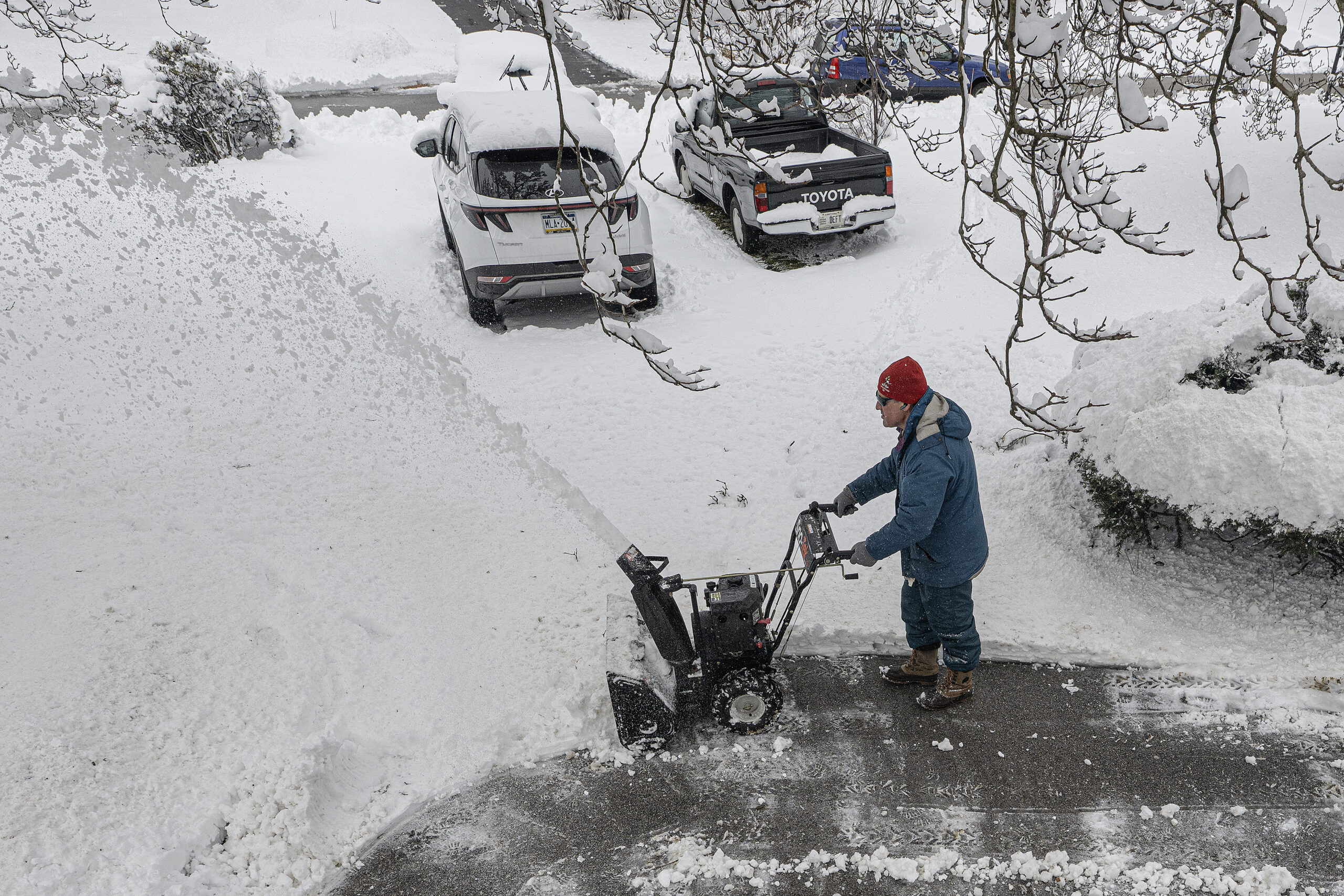
Mike Ouellette plows his driveway with a snow blower in Wallingford Monday.
The National Weather Service has taken down the blizzard warnings for the region.
While strong winds and blowing snow are likely to persist, the threat of blizzard conditions has diminished, said Nick Guzzo, meteorologist at the National Weather Service Office in Mount Holly.
The warning had been scheduled to expire at 6 p.m., but snow has moved out of the area, and overall visibilities and conditions have improved
Philly snow emergency remains in effect, no word yet if schools will reopen Tuesday
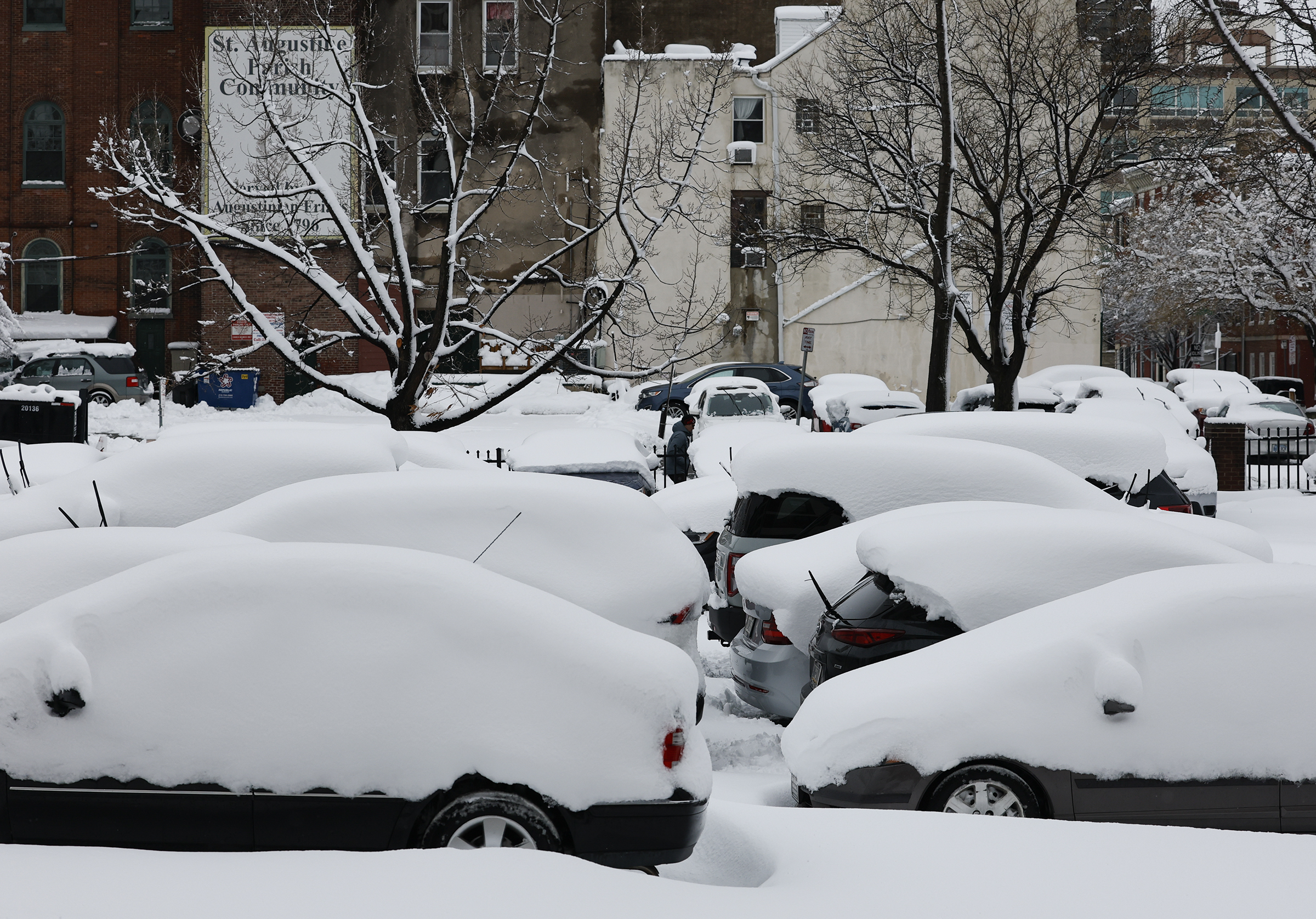
Snow topped cars sit in a Old City apartment parking lot Monday.
Mayor Cherelle L. Parker said at a Monday afternoon news conference it remained too early to determine when the city’s snow emergency could be lifted, but officials hoped to have an update on the resumption of city operations later in the day.
In the meantime, Parker added, city residents should avoid unnecessary travel until further notice to allow crews to continue to clear the more than 2,500 miles of roadways in Philadelphia. Roughly 65% of streets had been treated in some way as of Monday afternoon — plowed, salted, or lifted, or some combination of the three — director of Clean and Green Initiatives Carlton Williams said.
“When there are fewer cars on the street, we give our crews more flexibility to do the job that we are asking them to do,” Parker said.
At the height of the storm, the city employed more than 800 pieces of equipment and about 1,000 workers to aid in snow removal, and that number “is still continuously growing,” Williams said. Workers will assist with the clearing of curb cuts, ADA ramps, and areas around schools, among other spaces, as cleanup efforts continue, he added.
“We will continue to focus on those areas so that all pedestrians and motorists will have safe and accessible walkways,” Williams said.
Officials expect to release additional information about Tuesday’s city services and school operations around 6 p.m., Parker said.
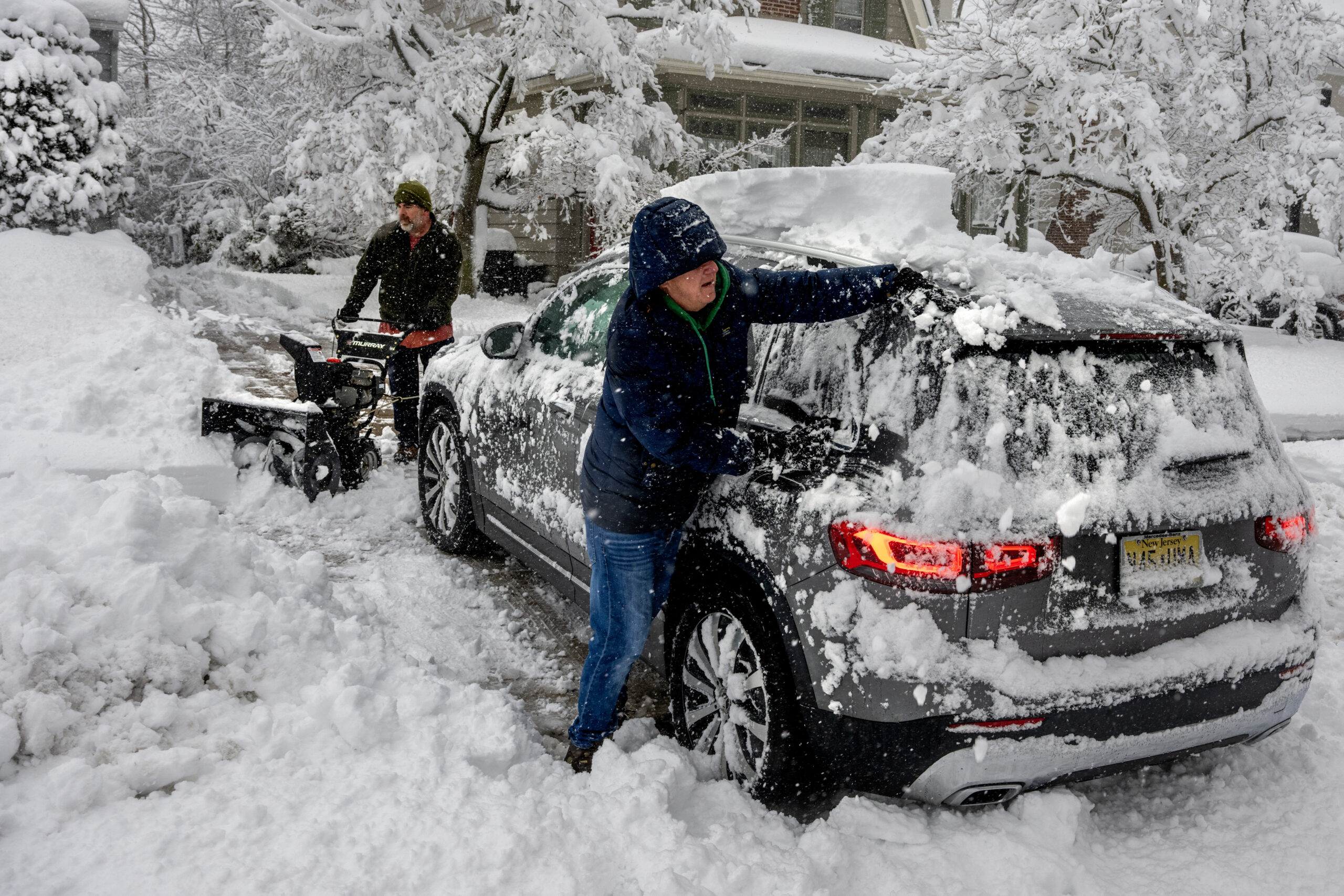
David Holmes cleans the snow off of his car as neighbor Bill McKean (rear) snow-blows the driveway in Haddonfield Monday.
The New Jersey Office of Emergency Management has announced that the mandatory travel restriction, which began at 9:00 p.m. on Sunday and was extended until noon Monday, has been lifted.
Officials nonetheless “strongly encouraged” motorists to avoid unnecessary travel as hazardous conditions remain in parts of New Jersey, according to a release from the state police.
“Some roadways remain snow-covered, visibility is limited in some areas, and crews continue working to clear roads and restore safe travel,” the release said.
Nicole Swinson looks into a snowy Penns Landing Monday.
Philadelphia hasn’t experienced a verified blizzard in 33 years, and it remains unclear whether this Sunday-Monday snow fest qualified for the honor.
According to NOAA guidelines, a blizzard requires “frequent winds of 35 mph or higher with considerable falling and/or blowing snow that frequently reduces visibility to 1/4 of a mile or less. These conditions are expected to prevail for a minimum of 3 hours.”
That’s a lot to ask for a snowstorm, and it is going to take considerable forensic work of poring through observations to determine whether those conditions were met in Philadelphia or elsewhere in the region, said Nick Guzzo, a meteorologist at the National Weahter Service Office in Mount Holly. (Incidentally, 20 inches of snow were measured on the office’s property.)
The last certifiable blizzard in Philly occurred on March 13, 1993. That one closed down the Philadelphia Flower Show.
Meteorologists were confident that the conditions were met during the record 30.7-inch snowfall of Jan. 7-8, 1996, however they weren’t officially verified in the city.
With or without a label, this was one impressive storm.
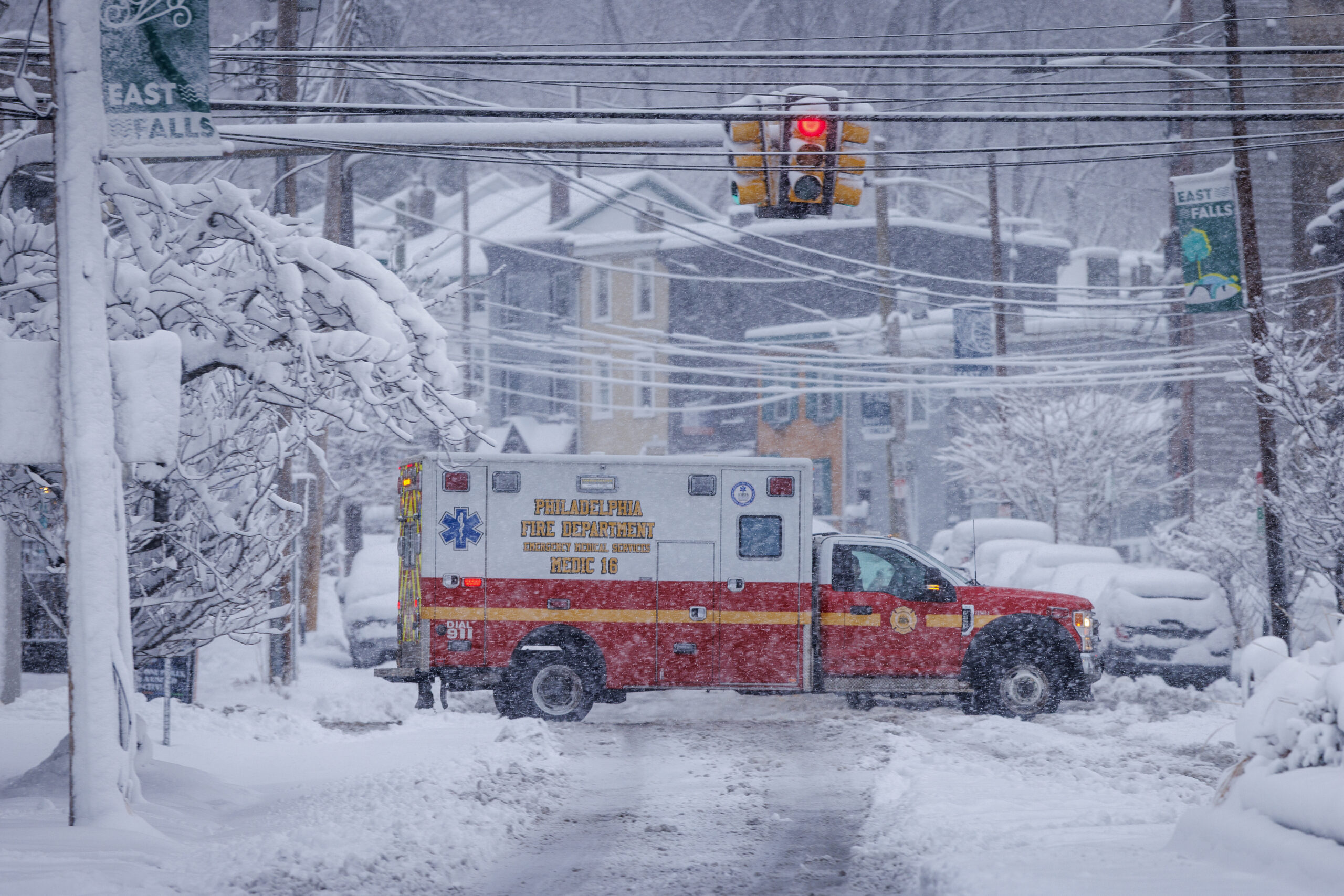
A Philadelphia Fire Department ambulance drives along Ridge Avenue at Midvale on Monday.
Light snow is lingering in the Philly region and could continue into the afternoon, but no additional accumulation is expected.
“What’s done is pretty much almost done,” said Amanda Lee, meteorologist at the National Weather Service in Mount Holly, where 18 inches was measured Monday morning.
The potent coastal nor’easter that clocked South Jersey and areas along I-95 and generously layered several inches of snow throughout Philly’s neighboring counties in Pennsylvania is pulling away.
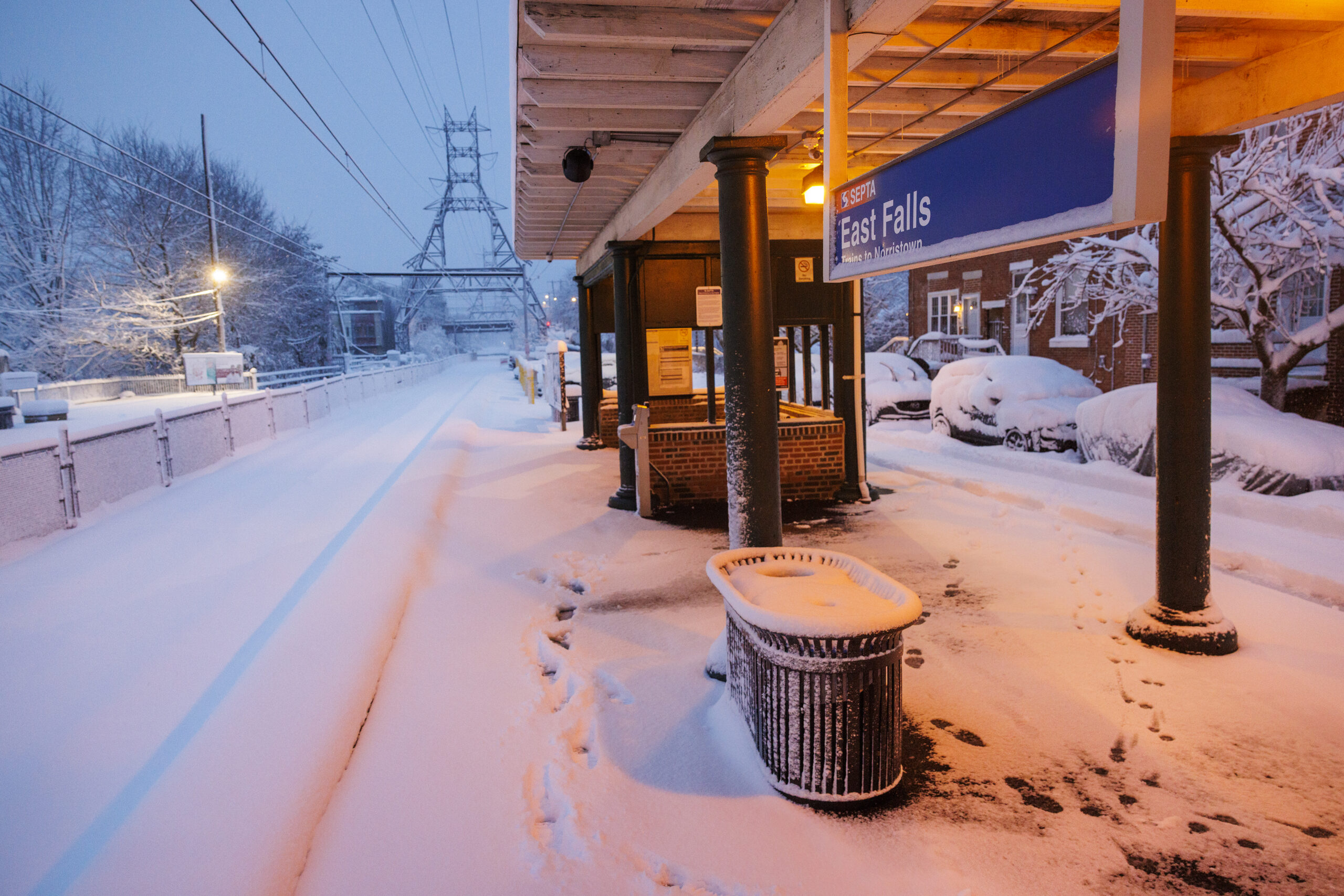
Snow covered tracks at SEPTA’s East Falls Station along the Norristown Regional Rail.
Almost all SEPTA services, besides some subway services, were temporarily suspended Monday due to the storm. But some are beginning to come back online.
Bus service is in the process of being restored as streets are cleared, the agency said.
The Center City Trolley Tunnel has reopened. The D and M lines are running on a modified service schedule, while Route G remains suspended.
Regional Rail remains suspended until safety inspections are complete. If Regional Rail service returns, it will follow a Saturday schedule.
The Broad Street Line (B), Market-Frankford Line (L), and Media-Sharon Hill Line (D) are operating as normal with some delays and cancellations.
The Norristown High Speed Line (M) is running but only operating between the 69th Street Transit Center and Radnor Station.
South Philadelphia is loving the winter wonderland
Zach Schwartz builds an igloo in Wharton Square Park Monday.
Fresh powdery snow, perfect for snowballs, blanketed Wharton Square Park in South Philadelphia after Sunday night’s snowstorm. Laughter from the playground, shovels scraping concrete, and snowmen slowly rolling into form took over the park on Monday morning.
Two men in particular came with a mission: to build an igloo for their kids. Zach Schwartz, 33, and Josh Feist, 33, of Point Breeze shoveled a path to the playground, piling up a more than five-foot snow pile. Feist, who is a mason, helped stabilize the frame while Schwartz carved out the inside.
“We have a really close crew of families in the neighborhood, so we’re here at the park like every day, no matter what. With the snow, we just have more fun things to do,” Schwartz said, who has lived in Philly since 2016. In recent memory, this storm had some of the most snowfall, Schwartz said, but that it doesn’t compare to the frozen snow of last month.
“The last snowstorm was a tough time for everyone, and I think the city was kind of in shock a little bit,” Schwartz said.
Samantha Schranck and John Gabel were out walking their dog enjoying the warmer temperatures compared to last snow storm. “I already had a day off, so I’m going to be a kid again and treat it like a snow day,” Schrank.
While snow removal is a much easier task this time around with snow that Gabel said is less frozen and easier to pick-up, the couple is hoping city streets and trash service are up to par this week.
“I’m very curious to see how the city clears the streets this time because it was a mess and took a long time in our neighborhood to clear snow from streets and take care of the trash build up,” Schranck said.
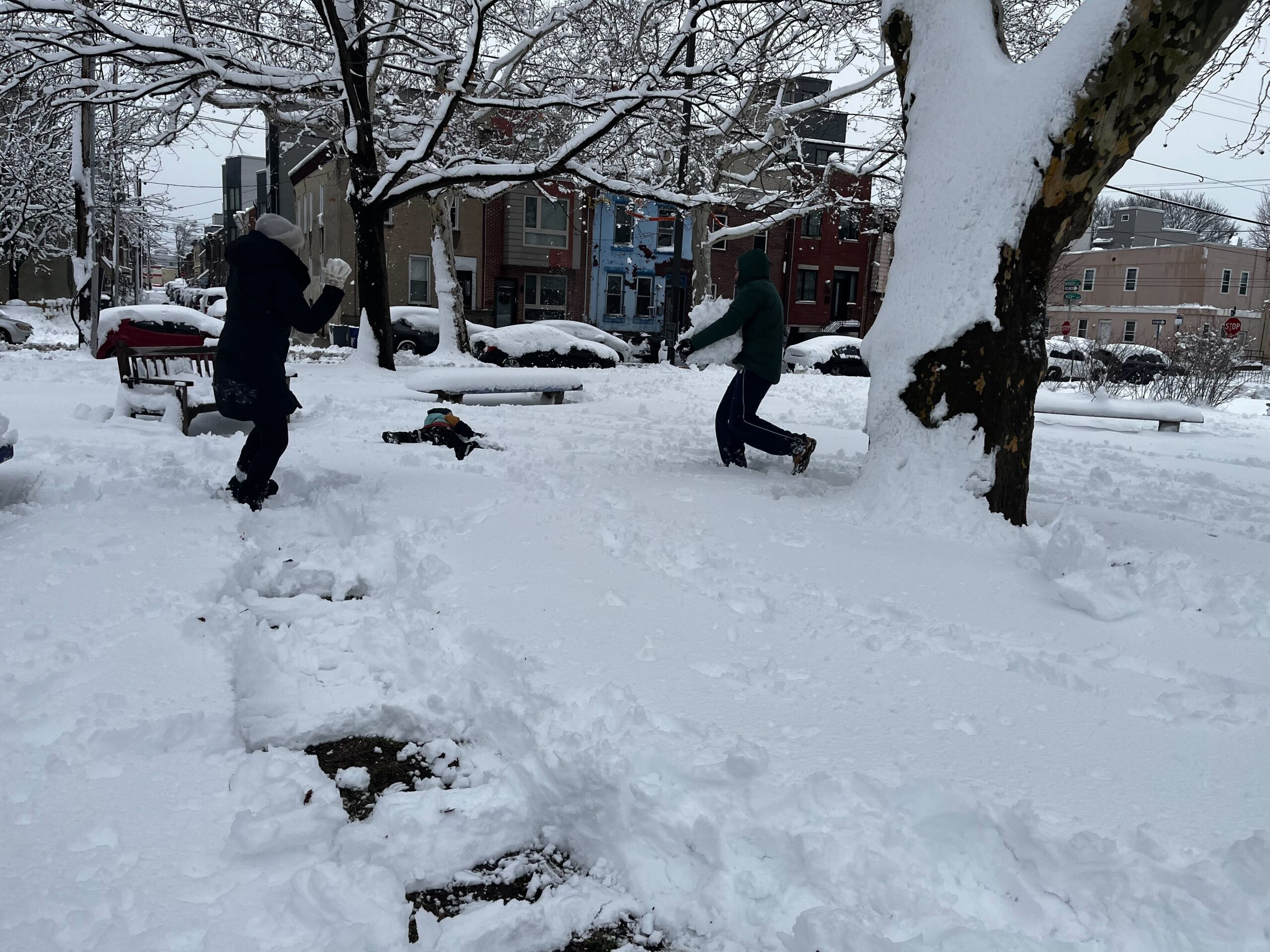
Sonia Odenthal (lft) throws a snowball at her son, Finn, while her husband Eric carries a giant snowball in Wharton Square Park Monday
On the other side of Wharton Square, Sonia Odenthal was having a snowball fight with her husband, Eric, and son, Finn. Despite trekking through the snow with a broken foot wrapped in a boot and water-proof bags, Odenthal couldn’t get enough of the snow.
“I’m Russian so this feels like home,” she said. “Even with a broken foot, I don’t care, I’m still out here. I love the snow.”
Philly’s snow accumulation is very reminiscent of her homeland, Sonia said, however, the temperature is much more reasonable. “A couple weeks ago when it got cold was very similar to home,” she said.
The trio will usually come to the park on snowy days for snowball fights or rolling snow into gigantic three-foot-high balls. The only thing missing in South Philadelphia is a good sledding hill, the Odenthal’s said.
Museums across the Philly region close due to snow
A griffin on the roof of the northern wing of the Philadelphia Art Museum.
Several major Philadelphia arts institutions have announced closures due to emergency weather.
Early Monday, the Philadelphia Museum of Art, the Franklin Institute, Philadelphia’s Magic Gardens, and Calder Gardens announced closures on their social media accounts.
The PMA said it’ll reopen on Tuesday.
The Mütter Museum, Rodin Museum, the Museum of the American Revolution, Independence National Historical Park, Otherworld Philadelphia, National Liberty Museum, the Independence Seaport Museum, have also announced closures.
Per their usual hours of operation, the National Constitution Center, Eastern State Penitentiary, Penn Museum, the Fireman’s Hall Museum and others are closed on Monday.
Multiple sections of the New Jersey Turnpike closed due to numerous accidents
Multiple sections of the New Jersey Turnpike are experiencing major delays and closures after a series of accidents Monday morning amid whiteout conditions.
Gov. Mikie Sherrill extended a travel ban through noon, citing visibility issues, though those restrictions exclude the Turnpike and essential workers.
In an interview with Fox 5 New York early Monday, Sherrill said plowers were “down to pavement” on the Turnpike.
Still, throughout the early morning, reports of disabled vehicles, cars spinning out of control, and crashes have lit up the state’s 511 map, which provides real-time traffic updates.
Around 8:20 a.m. a southbound tractor trailer jack-knifed along entrance ramp interchange 8A-NJ32 in South Brunswick, leading to an all-lane blockage.
Shortly after 9 a.m. two crashes, minutes apart, played out in inner turnpike roadways in Carteret. First a northbound vehicle crashed north of Interchange 12, leaving one of three lanes blocked. Shortly after, a southbound vehicle crashed along Interchange 12. As of 11:15 a.m., all lanes were blocked.
At around 10 a.m. a southbound vehicle spun out south of Interchange 8A-NJ32 blocking one of three lanes.
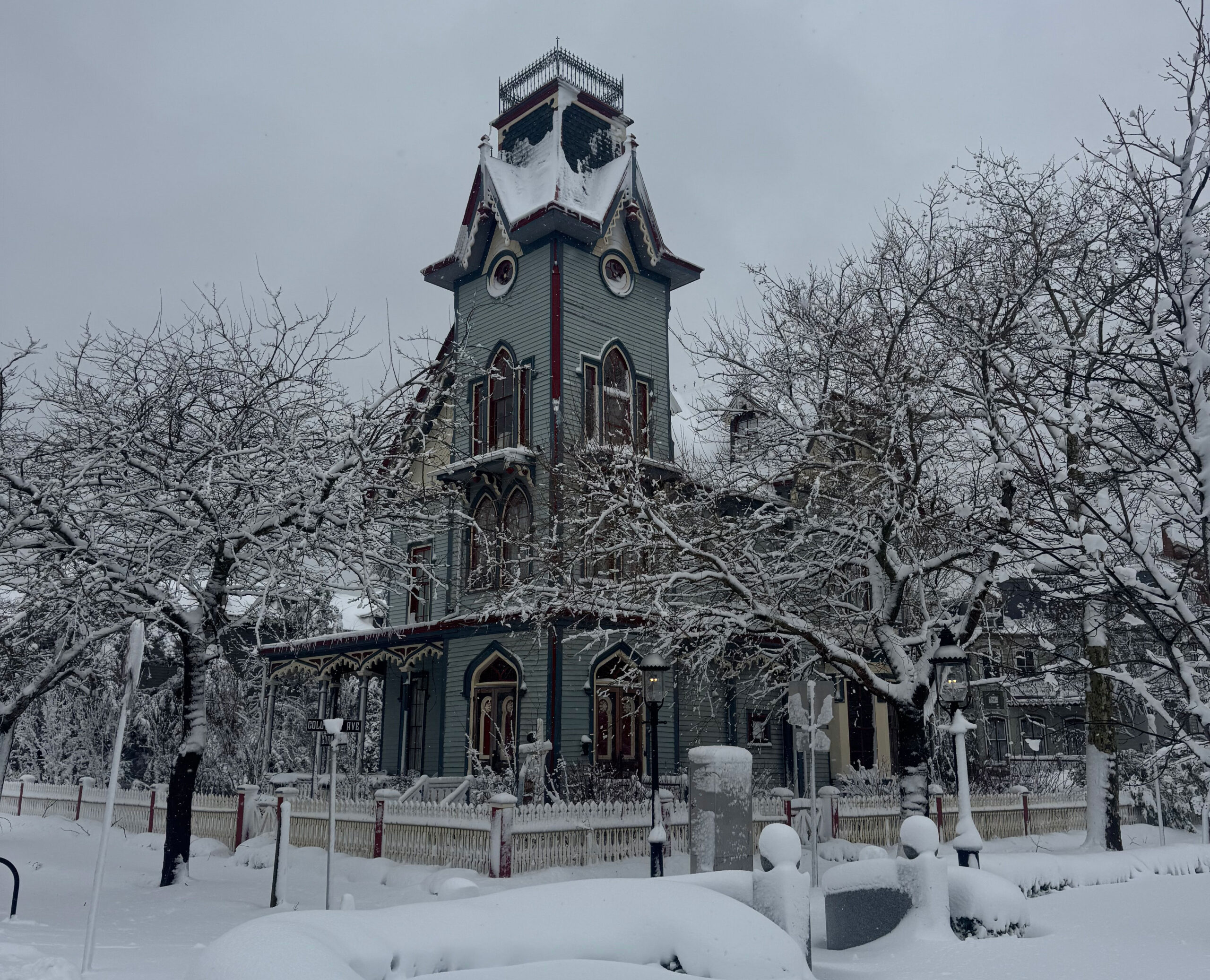
Cape May Mayor Zack Mullock said his coastal city of Victorian homes “looks beautiful” covered in the foot of snow that had fallen by Monday morning.
“It looks like a snow globe,” he said.
“We had a good amount,” Mullock said, speaking by phone, from atop a tractor, which he said he was using to help plow out some neighbors. “There’s a few individual homes where a tree took a power line. The tides were ok. We were a little nervous about that. Overall, I would say things are pretty good.”
He cautioned his residents about shoveling themselves. “We have a lot of elderly in Cape May who shouldn’t be shoveling.”
Updated snowfall totals from across the Philadelphia region
Residents of W. Stanton, Philadelphia clearing snow from cars and sidewalks Monday.
More than a foot of snow fell overnight across the Philadelphia region, though the Jersey Shore was hit hardest by a powerful winter storm that was still dropping heavy snow Monday morning.
Due to heavy snow bands, the totals varied widely. Ten inches of snow were recorded in Boothwyn Monday morning, while 15 inches dropped overnight in Mount Ephraim, Camden County.
Officially, 13.7 inches fell at Philadelphia International Airport as of 7 a.m.
window.addEventListener(“message”,function(a){if(void 0!==a.data[“datawrapper-height”]){var e=document.querySelectorAll(“iframe”);for(var t in a.data[“datawrapper-height”])for(var r,i=0;r=e[i];i++)if(r.contentWindow===a.source){var d=a.data[“datawrapper-height”][t]+”px”;r.style.height=d}}});
Here are the latest snowfall totals from the National Weather Service, measured by trained spotters or observed by the service itself:
Philadelphia
Philadelphia International Airport: 13.7 in (7 a.m.)
Cape May County hospital lost power briefly overnight
Cooper University Hospital Cape Regional in Cape May Court House lost power overnight in the storm “for a very short period of time” and reverted to its back up generators, said Cooper Health spokesperson Nancy Marano.
“It was fully on back-up emergency power so no services were lost,” she said.
Some Camden residents must boil water due to water main break
A water main break may pose a threat to the water quality in Camden Monday morning, American Water Contract Services said. As a precaution, some areas of Camden are under a “boil water” advisory while crews assess the water supply.
The water main break occurred at Ninth and Jefferson Streets on Sunday night. In response, American Water was advising all residents living between Ferry Avenue and Collings Road in Camden, which includes the Fairview, Morgan-Village, and Centerville neighborhoods, to not drink or use tap water until further notice.
The advisory will remain in effect until repairs are complete and water quality is tested to be safe.
Instead, residents should use bottled water or bring tap water to a rolling boil for at least one minute and let it cool before using, according to American Water. Boiling water kills bacteria that could be found in the water.
Boiled or bottled water should be used for:
Drinking
Preparing Foods/Cooking
Mixing baby formula
Washing vegetables/fruits
Making Ice
Brushing teeth
Washing dishes
Affected residents should throw away uncooked food, beverages, or ice cubes made with tap water on Sunday night or today. American Water also cautioned residents to not swallow water when showering or bathing.
The following measures are also recommended:
Rinse hand-washed dishes with a diluted bleach solution (one tablespoon of household bleach per gallon of tap water) or clean your dishes in a dishwasher using the hot wash cycle and dry cycle.
Do not use home filtering devices in place of boiling or using bottled water; most home water filters will not provide adequate protection from microorganisms.
Use only boiled water to treat minor injuries.
Provide pets with drinking water that has been boiled (and cooled).
With an official snowfall of 13.7 inches measured at Philadelphia International Airport, the city’s seasonal total bumped to 29.8 inches.
Among the 142 winters in the period of record, this one now is tied for 27th place, and also is the snowiest since 2018.
You may have noticed snow has been scarce in recent winters, and this also will be the first one since 2021 with snowfall above the normal, which is 23.1 inches.
Historically, totals have ranged radically from 78.7 inches in the historic winter of 2009-10 to nothing in the winter of 1972-73.
Photos: Heavy snow and wind bring down trees in Rittenhouse Square
Wet snow brought down trees in Rittenhouse Square in Philadelphia Monday. Several trees around Rittenhouse Square were taken down by the storm.
// Timestamp 02/23/26 9:08am
Amtrak cancels more than 30 trains, Keystone Service to resume at noon
Amtrak canceled more than 30 trains on its Northeast Regional and Acela train lines on Monday morning due to the snowstorm. Keystone Service has been suspended until at least noon.
Alerts went out at 4 a.m. announcing a slew of cancellations and advising riders to book the next available train. Amtrak will notify impacted customers directly. Customers whose trains are cancelled can rebook or request refunds, without penalties, on Amtrak.com, through the Amtrak mobile app, or by calling the Amtrak Care Center at 1-800-USA-RAIL.
Amtrak will operate 55% of planned service Monday on the Northeast Regional rail service, 33% of planned Acela trains, and half of the planned trains on the Keystone Service trains, when it returns at noon.
Northeast Regional carries thousands of passengers every day with Philadelphia and New York among some of the leading destinations, and the William H. Gray III 30th Street station among Amtrak’s busiest in the country.
‘Storm of a generation’: N.J. travel ban continues until noon, tree cutters ‘out in force’
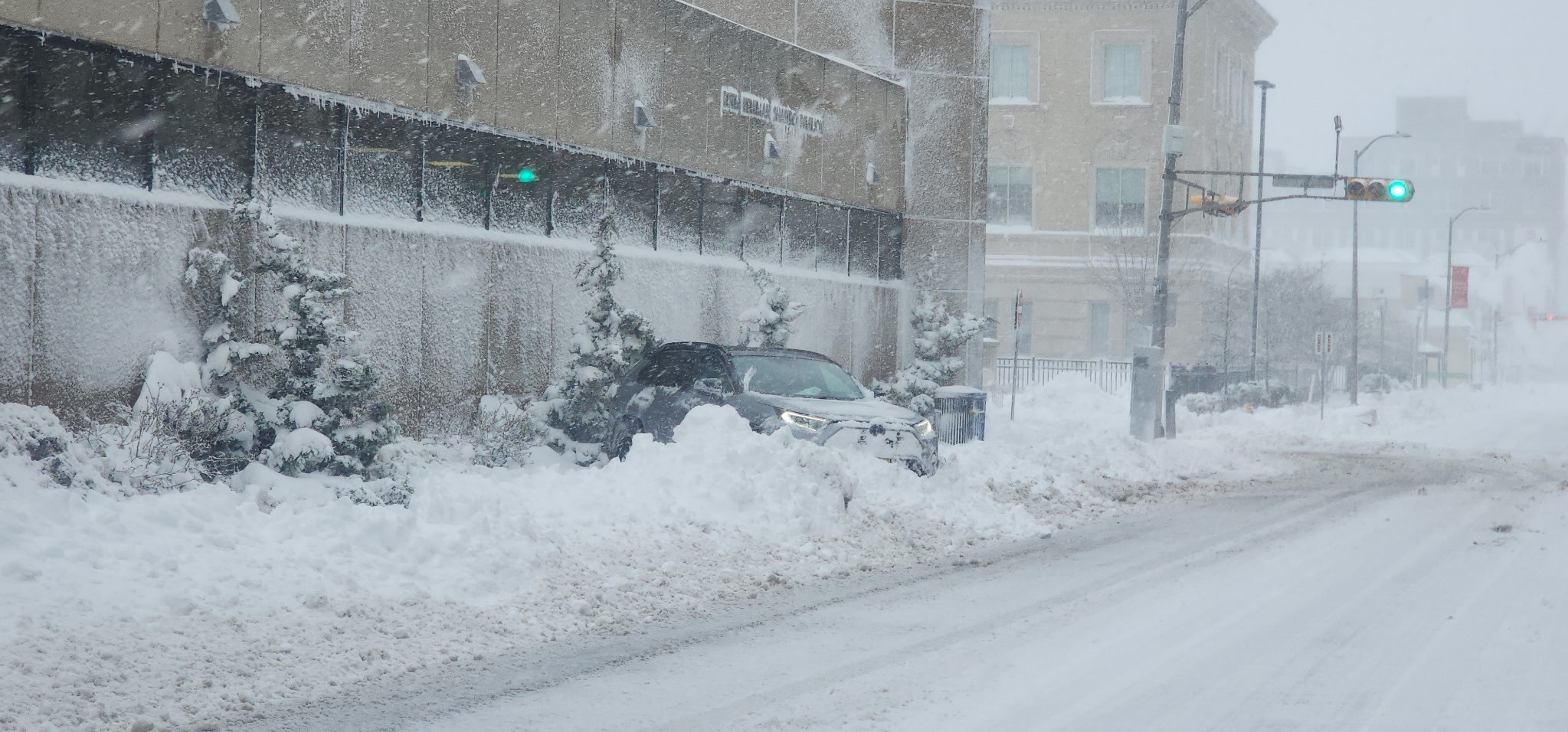
A car stuck in the plowed snow on Pacific Avenue near Ohio Avenue in Atlantic City Monday.
Gov. Mikie Sherrill said Monday morning that New Jersey’s travel ban would continue until noon as white out conditions were making it difficult to see, especially on major roads like the Garden State Parkway.
“It was an early morning call,” she said, in an online interview with South Jersey weather forecaster Nick “NorEaster Nick” Pittman. “It was difficult to see the edge of the road where the guardrails were. We still have snow falling in a lot of parts of our state.”
She said more than 200,000 people had lost power across New Jersey, but that more than half of them had already had power restored. “which is pretty shocking given how horrible the conditions are.”
“They’re hiking in to some pretty clobbered areas of the state,” she said of the utility workers, 5,000 of whom had been “predeployed,” she said.
With heavy snow bringing down tbranches and trees, she said, “We have the tree cutters out in force.”
She said the magnitude and reach of the storm across New Jersey, with overnight blizzard conditions and the dumping of a foot or more of snow, was “generational.”
“I don’t think we’ve seen anything like this since 1996,” she said.
Coastal flooding in Atlantic City ‘underperformed in a good way’
Ice floods onto the street along Massachusetts Avenue in Atlantic City overnight Monday, Feb. 23, 2026.
Scott Evans, Atlantic City’s Fire Chief and head of Emergency Management, said flooding in the coastal city was not as bad as feared. “The flooding definitely underperformed in a good way,” he said. “We’ll take it any day.”
He described it as “the low end of moderate” level of flooding, something Atlantic City is used to dealing with. The city had about a foot of snow by daylight, he said, with persistent high winds over night prompting numerous calls for “arcing wires.”
At the 11 p.m. Sunday high tide through around 2:30 a.m., there was about 8 to 10 inches of water in “some of our lowest lying areas,” he said, including Massachusetts Avenue, Bungalow Park and Lower Chelsea.
“We were expecting to get more,” he said in a phone interview Monday morning. “No significant problems.”
The city was still seeing the “residual ice” in the streets from the flooding, he said. Crews were out plowing streets, he said, and had mostly tamed the city’s famous Boardwalk. “They always have a team assigned to the Boardwalk,” he said.
He said he was not expecting any issues from the next high tide around 12:15 p.m. in the back bays.
Hundreds of flights canceled at Philadelphia International Airport
Airport crew plow snow during a winter storm in Philadelphia last month.
At Philadelphia International Airport, 604 flights had been canceled as of Monday morning, as snow blanketed the city. Another 42 flights were canceled for Tuesday, according to FlightAware, which tracks flights.
“Passengers should check on the status of their flights with their airlines—the airlines will also provide guidance on what passengers should do in the event their flights are cancelled,” said airport spokesperson Heather Redfern.
The airport also announced ticketing at Terminal A-West, B, and C and TSA checkpoints would be closed Monday.
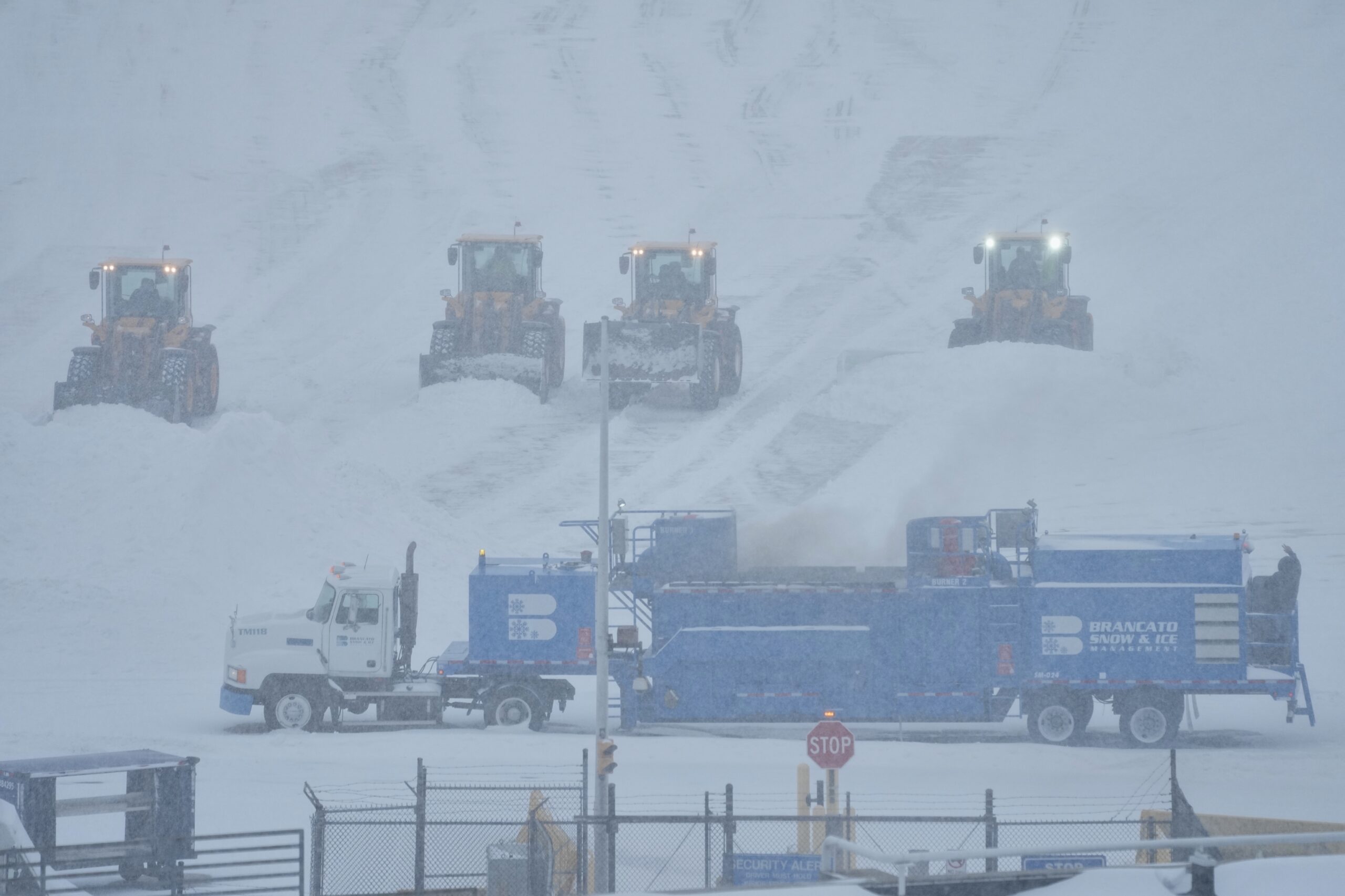
Some 40 million square feet need to be cleared at the airport when snow falls, including on airplane runways and taxiways. The airport also has an additional 11.9 million square feet of space on roadways, ramps and parking lots.
While airplanes are deiced by the airlines, the department of aviation is required to ensure runways and taxiways are clear.
More than two inches of dry snow or half an inch or wet snow trigger closing a runway, according to regulations by the Federal Aviation Administration, noted Redfern. Even if flights are canceled by airlines or in the event that the FAA issues a ground stop, the airport does not close, Redfern noted in January ahead of another snowfall.
Snow will continue across the Philly area through the morning
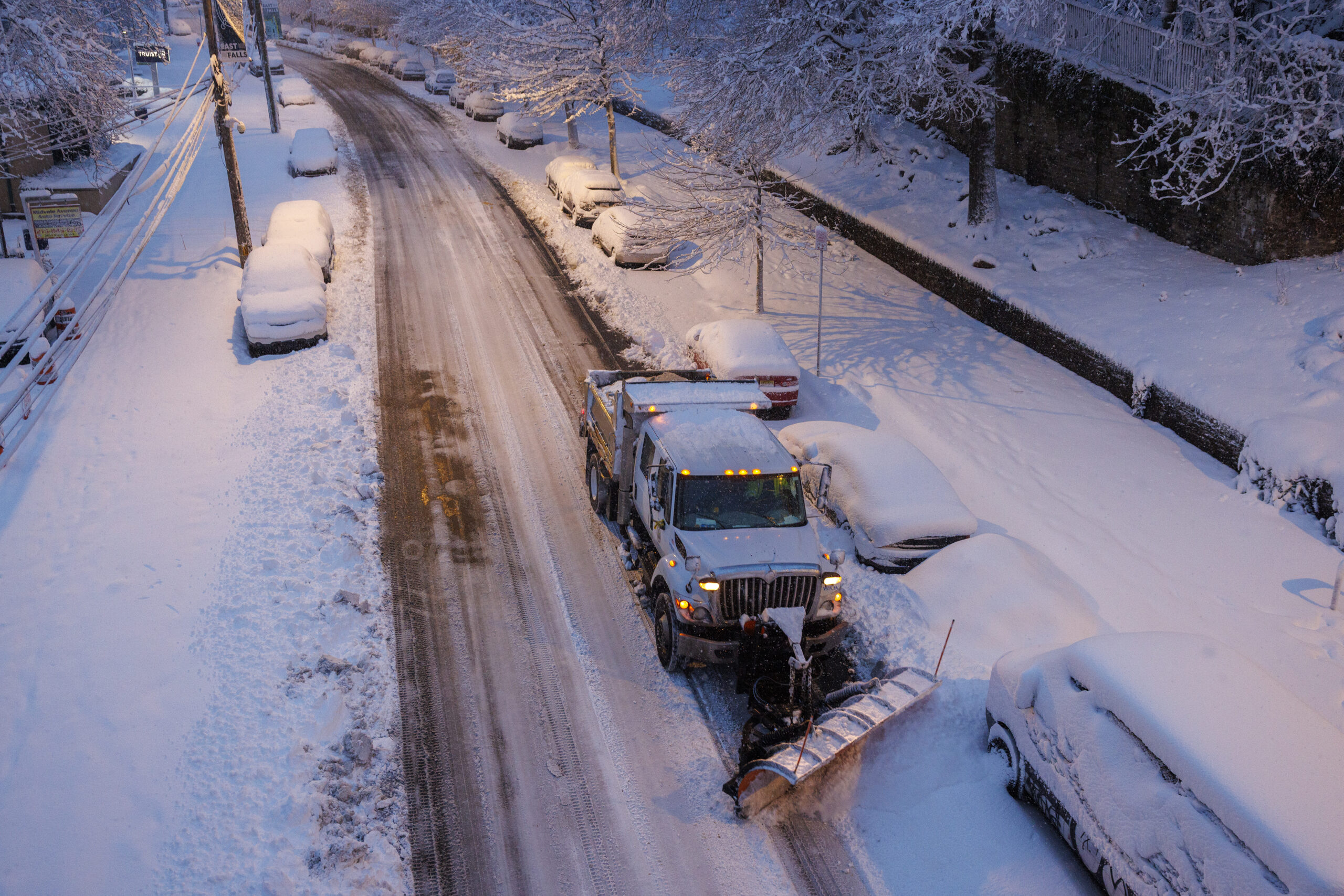
A Sanitation Department dump truck clears snow on Midvale Avenue in the East Falls section of Philadelphia Monday.
As much as a foot of snow fell overnight across the Philadelphia region as heavy snowfall from a massive winter storm continues across the Delaware Valley.
Due to heavy snow bands, the totals varied widely. Ten inches of snow were recorded in Boothwyn Monday morning, while 11 inches dropped overnight in Mount Ephraim, Camden County.
Snow will continue throughout the morning, with another 3 to 5 inches expected to fall in Philadelphia, according to National Weather Service meteorologist Sarah Johnson.
The highest totals are expected along the northern and central Jersey Shore, with the heaviest bands dropping as much as 2 inches of snow per hour or greater. Another 4 to 6 inches of snow is possible for Southern New Jersey and parts of Central and Southern Delaware.
At the National Weather Service’s Mt. Holly observatory, 18.5 inches of snow had fallen as of 5:15 a.m. Monday morning.
2:30 AM Monday: Near blizzard conditions at our office under the main snow band. We are now up to 14.0" of snowfall. Snowfall rates remain around 2" per hour under the band. Please do not travel if you are in the Blizzard Warning area! #NJwxpic.twitter.com/t8VCjczG2y
Snow is expected to taper off by noon, forecasters said, but strong winds and blowing snow will continue through at least 5 p.m., creating dangerous driving conditions. Wind gusts in Philadelphia could reach upwards of 40 miles per hour during the day.
One bit of good news: Tidal flooding isn’t expected along the Delaware River due to the direction of the wind, so it won’t be a concern for Philly or the immediate area.
Why have these storms been happening on the weekend?
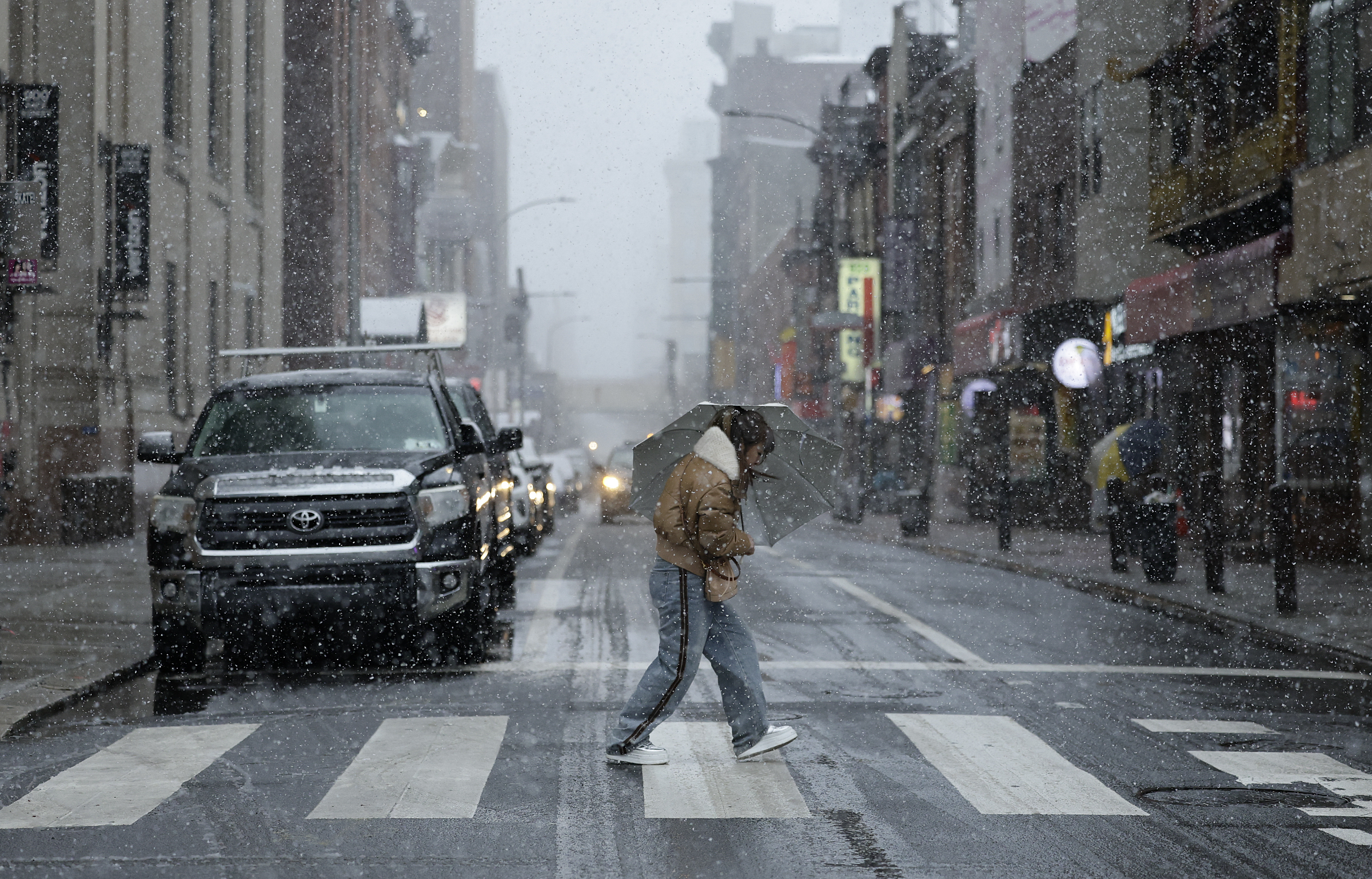
A pedestrian walks across Race Street in Chinatown Sunday.
If you perceive the atmosphere for whatever reason has a grudge against weekends, that’s understandable.
Precipitation has fallen on six of the last seven weekends, with snowflakes making appearances in all of them, most emphatically on Jan. 25, when 9.3 inches of snow and sleet balls accumulated, and then refused to leave.
The storm rhythm actually is a quite common one, meteorologists say.
It has to do with the spacing between weather systems. Sometimes they show up in roughly 3½-day cycles, taking that long to traverse the country, and often it’s the second one in the cycle that is the stronger storm.
Like so many things in the atmosphere — droughts, wet periods — they keep happening, until they don’t.
We’re probably about due for a don’t, but not this weekend.
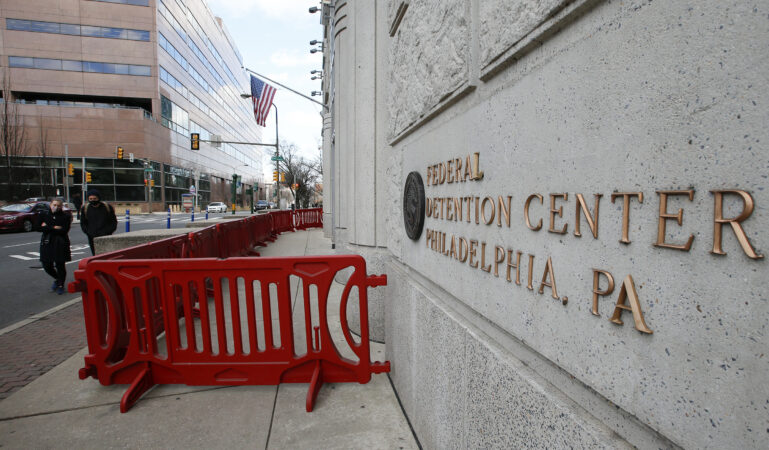
Philadelphia’s federal courthouse has become awash in lawsuits filed by undocumented immigrants challenging the government’s attempts to detain them, an Inquirer review has found, the latest example of how the mass deportation push by President Donald Trump’s administration has been affecting the nation’s legal landscape.
Through six weeks this year, court figures show, 168 such lawsuits have been filed in Pennsylvania’s Eastern District Court, up from 115 in all of 2025.
By contrast, only 11 such suits were filed between 2020 and 2024, meaning a new practice of litigation dominating the region’s federal court practically sprung up overnight.
<iframe title="An Unprecedented Rise In Release Petitions" aria-label="Column Chart" id="datawrapper-chart-Ze5f9" src="https://datawrapper.dwcdn.net/Ze5f9/1/" scrolling="no" frameborder="0" style="width: 0; min-width: 100% !important; border: none;" height="499" data-external="1"></iframe><script type="text/javascript">window.addEventListener("message",function(a){if(void 0!==a.data["datawrapper-height"]){var e=document.querySelectorAll("iframe");for(var t in a.data["datawrapper-height"])for(var r,i=0;r=e[i];i++)if(r.contentWindow===a.source){var d=a.data["datawrapper-height"][t]+"px";r.style.height=d}}});</script>
In other jurisdictions, the surge has become so pronounced that judges and attorneys say they’re struggling to keep up. In New Jersey, the region’s chief judge last week issued new procedures for filing and litigating the petitions, writing: “The volume and timing of these filings is creating a substantial burden on the Court’s ability to expeditiously docket, assign, and address” them.
In Philadelphia, nearly all of the increase in habeas petitions appears tied to the Trump administration’s decision last summer to mandate detention for virtually every undocumented immigrant encountered by authorities. ICE and other agencies are now confining people who would have previously been eligible to remain in the community while their cases wound through the immigration system, such as people who have been in the country for years, or those who have not complied with ICE’s instructions while living here.
“It was not a big part of our work up until about six months ago,” said Chris Setz-Kelly, a managing attorney with HIAS Pennsylvania, a nonprofit that provides legal assistance to immigrants.
For decades, Setz-Kelly said, there had been a clear understanding about who was or was not eligible to be released on bond once they were picked up by ICE. But he said that changed under mandatory detention, which also says anyone who is newly detained should be denied a bond hearing.
And the petitions represent just the tip of the iceberg, the attorney said, as many detained immigrants don’t have representation or leave the country during the process.
“It had really dire consequences to the community,” Setz-Kelly said.
The number of people in immigration detention has since grown from about 50,000 people in June, to nearly 70,000 people at the start of this year, federal data show.
‘The border is everywhere’
Trump’s administration has been clear about its desire to increase deportations. And it has scored one legal victory in a higher court so far while defending its mandatory detention policy in court.
Earlier this month, a three-judge panel in the Fifth Circuit Court of Appeals ruled the policy was legal and could be applied in Louisiana, Mississippi, and Texas.
The government’s main argument in that case was that every undocumented immigrant is, in legal terms, “seeking admission” to the United States, despite a longstanding interpretation that the phrase only applied to people who had recently crossed the border without proper paperwork.
“The everyday meaning of the statute’s terms confirms that being an ‘applicant for admission’ is not a condition independent from ‘seeking admission,’” the majority opinion said.
Two Fifth Circuit judges agreed with the government’s position.
The one who dissented, U.S. Circuit Judge Dana M. Douglas, wrote that the government’s interpretation contradicted the basics of immigration law and, in effect, would create a situation in which “the border is now everywhere.”
A ‘trap’
The ruling in the Fifth Circuit — based in New Orleans, and widely considered one of the most conservative courts in the country — has done little to change the views of judges in Pennsylvania’s Eastern District Court.
This region’s federal judges have consistently criticized the government’s mandatory detention policy over the last eight months, ruling in favor of nearly every immigrant seeking to be released from confinement.
Some judges have quoted Greek mythology to describe what they’ve cast as an unending attempt by the Trump administration to continue defending a policy that has been resoundingly rejected in court. The region’s chief judge even wrote that “the law is piled sky high against the government’s position.”
Diamond, in an opinion this month, wrote that he’d reviewed 201 recent decisions in the district involving habeas petitions, and found that judges in every case had rejected the government’s view that mandatory detention — with no opportunity for bond — was both warranted and legal.
U.S. District Judge Karen Spencer Marston, a Trump appointee, wrote in a recent decision that she was “unpersuaded” by the Fifth Circuit’s ruling as she agreed to free an undocumented immigrant from custody.
Still, government attorneys have appealed dozens of those losses to the region’s Third Circuit Court of Appeals. Experts believe the effort is part of a Justice Department attempt to create opposing appellate rulings and propel the question of the policy’s legality to the U.S. Supreme Court, which has a conservative majority.
“I think they’re just trying to tee up the right cases,” said Chris Casazza, a Philadelphia-based immigration attorney who has filed more than 60 habeas petitions in recent months. “They’re hoping the Supreme Court is going to rubber stamp this.”
In the meantime, judges in Philadelphia are continuing to confront and rule on dozens of petitions in an emerging area of law.
This week, in a blistering opinion, U.S. District Judge Gail A. Weilheimer wrote that ICE had set up a “trap” for “thousands of non-citizens,” who are required to file forms, attend check-ins, or apply for asylum to receive permission to stay in the country.
But under mandatory detention, Weilheimer wrote, those applicants will now get arrested and taken to a detention facility for the duration of their removal proceedings, which could take months or years.
The judge compared the situation to the government handing immigrants a bow and instructing them to shoot an arrow at a tree.
If anyone hits it, Weilheimer said, “the Government will look at the mark, paint a target to the left of it, and accuse them of missing.”
Correction: This story has been updated to correct the spelling of Chris Setz-Kelly.
The Philadelphia School District is walking away from middle schools — mostly.
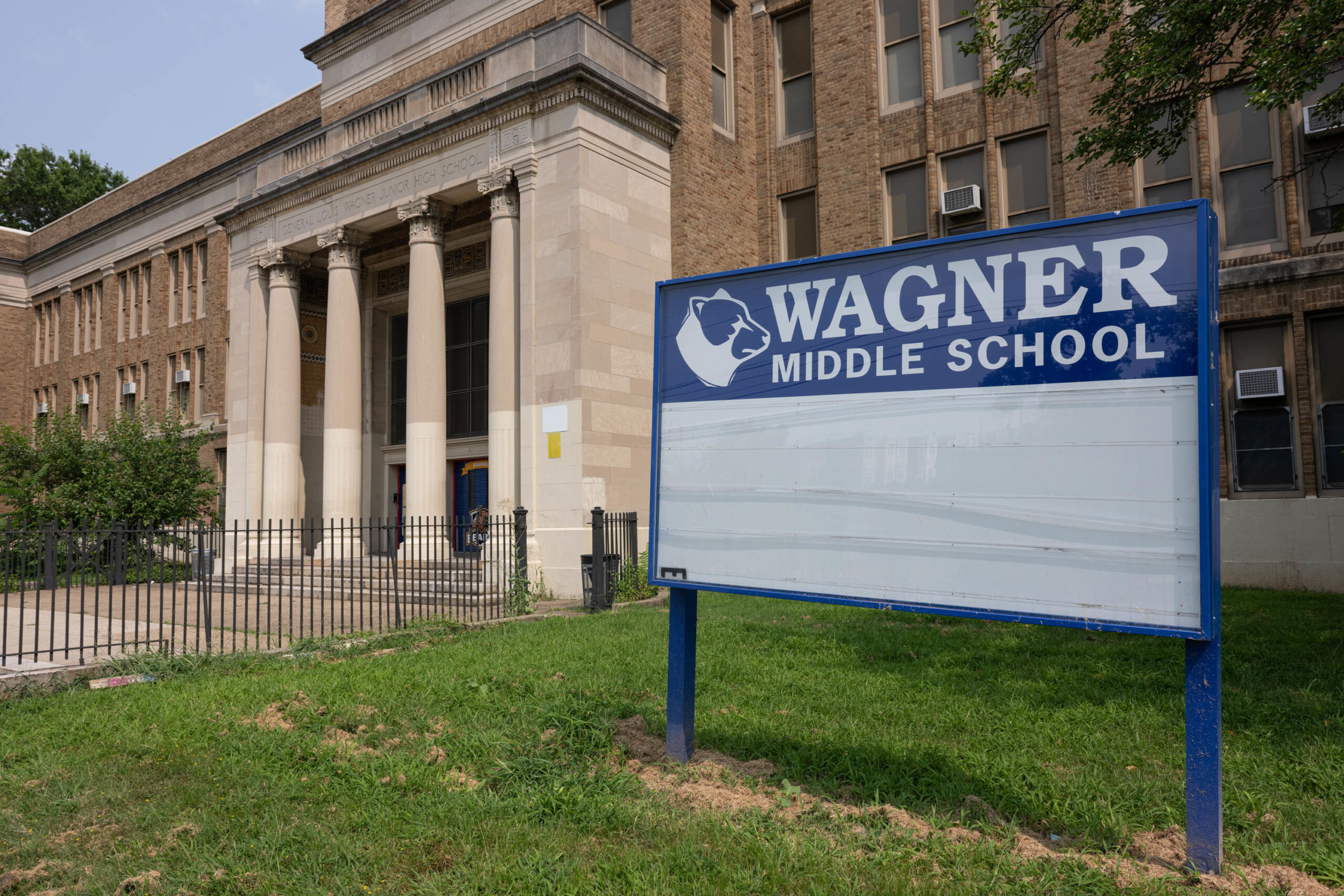
Of the 20 schools Superintendent Tony B. Watlington Sr. has recommended to close, six are middle schools — AMY Northwest, Conwell, and Stetson in Kensington; Harding in Frankford; Tilden in Southwest Philadelphia; and Wagner in West Oak Lane.
The district plans to expand elementary schools to take in those students in most cases, and Conwell, a magnet middle school, would send students to AMY at James Martin.
“Our research does not say that traditional middle school children in Philadelphia perform better academically than K-8 students,” Watlington said when he rolled out his tentative plan in January. “Nationally, and in Philadelphia, there’s a mixed bag.”
While the school district says the K-8 model reduces transitions for students and helps maximize resources, critics of the district’s plan say closing middle schools will uproot their children and abandon successful schools.
Education experts, meanwhile, say instructing middle school-age students has long been a complex and controversial issue — and it’s a debate that Philadelphia district officials are reigniting with their sweeping facilities proposal.
Among the top complaints from critics of the plan: The pivot isn’t absolute. Though many middle schools are disappearing, Philadelphia will still have13 standalone middle schools and secondary-middle schools if those six close. And some will even grow.
Middle-grades students from Masterman, the popular and elite city magnet, wouldtake over the closing Laura Wheeler Waring school building in Spring Garden “to expand access” to Masterman, officials said.
The district is also adding a new Academy at Palumbo Middle School to give students a feeder pattern into the South Philadelphia high schoolmagnet. The new middle school will co-locate with Childs Elementary in Point Breeze.
And in the Northeast, where schools are bursting at the seams, two standalone middle schools — Castor Gardens and Baldi — will be untouched. Sowill a handful of others, including Roberto Clemente in North Philadelphia, Feltonville School of Arts and Sciences, Grover Washington in Olney, AMY at James Martin in Fishtown, and MYA and Science Leadership Academy Middle School in West Philadelphia.
Why is the district targeting middle schools?
Though officials said the facilities plan is not driven by finances, it’s clear that the underfunded school system needs to shrink its footprint.
With 70,000 empty seats citywide and an inequitable distribution of programs and opportunities, system officials say they need to make changes to do better for all kids.
“We can more efficiently distribute our limited resources in a K-8 model by operating 13 grade spans as opposed to six,” Watlington told City Council at a hearing on March 17. “This is an efficiency issue.”
At present, the district has 13 different grade spans throughout its schools — from a single K-2 to K-4s, K-5s, K-8s, 5-8s, 6-8s, and others. It is proposing shrinking, mostly, to six different grade bands, and emphasizing K-8 or 5-12 as preferred models.
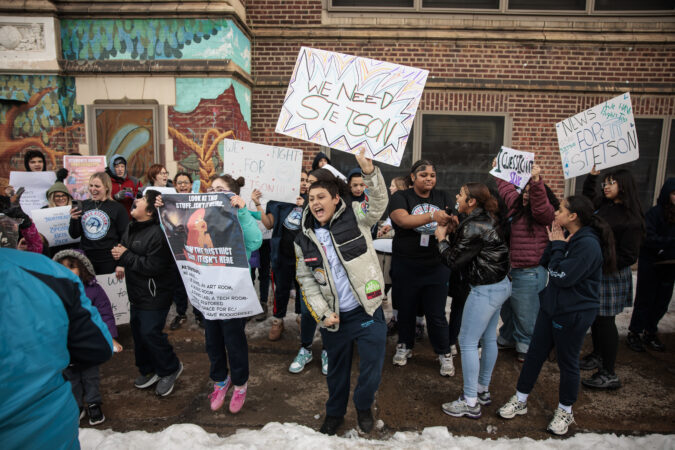
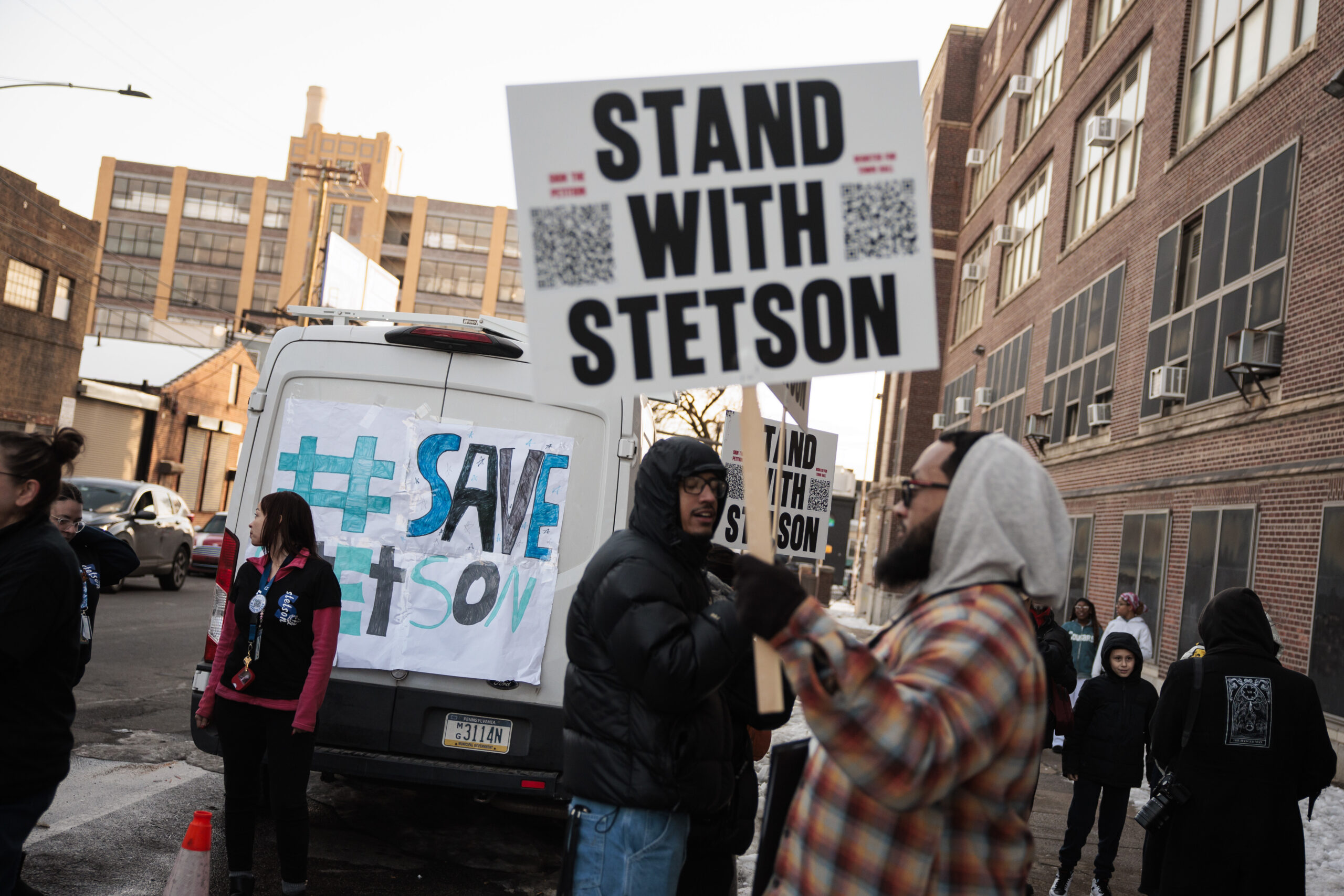
Students, teachers, and supporters rally before a community meeting at John B. Stetson Middle School this month. It’s one of six middle schools that is slated for closure.
Officials say they’re also relying on feedback received in surveys taken and meetings held prior to the plan’s release, despite critics’ worry that the feedback was crafted to give the district the answers it wanted.
Hilderbrand Pelzer III, an associate superintendent, told a crowd of more than100 people gathered at a Stetson Middle School meeting this month that in the surveys, families told the district they wanted to minimize transitions.
“Think of safety in the sense that young people should remain in one place longer, pre-K to 8,” Pelzer said. “Hence why we want to recommend some of our K-4s, K-5 schools grow to K-8. Now that may not be the answer you want to hear, but the voices that have informed that have allowed us to make that a recommendation.”
But critics of the district’s plan say they worry that the feedback was crafted to give the district the answers they wanted. And the audience at Stetson that day pushed back: Minimizing transitions is not what they want. They want their middle school to stay at their current school.
“Why can’t you inform recommendations from people at Stetson?” one person shouted.
The long and thorny history of middle schools
Wrestling with where middle-grades learners should attend school is nothing new, said Penny Bishop, dean of Boston University’s Wheelock College of Education and Human Development.
“We have been struggling to figure out how to provide appropriate schooling for this age group for well over a century,” Bishop said. “It’s a question with a long and thorny history” dating to the 1800s, she said, with much back and forth.
Philadelphia School District Deputy Superintendent Oz Hill (left) and student moderators listen to Andre Sanford-Adams, Conwell Middle School’s health and physical education teacher, speak during a recent community meeting about why he thinks it’s a mistake to close Conwell.
Many of Philadelphia’s middle schools began as junior highs. Middle schools as a concept first surfaced in the United States in the 1960s and took off in the 1980s as part of an explicit attempt to create schools “designed based on the developmental needs of this particular age group, as opposed to saying, they’re short high schoolers or they’re tall elementary students,” Bishop said.
But tweens and early adolescents can be a tough age group to educate well, and middle schools got a bad rap among some, said Bishop. As school choice and shifting birth rates caused belt-tightening in some places, some districts began to shift grade configurations.
Both Bishop and Katie Powell, director for middle level programs at the Association for Middle Level Education, said that research doesn’t support one kind of grade configuration or another.
“What matters most for middle school-age students is that we understand that they are going to need a different experience than their elementary counterparts in a K-8 building, and having a defined middle school, even within that K-8 school — that’s what tends to be most successful,” Powell said.
And, Bishop said, “a lot of this is tied up in the degree to which the leadership understands the developmental needs of the students.”
At a recentmeeting at slated-to-close Wagner Middle School, Kim Newman, another Philadelphia associate superintendent, vowed that the district will spend time and resources planning thoughtful transitions as grade configurations change.
Adding middle grades to elementary schools hasn’t always been done well in the district, Newman said.
“In the past, what we’ve done is said, ‘Let’s just add some furniture and books, great,’ grow a grade each year, and that’s really not what children need,” said Newman.
She said she hopes receiving schools and closing middle schools will work together on what middle-grades learners need in the newly expanded elementary schools.
Philly skepticism
Claire Andrews has taught at Wagner Middle School for 40 years — years ago, it had 1,000 students, buttoday, fewer than 300 are enrolled.
In the past, “we had opportunities for students, and as the years have gone on, they have just disappeared,” Andrews said. “Over the years, everything has just been pulled away.”
Wagner Middle School is one of six middle schools that is facing potential closure in Philadelphia.
Andrews, like others in the city, raised questions of equity.
“Are they closing schools in the Northeast?” Andrews said.
Councilmember Isaiah Thomas, chair of City Council’s education committee, highlighted Philadelphia’s complicated middle school position at a Council hearing last week.
The district’s talking points around middle school sound good,he said. But he questioned decisions to expand middle grades at magnet schools, like Masterman and Carver High School of Engineering and Science, whileclosing a number of neighborhood middle schools.
“I want us to have nuanced dialogue around where we are and what we need to do,” said Thomas, who has spoken out against closing Conwell, of which he’s an alumnus. “And I also recognize that there’s pushback on every decision you made. I understand that we have to make tough decisions somewhere else, there is no real facilities plan, and we do need a plan.
“But the reality is that we’re still not sending the right message to people, and I think our position around middle school is problematic.”
Watlington stressed the research around middle schools and the surveys.
The superintendent said the district is committed to modernizing and expanding receiving schools, where needed, and was not just focused on the Northeast.
“We absolutely will not present a plan that just pushes resources in parts of the cities that’s growing fastest,” Watlington said. “I think this is as strategic a plan as we could create.”
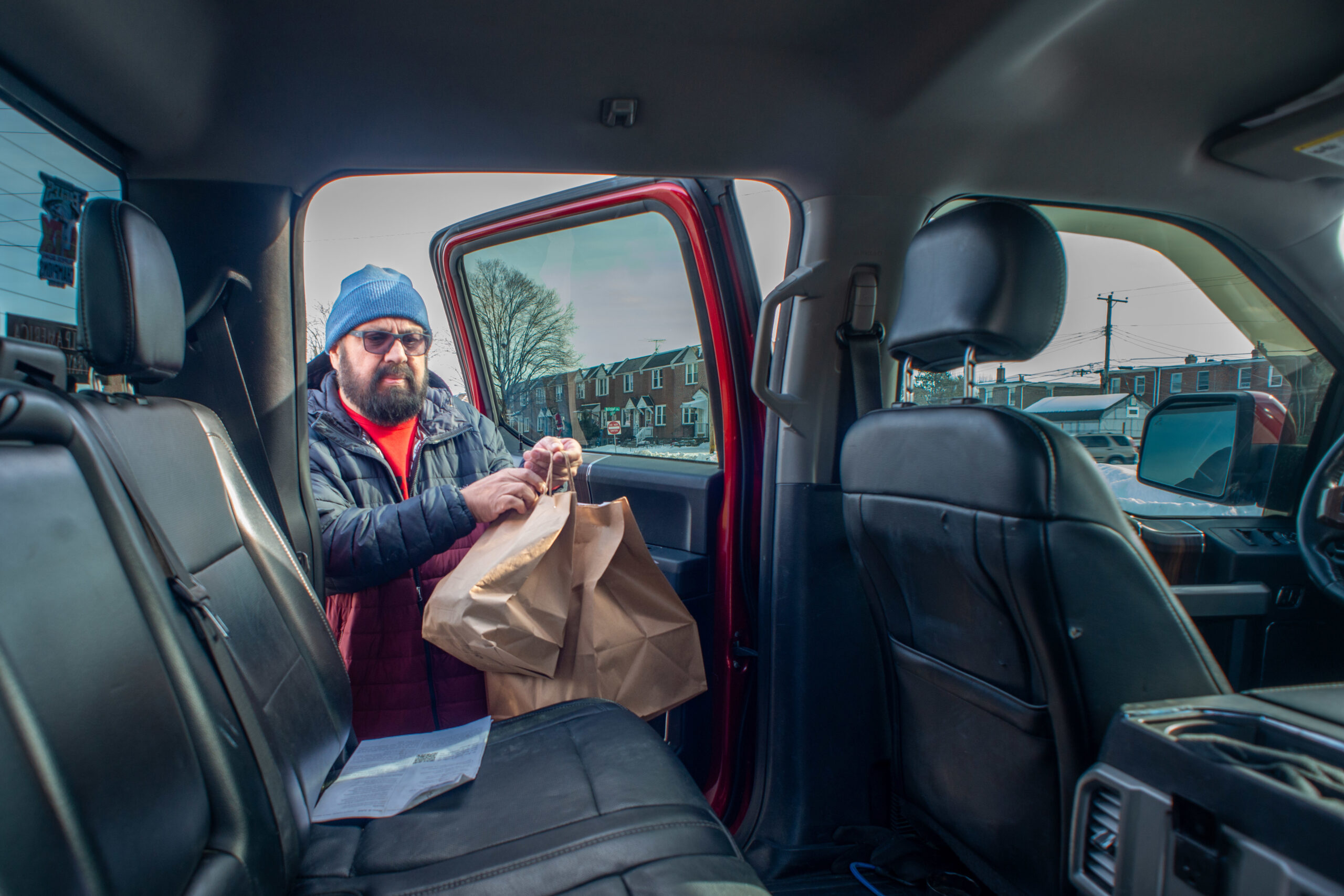
On an icy, 13-degree Saturday morning in January, José Hernández sat in his pickup truck outside a Bensalem church, waiting for his phone to ring.
It didn’t take long.
Calls, texts, and emails have become constant, as Hernández, a machinist by trade, has become a crucial connection for many township residents who are living in the United States without official permission.
What started as a simple good deed, delivering groceries to a few people worried about attracting ICE attention, has for Hernández, 61, become a full-time, unpaid job. Worry has hardened into fear amid the Trump administration’s dramatic escalation in immigration enforcement, leaving some people afraid to leave their homes.
Hernández’s weekend rounds ― picking up people’s grocery orders at stores, bringing the food to their homes, always with a glance over his shoulder ― ensures sustenance for families for whom discovery would mean arrest, separation, and likely deportation.
About 14% of the Bucks County township’s 63,000 residents are Latino. Among immigrants, everyone has a friend or family member who has been arrested by ICE and not seen again. And many fear that they’ll be next.
Connie and Ivan came from Mexico over two decades ago. Fear of being detained by ICE has led them to turn to Hernández for food-delivery help.
“They come out to pick up their order and you can see the fear in their faces,” Hernández said. “Many people come out saying, ‘Please hurry up, los delHielo can be here any second.’”
That’s what some community members call ICE agents — los del Hielo, meaning “the iced ones.” There are other names too, like elEscalofrío (“the chills”) and los Helados (“the frozen ones”).
The nicknames come not from anger but from anxiety — fear that even speaking aloud the words Immigration and Customs Enforcement could summon danger.
“We try to only go out when the darkness of the night protects us,” said an Ecuadoran mother, 32, who declined to provide her name for fear of arrest. “It’s a false sense of safety, but we must hold on to it.”
Hernández recently delivered two bags of groceries and a birthday cake to her home, as her son was turning 12.
“When I am in school,” the boy said, “the only thing I think about is if dad will make it home today. I wait all day, and then he comes, and I am happy he is still here. I am learning that being an American means that I have to be worried for the people I love.”
A third of his immediate family ― an uncle and two cousins ― was arrested in November and December.
José Hernández works to deliver groceries to local undocumented immigrants.
Intensified ICE enforcement in the region and the nation has altered their lives ― exactly as the Trump administration intended when it promised to carry out the largest deportation program in U.S. history.
For undocumented residents, freedom is no longer guaranteed by living quietly, obeying the law, and staying off the government radar. Now, discovery of having entered the country without approval, a civil violation, often means the end of an American life built across years.
As a result, people are staying indoors.
Many have stopped going to the doctor. And to church. They keep their children home from school when news of ICE activity surges. Businesses have had to temporarily close when workers stay away.
ICE officials did not reply to requests for comment.
In 2025, the agency detained 307,713 people in the U.S. ― detentions closely mirror arrests ― compared to 93,342 in 2024.
That’s more than a 230% increase.
Today more and more of those arrested face no criminal charges, even as the Trump administration pledges to deport “the worst of the worst.”
Hernández uses his own money, earned from his job as a machinist, to pay for gas for deliveries.
Hernández didn’t plan to be doing this work, spending his weekends traversing Bensalem.
A decade ago he founded a group called Movimiento Guadalupano, a committee to organize Catholic activities. That grew into a broader support group for Latinos, and now he’s one of four volunteers who have become a central source of assistance and information on ICE activity.
“Don’t go out today,” the Movimiento website warned on a recent weekend. “Volunteers will deliver your groceries from Hispanic stores to your home free of charge.”
Hernández is a U.S. citizen, born in this country. He carries no fear of ICE, but plenty of worry that people in the Latino community will struggle without reliable food deliveries.
In the truck, Hernández’s phone rang.
Soon he was parked and walking through the doors of a Bensalem store stocked with traditional Mexican foods. He looked around, to be sure he wasn’t followed, but also so he could update Movimiento’s Facebook page if he saw ICE agents.
A married couple shopping at the store recognized him and said hello ― Hernández had brought groceries to their home, bags of chorizo, tortillas, milk, cereal, and coffee.
“Having the groceries delivered has been a huge relief,” said the man, Ivan, 44, who declined to provide his surname for fear of being identified to ICE. “We don’t have to choose between risking ourselves and feeding our children.”
Maira wasn’t acquainted with Hernández, as her sister usually delivers her groceries. A recent medical emergency made it impossible, and with her family of four running out of food, she dialed the number Movimiento listed for delivery.
Bensalem has been their home for 24 years, the couple explained, but their efforts to obtain legal status have failed. Meanwhile personal disaster has crept close.
In December, at a construction site where he worked, Ivan said, two coworkers left for lunch and never returned. He later learned they had been arrested by ICE.
“It’s just very difficult to be in a country that we know isn’t ours,” said Ivan’s wife, Connie, “but we love it as if it were.”
A clerk interrupted: Hernández’s food order was ready. He grabbed the bag and headed out, Ivan watching him as he left.
“He could be at home with his family, instead, he is helping,” Ivan said. “He brings a little bit of peace in this environment, like we still are a community.”
Ten minutes later, Hernández slowed his truck near a row of houses, looking for anyone who might seem like they were waiting.
A woman at a doorway froze when their eyes met.
“Did you order a delivery?” Hernández called to her from the truck, watching relief come over her face.
“You scared me,” she said, explaining that his car looked like one driven by a man who phones ICE to report people.
The woman, who asked to be identified only by her first name, Maira, because she worried about immigration enforcement, said her husband hasn’t left the house since late November, when he barely escaped an ICE raid at a Norristown construction site. She still goes to work each morning, once she and her sister, who is a U.S. citizen, check the Movimiento site for a safe route.
“I feel like crying all the time,” said Maira, 48. “I feel like a fugitive without having done anything, but I still have to keep working and paying taxes.”
A receipt attached to a bag of groceries that José Hernández will deliver to local undocumented immigrants in Bensalem.
After 25 years, she said, she thought she was part of Bensalem. That changed when a neighbor complained there were “too many cars” on Maira’s driveway when her sister visited. After that, she said, she stopped hosting family gatherings, concerned that the neighbor would call ICE.
Hernández handed her the groceries and turned to leave.
Maira tried to give him a $5 bill.
“No, no, no,” he said. “How can I be of help if I charge you?”
Hernández likes to think he brings more than groceries, that with him comes a kind word, a smile, and maybe even some hope. Don José, as folks call him, says his worry is not the weight of the bags or the length of the checkout lines in stores.
“I am scared,” he said, “that we will get used to this [ICE enforcement], that it will be so normalized that people stop helping one another.”
As the day wound down, Hernández’s wife phoned to see how he was doing. He drove to a nearby Walgreens pharmacy to check out a report that ICE agents were in the parking lot. They weren’t.
His phone rang.
“Hi, is this Don José?” a young man asked, apologizing for calling. “I really need your help with a delivery.”
“Don’t worry, place your order,” Hernández replied. “I will be right there.”
The iconic Philadelphia Flower Show returns Feb. 28-March 8, bringing a massive, immersive garden world blooming to life within the Convention Center. And more than ever, it promises to be historic.
The show’s theme, “Rooted: Origins of American Gardening,” honors the people, places, and traditions that have shaped gardening — and invites visitors to consider where their own gardening stories began. The 2026 show will debut a reimagined Marketplace shopping destination and expanded Artisan Row.
America’s oldest flower show, which began in 1829, the internationally renowned event draws thousands to Center City each year, and represents the Horticultural Society’s biggest fundraiser, supporting its greening efforts across the city.
Here’s what you need to know if you’re planning to attend.
Location and schedule
📍 Pennsylvania Convention Center: 1101 Arch St., Philadelphia, PA 19107
📅 Feb. 28 to March 8
⏰ Hours:
Feb. 27: Noon — 4 p.m. Members only Preview
Feb. 28 — March 8, 2026
Open daily 10 a.m. — 8 p.m., until 6 p.m. on March 8
A rendering of the 2026 Philadelphia Flower show is on display during a Jan. 14 news conference at Union Trust. The theme of this year’s flower show is called “Rooted: Origins of American Gardening.”
Tickets are available online at tickets.phsonline.org and at the Convention Center. Online tickets are cheaper than those purchased at the door, and weekday tickets cost less than weekend tickets. Group discounts are offered to groups of 25 adults or more.
Online pricing:
Adult:
Student (18-24 with valid student ID):
Children (5-17):
Twilight (after 4 p.m.):
Any-Day Flex Pass — $60, one-time, any day admission
Floral Fanatic Pass — $100 unlimited daily entry for entire run
In-person pricing:
Adult:
Student (18-24 with valid student ID):
Children (5-17):
Twilight (after 4 p.m.):
A participant creates pressed flower art following a Jan. 14 news conference at Union Trust for the unveiling of a first look at the 2026 Philadelphia Flower Show, “Rooted: Origins of American Gardening.”
A sprawling, misty forest floor creation drawing on the diverse inspirations of American gardens, and featuring mossy stonework, Zen-like sculptural plantings, water displays, and crowned with a towering, twisting root structure.
The American Landscape Showcase: Special exhibition celebrating America’s 250th anniversary.
This year’s special exhibition celebrates the national milestone, also known as the Semiquincentennial, with four gardens highlighting how gardening has shaped communities and evolved over 250 years.
First Bloom — Rooted in Memory
Four acclaimed international florists— Gábor Nagy, Alex Segura, Chantal Post, and Conny van der Westerlaken — showcase the origin moments that sparked their passion for flowers.
Design Gallery
Presents floral arrangements crafted for themed challenges, highlighting skill, creativity, and artistic power.
Hamilton Horticourt
Each year, thousands of exhibitors compete in more than 900 classes or categories, ranging from horticulture and arrangement to design and photography. With no age limits, winners receive a “Blue Ribbon.” Competitive Class categories are on the show floor, including miniatures, pressed flowers, and specialty plants.
Artisan Row
The 2026 show features anexpanded Artisan Row, where guests can work alongside nearly 40 vendors and craftspeople to create everything from fresh floral crowns to dried bouquets and terrariums and candles and jewelry and more.
Marketplace
A new highly visible, street-level Marketplace below the main exhibit halls, with more than 200 vendors offering a curated selection of live plants, florals, garden tools, decorative wares, and more.
Create your own flower arrangements under the guidance of Tu Bloom, the official botanical artist for the Grammys. $20 per person (reserve attickets.phsonline.org/events).
Hundreds of native and exotic butterflies, including zebra longwings, morning cloaks, and bright blue morphos dance and paint the air with color in the iconic butterfly tent exhibit. Many are happy to land on visitors’ feeding sticks for nectar and sugar water.
Know to Grow
Speaker series featuring horticultural experts exploring topics including heirloom and early American gardens, native bees and pollinator habits, resilient ecological design, and the cultural histories that have shaped American gardening traditions.
Plant People Place
Interactive area where guests can connect with expert gardeners and industry specialists for advice and insight.
Buy tickets for the March 1 show for a day designed for young families, with educational experiences, playful floral design, coloring, and more. Free with admission, recommended for all ages.
A celebration of beauty, well, and natural healing, including yoga classes, opportunities to work with wellness experts, and mediation. Purchase required for yoga class, all other activities are free with admission. Recommended for all ages.
Fido Friday
March 6: 5 — 8 p.m.
Bring your best four-legged friend to explore the florals. Proof of current rabies vaccination required.
The Flowers After Hours dance party transforms the show into an enchanted, fairytale forest setting with themed cocktails and dancing. Guests are encouraged to wear “fantasy-inspired attire,” planners said. Purchase required. Must be 21.
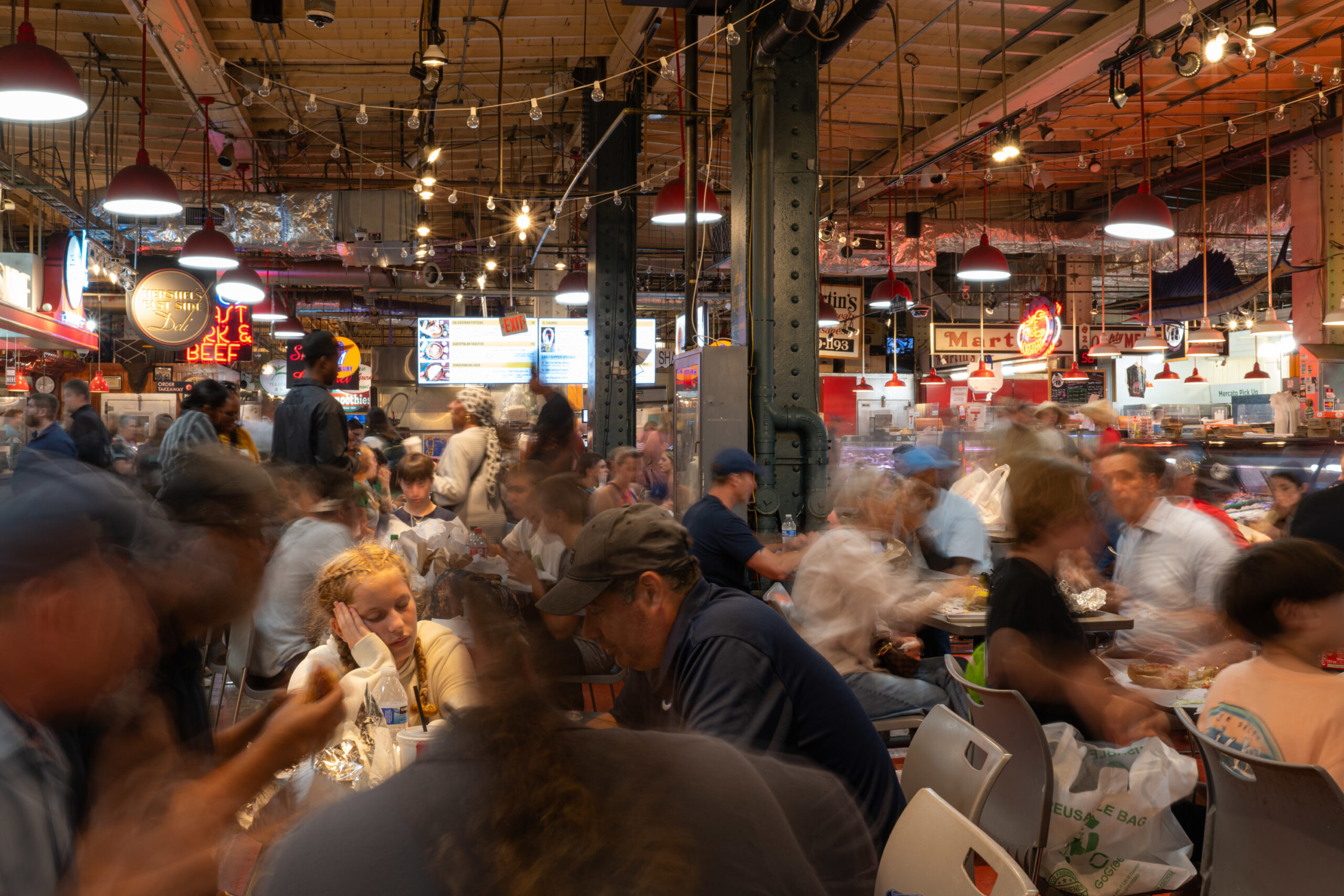
A young woman falls asleep during the lunch rush at Reading Terminal Market on June 11, 2025, in Philadelphia.
Food & drinks
In addition to the convention center’s Saxby’s Coffee and the Overlook Cafe, there are concession areas managed by Aramark serving light bites, snacks, and drinks on the show floor.
Guests are encouraged to get their hand stamped before exiting the building, if they decide to take a short walk to some of Philadelphia’s famous food destinations.
Download the free Inquirer mobile app forAppleandAndroid devices. Find hundreds of nearby restaurants, read Inquirer critic reviews, and learn more about the places you visit through the app’s “Discover” feature.
How to get to the Flower Show
🚴 Bike: 19 minutes from South Philly, about 30 minutes from North or West Philadelphia.
SEPTA is running extra trains on these Regional Rail lines on Saturdays and Sundays during the show — March 1-2 and March 8-9:
Where to park for the Philadelphia Flower Show
The Convention Center recommends parking at one of the lots closest to the show that are run by ABM Parking, E-Z Park, iParkit Philadelphia, Park America, Parking Facility, Parkway Corp., or SP+ Parking.
The Autopark at the Fashion District: 📍45 N. Ninth St., 💰 $35 for 24 hours, ⌚ 6 a.m. to midnight, 🚶♀️ three minutes.
The Autopark at Jefferson: 📍10th and Ludlow Streets, 💰 $36 for 24 hours, ⌚ 5 a.m. to 11 p.m., 🚶♀️ 10 minutes.
Parkade on Eighth: 📍801 Filbert St., 💰$32 for 24 hours, ⌚ 24/7, 🚶♀️ six minutes.
Gateway Parking Garage: 📍1540 Vine St., 💰 $16 for 1 hour, $30 for 24 hours, ⌚ 24/7, 🚶♀️ five minutes
Where does the money for the PHS Flower Show go?
Proceeds from the Flower Show go directly to the Pennsylvania Horticultural Society to disburse among its regional programming. This includes neighborhood programs, city tree-tending, low-cost gardening programs, water conservation, designing and maintaining public gardens, and more.
Before a single wet flake was sighted in the Philly region late Sunday afternoon, what forecasters warned would be a storm of rare severity already was having impacts on the workweek.
A blizzard warning remained in effect for Philadelphia and all of New Jersey and Delaware until 6 p.m. Monday. And while snow amounts might not qualify as “historic,” by the time it stops Monday this was expected to be the heftiest snowfall in a decade, with accumulation estimates of one to two feet.
Philadelphia hasn’t experienced a verified blizzard in 33 years, and this one would be powered by a “bomb cyclone” storm whose intensity would be similar to that of Category 1 hurricane, meteorologists said. This marked the first time ever that the entire state of New Jersey was under a blizzard warning, said Judah Cohen, a research scientist with the Massachusetts Institute of Technology.
With heavy, wet snow at the onset, and gusts howling to 45 mph on the mainland during the night — up to 55 at Shore — thousands of homes in Southern and Central New Jersey were without power Sunday night. Plus, with drier snow expected later as temperatures fall below freezing, the region may see something it hasn’t in several winters: considerable drifting.
By the time the plows are done this week, the region could end up with a mini-version of the White Mountains.
(function () {window.addEventListener(‘message’, function (e) { var message = e.data; var els = document.querySelectorAll(‘iframe[src*=”‘ + message.id + ‘”]’); els.forEach(function(el) { el.style.height = message.height + ‘px’; }); }, false); })();
In addition to heavy snows, a nor’easter that was ripening off the Virginia coast Sunday was destined to generate potent onshore winds setting off moderate flooding along the New Jersey and Delaware coasts.
The governors of Pennsylvania, New Jersey, and Delaware declared states of emergency and advised against driving.
Schools announced preemptive plans for closings or virtual learning. SEPTA suspended all bus service and warned that Monday might be a mess. PATCO said it would continue on its snow schedule Monday, Amtrak suspended its Keystone Service from Harrisburg to Philadelphia, and NJ Transit announced it was suspending service as of 6 p.m. Sunday. Philadelphia opened extra warming centers that would be available through Tuesday.
About two-thirds of the 1,460 flights scheduled into and out of Philadelphia International Airport for Sunday and Monday had been canceled by 5 p.m. Sunday.
Although the forecast updates later on Sunday were trimmed back from what the weather service said might be “potentially historic” amounts, meteorologists suggested that the conditions would warrant the region’s precautions.
The weather service’s updated predictions called for 12 to 18 inches, with up to two feet in South Jersey. AccuWeather Inc. was going with 10 to 14 inches.
“That’s nothing to sneeze at,” said Tom Kines, senior meteorologist with AccuWeather.
The weather service projections might have been “a little bit high,” said Ray Martin, a lead meteorologist in the Mount Holly office, but, “We don’t want people to be under-warned, that’s for sure.”
The storm almost certainly will reach “bomb cyclone” status, said Cody Snell, meteorologist at the Weather Prediction Center in College Park, Md.
“It will very easily qualify,” he said. The criteria is related to drops in the central barometric pressure. In layman’s terms, a bomb is one heck of a storm.
The storm got off to an uneventful start in the region with light rain falling into early Sunday afternoon with temperatures well above freezing.
But the changeover finally got underway late in the afternoon from south to north. Amounts of 1 to 5 inches were reported around the region by Sunday evening. Officially 1.7 inches had landed at Philadelphia International Airport, as of 7 p.m. Forecasters said snow could accumulate two inches an hour during the night.
Amounts likely will vary as a result of “banding,” narrow, moving corridors where snow falls heavily, said Nick Guzzo, a Mount Holly meteorologist. Banding already was evident early Sunday evening, he said.
And didn’t we just get rid of a bunch of this stuff?
Yes, that 9.3 inches of snow and white ice that fell on Jan. 25 is survived by some debris-strewn graying and blackening mountains, but it’s otherwise gone.
It just took about three weeks.
This one shouldn’t be as tenacious, as it won’t be infused with ice balls, and it will have a tough fight with the increasing power of the February sun.
In the short term, however, it is likely to be quite obstructive.
Accumulations are likely to vary substantially. Narrow corridors of heavier snow were likely to form during the night, and areas under the bands are going to receive the highest amounts.
This also will be a “long duration” storm with its effects continuing well into Monday afternoon. Some snow could continue through the day, the weather service says.
Some folks were determined to mine the best of the situation imposed by nature.
Bartender Bill Coburn at Les & Doreen’s Happy Tap said it was a “snowload,” in which people seek refuge from the blizzard at local bars.
“I think it comes from when you’re a kid — you have a snow day and you all go out somewhere, go sledding,” said James Brenner, 43, who lives above Atlantis: The Lost Bar in Kensington. “It’s just an adult version of that.”
In Germantown, Ashley Ellis Gitongu, 33, brought her three boys to the grocery store to buy some strawberries, a final outing before the impending storm.
With another child on the way, Gitongu was dealing with it all with a certain equanimity. “I’m not too worried, but we are going to be stuck inside for two days,” Gitongu said. And it looks like they’ll be getting some exercise.
“All the furniture is out of the way in the living room so they can play soccer inside,” she said. “We have softballs, Legos, anything to keep them active and distracted.”
Among those not traumatized by it all was Eric Dobson, 57.
“These kind of winters were common when I was a kid,” said the Germantown resident. “I guess we have become soft, so we panic.”
“I don’t know why we always get milk and bread in the storms,” said Dobson with a laugh. “I don’t even think we eat that much bread.”
This story will be updated.
Melanie Burney, Kristen A. Graham, Michelle Myers, Ariana Perez-Castells, Maggie Prosser, Brett Sholtis, and Aubrey Whelan contributed to this article.
People are calling for the longtime Quakertown Borough police chief to resign, two days after videos emerged that appear to show him barreling into a crowd of teenagers, sustaining a barrage of punches, and grappling with a girl on the ground.
The incident happened Friday after about 35 Quakertown Senior High School students walked out of class to protest Immigration and Customs Enforcement (ICE). The school initially approved the walkout but canceled it for safety reasons earlier that morning. Quakertown Borough Police said it arrested five students and one adult after a scuffle with officers.
Police Chief Scott McElree and the police department have not responded to requests for comment over the weekend. But as videos of the incident have spread online, demands for answers and accountability have grown. Community members held a rally outside the police department Saturday morning. Hours later, the office of Bucks County District Attorney Joe Khan said that it is investigating the police response.
As of Sunday afternoon, more than 4,000 people have signed a Change.org petition, “Demand Chief Scott McElree’s resignation.” It’s not clear how many of the signers are locals.
“The video made me cry,” wrote a petition signer identified as Karen. “I know every one of those children. They were taught to trust the police. They were also taught to fight back against an attacker.”
Karen and other petition signers noted that McElree was not wearing anything identifying himself as a police officer in the videos.
Another petition signer, identified as Sora from Quakertown, said the students should be held accountable for walking out of class. But that didn’t justify McElree’s response.
“This protest got violent because the chief [of] police chose to start the violence, the students were ready to defend because they have seen everything happening in other states with ICE,” the commenter said.
“Once students left school grounds without authorization and walked into town … they were no longer under the district’s custodial control or supervision, and we have almost no legal ability to regulate or investigate their behavior,” Lisa Hoffman, acting superintendent of schools for Quakertown Community School District said in a statement Sunday night.
According to the Quakertown Borough website, McElree serves as chief of police, borough manager, and open records officer for the community. About 9,400 people live there, recent U.S. census numbers show. Quakertown is in northwest Bucks County about a half hour from Allentown.
McElree has served as both police chief and borough manager since 2007, according to news reports. He previously was a Whitemarsh Township police officer for about 30 years, according to his LinkedIn profile.
Contacted by phone Sunday, Quakertown Borough Council Member Michael Johnson said the council may discuss the matter at a work session set for Monday night at 7:30 p.m.
Johnson, who has earned accolades for his work as a local law enforcement officer, declined to say whether he was concerned about McElree.
“I’m going to wait to see all the video before I make any comments,” Johnson said.
Other council members and borough council president Donald E. Rosenberger did not respond to requests for comment Sunday.
Scant details are available about the teenagers’ status.
“These are juvenile arrests, and because of that, their files are shielded by the Pennsylvania Juvenile Act,” said Bucks County District Attorney’s Office spokesperson Manuel Gamiz Jr.
Due to a major storm expected Sunday night, Gamiz noted, the Bucks County Justice Center is closed Monday.
That could potentially delay the students’ legal proceedings.
Editor’s note: A statement from Quakertown school officials was added after publication.
MEXICO CITY — The Mexican army killed the leader of the Jalisco New Generation Cartel, Nemesio Rubén Oseguera Cervantes, known as “El Mencho,” on Sunday, decapitating what had become Mexico’s most powerful cartel and giving the government its biggest prize yet to show the Trump administration its efforts.
Oseguera Cervantes was wounded in an operation to capture him Sunday in Tapalpa, Jalisco, about a two-hour drive southwest of Guadalajara, and he died while being flown to Mexico City, the Defense Department said in a statement. The state is the base of the cartel known for trafficking huge quantities of fentanyl and other drugs to the United States.
During the operation, troops came under fire and killed four people at the location. Three more people, including Oseguera Cervantes, were wounded and later died, the statement said. Two others were arrested and armored vehicles, rocket launchers, and other arms were seized. Three members of the armed forces were wounded and receiving medical treatment.
The U.S. Embassy in Mexico said on X that the operation was carried out by Mexican special forces “within the framework of bilateral cooperation, with U.S. authorities providing complementary intelligence.”
Roadblocks and burning vehicles
The killing of the powerful drug lord set off several hours of roadblocks with burning vehicles in Jalisco and other states. Such tactics are commonly used by the cartels to block military operations. Jalisco canceled school in the state for Monday.
Videos circulating on social media showed plumes of smoke billowing over the tourist city of Puerto Vallarta in Jalisco, and people sprinting through the airport of the state’s capital in panic. On Sunday afternoon, Air Canada announced it was suspending flights to Puerto Vallarta “due to an ongoing security situation” and advised customers not to go to their airport.
The U.S. State Department warned U.S. citizens in Jalisco, Tamaulipas, Michoacan, Guerrero, and Nuevo Leon states to remain in safe places due to the ongoing security operations. Canada’s embassy in Mexico warned its citizens in Puerto Vallarta to shelter in place and generally to keep a low profile in Jalisco.
Jalisco Gov. Pablo Lemus told residents to stay at home and suspended public transportation.
U.S. had offered up to $15 million for his capture
The U.S. State Department had offered a reward of up to $15 million for information leading to the arrest of El Mencho. The Jalisco New Generation Cartel, known as CJNG, is one of the most powerful and fastest growing criminal organizations in Mexico and was born in 2009.
In February, the Trump administration designated the cartel as a foreign terrorist organization.
Mexican President Claudia Sheinbaum, like her predecessor, has criticized the “kingpin” strategy of previous administrations that took out cartel leaders only to trigger explosions of violence as cartels fractured. While she has remained popular in Mexico, security is a persistent concern, and since U.S. President Donald Trump took office a year ago, she has been under tremendous pressure to show results against drug trafficking.
On Sunday, Sheinbaum applauded Mexican security forces and called for calm in a post on X.
A Jalisco state official who requested anonymity because they were not authorized to speak publicly said that a member of the National Guard died in Tapalpa during the operation, a jail guard was killed at a lockup in Puerto Vallarta when prisoners rioted, and an agent from the Jalisco state prosecutor’s office was killed in Guadalajara. Details were not immediately available.
Known as an aggressive cartel
The Jalisco cartel has been one of the most aggressive cartels in its attacks on the military — including on helicopters — and is a pioneer in launching explosives from drones and installing mines. In 2020, it carried out a spectacular assassination attempt with grenades and high-powered rifles in the heart of Mexico City against the then head of the capital’s police force, who is now federal security secretary.
The DEA considers the cartel to be as powerful as the Sinaloa cartel, one of Mexico’s most infamous criminal groups, with a presence in all 50 U.S. states. It is one of the main suppliers of cocaine to the U.S. market and, like the Sinaloa cartel, earns billions from the production of fentanyl and methamphetamines. Sinaloa, however, has been weakened by infighting after the loss of its leaders Ismael “El Mayo” Zambada and Joaquín “El Chapo” Guzmán, both in U.S. custody.
Oseguera Cervantes, 59, was originally from Aguililla in the neighboring state of Michoacan. He had been significantly involved in drug trafficking activities since the 1990s. When he was younger, he migrated to the U.S. where he was convicted of conspiracy to distribute heroin in the U.S. District Court for the Northern District of California in 1994 and served nearly three years in prison.
Following his release from custody, Oseguera Cervantes returned to Mexico and reengaged in drug trafficking activity with drug lord Ignacio Coronel Villarreal, alias “Nacho Coronel.” After Villarreal’s death, Oseguera Cervantes and Erik Valencia Salazar, alias “El 85,” created the Jalisco New Generation Cartel around 2007.
Initially, they worked for the Sinaloa Cartel, but eventually split and for years the two cartels have battled for territory across Mexico.
Indicted several times in the U.S.
Since 2017, Oseguera Cervantes has been indicted several times in the United States District Court for the District of Columbia.
The most recent superseding indictment, filed on April 5, 2022, charges Oseguera Cervantes with conspiracy and distribution of controlled substances (methamphetamine, cocaine, and fentanyl) for the purpose of illegal importation into the United States and use of firearms during and in connection with drug trafficking offenses. Oseguera Cervantes is also charged under the Drug Kingpin Enforcement Act for directing a continuing criminal enterprise.
One of the nation’s leading artificial intelligence firms is negotiating whether it can continue to work with the military, according to people familiar with the discussions, after Pentagon officials called their once-close relationship into question in the wake of January’s raid to capture Venezuelan leader Nicolás Maduro.
Anthropic’s Claude model is one of a handful of leading AI systems that the Pentagon is using to rapidly build its capabilities in cyberwarfare, improve the performance of its autonomous weapons systems, and increase the efficiency of its personnel.
Defense Secretary Pete Hegseth’s team has insisted in recent weeks that the militarymust have the freedomto use the powerful tools as it sees fit. Officials say other leading AI firms have gone along with the demand. ChatGPT maker OpenAI, Google, and Elon Musk’s xAI have agreed to allow the Pentagon to use their systems for “all lawful purposes” on unclassified networks, a Defense official said, and are working on agreements for classified networks. (The Washington Post has a content partnership with OpenAI.)
The companies did not respond to requests for comment.
But Anthropic — which has sought to position itself as the most safety-minded of the companies — has corporate principles that may keep it from giving the Pentagon carte blanche. Unlike many traditional weapons, powerful AI systems can be deployed in many ways not foreseen by their designers, and the dispute has raised questions about who should have the final say over their use by the military. While Anthropic has not said exactly what its qualms are with the Pentagon’s demands, its chief executive has recently warned of the dangers of autonomous weapons and AI-powered mass surveillance.
In a statement to the Washington Post, Anthropic said it is “committed to using frontier AI in support of U.S. national security.”
“Claude is used for a wide variety of intelligence-related use cases across the government, including the [Defense Department], in line with our Usage Policy,” Anthropic said. “We are having productive conversations, in good faith, with [the Defense Department] on how to continue that work and get these complex issues right.”
Until recent weeks Anthropic had been in an enviable position, with a $200 million contract and its technology uniquely approved for use within the Pentagon’s classified networks. That quickly began to change, Trump administration officials say, following Anthropic’s response to its recent use by the Pentagon in the Maduro operation.
Technology developed by defense firm Palantir and Anthropic’s Claude were used in preparation for the Jan. 3 raid, according a person familiar with the assault, who spoke on the condition of anonymity to share confidential details about the operation. During the raid, scores of Maduro’s security guards and Venezuelan service members were killed.
After the attack, a senior defense official said, an executive from Anthropic discussed the raid with an executive at Palantir, asking whether Anthropic’s tools had been used. The Palantir executive relayed the question to the Defense Department, saying it implied that Anthropic might have disapproved of how Claude had been used, the official said. That prompted department leaders to call into doubt whether the company could be fully relied on.
“They expressed concern over the Maduro raid, which is a huge problem for the department,” one administration official said.
However, Anthropic said it had not discussed any specific operations with the Defense Department nor “discussed this with, or expressed concerns to, any industry partners outside of routine discussions on strictly technical matters.”
The dispute appears to run deeper than any questions over the attack on Venezuela. Hegseth sees AI dominance as a must-have capability and his directives have pressed the military to move fast to embrace the technology. In January, he said that “speed wins” in an AI-driven future, and he has ordered the Pentagon to unblock data for AI to train, while pushing the department to move from “campaign planning to kill chain execution.”
“We must approach risk tradeoffs, ‘equities,’ and other subjective questions as if we were at war,” Hegseth wrote in the January 2026 directive.
Just over two weeks after Hegseth’s directive came down, Dario Amodei, Anthropic’s co-founder and chief executive, published an essay sketching a potential dystopia in which AI empowers a new generation of unstoppable weapons and surveillance tools.
“We should worry about them in the hands of autocracies, but also worry that because they are so powerful, with so little accountability, there is a greatly increased risk of democratic governments turning them against their own people to seize power,” Amodei wrote about swarms of AI-enabled drones.
Such weaponry is likely still many years away, but failing to reach an agreement could quickly have far-reaching consequences for the company.
The Pentagon has suggested that it could be branded a “supply chain risk,” something that would not only impact Anthropic, but any firm that uses the company’s AI. The designation has typically been aimed at Chinese and Russian companies.
“We may require that all our vendors and contractors certify that they don’t use any Anthropic model,” a defense official told the Post.
In the past, firms have been able to have riders in their contracts with the Pentagon indemnifying them from liability if their technology is used in an unlawful way and allowing them to bind the government to only use the technology for lawful purposes.
But it may beunreasonable for firms contracting with the Pentagon to try to set limitations on how their rapidly evolving technology can be applied, said Frank Kendall, who served as Air Force secretary during the Biden administration and oversaw its development of a fleet of autonomous warplanes.
“The military’s function is the application of violence, and if you’re going to give anything to the Defense Department, it’s likely going to be used to help kill people,” Kendall said.
The administration has held that its actions — which also include U.S. strikes on alleged drug boats in the Caribbean, its deployment of active duty troops on U.S. soil, and its decision to use lethal force in Minneapolis, killing two U.S. citizens — have been lawful. But the Trump administration has also fired many of the independent military and Justice Department lawyers who would have had the ability to challenge the legality of those usages.
“If you’re worried about this administration doing unlawful things, you should just not work with them,” Kendall said.
The Pentagon has been integrating AI into some of its weapons systems for years but never at the speed at which it is now. That’s partly driven by its competition with China and evolving threats like hypersonic missiles — where a human’s reaction time can be inadequate.
But there’s also been an emphasis on making sure AI’s unpredictable learning could be fenced in.
At Edwards Air Force Base in 2024, the Air Force flew its first AI fighter jet in dogfights — and the jet, an F-16 that carried the AI in a computer in the back, was already besting elite test pilots by shaving milliseconds off turns and maneuvers. Even then, there was a human in the loop, a test pilot inside the jet who could disengage the AI as needed — and the AI itself was kept in a system that was not connected to any networks. As the Air Force moved forward withe the AI, it said making sure the data it learned on was clean was the priority, to avoid security risks.
In 2023, the Biden administration instructed the Pentagon that any AI use in systems would require levels of review, anti-tamper mechanisms, and safeguards to ensure that humans would retain the decision on use of force.
That policy is still in force but will be reviewed as needed, the administration official told the Post.