Category: News

Latest breaking news and updates

  • Public health workers quitting over Guantánamo assignments

    Public health workers quitting over Guantánamo assignments

    Rebekah Stewart, a nurse at the U.S. Public Health Service, got a call last April that brought her to tears. She had been selected for deployment to the Trump administration’s new immigration detention operation at Guantánamo Bay, Cuba.

    This posting combined Donald Trump’s longtime passion to use the offshore base to move “some bad dudes” out of the United States with a promise made shortly after his inauguration last year to hold thousands of noncitizens there. The naval base is known for the torture and inhumane treatment of men suspected of terrorism in the wake of 9/11.

    “Deployments are typically not something you can say no to,” Stewart said. She pleaded with the coordinating office, which found another nurse to go in her place.

    Other public health officers who worked at Guantánamo in the past year described conditions there for the detainees, some of whom learned they were in Cuba from the nurses and doctors sent to care for them. They treated immigrants detained in a dark prison called Camp 6, where no sunlight filters in, said the officers, whom KFF Health News agreed not to name because they fear retaliation for speaking publicly. It previously held people with suspected ties to al-Qaeda. The officers said they were not briefed ahead of time on the details of their potential duties at the base.

    Although the Public Health Service is not a branch of the U.S. armed forces, its uniformed officers — roughly 5,000 doctors, nurses, and other health workers — act like stethoscope-wearing soldiers in emergencies. The government deploys them during hurricanes, wildfires, mass shootings, and measles outbreaks. In the interim, they fill gaps at an alphabet soup of government agencies.

    The Trump administration’s mass arrests to curb immigration have created a new type of health emergency as the number of people detained reaches record highs. About 71,000 immigrants are currently imprisoned, according to Immigration and Customs Enforcement data, which show that most have no criminal record.

    Homeland Security Secretary Kristi Noem has said: “President Donald Trump has been very clear: Guantánamo Bay will hold the worst of the worst.” However, several news organizations have reported that many of the men shipped to the base had no criminal convictions. As many as 90% of them were described as “low-risk” in a May progress report from ICE.

    In fits and starts, the Trump administration has sent about 780 noncitizens to Guantánamo Bay, according to the New York Times. Numbers fluctuate as new detainees arrive and others are returned to the U.S. or deported.

    While some Public Health Service officers have provided medical care to detained immigrants in the past, this is the first time in American history that Guantánamo has been used to house immigrants who had been living in the U.S. Officers said ICE postings are getting more common. After dodging Guantánamo, Stewart was instructed to report to an ICE detention center in Texas.

    “Public health officers are being asked to facilitate a man-made humanitarian crisis,” she said.

    Seeing no option to refuse deployments that she found objectionable, Stewart resigned after a decade of service. She would give up the prospect of a pension offered after 20 years.

    “It was one of the hardest decisions I ever had to make,” she said. “It was my dream job.”

    One of her PHS colleagues, nurse Dena Bushman, grappled with a similar moral dilemma when she got a notice to report to Guantánamo a few weeks after the shooting at the Centers for Disease Control and Prevention in August. Bushman, who was posted with the CDC, got a medical waiver delaying her deployment on account of stress and grief. She considered resigning, then did.

    “This may sound extreme,” Bushman said. “But when I was making this decision, I couldn’t help but think about how the people who fed those imprisoned in concentration camps were still part of the Nazi regime.”

    Others have resigned, but many officers remain. While they are alarmed by Trump’s tactics, detained people need care, multiple PHS officers told KFF Health News.

    “I respect people and treat them like humans,” said a PHS nurse who worked in detention facilities last year. “I try to be a light in the darkness, the one person that makes someone smile in this horrible mess.”

    The PHS officers conceded that their power to protect people was limited in a detention system fraught with overcrowding, disorganization, and the psychological trauma of uncertainty, family separations, and sleep deprivation.

    “Ensuring the safety, security, and well-being of individuals in our custody is a top priority at ICE,” said Tricia McLaughlin, chief spokesperson for the Department of Homeland Security, in an emailed statement to KFF Health News.

    Adm. Brian Christine, assistant secretary for health at the Department of Health and Human Services (HHS), which oversees the Public Health Service, said in an email: “Our duty is clear: say ‘Yes Sir!’, salute smartly, and execute the mission: show up, provide humane care, and protect health.” Christine is a recent appointee who, until recently, was a urologist specializing in testosterone and male fertility issues.

    “In pursuit of subjective morality or public displays of virtue,” he added, “we risk abandoning the very individuals we pledged to serve.”

    Into the unknown

    In the months before Stewart resigned, she reflected on her previous deployments, during Trump’s first term, to immigration processing centers run by Customs and Border Protection. Fifty women were held in a single concrete cell in Texas, she recalled.

    “The most impactful thing I could do was to convince the guards to allow the women, who had been in there for a week, to shower,” she said. “I witnessed suffering without having much ability to address it.”

    Stewart spoke with Bushman and other PHS officers who were embedded at the CDC last year. They assisted with the agency’s response to ongoing measles outbreaks, with sexually transmitted infection research, and more. Their roles became crucial last year as the Trump administration laid off droves of CDC staffers.

    Stewart, Bushman, and a few other PHS officers at the CDC said they met with middle managers to ask for details about the deployments: If they went to Guantánamo and ICE facilities, how much power would they have to provide what they considered medically necessary care? If they saw anything unethical, how could they report it? Would it be investigated? Would they be protected from reprisal?

    Stewart and Bushman said they were given a PHS office phone number they could call if they had a complaint while on assignment. Otherwise, they said, their questions went unanswered. They resigned and so never went to Guantánamo.

    PHS officers who were deployed to the base told KFF Health News they weren’t given details about their potential duties — or the standard operating procedure for medical care — before they arrived.

    Stephen Xenakis, a retired Army general and a psychiatrist who has advised on medical care at Guantánamo for two decades, said that was troubling. Before health workers deploy, he said, they should understand what they’ll be expected to do.

    The consequences of insufficient preparation can be severe. In 2014, the Navy threatened to court-martial one of its nurses at Guantánamo who refused to force-feed prisoners on hunger strike, who were protesting inhumane treatment and indefinite detention. The protocol was brutal: A person was shackled to a five-point restraint chair as nurses shoved a tube for liquid food into their stomach through their nostrils.

    “He wasn’t given clear guidance in advance on how these procedures would be conducted at Guantánamo,” Xenakis said of the nurse. “Until he saw it, he didn’t understand how painful it was for detainees.”

    The American Nurses Association and Physicians for Human Rights sided with the nurse, saying his objection was guided by professional ethics. After a year, the military dropped the charges.

    A uniformed doctor or nurse’s power tends to depend on their rank, their supervisor, and chains of command, Xenakis said. He helped put an end to some inhumane practices at Guantánamo more than a decade ago, when he and other retired generals and admirals publicly objected to certain interrogation techniques, such as one called “walling,” in which interrogators slammed the heads of detainees suspected of terrorism against a wall, causing slight concussions. Xenakis argued that science didn’t support “walling” as an effective means of interrogation, and that it was unethical, amounting to torture.

    Medics practice evacuating a detained immigrant in a simulated exercise at Guantánamo in April 2025.

    Torture hasn’t been reported from Guantánamo’s immigration operation, but ICE shift reports obtained through a Freedom of Information Act request by the government watchdog group American Oversight note concerns about detainees resorting to hunger strikes and self-harm.

    “Welfare checks with potential hunger strike IA’s,” short for illegal aliens, says an April 30 note from a contractor working with ICE. “In case of a hunger strike or other emergencies,” the report adds, the PHS and ICE are “coordinating policies and procedures.”

    “De-escalation of potential pod wide hunger strike/potential riot,” says an entry from July 8. “Speak with alien on suicide watch regarding well being.”

    Inmates and investigations have reported delayed medical care at immigration detention facilities and dangerous conditions, including overcrowding and a lack of sanitation. Thirty-two people died in ICE custody in 2025, making it the deadliest year in two decades.

    “They are arresting and detaining more people than their facilities can support,” one PHS officer told KFF Health News. The most prevalent problem the officer saw among imprisoned immigrants was psychological. They worried about never seeing their families again or being sent back to a country where they feared they’d be killed. “People are scared out of their minds,” the officer said.

    U.S. service members stand by during an April 2025 simulated medical evacuation of immigrants detained at Guantánamo.

    No sunlight

    The PHS officers who were at Guantánamo told KFF Health News that the men they saw were detained in either low-security barracks, with a handful of people per room, or in Camp 6, a dark, high-security facility without natural light. The ICE shift reports describe the two stations by their position on the island, Leeward for the barracks and Windward for Camp 6. About 50 Cuban men sent to Guantánamo in December and January have languished at Camp 6.

    A Navy hospital on the base mainly serves the military and other residents who aren’t locked up — and in any case, its capabilities are limited, the officers said. To reduce the chance of expensive medical evacuations back to the U.S. to see specialists quickly, they said, the immigrants were screened before being shipped to Guantánamo. People over age 60 or who needed daily drugs to manage diabetes and high blood pressure, for example, were generally excluded. Still, the officers said, some detainees have had to be evacuated back to Florida.

    PHS nurses and doctors said they screened immigrants again when they arrived and provided ongoing care, fielding complaints including about gastrointestinal distress and depression. One ICE monthly progress report says, “The USPHS psychologist started an exercise group” for detainees.

    Doctors’ requests for lab work were often turned down because of logistical hurdles, partly due to the number of agencies working together on the base, the officers said. Even a routine test, a complete blood count, took weeks to process, vs. hours in the U.S.

    DHS and the Department of Defense, which have coordinated on the Guantánamo immigration operation, did not respond to requests for comment about their work there.

    One PHS officer who helped medically screen new detainees said they were often surprised to learn they were at Guantánamo.

    “I’d tell them, ‘I’m sorry you are here,’” the officer said. “No one freaked out. It was like the ten-millionth time they had been transferred.” Some of the men had been detained in various facilities for five or six months and said they wanted to return to their home countries, according to the officer. Health workers had neither an answer nor a fix.

    Unlike ICE detention facilities in the U.S., Guantánamo hasn’t been overcrowded. “I have never been so not busy at work,” one officer said. A military base on a tropical island, Guantánamo offers activities such as snorkeling, paddleboard yoga, and kickboxing to those who aren’t imprisoned. Even so, the officer said they would rather be home than on this assignment on the taxpayer’s dime.

    Transporting staff and supplies to the island and maintaining them on-base is enormously expensive. The government paid an estimated $16,500 per day, per detainee at Guantánamo, to hold those accused of terrorism, according to a 2025 Washington Post analysis of Department of Defense data. (The average cost to detain immigrants in ICE facilities in the U.S. is $157 a day.)

    Even so, the funding has skyrocketed: Congress granted ICE a record $78 billion for fiscal year 2026, a staggering increase from $9.9 billion in 2024 and $6.5 billion nearly a decade ago.

    Last year, the Trump administration also diverted more than $2 billion from the national defense budget to immigration operations, according to a report from congressional Democrats. About $60 million of it went to Guantánamo.

    “Detaining noncitizens at Guantánamo is far more costly and logistically burdensome than holding them in ICE detention facilities within the United States,” wrote Deborah Fleischaker, a former assistant director at ICE, in a declaration submitted as part of a lawsuit brought by the American Civil Liberties Union early last year. In December, a federal judge rejected the Trump administration’s request to dismiss a separate ACLU case questioning the legality of detaining immigrants outside the U.S.

    Anne Schuchat, who served with the PHS for 30 years before retiring in 2018, said PHS deployments to detention centers may cost the nation in terms of security, too. “A key concern has always been to have enough of these officers available for public health emergencies,” she said.

    Andrew Nixon, an HHS spokesperson, said the immigration deployments don’t affect the public health service’s potential response to other emergencies.

    In the past, PHS officers have stood up medical shelters during hurricanes in Louisiana and Texas, rolled out COVID testing in the earliest months of the pandemic, and provided crisis support after the deadly shooting at Sandy Hook Elementary School and the Boston Marathon bombing.

    “It’s important for the public to be aware of how many government resources are being used so that the current administration can carry out this one agenda,” said Stewart, one of the nurses who resigned. “This one thing that’s probably turning us into the types of countries we have fought wars against.”

    KFF Health News is a national newsroom that produces in-depth journalism about health issues and is one of the core operating programs at KFF — the independent source for health policy research, polling, and journalism.


  • Meet the Philly native and St. Joe’s Prep grad running Philly’s largest outdoor shopping center operator

    Meet the Philly native and St. Joe’s Prep grad running Philly’s largest outdoor shopping center operator

    Brian Finnegan, Brixmor Property Group’s new CEO, is a true Philadelphian.

    He was born in Southwest Philly, spent his formative years in Roxborough, and graduated from St. Joe’s Prep. He met his wife, Katie, at a Halloween party in his mother’s Packer Park backyard in 2009, while just down the road the Phillies played the Yankees in the World Series and Pearl Jam closed the Spectrum.

    Finnegan, now 45, can’t give up his Eagles season tickets, despite living outside New York and traveling the world as a real estate executive, When he can’t make games, he can usually count on his 73-year-old mother, Geraldine, to take the seats.

    Finnegan said he got his work ethic from his mom, who’s worked for the legal services company MCS Group for nearly 50 years, and his late father, Thomas, a 30-year employee and manager of city parks. He also points to his early jobs, which included a summer gig as “head grill guy” at Circle Pizza in Avalon.

    These experiences paid off: Last month, Finnegan was named Brixmor’s CEO, a role he’d previously held on an interim basis.

    Brian Finnegan, who was named CEO of Brixmor Property Group last month, said he’s especially proud of the company’s commitment to its more than 20 shopping centers in and around Philadelphia, where he grew up.

    Finnegan lives in Rye, N.Y., with Katie and their three young daughters, Magnolia, Daisy, and Poppy.

    In a recent interview, Finnegan talked about Brixmor’s dedication to its more than 20 Philly-area shopping centers, including Roosevelt Mall, Pilgrim Gardens, and the Village at Newtown.

    The company has invested about $180 million in its Philly portfolio over the past nine years, Finnegan said, and calls itself the largest operator of open-air shopping centers in the region.

    The following interview has been edited and condensed for clarity.

    How would you say Brixmor is doing overall?

    The company is in the best position it’s ever been. We’re signing rents at the highest level that we ever have. We have occupancy levels that are close to the highest we’ve had.

    Consumers today are demanding much more of the suburbs in terms of the types of services that they’re looking for, the types of restaurant options that they’re looking for. And that’s allowed us to really improve the merchandising mix at our shopping centers with better food and beverage options and better service options in terms of health and wellness.

    Why do you think Brixmor shopping centers are thriving while many brick-and-mortar stores falter?

    Grocers, especially [tenants like Sprouts, Whole Foods, and McCaffrey’s], have really invested in their stores, and they’re drawing a lot of traffic.

    Sprouts is among the retailers located at Roosevelt Mall in Northeast Philadelphia, one of Brixmor Property Group’s complexes in the region.

    As it relates to fitness and wellness, and higher quality food and beverage options, I think consumers today care more about what they’re putting in their bodies and how they look than they ever have.

    Across the income spectrum, consumers are looking for value. And as department stores have closed, off-price operators [such as Burlington and Five Below] have taken a significant amount of share.

    You have to create an environment at specific shopping centers where if one tenant draws traffic, another tenant can complement them.

    It really matters who your neighbor is, so if you’re able to put a strong merchandising mix together, which we’ve been able to do at our centers in Philadelphia, you’re really going to see traffic.

    The Ross Dress for Less at Roosevelt Mall is one of several off-price retailers that have found success in Brixmor Property Group centers, according to CEO Brian Finnegan.
    What would you like to accomplish as CEO?

    We’d love to find some new opportunities to grow our footprint in Philadelphia.

    The deals that we’ve done in Philadelphia, many of them are [with retailers new to Brixmor’s national portfolio], like with Lululemon, like with Free People, like with Warby Parker, like with Pottery Barn and Williams-Sonoma.

    We think about how our centers connect with the communities that we’re in. We’re part of those communities. We’re actually landlords to Philadelphia institutions like Chickie’s & Pete’s and P.J. Whelihan’s.

    The more that we can tie our assets with retailers that are relevant to those communities, the better.

    What makes you optimistic about shopping centers amid all the e-commerce competition?

    What [the pandemic] showed was that people like connectivity. They don’t like to just have things delivered to their door. They want to go out and experience things. They want to touch and feel things.

    Our traffic since the pandemic across the entire portfolio is up 7%.

    Barnes & Noble is shown at Barn Plaza shopping center in Doylestown, which is one of more than 20 complexes in the region owned by Brixmor Property Group.

    If you talk to a lot of these major retailers, what they’ll say is the store is the center of everything that they do. They’re utilizing that store to be able to connect with the consumer in store, at delivery, as part of pickup.

    I’m pretty bullish. There are a lot of retailers that continue to thrive despite the fact that consumers have options to be able to get something online if they wanted to.

  • U.S. Army Corps official, congressman say help is on the way for N.J. beach erosion

    U.S. Army Corps official, congressman say help is on the way for N.J. beach erosion

    The federal official in charge of the U.S. Army Corps of Engineers visited Ocean City and other Jersey Shore communities Friday, along with U.S. Rep. Jeff Van Drew, pledging that beach replenishment help is on its way.

    Adam Telle, assistant secretary of the Army for civil works, came to New Jersey for a tour hosted by Van Drew. The Army Corps manages beach projects and puts up the majority of money. States and municipalities contribute the rest.

    “There’s emergency funding that’s available,” Telle said from Fifth Street on Ocean City’s boardwalk, adding that some beaches would see repairs by summer.

    Telle said the money does not hinge on legislation and has President Donald Trump’s support.

    The Army Corps will evaluate which beaches are in the most severe condition, he said, including Ocean City, which is among the top of the list. Telle and Van Drew did not cite a specific amount of money but indicated millions could be available.

    Telle, Van Drew, and other officials visited Strathmere, Avalon, and North Wildwood, which have all been heavily impacted by storm erosion over the last year. The short-term goal this year would be to take spoils from Army Corps projects and spread that on beaches.

    They said they plan to draw on a mix of funding, including money still remaining from Hurricane Sandy in 2012, other supplemental funds, and earmarks — language in appropriations bills to direct federal funds to state and local projects.

    Van Drew, a Republican, represents multiple Shore towns on the southern tip of New Jersey.

    Friday’s tour came on the heels of zero dollars earmarked for beach replenishment in 2025 — the first time that had happened since 1996. Up to $200 million annually has typically been awarded for beach erosion control projects.

    Van Drew also introduced a bill last week to establish a new source of continuous beach replenishment money through the Coastal Trust Fund Act.

    The bill would pay for ongoing coastal storm risk management by the Army Corps. U.S. Rep. Laura Gillen, a Democrat from New York, is a cosponsor.

    According to Van Drew, the legislation would use revenue from offshore energy leases to fund $1 billion a year into Army Corps of Engineers coastal storm management projects.

    He said his bill, if approved, would create a permanent source of funding so that it would not depend on yearly appropriations from Congress.

    “We need to get a permanent system in place so we aren’t riding this roller coaster,” Van Drew said.

    However, he acknowledged that getting any bill approved in Congress right now is difficult.

    “It’s going to be a labor of love,” Van Drew said, adding that he is gathering “support from all around the country.”

    There is no date for a vote on the bill.

    U.S. Rep. Jeff Van Drew (center), Assistant Secretary of the Army for Civil Works Adam Telle (right) and Upper Township Mayor Curtis Corson Jr. discuss shore erosion and beach replenishment in Strathmere.

    A measure has been introduced by U.S. Rep. Chuck Fleischmann, a Republican from Tennessee, for $23 million to fund coastal replenishment projects this year. That would be supplemented by a Senate bill introduced by U.S. Sen. John Kennedy, a Republican from Louisiana, that would allocate $62.2 million. However, neither bill is scheduled for a vote.

    In 2025, multiple New Jersey Shore towns found themselves in a crisis over erosion as Congress and Trump pushed for a huge reduction in the federal budget.

    No money was made available for crucial beach nourishment projects. The lack of funding became a political issue in New Jersey, which depends heavily on its beaches for tourism revenue.

    For decades, beach projects have been a staple of coastal management in the United States. In 2025, projects were paused in New Jersey, Maryland, and Delaware.

    Projects set for Cape May, Stone Harbor, Avalon, Sea Isle, Strathmere, Ocean City, and Long Beach Island were stalled because of the lack of funding. Georgia and Florida also were affected.

    In October, Ocean City declared a local emergency over the severe erosion exacerbated by storms like Hurricane Erin and a potent nor’easter in October. The city was left grappling with sand cliffs upward of five feet high after the storms scoured its beaches.

    Mayor Jay Gillian and others pushed for urgent state and federal intervention, citing the difficulty of managing large-scale beach replenishments and dune restoration with city resources alone.

    Gillian said Friday at the tour stop in Ocean City that he welcomed any help from the Army Corps and Van Drew.

    “They’re working for a solution,” Gillian said of Telle and Van Drew. “The permanent funding, that’s huge because it stops the games, and it stops the politics.”

    Van Drew represents the largely conservative 2nd District, which spans mostly rural and Shore communities in South Jersey, including all of Atlantic, Cape May, Cumberland, and Salem Counties, plus parts of Gloucester and Ocean Counties. He remains optimistic for funding.

  • Students protest U.S. Customs and Border Protection participation at campus career fairs

    Students protest U.S. Customs and Border Protection participation at campus career fairs

    Amid President Donald Trump’s crackdown on immigration and deployment of federal officers to cities across the country, students at Philadelphia-area colleges are protesting against the appearance of U.S. Customs and Border Protection at campus career fairs.

    At least four local universities — Thomas Jefferson, Villanova, Temple, and Rowan — have faced opposition to allowing recruitment in recent months.

    A petition circulated at Jefferson last week sought to keep CBP from appearing at a campus career event. CBP and ICE — both agencies that enforce immigration laws under the Department of Homeland Security — have been at the center of a national debate after two Minneapolis residents were killed by federal immigration enforcement agents in shootings now under investigation.

    “Due to the harm CBP has caused to communities across the nation, it is abhorrent for TJU to accept CBP at their institution,” said an occupational therapy student who signed the petition and asked that her name be withheld, fearing retribution. “I don’t think any institution should be encouraging students to get involved in these kinds of agencies, given the current climate.”

    But the petition has since come down, the student said, and CBP is not on the list of employers due to appear at the event, called the 2026 Career Day and Design Expo, on Thursday at the East Falls campus. Jefferson has not acknowledged that CBP was on the list initially or responded to questions on whether it was removed.

    CBP, which has offices in Philadelphia, has appeared at campus career events in the area in the past.

    An email seeking comment from CBP’s media office was not returned.

    At Rowan University in New Jersey earlier this month, the participation of CBP’s Trade Regulatory Audit Philadelphia Field Office in a career fair drew some student protest. Members of a student activist group distributed fliers speaking out against CBP during the fair, according to Rowan’s student newspaper, the Whit, and campus police and administration officials came to the scene.

    The agency also reserved a table and came to a fall event at Rowan to share information about accounting-related auditing internships, said Rowan spokesperson Joe Cardona, and has done so at the public university for the last decade.

    Rowan’s Rohrer College of Business Center for Professional Development hosts more than 200 employers each year, including local, state, and federal agencies as well as private-sector groups, he said.

    “The presence of any employer on campus does not constitute institutional endorsement of that organization’s policies or actions,” Cardona said. “Rather, it reflects our commitment to supporting student career exploration while upholding principles of open access and free expression.”

    At Villanova, CBP pulled out of a career fair it had planned to attend earlier this month, according to the Villanovan, the student newspaper. The withdrawal followed criticism on social media about the organization’s planned appearance.

    The organizer of an Instagram account that opposed the agency’s participation said they wished that Villanova had made the decision to disallow the group rather than the group withdrawing, according to the student newspaper.

    “I think a lot of students will feel a lot safer and more comfortable attending this Career Fair,” the organizer said. “But it doesn’t take away the anger that this was ever something that was gonna happen.”

    Villanova said in a statement that CBP‘s Office of Trade had participated in prior career events and that employers with prior participation were contacted “through standard outreach” about this year’s event.

    Temple’s law school last semester had planned to host a “Coffee and Careers” networking event with a DHS and Immigration and Customs Enforcement lawyer but later canceled it, according to the Temple News, the student newspaper. The event was replaced with a talk on public interest law by Philadelphia City Councilmember Rue Landau.

    DHS “chose to engage directly with students interested in DHS opportunities rather than participate in a scheduled career event,” Temple spokesperson Steve Orbanek said.

    He also noted that “career fairs are university-sponsored events, and actions that disrupt these events may violate university policy and established on-campus demonstration guidelines.”

  • What to know about student loan repayment plans and collections

    What to know about student loan repayment plans and collections

    NEW YORK — It’s been a confusing time for people with student loans. Collections restarted, then were put on hold. At the same time, borrowers had to stay on top of changes to key forgiveness plans.

    Last year, the long-contested SAVE plan introduced by the Biden administration ended with a settlement agreement. President Donald Trump’s “Big Beautiful Bill” introduced new borrowing limits for graduates and raised challenges to the Public Service Loan Forgiveness program. While several changes for student loan borrowers will take effect this summer, other key questions remain unresolved.

    More than 5 million Americans were in default on their federal student loans as of September, according to the Education Department. Millions are behind on loan payments and at risk of default this year.

    Borrowers “genuinely struggle to afford their loans and then to hear that the administration is making it more expensive and taking away some of the tools and resources that help folks afford their loans is really, it’s panic-inducing,” said Winston Berkman-Breen, legal director at Protect Borrowers.

    Last month, the Education Department announced that it would delay involuntary collections for student loan borrowers in default until the department finalizes its new loan repayment plans. The date for this is still unclear.

    If you’re a student loan borrower, here are some key things to know.

    If you were enrolled in the SAVE plan

    The SAVE plan was a repayment plan with some of the most lenient terms ever. Soon after its launch it was challenged in court, leaving millions of student loan borrowers in limbo. Last December, the Education Department announced a settlement agreement to end the SAVE plan. What is next for borrowers who were enrolled in this repayment plan is yet to be determined.

    “Seven and a half million borrowers who are currently enrolled in SAVE need to be moved to another plan,” Berkman-Breen said.

    As part of the agreement, the Education Department says it will not enroll new borrowers, will deny pending applications, and will move all current SAVE borrowers into other repayment plans.

    The Education Department is expected to develop a plan for borrowers to transition from the SAVE plan, yet borrowers should be proactive about enrolling in other repayment plans, said Kate Wood, a lending expert at NerdWallet.

    If you are looking to enroll in an income-driven repayment plan

    Borrowers can apply for the following income-driven plans: the Income-Based Repayment Plan, the Pay as You Earn plan, and the Income-Contingent Repayment plan.

    “They all have similar criteria, and they function similarly. Your payment is set as a percentage of your income, not how much you owe, so it’s usually a lower payment,” Berkman-Breen said.

    The payment amount under income-driven plans is a percentage of your discretionary income, and the percentage varies depending on the plan. Since many people are looking to switch plans, some applications to income-driven repayment plans might take longer to process, said Jill Desjean, director of policy analysis at the National Association of Student Financial Aid Administrators.

    You can find out which repayment plan might work best for you by logging on to the Education Department’s loan simulator at studentaid.gov/loan-simulator/.

    If you’re working toward your Public Service Loan Forgiveness

    There are no changes to the Public Service Loan Forgiveness Program yet. Last year, the Trump administration announced plans to change the eligibility requirements for participating nonprofits.

    The policy seeks to disqualify nonprofit workers if their work is deemed to have “substantial illegal purpose.” The Trump administration said it’s necessary to block taxpayer money from lawbreakers, while critics say it turns the program into a tool of political retribution.

    The proposal says illegal activity includes the trafficking or “chemical castration” of children, illegal immigration, and supporting foreign terrorist organizations. This move could cut off some teachers, doctors, and other public workers from federal loan cancellation.

    “This is something that obviously is very stressful, very nerve-wracking for a lot of people, but given that we don’t know exactly how this is going to be enforced, how these terms are going to be defined, it’s not really something that you can try to plan ahead for now,” Wood said.

    While this policy is currently being challenged by 20 Democrat-led states, it’s expected to take effect in July. In the meantime, Wood recommends that borrowers enrolled in the PSLF program continue making payments.

    If your student loans are in default

    Involuntary collections on federal student loans will remain on hold. The Trump administration announced earlier this month that it is delaying plans to withhold pay from student loan borrowers who default on their payments.

    Federal student loan borrowers can have their wages garnished and their federal tax refunds withheld if they default on their loans. Borrowers are considered in default when they are at least 270 days behind on payments.

    If your student loans are in default, you can contact your loan holder to apply for a loan rehabilitation program.

    “They essentially come up with a payment plan where you’re making a reduced payment,” Woods. “After five successful payments on that rehabilitation plan, wage garnishment will cease.”

    If you’re planning to attend graduate school

    Trump’s “Big Beautiful Bill” has changed the amount graduate students can borrow from federal student loans. Graduate students could previously borrow loans up to the cost of their degree; the new rules cap the amount depending on whether the degree is considered a graduate or a professional program.

    Wood said that if you’re starting a new program and taking out a loan after July 1, you will be subject to the new loan limits.

    Under the new plan, students in professional programs would be able to borrow up to $50,000 per year and up to $200,000 in total. Other graduate students, such as those pursuing nursing and physical therapy, would be limited to $20,500 a year and up to $100,000 total.

    The Education Department is defining the following fields as professional programs: pharmacy, dentistry, veterinary medicine, chiropractic, law, medicine, optometry, osteopathic medicine, podiatry and theology.

    If you want to consolidate your loan

    The online application for loan consolidation is available at studentaid.gov/loan-consolidation. If you have multiple federal student loans, you can combine them into a single loan with a fixed interest rate and a single monthly payment.

    The consolidation process typically takes around 60 days to complete. You can only consolidate your loans once.

  • Sloppy, slushy snow could hit Philly Sunday, but probably won’t stick around too long

    Sloppy, slushy snow could hit Philly Sunday, but probably won’t stick around too long

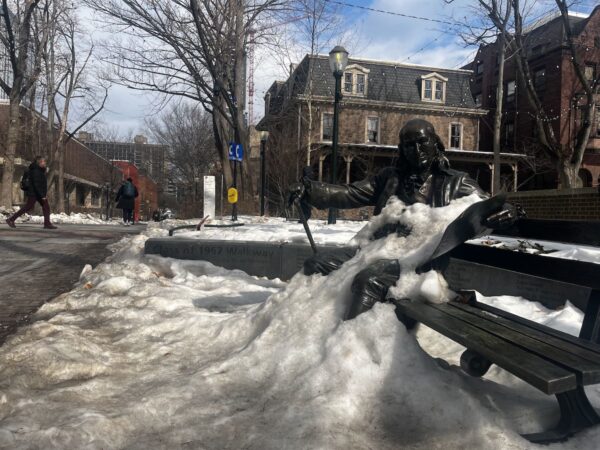
    Philadelphia could be hit with some sloppy, slushy snow Sunday.

    After a banner day Saturday, with a downright balmy high of 47 degrees in Philly, forecasters now expect a coastal storm to spread precipitation through the region late Sunday into Monday,

    “It’s one of those situations where if we have just enough cold air and just enough intensity, we could get several inches,” said Ray Martin, a meteorologist in the National Weather Service’s Mount Holly office. “But if the temperature is just a little bit warmer — even just a degree —it could end up being a rain-snow mix where there’s no accumulation. It’s a really borderline situation.”

    Currently, forecasters are calling for an inch of snow in Philadelphia, Martin said.

    “But I wouldn’t be shocked if we got unlucky and maybe got two to three inches of sloppy wet snow,” he said. “I also wouldn’t be shocked if we ended up with just mainly rain. There’s still some uncertainty with this forecast.”

    Still, he said, more snow would not necessarily represent a major blow to Philly’s efforts to dig out from its most stubborn snowpack in 65 years, courtesy of January’s blizzard and recent polar temperatures. With temps expected to climb back into the low 40s Monday, any accumulation will quickly melt away, Martin said.

    “Everything will look less brown,” he said. “But it’s not going to be 10 tons of snow or anything like that.”

    The changing forecast comes 24 hours after earlier weather models showed higher potential snow totals, Martin said.

    “There was some guidance suggesting a significantly higher snowfall of up to six inches of heavy wet snow,” he said. “But it’s way backed off from that.”

  • Southwest Philly-raised Raina J. León is the city’s new poet laureate

    Southwest Philly-raised Raina J. León is the city’s new poet laureate

    Norma Thomas had been keeping a secret since mid-January. At Saturday’s Passing the Pen ceremony, she was ready to shout it from the Central Library rooftop:

    “My daughter, Raina León, is the poet laureate of Philadelphia,” Thomas said, chest puffed out and brimming with pride. “She is effervescent, outgoing, and loves the city of Philadelphia.”

    Raina J. León, 44, was one of 32 applicants citywide, the largest number of candidates the city has had for the role, said Adam Feldman, the Free Library of Philadelphia department head of art and literature, and a poet laureate governing committee member.

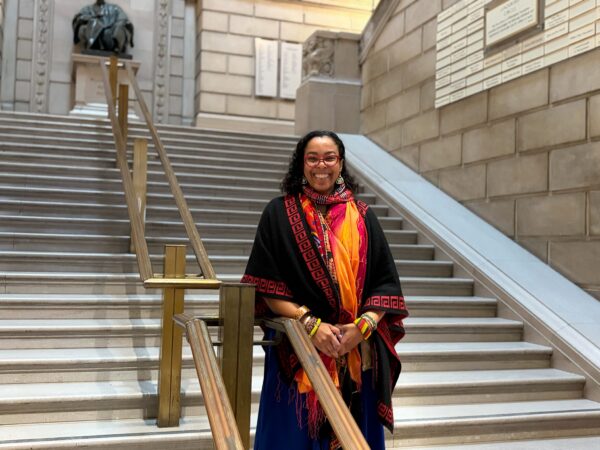
    Born in Upper Darby, León is a Black, Afro Boricuan poet, writer, educator, and cultural worker raised in Southwest Philadelphia. She speaks English, Spanish, and Italian, and believes in a world where diversity can strengthen communities.

    Still unable to believe her achievement, the University of Southern Maine professor recalled lighting candles nervously, hoping to get the email bearing the news.

    “I keep thinking, ‘Maybe this isn’t my time,’” León said. “But, no, DéLana would want me to dream big and to walk on assurance of my voice having a space,” she added, remembering her late friend, the poet DéLana R.A. Dameron, who died in November.

    Creating a space where people feel that their voices are welcome is the legacy León wants to leave during her two-year tenure as poet laureate.

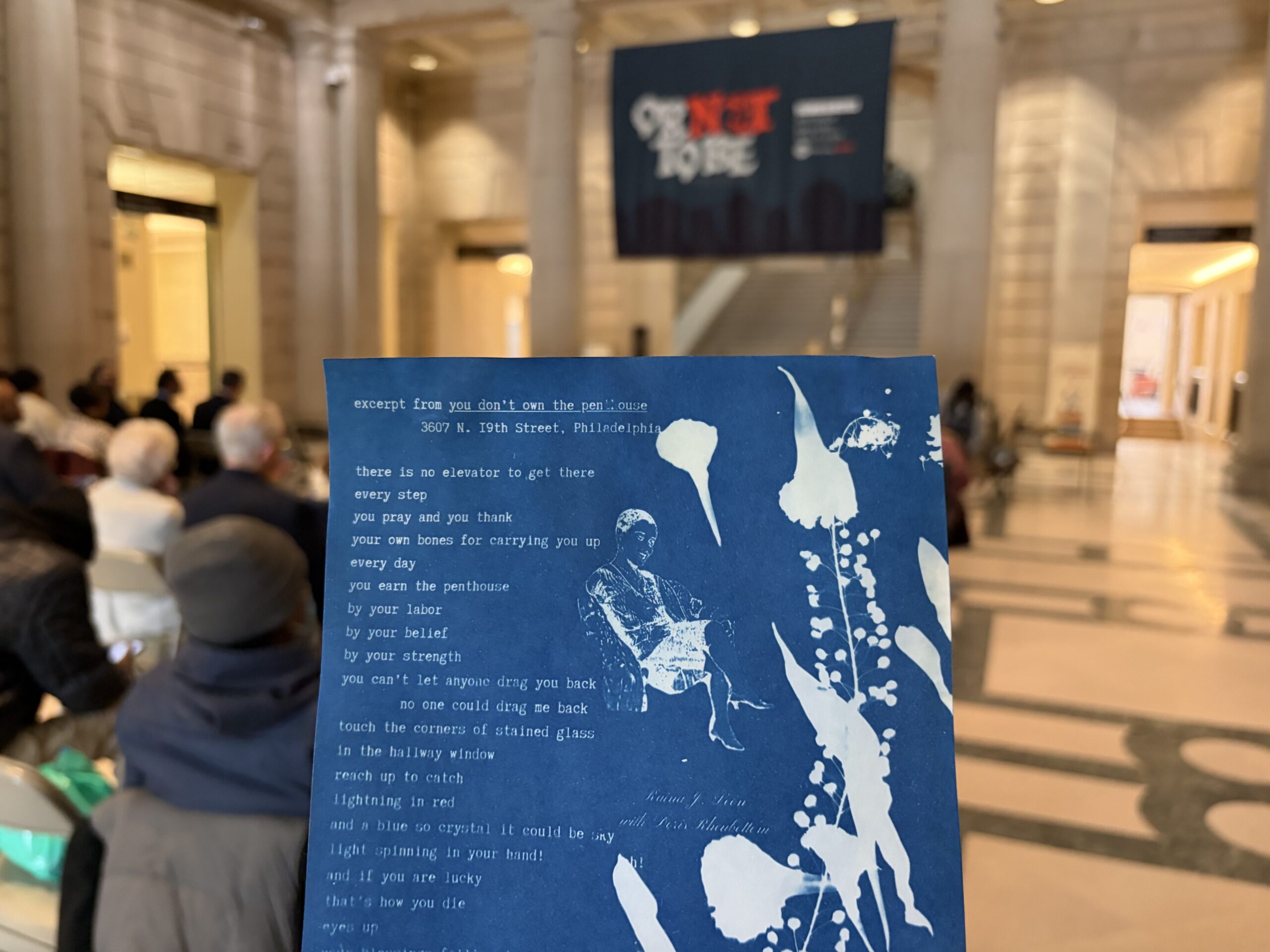
    An extract from Raina León’s poem “you don’t own the penthouse.”

    The poet laureate is an ambassador for poetry in the city, participating in community engagement, speaking at events, and mentoring the youth poet laureate, Rashawn Dorsey. But what excites León the most is helping Philadelphians see storytelling as a liberating practice.

    “Poetry is all around you. Even if you are like, ‘I don’t understand poetry’ — it understands you,” León said. “In these times of great volatility, with attacks on history and attacks on communities, there is a desire to preserve oneself by becoming numb, and poetry says, ‘No, you can’t be numb in life. You can’t be numb and observe the world.’”

    The poet laureate role comes with a $5,000 stipend, paid in two installments. But León says she isn’t in it for the money. She wants to provide language access to amplify Philadelphia’s diverse community of voices.

    She plans on holding open hours once a month at the Central Library of the Free Library for people to work on writing with her. For those who cannot come in person, León also wants to do online workshops.

    More importantly, she wants to work on writing projects across multiple languages, including American Sign Language, to ensure diversity opens doors in Philadelphia.

    “It’s like Bad Bunny said during the ‘Benito Bowl,’ what matters is that we are alive and we should be pouring [love] into one another and caring for one another,” León said. “Only love counters hate, and that is a revolutionary thing that is activating this, something that changes and pushes back on the nihilistic threat.”

    Raina León and her daughter at the Passing the Pen ceremony, in the Parkway Central Library on Saturday, Feb. 14, 2026.
  • All-Star reliever Elroy Face, 97, who saved 3 games for Pirates in 1960 World Series, has died

    All-Star reliever Elroy Face, 97, who saved 3 games for Pirates in 1960 World Series, has died

    PITTSBURGH — Elroy Face, an All-Star reliever for the Pittsburgh Pirates who saved three games in the 1960 World Series to help them upset the New York Yankees, has died. He was 97.

    In a news release Thursday, the Pirates announced they confirmed Mr. Face’s death. Team historian Jim Trdinich said the club was contacted by Mr. Face’s son, Elroy Jr., and informed the former pitcher died earlier in the day at an independent senior living facility outside Pittsburgh in North Versailles, Pa.

    No cause of death was provided. Mr. Face was eight days shy of his 98th birthday.

    “It is with heavy hearts and deep sadness that we mourn the passing of Pirates Hall of Famer Elroy Face, a beloved member of the Pirates family,” team chairperson Bob Nutting said in a statement.

    “Elroy was a pioneer of the modern relief pitcher — the ‘Baron of the Bullpen’ — and he played a critical role in our 1960 World Series championship.”

    Selected to six All-Star teams, Mr. Face went 104-95 with a 3.48 ERA in 16 major league seasons with Pittsburgh (1953-68), Detroit (1968), and Montreal (1969). He pitched in 848 games, starting only 27, and compiled 191 career saves — although saves didn’t become an official statistic until 1969.

    The 5-foot-8 right-hander holds the National League record for wins in relief with 96 and the major league mark for relief wins in one season after going 18-1 with a 2.70 ERA in 1959.

    He topped the National League with 68 appearances and 61 games finished in 1960, when the underdog Pirates stunned Mickey Mantle, Yogi Berra, and the mighty Yankees on Bill Mazeroski’s famous home run that won Game 7 of the World Series at Forbes Field in Pittsburgh.

    Mr. Face made four relief appearances in the Series, posting a 5.23 ERA in 10⅓ innings. He closed out Pirates wins in Games 1, 4, and 5.

    Inducted into the Pirates Hall of Fame in 2023, he is the club’s career leader in appearances with 802. And the team noted that if saves had been an official stat before 1969, he also would hold that franchise record with 188.

    Mr. Face was born in Stephentown, N.Y., on Feb. 20, 1928. He is survived by his three children, Michelle, Valerie, and Elroy Jr., and his sister Jacqueline, the Pirates said.

  • Seven couples tied the knot at Reading Terminal Market for a very Philly Valentine’s Day

    Seven couples tied the knot at Reading Terminal Market for a very Philly Valentine’s Day

    Tucked in between a fish market, a bakery, and a honey stand, seven couples tied the knot among family, friends, and perfect strangers on Saturday.

    “It’s amazing,” said Beth Esposito-Evans, who officiated the ceremony. “What could be more Philly than Reading Terminal Market?”

    Esposito-Evans, a vendor at the market, said she helped relaunch the “Married at the Market” Valentine’s Day wedding last year after she became an ordained minister.

    It was her second year officiating a group ceremony that blended traditional elements — two couples broke a glass, for example — with plenty of love for the market.

    Minister Elizabeth R. Esposito-Evans officiates and leads the wedding ceremony at the Reading Terminal Market’s Married at the Market on Valentine’s Day in Philadelphia, Pa., on Saturday, Feb. 14, 2026.

    “Love is timeless,” Esposito-Evans said, “regardless of destination or background.”

    For bride Daysi Morales, the market is a place full of fond memories. Her father, Juan Morales, worked there as a security guard. He died of cancer in September 2024.

    “So there’s a sentimental aspect,” Morales said. “It’s a place where I can feel my dad’s presence.”

    David Skillman, kisses his bride, Daysi Morales, during their wedding day at the Reading Terminal Market’s Married at the Market on Valentine’s Day in Philadelphia, Pa., on Saturday, Feb. 14, 2026.

    In an interview a few days before the ceremony, Morales, 36, and her partner, David Skillman, 35, finished each other’s sentences as they told their love story, which started as a Tinder date during the winter of 2021.

    They first met at Craft Hall, a sports bar in Old City, chosen because of its outdoor seating, which many people preferred during the worst days of the COVID-19 pandemic.

    They decided to go inside anyway, Skillman said, and there the conversation flowed and the connection was immediate. Morales was born in Honduras, he noted, where he had done medical missionary work as a registered nurse.

    “I think we dated for a couple weeks, then made [our relationship] official,” Morales said.

    They moved in together into her apartment in West Philly.

    After Morales’ father, Juan, fell ill, Skillman provided medical care for him during one of his shifts at the Hospital of the University of Pennsylvania Pavilion emergency department..

    “David was such a rock, not just for me, but for my family,” Morales said.

    In December 2024, they got engaged.

    The Reading Terminal Market offered couples a chance to get “Married at the Market” on Valentine’s Day in Philadelphia, Pa., on Saturday, Feb. 14, 2026.

    For the couple, who now live in South Philly, there was also a practical aspect to having a scaled-down, low-cost wedding.

    “I want to buy a house,” Skillman said. “And buying a house and having a big wedding aren’t both feasible.”

    Morales said she worked for the U.S. Department of Housing and Urban Development before being laid off last year.

    “Especially in this economy, I think micro weddings are becoming more and more popular,” Morales said.

    That didn’t stop them from having a special wedding with some of their favorite Philly attractions — including Okie Dokie Donuts, an after-party at Sardine Bar, specialty cocktails, and a cake made by Morales’ family.

    Luigi Nicolae performs some music for families, friends, and guests attending the Reading Terminal Market’s Married at the Market on Valentine’s Day in Philadelphia, Pa., on Saturday, Feb. 14, 2026.

    “It feels so special, to be in the market where my dad worked,” said Daysi Morales’ older sister Esther.

    Reading Terminal Market, at 12th and Arch Streets, is a magnet for tourists and a regular destination for residents. Housed in a National Historic Landmark building dating to 1893, the market has 72 food vendors, including a produce market, an oyster bar, Pennsylvania Dutch traditional food, and a wide range of other offerings.

    Fifty-seven couples applied for “Married at the Market,” according to event promoter London Faust. The seven lucky couples selected were treated to decor, a violin player, and the location, all paid for by Reading Terminal Market.

    Faust said “the Reading Terminal team began an outreach process loosely prioritizing those who had strong ties to the market in their love story.” The celebration is free of charge for those accepted.

    “We kind of needed something like this,” groom Joey Kathan said before the ceremony. “We’ve been engaged two years.”

    Megan Keane hugs Maurie Kathan, sister to Joey Kathan of Fishtown, the groom, at the Reading Terminal Market’s Married at the Market on Valentine’s Day in Philadelphia, Pa., on Saturday, Feb. 14, 2026.

    Kathan’s bride, Megan Keane, described them as a “COVID couple” who met on Bumble Washington and bonded over hiking trips before moving to Philadelphia a few years ago.

    “This was crazy,” Keane said. “We couldn’t believe we were accepted.”

    There were even some last-minute guests of honor. Dorothy and Terry White were at the market Saturday when one of the housekeepers introduced them to Esposito-Evans. She asked them to join the celebration.

    “We got married here, 21 years ago today,” Dorothy White triumphantly told the crowd.

  • LaMonte McLemore, 90, 5th Dimension singer and Jet photographer, has died

    LaMonte McLemore, 90, 5th Dimension singer and Jet photographer, has died

    Touring the world with the 5th Dimension, LaMonte McLemore liked to say he had a microphone in one hand and his camera in the other.

    Mr. McLemore, who died Feb. 3 at age 90, was best known as a founding member of the 5th Dimension, the genre-blending vocal group behind cheery, chart-topping hits like 1969’s “Aquarius/Let the Sunshine In,” a medley from the rock musical Hair. In an era of political violence and racial unrest, he and his fellow singers honed a fizzy style they called “champagne soul,” reaching a post-hippie audience — “This is the dawning of the Age of Aquarius,” they sang — while fusing jazz, pop, and R&B.

    Between 1967 and 1973, the group won six Grammy Awards, landed 20 songs on the Top 40 of the Billboard Hot 100, and performed in Las Vegas with Frank Sinatra and at the White House for President Richard M. Nixon. Mr. McLemore was a key part of that run, singing bass on hits like “One Less Bell to Answer” and “(Last Night) I Didn’t Get to Sleep at All,” in addition to serving as an occasional emcee, introducing his bandmates onstage by their zodiac sign.

    He was the only Virgo of the bunch.

    “LaMonte would be the first to tell you he may not have been our group’s strongest lead singer,” his former bandmates Marilyn McCoo and Billy Davis Jr. said in a statement. Yet it was Mr. McLemore “who brought us all together,” they said, adding that it was also Mr. McLemore who helped keep the group whole for 10 years, persuading the singers to postpone solo careers that ultimately led the original lineup to split apart in 1975.

    “Every time you hear a 5th Dimension harmony, every time you hear an Original 5th Dimension melody, pause and give thanks for our beloved friend,” McCoo and Davis said. “Without his grace, the egos of everyone else might have kept that dream from ever coming true.”

    Mr. McLemore, a onetime medical photographer for the Navy, toured with the 5th Dimension even as he pursued his other vocation, photography. He took pictures of fellow musicians including Marvin Gaye and Stevie Wonder; contributed to Harper’s Bazaar, where he was said to be the first Black photographer the magazine ever hired; and freelanced for publications including Ebony, Playboy, and People.

    For more than four decades, his photos were also a mainstay of Jet magazine, which once reached more than 1 million print subscribers each week. Mr. McLemore photographed more than 500 women — most of them nonprofessional models — for the publication’s “Beauty of the Week” feature, a reader favorite designed to showcase Black style and beauty from around the world.

    “LaMonte had a good eye. He was a sure shot,” said Sylvia Flanagan, a former Jet senior editor who worked with Mr. McLemore for 35 years. “And I knew that if LaMonte was shooting it, it was going to be perfect.”

    That was partly because Mr. McLemore was able to put his subjects at ease, Flanagan said. It was also because Mr. McLemore knew the assignment: “If a person was more voluptuous on the top, not so much on the bottom, LaMonte would put them in water. Because that magnifies everything.”

    Jet’s “Beauty of the Week” subjects were everyday women — college students, nurses, postal workers — confidently posing in a swimsuit or stockings. A brief caption identified them by name, noting their profession and hobbies along with their measurements.

    “They looked like someone whom you might catch a glimpse of at the Jersey Shore one day,” Jennifer Wilson wrote in the New Yorker in 2024, in an essay that praised the column for having “democratized the thirst trap.” “’Hey, did I see you in Jet?’ was a pickup line someone once tried on my aunt.”

    According to Flanagan, some of Mr. McLemore’s subjects were women he encountered while on tour with the 5th Dimension. Others were more personal: Mr. McLemore photographed his daughter, Ciara McLemore, 23 years after he photographed her mother, Lisa Starnes, wearing the same leopard-print swimsuit.

    Many of his Jet photographs were collected in a 2024 book, Black Is Beautiful, which he prepared with Washington gallerist Chris Murray. Artist Mickalene Thomas, who cited Mr. McLemore as an inspiration, wrote in an introductory essay that the pictures “served as a radical depiction of the Black female body as both effortlessly beautiful and exceedingly powerful.” Mr. McLemore’s images also “provided a much-needed space for Black women to see themselves represented as desirable,” she wrote.

    “To me, women are the miracle of life,” Mr. McLemore told Ebony in a 1989 interview. “As mysterious as they are, I got tired of trying to figure out the mystery. It’s better enjoyed than understood.”

    ‘A rare mixture’

    The first of four children, Herman LaMonte McLemore was born in St. Louis on Sept. 17, 1935. His first love was baseball, although he sang doo-wop ever since he was a boy, harmonizing on street corners with friends.

    When Mr. McLemore was 5, his father, a janitor and sometime musician, left the family. He was raised by his mother and maternal grandmother, who taught him a lesson that Mr. McLemore adopted as his motto: “We are only in this world to help one another.”

    After graduating from high school, Mr. McLemore enlisted in the Navy, buying his first 35 mm camera while stationed in Alaska. He went on to play minor league baseball, pitching in the Los Angeles Dodgers’ farm system before breaking his arm in a car crash, he said.

    In the offseason, he took pictures, working as a freelance photographer whenever he could. His assignments took him to the Miss Bronze California beauty pageant, where he photographed two contestants, McCoo and Florence LaRue, who became founding members of the 5th Dimension.

    Formed in 1965, the group was originally known as the Versatiles, and also included two of Mr. McLemore’s friends from St. Louis, Billy Davis Jr. and Ron “Sweets” Townson.

    “I pulled them together as friends,” Mr. McLemore told the Stuart News of Florida in 2004. “Ron happened to sing opera, Billy sang rock and roll, me and Marilyn were singing jazz and Florence was singing pop. It was just a rare mixture, but it blended.”

    The group had success almost immediately, scoring their first Top 40 hit with a cover of the Mamas & the Papas’ “Go Where You Wanna Go.” Later in 1967, they released their first million-selling record, “Up — Up and Away,” written by Jimmy Webb, a rising songwriter and pianist who backed them in the studio. The song’s title, usually rendered with a comma instead of a dash, became a national catchphrase, and the group went on to find repeated success with Webb and songwriter Laura Nyro, who crafted their hits “Stoned Soul Picnic” and “Wedding Bell Blues,” which went to No. 1.

    Their music resonated even behind the Iron Curtain. When the 5th Dimension embarked on a State Department cultural tour in 1973, performing in Eastern Europe and Turkey, they stopped to chat with admiring fans at embassies and elementary schools. “A lot of soul in Czechoslovakia,” Mr. McLemore observed on his return.

    His death — at his home in Henderson, Nev., a few years after suffering a stroke — was confirmed by Murray and by Robert-Allan Arno, who co-wrote Mr. McLemore’s memoir, From Hobo Flats to the 5th Dimension.

    In addition to his daughter, Ciara, survivors include his wife, the former Mieko Tone, whom he married in 1995; a son, Darin; a sister; and three grandchildren.

    Mr. McLemore and the 5th Dimension received renewed attention in 2021, when they were featured in Summer of Soul (… Or, When the Revolution Could Not Be Televised), Questlove’s Oscar-winning documentary about the 1969 Harlem Cultural Festival.

    Intended to promote Black pride and unity, the concert series featured acts including Nina Simone and Sly & the Family Stone. The 5th Dimension headlined the series’s first weekend, though, as the film noted, the singers had a mixed reputation among Black audiences. Hearing echoes of pop and folk rock acts like the Mamas & the Papas, some listeners mistakenly assumed that Mr. McLemore and his bandmates were white.

    Ebony magazine summed up the confusion in a 1967 cover story headlined, “The Fifth Dimension: White sound in a black group.”

    “Black people, when we first started … they didn’t understand what we were doing at all,” Mr. McLemore told an interviewer in 2017. He and his fellow singers were put off — “We said, ‘How can you color a sound? This is our sound. And it’s different and we ain’t gonna change it’” — but were gratified when the mood began to shift, just as the group notched its first No. 1 hit with “Aquarius.”

    “All of a sudden,” he said, “all the Black people came up and said, ‘We were with y’all all along!’”