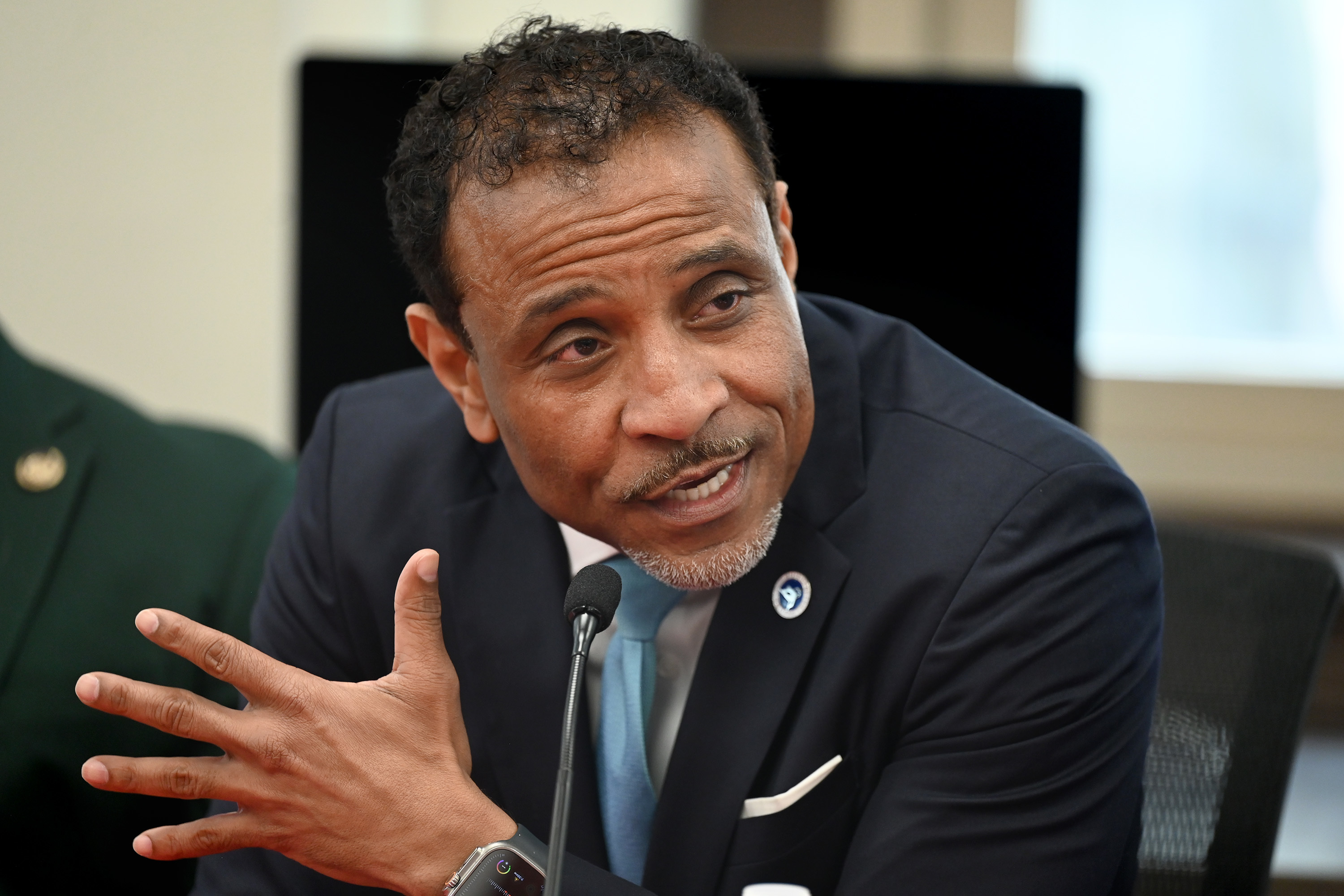
Ocean City Mayor Jay A. Gillian has filed for personal bankruptcy.
The “extraordinarily difficult decision” was made after a combination of business decisions he made, personal financial obligations, and outside circumstances led to “serious financial strain” on his family, Gillian said in a statement shared on Ocean City’s government website.
“Like many individuals and families across our nation who encounter unexpected hardship, I found myself in a position where traditional methods were no longer viable,” Gillian said. “It is my hope that by being transparent and direct, others facing similar hardships will feel empowered to seek help, take responsible action, and work toward rebuilding.”
Despite this personal challenge, Gillian said his leadership of Ocean City remained “unwavering,” and he would stay in his role as mayor. In the statement, the mayor assured residents that his personal financial issues had no impact on city finances and operations were uninterrupted.
“Safeguards, oversight, and the structure of municipal government ensure that personal finances and public finances remain entirely separate,” Gillian said.
Gillian referred to his public statement when asked for additional comment.
A sign welcomes visitors to Gillian’s Wonderland Pier in Ocean City on Tuesday, August 20, 2024.
While the mayor, who has been in office since 2010, did not specify what led to the bankruptcy beyond his statement, the Gillian family, which owned Gillian’s Wonderland Pier since 1965, sold the property to developer Eustace Mita, of Icona Resorts, in 2021. At the time, the Gillian family had defaulted on $8 million in loans, with the pier as collateral.
Mita has since embarked on plans to transform the site, first into a $150 million luxury hotel, and later, into townhomes. After a City Council vote Thursday, the property is now under review by the Ocean City Planning Board to determine whether the property should be rehabilitated or rezoned for new development.
Rebecca Kelly Slaughter was a powerful — but low-profile — bureaucrat when a New York Times news alert popped up on her phone blasting to the world her firing by President Donald Trump. The Democratic member of the Federal Trade Commission had found out only minutes earlier.
Her phone began blowing up as she stood outside her daughter’s school during a rehearsal of Beauty and the Beast Jr. Slaughter, who mostly avoided the media, was soon participating in an impromptu news conference on her phone as the musical carried on inside.
When her daughter stepped offstage, Slaughter pushed through a crowd so she could be the first to spill the news to the girl. The fifth grader burst into tears before asking, “Are you going to fight back?”
“Probably,” Slaughter replied.
Thrust into the spotlight in March, a regulator more comfortable with the minutiae of antitrust issues than the dynamics of a political fight, has emerged as one of the primary opponents of Trump’s war on the federal workforce he disparages as the “deep state.”
Slaughter has not onlyfought her owndismissal in court, she has defended the work of civil servants beforeCongress, on podcasts and on TV, speaking outwhen many others are demoralizedfrom losing jobs and absorbingthe president’s repeated attacks.
Rebecca Slaughter chats with her children as she makes dinner.
On Monday,the Supreme Courtwill hear arguments in her case — which probably will be the first in which the justicesrender a final decision on the legality of Trump’s moves to fire agency heads and gut agencies.
Many legal experts expect the court to rule against Slaughter — a majority of the justices have signaled support for much of Trump’s argument.The stakes are high: The case could upend how the federal government has been run for nearly a century. A ruling against her could give the president greater control over sometwo-dozen independent agencies, a major goal in his quest to enlarge his power.
The administration says presidential control will make agenciessuch as the Federal Trade Commission,Federal Election Commission and Federal Communications Commission more accountable to voters who elect presidents. Slaughter fears political influence will replace the expertise that has guided decisions on issues such as product safety, banking, and media mergers.
In other words, the very work she and some of the roughly 300,000 other civil servants who have been laid off in recent months have unobtrusively carried out for decades. Trump’s purge of the federal workforce is the largest in a single year since World War II.
“The alternative to allowing these agencies to operate as Congress designed is … accruing power to the president,” Slaughter said. “That is something that would be concerning at any time, but really concerning when you have a president who is interested in wielding power for the benefit of himself, his friends and allies — and at the expense of everyday Americans.”
Dismissed
Independent agencies were some of the first targets of Trump’ssecond-term buzz saw as he slashed government jobs and put the executive branch under a tighter grip.
“My administration will reclaim power from this unaccountable bureaucracy, and we will restore true democracy to America again,” Trump said in his first speech to Congress of his current term.
Slaughter watched with trepidation as Trump fired a Democratic member of the National Labor Relations Board in January and the Democratic chair of the Merit Systems Protection Board in February.
She guessed she might be a target but was still shocked when the email landed in her inbox March 18. Slaughter had spent nearly seven years on the commission and loved the work. Trump had originally appointed her in his first term, and she was reappointed by President Joe Biden.
“Your continued service on the FTC is inconsistent with my Administration’s priorities,” stated the message sent on behalf of the president.
It was the first time in 91 years a president had tried to fire a member of the FTC, which focuses on consumer protection and increasing business competition. Trump also dismissed the other Democrat on the five-member commission, Alvaro Bedoya, leaving only Republicans.
What struck Slaughter was thatTrump had given no reason for her dismissal. Congress insulated the FTC from the president through a law allowing the executive to remove commissioners only for “inefficiency, neglect of duty, or malfeasance in office.” Slaughter said firing her without citing any such reason was a blatant and illegal power grab. Almost immediately, she resolved to sue.
The stakes of her public stand quickly became apparent.
After juggling press calls and her daughter’s performance the night of her firing, Slaughter returned home. She received a knock on her door around 11:30 p.m. as her four children slept. It was a pizza delivery she had not ordered. Bedoya got one, too, the same night.
They concluded the pizzas were probably part of a wave sent to the homes of judges and other officials, most of whom had ruled against or opposed Trump’s policies — a reminder that potential assailants knew where they lived. They alerted police and scrubbed personal information from the internet.
Rebecca Slaughter chats with fellow FTC member Alvaro Bedoya on Capitol Hill in 2023.
But she and Bedoya resolved to stay in the public eye despite the risks. Days later, Slaughter appeared before a House committee to testify about her firing.
“I will not be the first to go down without a fight, and neither will Commissioner Bedoya,” Slaughter told the legislators. “We swore an oath to serve the American people and our Constitution, and I believe that the law will vindicate our right to finish the job.”
The legal fight
That was not so easily accomplished.
The path to the Supreme Court has been winding and full of setbacks. Bedoya had to drop out along the way.His family was struggling financially with one paycheck. The problems were compounded when someone tried to take out a $500,000 line of credit in his name, an act he suspects wastied to hisspeaking out about his firing.
“It is not fun to take on the president of the United States, particularly in this environment,” Bedoya said. “It’s not fun to notknow where your next paycheck will come from or if you will get a paycheck, period.”
Slaughter carried on, with her husband, who works for an investment firm, shouldering the financial load for the family and withhelp from pro bono attorneys. She has continued to publicly weigh in on matters before the FTC as if she werestill on the job, while speaking and making media appearances to draw attention to her case.
Rebecca Slaughter kisses one of her daughters as she prepares a meal in November.
“Mommy, I thought that being fired would make you less busy,” Slaughter recalled her 6-year-old daughter telling her.
In July, a federal judge ruled she could return to her job while her case played out in the courts. When Slaughter arrived back to work on a Friday, about two-dozen FTC staffers stood outside and clapped as she entered the building.
The returnwas exhilarating — but short-lived. By the following Monday, an appeals court hadpaused her reinstatement. In September, the appeals court ruled she could return to work again, but the Supreme Court soon stayed that order until it makes a final ruling on her dismissal.
Slaughter joked she is the first person in history fired from the FTC three times but said “the whiplash was really disheartening.” Even more disturbing were the glimpses she got inside the FTC during her second stint back.
It was an agency transformed.
“There were a lot of questions about political interference,” Slaughter said of two staff meetings she held. “People seem demoralized. People felt beaten down.”
A case with major ramifications
Slaughter’s case is in many ways a redo of another that changed the course of the federal government nine decades ago.
Through the late 1800s, presidents regularly rewarded political supporters with federal jobs. But the spoils system, as it was called then, was phased out after a backer of President James Garfieldwho had been denied a position assassinated him. Congress passed new laws for a nonpartisan civil service and prevented some officialsfrom being removed for political reasons.
A major test of thosestandards came in 1933, when President Franklin D. Roosevelt fired an FTC commissioner over policy disagreements related to economic regulation and the New Deal. William E. Humphrey sued, saying he could be removed only for cause under the law that created the FTC.
The Supreme Court sided with Humphrey, upholding Congress’s ability to limit the president’s firing ofthe heads of independent agencies. The case, knownas Humphrey’s Executor, is little known to the general public, but it has outsize legal importance.
University of Michigan law professor Daniel A. Crane credited it with “paving the way for the modern administrative state” — the alphabet soup of agencies that rely on technical expertise to regulate interest rates, bank deposits, labor disputes, and more.
The agencies are often run by bipartisan commissions, whose membersare appointed to staggered terms and can be removed only for cause. The idea was to mitigate political pressure on the agencies, so they could make decisions based on expertiseand technical knowledge, rather than political considerations.
Backers of the idea of independent agencies worry the demise of Humphrey’s Executor will mean presidents could politicize regulation of baby food, credit card fees, and a host of other things to please cronies, big donors, and ideological allies.
“The last thing we want is for industry to be able to come in and insert their favorite folks on commissions,” said Erin Witte, director of consumer protection at the Consumer Federation of America. “Congress designed these agencies to be independent for a reason. There’s a lot at stake.”
The Trump administration counters by arguing the contemporary FTC is far different fromthe one that existed when Humphrey’s Executor was decided. The agency now wields significant executive power, so the president — as head of the executive branch — has the constitutional authority to remove its commissioners.
“In this case, the lower courts have once again ordered the reinstatement of a high-level officer wielding substantial executive authority whom the President has determined should not exercise any executive power,” Solicitor General D. John Sauer wrote in a court filing.
The position is in keeping with a muscular vision of the presidency embraced by Trump and some conservatives, known as the unitary executive theory, that holds the president should have unfettered control over hiring and firing in the executive branch.
So far, the court has appeared to endorse that idea in temporary ordersallowing Trump to remove Democrats from the National Labor Relations Board, Consumer Product Safety Commission and Merit Systems Protection Board. Those orders aren’t final decisions on the merits of the cases but give a strong suggestion of where the court’s majority is headed, legal experts say.
“The Supreme Court has given every indication it will overrule Humphrey’s Executor,” Crane said.
Despite the seemingly long odds, Slaughter remains hopeful she will prevail. On a recent morning, she was once again making her case in public before a conference of women who work on antitrust issues.
“Why are you staying in the fight?” the host asked.
Slaughter said that independent agencies are crucial for protecting Americans and that she was taking a stand against Trump’s lawlessness. Trump should have sought a change in the law if he wanted to dismiss her, she said.
“As a person who took an oath to the Constitution, I feel very strongly that when that process for changing the law isn’t followed, then I need to stand up and push back,” Slaughter said. “I really recognize deeply how many people in this country are not in a position to do that. I am, so I have the obligation to do it.”
NEW YORK — A federal vaccine advisory committee voted on Friday to end the longstanding recommendation that all U.S. babies get the hepatitis B vaccine on the day they’re born.
A loud chorus of medical and public health leaders decried the actions of the panel, whose current members were all appointed by U.S. Health Secretary Robert F. Kennedy Jr. — a leading anti-vaccine activist before this year becoming the nation’s top health official.
“This is the group that can’t shoot straight,” said William Schaffner, a Vanderbilt University vaccine expert who for decades has been involved with ACIP and its work groups.
Several medical societies and state health departments said they would continue to recommend them. While people may have to check their policies, the trade group AHIP, formerly known as America’s Health Insurance Plans, said its members still will cover the birth dose of the hepatitis B vaccine.
For decades, the government has advised that all babies be vaccinated against the liver infection right after birth. The shots are widely considered to be a public health success for preventing thousands of illnesses.
But Kennedy’s Advisory Committee on Immunization Practices decided to recommend the birth dose only for babies whose mothers test positive, and in cases where the mom wasn’t tested.
For other babies, it will be up to the parents and their doctors to decide if a birth dose is appropriate. The committee voted 8-3 to suggest that when a family elects to wait, then the vaccination series should begin when the child is 2 months old.
The acting director of the Centers for Disease Control and Prevention, Jim O’Neill, is expected to decide later whether to accept the committee’s recommendation.
The decision marks a return to a health strategy abandoned more than three decades ago
Asked why the newly appointed committee moved quickly to reexamine the recommendation, committee member Vicky Pebsworth on Thursday cited “pressure from stakeholder groups,” without naming them.
Committee members said the risk of infection for most babies is very low and that earlier research that found the shots were safe for infants was inadequate.
They also worried that in many cases, doctors and nurses don’t have full conversations with parents about the pros and cons of the birth-dose vaccination.
The committee members voiced interest in hearing the input from public health and medical professionals, but chose to ignore the experts’ repeated pleas to leave the recommendations alone.
The committee gives advice to the director of the Centers for Disease Control and Prevention on how approved vaccines should be used. CDC directors almost always adopted the committee’s recommendations, which were widely heeded by doctors and guide vaccination programs. But the agency currently has no director, leaving acting director O’Neill to decide.
Hepatitis B is a serious liver infection that, for most people, lasts less than six months. But for some, especially infants and children, it can become a long-lasting problem that can lead to liver failure, liver cancer and scarring called cirrhosis.
In adults, the virus is spread through sex or through sharing needles during injection drug use. But it can also be passed from an infected mother to a baby.
In 1991, the committee recommended an initial dose of hepatitis B vaccine at birth. Experts say quick immunization is crucial to prevent infection from taking root. And, indeed, cases in children have plummeted.
Still, several members of Kennedy’s committee voiced discomfort with vaccinating all newborns. They argued that past safety studies of the vaccine in newborns were limited and it’s possible that larger, long-term studies could uncover a problem with the birth dose.
But two members said they saw no documented evidence of harm from the birth doses and suggested concern was based on speculation.
Three panel members asked about the scientific basis for saying that the first dose could be delayed for two months for many babies.
“This is unconscionable,” said committee member Joseph Hibbeln, who repeatedly voiced opposition to the proposal during the sometimes-heated two-day meeting.
The committee’s chair, Kirk Milhoan, said two months was chosen as a point where infants had matured beyond the neonatal stage. Hibbeln countered that there was no data presented that two months is an appropriate cut-off.
Cody Meissner, a professor of pediatrics at the Geisel School of Medicine at Dartmouth, also questioned a second proposal — which passed 6-4 — that said parents consider talking to pediatricians about blood tests meant to measure whether hep B shots have created protective antibodies.
Such testing is not standard pediatric practice after vaccination. Proponents said it could be a new way to see if fewer shots are adequate.
A CDC hepatitis expert, Adam Langer, said results could vary from child to child and would be an erratic way to assess if fewer doses work. He also noted there’s no good evidence that three shots pose harm to kids.
Meissner attacked the proposal, saying the language “is kind of making things up.”
Health experts say this could ‘make America sicker’
Health experts have noted Kennedy’s hand-picked committee is focused on the pros and cons of shots for the individual getting vaccinated, and has turned away from seeing vaccinations as a way to stop the spread of preventable diseases among the public.
The second proposal “is right at the center of this paradox,” said committee member Robert Malone.
Some observers criticized the meeting, noting recent changes in how they are conducted. CDC scientists no longer present vaccine safety and effectiveness data to the committee. Instead, people who have been prominent voices in anti-vaccine circles were given those slots.
The committee “is no longer a legitimate scientific body,” said Elizabeth Jacobs, a member of Defend Public Health, an advocacy group of researchers and others that has opposed Trump administration health policies. She described the meeting this week as “an epidemiological crime scene.”
Republican Sen. Bill Cassidy, a liver doctor who chairs the Senate health committee, called the committee’s vote on the hepatitis B vaccine “a mistake.”
“This makes America sicker,” he said, in a post on social media.
The committee heard a 90-minute presentation from Aaron Siri, a lawyer who has worked with Kennedy on vaccine litigation. He ended by saying that he believes there should no ACIP vaccine recommendations at all.
In a lengthy response, Meissner said, “What you have said is a terrible, terrible distortion of all the facts.” He ended by saying Siri should not have been invited.
The meeting’s organizers said they invited Siri as well a few vaccine researchers — who have been vocal defenders of immunizations — to discuss the vaccine schedule. They named two: Peter Hotez, who said he declined, and Paul Offit, who said he didn’t remember being asked but would have declined anyway. Offit is a nationally renowned vaccine expert and physician who leads Children’s Hospital of Philadelphia’s Vaccine Education Center.
Hotez, of the Texas Children’s Hospital in Houston, declined to present before the group “because ACIP appears to have shifted its mission away from science and evidence-based medicine,” he said in an email to the Associated Press.
The saga of Gillian’s Wonderland Pier continues as Ocean City Council voted last night to allow the local planning board to take the next steps in the property’s future.
Councilmembers voted 4-3 to refer the 600 Boardwalk Avenue site to the Ocean City Planning Board to evaluate its possible rehabilitation.
“This is basically a first step in what could potentially be an extensive review process, if it were to continue to move forward,” said Doug Bergen, Ocean City’s public information officer.
City Council President Terry Crowley Jr. and council members Jody Levchuk, Tony Polcini, and Pete Madden voted in favor, while Keith Hartzell, Dave Winslow, and Sean Barnes voted against.
This means the council is requesting the planning board to deem the property “an area of rehabilitation,” which kick-starts a wave of inspections, public input, and planning.
In the next 45 days, Bergen said the planning board must assess the site and make a recommendation to City Council on whether the once iconic amusement park property meets the criteria for rehabilitation. If council votes to make that determination, then the site developer and owners can negotiate with City Council to devise a redevelopment plan. “With lots of further review down the road,” Bergen said.
A coalition of various business associations, from restaurants to boardwalk shops, put pressure on City Council Wednesday in a news conference. Both the presidents of the Boardwalk Merchants Association — co-owner of Surf Mall, Wes Kazmarck — and the local restaurants association — owner of Cousin’s, Bill McGinnity — were joined on Wednesday by the Philadelphian property developer Eustace Mita.
Since the nearly century-old boardwalk amusement park closed last year, plans for the site’s redevelopment have been swirling around town. Mita initially proposed a 7-story luxury hotel, the “Icona in Wonderland Resort,” but council members refused to send that proposal to the planning board in August.
A month later, Mita announced that he was considering transforming the site into townhouses, after courting offers from Phillip Norcross (brother of South Jersey power broker George E. Norcross III) and from Virginia-based NVR Inc., to redevelop the site.
Now, the site’s future will be in the hands of the planning board’s assessment, which, for some business owners, is the right call. In a video posted to Facebook earlier this week, Kazmarck urged Ocean City residents to contact their council members and ask them to vote in favor of the planning board review.
“This is about City Council being able to make a better decision on what to do with this property. Everyone’s opinion here is a valuable opinion, but I think now we’re at that point where we should bring in experts,“ Kazmarck said. ”That’s the planning board. The planning board hires experts to evaluate the site to decide if the site should be an area of rehabilitation.”
While it may feel like redevelopment plans are coming swiftly, Kazmarck reassured residents that local business owners have been discussing these next steps since last year, he said in the video.
Netflix has agreed to buy Warner Bros Discovery’s TV, film studios and streaming division for $72 billion, a deal that would hand control of one of Hollywood’s most prized and oldest assets to the streaming pioneer.
The agreement, announced on Friday, follows a weeks-long bidding war in which Netflix offered nearly $28-a-share, eclipsing Paramount Skydance’s close to $24 bid for the whole of Warner Bros Discovery, including the cable TV assets slated for a spinoff.
Buying the owner of marquee franchises including “Game of Thrones,” “DC Comics” and “Harry Potter” will further tilt the balance of power in Hollywood in favor of Netflix.
It would help the streaming giant, which has so far built its dominance without major deals or a large content library, to ward off competition from Walt Disney and the Ellison family-backed Paramount.
The two companies together will “help define the next century of storytelling,” said Netflix co-CEO Ted Sarandos, who had once said “the goal is to become HBO faster than HBO can become us.”
Strong antitrust scrutiny likely
The deal, however, is likely to face strong antitrust scrutiny in Europe and the U.S. as it would give the world’s biggest streaming service ownership of a rival that is home to HBO Max and boasts nearly 130 million streaming subscribers.
David Ellison-led Paramount, which kicked off the bidding war with a series of unsolicited offers and has close ties with the Trump administration, had questioned the sale process earlier this week and alleged favorable treatment to Netflix.
Even before the bids were in, some members of Congress said a Netflix–Warner Bros Discovery deal could harm consumers and Hollywood.
Cinema United, a global exhibition trade association, said on Friday the deal poses an “unprecedented threat” to movie theaters worldwide.
“In light of the current regulatory environment this will raise eyebrows and concerns. The combined dominant streaming player will be heavily scrutinized,” said PP Foresight analyst Paolo Pescatore.
“We should expect this to wrangle on given Paramount Skydance pursuit for Warner Bros Discovery.”
Looking to allay some concerns, Netflix said the deal would give subscribers more shows and films, boost its U.S. production and long-term spending on original content and create more jobs and opportunities for creative talent.
The company argued in deal talks that a combination of its streaming service with HBO Max would benefit consumers by lowering the cost of a bundled offering.
The company has told Warner Bros Discovery it would keep releasing the studio’s films in cinemas in a bid to ease fears that its deal would eliminate another studio and major source of theatrical films, according to media reports.
Cash-and-stock deal
Warner Bros Discovery shares were up 2.4% at $25 in premarket trading, while Netflix fell nearly 3% and Paramount 2.2%. Comcast, the third suitor, was trading little changed.
Paramount and Comcast did not immediately respond to requests for comment.
Under the deal, each Warner Bros Discovery shareholder will receive $23.25 in cash and about $4.50 in Netflix stock per share, valuing Warner at $27.75 a share, or about $72 billion in equity and $82.7 billion, including debt.
The deal represents a premium of 121.3% to Warner Bros Discovery’s closing price on September 10, before initial reports of a possible buyout emerged.
The deal is expected to close after Warner Bros Discovery spins off its global networks unit, Discovery Global, into a separate listed company, a move now set for completion in the third quarter of 2026.
Netflix has offered Warner Bros Discovery a $5.8 billion breakup fee, while Warner Bros Discovery would pay Netflix $2.8 billion if the deal collapses.
Netflix said it expects to generate at least $2 billion to $3 billion in annual cost savings by the third year, after the deal closes.
Netflix growth worries
Analysts have said Netflix is driven by a desire to lock up long-term rights to hit shows and films and rely less on outside studios as it expands into gaming and looks for new avenues of growth after the success of its password-sharing crackdown.
Its shares are up just 16% this year, after surging more than 80% in 2024, as investors worry its breakneck growth could be slowing, especially after it stopped disclosing subscriber figures earlier this year.
The company has leaned on its ad-supported tier to drive growth, but that is not expected to become a major revenue engine until next year, while analysts say its push into video games has stumbled amid strategy shifts and executive turnover.
Buying Warner Bros would also deepen its gaming bet, as WBD is one of the few entertainment companies to notch big successes in the sector, including its Harry Potter title “Hogwarts Legacy,” which has generated more than $1 billion in revenue.
“You don’t have to like the fact that merit pay was in there,” Hibbs said of his contract at the board’s most recent meeting. But, he said, he is legally entitled to the payment on top of his $215,000 annual base salary because he met the goals listed in his contract.
And he is not the only South Jersey superintendent who has negotiated merit pay or other bonuses as part of a contract. The measure is a little-known way for New Jersey superintendents to earn higher salaries.
About 54 of the state’s 600 public school chiefs, or about 9%, had perks negotiated in their contracts in the 2023-24 school year, according to data from the New Jersey Department of Education.
Here’s what to know about the practice of giving merit pay to New Jersey superintendents:
How many superintendents get merit pay and how much is it?
In South Jersey, at least eight of nearly 100superintendents had merit or bonus pay provisions in their contracts in the 2023-24 school year, the most recent available state data obtained under the Open Public Records Act. The information may be incomplete because it is compiled from self-reporting by districts, and some superintendents have left their jobs since the data were compiled.
Among the districts offering merit pay are: Barrington, Black Horse Pike Regional, Clayton, Salem County Vocational, Washington Township in Gloucester County, Woodlynne, and West Deptford. Merchantville had it also, but that superintendent has since left the position.
window.addEventListener(“message”,function(a){if(void 0!==a.data[“datawrapper-height”]){var e=document.querySelectorAll(“iframe”);for(var t in a.data[“datawrapper-height”])for(var r,i=0;r=e[i];i++)if(r.contentWindow===a.source){var d=a.data[“datawrapper-height”][t]+”px”;r.style.height=d}}});
How much money do superintendents make in bonus pay?
An Inquirer analysis of state data found that bonus compensation packages ranged from $2,000 to $56,989 for the 2023-24 school year.
They included additional pay granted for meeting performance goals or obtaining a doctorate, orlongevity bonuses for years of service.
The districts with the most lucrative merit packages were in North Jersey: $56,989 in Bergen County Vocational; $43,272 in Hudson, and $36,489 in Union.
Clayton Superintendent Nikolaos Koutsogiannis, in his ninth year as schools chief, received $4,350 in longevity pay. He joined the district in 2008 as a principal and is one of the longest-serving superintendents in Gloucester County.
“I enjoy my job here,” Koutsogiannis said. “They wanted to keep me here. I was more than willing to stay.”
The Barrington, Black Horse Pike Regional, Salem County Vocational, and West Deptford superintendents did not respond to numerous email messages.
Some South Jersey districtswhere superintendents are among the highest-paid in the region do not offer merit pay, including Winslow, Lenape Regional, Burlington City, Mount Laurel and Cherry Hill.
Because of the cap, dozens of superintendents left the state for higher salaries elsewhere and districts had difficulty recruiting educators. Others negotiated merit pay and bonuses to boost their earnings.
Gov. Phil Murphy speaks with members of the media after meeting with Gov.-elect Mikie Sherrill at the governor’s office in Trenton last month.
Superintendent salaries can vary, as boards negotiate contracts based on experience, district size, and other factors.
The New Jersey Department of Education must approve contracts,including merit pay provisions and goals. Executive county school superintendents review contracts for each district.
Purnell said his association, which provides guidance to more than 600 New Jersey school boards, generally steers them away from considering merit pay. Longevity pay, however, is encouraged as an incentive to keep quality superintendents, he said.
Many superintendents are less interested in pursuing additional goals because merit pay is not factored into pensions, Purnell said.
When merit pay is in a contract, the board and the superintendent establish merit goals at the beginning of the school year. At the end of the year, the superintendent must submit evidence that the goals were met. The executive county superintendent must sign off on the request before any bonuses are paid.
The state specifies quantitative and qualitative goals that may be included in merit pay. It also sets the value of each goal, a percentage of the superintendent’s base salary.
Based on a district’s needs, merit pay may be given for meeting goals such as reducing chronic absenteeism, increasing student achievement, setting up learning academies, or establishing a foundation.
Hibbs’ goals approved by the board include completing Google training presentations, taking online professional development courses, and beefing up security.
In September, records show, the executive county superintendent approved $9,072 in merit pay for Barrington Superintendent Anthony Arcodia for meeting two goals — improved parent communication and overhauling the parent-student handbook.
Barrington school board president Mark Correa said Arcodia waived his right to merit pay for the 2025-26 school year because of the district’s belt-tightening. He will be eligible for merit pay in future years, he said.
The district “believes in rewarding our high-achieving, long-serving superintendent when possible,” Correa wrote in an email this week.
Some school chiefs get a stipend for holding an additional administrative position, such as serving as superintendent and a school principal, typically in smaller districts.
What are the drawbacks of merit pay?
Purnell said merit goals can muddy the waters for districts because superintendents could become so focused on those goals that they lose sight of the overall strategic plan.
“The question would be why do you need to receive merit pay when it’s your responsibility to provide a thorough and efficient education,” Purnell said. “You don’t want the goal to become more important than the best interest of all children.”
“Student outcomes are the result of a whole system and are heavily influenced by factors outside one leader’s control,” Campbell said. “If a district uses merit pay at all, I recommend it be a small slice of compensation.”
West Deptford Superintendent Brian Gismondi poses for a portrait outside the West Deptford Child Development Center in West Deptford earlier this year.
How common is merit pay nationwide?
Merit pay does exist in other states.Earlier this year, the state-appointed superintendent for the Houston Independent School District received a $173,660 bonus based on his annual performance evaluation, which credited him with boosting standardized test scores. His annual base salary is $462,000.
Nationwide, the median salary for a school superintendent was $156,000 for the 2023-24 school year, according to the School Superintendents Association. The group does not track merit pay.
The median superintendent salary among 91 South Jersey school districts was $176,088 for the 2024-25 school year, an Inquirer analysis found.
In Philadelphia, Superintendent Tony B. Watlington Sr. recently received a contract extension that will keep him in the nation’s eighth-largest school district through 2030. He is paid $367,710. He does not get merit pay.
Philadelphia School District Superintendent Tony B. Watlington, Sr.
What’s happening with merit pay in Washington Township?
In Washington Township,Hibbs has the most lucrative merit package in South Jersey. He received $25,000 in bonus pay for the 2023-24 school year, according to district records obtained by The Inquirer under the state’s Open Public Records Act.
Hibbs has asked the board several times to approve $27,319 in merit pay for the 2024-25 school year, indicating he had met four of the five goals approved by the board. His contract allows an annual merit bonus of up to 14.99% of his salary, the maximum permitted by the state.
The request has been rejected by the board, failing to get five votes needed. The dispute is expected to lead to another legal showdown between Hibbs and the board.
During a heated exchange at a board meeting last month, Hibbs accused the board of retribution. He was suspended for five months earlier this year over an ethics complaint. A judge ordered his return and Hibbs was later cleared of any wrongdoing.
“My merit pay that was 100% approved and achieved has been consistently voted down by certain members,” Hibbs said at a recent school board meeting.
Hibbs was hired in 2023 with an annual base salary of $215,000, making him among the highest-paid superintendents in South Jersey. His contract runs through 2027.
Staff writer Kristen A. Graham contributed to this article.
Think you know your news? There’s only one way to find out. Welcome back to our weekly News Quiz — a quick way to see if your reading habits are sinking in and to put your local news knowledge to the test.
Question 1 of 10
This nearly 100-year-old pizzeria, considered Philadelphia’s oldest, closed on Sunday:
CorrectIncorrect. XX% of other readers got this question right.
The Marra family says they’re exploring a new location for Marra’s — one with better parking. The building, which the Marras bought in 1927, has been sold after being on the market for several years.
Question 2 of 10
There’s already a plan for what will replace Marra’s in its original Passyunk Ave. location. What kind of cuisine is it expected to be?
CorrectIncorrect. XX% of other readers got this question right.
EMei, arguably Philly’s most acclaimed Sichuan restaurant, is taking over the building occupied by Marra’s for the last 98 years. The East Passyunk EMei would roll out in phases, with takeout and delivery launching in February during renovations and full dine-in service targeted for summer 2026.
Subscribe to The Philadelphia Inquirer
Our reporting is directly supported by reader subscriptions. If you want more journalism like this story, please subscribe today.
This musician with Pennsylvania roots slammed the Trump administration this week for using their song without permission in a video promoting ICE.
CorrectIncorrect. XX% of other readers got this question right.
On Tuesday, Sabrina Carpenter condemned the White House for posting a video featuring ICE arresting protesters and undocumented immigrants to one of her songs. The Bucks County native replied to the post, “this video is evil and disgusting. Do not ever involve me or my music to benefit your inhumane agenda.”
Question 4 of 10
Quinta Brunson of Abbott Elementary has started a new fund in partnership with the Philadelphia School District to provide free ____ for students.
CorrectIncorrect. XX% of other readers got this question right.
Through the Quinta Brunson Field Trip Fund, district teachers and administrators will be able to apply for money for field trips by completing a short application subject to evaluation by an independent, internal group of educators. Field trip grants will be made twice a year. Brunson said she recalls her class selling hoagies to pay for field trips and that the trips played a seminal part in her Philly education.
Question 5 of 10
The Rittenhouse estate sale of the late lawyer Bill Roberts opened to the public this week. The house is said to be filled with 100,000 of this object:
CorrectIncorrect. XX% of other readers got this question right.
Roberts, a longtime lawyer at Blank Rome LLP, was a bibliophile whose interests — and library — spanned genres and eras, touching on microeconomic theory, beekeeping, botany, classical music, poetry, and much else.
story continues after advertisement
Question 6 of 10
Eagles offensive coordinator Kevin Patullo's Moorestown house was pelted with what after the Eagles' Black Friday loss to the Bears?
CorrectIncorrect. XX% of other readers got this question right.
According to the Moorestown Police Department, Patullo’s home was vandalized with multiple eggs at about 2:50 a.m. Saturday, hours after the Eagles lost. Patullo, the first-year Eagles offensive coordinator, has shouldered the brunt of the blame for the Eagles’ struggles on offense. A website calling for his firing surfaced. Fans chanted for him to be fired during the game Friday. Police are still investigating.
Question 7 of 10
Philadelphia scientists won an Ig Nobel prize for studying this flavor of breast milk:
CorrectIncorrect. XX% of other readers got this question right.
Julie Mennella was one of two scientists at Monell Chemical Senses Center to win a 2025 Ig Nobel Prize, the satirical counterpart to the Nobel Prize for her work illuminating how babies respond to garlic-flavored breast milk.
Question 8 of 10
What did N.J. Senator Cory Booker notably do over the Thanksgiving holiday weekend?
CorrectIncorrect. XX% of other readers got this question right.
After a brief engagement, New Jersey U.S. Sen. Cory Booker and real estate executive Alexis Lewis celebrated their nuptials Saturday in Washington, after a courthouse wedding last Monday.
Question 9 of 10
Punk icon Patti Smith recently told The Inquirer that she was formed by her time in Philadelphia and rural South Jersey. Where did she grow up in Philly?
CorrectIncorrect. XX% of other readers got this question right.
Smith calls Philadelphia a formative force in her life. “Culturally, it was the city that helped form me,” she said. “It was where I discovered rock and roll.” Smith grew up in Germantown with stops in Upper Darby and South Philly peppered in.
Question 10 of 10
Sixers’ Joel Embiid’s latest signature shoe has dropped. What brand is making the new sneaker?
CorrectIncorrect. XX% of other readers got this question right.
The SKX JE1 marks Skechers’ first foray into signature basketball shoes. For years, Embiid was signed to and developed signature kicks with Under Armour. Embiid entered a partnership with Skechers in 2024. “I’m excited to share it with the world,” Embiid said. The shoes will retail for $130.
Your Results
You have skipped .
You scored XX out of 10.
The average reader scored XX out of 10
Seems like you’ve been skimming more than reading there, buddy. There’s always next week.
You’ve read some articles (or made some educated guesses) but we wouldn’t come to you first for our local news recaps. Better luck next week!
Do you work here? You’re a local news stan with the latest updates on Philly happenings. Your friends definitely ask you for summaries on what’s going on and it shows.
A second woman is accusingPhiladelphia doctor John Smyth Michel, the medical director and owner of Excel Medical Center, of sexual abuse. She said Michel touched her inappropriately when she worked for him several years ago, according to a recent court filing by the Philadelphia District Attorney’s Office.
Prosecutors charged Michel with felony rape and sexual assault earlier this yearafter a female patient said he raped her during an October 2024 office visit.
Michel, 55,of Jenkintown, told police and state medical licensing authorities that he had sex with the 39-year-old patient, but he claimed it was consensual, criminal and state licensing records show.
The new accusations involve a former female employee who worked for Michel as a medical assistant from 2015 to 2019 at his East Mount Airy office on Stenton Avenue and at another location in Germantown on Chelten Avenue.
She recently told law enforcement authorities that beginning in 2018 Michel touched her breasts over her clothing on multiple occasions while she was working in the office. He additionally groped her vagina over her clothing before she quit in 2019.
The accusations have not resulted in new charges at this time, but the investigation remains ongoing, according to Marisa Palmer, a spokesperson for the DA’s office.
Prosecutors are seeking to introduce the groping accusations as evidence to bolster its sexual assault case against Michel, given there were no witnesses to the alleged rape.
“The incidents reveal a common plan, scheme or design on the part of the defendant to engage in unlawful and similar nonconsensual sexual conduct with vulnerable women in his medical offices,” Assistant District Attorney Eamon Kenny wrote in a Nov. 24 court motion.
The judge presiding over the criminal case must decide whether to grant Kenny’s motion and put the 34-year-old former employee’s accusations before jurors at trial.
The Inquirer does not identify alleged victims of sexual assaultwithout their permission.
Michel did not return phone calls and emails from The Inquirer this week. His criminal defense lawyer, Andrew Gay Jr., declined to comment Wednesday.
Michel founded Excel Medical Center, whichgrew to more than a dozen medical clinics located throughout the city, with about 20,000 patients and 200 employees.
Last month, Excel’s general manager wrote a letter to patients informing them the practice “will be ceasing operations” as of Dec. 1. “We truly value the trust you have placed in us for your care,” the manager stated in the Nov. 11 letter obtained by The Inquirer.
A woman who answered the phone at Excel’s main location in West Mount Airy on Thursday said the practice was not taking any new patients in preparation of closing. She said the practice might resume operations and accept new patients after the new year. Michel’s lawyer declined to comment when asked about the practice’s status.
The criminal case, which is pending in Common Pleas Court, involves a then-38-year-old patient.
According to police and court records, she accused Michel of kissing her during a May 2024 exam at his East Mount Airy location.
She told him “no,” left the office, and did not report the kissing incident.
About five months later, she went to an appointment at Michel’s North Philadelphia office on West Diamond Street. During the Oct. 14, 2024, visit, she says Michel raped her with such force that her head banged twice against the exam room wall.
The exterior of Excel Medical Center at 2124 Diamond Street in Philadelphia.
In early November 2024, she told her husband what had happened and subsequently filed a police report. Michel was arrested and charged about three months later.
Michel’s trial was initially slated for Dec. 9, but during a hearing on Monday, a judge postponed it until Feb. 17 after the DA’s office asked for more time to investigate, court records show.
Michel’s suspension nears end
In June, the State Board of Osteopathic Medicine, which regulates and oversees licensure of osteopathic doctors like Michel, disciplined him for having sex with a patient — a violation of state regulations.
He apologized to the board in a letter, saying, “I fully acknowledge that I crossed a professional boundary” and is “profoundly contrite.”
The board suspended his medical license for six months, followed by 18 months of supervised probation, and fined him $4,000. Michel’s suspension is set to end on Dec. 11.
If convicted in the criminal case, Michel could permanently lose his medical license.
In an e-mailed statement on Thursday, the Pennsylvania Department of State, which oversees professional licensing boards, said its prosecution division “continues to closely monitor Dr. Michel’s criminal charges and review his compliance with the terms of the consent agreement.”
Abuse in office hallways
The accusations outlined in Kenny’s motion include new details of sexual misconduct. The former employee said Michel approached her from behind to “grab her breast over her shirt.”
She was stunned and “hated the feeling,” but she feared losing her job so she didn’t say anything to him.
Once, he simultaneously “cupped” her breast and vagina over her clothes with his hands. She turned around and screamed at him to stop touching her, according to the motion. He replied, “`You know you want it and you know you like it,’” she recounted.
She said she couldn’t quit because she needed the income and told her co-workers about the abuse. Those colleagues helped her “avoid him” while at work. She also told her husband, though she persuaded him not to confront Michel.
She resigned in 2019 after landing a new job. They had no contact until this year when he texted her.
When she asked why he wanted to talk to her after so much time had passed, Michel texted nevermind, the former medical assistant told prosecutors. She then wrote back, “explaining how she felt about his abuse all these years later, that the thoughts of it still traumatized her.”
Inquirer staff writer Chris Palmer contributed to this article.
Right now, any Philadelphian 21 or older can go online or walk into a regional smoke shop and buy a THC-infused drink as potent as products in legal dispensaries.
But soon, that might all change.
The billion-dollar intoxicating beverage industry exploded in recent years, with THC-infused seltzers, lemonades, and teas that resemble popular products like Surfsides or White Claws. Sold in local gas stations, smoke shops, and liquor stores outside of Pennsylvania, these weed drinks deliver a cannabis high that is infused into bubbly, sweet canned beverages.
While marijuana is still federally illegal, the hemp industry had found a way to manufacture and sell hemp-derived THC drinks across the country through a legal loophole that is soon closing.
Last month, Congress banned all intoxicating hemp products, a slew of THC-infused smokeable, vape-able, and edible products that are derived from hemp plants but could be mistaken for actual marijuana. In many cases, the drinks are just as potent as conventional weed.
Starting in 2027, almost all of them will be illegal, spurring a nationwide movement within the industry to save the burgeoning market.
Arthur Massolo, the vice president of national THC beverage brand Cycling Frog, which sells its wares locally, saidthese restrictions will have devastating effects on the producers of thousands of hemp-derived products, like THC, but also CBD, the non-intoxicating cannabinoid popular for treating anxiety, sleep, and pain.
Will Angelos, whose Ardmore smoke shop and wellness store, Free Will Collective, relies on THC drinks for nearly 40% of its business, is hoping for some saving grace. “We’re either looking to pivot or we’re disappearing,” he said.
Adults share Cycling Frog canned THC drinks in this marketing photo provided by Cycling Frog.
What are THC-infused drinks?
Seltzers, sodas, teas, mocktails, and lemonades all infused with THC — and sometimes non-intoxicating CBD — exploded onto the scene a few years ago and grew into a billion-dollar business, said hemp market analyst Beau Whitney.
“These drinks have transformed the hemp industry into this low-dose intoxicating health and wellness, alcohol-adjacent product,” said Massolo, who is also the president of U.S. Hemp Roundtable, a hemp business advocacy organization.
The THC-infused drinks sold in gas stations, smoke shops, and liquor stores are supposedly formulated using legally grown hemp, which is allowed to be grown under the 2018 Farm Bill that opened the door to hemp farming in the U.S.
Lawmakers carved out an exemption from federal drug laws for cannabis plants containing 0.3% or less of THC. These low-THC plants are considered “hemp” and are legal to grow. Cannabis plants over that THC threshold are considered marijuana and can carry felony charges if the plant is not being grown by state-licensed growers in places where adult use or medicinal marijuana is legal, like New Jersey and Pennsylvania.
While intoxicating hemp products have enjoyed consistent growth in the past years, these THC-infused drinks have increasingly appeared in aisles of liquor stores and supermarkets in some states, allowing adults who normally don’t visit dispensaries to pick up a bottle of infused wine in the same place they grab groceries, said New Jersey cannabis lawyer Steve Schain.
Hemp products photographed at the Philadelphia Inquirer, November 21, 2025.
The ease of access to THC drinks allowed the national market to grow to $1.3 billion in annual sales, and if access continues, Whitney said, that figure could reach $15 billion in the coming years.
This is all thanks to what Whitney calls the “FPS,” or “Female Power Shopper.” These women, ages 29 to 45, are the ones who are likely shopping for a household in grocery and liquor stores, and may jump at the chance to try cannabis products without diving headfirst into dispensaries, Whitney said.
Mary Ellen, 55, of Bucks County, who asked to not to be identified by her last name over concerns for her cannabis use and employment, said these THC drinks are the perfect way to unwind after a long day, especially for adults like her who choose not to drink alcohol. As a medical marijuana patient, she uses regulated cannabis for a variety of ailments, but also enjoys THC drinks like Nowadays’ infused mocktails that she buys at Angelos’ Ardmore store.
“I’d rather come home and have a glass of Nowadays. That’s a lot better than having a glass of vodka or a benzodiazepine,” she said. “I’m not going to forget what I did the night before, and I’m not going to wake up feeling crappy the next morning.”
City smoke shop exterior in the 1000 block of Chestnut Street Monday, July 21, 2025.
What are the concerns over THC drinks?
As the money started to roll in for THC drinks, fear among local communities and law enforcement began to grow. In the Philadelphia suburbs, the Bucks, Chester, and Montgomery County district attorneys’ offices finished a 10-month investigation into intoxicating hemp products and the local stores that sell them.
The 107-page grand jury report speaks of a public health crisis unfolding in “plain sight” across Pennsylvania, where retailers have little to no oversight, in some cases selling actual marijuana.
Montgomery County District Attorney Kevin Steele said the industry created a “Wild West situation” and urged state lawmakers to regulate the industry similarly to alcohol and tobacco, including age requirements, licensing, and mandatory lab testing.
Stakeholders in the industry support regulation of some kind. While hemp-derived THC companies fear the economic collapse of their industry, Massolo and Angelos say there is concern that these products will leave overt brick-and-mortar operations known by local officials for more covert, illicit operations, similar to how these products were purchased before the 2018 Farm Bill.
“We’ve basically traveled back to 10 seconds before the Farm Bill of 2018 was signed,” Schain said.
Mary Ellen says the lack of regulation is a major sticking point for consumers who flock to these products, but would like some reassurance on the drinks they are ingesting.
But, even if the ban goes into effect, she said, “people will just figure out another way for us to get it. It’ll be like a prohibition that we’ve seen in this country with alcohol and marijuana.”
THC and CBD-infused beverages on the shelves of Free Will Collective, an Ardmore smoke shop and wellness store owned by Will Angelos. As Congress moves to ban most intoxicating hemp products, business owners like Angelos aren’t sure they will be able to keep the doors open long past 2027 if current regulations go into effect.
Will THC-infused drinks be banned or saved by 2027?
Now, as the industry’s yearlong grace period begins before the ban takes effect, companies are scrambling.
The intoxicating hemp manufacturers and retailers who spoke to The Inquirer said the game plan is to offload all of the intoxicating hemp products in stock, including THC-infused drinks, flower, vapes, and even CBD products.
Some companies will see almost their entire product catalog become illegal, in some cases dwindling from 45 products on offer down to two, Whitney said of the firms he works with. The far-reaching impact will also hurt industrial hemp products, cannabis tourism, alcohol distributors, and even the legal cannabis industry, as some of their products, including CBD, will now have to contend with these new regulations, Schain and Whitney said.
At the U.S. Hemp Roundtable, Massolo is having daily board meetings, including on weekends, to coordinate a response to federal lawmakers. It’s now a race against the clock to remedy or claw back some of the new regulations before damage is done to the industry’s distribution pipelines, Massolo said. The group hopes to rally other industries, like traditional beverages, wellness products, and supplements, to bolster its case.
Among the U.S. Hemp Roundtable’s recommendations to lawmakers are an extension of the hemp ban grace period to two years, raising the limit on hemp-derived THC products, and allowing states to regulate these products as they see fit, to name a few.
Stakeholders say they want regulations to help legitimize this billion-dollar endeavor and save it from annihilation, but smaller operators like Angelos hope it’s not at the expense of small independent businesses.
While precautions like rigorous age verification systems and lab testing are necessary, Angelos said, if regulators “overtax, or over gate-keep,” many of the smaller retailers — who he said enjoy the benefit of knowing their local government officials and community — won’t be able to compete in the market.
“There obviously has to be standards, but I’m scared of an overcorrection,” Angelos said of the hemp ban. “It’s not just a singular choice. If you want your kids to be safe, have a mechanism where you can keep your eyes on the product.”
Two of its tentpole baseball franchises — the Brooklyn Dodgers and the New York Giants — packed up before the 1958 season and moved to the West Coast. Leaving behind only the Yankees and the rival American League to carry the New York City banner.
Just down the (not-yet-under-construction) I-95 corridor, the Carpenter family wondered if their own N.L. franchise, the Philadelphia Phillies, could help fill the void.
Broadcasting Phils’ games to the New York market could help soften the blow of losing two beloved franchises. It could also be lucrative.
And it would help a Philly team build a fanbase in — of all places — the Big Apple.
A league of their own
Now they’re just organizing devices, but back in the 1950s, there was a difference between the two leagues under the Major League Baseball umbrella.
The N.L. was faster to integrate Black players, featured more competitive teams, and thus more competitive pennant races. The A.L., on the other hand, was mostly dominated by one glory-hogging franchise.
So Phillies owner Bob Carpenter, hoping to help fill the vacuum, made a deal with TV station WOR, which had previously aired Dodgers games.
New York would carry 78 Phillies games during the 1958 season: 58 from Connie Mack Stadium, and 20 from the road (including night games).
And they weren’t alone.
Willie Mays scores on an inside-the-park home run vs. the Phillies in the 1950s.
‘The market is shot’
The St. Louis Cardinals and Pittsburgh Pirates made deals to broadcast two dozen of their games against the Giants and Dodgers to a New York audience.
Yankees brass reacted with trademark tact: They started making threats.
If Phillies (or Pirates or Cardinals) games returned to New York television sets the next season, then the Yankees would look to televise their games — featuring World Series-winning superstars like Mickey Mantle and Yogi Berra — on a national network. They’d even partner with the National League’s Milwaukee Braves to complete the package. Together stealing away scores of diehards and converting scores of casuals, from sea to shining sea.
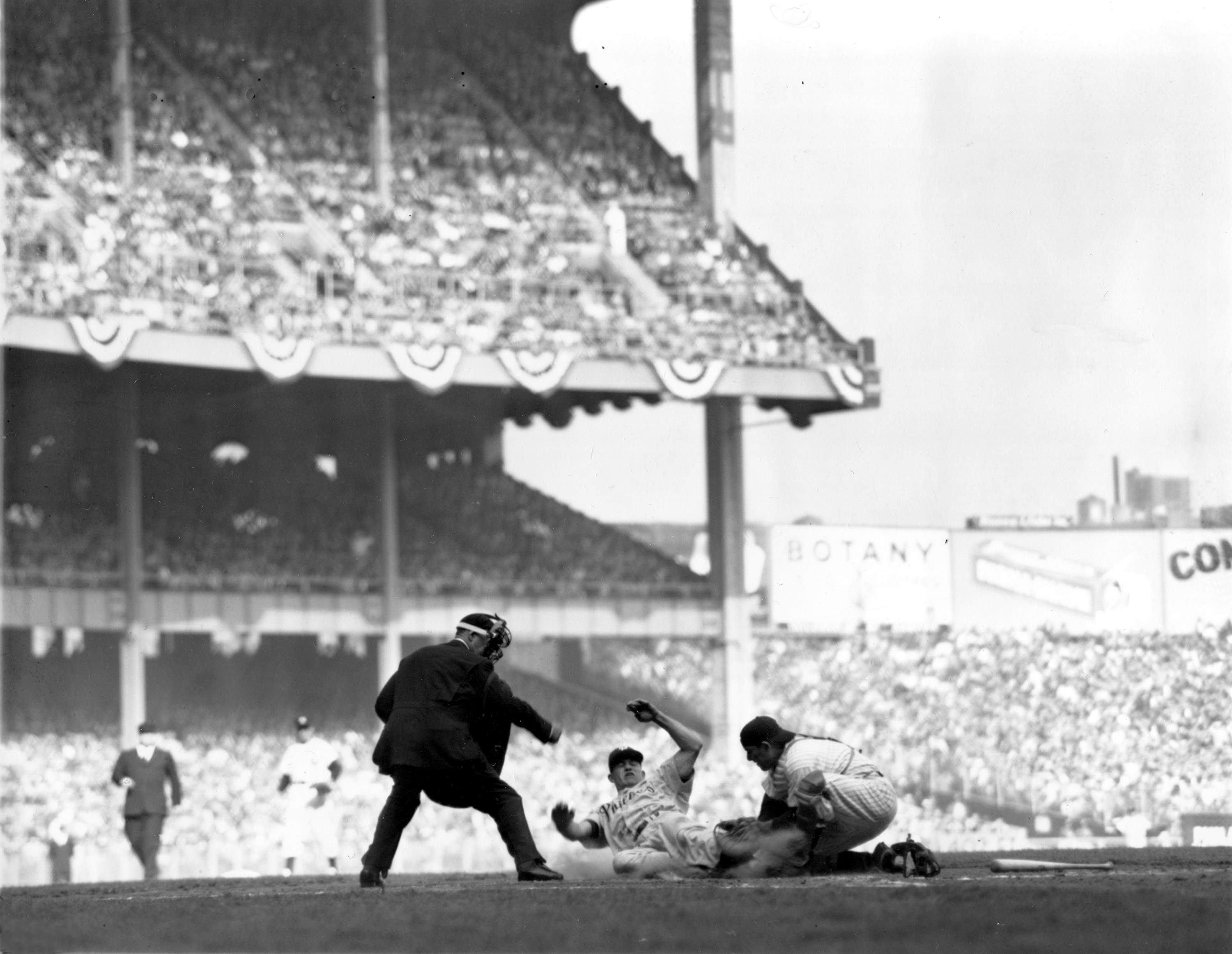
New York Yankees catcher Yogi Berra tags the sliding Philadelphia Phillies shortstop Granny Hamner for an out at home plate and second half of double play in 4th inning in the fourth and final World Series game at Yankee Stadium in New York City in 1950.
So on Dec. 5, 1958, the three teams announced that they were dropping their New York broadcast plans for the 1959 season.
None of the team representatives admitted to backing down.
But the joke was really on us: Those left-behind Dodger and Giants fans in New York didn’t get much joy from Philadelphia’s signature brand of baseball.
The Phillies went 69-85, and finished in last place.
And to make it worse: the Mets would arrive four years later.