Twin brothers Larry and Kelly Ganges grew up outside of Trenton with people constantly mispronouncing their last name. “Grange, Grain, Ganger,” they’ve heard it all.
So they developed a standard reply: “It’s Ganges like the river [in India].”
Decades on, they’d find out the deep Philadelphia story behind it.
When the brothers, now 72, got older and traveled, they’d grab the phone book in whatever town they were in to see if anybody with their last name was listed. Then they’d call and ask if they knew anybody in their family; they often did.
“So we all thought, no matter where we were,” said Larry, “we were connected with somebody,”
But they were also connected with something — a ship, a travesty, and a providence.
(From left to right) Twin brothers Larry Ganges, and Kelly Ganges, pose for a portrait at the Lazaretto in Tinicum, Pa., on Friday, Feb. 6, 2026. “It allows us to view and experience Black history,” Kelly said. “Pride in knowing our family was in this journey.”
The brothers’ first clue of their extended heritage arrived in 1975, when Kelly, was a student at Trenton State College. His journalism teacher, familiar with Bucks County cemeteries, asked if Kelly knew about the gravestones of two soldiers buried there.
Torbert and William Ganges had fought in the Civil War’s colored regiment, but Kelly couldn’t be sure if they were his relatives.
Nearly 30 years later, the brothers still don’t know if they are related to the soldiers, but they have discovered that their heritage is, as Kelly describes, “bigger than us, [it] extends beyond the continental United States and involves potentially the world.”
That information came in a phone call.
In the early aughts, Larry was working as the New Jersey Department of Health’s assistant commissioner for the HIV/AIDS division. His secretary told him that David Barnes, a University of Pennsylvania professor of history and the sociology of science, was on the line to talk about a different epidemic.
72-year-old twin brothers Kelly Ganges (left) and Larry Ganges, pose at the Lazaretto in Tinicum, Pa., on Friday, Feb. 6, 2026.
Barnes, who was seeking anyone with the Ganges name, had found Larry by chance in a New Jersey state employees directory. He wanted to discuss the 135 Africans who arrived in Philadelphia in 1800 and were detained at the old Lazaretto along the Delaware River.
At the time, every vessel arriving in Philadelphia was required to stop and be inspected at the Lazaretto — a hospital and quarantine station — where patients with yellow fever were treated.
Later, a brick facility replaced the old Lazaretto. Downriver from the original, the “new” Lazaretto, operational from 1801-1895, stands near present day Tinicum. It is the oldest surviving quarantine station in the Western Hemisphere and one of the 10 oldest in the world.
By the call’s end, Larry had learned not just the origin of his name but how his ancestors arrived in America.
“Wow, we had never heard about it. We just didn’t know,” he said.
The story goes: In 1800, the United States naval ship Ganges intercepted two schooners (the Phoebe and the Prudence) off the coast of Florida, near Cuba. Despite a new federal law banning the carrying of human beings for enslavement, the schooners, which experts believe disembarked from near Sierra Leone, contained 135 people from Africa, imprisoned as slaves, bound for the New World.
Ganges’ naval officers boarded the schooners — the Phoebe on July 19, 1800, and the Prudence on July 21, 1800 — took the enslaved into custody, and delivered them to the Ganges’ home port: Philadelphia.
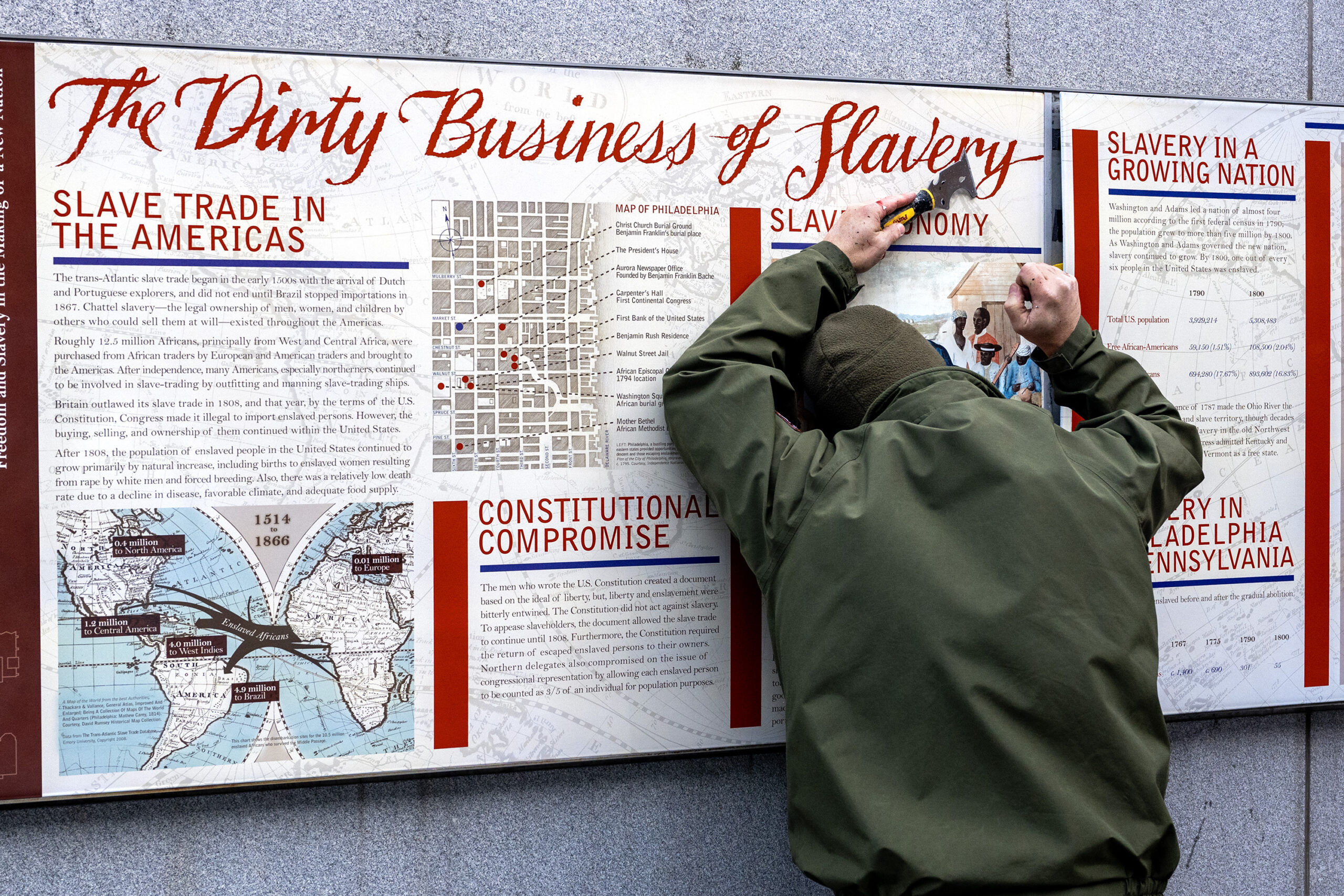
A NPS worker removes an interpretive panels – “The Dirty Business of Slavery” – at the President’s House site in Independence National Historical Park Thursday, Jan. 22, 2026.
When the schooners’ owners sued to reclaim their “property,” a Philadelphia judge ruled that the 135 aboard were people (not property) and ordered them freed. The Africans were remanded to the old Lazaretto for quarantine where they remained for up to three months.
Subsequently Sambo, Milnor, Yelle, and Culico Ganges and the rest of the 123 survivors were indentured to Pennsylvania Abolition Society members and others.
After Barnes’ phone call, the twins and their (late) older brother, Tendaji Ganges, visited the Lazaretto. At that time, the dilapidated building was locked. But Kelly returned with Barnes and gained access inside.
“I saw all of the little rooms … it was interesting to touch a piece of history, and know that that’s the genesis of how our family came to the United States,” he said.
“These modern-day heirs carry the legacy of resistance and survival into today’s conversations around justice, identity, and belonging,” said filmmaker Rah Crawford, whose documentary The Art of Brotherly Love focuses on the Ganges’ story.
A single rose and a handwritten cardboard sign (“Slavery is part of U.S. history learn from the past or repeat it”) are inside an empty hearth at the President’s House site in Independence National Historical Park late Thursday, Jan. 22, 2026 after workers removed display panels about slavery.
When the film premiered in Brooklyn last year, Larry said that as he sat in the audience watching, he was shaking, almost in tears. His wife asked, “Are you OK? Are you cold?”
He was overcome with emotions: “I was sad, I was happy, I was mad.”
Although, as the brothers say, “we’ve got the generic connection to the name,” they don’t have a connection to identify individual family members that came through the old Lazaretto; they can’t yet determine how their bloodline was carried to them.
But thanks to the efforts of family historian Michael Kearney, who is tracking descendants of the Ganges’ survivors, Larry is confident that “my children and my children’s children [are going] to know what the story is, and to know how to access it, and know who the players are …. And hopefully this movie is not the last of what’s going to occur.”
The “Life Under Slavery” sign at the President’s House in the Independence National Historical Park. The sign has since been removed. Photo from Sunday, Aug. 3, 2025.
“People made it through the troubled journey, the Middle Passage, and landed on American soil and contributed to make America a great nation,” said Kelly, “And nobody can ever deny that, and people can try and whitewash it and try to erase it, but it’s not going to work, because it’s real. Our contribution is documented.”
Prior to the opening of the President’s House in 2010, filmmaker Crawford was commissioned to create storyboards for a video installation at the site. Through his research, he first learned of the Ganges’ story, launching a 15-plus-year journey to produce the documentary.
Filmmaker Rah Crawford’s documentary “The Art of Brotherly Love” documents the story of the long-forgotten rescue of 135 enslaved Africans by the “Ganges” in the 1800s,
The Art of Brotherly Love, presented in partnership with Creative Philadelphia, is both a documentary and a trailer for a forthcoming animated feature. The Philadelphia premiere is slated for Feb. 14 at Ritz Five.
After the documentary screens, Kelly Ganges hopes that, “it just continues to cascade out — to inspire more genealogists and historians, and to reach more descendants and the next generation.”
“The Art of Brotherly Love,” Feb. 14, 11:30 a.m., Landmark’s Ritz Five, 214 Walnut St., eventbrite.com
Each night, Louis-Hunter Kean spiked a fever as high as 104.5. He would sweat through bedsheets and shiver uncontrollably. By morning, his fever wouldease but his body stillached; even his jaw hurt.
He had been sick like this for months. Doctors near his South Jersey home couldn’t figure out why a previously healthy 34-year-old was suffering high fevers plus a swollen liver and spleen. In early 2023, they referred Kean to Penn Medicine.
Louis-Hunter Kean visiting a winery in the Tuscany region of Italy in September 2021. He first spiked a mysterious and persistent fever about a year later in August 2022.
“These doctors are very sharp, and there are a lot of teams working on it,” Kean texted a friend after being admitted to the Hospital of the University of Pennsylvania (HUP) in West Philadelphia.
Was it an infection? An autoimmune disease? A blood cancer? Over the next six months, at least 34 HUP doctors — rheumatologists, hematologist-oncologists, gastroenterologists, infectious disease and internal medicine specialists — searched for an answer.
Kean was hospitalized at HUP five times during a six-month period in 2023. His electronic medical chart grew to thousands of pages.
Along the way, doctors missed critical clues, such as failing to obtain Kean’s complete travel history. They recommended a pair of key tests, but didn’t follow up to make sure they got done, medical records provided to The Inquirer by his family show.
Doctors involved in Kean’s care, including at Penn, prescribed treatments that made him sicker, said four infectious disease experts not involved in his care during interviews with a reporter, who shared details about his treatment. Penn doctors continued to do so even as his condition worsened.
Louis-Hunter Kean receives a kiss from bride Ashley Greyson at the October 2021 wedding of his close friend, Joshua Green. Green and Kean graduated from Haddonfield High School in 2007.
“No one was paying attention to what the doctor before them did or said,” Kean’s mother, Lois Kean, said.
“They did not put all the pieces together,” she said. “It was helter-skelter.”
Kean’s family is now suing Penn’s health system for medical malpractice in Common Pleas Court in Philadelphia. The complaint identifies nearly three dozen Penn doctors, accusing them of misdiagnoses and harmful treatments. These physicians are not individually named as defendants.
In court filings, Penn says its doctors did not act recklessly or with disregard for Kean’s well-being, and his case is not indicative of any systemic failures within its flagship hospital. A Penn spokesperson declined further comment on behalf of both the hospital and the individual doctors involved in Kean’s care, citing the pending lawsuit.
The puzzle of Kean’s diagnosis finally came together in November 2023 after a Penn doctor, early in his career, sought help from the National Institutes of Health (NIH).
An NIH doctor recommended a test that identified the cause: a parasite prevalent in countries bordering the Mediterranean Sea. Kean likely got infected while vacationing in Italy, four parasitic disease experts told The Inquirer.
The infection, which is treatable when caught early, is so rare in the U.S. that most doctors here have never seen a case, the experts said.
By the time Penn doctors figured it out, Kean’s organs were failing.
Louis-Hunter Kean and his then-girlfriend Zara Gaudioso at a friend’s wedding in Tuscany in September 2021. Kean and Gaudioso got engaged in early 2023. Gaudioso was smitten by Kean’s good looks and sense of humor.While vacationing in Italy in September 2021, Louis-Hunter Kean and his friends hiked in the foothills of the Apennine Mountains and visited Gran Sasso and Monti della Laga National Park.
A missed clue
When a patient has an ongoing and unexplained fever, an infectious disease doctor will routinely start by takinga thorough travel history to screen for possible illnesses picked up abroad.
A medical student took Kean’s travel history during his initial workup at HUP in June 2023. An infectious disease specialist reviewed the student’s notes and added a Cooper University Hospital doctor’s earlier notes into Kean’s electronic medical chart at Penn.
Those records show Kean had traveled to Turks and Caicos with his fiancée in May 2022. The next month, he took a work trip out West, including to California, where he visited farms, but didn’t interact with livestock.
This was not unusual for Kean, who worked with fruits and vegetables imported from around the world at his family’s produce distribution center on Essington Avenue in Southwest Philadelphia.
Kean’s fiancée, Zara Gaudioso, said she repeatedly told doctors about another trip: In September 2021, about a year before his fevers began, they traveled to Italy for a friend’s wedding in Tuscany.
The couple hiked remote foothills, danced all night in a courtyard, dined by candlelight surrounded by a sunflower farm, and slept in rustic villas with the windows flung open.
“We told everybody,” Gaudioso said. “A lot of Americans go to Italy — it’s not like a third-world country, so I could see how it could just go in one ear and out the other.”
But notes in Kean’s medical record from the Penn infectious disease specialist don’t mention Italy. Neither do the ones the specialist copied over from Kean’s infectious disease doctor at Cooper.
Kean “does not have known risk factors” for exposure to pathogens, the Penn specialist concluded, except possibly from farm animals or bird and bat droppings.
Still, the specialist listed various diseases that cause unexplained fever: Tick-borne diseases. Fungal infections. Tuberculosis. Bacteria from drinking unpasteurized milk.
The possible culprits included a parasitic disease, called visceral leishmaniasis, transmitted by a bite from an infected sandfly. It can lie dormant for a lifetime — or, in rare cases, activate long after exposure, so it’s important for doctors to take extensive past travel histories, parasitic experts say.
The parasite is widely circulating in Southern European countries, including Spain, Greece, Portugal, and Italy.
“Mostly, people living there are the ones who get it. But it’s just a lottery sandwich, and there’s no reason that travelers can’t get it,” said Michael Libman, a top parasitic disease expert and former director of a tropical medicine center at McGill University in Canada.
But few cases become severe. Hospitals in Italy reported only 2,509 cases of active infection between 2011 and 2016, affecting fewer than one in 100,000 people. Infections requiring hospital care in Italy began to decline after 2012, according a 2023 European study by the Public Library of Science (PLOS) journal Neglected Tropical Diseases.
Caught early, visceral leishmaniasis is treatable. Without treatment, more than 90% of patients will die.
In addition to fever, other telltale symptoms are swelling of the liver and spleen and low blood cell counts. Kean had all of those.
A missed test
The infectious disease specialist requested a test to examine tissue biopsied from Kean’s liver, which was damaged and enlarged. Lab results showed that immune cells there had formed unusual clusters — another sign that his body might be fighting off an infection.
In her notes, the specialist identified “visceral leish” as a possible diagnosis, which repeated — via copy and paste — seven times in his medical record. Her request to “please send biopsy for broad-range PCR” repeated five times.
That is a diagnostic (polymerase chain reaction) test that looks for the genetic fingerprint of a range of pathogens.
The test comes in different versions: One looks broadly for bacteria. The other is for fungi. The broad fungal test candetect leishmania, even though it’s not a fungus. However, it’s not always sensitive enough to identify the parasite and can produce a false negative, experts said.
The specialist’s chart note doesn’t specify which type she wanted done.
It’s not clear if anyone asked. The test wasn’t done.
Louis-Hunter Kean (right, with wine glass and tambourine) leads a wedding procession through the small stone village of Santo Stefano di Sessanio in Italy’s Abruzzo region in September 2021.
She did not order a low-cost rapid blood test that screens specifically for leishmaniasis by detecting antibodies made by the immune system after fighting it. She also didn’t order a leishmania-PCR, which is highly targeted to detect the exact species of the parasite.
Nor did the medical record show that the specialist followed up on the results of the broader test she requested, even though she saw Kean on nine of the 13 days of his first hospitalization at HUP in June 2023.
Penn has a policy that a lead doctor on the patient’s case is responsible for making sure that recommended tests get done. The specialist was called in as a consultant on Kean’s case. During that June hospitalization alone, his medical chart grew to 997 pages.
Patient safety experts have warned for years that electronic medical record systems — designed for billing and not for care — can become so unwieldy that doctors miss important details, especially with multiple specialists involved, or repeat initial errors.
A seemingly innocuous step in charting — copying and pasting previous entries and layering on new ones— can add to the danger, patient safety experts say.
That’s how the specialist’s mention of “visceral leish” and her test recommendation got repeated in Kean’s chart.
Marcus Schabacker, president of ECRI, a nonprofit patient-safety organization based in Plymouth Meeting, said “copy and paste” in electronic medical records puts patients at risk of harm.
“The reality is if you are reading something over and over again, which seems to be the same, you’re just not reading it anymore. You say, ‘Oh, yeah, I read that, let’s go on,’” said Schabacker, speaking generally about electronic medical record systems and not specifically about Kean’s case.
Louis-Hunter Kean plays guitar in his younger years. He loved music and shared eclectic playlists with his friends.
When treatments harm
Penn doctors believed Kean had a rare,life-threatening disorder, known as hemophagocytic lymphohistiocytosis (HLH), in which the immune system attacks the body. Instead of fighting infections, defective immune cells start to destroy healthy blood cells.
In most adults, the constellation of symptoms diagnosed as HLH gets triggered when an underlying disease sends the body’s immune system into overdrive. Triggers include a blood cancer like lymphoma, an autoimmune disease like lupus, or an infection.
Penn doctors across three specialties — hematology-oncology, rheumatology, and infectious disease — were searching for the cause within their specialties.
“His picture is extremely puzzling,” one doctor wrote in Kean’s chart. “We are awaiting liver biopsy results. I remain concerned about a possible infectious cause.”
As HUP doctors awaited test results, they treated Kean’s HLH symptoms with high doses of steroids and immunosuppressants to calm his immune system and reduce inflammation.
The treatments, however, made Kean highly vulnerable to further infection.And defenseless against another possible trigger of HLH: visceral leishmaniasis.
At the time, a Penn rheumatologist involved in Kean’s care before his first hospitalization warned about steroids “causing harm” to Kean if it turned out he had an infection. He wrote, “please ensure all studies requested by” infectious disease are done, medical records show.
Steroid treatments would allow the parasites to proliferate unchecked, experts said.
“It’s unfortunately exactly the wrong treatment for parasitic disease,” said Libman, the leishmania disease expert at McGill University.
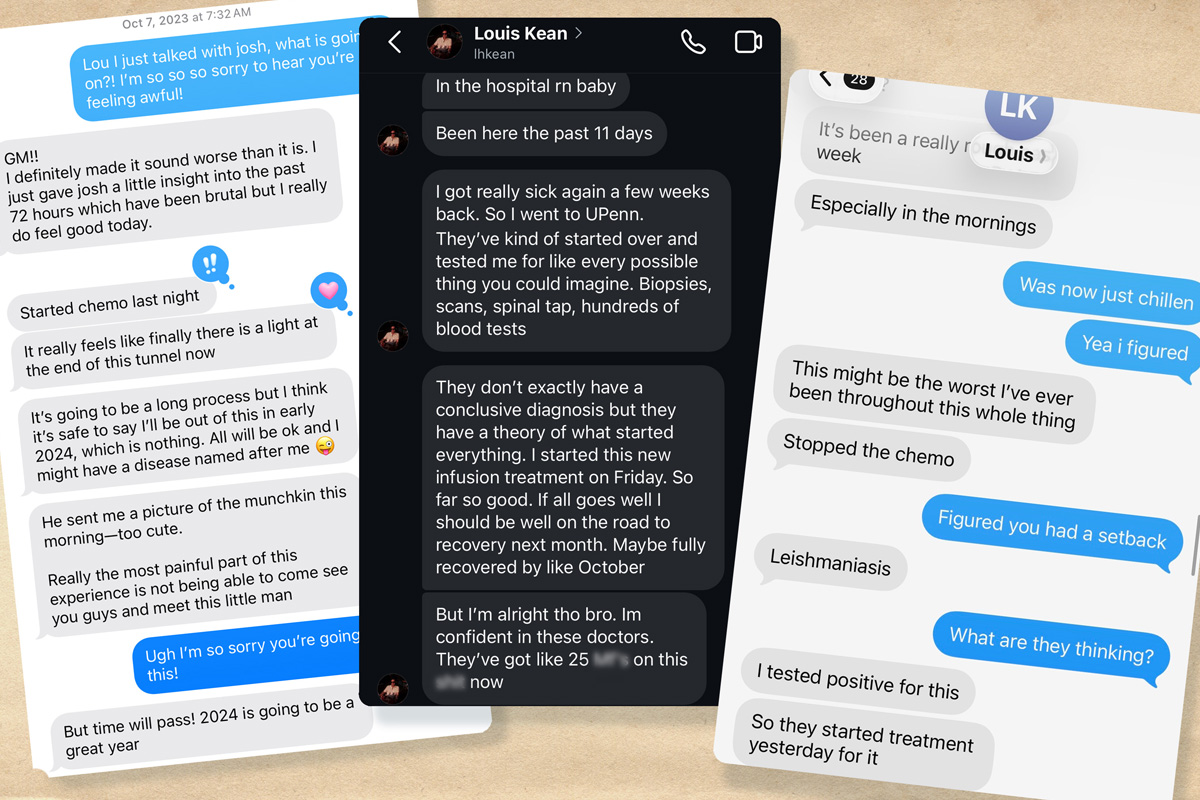
As Kean grew sicker, he was readmitted to HUP for a third time in September 2023. He texted a friend: “I’m on more medications than I’ve ever been on and my condition is worse than it’s ever been.”
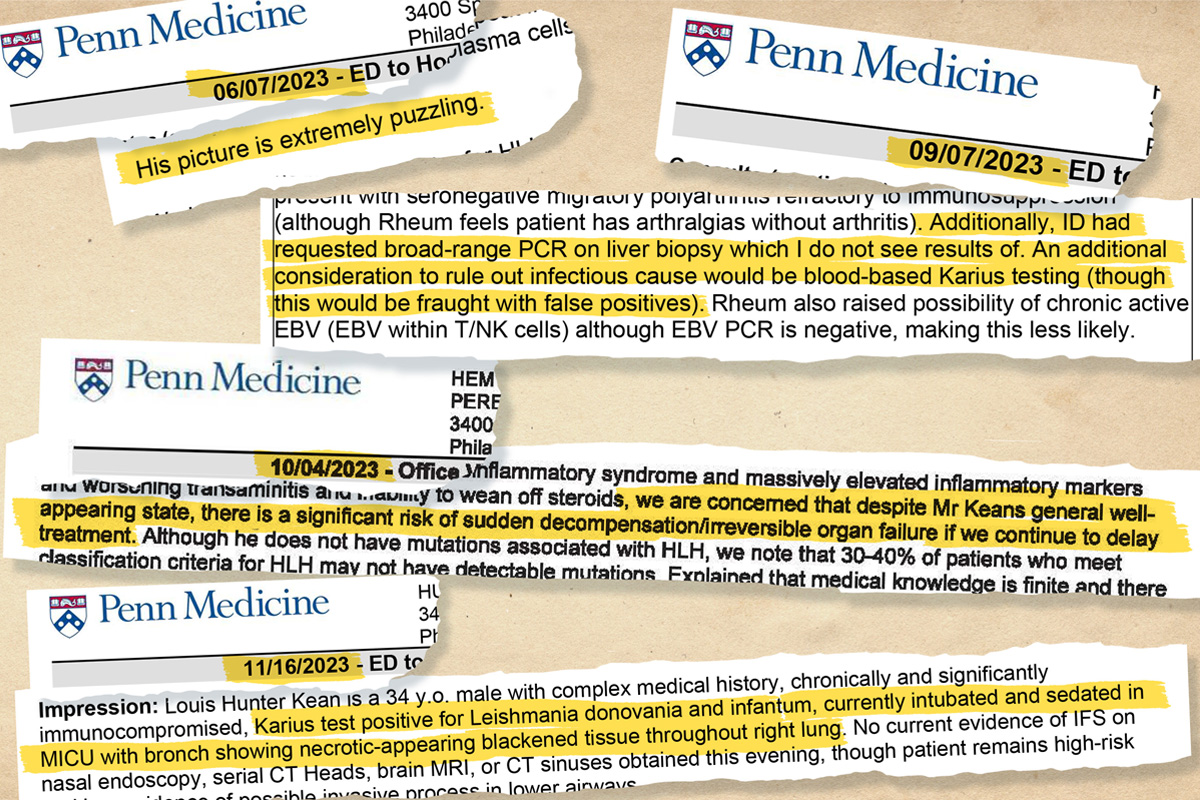
A sampling of Louis-Hunter Kean’s electronic medical records, which ballooned to thousands of pages over five HUP hospitalizations within six months in 2023.
Handoffs between doctors
No single doctor seemed to be in charge of Kean’s care, his family said. And the number of specialists involved worried them.
“Everyone just kept being like, ‘We don’t know. Go see this specialist. Go see that specialist,’” Kean’s sister, Priscilla Zinsky, said.
By fall 2023, rheumatologists hadn’t found a trigger of Kean’s symptoms within their specialty. They turned to doctors specializing in blood cancer.
During the handoff, three doctors noted that they didn’t see the results of the test requested by the infectious disease specialist back in June. They still thought it was possible that Kean had an infection, records show.
“An additional consideration to rule out infectious cause would be blood-based Karius testing (though this would be fraught with false positives),” wrote that doctor, who was still training as a hematologist-oncologist.
A supervising physician reviewed the Sept. 8, 2023, note and signed off on it. The medical records don’t show any follow-up with infectious disease doctors, and the test wasn’t done at the time.
In the coming days, blood cancer specialists struggled to find a link between Kean’s symptoms and an underlying disease.
They thought he might have a rare form of leukemia, but tests weren’t definitive, Kean texted friends.
Untreated HLH symptoms can lead to rapid organ failure, so doctors often start patients on treatment while trying to figure out the underlying cause, said Gaurav Goyal, a leading national expert on HLH, noting that it can take days to get test results.
“You have to walk and chew the gum. You have to calm the inflammation so the patient doesn’t die immediately, and at the same time, try to figure out what’s causing it by sending tests and biopsies,” said Goyal, a hematologist-oncologist at the University of Alabama at Birmingham.
Medical records show that Penn doctors feared Kean was at “significant risk” of “irreversible organ failure.”
They suggested a more aggressive treatment: a type of chemotherapy used to treat HLH that would destroy Kean’s malfunctioning immune cells.
In his medical record, a doctor noted that beginning treatment without a clear diagnosis was “not ideal,” but doctors thought it was his best option.
Four parasitic disease experts told The Inquirer that chemotherapy, along with steroids and immunosuppressants, can be fatal to patients with visceral leishmaniasis.
“If that goes on long enough, then they kill the patient because the parasite goes out of control,” Libman said, explaining that ramping up the HLH treatments weakens the immune system. “The parasite has a holiday.”
A sample of text messages from Louis-Hunter Kean to friends during separate HUP hospitalizations over a six-month period in 2023.
Chemo as last resort
Kean banked his sperm, because chemo infusions can cause infertility. He told friends he trusted his Penn team and hoped to make a full recovery.
“Started chemo last night. It really feels like finally there is a light at the end of the tunnel,” he texted a friend on Oct. 7, 2023.
“I’m gonna get to marry my best friend, and I think I’m going to be able to have children,” Kean wrote in another text to a different friend.
Kean spent nearly all of October at HUP getting chemo infusions. He rated his pain as a nine out of 10. His joints throbbed. He couldn’t get out of bed. He started blacking out.
Doctors added a full dose of steroids on top of the IV chemo infusion. By the end of the month, Kean told a friend he feared he was dying.
A year had passed since Kean first spiked a fever. He no longer could see himself returning to his former life — one filled with daily exercise, helping run his family’s produce store, nights out with friends at concerts and bars, and vacations overseas.
Lethargic and weak, he could barely feed himself. His sister tried to spoon-feed him yogurt in his hospital bed.
He started texting reflections on his life to friends and family, saying his illness had given him a “polished lens” through which he could see clearly. He wrote that their love felt “like a physical thing, like it’s a weighted blanket.”
“I’ve lived an extremely privileged life. I don’t think it’s possible for me to feel bad for myself,” he said in a text. “And I don’t want anyone else to either.”
Louis-Hunter Kean enjoying dinner out with his sister, Jessica Kean, in Manhattan in 2014. Friends and family described him as a “foodie” and health food advocate prior to the onset of his illness in August 2022.
Puzzle solved
One doctor involved in Kean’s care had seen him at Penn’s rheumatology clinic in early June 2023, just before his first HUP hospitalization. The doctor, a rheumatology fellow,urged him to go to HUP’s emergency department, so he could be admitted for a medical workup.
The fellowremained closely involved in Kean’s care, medical records show. Also in his 30s, this doctor shared Kean’s interests in music, fashion, and the city’s restaurant scene, according to Kean’s family.
“They had a rapport,” Kean’s father, Ted Kean, said. “Louis thought a lot of him, and he seemed to think a lot of my son.”
By early November 2023, the rheumatology fellow was extremely concerned, medical records show.
The chemo infusions weren’t helping. Kean still was running a fever of 103. The fellow wrote in his chart that he was worried Kean needed a bone-marrow transplant to replace his failing immune system.
And doctors still didn’t know the root of his symptoms.
The fellowcontacted the NIH, medical notes show.
An NIH doctor recommended a test to check for rare pathogens, including parasites that cause visceral leishmaniasis,according to family members present when the testing was discussed.
The NIH-recommended Karius test was the same one suggested two months earlier by the Penn hematologist-oncologist in training, but with no follow-up.
File of sign on front of Hospital of the University of Pennsylvania (HUP) taken on Tuesday, March 19, 2024.
On Nov. 16, the fellow got the results. He went to Kean’s bedside.
After five HUP hospitalizations over six months, a single test had revealed the cause of his illness: visceral leishmaniasis.
Kean cried with relief and hugged the fellow, joined by his mother and sister.
“‘You saved my life,’” Kean’s sister, Jessica Kean, recalled her brother telling the doctor. “‘Finally, we know what this is, and we can treat it.’”
Kean’s medical chart was updated to note that he traveled to “Italy in the past,” also noting he had visited Nicaragua and Mexico. A HUP infectious disease doctor consulted with the Centers for Disease Control and Prevention on antiparasitic medications.
Meanwhile, Kean’s nose wouldn’t stop bleeding. He felt light-headed and dizzy, with high fever. Even on morphine for his pain, his joints ached.
“I’ve been struggling, buddy,” he texted a friend on Nov. 20. “This might be the worst I’ve ever been.”
By Nov. 22, he stopped responding to text messages. He began hallucinating and babbling incoherently, family members recalled. “Things went downhill very, very quickly, like shockingly quickly,” his sister, Priscilla Zinsky, said.
When she returned on Thanksgiving morning, he was convulsing, thrashing his head and arms. “It was horrifying to see,” Zinsky said.
Her brother had suffered brain bleeds that caused a stroke. His organs were failing. He had a fungal infection with black mold growing throughout his right lung, medical records show.
Kean was put on life support, with a doctor noting the still-preliminary diagnosis: “Very medically ill with leishmaniasis.”
“Prognosis is poor,” read the note in his Nov. 29, 2023, medical records.
A few hours later, Kean’s family took him off life support. He died that day.
“All of his organs were destroyed,” said Kean’s mother, Lois Kean. “Even if he had lived, he had zero quality of life.”
Portraits of Lois and Ted Kean’s four children decorate a wall at their home in Haddonfield. Their son, Louis-Hunter, died after contracting visceral leishmaniasis, a parasitic infection he likely picked up in Italy. When caught early, it’s treatable with medication. It’s deadly without treatment.
It’s not clear why the parasites began to attack Kean a year after his return from Italy. Healthy people rarely develop severe disease from exposure to the deadly form of the parasite circulating outside the U.S., experts said.
Most people infected by a sandfly “are probably harboring small amounts of the parasite” in their organs, according to Naomi E. Aronson, a leishmania expert and director of infectious diseases at the Uniformed Services University of the Health Sciences in Bethesda, Md.
“Most of the time, you don’t have any problem from it,” Aronson said.
Children under age 5, seniors, and people who are malnourished or immunodeficient are most susceptible to visceral leishmaniasis. Aronson said she worries about people who might harbor the parasite without problems for years, and then become immunocompromised.
Libman, the parasitic expert from McGill, said he’s seen six to 10 patients die from visceral leishmaniasis because doctors unfamiliar with the disease mistakenly increased immunosuppressants to treat HLH during his 40 years specializing in parasite disease.
“That’s a classic error,” he said.
Kean’s case “should be a real clarion call” for infectious disease specialists and other doctors in the U.S., said Joshua A. Lieberman, an infectious disease pathologist and clinical microbiologist who pioneered the leishmania-PCR test at the Washington state lab.
“If you’re worried about an unexplained [fever], you have to take a travel history that goes back pretty far and think about Southern Europe, Iraq, Afghanistan, India, and maybe even Brazil,” Lieberman said.
In the wake of Kean’s death, his family was told that Penn doctors held a meeting to analyze his case so they could learn from it.
An infectious disease doctor called Zinsky, Kean’s sister, to let her know about the postmortem review and shared that doctors discussed that Kean had likely picked up the parasite in Tuscany.
“Why didn’t you guys have this meeting,” she asked, ”while he was alive?”
Editor’s note: This story has been updated to clarify that ECRI President Marcus Schabacker was not speaking specifically on Kean’s case.
In January, Philadelphia announced it would join a national initiative to accept plastic cups made of polypropylene and paper to-go cups in the curbside collection program. These to-go cups now join dozens of other household items that make up an estimated 1.5 million pounds of recyclables collected per year, according to the Department of Sanitation.
Once a week, you and many other Philadelphians fill blue bins with paper, plastic, glass, and other recyclables, hoping to rescue them from landfills, but do you really know what should go in the bin and what shouldn’t? Philadelphia uses a single-stream system, meaning you don’t have to separate different types of recycling, but the rules can still be tricky. We are here to help walk you through what should go in your recycling bin and what should be thrown in the trash.
Let’s check your knowledge on some typical household items and see if you can place the item in the right bin.
story continues after advertisement
Paper
Let’s start with a newspaper. You’ve finished reading your Philadelphia Inquirer. Where do you put it?
Drag the paper to the bin or select a button
That’s right!
Not quite.
Newspapers and magazines can be recycled. Paper in most forms should go in your recycling bin. This includes things like junk mail, envelopes, scrap paper, and paper bags.
There are some exceptions to this. You might be surprised to learn that shredded paper should go in the trash.
Recycling
Newspapers
Magazines
Brochures
Catalogs
Junk mail
Envelopes
Writing paper
Scrap paper
Paper bags
Trash
Food-soiled paper
Tissues
Paper towels
Napkins
Plastics
Plastics can be a bit trickier because only certain kinds of plastics can be recycled. You’ve probably seen the stamped number codes before (they range from 1 to 7) and they represent the type of plastic used in the item. In this case, where would you put a lotion bottle with a No. 2 recycling symbol on the bottom?
That’s right!
Not quite.
Plastics with the codes 1, 2 and 5 can be recycled in Philadelphia. These codes can be found stamped somewhere on the container. If there is no stamp, assume it cannot be recycled. Non-transparent plastic bottles like the one above are generally labeled with No. 2. You can also leave the lid or pump on. If you live outside of Philadelphia, check your local municipality, not every recycling program accepts the same codes. More information about the types of plastics can be found here.
Recycling
No. 1: Easy to recycle plastic found in food and drink containers like water and soda bottles
No. 2: Non-transparent plastic found in things like shampoo bottles and laundry detergent containers
No. 5: a type of plastic found in some food containers
Trash
No. 3: More difficult plastic to recycle and can also include shampoo and laundry detergent bottles
No. 4: Used to make plastic bags
No. 6: also known as Styrofoam
Cardboard
You’ve just finished a delicious pizza from Del Rossi's. Where do you put the box?
That’s right!
Not quite.
While cardboard is a recyclable material, it must be dry and free of food waste. So, a food-soiled pizza box should go in the trash. Also, it might be enticing to use a cardboard box as your recycling bin, but the city does not recommend this since wet paper and cardboard is not recyclable and can fall apart, leaving trash on the street. Instead they encourage using a hard sided container with a free lid that can be found at one of six Sanitation Convenience Centers.
Recycling
Shipping boxes
Clean pizza boxes
Paper towel and toilet paper rolls
Egg cartons
Trash
Shredded cardboard
Greasy or food-soiled cardboard
Recycling bags
You’re cleaning up and throw some empty bottles and cans in a bag. Where does it go?
That’s right!
Not quite.
No plastic bag is acceptable in single-stream curbside bin recycling in Philadelphia, even those marketed as recycling bags. According to the city’s recycling guide, plastic bags can “tear and wrap around the moving parts in recycling processing machines, leading to higher maintenance costs, equipment damage, and even worker-safety issues.” Another common mistake, according to the city, is leaving packing plastic and peanuts inside of shipping boxes. Make sure those are thrown in the trash instead. And for dog walkers, be sure to put waste bags in the trash!
Metals
You’ve got some cleaned-out aluminum cans, where do they go?
That’s right!
Not quite.
Aluminum cans can be recycled! These should be emptied, rinsed, and dry. You can keep lids and caps on. While some leftover liquid is OK “do not discard a bottle with enough liquid to swallow,” says Kyle Lewis, recycling director. That’s so that leftover liquid doesn’t contaminate any paper and cardboard around it after it’s compacted in the truck.
Recycling
Aluminum and tin cans
Empty paint cans
Empty aerosol cans
Trash
Pots and pans
Food-soiled cans
Miscellaneous
That’s right!
Not quite.
Batteries cannot be recycled and should be placed in the trash. In addition, the city says that batteries should be wrapped in tape around both ends for disposal. There are other disposal options for things like electronics, hazardous waste, bulk items, and lithium or rechargeable batteries. Find more information on disposal options here.
Your Results
You have skipped .
You scored XX out of 6.
When in doubt, throw it out!
You’re almost a recycling pro.
You are a recycling pro! Thanks for playing.
What else you should know
In addition to the above, glass and cartons are also recyclable. Like cans, glass and cartons should be emptied, rinsed, and dry.
story continues after advertisement
Some additional things to avoid putting in your recycling are Styrofoam, packing peanuts, clothing hangers, wood, and ceramics. You can find a complete list from the city here.
If you don’t have a recycling bin, the city will provide one for you. You can also use any household container as long as it is no larger than 32 gallons and no more than 40 pounds. There are also no limits to the amount of recycling you can put curbside, as long as it is contained correctly.
“We encourage Philadelphians to recycle for our communal benefit. Reduce, reuse, recycle, repeat!,” said Lewis.
Staff Contributors
Design, development, and reporting: Garland Fordice
Editing and additional development: Sam Morris
Photography: Monica Herndon
Copy Editing: Brian Leighton
Subscribe to The Philadelphia Inquirer
Our reporting is directly supported by reader subscriptions. If you want more journalism like this story, please subscribe today
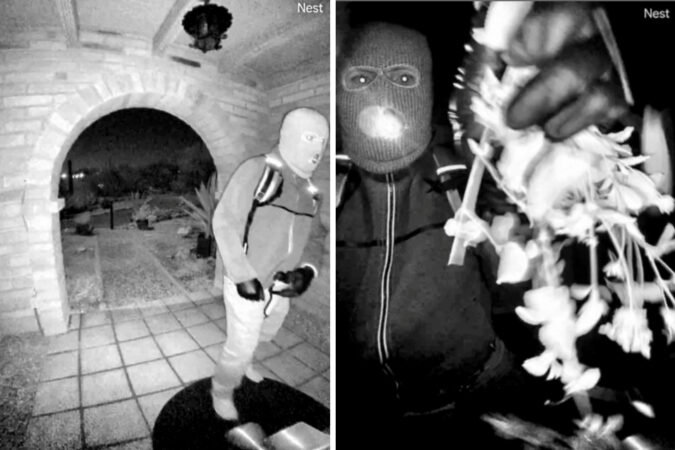
TUCSON, Ariz. — Fresh surveillance images from Nancy Guthrie’s porch the night she went missing, coupled with intense police activity across Arizona and the detention of a man had raised hopes that authorities were nearing a major break.
But then the man was released after questioning, leaving it unclear Wednesday where the investigation stood into last week’s disappearance of Guthrie, the 84-year-old mother of “Today” show host Savannah Guthrie.
FBI agents carrying water bottles to beat the 80-degree F (26.7-degree C) heat walked among rocks and desert vegetation at Guthrie’s Tucson-area home. They also fanned out across a neighborhood about a mile (1.6 kilometers) away, knocking on doors and searching through cactuses, bushes and boulders.
Several hundred detectives and agents are now assigned to the investigation, which is expanding in the area, the Pima County Sheriff’s Department said.
In a nearby neighborhood, two investigators emerged from daughter Annie Guthrie’s home with a paper grocery sack and a white trash bag. One, still wearing blue protective gloves, also took a stack of mail from the roadside mailbox. They drove away without speaking to reporters.
Barb Dutrow, who was jogging through a neighborhood where teams were searching, said an FBI agent told her they were looking for anything that might have been tossed from a car. Dutrow, who was visiting from Louisiana for a convention, said she “can’t imagine the feeling of the family of having their mother taken.”
A day earlier, authorities said they had stopped a man near the U.S.-Mexico border, just hours after the FBI released videos of a person wearing a gun holster, ski mask and backpack and approaching Nancy Guthrie’s home in Tucson. The man told media outlets early Wednesday that he was released after several hours and had nothing to do with Guthrie’s disappearance last week.
Authorities have not said what led them to stop the man Tuesday but confirmed he was released. The sheriff’s department said its deputies and FBI agents also searched a location in Rio Rico, a city south of Tucson where the man lives.
It was the latest twist in an investigation that has gripped the nation since Nancy Guthrie disappeared on Feb. 1. Until Tuesday, it seemed authorities were making little headway in determining what happened to her or finding who was responsible.
The black and white images released by the FBI showing a masked person trying to cover a doorbell camera on Guthrie’s porch marked the first significant break in the case. But the images did not show what happened to her or help determine whether she is still alive.
FBI Director Kash Patel said investigators spent days trying to find lost, corrupted or inaccessible images.
Even though the images do not show the person’s face, investigators are hopeful someone will know who was on the porch. More than 4,000 calls came into the Pima County sheriff’s tip line within the past 24 hours, the department said Wednesday afternoon.
Authorities have said for more than a week that they believe Nancy Guthrie was taken against her will. She was last seen at home Jan. 31 and reported missing the next day. DNA tests showed blood on her porch was hers, authorities said.
Savannah Guthrie posted the new surveillance images on social media and said the family believes their mother is still alive.
The longtime NBC host and her two siblings have indicated a willingness to pay a ransom.
It is not known whether ransom notes demanding money with deadlines that have already passed were authentic, and whether the family has had any contact with whoever took Guthrie.
TMZ reported it received a message Wednesday from someone claiming to know the kidnapper’s identity and that they unsuccessfully tried to reach Savannah Guthrie’s brother and sister. The person asked for bitcoin in exchange for the information, TMZ said. The FBI did not immediately respond to a message.
Authorities have said Nancy Guthrie takes several medications and there was concern from the start that she could die without them.
The Downingtown Interchange reopened Wednesday night after being closed for several hours because a toll-booth canopy collapsed during planned demolition work on the toll plaza, Pennsylvania Turnpike officials said.
“We were performing preliminary work to remove the canopy, in anticipation of a full closure this weekend. This is part of the demolition work as we reconfigure the toll plaza,” Turnpike spokesperson Marissa Orbanek said in an email.
“During the preliminary work, canopy columns destabilized, and we immediately shut down the interchange to ensure the safety of employees and motorists. While the interchange was shut down, the canopy fell down on top of the toll booths,” Orbanek said.
The Pennsylvania Turnpike has been switching to an “open road tolling” system that allows tolls to be charged electronically without vehicles having to slow down.
A 44-year-old man was in police custody after he allegedly stabbed his 3-month-old child late Wednesday morning in Chester County, police said.
Just after 11:35 a.m., Coatesville police were dispatched to the 2000 block of Smithbridge Drive to respond to a report on an infant that had been stabbed.
Officers took Michael Phillips into custody for stabbing his infant son in the abdomen, police said.
“After stabbing him, the father took the infant outside and threw him in the snow,” police said.
The infant was reported to be in very serious condition and was flown to Children’s Hospital of Philadelphia for surgery, police said.
Just before 8 p.m., the Chester County District Attorney’s Office said the child was out of surgery and was listed in critical but stable condition.
Police on the scene of a stabbing of an infant on Smithbridge Drive in Coatesville, Wednesday, February 11, 2026
President Donald Trump has backed down from his decision to exclude Democratic governors from an annual White House meeting that has long been bipartisan, according to the National Governors Association.
For decades, the White House meeting between the president and governors — held around the NGA’s annual winter gathering in Washington — has included Republican and Democratic governors. That nearly changed last week when Trump did not extend an invitation to Democrats, sparking concern among governors. After telling Democratic governors Friday that they would not be invited to the meeting, the bipartisan NGA said the meeting would no longer be part of the organization’s official schedule for the gathering.
On Wednesday, however, Oklahoma Gov. Kevin Stitt (R), the NGA chairman, told governors that Trump would be inviting all governors to the White House on Feb. 20 for the NGA’s business breakfast.
“He was very clear in his communications with me that this is a National Governors Association’s event, and he looks forward to hosting you and hearing from governors across the country,” Stitt wrote to the governors. “President Trump said this was always his intention, and we have addressed the misunderstanding in scheduling.”
Governors from all states are expected to gather in Washington for their conference from Feb. 19 to 21.
And while all governors are now being invited to the White House, not all Democrats were invited to a separate dinner there scheduled to be held around the NGA gathering. Maryland Gov. Wes Moore and Colorado Gov. Jared Polis, both Democrats, said in recent days that their invitations to the dinner had been rescinded. The other 16 Democratic governors remained on the guest list but decided Tuesday that they would not attend unless all 18 of them were invited.
Trump said on social media Wednesday that the situation over the White House meeting invitations had been a misunderstanding — and he blamed it on Stitt, whom he referred to as a “Republican In Name Only.” Stitt “incorrectly stated my position on the very exclusive Governors Annual Dinner and Meeting at the White House,” Trump wrote, and said that invitations were sent “to ALL Governors, other than two, who I feel are not worthy of being there.”
Trump emphasized that Polis and Moore had not been invited to the dinner, slinging baseless accusations against them, but he noted that he did invite some Democratic governors that he has repeatedly sparred with, including Illinois Gov. JB Pritzker and California Gov. Gavin Newsom.
“Stitt got it WRONG!” Trump wrote. “I look forward to seeing the Republican Governors, and some of the Democrats Governors who were worthy of being invited.”
White House press secretary Karoline Leavitt had defended Trump’s decision to exclude the Democrats from the meeting only a day earlier. “The president has the discretion to invite whomever he wants to the White House,” she told reporters.
NGA CEO Brandon Tatum said in a statement that the organization was “pleased the president will welcome governors from all 55 states and territories to the White House.”
“The bipartisan White House governors meeting is a valued tradition and an important opportunity to build bridges and hold constructive conversations,” Tatum said. “The NGA looks forward to continued collaboration between governors and the White House.”
The Democratic Governors Association did not immediately respond to a request for comment on the meeting and dinner.
NEW YORK — Activists planned protests at more than two dozen Target stores around the United States on Wednesday to pressure the discount retailer into taking a public stand against the 5-week-old immigration crackdown in its home state of Minnesota.
ICE Out Minnesota, a coalition of community groups, religious leaders, labor unions, and other critics of the federal operation, called for sit-ins and other demonstrations to continue at Target locations for a full week. Target’s headquarters are located in Minneapolis, where federal officers last month killed two residents who had participated in anti-ICE protests, and its name adorns the city’s major league baseball stadium and an arena where its basketball teams plays.
“They claim to be part of the community, but they are not standing up to ICE,” said Elan Axelbank, a member of the Minnesota chapter of Socialist Alternative, which describes itself as a revolutionary political group. He organized a Wednesday protest outside a Target store in Minneapolis’ Dinkytown commercial district.
Demonstrations also were scheduled in St. Paul, Minnesota, Boston, Chicago, Honolulu, Philadelphia, Pittsburgh, Raleigh, North Carolina, San Diego, Seattle and other cities, as well as in suburban areas of Minnesota, California and Massachusetts. Target declined Wednesday to comment on the protests.
Target first became a bull’s-eye for critics of the Trump administration’s surge in immigration enforcement activity after a widely-circulated video showed federal agents detaining two Target employees in a store in the Minneapolis suburb of Richfield last month. Luis Argueta, a spokesperson for Unidos Minnesota, an immigrant-led social justice advocacy organization that is part of the ICE Out Minnesota coalition, said his group is focusing its protests on the Richfield store.
One of the demands of Wednesday’s protests is for Target to deny federal agents entry to stores unless they have judicial warrants authorizing arrests.
Some lawyers have argued that anyone, including U.S. Border Patrol and Immigration and Customers Enforcement agents without signed warrants, can enter public areas of a business as they wish. Public areas include restaurant dining sections, open parking lots, office lobbies and shopping aisles, but not back offices, closed-off kitchens or other areas of a business that are generally off-limits to the public and where privacy would be reasonably expected, those lawyers say.
Target has not commented publicly on the detention of the store employees. CEO Michael Fiddelke, who became Target’s chief executive on Feb. 2, sent a video message to the company’s 400,000 workers two days after a Border Patrol agent and a Customs and Border Protection officer shot and killed Minneapolis resident Alex Pretti on Jan. 24.
Fiddelke said the “violence and loss of life in our community is incredibly painful,” but he did not mention the immigration crackdown or the fatal shootings of Pretti, an ICU nurse at a medical center for U.S. veterans in Minneapolis, and Renee Good, a mother of three fired on in her car by an ICE agent.
Fiddelke was one of 60 CEOs of Minnesota-based companies who, in the wake of Pretti’s death, signed an open letter “calling for an immediate de-escalation of tensions and for state, local and federal officials to work together to find real solutions.”
The protests over its alleged failure to oppose the immigration crackdown in Minnesota come a year after Target faced protests and boycotts over the company’s decision to roll back its diversity, equity and inclusion initiatives. At the time, critics said the decision marked a betrayal of Target’s retail giant’s philanthropic commitment to fighting racial disparities and promoting progressive values in liberal Minneapolis and beyond.
The retail chain also is struggling with a persistent sales malaise. Critics have complained of disheveled stores that are missing the budget-priced flair that long ago earned the retailer the nickname “Tarzhay.”
While Wednesday’s protests targeted a tiny fraction of the company’s nearly 2,000 stores, the negative attention serves as another distraction from Target’s business, according to Neil Saunders, managing director of the retail division of market research firm GlobalData.
“The agenda has been hijacked by this,” Saunders said. “And it is a bit of a distraction for Target that they’d rather not have.”
In recent days, a national coalition of Mennonite congregations organized roughly a dozen demonstrations inside and outside of Target stores across the country, singing and urging Target to publicly call Congress to defund Immigration and Customs Enforcement among other demands.
A spokesperson for Mennonite Action said the coalition was not formally connected to ICE Out but following the lead of organizers in Minneapolis.
The Rev. Joanna Lawrence Shenk, associate pastor at First Mennonite Church of San Francisco, said the group did not plan any actions on Wednesday but was mapping out weekend singalong events at Targets in a handful of towns and cities, including Pittsburgh and Harrisonburg, Virginia. She estimated that by the end of the weekend more than 1,000 congregation members will have participated.
Shenk noted that the Mennonites sing This Little Light of Mine and other gospel songs and hymns.
“The singing was an expression of our love for immigrant neighbors who are at risk right now and who are also a part of our congregation,” she said. “For us, it’s not just standing in solidarity with others but it’s also protecting people who are vulnerable.”
EL PASO, Texas — The Pentagon allowed U.S. Customs and Border Protection to use an anti-drone laser earlier this week, leading the Federal Aviation Administration to suddenly close the airspace over El Paso, Texas, on Wednesday, according to two people familiar with the situation who spoke on the condition of anonymity to discuss sensitive details.
The confusing arc of events began as the FAA announced it was shutting down all flight traffic over the city on the U.S.-Mexico border for 10 days, stranding some travelers, but the closure ended up only lasting a few hours. The Trump administration said it stemmed from the FAA and Pentagon working to halt an incursion by Mexican cartel drones, which are not uncommon along the southern border.
One of the people said the laser was deployed near Fort Bliss without coordinating with the FAA, which decided then to close the airspace to ensure commercial air safety. Others familiar with the matter said the technology was used despite a meeting scheduled for later this month between the Pentagon and the FAA to discuss the issue.
While the restrictions were short-lived in the city of nearly 700,000 people, it is unusual for an entire airport to shut down even for a short time. Stranded travelers with luggage lined up at airline ticket counters and car rental desks before the order was lifted.
Normal flights resumed after seven arrivals and seven departures were canceled. Some medical evacuation flights also had to be rerouted.
Jorge Rueda, 20, and Yamilexi Meza, 21, of Las Cruces, New Mexico, had their morning flight to Portland, Ore., canceled, so they were losing part of their Valentine’s Day weekend trip.
Rueda said he was glad that “10 days turned into two hours.” They were booked on an evening flight out of El Paso.
Troubling lack of coordination
The investigation into last year’s midair collision near Washington, D.C., between an airliner and Army helicopter that killed 67 people highlighted how the FAA and Pentagon were not always working well together.
The National Transportation Safety Board said the FAA and the Army did not share safety data with each other about the alarming number of close calls around Reagan National Airport and failed to address the risks.
Democratic Sen. Tammy Duckworth of Illinois, a former Army helicopter pilot who serves on committees focused on aviation and the armed services, said the issue Wednesday was the latest example of “the lack of coordination that’s endemic in this Trump administration.”
Senate Commerce Committee Chairman Ted Cruz (R., Texas) said he would request a briefing from the FAA on the incident.
Rep. Veronica Escobar, a Democrat whose district includes El Paso, said neither her office nor local officials received any advance notice of the closure. After it was lifted, she said “the information coming from the federal government does not add up.”
“I believe the FAA owes the community and the country an explanation as to why this happened so suddenly and abruptly and was lifted so suddenly and abruptly,” Escobar said at a news conference.
Transportation Secretary Sean Duffy said earlier that the airspace was closed as the Defense Department and the FAA halted an incursion by Mexican cartel drones and “the threat has been neutralized.”
Officials at the Department of Homeland Security, FAA and Department of Transportation did not immediately respond to requests for comment. A Trump administration official insisted the agencies were in lockstep to protect national security and pointed to Duffy’s statement. The Pentagon said it had nothing to add to its statement that largely mirrored Duffy’s.
Cross-border drone activity is not new
Republican Rep. Tony Gonzales, whose congressional district covers an area that stretches about 800 miles along Texas’ border with Mexico, said cartel drone sightings are common.
“For any of us who live and work along the border, daily drone incursions by criminal organizations is everyday life for us. It’s a Wednesday for us,” Gonzales said.
Steven Willoughby, deputy director of the counter-drone program at the Department of Homeland Security, told Congress in July that cartels are using drones nearly every day to transport drugs across the border and surveil Border Patrol agents. More than 27,000 drones were detected within 1,600 feet of the southern border in the last six months of 2024, he said, mostly at night.
What is “extremely rare” is the closure of an entire airport over a security issue, according to a former chief security officer at United Airlines.
Officials usually will try to take security measures to isolate the risk if a specific plane or airline is threatened rather than shut down the airport, said Rich Davis, now a senior security adviser at risk mitigation company International SOS.
Mexican officials question the explanation
Asked about the drone explanation provided by U.S. officials, Mexican President Claudia Sheinbaum said she had “no information about the use of drones on the border.” She noted that if U.S. authorities have more information, they should contact Mexico’s government.
Mexican defense and navy secretaries planned to talk with officials from U.S. Northern Command in a meeting Wednesday in Washington attended by several other countries, Sheinbaum told reporters. Sheinbaum said the Mexican officials would “listen” in the meeting and her government would look into “the exact causes” of the closure.
El Paso is a hub of cross-border commerce alongside Ciudad Juárez. That Mexican city is home to about 1.5 million people, and some of its residents are accustomed to taking advantage of facilities, including airports, on the U.S. side of the border.
That easy access to the United States also has made Juarez, like other border cities, attractive to Mexico’s drug cartels seeking to safeguard their smuggling routes for drugs and migrants headed north and cash and guns moving to the south.
‘This was a major and unnecessary disruption’
El Paso Mayor Renard Johnson told reporters that he did not hear about the closure until after the alert was issued.
“Decisions made without notice and coordination puts lives at risk and creates unnecessary danger and confusion,” Johnson said. “This was a major and unnecessary disruption, one that has not occurred since 9/11.”
The airport describes itself as the gateway to west Texas, southern New Mexico and northern Mexico. Southwest, United, American and Delta are among the carriers that operate flights there.
A similar 10-day temporary flight restriction for special security reasons remained in place Wednesday around Santa Teresa, New Mexico, which is about 15 miles (24 kilometers) northwest of the El Paso airport. FAA officials did not immediately explain why that restriction remained.
Sen. Ben Ray Lujan, a New Mexico Democrat, said in a statement that he was seeking answers from the FAA and the Trump administration “about why the airspace was closed in the first place without notifying appropriate officials, leaving travelers to deal with unnecessary chaos.”
Confusion for travelers
Travel plans on both sides of the border were disrupted.
María Aracelia was pushing two roller suitcases across the pedestrian bridge from Ciudad Juarez to El Paso on Wednesday morning. She had a round-trip flight to Illinois scheduled for the afternoon.
After receiving a text at 4 a.m. telling her about the 10-day closure, she scrambled to try to find other options, even how to get to another airport. Then came a notification that the El Paso airport had reopened.
“This is stressful, and there isn’t time to make so many changes, especially if you need to get back for work,” Aracelia said.
WASHINGTON — The House voted Wednesday to slap back President Donald Trump’s tariffs on Canada, a rare if largely symbolic rebuke of the White House agenda as Republicans joined Democrats over the objections of GOP leadership.
The tally, 219-211, was among the first times the House, controlled by Republicans, has confronted the president over a signature policy, and drew instant recrimination from Trump himself. The resolution seeks to end the national emergency Trump declared to impose the tariffs, though actually undoing the policy would require support from the president, which is highly unlikely. The resolution next goes to the Senate.
Trump believes in the power of tariffs to force U.S. trade partners to the negotiating table. But lawmakers are facing unrest back home from businesses caught in the trade wars and constituents navigating pocketbook issues and high prices.
“Today’s vote is simple, very simple: Will you vote to lower the cost of living for the American family or will you keep prices high out of loyalty to one person — Donald J. Trump?” said Rep. Gregory Meeks of New York, the top Democrat on the House Foreign Affairs Committee, who authored the resolution.
Within minutes, as the gavel struck, Trump fired off a stern warning to those in the Republican Party who would dare to cross him.
“Any Republican, in the House or the Senate, that votes against TARIFFS will seriously suffer the consequences come Election time, and that includes Primaries!” the president posted on social media.
The high-stakes moment provides a snapshot of the House’s unease with the president’s direction, especially ahead of the midterm elections as economic issues resonate among voters. The Senate has already voted to reject Trump’s tariffs on Canada and other countries in a show of displeasure. But both chambers would have to approve the tariff rollbacks, and send the resolution to Trump for the president’s signature — or veto.
Trump recently threatened to impose a 100% tariff on goods imported from Canada over that country’s proposed China trade deal, intensifying a feud with the longtime U.S. ally and Prime Minister Mark Carney.
Johnson (R., La.) insisted lawmakers wait for a pending Supreme Court ruling in a lawsuit about the tariffs. He engineered a complicated rules change to prevent floor action. But Johnson’s strategy collapsed late Tuesday, as Republicans peeled off during a procedural vote to ensure the Democratic measure was able to advance.
“The president’s trade policies have been of great benefit,” Johnson had said. “And I think the sentiment is that we allow a little more runway for this to be worked out between the executive branch and the judicial branch.”
Late Tuesday evening, Johnson could be seen speaking to holdout Republican lawmakers as the GOP leadership team struggled to shore up support during a lengthy procedural vote, but the numbers lined up against him.
“We’re disappointed in what the people have done,” Kevin Hassett, the director of the White House’s National Economic Council, told reporters at the White House on Wednesday morning. “The president will make sure they don’t repeal his tariffs.”
Terminating Trump’s emergency
The resolution put forward by Meeks would terminate the national emergency that Trump declared a year ago as one of his executive orders.
The administration claimed illicit drug flow from Canada constitutes an unusual and extraordinary threat that allows the president to slap tariffs on imported goods outside the terms of the U.S.-Mexico-Canada trade agreement.
The Republican chairman of the House Foreign Affairs Committee, Rep. Brian Mast of Florida, said the flow of fentanyl into the U.S. is a dire national emergency and the policy must be left in place.
“Let’s be clear again about what this resolution is and what it’s not. It’s not a debate about tariffs. You can talk about those, but that’s not really what it is,” Mast said. “This is Democrats trying to ignore that there is a fentanyl crisis.”
Experts say fentanyl produced by cartels in Mexico is largely smuggled into the U.S. from land crossings in California and Arizona. Fentanyl is also made in Canada and smuggled into the U.S., but to a much lesser extent.
Torn between Trump and tariffs
Ahead of voting, some rank-and-file Republican lawmakers expressed unease over the choices ahead as Democrats — and a few renegade Republicans — impressed on their colleagues the need to flex their power as the legislative branch rather than ceding so much power to the president to take authority over trade and tariff policy.
Rep. Don Bacon (R., Neb.) said he was unpersuaded by Johnson’s call to wait until the Supreme Court makes its decision about the legality of Trump’s tariffs. He voted for passage.
“Why doesn’t the Congress stand on its own two feet and say that we’re an independent branch?” Bacon said. “We should defend our authorities. I hope the Supreme Court does, but if we don’t do it, shame on us.”
Bacon, who is retiring rather than facing reelection, also argued that tariffs are bad economic policy.
Other Republicans had to swiftly make up their minds after Johnson’s gambit — which would have paused the calendar days to prevent the measure from coming forward — was turned back.
“At the end of the day, we’re going to have to support our president,” said Rep. Keith Self (R., Texas).
Rep. Darrell Issa (R., Calif.) said he doesn’t want to tie the president’s hands on trade and would support the tariffs on Canada “at this time.”