Bucks County voters on Tuesday did what protest and legal action could not, halting a controversial sheriff’s office alliance with ICE by electing a Democrat who has pledged to end the partnership.
Sheriff-elect Danny Ceisler said Wednesday that he will issue a moratorium barring deputies’ cooperation with ICE on his first day in office. From there, he said, he will figure out how to disentangle the sheriff’s office from the agreement signed by his predecessor.
Ceisler beat incumbent Republican Fred Harran by more than 10% of the vote in unofficial returns.
Ceisler and a cadre of immigration activists ― who saw an ACLU-led lawsuit falter ― had portrayed the election as the last chance to kill the affiliation, after a Bucks judge ruled last month that it had been legally implemented and could proceed.
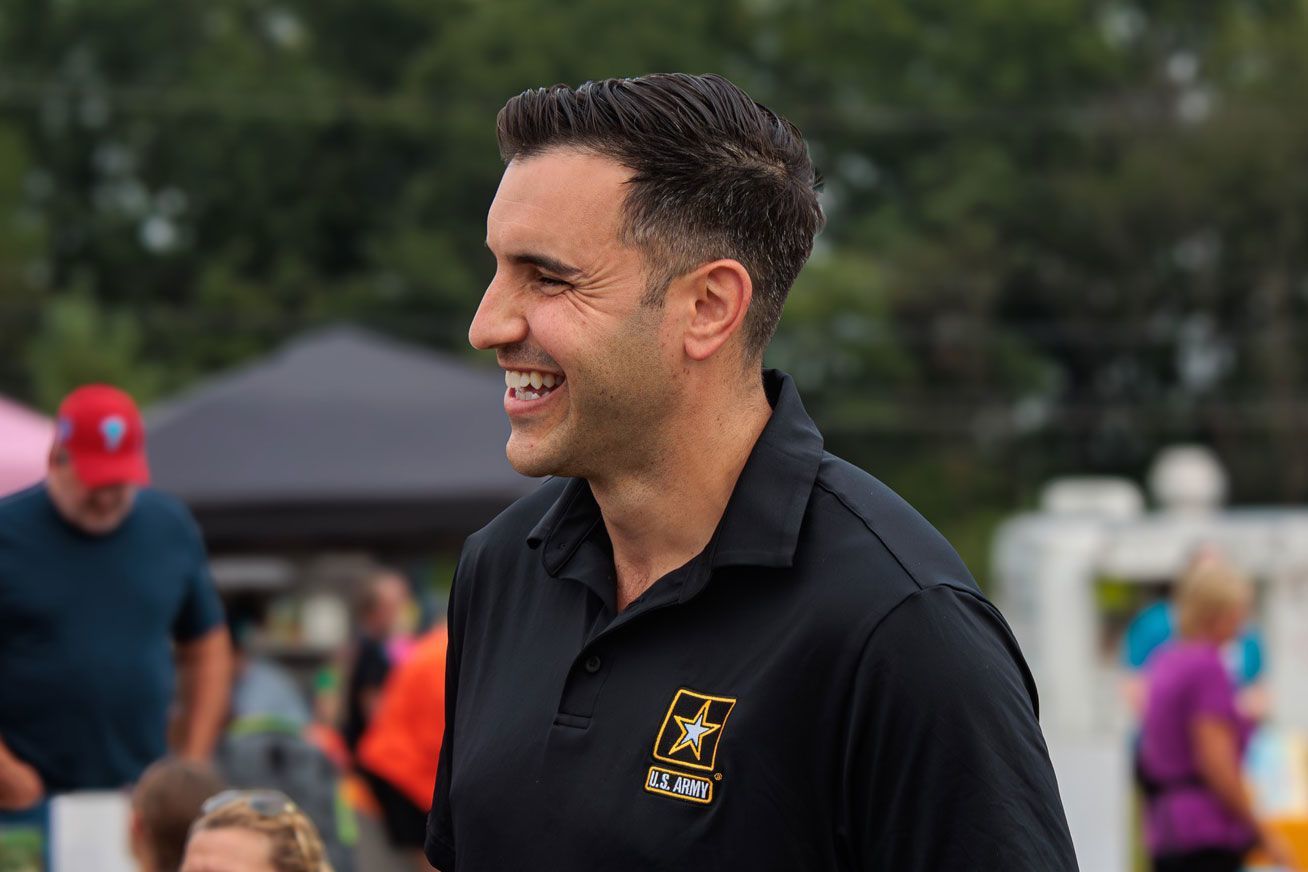
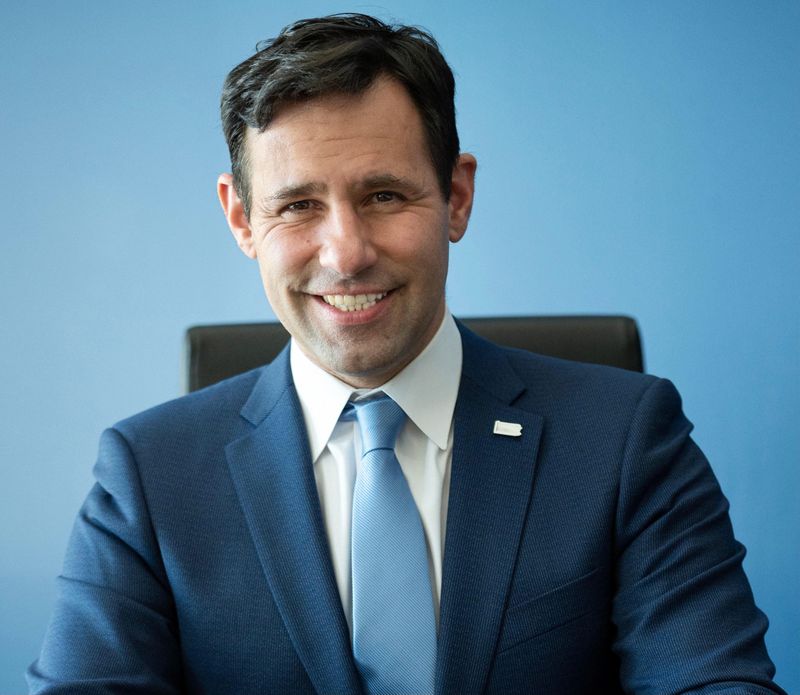
Army veteran Danny Ceisler won the hotly contested Bucks County sheriff race Tuesday night.
Harran, who led the Bensalem Police Department before being elected sheriff four years ago, said Wednesday that Ceisler will “have to answer for a person who becomes victimized by an individual that should have been deported. And he’ll have to sleep with that, and it’ll be on his head, not mine.“
His said his plans around the program had been misrepresented.
“Everyone knows my intentions. It was never making car stops on people who were dark-colored. My career speaks for itself in terms of my partnerships with the community.”
He had staunchly defended his decision to assist ICE, insisting it would make residents safer and even potentially bring new funding and police equipment to the county.
Ceisler called immigration the single biggest issue in this election.
“My goal was to provide an alternative which was a no-nonsense, reasonable approach to public safety,” Ceisler said Wednesday, noting that it was now “my responsibility to deliver on that.”
Officials with U.S. Immigration and Customs Enforcement declined to comment.
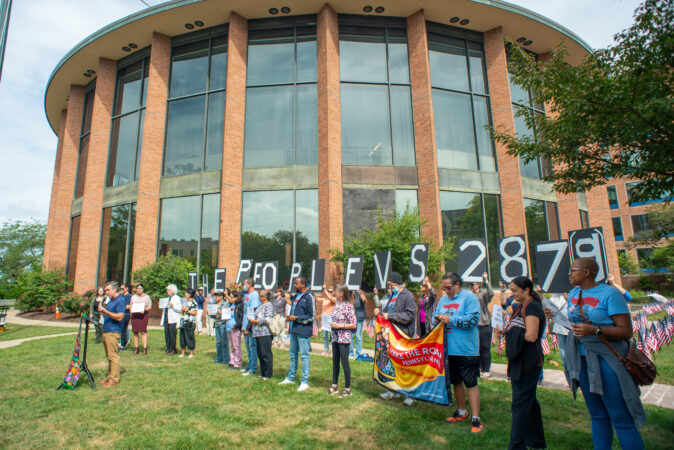
The partnership, which recently became active after months of planning, provoked backlash, including the lawsuit, public demonstrations outside the courthouse, and a repudiation by the Democratic-led Bucks County Board of Commissioners.
Nationally, only a few police agencies that signed on with ICE have dropped out of those agreements.
Ceisler’s victory was part of a Democratic sweep of county positions in a critical swing county that narrowly voted to elect President Donald Trump last year.
“I am walking on air,” said Laura Rose, a leader of Bucks County Indivisible, which supports immigrants and progressive causes. “Bucks County voters soundly rejected Sheriff Harran and his plan to turn county deputies into de facto ICE agents.”
In the spring, Harran and ICE officials signed what is called a 287(g) agreement, named for a section of a 1996 immigration law. It enables local police to undergo ICE training, then assist the agency in identifying, arresting, and deporting immigrants.
“Ceisler’s victory proves what we’ve always known ― 287(g) agreements don’t make us safer, they divide our community,” said Diana Robinson, co-executive director of Make the Road Pennsylvania, a plaintiff in the lawsuit.
The agreement with ICE “put Bucks County at risk,” and the election showed that “voters reject fear-based policies,” she said Wednesday.
Robinson and other opponents insist that turning local officers into immigration agents breaks community trust with the police and puts municipal taxpayers at risk of paying big legal settlements. ICE officials, however, say the program helps protect American communities, a force-multiplier that adds important staff strength to an agency workforce that numbers about 20,000 nationwide.
The number of participating police agencies has soared under Trump, with ICE having signed 1,135 agreements in 40 states as of Wednesday. Seven states, including New Jersey and Delaware, bar the agreements by law or policy.
The number of new agreements increases almost every day, and Trump has pushed hard for greater local involvement. On his first day in office he directed the Department of Homeland Security to authorize local police to “perform the functions of immigration officers” to “the maximum extent permitted by law.”
Shortly before the government shutdown, ICE was poised to begin backing its recruitment efforts with money, announcing that it would reimburse cooperating police agencies for costs that previously had been borne by local departments and taxpayers.
But activists focused on the difference between what Harran said he intended to do and the much broader powers conferred within the agreement with ICE.
Harran signed up for the “Task Force Model,” the most far-reaching of the three types of 287(g) agreements. It allows local police to challenge people on the streets about their immigration status and arrest them for violations.
Harran said his deputies would not do that. Instead, he said, they would electronically check the immigration status of people who have contact with the sheriff’s office because of alleged criminal offenses. Those found to be in the country illegally would be turned over or transported to ICE, if the federal agency desires, he said.
This suburban content is produced with support from the Leslie Miller and Richard Worley Foundation and The Lenfest Institute for Journalism. Editorial content is created independently of the project donors. Gifts to support The Inquirer’s high-impact journalism can be made at inquirer.com/donate. A list of Lenfest Institute donors can be found at lenfestinstitute.org/supporters.
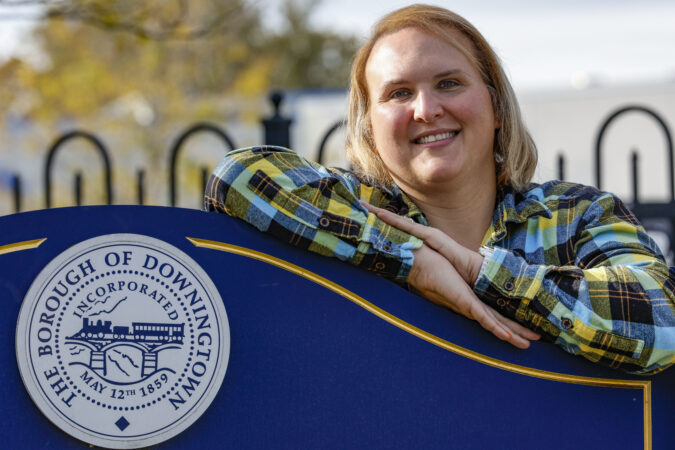
Erica Deuso will be Pennsylvanias first openly transgender mayor. She won Tuesday’s contest to lead Downingtown after a campaign focused on bread-and-butter local issues in the face of attacks to her identity.
The longtime Democratic advocate who works in management at a pharmaceutical company earned 64% of the vote as of Wednesday morning defeating Republican Rich Bryant who had 35% of the vote to serve as the next mayor of Downingtown, a Chester County borough of roughly 8,000 people.
“Voters chose hope, decency, and a community where every neighbor matters,” Deuso said in a statement at 1:30 a.m. Wednesday. “I am honored to be elected as Pennsylvania’s first openly transgender mayor. I carry that responsibility with care and with purpose.”
Deuso joins a small but growing rank of transgender officials in Pennsylvania and nationwide. There are 52 out transgender elected officials across the United States and three in Pennsylvania, all who govern at the local level , according to the Victory Institute, the research arm of the Victory Fund, which supports LGBTQ+ candidates and backed Deuso.
While her gender identity attracted attention, and online vitriol, Deuso’s campaign didn’t dwell on it. Instead she prioritized public safety, sustainable growth and community in the historic borough now home to Victory Brewing.
She ran with the support of the borough’s last two mayors, Democrats Phil Dague and County Commissioner Josh Maxwell.
Bryant, a retired cybersecurity expert, argued he was better experienced for the job, which primarily leads the borough police department. But Bryant faced accusations of bigotry as Deuso posted screenshots online of her opponentmaking misogynistic and transphobic remarks on X, (Bryant said 90% of the posts were AI-generated,but offered no proof.)
In a statement, Bryant congratulated Deuso and pledged to continue working to serve the community.
“To those who voted differently, I respect your decision and share your hope for a stronger, safer, and more united Downingtown. I will continue to serve, to listen, and to advocate for responsible growth, fiscal transparency, and accountable local leadership,” he said.
This suburban content is produced with support from the Leslie Miller and Richard Worley Foundation and The Lenfest Institute for Journalism. Editorial content is created independently of the project donors. Gifts to support The Inquirer’s high-impact journalism can be made at inquirer.com/donate. A list of Lenfest Institute donors can be found at lenfestinstitute.org/supporters.
Democrats swept two law enforcement races in Bucks County, ousting the incumbents and signalingthe swing county has soured on President Donald Trump just a year after voting for him.
Democrat Danny Ceisler, an Army veteran who held a public safety role in Gov. Josh Shapiro’s administration, led Republican Sheriff Fred Harran by 12 percentage points with all precincts reporting Wednesday morning. The sheriff race centered on Harran’s controversial decision to partner his agency with ICE as Trump ramps up immigration enforcement nationwide.
And former Bucks County Solicitor Joe Khan led Republican District Attorney Jen Schorn by eight percentage points. Democrats believe Khan is the first member of their party to ever be elected to the office.
Bucks County Democrats declared victory just after midnight Wednesday morning — sweeping every countywide race. The victories came in what appeared to be a blue wave election as voters rejected Republican candidates in Pennsylvania, New Jersey, and Virginia.
“What’s going on with our federal government is not normal, and voters saw that creeping into local offices, and they overwhelmingly rejected it,” Ceisler said Wednesday. “Bucks County doesn’t let extremism come inside.”
The hotly contested Bucks County races centered on some of the most contentious issues in national politics — Trump, crime, and immigration. Democrats sought to paint the incumbents as Trumpian ideologues, while Republicans warned voters of an influx of “Philly crime” if Democrats took office, even as the violent crime rate in the city has dropped from its pandemic peak.
Voters opted for a change, delivering both offices to Democrats and, as result, spelling the end to a controversial partnership between the sheriff’s office and U.S. Immigration and Customs Enforcement.
Bucks was the only county in the Philadelphia area to go for Trump last year and will be a key battleground in 2026 when Shapiro runs for reelection. Tuesday’s wins will give Democrats momentum going into the midterms.
Democrats, Khan said, had to work to prove to voters they could be trusted with public safety. They were aided by a favorable dynamic as voters rejected Trumpism.
“It was a campaign not about attacking somebody else but, really, making really clear that we deserve better than what we’ve got,” Khan said.
Voters at the polls persistently expressed frustration with Trump, and a sense that anyone from his party should not be trusted in office.
“They’re subject to his control, regardless of how they feel on issues,” said Stephanie Kraft of Doylestown. “And that affects everything, from our local courts on up to the higher courts in the state.”
The effort succeeded, indicating that Bucks voters are already disenchanted with the president they voted for just a year ago. The vote may set off alarm bells among Republicans as they prepare for next year’s election, when Republican Treasurer Stacy Garrity seeks to oust Shapiro and Republican U.S. Rep. Brian Fitzpatrick stands for reelection.
The Democratic victory is “on everything that Trump is doing to undermine the institutions of democracy, but it’s also on Trump’s failure to really reverse inflation,” said State Sen. Steve Santarsiero, the chair of the Bucks County Democratic Party.
Even so, for several voters, Harran’s partnership with ICE was the final straw.
Jill Johnson worried it would result in the targeting of Latino citizens, including her half-Mexican son, who is away at college.
“My biggest fear is that someone in a mask is going to come up and grab him because they think he’s here illegally,” Johnson said. “It’s scary. These are law-abiding people who have done nothing wrong.”
The partnership, which recently became active after months of planning, provoked backlash, including a lawsuit, public demonstrations outside the courthouse, and a repudiation by the Democratic-led board of commissioners.
Ceisler said Wednesday that he will issue a moratorium barring deputies’ cooperation with ICE on his first day in office. From there, he said, he will figure out how to disentangle the sheriff’s office from the agreement signed by his predecessor.
For his part, Harran said Wednesday that Ceisler will “have to answer for a person who becomes victimized by an individual that should have been deported. And he’ll have to sleep with that, and it’ll be on his head, not mine.”
Officials with U.S. Immigration and Customs Enforcement declined to comment.
Harran, an outspoken Republican who endorsed Trump last year and frequently clashes with the Democratic commissioners, was elected sheriff in 2021 after more than a decade leading Bensalem’s police department.
The Republican has expanded the role of the sheriff’s department, adding a K-9 unit and partnering with immigration officials, but faced criticism that he was failing to complete the basic duties of his job, such as executing warrants and protecting the courthouse.
Ceisler advocated taking politics out of the office, saying he would focus on domestic violence and pledging to end the partnership with ICE. He argued his experience in the Army and in a public safety leadership post under Shapiro prepared him to serve as sheriff — though Harran argued Ceisler would be unprepared for the job, having never worked in a sheriff’s office or police department.
“Being the sheriff isn’t on-the-job training,” Harran said at a Bristol polling place Tuesday. “You need knowledge and experience.”
Ceisler said he had spoken to Harran after the results came in and the incumbent promised to assist with a smooth transition.
Schorn, a veteran Bucks County prosecutor, lost in her bid for a full term after being appointed district attorney last year when her predecessor became a judge.
She had been an assistant district attorney in the county since 1999, prosecuting some of the county’s most high-profile cases. When she became district attorney, Schorn started a task force in the county to investigate internet crimes against children.
Khan, a former county solicitor and federal prosecutor, argued Schorn ran the office under “Trump’s blueprint” and criticized her decisions not to recuse herself when a Republican committeeperson was charged with voter fraud and not to prosecute alleged child abuse at Jamison Elementary School.
Schorn has said she was unable to discuss the details of the Jamison Elementary School case due to rules governing prosecutors, but Khan argued her explanations were insufficient as parents sought answers.
Schorn performed slightly better than her GOP counterparts in Bucks County on Tuesday. But, while many voters said they had no issue with Schorn’s policies, her political party was a turnoff.
“I just feel the Democrats would be better right now; I’m down on all Republicans,” said Marybeth Vinkler, a Doylestown voter who said she had no problems with how Schorn had run the district attorney’s office. “Everything happening in D.C. is trickling down around us.”
Schorn did not immediately comment on the results Wednesday.
Jim Worthington, who has run pro-Trump organizations in Bucks County, said Republicans failed to turn out voters on Election Day even as data showed Democrats held a significant lead on mail voting ahead of Tuesday.
“This is where the GOP was asleep at the wheel,” Worthington said.
Traditionally, voters trust Republicans more with law and order. The resounding victories for Democrats defied that trend.
“We now have an obligation to deliver and to show that Democrats can lead on the issue of safety,” Ceisler said.
“The ball is in our hands, and we’re ready to run with it.”
Staff writer Jeff Gammage contributed to this article.
This suburban content is produced with support from the Leslie Miller and Richard Worley Foundation and The Lenfest Institute for Journalism. Editorial content is created independently of the project donors. Gifts to support The Inquirer’s high-impact journalism can be made at inquirer.com/donate. A list of Lenfest Institute donors can be found at lenfestinstitute.org/supporters.
The results of the tight race could be a barometer, nationally, for which party has an edge, and signal the type of messaging and candidate that can win over New Jersey voters in an increasingly purple state.
The race has attracted national attention and resources from both parties — especially Democrats who see the seat as a critical opportunity to build momentum and safeguard the state from the policies of President Donald Trump.
Ciattarelli spent his final campaign week rallying with Puerto Rican voters in Passaic County and taking his “It’s Time” bus tour around the state. He held meet-and-greets, rallies, and diner stops over the weekend in Monmouth, Ocean, Union, and Bergen Counties.
Sherrill, who would be only the second woman elected governor in the state should she prevail on Tuesday, rallied with former President Barack Obama on Saturday in Newark and with Sens. Cory Booker and Andy Kim on Sunday in Camden and Mount Laurel Township. The events followed a week that included a “Driving Down Costs” bus tour and appearances with former Transportation Secretary and presidential candidate Pete Buttigieg and Philadelphia Mayor Cherelle L. Parker.
Along with her promise to take on landlords “colluding to raise rents” and to tackle pharmaceutical prices, Sherrill reiterated her campaign promise to freeze utility rate hikes on her first day in office at the rally with Obama on Saturday.
“New Jersey, I’m not playing,” she told the audience. “I’m not writing a strongly worded letter and I’m not starting up a working group. I am not doing a 10-year study. I’m declaring a state of emergency.”
For decades, New Jerseyans had voted blue at the national level while electing Republicans to the governor’s mansion. Democrats have a voter registration advantage of about 850,000 voters in New Jersey, but 2.2 million voters are registered unaffiliated. And GOP registrations have outpaced Democratic ones since the 2024 presidential election, when Trump swung the state significantly redder, losing by only 6 points.
Ashley Koning, the director of the Rutgers Center for Public Interest Polling, said either candidate has a “very plausible path to victory.”
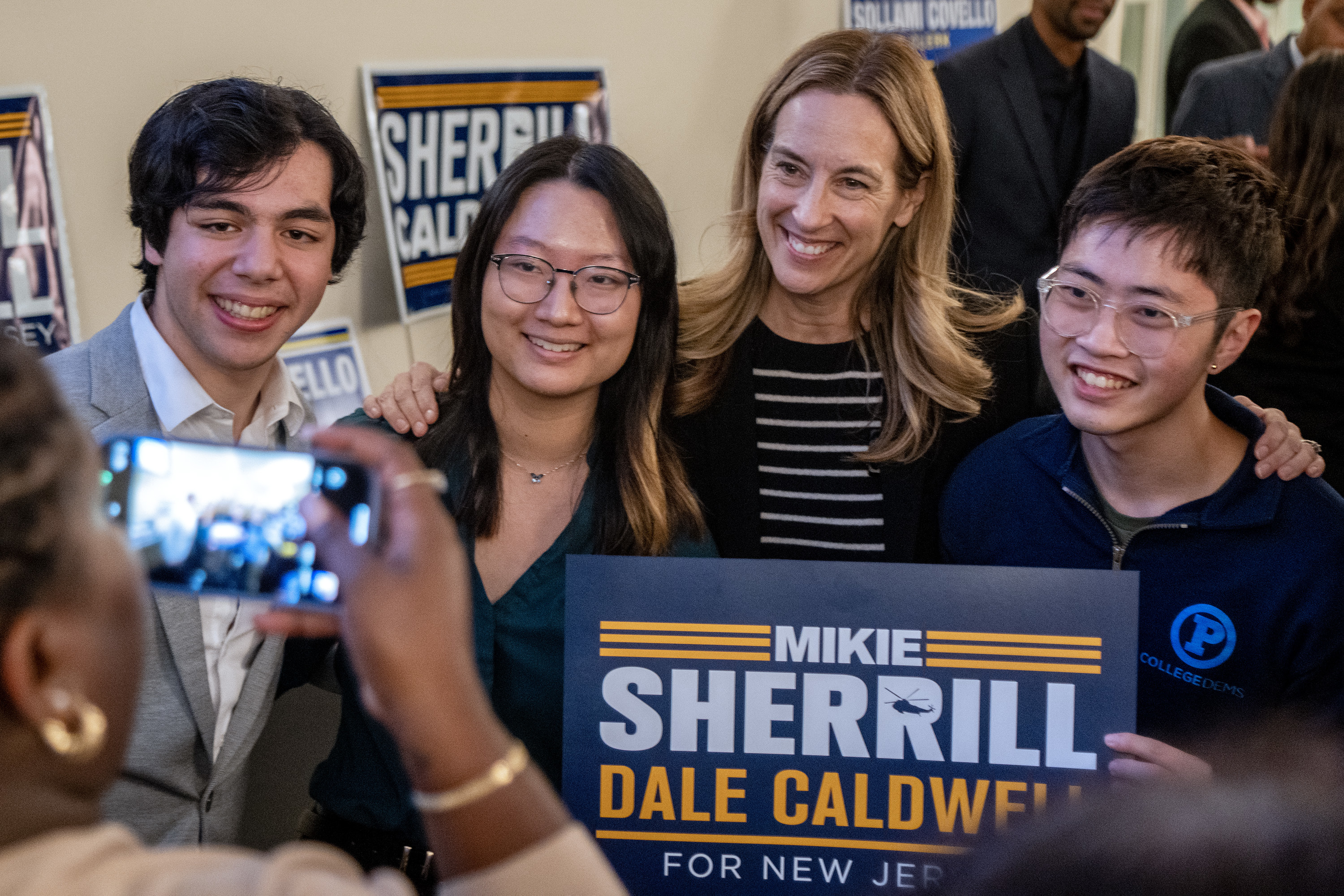
Democratic candidate for governor U.S. Rep. Mikie Sherrill poses with members of the Princeton College Democrats as she appears at a Mercer County Democrats GOTV Rally at the Mercer Oaks Golf Course in West Windsor Thursday, Oct. 23, 2025. From left are: Julian Danoff; Michelle Miao; and Paul Wang. (The group’s motto: “Bringing blue values to the Orange Bubble.”)
Dueling headwinds
There are dueling headwinds at play in the contest for New Jersey governor, too. Both Trump and Murphy are unpopular with about half of New Jersey voters. New Jersey hasn’t elected the same party to a third term for the governorship since 1961, but Republicans have also not won the office while their party has held the White House since 1985.
Once the votes are tallied in Tuesday’s election, New Jersey political history will be made either way.
Ken Martin, the chair of the Democratic National Committee, said he expects the race to be a close win for Democrats, noting “a win is a win.”
He resisted the critiques from some fellow Democrats that Sherrill played her campaign too safe, “in an era of brash bravado, machismo, and Donald Trump, and these candidates basically saying whatever the hell they want.”
“I think what she’s been doing is putting out a pretty compelling message to New Jerseyans and campaigning everywhere to make sure that they understand what she’s focused on,” he said.
The party’s vice chair, Pa. State Rep. Malcolm Kenyatta (D., Philadelphia) predicted a good night for Democrats in New Jersey. “There’s that famous saying that ‘Trenton makes, the world takes,’ and I think Trenton is going to make a lot of momentum that we are going to take into 2026 and beyond.”
“I feel it, you know, I feel it on the ground,” said Sen. Andy Kim (D., N.J.) who campaigned with Sherrill in between fielding questions from fellow Democrats in Washington about what the race looks like back home.
“Everyone I talked to knows what’s at stake,” Kim said.
Chris Russell, Ciattarelli’s political strategist, argued that Ciattarelli has garnered support from voters who have traditionally supported Democrats by delivering them a clearer message on affordability.
“We put a significant amount of time and resources, driven and led by Jack, to be present in minority communities like the Hispanic community and the Black community, and we believe that effort is going to pay off,” he said.
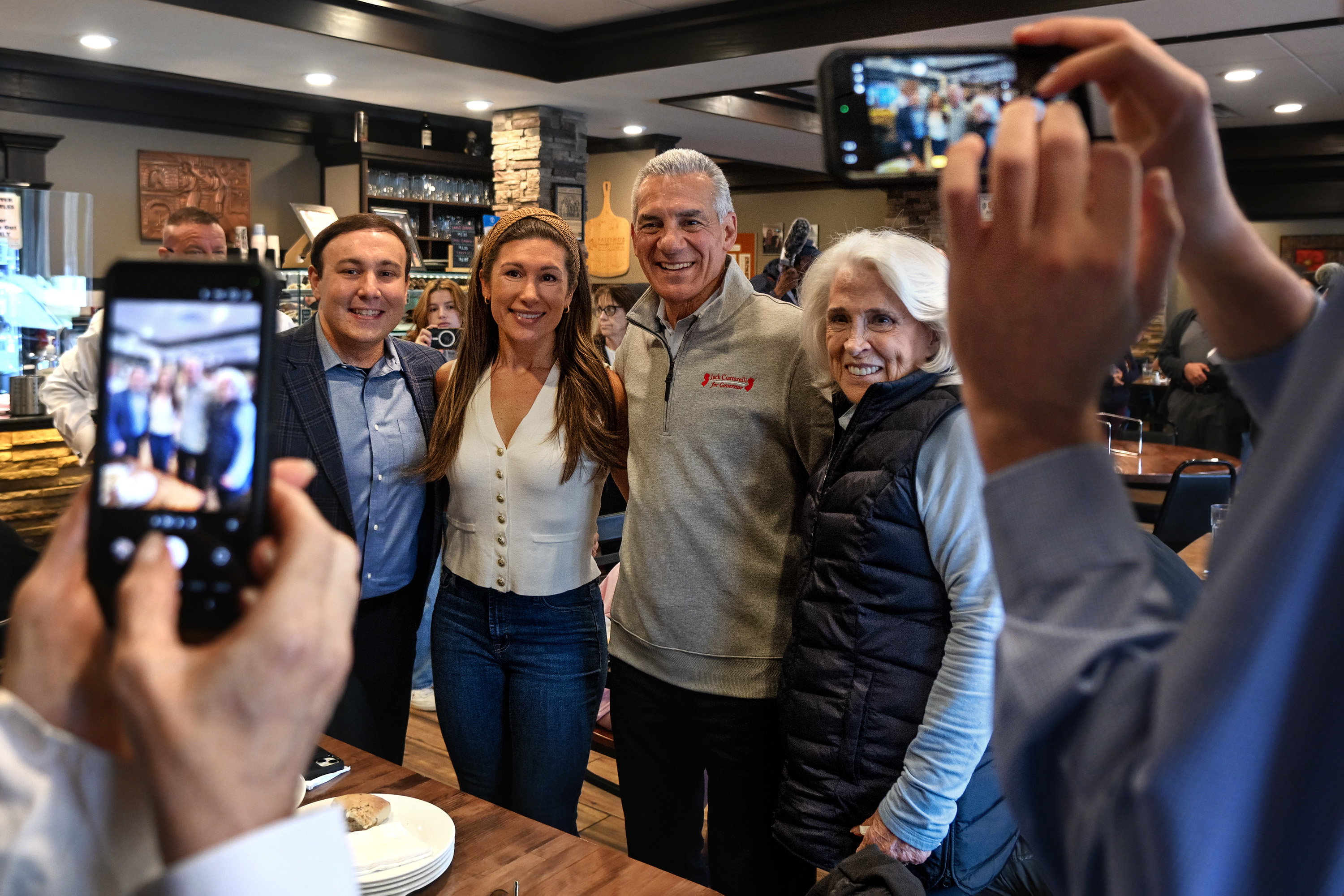
Republican candidate for governor Jack Ciattarelli poses with members of the Pascucci family as he greets supporters at Palermo’s Pizza in Bordentown Monday, Oct.13, 2025 while campaigning in South Jersey.
‘A totally different vibe’
As the candidates made their final burst of media appearances in the countdown to Election Day, Ciattarelli, in a town hall with Fox News’ Sean Hannity on Thursday night, said the Republican campaign energy “is electric.” Ciattarelli said he was encouraged by early-vote and vote-by-mail numbers, which, while trailing Democrats, had surpassed 2021 GOP turnout numbers.
“We go after those one out of four Republicans … who typically only vote in presidential years,” Ciattarelli said on Hannity’s program. “We’ve done a magnificent job, our local Republican organizations have, in getting those people to vote by mail or vote early.”
State Sen. Latham Tiver, a South Jersey Republican, said Ciattarelli’s campaign stops are a “totally different vibe” than his last run in 2021. He recalls Ciattarelli introducing himself table to table, but now, Tiver said when the candidate enters the room, people flock to him.
“Jack’s doing everything he can. … He’s pounding the pavement, he’s meeting more and more people, and we’re all out there doing the same thing for him,” Tiver said.
As the candidates make their final push to lead New Jersey, the outcome will likely depend on who shows up at the polls Tuesday.
Both campaigns have motivated bases, but the election could come down to the less engaged and whether they decide to vote. Despite a record amount of spending in the state, only about 2% of voters remained undecided in polls.
“I don’t think people give enough credit — pollsters, political wonks — to just how burnt out the average American is,” said Jackie Cornell, who previously ran field operations for Obama’s campaign in New Jersey.
“They just don’t want to hear anything about any of this any more, and I worry that will be the deterrent more so than anything else.”
Personal attacks, political division, and culture wars have defined school board races in the Philadelphia suburbs in recentyears.
But 2025 feels different.
Even as national politics are more divided than ever — and amid a federal shutdown and state budget standoff — local school board candidates from both parties are shying away from partisanship in favor of focusing on local issues like taxes and full-day kindergarten.
The change in posture can be attributed to several factors —Republicans who ran on culture-war issues largely lost in 2023 and, while the GOP is now tackling those priorities from the federal level, local candidates said they cannot control what President Donald Trump does.Schools are also facing pressing fiscal issues amid state and federal budget cuts.
There are some exceptions. In Souderton, candidates on the Republican slate say they want to maintain the district’s current policies that prevent transgender girls from playing sports and prioritize “parental rights” — stances Trump has also embraced. Some Democratic candidates, meanwhile, say Trump’s education policies, including plans to dismantle the federal Department of Education, motivated them to run.
Still, those issues are not taking center stage across the Philadelphia collar counties.
“School districts are struggling financially,” said Brittany Crampsie, a Democratic consultant. Parents “don’t want to have a debate about DEI [diversity, equity, and inclusion] anymore, they want to make sure their kids are getting a good education.”
Moving on from ‘culture wars’ — for the most part
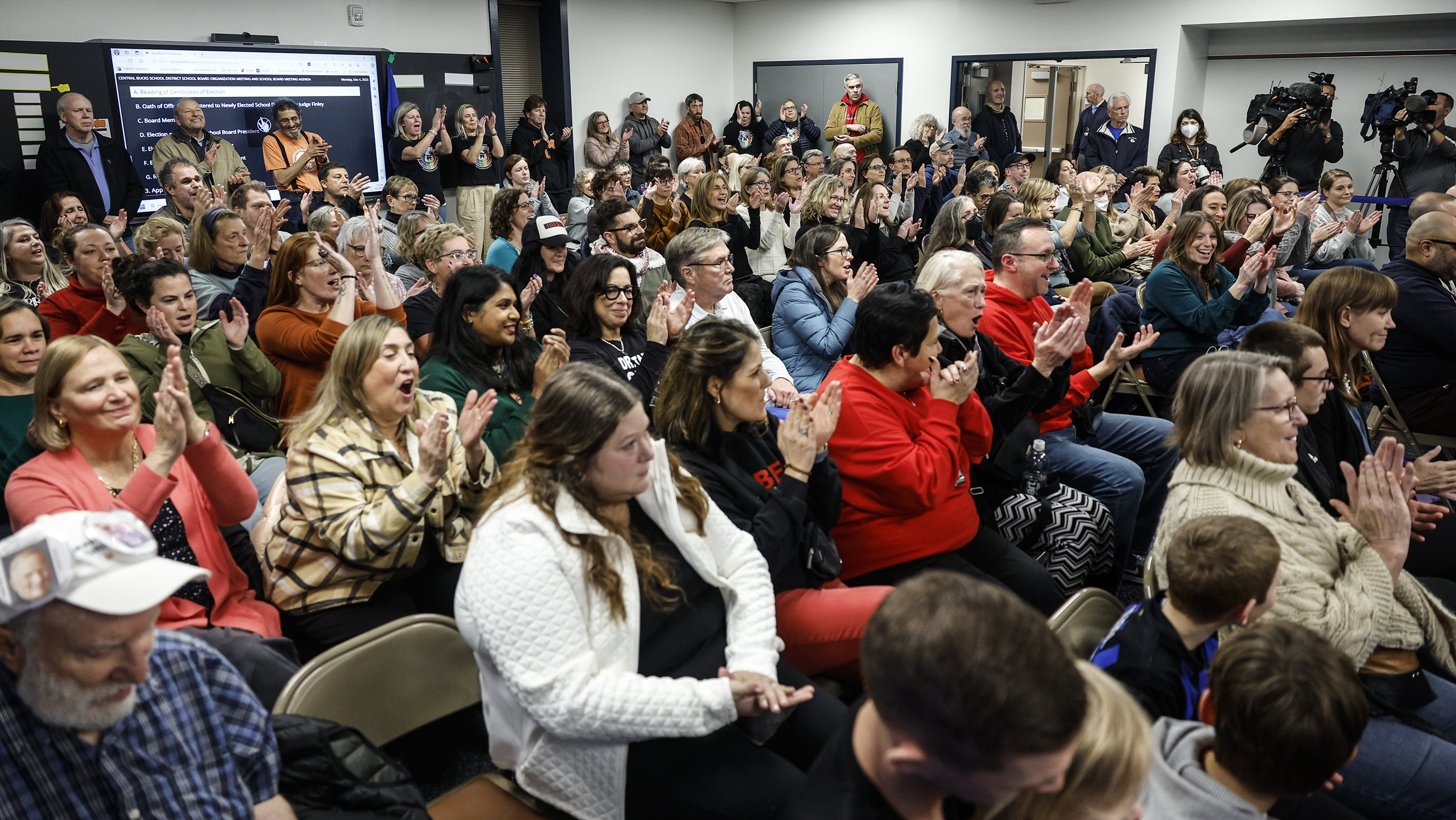
Supporters cheer in 2023 before five new Central Bucks school members are sworn in. Democrats seized control of the board in a contentious race.
Two years ago Central Bucks was again amongthe most closely watched races in the region, with spending surpassing $600,000. Democrats swept every open seat, oustinga conservative majority that had banned books and Pride flags in the district. Other suburban districts flipped to Democratic control as well.
Now, candidates are steering clear of those hot-button topics.
“My campaign is focused on academics, school taxes, and safety….these are the current issues of concern in Central Bucks,” Betty Santoro, a Republican, wrote in an email.
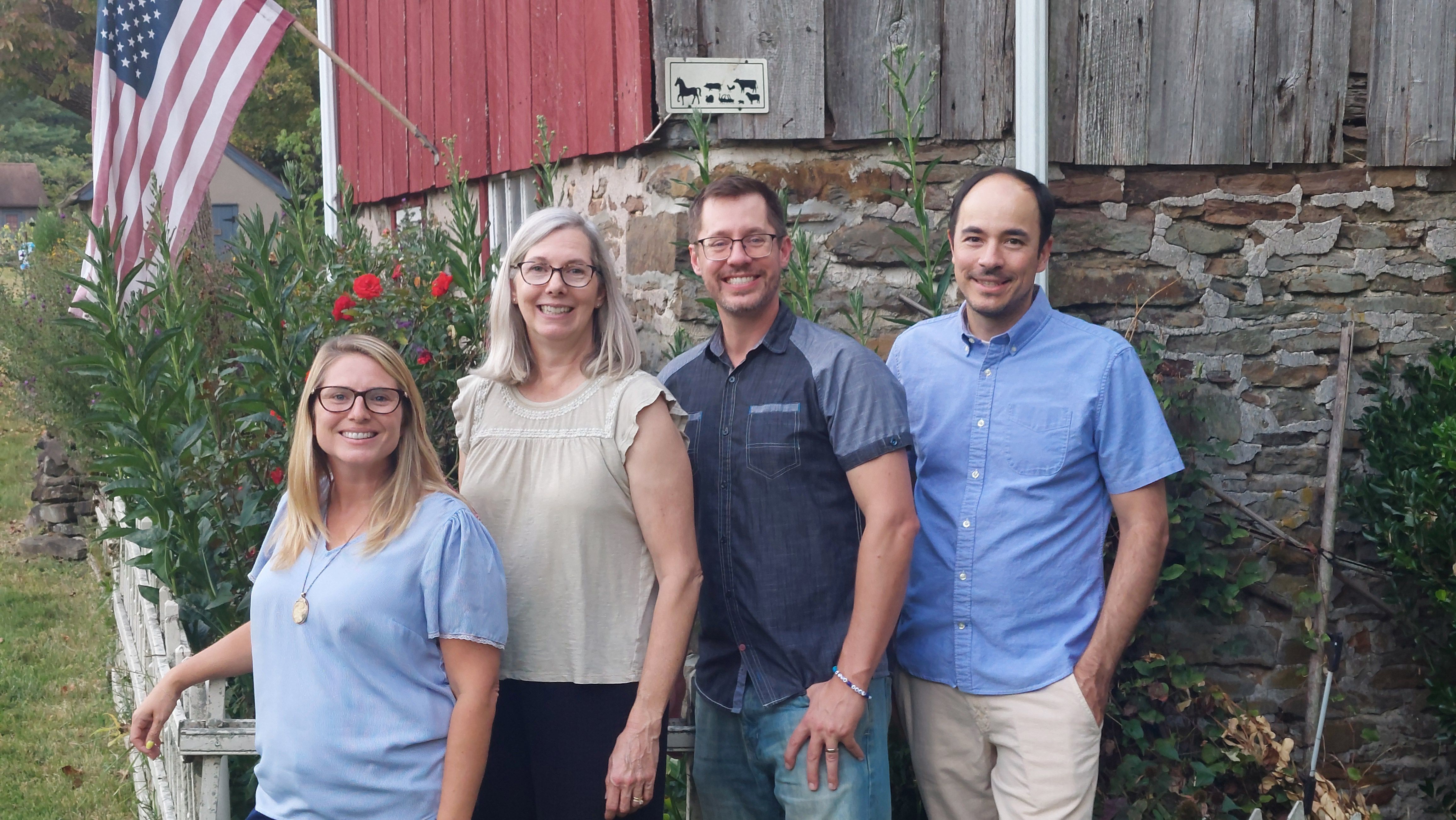
The Democratic candidates for Central Bucks school board: Amanda O’Connor, Katrina Filiatrault, David Comalli, and Daniel Kimicata (left to right).
Culture wars were a “distraction” from priorities for the district, said Daniel Kimicata, a Democrat running for reelection. Four of nine seats are on the ballot this year; Democrats will maintain their majority regardless of the outcome.
Andrew Miller, a Republican running in Central Bucks, wrote in an email it’s good that things are quieter. “People are tired of the shouting and want results,” he wrote. “They want candidates who listen, not lecture and candidates who build bridges, not walls.”
In Souderton — where Democrats say they are optimistic about their chances of gaining representation on the all-Republicanboard — the Republican platform also includesparental rights and student safety.
Republican board president Stephen Nelson, who is running for reelection, said that culture-war topics are not an issue in the district, but that it would not allow transgender athletes to compete on girls sports teams should the situation arise. (The Pennsylvania Interscholastic Athletic Association this year changed its transgender athlete policy to comply with President Donald Trump’s executive order on “Keeping Men Out of Women’s Sports.”)
“Why is that a question? It’s always been that way and we don’t quite understand why it has to be any different,” Nelson said.
In Pennridge, where the board is Democratic-controlled, Republican candidates, in a statement, pushed back on the idea that school board races in the past centered on issues promoted by Republicans. Instead, they argued, GOP candidates were responding to Democratic-initiated policies and questioning some DEI policies and whether they were best for students.
“Our intent was never to divide but to ensure that schools serve all students equally and that classroom priorities remain rooted in education, not ideology,” they said.
Money, money, money
This year, there is far less money flowing into school board races, though Central Bucks continues to attractoutside fundraising.
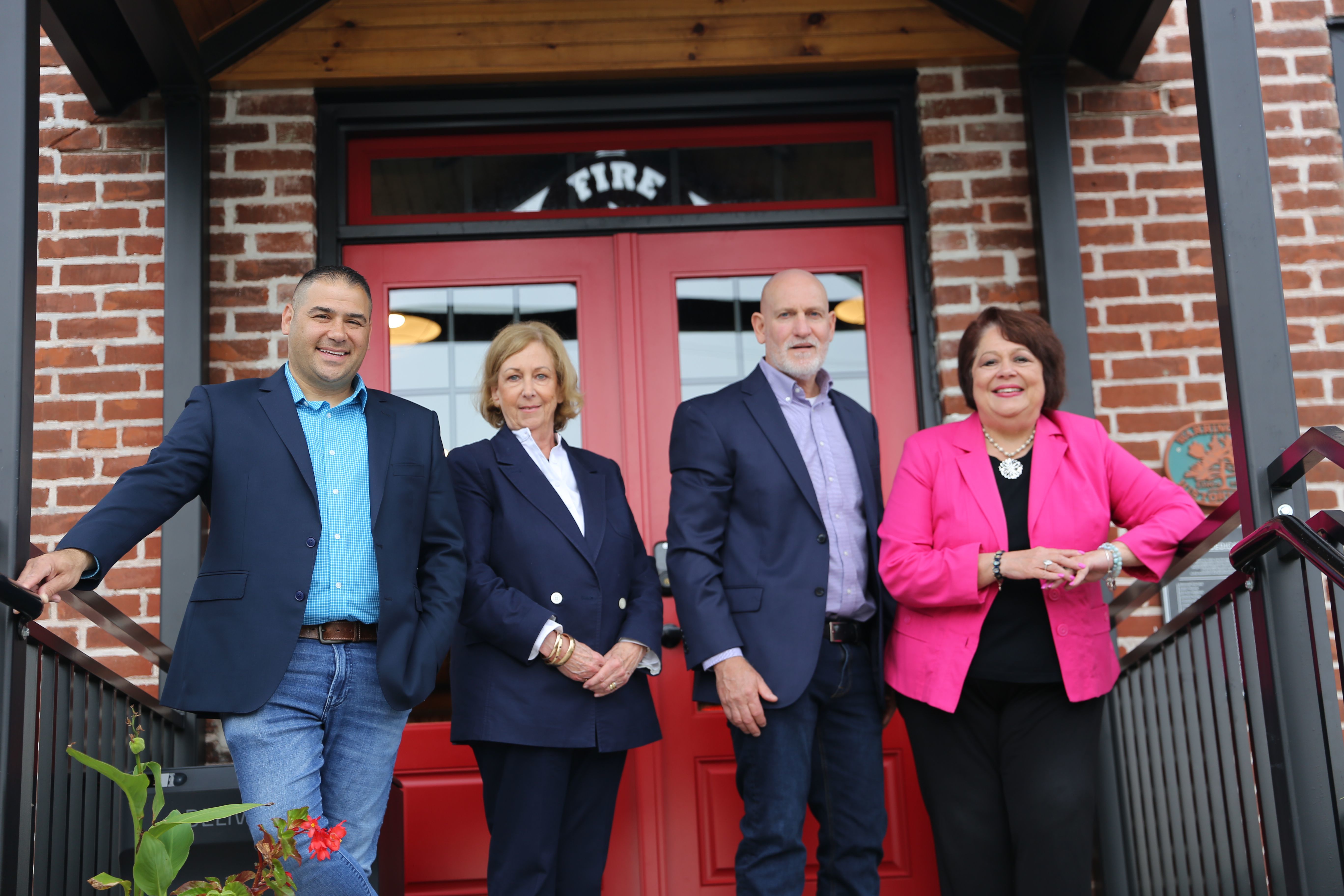
The Republican candidates for Central Bucks school board. Andrew Miller, Sharon Beck, Roman Szewczuk, and Betty Santoro (left to right).
The 1776 Project PAC, a group supportingRepublican school board candidates that has drawn ire from Democrats, has spent more than $86,000 on mailers and text messagesin Bucks County. Approximately half that has gone toward supporting Central Bucks GOP candidates,with the rest going to candidates in Centennial School District and Pennridge, according to Bucks Countycampaign finance reports.
The PAC has also spent more than $20,000 supporting candidates on Republican slates in Perkiomen Valley and Lower Merion, according to Montgomery County campaign finance filings.
Democrats are also getting support from an outside group — Red Wine and Blue, a national group of suburban women that promotes Democratic candidates. The group has spent approximately $260 in Bucks County and $104 in Montgomery County school board races, according to county filings.
In Bucks County, other races like district attorney and sheriffhave drawn money and attention that might have otherwise gone to school boards, said Guy Ciarrocchi, a GOP analyst.
“There’s a certain amount of fatigue that’s hitting a place like Bucks,” Ciarrocchi said.
The Trump factor
Democrats in suburban districts said they need tomaintain majorities to bestaddress the impacts of Trump administration policies.
“When I realized the threat that public education was under, I decided now was the time that I had to run,” said Katrina Filiatrault, a Democrat running in Central Bucks.
Judy Lofton, a Democrat running in Perkiomen Valley, said of her slate: “Our central unifying message is that we want to protect public education, that public education is currently under attacks from a variety of different stakeholders.”
Republicans are striking a different tone.
“We’re not focused on anything that’s going on outside of something that we don’t control,” said Jason Saylor, a Republican running for reelection in Perkiomen Valley. “We don’t control the federal government. We don’t control what might happen with the Department of Education. We don’t control issues at the state legislature.”
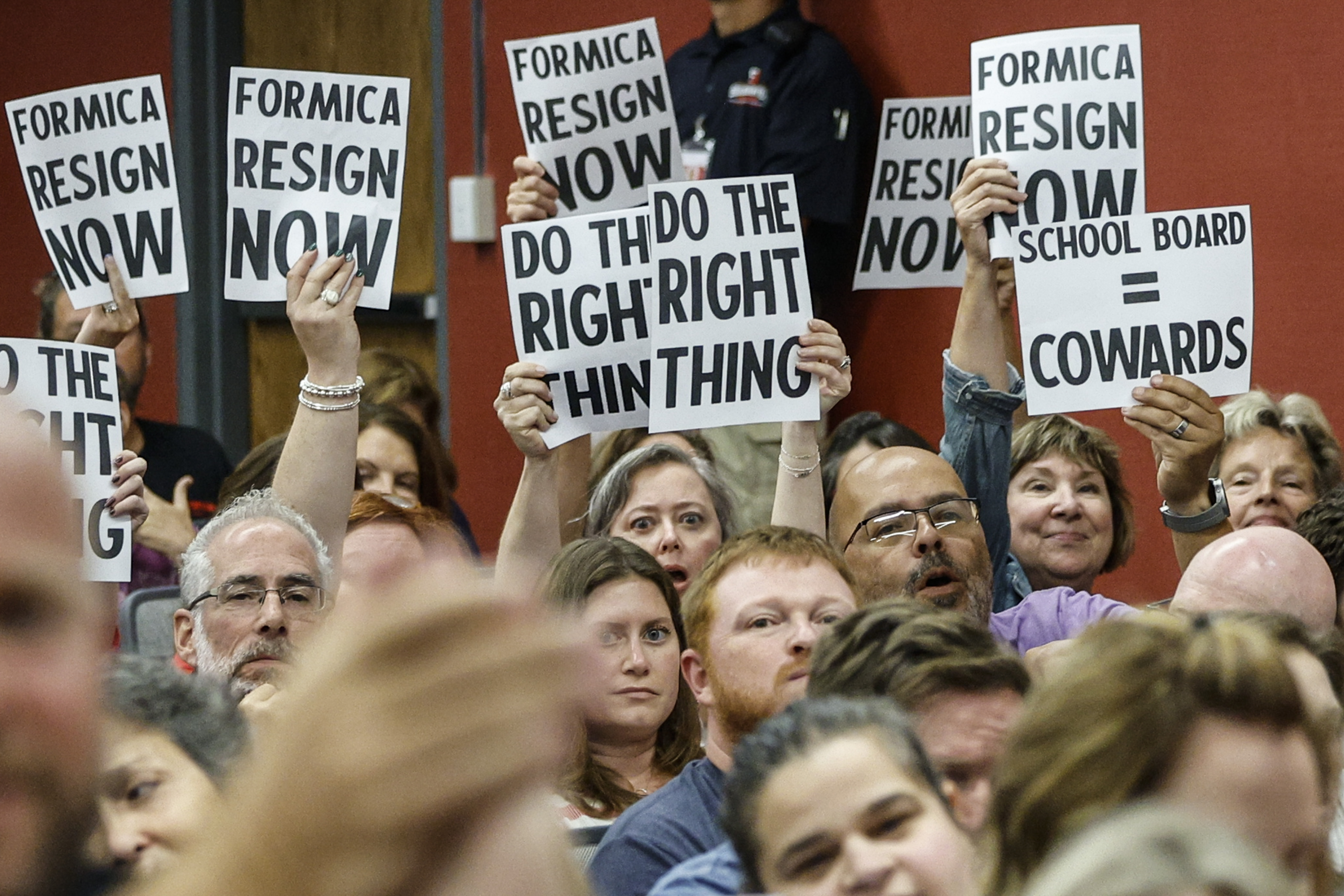
In Souderton, controversy flared last year whenRepublican school board member Bill Formica made lewd comments about former Vice President Kamala Harris. He is still on the board and is not up for reelection this year.
Residents protest at a Souderton school board meeting last year after board member Bill made a lewd social media post about then-Vice President Kamala Harris.
“We’re talking to every voter who might be a Republican or an independent, and they’re sharing concerns at the doors about how they can’t vote for certain people anymore,” said Corinne DeGeiso, a Democrat running for the board.
Nelson, the Republican school board president running for reelection, said Formica was protected by the First Amendment.
His comments, Nelson said, were “rude, lewd, and unacceptable,” but there was nothing the board could do about it.
Even in a less contentious election cycle, Chris Lilienthal, a spokesperson for the Pennsylvania State Education Association, which tends to endorse Democratic candidates, said school board elections are more important than ever this year.
“They’re holding the line right now in this budget impasse,” he said, “and that alone should merit the attention of voters.”
This suburban content is produced with support from the Leslie Miller and Richard Worley Foundation and The Lenfest Institute for Journalism. Editorial content is created independently of the project donors. Gifts to support The Inquirer’s high-impact journalism can be made at inquirer.com/donate. A list of Lenfest Institute donors can be found at lenfestinstitute.org/supporters.
Think you know your news? There’s only one way to find out. Welcome back to our weekly News Quiz — a quick way to see if your reading habits are sinking in and to put your local news knowledge to the test.
Question 1 of 10
A series of train fires has prompted SEPTA to inspect its trains. The majority of its fleet is made up of this model train:
CorrectIncorrect. XX% of other readers got this question right.
SEPTA is now rushing to inspect 225 Silverliner IVs and provide its findings on the root cause of the problem by the end of the month. The trains, which are outdated in design and decades of use, haven’t been replaced because of a lack of funding. Now they’re catching fire more often.
Question 2 of 10
East Passyunk’s Singing Fountain has been decorated by the local knitting collective for Halloween. With her new costume, what is the mermaid sculpture dressed as?
CorrectIncorrect. XX% of other readers got this question right.
The mermaid at the top of the fixture now wears a black and orange witch’s hat and matching cape. The surrounding cherubs also have crocheted outfits of their own: One is a monarch butterfly, another is a bat, and the third is a fairy. Philadelphia Drunken Knitwits is the group behind the new look.
Subscribe to The Philadelphia Inquirer
Our reporting is directly supported by reader subscriptions. If you want more journalism like this story, please subscribe today.
A new dog park opens in Manayunk soon, following the closure of Bark Social last year. What is it called?
CorrectIncorrect. XX% of other readers got this question right.
Fetch Park, an Atlanta-based company where dogs run leash-free and their humans drink concern-free, has announced it will open on Nov. 6 at the site of the former Bark Social next to the United Artists movie theater at 3720 Main St. It’s the first location for the chain outside its home base in Georgia.
Question 4 of 10
Stateside Brands, the local vodka distiller responsible for Surfside hard iced teas and lemonades, is suing Anheuser-Busch InBev. Stateside alleges that Anheuser-Busch’s own canned hard teas look “strikingly similar” to Surfside's. What is the competing beverage called?
CorrectIncorrect. XX% of other readers got this question right.
The suit centers on the packaging of Surfside and Skimmers, which debuted in April. Both cans use the same central design elements, the lawsuit alleges, which could dupe consumers into believing that Skimmers is associated with Stateside. Stateside is seeking a permanent injunction that would force Anheuser-Busch to change Skimmers’ packaging. It is also suing for unspecified damages, including “any and all profits” that Anheuser-Busch has earned from selling cans of Skimmers.
Question 5 of 10
At Vare Rec Center, a team of young gymnasts in South Philly trains on heart and hustle, competing against private clubs with deeper pockets. Now, they’re crowdfunding to raise money for this item for competition:
CorrectIncorrect. XX% of other readers got this question right.
Vare Gymnastics aimed to raise at least $6,000 through a GoFundMe for new jackets and gym bags for this year’s competition season. Following a report by The Inquirer, they secured nearly $50,000 in donations.
story continues after advertisement
Question 6 of 10
ESPN is bringing back Funday Football during the Eagles’ Week 14 game against the Los Angeles Chargers on Monday Night Football, where all the players will be transformed into popular characters in an alternate broadcast designed for kids. Which movie/show will this edition be based on?
CorrectIncorrect. XX% of other readers got this question right.
This time around, the kids' broadcast will be based on Monsters, Inc. films starring Mike, Sulley, and the rest of the Pixar film crew.
Question 7 of 10
The most popular cat name in Philadelphia is tied with 54 cats each registered under the names Shadow and:
CorrectIncorrect. XX% of other readers got this question right.
Indeed, 54 cats are named Luna and 54 more are named Shadow across Philadelphia, according to public data. It makes those two names tied for the most popular in the city. The next most popular name is Simba, with 38 cats holding that name.
Question 8 of 10
Pennsylvania ranks among the worst states for jobs according to a new report by WalletHub that placed it in the No. 44 slot of all 50 states. Which state did even worse?
CorrectIncorrect. XX% of other readers got this question right.
North Carolina, Oregon, Alaska, Kentucky, Louisiana, and West Virginia are the only states that received worse marks than Pennsylvania. The report considered employee protections such as state-mandated paid sick leave, equal pay, and protections for pregnant or breastfeeding people.
Question 9 of 10
K-9 Ron, a 3-year-old dog who was once scheduled to be euthanized, was officially sworn in Tuesday as a detection dog for the Delran Township Police Department. What breed is Ron?
CorrectIncorrect. XX% of other readers got this question right.
Ron, predominantly black-haired with a streak of white down the center of his face and across his chest, is a pit bull. He was found abandoned in an apartment in Minneapolis with two other dogs in 2023. A shelter gave the trio Harry Potter-themed names — Ron, Harry, and Hermione.
Question 10 of 10
Rachel Millner, a Bucks County psychologist and advocate for fat liberation, has launched a campaign to become the first plus-sized cycling instructor for this company:
CorrectIncorrect. XX% of other readers got this question right.
Seems like you’ve been skimming more than reading there, buddy. There’s always next week.
You’ve read some articles (or made some educated guesses) but we wouldn’t come to you first for our local news recaps. Better luck next week!
Do you work here? You’re a local news stan with the latest updates on Philly happenings. Your friends definitely ask you for summaries on what’s going on and it shows.
By most measures, Erica Deuso’s campaign for mayor of Downingtown is unremarkable.
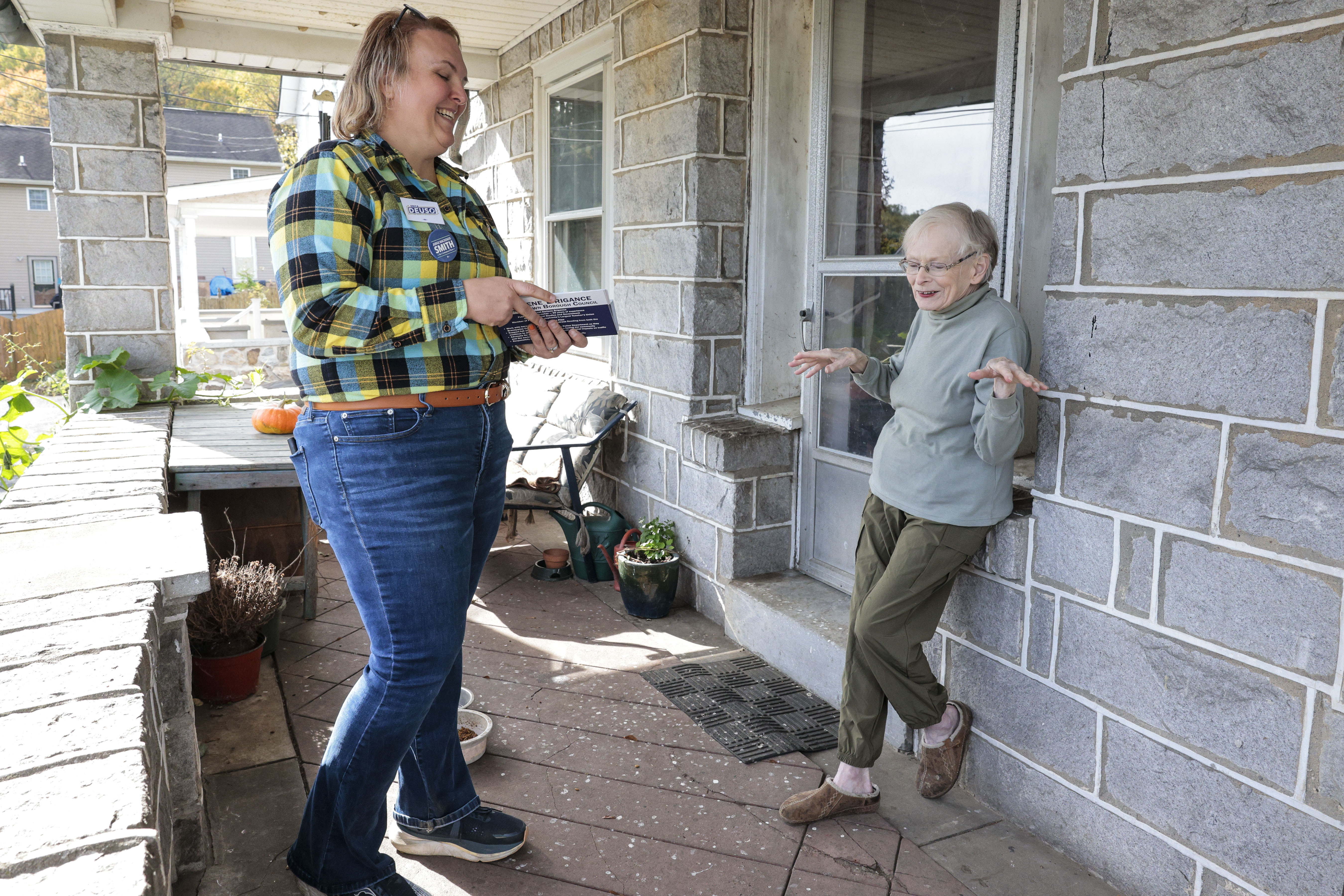
She spends Saturday mornings greeting residents at the farmers market and her weekend days knocking on doors in the Chester County borough. Most of the time, she’s talking about traffic and community events.
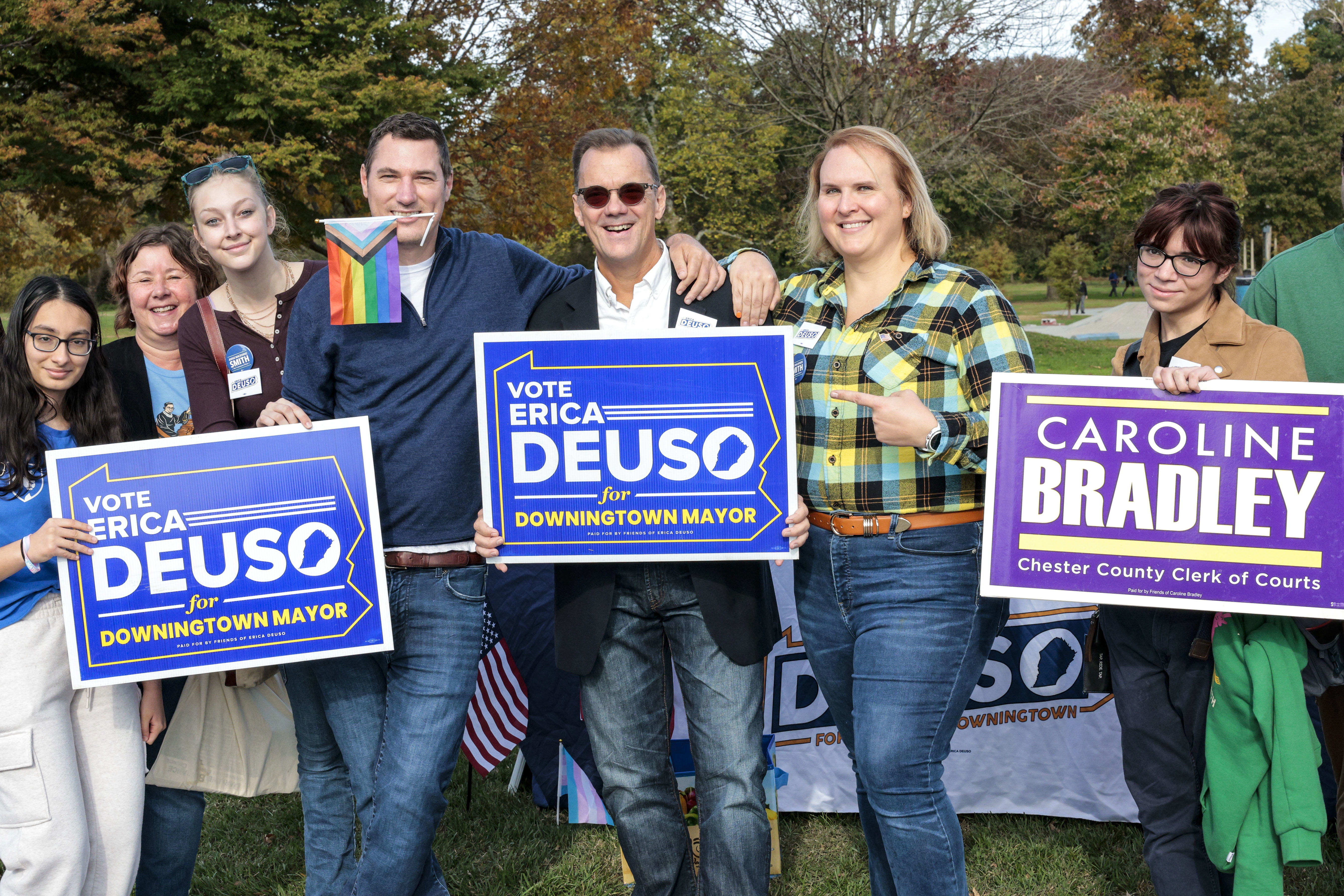
Democratic supporters pose with current Downingtown Mayor Phil Dague, center, Chester County Commissioner Josh Maxwell, center left, and mayoral candidate Erica Deuso, center right.
For most voters, though, those facts didn’t even register.
Deuso, who works in management at a pharmaceutical company, has lived in Downingtown for 18 years.
She is a committeewoman in the local Democratic Party, and board member for Emerge Pennsylvania, which trains women and LGBTQ+ people to run for office. Her platform centers on traffic control, domestic violence, community engagement, and sustainable development.
The Downingtown mayor has relatively limited power, overseeing the police department and acting as a tiebreaking vote on borough council. Deuso has promised not to sign an agreement between Downingtown police and U.S. Immigration and Customs Enforcement and said she wants to work on enhancing mental health services for officers while expanding their reach in the community to address concerns over traffic violations and e-bikes.
As she knocked on doors on a Saturday morning in October, Deuso’s gender identity rarely came up in her interactions with voters.
“I’m not running on being trans, that’s not something I ever do or ever wanted to do. I wanted to make it about the neighbors,” Deuso said. “It’s the other side making it about who I am, my identity.”
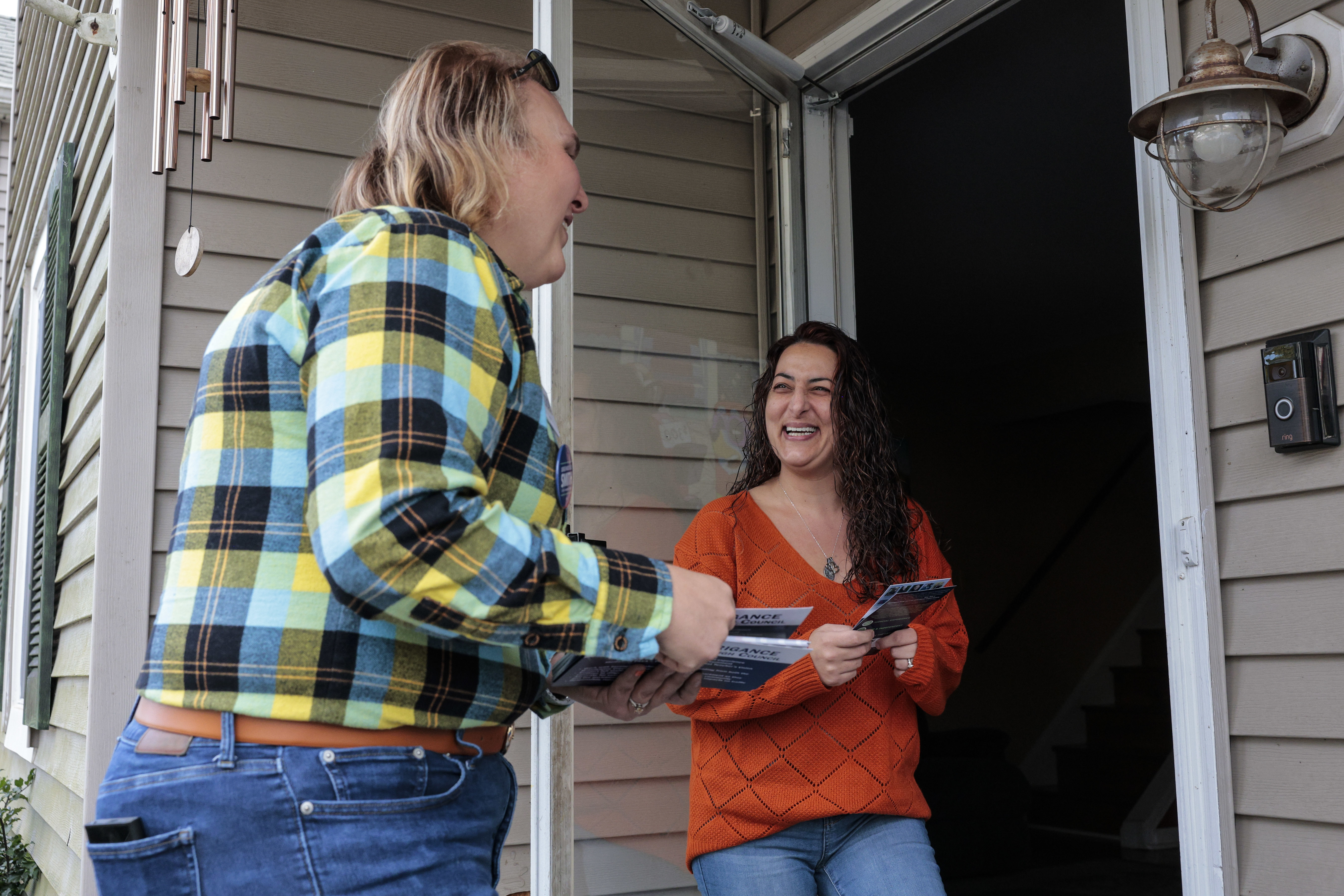
Going door-to-door looking for votes in Downingtown in October, Erica Deuso meets Nicole Flood at her door.
The historic nature of her campaign has likely driven attention and funds to the race. She has earned endorsements from several organizations that back LGBTQ+ and women candidates. And she’s received donations from outside the state and outside Chester County, including a $3,000 donation from Greater Than PAC, which supports progressive women.
But a scan of comments in community Facebook pages shows her identity has also driven more vitriol.
“There are people who refuse to use my correct name or pronouns, they’ve deadnamed me, all those sorts of things. But it’s been 16 years since I transitioned; I don’t really care,” Deuso said. But she’s mindful that LGBTQ+ youth are watching her. She engages in some of the posts, but not all of them.
“I want to handle it with grace.”
Those efforts are already influencing at least one local teen. Nicole Bastida-Moyer, a 39-year-old voter, told Deuso her candidacy had inspired her 14-year-old daughter to volunteer to help other students with their mental health. Both she and her daughter are pansexual.
“She deals with a lot of hate,” Bastida-Moyer said through tears about her daughter.
“Having Erica’s voice, it means a lot,” Bastida-Moyer said.
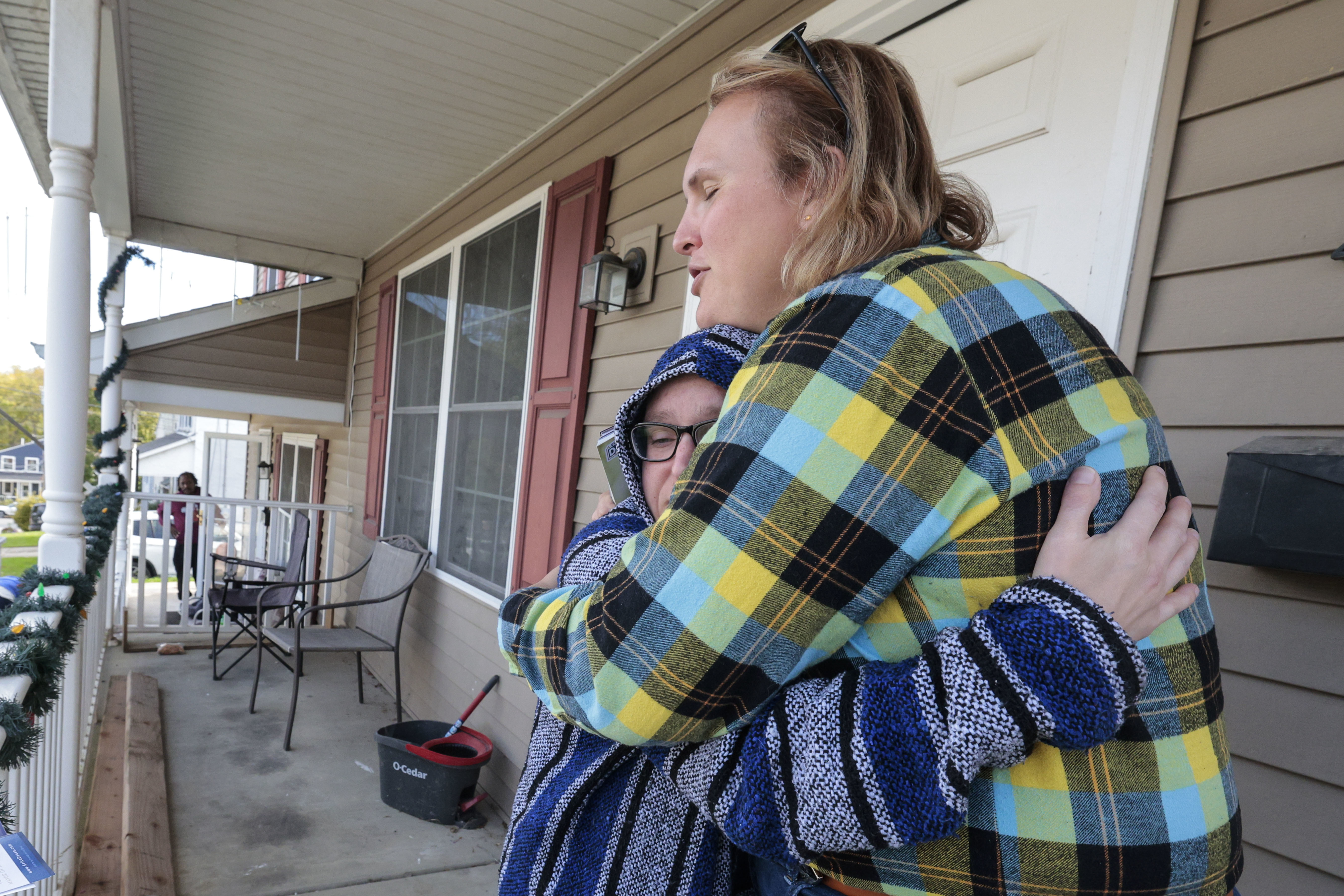
Nicole Bastida-Moyer gets a hug from Downingtown mayoral candidate Erica Deuso while campaigning in October.
Impact on voters
Deuso responds to comments on her Facebook page and other groups occasionally. She said she tends to do so only when she thinks a true conversation can come of it.
Door-knocking in her neighborhood, Deuso encountered just one voter who appeared to be hostile to her because of her gender identity. When Deuso approached one house, a woman came to the door and glanced at the candidate and her fliers through the screen door without opening it.
“I’m not voting for him,” the woman said. “For who?” Deuso asked as the woman turned and walked away.
Episodes like this are relatively rare, Deuso said
“People are generally much nicer in person than online,” said Jenn Fenn, who managed U.S. Rep. Chrissy Houlahan’s 2024 reelection campaign in a district that includes Downingtown.
Deuso’s opponent, Republican Rich Bryant, says he doesn’t condone those who attack Deuso based on her identity.
But Deuso has shared several screenshots on social media that appear to show Bryant insulting transgender women and making misogynistic remarks about cisgender women. At a canvass launch at the local farmers market, the township’s current mayor, Democrat Phil Dague, referenced these posts while comparing Bryant to Trump.
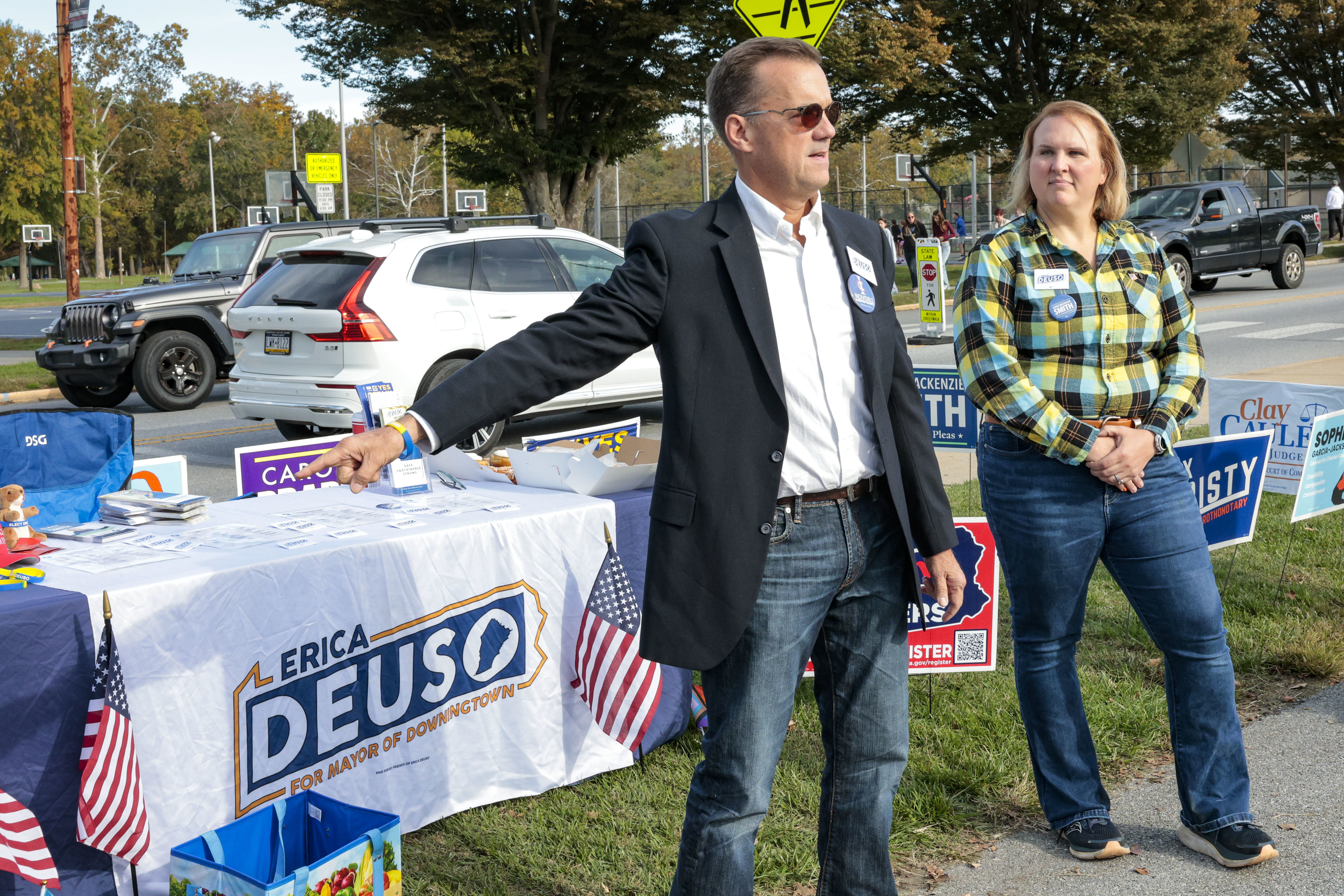
Current Downingtown Mayor Phil Dague talks with supporters for Erica Deuso listening at right. Saturday October 18, 2025.
Bryant claimed 90% of these posts are AI-generated but refused to say which posts are real and which are fake.
“I don’t like mud-slinging misinformation,” Bryant said. “I try to stay focused on what’s good for Downingtown.”
Rich Bryant is running as a Republican for Downingtown mayor.
He sought to present himself as better experienced than Deuso to be mayor, contending his career in cybersecurity has prepared him for the mayor’s primary duty of overseeing the local police department.
Alice Sullivan, an 80-year-old neighbor and donor to Deuso, had noticed some of the nastiness on social media and said she was voting for Deuso because, unlike her opponent, she wasn’t a “bigot.”
She lamented the online attacksagainst Deuso as disappointing — but unsurprising. The candidate’s gender identity shouldn’t matter, insisted Sullivan, who has lived in Downingtown for decades.
“Other people’s lives, genders, whatever is not my business,” she said.
Josh Maxwell, a Democratic county commissioner and former Downingtown mayor who had joined Deuso to knock doors, asked if Sullivan thought others would disagree in the historically Catholic community. But the people who cared, Sullivan argued, are “not going to vote Democrat anyway.”
“There might be some,” she said. “I don’t know very many.”
Campaigning in the west end of Downingtown Erica Deuso greets Alice Sullivan on Oct. 18.
As Deuso walked door to door, her conversations focused on local and community issues. She greeted every dog she saw and spoke to their owners about their safety concerns — drivers had been racing down quiet neighborhood streets — and their concerns about the community. Deuso is proposing a program to offer hotel rooms for one night to those facing domestic violence.
She also made it clear that she would be a resource, even on issues that went beyond the mayor’s official duties. She showed one voter how she had started a youth-driven art project at a recent township festival. And pointed to a home that, just weeks prior, she’d brought a misdelivered package to on behalf of a voter.
For weeks, Raul Hurtado, Deuso’s neighbor who immigrated from Colombia in the 1990s, has been rolling down his windows when he sees Deuso, telling her he’s voting for her.
“She is from this town, my neighbor, and we need someone to help us,” Hurtado told The Inquirer.
If she’s elected, Deuso told Hurtado, her goal is to be available to all residents through office hours at Borough Hall.
“We can have a face-to-face discussion,” she said. “Not through your car window.”
This suburban content is produced with support from the Leslie Miller and Richard Worley Foundation and The Lenfest Institute for Journalism. Editorial content is created independently of the project donors. Gifts to support The Inquirer’s high-impact journalism can be made at inquirer.com/donate. A list of Lenfest Institute donors can be found at lenfestinstitute.org/supporters.
A woman was shot in the wrist and a man was arrested after what police say appeared to be a road rage incident Monday evening in Bucks County.
Around 6:30 p.m., police responded to a reported shooting in the area of the Newtown Bypass and Woodbourne Road in Newtown Township.
The woman, who was driving one of the vehicles involved in the incident, was transported to St. Mary Medical Center and was listed in stable condition, police said.
A few minutes later, the man and the vehicle he was driving were located at Washington Crossing and Stoopville Roads, and he was taken into custody, police said. A gun was recovered for evidence.
Police said both vehicles reportedly were traveling east on Newtown Bypass during the initial encounter and then south onto Woodbourne Road.
Anyone who witnessed the incident or has information helpful to the case can contact the Newtown Township Police Department at 215-579-1000 ext. 317.
Philadelphia discharges 12.7 billion gallons of raw, diluted sewage into the Delaware River’s watershed each year, with Camden County adding to the mix, according to a new report.
That’s a problem, say the report’s authors at the nonprofit advocacy groupPennEnvironment. Philadelphia and Camden border the river, and significant recreational potential is blocked forpart of the year because of pollution from both, the authors say.
A waterway can remain unsafe for recreation for up to 72 hours after an overflow. That suggests local waterways could be unsafe for recreation up to 195 days per year, or more than half the year.
Five decades after the Clean Water Act mandated that waterways be made safe for swimming and fishing, combined sewer overflows (CSOs) continue to pollute during wet weather when untreated sewage and runoff surge into nearby creeks and rivers, creating the potential to sicken recreational users.
David Masur, executive director of PennEnvironment, said the group included Camden County in its most recent report“to get a more holistic view.”PennEnvironment’s first report on CSOs in 2023focused only on Philly.
The pollution “affects the waterway, the environment, and public health,” Masur said. “The river is the border between the two states, and people on both sides use it a lot.”
PennEnvironment acknowledges that both Philly and Camden County have programs to reduce overflows and is calling on federal officials for increased funding to put proper infrastructure into place.
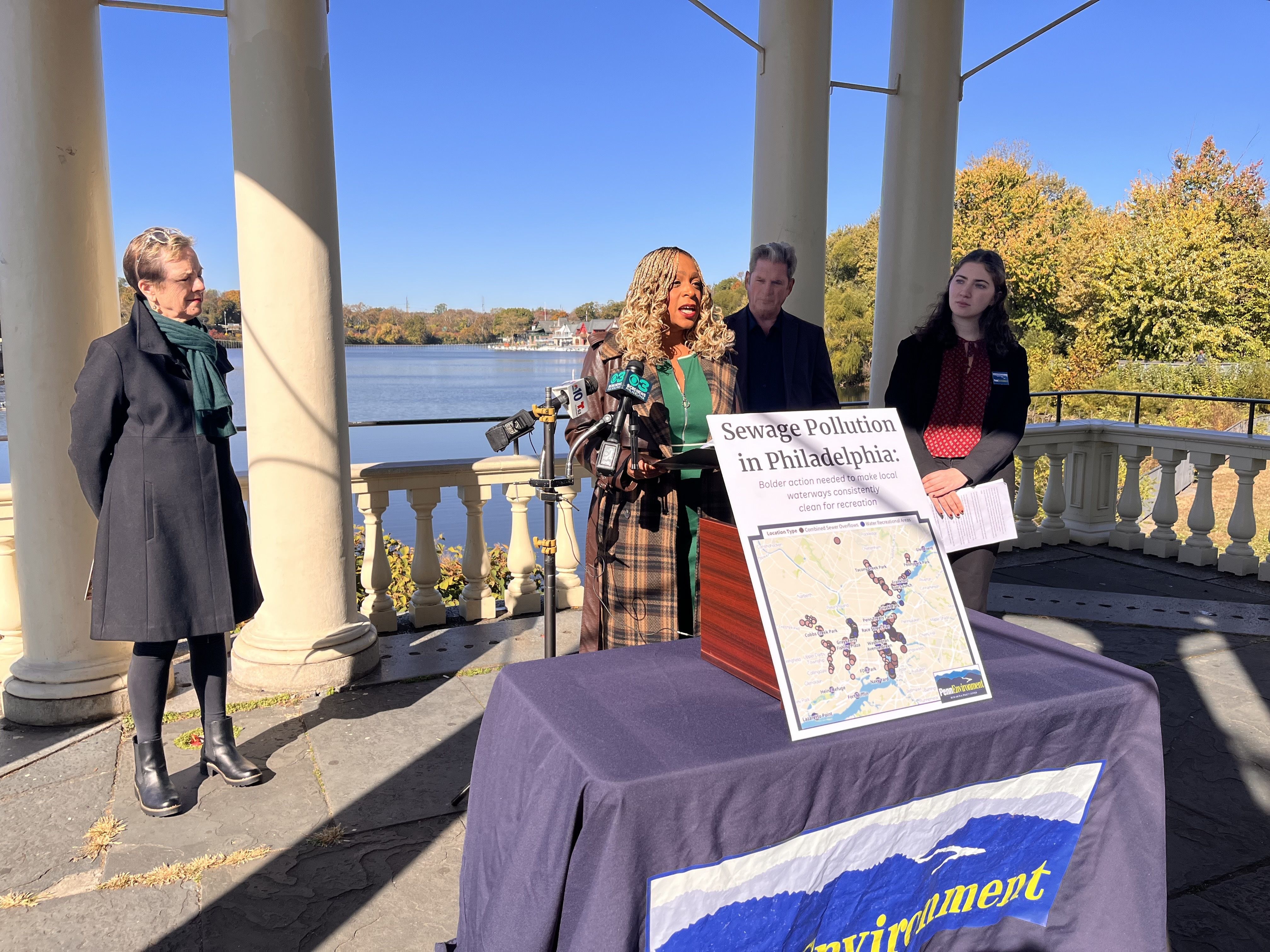
Philadelphia Council member Jamie Gauthier (center) spoke Monday about PennEnvironment’s report on pollution from combined sewer overflows. To her left is Margaret Meigs, president, Friends of the Schuylkill Navy. And to her right is Tim Dillingham, senior adviser, American Littoral Society, and Hanna Felber, clean water associate at PennEnvironment Research & Policy Center.
Frequent overflows, high volume in Philly
Roughly 60% of Philadelphia is served by a combined sewer system, which has 164 outfalls — really large metal or concrete openings — that discharge pollution into waterways. A CSO system uses a single pipe to collect and transport sewage from homes and businessesas well as stormwater runoff from streets and sidewalks.
During dry weather, the system can handle the volume before safely releasing it back into the rivers. But during heavy rainfall, thesystem discharges untreated, though highly diluted, sewage mixed with stormwater directly into waterways.
Despite the Philadelphia Water Department’s ongoing Green City, Clean Waters project — a 25-year plan focusing on green infrastructure to reduce overflows — the frequency and volume remain alarmingly high, the report states.
Overall, CSOs dumped an average of 12.7 billion gallons of raw sewage mixed with polluted stormwater per year into local waterways from 2016 to 2024, the authors of the report stated. They included an online map to show the location of the outfalls and annual overflow.
Half the sewage came from just 10 CSOs.
window.addEventListener(“message”,function(a){if(void 0!==a.data[“datawrapper-height”]){var e=document.querySelectorAll(“iframe”);for(var t in a.data[“datawrapper-height”])for(var r,i=0;r=e[i];i++)if(r.contentWindow===a.source){var d=a.data[“datawrapper-height”][t]+”px”;r.style.height=d}}});
Still, the numbers are a slight improvement over the 15 billion gallons a year released into local rivers, as PennEnvironment reported in 2023.
Philadelphia gets its drinking water from the rivers, but the CSOs are downstream of the city’s treatment plants on the Delaware and the Schuylkill.
The reportused publicly available data to show that five of six waterways in Philly produced at least one overflow 65 times or more per year on average between 2016 and 2024. Those were the Delaware River, the Schuylkill, and Cobbs, Frankford and Tacony Creeks.
In better news: The average volume of overflow per inch of precipitation declined by about 16% from previous periods, but progress is slow and threatened by increased rainfall and rising sea levels due to climate change, the authors say.
PWD could not be reached for comment.
window.addEventListener(“message”,function(a){if(void 0!==a.data[“datawrapper-height”]){var e=document.querySelectorAll(“iframe”);for(var t in a.data[“datawrapper-height”])for(var r,i=0;r=e[i];i++)if(r.contentWindow===a.source){var d=a.data[“datawrapper-height”][t]+”px”;r.style.height=d}}});
Camden County
The report also found persistent overflows in Camden County. The cities of Camden and Gloucester, along with the Camden County Municipal Utilities Authority (CCMUA), operate combined sewer systems that frequently overflow into the Delaware River and its tributaries, including the Cooper River and Newton Creek.
The report found that systemson the Camden County side of the river overflowed into local waterways an averageof 76 days per year from 2016 to 2024.
window.addEventListener(“message”,function(a){if(void 0!==a.data[“datawrapper-height”]){var e=document.querySelectorAll(“iframe”);for(var t in a.data[“datawrapper-height”])for(var r,i=0;r=e[i];i++)if(r.contentWindow===a.source){var d=a.data[“datawrapper-height”][t]+”px”;r.style.height=d}}});
The highest-frequency outfall for the Cooper River released sewage for an average of 118 days annually during that period.
The Delaware River received sewage overflows for an average of 94 days annually from its highest-frequency outfall.
The authors said gaps in data leave them unable to show the total volume of diluted sewage releasedfrom Camden. But they said that the amount of “solids/floatables” collected at each outfall is an indicator a waterway is polluted.
Dan Keashen, a spokesperson for Camden County, said officials have been making strides.
He said that crews recently cleaned 30 miles of pipe and that a $26 million project is underway to physically separate the combined sewer service area of Pennsauken that flows into Camden. Officials are also studying how to better achieve compliance for the largest outfall in the system, a project estimated to cost $40 million to $150 million when complete.
What can be done?
The report concludes that current plans by Philadelphia and Camden County are insufficient to achieve the goal of a clean Delaware River watershed.
The report was written by John Rumpler, clean water director for Environment America, PennEnvironment’s parent organization, and Elizabeth Ridlington, associate director of the Frontier Group, a nonprofit research group that is part of the Public Interest Network, an environmental advocacy organization.
The authors call for officials to accelerate action to end all sewer overflows, set a hard deadline, and find new ways to pay for necessary infrastructure upgrades.
Philadelphia CouncilmemberJamie Gauthier, chair of the committee on the environment, called overflows “a public health crisis” and urged PWD’s new commissioner, Benjamin Jewell, to act. She said elected officials in Harrisburg and Washington also need to step up.
PWD is separately under pressure by a new Environmental Protection Agency regulation that seeks to improve the amount of dissolved oxygen in the Delaware by ordering a large-scale reduction of ammonia at the city’s three water pollution control plants. PWD estimates that the price for compliance is $3.6 billion and would cost households an additional $265 annually on their water bills.
The authors of the PennEnvironment report concede the CSO task is daunting. But they say Portland and Boston faced similar situations, invested in infrastructure, and managed to make CSO overflows infrequent. Washington, D.C., they said, is on track to reduce sewage overflows by 96% in 2030.
Hanna Felber, a PennEnvironment advocate, said that PWD needs to use creative funding, such as floating longer-term bonds to finance projects, and that its engineers need to find more creative solutions, such as installing larger stormwater tunnels that flow separately from sewage.
“Unfortunately, our new report on sewage pollution in Philadelphia shows that on far too many days each year, the Philadelphia Water Department’s pipes and sewer systems dump huge volumes of raw sewage into our beautiful waters, harming our environment and depriving the public of a safe place to fish, boat, and float,” Felber said.
New Jersey’s beaches, still recovering from major sand losses from an offshore hurricane and a nor’easter, evidently are in for another assault this week as October is about to make a dramatic exit.
Gale-force gusts off the ocean could develop as early as Tuesday afternoon at the Shore, said Eric Hoeflich, a meteorologist at the National Weather Service office in Mount Holly, with brisk onshore winds persisting “maybe into Friday.”
A potent storm is forecast to affect the entire region Wednesday night into Thursday, with heavy rains in the immediate Philadelphia area, where drought conditions have been intensifying.
Also on Thursday, what is likely to become catastrophic Hurricane Melissa will be passing offshore, churning up the waves crashing on East Coast beaches.
“The coast once again is going to take a pretty good battering,” said Dave Dombek, senior meteorologist with AccuWeather Inc.
On the plus side, Hoeflich said, for the Shore, this week’s storm “doesn’t look as bad” as the beach-erasing nor’easter earlier this month. The path should be more inland, and the lunar influence on the tides would be less. Only minor flooding is expected, he said, subject to change.
However, not only would the track mean region-wide heavy rain, but it would also increase the potential for severe thunderstorms Thursday. A front is due to chase the rains Friday, but it may generate gusts to 50 mph, the weather service says. Power outages are possible both days.
The timetable for the winds and the storm in the Philly region
The National Weather Service has posted a gale warning for Tuesday into Wednesday morning for the waters along the immediate coast for winds from the east that could gust past 50 mph.
That would be more the result of high pressure to the north of the region. Winds circulate clockwise around centers of highs; thus, areas to the south of the center experience winds from the east.
The breezes will be getting a second wind as a storm develops in the Southeast and tracks north. Meanwhile, a weakened Hurricane Melissa will be churning the ocean as it passes well off the U.S. coast on Thursday.
A strong storm system will move across the region later this week. Here is a summary of expected impacts. pic.twitter.com/OvhoVAaS11
Rain for the last 30 days has been about a third of normal in the city and the neighboring Pennsylvania counties.
South Jersey has fared only slightly better, but precipitation is well less than half of normal.
What is the forecast for the trick-or-treaters?
It is all but certain that Friday will be a dry day, with temperatures in the low and mid-50s. Wind gusts are forecast to die down sometime after 5 p.m., but hold onto those brooms, just in case.