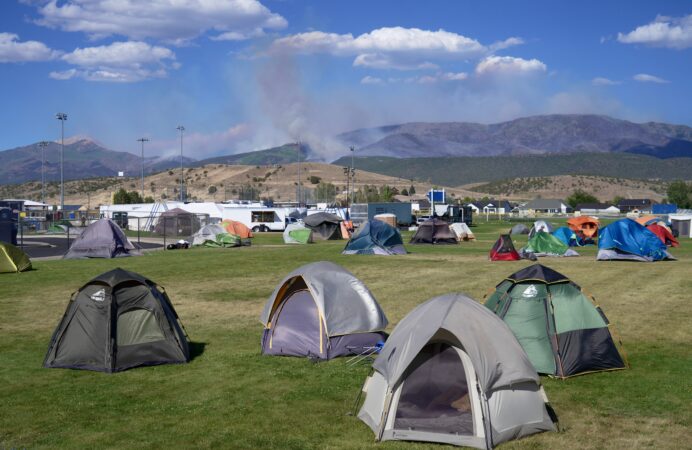
BEAVER, Utah — Three firefighters were killed and two sustained burn injuries when they were overcome by flames from fast-moving wildfires in hot, windy conditions near the Colorado-Utah border.
The firefighters deployed emergency shelters during the burnover incident on Saturday in Mesa County, Colo., the U.S. Interior Department said.
They worked for the U.S. Wildland Fire Service and U.S. Forest Service and were part of an interagency response to the Knowles and Gore fires, which merged with other fires to form the Snyder Fire. So far, about 44 square miles have burned.
Temperatures in Grand Junction hit a high of 93 degrees Fahrenheit, with winds gusting to 44 mph, according to the National Weather Service.
The U.S. Wildland Fire Service, created earlier this year to streamline firefighting and fire reduction across public lands, said in a statement that it “stands united” with the Forest Service in grief and “in our unwavering support for the loved ones left behind.”
“Their bravery, dedication, and sacrifice will never be forgotten,” the statement said.
The names of the firefighters who perished were being withheld pending notifications to their loved ones, the Interior Department said.
The Mesa County Sheriff’s Office was asking people to evacuate the potential path of the fire and to turn on irrigation water to saturate the land. The federal Bureau of Land Management closed public access to lands it manages nearby.
“Firefighter and public safety are the highest priority,” the agency said in a statement. “The temporary closing of the lands is to reduce exposure to hazardous situations due to the rapid rates of spread and fire behavior that the fire has exhibited. The public is to remain clear of these closed lands.”
Hot, dry, and windy conditions
Wildfire activity has intensified across the western United States, as consecutive days of hot, dry, and windy weather have fueled flames in Utah, Arizona, and elsewhere as new fires popped up across the region.
The largest blaze, the Cottonwood Fire, was burning in rugged terrain in southwest Utah. It ballooned Saturday to more than 144 square miles after marching through canyons and mountainsides, destroying part of a ski resort and other summer cabins along the way.
Authorities in Beaver County began working with fire teams on Saturday to assess the extent of the damage, but no estimates were immediately available. Utah Gov. Spencer Cox in a post on social media called it bleak, but he thanked crews for what he called “several miraculous stops and saves.”
The cliffs and steep slopes have made the job even harder, said Alyssa Mason, a spokesperson assigned to the fire.
“It’s hard to get dozers and other heavy equipment into that. It’s hard to get engines into that,” she said. “It doesn’t make it impossible to firefight, but it does just kind of slow things down.”
Hundreds of firefighters have been arriving in the arid state to battle new starts as well as those that have been growing because of what forecasters called critical fire weather — dangerously low humidity levels, warm temperatures, and gusty winds.
The danger is even higher this year because of Utah’s record-low snowpack and its warmest winter on record. Much of the West is grappling with similar conditions, according to the National Interagency Fire Center.
Nationally, nearly 3 million acres have burned since the start of the year. That is more than the 10-year average.
Emergencies declared in Utah and Colorado
The conditions in Utah were critical enough for Cox to declare an emergency earlier this week and clear the way for the state to ban fireworks ahead of the July Fourth holiday. The order comes as Utah is experiencing one of the most severe wildfire seasons in recent history, fueled by historic drought conditions.
State officials said that over the past week, Utah has seen an increase in wildfire starts, with each fire showing unprecedented behavior. These starts have stretched the state’s wildland firefighting capabilities, State Forester Jamie Barnes said.
Colorado Gov. Jared Polis also declared an emergency on Saturday, and authorized the use of the National Guard to tackle the fires.
Forecasters with the National Weather Service over recent days have been issuing red flag warnings for a wide swath of the West, from California to Arizona and New Mexico.
South of Grand Canyon National Park, authorities said the flames of a new wildfire were moving away from Grand Canyon Village and the nearby community of Tusayan on Saturday. But about 50 miles away, another fire prompted Coconino County officials to issue evacuation orders for those near Kendrick Mountain.
Parts of northern Arizona were without power Saturday as the utility serving the area initiated a safety shut-off in hopes of lessening the wildfire risk.
Power shutoffs have become more common in the West as wildfire risk has expanded. It is usually a last resort after utility forecasters weigh factors like sustained wind and gust speeds, available fuels, and topography.
With extreme fire conditions persisting in Utah, Rocky Mountain Power also shut off power lines serving Beaver County and other areas.
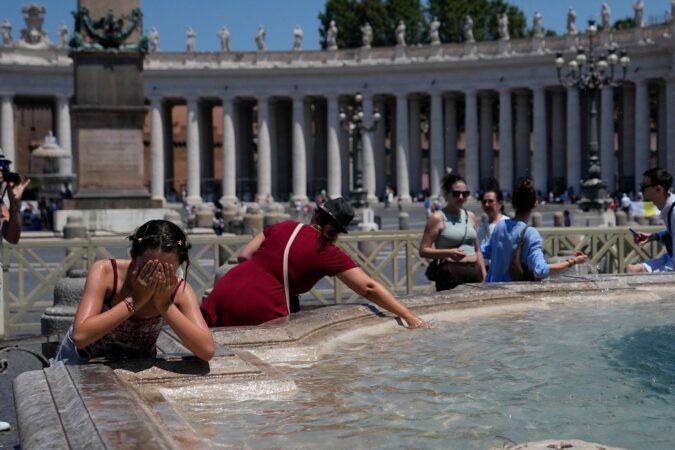
BERLIN — France saw around 1,000 additional deaths last week at the height of its record-smashing heat wave, the country’s public health agency said Sunday, as the head of the World Health Organization warned that Europe is now the fastest-warming continent and needs to do more to protect its citizens.
Temperature records were toppled in several countries on the weekend, wildfires were sparked in Germany, and Berlin police used water cannons to cool down the crowds.
Meanwhile, the heat wave slowly moved toward eastern parts of the continent.
Germany marked a new record for the third day in a row with 107 degrees Fahrenheit in Neißemünde, near the border with Poland, which baked under its new all-time high of 104.9 F. The Czech Republic also experienced its hottest day ever with 106.4 F.
A new study from the World Weather Attribution, a Europe-based collaboration of scientists, reported Friday that the record-breaking heat and humidity in Europe this past week would not have been possible without climate change.
The rapid study found that the heat would have been virtually impossible just five decades ago, and is 200 times more likely today than it would have been 20 years ago.
France records surge in deaths during heat wave
France reported a surge in deaths last week, including a sharp increase at private homes, especially in the Paris region, the national public health agency said Sunday.
There were more than 1,200 deaths on Wednesday, when France was sweltering under its hottest temperatures, increasing to more than 1,400 deaths on each of the two following days, Public Health France said. In April and May, before the heat wave, France’s rate of deaths was about 900 to 1,000 per day.
The agency concluded that France experienced a total of at least 1,000 additional deaths during those three days alone, an estimate it cautioned is likely to increase as more data is collected, including for deaths at home.
The increase was sharpest in areas under red warnings of extreme heat, it said. Those warnings blanketed about three-quarters of the country at the peak of the heat wave. The agency said that 85% of the deaths involved people aged 65 and above.
Europe is fastest-warming continent, WHO warns
“Europe is the fastest-warming continent on Earth, heating at twice the global average,” WHO Director-General Tedros Adhanom Ghebreyesus said Sunday on X. “Right now 150 million people are living under extreme heat, hundreds have died, schools are shut, grids are buckling.”
Driven by climate change and global warming, the “once-in-a-generation” heat wave is now occurring nearly every year, Tedros said, adding that more than 1,300 excess deaths have been recorded since June 21 linked to high temperatures in Europe.
“Heat stress is often called the ‘silent killer’ — and European homes, workplaces, and schools were not built for these temperatures,” Tedros warned as he called on European countries to implement action plans. He said they should focus on preparedness, prevention, and stronger health system responses.
Lightning strikes Swedish theme park
In Sweden, several people were injured when they were hit by lightning at an amusement park, the country’s TT news agency reported.
Three adults were taken to the hospital, among them a woman with serious injuries, after the lightning struck the Tosselilla Sommarland park in Tomelilla in the south of the country.
Across Europe, the extreme heat has been followed by severe thunderstorms.
Denmark, which marked new temperature records on Saturday, recorded 1,156 lighting strikes by Sunday morning, according to public broadcaster DR.
Wildfires burn forests contaminated with WWII ammunition
Similarly, a major firefighting operation was underway in southwest Germany near the village of Traisen, where the heat sparked a forest fire in an area that also contained unexploded ordnance. Firefighters had to be temporarily stop after explosions took place and an ordnance disposal unit was brought in to continuously assess the situation, German news agency dpa reported. Some 650 people in Traisen had to leave their homes Sunday afternoon because the fire continued to spread.
The big cities’ fire departments were busy sending out ambulances to people suffering from heat-related illnesses. In Berlin, an additional 500 ambulance dispatches were reported on Saturday, most of them heat-related.
Berlin police use water cannons to cool down locals. tourists
The German capital’s police found a way to help suffering Berliners and tourists alike. They put up two huge water cannons — usually used to disperse unruly protesters — in front of the city’s iconic Brandenburg Gate and sprayed the cool water across the cheering crowd.
The heat also continued to damage the country’s infrastructure, with the concrete surface on countless highways breaking up, and a weekend warning by national rail operator Deutsche Bahn to avoid all unnecessary train travel.
More than 600 passengers had to be evacuated from an overheated train in Brandenburg after a tree fell onto an overhead power line during a storm on Saturday evening. The train, which was on its way from Hamburg to Prague, lost power. The air conditioners stopped working and the doors were locked until emergency responders forced them open. Two people were hospitalized with heat-related problems, dpa reported.
In the eastern city of Leipzig, no trams will be running until early Monday morning due to heat damage to tracks and switches. The Leipzig Public Transportation Authority said that the high temperatures had caused the joint sealant for asphalt and concrete in switches and tracks to run and clump together in many places throughout the city’s network.
DUBAI, United Arab Emirates — Iran again launched drone and missile attacks Sunday targeting Bahrain and Kuwait in response to new U.S. airstrikes against the Islamic Republic, and threatened a “complete halt” in negotiations to end the war if Washington continues its attacks.
Efforts to reopen the Strait of Hormuz without Iran’s direct oversight sparked the days of crossfire and have imperiled the talks for a lasting ceasefire. A multinational maritime body overseen by the U.S. Navy said Saturday it would expand a route near Oman for inbound and outbound traffic, setting up a new flashpoint with Tehran.
The global community has long considered the strait an international passageway, despite its location in Iran and Oman’s territorial waters. In recent days, Iran has twice attacked vessels going through a route on the Omani side in an evacuation effort backed by a United Nations agency.
Iran insists that it alone must govern the strait, the narrow mouth of the Persian Gulf that once carried a fifth of the world’s oil and natural gas. Iranian Foreign Minister Abbas Araghchi reiterated the claim on Sunday.
“Any attempt to establish new or separate arrangements from those currently being carried out by the Islamic Republic of Iran will only lead to further complications, delay the reopening of the Strait of Hormuz and increase the level of tension,” Araghchi said.
The United States and Iran have been debating the terms of an interim deal, including shipping arrangements on the strait, the removal of a U.S. blockade on Iranian ports and sanctions on Iran, and the future of Iran’s stockpile of highly enriched uranium. Under the memorandum of understanding signed this month, they have 60 days to iron out details.
The interim deal is meant to end fighting on all fronts before certain key issues can be discussed. Continued fighting in Lebanon, where an Israeli soldier was killed by Hezbollah fire early Sunday, also threatens the agreement.
Strikes target Gulf states hosting U.S. military
Iran’s paramilitary Revolutionary Guard claimed responsibility for the attacks in Bahrain and Kuwait.
Kuwait’s military said air defenses intercepted Iranian drones and missiles just after the U.S. strikes in Iran. Kuwait, which hosts a major U.S. military base, said it intercepted two ballistic missiles. There were no reports of injuries or damage.
Bahrain’s Interior Ministry said the Iranian strikes damaged a residential building near the international airport but no one was killed. The ministry released photos of an eight-story building, its top floor destroyed and windows blown out.
Bahrain is home to the U.S. Navy’s 5th Fleet, whose base came under repeated attack during the war. The damaged building was not near the fleet’s headquarters.
Bahrain’s Foreign Ministry denounced what it called “a dangerous escalation that reveals that what Tehran is doing is not a passing act, nor an isolated incident, but rather a deliberate approach and a systematic pattern of repeated aggression.”
Trump accuses Iran of violating ceasefire with ship attack
The U.S. military’s Central Command said it struck Iranian military “surveillance infrastructure, communication systems, air defense sites, drone storage facilities, and minelayer capabilities” following an attack on a ship at sea Saturday. The Panamanian-flagged tanker Kiku carried crude oil for the state-run energy company of Qatar, a key mediator between Iran and the U.S.
President Donald Trump on social media accused Iran of violating the ceasefire and warned of a point where the U.S. may no longer be reasonable “and will be forced to militarily complete the job.”
“If that happens, the Islamic Republic of Iran will no longer exist!” Trump wrote.
Ship traffic on the strait had increased over the past 72 hours, off both Iran and Oman, the multinational maritime body overseen by the U.S. Navy said Sunday, adding that “U.S.-assisted commercial transits continued uninterrupted despite the elevated threat environment.”
It said 89 such transits had been made, still below the historical average of 138 vessels a day.
Iran calls for new “conflict control unit” in Lebanon
Last week, Israel and the Lebanese government signed a framework agreement to end the latest fighting between Israel and the Iranian-backed Hezbollah militant group, which began two days after the Iran war began when Hezbollah fired at Israel. Israel responded with an invasion that has occupied large swaths of southern Lebanon, and it has said it will not withdraw until Hezbollah is disarmed.
But last week’s deal did not include Iran or Hezbollah, which has criticized the deal and rejected calls to disarm.
On Sunday, Araghchi again said the U.S. must force Israel to halt attacks and withdraw. Israel occupies around 231 square miles in southern Lebanon, which it says it needs as a security buffer.
But sporadic clashes have continued, and Hezbollah’s leader said Saturday that the group would continue fighting until Israel withdraws from Lebanon.
Key Iranian negotiator and parliament Speaker Mohammad Bagher Qalibaf said Sunday that a new “conflict control unit” formed among Iran, the United States, and Lebanon should meet as soon as possible, Iran’s state broadcaster reported.
The frequency of Israeli strikes in Lebanon has decreased significantly since the Iran-U. S. deal was signed, but two separate strikes hit southern Lebanon on Sunday morning — one in Taybeh town and the other in the Nabatiyeh area, according to Lebanon’s National News Agency. There was no immediate word on casualties.
Overnight, Hezbollah militants killed an Israeli soldier in Deir Siryan village in southern Lebanon, according to Israel’s military. Hezbollah did not comment.
“We are prepared to rapidly resume offensive operations in both Lebanon and Iran if required,” said Israel’s military chief of staff, Lt. Gen. Eyal Zamir.
President Donald Trump administration’s doesn’t have the legal authority to demand the “highly sensitive” information, wrote Cathy Bissoon, Pittsburgh’s federal court chief judge. And while the Justice Department couldn’t articulate the “basis and purpose” for its request, Bissoon said, the administration has been “say[ing] the quiet parts out loud.”
“Public statements from government officials reveal its intentions: to create a nationwide voter-database, for potential weaponization in future elections; as a ‘fishing expedition,’ hoped to advance unsubstantiated claims of non-citizen voting; and as a tool for immigration enforcement,” the Barack Obama-appointed judge wrote.
The Justice Department sued more than half of the states in the union for their voter-related records. Bissoon’s ruling marks the Trump administration’s 10th defeat in a district court, which the judge notes with a positive spin.
“The administration’s demands have yielded one unexpected benefit, namely, bipartisan agreement,” Bissoon said. “Five of the district judges are Trump appointees.”
The Justice Department did not immediately respond to a request for comment.
“No matter what the Trump Administration tries next, we’re going to stand up to protect Pennsylvanians’ right to privacy — and our fundamental right to vote,“ Gov. Josh Shapiro said in a post on X.
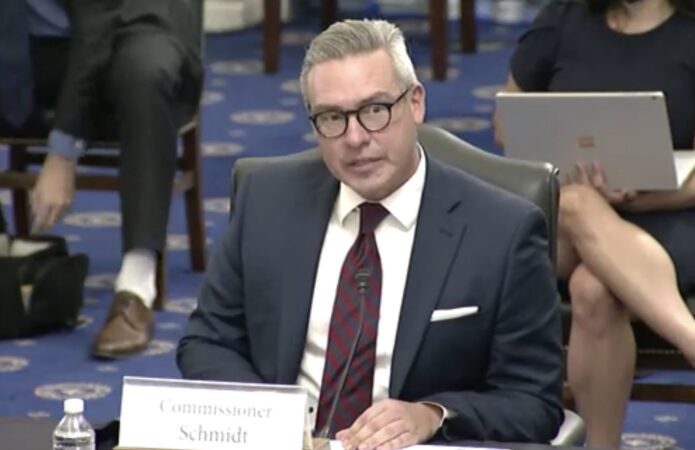
The Trump administration sued in September after Pennsylvania Secretary of State Al Schmidt refused to turn over all voter-registration data — which includes sensitive information such as Social Security numbers — from the November 2022 election through the 2024 presidential election.
“This request, and reported efforts to collect broad data on millions of Americans, represent a concerning attempt to expand the federal government’s role in our country’s electoral process,” Schmidt said in his response to the DOJ.
The federal government sued Schmidt, invoking federal voter election law and “ironically,” according to Bissoon, the Civil Rights Act of 1960.
“Every state has a responsibility to ensure that voter registration records are accurate, accessible, and secure — states that don’t fulfill that obligation will see this Department of Justice in court,” then-Attorney General Pam Bondi said in a statement announcing the suit.
The Trump administration’s push to obtain the unredacted voter rolls has alarmed multiple civil rights groups, including the American Civil Liberties Union, National Association for the Advancement of Colored People, and the League of Women Voters.
Far from boosting the public’s confidence in election integrity, the request seems like an attempt to undermine it, Lauren Cristella, the president of the Committee of Seventy, a Philly-based civic engagement group, previously told the Inquirer.
“They are insinuating that there’s something wrong,” Cristella said. “Even though there is no credible evidence.”
Others raised privacy concerns over sharing sensitive information of millions of voters nationwide.
The Trump administration’s argument hasn’t found much traction in federal courts throughout the country so far. Bissoon joins district judges in Arizona, California, Maine, Maryland, Massachusetts, Michigan, Rhode Island, Oregon, and Wisconsin in dismissing the lawsuits, according to the Brennan Center for Justice, a legal nonprofit affiliated with New York University.
Bissoon opened her opinion by saying limiting the federal government’s power has been among the “bedrock principles of conservative political ideology” and quoting former President Ronald Reagan’s commitment to states’ rights.
The Price Point compares homes listed for similar sale prices across the region to help readers set expectations about house hunting.
According to recent Zillow data, homes with “character” — visual distinction and a sense of history — are all the rage.
As the birthplace of the nation, the Philadelphia region has its fair share of drool-worthy older homes of all shapes, sizes, and price tags.
In May, the median sale price for homes in the Philadelphia metropolitan area was $405,000.
So, here are three pre-World War II homes in the Philadelphia region that about$405,000 can buy — all with ample “character.”
A Fairmount condo with a private patio
This second-floor condoboasts a desirable location, according to its listing agent, Jeniffer Benner with Home Sweet Home PHL.
It’s situated on a tree-lined street in the heart of the Art Museum neighborhood, with easy walkability to Center City, the Schuylkill River Trail, and Roberto Clemente Park just a block away.
Benner said a main draw is the property’s private rear patio, which is “tough to find in condo spaces.”
Built in 1920 with a major remodel in 2014, the home’s living room boasts modern features and touches of the past with its traditional red brick exterior. It has nine-foot ceilings, custom shutters, hardwood floors, recessed lighting, and crown molding. The built-in entertainment center has been a favorite of prospective buyers.
“A lot of people think that’s a really nice feature, rather than having a blank box like some of the newer construction condos,” Benner said. “They like that character.”
There are two bedrooms and two bathrooms, with the primary suite including two closets, one a walk-in.
Benner said the condo fee isminimal — $223 per month — because it only covers exterior maintenance and insurance for the townhouse’s three units. Compared to city condo fees that can reach upward of $1,000 a month, the cost is “very affordable.”
The property was listed for sale in March for $420,000. The listing price has since come down to $410,000.
A Tudor-style home in Drexel Hill
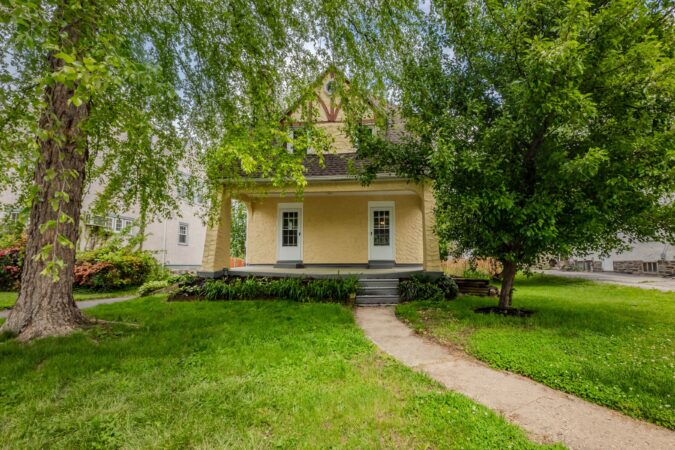
This Tudor-style home in Drexel Hill has an old-fashioned feel, as most of the neighborhood’s homes were built between 1925 and 1934, said listing agent Jason Cox with Long & Foster Real Estate.
“This is a throwback, and that’s one of the reasons people love it,” said Cox.
Two columns frame the property’s double-entry doors, which Cox said is an imprint of historical Drexel Hill homes. The kitchen’s mullioned glass-front cabinets and the bathroom’s checkered-tile accents further the home’s traditional aesthetic.
The front yard is shaded by a willow tree, and the backyard is spacious enough for a garden, play set, pool, or all of the above.
The three-story home has one full bathroom and five bedrooms — rare for its listing price. There are three larger bedrooms on the second floor, in addition to a smaller room that could double as an office, and a finished attic with skylights on the third floor.
The living room has a traditional brick fireplace, and the dining room features access to a deck that is a prime location for outdoor grilling. Recently repainted and carpeted, the home is move-in ready.
Cox, who lives a block away from the property, “can’t say enough about the neighborhood.” Ideal for families, the home is walking distance from the local elementary and middle schools, and is a five-minute drive from Upper Darby High School. In the neighborhood, some families have stayed for two or three generations.
Sitting on more than a half-acre, this home’s standout feature is its expansive backyard. About three years ago, the homeowners installed a patio and a gazebo with a mounted TV, transforming the empty space.
“It makes the outside feel like the inside, and it can be screened in,” said listing agent Aaron Wallace with KW Main Street. “It’s the best thing about this property.”
The four-bedroom, two-bath property was built in 1911 but underwent a major renovation in 2020. The contractor did everything “soup to nuts,” Wallace said, including the roof, windows, both bathrooms, and kitchen. “They left no stone unturned with this renovation.”
The bright and airy ground floor includes the mudroom, living room, dining room, kitchen, and full bathroom. Going up a level, there are three bedrooms and the second full bathroom. On the third floor, there’s a generously-sized carpeted room that can be utilized as a bedroom, office, or an alternative living space.
Another highlight is the living room’s fireplace, which is framed by a wooden chevron accent wall and serves as a focal point in the house.
Magnolia’s pre-K-8 school is within walking distance from the home, and there is a baseball field behind the house that hosts local games. Wallace said the homeowners enjoy watching games from their gazebo.
“It has a great small-town feel, and the big city is not too far away,” said Wallace.
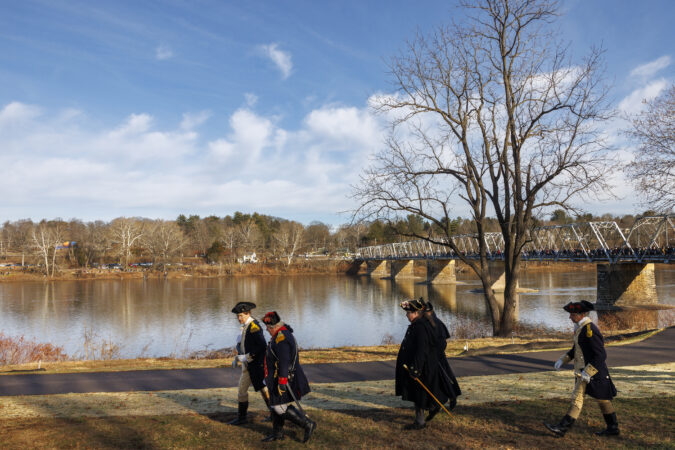
From George Washington crossing the Delaware and the Continental Army lodging at Valley Forge to the so-called real Penn’s Landing and the Battle of Brandywine, the Philadelphia suburbs played a crucial role in the early development of the United States.
And though Philadelphia — the birthplace of American democracy — has taken center stage for this year’s Semiquincenntenial celebrations, Bucks, Montgomery, Delaware, and Chester Counties have spent years preparing for 2026 and have curated an extensive list of activities for residents and visitors alike who are looking to honor the United States’ 250th birthday outside the city.
Here is what the Philly suburbs have in store for the 250th:
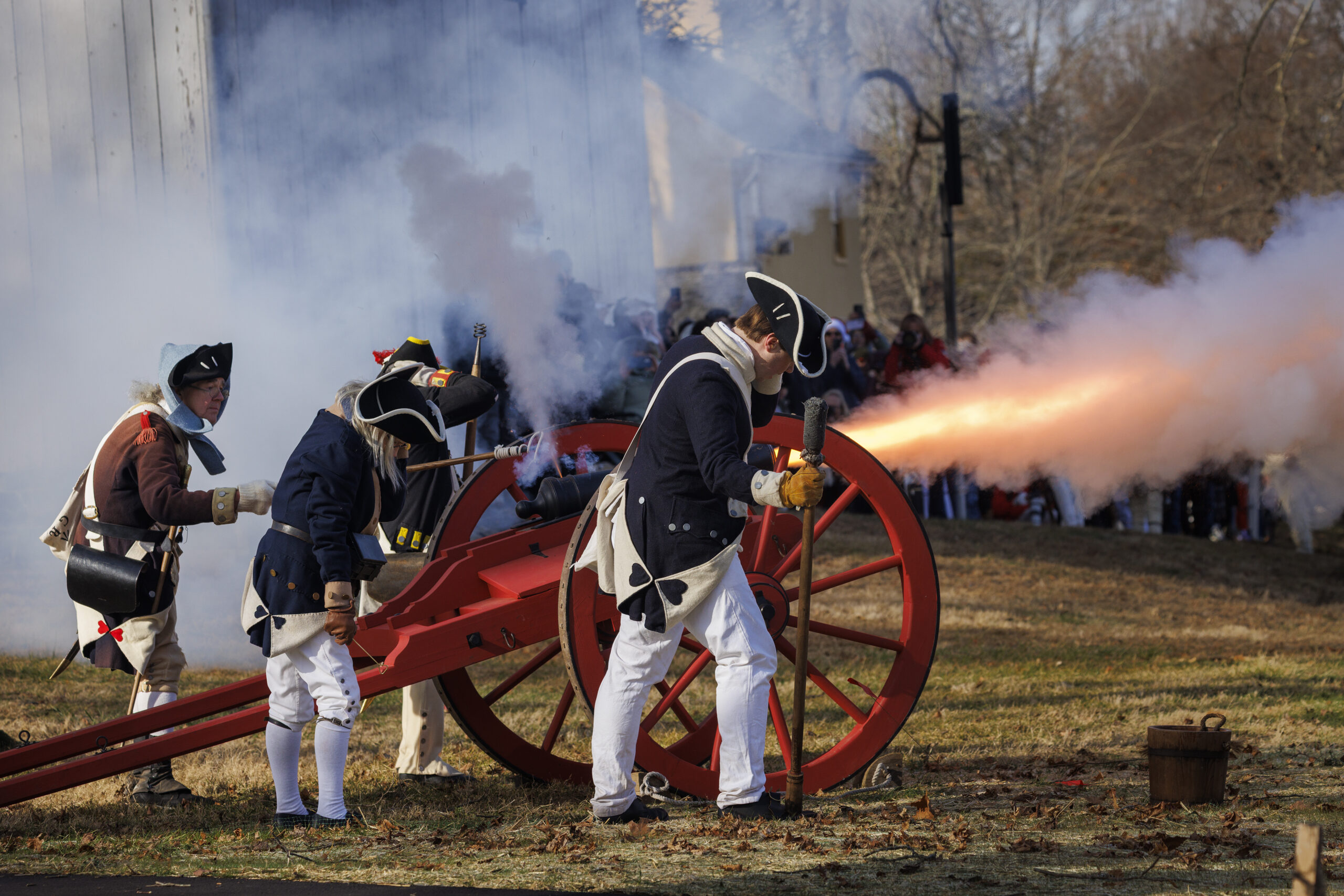
Reenactors fire off a Galloper gun during a reenactment of George Washington’s river crossing, Washington Crossing Historic Park, Washington Crossing, Pa., Thursday, December 25, 2025.
Bucks County’s history-packed celebrations
For Bucks County — established by William Penn in 1682 — 2026 is set to be chock-full of celebratory events tied to the founding of the U.S.
Bucks’ commissionin charge of planning 250th celebrations has partnered with numerous nonprofits to promote their events on a shared calendar on a dedicated county America 250 website.
Forthcoming activities include art exhibitions, a Doylestown bash featuring big-band music and the reading of the Declaration of Independence, tours of a Revolution-era exhibit at the Mercer Museum, and fireworks at Washington Crossing Historic Park on July Fourth. Not to mention the annual reenactment of Washington crossing the Delaware River on Christmas Day.
The group also worked with the Bucks County Planning Commission and the Bucks County Herald to release a Revolutionary War trail map that takes participants throughout the county to visit historical sites.
Bucks gave $7,500 to the 250th commission in July 2024 in support of the celebrations, a county spokesperson said. Other financial support has come from sponsors, including several companies that have dished out at least $10,000 apiece.
Bucks County Commissioner Bob Harvie, who chairs the county’s 250th commission, said these events underscore the pride that communities have in their rich history.
“It’s also a chance for us to think back, I think, and remind ourselves about the foundation of this country, and the values that united us, because especially now we’re seeing a lot of attempts, unfortunately, within our country to divide us,” said Harvie, a Democrat who is running for U.S. Congress.
It is difficult to predict how this year’s 250th celebrations will affect the county’s tourism numbers, but Bucks typically hosts about 8 million visitors a year, Harvie said.
“We’ve been pitching ourselves sort of — no pun intended — for people who are coming here for the World Cup,” Harvie said. “We’re right between Philadelphia and New York, where you happen to have a place that’s sort of a central hub.”
The Valley Creek Trail at Valley Forge National Historical Park in Valley Forge, Pa., on Tuesday, Feb. 20, 2024.
A ‘birthday bash’ and celebrating Valley Forge
Montgomery County’s 250th commission has curated months of events to commemorate the Semiquincentennial, but a free “birthday bash” on Monday at the county courthouse will kick off the height of the July Fourth celebrations.
Attendees can graze food trucks, take pictures, and meet an animal from the Elmwood Park Zoo.
Other programs this year include fireworks and live readings of the Declaration of Independence over July Fourth weekend, exhibits to commemorate the 50th anniversary of Valley Forge becoming a national park, and a gathering (with food and drink, of course) at a Skippack farmstead to honor Washington and his troops’ encampment in the town in 1777.
The 250th events have been planned by the county and local municipalities, said Jamila Winder, chair of the county commissioners, as an “opportunity to create meaningful, inclusive celebrations” and cultivate “civic pride.”
Montgomery County typically gets about 8 million visitors a year and are projecting an additional 1 million to the region for the 250th, said Winder, a Democrat.
To help fund this year’s festivities, the county started a grant program through which municipalities can apply to receive up to $500 to support their 250th events between now and Dec. 1.
The county has allotted a $35,000 budget for 250th celebrations, including the grant program, which 22 of 62 municipalities are a part of, a spokesperson said.
“It’s an opportunity for visitors to see how Montgomery County played a unique role in America’s founding, including our deep ties to Valley Forge in the Revolutionary area,” Winder said. “You know, people always think about Philadelphia, right? Philadelphia is a big piece of this story, but Montgomery County plays a huge role in that.”
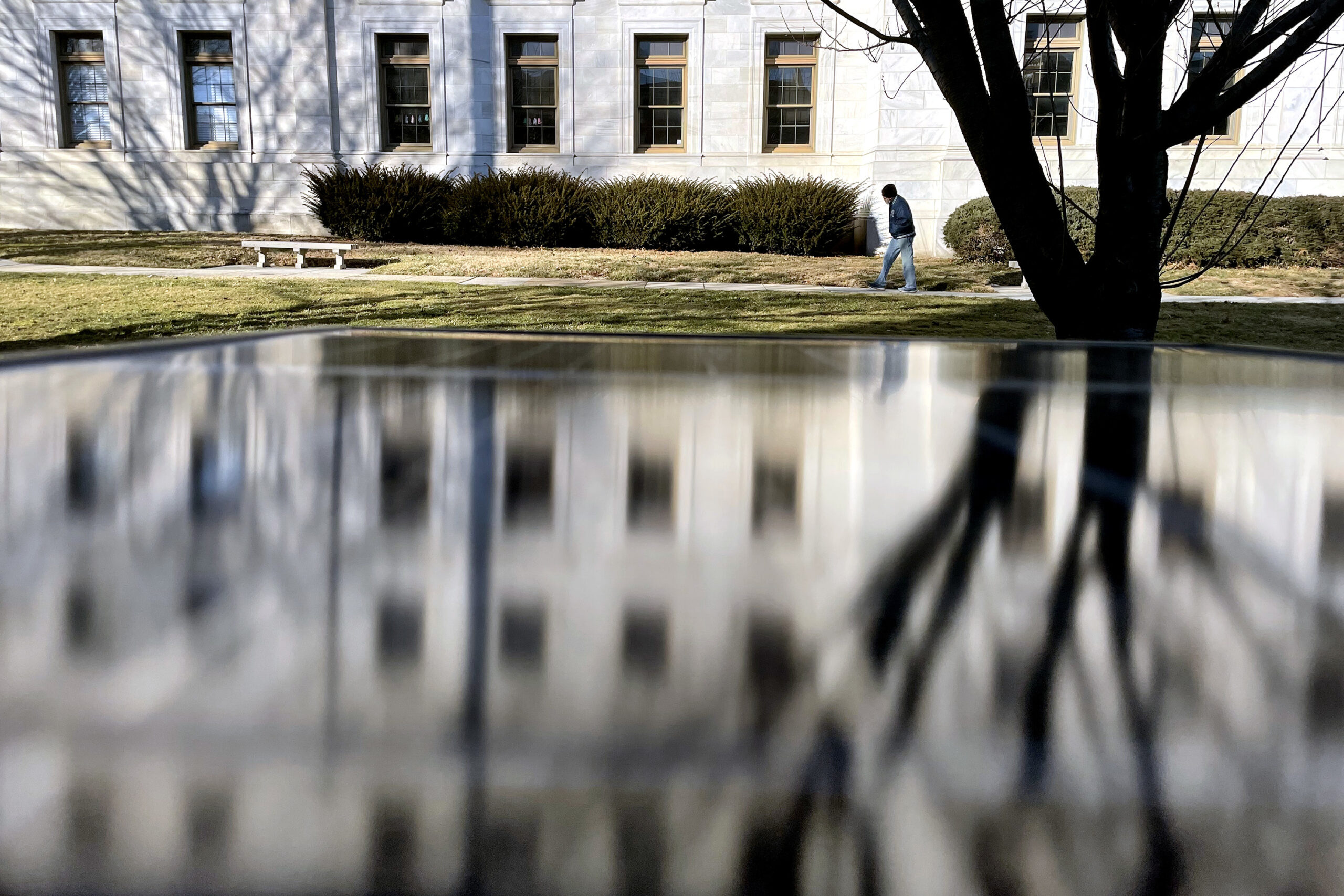
The Delaware County Courthouse in Media is reflected in a solar panel atop one of the borough’s on-street parking kiosks along Front Street.
Delco is ‘pretty lit’ about its 250th celebrations
“If you thought Delaware County residents were proud of being Delco before America 250 — you’re just, like, next-leveling it now.”
That’s what Delaware County Council member Elaine Paul Schaefer said about Delco’s excitement leading up to the 250th, making sure to set the record straight that William Penn’s storied first steps in the New World hundreds of years ago were actually in Chester, not at Penn’s Landing in Philadelphia.
The county — through its America250PADelco commission — is promoting over 100 county, town, or nonprofit events through November, from art exhibits, concerts, and fireworks to “dining under the stars” in Media, a late-summer drone show, and a reading of the Declaration of Independence on the county courthouse steps.
“Delco is pretty lit about this,” said Schaefer, a Democrat.
The county’s 250th commission has disbursed more than $650,000 in grants for various initiatives. That grant money comes from a mix of funds from the American Rescue Plan Act and from different county agencies.
Schaefer said she hopes the events encourage residents to harness a connection to their communities, particularly through the county’s 250th volunteer program.
“You can do something small, do something big. … It’s a really great way to get people involved and connected, and I think that kind of volunteerism and increasing connection to the community will carry on after this big celebration,” Schaefer said.
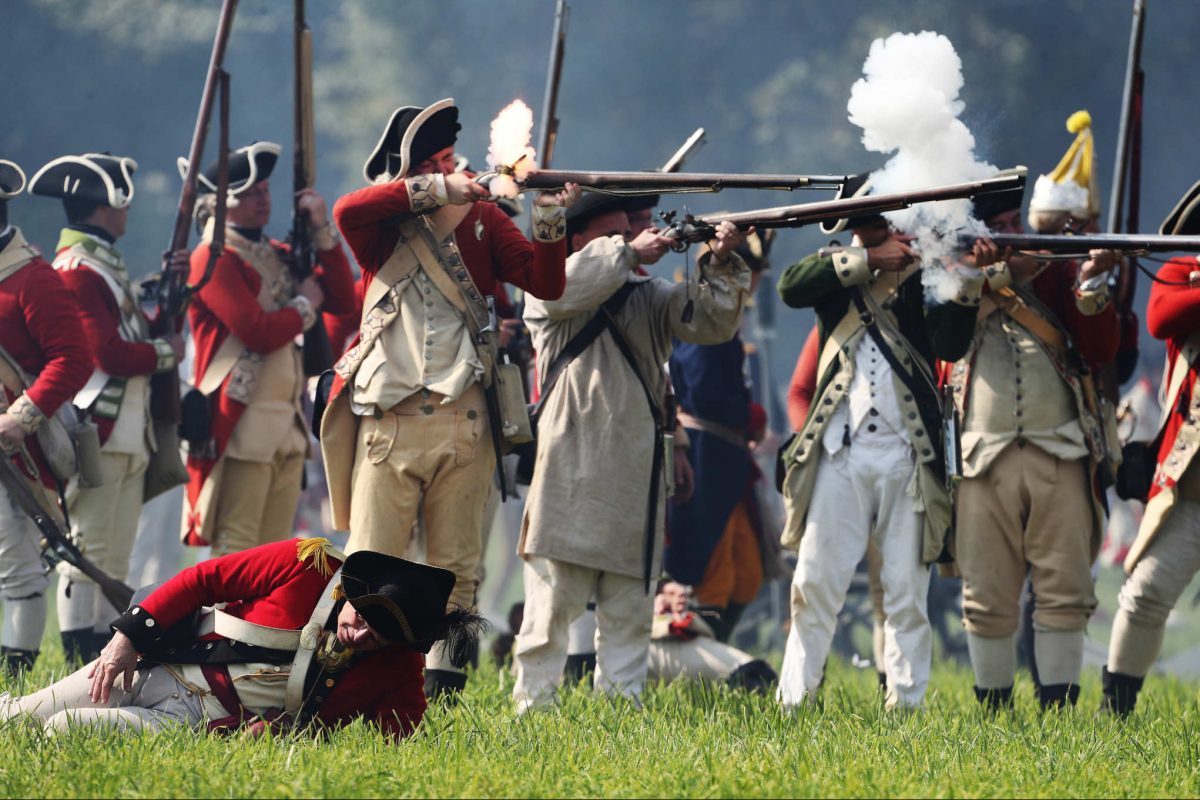
About 800 Battle of Brandywine reenactors in Chester County.
For Chester County, the party will last through next year
And the events planned for this year (and next year, as it honors various Revolutionary War-era battles, including the Battle of Brandywine) are key to celebrating the county’s role in the founding of the United States.
Residents and visitors have a wide array of activities to choose from outlined on the commission’s website, including driving tours of historical sites and Declaration of Independence readings. On the evening of July Fourth, the Chester County Concert Band will be playing patriotic music as a precursor to the fireworks show.
As opposed to hosting tons of large-scale events, Chesco is more focused on local events that can foster community building, said David Blackburn, heritage preservation coordinator at the Chester County Planning Commission. The commission is working with the county’s 250th commission to carry out plans.
“We’re really oriented to supporting the communities of the county to share their stories,” Blackburn said.
The county has invested over $170,000 in educational materials and programming related to the 250th, in addition to a more than $330,000 grant from the state, a spokesperson said.
But once the clock strikes midnight on New Year’s Eve, the celebrations won’t end for Chester County, said Matthew J. Edmond, executive director of the planning commission.
In 1777, many significant Revolutionary War battles took place in the collar counties, and Chester is planning to pour a lot of resources into commemorating those historical events next year.
“We are actively talking with our commission board about ways to celebrate, ways to fundraise for it, and ways that we can make maybe 2027 to be even better than celebrations in 2026,” Edmond said.
HARRISBURG — Three years after a bitter budget standoff over allowing state funding to be used for private school tuition, top Democrats in Harrisburg are ready to engage on school choice.
Legislative action and comments from a top House Democrat this week expressing openness to a federal school-choice program marked a notable change from 2023, when a fight over school vouchers put Democratic lawmakers at odds with both Republicans and Gov. Josh Shapiro, a member of their own party.
House Majority Leader Matt Bradford (D., Montgomery) said this week that some of the uses of Trump’s tax credits, which are opposed by the country’s largest teachers unions, are “intriguing.” And he noted he is proud of some money the state now pours into one of thetax credits to fund private-school scholarships for low-income families in low-achieving districts. Those comments from Bradford, a top leader in Harrisburg, suggested a public softening on an issue that was previously a non-starter for his party— and signaled the school-choice debate may once again factor into state budget negotiations.
“For our members of our caucus who want to see alternatives for the poorest kids in the poorest schools, we’re being responsive to the needs of those constituents,” he said in an interview, referencing growing support for school choice among some House Democrats, particularly those from Philadelphia.
State Rep. Matt Bradford (D., Montgomery County) during a press conference at the Capitol in Harrisburg Feb. 3, 2026.
The school-choice movement, a largely Republican-backed effort to allow public dollars to go to private schools, faces strong opposition from education advocates who say such programs can take money from public schools.
And that debate is sure to continue. Bradford said more oversight — and an overall reform of the current tax credits — is needed to make sure the state tax dollars are actually reaching poor students.
Earlier this week, House Democrats fast-tracked an overhaul to the state’s current $680 million school-choice tax-credit programs to require additional reporting from private schools in order to secure funding. The legislation is likely to face opposition in the GOP-led Senate, where Republicans on Thursday advanced a $25 million increase to the programs ahead of a June 30 deadline to pass a state budget.
Senate Republicans called the tax credits a “priority for empowering parents,” while the Archdiocese of Philadelphia said the House bill would be “devastating” to local Catholic schools and lead to fewer scholarships for students.
A spokesperson for Shapiro said his office is reviewing the House bill, and declined to comment on whether his position on school choice has changed. Shapiro, who has sent his own children to private school in Montgomery County, has previously said he supports school choice, including school vouchers.
Shapiro has until the end of the year to decide whether to opt in to the federal program. But the signal of openness from Bradford, who is close with the governor, offers potential insight into his path forward.
That program, enacted last year under Trump’s “One Big Beautiful Bill Act,” would offer federal tax credits to donors for giving to organizations that grant private school scholarships. Many GOP-led states have already signed on, while some Democratic governors have declined to participate.
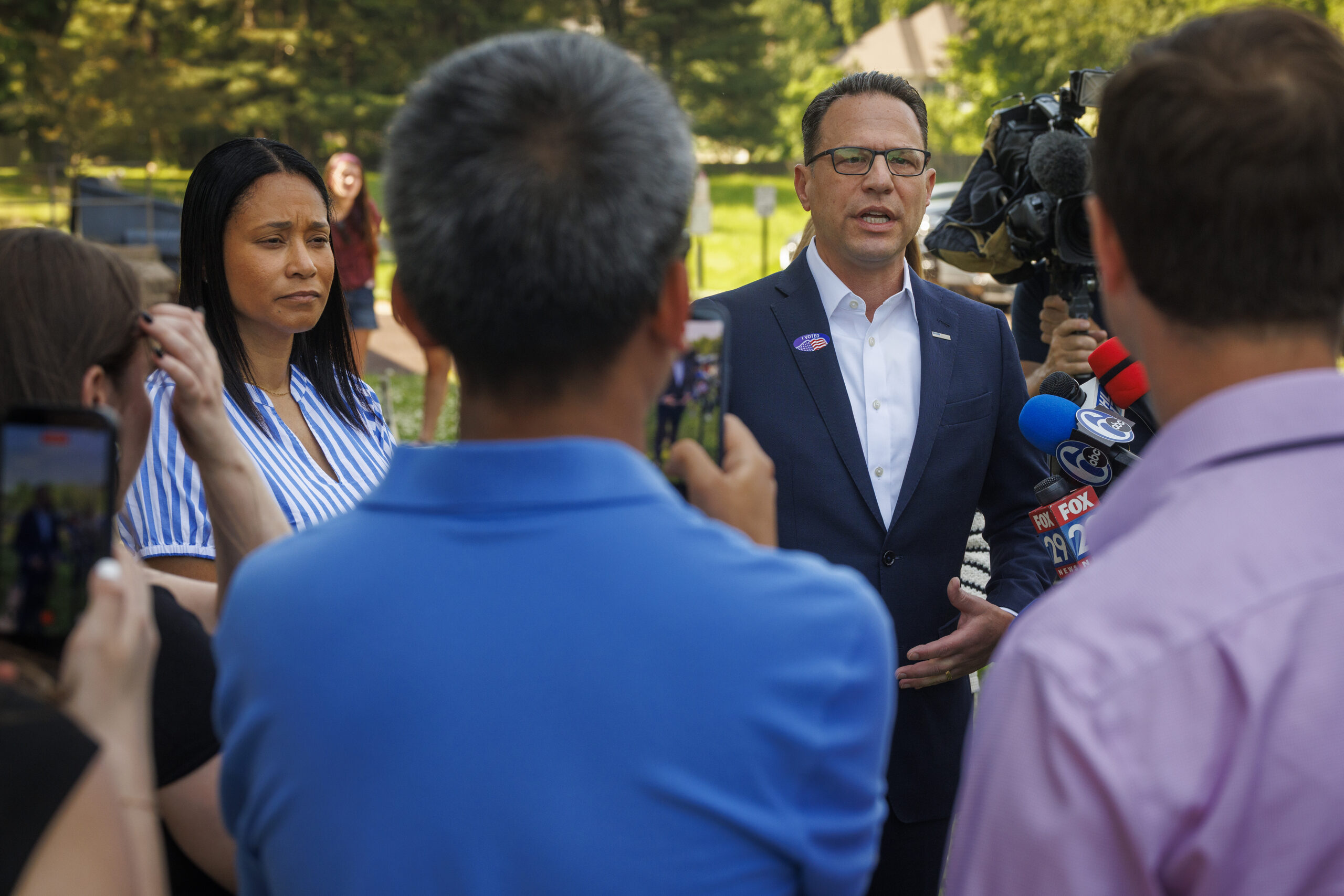
Pennsylvania Governor Josh Shapiro taking questions from media on election day, Tuesday, May 19, 2026. He voted today at Rydal Elementary (West) 1231 Meetinghouse Road Rydal, PA. At left is Jamila H. Winder, Chair, Montgomery County Commissioners.
Shapiro will also likely face questions about school choice on the campaign trail.
He is running for reelection in November against Republican Treasurer Stacy Garrity. Garrity’s platform focuses, in part, on expanding school-choice options in Pennsylvania and she has the support of Commonwealth Partners, a political action committee largely funded by Pennsylvania’s richest man, Jeff Yass, which has poured money into supporting school choice.
The issue will also likely surface a national stage if Shapiro enters the 2028 Democratic presidential primary race. His support for vouchers drew criticism from fellow Democrats in 2024, when he was a potential vice presidential nominee.
Debate over state tax credits
Pennsylvania does not have a direct school voucher program. Instead, the state sets aside $680 million each year for tax credits that allow businesses and individuals to write off charitable giving that supports private school scholarships.
House Democratic support for those credits has quietly grown in recent years. In a June 2025 letter recently obtained by The Inquirer, 10 House Democrats, including five from Philadelphia and the head of the Pennsylvania Legislative Black Caucus, asked their leadership to expand a portion of the tax credits forstudents in the lowest-achieving school districts — revealing more Democratic support for the programs than was previously known.
Public education advocates who oppose voucher programs say the state is funneling money to private schools with little accountability.
“It’s just a pot of money that a bunch of people get, and nobody really knows where it goes or what happens to it,” said Susan Spicka, executive director of Education Voters PA.
New requirements approved by the state legislature last year are set to take effect in November andwill require scholarship organizations to report the dollar amount of each award, the recipient’s district of residence, and where they attend private school.
The bill advanced by the House in a 105-97 vote this week would also require organizations to report each scholarship recipient’s income level — reducing the currentlimit to $144,000 for a family of four — and the amount of remaining tuition charged to a student. Advocates, including Spicka, called that information key to gauging whether scholarships are going to families who otherwise could afford private school.
Bradford said he’s proud of the $110 million earmarked in existing state tax credits to provide additional money to kids attending schools where a majority of students are getting scholarships. House Democrats say their newest proposal would steer more money toward those students.
But the proposed legislation — which would also reduce the tax credit donors could claim for some contributions, and require scholarship organizations to set 2% of funding aside for state oversight of the programs — drew swift backlash from private school advocates.
Philadelphia Archbishop Nelson J. Pérez is “deeply concerned that this legislation would have a devastating impact,” said spokesperson Ken Gavin. “The clear intent is to lead to the dilution or elimination of the programs, which are vital.”
Schools affiliated with the Philadelphia archdiocese educate nearly 44,000 students across 117 schools in the region, according to its website.
Bradford, who is Catholic, said the Archdiocese’s response “missed the mark,” arguing that this legislative effort is trying to achieve a similar goal of serving students from poor families who attend the roughest schools.
“I’m proud of my own Catholic faith. I love when my Catholic Church stands for those communities,” Bradford added. “No one should ever fear transparency, especially when you’re talking about three-quarters of a billion dollars of state tax dollars.”
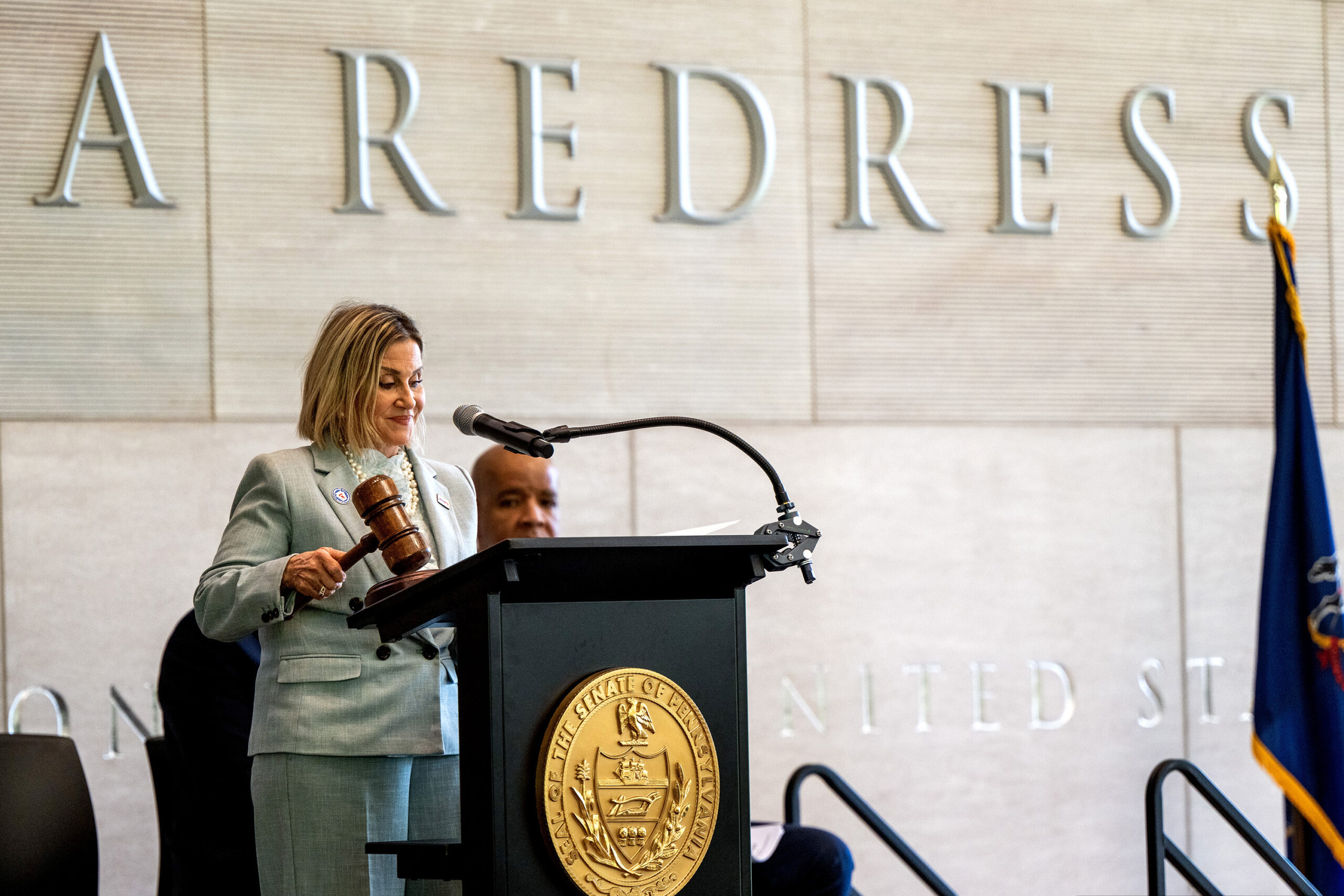
President Pro Tempore Kim Ward gavels the opening as the Pennsylvania Senate hosts a ceremonial meeting at the National Constitution Center Tuesday, May 5, 2026.
Meanwhile, Senate Republicans on Thursday amended another House bill to increase the state’s current tax credit programs to $705 million.
President Pro Tempore Kim Ward (R., Westmoreland), a staunch supporter of school vouchers, said in a statement that Bradford‘s attention to school choice is disingenuous, criticizing the House Democrats’ bill as “overly burdensome auditing requirements disguised as ‘transparency.’”
The 2023 budget breakdown, where Shapiro ultimately vetoed the school voucher program he‘d helped draft with Senate Republicans because it couldn’t pass the Democratic-controlled House, continues to tarnish his relationships with top GOP leaders, including Ward. He and Ward have hardly spoken since.
“While Senate Republicans have consistently advanced legislation to provide scholarships to disadvantaged students, the track record for Gov. Josh Shapiro and House Democrats has been nothing more than a case of whiplash as their words and actions rarely align,” Ward said. “To me, it seems like the support for school choice by the House Democrat Leadership is more of a façade as they continue to cater to political special interests.”
Bradford, in response, said he is open to conversation about accountability and transparency, but that debate needs to include private schools benefiting from taxpayer dollars.
“We shouldn’t carve out any portion of our K-to-12 education,” Bradford added. “That conversation needs to be uniform.”
A choice for states on Trump’s tax credits
Shapiro has previously said he would wait for more details before making a decisionon whether to participate in the new federal tax credit program. The U.S. Department of the Treasury earlier this month released additional details, including that itwill allow individuals to receive up to $1,700 in credits for making donations to private school scholarships that can cover tuition, tutoring, and more. In Philadelphia, families making $368,100 annually, or 300% of the county’s gross median income,would be eligible to receive the scholarship.
Shapiro’s press secretary Rosie Lapowsky said the governor appreciates the guidance, but continues to await information on “how this will affect use of our existing tax credits, how states will be expected to administer the program, and how eligibility will be determined.”
Twenty-eight states have opted in to the program, most of which are led by Republicans. And Democrats are facing pressure to stay out of the program.
In a letter sent to Democratic governors this week, American Federation of Teachers President Randi Weingarten and National Education Association President Becky Pringle called the program “a Trojan horse carrying near-universal K-12 private school vouchers into every state that participates.”
So far, Democratic governors elsewhere have taken differing approaches to the program. New York Gov. Kathy Hochul has said her state will participate but is waiting for final guidance before officially signing on. Other governors like Minnesota Gov. Tim Walz and Oregon Gov. Tina Kotek have announced that their states will not participate. Democratic governors in Arizona and Wisconsin have vetoed legislative efforts to force their states to opt in, while governors’ similar vetoes in North Carolina and Kentucky were overridden by legislators.
Bradford said it’s “an abomination” that funding for Trump’s program came from Republicans making other cuts to the federal budget, and emphasized that stateDemocrats remain committed to increasing public education funding.
“Here in Pennsylvania,” he said, “we are a humble 102 [Democrats] in the Pennsylvania House and we are nimble and pragmatic.”
America stands on the brink. The ultimate question of independence hangs over Philadelphia.
And Thomas Jefferson has a declaration to draft.
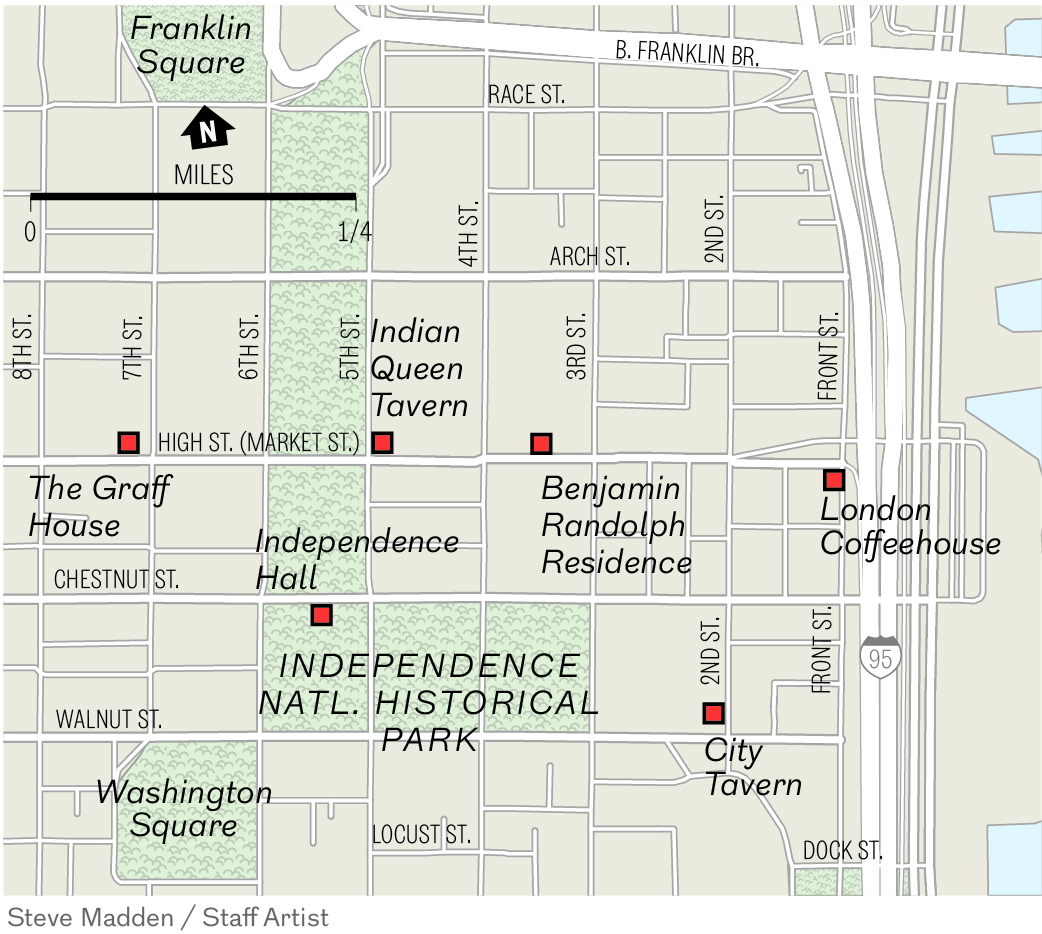
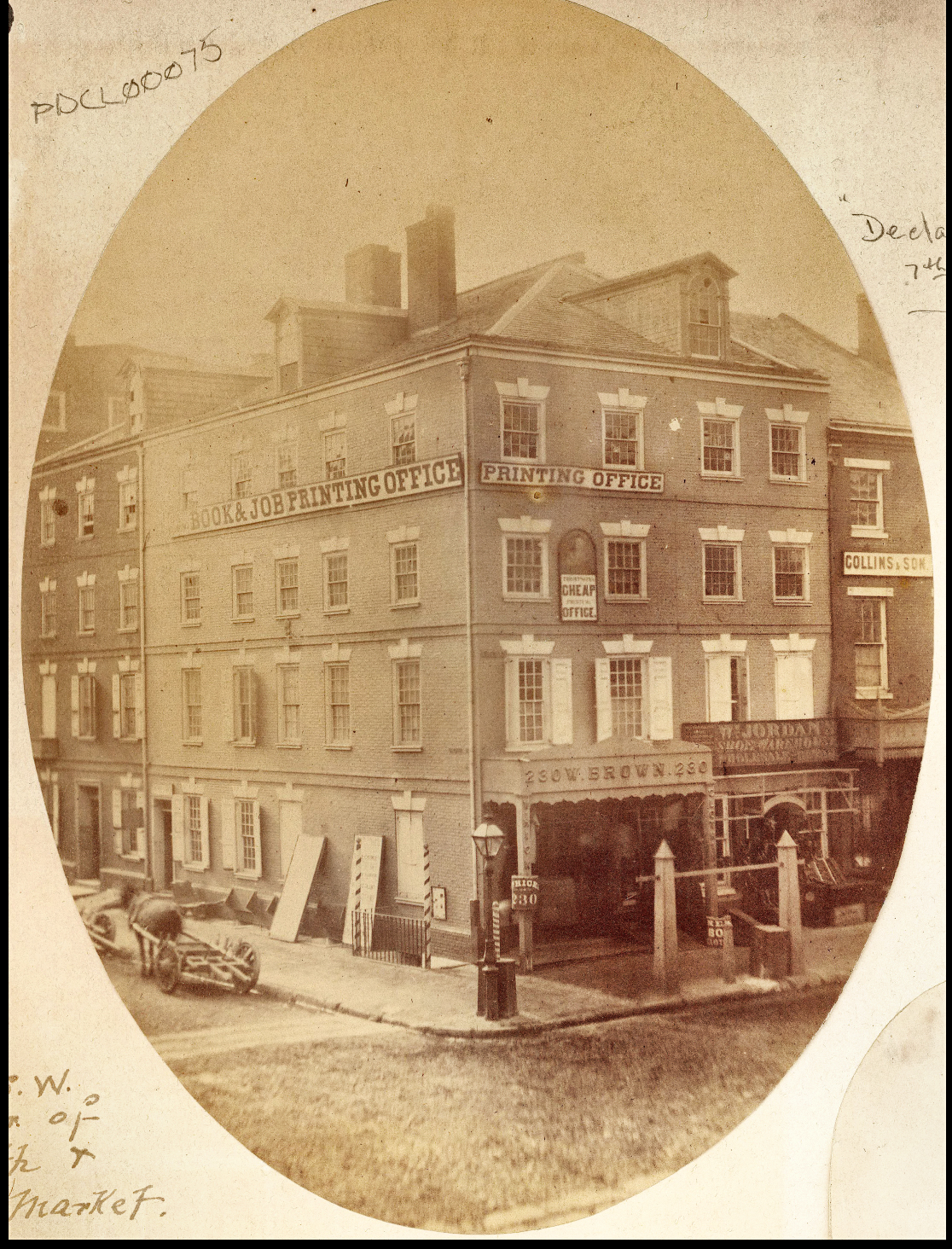
His heart is in Virginia. His “country,” as he calls it. But here he is at Seventh and High Streets, 33 years old, living in two sweltering rooms, with his chance to make his mark on history.
Unlike his fellow delegates, lodged in rooms along Philadelphia’s booming riverfront, Jefferson takes quarters along the city’s rural western edge, two blocks from the Pennsylvania State House, where the rebels conspire. The orchards and pastures bordering the downtown of British America’s largest and wealthiest city offer an escape from Philadelphia’s stifling summer heat and foul smells. Its stinking creeks, rotting trash, and unchoked illness. The verdant outpost, elsewise occupied by a bricklayer and his family, provides “the Squire,” as his friends back home call him, some small semblance of his mountaintop mansion, Monticello.
Thomas Jefferson’s Philadelphia in 1776.
He is living out of leather-bound trunks. Fresh air and sunlight stream through a window overlooking High Street — Philadelphia’s main thoroughfare, busy even on the outskirts. Hinterland farmers’ wagons clatter over cobbles, headed for the market. The sweet scent of fresh loaves drifts from a shopfront bakery. Jefferson’s thoroughbred — Caractacus, perhaps, his favored bay stallion, whose regal appellation derives from a first-century British chieftain — nickers in a nearby stable.
Robert “Bob” Hemmings, Jefferson’s 14-year-old enslaved valet — and half brother of Jefferson’s future paramour, Sally — attends his every need in Philadelphia, sleeping in a garret off the writing parlor.
The Declaration House, 7th and Market Streets, in 1856.
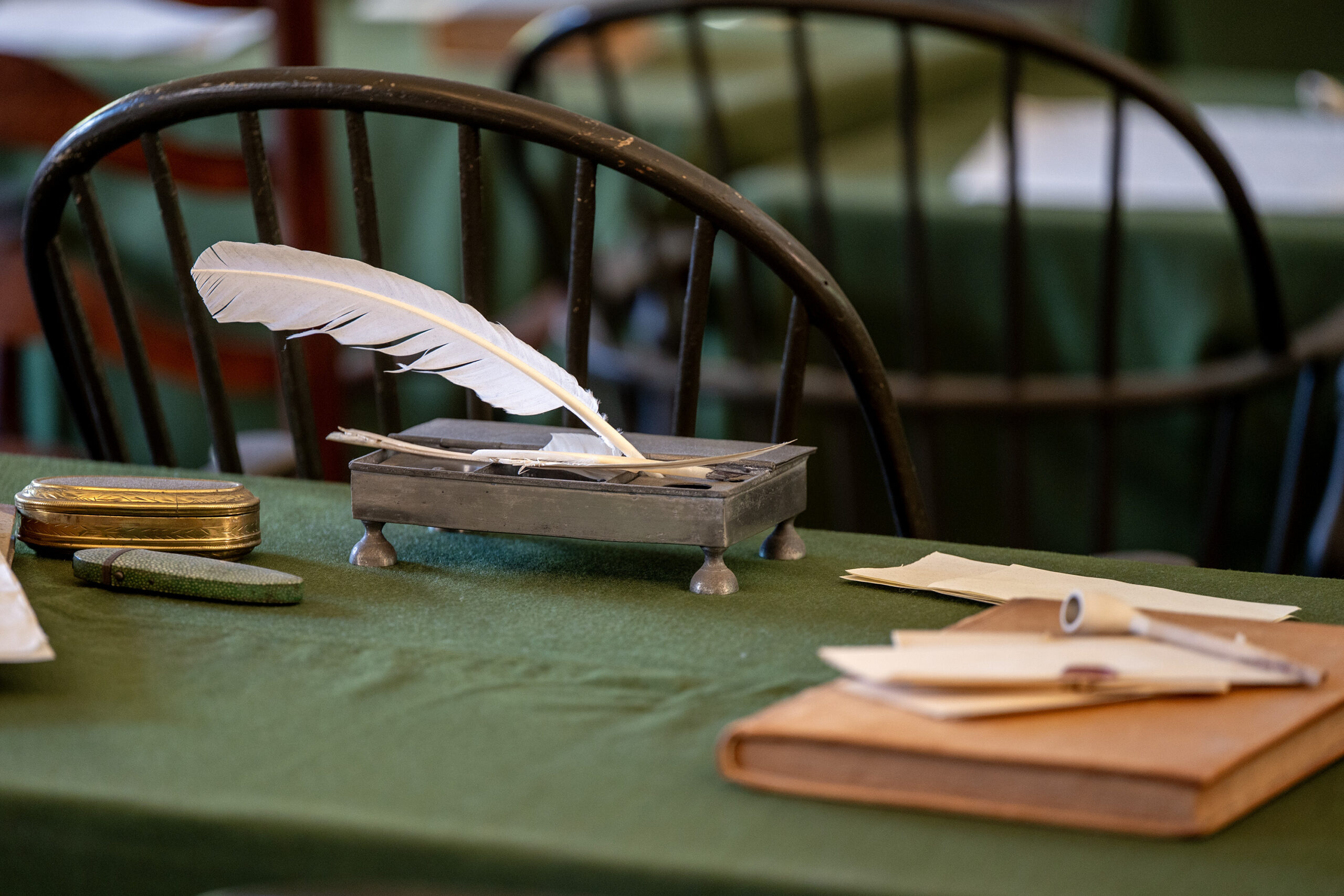
The rag paper resting on Jefferson’s mahogany travel desk — a small, portable lap device of his own design that the inveterate tinkerer had commissioned from a Chestnut Street cabinetmaker upon his arrival in Philadelphia a month earlier — remains blank. His quill is still. In the shadows, a grandfather clock ticks a stately rhythm.
Tick … tock … tick … tock.
The master of Monticello is working on a deadline.
Just weeks earlier, more than four thousand Philly patriots braved driving rains to gather in the brick-walled yard of the State House. Celebrating the Second Continental Congress’ decree to form new governments apart from King George III — the masterstroke of John Adams, 40 — the drenched Philly masses thunder for independence.
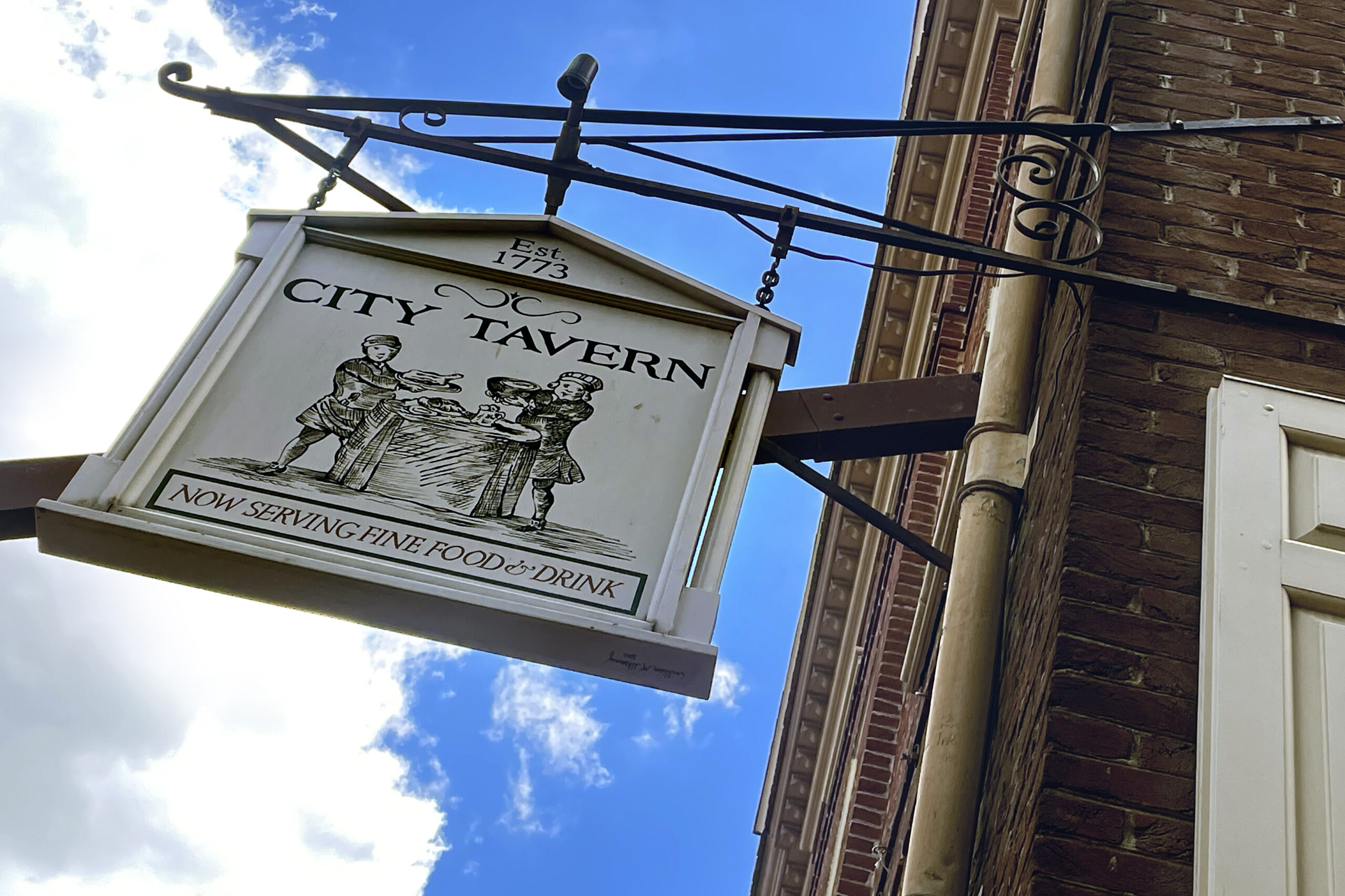
City Tavern Monday, June 15, 2026. The original building was demolished in 1854 and reconstructed in 1975.
George Washington himself takes brief leave of his embattled army, digging in for an expected British assault on New York, to update the 56 congressional delegates in Philadelphia. The general’s tidings are lost to the centuries. But hear the lusty huzzahs that greet the stoic warrior at the representatives’ nightly repast at City Tavern, their unofficial headquarters.
“George Washington, and victory to the American arms!” goes the toast.
Inside the locked chamber, radicals like Adams and his older cousin, and backroom operator, Samuel, 53, lead the fight for liberty. Jefferson, whose resolve for popular government in America is unquestioned, but who detests public speaking, rarely rises.
In early June, it is Jefferson’s fellow Virginian, the passionate patriot Henry Lee, who delivers a decisive stroke, boldly uttering words hitherto unsaid in Congress: “That these United Colonies are, and of right ought to be, free and independent.”
The thunderclap is met by delay. Delegates from powerful colonies, including Pennsylvania’s own reluctant son of liberty, John Dickinson, are hesitant to cut the cord. Radicals work furiously to build unanimity.
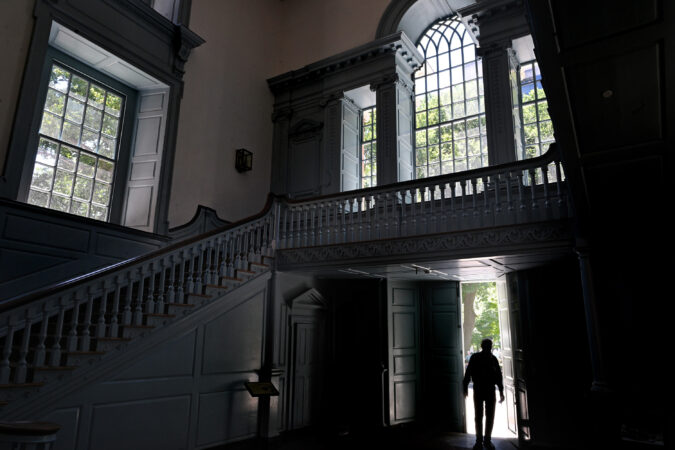
Clock tower at Independence Hall (Pennsylvania State House) Monday, June 15, 2026.
Philly headlines — in the same papers publishing fugitive slave ads and notices for the sale of Black children far younger than Bob Hemmings — decry “our mortal enemy the King of Great Britain.”
“The people wait for us to lead the way,” Jefferson will note.
During the delegates’ fiery, closed-door debates, his long legs folded underneath his desk, Jefferson stays mum.
But now the poet-philosopher and slaveholder, whose bright brilliance and dark contradictions mirror perfectly the promise and sins of the nation he seeks to author, must find all the words.
A renaissance figure among the rebels
It is John Adams, in characteristically gruff fashion, who appoints Jefferson first quill. The good gentleman from Virginia is but one of five men appointed to draft America’s creed — including Adams and Franklin, home sick with gout and other ailments — but Adams argues it is Jefferson, with his “peculiar felicity for expression,” who should do the writing.
“Reason first, you are a Virginian, and a Virginian ought to appear at the head of this business,” Adams recalls telling Jefferson in the committee’s first convocation. “Reason second, I am obnoxious, suspected, and unpopular. You are very much otherwise. Reason third, you can write 10 times better than I can.”
Adams is right.
Replica desks in the Assembly Room in Independence Hall (Pennsylvania State House) Monday, June 15, 2026.
Both drawn to the flame of American independence — the noblest cause of their age, and any other, they believe — the freedom fighters cut an odd coupling.
Adams, short, plump, balding, cantankerous. Jefferson, tall, lean, formidable, a shock of copper hair, freckled in the Philly heat, his illusive eyes described as blue or hazel or light gray. The Southern planter and legislator who matriculated at the College of William & Mary is soft-spoken and painfully gracious and polite, charming, flirtatious. He abhors confrontation.
Behold this true renaissance figure among the rebels.
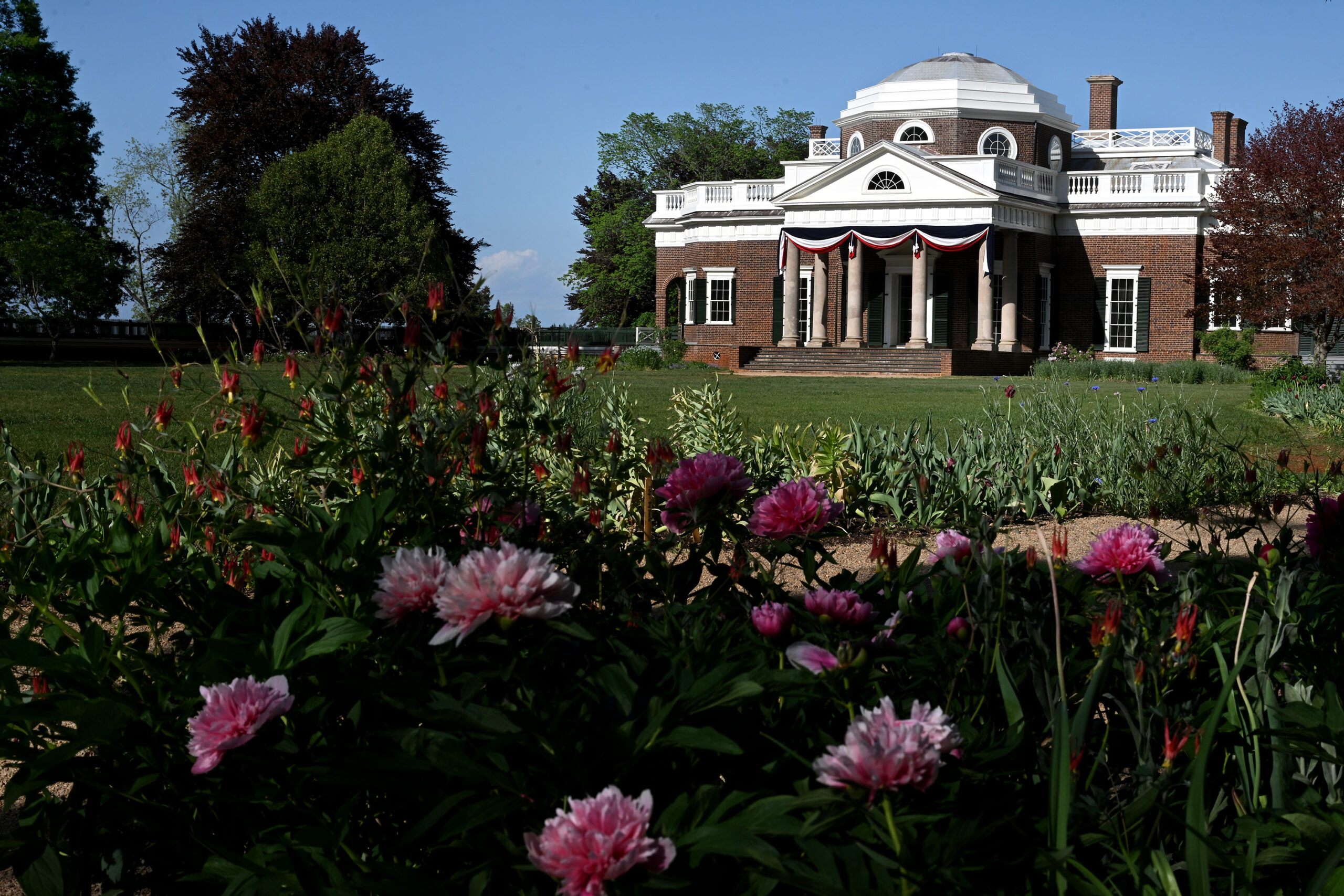
Monticello, the primary residence and plantation of Thomas Jefferson in Charlottesville, Virginia, April 22, 2026.
A lover of food and wine and fine things, he studies art and history, philosophy and mathematics, science, botany, astronomy. He speaks four languages and can aptly read ancient Greek. He has been building his Palladian plantation house — situated on land more than five times bigger than the core of Philadelphia, the makeshift colonial capital city, and toiled by more than 100 chained souls — since the age of 14.
Adams, obsessive even in his sightseeing, catalogs and compares the marvels of Philadelphia — its spacious thoroughfares, leafy green spaces, commanding skyline, including Christ Church’s heaven-kissing steeple, the tallest structure Washington had ever laid eyes on, its booming ports, gleaming institutions, exotic foods, and bottomless wine, porter, and punch.
During his few hours free from the rigors of revolution, Jefferson shops.
With Bob touting bulging bundles, the Squire strolls Philadelphia’s abundant artisanal shops, buying maps and books across all his tastes — so many volumes, he commissions his favorite Philly cabinetmaker to make a specialized bookcase to ship them home — and tools for Monticello. He buys fine fabrics for his wife, Martha, whom he is heartsick for. An elegant doll for his 4-year-old daughter, Patsy. He buys a straw hat for himself, and shoes and socks for Bob. At a market stall, he pays a shilling to gaze upon a merchant’s exotic monkey.
Along with his compatriots, he sups at the City Tavern most nights, enjoying as many as three glasses of wine, but also favors the regal rusticity — and punch — of the Sign of the Conestoga Wagon Tavern on High Street.
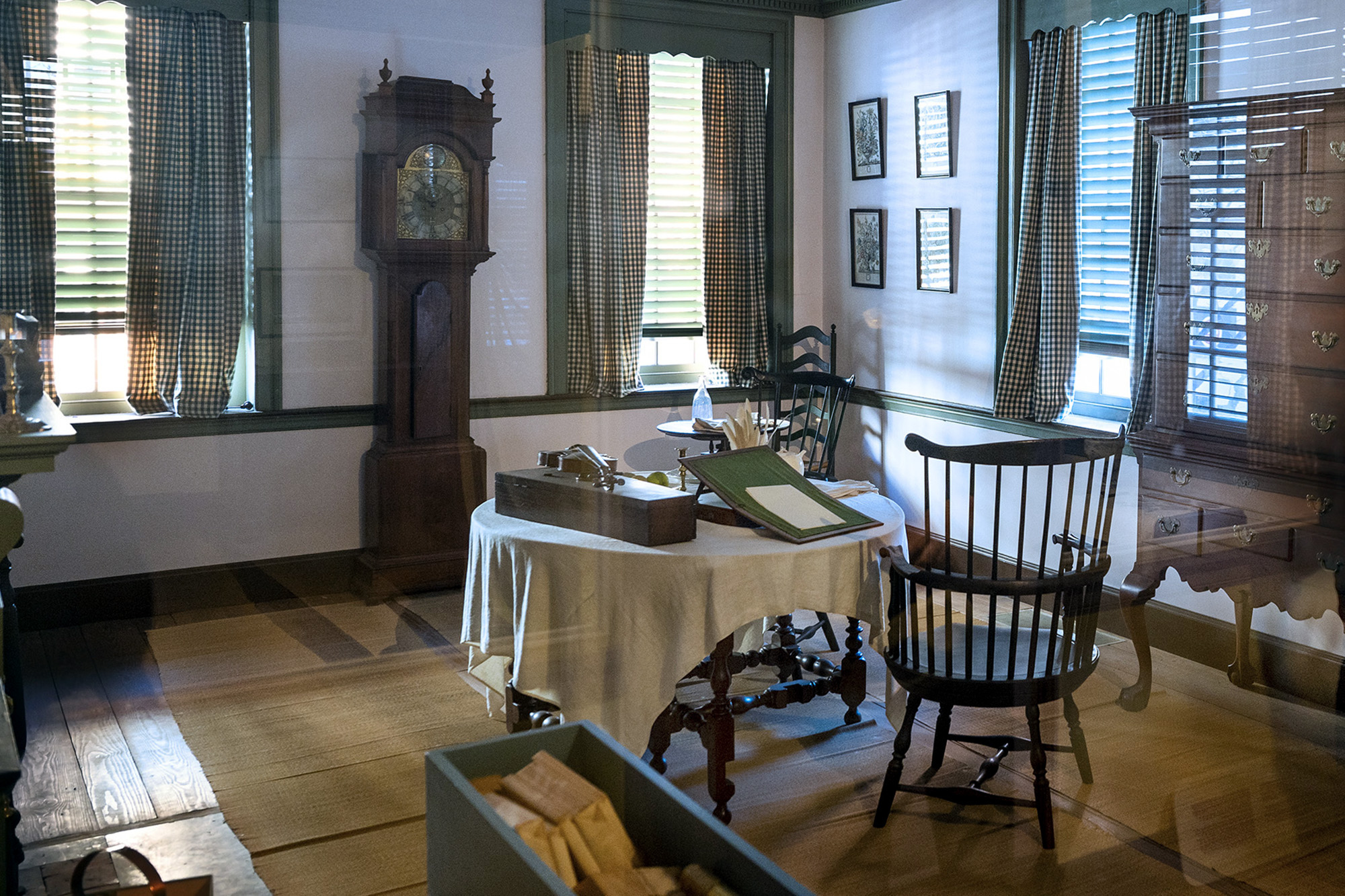
A replica of the room where Thomas Jefferson wrote the Declaration of Independence, inside Declaration House (home of Jacob Graff, Jr.) Dec. 20, 2023.
Envision him, this sun-freckled Moses of American history, in flesh and bone, a living, breathing man, donning a sun hat, whose first memory is being held on a pillow by an enslaved worker, and who will within days pen the most revolutionary, if fatally flawed, manifesto ever put to parchment, walking among, but set apart from, the working classes of Philadelphia. The laboring, the indentured, and the enslaved — all those he would conversely see lifted to the altar of democracy or sold at the auction block.
See this man. And understand America.
An expression of the American mind
He envisions his task to “place before mankind the common sense of the subject.” A justification for revolution, yes. A litany of proof that King George was a tyrant — and among other things, in an epic, and ultimately unsuccessful, act of blame-shifting, responsible for the entirety of the slave trade. But not a wholly original document. Rather, a soaring summation of the American revolutionary zeitgeist.
“Neither aiming at originality of principle or sentiment, nor yet copied from any particular and precious writing, it was intended to be an expression of the American mind, and to give to that expression the proper tone and spirit called for by the occasion,” he will later explain.
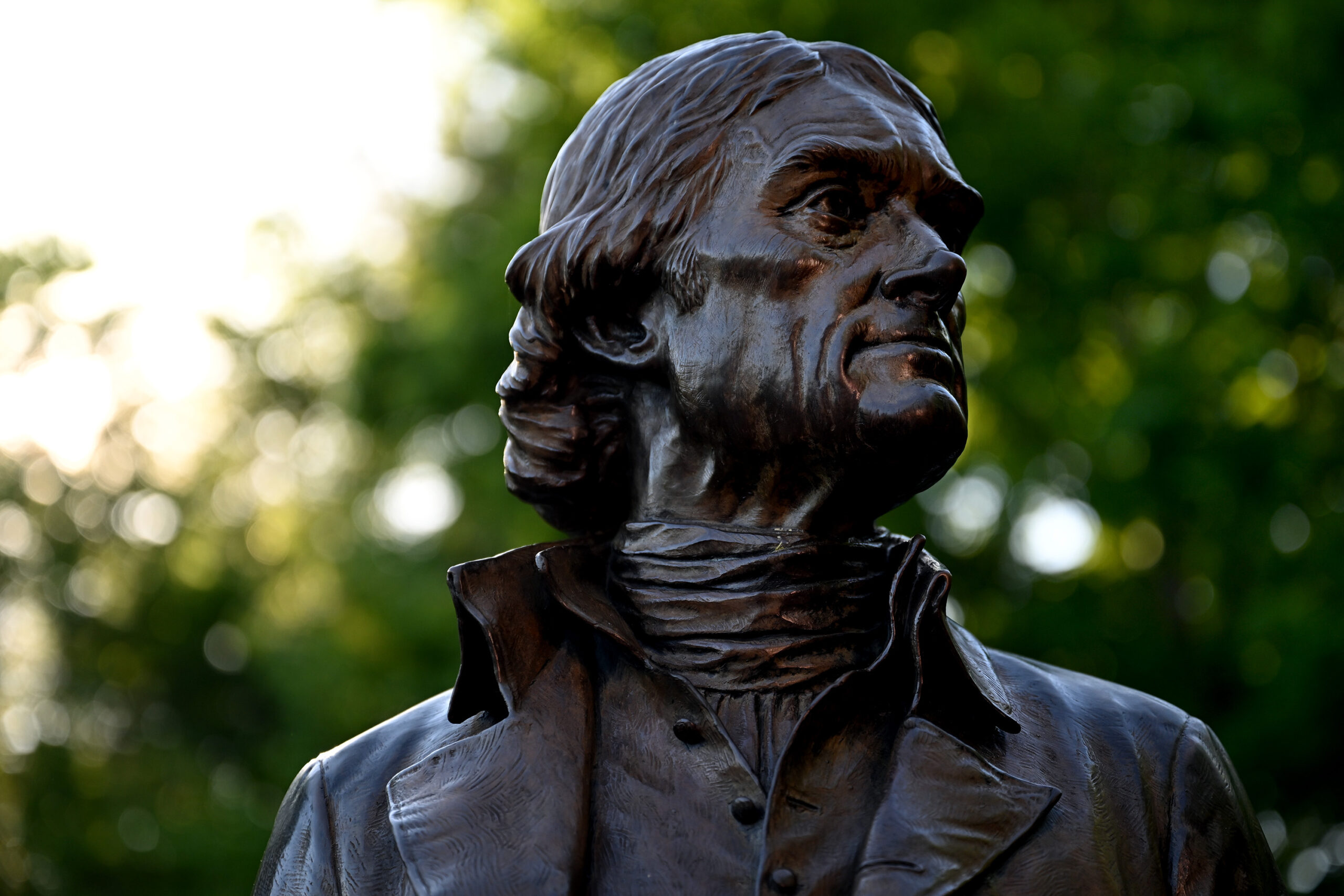
Statue of Thomas Jefferson at Monticello, his primary residence and plantation of in Charlottesville, Virginia, April 22, 2026.
In his parlor, with the tall clock ticking and Bob tending to tea, Jefferson works fast, pulling from his own writing — including his recent draft for a new Virginia constitution — and also from a declaration of rights for Virginia, penned by pal George Mason. From the whirling stream of his intellect, he plucks at will the inspirations and ideals of the seminal works of enlightened thinkers like John Locke and David Hume, whose writings on natural rights and freedom (“Life, liberty, and property,” Locke wrote, before Jefferson amends it for the better) provide the bedrock for the revolution.
Quickly, he begins to find his words. The rag paper fills.
“We hold these truths to be self-evident,” writes the man from Monticello.
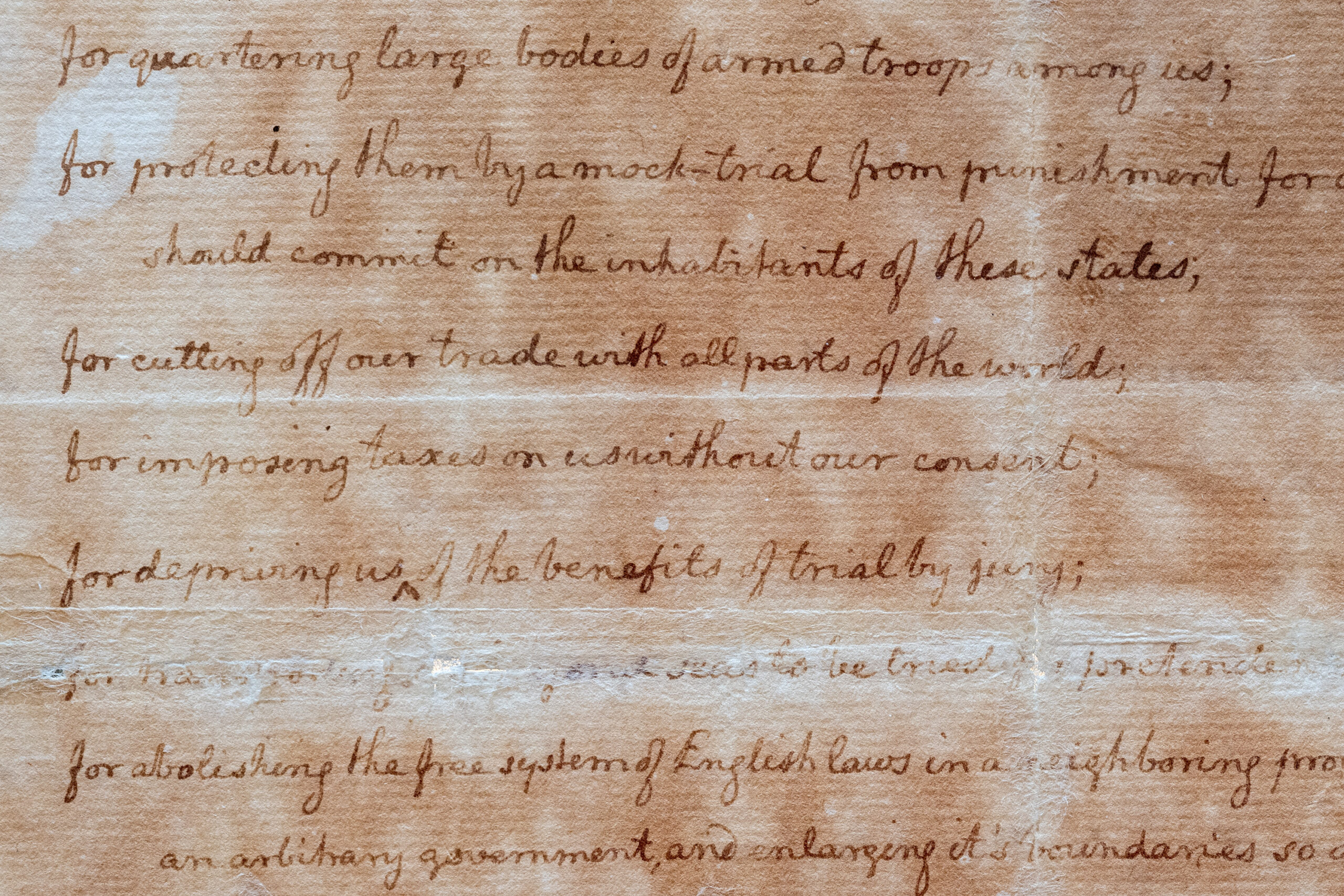
A faded copy of a draft of the Declaration of Independence handwritten by Thomas Jefferson, known as the “Fair Copy,” on display at the American Philosophical Society Monday, June 15, 2026.
Dispatches from 1776, Part III will be published online on July Fourth. Read Part I here.
This historical sketch is based on interviews with Tyler Putman, manager of gallery interpretation at the Museum of the American Revolution, and Michael Idriss, manager of the African American interpretive program at the Museum of the American Revolution, as well as J.M. Duffin, assistant archivist at Penn Libraries, historian and author Michelle Craig McDonald, and Stephen Nepa, history professor at Pennsylvania State University’s Abington campus. The author also based this series on historical newspaper accounts and research from “John Adams,” by David McCullough (Simon & Schuster, 2001), “Declaration: The Nine Tumultuous Weeks When America Became Independent, May 1-July 4, 1776,” by William Hogeland (Simon & Schuster, 2010), “American Scripture: Making of the Declaration of Independence,” by Pauline Maier (Random House, 1997), “The Revolutionary: Samuel Adams,” by Stacy Schiff (Little, Brown & Co., 2022), “Cocked and Boozy: An Intoxicating History of the American Revolution,” by Brooke Barbier (Chicago Review Press, 2026), “Thomas Jefferson: The Art of Power,” by Jon Meacham (Random House, 2012), “Rum Punch and Revolution: Taverngoing and Public Life in Eighteenth Century Philadelphia,” by Peter Thompson (University of Pennsylvania Press, 1999), “The Thomas Paine Reader” (Penguin Books, 1987), and “1776,” by David McCullough (Simon & Schuster, 2005).
In the latest twist over Pennsylvania’s participation in President Donald Trump’s Great American State Fair, U.S. Sens. Dave McCormick and John Fetterman announced Saturday that the state where America was founded will be represented after all.
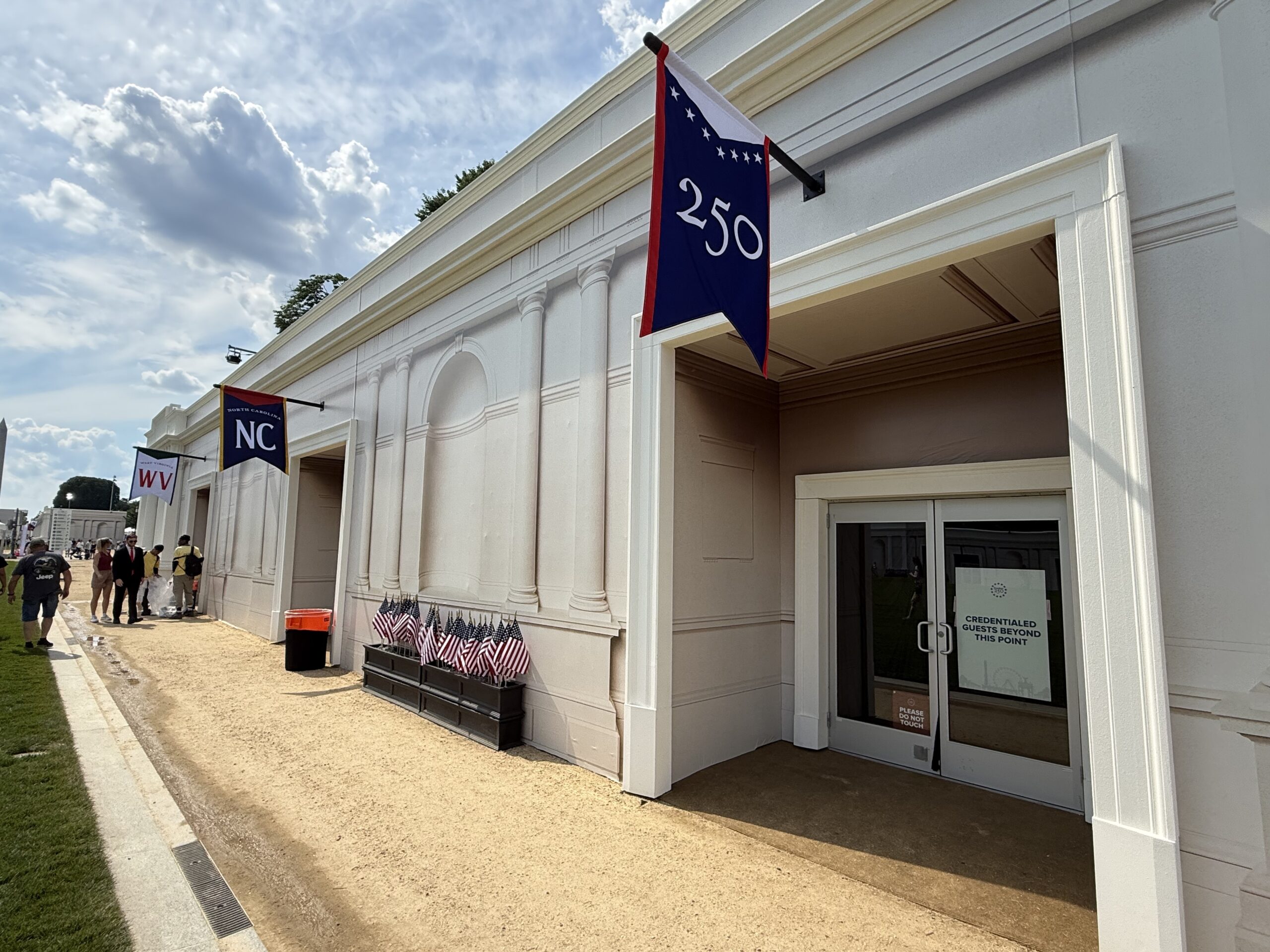
On the fair’s opening day, Pennsylvania had no official presence, and the booth reserved for the commonwealth remained empty, except for a flag that read “250” in Pennsylvania’s space.
After that news, McCormick (R., Pa.) and Fetterman (D., Pa.) said in a joint news release Saturday that they secured private-industry sponsors for the booth at no cost to taxpayers. Sponsors include the Pennsylvania Chamber of Business and Industry, the Pennsylvania Farm Bureau, and other organizations.
“Pennsylvania is where America’s story began, and there was no way we were going to let the Commonwealth go unrepresented during our Nation’s 250th birthday celebration,” McCormick said in the release.
“Celebrating America’s 250th birthday and Pennsylvania’s special role in our country is important and bipartisan,” Fetterman said. “We discovered our commonwealth wasn’t participating in the Great American State Fair on the National Mall, and we should be.”
A ferris wheel is on the National Mall as part of the Great American State Fair, one of the celebratory events organized by the Trump administration commemorating the 250th anniversary of the United States in Washington, D.C., June 25, 2026. At the kickoff to the Great American State Fair, exhibits celebrating the nation were on display. So were conservative themes. (Alex Kent/The New York Times)
Shapiro told the New Republic earlier this week that when his administration approached major Pennsylvania companies to participate, “none were interested.”
“It reflects this sad state of affairs that we find ourselves in — that the president has politicized this to a degree that businesses don’t want to participate,” he told the New Republic.
However, sources who worked on the sponsor search confirmed for The Inquirer that at least two major Pennsylvania companies agreed to provide products and other donations to give away at Pennsylvania’s fair booth but were unable to initially do so due to short notice. The sources asked The Inquirer to not name them because they were not authorized to speak on the search.
In a statement Saturday after the senators announced their plans, a Shapiro spokesperson said the administration was “unwilling to spend hundreds of thousands of taxpayer dollars to fund the Great American State Fair amid the historic slate of events across Pennsylvania in 2026.”
Before McCormick and Fetterman’s intervention, Shapiro administration officials were told that Freedom250, the organization planning the fair, would be “handling the booth” in the absence of formal state participation, said Rosie Lapowsky, Shapiro’s press secretary.
Pennsylvania’s Department of Agriculture also sent state literature that began appearing in the booth on Saturday, according to Freedom250.
The Great American State Fair Thursday, June 25, 2026, in Washington, D.C. This pavilion would have belonged to Pennsylvania if the state had participated in President Donald Trump’s 250th anniversary event on the National Mall.
But Pennsylvania’s search for business sponsors was brief, according to a source close to the search.
The Pennsylvania Chamber of Business and Industry, which was charged with finding sponsors, said Shapiro’s office called the organization less than two weeks before the fair began. Other states, the chamber said, had been working on their displays since January.
“The Governor’s team asked us for assistance with business outreach for the Great American State Fair just two weeks before the event. While there was interest, the short time frame made it difficult for many businesses to fully commit,” said Jon Anzur, the chamber’s senior vice president of public affairs. “We are now reengaging those and other companies as we partner with Sens. McCormick and Fetterman.”
In the absence of official Pennsylvania representatives and sponsors, McCormick and Fetterman were suddenly on Saturday able to secure private groups to staff the booth and help coordinate sponsors for the remainder of the fair.
According to a source briefed on the conversation, Shapiro and McCormick spoke Saturday about the senators’ plans to fill the booth, and Shapiro offered to send additional state literature. The Inquirer is not naming the source because they were not authorized to speak on the conversation.
Crayola is among the sponsors that will send along crayons, markers, and coloring books for a coloring station, which should be operational as early as Sunday. Other sponsors have signed on as well, though they were not immediately identified and their contributions were not disclosed.
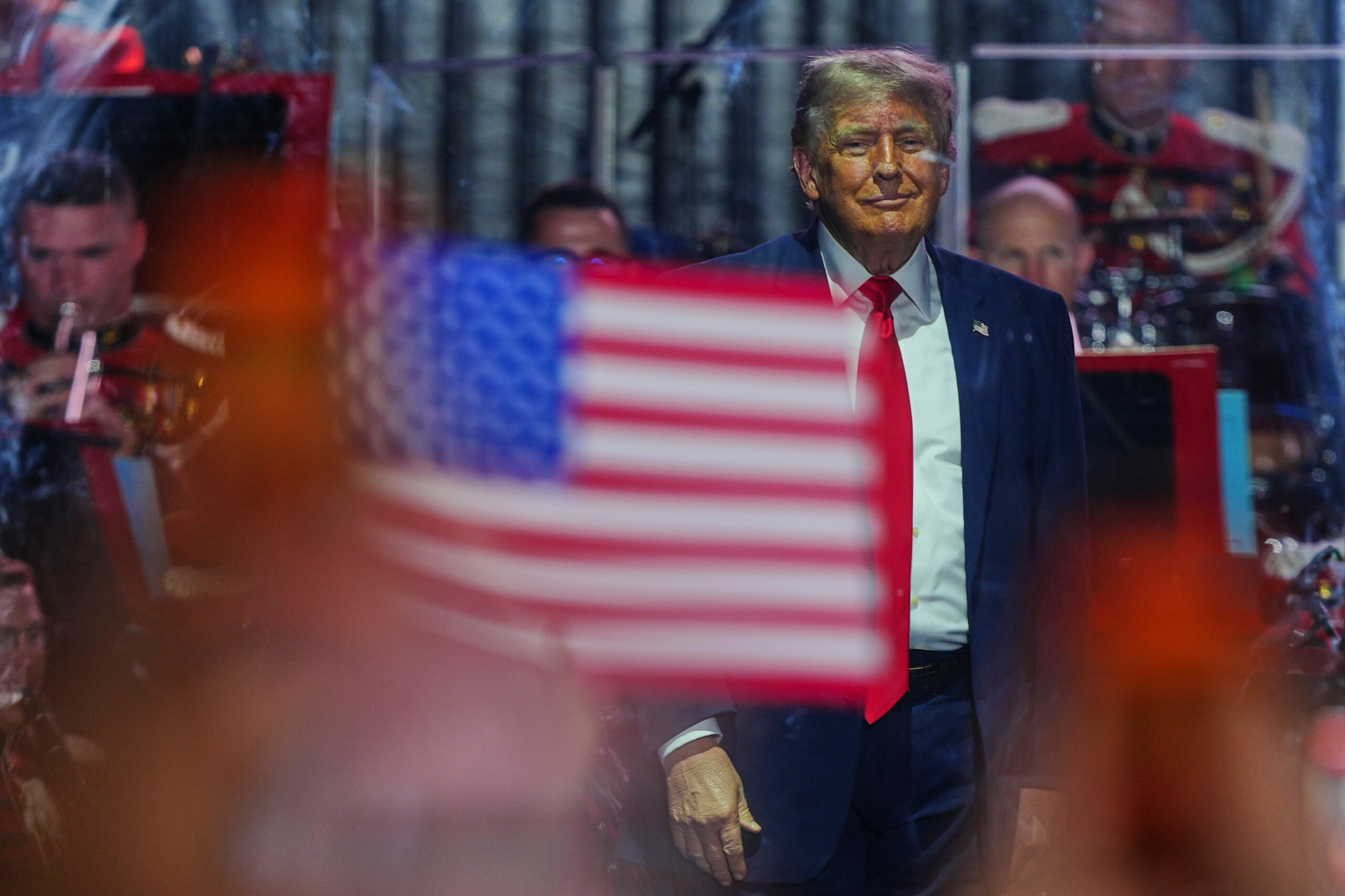
President Donald Trump stands on stage after speaking at the opening of the Great American State Fair on the National Mall, Wednesday, June 24, 2026, in Washington. (AP Photo/Julia Demaree Nikhinson)
During the fair’s opening days, nearly every other state was represented, with most sending government staff or tourism officials to host educational or interactive exhibits.
New Jersey also officially declined to participate, but Cape May County, a Republican stronghold, stepped in to represent the state. Its exhibit features an 8-ton sand sculpture created by a Wildwood artist over the course of more than four days.
Delaware highlighted Founding Father Caesar Rodney’s ride to cast the decisive vote for independence in Philadelphia.
Sam Janesch and Andrea Padilla contributed to this article.
Philadelphia homicide detectives are investigating two fatal shootings that occurred days apart near Hunting Park Recreation Center, where both victims were found with gunshot wounds near the park’s recreational facilities.
The victims — both adult males who have yet to be publicly identified — were discovered less than a week apart in separate areas of the recreation center, raising questions about whether the killings could be connected.
Police have not said whether they believe the shootings are related.
On June 26, just before 11 p.m., patrol officers discovered a man believed to be between 25 and 30 suffering from a gunshot wound to the back near the outdoor basketball courts. He was taken to Temple University Hospital, where he died a short time later. Police discovered a .40-caliber fired cartridge casing nearby.
The killing came six days after police discovered a man shot to death near the center’s baseball field. It was shortly after 10 p.m. on June 20, when police responding to a call for a shooting, found the 45-year-old victim suffering from gunshot wounds while seated on bleachers near the field. The victim, who had been shot in the torso, was pronounced dead at the scene. Investigators discovered two 9mm fired cartridge casings during that investigation.
Police have not released any motives or announced any suspects in the killings. Investigators have been searching the surrounding area for video surveillance footage, police said.
According to the Philadelphia Police Department, 80 people have been killed in the city so far in 2026, a nearly 30% decrease from the same period last year.
Anyone with information about either shooting is encouraged to contact the Philadelphia Police Department’s Homicide Unit at 215-686-3334 or submit an anonymous tip by calling or texting 215-686-TIPS (8477).