Category: News

Latest breaking news and updates

  • A woman missing since 2016 had close ties to the Olney house that’s now the target of a massive investigation

    A woman missing since 2016 had close ties to the Olney house that’s now the target of a massive investigation

    Amy McHale and Raymond “R.C.” Horsch met on the streets when she was battling pneumonia and needed medical care.

    She had long struggled with mental health issues and drug and alcohol addiction. She saw Horsch, an erotic photographer and filmmaker 30 years her senior, as her rock, said her mother, Gloria McHale.

    “He was like her savior.”

    They held their wedding reception beside a greenhouse in the sprawling, serene backyard of his Chalfont home in September 2004. The marriage lasted only a few years, but Amy McHale kept going back to Horsch after he moved to a house on West Chew Avenue in the Olney section of Philadelphia with his son, Eugene Albert Horsch.

    She was staying there on June 14, 2016, when she left a voicemail message for her daughter, Amanda Stofer, saying all was OK. At the time, Amy McHale was a 44-year-old mom and grandmother of three.

    She has been missing ever since.

    “She would never leave her daughter and grandchildren,” Gloria McHale, 79, said by phone after news broke this week that authorities had been combing through that house for days. “She loved them, adored them.”

    For more than a week, Philadelphia police and federal authorities have been searching the crumbling Horsch twin home to determine if there is any connection to the disappearance of Amy McHale and one other woman.

    R.C. Horsch was a controversial figure who had been convicted of forgery and drug manufacturing when he died in May 2025 of chronic obstructive pulmonary disease at age 82. Police have not named him as a person of interest in a missing-person investigation.

    His son, Eugene Albert Horsch, is being held on $500,000 bail at Curran-Fromhold Correctional Facility on charges of illegal gun possession and drug crimes. He had a criminal history that included at least 10 other arrests for drug possession, dealing, assault, and drunken driving when he was arrested earlier this month near Independence Hall after his actions drew the attention of U.S. Park Police.

    “This is much ado about nothing,” said Eugene Horsch’s attorney, Jerome Brown, of his client’s connection to any missing-person investigation. “They’re barking up the wrong tree.”

    When the news broke, McHale’s mother and daughter thought they might finally discover what happened.

    “But I don’t feel much closure, and today is an emotional low,” McHale’s daughter, Amanda Stofer, said Saturday. “I was hoping for some answers about my mother from the home, but I’m doubtful that will happen.

    “It just feels heavy and sad.”

    The case came to light under bizarre circumstances. U.S. Park Police stopped Horsch, 44, near Sixth and Market streets on June 19. In his black BMW, officers recovered two firearms with obliterated serial numbers and a phony drug enforcement badge with Horsch’s photograph under the name “Eugene Frederick Steiner.” He also had large amounts of cocaine, fentanyl, and marijuana, according to an affidavit of probable cause for his arrest.

    A woman with Horsch gave officers a false name, one that belonged to a 38-year-old woman who had been reported missing in Kensington in February 2023. Horsch’s passenger told investigators that he had made her fake ID cards with that name before and advised that if she was ever stopped by police, she could use them.
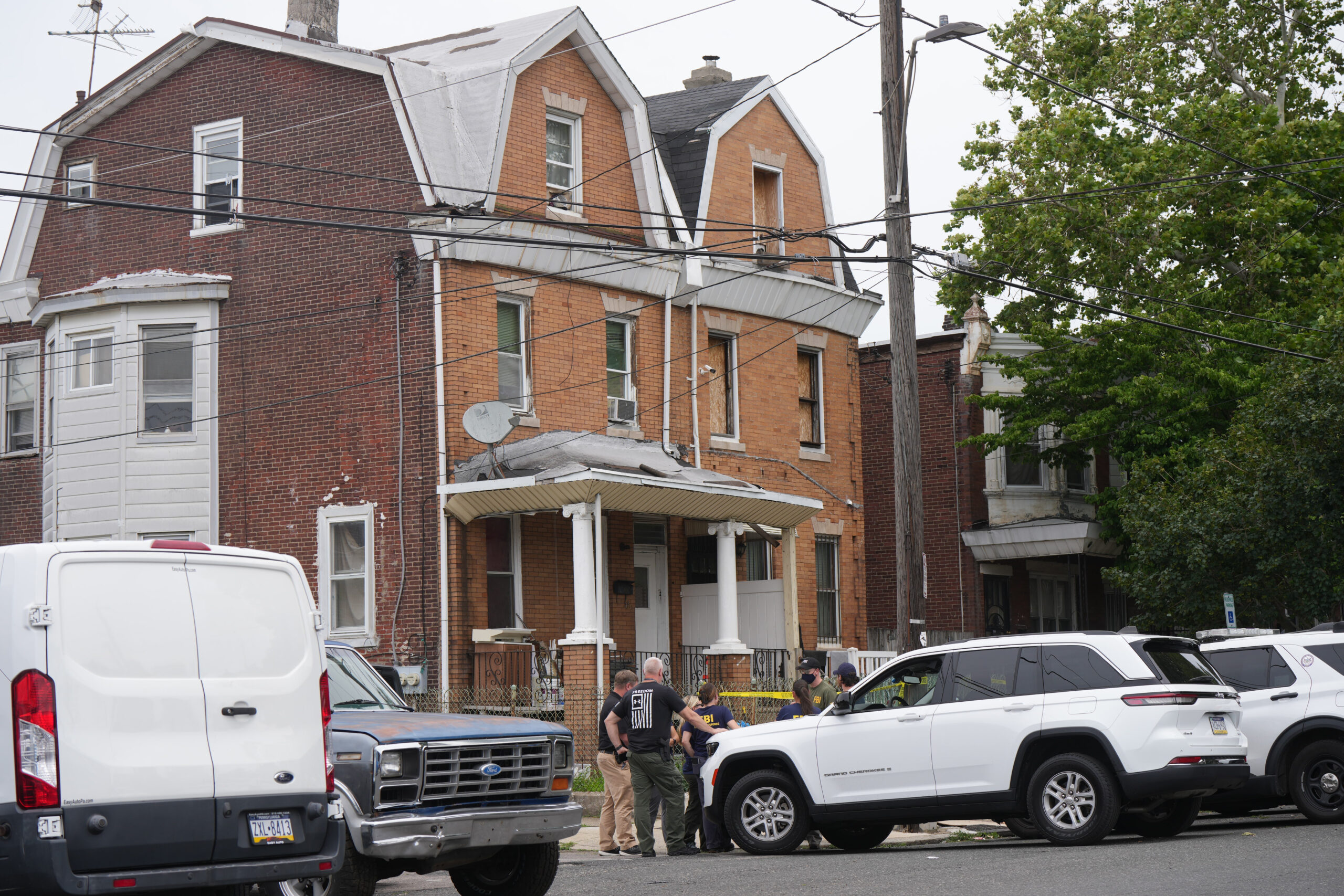
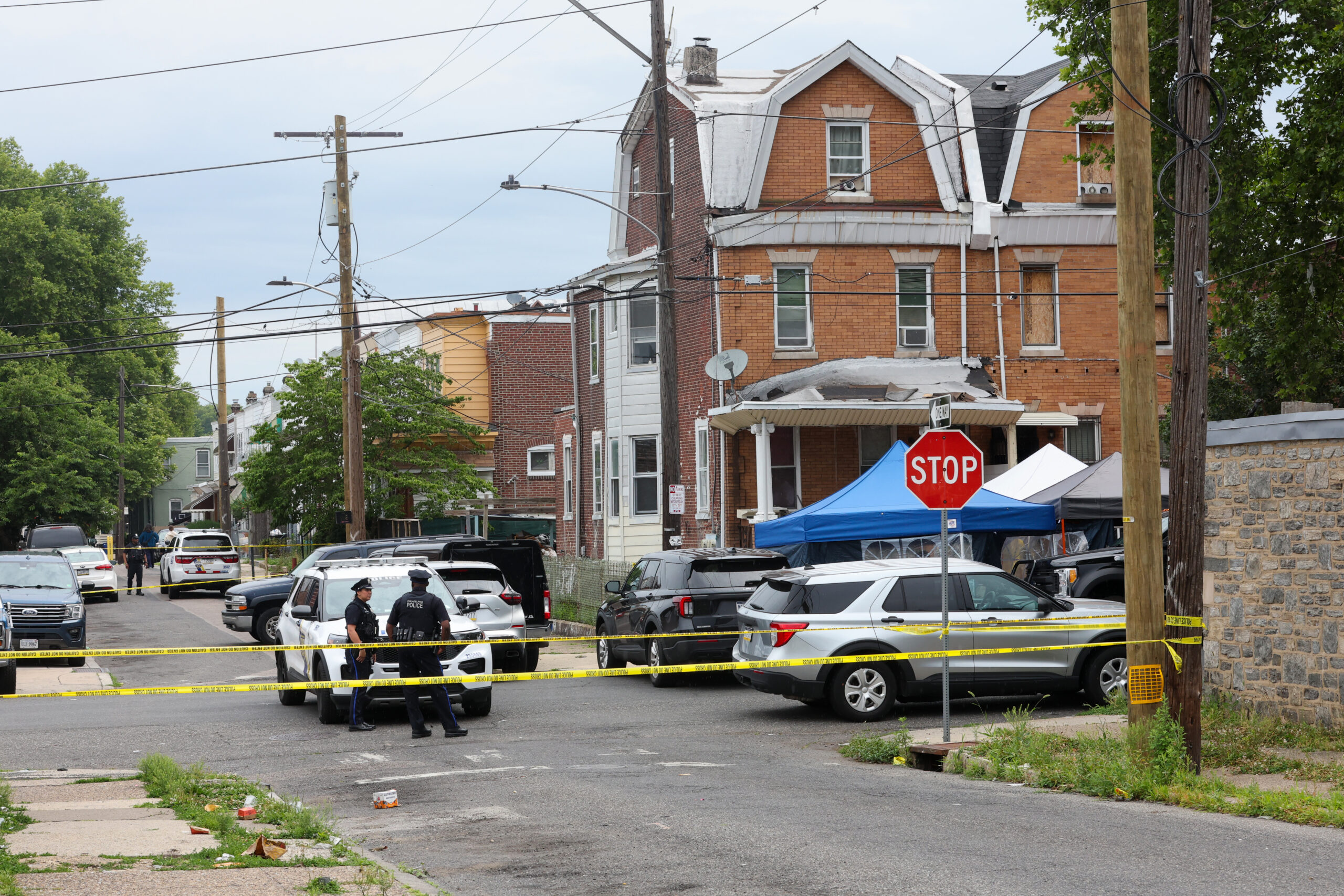
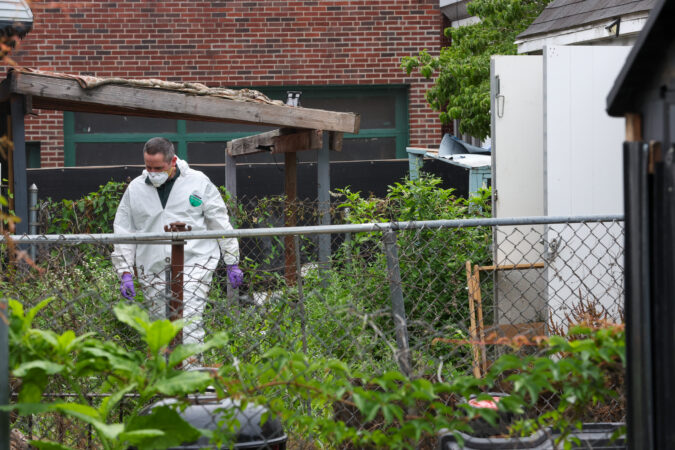
    Law enforcement wearing FBI clothing at the scene of an ongoing investigation in the 400 block of West Chew Avenue, searching a home in Olney.

    In Horsch’s dilapidated home, investigators found another handgun, hidden compartments, a 55-gallon drum with connections to water lines leading to a hole in the ground, and chemicals and bottles of liquid that forensics investigators are working to identify. There were also what appeared to be urns holding remains, one set of which was apparently his father’s. The basement resembled some sort of chemical lab.

    Federal investigators also found a unsigned and handwritten letter that referenced hurting unspecified people and the serial killer Ted Bundy, according to an affidavit of probable cause obtained by The Inquirer.

    Investigators are working to verify the authenticity of the letter, and whether it was meant to serve as a portion of a novel or screenplay.

    Under a gloomy sky Saturday, about 15 FBI agents, some wearing hazmat suits, streamed in and out of the boarded-up twin home. “They’ve begun processing the scene,” Philadelphia Deputy Police Commissioner Frank Vanore said. Forensic experts were determining what evidence had to be sent away for scientific analysis, he said. “It’s going to take some time.”

    Art and weed

    R.C. Horsch, who was born in East Stroudsburg, Monroe County, in 1943, is described in an author’s biography as “an artist, filmmaker, composer, writer, porn performer, drug smuggler, sometime political activist, art forger, counterfeiter, pot grower, air show pilot, army deserter, fugitive, sociopath, ex-convict and all-out villain.”

    Throughout his life, R.C. Horsch worked on avant-garde artwork and erotica, often focused on scantily clad women in sadomasochistic settings, including a book described as an “autobiographical memoir of a caring, empathetic serial killer.” He directed his first film, The Erotic Memoirs of a Male Chauvinist Pig, in 1973.

    A 1968 news report identified Horsch, then in his mid-20s, as the operator of a theater on the 2000 block of Sansom Street known as “Underground Cinema 16” — later the Roxy — which screened avant-garde films, including his own, but was shut down for operating without a license.

    Horsch was married at least three times. He married Anna Ferkuniak, a native of Nant-y-moel, Wales, who was Eugene Horsch’s mother. She died in 1989 at age 39 after a lengthy illness, according to her obituary.

    R.C. Horsch also had an extensive criminal history.

    He pleaded guilty to passing bad checks in North Carolina in 1973, and the following year the Secret Service charged him and another man in Doylestown with passing nearly $180,000 in fake 10-dollar bills and possessing phony driver’s licenses.

    In 1977, federal authorities raided what was described as his home laboratory, seizing equipment they alleged was meant to make methamphetamine. But Horsch left for New Zealand, later returning to California, according to court records, and operating under the alias “Richard Harris.”

    Eugene Horsch was born in 1981, while his father was still a fugitive.

    Authorities captured R.C. Horsch in Florida in 1985. A psychologist hired by his defense attorney claimed Horsch had a 140 IQ, according to court records, but had “deep rooted emotional problems.”

    He was sentenced to three years’ imprisonment, plus probation. He later settled in Chalfont but acquired the Chew Avenue house after his aunt died in 2004. In 2007, he used power of attorney to legally transfer ownership to his son for $1.

    In 2009, R.C. Horsch was indicted in Chalfont for growing “455 marijuana plants.” Investigators also confiscated two shotguns. The feds seized his suburban home and he was sentenced to 54 months in prison.

    Federal inmate records show he was released from prison in 2013, and later moved into the Chew Avenue property, where he would reside until his death. He authored several erotic novels in the 2010s, often focused on women battling substance abuse or mental health issues.

    Krista Marie Killen is credited as appearing in multiple erotic films that he directed, including one released as recently as 2021, and at times listed the Chew Avenue house as her residence.

    In 2025, a motorist sued R.C. Horsch, Killen, and an unidentified man, claiming the trio crashed their Chrysler 300 into her SUV near Adams Avenue and Montour Street in 2023. Court papers list Killen’s occupation as “caregiver” and the “adult in charge of residence.”

    She died the next month, according to an obituary, three months after Horsch.

    In searching the home recently, investigators found a death certificate for Killen. According to the affidavit of probable cause, the cause of death was drug intoxication.

    ‘People don’t vanish’

    R.C. Horsch and Amy McHale had become a couple in the 1990s.

    “I was a young kid when they started dating, and I want to say he had been around for at least 10 years by the time they got married,” Stofer recalled.

    They divorced after a few years and McHale moved in with her mother on South Hutchinson Street in Philadelphia. She went to Peirce College, became a paralegal, and was trying to get her life back on track, said Gloria McHale, 79.

    But she could not kick her drug and alcohol addiction, she said. She would periodically return to Horsch’s home on Chew Avenue.

    “They stayed friendly with each other,” Stofer said. “I’m sure it had something to do with the drugs and alcohol. I think he enabled her with things that weren’t really permitted in my grandmother’s house.”

    On June 13, 2016, she went to Horsch’s. She called her mom that night to tell her she was on her way home. “She was obviously very drunk and I told her to stay where she was, because to get home she would have to take the subway, and she was in no shape to take the subway.”

    The next day, she called Stofer and left a message. “She told me she was at Ray’s house and she was OK.”

    That’s the last they heard from her.

    Amy McHale would sometimes be gone for a couple of days, but never for much longer, they said. Stofer had three children, and her mother doted on them. Stofer was planning her September wedding.

    “My mom had her struggles with addiction,” said Stofer, 38. “But my mom would not want to disappear in my life. She would never do that. She always came back around. She never missed big things like my kid’s kindergarten graduation.”

    Gloria McHale searched all over for her daughter. “I put signs up all over Kensington,” she said.

    Detectives interviewed Horsch. He told police and the McHale family that she was drinking vodka and he went to bed. “He said when he woke up, she was gone,” McHale said.

    And Horsch stopped reaching out to her family.

    “When she would disappear before, Raymond would always keep calling me. ‘Did you hear from her?’ And after this I never heard from him.”

    McHale is hoping someone will come forward now with new information.

    “Somebody has to know something,” she said.

    “People don’t vanish into thin air.”
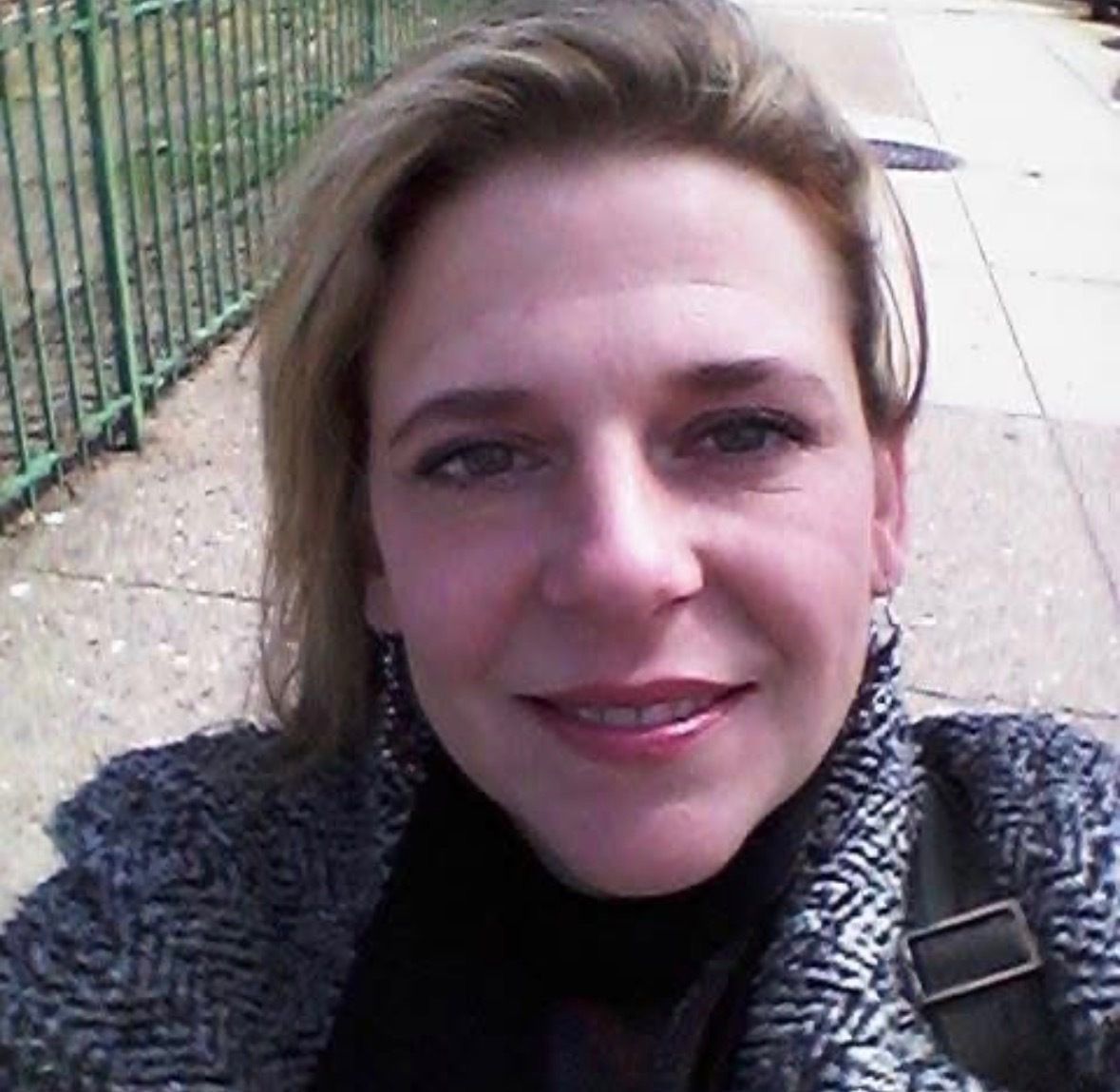
    Amy McHale.

    Staff writers Brett Sholtis, Michelle Myers, and Isabel Maney contributed to this article.
  • What we know about the Olney investigation into missing women

    What we know about the Olney investigation into missing women

    A law enforcement search continued Saturday at a dilapidated three-story brick twin in Olney, where police are investigating the homeowner’s connection with at least two missing women.

    The house belongs to Eugene Albert Horsch, 44, who was arrested June 19 and charged with illegal gun possession and drug-related crimes.

    Horsch’s initial arrest sparked questions: Why did he have a fake ID showing himself to be a DEA agent? Why did a woman with Horsch identify herself as someone else who was reported missing in 2023?

    More questions unspooled as city police investigators and federal agents looked inside Horsch’s house, where they found hidden compartments, a 55-gallon drum, chemicals, unknown liquids, a woman’s death certificate, and a handwritten letter that seemed to describe hurting people.

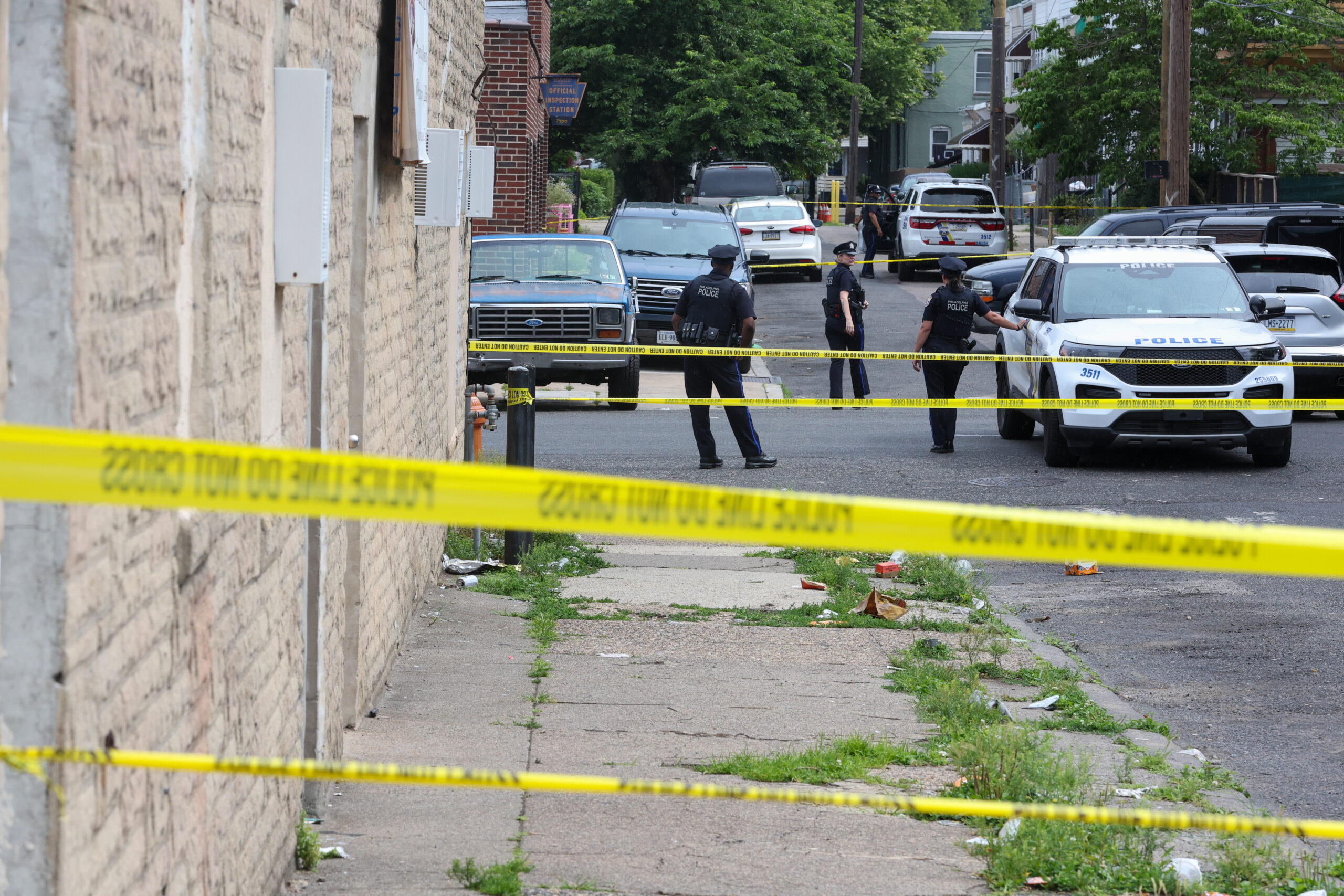
    On Saturday, Philadelphia police closed off the block and FBI forensic experts entered the property in hazmat suits.

    In addition to these questions, there’s an older mystery — the June 2016 disappearance of Amy McHale.

    Here’s what we know so far.

    What prompted the investigation?

    The morning of Friday, June 19, a U.S. park ranger near Independence Hall in Old City heard “a disturbance” coming from a black BMW, Philadelphia Police Department Deputy Commissioner Frank Vanore said Friday.

    The ranger heard a woman say she was concerned that Horsch was going to hurt her, Vanore said.

    The woman gave the ranger an identification card bearing her photo but the name of another woman who had been reported missing, Vanore said.

    “And the park ranger felt that there was illegal drug activity going on inside the vehicle,” Vanore said.

    Other law enforcement officers in the area were called to the scene, he said. In the car, police found cocaine, fentanyl, marijuana, two firearms with serial numbers removed, a collapsible baton, a cattle prod, and switchblade knives, sources told The Inquirer Friday.

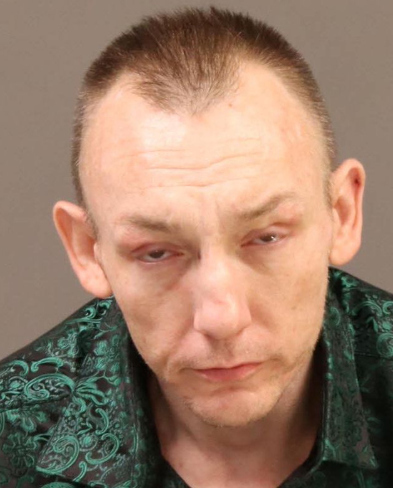
    Eugene Albert Horsch, 44, of Philadelphia.

    Why did Horsch have fake DEA credentials?

    Law enforcement also found a fake U.S. Drug Enforcement Agency badge with Horsch’s photograph under the name “Eugene Frederick Steiner” in the car, sources told The Inquirer.

    Police haven’t spoken publicly about why they believe Horsch had the fake ID. However, they soon brought real DEA agents to the scene, Vanore noted.

    Soon, those agents were among those searching his Olney home.

    What did police find inside the Chew Avenue house?

    Police searched Horsch’s home on the 400 block of West Chew Avenue, where they found a 9mm firearm, ammunition, and a marijuana grow operation on one of the floors, Vanore said.

    “The further search of this property produced some other things that we have a lot of questions about,” Vanore said.

    Police brought in homicide investigators — who are now leading the investigation with FBI assistance — due to their experience and because several urns, possibly from deceased family members, were found, Vanore said.

    Investigators found at least one more fake ID presenting someone as federal law enforcement, Vanore said, as well as “computer evidence” that the DEA took for analysis.

    They also found bank cards in the name of the woman who went missing in 2023, and recovered what appeared to be a death certificate for another woman who died last year, The Inquirer reported Friday.

    Police have officially blocked off access to the street at 417 W Chew, in Olney home in Philadelphia, June 27, 2026. Residents in the area are unable to access the street since Saturday morning.

    Why is the FBI involved?

    Investigators also found hidden compartments, “hoses coming from barrels,” and bottles containing chemicals and unknown liquids, Vanore said.

    Some of the chemicals, if combined and ignited, could pose hazards, he said. The chemicals are what led investigators to ask for help from FBI experts, Vanore said.

    “There’s chemical work being done, but we just don’t know if he was trying to produce narcotics, or some other work,” Vanore said.

    What is the handwritten letter investigators found?

    Federal investigators also found an unsigned handwritten letter that described references to hurting unspecified people, and references to the serial killer Ted Bundy, The Inquirer reported Friday.

    “Acting on emotion is where problems occur. What I don’t think I told you was that the first time it was planned ahead of time. The threat was made before you know who came over and I already had a 2ft zip tie in my pocket and a drum set up,” the letter said.

    “I had been ready and waiting and I damn sure showed no hesitation. And it was fun,” the letter said, according to an affidavit of probable cause for a search of the home obtained by The Inquirer.

    Law enforcement sources said investigators were working to learn who wrote the letter and whether it may be part of a work of fiction.

    Have police found bodies at the house?

    Rumors spread quickly online Friday, with one of the most widespread ones being that human bodies or remains had been found at the house.

    Speaking to reporters, Vanore dismissed these rumors.

    “There’s no apparent bodies inside the house,” Vanore said. “Now, we’re going to further search. There’s a sump pump that looks like a hole in the ground, but there’s no bodies.”

    Who are the missing women?

    Police have not released the names of any missing women connected to Horsch.

    The woman whose name was on the fake ID went missing in February 2023 from the Kensington area, sources told The Inquirer Friday. The woman who was with Horsch when he was arrested told police she used the fake ID because she had outstanding arrest warrants. She didn’t know the missing woman, but feared that something bad happened to her.

    Vanore said he didn’t know if the missing woman had known Horsch.

    “I have nothing to say she was ever inside the house, but of course, that’s why we’re still holding it and we’re still going to look,” Vanore said.

    Vanore noted that Horsch had enough information about the missing woman to create a convincing fake ID.

    Another woman who disappeared was Amy McHale, of South Philadelphia, who went missing in June 2016. McHale was the ex-wife of Horsch’s father, R.C. Horsch. Police questioned R.C. Horsch about the disappearance at the time.

    Who is Eugene Albert Horsch?

    Horsch has a long criminal record including a May 2025 arrest for possession of marijuana and amphetamines, which got him three years’ probation.

    In March, he was charged with aggravated assault after police said he stabbed a man in the stomach at Eighth and Market Streets. Prosecutors withdrew the charges in May after a witness failed to appear in court, court records show.

    Horsch had at least 10 previous arrests for drug possession, dealing, assaults, and drunken driving. He was sentenced to four to eight years in prison after police discovered $1.9 million worth of cannabis inside the Chew Avenue home in 2013, court records show.

    Horsch appeared to be living at his house on Chew Avenue, despite its boarded-up windows and rundown look. Vanore said Friday that the woman who had the fake ID also was believed to have been staying there.

    What do we know about R.C. Horsch, Eugene Horsch’s father?

    R.C. Horsch, born Raymond C. Hoersch, was an erotic photographer and filmmaker who was convicted of forgery and drug manufacturing. R.C. Horsch changed the spelling of his last name.

    R.C. Horsch pleaded guilty to passing bad checks in South Carolina in 1973 and the following year was charged in Doylestown by the Secret Service with passing nearly $180,000 in fake 10-dollar bills and possessing phony drivers’ licenses.

    In 1977, federal agents raided what was described as R.C. Horsch’s home laboratory, seizing equipment they alleged was meant to manufacture and distribute methamphetamine. But R.C. Horsch absconded to New Zealand, later returning to California, and operating under the alias “Richard Harris.”

    Eugene Horsch was born in 1981, while his father was still a fugitive.

    R.C. Horsch was captured by authorities in Florida 1985. A psychologist hired by his defense attorney said he had an 140 IQ but had “deep rooted emotional problems.”

    He was sentenced to three years imprisonment, plus probation, and settled into a home in Chalfont, Bucks County.

    What was R.C. Horsch’s connection to the Chew Avenue house?

    R.C. Horsch acquired the Chew Avenue house after the death of his sister, Helen M. Hoersch, in 2004. In 2007, R.C. Horsch used power of attorney to legally transfer ownership of the property to his son for $1.

    In 2009, R.C Horsch was indicted in Chalfont for growing 455 marijuana plants. Investigators also seized two shotguns. The feds seized his suburban home and he was sentenced to 54 months in prison.

    Federal inmate records show he was released from prison in 2013.

    Are investigators examining R.C. Horsch’s role?

    R.C. Horsch died in 2025, and Vanore told reporters Friday that investigators were looking at a lot of different angles. Vanore declined to go into specifics about R.C. Horsch, and said he wasn’t going to name “other missing people” potentially connected to the house.

    “We’re certainly looking into the activities that went on at the house, even before he was there,” he said, referring to Eugene Horsch.

    Police have officially blocked off access to the street at 417 W Chew, in Olney home in Philadelphia, June 27, 2026. Residents in the area are unable to access the street since Saturday morning.

    What’s the latest from the investigation?

    Under a gloomy sky Saturday, about 15 FBI agents went in and out of the boarded-up home, some wearing protective suits.

    Next to the tent installed Friday outside Horsch’s home were four portable fabric shelters, with all sides shielded from public view.

    Neighbors walked around the sealed perimeter asking for information, while men in protective suits came and went from Horsch’s backyard shed.

    “They’ve begun processing the scene,” Vanore said Saturday. Forensic experts now are determining what evidence had to be sent away for scientific analysis, he said. “It’s going to take some time.”

    Inquirer staff writers Max Marin, Ellie Rushing, Barbara Laker, Michelle Myers, Chris Palmer, and Isabel Maney contributed to this article. For more details, read this story.
  • Desperation mounts in Venezuela as earthquake death toll rises to 1,430

    Desperation mounts in Venezuela as earthquake death toll rises to 1,430

    LA GUAIRA, Venezuela — Tensions flared Saturday as desperation grew among anguished residents of the Venezuelan state of La Guaira, where rescuers and civilians searched for earthquake survivors amid a sharply rising death toll.

    Venezuela’s government said the number of people killed rose to 1,430 Saturday morning and families reported at least 68,900 people missing, three days after the one-two punch of 7.2 and 7.5 magnitude earthquakes that devastated the South American nation.

    Venezuelans looking for loved ones and neighbors used shovels, heavy equipment, ropes, and bare hands atop mounds of toppled concrete throughout La Guaira, one of the country’s hardest-hit states.

    Most of those digging were civilians who took search efforts into their own hands, and tensions peaked over inadequate response from the Venezuelan government, whose soldiers, firefighters, police, and military cadets were evidently underprepared to respond to the tragedy.

    Frustration was only amplified by state efforts to project the image of a robust state response.

    “There’s a pile of bodies over there from last night. Newborn babies. Look what time it is, and they still haven’t come to recover them. At 8 p.m. there were people alive down there, and they haven’t bothered to rescue them. We’ve located several bodies, and they haven’t helped us recover them either,” said Mileidy Romero, who was among those searching the rubble in the seaside town of Caraballeada. “What are they waiting for?”

    Aid agencies consider the first 48 to 72 hours as crucial for retrieving people alive, though that can be extended if they have access to food and water.

    However, a growing number of international rescue teams were joining the effort to save lives nearly 72 hours after the quake.

    Acting President Delcy Rodríguez said on state television Saturday that more than 14,000 members of the military and police are patrolling the area, where access is now blocked and special permits are required to enter. More rescue teams sent by governments across the world arrived in Venezuela on Saturday.

    Simón Bolívar International Airport, which serves Venezuela’s capital, Caracas, was badly damaged in the quake. One runway was operational on Saturday as U.S. teams worked to repair the crucial throughway, Jeremy Lewin, a senior State Department official in charge of foreign assistance, told reporters.

    Government forces distributed food and water to survivors in La Guaira, and Rodríguez said her government was mounting a full response during these “critical hours for rescuing people alive.”

    The disaster poses a huge challenge for Rodríguez, the former vice president who took office in January after the capture and removal of then-President Nicolás Maduro by the United States. Venezuela has been facing economic disarray for more than a decade, and many people reject the legitimacy of the political movement Rodríguez represents.

    Search teams and foreign aid from Mexico, the U.S., Brazil, El Salvador, France, El Salvador, and more continued to arrive in Venezuela Saturday morning to bolster recovery efforts.

    Lewin, the State Department official, said the U.S. military would help coordinate flights to bring in search and rescue workers, mobile hospitals, and supplies. He said two 80-person search teams were at work and a U.S. Navy transport ship was docked off the coast of Venezuela ready to receive airlifted survivors in need of medical attention. Lewin said it is a “race against the clock” to find people injured in the quakes.

    “People are trapped under rubble, and the priority is to get the search and rescue teams and the medical professionals and others to them as quickly as possible to save lives,” he said.

    The International Organization for Migration said up to 6.76 million people could be affected, some 2 million of them in Caracas alone. The destruction was amplified by the quick succession of shallow quakes, experts said.

    Loyce Pace, the International Red Cross’ regional director for the Americas, said “people are still terrified to reenter what were their homes.”

    Indeed, many continued to sleep on the street.

    In the city of Maiquetia, people lined up outside stores and pharmacies that served them one by one behind closed doors. At one point a woman in a crowd threw herself to the ground to protect a package of diapers with her body, desperate to keep it.

    Traffic and throngs of motorcyclists at times disrupted search efforts. Mexican soldiers and volunteers repeatedly asked for silence to try to hear signs of life under the rubble, but bikers — civilian and uniformed — continued to honk horns and rev engines, to the first responders’ frustration.

    Yuleidy Cadenas, 28, stood across the street from a collapsed public housing building, hoping her son, mother, and brother would be pulled out alive.

    She fled barefoot from another building as it collapsed Wednesday and found her mother’s 12-floor apartment tower had pancaked.

    “I got on top of the rubble and told them to yell back, and nobody did, not my brother, nor my son, or my mother,” Cadenas said.

  • Trump’s Religious Liberty Commission takes aim at church-state separation

    Trump’s Religious Liberty Commission takes aim at church-state separation

    The Trump administration took aim at the separation of church and state Friday, issuing a draft report from the president’s Religious Liberty Commission that says the separation concept is a legal error and that Americans should view religion as an “essential support” and always remember “the Creator who made us and bestows our rights.”

    The 224-page report recommended the Justice Department issue guidance to promote “an originalist understanding” of how the Constitution sees the relationship between religion and government. The founders had diverse views about the topic, but recent Supreme Court rulings have suggested a more narrow interpretation of what justices considered constraints on religious freedom.

    Friday’s report also said faith-based groups working with the government shouldn’t have to accommodate civil rights laws or anything that conflicts with their religious beliefs; public schools should allow religious displays (it mentioned only the Ten Commandments); and soldiers who refused to be vaccinated and were punished should have their positions restored and be financially compensated. It called for the end to the Johnson Amendment, which bars nonprofits from making political endorsements.

    At an Oval Office news conference announcing the report, commission chairperson Dan Patrick, the Republican lieutenant governor of Texas, said the commission recommends that any official — in government, a school, the military, a hospital, etc. — who alleges a violation of church-state separation must in writing “point out exactly where you have violated the Constitution, because you have not, and from this day forward, that phrase should have no power over people of all faiths ever again in America.”

    While the phrase “church-state” separation is not in the Constitution, the concept of space between government and religion is in the First Amendment, which calls for no government “establishment of religion.” Americans have disagreed over the meaning of establishment since the founding.

    The report was issued at a time when many conservatives are aggressively working to elevate religion — particularly Christianity — into the public square, fueled by Supreme Court decisions saying that such expression is constitutional. Several states have mandated that the Ten Commandments be displayed in public school classrooms, and many are requiring schools to release students for Bible classes during the school day. Last month, the White House hosted a daylong evangelical prayer festival on the Mall for the country’s 250th birthday, featuring commission members and others preaching from the stage.

    On Friday, the Texas education board approved a mandatory reading list for more than 5 million public school students in the state that includes Bible passages.

    President Donald Trump’s Religious Liberty Commission, created last year, is made up of all conservative Christians and one Orthodox Jew, groups who experts say make up a minority of Americans. In February, a coalition of groups representing other religious groups, as well as nonreligious and interfaith Americans, sued the administration over the commission, saying it was put together without the transparency and diversity required of a federal commission.

    The Rev. Paul Raushenbush, one of the plaintiffs in the lawsuit and head of the Interfaith Alliance, had applied unsuccessfully to be a member of the commission.

    The draft report, he wrote in a statement, “reflects the narrow, Christian nationalist worldview of the illegitimate commission. … A betrayal of the original intention of the promise of religious freedom guaranteed in the First Amendment, the report and the commission behind it fail to represent and uplift the importance of religious diversity and tolerance for all faiths in our country — not just a special, chosen few. The report is a wish list of divisive, unpopular ideas far-right religious groups have pushed for years.”

    Raushenbush also noted that while the report expresses concern about anti-Christian bias and antisemitism, it made no similar mention of growing Islamophobia around the country.

    The report is a draft, and comments from the public are open until July 12.

    The lawsuit against the commission had sought to stop the release of any report until the court ruled on whether the commission was illegally constituted. It also asked the court to mandate any commission recommendations include a disclaimer stating that the report was produced by a body that was not fairly balanced.

    Asked about the lack of religious diversity on the commission, a Justice Department spokesperson said the group was a way for Trump to create “opportunities for Americans from all walks of life to share their testimonies, concerns, and recommendations to better support Civil Rights and religious freedom in the United States.”

    “The Department of Justice’s mission is to uphold the rule of law and ensure fair and impartial justice for all Americans, which is an endeavor every American should support regardless of their political or religious beliefs,” the Justice Department statement said.

    People called to testify before the commission included a worker at an Alaska women’s shelter who turned away a homeless man who later sued for gender discrimination, and foster parents in Vermont who said their religion kept them from affirming children who were undergoing gender transitions — even though the state required foster parents to do so.

    Speaking at the White House, commission vice chairperson Ben Carson said Trump was doing more than anyone else in the country for religious liberty.

    “Our founding document says that our rights come from our creator and not from government,” he said. “People who try to divorce us from that heritage? Do they realize that that’s our family document? Do they realize that our family just says we are one nation under God?”

    Trump noted that he won the overwhelming majority of evangelicals in his elections.

    The White House is facing other litigation over its religion-related actions. Americans United for Separation of Church and State, among other advocacy groups, has a total of seven lawsuits.

    Some note that Trump’s Justice Department asked other federal agencies for examples of what it called “anti-Christian bias” and sought access to any complaints received as a result. Others note the proselytizing of some agency heads, including Defense Secretary Pete Hegseth and Agriculture Secretary Brooke Rollins.

  • U.S. says it struck multiple targets in Iran after drone attack on Bahrain, ship struck in strait

    U.S. says it struck multiple targets in Iran after drone attack on Bahrain, ship struck in strait

    DUBAI, United Arab Emirates — The U.S. military said Saturday it had struck multiple targets in Iran at President Donald Trump’s direction, continuing a string of attacks that have shaken the war’s uneasy ceasefire.

    The military said in a post on X that “Iran had a chance to honor the ceasefire agreement” but “elected not to” when its forces attacked a ship near the Strait of Hormuz earlier Saturday.

    Iran state TV reported explosions north of the Strait of Hormuz.

    Iran launched a drone assault targeting Bahrain while a ship in the Strait of Hormuz separately came under attack Saturday, in Tehran’s likely response to overnight airstrikes by the United States.

    The attacks in the Persian Gulf show the danger of the Iran war again spinning out of control, even after Iran and the U.S. reached an interim deal to try to agree on a final accord to end the conflict.

    The U.S. had launched airstrikes overnight in response to an Iranian drone attack on a container ship trying to leave the strait on Thursday, continuing a string of attacks that have shaken the war’s uneasy ceasefire.

    Meanwhile, a multinational maritime body overseen by the U.S. Navy said Saturday that it would expand a route near Oman in the strait to allow for both inbound and outbound traffic. That likely sets up a new flashpoint with Tehran, which sees the strait as a key source of leverage in ongoing talks with the U.S.

    Bahrain condemns Iran’s drone attack

    Bahrain has been one of the strongest critics of Iran and is home to the U.S. Navy’s 5th Fleet. It just hosted U.S. Secretary of State Marco Rubio for a meeting of the Gulf Cooperation Council’s foreign ministers, which ended with a call for an end to Iran’s attacks and for the strait to be completely open.

    A statement from Bahrain’s Foreign Ministry said a “number of Iranian drones” targeted the country. It called the attack “a flagrant threat to the security of citizens and residents.” There were no immediate reports of damage.

    Iran’s paramilitary Revolutionary Guard earlier on Saturday issued a statement carried by the state-run IRNA news agency saying it had targeted several locations “of the U.S. terrorist army in the region.” It did not name what areas were targeted.

    The U.S. military’s Central Command said the military struck Iranian missile and drone locations and coastal radar sites in the overnight strikes.

    U.S. Vice President JD Vance, who has led the negotiations with Iran, said on social media Friday night that Iran should “pick up the phone” if there are disagreements about the ceasefire agreement, “but violence will be met with violence.”

    The U.S. and Iran are negotiating terms of the deal including issues such as getting ships through the strait that are vital to global supplies of oil and natural gas and addressing the future of Iran’s nuclear program and stockpile of highly enriched uranium.

    Under the interim deal, the two sides have 60 days to work out the details. Ending the fighting in Lebanon between Israel and the Iranian-backed Hezbollah militant group is a key part of the deal.

    Ship comes under attack as strait route expands

    The British military’s United Kingdom Maritime Trade Operations center said that a tanker was attacked Saturday in the strait, with the crew safe and no environmental damage reported. No one immediately claimed the strike, but suspicion fell on Iran.

    Just after that report, the Joint Maritime Information Center, overseen by the U.S. Navy, said the route near Oman’s shore is expanding to allow for inbound and outbound traffic.

    Iran has insisted that ships must obey its orders and warned it will start charging fees for transit through the strait. However, ships have been increasingly trying to leave the Gulf in recent days.

    Ebrahim Azizi, who heads the Iranian parliament’s national security commission, wrote Friday that “the Strait of Hormuz is governed by Iran, so: Respect the rules.”

    The U.S. and Gulf Arab states have rejected Iran’s demands. The strait is considered an international waterway, despite being the territorial waters of Iran and Oman.

    The Joint Maritime Information Center warned that the threat to ships was “substantial,” adding that “mariners are advised of the existence of mines and should expect a naval presence as clearance operations continue.”

    The International Maritime Organization on Friday halted a new effort to evacuate ships and said it won’t resume until there are guarantees that other ships won’t be attacked. It said about 115 ships have been able to move out of the strait in recent days.

  • Inside the Flyers’ 2026 NHL draft party: Fans come together in Atlantic City to share passion — and critique the team’s first-round move

    Inside the Flyers’ 2026 NHL draft party: Fans come together in Atlantic City to share passion — and critique the team’s first-round move

    ATLANTIC CITY — Noel Cronon and Sarah Colon, both native Philadelphians and devoted Flyers fans, had never met in person before the Flyers’ draft party in Atlantic City on Friday night.

    The two first connected through Flyers Nation, a Facebook group with more than 67,000 members where fans discuss the team and post updates. Cronon saw Colon in the group and reached out, and asking if she wanted to go to the draft party together.

    “There aren’t a lot of female Flyers fans, so it’s nice that we found each other,” Cronon said. “There are a lot of women here tonight, though, which is good to see.”

    Several hundred Flyers fans came together as a fan base at the Sound Waves Theatre at Hard Rock Hotel and Casino in Atlantic City to watch the 2026 NHL draft. Orange balloons, streamers, and Flyers memorabilia decorated the venue while fans came decked out in their best Flyers merchandise.

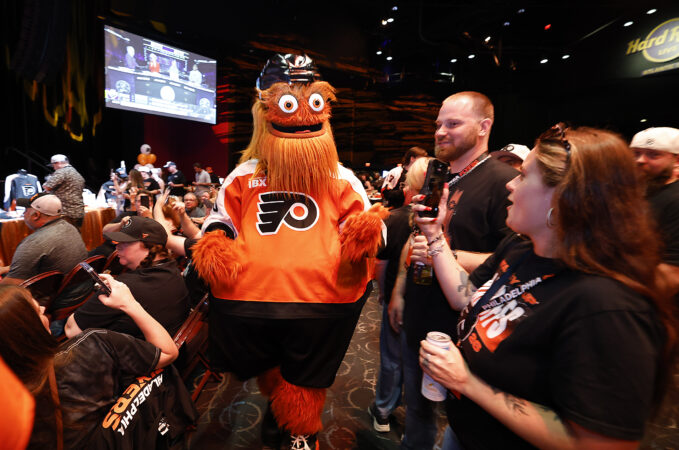
    Flyers fans watch the 2026 NHL draft during a party at the Hard Rock Hotel & Casino in Atlantic City on Friday.

    To kick off the night, past and present broadcasters Jim Jackson, Tim Saunders, and Steve Coates took the stage to share their thoughts on what general manager Danny Brière might do with the team’s first-round pick and energize the crowd.

    “We are back,” Coates said when he addressed the crowd. “Remember, this is a team that is going places.”

    The Austin City Nights band started the party, while the beginning of the draft played from monitors above the stage. Forward Porter Martone joined the band onstage and Gritty, the beloved Flyers mascot, posed for selfies and photos while Jackson went around the audience speaking with fans and taking photos.

    Father and son Grant and Trent Kitchenman have been season ticket holders since 1992 and said that they never miss events like this.

    “It’s really cool that they allow fans in on the draft night experience,” Grant said. “It makes it more personable and you get to see some of the players which is cool.”

    Garett Babik couldn’t have imagined watching the draft anywhere else.

    His dad took him to a playoff game against the Boston Bruins in 2010, and he’s been hooked ever since. During this year’s playoff run, Babik attended games dressed as Darth Vader to show his support for goalie Dan Vladař.

    “I’ve been a fan my entire life,” Babik said. “This is my life. I love this team from the bottom of my heart, and I can’t express that enough.”

    Fans (from left to right): Zack McErlain, Tug McErlain, Thomas McErlain and Stephen Dellaquilla react after the Flyers picked defenseman Maksim Sokolovskii with the 27th overall pick during the Flyers’ 2026 NHL draft party at the Hard Rock Hotel & Casino in Atlantic City on Friday.

    When it came time for the Flyers to make their first-round selection, the band stopped playing, and the theatre became quiet. Fans turned their attention to the monitors and anxiously waited for the announcement.

    When the trade alert came up on the screen and NHL commissioner Gary Bettman announced the trade, the crowd booed.

    Babik was not thrilled with the move either, he said.

    “I’m going to be totally blunt. I didn’t like it,” he said. “[Dallas Stars winger] Jason Robertson has been on the market, and I was hoping they would’ve got him. Don’t get me wrong, I understand we only have four picks in this draft, and they wanted to get more.”

    After they traded the 21st pick to the San Jose Sharks, moving down to No. 27, some fans immediately left, leaving the true diehards to wait until their pick.

    Among them were Eddie Bertino and Scott Parker, childhood friends from South Jersey who grew up playing hockey together and played in under-30 and under-40 leagues.

    Flyers Porter Martone signs his autograph for fans during the Flyers’ 2026 NHL draft party at the Hard Rock Hotel & Casino in Atlantic City on Friday.

    Bertino started playing hockey when he was 5 years old, with Parker’s dad as his coach. Both became lifelong Flyers fans thanks to their fathers, who had season tickets and attended the Flyers’ Stanley Cup victory in 1975.

    When Bertino secured the tickets for the draft party, he knew Parker was the right person to accompany him.

    “He is one of my few diehard Flyers fan friends,” Bertino said. “ I didn’t want to be here with some poseur, I wanted to be here with another diehard.”

    By 10:20 p.m., with the Flyers still waiting to pick and it being a Friday night in Atlantic City, Bertino was surprised so many fans decided to leave, but he wasn’t surprised by Brière’s trade.

    “The past two years he’s made some sort of trade, it’s kind of his thing,” Bertino said.

    Many fans didn’t stay around long enough to see the Flyers pick 6-foot-7 defenseman Maksim Sokolovskii with the 27th overall pick.

    However, a similar sentiment was shared with fans throughout the night — the future of Flyers hockey is bright, and they are proud to be a part of the fan base.

  • Walmart unveils ‘store of the future’ concept in Bucks. We tried it out.

    Walmart unveils ‘store of the future’ concept in Bucks. We tried it out.

    Grocery stores are constantly trying to reinvent the wheel.

    Consumers have been introduced to googly-eyed robots roaming aisles, the expansion of self-checkout, the rollback of self-checkout, and increasingly fast grocery delivery in recent years, as major grocers try to stand out in an industry known for low profit margins.

    Not to be left behind, Walmart has touted a “store of the future” concept for years as it opens and remodels hundreds of locations, including 32 in Pennsylvania this year, to have better layouts and services that aim to make the shopping experience seamless.

    “By modernizing our stores, we’re making shopping faster, easier, and more convenient, all while empowering our teams to serve customers better and creating local opportunity,” said Annie Walker, senior vice president of the East Business Unit at Walmart, in a statement announcing the Pennsylvania investments this year.

    The Walmart Supercenter in Warminster is the latest “store of the future,” unveiling its remodel this month.

    I tried it out to see what the future holds for shoppers. Spoiler alert: It’s nothing out of The Jetsons, but a handful of customers told me they liked the improvements nonetheless.

    “A lot of stuff is different, but it’s easier to find things,” said Cuong Kim, 41, of the new layout, walking out with a bag of toiletries.

    Sparky, where are the fiber gummies?

    Walking in, the store doesn’t feel that different from counterparts in South Jersey or Philadelphia. The polished concrete floors remain the same and there are an Auntie Anne’s and a Subway near the entrance.

    Still, I could see the company followed through on its “elevated assortment of healthy foods” promise. There were meat and cheese snack packs galore, along with a wide range of ready-to-eat salads and sandwiches in the grab-and-go section.

    Because better online/in-store integration is part of the company’s “store of the future” pitch, I brought an admittedly specific grocery list with me to test out Sparky, the company’s generative AI shopping assistant launched last year, another trend major retailers are adopting.

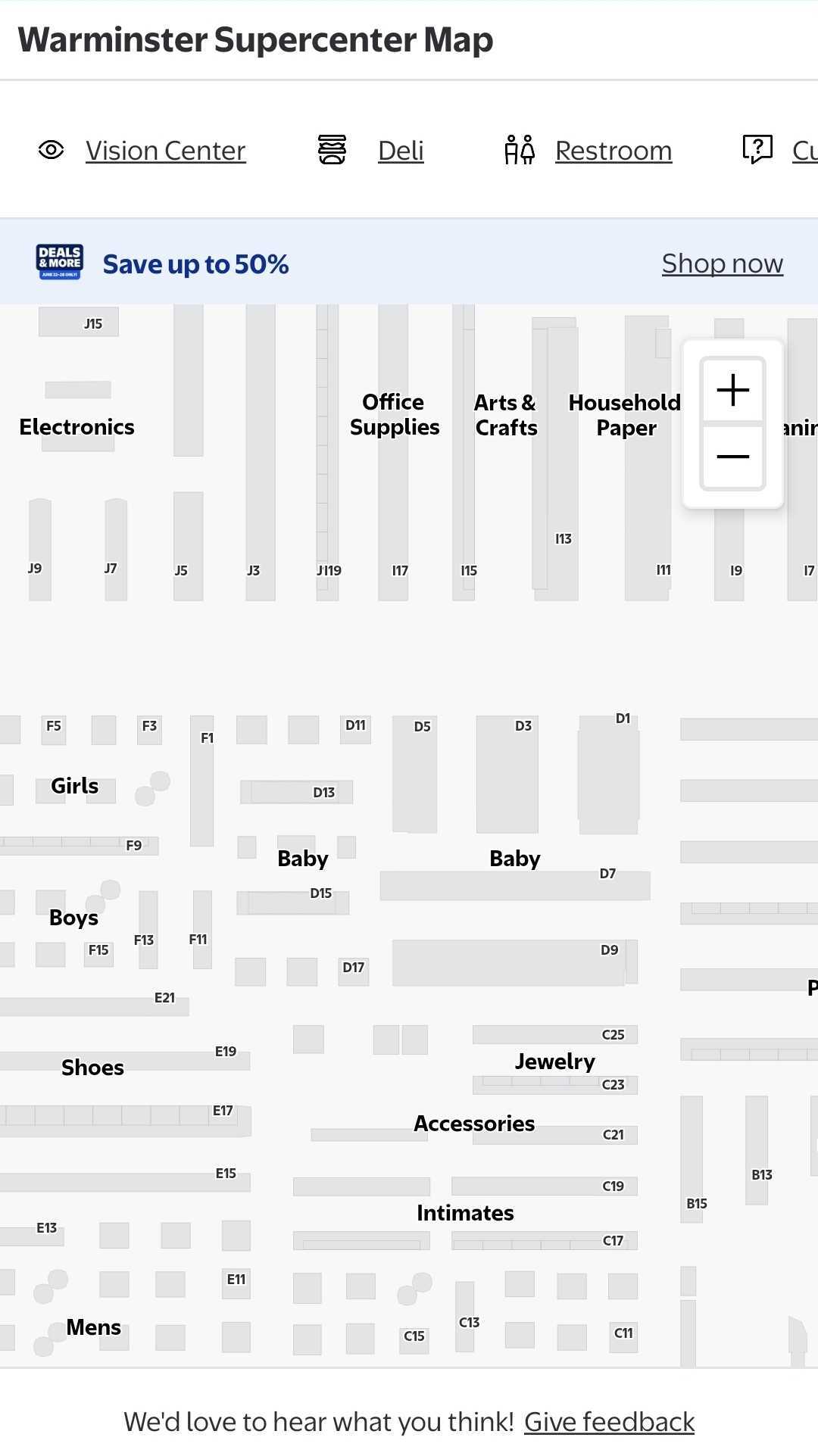
    Though the Walmart app provided a handy static map of the store, Sparky was not helpful in helping me find mango pulp for a cheesecake I’m making or my fiber gummies, which I will need if my rich dessert plans move forward.

    A static map of the Warminster Walmart in the app.

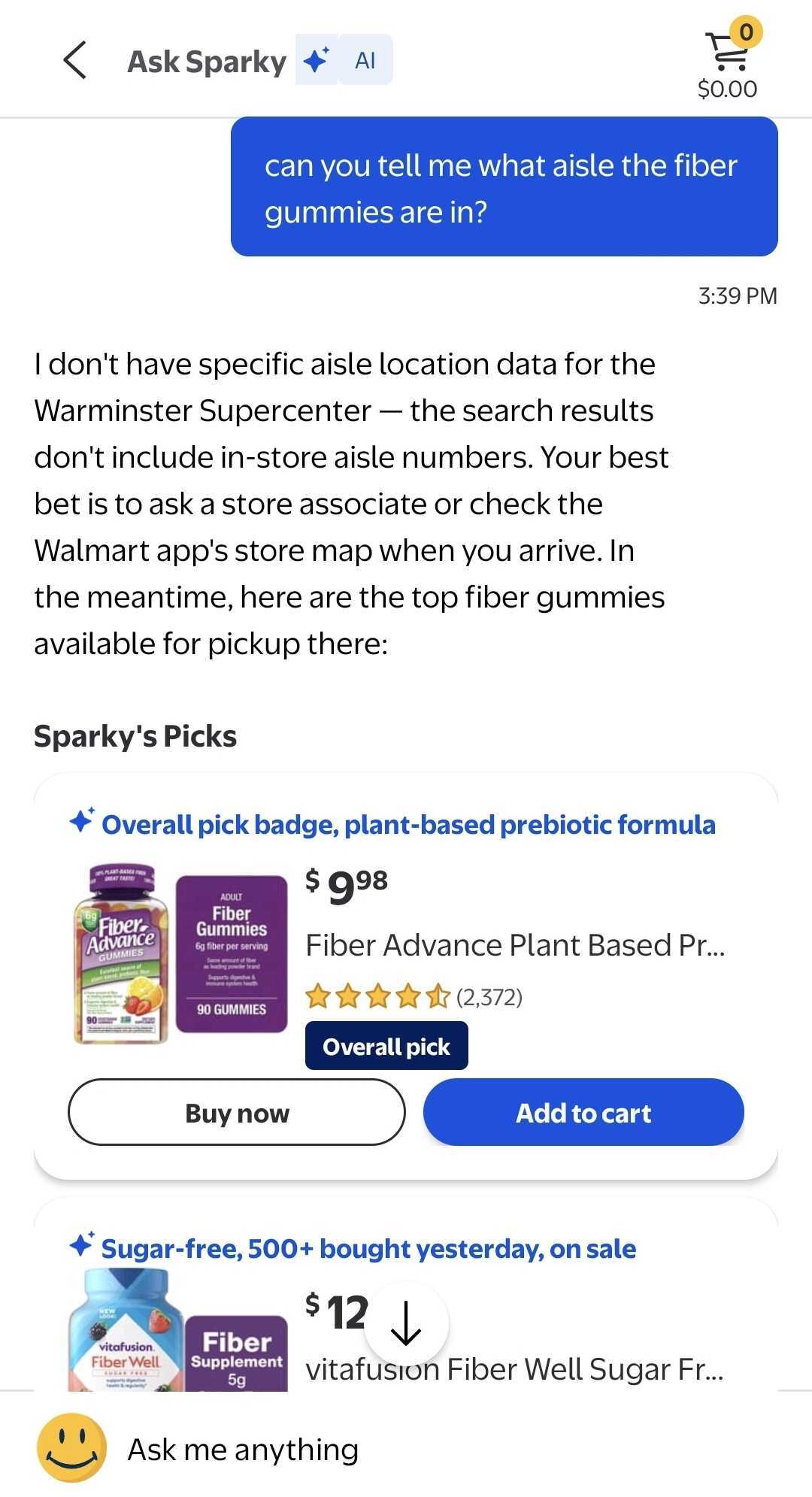
    While Sparky pointed me to several fiber gummy brands, it was less helpful in telling me what aisle they were in.

    “Your best bet is to ask a store associate or check the Walmart app’s store map when you arrive,” Sparky said.

    Sparky, Walmart’s AI shopping assistant, doesn’t know what aisle the fiber gummies are in.

    On the mango pulp front, Sparky showed me several options, which got my hopes up because I’d never used this item and was worried it might be hard to find.

    Alas, none of Sparky’s suggestions were in the store, but could be shipped by the next day — helpful information if I weren’t already on site.

    To be fair, one shopper told me that while Sparky doesn’t have a 100% hit rate, it is not a total dud.

    He was right. Seltzer, another item on the list, was in aisle A22.

    As I walked around the store, I noticed some aisles, like the beverage sections, could fit three shopping carts across. That’s some Costco-level width and another “store of the future” feature.

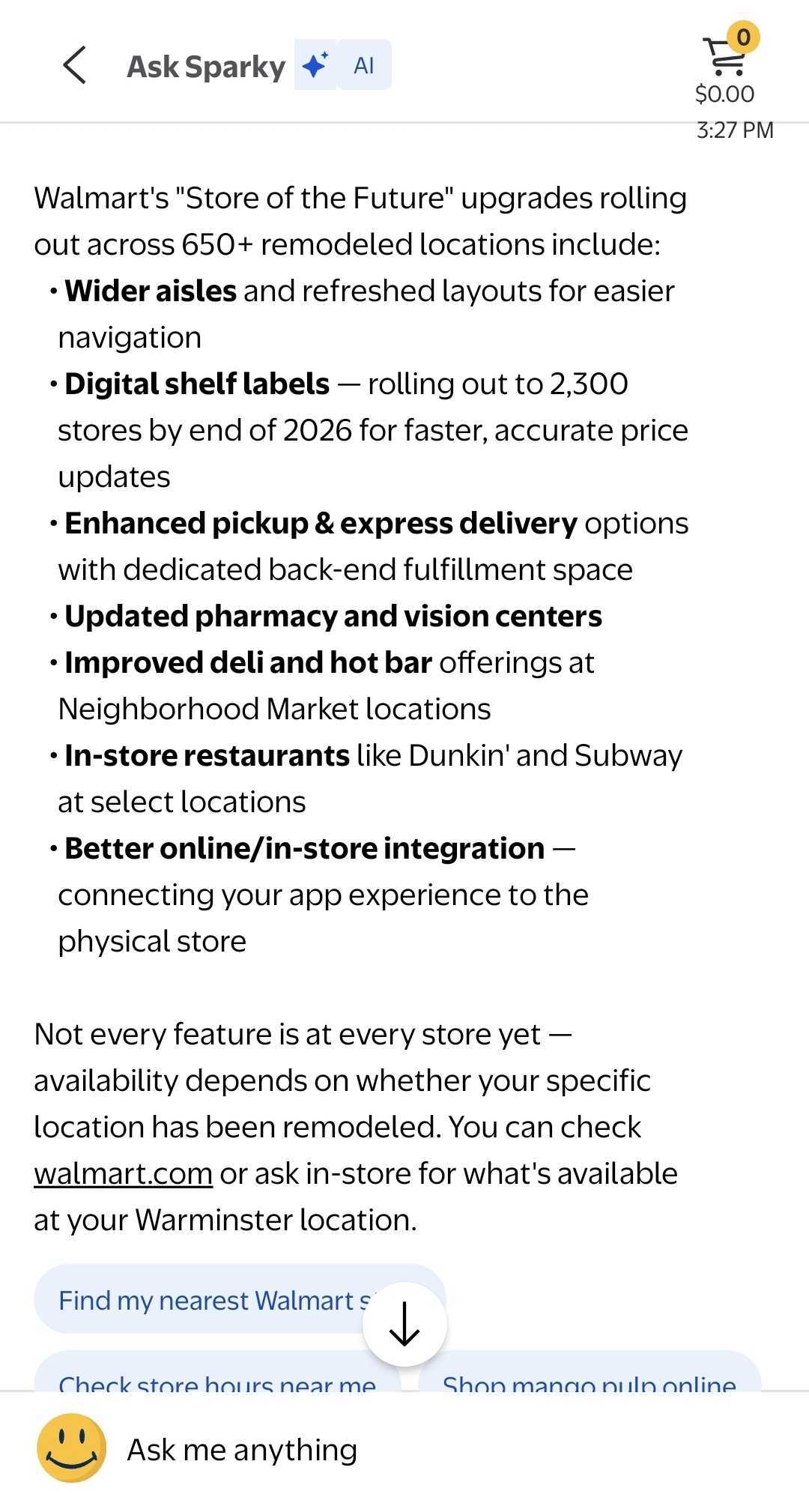
    Even so, wider lanes, a semi-useful shopping assistant, and more snack packs didn’t make my shopping experience feel that futuristic, so I asked Sparky: “What’s new about my Walmart? I heard it’s the store of the future but not sure what’s changed.”

    It reiterated some of what I’d already seen and highlighted the enhanced pickup and express delivery services. I recently had a laptop charger delivered from a different Walmart location and I can confirm it arrived in less than an hour.

    Sparky lays out the store of the future upgrades.

    Ol’ Sparky, however, warned me “not every feature is at every store yet.” For example, Walmart plans to roll out digital shelf labels that allow rollbacks and price changes to appear in real time, but were nowhere to be found in Warminster.

    I also asked an employee what was new with the store to fact-check Sparky.

    “It’s little things,” said the cheerful associate. “There’s more [grab and go] coolers, more cash registers, and a bigger electronics section.”

    A reminder that no one knows a store better than the people who work there.

    What we learned

    It seems the people who would get the most use out of Sparky are those ordering online for delivery or planning their haul ahead of time, checking to see if their desired items are in store. These features, however, are not exclusive to the 32 Walmarts up for a makeover.

    Yet while not exactly futuristic, shoppers in Warminster certainly appreciated the less tech-centered changes, such as the added breathing room as they shopped in clearly labeled sections.

    Kim, the shopper who traveled from Northeast Philadelphia for his haul, also reminded me that sometimes the most seamless shopping experience is pretty simple. He’s not an app user like some of the other customers I talked to. But he travels to Warminster because very few items require waiting for an associate to unlock them from glass cases.

    “It’s easier to shop here,” he said. “In Philly, they lock everything up.”

  • Philly’s queen of Gay Bingo hangs up her heels after 30 years and $5 million raised for AIDS research

    Philly’s queen of Gay Bingo hangs up her heels after 30 years and $5 million raised for AIDS research

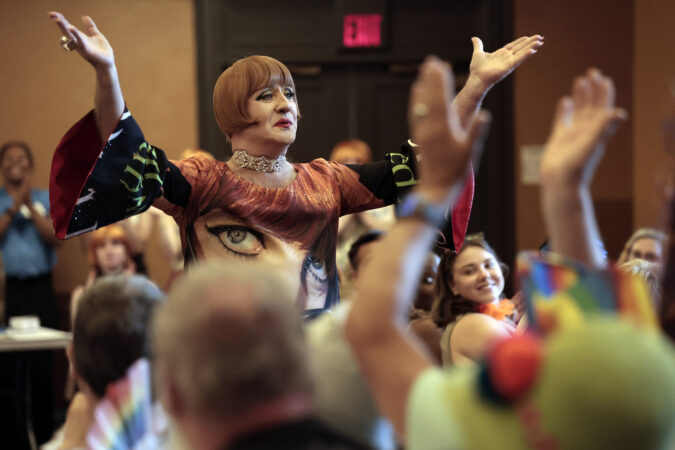
    The legendary redheaded drag queen Carlota Ttendant donned a baby-blue Eva Gabor-inspired gown — its plunging neckline revealing tasteful chest hair — and sensible black heels.

    At 65, arthritis stifles her strut in stilettos.

    “Drag is a young girl’s game,” she said.

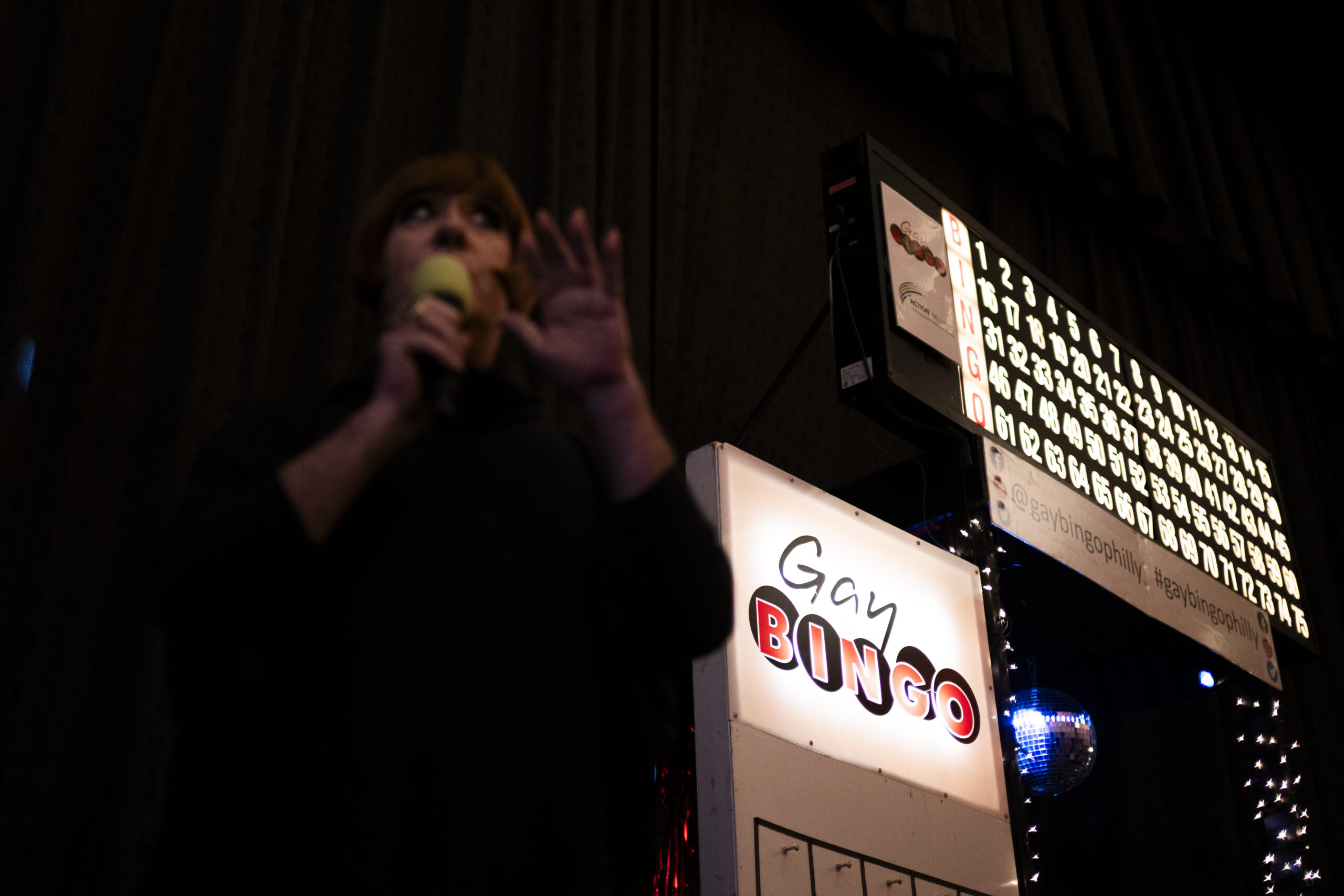
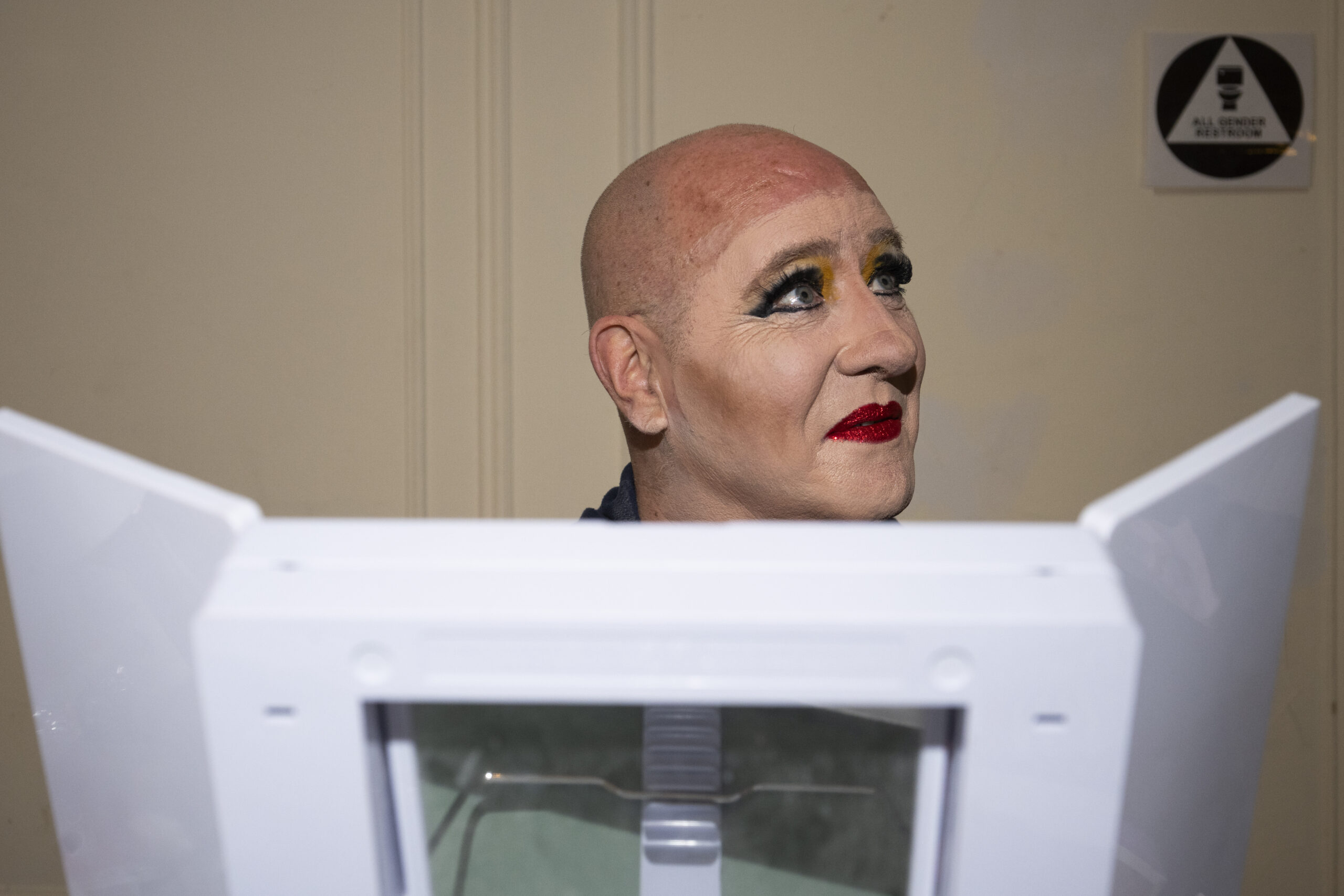
    This was her swan song. At the close of its 30th season this Pride Month, the man behind the makeup, Michael Byrne, hung up his heels and bid adieu to his drag persona and his longtime gig hosting Gay Bingo, the camp, irreverent, slightly profane, and undoubtedly silly monthly HIV/AIDS fundraiser.

    “I know it’s time,” Byrne said. And, “I’m excited to never wear Spanx ever again.”

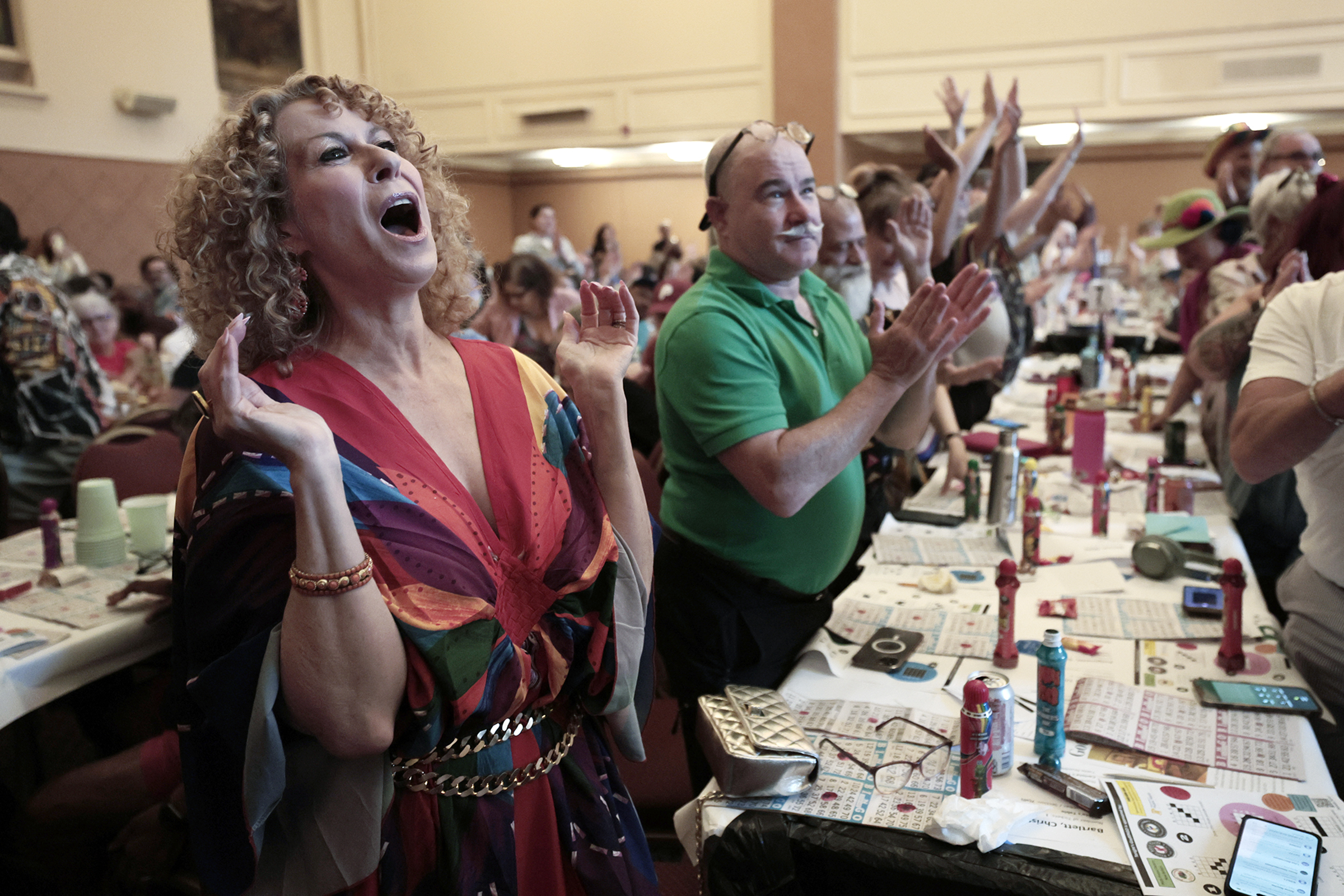
    Across three decades, Carlota Ttendant has called hundreds of games and elicited endless laughs, all while raising millions for people living with HIV/AIDS across the Delaware Valley. She helped steer a community through crisis, providing a respite to those experiencing immense loss and stigma. Even as medicine has advanced and HIV/AIDS has become manageable, she’s crafted a safe space for queer Philadelphians. For one night each month, she’s been an entertainer and an equalizer, responsible for uniting people — gay and straight, from Haddonfield to Phoenixville — around a common goal.

    And since Carlota came into Byrne’s life, she’s taught him to lead with courage, practice gratitude, and be unabashedly unafraid. He’s gone from being the “worst waiter ever” and selling cosmetics, to being a performer, licensed clinical social worker counseling older LGBTQ+ folks through their own next phases of life, and president of Philly AIDS Thrift’s board.

    “None of it would have been possible without all of you,” Carlota told the 400-person crowd — the biggest turnout in years — at her last Gay Bingo on June 13 in the basement ballroom at Congregation Rodeph Shalom. “In the ’90s there was horror happening, and today there is horror happening.

    “But please, let’s do some laughing,” Carlota said.

    “Let’s play bingo!”

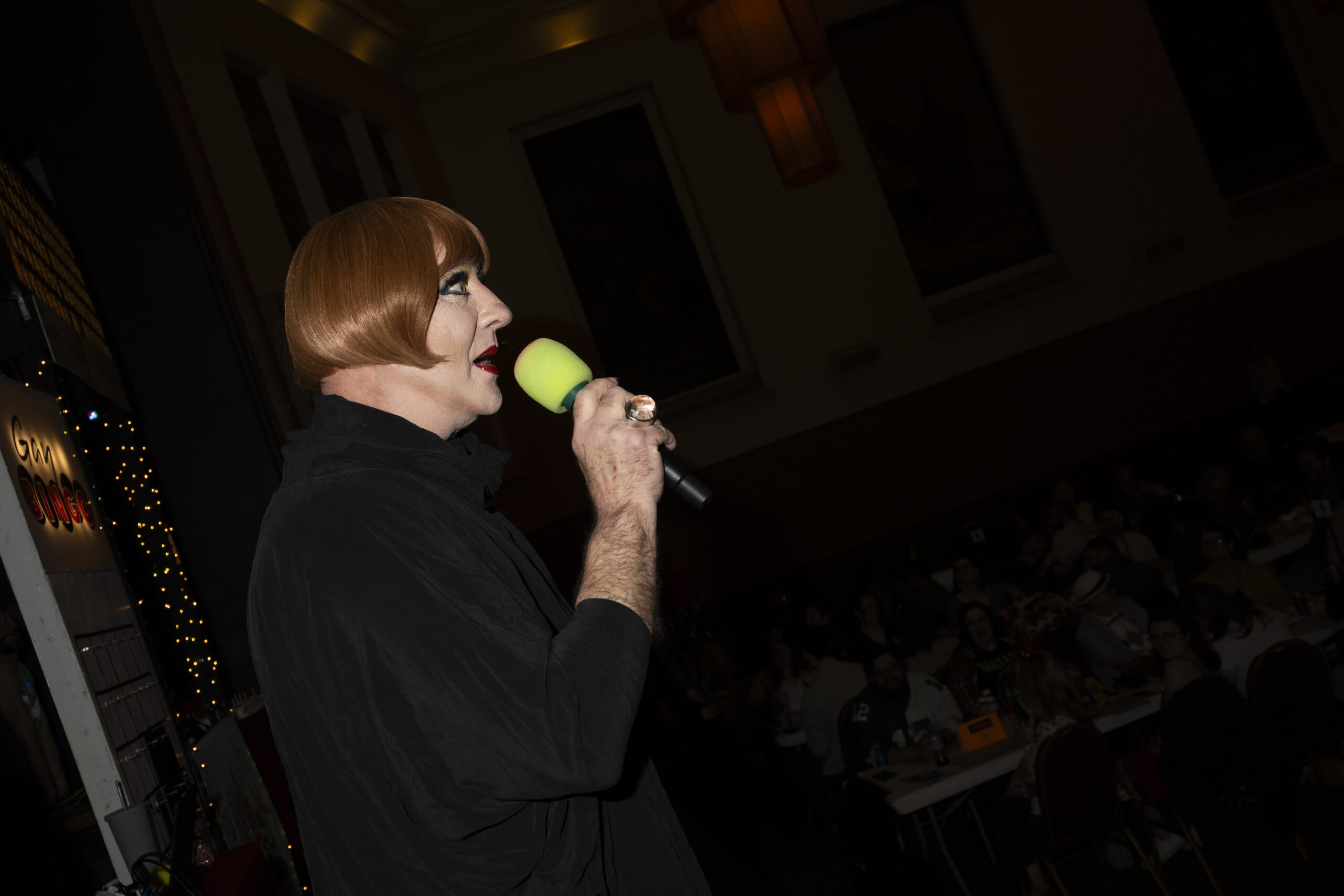
    Michael Byrne, as his drag persona Carlota Ttendant, during Gay Bingo on Saturday, May 9, 2026, at Congregation Rodeph Shalom in Philadelphia.

    Act I

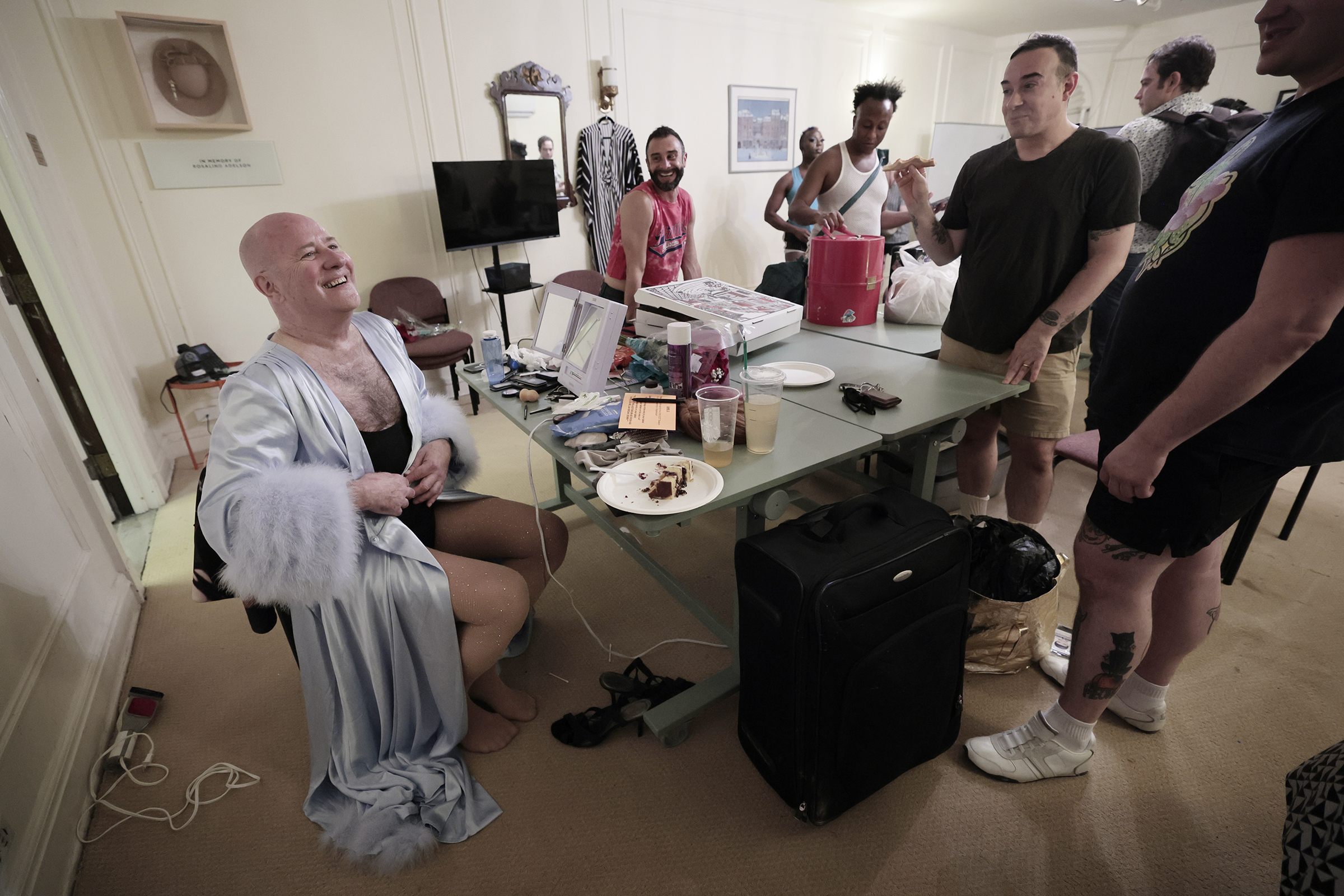
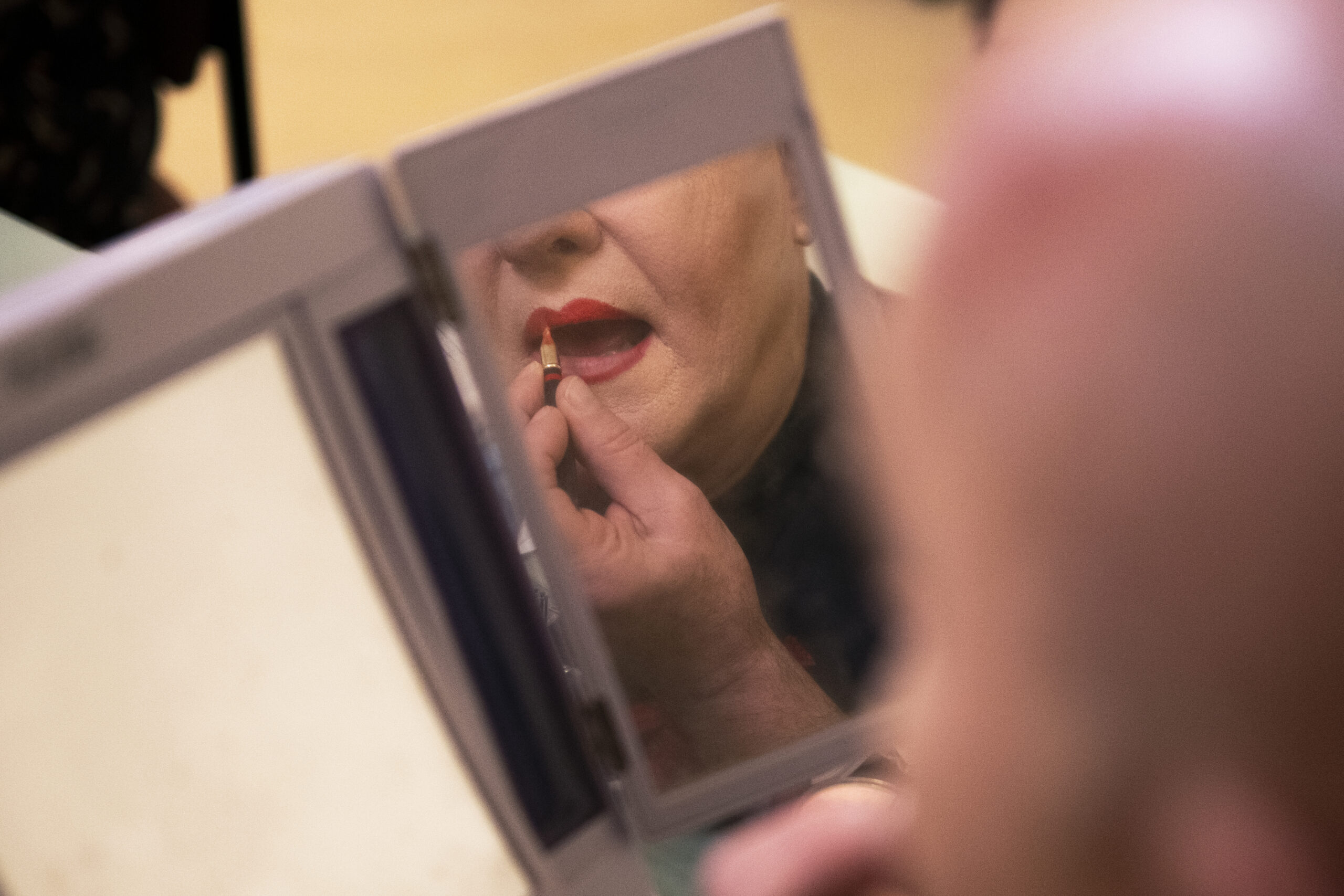
    Like so many Saturdays before, Byrne, on June 13, slathered his face with foundation, carved out his cheeks, deepened his eyes, and painted on his red lip. There was haze — from the dusting of loose setting powder, bronzer, and blush — and musk — from sweat and heat and hairspray — in a Rodeph Shalom classroom, which moonlights as a bridal suite and a boudoir for the Bingo Verifying Divas or BVDs. At 10 minutes till curtain, he futzed with his press-on nails, shimmied into a mod swing dress, straightened the back seams of his tights, and dabbed on some glitter. With each gender-bending step, he transformed into his “twin sister,” Carlota.

    Michael Byrne transforms into his drag persona Carlota Tendant ahead of Gay Bingo on May 9 at Congregation Rodeph Shalom in Philadelphia.

    Like all classy ladies, Carlota’s exact age is lost to time. In the 1990s, Byrne was organizing a fundraiser for Big Mess Theatre, an avant-garde troupe that he helped establish as the spinning axis of Philadelphia’s alternative performance scene, complete with vaudeville acts, an oompah orchestra, and live auction with a striptease routine. Byrne was to host and make his drag debut, and Carlota Ttendant (read as car lot attendant) was conjured up over bourbon and blackjack. (He learned, years later, that there was a ’60s stripper at the famed Trocadero Theatre with the same name.)

    Byrne never aimed to create a perfect, feminine illusion with Carlota. He left his chest unshaven and unstuffed, but short, thrifted dresses showed off his long and feminine legs. Carlota’s makeup was an extension of the exaggerated theater paint Byrne, who has been on stages since he was 10, knew; cheap wigs hid his sideburns. Nothing could mask his deep, raspy, anything-but-ladylike voice.

    Carlota Ttendant (Michael Byrne) (at left) laughs with friends and fellow performers after Carlota’s final evening cohosting Gay Bingo at Congregation Rodeph Shalom in Philadelphia on June 13.
    Michael Byrne transforms into his drag persona Carlota Ttendant ahead of Gay Bingo on May 9 at Congregation Rodeph Shalom in Philadelphia.

    Carlota could be bossy and profane but never vulgar; she could poke fun at audiences without being cruel. She became the “drag queen you could bring your grandma to,” Byrne said.

    Around the time Carlota came to be, the number of new AIDS diagnoses and deaths peaked in Philadelphia. In 1992, new AIDS cases surpassed 1,500; in 1994, AIDS deaths topped 900, according to city data.

    (function(){function e(){window.addEventListener(`message`,function(e){if(e.data[`datawrapper-height`]!==void 0){var t=document.querySelectorAll(`iframe`);for(var n in e.data[`datawrapper-height`])for(var r=0,i;i=t[r];r++)if(i.contentWindow===e.source){var a=e.data[`datawrapper-height`][n]+`px`;i.style.height=a}}})}e()})();

    Misinformation about the disease, which strips the body of its natural defenses and leaves it vulnerable to life-threatening infections and ailments, was rampant. People alienated gay men, wrongly fearing HIV/AIDS could be transmitted through a handshake, a hug, or across a dinner table, The Inquirer and Philadelphia Daily News wrote. Diagnostic testing took weeks; what rudimentary treatments were available sometimes made people sicker; and HIV often progressed to AIDS within a few years.

    “It was not unusual to have people dying every month,” said Kevin Burns, who as a case manager with the nonprofit ActionAIDS (now called Action Wellness) connected clients to hospice care. Burns later served as Action Wellness’ executive director.

    The need for resources was rife, and in 1996, Philly’s nonprofit AIDS Fund set out to supplement the money it made from its annual AIDS Walk, according to Sandra Thompson, former chair of its board of directors. An article in City Paper about an irreverent bingo-drag night sweeping Seattle — which, by one report in the Seattle Times, raised $10,000 a night — caught the attention of Mark “Chumley” Singer, then a fledgling events producer, who pitched the idea to the AIDS Fund. (The fund folded in 2024 due to the decrease in new AIDS cases, and turned ownership of Gay Bingo over to Action Wellness.)

    Singer recalled thinking at the time: “I’ve been doing sad, mopey, candlelight vigil fundraisers. … Why can’t we raise money and have fun?”

    Singer and Byrne had never met before the latter was tapped to host Gay Bingo, but their chemistry was kismet.

    “There was never a show where we weren’t having more fun than everybody,” said Singer, who cohosted until the early aughts. Byrne and Singer left Gay Bingo around that time, but Byrne later returned.

    Byrne remembers the magic of those early years of Gay Bingo. He remembers when 600 seats would sell out in 10 minutes, and he remembers doing his glittered red lip from the floor of the Gershman Y’s mirrored dance studio. He remembers two-show Saturdays and how six hours in heels would make him catatonic on Sunday. He remembers riffing with and ribbing Singer and the laughs their off-color jokes and mild profanity elicited. He remembers the constant movement of the bold and bawdy BVDs, on Rollerblades, or the electricity when O-69 was called and hundreds stood up, shaking and shouting with the fervor of their libidos.

    But Byrne also remembers the solemn moments: the steelworker who told a documentarian about watching his bodybuilder son become emaciated; the families who sponsored games on the anniversary of their loved one’s death; the pharmacist who learned all he could about HIV drugs; Byrne’s own friends who were infected.

    “Our community was in crisis,” Byrne said, “while we focused on it, we also focused on being fun and laughing.

    “And we all needed that at that point.”

    Act II

    The “Rainbow Bombshell” Gay Bingo on June 13 doubled as a Pride extravaganza and an homage to all things Carlota. Her first outfit of the night was crafted from a promotional banner from her years hosting the Philadelphia Orchestra’s Halloween Concert. Alongside her, the BVDs dressed as Big Mess-era Carlota, Norma Kamali-inspired Carlota, Phillies Carlota, and fuzzy caftan-wearing Carlota. Attendees, ushers, volunteers, and even the American Sign Language interpreter wore that signature red bob — wigs that Action Wellness bought in bulk. One wore a T-shirt that read, “Dibs on the ginger.”

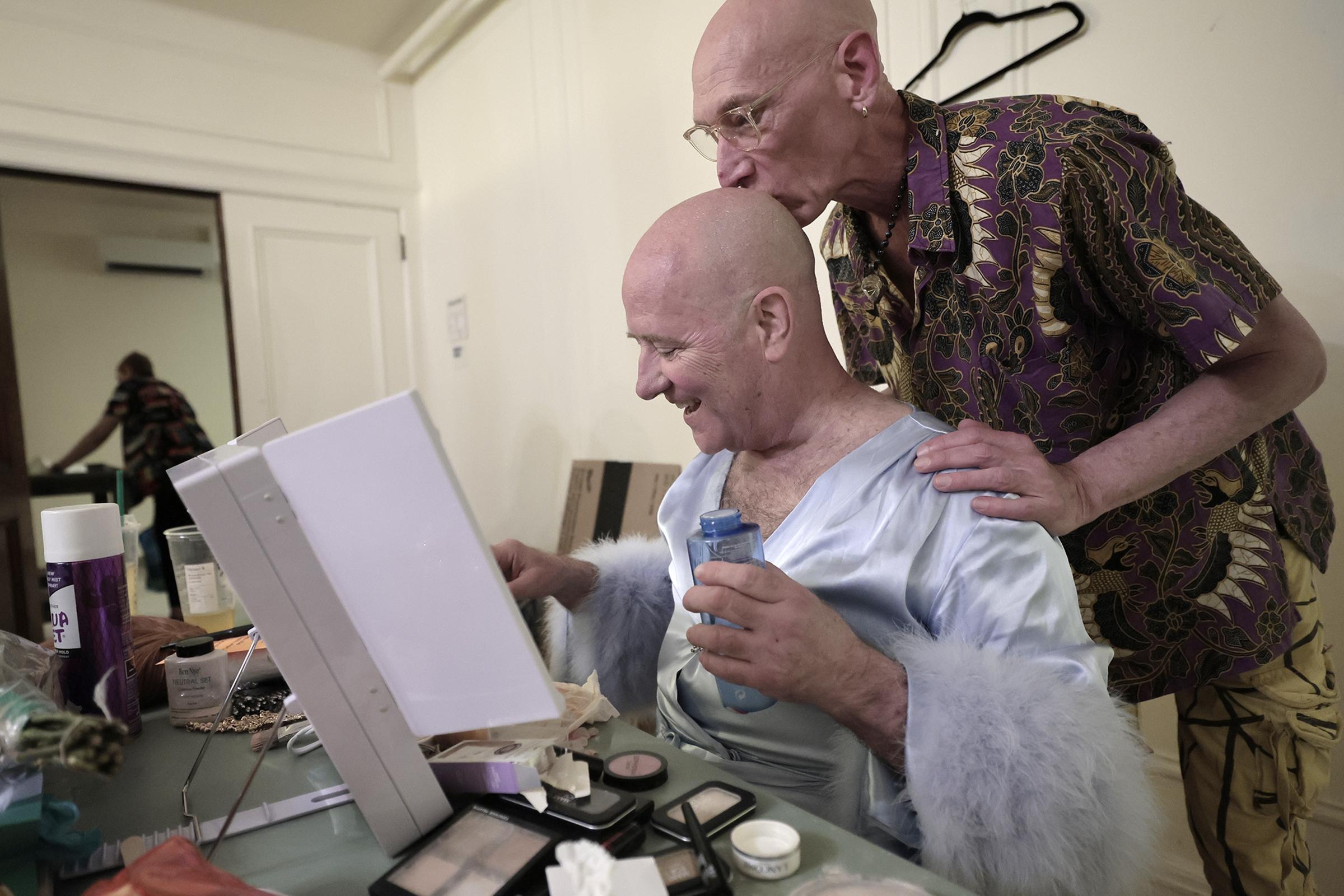
    In the dressing room, Tess Tickle (Paul Struck) kisses Carlota Ttendant (Michael Byrne) on the head after Rainbow Bombshell Gay Bingo at Congregation Rodeph Shalom in Philadelphia on Saturday, June 13, 2026. “I love him” said Struck as he walked out of the dressing room.
    Carlota Ttendant (Michael Byrne) puts on a favorite crystal ring and fake nails before cohosting Rainbow Bombshell Gay Bingo on June 13.

    “Are we ready to win some money?” Carlota said, hyping up the crowd before the first of 12 rounds of bingo. Councilmember Rue Landau, the Philadelphia City Council’s first openly LGBTQ+ member, called the first game:

    I-28.

    I-26.

    G-52.

    B-14.

    O-63.

    B-3.

    “Bingo!” someone cried out, as the audience let out an audible wave of disappointment, exasperation, and defeat, and the BVDs rushed over to authenticate.

    “Did you just get bingo, girl?” Carlota wisecracked.

    For 30 years, these Gay Bingo players have pledged each month to “keep on playing Gay Bingo until this crisis is over.” And today, HIV/AIDS deaths and new diagnoses have stagnated, according to the most recently available health department data, and drug cocktails have made it so people with HIV can live long, healthy lives and may never pass the disease onto others or have their illness advance to AIDS. Preventative medications, like PrEP, can also dramatically decrease the risk of becoming infected.

    Michael Byrne, as his drag persona Carlota Ttendant, on May 9 at Congregation Rodeph Shalom in Philadelphia.

    But there are still obstacles to ending the epidemic. HIV/AIDS disproportionately affects Black and brown communities and low-income people who experience barriers to healthcare, according to Action Wellness executive director Mary Evelyn Torres. The geographic disparities are also stark: Current drug regimens may be readily available in well-resourced countries, like the United States, but access is scarce in the world’s vulnerable pockets. These problems have only been exacerbated by President Donald Trump’s proposed cuts to domestic and foreign HIV/AIDS programs. The withdrawal of American dollars overseas, United Nations officials warned, could lead to more than 4 million AIDS-related deaths and 6 million more HIV infections by 2029.

    (function(){function e(){window.addEventListener(`message`,function(e){if(e.data[`datawrapper-height`]!==void 0){var t=document.querySelectorAll(`iframe`);for(var n in e.data[`datawrapper-height`])for(var r=0,i;i=t[r];r++)if(i.contentWindow===e.source){var a=e.data[`datawrapper-height`][n]+`px`;i.style.height=a}}})}e()})();

    Meanwhile, the Trump administration and state legislatures are attempting to roll back protections for LGBTQ+ people. In Philadelphia, Pride celebrations this month in the Gayborhood were disrupted after Philadelphia police pushed and confronted revelers using what some have called outsized and aggressive crowd-control tactics, although Police Commissioner Kevin Bethel said his department’s actions had nothing to do with Pride. City Council has since announced it will hold public hearings to examine the police response.

    “We’ve come a long way, but there’s still work to be done,” Torres said, “and that work is being threatened by this administration.”

    As the epidemic has changed, so has Gay Bingo: The money raised — more than $5 million since its inception — now goes toward Action Wellness’ social services and programming. The BVDs ditched their roller skates at the Gershman Y (because of the new, carpeted venue). Tickets cost $50-$60, compared to $10-$12 in May 1996, and these days, attendance averages between 150 and 200 a month.

    Drag has evolved, too. Spending centuries on the periphery as proto-punk-beatniks and after-midnight acts, queens disrupted and challenged the mainstream with wit and wonder. Then, the exploding popularity of RuPaul’s Drag Race, a drag reality-TV competition, seismically changed the culture, snubbing scrappiness for silicon and kitsch for couture. The show ushered drag into the zeitgeist: Its lingo became commonplace and its contestants turned into social media stars, with businesses, makeup brands, books, and podcasts, as the art form continues to face political bans and threats nationwide.

    The show “has taken everything to a whole other planet,” Byrne said, “and that’s amazing and that’s really great.

    “That’s also not what I do.”

    Carlota was never concerned with “affecting female mannerisms” or “trying to be this woman or this drag queen,” Singer said. To Byrne, she’s come to embody the fiercest, most unafraid, and righteous versions of himself. But “Michael was never far from Carlota,” Singer said.

    Janie Lopez of Philadelphia cheers for her friend Carlota Ttendant during Gay Bingo at Congregation Rodeph Shalom.

    To those who know Byrne, Carlota’s come to represent someone purer and more singular, a testament to what joyful resistance and defiant resilience can achieve amid tragedy. Her ingenuity and authenticity have made her synonymous with Gay Bingo, according to Action Wellness event planner and cohost Tim Johnson (otherwise known as Stella D’Oro); her playfulness is what’s engaging, Burns said; the safe space she’s cultivated for the queer community is what keeps people coming back season after season, said regulars Cat Johnson, 47, and Katie Dickerson, 38, of Roxborough.

    “It’s going to be really different without Carlota,” Johnson said. “No one’s going to fill her shoes, but I think that the vibe and the energy is going to live on.”

    “It’s a lot easier to raise money when everyone is having fun,” said Amber Schlesman, 38, of Point Breeze, who’s been coming to Gay Bingo since its Gershman Y days. “And for the shoes, I’m guessing it’s a size 12.”

    All those shoes will be donated to Philly AIDS Thrift soon enough, Byrne said.

    Epilogue

    Byrne’s voice cracked as he thought of the people who made Carlota’s run possible: the AIDS Fund organizers, Singer, the original cast of BVDs, the volunteers, those who came back monthly, the victims, their families. Many sent her off June 13 with a trove of well wishes, notes that read, “thanks for the memories,” and “so proud of all you’ve done.” They told her, “I love you,” and “hang up those high heels, baby.”

    At the end of the night, Byrne’s best friend gifted him a throw pillow.

    “Don’t be a lady,” it said. “Be a legend.”

    Michael Byrne transforms into his drag persona Carlota Ttendant ahead of Gay Bingo on Saturday, May 9, 2026, at Congregation Rodeph Shalom in Philadelphia.
  • Haverford parents are worried about chatbots in classrooms after a vote to buy AI tools

    Haverford parents are worried about chatbots in classrooms after a vote to buy AI tools

    A move by the Haverford Township School District to buy artificial intelligence tools for students and teachers has been met with protest from parents who fear the technology will erode learning.

    At a meeting last week, the Haverford school board voted 5-3 to approve contracts with School AI, which features AI “tutors,” and Brisk, which automates tasks for teachers, like developing quizzes and giving students feedback.

    While administrators said the tools wouldn’t supplant teaching and learning, critics said it was inevitable that AI would be used inappropriately — making it easier for kids to avoid work.

    “The idea of putting chatbots on computers — I don’t even care what age. I’m pretty disgusted by that,” said Christine Seewagen, a district parent of rising 12th and 7th graders.

    The district already struggles to manage technology in the classroom, said Seewagen, who said her older child has observed students run math questions through an AI tool on their phones. Her younger child, meanwhile, had a teacher who directed students to upload essays to an AI tool to get feedback, Seewagen said.

    “They’re just using AI, and not really being instructed on how to do it,” Seewagen said in an interview.

    Administrators said they were recommending buying AI tools in part because teachers are already using freely available versions, and they want to “eliminate free roaming around platforms,” Robert Anderson, the district’s technology director, said at the June 18 board meeting.

    Haverford’s superintendent, Matthew Hayes, said the School AI contract would “allow us to have a resource so that as we go through the process of the strategic plan and looking at all the implications down the line,” the district could begin teaching AI “thoughtfully, responsibly, ethically.”

    He added: “And also reducing screen time,” without providing further details.

    The controversy around AI in Haverford is the latest example of area parents pushing back on what they see as excessive and unchecked technology use in schools.

    In Lower Merion, parents have pushed to opt their kids out of district-assigned laptops or tablets; the district is planning changes to reduce usage for younger students, but has told parents they cannot opt out entirely. Parents in other districts are also raising concerns about too much Chromebook use.

    In Haverford, some parents said they were caught off guard by the proposal to adopt technology they felt posed risks to their kids.

    Patrick Burland, the parent of an incoming 10th grader and 6th grader, noted he’d had to sign numerous permission slips for his younger child to participate in end-of-year celebrations.

    “Apparently, sugar requires a signature, but cognitively rewiring her brain does not,” Burland told the board.

    Anderson said Haverford had been considering how to incorporate AI for years. He said the district sought feedback from teachers, including through an AI working group, before proposing the contracts.

    Board members who voted for the AI tools, meanwhile, said kids needed to learn how to use the technology responsibly.

    “Not acknowledging that it’s here … we don’t gain anything, right? We actually lose and we put ourselves farther behind because it’s not going anywhere,” said board member LaTonia Lee.

    But some raised questions about what the district was planning to do with the tools.

    Dave Schwartz, another board member, said he would support teaching kids about AI. But the district hasn’t said how it plans to do that, he said.

    “We’ve been talking very much in vague terms, and I can’t vote for something that I don’t understand,” Schwartz said.

    A district spokesperson did not respond to a question this week about examples of how School AI might be used.

    Board member Chris Shelton asked Anderson about criticism that the tool’s “historical figure” chatbots were giving students inaccurate information. (Last year, School AI acknowledged that responses from an Anne Frank character “didn’t provide critical historical details about the Nazis’ role in the Holocaust.”)

    Anderson called it “unfortunate” that the company had promoted the historical figures feature, but said the district “would have the option to potentially not use something like that.”

    John Flagler, a board member and English teacher, said he understood the burdens placed on teachers, “but I also believe there are lines that should not be crossed.”

    The suggestion that grading papers is a “menial task” that could be offloaded to AI “is an insult to both the teacher and the student,” Flagler said, calling grading essential to teachers learning about students.

    Administrators said Brisk wouldn’t be used for grading, but would provide “first-level feedback” — informing students they’re missing a topic sentence, for instance, said Meridith Herne, the district’s technology integration coordinator.

    “We insist that our teachers read it over and modify it so it’s in their own voice,” Herne said of Brisk’s feedback. Hayes said that 97 district teachers already use a free version of the tool.

    He said the tool was not meant to replace teachers.

    “That’s not my intent at all,” Hayes said, describing Brisk as “an option for individuals who want exposure to it.”

    He noted that the contracts with Brisk, for $22,260, and School AI, for $12,999, were each limited to one year.

    Teachers will be trained on the School AI platform, Anderson said; it will be up to them to decide whether they want to use it. He said the district envisions the platform being used in high school and “potentially” middle school, but isn’t planning for it to be used in elementary schools.

    Parents like Burland and Seewagen, who said like-minded parents have been organizing on social media, weren’t persuaded.

    “It does not feel like to me they have put any guardrails on,” Burland said in an interview. He questioned whether the district would have considered turning off School AI chatbots, for instance, had it not been asked at the board meeting.

    Seewagen said many parents who have learned about the AI plans aren’t happy.

    “It did not go under the radar,” she said.

  • A Chester County lake is planned for draining as a dam is decommissioned. Residents are worried about what it’ll become.

    A Chester County lake is planned for draining as a dam is decommissioned. Residents are worried about what it’ll become.

    Dorothy Verdon had a history of moving around every few years. But when she found her lakefront — or, technically, lake-back — home in the Arbours of West Goshen in Chester County 12 years ago, she just really liked it.

    Her loudest neighbors are the geese, who live at the banks of Fernhill Lake, a 64-acre impoundment formed from Aqua’s Township Line Dam. But under a plan from the public water company to partially decommission the dam and draw down the reservoir, returning the natural flow of Chester Creek, Verdon and her neighbors’ backyards would be subject to great ecological change in the coming years.

    It’s a change environmentalists generally support, as dams greatly affect the ecosystem around them: increasing water temperature, generating algae growth, and fragmenting habitats. But residents, some of whom paid up to $20,000 for their lake-facing yards, worry what their backyards, and the developed habitat, could become.

    “My immediate concern, and that of several residents and the township, is what’s going to happen to the ecosystem, because it is a water-based ecosystem,” Verdon said. “There’s that. It’s really financial. And it’s aesthetic. What are we going to have behind us as the lake gets drained?”

    A view of Fernhill Lake from the Arbours at West Goshen in West Goshen, Pa., on Monday, June 22, 2026.

    The planned decommissioning

    Built in 1935, Township Line Dam once supplied drinking water for surrounding customers. But, as with a number of dams before it, that has not been the case for decades. Aqua acquired the dam in 1998 and does not use it for daily operations.

    Township Line requires “extensive investment” to satisfy requirements from the Pennsylvania Department of Environmental Protection, which outweighs the benefits of a dam that no longer serves its purpose, Michael Fili, the company’s vice president of planning, design, and construction, wrote in a letter to the township’s board of supervisors in May.

    Under its plan, the company will begin drawing down the water in the reservoir by eight to 10 feet, leaving the water at that reduced level until it begins construction for partial dam removal in early 2028 through 2029, Fili wrote. At that time, the entire lake would be drained. (The company originally planned to begin the process in July, but pushed the timeline back to fall following concerns from residents.)

    A view of the Township Line Dam along Airport Road in West Goshen, Pa., on Monday, June 22, 2026.

    Following decommissioning, Aqua proposed transferring ownership of the 114 acres to West Goshen Township, making the municipality “stewards of the land” that could “utilize the land for the benefit of its residents,” Fili wrote.

    “We understand the reservoir and surrounding area is enjoyed by the community, and we do not take this action lightly,” Fili wrote.

    The announcement drew concerns during a May board meeting from residents, who questioned why it had to be drawn down so quickly, and worried about what would become of the land — fearing further development, or lack of adequate care to keep it from becoming an eyesore. Some wondered if there might be a path to maintaining the lake.

    “With all due respect to my fellow supervisors’ opinion, I don’t think we have an option here,” said Shaun Walsh, chairman of the township’s board. “If you keep it as a dam, you need to spend millions of dollars to fix it.”

    Walsh said the township would keep it as an open space, possibly turning it into a mixture of wetlands, meadow, woodlands with walking trails — an “ultimately real beautiful amenity for people in the area to use,” he said.

    “I think there are so many advantages in it becoming a publicly owned asset, given that the township is so built out,” he added. “I personally believe in 10 years’ time we should have an attractive amenity there for the community.”

    (“When we’re all dead,” someone in the meeting responded.)

    West Chester appears to have a right of first refusal to purchase the property at low cost, based on old agreements, officials for the borough said. West Goshen Township Manager Chris Bashore said that town was waiting to see what West Chester decides.

    In a message, Aqua said it is communicating with both municipalities and “no determination has yet been made as to whether the 114 acres of property will be conveyed and to whom.”

    Birds rest on the Township Line Dam along Airport Road in West Goshen, Pa., on Monday, June 22, 2026.

    Dams and wildlife

    Residents also worry about what will become of the waterfowl, turtles, fish, and a bald eagle who have begun to call it home over nearly a century.

    Largely, environmental activists believe that “the positives of dam removal outweigh any kind of negatives” said Faith Zerbe, advocacy and science community action coordinator with the Delaware Riverkeeper Network, which has sought the decommissioning of multiple dams over the last two decades.

    The Chester Creek, a tributary of the Delaware River, is steeped with “impairments” — situations when a waterway does not meet environmental or regulatory quality — along much of its length. Removing the dam would help chip away at some of those larger issues.

    “Removing a dam, allowing the natural stream to find its pattern over time as that dam removal takes place, and then restoring the stream banks with natural native indigenous species is kind of a critical piece to getting ecology back to the river,” she said.

    Aqua said it is coordinating with the Pennsylvania Fish and Boat Commission and Department of Conservation and Natural Resources, and the federal Fish and Wildlife Services, as it prepares for its drawdown.

    It is essential for the dam decommissioning to be done right, environmentalists said. But when done “thoughtfully and with the proper permissions, dam removal can have remarkable benefits for local ecosystems, allowing these areas to return to their original landscape,” said Carly Lare, executive director of Chester Ridley Crum Watersheds Association.

    Her organization has been communicating with Aqua to better understand the project’s goals and timelines, she said.

    “Since colonization of the area, this landscape has greatly changed, which in turn alters which native species can survive throughout our region,” Lare said. “When habitats are fragmented, our creeks experience diminished migration of native fish populations, which in turn influences the health and diversity of other native organisms, ranging from freshwater mussels to river otters.”

    This suburban content is produced with support from the Leslie Miller and Richard Worley Foundation and The Lenfest Institute for Journalism. Editorial content is created independently of the project donors. Gifts to support The Inquirer’s high-impact journalism can be made at inquirer.com/donate. A list of Lenfest Institute donors can be found at lenfestinstitute.org/supporters.