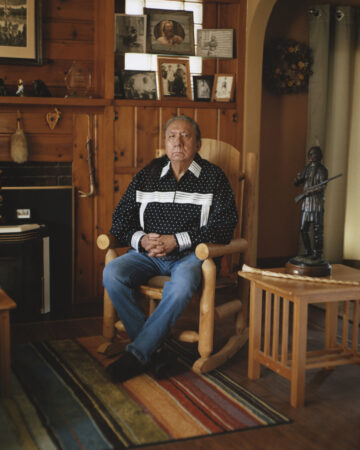
CROW AGENCY, Mont. — As a child in South Dakota, Ernie LaPointe was told: Don’t tell anyone who your great-grandfather was.
If his neighbors or friends knew he was descended from Sitting Bull, the storied Hunkpapa Lakota leader, he would never have a normal childhood, his mother told him.
“‘There will be a time and place when you get the permission to do it,’” LaPointe, now 77, recalled his mother saying.
LaPointe kept mum until the early 1990s, when, he said, an aunt told him it was time to “come out from the shadows.”
Now he protects the legacy of Sitting Bull, who helped lead the resistance to the U.S. government’s seizure of the Great Plains and became perhaps even more famous in death than in life.
Almost 150 years ago, Sitting Bull’s followers defeated Lt. Col. George Armstrong Custer and the 7th Cavalry Regiment of the U.S. Army in the Battle of the Little Bighorn, one of the most closely studied and hotly debated military clashes in American history. Sitting Bull is said to have had a vision that presaged a great victory, which came weeks later for warriors led by Crazy Horse.
More than a thousand miles south, in Arizona, Chip Custer’s lineage was not something he could have hidden, even if he wanted to.
He was born George Armstrong Custer IV, the great-great-grand-nephew of the famous lieutenant colonel. After his father (George Armstrong Custer III) died suddenly in 1991, Chip inherited the job of minding the legacy of a man who is among the most lionized, and vilified, figures in American history.
Chip Custer, 70, has long been familiar with the criticism — of Custer’s devastating offensive against the Cheyenne, of his military tactics, of his ego. He hopes people will try to view his relative in his full complexity, in light of his successes and in the context of his time.
“If someone wrote a thousand stories about me,” he added, “what would I end up looking like after all the time under the microscope?”
Last week, crowds converged where the Little Bighorn River snakes through grassy hills in southeastern Montana and where Custer and all of his men died during an attack on a Native American encampment on June 25, 1876. There were reenactments, ceremonies, and talk of a new visitor center scheduled to be completed in the coming months.
To the Lakota, Northern Cheyenne, and other tribes, the battlefield remains hallowed ground, a place of great triumph over a government that suppressed their way of life.
To historians, it remains an inexhaustible source for debate. Had one cavalry major been drinking? Was Custer undone by recklessness or flawed intelligence?
Chip Custer and Ernie LaPointe are students of the battle and fluent in its intricacies, but their interest is not simply in military history. It is based in a mission to preserve their family legacies.
“The blood of my great-grandfather is in me,” LaPointe said. “He cared for the people; he cared for everything. He even cared for the people who tried to kill him.”
Custer’s kin
Chip Custer first visited the battlefield in 1976, for the 100th anniversary of the battle, as a 21-year-old hippie with no expressed interest in family history. He drove up from college to surprise his father, a retired Army officer who had fought in three wars.
As they sat through a quiet ceremony near what is known as Last Stand Hill, the American Indian Movement leader Russell Means spoke out to celebrate the cavalry’s defeat.
“My father, of course, was incensed over the way that whole event went,” Custer said. “So that was my introduction.”
The national park was known as Custer Battlefield National Monument then, though Native American activists had begun to draw attention to the site’s narrow focus on the more than 260 U.S. deaths, part of a wider discussion of broken treaties and American expansionism.
White marble headstones peeked out of the grass across the haunting prairie to mark where soldiers had fallen. The same was not true for the 60 to 100 Native Americans who the National Park Service has estimated died that day.
“You’d see that powerful landscape out there and it was just the 7th Cavalry headstones,” said John Doerner, who was an historian at the battlefield for more than 20 years.
Perspectives were evolving. Chip Custer said his father recognized that depictions of their relative — long embraced by many as a gallant, fearless commander carrying out Washington’s will to push Native Americans toward reservations — had grown more complicated.
In 1970, the movie Little Big Man portrayed Custer as a vain commander who foolishly led his soldiers to slaughter. Chip Custer remembers watching it on an Arizona army base and that his red-faced father stormed out. His father was similarly upset in 1991 at a proposal to drop the family name from the site. He died of a heart attack just months before Congress rechristened it the Little Bighorn Battlefield National Monument.
In the decades since, Chip has served as an occasional spokesperson for the Custer legacy, even as he ran a landscape design business and raised two daughters with his wife. Chip is descended from one of the famed soldier’s brothers, Nevin, whose health problems prevented him from joining the military. Two of George Armstrong Custer’s brothers died with him on the battlefield.
Chip has written about Custer’s rowdy days at West Point and his celebrated successes as a Civil War “boy general,” which included commanding the Michigan Cavalry Brigade in the Battle of Gettysburg. He has spoken to groups of Custer buffs.
In 2021, he opposed calls to remove a Custer statue in Monroe, Mich., the lieutenant colonel’s hometown. In a letter to the City Council, Chip argued that Custer, in his writings, had recognized why Native Americans resisted the confinement of reservations and that he had unfairly become the “poster boy for all wrongs committed against the American Indians during our roughly 250 years as a nation.”
The council ultimately left the monument as is.
When it comes to that final battle, Chip Custer believes his relative unquestionably shoulders some blame for the outcome, though some point fingers at subordinates.
“I think he would, as any commander, accept full responsibility for how that all played out,” he said. “But I regret that we only remember him by the last day of his life.”
Sitting with history
For LaPointe, an Army veteran born on the Pine Ridge Indian Reservation in South Dakota, the challenge has been defending, not his relative’s legacy, but his own.
After LaPointe publicly embraced his lineage, he began representing the family at events like the 1992 dedication of a bronze bust of his great-grandfather to the National Hall of Fame for Famous American Indians, in Oklahoma. But in the face of competing claims, his connection was still closely scrutinized by the Smithsonian in the mid-2000s as it worked to repatriate some of Sitting Bull’s belongings. Once satisfied, the museum gave LaPointe a braid of Sitting Bull’s hair and a pair of wool leggings obtained by a doctor who had custody of the Lakota leader’s body after his death.
Sitting Bull was fatally shot in 1890 on the Standing Rock Indian Reservation during a botched arrest by Native American police officers following orders from U.S. officials. In the years after the Battle of the Little Bighorn, the U.S. government had responded to the loss by escalating its efforts to force Native Americans onto reservations.
LaPointe’s ancestry was later scientifically confirmed by a Danish researcher, who did a DNA test on a small clipping of his great-grandfather’s hair. When the results were published, news of LaPointe’s lineage ricocheted across domestic and international media. It escalated the outreach he had long received from people who claim to be his long-lost kin.
“They call, they email, they come to the house,” said Sonja LaPointe, his wife of more than 30 years. “One guy from Wisconsin brought his Winchester to the house because he wanted to take a picture with Ernie.”
LaPointe was involved in the creation of an Indian memorial at the Little Bighorn battlefield, and in 2003 he attended the dedication of a sculpture by Colleen Cutschall, an Oglala-Sicangu Lakota artist. The bronze outline of warriors on horseback is level with the horizon, with the sky and grassy hills shining through the tableau.
With permission from park rangers, LaPointe had a pipe ceremony at the memorial that night and said he noticed something special in the air. “You could hear the horse hooves all around us,” he said.
LaPointe was also asked to share the oral histories he had heard as a child with Doerner, who worked to add red granite markers where Native American warriors fell.
LaPointe and Custer have each been to multiple events at the battlefield, but neither planned to attend the anniversary this week. Sonja LaPointe said her husband and Custer briefly crossed paths at a battlefield event years ago, but the men do not remember meeting.
Around 2007, LaPointe did speak with Chip’s uncle, Brice Custer, who called him after LaPointe gave a talk in George Armstrong Custer’s hometown.
Brice, who named one of his sons Garry Owen after the 7th Cavalry marching song, told LaPointe he had not felt well enough to make the trip but wanted to express how much respect he had for Sitting Bull.
“I said I appreciated his call,” LaPointe recalled, “and I don’t hold any animosities toward nobody.”
“‘It happened many years ago,’ I said. ‘I think we have to heal from that.’ He agreed.”
A Philadelphia woman pleaded guilty Monday to voting twice in the 2024 election — first in northern New Jersey, then in the city.
Miya Pack, 40, said little beyond responding to routine legal questions as she pleaded guilty to a charge of voter fraud before U.S. District Judge Joshua D. Wolson.
Pack has been registered to vote since 2004 in Bergen County, N.J., prosecutors said in court documents, and she’s also been registered to vote in Philadelphia since 2016. She is not affiliated with any political party, voter records show.
On Oct. 26, 2024, prosecutors said, Pack cast a ballot in that year’s presidential election in Bergen County. Then, 10 days later, prosecutors said, she cast a ballot in the same contest in Philadelphia on Election Day.
They did not say whom she voted for, and she declined to comment as she left the courtroom Monday.
Pack was charged by federal prosecutors last September. Prosecutors announced her indictment alongside the indictment of another man, Matthew Laiss, who was separately charged with voting twice in the 2020 election.
Laiss later said in court documents that he voted twice for Trump, and unsuccessfully sought to claim that his actions were covered by pardons Trump extended to people who tried to help him overturn the results of the 2020 election.
Laiss was convicted of voter fraud earlier this year at trial and is awaiting sentencing.
Pack is scheduled to be sentenced in October. She faces the possibility of prison time, although prosecutors said in court that federal guidelines suggest a term of no jail time to six months.
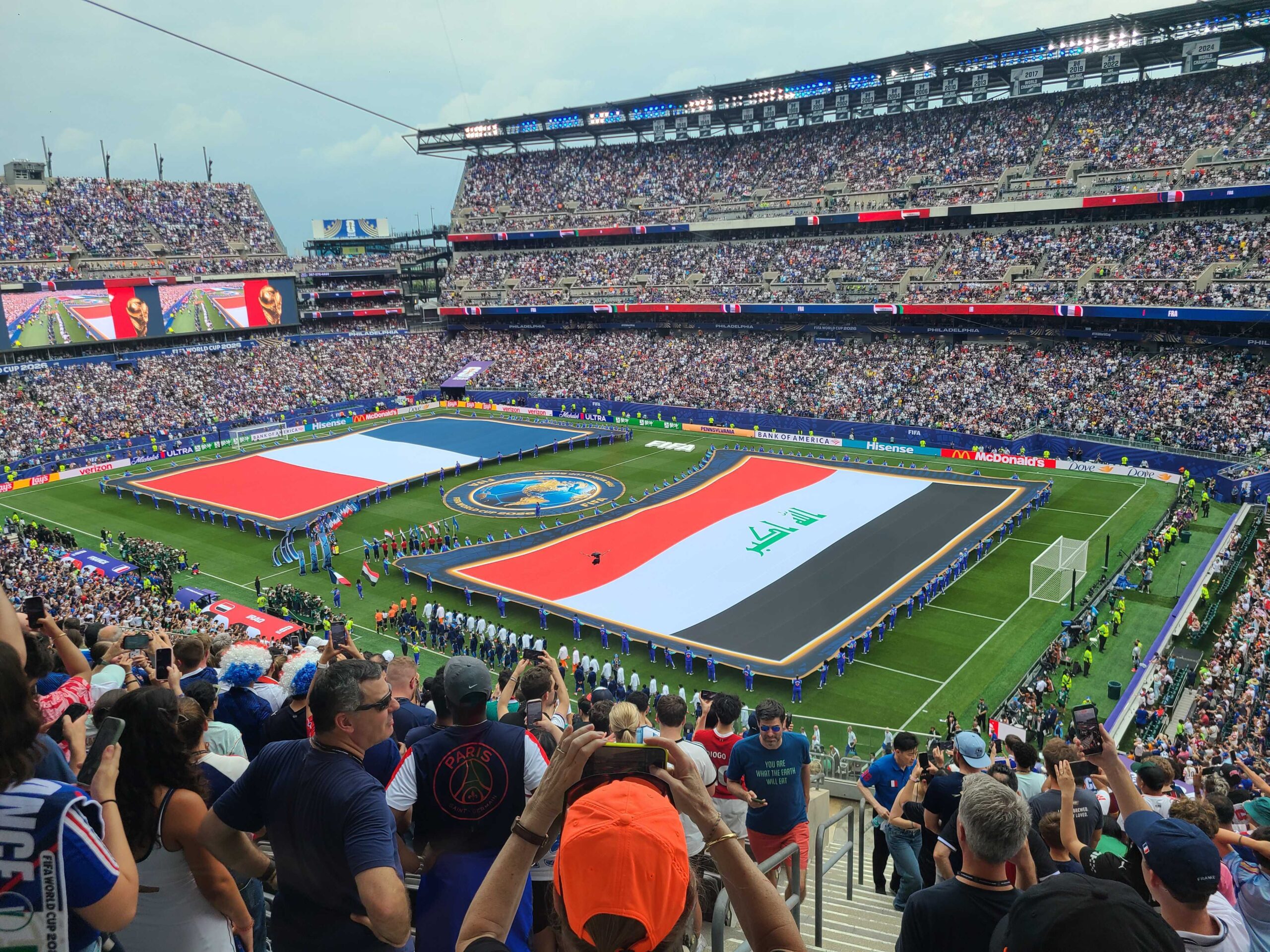
Thunderstorms are expected to make their way through the Philadelphia region later Monday evening, potentially interrupting the World Cup match between France and Iraq (5 p.m, Fox).
The strongest storms are forecast to move in beginning around 4 p.m., bringing with them heavy rain, wind gusts approaching 60 mph, and the potential for an isolated tornado.
“Storms will certainly have lightning with them,” said Zack Cooper, a meteorologist at the National Weather Service’s Mount Holly station.
An inch or two of rain could fall in and around the city, Cooper said, but depending on the storm’s severity that could all come in an hour or less, leading to flash flooding. Philadelphia and the surrounding region are under a flood watch.
“Exactly how much would fall on a given thunderstorm is impossible to know, but we could certainly see some pretty high rain rates in these storms tonight,” Cooper said.
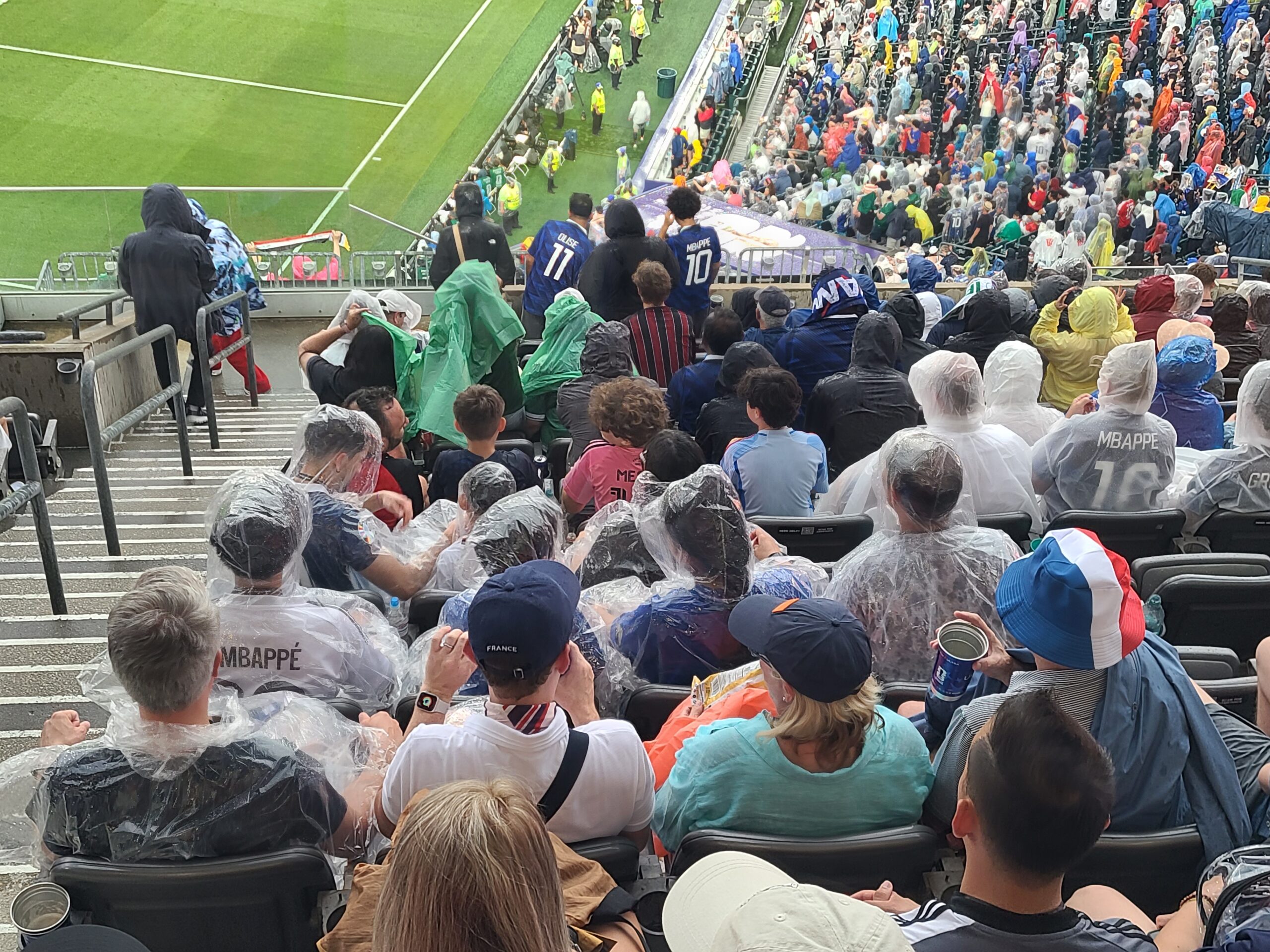
For those going to the game, umbrellas aren’t allowed in the stadium, but you can bring a poncho.
FIFA will pause play if there is a lightning strike within eight miles of the stadium. The match will remain paused for 30 minutes, with any subsequent lightning strikes resetting the clock.
Six Club World Cup matches were delayed by severe weather last summer. A match between Chelsea and Benfica at Bank of America Stadium in Charlotte, N.C., was delayed multiple times due to lightning strikes, taking four hours and 38 minutes to finish.
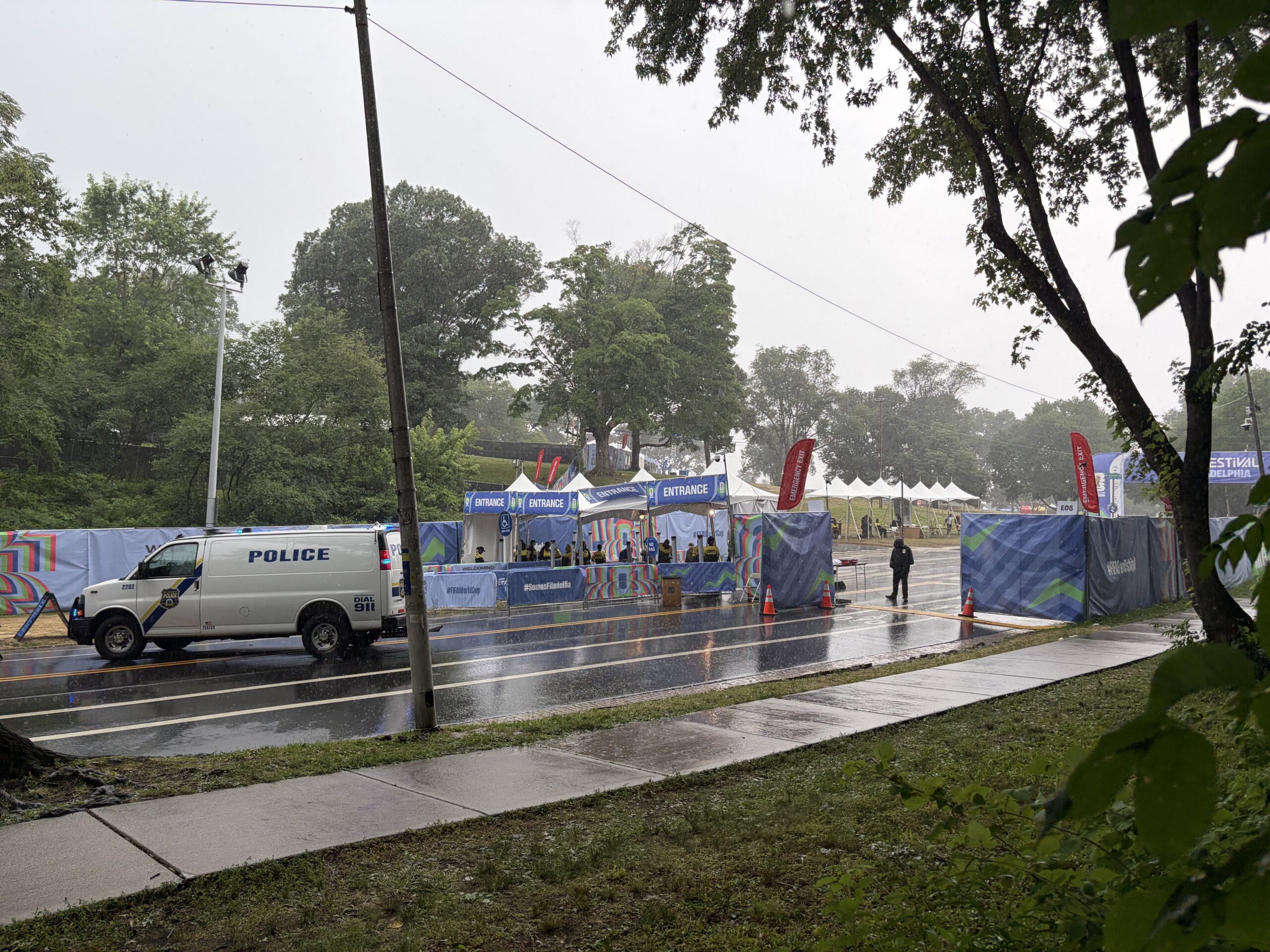
The FIFA Fan Fest at Lemon Hill Park in Fairmount would close if lightning is detected within an eight-mile radius. Fans would need to exit the grounds and move to a safe location, and could re-enter after 30 minutes if no additional lightning is detected.
Festivities were interrupted Thursday evening, when high winds prompted the event to close early.
Lincoln Financial Field has been renamed “Philadelphia Stadium” for the duration of the World Cup. In addition to five group stage games, the city will host a Round of 16 game on July 4.
France tops Iraq 3-0 in weather-delayed World Cup match
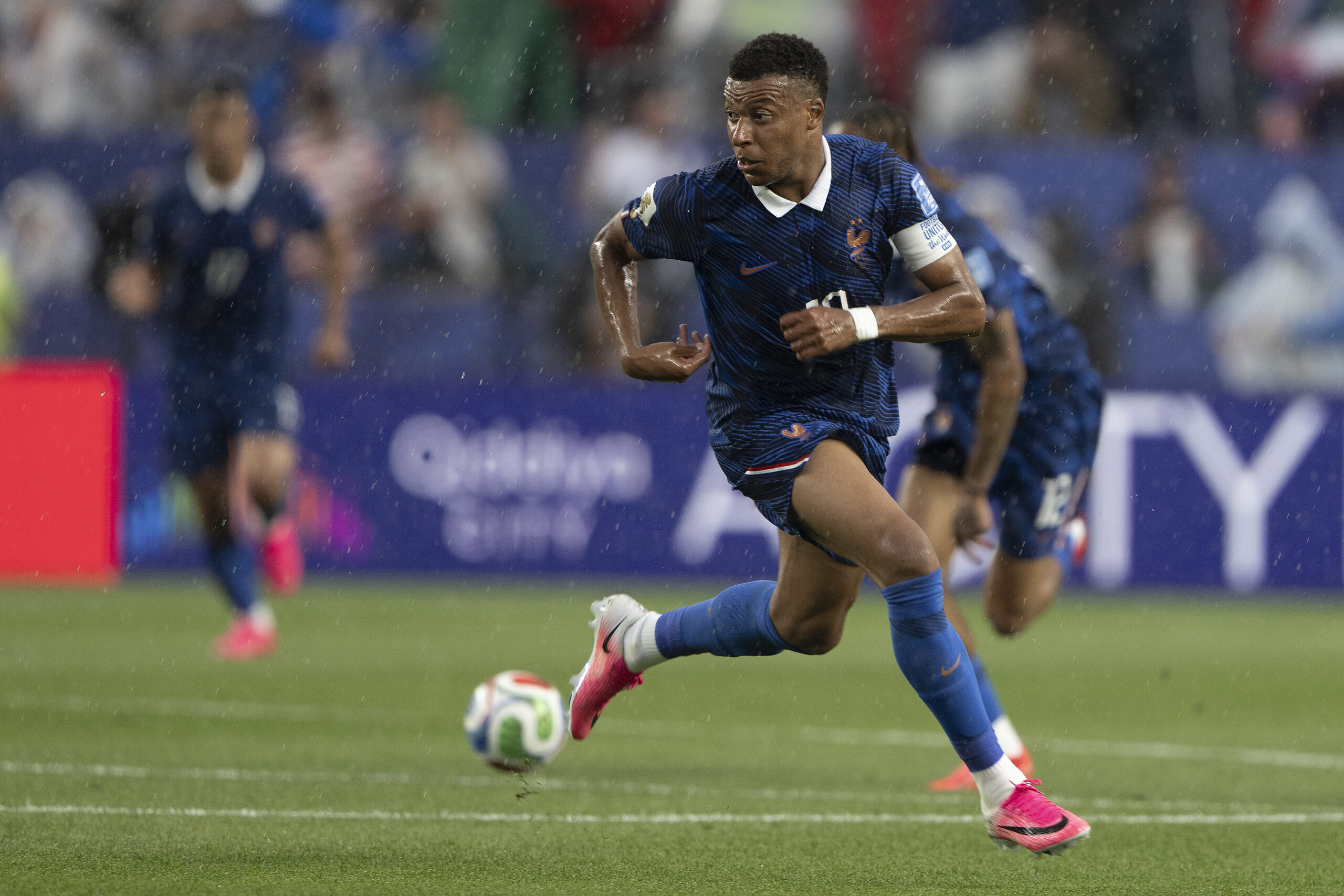
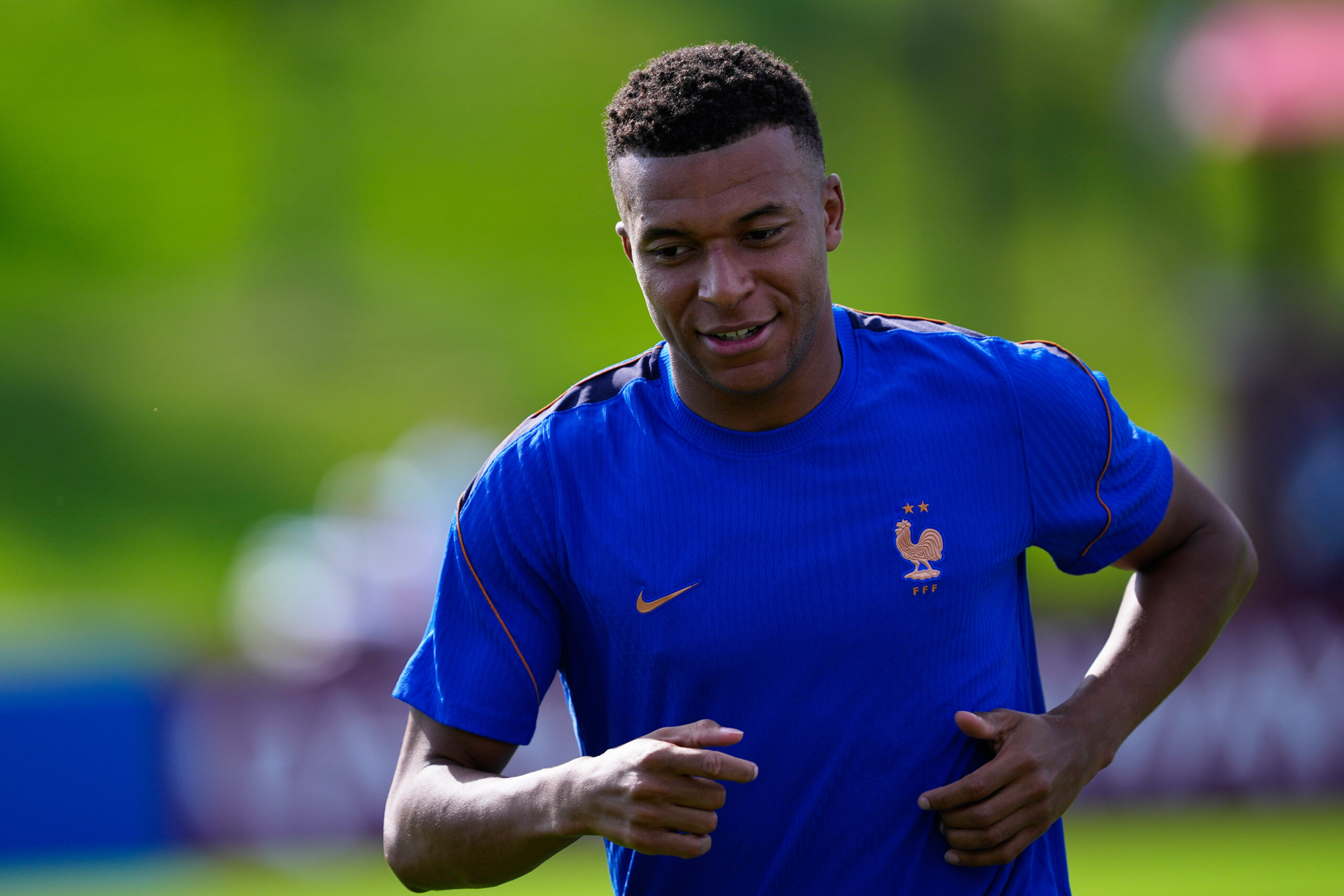
Kylian Mbappé scored two goals in France’s win.
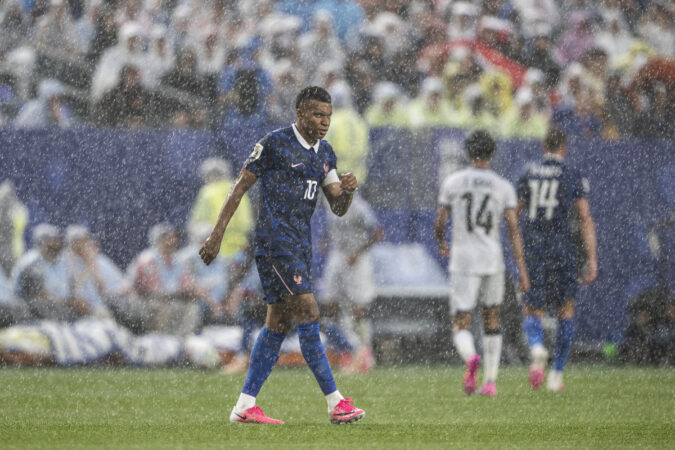
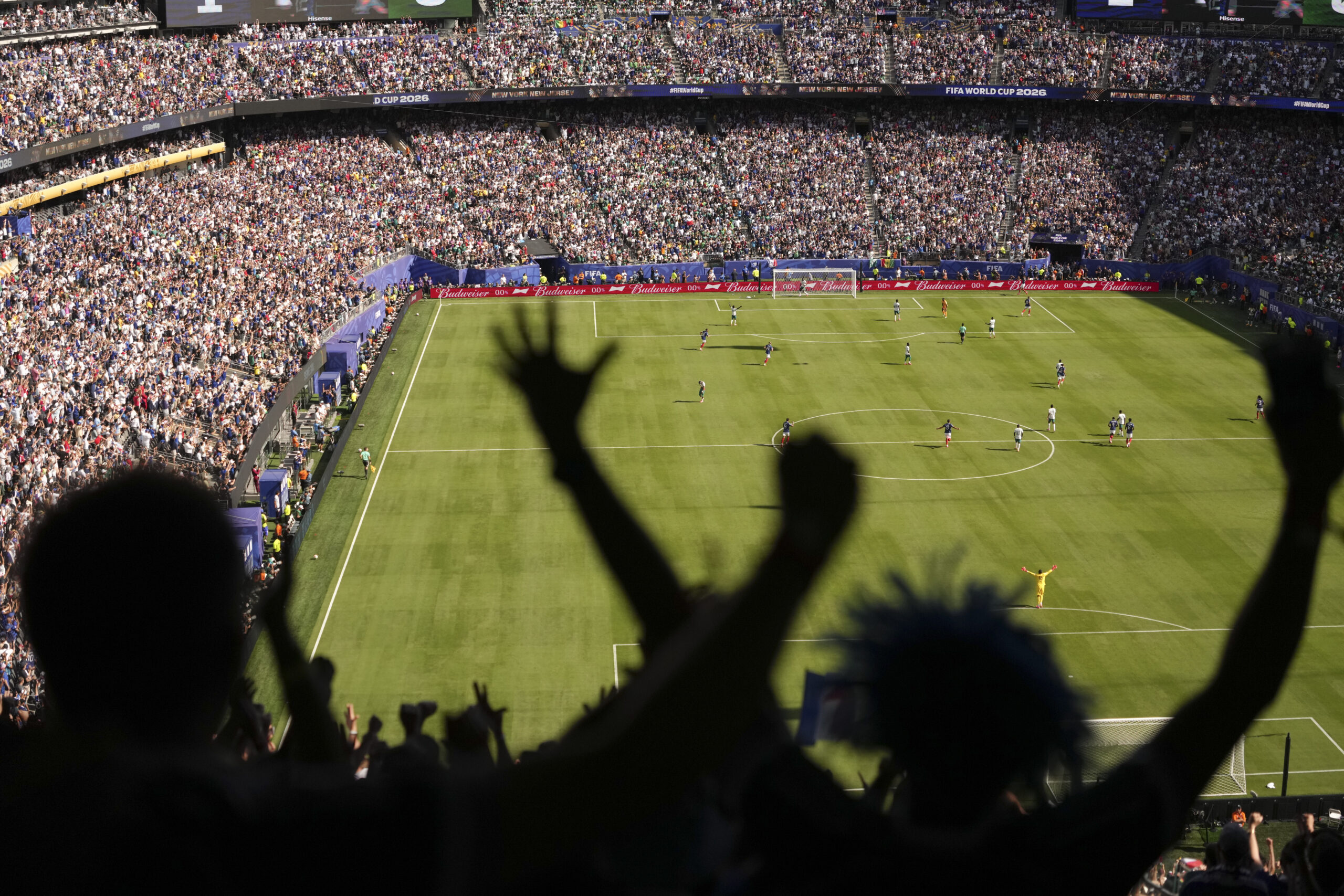
Kylian Mbappé scored two goals and reigning Ballon D’or winner Ousmane Dembele fueled a 3-0 win against Iraq inside Philadelphia Stadium, with Dembele’s goal and Mbappé’s second both arriving after a near one hour, 30 minute rain delay at Philadelphia Stadium.
The goals for Mbappe were his fourth and fifth of the tournament and the 16th of his World Cup career. He trails only Lionel Messi, who has 18 World Cup goals, after scoring two earlier today in Argentina’s win against Austria in Group J.
With the win, France secured its place in the knockout round, but have yet to win Group I outright with Norway on their heels. At the time of this report, the Norwegians were up 1-0 against Senegal.
As for the Iraqis, its World Cup hasn’t yet come to a close but they’d need to win their final match against Senegal on Friday (3 p.m., FS1) and hope for the misfortune of teams in other groups to work in their favor.
France will also play its final match on Friday against Norway (3 p.m., Fox29) with a chance to win Group I outright.
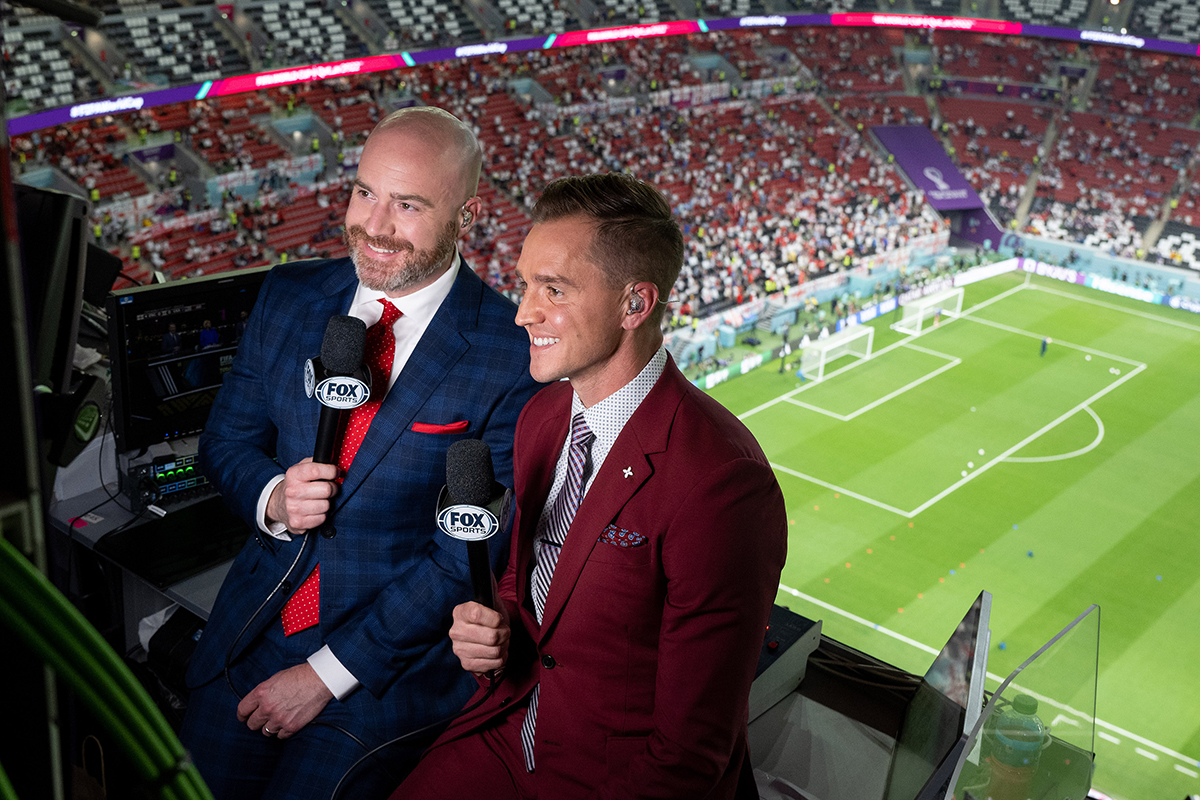
Ex-Villanova star Collin Gillespie get a few seconds of airtime during Fox’s broadcast of Monday’s World Cup match between France and Iraq, though fans watching at home might have been scratching their heads.
Mbappé scores second goal, extending France’s lead
Make that two goals for Kylian Mbappé.
The French star scored his second goal of the night shortly after play resumed, but it was largely due to a terrible mistake made by Iraq’s goalkeeper.
A MASSIVE mistake at the back for Iraq and Mbappé capitalizes 🇫🇷
Mbappé is now tied for No. 2 all time in men’s World Cup goal-scoring with Germany’s Miroslav Klose. Lionel Messi, who scored two more goals today, remains No. 1.
Thunderstorm threat subsides, but more rain expected for Philly
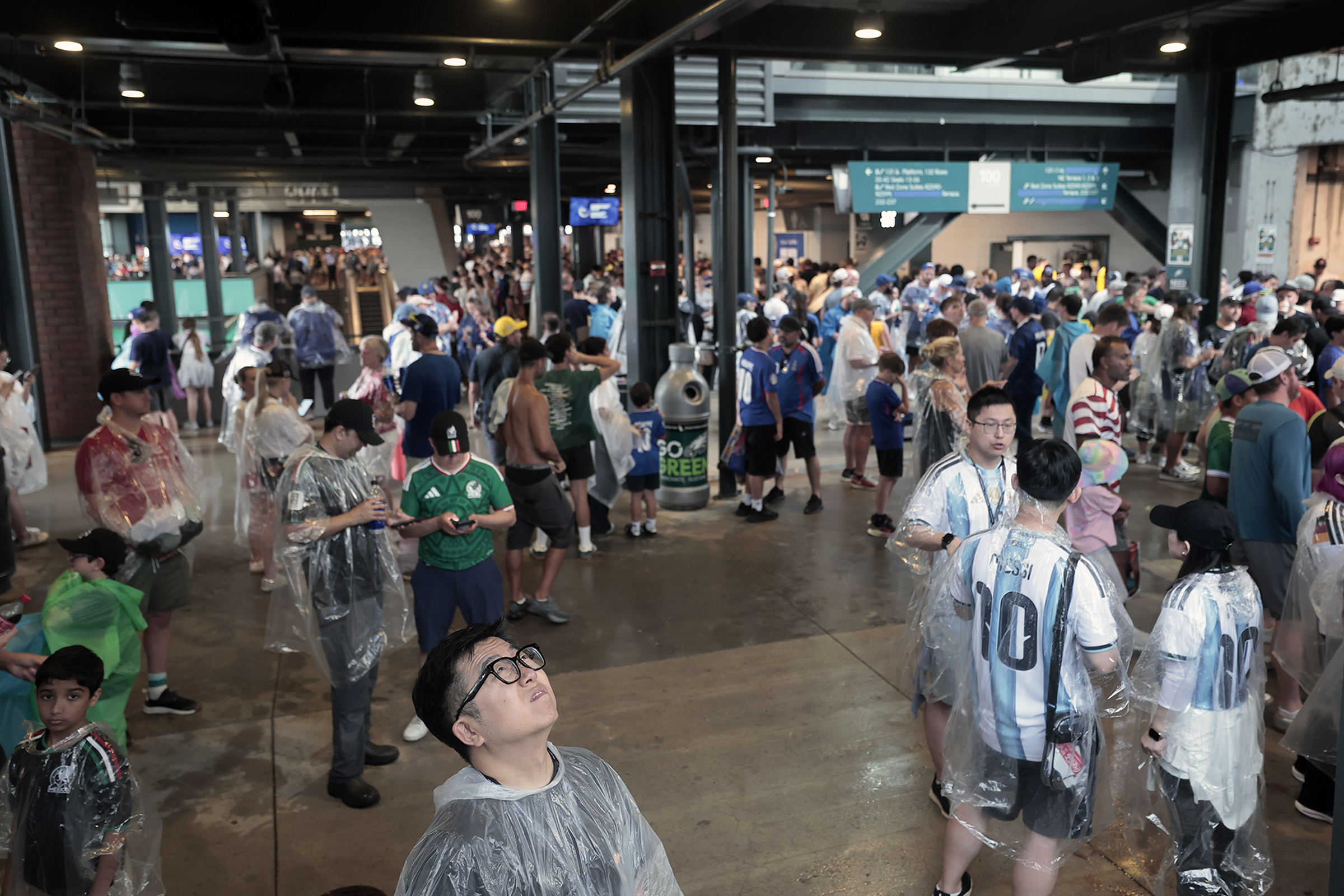
Fans seek shelter from the rain at Lincoln Financial Field.
The severe thunderstorms storms have backed off in the immediately Philadelphia area, but soaking rains are expected to continue through the night, and perhaps Tuesday.
The National Weather Service has posted several flash-flood warnings, as near to the stadium as Center City.
IRVINE, Calif. – I am sitting in my hotel room here, where it is definitely not thunderstorming, but I’ve been waiting out the delay in France-Iraq like everyone else.
As it happens, an old friend of mine is in Philadelphia today to do one of the many radio broadcasts back to France of the game.
Julien Froment is the director of the sports department at Radio France, one of that country’s biggest broadcasters, and his team is perched in the outside media seats in the upper deck.
Or at least they’re supposed to be. When the worst of the storms hit, they had to evacuate the stands for a while along with all the fans who did. But they couldn’t take all their broadcasting equipment with them, and I can tell you from enough experience doing radio work that it’s expensive – and hard-to-find – stuff.
FIFA kindly provided plastic covers to all the TV and radio networks in the open seats. But Julien and his crew went a step further. The technician, Virginie Lorda, brought a folded tarp, some rope to tie it down with, and a roll of duct tape. When they all had to go back on air before the rain had fully stopped, they started broadcasting from under the tarp.
As Julien wrote on Instagram, MacGyver would be proud.
Alex Freeman’s fast rise with the U.S. team has no bigger fan than his father, former Eagles and Green Bay Packers wide receiver Antonio Freeman. When Alex scored the game’s second goal against Australia, he achieved the rare feat of scoring a World Cup goal in a stadium where his father scored two touchdowns 30 years earlier.
Antonio stopped by Monday’s practice to talk with the media and share his joy.
“I’m sure Alex has heard enough from other people about my success and my moments,” he said. “I don’t really talk about those moments too much. But it was definitely a full circle moment. to just have a father and son combination in any sport have an impact on a game in the same stadium, same state, it’s pretty amazing.”
He called it “a credit to all the work that Alex has put in, the commitment that he’s made. This is his ride, and I’m just happy to be his biggest supporter.”
And what was the father’s message to his son after the game?
“He just continued to amaze me, and that’s all it is,” he said. “When I see him, it’s like, ‘Yeah, boy, that’s what I’m talking about!’ — That’s our little thing. But just keep working, Alex, keep being you. People love who you are, don’t change, just keep working hard.”
He also praised soccer’s growth in the United States, saying this World Cup “has really heightened the awareness in the U.S., and people from all walks of life are getting involved, rallying behind the [U.S.] team.”
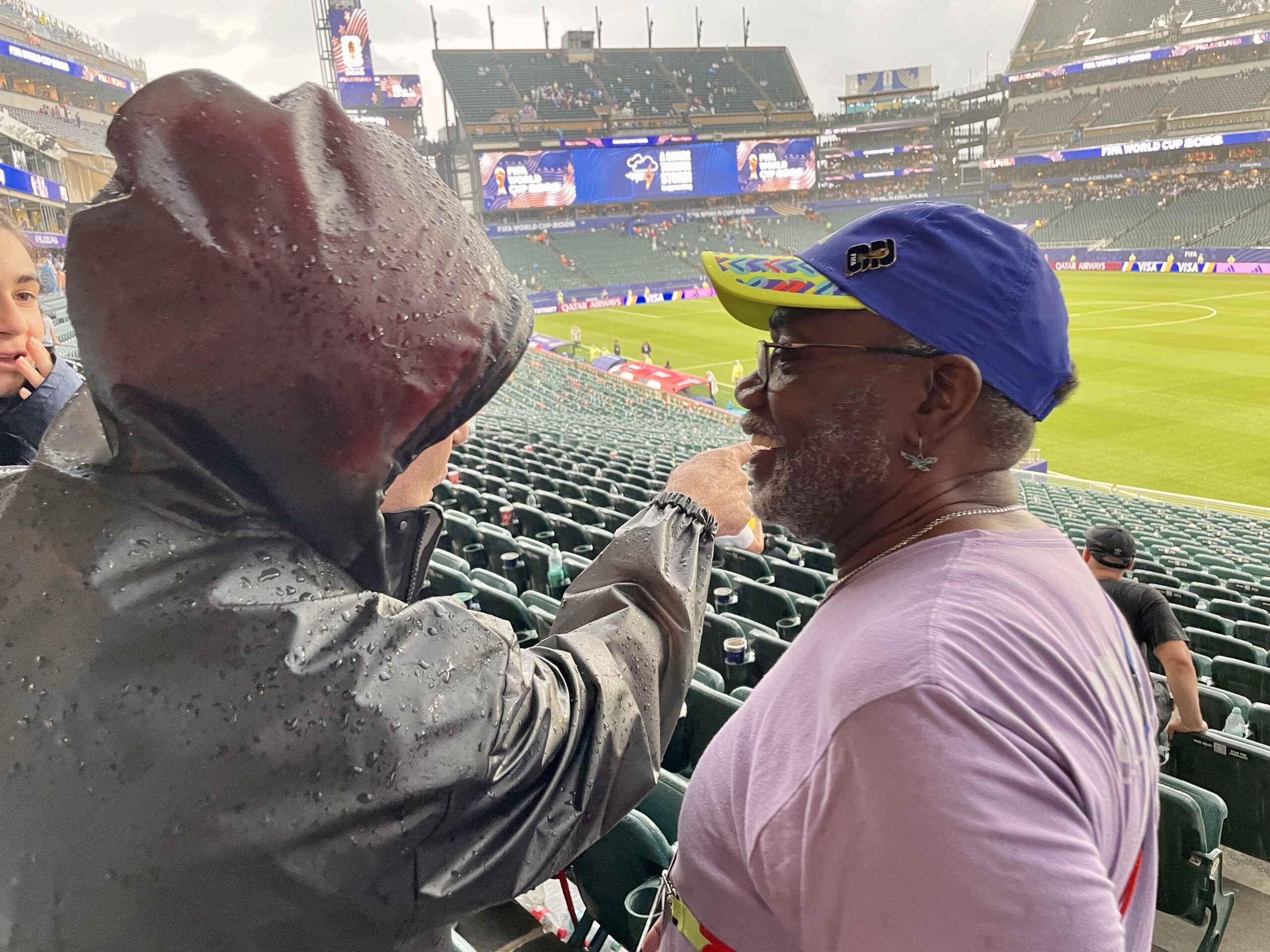
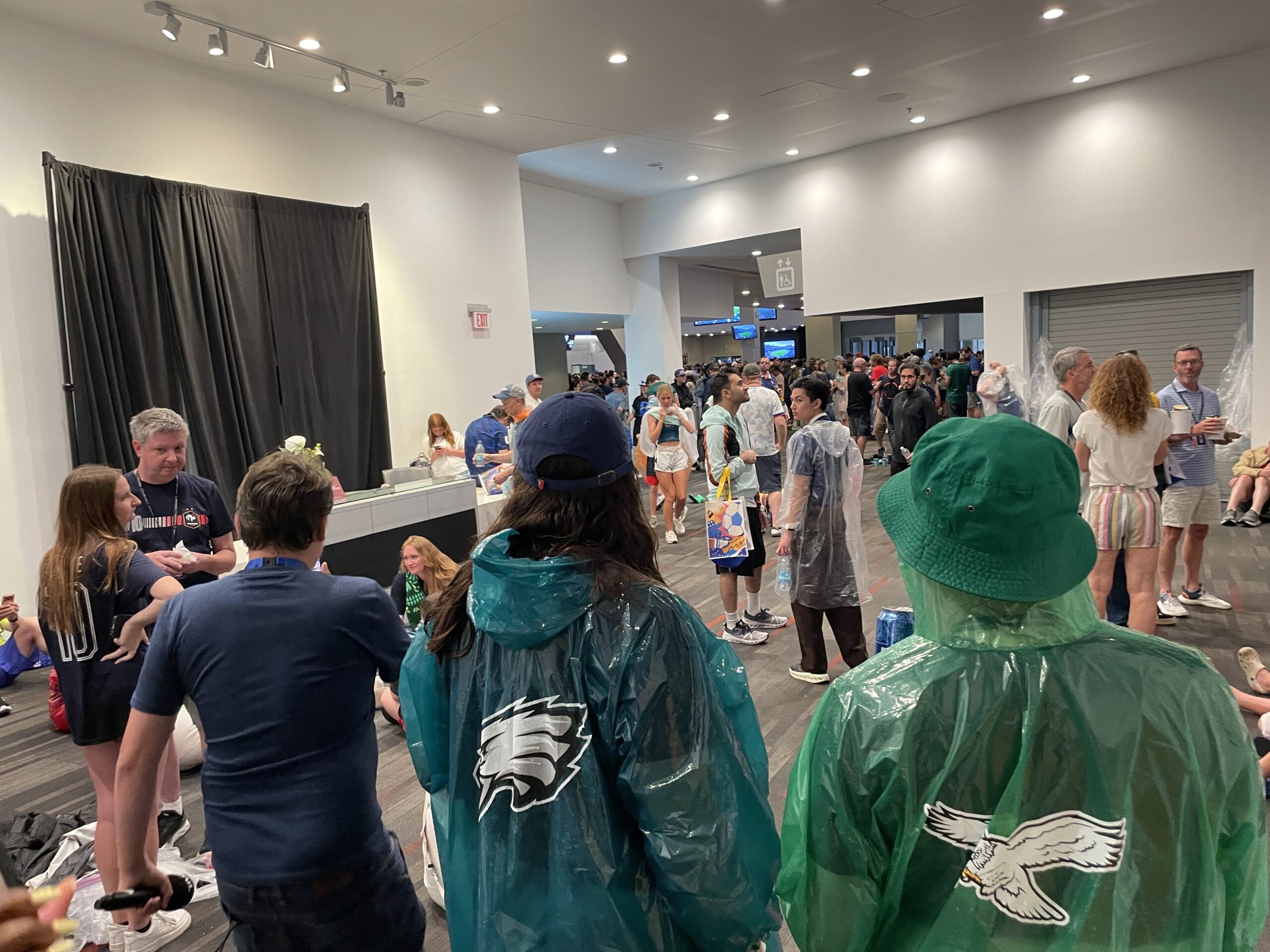
A fan services official speaks to a French fan during a weather delay at Lincoln Financial Field.
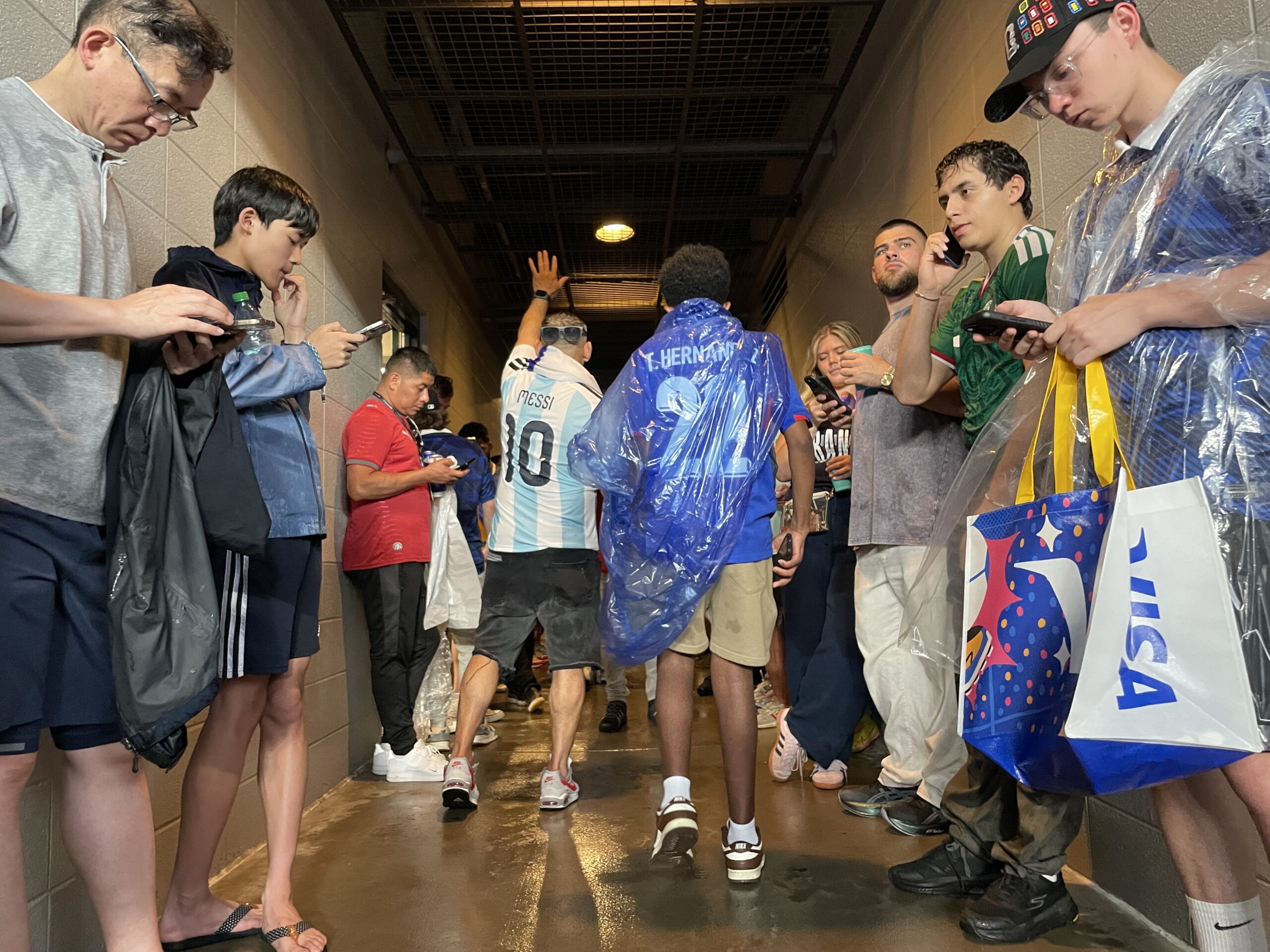
Loud cheers erupted twice from the steamy main concourse level of Philadelphia Stadium after it was announced that fans were able to return to their seats. A band of sunlight crept through and hit sections 118-121.
It looked like the game was set to return. However, public address announcer Kevin Casey notified fans that the match was still suspended, cheers changed to groans, but in true Philly fashion, people still milled to their seats.
During the downpour, a fan services official in section 106 was overheard saying, “these people paid good money for their seat, I can’t be the one to tell them to get up if they don’t want to, and if they want to get loud with me, that’s what Apex [stadium security services] is for.
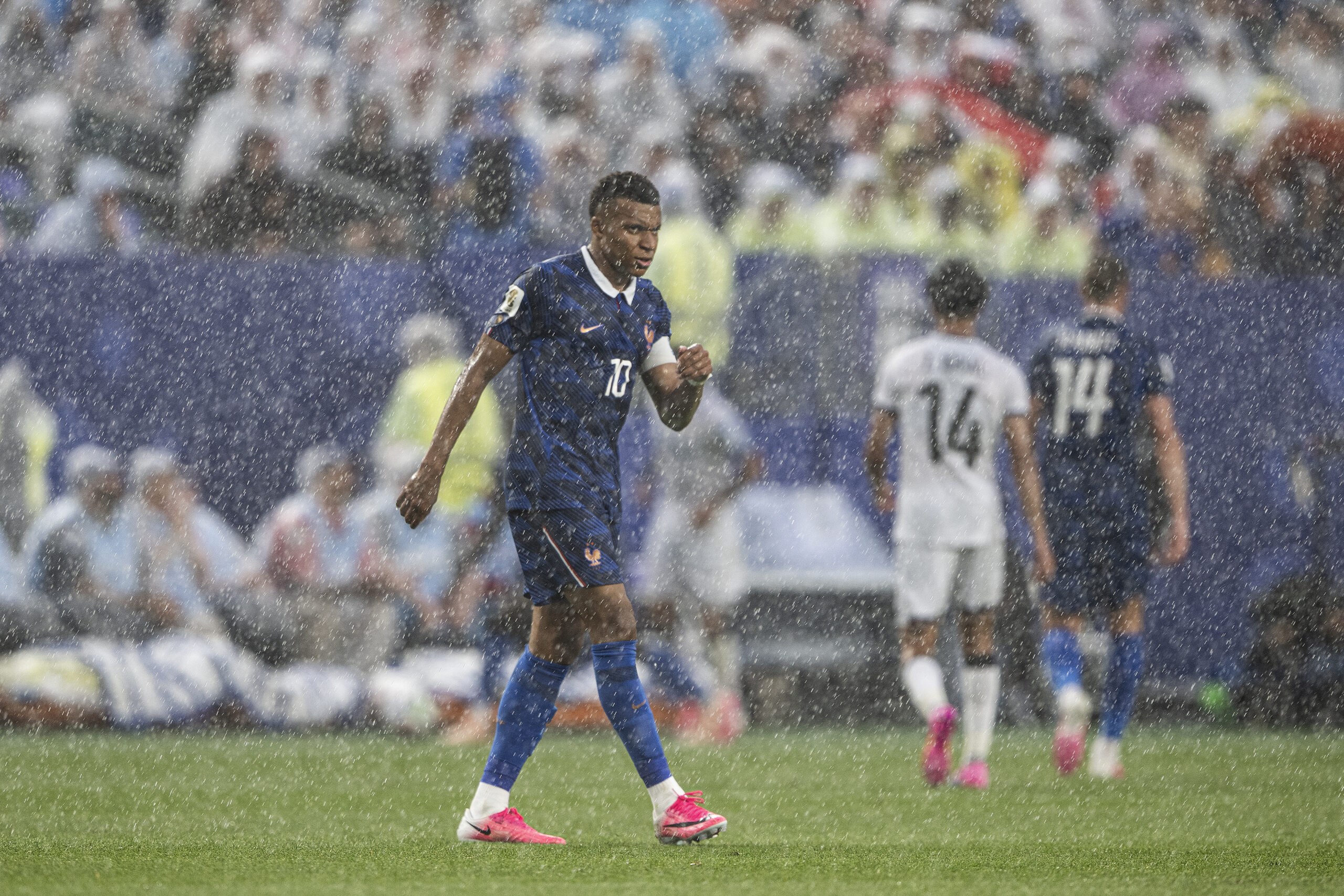
France forward Kylian Mbappé walks off the field during a thunderstorm delay. The game remains suspended.
Monday’s World Cup match between France and Iraq remains delayed as severe storms linger in and around Philadelphia.
“FIFA will follow the safety protocols established by the local authorities in the region, and will resume the match as soon as it’s safe to do so,” a FIFA spokesperson said. “The safety and security of all individuals is FIFA’s priority.”
It is unclear when the game will resume. Some fans have trickled back to their seats, even as they’re being told to seek shelter. Parts of the stadium remain empty as FIFA assess the situation.
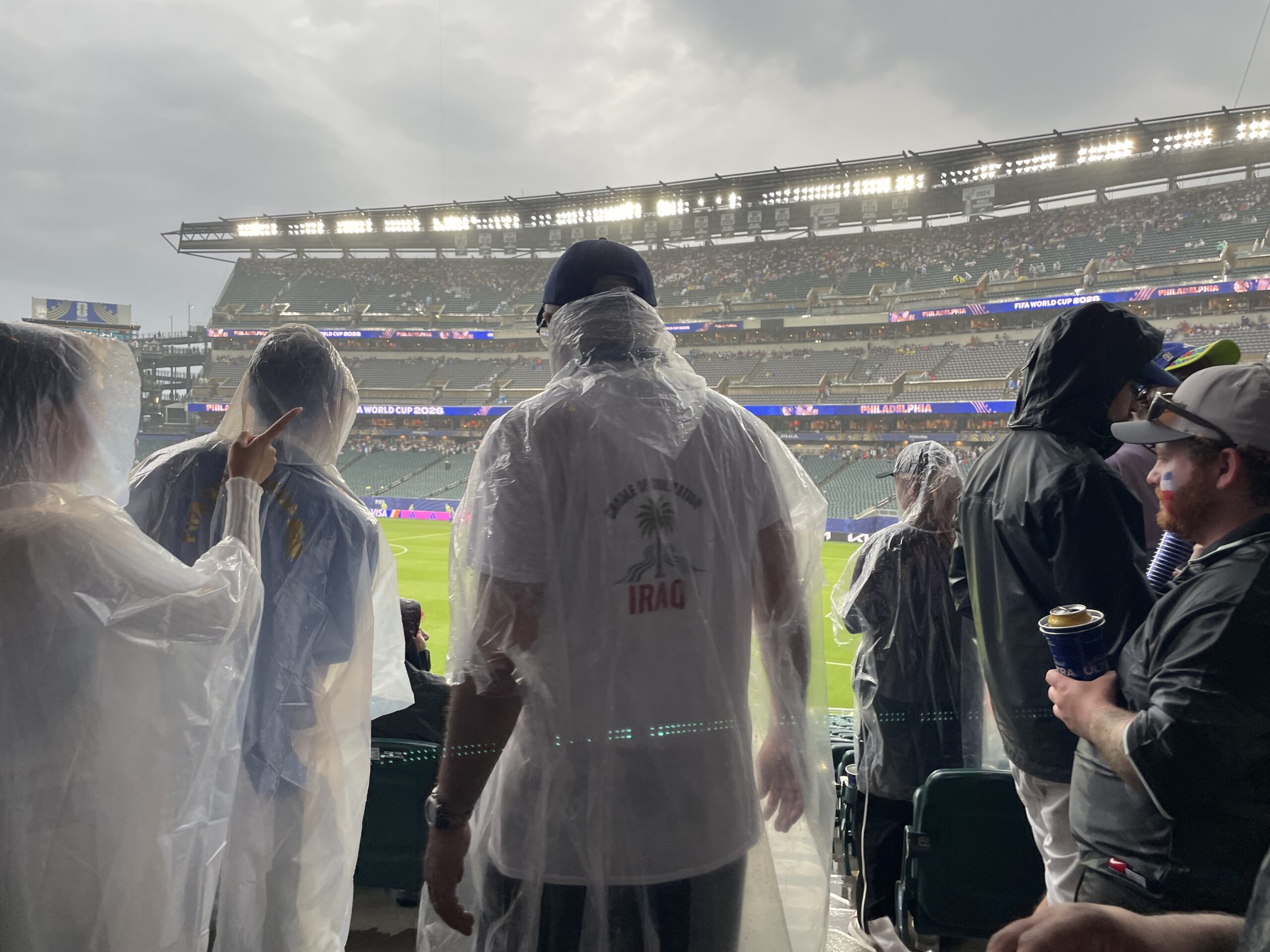
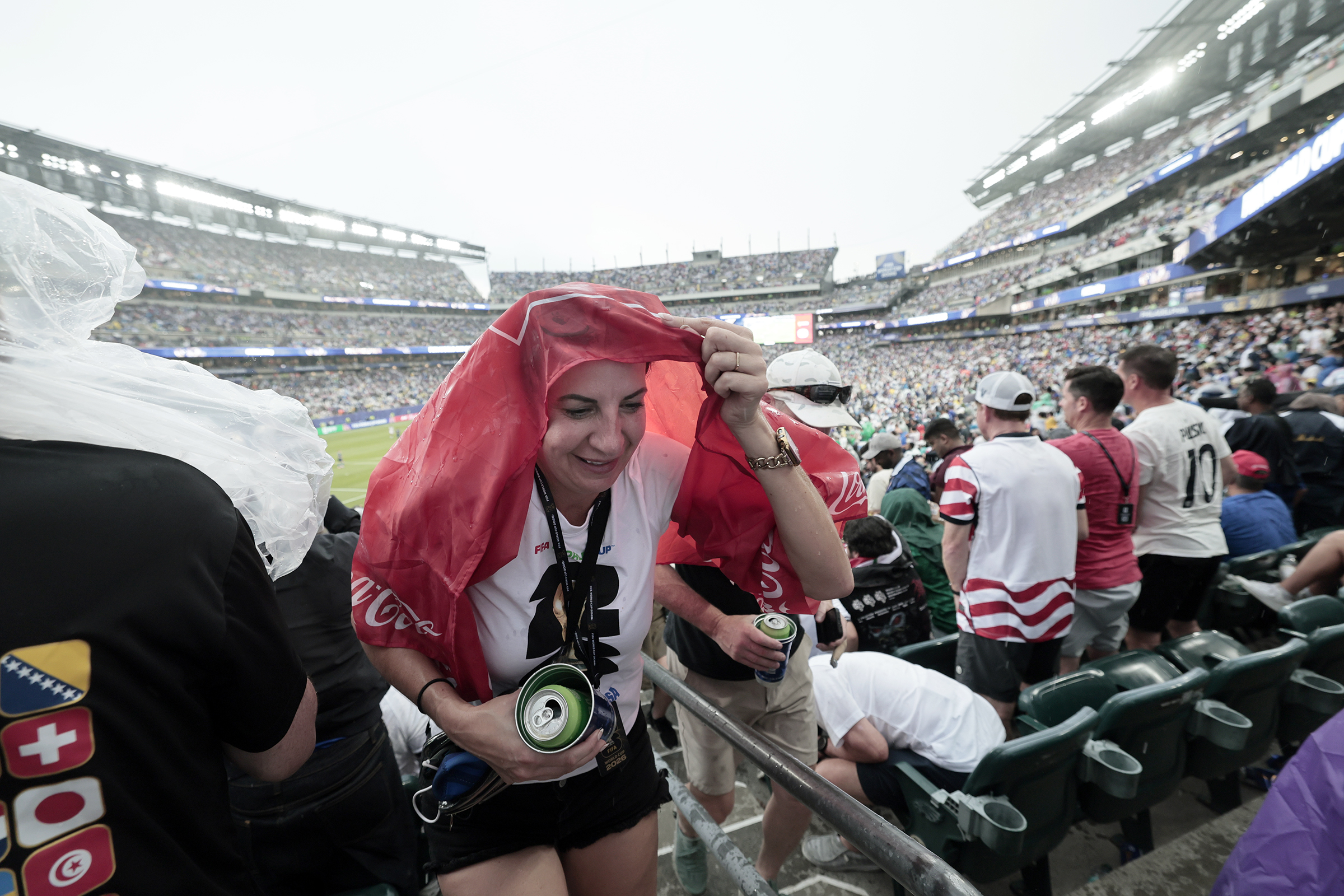
Fans try to stay dry as storms pass over Lincoln Financial Field.
Rain coming down in Philly as France and Iraq play on
Fans poncho up as rain begins to fall at Lincoln Financial Field as France plays Iraq.
It’s pouring in South Philadelphia as severe storms move through the region.
FIFA will only pause play if there is a lightning strike within eight miles of the stadium. If that happens, the match will remain paused for 30 minutes, with any subsequent lightning strikes resetting the clock.
A storm warning is in effect until 6:15 p.m. if it rains like it did out in Valley forge way, this could turn into a swim meet.
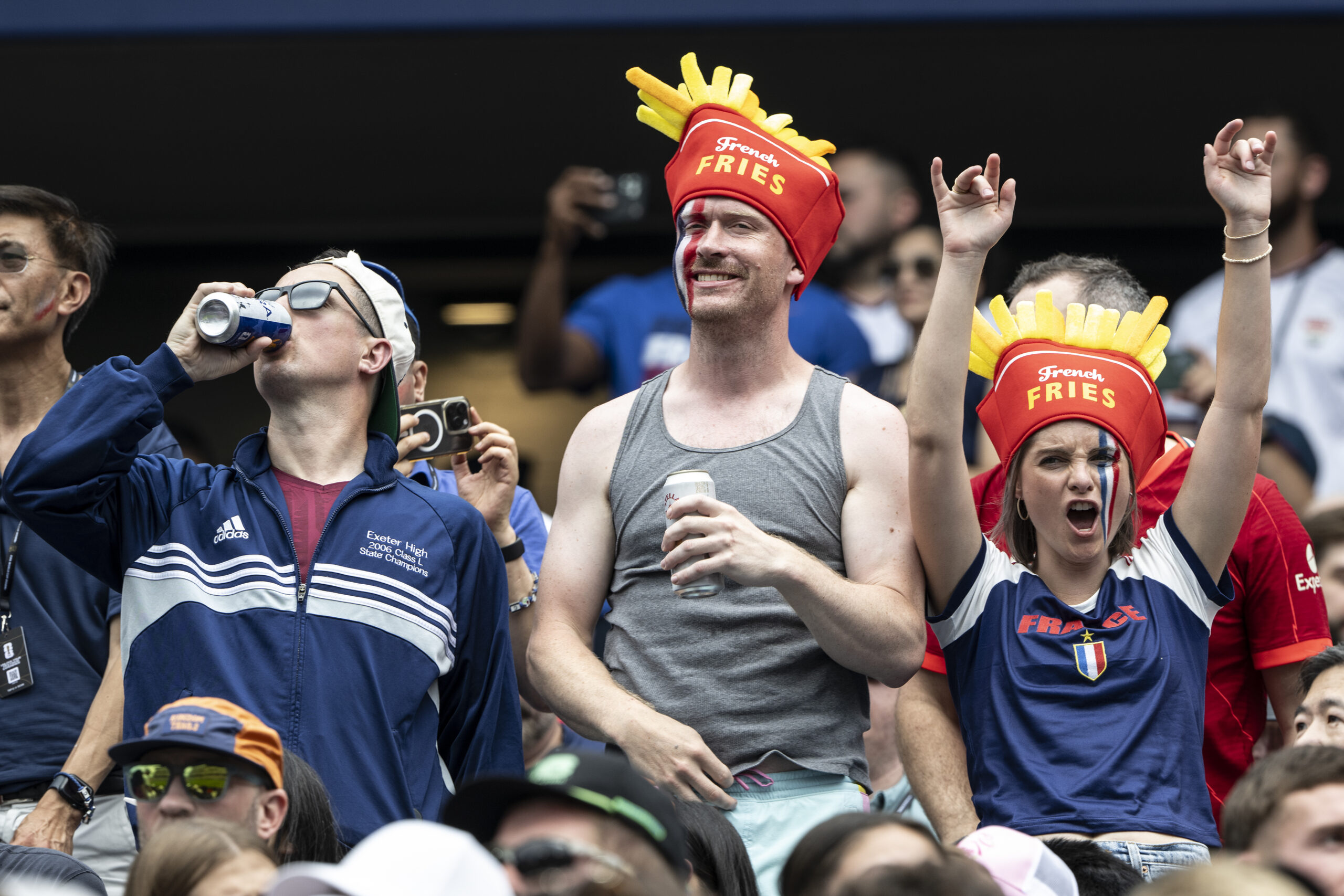
France fans cheer in the stands at the Linc during Monday night’s match against Iraq.
For the most part, French fans in Philadelphia for Monday’s game seemed to agree.
“The architecture looks quite French,” said French fan Tao Taumas, pointing to City Hall on Monday. “Yes, a lot, and we are living in Montreal now, and it looks exactly like the French part of Montreal.”
Vincent Magardeau, who traveled to Philadelphia with Taumas, did not fully agree with his friend’s conclusion.
“I’m pretty surprised that you say that,” Magardeau said after being informed of Philadelphia’s similarities to Paris. “But now that you say it, you can see the architecture here and there, but I wouldn’t say that this is the most French city that I could see.”
Gabriel Sabinaud, who “never heard about anything in Philadelphia,” arrived in the city early Monday morning after staying in New York City. A local informed Sabinaud to try a soft pretzel before he leaves, so he headed to the Philly Pretzel Factory near City Hall before the game. Sabinaud, although having limited time to explore, definitely saw the similarities between the two cities.
“The east side of the U.S. is definitely more European than the west side,” Sabinaud said. “I’ve been to San Francisco as well, not European. No, it’s not. So [Philadelphia] is definitely more European and Parisian at some points. You’ve got tiny streets with lots of people making noise with their cars. Very similar, more similar to Paris than the west side.”
Many French fans explored Center City before taking the Broad Street Line to South Philadelphia for the game. For a moment, before it began to rain heavily, “Les Bleus” had taken over downtown.
“You can see the vibe of French people here,” Taumas said. “With the World Cup, I would say it’s a French city, because everyone is wearing French jerseys, so you might be the Frenchest city in the U.S.”
Iraqi social media star serves dolma outside the Linc
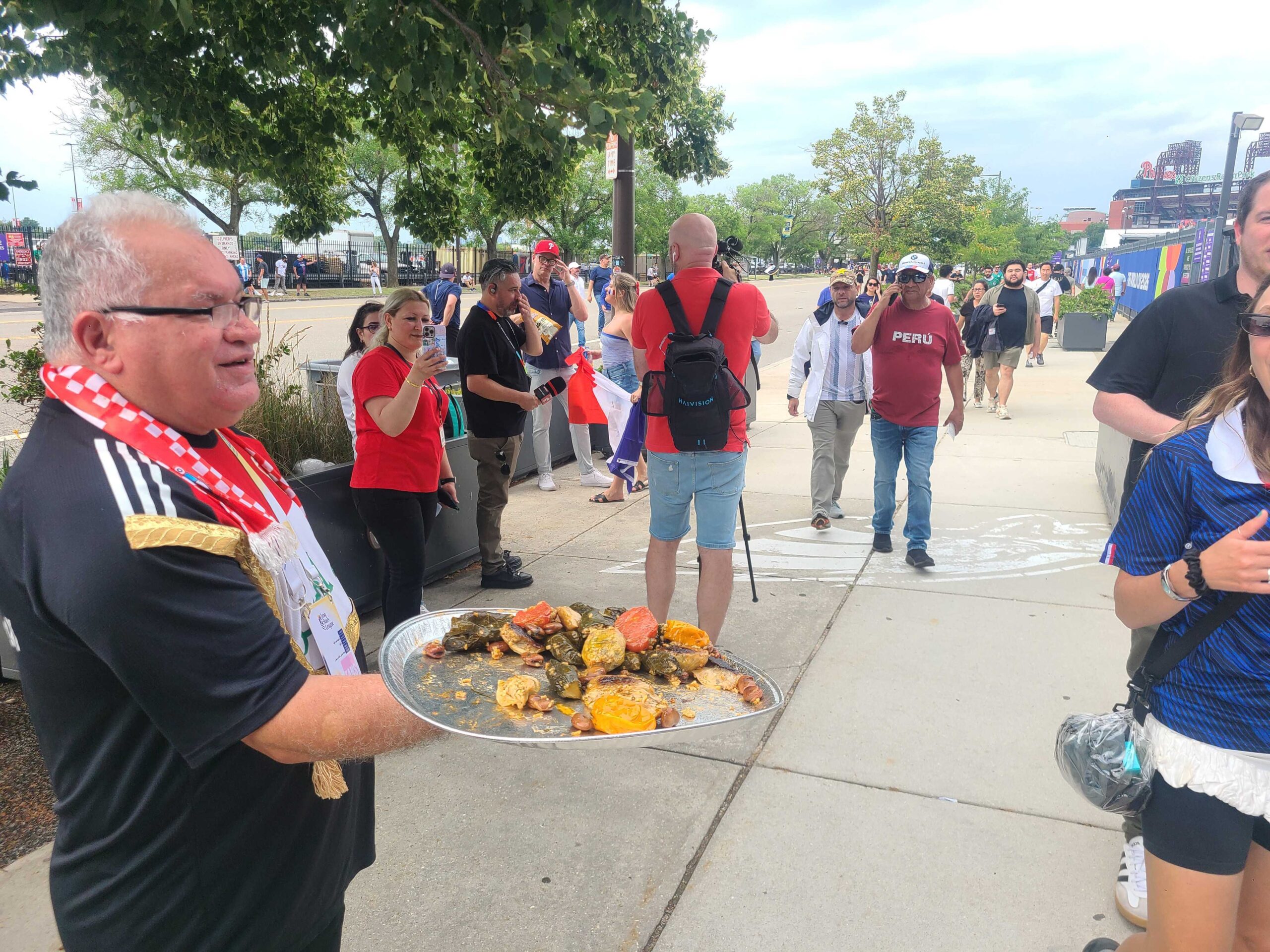
Fawzi Bedaweed serves dolma from his native Iraq outside Lincoln Financial Field Monday.
Fawzi Bedaweed, an Iraqi native from Zakho, traveled to Philadelphia by way of Texas to watch his beloved “Lions of Mesopotamia” take on France.
A budding social media star, Bedaweed has built up a loyal following on social media sharing Iraqi culture during the World Cup. In Philadelphia, that took the form of handing out authentic Iraqi food like dolma to fans outside Lincoln Financial Field.
“We’re going to win! Iraq!” Bedaweed chanted, dancing on the sidewalk.
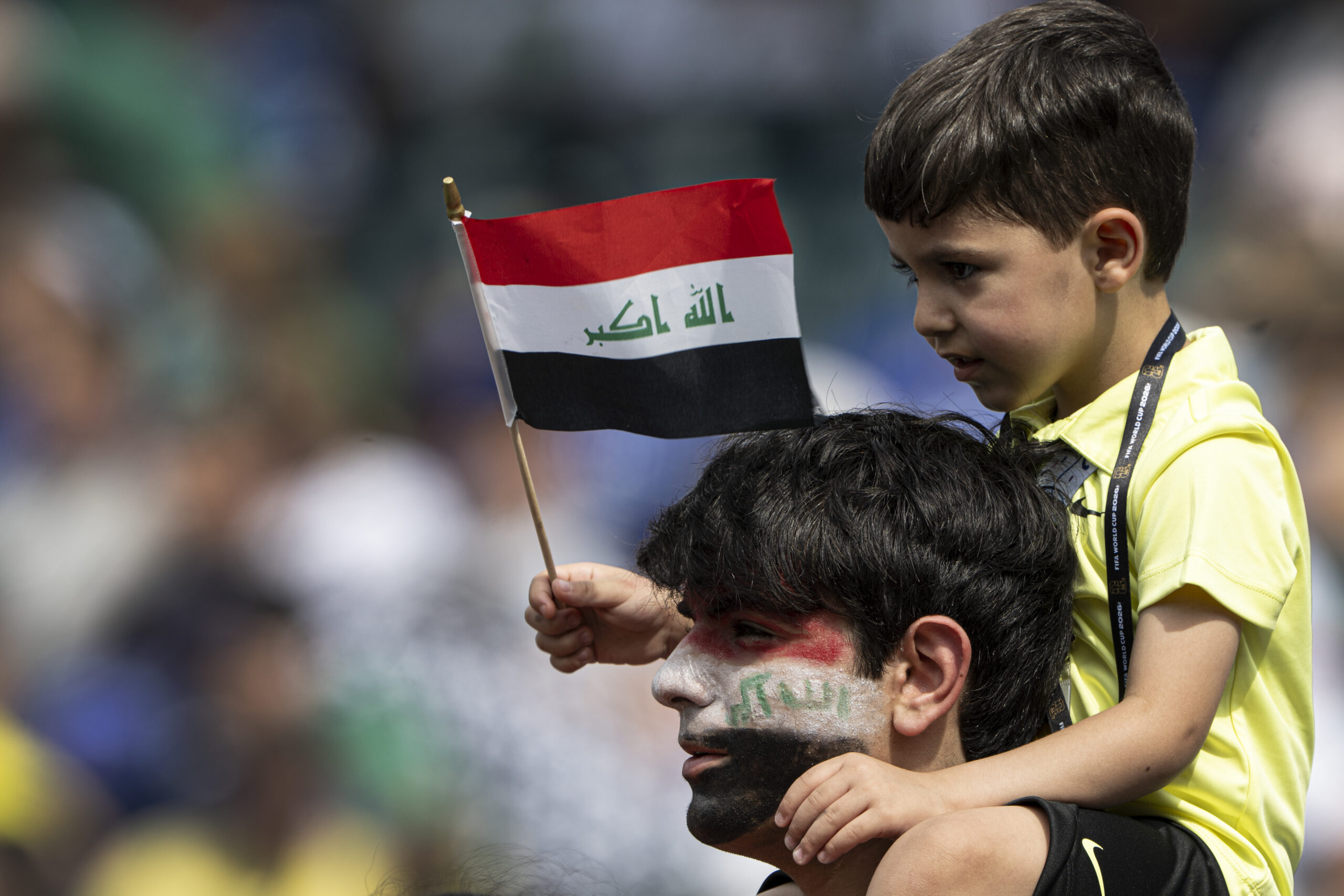
While France were clear favorites heading into the game, a strong contingent of Iraqi fans filled the southern stands behind the net at the stadium.
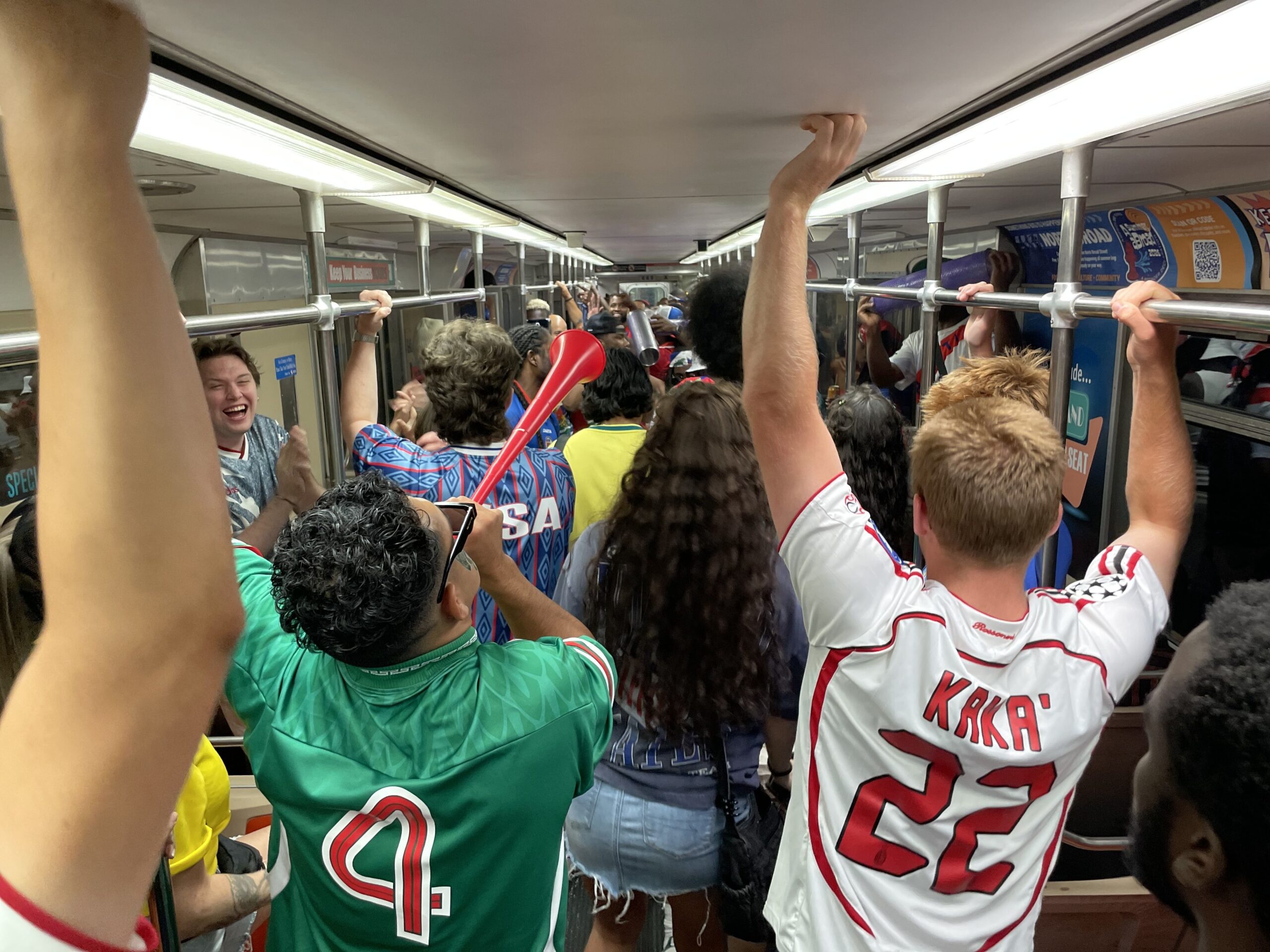
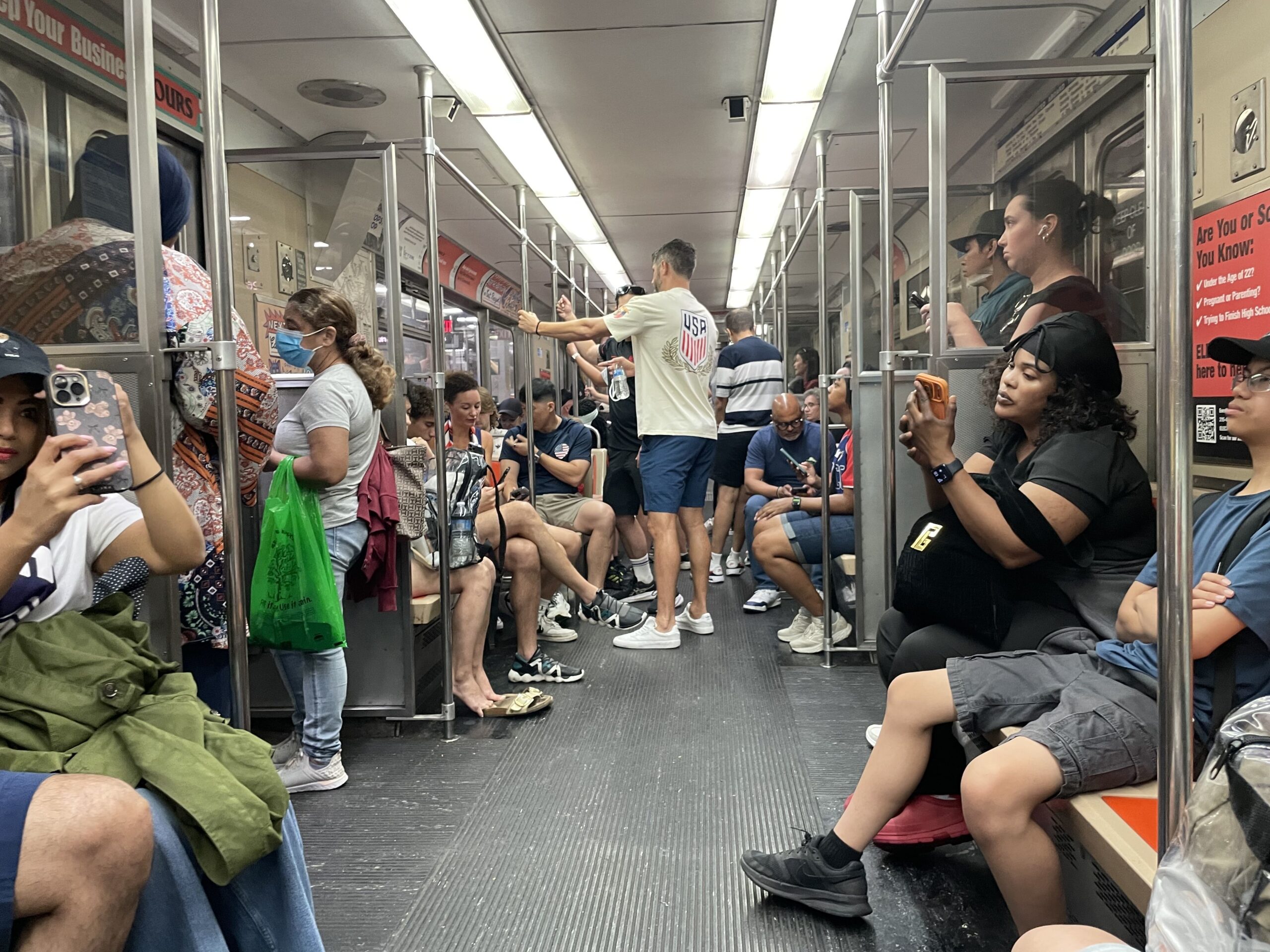
It could just be the time of day, or that fact that it’s a 5 p.m. match on a Monday, but the revelry, excitement, and energy that transpired on SEPTA’s Broad Street Line an hour before kickoff compared to Friday’s match between Brazil-Haiti has fallen off.
That’s not to say there won’t be a significant crowd in-stadium, but traveling the express subway down was not the method of choice at this hour.
The subway line was packed heading to the match after the City Hall stop on Friday at 8 p.m., a little less than hour before the game started. Let’s just say it was a vibe.
Fans pack the Broad Street Line ahead of the World Cup game between Brazil and Haiti on Friday, June 19, 2026.
On the way in to France-Iraq one hour before kickoff after City Hall? Not so much.
Fans ride the Broad Street Line ahead of the World Cup game between Iraq and France on Monday, June 22, 2026.
Philly will see France’s biggest stars in the starting lineup
Whenever the France-Iraq game kicks off, Philly fans will get to see some of soccer’s biggest stars on the field.
Les Bleus will have Kylian Mbappé, Bradley Barcola, Ousmane Dembélé, and Michael Olise as the front four in their attack, as fearsome a quarter as there is anywhere in the world’s game.
It’s a little bit of lineup rotation from the group that started France’s entertaining 3-1 win over Senegal in the Meadowlands on Tuesday, as Barcola comes in for Désiré Doué — another of the world’s brightest young talents.
Mbappé scored two brilliant goals in that game, playing his own role in the chase for the all-time World Cup scoring record. He now has 14, four behind Lionel Messi’s new record of 18. Messi scored twice in Argentina’s 2-0 win over Austria Monday, after having scored a hat trick in the reigning champions’ 3-0 win over Algeria.
Germany’s Miroslav Klose was the previous men’s World Cup record holder with 16. The overall World Cup record belong to Brazilian women’s legend Marta with 17, until Messi passed that mark Monday.
Iraq’s lineup includes a player from MLS, Nashville SC’s Ahmed Qasem, on the left flank in midfield. There will also be a familiar face from the league in the center circle, as veteran Canadian referee Drew Fischer takes charge of the whistle.
At least so far, FIFA has not delayed the kickoff time from the scheduled 5 p.m.
France and Iraq's starters are out.
Mbappé, Dembélé, Barcola and Olise all line up for France.
Nashville SC's Ahmed Qasem goes for Iraq.
Another familiar face from MLS, Canada's Drew Fischer, is the referee.
Fans ready for today’s Philly match: ‘I just enjoy that vibe’
The FIFA Fan Festival is shut down for the day, but the pre-match party is rolling on across the city.
Mahir Sanori and Gene Lazarraga staked out their spot across from the bar at Lion Sports Bar in Chinatown by 3:20 p.m., more than an hour before France and Iraq’s scheduled kick-off time.
Sanori and Lazarraga have no connection to France, aside from Lazarraga’s French classes at Delran High School in Burlington County, but the former high school classmates chose to cheer on Les Bleus.
“We were both free this day, so [we said], ‘let’s just do it,’” Sanori said.
Lazarraga was wearing a Nike-branded navy blue French kit, while Sanori sported a white T-shirt colored in with fabric marker to make the French tricolor.
The pair also picked up some France face stickers and a French flag at Walmart, the latter of which was draped over Sanori’s shoulders.
Sanori and Lazarraga arrived just after Lion Sports Bar finished hosting a group of French supporters for some pre-match festivities, but both said they appreciated the influx of global culture brought to the region by the beautiful game.
“Seeing all these different groups of people come together, that’s kind of a rare sight in America,” Lazarraga said. “Especially with the sports here, people just go at each others’ throats. But, different countries [are] coming together, everyone’s just having a fun time. I just enjoy that vibe. That’s why we’re here right now.”
IRVINE, Calif. – Star playmaker Christian Pulisic was back on the field in practice for the U.S. men’s soccer team on Monday, taking part for the first time since before the tournament opener against Paraguay.
That was a good sign as the Hershey native recovers from the calf injury that kept him out of the second group stage contest against Australia. But it’s just one step, and practice was open to the media for the first 15 minutes. So we don’t know what happened after that.
Since the United States has already clinched first place, there isn’t much reason to play Pulisic in Thursday’s group finale against Turkey (10 p.m., Fox29, Telemundo 62). There also isn’t much reason to play the players on yellow cards — defenders Chris Richards and Antonee Robinson, midfielder Tyler Adams, and striker Folarin Balogun — since a booking in that game would get them suspended from the round of 32.
Still, it was a good sign to see Pulisic making progress.
The other injury news is that midfielder Cristian Roldan is day to day with a muscle strain. If he can’t play against Turkey, that will leave the United States shallow. Balogun also got a lighter day of practice, with a U.S. Soccer spokesperson saying: “Extra recovery. No issues.”
Opening gate time delayed at Philadelphia Stadium ahead of Iraq-France game
France v Iraq – June 22, 2026
Due to inclement weather in the region, gates opening will be delayed. If you are not in the area, please do not travel to Philadelphia Stadium at this time. A new gates opening time will be communicated once the weather has passed. If you are near…
— Lincoln Financial Field (@LFFStadium) June 22, 2026
// Timestamp 06/22/26 2:17pm
Philly fan festival is closed the rest of the day
Due to inclement weather, FIFA Fan Festival will close for the remainder of Monday. pic.twitter.com/BajUl4whLk
— FIFA World Cup 26 Philadelphia™ (@FWC26Philly) June 22, 2026
// Timestamp 06/22/26 2:02pm
Fan fest at Lemon Hill shuts down due to weather
Stormy weather shut down the World Cup fan festival on Lemon Hill during the afternoon on Monday, June 22, 2026.
The broadcast screens at the FIFA Fan Festival went from showing the Argentina-Austria match to an orange screen with a warning that thunderstorms were approaching the area around 1:40 p.m.
Minutes later, the orange warning switched to a red warning, indicating that “a thunderstorm with lightning is approaching the park.”
Festival organizers said the grounds could re-open if the storm passes through the area quickly. The festival asked fans to pay attention to its social media feeds for further updates on Monday’s schedule.
Organizers would not make an official commitment on whether the grounds would open again, but a member of the festival staff was informing food vendors that they were to shut down for the day as fans were exiting the grounds.
France and Iraq will have to contend with forecast thunderstorms when they kick off at Lincoln Financial Field at 5 p.m.
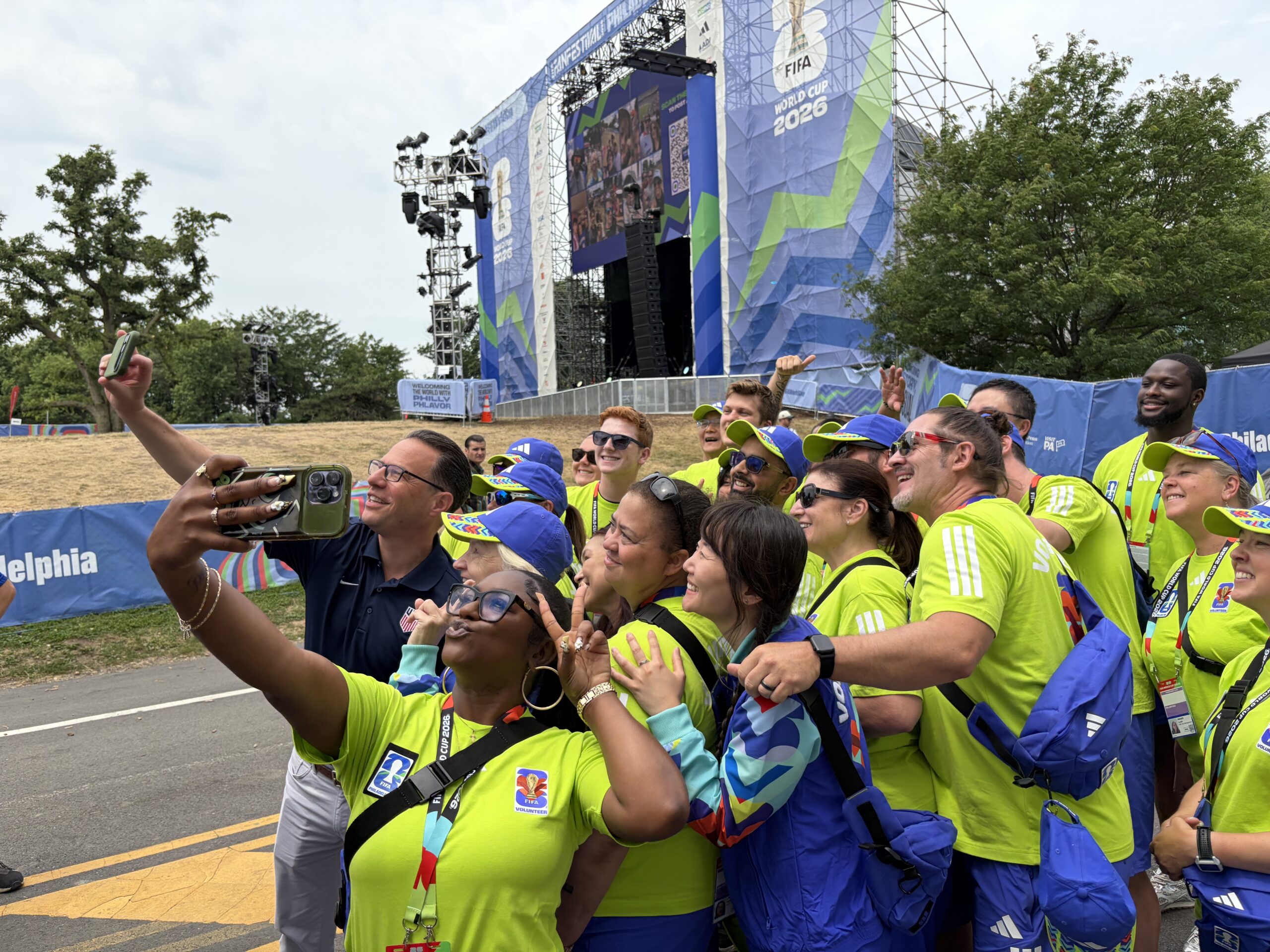
‘This is Philly, man’: Gov. Josh Shapiro hits Fan Fest
Pennsylvania Gov. Josh Shapiro poses with volunteers at FIFA Fan Fest at Fairmount Park in Philadelphia Monday.
Gov. Josh Shapiro became the latest elected official to visit the FIFA Fan Festival when he stopped by Lemon Hill Park on Monday afternoon, ahead of France and Iraq’s meeting in Philadelphia this evening.
Shapiro, sporting a navy blue U.S. Soccer polo, walked the festival grounds before kick-off of Monday’s first match, between defending champion Argentina and Austria.
“What a unique event and historic moment for our city at this historic juncture of 250 years,” Shapiro said. “To be able to be together and just celebrate one another, celebrate this great sport and enjoy yourself… I think the world needs some more togetherness, needs some more cheer, and this is a great opportunity for that.”
He was greeted by lines of volunteers as he entered the festival, then followed in Mayor Cherelle L. Parker’s footsteps by customizing a charm bracelet at the Bank of America tent — Shapiro chose charms that read 250.
In a brief news conference in front of the festival stage, Shapiro hailed Philadelphia’s Fan Festival as the best “in the country.”
“This is Philly, man,” Shapiro said. “We know how to do big things. It’s extraordinary to see people come out happy and joyful, cheering for their team. Unlike a typical Philly sports event, our fans aren’t cheering against others. There’s just happiness and joy … I’m glad that Philly is a welcoming city and welcoming people from all across the world to be here.”
Shapiro stopped to chat with dozens of attendees inside Visit PA’s booth and play a large arcade-style video game with a young fan in a Paris Saint-Germain kit. He asked French fans in line if Argentina’s Lionel Messi or France’s Kylian Mbappé was the better player, and stopped with an Argentina fan to recount Messi’s performance in Argentina’s win over Algeria.
One of the people Shapiro introduced himself to was 18-year-old Esra Asfaw, who had a French flag draped over his shoulders. Asfaw, a George Mason student originally from Addis Ababa, Ethiopia, said he did not know who Shapiro was when the governor introduced himself.
“I was so surprised,” Asfaw said.
Asfaw traveled up from Virginia to Philadelphia to see Les Bleus face Iraq. He paid $1,089 on the resale market for his 200-level seats. Asfaw said he is not worried about France’s chances against Iraq, but instead about the weather, as looming thunderstorms in the evening could impact the match.
“Maybe the match might get delayed,” Asfaw said. “That’s the only thing I’m worried about. If it rains and they play, then that’s enough for me.”
France’s Kylian Mbappe will take the field in Philly tonight, even if it’s pouring.
That’s the front page headline today in L’Équipe, France’s national sports newspaper and one of the most influential sports outlets in Europe.
Whether or not they read The Inquirer (we hope they do!), the word is out that thunderstorms are on the way to South Philadelphia, and are expected to hit the stadium around the time that France and Iraq are on the field (5 p.m., Fox29, Telemundo 62).
The paper’s coverage setting the stage for the game includes some teaching of Philadelphia lore. And of course, it’s Rocky-themed, since Iraq’s challenge is a classic World Cup underdog story.
The front page of @lequipe-actu.bsky.social today:
“It’s the kind of moment that makes you want to strike up a fanfare, to sound the trumpets and the Rocky theme, to be ready to go up the Philadelphia Museum of Art steps four by four, before a run along the waterfront, a spar with a hunk of meat in a cold room, or a World Cup game at ‘the Linc,’ the Eagles’ stadium,” lead soccer reporter Vincent Duluc writes. “It’s been 50 years since visitors to Philly have raised their arms at the top of these steps, jumping in place. But it’s also a moment to remember that this piece of popular culture celebrates an unexpected hero – and that the France team that’s getting ready to face Iraq in Philadelphia feels more like Apollo Creed than Rocky Balboa.”
Elsewhere in the paper, there’s a little feature on the history of Lincoln Financial Field — Philadelphia Stadium during the World Cup — and its place in the city’s culture.
“Here, the Eagles aren’t just a NFL team, they’re a local religion,” reporter Hugo Guillemet writes. “Their logo is omnipresent on the streets, in shop windows, and in the bars of South Philly. Their hymn, ‘Fly, Eagles, Fly,’ is a popular chant on game days, and when it resonates in the stadium, the stands shake.”
As for social media, if you want a fun French perspective, check out Radio France’s sports reporter Julien Froment. He’s been posting lots of videos on his X and Instagram accounts as he travels around town. Here’s one from the France fans’ pep rally on the Art Museum steps yesterday.
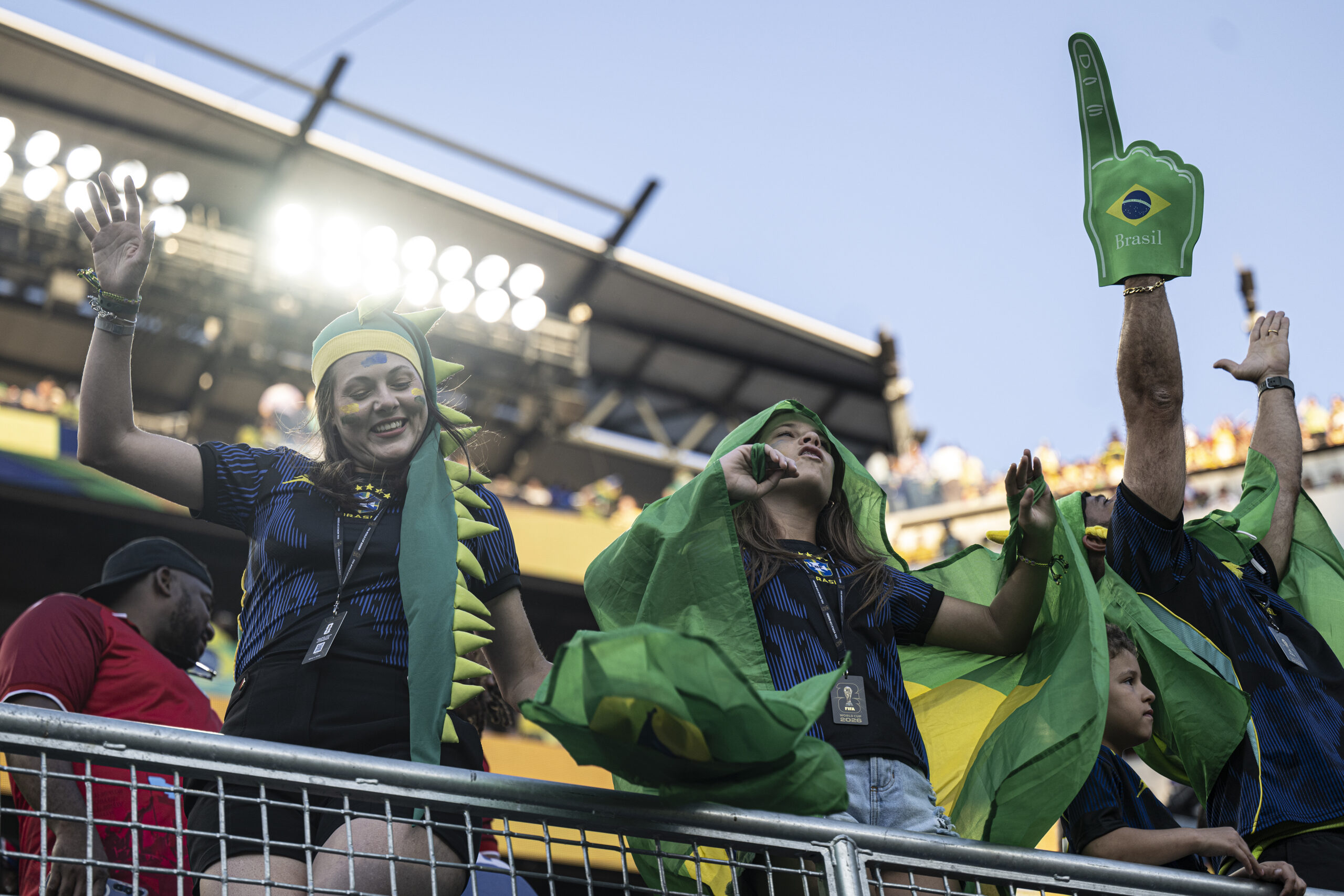
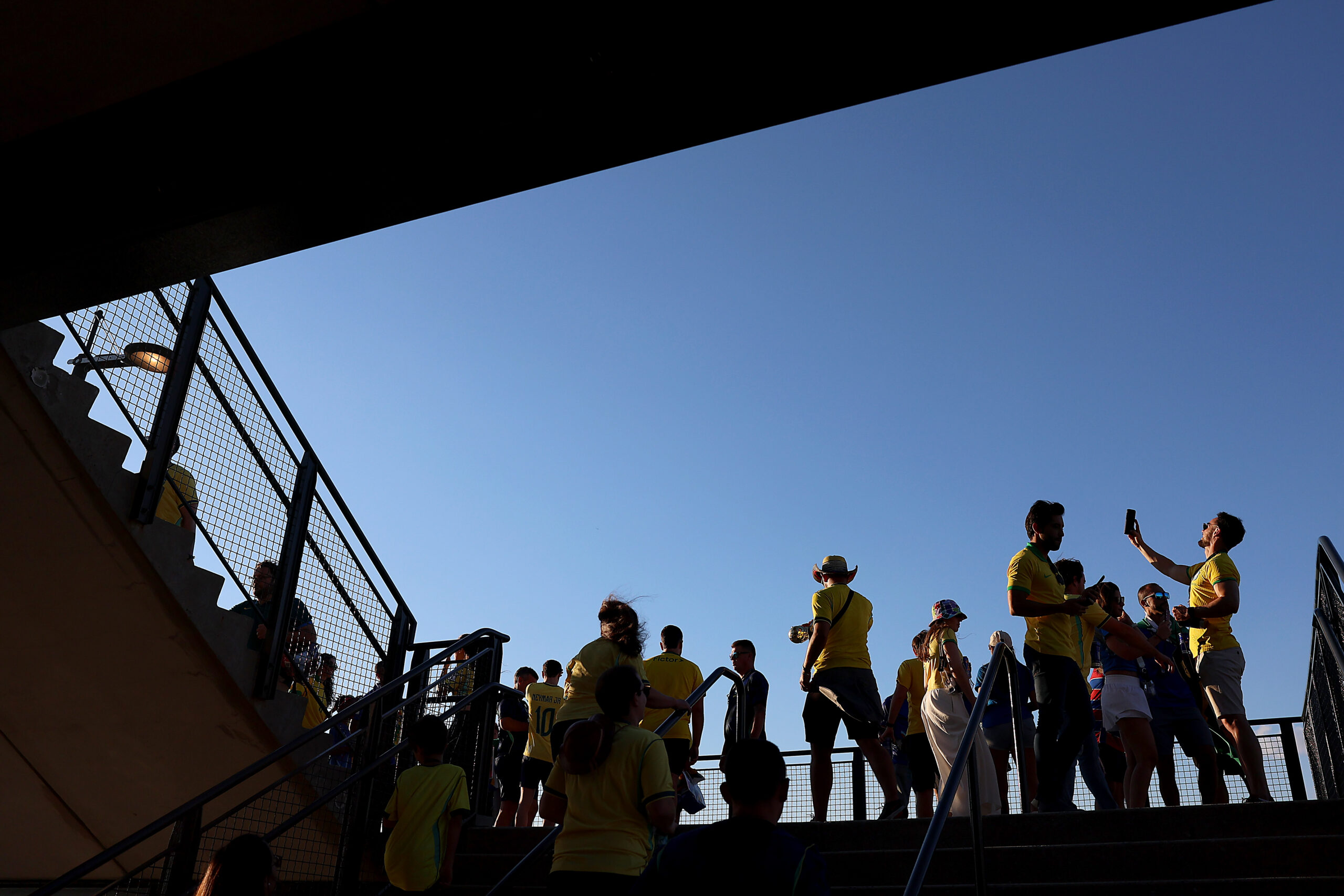
Brazilian fans cheers before their country’s match against Haiti in Philadelphia Friday night.
France, a favorite by many to win the whole tournament, will take on Iraq in the second game of Group I tonight, but if it’s anything like the previous two matches, the game itself will once again not be the story.
Because for the past two games, the attraction has been that of the fans, and the unbridled passion people have for not just a team and its players, but the nation so many have bought jerseys for, the emblem they proudly wear above their heart, or in the middle of their chest.
This spectacle of what will result in 104 matches of underdogs becoming story lines, a U.S. men’s national team exercising the type of dominance very few expected, has also seen Philly lead the way on the main stage, creating lasting memories for thousands of fans who have flocked to the city, all while becoming lore, in the process.
Soccer in its purest form has provided an escape for a nation that desperately needed one. And what it’s also proved in the process is that people of different races, colors, and creeds don’t hate each other as much as their social media algorithms might suggest.
Proof was on display right here in Philly in the form of fans who packed the stands over the last two matches.
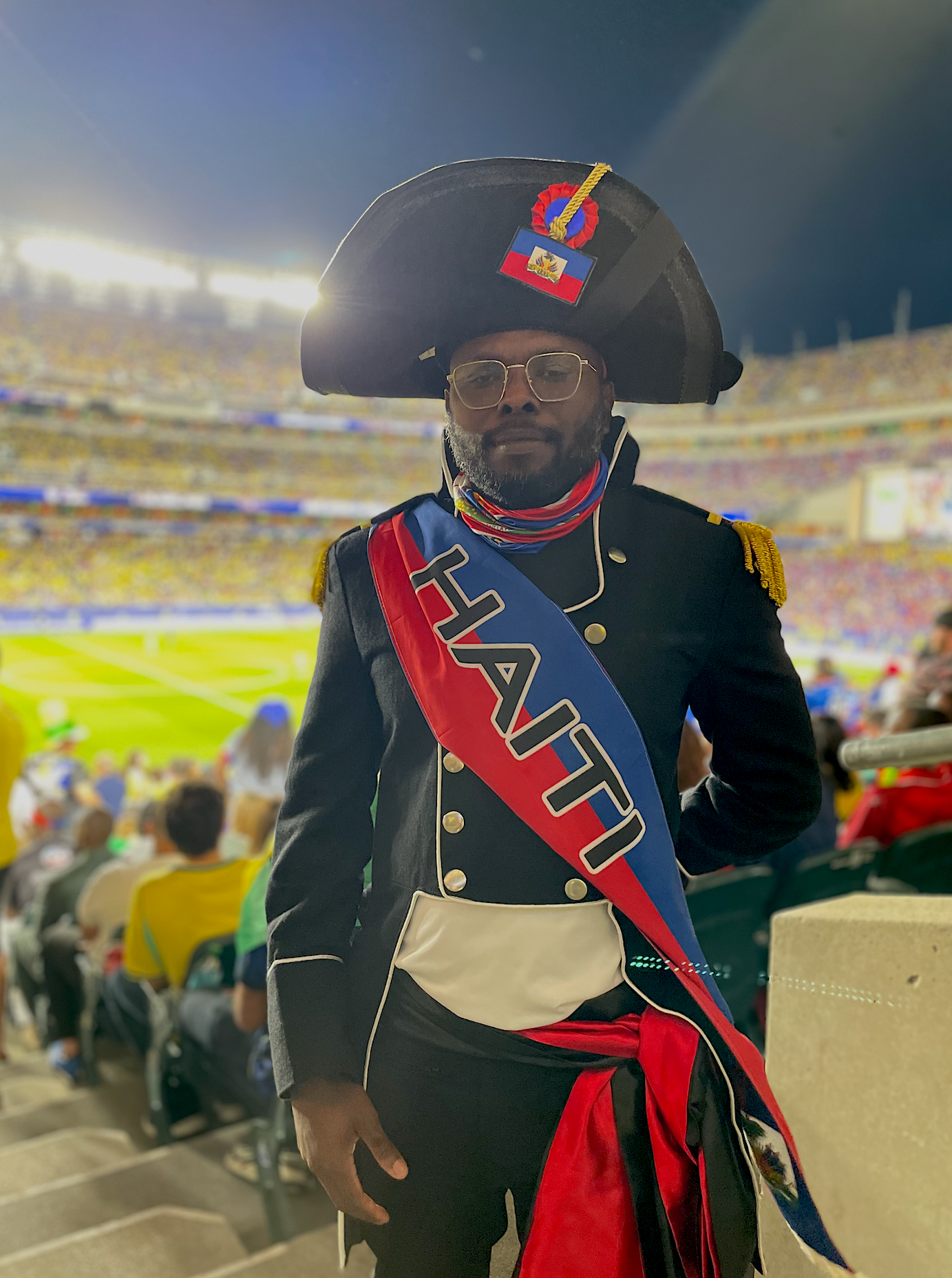
Fans like Maxence Jeanty, a 41-year-old Haitian native living in Chicago who traveled to Philly from the Windy City, dressed in a suit depicting liberator Jean-Jacques Dessalines, a key figure of the Haitian Revolution.
Maxence Jeanty, 41, a fan from Chicago.
“When I was growing up in Haiti as a kid, I watched the World Cup, and I’ll never forget watching the 1994 World Cup,” Jeanty said. “It’s been so long that my people haven’t made it to the World Cup that the choice was to choose either Brazil or Argentina [as the nation to support]. But now, we’re stepping on the field as equals, and no matter what happens, we’re stepping on the field as equals. The pride that brings to me and to every Haitian fan here, man, that’s indescribable.”
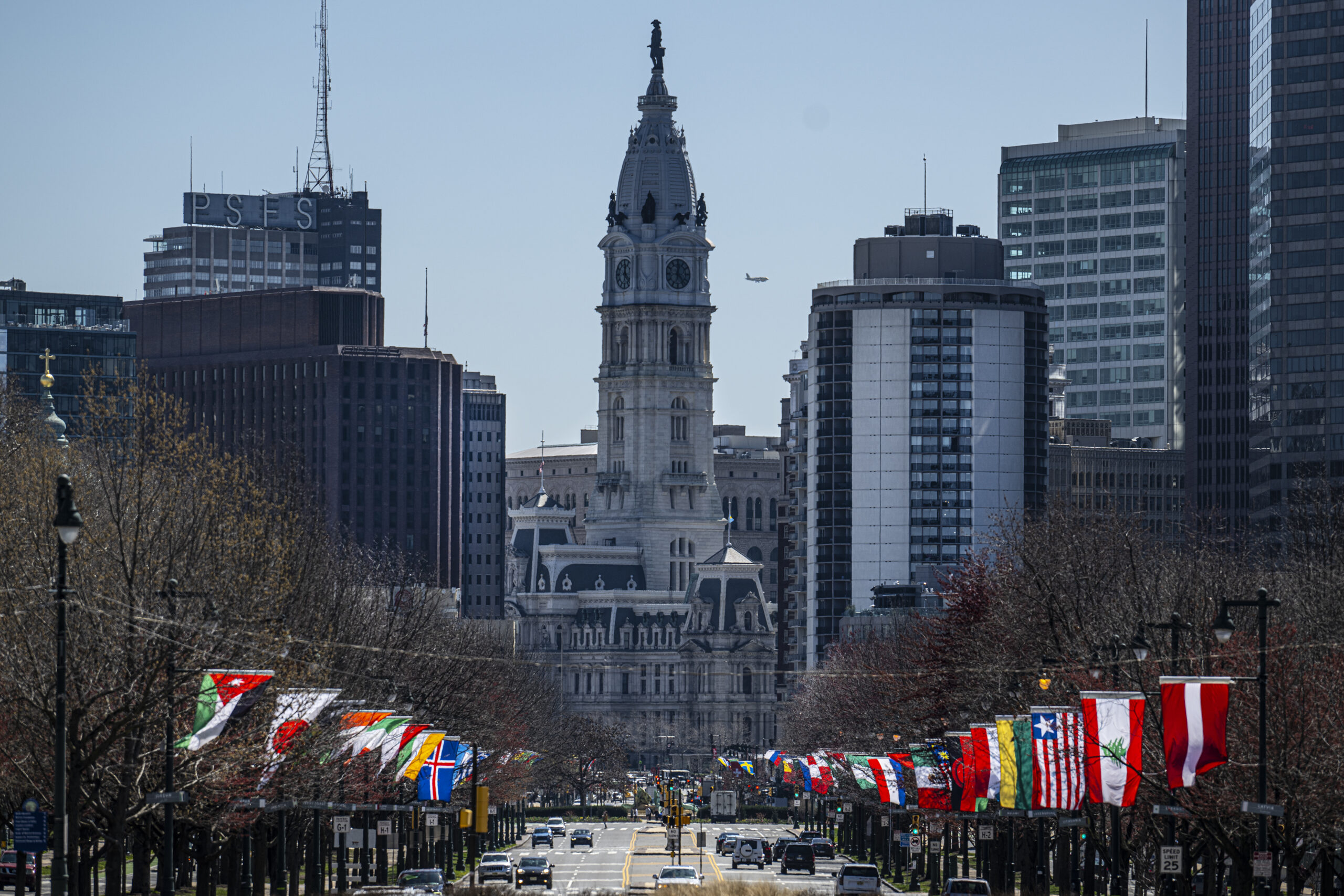
Benjamin Franklin Parkway is one example of urban planners borrowing from the French.
Some have called Philadelphia the “Paris of America.” Really.
It might be hard for locals to wrap their heads around the title, but there is some truth to the comparison — mostly due to the cities’ similarities in architecture. With France in town to take on Iraq in the World Cup Monday night, here’s a look at some of Philadelphia’s Parisian connections.
The Benjamin Franklin Parkway is the most glaring example of Philadelphia borrowing from the French. Finished in 1929, the parkway was designed primarily by two Frenchman, architect Paul Philippe Cret and city-planner Jacques Gréber. Their inspiration? Paris’ Champs-Élysées, a similarly grand avenue that stretches throughout the city. The two also both boast similar end points. The Champs-Élysées concludes with the grand Arc de Triomphe while Philadelphians can spot the Philadelphia Museum of Art from the parkway’s start at City Hall.
French fans just need to know not to dress the Rocky Statue atop of art museums steps.
Shortly after the conclusion of World War I, but before the signing of The Treaty of Versailles, Gréber displayed hope that the construction of the parkway would bring in tourists just as the Champs-Élysées does.
“I am glad to say that, if by this work the city of Paris may be enabled to bring its sister in America the inspiration of what makes Paris so attractive to visitors,” Gerbner said in 1918. “It will be the first opportunity of Paris to pay a little of the great debt of thankfulness for what Philadelphia and its citizens have done for France during the last three years.”
Meanwhile, Cret was also the mind behind the Benjamin Franklin bridge and a redesign of Rittenhouse Square, which also get Parisian comparisons. City Hall also looks like it could have been picked up in Paris and plopped down in Philadelphia as it was built in the French Second Empire style.
— Conor Smith
// Timestamp 06/22/26 10:24am
World Cup teams that have qualified for the next round and been eliminated
The U.S. is already in the Round of 32 and have won two group stage games for the first time since 1930.
Heading into Monday’s World Cup matches, three teams have already punched their ticket to the next round of the tournament.
Among them is the United States, which have won two games in the World Cup group stage for the first time since 1930. The U.S. has one more group stage match – against Turkey Thursday night – and will play in the Round of 32 on July 1 in San Francisco Stadium at 8 p.m. Philly time.
Here’s a rundown of all the World Cup teams that have qualified for the next round, and those that have already been eliminated from contention:
Thunderstorms in Philly could interrupt tonight’s World Cup match
Scattered severe thunderstorms could move through the region tonight.
Thunderstorms are expected to make their way through the Philadelphia region later this evening, potentially interrupting tonight’s World Cup match between France and Iraq.
The strongest of the storms are forecast to move in beginning around 4 p.m., bringing with them heavy rain, wind gusts approaching 60 mph, and the potential for an isolated tornado.
“Storms will certainly have lightning with them,” said Zack Cooper, a meteorologist at the National Weather Service’s Mt. Holly station.
An inch or two of rain could fall in and around the city, Cooper said, but depending on the storm’s severity that could all come in an hour or less, leading to flash flooding. Philadelphia and the surrounding region are currently under a flood watch.
FIFA will pause play if there is a lightning strike within eight miles of the stadium. The match will remain paused for 30 minutes, with any subsequent lightning strikes resetting the clock.
The FIFA Fan Fest at Lemon Hill Park in Fairmount would also be forced to close if lightning is detected within an eight-mile radius. Fans would need to exit the grounds and move to a safe location, FIFA said in a statement, and could re-enter after 30 minutes if no additional lightning is detected.
The Storm Prediction Center in Norman, Okla., which issues severe storm watches, listed a 2% chance of tornadoes, and an “isolated” twister can’t be ruled out, said Nick Guzzo, meteorologist with the National Weather Service in Mount Holly.
Four Frenchmen skipped work to go to the World Cup in Philly
Fans react during France’s opening match against Senegal on June 16. Some of those fans have taken up residence in Philadelphia ahead of Monday’s match against Iraq.
Eight years ago, when FIFA announced that the World Cup would be coming to the United States in 2026, a student in France felt a rush of excitement. He and his friends had been watching the international soccer tournament on television since they were kids.
They’d never seen it in person. The last time their native country hosted the competition was in 1998, before all four Frenchmen were born. In the years since, they’d tried to make it to a game, but to no avail.
Russia hosted in 2018, but the four friends were unable to get visas. Qatar hosted in 2022, but this time, they were attending different colleges, which made traveling logistically complicated. So, they looked ahead to 2026 and started saving money.
One man picked up extra work shifts at his Parisian brasserie. Another taught English lessons on the side. All four made a conscious effort to cut back on drinking and eating out.
There was one problem. The men worked in upscale restaurants, and summers were extremely busy. The Parisians knew that they wouldn’t be able to get a few days off, let alone a few weeks.
In the spirit of Ferris Bueller, the 20-something-year-olds decided to tell a white lie. And now, three years and $12,000 in savings later, they are in Philadelphia, enjoying everything it has to offer (unbeknownst to their employers).
“Momo,” the Parisian waiter who organized this trip, participated on the condition that he and his friends’ last names would be omitted (out of fear of losing their jobs).
Fans navigate the stairs in the upper concourse of Lincoln Financial Field, rebranded as Philadelphia Stadium.
Philadelphia has hosted two World Cup matches so far – Ivory Coast’s upset of Ecuador, and Brazil’s blowout of Haiti.
Philadelphia Stadium, as it’s called during the tournament, will host four more World Cup games, including a Round of 16 matchup on July 4.
Unfortunately, Philly won’t host the U.S., which clinched a first-place finish in the group stage. They needed to finish in third place to even have a chance of winding up the the Linc.
Here’s Philly’s remaining World Cup schedule:
France vs. Iraq: Monday, June 22, 5 p.m. (Fox)
Curaçao vs. Ivory Coast: Thursday, June 25, 4 p.m. (FS1)
Croatia vs. Ghana: Saturday, June 27, 5 p.m. (FS1)
As Philadelphia’s city solicitor, heading a staff of more than 200 lawyers, Sozi Pedro Tulante sued some of the nation’s biggest corporations, accusing them of loan discrimination and pushing lethal painkillers.
Now he’s apartner at Dechert LLP, a Philadelphia-founded, international corporate law firm, where the work includes defending big national corporations from the kinds of complaints he used to file.
Corporate targets during his 2016-18 stint as the city’s top civil lawyer included Wells Fargo & Co., the third-largest U.S. bank, which settled his lending-discrimination complaint for a promise of $10 million in donations to housing programs, and six pharmaceutical companies, four of which were major Pennsylvania employers, for promoting addictive opioids. The city later got a nearly $200 million share of a national settlement.
Tulante’s job also included routine legal reviews. He defended the city’s soda tax and its sanctuary city immigration status.
After leaving his city position in 2018, Tulante — son of a refugee, a Northeast High School and Harvard University graduate, and a former federal prosecutor — lectured at the University of Pennsylvania’s law school.
He joined Dechert’s litigation department the next year, then spent 2022 to 2025 as general counsel at Boston-based Form Energy, which builds iron-based batteries for data centers and other clients at its plant in Weirton, W.Va.
More companies are now aware of the risk. They adjust.
There are extreme cases where litigation ends a company. But for the most part you factor it in.
Who gains from a litigious climate?
Sophisticated national companies have clients everywhere. They know they are going to get sued. They study to minimize litigation. For example, don’t use flip messaging. Just be familiar where the threats may come from. Know what litigation the city is pursuing.
Many of the big companies facing litigation in Philadelphia are more likely to engage counsel that is locally respected and recognized in the area. In Philly, if you can’t answer the question, “Where did you go to high school?” [with a name the parties recognize], it’s a disadvantage. Here, we fight the plaintiff attorney, but we also serve on the same board and attend the same continuing legal education [CLE] classes.
There are great lawyers on the other side, at [plaintiffs’] firms like Kline & Specter and Ross Feller Casey, sophisticated counsel who walk into court and get instant respect.
Part of my role at Dechert is to represent clients in Philadelphia and nationally who are thinking about how Philadelphia has changed as a place of litigation and how that litigation impacts business.
Businesses are saying, “We have the tax burden, the regulatory burden, we’ll comply, but you are pushing on the edges.”
What recent laws have changed the legal climate for business?
The new consumer protection ordinance, passed in 2024, has given the city more power to bring some major cases [through national law firms] that are broader than before. Life sciences cases. Firearms liability. Fair workweek litigation. They may go after [national] retailers in certain cases. The city can go forward and get penalties up to $2,000 per violation.
As city solicitor, I was reminded that government has the broadest power of regulation at the local level. The police authority government has is really broad. Unless there’s some preemption by state or federal government. It’s something folks pay attention to.
Is part of Philadelphia’s affordability a result of its failure to attract private-sector employers?
I live in West Philly. I work at the law school. I have three children in public schools. I want the city to have a secure tax base. I want to make sure investment goes where it needs to.
It’s challenging. One of the biggest challenges is getting people from Temple, Penn, Drexel, and St. Joe’s to stay.
In Philadelphia the strength ultimately is in eds and meds. We have doctors and nurses, lab technicians, people with a high level of training. Philadelphia takes credit for helping solve COVID by our Nobel Prize winners Drew Weissman and Katalin Karikó at Penn, which has led to investments in gene therapy.
What was the most satisfying thing you did as city solicitor?
Working to get local control of the school district and disbanding the state’s School Reform Commission. It was humiliating, the way the state was running our schools. We should have a stake. The most important thing we can do is educate our children and prepare them for businesses that want to hire talent.
Why did you choose the law?
It’s not the ability to argue that makes a good lawyer. You have to solve problems. You have to be really good at writing. And you have to be able to talk to people — to be personable, to make the hard stuff simple, to help them understand.
I like a career where people ask you to help them solve really big problems. They can be CEO of a major company or a pro bono client that needs a habeas petition. They require the same level of skill.
How did you come to be a Philadelphian?
I came here at age 8 in 1983 [after his father, a military official in Angola, fled to Congo following a change in government, was imprisoned, then was resettled in North Philly by a refugee agency].
It was a difficult time to grow up here. I graduated in 1993 from Northeast High School. I got into Harvard, then Harvard Law School.
Eight years ago, I left the city, to be general counsel at a startup.
But it came back to family and affordability. Philadelphia is that place for me, within the larger Northeast corridor.
What gives you hope?
My dad drove a cab when he came here. My mom worked in the prison system. Now here I am, a Black attorney from the public school system.
I am a big booster of today’s public schools. My children are at Central, at Masterman — I couldn’t get into those, I still hold a grudge! — and at Penn Alexander in West Philly.
I want my children with other children who really want to achieve. I motivate them, the teachers motivate them, they are self-motivated, but the friends they are with have more of an impact on them.
And I think we are finally putting into place an infrastructure for understanding government. You know Philadelphia has more political ads and advertising than almost anyplace, a big city in a swing state. But we have not always centered our education on civics. Now my son understands more than I did.
I’m glad to be back at Dechert. I can see a lot from this perch.
This story has been updated to correct some biographical information about Sozi Pedro Tulante.
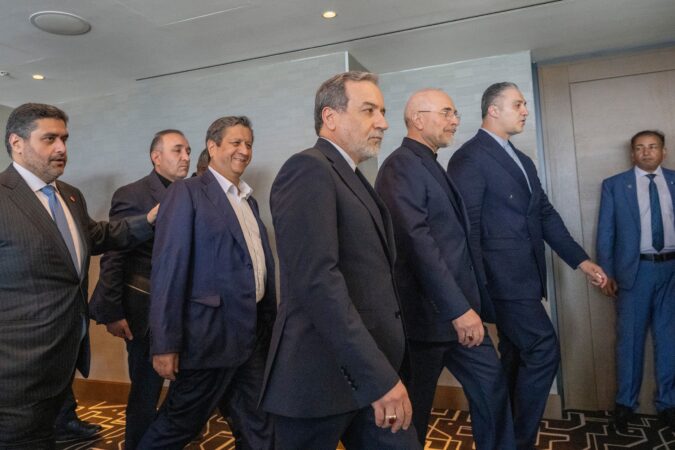
OBBUERGEN, Switzerland — U.S. Vice President JD Vance and Iran’s parliamentary speaker Mohammad Bagher Qalibaf on Monday wrapped up a lengthy round of initial talks aimed at solidifying a permanent end to the war between the countries.
The mediation effort in Switzerland, which started Sunday and stretched into the early hours of Monday, had rocky moments. But the talks also led to some agreements between the two sides.
In a joint statement, mediators Pakistan and Qatar said that while the high-level engagement had ended, technical negotiations would continue in Switzerland this week.
Vance was expected to make remarks from the resort at 1 p.m. local time, his office said.
The mediators hailed what they called “encouraging progress” made during the talks. A senior U.S. diplomat claimed progress on multiple fronts, including the establishment of “mechanisms” to ensure the Strait of Hormuz, a vital waterway for global energy shipments, remains open and that a ceasefire in the fighting between Israel and Iran-backed Hezbollah militants in southern Lebanon holds.
Yet the talks between the United States and Iran were jolted by blistering statements from U.S. President Donald Trump, who, from thousands of miles away from the Swiss negotiating venue at a mountainside resort near Lake Lucerne, was firing off comments that offended the Iranians.
Iranian state media said talks had paused after the “publication of an insulting message by the U.S. President,” according to Iranian state media.
Ultimately, the Iranians remained on site and negotiations continued, according to the senior U.S. diplomat, who was not authorized to comment publicly and briefed reporters on the condition of anonymity.
Iranian state television reported Monday that the Iranian delegation had left the summit site to head to the airport in Zurich to fly back to Tehran.
Trump didn’t attend what was dubbed the “Lake Lucerne Summit,” but his presence certainly loomed large.
Ahead of the talks, Iranian President Masoud Pezeshkian had vowed to “never back down from the right to enrich uranium,” according to state media.
Trump on Sunday told Fox News in a phone interview that Pezeshkian should watch what he says and also threatened to take over Iran, according to one of the news channel’s correspondents.
Trump also continued to issue warnings against Iran on social media, posting as negotiators worked: “Iran must immediately stop their highly paid PROXIES in Lebanon from causing trouble. If they don’t, we’ll hit Iran very hard again, just like we did last week, only harder!!!”
It’s unclear when Vance will depart Switzerland. Trump envoys Jared Kushner and Steve Witkoff are handling many of the technical details on behalf of the U.S. delegation.
Iranian Foreign Minister Abbas Araghchi wrote on X that Pakistani and Qatari mediators delivered “major progress to end the Lebanon War.” But, he added, the first “real test” of negotiations would be whether the mechanism succeeded in halting the fighting between Israel and Hezbollah.
The senior U.S. diplomat said among the issues discussed was Iran’s messaging as it related to the Strait of Hormuz, which Iran’s military said it closed Saturday in response to continued fighting in Lebanon. U.S. Central Command has disputed that Iran closed the strait again.
The interim deal to end the fighting in Iran, signed last week by the leaders of the U.S. and Iran, also sets a 60-day period for negotiators to settle the future of Tehran’s nuclear program amid concerns that it wants to use it for military purposes, a claim Iran denies. The fate of frozen Iranian assets, among other thorny issues, are also on the agenda.
Though the talks will encompass a vast array of complex matters, Iran has insisted on first addressing the fighting in Lebanon.
Saturday’s renewed ceasefire in Lebanon appeared to be holding, and Israel’s military said it would lift movement restrictions for residents near the Israel-Lebanon border on Monday morning. Neither Israel nor Hezbollah is a signatory to the U.S.-Iran deal.
There was cautious calm Monday in Lebanon, with no Israeli strikes reported overnight after a quiet Sunday. Hezbollah likewise has not announced any attacks on Israeli forces since Saturday.
The lull in fighting in Lebanon is the longest since the outbreak of the latest Israel-Hezbollah war on March 2.
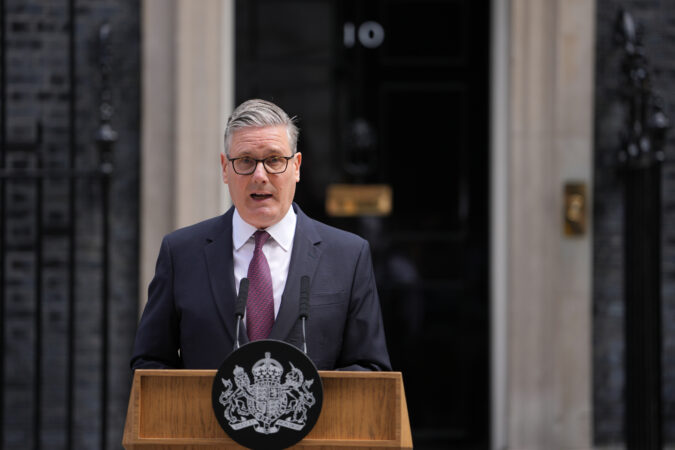
LONDON — British Prime Minister Keir Starmer announced Monday that he will resign, forced out by his own party after missteps and mistakes soured voters’ goodwill for a prime minister who won a landslide election victory two years ago on a promise of steady leadership and economic growth.
Starmer says he will remain caretaker prime minister until his Labour party chooses a new leader — with expectations growing that it will be former Greater Manchester Mayor Andy Burnham.
Burnham confirmed in a social media post that “I will put myself forward as part of this process.” Former Health Secretary Wes Streeting, who was considered his main rival for the top job, said he will back Burnham.
It was Burnham’s victory in a special parliamentary election last week that triggered Starmer’s decision to resign. After nearly a decade out of Parliament as the mayor of Greater Manchester, Burnham returns to Westminster and will be sworn in as a lawmaker later on Monday.
Only members of Parliament can stand for the party leadership.
Streeting’s statement makes it more likely that Burnham will be selected without a leadership contest.
Starmer is the sixth prime minister in a decade to stand outside 10 Downing Street and announce a premature departure. His statement comes the day before Britain marks the 10th anniversary of its vote to leave the European Union, a decision that still roils the country’s economy and politics.
After weeks of insisting he would fight to keep his job, Starmer conceded to growing pressure to hand over to a new leader who can try and revive the government’s flagging fortunes. He led Labour to a landslide election victory in July 2024, but since then his popularity and that of the party have plummeted.
A new leader in place within weeks
Starmer made the announcement outside his official 10 Downing St. residence, the spot where he delivered his first speech as prime minister two years ago.
His voice choked with emotion near the end of the brief statement, which was watched by a group of staff, Cabinet ministers and scores of journalists.
“The question my party is asking now is whether I am best placed to lead us into the next general election,” Starmer said. “I have heard the answer of my parliamentary party to that question, and I accept that answer with good grace.”
He said he spoke to King Charles III, Britain’s constitutional monarch, to inform him of the decision.
Starmer spent the weekend pondering his future following Burnham’s special election victory.
It’s unclear whether Burnham, who is due to be sworn in as a member of Parliament on Monday, will now face a coronation or a challenge. Starmer said nominations for a leadership contest will open on July 9, and the new leader will be in place by the time Parliament returns from its summer break on Sept. 1.
If Burnham is the only candidate, the change could come by mid-July.
Starmer struggled to fulfill election pledges
Starmer has struggled to deliver promised economic growth, repair tattered public services and ease the cost of living. He has been hamstrung by repeated missteps, including his decision to appoint Peter Mandelson, a scandal-tarnished friend of Jeffrey Epstein, as the U.K. ambassador to the United States.
Labour is losing liberal voters to the growing Green Party and facing a rising Reform UK, the Nigel Farage -led anti-immigration party that consistently leads in nationwide opinion polls.
U.S. President Donald Trump weighed in even before an announcement, linking Starmer’s potential exit to two of his recurring bugbears: immigration and renewable energy.
“Keir Starmer will resign as Prime Minister of The United Kingdom. He failed badly on two very important subjects- IMMIGRATION AND ENERGY (OPEN NORTH SEA OIL!). I wish him well! President DJT,” Trump posted on his social media platform.
Starmer’s initially warm relationship with the president has soured in recent months over issues including the Iran war, which the U.K. didn’t join.
He won praise on the world stage
In contrast to missteps on the domestic front, Starmer has won praise for his international role, notably in rallying European support for Ukraine in its fight against Russia’s invasion, and working to mitigate the economic and political turmoil unleashed by the Iran conflict.
A NATO summit in Turkey next month may be his last foray on the world stage as Britain’s leader.
European Commission President Ursula von der Leyen praised Starmer’s legacy.
“It can take many leaders years to grow into the statesman you became in just two years,” she said on X. “European and Ukrainian security is stronger because of you. Thank you, dear Keir.”
While many Labour lawmakers have rallied behind Burnham, some have said that Starmer had been treated unfairly. London legislator Neil Coyle railed on X against “the prospect of an utter stitch-up & the media circus being rewarded.
“When the next leader cannot change Trump, Iran, Ukraine, Putin, Musk, broadcast editorial & algorithm bias overnight they’ll bay for his blood too. Better keep that guillotine sharp,” he wrote.
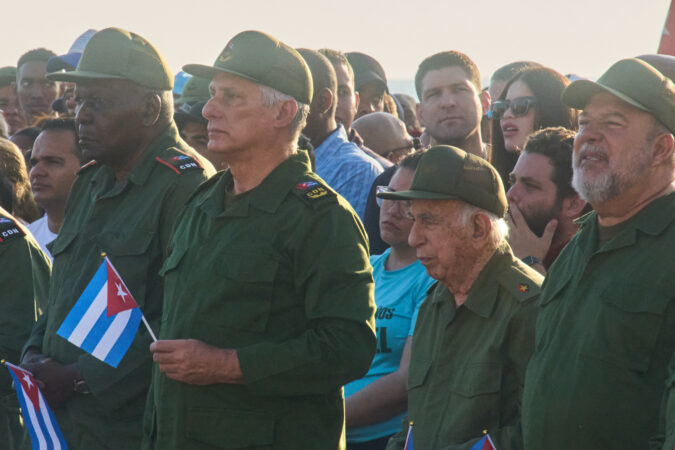
Recently, President Donald Trump declared “I do believe I’ll have the honor of taking Cuba.” He mused that, “whether I free it, take it, I think I could do anything I want with it.” Trump’s increasingly hostile rhetoric has led to a debate over whether the U.S. should invade Cuba and remove the island nation’s government from power.
History suggests that the answer is no. An intervention by the U.S. in Cuba will end badly for both Americans and Cubans. It may prompt a flood of Cuban Americans returning to the island, and the very sort of economic development that, in the past, produced a revolution and ignited a chain of events that led to the current situation.
U.S. intervention in the Caribbean to “bring democracy” or promote American corporate interests is nothing new — and Cuba is no exception.
In 1898, the U.S. took control of Cuba after it won a quick victory in the Spanish-American War. What most Americans do not know is that Spain’s defeat was just the epilogue to a Cuban war for independence that had raged for three years.
The American victory meant that, instead of the independence for which Cubans had been fighting, they became an American colony. Worse, a series of independence wars, dating back to 1868, had left the fledgling Cuban government and landowners bankrupt as the warring factions destroyed property in an effort to break the other’s morale. As a result, many previously wealthy Cubans sold off their properties to American investors.
U.S. business owners and companies poured money into the island, purchasing some of the best properties in the agricultural zones, as well as telecommunications, mining and railroad infrastructure. These purchases gave Americans dominance over the Cuban economy. At one point 70% of Cuba’s foreign trade was with the United States, and U.S. companies and investors owned 90% of the telephone and telegraph industry, 83% of the railways and 42% of sugar production.
U.S. industries, like the United Fruit Company, primarily hired Americans to work in upper management, which limited the upward mobility of Cubans. They built enclaves for their managers that frequently segregated them from the Cuban population-at-large except for the laborers who provided services. Often, they even built infrastructure, including railroads and ports, to extract goods and wealth from Cuba rather than serve the people of the island.
Even worse, as historian Louis A. Pérez, Jr. has eloquently argued, this economy paved the way for a corrupt political system fueled by patronage and pay offs. Engaging in the system became the principal pathway to wealth for Cubans.
Four years after the occupation, in 1902, the U.S. granted Cuba independence — sort of.
The U.S. agreed to withdraw its troops, but only after Cuba signed a treaty allowing the U.S. to militarily intervene when its self-interests were imperiled — the so-called Platt Amendment. Cuba also agreed to lease to the U.S. in perpetuity a vast tract of land around Guantanamo Bay for use as a naval base. The lease could only be voided if both parties agreed to end it, which gave the U.S. veto power.
In 1906, the U.S. demonstrated that Cuba’s “independence” was illusory. Concerned by a faltering Cuban government, the U.S. dispatched troops who would occupy the island until 1909. In 1912, U.S. Marines again invaded eastern Cuba to help put down a local uprising.
The interventions sent the unmistakable message: Cuban officials had to maintain U.S. support. Accordingly, every Cuban government until 1933 sought to please the U.S. government and powerful American economic interests.
When the government did try to boost Cuban industries, it often had to reverse course after Washington balked to protect American corporate interests.
Cubans resented an economy that served U.S. companies well, but not Cubans. They also resented their government for putting American interests ahead of Cuban ones. That led to a powerful backlash typified by the slogan “Cuba for Cubans.” In 1933, Cubans finally revolted.
The uprising produced some economic and political reforms, including the establishment of an eight-hour work day, a minimum wage, guarantees that industries would maintain a minimum percentage of Cuban workers and the abrogation of the Platt Amendment.
However, in the ensuing years, the U.S. meddled in Cuban politics in an attempt to temper the revolutionary fervor. Behind the scenes, the U.S. Embassy worked with political groups to try to ensure a compliant Cuban government. They went so far as to help rig the 1936 presidential election to secure victory for a candidate favorable to military dictator Fulgencio Batista (who ruled the island on several occasions between the 1930s and 1950s) and the military. American officials saw the dictator as a stabilizing force in Cuban politics.
Made By History sponsors. FOR USE ON MADE BY HISTORY STORIES ONLY.
The U.S. also maintained economic dominance over the island by purchasing most of Cuba’s primary export: sugar. That made it impossible even for democratic Cuban governments to undertake the substantial land reform necessary to create economic prosperity for small farmers. Such reform would have taken land from American owners and therefore risked an U.S. boycott of Cuban sugar or other economic sanctions. The loss of their primary market would have devastated Cuban tenant farmers.
In 1952, however, the U.S. made a fatal mistake. After an eight-year absence from power, Batista led a coup against democratically elected president Carlos Prio Socarrás. The Eisenhower administration quickly recognized Batista’s government, failing to grasp that it had little popular support.
Enter Fidel Castro, who quickly built a strong opposition movement, precipitating the Cuban Revolution in 1959. During a visit to the U.S. a few months after his triumph, Castro described his revolution as “humanist.”
Yet, the Eisenhower Administration suspected that Castro was a Communist at heart. The new leader confirmed their worst fears when he presented a modest land reform plan in June 1959 that would distribute unused parcels of land to tenant farmers. This proposal led to a rapid escalation of American sanctions against Cuba. The Cuban government responded by seizing property owned by American business interests. The escalating bellicosity from the U.S. drove Castro into a closer relationship with the Soviet Union. In April 1961, this cycle of escalation culminated in the fiasco that was the Bay of Pigs invasion by Cuban exiles, backed by the U.S.
Scholars have long debated whether Castro was a Communist when he took power, but it was not until the day before the Bay of Pigs that he made it official by declaring this is a “socialist and democratic revolution of the humble, by the humble and for the humble.”, In October 1962, the conflict between the two nations culminated in the Cuban missile crisis, when the Soviet Union placed nuclear weapons in Cuba. After 13 days of brinkmanship between the U.S. and Soviet Union, the Soviets agreed to withdraw the missiles. As part of the deal, President John F. Kennedy pledged never to invade Cuba.
Over decades, however, memory of the cycle that led to the Cuban Revolution — and the rise of a government hostile to the U.S. — has faded. And that has left Americans and Cubans, once again, at a crossroads.
Cuba, already impoverished by government mismanagement, is being squeezed further by a fuel blockade and new economic sanctions imposed by the U.S. The Trump Administration is seeking a collapse of the Cuban Government. It has not ruled out direct military intervention either to capture former President Raúl Castro (Fidel’s brother) or displace the government.
Yet, the history of Cuban-American relations suggests that such a move would be a mistake. It is easy to envision Miami Cubans flooding back to the island, some with property claims dating back more than 65 years, and others with mucho dinero ready to invest in Cuban tourism and other economic opportunities. Investment sounds like a great idea but as the first half of the 20th century demonstrated, investment from Americans and American interests probably will not focus on what is good for Cubans.
If the U.S. recreates an economy dominated by outsiders like it did after the Spanish-American War, trampling all over Cuban sovereignty in the process, that will fuel resentments and anti-American sentiment, and could sow the seeds of revolution once again. If history is any guide, the result will be catastrophic for Cubans and Americans alike.
Frank Argote-Freyre is a Latin American history professor at Kean University, Argote-Freyre’s first book, Fulgencio Batista: From Revolutionary to Strongman, was published in 2006. He is the author of dozens of scholarly works, journalistic articles, and public policy papers on a wide variety of topics from mental health to housing to public education. He is currently working on his next book, Fulgencio Batista: From President to Dictator.
Made by History takes readers beyond the headlines with articles written and edited by professional historians. Opinions expressed do not necessarily reflect the views of The Inquirer.
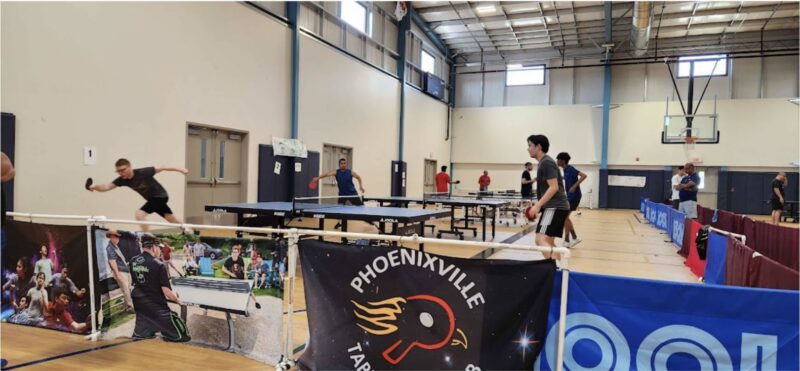
For Deepak Gupta, playing Ping-Pong is something of living out a childhood dream for him.
Later this month, he’ll be taking that dream to the next level, as he makes his tournament debut at the USA Table Tennis Pennsylvania Open in Phoenixville.
“I’ve never met two people who play the same … they have a unique style of playing, and every player has strengths and weaknesses, the way they spin the ball, the way they serve,” he said. “I’m looking forward to playing against more people whom I’ve never met, so that’ll be challenging.”
Gupta, 52, will be among the 40 to 50 players from the region competing; the tournament has six events and will be held at the Phoenixville Recreation Center.
Players will compete in women’s singles, juniors, over 40, the open, or skill-capped events. On the line: cash prizes, trophies, and national ratings points.
It’s the fourth time the Phoenixville Table Tennis Club, established in 2009, is holding a USA Table Tennis tournament, and its second Pennsylvania Open.
“We do have a lot of lower-level players participating in those events, and one, it gives them the opportunity to win trophy and money, but two, it gives them the opportunity to continue to compete … and get better in their games,” said Nick Flor, organizer and one of the founders of the Phoenixville club. “Say you come across your archnemesis that you play at the club in the tournament. … It’s going to give you that drive to learn to beat them, to learn to get better.”
Gupta will be playing in the “under 1200″ event, for beginner to intermediate players whose rating is below 1200. A rating represents their skill level and determines where a player is seeded in an event. Low-level players would be rated around 900 or 1000, while high-level players approach 3000, Flor said. As players win matches and tournaments, up goes their rating. The tournament will have several events split by rating level.
Players will also be competing for ranking points as part of the USA Table Tennis’ system. Depending on how many tournaments players win, they earn points. Top-point earners are considered for the Olympics, or the sport’s World Cup.
Aside from rankings, players are drawn to the community the sport has given them.
Serving up community
Gupta loved the game passionately as a child, but it faded into the background after high school. Some 30 years later, he started playing against a couple of friends in the basement. He found out about the Phoenixville club, which meets twice a week at the recreation center, hosts a smattering of smaller tournaments and competitions, and provides support for new players. But it wasn’t enough; he ended up opening his own club in Exton, called Exton Table Tennis.
The club is run by friends, for friends, he said. Before he started playing table tennis a few years ago, he had few of them. He met other parents in school groups, but those social interactions were limited to talking about their kids.
“Once I started playing table tennis with some of the other dads, we started getting to know each other more as individuals and more as friends,” he said, “and then taking that spirit and … expanding it to a community.”
Flor, 53, caught the bug in high school, when he’d play with his friends in the senior lounge. They started playing before and after school. They were “terrible,” Flor recalls. But they kept playing, deciding to enter a tournament. They got crushed and had the experience he’s seen in many players: the shock and awe at the level of gameplay, of technique, and skill it takes. The group began going to a club in Pottstown, getting tutelage from an older gentleman, and eventually opened their own club, he said.
He’s seen the sport change over time, fluctuating in popularity. They see surges around the Olympics, and during the colder months. Marty Supreme drummed up excitement among players but didn’t seem to inspire a new generation. (Forrest Gump has probably done more for the sport, he noted.)
A game for all
Flor’s love of Ping-Pong has seeped into his marriage, as he slowly turned his wife, Janel Flor, into a convert. Now the two are evenly matched.
It’s been a journey for Janel, whose first experience was in the place that makes or breaks anyone’s love of sport: gym class. It put her off table tennis for years. She was supportive of her husband but felt it was “kind of a dumb sport.” But, ever persistent, he coaxed her into a lesson. About a month later, she felt it sink in and sent the ball exactly where she wanted it to go. She was hooked.
She was not very competitive until she was able to beat Nick. “Once I could do that,” she said, “I was like, you know what, I actually really like this game.”
It’s been her goal to get more women into the game and to have fun doing it.
“My goal is always to help build confidence and help get them playing, so that they’re not overthinking everything,” she said.
Janel, 50, will compete in the women’s event in the upcoming tournament, against roughly six others. She has gotten over some of the initial fears of tournament play but said she still gets butterflies when she steps up to the table.
Despite those butterflies, it’s often an encouraging, but still competitive, game, she said.
For Gupta, it’s a game where people of all ages, genders, and abilities can thrive. The clubs welcome kids, whom they have watched level up over time.
“Table tennis is one game where it evens everything out. It doesn’t matter,” he said. “If you have skills, you can become really good, that’s one thing that I really love about this game. … I think now I’m finally trying to live my childhood dream, and I hope other kids can enjoy the same passion that I had as a child.”
This suburban content is produced with support from the Leslie Miller and Richard Worley Foundation and The Lenfest Institute for Journalism. Editorial content is created independently of the project donors. Gifts to support The Inquirer’s high-impact journalism can be made at inquirer.com/donate. A list of Lenfest Institute donors can be found at lenfestinstitute.org/supporters.
As the newly appointed National Teacher of the Year, Haverford High School’s Leon Smith has been celebrated on television: from CBS Mornings and Good Morning America to the Kelly Clarkson Show.
But as the lone Black teacher when he started teaching at Haverford 25 years ago, Smith got a different reception. He experienced racism, he told a group of young people interested in teaching, and if it weren’t for a Black vice principal that listened and supported him, he might not still be teaching today.
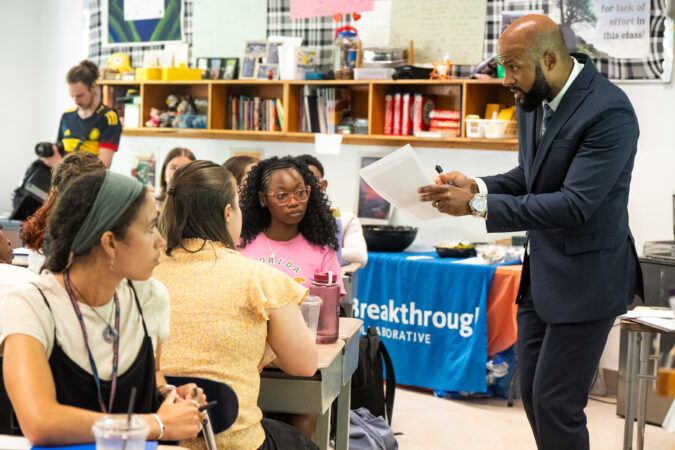
“She would just be very honest with me, and be like, ‘First of all, you’re an excellent educator. … Keep being you. Somebody calls and says something crazy, I’m just hanging up,’” Smith told teaching fellows gathered in Germantown on Wednesday with Breakthrough of Greater Philadelphia, a nonprofit that trains aspiring teachers to lead enrichment programs for middle-school students.
The event, sponsored by the Equitable Foundation, was just one of many for Smith during his yearlong stint as Teacher of the Year, a platform he was awarded in April by the Council of Chief State School Officers. In that role, he’s spending the year traveling the country to advocate for the teaching profession and growing its ranks.
Smith, who teaches Advanced Placement U.S. History and Advanced Placement African American Studies at Haverford, spoke passionately to the fellows Wednesdayabout his motivation to be the teacher he didn’t have growing up, and the immense impact teachers can have on students’ lives — presenting the profession as a deeply rewarding opportunity to help kids recognize their talents.
But he was also honest about the challenges. Fielding questions about his career from fellows gathered in an auditorium on the Germantown Friends School campus, Smith said he had struggled to find his way as a new teacher, staying up too late trying to perfect lessons.
He described the sometimes lonely experience of being his predominantly white high school’s only Black teacher, and how he developed strategies to respond to racism, including learning when to walk away and when to speak out.
He told fellowsto find supportive colleagues and to be selective when they considered job offers.
“Do your research. Make sure it’s a space that’s going to take care of you,” he said.
Smith also described feeling self-conscious when he was younger about some of his lessons — worrying that students would say, “‘Oh, all he does is talk about Black history,’” Smith said. But he began hearing from students about how grateful they were to have learned about subjects that hadn’t been covered in other classes; an audit later identified African American studies as a class community members wanted to see added.
‘My why’
His comments resonated with the teaching fellows, some of whom said they’re committed to careers in education.
Dominique Sidae, a 23-year-old rising senior at Florida A&M University, is planning to become a special-education teacher. She said she wasinspired by her appreciation for a teacher who helped her younger brothers, who have autism.
Sidae said she is often the only Black person in teaching spaces. “It feels good to know this isn’t only happening to me,” she said. “You don’t really learn that in college.”
Dominique Sidae, 23, a fellow with the Breakthrough of Greater Philadelphia, listens to a talk by Leon Smith last week.
Miles Baldwin, an 18-year-old graduate of Harriton High School in Lower Merion, isn’t sure he wants to become a teacher. But he enjoyed working with students last summer in the Breakthrough program — “a lot of kids came in hating it, and left wanting more,” he said — and Smith’s pitch about being a mentor was compelling to him.
“Honestly, yeah,” he said, when asked if hearing from Smith made him more interested in teaching.
Smith’s agenda this summer includes attending the National PTA Convention in Pittsburgh and giving a keynote speech at the Smithsonian’s National Education Summit. He also will be joining other state teachers of the year at Space Camp in Alabama and participating in professional development.
But addressing the Breakthrough teaching fellows Wednesday “reminds me of my why,” Smith said in a brief interview. He said the fellows’ eagerness to ask questions “shows they want to be the best they can be,” and reflects qualities of good teachers: “You have to be curious, sometimes silent … often humbled,” Smith said.
Leon Smith, a teacher at Haverford High School, was named National Teacher of the Year this spring.
Teaching students to lead
In a model lesson after his talk, Smith put some of those skills on display. He started by gathering the 34 fellows in a circle, asking them each to share their name and a brief story about it; the group periodically broke into laughter at humorous anecdotes.
Smith then outlined the objectives for his lesson about assessing the credibility of sources. He passed out copies of a photo, asking fellows to silently write and then discuss in small groups whether it provided strong evidence of the Fukushima power plant explosion.
“I always tell my students, you want to be a leader,” Smith said, encouraging fellows to stand by their analyses, even if others disagreed. He then called on people, asking them to explain their thinking while challenging some of their points.
Leon Smith talks to fellows at Breakthrough Collaborative last week.
Matt Greenawalt, co-dean of faculty for the Breakthrough summer program and a teacher at Germantown Friends — which supports Breakthrough — was planning to breakdown Smith’s approach for the fellows after the lesson. He noted how Smith was walking through the room, engaging with the fellows as they talked, and Smith’s ability to affirm and redirect them when an answer wasn’t on point.
Smith’s visit came on day three of a two-week orientation for the fellows, before they would begin teaching students during Breakthrough’s six-week free summer program.
While access to academics is key for the program’s students, many of whom come from Germantown, “a big piece of it too is having role models,” Greenawalt said.
Smith told fellows that when the students arrived, “they’re going to just admire you so much.”
“You’re going to be able to see the light inside of them, and sometimes it just takes someone else to notice, right? … They’ll just kind of be doing their work, and then as you get to know them, you’ll notice certain characteristics and you’ll just pour into it.”
What really helps make a connection with kids, Smith said, is “just you being yourself.”
“You walking in there and walking in your own life, and bringing your passion and all the reasons why you wanted to become a teacher,” he said. “Your students are going to feel that.”