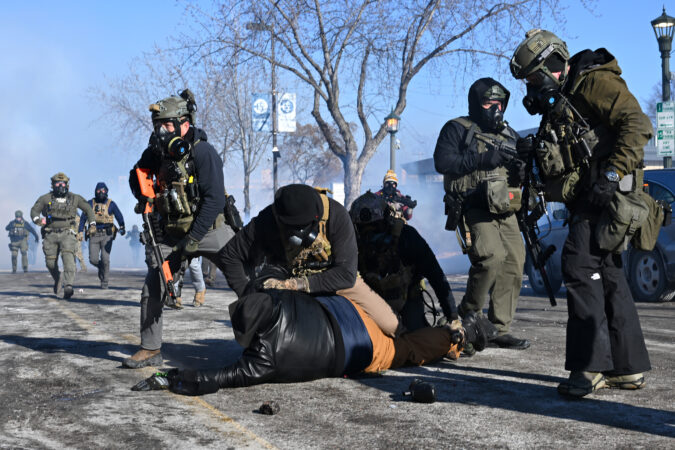
MINNEAPOLIS — In dueling news conferences, federal and state officials offered starkly different messages Sunday about the immigration crackdown that has swept across Minneapolis and surrounding cities, with both claiming the moral high ground in the wake of another shooting death by federal agents.
“Which side do you want to be on?” Gov. Tim Walz asked the public. “The side of an all-powerful federal government that could kill, injure, menace, and kidnap its citizens off the streets, or on the side of a nurse at the VA hospital who died bearing witness to such government,” a reference to the shooting of Alex Pretti on Saturday in Minneapolis.
At the same time, in a federal office building about 20 miles away, Border Patrol Commander Gregory Bovino, the public face of the crackdown, again turned blame for the shooting to Pretti.
“When someone makes the choice to come into an active law enforcement scene, interfere, obstruct, delay, or assault law enforcement officer and — and they bring a weapon to do that. That is a choice that that individual made,” he told reporters.
The competing comments emerged as local leaders and Democrats across the country demanded federal immigration officers leave Minnesota after Pretti’s shooting, which set off clashes with protesters in a city already shaken by another shooting death weeks earlier.
Video contradicts administration statements
Video shot by bystanders and reviewed by the Associated Press appears to contradict statements by President Donald Trump’s administration, which said agents fired “defensively” against Pretti, a 37-year-old intensive care nurse, as he approached them.
Pretti can be seen with only a phone in his hand as he steps between an immigration agent and a woman on the street. No footage appears to show him with a weapon. During the scuffle, agents appear to disarm him after discovering that he was carrying a 9 mm semiautomatic handgun, and then the agents opened fire several times. Pretti was licensed to carry a concealed weapon.
In the hours after the shooting, Homeland Security Secretary Kristi Noem said Pretti attacked officers, and Bovino said he wanted to “massacre law enforcement.”
Bovino was more restrained Sunday, saying he would not speculate about the shooting and that he planned to wait for the investigation.
Relatives say they are heartbroken
Pretti’s family said they were “heartbroken but also very angry” at authorities. Relatives were furious at federal officials’ description of the shooting.
“The sickening lies told about our son by the administration are reprehensible and disgusting. Alex is clearly not holding a gun when attacked by Trump’s murdering and cowardly ICE thugs. He has his phone in his right hand, and his empty left hand is raised above his head while trying to protect the woman ICE just pushed down all while being pepper sprayed,” the family statement said. “Please get the truth out about our son.”
Pretti was shot just over a mile from where an ICE officer killed 37-year-old Renee Good on Jan. 7, sparking widespread protests.
A federal judge has already issued an order blocking the Trump administration from “destroying or altering evidence” related to the shooting, after state and county officials sued.
Minnesota Attorney General Keith Ellison said the lawsuit filed Saturday is meant to preserve evidence collected by federal officials that state authorities have not yet been able to inspect. A court hearing is scheduled for Monday in federal court in St. Paul.
“A full, impartial, and transparent investigation into his fatal shooting at the hands of DHS agents is nonnegotiable,” Ellison said in a statement.
Drew Evans, superintendent of the state’s Bureau of Criminal Apprehension, which investigates police shootings, told reporters Saturday that federal officers blocked his agency from the scene of the shooting even after it obtained a signed judicial warrant. On Sunday morning, bureau officers were working at the scene.
Assistant Homeland Security Secretary Tricia McLaughlin dismissed the lawsuit, saying claims that the federal government would destroy evidence are “a ridiculous attempt to divide the American people and distract from the fact that our law enforcement officers were attacked — and their lives were threatened.”
The Minnesota National Guard temporarily assisted local police at Walz’s direction, officials said, with troops sent to the shooting site and a federal building where officers have squared off daily with demonstrators.
But Minneapolis Police Chief Brian O’Hara said Sunday morning on CBS’ Face the Nation that “it’s back to just the Minneapolis police responding to calls.”
No evidence that Pretti brandished gun
O’Hara said he had seen no evidence that Pretti brandished the pistol, and that the crackdown was exhausting his department.
“This is taking an enormous toll, trying to manage all this chaos on top of having to be the police department for a major city. It’s too much,” he said.
Rep. Alexandria Ocasio-Cortez of New York was among several Democratic lawmakers demanding that federal immigration authorities leave Minnesota.
In a statement, former President Barack Obama called Pretti’s death a “heartbreaking tragedy” and warned that “many of our core values as a nation are increasingly under assault.”
He urged the White House to work with city and state officials.
“This has to stop,” Obama said.
Federal officials have repeatedly questioned why Pretti was armed during the confrontation. But gun rights groups noted that it’s legal to carry firearms during protests.
“Every peaceable Minnesotan has the right to keep and bear arms — including while attending protests, acting as observers, or exercising their First Amendment rights,” the Minnesota Gun Owners Caucus said in a statement. “These rights do not disappear when someone is lawfully armed.”
Minnesota businesses issue letter urging cooperation
“With yesterday’s tragic news, we are calling for an immediate deescalation of tensions and for state, local and federal officials to work together to find real solutions,” the open letter reads.
CEOs that signed the letter included 3M CEO William Brown, Best Buy CEO Corie Barry, General Mills CEO Jeff Harmening, Target incoming CEO Michael Fiddelke, UnitedHealth Group CEO Stephen Helmsley, and others.
Before the letter, most of the biggest Minnesota-based companies had not issued any public statements about the enforcement surge and unrest.
But the issue has become more difficult to avoid. Over the past two weeks protesters have targeted some businesses they see not taking a strong enough stand against federal law enforcement activity, including Minneapolis-based Target. Earlier in January a Minnesota hotel that wouldn’t allow federal immigration agents to stay there apologized and said the refusal violated its own policies after a furor online.
“In this difficult moment for our community, we call for peace and focused cooperation among local, state and federal leaders to achieve a swift and durable solution that enables families, businesses, our employees, and communities across Minnesota to resume our work to build a bright and prosperous future,” the letter reads.
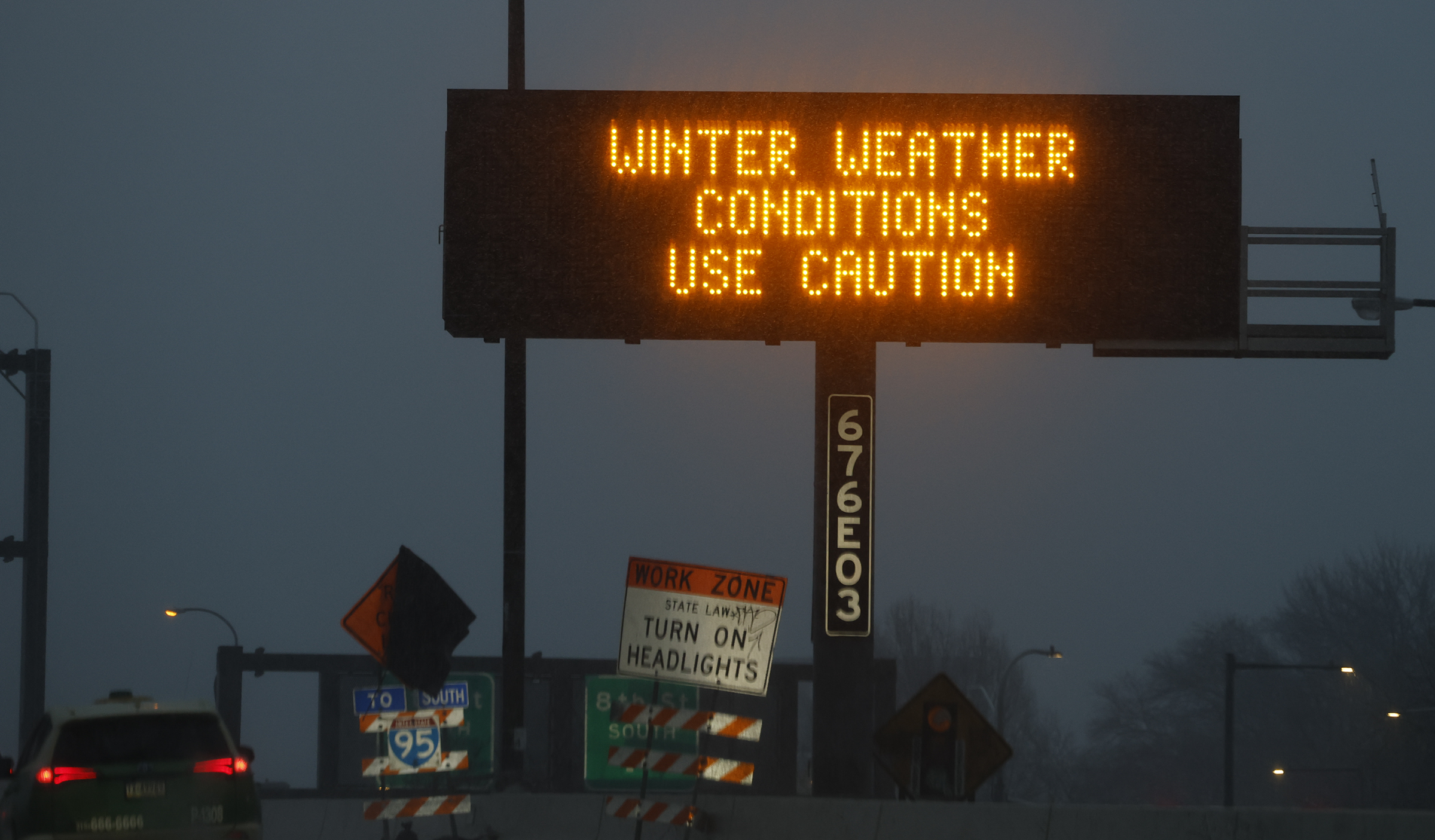
It may not approach their magnitudes, but Sunday’s snow-and-ice cold brew is expected to bear eerie similarities to some of Philly’s historic winter storms and perhaps rival them for disruption.
By 7 a.m., up to 3 inches had been reported around the region, with heaviest amounts to the south where the snow started earlier.
Officially, at Philadelphia International Airport, 1.6 inches had been measured, already making this the city’s biggest official total of the month. But Center City trumped it at 1.8.
From 8 to 10 inches was expected around the city before the snow mixes with sleet and possibly freezing rain during the afternoon, said Nick Guzzo, a meteorologist at the National Weather Service Office in Mount Holly. All that is subject to change, of course.
As for the potential mixing, “pick your poison,” said Guzzo’s colleague Mike Lee.
The office has posted winter storm warnings for the entire region, joining offices from New Mexico to Maine.
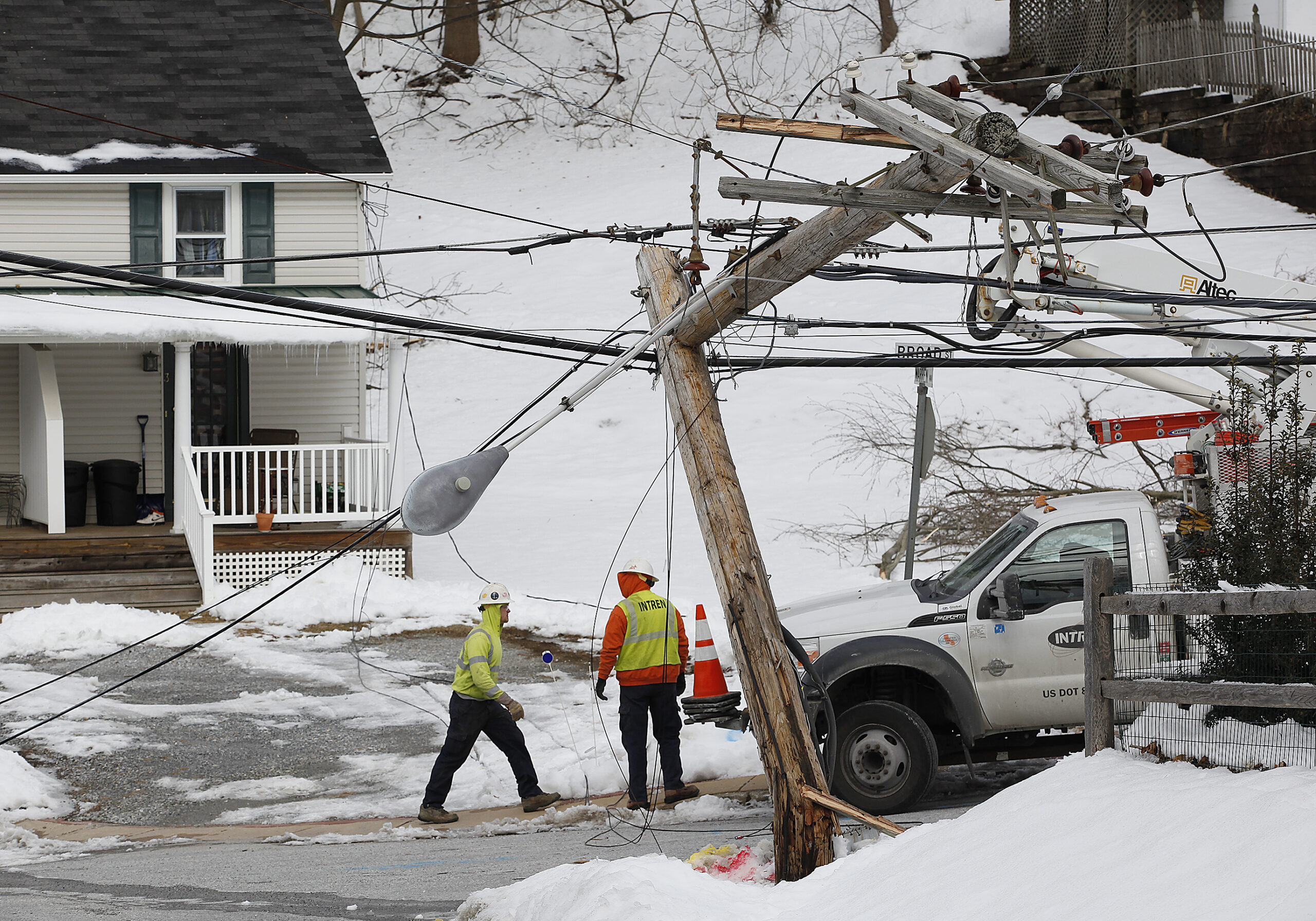
A crew from northern Illinois works to restore power at Broad Street and Warren Avenue in Malvern after the February 2014 ice storm.
The precipitation is due to shut off early Monday, but by then it may be a case of welcome to ice station Philly.
Nothing that falls is going to melt, as temperatures will get no higher than the 20s Sunday and may not see 30 for the rest of the week
Affirming their faith in the forecasts, Philadelphia, New Jersey, and Pennsylvania have declared emergencies. If you have plans the next few days, don’t count on them happening, and some kids might be able to put off homework for a few days.
Perhaps of more interest to some parties, Pennsylvania announced that all its liquor stores will be closed Sunday, and the Girl Scouts have pushed back their cookie-sale dates all the way to the spring equinox. (At least some of the bars and churches may be open.)
How much for Philly?
On Saturday, the National Weather Service was sticking with 8 to 10 inches for the immediate Philly area, said meteorologist Amanda Lee, with less to the southeast. AccuWeather Inc. was calling for 6 to 10 inches.
A lot of that would fall during a “front-end thump,” said AccuWeather meteorologist Elizabeth Glenny. Once the mixing begins, accumulation rates would back off.
While people understandably want to know how many inches of snow are going to land, that is almost always difficult to answer, meteorologists say, especially in a storm of this nature.
In this case, snow amounts are dependent on a coastal storm that had not yet formed Saturday and on what might happen in parts of the atmosphere that are not well-observed.
Temperatures in the bottom 5,500 feet of the atmosphere over Philly are expected to remain below freezing, said AccuWeather senior meteorologist Tom Kines, but computer models insist that a warm layer in the higher atmosphere would result in the changeover.
That warmth would be imported from the Atlantic Ocean by the strong onshore winds from the northeast generated by the storm — it’s not for nothing that these things are called nor’easters.
Another wild card would be if the snow is heavy enough that it could survive the warm layer and delay the changeover.
But the mixing of sleet, which is liquid that remains frozen in its trip through the atmosphere, and freezing rain, liquid that freezes on contact, is inevitable, forecasters said.
Freezing rain atop a snowpack is especially dangerous because it adds weight to vulnerable and snow-burdened power lines and tree branches. Sleet is polite enough to bounce off hard surfaces, but since it is pure ice, it is slower to melt.
Said the weather service’s Mike Lee, the mixing “just means we’re getting a different blend of horrors.”
Remembrance of Philly storms past
Mike Lee said that about 1.5 inches of liquid precipitation — the amount of melted snow and ice — was expected to fall during the storm, and whatever landed was certain to participate in becoming a massive block of ice.
And it is close to what fell during Philly’s last double-digit snow, the 22.4 inches of Jan. 22-23, 2016.
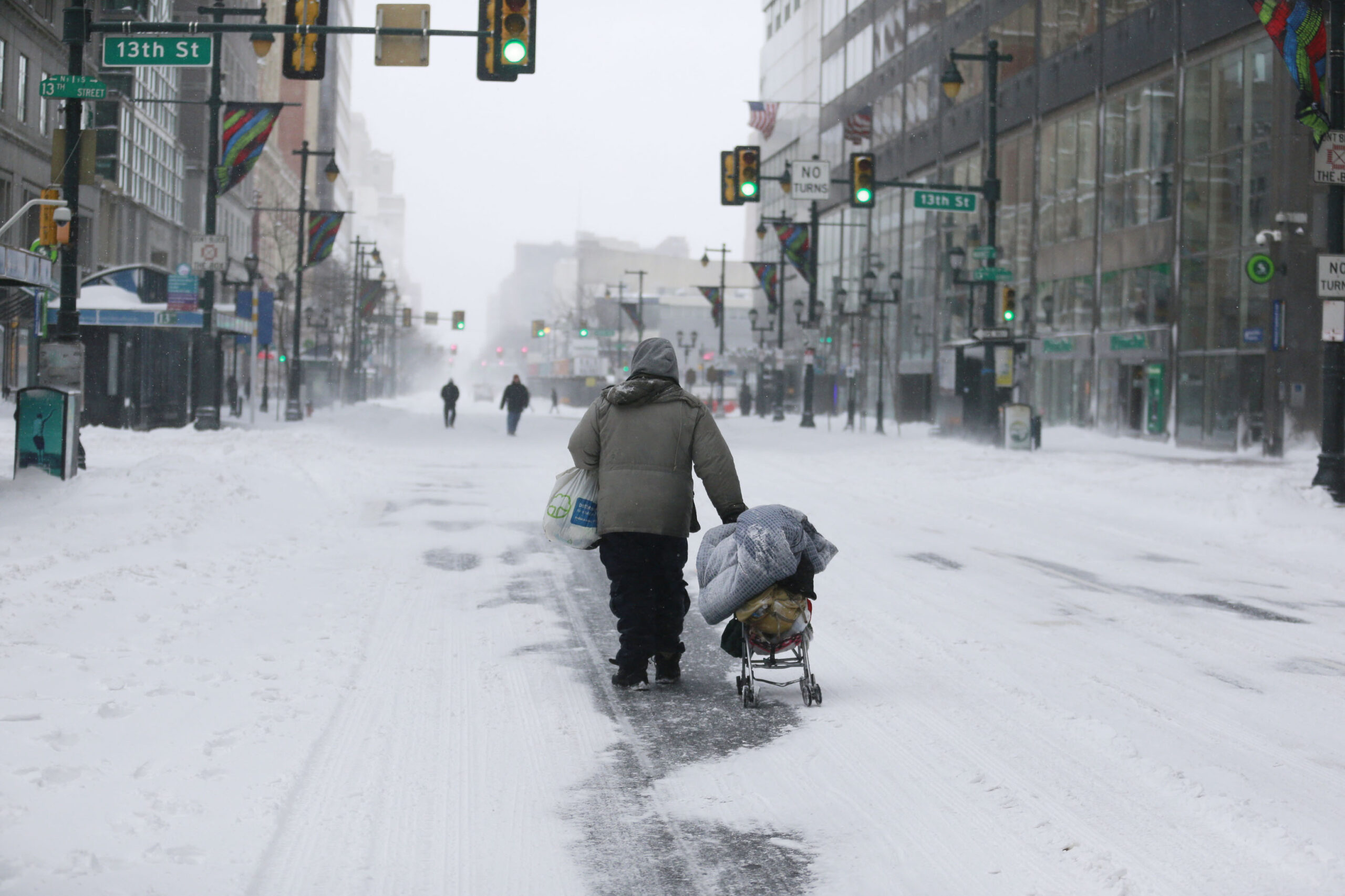
Market Street near 13th is mostly pedestrian traffic as snow falls over the region on Jan. 23, 2016.
In mid-March 1993, a foot of snow accumulated rapidly during a blizzard, followed by several hours of sleet and a flash freeze during the early morning. It created what a weather service meteorologist famously called an “Arctic landscape.”
The landscape Monday may be similar, but with one important difference.
That March storm occurred near the equinox, when the sun was about 50% stronger than it is this time of year, according to NASA data, and days were close to two hours longer. (Yes, those days are coming.)
The temperature bottomed out at 11 degrees Saturday morning, the lowest reading of the season at Philadelphia International Airport, and into the single digits outside the city.
Most airlines have canceled flights departing Sunday from Philadelphia International Airport. By late Saturday afternoon, there were 502 canceled flights into or out of the airport, according to the city.
Temperatures are expected to get no higher than the mid-20s Sunday and Monday. And then it’s going to get colder, with daytime highs no better than the low 20s, and nights in the single digits.
Philly’s biggest snow in five years has an icy finish, and it isn’t going anywhere soon
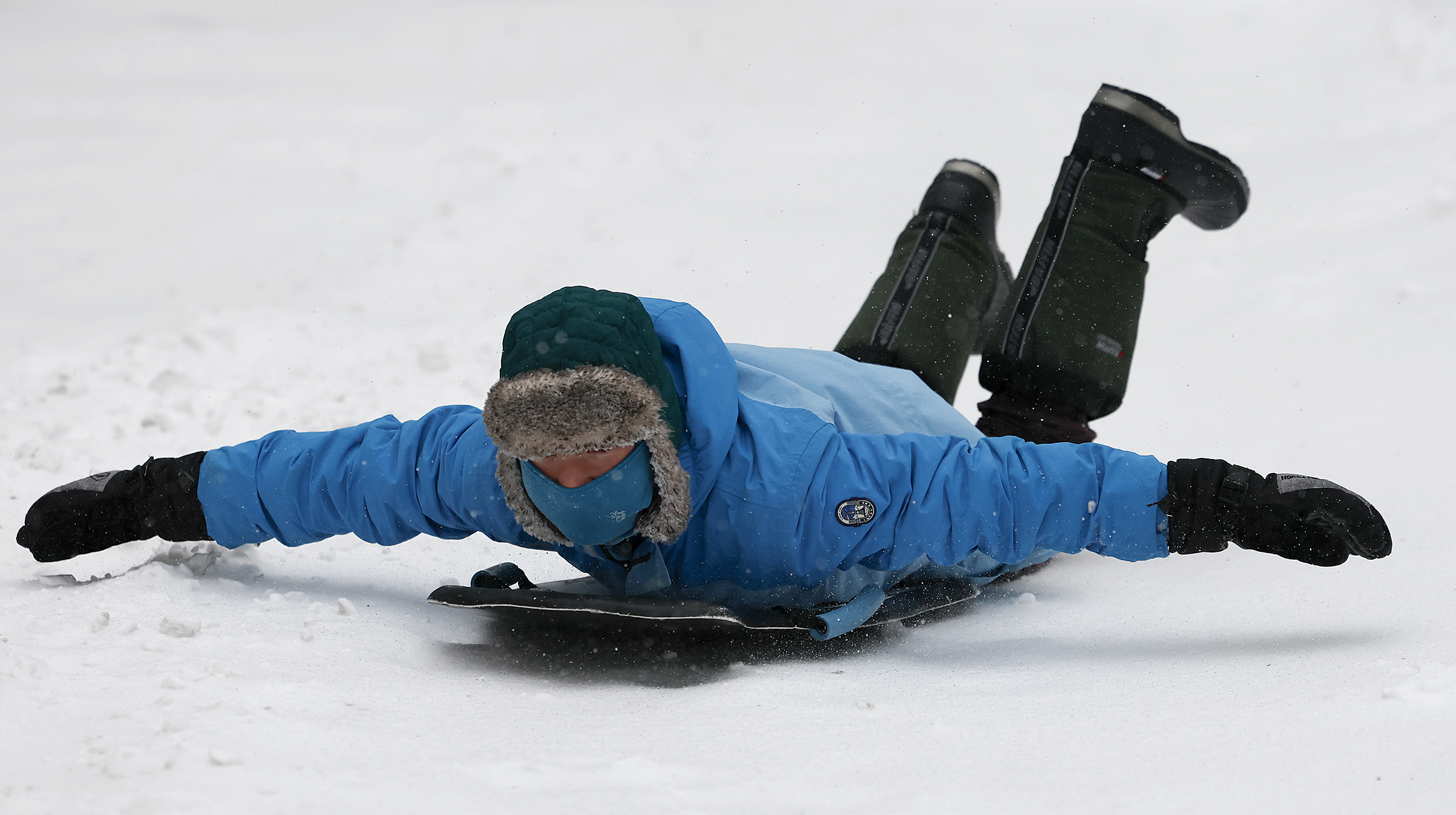
George Lynch, 11, slides on his stomach down 2nd Street in the Society Hill neighborhood Sunday.
Hours of percussive sleet layered a nasty icing on Philadelphia’s biggest snowfall in five years Sunday, and it may be some time before bare ground resurfaces in the region, if not normality.
This was not the stuff of postcards.
Officially 7.4 inches of snow was measured at unusually quiet Philadelphia International Airport, with similar amounts reported in the neighboring counties, as temperatures didn’t get out of the teens during the day anywhere near Philly.
And shovelers beware: That mess may weight as much as 18 inches of pure snow. Besides, we may be out of practice. This was the most snow since the 81 inches of Feb. 2-3, 2021. Incidentally, that snowfall was the biggest in five years, in what has been a generally snow-deprived decade.
Forecasters say it is unlikely that the precipitation would flip back to snow, but some additional accumulation was possible, since sleet — liquid that freezes before it lands — counts as snow. In some places it was falling at the rate of 0.5 inches an hour, the National Weather Service said, an extraordinary rate for sleet.
Some freezing rain — liquid that freezes on contact with a surface — was possible Sunday evening, said Nick Guzzo, meteorologist at the National Weather Service in Mount Holly.
However, widespread power outages were unlikely, a function of the unusual behavior of a potent but peculiar storm that wrought a familiar set of disruptions and inconveniences.
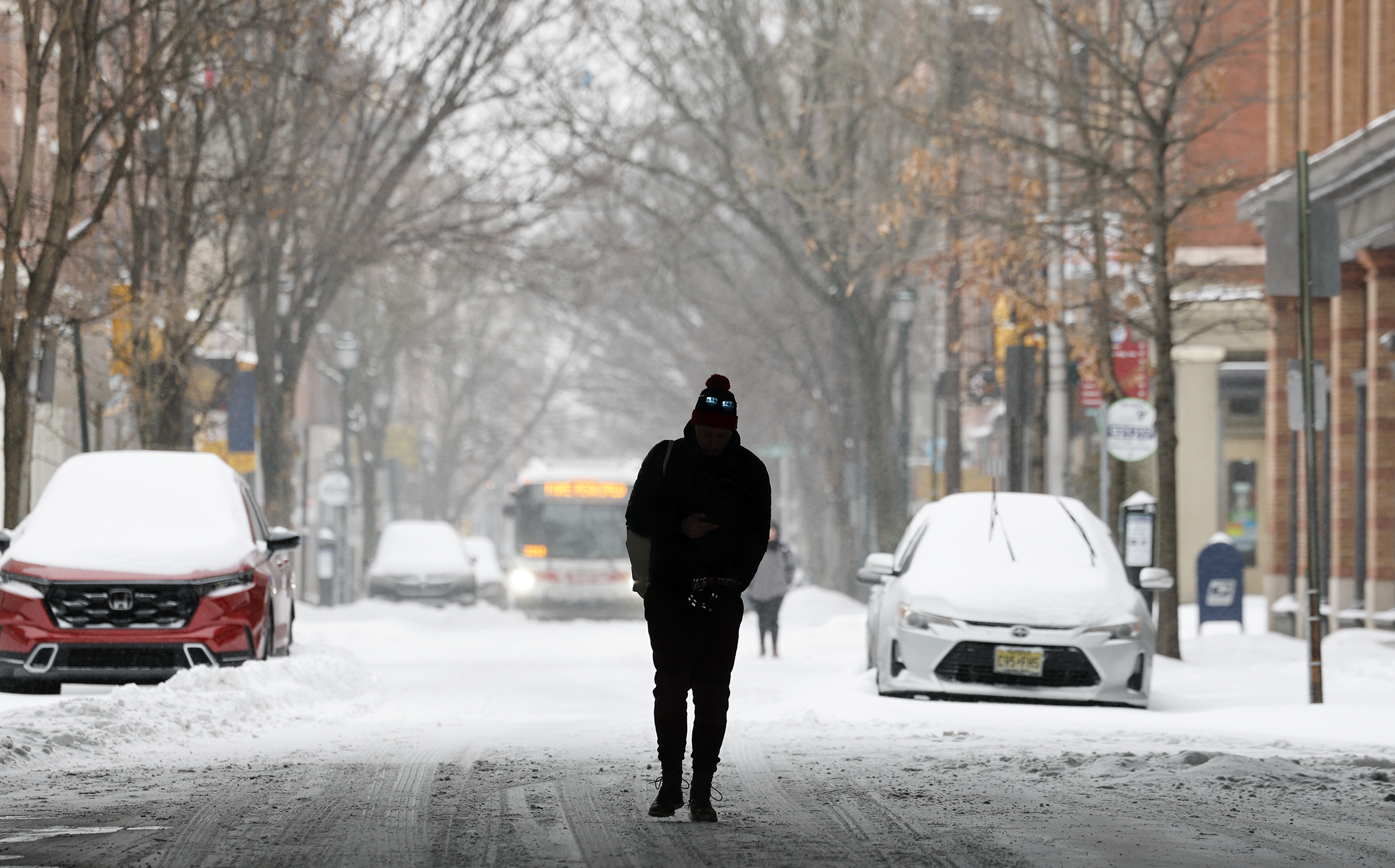
A pedestrian walks under the Benjamin Franklin Bridge Sunday.
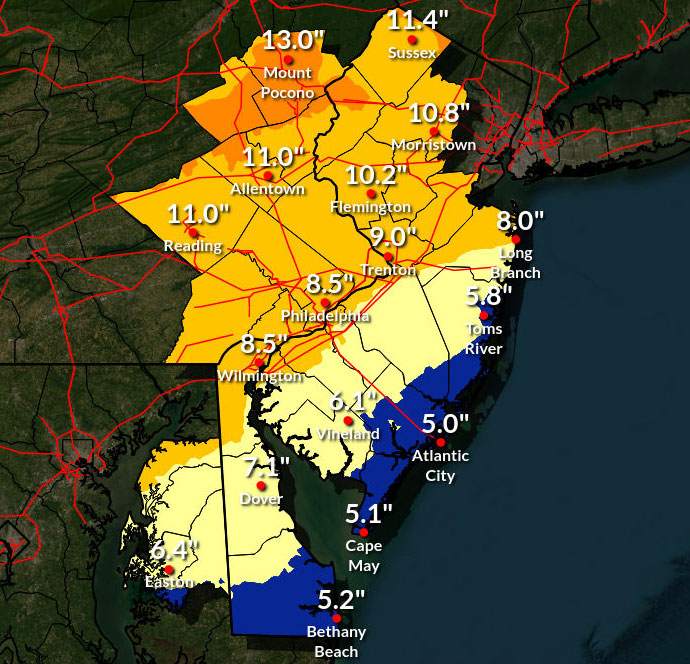
A far-reaching winter storm blanketed the Mid-Atlantic in an icy brew of snow and sleet Sunday, with preliminary totals nearing a foot in parts of New Jersey.
Philadelphia ranked near the top end of regional totals. A survey of five regional National Weather Service offices showed PHL’s total ranked 103rd of 565 reports made in the last six hours.
The Philadelphia metropolitan region generally received between four and nine inches of snow by early Sunday afternoon, according to National Weather Service reports.
Among the highest totals:
Pottstown – 9.5 inches
Norristown – 8.7 inches
Stowe – 8.5 inches
Lower Pottsgrove – 8.5 inches
New Hanover – 8.5 inches
Use the map and chart below to find preliminary snow totals in your area. Hover over dots on the map to reveal more information, or search for Philadelphia-area totals below.
window.addEventListener(“message”,function(a){if(void 0!==a.data[“datawrapper-height”]){var e=document.querySelectorAll(“iframe”);for(var t in a.data[“datawrapper-height”])for(var r,i=0;r=e[i];i++)if(r.contentWindow===a.source){var d=a.data[“datawrapper-height”][t]+”px”;r.style.height=d}}});window.addEventListener(“message”,function(a){if(void 0!==a.data[“datawrapper-height”]){var e=document.querySelectorAll(“iframe”);for(var t in a.data[“datawrapper-height”])for(var r,i=0;r=e[i];i++)if(r.contentWindow===a.source){var d=a.data[“datawrapper-height”][t]+”px”;r.style.height=d}}});
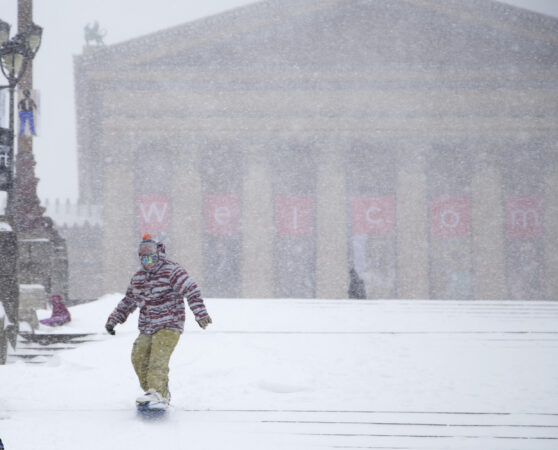
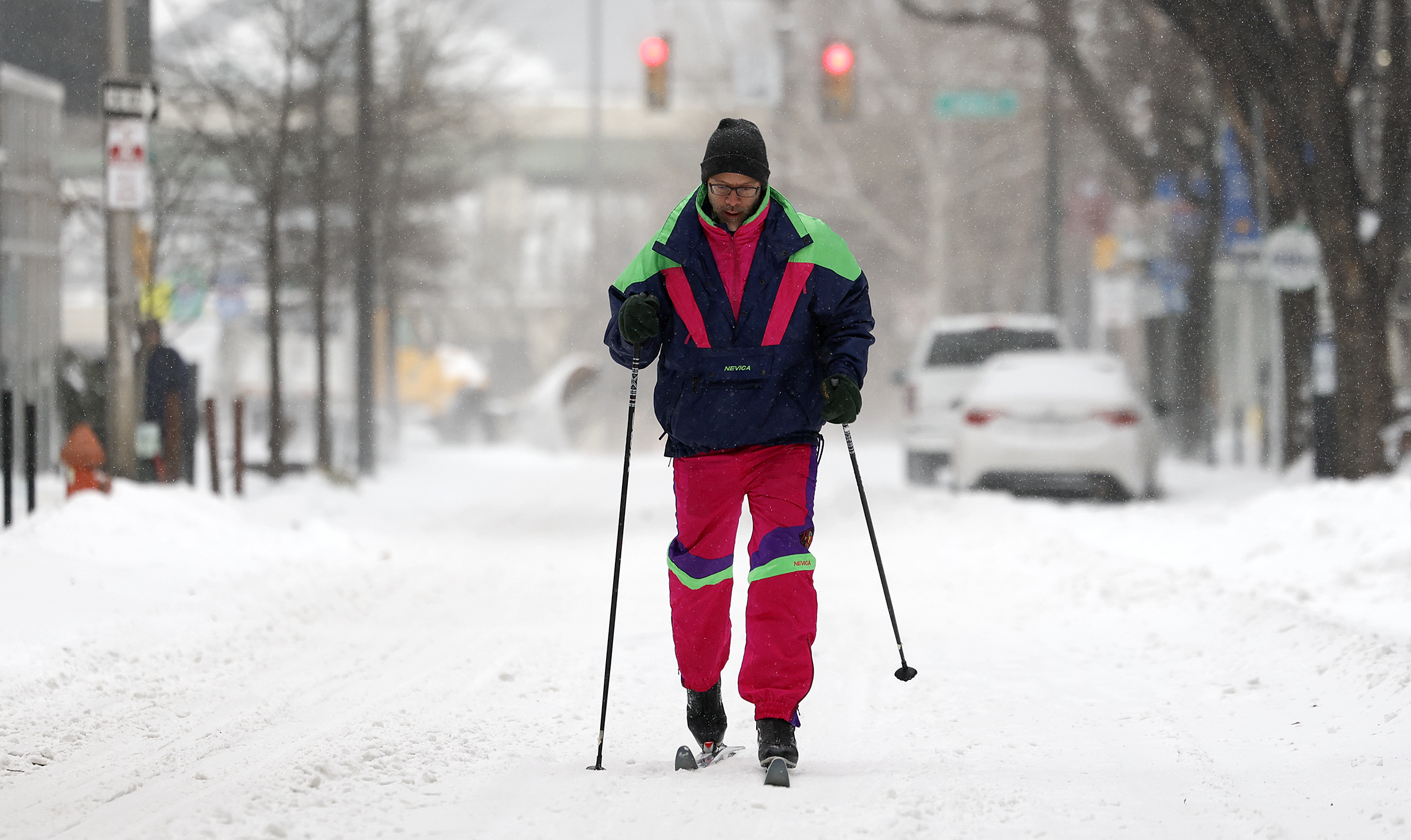
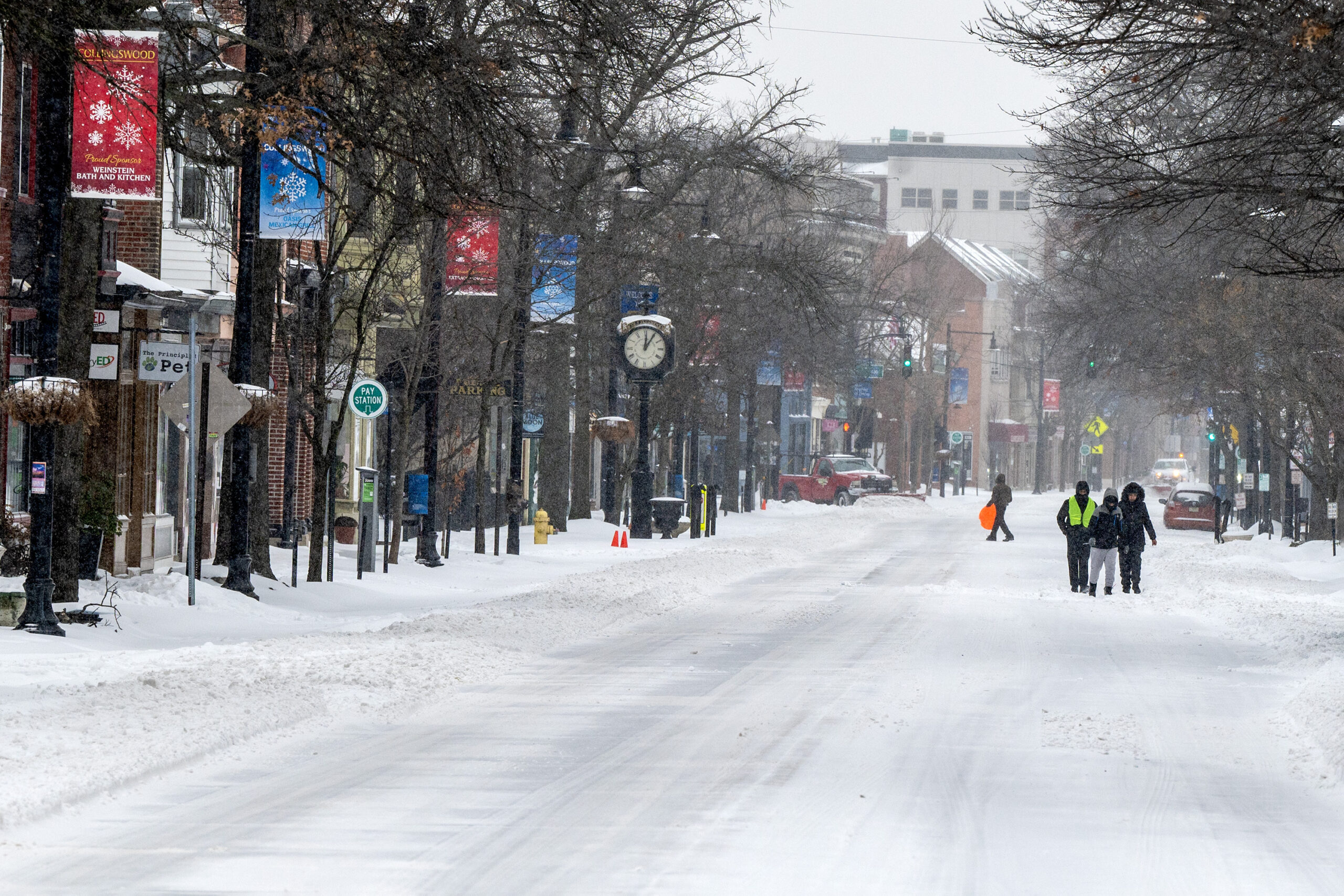
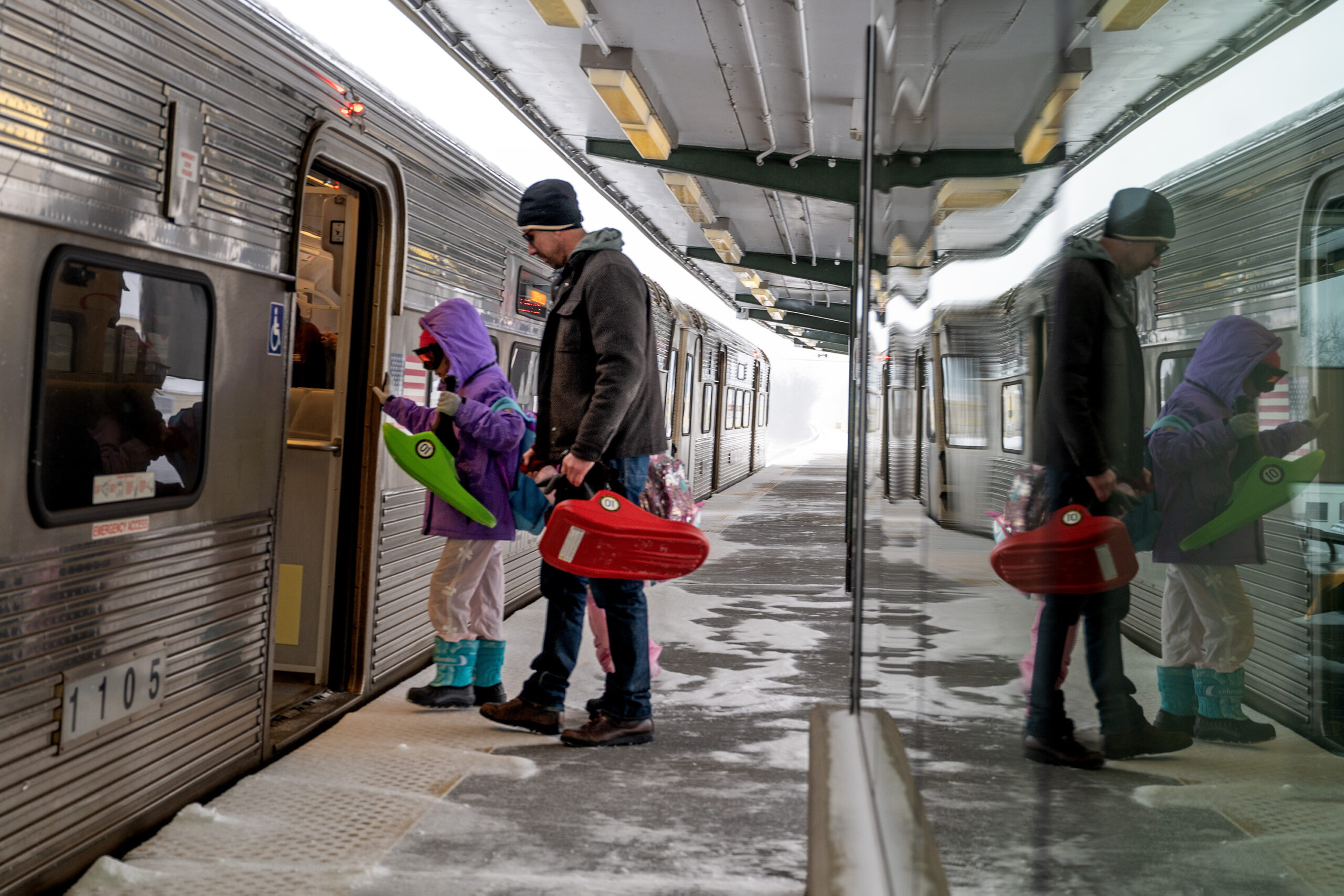
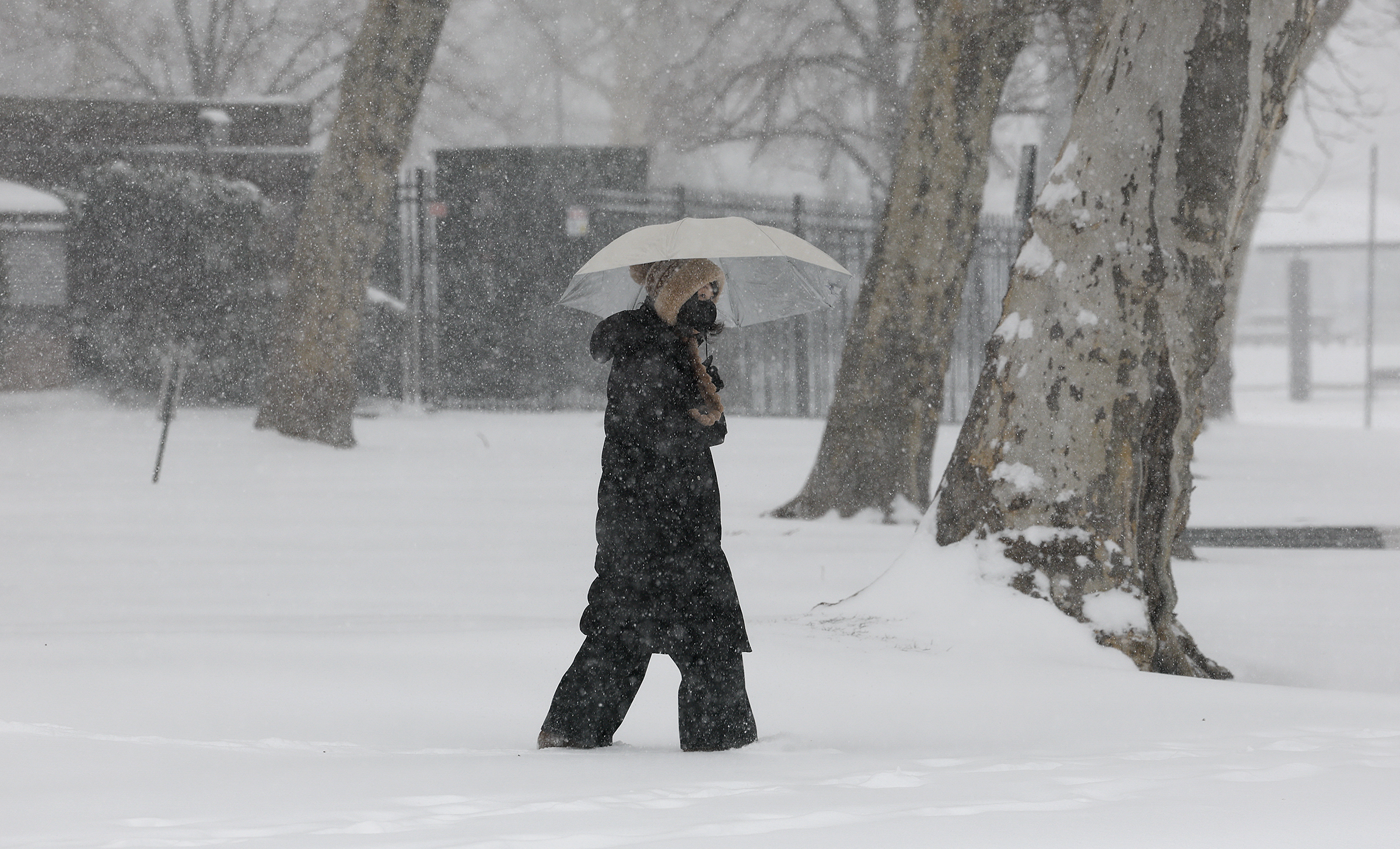
Russ Walters skies along Race Street in the Old City neighborhood Sunday. Pedestrians walk in the middle of a plowed but empty Haddon Avenue in downtown Collingswood. Mike Doveton and his daughters. Maya, 10, and Jaydan (hidden), 6, board a PATCO train with their sleds heading out to snow. A pedestrian uses their umbrella as snow falls on Race Street.
// Timestamp 01/25/26 1:41pm
Philly officially has its biggest snow in five years
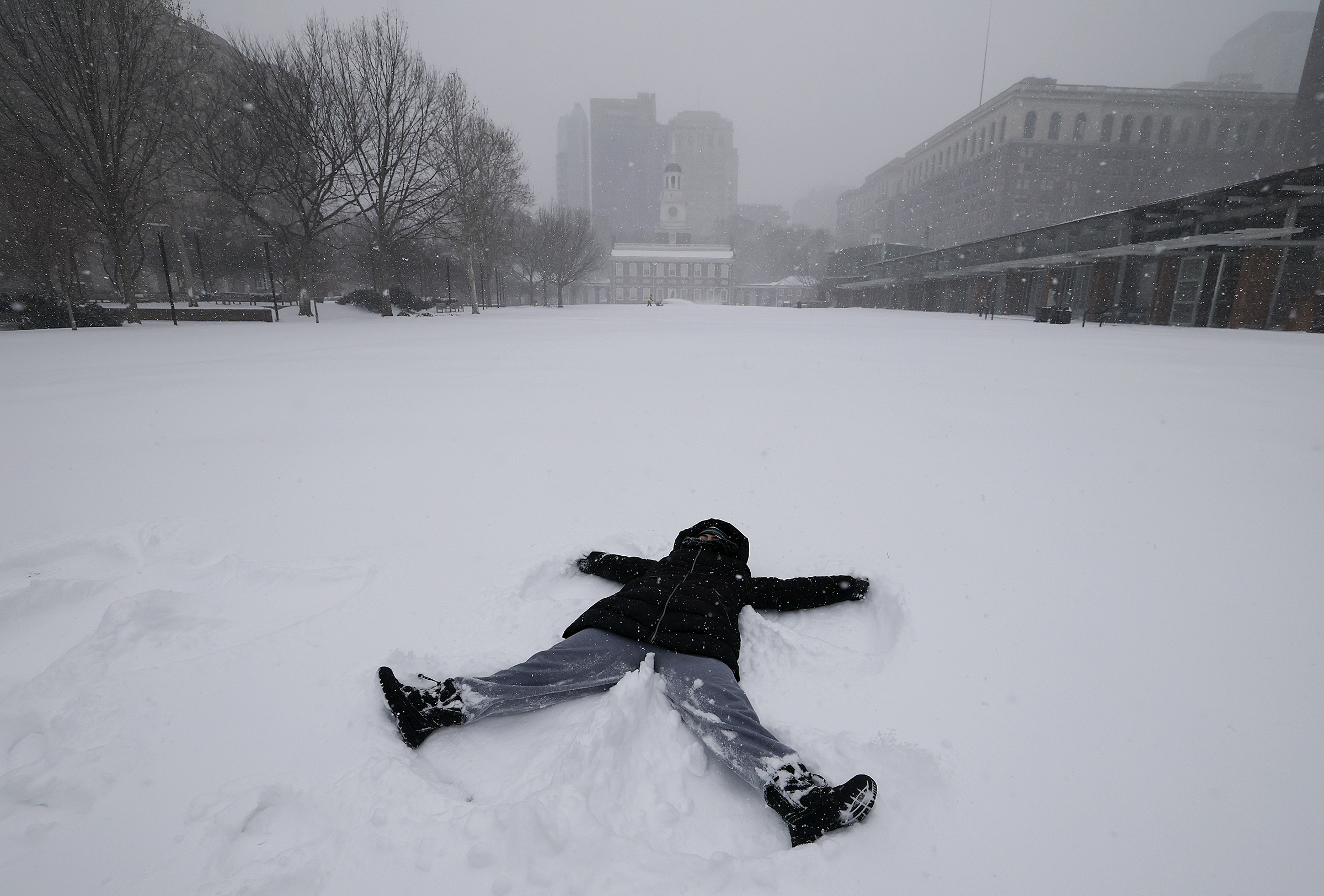
Julie Cohen makes a snow angel on the snow covered lawn at Independence Mall Sunday.
At 1 p.m., 7.4 inches of snow was measured at Philadelphia International Airport, the biggest snow in five years.
It also pushed the seasonal total to 13.8 inches, also the highest since the winter of 2020-21.
Given how cold it was during the snowfall, the regional totals didn’t show their usual wide variations, and were mostly in the 6- to 8-inch range. It’s possible that another inch could be added to the totals with the slow-accumulating sleet and a possible flip-back to light snow before the precipitation ends.
Some freezing rain also is possible late in the day or evening Sunday.
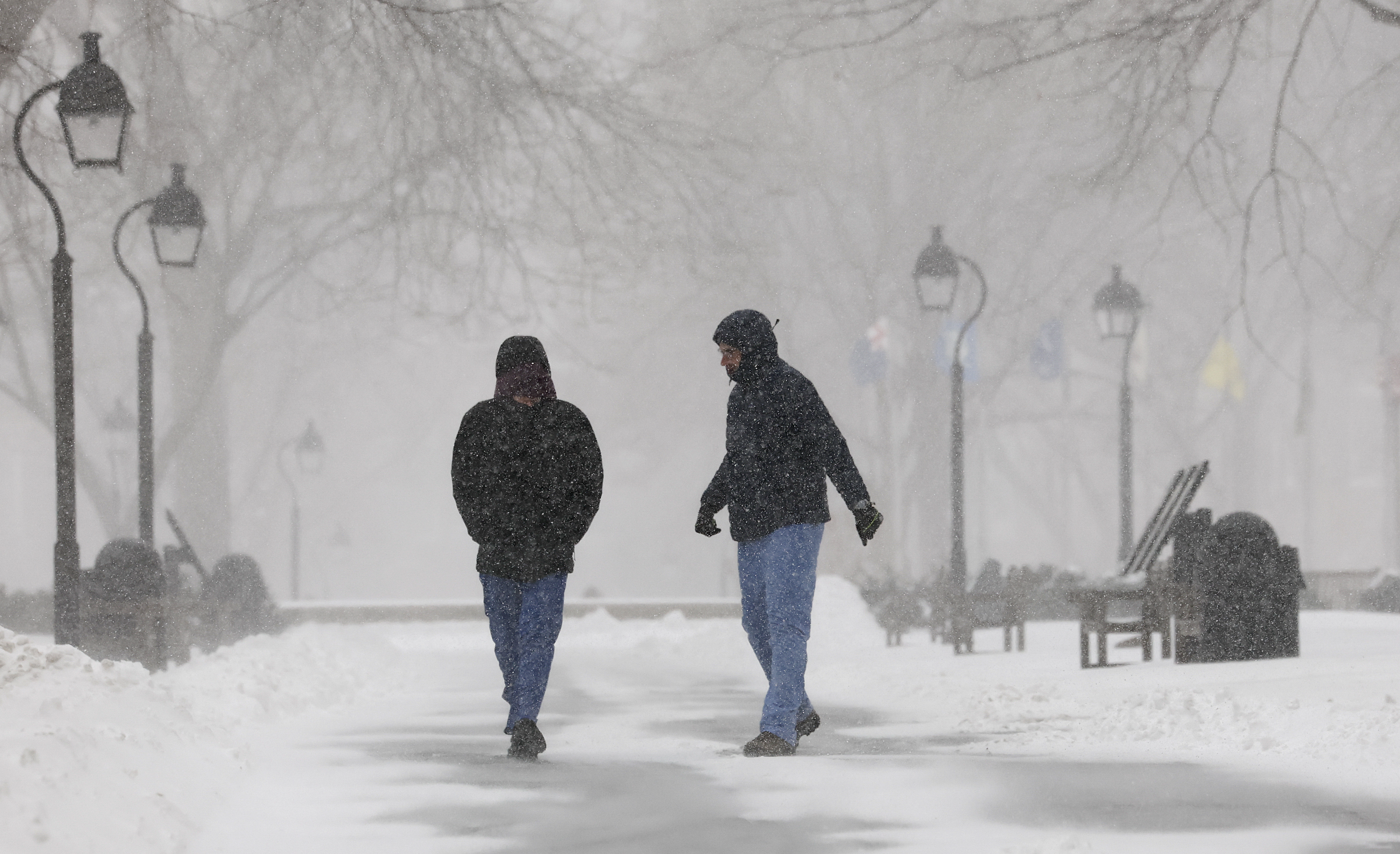
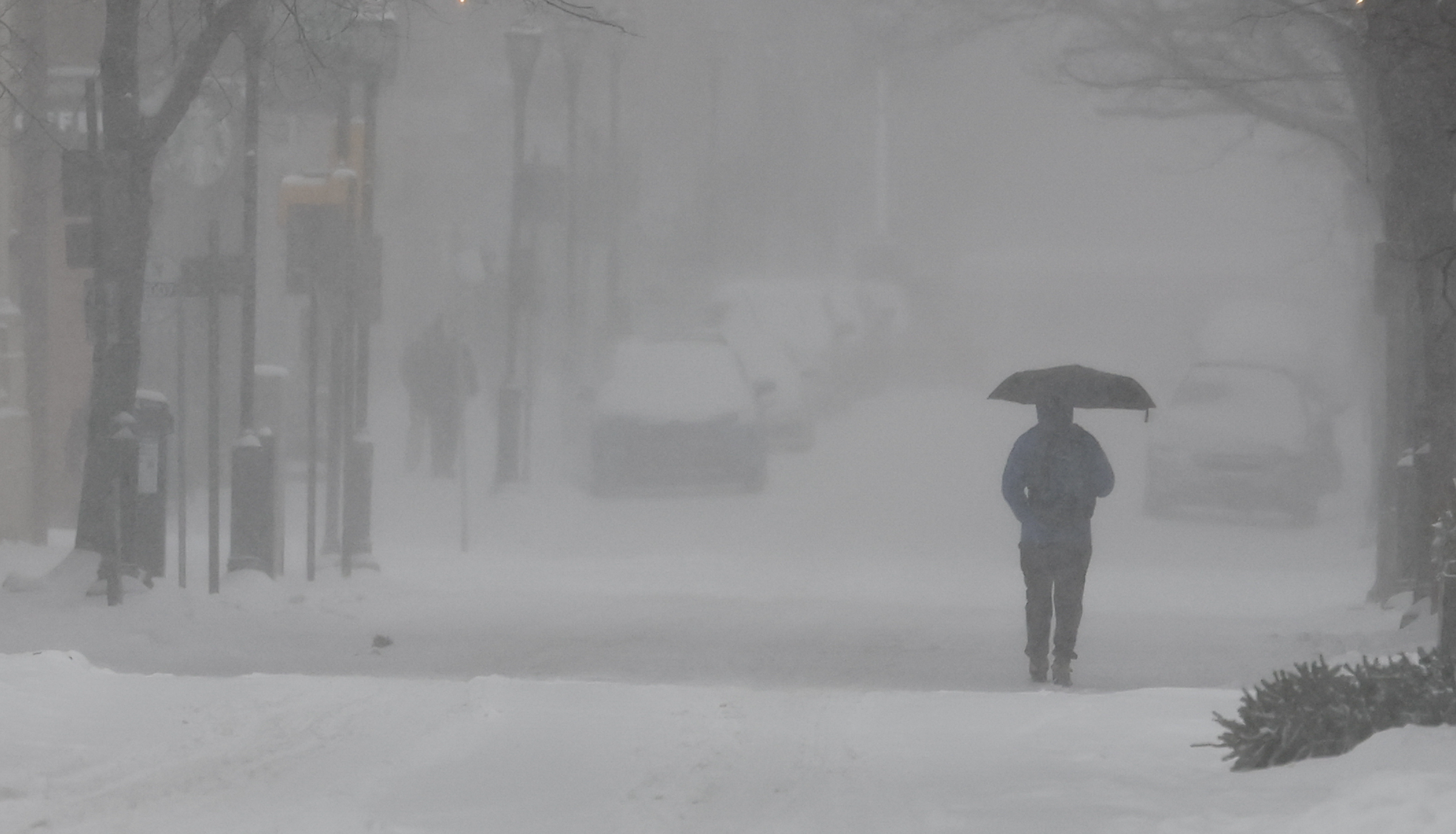
Two pedestrian brave the weather in Washington Square Park Sunday.
Temperatures at the surface remain in the teens, but sleet has routed the snow throughout the region.
Before the changeover, weather service spotters reported as much as 7 inches of snow. By convention, spotters measure snow before changeovers, since sleet and rain compress the snowpack.
Sleet, which is liquid that freezes on the way to the surface, counts as snowfall, but it accumulates ponderously. A tenth of an inch of liquid will yield about an inch of snow, but it would take three times that to produce an inch of sleet.
The changeover is the result of a layer of warm air in the upper atmosphere imported from the ocean by the onshore winds of a potent coastal storm.
The sleet is due continue this afternoon, and freezing rain also remains a possibility before it all ends late tonight or early Monday, said Nick Guzzo, meteorologist at the National Weather Service Office in Mount Holly.
Whereas sleet and freezing rain hold down accumulations, he notes that they slow down the melting process.
Ice cubes take longer to melt than snowflakes.
Be careful shoveling. The whole frozen mess may feel like it weighs as much as 18 inches of snow.
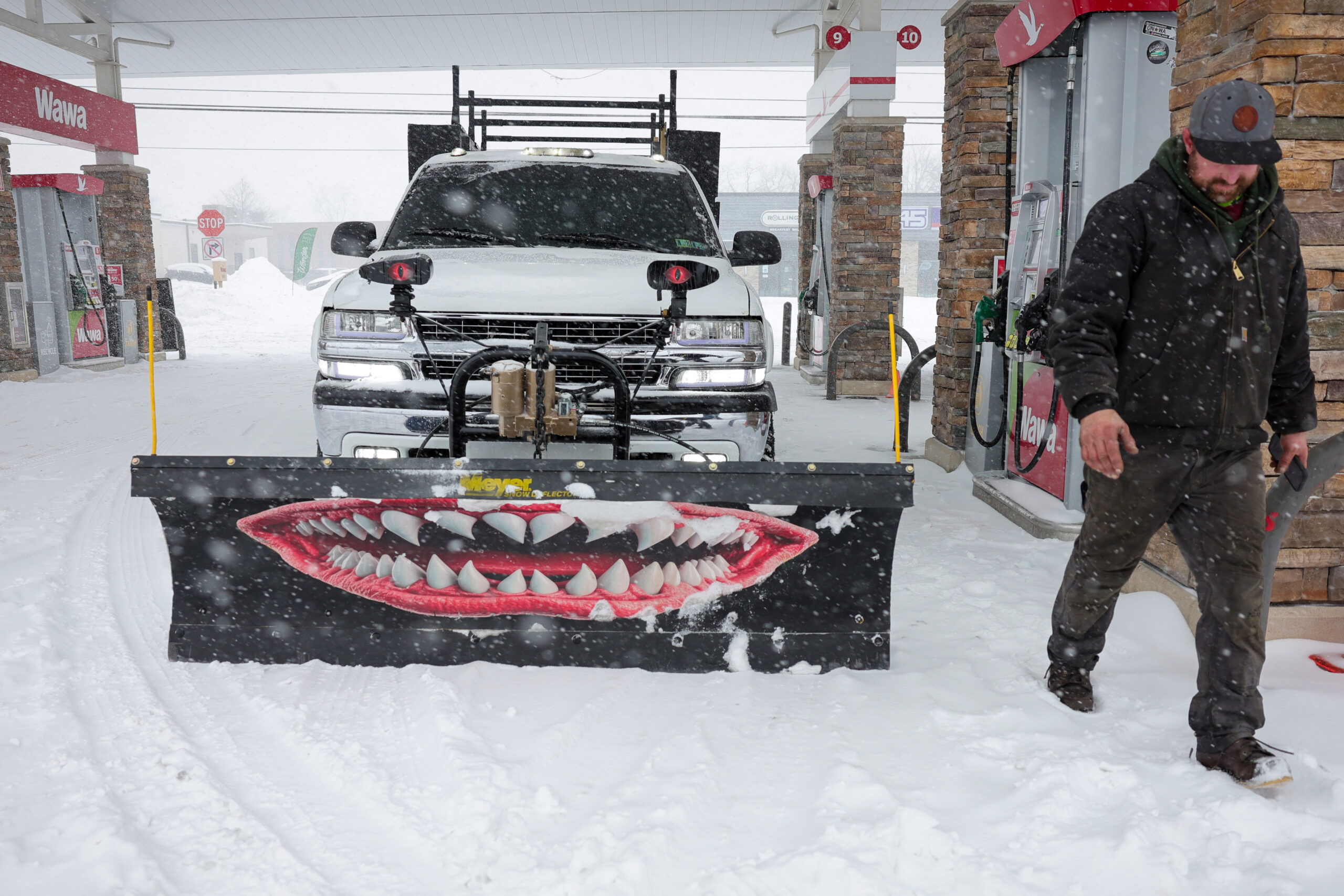
Mike Orazietti takes a break at Wawa from snowplowing in West Chester Sunday.
Five inches or more of snow have fallen in several locations in the Philly region, according to reports from National Weather Service trained spotters.
Here is the current list, which is likely to grow before sleet mixes in the next few hours:
Lehigh Valley International Airport cancels all flights Sunday
ABE is currently closed. Snow Ops continue as long as weather conditions allow for our team to work safely. We encourage travelers to check with their airline for flight delays or cancellations impacting Sunday / Monday's schedule. @69News@mcall@LVNewsdotcom@lehighvalleypic.twitter.com/MyTfQgElWI
Warming centers across Philadelphia will remain open during this storm as part of the ongoing Code Blue declaration, Philadelphia Mayor Cherelle L. Parker said a news conference Sunday.
24-hour warming centers are available for use, stocked with water, snacks, blankets, warming kits, and cots, said Crystal Yates-Galle, deputy managing director for health and human services.
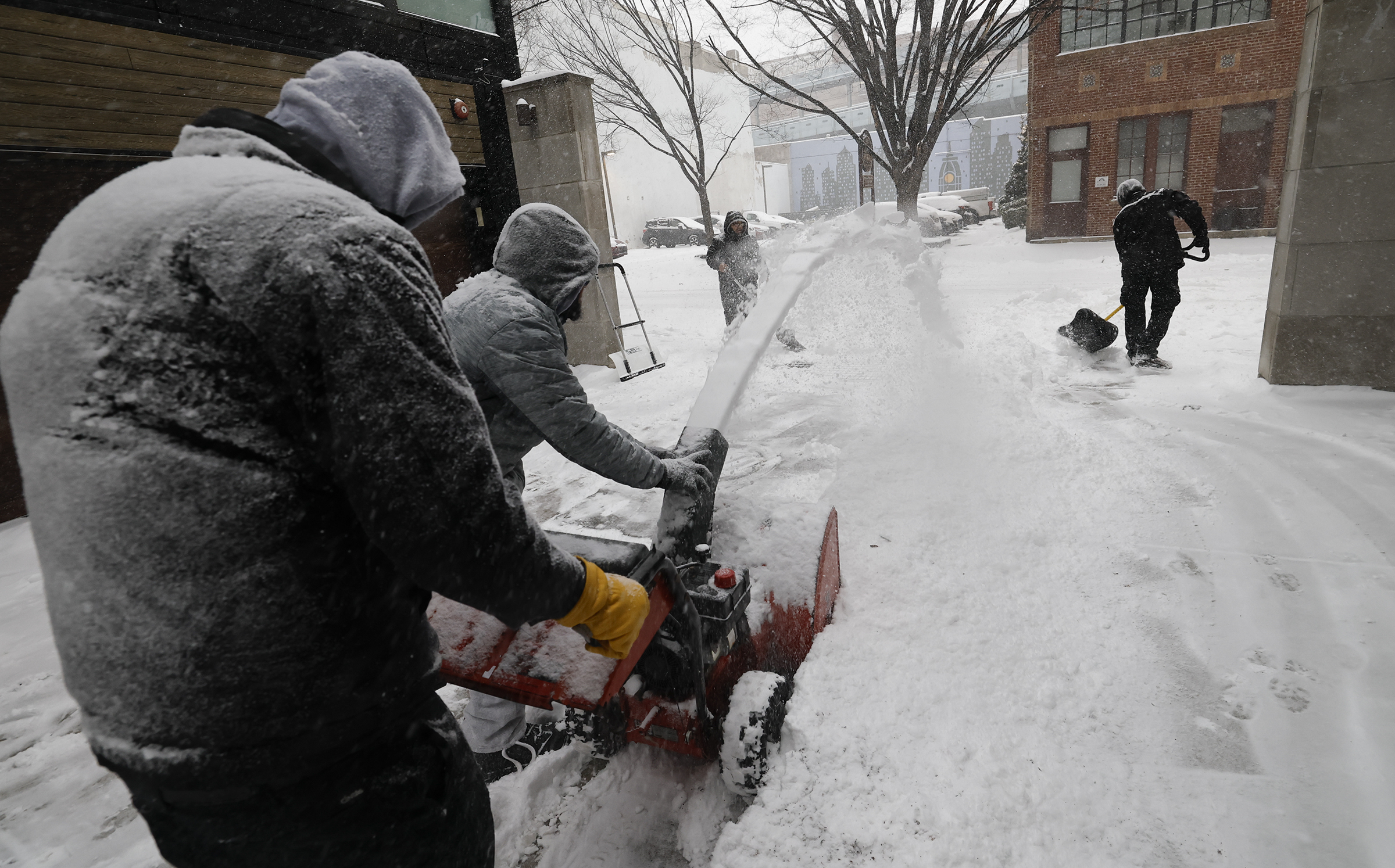
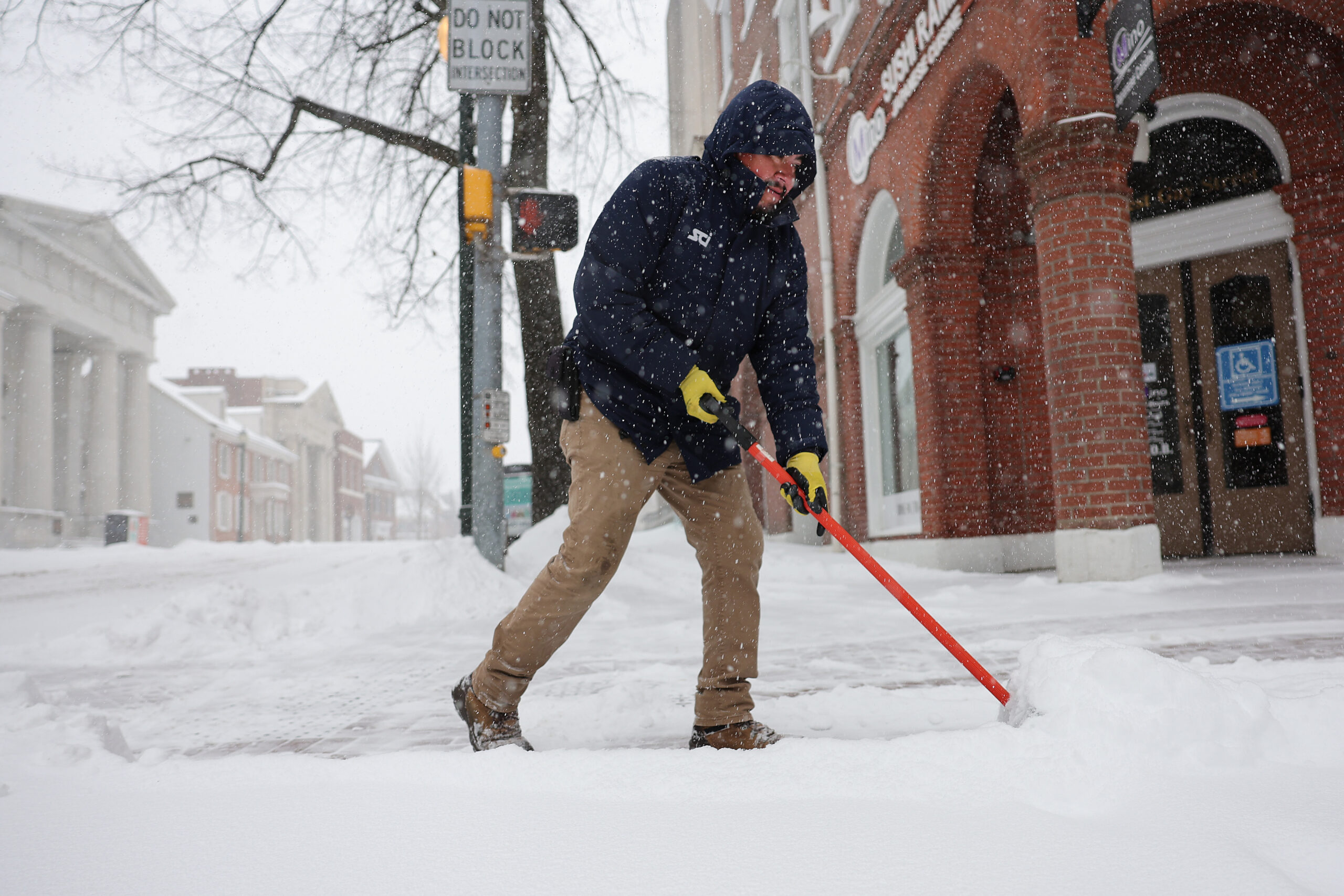
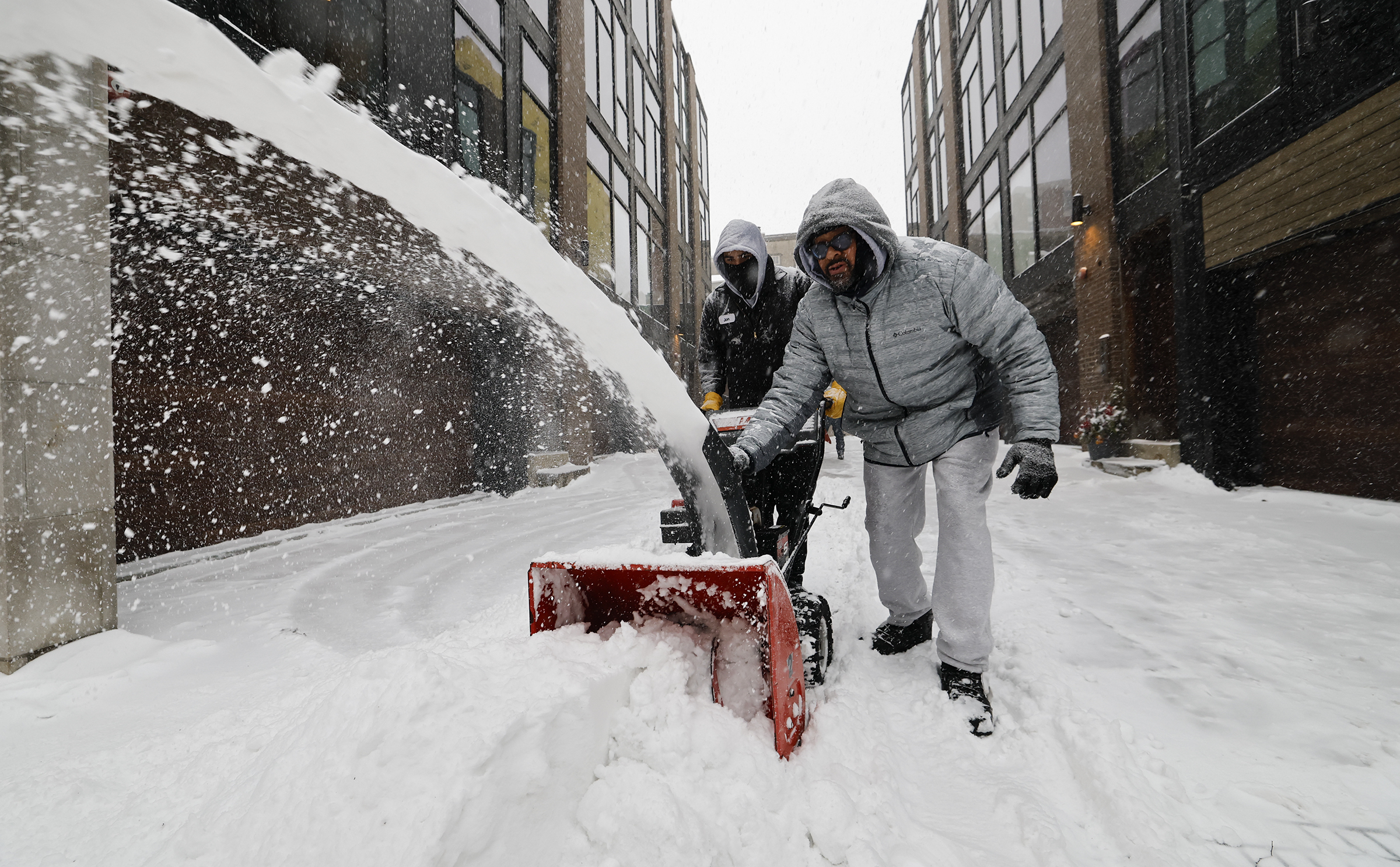
Jonathan Ahmad (left) and Michael Thompson clear snow in Old City Sunday.
Carlton Williams, director of the office of clean and green initiatives, debunked a widespread piece of misinformation he said has been circulating online.
No, he said, the city is not handing out free salt, which it needs for roadways and events given the expected icy conditions.
“We must be smart about the work that we’re doing … because this is a matter of life and death if we don’t get this right,” Williams said at a news conference Sunday.
Williams said 4 to 7 inches of snow are expected to fall in the next couple hours, and it’s likely to freeze.
Meanwhile, in some parts of the city, accumulation will likely get to a point where snow must be removed from the neighborhood and deposited elsewhere.
The city has also invested in a snow melter “that delivers 135 tons an hour melting snow,” Williams said.
So far, that snow has fallen at a rate of two inches in two hours, said Dom Morales, director of the office of emergency management
Like other officials, he warned of treacherous conditions on the roads, noting that state’s 511PA website can provide details on road conditions.
“Whether you have four wheel drive, all wheel drive, the conditions are not favorable to being on the road right now,” Morales said.
He warned that sleet and freezing rain could create “invisible ice” and lead people to fall off their stoops even if they’ve shoveled earlier.
Morales encouraged people to keep their phones charged in case power goes out and check out the city’s website for details on how to respond to common scenarios including a downed tree, a water emergency, and a power outage.
“Philly we have a few more days ahead of us,” Morales said. “So please, let’s keep ready, and let’s take care of one another.”
Cherry Hill Mall, Christiana Mall close due to snow
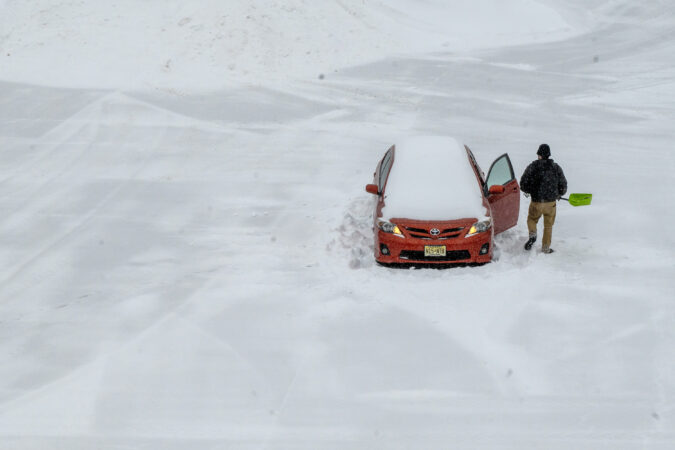
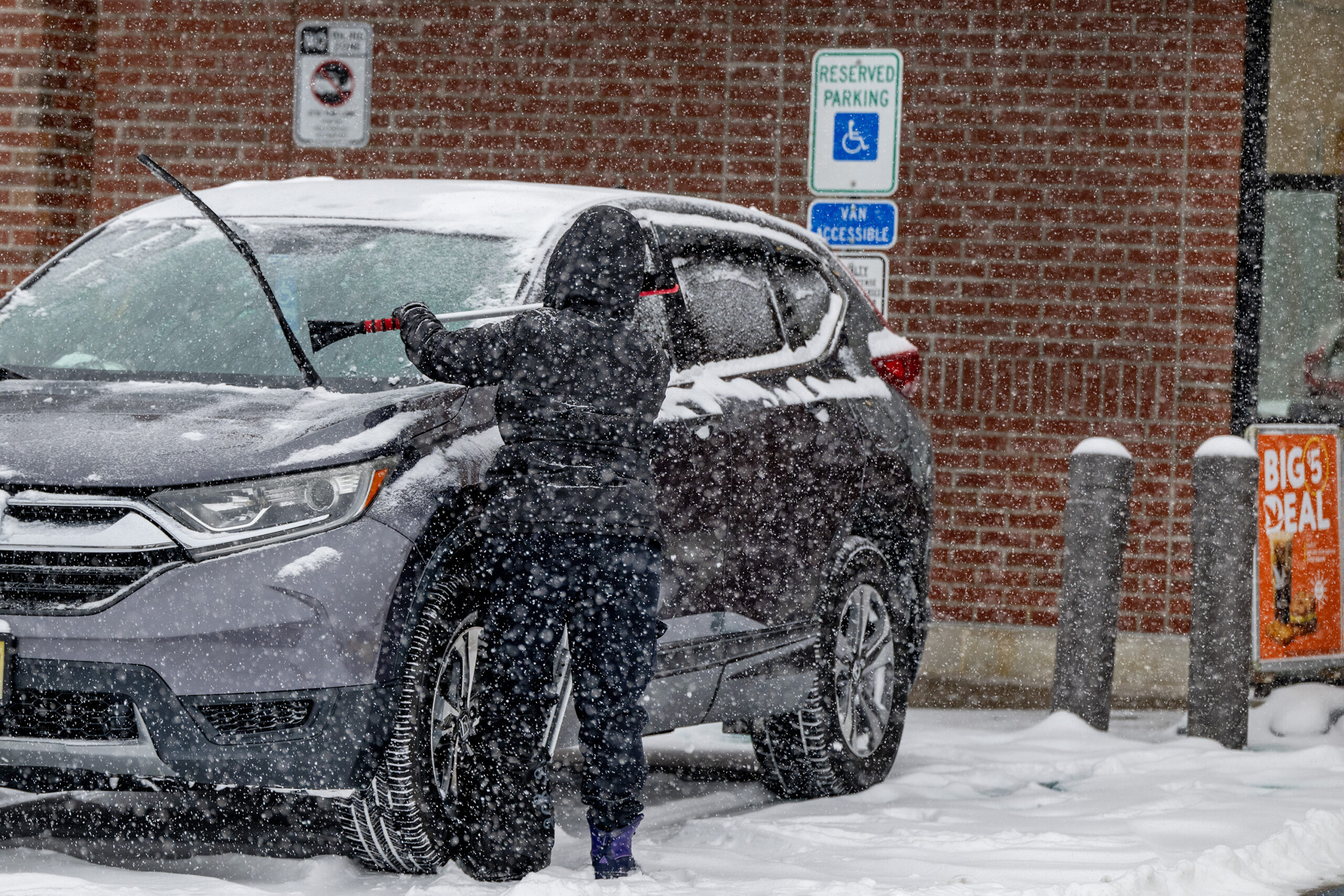
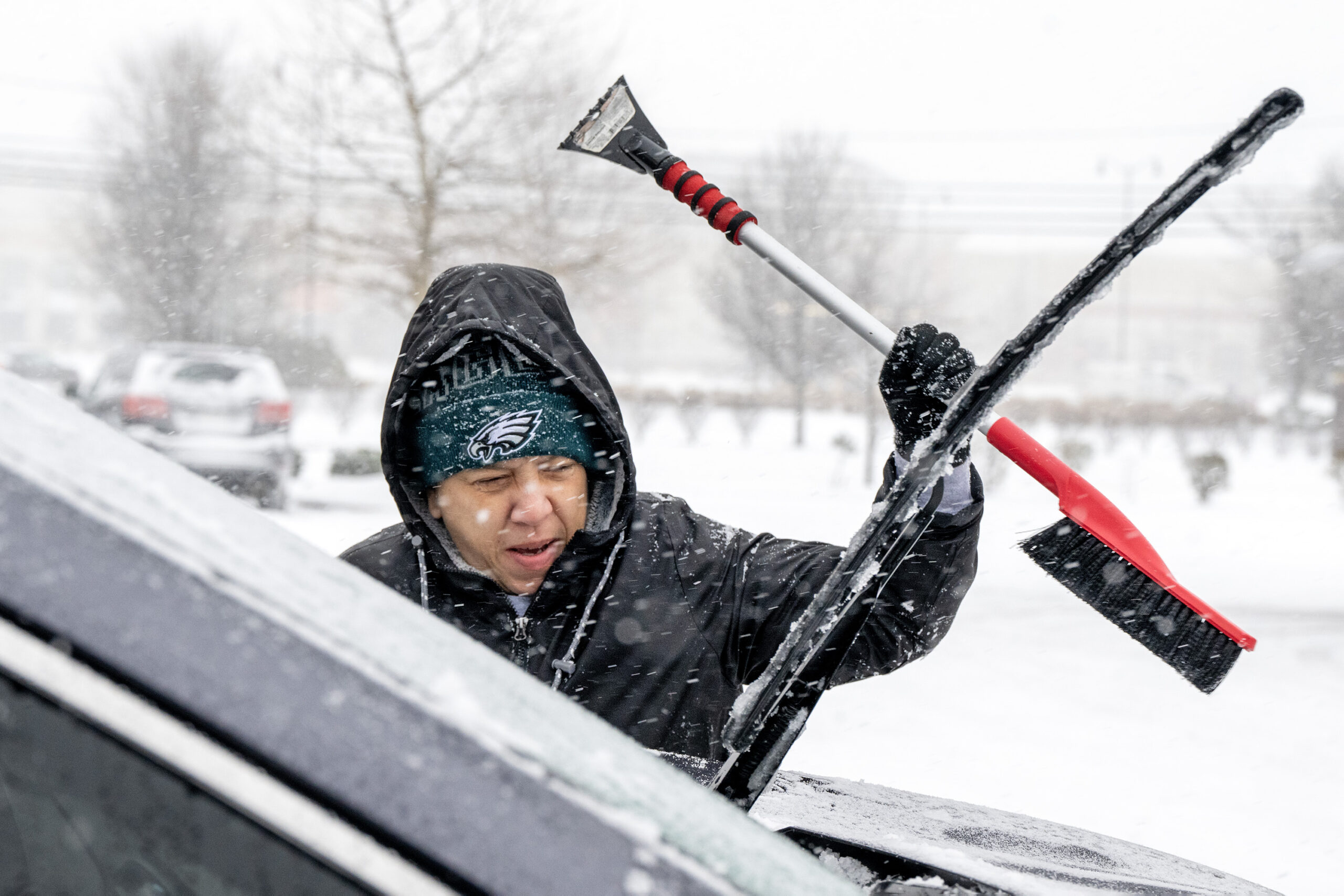
Carmen Roman clears snow off her car at the Wawa on Haddonfield Road in Cherry Hill Sunday.
Both the Cherry Hill Mall and the Christiana Mall will be closed Sunday due to the snow.
In New Castle County, level 2 driving restrictions are in effect, meaning only essential personnel are permitted to drive.
In Philadelphia, Emilia, James Beard Award-winning chef Greg Vernick’s Italian restaurant in Kensington, has postponed its scheduled opening from Monday to Tuesday. Vernick told The Inquirer he was unsure if his fish supplier could deliver Monday.
Alex Peralta shovels a sidewalk on Gay Street in West Chester, Pa., Sunday.
Snow totals of 4 to 6 inches have been reported across the region as heavy snow continues.
Meanwhile, the sleet line continues to advance northward and had reached central Delaware by mid morning. The Washington, D.C., area flipped to sleet around 8:30 a.m., after about seven inches had accumulated.
Sleet is expected to join the party in the immediate Philly area by early afternoon, and that would put the brakes on further accumulations. Before that happens, it is possible that the city officially will have had its biggest snowfall in five years.
Parker warns Philly residents to stay home and off the roads
A pedestrian uses their umbrella as snow falls in the Old City neighborhood of Philadelphia Sunday.
Philadelphia Mayor Cherelle L. Parker asked people to stay home and off the roads if possible as the city grapples with a winter storm that has dumped about three inches so far — and is expected to turn to ice in the coming hours.
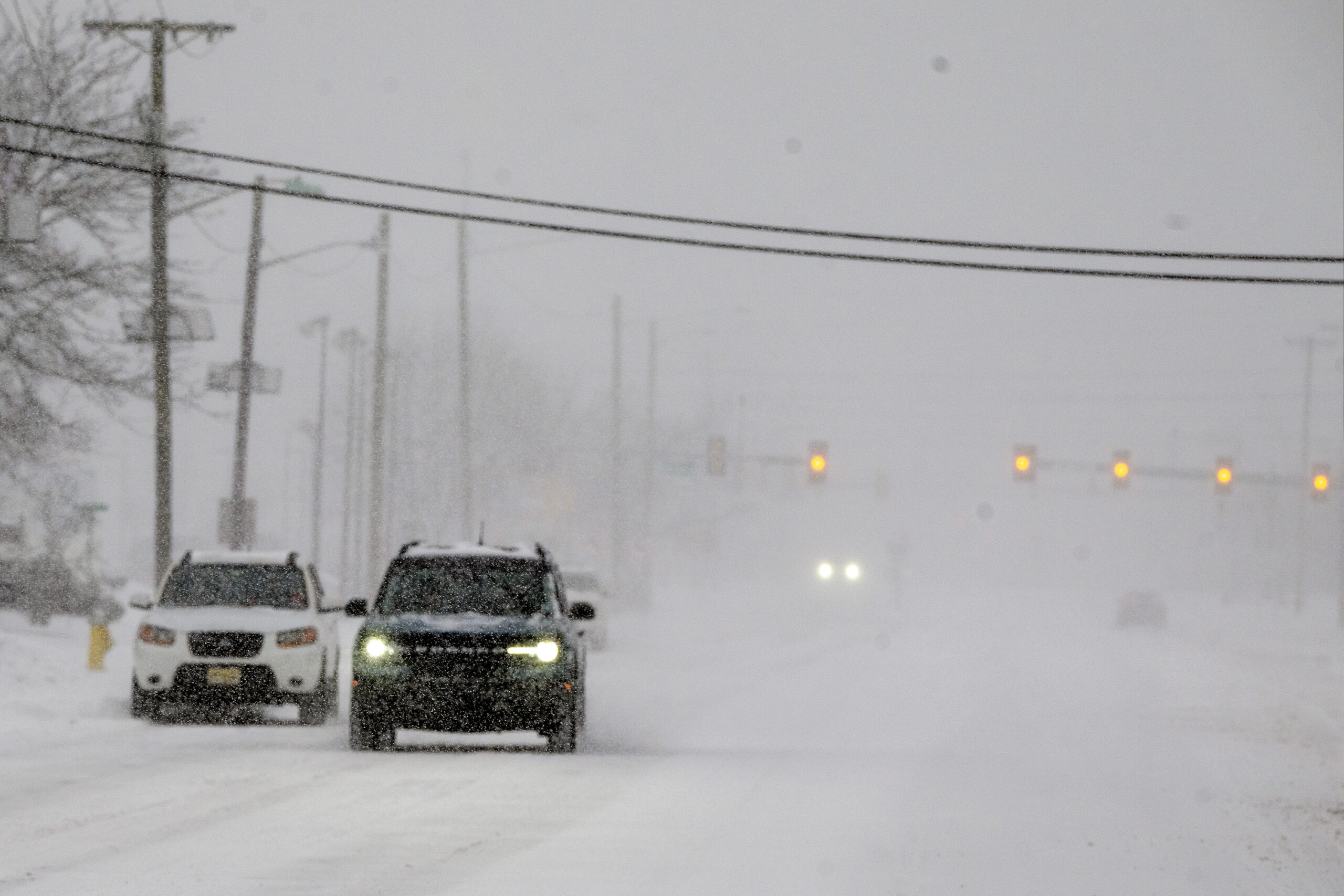
“This remains a significant winter storm, and there are rough travel conditions expected all day,” Parker said.
Parker said 1,000 city workers are clearing roads and sidewalks and battling snow with about 600 pieces of equipment, including triaxial dump trucks, loaders, sanitation compactors with plows attached, and pickup trucks.
“And this was a new one for me, Philadelphia, even ATVs have been deployed,” Parker noted.
Philadelphia remains under a snow emergency that began Saturday night at 9 p.m.. The city has no update on when it plans to lift the emergency.
The city has teams working in “an enhanced emergency posture” to address the needs of people affected by the bitter cold. The city has implemented 250 additional beds for those in need, Parker said. If residents see anyone in need of immediate help, they can call 215-232-1984.
SEPTA to suspend bus, regional rail service at 2 p.m.
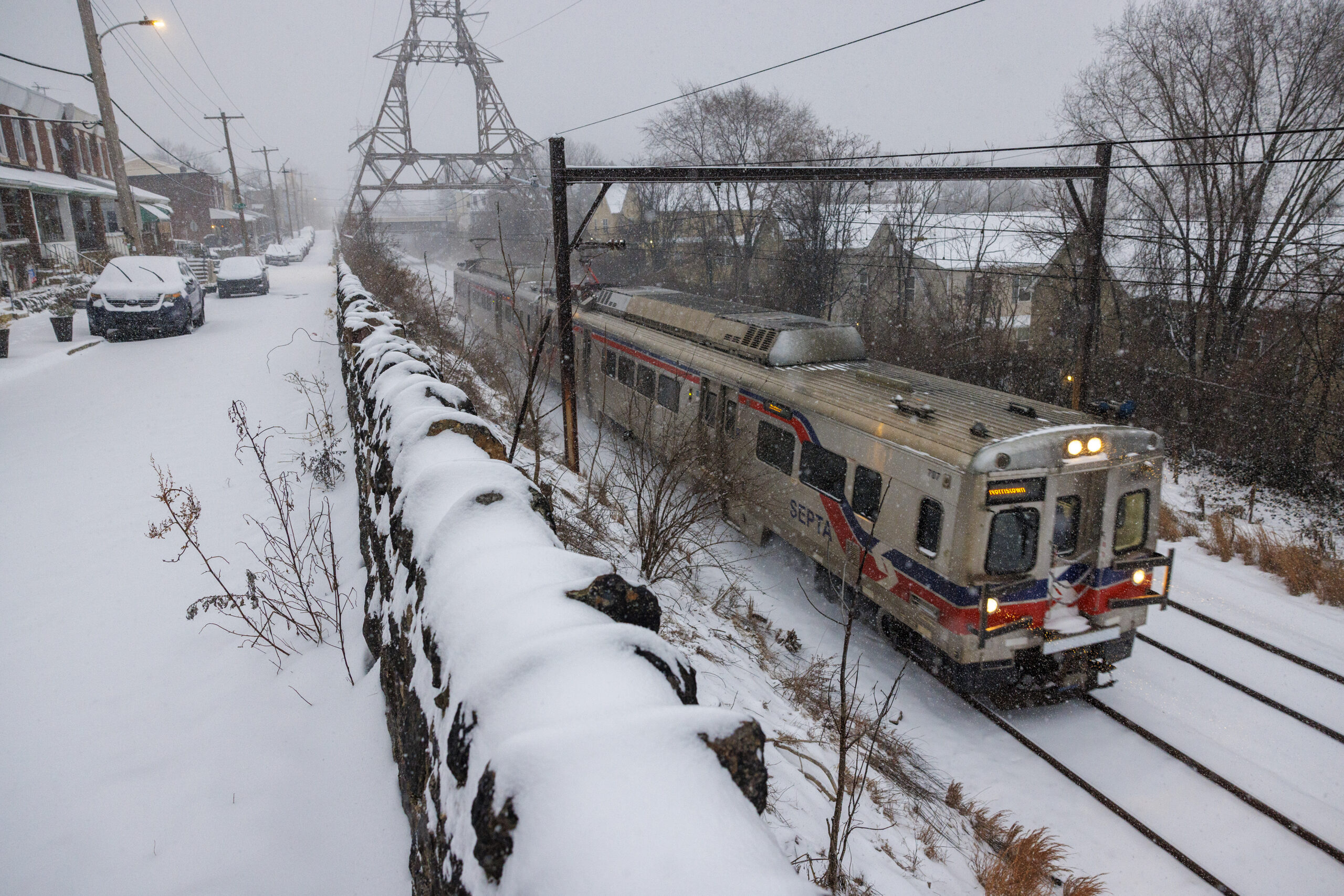
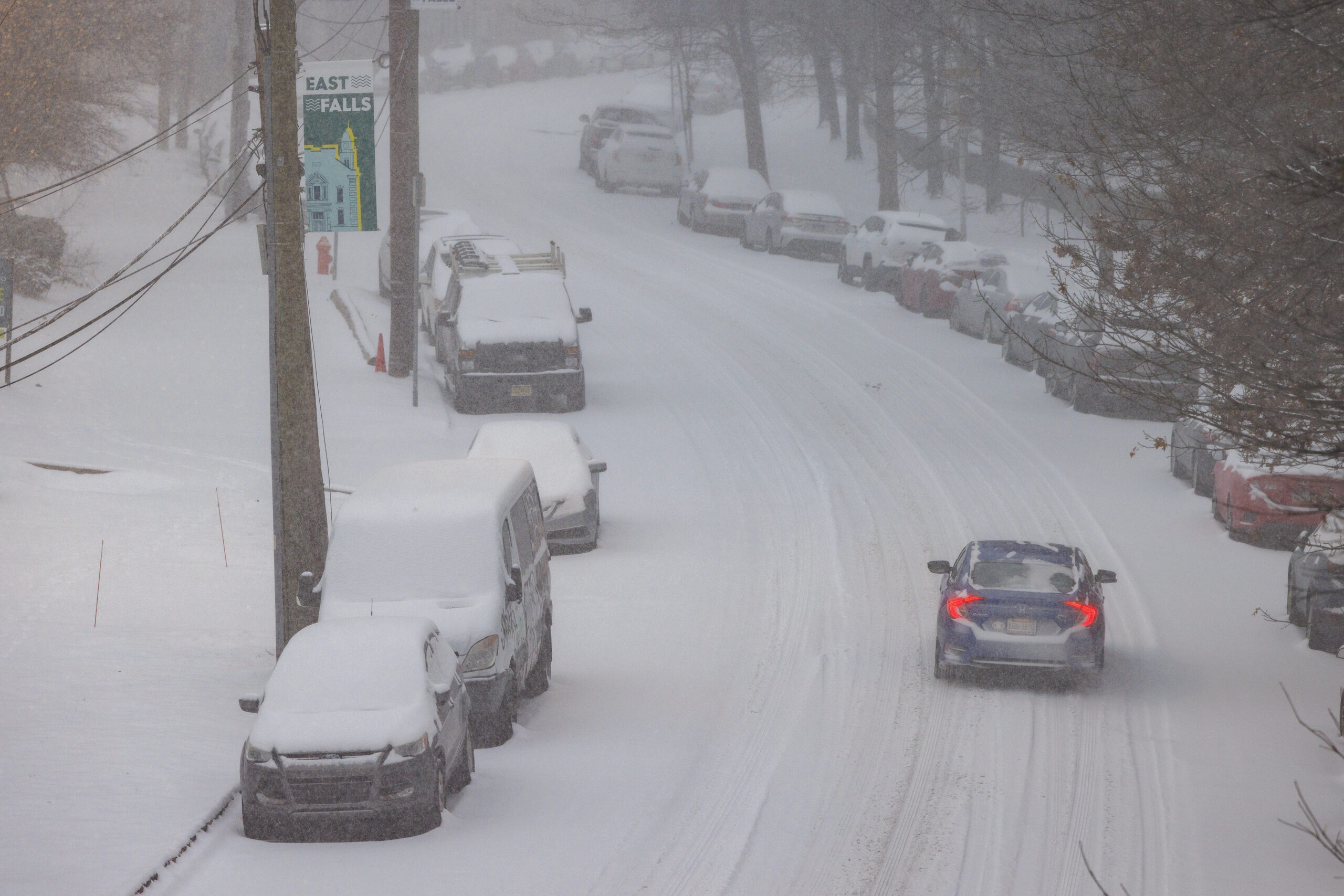
A SEPTA Regional rail train heading through the East Falls section of Philadelphia Sunday.
SEPTA will suspend all bus and Regional Rail service at 2 p.m. Sunday, the agency announced.
As for trolley service, the T1 is suspended, the T3 is cutting back at 59th/Chester, and the T4 is cutting back at Island/Woodland, SEPTA said. The T2 and T5 are currently running regular service.
The Market-Frankford and Broad Street subway lines will continue to run. through the storm, the agency said. Crews have been assigned to keep station entrances, platforms, and sidewalks clean of ice and snow, as best they can.
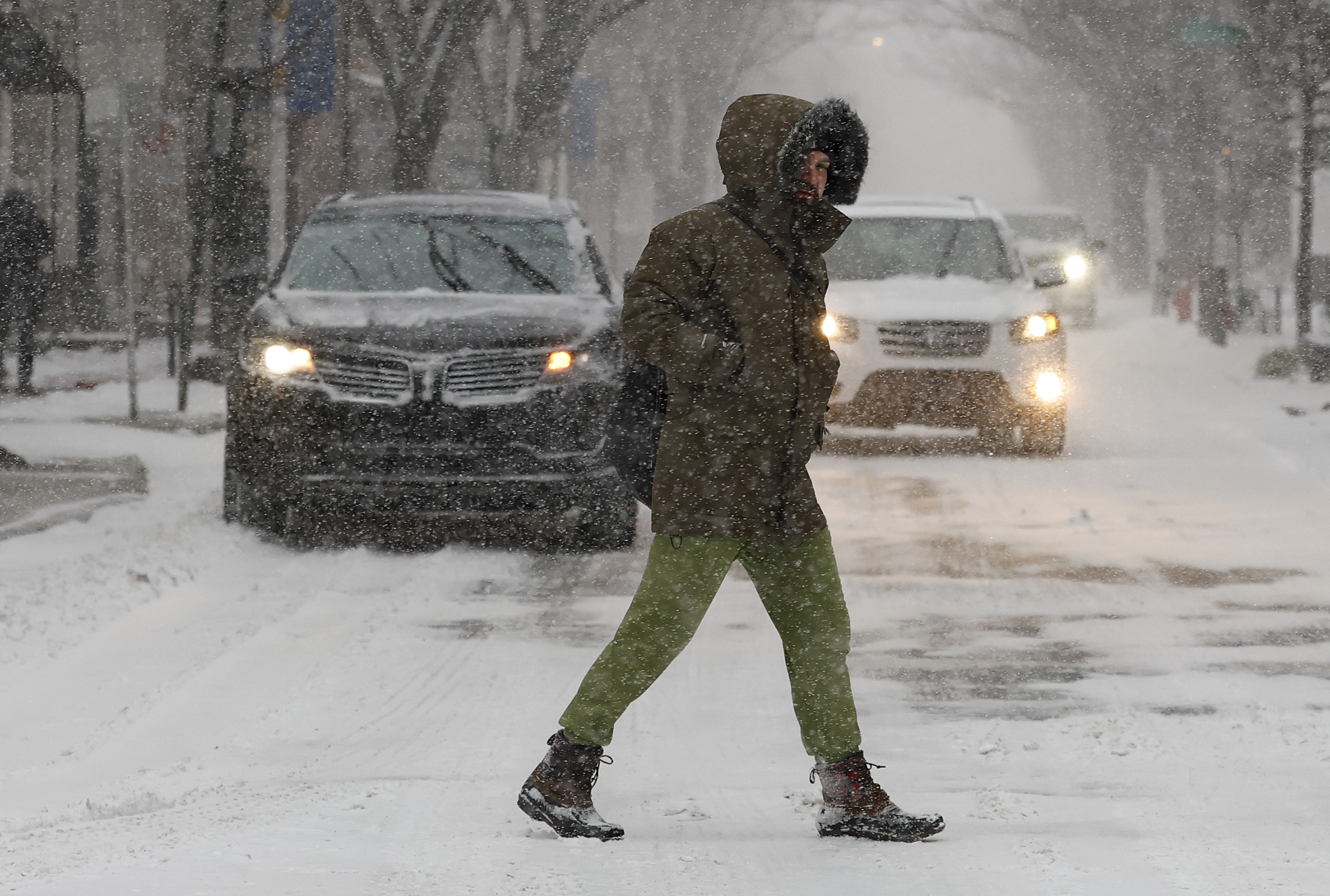
A pedestrian walks across Race Street along 2nd Street in the Old City neighborhood of Philadelphia. Michael Thompson (right) and Jonathan Ahmad clear snow. Carmen Roman clears snow off her car after dropping her partner off at work at the Costco In Cherry Hill early Sunday morning.
// Timestamp 01/25/26 9:27am
$5 parking in Center City garages to avoid getting your car towed
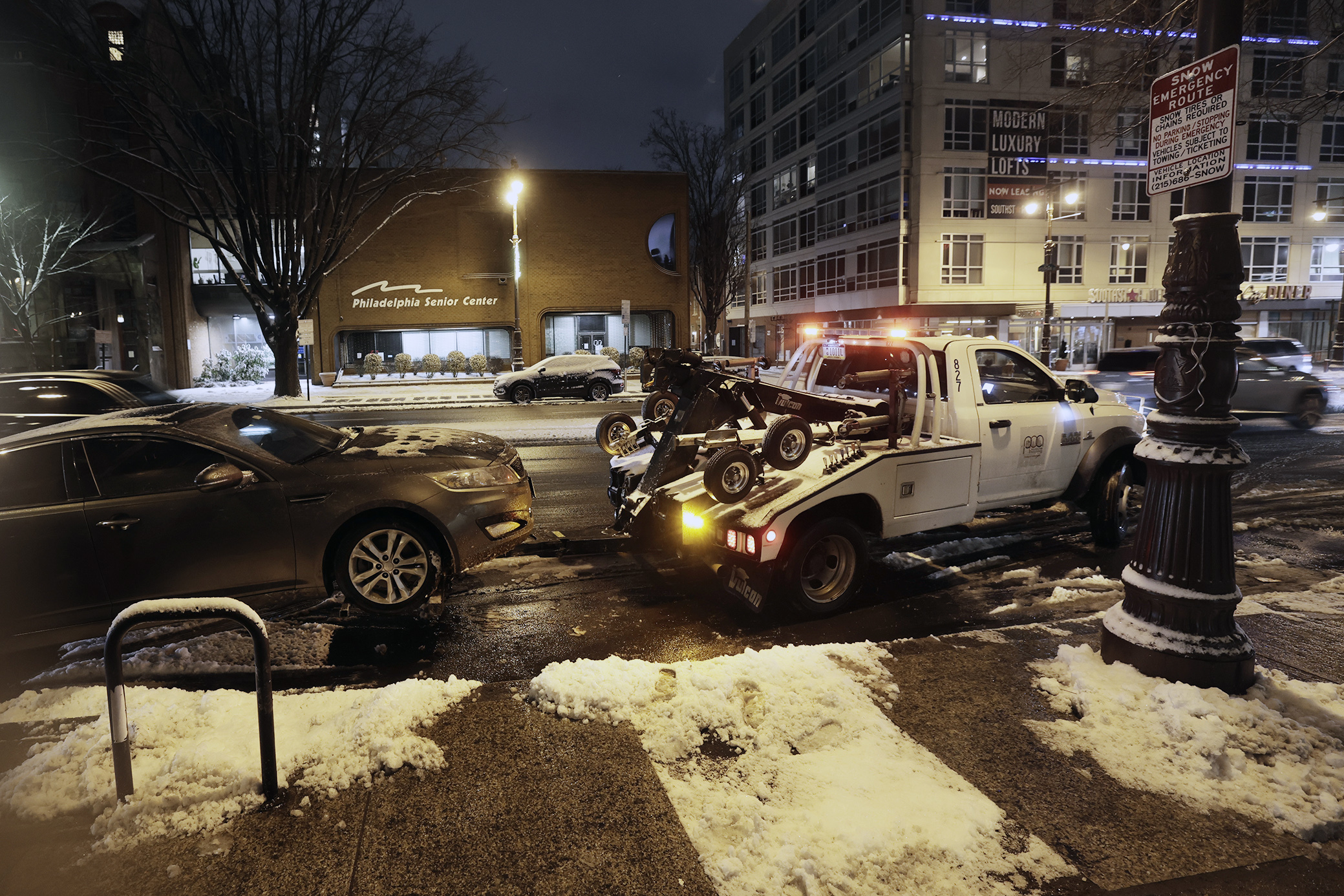
A Philadelphia Parking Authority truck tows a car from South Broad Street, a snow emergency route, earlier this month.
As the snow covers everything in its path, parking on designated snow emergency routes is the fastest way to get your car towed.
To prevent this, the Philadelphia Parking authority is offering $5 parking for 24 hours in Center City garages until the snow emergency is lifted.
Philadelphia Family Court Garage (1503-11 Arch Street – Going south on 15th Street, enter the garage on the west side just after 15th & Cherry Streets)
Meters and time limit violations won’t be enforced until the emergency ends. But if you suspect your car was towed, call 215-686-SNOWor visit www.philapark.org/tow to locate it. A license plate number is needed.
PennDOT and Philadelphia Department of Streets are working hard plowing to keep highways and roads passable. Please avoid unnecessary travel so they have room to safely work. If traveling, use caution and give yourself at least 6 car lengths behind snow response equipment. pic.twitter.com/yATOdEnJqV
2 to 3 inches of snow have already fallen across the Philadelphia region.
Not that the bar was especially high, but officially Philly has had its biggest snowfall of the month, with 1.6 inches measured officially at the mostly dormant Philadelphia International Airport.
That tops the 1.1-inch report of last weekend. It also brings the seasonal total to 8, and one of the safer bets is that this winter will end up being snowier than the winter of 2024-25 – 8.1 inches.
By 8:30 a.m., amounts of 2.5 to 3 inches were common throughout the region.
The next official report from PHL is due at 1 p.m. For now, it is playing catch-up with the 1.8-inch reading at Rittenhouse Square.
Heavy snow arrives, with ice to follow. It all may stick around for a week or more.
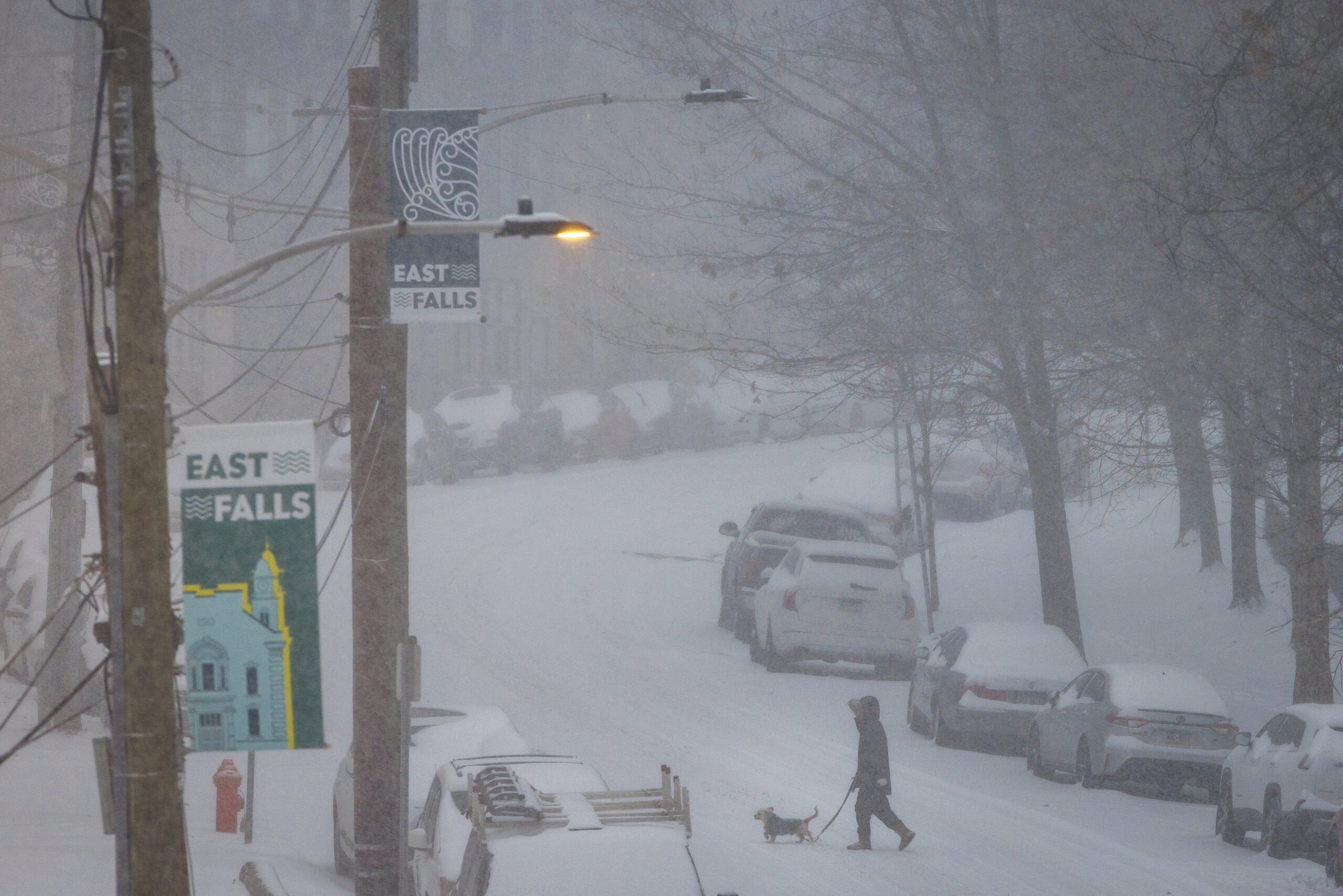
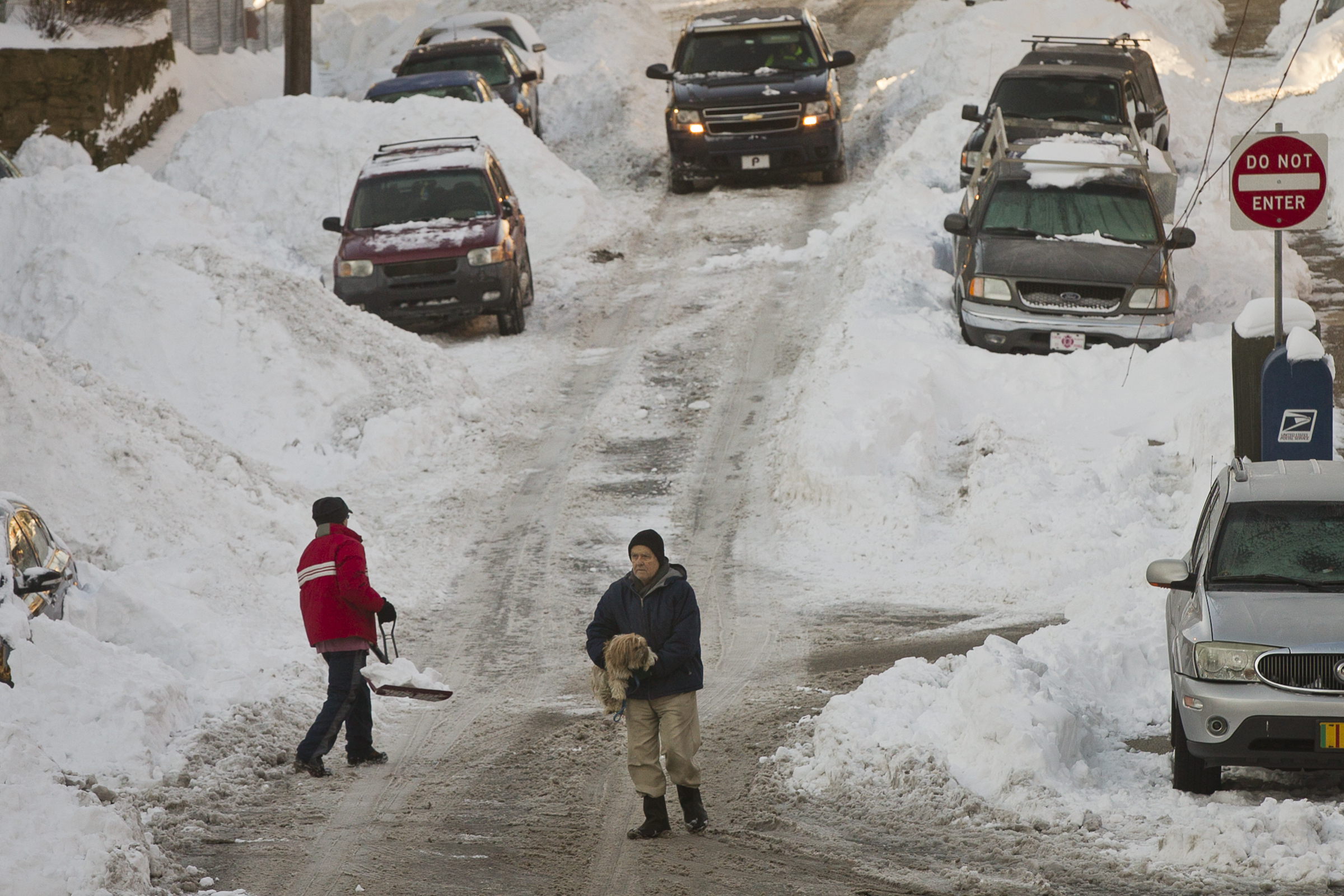
Dog walkers and fresh snow along Cresson Street in the East Falls section of Philadelphia.
It may not approach their magnitudes, but Sunday’s snow-and-ice cold brew is expected to bear eerie similarities to some of Philly’s historic winter storms and perhaps rival them for disruption.
By 7 a.m., up to 3 inches had been reported around the region, with heaviest amounts to the south where the snow started earlier.
Officially, at Philadelphia International Airport, 1.6 inches had been measured, already making this the city’s biggest official total of the month. But Center City trumped it at 1.8.
From 8 to 10 inches was expected around the city before the snow mixes with sleet and possibly freezing rain during the afternoon, said Nick Guzzo, a meteorologist at the National Weather Service Office in Mount Holly. All that is subject to change, of course.
The precipitation is due to shut off early Monday, but by then it may be a case of welcome to ice station Philly.
Nothing that falls is going to melt, as temperatures will get no higher than the 20s Sunday and may not see 30 for the rest of the week
Snow falls in Manayunk. Several inches of snow have already fallen in Bear, Del. Snow covers the trees in Conshohocken, Montgomery County.
// Timestamp 01/25/26 8:11am
Cancellations piling up at PHL
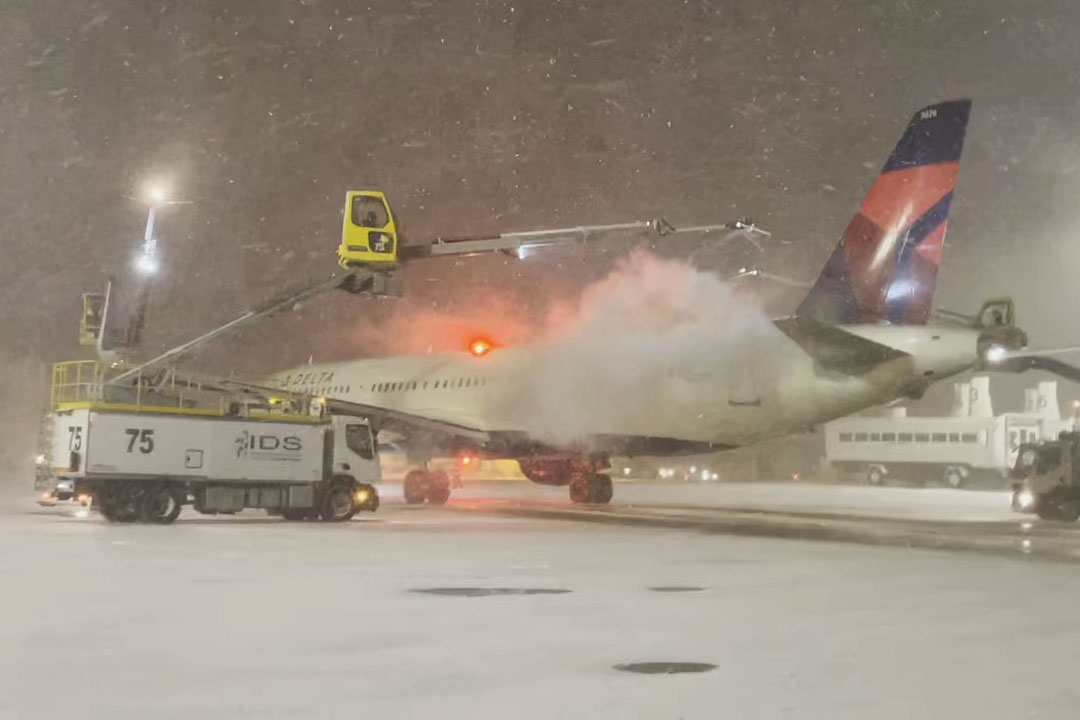
Crews deice a Delta plane as snow falls at Philadelphia International Airport Sunday, Jan 25, 2026.
At least 641 flights have been canceled going into or out of Philadelphia International Airport Sunday, as a major snowstorm moves across the Northeast.
Due to the reduced number of flights, TSA agents will only be operating at checkpoints A-East, D/E, and F.
Travels are encouraged to check with their airlines for the latest flight information.
The National Weather Service is forecasting 8.5 inches of snow will fall in Philadelphia, followed by sleet and freezing rain.
On Saturday, the National Weather Service was going with 8 to 10 inches for the immediate Philly area, said meteorologist Amanda Lee, with less to the southeast. AccuWeather Inc. was calling for 6 to 10 inches.
A lot of that would fall during a “front-end thump,” said AccuWeather meteorologist Elizabeth Glenny. Once the mixing begins, accumulation rates would back off.
While people understandably want to know how many inches of snow are going to land, that is almost always difficult to answer, meteorologists say, especially in a storm of this nature.
In this case, snow amounts are dependent on a coastal storm that had not yet formed Saturday and on what might happen in parts of the atmosphere that are not well-observed.
Temperatures in the bottom 5,500 feet of the atmosphere over Philly are expected to remain below freezing, said AccuWeather senior meteorologist Tom Kines, but computer models insist that a warm layer in the higher atmosphere would result in the changeover.
That warmth would be imported from the Atlantic Ocean by the strong onshore winds from the northeast generated by the storm — it’s not for nothing that these things are called nor’easters.
Another wild card would be if the snow is heavy enough that it could survive the warm layer and delay the changeover.
But the mixing of sleet, which is liquid that remains frozen in its trip through the atmosphere, and freezing rain, liquid that freezes on contact, is inevitable, forecasters said.
Freezing rain atop a snowpack is especially dangerous because it adds weight to vulnerable and snow-burdened power lines and tree branches. Sleet is polite enough to bounce off hard surfaces, but since it is pure ice, it is slower to melt.
Said the weather service’s Mike Lee, the mixing “just means we’re getting a different blend of horrors.”
Midvale Avenue is covered in fresh snow in the East Falls section of Philadelphia.
Snow is forecast to accumulate rapidly Sunday morning, with temperatures in the teens and snowfall rates of one to two inches per hour.
Models were suggesting sleet could mix in as soon as early afternoon, said Tom Kines, senior meteorologist with AccuWeather Inc.
Temperatures in the bottom 5,500 feet of the atmosphere are going to remain well below freezing. However, as the coastal storm intensifies, its onshore winds from the northeast are forecast to import warmer air from over the ocean into the upper atmosphere, which would change the snow to sleet and rain Sunday afternoon and evening.
It’s possible the precipitation will flip back to all snow and accumulate maybe another inch early Monday, Staarmann said. But at that point it would have all the impact of drizzle in the ocean. The mass of snow and ice evidently will be vacationing in Philly for a while.
“It will stick around for a week, maybe two weeks,” Staarmann said.
Vehicle restrictions on Pa. highways now in effect
PennDOT implemented vehicle restrictions on Pennsylvania highways due to the storm
Vehicle restrictions aimed at limiting the number of cars on roads statewide during Sunday’s snowstorm are not in effect across Pennsylvania.
PennDot’s vehicle restrictions are instituted in a tiered system, with today’s coming in at tier four — the second-highest level. Under that tier, commercial vehicles are totally prohibited from using a number of interstates around Pennsylvania, as well as the Pennsylvania Turnpike.
“The decision to implement these restrictions was made with the intention of balancing safety for everyone on the roadway, including commercial drivers,” PennDot secretary Mike Carroll told reporters Friday at a news conference. “We will remove these restrictions as soon as conditions warrant.”
In addition to limiting the travel of vehicles like tractor trailers and commercial buses, PennDot’s restrictions also apply to school buses, motorcycles, RVs, and passenger vehicles that are towing trailers, Carroll added. None of those vehicles, he said, are permitted to use roadways while the restrictions are in place.
Officials urged motorists to stay home, noting the anticipated snowfall rate of one to two inches per hour, as well as the overall snowfall totals, will make keeping roads safe and clear difficult.
Restrictions, PennDot notes online, are evaluated hourly. Pennsylvania’s traveler information website, 511PA, keeps an up to date map of which roads are impacted by the restrictions, and Carroll recommended travelers check that website before heading out, should they absolutely have to.
“Stay home and watch the NFL games, despite the fact that the Eagles and Steelers are not playing,” Carroll said.
But as large and disruptive as this storm will likely be, it will have a difficult time cracking the list of the top January snowstorms in Philly history.
It would take 12.3 inches of snow for this latest storm to make its way on to the list of the snowiest January storms in Philly history. That would match a 1922 event dubbed the “Knickerbocker storm” because snow caused the collapse of the Knickerbocker Theatre in Washington, D.C., killing 98 people, which remains the worst natural disaster in the city’s history.
Here’s the full list of the Philly snowfalls of a foot or more in January history:
WATER VALLEY, Miss. — A crowd turned out to hear a politician talk big about improving schools, but it wasn’t a Republican railing about transgender athletes or school vouchers or any of the issues the GOP has used to put Democrats into a defensive crouch.
On this night, the politician taking questions was a Democrat — former Chicago mayor and President Barack Obama’s chief of staff Rahm Emanuel — talking about reading. For the past several years, Republicans have dominated the education debate with a focus on culture war politics. Emanuel, who is exploring a 2028 presidential run, makes the case for returning to the education part of education: achievement and learning rather than book bans and gender identity.
That would benefit students and, he says, Democrats, who have not led a national conversation about student achievement since Obama was president. Instead, Republicans have been able to make up ground, capitalizing on anger about school closures during the pandemic and heated fights over transgender rights, race and other subjects.
Emanuel talks about school achievement with a frequency and urgency rarely heard from Democrats in recent years. And he says both parties have wasted time on education culture wars.
“This distracts us from the priorities of education,” he said in an interview. Questions around gender identity, he said, affect “less than 1 percent of the population and yet dominate 99 percent of the conversation. … You want to pick a pronoun? Great. Now can we focus on the other 35 kids that don’t know what a goddamn pronoun is?”
While a dozen or more Democratic presidential hopefuls scramble to carve out their identities in advance of the 2028 election, many of them better known than he is, Emanuel is betting that a renewed focus on education can fuel a Democratic victory — and more immediately, his own prospects.
As Chicago mayor, Emanuel successfully pushed several school reforms, including a longer school day, and saw graduation rates jump. But he had a contentious relationship with the teachers union and his tenure was marred by a seven-day strike. He also angered many Chicagoans by closing 50 schools. He says he has learned from his mistakes and hopes to take some of his successes national.
Emanuel traveled to Mississippi this month to examine and promote the state’s success in teaching reading. On fourth-grade tests, the state moved from 49th in the nation in 2013 to ninth in 2024 by focusing on what’s called the science of reading — instruction built on sound-it-out phonics. The state combined that withincreased funding, a heavy dose of teacher training and support, and a requirement that third graders pass a reading test to advance to fourth grade.
Emanuel argues that Washington should use federal dollars to incentivize other states to do the same. And he is proposing renewed federal standards and accountability, ideas that faded a decade ago.
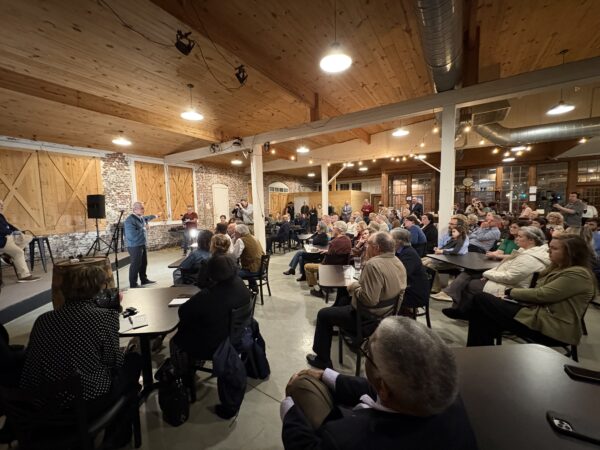
At the town hall meeting in Water Valley, a tiny town in the north of the state, more than 125 people gathered. There were no questions about race, gender or culture wars, giving Emanuel space to drive home his central thesis.
“We’ve got a 30-year low in reading scores,” he said. “Has a single governor called for an emergency meeting of the governors association?”
Left unsaid was that he might run against some of those governors in a 2028 Democratic primary.
Emanuel brought a film crew with him, and within a day of leaving the state, he had posted video from the visit to his social media accounts.
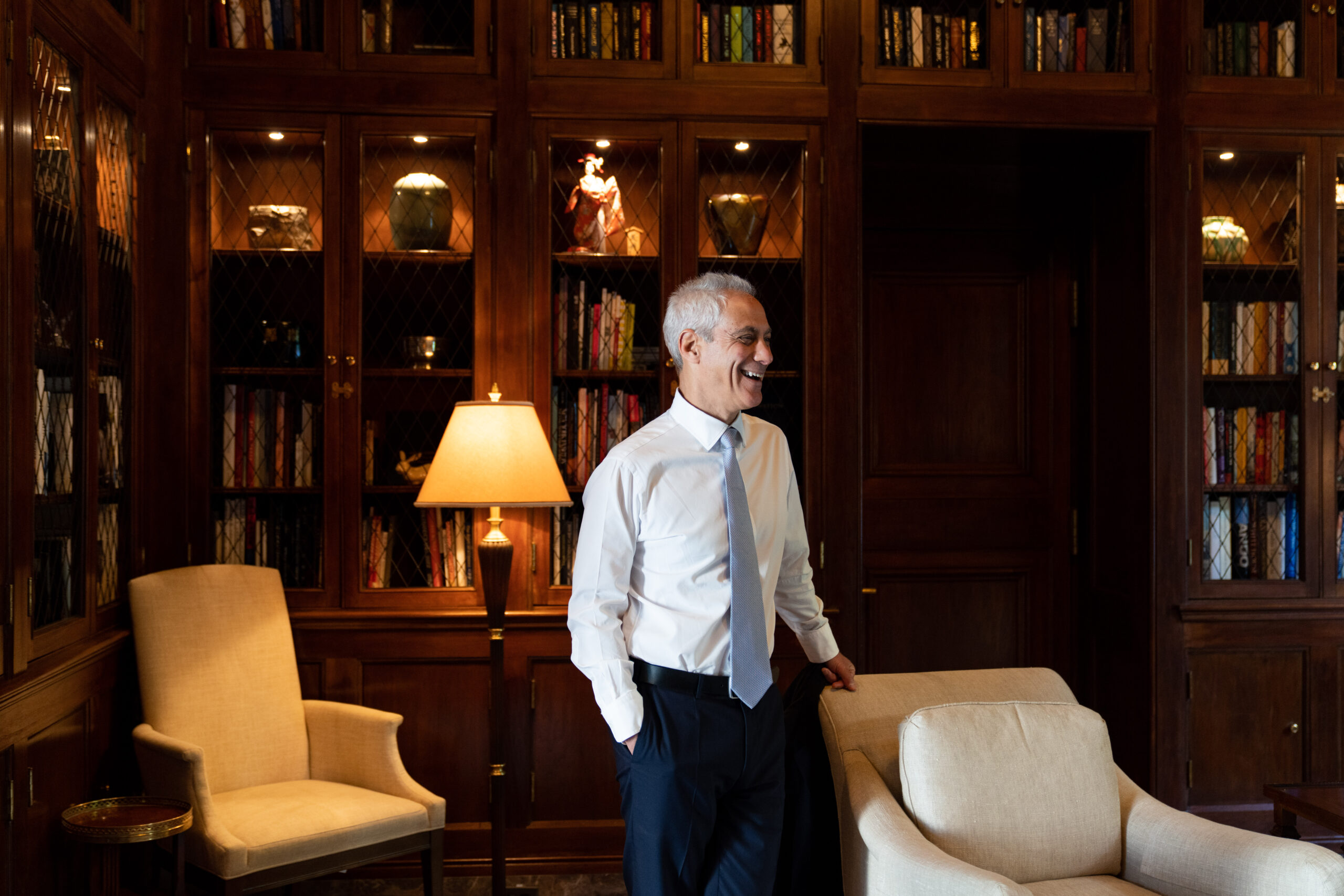
Rahm Emanuel in 2023, when he served as U.S. ambassador to Japan.
An education evolution
Emanuel likes to hark back to anera when education reform was in vogue. A national movement centered on standards and accountability began in the states and culminated with the bipartisan passage of the No Child Left Behind Act in 2001. Schools were required to make progress on annual tests or face escalating consequences.
Eight years later, Obama continued pressing for accountability with the Race to the Top competition that awarded states with extra federal money for adopting favored policies such as Common Core standards and using student scores to measure teacher quality.
But by the end of Obama’s tenure, opposition had built to the high-stakes testing that the accountability system was built on. The Race to the Top program ended, and most of the requirements under the 2001 law were reversed. The bipartisan consensus collapsed, and soon the political parties gravitated to their partisan corners.
Democrats backed increased funding for public schools and racial equity initiatives. They adopted policies in support of transgender students. Today, most Democratic governors continue to focus on new funding — for prekindergarten, community schools, teacher pay, free meals, and other priorities.
Republicans promoted tax dollars for private school vouchers. During the pandemic, they blamed Democrats for keeping schools closed too long and for requiring measures like masks once school buildings reopened. Conservative parent groups that formed around pandemic issues soon used that momentum to build support for book bans and influence how educators address race and LGBTQ+ issues. GOP legislatures and conservative school boards passed laws and policies restricting how those topics could be dealt with in school.
Republicans began eating into Democrats’ commanding lead on education issues. In 2006, a Fox News poll found Democrats with a 17-percentage-point lead when asked whom they trust on education issues, though their advantage was not that big in other surveys. By 2022,Republicans had narrowed the gap significantly – som— polls found the parties virtually tied. (Several newerpolls have found that Democrats regained their advantage following President Donald Trump’s election.)
In the wake of the pandemic, scores on national math and reading exams slid to a 30-year low.
The Trump administration repeatedly cites this data in making the case for closing the Education Department and for backing school choice policies. Now, some Democrats are arguing that their party needs its own response to the slide.
“It is deeply frustrating to me as a Democrat that we completely ceded this issue,” said Lanae Erickson, senior vice president for social policy, education, and politics at Third Way, a centrist Democratic think tank. “We have absolutely no ideas on the table.”
In the 2024 presidential election, President Joe Biden and Vice President Kamala Harris, who took his place on the ticket, put forward only vague education goals. One day before the election, the Center for American Progress, a leading Democratic think tank, published a set of education recommendations. Even then, there was not muchabout student achievement.
Jared Bass, senior vice president for education at CAP, said the group is now working on a new set of proposals that will squarely address academics.
“There’s a real sense of humility within the party. We used to be the party that was trusted on education,” he said. “We need to get it right.”
Even with a hunger for action among Democrats, Emanuel’s ideas are likely to face pushback inside his party and beyond. Many progressives argue that racial inequity and racism are to blame for the low achievement rates of many students of color, and they may resist leaders who want to pivot away from those topics. Teachers unions, who are active in the Democratic Party, strongly oppose the accountability systems that rely on standardized testing that Emanuel hopes to bring back.
Randi Weingarten, president of the American Federation of Teachers and a longtime power in the Democratic Party, said she would oppose a return to accountability systems that too often, in her view, devolved into blaming teachers. Still, she agrees that Democrats need a new vision.
“Democrats are all too reactive and as a result they have lost ground on education,” she said. “It’s very frustrating.”
A new Race to the Top
Emanuel is betting that while other Democratic presidential candidates concentrate on standing up to Trump, voters will want a candidate more focused on their daily concerns.
On his trip to Mississippi, Emanuel toured an elementary school in Hattiesburg, crouching beside children’s desks to peek at their work and hearing from the principal about what has succeeded. And he met with Jim Barksdale, whose $100 million donation beginning 25 years ago set Mississippi on its path to a new reading program.
“When do we get to geek out?” he asked Barksdale as they took seats in his living room with a trio of people involved in education in Mississippi. He turned to the group and asked, simply, “How did you do it?”
After a long conversation about the reading program, Barksdale told Emanuel that a lot of people say they want to learn from Mississippi’s success. “They say, ‘I’m all for it. How’d you do this?’” he said. “And then they don’t do it because it costs money.”
“It also costs guts,” Emanuel replied.
Emanuel, long known as a partisan brawler, says he is ready to fight for this.
In an interview, Emanuel sketched the outlines of the federal program he would like to see. He suggested a new version of Obama’s Race to the Top that would incentivize states to adopt science of reading curriculums — what Mississippi uses — and other policy changes.
The program, he said, also could encourage high schools to offer more college courses, and he favors a policy he advanced in Chicago requiring all seniors to have a plan for college, trade school or the military to graduate from high school. He also wants to incentivize states to replicate Chicago’s promise of free community college for students who graduate from high school with a B average.
States would have to adopt these types of changes to get the new federal money, he said. He contrasted that approach with the unprecedented $130 billion in COVID funding that went to K-12 schools under the Biden administration, which Emanuel slammed as having too few requirements. For instance, the program was sold as a way to reopen schools, but districts were not required to reopen.
He argues that the No Child Left Behind system was too test-driven, but that the country “overcorrected.” The right answer, he said, lies somewhere in between.
As for the culture wars, he is trying to stay far away. He dismisses some of the racial equity efforts that swept through schools, mocking San Francisco’s effort to rename schools, including one named for Abraham Lincoln.
He also opposes allowing trans athletes to compete in girls’ and women’s sports, saying it’s not fair to other competitors. But he said he does not know whether he would, if elected president, pull federal funding from schools that resist, as Trump has done, and he said he is not interested in discussing the finer points of these policies. The entire debate, he said, has been a “dead-bang loser” — both politically and for the young people involved.
As Democrats begin to rethink their positions on education, they will need to weigh whether Emanuel’s prescriptions are the right ones and also whether he is the right messenger for them. For now, though, Emanuel is one of the fewpeople making this case.
At the town hall meeting, a questioner asked what he had done right and wrong as mayor, and Emanuel replied that he mishandled his relationship with the teachers union at first, specifically by unilaterally canceling a scheduled pay raise.
“It created a lot of animosity,” he said, describing his first term as “hand-to-hand combat.” He said he should have tried to work with the union president to find a solution together.
“You can’t drive reform if people don’t feel part of it,” he said. “That’s like 101, and I screwed it up — Mr. Smarty Pants over here. And I learned a lot.”
Jim Mooney has launched a high-wattage campaign to elevate the flamingo to Florida’s state bird.
The Republican has handed out flamingo lapel pins and 11-by-16 prints of flamingo artwork to his 119 colleagues in the state legislature. He sported a suit with a pink shirt, a pink pocket square, and a tie festooned with flamingos to testify on behalf of his legislation.
But the gangly pink bird must unseat the mockingbird, which has been Florida’s official bird for 99 years, to gain the distinction Mooney says it deeply deserves.
To accomplish this, the lawmaker is hoping to reach a political compromise with supporters of the sprightly and charming Florida scrub jay, who have torpedoed his legislation in the past. The scrub jay would be honored as the state’s songbird under Mooney’s bill, while the flamingo would become the state bird.
“It’s unbelievable how this has taken on a life of its own,” said Mooney, a retired high school sports coach and former mayor of Islamorada. “I’m seeing flamingos everywhere I go. Across the state, everywhere I turn around, it’s a flamingo here and a flamingo there. People are sending me texts and letters about it. Everybody is on board for the flamingo.”
He quickly added, “And the scrub jay.”
Florida struck a similar deal in 2022 when strawberry growers lobbied the state to honor the strawberry shortcake. Many in the state especially in Mooney’s Florida Keys district — were outraged at the prospect that the key lime pie, the official state pie, could be pushed aside. Instead, state lawmakers just created a new category — state dessert — and awarded it to the strawberry shortcake.
“There’s room for both, just like there’s room for both the flamingo and the scrub jay,” Mooney said.
At stake are mostly bragging rights, though supporters also hope to secure more money for the study and conservation of flamingos. The American flamingo is already protected by the U.S. Migratory Bird Treaty Act, but conservationists say it should also be considered a threatened species, offering it even more protection after it was nearly wiped out in Florida in the past century by plume hunters and, later, habitat loss.
Audubon Florida Executive Director Julie Wraithmell refuses to choose a favorite among the flamingo, mockingbird, and scrub jay — “we don’t choose between our kids” — but hopes the bird competition will lead to them all receiving more recognition.
“If you’re Team Flamingo, you should put your influence and your support where your loyalty lies and really support Everglades restoration,” Wraithmell said. “If you’re Team Scrub Jay, you need to be paying attention to if the state is appropriating enough funding for upland land management for our parks and preserves.”
Supporters have been campaigning for flamingos, one of the state’s most celebrated symbols, for years. But a debate among scientists about whether the wading bird, which on average can stand five feet tall, is native to the Sunshine State has hampered those efforts. Skeptics noted that few were seen in the wild, or outside a zoo, for more than 100 years.
But Mooney, who has sponsored pro-flamingo legislation for four years, said a new University of Central Florida study may finally settle the dispute. Flamingos are native to the state and “genetically fit for restoration,” according to the study released in December. Audubon Florida also found that more than 101 flamingos landed in the state during Hurricane Idalia in 2023 and didn’t leave.
The exact number of flamingos in Florida is unknown — the state doesn’t keep track — but residents regularly report sightings, including Mooney, who likes to show everyone he encounters a video of nearly three dozen flamingos serenely feeding in the Florida Bay in early January. A scientist spotted a flamboyance of 125 flamingos in the Everglades in July.
The proposal, being debated during the current legislative session, isn’t as weighty as some of the other topics Florida lawmakers are expected to tackle, including the cost of property insurance, Mooney said, but is still important.
“We seldom have bills that make you feel good,” he said. “This bill does, and it also has some real intrinsic value. It shows that our restoration projects are bearing fruit, and that flamingos are here to stay.”
He was thrilled when Florida Gov. Ron DeSantis gave the birds a shout-out during his State of the State address Jan. 13. “Even the flamingos have returned,” DeSantis said while touting the state’s Everglades restoration work.
Efforts to elevate the flamingo have overtaken a decades-long pro-scrub jay campaign. The friendly blue-and-white bird has fans among Florida schoolchildren, who have formed clubs and written lawmakers in support of the scrub jay being named state bird. It also has a devoted following among environmentalists who often argue against overdevelopment that would disturb their habitats.
In 1999, Marion Hammer, the first female president of the National Rifle Association and considered among the most formidable lobbyists in Tallahassee, helped derail scrub jay supporters. They are “evil little birds that rob the nests of other birds and eat their eggs and kill their babies,” she said.
A northern mockingbird keeps a keen eye out for intruders in 2015 n Houston. After nearly a century on its lofty perch, the northern mockingbird may be singing its last melodies as the state bird of Florida.
Hammer was on Team Mockingbird and in an op-ed in 2016 noted that they are good parents and also remarkable songbirds, while the scrub jay “can’t even sing — it can only squawk.”
The scrub jay lets out a soft trill during courtship but is often lumped in with songbirds, like blue jays, that it is related to. Flamingos, meanwhile, make squawky sounds.
The mockingbird should remain the state bird, just as it has been since 1927, Hammer argued. (It’s also the state bird in Arkansas, Mississippi, Tennessee, and Texas.)
Hammer couldn’t be reached for comment on the latest bird competition, but the scrub jay also has adversaries among Florida developers. It is at the center of a federal lawsuit filed in 2024 over homeowner rights in southwest Florida, where Charlotte County officials charge a fee to build in the bird’s habitat.
“The scrub jay has just been commandeered to really violate property rights across Florida, and I just cannot allow it to be elevated to this level,” state Rep. Monique Miller, a Central Florida Republican, said during a committee meeting in December. “I wish these were decoupled because I want to make the flamingo your bird so badly.”
Jackson Oberlink, a third-generation Floridian, has testified on behalf of the flamingo for the past three years, only to see his hopes dashed. He’s not nearly as optimistic as Mooney that it will succeed this time.
“Every year, there seems to be a few more flamingo props in a committee room, and it seems like there’s a bit more enthusiasm. And then every year, it kind of peters out,” said Oberlink, the former legislative director for Florida for All, a liberal lobbying group.
But he’s not ready to give up.
Oberlink said he became enchanted with the gangly pink birds when he encountered Pinky, a flamingo that was blown into the St. Marks National Wildlife Refuge in north Florida by Hurricane Michael in 2018.
“I have a tattoo of Pinky and the St. Marks Lighthouse. So it definitely left a mark on me, and I’ll always be rooting for the flamingo in Florida.”
One of Kennett Square’s last remaining sizable undeveloped parcels could get hundreds of townhomes and apartments — once contamination cleanup of a former industrial site passes muster.
But even with the OK from state and federal environmental officials, it would be years — and require more sign-offs at the municipal level — before the developer eyeing a residential complex at the former National Vulcanized Fiber site could break ground.
And the site’s owners face headwinds beyond the governmental approval, as some borough residents worry that the site is not safe for homes.
Officials from the U.S. Environmental Protection Agency and the Pennsylvania Department of Environmental Protection, agencies that have to ultimately green-light the land as safe for people to live on, sought to assuage those concerns Tuesday during a town hall that explained the processes for cleanup and the standards the developer would have to meet for any homes to be built.
It was the latest update regarding a proposed residential complex that would feature 246 townhomes and 48 apartments, located at the 22-acre lot on 400 W. Mulberry St., not far from the historic district of the borough, on a plot of land that has languished for almost 20 years.
It’s one of the largest untouched parcels in the borough, making up at least 10% of Kennett Square, which is one square mile. Developers project the residential complex would increase the population of the 7,000-person borough by 15%.
The site, which housed National Vulcanized Fiber from the late 1890suntil it shut down in 2007, was purchased by its current owner in 2009 and has been the subject of cleanup efforts for more than a decade after the land was found to be contaminated with so-calledforever chemicals.
“It feels like the cart was put before the horse for the public,” one resident, Sarah Hardin, said during Tuesday’s meeting. “I think it’s the fact that we’re all feeling like this was guns a-blazing forward, and we would like to know that all the proper environmental steps are taken.”
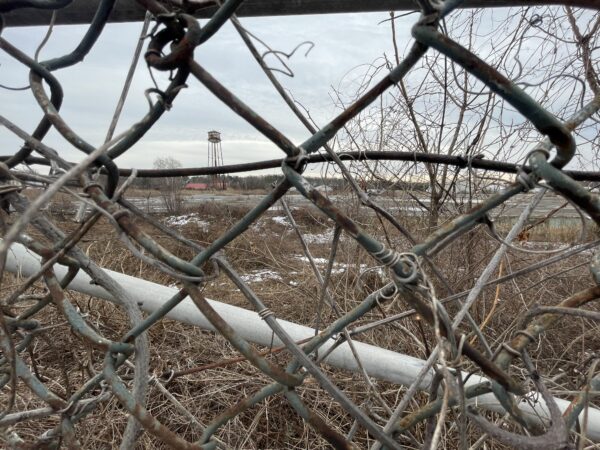
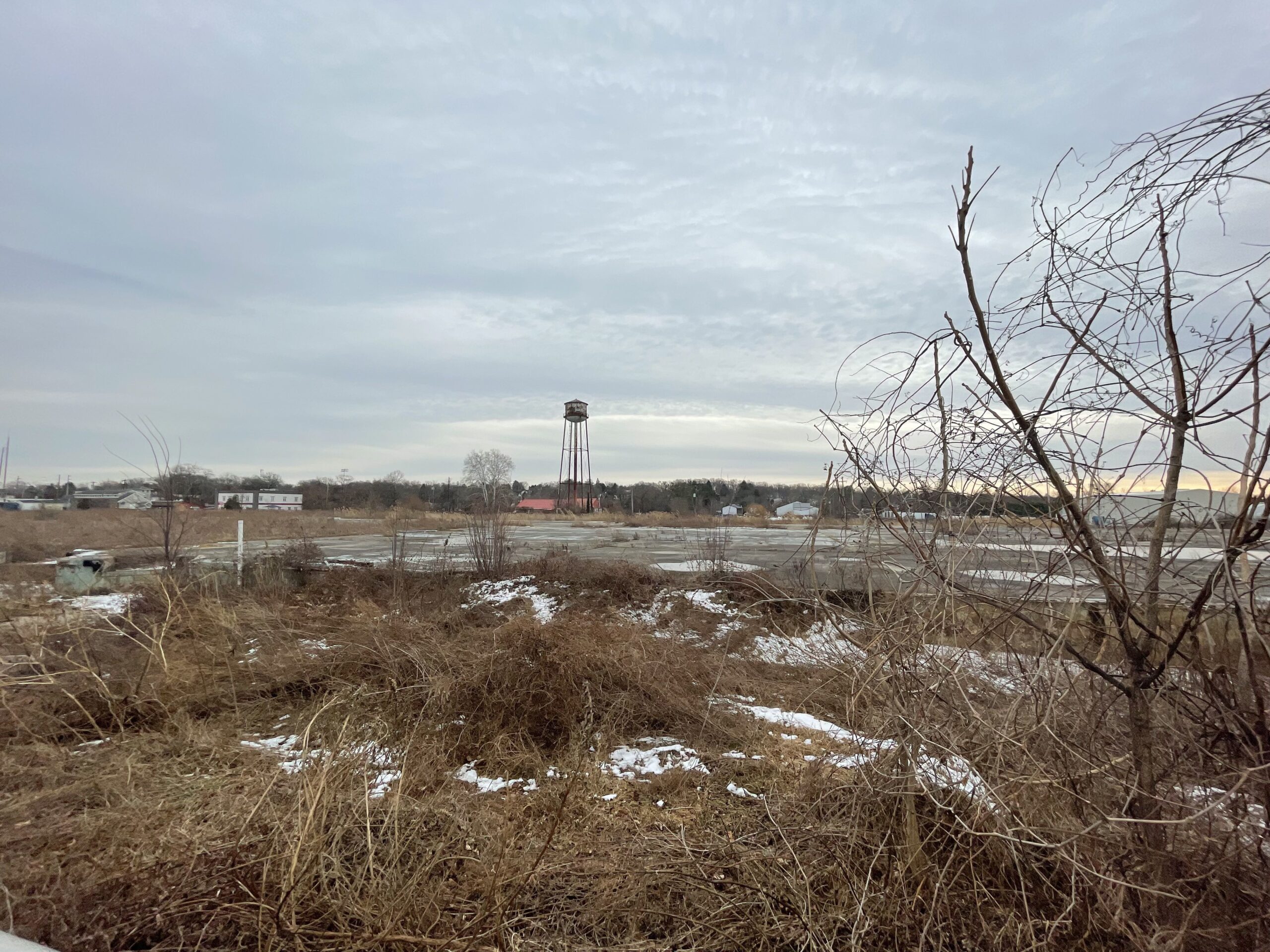
The former National Vulcanized Fiber in Kennett Square on Friday, Jan. 23, 2026. Once an industrial site, the property’s current owner is seeking to eventually turn it into a residential development. But first, the property has to be decontaminated that satisfy state and federal requirements.
What’s the history of the site?
For more than 100 years, National Vulcanized Fiber ran operations on the property, creating a slew of products with vulcanized fiber — a durable, flexible, lightweight plastic-like material that was used to make anything from trash cans to computer circuit boards.
Production of those items led to contamination of the site; polychlorinated biphenyls (PCBs) were identified in the 1980s, after contamination spread into Red Clay Creek. That prompted the EPA to become involved, said Amanda Michel, the agency’s PCB coordinator for the region.
The chemicals are probable carcinogens, linked to liver and breast cancer, melanoma, and non-Hodgkin lymphoma. The chemical is also associated with birth defects, developmental delays, and immune system dysfunction.
Remediation began after the chemicals were found in the 1980s, and NVF folded in 2007. Rockhopper LLC purchased the property two years later and began cleaning the site, eyeing future residential development.
Along with the federal cleanup, in 2010 the owners began a voluntary state cleanup process — which is aimed at redeveloping contaminated, vacant, and unused parcels into productive uses — to target the other chemicals found on the site.
In both cases, the owners have to demonstrate, through sample testing, that contamination has been lowered to a threshold acceptable for human health or that they have the proper barriers in place to prevent exposure.
“Until that happens, there will not be a residential occupant at this property,” said Jonathan Spergel, an environmental lawyer representing Rockhopper.
What is the developer proposing?
Under the proposed development, the property would have 104 stacked and 38 unstacked townhomes, along with 48 one-, two-, and three-bedroom apartments. The owners said the project would comprise affordable and market-value units. A proposed rezoning ordinance would require15% of the homes to be affordable.
That component was critical forKennett Square officials, Mayor MattFetick said in an interview last week.
“It’s our best opportunity to have an affordable component,” he said.
Alongside those homes, the property would have roughly 732 parking spaces, and 50 would be added to Mulberry Street.
To offset feared bottlenecks, the property’s proposed plan would have five driveways todistribute traffic flow.
The site’s developers estimate that the property would bring in $382,000 for the borough and more than $830,000 for the school district each year.
Another portion of the site serves as a baseball field at the high school, and no further development is planned there, the property’s owners said in 2024.
The project is helmed by Rockhopper LLC, which is led by two development firms, Delaware Valley Development Corp. and Catalyst City. They brought in Lennar, a home-building company, in 2021. Lennar has done at least two similar projects, remediating industrial lots in Phoenixville and in Bridgeport for residential use, a representative said previously.
What are residents’ concerns?
On Tuesday, residents shared stories of loved ones who lived near the site who have been diagnosed with cancer. They worried that the developer could skew data to move the project forward. They wondered why there had been no urgency to clean it up before.
Officials said the developer has to work with an independent environmental professional and their agencies had been on site throughout the cleanup process.
Corey Barber, who lived near the site for 20 years and moved out of the area after her cancer diagnosis in 2021, worried what construction on the site would bring.
“People are going to believe that they’re going to get cancer from the dust kicking up,” she said.
Charla Watson, who lives right by the property, said there was distrust because the community has not seen the work the developer says is happening.
“It’s just been a wasteland,” she said. “Everything looks the same the day they moved out of there.”
What comes next?
The developer is going through two processes simultaneously. As it cleans up the property to get the necessary state and federal approvals for residential development, it is also working at the municipal level for the land to be rezoned so it can build the residences.
The borough is advertising a change to the ordinance that would rezone the land.
If the ordinance is approved, the developer could formally start developing the land — which would come with at least another year of planning and meetings.
This suburban content is produced with support from the Leslie Miller and Richard Worley Foundation and The Lenfest Institute for Journalism. Editorial content is created independently of the project donors. Gifts to support The Inquirer’s high-impact journalism can be made at inquirer.com/donate. A list of Lenfest Institute donors can be found at lenfestinstitute.org/supporters.
Saying “it’s been a while” since New Jersey faced a storm like the one being forecasted for Sunday and Monday, Gov. Mikie Sherrill urged state residents to stay off the roads and to not “commit to anything on Monday.”
Sherrill said in a press conference in Newark late Saturday afternoon that while “we’re tough” in New Jersey, “we have to be safe.” She declared a state of emergency starting 5 p.m. Saturday.
Sherrill said she was expecting snowfall to range from eight inches to 18 inches throughout the state. It will be a storm “the likes of which we haven’t seen in a decade,” Sherrill said.
The governor said extremely cold temperatures are expected to make things more difficult, and she suggested that people watch football and play board games with their children on Sunday.
“We are prepared for the moment, but we do need the people of New Jersey to stay safe,” she said.
The governor was accompanied by State Police Acting Superintendent Lieutenant Colonel David Sierotowicz, Department of Transportation Acting Commissioner Joseph Bertoni, and NJ Transit President and CEO Kris Kolluri.
With challenging conditions expected, Acting Attorney General Jennifer Davenport and the Division of Consumer Affairs warned sellers that price gouging New Jersey’s consumers during the declared state of emergency wouldn’t be tolerated.
Sellers can’t excessively increase prices (10% more than normal or higher) during a declared state of emergency, or for 30 days after the termination of the state of emergency, according to New Jersey law.
“As a former prosecutor, my administration will not tolerate price gouging, and we will be vigilant during this winter storm,” Sherrill said, adding that there’d be “zero tolerance for those who prey on New Jerseyans during this state of emergency.”
Gov. Josh Shapiro recounted Saturday to a crowd of nearly 500 in Philadelphia how he found himself struggling as a father weeks after his family survived an arson attempt at the governor’s mansion on Passover last year.
That’s when the proudly Jewish governor went to Salem Baptist Church in his hometown of Abington for counsel and support from Pastor Marshall Mitchell.
“I could feel the power of their prayers,” Shapiro recalled. “I think that’s helped me be a better, more compassionate governor for all.”
Mitchell, a longtime Shapiro friend who served on his transition team, joined the governor onstage at the Central Library of the Free Library of Philadelphia to discuss his memoir, Where We Keep The Light, set for release Tuesday.
The conversation focused on the governor’s spiritual journey and family, but it also offered critiques of both parties and promises to the community.
“There’s a lot more that unites us,” Shapiro said during the hour-long conversation. “There’s a lot more common bonds that we have. And we have to find our way back to that.”
Shapiro opined that the city’s Quaker founder, William Penn, “would have never imagined a Jewish governor and a Black preacher sitting up here, but I bet he’d be proud of that.”
The Philadelphia event kicked off a flurry of promotional events as Shapiro plans to travel to New York, Boston, and Washington in the coming week. A CBS interview focused on the book is also slated to air Sunday.
The release of the memoir comes as Shapiro is seeking a second term as governor, but it has fueled speculation about his potential presidential ambitions in 2028.
“I think people want authenticity from our leadership, and I think he’s providing it,” said State Rep. Sharif Street, a Philadelphia Democrat running for Congress, who attended the event. “I think Josh Shapiro would make an excellent president.”
The book, which has been shared with The Inquirer and other outlets, includes details on what Shapiro called an “offensive” vetting process to be Kamala Harris’ running mate when she took over the Democratic presidential ticket for President Joe Biden in 2024. Shapiro said he was being unfairly scrutinized as the only Jewish person in the running for the vice presidency.
Harris did not come up during the conversation with Mitchell.
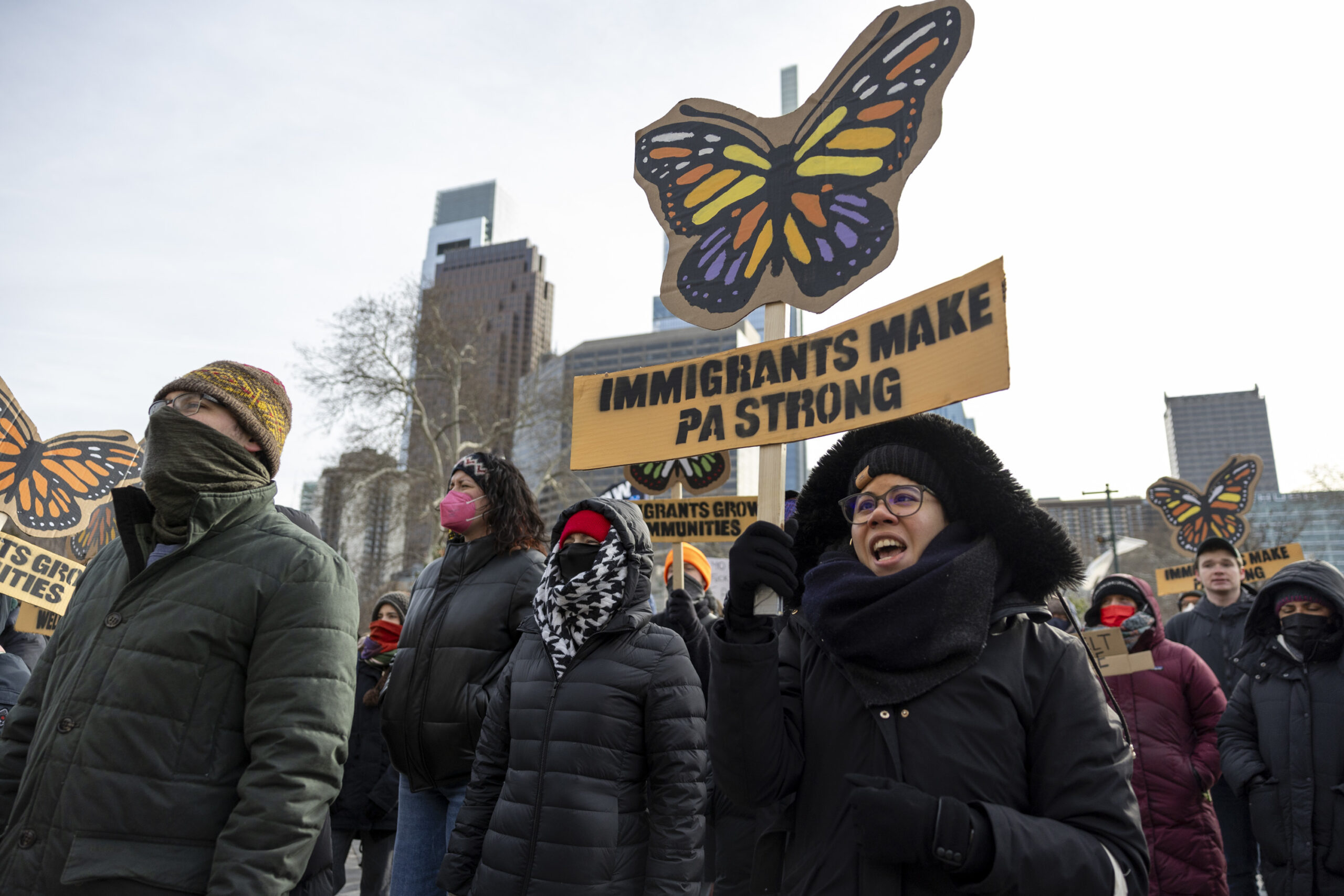
Diana Robinson, of East Kensington, Codirector with Make the Road Pennsylvania, chants with fellow protestors outside the Free Library at Governor Josh Shapiro’s new book “Where We Keep The Light” author event in Philadelphia, Pa., on Saturday, Jan. 24, 2026.
Shapiro weighs in on ICE’s crackdown as protesters gather outside
Shapiro answered several submitted questions after the discussion. He said that he expects President Donald Trump to attempt to disrupt the 2026 election, as he did in 2020.
“We are on it. We are prepared. We will do everything in our power to protect your vote.”
Shapiro also said that his team was prepared to handle a Minneapolis-style Immigration and Customs Enforcement action in Pennsylvania.
“What we are seeing in Minnesota is absolutely unacceptable,” Shapiro told the crowd. “What we are seeing is lawlessness by these federal agents.”
The conversation took place just hours after a U.S. Border Patrol agent shot and killed a man in Minneapolis, which Shapiro decried as an atrocity.
Outside the book event, roughly 100 protesters gathered in the bitter cold to demand that Shapiro “stop working with ICE.”
Pennsylvania has no sanctuary policy limiting cooperation with ICE — though Philadelphia and several other jurisdictions in the state do.
Immigration advocates contend Shapiro is collaborating by allowing ICE access to state databases that they said provide the agency with facial recognition and personal information that can put immigrants in Pennsylvania at risk.
“As the governor, he has an opportunity to step up and lead with conviction, especially at a moment when people are dying in ICE custody,” said Jasmine Rivera, executive director of the Pennsylvania Immigration Coalition. “Instead, he is arming ICE with the information they need to attack his own people.”
Will Simons, a spokesperson for the governor, said in a statement after the rally that outside agencies “do not have unfettered access to state databases,” but rather Pennsylvania State Police share information when it’s necessary for an investigation.
“There are legitimate investigations that involve foreign nationals who have committed crimes in PA or elsewhere that would require immigration enforcement agencies to seek access to information contained in Commonwealth-run databases,” Simons said.
Democrats are likely to be grappling with how best to respond to Trump’s immigration crackdown and other policies as they head into this year’s midterms and the next presidential cycle.
But Shapiro warned the party risks alienating voters with too much of a focus on Trump.
“I think we can’t be a party that is defined by being negative on Donald Trump all the time,” Shapiro said.
This story was updated to include Shapiro’s spokesperson’s statement on state databases.
Nearly a quarter century ago, Black activists fought relentlessly to memorialize the lives of nine people enslaved at the first presidential mansion. On Saturday, the leader of that decade-long battle rallied a new fight.
Michael Coard, an attorney and founding member of Avenging the Ancestors Coalition (ATAC), pledged to restore the slavery memorial at the President’s House Site on Independence Mall and said his group will not concede on the exhibit’s location or its content, despite efforts from federal officials to sanitize and erase the outdoor museum.
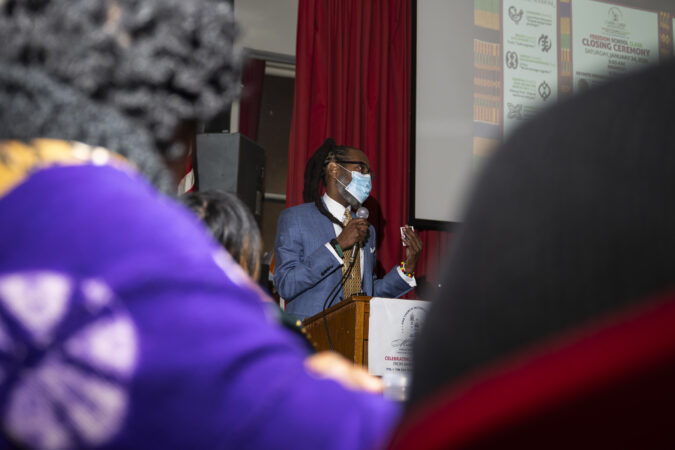
“Our goal, first and foremost, is to remain at that site — intact,” Coard told a roughly 60-person crowd at an unrelated event at Mother Bethel A.M.E. Church. “There’s only one first White House where Black people were enslaved. … There are no alternatives.”
This week, the National Park Service dismantled all the educational displays and illustrations, including those titled “Life Under Slavery” and “The Dirty Business of Slavery,” at the memorial on the corner of Sixth and Market Streets. The site was the latest casualty in President Donald Trump’s push to remove all displays and other content that he has said “inappropriately disparage Americans past or living” from federal land — what some have called an attempt to whitewash history.
Coard, whose group has been stewarding and championing the exhibits since 2002, said Avenging the Ancestors is mounting a multipronged response; he alluded to a legal strategy but would not elaborate. (Mayor Cherelle L. Parker’s administration filed a lawsuit Thursday arguing that the removal of the exhibits is unlawful.)
There has been an outpouring of sorrow and appreciation for the exhibits and anger at Trump’s administration. On Friday, small tokens — a rose, a bouquet of flowers, and a sign that read “Slavery was real” — were left at the site. A group of teachers on their lunch break taped up dozens of posters reading “Learn all history” and “History is real.” The signs were gone as of Saturday morning; by the afternoon, new tributes had spawned. One event promoted online encouraged Philadelphia artists to craft replicas of the removed displays.
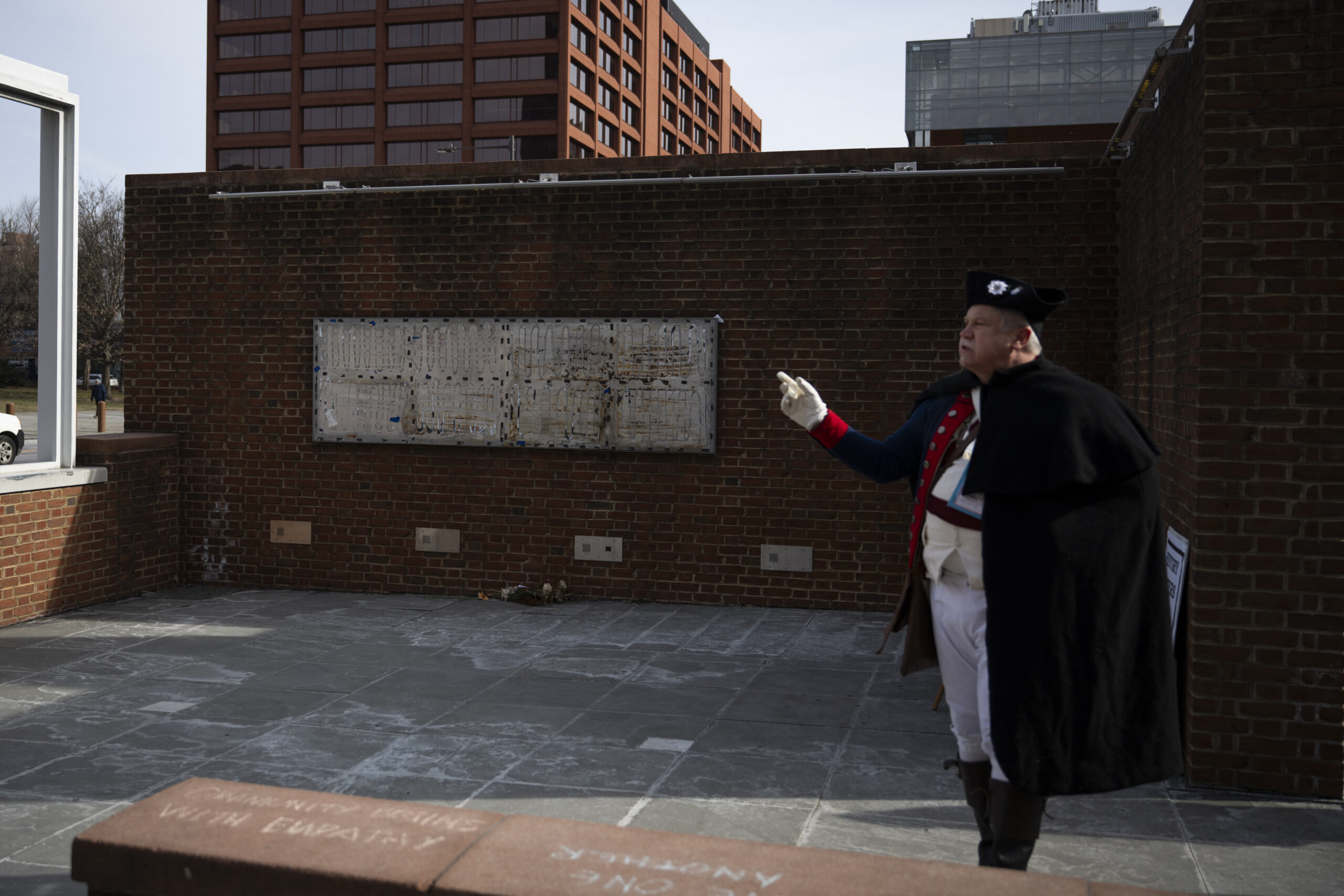
Michael Carver portrays colonial merchant and soldier Mordecai Sheftall during a “History Matters” event Saturday at the President’s House Site in Independence National Historical Park. Displays at the site were dismantled by the National Park Service last week.
“We support and commend those who are doing something,” Coard told The Inquirer after the event, which honored the inaugural graduates of Mother Bethel’s “Freedom School,” a 10-week course on African American history. “If that’s simply liking a social media post about resisting, do that. If it’s taking signs and other items down to the site, do that. … Stand up, fight back, and resist.”
“Our history is our history. It is our willingness to learn from it that makes America exceptional and the greatest country on Earth, on our journey to become a more perfect union,” McCormick wrote on X, responding to The Inquirer’s reporting.
In the same post, McCormick said he also invoked this reasoning when he opposed renaming military bases, like Fort Bragg, after Confederate generals and the park service’s proposal (which was later retracted) to remove a statue of William Penn in Philadelphia in 2024.
Fort Bragg was named after Confederate Gen. Braxton Bragg before former President Joe Biden’s administration changed it to Fort Liberty. Secretary of Defense Pete Hegseth changed it back to Bragg, but in honor of Roland L. Bragg, whom the Defense Department describes as a “World War II hero,” NPR reported.
McCormick appears to be one of the first Pennsylvania Republicans — if not the only one — to weigh in against the exhibits’ removal. Democratic lawmakers across the region have also expressed their disapproval.
U.S. Sen. John Fetterman (D., Pa.) called the NPS decision “deeply wrong and misguided” in a statement emailed to The Inquirer on Saturday.
“America is the best country in the world. Our history is filled with the greatest sacrifices to the most awful chapters. Teach all of it,” Fetterman said.
The erasure of the site — which captured the somber paradox of a young America that exalted freedom for some but deprived others of it — comes ahead of the country’s Semiquincentennial celebrations, when Philadelphia will be in the national spotlight.
The Rev. Carolyn Cavaness of Mother Bethel said it was a blow to her heart to see the exhibits removed. Mother Bethel is a hub for activism and the oldest church property in the United States to be owned continually by Black people. Bishop Richard Allen, the former slave, educator, and Methodist lay preacher who founded the church, was featured at the site.
“There’s something about the full story being told, and for that piece of this story to just be ripped away, I think it even mobilizes … preserving, protecting, sharing our story and our contributions,” Cavaness said. “It just ups the ante.”
With a snowstorm bearing down, Philadelphia-area restaurant and bar owners spent Saturday weighing whether to stay open, limit hours, or close altogether — balancing safety concerns against the reality that snow days can sometimes drive business.
Heavy snow is historically a mixed proposition for the hospitality industry, especially in the city. After the 30.7-inch snowfall in January 1996, for example, The Inquirer reported that the chef at Moriarty’s restaurant slept overnight in a booth and awoke to record crowds, fueled by nearby hotel guests, hospital workers, and neighborhood regulars trudging through the drifts.
Similar dynamics could still play out in dense neighborhoods, where many bar customers and employees live within walking distance — especially given the fact that Pennsylvania’s Fine Wine & Good Spirits stores will be closed Sunday.
This weekend’s forecast, however, arrives at a sensitive moment. The storm threatens to disrupt Center City District Restaurant Week; of the 120 participating restaurants, most were counting on strong Sunday sales.
A spot check of local restaurants and bars shows a wide range of approaches. Ember & Ash and River Twice in South Philadelphia plan to close Sunday, as do Southgate, Wilder, and Leo in Center City and Fleur’s and Amá in Kensington. Suraya in Fishtown plans to close for brunch but open for dinner. Gather Food Hall in University City will be closed Sunday and Monday. Others, including Uchi in Rittenhouse, and Hannah K’s in Point Breeze, were still evaluating conditions Saturday.
Stephen Starr said he expected his 19 Philadelphia restaurants to be open Sunday, though he planned to reassess conditions in the morning. “Parc never closes,” Starr said of his brasserie, a Rittenhouse Square stalwart. “No matter what.”
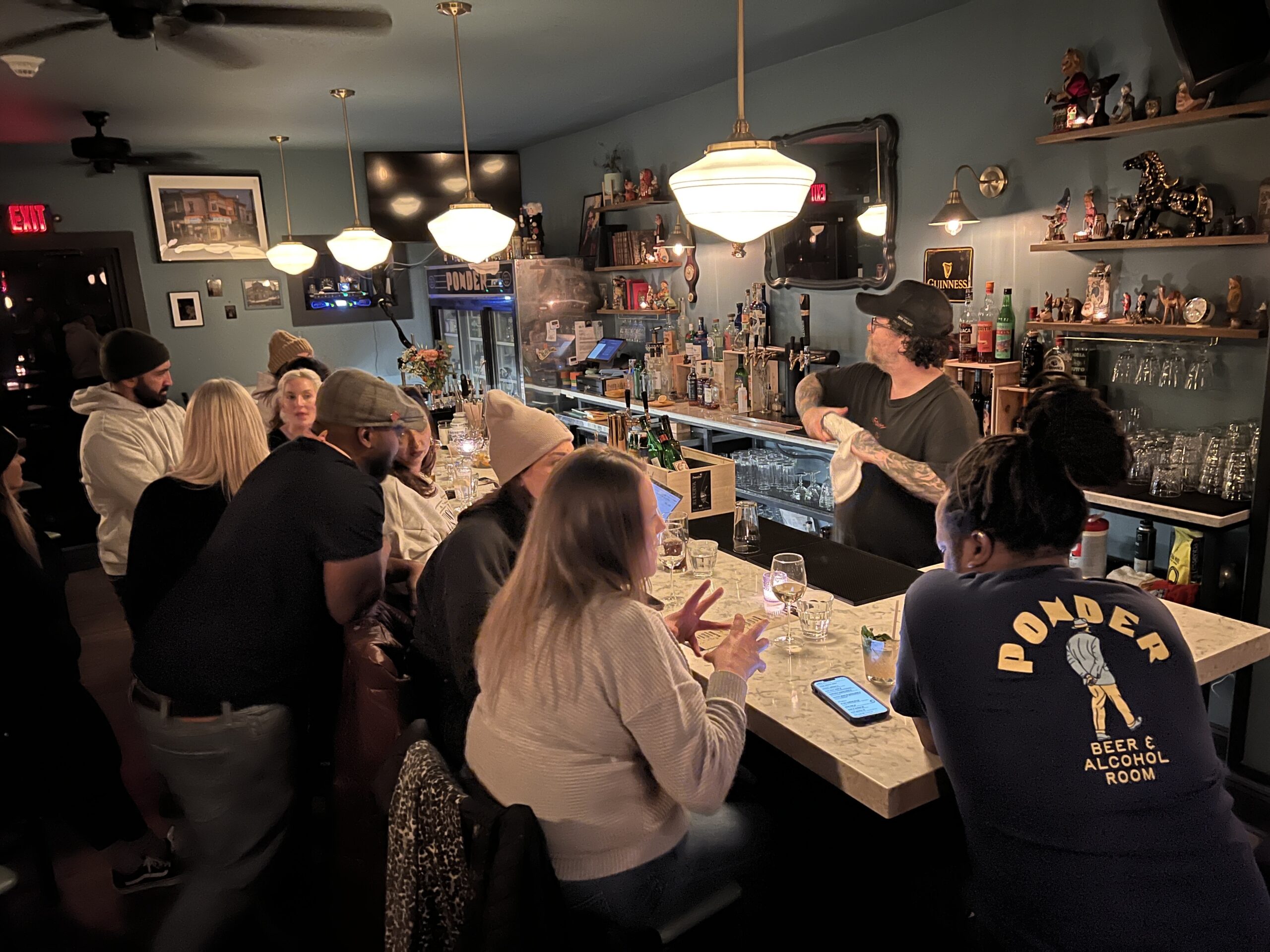
Customers crowding the bar at Ponder Bar in Kensington on Jan. 21, 2026.
Matt Kuziemski said his newly opened Ponder Bar in Kensington would be open, in part because he lives nearby. “I’ll set expectations,” he said. “Come in for something simple — cozy up or grab takeout.”
At the Little Gay Pub in Washington Square West, co-owner Dito Sevilla said the bar plans to open. “We have done what we can to make sure staff has places to stay and can commute on foot for the next few days,” Sevilla said. “We’ve got enough booze stored up for a storm or two.”
Other operators are taking a wait-and-see approach. Dave Conn, chef-owner of Alice in South Philadelphia, said Saturday that he would decide Sunday morning. “If it’s eight or nine inches or less [of snow], we’d probably open,” Conn said. “Anything crazy where it might be unsafe for staff coming and going, we’d probably close.”
Hotel restaurants are more likely to remain open, largely because many are housing employees. About 30 staff members are staying overnight at the Logan Hotel, which houses Urban Farmer steakhouse and Assembly Rooftop Lounge, while roughly 20 employees are being accommodated at Hotel Palomar, home to Square 1682.
Aleks Alimpijevic of Restaurant Aleksandar in Rittenhouse said the restaurant would be open for lunch Sunday, serving its Restaurant Week menu, but would close for dinner and remain closed Monday, its normal day off.
In the suburbs, Sydney Grims of Fearless Restaurants said she was monitoring conditions but hoped to open Triple Crown at the Radnor Hotel and Rosalie at the Wayne Hotel. “Our staff’s safety is priority number one,” she said, noting both properties have generator backup.
Justin Weathers, co-owner of several suburban restaurants, including Stove & Tap, said staffing decisions depend heavily on who lives nearby. “If the snow starts to accumulate, then we cut third-party apps as well,” he said.
Third-party delivery from companies such as DoorDash and Grubhub was not a thing in 1996. Philadelphia’s snow emergency declaration, issued ahead of the storm, does not automatically ban driving. A Grubhub spokesperson said the company may proactively pause deliveries in certain areas ahead of severe weather and continue doing so on a rolling basis to prioritize safety. If deliveries remain available and restaurants stay open, customers are encouraged to be patient, as delivery times may be longer.
Large-scale caterers face additional logistical challenges. Joe Volpe, owner of Cescaphe, said his company, which handles events at nine local venues, was relieved that the storm was forecast to begin late Saturday night rather than earlier. Cescaphe had four weddings and a 300-person anniversary party scheduled for Saturday, but only one wedding on Sunday.
Cescaphe is preparing extra food for guests who may arrive early or stay overnight due to travel disruptions, Volpe said, adding that safety remains the priority. Weddings, he noted, leave little room for rescheduling. “It’s rain or shine — there are no makeups, no do-overs,” he said. “We’re going to be there, and we’ll do everything possible to make it happen.”
The storm is also rippling through the supply chain. Mark Oltman, chief financial officer of Foods Galore, said the South Jersey distributor urged customers to complete deliveries by Saturday for food needed through Monday. “Most places are telling us they won’t be open Sunday and possibly not even Monday,” Oltman said. “As much as we want to service our customers, we’re never going to put our people at risk.”
Winter weather, he added, compounds an already slow season. “January and February are tough,” Oltman said. “You finally get into a rhythm, and then winter shows up and wipes it out.”
Still, some view snow days as part of the city’s fabric. “Bar-hopping during snowstorms in Philadelphia are great memories of mine,” Weathers said.