Now, a man accused of committing voter fraud in that contest by voting twice for Trump is seeking to wipe out a pending criminal case by saying the powers of that pardon action should extend to him.
Attorneys for Matthew Laiss wrote in court documents last month that the language in Trump’s pardon proclamation “clearly extend” to Laiss, who is awaiting trial on charges that he illegally voted twice in the 2020 election — first by submitting a mail-in ballot in Bucks County, then by voting in-person at his new home in Florida.
Federal prosecutors in Philadelphia charged Laiss in September with crimes including voter fraud and voting more than once in a federal election, and they said he faces potential prison time if convicted.
Last month, however, Laiss’ attorneys filed a motion to dismiss the case, saying that the pardon Trump issued Nov. 7 clearly applied to Laiss, and that Laiss had accepted it.
Although Laiss was not among the 77 people Trump listed when specifying who would receive relief, Laiss’ lawyers said the proclamation’s preamble included language making it applicable to “all United States citizens” for conduct, voting, or advocacy surrounding the contest.
In addition, his attorneys wrote, Trump allies including Rudy Giuliani, Sidney Powell, and Mark Meadows were all explicitly pardoned for “exponentially more egregious alleged conduct.” Extending relief to them while denying it to Laiss, his lawyers wrote, “would be outrageous.”
Federal prosecutors say Laiss is “entirely incorrect.”
In a reply brief filed last week, the U.S. Attorney’s Office said Trump’s pardon was intended for people who were seeking to expose or rectify potential fraud in the 2020 election — not for people like Laiss, who are accused of actually committing it.
Beyond what they said was Laiss’ clear misinterpretation, prosecutors said that they checked with Trump’s Office of the Pardon Attorney and that it does not believe the president’s clemency —` which it helped effectuate — applies to Laiss.
“In other words, it is this office’s understanding that if Laiss were to appeal directly to the Office of the Pardon Attorney for a pardon based on [the] November 7 pardon proclamation, that petition would be denied,” prosecutors wrote.
It was not immediately clear how or when U.S. District Judge Joseph F. Leeson Jr. might rule on the issue, although Laiss was scheduled to have a final pretrial hearing Tuesday morning.
If Leeson rules that the case can proceed, a trial is scheduled to begin next week.
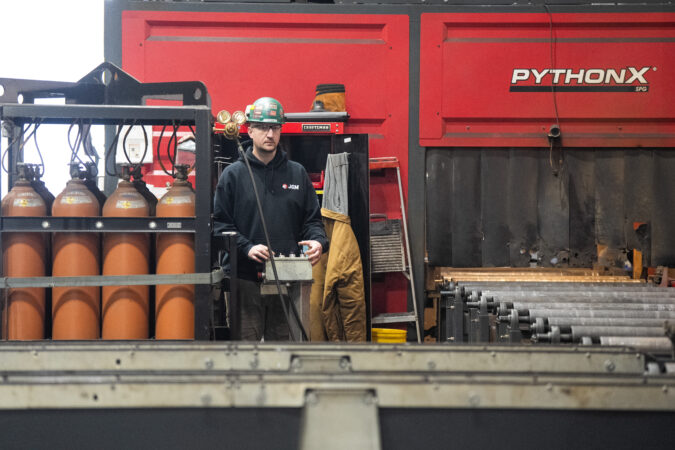
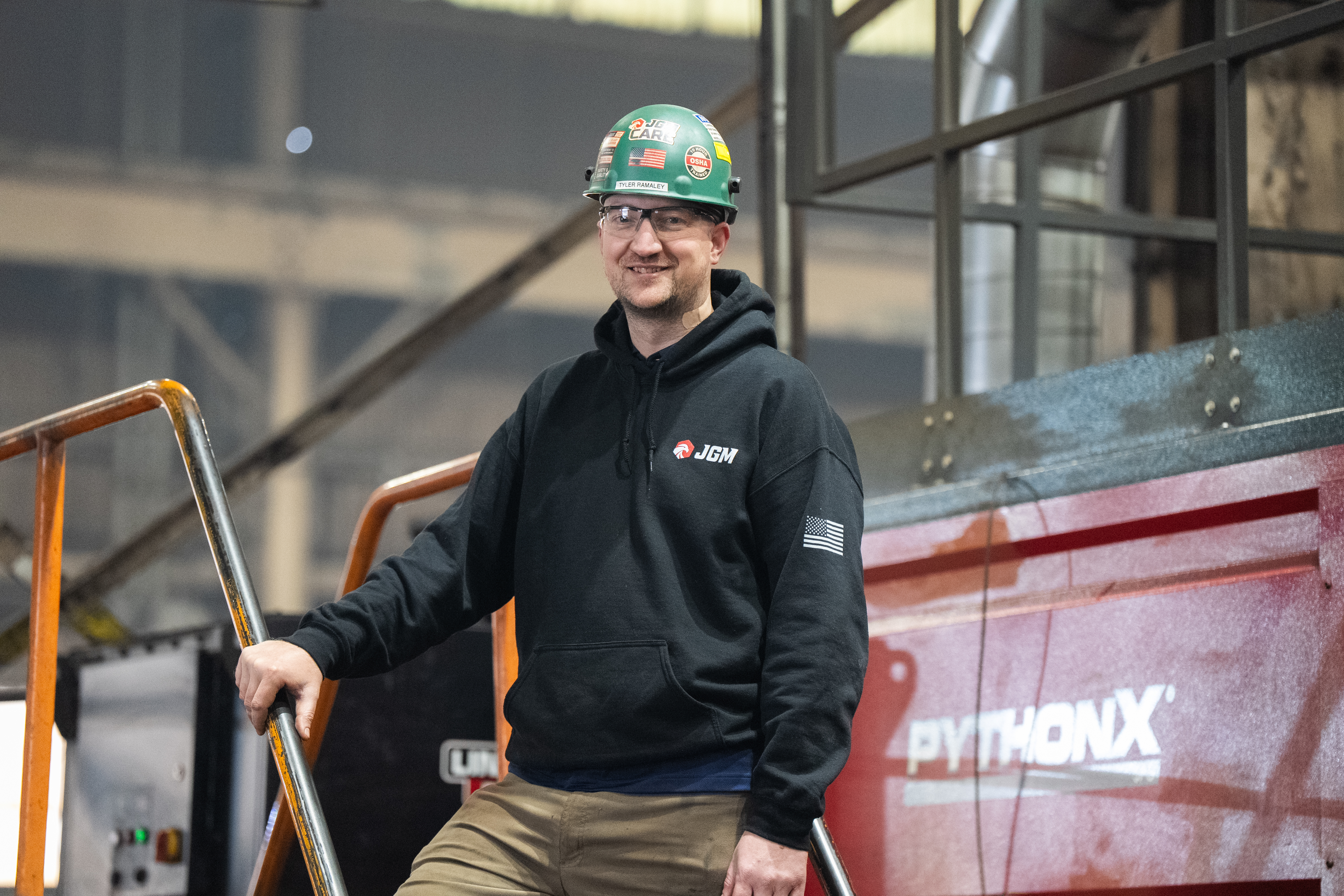
Tyler Ramaley wakes up every morning grateful that he’s able to do “respectable work in a hardhat” as he clocks in for his shift at JGM, a steel fabrication plant in Coatesville.
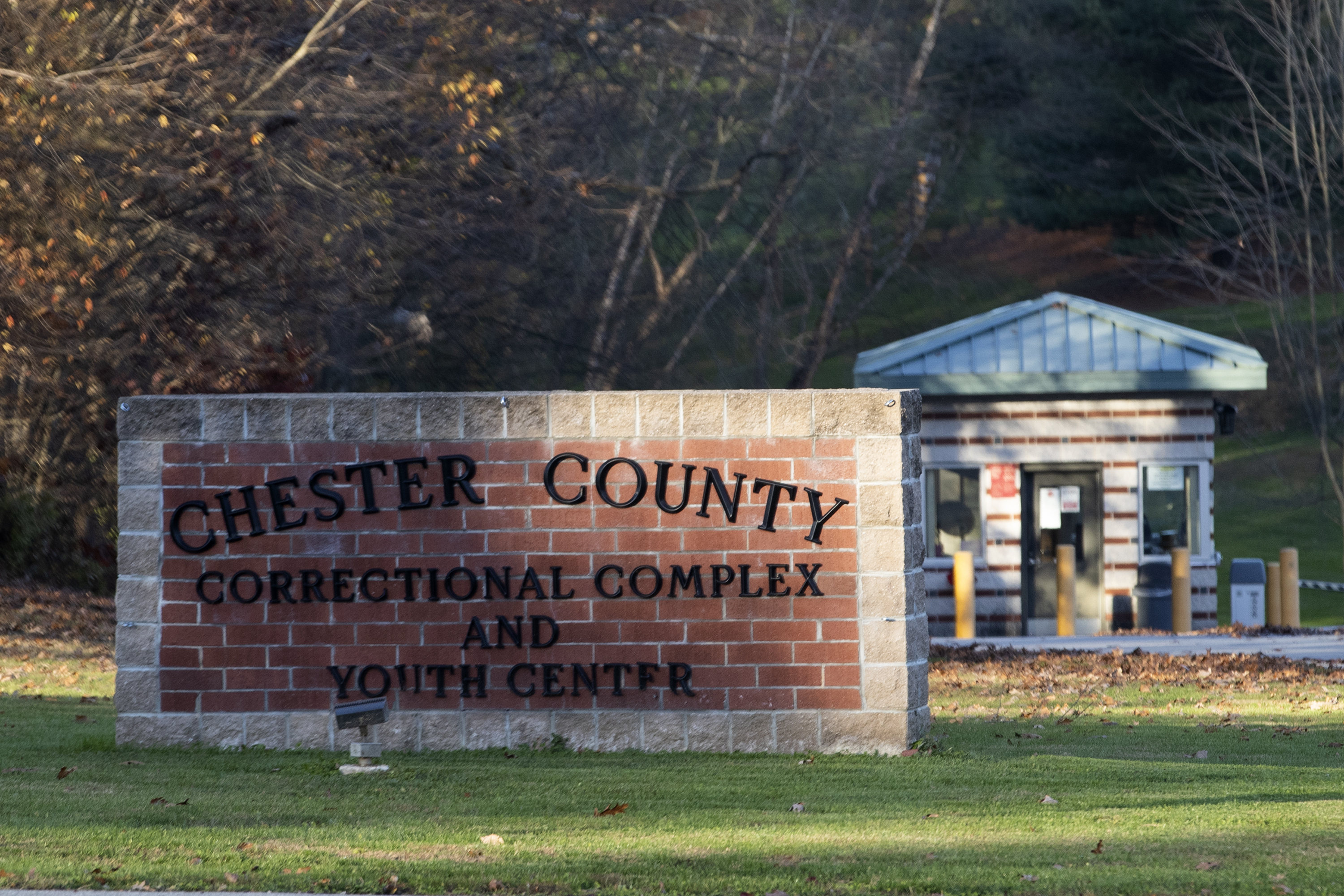
Nineteen months ago, that would have been impossible: He was struggling with an opioid addiction and waking up to a monotonous routine in a Chester County Prison cell.
A new program offered at the jail, Exit, Enter, Employ, gave him an opportunity to move on from his past mistakes. He had help building his resume, getting certified in his chosen field, and, crucially, landing an interview for a job that was waiting for him after his release.
“I was in there, and I just didn’t like who I was and I just knew I needed to change,” Ramaley, 37, said in an interview during a break from running a plasma cutter on a recent day. “It gave me a purpose to wake up every day, and it makes me not want to waste the opportunity I’ve been given.”
Ramaley’s experience, county officials say, is just one of many success stories to come out of the E3 program since its inception in January 2023 through a partnership between the jail and the Chester County Intermediate Unit.
More than 100 people have graduated from the course, with a recidivism rate of 2%, according to Jill Stoltzfus, the program’s career-readiness coordinator and a CCIU employee.
“Everybody needs a second chance,” she said. “And I’m very candid with people when I interview them. Like, we’ve all made mistakes, I’m sure I’ve made mistakes that I could be in the same situation.”
More than 100 inmates at the Chester County Prison have graduate from the E3 program since its inception in January 2023.
Job-readiness programs are nothing new for county jails — they’re offered almost universally across the region. But Stoltzfus said E3 is different because it provides a direct path, with job openings already lined up for graduating inmates from multiple companies that partner with the county.
And in the first few months in those jobs, coordinators from the program follow up with former inmates, checking in to see how they are faring.
“I don’t like the judgment we often hear of ‘Why should we fund this?’ or the idea that some people deserve a chance over others,” Stoltzfus said. “I think it’s crucial that we at least put that opportunity out to them.”
E3 is available only to inmates who have been sentenced to county jail, meaning their crimes were not serious enough to warrant state prison time. And county officials carefully screen those who apply to the program to make sure they are ready.
Besides workforce skills like OSHA certification and courses in customer service, E3 offers financial-planning advice, as well as cognitive behavioral therapy and anger management.
Current partner employers, besides JGM, include J.P. Mascaro & Sons, FASTSIGNS, and MacKissic. Stoltzfus is hoping to expand the offerings to include agricultural and culinary posts.
Howard Holland, the warden of Chester County Prison, views the program as a way to help incarcerated people prepare to reenter society in a productive way.
“We’re engaging them in a way other than just ‘Here’s your cot, stay behind the bars,’” he said. “You just have that same cycle over and over and over again because that’s the way our institutions are run.
“At the end of the day, we’re humans, right?” he added. “They’re here, and it’s our responsibility to, while they’re here, try to do the best we can for them.”
Tyler Ramaley said he never thought he would be able to go to work, after years of addiction. The E3 program helped him connect with a job he loves.
Ramaley, who was named JGM’s employee of the month in June, said the opportunity was an important step toward reversing years of bad decisions.
His drug abuse, he said, began in 2020, when he was injured on the job while running a hammer drill at a concrete mill. The drill skipped and jerked his arm hard, shredding multiple tendons. After several surgeries, he said, he was prescribed Tramadol in bottles of 150 pills at a time. He became reliant on the pills, using them to deal with the pain.
And when his workers’ comp ran out, he said, his doctor cut him off cold turkey and he turned to other ways to support his opioid habit and purchase drugs, racking up convictions for theft and forgery and landing in county jail.
His moment of clarity came this spring, he said, and he graduated from E3 in April, weeks before his jail sentence ended and he was released.
“When I was in my active addiction, I never thought I would be able to go to work and not be on something,” he said, “and there’s times I’ll stand out there and just kind of think about how happy I am here, actually doing hard work and respectable work and doing it the right way.
“And that’s a better feeling than anything I had when I was in my addiction.”
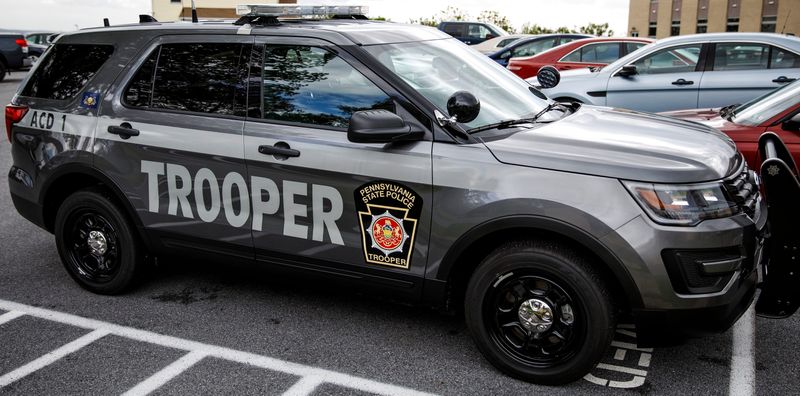
State police Cpl. Joshua Mack is suing the Pennsylvania State Police in federal court, arguing that he lost a lucrative position on the governor’s security detail because of racial discrimination.
Mack, who is white, claims that his superiors reassigned him earlier this year and that he had heard them talk about the “need” for “more minorities” on Gov. Josh Shapiro’s security team.
Mack had been the longest-serving member of the governor’s security detail, joining the elite squad in 2011 when Ed Rendell was in office.
“Mack’s removal and replacement on the Governor’s Detail were motivated by race considerations and intended to satisfy [Pennsylvania State Police’s] stated goal of increasing minority representation in the Governor’s Detail,” the lawsuit reads. “As a result, Mack suffered loss of pay, loss of overtime income, diminished professional opportunities, and emotional distress.”
Mack joined the state police in 2004 and went on to protect four governors. The lawsuit claims that he “consistently received strong performance evaluations” and that guarding the governor came with opportunities for specialized dignitary-protection training, state-owned vehicles, and far more overtime than other state troopers have.
Pennsylvania State Police declined to comment, saying that they don’t respond to queries about personnel matters or pending litigation. Shapiro’s office declined to comment as well.
According to the lawsuit, Mack lost the position on March 25 — although he retained his rank of corporal — and was told that it was only because of “administrative changes.” His supervisors repeatedly informed him their decision was not due to any deficiencies in his performance, the lawsuit states.
“As a result of his removal from the Governor’s Detail, Mack was reassigned to another unit farther from his home, lost access to a state vehicle, and lost substantial overtime opportunities,” reads the lawsuit, which was filed on Nov. 25.
“He was assigned back to patrol, which was a drastic change, as he was out of patrol work for so long and much has changed during that time,” wrote Anthony T. Bowser, who is representing Mack, in an email to The Inquirer.
Mack alleges he was then replaced by two non-white troopers “who were substantially less qualified and lacked any dignitary-protection experience.”
Mack is demanding a jury trial. He is alleging damages stemming from lost wages and benefits, damage to his professional reputation, and “emotional distress, humiliation, and embarrassment.”
Bowser says that while the damages would have to be determined during litigation, the lost overtime amounts to over $50,000 annually because it is capped in Mack’s new patrol position. The lost overtime would also affect his pension.
Mack is specifically suing the Pennsylvania State Police and his superiors Cpl. John Nicholson and Lt. Col. George Bivens. Shapiro is not mentioned by name in the suit.
Mack first filed an administrative charge of discrimination with the Equal Employment Opportunity Commission, a necessary first step before filing in federal court.
Spotlight PA is an independent, nonpartisan, and nonprofit newsroom producing investigative and public-service journalism that holds power to account and drives positive change in Pennsylvania. Sign up for our free newsletters.
HARRISBURG — This year’s state budget didn’t pull slot-like skill games out of their legal limbo in Pennsylvania, despite bipartisan consensus on the need to do so.
But it could still happen. Democratic Gov. Josh Shapiro called the matter “unfinished business,” and legislative leaders have also indicated interest in taking up the issue again next year.
“This building has a long history of going through gaming debates, and they are very complex and very tedious and very difficult,” state Senate Majority Leader Joe Pittman (R., Indiana) said after the budget passed on Nov. 12. “I certainly believe gaming reform is — and must be — an important policy initiative going forward.”
Pennsylvania faces a structural deficit, which will require spending cuts or more cash in the state’s coffers. A gambling levy, alongside other sin taxes, offers a way to raise revenue without making politically unpopular increases to sales or income taxes.
While such taxes are potentially more palatable to the broader electorate, gambling debates are complex and difficult within the Capitol due to the array of monied interests that defend their existing market share or attempt to expand it further.
The money at stake is real. Existing taxes on revenue from slot machines and table games, whether in brick-and-mortar casinos or online, as well as levies on activities like sports betting and truck stop-based video gaming terminals, brought in $2.7 billion last fiscal year, a record high.
What was on the table this budget cycle?
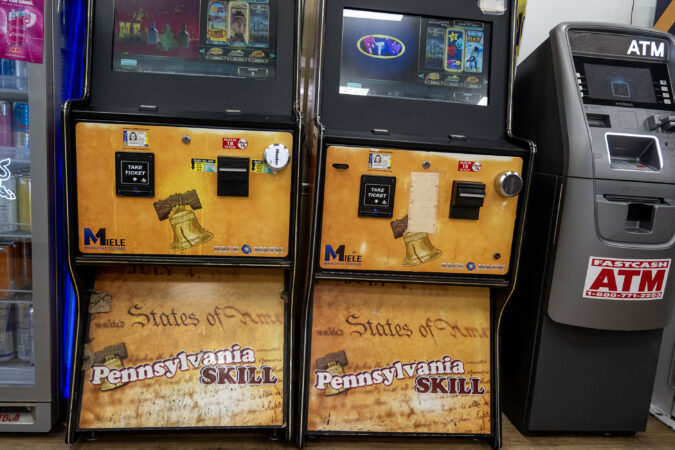
Skill games, which have proliferated in bars and gas stations across the state, exist in a legal gray area and have been subject to years of litigation. They are untaxed and unregulated, and officially setting up laws around them would bring in more gaming cash.
Shapiro proposed in his budget address a 52% tax on the gross revenue of skill games, estimating that it would bring in roughly $400 million. State Senate Republican leaders later backed a plan to tax skill games at a lower rate, 35% of gross revenue.
(Politically powerful casinos pay a 55% tax on electronic games and are pushing for skill games to be taxed at a similar rate.)
As budget talks progressed, neither of the plans went far. Lobbyists for Pace-O-Matic, a major skill games developer and distributor, wanted lawmakers to support legislation introduced by State Sen. Gene Yaw (R., Lycoming) with a 16% tax.
In the weeks leading up to a final budget deal, Yaw and another state senator, Anthony Williams (D., Philadelphia), proposed levying a $500 monthly fee per machine, rather than a tax. They estimated such a fee would bring in about $300 million.
Yaw, whose district is home to a skill games manufacturer, told Spotlight PA the bill was an attempt to sidestep the impasse between leaders, adding that he thinks the tax rates proposed so far would destroy the existing industry.
Williams noted that the bill also seeks to regulate “stop-and-go” convenience stores with liquor licenses. These stores can serve as illegal gaming hubs, which is a concern among Philadelphia lawmakers.
Both lawmakers said they hope that the legislature will finally address skill games regulations in 2026. If not his bill, Williams added, he hopes the legislature will pass another proposal.
“I think it will be included,” Williams said of skill games. “We got a budget that’s passed, but revenue challenges are coming next year, and we’re not going to raise taxes. So this, along with other items, will be considered.”
Adding complexity to the matter is a case before the state Supreme Court. Justices heard oral arguments about the legality of skill games in late November.
Attorneys for the state argued that the machines’ mechanisms and functionality effectively constitute gambling, violating the state’s gaming law. “A game that looks like a slot machine, and plays like a slot machine, is a slot machine,” the state attorney general’s office wrote in its brief.
Matthew Haverstick, Pace-O-Matic’s attorney, argued that the devices comply with decades of legal precedent and that many of the concerns raised by justices, such as the devices’ profitability, amount to policy questions.
“Why [do skill machines] make money? Because somebody really brilliant came up with an idea that they tested. … It was held to be legal, and nobody appealed,” Haverstick said.
It is not known when the high court will issue a ruling.
‘We get threatened all the time’
Part of what makes gaming such a complex topic is simple: Money.
Gambling is a multibillion-dollar industry in Pennsylvania with several key players. And public officials hold the keys to either helping or hurting their bottom lines.
Pace-O-Matic alone has paid millions of dollars to employ dozens of lobbyists to influence the legislature in recent years. Casinos, legalized in the 2000s, likewise are heavily involved in the legislative process — they employ dozens of lobbyists of their own and also spend millions.
Other, smaller players, including those involved in horse racing, sports betting, and truck-stop-only video gaming terminals, add to the complexity of the policy debate.
Then there’s campaign fundraising. A Spotlight PA analysis of campaign finance records found that gaming interests of all stripes gave $1.7 million to top legislative leaders and the governor between Jan. 1, 2023, and Dec. 31, 2024.
Current campaign finance reports show Pace-O-Matic has given money to a PAC that, in turn, donated to a second PAC that has attacked incumbent state Senate Republicans — something that could complicate talks going forward, particularly in the upper chamber.
The company historically has made significant donations to legislative Republicans. But that once-friendly relationship soured earlier this year, after GOP leaders in the state Senate backed legislation that would have taxed the industry at a higher rate than it preferred.
Around the same time, door knockers delivered fliers attacking key GOP lawmakers. State Sens. Frank Farry (R., Bucks) and Chris Gebhard (R., Lebanon) were “siding with Harrisburg insiders and lobbyists to stop small town groups like our volunteer firefighters and VFWs from being able to raise additional revenues,” the fliers, viewed by Spotlight PA, said.
In June, Pace-O-Matic accused the state Senate’s top two GOP leaders of intimidating its lobbyists unless they dropped the company as a client. Three firms did. (A GOP spokesperson called the allegation “bizarre.”)
A lobbyist for Pace-O-Matic told Spotlight PA at the time that it did not coordinate with the group that advanced the ad campaign attacking GOP senators.
However, federal campaign finance records show Pace-O-Matic began giving money to Citizens Alliance, a national conservative political group, as budget talks intensified in May — $630,000 total as of Nov. 21.
Soon after Pace-O-Matic’s first donation, Citizens Alliance contributed to an Ohio-based super PAC called Defeating Communism — the group behind the fliers. Citizens Alliance has donated $428,000 to the super PAC this year.
Cliff Maloney, CEO of Citizens Alliance, said the organization’s aims are to make Pennsylvania into a “red wall” by running a program to “compete with Democrats’ door-knocking efforts,” and to “run a pledge program to hold both Democrats and Republicans accountable to the principles of the [Pennsylvania] and [U.S.] Constitution.”
“Yes, partners are working to hold Senate Republicans accountable that proposed a new tax on certain small businesses,” Maloney said in a statement.
Pennsylvania Department of State disclosures show that in October, Defeating Communism reported $225,000 for door-knocking targeting Gebhard as well as State Sen. Camera Bartolotta (R., Washington). The campaign focused on their votes on past budgets and carbon capture and sequestration, as well as skill games.
Bartolotta told Spotlight PA that she expected taxation of skill games to still be a leading topic in state Senate Republicans’ internal discussions despite the wave of attacks.
The skill games lobby, she said, is “just passing out garbage. And they’re acting like criminals. And I don’t know what in the world they think this is going to do to engender our support.”
Defeating Communism did not respond to a request for comment. Mike Barley, Pace-O-Matic’s chief public affairs officer, said in a statement that the company “donates substantial amounts of funding to politicians and PACs, and we will continue to do so.”
A growing field
The number of moneyed gambling interests that wish to play in the Keystone State is growing.
As Spotlight PA recently reported, the national trade group for sports betting firms launched a more than $500,000 pressure campaign to kill a closed-door budget pitch. The proposal would have raised taxes on sports betting and online casino gaming.
That pressure helped kill the proposal for now, a source told Spotlight PA.
Legal Sports Report, a trade news outlet, reported in November that sports bettors were creating a $10 million super PAC, citing an anonymous source who claimed that Pennsylvania has “rocketed to the top of the list of states where operators are looking to play big during next year’s midterm election.”
While gaming was off the table in 2025, it’s unclear what the future holds.
“We get threatened all the time by some of these interests, you know, ‘We’re going to come beat you up. We’re going to come take you out,’” state Senate President Pro Tempore Kim Ward (R., Westmoreland) said at a news conference after the budget’s passage.
“That’s just ridiculous, and it just makes my blood pressure go up. We don’t do well being bullied. And I think a lot of these gaming interests have done nothing but try to bully us. And I don’t think we stand for that.”
EXCLUSIVE INSIGHTS … If you liked this reporting from Stephen Caruso, subscribe to Access Harrisburg, a premium newsletter with his unique insider view on how state government works.
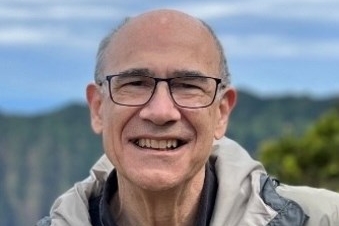
Mark Hallett, 82, of Bethesda, Md., world-renowned scientist emeritus at the Maryland-based National Institute of Neurological Disorders and Stroke, former chief of the clinical neurophysiology laboratory at Brigham and Women’s Hospital in Boston, associate professor of neurology at Harvard Medical School, groundbreaking researcher, prolific author, mentor, and world traveler, died Sunday, Nov. 2, of glioblastoma at his home.
Dr. Hallett was born in Philadelphia and reared in Lower Merion Township. He graduated from Harriton High School in 1961 and became a pioneering expert in movement, brain physiology, and human motor control.
He spent 38 years, from 1984 to his retirement in 2022, at the National Institutes of Health in Bethesda and was clinical director and chief of the medical neurology branch of the National Institute of Neurological Disorders and Stroke. He and his colleagues examined the human nervous system and the brain, and their decades of research helped doctors and countless patients treat dystonia, Parkinson’s, and other neurodegenerative diseases.
“When I met him, I was in bad shape,” a former patient said on Instagram. “I’d also been told … that no one would ever figure out the source of my illness. … He and his team diagnosed me, and thereby, I’m pretty sure, saved my life”
Dr. Hallett told the Associated Press in 1992: “The more that we know about the way these cells function, the better off we are.”
Barbara Dworetzky, current president of the FNDS, said Dr. Hallett was a “brilliant scientist, visionary leader, and compassionate physician whose legacy will endure.” Former NIH colleagues called his contributions “astounding” and said: “The scope and impact of Dr. Hallett’s work transcend traditional productivity metrics.”
He chaired scientific committees and conferences, and supervised workshops for many organizations. He earned honorary degrees and clinical teaching awards, and mentored more than 150 fellows at NIH. “Our lab’s demonstration of trans-modal plasticity in humans was another milestone,” he told the NIH Record in 2023. “And, of course, I am particularly proud of the fellows that I have trained and their accomplishments.”
In a tribute, his family said those he mentored “valued his intellect, his encouragement, his kindness, and his humor.”
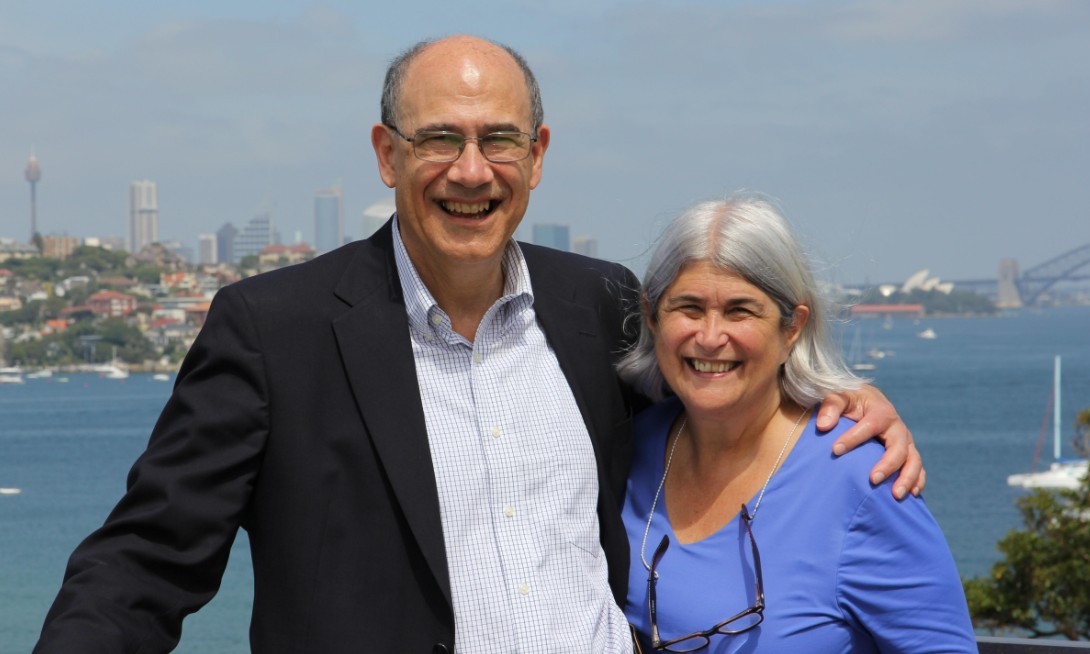
Dr. Hallett and his wife, Judy, married in 1966.
Dr. Hallett had planned to study astronomy at Harvard University after high school. Instead, he earned a bachelor’s degree in biology in 1965 and a medical degree at Harvard Medical School in 1969. He completed an internship at the old Peter Bent Brigham Hospital, now part of Brigham and Women’s, and joined a research program at the NIH in 1970 to fulfill his military obligation during the Vietnam War.
A fellowship in neurophysiology and biophysics at the National Institute of Mental Health sparked his interest in motor control, and he served a neurology residency at Massachusetts General Hospital in 1972 and a fellowship at the Institute of Psychiatry in London in 1974.
He returned to Brigham and Women’s in 1976 to supervise the clinical neurophysiology laboratory and rose to associate professor of neurology at Harvard. In 2019, he earned the Medal for Contribution to Neuroscience from the World Federation of Neurology, and former colleagues there recently said his work “had a lasting global impact and shaped modern clinical and research practice.”
He also studied the scientific nature of voluntary movement and free will. He wrote or cowrote more than 1,200 scientific papers on all kinds of topics, edited dozens of publications and books, and served on editorial boards.
He was past president of the International Federation of Clinical Neurophysiology and the International Parkinson and Movement Disorder Society, and vice president of the American Academy of Neurology.
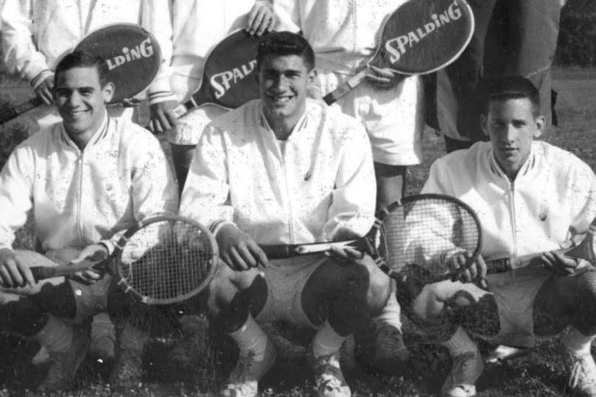
At Harriton, he was senior class president, a star tennis player, and a leading man in several theatrical shows. “The only time he disobeyed his parents,” his family said, “was when he decided to leave Philadelphia to attend Harvard College.”
Mark Hallett was born Oct. 22, 1943. The oldest of three children, he was a natural nurturer, a longtime summer camp counselor, and the winner of an Alfred P. Sloan Foundation national scholarship award in high school.
He grew up in Merion and met Judith Peller at a party in 1963. They married in 1966 and had a son, Nicholas, and a daughter, Victoria.
Dr. Hallett (center) was a star on the Harriton High School tennis team.
Dr. Hallett was an avid photographer and a master of the family group shot. He championed a healthy work-life balance, and his family said: “He eagerly built sand castles, skipped stones, and started pillow fights. His easy laugh was contagious.”
He enjoyed hiking, biking, jazz bands, and organizing family vacations. “He was a natural leader,” his son said, “self-assured and patient of others, with a deep sincerity and a desire to help people.”
Philadelphia nearly experienced its own nightmare before Christmas this year, with the closure of the Center City Macy’s and the iconic, beloved holiday light show.
Capitalism can’t stop Christmas traditions, though. The light show is back, and across the region, people are buying Christmas trees, prepping for Hanukkah, and preparing for Kwanzaa events this week.
One simple way to get in the spirit? Visit one of the many holiday light shows, from neighborly displays to events steeped in decades of history and nostalgia.
Philadelphia and its suburbs offer plenty of options. Here are some of the best.
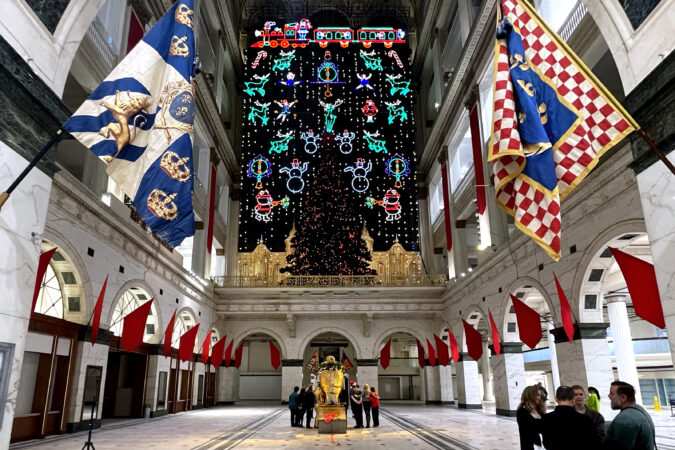
The decades-old holiday tradition is back at Center City’s shuttered Macy’s, with a new name and, possibly, an entirely better experience. With more than 100,000 LED lights, the Wanamaker Light Show remains free to the public. What makes the Wanamaker Building so magical is the melodies booming throughout the cathedral-like department store from the century-old organ, one of the largest in the world. Enjoy the massive light show beginning on Black Friday. The show operates Wednesday to Sunday from noon to 8 p.m., through Dec. 11. Starting Dec. 12, there are daily shows from noon to 8 p.m. The final day for the show is Christmas Eve, from noon to 4 p.m.
According to Visit Philadelphia, the Wanamaker Building will undergo renovations after the holidays, and the light show may be on hiatus for several years.
🕒 Through Dec. 24, daily, various times, 💵 Free, 📍1300 Market St., Philadelphia, Pa. 19107, 🌐 visitphilly.com
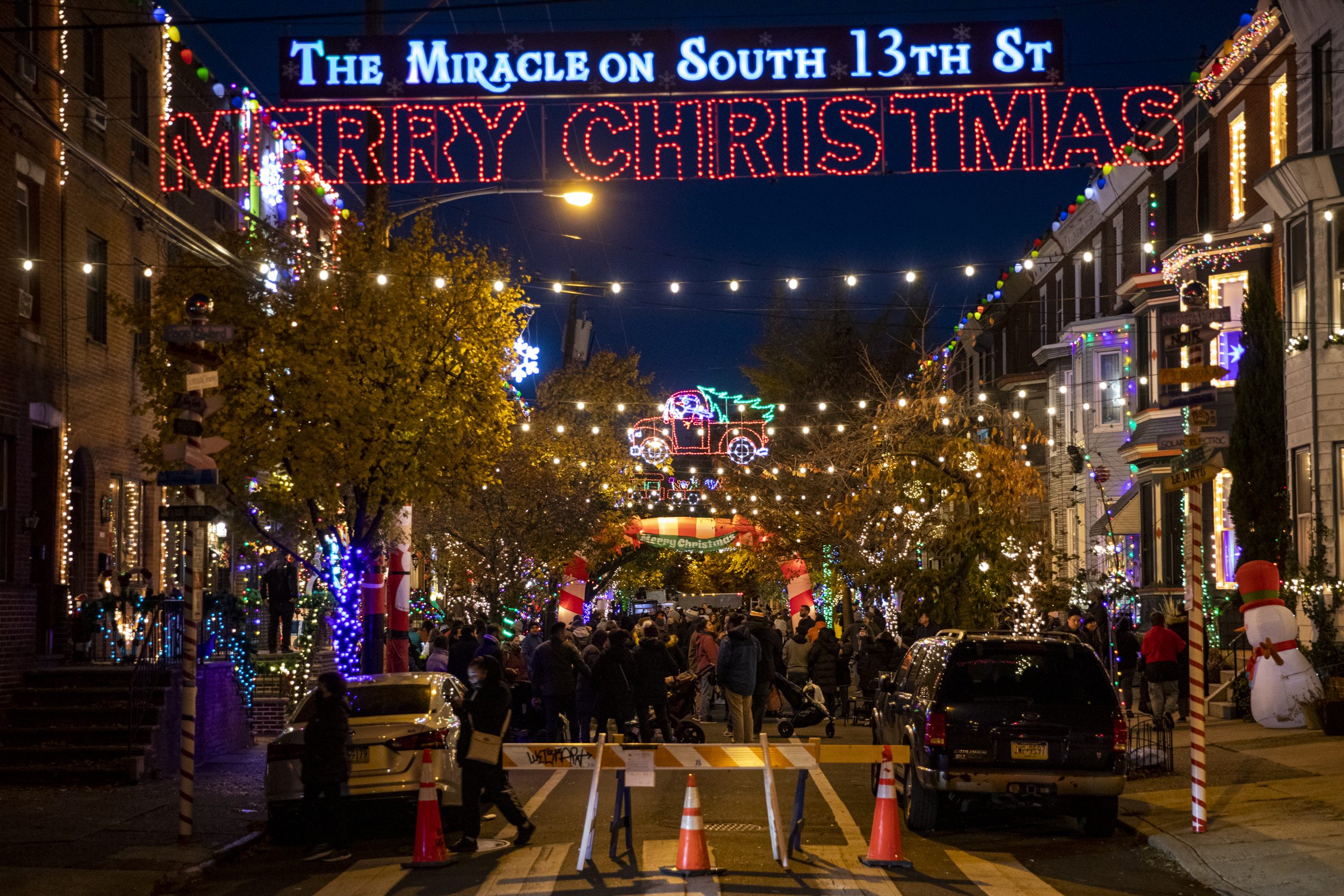
The Miracle on South 13th Street block party filled with Christmas lights and decorations in South Philadelphia, on Saturday, Nov. 27, 2021.
Nothing spreads holiday spirit more than neighbors coming together to remind us what it’s all about. Since the ‘90s, residents of the 1600 block of South 13th Street in East Passyunk have transformed their street into a Christmas light show so spectacular that Peco must see a spike in usage. The show opens with a block party on Nov. 29 from 5 to 9 p.m. with face painting, balloon art, and a 6 p.m. special guest from the North Pole.
🕒 Through Jan. 1, daily, 5 to 10 p.m., 💵 Free, 📍 1700 S. 13th St., Philadelphia, Pa. 19148, 📷 @themiracleonsouth13thstreet
It was opening night for Winter in Franklin Square featuring the Electrical Spectacle Light Show presented by PECO.
Celebrate the holidays in Franklin Square, a park older than the Declaration of Independence, where each year the Electrical Spectacle Holiday Light Show illuminates the plaza along with classic Christmas songs. The event includes mini golf, street curling, and seasonal sweet treats and cocktails at Frosty’s Fireside Winter Pop-Up Bar.
🕒 Through Feb. 23, various times, 💵 Free, 📍200 N. Sixth St., Philadelphia, Pa. 19106, 🌐 historicphiladelphia.org
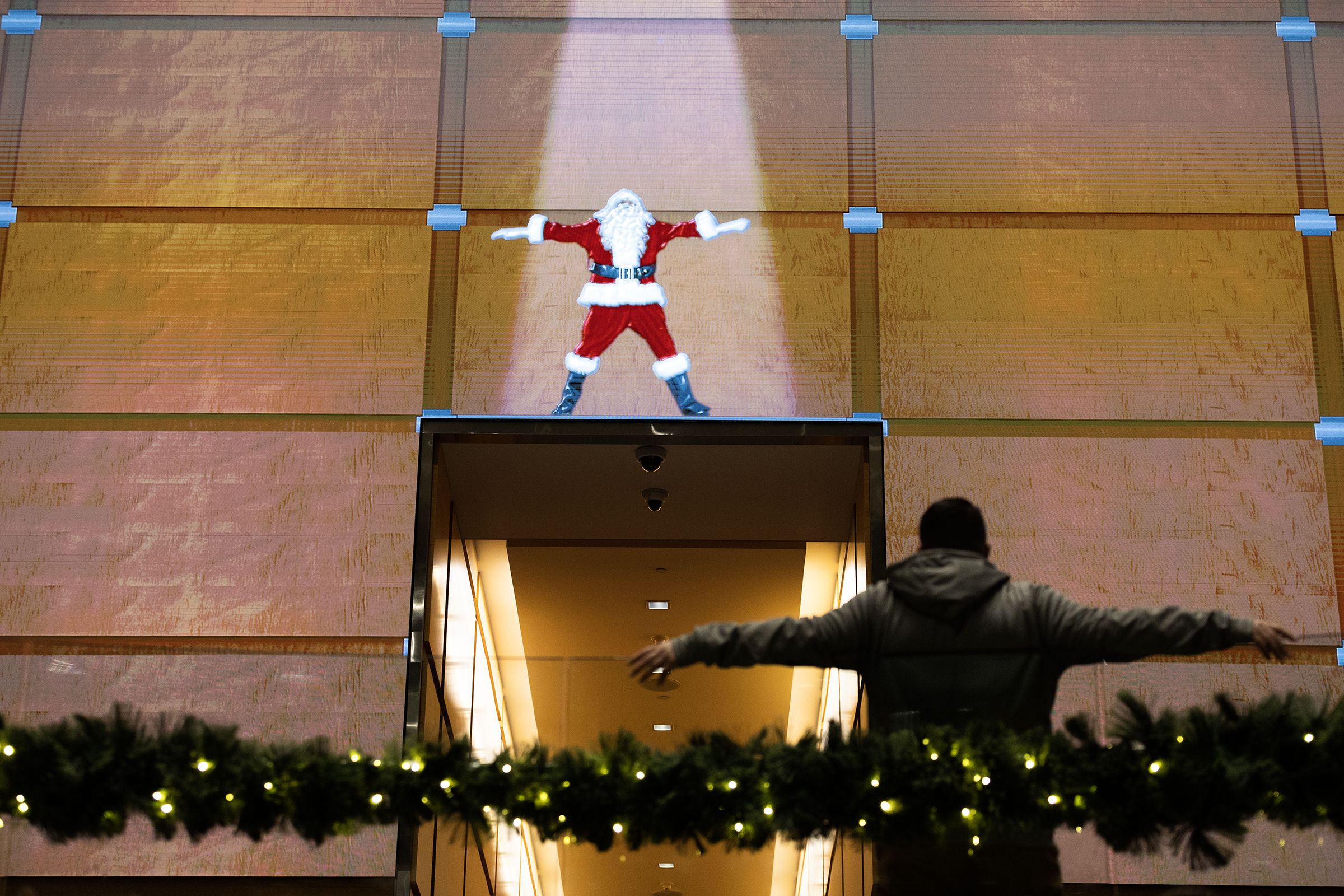
A man watches a dancing Santa with a similar body language in the lobby of the Comcast Technology Center during a Dec. 15, 2023, holiday video presentation.
Philly’s telecommunications giant has two immersive attractions again this year. Each day, the Comcast Holiday Spectacular at the Comcast Center wows visitors with light shows at the top of every hour. Inside the Comcast Technology Center, which is right around the corner, theDreamWorks’ Shrek’s Festive Flightreturns. The show tells the story of Shrek, Donkey, and Gingy’s journey from Philadelphia to the North Pole Bakery.
🕒 Through Jan. 2, daily, 10 a.m. to 8 p.m., 💵 Free, 📍1701 JFK Blvd., Philadelphia, Pa. 19103, 🌐 comcastcentercampus.com
This regional credit union gives back during the holidays with a 400,000-light display accompanied by 40-foot Christmas trees, hundreds of wreaths, and more. Stroll through American Heritage’s campus, where you can snap family photos, enjoy the displays, and take in the winter night air. The events begin on Nov. 29.
🕒 Through Jan. 1, daily at dusk, 💵 Free, 📍2060 Red Lion Rd., Philadelphia, Pa. 19115, 🌐 americanheritagecu.org
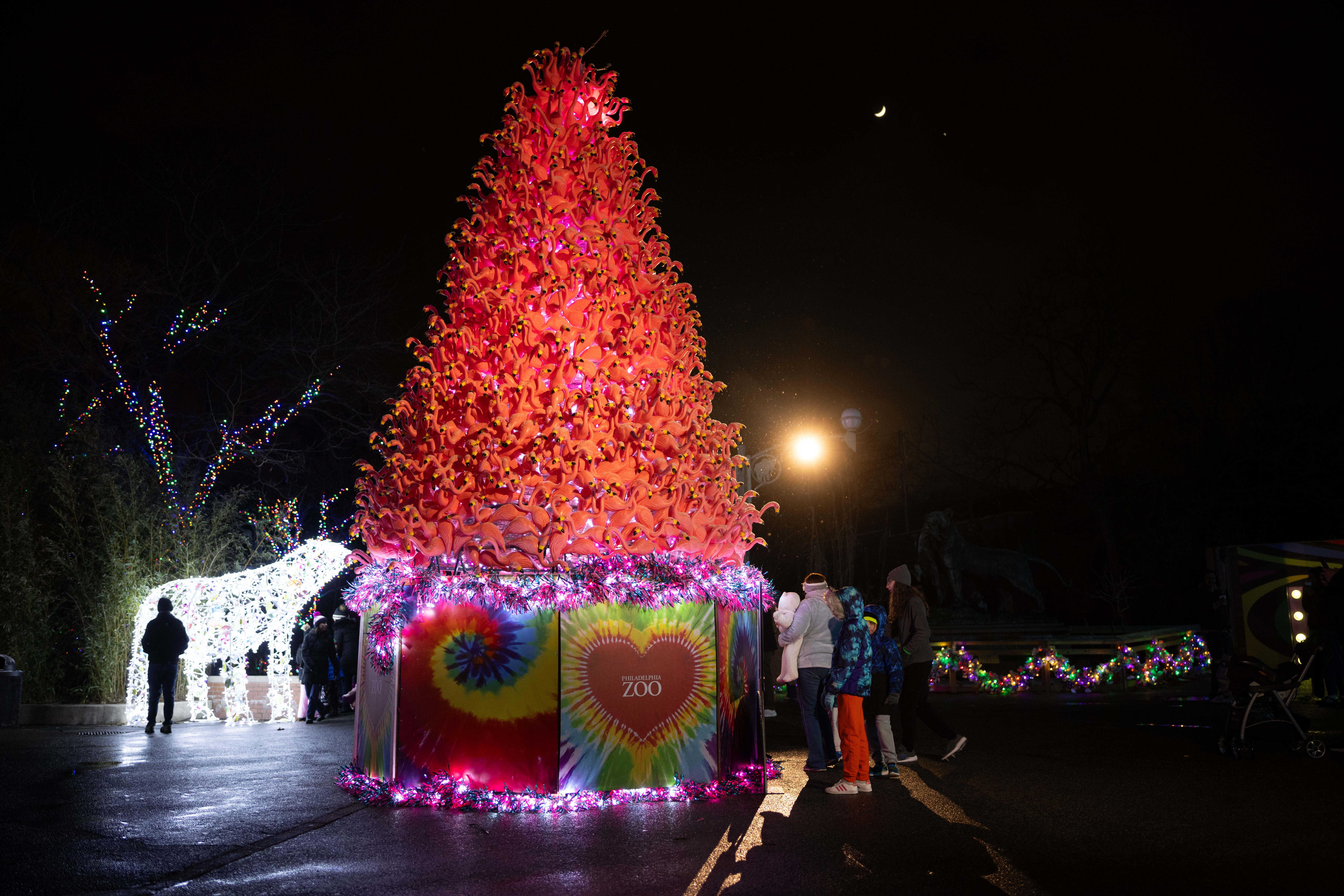
Philadelphia Zoo’s nature-inspired holiday tradition, LumiNature, returns for its sixth season of whimsical wildlife scenes come to light.
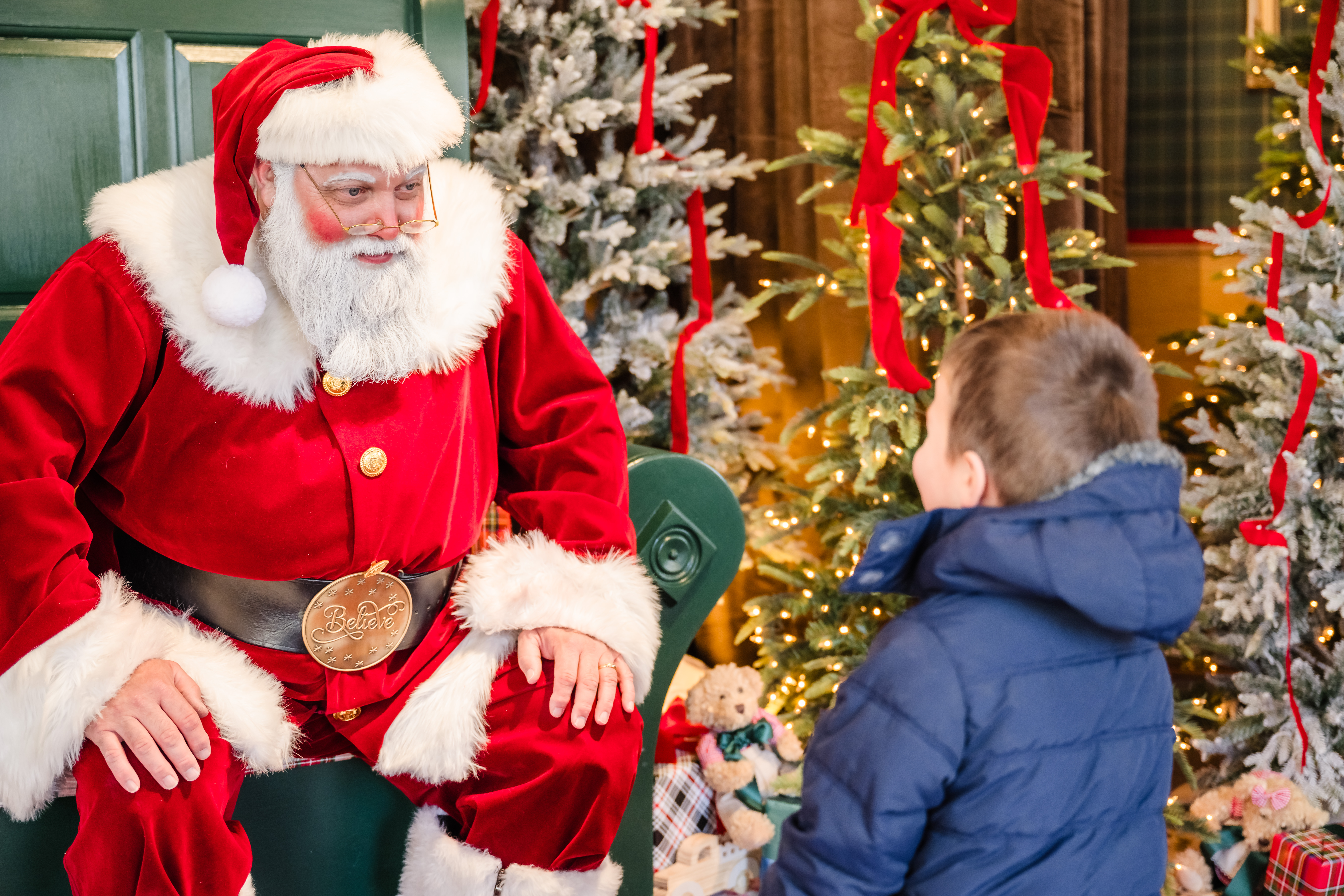
Philadelphia Zoo’s nature-inspired holiday tradition, LumiNature, returns for its sixth season of whimsical wildlife scenes come to light. Guests are invited to take a spin on the brand new Philly Zoo Pherris Wheel, a 110-foot-tall ride with breathtaking views of the city skyline, grab a drink with Santa inside his warm, cozy lodge, bring their old zoo key (or treat themselves to a new one) to turn on the magic at select displays, play and dance with roaming animal characters, and take in more than a million twinkling lights with family and friends. Guests should note the zoo’s animals will be sleeping in their indoor homes.
Bucks County’s all-in-one holiday shopping experience and attraction is back to bring smiles to all who visit. The Colonial-style Peddler’s Village is adorned with thousands of lights among the dozens of shops and restaurants connected by brick walkways. The annual gingerbread displays will feature 125 creations, and the tunnel of lights is the Instagrammable photo of the season.
🕒 Through Jan. 18, Monday to Saturday, 10 a.m. to 9 p.m.; Sunday, 10 a.m. to 7 p.m., 💵 Free, 📍100 Peddlers Village, Lahaska, Pa. 18931, 🌐 peddlersvillage.com
Clark Griswold would be proud of his estranged West Chester relatives’ over-the-top holiday display. Known as the West Chester Griswolds, this family covers their home and property with thousands of LED lights, glowing figurines, nativity scenes, and, if you’re lucky, a glimpse of Santa Claus peeking from a window. Each year, they turn their dazzling display into a charitable effort, raising $400 for the Hearing Loss Association of America in 2023. Don’t forget to tune your car radio to 87.9 FM to enjoy the synchronized light-and-music show. This year, donations are going to LaMancha Animal Rescue in Coatesville.
🕒 Through Dec. 28, Monday to Thursday, 4:45 to 9:45 p.m.; Friday to Sunday, 4:45 to 10:15 p.m., 💵 Free, 📍304 Dutton Mill Rd., West Chester, Pa. 19380, 🌐 westchestergriswolds.com
The Harnishfegers on Colonial Drive transform their Bucks County home into Danny DeVito’s from Deck the Halls, equipped with Pixel technology to sync holiday music to the thousands of LED lights and a projector that displays animations across the house. So bright, you could swear satellites can see it from space. Donations will go to the Children’s Hospital of Philadelphia’s toy drive.
🕒 Through Jan. 1, daily, 5 to 10 p.m., 💵 Free, 📍155 Colonial Dr., Langhorne, Pa. 19047, 🌐 facebook.com/ColonialLights
Herr’s, the nationwide snack brand headquartered in Philly’s backyard of Chester County, invites families and friends to enjoy a free drive-through holiday lights show. More than 600,000 lights are on display throughout the company’s corporate campus. Visitors should stay in their cars at all times while driving through the show.
Visit Rose Tree Park anytime during the holiday season for a serene nighttime stroll among brightly colored illuminated trees. On Dec. 5, Dec. 7-8, and Dec. 14-15, enjoy food trucks, vendor markets, and live entertainment with Delco Fare and Flair Nights. Friendly, leashed dogs are welcome.
🕒 Through Jan. 4, daily, 5 to 10 p.m., 💵 Free, 📍1671 N. Providence Rd., Media, Pa. 19063, 🌐 delcopa.gov
Manayunk businesses are bringing the holiday cheer with more than 80,000 lights lining Main Street — and some friendly rivalry in the annual Manayunk Gets Lit Competition. Stroll through the hillside neighborhood to enjoy festive food, drink, and shopping while casting your votes for the Best Overall, Most Lit, and Most Creative light displays. Participants will also be entered for a chance to win a $200 Manayunk shopping spree. The lights shine daily, but for an extra festive experience, hop aboard the free Jolly Trolley for tours of the displays Thursday through Saturday, now through Dec. 20.
In Philadelphia’s historic district, December is a nonstop holiday celebration with street events, holiday shopping, menorah lighting, light shows, and more. On the Old City District’s website at oldcitydistrict.org is a full schedule of events to attend. Don’t miss the Historic Holiday Tree at the Betsy Ross House.
🕒 Through Jan. 1, various dates and times, 💵 Free to $100-plus depending on event, 📍239 Arch St., Philadelphia, Pa. 19106, 🌐 oldcitydistrict.org
The trek to Sicklerville, Camden County, is worth it for this award-winning mile-long drive-through holiday light show, marketplace, and Ferris wheel. Glow at Washington Township is one of the largest light displays in the region with 8 million animated lights synced to music playing through the car radio, and it’s perhaps the most costly starting at $40 per car.
🕒 Through Jan. 26, daily, Sunday to Thursday, 5 to 9 p.m.; Friday and Saturday, 5 to 10 p.m., 💵 $50-$75 per vehicle, 📍217 Berlin-Cross Keys Rd., Sicklerville, N.J. 08081, 🌐 visitglow.com
In West Chester, live music, markets, Santa Claus, and a professional gingerbread competition are happening on the weekends. Free to the public, each weekend will feature different events among the illuminated streets and businesses of West Chester. Find a schedule of events and promotions at greaterwestchester.com.
🕒 Through Jan. 1, various times, 💵 Free, 📍137 N. High St., West Chester, Pa. 19380, 🌐 greaterwestchester.com
Santa will make stops throughout Lower Merion this year, including at Suburban Square.
The holiday season is officially upon us and with it, a slew of festive events. Whether you’re looking to snag a picture with Santa Claus, catch an ice skating show, see a menorah lighting, or tour a decked-out historic house, there’s no shortage of things to do in Lower Merion.
We’ve rounded up 20 holiday festivities this season, including shopping pop-ups, holiday movie screenings, festivals, and more.
A judge denied a former Narberth doctor’s parole request this week and ordered her to serve five more months in jail. Amy Lauren Cohen was sentenced in March to 11 1/2 to 23 months of jail time after pleading guilty to charges of arson, stalking, and terroristic threats for setting a 99-year-old Lower Merion woman’s home on fire in November 2023. (Main Line Times)
WMMR has announced that longtime Philadelphia radio host Matt Cord will return to the station to take over late Gladwyne resident Pierre Robert’s midday show, starting Monday, with Cord adding, “Nobody replaces Pierre.”
Gov. Josh Shapiro is sending $220 million to SEPTA, funds that will help the transit agency repair its Regional Rail cars. Problems that arose while SEPTA inspected its Silverliner IV fleet caused a painstaking return to service and commuter delays. With the fresh capital, SEPTA aims to return service to normal capacity in the next few weeks.
Make-A-Wish Philadelphia, Delaware & Susquehanna Valley opened its new headquarters in Bala Cynwyd last week. Located at 251 St. Asaphs Rd., The Vince and Lynne Laino Wishing Place features a tree house, a LEGO room, and a wishing fountain in addition to serving as the nonprofit’s offices.
Schools are closed today and tomorrow for Thanksgiving. LMHS is hosting its “Maroon Madness” on Tuesday ahead of the winter Keystone testing window, which starts Wednesday and continues until Dec. 17. See the district’s full calendar here.
The Education Foundation of Lower Merion is seeking new members to join its board of directors for three-year terms. Learn more here.
🍽️ On our Plate
Mama’s Pizzeria in Bala Cynwyd is closing its doors this week after 65 years in business. The shop, known for its signature cheesesteak, plans to shutter Friday or Saturday.
Earlier this month, Fox29’s Morgan Parrish visited The Brew Room in Ardmore to chat with the husband-and-wife team behind the specialty Greek café and what inspired them to bring the flavors of the Mediterranean to the Main Line. See the segment here.
🎳 Things to Do
🍬 Day After Thanksgiving Edible Art Camp: Kids ages 5 to 12 will make four winter-themed edible treats. ⏰ Friday, Nov. 28, 10-11 a.m. 💵 $21.20 📍 The Candy Lab
🍿Zootopia: Catch a screening of the 2016 animated film about Zootopia’s first bunny on the police force, who partners with a fox to solve a case. ⏰ Friday, Nov. 28, 1-3 p.m. 💵 Free 📍 Penn Wynne Library
👸 Cinderella: Catch a screening of the ultimate Disney classic. There will be a second screening on Dec. 13. ⏰ Saturday, Nov. 29, 11 a.m. 💵 $6.75-$7.75 📍 Bryn Mawr Film Institute
🩰 Israeli Dancing: This drop-in class will teach you some moves set to traditional Israeli music. ⏰ Wednesday, Dec. 3, 11:30 a.m.-12:30 p.m. 💵 $15 📍 Kaiserman JCC
✡️ Hanukkah Crafternoon: Kids can create a holiday-themed craft during this drop-in event. ⏰ Wednesday, Dec. 3, 3-5 p.m. 💵 Free 📍 Gladwyne Library
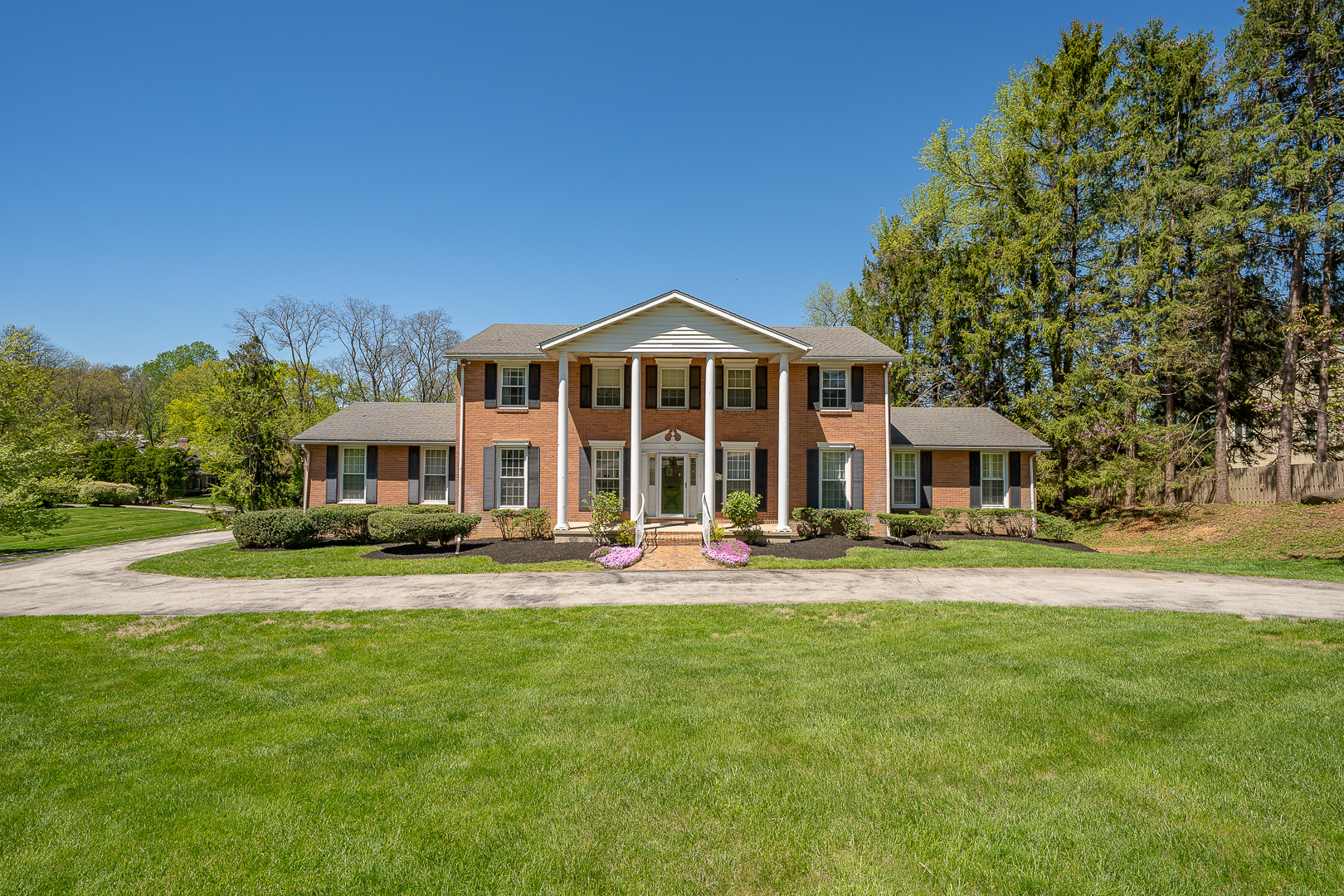
This six-bedroom brick Gladwyne home exudes old world vibes thanks to its center hall layout and two-story pillar columns. Inside, the home feels contemporary. Some features include a formal living room with a double-sided gas fireplace, a formal dining room, an eat-in kitchen, and a first floor primary suite. The finished basement also has a fireplace and an ensuite bedroom. There’s an open house on Sunday from 2 to 4 p.m.
By submitting your written, visual, and/or audio contributions, you agree to The Inquirer’s Terms of Use, including the grant of rights in Section 10.
This suburban content is produced with support from the Leslie Miller and Richard Worley Foundation and The Lenfest Institute for Journalism. Editorial content is created independently of the project donors. Gifts to support The Inquirer’s high-impact journalism can be made at inquirer.com/donate. A list of Lenfest Institute donors can be found at lenfestinstitute.org/supporters.
Happy Thanksgiving! With one holiday here and several others fast approaching, we’ve rounded up over a dozen events you’ll want to add to your calendar. Also this week, the Delco-set HBO series Task will return for a second season, SEPTA is getting additional funding for Regional Rail car repairs, plus a gift guide with a very Philly twist.
Christmasland returns to Linvilla Orchards, where visitors can cut their own tree or pick a pre-cut one.
The holiday season is officially upon us and with it, a slew of festive events. Whether you’re looking to snag a picture with Santa Claus or be dazzled by light displays, there’s no shortage of things to do in and around Media.
We’ve rounded up more than a dozen holiday festivities this season, including shopping pop-ups, holiday parades, cookie swaps, and more.
Trash and recycling pickups are operating on an altered schedule this week for the holiday. For more information on pickups, check the Media, Middletown Township, or Swarthmore websites, or for Nether Providence Township residents, check with your private trash collector.
Heads up for drivers: Valley Road between Darlington and New Darlington Roads will be closed from 8 a.m. to 3 p.m. next Wednesday through Friday for water main work.
Gov. Josh Shapiro is sending $220 million to SEPTA, funds that will help the transit agency with repairs to its Regional Rail cars. Problems that arose while SEPTA inspected its Silverliner IV fleet caused a painstaking return to service and commuter delays. With the fresh capital, SEPTA aims to return service to normal capacity in the next few weeks.
A pair of Swarthmore residents last week were accused of causing $130,000 in losses to a company after allegedly stealing and using corporate credit cards for their own purchases. They were arrested last week before being released on unsecured bail. (Patch)
Swarthmore College will continue its test-optional admission policy for up to five more years as many schools continue to de-emphasize SAT or ACT scores in admissions decisions. (The Phoenix)
Speaking of shopping, 6abc recently visited Swarthmore thrift store Heart & Soul’d to chat with owners Terry Crossan and Kristen Mancini about their mission. The sisters’ shop, which sells an array of donated goods, helps benefit foster and adoptive services in the county, something close to their hearts given both have adopted daughters themselves. Watch the segment here.
Those shopping in Swarthmore’s town center will get free parking on Fridays, Saturdays, and Sundays starting this weekend and running through the end of the year. In Media, the borough will have free daily parking at the Baltimore Avenue garage today through New Year’s Day.
RTMSD is closed today and tomorrow for Thanksgiving.
WSSD is closed today and tomorrow for Thanksgiving. Keystone testing dates begin Wednesday.
🍽️ On our Plate
In case you missed it, Media is getting a new Mexican BYOB. Taquero features authentic dishes from around the country, including street foods and tacos, and is now planning to open on Monday.
🎭 Annie: The Media Theatre kicks off its run of the beloved Broadway hit about an orphan who finds an unlikely champion in a billionaire. ⏰ Friday, Nov. 28-Sunday, Jan. 4, days and times vary 💵 $27-$47 📍 The Media Theatre
🎶 The Whitewalls: The nine-piece horn Philadelphia party band specializes in R&B, funk, pop, disco, and Top 40 tunes. ⏰ Saturday, Nov. 29, 8:30 p.m. 💵 Free 📍 Shere-e-Punjab
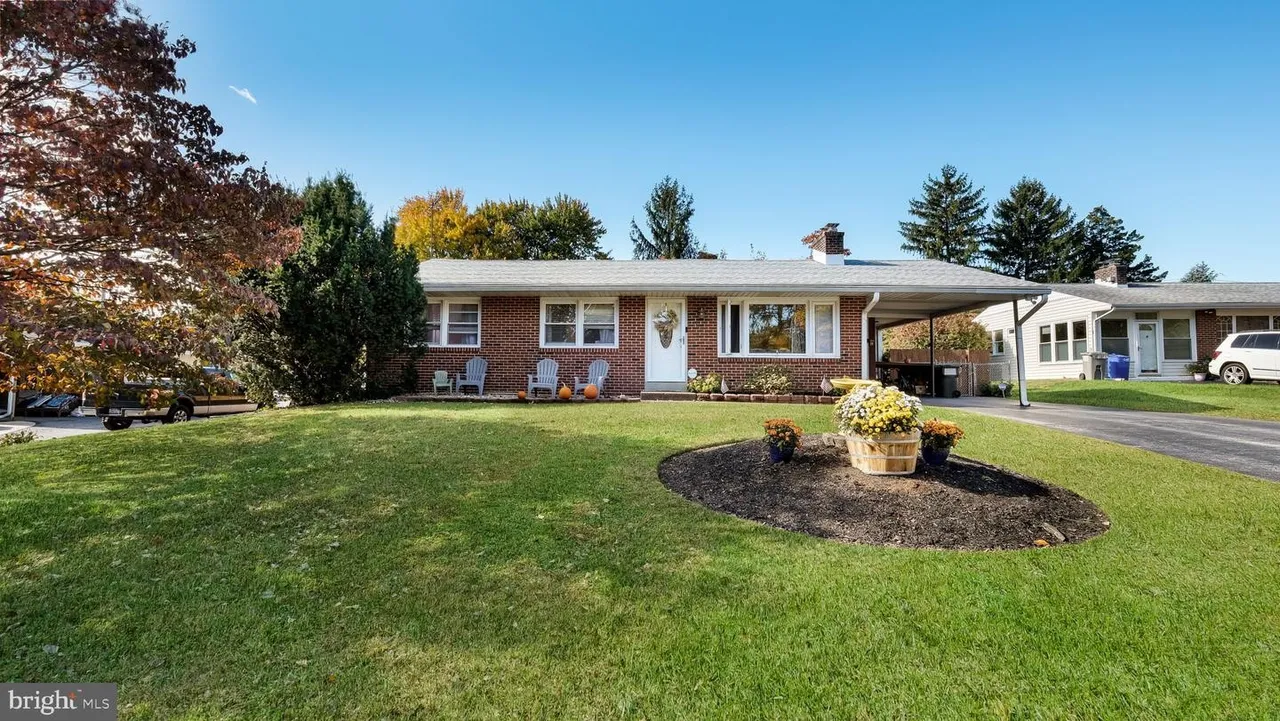
The home spans 3,300 square feet and has an above-ground pool.
Built in 1957, this updated brick ranch offers single-floor living with a living room, dining room, kitchen, and four bedrooms all situated on the ground level. It also has an enclosed rear porch leading to a fenced backyard, where there’s an above-ground pool. There’s also a finished basement. There are open houses this Friday, Saturday, and Sunday from 1 to 3 p.m.
By submitting your written, visual, and/or audio contributions, you agree to The Inquirer’s Terms of Use, including the grant of rights in Section 10.
This suburban content is produced with support from the Leslie Miller and Richard Worley Foundation and The Lenfest Institute for Journalism. Editorial content is created independently of the project donors. Gifts to support The Inquirer’s high-impact journalism can be made at inquirer.com/donate. A list of Lenfest Institute donors can be found at lenfestinstitute.org/supporters.
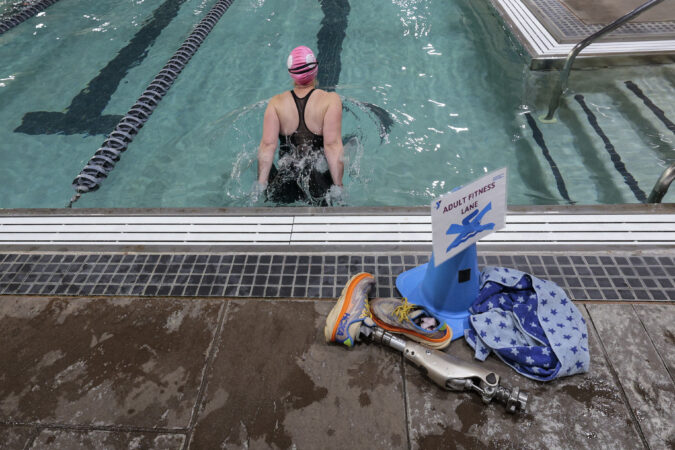
Stephanie Dunn, who at first introduction has the warm disposition and positivity of someone who has never had a bad day, will tell you that a life-threatening, flesh-eating infection in her foot and the subsequent amputation of her left leg are not the hardest challenges she’s had in life.
That distinction she reserves for motherhood.
But the recovery from the mysterious illness that struck Dunn in September 2022 has had its share of brutal moments.
Through the near-death experience, the onslaught of medical bills, and coming to terms with the fact that some aspects of her life would never be the same, the 52-year-old Schwenksville mom has worked to become as mobile as feasibly possible.
In a matter of years, she has upgraded to a prosthetic meant for high-impact use and more mobile amputees. It’s a cumbersome process that involves proving to insurers the patient is active enough to qualify for the prosthetics that offer a broader range of motion and shock absorption. Amputee forums are filled with stories of red tape and insurance rejections, telling patients the advanced prosthetics are not “medically necessary.”
“If I didn’t have two kids, I don’t know if I would have pushed myself to do it,” she said of the daily workout routines she has adopted in the years since her amputation. “I knew I had a responsibility to them and you can’t give up.”
This Thanksgiving, Dunn, who never considered herself athletic before she lost her limb, hopes to put her current prosthetic to the test, walking in her local Gobble Wobble.
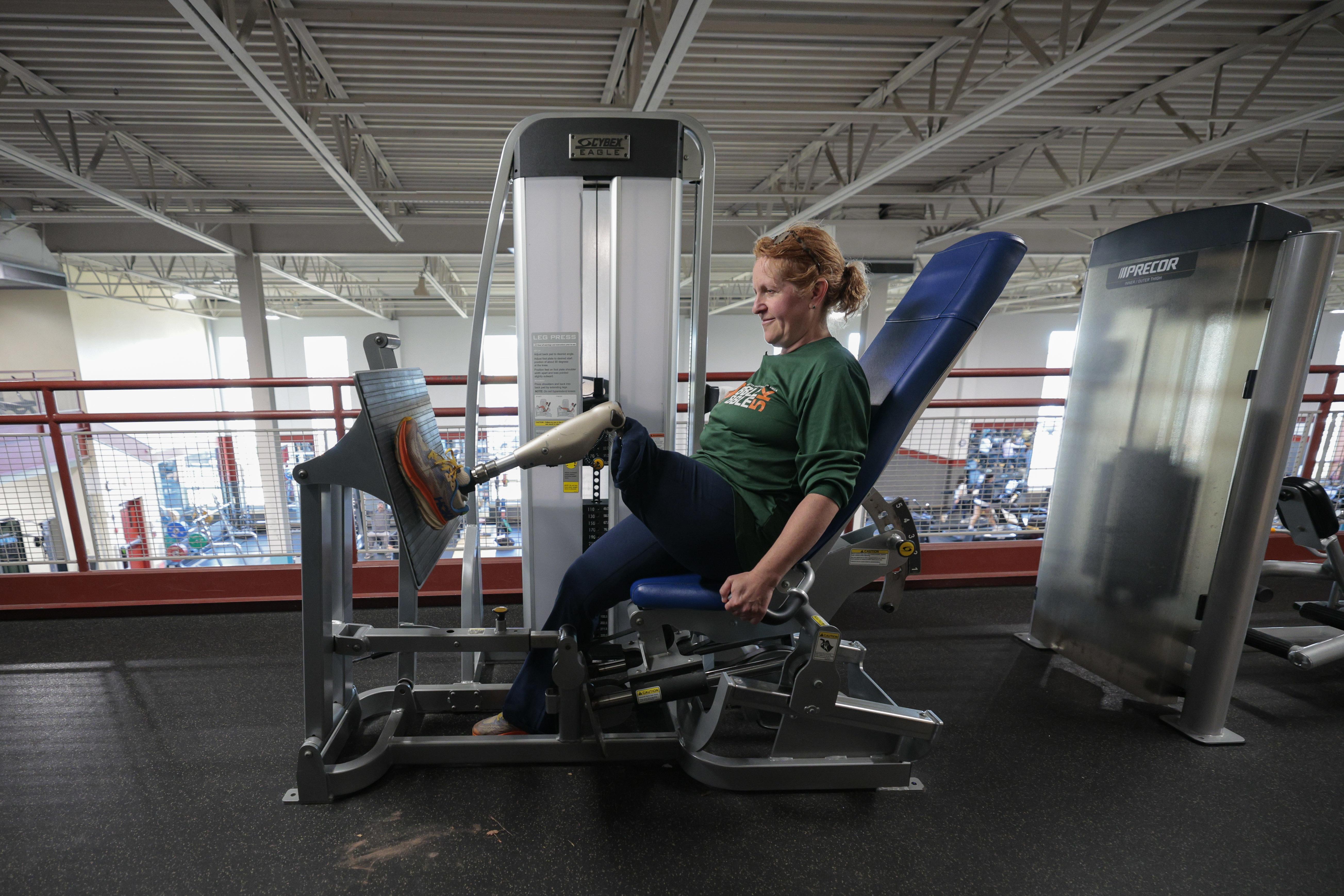
Stephanie Dunn had to have her leg amputated because of a rare bacterial infection two years ago. She credits the Spring Valley YMCA, in Royersford, where Dunn was using a weight machine with her prosthetic legs on Monday.
Hosted by the Greater Philadelphia YMCA, the Spring Valley event offers a 5k event and a mile walk. For her first Gobble Wobble with a prosthetic, in 2023, Dunn cut some sections of the walk. Last year, she finished the loop but came in last. Dunn believes she can beat that performance this year. She also hopes it will serve as a milestone on her way to an even more ambitious goal: qualifying for a running blade along with a grant to pay for it.
And while Dunn doesn’t see herself as an amputee advocate or role model — she reserves that designation, perhaps incorrectly, to the “super-fit people out there running marathons” — she hopes her story will let people in similar situations know the journey to mobility is hard but possible with the right support system.
This year’s Gobble Wobble is as much of a personal test for Dunn as it is a bit of an ode to the wheelchair-accessible Spring Valley YMCA, which has been a lifeline and refuge in the years following her amputation.
“When [the amputation] first happened, I thought, ‘Oh, my God, I’m on the periphery of society now. I’ll never be able to do anything normal,’” she said, remembering how she avoided grocery stores at first. “But I did. I could come here.”
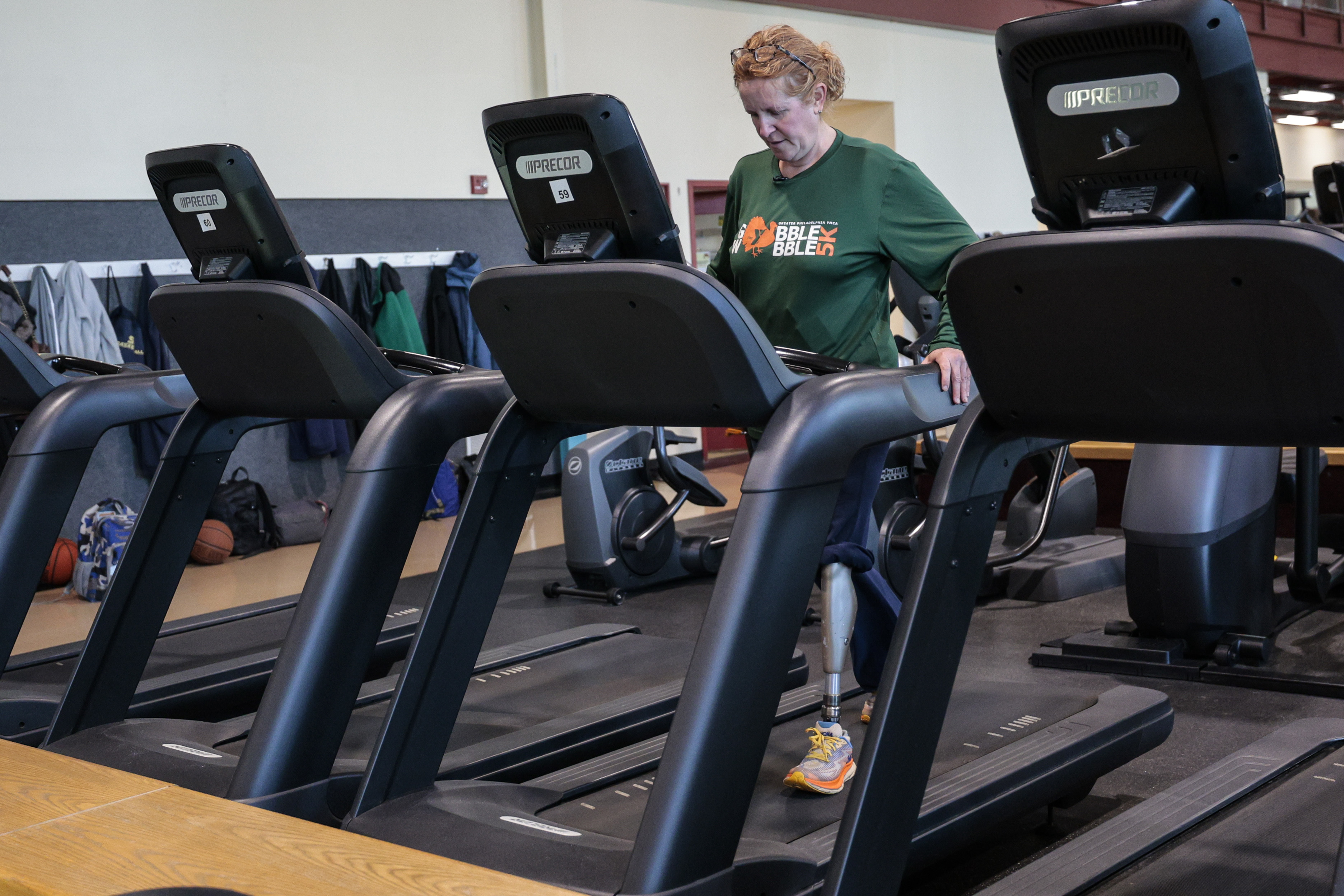
Stephanie Dunn had to have her leg amputated because of a rare bacterial infection two years ago. She credits the Spring Valley YMCA, in Royersford, where Dunn was working out on the treadmill Monday.
The challenges facing America’s growing number of amputees
For Dunn, a throbbing left foot and waves of bile vomit ended up being necrotizing fasciitis, source unknown.
The flesh-eating bacteria gnawed away at her limb in a matter of days, led to sepsis, and nearly reached her chest. Dunn said the amputation saved her life.
Yet there is much more to an amputation than the operation itself.
The Amputee Coalition says 36% of people living with limb loss experience depression. Many find themselves physically unable to return to demanding jobs that require fast movement or heavy lifting. Dunn, who had been a speech pathologist for 19 years, has come to terms that she cannot do the job full-time without risking an injury, even with her prosthetic.
And while a Government Accountability Office report expects the number of people living with limb loss to double by 2050, online forums remain full of people looking for advice on how to get their insurers to pay for prosthetics that will help with mobility.
Dunn’s experience navigating healthcare is only a snapshot of the challenges facing amputees.
After the amputation, she faced a growing mountain of medical bills and paperwork. As Dunn managed pain and the care of her two young children, she had to go from her home in Schwenksville, Montgomery County, to South Philly to “prove” she had actually had her limb amputated in order to apply for disability benefits.
Then there was the process of qualifying for a prosthetic.
The most basic below-the-knee prosthetics cost $3,000. There is no secondhand market because each is molded to the person. Even so, as limbs naturally change size and swell or contract throughout the day, users will have to adjust. It’s why amputees sometimes stuff socks in their prosthetics.
The more advanced prosthetics provide more mobility but easily run into the tens of thousands of dollars. Private insurance runs the gamut in terms of coverage, with many amputees reporting better luck through Medicare or Medicaid. But going with public insurance comes with other considerations, such as income limits.
“You can’t financially get ahead at all,” said Dunn, who was making a six-figure salary before her amputation. “You can just barely make ends meet.”
In the early post-op days, Dunn said, lying in bed and sitting in a chair were her biggest temptations — they often are for recent amputees. But skipping the at-home workouts assigned by her physical therapist risked muscle spasms and stiff muscles in the remaining part of the limb. To lose flexibility in the limb makes it harder to move with a prosthetic.
Determined to become mobile, Dunn headed to her local Y branch.
Dunn said in those early post-op days, lying in bed and sitting in a chair were her biggest temptations — they often are for recent amputees.
A gym offers refuge and resources
To walk alongside Dunn at the Spring Valley Y is to accompany a minor celebrity. Dunn jokes that it’s the prosthetic leg, though that feels like she’s selling herself short. She is at the gym every day for anywhere between 30 minutes and three hours.
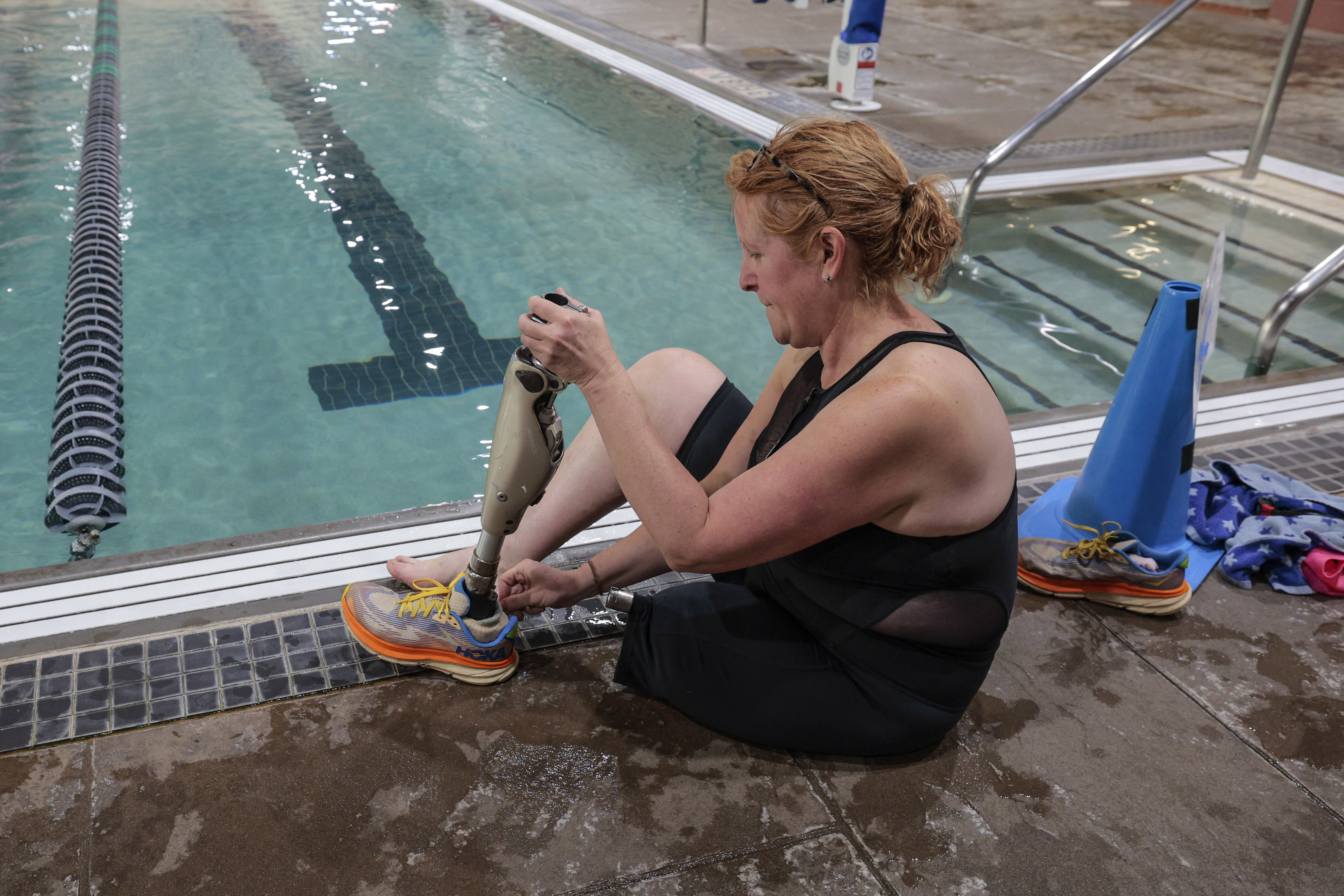
“You must’ve had a good night’s sleep,” shouts a lifeguard taking his perch after Dunn completed several laps in the pool. One of the many greetings thrown over the hum of the pool machinery.
Part of the Greater Philadelphia YMCA, the Spring Valley branch was familiar to Dunn before her injury because of the programming her children took part in, which only became more important during her two-month stay at the hospital.
The children participated in the branch’s before- and after-school care, which Dunn credits with giving the boys a routine as she regained her strength.
But the facility was also primed to aid in her recovery in small ways that added up.
Before Dunn renovated her bathroom to be wheelchair-accessible, the Spring Valley Y was the only place she could shower.
Soon, Dunn was navigating the gym equipment and pool. She could park her wheelchair along the pool’s edge and get in the water, where she enjoyed what she described as a weightlessness.
Dunn still had days when she cried in the parking lot or the bathroom, but she kept coming to get on the sit-up machines and for the aquatic dance classes. Not once did she feel out of place, she said.
The mental boosts served to buoy her physical gains and vice versa. It’s a rhythm she longs for other amputees to find.
“I maintained the range of motion in my limb, so that when I did get measured for a prosthetic to see what kind of prosthetic I could qualify for, as far as insurance and what I could use … I got a higher-level prosthetic than if I hadn’t come here,” she said.
That said, a robust support network or gym can’t fix the healthcare system, and Dunn continues to navigate the logistics of getting the prosthetics she needs to live the life she wants with her children.
Dunn said she had to travel to New York City in order to get a one-step procedure that would allow a rod to be embedded in what is left of her femur. Approvals took six months.
And even as Dunn gets more comfortable with her prosthetic, there is tweaking to be done. She has been dealing with pain that is constantly in the background.
Still, Dunn characterizes these as small bumps along the way, as she does with many of the challenges she has navigated postamputation.
She said going through fertility treatments to have her boys and the quandaries of raising them as a single mom by choice weighed much more heavily on her.
Back then, when things felt particularly dire, she would tell herself: If at any time you want to stop, just stop.
In the case of her mobility journey, as with conception, Dunn has yet found a reason to call it.
A trail planned in Montgomery County is getting new funding to take the project to the next step.
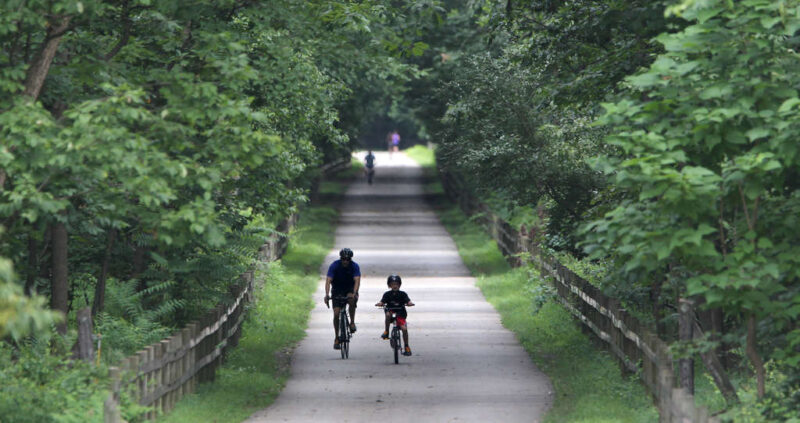
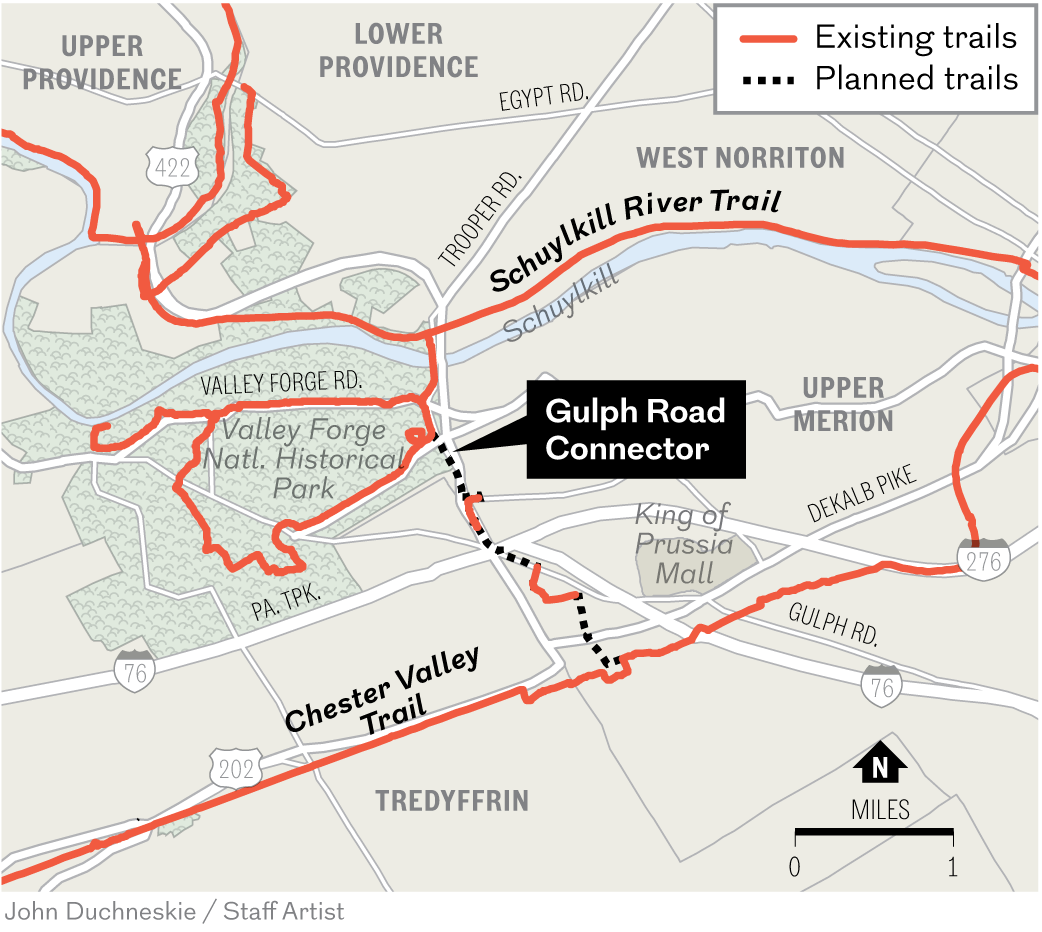
The “Gulph Road Connector,” as it is currently called, is slated to connect to the Chester Valley Trail near the King of Prussia Mall, cross through Valley Forge National Historical Park, and link with the Schuylkill River Trail when completed.
The project was recently awarded a three-year $326,900 grant from the William Penn Foundation, which will begin in January, said Eric Goldstein, president and CEO of the King of Prussia District, which is leading the project. The official name of the trail has not been determined.
The influx of funds is slated for education, advocacy, and marketing, said Goldstein, who noted that the foundation is supporting “efforts to build a coalition of advocates” for the trail. The money will not be used for design or construction.
Segments of the planned 2.8-mile trail connector are in stages of design and construction, with some already built, Goldstein said.
“What we’re trying to do is ultimately fill in the blanks to make the 2.8-mile section complete,” he said.
Goldstein said the new funds will allow the King of Prussia District to work with different partners along the trail. The aim is to build a coalition and raise awareness of the proposed trail, which ideally would lead to more grant money down the line for design and construction, he said.
Map of the planned Gulph Road Connector trial near King of Prussia.
The new funding is “the impetus for this trail to start moving toward completion,” said Molly Duffy, executive director of the Valley Forge Park Alliance, a partner organization in the trail’s development.
There is no estimate yet for the total cost of the project, Goldstein said.
The project is part of the Circuit Trails, a regional network that aims to have more than 850 miles of trails through nine counties. Once the trail is built out, Goldstein said, he expects it will be managed by multiple entities, depending on the section.
He hopes to be able to complete the trail in the next 10 years.
Some parts of the trail are “enormously complex,” he noted, adding that pedestrian bridges over sections of highway would require complex engineering and be costly — which requires raising funds.
While the trail is expected to be used for recreation, it could also be an option for commuting to work.
“The second audience of this proposed trail network is employees that work in Upper Merion Township that are seeking alternative modes of transportation to get to and from work,” he said.
The trail also could make Valley Forge National Historical Park more accessible by ways other than driving, Duffy said.
“We want people to be able to get here,” Duffy said. “Knowing where this is — in this super densely populated suburban area — we know that there’s this missing link, really, between these two major trails that, once built, will literally connect thousands and thousands of people who live in the area, work in the area, are visiting the area.”