Democrats swept two law enforcement races in Bucks County, ousting the incumbents and signalingthe swing county has soured on President Donald Trump just a year after voting for him.
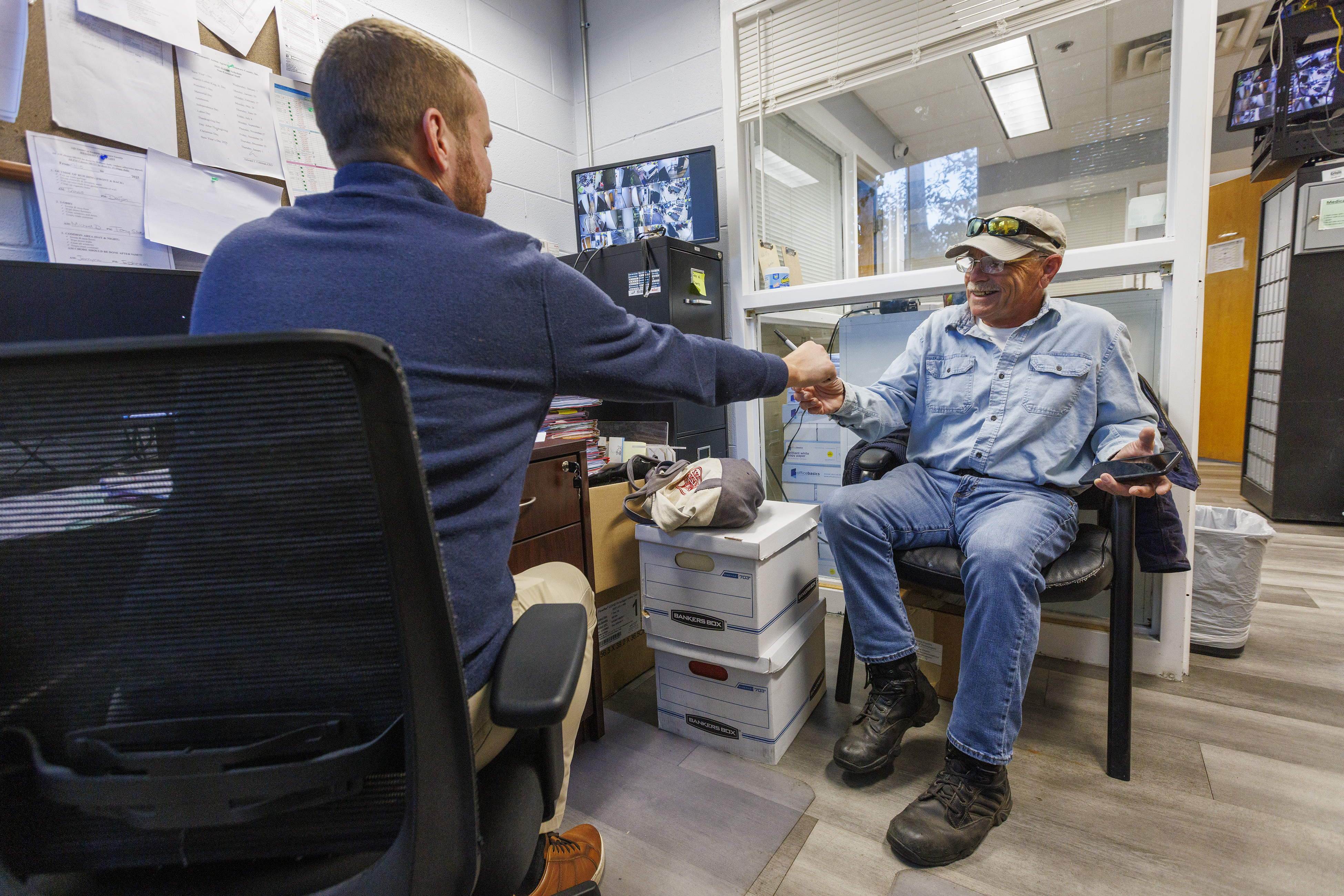
Democrat Danny Ceisler, an Army veteran who held a public safety role in Gov. Josh Shapiro’s administration, led Republican Sheriff Fred Harran by 12 percentage points with all precincts reporting Wednesday morning. The sheriff race centered on Harran’s controversial decision to partner his agency with ICE as Trump ramps up immigration enforcement nationwide.
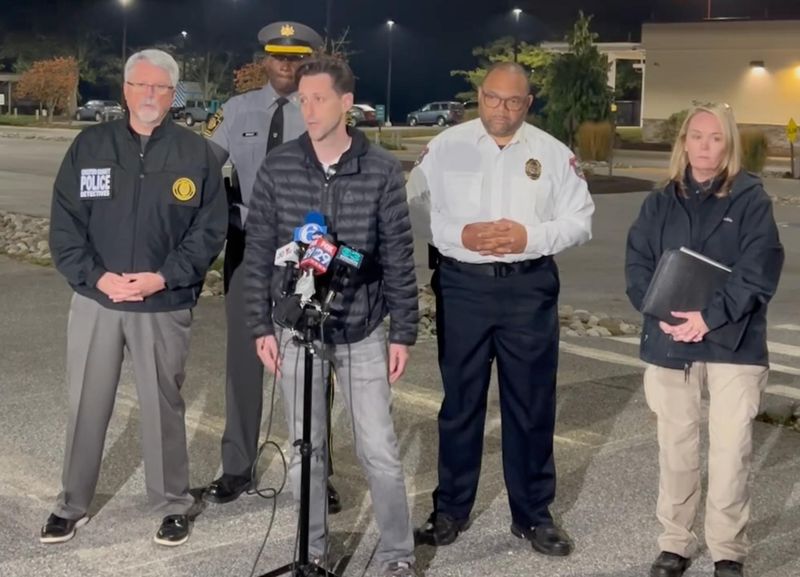
And former Bucks County Solicitor Joe Khan led Republican District Attorney Jen Schorn by eight percentage points. Democrats believe Khan is the first member of their party to ever be elected to the office.
Bucks County Democrats declared victory just after midnight Wednesday morning — sweeping every countywide race. The victories came in what appeared to be a blue wave election as voters rejected Republican candidates in Pennsylvania, New Jersey, and Virginia.
“What’s going on with our federal government is not normal, and voters saw that creeping into local offices, and they overwhelmingly rejected it,” Ceisler said Wednesday. “Bucks County doesn’t let extremism come inside.”
The hotly contested Bucks County races centered on some of the most contentious issues in national politics — Trump, crime, and immigration. Democrats sought to paint the incumbents as Trumpian ideologues, while Republicans warned voters of an influx of “Philly crime” if Democrats took office, even as the violent crime rate in the city has dropped from its pandemic peak.
Voters opted for a change, delivering both offices to Democrats and, as result, spelling the end to a controversial partnership between the sheriff’s office and U.S. Immigration and Customs Enforcement.
Bucks was the only county in the Philadelphia area to go for Trump last year and will be a key battleground in 2026 when Shapiro runs for reelection. Tuesday’s wins will give Democrats momentum going into the midterms.
Democrats, Khan said, had to work to prove to voters they could be trusted with public safety. They were aided by a favorable dynamic as voters rejected Trumpism.
“It was a campaign not about attacking somebody else but, really, making really clear that we deserve better than what we’ve got,” Khan said.
Voters at the polls persistently expressed frustration with Trump, and a sense that anyone from his party should not be trusted in office.
“They’re subject to his control, regardless of how they feel on issues,” said Stephanie Kraft of Doylestown. “And that affects everything, from our local courts on up to the higher courts in the state.”
The effort succeeded, indicating that Bucks voters are already disenchanted with the president they voted for just a year ago. The vote may set off alarm bells among Republicans as they prepare for next year’s election, when Republican Treasurer Stacy Garrity seeks to oust Shapiro and Republican U.S. Rep. Brian Fitzpatrick stands for reelection.
The Democratic victory is “on everything that Trump is doing to undermine the institutions of democracy, but it’s also on Trump’s failure to really reverse inflation,” said State Sen. Steve Santarsiero, the chair of the Bucks County Democratic Party.
Even so, for several voters, Harran’s partnership with ICE was the final straw.
Jill Johnson worried it would result in the targeting of Latino citizens, including her half-Mexican son, who is away at college.
“My biggest fear is that someone in a mask is going to come up and grab him because they think he’s here illegally,” Johnson said. “It’s scary. These are law-abiding people who have done nothing wrong.”
The partnership, which recently became active after months of planning, provoked backlash, including a lawsuit, public demonstrations outside the courthouse, and a repudiation by the Democratic-led board of commissioners.
Ceisler said Wednesday that he will issue a moratorium barring deputies’ cooperation with ICE on his first day in office. From there, he said, he will figure out how to disentangle the sheriff’s office from the agreement signed by his predecessor.
For his part, Harran said Wednesday that Ceisler will “have to answer for a person who becomes victimized by an individual that should have been deported. And he’ll have to sleep with that, and it’ll be on his head, not mine.”
Officials with U.S. Immigration and Customs Enforcement declined to comment.
Harran, an outspoken Republican who endorsed Trump last year and frequently clashes with the Democratic commissioners, was elected sheriff in 2021 after more than a decade leading Bensalem’s police department.
The Republican has expanded the role of the sheriff’s department, adding a K-9 unit and partnering with immigration officials, but faced criticism that he was failing to complete the basic duties of his job, such as executing warrants and protecting the courthouse.
Ceisler advocated taking politics out of the office, saying he would focus on domestic violence and pledging to end the partnership with ICE. He argued his experience in the Army and in a public safety leadership post under Shapiro prepared him to serve as sheriff — though Harran argued Ceisler would be unprepared for the job, having never worked in a sheriff’s office or police department.
“Being the sheriff isn’t on-the-job training,” Harran said at a Bristol polling place Tuesday. “You need knowledge and experience.”
Ceisler said he had spoken to Harran after the results came in and the incumbent promised to assist with a smooth transition.
Schorn, a veteran Bucks County prosecutor, lost in her bid for a full term after being appointed district attorney last year when her predecessor became a judge.
She had been an assistant district attorney in the county since 1999, prosecuting some of the county’s most high-profile cases. When she became district attorney, Schorn started a task force in the county to investigate internet crimes against children.
Khan, a former county solicitor and federal prosecutor, argued Schorn ran the office under “Trump’s blueprint” and criticized her decisions not to recuse herself when a Republican committeeperson was charged with voter fraud and not to prosecute alleged child abuse at Jamison Elementary School.
Schorn has said she was unable to discuss the details of the Jamison Elementary School case due to rules governing prosecutors, but Khan argued her explanations were insufficient as parents sought answers.
Schorn performed slightly better than her GOP counterparts in Bucks County on Tuesday. But, while many voters said they had no issue with Schorn’s policies, her political party was a turnoff.
“I just feel the Democrats would be better right now; I’m down on all Republicans,” said Marybeth Vinkler, a Doylestown voter who said she had no problems with how Schorn had run the district attorney’s office. “Everything happening in D.C. is trickling down around us.”
Schorn did not immediately comment on the results Wednesday.
Jim Worthington, who has run pro-Trump organizations in Bucks County, said Republicans failed to turn out voters on Election Day even as data showed Democrats held a significant lead on mail voting ahead of Tuesday.
“This is where the GOP was asleep at the wheel,” Worthington said.
Traditionally, voters trust Republicans more with law and order. The resounding victories for Democrats defied that trend.
“We now have an obligation to deliver and to show that Democrats can lead on the issue of safety,” Ceisler said.
“The ball is in our hands, and we’re ready to run with it.”
Staff writer Jeff Gammage contributed to this article.
This suburban content is produced with support from the Leslie Miller and Richard Worley Foundation and The Lenfest Institute for Journalism. Editorial content is created independently of the project donors. Gifts to support The Inquirer’s high-impact journalism can be made at inquirer.com/donate. A list of Lenfest Institute donors can be found at lenfestinstitute.org/supporters.
By most measures, Erica Deuso’s campaign for mayor of Downingtown is unremarkable.
She spends Saturday mornings greeting residents at the farmers market and her weekend days knocking on doors in the Chester County borough. Most of the time, she’s talking about traffic and community events.
Democratic supporters pose with current Downingtown Mayor Phil Dague, center, Chester County Commissioner Josh Maxwell, center left, and mayoral candidate Erica Deuso, center right.
For most voters, though, those facts didn’t even register.
Deuso, who works in management at a pharmaceutical company, has lived in Downingtown for 18 years.
She is a committeewoman in the local Democratic Party, and board member for Emerge Pennsylvania, which trains women and LGBTQ+ people to run for office. Her platform centers on traffic control, domestic violence, community engagement, and sustainable development.
The Downingtown mayor has relatively limited power, overseeing the police department and acting as a tiebreaking vote on borough council. Deuso has promised not to sign an agreement between Downingtown police and U.S. Immigration and Customs Enforcement and said she wants to work on enhancing mental health services for officers while expanding their reach in the community to address concerns over traffic violations and e-bikes.
As she knocked on doors on a Saturday morning in October, Deuso’s gender identity rarely came up in her interactions with voters.
“I’m not running on being trans, that’s not something I ever do or ever wanted to do. I wanted to make it about the neighbors,” Deuso said. “It’s the other side making it about who I am, my identity.”
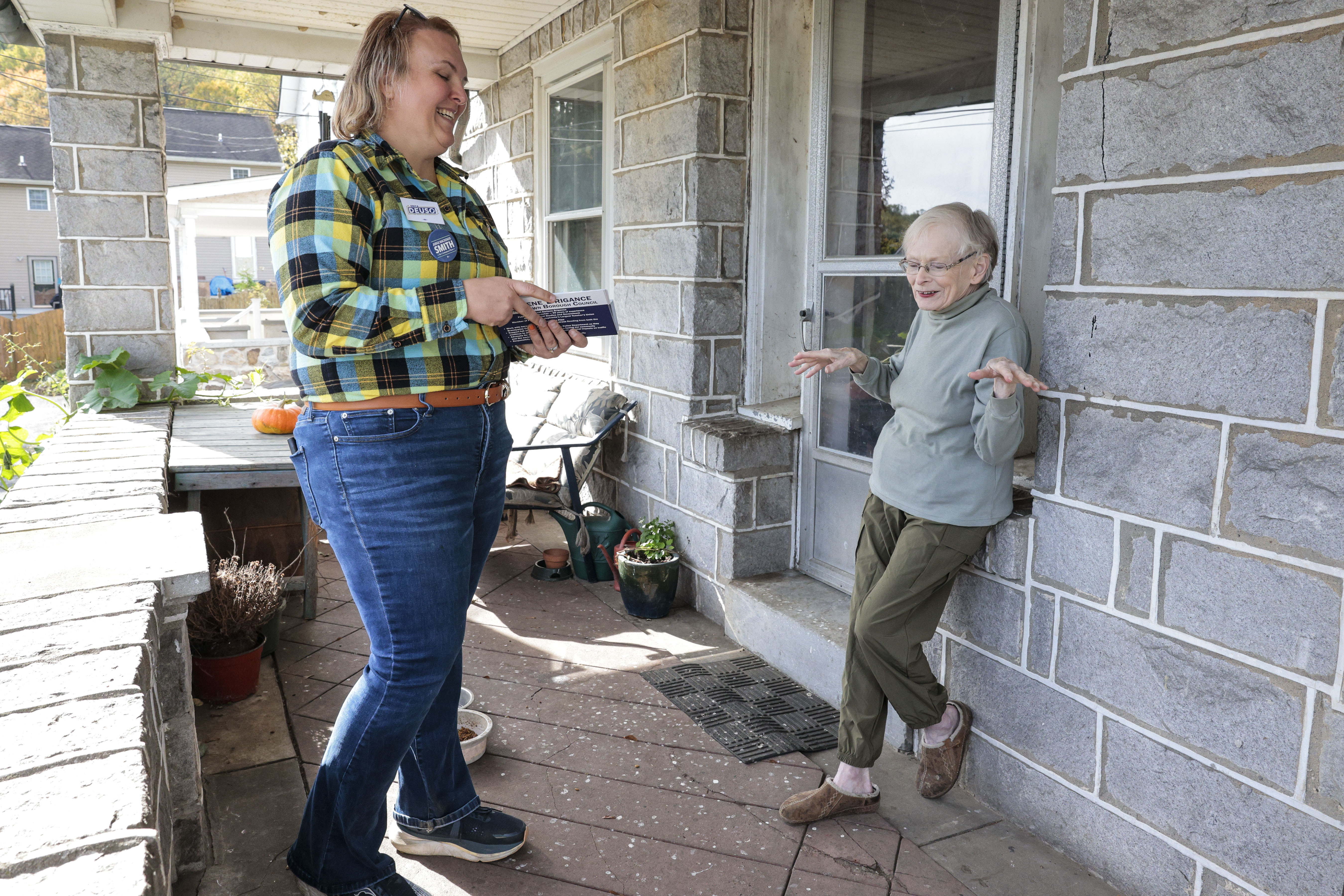
Going door-to-door looking for votes in Downingtown in October, Erica Deuso meets Nicole Flood at her door.
The historic nature of her campaign has likely driven attention and funds to the race. She has earned endorsements from several organizations that back LGBTQ+ and women candidates. And she’s received donations from outside the state and outside Chester County, including a $3,000 donation from Greater Than PAC, which supports progressive women.
But a scan of comments in community Facebook pages shows her identity has also driven more vitriol.
“There are people who refuse to use my correct name or pronouns, they’ve deadnamed me, all those sorts of things. But it’s been 16 years since I transitioned; I don’t really care,” Deuso said. But she’s mindful that LGBTQ+ youth are watching her. She engages in some of the posts, but not all of them.
“I want to handle it with grace.”
Those efforts are already influencing at least one local teen. Nicole Bastida-Moyer, a 39-year-old voter, told Deuso her candidacy had inspired her 14-year-old daughter to volunteer to help other students with their mental health. Both she and her daughter are pansexual.
“She deals with a lot of hate,” Bastida-Moyer said through tears about her daughter.
“Having Erica’s voice, it means a lot,” Bastida-Moyer said.
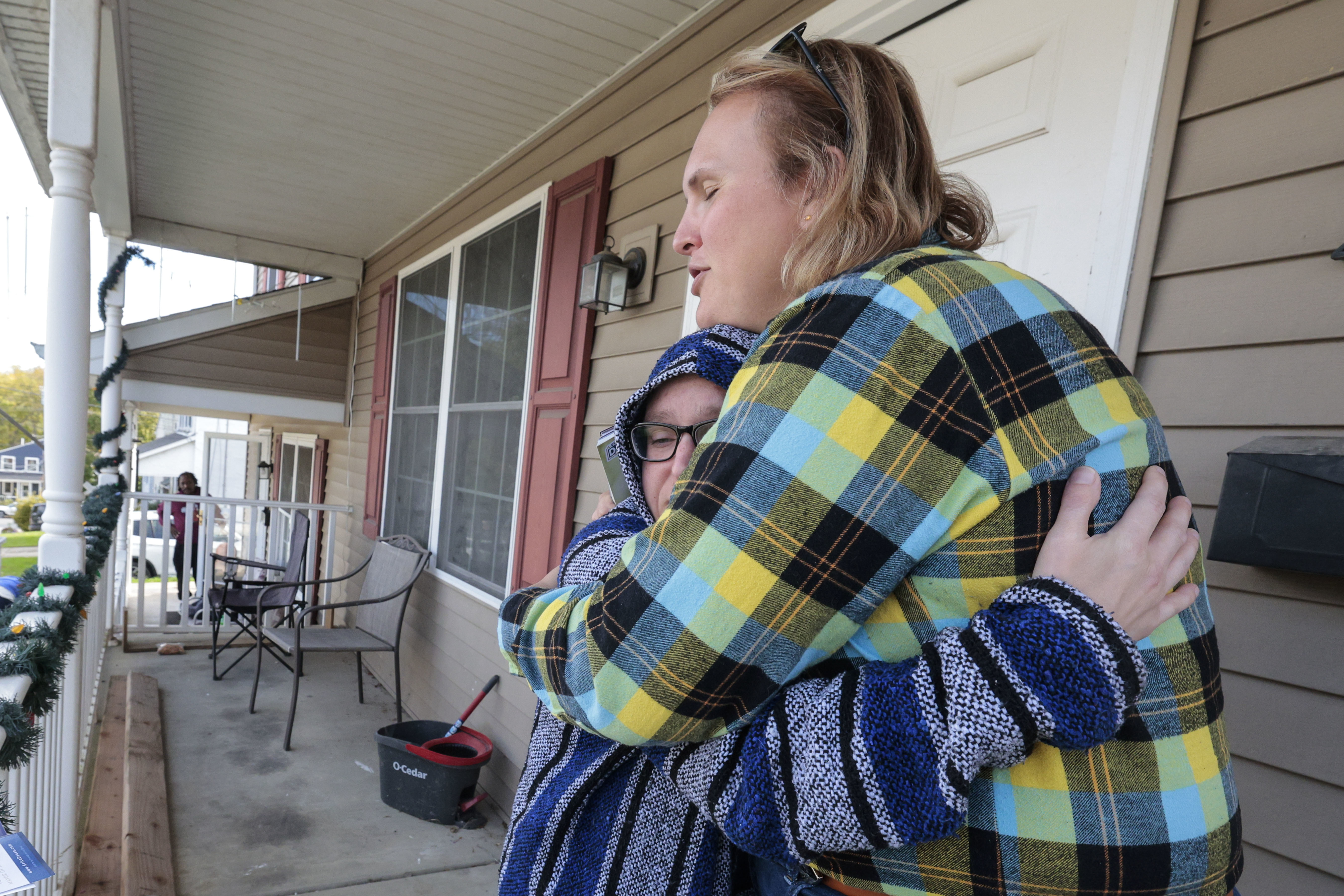
Nicole Bastida-Moyer gets a hug from Downingtown mayoral candidate Erica Deuso while campaigning in October.
Impact on voters
Deuso responds to comments on her Facebook page and other groups occasionally. She said she tends to do so only when she thinks a true conversation can come of it.
Door-knocking in her neighborhood, Deuso encountered just one voter who appeared to be hostile to her because of her gender identity. When Deuso approached one house, a woman came to the door and glanced at the candidate and her fliers through the screen door without opening it.
“I’m not voting for him,” the woman said. “For who?” Deuso asked as the woman turned and walked away.
Episodes like this are relatively rare, Deuso said
“People are generally much nicer in person than online,” said Jenn Fenn, who managed U.S. Rep. Chrissy Houlahan’s 2024 reelection campaign in a district that includes Downingtown.
Deuso’s opponent, Republican Rich Bryant, says he doesn’t condone those who attack Deuso based on her identity.
But Deuso has shared several screenshots on social media that appear to show Bryant insulting transgender women and making misogynistic remarks about cisgender women. At a canvass launch at the local farmers market, the township’s current mayor, Democrat Phil Dague, referenced these posts while comparing Bryant to Trump.
Current Downingtown Mayor Phil Dague talks with supporters for Erica Deuso listening at right. Saturday October 18, 2025.
Bryant claimed 90% of these posts are AI-generated but refused to say which posts are real and which are fake.
“I don’t like mud-slinging misinformation,” Bryant said. “I try to stay focused on what’s good for Downingtown.”
Rich Bryant is running as a Republican for Downingtown mayor.
He sought to present himself as better experienced than Deuso to be mayor, contending his career in cybersecurity has prepared him for the mayor’s primary duty of overseeing the local police department.
Alice Sullivan, an 80-year-old neighbor and donor to Deuso, had noticed some of the nastiness on social media and said she was voting for Deuso because, unlike her opponent, she wasn’t a “bigot.”
She lamented the online attacksagainst Deuso as disappointing — but unsurprising. The candidate’s gender identity shouldn’t matter, insisted Sullivan, who has lived in Downingtown for decades.
“Other people’s lives, genders, whatever is not my business,” she said.
Josh Maxwell, a Democratic county commissioner and former Downingtown mayor who had joined Deuso to knock doors, asked if Sullivan thought others would disagree in the historically Catholic community. But the people who cared, Sullivan argued, are “not going to vote Democrat anyway.”
“There might be some,” she said. “I don’t know very many.”
Campaigning in the west end of Downingtown Erica Deuso greets Alice Sullivan on Oct. 18.
As Deuso walked door to door, her conversations focused on local and community issues. She greeted every dog she saw and spoke to their owners about their safety concerns — drivers had been racing down quiet neighborhood streets — and their concerns about the community. Deuso is proposing a program to offer hotel rooms for one night to those facing domestic violence.
She also made it clear that she would be a resource, even on issues that went beyond the mayor’s official duties. She showed one voter how she had started a youth-driven art project at a recent township festival. And pointed to a home that, just weeks prior, she’d brought a misdelivered package to on behalf of a voter.
For weeks, Raul Hurtado, Deuso’s neighbor who immigrated from Colombia in the 1990s, has been rolling down his windows when he sees Deuso, telling her he’s voting for her.
“She is from this town, my neighbor, and we need someone to help us,” Hurtado told The Inquirer.
If she’s elected, Deuso told Hurtado, her goal is to be available to all residents through office hours at Borough Hall.
“We can have a face-to-face discussion,” she said. “Not through your car window.”
This suburban content is produced with support from the Leslie Miller and Richard Worley Foundation and The Lenfest Institute for Journalism. Editorial content is created independently of the project donors. Gifts to support The Inquirer’s high-impact journalism can be made at inquirer.com/donate. A list of Lenfest Institute donors can be found at lenfestinstitute.org/supporters.
A woman was shot in the wrist and a man was arrested after what police say appeared to be a road rage incident Monday evening in Bucks County.
Around 6:30 p.m., police responded to a reported shooting in the area of the Newtown Bypass and Woodbourne Road in Newtown Township.
The woman, who was driving one of the vehicles involved in the incident, was transported to St. Mary Medical Center and was listed in stable condition, police said.
A few minutes later, the man and the vehicle he was driving were located at Washington Crossing and Stoopville Roads, and he was taken into custody, police said. A gun was recovered for evidence.
Police said both vehicles reportedly were traveling east on Newtown Bypass during the initial encounter and then south onto Woodbourne Road.
Anyone who witnessed the incident or has information helpful to the case can contact the Newtown Township Police Department at 215-579-1000 ext. 317.
New Jersey’s beaches, still recovering from major sand losses from an offshore hurricane and a nor’easter, evidently are in for another assault this week as October is about to make a dramatic exit.
Gale-force gusts off the ocean could develop as early as Tuesday afternoon at the Shore, said Eric Hoeflich, a meteorologist at the National Weather Service office in Mount Holly, with brisk onshore winds persisting “maybe into Friday.”
A potent storm is forecast to affect the entire region Wednesday night into Thursday, with heavy rains in the immediate Philadelphia area, where drought conditions have been intensifying.
Also on Thursday, what is likely to become catastrophic Hurricane Melissa will be passing offshore, churning up the waves crashing on East Coast beaches.
“The coast once again is going to take a pretty good battering,” said Dave Dombek, senior meteorologist with AccuWeather Inc.
On the plus side, Hoeflich said, for the Shore, this week’s storm “doesn’t look as bad” as the beach-erasing nor’easter earlier this month. The path should be more inland, and the lunar influence on the tides would be less. Only minor flooding is expected, he said, subject to change.
However, not only would the track mean region-wide heavy rain, but it would also increase the potential for severe thunderstorms Thursday. A front is due to chase the rains Friday, but it may generate gusts to 50 mph, the weather service says. Power outages are possible both days.
The timetable for the winds and the storm in the Philly region
The National Weather Service has posted a gale warning for Tuesday into Wednesday morning for the waters along the immediate coast for winds from the east that could gust past 50 mph.
That would be more the result of high pressure to the north of the region. Winds circulate clockwise around centers of highs; thus, areas to the south of the center experience winds from the east.
The breezes will be getting a second wind as a storm develops in the Southeast and tracks north. Meanwhile, a weakened Hurricane Melissa will be churning the ocean as it passes well off the U.S. coast on Thursday.
A strong storm system will move across the region later this week. Here is a summary of expected impacts. pic.twitter.com/OvhoVAaS11
Rain for the last 30 days has been about a third of normal in the city and the neighboring Pennsylvania counties.
South Jersey has fared only slightly better, but precipitation is well less than half of normal.
What is the forecast for the trick-or-treaters?
It is all but certain that Friday will be a dry day, with temperatures in the low and mid-50s. Wind gusts are forecast to die down sometime after 5 p.m., but hold onto those brooms, just in case.
A Wilmington man brought his mother’s gun to Lincoln University’s campus Saturday, prosecutors said, and was still holding the loaded weapon when a deadly shooting tore through the school’s homecoming celebration.
Zecqueous Morgan-Thompson, 21, has not been charged in connection with the shooting, only with possessing the weapon without a concealed-carry permit. But investigators said they were still working Monday to determine whether his firearm was used in the incident at the historically Black university, which left one person dead and six others wounded.
Morgan-Thompson remained in custody Monday in lieu of $25,000 bail.
Chester County District Attorney Chris de Barrena-Sarobe said his office is trying to determine if more than one shooter was involved. Morgan-Thompson was arrested on the campus in the aftermath of the gunfire, holding a loaded Glock 28 .380-caliber handgun, according to the affidavit of probable cause for his arrest.
The shots rang out about 9:30 p.m. Saturday on the campus in Lower Oxford Township. De Barrena-Sarobe has said he does not believe the shooting was a coordinated attack targeting the school, but instead took place as the crowd swelled on the campus.
The motive for the shooting remained under investigation.
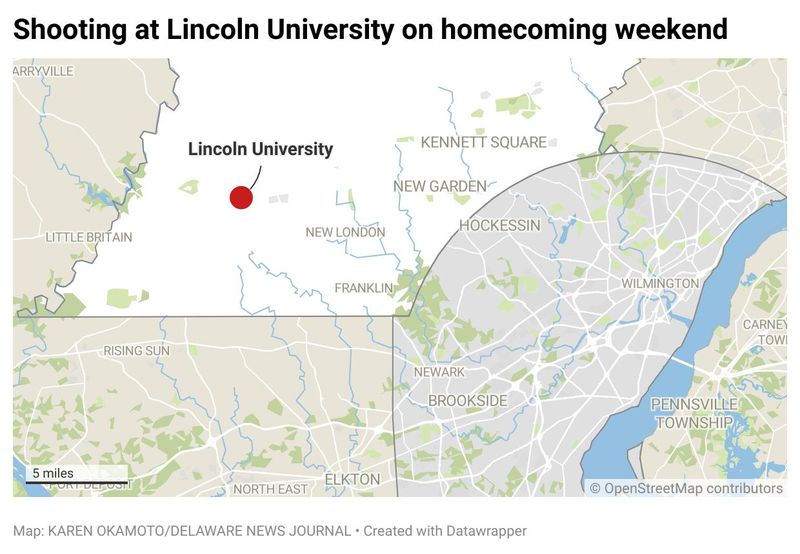
Gunfire rang out just before 9:30 p.m. Oct. 25 at Lincoln University in the parking lot of the International Cultural Center in Lower Oxford Township in Chester County, Pennsylvania. The university is about 15 miles from Hockessin.
Jujuan Jeffers, 20, of Wilmington, died after being shot in the head. It was unclear if Jeffers had any affiliation with Lincoln — investigators have said the victims included one alumnus and one current student.
Jeffers’ brother declined to speak with a reporter when contacted Monday.
The student who was hurt was recovering well, but obviously shaken, according to Chester County Commissioner Josh Maxwell, who is an adjunct professor at the school. Her injuries, he said, were not life-threatening.
Lincoln University canceled classes Monday in light of the shooting.
“Gun violence happens far too often in our country, and we are heartbroken that Lincoln University and its students are among the latest victims of such senseless violence,” the school said in a statement.
The rural campus was quiet Monday afternoon as students gathered for a vigil that gave members of the university community a chance to grieve and heal.
The service was not open to the media, and gates at various entrances to Lincoln’s campus were locked.
Geslande Sanne, a Lincoln University junior from Oregon, was in her dorm Monday morning, still coming to terms with the chaotic scene she experienced Saturday night.
“A lot of us on campus are processing it in our own different ways,” said Sanne, a political science and French major. “We are all reaching out to each other. Our professors are talking to each other and to us. Some students went home to be with their families. Some people are just resting.”
She said she intended to attend the university’s community healing session on campus at noon and later go to the hospital to visit her friend, who was the only Lincoln student shot during the incident.
Sanne recalled that she and a group of friends were on the outskirts of the crowd when they heard gunshots.
“Everybody started running and we started running, too,” she said. “We were confused. Did something really happen? After a few minutes, the music stopped, and we knew something really happened.”
She and her friends made a plan to get back to their dorms so they would be safe, but then decided to seek shelter inside the International Cultural Center building, not far from where the shooting took place.
After people started banging on the windows, she said, Sanne and her friends left there and walked carefully back to their dorms.
It all happened in about 20 minutes, she estimated.
Sanne said she chose to attend Lincoln because she wanted to go to an HBCU and was impressed by all its prominent graduates. She said she has received much encouragement and many opportunities at the school.
“It’s really inspired me,” she said, “that I can be a part of something positive despite everything going on in the country.”
She said she has always felt safe on Lincoln’s rural campus, safer than she does anywhere else. And Saturday night’s shooting hasn’t changed that.
“It wasn’t Lincoln’s fault,” said Sanne, who wants to be an international lawyer. “We do the best we can with the resources we have. It shouldn’t be an excuse to leave or disinvest in Lincoln. It’s a reason to pour in more resources and support these schools even more.”
Staff writer Jesse Bunch contributed to this article.
The transit agency has until Oct. 31 to complete the inspections, which were recommended after the National Transportation Safety Board released a report investigating five fires that occurred on the Silverliner IVs this year.
As of Oct. 9, SEPTA said that crews can handle about six Silverliner IV cars a day, with a goal of ramping up inspections to handle 12 cars a day with five-person crews per car.
Although SEPTA is rotating cars in and out of service for the inspections — instead of yanking all 225 from service at once — riders have experienced significant delays and some trains have been outright canceled. Without a full fleet, SEPTA says it is unable to respond as easily to typical delay-causing events, such as power outages and bad weather.
Riders should check the SEPTA app for real-time updates on how trains are running.
As the deadline approaches and delays persist, The Inquirer is tracking SEPTA’s inspection progress.
Mon., Oct. 27, 2025
95 inspections complete
Days until deadline: 4
Fri., Oct. 24, 2025
88 inspections complete
Days until deadline: 7
Wed., Oct. 22, 2025
78 inspections complete
Days until deadline: 9
Mon., Oct. 20, 2025
66 inspections complete
Days until deadline: 11
Fri., Oct. 17, 2025
58 inspections complete
Days until deadline: 14
story continues after advertisement
Wed., Oct. 15, 2025
46 inspections complete
Days until deadline: 16
Thurs., Oct. 9, 2025
12 inspections completed
Days until deadline: 22
Mon., Oct. 6, 2025
Inspections begin
Cars began undergoing inspections in SEPTA’s four regional maintenance facilities.
Greg Buzby, manager of Regional Rail vehicle engineering, shows some of the work being done for the safety inspections at the SEPTA Overbrook Maintenance Facility.Tyger Williams / Staff Photographer
“We’re looking for any signs of overheating or damage to any of the circuits, physical damage, making sure the bolted connections are tight,” said Greg Buzby, manager of Regional Rail engineering. “There’s also electrical testing that we have to do to make sure the insulation has its integrity.”
Inspections remaining: 225
Days until deadline: 25
Wed., Oct. 1, 2025
NTSB releases report
Noting that the Silverliner IV cars’ “outdated design … represents an immediate and unacceptable safety risk,” the National Transportation Safety Board urged SEPTA to sideline all the Silverliner cars immediately and to retrofit or replace them as soon as possible. The Silverliner IVs went into service between 1974 and 1976, with technology that was designed even before that time.
The NTSB’s findings are advisory.
More than 300 passengers were safely evacuated after a SEPTA Regional Rail train caught fire in February in Delaware County.Charles Fox / Staff Photographer
The Federal Railroad Administration, which regulates freight and passenger railroads, ordered SEPTA to undertake the inspections, concluding “that SEPTA’s maintenance and operation of its passenger rail equipment requires additional oversight and corrective action.”
Inspections remaining: 225
Days until deadline: 30
story continues after advertisement
Talk to our transportation team.
Do you have questions about what’s happening on Regional Rail? Ask here or share how your rides on Regional Rail have been impacted in October.
Staff Contributors
Reporting: Thomas Fitzgerald and Erica Palan
Graphics: John Duchneskie
Editing: Lizzy McLellan Ravitch
Digital Editing: Erica Palan
Subscribe to The Philadelphia Inquirer
Our reporting is directly supported by reader subscriptions. If you want more journalism like this story, please subscribe today
Curiosity killed the cat, the adage goes, but in the case of Ace the kitten, the fault lies with a defective pet-food container, according to a proposed class-action lawsuit filed in Philadelphia’s federal court.
Valentina Mallozzi, of Montgomery County, says in the complaint that, in July, Ace managed to get into a locked Iris pet food container she ordered from Amazon. But once the 3-pound kitten was inside, the airtight lid dropped and locked Ace inside.
The lawsuit, filed last week, accuses Iris USA of creating a defective product that it markets as safe for pets. The complaint says Mallozzi is one of many pet owners who tragically lost their cat to an Iris container.
The complaint aims to represent all people in the United States who purchased an Iris container. The complaint does not include an estimate of how many people are included in the class, or how much money Iris would owe each person.
Iris USA, a subsidiary of Japanese plastics manufacturer Iris Ohyama, did not respond to a request for comment.
Mallozzi bought the Iris airtight stackable containers for $29.99 from Amazon in March, the complaint says. The containers have a locking mechanism that Iris claimed is designed to “keep pets from sneaking a second or even third breakfast with the secure locking latch,” according to the complaint.
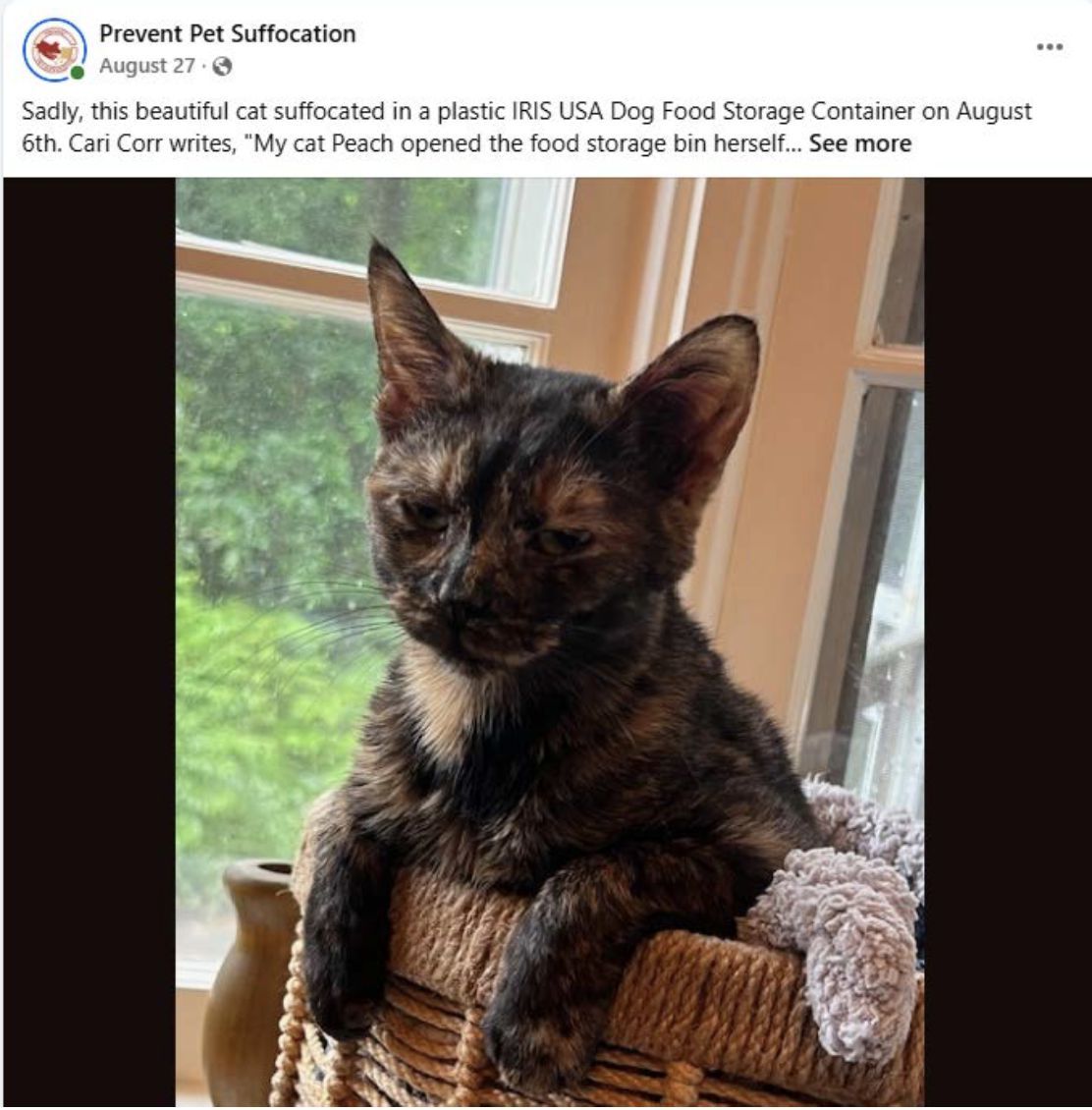
Screenshot of a post in the Prevent Pet Suffocation Facebook group, which shares the story of Peach the cat who died trapped in a Iris USA food storage container, from Valentina Mallozzi’s lawsuit against the company.
The problem, the suit says, is that cats can open the latch from outside, climb in, and get trapped as the mechanism automatically locks them in. The airtight seal that keeps pet food fresh makes the trap deadly, as a “pet will suffocate within a few minutes,” the complaint says.
The lawsuit cites posts from the Prevent Pet Suffocation Facebook group in which cat owners share stories about their beloved pets getting trapped in an Iris container.
One post included in the complaint shares the story of Baby Bear, a family’s cat who was found dead in an Iris container by an 8-year-old girl.
“My cat, Max, also suffocated in an Iris pet food container,” a woman responded. “I know the pain you’re going through.”
Iris USA was put on notice, and not only by people on social media, the complaint says. In March, the Center for Pet Safety, a Virginia-based nonprofit, put out a report evaluating the risk food containers represent for pet suffocation that specifically calls out Iris.
The latch mechanism on the lid “significantly increases the risk of pet suffocation,” the report says.
The lawsuit says the product should have come with a label warning of the suffocation risk for pets that can unlatch the lid.
Delaware County’s homeless services, already overextended and stretched to its limits, are slated to lose two shelters and a much-needed rental assistance program at the end of the month as a result of the ongoing budget impasse in Harrisburg.
The closures, though likely temporary until state lawmakers set aside partisan disagreements to approve a budget, would mark a major blow to a system some say is on the brink of collapse in one of Pennsylvania’s most populous counties.
Delaware County officials have attempted to stave off suspensions in critical social services for the first few months of the budget impasse by dipping into their coffers. According to officials, the county typically spends $12 million a month on homeless shelters and other services for children and youth, mental health needs, and substance use disorders.
Now out of options to pay for these critical supports, the county has notified local service providers that they won’t be able to help them any further. Only a budget can restore funding.
“We had hoped the impasse would be resolved much sooner and had fully funded our providers through September, but unfortunately can no longer fully fund providers without the funds from the state,” county spokesperson Mike Connolly said.
Men’s dorm at Life Center-Eastern Delaware County in Upper Darby on Friday.
The Community Action Agency of Delaware County, which operates three shelters and a rental assistance program, among other services, has no choice but to make cuts to its services or even close, its executive director Ed Coleman said.
Life Center, a shelter that has room for about 50 people, has gradually cut its capacity by half. Wesley House and Family Management Center, which have a combined capacity to house more than 110 people, are slated to close by the end of the month. Plus, CAADC’s rental assistance program, which helps approximately 270 families a year, will be paused until the state budget is passed.
Remaining homeless shelters, such as Breaking Bread in Upper Darby and the Salvation Army in Chester, have already seen a surge in people seeking assistance in recent weeks as Wesley House Shelter and Family Management Center wind down operations.
“We’re at capacity. We have no more room,” said James Stephenson, who leads the Salvation Army’s 40-person facility.
Mental Health Partnerships, which provides services for people with mental health conditions or substance use disorders, has been assembling a weekly working group with local shelters and county government to prepare for a winter with at least one emergency shelter, in anticipation of more shelter closures, said its president and CEO, Jeannine Lisitski. Mental Health Partnerships officials have already begun seeing more people on the streets around Delaware County as part of their street outreach there due to the diminishing number of places that people can go to stay warm in these cooling months.
“There’s a real crisis in Delaware County brewing now,” Lisitski said.
‘It’s childish for people to be so politically divided’
With no state budget in sight, public schools, counties, and service providers that help Pennsylvania’s most vulnerable have been forced to find ways to keep their doors open as they await reimbursement from the state. School districts have had to make up more than $3 billion in expected state payments, while some counties have had to lay off staff or take out major loans.
But the issues are particularly dire in Delaware County, where the budget impasse is just the latest blow to the threadbare safety net that has only been further stretched in recent years.
Delco had the fourth-highest eviction rate in Pennsylvania in 2022, at 11.5%, according to a study by PolicyLink and Community Legal Services of Philadelphia.
The persistent issue pushed Delco officials and dozens of other stakeholders to convene the following year to find ways to help the more than 300 people already facing homelessness and the 100 families on wait lists for shelters in the county, as well as all those in danger of losing housing.
Breaking Bread, which until recently could serve 25 people, can take in only eight after moving back to its original building, which is in need of repairs and has limited space.
And the county’s adult and family services agency, which contracts with shelter providers, saw a loss of $1 million in funding.
Lisitski said Mental Health Partnerships — which serves Delaware County, the other three collar counties, and Philadelphia — has already taken out a significant amount of credit to continue operating. And she has grown deeply frustrated with the state government that leaders have not been able to come together to achieve a budget deal.
“I’m really disgusted, I have to say. I hold myself to a very high standard as a CEO and as a leader. I would not leave my post if I did not take care of every program. I would not leave for the day until I resolved everything,” she said.
“That’s my commitment. I want the same commitment from our elected officials. And it’s childish for people to be so politically divided,” she added.
Separately, the federal shutdown is poised to delay funds from the Low-Income Energy Assistance Program, which help about 300,000 Pennsylvanians pay their heating bills, as well as the distribution of Supplemental Nutrition Assistance Program (SNAP) benefits.
At Wesley House, which can serve an average of 50 children at any given time, families like Grayson’s are scrambling to find temporary housing.
The 52-year-old has been living in Wesley House for almost seven months after caring for his terminally ill mother drained the family’s finances and led his family of four to be evicted. He asked that his full name be withheld to protect the identity of his two young children, as not everyone knows the family became homeless this year.
“This is people’s last resort. This is the last stop before being on the street,” Grayson said of the room with four bunk beds he shares with his family. “I feel like we’re being kicked while we’re already down.”
With news of Wesley House’s closure, Grayson and his wife are working with social workers to get rapid rehousing so as not to disrupt their children’s lives, but it’s a race against time in between the three combined jobs the couple is working.
John Weis, Life Center of Delaware County’s lead case manager (left) assists client Joseph Wallace Friday.
For Heather Schearer, her several months living at Life Center were a necessary step up in her recovery process. She had been unhoused for about five months earlier this year, and was sleeping in her car until it got too cold. When approached, she agreed to stay at Life Center until she eventually was connected to longer-term provider Mental Health Partnerships for its rapid rehousing and peer support programs, she said.
“[Politicians] don’t want to get their boots on the ground, take your ties off, and sit and talk,” Schearer said. “It’s the little things that matter that will get you to the next step.”
According to Community Action, similar scenes are playing out at Family Management Center, which can serve an average of a little more than 30 children at any given time. And while the most significant service reductions in homeless services are not scheduled for another week, the impacts of cuts are already visible across Delaware County.
Lisitski, of Mental Health Partnerships, which provides street outreach around Delaware County, said staff have already seen “a lot more people” than usual living on the street.
When shelters close like this, it becomes a “life-and-death situation” for people who are unhoused, she added. If the people who access critical services — usually people who are homeless, have substance use disorder, or have serious mental health conditions — cannot do so, she said, it will result in their being jailed, institutionalized, or, in the worst cases, dead.
In anticipation of the added need for housing due to the impasse, Mental Health Partnerships is working with Delaware County officials, faith-based entities, and other local groups to prepare emergency shelter space from December through April. It is also taking a line of credit to stay afloat.
But loans are not a viable option for all service providers.
Coleman, of Community Action, said even if the nonprofit could be approved for a line of credit, leaders have no way of knowing how much to ask for since they don’t know when a budget will be passed. Then there would be the question of interest.
“There’s no way [shelters] can afford to pay back interest on a loan, and the interest on a loan cannot be charged to a grant, so it would just be money lost to them,” he said.
Without a state budget, local government is the nonprofit’s last hope. Upper Darby, where Life Center is located, has awarded Life Center $120,000 in Community Development Block Grant funds, which will become available Jan. 1, according to officials there.
It’s much-needed money, but only one thing can help Community Action’s two other shelters stay open.
“We’re hoping that the legislators can do their job and pass a budget so the county doesn’t have to deal with some unfortunate situations,” Coleman said.
A 25-year-old man from Wilmington was killed and six others — including a student and an alum — were injured in a shooting Saturday night at Lincoln University, which was celebrating homecoming weekend, according to the Chester County District Attorney’s Office.
The man killed was Jujuan Jeffers, 25, of Wilmington, District Attorney Christopher de Barrena-Sarobe said.
The other six shooting victims, all age 20 to 25, are expected to survive, de Barrena-Sarobe said at a news conference on campus early Sunday evening.
Zecqueous Morgan-Thompson, 21, of Wilmington, was charged with carrying a concealed firearm without a license, de Barrena-Sarobe said. Authorities are investigating whether the gun found on Morgan-Thompson was used in the shooting, he said, but also said authorities suspect there were multiple shooters.
Morgan-Thompson was being held at Chester County prison after his bail was set at $25,000 bail Sunday evening, according to court records. It was not immediately clear if he had a lawyer.
“We don’t have a lot of answers about exactly what happened. What I will tell you is that today we’re operating as if this is not an incident where someone came in with the design to inflict mass damage on a college campus,” de Barrena-Sarobe told reporters during a news conference earlier on Sunday.
He urged anyone with video from the scene or other information that could help the investigation to contact the FBI, and he repeated that request at the evening news conference. Lincoln which enrolls about 1,650 students, is the first degree-granting historically Black university in the nation.
The shooting occurred at the university’s International Cultural Center building about 9:30 p.m. Saturday, leading to a chaotic scene.
“It was a very packed scene,” said Dana Moore, a spokesperson for the district attorney’s office. “The festivities had gone on. … It was all fun, football game, tailgate, a lot people had set up tents. And then chaos ensued.”
Authorities discuss shooting at Lincoln University that left one dead, six injured.
Moore declined to say where the injured were being treated or release their identities.
“We are protecting all identities and locations at this time,” she said.
The district attorney did not release other information about the injured at the evening press conference but said one victim was a student and one was an alumnus. The rest, he said, do not have direct affiliation with the university.
“Everyone on campus is a victim in this,” he said, emphasizing the importance of healing.
Josh Maxwell, chair of the Chester County Commissioners and an adjunct professor at Lincoln, said he knew the student who was shot and had spoken with her Sunday.
“She said she’s had better days but she’ll be fine,” he said, noting that he planned to visit her on Monday. “She’s a phenomenal student, just an extraordinarily focused, really good kid who is hitting all the marks to have a really good life. And I expect that’s not going to be interrupted.”
Maxwell said students choose Lincoln to get a good education.
“There’s no downtown to walk to or bars, just the quiet borough of Oxford and beautiful farmland,” he wrote in a Facebook post. “The fact that violence could reach them here, and personally one of my students, tears at my heart.”
The university announced in a statement Sunday afternoon that it would suspend classes Monday “for a day of healing and reflection,” though the school would remain open and staff and counseling would be available to help students and faculty.
The university has invited the campus community to gather at noon in the Historic District, between Vail and Amos Halls, for “a moment of reflection, connection, and collective healing.”
“Gun violence happens far too often in our country, and we are heartbroken that Lincoln University and its students are among the latest victims of such senseless violence,” the school said in the statement.
On campus Sunday, police tape draped a parking lot strewn with trash — showing a scene of homecoming revelry abruptly abandoned.
Investigators are on the scene outside Lincoln University’s International Cultural Center (ICC) Sunday, Oct. 26, 2025, where one person was killed and six other people were shot the night before during homecoming weekend celebrations.
Vanessa Ayllon, who lives across the street, said she saw the chaos on her Ring doorbell camera.
“All I see is people running and just getting into cars, just trying to leave,” Ayllon said. “It was very hectic.”
She said cars were traveling in the same direction in both lanes on the street, nearly causing a crash as people fled.
Terina Clark, 61, of West Philadelphia, graduated from Lincoln in 1987 and said she came to homecoming weekend to reconnect with old friends. They left shortly before the shooting, Clark said, frustrated by a crowded scene where she said alcohol flowed freely and people rolled joints and smoked marijuana not far from security officers.
“The crowds grew like you were going to a stadium game,” Clark said, adding she wanted to see school officials held responsible for allowing things to get out of control.
“Parents trust these kids within these walls,” Clark said. “The walls have to control what comes in.”
Delaware State University students Darius Lawson and Jake Ferguson, who attended the Saturday night homecoming, returned to Lincoln’s campus Sunday to try to retrieve a friend’s purse that was left behind in the woods as people fled the gunfire. The two were turned away by campus police who told them the purse was now part of a crime scene.
“Everyone just started running and falling,” said Lawson, 21. He said he saw people lying on the ground after the gunfire, as ambulances arrived.
Lawson called it a sad end to what had been a great party. He added that Saturday wasn’t the first time he attended a homecoming party marred by violence: Last year he attended celebrations at North Carolina Central University, where two shootings occurred.
The scene at Lincoln University’s International Cultural Center (ICC) building Sunday morning Oct. 26, 2025, where one person was killed and six other people were shot the night before during homecoming weekend celebrations.
University officials, including Henry Lancaster II, a 1976 graduate and member of the board of trustees, were mum on details about the shooting when reached Sunday.
Marc Partee, Lincoln University police chief, declined to answer any questions about the shooting or estimate how many people were on campus at the time. The incident happened about a half hour before festivities were due to end at 10 p.m., said Partee, who has worked at the school since 2019.
Gov. Josh Shapiro, who received an honorary degree from Lincoln in 2023, said the state had “offered its full support” to the university and local police.
“Join Lori and me in praying for the Lincoln University community,” he said on X late Saturday.
Lincoln, one of four so-called state-related colleges in Pennsylvania, is in rural Chester County, about 45 miles southwest of Philadelphia.
The university’s alumni association said in a Facebook post Sunday morning that it was sending “thoughts and prayers to Lincoln University, our students, and the victims of last night’s tragic and senseless act of violence during Homecoming.”
“Homecoming should be a time of joy and unity,” the Alumni Association of Lincoln University posted. “Today, we stand together in grief, in strength, and in unwavering support of our beloved alma mater.”
Philadelphia Mayor Cherelle L. Parker is a Lincoln alumna, and was on campus last week, posting to social media Saturday, “It was an honor to help kick off @LincolnUofPA‘s Homecoming earlier this week — celebrating 171 years of Black excellence and The Lincolnian’s 100th anniversary.”
Lincoln pride is in full effect this weekend!
It was an honor to help kick off @LincolnUofPA‘s Homecoming earlier this week — celebrating 171 years of Black excellence and The Lincolnian’s 100th anniversary.
Parker did not immediately reply to a request for comment Sunday.
She’s among several notable Lincoln alumni, a list which includes Thurgood Marshall, the first Black U.S. Supreme Court justice; Harlem Renaissance poet Langston Hughes; Robert N.C. Nix, Sr., the first Black lawmaker from Pennsylvania to serve in Congress; Sheila Oliver, former New Jersey lieutenant governor and the first Black woman to serve as speaker of the New Jersey general assembly; and Harry W. Bass, the first Black Pennsylvania state legislator.
The school has achieved some milestones in recent years. The university in 2020 received a $20 million donation from philanthropist MacKenzie Scott, which became the largest single gift in the school’s history.
President Brenda A. Allen at that time called the gift “transformational” for the then-2,100-student school and said it would fund new investments in teaching, research, and faculty development, as well as support need-based scholarships.
In 2021, Allen was named one of the 10 most dominant historically Black college leaders by a national nonprofit organization that advocates for the schools, and in May, Maryland Gov. Wes Moore delivered the commencement address at Lincoln.
But the university also has weathered controversy, including an internal battle over Allen’s leadership in 2020. The board attempted to oust her, but later decided to negotiate a new contract with her.
The school also has been the scene of prior shooting incidents.
In 2023, two people were shot inside a residential building on campus; the victims were not students but had been visiting the school. And in 2015, the campus tightened security after shots were fired in a dorm, though no one was hurt in the incident.
Staff writer Kristen A. Graham contributed to this article, which also contains information from the Associated Press.
Spotlight PA is an independent, nonpartisan, and nonprofit newsroom producing investigative and public-service journalism that holds power to account and drives positive change in Pennsylvania. Sign up for our free newsletters.
HARRISBURG — Taxpayers are paying for roughly $1 million in security upgrades to Gov. Josh Shapiro’s private home in Montgomery County, according to information the administration disclosed to top lawmakers about its expenditures in the aftermath of the brazen arson attack on the first family earlier this year.
In a Friday letter to legislative leaders, administration officials said improvements include “erecting physical and visual barriers on the property, installing enhanced security technology, and other steps.” They then noted that due to safety concerns, they could not provide more details about the work being conducted at Shapiro’s private home.
The letter, authored by Pennsylvania State Police Commissioner Christopher Paris and Department of General Services Secretary Reggie McNeill, also disclosed safety upgrades totaling $32.3 million at the governor’s official residence in Harrisburg, including $8 million to retrofit the mansion with new windows that are bullet- and shatterproof.
The attack occurred at the 29,000-square-foot mansion this past April while the governor and his family were asleep inside.
“The horrifying attack on the Governor, his family, and Commonwealth property, coupled with the unfortunate rise in political violence across our country, has made these updates necessary to protect the Governor and his family and ensure the continued operation of the executive branch of the Commonwealth,” Paris and McNeill wrote. “No family should have to live behind bulletproof glass or behind large walls — but the nature of the threats against elected officials today require us to take these important steps.”
They added: “Unfortunately, the threat to a high-profile elected official like Gov. Shapiro does not end when he leaves the Governor’s Residence.”
In a statement, Shapiro spokesperson Rosie Lapowsky said the State Police conducted a security review of the governor’s personal residence and recommended a number of improvements. Before carrying out any of those improvements, she said the administration “consulted the Ethics Commission … to ensure there is no improper private, pecuniary gain from these security improvements.”
Last week, Harrisburg resident Cody Balmer pleaded guilty to attempted murder, aggravated arson, and other charges related to the attack in the dead of the night on April 13. That is when Balmer scaled the perimeter fence at the governor’s official residence along the banks of the Susquehanna River, broke two windows, and used crude, homemade Molotov cocktails to set fire to several rooms on the residence’s first floor.
Shapiro, his family, and friends had celebrated Passover just hours before, and were asleep on the second floor of the residence when Balmer broke in. Balmer told authorities that he would have beaten Shapiro with a hammer he had with him if he had encountered the governor.
The Democratic governor has said that he and his family are still struggling with the emotional toll of the attack, but stressed that he will not be deterred from continuing in public service.
It is not clear what prompted Paris and McNeill’s letter. Earlier this week, Spotlight PA submitted a public records request for all taxpayer-funded expenditures at the governor’s private home.
Also midweek, Republican state Sen. Jarett Coleman, who chairs the chamber’s Intergovernmental Operations Committee, fired off a letter to Paris seeking similar information about physical improvements to Shapiro’s Montgomery County home, among other items.
Coleman told Spotlight PA on Friday that his committee will “continue to investigate” spending at the governor’s private residence “to protect taxpayers as this unprecedented project is being completed.”
Spotlight PA last month reported that the state has spent more than $6 million to repair extensive damage from the fire at the governor’s official residence — but that the administration is shielding information about nearly a quarter of those expenses, including who was paid and exactly what the money was spent on.
The news organization has also reported that private donors have separately contributed to a fund managed by a Harrisburg-based nonprofit to help restore the mansion. So far, neither the organization nor the administration has disclosed the donors’ identities, the amount they contributed to the fund, or provided a general description of what that money has or will be used for.
In the letter sent to legislative leaders, the administration shed light on at least some of those questions. The officials said that to date, the state has submitted $4.5 million in expenses to one of its insurers, which in turn has so far approved $2 million in reimbursements.
Security upgrades and improvements to the official residence, however, are not covered by the state’s insurance plans. The security improvements — recommended by a third-party review commissioned by the State Police in the wake of the attack — there include:
An estimated $14 million to replace the 6-foot fence that Balmer scaled with a “single material, 10-foot barrier resistant to vehicle damage or climbing.”
An estimated $6.3 million to install updated cameras, improve lighting, and add motion detection sensors in the residence’s yard.
An estimated $8 million to retrofit the residence’s existing windows with bulletproof and shatterproof glass.
An estimated $4 million to install a comprehensive fire suppression system in the residence, one of the largest state-owned buildings without one.
“In addition to the visible and extensive building security enhancements outlined above, additional recommendations on things like staffing, internal systems, and other technology improvements have been implemented,” by the state, Paris and McNeill wrote. “To avoid risk of a successful security threat against the property or the Governor in the future, we cannot disclose all of those recommendations publicly.”
The two men noted that the fire damaged multiple decorative items inside the residence, including chandeliers, china, pianos, and artwork. Most of those items, they said, do not qualify for insurance reimbursement, and their repair or replacement will be funded by private dollars.
BEFORE YOU GO… If you learned something from this article, pay it forward and contribute to Spotlight PA at spotlightpa.org/donate. Spotlight PA is funded by foundations and readers like you who are committed to accountability journalism that gets results.