Apalosnia Watson, 39, was arrested Jan. 14, nine months after Syvir Hill drowned in her home. She was charged with third-degree murder and endangering the welfare of a child, court records show, and was released from custody on a $500,000 unsecured bail bond as her case progressed.
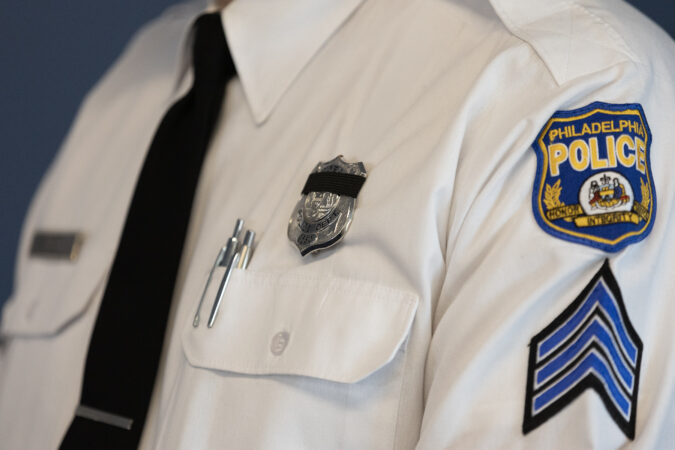
Philadelphia police officers arrived at the house on the 900 block of East Schiller Street on April 15 to find medics performing CPR on an unresponsive 1-year-old, according to the arrest warrant. Watson had left Syvir and two other children alone in the bath and had gone downstairs to get food from the microwave, she told the officers that night. On her way down to the first floor, she heard “flipping in the water,” and when she returned to the second-floor room, the toddler was motionless, facedown in the water. The foster parent attempted CPR and called 911.
“I don’t want to go to jail,” Watson told the officers on the scene, according to the police report. “It happened so fast.”
S. Philip Steinberg, a Schatz Steinberg & Klayman defense attorney representing Watson, said that Watson did not act with malice, which is required for a murder charge.
“It’s a tragic accident but one that Ms. Watson would not have any criminal liability for,” Steinberg said.
The Philadelphia Medical Examiner’s Office conducted a postmortem exam the day following Syvir’s death, but the cause and manner of death remained pending for months. On Dec. 4, the office ruled that the cause of death was drowning and the manner of death was homicide.
A spokesperson for the Philadelphia District Attorney’s Office said charges were brought shortly after the homicide investigation was reopened following the ruling on the manner of death.
Death investigations can vary in how long they take due to a number of factors, saidJames Garrow, a Philadelphia health department spokesperson.
“Above all, our priority is to conduct thorough and accurate investigations,” Garrow said in a statement.
The long gap between the exam and the medical examiner’s ruling concerns A.J. Thomson, a Zafran Law Group attorney representing Syvir’s biological mother in a wrongful-death lawsuit filed in October against Watson and two child-welfare agencies.
Thomson filed a second lawsuit in November, asking a Philadelphia Common Pleas Court judge to compel the medical examiner to make a ruling. That suit accuses Lindsay Simon, the city’s chief medical examiner, of refusing to perform her mandatory public duty, “blocking the family’s ability to settle the estate, pursue insurance and benefits, and understand the cause and manner of death.”
Judge Sierra Thomas Street ordered Simon on Dec. 11 to certify the cause and manner of death within 10 days.
Thomson credited the lawsuit with pushing the medical examiner’s office to issue a finding, which ultimately came before the judge ruled.
The lawsuit from Syvir’s biological mother accuses Tabor Children’s Services and Northeast Treatment Centers of failing when they placed Syvir in the home and did not remove him even though visit notes showed a varying number of children living in the crowded house.
At the time of Syvir’s death, multiple other children lived in the home, including the 4-year-old and 2-year-old who were also in the bathtub, Hill’s 4-month-old sister, and a 17-year-old, according to the police report.
The lawsuit further alleges that after Watson left the children alone in the bath, the 2-year-old told Syvir, “you are not my brother,“ and held the toddler’s head underwater. The police report makes no such claim. The accusation comes from a child’s interview with investigators from the city’s department of human services, Thomson said.
SEPTA Regional Rail riders experienced significant delays — at times, 30 minutes to an hour — at the peak of morning rush hour on Tuesday morning, after a train pulled electrical wires down.
A West Trenton Line train struck overhead electrical wires near Wayne Junction train station in the Nicetown section of Philadelphia at 7:45 a.m., said SEPTA officials.
The train lost power and was tangled in the wires it had pulled down.
Marie Pollock, 24, who was on board, felt the train start to gradually slow down before quickly and forcefully coming to a stop. Pollock could see wires hitting the train windows and noted that other passengers were startled during the collision.
“We were keeping the doors closed because it was so cold,” Pollock said. “We were on kind of a hill, so there wasn’t any room for SEPTA to get a shuttle, and the power was out on both tracks, so we couldn’t get a typical rescue train to us.”
Pollock, who had already been waiting a half-hour in 20-degree chill for her 6:17 a.m. West Trenton Line train before the ordeal, said passengers waited inside the stuck train for an hour and a half.
SEPTA crews had to cut through the downed wires to free the train and then used a diesel-powered train to tow the disabled one to Wayne Junction, where passengers took other trains into Center City.
Pollock’s four-hour journey didn’t end until 10 a.m. when she finally arrived at Jefferson Station.
Since then, service interruptions have been occurring primarily on the Warminster, Lansdale/Doylestown, and West Trenton lines. However, delays cascade throughout the rail system, leading to 15 to 45-minute delays on other lines, said SEPTA spokesperson Andrew Busch.
“Repairs are still continuing,” Busch said Tuesday afternoon, “but service has improved. Some minor delays, and we are advising passengers to plan for some extra time during rush hour, but we expect the evening commute to be better than this morning.”
There is currently no timeline for completed repairs.
A 17-year-old Philadelphian turned himself in on Monday in connection with the fatal hit and run of June Rodriguez, a beloved and decades-long presence at Bob & Barbara’s Lounge.
Philadelphia police said they had already obtained a warrant for the teen’s arrest when he turned himself in, accompanied by his mother and attorney.
The teen, whose name is not being released because he is a minor, was charged with multiple felonies, including homicide by vehicle, as well as involuntary manslaughter, reckless driving, driving without a license, and related offenses.
But for the victim’s son, Skye Rodriguez, the arrest brings little solace.
“I feel relieved, but I’m still angry,” he said in between sobs. “I know I’m called to forgive because that’s my faith, I just don’t know how to. It’d be different if this kid hit my dad and went straight to the police station.”
But the teen didn’t.
The younger Rodriguez said his father did everything right as he rode his bike home after a shift at Bob & Barbara’s on Dec. 20.
“My father was very cautious — he even had reflectors on his boots,” said Skye Rodriguez, who learned of the added precaution when the morgue gave him his father’s things.
June Rodriguez, 54, was turning onto North 56th Street from Lancaster Avenue in Overbrook around 3:45 a.m. when the driver of a red SUV swerved into him and drove away, according to Philadelphia police.
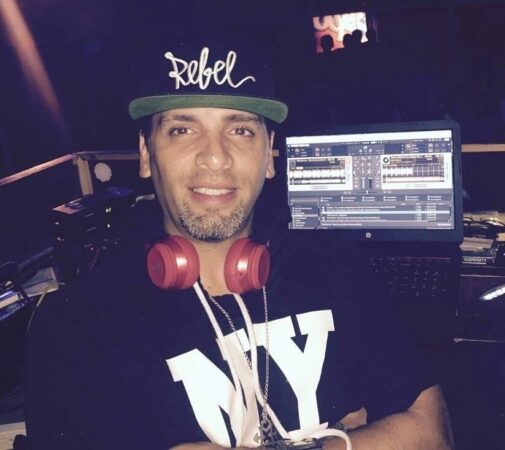
Rodriguez’s death devastated Philadelphia’s queer community, where he was a known DJ, and the city’s house music scene. Friends remembered Diaz as a warm, welcoming individual, and a strong ally and presence in the LGBTQ+ community, though he was straight himself.
One remembrance feature on a GoFundMe page for Rodriguez’ funeral expenses said the DJ created “a sanctuary on the dance floor.”
His death also mobilized safe-streets advocates, who noted that stretch of Lancaster Avenue is one of the city’s most dangerous, part of the 12% of city streets that account for 80% of traffic deaths and serious injuries.
Rodriguez’s son said he had yet to watch the surveillance video procured by investigators. Police have told him that his father had his reflectors on and was in the bike lane.
Still, Rodriguez doesn’t know if he wants to see the moment of impact. His father’s belongings were covered with blood, he said. He doesn’t want to see the severity of the impact play out.
For now, he is grateful to have a break in the case.
“If it wasn’t detectives or police making it a big deal, what if it had been swept under the rug?” he said.
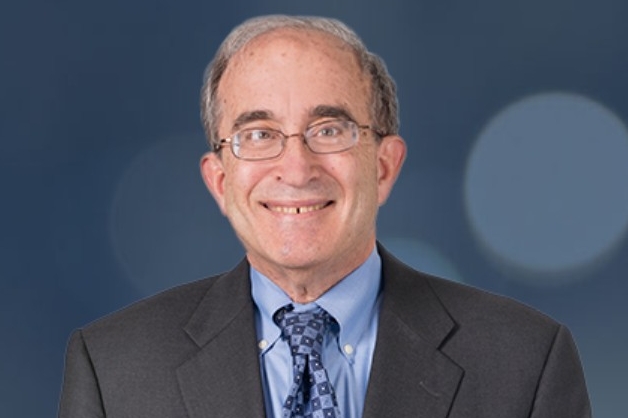
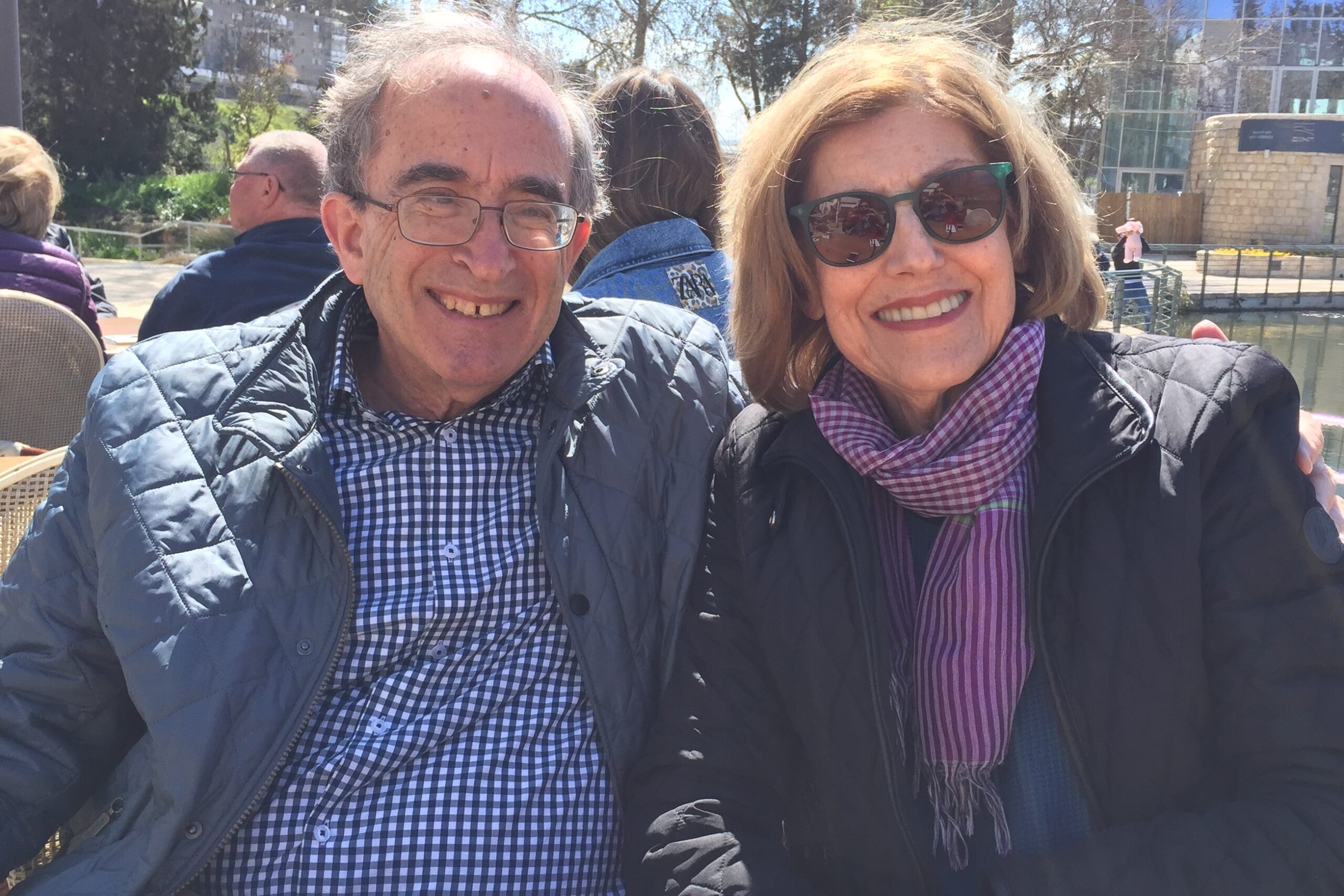
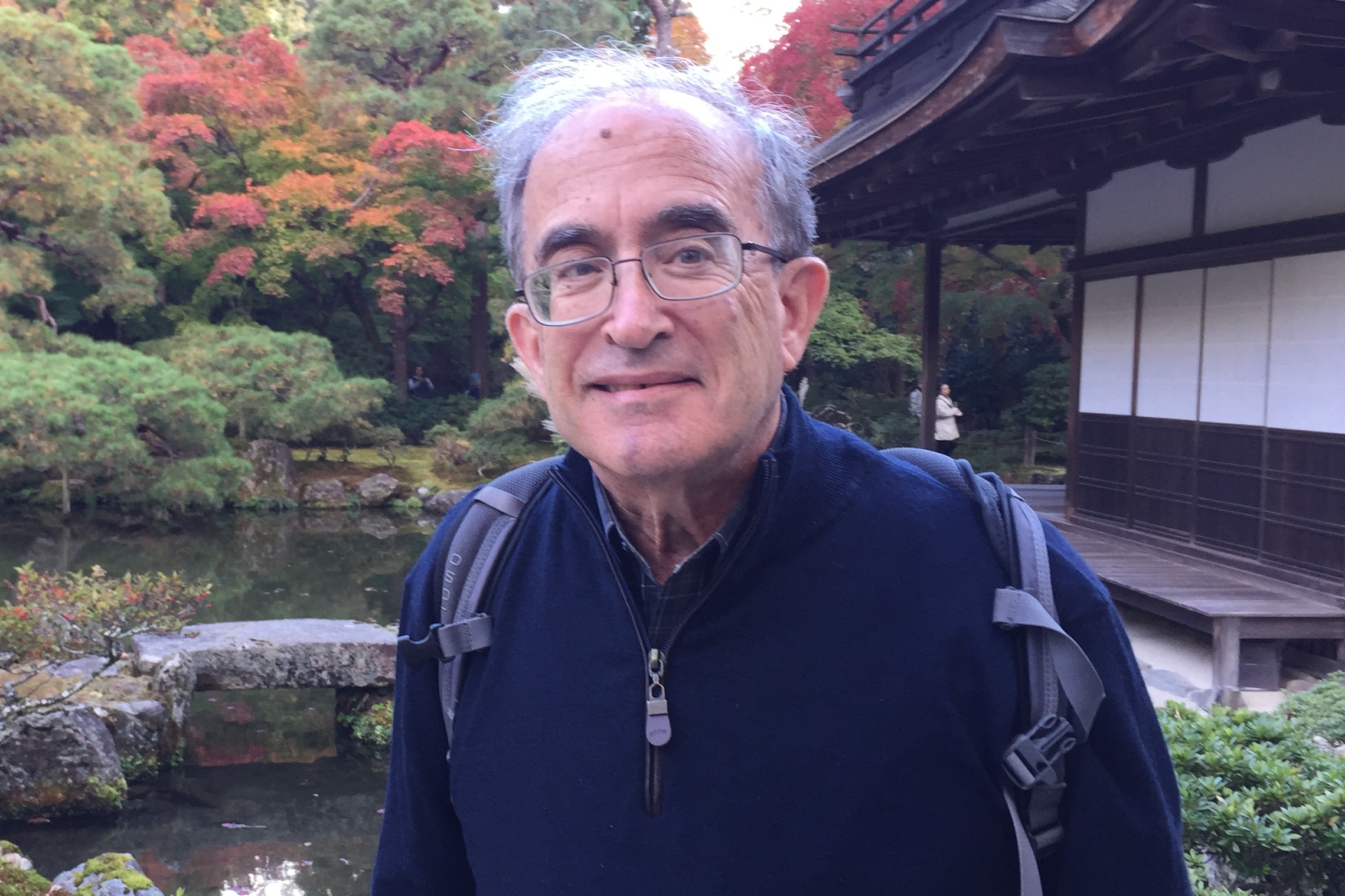
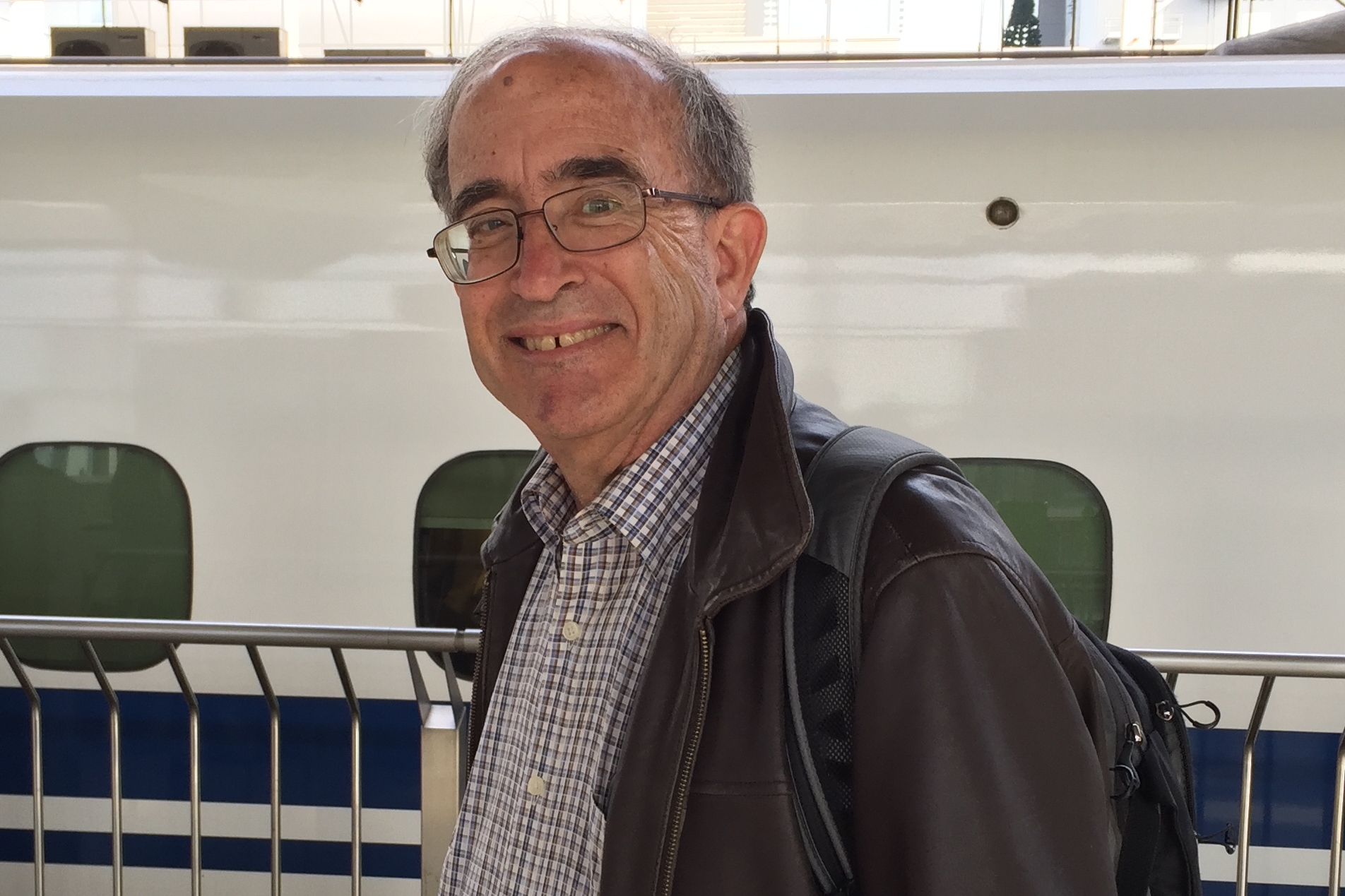
Daniel Segal, 79, of Philadelphia, cofounder and shareholder of the Hangley Aronchick Segal Pudlin & Schiller law firm, adjunct law professor at the University of Pennsylvania, former cochair of the Philadelphia Soviet Jewry Council, onetime board president at the Juvenile Law Center, mentor, and “mischievous mensch,” died Thursday, Jan. 8, of stomach cancer at his home.
Born and reared in Washington, Mr. Segal moved to Philadelphia in 1976 to teach at what is now Penn Carey Law School. He went into private law practice in 1979, became cochair of a litigation department in 1993, and joined with colleagues in 1994 to establish Hangley Aronchick Segal & Pudlin.
For more than 40 years, until his recent retirement, Mr. Segal handled all kinds of cases for all kinds of clients, including The Inquirer. He was an expert in juvenile law, defamation, the First Amendment, professional ethics, education, civil rights, and other legal issues.
He was president of the board at the Juvenile Law Center and worked pro bono for years, beginning in 2009, to help represent more than 2,400 juvenile victims and win millions of dollars in settlements in what is known as the Luzerne County “kids-for-cash” case. In that case, two judges were convicted of taking kickbacks for illegally sending juveniles to two private for-profit detention facilities.
“This is one of the worst judicial scandals in history,” Mr. Segal told The Inquirer in 2009. “The people you’re stepping on are the true, true little guys.”
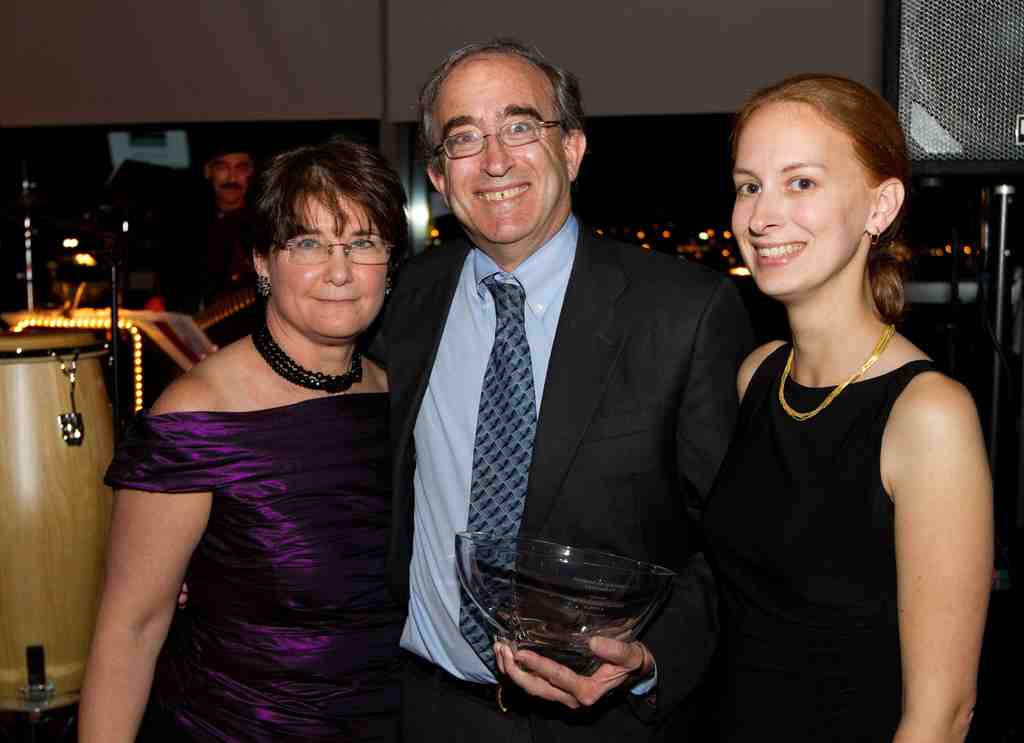
Mr. Segal was honored in 2010 by the Philadelphia Bar Foundation.
Among his other notable cases are a 1985 workplace racial discrimination dispute, a 1990 libel case against The Inquirer, and a 2000 trial about the city taxing outdoor advertisers. “Dan Segal was a living testament to professional excellence,” said Mark Aronchick, his law partner and longtime friend.
Law partner and friend John Summers said: “He was a great teacher and mentor.” Marsha Levick, cofounder of the Juvenile Law Center, said: “He was a brilliant, steady partner who made us smarter and kept us laughing.”
Mr. Segal clerked for Chief Judge David Bazelon in the U.S. Court of Appeals for the District of Columbia Circuit in 1974 and for Supreme Court Associate Justice Thurgood Marshall in 1975. He was active with the Philadelphia Bar Association, Philadelphia Common Pleas Court, and the Penn Law School American Inn of Court.
He wrote articles for legal journals and letters to the editor of The Inquirer and Daily News. He spoke at panels and conferences, earned honors from legal organizations and trade publications, and was named the Thomas A. O’Boyle adjunct professor of law at Penn in 1992.
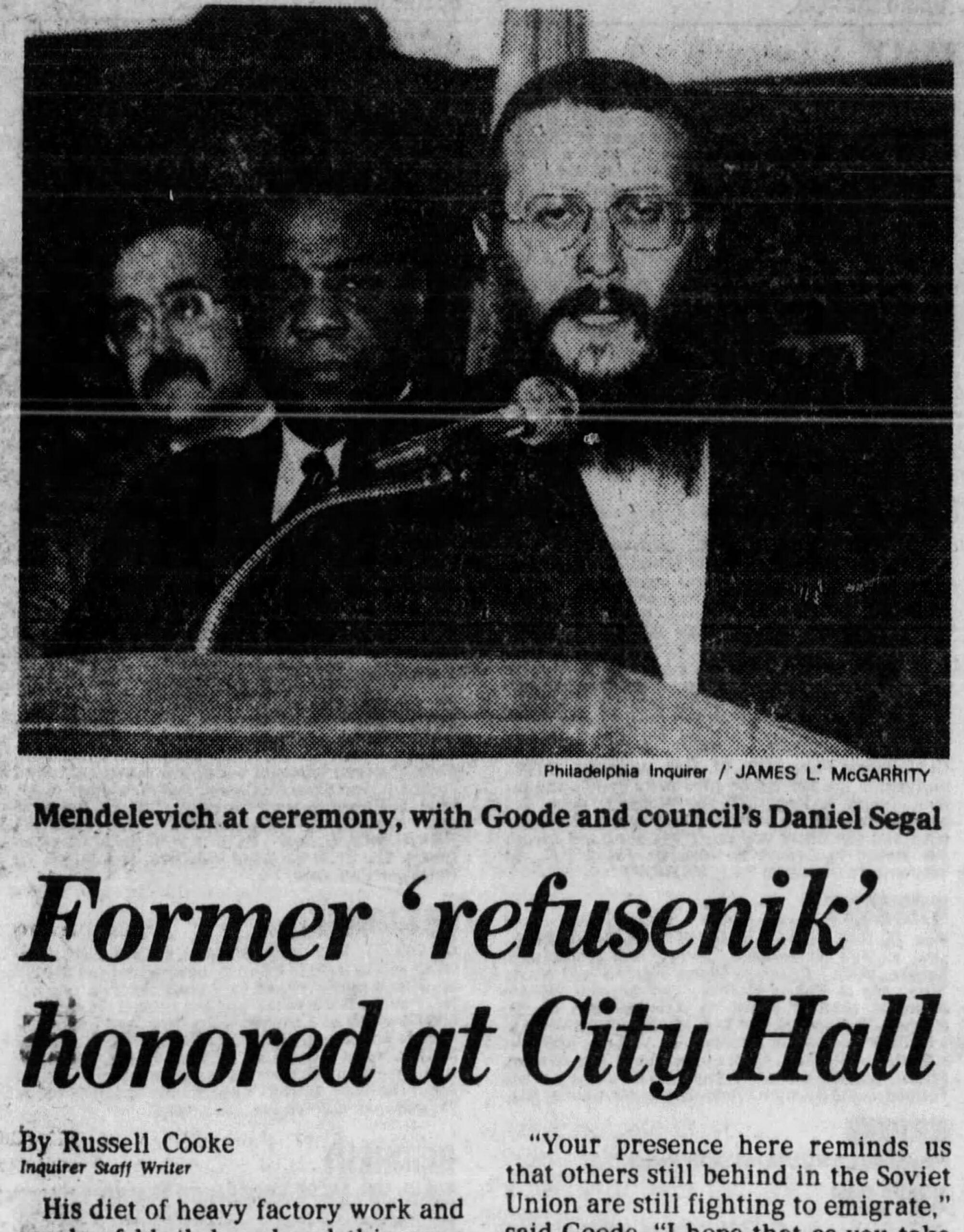
This story and photo features Mr. Segal (left) and appeared in The Inquirer in 1984.
The son of a rabbi, Mr. Segal was cochair of the Soviet Jewry Council in the 1980s, and he organized rallies and marches for social justice and human rights. He traveled to Israel often and to the old Soviet Union several times to secretly support Jews not permitted by government officials to immigrate to Israel.
“We are persuaded that the Soviet Jews are pawns in the Soviet-American relationship,” he told The Inquirer in 1985.
He served as president of the board of directors at what is now Jack M. Barrack Hebrew Academy and held leadership roles with the Jewish Community Relations Council, the New Israel Fund, Mazon: A Jewish Response to Hunger, and other organizations.
Colleagues at the New Israel Fund praised his “characteristic kindness” and “gentle and sparkling humor” in an online tribute. They said: “He was everyone’s favorite board member.”
Mr. Segal and his wife, Sheila, married in 1968.
Mr. Segal enjoyed pranks and funny jokes, even at work, and neighbors called him Silly Dan. His son Josh said: “His warmth, humor, and humility meant that he could connect with just about anyone.” A friend said he was a “mischievous mensch.”
He earned his law degree in 1973 and was executive editor of the Law Review at Harvard University Law School. He earned a bachelor’s degree in politics and economics at Yale University in 1968 and a master’s degree in international relations from the London School of Economics in 1969.
He taught elementary school for a year in Washington and spent another year in Europe before moving to Philadelphia. “He taught us just how important it is to stand up for what is right,” his son Eli said, “and to do so not only with conviction but with humility and kindness, and without a thought of getting personal credit.”
Daniel Segal was born July 4, 1946. He started dating Sheila Feinstein in ninth grade, and they married after college in 1968. They had sons Josh and Eli, and lived in Center City and Lower Merion before moving to Fairmount in 2018.
Mr. Segal’s sons said: “Our dad showed us that relationships are the heart of a life well-lived by nurturing lifelong friendships.”
Mr. Segal loved chocolate and ice cream. He recovered from a traumatic brain injury 20 years ago, and he and his wife traveled to Iceland, Peru, Vietnam, Europe, Japan, and elsewhere.
He doted on his family and friends, and he and his wife rented vacation places every summer to bring his sons and their families together. “Neither of us were surprised that our dad always made our kids feel so loved,” his son Eli said. “Because that was just how he made us feel.”
A Philadelphia police officer opened fire on a man Monday night after the man critically injured another person in Hunting Park, police said. The man, police said, was not hit.
Officers were called about 8:30 p.m. to a Sunoco gas station in the 4100 block of North Broad Street for a report of a man with a gun, according to police Tuesday.
When they arrived, police said, the officers saw multiple men arguing. The men quickly left the gas station and walked toward the intersection of Broad and Jerome Streets, where the fight turned physical, police said.
A 29-year-old man drew a handgun and shot another man in the chest and groin. One of the officers fired at the alleged shooter, police said, but did not strike him.
The alleged shooter ran away, but the officer caught and arrested him in the 1300 block of Jerome Street, police said. Nearby, beneath a parked vehicle, officers found a 9mm handgun.
Paramedics took the victim to Temple University Hospital, where police said he was in critical condition Tuesday. His name was not released.
Police did not release the name of the alleged shooter, who had not yet been formally charged, they said.
The officer, a 36-year-old man with nine years on the police force, was not injured in the incident, police said. He has been placed on administrative duty pending an internal investigation, as per department policy when an officer discharges his gun.
Frank P. Olivieri, 87 — whose uncle and father invented the steak sandwich and who ran the landmark Pat’s King of Steaks for nearly four decades — died Sunday, Jan. 18. He had been under care for dementia, said his son, Frank E. Olivieri, who has run the shop since his father’s 1996 retirement.
Though the Olivieri name spread through Philadelphia over the years through various shops, Mr. Olivieri spent his entire working life at the intersection of Ninth, Wharton, and Passyunk in South Philadelphia. “I’m on my own little island,” he told The Inquirer in 1982.
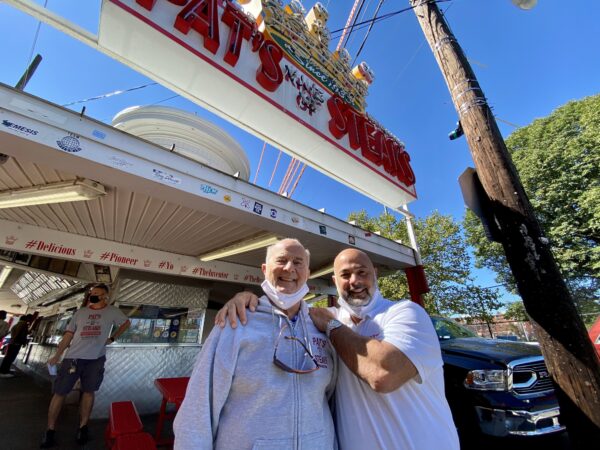
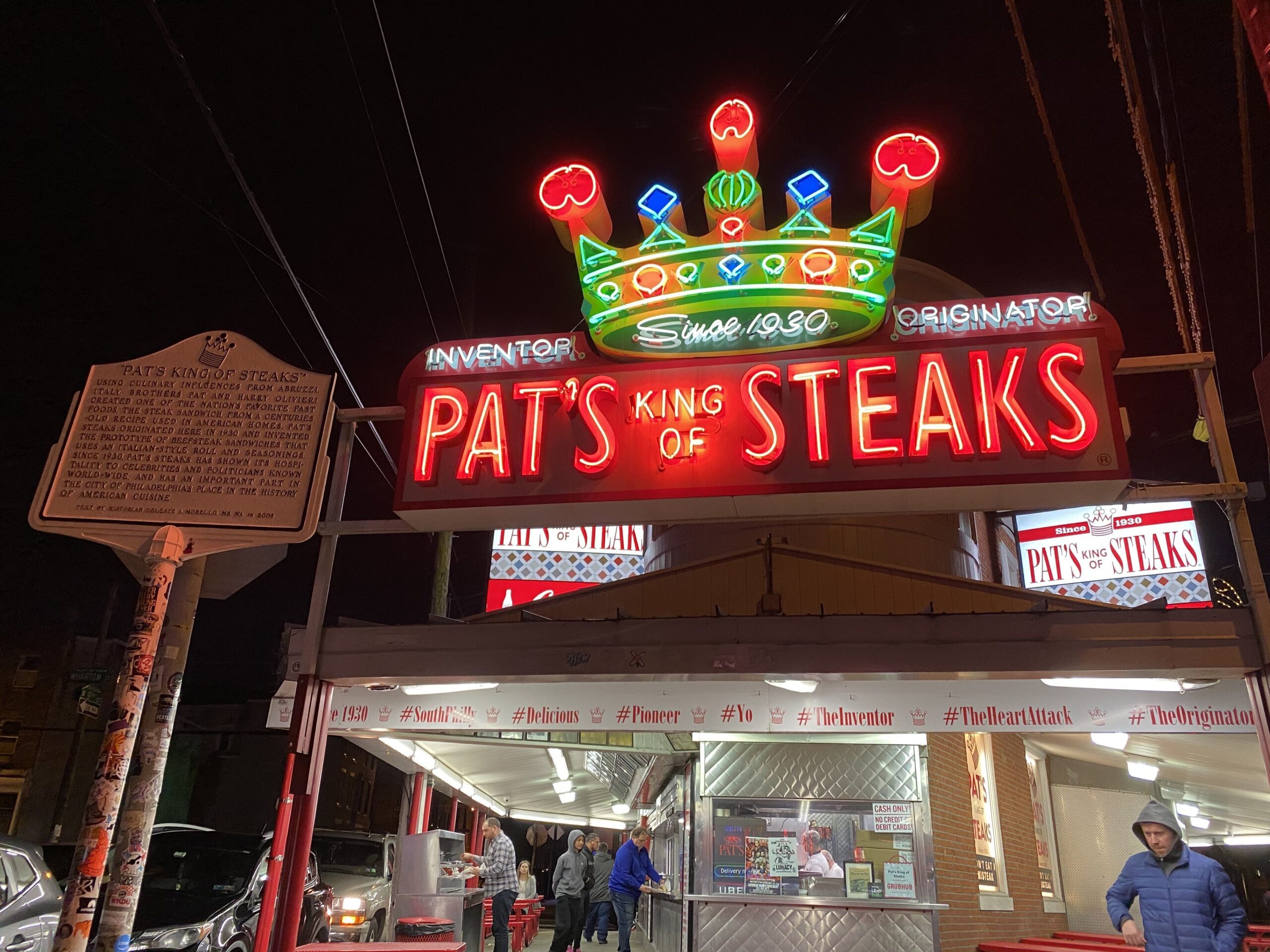
Pat’s King of Steaks, at Ninth Street, Wharton Street, and Passyunk Avenue, in 2020.
The legend began in 1930 (in some accounts 1932) when Mr. Olivieri’s father, Harry, and his uncle, Pasquale “Pat” Olivieri, started selling hot dogs for a nickel at that corner. (Pat, the elder, got the naming rights.) One day, as the story goes, they got tired of eating hot dogs and bought a loaf of Italian bread and some steaks, sliced them up, and put them on the grill. (Cheesesteaks came along in 1951.) Curious cabdrivers begged for the sandwiches. “Pretty soon, they forgot all about the hot dogs and did nothing but steaks,” Mr. Olivieri told The Inquirer in 1982.
Mr. Olivieri told The Inquirer that he started working at the stand at age 11, selling watermelon and corn on the cob out front. He turned down the opportunity to go to the University of Pennsylvania to become an attorney, and chose to go into the family business, his son said.
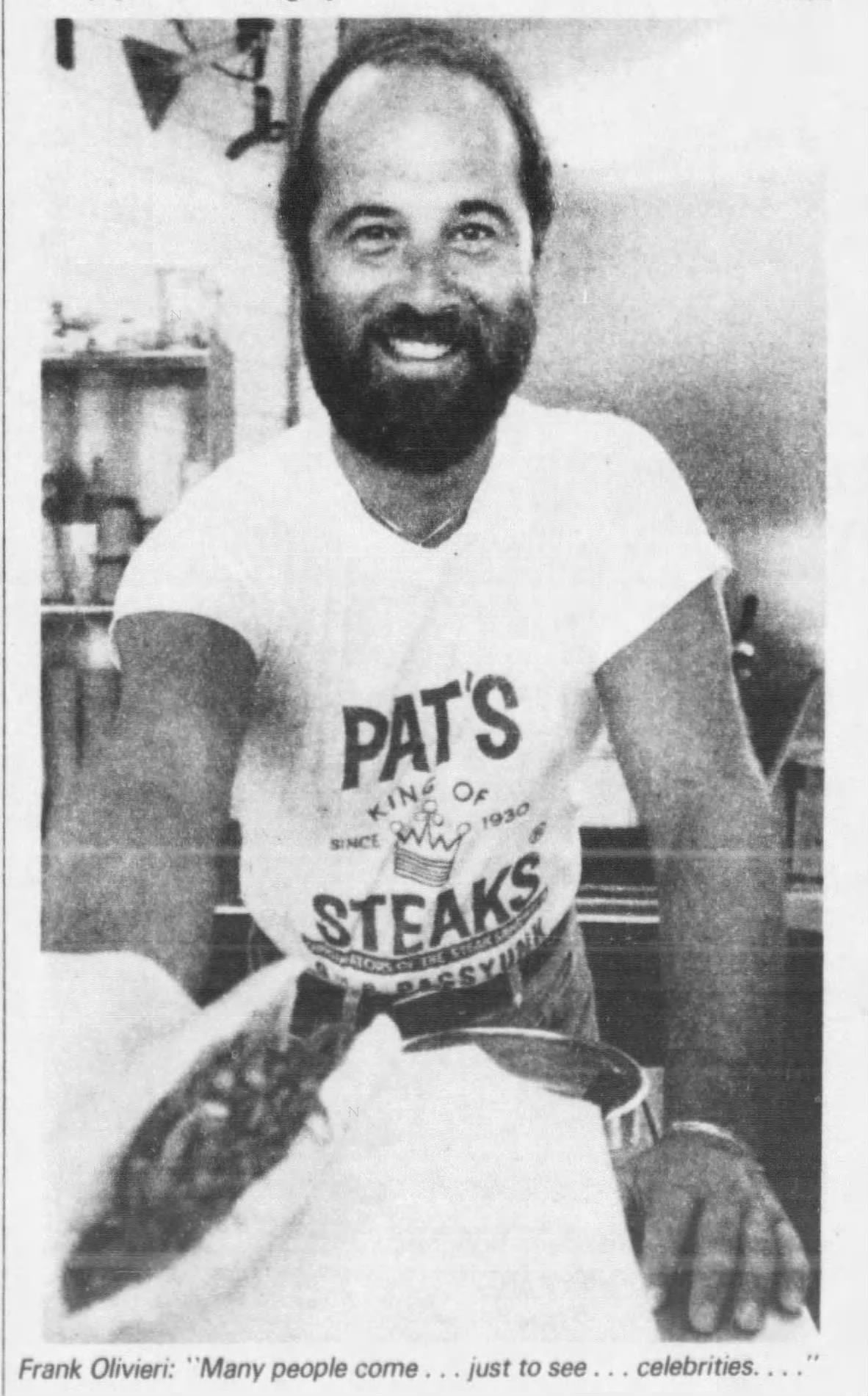
Frank Olivieri working the grill at Pat’s King of Steaks in 1980.
Pat Olivieri moved to California in the 1960s; he died in 1970. In 1967, father and son Harry and Frank Olivieri bought the original stand, while Pat’s son Herb obtained licensing and franchising rights to the name.
Herb Olivieri opened Olivieri’s Prince of Steaks in Reading Terminal Market in 1982 and later ran a Pat’s location in Northeast Philadelphia (unaffiliated with the original). Herb’s son Rick owned sandwich shops, including the reflagged Rick’s Steaks at Reading Terminal, as well as stands at the Bellevue and Liberty Place food courts.
Pat’s, meanwhile, had become a 24-hour destination. Limos and tour buses, then as now, roll up at all hours.
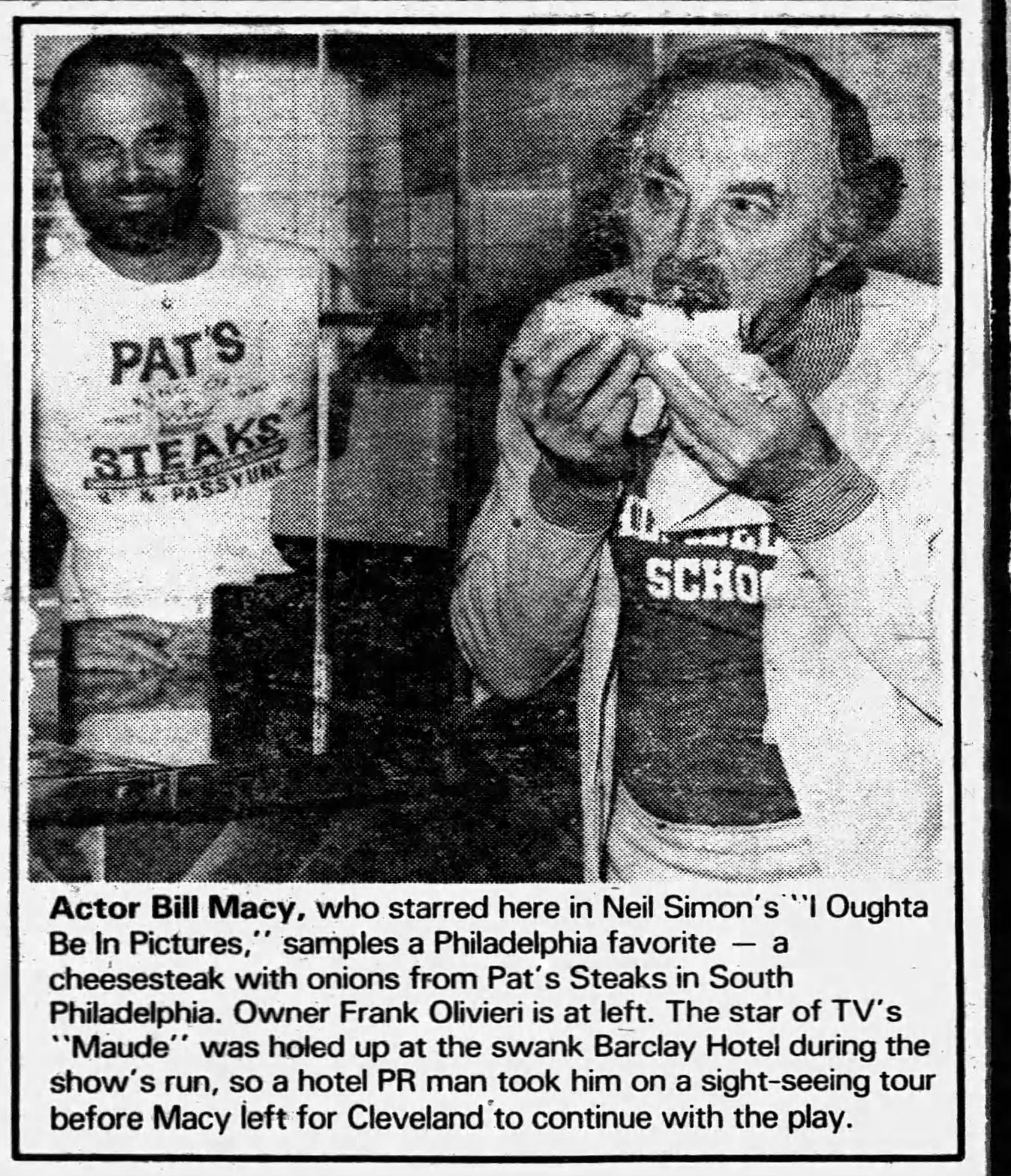
Frank Olivieri (left) watching actor Bill Macy eating a cheesesteak from Pat’s King of Steaks in 1981. Macy was touring Philadelphia sites while starring at the Forrest Theater in a pre-Broadway run of “I Oughta Be in Pictures.”
When Sylvester Stallone filmed part of Rocky outside of Pat’s in 1976, he invited Mr. Olivieri to a private party afterward.
“I had to tell him I can’t go,” Mr. Olivieri recalled. “We didn’t get to be No. 1 by letting the business run itself.” Back then, Mr. Olivieri lived in Packer Park, kept a summer home in Brigantine, and was rarely more than an hour away.
“I can be here any time,” he said. “And I am here lots and lots of the time.”
In 1966, a competitor arrived across the street: Geno’s Steaks, owned by Joey Vento, a former Pat’s employee. The Pat’s-Geno’s rivalry — buzzing neon, dueling lines, endless debates over quality — is, in fact, wildly overblown. Current owners Frank E. Olivieri, popularly known as Frankie, and Geno Vento, Joey’s son, are good friends.
Mr. Olivieri, who served for many years on the board of directors of Provident Bank, was a whiz with numbers, his son said. He also was an avid fisherman and yachtsman who had his captain’s license. “He also taught me everything I know about electrical work, plumbing, woodworking, and how to fix just about anything,” his son said. “The reason I know how to do all of that is because if he couldn’t do something himself, I had to learn how to do it. Without his guidance, I wouldn’t know how to do any of it.”
Mr. Olivieri’s son recalls his father’s burgundy 1974 Corvette. “One of the happiest moments of my week was sitting in the passenger seat with him on Saturdays and Sundays,” he said. When they turned from Broad onto Wharton Street, “by the time we hit around 10th Street, I could already smell the onions cooking. He always had the T-tops off for me in the summer. That was my first introduction to being at the store.”
Besides his son, Mr. Olivieri is survived by his wife of 65 years, Ritamarie; daughters Danielle Olivieri and Leah Tartaglia; 10 grandchildren; and three great-grandchildren.
Viewing will be from 9 to 11 a.m. Friday, Jan. 23, at Baldi Funeral Home, 1327-29 S. Broad St. A prayer service and memorial tributes will begin at 11 a.m. The family requests donations to St. Maron Church, 1010 Ellsworth St., Philadelphia, Pa. 19147.
Protestors want ICE agents banned from the Criminal Justice Center in Center City, where immigrants have been trailed and arrested.
// Timestamp 01/20/26 9:39am
Anti-ICE demonstrators end their protest
Rev. Jay Bergen, a leader of No ICE Philly, said the group had accomplished its goal – and that the brutal cold had become too much for older demonstrators, some of whom have medical conditions.
In his closing prayer, Bergen hoped the nearly 2 hour stretch was enough for ICE’s target to be somewhere else.
“All of us here have proven in our song and our prayer that we can slow down the machine of authoritarianism, of fascism, that we can delay the operations that will detain and kidnap and destroy our neighbors, our families, our community,” Bergen said.
ICE vehicle able to exit garage, helped by Philly police
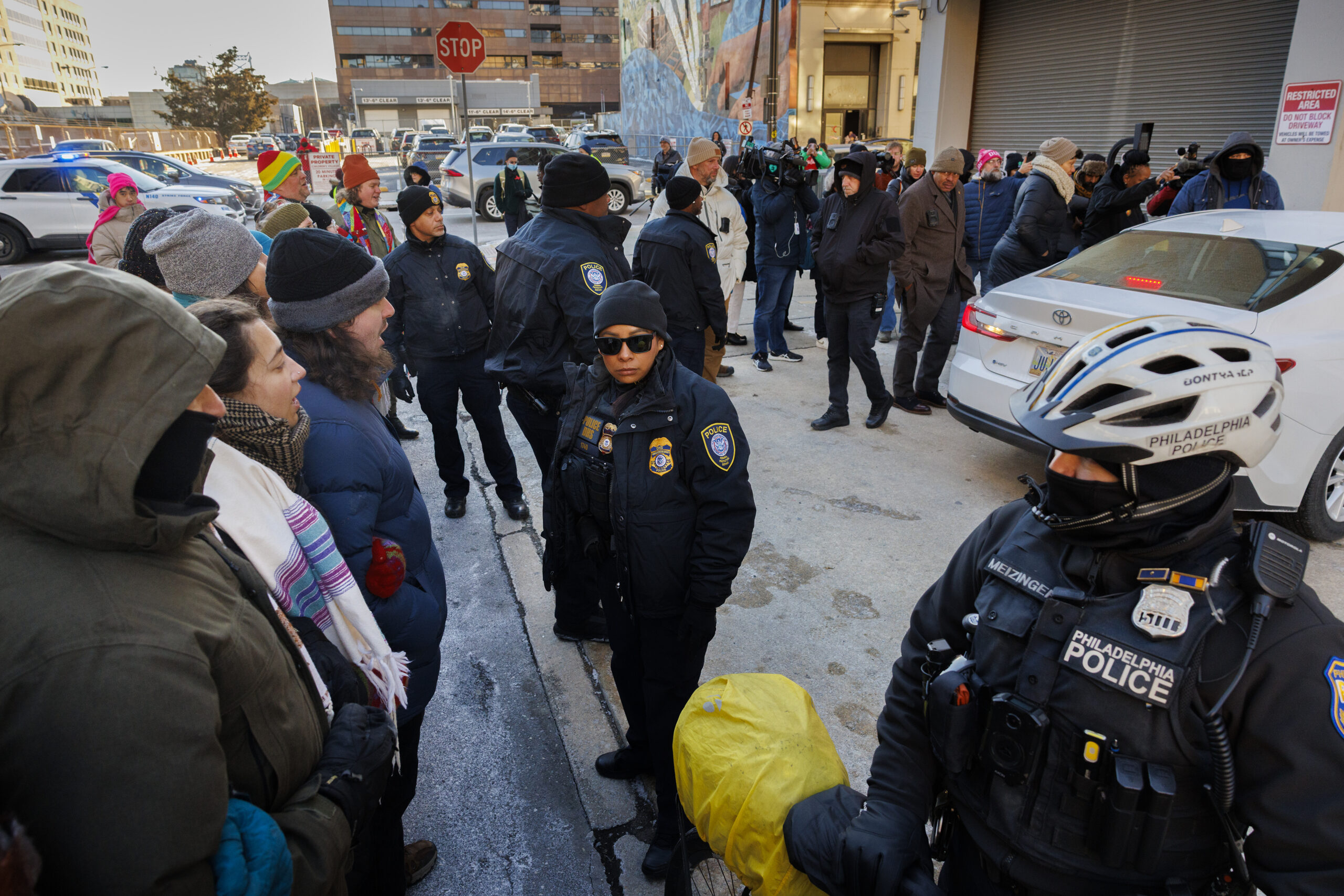
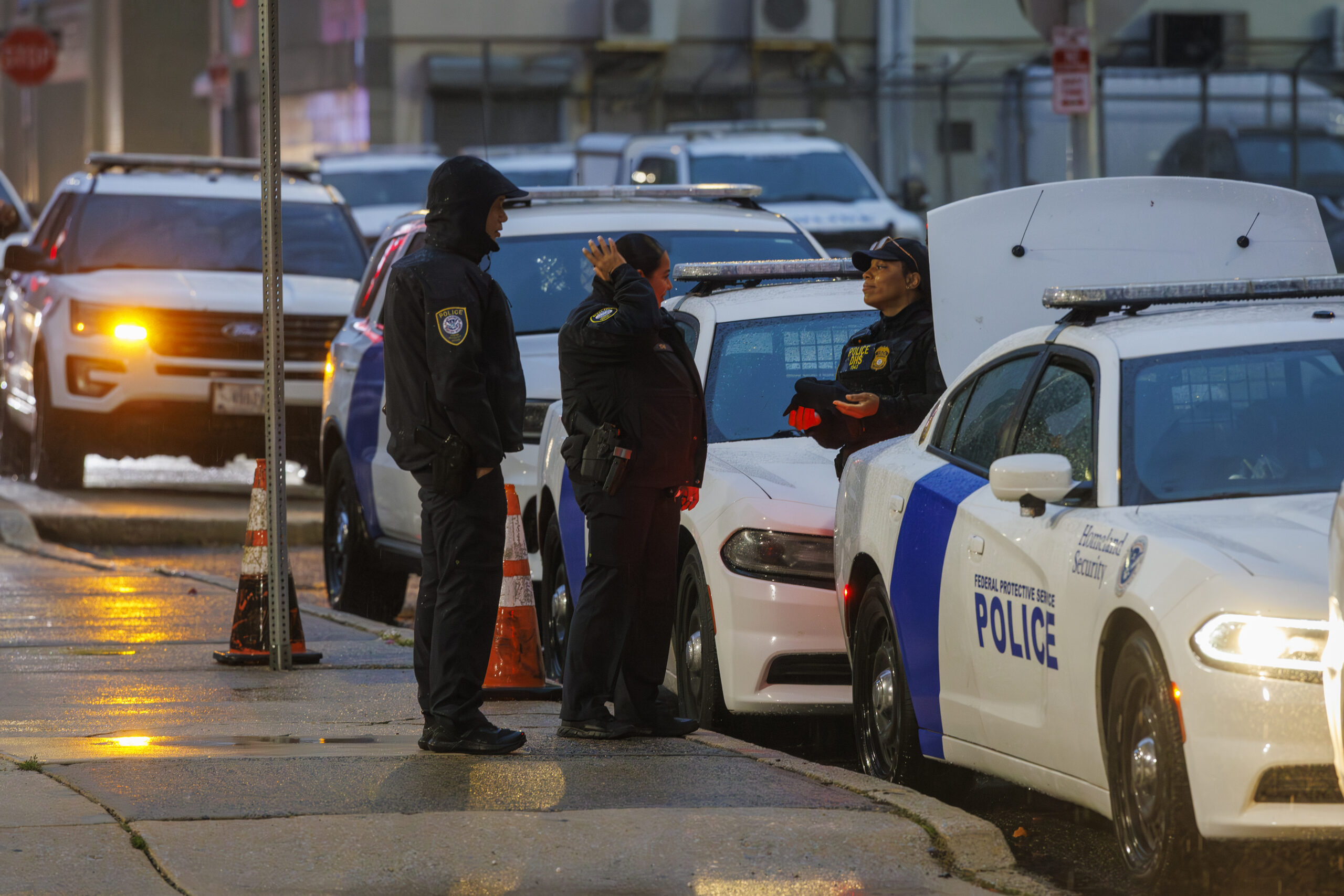
Philadelphia Police and Department of Homeland Security officials block protesters outside the garage at ICE’s Center City headquarters.
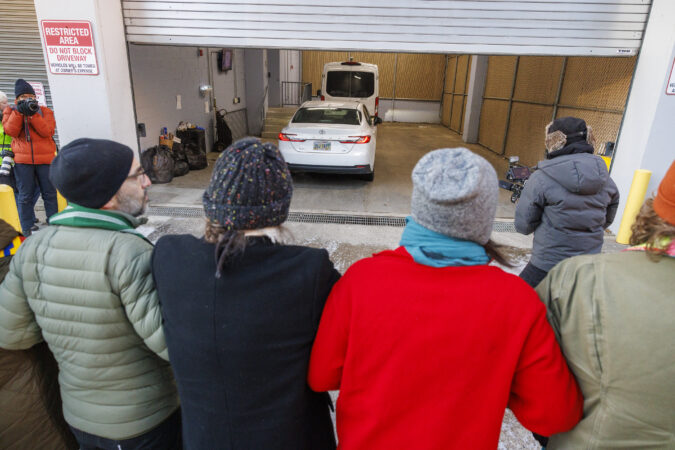
Just before 9:30 a.m., a white sedan – which had initially been blocked by protesters – was able to exit the ICE headquarters parking bay with the help of Philadelphia Police.
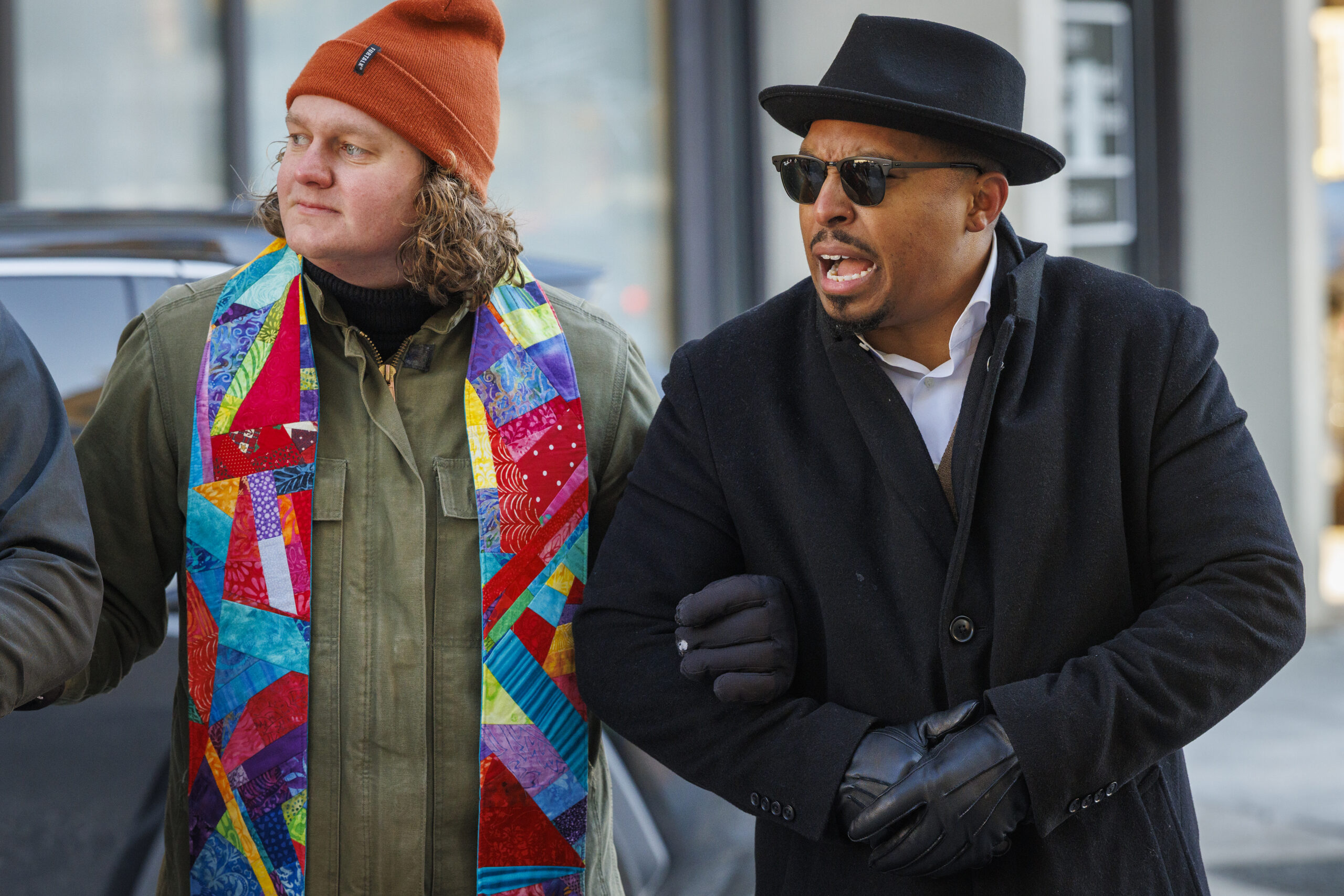
Philadelphia City Councilman Nicolas V. O’Rourke (right) joins the protest alongside Rev. Jay Bergen.
Protestors saw their ranks boosted by City Council member Nicholas O’Rourke, who is also a pastor of the Living Water United Church of Christ in Oxford Circle.
O’Rourke said it was only natural for him to join fellow clergy at Tuesday’s frigid demonstration.
A pastor of the Living Water United Church of Christ in Oxford Circle, O’Rourke said Tuesday’s action was part of a long tradition of faith leaders being at the forefront of the “struggle against oppression,” as seen with Rev. Dr. Martin Luther King Jr. and others.
“We are a day after King’s Day, and it’s important that we don’t just wax eloquent about the nice things that King said or the image that he’s been painted of now, but we continue in that tradition of resisting the oppression as he saw it, we’re doing in our own time,” said O’Rourke.
‘We need more people every day willing to do this’
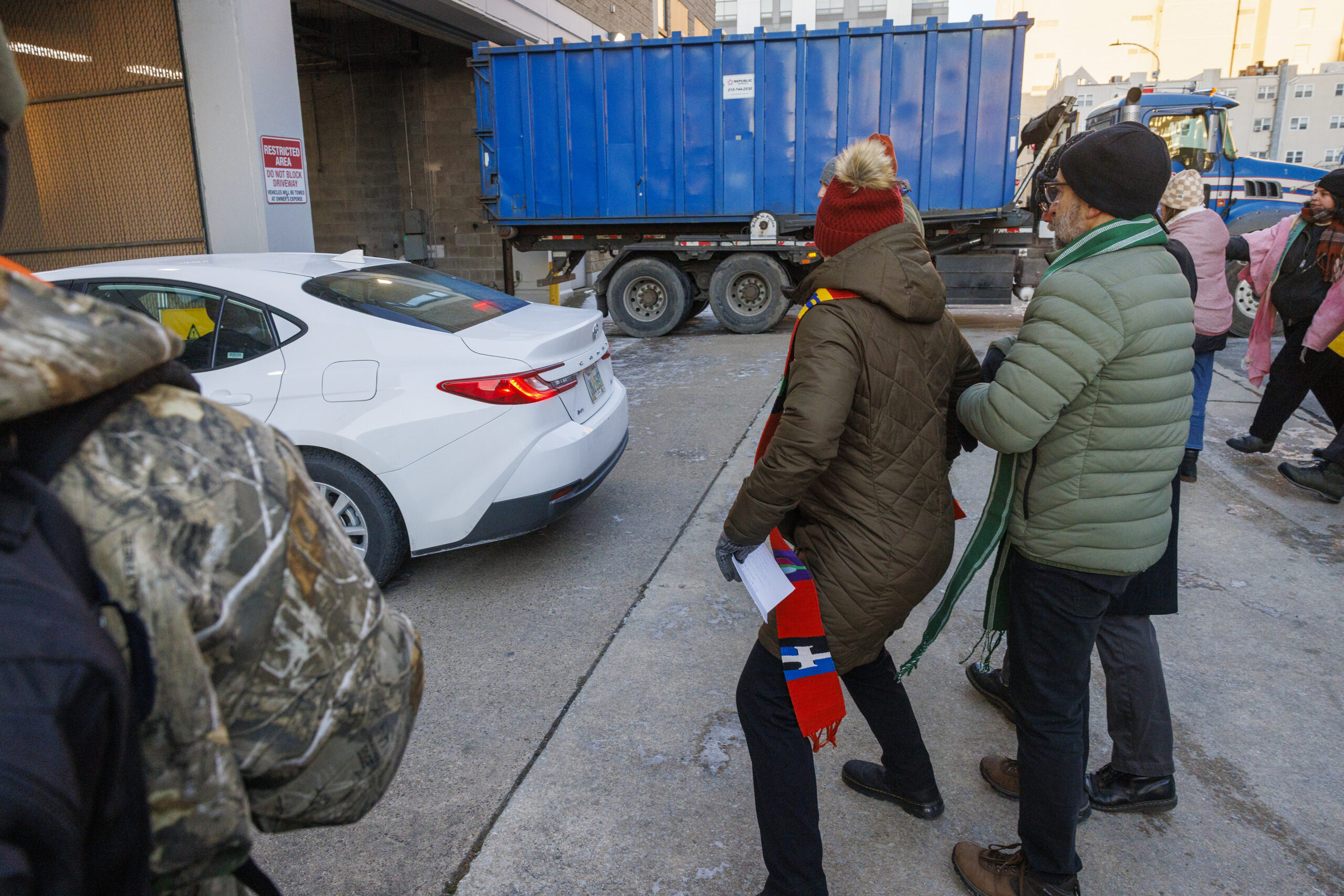
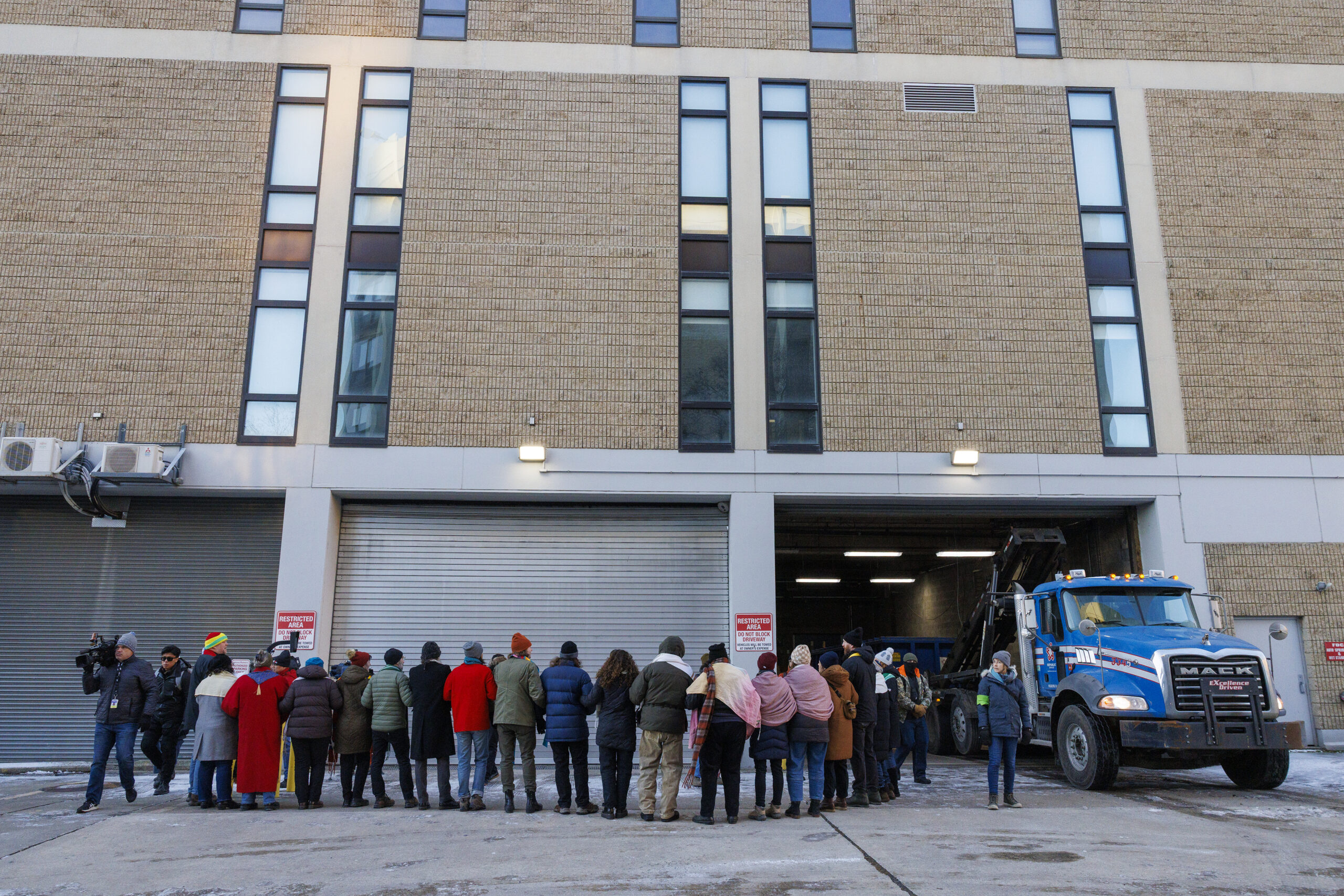
Protesters sing and lock arms outside ICE headquarters in Center City Tuesday.
The group of clergy and immigration advocates continued to sing in locked arms in front of the parking bay in front of ICE headquarters in Center City after its initial “ICE block” in an effort to disrupt immigration enforcement.
Rev. Hannah Capaldi, minister at the Unitarian Society of Germantown, described the selection of participants as an intentional one as they face warnings from police, possible arrests, and citations.
Those present are leveraging a certain level of privilege, she said. All are citizens and many are clergy wearing collars, taluses, and stoles.
“We’re saying, listen, we have some level of moral authority in this city, and we’re trying to tell you where to look and what to pay attention to,” she said.
But in addition to drawing attention to ICE operations in Philadelphia, Capaldi hopes to plant “seeds of resistance” in the broader public, encouraging people to get involved.
“It doesn’t have to just be us, and we need more people every day willing to do this, to stand between the vehicles and the work that they’re doing to kidnap our neighbors,” she said.
“What ICE is doing in our communities is against our faith tradition,” said Rev. Jonny Rashid, a protest organizer. “We are gathered clergy, priests, rabbis, imams, and we are here to say no to ICE, and we want to demonstrate that publicly, and we’re willing to get arrested to do that. We’re blocking ICE’s garage as a symbol of saying you are not welcome in Philadelphia.”
He said he was not surprised by the lack of an overt Philadelphia police presence, though in the past groups of officers have been sent to anti-ICE protests.
“I don’t think the Philly police want to engage. They don’t want to make Philadelphia look like Minneapolis.”
Protestors are blocking the parking garage at ICE headquarters in Center City Philadelphia.
A group of about 30 immigration advocates, including local clergy, kicked off the frigid morning shortly before 8 a.m. with song in front of ICE headquarters.
They carried signs that read “Who would jesus deport?” and approximately at 7:55 a.m. the group locked arms calmly shouting “ICE block” as a white sedan tried to make its way out of a garage.
The gate to the garage closed back down almost immediately as the car pulled back in and the group continued in song.
Organizers with No ICE Philly say they’ll form a human blockade to stop ICE vehicles from departing the agency’s Center City headquarters beginning at 8 a.m. Tuesday.
They pledge to stay there, singing and chanting, until they are forcibly removed or arrested or both, in what they say is an effort to stop ICE from “leaving the facility to terrorize our neighbors.”
The ICE office is located at 8th and Cherry Streets, just southwest of the former Roundhouse police building.
Homeland Security officers with their cars along Cherry Street outside ICE’s Center City office in October.
In October, a No ICE Philly protest outside the agency headquarters erupted into physical confrontations with police, with several people knocked to the ground and four taken into custody.
A series of push-and-shove skirmishes broke out after about 35 protesters gathered for a Halloween Eve demonstration where they attempted to stop Immigration and Customs Enforcement vehicles from leaving the facility.
When an organizer shouted, “ICE Block!” about a dozen people poured onto Cherry Street to try to block the road. A series of scrums grew increasingly intense, with police shoving protesters back and in some cases to the ground.
The Department of Homeland Security, ICE, and Philadelphia police presence was substantial, with more than 30 officers outside the immigration agency’s big metal garage doors. Philadelphia police said four demonstrators were arrested and later released after being given citations for obstruction of highway, a violation that typically results in a fine.
That protest followed a September demonstration in which members of No ICE Philly acted as symbolic “building inspectors” who “condemned” the ICE facility. On the building they hung signs, bordered with yellow-and-black warning tape, that said, “ICE Raids Violate Philly Values.”
Protesters want Sheriff Rochelle Bilal to ban ICE agents from the courthouse in Center City.
No ICE Philly has been a leader in protests outside the Criminal Justice Center in Center City, where it and other groups have demanded that Sheriff Rochelle Bilal ban immigration agents from the building.
Activists charge that the sheriff has allowed ICE to turn the property into a “hunting ground,” with at least 114 immigrants trailed from the courthouse by agents and arrested on the sidewalk.
On Wednesday the judicial district that oversees the Philadelphia court system said that authority for managing ICE’s presence rested with the sheriff, and that decisions around that were her “sole responsibility.”
Many people who go to the courthouse are not criminal defendants ― they are witnesses, victims, family members, and others in diversionary programs. But they have been targeted and arrested by ICE, immigration attorneys and government officials say, causing witnesses and victims to stay away from court and damaging the administration of justice in Philadelphia.
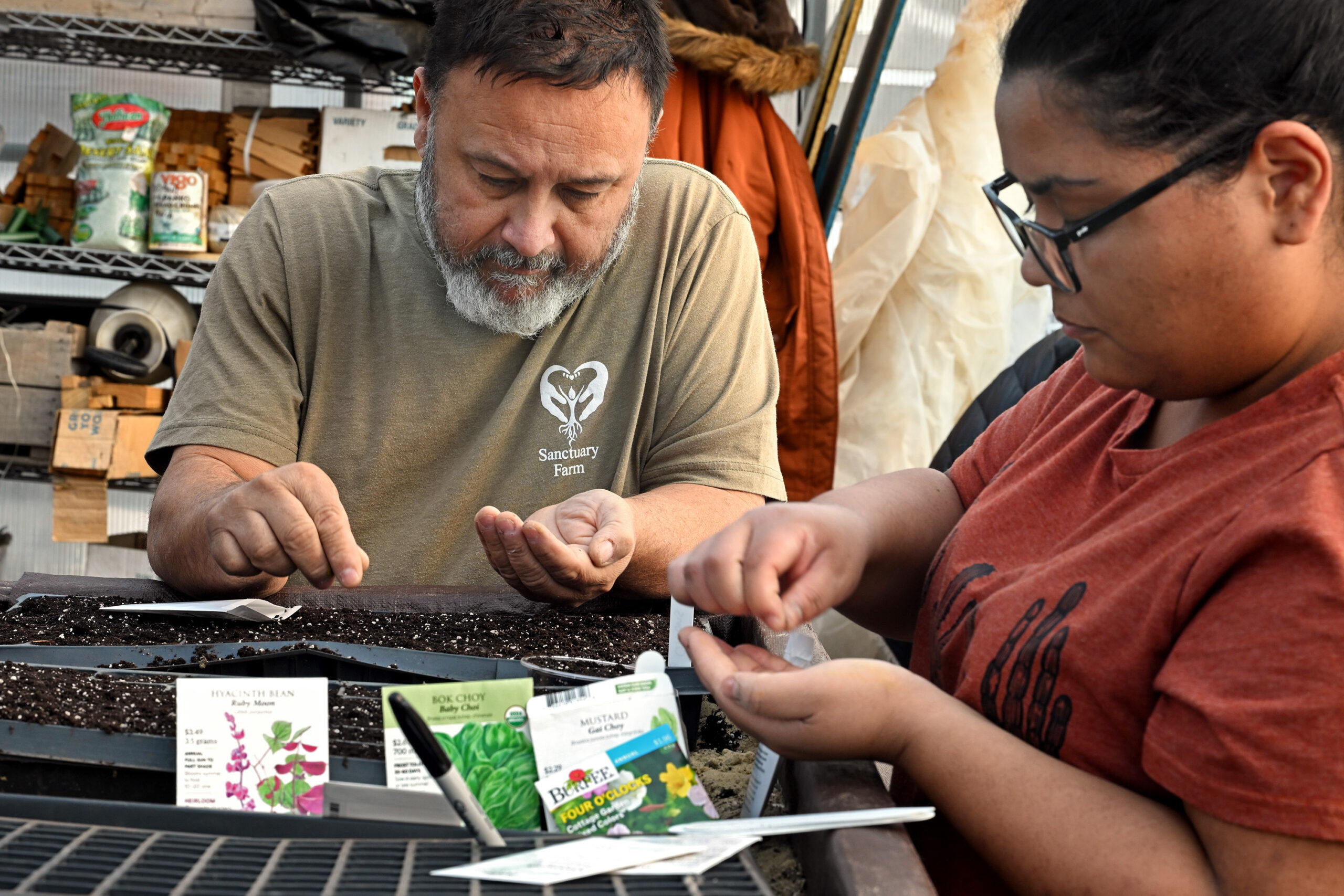
Chris Meyers, 67, was planting onion seeds Monday in the warmth of a large greenhouse near North 24th and Berks Streets for Sanctuary Farm Phila’s first ever Martin Luther King Jr. Day of Service.
The onions will be transplanted when the time is right. They’re destined to take root in one of the urban farm nonprofit’s nine lots.
Meyers, a retired city worker, came to the role by an unexpected path. Three years ago, the North Philly resident sat in the office of nurse-practitioner Andrea Vettori, his primary health care provider, determined to reduce his blood pressure and cut back on medications.
“She was the only physician — in this case a nurse-practitioner — that started talking about doing it through diet and losing weight,” Meyers said. “I felt like here was someone who was truly listening to me instead of taking the stance, ‘OK, I’m the doctor. I know better. It was like we were reasoning out how we could make this possible.’”
Vettori told him about the urban farm she oversaw in North Philadelphia as executive director. Soon,Meyers enrolled in Sanctuary Farm’s therapeutic farming program, began meditating with the group he sowed seeds alongside, ate the fruits and vegetables they cultivated, shed weight, and reduced his medications.
“I can finally see light at the end of the tunnel,” said Meyers, and one of thousands of participants and volunteers in Martin Luther King days of service throughout the region.
Zora Clark, 8, waters her seed plantings in the greenhouse. She was there with her partents, Mike Clark and Shawnika Hull of Fishtown.
What’s Sanctuary Farm Phila?
Vettori, 61, executive director of Sanctuary Farm Phila, is a nurse-practitioner by training and still works in the medical field one day a week.
She founded the nonprofit in 2017 with a primary mission to improve the health of the neighborhood by addressing food insecurity.
Sanctuary Farm set out to achieve that by transforming abandoned urban lots into productive agricultural spaces where staff and volunteers grow produce to distribute to neighbors for free.
The farm offers residents various programs and classes centered on nutrition and health, including gardening, beekeeping, sewing, and candle-making.
”Everything’s free to community members,“ Vettori said. “We do lots of different programming.”
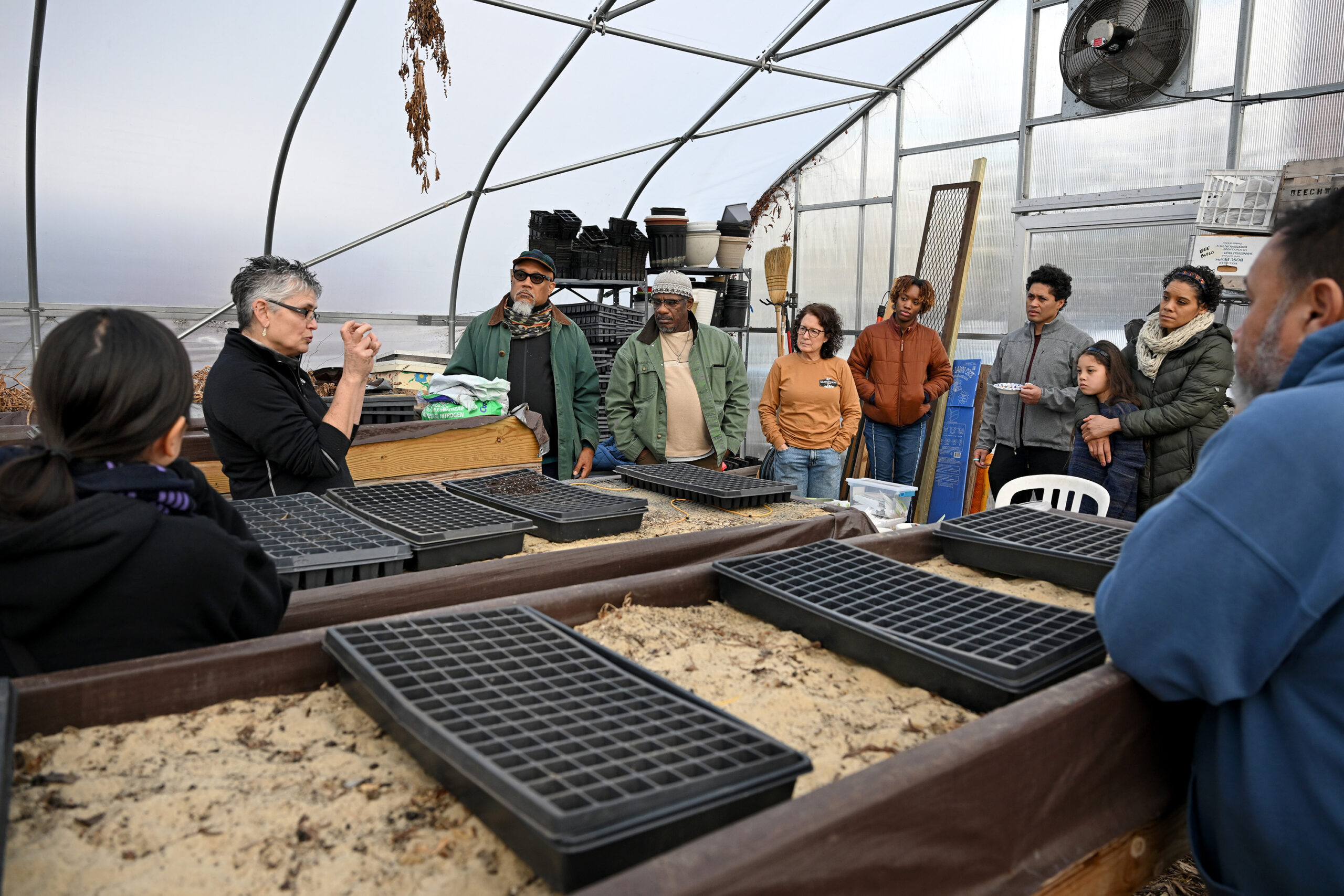
Sanctuary Farm founder and executive director Andrea Vettori (second from left) talks about seeds and germination.
Sanctuary Farm has a headquarters on North 24th Street, and currently operates nine gardening sites. Eight are located in North Philadelphia and one is in Huntingdon Valley, Montgomery County.
During the summer, the organization ramps up its operations to run two to three produce stands per week to distribute free food. The efforts are funded through a combination of private foundation grants, individual donations, and government support from state grants and the U.S. Department of Agriculture.
Vettori’s organization operates with a small staff — approximately five year-round employees, only two of whom are full-time.
Because of this small footprint, Vettori notes that they “couldn’t survive” without volunteers.
Sanctuary Farm has a core group of about 20 regular volunteers, though as many as 150 people have assisted the farm over the years. To draw members of the community, the farm uses a mix of social media, monthly meetings, and “old-fashioned” methods like handing out fliers door-to-door and using information boards, Vettori said.
In 2024, the organization harvested 9,500 pounds of produce.
Monday marked the first full scale MLK Day of Service the farm has hosted, though it has opened its doors in the past on the holiday. It was supported by a $1,000 grant for materials and food from Indego Bike Share.
Jose Hernandez (left) and Lisa Hernandez-Smith plant seeds.
‘Contribute back to the community’
Shamika Hull, of Fishtown, attended Monday’s event with her daughter, Zora Clark, 8, and husband, Mike Clark.
“I wanted to plan something together with my family to contribute back to the community, but I didn’t anticipate finding an organization that’s really this exciting,” Hull said, as she and her family began to plant onion seeds.
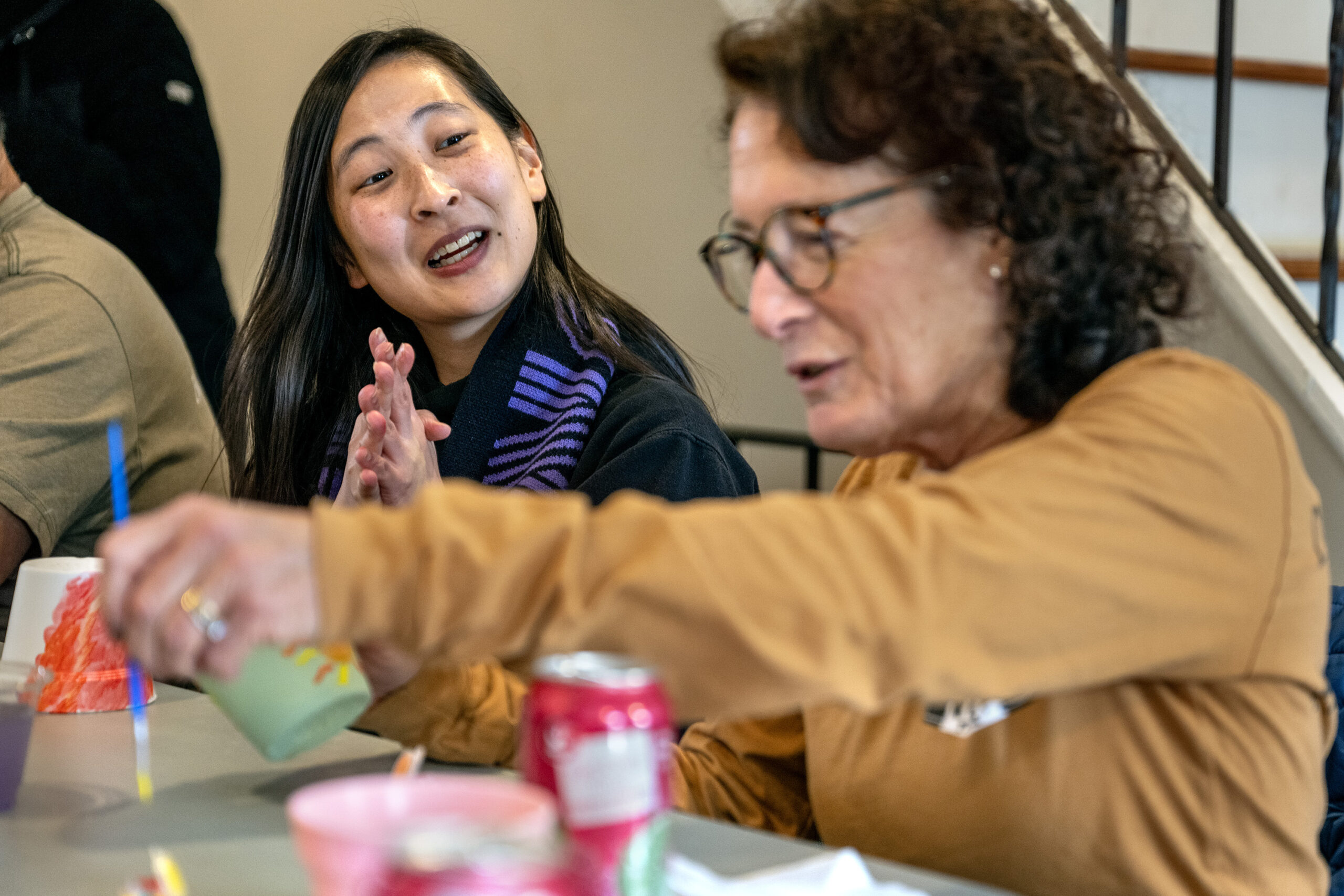
They had decorated planting pots earlier and also planned to bring home some seedlings.
Vettori gave a group of about a dozen people instruction in organic gardening basics, such as annuals vs. perennials, what type of seed starter to use, and what types of soils and fertilizers to avoid.
Sanctuary Farm does not use any chemical fertilizers or chemical pest control methods, she said.
“We use a lot of flowers to deter pests or to attract beneficials like wasps,” Vettori told the group. “I love wasps. I’m always trying to put in a good word for wasps, because they’re really good for the garden.”
She started Monday with onions because it’s too early to begin planting greens and tomatoes, she said. The group also planted flowers that they could bring home.
Patricia Farley (left) and Claudia Huot talk while painting their seedling pots indoors at Sanctuary Farm before heading out to the greenhouse.
‘The last think you’d expect’
Nearby, Jose Hernandez had smoothed seed starter over a plastic seedling tray. He joined the garden as a volunteer a few years ago to help manage his PTSD through the therapeutic gardening program. Hernandez served as a U.S. Marine in Operation Desert Storm during the Gulf War in the early 1990s.
“I overheard someone at the Veterans Administration speaking about it,” said Hernandez, formerly of Olney but now living in Delaware County.
Other vets are also enrolled in the therapeutic gardening program, which is designed for people with health challenges.
Hernandez travels to Sanctuary Farm every Monday. He also takes part in meditation and the sewing class, “which is the last thing you’d expect,” he said with a smile.
“One of the things that you tend to do when you have PTSD is internalize everything. You just keep to yourself,” Hernandez said. “Coming here, you meet other veterans and realize, ‘Oh, so there are other vets like me.’ … We can speak of things that we’ve experienced.”
The region evidently is about to migrate from the refrigerator to the freezer this week, with wind-chill levels possibly approaching zero as temperatures fall to the teens and a brisk west wind adds sting.
“Wind chill” has been a staple of National Weather Service forecasts and media weather reports since 1973.
(Commercial services, such as AccuWeather Inc., now have their own variants.)
At different times it has been a subject of contention, confusion, derision, and revision; its popularity, however, endures.
In terms of alerting the public to potential health hazards, “I think it’s useful,” saidMichael DeAngelis, vice chair of emergency medicine at Temple University’s Lewis Katz School of Medicine.
Said Harvey V. Lankford, a retired physician and writer who has done a deeper dive into wind chill than most humans: “It’s a yardstick.
“The public loves it.”
But where do those numbers come from, and do they tell us how we really feel?
The birth of ‘wind chill’
Gentoo penguins walk at Neko Harbour in Antarctica, Saturday, Nov. 22, 2025. (AP Photo/Mark Baker)
Wind chill is a measure of heat loss from the body from the combination of temperature and wind.
What we know about its effects has a lot to do with former Eagle Scout Paul Siple, the pride of Erie’s Central High School.
He pursued his quest while accompanying Admiral Richard Byrd on his legendary expeditions to that icy forbidden planet known as Antarctica, where the wind stings “like a knife drawn across the face,” as one of his associates put it. At age 19, Siple had won a highly publicized national competition to join Byrd.
Siple minted the term wind chill in his 565-page unpublished doctoral dissertation, a copy of which Lankford obtained from Clark University, in Worcester, Mass.
On a later expedition, Siple, assisted by geologist Charles Passel, conducted experiments measuring how long it took to freeze a container of water under a variety of temperature and wind conditions. Winds obviously accelerated the freezing process.
Using that data they estimated heat loss from human skin, publishing their findings in a landmark 1945 paper.
But Lankford said Siple got remarkable results in his more primitive earlier research, which included estimating frostbite thresholds, using a relatively simple formula involving wind speeds and temperatures.
Siple’s work would become the basis for the wind chill factor that the weather service massaged and began sharing publicly in 1973.
Frostbite and the wind chill revision
The wind chill calculations underwent a significant revision a quarter century ago.
U.S. and Canadian scientists during the 1990s used human subjects to upgrade the index, including establishing new frostbite thresholds.
Twelve subjects, with sensors inside their cheeks and their faces bare, were subjected to temperatures ranging from 32 to 58 below at three different wind speeds.
They were monitored for signs of “frostnip,” which precedes frostbite by about a minute.
For the record, the researchers found that with wind chills of 40 below, frostnip occurs within 15 minutes.
The weather service said the revised index profited from “advances in science, technology and computer modeling.”
Yet Siple obviously had been on to something decades earlier, Lankford said.
In a paper published in 2021 in the journal Wilderness and Environmental Medicine, Lankford and coauthor Leslie R. Fox wrote that some of the modern findings on frostbite thresholds were remarkably similar to what appeared in Siple’s dissertation.
Lankford said they were not surprised by the similarities: “We were stunned.”
Those conditions can seriously exacerbate certain lung problems.
For the healthy, he recommends proceeding with caution while exercising. Sweating in the cold — it does happen, just ask runners and hikers — can increase the risk of hypothermia.
Plus, your brain, heart, kidneys, and other internal organs will be diverting blood flow from muscles and extremities, and that could slow recovery from exertion.
Or you could just put off that run or bike workout until Thursday, when it may go up to 40 degrees.
A year ago, leaders of Family Practice & Counseling Network feared their health clinic, which has served low-income Philadelphians for more than 30 years, wouldn’t survive past June.
The clinic was part of Resources for Human Development, a Philadelphia human services agency that a fast-growing Reading nonprofit called Inperium Inc. had acquired in late 2024.
As a federally qualified health clinic since 1992, the clinic had received an annual federal grant, higher Medicaid rates, and other benefits.
But federal rules prohibited the clinic from continuing to retain that status and those benefits under a parent company. That meant Family Practice & Counseling Network had two options: close or spin out into a new entity that would reapply to be a federally qualified clinic.
“We had to figure it out,” the organization’s CEO Emily Nichols said in a recent interview.
At the time, the organization’s three main locations had 15,000 patients. They are “very underserved, low-income people that deserve good healthcare,” she said.
Thanks to $9.5 million in financial and operational support from the University of Pennsylvania Health System, a new legal entity took over the clinics in July. They now operate under the tweaked name, Family Practice & Counseling Services Network, and without the federalstatus.
“Penn allowed us to survive,” Nichols said.
Still in a precarious position
The nonprofit, with its name now abbreviated as FPCSN, remains in a precarious position.
Because of the corporate change, the $4.2 million annual grant that Family Practice had been receiving through RHD had to be opened up for other applicants under federal law. FPCSN applied but won’t find out until March the result of the competition.
Natalie Levkovich, CEO of the Health Federation of Philadelphia, a nonprofit that supports community health centers in Southeastern Pennsylvania, expressed confidence that the clinic will regain the funding, which helps cover the cost of caring for people who don’t have insurance.
“FPCSN is a well-run, well-regarded, well-supported health center that has an established, high-functioning practice in multiple locations,” Levkovich said. The clinic received letters of support from all the other federal clinics in the area, she said.
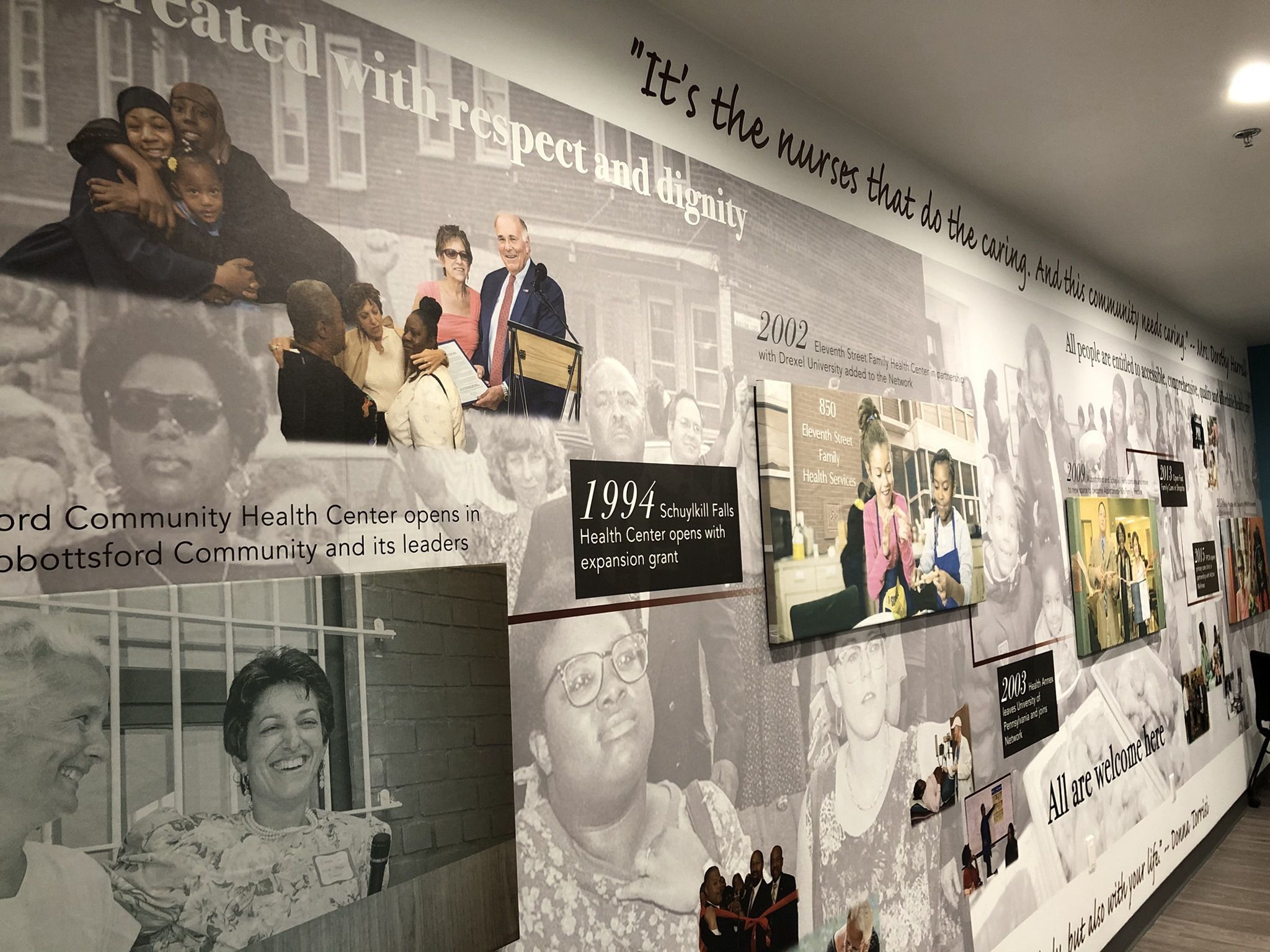
A mural in a conference room at Family Practice & Counseling Services Network’s headquarters in Nicetown shows a timeline of the agency’s history since its founding in 1992.
In return, federally qualified clinics have to accept all patients, including people without insurance. The insurance mix of FPCSN’s patient population is about 60% Medicaid, 20% uninsured, 10% Medicare, and 10% commercial, Nichols said.
Also, half of a federal clinic’s board members have to be patients at the clinic. FPCSN has three main locations, in Southwest Philadelphia, on the western edge of North Philadelphia, and in the West Poplar neighborhood. Its revenue in fiscal 2025 was $31 million.
During the past year, 55 FPCSN staff members have left, leaving 140 employees still at the organization, including 16 nurse practitioners who provide the primary care. The departures may have contributed to a decline in the number of patients seen to 13,500 last year, compared to 15,000 the year before, Nichols said.
Why Penn helped FPCSN
Federally qualified health centers form the core safety net in Philadelphia and across the nation, said Richard Wender, who chairs Family Medicine and Community Health at Penn, which had a longstanding relationship with RHD’s clinics.
Under contract, Penn family practice physicians were providing prenatal care to 400 pregnant patients at the clinics that would have closed abruptly at the end of June if Penn hadn’t provided support. “We wanted them to be able to continue to take care of the patients that they were taking care of,” Wender said.
The money from Penn helped pay startup costs for the new entity and bridged the period until FPCSN was able to secure new contracts with insurance companies.
Penn also didn’t want the clinic’s patients showing up in its already busy emergency departments for basic care. “That adversely affects their health because it’s not a good place to get preventive care,” he said.
But it was important to Penn that there was a pathway back to federal clinic status. “We feel as optimistic as we can,” Wender said.
Wender and Nichols credited Kevin Mahoney, CEO of Penn’s health system, with the preservation of FPCSN’s services for low-income Philadelphians by throwing his full support behind the effort.
“You have to have a CEO, a leader in your health system, who understands that this is the responsibility of large academic health centers,” Wender said.