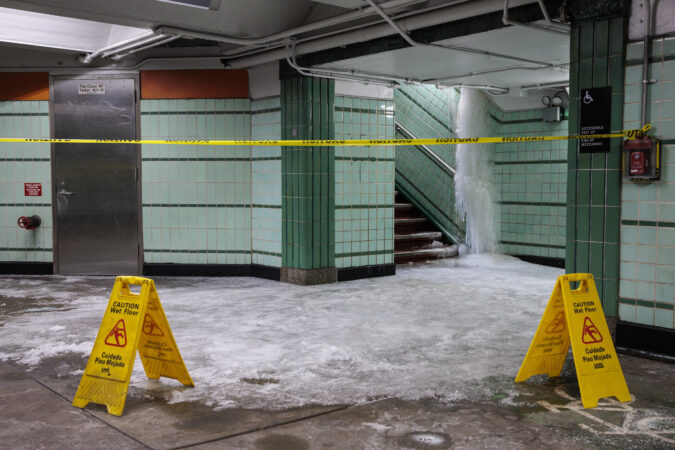
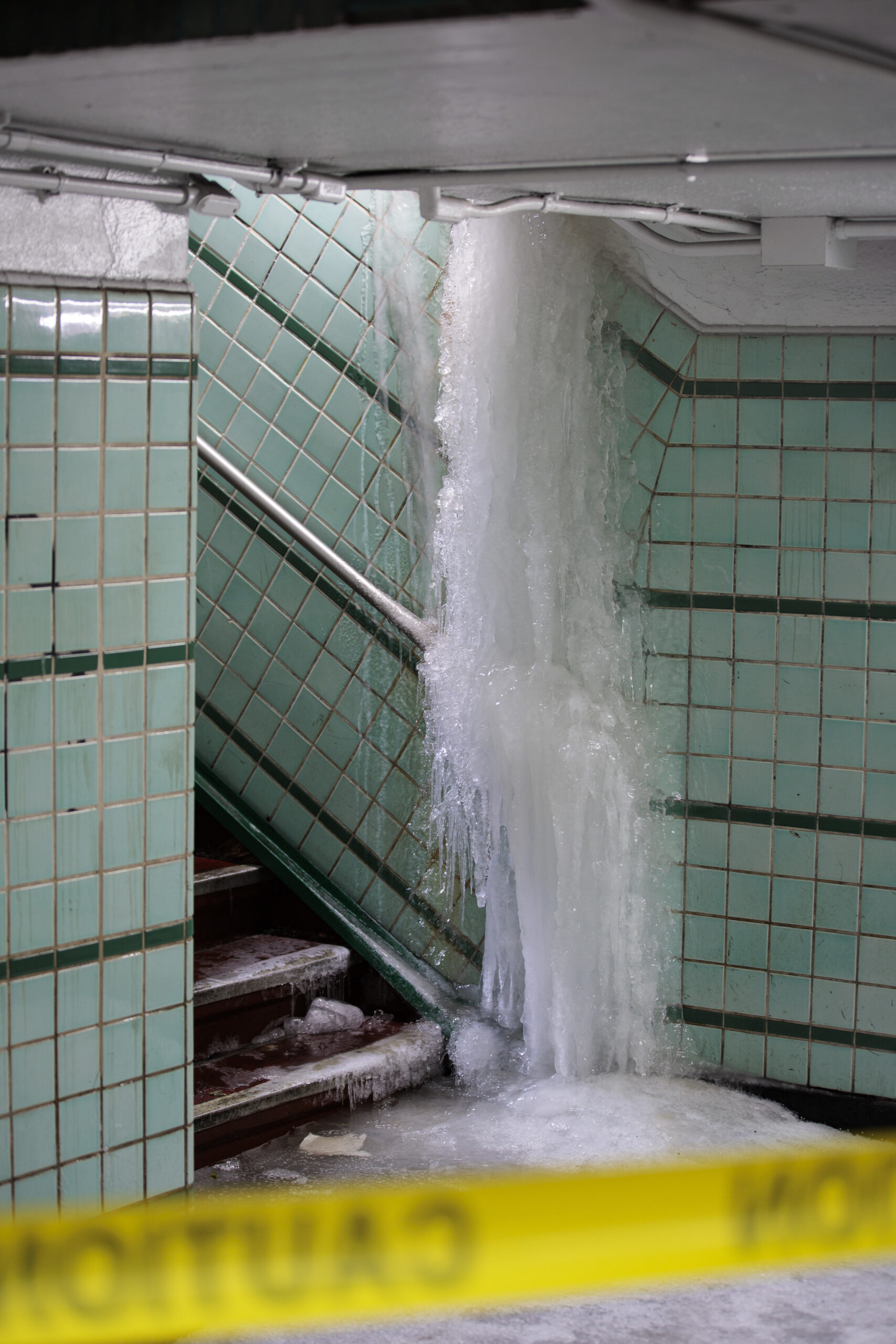
An enormous block of ice extended from the ceiling and covered the floor at the east-side entrance to the Tasker-Morris Station on SEPTA’s Broad Street Line on Tuesday afternoon after a pipe burst outside the station late Monday.
The pipe belonged to the Philadelphia Water Department, SEPTA spokesperson Andrew Busch said. It was being repaired and crews were continuing to clean up the damage, Busch said Tuesday afternoon.
The damage did not affect train service, he said.
The transit authority has been dealing with a number of burst pipes the last few weeks, only some of which are theirs. Some belong to other property owners, such as the one that burst at the Convention Center and flooded Jefferson Station on Monday night.
Ice covers the Tasker Street east-side entrance/exit at the Tasker-Morris SEPTA Station on the Broad Street Line on Tuesday, Feb. 10, 2026 in Philadelphia.
“When we have these deep freezes and then it warms up, and it’s happening all over, that causes problems with the pipes,” Busch said. “In many cases the best we can do is make sure that we have crews ready to respond to it and then work on cleaning up.”
Over the last two weeks, SEPTA has recorded about 10 incidents of water main breaks or burst pipes leading to flooding in stations or water from SEPTA structures flooding streets, Busch said. In about half those cases, the pipes belonged to SEPTA.
Many of these issues have occurred along the eastern edge of the Market-Frankford Line from near Spring Garden to the Frankford Transportation Center, Busch said. That is the oldest part of the line and some sections of the pipes are exposed.
SEPTA is planning a winterization project starting this summer. The project will likely include installing new valves on the water lines, replacing pipe insulation, and upgrading strips in the pipes that heat them. Busch said SEPTA expects that project to be done by around the start of next year. No full cost estimate is available yet, Busch said.
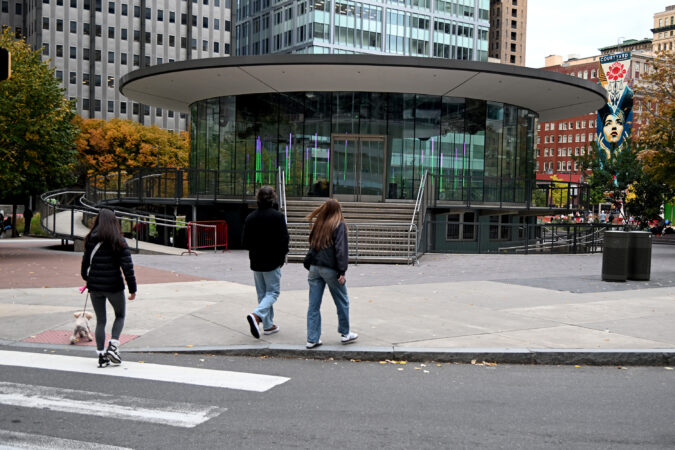
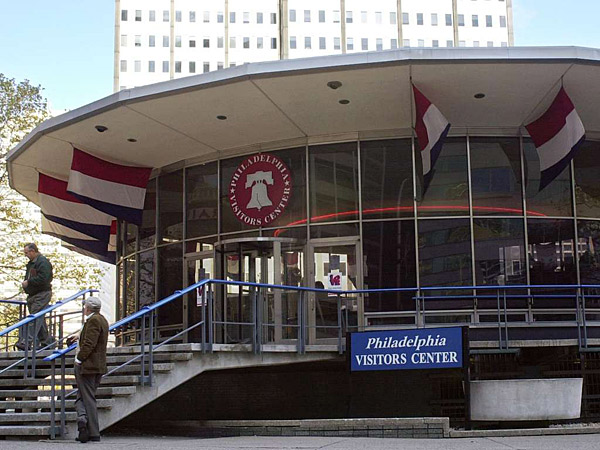
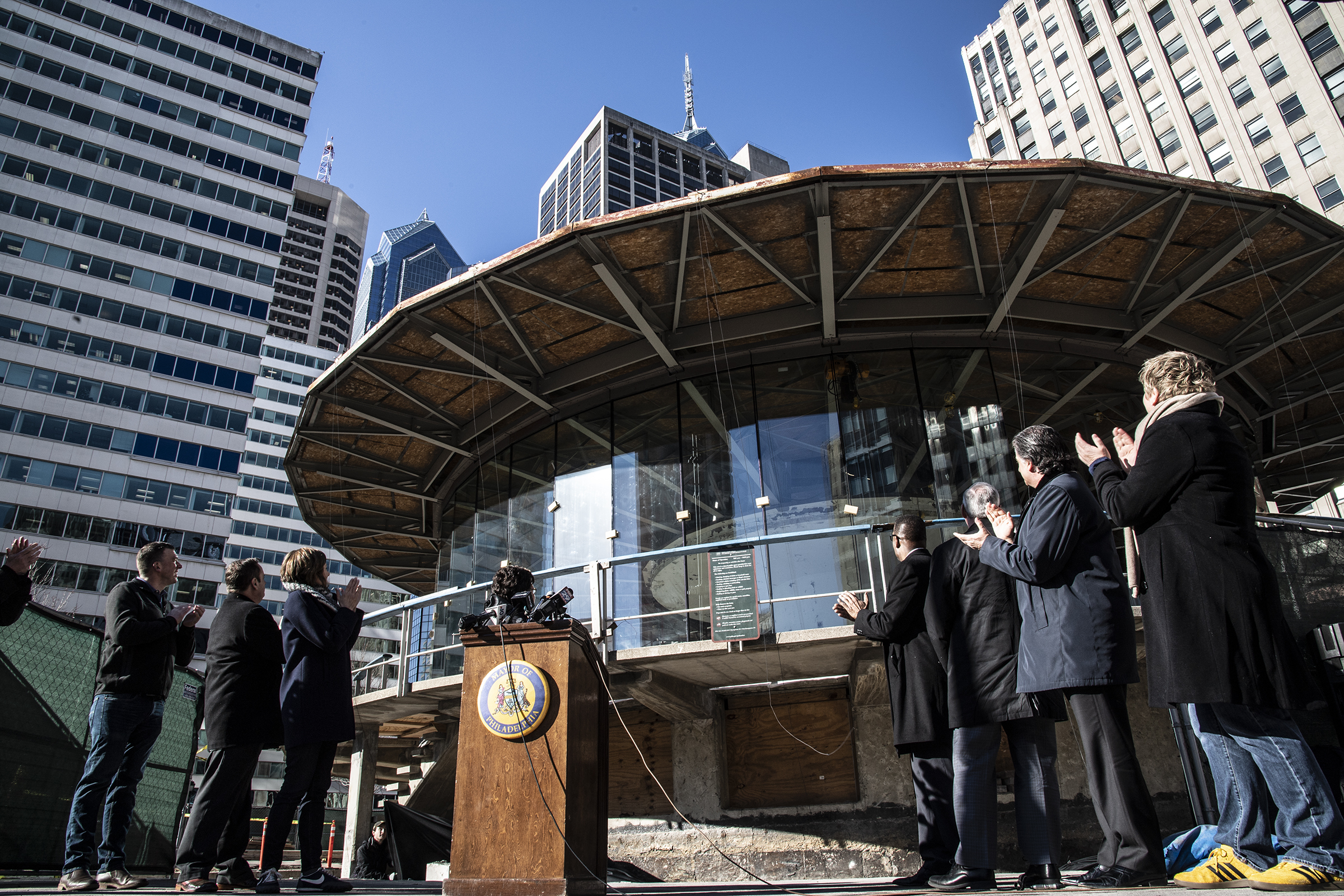
The saucer in LOVE Park finally has a timeline for its revival.
After years of seeking ideas from business owners and other Philadelphians, city officials expect work on the historic building to begin in May, the city’s Parks & Recreation Department says.
But officials are still working to select a partner for the project.
In May, the city issued a “request for expressions of interest” (RFEI) from “visionary businesses, particularly those in food, beverage, retail, or hospitality,” who wanted to partner on the saucer.
City officials said the interest exceeded expectations, with more than 50 applicants submitting ideas. They included “coffee and cafe concepts, casual food offerings, beer garden hybrids, and informal meeting spaces,” according to Parks & Recreation spokesperson Ra’Chelle Rogers.
Among applicants, there was a focus on “flexible, welcoming concepts that function as a true public amenity, encouraging people to meet, linger, and connect in the park,” Rogers said.
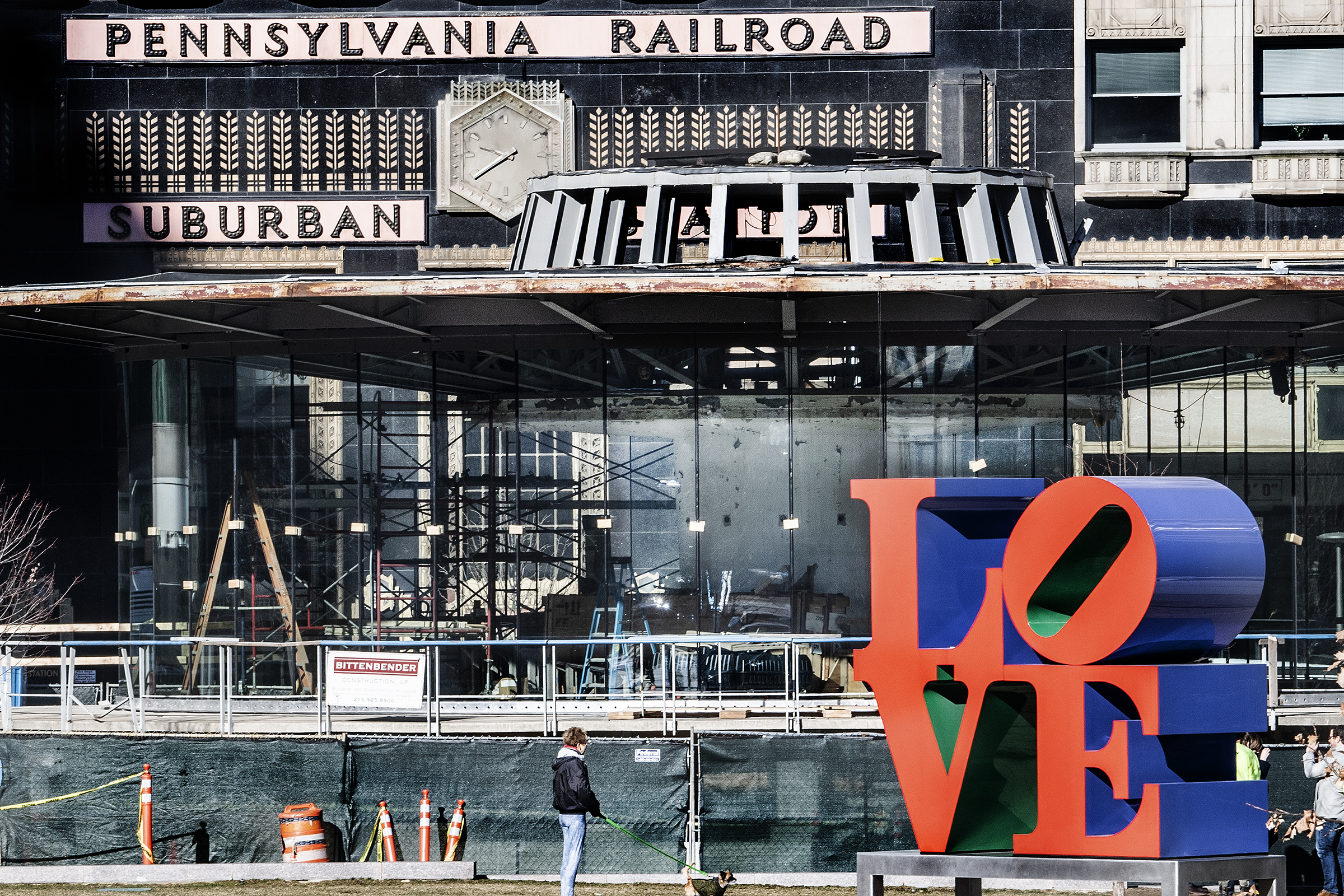
The saucer building in LOVE Park is pictured in March 2019, amid early renovations for a bar-restaurant concept that never panned out.
In light of the demand, the city is moving into its next stage, requiring prospective partners to visit the saucer at 3 p.m. on Feb. 18 and submit a proposal online by March 18.
Prospective partners do not need to have submitted an idea in the spring, Rogers said. Any experienced food, beverage, hospitality, or community operator with the capacity to “generate sustainable revenue to support the park” is encouraged to apply, Rogers said.
“The saucer has always been envisioned as a people-first space — one that complements the park, supports programming, and welcomes both residents and visitors,” said Susan Slawson, the city’s parks & recreation commissioner. The RFEI process has given officials “confidence to move forward with a flexible, inclusive model designed for the way people actually use LOVE Park.”
The saucer, also referred to as the UFO, was added to the Philadelphia Register of Historic Places last year. Built in 1960, the building predates LOVE Park, and first served as the city hospitality center. It later housed offices for park staff.
An undated file photo of LOVE Park’s saucer building when it served as the Philadelphia Visitors Center.
For more than a decade, however, the circular structure near 16th Street and JFK Boulevard has largely sat dormant (the building has opened to the public for the Festival of Trees, a Children’s Hospital of Philadelphia fundraiser, during recent holiday seasons).
In March 2019, city officials applauded the early construction of a bar-restaurant that was set to fill LOVE Park’s saucer building. The pandemic later caused the restaurateurs to bow out of the project.
As for this latest request process, city officials said they plan to select a partner by April, and begin work a month later. The timing could coincide with Philly’s celebration of America’s 250th birthday, as well as the city’s hosting of World Cup matches and the MLB All-Star game.
The office of Councilmember Jeffery Young, whose district includes LOVE Park, is set to fund “key utility and infrastructure improvements” at the saucer, according to the city statement, and public grants are being sought to offset other upfront costs.
“Bringing an active, public-facing partner into the saucer is a milestone for LOVE Park and for Philadelphia,” Young said. “I’m proud to support improvements that make the saucer a welcoming hub for years to come.”
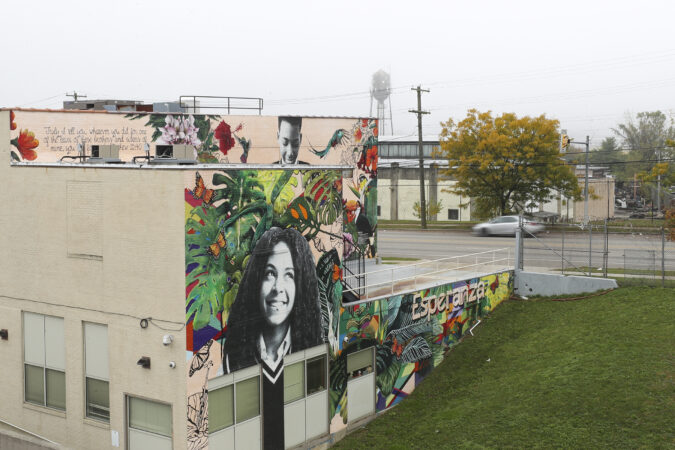
Esperanza Academy Charter High School teachers and staff have unionized.
The brand-new Esperanza High School Collective, a chapter of the American Federation of Teachers, now represents nearly 80 staff at the school.
The move comes during a period of turmoil at the school, after some employees were laid off abruptly in December. Current and former staff say there have been sudden and arbitrary changes at the school, including larger class sizes and fewer staff working directly with children.
Union recognition was hard fought — a majority of the staff signed union cards in the fall, but the Esperanza administration declined to voluntarily recognize the collective.
Instead, the AFT had to go through the National Labor Relations Board, which held an election in late January. In all, 87% of the Esperanza Academy Charter High School staff voted to unionize. (Staff at Esperanza’s elementary and middle schools have not unionized.)
Wendy G. Coleman, president of AFT Pennsylvania, said the organization was “thrilled” to welcome Esperanza Academy high school staff.
“These dedicated educators and staff work tirelessly to ensure that their students receive the best possible education, and AFTPA is ready to work just as diligently to help them secure better class sizes, higher wages, and adequate resources for every member in their first contract,” Coleman said in a statement. “As we know, our members’ working conditions are our students’ learning conditions, and we’re excited to see what the future holds for the Esperanza High School Collective in their first contract.”
Esperanza is the sixth of Philadelphia’s 81 charter schools to form a union; the vast majority of Pennsylvania charters are not unionized.
A growing number of musicians — including most recently Chappell Roan — are leaving their management company after its founder’s emails were uncovered in the latest release of the Epstein files.
Wasserman, a major talent management company based out of Los Angeles, represents stars ranging from Billie Eilish and Kendrick Lamar to Phish, Bon Iver, Turnstile, and Kacey Musgraves.
The company has been in hot water since the Department of Justice dropped over 3 million pages of documents related to Jeffrey Epstein, the disgraced financier and sex offender, and his associate, convicted sex offender Ghislaine Maxwell.
Those released files included emails between the agency’s founder, Casey Wasserman, and Maxwell. Now, musicians signed to Wasserman Group are speaking out and cutting ties.
Here’s what you need to know.
Who is Casey Wasserman?
Wasserman is a successful entertainment agent and the founder and CEO of the Wasserman Group, which represents sports talent, musicians, artists, and content creators.
He is the grandson of media mogul and talent agent Lew Wasserman. He is also the chairperson of the organizing committee for the Los Angeles 2028 Olympic and Paralympic Games.
What did Casey Wasserman’s emails to Ghislaine Maxwell say?
Wasserman’s emails, which were released by the Justice Department in January, reveal an exchange between him and Maxwell from 2003.
In the emails, Maxwell offers to give Wasserman a massage that would “drive a man wild.” Later, Wasserman tells Maxwell that he thinks about her “all the time” and asks what he has to do to see her in “a tight leather outfit.”
The Justice Department has not accused Wasserman of wrongdoing.
What kind of talent does the Wasserman Group represent?
Wasserman is regarded as one of the top talentagencies. The companyrepresents hundreds of the world’s biggest touring acts and oversees artists who perform across a range of musical genres.
The company’s artist roster includes Coldplay; Ed Sheeran; Joni Mitchell; Tyler, the Creator; Kendrick Lamar; Lorde; and many more.
Wasserman’s artist roster is no longer available on its website.
How are artists signed to Wasserman reacting?
Many have spoken out against the Wasserman CEO, calling for him to leave the agency. Some artists have gone as far as leaving the agency.
Bethany Cosentino, the front woman of Best Coast, was among the first to speak out, posting an open letter on Instagram last week calling for the founder to step down.
“As an artist represented by Wasserman, I did not consent to having my name or my career tied to someone with this kind of association to exploitation,” Cosentino said. “Staying quiet isn’t something I can do in good conscience — especially in a moment when men in power are so often protected, excused, or allowed to move on without consequence. Pretending this isn’t a big deal is not an option for me.”
Irish punk band the Dropkick Murphys announced over the weekend that they were alsoleaving Wasserman.
“It saddens us to part ways with [our agents], but the namesake of the agency is in the Epstein files so … we GONE,” the band wrote on Instagram.
Other bands, including Wednesday, Water From Your Eyes, and Beach Bunny, have made statements on social media about their concerns or their intentions to start the process of leaving the agency.
On Monday, Chappell Roan announced her exit.
“As of today, I am no longer represented by Wasserman, the talent agency led by Casey Wasserman,” Roan posted on Instagram. “I hold my teams to the highest standards and have a duty to protect them as well. No artist, agent or employee should ever be expected to defend or overlook actions that conflict so deeply with our own moral values. I have deep respect and appreciation for the agents and staff who work tirelessly for their artists and I refuse to passively stand by.”
In addition to artist pressure, Los Angeles politicians are calling for Wasserman to give up his role on the Olympics committee. The Hollywood Reporter also reported that agents who work at Wasserman are considering spinning off a new firm.
Still, not all artists believe they can make a clean break like Chappell Roan or the Dropkick Murphys.
Why can’t every artist leave the agency?
Wasserman client Alexis Krauss, of the group Sleigh Bells, released a lengthy statement condemning the CEO and detailing why she could not leave the company entirely, citing the financial impact it would cause.
“Do I wish I could burn it all down, boycott and divest? Sure I do. But to be totally honest, I can’t afford to,” Krauss said.
Krauss continued, “Would I love to just leave Wasserman Music? Yes I would. Can we? No, because I love and respect our agent and I trust him to make the decision that is best for himself, his family and his artists. The agents at Wasserman are not the villains.”
Several artists, including Krauss, emphasized that they do not work directly with — and in most cases have never met — Casey Wasserman.
Krauss added that her income allows her to pay her and her child’s health insurance, saying, “let’s remember that there’s no such thing as healthcare for working musicians. Call me spineless, but this is my truth. This is the hypocrisy of our realities as we try to do the least harm in an unscrupulous system.”
Are any Philadelphia-area artists managed by Wasserman?
Yes. Some include: Aaron West and the Roaring Twenties, the A’s, the Bacon Brothers, Diplo, the Disco Biscuits, Dr. Dog, G. Love & Special Sauce, the Menzingers, the Wonder Years, and Spaga.
As of publication time, none of these artists have made statements about Wasserman. This story will be updated if they do.
Has Casey Wasserman made a statement?
Yes. In a statement sent to the New York Times, Wasserman said he “deeply regrets” his correspondence with Maxwell, “which took place over two decades ago, long before her horrific crimes came to light.”
Wasserman added that he never had a “personal or business relationship” with Epstein.
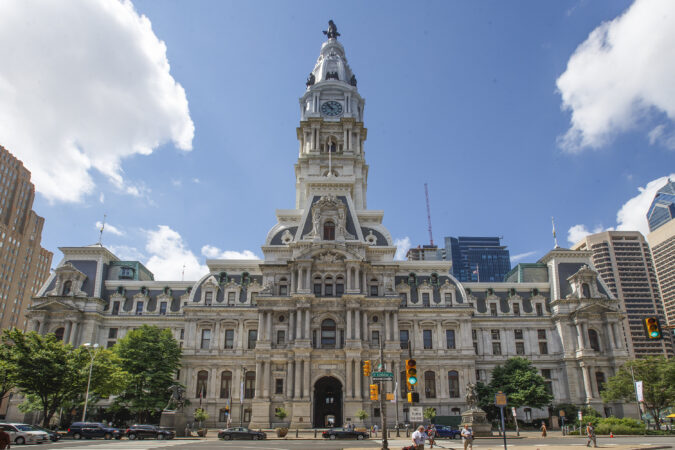
After Sharif Street Jr. got into a highly public fight at Mayor Cherelle L. Parker’s 2024 inauguration ceremony, his boss, City Councilmember Jim Harrity, extended him some grace.
Harrity, who credits Street Jr.’s father, State Sen. Sharif Street (D., Philadelphia), with giving him a second chance earlier in his own career, kept the junior Street on staff as a special assistant, saying the incident was a lapse in judgment.
But according to another staff member in Harrity’s office, it was not the only transgression.
Shanelle Davis, a former constituent services representative, filed a federal lawsuit last week against the city claiming that she told supervisors months before the inauguration fight that Street Jr. had sexually harassed her while she was at work, including twice grabbing her and making sexualized comments about her body.
She said in the suit, filed in the U.S. District Court for the Eastern District of Pennsylvania, that no action was taken and Street Jr. remained on staff.
Davis is seeking unspecified damages from the city, which she claims violated state and federal laws related to gender-based discrimination. Street Jr. is not named as a defendant in the suit, but he is mentioned throughout the 13-page filing.
Davis’ complaint portrays a dysfunctional workplace environment in the City Hall office, including an alleged physical altercation between Street Jr. and another staffer for which no one was reprimanded. Davis, who is Black, claimed another colleague in Harrity’s office made racist comments, including hurling the N-word toward her.
Davis, who was hired in late 2022, said in the lawsuit that she was fired for underperforming at her job about a year later, after Harrity won reelection.
Her attorney did not respond to a request for comment Monday. Street Jr. did not respond to calls seeking comment.
Harrity, a Democrat who represents the city at-large and was a longtime aide to the elder Street, said in a statement that he “categorically denounce[s] workplace harassment, or any conduct that undermines a respectful and professional work environment.”
He declined to comment further, citing the ongoing legal proceedings. A spokesperson for the city law department also declined to comment.
The lawsuit is the latest legal trouble involving Sharif Street Jr., 26, who over the last three years has pleaded guilty to criminal offenses in Philadelphia, Montgomery, and Delaware Counties. In August, his employment with the city was terminated the week he pleaded guilty to charges in connection with the inauguration assault and another incident.
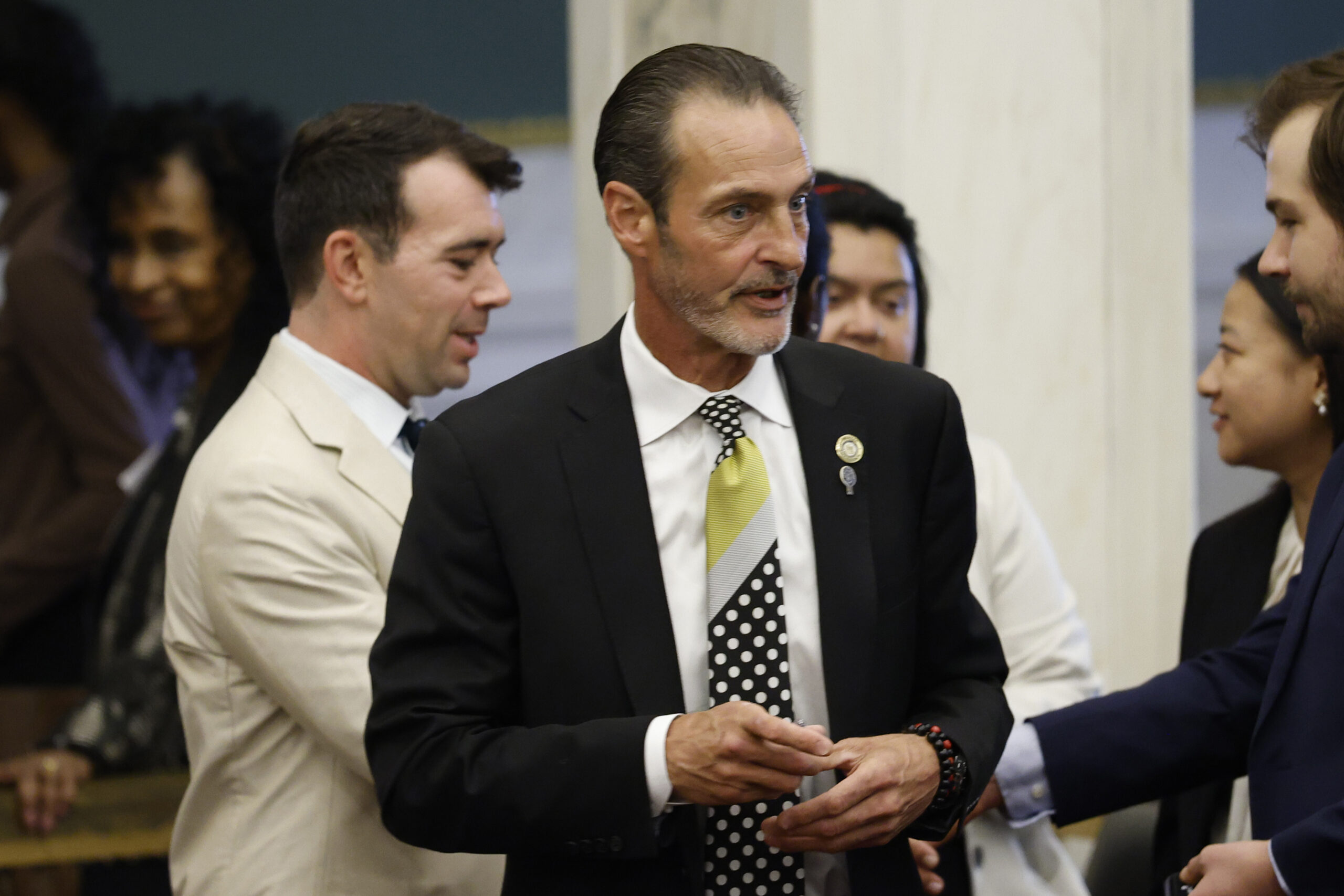
City Councilmember Jim Harrity speaks to colleagues on during a Council session in September.
Street Jr. comes from one of Philadelphia’s most well-known political families. His grandfather is former Mayor John F. Street, his mother is Common Pleas Court Judge Sierra Thomas Street, and his father is a state senator and the former head of the state Democratic Party who is now running for a seat in Congress.
Anthony Campisi, a spokesperson for the elder Sharif Street’s congressional campaign, said the state senator had “no knowledge” of the sexual harassment allegations.
“Sharif loves his son unconditionally and has supported his son through personal troubles, like so many parents across Philadelphia,” Campisi said. “That being said, Sharif unequivocally condemns sexual harassment in all its forms and is looking for the legal process to play out.”
City Council President Kenyatta Johnson, who took over as leader of the chamber in 2024, declined to comment. Under City Council rules, individual members are responsible for hiring and terminating their own employees.
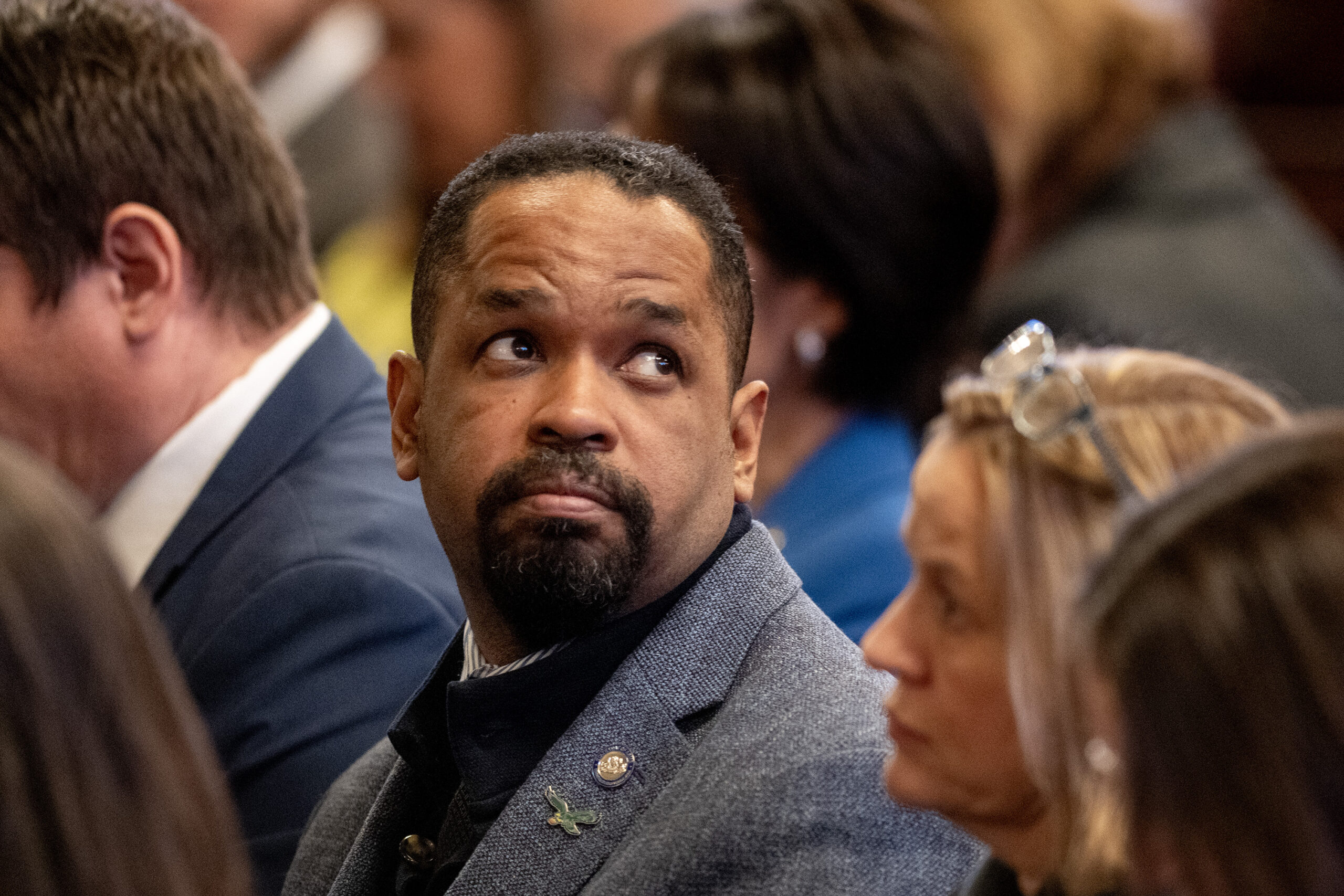
State Senator Sharif Street (D., Phila.)is in the state House chamber as Gov. Josh Shapiro makes his annual budget proposal Feb. 3, 2026.
Street Jr. was arrestedseveral times over three years while working in City Hall as an assistant in Harrity’s office, court records show. Davis’ lawsuit comes about six months after Street Jr.’s employment in Harrity’s office ended, according to payroll records.
In January 2024, Street Jr. punched a security guard at the entrance to Parker’s inauguration ceremony at the Met Philadelphia on North Broad Street. He told The Inquirer at the time that he was defending his grandfather, the former mayor, whom he said the guard had grabbed because they were trying to enter at a back entrance without waiting in line.
“I saw my grandfather get grabbed and I just sort of blacked out,” Street Jr. said. His father defended him at the time, saying the security guard had initiated the altercation.
Later that month, Street Jr. was charged in connection with a hit-and-run from the previous August that left a 14-year-old injured.
The two cases were consolidated in Common Pleas Court, and Street Jr. pleaded guilty in August to charges of assault and causing an accident that resulted in an injury. According to prosecutors, he was sentenced to 60 days in jail.
Four months later, when he was no longer working in city government, Street Jr. was briefly jailed in Delaware County following what police in Upper Darby described as a “prolonged struggle” during a traffic stop. He pleaded guilty to disorderly conduct, a summary offense.
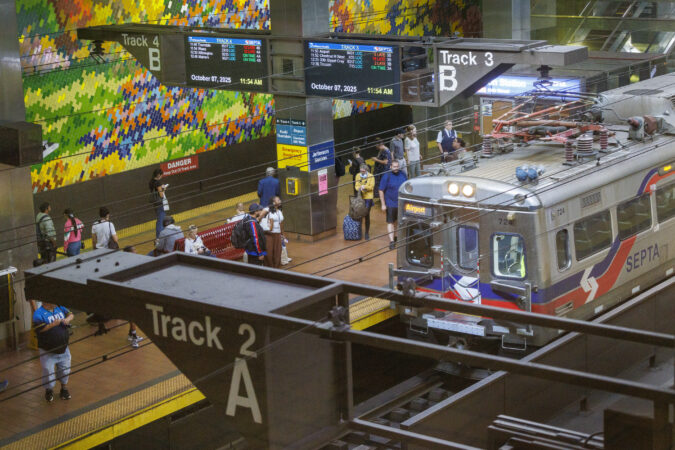
A burst water pipe caused SEPTA to close a section of Jefferson Station in Center Cityon Monday night, but Regional Rail trains were still making stops there for commuters, an agency spokesperson said.
The water started flooding into Section A of the station around 6 p.m., and the water was shut off shortly after 7 p.m., said SEPTA spokesperson Andrew Busch.
Section A closed Monday night for cleanup but opened in time for the morning rush Tuesday, Busch said.
All trains were still running with boardings and exits at other platforms, Busch said.
“We believe the pipe burst was likely due to the change in temperature,” Busch said in an email Monday. “We also had one at the Allegheny subway station today, and a few last week on the days it got above freezing.”
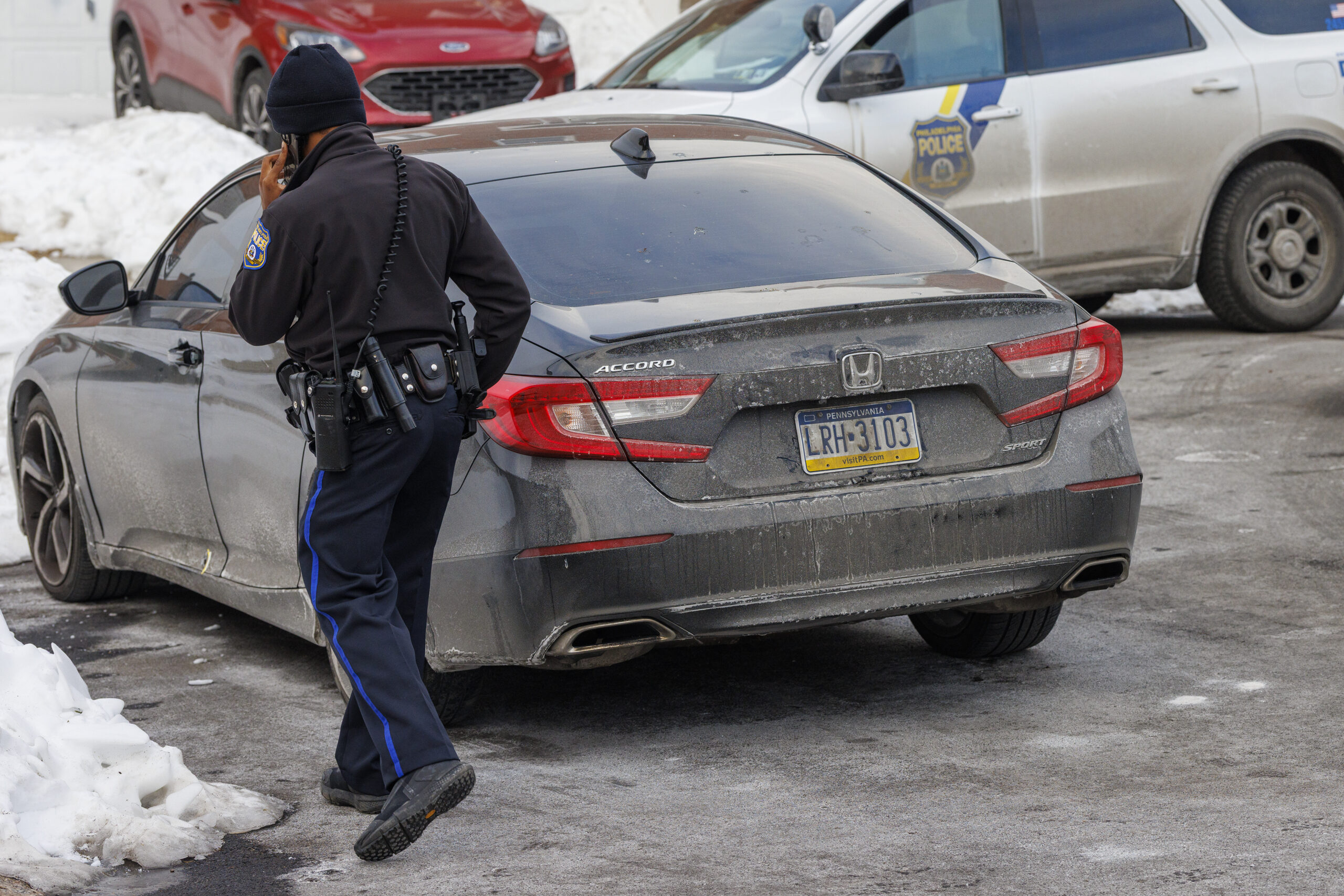
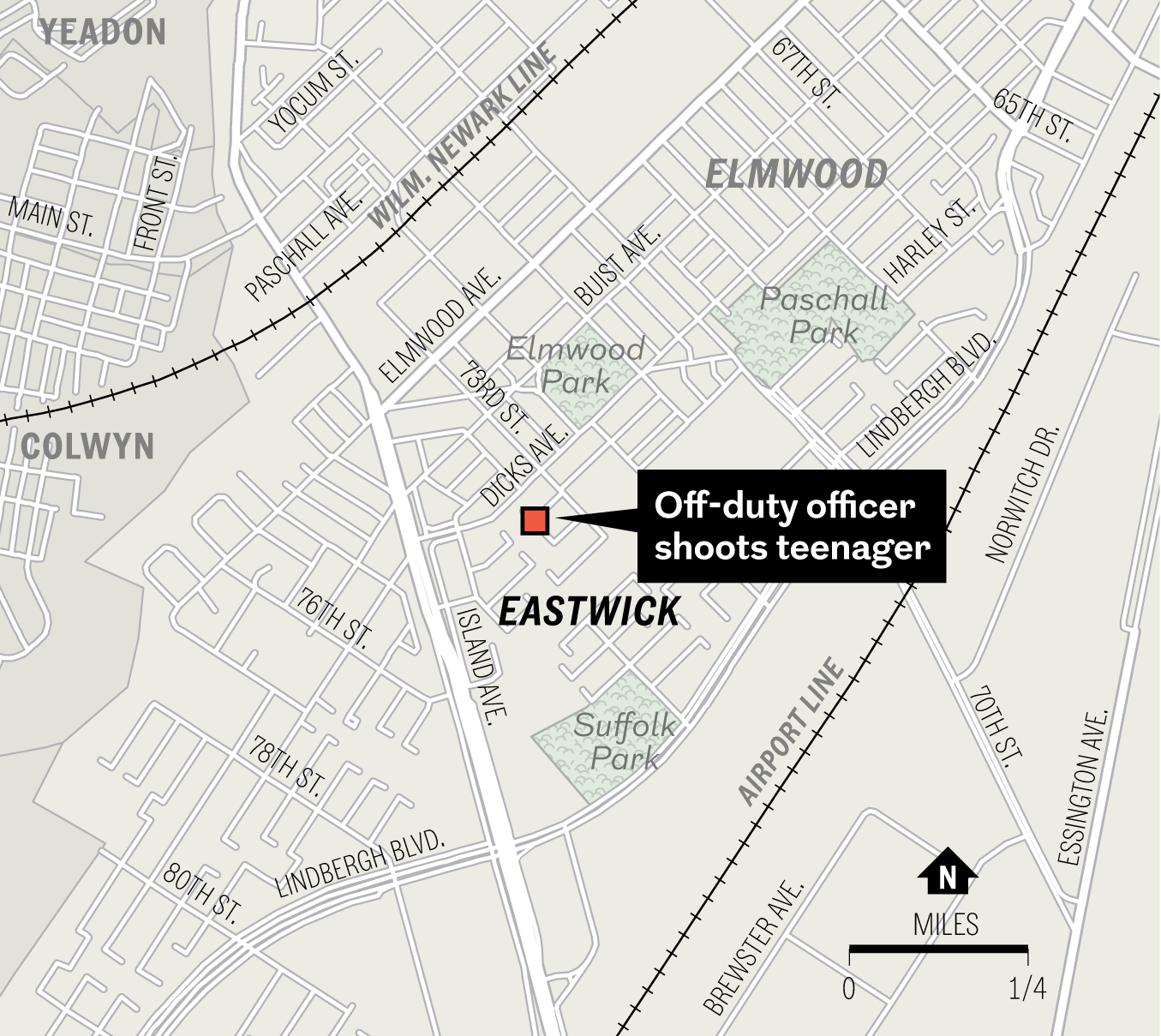
An off-duty sheriff’s officer shot a 17-year-old in Southwest Philadelphia early Tuesday morning.
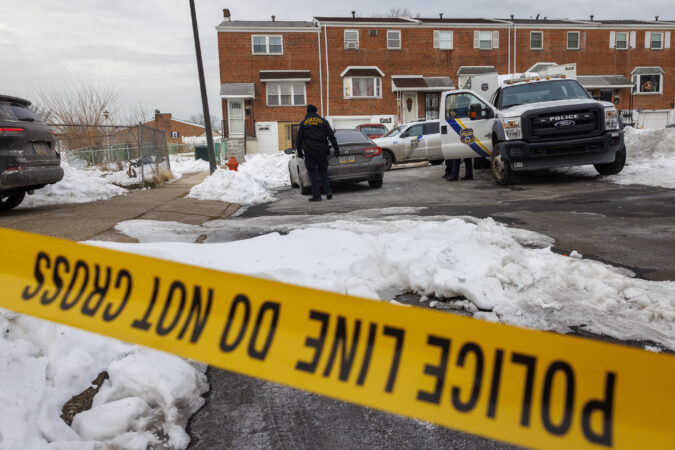
Philadelphia Police Chief Inspector Scott Small told reporters the off-duty officer saw the teenager,who has not been identified, breaking into his private vehicle around 3:32 a.m. on the 7300 block of Bunting Place.
“For reasons unknown at this time,” the officer, and a member of the officer’s family, fired their guns at the teen inside the car, Small told reporters.
Philadelphia police crime scene unit gathers evidence at shooting by off-duty sheriff at 7300 block of Bunting Place, early Tuesday, Feb. 10, 2026. An off-duty Philadelphia sheriff’s deputy and a family member shot a teen, allegedly trying to steal their car, a Honda Accord.
Four shots total were fired, according to Small, before the teen fled the scene.
Around 20 minutes later,a teenager was transported by a private vehicle to Presbyterian Medical Center, where the officer involved in the shooting identified the wounded teen. The teenager was placed in stable condition.
Map of where an off-duty sheriff’s officer shot a 17-year-old in Southwest Philadelphia on Feb. 10.
Small noted that the teen was in possession of commonly used car theft tools, like a screwdriver, extra key fob, and other items. He told reporters at the scene that investigators found four spent shell casings and newly broken locks on the car’s doors.
The teenager was placed in custody at the hospital with charges pending.
The off-duty sheriff’s officer and their family member are uninjured and cooperating with the investigation. The family member involved in the incident had a license to carry the firearm used in the shooting, Small said.
Lankenau High’s 11th-grade class is tiny — just 25 students.
That’s one of the reasons why closing the school is for the best, Philadelphia School District Associate Superintendent Tomás Hanna said at a community meeting last week.
At small schools, Hanna said, programming options are limited and “what’s left behind is very difficult environment for young people.”
The district proposes merging Lankenau into Roxborough High as an honors program — a move that officials say will maximize opportunities for students at both schools. That proposal has been met with fierce opposition from the Lankenau community, whose members say stripping the school of its identity and removing it from its unique location on 400 wooded acres is unjustifiable.
When the school system dramatically revamped its special-admissions process in 2021, moving to a centralized lottery from a system where principals had discretion over who got into the district’s 37 criteria-based schools, enrollment dropped at some magnets.
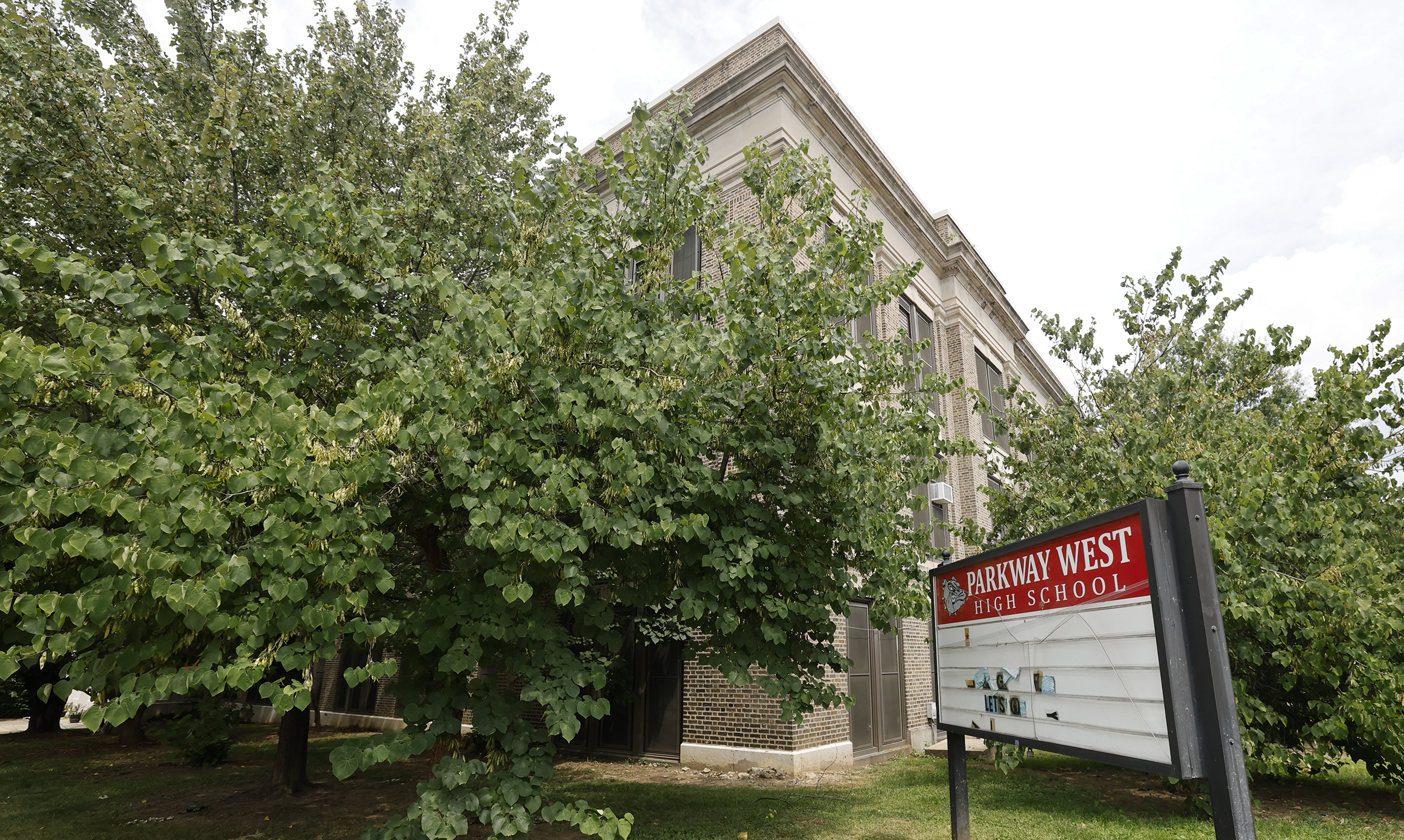
For the 2022-23 school admissions cycle, Lankenau, Motivation, Parkway West, and Parkway Northwest — four of the 20 schools tagged to close — had dozens of unfilled seats in their ninth-grade classes.
window.addEventListener(“message”,function(a){if(void 0!==a.data[“datawrapper-height”]){var e=document.querySelectorAll(“iframe”);for(var t in a.data[“datawrapper-height”])for(var r,i=0;r=e[i];i++)if(r.contentWindow===a.source){var d=a.data[“datawrapper-height”][t]+”px”;r.style.height=d}}});
The district setacademic standards for admission to those schools, and stopped allowing schools to admit students who were close to meeting academic requirements and who demonstrated they would be a good fit for the individual schools, as had been done in the past. (Officials said they wanted to centralize admissions to avoid demographic imbalances at schools; those four magnets did not have a history of them.)
The district’s using Lankenau’s tiny now-junior class to justify closings infuriated many, including Matthew VanKouwenberg, a science teacher at the school.
Lankenau’s size “is a district-designed and district-created problem,” VanKouwenberg said. Though the lottery was begun for equity reasons, “the result is disastrous.”
But Tonya Wolford, the district’s chief of evaluation, research, and accountability, said Lankenau, Motivation, Parkway West, and Parkway Northwest had declining numbers of students applying prior to the lottery changes.
And for years, those schools accepted large numbers of students who didn’t meet the district’s criteria, Wolford said.
Dramatic enrollment drops after district orders
The data are clear: After the district pushed changes to the admissions process, the four schools all saw dramatic drops in enrollment — and some of them never recovered.
Motivation, in West Philadelphia, had a freshman class of 83 students and a total enrollment of 336 in 2022-23. It saw a 77% drop in its ninth- grade class — just 19 freshman in 2023-24. The school now has 151 students, and the district wants to close it and make it an honors program inside Sayre High School. It is operating at only 15% of its full capacity.
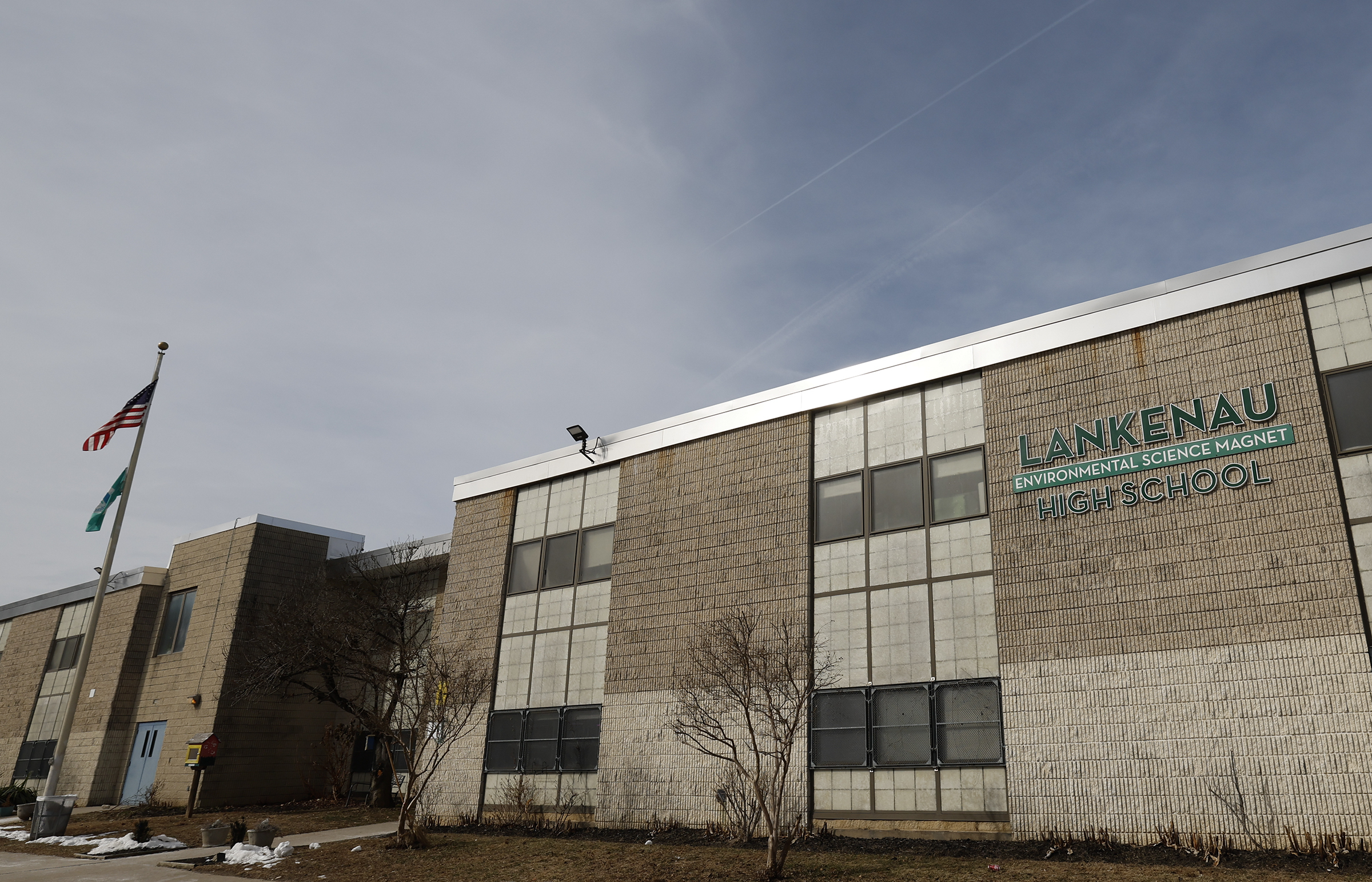
The Lankenau Environmental Science Magnet High School in Roxborough.
Lankenau, in Upper Roxborough, had 91 freshman in 2022-23, then 31 in 2023-24, a 66% decline. It now enrolls 225 students. The school is using 49% of its capacity.
Parkway Northwest had 77 ninth graders in 2022-23, then dropped to 30 in 2023-24, a 61% decrease, and is 60% full. It’s got 248 students this year, and the district wants to close it and make it an honors program of Martin Luther King High.
And Parkway West had 54 freshman in 2022-23, then 19 the following year, a 65% decrease. It now has just 140 students, and is using 40% of available seats. It’s proposed to close and become part of Science Leadership Academy at Beeber.
A staffer who worked at Parkway West as the special-admissions process changes rolled out said they were devastating to the school, which typically filled three-quarters of its slots for incoming ninth graders with students who qualified on every measure, and a quarter by feel.
Parkway West High School, in West Philadelphia, is proposed to close under a Philadelphia School District facilities proposal.
“We found kids who maybe missed one criteria, but they were good kids, and had strong recommendations,” said the staffer, who asked not to be identified because they were not authorized to speak to a reporter.
When Parkway West lost that ability, its enrollment tumbled, and never recovered.
Lankenau community members say interest in their unique school has never waned, but the size of their incoming classes continues to be limited by the district — even beyond the admissions changes.
For the applicant class set to start high school in the fall, 107 students listed Lankenau as their first choice, staff said, and 95 have accepted Lankenau’s school board offer.
But since 2022-23, district officials have limited Lankenau to two sections of ninth graders, and with class sizes capped at 33. So despite having interest and students enough for 99 freshmen, it won’t have staff for more than 66.
In the last few years, staffers said, more than 66 students show up at the start of the school year. But with only enough teachers for 66, classes are overcrowded and some students end up transferring out.
“That is the only reason we lose enrollment,” said Erica Stefanovich, a Lankenau teacher. “We wouldn’t be in this situation if they hadn’t put us in it. This is an artificial problem.”
But, Wolford said the trend lines were clear for Lankenau and other schools.
In 2019-20, for instance, the prior to the district’s admissions changes just 34 students met Lankenau’s criteria, but 81 students accepted offers for the ninth-grade class, Wolford said. That same year, eight students qualified for Parkway Northwest on paper, but 34 were admitted, according to district data.
Schools like Lankenau and Parkway Northwest “were existing without following the criteria,” said Wolford.
Trees, bees, and a Lorax
Lankenau is putting up a spirited battle to stay open.
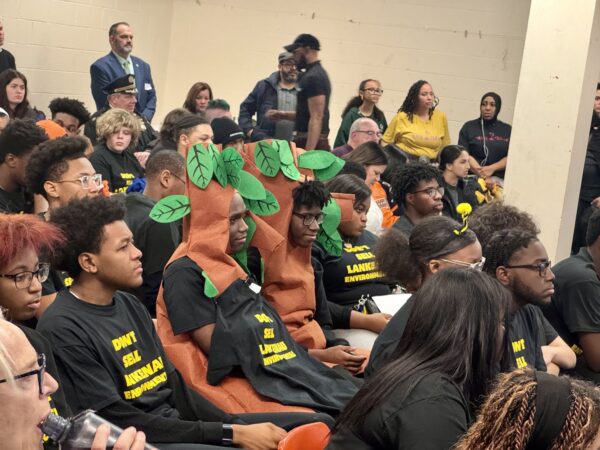
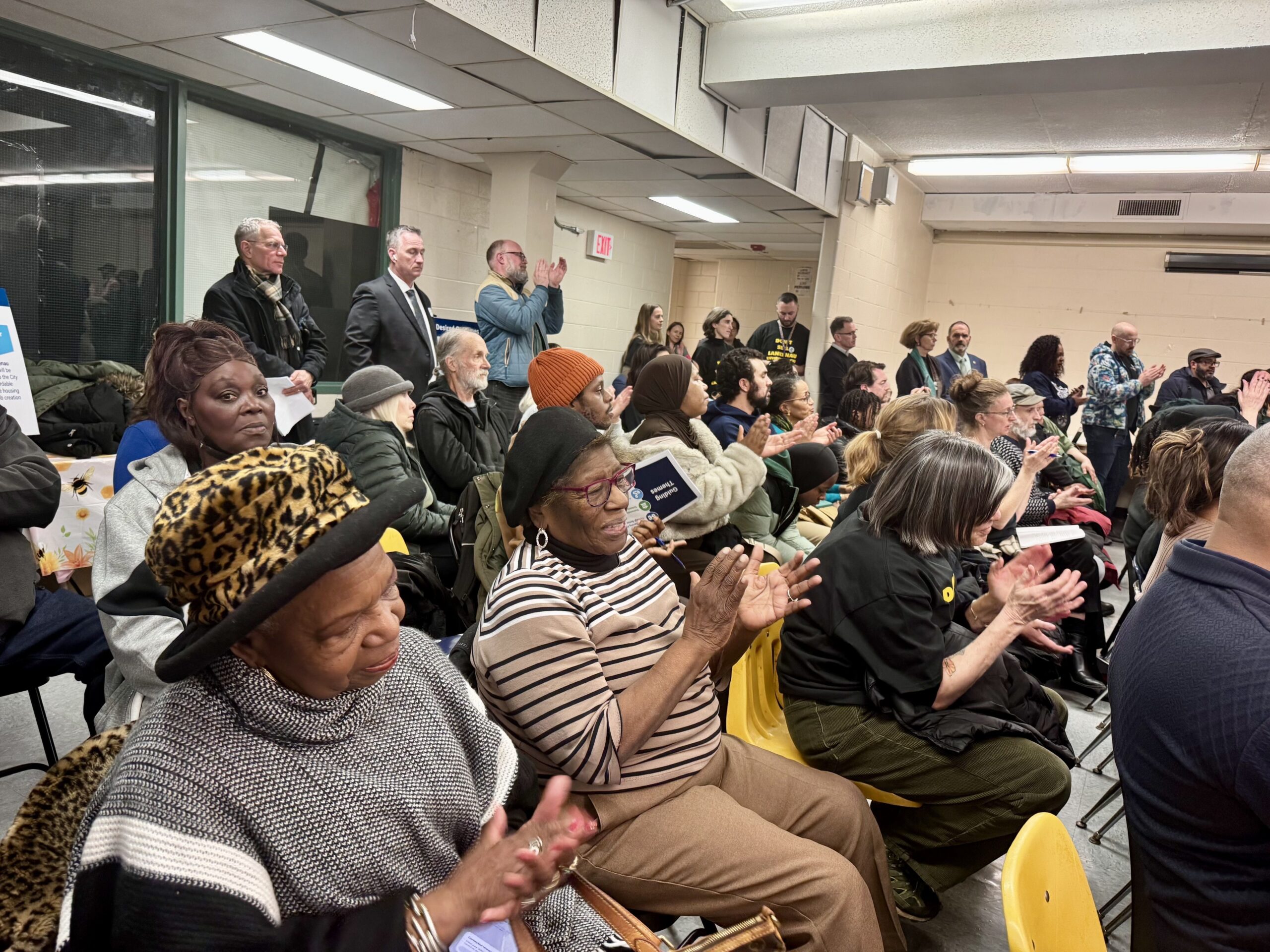
Last week, an overflow crowd — more than 100 students, staff, parents, representatives from Lankenau’s many partner organizations, and community members — packed the school for a student showcase and district-led meeting about the closure. Some students dressed as trees, bees, and a Lorax, the Dr. Seuss character who “speaks for trees” — to emphasize the importance of their school’s setting amid 400 acres of woods.
Community members at Lankenau High School applaud a student telling district officials why the school should not close. Lankenau is one of 20 Philadelphia School District schools proposed for closure.
First, Lankenau students wowed visitors with presentations — about their study of natural resources, about the experience of foraging for ingredients to brew their own artisan teas — and then, it was down to business. Lankenau is too small, officials said, and the district must find ways to offer a more equitable experience for all students.
“I don’t discount that there is magic inside of these walls,” Deputy Superintendent Oz Hill said. “What I’m sharing with you is if we can take that magic and enhance it with more extracurricular activities, more expanded academic programming, the sky’s the limit.”
The parents, students, and staff in the audience weren’t having it.
Lankenau was just certified to become the state’s only three-year agriculture, food, and natural resources career and technical education program — a designation that took years to achieve, and cannot transfer to a new building.
Officials are proposing closing Lankenau a year and a half from now; that’s not enough time for the district to reapply for the designation for a new Lankenau-inside-Roxborough CTE program.
District officials said at the meeting that they believe their “close relationship” with the state education department will give them enough time to get a new Roxborough program certified in time for the Lankenau closing.
Multiple parents told district leaders they would not send their children to Roxborough High.
And Akiraa Phillips, a Lankenau ninth grader, said she couldn’t imagine attending school in another setting.
In Lankenau’s current setting, “learning doesn’t stop at the desk. Our campus is the classroom,” Akiraa said. “We learn science by being in it. Here, we don’t just talk about ecosystems, climate, and sustainability, we walk through it. That kind of learning sticks with you. You can’t stick this into any random building and expect it to work.”
The community turned out in full force, but politicians and other decision-makers were in the room, too. Three school board members, including president Reginald Streater, attended the meeting.
State Sen. Sharif Street (D., Philadelphia), the front-runner to replace U.S. Rep. Dwight Evans in Congress, said he “was against closing the school,” but noted that the decision didn’t rest with him, and said the state needed to better fund schools “because we have not met our obligation to fully fund the program.”
And Councilmember Cindy Bass said she was particularly incredulous that the district was attempting to close a successful magnet — Lankenau has a 100% graduation rate.
“If it works, why are you breaking it?” Bass said. “I do not understand what the logic and the rationale is that we are making these kinds of decisions. We’re not just closing a school, we’re disrupting the lives of young people.”
In June 1776, before the Declaration of Independence was signed, a group of leaders from Philadelphia and its surrounding 10 counties — Bucks, Berks, Chester, Lancaster, York, Cumberland, Bedford, Northampton, Northumberland, and Westmoreland — met in Carpenters Hall for the Pennsylvania Provincial Conference. There, the Commonwealth of Pennsylvania was born.
Carpenters Hall, a hidden landmark just two blocks from Independence Hall in Philadelphia’s Old City, is the true birthplace of Pennsylvania, where the state declared its independence from Britain — jump-starting the framework of the state’s influential constitution that would serve as a model for the U.S. Constitution.
Now, the little-known and privately owned historic site is celebrating Pennsylvania’s 250th birthday — which coincides with America’s Semiquincentennial — by holding commemorative events across the state to reflect on Pennsylvania’s history and ask residents how the state constitution should be strengthened in 2026 and beyond.
“It’s the piece of the story we should own and celebrate and use as a platform for civic engagement,” said Michael Norris, the executive director of Carpenters Hall.
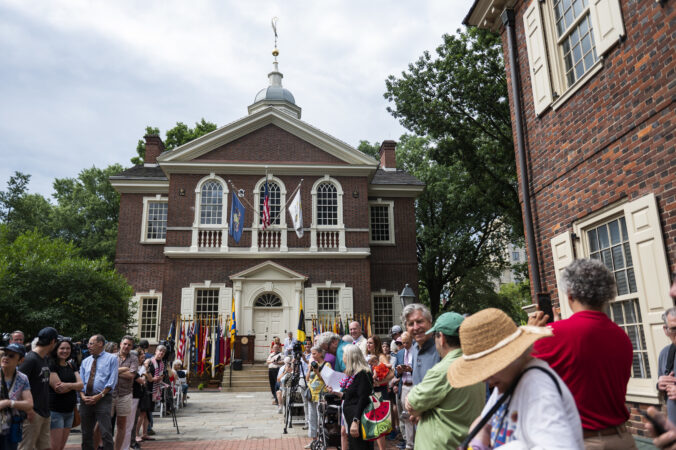
Executive director Michael Norris makes remarks at the reopening ceremony at Carpenters Hall on July 3, 2023.
Last week, Norris and others from Carpenters Hall traveled from Philadelphia — the state’s first capital— to Harrisburg to announce their yearlong schedule of events celebrating Pennsylvania’s founding, including those about the state’s constitution and its past and future.
At a news conference last week, Rep. Mary Isaacson (D., Philadelphia) noted that she occupies the seat once held by former Pennsylvania House Speaker Benjamin Franklin. She said she sees the Carpenters Hall events as “more than learning about a key moment in Pennsylvania history.”
“It’s also about exploring the vital importance of our state constitution in our democracy today and what citizens can do to engage,” she added.
The commemorative events include an interactive town hall series hosted in Philadelphia, Pittsburgh, Harrisburg, and Erie to discuss the importance of the Pennsylvania Provincial Conference in the United States’ founding. The group will also host several events at Carpenters Hall, including the installation of a blue historical marker outside the hall on June 18, in addition to a three-part virtual lecture series on Pennsylvania’s constitution.
The events, funded by America 250 PA and the Landenberger Family Foundation, are open to the public and intended to reach Pennsylvania’s “lifelong learners” who are interested in history and civics,as well as the legal community, who will be eligible for Continuing Legal Education credits for attending the virtual lectures, Norris said.
“To me, 250 is about reflection and engagement,” Norris said. “It’s not about parties and buildings. It’s really a moment to reflect and say, ‘What are we doing here? Do we still want this democracy, and how do we protect it and keep it going?’”
The Carpenters’ Company — the nation’s oldest craft guild, which built and still owns Carpenters Hall — will also conduct polling about how Pennsylvania’s constitution, as well as the U.S. Constitution, should be changed to better represent citizens in a modern time, Norris said. The poll results will be made public at an in-person event in Philadelphia on Sept. 28, the 250th anniversary of when the state constitution was ratified.
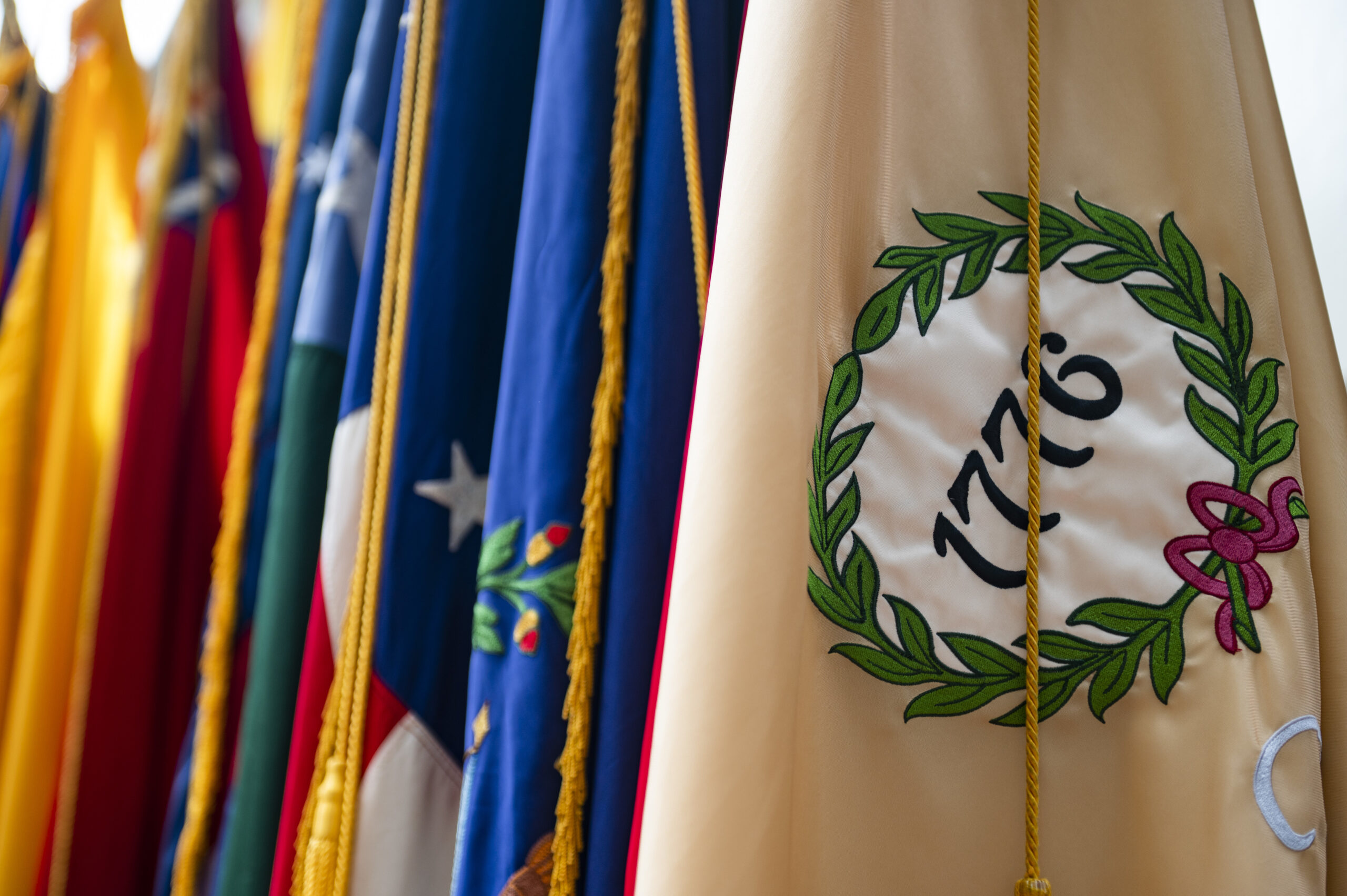
Historic flags are displayed outside at the reopening ceremony at Carpenters Hall on July 3, 2023. The building opened for the first time to the public since April 2022.
Rhode Island was the first colony to declare independence from England in May 1776, and Delaware became the first state in December 1787. Pennsylvania followed days after, and its constitution influenced the country’s founding documents. Pennsylvania’s expansive constitution — viewed as radical at the time — focused on personal freedoms and liberties in its “Declaration of Rights,” after which the Bill of Rights was modeled.
Carpenters Hall was the nation’s first privately owned historic landmark, and remains owned by the Carpenters’ Company today, which offers free admission for 150,000 visitors each year. Because it is privately owned, it is not overseen by the National Park Service, which has in recent weeks dismantled exhibits about slavery at the nearby President’s House Site in Independence National Park thatPresident Donald Trump’s administration contends “inappropriately disparage” the United States.
History may not repeat itself, but at least in Philadelphia, it sure does rhyme.
Twenty years ago, our famed Rocky statue made the move from its former perch at the stadium complex in South Philly to the base of the steps of the Philadelphia Museum of Art, where it has stood since.
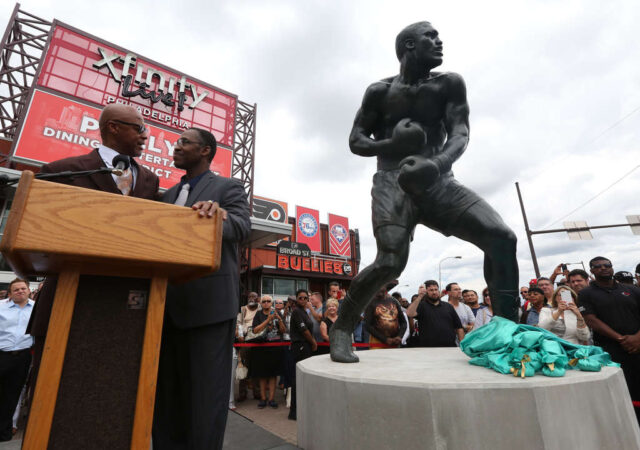
Now, the city’s statue of former world heavyweight champion “Smokin’” Joe Frazier could soon do the same.
“Relocating the Joe Frazier statue to this prominent civic and cultural space would … create a respectful dialogue between two complementary representations of Philadelphia’s spirit,” chief cultural officer Valerie V. Gay and public art director Marguerite Anglin wrote in a letter to the Art Commission. “Rocky Balboa as a symbol of hard work and aspiration, and Joe Frazier as the embodiment of those values lived out in real life.”
Created by sculptor Stephen Layne in 2014, the Frazier statue has stood in the sports complex outside what is now Stateside Live! for about a decade, and has been a part of the city’s public art collection since its inception. In an effort led by Joe Hand, the owner of Feasterville’s Joe Hand Boxing Gym and a longtime friend of Frazier’s, the statue’s commission was funded by the boxer’s family and supporters before its donation to the city.
The statue, standing at about 12 feet tall, depicts Frazier just moments after besting Muhammad Ali in the so-called “Fight of the Century” — the March 1971 bout in which Ali suffered his first professional loss after 15 grueling rounds.
Frazier, who died in 2011, was a well-accomplished boxer before that matchup, having won an Olympic gold medal in 1964 in Tokyo. He held the heavyweight championship title from 1970 to 1973, when he lost the belt to fellow legend George Foreman following a bout in Kingston, Jamaica, in a matchup referred to as “The Sunshine Showdown.” He retired in 1976, the year following a vicious loss to Ali in the famed “Thrilla in Manila” fight. After returning for a 1981 match against “Jumbo” Floyd Cummings that resulted in a draw, Frazier left the sport for good.
Relocating the Frazier statue to the Art Museum is expected to cost roughly $150,000 in city funds, and has support from leaders including Mayor Cherelle L. Parker, City Councilmember Katherine Gilmore Richardson, State Sen. Sharif Street, and State Sen. Anthony Hardy Williams, according to Creative Philadelphia’s Art Commission proposal.
“Placing the Joe Frazier statue at the Art Museum affirms Philadelphia’s commitment to honoring real-life achievement alongside cultural mythology,” Parker wrote in a letter supporting the move. “Together, these figures reflect the city’s spirit, where determination, resilience, and opportunity meet.”
Friends of Frazier also expressed support in letters included as part of Creative Philadelphia’s proposal — in part, at least, because the Art Museum has higher foot traffic than where the statue currently stands.
The move “will give the Frazier statue many more eyes on it than at the Xfinity area,” wrote Nicholas L. Depace, the boxer’s friend and former physician.
Frazier served as a major inspiration for the Rocky Balboa character, with the man and the character sharing several key elements, according to Creative Philadelphia. Like Rocky, Frazier trained for boxing matches by hitting frozen raw meat, ran the Art Museum steps, and faced opponents that closely mirrored those actor Sylvester Stallone’s character faced in the franchise.
“Stallone made 5 Rocky movies mostly based on the real life humble champion Smokin’ Joe Frazier from Philadelphia,” wrote Smokin’ Frazier Championship Foundation Inc. CEO Pete Lyde in a letter of support for the move. “Joe Frazier’s statue at the Philadelphia Art Museum Steps symbolizes and celebrates the real life human heart and potential within us all worldwide.”
The Rocky statue, meanwhile, is cleared for installation atop the Art Museum steps following its exhibition in “Rising Up: Rocky and the Making of Monuments,” an Art Museum program slated to run from April to August. After that, the statue now displayed at the top of steps — which Stallone lent to the city for the inaugural RockyFest in December 2024 — will head back to the actor’s collection, and the original, screen-used statue will take its place.
It was not immediately clear when the Frazier statue could head to the Art Museum. Creative Philadelphia did not immediately respond to a request for comment.
“Placing the Smokin’ Joe Frazier statue at the Art Museum steps would not only correct a historical imbalance but also serve as an inspirational symbol for residents and visitors alike,” wrote Councilmember at-large Jim Harrity in a letter of support. “It would elevate a true Philadelphia champion whose impact reached far beyond the boxing ring and whose contributions to sports, labor history, and community service continue to resonate today.”