Category: Commentary

  • With roots stretching back 170 years, the Jewish Family and Children’s Service strives ‘to make the world a better place’ | Philly Gives

    With roots stretching back 170 years, the Jewish Family and Children’s Service strives ‘to make the world a better place’ | Philly Gives

    By the time more than 700 people had found coats at the Jewish Family and Children’s Service of Greater Philadelphia’s annual coat drive last month, JFCS volunteer manager Brianna Torres should have been exhausted.

    Instead, she was exhilarated.

    “Honestly, this is one of our most favorite days of the year,” she said, taking a break from shepherding the 60 volunteers helping hundreds of folks choose free winter jackets and coats for themselves and their children at Congregation Rodeph Shalom.

    Sometimes the line stretched around the historic synagogue on North Broad Street.

    “It’s all hands on deck,” Torres said, with a smile. “We feel good — giving and receiving.”

    JFCS’s roots date to 1855, when philanthropist and Jewish educator Rebecca Gratz founded the Jewish Foster Home, and to 1869, when United Hebrew Charities was organized.

    These days, JFCS’s client base has grown beyond the Jewish population it once primarily served. It offers a multitude of services, including help with basic needs, mental health and wellness, support for Holocaust survivors, older adults and their families, help for children and families, and for people living with disabilities, as well as an LGBTQ initiative.

    “We’re an organization that is very focused on the equal value of every human being,” said Robin Brandies, JFCS’s new president and chief executive.

    When the giveaway ended, 900 of those human beings had chosen 1,200 coats out of 1,600 donated.

    “It is our responsibility to make the world a better place,” Torres said. “Our main forefront is dignity.”

    That’s why, she explained, the coat drive, while massive, didn’t resemble a rummage sale. “We’re trying to create a boutique type of atmosphere.”
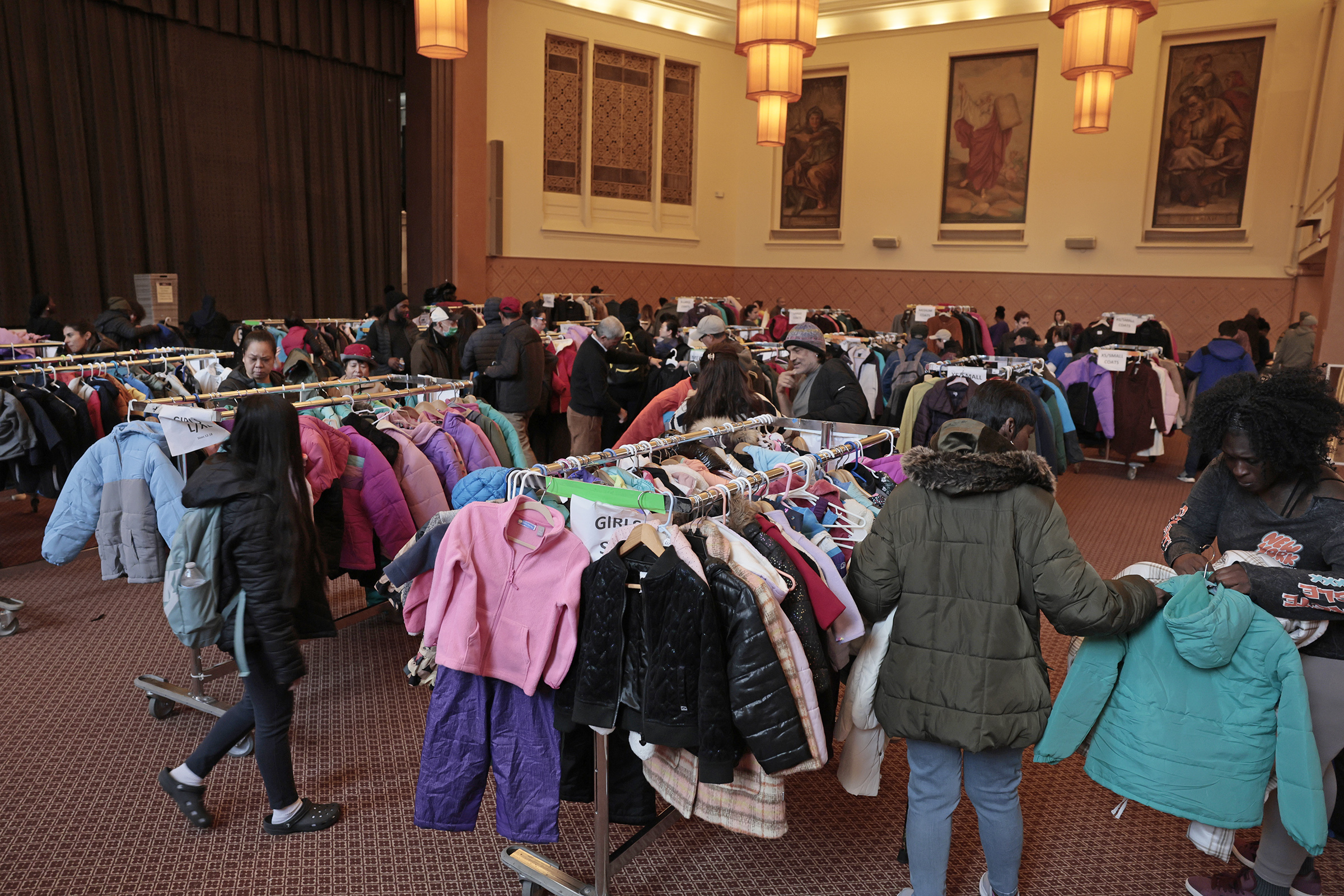
    People look for coats during the winter coat drive at Rodeph Shalom synagogue last month.

    Volunteers hung coats neatly on racks by size, not piled in heaps. While many people were served, only 35 at a time were allowed in to “shop” in the synagogue’s huge community room. They could look at and try on coats at leisure without jostling for room.

    Volunteers helped them choose their coats while other friendly volunteers packed their coats into bags along with flyers describing more of JFCS’s services.

    Leftover coats wind up in JFCS’s mobile pop-up, “Our Closet in Your Neighborhood.” The agency brings a truck loaded with all kinds of clothing, from shoes to coats, and sets up mini boutiques in synagogues, churches, and community centers around the region. Fresh produce is also often available.

    Last month’s coat drive was Brandies’ first as JFCS’s new president and chief executive. She replaces JFCS’s longtime executive Paula Goldstein, who retired Sept. 1 after more than 40 years of service.

    “I’m blown away,” Brandies said. She walked into the synagogue’s community room and almost immediately ended up helping little King James, 3, get zipped into his new jacket.

    His mother, Jessel Huggins, of Strawberry Mansion, brought five of her 13 children to the coat drive.

    As they waited to choose, three of the boys, Shar, 6, Boaz, 7, and Prince Jedidiah, 8, said they hoped for winter jackets themed with Sonic the Hedgehog characters — Sonic and Tails, the fox.

    Sadly, they weren’t available, but at least Boaz and Prince Jedidiah got blue coats — the same color as the hedgehog. Shar landed a gray camouflage one. Their older sister, Shaly, 13, managed to snag her dream coat, a jacket with fur around the hood.

    “This is my first time coming,” Huggins said. “Buying coats for 13 kids is a lot.”

    LaToya Adams, of West Philly, stood in line, hoping she’d find a coat for herself, her daughter, 20, and her son, 7. “We can’t afford coats with food stamps being cut off — and right at Thanksgiving.”
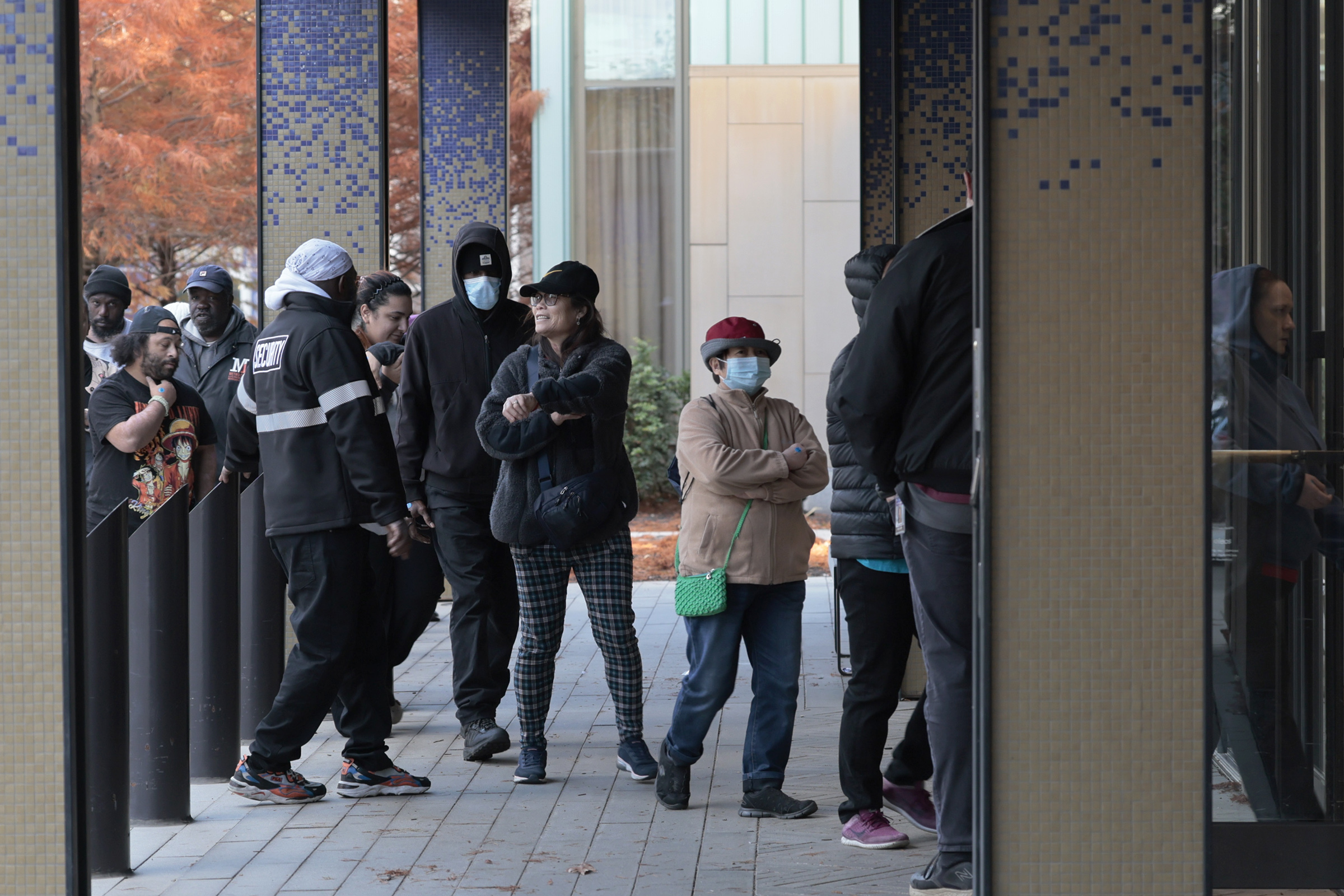
    People wait in line to get into the winter coat drive at Rodeph Shalom synagogue last month.

    “The money I do make has to go to the bills,” she said. “I’m just trying to find a good-paying job. It’s a burden. It feels like you have a weight on your shoulders and you can’t get out of it. We’re trying to survive, and them giving a coat today helps.”

    Brandies came to JFCS after serving as the leader of Abramson Senior Care. The two organizations joined on Oct. 1 to provide more seamless care for older adults and their families in a program now known as Abramson Senior Care of JFCS.

    Abramson had offered more health-based care with JFCS, providing other types of services to seniors, including help with housing and food. “A family can make one phone call” on a 24-hour hotline to access services, Brandies said.

    Sometimes there are emergencies, like a person calling late at night after noticing an elderly neighbor had tried to cook herself a meal and ended up having a minor fire. Usually, though, Brandies said, the calls are from people seeking advice on how to care for an aging relative.

    Brandies, who had earlier careers in law and fundraising, said she became a fierce advocate for older adults in the 10 years she spent at Abramson.

    “People don’t like to think about aging,” she said. “It’s possibly the most universal and least sexy of causes. It’s not as sexy in fundraising circles as donating” to programs for children.

    “Everybody ages and needs help at some point,” she said. “But we’re not educated [as a society] as to the best way to be there.

    “As the percentage of the population that’s aging increases, we have fewer people going into senior care professions,” and there are fewer resources available to help the elderly. Many are aging alone, with no families nearby to help.

    “Seniors don’t want to be infantilized,” she said. “They want to continue to live their lives with as much dignity as possible.”

    This article is part of a series about Philly Gives — a community fund to support nonprofits through end-of-year giving. To learn more about Philly Gives, including how to donate, visit phillygives.org.
    For more information about Philly Gives, including how to donate, visit phillygives.org.

    Jewish Family and Children’s Service of Greater Philadelphia

    Mission: Jewish Family and Children’s Service (JFCS) of Greater Philadelphia strengthens families and individuals across generations and cultures to achieve stability, independence, and community.

    People served: Over 30,000 annually

    Annual spending: $14,899,000 for 2024-2025

    Point of pride: The recent merger of JFCS and Abramson Senior Care (now Abramson Senior Care of JFCS) expands access to comprehensive social and healthcare services for older adults and their caregivers across Greater Philadelphia.

    You can help: We invite individuals, families, groups, corporations, and more to contribute their time and skills to a variety of community-based volunteer opportunities.

    Support: phillygives.org

    What your JFCS donation can do

    • $25 buys a warm winter coat for a child.
    • $50 purchases a grocery store gift card for a family.
    • $100 pays the heating bill for an individual with a disability.
    • $360 subsidizes the cost of therapy for an individual experiencing a mental health crisis.
    • $500 covers medical bills for an older adult.
    • $1,000 helps a family of four pay their rent.
    • $2,500 installs a chair lift in the home of a Holocaust survivor.
  • The way we treat older adults transitioning to long-term care is ‘garbage’

    The way we treat older adults transitioning to long-term care is ‘garbage’

    I am not new to end-of-life care — as a nurse and someone who has worked in healthcare for most of my life, I have helped numerous friends, family, patients, and clients at the end of their lives.

    Yet, the transition to long-term care for older adults is vastly different. Over the past few weeks, I have witnessed the demoralizing treatment of this firsthand as family members close to me have tried to manage their loved one’s urgent hospitalization and the fallout afterward; it was a wake-up call.

    My 80-year-old relative was diagnosed with metastatic cancer seven years ago. During the pandemic, they had emergency surgery as their cancer spread to their spine and caused partial paralysis in their legs. The surgery was successful, and for a long time, medication kept the cancer contained. But last month, the paralysis began again, and they were back in the hospital requiring another urgent spinal surgery.

    At first, their acute care was phenomenal. Then, as they became physiologically stable, and it became clear they couldn’t go home but would need long-term care, everything changed.

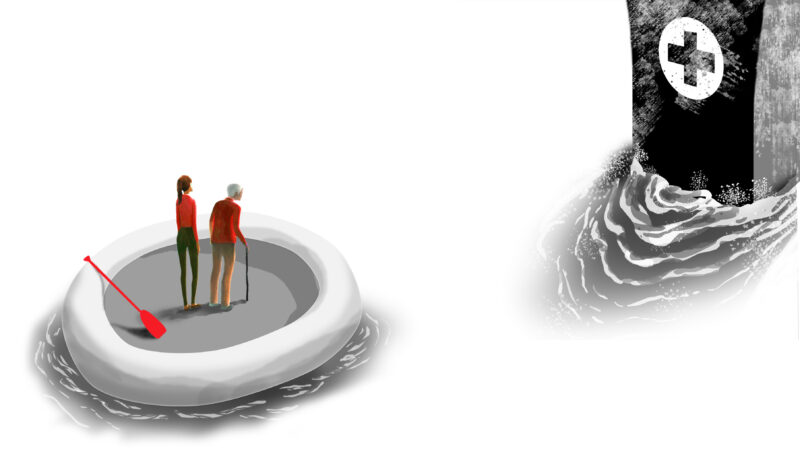
    When it comes to the transition into long-term care, families have no control over some things, yet are expected to control the minutest details of others, writes Marion Leary.

    I watched as my family members, over the course of two weeks, grew increasingly overwhelmed, exasperated, and exhausted. They began to look as though they themselves were going to require hospitalization. The amount of information being thrown at them, in no coordinated way, was utterly overwhelming. In contrast, the lack of information being shared with them was similarly overwhelming and stupefying.

    Though my family members were at their loved one’s bedside more than eight hours a day while in the hospital, and repeatedly asked the medical team to discuss any plans with them, their loved one’s healthcare proxy, the team continued to only relay pertinent information to the patient who was in excruciating pain, on pain meds, is hard-of-hearing, and was recovering from spine surgery and anesthesia .

    Not surprisingly, the information rarely made it back to my family members. Not once during the week postsurgery, as they were trying to plan for the looming hospital discharge and the associated next steps, did that happen.

    At no time did anyone from the surgical or oncology team discuss follow-up plans with my family members. This sparked a cascade of misinformation and omissions that became the foundation for the steep learning curve that is rehabilitation and long-term care in our healthcare industry.

    Due to the progression of the cancer on the spine and the ensuing paralysis, my family’s loved one needed to go to acute rehab from the hospital, but what acute rehabs were available, where they were located, how long one can stay and then where they go afterward, how it would be decided, and how it would be paid for was a mystery for my family to decipher.

    Their loved one would need to start radiation therapy once the surgical wound healed, but how they would be transported from the acute rehab to the medical center and when that would begin was also, apparently, for the family to figure out. At one point, my family member asked the social worker how transportation to the radiation appointment would work; the social worker shrugged their shoulders and told them to try an Uber.

    An Uber, for a medically fragile, at the time stretcher-bound, individual. It would be funny if it were not contemptible.

    Almost all of us who grow old will need some long-term care — and yet, based on our experience and the experiences of so many others, there is no system in place, writes Marion Leary.

    As my family member’s loved one became more stable and progressed in their rehabilitation, their follow-up medical care became the next problem to be solved.

    Oncology appointments were scheduled while at acute rehab; luckily, they could be done virtually. To our surprise, though, the acute rehab personnel would take no responsibility in assisting their patient in attending these medically necessary appointments. They refused to help turn on the iPad or log in to the medical portal for the appointment. Once again, it was the family’s responsibility to figure out how this would happen.

    Ultimately, my family member had to physically go to the acute rehab to turn on the device and log their loved one into the portal. Dealing with an ill and injured loved one is hard enough while juggling your own life responsibilities, but requiring family members to drive 40 minutes (each way) in the middle of a weekday to an acute rehab facility with licensed medical providers — to assist the facility’s own patient with their necessary medical appointments because the facility’s licensed medical providers refuse — is yet another unnecessary and callous hurdle to make families jump.

    In situations such as I have described, families have no control over some things, yet are expected to control the minutest details of others. Make it make sense.

    I am not naive to the plethora of troubles that come with being sick, injured, low-income/low-resources, or elderly in this country.

    I ran a nonprofit organization years ago that helped people pay for medical expenses. I worked with clients who were not only trying to keep their loved ones alive but were also trying to manage and pay for their care. I repeatedly witnessed how our healthcare industry put up every possible roadblock and hurdle; how loved ones became increasingly despondent.

    In the U.S., there are over 61 million older adults, those aged 65 or older — this is 18% of the population. This number is expected to grow to 22% of the population by 2040. That will be close to one-quarter of the U.S. population. Yet, there is no coordinated system in place to help older adults and their families transition to long-term care and navigate the inevitable healthcare challenges they will face — let alone face them with grace and dignity.

    The “not my problem” “hot potato” approach our healthcare industry has taken is criminal.

    With nowhere else to turn to help my loved ones, I reached out to a colleague who specializes in palliative care. They provided helpful resources and echoed what seems to be the sentiment of many providers: “Our ‘system,’ it’s garbage.”

    Many patients and families who have gone through this experience know this to be true. Yet, we continue to perpetuate, accept, or be resigned to a system that treats older adults and their families, as my colleague accurately stated, like garbage.

    Which is mind-boggling, as most of us, if we are lucky (or unlucky, given the circumstances), will grow old. Most of us have relatives who will grow old. Almost all of us who grow old will need some long-term care — and yet, based on our experience and the experiences of so many others, there is no system in place.

    None of the resources we eventually found came from any healthcare provider or social worker in either the hospital or the acute rehab.

    None.

    Only after using ChatGPT and reaching out to colleagues were we able to start putting the pieces together. ChatGPT recommended our local county aging corporation, which provided helpful resources for transportation and the Pennsylvania Elder Law hotline.

    Through this whole process, we have remarked — and felt genuinely nauseated over — what other older adults who need long-term care do if they don’t have family support or financial resources. We are still at a loss.

    But I am not about to shrug my shoulders or be resigned. I am not willing to place the burden back on the sick and aging, nor their families. I implore my healthcare colleagues to acknowledge the faults in the system, accept the burden of care, and do better.

    Marion Leary is a nurse, public health advocate, and activist.

  • Why a ceasefire is not enough: A call to block the bombs

    Why a ceasefire is not enough: A call to block the bombs

    This Hanukkah, while Jews around the world prepare to light the menorah and bring light into the darkest days of winter, our celebration of hope and resilience remains in the shadow of Israel’s ongoing genocide of Palestinians in Gaza. And, nearly two months into a U.S.-brokered ceasefire, I am still protesting.

    Hanukkah, which in Hebrew means dedication, tells the story of Jewish peoples’ resistance to an oppressive empire, and of a miracle that kept candles aflame for eight days and eight nights when there was only enough oil for one.

    It is a story that resonates to this day, and it is in the spirit of hope, light, and miracles that I find myself rededicating to the struggle for Palestinian liberation.

    The U.S.-brokered ceasefire went into effect on Oct. 10. Since then, Israel has continued near-daily attacks, killing at least 345 Palestinians and wounding another 889. While the agreement required Israel to lift its blockade on aid reaching Gaza, Israel continues to interfere with the free flow of humanitarian aid. Less than 25% of aid deliveries have made it to Gazans, who face increasingly dire circumstances.

    Palestinians grab sacks of flour from a moving truck carrying World Food Programme (WFP) aid as it drives through Deir al-Balah in central Gaza, in November.

    While the United States and Israel insist the ceasefire holds and deny the well-documented violations of the ceasefire agreement, I find it difficult to describe the current conditions as anything other than a slower-paced extension of the genocide.

    The need for our solidarity is no less urgent or crucial than it was last year or the year before.

    What’s more, Israel’s genocidal campaign against Palestinians isn’t confined to Gaza. Tens of thousands of Palestinians have been forcibly expelled from the illegally occupied West Bank, actions that human rights groups have classified as war crimes. It is worth noting that the primary targets of this ethnic cleansing are the refugee camps set up in the 1950s to house Palestinians who were forcibly driven from their homes when the state of Israel was founded.

    I have been in the movement for Palestinian liberation for decades through my work on the Rabbinic Council for Jewish Voice for Peace, the largest progressive Jewish anti-Zionist organization in the world. More recently, I joined over 400 other rabbis organizing as Rabbis for Ceasefire.

    Because of my organizing, I know history didn’t start on Oct. 7, 2023. Palestinians have faced expulsion from their lands, destruction of their homes and civil infrastructure, and deadly violence since 1948. They enjoy fewer rights than their Jewish counterparts, lacking freedom of movement and access to land, jobs, and public services.

    Many falsely proclaim that this system of violent occupation and the ongoing genocide are necessary for Jewish safety. The truth is that this is a desecration of Jewish values and an affront to our long tradition of resisting empire and seeking justice.

    I reject the claim that Jewish safety relies on the subjugation of Palestinians, and am inspired by the growing anti-Zionist movement among American Jews. Just as the Hanukkah lights our ancestors lit were not extinguished, our struggle for Palestinian liberation burns brightly.

    It doesn’t take a miracle, but it does require courage, rededication to fundamental human rights, and, for many, the willingness to shift positions and take accountability for the role of the United States in bankrolling and providing diplomatic cover for Israel’s genocide of Palestinians in Gaza.

    One opportunity I implore our elected officials to take is to sign on to the Block the Bombs legislation, which prohibits the president from selling, transferring, or exporting certain defense articles or services to Israel, except in specified circumstances. I was heartened to see Rep. Dwight Evans recently sign onto the bill, joining 59 other legislators, including three from Pennsylvania.

    Hanukkah celebrates an important miracle in the Jewish faith, the rededication of the Second Temple in Jerusalem.

    This Hanukkah, I call on all of us to shine a light on Gaza and rededicate ourselves to Palestinian liberation. Only by keeping the flame of our solidarity alive can we hope to one day say, as in our Hanukkah story, “a great miracle happened there.”

    Rabbi Linda Holtzman teaches at the Reconstructionist Rabbinical College. She is the organizer of Tikkun Olam Chavurah, a group that pursues social and political justice work together as a Jewish community.

  • David McCormick: How we can have school choice for everyone, not just rich people

    David McCormick: How we can have school choice for everyone, not just rich people

    You would think that freshmen at a top-ranked university could do basic math. You would be wrong. According to a recent analysis at the University of California, San Diego, one in eight cannot meet minimum high school standards. This story is repeating itself across America. As a proud product of Pennsylvania’s public schools, it pains me to say: Our nation’s public education system is failing miserably.

    Fortunately, we have an opportunity to begin to fix it, thanks to the school choice tax credit passed into law in the Working Families Tax Cut Act in July.

    The trick? Governors must opt in. So far, four governors — from North Carolina, Tennessee, South Dakota, and Nebraska — have signed up or signaled they will. Will Pennsylvania support giving free money to families? Or will it double down on a failing educational system that disproportionately hurts the poorest among us?

    Access to a good education levels the playing field, giving students an equal opportunity to chase the American dream. It forms kids into citizens. And it not only gives students book smarts, but also the ability to wrestle with hard problems at a time when every American must be ready to adapt to a rapidly changing world.

    The inverse is equally true. Trapping students in bad schools robs them of the opportunity promised to each generation and unduly harms people of color and students from lower-income families.

    According to a 2024 national assessment, 45% of 12th graders could not complete even basic math. Roughly one-third of 12th graders could not read at a basic level. Pennsylvania students performed similarly: 37% of eighth graders did not have basic math skills, and 31% lacked basic reading ability. Students of color and those from low-income families struggled most.

    The COVID-19 pandemic made this all so much worse and set back a generation of Pennsylvanians. The commonwealth’s children have still not recovered from the damage done by school closures foisted on them by the national teachers’ unions.

    Our public school system too often puts the interests of the system over the interests of the students, Sen. David McCormick writes.

    Not only are we falling behind as a nation, we’re also falling behind other states. Florida, Arkansas, and others have busted the education monopoly. By embracing this new federal tax credit, Pennsylvania’s leaders can follow suit.

    One of my first acts in the U.S. Senate was to cosponsor the Educational Choice for Children Act. One of my proudest moments was voting to pass this school choice provision into law alongside childcare tax credits for working families.

    The bill established a $1,700 tax credit for donations to organizations that give educational scholarships to families. The program offers families true opportunity, as these stipends can be used to pay tuition, hire tutors, buy school supplies, and otherwise expand educational opportunities for students. It could inject tens of billions of new funding for our schools.

    Not everyone will agree with me. Some may say we shouldn’t take money away from public schools. Well, this tax credit doesn’t redirect any existing federal or state funds. It allows Americans to support other Americans’ right to a good education.

    It also recognizes that a certain class of people already have the privilege of school choice: those who can afford it. If Pennsylvania opts into this tax credit, it will provide low- and middle-class families with the same opportunity.

    Others might question the quality or accountability of private and charter schools. They have it wrong. The public education system has failed for decades without consequence. School choice introduces accountability through competition. It lets parents choose what’s best for their children instead of being forced into failing schools by fate of geography.

    Finally, I understand the fears that promoting private and charter schools risks hurting teachers, but what I’m proposing is entirely pro-teacher. As the son of two Pennsylvania public school teachers and the product of the commonwealth’s public school system, I have immense respect and admiration for educators.

    The problem is the system, not the teachers. Our public school system too often puts the interests of the system over the interests of the students — and educators. Teachers do the Lord’s work and deserve our thanks. They also deserve to work in schools that value their talent. This program would put more money into education and provide greater choice to teachers, too.

    There are many details to iron out still, but this program has the potential to transform education in Pennsylvania at a moment of incredible change and consequence. It will both allow Pennsylvanians to support their neighbors and invite national investment in our commonwealth’s future.

    The choice is clear. Pennsylvania families have been offered a door to a better education for their children. Will the governor and our leaders in Harrisburg open it?

    David McCormick is a U.S. senator from Pennsylvania.

  • Want to understand OpenAI becoming a public benefit corporation? Look to ‘KPop Demon Hunters.’

    Want to understand OpenAI becoming a public benefit corporation? Look to ‘KPop Demon Hunters.’

    For anyone trying to follow OpenAI’s latest corporate restructuring, here’s the breakdown from a professor of entrepreneurship who studies social enterprises.

    The nonprofit OpenAI Foundation controls a for-profit company that just restructured into a public benefit corporation (OpenAI Group PBC). The company says this new form will “benefit everyone” by allowing OpenAI to cure diseases and build “resilient AI.”

    Sounds noble, right? Stick with me, and I’ll explain what is really happening.

    Let’s use the analogy of KPop Demon Hunters, a recent megahit movie by Netflix. It’s an age-old story in which it’s up to the brave to fight evil for the good of humanity, but this time told using catchy K-pop songs and pastel animations.

    In the movie, the demons disguise themselves as a boy K-pop group, the Saja Boys. The girl K-pop group, HUNTR/X, are the saviors who need to slay the demons — but instead are dazzled by the Saja Boys’ talent and smooth dance moves. The Saja Boys end up sucking the souls of all humans and lead the population into misery as the girl group remains helpless to the boy group’s whims.

    So in our analogy, OpenAI sees itself as HUNTR/X, and it is here to save the world from the demon, which in this scenario is artificial general intelligence (AGI).

    Unlike today’s generative artificial intelligence (e.g., ChatGPT, Claude, Gemini), artificial general intelligence would actually think and reason like a human. Some data scientists see it as having the ability to become superior to human intelligence. (Think of Terminator’s Skynet, an AI that becomes self-aware and launches nuclear war against humans. Some call that science fiction fantasy, whereas others say it is a possibility.)

    AGIs are not yet possible, but OpenAI, the maker of ChatGPT, wants to be the first to introduce them to the general market. So, like the girl group HUNTR/X, OpenAI sees itself as the savior by building “resilient” AI to harness the evil AGI.

    To have the power to fight evil, HUNTR/X needed K-pop songs, whereas OpenAI just needs capital, and lots of it. For example, it just signed a $38 billion deal with Amazon. However, OpenAI is more like the Saja Boys than HUNTR/X, by disguising itself as a public benefit corporation that allows it to make profits while saying it is focusing on the public good.

    It’s important to our story to know that a PBC is a for-profit corporate entity that legally commits to pursuing one or more declared public benefits in addition to generating profit for shareholders. Being a public company, it can raise funds through selling shares. By investing in a PBC, shareholders understand profits will be diverted to a public good.

    OpenAI promises profits will flow back to its nonprofit, funding “AI resilience.”

    It sounds altruistic until you realize: If it’s all for the public good, why does a nonprofit need to own the for-profit version of itself — and what is AI resilience anyway?

    Back to our analogy: OpenAI wants to be the market leader in building out AGI (fight evil demons). It can’t do it without capital (catchy songs). Representing itself as a public benefit corporation (Saja Boys), it can collect the cash (human souls) that is then diverted to the nonprofit (demon king), which will control how AGI is used and marketed (rule the world).

    “AI resilience” is OpenAI’s way of controlling the market. This is a form of “Big Tech extraction.“ Another benefit of this shell is that it pays less taxes as a nonprofit.

    Some may say my analogy is too simplistic. I’ll counter that every “save the world” story needs a hero and a villain. The twist? The villain always insists they’re the hero. When a $500 billion company says it’s saving humanity, it’s worth asking why it needs a legal shell game to do so.

    This is the same company being sued for copyright infringement and for lack of safeguards for suicidal ideation.

    A lawsuit against OpenAI claims that Joshua Enneking, 26, was coached into suicide by ChatGPT after confiding in the chatbot for months.

    These are hardly the marks of altruism.

    OpenAI isn’t HUNTR/X or even the Saja Boys. It’s the soul-stealing Gwi-Ma, the demon king who wins by pretending to deliver good.

    Investors, beware: You’re being Gwi-Ma’d. Many will be OK with that. The rest should question the deception of Big Tech.

    Rosanna Garcia is the endowed chair of innovation and entrepreneurship at Worcester Polytechnic Institute in Massachusetts and a public voices fellow on technology in the Public Interest with the OpEd Project.

  • In North Philly, Congreso de Latinos Unidos has spent five decades being ‘here for you’ | Philly Gives

    In North Philly, Congreso de Latinos Unidos has spent five decades being ‘here for you’ | Philly Gives

    The litany of horrors never stopped:

    For more than an hour, one domestic violence survivor after another stepped up to the microphone with tales of pain and resilience.

    “When people get close to me, I flinch because I’m afraid they are going to abuse me,” said one woman, speaking in Spanish, her words translated into English by a staffer at Congreso de Latinos Unidos, a nonprofit social services agency in North Philadelphia that provides help with housing, education, medical needs, workforce training, and after-school activities for youngsters.

    Congreso is celebrating its 48th year in operation, and for 30 of those years, it has maintained a program to support people dealing with, and trying to escape from, domestic violence.

    “I was never allowed to go outside. He would show up at my job,” the woman continued in a room decorated with purple balloons, the color symbolizing domestic violence. Each year, Congreso honors survivors and mourns, in a few moments of poignant silence, the people who lost their lives to domestic violence. Last year, in Pennsylvania, there were 102.

    “He would bruise my face so I couldn’t see my family. I worked in a nightclub, and he would drag me out … No one wanted to get involved,” she said.

    No one, until Congreso did and helped relocate her to a new home.

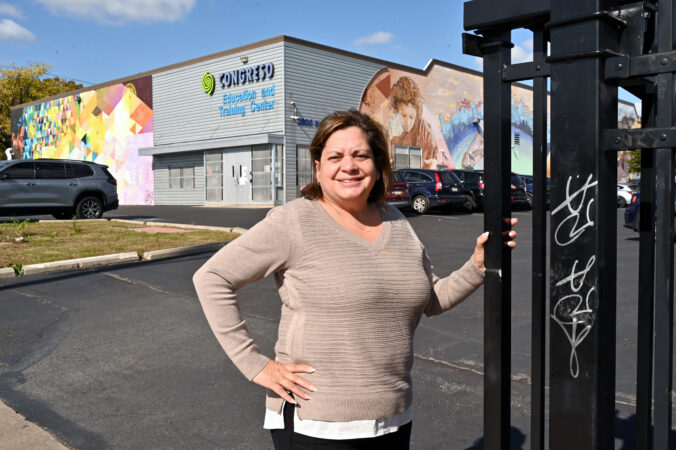
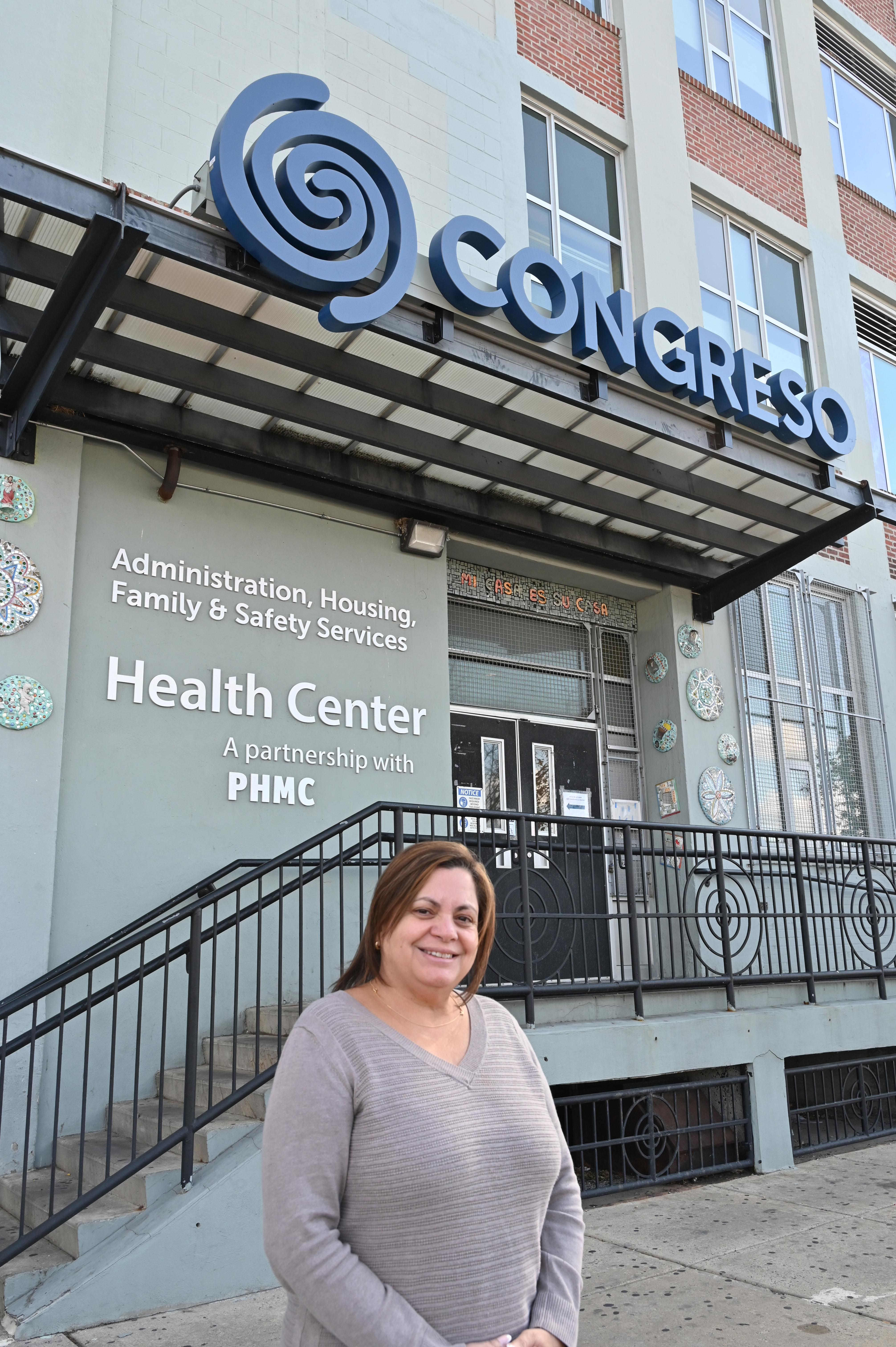
    Jannette Diaz, president and CEO of Congreso, outside the group’s offices in North Philadelphia.“We’re all feeling the crunch,” she said of recent funding challenges.

    “It takes a lot of courage to come up here and share your story,” Ramona Peralta, Congreso’s director of family wellness, said as the woman finished speaking. “We’re very proud of you, and we are here for you all the way.”

    In the main room, the mood vacillated between the heavy silence of shared pain and the cheerful clamoring of babies. Later, there was music, and before, a friendly lunch of rice with pork and chicken.

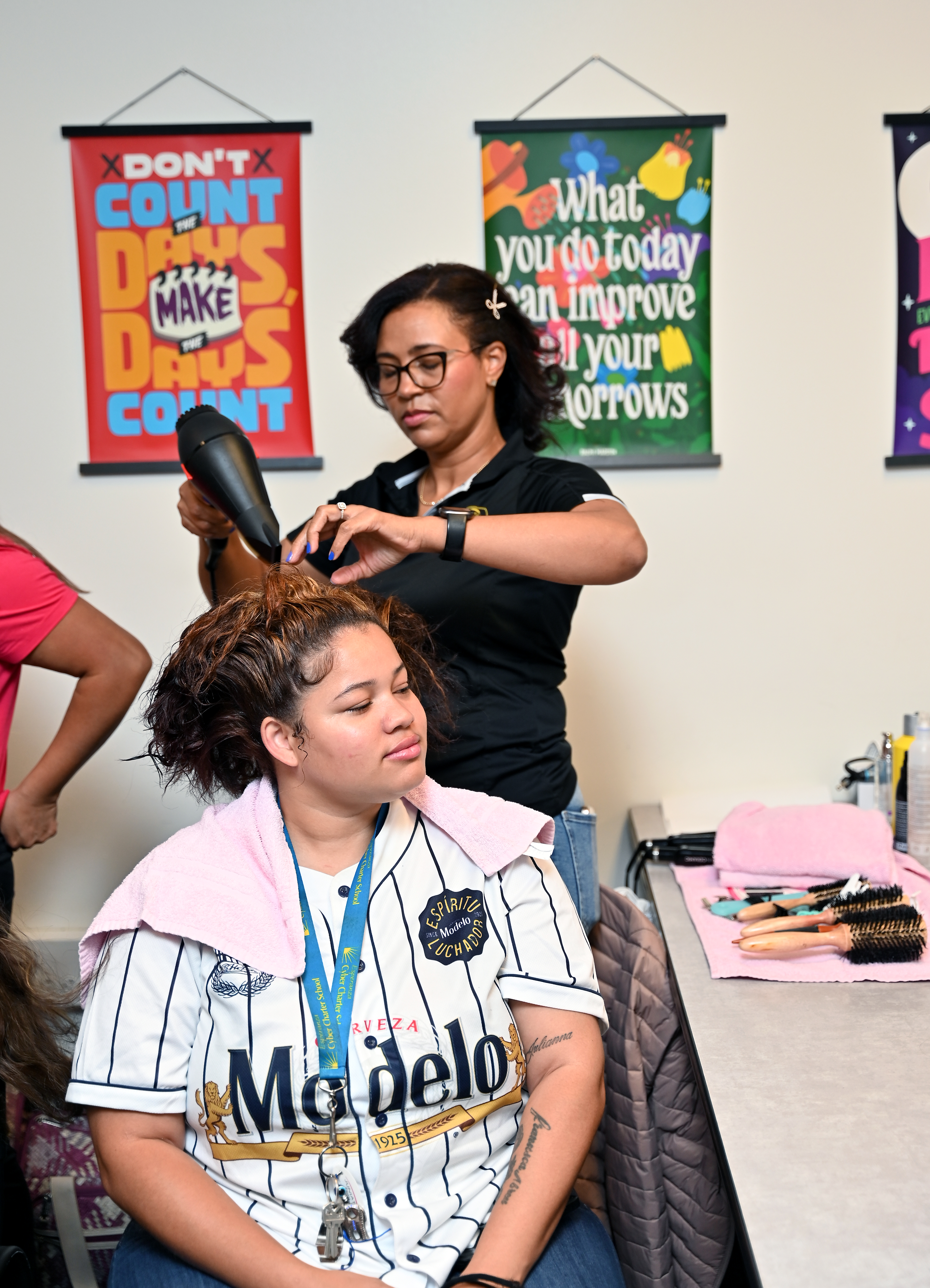
    Across the hall, members of the Asociación de Cosmetologas de Pennsylvania offered free hairstyling to the women who attended the celebration.

    Congreso, as part of its program to teach police, educators, social workers, and others to recognize signs of domestic abuse, had trained this group, as well, and because of the intimacy of their work, the stylists were uniquely positioned to do so. More than most, beauty salon operators could readily see the bruises hidden under hair and makeup. They could feel the cuts and scars on the scalp. And then there were the confidences confessed during shampoos and stylings.

    Wanda Gómez, of the Blessings of God beauty salon, styles Franyeimi Abreu’s hair at Congreso’s offices.

    Among the volunteers was Wanda Gómez, owner of the Blessings of God beauty salon in Northeast Philadelphia. “Thank God, I’m no longer in that situation,” she said, speaking through a translator. But because she survived domestic violence, she said she’s in a better position to help others. She tells them about Congreso.

    Elisa Zaro Doran, owner of Dominican Divas Beauty Salon in Olney, twisted a strand of hair around a curling iron as she styled Maria Rodriguez’s long, dark hair. Like Gómez, Doran survived domestic abuse. “The first time, when he hit me, we were having a lot of problems, so I thought it was normal,” Doran said.

    He’d even come into her beauty salon and hit her. “My clients would try to defend me,” she said. Eventually, when her son tried to protect her, she knew she had to take the necessary steps to get away and be safe — for herself and her children.

    Rodriguez was there yesterday to support her daughter, who survived domestic violence, but still lives in fear — which is the reason she would only agree to be interviewed if her name was not used. “He told me that it doesn’t matter how many years — he will come and burn down my house with me in it,” she said.

    Hairdresser Domaris Rodriguez shows her artistry on Raquel Mendez’s hair.

    Rodriguez’s daughter turned to Congreso for help after Thanksgiving a few years ago. Her oldest son told her that day that he would no longer live with her, because every night he dreamed of killing his father. He couldn’t stay and watch the beatings or watch his father, in a rage, destroy the furniture in their home.

    “I don’t know how many dining room tables I bought,” the daughter said.

    On that Thanksgiving, she told her husband he had to leave. It was the end of the relationship, but the beginning of a new nightmare. He followed her to work and even stood in the pharmacy, watching her as she managed the office.

    Counseling at Congreso helped her name her situation for what it was — abuse. “They made me see that I was in danger,” and that what she thought was normal was anything but. In group sessions, she learned a critical lesson: “I understood that I wasn’t the only one. They made me know it wasn’t my fault.”

    She’s still afraid to leave her home. “I’m going through anxiety, PTSD. It still affects me.”

    As she watched her mother get her hair styled, Rodriguez’s daughter hoped her mother would absorb a lesson from the stories she would hear. The daughter wanted her mother to understand the intergenerational legacy of abuse because she believes her mother also suffered from domestic violence.

    That abuse, Rodriguez’s daughter believes, impacted both her and her sister, whose abuser stopped hitting her only when he thought she was dead. She teaches her sister lessons learned from counseling at Congreso. Counseling includes helping women develop a safety plan.

    Rodriguez’s daughter brings her own little girl, 13, to Congreso’s counseling groups for children impacted by domestic violence. “I’m saving my sister’s life, and I’m saving my daughter’s life,” she said. As for her sons, “I’m not raising abusers,” as she reminds them to respect their girlfriends.

    Last month’s celebration in honor of the survivors of domestic abuse took center stage that day at Congreso, but Congreso’s programming benefits many more people in the community, 75% of whom are Latino, said Jannette Diaz, president and chief executive.

    Diaz grew up a few blocks from Congreso, and her father relied on the nonprofit for help with the family’s utility bills.

    These days, she spends time working on strengthening relationships with fellow nonprofit agencies and with Congreso’s friends in the donor community.

    “We’re all feeling the crunch,” Diaz said, describing a double whammy in mid-October of the state’s failure to pass a budget as the national government moved into another week of shutdown. Congreso gets much of its funding from government reimbursements for services provided.

    At Congreso, “we’re very mindful of our spending. So far, we’re continuing to provide services at 100%, but there’s only so much we can do, tapping into our reserves and our line of credit.”

    “Sometimes it’s heavy, but I’m also hopeful,” Diaz said, explaining that the twin state and federal budget crises required a sharper focus even as demand for services increases. Changes in Medicaid regulations may impact finances at Congreso’s health center, for example.

    But, she said, donors can be confident their dollars are being spent wisely.

    Why? Because as nonprofits come and go, Congreso has survived, thanks to providing trauma-informed and culturally responsive services that are informed by data to its clients, Diaz said.

    “We’ve been around for 48 years, and there’s a reason for that. And that is how we operate within our community,” she said. “We forge a trusting relationship, and we try our best to do what they need. It’s important that we make sure our programs have impact.”

    And that impact, Diaz said, goes beyond help given directly to clients. When Congreso assists a first-time home buyer in qualifying for and landing a mortgage, that homeowner becomes a Philadelphia taxpayer, benefiting the community.

    When someone like Gary DeJesus-Walker earns a CDL truck-driving license through Congreso’s workforce training program, he can go on to build a trucking business. Now he employs three people.

    “Congreso — they changed my life,” he said. “From trucking, I started two other companies.” With Congreso’s CDL program, “if you need a second chance, you can have one for the rest of your life. This is a way you can provide for and feed your family, forever.”

    The stories are an inspiration to Diaz.

    “Even in this season,” she said, “we can strategize and design services that our community needs. We’re not paralyzed by this crisis, and in terms of moving the needle forward, we’re progressing.”

    This article is part of a series about Philly Gives — a community fund to support nonprofits through end-of-year giving. To learn more about Philly Gives, including how to donate, visit phillygives.org.

    For more information about Philly Gives, including how to donate, visit phillygives.org.

    About Congreso de Latinos Unidos

    Mission: To enable individuals and families in predominantly Latino neighborhoods to achieve economic self-sufficiency and well-being.

    People served: 13,435 unique clients served in fiscal year 2025.

    Annual Spending: $30 million

    Point of Pride: Trademarked Primary Client Model that drives Congreso’s bilingual and bicultural approach to delivering services in a client-centered, data-informed, and culturally responsive way, whether a community member is receiving support in education, workforce development, housing, health, or family services.

    You can help: Become a monthly donor, a member of Congreso’s Corporate Advisory Council, or a volunteer in the Congreso Cares Program. Volunteers help with participating in program initiatives like Congreso’s free tax preparation, supporting program and agency events, and assisting with fundraising.

    Support: phillygives.org

    To get help:

    866-723-3014 (Philadelphia Domestic Violence Hotline)

    215-763-8870 (Congreso)

    What your Congreso donation can do

    • $25 can help provide food baskets to individuals living with HIV.
    • $50 can help cover past-due utility bills and prevent shutoffs for a family to stay safe in their home.
    • $100 covers an immunization visit at the Congreso Health Center for a child entering the school system.
    • $200 provides a new uniform or professional wardrobe for a community member entering the workforce.
    • $250 provides a semester of after-school programming for a high school student.
  • Black Panther leader Fred Hampton was assassinated by police 56 years ago today. I found my life’s purpose during the search for his killers.

    Black Panther leader Fred Hampton was assassinated by police 56 years ago today. I found my life’s purpose during the search for his killers.

    On this date 56 years ago, I awoke in my tiny apartment on the South Side of Chicago and heard the news that changed the course of my life: Fred Hampton was dead.

    Hampton, chairman of the Illinois Black Panther Party, had been killed that morning in what the Chicago police described as a “shootout” between them and members of the party at the group’s West Side headquarters.

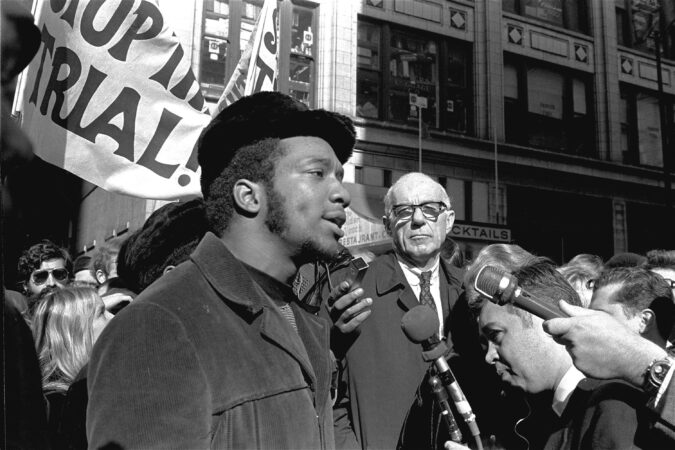
    Hampton was 21, a year younger than I was then. But he already was a magnetic, charismatic figure on the left, clearly destined for leadership beyond the Panthers and Illinois.

    Precisely for that reason, Hampton had become a target of J. Edgar Hoover’s FBI in its effort to control and wipe out the Panthers, a group that he labeled “the greatest threat to the internal security of the country.”

    I was a graduate student at the University of Chicago, looking for a purpose in life that academia was not providing. Suddenly, the death of Hampton — actually, the assassination of Hampton — gave me that purpose.

    Just as many young Americans watched the events of Sept. 11, 2001, and felt compelled to join the military, I watched the aftermath of Hampton’s death and was moved to become a journalist.

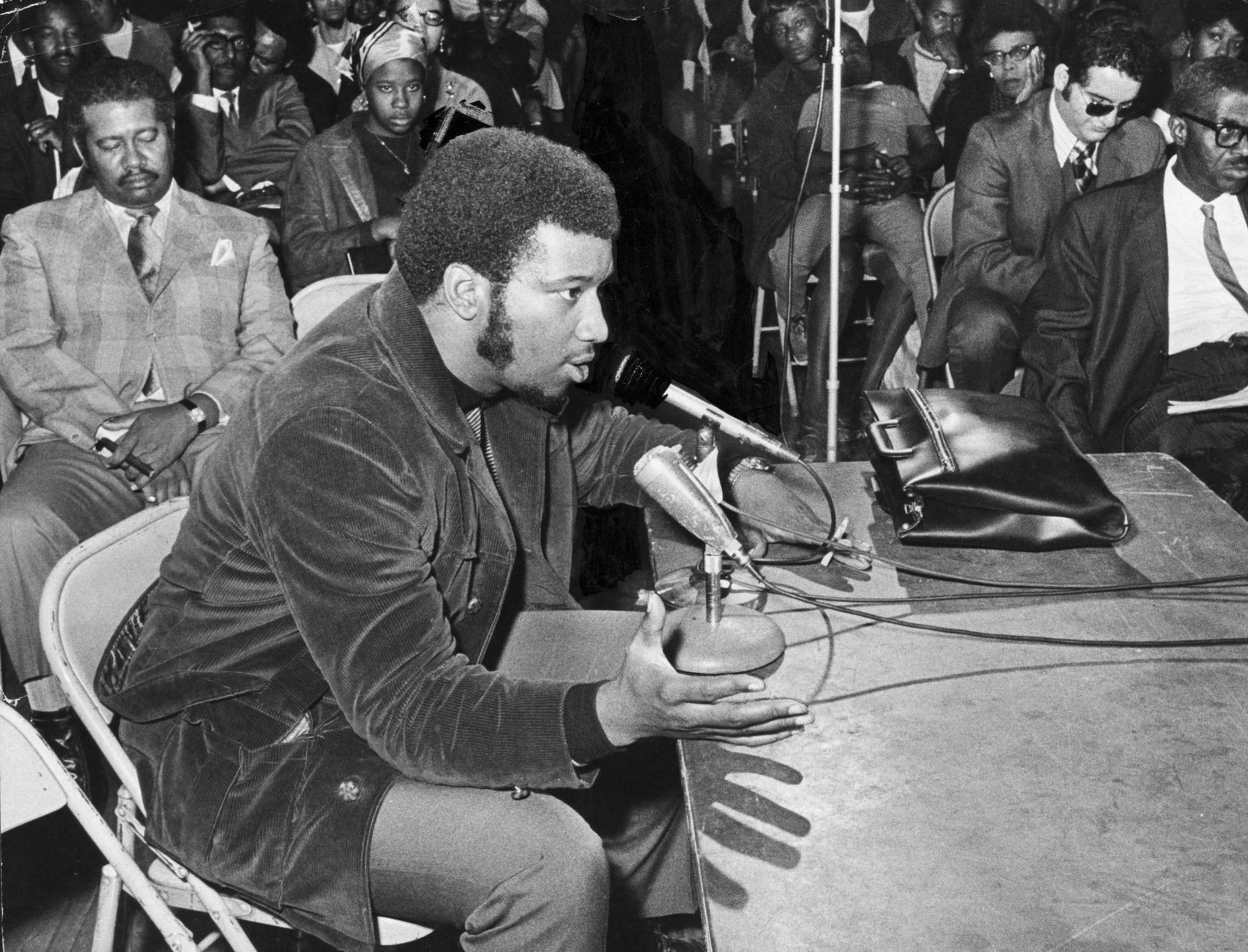
    At 21, Fred Hampton was already a magnetic, charismatic figure on the left, clearly destined for leadership beyond the Black Panthers, Don Wycliff writes.

    I had been habituated to the importance of news since I was a child in rural East Texas, listening with my maternal grandfather to Gabriel Heatter’s quavering delivery of the news each evening on the radio.

    In high school, I read and watched in terror as the Cuban missile crisis unfolded. And the year before my high school graduation, I watched faithfully as CBS’s Roger Mudd delivered daily reports on the progress through Congress of the Civil Rights Act of 1964.

    But even as I progressed through college at the University of Notre Dame, it never occurred to me that a Black kid like me could become a journalist. And then came Dec. 4, 1969.

    The Chicago media were all over the Hampton story, and I was into every news story and broadcast about the case.

    One station broadcast a police reenactment of the raid and shootout.

    Five daily newspapers — including the legendary Black publication the Chicago Daily Defender (which, a few years prior, had been led by an editor named Chuck Stone) — published editions virtually around the clock, constantly trying to advance the story.

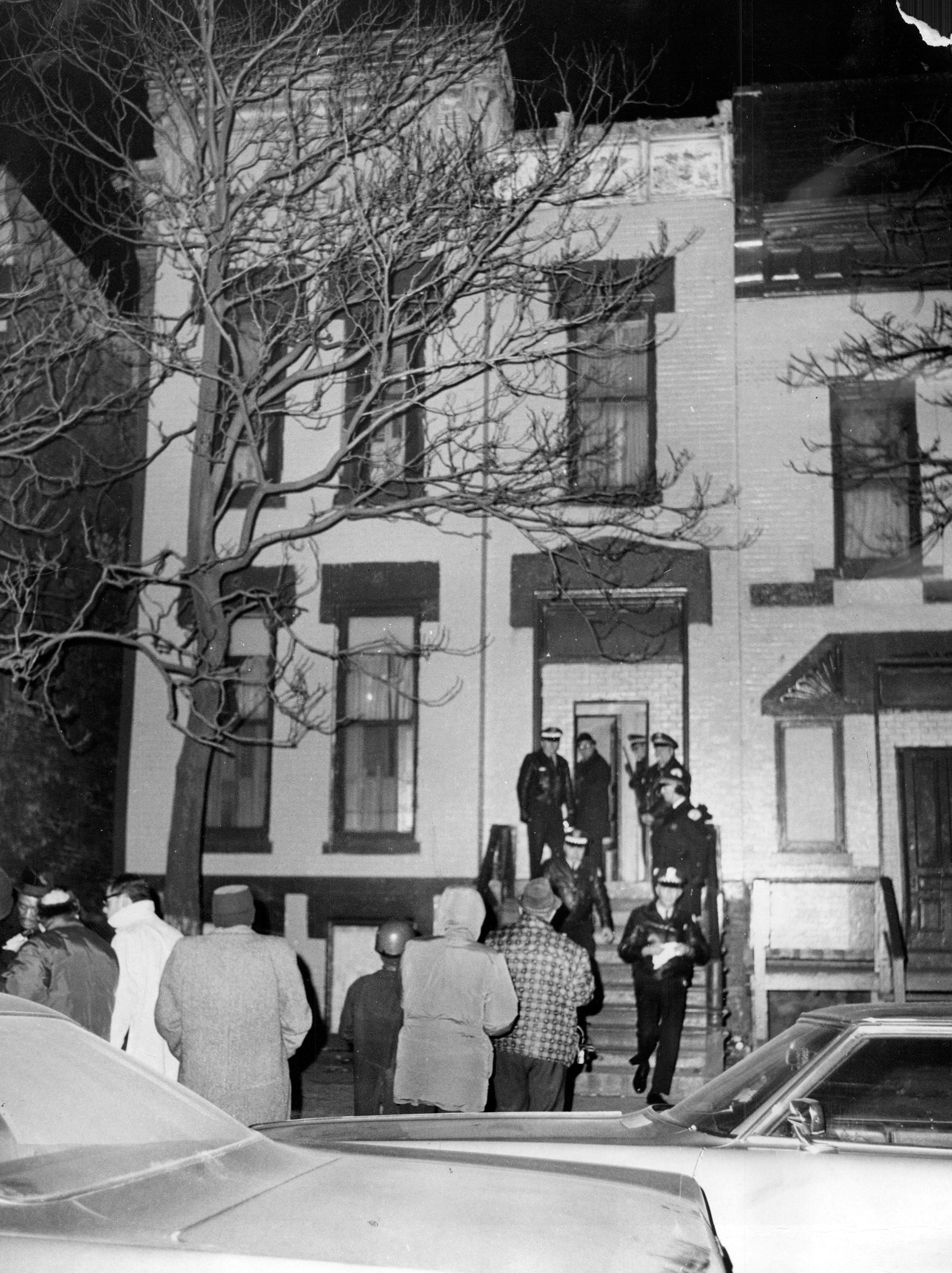
    On Dec. 4, 1969, police gathered at 2337 W. Monroe St. on Chicago’s West Side, where Fred Hampton and another member of the Black Panthers were killed.

    Eventually, it became clear that there had been no “shootout” at all, but a shoot-in by the police. The clincher was a front-page photo in the Dec. 12 editions of the Chicago Sun-Times under a headline that read, “Those ‘bullet holes’ aren’t.”

    The police had put out a similar photo earlier, claiming to show holes in a door caused by bullets fired from within the Panther apartment. The Sun-Times photo showed they were actually rusted nail heads.

    What all of this demonstrated to me was the power of journalism to expose truth, to lay bare hidden facts for examination by citizens of a democracy. And after seeing it done, I knew I wanted to do it, too.

    The Hampton case was the catalyst for my desire to do journalism, but there have been others.

    Bob Woodward and Carl Bernstein inspired a whole generation of journalists with their coverage of Richard Nixon’s Watergate scandal.

    And in cities and towns and hamlets all across the country, journalists have unearthed inconvenient truths that people in power would have preferred remained buried — and that undoubtedly inspired others who wanted to do the same.

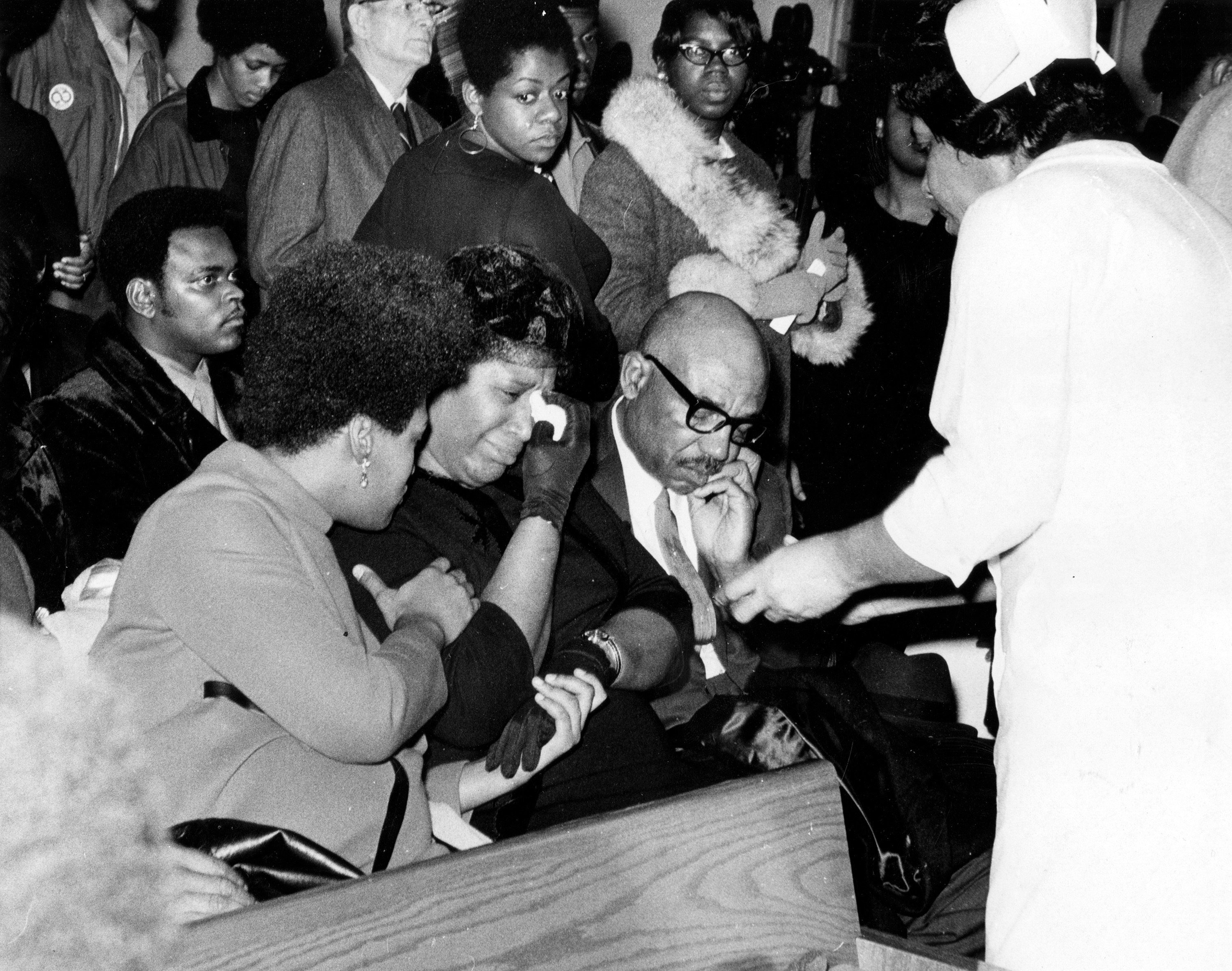
    The parents of Fred Hampton, Mr. and Mrs. Francis Hampton (center with tissue-second and third from left), weep during a memorial service for their son on Dec. 9, 1969, in Melrose Park, Ill.

    Our current politics provide what some might call a “target-rich environment” for aggressive, probing journalism. The undeclared war against alleged Venezuelan drug runners on the high seas of the Caribbean is but the most obvious example.

    But there are plenty of abuses short of lethal ones that cry out for investigation and exposure. In a world where those in power see disagreement as disloyalty, protest as terrorism, and constitutional mandates like due process as dispensable annoyances, the need for passionate, implacable, even clamorous, journalism endures. And will, I suspect, for at least another 56 years.

    Don Wycliff, a former editorial page editor at the Chicago Tribune, is the author of “Black Domers: African-American Students at Notre Dame in Their Own Words” and the recently released memoir, “Before the Byline: A Journalist’s Roots.”

  • New study on historic districts counters claim preservation limits development, housing

    New study on historic districts counters claim preservation limits development, housing

    For years, preservationists have countered claims that historic designation limits development and housing supply. Some neighborhood groups have gone as far as filing petitions to oppose new historic districts in Philadelphia on these grounds.

    Until recently, there was little data to challenge these assumptions. That changed when the Preservation Alliance for Greater Philadelphia commissioned PlaceEconomics to study preservation’s impact in Philadelphia.

    Although only about 5% of the city’s land and 4.4% of its buildings are listed on the Philadelphia Register of Historic Places — up from just 2.2% in 2016 — that expansion in designations shows how Philadelphia has begun to catch up with peer cities. This growth reflects both resident advocacy and the city’s expanded preservation capacity, which were spurred by efforts under Mayor Jim Kenney’s administration, including the convening of a Historic Preservation Task Force.

    The new report produced striking findings that flip the old narrative on its head: that preservation constricts housing supply and reduces density.

    In fact, the data show preservation supports growth and density. Population density in historic districts is 34% higher than in other neighborhoods, and housing units there grew 26% over the past decade, nearly triple the citywide rate.

    The study also found that older neighborhoods are becoming more diverse, with preservation helping sustain racial and economic inclusion. Nonwhite homeownership in these areas is rising faster than in the city as a whole, a clear sign that maintaining older housing can open doors to opportunity, not close them.

    It’s evidence that preserving the city’s older housing stock is a key component of Mayor Cherelle L. Parker’s H.O.M.E. Initiative to provide new affordable housing opportunities. Investing in these neighborhoods will support the growth of homeownership for Black and Hispanic populations.

    The 1500 block of Christian Street in the historic Black neighborhood nicknamed “Doctors Row,” photographed in 2021.

    Beyond the data, historic neighborhoods offer beauty, character, and a sense of place that newer developments often struggle to match. Built long before cars shaped our neighborhoods, these areas were designed for people: compact, walkable, and full of architectural variety. Their mix of rowhouses, corner stores, and small apartment buildings naturally creates the kind of density and vibrancy that newer communities struggle to emulate.

    Moreover, many older neighborhoods were built at a time when transportation options were more limited, such as walking and transit, causing them to be more densely developed than later, automobile-oriented areas of the city. These neighborhoods were often built with a wide variety of housing types, including multifamily buildings that are inherently denser than neighborhoods of primarily single-family homes.

    Historic districts are simply desirable places to live. And that attracts housing developers seeking to put up new housing, whether on vacant lots or on parcels containing “noncontributing” properties, which can be demolished under Philadelphia Historical Commission regulations.

    These and other new buildings constructed within historic districts in recent years have been subject to Historical Commission review to ensure they do not detract from the character of the historic districts in which they were built.

    Preservation also fuels local jobs and investment. Philadelphia ranks among the nation’s leaders in historic tax credit projects, which, since 2010, have generated roughly 2,500 jobs and $141 million in annual labor income — a steady return that proves preservation is as much an economic strategy as a cultural one.

    Historic districts are living, breathing neighborhoods that welcome both new housing and new residents. The findings from the latest study should put to rest some of the more persistent claims of preservation’s detractors.

    Paul Steinke is the executive director of the Preservation Alliance for Greater Philadelphia.

  • Manufactured ‘fraud’ narrative threatens veterans’ disability benefits

    Manufactured ‘fraud’ narrative threatens veterans’ disability benefits

    In the five-county Philadelphia region, nearly 34,000 veterans depend on U.S. Department of Veterans Affairs disability benefits. These benefits are not just a lifeline; they are a powerful economic engine that pumps nearly $955 million into our local economy every year.

    But on Oct. 29, the U.S. Senate Veterans’ Affairs Committee held a hearing to “reform” the disability system, laying the groundwork to gut this vital support by using a false narrative that targets the very veterans who need it most.

    The hearing was built around a proposal by Sen. Tommy Tuberville (R., Ala.) to create a commission similar to a Base Realignment and Closure (BRAC) procedure to fast-track changes, and by the testimony of one star witness, Daniel Gade.

    Gade, a retired Army colonel, professor, and disabilities activist who was badly wounded in Iraq and is now running for a U.S. Senate seat in Virginia, argued that disability benefits “rob veterans of purpose” and that conditions like tinnitus and hypertension should not be compensated.

    As a Navy veteran and a medical student, I was alarmed by the medical and data-driven inaccuracies used to justify this attack.

    Questioning PTSD

    Gade’s claim that PTSD is “curable,” and thus shouldn’t be permanently compensated, is medically false. As any first-year medical student knows, post-traumatic stress disorder is a chronic condition that, at best, can be managed into remission. It is not “cured.”

    Gade’s dismissal of hypertension as a “lifestyle” condition is equally dangerous. As the Disabled American Veterans (DAV) has testified, hypertension is scientifically linked to military service and associated with common toxic exposures to Agent Orange and other toxic substances. These conditions are not lifestyle choices; they are the documented, latent wounds of military service.

    The entire premise for this “reform” is based on a manufactured narrative of “massive fraud.” This is statistical fiction.

    My research at Temple University involves analyzing large medical data sets, and the data here is clear: The fraud narrative is a myth. The DAV’s testimony confirmed that the VA sees “fewer than 200 fraud convictions annually” out of nearly “3 million claims.” That is a fraud conviction rate of less than 1/100th of 1%.

    This isn’t just a national story. This rhetoric insults the 33,816 veterans in the Philadelphia region who receive these earned benefits.

    If the committee truly wants to find waste, it should focus on real problems, which were detailed by the VA’s own watchdogs at the same hearing.

    VA Inspector General Cheryl L. Mason focused her testimony on the real issue: predatory “claim sharks” and systemic management challenges, as outlined in an inspector general’s report on the Philadelphia office. The VA’s own data show its problems are internal, not with the veterans it serves.

    Dangerous distraction

    In other words, the “veteran fraud” narrative is a dangerous distraction from the real problem: a broken VA disability system. The Government Accountability Office (GAO) agreed, confirming that the system has been on its “High Risk List” since 2003 due to “longstanding challenges” concerning oversight and training.

    Exterior of Philadelphia Veterans Affairs Regional Benefit Office, 5000 Wissahickon Ave.

    This is where reform is needed. Don’t misplace blame on veterans for the VA’s own systemic failures.

    While Sens. Dave McCormick and John Fetterman do not sit on the Veterans’ Affairs Committee, the financial stability of over 33,000 of their constituents, and nearly a billion dollars in our local economy, is on the line.

    I urge them to publicly oppose this dangerous commission and demand Congress focus on the real problems: cracking down on the claim sharks who prey on veterans, and fixing the VA management failures the watchdogs have identified for decades.

    Alyster Alcudia is a U.S. Navy veteran, a former nuclear submarine warfare officer, and a medical student in Philadelphia.

  • Fatigue is still a safety risk for air travel

    Fatigue is still a safety risk for air travel

    Even with the longest government shutdown in American history over, it is crucial to recognize that the menace of fatigue and its impact on air travel safety remains a serious and ongoing threat.

    Before the shutdown started on Oct. 1, air traffic controller staffing was below targeted levels, with many already working mandatory overtime and six-day weeks.

    The signs of stress on the system appeared immediately, as flight delays due to staffing shortages were reported at major airports, including the temporary closure of an airport control tower, affecting over five million passengers.

    These effects snowballed such that while just 11 flights were canceled between Oct. 1 and 29 because of controller staffing, the number surged to 4,162 between Oct. 30 and Nov. 9. Of those, 3,756 were between Nov. 7 and 9. To mitigate risk, an emergency order from the Federal Aviation Administration was issued, targeting a 10% reduction in flights at 40 high-traffic airports across the country.

    A Delta Airlines plane comes in for a landing over the air traffic control tower at Denver International Airport on Nov. 9.

    As essential workers, air traffic controllers were required to work unpaid. Faced with mounting expenses, many workers took second jobs to cover their bills, cutting into their sleep. Others faced stress-induced insomnia from unpaid bills and job uncertainty. Overtime prevents recovery of sleep and increases fatigue-related error risk. Unsurprisingly, the White House warned that absenteeism among unpaid federal workers would increase.

    Even under normal conditions, irregular schedules, undiagnosed sleep disorders, and lifestyle factors contribute to fatigue-related errors. Shutdowns amplify these dangers.

    Air traffic controllers perform mentally demanding tasks requiring sustained vigilance. Controllers often work “rattler” schedules: five eight-hour shifts in four days, ending with a day shift followed by a night shift. These offer only 10 hours off between shifts, far too little for sleep recovery.

    One night of sleep loss can significantly impair performance. A 2008 University of Pennsylvania study found that sleep-deprived Transportation Security Administration agents were less able to detect weapons in bags.

    A NASA study found that 70% of air traffic controllers had nearly dozed off while actively working, and more than half of those who made operational errors cited fatigue as a contributing factor.

    Critically, people often misjudge their own level of sleepiness. One landmark study found that people rate themselves as only moderately sleepy even when their cognitive performance has significantly declined. As a result, well-intentioned workers may unknowingly put lives at risk.

    Many mistakenly believe they can overcome sleepiness through willpower and dedication to a task. However, sleepiness is not a minor inconvenience; it is a physiological condition that impairs judgment and performance.

    There is currently no real-time safety monitoring system in place that can determine whether an air traffic controller is fit for duty. The insidious effects of accumulated fatigue and stress may continue to linger long after the shutdown, as flight disruptions remain expected.

    Even though the shutdown has ended, air traffic controller leadership must take active steps, including restricting overtime, monitoring signs of fatigue, and avoiding reliance on self-reported assessments of fatigue.

    If necessary, airports should continue to scale back operations to allow workers time to rest. No one responsible for critical safety operations should be expected to perform under sustained, elevated fatigue levels.

    Allowing exhausted and compromised workers on the job is a recipe for disaster. The safety of millions depends on acknowledging the real threat of fatigue and taking immediate action to prevent avoidable disasters from becoming a reality.

    Jocelyn Y. Cheng is vice chair of the Public Safety Committee of the American Academy of Sleep Medicine.