“Might makes right,” “Greed is good,” “omertá,” phrases that offend human decency and American dignity.
The MAGA government and its enablers have embraced these odious concepts. The Republican regime deploys the U.S. military and hooded secret police to terrorize American cities, murders foreign civilian sailors, invades a sovereign nation to capture its leader, schemes to steal a foreign nation’s oil reserves, plots invasion of our ally’s territory in Greenland, and threatens the sovereignty of Canada. Who offers a rationale?
Steven Miller gleefully articulates MAGA principles: We do these things because we can. When MAGA sends military troops to invade our cities, attack foreign nations, steal foreign assets, or kill foreign civilians, corrupt and co-opted MAGA forces simply cannot be stopped.
Is this our new U.S.? A brutish gangster nation? Do threatened civil rights at home, broken alliances abroad, transactional collusion with international criminals, dictators, and despots comport with our heritage?
How can we restore the noble legacy of the Greatest Generation? Make decency at home and abroad our national goal? Prioritize the rule of law and accountability? When will U.S. power again be directed to support democratic ideals, international cooperation, and civil/human rights?
What world will we pass to our progeny?
Mike Shivers,Altoona, Pa.
World of MAGA first
The attack on Venezuela and the removal of former President Nicolás Maduro and his wife, together with administration statements thereafter, have at least given us a better understanding of what “America First” means and what it does not mean. America First does not mean doing anything for ordinary American people; it means doing everything for President Donald Trump’s family, his cronies, and major corporations.
It does not mean helping Americans who are hungry or have problems accessing medical care.
If it meant that, the administration would not be cutting back on SNAP benefits and acting to take away the health insurance of millions who were on Medicaid or had insurance through the Affordable Care Act. It does not mean helping Americans who have trouble affording high prices. If it meant that, the administration would not have raised prices through tariffs and failed to take any other action to rein them in.
What it does mean is imposing American “rule” and hegemony over any country, at least in the Western Hemisphere, with whose policies we disagree and to whose resources we want access.
So we remove Maduro and not his regime and expect to be able to coerce that regime to allow American energy companies to exploit Venezuelan oil. The administration also seeks to attack or coerce other countries in the region, including Panama, Colombia, and Greenland.
This is not about helping the American people, much less the Venezuelan people. It is about enabling Trump and his henchmen to strut about on the world stage. And it is about making money for Trump’s family, his cronies, and corporations that do his bidding. Trump is making unconstitutional use of the U.S. military to achieve these goals. According to opinion polls, the American people do not support this mob boss-style imperialism. It is time for Congress, especially Republicans in Congress, to stand up and prevent further unauthorized and unconstitutional military ventures.
Matthew Lawry, Elkins Park
Join the conversation: Send letters to letters@inquirer.com. Limit length to 150 words and include home address and day and evening phone number. Letters run in The Inquirer six days a week on the editorial pages and online.
Vladimir Lenin, who famously (may have) said there are decades when nothing happens and weeks when decades happen, probably would have been flabbergasted by the century that took place in the first week of January 2026.
America’s battered psyche had barely processed Donald Trump’s dictate to illegally bomb Venezuela — killing as many as 100 people — and capture its ruler when a political earthquake struck Minneapolis, where an ICE agent’s stone-cold killing of a 37-year-old mom in her SUV, captured on multiple videos, shook the national conscience.
These two seismic stories sandwiched a grotesque effort by the Oval Office to whitewash the fifth anniversary of Trump’s attempted Capitol Hill coup on Jan. 6, 2021. Yet I would argue that American historians will look back and see the most consequential moment — amid seven more days that shook the world —occurred on the quiet hiss of a New York Times journalist’s tape recorder.
The nation’s 47th president insisted to anyone listening that he believes there are no limits to his power, other than those that he himself sets in a brain clogged by decades of Big Macs.
A dictatorship, if he can keep it.
In the White House last Wednesday, Trump was asked by four New York Times reporters during a wide-ranging interview whether he believed there are any limits on his own powers. “Yeah, there is one thing. My own morality. My own mind. It’s the only thing that can stop me.”
As America’s self-proclaimed paper of record, the Times gets a lot of well-deserved criticism for its news judgment, but it was absolutely right to splay Trump’s kingly pronouncement across the top of the front page — even in a week that seemed like the end of the world as we know it. This actually was the most important story — a unitary dictatorship theory that binds Caracas with the Twin Cities.
There’s an understandable yet somewhat misguided tendency to label Trump’s most impulsive and outrageous actions as “a distraction” from deeper long-term problems. And, to be sure, the president’s MAGA inner circle probably doesn’t mind when TV’s talking heads are talking about Venezuelan crude oil and not the flagrant lawbreaking of blocking the mandated release of the Jeffrey Epstein Files, with 99% still outstanding.
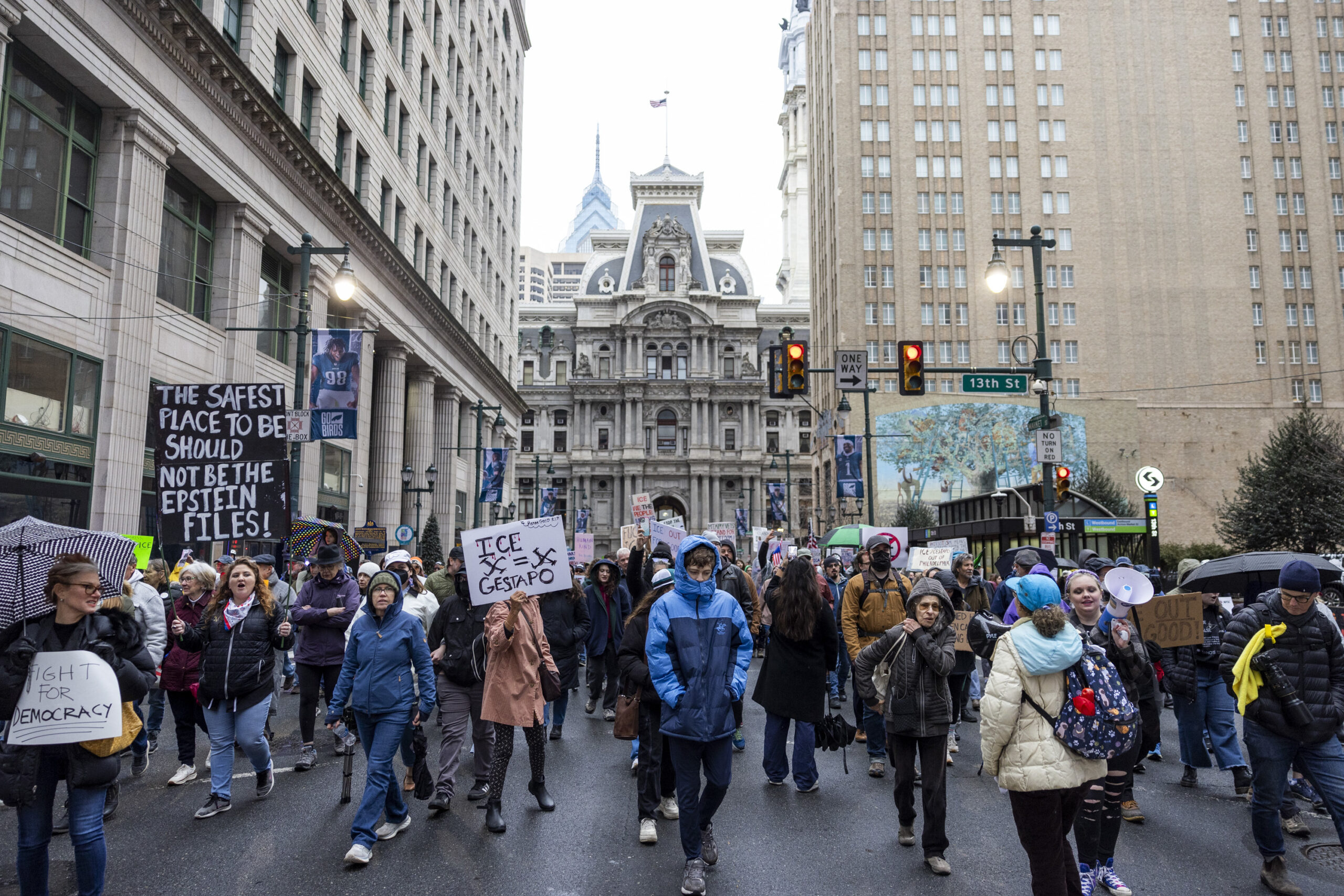
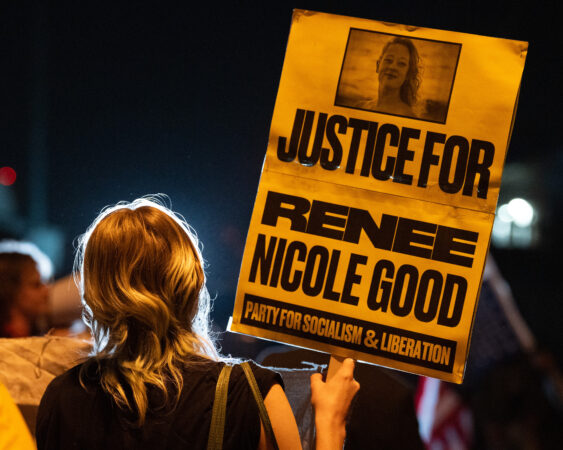
Demonstrators gather along Market Street to honor the memory of Renee Good and to protest against ICE in Center City, on Saturday.
But these so-called “distractions” are, in reality, the very essence of Trump’s “red Caesar” vision for his personalist, authoritarian governance of America and his perceived sphere of domination in the Western Hemisphere. It is a regime that believes in the raw power of brute force and its ability to murder people with “absolute immunity,” whether it’s an 80-year-old grandmother who lived too close to Nicolás Maduro or a 37-year-old mom whose SUV is in the way of its masked secret police.
That crisis aims to eliminate the perceived constraints on the regime’s lethal conduct — traditions of America morality that are very different from what dwells in Trump’s clouded brain — by outrageously lying about the present and altering the factual narratives of the past.
Any high-school student struggling to understand George Orwell’s 1984 (just kidding…they don’t read books in high school anymore) could have simply turned on the news last Tuesday, when the Trump regime threw the truth about the deadly insurrection on Jan. 6, 2021 down the memory hole with a fictionalized rewrite of what happened — thus seeking to control the future by controlling the past.
Although published some 78 years ago, Orwell’s novel is proving an even better roadmap to the deeper truths of the Trump regime than the Heritage Foundation’s Project 2025. It predicted the meaninglessness of past political alliances (“We were at war with Greenland. We had always been at war with Greenland.”), the Two Minutes Hate that is Trump’s Truth Social Feed, and the deepfake altering of reality that turns a part-time poet with three kids into “a domestic terrorist.”
What Orwell was describing was essentially totalitarianism — government with no real objectives or moral force beyond the whims of its Dear Leader and the violent social control that’s required to keep that from unraveling. Less than one year after his inauguration, Trump is claiming this worldview as his own. If he had bothered to crack open his high-school French book, he might have told the Times, “L’État, c’est moi.”
In a screen grab from footage circulating on social media, anti-regime protesters dance around a bonfire as they take to the streets, in Tehran, Iran, Friday.
Yet the most chilling part of this regal declaration from the Oval Office was when Trump said his own values and intellect are the only thing that can stop him — presumably from killing again in Caracas or South Minneapolis or the middle of Fifth Avenue. In fact, the institutions that have restrained less-ambitious presidential overreach in the past seem to have vanished in the face of an actual dictator.
Speaking of which, there was one other passage in the New York Times this week that was also striking. It read: “On state television, an anchor warned that protesters could be risking their lives by taking to the streets. ‘Tonight is the night for parents to stop their children from going out,’” he said. “‘If something happens, if someone is injured, if a bullet is fired and something happens to them, do not complain.’”
You can’t be blamed for thinking that the “state television” being quoted was CBS News under its now pro-Trump billionaire owner and his muse, Bari Weiss, but of course the Times was describing that other country where people are risking getting shot to protest: Iran.
There are no coincidences in this already incredible year of 2026. The slow moral rot of the backwards-looking, theocratic regimes behind the Iranian revolution of 1979 and the Reagan revolution of 1980 has finally decayed to the point where thousands of people are out in the streets of Tehran, Minneapolis, Tabriz, and Philadelphia.
“People are saying we have nothing left to lose.”
Again, this is a quote from an Iranian anti-regime journalist named Elyar Kamrani, but it’s a vibe that is also deeply felt by the thousands who marched this weekend all across America. One imagines that the gunfire of Tehran was echoing in the mind ofthe Episcopal bishop of New Hampshire when he told a candlelight vigil Saturday that he’s instructed his clergy to get their affairs in order and make sure their wills are completed. “It is time to put our bodies between the powers of this world and the most vulnerable,” Rob Hirschfeld said.
You’ve almost got to hand it to Trump for being honest about his warped agenda, and for understanding what the war for the soul of America is really all about.
Morality.
If the American Experiment dies, it will be because we didn’t stop the immorality of a white supremacy that calls Somali refugees “garbage” and a patriarchy that mutters “f—ing bitch” as it murders a woman in ice-cold blood. If it lives, it will be because we embraced the higher morality of empathy and compassion for our neighbors — and for people we don’t even know.
The world must choose between the morality of one man’s damaged soul and those ancient hierarchies, or that of the millions who are risking bodily harm and even death out in the streets, here and on the other side of the world. There is no longer any middle ground.
Sometimes, in our bewildering health system, a patient’s gratitude is a sign of how much the system has failed them. When someone tells a new doctor, “I feel so lucky to see you,” the appreciation can come from years of trying to get high-quality care. And much of that struggle may not be accidental — it is the direct result of how our health system pays doctors.
As a new year begins, it’s worth confronting a hard truth: Our healthcare system fails to treat everyone equally. A key reason is the financial incentives we have created. We pay doctors less to care for some people than others.
Our new research shows that practices receive 8.8% less for visits with Black patients and nearly 10% less for Hispanic patients than for their white peers. For children, the gaps are even wider. Physicians got 13.9% less for visits with Black children and 15% less for Hispanic children.
How does this affect patients? Consider childhood asthma. Having a regular pediatrician and the right inhalers can mean the difference between living symptom-free and taking many miserable trips to the emergency room. Yet, one in eight children with asthma lacks a usual place for care, the Centers for Disease Control and Prevention reports, and poor access is far more common for Black or Hispanic children than for their white counterparts.
The hidden math behind denied appointments
We get what we pay for. In the U.S., doctors are paid very different sums for different patients, even when providing the same service. Commercial insurance tends to pay the most. Medicare, which primarily serves older Americans, pays less. And in most states, Medicaid, which serves low-income Americans, pays the least.
What does this mean for a child on Medicaid? Many physicians refuse to treat anyone with Medicaid. When researchers posed as parents and called pediatrician offices seeking an asthma appointment, over half of callers with Medicaid were denied appointments.
Eliminating pay disparities would cut the gap in general checkup visits by more than half between white children and Black or Hispanic children, write Aaron Schwartz and Rachel M. Werner.
Yet, when these same clinics received a call about a child with private insurance, every single one offered an appointment. Financial incentives matter.
This disparate pay will only worsen after the largest funding cut in Medicaid’s history. The recently passed “One Big Beautiful Bill Act” reduced federal Medicaid support by roughly $1 trillion over the next 10 years.
States now face three options: remove people from Medicaid, cut optional services, or further reduce what they pay providers. States like North Carolina have already moved to cut doctor pay, and others will likely follow suit.
With this law, we are hitting the brakes instead of the accelerator. It recalls a scene from The Simpsons in which Bart is put in a remedial class and says: “Let me get this straight. We’re behind the rest of the class, and we’re going to catch up to them by going slower?”
Commercial insurance also pays less
In our new research, Medicaid is a major driver of these payment disparities, but not the only factor.
Even among patients with similar coverage, like commercial insurance, Black and Hispanic patients still found themselves in plans that paid doctors less. These differences amount to a “tax” physicians face for treating patients whose health insurance pays less. This tax not only penalizes physicians in safety net roles but also shapes which patients ultimately get treated.
Physicians provide more care when they are paid higher prices. One frequently cited study showed that raising physician payment by 2% resulted in 3% more care provision. Based on this figure, we project that eliminating pay disparities would cut the gap in general checkup visits by more than half between white children and Black or Hispanic children.
As long as we provide less incentive to treat some patients, we will get what we pay for: a system that falls short for people with less, especially children. Reversing this trend will require strengthening Medicaid rather than gutting it. Raising Medicaid payments to doctors to be equal to Medicare rates would improve access, evidence suggests. But reforms like this require investment.
Right now, we live in a country where modern medicine achieves great things, sometimes at very low cost. But those benefits are out of reach for those who can’t get a doctor’s appointment.
Our national policies embed inequality into our system of healthcare financing. Unless we confront and reform those policies, uneven access to care will persist and likely worsen.
Aaron Schwartz is a senior fellow at the Leonard Davis Institute of Health Economics at the University of Pennsylvania, where Rachel M. Werner is the executive director. Both are also practicing physicians.
Out of the ashes of the Second World War, the United States led the creation of several global institutions to ensure we would never again have to fight such a war. We created the United Nations, the World Bank, the International Monetary Fund, and, most importantly, the North Atlantic Treaty Organization.
Decades ago, NATO’s first secretary general, Hastings Ismay, remarked that the purpose of the alliance was “to keep the Soviet Union out, the Americans in, and the Germans down.” Then, aside from the threat of Soviet aggression, the other major threat was that the U.S. would turn its back on European allies and return to the isolationist posture it disastrously pursued in the early 20th century.
Today, NATO faces its greatest threat from an entirely new source: a belligerent United States that may attack a fellow NATO nation.
The White House has said President Donald Trump is weighing “a range of options,” explicitly including the use of the U.S. military, in his efforts to control Greenland. If that threat ever becomes reality, NATO as we know it will not survive.
I write this as the lead Democrat for the U.S. congressional delegation to the NATO Parliamentary Assembly, which brings together lawmakers from every NATO member country to provide democratic oversight of the alliance and coordinate on shared security threats.
I also write as someone who believes deeply that NATO is the bedrock of the post-World War II world. It is why Americans and Europeans have avoided a great-power war for nearly 80 years.
NATO endures because of trust: The shared belief that allies do not threaten one another, and that borders are not rewritten by force.
Greenland is a part of the Kingdom of Denmark, a founding member of NATO. A U.S. attack on Greenland would mean the United States using military force against a member of its own alliance.
Danish military forces participate in an exercise with hundreds of troops from several European NATO members in the Arctic Ocean in Nuuk, Greenland, in September.
There is no playbook for that scenario because it was always unthinkable. The moral authority of Article 5 — the pledge that an attack on one is an attack on all — would collapse overnight.
No country on NATO’s eastern flank would ever again fully trust American guarantees. Estonia, Latvia, Poland, and others would be forced to reconsider their security in a world where Washington seizes territory from a smaller ally.
The Trump administration’s rhetoric also plays directly into the hands of our fiercest adversaries.
Beijing and Moscow have spent years trying to fracture the transatlantic partnership through disinformation, coercion, and intimidation. Every hint that America might use force against an ally becomes propaganda for authoritarian regimes that insist the rules-based order is a fiction, and that power — not law — is what matters.
The administration argues that Greenland is strategically vital because of rising Russian and Chinese activity in the Arctic. But that reality is precisely why the United States must deepen cooperation with Denmark and Greenland — not threaten them.
America already maintains a robust security presence in Greenland. A critical U.S. base supports missile warning, missile defense, and space surveillance under a long-standing defense agreement with Denmark that grants extensive U.S. access.
Danish leaders have made clear they are open to strengthening cooperation with the U.S., writes Brendan F. Boyle. Pictured here is Mette Frederiksen, Denmark’s prime minister, at the European Political Community summit in Copenhagen, in October.
Danish leaders have made clear they are open to strengthening that cooperation, and Greenland’s elected government has welcomed dialogue conducted with respect for international law and democratic self-determination.
That is the path forward. The United States must expand joint Arctic operations, invest alongside Denmark in new capabilities, and work directly with Greenland’s leaders to protect shared security interests. Partnership strengthens deterrence while preserving the alliance that makes deterrence possible in the first place.
This moment is a choice between partnership and coercion. America must choose partnership.
The consequences of coercion would be devastating: European allies would begin preparing for a world in which U.S. commitments no longer carry weight. Some nations would pursue independent nuclear deterrents. Others would seek alternative security arrangements. Critical partnerships — including Trump’s own agreement with Finland to build polar icebreakers vital to deterring Russian aggression in the Arctic — would collapse.
The alliance that has underpinned global stability since 1945 would fracture, not because of Moscow or Beijing, but because of decisions made in Washington.
After the disastrous Iraq War, Americans are already uneasy about another prolonged foreign war. Now they are being told military force against a NATO ally is under consideration, an act that would inevitably risk escalation and could drag the United States into a costly, dangerous occupation.
At home, families are trying to afford healthcare, keep their jobs, and provide for their children. They do not want to bankroll another unnecessary conflict that risks American lives and diverts attention from urgent needs here.
Congress must draw a clear line. No funding for military action against a NATO ally. No ambiguity about America’s commitments. The United States must reaffirm — in law and in action — that its power is exercised through its alliances, not against them.
An invasion of Greenland would not make America safer. It would end the alliance that has kept Americans safe for generations and plunge us into a new, dark world.
Brendan F. Boyle represents Pennsylvania’s 2nd Congressional District and is the lead Democrat for the U.S. congressional delegation to the NATO Parliamentary Assembly. He is also a visiting lecturer at Princeton University’s School of Public and International Affairs.
It’s official. The United States is a shining city on a hill no more. We can no longer pretend to be a nation-building, democracy-spreading, weapons of mass destruction-concerned, terrorist-hunting world leader. We now openly blockade foreign shores, blow up innocent civilians, and then sneak attack in the early morning hours to kidnap leaders who don’t play ball. Caligula has given a Senate seat to his horse, Nero has started the fire, Commodus has become a gladiator. How does this historic provocation not overtly fan the flames of the war in Ukraine, the Israel/Palestine conflict, or China’s eventual invasion of Taiwan? Donald Trump came out to his news conference Saturday looking like a victorious Scar surrounded by his obedient hyenas, Malevolent Miller, Plastic Pete, and, of course, Little Marco. Years from now, when historians look back upon President Trump’s actions this past week, they will understand it as the moment America stopped pretending to be the good guys and openly embraced its decision to be the bad guys. As John Adams once said, “Whenever we leave principles and clear positive laws, we are soon lost in the wild regions of imagination and possibility where arbitrary power sits upon her brazen throne and governs with an iron scepter.”
Matt Lyons,Glen Mills
. . .
Why does the richest country in the world need to steal resources from Venezuela? The rape of South America by North American companies goes back hundreds of years and is, of course, not taught in American history courses. Kidnapping heads of state, no matter how bad they are, for the sole purpose of taking resources that are clearly theirs, is an abomination and a clear invitation to war.
For how much longer do we have to feel shame and embarrassment about being American? I am tired of it. How can we celebrate America’s Semiquincentennial when our nation is so close to becoming a dictatorship in the 250th year?
Please let your members of Congress — and the White House! — know we will not stand for another war that we start for literally no reason whatsoever.
Catherine Freimiller,Philadelphia
. . .
The operation that led to the arrest of Nicolás Maduro was truly remarkable. The coordination among law enforcement, the military, and intelligence agencies was flawless. Maduro will have his day in court, as he should. My question is, if the United States government can land forces on a Venezuelan military base, arrest two suspects, and get out without a single casualty, why can’t they stop a speedboat? Why the extrajudicial executions? Doesn’t the little guy deserve his day in court, as well?
Could it be that a big show trial in New York will bring a lot of headlines about how tough Donald Trump is on enforcing the law, and a little guy’s day in court won’t even be noticed?
Tim Moran,Wayne
Join the conversation: Send letters to letters@inquirer.com. Limit length to 150 words and include home address and day and evening phone number. Letters run in The Inquirer six days a week on the editorial pages and online.
POTTSVILLE, Pa. — Because I love Pennsylvania and football (and not always in that order), I drove 90 miles recently to this coal-region city of 13,300 to take a peek at a bronzed football shoe, a trophy carved from coal, and a battered football, its laces askew.
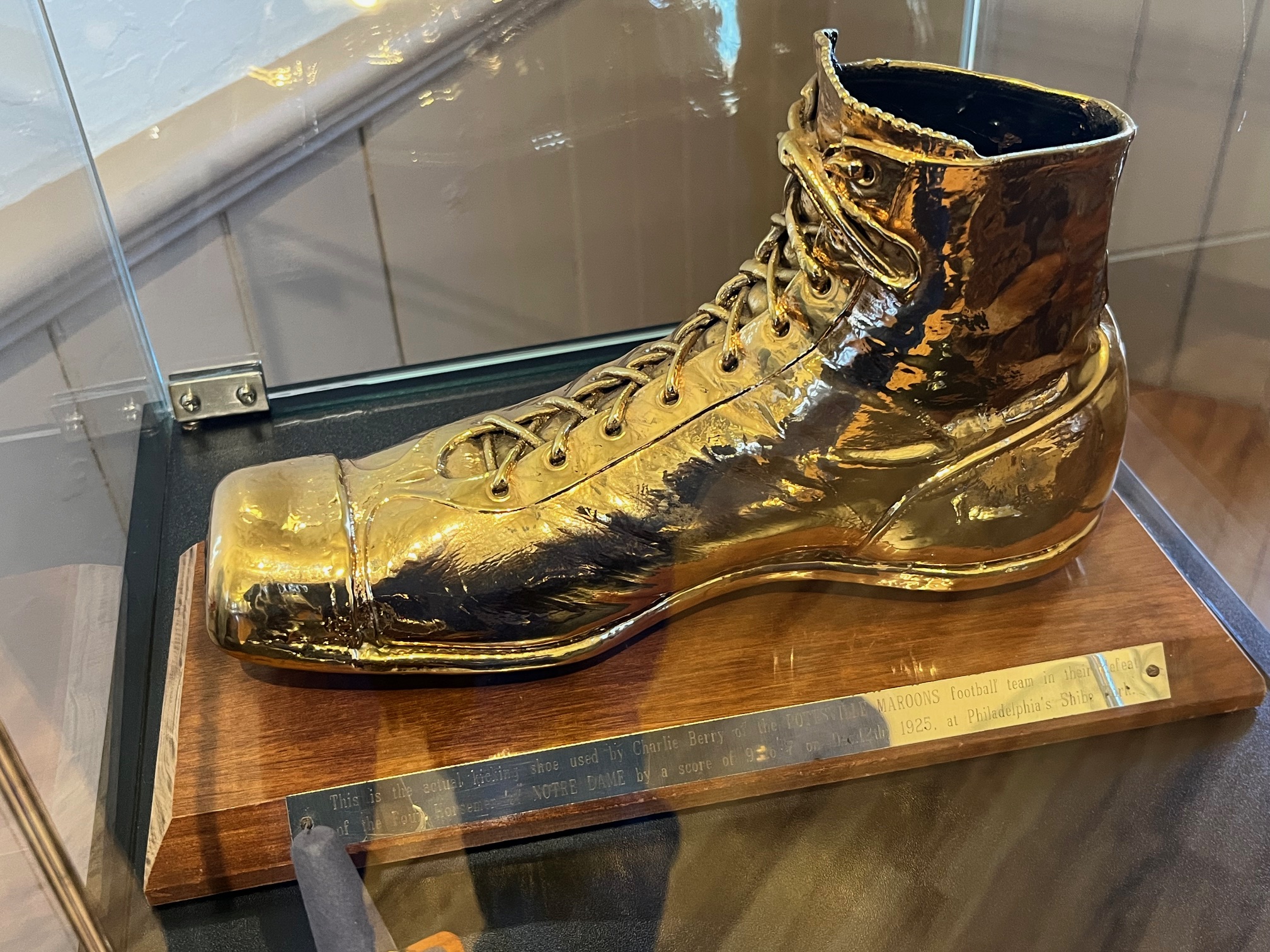
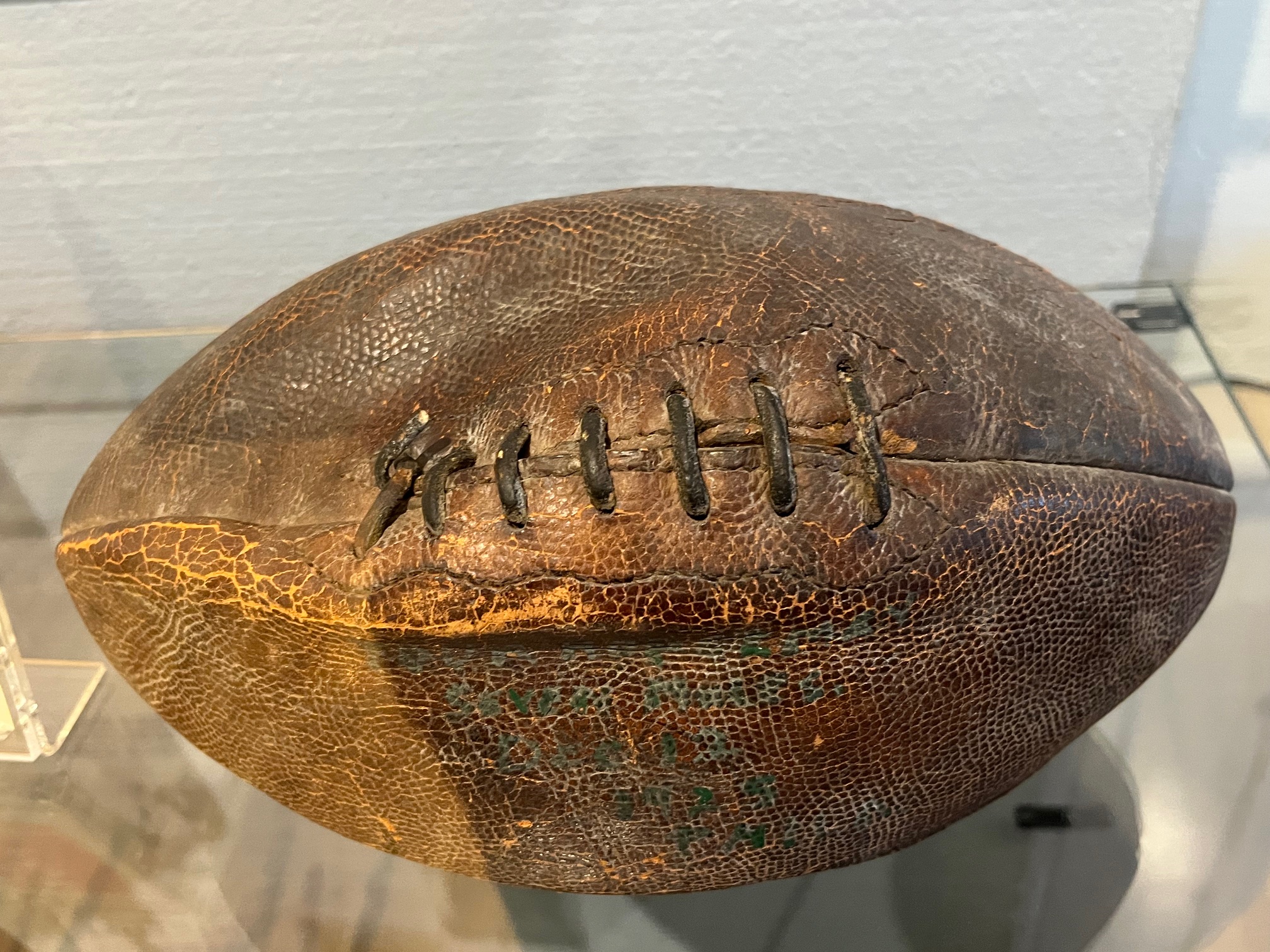
On Dec. 12, 1925, 100 years ago last month, a 23-year-old kid named Charlie Berry — who also played baseball for the Philadelphia Athletics and later became an American League umpire — used that high-top shoe to kick that ball to lift the Pottsville Maroons to a huge victory.
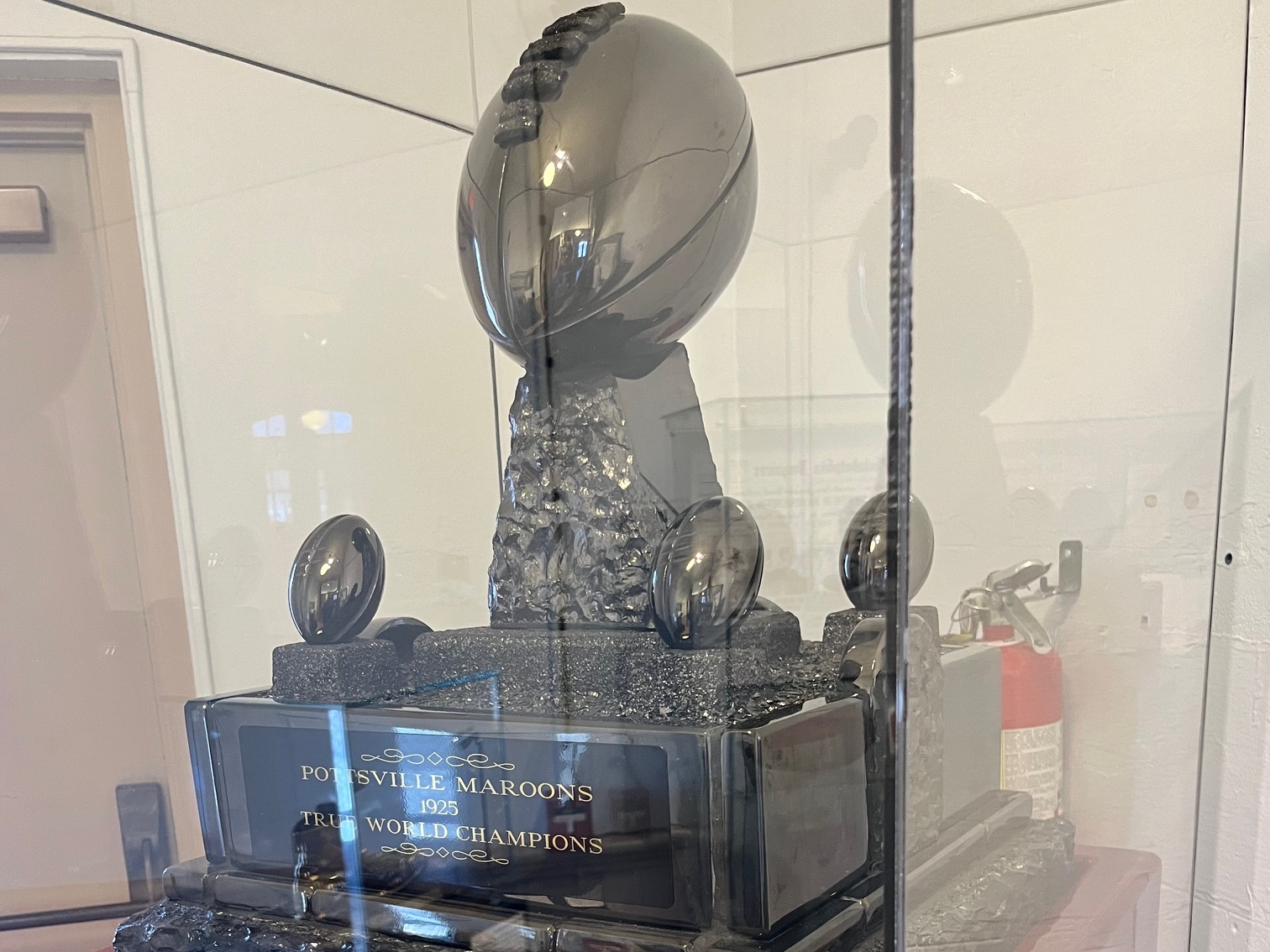
The Maroons got that trophy, emblazoned with the words “TRUE WORLD CHAMPIONS,” after beating a squad of former Notre Dame players, 9-7, in an exhibition game at Shibe Park in Philadelphia. But the Maroons were true world champions only in sentiment. They did not even win their own league.
That would be the National Football League — the same NFL that now includes the Eagles and opens its annual playoffs this weekend, ending with Super Bowl LX. The NFL would deny the Maroons the league championship despite clearly having the best team, having disposed of the Chicago Cardinals a week earlier in icy Chicago, 21-7.
The shoe that Pottsville Maroons kicker Charlie Berry used to kick the winning field goal in the 9-7 victory over the Notre Dame All-Stars on Dec. 12, 1925. The shoe was bronzed in 1961.
The exhibition game turned out to be a big problem. Long story short: Although the Maroons had requested (and, they said, been granted) permission to play the Notre Dame team, they were treading on the turf of the city’s NFL team, the Frankford Yellow Jackets. The Maroons were thrown out of the league.
You have probably heard of the Yellow Jackets, who folded in 1931 and whose remnants were purchased in 1933 by Bert Bell and Lud Wray for $2,500 and relaunched as the Eagles. The Maroons have faded, like a photograph in an album. That is a shame. The Maroons were a town team that climbed through a primitive organizational ladder to reign supreme over a sport.
Payne, who had not heard of the Maroons while growing up in Erie, acknowledged that the NFL is unlikely to declare the Maroons as 1925 champions, saying, “It would take a higher force for this to happen.” And it is old news: The last Maroons player died in 2003, at age 101.
The ball used in the Maroons’ win over the Notre Dame All-Stars.
Rendell wrote that he did not intend “to have any more communications with the cowardly barons that run the National Football League, including their extremely well paid leader, until they relent and grant the gallant Pottsville Maroons what is rightfully theirs.”
(He added that the vast majority of NFL owners lack “cojones.”)
But Rendell only had two NFL teams behind him: those from Pennsylvania, the Eagles and the Pittsburgh Steelers. So that Tush Push, of sorts, failed to reach the line to gain. The NFL still places the Cardinals atop its official 1925 standings, with the Maroons second.
Plus, the Cardinals padded their final winning percentage — used then to determine the champion — by beating teams with some high school kids. They refused to accept the trophy (the one not made of coal) until years later, after the team had been sold to Charley Bidwill.
The last name may ring a bell. The Cardinals, now in Arizona, are still owned by the Bidwill family. How interesting it is that the team has won only one NFL championship since — way back in 1946. They have played in just one Super Bowl, losing in 2009 to the Steelers.
Some “Skooks,” those from Pottsville and surrounding Schuylkill County, still enjoy claiming the Cardinals have been afflicted by the Curse of the Maroons. “And that 1925 championship was stolen. Never forget,” says a Skook friend of mine, still seeking retribution.
“It’s just so tragic and cruel. What should have been a watershed moment by winning such a big game ruined Pottsville and their football team,” David Fleming, who wrote an astonishing book in 2007 about the controversy, Breaker Boys: The NFL’s Greatest Team and the Stolen 1925 Championship, told me recently. “Pottsville put the NFL on the map.”
The NFL of 1925 was prehistoric compared with the NFL of 2025. Salaries were meager, from $100 to $300 a game, and players had to hold down second jobs to pay the bills. Moreover, college football was far more popular and considered to be a far better product.
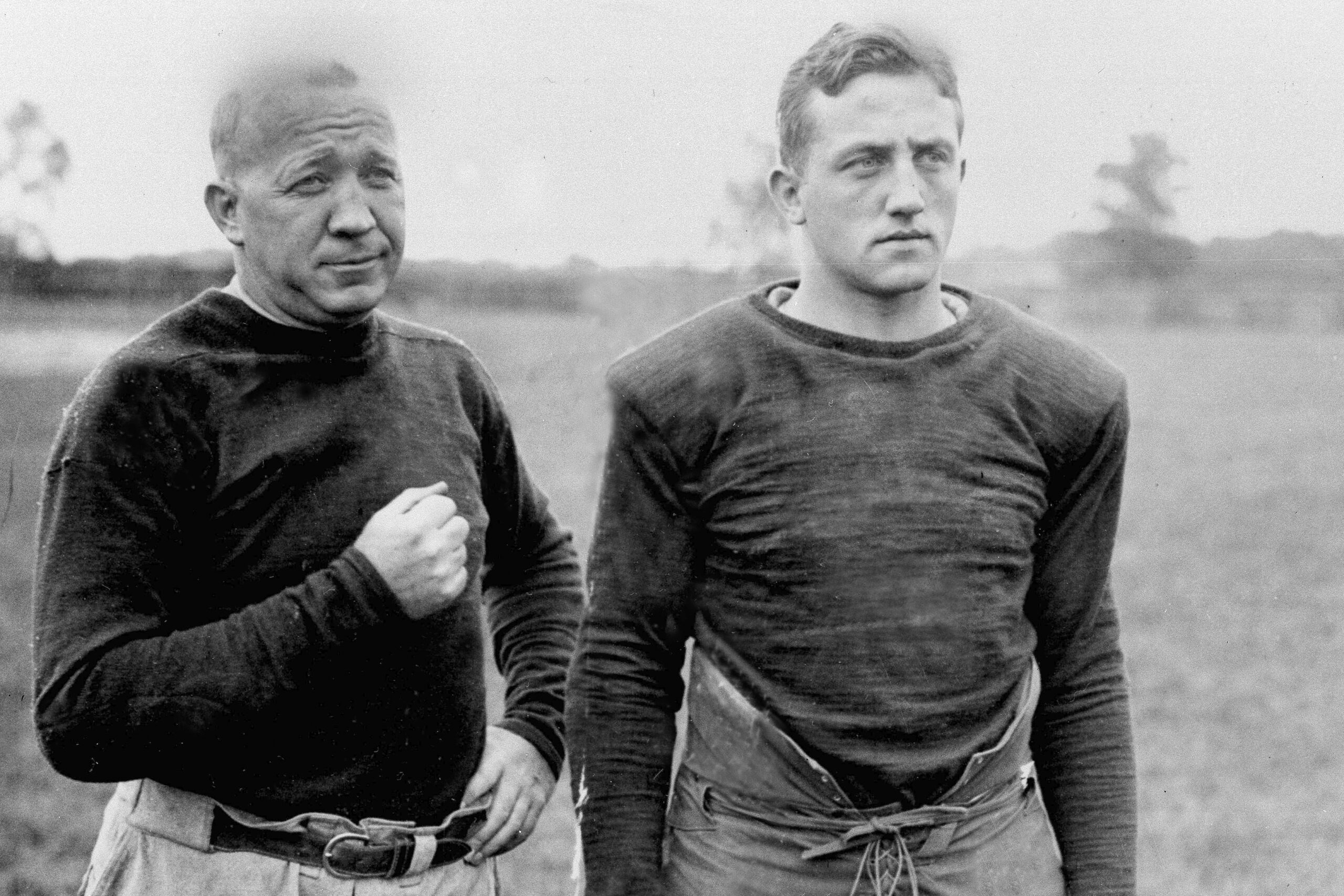
Notre Dame football coach Knute Rockne (left) and team captain Clem Crowe watch the team practice in 1925 — the same year a group of former Fighting Irish players fell to the Maroons, 9-7.
Pottsville sort of ignored the Pennsylvania “Blue Laws,” so the Maroons often played at home on Sundays against opponents that played in Philadelphia the day before. The Maroons set trends that last to this day: For example, the coach insisted his players live in town.
Pottsville was among the smallest cities with an NFL team, but the city more than made up for it by adoring the Maroons — even during a contentious miners’ strike that nearly broke the town. For the exhibition at Shibe Park, as Fleming wrote, several Maroons fans playfully wore coal-miner garb to distinguish themselves from the overwhelming majority of Notre Dame fans.
Even after both teams had arrived at Shibe Park, the exhibition game was nearly canceled because only about 8,000 had paid to see the game, some 10,000 fewer than expected, leading Notre Dame star Harry Stuhldreher, one of the legendary “Four Horsemen,” to push for $25,000 upfront — which is worth about $450,000 today — for his team to play in the game.
(The gate was surely smaller than expected because the Yellow Jackets suddenly scheduled a game at the same time in Frankford, beating Cleveland, 3-0, before 7,000.)
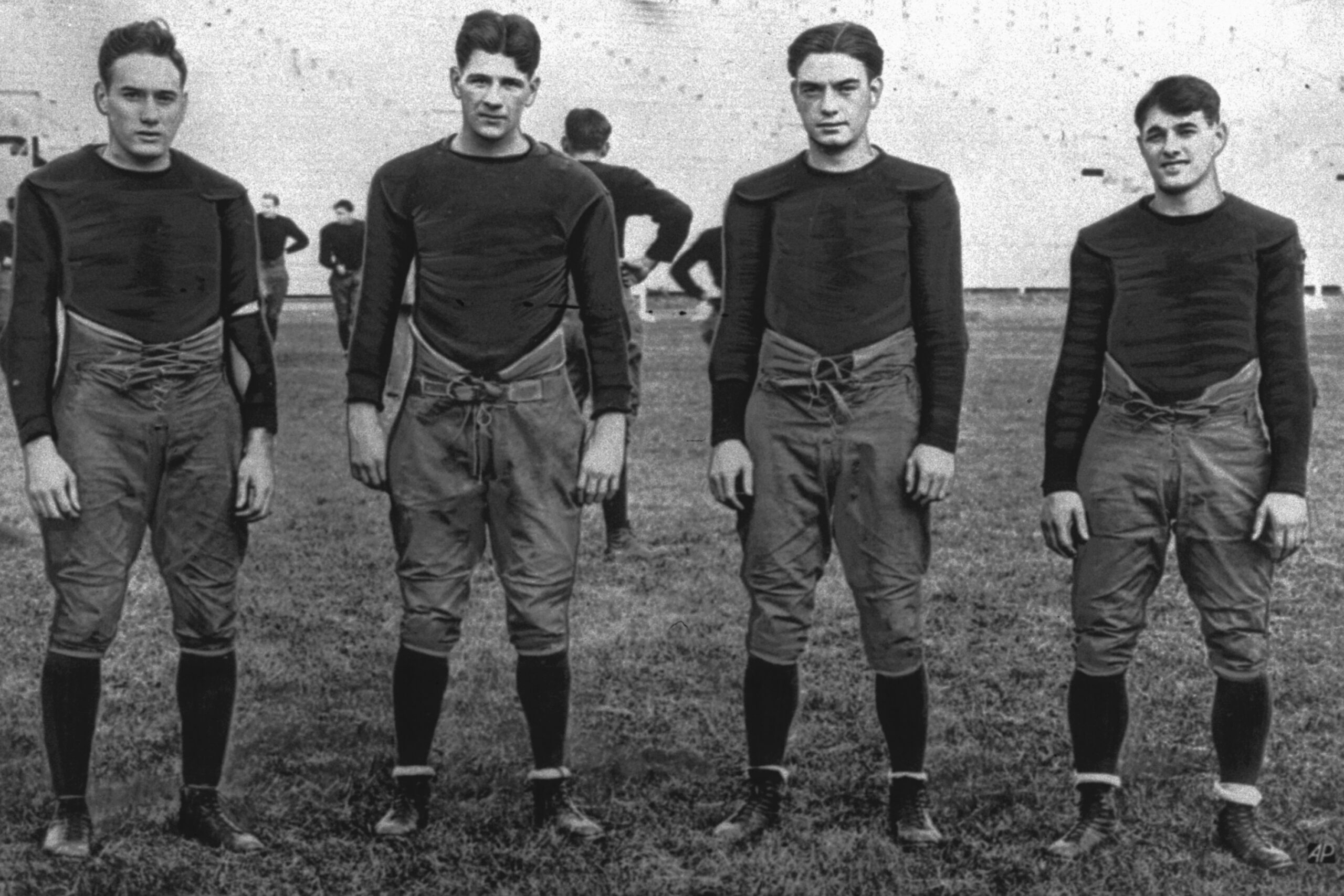
In this 1924 file photo, Notre Dame’s infamous backfield known as “The Four Horsemen,” from left, Don Miller, Elmer Layden, Jim Crowley, and Harry Stuhldreher, pose on the practice field in South Bend, Ind. Stuhldreher asked for $25,000 up front for his team to play against the Maroons.
At the same time, the Maroons were holding out for $10,000 upfront, or about $181,000 today (the pay disparity underscores the difference in perception then between the college and pro games), so the kickoff was delayed. Then Notre Dame took a 7-0 lead on an Elmer Layden touchdown. But the Maroons rallied — gallantly.
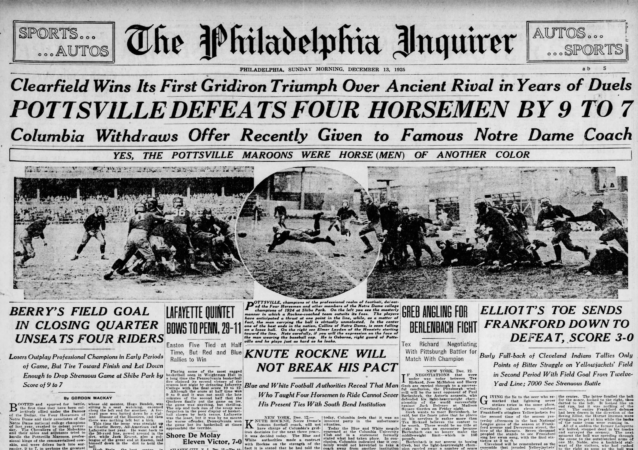
“YES, THE POTTSVILLE MAROONS WERE HORSE(MEN) OF A DIFFERENT COLOR,” The Inquirer gasped the next morning. Gordon Mackay, the reporter, labeled it “perhaps the greatest football battle that this Quaker City has known in years and years.”
The Maroons had put in 28-year-old Tony Latone, the “Human Howitzer,” after halftime. Latone’s story was mythic: He began working in nearby coal mines to support his family when he was 11, after his father died.
At first, he was a “breaker boy,” working 70-hour weeks picking slate and debris from the valuable anthracite coal. (After a week or two, the skin on the tops of a breaker boy’s fingers would peel off.) Later, he strengthened his legs by pushing loaded coal carts from the mines.
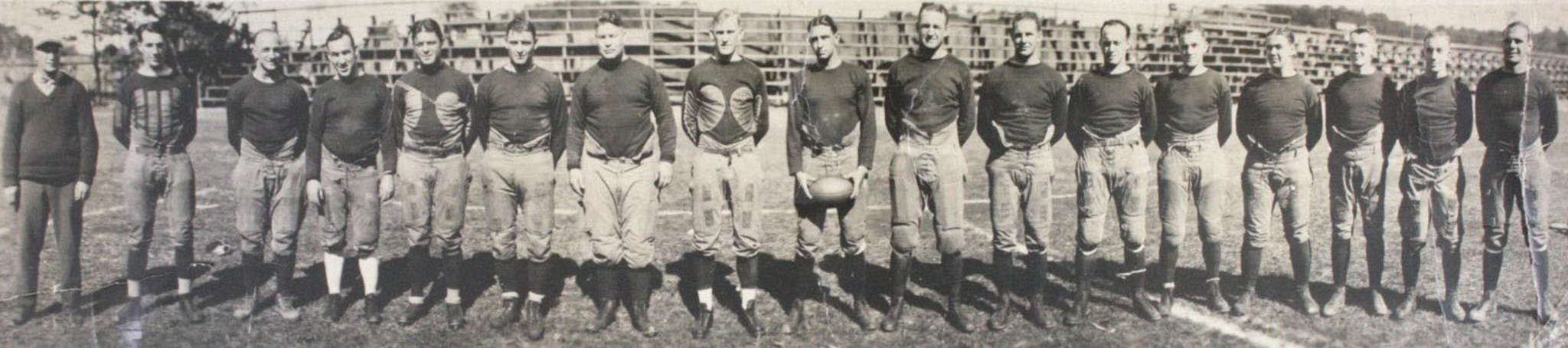
The Pottsville Maroons of 1925, a squad that was comprised of miners from Schuylkill and Luzerne Counties.
Berry, already a catcher for the A’s, hit the crossbar on an extra-point attempt after Latone scored a touchdown late in the third quarter, so Notre Dame still led, 7-6. But Latone, playing on a sore right heel, gained five first downs on another brutal, physical drive.
“He just ripped the Notre Dame team to shreds,” Payne told me of Latone, who ran for more yardage in the NFL in the 1920s than the legendary Harold “Red” Grange.
The drive stalled at the Notre Dame 18-yard line, so Berry tried a 30-yard field goal, which was hardly automatic back in those days. He’d made only three of nine attempts in the season to that point, none past 29 yards.
But, as Mackay so colorfully wrote in The Inquirer the next morning: “He swung that agile hoof. There was a crash of ball and foot, and the crowd, awed into silence, held their breaths as the sphere soared and soared and skipped straight through the crossbar.”
As Fleming wrote in 2007: “Most of the fans at Shibe Park, even the ones from Pottsville, had come out for a fun day of football and a glimpse at the famous Four Horsemen. Instead, they were witness to a watershed moment in the history of American sports: the very moment that professional football surpassed college ball.”
A replica of the trophy — which, like the original, is carved from coal — that the Maroons received for winning the “true” championship resides at the Schuylkill County Historical Society in Pottsville, Pa. The original is in the Pro Football Hall of Fame.
Books about the Maroons, including Fleming’s and the recent release by Payne and Hayes, are on sale at the museum’s gift shop (and online, as well), as are $18 maroon T-shirts with “The Real Champions.” A 100th anniversary celebration was held in August. Students at nearby Nativity BVM High School premiered a documentary, MaRooned.
Fleming, whose book, A Big Mess in Texas, about the antics of the ill-fated 1952 Dallas Texans, was published in October, had Breaker Boys reissued before the 100th anniversary, with a new cover: a photo of the trophy made of silver, not anthracite coal.
“I just wanted to give them the title that they were denied,” he said.
Well, more like, robbed of. Payne and Hayes make a six-premise thesis in their book for the NFL to award the 1925 NFL title to the Pottsville Maroons. They write, “Until the NFL corrects the situation, the Pottsville championship status remains, very simply, marooned.”
Until that day comes, and as a native Pennsylvanian and football fan, the matter should at least be considered; there is only memorabilia from a bygone age in a second-floor alcove at the Schuylkill County Historical Society, a cozy museum in a former school on Centre Street.
Joe Zacko, the late sporting goods store owner and die-hard fan who ordered the jerseys that gave the Maroons their name, had Berry’s shoe bronzed after a 1961 reunion. The goal was to present it to the Pro Football Hall of Fame, then under construction.
The shoe is still in Pottsville. I am not a Skook, but, as I said, I love Pennsylvania and football, and I say a real NFL trophy belongs right next to that shoe, coal trophy, and old ball.
Dave Caldwell, an Inquirer sports writer from 1986 to 1995, grew up in Lancaster County and lives in Manayunk.
The shooting death of Renee Good by U.S. Immigration and Customs Enforcement agents in Minneapolis will likely spark the kind of outrage that we witnessed after the murder of George Floyd.
Not just because Good — a 37-year-old wife and mother — was a U.S. citizen whose shooting by a federal agent was captured on several videos. Not even because those videos indicate that the government’s initial account of the shooting is false. Good’s death will trigger outrage because she was a white woman, and in America, the lives of white women are valued more than most.
It’s haunting, really. Good was shot and killed by an ICE agent about a mile from where Floyd was killed by Minneapolis Police Officer Derek Chauvin in 2020. Video of both incidents circled the world in seconds. And while Good was a white woman and Floyd was a Black man, the role of race hangs ominously over both incidents.
Hundreds of demonstrators rallied outside City Hall on Thursday to protest the killing of Renee Good by an ICE agent in Minneapolis.
Good, who was in a maroon Honda near one such protest, was approached by ICE agents in other vehicles. An agent walked up to her vehicle, pulled her door handle, and yelled, “Get the f— out of the car!”
Good first tried to back up, and then drove forward, veering around an ICE officer who shot into the vehicle. Good died from her injuries.
Kristi Noem, secretary of the U.S. Department of Homeland Security, claimed the ICE agent shot Good in self-defense after Good tried to commit an “act of domestic terrorism.” A Homeland Security spokesperson went further, accusing Good of trying to use her vehicle as a weapon to kill the agent. Noem even called Good an anti-ICE rioter, which makes no sense, since it would be difficult to riot from inside a stationary vehicle.
Minneapolis Mayor Jacob Frey was having none of it. He called the claims of self-defense “bullshit,” and demanded that ICE get out of Minneapolis.
“We’ve dreaded this moment since the early stages of this ICE presence in Minneapolis,” Frey said during a news conference. “Not only is this a concern that we’ve had internally, we’ve been talking about it. They are not here to cause safety in this city. What they are doing is not to provide safety in America. What they are doing is causing chaos and distrust.”
Just as importantly, the death of a white woman at the hands of ICE is bringing clarity. This heartbreaking shooting lets us know that no one is exempt from the violence this administration is apparently willing to unleash to uphold its anti-immigrant policies.
I have no doubt Good’s death will be extensively covered, because police shootings of white women are rare. In fact, the Washington Post database of police shootings indicates that between 2015 and 2024, white women comprised less than 1% of police shooting victims each year.
Still, there’s more to it than that. White women in America are valued, and when they go missing or are victimized, media attention is so overwhelming that social scientists use a specific term to describe it: Missing White Woman Syndrome.
With that in mind, here is the ugly truth: America’s racial hierarchy will assuredly seek justice for Good. And while I hate that she senselessly lost her life at the hands of her government, and was demonized by the president and his cabinet members, I am nonetheless hopeful for change.
If this brutal incident wakes Americans to the danger of this moment, Renee Good did not lose her life in vain.
Pennsylvania’s two largest cities have more in common politically, demographically, and economically with one another than with the rest of the commonwealth. For decades, they also had in common the presence of great American newspapers serving their diverse and dynamic communities: The Inquirer and the Pittsburgh Post-Gazette. Sadly, that may no longer be the case.
On Tuesday, Block Communications, the owners of the Post-Gazette, announced that on May 3, it will shutter the newspaper, the roots of which date back 240 years. The loss of a once great newspaper in a major American city is itself a civic tragedy. The fact that this loss was entirely preventable is even more unfortunate.
It is no secret that the traditional print newspaper business is in sharp decline. Self-inflicted wounds — including a long history of labor strife, family disunity, and financial losses — have compounded these headwinds at the Post-Gazette. The Block family’s announcement cited cumulative losses of over $350 million over a 20-year period.
Disclosure of a decision to close the paper came the same day the U.S. Supreme Court denied the company’s appeal of a decision that required it to honor the terms of an earlier union contract, and after the resolution of a bitter three-year labor strike. Striking workers agreed to return to work on Nov. 24 and were told this week they would be severed.
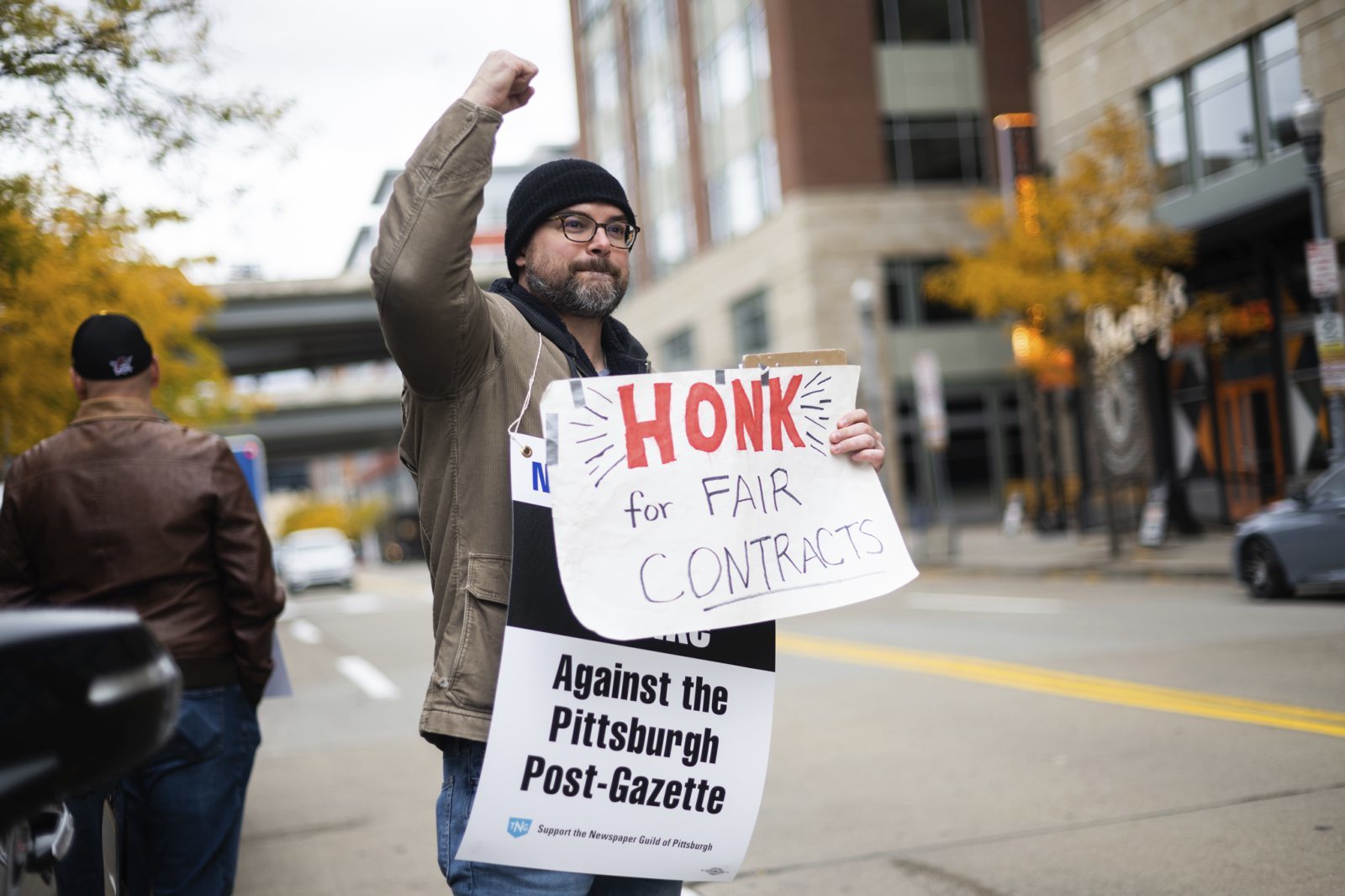
John Santa, a copy editor at the Pittsburgh Post-Gazette, walks a picket line outside the newspaper’s offices with his fellow journalists in October 2022.
The Lenfest Institute for Journalism, of which I am CEO, is in the business of helping sustain and support local news. I heard this week from more than half a dozen news industry colleagues about the potential to “save the Post-Gazette.” As a Philly-based journalism executive, I was unsure what was really left of the Post-Gazette to save. So I reached out to Pittsburgh newsroom sources, readers, and local foundations.
While the Post-Gazette has suffered multiple layoffs and a reduction in its print schedule to two days a week, there is unquestionably still a there, there. The current newsroom numbers 110 employees. And its journalists still produce great public service journalism, covering politics to sports. More importantly, with or without the Post-Gazette, there remains a need and an appetite among readers for independent local news in Pittsburgh. As of the end of 2025, more than 60,000 pay for the P-G in digital form, and 27,000 in print.
To save, reinvent, or perhaps replace the Post-Gazette, it is instructive to look at recent local news investment in Philadelphia and Baltimore:
Ten years ago this month, the late H.F. “Gerry” Lenfest, a philanthropist and cable television entrepreneur, donated his ownership of The Philadelphia Inquirer to the nonprofit Lenfest Institute for Journalism, allowing The Inquirer to invest long term in the transformation of its news and business operations.
The late H.F. “Gerry” Lenfest, a philanthropist and cable television entrepreneur, donated his ownership of The Philadelphia Inquirer to the nonprofit Lenfest Institute for Journalism in 2016.
The Inquirer’s 200-person newsroom is supported in large part by the loyalty of readers, the growth of its digital revenues, and supplemented by donations from readers, foundations, and the Lenfest Institute. The Inquirer, which remains a for-profit enterprise, is well-managed, both editorially and as a business. It has more than 120,000 paying digital subscribers, and philanthropy — a finite resource — is a single-digit percentage of total revenues, although mission-critical.
Emulating the Lenfest Institute model, Stewart W. Bainum Jr., a Maryland-based hotel and healthcare executive, sought to acquire the Baltimore Sun from its parent company and to convert it to nonprofit ownership. Unable to come to terms with a difficult seller, Bainum chose instead to launch the Baltimore Banner from scratch in 2022, an impressive, all-digital nonprofit news enterprise that won the Pulitzer Prize for local reporting last year for coverage of its city’s opioid crisis.
Pittsburgh’s journalistic, business, and philanthropic interests have several paths open to them:
The Post-Gazette could be acquired by a nonprofit organization similar to the Lenfest Institute. However, local leaders with whom I have spoken seem loath to take on its obligations and liabilities.
The Post-Gazette is by no means the sole source of independent journalism serving Southwest Pennsylvania. The region is covered by NPR station WESA, by Pittsburgh’s Public Source, a small but effective nonprofit, and by Harrisburg-based Spotlight PA, of which the Lenfest Institute was a founder. Each of these entities could help form the foundation of expanded Pittsburgh news.
Or the community could build from scratch, mirroring the approach of the Baltimore Banner.
Each path has its complications, but they all have one thing in common: the need for determined, deep-pocketed, and strategically aligned funders to create sustainable local news at scale for the city of Pittsburgh.
Maxwell E.P. King, a former editor of The Inquirer and past president of two of Pittsburgh’s leading philanthropies — Heinz Endowments and the Pittsburgh Foundation — has sounded the alarm.
Maxwell E.P. King served as the editor of The Inquirer from 1990 to 1998.
“I am heartbroken, both as a reader and a contributor” to the Post-Gazette, King told me. “But the community, particularly the foundation community, must rally to this moment. Nonprofit journalism is succeeding around the country, most notably in Philadelphia with The Inquirer. We have to find a viable nonprofit way to continue daily journalism here. It is crucial for the region.”
Let’s hope Pittsburgh finds the resolve to serve its residents with the local news they need and deserve. Certainly, we at the Lenfest Institute are here to help.
Jim Friedlich is CEO and executive director of the Lenfest Institute for Journalism, the nonprofit, noncontrolling owner of The Inquirer. @jimfriedlich
I was a firsthand witness to the riot at the U.S. Capitol on Jan. 6, 2021. Inside the House chamber, we heard shouts, footsteps, and gunshots. Speaker Nancy Pelosi was rushed off the floor. The rest of us, representatives and journalists, stayed as frozen as the Rotunda statues.
That was not only an attack on the building itself. That bitter day destroyed an illusion we Americans held dear about our nation: Fair is fair. Win or lose, peace prevailed in our elections. We took pride in our place as the world’s oldest democracy.
Echo in history
History shows that much the same thing happened in Philadelphia, the Quaker city where our cherished founding documents were drawn up by the signers of the Declaration of Independence and the Constitution.
But slavery festered in Jacksonian America, and open hostility to abolitionists was common. Elijah Lovejoy, an abolitionist editor, was murdered by a mob in Alton, Ill. Philadelphia was not spared.
In 1838, a majestic new building changed the Philadelphia cityscape. Built by the Society of Friends (the Quakers) for abolitionist gatherings, Pennsylvania Hall was envisioned as a temple of liberty and free speech, with elegant touches like damask drapes and a sunflower-shaped mirror.
There, Philadelphia Quakers worked with “the world’s people,” as they called non-Quakers — notably Bostonians and Unitarians — to speak out against slavery. Fiery William Lloyd Garrison spoke during opening week. The Grimké sisters, Sarah and Angelina, white abolitionists from South Carolina who had fled North and become Friends, bore witness to the evils of slavery.
Lucretia Mott, the leading Philadelphia Quaker abolitionist voice, cofounded the Female Anti-Slavery Society.
Lucretia Mott, the leading Philadelphia Quaker abolitionist voice, cofounded the Female Anti-Slavery Society. And it was Mott who most enraged some Southerners studying medicine in the city.
The medical students jeered at Black and white female abolitionists walking together in pairs, a procession led by Mott. The word for Black-white mixed company in those days was “amalgamation,” and the racist Southerners would not tolerate it, hurling insults at the members of the Female Anti-Slavery Society.
On Sixth Street, the students grew into a pack of hundreds, perhaps thousands, rioting and eventually focusing on the beautiful hall, which they burst into and set ablaze in one of the worst mob scenes in antebellum America.
Narrow escape
But the rampage was not over. Lucretia and James Mott, their son, Thomas, and others went to the Mott home on North Ninth Street. They sensed the mob might be looking for them, and they were right.
They were spared an ugly scene by the Quaker poet and journalist, John Greenleaf Whittier. He kept pace with the moving mob as it shouted, “To the Motts!” and pointed them in the wrong direction. (Much as Capitol Police Officer Eugene Goodman did in the U.S. Senate on Jan. 6.)
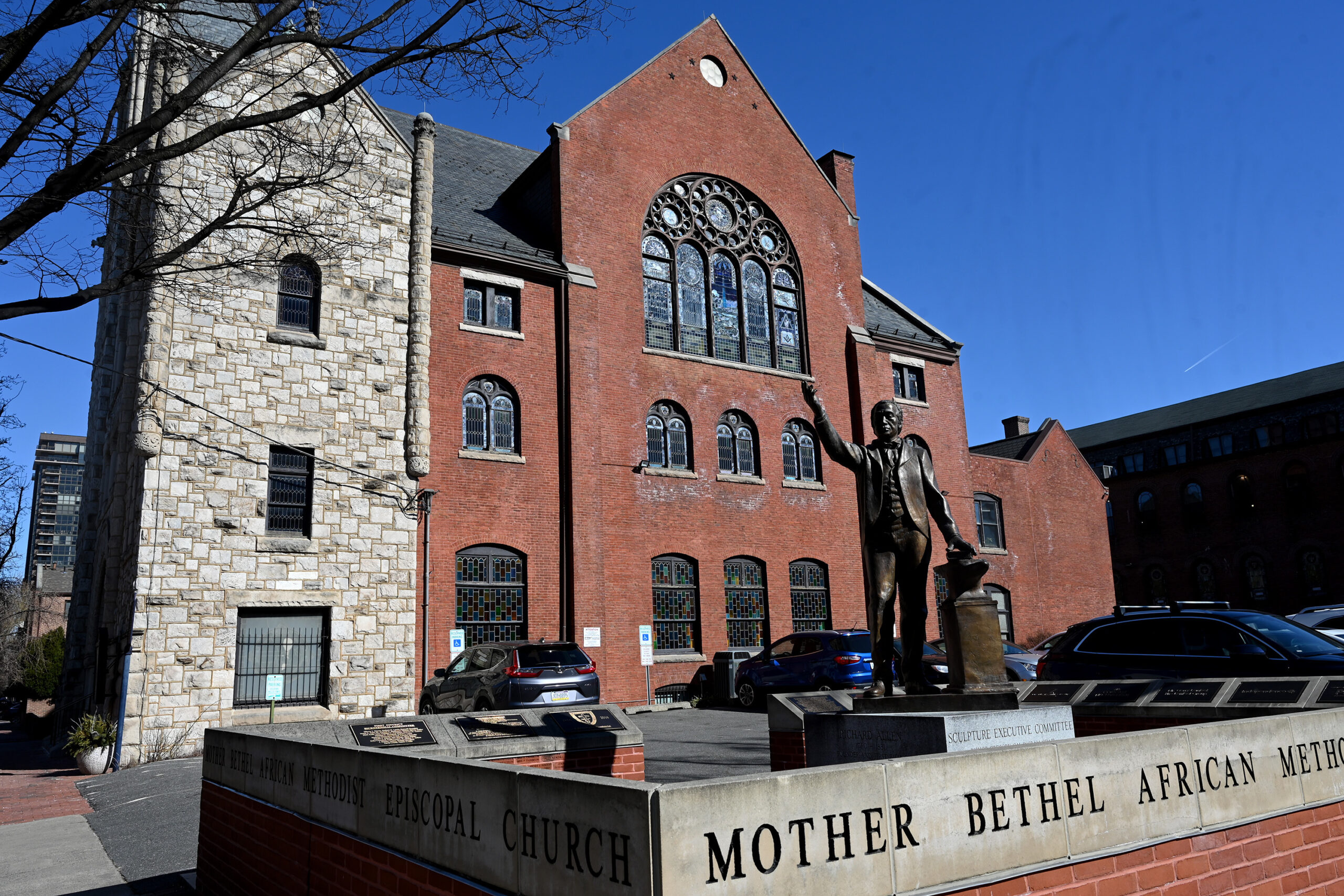
A bronze statue of Bishop Richard Allen outside Mother Bethel AME Church, photographed in February 2024.
Instead, the mob damaged Mother Bethel, a Black church and the oldest African Methodist Episcopal congregation in the nation, as well as a nearby Black orphanage.
That shattering night shocked Philadelphia’s civic pride as a haven for freedom and democracy. Was it a place where the free Black community could still feel safe? Clearly not.
For sobered antislavery advocates, the riot and fire landed as a moment of reckoning. Violence in Philadelphia meant they had an even more determined foe in proslavery forces than they had thought. Abolitionists would have to rise from the ashes and press their campaign harder for the next 25 years.
Today, we may see Pennsylvania Hall’s burning as a template for the savage attack on the Capitol in our own era. White nationalism, no stranger to America’s streets, rose again — with a vengeance.
Jamie Stiehm, author of “The War Within” and a Creators Syndicate columnist, is at work on a biography of Lucretia Mott. She lives in Washington, D.C.