We buried my father on a bitterly cold day in Washington, D.C., in 2010. As I followed his casket out of the church, I spotted journalist Michael Days in the crowd of mourners. I didn’t get to speak with him, but I was deeply touched, not to mention honored, that my editor at the Daily News was there.
He didn’t have to do that. But Days, who died suddenly on Saturday at the age of 72, was a deeply empathetic man who genuinely cared about people. As former Daily News columnist Howard Gensler wrote on Facebook recently: “He celebrated the wins and keenly felt the losses in his newsroom. He knew when to step in and when to step back and he could go Philly on you when he had to — and then later ask you how your parents were doing.”
I met the pioneering journalist when he was business editor for the Daily News, and I was applying for a job. During my interview, I got so excited at the prospect of earning twice my salary in D.C. at the time that I didn’t bother to negotiate. But Days kindly arranged for me to have two weeks’ vacation during my first year of employment instead of my having to work an entire year, as stipulated by the terms of the union contract.
That was my first experience with the kind of leader Days was. He was more than just a boss. He was an editor, mentor, and friend who looked out for his staffers, which engendered our intense loyalty. We used to joke that when Days said, “Jump,” our response was, “How high?”
This is how I’ll always remember Michael Days: sitting in his office with a smile on his face, always ready to talk or just listen.
As amazing as he was as a newsroom leader, Days was an even better person outside of work. A fellow Catholic, he was a man of great faith who not only attended Mass regularly but whose life exemplified his deeply held Christian beliefs. He and his wife, Angela Dodson — then an editor at the New York Times — adopted not one child, but four brothers all at the same time.
Once, I had the good fortune of being invited to a holiday party at his home in Trenton — a location picked because it was between his wife’s job in NYC and his own in Philly. Shortly after I arrived, I recall glancing outdoors and spotting four shiny, new bicycles in the backyard. I was in awe. His beautiful home was decorated with a huge tree. I watched as Days’ wife handed each boy a matching Christmas plate. Lunch was a warm, cozy affair with lots of Southern favorites.
Days’ career took off, as he went on to hold a number of leadership positions in the newsroom. The first time he was in line to make history — as the first African American managing editor of the Daily News — I felt for certain he would get the job. Days had grown up in North Philly and graduated from Roman Catholic High School. Not only did he know the city, he understood the paper’s operations inside and out, and was adept at dealing with its motley crew of reporters and photographers.
I was outraged when he was passed over for an outsider. But when I stuck my head in his office to check on him, I was startled when he met my gaze with a smile. Days was unflappable like that. Calm. Steady. No matter what happened, he always kept his cool. That’s not easy in a newsroom full of strong personalities, but Days did it.
Looking back, he had the right idea. Management eventually woke up and named him managing editor, and later executive editor, of the Daily News. Under his leadership, the Daily News excelled journalistically, winning a Pulitzer Prize in 2010 for a series exposing corruption in the Philadelphia Police Department.
The following year, Days was named managing editor of The Inquirer and left the Daily News for a brief time. When then-publisher Bob Hall announced his return, and Days strode back into the newsroom, we all stood and cheered. Some even cried. Time passed, the papers consolidated, and Days went on to hold other management roles at The Inquirer. Even as he became less involved in the day-to-day newsroom operations, we still streamed in and out of his office, seeking advice about stories we were working on or grabbing a piece of chocolate from his candy dish.
After he retired in 2020, we continued to seek him out. He would take our calls as if he were still on the clock.
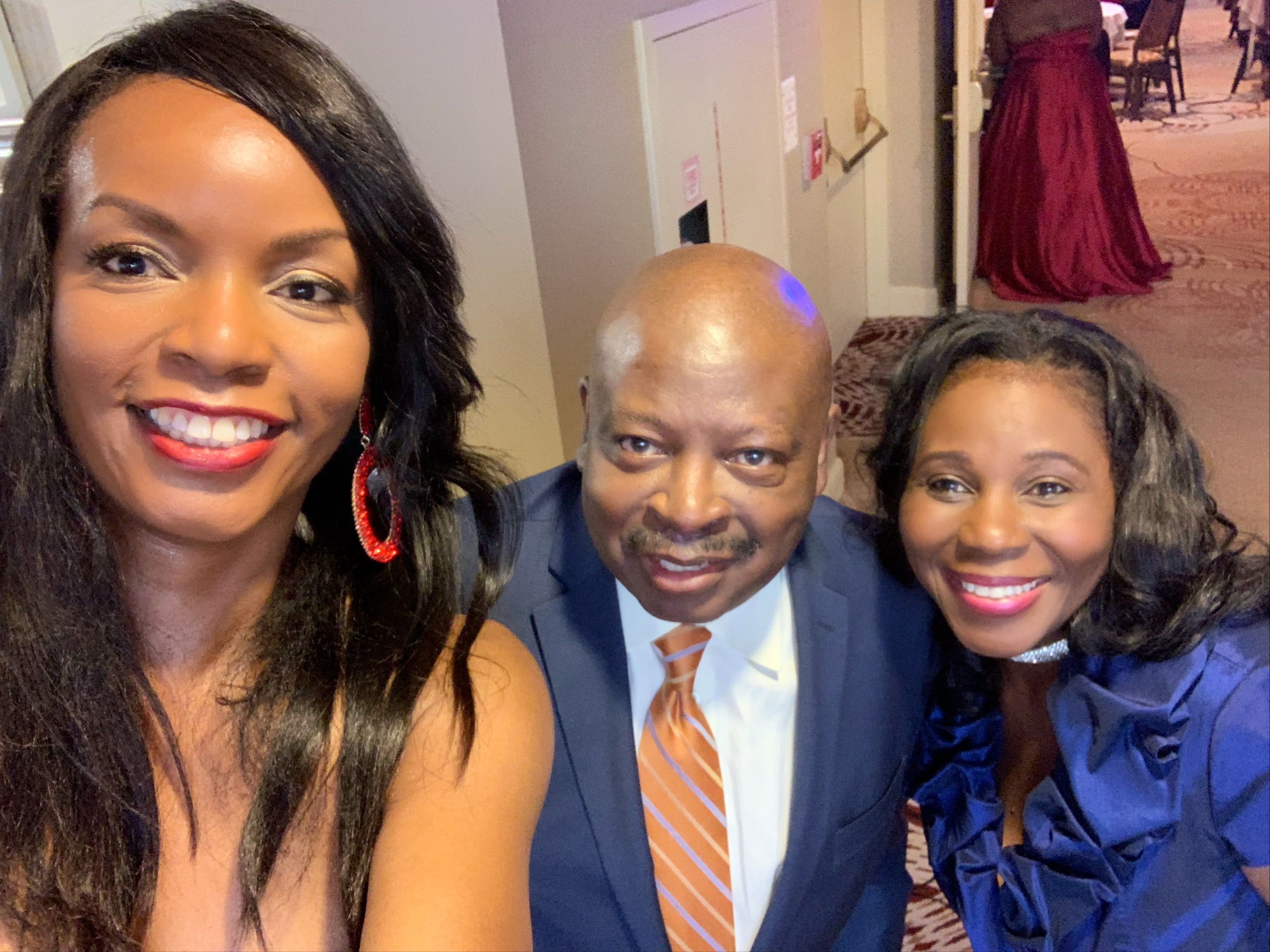
The author (left) at a WDAS Women of Excellence Luncheon where she was being honored. The late Inquirer Vice President Michael Days is to her immediate right, and former Deputy News Editor Yvette Ousley is next to him.
Two years ago, a group of Black journalists decided to form a new local affiliate branch of the National Association of Black Journalists after the Philadelphia Association of Black Journalists broke off from the nationwide group. Days, then 70, graciously agreed to serve as NABJ-Philadelphia’s inaugural president, and helped the new group find its footing.
In September, the group hosted a reception at the Free Library of Philadelphia honoring NBC contributor Trymaine Lee, author of the new book, A Thousand Ways to Die: The True Cost of Violence on Black Life in America. When it was his turn to speak, Days praised Lee, who had been a Daily News intern, and told him, “You are a talent, and nobody is surprised that you have done so well.”
Afterward, former Daily News reporter Mister Mann Frisby posted on social media: “The way he spoke about Trymaine at his book signing, I have also heard him speak of me the same way. Always encouraging. That makes me know that he was CONSISTENT for decades in regards to how he supported and mentored journalists.”
When I woke up early Sunday and discovered numerous “call me” texts, I knew something really bad had happened. Days’ death sent a seismic jolt through journalism circles nationwide.
“He was kind and gentle,” recalled Inquirer columnist Elizabeth Wellington. “I lost my own father earlier this year. And this feels as if I’ve lost a second.”
I feel the same way. Before Days, I’d never met any man I considered anywhere close to being in the same league as my dad,who was a giant among men.
Inquirer reporter Melanie Burney, who will finish out Days’ term as president of NABJ-Philadelphia, told me she has found herself in the days after his death asking, “What would Michael do?”
That’s a question I’ve asked myself a few times recently, as well. Days had been just a quick phone call away. Going forward, we will have to rely on the many lessons he has already taught us.
Philadelphia has lost 187 people to homicide this year. With just over two months left in 2025, this represents a marked improvement over the pandemic era, a time when the city experienced more than 500 killings annually.
This reduction — along with an increase in the number of homicide cases detectives are solving — is worth celebrating. But, as evidenced by the horrific killing of Kada Scott and far too many other calamities, there is still much more to be done. Even if homicides remain under 240 killings this year, which would be the lowest number since the 1960s, it would still leave the city with a homicide rate that is triple that of New York or Boston.
That’s not to say there hasn’t been important progress.
In 2020, when gun violence was beginning to surge, City Council authorized the “100 Shooting Review,” which identified weaknesses in the criminal justice system and outlined a series of recommendations to cool the violence.
In 2021, Philadelphia invested more than $150 million in violence prevention and intervention programs. The disbursement of those funds was marked by instances of disorganization and insufficient oversight. However, according to those who study urban violence, the money served its purpose.
Thanks, in part, to new technology and the installation of high-definition cameras across the city, police are now solving between 85% and 91% of homicide cases, a 40-year high.
The clearance rate — or the percentage of homicides that have been solved — had dipped as low as 42% in recent years, meaning killers were more likely than not to get away with murder in Philadelphia.
Beyond providing closure for families and accountability to perpetrators, solving cases and prosecuting offenders can also help deter future acts of violence. According to crime researchers, certainty of punishment is one of the most effective deterrents for those who are likely to kill. This effect is particularly strong for younger offenders, who tend to act impulsively. Given that gun violence among teens continued to rise despite the progress made in other age groups, continuing to improve the clearance rate is essential.
Solving cases also helps to prevent cycles of retributive shootings by gang members. These days, experts say, it is song lyrics and social media beefs that drive many conflicts between rival gangs, not territorial clashes. Solving cases, and doing so quickly, can help intervene before these groups become the next Young Bag Chasers.
Despite the drop in the murder rate, Philadelphia still often feels beset by misdemeanors and lower-level felonies that contribute to an overall sense of disorder. Reckless driving permeates nearly all corners of the city, many transit stations reek of smoke and urine, illegal dumping plagues communities, blighted buildings like the former Ada H.H. Lewis Middle School attract crime, and police can take hours to respond to calls.
Many Center City businesses feel the need to employ armed security due to regular incidents involving thieves or emotionally disturbed people. In August, a security guard at a women’s clothing store fired a warning shot at a man who was harassing the staff. Earlier this month, a security guard at an IHOP in Center City was charged with murder after shooting a man who allegedly spat on her. Buying clothes and eating pancakes should not feel like a trip to the Wild West, nor should crossing the street feel like a game of Frogger.
Philadelphia’s leaders, including Police Commissioner Kevin J. Bethel, deserve credit for the progress the city has made in providing justice and reducing gun violence. But the job is far from over.
The Republican Party controls the federal government. It holds the majority in the House and the Senate, and controls the White House, as well.
Republicans could end the government shutdown tomorrow. A quick vote by the majority in the House and, after a rules change, by the majority in the Senate, followed by a presidential signature, would pass a budget into law and reopen the government.
Yet, absurdly, President Donald Trump and his followers are blaming congressional Democrats for the shutdown. This is ridiculous. The Democrats have little power in Washington these days.
Their only sway comes in the ability to filibuster in the Senate, but that can be easily taken away by a simple majority vote by the Republicans.
No, as President Trump might say, the Republicans hold all the cards.
The president, for months, has been openly targeting Democrats as he uses and misuses his presidential powers.
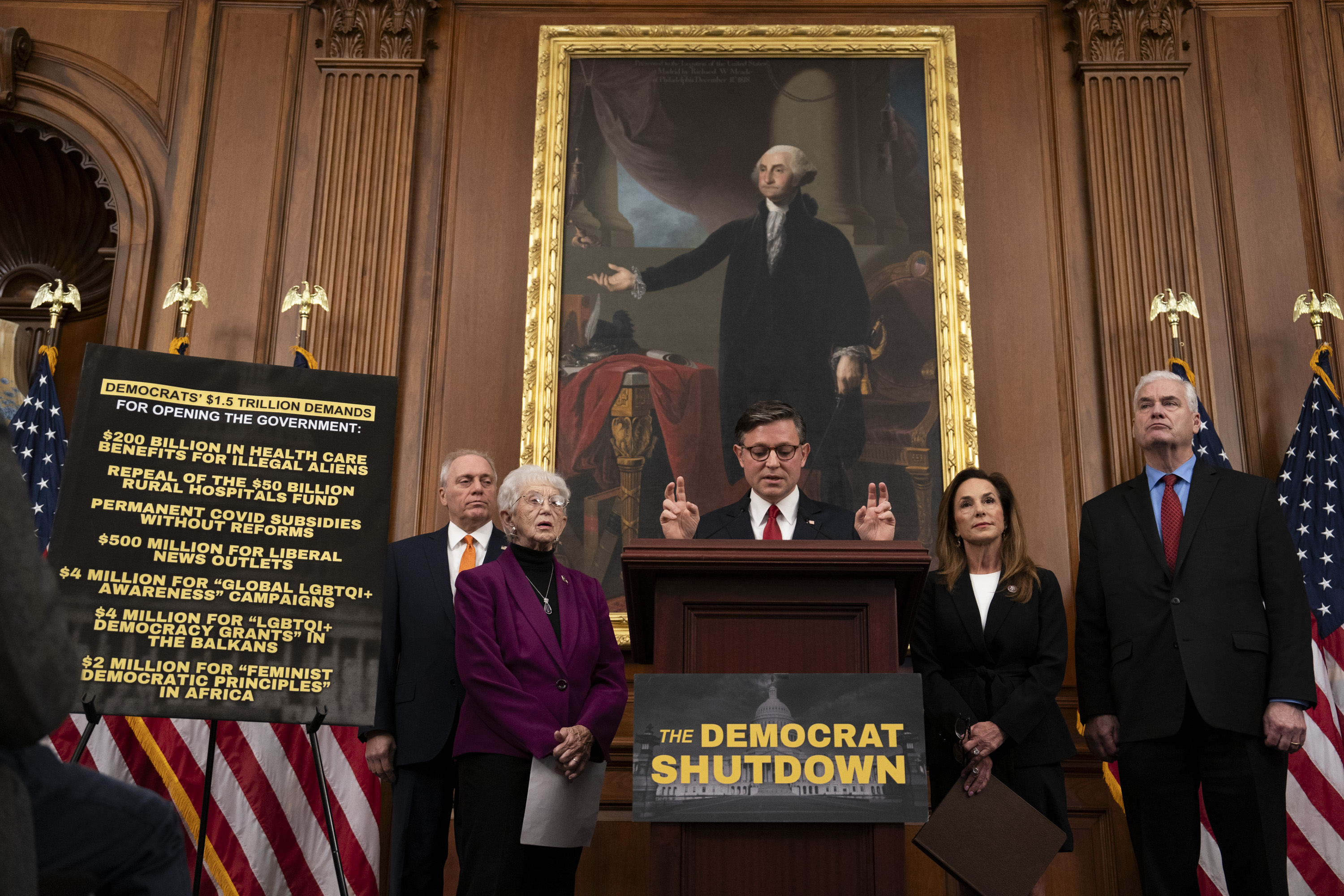
House Speaker Mike Johnson gathers Republican leaders at a news conference last week to blame Democrats for the government shutdown. That’s ridiculous, writes Joseph Hoeffel.
The country has never seen such presidential partisanship, overreach, and lawlessness.
Now, Kristi Noem, the secretary of Homeland Security, is abusing her powers and playing politics regarding the shutdown.
Last week, she produced a video for the Transportation Security Administration, which she supervises, to show at TSA security checkpoints in airports across the country. In the video, Noem blames congressional Democrats for the government shutdown and any related travel delays.
She says, in part, “Democrats in Congress refuse to fund the federal government, and because of this, many of our operations are impacted … our hope is that Democrats will soon recognize the importance of opening the government.”
No member suspected that a future secretary would so blatantly engage in partisanship on the job. Petty politics should never infect this particular department and its critical national security responsibilities.
A number of airports around the country, including Los Angeles, Phoenix, Cleveland, and Charlotte, N.C., are refusing to run the TSA video, citing the political nature of its content.
Any airport, public or private, that receives federal or state funding could be breaking the laws against political activity by recipients of government money if they show the video.
I doubt this legal jeopardy Noem is creating through her avid partisanship will give her any pause. Nor will any worries about her job security.
She is doing exactly what Trump wants her to do: Blame the Democrats at every opportunity for anything that is not working in the federal government.
But the Republicans could pass a budget and reopen the government tomorrow.
They need only to suspend the Senate rule that permits the Democrats to filibuster. Any Senate rule can be changed at any time by a simple majority vote.
Elections have consequences
In fact, the Senate Republicans just suspended such a rule last month so they could approve a large group of military and civilian appointees by a single en bloc vote, rather than the regular process of individual committee hearings and separate votes on each appointee.
I am sure I would not like the budget priorities that unfettered congressional GOP majorities and Trump would produce.
But elections have consequences.
A single party controls our federal government by the will of the voters. I accept that and will fight it out at the next election.
Why won’t the Republicans pass a budget and end the government shutdown? Do they think playing the political blame game is more important than governing?
Let them use the power the voters gave them and accept the responsibility to govern. Let them accept the credit or the blame for the actions they take.
And stop blaming the Democrats because the Republicans will not do their job.
Joseph Hoeffel is a former Democratic member of Congress from Montgomery County (13th Congressional District, 1999-2004). He lives in Abington.
How much Russian humiliation can Donald Trump swallow before conceding that Vladimir Putin is making him look like a fool?
On Tuesday, the White House was forced to announce the cancellation of a supposed Trump-Putin summit the president had recently stated would take place in Budapest, Hungary, in around two weeks.
Russian Foreign Minister Sergey Lavrov effectively told Secretary of State Marco Rubio by phone that the U.S. president hadn’t kowtowed sufficiently to Moscow to justify a summit. There are “no plans” for Trump to meet Putin “in the immediate future,” the White House admitted.
In past weeks and months, Trump has bowed down so deeply to Russia’s leader it’s a wonder his head hasn’t banged on the ground. Yet, the Kremlin keeps playing him and disrespecting the self-declared champion of global peacemaking.
It won’t be surprising if Trump chooses to blame the summit fiasco on Kyiv’s refusal to surrender to Moscow — rather than recognize Putin’s total disinterest in a peace deal. If he doesn’t want to go down in history as Putin’s lapdog, the president needs to recognize that carrots won’t bring peace if they aren’t backed up by sticks.
Ironically, Trump appeared to have grasped that truth when he finally pressured a reluctant Benjamin Netanyahu to accept a ceasefire in Gaza in return for Hamas’ release of living and dead Israeli hostages.
But with Putin, Trump’s tactic has been all carrots. So far, the president seems blind to the reasons why his peacemaking efforts with the Kremlin have failed, again and again.
A red-carpet summit in Alaska in August was a dismal disaster, even though POTUS dropped his support for a ceasefire in favor of Putin’s demand to negotiate while fighting.
When Putin rewarded Trump’s faith by massively ratcheting up air attacks on Ukrainian civilians, the president seemed to recognize he was being played. He began hinting he would sell Kyiv long-range Tomahawk missiles that could take out Russian missile bases at the source, and was set to meet Ukrainian President Volodymyr Zelensky to discuss the missiles on Friday.
Putin, knowing his man, called the White House on Thursday and said nyet. Trump immediately dropped all talk of delivering Tomahawks.
Instead, the president angrily urged Zelensky to accept Putin’s demands that Ukraine surrender the entire Donetsk region to Russia, including a large chunk that Kyiv still holds, which is a critical “fortress belt” preventing further Russian advances toward major cities. Trump reportedly berated Ukraine’s leader in foul language to accept the Russian demand (on the false presumption it would end the war). Otherwise, he claimed, Putin would “destroy” Ukraine.
Ukraine’s President Volodymyr Zelensky speaks to reporters in Lafayette Park across the street from the White House on Friday, following a meeting with President Donald Trump.
Needless to say, Zelensky refused this suicidal proposal. Trump then resurrected a call for Russia to agree to a ceasefire in place in Ukraine. Kyiv and America’s NATO allies supported this idea.
Russia refused, and continued to demand Ukraine’s complete capitulation, including the handover of unoccupied Donetsk, Ukraine’s demilitarization, a change of government (meaning installing a pro-Putin puppet regime), and a cutoff from any NATO member support.
Which brings us to now, and what comes next for Ukraine.
Much depends on whether an egotistical Trump can sense how weak he is being made to look by Putin. It also depends on whether the president has the guts and smarts to pressure Putin sufficiently to convince him the war has become too costly.
It is hard to imagine such a presidential self-awakening. But were it to happen, it would require recognition of certain facts that Trump has failed to grasp until now.
First, the Ukraine war is not about territory. I cringed when Trump told Fox News onSunday he was confident he could end the conflict, but Putin was “going to take something, he’s won certain property.”
That is the equivalent of claiming that American patriots waged the Revolutionary War up and down the Eastern Seaboard over waterfront footage, not for their independence from imperial rule. As former Ukrainian Defense Minister Andriy Zagorodnyuk told me by phone from Kyiv, “This is not a territorial war, it is an existential war about the existence of the Ukrainian state.”
Nor is Putin fighting for land. He is waging an imperial war to destroy Ukraine’s existence as an independent country, eradicating its religion, culture, language and civic freedoms. Such Russian cruelty is already the norm in Ukrainian territory that Moscow has seized.
Until Trump and his Putin-bedazzled negotiator Steve Witkoff grasp this, they will never understand why Ukrainians continue to fight.
Second, Putin does not want peace, no matter what platitudes he feeds Trump. He is angling to see how many carrots Trump will offer him in return for nothing. That is why it is past time for sticks — including secondary sanctions on Russia, and Tomahawks and Patriot air defenses for Ukraine.
Third, the portion of Donetsk that Ukraine still controls contains key cities and critical fortifications that prevent Russian troops from entering vast flat steppes which would give them open access to major Ukrainian cities such as Dnipro. The Russians have been struggling for three years to take this area, with huge losses of man power, and still haven’t succeeded.
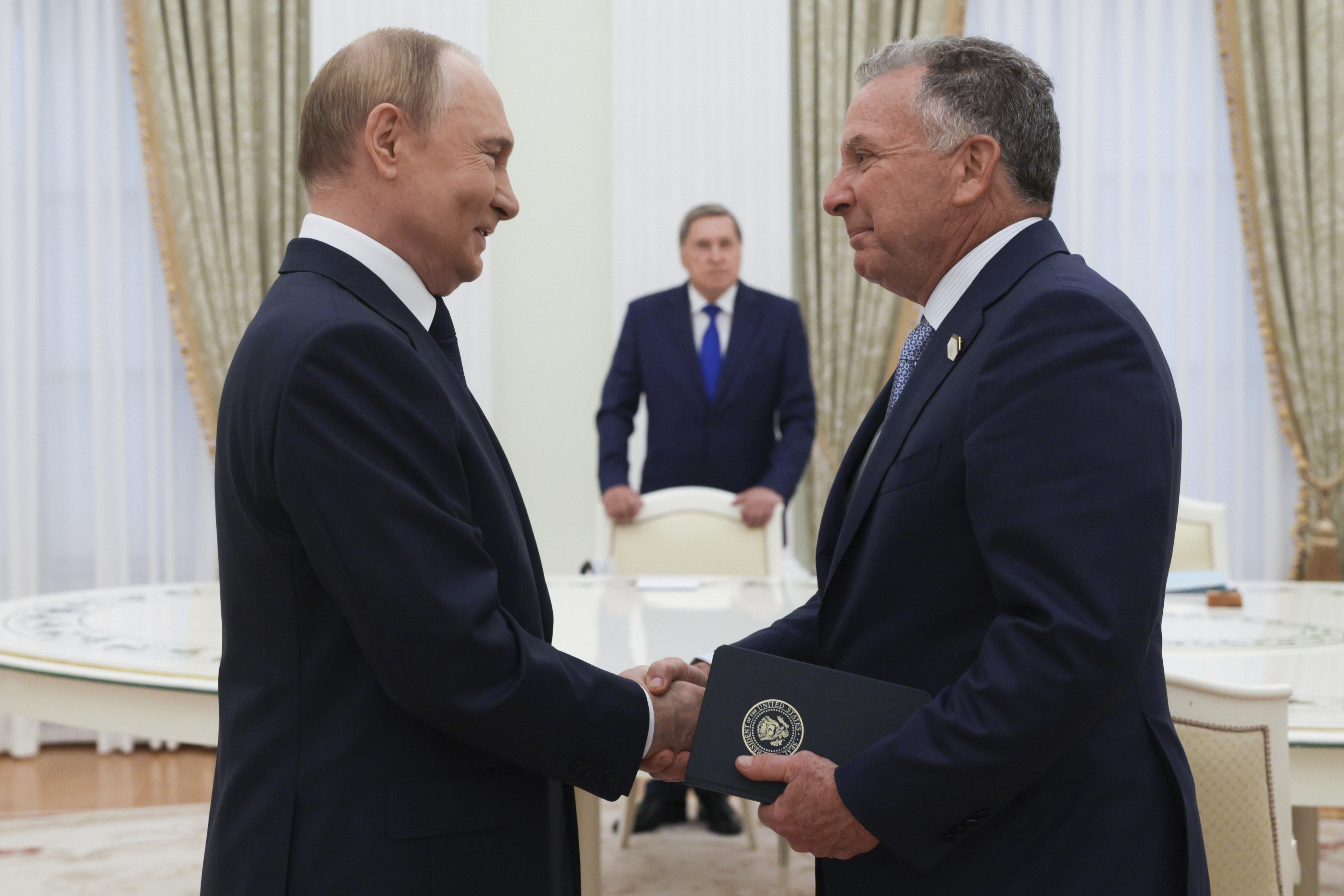
Russian President Vladimir Putin and President Donald Trump’s special envoy Steve Witkoff (right) shake hands during their meeting in Moscow in August.
Nor did they yearn for Kremlin overlordship because they were Russian speakers, a Putin talking point Witkoff keeps repeating. Most Ukrainians were bilingual or Russian speakers before Moscow’s invasion because of the long-term impact of prior Soviet rule.
Fourth, Putin won’t be able to “destroy Ukraine” if Kyiv refuses to capitulate. Contrary to Putin’s lies to Trump and Witkoff, his economy is ailing, and his massive losses of soldiers are being felt. Were it not for aid from Iran, China, and North Korea, Moscow could not keep up.
“Putin won’t be able to destroy us,” Zagorodnyuk told me. “He is selling himself as the leader of a superpower, but he isn’t. He is much weaker than he is perceived. Most of the world sees this, but unfortunately, he still seems able to communicate this message to the United States.”
Fifth, forging peace requires U.S. toughness. If Trump truly wants peace in Ukraine, it’s time to recognize Putin’s weakness and Ukraine’s strength, born from painful knowledge that Putin intends to turn their country into a Soviet-style satellite ruled by terror. Trump’s weakness will only encourage further attacks on Europe and aggression against other U.S. allies by a Chinese-Russian-North Korean entente.
Handing over Donetsk would only feed Putin’s appetite for more. “He would just take the territory and move on,” said Zagorodnyuk, rightly.
If Trump is the tough guy his followers claim, and not Putin’s patsy, it’s past time for more sanctions, Tomahawks, and air defenses for Ukraine.
President Donald Trump’s shifting stance on Ukraine’s war with Russia has emerged once again. Less than a month ago, Trump, on his Truth Social platform, asserted that Ukraine’s territorial integrity could be restored to its prewar borders if support by the U.S. and its allies remained resolute.
In a predictable about-face — and in preparation for the meeting with Vladimir Putin in Budapest, Hungary — Trump is once again pressuring Ukraine’s President Volodymyr Zelensky to cede territory. With territorial reclamation presumably a nonstarter, Trump, in another apparent strategic misstep, denied Zelensky’s request for advanced military weaponry, the Tomahawk missile. Ukraine’s possession of this cutting-edge military technology could have weakened Putin’s hand at the negotiating table. Instead, it increased the odds that his intransigence will continue.
Should the Budapest summit end without an agreement being announced (as happened in Alaska), look for Zelensky to be the scapegoat, not Trump’s misapplication of leverage.
Jim Paladino,Tampa, Fla.
In my opinion
Recently, President Donald Trump listed some people who had opposed him and said, “They’re all guilty as hell.” Thankfully, in our judicial system, people are not convicted because of “opinions,” but based on facts and laws. Nonetheless, it is disheartening and dangerous for a president to attempt to influence the Justice Department in deciding whom to prosecute and who is guilty of crimes. Would that an independent attorney general stand up to him and not pursue perceived enemies in search of a crime?
Joe Stoutzenberger,Erdenheim
Commuted sentence
Let the word go out. The Republican Party just destroyed its very last vestige of being the party of law and order and personal responsibility. Dead. Gone. Disappeared. George Santos stole, robbed, cheated, and lied about every aspect of his entire existence. People were hurt by him. Apparently, his only saving attribute was that, in his ignominious and short congressional career, at least he voted for Republicans. In the rubble of the former Republican Party, that is sufficient to gain you a commuted sentence. It is no longer a political party; it is a shallow gathering of cult followers who have ceased to be able to exercise independent moral judgment. Brian Fitzpatrick, for your own sake, I suggest that you leave that cult.
Tom Taft,Chalfont
Rally downplayed
“Below the fold” — that is, articles that appeared at the bottom of newspaper pages — is the old expression for suppressing news that upsets the Powers That Be. Placing the well-written report of Saturday’s massive “No Kings” rally on Page A4 of the Sunday Inquirer — and below the dozens of less important articles on the website — is unconscionable. Bowing and scraping to MAGA is complicit with authoritarianism.
Elizabeth Malone,Glenside
. . .
I have been participating in a weekly “No Kings” rally for several months. I protest because it makes me feel better. Rather than sitting around feeling helpless, it offers me an outlet to express myself and to see that I am not alone in my frustration. Saturday’s “No Kings” rally was an exceptional experience. There was an exhilarating feeling of hope and kindness and warmth. It highlighted for me both who we are and what kind of country we need to be. There was music and laughter and costumes. Horns were honking and flags were waving. There were peacekeepers who ensured we did not engage in hate speech or unwarranted behavior. There were a few MAGA supporters who drove in circles around the crowds and revved their engines, but no one seemed to pay attention to them. It was a good day. It was a reminder that at our core, we are a peaceful, caring nation. I urge anyone who is feeling alone and scared by the current administration to take heart and join a peaceful protest. It is, after all, what makes us a democracy. I only wish The Inquirer had put the pictures and the story about the demonstration on its front page. It deserved that attention.
Kathleen Coyne, Wallingford
. . .
I’m outraged that The Inquirer didn’t give more prominence to its coverage of the “No Kings”protests in Philadelphia and around the country. Your articles about the demonstrations appeared on Pages 4 and 5 of the next day’s paper. They should have been on the front page.
The Inquirer covers daily the Trump administration’s efforts to eliminate our system of checks and balances, to punish the president’s political opponents, to deprive millions of Americans of affordable, healthy, and decent lives, to strip citizens of their express constitutional rights, and to send unrestrained and violent U.S. Immigration and Customs Enforcement agents to so called Democratic cities to detain, deport, and terrorize millions of people who have not committed crimes. These are steps right out of the playbook for turning a democracy into an authoritarian state.
On Saturday, some seven million people around the country, including in Philadelphia, took to the streets to protest these actions in perhaps the largest protest in U.S. history. This is an event of singular importance. The coverage of it should be treated as such.
Sharon Weinman,Philadelphia
Prize worthy?
As he attempted to do with the Abraham Accords, President Donald Trump (with Egypt and Qatar) is working tirelessly to bring some peace to the Middle East.
The unique negotiating team engineered by Trump, to encourage an agreement between Israel and Hamas, appears to be an effective strategy to ensure a monumental achievement.
While most of the mainstream media, with their Trump Derangement Syndrome (TDS), will resist praising The Donald with any accolades, he most assuredly should have received a Nobel Peace Prize if these peace negotiations come to fruition.
And, riding on this astonishing accomplishment, he will then exert his newfound influence to achieve a similar peaceful resolution to the Ukraine-Russia conflict — without sacrificing the lives of American troops.
Thus, Trump will have achieved peaceful negotiations on a scale not achieved since Ronald Reagan (with the USSR in the 1980s) or Dwight D. Eisenhower (with North and South Korea and the Suez Canal conflicts in the 1950s).
Reagan’s unyielding tactics laid the groundwork for the dismantling of the Soviet Union. Ike entreated India’s Prime Minister Jawaharlal Nehru to influence the Chinese to support a Korean armistice.
Presidents Eisenhower and Reagan firmly understood the critical aspects of The Art of the Deal.
Ron Smith, Brigantine, ronaldjsmithsr@comcast.net
. . .
It is ironic that President Donald Trump thinks he deserves a Nobel Peace Prize for a possible settlement in Gaza. Although we all want a just peace in that area, it has not happened yet. And the “Trump Plan” closely follows what some Arab nations proposed earlier this year. Trump’s choice of envoys, developers Steve Witkoff and Jared Kushner, causes one to wonder if the quest for peace is so that money can be made off Palestinian land. That follows an earlier Trump-Netanyahu plan for a Gaza Riviera.
Trump is not a man of peace.
He has threatened to “take” Greenland and Canada.
He has ordered the illegal bombing of boats off Venezuela because he claimed they contained drugs. Most U.S. drugs do not come from Venezuela. Trump has intimated he wants regime change there.
Trump took credit for peace between Azerbaijan and “Albania.” How involved was he? The countries are Azerbaijan and Armenia.
Trump is certainly not a peaceful unifier of the U.S. Any American who disagrees with him is an “opponent.” He “hates” his opponents, as he stated at Charlie Kirk’s funeral. He considers Americans who demonstrate against government policies “domestic terrorists” and “the enemy within.” Trump is sending the National Guard to some cities.
Before people consider a peace prize for President Trump, I hope they realize that his actions are based on a desire for vengeance, a quest for power, and his endless grifting.
Ellen Danish,Philadelphia
Join the conversation: Send letters to letters@inquirer.com. Limit length to 150 words and include home address and day and evening phone number. Letters run in The Inquirer six days a week on the editorial pages and online.
The sense of loss that has permeated 2025 struck again this weekend when we learned of the sudden death of a Philly journalism legend, Michael Days, who guided the Philadelphia Daily News during most of its last dozen freewheeling and Pulitzer-winning years before we merged with The Inquirer in 2017. He was just 72, far too young. The top-line of Mike’s obituary was how, as the first African American to lead a newsroom in America’s founding city, he paid it forward by mentoring the next generation of rising Black journalists. But people like me who worked for him remember him more simply as the wisest and mostempathetic human being we ever had as a boss. He leaves right when the nation’s newsrooms need decent souls like Mike Days more than they ever did.
What a $10M bribe rumor says about Trump, Middle East peace, and America’s fall
President Donald Trump talks with Egypt’s President Abdel-Fattah el-Sissi during a summit to support ending the more than two-year Israel-Hamas war in Gaza after a breakthrough ceasefire deal, Oct. 13 in Sharm El Sheikh, Egypt.
The thing about being a 79-year-old president is that sometimes you just blurt stuff out, with no filter as to whether your words might be embarrassing, undiplomatic — or potentially incriminating.
Consider the case of Donald John Trump, the 47th U.S. president and the oldest one on the day of his election. Last week, in what may prove to be a fleeting moment of triumph as Trump celebrated a Gaza peace deal that included the release of 20 Israeli hostages, POTUS arrived at an Egyptian resort town for a Middle East summit. He kicked off the day with a one-on-one sit-down with Egypt’s strongman ruler, Abdel-Fattah el-Sissi.
“There was a reason we chose Egypt [for the summit] because you were very helpful,” Trump said as a gaggle of reporters and photojournalists entered their meeting room.
Really? Helpful in what way?
“I want to thank you,” the American president told Sissi, who seized power in a 2013 coup. “He’s been my friend right from the beginning during the campaign against Crooked Hillary Clinton. Have you heard of her?”
Here Trump was pushing, ever so absurdly, for the Nobel Peace Prize, and then he had to spoil it all by saying somethin’ stupid like, you bribed me. Well, he almost spoiled it, if more journalists — aside from MSNBC’s brilliant Rachel Maddow, who seized on the remark hours later — had grasped the potential import of this presidential prattle.
It’s certainly legal, if gross, for Trump to be close pals with Sissi, even if Human Rights Watch reports that the Egyptian dictator is “continuing wholesale repression, systematically detaining and punishing peaceful critics and activists and effectively criminalizing peaceful dissent.” What would not be legal is the Middle Eastern nation interfering in the 2016 election, in which Trump narrowly defeated Clinton in the handful of swing states that tipped the Electoral College.
What made Trump’s comments last week so jaw-dropping is that U.S. federal investigators worked for several years trying to prove exactly that scenario. In August 2024, days after Trump was nominated by the GOP for his second reelection bid, the Washington Post reported that the Justice Department investigated a tip that Sissi’s Egypt provided Trump with $10 million the candidate desperately needed in the 2016 homestretch to defeat Clinton. That happened right before Trump, as 45th president, reopened the spigot of foreign aid that had been halted because of Sissi’s human rights abuses.
It’s known that Trump did put $10 million into the campaign, which he listed as a loan. The Post in 2024 offered a tantalizing, if circumstantial, piece of evidence — that the Cairo bank had received a note from an agency believed to be Egyptian intelligence to “kindly withdraw” nearly $10 million in two, 100-pound bags full of U.S. $100 bills, five days before Trump took the oath of office.
But the investigative trail ran cold. In 2019, then-special counsel Robert Mueller turned the matter over to Trump’s appointees in the Justice Department, who of course didn’t pursue the president’s bank records. Neither — inexplicably — did Joe Biden’s attorney general, Merrick Garland, as the statute of limitations expired in January 2022. That’s where things stood last week before Trump started blathering in Sharm El Sheikh.
One reason I’m writing about this is the sheer frustration that Trump — yes, allegedly, possibly — might have gotten away with bribery to the point where he’s almost bragging about it in public. But I also think the mysterious case of the Egyptian bags of cash speaks to the present, dire American moment in a couple of ways.
For one thing, it casts a light on what’s really behind what Trump hopes will be viewed as the signature achievement of his second presidency. That would be the fragile peace deal that aims to end the last two years of bloodshed in Gaza that started with the Hamas terror attack of Oct. 7, 2023 and has resulted in at least 67,000 dead Palestinians and the utter destruction of their seaside homeland.
How did Trump get a deal that had eluded his predecessor Biden, in a region that has vexed every American president from both parties? It certainly helped that most of the power brokers with the clout and the cash to help end the fighting in Gaza are repressive strongmen — or, as Trump might call them, role models. And they all seem to speak the same language of corrupt back-scratching.
If those bags with $10 million in greenbacks did make their way to Trump in 2017, it looks like small change in today’s cross-Atlantic wheeling-and-dealing. After all, a key go-between in the negotiations — Qatar, which has good relations with Hamas and has hosted its exiled leaders — gifted America a $400 million jet that Trump plans to use not just as Air Force One but in his post presidency, while his regime has promised to protect the Qatari dictators if they are ever attacked.
Another key supporter of the plan is the United Arab Emirates, which also backs the UAE firm that recently purchased a whopping $2 billion in cryptocurrency from a firm owned by Trump’s family as well as the family of Steve Witkoff, the regime’s lead Middle East negotiator. At the same time, Trump’s U.S. government allowed UAE to import highly sensitive microchips used in artificial intelligence.
Witkoff’s negotiation end–game brought in Trump’s son-in-law, Jared Kushner, who forged close ties during his father-in-law’s first term with Saudi Arabia’s murderous de facto ruler Prince Mohammed bin Salman, who pulled the levers for a $2 billion investment in a hedge fund created by Kushner despite no prior expertise.
Those Saudi ties could prove critical to future stability in the region, and in a joint interview with CBS’ 60 Minutes Sunday night, Kushner and Witkoff made no apologies for mixing billion-dollar deals with the pursuit of world peace. “What people call conflicts of interest,” Kushner said, “Steve and I call experience and trusted relationships.”
OK, but those “trusted relationships” are built on a flimsy mountain of cash that could collapse at any minute. Look, I’m thrilled like everyone else that 20 Israeli hostages are finally reunited with their loved ones, and to the extent Trump and his regime deserve any credit, I credit them. But the art of the deal that the president is bragging about is all about the Benjamins — more worthy of applause on the floor of the New York Stock Exchange than a Nobel Peace Prize.
Real peace is based on hard work and trust, not Bitcoin — so is it any wonder that the ceasefire is already collapsing with two dead Israeli soldiers and fresh, lethal airstrikes in Gaza? The only thing with any currency among a rogues’ gallery of world dictators is currency, and that transactional stench has fouled everything from Cairo to K Street.
Is it any surprise that a regime whose origin story allegedly includes bags of Egyptian cash would do absolutely nothing when it was told that its future border czar, Tom Homan, was captured on an audiotape accepting $50,000 in a fast-food bag from undercover FBI agents who said they wanted government contracts?
In hindsight, the failure to pursue that report of the $10 million Egyptian bribe opened up a floodgate of putrid corruption, wider than the Nile. It signaled a sick society where everything is for sale — even world peace — but nothing is guaranteed.
Yo, do this!
The 1970s and ‘80s are having a cultural moment right now, and this boomer is here for it! On Apple TV (they’ve dropped the “+,” probably after paying some consultant $1 million for that pearl of wisdom) comes the long-awaited five part docuseries about the life and times of filmmaker Martin Scorsese, the savior who rose from NYC’s mean streets to give us Goodfellas, Raging Bull, Taxi Driver, and so much more. Watching Mr. Scorsese is going to make the eventual death of the baseball season so much easier to take.
The earthy, urban musical equivalent of Scorsese would have to be Bruce Springsteen, who has been marking the 50th anniversary of his breakthrough Born to Run LP with all kinds of cool stuff, capped with Friday’s long-awaited release of the first-ever biopic about “The Boss,” Deliver Me from Nowhere. Staring The Bear’s Jeremy Allen White as Springsteen, the film’s unlikely narrative — focusing on the making of 1982’s highly personal and acoustic Nebraska as the rock star seeks release from a bout of depression — sounds like exactly the uplift that America needs right now.
Ask me anything
Question: As someone living in Ireland and looking across the ocean. Trump won’t be in power forever, but how is anyone going to deal with the MAGA crowd that helped elect him? That level of stupidity, hatred and racism cannot be fixed. How is [t]he USA ever going to heal? — Stephen (@bannside@bsky.social) via Bluesky
Answer: That’s a great question, Stephen, and like most great questions there’s no easy answer. Although I’m optimistic that the 2026 midterms and the 2028 presidential election will happen and that the anti-Trump coalition that we witnessed at “No Kings” will prevail, I agree with you that it’s only a partial and temporary fix. I’d fear an Iraq-level resistance could rise up in the regions we call “Trump country.” My long-term solution would be along the lines of what I proposed in my 2022 bookAfter the Ivory Tower Falls: Fix higher education — broadly defined as from the Ivy League to good trade schools — to made it a public good that reduces inequality instead of driving it. And promote a universal gap year of national service for 18-year-olds, to get young people out of their isolated silos. There are ways to prevent the next generation from becoming as stupid or hateful or racist as the Americans who came before them, but it will take time and patience that we seem to lack right now.
What you’re saying about…
Remember the Philadelphia Phillies? When I last saw you here two weeks ago, their annual postseason collapse and the fate of manager Rob Thomson was a hot topic. As expected, there was minimal response from you political junkies, and opinions were split — even before the team defied the conventional wisdom and announced he’ll be returning in 2026. Thomson’s supporters were more likely to blame the Phillies’ inconsistent sluggers, with John Braun asking “who could you hire who could guarantee clutch hits?” Personally, I’m with Kim Root: “I follow the Philly Union, who just won the Supporters Shield — that is all.”
📮 This week’s question: Back to the issue at hand: I’m curious if newsletter readers attended the “No Kings” protest last Saturday, and what you see as the future of the anti-Trump movement. Are more aggressive measures like a nationwide general strike needed, or is the continued visibility of nonviolent resisters enough? Please email me your answer and put the exact phrase “No Kings future” in the subject line.
Backstory on who the “No Kings” protesters really were
Demonstrators gather for a ’No Kings’ rally in Philadelphia on Saturday.
They clogged city plazas and small-town main streets from San Diego to Bangor on Saturday, yet the more than 7 million Americans who took part in the massive “No Kings” protest — the second-largest one day demonstration in U.S. history, behind only the first Earth Day in 1970 — seemed to mystify much of the befuddled mainstream media. Just who were these people protesting the Donald Trump presidency, and why are they here?
Instead of a journalist, it took a sociologist to get some answers. Dana Fisher — the Philadelphia-area native who teaches at American University and is the leading expert on contemporary protest movements — was out in the field Saturday at the large “No Kings” march in Washington, D.C., collecting data with a team of researchers. She’s shared her early top-line results with me, aiming to both give a demographic and ideological snapshot and also compare Saturday’s crowd with her findings at other recent rallies.
If you were among the 7 million on Saturday, some of this data won’t surprise you. The protesters were, on the whole, older than the average American, with a median age of 44 (compared to 38 for the nation as a whole.) Once again, the “No Kings” participants were overwhelmingly white (87%) with women (57%) in the majority. But it’s also worth noting that men (39%) were more likely to take part than earlier protests tracked by Fisher, and the 8% who identified as Latino is double the rate of Hispanic participation in the 2017 Women’s March.
That last finding may reflect the passions of the “No Kings” protesters, who listed immigration as a key motivation at a rate of 74%, second only to their general opposition to Trump (80%, kind of a no brainer). That certainly jibed with the demonstrators at the rally I attended in suburban Havertown, who again and again mentioned the sight of masked federal agents grabbing migrants off the street as what compelled them to come out.
Fisher’s most telling findings may have been these: The people out in the streets are mad about what they see happening to America, with 80% listing “anger” as an emotion they are feeling, trailed closely by “anxiety” at 76%. Yet few of those who spoke with her team believed that will translate into violence. The number of demonstrators who agreed with the statement that “because things have gotten so off track, Americans may have to resort to violence in order to save our country” was only 23% — lower than other protests her team has surveyed. It seems like the larger the public show of resistance to Trump’s authoritarianism, the more optimism that the path back to democracy can be nonviolent.
What I wrote on this date in 2021
I hate to say I told you so but… On this date four years ago, Joe Biden was still clinging to dreams of a presidential honeymoon after ousting Donald Trump in the 2020 election, but there were dark clouds on the horizon. On Oct. 21, 2021 I warned that sluggish action on key issues was starting to hurt his standing with under-30 voters. I wrote that “while the clock hasn’t fully run out on federal action around issues like student debt or a bolder approach on climate — the disillusionment of increasingly jaded young voters could change the course of American history for the next generation, or even beyond.” How’d that turn out? Read the rest: “From college to climate, Democrats are sealing their doom by selling out young voters.”
Recommended Inquirer reading
I returned from a much-needed staycation this weekend by leaving the sofa and spending a glorious fall morning at the boisterous “No Kings” protest closest to home in Delaware County, which lined a busy street in Havertown. I wrote about how the protests are winning back America by getting under the skin of Donald Trump and the GOP, who can no longer pretend to ignore the widespread unpopularity of their authoritarian project.
Every election matters, even the ones that are dismissed as “off-year” contests. In today’s heated and divisive climate, even what used to be a fairly routine affair — the retention of sitting judges on the state and local level — has taken on greater importance. Here in Pennsylvania, the state’s richest billionaire, Jeff Yass, is spending a sliver of his vast wealth to convince voters to end the tenure of three Democrats on the state Supreme Court. The Inquirer’s Editorial Board is here to explain why that’s a very bad idea. On the other hand, some judges up for retention in the city of Philadelphia — where jurists haven’t always lived up to the promise of America’s cradle of democracy — deserve closer scrutiny. The newsroom’s Samantha Melamed revealed a leaked, secret survey detailing what Philadelphia attorneys think of some of the judges on the November ballot, and it is not pretty. The bottom line is that you need to vote this year, and subscribing to The Inquirer is the best way to stay informed. Sign up today!
By submitting your written, visual, and/or audio contributions, you agree to The Inquirer‘s Terms of Use, including the grant of rights in Section 10.
The killing of Kada Scott is tragic on many levels, but hopefully, some lessons can be learned to honor her life.
Scott’s death is all the more painful for her family and friends because it could have been prevented. That’s because it appears District Attorney Larry Krasner and the Philadelphia court system failed her.
The man accused of abducting Scott had been previously charged with assaulting an ex-girlfriend twice in the last year, but prosecutors withdrew the charges after the victim did not show up for court.
After Scott’s disappearance, Krasner’s office admitted its handling of the earlier cases was a mistake. If the district attorney’s office had instead prosecuted Keon King, 21, then perhaps Scott, 23, would still be alive.
“We could’ve done better,” Krasner said at a news conference Monday, echoing earlier comments from Assistant District Attorney Ashley Toczylowski, who said last week, “Everyone involved at this point, including the [initial prosecutor], agrees that we wish this happened differently.”
To be sure, hindsight is 20/20. But a review of King’s legal entanglements indicates a series of miscues may have enabled Scott’s death.
The case also offers a window into the challenges of filing domestic abuse charges, and underscores the need for prosecutors to be more aggressive in going after the accused while doing more to ensure the safety of victims.
For starters, King’s initial assault charges last November were handled by an inexperienced assistant district attorney who was juggling multiple cases. During that incident, prosecutors said, King grabbed an ex-girlfriend by the neck and tried to strangle her after she refused to lie on the bed with him, according to the affidavit.
But after initially cooperating with the authorities, King’s accuser stopped responding to calls from prosecutors. After she failed to appear at three court hearings, the district attorney’s office withdrew the case.
In January, King tried to break into the woman’s home, but fled before police arrived, according to an affidavit. He returned later in the day and dragged the woman by her hair, shoved her in a car, and drove away before dropping her off on the side of the road.
This time, the woman and her friend captured video of King trying to get into her home. He was arrested again and charged with kidnapping, strangulation, and other charges.
But once again, the victim and her friend refused to cooperate with prosecutors, so the charges were withdrawn in May.
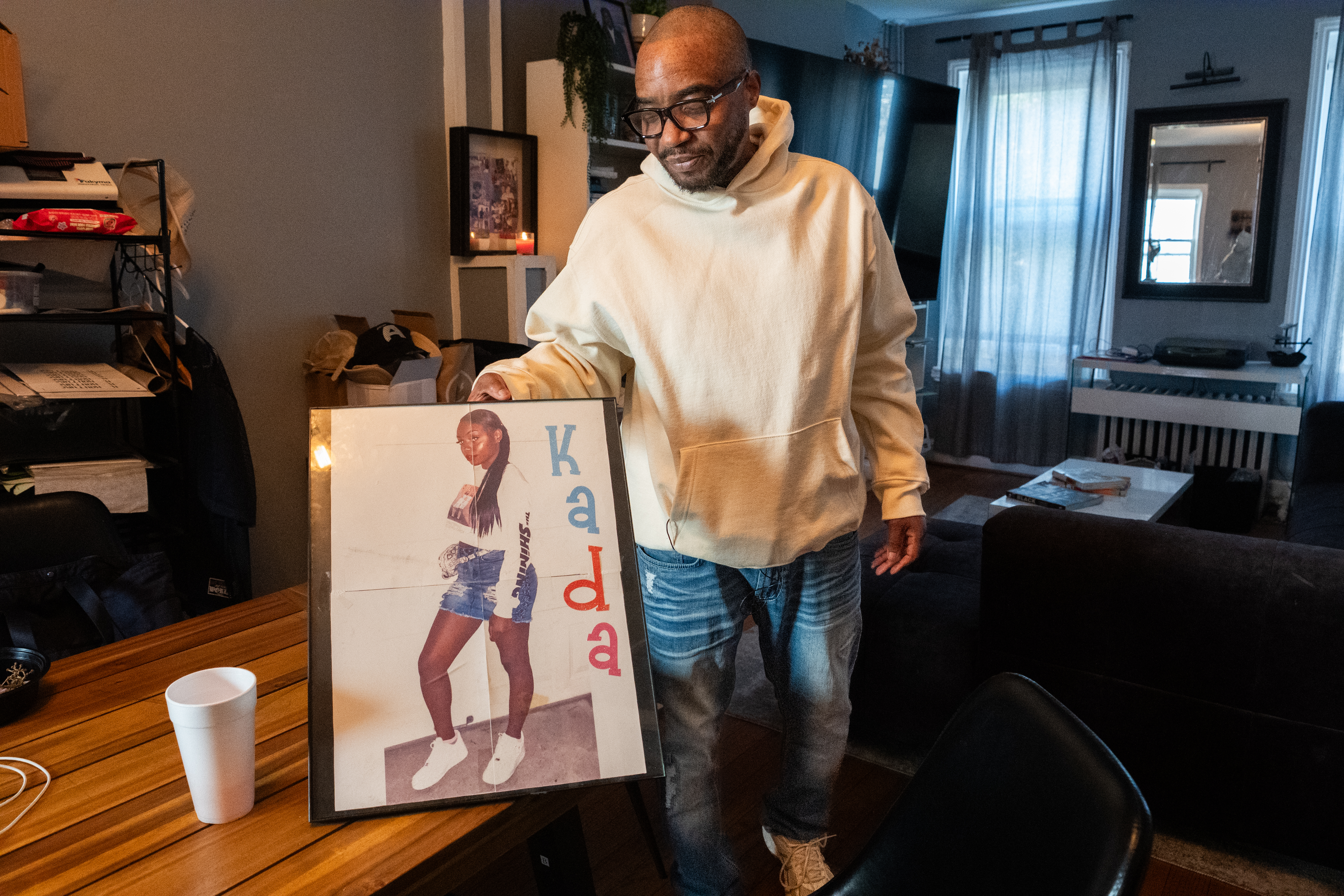
Kevin Scott, Kada Scott’s father, with a photo of his daughter.
This is not unusual, as victims of domestic violence often live in fear of the perpetrators. Reviewing the period between 2010 and 2020, researchers at the University of Pennsylvania found that 70% of victims of domestic violence cases failed to appear in Philadelphia’s courts.
A big part of the problem is that the accused are often out on bail and still threatening the victims. In King’s case, after the second set of assault charges, prosecutors requested bail of $1 million, but the magistrate lowered it to $200,000.
King posted the necessary 10% — or $20,000 — and was released in April.
Krasner blamed the magistrate for lowering the bail, but his office could have appealed the ruling.
There is a fine line in detaining suspects accused of crimes for months on end until a trial. But in domestic violence cases, the current system is not working and needs to be revamped.
Prosecutors and judges must do everything possible to guarantee the safety of victims. Victims need more support within the criminal justice system to ensure their safety.
More broadly, additional preventive steps are needed to reduce violence against women, including standing up to rape culture, empowering women, and teaching boys to respect women.
Black women disproportionately experience higher rates of domestic abuse, including rape and homicides, studies show, further underscoring the need for more awareness, training, and preventive measures.
In this instance, given that King had been charged once before, the magistrate and Krasner’s office dropped the ball.
And although the victim refused to testify, the district attorney’s office could have used the video evidence to move forward with King’s prosecution — though not having the witnesses testify certainly would have made for a tougher case.
To his credit, Krasner, a former defense attorney who faces reelection next month and has been criticized for being soft on crime, admitted his office was ultimately to blame.
Sadly, a young, vibrant woman full of promise has died, and another woman was previously assaulted and traumatized. Krasner said the public played an enormous role in Scott’s case, and asked for anyone with information to call 215-686-TIPS.
The only positive outcome will be to ensure justice is served, and a broken legal system in which victims are afraid to testify is fixed, so others do not experience the same horrific outcome.
Donald Trump is executing human beings. By blowing up boats in the Caribbean Sea, he is targeting vessels he deems are “suspected” of carrying contraband, and authorizing the military to blow them up in international waters. Please, let that sink in for a minute. We have the Navy, the Marines, and the Coast Guard patrolling our seas. How about securing our ports and turning the ships away, or confiscating the ships and their contents? Where is the proof of any criminal acts? I can’t believe what I am witnessing. How does this stand?
K. Mayes, Philadelphia
The irony
Not looking good for John Bolton regarding accusations of mishandling classified material. But, oh, the irony! I can’t get the photos out of my mind of boxes full of classified material in the ballroom and bathroom of Mar-a-Lago. I can’t forget the outrage when Trump-appointed Judge Aileen Cannon dropped that case. I can’t forgive the U.S. Supreme Court for giving Donald Trump immunity from any illegal activity as president. Then there is the irony of former Attorney General Merrick Garland delaying any prosecution of Trump to avoid the appearance of weaponization of the Justice Department — only for Trump to take office again and do exactly that. And now, I can’t sleep worrying about the fate of our democracy and our country.
Sylvia Metzler, Philadelphia
Offensive Young Republicans
Nine Young Republican activists in New York, Arizona, Kansas, and Vermont were recently outed for the revelation of eight months of their disgusting, racist, antisemitic, and homophobic texts covering 2,900 pages of material that were obtained by Politico. The texts and the writers were quickly distanced by the Republican establishment, but one has to wonder why these individuals felt perfectly comfortable exchanging such abhorrent views. Are these the views all Young Republicans have when they speak to each other behind closed doors or online? And if these rising stars expressed remorse for their texts, is the remorse only that they were caught and their bigotry was exposed for all the world to see?
Larry Skvir,Delran
Refreshing representation
I was delighted to see diversity on display in the performing and marching units celebrating the 250th anniversary of the founding of the Navy and Marine Corps earlier this month. Truly remarkable that citizens of all persuasions and ethnic backgrounds have chosen to serve their country and build such strong fighting forces. This has not happened overnight and has been years in the making. It would be a shame for Defense Secretary Pete Hegseth’s misguided efforts to actually tear things down.
Roger Smith,West Chester
Join the conversation: Send letters to letters@inquirer.com. Limit length to 150 words and include home address and day and evening phone number. Letters run in The Inquirer six days a week on the editorial pages and online.
Professors and students at the University of Pennsylvania— where I teach — breathed a sigh of relief on Thursday when the university rejected a compact that would have given us preferential treatment in federal funding. All we needed to do in exchange was comply with the Trump administration’s demands around teaching, student costs, and much else.
As our faculty senate warned, the compact asked universities to “surrender their institutional autonomy.” I’m delighted — and proud — that Penn joined four other institutions — MIT, Brown, the University of Southern California, and the University of Virginia — in rejecting the offer, which the White House sent to nine schools earlier this month.
Now comes the hard part: to institute the goals of the compact on our own. The problem wasn’t with the demands of the Trump administration. It was with the mechanism of enforcement, which would have let it determine if we were satisfying them.
Consider the compact’s requirement that we foster “a vibrant marketplace of ideas” and abolish “institutional units” that “belittle” conservative ideas. Of course, we should aim for a full and free dialogue of all ideas, including conservative ones.
But do you trust Donald Trump and his disciples to determine — fairly and impartially — whether universities are belittling conservatives? I certainly don’t.
Trump’s vice president, JD Vance, has already declared that “the universities are the enemy.” The only way to make friends with Trump is to echo his own ideas, which is what the compact would have required us to do.
University of Pennsylvania students at graduation, at Franklin Field, in May.
But if we’re honest, we’ll also admit that we have indeed belittled — or suppressed — conservatives, via the cultures we have created on our campuses. We talk a good game about the free exchange of ideas. If you think we’re living that ideal, however, you haven’t talked to right-leaning students.
I have. They come out to me in my office, with the door shut, because they’re afraid of being canceled by their peers or their professors. In a 2024 survey, 12% of Penn students said they planned to vote for Trump. That’s a small fraction, but Penn is a big place; we have about 12,000 undergraduates, which means more than 1,000 students probably backed Trump.
We almost never hear from them, which harms everyone. We won’t understand the Trump phenomenon if they are biting their tongues. I want my conservative students to speak their minds, especially in class, so they can teach the rest of us.
They don’t. “When we act as though virtually everything that gets turned in is some kind of A — where A is supposedly meaning ‘excellent work’ — we are simply being dishonest to our students,” Yale philosopher Shelly Kagan told the New York Times in 2023.
And earlier this month, the Times reported that Harvard students routinely skip classes, and even register for two courses that meet at the same time. When they do show up, they often spend the class period surfing on their phones or laptops.
Again, though, I don’t want the federal government monitoring our “commitment to grade integrity” — to quote the Trump compact — or penalizing us if we fall short. That would give the White House another cudgel to use against a school that said or did something Trump didn’t like. We should instead address the problem on our own, by instituting grade curves and making effective teaching a requirement for tenure and promotion.
Ditto for college costs, which the Trump compact properly identifies as a huge burden on our students. But the answer is not to freeze tuition for five years, as the compact demands, even as it instructs us to limit our enrollment of international students. Cutting the number of students from other countries — most of whom pay our full sticker price — would make it even harder for us to keep that price down.
Rather, we need to make a stronger argument for public assistance to all our universities. Over the past four decades, as state governments slashed their aid to higher education, students and their families have had to finance college on their own. What began as a public good — to serve all Americans, and to sustain our democracy — has become a private one.
But we’ll never make the case for more government dollars unless we can show we’re doing well with what we already have. That will require us to put good teaching — and the free exchange of ideas — front and center. I’m glad we rebuffed Trump’s effort to impose his will on us. Now we’ll find out if we can muster the will — and the courage — to do the job ourselves.
Jonathan Zimmerman teaches education and history at the University of Pennsylvania. He is the author of “The Amateur Hour: A History of College Teaching in America” and nine other books.