Trump engaging in this behavior during Black History Month is no accident. His childish attempt to taint the legacy of America’s most accomplished Black couple is about more than insulting the Obamas. It is meant to demean all of us.
After all, if a Black president is nothing more than a monkey, a Black doctor, lawyer, or executive is even less than that. Therefore, in the minds of those who embrace that kind of racist reasoning, Black history should not be celebrated. It should be mocked, undermined, and erased.
The White House, through a statement from press secretary Karoline Leavitt, initially sought to downplay the president’s social media post. “This is from an internet meme video depicting President Trump as the King of the Jungle and Democrats as characters from The Lion King,” Leavitt said. “Please stop the fake outrage and report on something today that actually matters to the American public.”
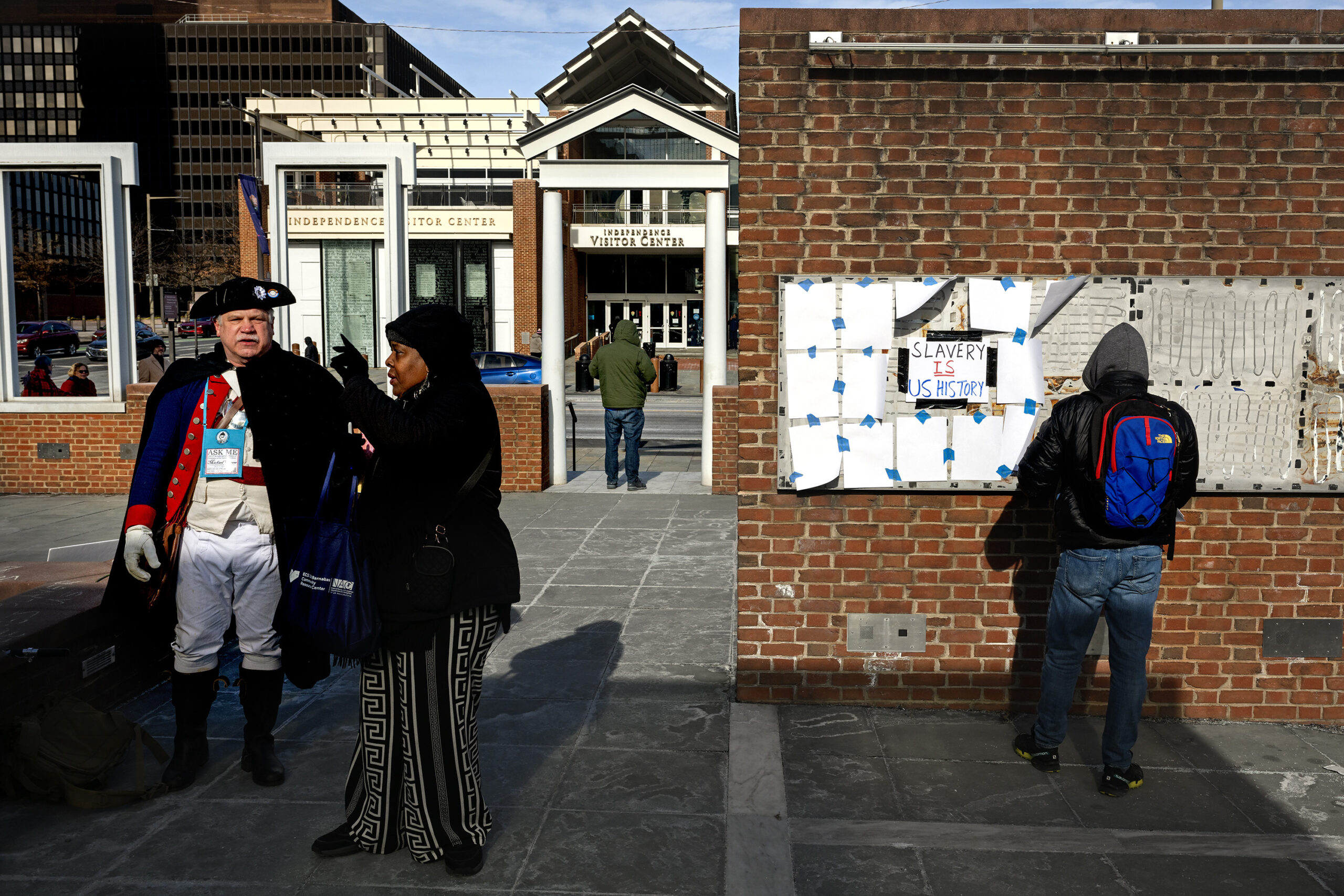
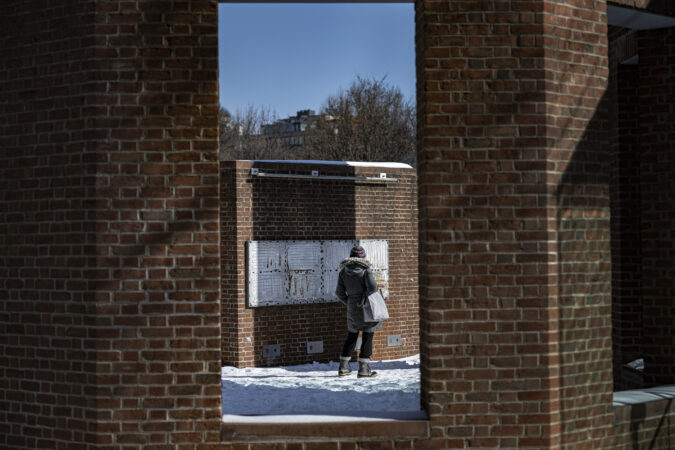
Historical interpreter Michael Carver speaks with visitors at the President’s House site on Independence Mall on Jan. 25 — two days after displays about slavery were removed.
But here’s the thing. The president’s racist post does matter to the American public, as evidenced by the immediate backlash from major figures on both sides of the aisle. Even Black Republican U.S. Sen. Tim Scott, who normally declines to criticize the president’s racial broadsides, responded.
“Praying it was fake because it’s the most racist thing I’ve seen out of this White House. The President should remove it,” Scott wrote on social media.
Scott, who chairs the Senate Republicans’ midterm campaign arm, is right to pray, because with each outrageous act by the president, Republican odds in the upcoming elections get a little longer.
But Trump’s overtly racist post was never about the elections. It was about reshaping the society in which we live.
Though Trump deleted the post after Americans reacted with outrage, the message was sent. Black people are the enemy, and they are to be treated as such.
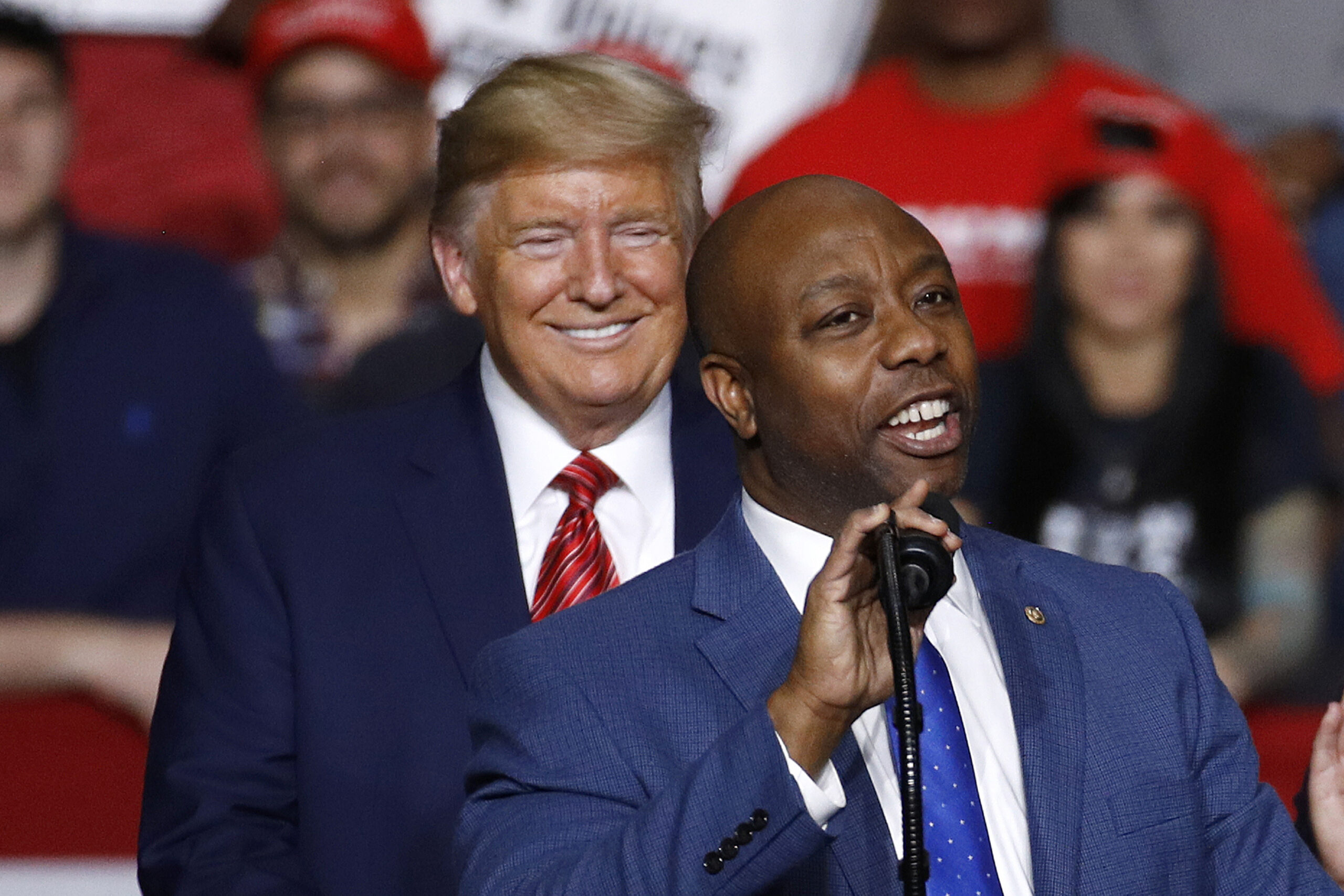
Sen. Tim Scott (R., S.C.), here speaking at a Trump campaign rally in February 2020, called the president’s post “the most racist thing I’ve seen out of this White House.”
As if to underline that point, a white listener called my radio show on Friday morning and called me the N-word on the air. I was neither surprised nor angry. Rather, I experienced a moment of great clarity. America should, too.
Trump is inviting the white conservatives who comprise much of his political base to follow his lead and embrace racism. He is reaching back for vile racist tropes to get them to do so.
In some ways, I’m grateful Trump waited until Black History Month to do this. History, after all, is a strong and determined teacher. We must strive to be the kind of students who embrace history’s lessons.
In 1906, for example, the determination to portray Black people as monkeys took an unimaginably cruel turn. A young African named Ota Benga, who had been taken from what was then the Belgian Congo, was placed in a cage at the Bronx Zoo with actual monkeys. Historians speculate he may have been 12 or 13 — caged with monkeys so crowds of white people could gawk at him, laugh at him, demean and humiliate him.
Benga was freed when outraged Black ministers and others complained about his treatment. Ten years later, Benga killed himself, and the Wildlife Conservation Society, which oversees the Bronx Zoo, spent nearly a century trying to cover up what was done to him. It was only after the murder of George Floyd that the organization fully acknowledged and apologized for the incident.
History teaches us that when racism is left unchecked and unchallenged, people die.
This Black History Month, as Trump seeks to take us backward, he must know that we will not go quietly.
The late Maya Angelou had a saying that goes, “When people show you who they are, believe them the first time.”
She’s gone now, but that was some really good advice.
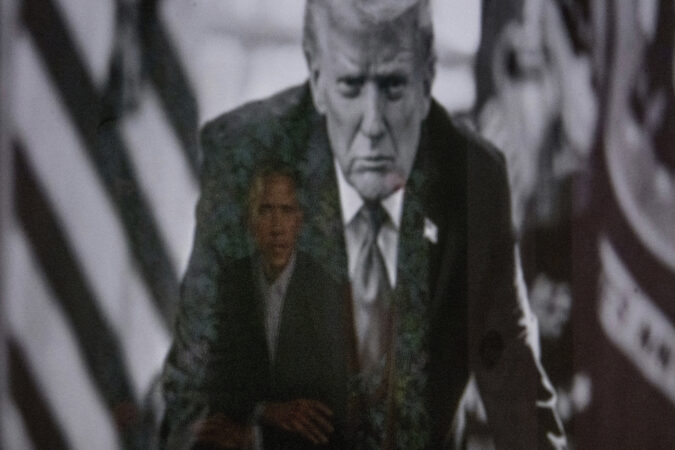
I am reminded of the late author’s wisdom after watching and rewatching a blatantly racist video that President Donald Trump posted on Thursday on Truth Social. It includes AI-generated imagery depicting former President Barack Obama and his wife as dancing primates.
I am so disgusted.
Anything to make the Obamas look bad. I wish I could share a photo of it with this column, but it’s too offensive. I’d tell you to go see his Truth Social account and look it up yourself, but I learned while writing this column that he has taken it down.
Trump’s boorishness is no surprise. He has been showing us who he is and what MAGA is about since even before he came down that escalator at Trump Tower in 2015 and called Mexicans rapists and drug dealers.
So it’s entirely fitting that night he would reshare a video repeating false claims about the 2020 presidential election, which he lost, that includes vile imagery about the 44th president.
For many of 44’s supporters, the Obamas represented America at its best. And no matter where one stands politically, it would be hard to argue that Obama himself ever succumbed to the kind of impulsivity, rudeness, and disrespect we regularly see these days out of 1600 Pennsylvania Ave.
But Trump is a petty, vindictive man whose obsession with the Obamas goes way back. It began in 2011, when Trump deliberately started a campaign of lies about Obama, claiming he wasn’t born in America and therefore ineligible to occupy the Oval Office.
Some pundits argue that Trump’s Obama envy helped fuel his own run for the presidency. And now that he is in the White House for a second term, you’d think he’d be over it. But judging from the way he keeps disparaging Obama, he’s not.
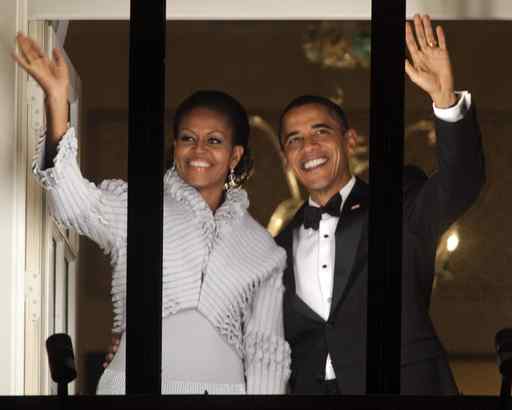
President Barack and Michelle Obama wave to the crowd from a balcony at the Grand Hotel in Oslo, Norway, after he accepted the Nobel Peace Prize at the city hall in 2009.
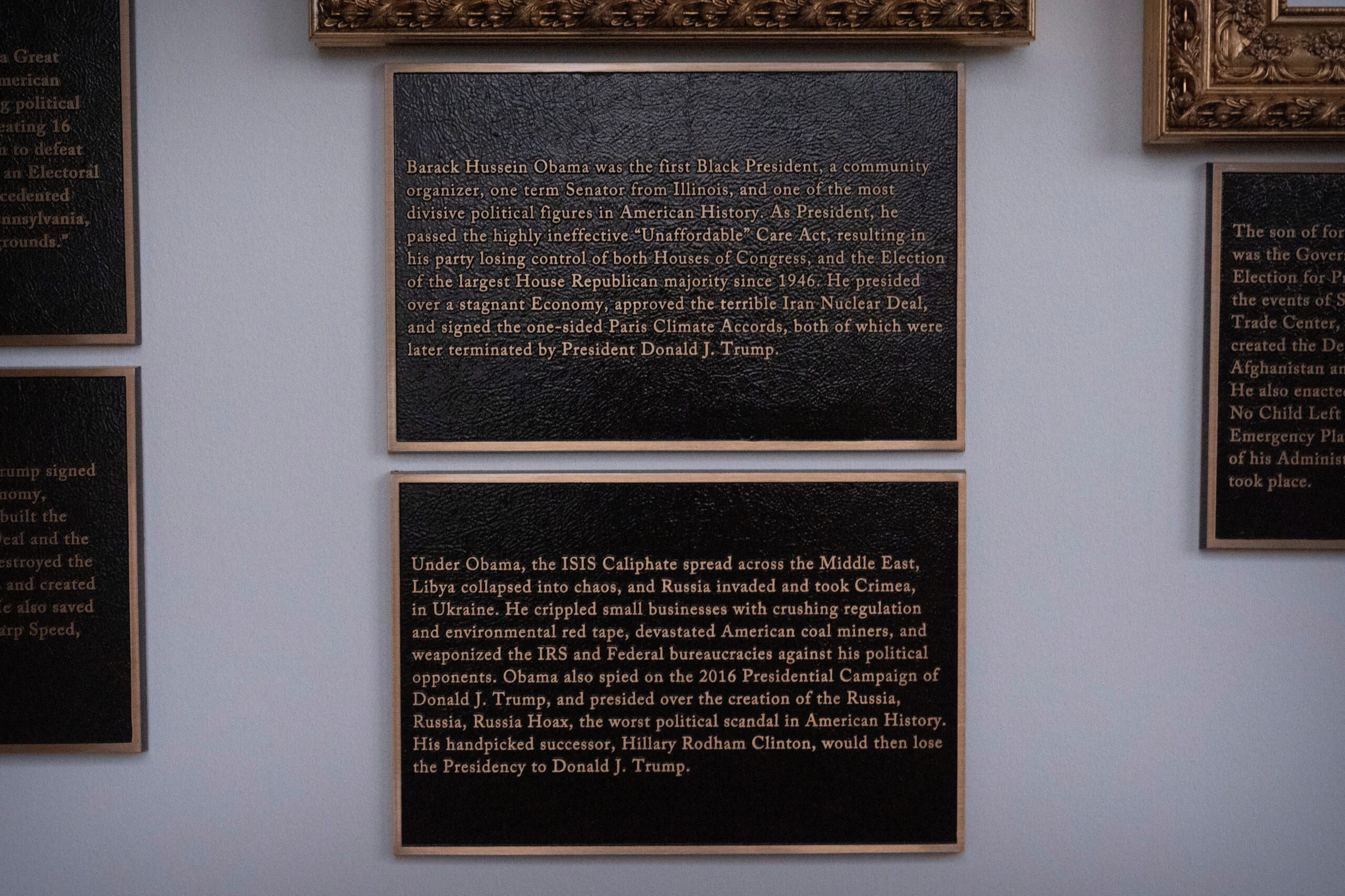
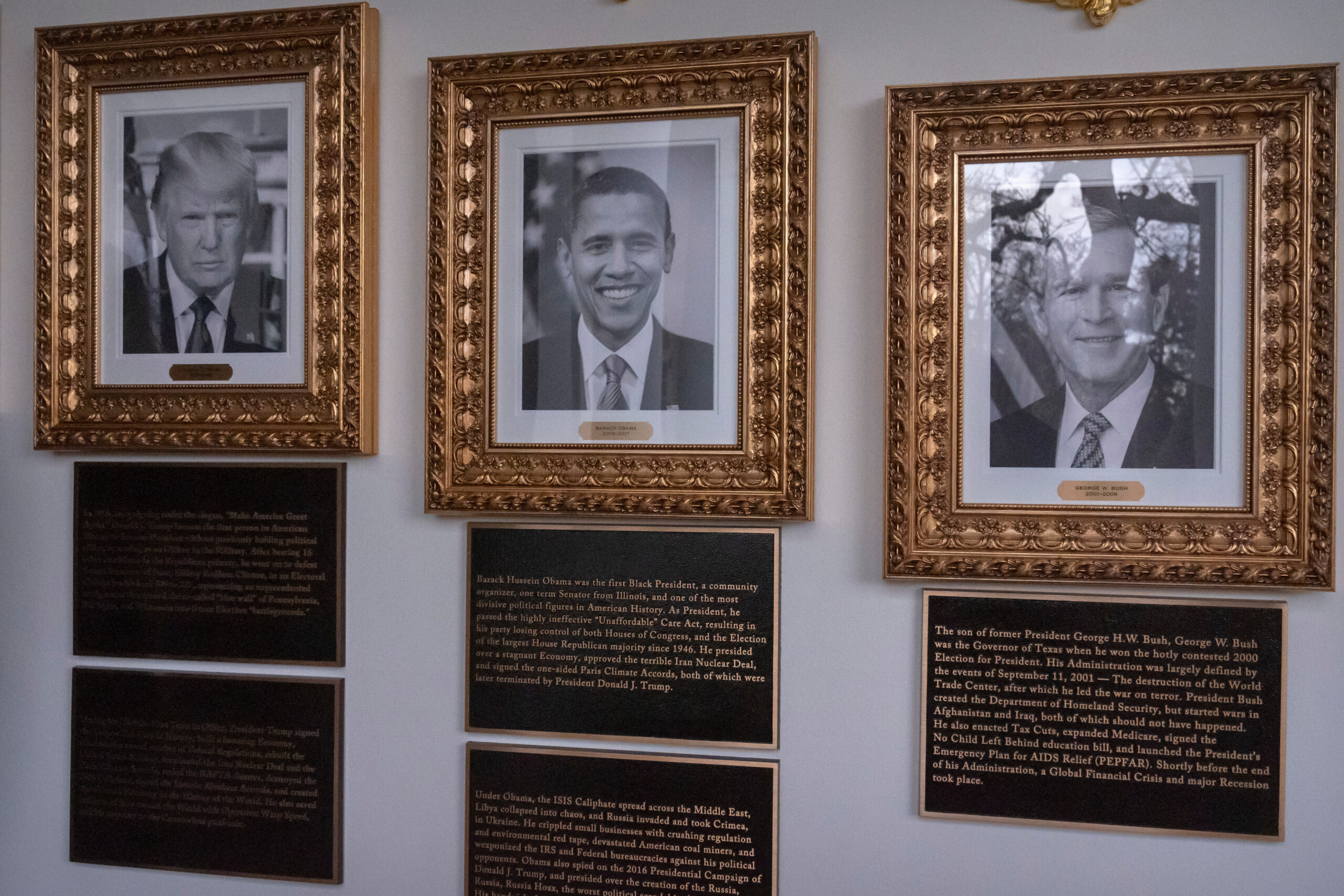
Trump also ordered the installation of plaques under the photos of his presidential predecessors, and used the one under Obama’s to bash his legacy, calling him “one of the most divisive political figures in American history” and making other false claims.
Plaques of explanatory text are seen beneath a framed portrait of former President Barack Obama on the Presidential Walk of Fame on the Colonnade of the White House, Wednesday, Dec. 17, 2025, in Washington. Portraits of President Donald Trump and former Presidents Barack Obama and George W. Bush with plaques of text below are seen on the Presidential Walk of Fame on the Colonnade of the White House, Wednesday, Dec. 17, 2025, in Washington.
White House press secretary Karoline Leavitt tried to walk Trump’s post back, writing, “This is from an internet meme video depicting President Trump as the King of the Jungle and Democrats as characters from the Lion King.”
She added via text, “Please stop the fake outrage and report on something today that actually matters to the American public.”
There’s nothing fake about our outrage. We see Trump. We know what he’s doing by pulling out that old racist trope. Even Black Trump supporters like Sen. Tim Scott (R., S.C.) see this for what it is. “Praying it was fake because it’s the most racist thing I’ve seen out of this White House. The President should remove it,” Scott wrote on social media.
Public narratives of American democracy often emphasize founding documents, elections, and constitutional milestones while obscuring the long and contested process through which democratic practice was learned, refined, and sustained, particularly by people denied formal power.
The portrayal of Black civic life in early America is often reduced to suffering, resistance, or individual achievement, but these things conceal a deeper truth.
In 1840, Philadelphia’s Black community numbered nearly 20,000 people. This population was concentrated in the center of the city, including Society Hill, Queen Village, and Washington Square in the south, 41st and Ludlow in West Philadelphia, and Northern Liberties in the north. With this intensive concentration of people, institutions, and ideas, Black Philadelphia was a metropolitan center in its own right.
A thriving community
By 1845, the community sustained more than 17 Black churches, along with 21 public and private schools, two fraternal lodges, more than 80 mutual aid and literary societies, labor organizations, over 600 Black-owned businesses, and a printing press.
Formal democratic structures grew from these institutions. Churches functioned as civic laboratories, and mutual aid societies were exemplars of rules-based organizations.
Philadelphia was where Black life cohered into a national political identity. People who had defined themselves as African, Caribbean, Indigenous, enslaved, or free identified themselves collectively as African American.
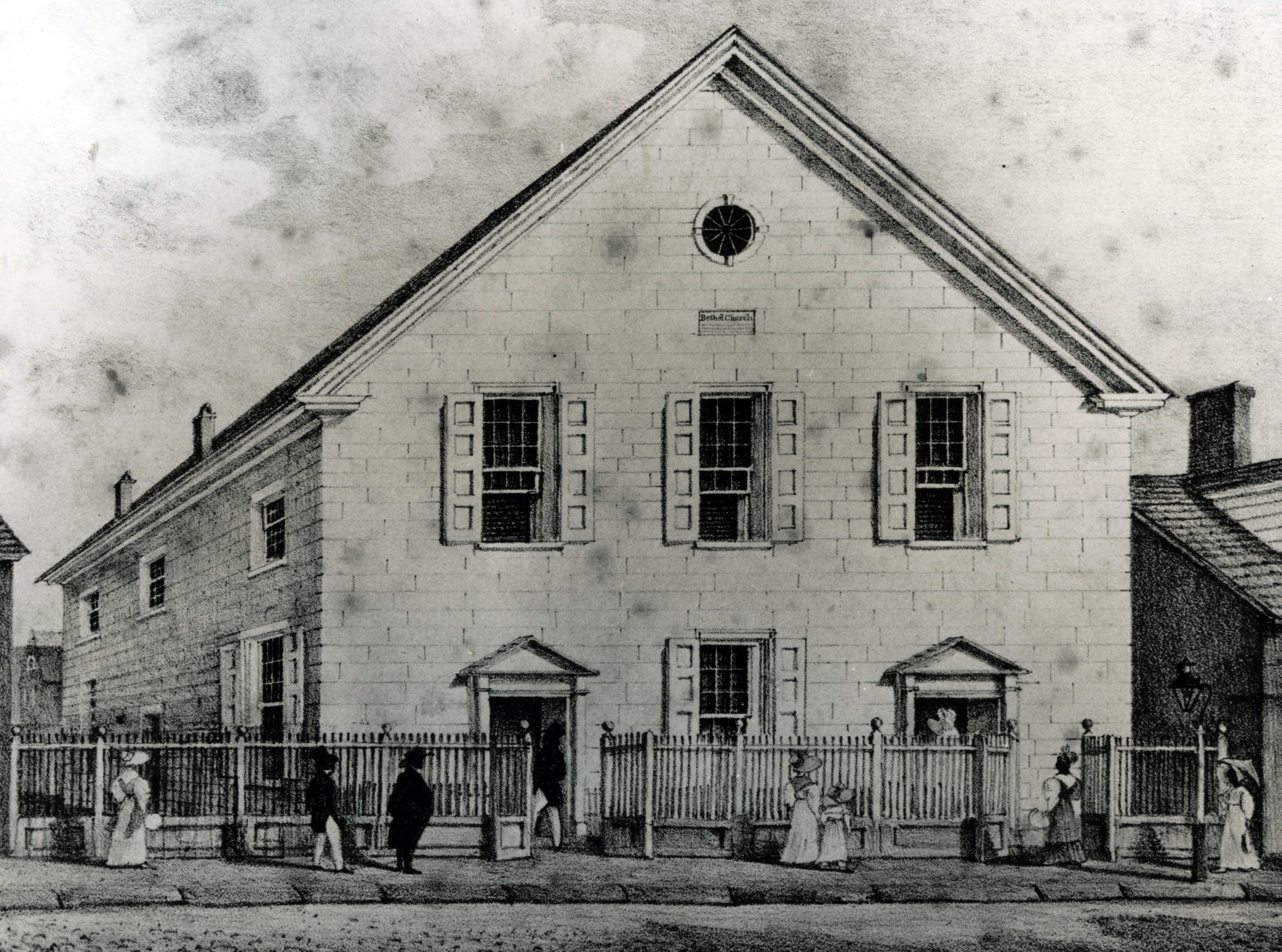
By 1814, the Black Philadelphians were organized. They defended the city at Gray’s Ferry during the War of 1812. In 1817, they met at Mother Bethel, the country’s first African Methodist Episcopal Church, to decide if they would consider emigration to Haiti or Africa. “No!” was the resounding answer.
Black organizations in Philadelphia served as national models. Conventions at Mother Bethel spawned the Colored Conventions Movement beginning in 1830, which extended concepts of civic and human rights across the United States. Constitutional scholar James W. Fox Jr. argues that these conventions articulated a national constitutionalism rooted in the Declaration of Independence, asserting that human rights were inherent and not contingent on state or local laws, a concept far ahead of its time that anticipated the post-Civil War ideas of citizenship and rights.
A melting pot
Black Philadelphia was its own melting pot, too. People arrived from the Caribbean, including Haiti, bringing revolutionary ideas. These ideas moved outward from Philadelphia nationwide and across the Atlantic through transnational anti-slavery networks. Anti-slavery Black activists Olaudah Equiano and James Somerset moved between London and Philadelphia in the 1760s. A song written by the Philadelphia-based pastor Shadrach Bassett was discovered in the papers of Nat Turner, the enslaved man who led an uprising in the Carolinas in 1831.
The understanding that there are civic rights within a democracy was a foundational concept for Black Philadelphians. In fact, we see an early use of the term “civil rights” in the records of the Social, Civil, and Statistical Association in 1863, nearly a 100 years before the 20th-century civil rights movement.
A Nov. 12, 1862, entry from the Social, Civil, and Statistical Association, showing the use of the words “civil rights.” C.S. Statistical Association of Philadelphia, Civil and Social Committee of Superintendence, Constitution, By-Laws, Roll, Minutes [Ams .54, Part 2]
Other examples: In 1842, after mobs destroyed the newly built Beneficial Hall, Stephen Smith sued the city for not protecting the structure. Smith won his case, setting a very public example of Black Philadelphians’ assertion of rights through the rule of law.
In 1861, after the Rev. Richard Robinson was forced to ride outside a trolley during a storm and died when it crashed, Black leaders organized legal aid to support his widow and challenge transit segregation.
In 1867, Caroline LeCount refused to surrender her seat on a streetcar. After being forcibly removed, she obtained a certified copy of the law, returned with a magistrate, and confronted the conductor. He was arrested on the spot.
Asserting their rights
All of this civic activism occurred before Black Philadelphians were enfranchised citizens.
Black Philadelphians boldly asserted their own democratic rights across the 18th and 19th centuries, all within the context of America’s denial of human rights with enslavement and disenfranchisement.
Yet, even as Black Philadelphians engineered this civic infrastructure, the city refused to acknowledge their achievements. Major historical texts on Philadelphia erased Black institutions entirely. Henry Simpson’s Lives of Eminent Philadelphians Now Deceased, written in 1859, doesn’t even mention Absalom Jones, James Forten, or Richard Allen, or the major religious denomination born here in Philadelphia, the African Methodist Episcopal Church.
Mother Bethel African Methodist Episcopal Church in Society Hill, founded in 1794 and rebuilt in 1809, has long been the locus of Philadelphia’s Black community, writes Michiko Quinones.
No Black churches or institutions appear in Moses King’s exhaustive civic visual history, Philadelphia and Notable Philadelphians, from 1902, a purportedly definitive account meant to define the city’s civic identity.
Arguably, there is a deeper reverence in American public memory for a woman who sewed a flag than for an entire population that defined democracy and held the nation accountable to its own written ideals. That imbalance reveals not just a lack of attention to history, but a refusal to honor people who forced democracy to become real.
The question facing Philadelphia now is whether it will recognize early Black civic engineering as foundational to its identity, or continue to exist with parallel histories, thriving yet separate. There could be no better time to ask than the 250th anniversary of our country’s founding.
Michiko Quinones is the lead public historian and cofounder of the 1838 Black Metropolis Collective.
This week’s column covers housing debates in Harrisburg, admissions policies at the school district, and more bad zoning overlays.
Go big or go home
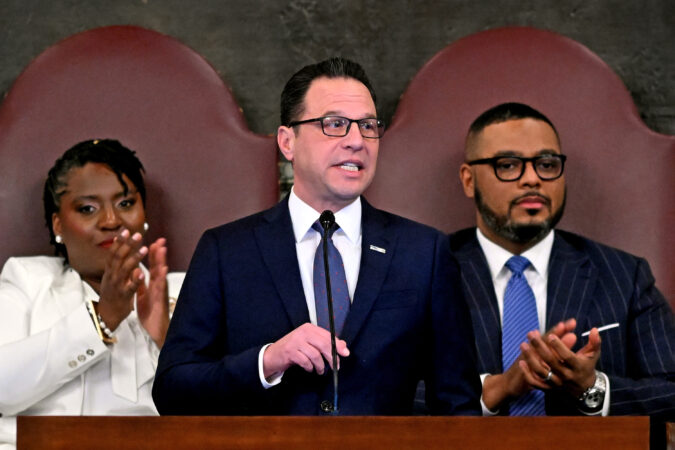
Philadelphia Mayor Cherelle L. Parker is no longer the only person with an ambitious housing plan. Gov. Josh Shapiro joined her this week, pledging in his budget address to create a billion-dollar state fund to encourage housing production in local communities. The guv is echoing a bipartisan consensus that there simply aren’t enough homes to meet the demand. There’s just one problem: Many housing experts say Shapiro’s ideas won’t move the needle on production.
That’s because his plan is based entirely on carrots, avoiding the creation of the kind of statewide building standards that have been most effective elsewhere.
While factors like interest rates and the cost of construction impact housing starts, local zoning rules are also a key constraint on homebuilding. Many municipalities maintain strict rules that make it impossible to build anything other than McMansions. In the few towns that do allow for new construction, the mismatch between supply and demand means developers can charge outlandish prices. The new Coulter Place in Ardmore starts at around $3,000 a month for a one-bedroom unit.
In states like California, the debate over housing has been going on for over a decade. State leaders there also sought to use an incremental approach and avoid attracting the ire of interest groups that are committed to the current system of regulating housing. The result has been the legislature routinely needing to revise the plan. Instead of starting with a half-measure, Pennsylvania should get things right the first time.
State Rep. Tarik Khan has proposed what he calls the “Golden Girls Law,” named after the famed ‘80s sitcom. Many municipalities restrict unrelated women from living together, which would have made scofflaws out of Blanche, Rose, Dorothy, and her mother if the show were set in Pennsylvania. Khan’s bill would end those bans.
State Rep. Greg Scott wants to eliminate parking minimums, and State Rep. John Inglis III has introduced bills that would require municipalities to allow for more duplexes and triplexes. Shapiro should put his weight behind these efforts, as well.
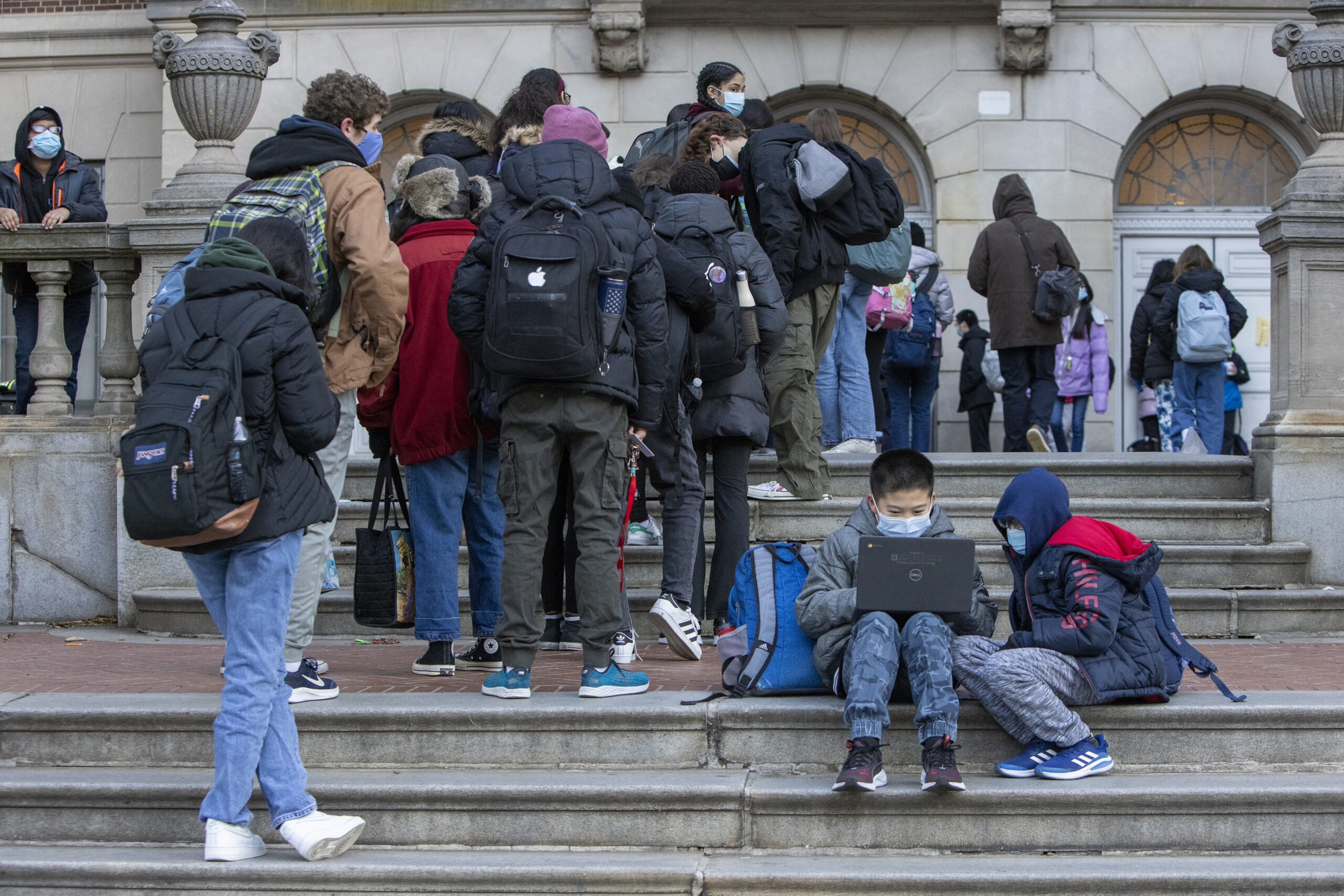
Students outside Masterman High School in 2022.
Polarizing magnets
During the pandemic, the Philadelphia School District was faced with a conundrum: how to decide who got spots at the city’s well-regarded magnet schools, given the state’s cancellation of the Pennsylvania System of School Assessment, or PSSA, standardized tests.
The schools — and standardized tests — have often been criticized for having cultural and socioeconomic biases. The demographics at Masterman and Central (where I attended) do not match those of the district overall, while standardized test scores tend to reflect the socioeconomic status of the students taking them. To many, this is enough evidence to scrap the magnet system, the tests, or both.
The district’s solution was to take over admissions, which had traditionally been handled by the schools themselves, and subject applicants to a lottery process. To address equity concerns, some zip codes were given priority access to the schools. Students at predominantly Black George Washington Carver Middle School, who had been promised a spot at the partner high school if they maintained good grades, saw those pledges revoked. The district also created a computer-graded writing test, although that was quickly phased out. Some parents saw the revamp as a blatant attempt to discriminate against Asian students. A bipartisan federal appeals court ruled this week that these families have a case.
With the state once again administering PSSAs, and with the new lottery system not having a substantial impact on demographics at the schools, it is worth questioning whether the new process represents any improvement at all.
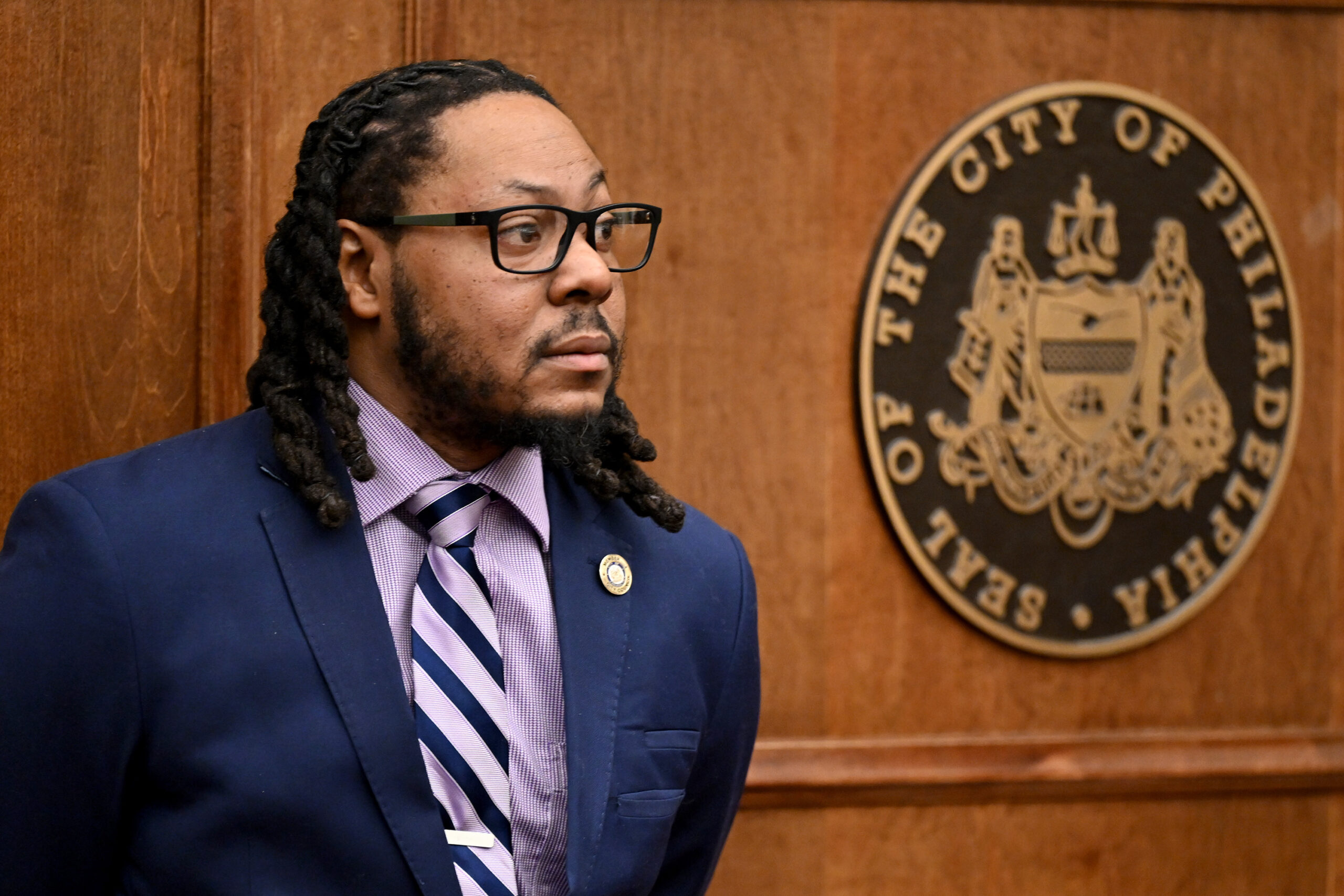
Councilmember Jeffery Young Jr. in chambers as City Council meets in December.
Day of Jay
This column’s favorite City Council member, the 5th District’s Jeffery “Jay” Young Jr., decided not to advance his controversial bill to ban housing construction on or near the former Hahnemann University Hospital campus after serious pushback from local community groups and the Planning Commission. Unfortunately, the attention given to the Hahnemann bill may have helped two of his other bad ideas evade scrutiny.
Young got two bills through the Rules Committee. One bill is aimed at preventing blight by restricting demolitions of vacant property. Ironically, most development experts say the bill will likely increase blight by incentivizing owners to create hazards to justify demolition or providing more space for squatters to operate.
Young also introduced a bill creating an 11 p.m. curfew for some businesses within his district, which he said is aimed at stopping nuisance businesses that are selling drug paraphernalia and, per Young, sometimes the drugs themselves.
By that logic, selling drugs at 10:59 p.m. will still be allowed.
When Philadelphia temperatures dipped to near zero last week, the frigid weather was so unbearable that most of us retreated indoors. Of course, our homes were warm and well-lit, although the threat of losing power was unnerving.
For my friend Maisie, whose family lives in the Philly area but who is doing research in Kyiv, Ukraine, on blast injuries and coordinating international programs to help amputees, there is no escape from subzero weather.
When I spoke to her on the weekend, she was huddled in two down parkas, under a mountain of blankets, and hugging her dog, Olly, for warmth, having had no heat for three weeks.
Thanks to Vladimir Putin, Kyiv and other major Ukrainian cities have been under massive missile and drone attacks deliberately aimed at civilian heating and power infrastructure. All in an effort to freeze Ukrainians into submission.
Such attacks on civilians are a war crime.
Donald Trump is helping Putin weaponize winter. The president echoes Russian propaganda, claiming Putin agreed to a weeklong pause in bombing energy infrastructure — even as Putin was raining down record numbers of missiles on apartment buildings, a maternity hospital, and power grids. Kyiv is only expected to receive four to six hours of power daily for the rest of February.
To make his pro-Russian stance clear, Trump had a framed photo of himself and the Kremlin leader, taken at the failed Alaska summit last August, put up in the White House Palm Room, above one of him and a grandchild. Only Trump could consider it appropriate to hang a photo of a modern-day Adolf Hitler in the White House visitors’ area.
Moscow, of course, loves it. To quote the X post of Putin’s special envoy, Kirill Dmitriev (who has brainwashed his White House counterpart, Steve Witkoff, into adopting Moscow’s positions): “A picture is worth a thousand words.” Indeed.
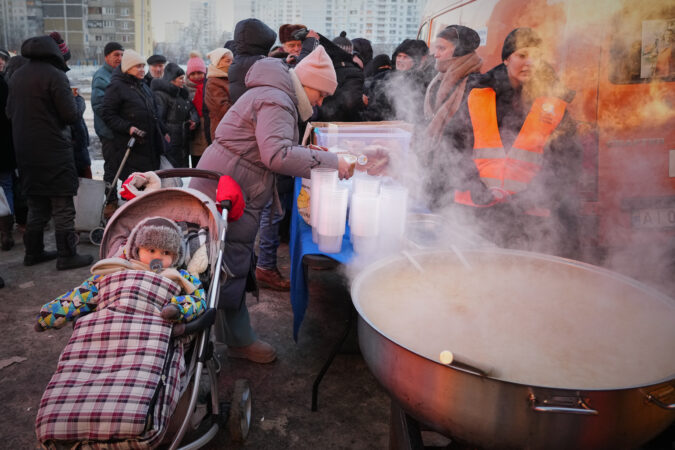
Other pictures to consider are those of mothers and children clinging to each other in underground subway stations — reminiscent of the London Blitz — because they fear repeated Russian drone attacks on apartment blocks, or because they simply have no heat.
“Even if you can get food, you don’t need a refrigerator,” Maisie, whose last name I’m not using from safety concerns, told me via WhatsApp. “Any food you have freezes.” Her electricity is sporadic, she told me, barely giving time to charge power banks, a small heater, her laptop, and her phone.
“It got so bad these past weeks that I remember a moment when I realized I hadn’t felt my toes in so long, I took off layers of socks to realize they had blistered so much from the cold that they were bleeding.
“A lot of grocery stores were closed, and it was a mad rush when they were open. Sheets of ice are coating every street, which makes it particularly difficult for the elderly.
“Despite all this, Ukrainians are still holding on, adapting, supporting one another and enduring conditions that should never be normal in the civilized world,” she said.
What infuriated Ukrainians this week was Trump’s repeated claims that his deal-making skills had persuaded Putin to stop bombing energy infrastructure for a week, until the trilateral talks in Abu Dhabi, United Arab Emirates. Putin “kept his word,” Trump told White House reporters on Tuesday.
No, Putin did not keep his word.
Drones and missiles on power distribution sites halted for barely two and a half days, during which Russia kept hitting residential buildings — along with workers repairing damaged energy infrastructure. Then, with the missiles saved up from the two-day “energy ceasefire,” Russia launched a massive strike against energy targets even as Trump was touting that he had talked Putin down.
Any president with minimal smarts would have grasped by now that the Russians are trolling him.
Trump has been pushing since the Alaska summit for a direct meeting between Putin and Ukrainian President Volodymyr Zelensky, and the Kremlin recently offered one — if it took place in Moscow. The slimy Russian foreign minister, Sergey Lavrov, said his country would guarantee Zelensky’s safety.
Needless to say, Zelensky — whom the Russians have tried to assassinate many times — declined the honor. One doesn’t have to be a fortune teller to imagine poisoned soup (a tactic used by Russia against a previous Ukrainian president) or a sudden fall from a window. Yet, no doubt, Trump will soon be criticizing Zelensky for refusing this golden opportunity.
Similarly, the U.S.-Ukraine peace talks pushed by Trump — along with this week’s trilateral meeting of U.S., Ukrainian, and Russian officials — are a farce. That’s because Trump refuses to press Putin to make any concessions, and the Russian leader has yet to veer from his position that Ukraine slash its army, change its president, give up unconquered territory, and refuse any strong Western guarantees.
In fact, chief White House negotiator Witkoff, an ill-informed real estate mogul who seems to be Trump’s main emissary to everywhere — from Israel to Iran to Russia — insists Kyiv cave to Putin’s key position: give up a belt of Donetsk that Ukraine still holds, which is the main fortified barrier that prevents Russian troops from moving into central Ukraine.
Witkoff, who, like Trump, thinks only of land deals, might as well be calling on Ukraine to commit suicide. He has actually proposed that this armed Ukrainian territory could become a “free trade zone.” As with the “energy ceasefire,” Putin would respect that zone for about five minutes before sending his troops in.
Yet, through sheer grit, Ukrainians are enduring and preventing serious Russian gains on the front, as the Kremlin’s war economy sags and Russia suffers staggering numbers of military casualties. I believe if Ukraine can get through this winter, with European help, Russia will be unable to continue the war at this level.
So now would be the perfect time for Trump to push back strongly against Putin’s “energy war” on civilians. Having basically halted military aid to Ukraine, the president could still help Kyiv by selling Europe desperately needed air defense weapons that it would then pass on to Ukraine. The president could also finally stop blocking a vote on bipartisan congressional legislation to impose more sanctions on Russian oil sales.
By turning up the heat on Putin, Trump could help turn the heat back on for Ukraine. But don’t hold your breath.
The only slight opening I can imagine is if the president finally grasps how weak and foolish his bow to Putin makes him look on the world stage, and how dangerous his links to Putin are to his own legacy.
Rather than be awarded the Nobel Peace Prize, Trump looks more likely to be tarred by his subservience to the greatest war criminal of the 21st century, who played him like a military drum.
Why does it matter so much to the Trump administration that an exhibit about nine enslaved Africans at the President’s House be removed? Yes, we know this display does not allow Americans to skip past the horrors of enslavement and the daily violence that people of African descent faced. Yes, we know the display counters the majestic view of the Founding Fathers as saintly people who fought for the equal rights of all. Yes, we know this memorial ingrains in the American consciousness that Black people were thingified and their free labor built this country.
Simply put, the dismantling of this exhibit is an attempt to erase our collective consciousness so that Black children and white children grow up without a clear reference point of what this nation was. Without understanding what America was, we are bound to make the same oppressive mistakes. And what will efforts like this mean for the future of the curricula in our schools?
The removal of the exhibits was an assault on our spiritual eyes — the eyes we use to invoke our collective memory. My spiritual eyes watched a video of the dismantling and saw my ancestors being brutalized by the crack of the whip again. My spiritual eyes saw my ancestors labor to build a nation and fight for a country that does not see them as fully human.
The Sankofa proverb teaches us that progress occurs when we must recognize our past. Our past is not perfect; it is complex and filled with moments of dehumanization that make us all cringe and feel saddened. But examining and reflecting on the past allows us to build a better, more beautiful society together. Let’s take that path forward as a nation.
Dr. O’Brien will now help make the ultimate decision on both commutation and pardon applications from deserving people who seek to shorten their prison sentence.
My experience with the Board of Pardons is deeply personal. My father was the victim of a kidnap carjack robbery in 1980 and died as a result of the crime. The two accomplices to the carjacking, who did not intend to kill my father and did not kill him, were still convicted of second-degree felony murder, and they were sentenced to the mandatory sentence in Pennsylvania: life in prison without parole. They were 18 and 19 respectively.
They were incarcerated for 40 years. They more than paid for their participation. I felt so strongly about this that I was a key advocate for their release through the commutation process.
Dr. O’Brien is known for being a paid expert witness in criminal cases, almost always for the prosecution, often involving children. He has argued that accused children cannot be rehabilitated and should be charged as adults. This biased point of view goes against science and documented research.
People who committed or were participants in severe crimes when they were teenagers are often incarcerated for years and pay dearly for their crimes. These people deserve consideration (but not automatic release) when applying for commutation. To think otherwise is simply not true.
It is just wrong to deny people who have paid their debt to society a voice as they are fighting to prove they are not the same person they were at such a young age.
Nancy Leichter, Philadelphia
Join the conversation: Send letters to letters@inquirer.com. Limit length to 150 words and include home address and day and evening phone number. Letters run in The Inquirer six days a week on the editorial pages and online.
A massive 1.3 million-square-foot Schuylkill County warehouse that just 13 months ago bustled with 505 workers moving cheap overstock goods like shower curtains or pet cleaners for now-bankrupt retailer Big Lots sits utterly abandoned, its dozens of truck bays fenced off and surrounded by a silent shroud of snow.
It’s hard to imagine, but in the very near future, this white behemoth could be warehousing thousands of desperate human beings behind its bland, baby blue-trimmed concrete walls. On Monday, U.S. Immigration and Customs Enforcement filed a county deed that confirmed its $119.5 million purchase of the Big Lots facility — one more island in an American gulag archipelago of detention camps for the undocumented immigrants ICE is aggressively arresting from coast to coast.
“It hurts my heart,” the Rev. Brian Beissel, pastor at Christ’s United Lutheran Church in nearby Ashland, told me, choking up a bit, as we sat in a car outside the warehouse entrance.
When I asked him to expand on the source of that pain,Beissel’s response epitomized what other local residents have been saying about the stunning ICE news — a blend of small-town fears about stressed infrastructure with spiritual unease over the images of violent immigration raids in Minneapolis and elsewhere. He invoked Schuylkill County’s deep resentment of the 20th-century coal barons who took the money and the minerals and then ran. “They’re promising jobs, but how long are they going to be here?”
But then Beissel — a Schuylkill County native who sees himself as a not very political preacher, in a county that Donald Trump won in 2024 with nearly 71% of the vote— pivoted to his moral dismay over a citizenship-seeking restaurant owner and father of a 2-year-old he knows from nearby Danville who was arrested by ICE and agreed to return to Mexico. “The Bible is pretty darn clear,” he said, “that we welcome the stranger.”
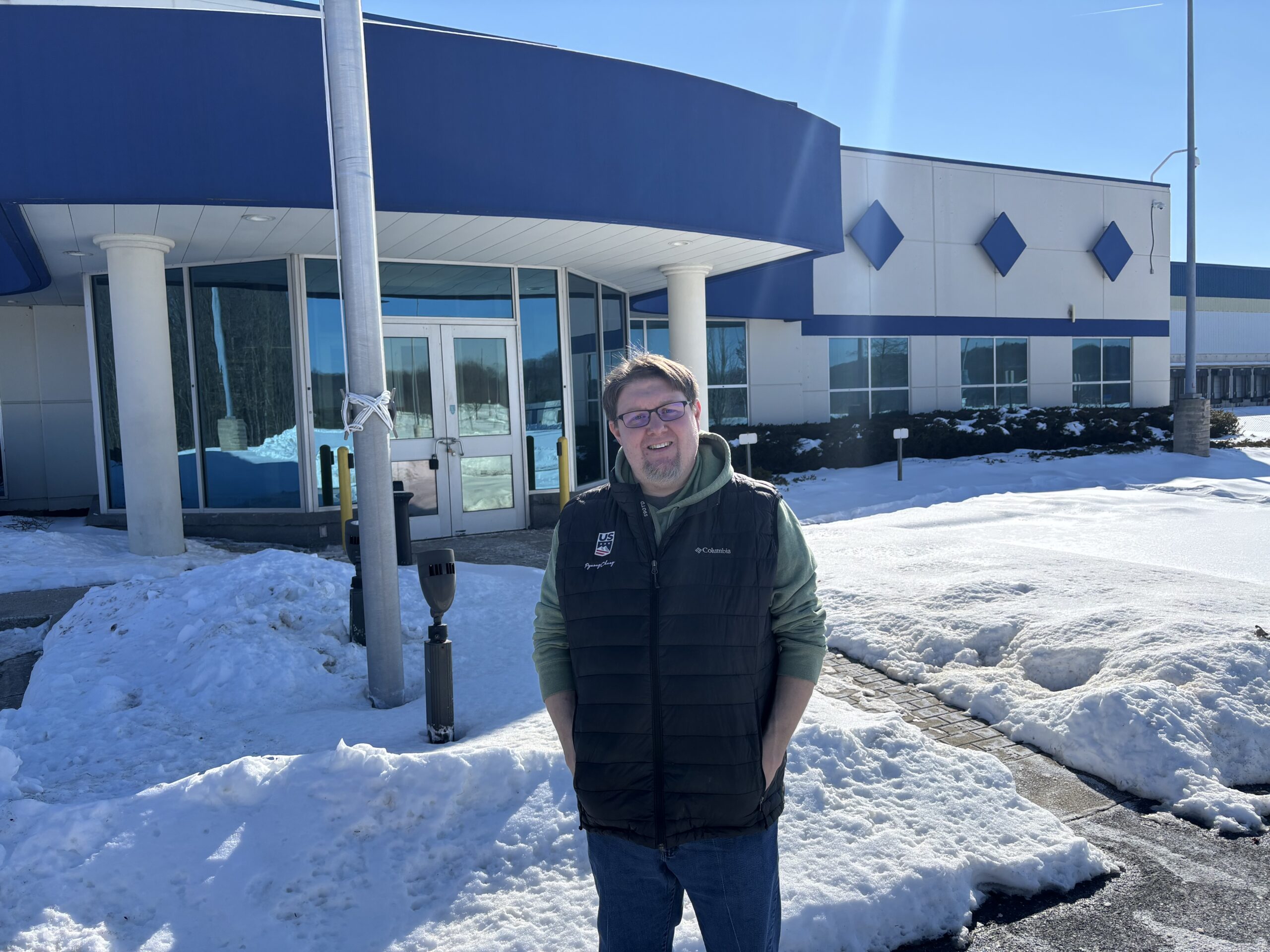
Brian Beissel, pastor at Christ’s United Lutheran Church in Ashland, Pa., stands in front of the former Big Lots warehouse in Tremont, Pa., that has been purchased by U.S. Immigration and Customs Enforcement (ICE), on Wednesday.
The Trump regime told America this day was coming. Its acting ICE director, Todd Lyons, said in an April interview that he wanted to run the agency like a business, with a deportation process “like [Amazon] Prime, but with human beings.”
Ironically, the soon-to-be ICE detention center in Schuylkill County, about 100 miles northwest of Philadelphia, is less than a mile from a massive new Amazon fulfillment center that opened in 2023. Soon, trucks carrying consumer bric-a-brac to Tremont will be jostling on Interstate 81 with buses carrying day laborers or restaurant servers in handcuffs to those reborn rows of truck portals.
ICE, flush with a whopping $45 billion in cash from Trump’s so-called Big Beautiful Bill to construct its human supply chain, is currently racing to buy sites for 23 detention centers with as many as 76,500 beds from coast to coast — often keeping communities like Tremont in the dark to thwart the inevitable opposition.
In fact, the Schuylkill County deal is the second ICE facility in east-central Pennsylvania announced just this week. A different warehouse location, which ICE envisions as a kind of feeder camp for 1,500 detainees, was also purchased for $87 million in Hamburg, Berks County — only 25 miles from Tremont.
Even if you could somehow put the morality of what many see as concentration camps on U.S. soil to the side, the government’s scenario for tiny Tremont — a coal-country hollow of two-story brick homes and faded American flags with just 2,000 residents — boggles the mind.
The Big Lots site could soon see a community of nearly 10,000 people — the 7,500 detainees and an estimated more than 2,000 workers to oversee them — that would instantly become the second-largest city in Schuylkill County (after Pottsville, the county seat). It’s just 300 yards from the largest daycare center in a township where the water and sewer system is already at capacity, with no local police force or nearby hospital to deal with the inevitable emergencies. The U.S. government won’t be paying the roughly $1 million a year in annual property taxes that propped up local schools and county and municipal services.
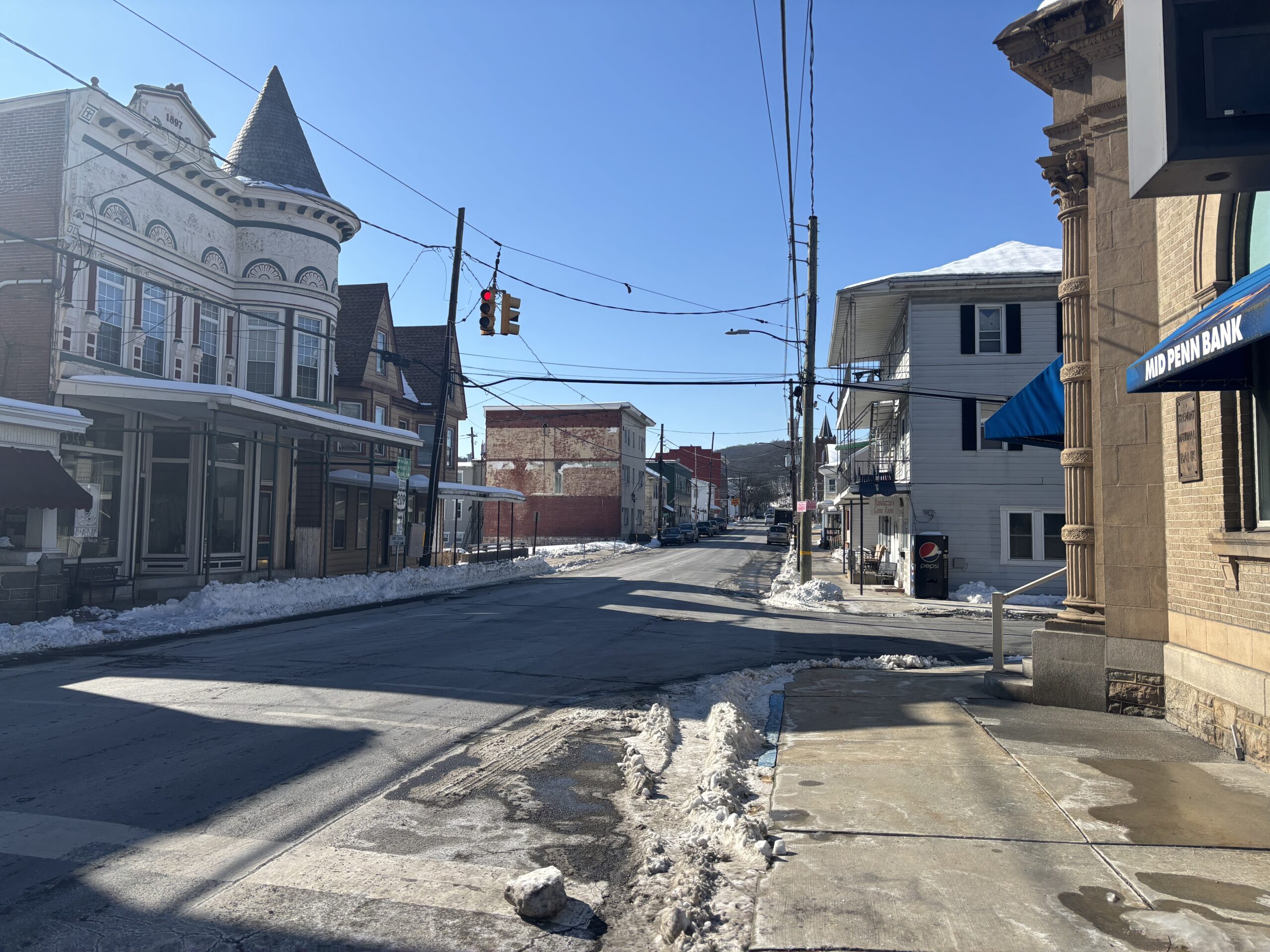
The empty streets of downtown Tremont, Pa., on Tuesday. The 2,000 people of the coal-country borough and its surrounding township would be dwarfed by 7,500 potential detainees at a planned ICE facility on the edge of town.
It’s these kinds of not-in-my-backyard worries that are driving a lot of the initial concern in Schuylkill County, especially from politicians who are cautious in talking about the fraught immigration issue in blood-red Trump country. “I am not going to get into a debate over the overarching immigration policies of the United States of America,” the GOP chair of the county commission, Larry Padora Jr., told a meeting on Wednesday, where he confirmed the ICE purchase of the warehouse.
But a growing number of neighbors do want to talk about those immigration policies, and the stench of inhumanity.
“I’m scared,” Tana Smith, a 24-year-old server at Behm’s Family Restaurant, the local wood-paneled breakfast hangout, told me about the pending ICE project. She, too, blended fears about the daycare site and possible escapees from a detention center with empathy for those same would-be detainees. “People’s families are just being, you know, ripped apart,” she said. “It’s really sad.”
Smith said she’d already gently lobbied her dad — a Republican who said, “I guess it’s just taking care of the illegal people” — against the ICE plan. “I was like, I don’t feel like that’s true at all,” she said. “I feel like they’re going after everyone.”
Andrea Pitzer, author of the definitive history of global concentration camps, One Long Night, said Tremont residents like Smith are right to be alarmed. She told me her research found that authoritarian regimes frequently rely on existing sites like abandoned warehouses or factories as they launch a growing network of gulags.
“The U.S. is clearly echoing previous history with these warehouse acquisitions,” she said. “Dachau — not a death camp, to be sure, but one of the earliest Nazi concentration camps — took over a converted factory when it began its heinous existence in 1933.”
A massive new ICE detention center is coming to Tremont Township in Schuylkill County. At full capacity, it would have a population roughly equivalent to 30 times the Township’s current population: https://t.co/Zp385ZKcjJ
Pitzer asked, “What things will they do on this new, huge scale behind barbed wire?” She noted that the warehouses are a massive expansion of a system that’s already at a record for detainees, with more than 73,000, and is already plagued by squalid conditions, a measles outbreak at the family detention site in Texas, and a death rate as much as 10 times as high as during the Biden administration.
No wonder ICE has moved to buy up new sites — including the two Pennsylvania warehouses — with a practically Soviet level of state secrecy. There are no public hearings. Top lawmakers from both parties have been left in the dark. “This was quiet,” the Democratic county commissioner, Gary Hess, told the meeting. “It was silent. And then, bango! There it was.”
“These will not be warehouses — they will be very well-structured detention facilities meeting our regular detention standards,“ the U.S. Department of Homeland Security insisted in a statement Wednesday. It added that the federal acquisitions “should not come as news,” as ICE expands its nationwide dragnet.
Yet, arguably the region’s most powerful politician, Republican U.S. Rep. Dan Meuser, who voted for the $45 billion fund, has sounded, fittingly, like TV’s fictional German prison camp guard, Sgt. Schultz: He knows nothing, nothing! His spokesperson said Meuser, with both planned facilities in his 9th Congressional District, “has requested a call with … [ICE], and our office has reached out for additional information to better understand the details of the situation. We have not yet received a response.”
Instead, it fell on Meuser’s likely Democratic opponent in November — Rachel Wallace, a former chief of staff for the U.S. Office of Management and Budget who has returned to her native Pottsville — to organize a town hall last week when the project was still rumored.
Lisa Von Ahn (left) and Josephine Kwiatkowski, members of the Schuylkill County chapter of Indivisible, attend a county commissioners meeting in Pottsville on Tuesday to speak out against a proposed ICE detention center in Tremont, Pa.
Most of the 100 or so peoplewho packed a fire hall voiced opposition, but for a variety of reasons. The local GOP state representative, Joanne Stehr, attended and agreed with the not-in-my-backyard concerns, but then drew loud boos when she reportedly said: “I’m saying ICE has a job to do, and it’s going to get done. We are taking out the trash.”
The growing uproar in Schuylkill County echoes brewing battles in many of the 21 other locations, even in areas that voted heavily for Trump in 2024. In Ashland, Va., a Canadian-based warehouse owner canceled its planned deal with ICE after economic pressure and opposition from county commissioners. Elected officials in Roxbury, N.J., and other proposed sites are also fighting to keep ICE out, but it’s unclear how much traction such an effort will get in red rural Pennsylvania.
“We want economic development, and we want good businesses that are part of the community,” Wallace, the congressional candidate, told me as she decried the process and her opponent Meuser’s silence. “And this is the opposite of that.”
And a growing number of Schuylkill County residents say their biggest alarm is less over the NIMBY concerns and more about the idea of their backyard hosting an American concentration camp.
“We have seen firsthand the brutality that government agents are using to detain American citizens, legal immigrants, and law-abiding immigrants without legal status, and the violence in our streets caused by masked, heavily armed agents,” Josephine Kwiatkowski, an Army veteran and retiree from Pottsville, told the commissioners. She said these scenes and “the civil rights violations, the lack of humanitarian conditions [in current ICE facilities], and the discounting of the Constitution are the same issues that I was willing to sacrifice my life to oppose.”
Pitzer, the concentration camp historian, said the time to act is now, before these proposed gulags are up and running.
“Those who made excuses for or ignored these kinds of camps in Russia in the 1920s or Germany in the 1930s couldn’t know how much more vast and lethal those systems would become a decade later,” she said. “But we, who have those examples and other horrors from around the world in our rearview mirror, have no excuse.”
This should be a five-alarm fire, not just for the politicians who’ve been trusted with keeping an American republic, but for citizens who are beginning to grasp a monstrous reality that was set into motion when Trump’s xenophobic demagoguery won a narrow plurality on Nov. 5, 2024. The image of our neighbors shipped in a supply chain like patio furniture and disappeared into the bowels of a Big Lots warehouse should have all of us asking a fundamental question.
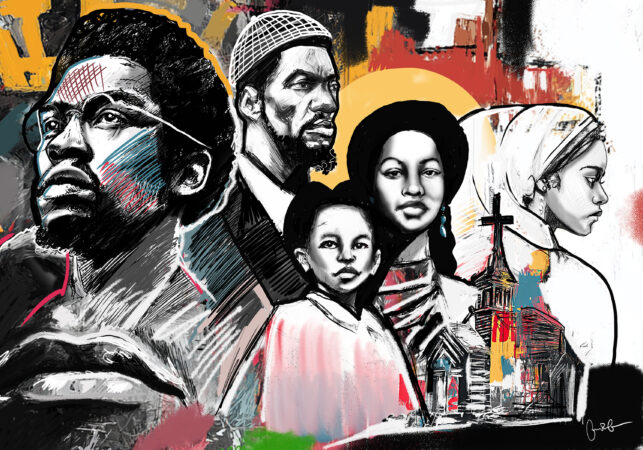
When you hear the word faith in relation to the history of African Americans in the United States, what do you imagine? Do you see a preacher, or a gospel choir, or imagine a church mother in a resplendent hat?
These images, while valid depictions of the Black church, are not the only measures of how faith informs and shapes the history of African American life.
For African Americans, faith has not been simply about belief in a deity. By necessity, it has also been about having the faith to fight for freedom, faith in showing the shortcomings of democracy, faith in finding hope during struggle, and protecting the community. It was also the only way, for many years, to organize and establish places of worship or set up businesses.
In the American context, many equate African American religion with Protestant Christianity. Yet, faith isn’t limited to a particular religious tradition or organized religion. It is an intentional practice of believing. The history of African Americans’ personal faith and organized faith traditions is what has sustained them in their tumultuous history in America.
It is impossible to speak about the history of faith and African American life without speaking of the brutal realities of the Atlantic slave trade and slaveholding in America. Africans who were captured and sold into slavery from ports in West Africa came to the Americas from rich traditions steeped in different African religious practices, like Vodun.
Some of the enslaved, like Omar Ibn Said, were Muslim, and still others were from places like Congo and had been introduced to Christianity in Africa. Examples of the longevity of these religious traditions can be seen in the practices of the Gullah people in South Carolina, who have shared their traditions like rice growing, ring shouts, and burial practices from enslavement to the 21st century.
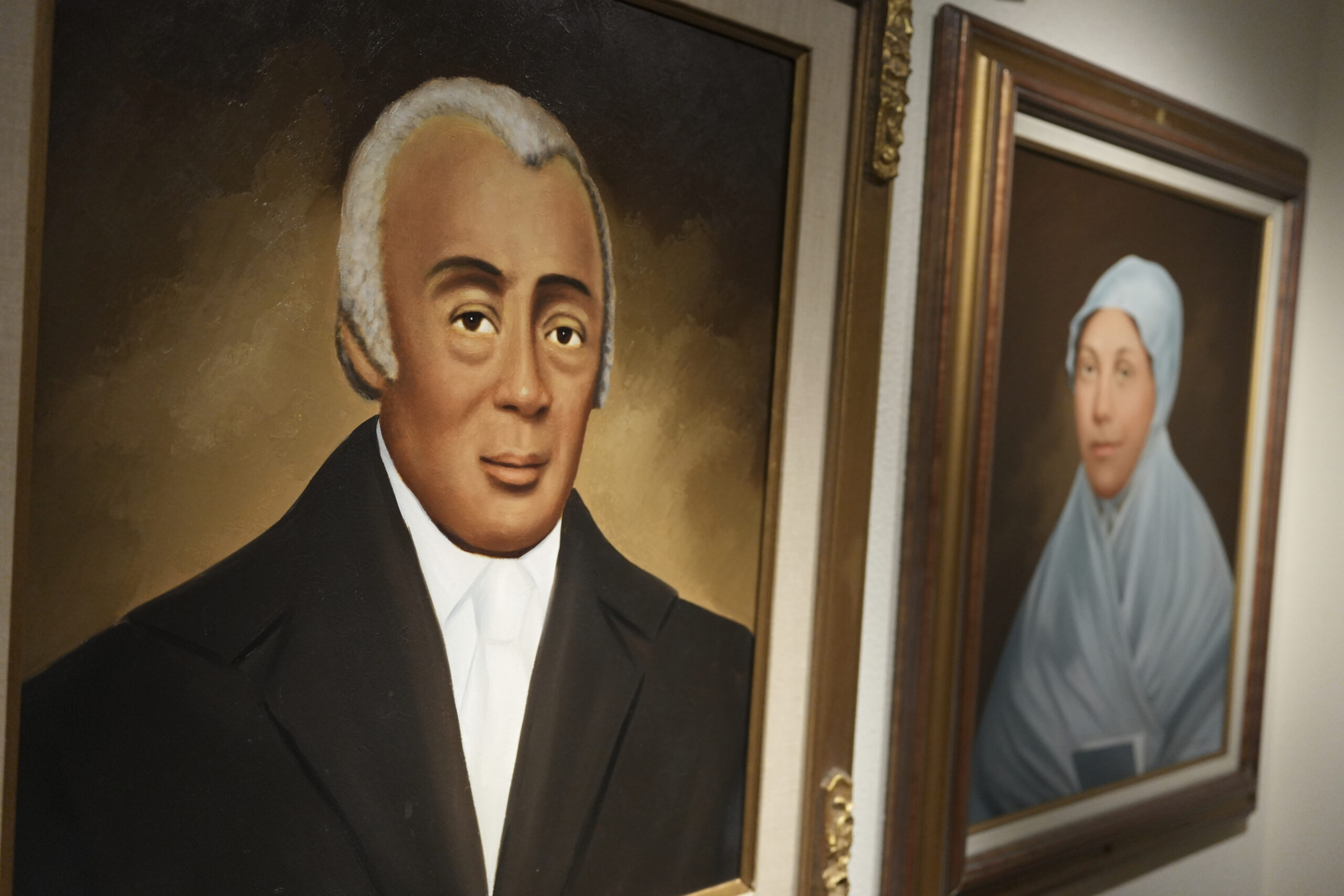
Portraits of Mother Bethel AME Church founder, the Rev. Richard Allen, and his wife, Sarah, are displayed on a wall at the church’s museum in Philadelphia.
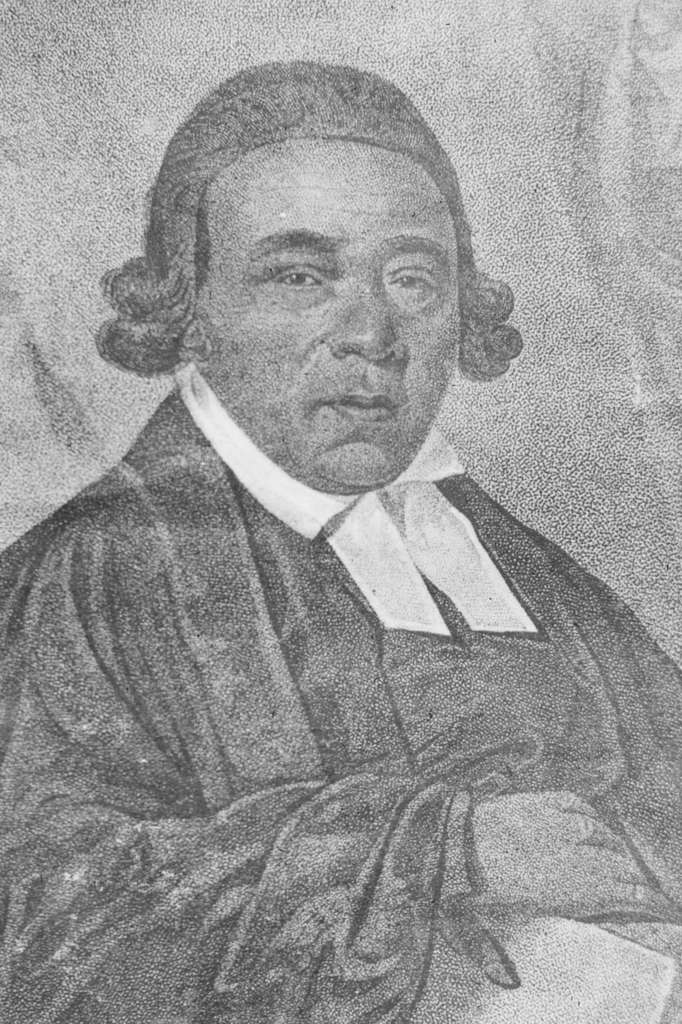
Faith also defined the involvement and influence of African Americans in the struggle for equality and freedom. Richard Allen and Absalom Jones, both important members of the freed Black community in Philadelphia, left St. George’s United Methodist Church over the racism there. Both Allen and Jones would establish churches: Allen starting Mother Bethel African Methodist Episcopal Church and Jones establishing the African Episcopal Church of St. Thomas.
The Rev. Absalom Jones was a priest in the African Episcopal Church of St. Thomas.
To wrest Mother Bethel from the attempts of the white Methodist group to gain control over it, Allen would use the legal system, incorporating the church in 1796 and then fighting to keep control of it from the larger white Methodist denomination. Faith, as well as acumen, would give him the determination to see the legal process through to incorporation in Pennsylvania.
Today, the AME denomination is a worldwide church, estimated to have more than two million members.
Faith would also play a role in establishing organizations within the African American community.
Schools in the 19th and early 20th century found their formation in religious organizations post-Civil War. Clergy would pair with white denominations to form schools such as Spellman and Morehouse. Other organizational structures formed by religious communities would include insurance organizations, funeral homes, fraternities, and sororities. The best-known organization, the National Association for the Advancement of Colored People, would also find pastors and religious figures in the initial call for its formation.
Faith leaders from various religious communities were also instrumental in reminding and challenging white leadership of the promises of democracy and freedom in our founding documents.
In the 20th century, new religious movements such as Garveyism, Moorish Science Temple, the Nation of Islam, and Father Divine’s peace movement would all organize as a counternarrative to the harsh conditions of racism and Jim Crow in American life. All these movements offered an alternative narrative of not only uplift but also promoted different visions of race through religion that drew followers who questioned the merits of white Protestantism for African Americans.
Of course, we cannot forget the role of faith in the civil rights movement. While it is obvious to think of the Rev. Dr. Martin Luther King Jr., it is important to remember that King not only found his voice through Christianity, but through the principle of satyāgraha, soul force, coined by Mohandas Gandhi, the famous Hindu leader who promoted nonviolent struggle that formed the foundations of the civil rights movement. Diane Nash, who was Catholic and considered being a nun before becoming an activist while at Fisk College in Nashville, would become an important part of the movement — along with figures like the late U.S. Rep. John Lewis, who was enrolled in divinity school before joining the movement.
All of these are very brief examples from a very diverse history of faith in the African American community that was not only about individual belief, but many times served as a counter to the racism of religious communities in America that treated African Americans as second-class citizens.
Suppressing this history by altering it or calling it DEI does an injustice to the history of faith-based organizing in America.
African Americans’ faith, and the challenges they brought to bear on the racial issues of America, highlighted the promises of the Declaration of Independence and the Constitution. Now, more than ever, we need that faith to sustain us during the 250th anniversary of America.
Anthea Butler is the Geraldine R. Segal Professor in American Social Thought at the University of Pennsylvania.
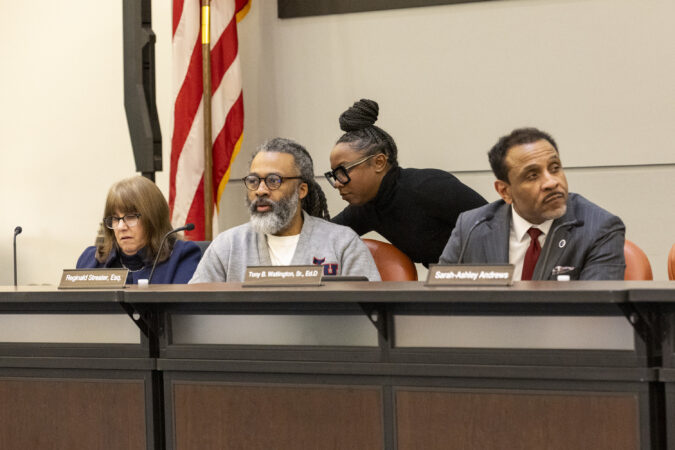
Superintendent Tony B. Watlington Sr.’s facilities master plan — which includes 20 school closures and comes with a $2.8 billion price tag over 10 years — has attracted serious criticism. But while the proposal requires fine-tuning, and officials must work to earn Philadelphians’ trust, Watlington is wisely pushing to modernize and rightsize the district.
The need for a facilities plan is clear.
The average school building in Philadelphia is over 70 years old. More than simply being timeworn and out of date, the district’s buildings frequently contain environmental hazards like asbestos, and staff struggle to maintain older bathrooms and heating systems. In total, the cost of fully updating the district’s facilities is an estimated $10 billion, which is money the district simply doesn’t have.
Meanwhile, many children attend classes in buildings meant for several times the number of students currently enrolled. Others have been forced to use trailers due to overcrowding. Some institutions lack key enrichment programs, like art or music.
Unlike the downsizing in 2013, when Superintendent William R. Hite Jr. closed over 20 schools in a desperate bid to stave off a fiscal crisis, Watlington’s plan comes with some clear benefits to students, families, and educators.
The city plans to open new schools (in part by using empty space in existing buildings), expand access to criteria-based middle school programs, create additional career and technical education pathways at neighborhood high schools, and update recreational and performance spaces. These investments lean into the district’s relative strengths. Suburban schools may have more resources, but they don’t have options like the Philadelphia High School for Creative and Performing Arts, George Washington Carver High School of Engineering and Science, or Central High School.
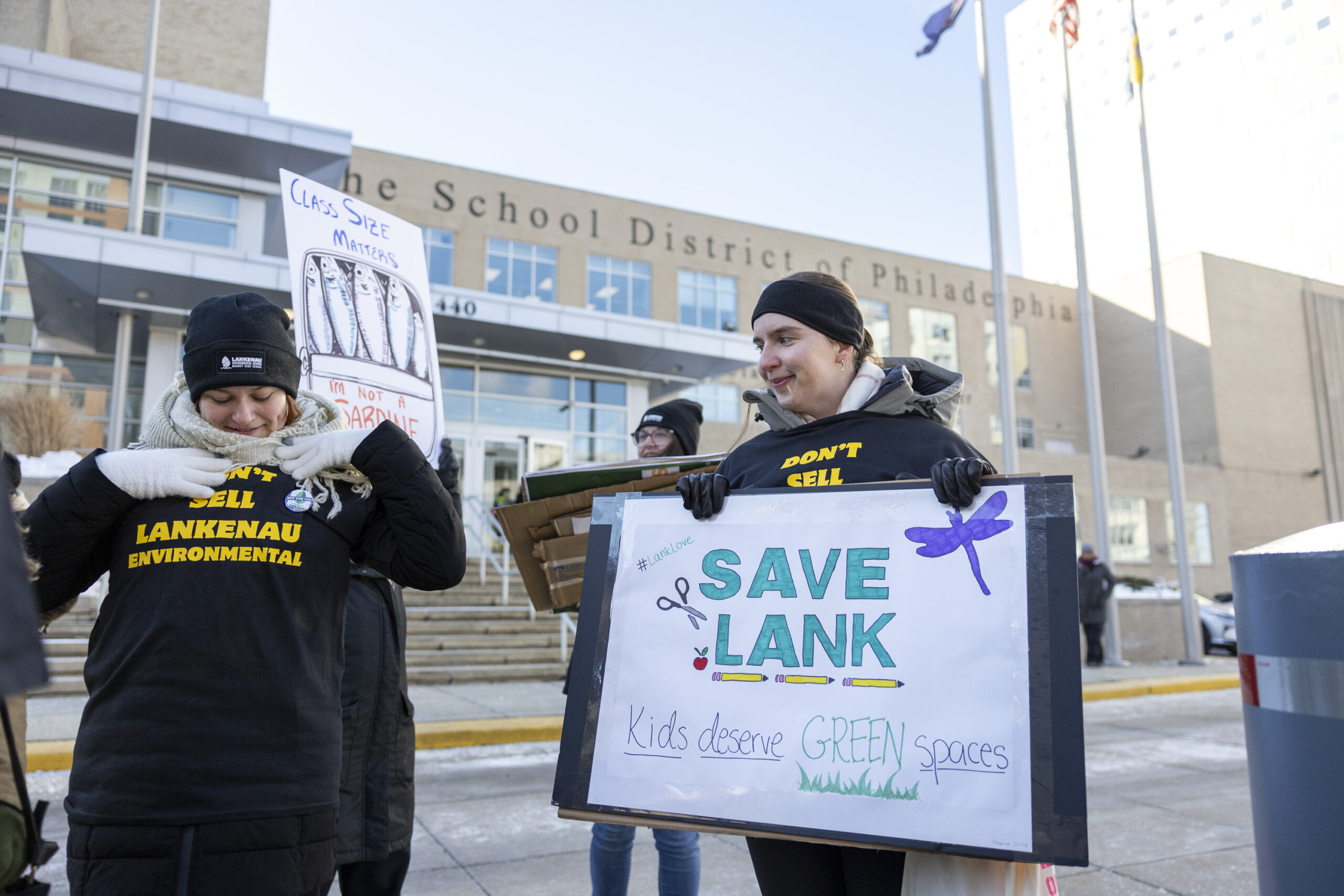
The plan, of course, is not perfect. One proposal the district should reconsider, for example, is the relocation of Lankenau High School. The facilities plan recommends relocating Lankenau to Roxborough High School, which would make it difficult to offer many of its nature-oriented programs. The district may be better off keeping Lankenau and closing Roxborough, which has just over 600 students and test scores that are lower than district-wide averages.
Grace Keiser, 27, of Norristown, a math teacher at Lankenau High School, holding a “Save Lank” sign during a rally outside the Philadelphia School District in January.
Another reason to reconsider closing Lankenau is the fact that some of the school’s struggles are the result of district decisions. The poorly executed revamp of admissions at the city’s criteria-based, or magnet, high schools led to recruiting struggles at many of the district’s most well-regarded institutions. Beyond Lankenau, CAPA and Girls’ High also experienced a dip in enrollment. For the school to experience another drastic change would be a step backward.
Another criticism of the plan is that it will impact predominantly Black schools and neighborhoods disproportionately. This is partly a reaction to trends that are far outside the district’s control. Since the 2014-15 school year, there are around 20,000 fewer Black students in traditional public schools. Another factor is the rise of charter and cyber schools, which educate nearly 80,000 students in Philadelphia. As this board wrote in 2024, “threading this needle might be the most daunting part of the job” when it comes to reorganizing the district’s schools.
The facilities plan has attempted to soften the blow by including a neighborhood vulnerability score. Without it, the plan would likely recommend more closures in predominantly Black neighborhoods.
Some of the outrage over the plan has less to do with the specifics of the proposal and more to do with the district’s deficit of goodwill among residents. After the 2013 closures, many educators noted an uptick in behavioral issues, and the financial savings failed to fully materialize. It is important to note, however, that while this plan is constrained by fiscal realities, it was not created in reaction to them. The goal is not to save money, but to improve buildings and programs for students.
Each building that the district transfers to the city for new usage eliminates millions of dollars’ worth of overdue maintenance and upgrades. Given the nearly $30 million cost to renovate and remediate asbestos at Frankford High School, reducing the district’s capital needs by shrinking its physical footprint is the right call. It creates fiscal space for the district to invest in programs that are succeeding.
No one cheers for the closure of schools, but Watlington’s plan offers students across the city access to better facilities and better programs. After some revisions, it should move forward.
With the midterm elections about eight months away, President Donald Trump is doing his damnedest to undermine the public’s faith in our electoral process. He used his speech at the World Economic Forum in Davos, Switzerland, to tell the whole world the Big Lie about his winning the 2020 election. And now he is sending the FBI to Atlanta to look for evidence of fraud in the 2020 Georgia election.
But apparently, these tactics are not enough to reassure Trump of a Republican victory in 2026. He wants access to voter rolls in Atlanta and in Minneapolis, where the governor and mayor have refused his bribe: relief from the invasion of armed U.S. Immigration and Customs Enforcement and U.S. Customs and Border Protection agents. We can only speculate on how the personal information contained in voter rolls might be used to manipulate voters.
So what can be done to protect the integrity of our elections? State election officials — Democrats and some Republicans — are taking steps to ensure election security. And we, as citizens, can help by encouraging our friends and neighbors to exercise their right to vote and by reporting to local election officials any interference with voters accessing the polls or casting their ballots.
Susan Reisbord, Philadelphia
Apt comparison
I read the article headlined “Philly DA Larry Krasner says ‘don’t be a wimp’” after Gov. Josh Shapiro decried Mr. Krasner’s comparison of U.S. Immigration and Customs Enforcement agents to Nazis, and am in agreement with Mr. Krasner. It is indeed appropriate to compare ICE agents to “Nazis.” There is ample historical precedent for this comparison. The protofascist Freikorps that were used by the government to suppress socialists and communists grew into the Sturmabteilung, or SA, which was the paramilitary force initially used by the NSDAP, or Nazi Party, to terrorize Jews, Roma, socialists, and others who opposed the party. What we see now in several largely Democratic cities under siege by ICE is highly reminiscent of what the Freikorps and SA did during the gradual loss of the nascent democracy that was Weimar-era Germany. Our governor and Sen. John Fetterman would do well to consider what my childhood rabbi, Joachim Prinz, stated in 1963, as mentioned in the article: “The most urgent, the most disgraceful, the most shameful, and the most tragic problem is silence.” They should be calling ICE for what it is: a fascist paramilitary force that operates outside the law.
I see no reason to apologize to anyone for drawing that parallel — nor do I understand the outrage that accompanied Larry Krasner’s statement making the same comparison.
Mark Turetsky,Lower Gwynedd
Join the conversation: Send letters to letters@inquirer.com. Limit length to 150 words and include home address and day and evening phone number. Letters run in The Inquirer six days a week on the editorial pages and online.