Category: Opinion

  • The retirement loophole that just won’t die | Editorial

    The retirement loophole that just won’t die | Editorial

    City Hall just can’t quit abusing a retirement perk known as the Deferred Retirement Option Plan, or DROP, that was supposed to be self-sustaining but costs Philadelphians millions of dollars a year.

    Now, along comes City Councilmember Curtis Jones Jr. and his wife, City Representative Jazelle Jones, to take it up a notch.

    The power couple plans to collect up to $752,000 in combined retirement payouts. But rather than ride off into the sunset, they both plan to keep their respective six-figure jobs.

    The scheme raises a question that has long plagued DROP: What is the point of a retirement incentive if the person doesn’t retire?

    The problem goes back to 1999, when former Mayor Ed Rendell pitched it as a good government idea when it was really nothing more than a sweetheart enrichment program for city workers at taxpayer expense.

    At the time, Rendell said DROP would not cost the city any additional revenue. But one study found that in its first 11 years, DROP cost the city $258 million, which is almost enough to cover the school district’s $300 million budget deficit this year.

    For those unfamiliar with DROP, it is a program that allows eligible municipal employees to select a mandatory retirement date up to four years in advance. While they continue to get paid to do their job, the city makes pension payments into a special interest-bearing account that results in a lump-sum payout upon retirement.

    After retiring, they receive their standard monthly pension. City workers contribute to the pension fund, but that does not cover all the pension fund liabilities, let alone the added costs of DROP, which are ultimately borne by taxpayers.

    The added costs prompted several cities to eliminate or heavily restrict their DROP programs, including San Diego, San Francisco, Houston, and Baltimore.

    In Philadelphia, more than 12,000 municipal employees collected DROP payments totaling $1.5 billion from 1999 to 2018. The payments have since topped $2 billion, according to one recent report by former Inquirer reporter Ralph Cipriano, who has long followed the program as an independent journalist.

    Bottom line: DROP is not revenue-neutral.

    Rendell’s other claim was that by entering DROP, the city would have four years to find or train a replacement for the retiring worker.

    It was always ludicrous that it would take years to find or train a replacement when most places of employment manage to survive when a person gives two weeks’ notice. But that was the story, and the city stuck with it.

    Mayor Ed Rendell delivers his State of the City address in Lincoln Hall at the Union League in February 1999. Rendell claimed the Deferred Retirement Option Plan would not cost the city any additional revenue. Instead, around $2 billion has been spent since 1999.

    In the case of Jazelle Jones, four years’ notice was apparently not enough.

    She was set to retire in September 2024, but Mayor Cherelle L. Parker asked her to stay on the job and issued a special exception so she could be rehired.

    Following a one-day retirement, Jones, 70, received a $97,000 payout for unused sick and vacation time, in addition to a DROP payment of nearly $320,000. She was then rehired with a $4,000 pay bump.

    Jones, whose annual salary is $199,000, serves as the city’s chief ambassador and director of special events, such as parades, concerts, festivals, and athletic events.

    Parker defended the move because of Jones’ experience overseeing major events like the current World Cup games.

    But there is no defending her Council member husband’s plan to collect his DROP payment and continue serving in office.

    DROP was never intended for elected officials, since voters determine whether they get to keep their seats.

    Controversy erupted in the early 2000s after several elected officials collected large DROP payments, retired for a day, and returned to office. City Councilmember Frank Rizzo Jr. lost his election bid in 2011 after he accepted a DROP payment.

    In 2010, Council barred future elected officials from participating in the program — but grandfathered anyone already in office. That included Curtis Jones Jr., 68, who was first elected in November 2007.

    He enrolled in DROP in August 2024 but plans to run for a sixth term next year. If Jones is reelected, he could then retire for a day in 2028, collect his $432,221 DROP payment, and then serve another four-year term. The Council member told The Inquirer he instead plans to retire in December 2027, collecting a reduced DROP payment closer to $350,000.

    What a mensch.

    Jones has publicly discussed delaying bridge repairs in his district to avoid traffic jams that may rankle voters during his reelection campaign.

    Perhaps voters should beat a path to finding candidates who put the public’s interest before their personal gain.

    Even better, the city should put an end to DROP.
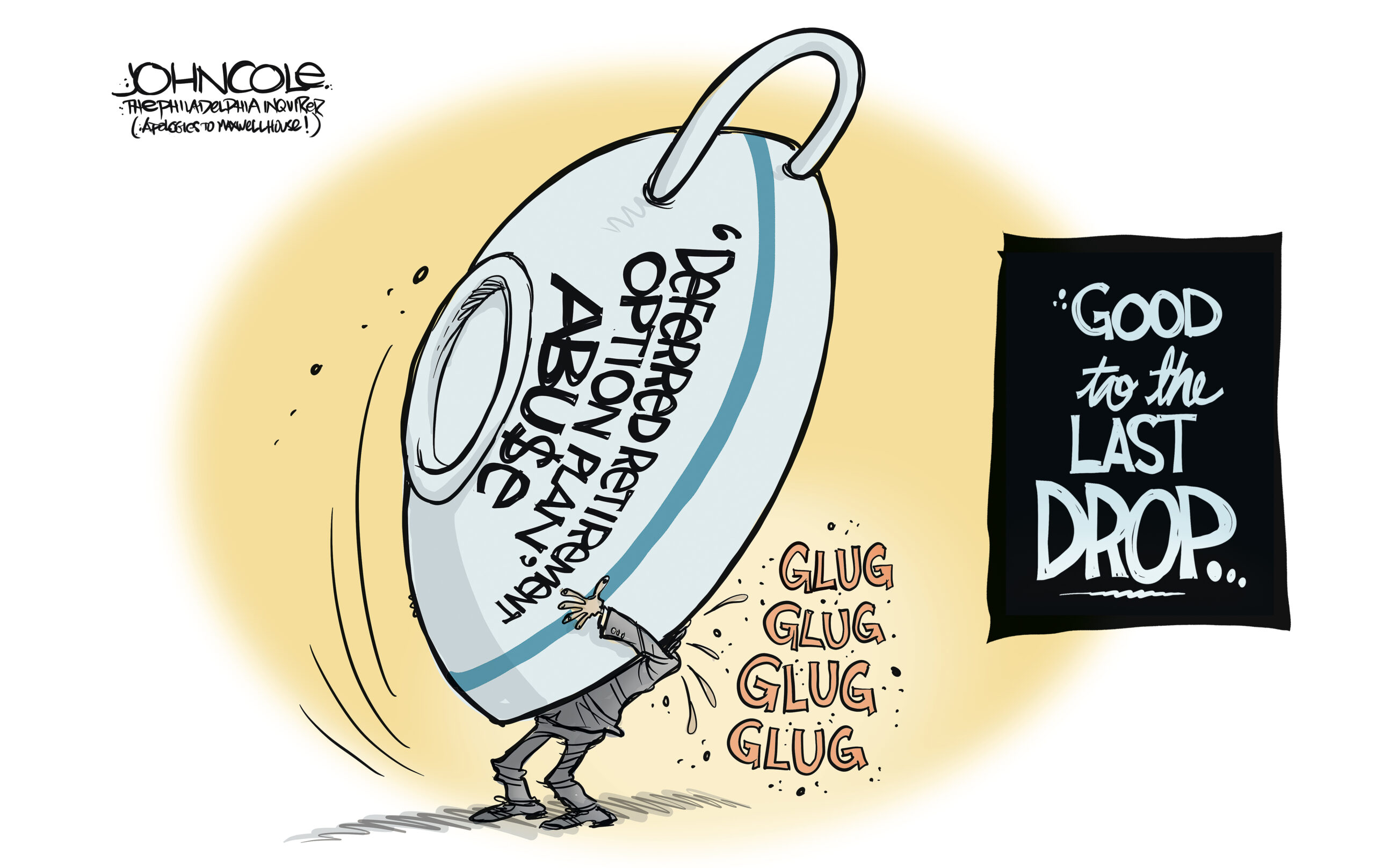
  • Good to the last DROP | Editorial Cartoon

    John Cole spent 18 years as editorial cartoonist for The (Scranton) Times-Tribune, and now draws for various statesnewsroom.com sites.

  • Five wacky things I saw on the Nic Cage bar crawl

    Five wacky things I saw on the Nic Cage bar crawl

    Like many, I’m big fan of Nicolas Cage’s work. How big? On my bachelorette party to New Orleans a few years ago I requested we tour St. Louis Cemetery No. 1 so I could get a pic of me and my girls with Cage’s nine-foot pyramid tomb.

    Not only can the man seriously act, he can also seriously overact. As a writer who loves puns ( especially bad ones), I appreciate someone who has fun with their art form to the point it causes eye rolls.

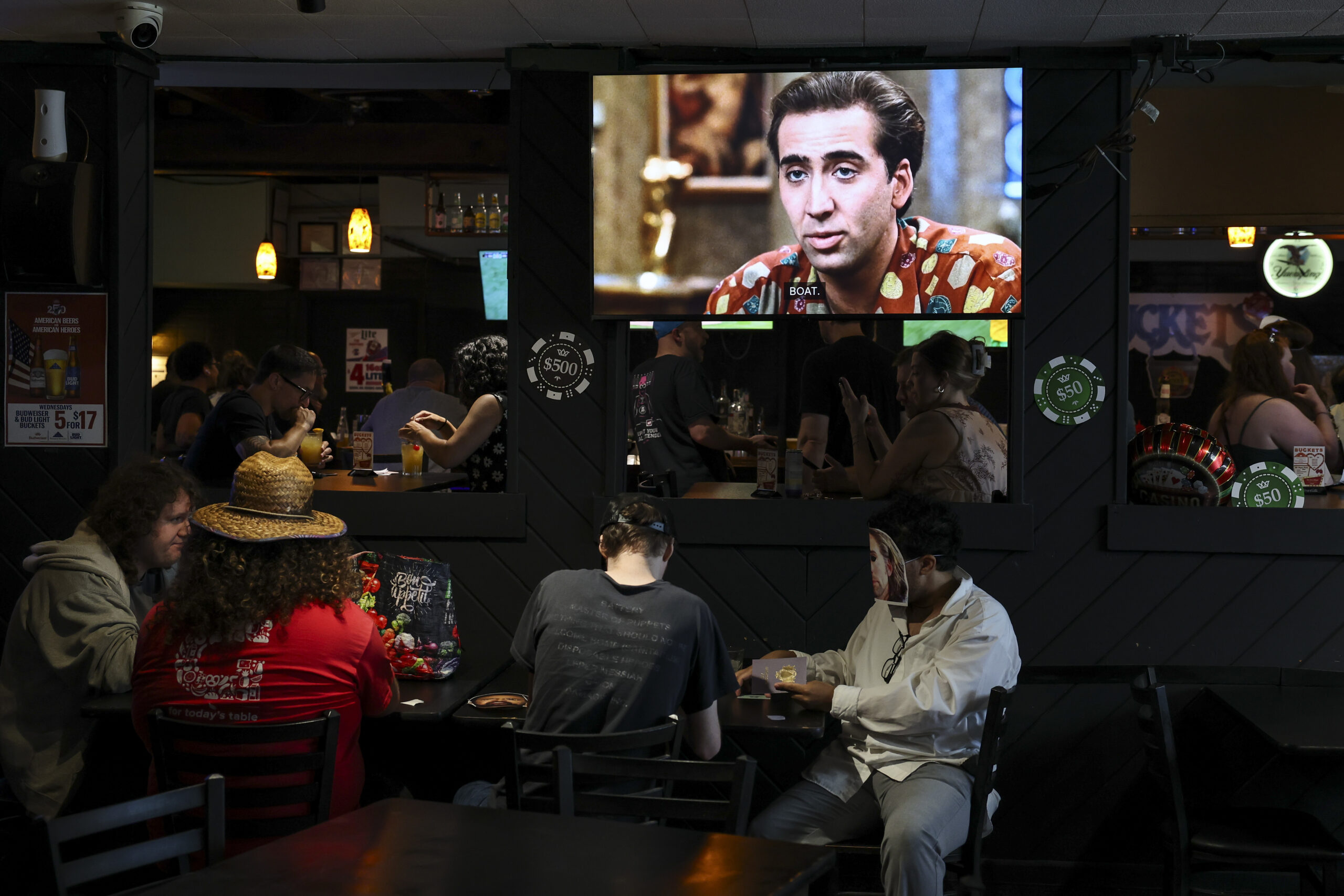
    And so, when I learned about Uncaged in Jenkintown: A Nic Cage cocktail crawl that happened on Sunday, I wanted to check it out. In some ways, it turned out to be like a lot of Cage movies — not a blockbuster, but still quirky and fun.

    “Honeymoon in Vegas” plays at Buckets Bar during the Nic Cage cocktail crawl on Sunday in Jenkintown.

    The crawl was spread across four Jenkintown bars — the Keep Easy, the Drake Tavern, Buckets Bar, and King’s Corner. Each one featured Cage-themed cocktails and hosted a “Cage match,” where participants went head-to-head in challenges based on Cage films.

    Organizer Mel Hager, an owner of the Keep Easy, said she sold out of the 50 Uncaged kits she’d prepared for $15 a pop. While the crawl was free to attend, those who bought a kit — including yours truly — received a passport book, which got you a free Cage match at each establishment (otherwise they were $2 to play); a piece of Cage cash, which was good for one shot at any of the bars (it’s a tiny dollar bill with Nic Cage’s face on it, I’m never spending that); and one of a variety of Cage masks (I felt like I won the lottery when I got the Con-Air Cage).

    While I didn’t drink, I hopped around to the bars, tried my hand at the Cage matches, and talked with fellow Cage fans about what brought them out to the event. Here are five of the wackiest things I saw at the Nic Cage bar crawl.

    1. H.I. fashion

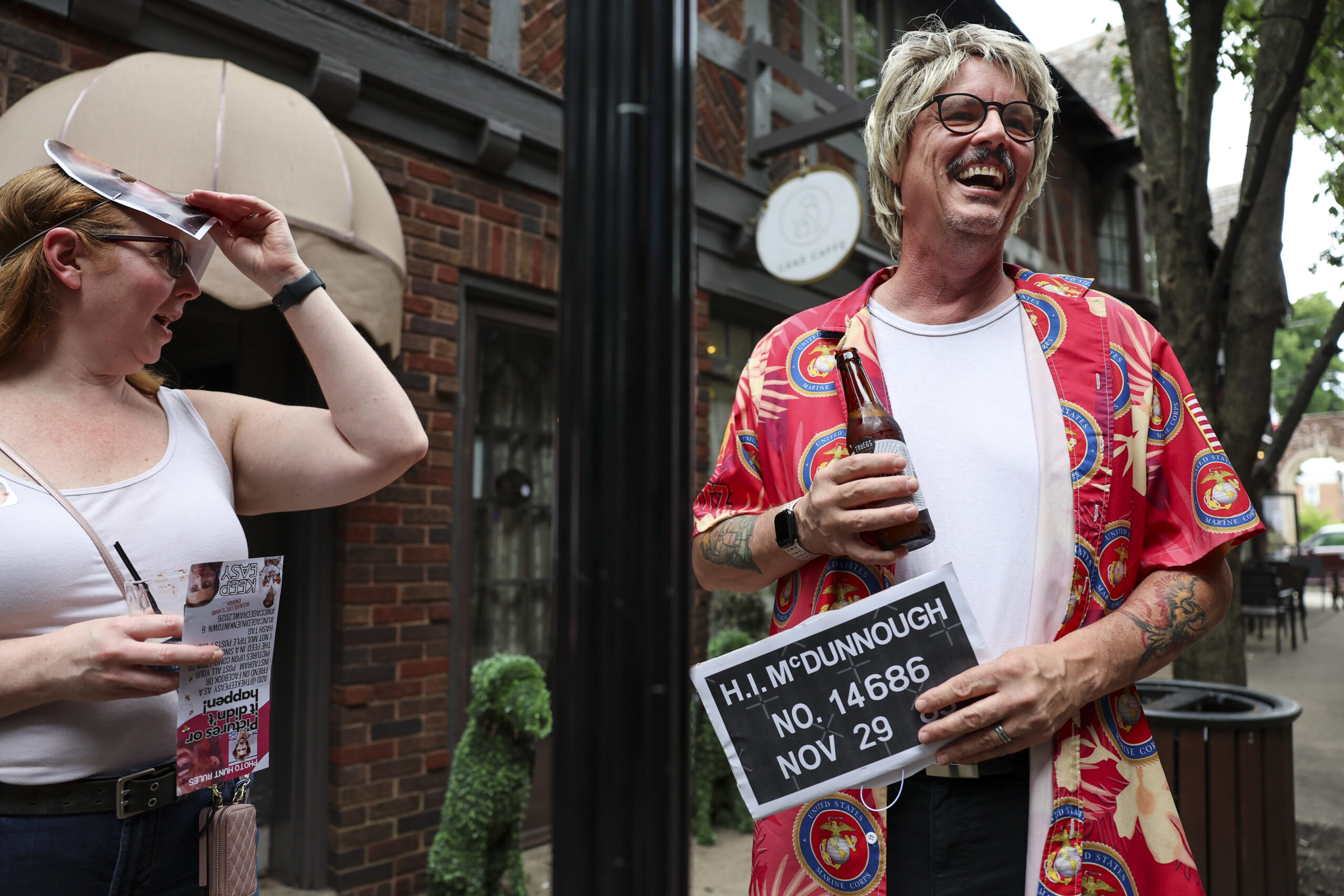
    Vicky and Mike Hutz, of Huntington Valley, at the Keep Easy during the Nic Cage cocktail crawl on Sunday in Jenkintown. Mike Hutz is dressed as Cage’s character from “Raising Arizona,” H.I. McDunnough.

    When H.I. McDunnough kidnaps one of the Arizona quintuplet babies in the 1987 Cohen Brothers classic, Raising Arizona, he proclaims to his wife: “I think I got the best one.”

    Of the few Cage character costumes I saw Sunday — which included Ronny from Moonstruck, Cameron Poe from Con Air, and someone portraying Cage’s first role as an unnamed burger shop worker in Fast Times at Ridgemont High — Mike Hutz’s H.I. McDunnough costume was undoubtedly the best one. Hutz, of Huntingdon Valley, had the open Hawaiian shirt, a wig, and McDunnough’s mugshot board.

    “What else are you going to do on a Sunday afternoon when you have a Nicolas Cage crawl option?” he said. “There’s nothing he can’t do and he does it with maximum cheesiness, which is just perfect for people who love cheesy.”

    2. The faces

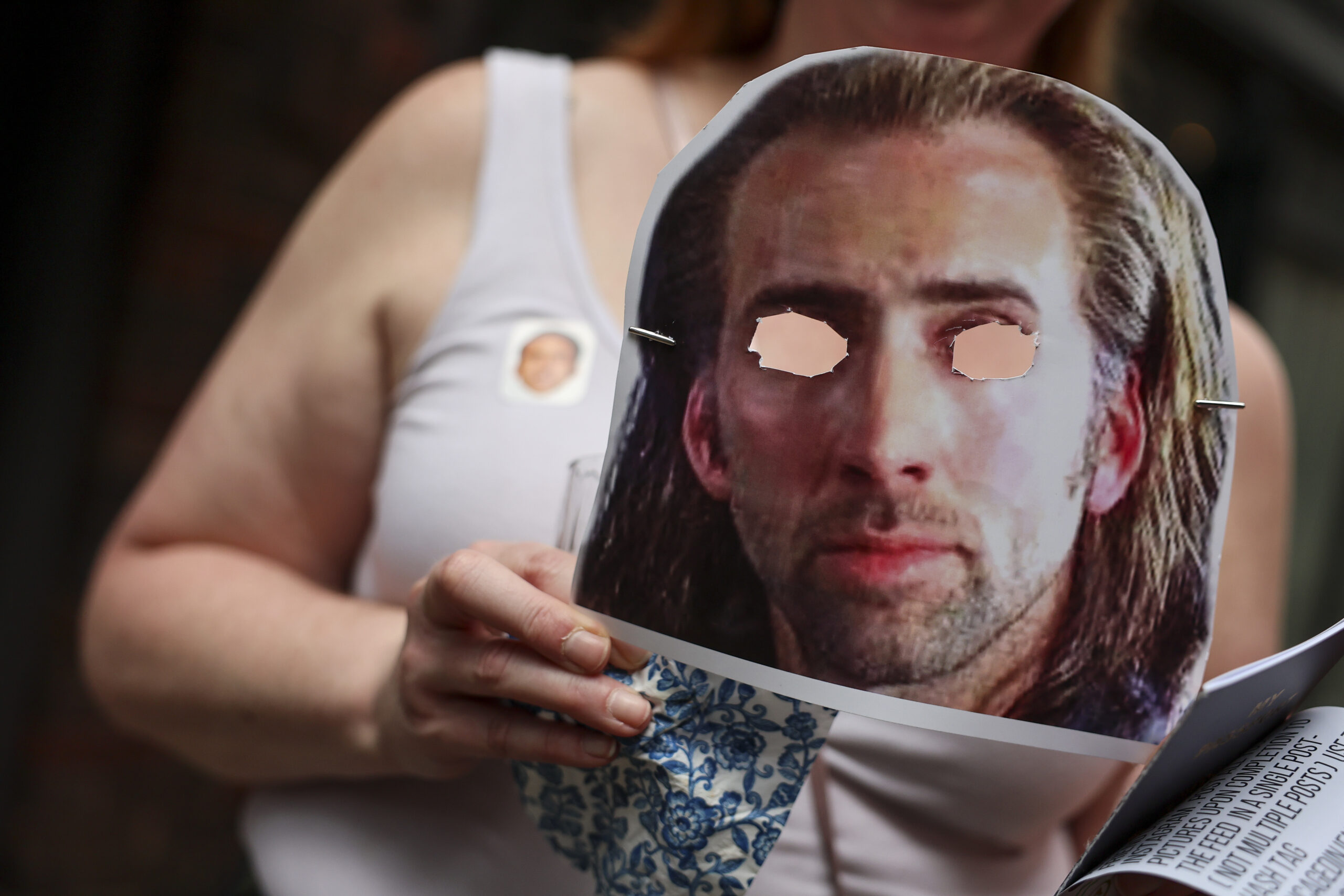
    Seeing people at bars and walking the streets of Jenkintown wearing Cage face masks was both highly amusing and mildly unsettling, mainly because the eye holes were cut out wonkily, giving them a ragged, creepy edge.

    Masks included Face/Off Cage, Con Air Cage, red carpet Cage, and Dracula Cage (from the movie Renfield).

    Vicky Hutz, of Huntington Valley, holds a “Con-Air” Nic Cage mask at the Keep Easy during the Nic Cage cocktail crawl on Sunday.

    Julia Sousa and Josh Douglas traveled to the crawl from Roxborough because they love Cage and Jenkintown. Douglas walked from bar to bar with his Cage face mask on, which seemed to startle some passing motorists.

    “I’m pretty sure they thought I was Michael Myers,” he said.

    3. The Cage matches

    The games based on Cage films, while homespun, were clever and fun. At Buckets, the game was inspired by the scene in Honeymoon in Vegas where Cage skydives with a bunch of Elvis impersonators. Contestants had to throw toy parachute soldiers that were painted to look like Elvis onto particular spots of a mock-up of the Vegas strip for points.

    Julia Sousa and Josh Douglas, both of Roxborough, compete in the “Flying Elvis Cage Match,” at Buckets Bar during the Nic Cage cocktail crawl on Sunday in Jenkintown.

    At King’s Corner, where the challenge was based on the movie National Treasure, participants had to solve little metal mind-bender puzzles.

    For the Spider-Noir Cage match at the Drake, you had to keep a balloon bouncing in the air while putting on a cape, mask, and fedora.

    I failed spectacularly at all three of those challenges — and I was completely sober! The only one I did succeed at was called Ghost Glider. Based on the film Ghost Rider, the challenge was to to roll a penny down an inclined surface made to look like a road and into the tongs of a fork at the other end.

    The “Ghost Glider” Cage match at the Keep Easy during the Nic Cage cocktail crawl on Sunday in Jenkintown.

    4. Stickers and sage

    For winning the Ghost Glider challenge, I received a bundle of sage and a sticker for my passport book of a shirtless, reclining Cage coming out of a banana.

    Let’s address the sage first: Nobody could tell me why this was my prize for winning the challenge, which somehow makes it even better. I have two theories — it could be because sage rhymes with Cage, or maybe it’s because you light sage and in Ghost Rider, Cage lights on fire.

    Whatever the reason, I’m gonna smudge some stuff up this weekend.

    An a-peeling sticker columnist Stephanie Farr received for winning a Cage match challenge at the Keep Easy during the Nic Cage bar crawl in Jenkintown Sunday.

    Now onto this banana sticker — I don’t know why it exists, but I am so happy it does. Each bar gave a different sticker if you won a challenge, but this banana-Cage split one was, by far, the most a-peeling.

    Later at the Drake, I met Erica Adams of Bensalem and “her only friend of whimsy,” Amanda Knop, who’d driven from Baltimore to attend the Cage crawl with her. Adams had her own stickers of Cage’s head she was handing out like friendship bracelets at a Taylor Swift concert.

    “I just love his movies and doing silly, fun things,” Adams said. “Nicolas Cage himself is very unserious. He’s lived a million different lives in a short span already.”

    5. Picolas Cage

    Justin Walsh poses for a photo with “Picolas Cage” as Jessica Lopez takes the photo at the Keep Easy during the Nic Cage cocktail crawl on Sunday in Jenkintown.

    A giant cut-out of Cage as a pickle, aka Picolas Cage, was stationed outside of the Keep Easy during the crawl. As someone who likes Cage and cucumbers — but hates pickles — it was a jarring experience. But I saw others relishing the photo op so I didn’t make a big dill out of it.

  • Assailed by right and left, the Peace Corps continues to make an apolitical difference

    Assailed by right and left, the Peace Corps continues to make an apolitical difference

    In 1983, I finished college and joined the Peace Corps. I was sent to Nepal, where I taught English in a remote village. To get there, you took an overnight bus out of Kathmandu and then walked for three days into the Himalayan foothills.

    My Peace Corps journey changed my life. It opened my eyes to cultural differences, and it taught me how to communicate across them. That’s been an invaluable tool for me, as an educator and a human being.

    But when I got to graduate school, I discovered that many of my fellow left-leaning students — and some of their professors — had a decidedly less rosy view of the Peace Corps. It was a neocolonial project, they said, designed to enhance America’s global power and to keep poorer countries in perpetual dependency.

    I’ve been thinking about their comments over the past few days, as news spread that U.S. Rep. Scott Perry (R., Pa.) had proposed to eliminate funding for the Peace Corps under amendments he submitted to a House appropriations bill. The York congressman was also an ardent supporter of Elon Musk’s dismantling of the U.S. Agency for International Development, which Perry called a “piggy bank for far-left causes.”

    Yet, the Peace Corps — like USAID — has also been the target of left-wing attacks, which bear a strong echo to Republican ones. Neither side believes Americans can be a force for good in the world.

    That’s why the Peace Corps matters. It’s based on the simple proposition that bringing different people together can help them thrive. And it’s a standing rebuke to cynics on the right and the left.

    Going back to Richard Nixon, GOP politicians have tried to diminish — or destroy — the Peace Corps. Their last effort to zero it out took place in 2019, when U.S. Rep. Mark Walker (R., N.C.) proposed to “put America first” by defunding the Peace Corps and devoting the saved dollars to disaster relief at home.

    Never mind that the Peace Corps represents 1% of our foreign aid budget, which is usually about 1% of total government spending. That means one out of every 10,000 federal dollars goes to the Peace Corps.

    But that’s too much for Perry, who has also proposed eliminating government funding for the Millennium Challenge Corp., which finances infrastructure and anti-poverty programs in poor countries, and for the Democracy Fund, which aids nascent democracies that are under strain.

    U.S. Rep. Scott Perry (R., Pa.) at a campaign event in front of employees at an insurance marketing firm in Harrisburg in 2024. He has proposed eliminating funding for the Peace Corps.

    America’s own democracy is under strain, of course, thanks to the likes of Perry. As his text messages showed, he tried to assist Donald Trump’s effort to overturn the results of the 2020 election. He’s also facing a tough reelection battle this fall against Democratic challenger Janelle Stelson, whom he narrowly defeated in 2024.

    Perry is betting that his campaign to defund the Peace Corps and other foreign aid will help him at the polls, and I hope he’s wrong. But I also think it’s wrong to dismiss the Peace Corps as an imperial power grab, as my grad student colleagues did.

    That critique has been revived in the digital age by “No White Saviors,” a social media campaign begun in 2018. When the Peace Corps evacuated all of its volunteers during the 2020 COVID-19 pandemic, No White Saviors said they should stay home.

    “No more pretending inexperienced young people are actually useful in countries and cultures they are alien to,” No White Saviors declared. “No more spending money on flights or evacuations, no need to teach language or culture.”

    That demand was taken up within the Peace Corps itself. Calling themselves “Decolonizing Peace Corps,” disillusioned volunteers called for the abolition of the agency. The Peace Corps was a scam, they said, spending scarce resources that could be better used at home.

    Scott Perry and Mark Walker couldn’t have put it better themselves. Whatever their other differences, America First Republicans and No White Saviors think the Peace Corps is a waste of taxpayer dollars.

    Please. The 250,000 people who have served in the agency have generated enormous goodwill overseas and huge benefits at home. More than 80% of them continue to volunteer in their communities. A quarter of them have started businesses.

    They’re also more diverse than No White Saviors assumes. In 1990, four years after I returned from Nepal, only 7% of volunteers were nonwhite; in 2020, 34% were.

    I didn’t go to Nepal to save anyone. I went to live, and to learn, and to grow. And 25 years later, I returned to my village with my 17-year-old daughter. A bus road had been cut into the hills, so the three-day walk was narrowed to about six hours.

    The school where I taught held an impromptu “welcome home” ceremony for us. I stood up to give a speech in my broken Nepali, but broke down in tears, overwhelmed by my good fortune to have known these good people. If we jettison the Peace Corps, fewer Americans will experience that kind of connection. I just don’t see how that can be good for America or for the world.

    Jonathan Zimmerman teaches history and education at the University of Pennsylvania. He is the author of “Schooling Citizens: How Education Can Save Democracy,” which will be published next spring by the American Philosophical Society Press.

  • Letters to the Editor | June 30, 2026

    Letters to the Editor | June 30, 2026

    Vance snubs vets

    The constant propaganda emanating from the current presidential administration continues to be dangerous and disturbing. The latest example concerns our vice president’s comments concerning Richard Nixon and the Vietnam War. Our nation suffered the loss of 58,000 service members during the Vietnam War, and it would be difficult to find an American family in the 1960s and early 1970s that had not been touched by the war’s violence. To rewrite the war’s history and its conclusion — not to mention the unlawful conduct of President Nixon during his administration — is insulting to all Americans and service members who served during those years.

    Thomas M. Lynch, Voorhees

    Reflections

    As voters go to the polls this November, I hope they remember that the people they elect are a direct reflection of themselves. Before you pull the lever to register your votes, think hard about how you want people across America and the world to view you.

    When you elect a candidate who says and does disgusting things, others will believe that is an accurate reflection of your values and morals. If you vote for a person who is lawless and disrespects our Constitution, are you willing to accept that others will think you believe this behavior to be acceptable and honorable enough to represent you? Are you willing to elect a candidate who will decide on legislation that will directly impact your life, but is someone you wouldn’t trust to babysit your children or your pets? I urge people to think hard about the candidate they are considering.

    In the end, whoever gets elected will be a direct reflection on the voters and their communities.

    Fred Shapiro, Margate

    Fearmongering

    What keeps you up at night? Is it voter fraud? Rigged and stolen elections?

    I guess it keeps the president up, because he says voter fraud is a national emergency and should be Congress’ top priority. He refused to sign a bipartisan housing bill that would have improved the lives of Americans all over the country because of this “national emergency.”

    I think most people would say what keeps them up at night is being able to pay their bills, to have secure housing, affordable healthcare. The president says he doesn’t worry about inflation or high gas and grocery prices — things that affect the lives of Americans every single day. He obviously is not concerned about people’s housing status because he’s chosen to block the bill that would have given them some relief.

    I think we all know there is no national emergency around elections.

    The real emergency here is Donald Trump’s fear that the Republicans might lose their majority in Congress, which would be a defeat for him.

    June Siegel, Elkins Park

    Join the conversation: Send letters to letters@inquirer.com. Limit length to 150 words and include home address and day and evening phone number. Letters run in The Inquirer six days a week on the editorial pages and online.

  • Trump’s Reflecting Pool debacle mirrors what’s ailing America

    Trump’s Reflecting Pool debacle mirrors what’s ailing America

    WASHINGTON — I arrived in Washington, D.C., on Wednesday and headed straight to the Reflecting Pool on the National Mall to see for myself what it looked like.

    At first glance, it appeared as if sand had been tossed into the newly renovated water basin located between the Lincoln Memorial and the Washington Monument. But my eyes were mistaken. “The sand” was actually the underlying surface showing through as the coating at the bottom started peeling off.

    Peeling is seen in the blue coating on the bottom of the Lincoln Memorial Reflecting Pool, Wednesday, June 24.

    As I bent down to get a closer look, I made a point to keep my hands close to my body. I knew better than to touch so much as a drop of that water, since people have allegedly been arrested for vandalism after touching the floating detritus.

    President Donald Trump blames “radical lunatics” for defacing his latest renovation project. “This isn’t random mischief — it’s targeted sabotage by anti-American crackpots who despise a strong, proud, and beautiful country. They cannot build; they can only destroy. They cannot celebrate our heritage; they can only deface it,” reads a statement released by the White House.

    I walked around the pool’s entire perimeter. I didn’t notice any stench, not even a whiff. But the reports are true, and Trump’s $14 million no-bid boondoggle to renovate the Reflecting Pool in advance of the nation’s 250th anniversary has faced one stumbling block after another.

    Depending on the angle of the sun and where you’re standing, the combination of the newly added dark paint that’s already chipping away and the algae blooms gives the illusion that the pool is a beautiful aquamarine color. I didn’t expect that.

    But it’s not what the president ordered.

    Nor is it what the American people want or need right now. We want the war with Iran to be over, but Trump is more concerned with putting a Mar-a-Lago-esque stamp on the nation’s capital. He has barely acknowledged that Americans are most concerned about how to pay for gas, food, and healthcare insurance premiums.

    The Lincoln Memorial Reflecting Pool was fine the way it was. Trump should have followed President Joe Biden’s lead and just left it alone. Same thing with the White House East Wing that Trump ordered torn down for a $600 million ballroom project. Same thing with the Kennedy Center for the Performing Arts before Trump made himself chair and slapped his name on the living memorial built to honor the late President John F. Kennedy.

    Trump’s gonna trump, though.

    Back in April, he announced plans to install an industrial-grade surface on the Reflecting Pool. He originally wanted it to be turquoise, but took the contractor’s advice and went with a darker color that he calls “American Flag Blue.” In typical Trump fashion, he claimed it would only take a week to rehab and cost about $1.5 million, only for the project to take months to complete and the cost to balloon to $14 million.

    Workers refilled the pool on June 9. The water quickly turned green, which the U.S. Department of the Interior blamed on “residual algae from the supply lines.” It has since been treated with hydrogen peroxide and ozone nanobubbles. And the blue material coating the bottom has started coming off.

    The century-old Reflecting Pool has had issues for years. But it’s still a beautiful thing to behold.

    Civil rights activists famously flanked it while listening to the Rev. Dr. Martin Luther King Jr. deliver his famous “I Have a Dream” speech in 1963. Same thing when Marian Anderson performed on the steps of the Lincoln Memorial in 1939, after the Daughters of the American Revolution refused to let the African American contralto sing in their concert hall because of her race.

    Under Trump, the Reflecting Pool has become a Rorschach test of where we are right now as a nation. Some only see its beauty, while for others, the bumbling rehab symbolizes yet another Trump failure.

    “I came to see for myself. I wanted to see what all the hoopla was about,” said Cedric Jackson, an Atlanta resident whom I spotted taking photos. “It’s not as green as I thought it was going to be. So they’ve obviously been doing some kind of work.”

    But then he added, “I think this is probably something that could have been avoided.”

    I couldn’t agree more. Like so much damage and harm the Trump administration has inflicted during this second term, it didn’t have to be this way.

  • The World Cup is a stress test for our public health system. We failed it even before kickoff.

    The World Cup is a stress test for our public health system. We failed it even before kickoff.

    This summer, the largest sporting event in human history is moving across three countries, 16 cities, and 104 matches. Millions of people from every continent are passing through the same stadiums, the same airports, the same fan zones. As an infectious disease physician, I can tell you exactly what this is in epidemiological terms. It is a stress test.

    Mass gatherings do not create new pathogens. They reveal the weaknesses present in the systems that receive them. I learned this in Ebola wards and in refugee camps, and I learned it again as the first chief medical officer for New York City during the first COVID-19 surge. The virus did not invent the cracks in our response. It found them, widened them, and poured through them.

    So the right question about the 2026 World Cup is not “what new disease might appear.” It is “what is already broken, and what happens when we run a max-capacity crowd straight through it.”

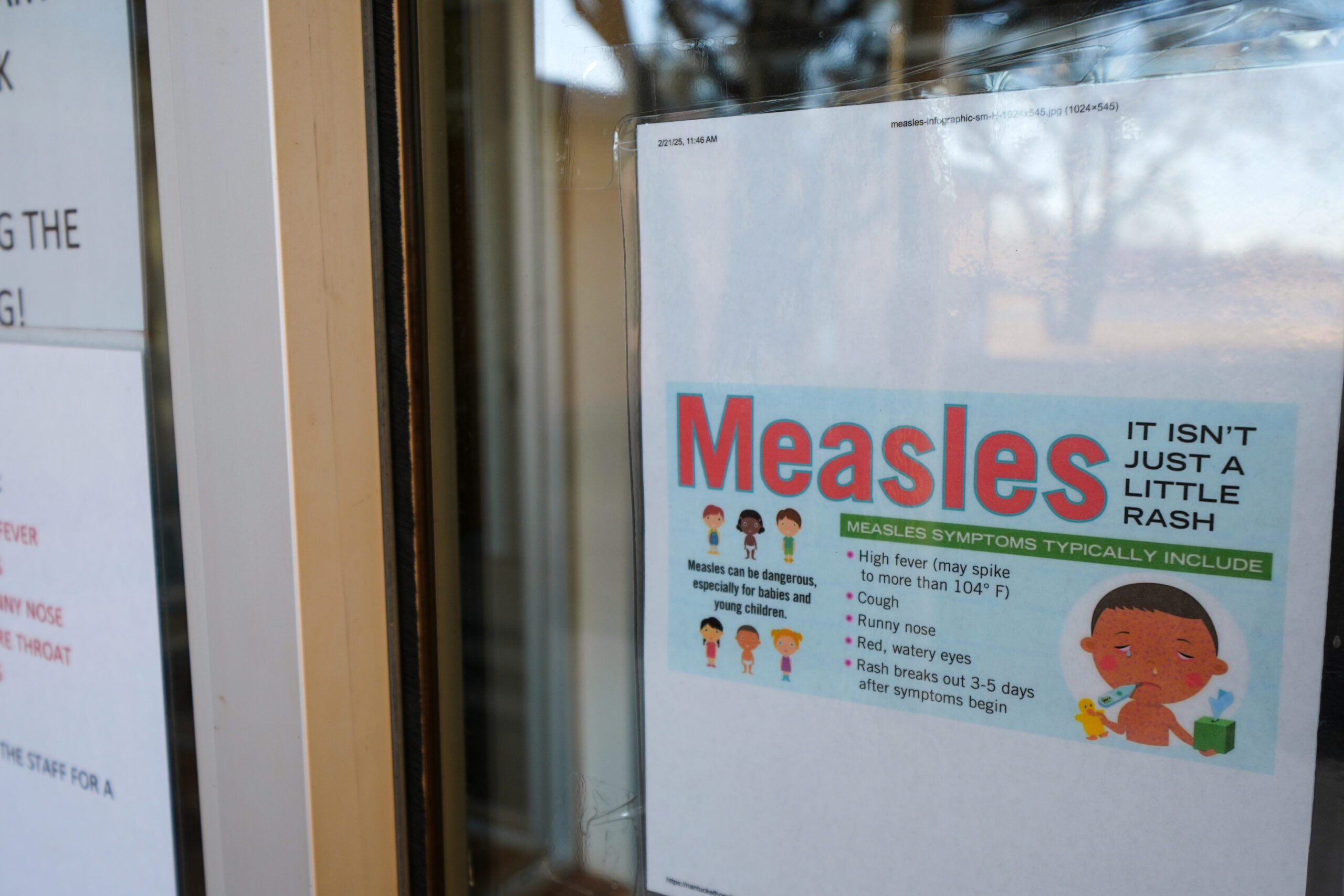
    Start with measles. The United States recorded its worst year for measles in more than three decades in 2025, and 2026 is on pace to be even worse. We have already crossed 2,000 confirmed cases this year. The country that declared measles eliminated in 2000 is now, by the assessment of its own scientists, likely to lose that status.

    This is not a tropical import. This is a homegrown failure of vaccination, accelerated by official messaging that treats a settled question as an open debate. Measles is one of the most contagious pathogens known to medicine. A stadium is, by design, the most efficient room we have ever built for spreading it.

    Now layer the rest. Three host nations means three health systems, three surveillance capacities, and three sets of rules that do not automatically talk to each other. Fans are crossing the Tijuana and El Paso corridors in volume. We will have a kaleidoscope of variable immunity without any uniform vaccine requirements or compliance, and thereby radically divergent vulnerability to infection.

    Moreover, these systems are not connected. These countries rarely speak to one another and the current political climate has exacerbated it. A case detected in one country is only useful if the next country hears about it in time to act. During COVID-19, our data systems were often a week behind the virus. A week is a lifetime in an outbreak.

    A clinic in Brownsnville, Texas, offers measles inoculations. Measles is just one of the infectious diseases that could be spread as people gather in large groups during the World Cup, writes Tyler B. Evans.

    Then there is geography. Several Mexican host cities sit in dengue-endemic zones, and summer is peak mosquito season. Southern Hemisphere visitors are arriving mid-influenza season carrying strains our summer was not expecting. West Nile virus peaks in exactly the Southern U.S. cities hosting matches, in exactly these weeks.

    None of this is exotic. All of it is predictable — which should worry us, because predictable means preventable, and preventable means that whatever goes wrong will be a choice, not an accident.

    There is also what screening cannot see. Ebola is remembered as a disease of blood and isolation wards, but the virus can persist in survivors for months after recovery and can transmit sexually long after a patient is declared cured. Outbreaks have been seeded this way, quietly, by transmission that no fever check at an airport would ever catch. Record crowds could spread disease we have not thought to look for.

    Here is the part that the risk charts miss. The people who will suffer most are not the ticket holders. They are the workers. The food handlers, the stadium cleaners, the hotel staff, the rideshare drivers, the street vendors. They are disproportionately low-income, often uninsured, frequently undocumented, and the least able to take a sick day or see a doctor.

    When transmission runs through a city, it does not stop at the stadium gate. It follows the bus lines home to the neighborhoods with the least health infrastructure and the most people sharing the least space. This is the pattern of every modern pandemic. The pathogen is universal. The suffering is sorted by income.

    The same sorting applies to the infections we never put on a risk chart. Sexually transmitted infections rise wherever large numbers of people gather, travel, and disperse, and they fall hardest on the people with the least access to testing and treatment. Syphilis is already at its highest level in the United States in decades. A surveillance system built around fevers and symptoms will miss these. What we fail to look for, we fail to find.

    We know how to prevent this. The tools are not mysterious. Real-time, trinational surveillance that shares data across the CDC, Canada’s public health agency, and Mexico’s IMSS. Vaccination campaigns that meet visitors and workers before they gather, not after they fall ill. Mosquito control in the cities where the vectors are already breeding. Food and water safety enforcement scaled to the size of the crowd. Medical teams embedded at venues, and clear, accurate public health messaging that treats people as adults rather than as a constituency to be managed.

    None of that is expensive compared to the alternative. It is, however, unglamorous, and it requires a federal posture that takes infectious disease seriously rather than treating vaccine science as a matter of opinion. That is the variable none of us can predict. The mosquitoes will behave as mosquitoes do. The viruses will behave as viruses do. The open question is whether our institutions will behave as public health institutions are supposed to.

    I have spent nearly three decades working in global health across dozens of countries, and I have watched leaders in resource-poor settings mount more coherent outbreak responses than wealthy nations that simply chose not to. Capacity is not our problem. Will is our problem.

    The World Cup is a celebration. I want it to be one. But it is also a mirror, and it is going to show us exactly what we have built and exactly what we have neglected. We still have time to act on what it reveals. The kickoff has already happened. The reckoning is still a choice.

    Tyler B. Evans is the author of “Pandemics, Poverty, and Politics,” founder and CEO of Wellness & Equity Alliance, and a public health policy expert focused on global health security and equity.

  • DACA and TPS recipients pump billions into the U.S. economy. Trump wants them gone anyway.

    DACA and TPS recipients pump billions into the U.S. economy. Trump wants them gone anyway.

    Immigration is complicated. That makes polling on the topic difficult, as the same Americans who will tell you they support mass deportation one day will turn around and say they back a path to citizenship the next. So, which is it? Well, it depends.

    As crowded scenes of immigrants clustering at the southern border were endlessly repeated on TV, many Americans felt the Biden administration was not taking national security seriously and had flung open the golden door to anyone with a pulse and a sob story.

    Then, as U.S. Immigration and Customs Enforcement agents descended on Minneapolis, masked, heavily armed, and dangerously encouraged to ignore people’s constitutional rights — ultimately killing two U.S. citizens because they dared to question authority — even many Donald Trump supporters rose up to say this is not what they voted for.

    Unsurprisingly, most Americans fall somewhere in the middle — where balancing immigration control with humanitarian values looks at what makes the most sense for the country and for the people who are looking for a better life here.

    But that’s illegal immigration. On legal immigration, most Americans are all in, with only one in five opposing it. Why, then, is the Trump administration hell-bent on making life miserable for legal immigrants?

    Earlier this month, a court ruled against an administration decision that froze processing of immigration benefits like work permits and green-card applications for nationals of 39 countries targeted by a travel ban. These are people already in the United States legally who found themselves in limbo for months — many losing their jobs and risking deportation — after U.S. Citizenship and Immigration Services determined in January it would keep the $1 billion in fees these immigrants paid and give them nothing in return.

    Meanwhile, renewals under the Deferred Action for Childhood Arrivals (DACA) program for immigrants brought here as children have been hit with delays, and approvals of legal permanent residency applications, known as green cards, have fallen by around 16% — all part of the administration’s strategy of bureaucratic sabotage in the guise of “enhanced security.”

    The administration has also banned permanent legal residents from qualifying for government-backed small-business loans, while some immigrants, including DACA recipients, can no longer hold commercial driver’s licenses, regardless of possessing a legal work permit.

    Two U.S. Supreme Court decisions released last week will only continue to embolden the administration’s anti-legal immigrant push.

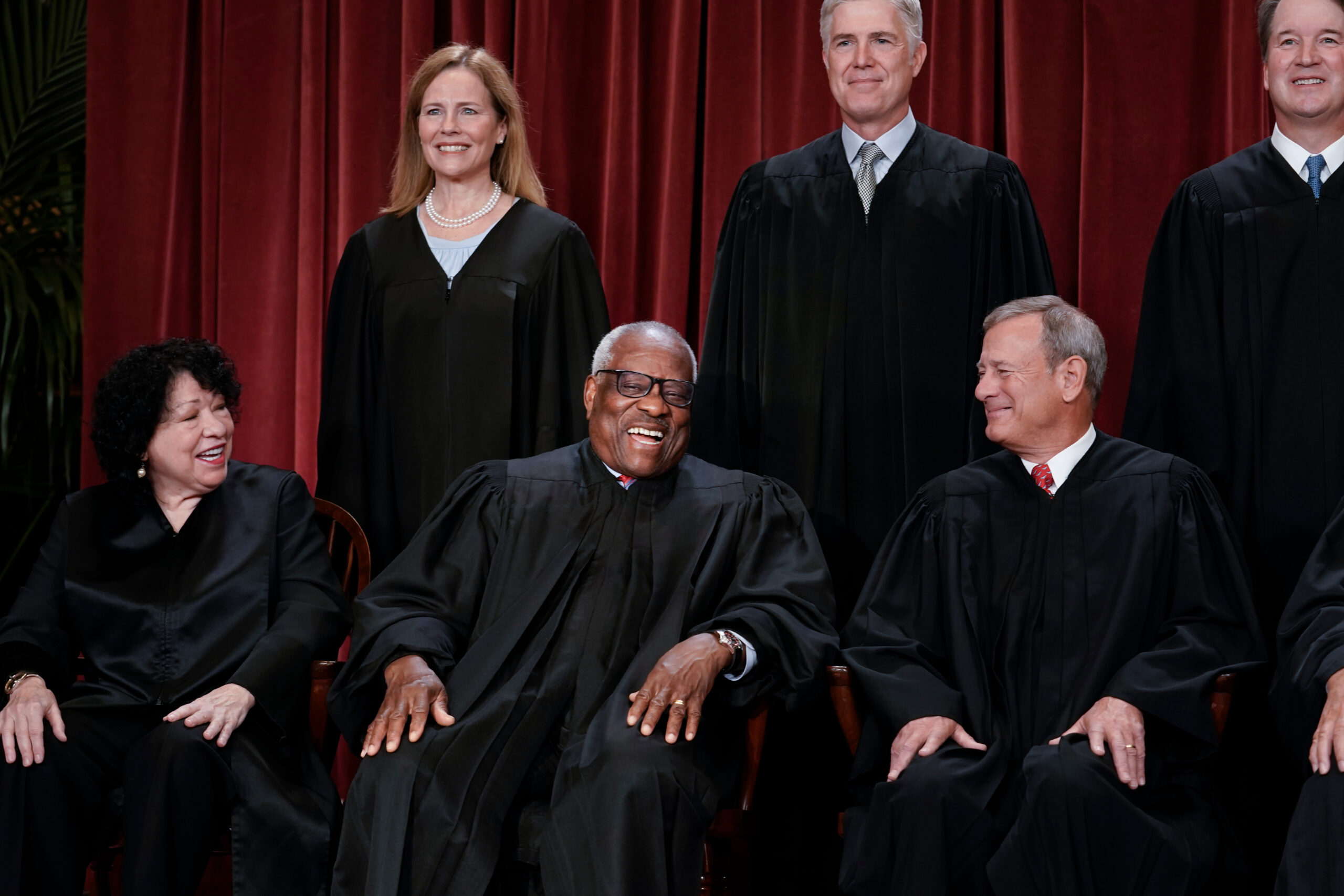
    Members of the Supreme Court sit for a group portrait in 2022. Bottom row, from left, Associate Justice Sonia Sotomayor, Associate Justice Clarence Thomas, and Chief Justice of the United States John Roberts. Top row, from left, Associate Justice Amy Coney Barrett, Associate Justice Neil Gorsuch, and Associate Justice Brett Kavanaugh.

    On Tuesday, the court’s conservative justices affirmed that border officers do not need “clear and convincing evidence” that a green-card holder seeking to reenter the U.S. has committed a crime to deny them entry. While I hope that one day the Clarence Thomas “border vibe check” joins the “Kavanaugh stop” in the annals of legal ignominy surrounding immigration enforcement, the court’s 6-3 decision makes a mockery of the idea that someone is innocent until proven guilty.

    Perhaps even more immediately concerning is the high court’s ruling Thursday allowing the president to end Temporary Protected Status, or TPS, for roughly 350,000 Haitians and 6,000 Syrians.

    The TPS program, a bipartisan congressional creation under President George H.W. Bush, gives immigrants work permits and protection from deportation if they come from countries determined to be too dangerous to go back to. While the word temporary is right there in the name, some program participants have been in the country for decades and have built lives here. For others, the nations they fled are still unsafe to return to, including Haiti, which is in the grip of gang violence and widespread hunger.

    That the conservative justices also found that Trump’s comments against Haitians were not “overtly racial” is absurd. Trump infamously referred to Haiti and African nations as “shithole countries” in the same 2018 meeting in which he wondered aloud why America couldn’t have more immigrants from places like Norway. For context, this is the same administration that considers white South Africans the only persecuted minority worthy of asylum in the U.S.

    For the moment, the court’s decision applies only to Haitian and Syrian immigrants with TPS, but it has opened the door for the president to do what he has wanted to do since his first term, which is to end the program wholesale. That would impact the 1.3 million TPS holders from around 17 nations and their families, many of whom are U.S. citizens.

    While the human impact on communities of this mass de-legalization effort is immeasurable, the economic damage of Trump’s anti-immigrant policies is not.

    The 500,000 or so DACA recipients, for example, contribute nearly $17 billion to the U.S. economy annually, also paying into federal social safety net programs they are not legally able to access themselves, according to the immigration rights group FWD.us. TPS recipients contribute about $29 billion a year to the economy and pay $7.8 billion in combined federal, payroll, state, and local taxes.

    An immigration policy calculator produced by the Manhattan Institute finds that the kind of policies favored by the administration would add $618 billion to the national debt over 10 years, and leave every American poorer.

    Reasonable people can disagree on immigration, but at the very least, Trump’s exclusionary ideas are an economic dead end.

  • Pa.’s Medicaid rollback on obesity drugs is a crisis in slow motion

    Pa.’s Medicaid rollback on obesity drugs is a crisis in slow motion

    The assault on healthcare for America’s most vulnerable is not only coming from Washington. It’s creeping into statehouses across the nation — even here in the commonwealth.

    In Pennsylvania, Medicaid beneficiaries rang in the New Year without the obesity treatments they previously had access to, thanks to the actions of policymakers who moved to prohibit Medicaid coverage to meet tighter state budget benchmarks.

    As a cardiologist who has spent my career treating many Black and brown patients, I have witnessed the consequences of unmanaged obesity play out in the most brutal and preventable ways: men in their 40s having heart attacks, women with decades of life ahead of them receiving stroke diagnoses, and heart failure caught too late for treatment to make a real difference. I have sat with families and explained that the disease that took their loved one was manageable — if caught earlier, with the right treatment. It’s devastating.

    That’s why Pennsylvania’s decision to strip Medicaid coverage for obesity medications, effective Jan. 1 of this year, is a sign of further catastrophe that may be coming.

    Pennsylvania has long been heralded as a champion of health equity, but our legislature is unintentionally sending a message that advances in medicine should be reserved for the privileged, the justification being cost. However, this rationale suffers from tunnel vision — the cost of untreated obesity and its complications is far greater. Treating obesity prevents its complications and saves money.

    Obesity is not a lifestyle failure. It is a chronic disease that exacerbates cardiovascular conditions, already killing Black and brown Pennsylvanians at disproportionate rates. Obesity costs the U.S. nearly $173 billion annually in direct medical costs and more than $1.4 trillion in total economic impact. Cutting access to treatment will only worsen the obesity epidemic and continue to drive up costs.

    Nearly 60% of Black women live with obesity, along with half of all Black and Latino adults. Pennsylvania is home to approximately 3.5 million adults living with obesity — one in three residents, irrespective of race or ethnicity. That number is projected to reach one in two by 2030. But for Black and brown communities, already burdened by decades of systemic underinvestment in preventive care and access to healthy food, the cardiovascular consequences of untreated obesity are the daily reality of emergency rooms and cardiac units across Philadelphia, Pittsburgh, Harrisburg, and everywhere in between.

    Gaps in state budgets shouldn’t be closed by compromising the health of the underserved, communities of color, those with disabilities, and millions of others who depend on public healthcare coverage. Access to healthcare should be more than just a budget debate — it’s both a civil rights and a human rights issue.

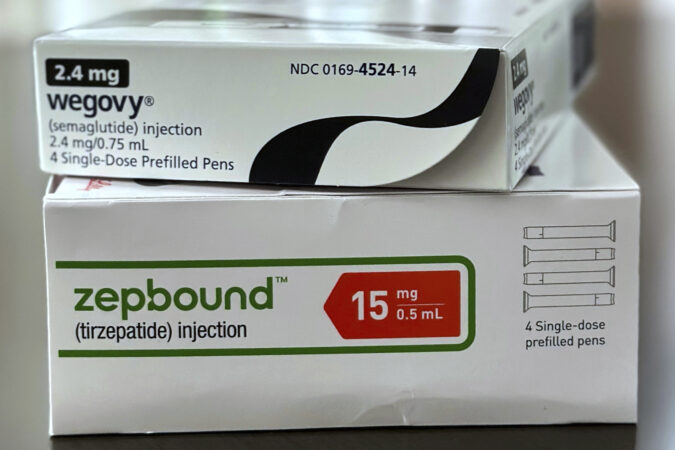
    At the same time, when patients cannot access FDA-approved obesity medications through Medicaid, they resort to whatever fills the void. Right now, that means a predatory market of unregulated, potentially unsafe, compounded GLP-1 drugs aggressively marketed to low-income communities.

    Attorney General Dave Sunday has already warned Pennsylvanians about the dangers of these products. The Shapiro administration itself fined a Chester County pharmacy $1 million for producing unauthorized injectable weight-loss drugs. The state knows this market exists, but fails to see how cutting Medicaid coverage for FDA-approved treatments drives patients straight into it.

    State Rep. Justin Fleming (D., Dauphin) has introduced the GLP-1 Safety Act, which would crack down on illegal compounders and protect Pennsylvanians from dangerous counterfeit medications. His bill deserves passage.

    However, enforcement without access is not a health policy. It forces patients to choose between nothing and something dangerous. For Black and brown patients in Pennsylvania, this is not hypothetical, but their current reality.

    Pennsylvania once led the nation by expanding Medicaid to cover chronic conditions like obesity. But now, with Washington dismantling Medicaid at the federal level — 310,000 Pennsylvanians are projected to lose coverage under federal cuts beginning this year — it’s important that the state moves in the right direction at the state level.

    Choosing exclusion and shortsighted cuts is weak policy and will not achieve future healthcare savings. Pennsylvania can once again lead in equitable access to obesity treatment. Our shared progress in the fight against obesity is not negotiable.

    Marietta Ambrose is a cardiologist in Philadelphia and is affiliated with the Hospital of the University of Pennsylvania and Penn Presbyterian Medical Center. She is a member of the Association of Black Cardiologists.

  • Letters to the Editor | June 29, 2026

    Letters to the Editor | June 29, 2026

    Books to bars

    Why can’t Johnny read? That depends on whom you ask. For years, they blamed it on Johnny. Then they blamed his teacher. Now, a new culprit has emerged: They are blaming Johnny’s teacher’s teacher. The new blame came from a recent report from the National Council on Teacher Quality examining whether colleges and universities have aligned their curriculums for future teachers to teach reading. They evaluated 23 graduate and undergraduate programs in Pennsylvania; five received “A’s” and five received “F’s.” Ron Noble, director of teacher preparation, said it all: Pennsylvania is “among the lowest performing states in this analysis.”

    I don’t buy this new scapegoating. Don’t blame it on the colleges and universities. Teachers must know how to teach before they take the job. And, if they have deficiencies, it is their duty — not that of the colleges and universities — to correct them. Sadly, by the time Johnny gets to third grade, if he still can’t read, the system will cease to prepare a curriculum and begin to prepare a jail cell.

    Leon Williams, Philadelphia

    Regulate, don’t ban

    Recently, the Pennsylvania Supreme Court decided that skill games, now found in many local bars and social clubs, should be treated as slot machines. The Inquirer Editorial Board believes Harrisburg would be making a mistake if it tried to tax the games at the same rate as slots.

    I would take the other side. Since Donald Trump became president a second time, many useful federal programs that helped the states, including Pennsylvania, to balance their budgets have been shut down, or at least severely curtailed. Exhibits A, B, and C could be the Supplemental Nutrition Assistance Program, money for hospitals, and funding for federal housing programs. So now the General Assembly is finding its fiscal cupboard bare as it tries to pay for these useful programs.

    With that in mind, why shouldn’t the 70,000 skill games outside the casinos also be taxed?

    The Editorial Board mentioned how skill games contribute to problem gambling. I believe it is possible to seriously reduce the urge to gamble with these skill games. One idea I have is that the legislature declares that someone has to be 18, 21, or even 24 years old to play and win at these skill games. By the age of 24, most people realize money doesn’t grow on trees and know they need to earn it.

    Andrew Saul, Media

    Drop DROP

    I was struck by two articles in a recent issue of The Inquirer. On one hand, Mayor Cherelle L. Parker’s budget slashed $1.5 million from the city’s $5 million arts budget; a rounding error for the city, but a cut that will hurt arts and culture groups throughout the city. And then, I read that Councilmember Curtis Jones Jr. and Jazelle Jones, an appointee of Mayor Parker, by themselves, are grabbing a $750,000 payday thanks to DROP. Fully half of this cut to the arts throughout Philadelphia is being paid out to two people who are gaming the pension system. Councilmember Jones is planning to retire temporarily before his next term starts. We, the voters, should remember this next year and make it permanent.

    Jared Cram, Philadelphia

    Citizenship needs reform

    I applaud The Inquirer’s story of Muhammed Emanet. It highlights the plight of those who have entered our country legally, applied for green cards, and then are left in limbo for years because of our nation’s faulty immigration system. Regardless of where one stands on the issue of immigration and the need to deport criminals who are here without legal status, we know that, like Emanat and his family, most immigrants are here in search of a safer life and are actually contributing to our society. This issue becomes more dire today, as the U.S. Supreme Court cleared the way for the current administration to remove legal protections from thousands of Haitian and Syrian immigrants in the United States, meaning they could be subject to deportation. Again, we are not talking about criminals, but rather people seeking refuge. I hope The Inquirer will continue to publish front-page stories like that of the Emanet family. Readers need to better understand the many difficulties within the pathway to citizenship in this country. We have so much work to do before we can ever be considered “Great Again.”

    Kathleen Coyne, Wallingford

    Profits over patients

    The special interests that have shaped America’s dysfunctional healthcare system remind me of Oliver Hardy’s comment to Stan Laurel: “Well, here’s another nice mess you’ve gotten us into!” The Editorial Board suggests that we need a public option that “would allow eligible participants of all ages to pay adjusted health insurance premiums based on their incomes.” I assume infants would be excluded? While most agree that we need major reform, allowing for profit greed to continue only perpetuates the enormous administrative overhead that sucks 30% of healthcare dollars. It would also allow the “expensive” ill patients to be turfed to the “public option,” accelerating a death spiral for taxpayers. The cost savings we need only come from a single-payer, national health insurance program with a private delivery system focused on public health, prevention, and primary care.

    Walter Tsou, Philadelphia

    The writer is a former health commissioner of Philadelphia.

    Smart meter mandate

    The entire General Assembly should be ashamed of how it let the Public Utility Commission, an out-of-control, unelected bureaucracy, wholly controlled by the utilities it is supposed to regulate for the good of the public, dictate the mandating of electric smart meter installation, with zero opt-out, contrary to the original intent of Act 129, which was electric smart meter opt-in legislation.

    The case had to be taken to the Supreme Court of the United States. It is a complete disgrace that the legislature treats Pennsylvania citizens in this way.

    Tom McCarey, Berwyn

    House Bill 2632

    In their recent op-ed, Michael Marrone and Joseph Marano claim that the average Liguori Academy family’s income is close to the federal poverty line, that Liguori students typically display significant growth in reading and math, and that, according to a study commissioned by the Children’s Scholarship Fund of Philadelphia, educational tax credit scholarship recipients outperform their public and private school peers.

    All of those claims may be true. Or not. We have no way of knowing because current Pennsylvania law prevents such information as a scholarship recipient’s family income levels, household demographics, or former school from being shared with the state government. We, therefore, have no way of knowing whether these tax credits are going toward a quality education for the commonwealth’s neediest students or for a family vacation in the Bahamas.

    This is not simply conjecture. In 2019, a Keystone Crossroads investigation found that many private schools that accept Educational Improvement Tax Credit scholarship admissions have no low-income students in attendance.

    House Bill 2632 will begin to address this problem by allowing the auditor general to acquire the necessary information to determine whether qualified families have access to a quality education.

    The foundation of our children’s education should rely more on accountability than acts of faith. This is the reason we need the state Senate to pass House Bill 2632, and for Gov. Josh Shapiro to sign it into law.

    Diane Payne, retired public schoolteacher, Philadelphia

    Join the conversation: Send letters to letters@inquirer.com. Limit length to 150 words and include home address and day and evening phone number. Letters run in The Inquirer six days a week on the editorial pages and online.