Category: Opinion

  • The America-turns-250 column Donald Trump doesn’t want me to write

    The America-turns-250 column Donald Trump doesn’t want me to write

    It was right after birthright citizen Folarin Balogun tapped in another game-winning goal for U.S. men’s soccer in the World Cup Wednesday night that I had a moment of clarity about where things are in America as our nation turns 250.

    I’d gone to Union Yards, the outdoorsy beer hall adjacent to Chester’s soccer palace, Subaru Park, not only to catch the game but also a vibe that I’d wanted to turn into this column.

    The euphoria after Balogun’s goal — a red-bearded man in a colonial tri-corner hat and the two older veterans who’ve saluted through all of the prematch “Star-Spangled Banner” jumping to their feet, as a little girl in cornrows danced on a table — was the bucket-list moment I’d come there for.

    I saw a beer-recipe melting pot of Americans cheering the immigrant-heavy rainbow coalition of U.S. soccer, showing yet again — just as we did in 1976, when I was 17 — that the people instinctively know how to celebrate what’s actually great about our country no matter how much our leaders try to muck it up.

    I’d joked with my editors earlier in the week that I might lose my columnist license (not an actual thing, although maybe it should be) if my piece that runs on the weekend of the United States Semiquincentennial wasn’t a Big Think essay on what the American Experiment all means — to the extent that anyone can actually think through the fireworks, traffic jams, and 100-degree temperatures.

    That’s when it hit me. That was exactly the column Donald Trump was counting on from me and every other opinion writer in America ahead of Independence Day. The 47th president needed a week when the pundits put on their wide-angle lenses and put away the magnifying glasses, while his “forgotten Americans” headed off to the beach or the fireworks show, or gorged themselves on six hours of World Cup soccer every day, and stopped watching the news.

    An international jewel thief needs to create a distraction. Because if you’d been paying attention during the nation’s summer vacation week, you’d have seen that Trump is robbing us blind.

    The July Fourth holiday gave the Trump regime an opportunity for the ultimate Friday news dump, the now time-honored tradition of releasing the worst stuff when people will be unplugged for a few days. In this case, the dump was a federally mandated financial disclosure form that revealed the stunning extent to which Trump has cashed in on his power and influence as president since taking office in January 2025.

    The top-line numbers defy belief. Trump, who reported earning at least $622 million in 2024, his last year as an out-of-power businessman, revealed that he made at least $2.2 billion in 2025, and it’s hard not to see a lot of this as coming from turning the institution of the American presidency into a cash cow.

    Consider the $636 million Trump made by releasing a so-called meme coin — an asset whose value is tied to nothing beyond its own hype — that depicted his fist-pumping reaction to the 2024 assassination attempt in Butler, Pa., and which was released literally hours before he took the oath of office again. Not only is this a staggering amount, but Trump pocketed this cash by fleecing thousands of middle-class folks who voted for him.

    Publicly available information from last year showed that some 764,000 individuals who bought the Trump meme coin after its launch lost money. How many investors profited from the $TRUMP coin? Just 58 — and no one got nearly as rich as the man pictured on the coin.

    Yet, Trump’s other sources of wealth are almost as troubling — especially the real estate and crypto deals with foreign nations that have an enormous stake in the president’s policy decisions. That’s especially true when the investment arm of the United Arab Emirates bought nearly half of the Trump family’s main crypto venture, World Liberty Financial, contributing to his at least $1.4 billion in crypto-related earnings. The U.S. and the UAE are (or were) key allies in the war-torn Persian Gulf.

    But the important thing to understand about Trump’s money: It’s not a case in which the issue is that these deals are a lot shadier than the financial profiteering by, say, Jimmy Carter or Warren G. Harding or whomever. None of Trump’s 44 White House predecessors seriously profited from the presidency while they were still in office.

    Carter put his peanut farm in a blind trust. On the flip side, Spiro Agnew pleaded no contest to a felony charge for accepting just a few thousand dollars in the White House — not billions. There is absolutely no precedent for Trump’s naked greed and for how he trades on his office for personal profit.

    Yet, the president thinks that by declaring his crimes on a public document, voters will think it isn’t a crime — even if he releases that form over July Fourth to hedge his bets.

    Indeed, the scale and scope of the president’s grift is vast and overwhelming, which is the point. I’m just now getting to a different Trump family scandal, in which the president approved a lucrative tungsten mining deal with Kazakhstan whereby his sons are key investors, propped up with up to $1.6 billion in loans from Trump’s Pentagon.

    Trump took questions about his family’s 2025 cash bonanza as — and you can’t make this up — he prepared to fly for the first time in the $400 million luxury jet that was gifted by Qatar and which, after a brief stint as Air Force One, is slated to go to Trump’s presidential library (a.k.a. Trump) in 2029.
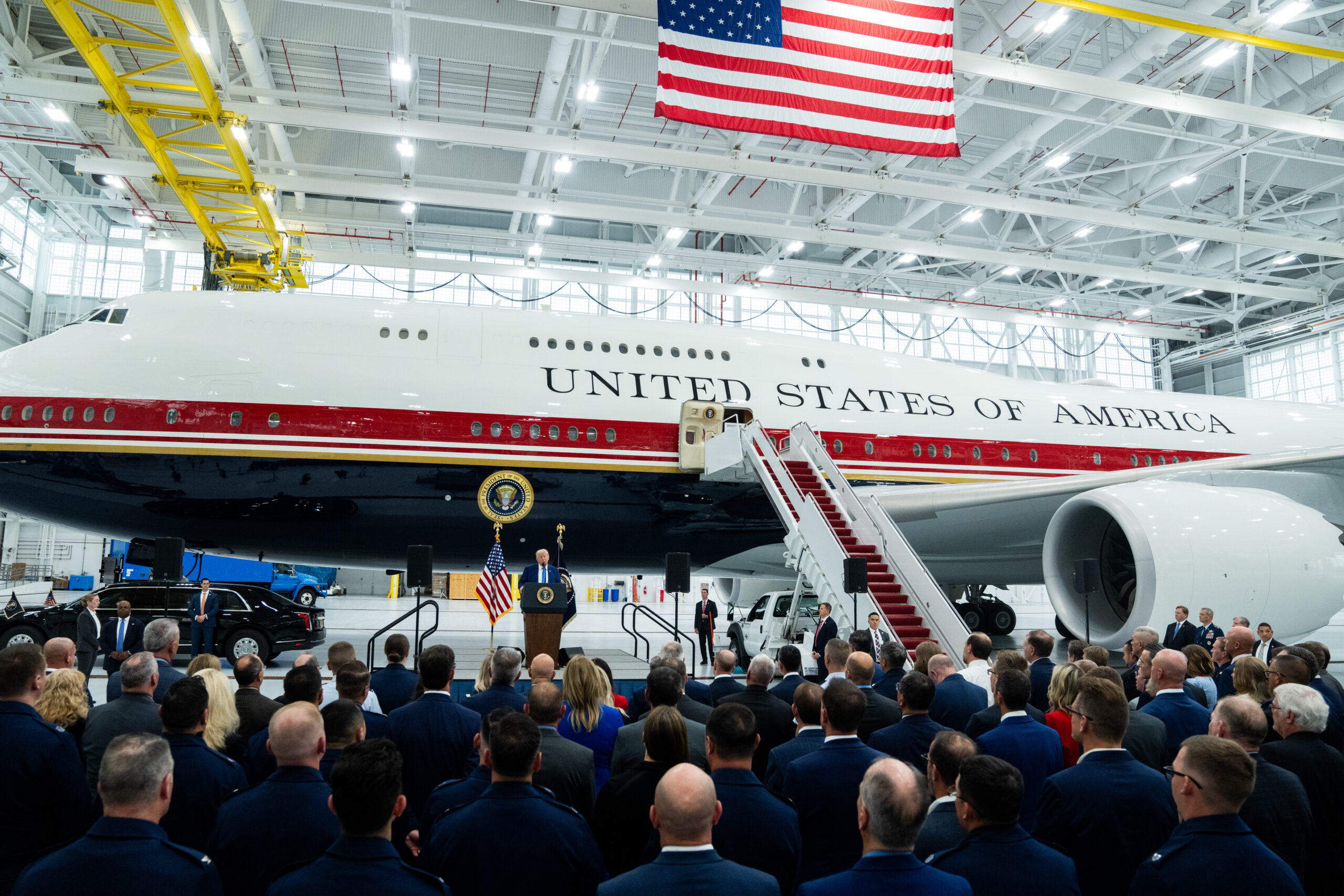
    President Donald Trump delivers remarks next to the new red, white, and blue Boeing 747 jetliner donated by the government of Qatar that will be used as Air Force One, at Joint Base Andrews, Md., in June.

    Still, the national media — and a lot of social media, as well — gave more attention to the Trump disasters that are easier to visualize, including troops guarding his green algae swamp at the Lincoln Memorial Reflecting Pool and empty fields at his Freedom 250’s disastrous Great American State Fair, which sits nearly empty while thousands pack bars for the international joy of the World Cup, or line the rainbow-colored routes of Pride Month parades.

    One of the many ironies here is that Trump is inadvertently doing America a July Fourth favor by highlighting a key part of the flawed wisdom of the nation’s founders. In declaring independence in 1776 and creating a government that aimed for people-powered democracy with checks and balances on unbridled autocracy, the mad scientists of the American Experiment also expressed their fears for our future.

    “The only path to a subversion of the republican system of the Country is, by flattering the prejudices of the people, and exciting their jealousies and apprehensions, to throw affairs into confusion, and bring on civil commotion,” Alexander Hamilton wrote in 1790. “When a man unprincipled in private life, desperate in his fortune, bold in his temper … is seen to mount the hobby horse of popularity, he may ‘ride the storm and direct the whirlwind.’”

    This Fourth of July week, I’ve been thinking a lot about the 1770s, but also the 1970s. For the second-half baby boomers like myself, it’s impossible not to experience the nation’s 250th anniversary without sepia-toned memories of July 4, 1976 — the U.S. Bicentennial.

    Things were both so similar and so different.

    Just as democracy stares into the abyss now, the assassinations, riots, and bombings of the late 1960s and early ’70s felt like the apocalypse to those who lived through it. But the Watergate scandal — yes, the very thing JD Vance and others on the far-right are dismissive of now — and the way courts and newsrooms and members of Congress responded had created a new hopeful yearning in the summer of 1976.
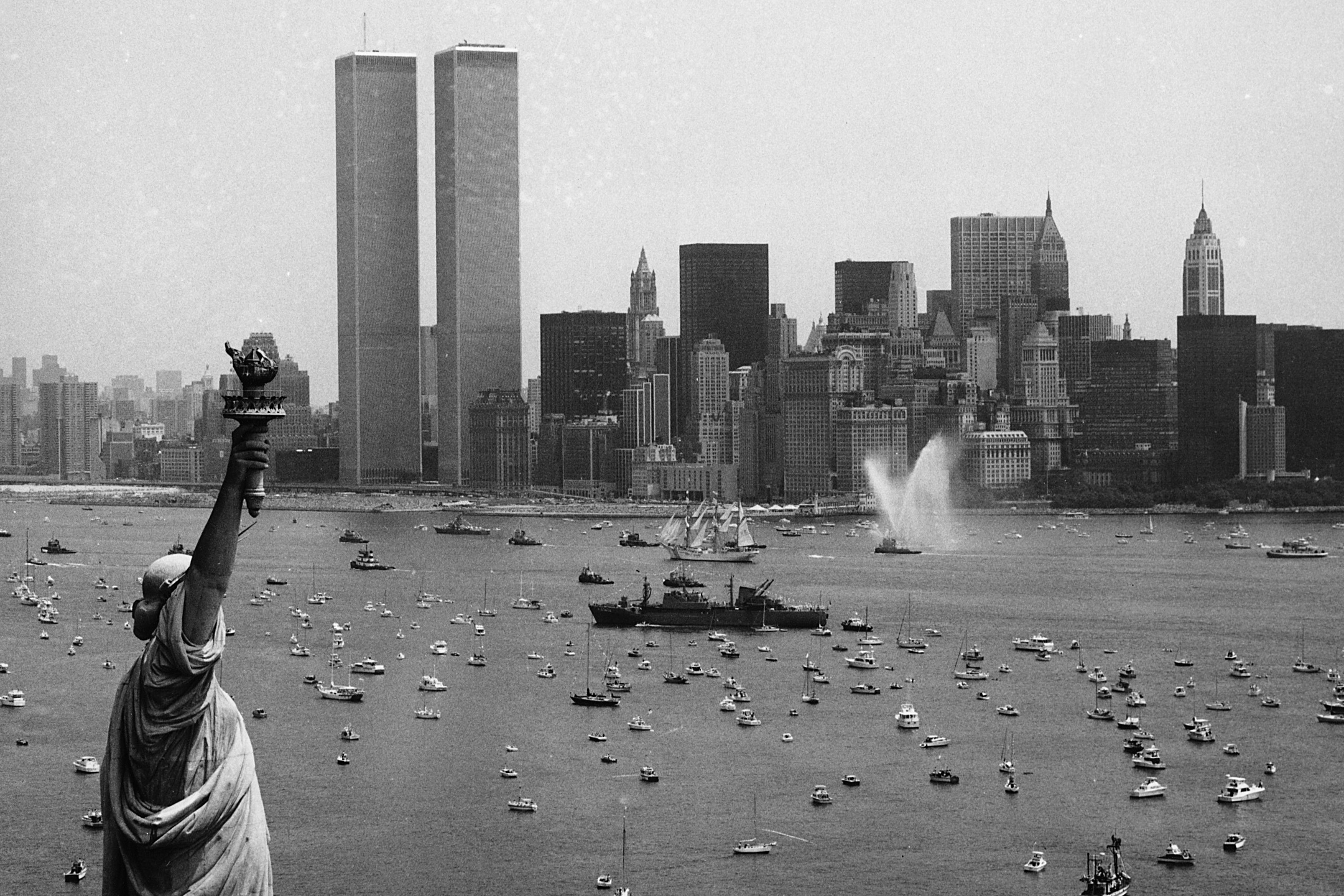
    Ships participate in Operation Sail between the Statue of Liberty and the Twin Towers to celebrate the U.S. Bicentennial in New York on July 4, 1976.

    That feeling is what made the day I enjoyed with my family as a 17-year-old a half-century ago — watching those glorious tall ships glide down the Hudson River from my dad’s high-rise office on 10th Avenue, then cramming into a subway to get to the fireworks over the Statue of Liberty — still bring back chills today. There was an unexpected sense of togetherness — and, naively in hindsight, that a storm had passed.

    It’s different in 2026. The whirlwind that Hamilton warned us about is directly overhead, and the man is still riding, however clumsily, the hobby horse. The institutions that saved us ahead of 1976 are shells of their former selves, as if a neutron bomb had struck.

    And yet, the fundamental essence of what can make America actually great someday remains intact: its people. This summer, millions of us are showing that Americans want things that can bring us together, and also to celebrate what makes us all different and all special, whether on a soccer pitch or a parade route laced with pink.

    The question is, how do we take this positive energy and stop the whirlwind? How do we celebrate a 250-year slow-bending of the arc of the moral universe without losing our focus on the ongoing crime scene at 1600 Pennsylvania Avenue?

    When the president’s Freedom 250 sets off 850,000 fireworks over Washington on Saturday, think of every single blast as about $2,000 that Trump pocketed for himself, and then it might be possible to comprehend the scope of his crime against our citizenry.

    Don’t let the president hijack the Fourth of July to rob the focus from what matters most, the things we need to write and discuss and march against every week: his unprecedented criminality. The bombs are bursting in air, but only when we unleash our people power and seek justice will we see the dawn’s early light of a new nation again.

    Happy birthday, America.
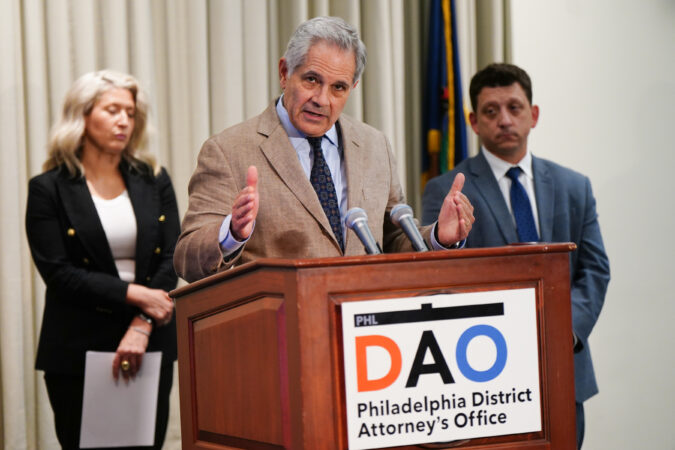
  • Krasner isn’t perfect. The Pa. Supreme Court’s ruling on his exoneration push is worse. | Editorial

    Krasner isn’t perfect. The Pa. Supreme Court’s ruling on his exoneration push is worse. | Editorial

    When the Pennsylvania Supreme Court authorized the state’s top prosecutor to review Philadelphia’s efforts to reverse tainted convictions, the message was clear.

    The move was a stinging rebuke of District Attorney Larry Krasner and attempts by his office’s Conviction Integrity Unit to overturn verdicts it believed were marred by official misconduct.

    It was also an unprecedented and dubious decision in which the cure may be worse than the disease.

    Writing for the majority, Justice Kevin Dougherty found that the district attorney’s office repeatedly “made unreliable concessions unsupported by the facts and law” and “violated its duty of candor.”

    The justices — Dougherty was joined by Daniel McCaffery, P. Kevin Brobson, and Sallie Updyke Mundy — ruled that any attempts by Krasner’s office to win exonerations must now be overseen by the attorney general.

    Justices Debra Todd, Christine Donohue, and David Wecht disagreed, finding little to warrant such sweeping action by the court.

    At the heart of the matter was the case of Lavar Brown, who was convicted in the robbery and fatal shooting of the manager of a North Philadelphia Rite Aid.

    Krasner’s office believed Brown deserved a new trial because of past prosecutorial misconduct. The victim’s family accused Krasner of a conflict of interest over payments made to the district attorney by former law partners who had been involved in Brown’s case.

    As Justice Wecht writes in his dissent, the court’s majority used the Brown case as a springboard to “scrutinize decisions made by the Philadelphia District Attorney’s Office in other, wholly unrelated cases.”

    This board has long supported Krasner’s efforts to examine past convictions. No one should be imprisoned because of misconduct by the police or prosecutors, and the district attorney’s office has supported 59 exonerations so far.

    It has been well established that some police and prosecutors have been willing to bend the rules — if not break them — in order to facilitate convictions and arrests. Unlike too many of his predecessors, Krasner has held police officers accountable for unjustified use of force, charging dozens and convicting three.

    In some instances, however, victims, law enforcement, and some judges have called foul, accusing Krasner of being overzealous.

    The district attorney’s office itself recently withdrew a recommendation to overturn a murder conviction, saying prosecutors had filed court documents that were “not supported by the record.” This looks less like the systemic misconduct the court described than an office catching and correcting its own mistakes.

    It is also important to note that Krasner’s integrity unit has not sought to undo the vast majority of convictions. According to the district attorney, just 1.2% of the cases have resulted in his office seeking exoneration. While Krasner and his team believe in the innocence of many of these defendants, it is also important that everyone gets a fair trial — even those who are ultimately found guilty.

    Adding another wrinkle to the high court’s decision is the fact that people who had policy disagreements with Krasner at the district attorney’s office are now part of the state attorney general’s office, including some of the veteran prosecutors Krasner fired upon assuming office in 2018.

    At the time, Krasner thoughtlessly compared the state office to Paraguay, a reference to the flight of high-ranking Nazi officials to Latin American countries after World War II. Some of those same prosecutors will now be overseeing some of the same convictions they obtained.

    Wecht’s fellow justices should consider his words carefully and rethink this oversight measure, which he called “unprecedented and unconstitutional.” A more targeted remedy — one focused specifically on the issues identified in the ruling — would have been far less troubling.

    Krasner is far from perfect. In an interview with this board, he acknowledged that some errors have been made by attorneys under his supervision. But for the court’s majority to take the drastic step of removing authority from Philadelphia’s top prosecutor, more substantive charges are required.

    A simple difference of opinion does not suffice.

  • America’s rich tradition of July Fourth protest is worth recalling

    America’s rich tradition of July Fourth protest is worth recalling

    No Kings and other protests opposing the policies and executive overreach of the Trump administration continue to draw crowds across the country, most recently on Flag Day, June 14, which was also the president’s 80th birthday. While critics have denounced these demonstrators as un-American — House Speaker Mike Johnson called a 2025 No Kings march a “hate America rally” — those voicing dissent, pushing for change and speaking truth to power are, in fact, participating in a tradition at our nation’s core.

    That tradition dates back to July 4, 1776, when the Continental Congress, citing a list of grievances, declared independence from the rule of a would-be despot, King George III. The founders’ act of resistance set an example that ordinary Americans would follow. According to historian David Waldstreicher, citizens in the early republic used celebrations not just to commemorate independence, but to lay claim to the lofty principles expressed in the Declaration of Independence, namely that all are created equal, that they have unalienable rights, and that government is instituted to secure those rights, deriving its just powers from the consent of the governed.

    The custom continued for two-plus centuries, with Americans regularly marching, picketing, or otherwise taking to the streets on the Fourth to realize a more perfect union.

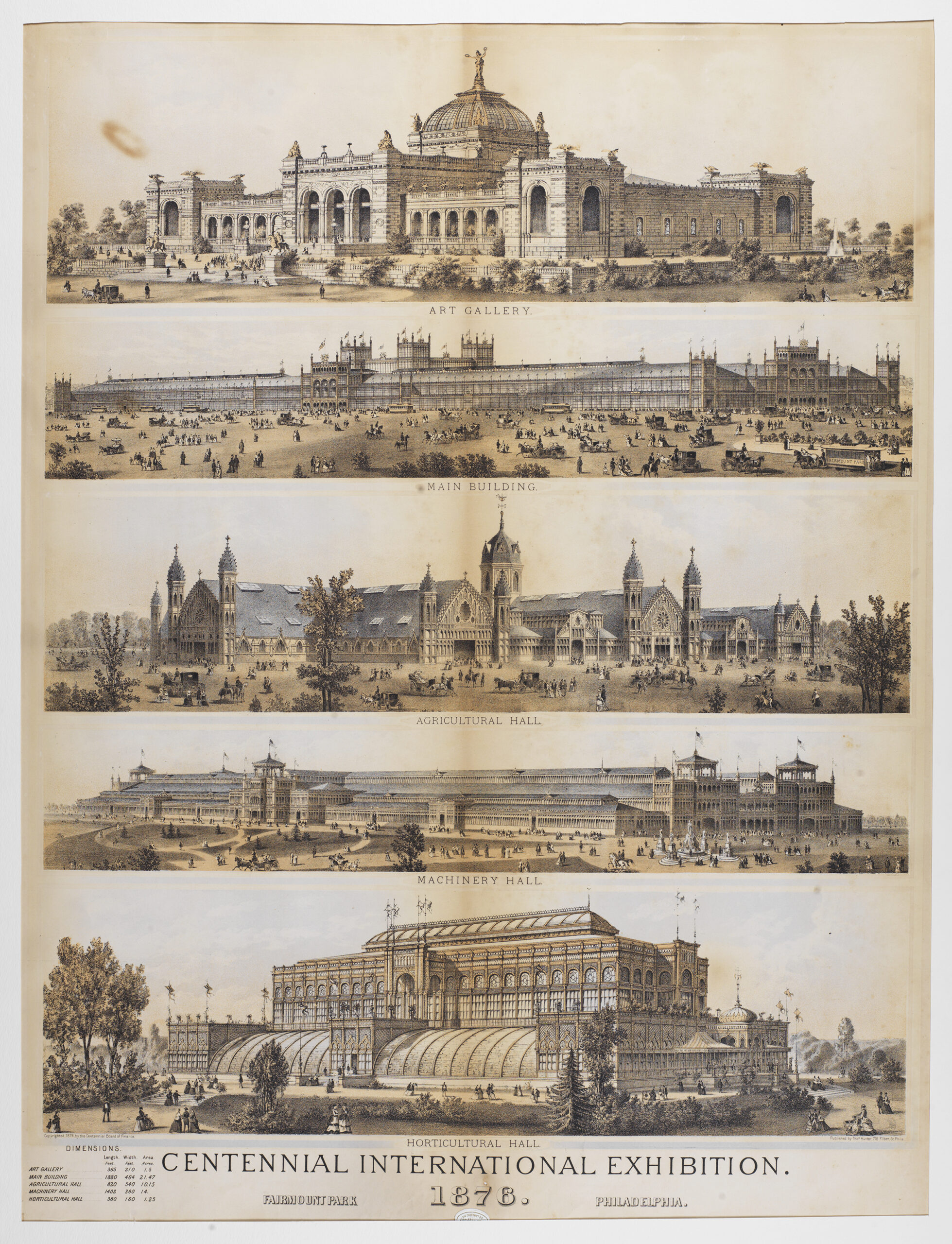
    Centennial International Exhibition, 1876.

    Perhaps the most famous Independence Day protest occurred in 1876 in Philadelphia. As tens of thousands gathered for the Centennial International Exhibition in Philadelphia’s Fairmount Park to celebrate a century of American progress in the arts, in industry, and in economic development, Susan B. Anthony protested the fact that half the nation, women, remained unable to vote and were thus without the unalienable rights named in the declaration.

    Anthony and a determined group of suffragists attempted to introduce a statement drafted by the National Woman Suffrage Association into the exhibition’s official proceedings. When Joseph Hawley, president of the United States Centennial Commission, prevented the women from doing so, Anthony led a procession to Independence Hall, where she read aloud the suffragists’ “Declaration of Rights of the Women of the United States” to a crowd that quickly gathered around her. Patterned after the original declaration, the text condemned the government for denying women the franchise, before ending with a clear demand: “We ask justice, we ask equality, we ask that all the civil and political rights that belong to citizens of the United States, be guaranteed to us and our daughters forever.”

    It took decades of nonviolent action before Congress passed the 19th Amendment, granting women the constitutional right to vote. But Anthony’s principled stance contributed to a rich history of July Fourth protests that continued a century later, as the nation prepared to mark the Bicentennial.

    On July 4, 1976, approximately 10,000 to 15,000 demonstrators massed in Washington, D.C., on America’s 200th birthday. Assembled by the People’s Bicentennial Commission, a New Left group, near the Jefferson Memorial, they marched to the U.S. Capitol under a banner reading, “Independence from Big Business.”

    The group’s populist call for economic democracy resonated in the mid-1970s, when the country was still reeling from a divisive war (Vietnam), a constitutional crisis (Watergate), and an economic recession that saw both inflation (5.97% in July 1976) and unemployment (7.6%) soar. Many people signed the commission’s “Declaration of Economic Independence” calling for limits on concentrated corporate power in the interest of the common good. “We, therefore, the Citizens of the United States of America,” the declaration stated, “hereby call for the abolition of these giant institutions of tyranny … to provide for the equal and democratic participation of all American Citizens in the economic decisions … that effect … our Nation.”

    Other protests occurred across the country, in Detroit and Chicago, as well as Los Angeles, San Francisco, and Seattle. Even Salt Lake City witnessed a small demonstration — albeit on Saturday, July 3, so as not to disturb the Christian Sabbath.

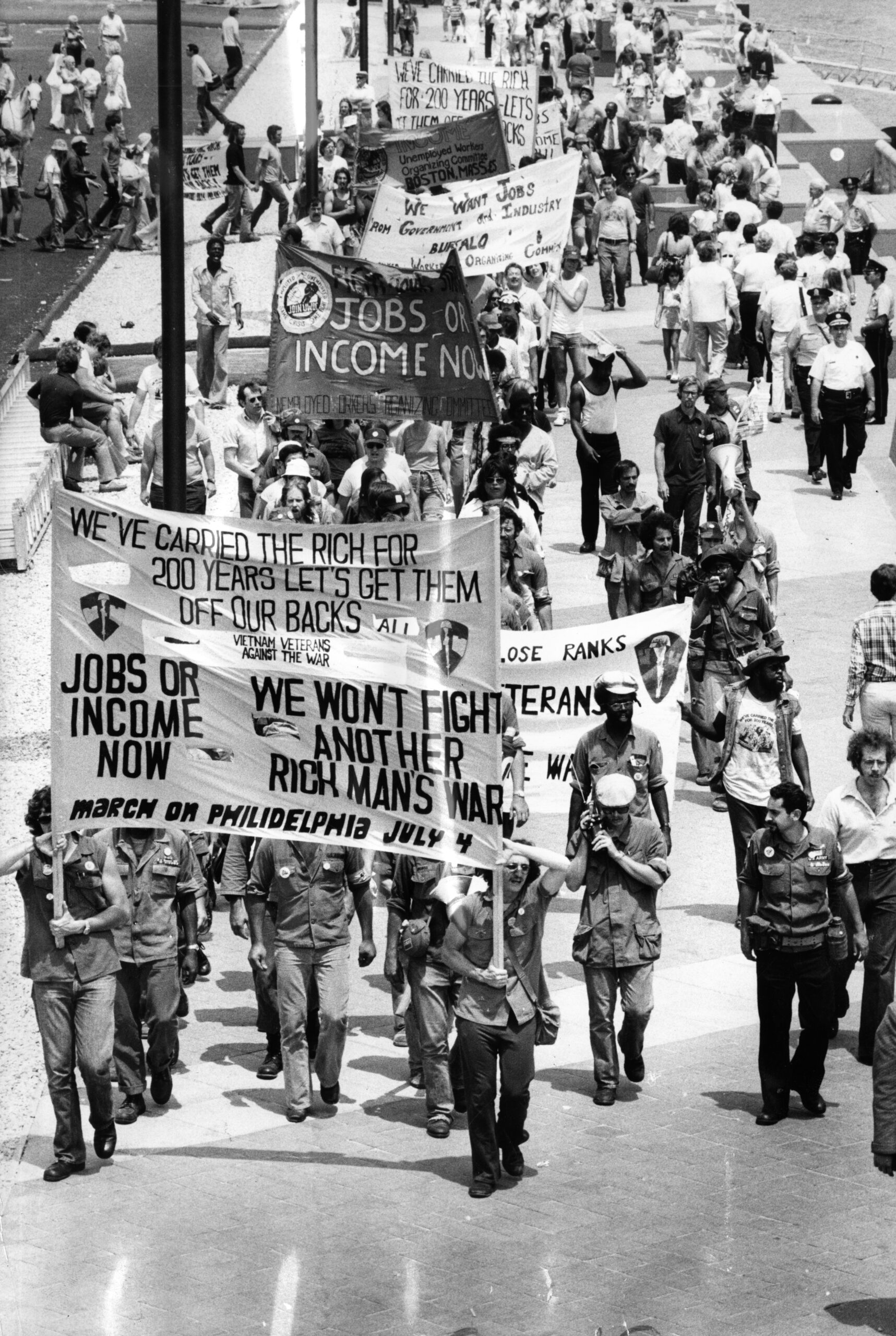
    Marchers with the Rich Off Our Backs Coalition demonstrate at Penn’s Landing in Philadelphia on July 3, 1976.

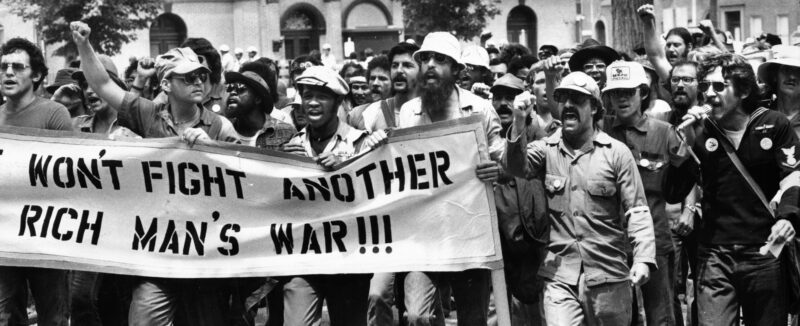
    The largest gatherings, though, were in Philadelphia, where more than 3,000 demonstrators gathered in Norris Square, under the auspices of a group called the Rich Off Our Backs Coalition, to march for jobs and income and economic justice — backed by fatigue-wearing Vietnam Veterans Against the War, who chanted: “One, two, three, four, we won’t fight a rich man’s war.”

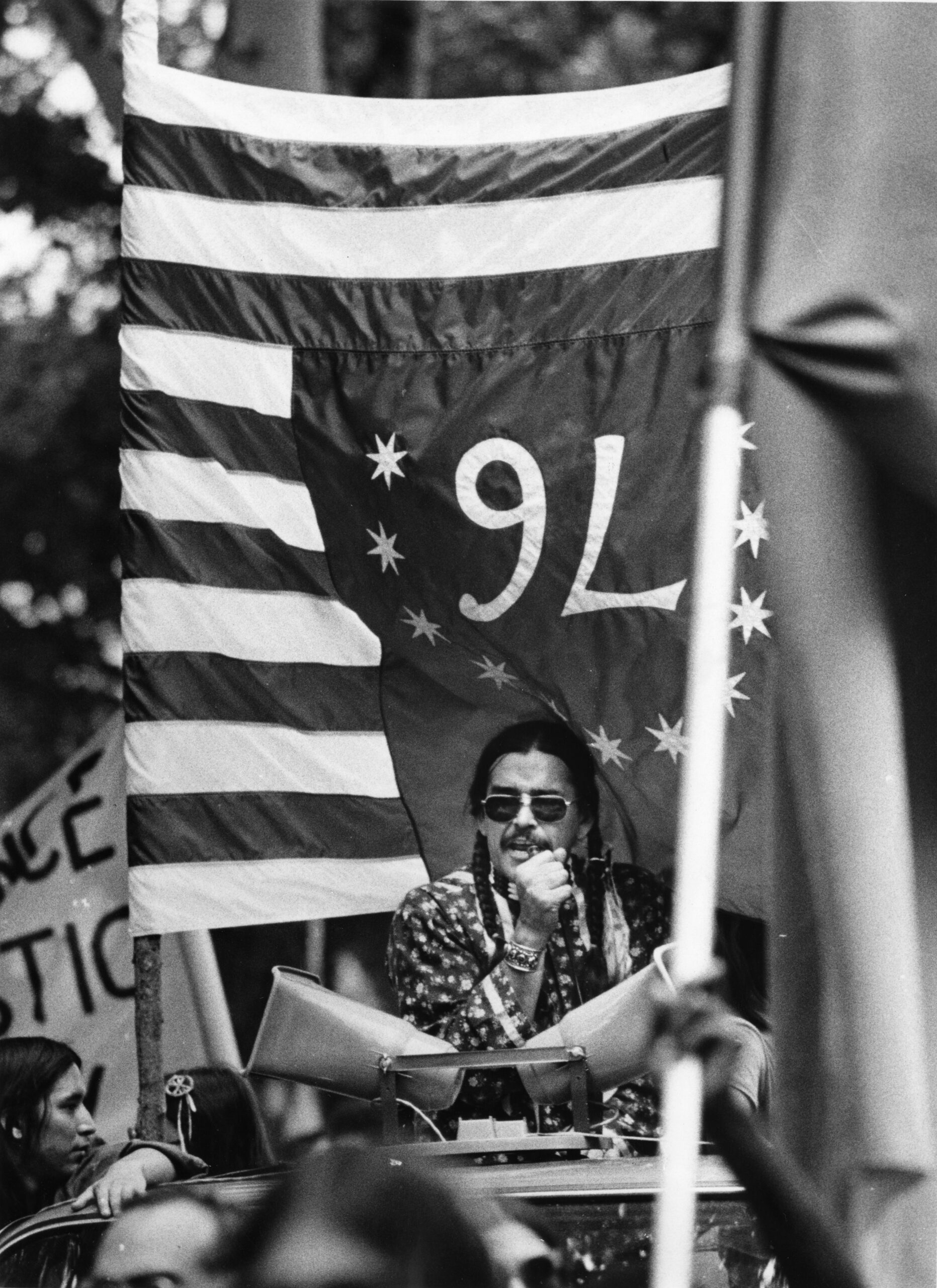
    Another group, the July 4th Coalition, rallied 30,000-plus in Fairmount Park, site of the Bicentennial, to demand Puerto Rican independence, greater rights for Black Americans, Native Americans, and members of the LGBTQ+ community, and much else. Karen DeCrow, president of the National Organization for Women, reread the declaration Susan B. Anthony had introduced a century earlier to flag the limited progress the nation had made toward gender equity since 1876. Black Panther leader Elaine Brown, a native Philadelphian, decried America’s 200-year history of racism.

    A group of Native Americans leads a July 4th Coalition protest parade at 33rd and Diamond Streets in Philadelphia on July 4, 1976.

    Despite opposition — Mayor Frank Rizzo famously requested 15,000 federal troops to maintain order — the demonstrations remained peaceful. Organizers won plaudits even from those who did not necessarily agree with their critiques. Protesters had a right, The Inquirer editors agreed, to call attention to America’s shortcomings, as they saw them. Dissent was as integral to the Fourth of July as bunting and brass bands: Its existence confirmed “the strength and genius of American democracy.”

    Today, according to polls, Americans typically mark Independence Day by barbecuing, shooting fireworks, going to the beach, viewing a parade, traveling, watching patriotic movies, or relaxing at home. Participating in a protest, demonstration, rally, or other nonviolent action does not rate a mention.

    That’s certainly understandable. These days are exhausting, and we all just want a break, a moment to have a laugh with family and friends.

    Yet, America’s rich tradition of July Fourth protest is worth recalling, especially at a time when the nation’s democratic institutions are under stress, for it once served as an essential tool that enabled Americans to hold their leaders to account for the words of 1776. We, the people, have never quite realized those words — written principally by a slave owner, Thomas Jefferson.

    But for 250 years and counting, the Declaration of Independence has set a “moral standard,” as historian Pauline Maier has argued, to which not only feminists and civil rights activists but civil libertarians and laborers have turned time and again in pursuit of liberty from their oppressors, be those would-be tyrants, foreign or domestic.

    M. Todd Bennett, a professor of history at East Carolina University, and David McKean, former director of policy planning in the U.S. Department of State, are the authors of “The Flag Was Still There: A History of the American Experiment in Five Anniversaries” (PublicAffairs, 2026).

    Made By History takes readers beyond the headlines with articles written and edited by professional historians. Opinions expressed do not necessarily reflect the views of The Inquirer.

    Made By History sponsors.
  • Religious liberty isn’t the only American principle on Pope Leo XIV’s mind as he accepts the Liberty Medal

    Religious liberty isn’t the only American principle on Pope Leo XIV’s mind as he accepts the Liberty Medal

    The common wisdom that “There will never be an American pope” went up in white smoke on May 8, 2025, when Cardinal Robert Prevost, a boy from the South Side of Chicago and a graduate of Villanova University, was elected pontiff and took the name Leo XIV.

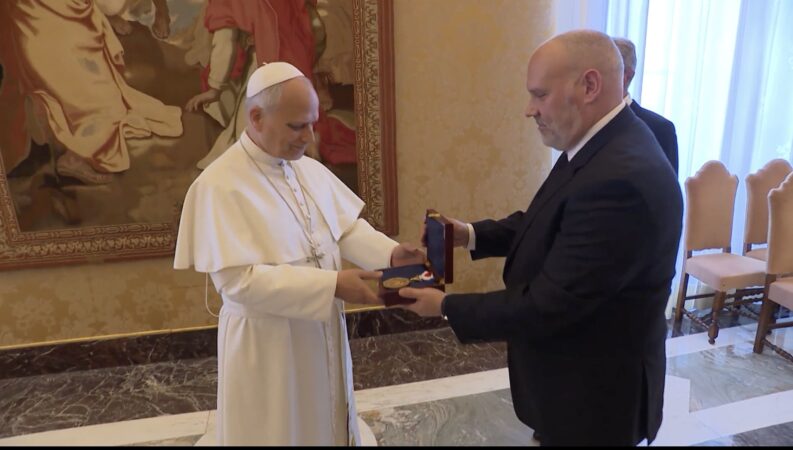
    Now, on the eve of America’s Semiquincentennial, as if to underscore how much has changed, the American pope has been awarded the National Constitution Center’s Liberty Medal. Pope Leo accepted the award at the Vatican on April 30. On Friday, in a ceremony at the National Constitution Center on Independence Mall, the pontiff will address the audience live from the Vatican in a speech that will be livestreamed globally.

    The medal, according to the center’s interim president and CEO, Vince Stango, will celebrate how “[i]n formal Vatican statements and public addresses, His Holiness has affirmed that peace cannot exist without freedom of religion, freedom of thought, and freedom of expression, principles that closely align with constitutional protections guaranteed by the First Amendment.”

    One reason an American pope was long unthinkable is that American principles have not always aligned with Catholic principles. The proud American refusal to establish the Catholic Church as the national religion flew in the face of traditional Catholic teaching that the church should ensoul the body politic.

    That was never going to happen in the United States, of course. Not even close. And so the question then became, from the Catholic point of view, what to say about the American model that included the First Amendment, with its coordinated guarantees of the “free exercise” of religion and the nonestablishment of religion by Congress.

    Rome’s response has changed over time. In the late 1800s, Pope Leo XIII noted with approval the religious situation of Catholics in the United States, yet cautioned against the error that separation between the church and the civil power was to be the norm. By the 1950s, though, some Catholic thinkers were claiming the American model, in fact, stated the ideal, reasoning that the First Amendment guarantee of “free exercise” is necessary for a person to honor his God-imposed duties.

    By now, even though the Second Vatican Council (1962-1965) stated that it was leaving the church’s traditional teaching “untouched,” the nonestablishment of religion and a legal guarantee of individual and group free exercise of religion, subject to just limitations for the common good, constitute the norm proposed by the Catholic Church to the world as we know it.

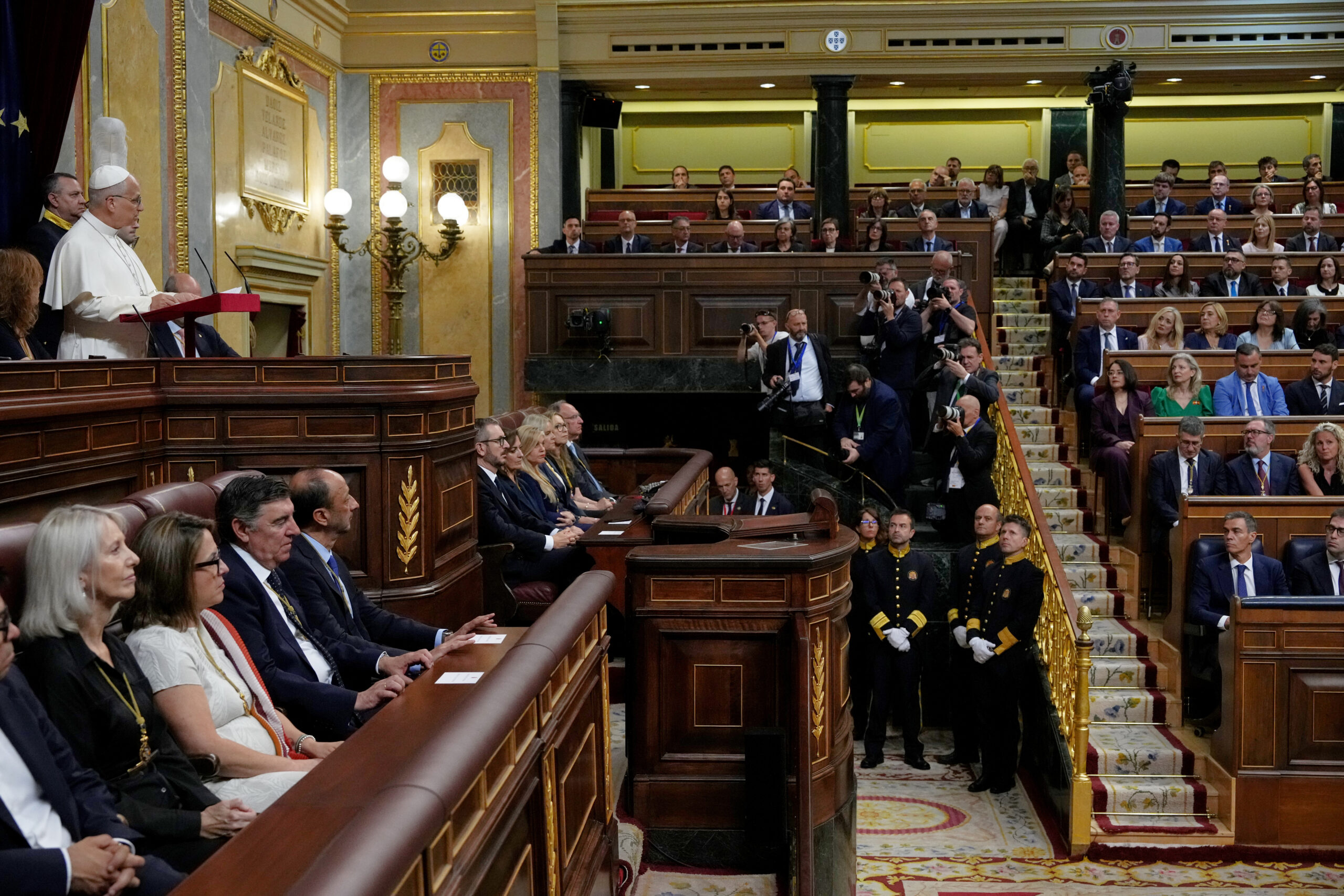
    Pope Leo XIV speaks to members of the Spanish Parliament at the Congress of Deputies, in Madrid, on Monday, June 8.

    In speaking to the Spanish Parliament on June 8, for example, Pope Leo insisted that laws must respect “freedom of thought, conscience and religion, a fundamental right that protects the most intimate sphere of the person. The freedom upon which the contemporary state is built, if it is authentic, recognizes the religious dimension of the human person.”

    In the ceremony on Independence Mall on Friday, Pope Leo will address a nation in which, for the first time in its history, it is becoming socially acceptable to oppose the free exercise of religion for some people. Litigation that threatens to cancel people’s freedom to live according to their conscience becomes more common. The seal of confession, long protected in the United States, is under assault, and the threat is real. In his address to the Spanish Parliament, Pope Leo warned against the withdrawal of that protection, and the warning needs to be echoed in the United States.

    It would be one of history’s great ironies for an American pope to call his country back to a principle that his church learned, in part, from America.
    Religious liberty is not the only American principle on the American pope’s mind, as his message to the 2026 graduates of his alma mater makes clear. “This being the 250th anniversary of the United States of America, I would invite you to recall in a special way the guiding principles of the foundations of our nation: ‘We hold these truths to be self-evident: that all [people] are created equal; that they are endowed by our Creator with certain inalienable rights, and among those are Life, Liberty and the pursuit of happiness.’”

    The principles of the First Amendment are to be cherished, but prior to those principles, the pope has reminded us, are the principles of the Declaration of Independence around which the nation was formed in 1776. And while the declaration does indeed attest to the nation’s commitment to the people’s Creator-given right to liberty, the outstanding principle of the declaration to which President Abraham Lincoln later found the nation “dedicated” since 1776 was that all people are “created equal.”

    When Lincoln summoned the American nation to rededicate itself to the equality of all persons, he did so for good reason: Unless we are related to one another as equals, we are related to one another as fractions to wholes. The three-fifths clause of the original U.S. Constitution gave effect to slavery, a grievous injustice removed by the 13th Amendment in concert with the other Reconstruction amendments. These amendments constitutionalized the nation’s earlier commitment to our having been “created equal,” but not everyone is a believer in the equality of all people.

    Today, Americans are divided over the declaration and, specifically, the claim that we are “created equal.” Human equality is said by some to be a self-evident lie, and even among those who pay it lip service, commitment to the basic equality of all people is undermined by identity politics, race-based priorities, and blood guilt.

    Pope Leo, though, is not in doubt about the equality of all people. In his first encyclical, Magnifica Humanitas, he writes that we are equal in “ontological dignity, which is neither acquired nor earned, nor does it need to be justified.” This immutable and foundational equality is true of all people because we are, without exception, “created in the image and likeness of God.”

    And this is another truth Americans need to reclaim.

    In order to reclaim it, we need to understand that human equality was never meant to state something empirical or measurable about people. The equality declared by the declaration and celebrated by Lincoln, and fully constitutionalized by the Reconstruction amendments, depends on what is spiritual in a person, represented by the radical Christian judgment that underneath the obvious and often wonderful diversity of people lies a universal sameness in being created in the divine image.

    When G.K. Chesterton was asked, “What is America?” he gave a characteristically smart answer that has been debated ever since: “America is a nation with the soul of a church. America is the only nation in the world founded on a creed. That creed is set forth with dogmatic and even theological lucidity in the Declaration of Independence.”

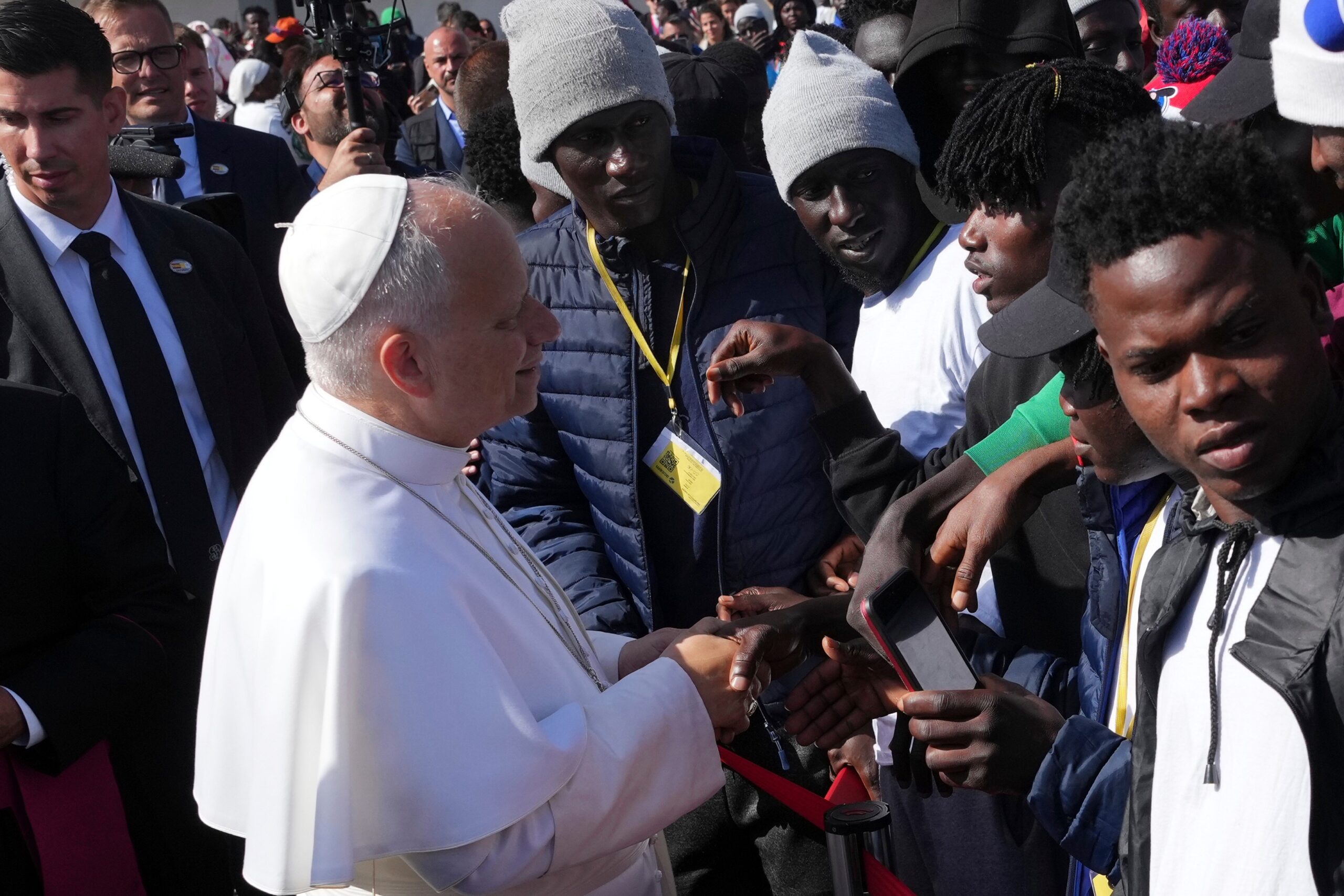
    Pope Leo XIV meets migrants at the Las Raices center, in San Cristobal de la Laguna, Tenerife, Spain, June 12.

    Robert Prevost, now Pope Leo, was formed, in part, in that “church” with its declarational creed. He was also, and first, formed in the Catholic Church, with its commitment to the universal equality of all people.

    What the American pope can do now, in a way no other person on earth can, is to remind Americans that the equality to which their nation has been dedicated since 1776 depends on what Christianity has shown the world: that even the least, in worldly eyes, are equals in God’s eyes.

    Patrick McKinley Brennan is the chair of Catholic legal studies and a constitutional law scholar at Villanova University.

  • Letters to the Editor | July 2, 2026

    Letters to the Editor | July 2, 2026

    Messy MOU

    This eternal blustering by the U.S. and Iran over the control of the Strait of Hormuz is just that. Two nation-states vying for control of a waterway neither has the right nor historical precedent to. I can’t say I blame Iran, which from any vantage point was — despite its history — unjustifiably attacked by Israel and the U.S. Where is Iran in this picture? Why is President Donald Trump taking full responsibility for keeping it open? What role should a NATO peacekeeping force be playing? Why are the peace negotiations being driven by Trump and Iran? Where is Israel in that picture? Unless Israel is totally complacent and under the thumb of Trump, how can he and Iran expect to sign a treaty governing southern Lebanon? Something just doesn’t smell right.

    Tim Reed, Philadelphia

    Heat safety

    As Philadelphia welcomes thousands of visitors for a summer filled with historic events, matches, and celebrations, it’s important to remember that extreme heat poses serious health risks.

    Extreme heat is the leading cause of weather-related deaths in the United States. Forecasts suggest above-average temperatures throughout summer — and we’re all really seeing the truth of that this week. The combination of heat, humidity, and dense crowds can quickly lead to heat-related illnesses.

    There are three simple but critical steps everyone should follow:

    • Stay hydrated. Drink water regularly, even if you do not feel thirsty. Avoid sugary, caffeinated, and alcoholic beverages.
    • Stay cool. Take frequent breaks in shaded or air-conditioned spaces. If your home is too warm, visit public places such as libraries, malls, or designated cooling centers.
    • Stay connected. Check in on friends, family, and neighbors, especially those at higher risk. Make sure pets also have access to water and shade.

    Philadelphia’s historic summer events should be a time of celebration. By taking a few simple precautions and looking out for one another, we can ensure this season is not only memorable but safe for all.

    Jennifer Graham, CEO, American Red Cross Southeastern Pennsylvania Region

    Hubris

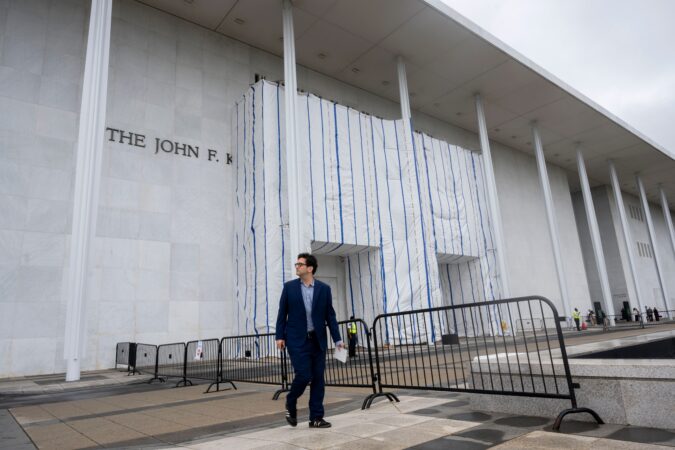
    The latest example of legal malfeasance by the U.S. Department of Justice takes the form of its newly filed brief contesting the removal of Donald Trump’s name from the John F. Kennedy Center for the Performing Arts.

    Ignoring Public Law 88-260, which established the center as “a living memorial to be named in [JFK’s] honor,” the brief asserts that Trump’s name should also be on it. The reason being that the center’s trustees thought Trump’s experience building things warrants his name being placed back above President Kennedy’s, even though Trump was 25 when the center opened and he had nothing to do with its construction.

    The brief gets worse, stating that Trump’s “construction abilities” would fix the building and restore it as a crown jewel of D.C. Apparently, neither the board of trustees nor anyone at the Justice Department has seen what Trump has done to two of the district’s other crown jewels — the Lincoln Memorial Reflecting Pool and the East Wing of the White House.

    Even if the laughable assertions in the brief were true, they are meaningless. The center was named for an assassinated president, and the name of a narcissistic opportunist doesn’t belong there, legally or otherwise. It’s impossible that Todd Blanche was unaware of this frivolous argument. This further cements his place as likely the most unfit person ever nominated to serve as attorney general. The only law he cares about is the law of Trump.

    Stewart Speck, Wynnewood, speckstewart@gmail.com

    Join the conversation: Send letters to letters@inquirer.com. Limit length to 150 words and include home address and day and evening phone number. Letters run in The Inquirer six days a week on the editorial pages and online.

  • Trump’s Great American State Fair reveals how he has turned the Semiquincentennial into a celebration of himself

    Trump’s Great American State Fair reveals how he has turned the Semiquincentennial into a celebration of himself

    WASHINGTON — The Great American State Fair on the National Mall should have been the rousing centerpiece of America’s 250th birthday celebration. Instead, it is a perfect tribute to President Donald Trump.

    With its cheap, slapdash imagining of Trump’s America and its constant political homage to POTUS and MAGA, the exhibit has little to do with commemorating the Declaration of Independence, U.S. history, or American culture. The exhibits lack even the delicious, tacky, lively atmosphere of state fairs (the few visible animals I saw were all fake).

    With few exceptions, it is a vapid, empty insult to the best aspects of this nation.

    When I remember the Semiquincentennial, I will be thinking more about scenes of Brazilian soccer fans visiting Philadelphia’s Independence Hall and warm interactions between locals across the country and visiting World Cup tourists. These personal exchanges may offset some of the hostility so many countries feel about Trump’s foreign policy.

    And yet, I’m glad I visited the fair on Monday because it reminds me of how different the president’s vision is from the real America that is ignored in this tribute to Trump.

    A true celebration could have displayed the best of this country, what the United States has gotten right, while providing the moment for serious reflection on what has gone wrong — and what needs desperately to be remedied at home and in our foreign relations. No matter how uphill that struggle seems under Trump.

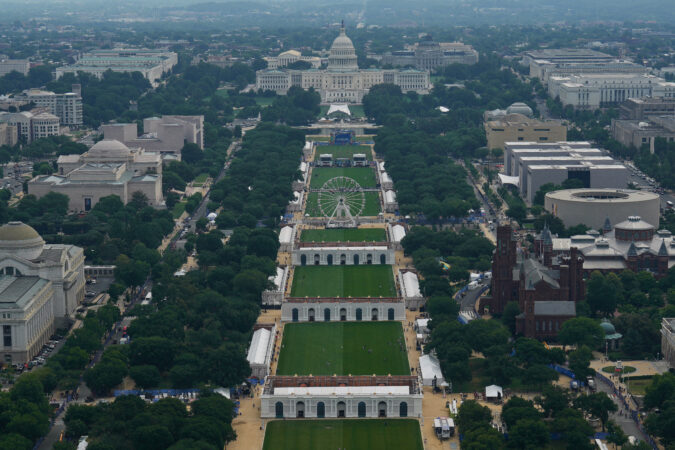
    Instead, the Great American State Fair mainly consists of several long, white, one-story buildings fronted by fake Greek columns and punctuated by closed doors. The structures extend on either side of large expanses of mall greenery which were almost empty, as the 88-degree heat sent the scant numbers of visitors inside in in search of air-conditioning.

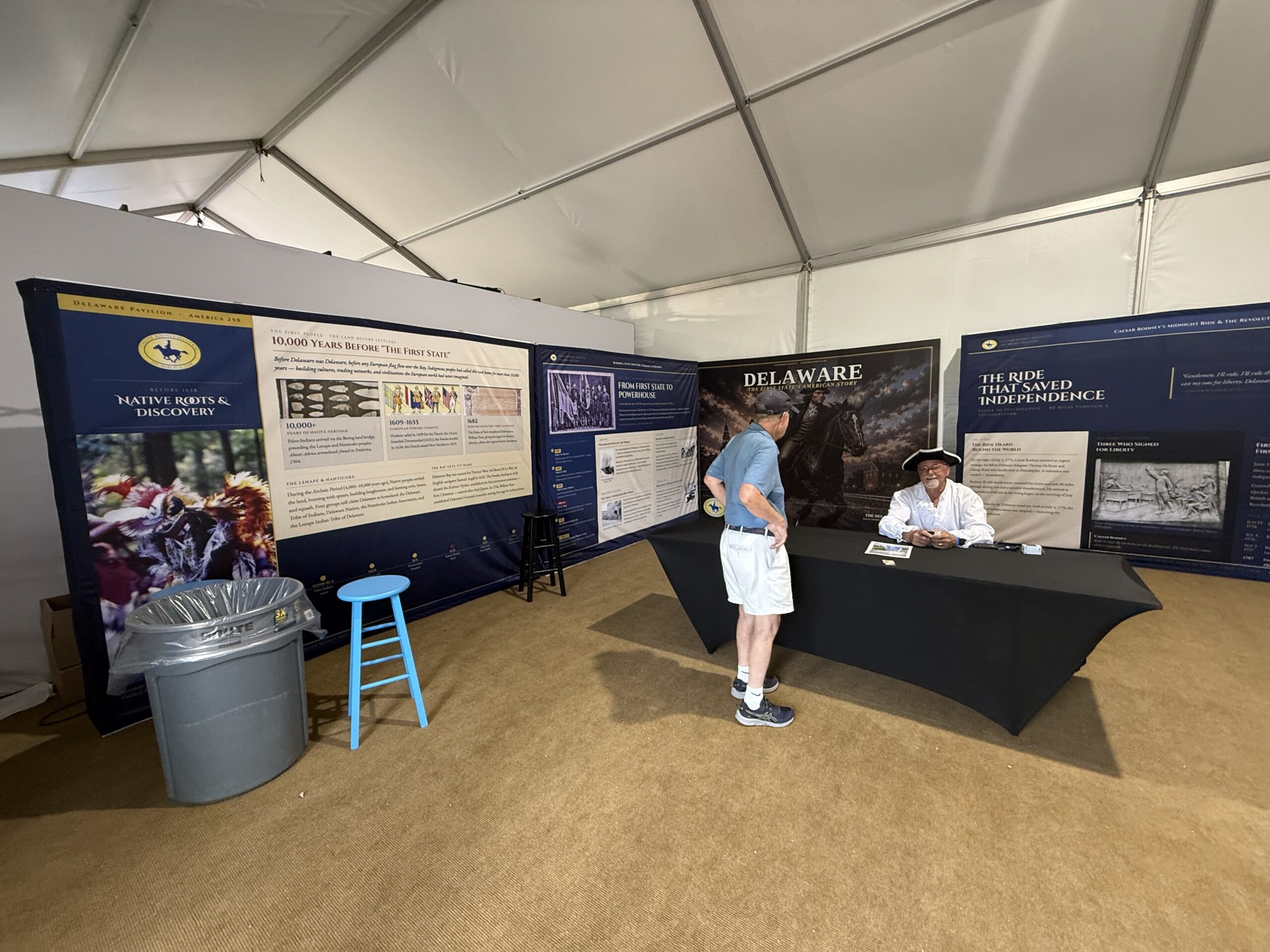
    The state of Delaware’s pavilion at the Great American State Fair Thursday in Washington, D.C.

    Behind those doors are small exhibits by each state (11 of which, including Pennsylvania, opted out due to the politicization of the fair or cost concerns), or by U.S. government departments (including “WAR”) and agencies and religious groups. Most state exhibits are tourism displays with posters, literature, or videos, with a few exceptions like South Dakota, whose state historic commission mounted excellent posters about the vivid characters, including women and Sioux leaders, who settled its land.

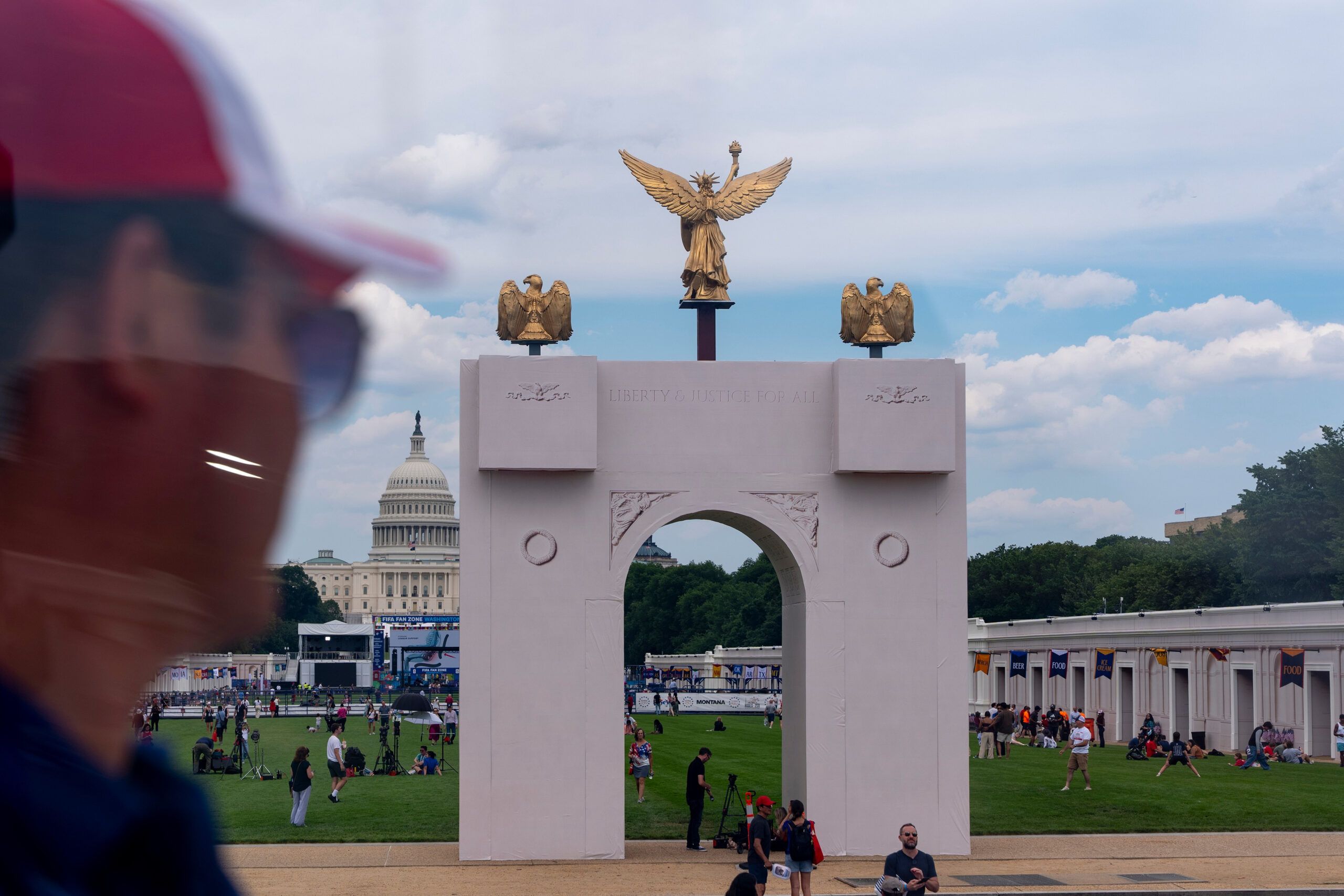
    Towering over the few attendees out in the sun is a 110-foot Ferris wheel (which has been mostly stationary because of electrical problems) and a small mock-up of Trump’s planned and controversial Arch of Triumph topped by gold angels.

    The image portrayed is of a country isolated from its own people and the world.

    However, visitors can collect Trump literature from AMAC (the Association of Mature American Citizens), listen to a Bible lecture, and hear how “America shall be saved” from a group called “The Great Awakening.” They can bid for a $700 “marriage getaway,” sign up their children for a Trump savings account, or fill out a recruitment form for the U.S. military or U.S. Secret Service. They can also view a copy of the limited edition “Patriot Passport” with Trump’s photo on it inside a glass case at the U.S. Department of State exhibit and get a free paper copy.

    Trump, Trump, and more Trump. The Washington celebration of our 250th birthday wasn’t supposed to look this way.

    The U.S. Capitol and a mock-up of President Donald Trump’s proposed triumphal arch are seen from the ferris wheel at the Great American State Fair on the National Mall.

    Congress started planning for this anniversary in 2016, when it created America250, a bipartisan commission that was supposed to program nonpartisan events for all Americans. The idea was to unify the country in celebration.

    Its original plans were focused on a parade through the capital with “diverse floats” and marching bands, along with an energetic festival of the nation’s cultural diversity on the mall organized by the Smithsonian.

    Anyone who has ever attended the annual Smithsonian Folklife Festival on the mall can imagine how wonderful this could have been. On one occasion when I was there, one side of the mall was celebrating the culture of India and the other Louisiana and Cajun culture, with bands of old-timers and their acolytes playing washboards, banjos, and accordions, while tents dished out Cajun food.

    This year, one side of the mall might have hosted cultures of the immigrants who have built America, and the other could have presented tributes to the Declaration of Independence, its impact around the world, and how its flaws regarding slavery and women were remediated by law.

    Instead, Trump squeezed out America250 by virtually replacing it with Freedom 250, which is partly funded with taxpayer money and partly by donors. The New York Times has detailed how donors were offered access to Trump for million-dollar contributions.

    People dance with a U.S. Army robotic dog at the Great American State Fair on the National Mall, Sunday.

    Instead of funding projects connected to key moments in the fight for American independence, Trump’s group focused on his MAGA agenda, his love for spectacle, and his person. Thus, his vision of America’s 250th birthday celebration has centered on his arch, on a $60 million UFC match on the White House lawn, and on an IndyCar race through the capital scheduled for August. As for the fair on the mall, it has been focused on an opening (political) speech by Trump (after most planned musical acts withdrew due to the fair’s partisan nature), and another rally on July Fourth.

    Unity out. Division in. Who cares about celebrating our founding document and the aspirational values on which the country has been built, when Trump can have circuses that celebrate only him?

    And that is why I point to the World Cup games as a sign that Americans still know how to display their best qualities as a people. What particularly moved me was watching the huge kilted Scottish contingent break through sometimes insular Bostonians’ reserve when it belted out John Denver’s “Take Me Home, Country Roads” at Fenway Park.

    Americans are so much better than this sterile exhibition on the mall. In the warmth displayed across the country to World Cup visitors they have shown a welcoming nature still unsullied by Trump’s efforts to make people hate the other.

    Back in the states and cities, many celebrations of July Fourth will probably still capture that warmth. It still exists. In Philadelphia, history museums are doing a terrific job of commemorating the declaration.

    But you can certainly skip visiting Trump’s Great American State Fair, which reveals his total disdain for what this holiday really means.

  • Pa. lawmakers must pass a full moratorium on hyperscale data centers
    Pa. lawmakers must pass a full moratorium on hyperscale data centers
    Artificial intelligence is fundamentally changing the world we live in at a speed unprecedented in modern history.

    Headlines buzz with warnings that this tech boom will bring a disruptive reindustrialization, and people are already seeing this play out in real time. Behemoth data center campuses have been proposed across the nation, including dozens right here in Pennsylvania.

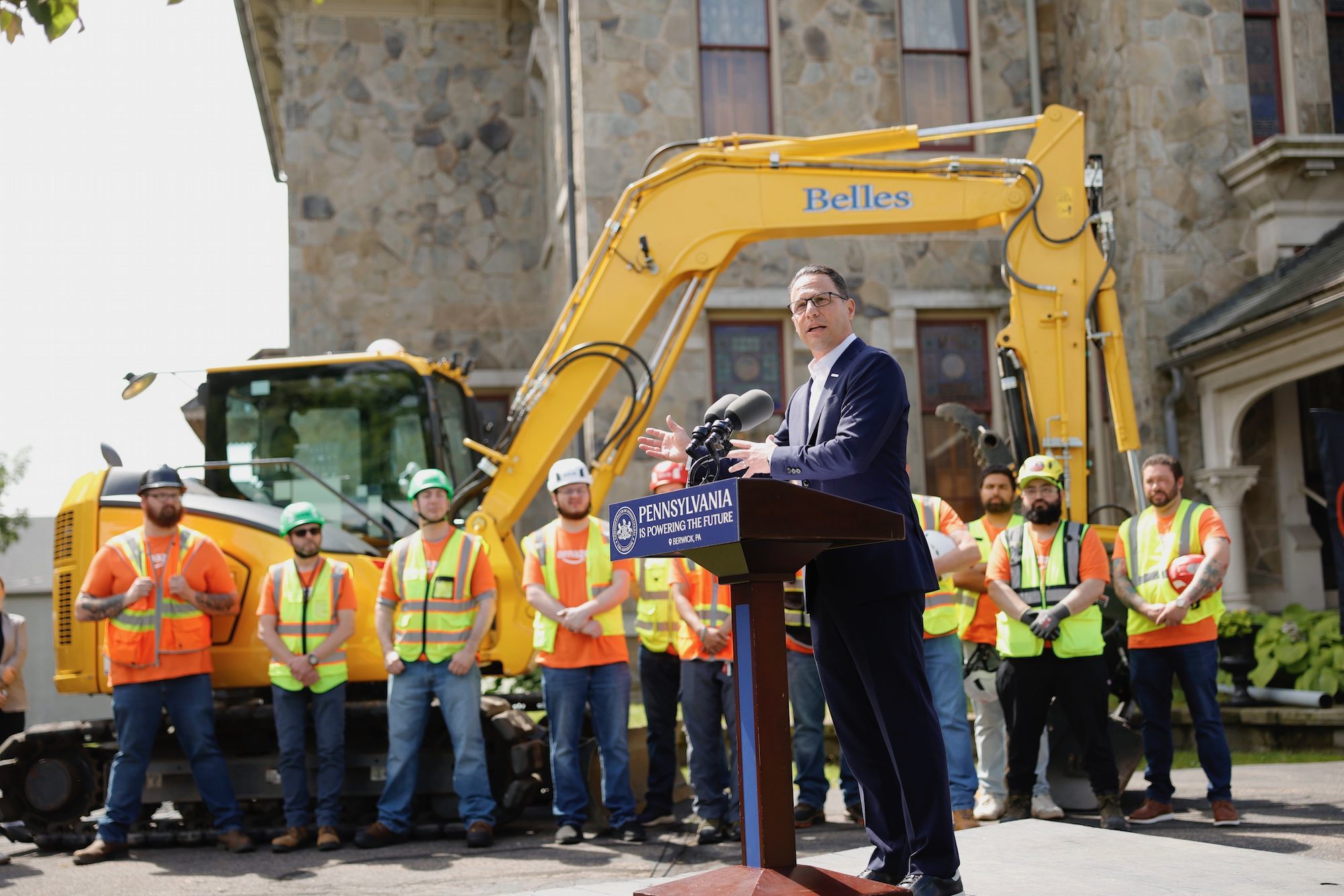
    Gov. Josh Shapiro has been at the helm of this push, incentivizing data center developers to take advantage of Pennsylvania’s resources to accommodate these energy-guzzling facilities and offering industry tax breaks that will cost taxpayers big time.

    Gov. Josh Shapiro announces a $20 billion investment by Amazon in Pennsylvania data centers in Salem Township and Falls Township in June 2025.

    The governor’s so-called Responsible Infrastructure Development (GRID) standards, which passed the House last week, are yet another effort to grease the wheels for data center developers. These voluntary half-measures are a naive effort to placate widespread data center opposition — worse still, Right to Know files obtained by Concerned Citizens of Montour County found that Amazon had first dibs on GRID input. That doesn’t sound like putting Pennsylvanians first.

    Instead of diving in headfirst, lawmakers must consider the real-world consequences of a largely unfettered data center build-out. That’s why the grassroots organization I am part of, Food and Water Watch, has endorsed the three-year moratorium State Sen. Katie Muth (D., Berks, Chester, and Montgomery) introduced in the Assembly.

    A recent comprehensive report from Food and Water Watch details the harms AI-driven hyperscale data centers will bring. Shapiro’s embrace of this technology — notwithstanding his recent attempt to make data center development less worrisome to Pennsylvania residents — has left communities grappling with secretive billion-dollar projects that threaten to swallow agricultural land, drive up residential and small-business electricity rates, and ruin quality of life.

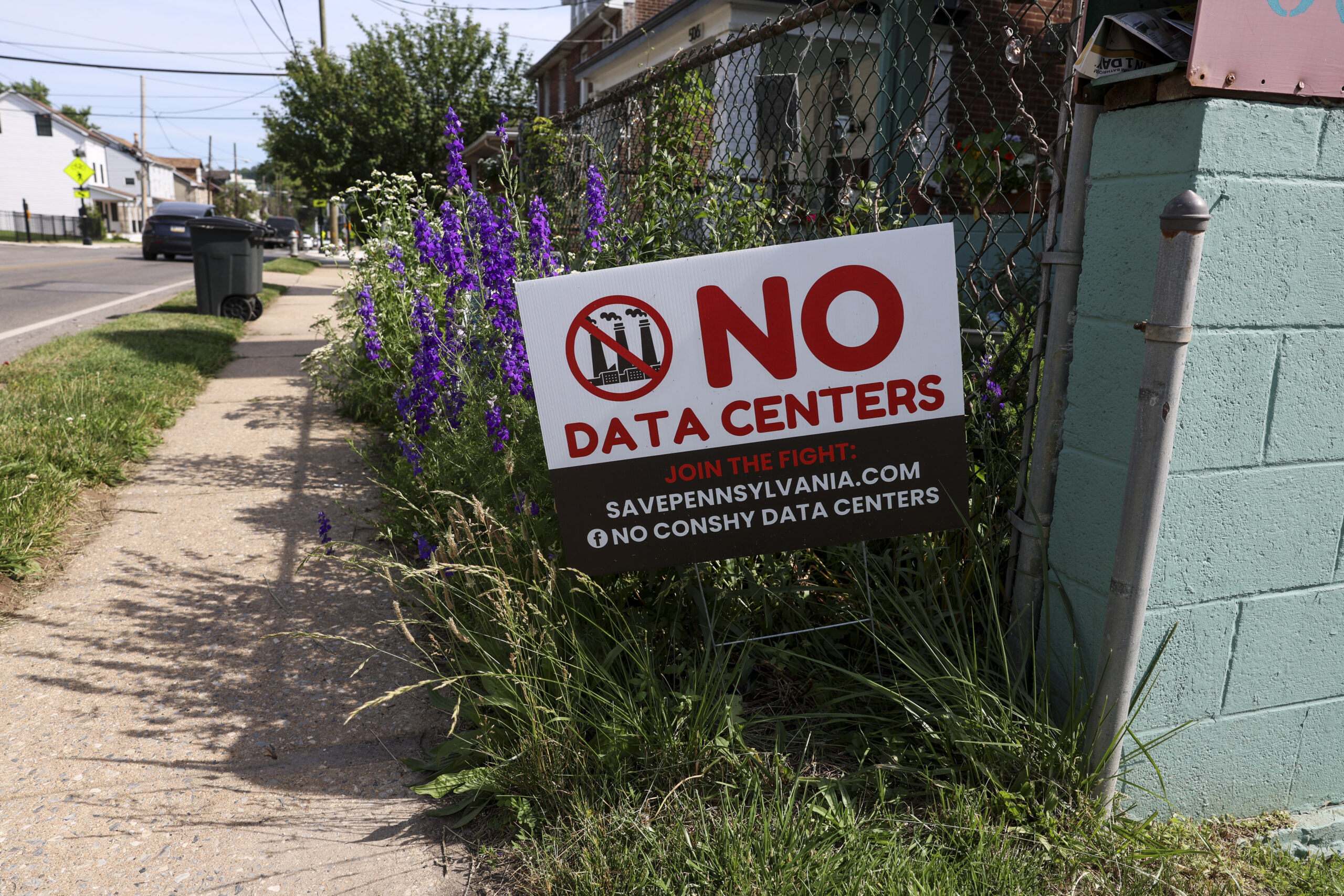
    A yard sign protests the proposed data center on New Elm Street near the Closed Cleveland-Cliffs steel mill, photographed on June 4 in Conshohocken.

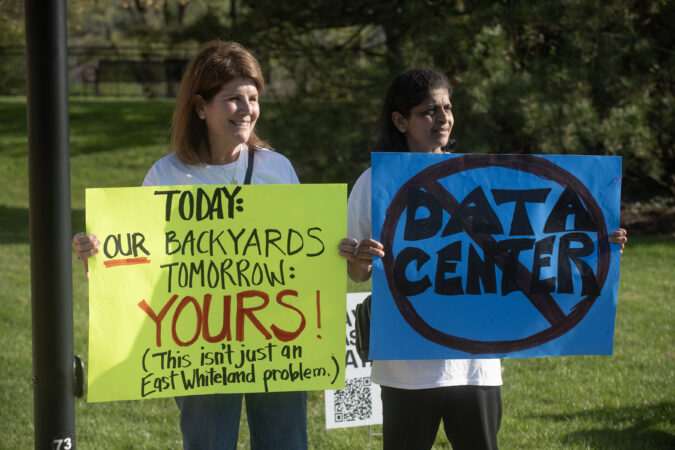
    Communities across Pennsylvania have pushed back on each and every data center project, from East Whiteland and Hazle Townships to Montour County and beyond. Concerns include lack of transparency and due process, high water use, skyrocketing energy prices, an unprecedented build-out of power plants and high-voltage transmission lines, and more.

    These concerns are not purely theoretical — Pennsylvanians are already seeing the financial impacts of the data center build-out. In 2024, Pennsylvanians paid $492 million in energy infrastructure upgrades for 16 data centers. Shapiro’s GRID plan notwithstanding, as more projects are proposed and more infrastructure is needed to bring these sites online, we can expect ratepayers to fork over more of their hard-earned cash for facilities that do not serve their needs or interests.

    Pennsylvanians don’t have to look far to see what unchecked data center expansion can do to communities.

    Two states away in Virginia, massive, loud data centers have been built right next to homes, turning neighborhoods into industrial sites. Now this industry is attempting to bully Pennsylvania communities to accept the same fate.

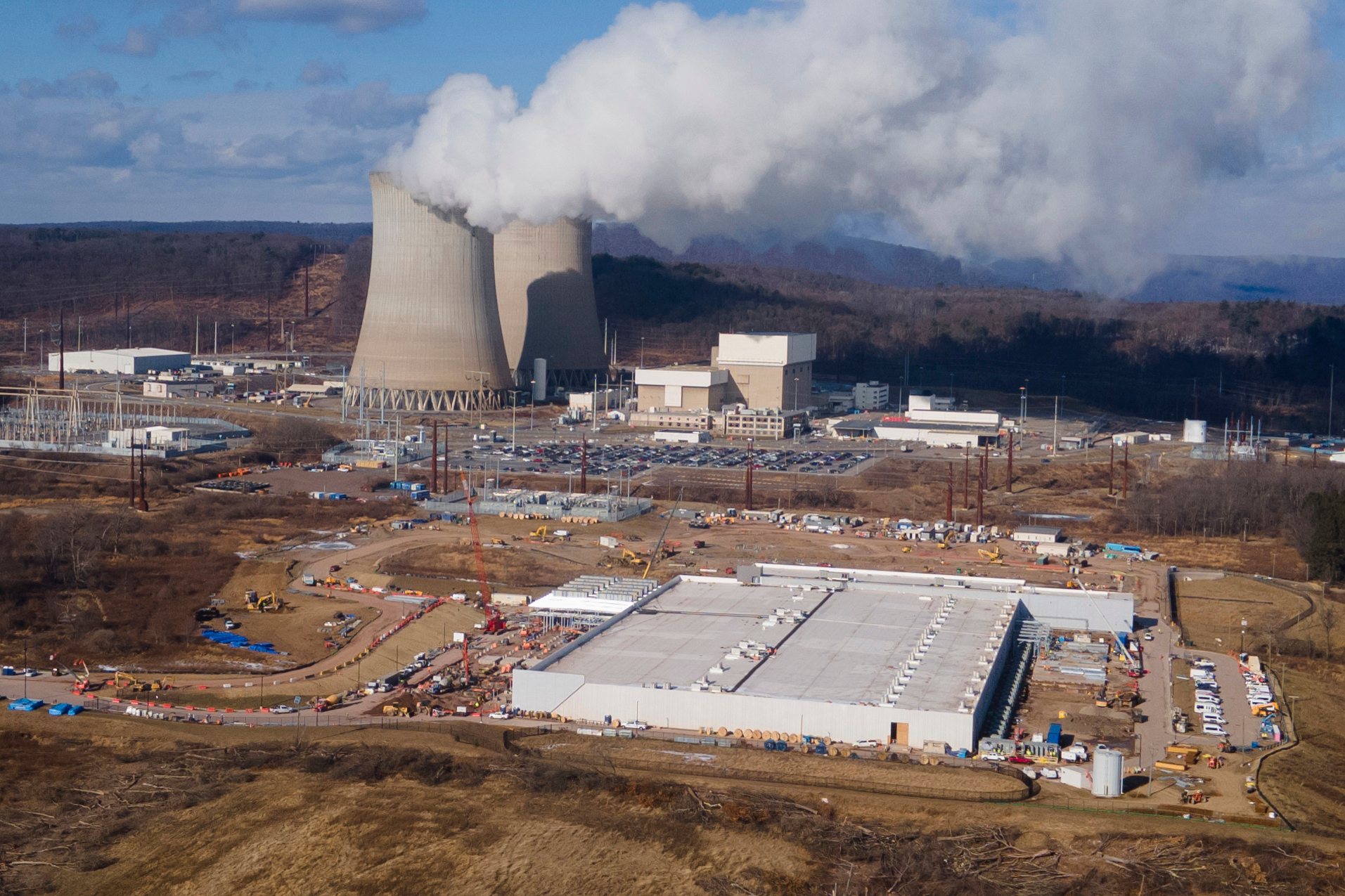
    A data center owned by Amazon Web Services, front right, under construction next to the Susquehanna nuclear power plant in Berwick, Pa., in January 2025.

    Many of these industrial compounds are proposed for rural Pennsylvania, threatening to disrupt communities’ way of life. A proposed data center in South Whitehall Township, Lehigh County, would include six buildings spread across 410 acres — which Food and Water Watch analysis finds is equivalent to the size of 100 Walmart supercenters.

    On an even grander scale, as part of the Shapiro-touted $20 billion data center AI investment by Amazon, a proposed campus in Luzerne County would stretch across 1,5200-1,700 acres.

    These are not modest developments. They are sprawling industrial complexes that threaten to reshape rural and residential communities beyond recognition.

    These proposals also threaten drinking water supplies. Hyperscale data centers can consume as much as two million to eight million gallons of water daily, putting enormous strain on local water supplies. This comes as the majority of Eastern Pennsylvania, a hot spot for development, is currently experiencing moderate to severe drought.

    Nationwide, two-thirds of data centers built since 2022 have been built in water-stressed regions, showing an alarming pattern of development that ignores the limits of local resources. Pennsylvanians should not be forced to compete with corporate server complexes for access to safe, reliable drinking water.

    Data centers are not a public good. They are profit-driven extractive industrial facilities that destroy local communities’ quality of life, all while draining their most necessary resources.

    Lawmakers have the choice to stand with communities and allow state regulators to pause and take an informed path when deciding if — not how — data centers can coexist with the needs of Pennsylvanians.

    It’s why Food and Water Watch drove 180-plus impacted residents facing data center projects in their communities to Harrisburg on June 23, and it’s why Pennsylvanians across the commonwealth must call on their legislators to support Muth’s bipartisan moratorium on hyperscale data centers today, before we all pay the price later.

    Ginny Marcille-Kerslake is a senior organizer for Food and Water Watch in West Whiteland Township.

  • The Ben Franklin Bridge turns 100. Don’t wait to walk it like I did.

    The Ben Franklin Bridge turns 100. Don’t wait to walk it like I did.

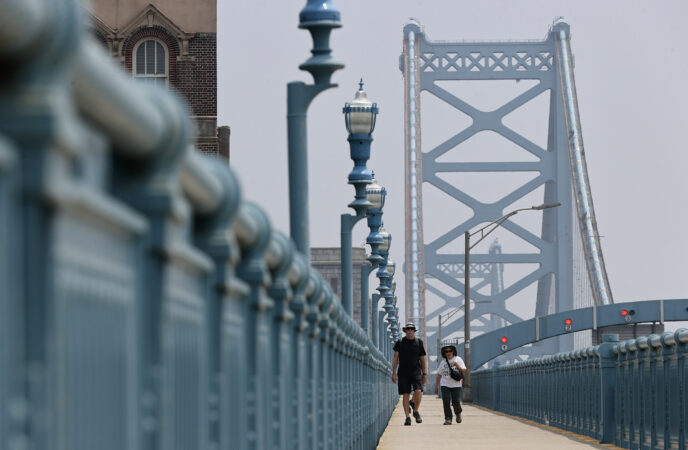
    I’ve driven across the Ben Franklin Bridge countless times but until last week I’d never walked across it, and I walked across the Brooklyn Bridge once, so I’ve quietly carried that shame with me for years.

    When I received a news release about the bridge turning 100 on July 1 and a subsequent anniversary party on July 11 that will close it to vehicles for public use for the first time since Pope Francis’ visit in 2015, I wanted to finally check walking across it off my Philly bucket list before the event.

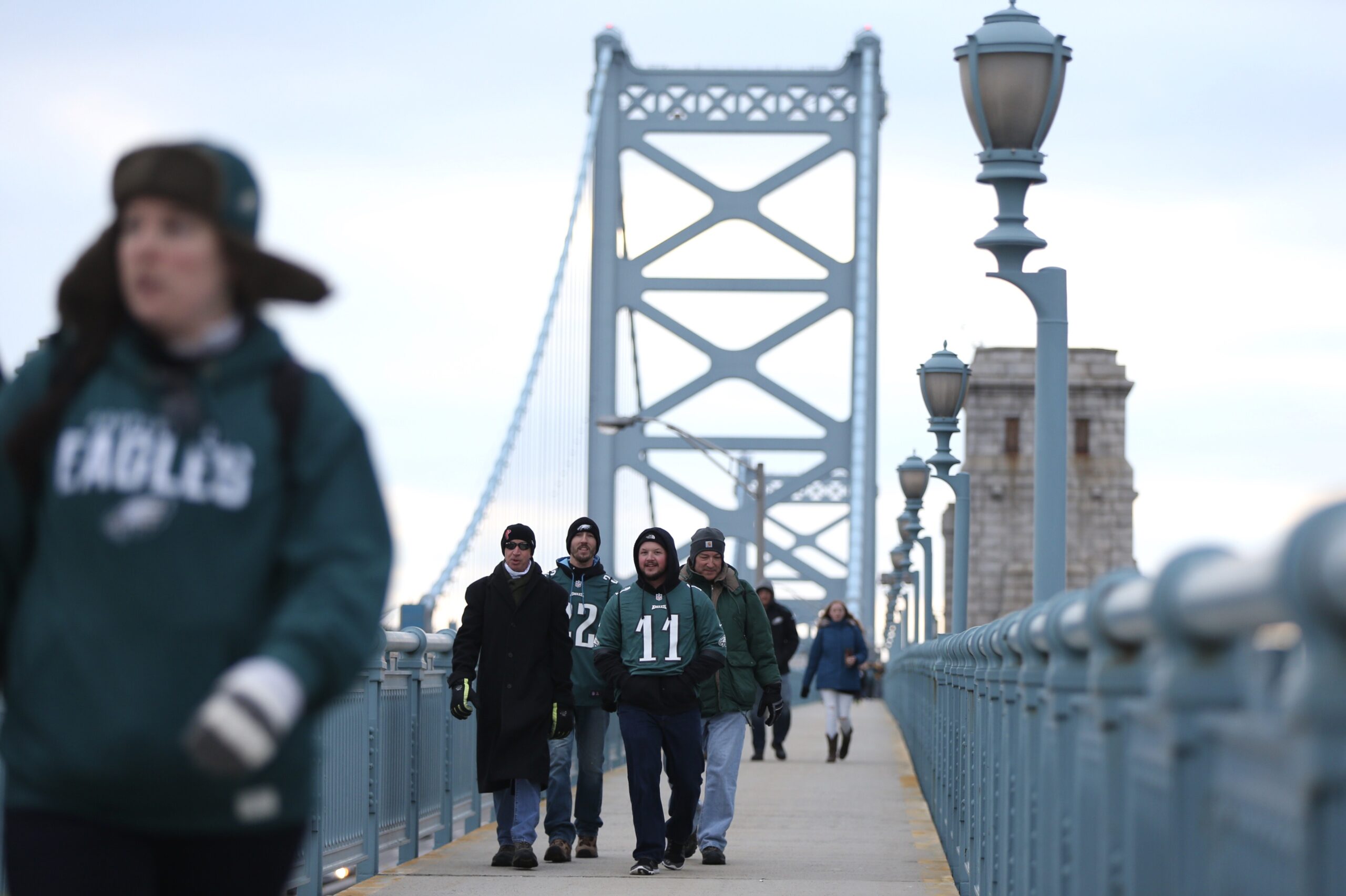
    Fans cross the Ben Franklin Bridge into Philadelphia on the morning of the Eagles’ Super Bowl parade in 2018.

    I was going to go it alone, but I decided to reach out to Mike Williams, spokesperson for the Delaware River Port Authority (DRPA), which manages the bridge, and he offered to schedule a walkway tour of it for me with DRPA principal engineer Michael Howard.

    I met both men at Fifth and Race Streets at the base of the bridge on the Philly side, but as luck would have it, we showed up on opposite sides of the heavily-trafficked span. We waved at each other across the cars and as I tried to figure out how to Frogger my way over to them, Howard and Williams disappeared.

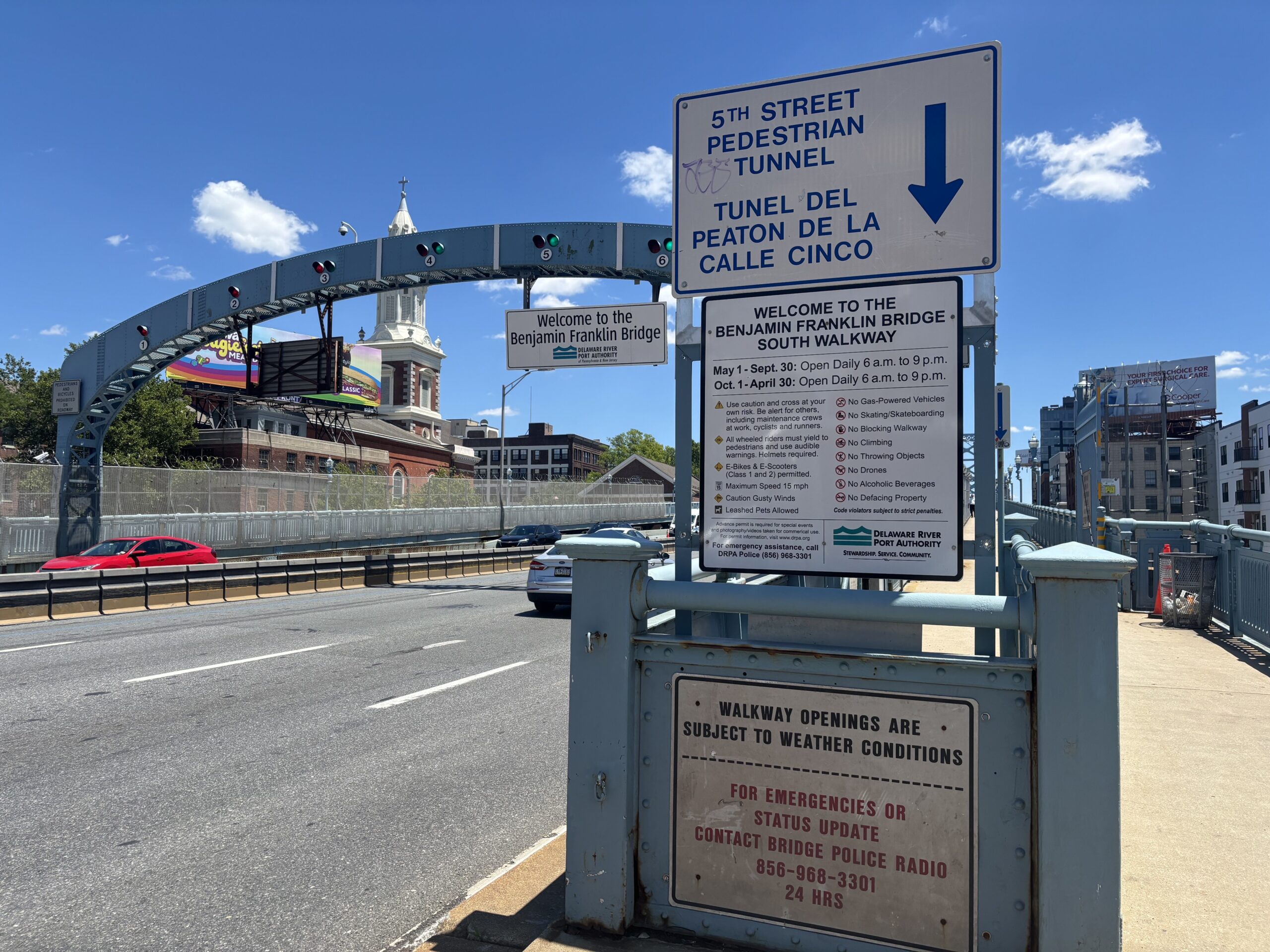
    The men popped up out of a stairwell right next to me, having used the Fifth Street pedestrian tunnel under the bridge.

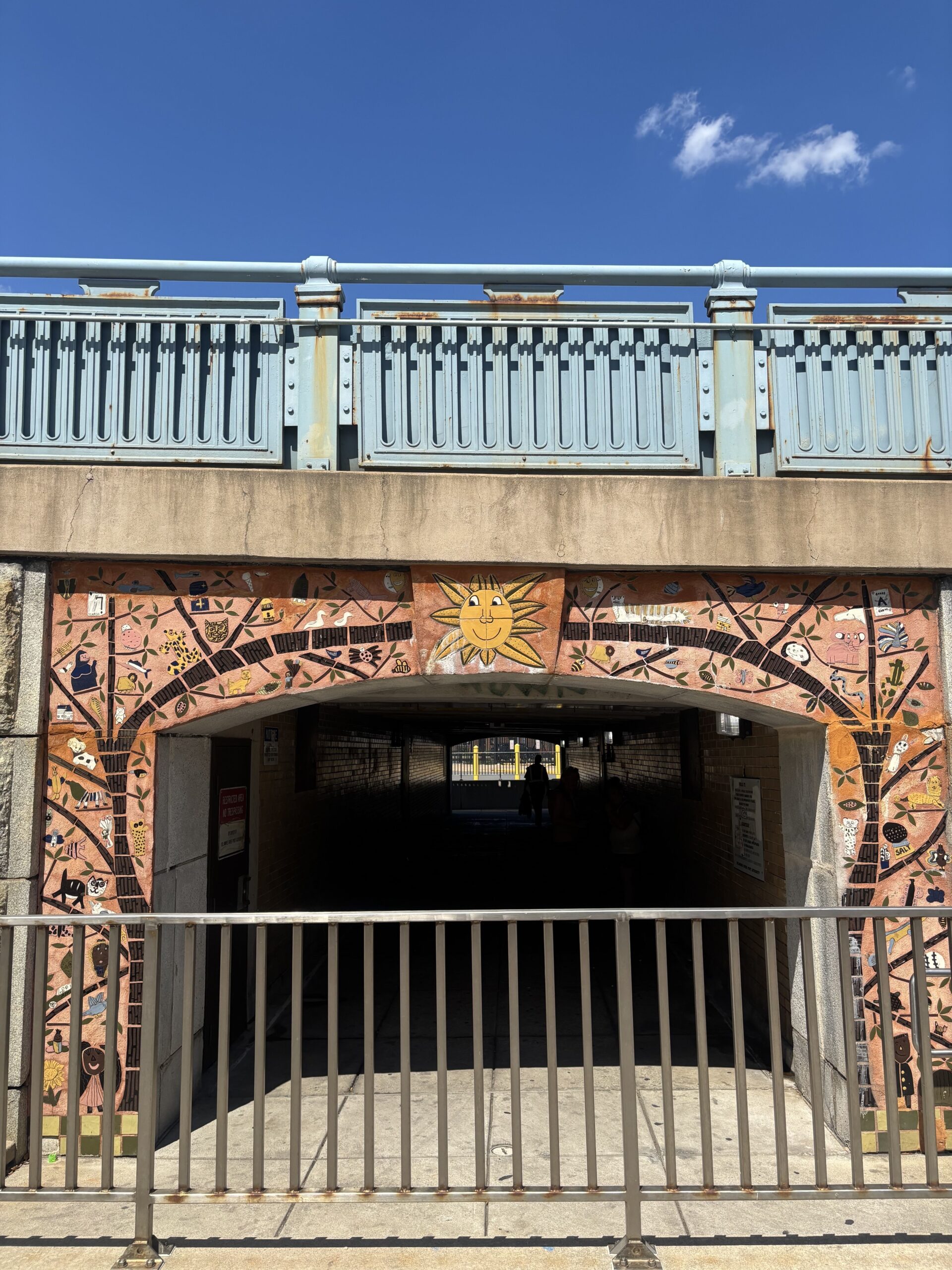
    The entrance to the Fifth Street pedestrian tunnel on the south side of the Ben Franklin Bridge in Philadelphia.

    “This was one of the original things that we incorporated into the bridge because we didn’t want people to try to walk across the traffic — because they would, you know,” Howard said, and I agreed.

    Obviously, it was the first place I wanted to check out.

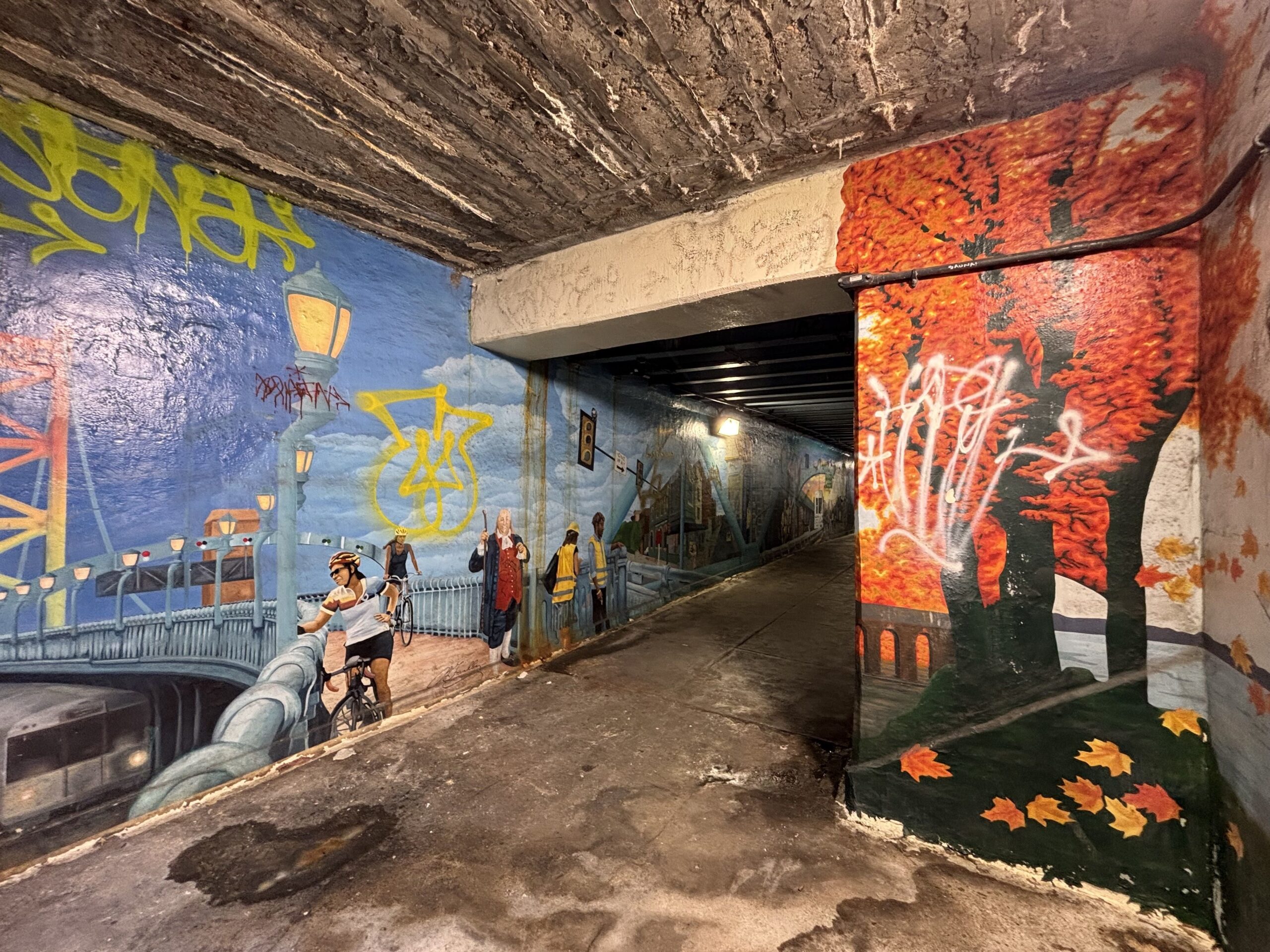
    The “Building Connections through Time” mural inside of the Fifth Street pedestrian tunnel on the Philadelphia side of the Ben Franklin Bridge.

    The entire length of the 91-foot-long tunnel was painted with a vibrant Mural Arts Philadelphia work by Brad Carney and Melissa Mandel. Created in 2018, Building Connections through Time shows people using the bridge, the building of it, and images of its early years. There are also paintings of Independence Hall, Benjamin Franklin, and other bridges that span the Delaware River.

    Finding one of the city’s most secluded murals felt like finding one of those wonderful Philly secrets the city gives sometimes, if you never stop exploring it.

    Come along with me as I explore one of Philly’s most secluded murals.

    [image or embed]

    — Stephanie Farr (@farfarraway.bsky.social) June 30, 2026 at 11:38 AM

    Mere feet

    Back on the surface, Howard said that while the bridge has two pedestrian walkways, for operational reasons, only one side is open at a time and it’s usually the south side. The walkway has restricted hours, so be sure to check the signs (currently, it’s open from 6 a.m. to 9 p.m.).

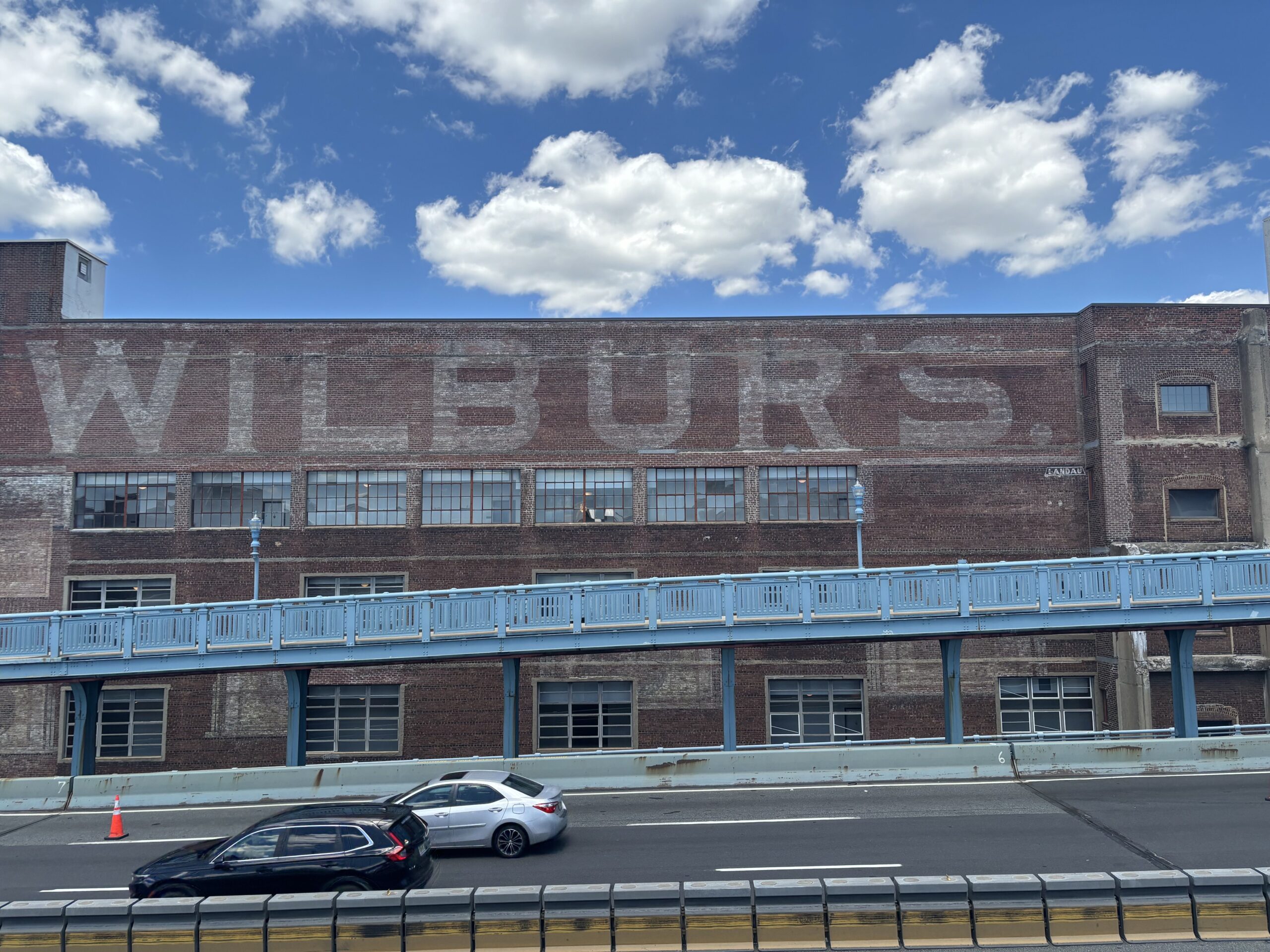
    Howard pointed out the old Wilbur Chocolate factory on Third Street and explained that a part was sliced off to make way for the bridge.

    “One of the things that we had to do when we were constructing was kind of take a surgeon’s scalpel to the area because you know with Old City, everything’s tightly packed and we wanted to make sure we took the bare minimum of structures,” he said.

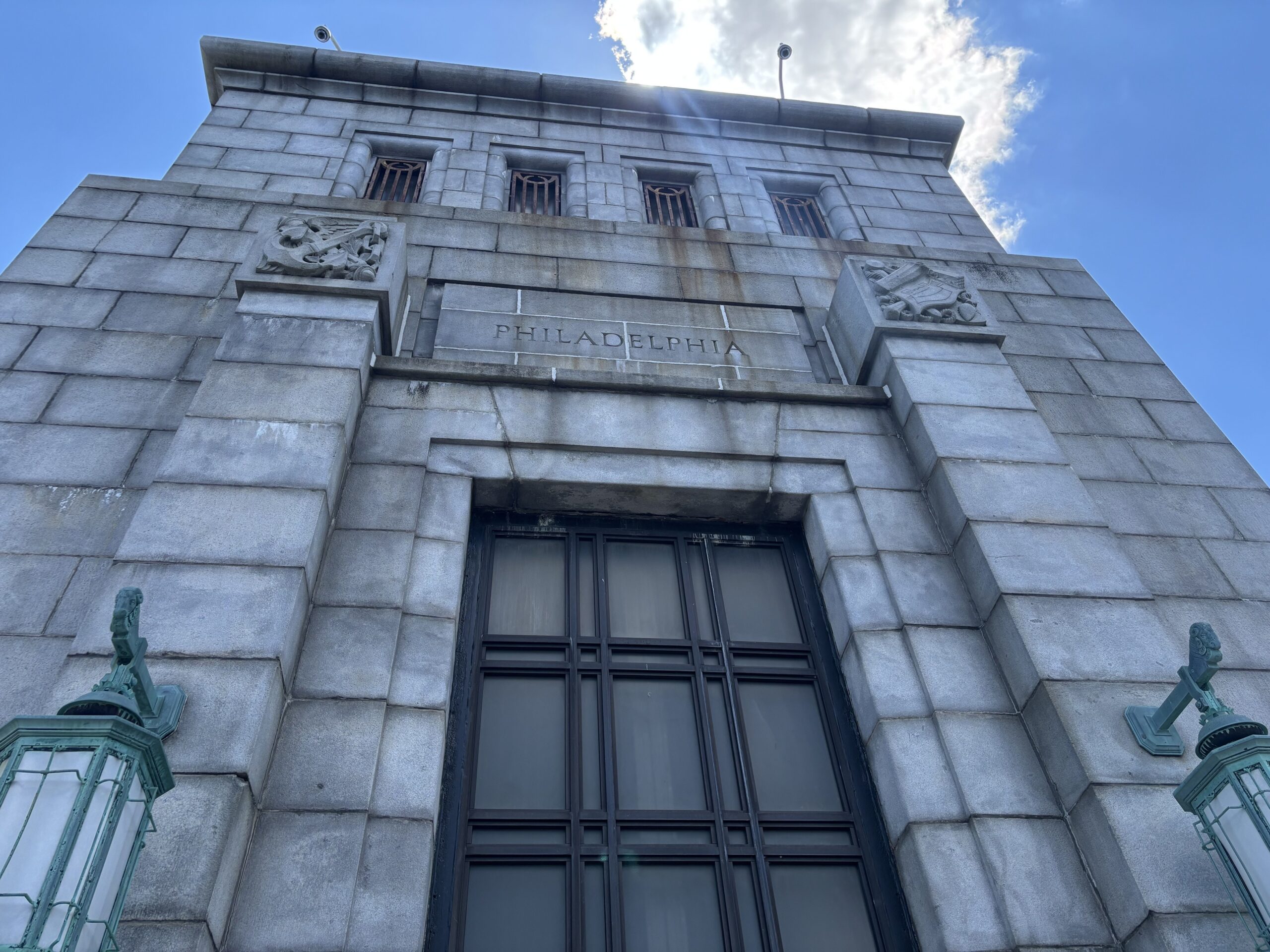
    A piece of the former Wilbur’s Chocolate Factory had to be sliced off to make way for the Benjamin Franklin Bridge.

    Also under threat when the bridge was built was nearby St. George’s United Methodist Church on Fourth Street. Opened in 1769, it’s the country’s oldest Methodist church in continuous service.

    “Luckily, the engineers were able to just adjust the angle of the approach ever so slightly to avoid encountering the building,” Howard said.

    I marveled as I looked at the mere 14 feet that still separates St. George’s from Philly’s big Ben. The engineers left just enough room for the Holy Spirit.

    ‘Bridge angels’

    As we began our journey across the bridge, Howard said it took about four-and-a-half years to build and it was designed by architect Paul Philippe Cret, who also designed Philly’s Rodin Museum. The bridge was constructed with eight lanes — six for traffic and two for trolleys, as well as two tracks for heavy rail.

    But in the time it took to build it, trolleys went out of fashion and buses came in. The trolley tracks sat unused until the 1940s, when they were paved over. A vast, empty space for a never-opened trolley station remains under the Bolt of Lightning sculpture near the base of the bridge.

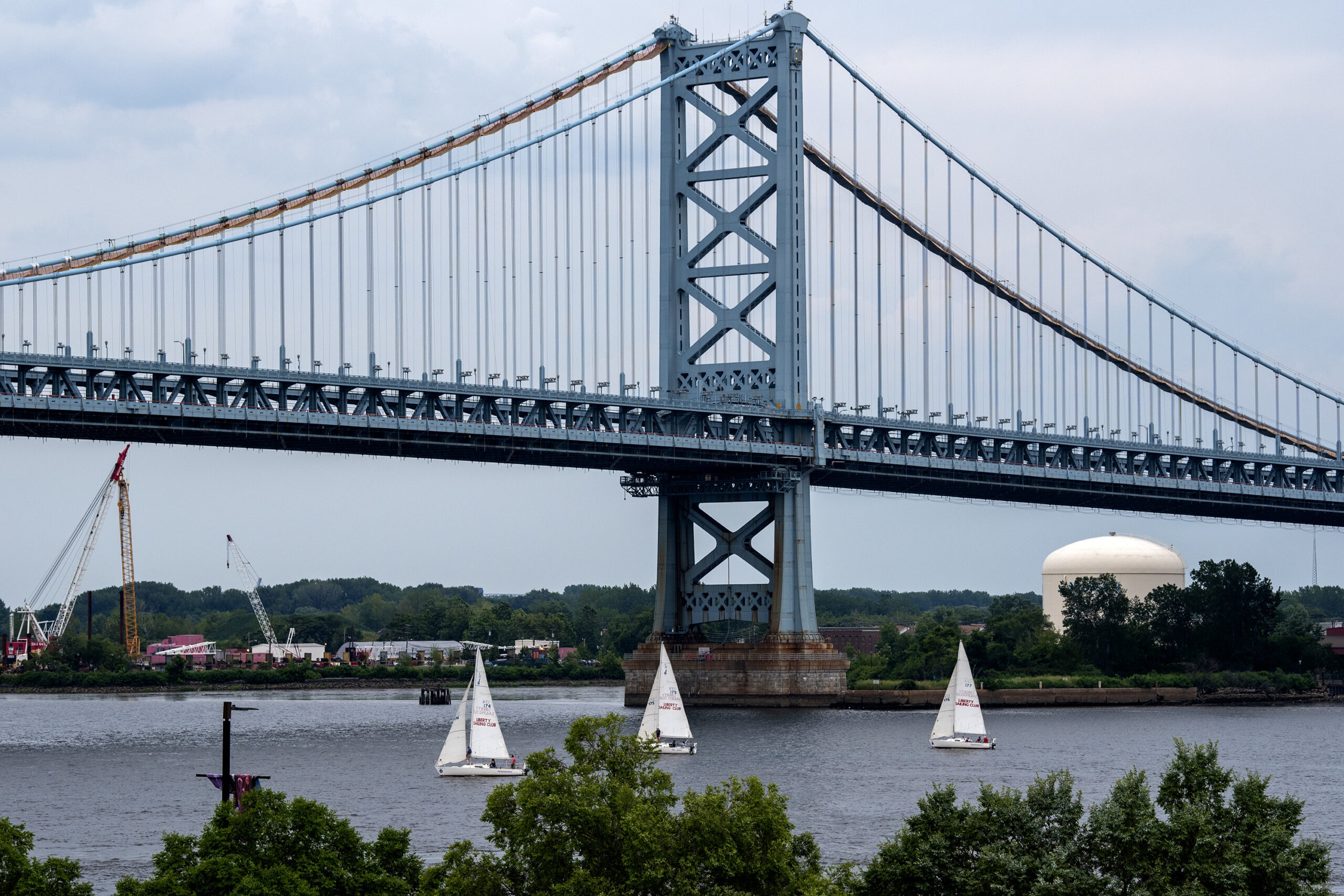
    Sailboats pass under the Ben Franklin Bridge in 2020.

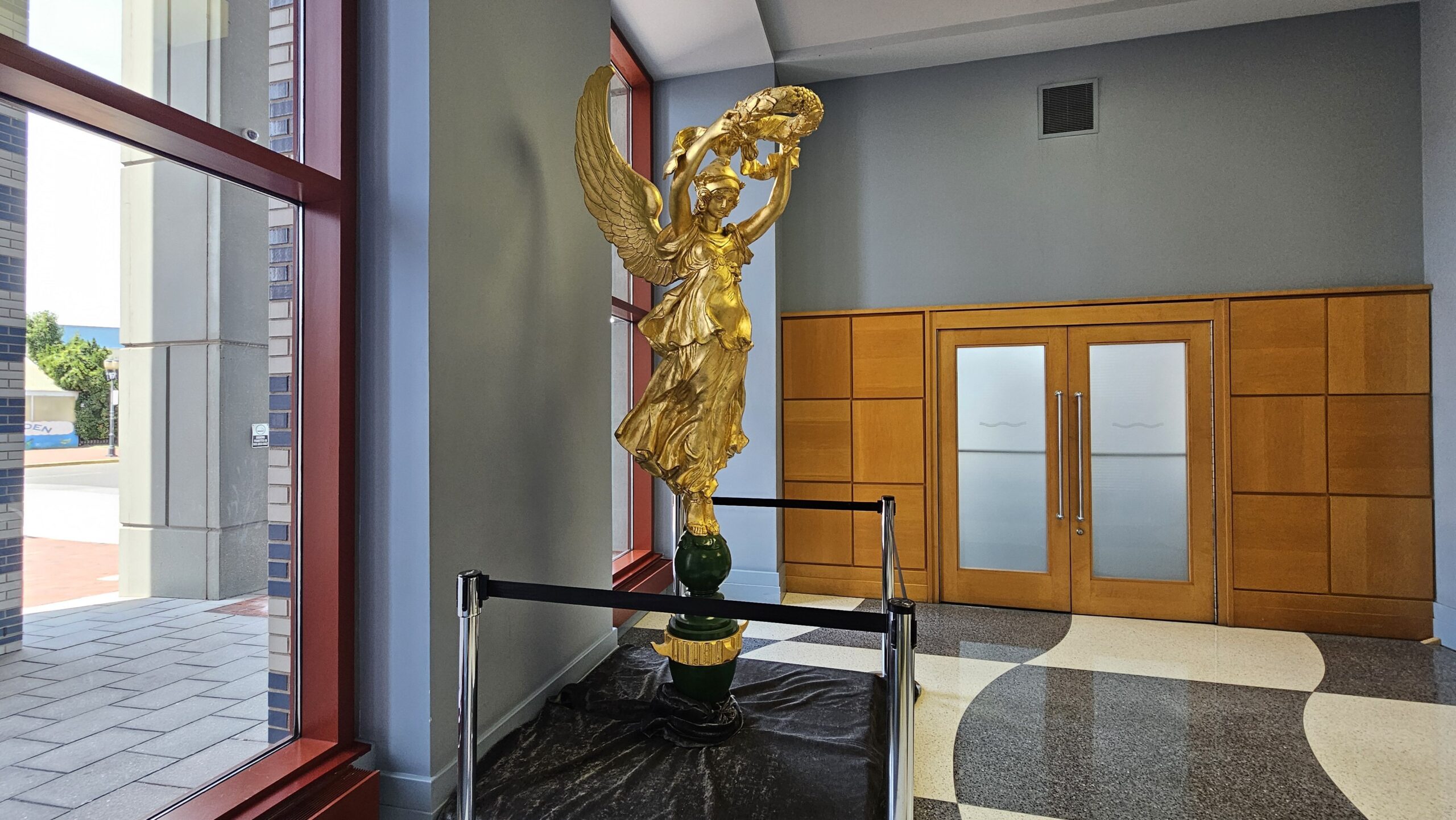
    Another original component lost when the trolley tracks were paved over were four 75-foot-tall pylons — two on either side of the bridge — that were topped with bronze angel statues called Winged Victory.

    One of the angel statues is in the lobby of DRPA’s headquarters and three are in storage, but one will be displayed at the upcoming 100th anniversary celebration, according to Williams.

    One of the four “Winged Victory” statues that used to decorate the Ben Franklin Bridge is now on display at the Delaware River Port Authority’s headquarters.

    ‘A living beast’

    Shortly after we began our trek on the 1.3-mile walkway, I felt a PATCO train speeding beneath my feet and the bridge move ever so slightly.

    “The bridge is dynamic, almost like a living beast because the steel expands when it gets warm out and with traffic, it bounces,” Howard said.

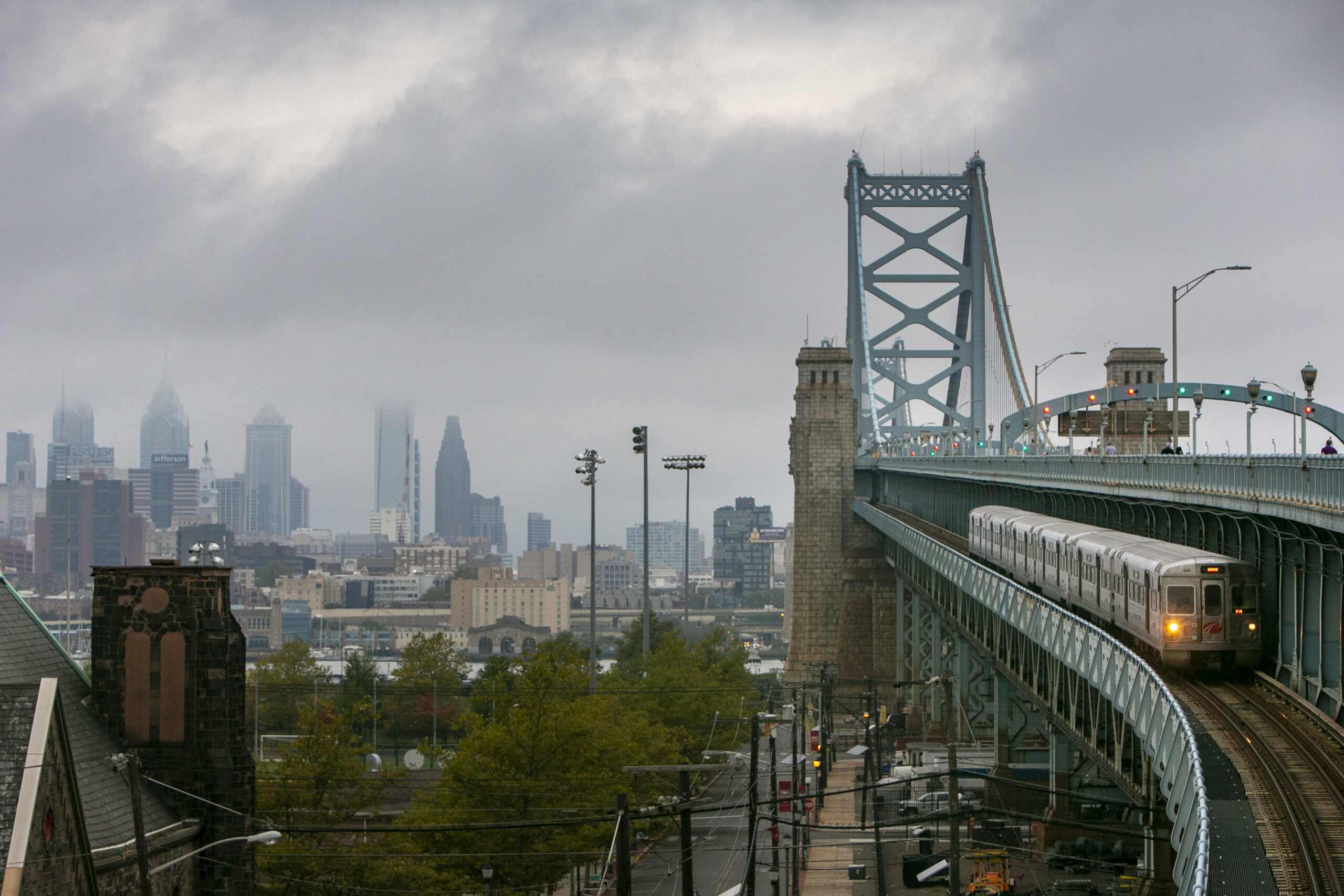
    A PATCO train travels from Philadelphia to Camden underneath the pedestrian walkway of the Ben Franklin Bridge.

    I got used to the sensations within minutes. That being said, I’m not afraid of heights. It could be unnerving if you are.

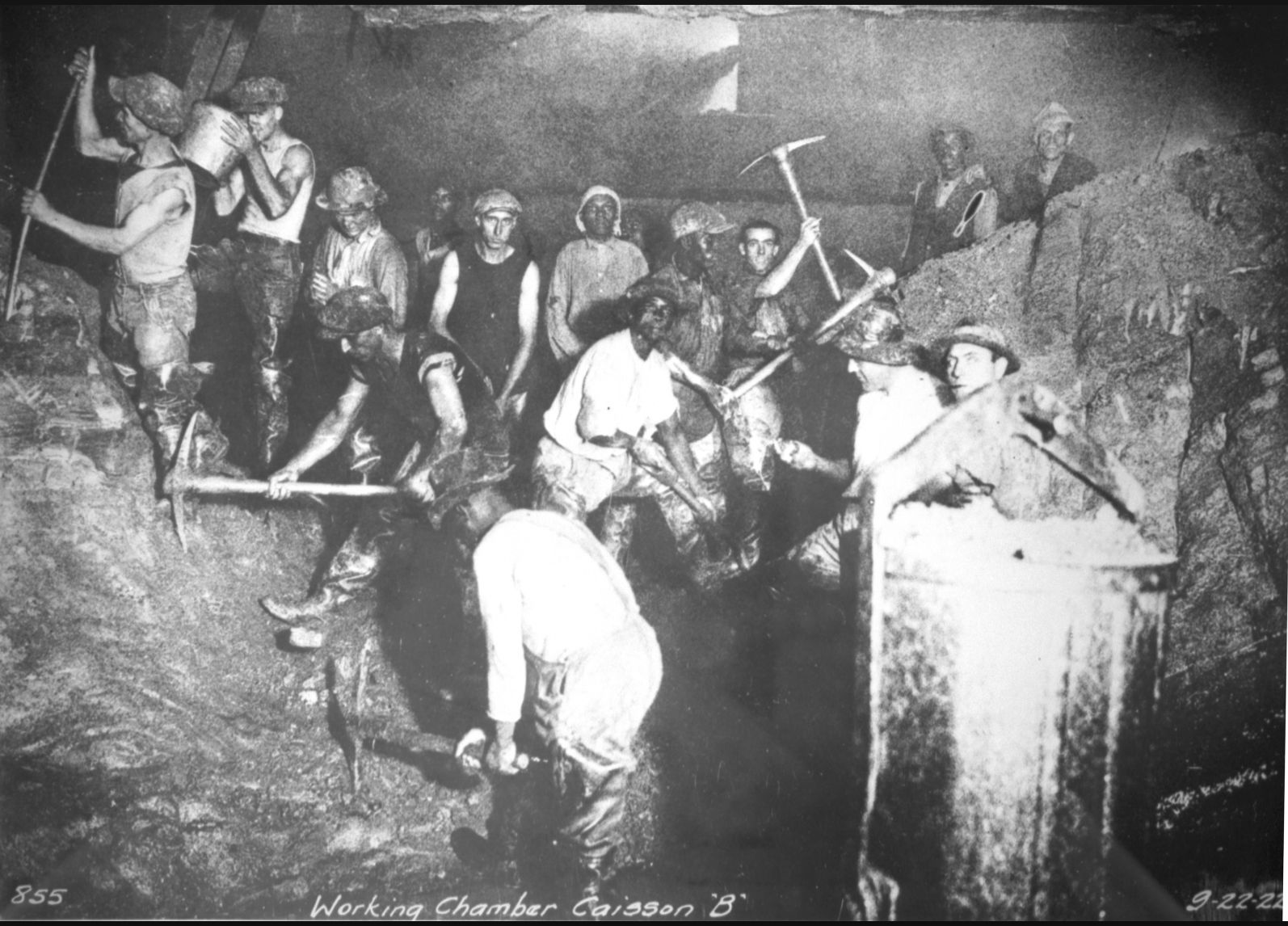
    It took $36 million and 1,300 people to build the 376-foot-tall bridge that extends an additional 100 feet or so below the river, Howard said. Guys known as “sand hogs” worked in submerged watertight structures called caissons where temps sweltered into the 90s, even in winter, to dig down to the bedrock of the Delaware River.

    In a photo dated 1922, men known as “sand hogs” work in a submerged watertight structure called a caisson to dig down to the bedrock of the Delaware River during the construction of the Benjamin Franklin Bridge.

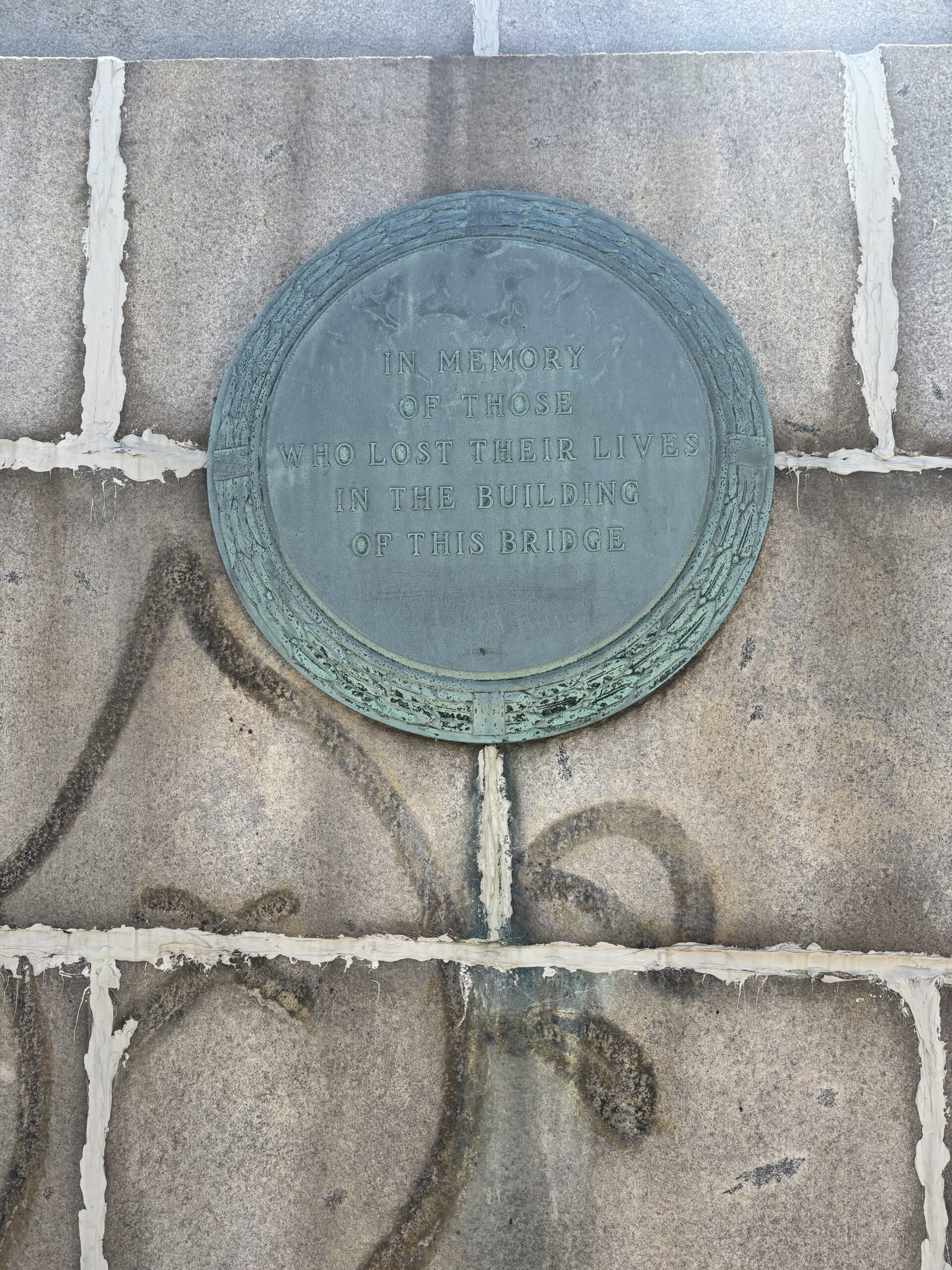
    Fifteen workers died in the construction of the bridge. We passed a circular plaque in their memory as we walked. I wondered who they were, how they died, and how they lived.

    “Unfortunately, the rule of thumb at the time was for every million dollars you’re spending, you expect to lose a life … so by that rationale you could have had 36 fatalities.” Howard said. “Nowadays, you know, one injury is unacceptable.”

    A plaque on the Benjamin Franklin Bridge is dedicated in memory of those who lost their lives while building it.

    Unique elements

    Our pace was a steady stroll, so we were often passed by runners, walkers, and cyclists. Some appeared to be having a good time, and others looked like they were going through tough times. Some talked to themselves and some stopped to take photos. It was a microcosm of Philly and Camden, suspended high above the river.

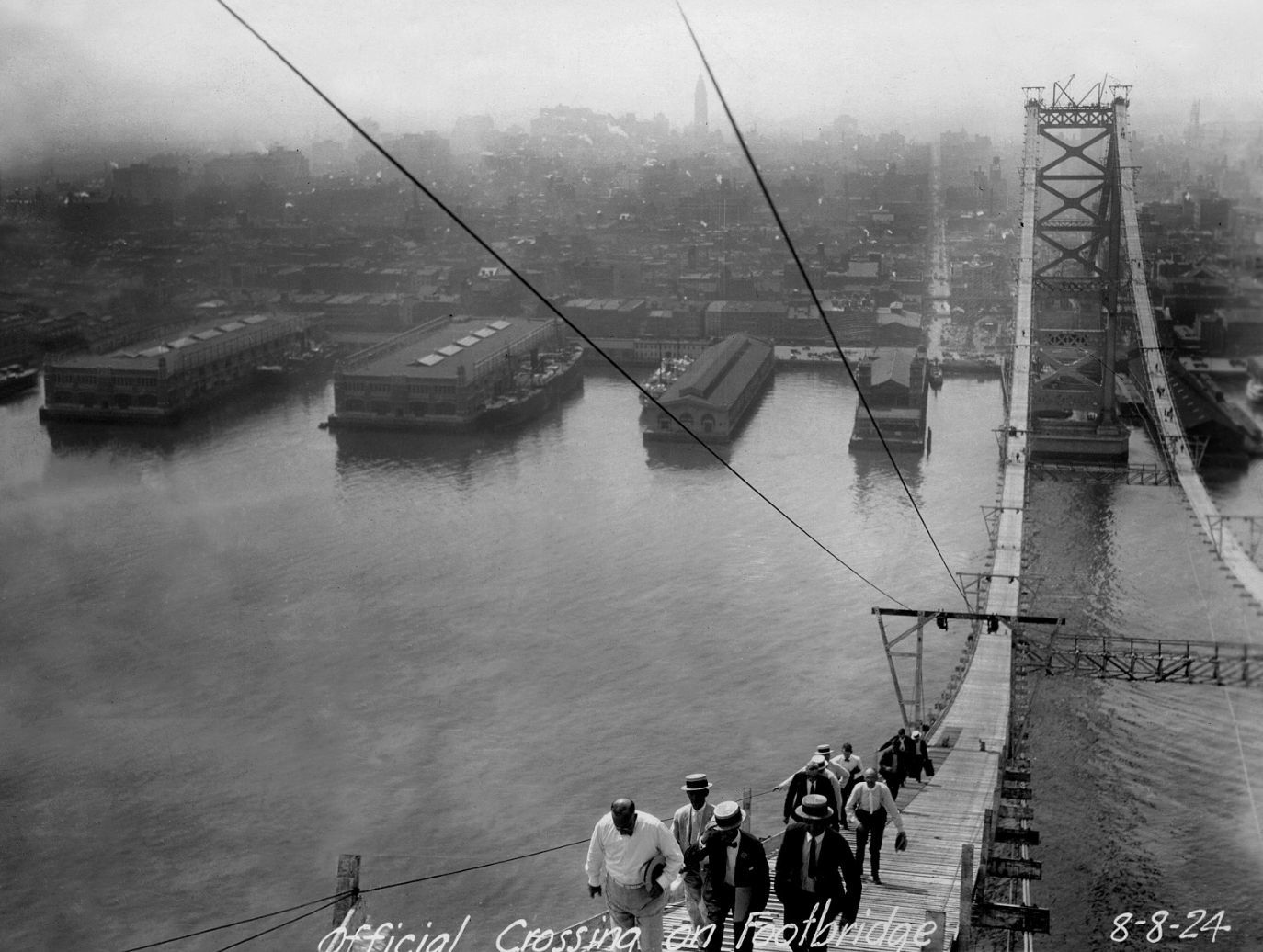
    Howard said when the bridge was built, its chief engineer believed the walkways wouldn’t be used “in an increasingly or completely motorized age.”

    A photo dating from 1924 shows the first official crossing of the Benjamin Franklin Bridge’s pedestrian walkway prior to the 1926 opening of the bridge.

    “But you see today the amount of people that are using this walkway and it’s one of the unique elements of this bridge,” he said.

    I looked ahead to Camden and then back to Philly. I was so grateful for this walkway and this view. I couldn’t imagine not having it and I couldn’t believe it took me so long to see the city from this new perspective.

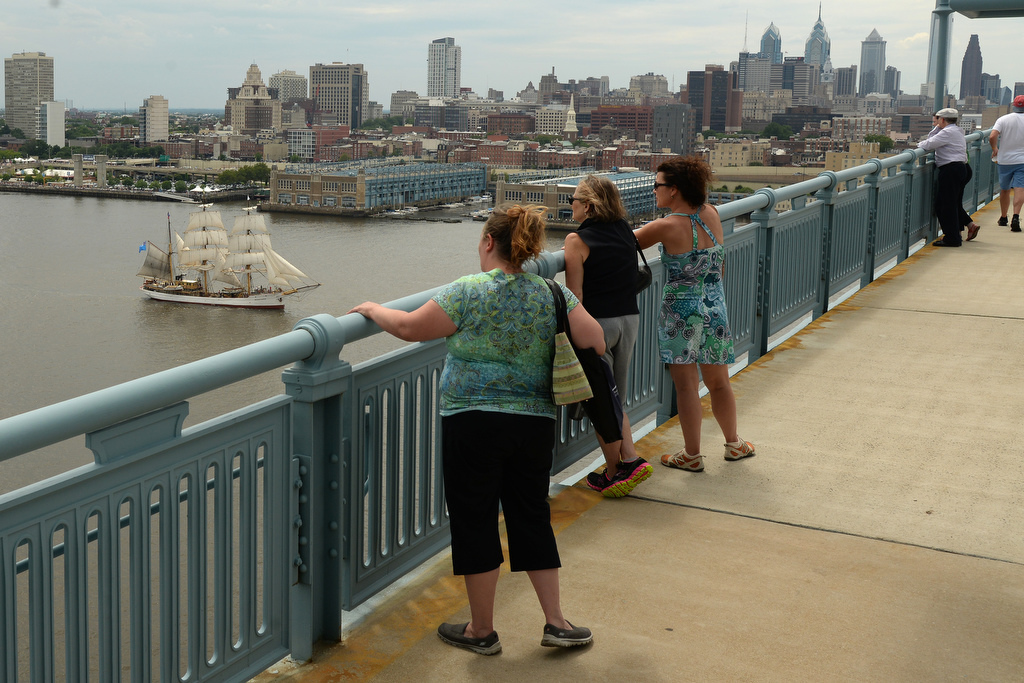
    Spectators watch from the Ben Franklin Bridge pedestrian walkway as the Picton Castle sails up the Delaware River in 2015 during the Parade of Tall Ships.

    The only thing I found worrisome and the thing that kept all three of us looking over our shoulders, were the e-bike and e-scooter riders we didn’t always hear zooming behind us. Skateboards and rollerblades aren’t allowed, but certain classes of e-bikes and e-scooters are. Gas-powered vehicles are also prohibited on the walkway, but a guy on a dirt bike definitely zoomed by at one point.

    In the bridge’s early days, horses and carriages were allowed on the main span alongside cars, according to Howard, but their slow pace proved dangerous and their excrement, troublesome, so they were banned in the 1940s.

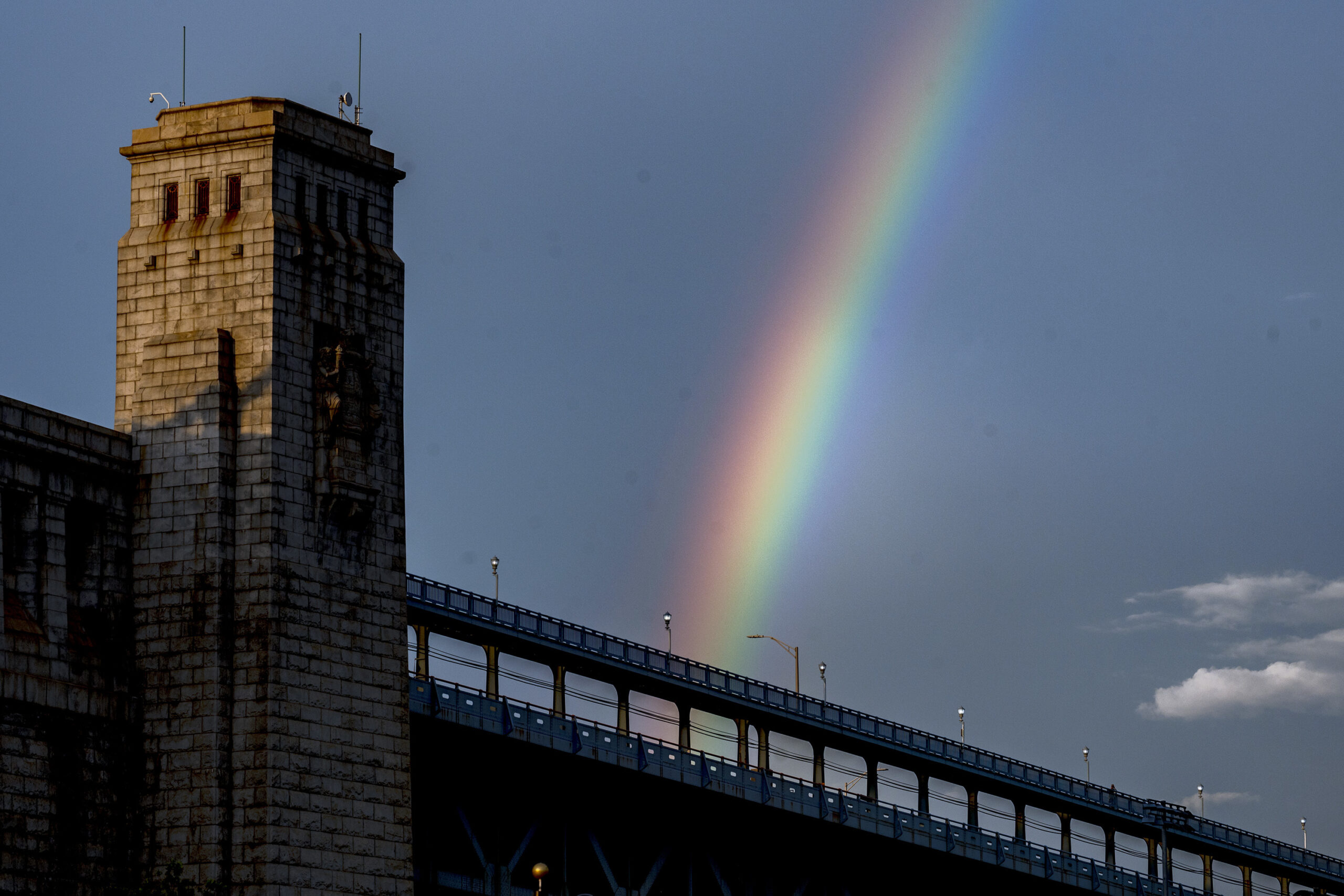
    A rainbow appears behind the Camden anchorage of the Ben Franklin Bridge after an early evening rainstorm passes through.

    We stopped at one of the Philadelphia anchorages, the massive concrete-and-granite structures where the bridge’s cables are anchored.

    These structures were made to house elevators for the trolleys. Alas, the anchorages are off-limits spaces, but Howard told me that each of the four have the same seven artistic tiles inside commemorating milestones in transportation, from one of a Conestoga wagon to one of the USS Shenandoah, the ill-fated dirigible that crashed before the bridge even opened.

    One of the anchorages on the Philadelphia side of the Benjamin Franklin Bridge as seen from the pedestrian walkway.

    Another name

    The Ben Franklin Bridge was the longest suspension span in the world, with a distance of 1,750 feet between the two towers, when it opened on July 1, 1926.

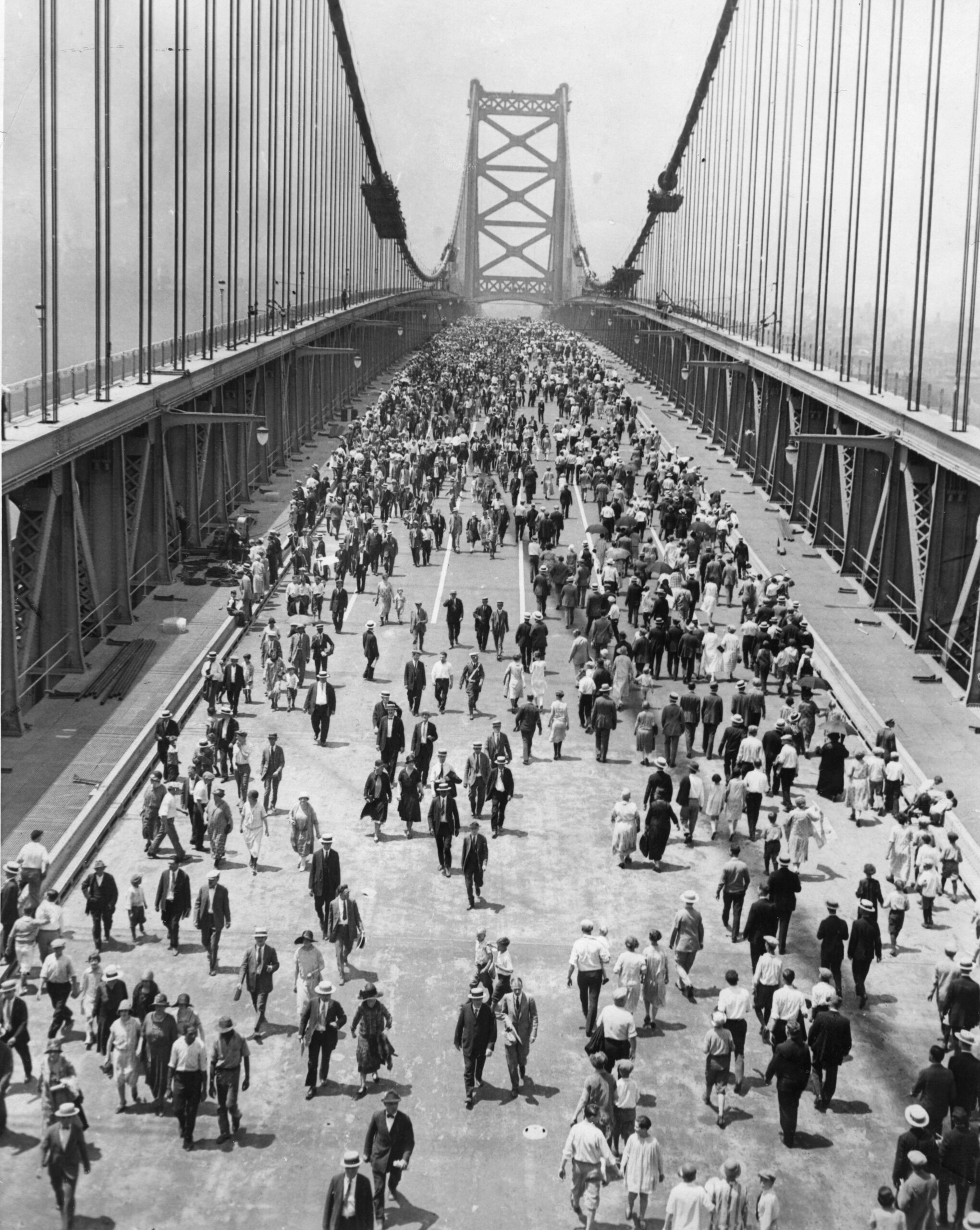
    In a front-page Inquirer report, journalist Richard J. Beamish noted 250,000 people crossed the bridge on foot opening day and that the structure was “beautiful as gossamer web and seemingly as frail.”

    Pedestrian cross the Delaware River Bridge on its opening day in 1926.

    Howard, who quoted that report to me, then asked: “When do you think our first accident was?”

    I guessed July 2, 1926. I guessed wrong.

    “It was the day it opened,” he said. “People were jockeying to be one of the first to cross the bridge, and over in Camden, you had a fender bender.”

    Back then, the span also had a different name — the Delaware River Bridge. It was rechristened in 1956 to avoid confusion when the Walt Whitman Bridge was also built over the Delaware River.

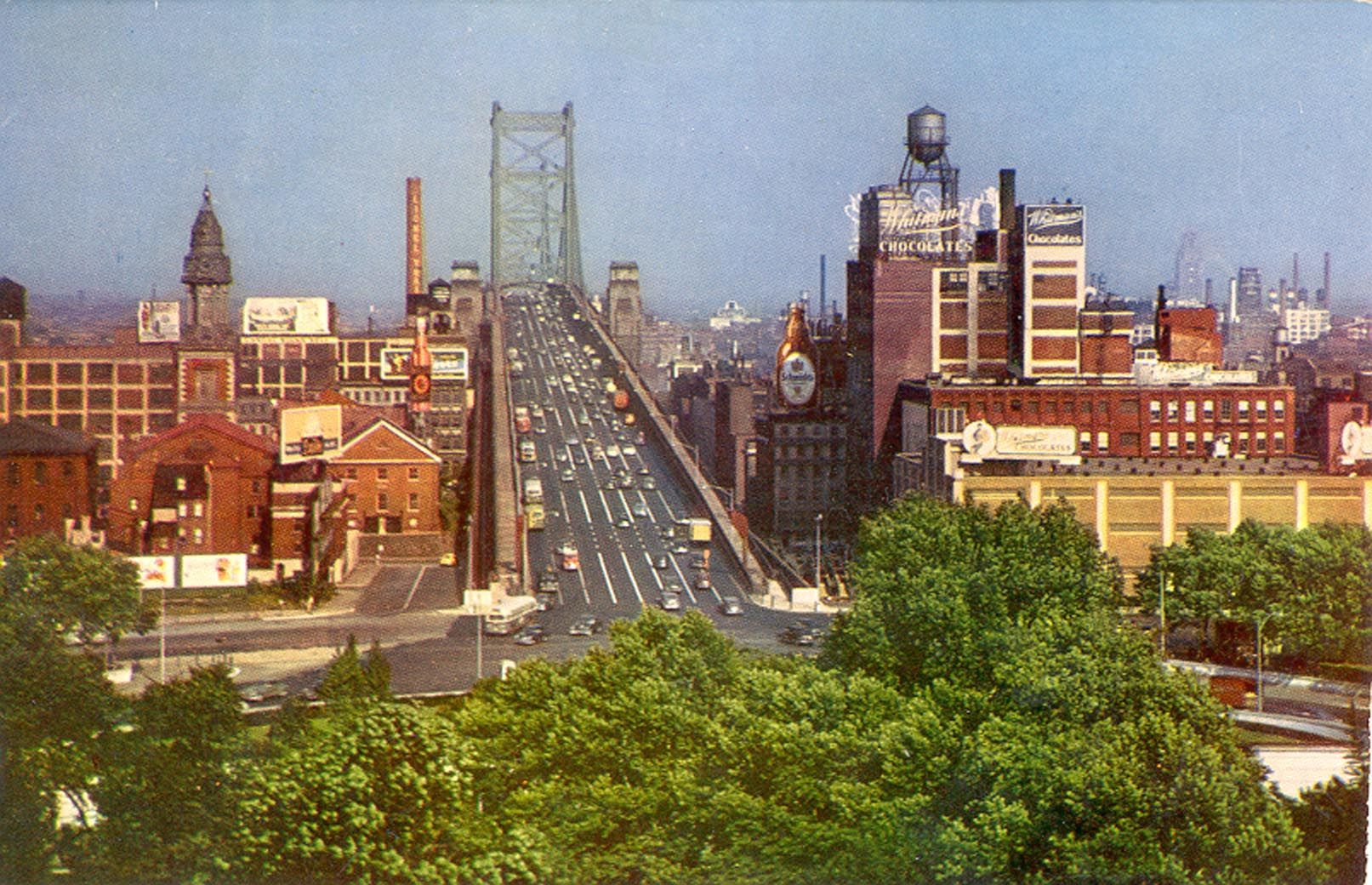
    A view of the Benjamin Franklin Bridge in the 1950s.

    The Ben Franklin Bridge wasn’t always blue, either. It was originally gray and was repainted to its current color just ahead of the Bicentennial, Howard said.

    ‘Calm and serene’

    As we stood talking, a man jogging by in Rocky Run T-shirt asked if we’d take a photo of him with the Philly skyline.

    Jim Bach of Voorhees works in Camden and likes to run the bridge during his lunch break.

    “It’s fantastic. I mean the views that you get when you’re up here, it’s just calm and serene,” he said.

    I too felt serene. It was quiet and peaceful on the bridge and being atop it helped me see the city I love in a new way.

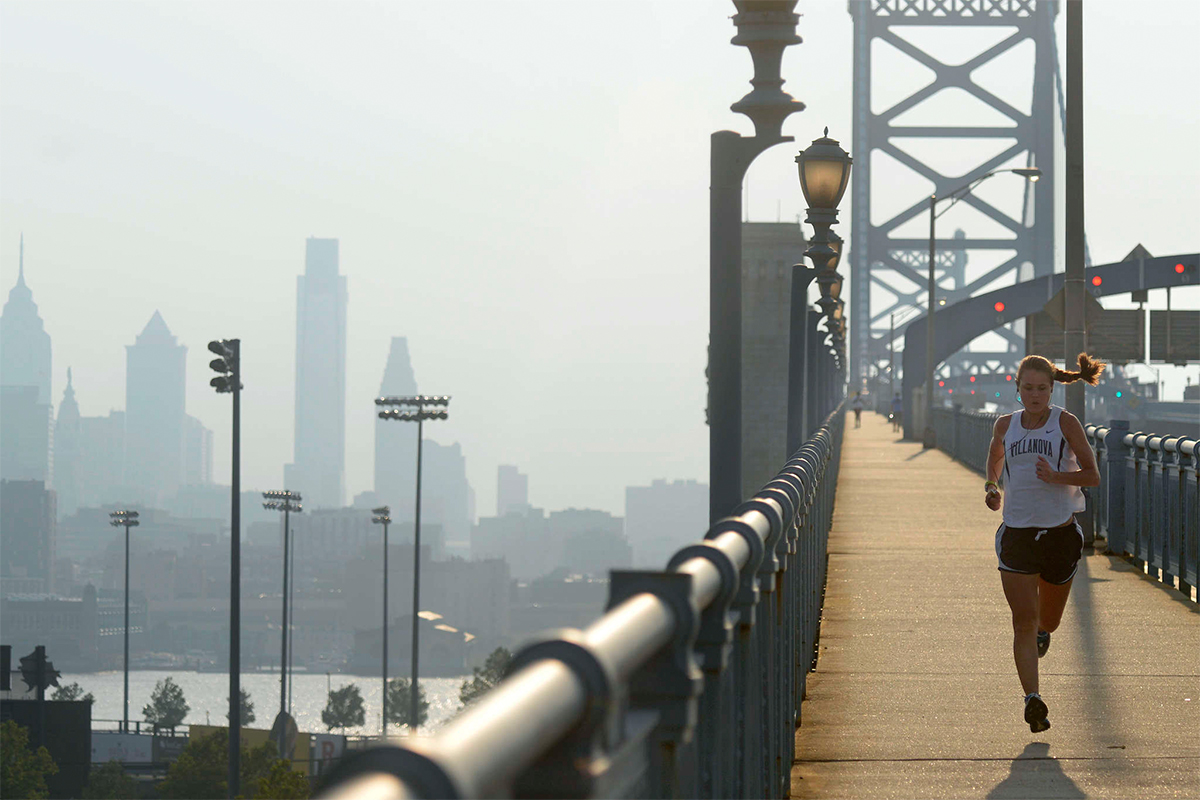
    A jogger runs across the Ben Franklin Bridge in an Inquirer file photo.

    Howard also helped me to see something else — the Betsy Ross, Walt Whitman, and Commodore Barry Bridges are all visible from the top of the Ben Franklin.

    “All bridges essentially become monuments to the area,” he said. This was most true of the one we were standing on.

    We talked about the Ben Franklin’s many appearances in television and movies, from Blow Out to 12 Monkeys.

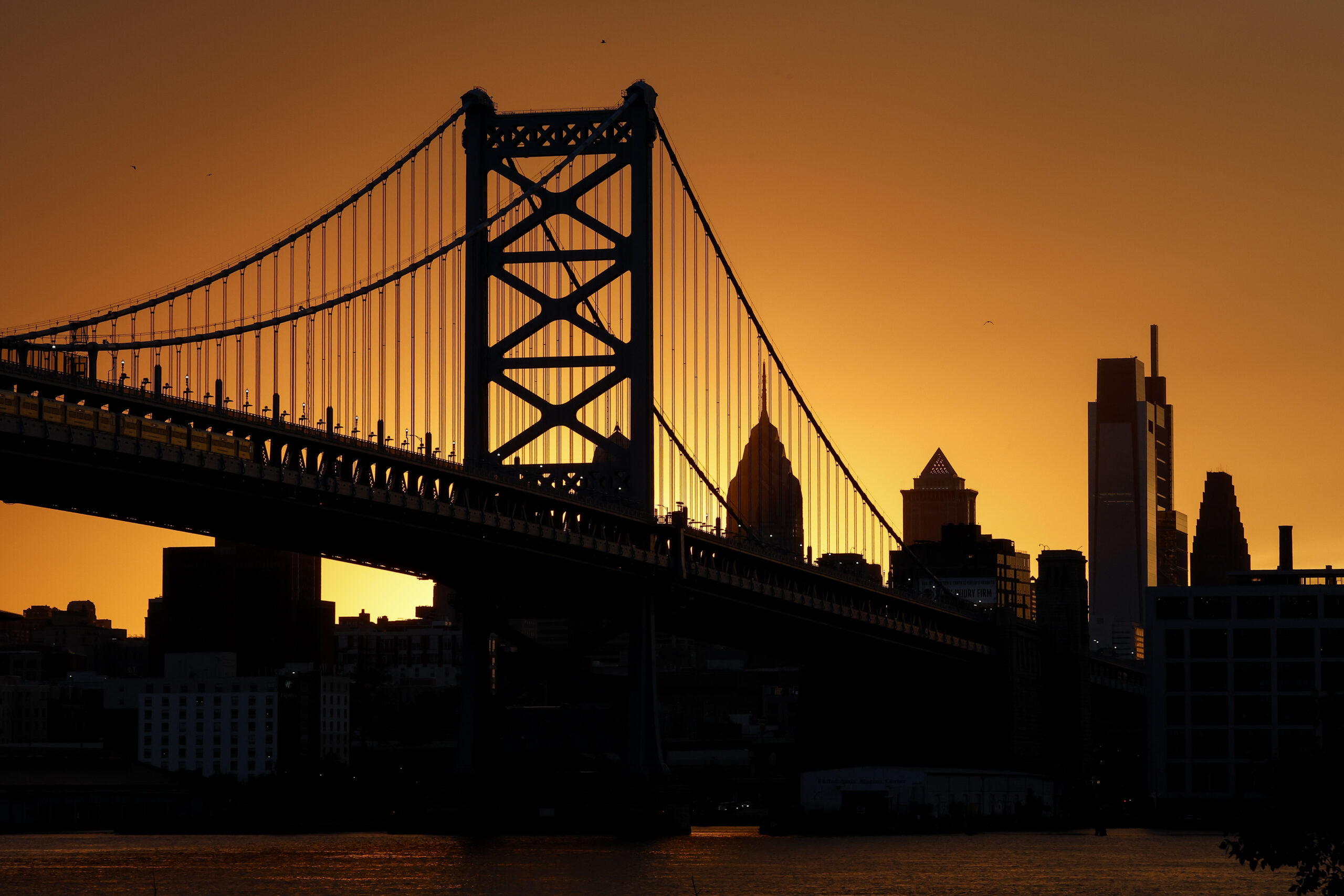
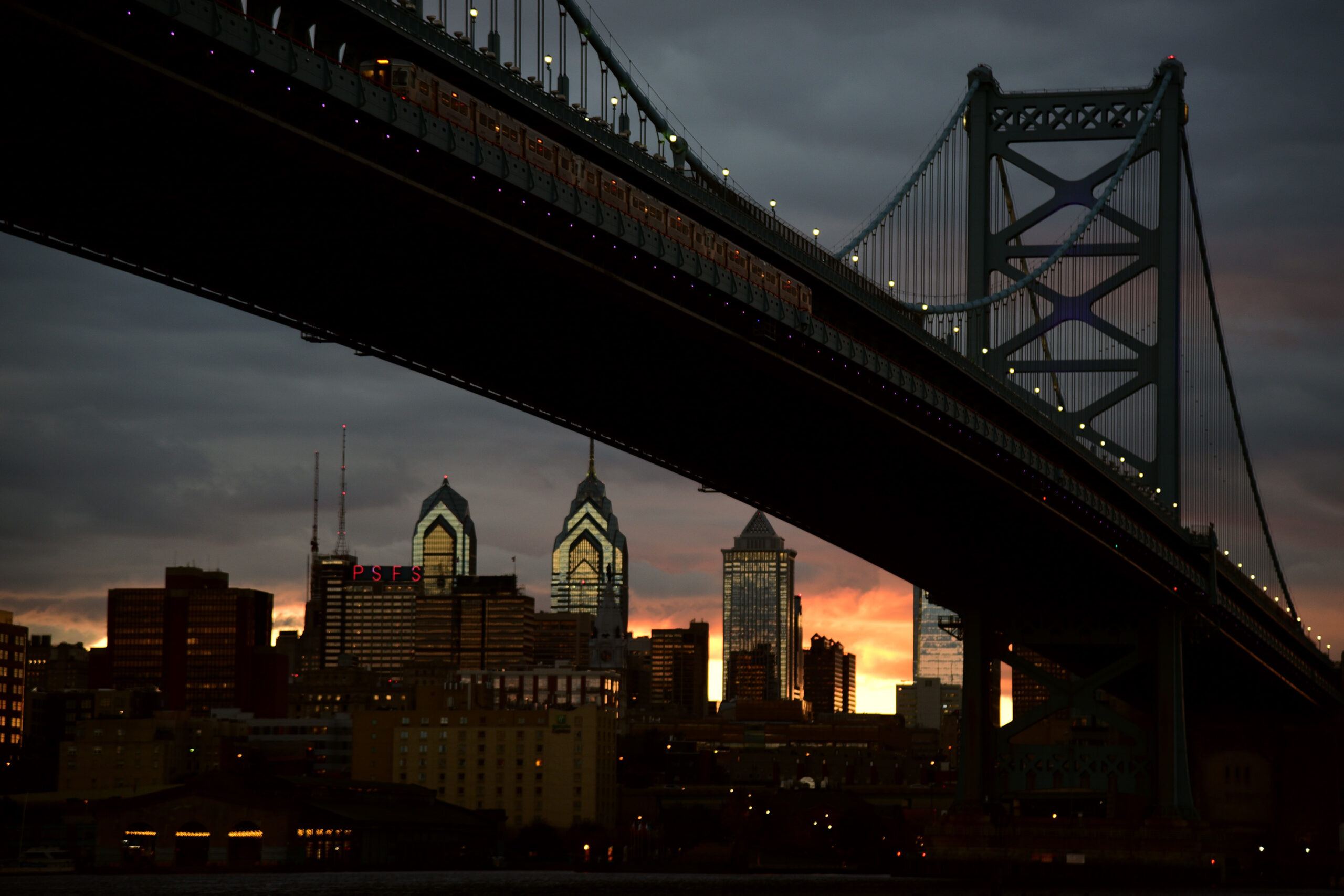
    The sun sets behind the Ben Franklin Bridge, seen from Cooper’s Poynt Park on Tuesday, Sept. 30, 2025 in Camden, NJ.

    “Last year they kept coming back from commercial breaks during Monday Night Football and they showed one of three things — the Liberty Bell, someone making cheesesteaks, or the bridge,” Howard said.

    In its 100 years, the bridge has become a visual touchstone for the region. You see it and you know you’re in Philly, whether you’re watching a movie or coming back from a road trip. It’s given Philly its sense of place as much as the LOVE sculpture or Independence Hall.

    A great connector

    When we got to Camden, we walked through the pedestrian tunnel on that end, too. It doesn’t have a mural, but the exterior is decorated with a bright mosaic of birds and animals created by Camden schoolchildren in the early 2000s.

    A mosaic created by Camden schoolchildren decorates the exterior of the pedestrian tunnel on the Camden side of the Benjamin Franklin Bridge.

    On our return walk, I asked Howard if he had a moment on the bridge that’s stuck with him. He said a few years ago, while he was leading a tour, there was a commotion on the Philly side. A kitten found its way onto the bridge and police were called. The feline then crawled into the engine compartment of a police cruiser, which had to be taken apart to get it freed.

    “I was like, ‘Yeah, so I gotta go adopt it,’” Howard said.

    And so he did, and he named the furry little girl Beanie.

    I thought of a poignant moment I had once on the bridge. I was a passenger in a vehicle years ago, when I looked over and saw that the car I was in was traveling at relatively the same speed as the PATCO train next to us.

    The sun sets over the Philadelphia Skyline behind the Benjamin Franklin Bridge looking southwest from Cooper’s Point Waterfront Park in Camden in this Inquirer file photo.

    I locked eyes with a woman on the train, who looked a lot like me. We smiled at each other and I waved and she waved back. It’s a brief moment that’s always stuck with me. Maybe it’s because I felt like I could have been her in another life, or she could have been me.

    Walking the bridge and hearing its stories, I realized that it connects so much more than just Camden and Philly. It connects all of us to each other — in big and small ways — and it connects our future with our history.

    Today, I have a new story about the Benjamin Franklin Bridge, the day I walked across it. If you haven’t done so yet, I encourage you to walk it, too, and make a new memory with one of Philadelphia’s great old structures.

    A man walks across the Ben Franklin Bridge towards Camden in an Inquirer file photo.

    The anniversary celebration for the Ben Franklin Bridge will take place from 10 a.m. to 2:30 p.m. July 11. Details can be found at drpa.org/bfb100/.

  • Letters to the Editor | July 1, 2026

    Letters to the Editor | July 1, 2026

    Civics lesson

    A civics lesson for those of us who remember our high school class in government. Perhaps ironically, given today’s reality, in my Montgomery County high school, the course was named “Problems of Democracy.” These days, without a doubt, the problems are large and numerous.

    I commend everyone for spending a few minutes finding and watching online Sen. Chris Murphy’s (D., Conn.) speech last week, “500 Days of Corruption.” Then contact your favorite Republican elected officials (and Republican candidates) from Pennsylvania, asking him/her to either 1) rebut the facts Murphy outlined (which represented only the tip of the corruption iceberg floating in the Trump swamp), or 2) state precisely what he or she will publicly do in an effort to clean the swamp and preserve our representative democracy.

    As you wait forever for your response, as I do in my case from Sen. Dave McCormick, keep in mind the basic precept of our system is that these “officials” represent the interests of the residents of Pennsylvania, not merely the resident of 1600 Pennsylvania Avenue and his superwealthy family and friends.

    Stephen Ulan, Wynnewood

    Missed gems

    When we saw The Inquirer’s “76 Neighborhood Gems,” the leadership of the Ceiba Collective came to the same conclusion: “The only thing worse than being blind is having sight but no vision.” Helen Keller’s quote is apropos because the piece missed important parts of Philly.

    We understand it was based on a survey of The Inquirer’s readers, but the survey stated that your “own reporting” would ensure the collection was well-rounded.

    The piece, however, was vision-impaired. It did not, for example, feature a Latino place in the city.

    Highlighting this blind spot is not a complaint about inequity. We find fault with it because Philadelphians were not fully served. They did not get information that recognized the variety of gems in the city. This hurts us all because it misses the opportunity to bring diverse people together to learn more about Latinos: one of the fastest-growing and vibrant populations in Philly.

    We know The Inquirer can do better.

    We implore it to do so. Today, more than ever, we need to be fully informed and encouraged to connect with all people in all neighborhoods of the city.

    Will Gonzalez, executive director, Ceiba, Philadelphia

    Join the conversation: Send letters to letters@inquirer.com. Limit length to 150 words and include home address and day and evening phone number. Letters run in The Inquirer six days a week on the editorial pages and online.

  • Another Jan. 6 coup? Trump is screaming it out loud. | Will Bunch Newsletter

    What amazes me about the fact that America turns 250 on Saturday is that I’ve been alive now for 27% of U.S. history. When I was 17 and watched the Bicentennial parade of tall ships down the Hudson River from my dad’s conveniently located Manhattan skyscraper office on July 4, 1976, I thought I was celebrating ancient history. I was wrong. In a big, diverse world, the United States remains a young adult among nations. Like most young adults, we have a lot of issues.

    If someone forwarded you this email, sign up for free here.

    Trump thinks anything besides stealing the election is ‘a big yawn’

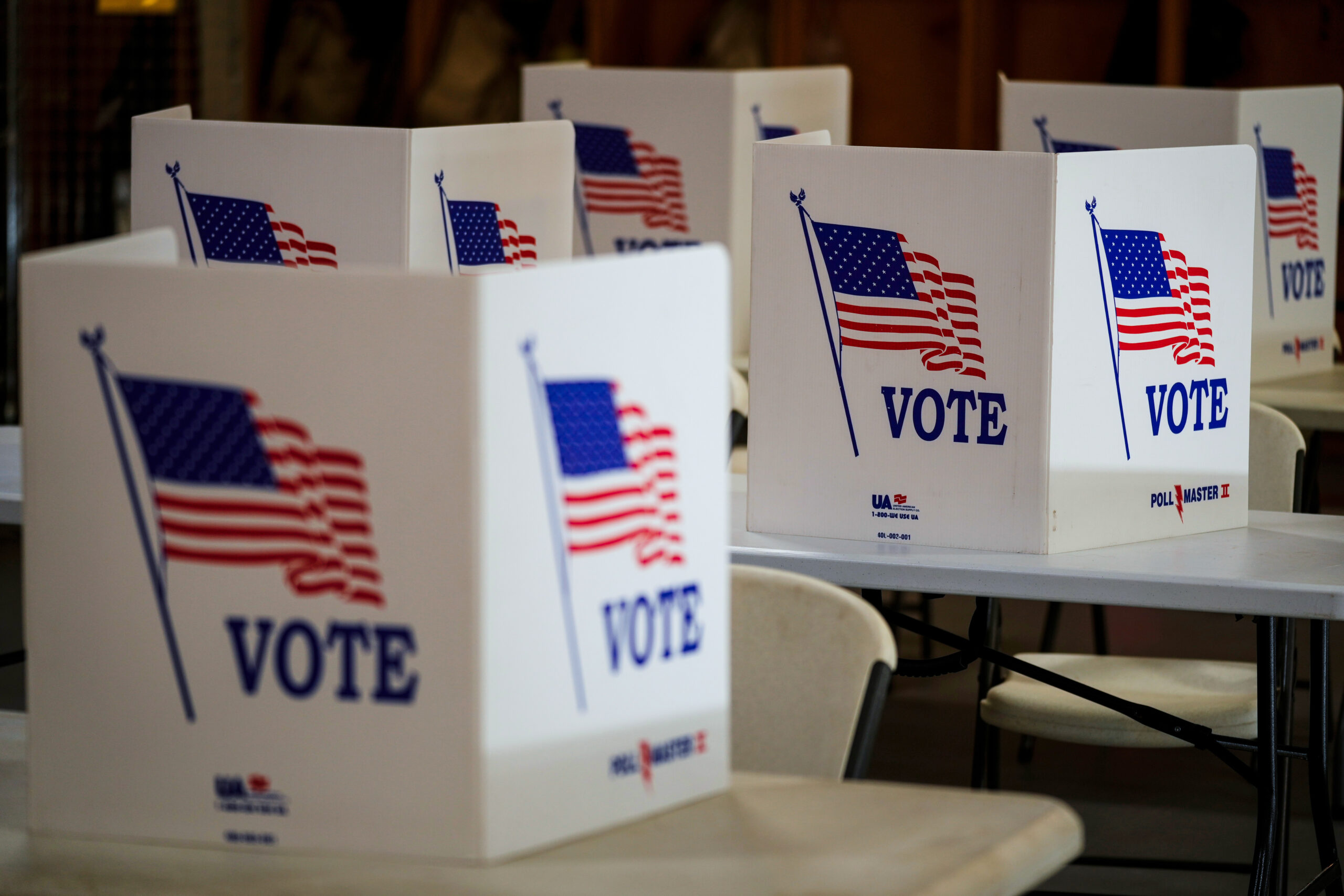
    Voting booths are set up at a polling place in Newtown in 2024.

    Donald Trump gets a lot of flak, and deservedly so, for telling so many lies. On Monday, he held an Oval Office press availability, and much of what he said — false claims that other nations don’t have birthright citizenship or mail-in voting — was flat-out untrue.

    But nothing is scarier than when the 47th president speaks the truth about what’s really on his mind. Because the only thing that’s in Trump’s brain right now is stealing the November midterm election by changing the rules in his favor … or worse. If Trump’s vocal cords were not so weak and diminished, he’d have been screaming the quiet part out loud.

    A reporter asked the president about last week’s abrupt cancellation of a ceremony to sign a popular and surprisingly bipartisan bill to lower the cost of housing. Trump tied that move to an extortionary threat that Congress must pass his bill, which is called the SAVE America Act, but which could ruin democracy by suppressing votes.

    “Here’s what I would like to say,” Trump said of the still-unsigned housing bill, which passed in the House by a 396-13 vote. “It’s a yawn. Some people say it’s wonderful. To me, compared to the SAVE America Act, just about everything is a big yawn.”

    In quainter times, Trump’s disrespect for the housing bill — a grab bag of measures all geared toward encouraging contractors to build more units, which would lower both purchase prices and rents — might be the political gaffe of the year. Currently, only 29% of Americans think it’s a good time to buy a house, and nearly two-thirds are more likely to vote for a Congress member who helped lower prices. Republicans who voted for the bill are desperate for a win.

    Trump doesn’t care. He’s forgotten his “forgotten Americans” who think the rent is too damn high, not to mention the GOP members of Congress who’ve followed him off the cliff. But that’s not even close to the most alarming thing about Trump’s Oval Office moment of truth.

    The president says the only thing he cares about — even with his conflict in Iran becoming another “forever war,” and with the economy down the toilet for everyone who’s not a tech trillionaire — is a bill that critics say would be a disaster for free and fair U.S. elections. One report found that some 12 million people who fairly and successfully voted in the 2020 presidential election don’t have the documentation — such as a birth certificate or passport — that the bill requires.

    We don’t know how such a massive drop in turnout would change the election results, or whether a weakened Trump can pressure the GOP to find a way to pass a bill with zero Democratic support. But we do know this: The president’s maneuvers are not even the worst thing Trump has done this month on the steal-this-election front. Not by a long shot.

    The Trump regime has been signaling for months that it sees the U.S. intelligence community — spy agencies like the CIA — not as a tool for finding out what comes next in the Persian Gulf, or if or when China is invading Taiwan, or when Vladimir Putin’s Russian empire will fall. No, Trump wants secret agents who can creatively invent theories of foreign-born election fraud that would demand a strongman response.

    We saw this coming back in January, when the regime dispatched Trump 47’s first director of national intelligence, Tulsi Gabbard, to Fulton County, Ga., to oversee an FBI raid of voting materials from the 2020 election that Trump, with no evidence, continues to dispute. That link made it clear the regime is looking to create links to foreign actors.

    When Gabbard left the administration this spring, Trump named a temporary replacement who can serve through the November election: Bill Pulte, who also continues to lead the Federal Housing Finance Agency. Pulte lacks a key prerequisite for his new job — any experience in intelligence whatsoever — but has the only quality that matters to Trump: undying loyalty. Pulte’s main focus in the housing job has been combing through the mortgage records of the president’s political enemies, looking for undotted i’s and uncrossed t’s that could be used to manufacture criminal charges from nothing.

    In just a few days at intelligence, Pulte has not disappointed his boss. He showed up Monday and immediately began firing current staffers, with a rumored list of hundreds. The steep reduction in eyeballs on the world’s trouble spots is disturbing, but what’s even more alarming is the one person Pulte has hired.

    The newsletter SpyTalk described Pulte’s new chief of staff, Christina Norton, as “a party-loving MAGA activist with no background in national security issues but who last year boasted of running ‘the largest election integrity operation the Republican Party has ever seen’ …”

    The pairing of Pulte and Norton is an alarm bell that the national intelligence team under Trump will have one job: investigating fantastical “foreign election plots” that will be cited to justify radical measures like sending troops to polling places, seizing voting machines, or worse.

    SpyTalk noted that Norton, in her active Instagram feed, “talks about supervising more than 200,000 Republican poll watchers ‘standing guard’ at polling booths and vote-counting stations across the country” during her 2024 stint at the Republican National Committee.

    Yet, intelligence is just one of many tools in the federal government that the obsessive Trump is working to activate ahead of a November election that polls suggest will be a “blue wave” for Democrats hoping to retake Capitol Hill. Trump has issued several executive orders seeking to assert federal control over voting, which has been a state and local function throughout 250 years of American history.

    That effort suffered a bit of a setback Monday, when the U.S. Supreme Court ruled that states can continue to count mail-in ballots that are postmarked before Election Day but arrive after the polls have closed. But that will not stop the Trump regime from politicizing the U.S. Postal Service ahead of November.

    Last week, Postmaster General David Steiner told Congress that USPS plans not to deliver mail-in ballots in states that don’t turn their voter rolls over to the Trump regime, a demand many governors have resisted so far. “President Trump does not believe that elections he loses are valid,” Democratic Michigan Sen. Elisa Slotkin said after the hearing. “It’s all part of his authoritarian playbook.”

    This all feels very familiar. In the lame-duck days after Trump’s 2020 election loss to Joe Biden, the 45th president — instead of packing up to return to Mar-a-Lago — got busy putting in a new team at the Pentagon, ordering the U.S. Department of Justice to probe alleged voter fraud, challenging vote count certifications in court, and urging state lawmakers to seat rival slates of electors. Most pundits laughed this off, but I wrote a column — “So, is President Trump staging a coup, or what?” — that ran on Nov. 10, 2020, nearly two months before the actual attempted coup on Jan. 6, 2021.

    Now Trump is not only staging another coup, but he is yelling about it, in your face. There is nothing he won’t try over the next five months to prevent a Democratic Congress from investigating how he and his family have made billions of dollars off the American presidency.

    When Trump says anything that’s not election meddling is a “big yawn,” this should be our wake-up call. The time for a full-court press — lawsuits, public hearings, and investigative journalism — can’t wait until after the election. The new putsch has already begun.

    Yo, do this!

    • If you didn’t think I raced to download the new audiobook of Zayd Ayers Dohrn’s tale of growing up in the radical Weather Underground in the 1970s and ’80s — Dangerous, Dirty, Violent, and Young: A Fugitive Family in the Revolutionary Underground — then you must be new around these parts. Dohrn had already used his unique access to his parents — Bernardine Dohrn and Bill Ayers, revolutionary royalty — and their friends to tell a history of that era’s far left in 2022’s award-winning podcast, Mother Country Radicals. His new book aims to go deeper into the psychology of what it was like to be raised as a toddler on the run from the FBI, or whether bombings and bank robberies can change the world. That’s a question — also explored in this viral essay — with new resonance in the Trump era.
    • A few weeks ago, I suggested that folks see the new movie The Sheep Detectives. The film is already streaming on Amazon Prime (which produced it), and Sunday’s rare night off for the World Cup offered the excuse to finally watch. I can now highly recommend it. The movie — with an adapted script by the acclaimed showrunner of HBO’s Chernobyl, Craig Mazin — manages to merge police procedural cliches with moving thoughts about prejudice, existentialism, and what it means to belong to a flock. Even a flock of talking sheep.

    Ask me anything

    Question: Is Markwayne [Mullin, the Homeland Security secretary and former Oklahoma senator] the least qualified cabinet level official in American history? — Richard McGovern (@richardmcgovern.bsky.social) via Bluesky

    Answer: Good question from Richard, a fellow long-suffering Philadelphia Union fan. Not because I know the answer, when there are rivals for the title like Donald Trump’s war-losing “Secretary of War” Pete Hegseth, to name just one. But Mullin is now behind a move so outlandish that it showed me I haven’t lost my capacity for shock after all. This weekend, Trump nominated a previously unknown former Oklahoma state trooper named Lance Schroyer to run U.S. Immigration and Customs Enforcement, a powerful agency with 22,000 agents and a budget of around $30 billion a year. It turns out that just recently, Schroyer was heading a security detail for Mullin in Washington, D.C., and has become a close enough friend that he is an occasional dinner guest. Yes, he hired his bodyguard to run the equivalent of a large corporation. Stay tuned for all of this to unravel.

    What you’re saying about …

    I guess we’re not as close as we thought, as very few of you were eager to share your July Fourth plans with me or discuss what America’s 250th birthday means at such a dark moment. The ones who did reply are looking forward to spending time with family and friends, but all that patriotic jazz, not so much. “Probably, we will have our usual picnic and take the grandkids to see the local fireworks, but I have no intention to watch any special programming or parades, etc.” Marianne Zollers wrote. “It will just make me sad. Such a different feeling compared with the Bicentennial which was such a joyous and happy occasion for my entire family.”

    📮 This week’s question: One of the big stories of 2026 that’s finally getting a lot of attention is the success of more progressive Democrats, including democratic socialists, in key primary races against party moderates. Is this a good thing, lifting up candidates who’ll fight against Trump and for the working class? Or do you worry Republicans will capitalize against their opponents with more left-wing views? Please email me your answer and put the exact phrase “2026 progressive Democrats” in the subject line.

    Backstory on crossing the World Cup off my bucket list

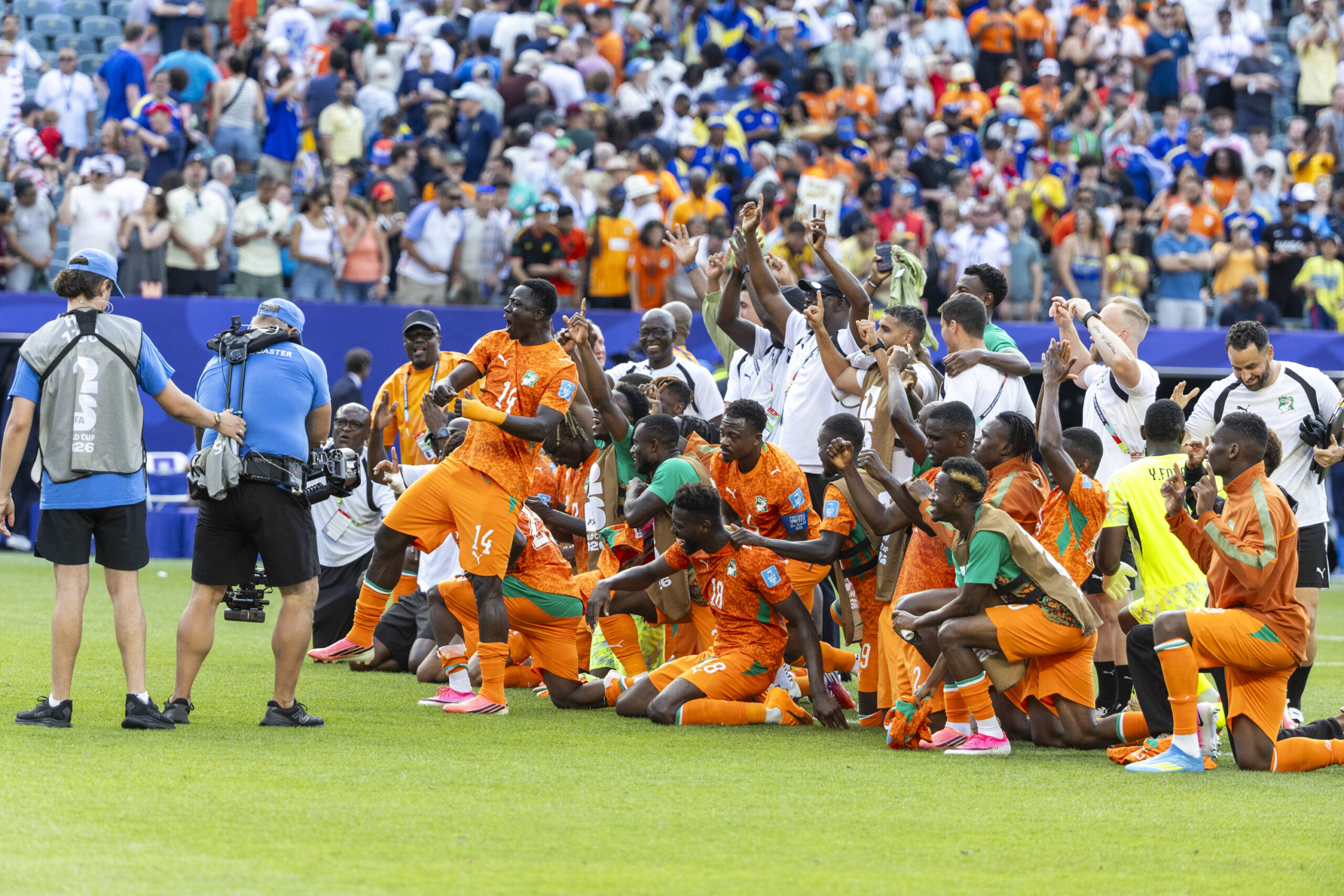
    The Ivory Coast team celebrates their win in the middle of the field against Curaçao with a score of 2-0 for the FIFA World Cup at the Lincoln Financial Field in Philadelphia on Thursday.

    I can’t say exactly when, but at some point during my first-ever in-person World Cup match between Côte d’Ivoire and Curaçao, watching from the thin air of the top deck of the temporarily renamed Philadelphia Stadium, it struck me: My decades-long dream of being there for the world’s greatest sporting event was not like what I’d imagined.

    And yet, in some weird, quasi-religious acid test kind of way, it was even better.

    I’ve been to countless sporting events going back to 1968, but never one where the vibe was basically: So happy to be here. I’ve certainly never been to a game where the PA announcer uttered something before the match about giving a big hand to both teams — and the sold-out crowd obliged. Fans would have burned down Section 220, Row 27, where I was sitting, if this had happened during an Eagles-Cowboys game. During a tense match with a place in the Round of 32 on the line, the gathering repeatedly did the wave and threw their vocal cords more behind the halftime singalong of the Bruce Channel 1961 oldie “Hey! Baby” than either of the two decisive goals by Côte d’Ivoire’s Les Éléphants.

    Up in nosebleed country, many of the fans repped soccer jerseys, but they were for club teams like Liverpool or Christian Pulisic’s USA No. 10, joined by me in my Philadelphia Union T-shirt. We were Philly’s soccer aficionados, desperate to be a part of maybe the only time in our lives the World Cup would take place in the City of Brotherly Love. A match pitting the smallest nation to ever qualify for the FIFA tourney (Curaçao, population 158,000) and an African underdog was pretty much the only way to crash the party without a bank loan. (Full disclosure: I paid about $280 apiece for two seats on StubHub — much like buying a stock, it could have been more or less, depending on how one timed it.)

    No, this wasn’t much like the Eagles games played here, where excitement merges with pins and needles of anxiety. On a picture-perfect late afternoon in June, bookended by the Philadelphia skyline and a lazy Delaware River, it felt more like a rock concert. It wouldn’t have seemed out of place if folks had started batting a beachball around at this soccer Woodstock. There was a mind-meld of the faithful, who saw FIFA and its commercialization as the devil, with the loudest boos for the TV-ad-laden “hydration breaks,” but with — I swear to God — a loud roar for the announcement of the attendance: 68,324. In a city where a 1976 Bicentennial match of some of the world’s best players took place in a mostly empty stadium, soccer is indisputably here to stay.

    Fans walked out of Philadelphia Stadium beaming less over the final score and more about the instant karma of the afternoon. After years of tavern taunts and ridicule from sports-talk radio, local soccer die-hards lived long enough to see America’s founding city become the world’s co-capital of the sport that, for its true believers, passes all understanding. It was all too beautiful. If I can somehow make it to Spain or Portugal or Morocco in 2030 (because, hey, I need a new bucket list now), I will be sure to wear some flowers in my hair. Soccer time will be a love-in there.

    What I wrote on this date in 2019

    I’ve been writing about the topic of journalism reform since the mid-2000s, or around the time it became clear to me and a lot of other folks that newsrooms needed to change or die. My fear, circa 2006 or so, was that we’d start seeing entire communities without newspapers or the accountability journalism that flows from that — which is exactly what happened in Youngstown, Ohio, when its paper closed seven years ago. I wrote: “The loss of the Youngstown Vindicator every morning doesn’t mean that the region’s 200,000 people will no longer be getting information. It just increases the likelihood they’ll be getting bad information — intentionally manipulated, and sometimes out-and-out fakery.”

    Read the rest: “How the first U.S. city with no daily newspaper will help Trump in 2020.”

    Recommended Inquirer reading

    • Only one column this week, as I took a well-deserved day off to attend the World Cup. In that piece, I looked at the sorry state of justice in America on the eve of its 250th birthday, with an emphasis on the outrageous sentences — ranging from 30 to 100 years — handed down to left-wing anti-ICE protesters convicted of rioting in North Texas. The U.S. Department of Justice that pushed these virtual life sentences is also pardoning the right-wing rioters of Jan. 6, 2021, as well as billionaire fraudsters who donate money to MAGA players and causes. They’ve made a mockery of liberty and justice for all.
    • Let’s be honest: People — not to mention sheep (see above) — can’t get enough of a murder mystery, especially a real-life true crime. It’s been a while since a crime saga has riveted Philadelphia readers as much as the stench of possible foul play that is growing at a home on West Chew Avenue in the city’s Olney section that police have branded a crime scene as they search for clues in the disappearance of two local women. Since the case broke open last week, nearly a dozen Inquirer reporters have produced riveting articles about the discovery of drugs, chemicals, and “a significant amount of blood” at the Horsch family residence, profiles of the two missing women — Amy McHale and Blair Tonzelli — and interviews with neighbors who talked about living next door to “a house from a scary movie.” The backstory here is that — whatever you may have heard about AI — it still takes a lot of human shoe-leather to get to the bottom of a story like this. Subscribing to The Inquirer is a twofer: You get to hurdle the paywall to read compelling journalism and feel good about being a supporter.

    By submitting your written, visual, and/or audio contributions, you agree to The Inquirer’s Terms of Use, including the grant of rights in Section 10.