President Donald Trump’s administration proposed a sweeping set of rules Thursday designed to prevent hospitals from providing gender-affirming care to minors, a move that could have consequential implications for Children’s Hospital of Philadelphia.
CHOP runs one of the nation’s largest clinics providing medical care and mental health support for transgender and gender-nonbinary children and teens and their families. Each year, hundreds of new families seek care at CHOP’s Gender and Sexuality Development Program, created in 2014. The information of CHOP patients who have sought gender-affirming care had been the target of a recent unsuccessful lawsuit from the Trump administration.
The proposals constitute the most significant moves the administration has taken to restrict the use of puberty blockers, hormone therapy, and surgical interventions for transgender people under the age of 18 — including cutting off federal Medicaid and Medicare funding from hospitals that provide gender-affirming care to children and prohibiting federal Medicaid dollars from being used to fund such procedures.
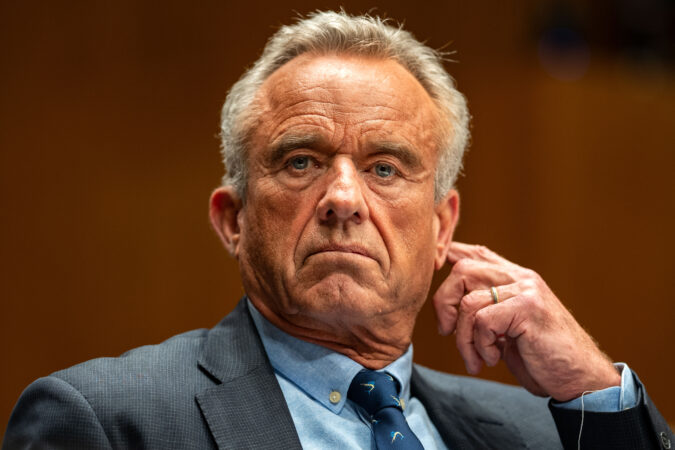
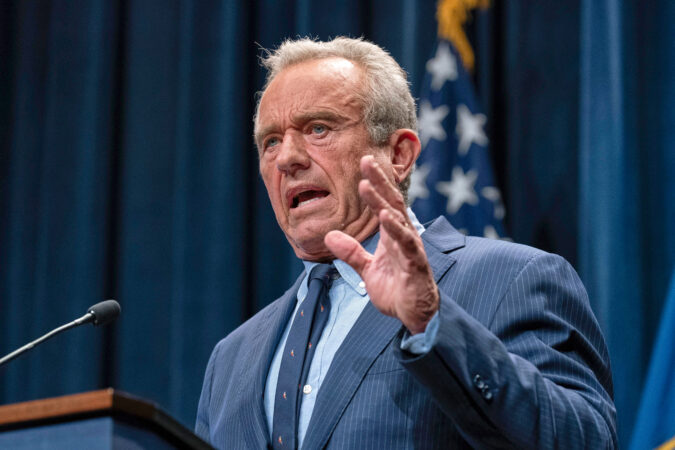
“This is not medicine, it is malpractice,” Health Secretary Robert F. Kennedy Jr. said, referring to gender-affirming procedures, at a news conference Thursday. “Sex-rejecting procedures rob children of their futures.”
CHOP, like most other hospitals in the country, participates in both Medicare and Medicaid.
CHOP declined to comment Thursday.
The renowned pediatric hospital treats children and teens with gender dysphoria — a medical condition in which a person’s body does not match their gender identity. Its doctors prescribe hormone therapy and puberty blockers.
CHOP has said its doctors do not prescribe any medication before its patients undergo extensive medical and psychological evaluations.
Gender-affirming care is legal in Pennsylvania, and states, not the federal government, regulate medicine and doctors.
But Trump has sought to criminalize this care for minors, saying doctors are engaged in “chemical mutilation,” akin to child abuse, and he has called the research “junk science.”
Just days into his second term in office, the president issued an executive order titled “Protecting Children from Chemical and Surgical Mutilation,” which contains inflammatory and misleading descriptions of largely medically approved transgender care. Kennedy has followed the president’s lead, signing a declaration Thursday rejecting these procedures.
Other actions proposed Thursday include the U.S. Food and Drug Administration issuing warning letters to 12 manufacturers and retailers for what an HHS news release claims to be “illegal marketing of breast binders to children for the purposes of treating gender dysphoria.”
The court battle over gender care for minors
In June, the U.S. Department of Justice issued subpoenas to CHOP and at least 19 other hospitals that treat transgender youth as part of an investigation into possible healthcare fraud. The federal subpoenas demanded patient medical records, including their dates of birth, Social Security numbers, and addresses, as well as every communication by doctors — emails, voicemails, and encrypted text messages — dating back to January 2020.
The subpoenas touched off a wave of legal battles that continue to play out. Several hospitals around the country, including CHOP, filed motions asking federal judges to block the release of private patient information.
So far, federal judges in Philadelphia, Boston, and Washington state have sided with the hospitals, ruling the subpoenas were politically motivated.
In Philadelphia, U.S. District Judge Mark A. Kearney last month determined that the “privacy interests of children and their families substantially outweighs the department’s need to know” such confidential and sensitive information. The federal government has 60 days to appeal the Nov. 21 ruling.
In September, patients and their parents joined the legal fight to limit the scope of the subpoenas issued to CHOP and UPMC Children’s Hospital of Pittsburgh. The Philadelphia-based Public Interest Law Center (PILC) filed separate but similar legal relief on behalf of families with children and teens who have received gender-affirming care at CHOP and in Pittsburgh.
The federal judge presiding over the Pittsburgh hospital’s case has yet to issue a ruling. Earlier this week, however, DOJ lawyers said they are willing to accept redacted medical records. They argued that would solve the dispute over patient privacy rights.
On Thursday, Mimi McKenzie, PILC’s legal director, said the center “strongly disagrees” and would fight the release of redacted medical records.
“These records are so deeply personal and contain such highly sensitive information about these young patients,” McKenzie said. “There is no anonymization or redaction that can protect their privacy interests.”
McKenzie said the proposed federal rule to ban all federal funding to hospitals that treat transgender youth would “face a myriad of legal challenges.” She described gender-affirming care as “lifesaving” for many children.
“The notion that our federal government would tell hospitals to pick which children you want to save — the children who need gender-affirming care or all the other children — is despicable. The cruelty of this administration knows no bounds.”
Other institutions have recoiled in the face of the Trump administration’s threats.
Earlier this year, Penn Medicine and Penn State Health cut back gender-affirming care for youth. Nemours Children’s Hospital in Delaware and UPMC Children’s Hospital of Pittsburgh announced they will no longer provide gender-affirming care beyond behavioral health services to new patients.
WASHINGTON — President Donald Trump’s handpicked board voted Thursday to rename Washington’s leading performing arts center as the Trump Kennedy Center, the White House said, in a move that made Democrats fume, saying the board had overstepped its legal authority.
Congress named the center after President John F. Kennedy in 1964, after his assassination. Donald A. Ritchie, who served as Senate historian from 2009-2015, said that because Congress had first named the center it would be up to Congress to “amend the law.”
Ritchie said that while Trump and others can “informally” refer to the center by a different name, they couldn’t do it in a way “that would [legally] stick.”
But the board did not wait for that debate to play out, immediately changing the branding on its website to reflect the new name.
House Democratic leader Hakeem Jeffries told reporters that legislative action was needed, “and we’re going to make that clear.” The New York Democrat is an ex officio member of the board because of his position in Congress.
Trump has teased the name change for some time
“The Kennedy Center Board of Trustees voted unanimously today to name the institution The Donald J. Trump and The John F. Kennedy Memorial Center for the Performing Arts,” said Roma Daravi, the institution’s vice president for public relations.
She said the vote recognized that Trump saved the center from “financial ruin and physical destruction,” a pair of claims denied by the venue’s ousted leadership.
“The new Trump Kennedy Center reflects the unequivocal bipartisan support for America’s cultural center for generations to come,” Daravi said.
Press secretary Karoline Leavitt announced the vote on social media, attributing it to the “unbelievable work President Trump has done over the last year in saving the building. Not only from the standpoint of its reconstruction, but also financially, and its reputation.”
Trump, a Republican who’s chairman of the board, said at the White House that he was “surprised” and “honored” by the vote.
“The board is a very distinguished board, most distinguished people in the country and I was surprised by it and I was honored by it,” he said.
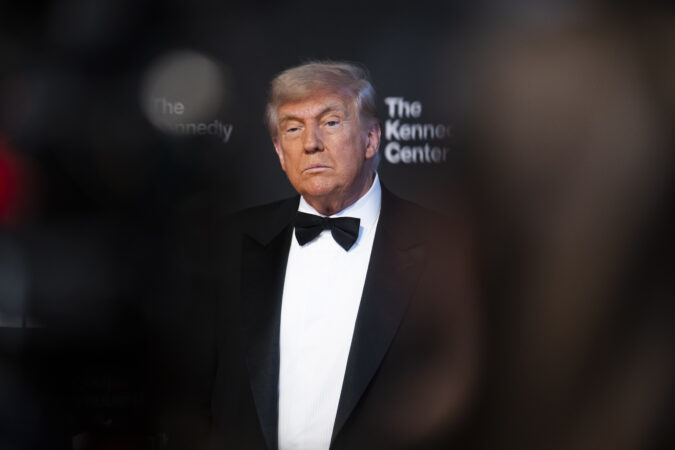
Trump had already been referring to the center as the “Trump Kennedy Center.” Asked Dec. 7 as he walked the red carpet for the Kennedy Center Honors program whether he would rename the venue after himself, Trump said such a decision would be up to the board.
Earlier this month, Trump talked about a “big event” happening at the “Trump Kennedy Center” before saying, “excuse me, at the Kennedy Center,” as his audience laughed. He was referring to the FIFA World Cup soccer draw for 2026, in which he participated.
A name change won’t sit well with some Kennedy family members.
Maria Shriver, a niece of John F. Kennedy, referred to the legislation introduced in Congress to rebrand the Kennedy Center as the Donald J. Trump Center for the Performing Arts as “insane” in a social media post in July.
“It makes my blood boil. It’s so ridiculous, so petty, so small minded,” she wrote. “Truly, what is this about? It’s always about something. ‘Let’s get rid of the Rose Garden. Let’s rename the Kennedy Center.’ What’s next?”
Trump earlier this year turned the Kennedy-era Rose Garden at the White House into a patio by removing the lawn and laying down paving stones.
Another Kennedy family member, Robert F. Kennedy Jr., serves in Trump’s cabinet as secretary of the Department of Health and Human Services.
Trump showed scant interest in the Kennedy Center during his first term as president, but since returning to office in January he has replaced board members appointed by Democratic presidents with some of his most ardent supporters, who then elected him as board chairman.
He also has criticized the center’s programming and its physical appearance and has vowed to overhaul both.
Trump secured more than $250 million from the Republican-controlled Congress for renovations of the building.
He attended opening night of the musical Les Misérables, and last week he served as host of the Kennedy Center Honors program after not attending the show during his first term as president. The awards program is scheduled to be broadcast by CBS and Paramount+ on Dec. 23.
Sales of subscription packages are said to have declined since Trump’s takeover of the center, and several touring productions, including Hamilton, have canceled planned runs there. Rows upon rows of empty seats have been seen in the Concert Hall during performances by the National Symphony Orchestra.
Some performers, including actor Issa Rae and musician Rhiannon Giddens, have scrapped scheduled appearances, and Kennedy Center consultants including musician Ben Folds and singer Renée Fleming have resigned.
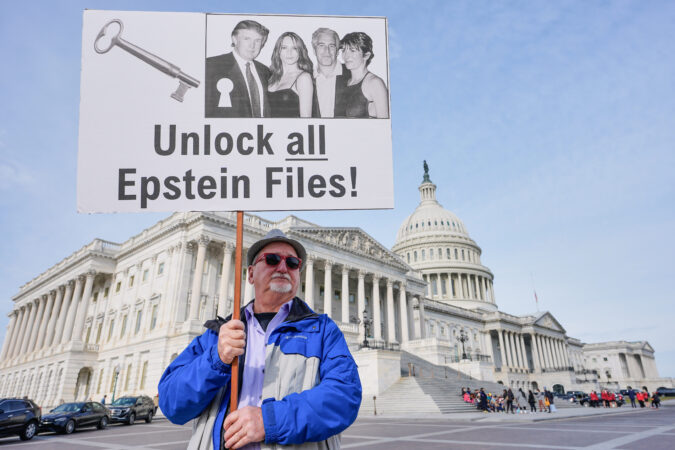
WASHINGTON — House Democrats released several dozen more photos Thursday from the estate of the convicted sex offender Jeffrey Epstein, showing his associations with the rich and famous, as the Department of Justice faces a deadline to release many of its case files on the late financier by the end of the week.
The photos released Thursday were among more than 95,000 that the House Oversight Committee has received after issuing a subpoena for the photos that Epstein had in his possession before he died in a New York jail cell in 2019. Congress has also passed, and President Donald Trump has signed, a law requiring the Justice Department to release its case files on Epstein, and his longtime girlfriend and confidant Ghislaine Maxwell, by Friday. Anticipation about what those files will show is running high after they have been the subject of conspiracy theories and speculation about his friendships with Trump, former President Bill Clinton, the former Prince Andrew, and others.
House Democrats have already released dozens of photos from Epstein’s estate showing Trump, Clinton and Andrew, who lost his royal title and privileges this year amid scrutiny of his relationship with the wealthy financier. The photos released Thursday showed Epstein cooking with Sultan Ahmed bin Sulayem, an Emirati businessman. The photos also include the billionaire Bill Gates and images of a 2011 dinner of notable people and wealthy philanthropists hosted by a nonprofit group. The committee made no accusations of wrongdoing by the men in the photos.
There were also images of passports, visas and identification cards from Russia, the Czech Republic, Ukraine, South Africa, and Lithuania with personally identifying information redacted, as well as photos of Epstein with women or girls whose faces were blacked out. The committee has said it is redacting information from the photos that may lead to the identity of victims being revealed.
Rep. Robert Garcia, the top Democrat on the oversight panel, said in a statement that the “new images raise more questions about what exactly the Department of Justice has in its possession. We must end this White House cover-up, and the DOJ must release the Epstein files now.”
The Democratic National Committee will not publicly release its autopsy of the 2024 presidential campaign, party officials said, a reversal intended to avoid a contentious reckoning over the party’s failure.
Operatives involved in drafting the autopsy worried that revisiting Kamala Harris’ loss to Donald Trump would reignite the fiery internal debates that consumed the party in the wake of the 2024 loss at a time when Democrats are eager to celebrate a string of wins in 2025 and focus on the 2026 midterms, the officials said.
But by declining to make the report public, the party is also keeping the lessons learned from its 2024 failures limited to a small group of insiders and dodging a public accounting that many Democrats believe is necessary to avoid repeating past mistakes.
There remain sharp internal debates, for example, over the party’s stance on transgender rights, its handling of generational change, and whether Harris’ selection as President Joe Biden’s replacement on the ticket was properly conducted.
“We completed a comprehensive review of what happened in 2024 and are already putting our learnings into motion,” Ken Martin, chair of the Democratic National Committee, said in a statement that did not directly address the committee’s decision to shield the report. “In our conversations with stakeholders from across the Democratic ecosystem, we are aligned on what’s important, and that’s learning from the past and winning the future. Here’s our North Star: does this help us win? If the answer is no, it’s a distraction from the core mission.”
Democratic officials briefed on the report’s contents said the autopsy chastises the party for failing to adequately listen to voters in 2024. The report describes a feeble response to concerns about public safety and immigration in particular, allowing Republicans to dominate the issues, according to the officials, who spoke on the condition of anonymity to discuss the private findings. That amplified the Democrats’ credibility problem on the election’s central issue: the economy.
Another key takeaway, officials said, was that the party took young voters for granted, neglecting a group that normally supports its candidates in overwhelming numbers. As a result, they swung toward Trump, with the president winning a majority of first-time voters and increasing his share of youth voters by double digits. The report faults a party wedded to traditional media that often bypasses these voters. It calls for greater engagement with nontraditional media, something that vexed the Harris campaign.
The report, generated based on hundreds of interviews with Democrats in all 50 states, also highlights missteps in how Democrats contact voters, the officials said, noting that while the party reached more voters than ever last year, the outreach was ineffective, led to poor-quality conversations with swing voters, and came too late in pivotal states. The changes suggested by the party, the officials said, include measuring the success of an outreach program by the impact of the conversations, not the number of attempted calls, while also investing in more long-term party building so voter contact does not begin weeks before Election Day.
Democratic officials have struggled to craft and discuss the report for much of the year amid internal debates over the party’s direction and leadership.
They were in the final stages of preparing it in October and began briefing top operatives and donors on its contents. But the expected public release was delayed until after off-year elections in November, with the party hoping to keep the focus on races they eventually swept in New York, New Jersey, and Virginia.
Those preliminary briefings did not include any reflection on the handling of Biden’s late withdrawal from the race, his perceived infirmity and the lack of a competitive process used to select Harris as his replacement, which many Democrats have said was central to their party’s defeat. Members of the Democratic committee, including Martin, argued that little could be learned from those reflections, given that it is unlikely the party will face a similar situation again. Still, the lack of any reflection on Biden or Harris led some party insiders to criticize the report as intentionally avoiding what many saw as the most decisive issue in the 2024 loss.
The delays in releasing the report have spurred internal Democratic grumbling, and the committee’s decision to keep it private was already stirring up Democratic anger.
“A handful of wins is not the same as the rehabilitation of the Democratic brand, which is required to build real governing majorities and a national coalition,” said Alyssa Cass, a Democratic operative in New York. ”Achieving that requires real soul-searching and new ideas, and it would be nice for candidates and campaigns to know they had a partner in that hard work, instead of an institutional structure buried in the sand.”
Other Democrats echoed Cass, casting the decision as the Democratic National Committee looking to obscure its own failings in 2024.
But some Democratic operatives, especially those close to the committee, praised the decision as prudent. “Democrats don’t need to engage in a hand-wringing exercise about last year’s elections when we’re winning this year’s elections,” said Xochitl Hinojosa, a former top spokesperson for the DNC.
How the party handles learning from the 2024 loss could prove critical for years to come. Democratic officials and campaign operatives from winning campaigns this year have already said they used lessons from the 2024 campaign to strengthen their operations. And some of the party’s most high-profile members, including Harris, have begun to break from the policies that defined the Biden administration.
In a speech Friday night at the Democratic National Committee meeting in Los Angeles, Harris argued that both Democrats and Republicans have failed to address Americans’ deep financial anxieties and lack of confidence in government.
“Both parties have failed to hold the public’s trust. Government is viewed as fundamentally unable to meet the needs of its people,” Harris said in an implicit condemnation of the Biden administration, which she served in for four years as his vice president and defended throughout her unsuccessful presidential campaign.
Trump “is not the only source of our problems,” Harris said, arguing that the rise of his political movement is “a symptom of a failed system that is the result of years of outsourcing and offshoring, financial deregulation, growing income inequality, a broken campaign finance system and endless partisan gridlock.”
The Trump administration will repurpose $2.6 billion in military housing assistance to pay $1,776 “warrior dividend” bonuses to service members, according to a senior administration official.
In a prime-time address Wednesday night, President Donald Trump announced the Christmastime bonuses “in honor of our nation’s founding in 1776.”
“Nobody deserves it more than our military. And I say congratulations to everybody,” Trump said.
The president said the money for the bonuses came from revenue from import taxes he’s imposed on trading partners worldwide. That was incorrect, however, and Trump does not have the authority to spend the money from tariffs without authorization from Congress.
But lawmakers this summer did approve $2.9 billion to supplement the military’s basic allowance for housing as part of Trump and the GOP’s mammoth tax and immigration law, the One Big Beautiful Bill.
Defense Secretary Pete Hegseth ordered the Pentagon to spend most of that money as a one-time payout on the bonuses, said the senior administration official, who spoke on the condition of anonymity because they were not authorized to speak publicly on the matter.
The use of the housing funds to pay the bonuses was reported earlier by Defense One.
Roughly 1.45 million service members, including 174,000 reservists, will receive the bonuses, which Hegseth said in a video Thursday would be tax-free.
“This warrior dividend serves as yet another example of how the War Department is working to improve the quality of life for our military personnel and their families,” Hegseth said.
Trump renamed the Department of Defense as the Department of War in September, designating that as the department’s “secondary title” and authorizing its use. It’s unclear whether Trump has the authority to permanently rename cabinet departments without congressional approval.
“I can think of no better Americans to receive this check right before Christmas, whether it’s for pay, housing, faith, support, all elements of what we’re doing are to rebuild our military,” Hegseth said.
The defense secretary called the payment “a direct investment in the brave men and women who carry on the legacy of our armed forces every single day,” and said military members in pay grades E-1 to O-6 would be eligible. The top pay grade eligible includes the ranks of colonel in the Air Force, Army, Marines and Space Force, and captain in the Navy and Coast Guard.
Speaking in the Oval Office on Thursday, Trump said his staff originally presented him with a plan for $1,775 bonuses.
“And I said, ‘Wow, I think we can afford one more dollar,’” Trump said.
In Congress, reaction to the bonuses was mixed, largely along party lines. Sen. Roger Wicker (Mississippi), the Republican chairman of the Armed Services Committee, said in an interview that the payments were “quite appropriate.”
He added in a statement that the bonuses would “put real money in the pockets of our service members and their families, helping provide greater stability and improved housing options as they manage the unique demands of military life.”
Sen. Jack Reed (Rhode Island), the top Democrat on the panel, said he was concerned that pulling the money for the bonuses from the housing assistance program would prevent the Defense Department from improving housing for service members and conducting overdue maintenance.
“There has been a real fundamental need for housing improvements and maintenance,” Reed said. “I think they could find a better source for the funds.”
Sen. Chris Coons (Delaware), the top Democrat on the Senate Appropriations Defense Subcommittee, was more blunt — both about the purpose of the checks and Trump’s authority to issue them.
“Read the Constitution! You can’t just sprinkle the country with checks just because you came up with it late at night,” Coons said.
The National Defense Authorization Act, which Trump is set to sign into law Thursday evening, approves pay increases for troops, and the annual appropriations bill — which Congress has yet to pass — funds it, he said.
“That’s how we do this, not game-show checks. Not last minute whimsy by a president,” Coons said. “This is a classic campaign stunt that does not serve our warfighters, our Constitution, or our republic well.”
The Trump administration has a track record of aggressively shifting resources around the Pentagon to goose service members’ compensation.
During the government shutdown, the administration twice moved money from other parts of the Pentagon budget to keep paying troops. Doing so without the approval of lawmakers — who normally have a say over large changes in federal spending — was controversial in Congress, where aides from both parties acknowledged that the move was probably illegal.
WASHINGTON — The U.S. Department of Health and Human Services on Thursday unveiled a series of regulatory actions designed to effectively ban gender-affirming care for minors, building on broader Trump administration restrictions on transgender Americans.
The sweeping proposals — the most significant moves this administration has taken so far to restrict the use of puberty blockers, hormone therapy, and surgical interventions for transgender children — include cutting off federal Medicaid and Medicare funding from hospitals that provide gender-affirming care to children and prohibiting federal Medicaid dollars from being used to fund such procedures.
“This is not medicine, it is malpractice,” Health Secretary Robert F. Kennedy Jr. said of gender-affirming procedures on children in a news conference on Thursday. “Sex-rejecting procedures rob children of their futures.”
Kennedy also announced Thursday that the HHS Office of Civil Rights will propose a rule excluding gender dysphoria from the definition of a disability.
In a related move, the Food and Drug Administration issued warning letters to a dozen companies that market chest-binding vests and other equipment used by people with gender dysphoria. Manufacturers include GenderBender LLC of Carson, Calif., and TomboyX of Seattle. The FDA letters state that chest binders can only be legally marketed for FDA-approved medical uses, such as recovery after mastectomy surgery.
Proposed rules would threaten youth gender-affirming care in states where it remains legal
Medicaid programs in slightly less than half of states currently cover gender-affirming care. At least 27 states have adopted laws restricting or banning the care. The Supreme Court’s recent decision upholding Tennessee’s ban means most other state laws are likely to remain in place.
Thursday’s announcements would imperil access in nearly two dozen states where drug treatments and surgical procedures remain legal and funded by Medicaid, which includes federal and state dollars.
The proposals announced by Kennedy and his deputies are not final or legally binding. The federal government must go through a lengthy rulemaking process, including periods of public comment and document rewrites, before the restrictions becoming permanent. They are also likely to face legal challenges.
But the proposed rules will likely further intimidate healthcare providers from offering gender-affirming care to children and many hospitals have already ceased such care in anticipation of federal action.
Children’s Hospital of Philadelphia recently went to court to prevent the Trump administration from obtaining the private medical records of youth who sought gender-affirming care.
Nearly all U.S. hospitals participate in the Medicare and Medicaid programs, the federal government’s largest health plans that cover seniors, the disabled and low-income Americans. Losing access to those payments would imperil most U.S. hospitals and medical providers.
The same funding restrictions would apply to a smaller health program when it comes to care for people under the age of 19, the State Children’s Health Insurance Program, according to a federal notice posted Thursday morning.
Moves contradict advice from medical organizations and transgender advocates
Mehmet Oz, the administrator of the Centers for Medicare and Medicaid Services, on Thursday called transgender treatments “a Band-Aid on a much deeper pathology,” and suggested children with gender dysphoria are “confused, lost, and need help.”
Polling shows many Americans agree with the administration’s view of the issue. An Associated Press-NORC Center for Public Affairs Research survey conducted earlier this year found that about half of U.S. adults approved of how Trump was handling transgender issues.
Chloe Cole, a conservative activist known for speaking about her gender-transition reversal, spoke at the news conference to express appreciation. She said cries for help from her and others in her situation, “have finally been heard.”
But the approach contradicts the recommendations of most major U.S. medical organizations, including the American Medical Association, which has urged states not to restrict care for gender dysphoria.
Advocates for transgender children strongly refuted the administration’s claims about gender-affirming care and said Thursday’s moves would put lives at risk.
“In an effort to strongarm hospitals into participating in the administration’s anti-LGBTQ agenda, the Trump Administration is forcing health care systems to choose between providing lifesaving care for LGBTQ+ young people and accepting crucial federal funding,” Jamila Perritt, a Washington-based OB/GYN and president and CEO of Physicians for Reproductive Health, said in a statement. “This is a lose-lose situation where lives are inevitably on the line. “
Rodrigo Heng-Lehtinen, senior vice president at The Trevor Project, a nonprofit suicide prevention organization for LBGTQ+ youth, called the changes a “one-size-fits-all mandate from the federal government” on a decision that should be between a doctor and patient.
“The multitude of efforts we are seeing from federal legislators to strip transgender and nonbinary youth of the health care they need is deeply troubling,” he said.
Actions build on a larger effort to restrict transgender rights
The announcements build on a wave of actions President Donald Trump, his administration and Republicans in Congress have taken to target the rights of transgender people nationwide.
On his first day in office, Trump signed an executive order that declared the federal government would recognize only two immutable sexes: male and female. He also has signed orders aimed at cutting off federal support for gender transitions for people under age 19 and barring transgender athletes from participating in girls’ and women’s sports.
On Wednesday, a bill that would open transgender health care providers to prison time if they treat people under the age of 18 passed the U.S. House and heads to the Senate. Another bill under consideration in the House on Thursday aims to ban Medicaid coverage for gender-affirming care for children.
Young people who persistently identify as a gender that differs from their sex assigned at birth are first evaluated by a team of professionals. Some may try a social transition, involving changing a hairstyle or pronouns. Some may later also receive hormone-blocking drugs that delay puberty, followed by testosterone or estrogen to bring about the desired physical changes in patients. Surgery is rare for minors.
President Donald Trump’s homeland security adviser, Stephen Miller, and other senior officials were looking for a fight.
In the first months of the administration, Miller, the architect of Trump’s anti-immigration and border policies, and his team discussed starting a new war on drugs by striking cartels and alleged traffickers in Mexico, according to one current and two former U.S. officials.
Reducing the power of cartels, an idea that dated back to the first Trump administration, would ease the flow of migrants and narcotics, creating early political wins. But as the administration surged thousands of U.S. troops to the southern border, increased U.S. surveillance flights and boosted intelligence sharing with its neighbor, Mexican military operations across the border curbed cartel action, the people said. That left Miller and his team looking for another target.
“When you hope and wait for something to develop that doesn’t, you start looking at countries south of Mexico,” said the current official, who, like nine others interviewed for this story, spoke on the condition of anonymity because of the matter’s sensitivity.
The campaign that emerged in the Caribbean Sea and eastern Pacific Ocean is unprecedented in its use of lethal force by the U.S. military against alleged drug smuggling groups. These operations, which began Sept. 2, have evolved to embrace the Trump team’s long-running ambition to oust Venezuelan President Nicolás Maduro, whom the president has accused of overseeing “narco-terrorists” assaulting the United States.
A U.S. soldier is deployed along the U.S.-Mexico border as part of the Joint Task Force Southern Border mission, in Sunland Park, N.M., on April 4.
Miller has been a driving force behind the administration’s counternarcotics campaign, pressing for results and fresh military options that could be turned into future operations, the current and former officials said.
“President Trump’s counternarcotics policies come from President Trump himself,” White House spokeswoman Anna Kelly said. “All senior administration officials work closely together to carry out the agenda President Trump was elected to implement, including eliminating the scourge of narco-terrorism that takes tens of thousands of American lives every year.”
Miller could not be reached for comment.
Miller steered the drafting of a July 25 classified directive signed by the president that authorized the military to undertake lethal force against two dozen foreign criminal groups, said a former U.S. official familiar with the campaign and its evolution. The administration has labeled these groups “designated terrorist organizations,” accusing them of using drugs as a weapon to kill Americans, using a moniker that many experts say has no basis in law.
“The president’s memo is the original sin of the whole operation,” the former official said.
That presidential directive provided the foundational authority for an “execute order” that Defense Secretary Pete Hegseth issued on Aug. 5 and that subsequently has been modified. The order, details of which were previously unreported, contains permissive targeting guidelines for lethal operations, current and former officials said. The presidential directive’s existence was first reported by the New York Times.
Together, these two documents guided a military campaign of lethal strikes against criminal organizations, grafting a wartime frame to what has been traditionally treated as a law enforcement problem. The execute order also contains targeting criteria lifted from the language of the counterterrorism campaign against al-Qaeda and the Islamic State, which some current and former officials say give the Pentagon an overly permissive license to kill.
The department will treat suspected drug smugglers “EXACTLY how we treated Al-Qaeda. We will continue to track them, map them, hunt them, and kill them,” Hegseth said on social media last month.
Pursuant to these orders, the Trump administration has launched strikes on at least 26 boats, killing at least 99 people in the Caribbean Sea and eastern Pacific Ocean. The Pentagon has not publicly identified those killed, and it is unclear whether it has collected the intelligence to do so.
“The administration appears to have authorized a campaign against civilians and alleged criminals that is now stretching the limits of international law so that it’s now totally unrecognizable,” said Todd Huntley, a former military lawyer who advised Special Operations forces for seven years at the height of the U.S. counterterrorism campaign and is director of the national security law program at Georgetown Law.
The White House’s early deliberations about the use of lethal force against cartels contemplated using covert action by theCIA. But as resistance emerged from lawyers and others over the ensuing months, Miller and his team turned increasingly toward the idea of using the military to pursue alleged traffickers.
Miller’s larger vision was to reduce the flow of drugs — and migrants — into the United States. He figured that attacking cartels would diminish their power and help stabilize Latin American countries, resulting in fewer people risking the trek to the United States, according to one of the former U.S. officials familiar with Miller’s deliberations.
As the summer progressed, the White House’s campaigns against narcotics and migration coalesced with a long-held desire of Secretary of State Marco Rubio to force Maduro from power. Rubio and the Justice Department in August doubled to $50 million the reward for information leading to the Venezuelan leader’s arrest, citing an indictment for corruption and drug trafficking during the first Trump administration.
Meanwhile, the White House found a willing partner in Hegseth, who had been knockedoff stride by several missteps and was eager to show he could deliver on a high-priority mission.
“Pete very much wanted to keep Stephen in his good graces and also the president,” said the former official familiar with Miller’s thinking. “And that was a motivation for him — getting behind this campaign in an aggressive way.”
The Defense Department declined to address questions about its operations to strike alleged traffickers and how the mission took shape. Elements of Miller’s leading role were reported earlier by the Guardian.
“This reporting is inaccurate and is built on a false premise that ignores reality,” Pentagon chief spokesman Sean Parnell said in a statement. The department’s focus, he said, “is, and will continue to be, protecting the Homeland from any threat.”
Widening the scope
The Aug. 5 execute order,or EXORD in Pentagon parlance, stated that the campaign’s goal is to stop the flow of drugs by sea to the United States, two people said.
Initially, the order contained a geographic boundary that designated target areas in international waters off the coast of Venezuela, but it was modified about two months later to include the eastern Pacific area, one current and one former U.S. official said.It specified that at least for the initial strikes, Joint Special Operations Command would be in charge of operations, the two people said.
A still frame from a video posted on social media by President Donald Trump shows a boat allegedly transporting illegal narcotics after a lethal strike on Sept. 2, through U.S. military imagery.
Over the late summer and into the fall, lawyers and policy personnel raised concerns about the legality of the lethal force campaign that was taking shape. Administration officials sought to reassure them by saying that a Justice Department Office of Legal Counsel memo was being drafted that determined that the lethal targeting of suspected drug runners was lawful under the president’s power to ascertain that the U.S. is in a formal state of war — in this case with alleged drug traffickers.
But the opinion was not signed until Sept. 5 — three days after the first boat strike — and some career lawyers were not permitted to read the draft OLC memo before the execute order was issued, said the former official familiar with the campaign’s evolution.
The OLC memo, signed by Assistant Attorney General T. Elliot Gaiser, asserts that alleged drug trafficking groups are a threat to the United States akin to a foreign nation attempting to invade, Sen. Mark Kelly (D., Ariz.), who was allowed to read it in his capacity as a member of the Senate Armed Services Committee, told the Post in an interview.
The execute order contains targeting instructions that do not require positive identification of any individual but rather “reasonable certainty” that adult males are members of, or affiliated with, a “designated terrorist organization,” or DTO, according to five current and former U.S. officials familiar with the criteria. To mitigate civilian harm, the order requires “near certainty” that no women, children or civilians are present, they said.
The administration is using the phrase “designated terrorist organizations” to refer to 24 alleged drug trafficking groups whose activities it contends are killing millions of Americans.
The term, said Rebecca Ingber, a professor at the Cardozo School of Law and a former State Department law-of-war expert, “is entirely manufactured as a source of targeting authority with no basis in law.”
The list of 24 such groups appears in an annex to Trump’s July directive and also in the EXORD, according to one current and one former official.
The assessment of “affiliation” is based on a number of factors, including the presence of drugs on board the vessel and its route, as well as intercepts of communications, the current and former officials said.
As a result, the campaign may be killing individuals who in some cases have a tenuous link to any organized drug-running operation, said one of the former U.S. officials, who has read the execute order.
“When you define DTO and affiliate so loosely and you’re attacking boats, [the guidelines are] basically meaningless,” the former official said.
If the United States were actually at war, the reasonable certainty standard would be “perfectly reasonable,” said Ryan Goodman, a former Pentagon special counsel who worked on counterterrorism targeting issues in the Obama administration.
“Not being in an armed conflict changes everything,” he said. “The idea that a government would kill people on the basis of ‘reasonable certainty’ that they’re a member of a drug cartel is beyond the pale. Any U.N. body would find that to be a gross violation of human rights.”
Identification and delegation
The targeting requirements, four former officials say, resemble the “signature strikes” of past global counterterrorism campaigns, in which the CIA and the military launched drone attacks in Afghanistan, Pakistan and Yemen on individuals or groups whose identities were unknown but who were targeted based on a pattern of behavior or other characteristics associated with terrorist activity.
The execute order, which sets the rules of engagement for the military, designates Hegseth as the “target engagement authority” — the official who can approve strike targets. It also stipulates that he can delegate that authority to others in individual missions.
“Now, the first couple of strikes … as any leader would want, you want to own that responsibility,” Hegseth said at a cabinet meeting this monthin response to questions about the first boat strike, details of which — including a subsequent missile strike to kill survivors — were first published bythe Post. “So I said I’m going to be the one to make the call after getting all the information and make sure it’s the right strike.”
Pentagon general counsel Earl Matthews — who had just been confirmed by the Senate on July 29 with a 50-47 vote — signed off on the Aug. 5 order, said a person familiar with the matter. Lawmakers have for weeks requested a copy of the order and related documents but have not received them. Matthews did not respond to a request for comment.
President Donald Trump signed a classified directive that authorized the military to undertake lethal force against two dozen foreign criminal groups.
Trump has asserted, without offering proof, that the U.S. troops know who they are targeting in every case. “We know everything about them. We know where they live. We know where the bad ones live,” he told reporters this month.
The military knew the identities of all 11 people killed in the first attack of the campaign on Sept. 2, Pentagon officials have said. But “they don’t know all of the individuals on many of the other boats” in subsequent strikes, Sen. Mark R. Warner (D., Va.), vice chairman of the Senate Intelligence Committee, told ABC News on Sunday.
Trump posted on Truth Social the day of the first strike that the U.S. military had killed 11 “positively identified” members of the Venezuelan organization Tren de Aragua. He called them “narco-terrorists” operating “under the control of” Maduro, who has been condemned by both the Trump and Biden administrations for illegally retaining power after losing last year’s presidential election.
This week, the commander overseeing that operation, Adm. Frank M. Bradley, told lawmakers that the military knew one of the 11 was a member of Tren de Aragua and the other 10 were affiliates, according to three U.S. officials.
The U.S. intelligence community this year assessed that Tren de Aragua, a transnational crime syndicate, was not directed by Venezuela’s government.
Two family members of men killed on Sept. 2 did not deny that the boat was smuggling marijuana and cocaine. But they said Trump’s allegation the men had worked for Tren de Aragua was inaccurate.
“I knew them all,” one of the family members told the Post in October, speaking on the condition of anonymity for fear of retribution. “None of them had anything to do with Tren de Aragua. They were fishermen who were looking for a better life” by smuggling contraband.
In some of the strikes, the targets who have been identified are not high-level operators or cartel bosses, lawmakers said. “It’s one thing to be a narco-terrorist and another thing to be a fisherman that’s getting paid a hundred bucks a couple times a year … to supplement his income” to ferry drugs, Warner told reporters at the Defense Writers Group last week.
Lifting language from the ‘war on terror’
The Aug. 5 execute order adopts the language of previous administrations in successive global counterterrorism campaigns after 2001, but the context is vastly different, current and former officials say.
The fight against ISIS in Iraq from 2014 on generally involved clearing terrain of fighters who often barricaded themselves in buildings in cities teeming with civilians, and U.S. troops were often firing in self-defense at militants shooting at them, former Special Operations personnel said.
In the drug boat campaign, the U.S. military is launching munitions from afar, more like the counterterrorism operations in Yemen and Somalia during the Obama and first Trump administrations.
Under President Barack Obama, outside areas of active hostility, the targeting guidelines required that lethal force be used only when capture was not feasible and only to prevent attacks against U.S. citizens or when targets posed a continuing imminent threat. They required “near certainty” that a target was a member of a terrorist organization.
“Generally you had people swearing allegiance” to a group like al-Qaeda as an indicator of membership, said the former U.S. official, who is familiar with the counterterrorism targeting criteria. “So you had the presence of weapons and good intelligence on planning you could point to, to link people to the group and say this person is a planner of attacks, this is the money guy, this is a recruiter, etc.”
The standard was changed to “reasonable certainty” under the first Trump administration. But for all practical purposes, said a former senior military officer involved in special operations and battle in the Middle East, the military was applying the “near certainty” standard in these areas. The standard was returned to near certainty under Biden.
“In places like Yemen, whether it was under Obama or Trump,” the retired officer said,“we knew who we were going after. We knew what their place in the network was. We knew what the effects of removing them would be on the network. I don’t see that in some of what [the U.S. is] doing right now.”
One major contextual difference in the current operations against seaborne narcotics is the lack of congressional authority. In the battles against al-Qaeda and associated forces, Congress explicitly authorized the campaigns, giving the president permission to use “all necessary and appropriate force” against those who attacked the United States on Sept. 11, 2001.
The execute order and subsequent targeting guidelines were grounded in the 2001 congressional authorization to use military force.
In 2013, during the Obama administration, the “near certainty” standard typically required confirmation via two sources of intelligence, said Huntley, the former military lawyer for Special Operations forces.
A combination of intelligence tools — signals intelligence, eavesdropping, human spies, and drone surveillance — would contribute to a “positive identification of the individual,” Huntley said. To get to “near certainty” that civilians were not present, the attack location was usually a remote area or a place known to be frequented by only members of the terrorist organization that Congress had specifically authorized as a viable target.
If U.S. officials know the identities of who they are striking, as Trump and Hegseth maintain, then they should release them, the former senior military officer said. “It would help build the case,” he said, that the military is acting to protect civilians according to the law of war.
‘Anybody … is subject to attack’
Though the administration’s charges against Maduro have merit, its claims that Venezuela is sending massive amounts of drugs to America do not, analysts and officials have said.The main domestic drug scourge is fentanyl, a synthetic opioid produced in Mexico, not Venezuela.
Many strikes taken have been in the Pacific, the main sea lane used by traffickers from Colombia and Ecuador. Drug running in the Caribbean focuses mainly on non-U.S. markets, such as Europe. The lethal strike on Sept. 2, for instance, targeted a boat carrying cocaine ultimately bound for Suriname, officials have said.
That absence of information has prompted speculation that the larger buildup of U.S. forces in the region is a preparation for an attack on Venezuela. Miller has indicated to colleagues that a strong reaction from Caracas could provide the reasoning to invoke the Alien Enemies Act to quickly deport hundreds of thousands of Venezuelan immigrants from the United States, the former official noted.
This month, Trump suggested that he wanted to go after Colombian targets. “I hear the country of Colombia is making cocaine,” he said. “They have cocaine manufacturing plants. And then they sell us their cocaine. … Anybody that’s doing that and selling it into our country is subject to attack.”
He also has stepped up the pressure on Venezuela, seizing an oil tanker last week off that country’s coast.
“He wants to keep on blowing boats up until Maduro cries uncle,” Trump’s chief of staff, Susan Wiles, told Vanity Fair in an article published this week. “And people way smarter than me on that say that he will.”
On Tuesday, Trump announced in a social media post a “total and complete blockade” of all sanctioned oil tankers entering or leaving Venezuela, further ratcheting up the pressure.
On Wednesday, Miller amplified Trump’s post, commenting: “American sweat, ingenuity and toil created the oil industry in Venezuela. Its tyrannical expropriation was the largest recorded theft of American wealth and property. These pillaged assets were then used to fund terrorism and flood our streets with killers, mercenaries and drugs.”
Trump, meanwhile, has been signaling that the campaign is widening.
“We knocked out 96 percent of the drugs coming in by water,” he told reporters Friday in the Oval Office. “And now we’re starting by land, and by land is a lot easier, and that’s going to start happening.”
WASHINGTON — President Donald Trump delivered a politically charged speech Wednesday carried live in prime time on network television, seeking to pin the blame for economic challenges on Democrats while announcing he is sending a $1,776 bonus check to U.S. troops for Christmas.
The remarks came as the nation is preparing to settle down to celebrate the holidays, yet Trump was focused more on divisions within the country than a sense of unity. His speech was a rehash of his recent messaging that has so far been unable to calm public anxiety about the cost of groceries, housing, utilities and other basic goods.
Trump has promised an economic boom, yet inflation has stayed elevated and the job market has weakened sharply in the wake of his import taxes. Trump suggested that his tariffs — which are partly responsible for boosting consumer prices — would fund a new “warrior dividend” for 1.45 million military members, a payment that could ease some of the financial strains for many households. The amount of $1,776 was a reference to next year’s 250th anniversary of the signing of the Declaration of Independence.
“The checks are already on the way,” he said of the expenditure, which would total roughly $2.6 billion.
Presidential addresses to the nation carried on network television are traditionally less partisan than rally speeches, but Trump gave a condensed version of his usual political remarks.
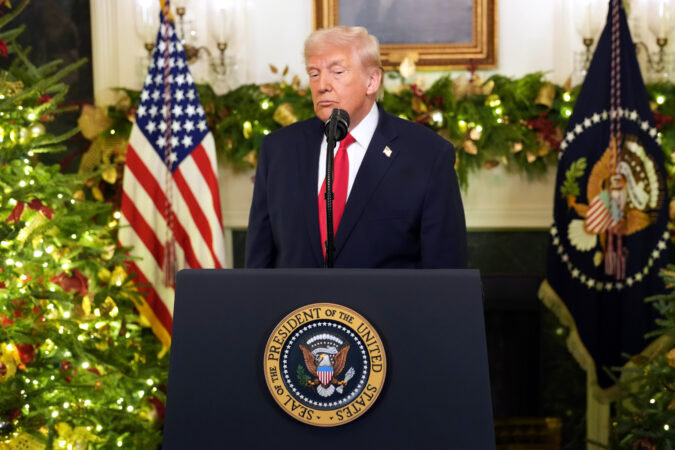
Flanked by two Christmas trees with a portrait of George Washington behind him in the White House’s Diplomatic Reception Room, Trump sought to pin any worries about the economy on his predecessor, Joe Biden.
“Eleven months ago, I inherited a mess, and I’m fixing it,” Trump said. “We’re poised for an economic boom, the likes of which the world has never seen.”
Trump seeking to stop the slump in his approval ratings
His holiday wishes came at a crucial time as he tries to rebuild his steadily eroding popularity. Public polling shows most U.S. adults are frustrated with his handling of the economy as inflation picked up after his tariffs raised prices and hiring slowed.
In 2026, Trump and his party face a referendum on their leadership as the nation heads into the midterm elections that will decide control of the House and the Senate.
The White House remarks were a chance for Trump to try to regain some momentum after Republican losses in this year’s elections raised questions about the durability of his coalition. He openly leaned into the politics despite television networks’ past reluctance to broadcast presidential addresses loaded with campaign-style rhetoric.
For example, in September 2022, networks declined to give the Biden White House a prime-time slot for a speech the then-president gave about democracy because it was viewed as too political.
Trump spoke at a rapid-fire clip with a tone that bordered at times on anger. He responded to the public frustration this year over the economy by making even bolder promises on growth next year, saying that mortgage rates would be coming down and that he “would announce some of the most aggressive housing reform plans in American history.”
Trump brought charts with him to make the case that the economy is on an upward trajectory. He made claims about incomes growing, inflation easing and investment dollars pouring into the country as foreign leaders, he claimed, have assured him that “we’re the hottest country anywhere in the world,” a statement he has frequently repeated at public events.
If the argument seemed familiar, that’s because it has echoes of the case that Biden made about the U.S. economy with little success. He, too, in the face of inflation pointed to the enviable rate of U.S. economic growth compared to other nations.
The public sees the economy differently from Trump
The hard math internalized by the public paints a more complicated picture of an economy that has some stability but few reasons to inspire much public confidence.
The stock market is up, gasoline prices are down and tech companies are placing large bets on the development of artificial intelligence.
But inflation that had been descending after spiking to a four-decade high in 2022 under Biden has reaccelerated after Trump announced his tariffs in April.
The consumer price index is increasing at an annual rate of 3%, up from 2.3% in April.
The affordability squeeze is also coming from a softening job market. Monthly job gains have averaged a paltry 17,000 since April’s “Liberation Day,” when Trump announced import taxes that he later suspended and then readjusted several months later.
The unemployment rate has climbed from 4% in January to 4.6%.
Trump said that investment commitments for new factories will boost manufacturing jobs and that consumer activity will improve dramatically as people receive increased tax refunds next year.
While emphasizing the economy, he also faces challenges on other policy fronts.
Trump sought to blame Democrats for the likely increase in health insurance premiums as the subsidies tied to the 2010 Affordable Care Act are expiring. Democratic lawmakers and some Republicans have sought to address that issue, but Trump has pushed back and suggested instead that payments should go directly to the buyers of health insurance instead of the companies. The president has yet to commit to a specific legislative fix.
After his speech ended and the video was no longer being broadcast, Trump turned to his gathered aides and asked them how his address to the nation went. The aides assured him it was great.
Trump then indicated that White House chief of staff Susie Wiles had told him he needed to address the nation. After some back and forth, he asked Wiles how he had done.
“I told you 20 minutes and you were 20 minutes on the dot,” Wiles said.
Four moderate Republicans — including three who are in the hot seat for reelection in swing districts in Pennsylvania — joined Democrats to sign a discharge petition Wednesday to force a vote on a proposal to extend pandemic-era expanded Obamacare subsidies.
While the move may not save the subsidies from expiring, given that Republican-controlled Senate has indicated resistance to the plan, the votes mark the sharpest rebuke of party leadership from within the GOP since President Donald Trump started his second term.
U.S. Rep. Brian Fitzpatrick, who has represented Bucks County since 2017, and two GOP freshmen from elsewhere in the state, U.S. Reps. Rob Bresnahan and Ryan Mackenzie, joined New York moderate Mike Lawler to give Democrats the votes they needed to push a vote on a clean extension of the subsidies to the floor.
The move comes on the heels of other high-profile examples of rank-and-file Republicans bucking Trump and House Speaker Mike Johnson, including last month’s bipartisan vote to release the Jeffrey Epstein files, following a discharge petition after Johnson had slow-walked the legislation.
The “dam is breaking,” U.S. Rep. Marjorie Taylor Greene (R., Ga.) told CNN on Tuesday in reference to the string of incidents in which members of the party had defied the president and speaker ahead of next year’s midterms.
The Republicans who defected on the healthcare bill had favored a compromise that they hoped might have a chance of passing Congress, but that was rejected by Johnson (R., La.), who sided with conservatives against expanding the subsidies, on Tuesday night.
That left them supporting a vote on a bill that extends the program as is, with far fewer restrictions and concessions than the compromise bills included.
“Despite our months-long call for action, leadership on both sides of the aisle failed to work together to advance any bipartisan compromise, leaving this as the only way to protect the 28,000 people in my district from higher costs,” Bresnahan said in a statement posted on X.
“Families in NEPA cannot afford to have the rug pulled out from under them. Doing nothing was not an option, and although this is not a bill I ever intended to support, it is the only option remaining. I urge my colleagues to set politics aside, put people first, and come together around a bipartisan deal.”
Later Wednesday, House Republican leaders pushed to passage a healthcare bill that does not address the soaring monthly premiums that millions of people will soon endure. The bill passed on a mostly party-line vote of 216-211. U.S. Rep. Thomas Massie (R., Ky.) joined with Democrats in voting against the measure.
Fitzpatrick and Lawler tried to add a temporary extension of the subsidies to the bill, but were denied.
“Our only request was a floor vote on this compromise, so that the American People’s voice could be heard on this issue. That request was rejected. Then, at the request of House leadership I, along with my colleagues, filed multiple amendments, and testified at length to those amendments,” Fitzpatrick said in a statement. “House leadership then decided to reject every single one of these amendments.
“As I’ve stated many times before, the only policy that is worse than a clean three-year extension without any reforms, is a policy of complete expiration without any bridge,” Fitzpatrick said.
Bresnahan’s vote for the discharge petition came a little more than a week after he welcomed Trump to his Northeast Pennsylvania district for a rally, which was meant to address voter concerns about affordability ahead of next year’s midterms.
Bresnahan won his election last year by about 1 percentage point. He was also one of just 20 House Republicans to sign a successful discharge petition earlier this month to force a vote for collective bargaining to be restored for federal workers.
“At the end of the day that might have been going against party leadership, but it was what’s right for northeastern Pennsylvania,” he told The Inquirer of the vote at the Pennsylvania Society last weekend.
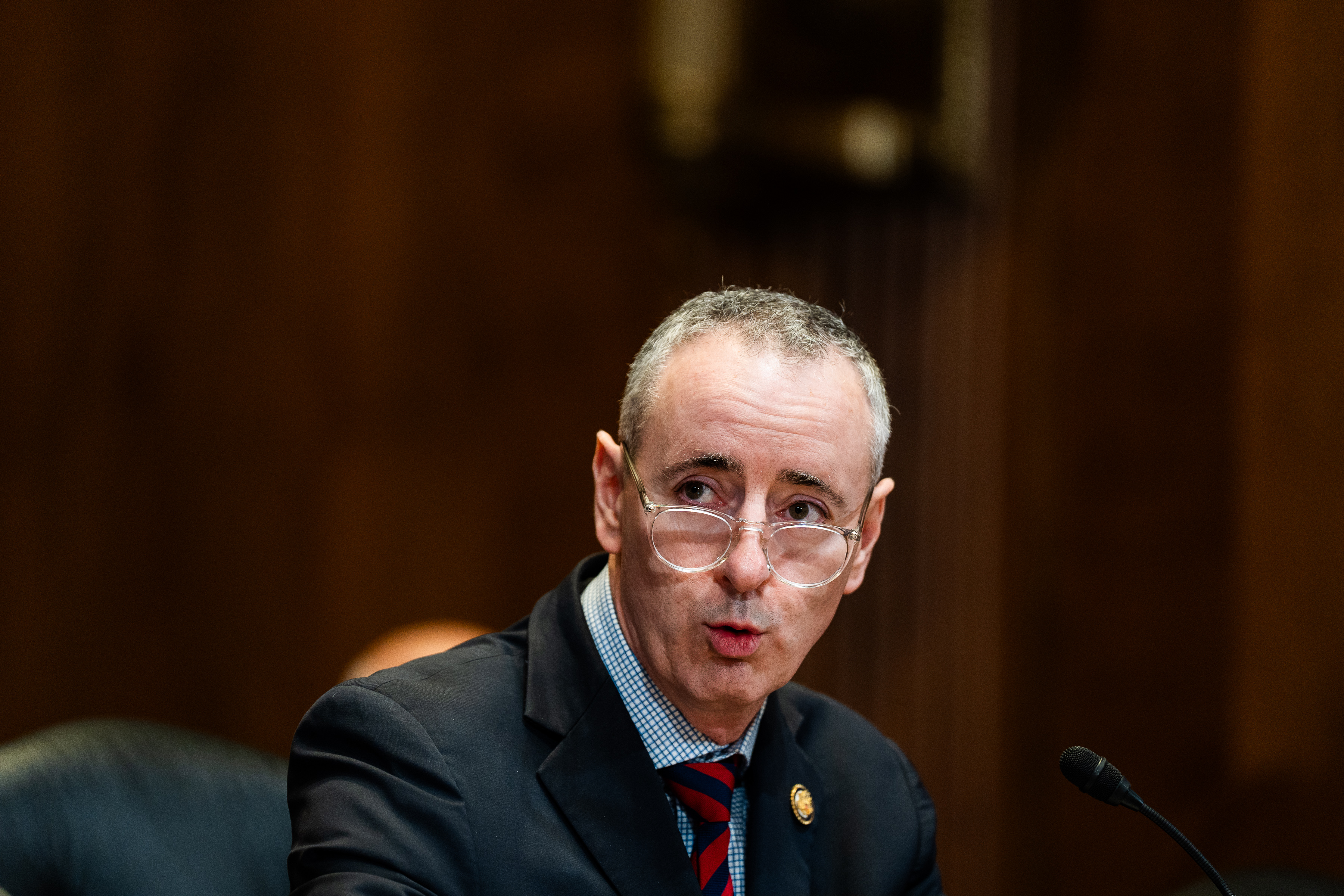
Rep. Brian Fitzpatrick (R-Pennsylvania) speaks at a hearing on Capitol Hill on Dec. 3.
Mackenzie, in an interview with The Inquirer, blamed Democrats for not signing on to one of the compromise proposals, leaving him and the other three Republicans with no alternative but to sign onto a discharge for a plan he doubts will pass.
“But if you send the Senate anything at this point, I’m of the opinion it will continue the conversation and they’ll consider what their options are,” Mackenzie said. “If they would like to do additional reforms, I welcome those.”
While Republicans who have opposed the extension argue the subsidies were meant to be temporary and affect only about 7% of Americans, Mackenzie said he has been hearing from constituents constantly.
“Healthcare and the current system is unaffordable for many people,” he said. “We recognize the current system is broken for millions of Americans, so to actually get to some kind of better position, you need both short-term and long-term solutions.”
He called the Affordable Care Act subsidy extension a needed short-term solution “to do something for people struggling right now.”
Like Bresnahan, Mackenzie won his Lehigh Valley seat by 1 percentage point last year. And the district will be a top priority for both parties in next year’s election — as shown by Vice President JD Vance’s visit there Tuesday.
U.S. Rep. Scott Perry, a staunch Trump ally, represents a swing district in Central Pennsylvania but voted against the discharge petition. Janelle Stelson, a Democrat seeking Perry’s seat, called him “extreme” for voting against the measure.
“While other Republicans are working across party lines to lower costs, Perry is yet again refusing to do anything to make life more affordable,” said Stelson, who narrowly lost to Perry last year.
Some Republicans do not want to extend the credits at all, while others want abortion restrictions included.
Democrats hoping to unseat Fitzpatrick argue he has a record of pushing back on Trump and GOP leaders only in ways that do not actually damage the party or its priorities. In this case, though, the three Pennsylvanians were critical in getting the petition through, even if the future of ACA tax credits remains uncertain.
“The only thing Brian Fitzpatrick has perfected in his 9 years in Congress is the art of completely meaningless gesture, designed to protect his political future not the people he serves,” his Democratic challenger, Bucks County Commissioner Bob Harvie, wrote on X.
Harvie had previously called on Fitzpatrick to sign the Democrats’ discharge petition.
Not all ACA tax credits are under threat. Under the ACA, people who earn less than 400% of the federal poverty level — about $60,000 — are eligible for tax credits on a sliding scale, based on their income, to help offset the monthly cost of an insurance premium.
That tax credit is part of the law, and therefore not expiring. But what will expire is an expansion passed in 2021 when Congress increased financial assistance so that those buying coverage through an Obamacare marketplace do not pay more than 8.5% of their income.
This article includes information from the Associated Press.
More than 74,000 people, with an average age of 28, have applied for roles in Zohran Mamdani’s new administration. Those figures are both a measure of enthusiasm for New York City’s incoming mayor and a sign of how tough the job market is for young people in the five boroughs.
Young voters and volunteers fueled the 34-year-old Mamdani’s fast rise from a relatively unknown Queens assemblyman to mayor-elect of America’s largest city. A lot of them had time on their hands: New Yorkers aged 16 to 24 faced a 13.2% unemployment rate in 2024, 3.6 percentage points higher than in 2019, according to a May report from the New York state comptroller.
New York City had a 5.8% unemployment rate overall in August, 1.3 percentage points above the U.S. average. The city added roughly 25,000 jobs this year through September, compared with about 106,000 during the same period in 2024, according to city data.
Mamdani’s campaign pledge to lower the cost of living in New York resonated with voters struggling to find jobs and establish themselves at a time when rents have stayed high and income growth has slowed. Now he’s looking to hire an unspecified number of roles across 60 agencies, 95 mayoral offices, and more than 250 boards and commissions, with senior roles a priority, according to his transition team.
The typical size of the New York City mayoral staff — commissioners, communications, operations and community affairs — is about 1,100, according to Ana Champeny, vice president of research at the Citizens Budget Commission, a nonprofit finance watchdog. City government in total hired 39,455 people in 2024, according to New York City data.
Applications for roles in Mamdani’s administration have come from workers of all experience levels and from a wide range of backgrounds and industries, said Maria Torres-Springer, co-chair of the mayor-elect’s transition team. About 20,000 of the applicants came from out of state.
When Barack Obama was elected U.S. president in 2008, workers submitted more than 300,000 job applications to his administration. Blair Levin, who co-led the technology transition team for Obama, said he received around 3,000 of those resumes. He whittled the pool down to 75, a relatively easy task because he needed applicants with specific tech and economics skills, he said.
Without invoking the term “AI,” Torres-Springer said the applications would be filtered using “the typical technology that any big corporation would have in an applicant-tracking system.” The resumes will then be sorted and matched to different agencies.
Mamdani’s avid use of social media, which helped him connect with young people during his campaign, has continued into his transition efforts, creating excitement — among young people especially — about the prospect of joining his administration.
“The average age does tell a particularly interesting story in two ways,” Torres-Springer said. “It might be because of volatility in the job market but it’s also because I think we are attracting, the administration is attracting, New Yorkers who may not have considered government in the past.”
Take David Kinchen, a 28-year-old data engineer who moved to New York from northern Virginia three years ago. Since getting laid off from a job in fraud detection at Capital One, he has applied for more than 1,000 roles and completed at least 75 interviews without an offer, he said. Kinchen volunteered for Mamdani’s campaign and applied to the administration, highlighting his tech credentials and a passion for photography.
“I did data engineering, so I could help with database decisions. There was also a creative option on the application, since I could work as a staff photographer too,” Kinchen said.
Another applicant, 22-year-old Aurisha Rahman, has struggled to find a job since graduating with a civil-engineering degree from Hofstra University on Long Island.
“The job market is even worse than it was last fall,” Rahman said. Mamdani’s resumé portal was one of the few places she found open to entry-level applicants.
Rahman, who was born and raised in Queens, said she wants to give back to the city where she was raised and wouldn’t be picky about a position. “Whatever they need, I’ll do it. I don’t care,” she said. “Right now, it’s better to be busy with something than nothing.”