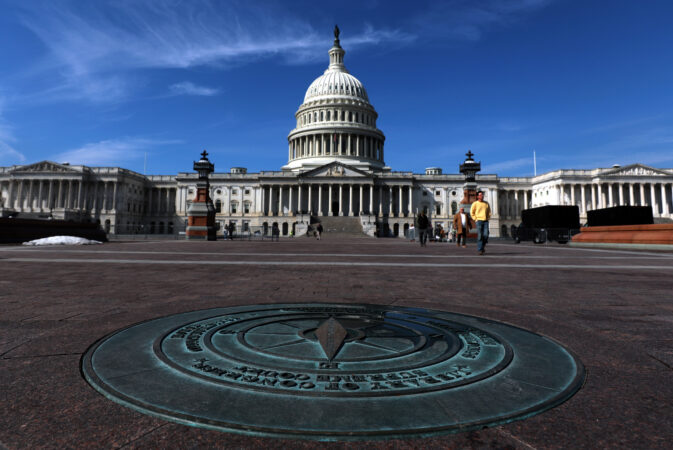
Military officers will see their tuition assistance cut off at 22 schools and institutions, but the University of Pennsylvania is not among them.
The Ivy League institution, which counts President Donald Trump among its alumni, was on an initial list of 34 schools “at risk” of losing Pentagon-funded tuition assistance. But Penn was not part of the 22-university list released by Defense Secretary Pete Hegseth on Friday.
Penn did not immediately respond to a request for comment Tuesday.
Hegseth previously said he intendedto cut off schools where faculty members have “leftist political leanings” and “openly loathe our military,” but he cited no specific examples of bias or misconduct at the 22 schools that will lose tuition assistance beginning with the 2026-27 academic year.
“We will no longer invest in institutions that fail to sharpen our leaders’ warfighting capabilities or that undermine the very values they are sworn to defend,” Hegseth wrote in a letter released Friday with the final list.
It was not immediately clear why Penn and other schools were removed from the initial draft list.
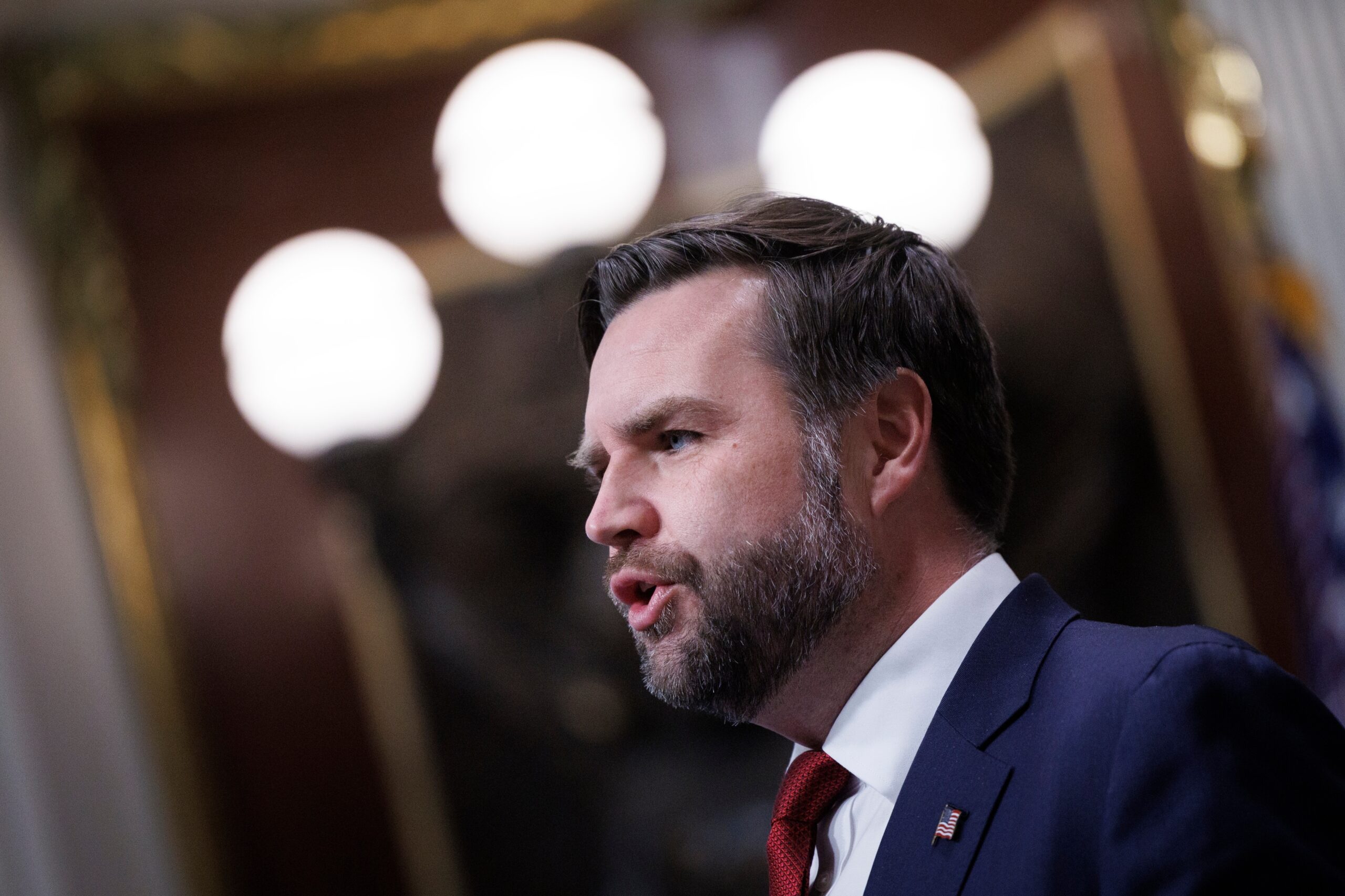
Among the schools still set to lose access to the tuition-assistance program is Princeton University, where Hegseth obtained a bachelor’s degree in 2003. Carnegie Mellon University in Pittsburgh is also on the list, as is Yale University, where Vice President JD Vance obtained a law degree.
The move means members of the military will be banned from using Department of Defense tuition assistance to pay for Senior Service College Fellowship programs at those schools.
The impact will not be large — the Department of Defense said fewer than 100 military students are enrolled in programs at schools that will lose funding. Military personnel currently enrolled may complete their courses of study, Hegseth said, though it is unclear if they will have to change schools to continue receiving financial assistance.
Hegseth’s announcement did not mention several other financial assistance programs for undergraduates, including the GI Bill, which is administered by the Department of Veterans Affairs.
Here is the full list of schools losing tuition assistance from the Pentagon:
Educational institutions
Harvard University
St. Louis University
Massachusetts Institute of Technology
Tufts University
Georgetown University
Carnegie Mellon University
Brown University
Columbia University
Yale University
Middlebury College
Princeton University
George Washington University
College of William and Mary
International institution
Queen’s University (Canada)
Nonprofit institutions
Center for Strategic and International Studies
New America Foundation
Brookings Institution
Atlantic Council
Center for a New American Security
Council on Foreign Relations
Henry L. Stimson Center
Senior Service College
Johns Hopkins University School of Advanced International Studies West Space Scholars Program
WASHINGTON (AP) — For Democrats demoralized at being shut out of power in Washington, the past several months have offered reason for optimism.
A party often beset by ideological division has largely been unified in opposition to President Donald Trump’s hardline immigration tactics, particularly after two U.S. citizens were killed in Minneapolis. Heading into a midterm election year in which they are just a few seats shy of reclaiming the U.S. House majority, Democrats have also kept the White House on defense with criticism of Trump’s economic policies and ties to Jeffrey Epstein, the convicted sex offender.
But the U.S. and Israeli strikes against Iran could test the durability of that cohesion. Initially, Democrats balanced condemnation of Iran’s supreme leader, Ayatollah Ali Khamenei, who was killed over the weekend, with calls for Congress to quickly pass a war powers resolution that would restrain Trump’s attack options.
“As soon as our resolution comes to the floor, senators need to pick a side,” Senate Democratic leader Chuck Schumer said on Monday. “Stand with Americans who don’t want war, or stand with Donald Trump as he singlehandedly starts another war.”
Democratic divisions going into war powers vote
But some divisions are surfacing as a handful of Democrats, especially those who are strongly aligned with Israel, express reservations about the war powers measure. Rep. Greg Landsman, D-Ohio, won’t back an Iran resolution. Before the strike, Rep. Josh Gottheimer, D-N.J., also said he would vote no.
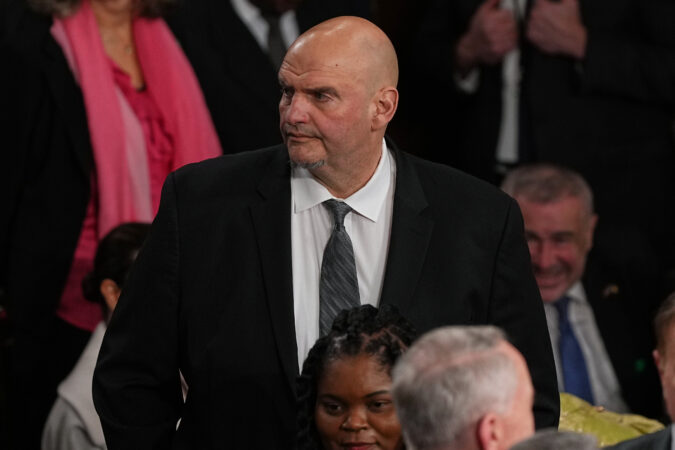
Sen. John Fetterman, D-Pa., who backed a war powers vote tied to Venezuela in January, also has broken with Democrats over the Iranian measure and rejected arguments that the attack was illegal, spurring frustration among some party leaders.
“John Fetterman knows better,” House Democratic leader Hakeem Jeffries said Monday on CNN.
Republicans are also facing internal dissent. Trump, who did little to prepare Americans for the prospect of such a dramatic conflict, said Monday the operation could last four to five weeks. He hasn’t articulated a clear exit strategy and warns that American casualties could mount, which will pose a severe test of voter patience for the conflict.
The war could also lead to rising gas prices and economic volatility that may bolster Democratic arguments that the president is out of touch with the financial realities facing many Americans.
Still, Republicans see an opportunity to portray Democrats as reflexively opposed to Trump.
“For my Democratic colleagues, this is not about what’s best for our national security or what’s best for protecting the American people,” said Sen. John Kennedy, R-La. “This is about how to defeat Donald Trump.”
A searing debate among Democrats over Israel
Democrats have undergone a searing internal debate over the party’s relationship with Israel in the wake of the war in Gaza. Then-President Joe Biden’s loyalty to Israel during the heat of the 2024 campaign was starkly at odds with younger generations outraged by the treatment of Palestinians in Gaza. By the time Kamala Harris rose to the top of the ticket that year, she struggled to win over some younger voters who are critical to Democratic success.
Paco Fabian, the political director for the progressive advocacy group Our Revolution, acknowledged that Democrats “aren’t monolithic.” But he also suggested a shift was underway, noting the results of a New Jersey special election last month.
During that campaign, the affiliated super PAC of the pro-Israel American Israel Public Affairs committee sought to thwart the moderate candidate, Tom Malinowski, after he questioned unconditional aid to the Israeli government. Those efforts appeared to backfire with the more progressive contender, Analilia Mejia, winning the primary.
“Given what’s going on right now, I don’t think the moment is doing AIPAC and Israel any favors,” Fabian said.
Sympathy toward Israel appears to be shifting. Three years ago, 54% of Americans sympathized more with the Israelis, compared with 31% for the Palestinians, according to Gallup polling released last month. Now, their support is about evenly balanced, with 41% saying their sympathies lie more with the Palestinians, and only 36% saying the same about the Israelis.
Americans’ initial reactions to airstrikes also appeared more negative than positive, early polling suggested. About 6 in 10 U.S. adults disapproved of the U.S. decision to take military action in Iran, according to a CNN poll conducted via text message over the weekend. A separate snap poll from The Washington Post conducted via text message on Sunday suggested that about half of those polled opposed the strikes, while 39% were in support. Roughly 1 in 10 were unsure.
Democrats and independents drove much of the disapproval in those early polls, while Republicans were much more supportive.
Elections this week could show impact of attacks
The initial political impact of the attacks in Iran could emerge as soon as Tuesday during the first primary elections of this year’s midterm campaign.
In North Carolina, Durham County Commissioner Nida Allam was already going into her bid to unseat two-term Rep. Valerie Foushee with backing from Our Revolution and other top progressives. After receiving support from groups tied to AIPAC during her 2022 campaign, Foushee’s campaign rejected such contributions this cycle. Over the weekend, she said she doesn’t support “Trump’s illegal war with Iran” and would back the war powers resolution.
Still, Allam, who would be the first Muslim elected to Congress from North Carolina, was quick to release a video ahead of Tuesday’s vote criticizing Trump for “starting another endless war” and promising to never accept support from “the pro-Israel lobby.”
In Texas, home to high-profile Senate primaries on Tuesday, Democratic voters expressed alarm at the attacks.
“It shouldn’t have happened,” said Charles Padmore, 45, an independent contractor in Houston. “Affordability should be the top priority on Trump’s list.”
Alex Diaz, 31, a biology high school teacher in Houston, called the bombing of Iran “uncalled for.”
“You’re trying to start World War III, and we don’t need that right now,” he said.
The fallout could spread to other contests this month. Ahead of the March 17 primary in Illinois, AIPAC-aligned groups have also criticized Daniel Biss, the Evanston mayor who is aiming to become the Democratic candidate to succeed the retiring Rep. Jan Schakowsky. In an interview, Biss spoke of the “backlash I’m hearing people have against AIPAC, their MAGA-aligned money and their Trump-aligned policy agenda.”
Asked about such predictions, Patrick Dorton, a spokesman for AIPAC’s affiliated super PAC, said “the key distinction will be between those who recognize that Iran is a murderous regime that tortures women for leaving their hair uncovered, hangs gay people, and executes peaceful democratic protestors, and those who will turn a blind eye to the regime’s atrocities.”
Calls for a ‘united opposition party’
As Congress moves toward a potential war powers vote this week, Biss said there was a need for Democrats to act as a “strong, clear, vocal, united opposition party.”
“I also would like to see the Democratic Party united not just on the procedural argument but on the basic acknowledgment that this war is wrong,” he added.
On Capitol Hill, Sen. Richard Blumenthal of Connecticut, a Democrat on the Armed Services Committee, said he was less concerned about party unity than the prospect of achieving a bipartisan vote on the war powers resolution. Three Republicans ultimately backed the Venezuela resolution in January.
“What I want to see happen is the war powers resolution pass,” he said. “I’m not focused on what Democrats as a whole do. We’re going to have differing opinions among Democrats and among Republicans.”
Philadelphia is one of five cities on a list of finalists to host the 2028 Democratic National Convention, a major gathering that could generate millions of dollars in economic impact for the city.
Party officials are also considering Boston, Atlanta, Chicago, and Denver, the Democratic National Committee announced Monday.
The convention will be held from Aug. 7 to Aug. 10, 2028, according to the party. If Philadelphia is selected, the convention would likely be held at the Xfinity Mobile Arena at the South Philly stadium complex, the largest indoor event space in the city.
DNC leaders and advisers are expected to make site visits this spring before selecting a host.
The DNC said in its statement that, in picking a host city, party leaders will consider how each city uses “new and innovative approaches in response to the challenges and opportunities that arise from hosting an event of this magnitude.”
The Republican Party’s 2028 convention will take place in Houston.
Top Philadelphia Democrats and donors formed a host committee — called Pick Pennsylvania — in recent months and, in partnership with Democratic Mayor Cherelle L. Parker, submitted a bid to host the 2028 convention.
In a statement, Parker said that Philadelphia’s selection as a finalist “reflects the strength of its proposal and the broad coalition of civic, business, labor, and community leaders committed to hosting a convention that is inclusive and memorable.”
Parker, who is up for reelection next year, would no doubt play a major role in planning for an upcoming convention. So would Gov. Josh Shapiro, a Democrat currently running for reelection who is considered a contender for the 2028 presidential nomination.
The president of the Philadelphia host committee is David L. Cohen, a prominent party stalwart, and the chair is Daniel J. Hilferty, the CEO of Comcast Spectacor, which owns the Xfinity Mobile Arena.
He said in a statement that “there is no city more excited, more invested and more prepared than Philadelphia to host the 2028 Democratic National Convention.”
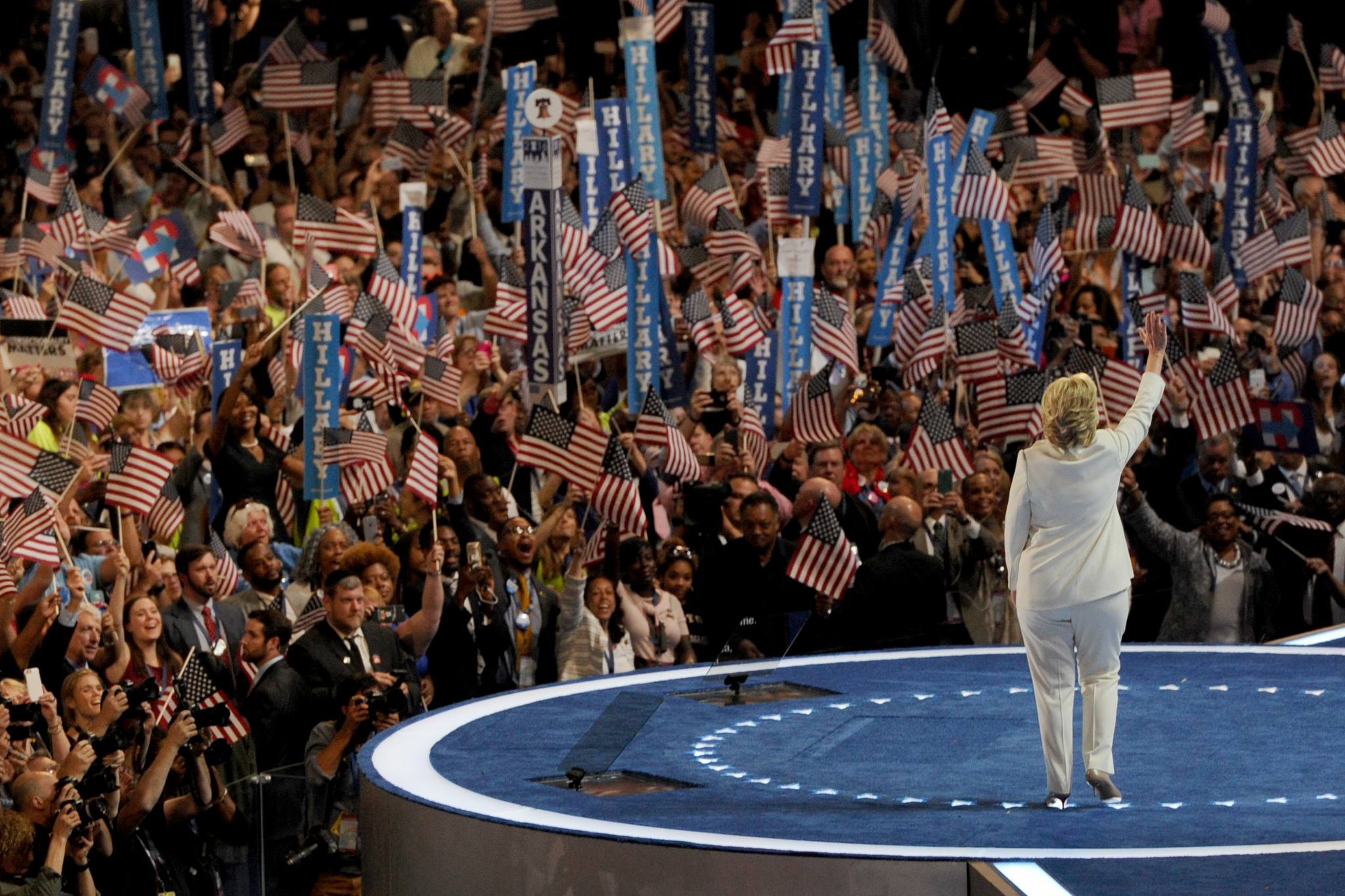
Philadelphia — the largest city in a critical swing state — last hosted a presidential nominating convention in 2016 at the South Philly arena, then called the Wells Fargo Center. Democrats that year nominated former Secretary of State Hillary Clinton, who was later defeated by Republican Donald Trump.
Before 2016, the city hosted major party conventions seven times, including the 2000 Republican National Convention. The GOP that year nominated then-Texas Gov. George W. Bush, who went on to serve two terms in the White House.
Former U.S. Rep. Bob Brady, the chair of the Philadelphia Democratic City Committee, said Monday that he had spoken multiple times to DNC leaders about the prospect of the city hosting the 2028 convention.
“We got a great reputation from the last convention we had,” Brady said. “Plus we’re going to show off the city very well this summer, which will really give us a good look.”
The news that Philadelphia is again a finalist to host the DNC is a welcome development for the city’s tourism and hospitality industry, as party conventions draw thousands of visitors and can be a boon for spending in the city.
The 2016 event generated $230.9 million in economic impact, according to the Philadelphia Convention and Visitors Bureau. Of that, about $132.9 million came from direct convention-related spending, and $11.1 million was generated by state and local taxes. That convention attracted more than 5,000 attendees and some 29,000 other visitors, leading to a record-breaking year for hotels in Center City, the bureau reported.
In this July 28, 2016 file photo, then-Democratic presidential nominee Hillary Clinton walks on stage at the arena in South Philly to accept the nomination of her party on the final night of the DNC.
If selected, Philadelphia may be uniquely positioned to host an influx of visitors.
The city’s hotel supply has expanded since the last time it hosted a DNC — and there are more than 19,000 hotel rooms in the city, according to Visit Philadelphia. That’s an increase from about 16,000 available in 2016.
The city has also invested millions of dollars on improvements to public spaces, transit hubs, and security ahead of several major events this year, including World Cup games, the MLB All-Star Game, and the commemoration of the 250th anniversary of America.
Conventions are also major logistical undertakings. Attendees include high-profile politicians and celebrities, and protests often form outside the events. The federal government has over the last two decades designated both parties’ nominating conventions as National Special Security Events, meaning they are deemed at high risk for terrorism and require federally led security.
In Chicago in 2024, the U.S. Secret Service led security planning alongside 16 other public safety entities, according to a local NBC affiliate. The law enforcement and security plan included designated protest zones, airspace monitoring, and traffic control.
Host committees are also responsible for raising millions of dollars to pay for parties, transportation for delegates, construction and venue upgrades, as well as other logistical services such as consultants, accountants, and communications staff.
In 2016, the Philadelphia host committee raised about $85 million — $10 million of which came from taxpayers in the form of a state grant. Other top contributions came from corporations, unions, and wealthy individual donors.
President George W. Bush used a solemn address from the Cabinet Room to tell Americans that Iraqi leader Saddam Hussein had been captured. President Barack Obama spoke to cameras when he announced that Osama bin Laden had been killed.
After President Donald Trump’s attack on Iran killed its supreme leader on Saturday, he used a different messaging strategy — a written post on Truth Social.
Trump has taken an approach to selling U.S. citizens on military action in Iran that sharply contrasts with his predecessors: He devoted three minutes of his 108-minute State of the Union address to the issue, spoke to Americans through social media posts and a pair of videos recorded at Mar-a-Lago but made no public appearances over the weekend since a Friday rally in Corpus Christi, Texas.
The strategy might afford him flexibility in the coming days and weeks to avoid what former Secretary of State Colin Powell told Bush was the Pottery Barn rule — if you break it, you own it.
From the outset, Trump has been careful to declare limits around the U.S. attack, saying he wanted to overthrow the current regime, but telling Iranians it was up to them to seize the opportunity to write their country’s next chapter. His communication strategy has reinforced those limits by creating a bit of distance — at least in imagery — between the president and the fighting.
At the same time, however, Trump has adopted expansive rhetoric about the reasoning for his intervention that recalled the justifications used for earlier U.S. forays into the Middle East.
“They have waged war against civilization itself,” Trump said in a six-minute video posted to Truth Social on Sunday in which he left the precise goals of the attack flexible.
“We’re undertaking this massive operation not merely to ensure security for our own time and place, but for our children and their children, just as our ancestors have done for us many, many years ago. This is the duty and the burden of a free people.”
It was his first on-camera acknowledgment of Supreme Leader Ayatollah Ali Khamenei’s death nearly 24 hours after he made his first written post about it.
“I call upon all Iranian patriots who yearn for freedom to seize this moment to be brave,” Trump said. “I made a promise to you, and I fulfilled that promise. The rest will be up to you, but we’ll be there to help.”
Middle East experts said Trump’s strategy could end up politically successful, pairing an airstrike-only approach with a flexible definition of what would constitute victory.
“We have escalation dominance in Iran. We control the pace, the focus, the intensity of military conflict,” said Aaron David Miller, who advised Democratic and Republican administrations on Middle East issues. “We can escalate when we want, and we can presumably prevent Iranians from escalating, and so we can own Iran without the Pottery Barn rule going into effect. That’s what makes this so Trumpian.”
Richard Haass, who was the director of policy planning at Powell’s State Department in the lead-up to the 2003 Iraq War, said Trump was “calling for regime change, but is not assuming the responsibility for it.”
“It gives him an off-ramp, not having to see it through. So if it happens, he gets credit for it, if it doesn’t happen, he doesn’t get the blame for it,” said Haass, who is president emeritus of the Council on Foreign Relations.
Still, there may be political risks to Trump’s sweeping rhetoric if the situation deteriorates, especially if the number of dead U.S. troops rises. So far in the operation, three have been killed and five injured, the U.S. Central Command announced Sunday. Another death was announced Monday.
“Sadly there will likely be more before it ends. That’s the way it is,” Trump said in his Sunday video.
White House officials say they owe nothing to past communications practice and that the president’s videos and written statements on Truth Social have reached a vast audience.
If Trump had pursued a strategy similar to Bush’s approach to Iraq, in which he laid out an extensive argument for war, “the Ayatollah [Khamenei] would probably still be alive, because we would have been spending weeks and months leading up to this tipping off our adversaries, which would not have led to the killing of the Ayatollah yesterday,” White House press secretary Karoline Leavitt said.
“Operational secrecy and security is the number one priority for the president,” she said.
In addition to leaving the objectives flexible, the administration has also been vague about its justification for the attack, including in classified briefings for members of Congress.
During a closed-door briefing with congressional staff Sunday, some aides said the administration provided no intelligence on an imminent or preemptive threat posed by Iran, according to people in the room who spoke on the condition of anonymity to discuss a classified briefing.
When asked directly about potential threats, one briefer said Iran was prepared to retaliate against the United States, but such warnings fall short of the traditional tests for a legal basis to launch a preemptive attack on a country or decapitate its political and military leadership.
U.S. officials told reporters on Saturday that Iran’s ballistic missile program posed a threat. International law would not typically support a military assault based on a country’s maintaining a conventional weapons program of that nature.
Trump may have been more restrained in the lead-up to Saturday’s attack because he was giving more space for negotiations than Bush had offered Iraq, even as the U.S. military presence in the Middle East ramped up in recent weeks to the largest massing of force since the 2003 Iraq invasion.
But for a president who rose to power in part on the shoulders of supporters who were weary of decades of U.S. wars in the Middle East, there may be political risk in launching major foreign actions and not bringing his supporters along. Last week, a Washington Post-ABC News-Ipsos poll found that among Trump voters, 46% supported the prospect of the president’s using the U.S. military to force changes in other countries while 22% were opposed and 30% had no opinion.
White House officialshave taken a far more restrained approach this year than last toward how they highlight the president’s foreign policy-related engagements. In 2025, he had a foreign leader in the Oval Office almost every week, ushering in reporters and taking questions in impromptu news conferences that highlighted his central role on the world stage. But since the beginning of the year, that practice has stopped, as the White House tried to steer closer toward a domestic agenda that would highlight positive aspects of the president’s economic record.
Leavitt said the president put out the initial announcement about Khamenei’s death in the form of a written statement because he “was very busy yesterday in the situation room all day, monitoring it all night, and he was on the phone with our allies around the world and talking to other countries. And so the most effective way for him to get that message out yesterday was by a Truth [Social post], and obviously it was a statement heard around the world.”
Trump’s Sunday video address offered a more traditional approach to Khamenei, embracing the victory on camera.
“This wretched and vile man had the blood of hundreds and even thousands of Americans on his hands,” Trump said. “All over Iran, the voices of the Iranian people could be heard cheering and celebrating in the streets when his death was announced.”
Administration officials make television appearances on Sunday morning shows nearly every week, but none made the rounds this time. A seniorWhite House official said that wasn’t an effort to distance the administration from the fighting, but rather a measure of their need to monitor military operations from the Situation Room and from the president’s side at Mar-a-Lago. The official spoke on the condition of anonymity to discuss sensitive internal strategy.
Rather than put administration officials in front of the cameras, the White House coordinated a message with congressional Republicans to speak on the shows, offering Secretary of State Marco Rubio on Saturday evening to brief them.
“I thought the president’s eight-minute video yesterday was outstanding,” Sen. Tom Cotton (R., Ark.) told CBS’s Face the Nation on Sunday. “It laid out Iran’s 47-year campaign of terror and revolutionary violence against the United States and our people and really, the civilized world. I’m sure the president will speak more in the coming days, will have briefings to Congress.”
Classified briefings to Congress are planned for Tuesday.
Some supporters of tough action against Tehran said that it may take time to judge the final outcome of the military action — longer than the actual time frame of the bombing.
“The question is going to be whether it’s good policy, and that will turn in part on American casualties,” said Elliott Abrams, who worked on Iran issues during the first Trump administration and on foreign policy in the Reagan and George W. Bush administrations.
But, he said, “I caution critics that if this war ends in a week and the regime is still in place, it’s really too soon to say it failed. … If the regime falls in six months or 10 months or next year, everyone will have to acknowledge that this war brought it a lot closer and in retrospect, it will have been a great success, because I think getting rid of that regime will really change the Middle East.”
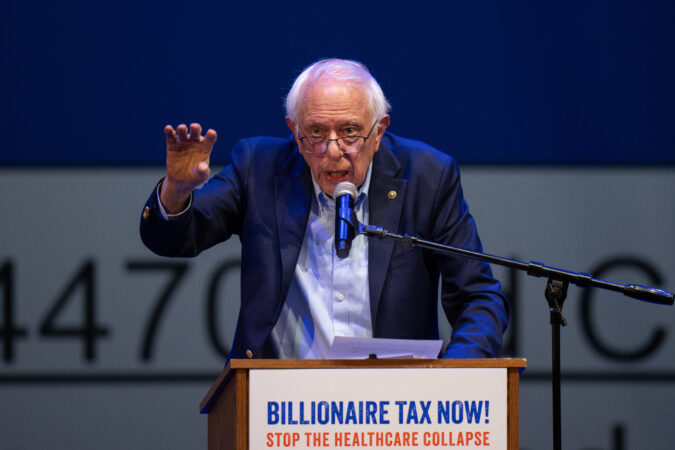
Sen. Bernie Sanders (I., Vt.) on Monday was set to unveil new legislation that would raise $4.4 trillion in taxes from America’s roughly 1,000 billionaires, aiming to roughly halve their fortunes.
The plan is a nonstarter in the current Republican-controlled Congress, but could become a litmus test for candidates in the 2028 Democratic presidential primary, much like Sanders’s Medicare-for-all plan was during the 2020 presidential cycle.
Sanders’s new legislation, which expands on his prior efforts, calls for an annual 5% wealth tax on America’s billionaires. Revenue from the tax would be redirected to social spending programs, including $3,000 cash payments for Americans earning less than $150,000 per year, a $60,000 minimum salary for every public school teacher, and an expansion of Medicare to cover dental, vision, and hearing care, among other measures.
While Sanders, 84, is not expected to run for president for a third consecutive time, the proposal could prove divisive among Democrats who do run. California Gov. Gavin Newsom, widely viewed as a top Democratic presidential candidate, has objected to a billionaire tax currently being proposed in his state. Sanders’ proposal is being introduced in the House by Rep. Ro Khanna (D., Calif.), a co-chair of Sanders’s 2020 presidential campaign who supports California’s proposed billionaire tax — and who has been testing the waters of his own presidential bid.
“This is Senator Sanders’ defining vision for our age,” Khanna said. “It is the most ambitious and transformative legislation for our times to tackle inequality in the New Gilded Age.”
The legislation comes amid a substantial increase in billionaire wealth during the first year of Trump’s presidency, driven by strong stock market gains. The total wealth of America’s billionaires rose last year by roughly 20%, according to Americans for Tax Fairness, a left-leaning organization. Billionaires’ political influence has risen along with their economic clout.
Sanders argues that the measure is an essentially conservative compromise that would leave most billionaires’ fortunes intact. Tesla CEO Elon Musk’s holdings, according to estimates from Sanders’ office, would go from $833 billion to $792 billion. Meta CEO Mark Zuckerberg’s would go from $220 billion to $209 billion. Amazon founder Jeff Bezos’ would shrink from $218 billion to $207 billion. (Bezos also owns the Washington Post.)
The amount of revenue raised would be substantial, however, and in addition to the aforementioned initiatives, would be used to provide home healthcare to seniors and people with disabilities through Medicaid. It would also reverse the GOP’s Medicaid cuts. The $3,000 checks would apply per person for households earning under $150,000, which would amount to $12,000 for a family of four.
Sanders’ revenue estimates were provided by Emmanuel Saez and Gabriel Zucman, two economics professors at the University of California at Berkeley. The economists assume a 10% rate of “tax evasion/avoidance,” and argue that the existing “exit tax” for renouncing American citizenship would make doing so unattractive for the targeted billionaires.
The plan is unlikely to be backed by any Republicans, but its support even among Democrats, who have a range of opinions about taxing billionaires, remains unclear. During the party’s last contested presidential primary in 2020, several leading candidates embraced far-reaching ideas to restructure the American economy with new levies on the rich and major new spending programs. Those ideas fizzled in Congress under former President Joe Biden, who supported many of them but failed to persuade Sen. Joe Manchin III, then a Democrat from West Virginia, to go along with even a small fraction of what Sanders and many other Democrats called for.
The defeat of Biden’s ambitious “Build Back Better” agenda — which included many of the ideas Sanders is now attempting to revive — paved the way for passage of a smaller bill focused on climate and energy subsidies, after which Democrats lost control of both Congress and the White House.
Since then, the party’s policy agenda has been mostly up for grabs. Democrats appear largely unified on reversing the more than $1 trillion in cuts to Medicaid and food stamps approved by Trump and congressional Republicans as part of last year’s One Big Beautiful Bill. But the party’s priorities beyond that appear unclear. Sanders’ proposal attempts to provide one potential blueprint.
Newsom has been a prominent advocate for a different approach. The governor has warned that the wealth tax currently being pushed in California would hurt his state, driving companies to flee and suppressing the innovation that has helped make Silicon Valley among the richest regions in the world.
“This will be defeated — there’s no question in my mind,” Newsom said last month of the billionaire tax. “I’ll do what I have to do to protect the state.”
Other Democrats who are cautious about raising taxes on billionaires believe the party moved too far to the left during the 2020 Democratic presidential primary, alienating potential business allies and driving them into the Republican camp.
Sanders and Khanna have taken the other side of that debate, and last month Sanders held an event with Khanna in California at which both called for passage of the measure.
“The billionaire class no longer sees itself as part of American society,” Sanders said in Los Angeles last month. “They see themselves as something separate and apart, like the oligarchs of the 18th century, the kings and the queens and the czars, they believe they have the divine right to rule and are no longer subject to democratic governance.”
WASHINGTON — The U.S. Congress is about to launch a war powers debate over President Donald Trump’s authority to bomb Iran under largely unusual circumstances — he has already done it, and the country is essentially already at war.
Bombs are falling, people are dying and vows of revenge and retribution are being lobbed in escalating threats, all while untold taxpayer dollars are being spent on a military strategy that’s expected to continue for weeks with an undefined goal and conclusion. Unlike the run-up to the Iraq War in 2003, which included long debates in Congress in the aftermath of the Sept. 11, 2001, attacks, or the more recent U.S. military strikes on Venezuela that proved to be limited, the joint U.S.-Israel military attack on Iran, called Operation Epic Fury, is well underway, with no foreseeable end in sight.
The moment is a defining one for Congress, which alone has the authority under the U.S. Constitution to declare war, and for the Republican president, who has consistently seized power during his second term with an apparent limitless view of his own executive reach.
“The Constitution is intended to prevent the accumulation of power in any one branch of government — and in any one person in government,” said David Janovsky, acting director of The Constitution Project at the Project on Government Oversight, a watchdog organization.
“Congress is the people’s representatives in a way that the president isn’t, even though we tend to focus on the president,” he said. “We need the people’s representatives to weigh in on whether we, the people, are going to war right now.”
War powers as a check on presidential power
In the U.S., the Congress would need to affirmatively approve wartime operations, with a declaration of war, or with an authorization for the use of military force, to essentially approve of the actions. But this rarely happens.
In fact, Congress has declared war just five times in the nation’s history, most recently in 1941, to enter World War II a day after the Pearl Harbor attack. Congress approved an AUMF for the 1990 Gulf War and did so again in 2001 and 2002 to launch the 9/11-era wars into Afghanistan and then Iraq.
But Congress also created the war powers resolution during the Vietnam War-era, as something of a tool of last resort — deployed to slap back a president who had embarked on military excursions without congressional approval.
Both the House and the Senate have prepared war powers resolutions for votes this week.
Sen. Mark Warner, the top Democrat on the Senate Intelligence Committee, said Trump, as president, “does not have the right to do this on his own.”
“When the president commits American forces to a war of choice, he needs to come before Congress and the American people and ask for a declaration of war,” Warner said on CNN’s “State of the Union.”
While lawmakers have criticized the Iranian regime and its nuclear ambitions, Democrats said Trump has not provided a rationale for the war or outlined its strategy for what comes next, and Trump’s MAGA coalition is splintering over what it sees as the president’s failure to keep his “America First” campaign promise by leading the U.S. toward an overseas war. Many lawmakers are wary of a longer entanglement as the operation killed Iran’s Supreme Leader Ayatollah Ali Khamenei and hundreds of people in the region.
White House officials are scheduled to brief congressional leaders and lawmakers this week, but the question-and-answer sessions will be behind closed doors, without a watchful public.
Power of the purse can stop wars
Over time, presidents of both major political parties have accumulated vast authority to engage in what are often more limited U.S. military strikes to accomplish strategic national security goals without approval from Congress. Democrat Barack Obama’s military operations over Libya and Republican George H.W. Bush’s incursions into Panama were conducted without the nod from Congress.
But restraining a president’s war powers is something lawmakers past and present have rarely been able to accomplish. Even if Congress is able to pass a war powers resolution to curb Trump in Iran, the House and the Senate would be unlikely to tally the two-thirds majority needed to overcome a presidential veto.
Trump has shrugged at the power of Congress to dictate what he can and can’t do, in war and other matters. He made only a brief mention of Iran in his State of the Union address last week, treating lawmakers’ support as an afterthought.
John Yoo, a law professor at the University of California, Berkeley, said the Founding Fathers set up a constitutional system in which the president and Congress would battle it out over these issues — but with Congress having one particularly powerful tool, because it controls the federal funding.
“Congress, they know how to stop this if they want to,” said Yoo, who helped draft the Bush administration’s 2001 and 2002 use of force authorizations. The Vietnam War ended once Congress pulled funding, he said.
But Congress is controlled by a Republican majority that largely shares Trump’s view of focusing military power against Iran, and it recently approved massive new funds for the Pentagon, some $175 billion, in the big tax cuts bill that he signed into law last yar.
With the Republican president’s party in power in the House and the Senate, it’s no surprise they are unlikely to object, Yoo said: “They agree with him.”
Debate in Congress begins
Ahead of debates, Republican Sen. Tom Cotton, the chairman of the Senate Intelligence Committee, said Trump already laid out his vision for Iran.
Cotton said Sunday that Trump has made it clear the U.S. won’t be sending ground forces inside Iran. Instead, Americans should expect to see an “extended air and naval campaign” in the region, which could result in pilots being shot down, though he said the military personnel would be recovered.
He expects a weekslong campaign as Iran names a new leader and determines how it will react to the U.S. attack.
“There’s no simple answer for what’s going to come next,” Cotton said on CBS’ “Face the Nation.”
Weeks earlier, Brown was accused of robbing campaign donations from another Democrat more than a thousand miles away in Florida.
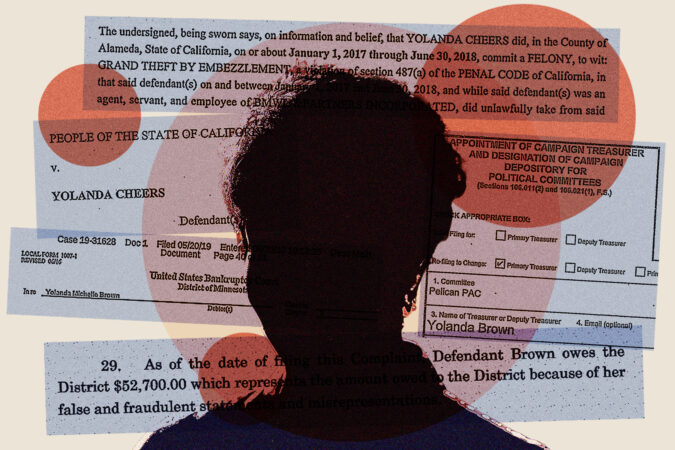
Brown, a Florida-based finance manager and campaign consultant who works primarily with Democrats and social justice groups, has over the last decade faced criminal charges for embezzlement and other allegations of financial fraud in at least four states totaling in excess of half a million dollars, according to an Inquirer review of hundreds of pages of court documents, campaign finance filings, and business records.
The misdeeds Brown, 46, has been accused of range from shaving money from campaign accounts to setting up sham jobs and billing nonprofits for work that was never performed. Two years ago, Brown paid $330,000 after pleading no contest to felony embezzlement in California, where prosecutors said she stole from a nonprofit and set up a fake loan under the name of a consultancy where she previously worked.
Through it all, she avoided jail time and, using three different surnames, continued to work on political campaigns from Florida to Philly, persuading candidates to trust her with access to their bank accounts and thousands of dollars in donations to their causes.
Khambrel Davis, a Florida-based criminal defense attorney representing Brown, says this is all a misunderstanding. He said that Brown is the victim, and that a rogue employee of Brown’s firm stole from the PACs in Philadelphia and St. Petersburg and then disappeared “in the wind.”
Davis said Brown reached out to law enforcement but has not heard back.
“[Brown] just can’t locate her, and now it’s kind of all coming back on her,” Davis saidin a phone interview Saturday. “Her history is coming up, so everyone’s just assuming she must have done this. They’re kind of putting together this narrative that she’s just this habitual thief.”
Records show Brown as the only employee of her firm who ever filed campaign finance paperwork for the campaigns now accusing her of theft.
Today, Brown’s whereabouts are unknown to the campaigns she once worked for.Her firm’s address listed in campaign finance filings is a mailbox rental shop, and her website went dark in February. She is registered to vote in Coral Springs, Fla., a suburb of Fort Lauderdale.
Davis, who said he has been in contact with Brown, declined to say where she is. He insisted she has been “transparent and forthcoming with everyone.”
Several other campaign consultants based in Florida told The Inquirer that they have identified suspicious transactions made last year while Brown had access to their accounts. And multiple law enforcement agencies are investigating Brown’s accounting, including the FBI, according to two sources who requested anonymity because they were not authorized to discuss the ongoing probe.
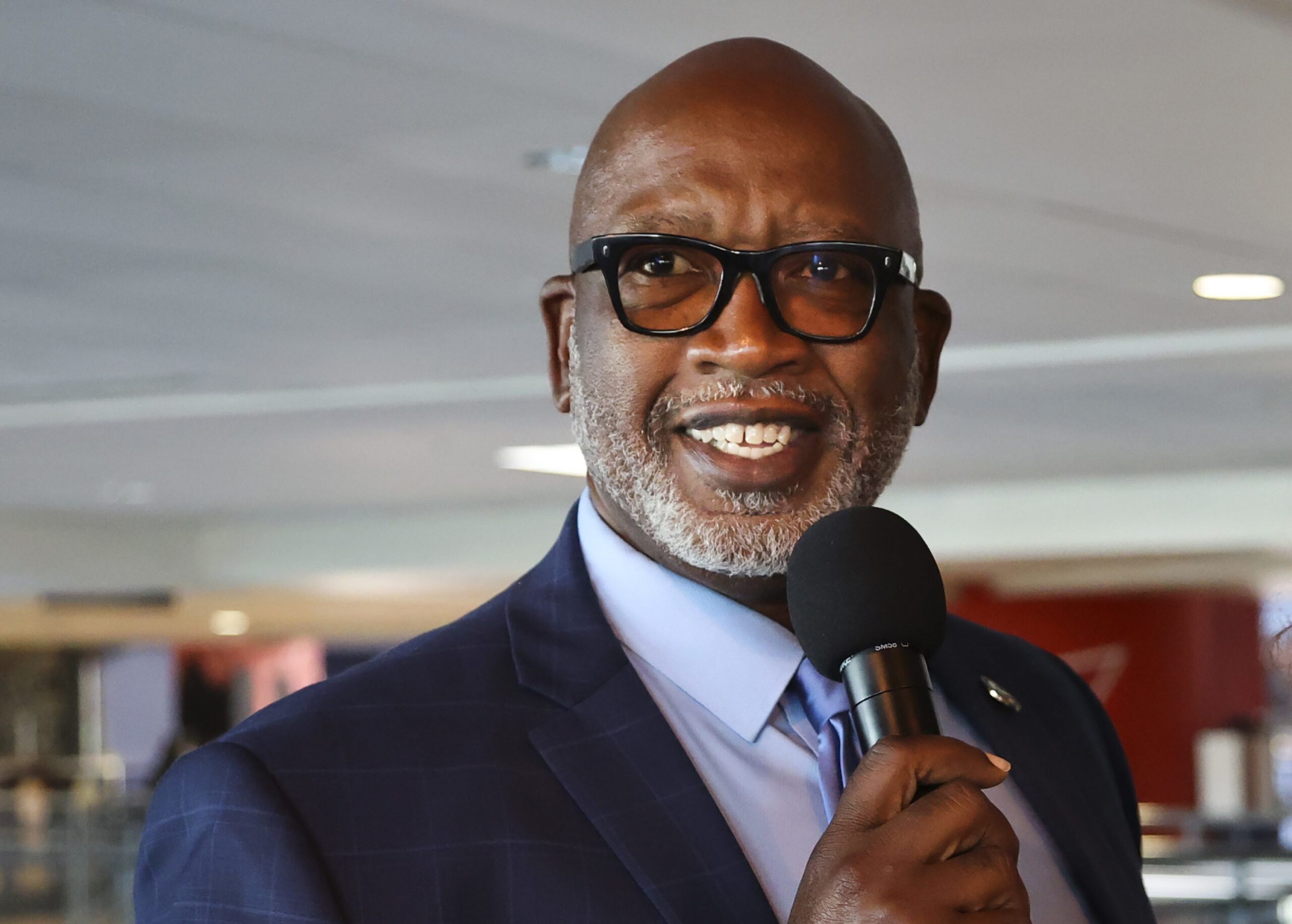
State Rep. Chris Rabb at a forum hosted by the 9th Ward Democratic Committee on Dec. 4, 2025. He is a Democratic candidate running to represent Philadelphia’s 3rd Congressional District.
Before Brown joined Rabb’s campaign in August, she worked with high-profile Democrats in New York, Illinois, and Florida — at times using her married name, Yolanda Rumph.
Her clients included former Tallahassee Mayor Andrew Gillum, who waged a closely watched campaign for Florida governor against Ron DeSantis in 2018. Gillum was indicted for making fraudulent transactions out of the same political action committee that Brown worked for — but prosecutors dropped the charges in 2023 after a jury deadlocked and the court declared a mistrial.
Rabb, a progressive who is considered among a handful of front-runners in the race to replace outgoing U.S. Rep. Dwight Evans, has said he is committed to continuing his campaign for the 3rd Congressional District seat, despite losing money that heis unlikely to see returned before the May 19 primary.
In January, before allegations of the missing money became public, Rabb was already significantly trailing the financial front-runner in the race. Records show he had about $100,000 in his campaign account at the start of the year, while State Sen. Sharif Street reported having more than five times that amount.
Rabb’s campaign declined to say how much money was taken, citing the ongoing law enforcement investigation.
Abe White, Rabb’s spokesperson, said in a statement that the campaign identified the unauthorized withdrawals after finding errors in its most recent campaign finance filing, which encompasses fundraising and spending activity from October to December.
He said the campaign had protocols in place to reconcile accounts and “immediately took action” after coming across the suspicious activity.
“The campaign’s former treasurer manipulated every campaign safeguard in place,” White said. “It’s what these people do.”
Davis, Brown’s attorney, said his client intends to pay back the funds he alleges were stolen by the employee.
“She’s just going to take responsibility,” he said, “and try to remedy the situation.”
No warning signs until it was too late
Very few people working on political campaigns have access to the bank accounts powering their efforts. The accounts see thousands — and sometimes millions — of dollars flowing in and out in a relatively short period of time.
That means candidates put significant trust in their treasurers, who are official designees responsible for ensuring campaigns comply with finance laws.
Matthew Haverstick, a managing partner with Kleinbard LLC, a Philadelphia-based law firm that often works with political campaigns and causes, said it is essential that campaigns thoroughly vet campaign treasurers and compliance consultants.
“This is why you work hard at the front end of this stuff in campaigns,” Haverstick, who is not working for any candidate in the race, said of Rabb’s situation. “When you’re deep into a campaign and a problem like this blows up, it has the potential to end the campaign. So the right time to spend a little more money and try a little harder is before you hire somebody.”
Rabb, a five-term Pennsylvania state representative, entrusted his account to Brown shortly after launching his run for Congress in July. Rabb had not worked with Brown before, and records show no other campaign in Pennsylvania has paid her or her firm for work.
The three other candidates who have so far raised the most money in the 3rd Congressional District race have treasurers based in Philadelphia. But it’s not unheard of for candidates to use consultants and staff from out of state, especially when they are seeking federal office.
White, Rabb’s spokesperson, said Brown “came highly recommended”and “there was no reason for concern” when she was hired.
Elsewhere, other Democrats who hired Brown said they similarly saw no warning signs until it was too late.
In January, the chairperson of a PAC backing St. Petersburg Mayor Ken Welch said she had reported Brown to law enforcement for misspending $207,000.
Brown had worked with the group, called the Pelican PAC, for about a year. Campaign finance records show that last fall, several transactions were made to transfer money from the PAC account into O’Reilly Business LLC, a separate entity that Brown controls.
Davis said Brown’s employee also had access to that LLC, and said it was the employee who moved the money.
Adrienne Bogen, who heads the Pelican PAC, said Brown was removed as the PAC’s treasurer in January.
She was hired following “standard onboarding practices,” Bogen said.
“Nothing was identified that raised concerns,” she added.
In this 2023 file photo, St. Petersburg Mayor Ken Welch greets the audience during a Suncoast Tiger Bay Club meeting at Tropicana Field in St. Petersburg, Fla.
In reality, Brown had been under indictment on 10 criminal charges in Alameda County, Calif., where she worked as a finance manager for Oakland-based consultancy BMWL & Partners. She was charged under the name “Yolanda Cheers.”
In 2019, prosecutors in court documents accused Brown — referring to her as “Cheers” — of routing money belonging to a nonprofit client of the consultancy to herself and then, years after being fired, taking out unauthorized loans in BMWL’s name. She faced charges of aggravated white-collar crime, grand theft by embezzlement, forgery, and identity theft, and could have faced years in prison.
The same year she was indicted in California, Brown faced legal trouble elsewhere. Authorities in Washington, D.C., accused her of fraud, allegations that came to light after she filed for bankruptcy in Minnesota.
Brown had previously worked as a grants manager for the local government in D.C. and owed the city $52,700 while filing for bankruptcy, the D.C. attorney general wrote in court papers. Authorities alleged that in 2014 and 2015, Brown asked two city contractors to hire her fiance,and she billed them for work that he supposedly completed — even though he was on an active-duty military assignment at the time.
The Minnesota bankruptcy case moved forward. Much of Brown’s debt was erased, but not the money that she owed in Washington.
On the other side of the country, the criminal case in California languished for nearly five years.
In February 2024, Alameda County District Attorney Pamela Price announced that her office had reached a plea deal. Brown pleaded no contest to one count of grand theft by embezzlement andwas required to pay $330,000 in restitution. She served no jail time.
Davis cast the no-contest plea as Brown’s attempt to put the charges behind her — not as an admission of guilt.
“Court could be kind of dragging on people,” he said. “It’s a very big burden.”
‘Some people will inevitably give in to temptation’
After the campaign allegations against Brown in St. Petersburg and Philadelphia trickled out this year, others who have worked with her said they reported activity they think is suspicious to law enforcement.
Jamie Jodoin, a Florida-based political and financial consultant, said she worked on a PAC last year that hired Brown as its treasurer. She said Brown wired $25,000 out of the PAC’s bank account and later closed the account without notifying the candidate.
“We have no idea where that went,” Jodoin said.
Political campaigns, which are small and short-lived entities, often don’t carry insurance against internal theft. But they do usually have review processes.
The Federal Election Commission recommends candidates put in place internal controls such as risk assessment and monitoring in order to prevent the misappropriation of funds. The guidance says that bank statements should be reviewed by someone who is not also writing the checks.
“Absent some basic checks and balances,” the commission says in its recommendations, “some people will inevitably give in to temptation.”
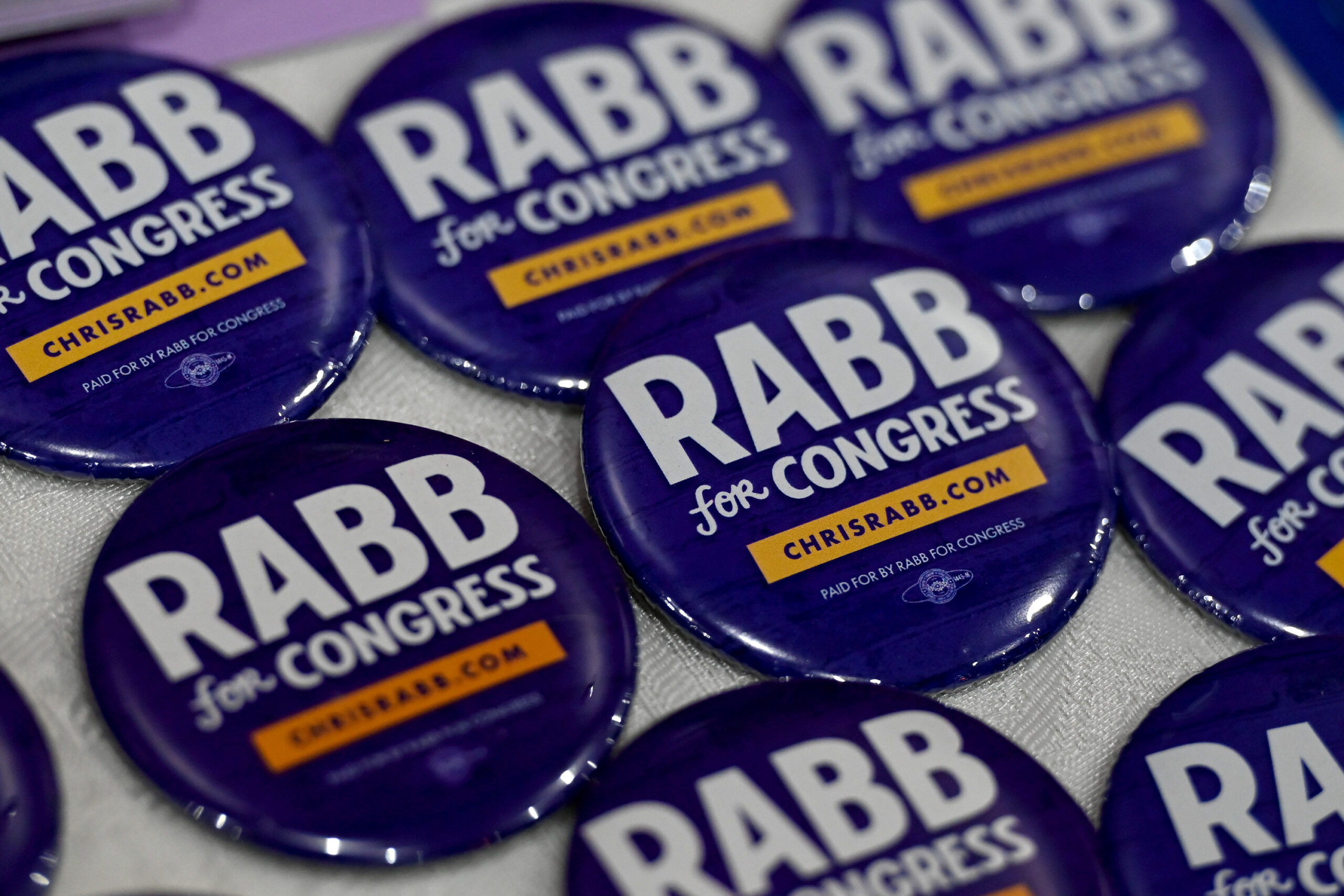
Campaign buttons for State Rep. Chris Rabb Dec. 4, 2025. A Democratic candidate running to represent Philadelphia’s 3rd Congressional District.
White said the Rabb campaign had safeguards in place. But he added that, after the unauthorized withdrawals were identified, the campaign newly established “airtight financial protocols” such as “strengthening oversight and internal controls.”
The campaign recently named a new treasurer and hired a new compliance firm.
Bogen, of Welch’s PAC in St. Petersburg, said Brown’s access to internal systems and bank accounts was “immediately revoked” once it was discovered that she had made suspicious transactions.
Brown, Bogen said, “has not been heard from since.”
WASHINGTON — President Donald Trump, his Treasury secretary, and his choice to lead the Federal Reserve believe they can coax the U.S. economy into partying like it’s 1999.
They are putting their faith in artificial intelligence to duplicate what happened when another technology arrived in the 1990s: the internet. Back then, the American economy surged as businesses became more productive, unemployment tumbled, and inflation remained in check.
Trump is confident that his nominee to become Fed chair, Kevin Warsh, can unleash an even greater economic bonanza by jettisoning what the president sees as the central bank’s hidebound reluctance to slash interest rates.
Many economists are skeptical.
The world looks a lot different today than it did when the Spice Girls ruled radio and Titanic dominated the box office. And the story the Trump team is telling — that a visionary Fed chair, Alan Greenspan, fueled the ‘90s boom by keeping interest rates low — is incomplete at best.
“The administration is offering a rather distorted version of what actually happened in the 1990s,’’ economist Dario Perkins of TS Lombard said in a commentary.
Nonetheless, the Trump administration believes history can repeat itself. All that’s been missing, in the president’s view, is a Fed chair with Greenspan’s foresight.
AI’s influence over interest rates
Trump has repeatedly attacked current Fed chief Jerome Powell, whose term as chair ends in May, for his reluctance to lower rates aggressively while inflation hovers above the central bank’s 2% target. Treasury Secretary Scott Bessent said on social media in January that the president sought to replace Powell with someone with “an open, Greenspan-like mind.”
“Our nation can see productivity boom like we did in the ’90s when we are not encumbered by a Federal Reserve which throws the brakes on,’’ Bessent said.
In speeches and writings, Warsh has argued that AI-driven improvements in productivity could justify lower interest rates.
These views align with Trump’s desires for Fed rate cuts but mark a break with Warsh’s own past as an inflation hawk. In the aftermath of the 2007-2009 Great Recession, Warsh — then a Fed governor — objected to some of the central bank’s efforts to help the struggling economy by pushing down rates even though unemployment exceeded 9%. Warsh warned then, wrongly, that inflation would soon accelerate.
At issue now are gains in productivity and the possibility that AI will make them bigger — much bigger.
To economists, productivity improvements are almost magical. When companies roll out new machines or technology, their workers can become more efficient and produce more stuff per hour. That allows firms to earn more and to raise employees’ pay without raising prices. In short: Surging productivity can drive economic growth without spurring inflation.
Greenspan and the internet
In the mid-1990s, Greenspan was contending with a strange set of economic circumstances: Wages were rising, but inflation wasn’t heating up.
Big productivity gains might have explained things, but government data showed no sign of them. Other Fed policymakers worried that surging wages and tame inflation couldn’t coexist and that higher prices were coming. They wanted to raise interest rates.
But Greenspan suspected the official productivity numbers were missing something. For one thing, they didn’t jibe with the amazing tales of efficiency improvements the Fed was hearing from companies investing in computers and turning to the internet.
So he ordered his lieutenants to dig through decades of productivity numbers. The official statistics they assembled told an implausible story: Services firms — from retailers to legal practices — had supposedly seen productivity fall over the years, despite intense competitive pressure and massive investments in technology.
Greenspan didn’t believe it. He persuaded his Fed colleagues that the government’s numbers were wrong and were understating productivity. They agreed in September 1996 to hold off on raising rates.
The economy took flight.
Tardily, productivity advances began to show up in the official data. Overall, American economic growth surpassed 4% every year from 1997 through 2000, something it would do again only once in the next quarter century. The unemployment rate plunged to 3.8% in April 2000, lowest in three decades. Inflation stayed in its cage, coming in below 2% — later the Fed’s official target — for 17 straight months in 1997-1999.
History repeats itself … maybe?
American productivity certainly looked strong in the second and third quarters of 2025, and some economists attribute the improvements to early adoption of AI; they see bigger gains and stronger economic growth ahead.
Others aren’t so sure.
Joe Brusuelas, chief economist at the consulting firm RSM, wrote that the 2025 productivity improvements “are not because of artificial intelligence’’ but reflect investments in automation that companies made when they couldn’t find enough workers during and after the COVID-19 pandemic. “Those investments are starting to pay off,’’ Brusuelas wrote.
Economist Martin Baily, senior fellow emeritus at the Brookings Institution, believes it will take time for AI to have a big impact on the way companies do business and on the nation’s productivity.
“Companies don’t change that fast,” said Baily, chairperson of President Bill Clinton’s Council of Economic Advisers. “It’s expensive to change. It’s risky to change. The managers don’t necessarily understand the new technology that well. So they have to learn how to use it. They have to train their staff. All that stuff takes a long time.’’
A productivity boom can raise the economy’s speed limit — how fast it can grow without pushing prices higher. But it might not justify lower interest rates, Federal Reserve Gov. Michael Barr said in a speech earlier this month.
Businesses will borrow to invest in AI, putting upward pressure on interest rates. Likewise, American workers and their families likely would save less and borrow more in anticipation of higher wages, the payoff for being more productive; that would put still more pressure on rates to rise.
Bottom line, Barr said: “The AI boom is unlikely to be a reason for lowering policy rates.’’
Even Greenspan’s Fed eventually came to the same conclusion, reversing course and starting to raise its benchmark rate in mid-1999, taking it from 4.75% to 6.5% in less than a year. (The rate Trump complains about now is around 3.6%.)
“Warsh and Bessent talk only about the dovish 1995/96 version of Greenspan; they overlook the hawkish 1999/2000 variant,’’ Perkins wrote.
Then and now
Many of Warsh’s potential future colleagues on the Fed’s interest-rate setting committee see the late 1990s experience differently than he does, setting up what could be a clash at the central bank if the Senate confirms Warsh as chair.
Austan Goolsbee, president of the Federal Reserve Bank of Chicago, said earlier this week that “the analogy to the late 90s is a little harder for me to understand.” Greenspan’s insight was that productivity gains meant the Fed could hold off on raising rates, not that it should slash them, Goolsbee noted.
“It wasn’t, ‘Should we cut rates because productivity growth is higher?’” he said.
The economic backdrop that awaits Warsh is also far less friendly than the one Greenspan enjoyed.
Greenspan was avoiding rate hikes at a time when the usually profligate U.S. government was running rare budget surpluses and didn’t need to borrow so desperately. Now, after a series of spending hikes and tax cuts, deficits are piling up year after year, and the Congressional Budget Office expects federal debt to hit a historic high of 120% of America’s GDP by 2035.
Nor was productivity the only thing controlling inflation in the 1990s. Countries were lowering tariffs and dismantling trade barriers. Immigration was surging.
Now, thanks largely to Trump’s own policies, notably his sweeping taxes on imports and his crackdown on immigration, the world is much different. “Trade barriers are going up,’’ Perkins wrote. “Globalization has given way to de-globalization.’’
“That benign era is clearly behind us,’’ said Michael Pearce, chief U.S. economist at Oxford Economics.
President Donald Trump launched Saturday’s wide-ranging attack on Iran after a weekslong lobbying effort by an unusual pair of U.S. allies in the Middle East — Israel and Saudi Arabia — according to four people familiar with the matter, as Israeli and U.S. forces teamed to topple Iranian Supreme Leader Ali Khamenei after nearly four decades in power.
Saudi Crown Prince Mohammed bin Salman made multiple private phone calls to Trump over the past month advocating a U.S. attack, despite his public support for a diplomatic solution, the four people said. Israeli Prime Minister Benjamin Netanyahu, meanwhile, continued his long-running public campaign for U.S. strikes against what he views as an existential enemy of his country.
The combined effort helped lead Trump to order a massive aerial campaign against Iran’s leadership and military, which in its initial hour led to the death of Khamenei and several other senior Iranian officials.
The attack came despite U.S. intelligence assessments that Iran’s forces were unlikely to pose an immediate threat to the U.S. mainland within the next decade. Saturday’s attack on Iran was a break from decades of U.S. decision-making to hold back from a full-scale effort to depose the regime of a country of more than 90 million people. It also marked a stark shift from Trump’s own previous military forays, which until now have been far narrower in scope.
Now Trump will bear the risk of the bet he has placed: that a major military operation conducted from the air can achieve political goals on the ground.
“No president was willing to do what I am willing to do tonight,” Trump told Iranians in a video address posted as U.S. bombs rained down on targets across Iran. “Now you have a president who is giving you what you want, so let’s see how you respond.”
The Saudi push for an attack came as presidential envoy Steve Witkoff and Trump’s son-in-law Jared Kushner pursued negotiations with Iranian leaders over the country’s nuclear and missile programs.
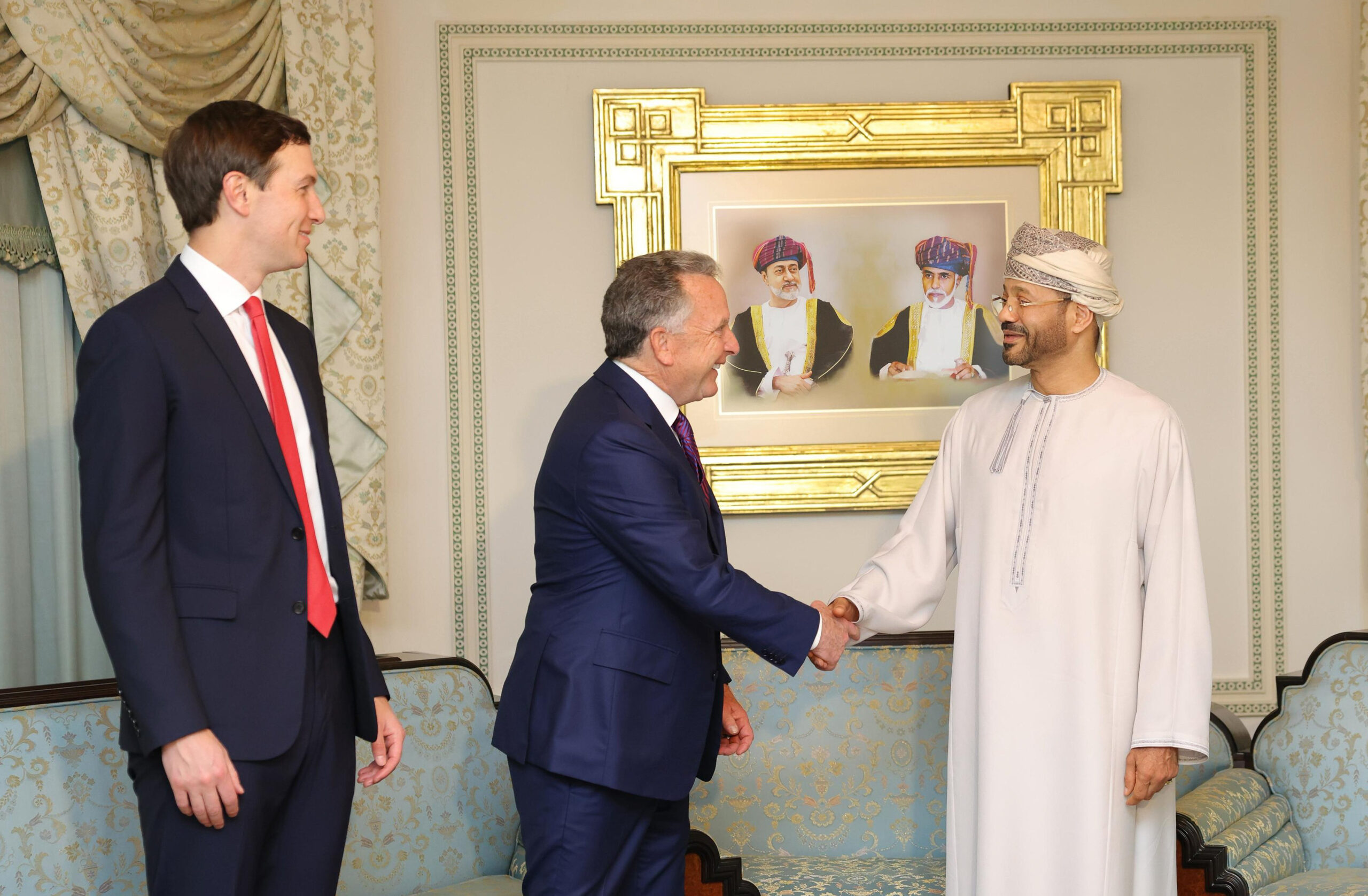
In this photo released by the Oman’s Foreign Ministry, Steve Witkoff, White House special envoy, centre, shakes hands with Oman’s Foreign Minister Sayyid Badr Albusaidi as Jared Kushner, left, looks on during their meeting prior to Iran and the U.S. negotiations, in Muscat, Oman, Friday, Feb. 6, 2026. (Oman Foreign Ministry via AP)
As those talks proceeded, Riyadh issued a statement, following a phone call between the crown prince and Iranian President Masoud Pezeshkian, that Mohammed would not allow Saudi airspace or territory to be used in an attack on Iran.
In his discussions with U.S. officials, however, the Saudi leader warned that Iran would come away stronger and more dangerous if the United States did not strike now, after amassing the largest military presence in the Middle East since the 2003 invasion of Iraq, said the people, who, like others, spoke on the condition of anonymity to discuss the sensitive situation.
Mohammed’s position was reinforced by his brother, Saudi Defense Minister Khalid bin Salman, who held closed-door meetings with U.S. officials in Washington in January and warned about the downsides of not attacking, the people said.
The Saudi leader’s complicated position probably reflected his desire to avoid Iranian retaliation against his country’s vulnerable oil infrastructure, weighed against his view of Tehran as Riyadh’s ultimate foe in the region, said those familiar with his thinking. Iran, dominated by Shiite Muslims, and Saudi Arabia, led by Sunnis, have long had an intense rivalry that has generated proxy wars in the region.
Following the initial U.S. attack on Saturday, Iran did retaliate against Saudi Arabia. Riyadh issued a furious statement condemning the attack and calling on the international community to “take all necessary and decisive measures” to confront Iran.
The Saudi Embassy did not respond to a request for comment.
Witkoff and Kushner had their final contacts with Iranian officials in Geneva on Thursday, their third high-level encounter since early February. They walked away believing that Tehran was playing games with them about its need for nuclear enrichment, according to a senior Trump administration official.
“It was very clear that the intent for them was to preserve their ability to do enrichment so that, over time, they could use it for a nuclear bomb,” the official said.
By Friday afternoon, when Trump arrived in Corpus Christi, Texas, for a campaign rally ahead of Tuesday primaries there, the president’s frustration — and his rhetoric — was escalating. He repeatedly declared himself “not happy” with Iranian negotiators.
“I’ve got a lot of things going on now,” he told the crowd toward the end of a rambling speech ostensibly focused on energy policy. “We have a big decision to make, you know that. Not easy, not easy. We have a very big decision to make.”
Later, he flew to Palm Beach for the weekend, where he mingled with supporters at his Mar-a-Lago resort Friday evening, looking tired but otherwise in good sprits before exiting to his private quarters to record a speech he would give announcing the attack, according to one person who was there and interacted with him.
The decision to launch the attack was in some ways foretold by the massive buildup of U.S. forces over the past two months. But there was little in Trump’s record to suggest that he would embrace a war of choice in the Middle East with the goal of regime change.
In explaining his decision, Trump on Saturday reached all the way back to Iran’s 1979 revolution. He described the U.S. attacks as payback for decades of conflict with Iran. He cited the 52 Americans held hostage for more than a year after the 1979 takeover of the American Embassy in Tehran; the deaths of 241 U.S. service members in 1983 bombing of their barracks in Beirut by Iran-backed Hezbollah during a Lebanese civil war; and the 2000 attack on the USS Cole, a naval destroyer docked in a Yemen, which Trump said Iran “probably” was involved in, although the United States has long attributed the suicide bombing to al-Qaeda.
Earlier Saturday, Trump said that the United States had faced “imminent threats from the Iranian regime.” Tehran was continuing to work toward producing a nuclear weapon and development of “long-range missiles that … could soon reach the American homeland.”
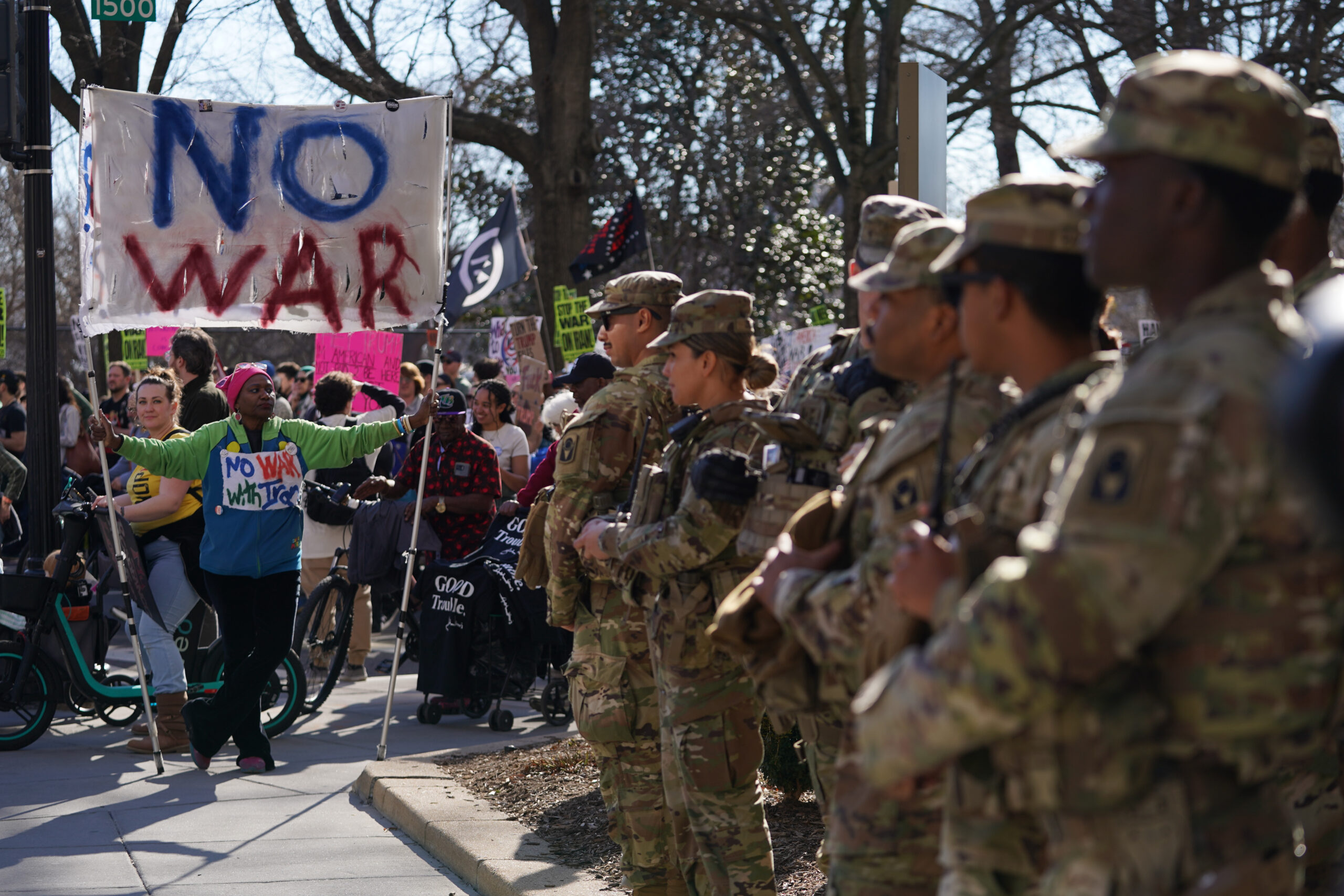
National Guard members watch as people protest near the White House against U.S. and Israeli strikes on Iran, Saturday, Feb. 28, 2026 in Washington. (AP Photo/Allison Robbert)
Both of those assertions have been challenged. Trump himself has vehemently maintained that the U.S. “obliterated” Iran’s nuclear program with airstrikes this past summer. The International Atomic Energy Agency has said there is no evidence Iran has restarted its uranium enrichment program following those strikes or that it has an active bomb-building plan. In an assessment last year, the U.S. Defense Intelligence Agency cited no indication that Iran was embarking on development of an intercontinental ballistic missile. If it decided to do so, the DIA said, it would take a decade to produce.
Trump directed anti-government Iranians to “take over” their government, but his call included no details. He declared that those within Iran’s extensive military and security infrastructure would be given “complete immunity” but provided no explanation how or by whom that would be done.
During both his first and second terms, Trump has said consistently there would be no American boots on the ground in military operations that he launched. Since taking office again, while launching air and missile attacks on seven countries — Nigeria, Syria, Yemen, Somalia, Venezuela, Iraq and Iran — he largely has kept that promise.
But it remains unclear whether aircraft and missile strikes can achieve his ever-expanding goals — among them new, U.S.-friendly regimes in Iran and Venezuela; an end to Iran-backed militant operations in Yemen; and the defeat of Islamic terrorist operations in Nigeria and Somalia.
“History is not kind to efforts to fundamentally alter and restructure the internal politics of a country using the air power alone,” said Aaron David Miller, a former U.S. diplomat who worked on Middle East issues for both Republican and Democratic administrations.
“This is very much Trumpian, in the sense that he’s tried to split the difference between getting bogged down in an interminable conflict which will undermine the American economy and cost Americans their lives, on one hand, and yet bringing to bear the power of the American military in a sort of roll-the-dice operation,” Miller said.
Months of planning for the 2003 U.S. toppling of Iraqi leader Saddam Hussein included thousands of invading American forces that remained there for nearly a decade and a large cadre of civilian U.S. officials on the ground to organize a new government.
Top Trump officials — some of whom have been sharp critics of the Iraq effort and other U.S. forays into the Middle East — have insisted in recent days that this time will be different.
Vice President JD Vance speaks during a news conference in the Old Eisenhower Executive Office Building on the White House campus Wednesday, Feb. 25, 2026, in Washington. (AP Photo/Tom Brenner)
Vice President JD Vance on Thursday told the Washington Post that he still considers himself a “skeptic” of foreign military interventions — a description he said still applied to Trump, too. He said there was “no chance” any military operation by the U.S. in Iran would lead to a drawn-out war involving the Trump administration.
Vance on Saturday watched the military operation from the Situation Room at the White House, while dialed into a conference line that connected him to the president and his national security team, who were tracking Iran from Mar-a-Lago, according to a person with knowledge of the events. Vance was joined at the White House by Tulsi Gabbard, the director of national intelligence, who has long campaigned against war with Iran. Energy Secretary Chris Wright and Treasury Secretary Scott Bessent were in the Situation Room too, the person said.
Apart from Trump’s Saturday’s statements once the attack already started, the president has devoted little time to publicly justifying or explaining war with Iran, a break from previous practice of U.S. leaders.
Democrats on Saturday pushed Trump to explain his case to the American people.
“What was the imminent threat to America?” said Sen. Mark R. Warner (D., Va.), the senior Democrat on the Senate Intelligence Committee, in an interview. “I don’t know the answer.”
Warner, who participated in a classified briefing on Tuesday with Secretary of State Marco Rubio and CIA Director John Ratcliffe, said that senior lawmakers were given a “fair description of options” the administration was considering, but that he saw no threat that “would literally be worthy of putting our troops in harm’s way.”
In the briefing on Tuesday for the Gang of Eight, which consists of the leaders of the House, the Senate and each chamber’s intelligence committees, Secretary of State Marco Rubio indicated to lawmakers that the mission’s timing and goals were shaped by the fact that Israel was going to attack with or without the United States, according to a person familiar with the administration’s outreach to lawmakers.
“So the only debate that seemed to be remaining was whether the U.S. would launch in concert with Israel or if the U.S. would wait until Iran retaliated on U.S. military targets in the region and then engage,” the person said.
Now the question is what comes next.
For now, Trump says that he hopes that in the face of the death of Khamenei, Iran’s security forces and police “will peacefully merge with the Iranian Patriots, and work together as a unit to bring back the Country to the Greatness it deserves.” In January, those security forces killed thousands of Iranian protesters.
He vowed that “the heavy and pinpoint bombing, however, will continue, uninterrupted throughout the week or, as long as necessary to achieve our objective of PEACE THROUGHOUT THE MIDDLE EAST AND, INDEED, THE WORLD!”
By Saturday morning, when many Americans were waking to the news that the U.S. and Israel had launched a missile attack on Iran, U.S. Sen. John Fetterman (D., Pa.) had already spoken in support of the bombings.
“Operation Epic Fury,” Fetterman said on X at 4:18 a.m., using the name given to the campaign by the Trump administration. “President Donald Trump has been willing to do what’s right and necessary to produce real peace in the region.”
“God bless the United States, our great military, and Israel,” Fetterman said.
The missile strikes were focused on the home of Iran’s leader and a number of targets in Tehran and other cities. Trump called on the Iranian people to take over the government and put an end to the country’s decades of theocratic rule.
People sit in a shelter after warning sirens sound following Israeli strikes on Iran, in Tel Aviv, Israel, Saturday, Feb. 28, 2026. (AP Photo/Ohad Zwigenberg)
The possibility of such an attack was anticipated for weeks as tensions rose between Iran and Israel and the U.S. positioned warships in the region.
Pennsylvania Gov. Josh Shapiro criticized Trump in a statement Saturday for acting “without Congressional approval,” while adding that the Iranian regime “must never be allowed to possess nuclear weapons.”
Trump and his administration “have not demonstrated to the American people that we have a clear plan with this mission — and by taking unilateral action, without a broad coalition of international partners, he is putting our brave servicemembers at greater risk and undermining our national security interests,” Shapiro, a Democrat, said.
U.S. Sen. Dave McCormick (R., Pa.)said he is praying for U.S. troops and allies “during this challenging and noble mission.”
“For decades, the Iranian regime has killed Americans, threatened Israel and our allies in the region with their ballistic missiles and nuclear ambitions, and butchered tens of thousands of its own people,” McCormick said on X.
“The president has given the ayatollahs a chance for a deal, and they have rejected a path to peace and prosperity,” McCormick added.
Pennsylvania’s U.S. senators, Democrat John Fetterman, left, and Republican Dave McCormick, in Braddock, Pa., on Feb. 2.
On Saturday afternoon, several dozen protesters gathered outside Philadelphia City Hall, chanting “death to America” and “free Palestine,” and speaking about the U.S. incursion.
McCormick noted earlier this week that Iranian citizens have been embroiled in protests against its government in recent weeks. The government responded with an internet blackout and a violent crackdown. More than 7,000 citizens have died as a result of the crackdown, according to a U.S.-based human rights agency.
McCormick, an Army veteran of the first Persian Gulf War, added that people in the U.S. are distrustful of prolonged military operations overseas.
Both McCormick and Fetterman have spoken in support of a strong U.S. backing of Israel, and like many lawmakers have received campaign donations from pro-Israel lobbying groups such as the American Israel Public Affairs Committee, according to a political group critical of U.S. support for Israel that tracks such public spending.
In the U.S. House of Representatives, Rep. Chrissy Houlahan (D., Chester), an Air Force veteran, said the attack lacks a clear explanation or new threat posed to the U.S.
“Make no mistake, Iran is a very bad actor on the world stage, and has been for a long time, but the American people have not been given any evidence of any appreciable change and Congress did not authorize any action,” Houlahan said in an emailed statement.
“President Trump, who promised no wars, is now again putting the lives of our men and women in uniform in grave danger all while trampling all over the Constitution,” Houlahan said.
The Trump administration’s strike was initiated without a vote by Congress. Houlahan said that House Speaker Mike Johnson (R., La.) canceled votes for next week, a move she believes is to prevent floor time for lawmakers to weigh in on the attack.
“Speaker Johnson has forfeited Congress’s authority, rendering Congress and the Constitution immaterial,” Houlahan said. “Now we will all pay the price, whatever that is.”
U.S. Rep. Brian Fitzpatrick (R., Bucks) said Congress needs to have a say in any further military actions in Iran.
“The American people deserve clarity of mission, defined objectives, and disciplined oversight,” said Fitzpatrick, a senior member of the House Intelligence Committee and chairman of the Central Intelligence Agency Subcommittee.
Fitzpatrick called Iran “the world’s foremost state sponsor of terrorism” and said it cannot be allowed to possess nuclear weapons.
Democratic Sen. Andy Kim of New Jersey called for lawmakers to return to Congress immediately to vote on whether the U.S. should be at war.
“It’s just very clear that the American people don’t want this,” Kim posted to social media on Saturday.
Sen. Cory Booker (D., N.J.), a member of the Senate Foreign Relations Committee, critized the president’s actions for presenting “no strategy for what happens if the Iranian regime collapses.”
Booker said American service members “deserve leadership guided by strategy, grounded in law, and worthy of their sacrifice — not reckless decision making that places them in the path of escalating danger.”
U.S. Rep. Brendan Boyle (D., Philadelphia) also criticized the attack.
“The regime in Iran is evil and poses a serious threat,” Boyle said in an emailed statement. “But no president can unilaterally launch a war. Any use of force that risks dragging us into war must be debated and authorized by Congress. The American people want lower costs and affordable health care, not yet another costly foreign war.”
U.S. Rep. Dwight Evans (D., Philadelphia) said the House and Senate should vote on a war powers resolution “to stop Trump’s reckless warmongering.”
“After claiming last June he ‘completely and totally obliterated’ Iran’s nuclear program, President Trump launched yet another illegal, ill-conceived attack on Iran,” Evans said in an emailed statement. “These escalations only put American lives, at home and abroad, at greater risk and drag our country towards another endless war.”
South Jersey Democratic U.S. Reps. Herb Conaway Jr. and Donald Norcross were both critical of the attack. While calling the Iranian regime “brutal,” Conaway said Trump’s actions were illegal and reckless. And Norcross said the American people deserve to understand why the strikes were undertaken. He called for “an immediate classified briefing to Congress to fully explain the rationale for this action and the path forward.”
Republican U.S. Rep. Jeff Van Drew (R., N.J.) praised the action.
“Operation Epic Fury shows that America will confront evil, defend our people, and stand by our allies,” he wrote on social media.
New Jersey Gov. Mikie Sherrill, a Democrat, said in a statement that as a precautionary measure, law enforcement would increase patrols at houses of worship and other sensitive sites.
“My office is closely monitoring the situation in Iran, Israel, and elsewhere in the Middle East,” Sherrill said, adding that there was no known threat to the state.
And the Philadelphia Police Department said it was monitoring developments overseas.
“While there are no credible threats to Philadelphia, we’ve increased patrols at religious & cultural sites out of caution,” police said.