Category: Politics

Political news and coverage

  • Philadelphia has spent $59 million on its snow response so far. Here’s how it breaks down.

    Philadelphia has spent $59 million on its snow response so far. Here’s how it breaks down.

    With the arrival of above-freezing temperatures, Philadelphia is declaring an end to an emergency response that lasted 26 days, closing the chapter on an all-hands-on-deck mobilization of various city departments that navigated the biggest snowfall in a decade and the persistent cold snap that followed.

    The city’s “enhanced code blue” response began the Friday before a winter storm that blanketed Philadelphia with 9.3 inches of snow and sleet on Jan. 25. The designation allowed the city to deploy support services across departments for some of the city’s most vulnerable, living on the streets.

    A preliminary estimate by the city puts the cost of the storm response at about $59 million, which officials said reflects the intensity of the storm and conditions that followed.

    “A tremendous City workforce, outreach teams, first responders, nonprofit partners, and community stakeholders came together without hesitation,” Mayor Cherelle L. Parker said in a statement Tuesday. “Because of their coordination, compassion, and commitment, lives were protected during some of the harshest conditions we have faced this winter.”

    Amid a bitter cold that hampered snow-removal efforts, the city embarked on a cleanup operation that lasted more than two weeks and combined heavy machinery and old-fashioned manual digging.

    Here are some key numbers highlighting how various city departments mobilized and the costs they accrued.

    Heavy machinery and dump trucks collecting piles of snow from Germantown and Thompson Street, Philadelphia, Wednesday, Jan. 28, 2026.

    $46,021,516 in snow removal

    The city crafted its $4.1 million snow operations budget for fiscal year 2026 using a rolling-year average of prior costs.

    But the storm brought about a slew of unanticipated expenses and challenges, including snow removal, ice control, and other emergency operations.

    The city looked to contractors to bolster its workforce as it launched a massive effort to treat and plow streets.

    Contractor plowing and salting operations during the storm cost $13.9 million, while the post-storm contractor cleaning and lifting operations cost $31.8 million. The remainder of the expenses came from snow-related operations across departments, such as the activation of warming centers.

    Part of what made the storm so costly was the uncooperative temperatures.

    Amid complaints from residents over what was perceived as a slow cleanup, the city noted that the below-freezing temperatures created increasingly tightly packed ice that had nowhere to go.

    The city even brought in a snow melter from Chicago, which eliminated 4.7 million pounds of snow in the first two days after the snowfall. The costs of melting, which is considered a specialized service, ran more than $139,000.

    After the initial snow removal, the city moved to what it called its lifting operations.

    Snowplows, compactors, front-end loaders, and backhoes took part in an intricate operation where snow was placed in dumpsters before being shipped off to more than 30 dumping sites.

    The Philadelphia Streets Department mobilized up to 300 pieces of equipment on any given day in an effort to leave no street untreated.

    The city went through 15,000 tons of salt through the three-week cleanup amid other challenges, such as an icy Delaware River that temporarily blocked additional salt orders, and the rising cost of salt post-storm.

    The cost of salt was more than $1.2 million.

    Emily Street is still covered in snow near Furness High School (top left) on Wednesday, Jan. 28, 2026 in South Philadelphia.

    18,340 ramps cleared

    The massive cleanup had the city looking at creative ways to boost the number of workers clearing streets.

    The streets department tapped participants in its Future Track Program for snow-removal efforts early on. These are trainees, typically at-risk young adults, who are not enrolled in higher education and are unemployed. They get job experience, as well as other services, and they help in beautification projects.

    The trainees cleared hundreds of ADA ramps across Philadelphia.

    But more than a week after the storm, the city was still being flooded with complaints about inaccessible crosswalks and SEPTA stops piled with ice.

    That’s when officials tapped into a city program that pays people the same day for their work, deploying 300 people to help chip and sweep away the hardened ice with shovels and brooms.

    The city assembled a more than 1,000-person workforce for cleanup efforts this way, deploying a mix of city employees, contractors, and participants from the same-day pay program.

    In all, the city said, the crews worked nearly 2,300 intersections, clearing 18,340 ADA ramps and about 2,800 SEPTA stops.

    The use of contractors, however, was met with pushback from American Federation of State, County and Municipal Employees District Council 33, the city’s largest municipal workers union, which said the decision was made without consulting the union.

    “Our members are the trained, dedicated workforce responsible for this work, and it is disheartening to see the administration move forward without even a discussion on how best to manage these challenges,” DC 33 president Greg Boulware said in a statement in early February.

    (function() { var l = function() { new pym.Parent( ‘phillysnowcosts__graphic’, ‘https://media.inquirer.com/storage/inquirer/ai2html/phillysnowcosts/index.html’); }; if(typeof(pym) === ‘undefined’) { var h = document.getElementsByTagName(‘head’)[0], s = document.createElement(‘script’); s.type = ‘text/javascript’; s.src = ‘https://pym.nprapps.org/pym.v1.min.js’; s.onload = l; h.appendChild(s); } else { l(); } })();

    22 warming centers

    The cold snap presented another life-or-death challenge for the city: how to get people living on the streets indoors.

    Between Jan. 20 and Feb. 14, homeless outreach teams worked nonstop distributing more than 2,800 warming kits, 4,000 fleece blankets, 700 cases of water, and 35,000 food items while trying to get people to take a shelter bed or go to one of the city’s 22 so-called warming centers.

    The code blue designation allowed the city to activate some libraries and recreation centers as hubs for people looking to escape the cold.

    The warming center operation was seen as lifesaving, largely supported by library staff. Between Jan. 19 and Feb. 11, New York City recorded at least 18 cold-related deaths; Philadelphia had three over a similar time frame.

    Still, after 20 days of 12-hour operations, staff at the daytime centers described a lack of support from the city when it came to dealing with people who had medically complex issues requiring behavioral health support and wound care. (One library staffer said more city-assigned support staff showed up at the daytime centers after The Inquirer published a report about workers’ concerns.)

    Philadelphia officials said more than 100 people from more than 20 city and partner organizations helped support the warming centers.

    Nighttime warming centers had about 4,400 overnight guests, according to the city.

    Mount Market Street at 7th Street, Center City Philadelphia, Tuesday, Jan. 27, 2026. Large pile of snow on northeast corner of Market and 7th.

    $50 million from general fund

    Because snow operations exceeded the initial amount allotted in the budget, the city plans to transfer $50 million from its general fund to its transportation fund.

    Even so, the city said its general fund remains higher than projected in its five-year plan because of a larger-than-anticipated general fund balance in the previous fiscal year.


  • Judge gives Trump administration a deadline to restore President’s House exhibits

    Judge gives Trump administration a deadline to restore President’s House exhibits

    President Donald Trump’s administration now has a hard deadline to restore slavery exhibits to the President’s House.

    The Department of Interior and National Park Service must restore the President’s House to its condition before the exhibits were removed by 5 p.m. Friday, according to a new order from District Judge Cynthia M. Rufe. In a blistering 40-page opinion Monday, the judge had ordered the exhibits to be restored “immediately,” but without a specific time frame.

    Rufe wrote that the deadline follows the agencies’ “failure to comply” with the injunction’s instruction to take action “forthwith,” which is often defined in law to mean as soon as possible or within 24 hours.

    While the federal government appealed the injunction to the Third Circuit Court of Appeals, the judge noted, the Trump administration did not ask for a stay.

    “Absent a stay granted by this Court or the Third Circuit, this Court must enforce its own order,” Rufe wrote.

    The U.S. Attorney’s Office for the Eastern District of Pennsylvania did not respond to a request for comment. The city declined to comment.

    The National Park Service last month removed exhibits telling the story of the nine enslaved people who lived in George Washington’s Philadelphia home. The city sued the federal government in turn, and following a tense hearing and the judge’s inspection of the exhibits and site, secured an injunction on Monday that required the federal agencies to restore the interpretive panels.

    National Park Service staff were at the President’s House site on Wednesday morning to hose down the walls, which are covered with protest signs in lieu of the exhibits, and place barricades around them.

    The National Park Service did not respond to questions about the activity.

    A spokesperson for the White House, Taylor Rogers, said in a statement Wednesday that the lawsuit brought by Philadelphia was “premature” because the removal of the exhibits from the President’s House and other national parks is not final.

    “The Department of the Interior is engaged in an ongoing review of our nation’s American history exhibits in accordance with the President’s executive order to eliminate corrosive ideology, restore sanity, and reinstate the truth,” Rogers said.

    Staff writer Fallon Roth contributed to this article.

  • Trump officials limit FEMA travel to disaster areas amid funding lapse, emails show

    Trump officials limit FEMA travel to disaster areas amid funding lapse, emails show

    The Department of Homeland Security has halted almost all travel amid the ongoing standoff over its funding, restricting the ability of hundreds of Federal Emergency Management Agency staff members to move in and out of disaster-affected areas, according to emails and documents obtained by the Washington Post.

    Much of the department ran out of money over the weekend after negotiations stalled between the White House and Democratic lawmakers over restrictions on federal immigration enforcement. It is normal for the department to stop employees from traveling across the country for various assignments, such as trainings, during a funding lapse, 10 current and former FEMA officials said. But it is unusual for a government shutdown to impede ongoing disaster recovery efforts, the officials explained, saying it further reflects sweeping policies instituted under Homeland Security Secretary Kristi L. Noem.

    Typically, FEMA staffers who work on disasters are able to travel to and from ongoing recovery projects regardless of DHS funding issues. And a current veteran officials said that disaster travel is always allowed because it is mission-critical.

    In a statement, DHS criticized Democratic lawmakers over the stalled funding negotiations and said the department and FEMA are coordinating closely to “ensure effective disaster response under these circumstances.”

    “During a funding lapse, FEMA prioritizes life safety and property protection. FEMA continues mission-essential operations for active disasters, including immediate response and critical survivor assistance,” FEMA spokesperson Daniel Llargués said in the statement. “While some non-essential activities will be paused or scaled back, FEMA remains committed to supporting communities and responding to incidents like Hurricane Helene.”

    Congressional Democrats have demanded new restrictions on federal immigration agents after federal personnel killed Alex Pretti and another U.S. citizen, Renée Good, in Minneapolis in January.

    On Tuesday night, DHS sent out an email ordering a stop to all travel, including for disaster-related work, sparking confusion across FEMA as teams continue to respond to 14 ongoing disaster declarations as a result of brutal winter storms that hit parts of the country last month. In another message obtained by the Post, a FEMA official said that “ALL travel stopped” and noted that 360 people who were slated to go to trainings and other assignments had to stand down. People who were supposed to deploy could begin some work virtually, but DHS now had to sign off on their in-person assignment, the message said.

    The next morning, officials within DHS and FEMA had to scramble and negotiate guidance for how disaster-specific workers could continue to travel, according to an official familiar with the situation.

    “In most cases, FEMA’s ability to deploy staff to active disaster response and recovery operations is not impacted by a DHS funding lapse,” said former FEMA administrator Deanne Criswell. “Those personnel are funded through the Stafford Act’s Disaster Relief Fund, which is specifically designed to ensure continuity of operations during emergencies. If DHS experiences a shutdown, FEMA employees supported by the Disaster Relief Fund should still be able to travel and carry out response missions.”

    Emails and documents obtained by the Post show that FEMA officials must submit a justification to DHS headquarters explaining why a staffer needs to travel during the funding lapse, including employees who are paid through the Disaster Relief Fund. Officials also have to state whether the travel is “mission essential,” meaning it involves the “safety of human life or protection of property.”

    “DHS imposing restrictions on FEMA’s ability to deploy our response/recovery workforce slows us down and limits our ability to respond quickly and effectively to the needs of impacted states and communities,” said one official in a region still cleaning up from the heavy onslaught of sleet and snow.

    According to one email sent Tuesday night, agency staff members currently deployed in another region that was hit particularly hard can continue assisting communities. But those who were slated to travel to these locations after Thursday can no longer do so. Employees who were on a rotation — perhaps home for a week to see family or go to the doctor — are not able to return to their job under the order.

    These rotations are critical to disaster work because they enable people who have been working nonstop to take a break and then come back to their work. FEMA is also required to relieve employees who have been working too long in a state where they do not live.

    In the email, FEMA staff members who had not yet begun their deployments or returns from rotation were directed to cancel their travel and notify their point of contact to “receive updated reporting instructions.”

    “Additional agencywide information will be forthcoming,” it read.

    The snag with some FEMA employees being unable to travel for disaster work, take breaks or relieve their colleagues adds to the beleaguered agency’s long list of operational issues since President Donald Trump took office for a second time and his appointees implemented significant changes in how the agency functions.

    The travel pause has also halted some of FEMA’s other critical work, such as leading exercises and assessments for emergency plans and procedures at nuclear facilities, and flood-mapping meetings with communities, according to an email obtained by the Post and an agency official familiar with the situation. That “will delay flood map updates, which directly impacts people waiting on new maps for any number of reasons,” the official said.

    As the winter storms barreled in last month, Noem, who has been spearheading many of FEMA’s staffing reductions and reforms, was particularly hands-on, embedding at the agency’s headquarters, hosting a call with governors to show her support and holding news conferences with FEMA staff members in front of maps laying out where the weather would hit.

    DHS also made a big push to pre-position teams, millions of ready-made meals and liters of water, blankets, and hundreds of generators in several states that were expected to be slammed.

    That’s why instituting travel restrictions when staffers are still working on these storm responses is even more frustrating, several current employees said.

    “They are just trying to make it hurt, and the only people they are hurting are survivors and FEMA employees,” one veteran official said. “They just pull new rules out every day.”

  • White House taps Jay Bhattacharya, CDC critic, to lead agency for now

    White House taps Jay Bhattacharya, CDC critic, to lead agency for now

    Jay Bhattacharya, a top Trump administration health official and an outspoken critic of the Centers for Disease Control and Prevention’s response to the coronavirus pandemic, will lead the CDC on an acting basis, according to four people who spoke on the condition of anonymity to describe personnel moves.

    Bhattacharya, who will continue his role as director of the National Institutes of Health, replaces Jim O’Neill, who had served as the CDC’s acting director. O’Neill, who had also served as the deputy secretary of the Department of Health and Human Services, will be nominated to run the National Science Foundation after he declined a potential ambassadorship to the Organization for Economic Cooperation and Development, two of the people said.

    The installation of Bhattacharya at the CDC is the latest move by the White House and Health Secretary Robert F. Kennedy Jr. to shake up HHS’s leadership team ahead of the midterms, as the Trump administration seeks to stabilize a department rattled by internal fights and controversial messages.

    The New York Times first reported that Bhattacharya would serve as the acting head of CDC, which is charged with protecting Americans from health threats and issues recommendations on vaccines and other public health matters. Trump officials have said they are planning to find a full-time CDC director, a post that requires Senate confirmation. Susan Monarez, who was confirmed as CDC director in July, was ousted less than a month later after clashing with Kennedy over his plans to change vaccine policies.

    Bhattacharya, a Stanford University physician and economist, rose to prominence during the pandemic by arguing that the government’s response to the outbreak was too harsh, a stance that put him at odds with public health leaders who said his proposals would imperil the most vulnerable Americans. He co-wrote the Great Barrington Declaration, which was published in October 2020 and called for an end to coronavirus shutdowns. The declaration drew rebukes from government officials — a clash that ultimately boosted his profile and helped draw the support of Kennedy, a fellow critic of the government’s pandemic response.

    “The CDC peddled pseudo science in the middle of a pandemic,” Bhattacharya wrote on X in 2024, criticizing agency leaders’ past claim that widespread masking could end the coronavirus outbreak.

    As CDC’s acting head, Bhattacharya is poised to oversee the agency’s vaccine recommendations, which have emerged as a political flash point as Kennedy has worked to roll them back over the objections of public health leaders. A KFF poll published this month found that 47% of U.S. adults now trust CDC for reliable information on vaccines, down from 85% in early 2020.

    Bhattacharya has said he supports vaccination for childhood diseases.

    “I think the best way to address the measles epidemic in this country is by vaccinating your children for measles,” Bhattacharya said at a Senate hearing this month.

    Bhattacharya and other NIH leaders in January also published a commentary in the journal Nature Medicine that criticized the public health response to the pandemic led by other agencies.

    “Many of the recommended policies, including lockdowns, social distancing, school closures, masking, and vaccine mandates, lacked robust confirmatory evidence and remain the subject of debate regarding their overall benefits and unintended consequences,” they wrote. “Where enforced, vaccine mandates contributed to decreased public confidence in routine voluntary immunizations.”

  • The DOJ said authorities in N.J. have violated dozens of judicial orders in recent immigration cases

    The DOJ said authorities in N.J. have violated dozens of judicial orders in recent immigration cases

    Federal authorities in New Jersey have violated dozens of judicial orders in recent months as immigration cases have surged in the courts, the Justice Department acknowledged in a court filing, including by transferring some detained immigrants to other jurisdictions and, in one instance, improperly deporting a man to Peru.

    The admissions came in a declaration filed by Associate Deputy Attorney General Jordan Fox, who has recently been helping lead the U.S. Attorney’s Office in New Jersey, and who is also a top adviser to Deputy Attorney General Todd Blanche.

    They are the latest example of how federal judges in various jurisdictions have been seeking to hold the Trump administration accountable for episodes in which authorities have failed to comply with court orders as President Donald Trump has sought to rapidly increase deportations.

    Fox issued her declaration in response to an order from U.S. District Judge Michael Farbiarz, who has been overseeing a lawsuit from an immigrant challenging his detention. Farbiarz was frustrated that Immigration and Customs Enforcement had transferred the man to another jurisdiction — despite the judge’s order to keep him in New Jersey.

    So earlier this month, court records show, Farbiarz directed prosecutors to review similar immigration lawsuits filed in the state’s federal courts since December and “enumerate each instance in which the Respondents or people acting on their behalf violated an order issued by a judge of this district.”

    Fox, in her response filed last week, said her office had identified 547 such cases — known as habeas petitions — filed since early December. And in 56 instances, the declaration said, prosecutors did not comply with a judicial order.

    Some concerned lawyers’ behavior, the document says, including six instances in which attorneys missed filing deadlines, and 10 cases in which government attorneys did not provide complete discovery.

    But others outlined ways in which federal authorities handled immigrants in custody. In 17 instances, Fox wrote, ICE or other federal authorities transferred immigrants in detention after judges had ordered them not to be moved.

    Fox wrote that each of those mistakes “occurred inadvertently,” because of either communication delays or “administrative oversight,” and that prosecutors in each case had agreed to return the petitioner to New Jersey.

    In December, court records show, ICE also “erroneously removed” a man and deported him to Peru despite a judicial injunction prohibiting his removal.

    Fox wrote that the deportation “occurred due to an inadvertent administrative oversight by the local ICE custodian.” She said that authorities worked with the man’s lawyer to try to arrange his return to the United States, but that he “decided to remain in Peru instead.”

    Farbiarz, the judge, responded in a filing Tuesday by crediting Fox and her staff for providing thorough answers to his questions.

    Still, he wrote, he was concerned that the violation he observed in his case was apparently “not fully an outlier.”

    “Judicial orders,” he wrote, “should never be violated.”

    He instructed the Justice Department to file an affidavit “detailing the procedures that are in place (or that will be put in place in the near-term) to ensure that court orders issued by district judges in New Jersey are timely and consistently complied with.”

  • Bucks commissioners vote to oppose ICE facilities, say feds looked at two local sites

    Bucks commissioners vote to oppose ICE facilities, say feds looked at two local sites

    The contentious national discussion over the rapid expansion of ICE came to the doorstep of the Philadelphia region on Wednesday, as the Bucks County commissioners voted to oppose having any processing or detention facilities in the county.

    Commissioners said they learned that the federal government had recently approached warehouse owners in two communities, Bensalem Township and Middletown Township, about possible conversions. Neither owner is going forward, they said.

    The commissioners voted 3-0 ― including the board’s lone Republican ― to approve a resolution that said such a center would be harmful for county residents and the people who would be confined there.

    ICE officials did not immediately reply to a request for comment.

    The commissioners voted a day after U.S. Rep Brian Fitzpatrick said that he would oppose such a facility ― and that he had received federal assurances none was planned in his district, which covers Bucks County and parts of eastern Montgomery County.

    Fitzpatrick, a Republican who is seeking reelection in the purple district, faces a likely November challenge from Democratic Bucks County Commissioner Bob Harvie, who also opposes ICE sites.

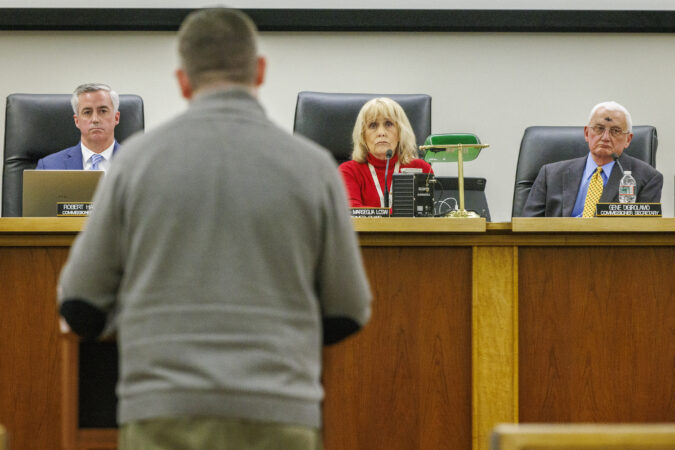
    In Doylestown on Wednesday, Commissioner Gene DiGirolamo, a Republican who serves with two Democrats, said he heard about the federal interest in two local sites and strongly disapproved.

    Jake Didinsky of Southampton, said he opposes ICE warehouses in his county, comparing them to Japanese interment camps.

    “Bucks County is not a county that needs or wants a detention facility,” he said.

    Harvie, the board’s vice chair, said Bucks County “is no place for these kinds of facilities” and cautioned: “We have been down this road before, with Japanese Americans. And with Italian Americans.”

    During World War II the U.S. government forcibly incarcerated thousands of people of Japanese descent, holding them in concentration camps mostly in the western part of the country. About two-thirds of those confined were American citizens.

    Some Italian Americans endured the same treatment.

    A resolution conveys the opinion and wishes of the board, but holds no force of law.

    The Bucks resolution said the county opposes “the use of warehouses or similar industrial facilities not intended for human occupancy as facilities to hold, jail, detain, house or otherwise store human beings.”

    In addition to humanitarian concerns, the resolution says, “such facilities, being hastily erected in areas and structures not intended for human occupation, would place unanticipated demands upon water and sewer systems, creating hazards to public health, as well as heaping new strain upon public safety services.”

    The vote came as the growth of ICE leasing and purchases has become contentious in Pennsylvania and across the United States.

    U.S. Immigration and Customs Enforcement expects to spend $38.3 billion to acquire warehouses around the country and retrofit them into immigrant detention centers to hold tens of thousands of people, the Washington Post reported. The newspaper analyzed agency documents that were provided to New Hampshire’s governor and published on the state’s website.

    ICE intends to buy and convert 16 buildings to serve as regional processing centers, each holding 1,000 to 1,500 immigrant detainees. An additional eight detention centers would hold 7,000 to 10,000 detainees and serve as primary sites for deportations.

    Two sites have been purchased in Pennsylvania ― one in Upper Bern Township, in northern Berks County, and another in Tremont Township, in Schuylkill County, where the purchase has drawn the ire of concerned residents.

    Last week Gov. Josh Shapiro formally asked Homeland Security Secretary Kristi Noem in a letter to reconsider the conversion of the Berks and Schuylkill sites, citing “real harms” to the communities.

    He questioned the legality of the facilities and hinted at a possible lawsuit, saying if DHS goes forward, his administration will “aggressively pursue every option to prevent these facilities from opening.”

    DHS spokesperson Tricia McLaughlin confirmed the plans for the Pennsylvania sites, saying that they would undergo community-impact studies and a rigorous due-diligence process, and that they would bring 11,000 jobs to the two Pennsylvania communities.

    The two sites would hold a combined 9,000 people.

    On Tuesday, Fitzpatrick’s office said it had received assurances from DHS and ICE that they had no plans or intention to open a detention facility within the First Congressional District.

    “After hearing from concerned residents, our office immediately contacted U.S. Immigration and Customs Enforcement, and we have received assurances that no such facility is planned,” Fitzpatrick said.

  • Philadelphia’s Managing Director Adam Thiel was once everywhere. Now, he’s largely faded from public view.

    Philadelphia’s Managing Director Adam Thiel was once everywhere. Now, he’s largely faded from public view.

    When Mayor Cherelle L. Parker stood in the city’s emergency management center last month and announced that her administration was preparing for the worst winter storm Philadelphia had seen in years, she was flanked by the police commissioner, the head of public schools, and a dozen other deputies.

    Missing from the news conference of Philadelphia’s top officials was Managing Director Adam K. Thiel, whose job it is to oversee the delivery of city services.

    It wasn’t the only time over the last year that Thiel, Philadelphia’s No. 2 public official, was noticeably absent.

    Thiel, who is effectively the city’s chief operating officer, was out of office last year for a total of nearly five months, much of which he spent on military leave, according to 2025 payroll register records obtained by The Inquirer. His increasingly low profile in Philadelphia City Hall has generated frustration and fueled questions about his job performance among some lawmakers, especially as the city faced criticism over the recent snow cleanup.

    Almost half of Thiel’s $316,200 city salary last year was for paid time off, according to payroll records. He is one of the highest-paid officials in the government and made more than Parker, who last year earned $280,000.

    In addition to his top city role, Thiel is a major in the U.S. Army Reserves. He joined the reserves in August 2024, eight months after beginning his job as managing director.

    Thiel also holds other positions outside government. In 2024, while he was managing director, he made more than $300,000 working as a consultant, according to financial disclosures. He is an adjunct faculty member at two universities and sits on several nonprofit boards.

    Five City Council members told The Inquirer that it has been months since they interacted directly with Thiel.

    “The managing director of the city is an extremely important job,” said Councilmember Jamie Gauthier, a Democrat from West Philadelphia. “I do not understand how someone who is absent as much as Thiel is able to carry out this job effectively.”

    Managing Director Adam Thiel during graduation ceremonies for the police academy Class #402 of the Philadelphia Police Department and Temple University Police Department at Temple University Performing Arts Center June 17, 2024.

    The administration declined requests to interview Thiel and Parker for this article. In a statement, Thiel thanked Parker for her “continued support of our city of Philadelphia employees who also serve the United States of America.”

    Sharon Gallagher, a spokesperson for the managing director’s office, said in a statement that Thiel has been employed by the city for nearly 10 years and “earns leave offered by the city the same way as other city employees accrue vacation, sick days, family, medical, military and other leave categories.”

    Payroll records show that Thiel logged six weeks of military leave time last year — the maximum amount the city offers employees. Gallagher said he also used 11 weeks of accrued vacation time to cover additional military assignments.

    The administration declined to answer questions about Thiel’s military service, including details about his location and unit. His LinkedIn page says he “helps provide emergency management subject matter expertise to combatant commands and partner nations.”

    Thiel is also founding partner of one consulting firm and the president of a second, though the specific nature of that work is not known and he has declined to disclose his clients publicly.

    In 2024, Thiel said his consulting work took fewer than 10 hours per week. Gallagher said Tuesday that “nothing has changed” since then.

    The Parker administration did not publicly announce when Thiel was on leave last year, but officials acknowledged it once asked by reporters last summer. At the time, Deputy Managing Director Michael Carroll filled in on an interim basis.

    Thiel, 53, is a nationally recognized expert in emergency management. He held a variety of firefighting, public safety, and disaster preparedness roles across the country before coming to Philadelphia in 2016 to serve as fire commissioner and deputy managing director under former Mayor Jim Kenney.

    Despite that, he did not appear alongside the mayor at multiple briefings the city conducted to update residents on the response to last month’s snowstorm. Instead, the face of the snow emergency response was Carlton Williams, the head of the city’s Office of Clean and Green Initiatives, a position Parker created.

    Thiel said in a statement Tuesday that Williams was “the best choice to lead our city’s unified response to the recent snowstorm operation and is the right leader for future snow and ice events.”

    Gauthier said the city’s handling of the storm “needed a higher-level emergency response.” She said while she respects Thiel’s military service, she raised his consulting work as a concern.

    “A decision needs to be made what he wants to do. Does he want to serve locally, or does he want to do other things?” Gauthier said. “We need a managing director who will serve full time.”

    The administration did not answer questions about whether Thiel was in town through the duration of the city’s 26-day winter emergency response.

    Parker’s chief of staff, Tiffany W. Thurman, said in a statement that the city is proud to offer benefits such as military and administrative leave that support employee well-being and professional development.

    Thurman said Thiel “is always reachable and fulfills the responsibilities of his position as needed based on the situation.”

    “His leadership — as is the case with the leadership team of any large city — is not limited by time designated as leave,” she said.

    The purpose of the Philadelphia managing director

    The authors of the 1950s-era Philadelphia Home Rule Charter created the position of managing director to serve as a barrier between the mayor’s political appointees and the city’s operational departments.

    The idea was that having a bureaucrat at the helm would ensure city service delivery would be apolitical, and the mayor cannot fire the managing director without cause.

    In reality, different mayors have granted their managing directors varying levels of power.

    In this 2018 file photo, LOVE Park is by (left to right) then-Philadelphia Parks and Recreation Commissioner Kathryn Ott Lovell, former City Council President Darrell Clarke, former Philadelphia Mayor Jim Kenney and then-Managing Director Michael DiBerardinis.

    For example, former Mayor Michael Nutter dispensed with decades of tradition and assigned robust portfolios to several deputy mayors. While his managing directors were important figures in his administration, they oversaw fewer operating departments than their predecessors.

    Nutter’s first managing director, Camille Barnett, left the administration after facing criticism for going on a two-week vacation in 2009 while the Phillies made a World Series run and SEPTA workers went on strike.

    Kenney, Parker’s immediate predecessor, sought to re-empower the city’s managing director position, while his deputy mayors took on advisory roles. He reassigned almost all departmental oversight to the managing director’s office.

    “We’re going to have a managing director that’s actually a managing director,” Kenney said before he took office.

    Council members who were in office before Parker’s 2024 swearing-in became used to the managing director being accessible. Several lawmakers said that under Kenney’s administration, they routinely communicated about constituent services matters with ex-Managing Director Tumar Alexander and his predecessor, Brian Abernathy.

    That hasn’t been the case with Thiel in the role.

    “Since the beginning of this administration, I have gone to Carlton Williams,” said Councilmember Jeffery “Jay” Young Jr., a freshman Democrat who represents parts of North Philadelphia.

    Mayor Cherelle L. Parker is applauded by members of her administration at City Hall Wednesday, Jul. 9, 2025, hours after reaching a tentative contract agreement with District Council 33 leaders overnight, ending the workers’ strike. At left is Carlton Williams, director of the Office of Clean and Green Initiatives and Chief Deputy Mayor Sinceré Harris is behind the mayor at right.

    Several other members said that instead of going to the managing director’s office, they take administrative needs to legislative affairs staff, agency heads, or Thurman.

    “Almost everything goes through Tiffany, and she’s able to get things done,” said one Council member who spoke on the condition of anonymity to preserve relationships with the administration.

    Parker doesn’t deny that little happens at the top rungs of city government without Thurman’s involvement. The mayor has come to see her chief of staff as the central figure in her administration and calls her the city’s “chief air traffic controller.”

    Phil Goldsmith, who served as managing director for two years under former Mayor John F. Street, said Thiel’s minimized public role may be because Parker appears to favor “a very strong mayor’s office.”

    “It seems to me that the managing director may have to go through more hoops to get things done than, for example, I had to do,” Goldsmith said. “That’s just a function of what a mayor wants and feels comfortable with.”

    Fading out of public view

    Thiel’s lack of public appearances over the last year has been unusual for a managing director.

    It has been 10 months since he testified before City Council, despite the managing director in previous administrations being a mainstay in hearings to answer lawmakers’ questions about city services ranging from street repaving to emergency preparation.

    And in December, when a half-dozen top Parker administration officials spoke during the mayor’s State of the City event, Thiel was not on the roster.

    The decrease in visibility marks a departure from his first year in office, when Thiel had a more consistent public presence and was often seen beside the mayor.

    Ahead of a snowstorm in January 2024, Thiel stood with Parker during a news conference about preparations. He donned a suit while snowflakes fell, and he reassured the city that the administration was ready for the service disruptions that bad weather can bring.

    Mayor Cherelle L. Parker (center) with Managing Director, Adam Thiel (right) and at left Carlton Williams, Director of Clean & Green Initiatives, at a news conference with city officials in Northeast Philadelphia on Friday, Jan. 19, 2024 to share the city’s response to the snowstorm.

    Through his first year in the position, Thiel also faced scrutiny as the face of some of the mayor’s most controversial initiatives.

    He took a leading role in Parker’s efforts to end the open-air drug market in the city’s Kensington neighborhood, and he oversaw the development of the Riverview Wellness Center, a new city-owned recovery house for people with substance use disorder.

    Today, much of Kensington initiative is overseen by the public safety director, who reports directly to Parker. A new head of community wellness is leading development at Riverview, and Williams was the face of the storm response.

    Mayor Cherelle L. Parker finishes a news media briefing with her leadership team at the Tustin Playground at 60th St. and W Columbia Ave. Tuesday, Jul, 1, 2025, on the first day of the strike by District Council 33. At left are Carlton Williams (Phillies cap), Director of Clean and Green Initiative with the Dept. of Streets Sanitation Division; and Managing Director Adam Thiel (at lectern).

    Last summer, during the eight-day strike by municipal workers that brought city services to a halt for the first time in 40 years as trash piled on sidewalks and streets, Thiel initially spoke nearly every day at news conferences to update citizens on the crisis.

    But by the time the strike was resolved, Thiel had faded from public view, departing from his city job for one of his stints on military leave. After Parker reached an agreement with the union, she held a news conference with 20 top deputies and thanked each of them by name.

    Thiel, absent from the City Hall news conference, was not one of them.

    Staff writers Ryan W. Briggs and Sean Collins Walsh contributed to this article.

  • Late-night host Stephen Colbert isn’t backing down from public dispute with CBS bosses

    Late-night host Stephen Colbert isn’t backing down from public dispute with CBS bosses

    Stephen Colbert isn’t backing down in an extraordinary public dispute with his bosses at CBS over what he can air on his late-night talk show.

    On The Late Show Tuesday, Colbert said he was surprised by a statement from CBS denying that its lawyers told him he couldn’t show an interview with Democratic Texas Senate candidate James Talarico — which the host said had happened the night before.

    He then took a copy of the network statement, wrapped it in a dog poop bag, and tossed it away.

    Colbert had instead shown his Talarico interview on YouTube, but told viewers why he couldn’t show it on CBS. The network was concerned about FCC Chairman Brendan Carr trying to enforce a rule that required broadcasters to give “equal time” to opposing candidates when an interview was broadcast with one of them.

    “We looked and we can’t find one example of this rule being enforced for any talk show interview, not only for my entire late-night career, but for anyone’s late-night career going back to the 1960s,” Colbert said.

    Although Carr said in January he was thinking about getting rid of the exemption for late-night talk shows, he hadn’t done it yet. “But CBS generously did it for him,” Colbert said.

    Not only had CBS been aware Monday night that Colbert was going to talk about this issue publicly, its lawyers had even approved it in his script, he said. That’s why he was surprised by the statement, which said that Colbert had been provided “legal guidance” that broadcasting the interview could trigger the equal time rule.

    “I don’t know what this is about,” Colbert said. “For the record, I’m not even mad. I really don’t want an adversarial relationship with the network. I’ve never had one.”

    He said he was “just so surprised that this giant global corporation would not stand up to these bullies.” CBS is owned by Paramount Global.

    Colbert is a short-timer now at CBS. The network announced last summer that Colbert’s show, where President Donald Trump is a frequent target of biting jokes, would end in May. The network said it was for economic reasons but others — including Colbert — have expressed skepticism that Trump’s repeated criticism of the show had nothing to do with it.

    This week’s dispute with Colbert also recalls last fall, when ABC took late-night host Jimmy Kimmel off the air for a remark made about the killing of conservative activist founder Charlie Kirk, only to reinstate him following a backlash by viewers.

    As of Wednesday morning, Colbert’s YouTube interview with Talarico had been viewed more than five million times, or roughly double what the comic’s CBS program draws each night. The Texas Democrat also reported that he had raised $2.5 million in campaign donations in the 24 hours after the interview.

  • A Minneapolis artist’s custom font, Times New Resistance, autocorrects Trump to ‘felon’ and ICE to ‘goon squad’

    A Minneapolis artist’s custom font, Times New Resistance, autocorrects Trump to ‘felon’ and ICE to ‘goon squad’

    Abby Haddican got tired of the rhetoric.

    The Minneapolis-based artist can’t unsee the impact ICE and directives from President Donald Trump’s administration’s have had on her hometown in recent months.

    “I don’t really know anyone whose life hasn’t been affected by the occupation in a tangible way,” she said. “Many people I know are volunteering to deliver meals, patrol schools, drive folks to work, and serve as peaceful observers — which is what both Renee Good and Alex Pretti were doing when they lost their lives at the hands of ICE agents.”

    The independent graphic designer thought about ways she could get involved when it hit her. She’s joining a larger tradition of subversive font design.

    Haddican, whose work focuses on typography, branding, and packaging, thought back to Moontype, a font created by designer Olli Meier that autocorrects “bad words,” like hate, into “good words,” like love.

    Then she thought about language and its use today.

    “It’s become impossible to ignore how blatantly the Trump administration is misusing language in order to control and distort the narrative,” she said. It clicked.

    “Wouldn’t it be cool if you could change someone else’s words?” Haddican said. “I decided that the best practical use of this font feature would be a practical joke.”

    This month, she launched Times New Resistance, a parody of the commonly used Times New Roman font, which autocorrects a slew of specific words as they’re typed. Notably, Times New Roman is the new (and old) official font of the State Department.

    Using Times New Resistance, the term ICE autocorrects to “the Goon Squad.” Trump autocorrects to “Donald Trump is a felon.” Gay becomes “gay rights are human rights.” Illegal alien becomes “human being.”

    Kingsley Spencer, a creative director and designer based in Jacksonville, Fla., says using the State Department’s own font is part of what makes Haddican’s font so powerful.

    “Using technology as a form of commentary against a political regime that decided to weaponize Times New Roman as a form of culture shaping is sharp for a designer,” he said. “I love how direct and comical it is.”

    The font is free, “just like America used to be,” Haddican‘s website says. She said Monday that it has been downloaded about 600 times so far. She describes it as a “social commentary meant to autocorrect the autocrats.”

    The hope is that some users might secretly install the font onto the computers of “an ICE apologist,” or “morally bankrupt American” as a way of unleashing mischief.

    To the untrained eye, the typeface looks like Times New Roman in the font menu — there’s just a sneaky extra space between the words Times and New. But it’s likely many downloads are by like-minded supporters who want to enjoy the font for themselves.

    The technology behind the font is simple.

    Haddican modified an existing open-source typeface that resembles Times New Roman and programmed the substitutions. She said the hardest part was deciding which autocorrections to make.

    “I know I’ve done an imperfect job. The corrections are a mixture of serious stuff (for example, the word ‘good’ autocorrects to ‘Renee Good was murdered by ICE’) and things that I find funny, like changing ‘Stephen Miller’ to ‘Nosferatu,’” she said.

    “The first draft was significantly more profane, but I toned it down. I wanted to offend people by speaking truth to power, not for swearing like a sailor.”

    Spencer said the font uses something in the typography world called ligatures, which replaces a set of recognized characters with a single character phrase. An example of this is when you type a fraction or date in a document and it’s automatically formatted.

    Haddican joins a group of other typography artists who have made jokes, social commentary, or both through text.

    Times Newer Roman is a typeface created by the Brooklyn-based art collective MSCHF (pronounced mischief) in 2018 that looks identical to Times New Roman, except each character is 5% to 10% longer, making essays appear slightly longer without changing formatting rules.

    It was billed as a font that could help students cheat on term papers. The font takes jabs at academic productivity culture, using typographic invisibility that’s undetected by the untrained eye.

    Sang Mun, a designer and former National Security Agency contractor, created a subversive “surveillance proof” font called ZXX in 2013. The fonts were created to be legible to the human eye, but difficult for surveillance software used by Google and other companies to scan text to read.

    More mainstream examples include Shepard Fairey, the artist behind OBEY and President Barack Obama’s iconic HOPE graphic, who is known for his use of single phrases and high-contrast graphics to make political propaganda-style art. In the 2024 presidential election, Fairey made a Kamala Harris poster that said FORWARD in the same style as his Obama art.

    On social media, reception for Haddican’s font has been strong, garnering over 6,000 likes on Instagram and hat tips from fellow designers.

    “I think just about anything can be a form of resistance, and I believe that humor and playfulness are powerful tools for pushing back against oppression and authoritarianism,” Haddican said. “The trickster (e.g. Bugs Bunny) always beats the martyr (e.g. Elmer Fudd) in the end.”

  • Sue Altman was thrown out of a hearing as a critic of George Norcross. Six years later, she’s running for Congress

    Sue Altman was thrown out of a hearing as a critic of George Norcross. Six years later, she’s running for Congress

    Sue Altman showed up at a state Senate hearing in late 2019 to confront George E. Norcross III and was dragged out by state troopers. Six years later, she is using that incident as an example of why New Jersey voters should send her to Congress.

    “If anything can prepare you for a dogfight that Washington politics is, it’s Jersey politics,” said Altman, one of more than 15 Democrats vying to succeed retiring U.S. Rep. Bonnie Watson Coleman in a reliably blue Central Jersey seat.

    Altman, 43, recently resigned after serving for the last year as state director for U.S. Sen. Andy Kim, a South Jersey Democrat who has also challenged the state’s machine politics. Before that role, she unsuccessfully ran for Congress in 2024 in a swing district that borders Coleman’s district.

    She made a name for herself as a progressive activist in Camden, where she fought former Republican Gov. Chris Christie as the state began its takeover of the city’s public schools, vocally criticized power brokers like Norcross, and led a legal effort to abolish the county line from New Jersey ballots before Kim took it to the finish line in 2024.

    “My time in Camden was extremely important, and in many ways shapes the work that I did in the state from that point forward,” she said.

    While Altman built her progressive credentials in Camden, she has most recently lived in Lambertville and will be relocating northeast to Bridgewater to move in with her long-term boyfriend, who lives just outside the district’s boundaries.

    “I think what the electorate is hungry for and what the party needs are people who are going to challenge power,” she said. “I’ve done that my whole career.”

    Altman, who grew up in Central Jersey, played professional basketball in Ireland and Germany after graduating from Columbia University. She earned two master’s degrees from Oxford University before landing in Camden in 2014.

    She garnered attention in the city for going back and forth with Christie for roughly six minutes at a public meeting in which they tossed a microphone in the air to each other.

    After Donald Trump’s first election as president in 2016, Altman helped organize South Jersey Women for Progressive Change, a group that campaigned for Kim’s 2018 election to the U.S. House and spoke out against machine politics. She said she continued that work as she took the reins as executive director of the state’s Working Families Party in 2019 from Analilia Mejia — the progressive who recently won Democratic primary to replace Gov. Mikie Sherrill in Congress.

    Sue Altman at the Camden Waterfront in 2019.

    Altman drew national attention that year after she was dragged out of the hearing in Trenton on a corporate tax incentive program Norcross defended, drawing a message of support from U.S. Sen. Elizabeth Warren (D., Mass.). Activists used images of the incident to bolster their argument that unelected power brokers like Norcross hold outsize influence in New Jersey, though Norcross later said he did not believe she should have been thrown out.

    Camden Mayor Vic Carstarphen, a Democrat, criticized Altman for what he called her “singular focus” on “trying to tear down” Norcross during her time in Camden for her own “self-promotion.”

    “She created a lot of chaos in the city, and ran amok throughout the city,” Carstarphen said Tuesday.

    In 2021, Altman led the legal strategy in the first major lawsuit against the county line, the old ballot that was advantageous to party-endorsed candidates. The fall of the line has led to more competitive primaries, including her own.

    She went on to unsuccessfully challenge incumbent Republican U.S. Rep. Tom Kean Jr., losing by more than five percentage points in 2024.

    Altman said dealing with immigration cases while working in Kim’s office partially inspired her to run again. She said Democrats should replace U.S. Immigration and Customs Enforcement with “full comprehensive immigration reform” while also securing the border.

    Neither Kim nor the Working Families Party has weighed in on the race.

    Altman warns that the country is at “one of the most vulnerable points” in its history with Trump in office for a second time.

    “We have a very short window of time to prove to the rest of the country that Democrats in power can deliver for people and hold Trump accountable, but not get overwrought with the politics of it,” she said.