Category: Politics

Political news and coverage

  • Justice Department weighs rollback of gun regulations

    Justice Department weighs rollback of gun regulations

    The Justice Department is considering loosening a slate of gun regulations as it seeks to bolster support from ardent Second Amendment advocates, according to three people familiar with the changes who spoke on the condition of anonymity to discuss plans that have not been made public.

    Some of the changes are expected to ease restrictions on the private sale of guns and loosen regulations on shipping firearms.

    Other changes to Bureau of Alcohol, Tobacco, Firearms and Explosives regulations under consideration would change the types of firearms that can be imported and make licensing fees refundable. Officials are also expected to change the form required to purchase guns to have applicants list their biological sex at birth. The current form asks applicants to list their sex.

    Federal officials had considered announcing the changes to coincide with the National Shooting Sports Foundation gun trade show in Las Vegas, which began on Tuesday. Deputy Attorney General Todd Blanche is scheduled to speak at the annual show. The NSSF SHOT Show is one of the nation’s largest firearm trade shows, and Justice Department officials in both Democratic and Republican administrations have regularly attended it.

    But officials are still finalizing their new regulations and the timing of the announcement, the people familiar with the matter said.

    The back-and-forth over the rollout of the new gun rules highlights the Justice Department’s challenges as it seeks to placate a part of the president’s base that believes the administration has not been aggressive enough in easing firearm restrictions — while also preserving the law enforcement capabilities of ATF, which some gun rights advocates have sought to abolish.

    The Trump administration has installed prominent gun rights advocates in senior political positions, and the president has allied himself with conservative advocacy groups, such as Gun Owners of America. The administration has pushed to slash about 5,000 law enforcement officers from ATF, cutting the number of inspectors who ensure gun sellers are in compliance with federal laws.

    But some gun rights advocates have publicly expressed disappointment with Attorney General Pam Bondi, who as attorney general of Florida supported gun restrictions after the 2018 school shooting in Parkland.

    Bondi and the Trump administration have faced criticism for not going as far as some lawmakers and gun rights advocates have demanded.

    “The Biden Administration waged war against the Second Amendment, but that era has come to an end under Attorney General Bondi, who has led the Justice Department’s effort to protect the Second Amendment through litigation, civil rights enforcement, regulatory reform, and by ending abusive enforcement practices,” a Justice Department spokesperson said in a statement.

    “Whenever law-abiding gun owners’ constitutional rights are violated, the Trump Administration will fight back in defense of freedom and the Constitution.”

    Because ATF crafts regulations based on its interpretation of laws passed by Congress, Justice Department officials are allowed to amend its rules, though any changes risk legal challenges. ATF is part of the Justice Department, responsible for regulating the sales and licensing of firearms and working with local law enforcement to solve gun crimes. Federal and local law enforcement officials tout ATF’s gun tracing capabilities with helping to combat violent crime.

    In the first months of the Trump administration, the Justice Department proposed merging the Drug Enforcement Administration with ATF — a move that ATF’s backers feared would leave the agency powerless. Opponents of ATF, meanwhile, feared that the merger would give the agency too much power. The merger plans have not come to fruition and, instead, the Trump administration in November quietly nominated a respected ATF veteran to lead the agency.

    The nominee, Robert Cekada, is scheduled to have his hearing next month, and administration officials are worried about how the announcement of the new regulations could boost or hurt his nomination chances, according to one person familiar with the nomination process. Announcing the loosening of regulations ahead of his nomination hearing could risk the support of moderate Republicans, said the people, who spoke on the condition of anonymity to discuss personnel issues.

    Winning confirmation to serve as ATF director is notoriously difficult. Only two people have won Senate approval as director since the position began requiring Senate confirmation in 2006. During his first term, President Donald Trump had to pull a nominee, Chuck Canterbury, the former head of the national Fraternal Order of Police, because some conservative Republicans thought he would restrict gun rights.

    Trump had originally tapped FBI Director Kash Patel to simultaneously serve as ATF director. The Washington Post reported at the time that Patel never showed up to ATF headquarters and had scarce interaction with staff. The administration replaced Patel in early April with Army Secretary Dan Driscoll, who holds the two roles simultaneously. Cekada has been running the day-to-day operations of ATF since the ousting of the second-in-command at ATF in April.

    The nomination of Cekada was considered a win for Bondi, who had wanted a law enforcement veteran leading the agency. Some Second Amendment groups had pushed for an advocate at the head of the organization.

    Bondi pushed out ATF’s longtime general counsel and replaced her with a political appointee, Robert Leider — a former law professor who believes in a strict interpretation of the Second Amendment and has publicly written about how ATF too heavily regulates firearms.

    The Post reported this past summer that the U.S. DOGE Service sent staff to ATF with the goal of revising or eliminating at least 47 rules and gun restrictions — an apparent reference to Trump’s status as the 47th president — by July 4, according to multiple people with knowledge of the efforts. Those plan hit roadblocks, in part, because the political appointees failed to realize how complicated and legally cumbersome it is to amend regulations, according to one person familiar with the process.

    In addition to the regulatory changes, Leider and his team have been working to shrink the legally mandated 4473 Form that most buyers are required to fill out when purchasing a firearm, making it quicker to read and fill out the paperwork required to purchase and sell firearms.

    In December, Assistant Attorney General Harmeet K. Dhillon, who heads the Civil Rights Division, announced creation of a new Second Amendment group within her division focused on expanding gun rights. In its first days, the newly created group filed a lawsuit challenging an assault weapon ban in D.C.

    It’s unclear how much support Dhillon’s new group has received. Top Justice Department officials have not fully backed it, in part because Congress needs to approve the creation of a new section within the Civil Rights Division, according to people familiar with the group.

    Dhillon so far has not hired many attorneys with legal expertise in the Second Amendment to work in the group, the people said. Instead, she has used existing attorneys within the Civil Rights Department to staff some of the group’s projects.

    Top Democratic lawmakers on the Senate Judiciary Committee have questioned the creation and legality of Dhillon’s group.

    “Since President Trump took office, you have decimated the Division’s nonpartisan workforce and changed the Division’s enforcement priorities to serve the President’s agenda in lieu of our federal civil rights laws,” Sens. Peter Welch (D., Vt.) and Dick Durbin (D., Ill.) wrote in a letter to Dhillon this month. “The creation of the Second Amendment Section is another example of this profound retreat from the core mission of the Civil Rights Division.”

    Last week, the Justice Department’s Office of Legal Counsel issued an opinion saying that a federal ban on mailing firearms through Postal Service is unconstitutional. An OLC opinion is not binding, but it provides legal guidance across the federal government on how federal prosecutors view laws and signals the Justice Department’s future stances in court.
  • Mikie Sherrill takes oath as New Jersey governor, becoming the second woman to lead the state

    Mikie Sherrill takes oath as New Jersey governor, becoming the second woman to lead the state

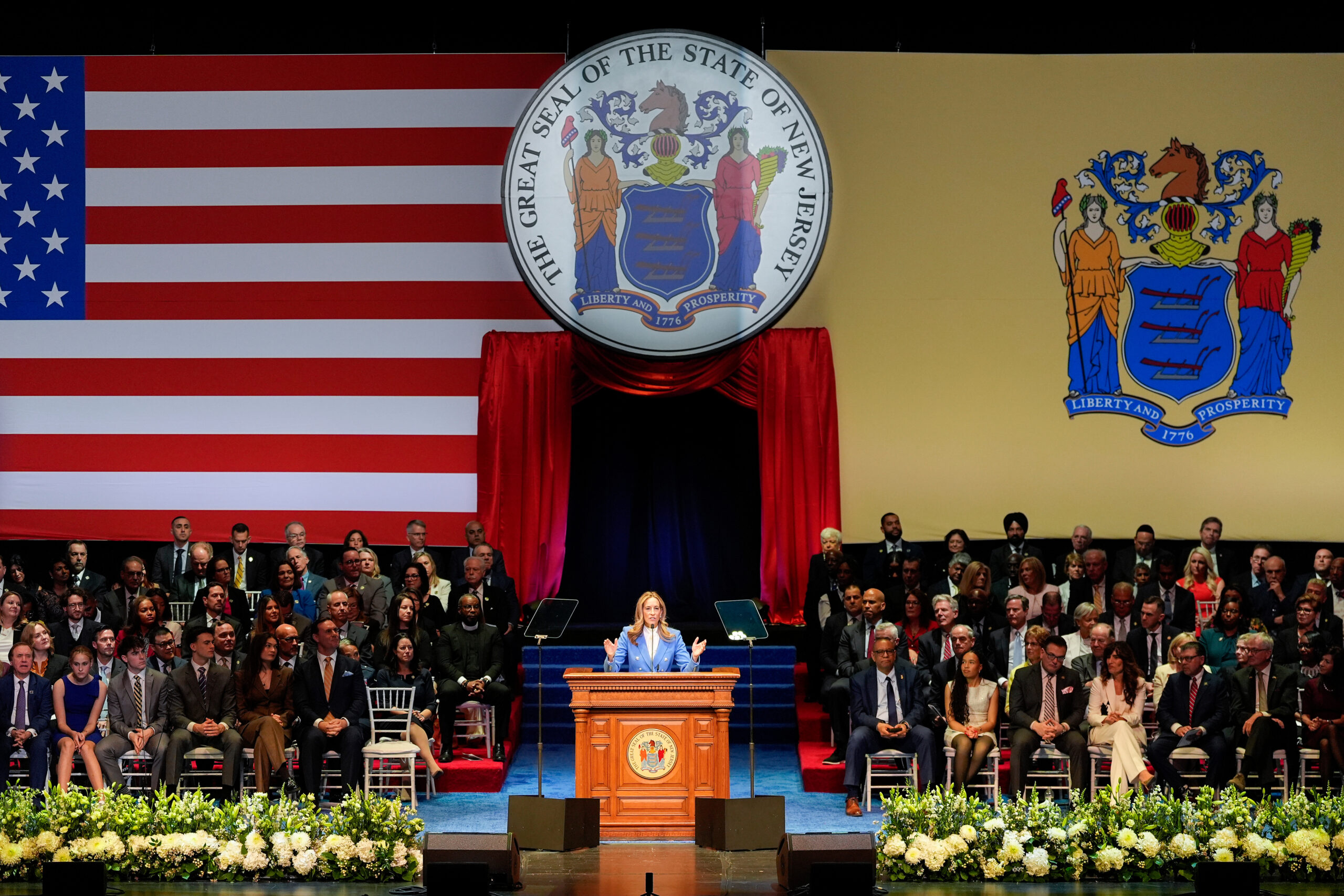
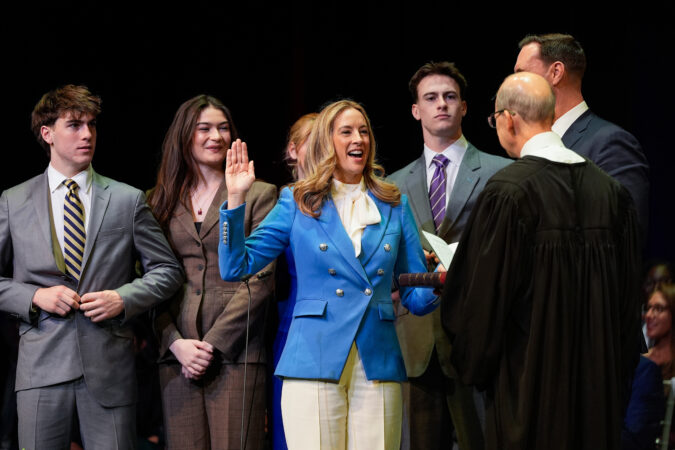
    NEWARK, N.J. — Mikie Sherrill was sworn in as New Jersey governor Tuesday, becoming the second woman to govern the state and the first from the Democratic Party.

    Sherrill, who is also the first female veteran from either party to be elected to the office, broke tradition by opting to be inaugurated in her home county of Essex, in northern New Jersey, instead of the state’s capital city, Trenton.

    She took the oath at the New Jersey Performing Arts Center in Newark in the morning. Joined onstage by her family and high-profile Democrats, Sherrill spoke about her love for New Jersey and denounced President Donald Trump in a speech on Tuesday.

    She also gave two shout-outs to South Jersey, noting that she learned on the campaign trail that South Jerseyans say “pork roll” instead of “Taylor Ham.”

    “I have heard you in South Jersey, where you want jobs, transportation investments, innovative businesses, and not to be forgotten or left behind,” she also said.

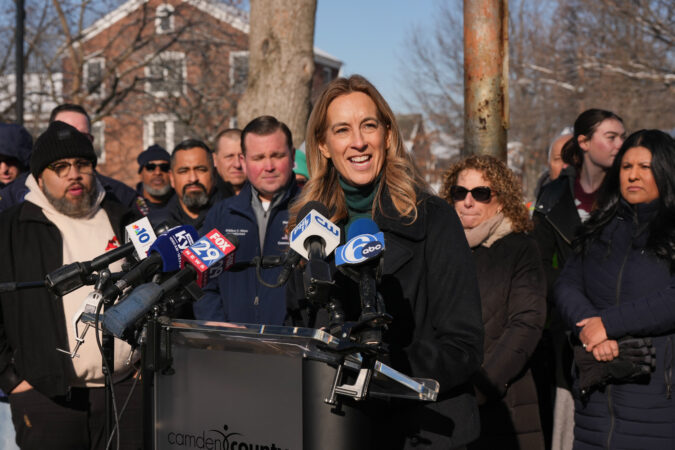
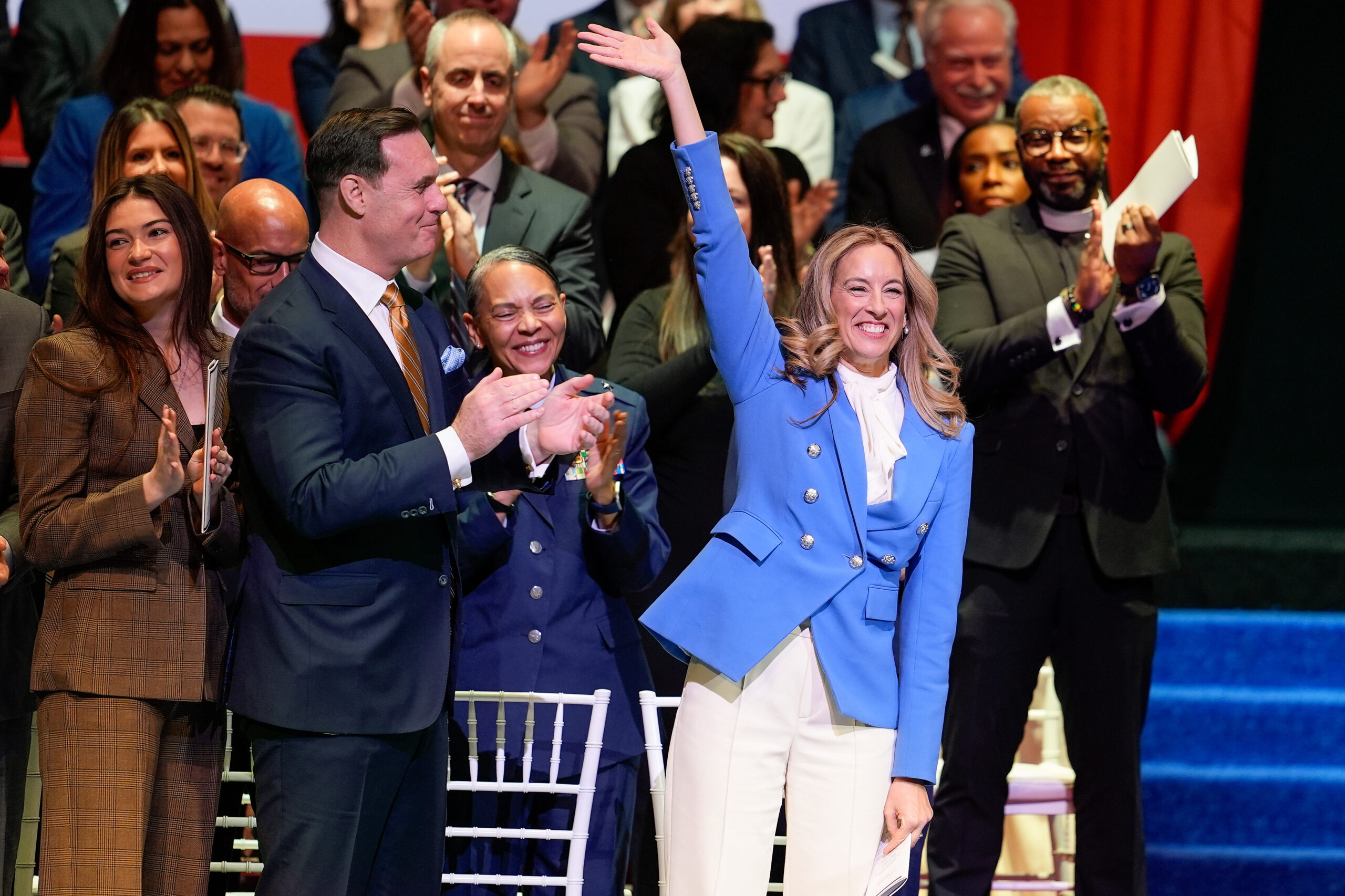
    New Jersey Governor-elect Mikie Sherrill waves as she arrives for her inauguration, Tuesday, Jan. 20, 2026, in Newark, N.J. (AP Photo/Seth Wenig)

    She even referenced Philadelphia while talking about the founding of the United States — in a very Jersey way.

    “In fact, not too far away, in the greater Camden metropolitan region, in a place called Philadelphia, Thomas Jefferson wrote a declaration of our independence, marking the birth of this great nation,” she said.

    “This entirely unique and revolutionary declaration claims human beings had universal rights to life, to liberty, to the pursuit of happiness, not because of who their parents were, but because every human being is endowed with these rights by their creator, not by a king,” she added, and was met by applause.

    She drew parallels between England’s king at the founding of the United States and Trump, whom Democrats have criticized through “no kings” protests. Sherrill said Trump is “illegally usurping power, unconstitutionally enacting a tariff regime to make billions for himself and his family while everyone else sees their costs go higher.”

    Sherrill, a former Navy helicopter pilot, former federal prosecutor, and mother of four, was elected to Congress in 2018 and stepped down in November after winning the election, defeating Jack Ciattarelli, who had won the endorsement of Trump.

    Sherrill, whose closely watched candidacy drew significant national support, promised during her campaign that she would make New Jersey more affordable and would stand up to Trump.

    She told voters she would declare a state of emergency on utility rates on her first day in office, a promise she executed while still onstage for her inauguration speech right after being sworn in. She signed two bills: one freezing utility rates and the other encouraging more energy production in the state.

    White flowers lined the front of the stage, and large American and New Jersey flags served as a backdrop.

    Virginia Gov. Abigail Spanberger, Sherrill’s friend and former congressional colleague, was in attendance. Spanberger became Virginia’s first female governor on Saturday in a ceremony attended by Sherrill and other high-profile Democrats.

    New Jersey and Virginia were the only states to hold gubernatorial races last year, and the Democratic victories were viewed as a positive sign for the party heading into the midterms with Trump in the White House.

    Sherrill, who turned 54 on Monday, succeeds Gov. Phil Murphy, a Democrat who served two terms. It’s the first time the same party has held the governor’s mansion for three consecutive terms since 1970.

    After the ceremony, Sherrill was slated to head to Trenton to sign more executive orders before going back north for an inaugural ball Tuesday evening at the American Dream in East Rutherford.

    Sherrill’s lieutenant governor, Dale Caldwell, 65, was also sworn in Tuesday. Caldwell, a Middlesex County-based Methodist pastor, most recently worked as the first Black president of Centenary University. He has worked for state government, started nonprofits, and led charter schools.

    In his speech Tuesday, Caldwell said his father marched with the Rev. Dr. Martin Luther King Jr., whom he and Sherrill both mentioned in their speeches.

    “My father taught me that faith must be active, not passive. He taught me that justice is not an idea, it is a responsibility,” Caldwell said. “And he taught me that service is not optional, especially for those who have been blessed with opportunity.”

    Sherrill defied expectations on both sides of the aisle by winning what had been viewed as a competitive race by 14 points. Republicans had felt optimistic in part because the state shifted red in 2024, but those gains bounced back in November. The resident of Montclair similarly won a crowded primary by more than 100,000 votes in June.

    During her campaign, Sherrill repeatedly reminded voters of Ciattarelli’s ties to Trump and leaned into the president’s unpopularity in the state.

    Sherrill’s campaign repeatedly held events in Newark leading up to her election with the support of Newark Mayor Ras Baraka, a progressive who placed second in the Democratic primary.

    Her decision to be inaugurated up north was celebrated by Newark officials, but Trenton City Council member Jennifer Williams, a Republican, argued in an op-ed that it was an insult to Trenton.

    The governor-elect visited Camden on Monday to celebrate Martin Luther King Jr. Day and announced that she will divert resources to the city to honor the civil rights leader.

    Christine Todd Whitman, the first woman to serve as New Jersey governor, used the same venue as Sherrill when she was sworn in for her second term in 1998 while the war memorial in Trenton, the traditional site, was undergoing renovations.

    Whitman served as a Republican from 1994 to 2001 before joining the Bush administration and has since left the Republican Party for the Forward Party. She endorsed Sherrill’s candidacy.

    New Jersey Gov. Mikie Sherrill speaks after taking the oath of office during an inauguration ceremony, Tuesday, Jan. 20, 2026, in Newark, N.J. (AP Photo/Seth Wenig)
  • Protesters briefly block ICE garage in Philly in latest protest of immigration agents

    Protesters briefly block ICE garage in Philly in latest protest of immigration agents

    • What you should know
    • Philly protesters are blocking vehicles from leaving an ICE parking garage in Center City.
    • The protest comes following a deadly incident in Minneapolis earlier this month, where an ICE agent shot and killed Renee Good, a U.S. citizen.
    • Four people were arrested during anti-ICE protests in Philadelphia back in October.
    • Protestors want ICE agents banned from the Criminal Justice Center in Center City, where immigrants have been trailed and arrested.

    // Timestamp 01/20/26 9:39am

    Anti-ICE demonstrators end their protest

    Rev. Jay Bergen, a leader of No ICE Philly, said the group had accomplished its goal – and that the brutal cold had become too much for older demonstrators, some of whom have medical conditions.

    In his closing prayer, Bergen hoped the nearly 2 hour stretch was enough for ICE’s target to be somewhere else.

    “All of us here have proven in our song and our prayer that we can slow down the machine of authoritarianism, of fascism, that we can delay the operations that will detain and kidnap and destroy our neighbors, our families, our community,” Bergen said.

    Jeff Gammage, Ximena Conde


    // Timestamp 01/20/26 9:37am

    Video: Anti-ICE protesters in Philly


    // Timestamp 01/20/26 9:33am

    ICE vehicle able to exit garage, helped by Philly police

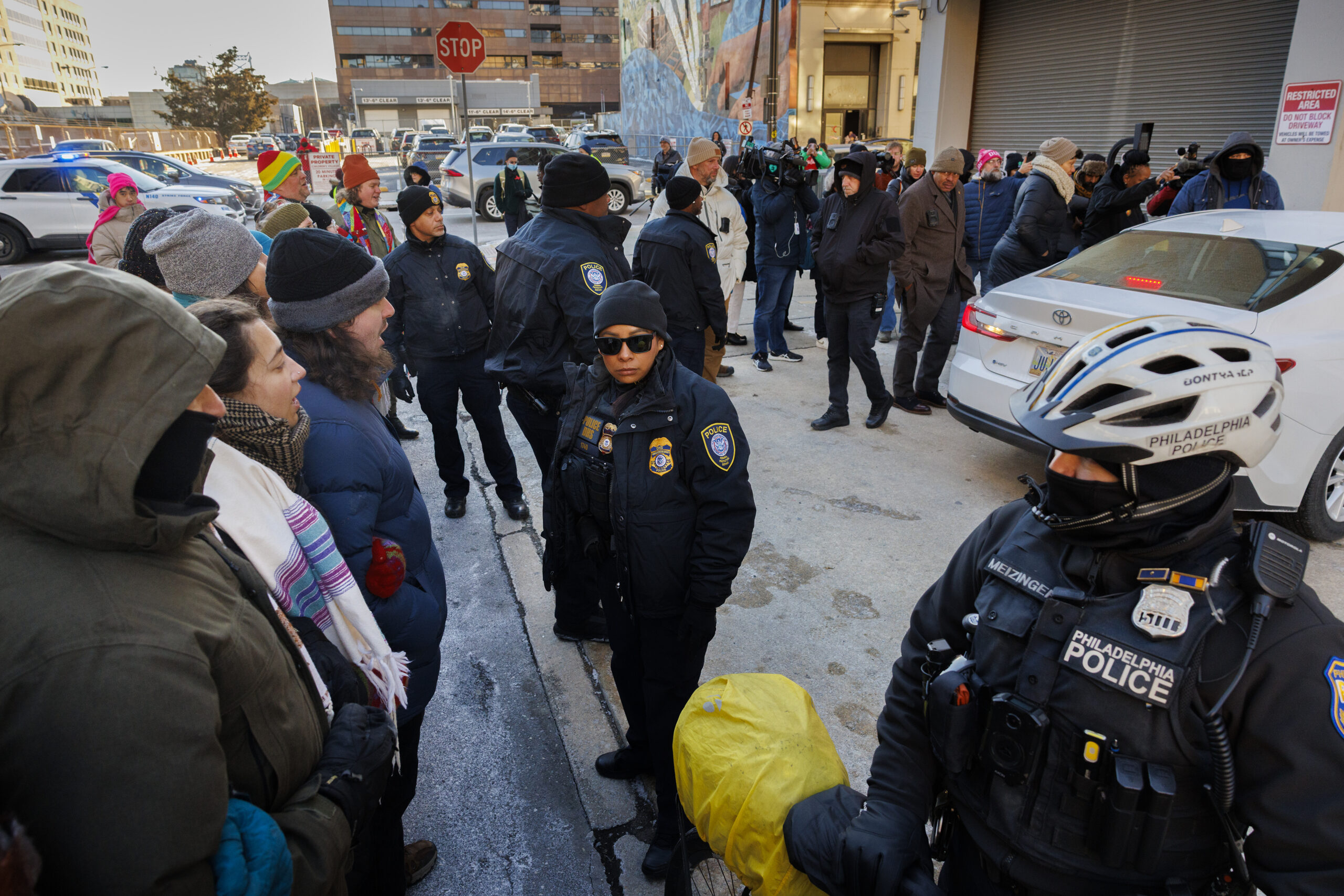
    Philadelphia Police and Department of Homeland Security officials block protesters outside the garage at ICE’s Center City headquarters.

    Just before 9:30 a.m., a white sedan – which had initially been blocked by protesters – was able to exit the ICE headquarters parking bay with the help of Philadelphia Police.

    No one was arrested.

    Ximena Conde


    // Timestamp 01/20/26 9:03am

    Philly Council member joins protest

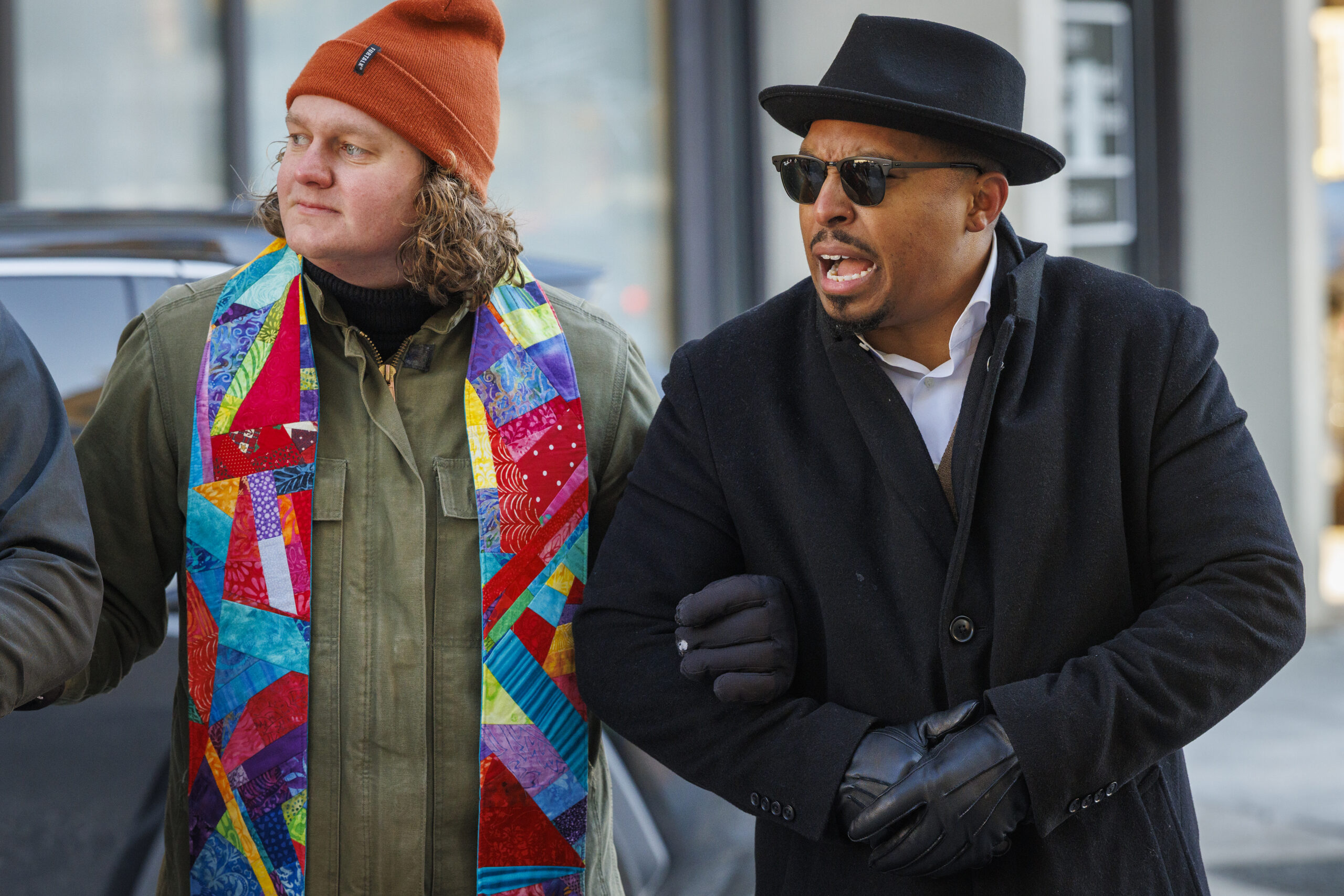
    Philadelphia City Councilman Nicolas V. O’Rourke (right) joins the protest alongside Rev. Jay Bergen.

    Protestors saw their ranks boosted by City Council member Nicholas O’Rourke, who is also a pastor of the Living Water United Church of Christ in Oxford Circle.

    O’Rourke said it was only natural for him to join fellow clergy at Tuesday’s frigid demonstration.

    A pastor of the Living Water United Church of Christ in Oxford Circle, O’Rourke said Tuesday’s action was part of a long tradition of faith leaders being at the forefront of the “struggle against oppression,” as seen with Rev. Dr. Martin Luther King Jr. and others.

    “We are a day after King’s Day, and it’s important that we don’t just wax eloquent about the nice things that King said or the image that he’s been painted of now, but we continue in that tradition of resisting the oppression as he saw it, we’re doing in our own time,” said O’Rourke.

    Ximena Conde


    // Timestamp 01/20/26 8:40am

    ‘We need more people every day willing to do this’

    Protesters sing and lock arms outside ICE headquarters in Center City Tuesday.

    The group of clergy and immigration advocates continued to sing in locked arms in front of the parking bay in front of ICE headquarters in Center City after its initial “ICE block” in an effort to disrupt immigration enforcement.

    Rev. Hannah Capaldi, minister at the Unitarian Society of Germantown, described the selection of participants as an intentional one as they face warnings from police, possible arrests, and citations.

    Those present are leveraging a certain level of privilege, she said. All are citizens and many are clergy wearing collars, taluses, and stoles.

    “We’re saying, listen, we have some level of moral authority in this city, and we’re trying to tell you where to look and what to pay attention to,” she said.

    But in addition to drawing attention to ICE operations in Philadelphia, Capaldi hopes to plant “seeds of resistance” in the broader public, encouraging people to get involved.

    “It doesn’t have to just be us, and we need more people every day willing to do this, to stand between the vehicles and the work that they’re doing to kidnap our neighbors,” she said.

    “What ICE is doing in our communities is against our faith tradition,” said Rev. Jonny Rashid, a protest organizer. “We are gathered clergy, priests, rabbis, imams, and we are here to say no to ICE, and we want to demonstrate that publicly, and we’re willing to get arrested to do that. We’re blocking ICE’s garage as a symbol of saying you are not welcome in Philadelphia.”

    He said he was not surprised by the lack of an overt Philadelphia police presence, though in the past groups of officers have been sent to anti-ICE protests.

    “I don’t think the Philly police want to engage. They don’t want to make Philadelphia look like Minneapolis.”

    Ximena Conde, Jeff Gammage


    // Timestamp 01/20/26 8:38am

    Police warn anti-ICE protesters to clear the area

    Philadelphia police officers are warning demonstrators to clear the area.

    About 30 immigration advocates are blocking the garage entrance of ICE headquarters in Center City.

    Jeff Gammage, Rob Tornoe


    // Timestamp 01/20/26 8:02am

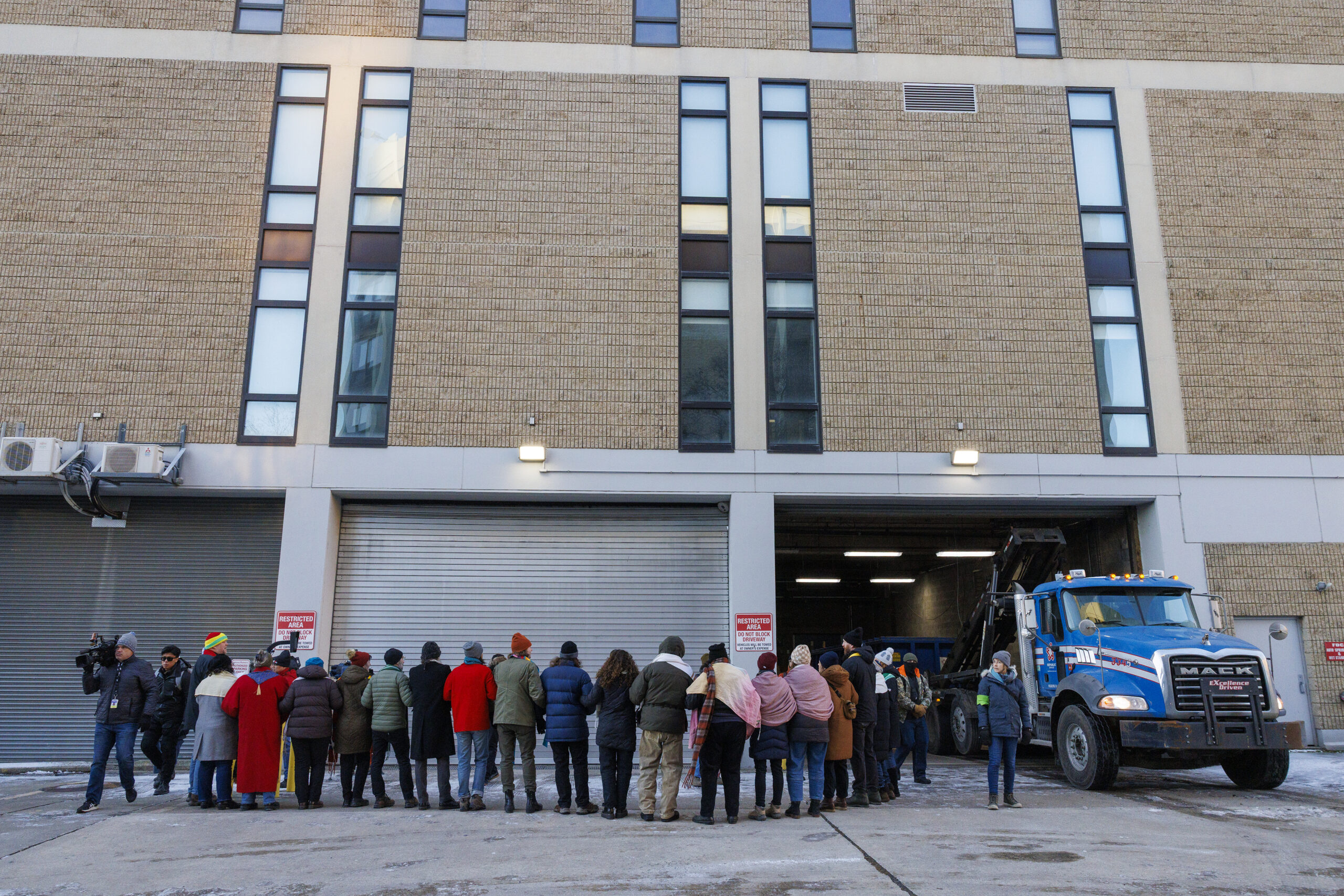
    Protestors block ICE parking garage

    Protestors are blocking the parking garage at ICE headquarters in Center City Philadelphia.

    A group of about 30 immigration advocates, including local clergy, kicked off the frigid morning shortly before 8 a.m. with song in front of ICE headquarters.

    They carried signs that read “Who would jesus deport?” and approximately at 7:55 a.m. the group locked arms calmly shouting “ICE block” as a white sedan tried to make its way out of a garage.

    The gate to the garage closed back down almost immediately as the car pulled back in and the group continued in song.

    Ximena Conde


    // Timestamp 01/20/26 8:02am

    Protestors target ICE agents in Philly

    Organizers with No ICE Philly say they’ll form a human blockade to stop ICE vehicles from departing the agency’s Center City headquarters beginning at 8 a.m. Tuesday.

    They pledge to stay there, singing and chanting, until they are forcibly removed or arrested or both, in what they say is an effort to stop ICE from “leaving the facility to terrorize our neighbors.”

    The ICE office is located at 8th and Cherry Streets, just southwest of the former Roundhouse police building.

    Jeff Gammage


    // Timestamp 01/20/26 8:00am

    This isn’t the first anti-ICE protest in Philly

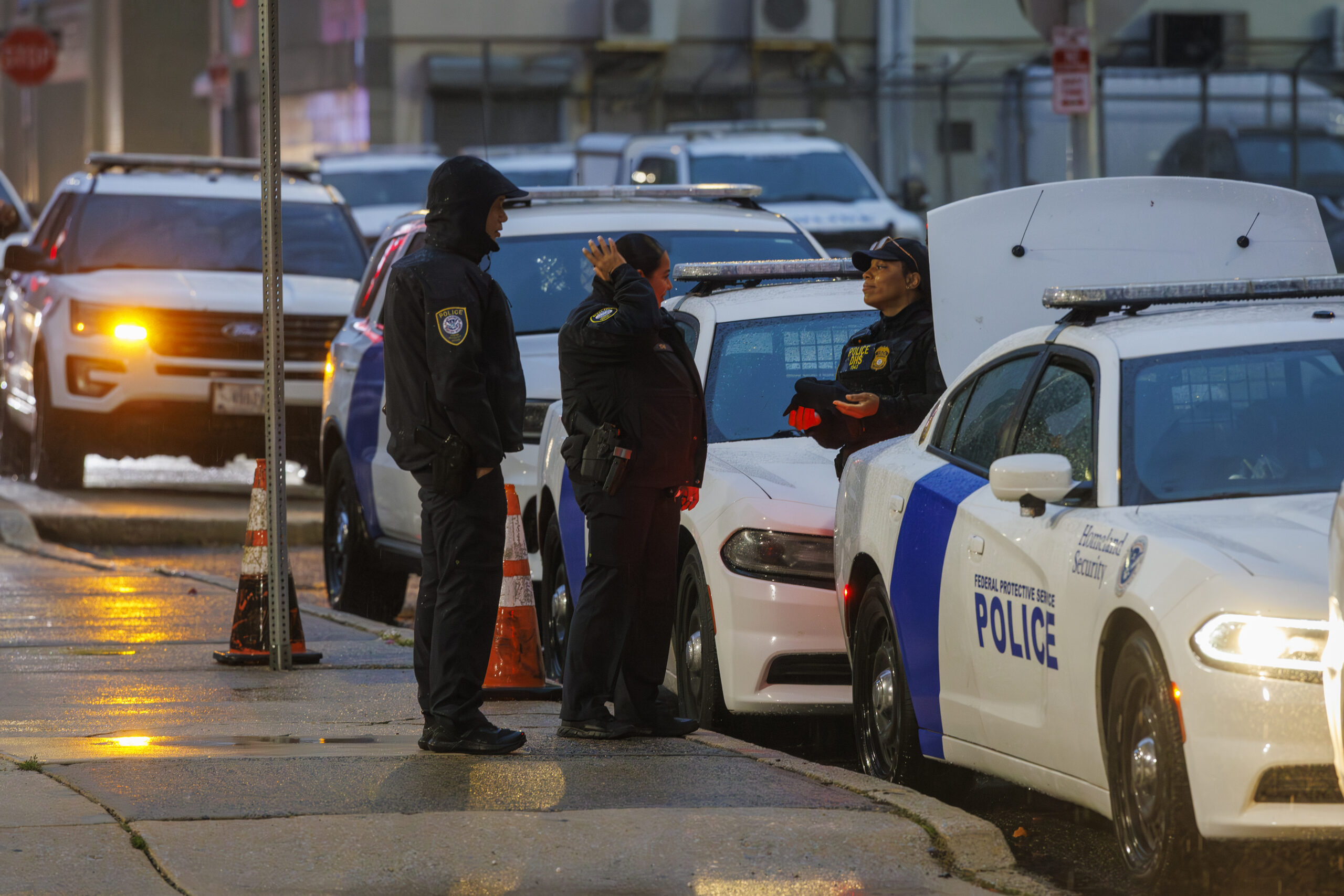
    Homeland Security officers with their cars along Cherry Street outside ICE’s Center City office in October.

    In October, a No ICE Philly protest outside the agency headquarters erupted into physical confrontations with police, with several people knocked to the ground and four taken into custody.

    A series of push-and-shove skirmishes broke out after about 35 protesters gathered for a Halloween Eve demonstration where they attempted to stop Immigration and Customs Enforcement vehicles from leaving the facility.

    When an organizer shouted, “ICE Block!” about a dozen people poured onto Cherry Street to try to block the road. A series of scrums grew increasingly intense, with police shoving protesters back and in some cases to the ground.

    The Department of Homeland Security, ICE, and Philadelphia police presence was substantial, with more than 30 officers outside the immigration agency’s big metal garage doors. Philadelphia police said four demonstrators were arrested and later released after being given citations for obstruction of highway, a violation that typically results in a fine.

    That protest followed a September demonstration in which members of No ICE Philly acted as symbolic “building inspectors” who “condemned” the ICE facility. On the building they hung signs, bordered with yellow-and-black warning tape, that said, “ICE Raids Violate Philly Values.”

    And earlier this month, hundreds took to the streets in Philadelphia to protest after an ICE agent shot and killed Renee Nicole Good, a U.S. citizen and mother of three.

    Jeff Gammage


    Protesters want Sheriff Rochelle Bilal to ban ICE agents from the courthouse in Center City.

    No ICE Philly has been a leader in protests outside the Criminal Justice Center in Center City, where it and other groups have demanded that Sheriff Rochelle Bilal ban immigration agents from the building.

    The ICE courthouse activity has been hugely controversial, with demonstrators calling on city officials to act to protect immigrants.

    Activists charge that the sheriff has allowed ICE to turn the property into a “hunting ground,” with at least 114 immigrants trailed from the courthouse by agents and arrested on the sidewalk.

    On Wednesday the judicial district that oversees the Philadelphia court system said that authority for managing ICE’s presence rested with the sheriff, and that decisions around that were her “sole responsibility.”

    That followed a news conference where the sheriff joined local elected and community leaders who suggested that court officials or legislators needed to address the turmoil, calling for meetings with court leaders to discuss how to set guardrails on ICE.

    Many people who go to the courthouse are not criminal defendants ― they are witnesses, victims, family members, and others in diversionary programs. But they have been targeted and arrested by ICE, immigration attorneys and government officials say, causing witnesses and victims to stay away from court and damaging the administration of justice in Philadelphia.

    Jeff Gammage

    Protesters want ICE agents banned from Philly courthouse

    // Timestamp 01/20/26 7:50am

  • Sharif Street could become Pa.’s first Muslim member of Congress. But don’t make assumptions about his politics.

    Sharif Street could become Pa.’s first Muslim member of Congress. But don’t make assumptions about his politics.

    When State Sen. Sharif Tahir Street converted to Islam 30 years ago, he already had a Muslim name.

    His father, John F. Street, who would go on to become Philadelphia’s mayor, gave his son a Muslim name when he was born in 1974 despite raising him in the Seventh-day Adventist Church, an evangelical Christian sect in which members of the Street family hold leadership roles to this day.

    As the senator tells it, his father initially considered adopting the name Sharif himself — not because he was considering converting to Islam but because he wanted to embrace the movement of Black Americans reclaiming pre-slavery identities.

    Instead, the elder Street, who had already built a reputation as a rabble-rousing activist, kept his name and dubbed his son Sharif, which in Arabic means noble or exalted one.

    The story would be surprising if it weren’t from the idiosyncratic Street family, which has played a unique outsider-turned-insider role in Philly politics for decades. The late State Sen. Milton Street was the senator’s uncle, and Common Pleas Court Judge Sierra Thomas Street is his ex-wife.

    This year, with Sharif Street a frontrunner in the crowded Democratic primary to replace retiring U.S. Rep. Dwight Evans, the family could make more history: If elected, Sharif Street would become the first Muslim member of Congress from Pennsylvania.

    A Street win would mark another milestone in political representation for Philadelphia’s large Muslim community, an influential constituency that already includes numerous elected officials and power players.

    But in characteristic Street fashion, that potential comes with a twist. Street has relatively moderate views on the conflict in Gaza and would likely stand out from Muslim colleagues in Congress like U.S. Reps. Ilhan Omar (D., Minn.) and Rashida Tlaib (D. Mich.), progressives who regularly denounce Israeli aggression.

    To be sure, Sharif Street, 51, is highly critical of Israeli Prime Minister Benjamin Netanyahu and the war in Gaza. But he is also quick to defend Israel’s right to exist as a Jewish state, favors the two-state solution, and counts many prominent Philadelphia-area Jews among his friends and political supporters.

    “Guess what? Benjamin Netanyahu is not the only leader of a major country in the world that’s committed war crimes, because Donald Trump has done the same thing,” Street said last week at a Muslim League of Voters event. ”But none of us would talk about getting rid of the United States of America as a country.”

    For Muslim voters who view the Middle East crisis as a top political concern, this year’s 3rd Congressional District race sets up a choice between one of their own and a candidate whose politics may more closely align with their views on Gaza: State Rep. Chris Rabb, a progressive who has been endorsed to succeed Evans by the national Muslims United PAC.

    “F— AIPAC,” Rabb said at a recent forum, referring to the American Israeli Public Affairs Committee, which has spent large sums and wielded aggressive tactics to unseat lawmakers it views as antagonistic to Israel. “They are destroying candidates’ lives because they don’t like that we’re standing up to them, that we are actively and consistently acknowledging that there is a genocide in Gaza.”

    Rabb, who is not religious and said he respects all faiths, is hoping that Muslim voters will embrace his stance on the issues.

    “Making history is not the same as being on the right side of history,” Rabb said in a statement.

    ‘Embrace all of the texts’

    Street said his Adventist upbringing immersed him in an Old Testament-rooted Christianity that led to a growing curiosity about all the Abrahamic faiths. As he got older and read more, he realized that he didn’t view Judaism, Christianity, and Islam “as separately as other people do.”

    “I do believe that the Abrahamic religions were all correct. In no way were they all supposed to be separate religions,” he said. “Islam allowed me to embrace all of the texts, which I had already decided to do.”

    Before converting, Street said he was embraced by the Muslim community in Atlanta when he was a student at Morehouse College. He officially converted after returning to Philly to earn his law degree at the University of Pennsylvania.

    Street’s Shahada, the creed Muslims take when joining the faith, was administered by Imam Shamsud-din Ali, his father’s friend. (Years later, Ali was one the elder Street’s associates being targeted by federal investigators when an FBI listening device was discovered in the mayor’s office in 2003. The episode created a firestorm around John Street’s ultimately successful reelection campaign that year, and Ali was later convicted on fraud and racketeering charges.)

    For many Muslim converts, the religion’s dietary strictures, such as abstaining from pork and eating Halal food, take some getting used to, Sharif Street said. That wasn’t a problem for him.

    “Islam has a lot of rules — unless you were Seventh-day Adventist,” he said, referring to the denomination discouraging followers from eating pork, shellfish, and numerous other foods.

    Street said his faith has guided him as an individual and public servant.

    “Islam, for me, focuses on my personal responsibility,” he said, and “the idea that man’s relationship with God is and always was.”

    His views on the unity of the Abrahamic religions also guide his perspective on the Middle East, he said.

    “I recognize that there won’t be peace for the state of Israel without peace for the Palestinian people, but there won’t be peace for the Palestinian people unless there’s peace for the state of Israel at some point,” he said.

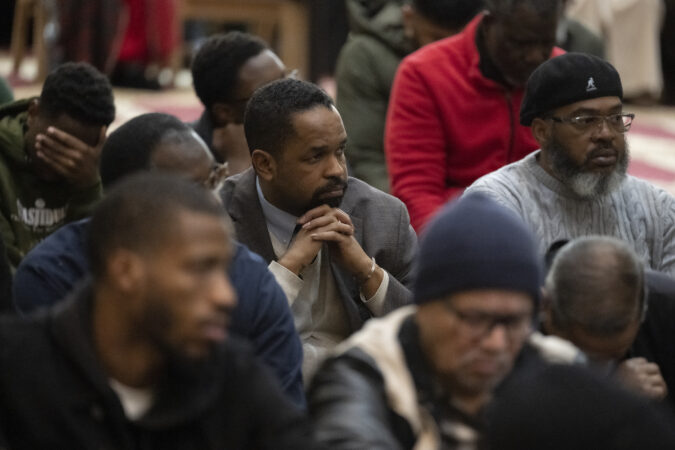
    Sharif Street participates in Friday prayer at Masjidullah mosque recently.

    Like elected officials of other religions, Street’s politics do not perfectly align with the teachers of Muslim leaders.

    On a recent Friday, Street attended Jumu’ah, the weekly afternoon prayer service, at Masjidullah in Northwest Philadelphia. A sign at the entrance reminded Muslims that abortion and homosexuality are against Islam’s teachings.

    “Almost every one of Philadelphia’s Muslim political leaders … are all pro-civil rights, including LGBTQ [rights] and pro-choice,” he said. The sign, he said, represented “some members of the faith leadership who are reminding us … that is not the stance of the official religious community.”

    For Street, that type of dissidence hits close to home.

    His father, he said, became Baptist after being “kicked out” of the Seventh-day Adventist Church for officiating a same-sex marriage in 2007 between Micah Mahjoubian, a staffer for Sharif Street, and his husband, Ryan Bunch.

    The Seventh-day Adventist Church in North Philadelphia did not respond to a request for comment.

    ’One of the most Muslim urban spaces’

    Ryan Boyer, who heads the Philadelphia Building and Construction Trades Council and is Muslim, likes to say he’s proud that members of his faith are so integrated into local politics that their religious identities are often overlooked.

    “We’re a part of the fabric,” said Boyer, whose politically powerful coalition of unions has endorsed Street. ”To me, it’s not that big of a deal. We’re here.”

    For Boyer, that means Muslim candidates like Street are judged based on their merits, not their identities.

    “He’s Muslim,” Boyer said of Street. “Well, is he smart? Does he present the requisite skills and abilities to do the job? … The answer is yes.”

    Other Muslim leaders in the city include: Sheriff Rochelle Bilal; City Councilmembers Curtis Jones Jr. and Nina Ahmad; former Police Commissioner Sylvester Johnson; and City Commissioner Omar Sabir, who is Boyer’s brother.

    Philly has also sent several Muslim lawmakers to Harrisburg, including current State Reps. Keith Harris, Jason Dawkins, and Tarik Khan.

    Although the community is less well-known nationally than those in Michigan or Minnesota, Philadelphia has one of the nation’s oldest and largest Muslim populations, with about 250,000 faithful in a city of 1.6 million, according to Ahmet Tekelioglu, executive director of the Council on American-Islamic Relations’ Philadelphia branch.

    By some estimates, Philly’s Muslim community has the highest percentage of U.S.-born followers of any major American city, thanks to the conversion of thousands of Black Philadelphians in recent decades. While many came to the faith through the Nation of Islam movement, a vast majority of Black Muslims in Philadelphia now practice mainstream Sunni Islam, Tekelioglu said.

    Add in thriving immigrant communities from West Africa and the Middle East, and Philadelphia is “one of the most Muslim urban spaces” in the country, he said.

    “Within a few minutes of walking in the city, you come across a visibly Muslim individual,” said Tekelioglu, whose nonprofit group does not make political endorsements. “Halal cheesesteak, ‘the Philly beard,’ and such — these also have overlap with the Muslim community and [the city’s] popular culture.”

    The Middle East and the 3rd Congressional District

    As a lawmaker, Street has been instrumental in forcing the Pennsylvania Interscholastic Athletic Association to allow Muslim girls competing in sports to wear hijabs and in leading the School District of Philadelphia to recognize Eid al-Adha and Eid al-Fitr as official holidays.

    That record is part of why he bristles at the Muslims United PAC’s endorsement of Rabb.

    “We cannot allow other people to hijack our community and hijack our issue because it’s Black people, it’s Muslims dying in Philadelphia right now, and some of these candidates don’t have anything to say about that,” Street said at the Muslim League of Voters event. “Some of them even got some fugazi Muslim organizations to endorse them.”

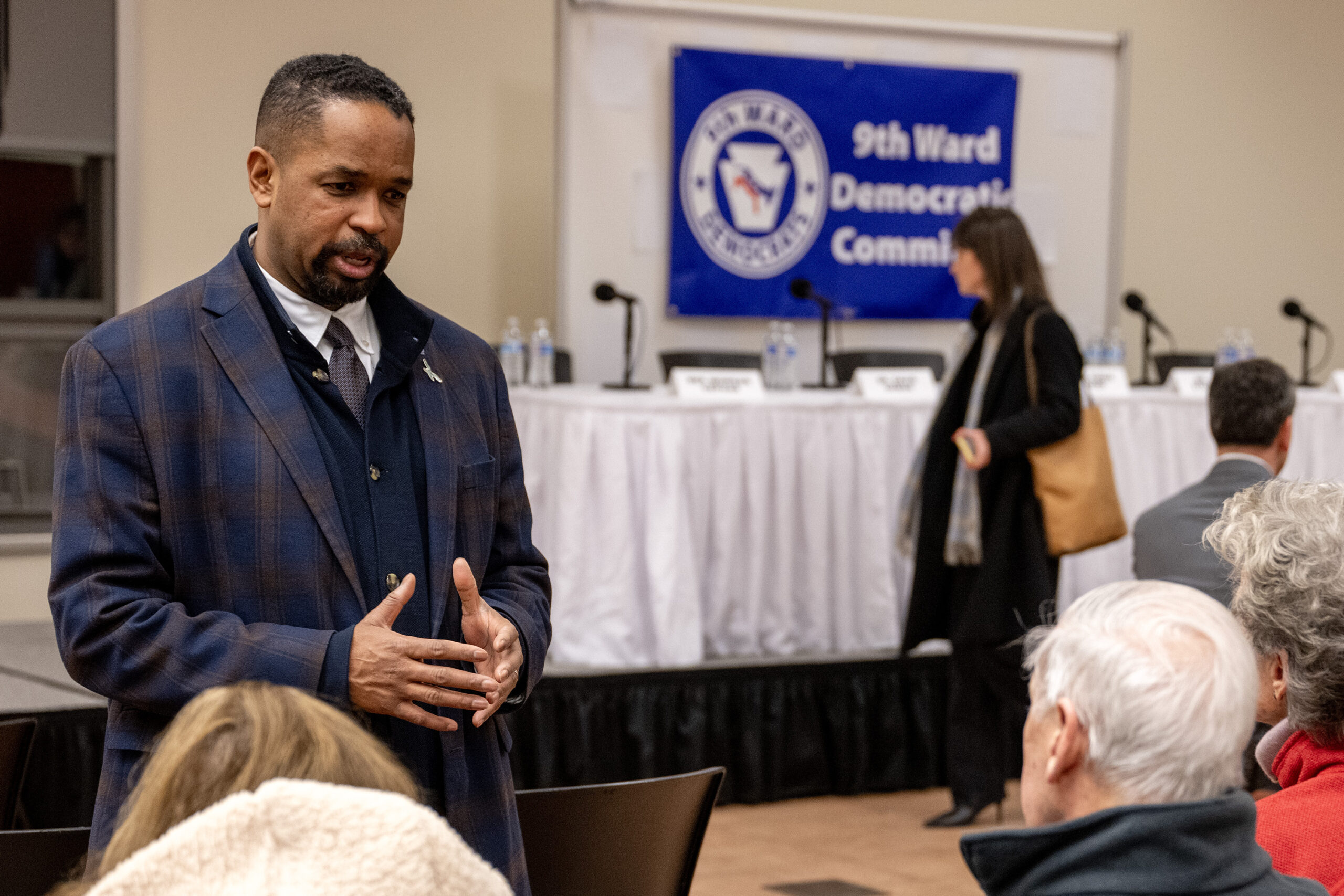
    State Sen. Sharif Street appearing at a forum hosted by the 9th Ward Democratic Committee in December.

    At another recent forum, the 3rd District Democratic candidates were asked whether they support legislation stopping U.S. weapons shipments to Israel after more than two years of conflict that has seen an estimated 70,000 Palestinians die in Gaza.

    Street, who traveled to Israel and Palestine in 2017, said the one-minute response time wasn’t enough to unpack the complicated issues, and none of the other candidates gave straightforward answers — except Rabb, who said he supported the proposal.

    “There are no two sides in this when we see the devastation,” Rabb said.

    In an interview, Street said his comparatively moderate views on the crisis and his relationships with Jewish supporters will allow him to “play a really constructive role” in Congress.

    “We need more people who can talk to both the Jewish and Muslim communities,” he said. “We need people who can have a nuanced conversation and do it with some real credibility.”

    Tekelioglu said he has observed Muslim voters moving away from “identity politics” and toward “accountability-based political stance.” That evolution has accelerated during Israel’s war in Gaza following the Hamas attacks on Oct. 7, 2023, he said.

    “Oct. 7 and everything that’s going on has made everything a bit more clear,” he said. “This doesn’t make it such that the Palestine issue is the main dealbreaker, but overall I see a trend of moving away from the identity politics.”

    The real question, he said, is, “Are they going to represent our interests?”

    Staff writer Anna Orso contributed this article.

  • Mikie Sherrill announces she’ll steer resources to honor MLK in Camden in visit ahead of inauguration

    Mikie Sherrill announces she’ll steer resources to honor MLK in Camden in visit ahead of inauguration

    A day before taking the oath as New Jersey governor, Mikie Sherrill said in a visit to Camden on Monday that she will steer resources to the city to commemorate the Rev. Dr. Martin Luther King Jr.

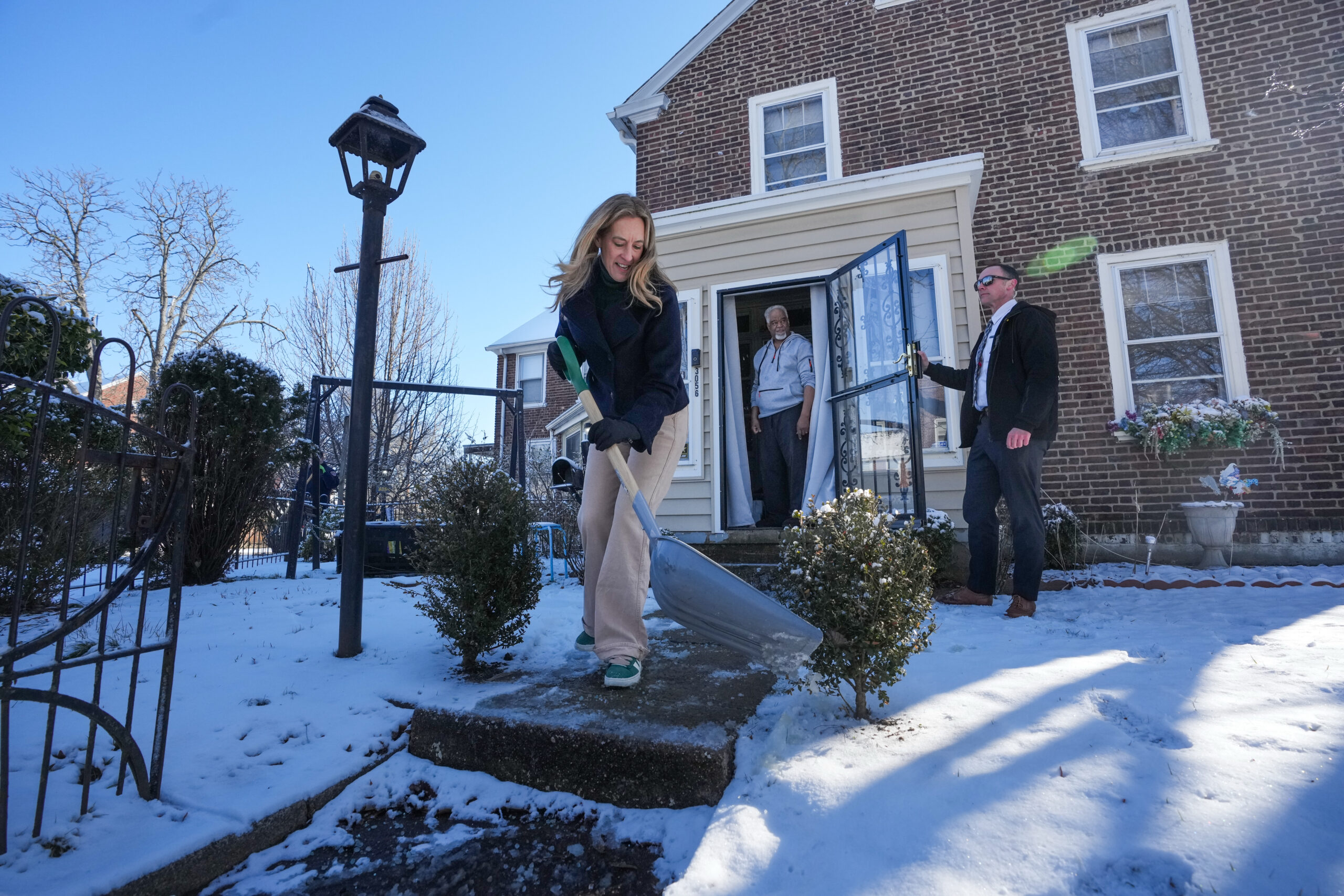
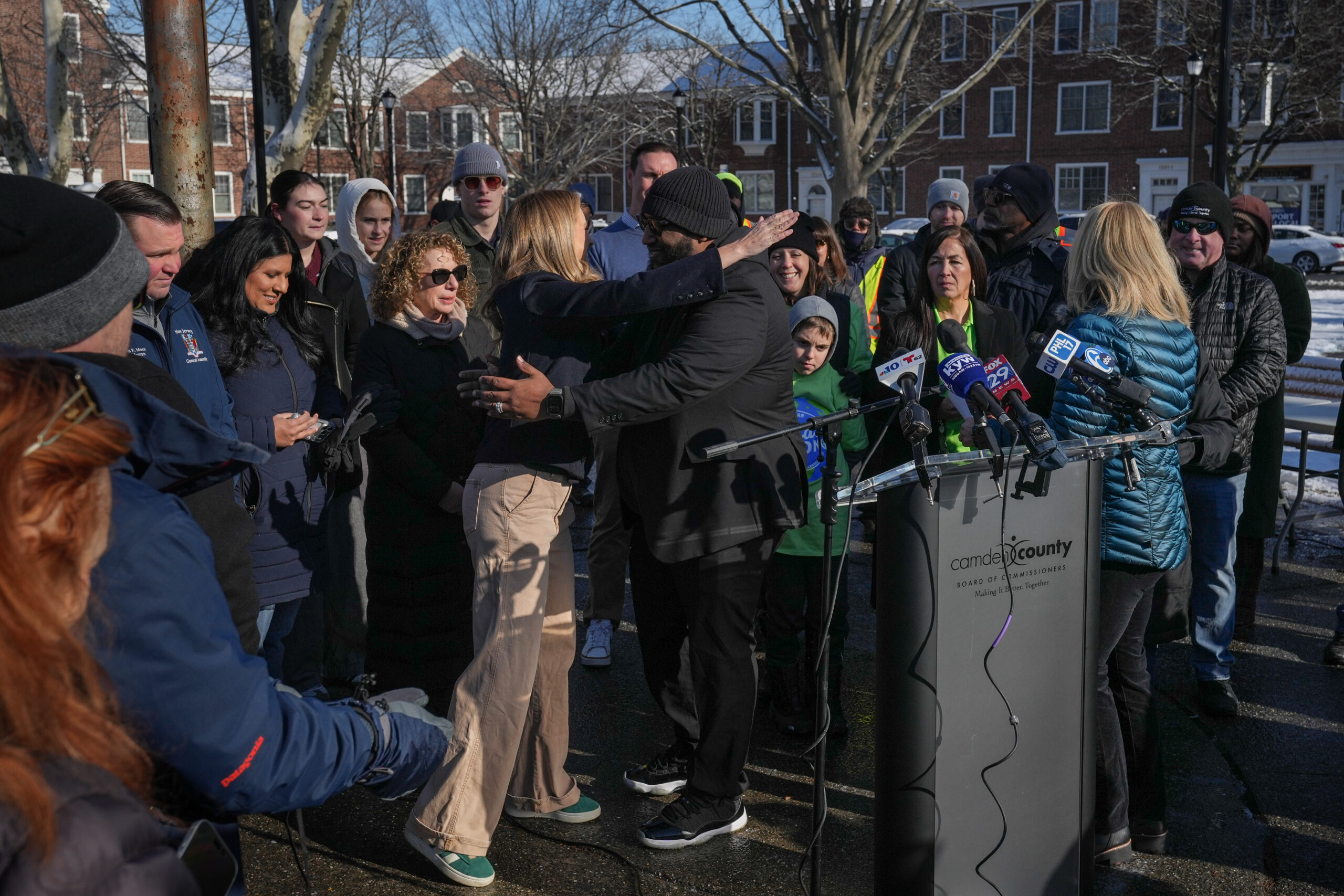
    Sherrill visited Camden on Monday morning to observe Martin Luther King Jr. Day by joining a community effort to shovel snow. In a short speech, she emphasized King’s historical connection to Camden and an incident he’s said to have cited as sparking his interest in becoming a civil rights leader.

    “I’m going to work with the city of Camden to make sure we can better bring this history to light, that we bring resources to commemorate the real birth of this movement here in Camden, New Jersey,” she said.

    Sherrill’s team told local officials last week that she would be announcing plans to commission a statue of King for Camden, but they backtracked minutes before her announcement to instead make a broader promise.

    New Jersey Gov.-elect Mikie Sherrill shovels snow for a resident, as volunteers shovel snow at Fairview Village on Martin Luther King Jr. Day during a day of service Monday in Camden.

    Her transition team later told The Inquirer that Sherrill “is excited about the chance to elevate the history of Martin Luther King Jr. in Camden, and will work with the community on different possibilities to do this, including with a statue.”

    Sherrill’s decision to come to Camden on MLK Day — the eve of her swearing-in and also her 54th birthday — was significant to local officials. It showed that the diverse South Jersey city is at the top of her mind after it resoundingly voted for her in November and improved turnout compared to the last gubernatorial election.

    Camden Mayor Victor Carstarphen said in an interview on Saturday — anticipating a statue announcement — that he would want King to be honored in a spot in Farnham Park that has sat empty since a statue of Christopher Columbus was removed in June 2020 amid a nationwide reckoning on racism after former Minneapolis police officer Derek Chauvin murdered George Floyd.

    Camden released a statement at the time saying the statue’s removal was “long overdue.”

    Carstarphen said the city has been wanting to replace that statue with one that’s more fitting for the community at some point. He said “it only makes just great sense” for King’s honor to be put there.

    A headless statue of Christopher Columbus that was dismantled and then knocked off a trailer in Farnham Park in Camden on June 11, 2020.

    State Sen. Nilsa Cruz-Perez, a Democrat who represents Camden, said in an interview on Friday that residents were surprised that Sherrill chose to come back to Camden so soon after being elected.

    “It’s a good message for the South Jersey region that she is going to be available for South Jersey, that she’s someone who’s going to pay attention,” Cruz-Perez said.

    City Council member Nohemi Soria-Pérez, who works as the chief of staff for Cruz-Pérez and two local assembly members, said Sherrill’s attention to Camden, and the possibility of a King statue, is “just such a positive step forward into what we see in the future.”

    The (debated) significance of MLK to Camden

    Sherrill said in her speech that she loves learning “so many neat things about our state that otherwise you just wouldn’t realize, even places you pass by every single day.”

    “And I have to tell you, one of the coolest was hearing about Martin Luther King’s history in Camden, the fact that many scholars say he had his very first act of civil disobedience here in Camden,” she added.

    She was referencing an incident in 1950 in which King and his friends reported that they were refused service at Mary’s Cafe, a tavern in Maple Shade Township in nearby Burlington County — not Camden — while attending Crozer Theological Seminary in Pennsylvania’s Delaware County.

    New Jersey Gov.-elect Mikie Sherrill (center left) hugs pastor Pastor Daniel Brown from Freedom Worship Assembly Church, as volunteers gather to shovel snow at Fairview Village on Martin Luther KingJr. Day during a day of service on Monday in Camden.

    King often recounted the incident as an example that sparked his interest in the civil rights movement, according to the Southern Christian Leadership Conference and reported in a 1976 Inquirer obituary of the tavern owner.

    Widespread accounts of the incident indicate that the tavern owner shot his gun in the air, but Sherrill said in her speech that King had a gun “pointed at him.”

    “I didn’t realize that he lived in Camden during his years as a student at Crozer Theological Seminary from 1948 to 1951,” she also said.

    That may be because historians have argued there is no evidence King actually lived in the house, but rather stayed there during visits.

    The state denied an application to designate the house as a historical landmark in early 2020 after it commissioned an unprecedented $20,000 study by Stockton University, which made the case that the home wasn’t King’s residence.

    The belief that King lived in the home stems in part from the building’s then-owner and his daughter saying the civil rights leader lived there “on and off for two years.”

    Regardless of the disputed details, King is widely understood to have a connection to Camden.

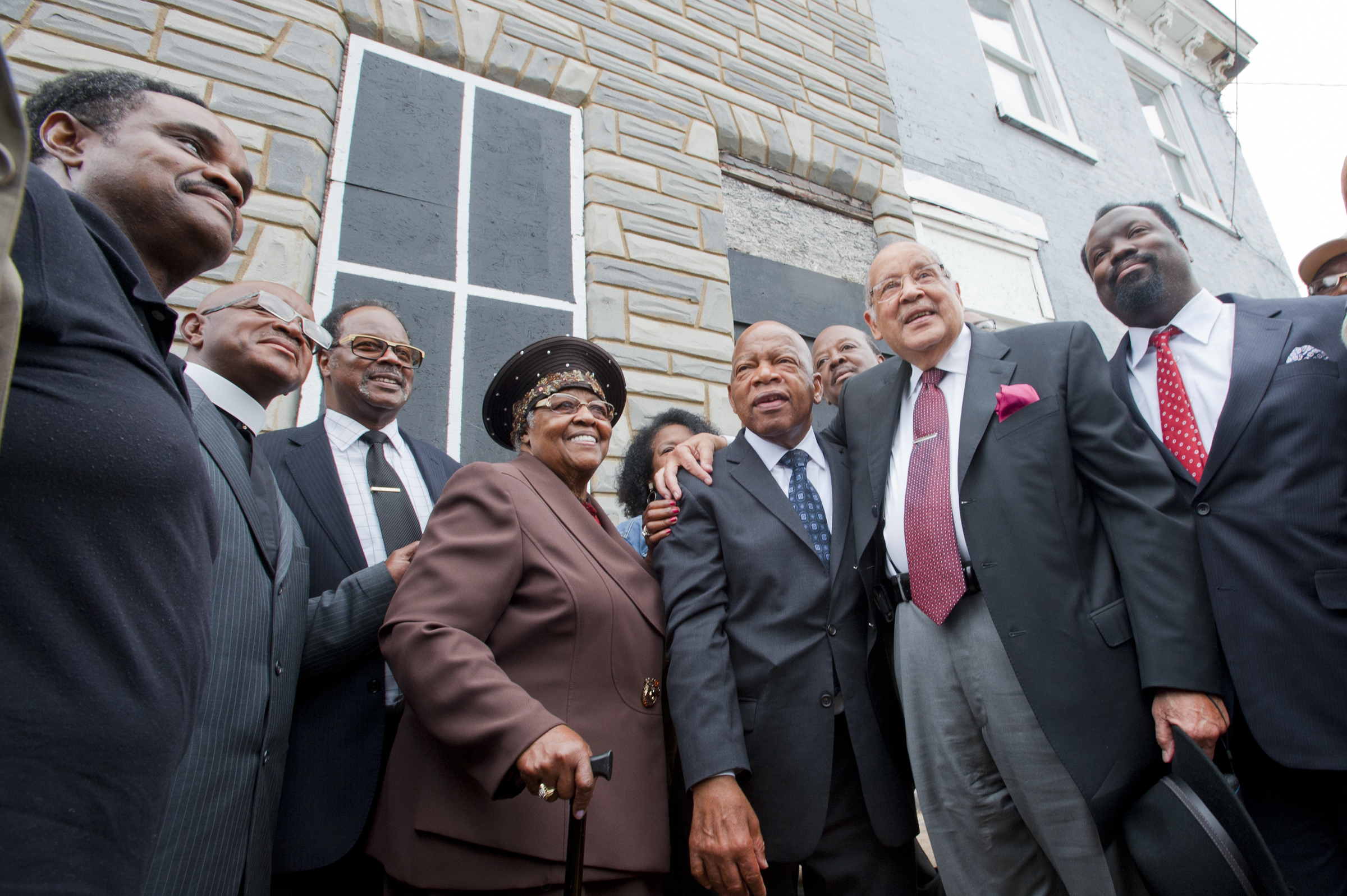
    Civil rights icon and U. S. Rep. John Lewis of Georgia (center) is surrounded by admirers during his visit to the Walnut Street property in 2016.

    David Garrow, a historian and the author of the King biography Bearing the Cross, has previously said he believes King spent time in Camden and likely occasionally stayed at the Walnut Street house where he visited his friend.

    The state-commissioned study noted that King “almost certainly” stayed there the night of the Mary’s Place incident described by Sherrill.

    John Lewis, a civil rights leader and member of Congress who died in 2020, visited the building in 2016 and called it a “piece of historic real estate that must be saved for generations yet unborn.”

    Local advocates have sought to rehabilitate the Walnut Street home — which sustained a fire in 2023. A 2017 grant of $229,000 was earmarked to renovate the building — which sat vacant and in disrepair even before the fire — but the money was diverted to the city’s fire department in 2018 without explanation.

    Voter turnout in Camden increased 63% from the last gubernatorial election in 2021 to 2025, and the city voted for Sherrill with 92% of the vote.

    Sherrill and running mate Dale Caldwell visited the city repeatedly in the weeks leading up to Election Day, and Caldwell was in Camden on Saturday. The city’s population is nearly 38% Black and more than 54% Latino, and Sherrill’s campaign had outreach teams specifically catered toward both groups.

    Carstarphen said a statue of King would be “a daily reminder” to Camden’s residents that “our city matters.”

    “It sends a powerful message to us that we’re not an afterthought,” he said ahead of Sherrill’s visit.

  • Trump tied his stance on Greenland to not getting the Nobel Peace Prize, European officials said

    Trump tied his stance on Greenland to not getting the Nobel Peace Prize, European officials said

    U.S. President Donald Trump linked his aggressive stance on Greenland to last year’s decision not to award him the Nobel Peace Prize, telling Norway’s prime minister that he no longer felt “an obligation to think purely of Peace,” in a text message released on Monday.

    Trump’s message to Jonas Gahr Støre appears to ratchet up a standoff between Washington and its closest allies over his threats to take over Greenland, a self-governing territory of NATO member Denmark. On Saturday, Trump announced a 10% import tax starting in February on goods from eight nations that have rallied around Denmark and Greenland, including Norway.

    Those countries issued a forceful rebuke.

    The White House has not ruled taking control of the strategic Arctic island by force. Asked whether Trump could invade Greenland, Danish Foreign Minister Lars Løkke Rasmussen said on Monday that “you can’t leave anything out until the president himself has decided to leave anything out.”

    Rasmussen, speaking to reporters following a meeting with his British counterpart Yvette Cooper in London, encouraged Washington to instead discuss solutions.

    British Prime Minister Keir Starmer also sought to de-escalate tensions on Monday. “I think this can be resolved and should be resolved through calm discussion,” he said, adding that he did not believe military action would occur.

    In a sign of how tensions have increased in recent days, thousands of Greenlanders marched over the weekend in protest of any effort to take over their island. Greenland Prime Minister Jens-Frederik Nielsen said in a Facebook post Monday that the tariff threats would not change their stance.

    “We will not be pressured,” he wrote.

    Meanwhile, Naaja Nathanielsen, Greenland’s minister for business, minerals, energy, justice and equality, told The Associated Press that she was moved by the quick response of allies to the tariff threat and said it showed that countries realize “this is about more than Greenland.”

    “I think a lot of countries are afraid that if they let Greenland go, what would be next?”

    Trump cites Nobel as escalation in text to Norwegian leader

    Trump’s Sunday message to Gahr Støre, released by the Norwegian government, read in part: “Considering your Country decided not to give me the Nobel Peace Prize for having stopped 8 Wars PLUS, I no longer feel an obligation to think purely of Peace, although it will always be predominant, but can now think about what is good and proper for the United States of America.”

    It concluded: “The World is not secure unless we have Complete and Total Control of Greenland.”

    The Norwegian leader said Trump’s message was a reply to an earlier missive sent on behalf of himself and Finnish President Alexander Stubb, in which they conveyed their opposition to the tariff announcement, pointed to a need to de-escalate, and proposed a telephone conversation among the three leaders.

    “Norway’s position on Greenland is clear. Greenland is a part of the Kingdom of Denmark, and Norway fully supports the Kingdom of Denmark on this matter,” the Norwegian leader said in a statement. “As regards the Nobel Peace Prize, I have clearly explained, including to President Trump what is well known, the prize is awarded by an independent Nobel Committee and not the Norwegian Government.”

    The Norwegian Nobel Committee is an independent body whose five members are appointed by the Norwegian Parliament.

    U.S. Treasury Secretary Scott Bessent defended the president’s approach in Greenland during a brief Q&A with reporters in Davos, Switzerland, which is hosting the World Economic Forum meeting this week.

    “I think it’s a complete canard that the president would be doing this because of the Nobel,” Bessent said, immediately after saying he did not “know anything about the president’s letter to Norway.”

    Bessent insisted Trump “is looking at Greenland as a strategic asset for the United States,” adding that “we are not going to outsource our hemispheric security to anyone else.”

    Trump has openly coveted the peace prize, which the committee awarded to Venezuelan opposition leader María Corina Machado last year. Last week, Machado presented her Nobel medal to Trump, who said he planned to keep it, though the committee said the prize can’t be revoked, transferred or shared with others.

    Starmer says a trade war is in no one’s interest

    In his latest threat of tariffs, Trump indicated they would be retaliation for last week’s deployment of symbolic numbers of troops from the European countries to Greenland — though he also suggested that he was using the tariffs as leverage to negotiate with Denmark.

    European governments said that the troops traveled to the island to assess Arctic security, part of a response to Trump’s own concerns about interference from Russia and China.

    Starmer on Monday called Trump’s threat of tariffs “completely wrong” and said that a trade war is in no one’s interest.

    He added that “being pragmatic does not mean being passive and partnership does not mean abandoning principles.”

    Six of the eight countries targeted are part of the 27-member European Union, which operates as a single economic zone in terms of trade. European Council President Antonio Costa said Sunday that the bloc’s leaders expressed “readiness to defend ourselves against any form of coercion.” He announced a summit for Thursday evening.

    Starmer indicated that Britain, which is not part of the EU, is not planning to consider retaliatory tariffs.

    “My focus is on making sure we don’t get to that stage,” he said.

    Denmark’s defense minister and Greenland’s foreign minister are expected to meet NATO Secretary-General Mark Rutte in Brussels on Monday, a meeting that was planned before the latest escalation.

  • Chris Rabb is trying to be the left’s standard-bearer as he runs for Congress. Will progressives rally around him?

    Chris Rabb is trying to be the left’s standard-bearer as he runs for Congress. Will progressives rally around him?

    In the most-watched race for Congress in Philadelphia in more than a decade, State Rep. Chris Rabb has cast himself as the unabashed anti-establishment leftist. He’s refusing donations from corporations, calls the war in Gaza a genocide, and wants to abolish U.S. Immigration and Customs Enforcement.

    But despite announcing his campaign more than six months ago, he had yet to amass support from much of the city’s progressive flank, leading observers to wonder if he would be able to tap into the movement’s network of donors and volunteers.

    It appears they’re coming around.

    Rabb this week has won an endorsement from One PA, a progressive political group that’s aligned with labor and most of the city’s left-leaning elected officials. That comes after the environmental justice group Sunrise Movement said it, too, would back Rabb.

    “This is a moment when democracy is at stake,” said Steve Paul, One PA’s executive director. “If there was any moment for the style of leadership that Chris [Rabb] brings to the table, it’s this moment.”

    Rabb said he’s “energized” by the endorsement and what it means for the campaign.

    “Our movement is growing every single day,” he said.

    The questions now are whether some of the city’s most prominent progressive elected officials will lend their endorsements to Rabb, and if deep-pocketed national organizations will spend money to back him.

    For example, Justice Democrats, a progressive political action committee, said it’s “very closely looking at this district.” And the Working Families Party, the labor-aligned third party that supports progressives across the nation, has endorsed candidates in four other congressional races with competitive primaries — but not yet in Philadelphia’s. The group previously spent millions to boost candidates in the region.

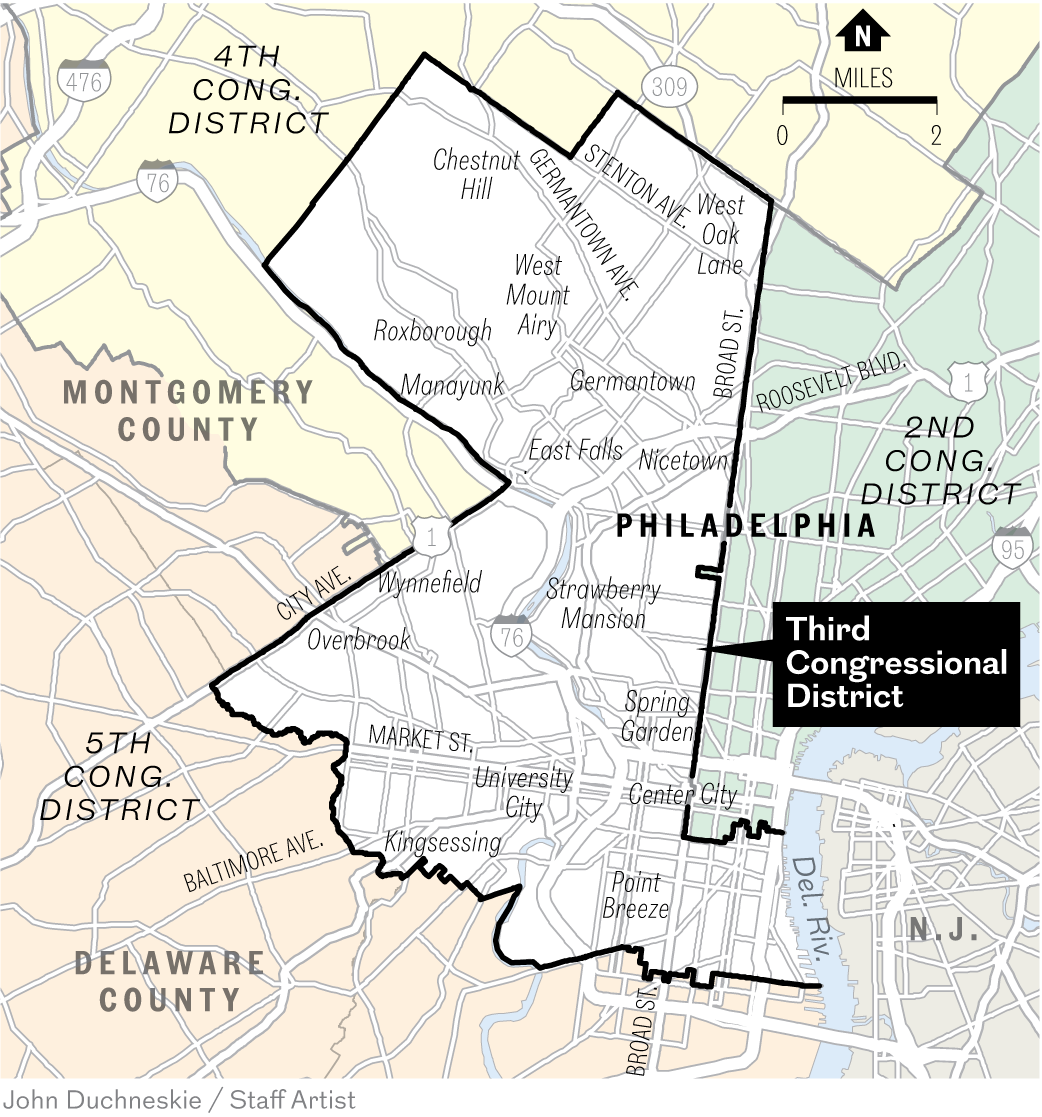
    Rabb, who hails from the voter-rich Northwest Philadelphia, is one of several likely front-runners seeking the Democratic nomination to represent the 3rd Congressional District, which encompasses about half of Philadelphia. U.S. Rep. Dwight Evans is retiring after holding the seat since 2016.

    Progressives and democratic socialists — energized by Mayor Zohran Mamdani’s win last year in New York City — see a major opportunity to install one of their own in the district, which is the most Democratic in the nation.

    Map of Pennsylvania’s 3rd Congressional District.

    The primary election — the marquee race in deep-blue Philadelphia — isn’t until May. But some on the left say the movement should have already coalesced around Rabb.

    “We will probably regret it in the end, because this is a seat we should win,” said one leader of a progressive organization in the city who requested anonymity to speak freely about the political dynamic.

    Rabb is seen as something of a lone operator with his own political apparatus. He didn’t come up through the newer progressive organizations that have run their own candidates for office in the city. Rather, he won a seat in the state House for the first time a decade ago when he toppled an establishment-backed Democrat.

    State Rep. Chris Rabb at a forum hosted by the 9th Ward Democratic Committee on Dec. 4, 2025. He is a Democratic candidate running to represent Philadelphia’s Third Congressional District.

    Some of the city’s progressive leaders say they expect to back Rabb but that they were waiting to see how the field shaped up.

    Last year, there were efforts to recruit other left-leaning candidates to run, including City Councilmember Kendra Brooks of the Working Families Party, and State Rep. Rick Krajewski, according to three sources with knowledge of the efforts who spoke on condition of anonymity to preserve relationships. Both decided against running.

    Brooks — who emerged as a face of the Working Families Party six years ago after she became the first third-party candidate to win a seat on Council in 100 years — is likely to back whomever the organization endorses. The group is still in the midst of its endorsement process.

    “We’re confident that we will land on a progressive who will fight for working people, not billionaire donors, big corporations, or special interests,” WFP spokesperson Nick Gavio said.

    Krajewski, who represents parts of West Philadelphia, has also not endorsed a candidate but he said he will. Rabb, according to Krajewski, has the qualities necessary to be a member of Congress during “a pivotal moment for our country.”

    “The question is: Do we allow the fascists and the ruling class to double down on this insanity that they’re pushing? Or do we use this opportunity to agitate and say a different world is possible?” Krajewski said. “That’s what I want from my member of Congress. Chris [Rabb] has demonstrated that he’s clear about that.”

    Pennsylvania State Rep. Rick Krajewski making statements at a news conference and rally by University of Pennsylvania graduate students. Grad students held the event to call for a strike vote against the university at corner of South 34th and Walnut Streets on Nov. 3, 2025.

    Meanwhile, other candidates in the wide-open Democratic primary have tried to pick off progressive support.

    State Sen. Sharif Street, the former chair of the state Democratic Party, is seen as the establishment’s pick for the seat. But he also has alliances with some of the city’s most progressive leaders.

    That includes a decades-long relationship with Councilmember Rue Landau, who often votes with Council’s progressive bloc and is the first openly LGBTQ person ever elected to Council. Two sources familiar with Landau’s thinking said she is strongly considering endorsing Street.

    Street has also worked closely on criminal justice reform matters with District Attorney Larry Krasner, perhaps the city’s most prominent elected progressive. He inherited some of Krasner’s political staff to manage his campaign.

    However, several other candidates in the congressional race could be in the running for backing from Krasner, who recently won his third term in office in landslide fashion. Rabb, Street, and State Rep. Morgan Cephas previously endorsed Krasner for reelection.

    State Rep. Chris Rabb (left), Helen Gym (center), and District Attorney Larry Krasner attend the election results watch party for Working Families Party candidates Kendra Brooks and Nicolas O’Rourke in North Philadelphia on Nov. 5, 2019.

    The crowded field may also mean that some elected officials choose not to get involved.

    State Rep. Tarik Khan, a Democrat and nurse practitioner who has been backed by progressive organizations, said he has relationships with several leading candidates. That includes his colleagues in Harrisburg, as well as Ala Stanford, a surgeon. She and Khan were both prominent vaccine advocates during the COVID-19 pandemic.

    “There’s a lot of good choices in this race,” Khan said. “I’m probably just going to let the process play out.”

  • In his new book, Gov. Josh Shapiro recalls an ‘offensive’ vetting process to be Kamala Harris’ running mate

    In his new book, Gov. Josh Shapiro recalls an ‘offensive’ vetting process to be Kamala Harris’ running mate

    Pennsylvania Gov. Josh Shapiro questioned whether he was being unfairly scrutinized as the only Jewish person being considered as a finalist to be Vice President Kamala Harris’ running mate — and briefly entertained his own run for the presidency — according to a copy of his upcoming book obtained by The Inquirer.

    In his memoir, Where We Keep the Light, set to debut on Jan. 27, Shapiro wrote that he underwent significant questioning by Harris’ vetting team ahead of the 2024 presidential election about his views on Israel, and his actions supporting the end of pro-Palestinian protests at the University of Pennsylvania — leading him to wonder whether the other contenders for the post had faced the same interrogation.

    Shapiro, a popular Democratic governor long rumored to have future presidential ambitions, even briefly entertained a run shortly after then-President Joe Biden unexpectedly dropped out of the race in July 2024, according to his book. The Abington Township resident is now seen as a top contender for the 2028 Democratic nomination as he seeks reelection in Pennsylvania this year.

    But before Shapiro ended up in the veepstakes for Harris’ running mate, he wrote in his book that there was a moment right after Biden dropped out of the race where he considered whether he should run for president.

    “Well, now what?” Shapiro wrote. “Maybe there would be a process the party would engage in to replace him? Did I want to be part of that?”

    He called his wife, Lori, who at the time was out of the country with their two younger kids. “I don’t think we are ready to do this,” Shapiro recalled his wife saying from a Walmart in Vancouver. “It’s not the right time for our family. And it’s not on our terms.”

    After that call, Shapiro wrote that he quickly decided he didn’t want to run and would back Harris, as Biden also endorsed her for the top of the ticket.

    Once the field cleared for Harris, Shapiro recalled seeing his face on TV as her potential running mate, before he was asked by her campaign manager to be formally vetted.

    In the days that followed, Shapiro contended with increasing national scrutiny as he emerged as a front-runner. Some pro-Palestinian protesters began calling Shapiro “Genocide Josh” online, he wrote. And top Democrats questioned whether a Jewish running mate would deter voters from supporting Harris, as Shapiro had been outspoken against some pro-Palestinian campus protests that year.

    What was unknown: Whether those same questions — and some even more extreme — were circulating within Harris’ camp, Shapiro wrote in his most detailed retelling of his experience vying for the vice presidency to date.

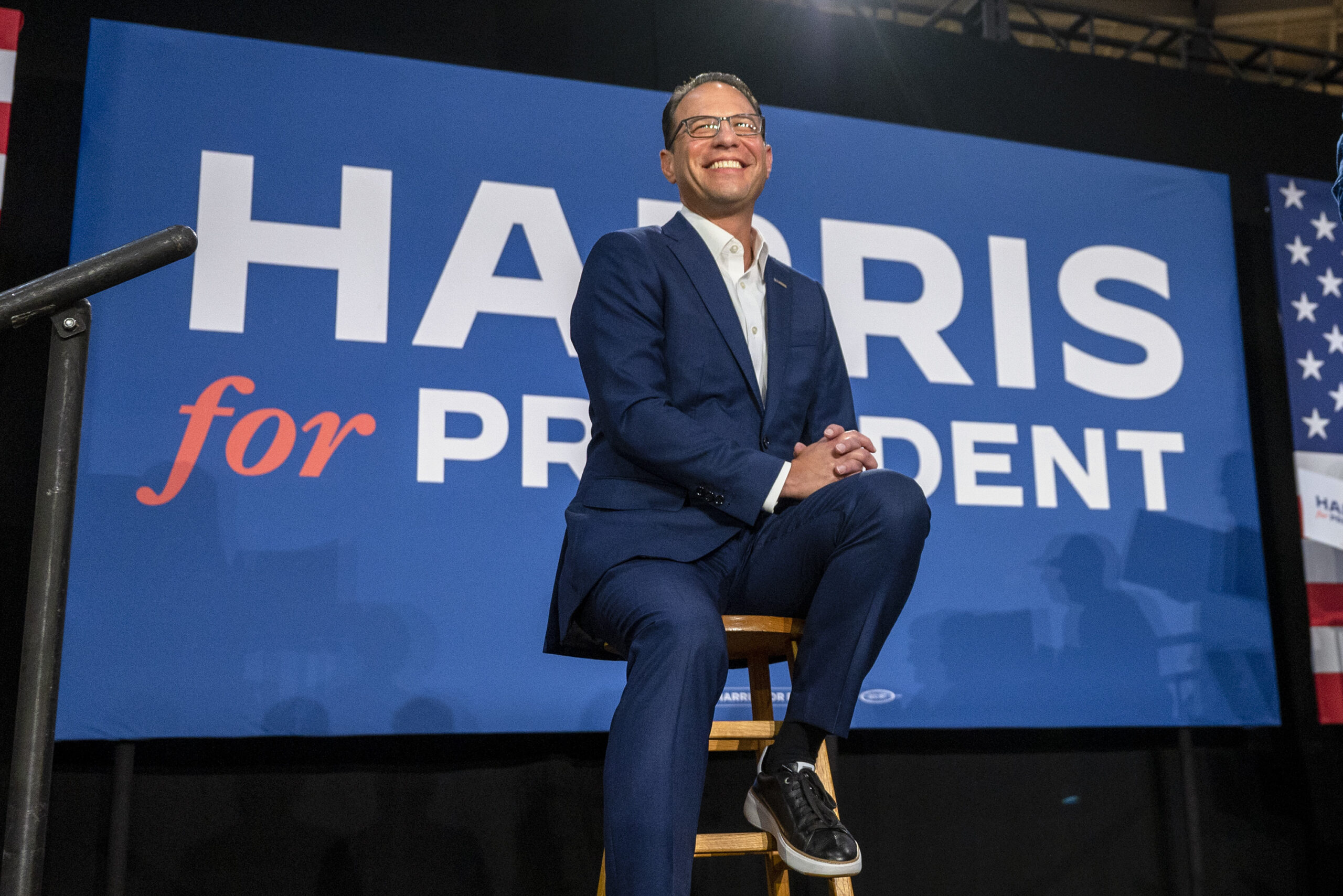
    Gov. Josh Shapiro at a rally for Vice President Kamala Harris at Wissahickon High School in Ambler on July 29, 2024.

    Just before he went to meet with Harris at the vice president’s residence in the summer of 2024, Shapiro received a call from Dana Remus, former White House counsel for Biden who was coleading the vetting process for Harris.

    “Have you ever been an agent of the Israeli government?” Remus asked, according to Shapiro’s memoir.

    “Had I been a double agent for Israel? Was she kidding?” Shapiro wrote in his 257-page book. “I told her how offensive the question was.”

    According to the memoir, Remus then asked if Shapiro had ever communicated with an undercover Israeli agent, which he shot back: “If they were undercover… how the hell would I know?”

    “Remus was just doing her job. I get it. But the fact that she asked, or was told to ask that question by someone else, said a lot about some of the people around the VP,” Shapiro wrote.

    In high school, Shapiro completed a program in Israel that included service projects on a farm, and at a fishery in a kibbutz, as well as at an Israeli army base, which he once described in his college student newspaper as “a past volunteer in the Israeli army.”

    Harris’ office could not be reached for comment Sunday evening. Remus also could not immediately be reached for comment Sunday.

    Shapiro, more broadly, recalled getting the feeling from Harris’ vetting team that she should pick Shapiro — a popular Democratic governor in a critical swing state — but that they had reservations about whether Shapiro’s views would mesh with Harris’.

    In one vetting session with U.S. Sen. Catherine Cortez Masto (D., Nev.), former Labor Secretary Marty Walsh, former associate Attorney General Tony West, and former senior Biden adviser Cedric Richmond, Shapiro wrote that he had been questioned “a lot” about Israel, including why he had been outspoken against the protests at Penn.

    “I wondered whether these questions were being posed to just me — the only Jewish guy in the running — or if everyone who had not held a federal office was being grilled about Israel in the same way,” he wrote. (Illinois Gov. JB Pritzker, who is Jewish, was also vetted to be Harris’ running mate. Harris’ husband, Doug Emhoff, is also Jewish.)

    In his book, Shapiro recalled the whirlwind two weeks as an awe-inspiring window into an opportunity — but ultimately it was one he knew he didn’t want.

    When Shapiro finally sat down with Harris in the dining room at the Naval Observatory, he said it became clear that she had a different vision for the vice presidency than what he wanted. He would work primarily with her staff and couldn’t say whether he would have access to her. In her own experience as vice president, she saw the job as mostly to make sure that you aren’t making any problems for the president, he wrote.

    Shapiro noted his own relationship with his No. 2, Lt. Gov. Austin Davis. The role in itself has few powers, but Shapiro views Davis as a governing partner and is one of few people who can walk into his office unannounced at any time, he wrote. He wanted the same relationship with Harris, he said, noting that he knew he would not be the decision-maker.

    “If we had door A and door B as options, and she was for door A and I was for door B, I just wanted to makes sure that I could make the case for door B,” Shapiro wrote.

    But Harris was “crystal clear” that that wasn’t the kind of president-vice president dynamic she envisioned, he said.

    In her own book released last year, 107 Days, Harris recalled the meeting differently. There, she wrote that Shapiro had “peppered” her with questions and “mused that he would want to be in the room for every decision.” His ambitions, she said, didn’t align with her view that a vice president should be a No. 2 and not a “copresident.”

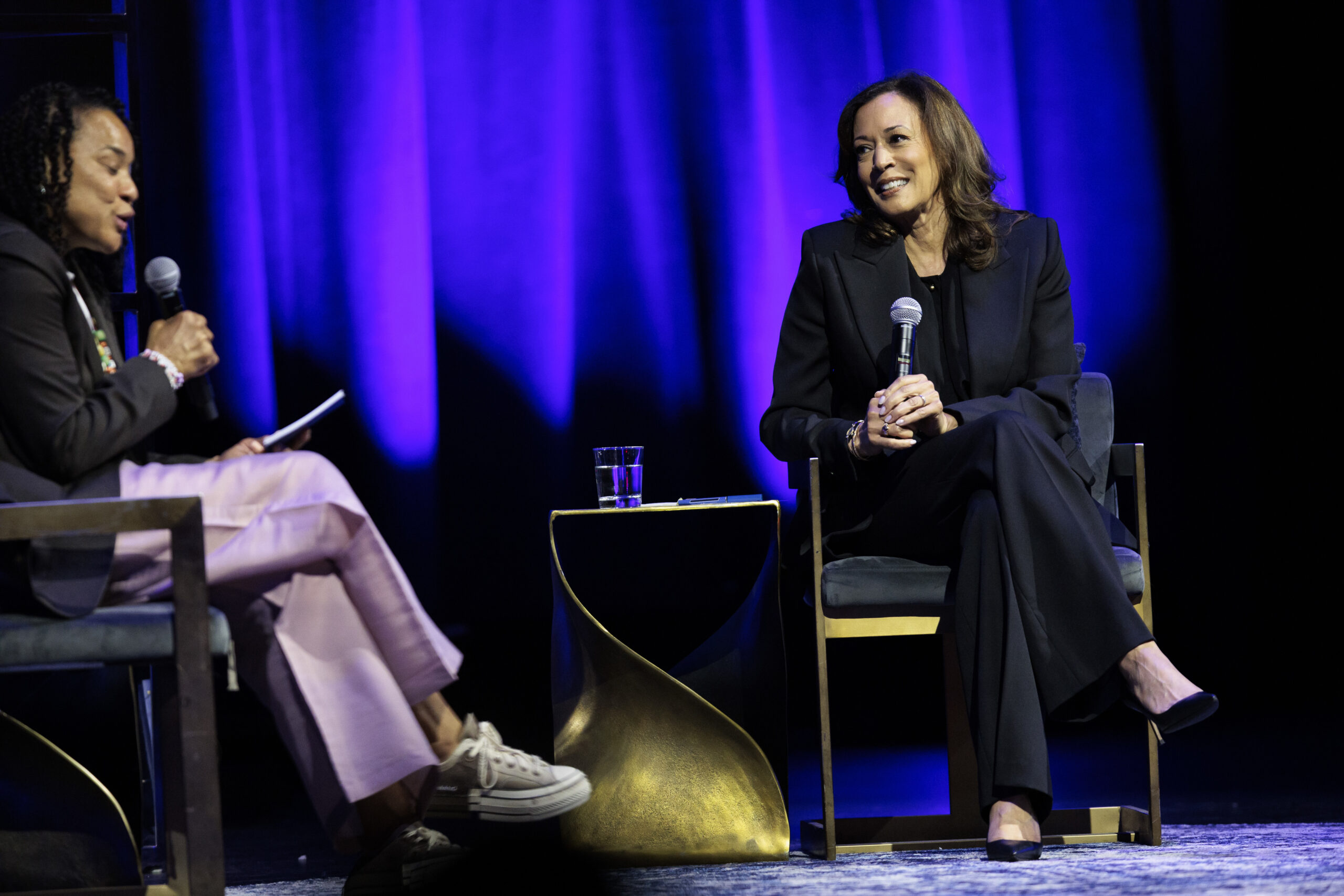
    Former Vice President Kamala Harris speaks with Dawn Staley (left), while promoting her new book “107 Days,” at the Met on Sept. 25 in Philadelphia. The event was held in partnership with Uncle Bobbie’s Coffee & Books.

    As Shapiro tells it, the friction with Harris’ team didn’t stop there.

    Shortly after meeting with Harris, Shapiro in his book recalled another unpleasant conversation with Remus, in which he wrote that she said she “could sense that I didn’t want to do this.”

    According to the book, Remus said it would be hard for Shapiro to move to Washington, it would be a strain financially for his family who “didn’t have a lot of money” by D.C. standards, and that Lori would need to get a whole new wardrobe and pay people to do her hair and makeup.

    It was then that he decided to leave the apartment where he had been asked to wait until Harris could come and talk to him again, he recalled.

    “These comments were unkind to me. They were nasty to Lori,” Shapiro wrote. “I hold no grudge against Remus, who I know was doing the job she had to do, but I needed to leave.”

    Shapiro went home, he said, and went over the day’s events with Lori at the edge of their bed.

    “On one hand, I was still tugged by the prestige of it all. It’s an honor. It’s a big title. But that’s never been enough for me,” he wrote. Still, he struggled with what it would mean to withdraw, concerned about not playing his part in a high-stakes election and letting his supporters down. Ultimately, he decided that it was not his race to win or lose, he wrote.

    “People were going to cast their votes for her, or they weren’t,” he added.

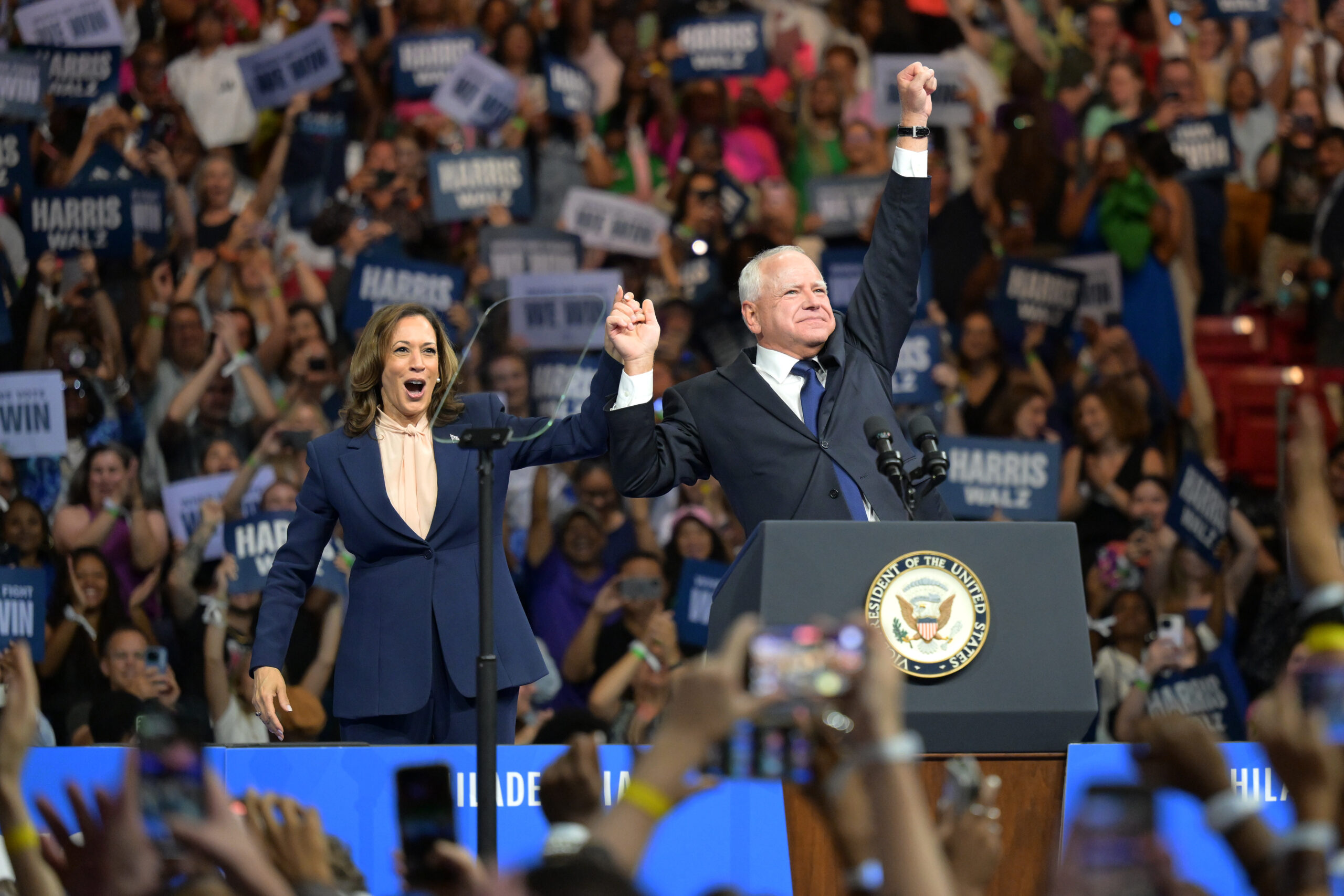
    Vice President Kamala Harris, Democratic nominee for president, and her running mate Minnesota Gov. Tim Walz, address a rally to kick off their campaign at the Liacouras Center in Philadelphia, Pa., on Tuesday, August 6, 2024.

    He decided that day he did not want the job, and toyed with the idea about publicly releasing a statement withdrawing himself from the running. He said he also tried to tell Harris he did not think it would be a good fit, but wasn’t able to reach her.

    Shortly thereafter, Harris announced that she had chosen Minnesota Gov. Tim Walz to be her running mate in an ultimately unsuccessful campaign against President Donald Trump. The two would debut their presidential ticket at a rally at the Liacouras Center in North Philadelphia. Shapiro wrote that he didn’t want to go.

    “I was wrung out. I just wanted to be home with my family, to take a walk with Lori, and just be,” he wrote.

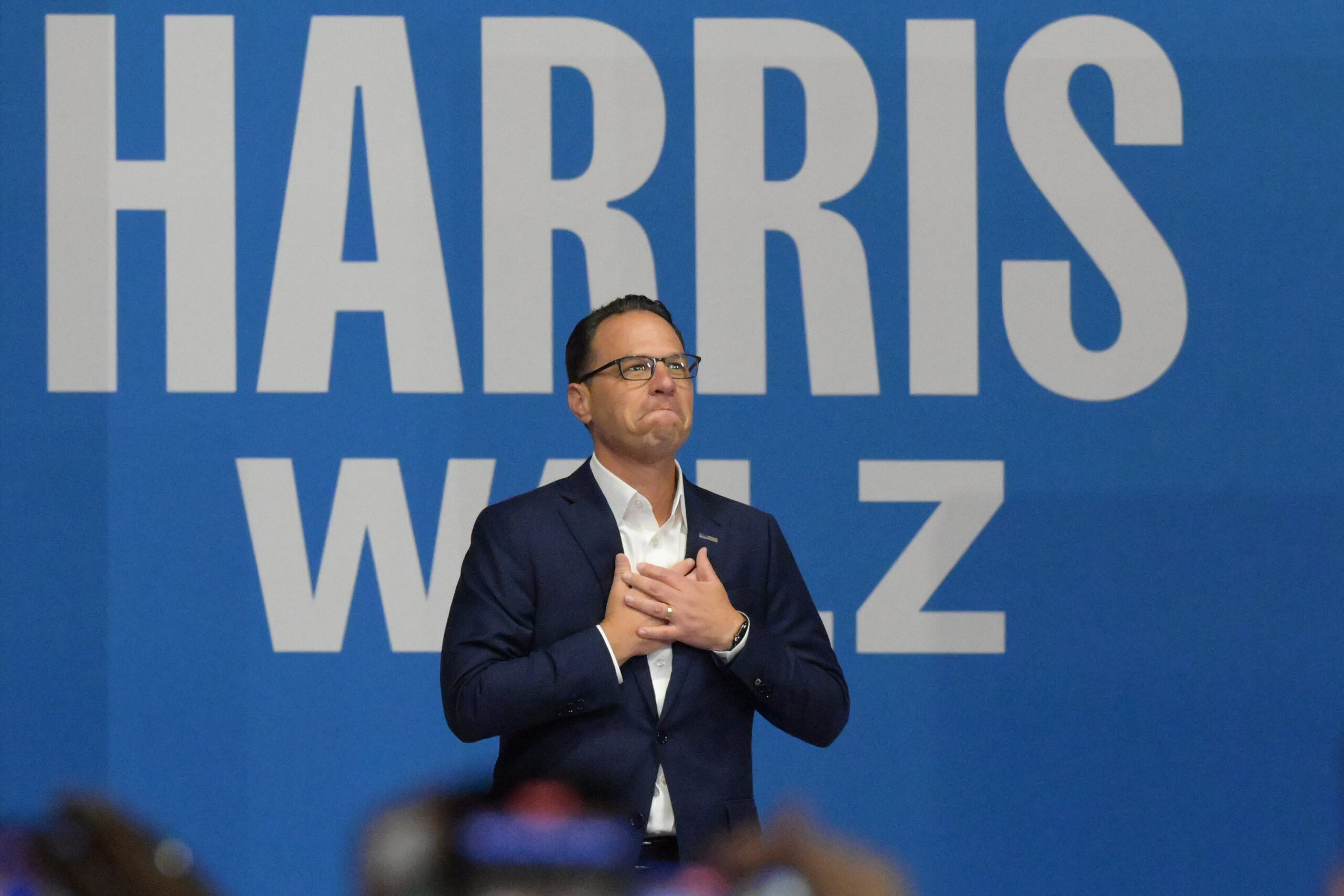
    Gov. Josh Shapiro takes the stage ahead of Vice President Kamala Harris and Gov. Tim Walz at a rally in Philadelphia’s Liacouras Center on August 6, 2024.

    But when it was time for him to take the stage ahead of Walz and Harris, he was long-applauded by his home city and gave a speech “from my heart” about how he took pride in his faith and his support for Walz and Harris.

    Shapiro’s memoir will be released Jan. 27 and is a reflection on his decades as an elected official, including as Pennsylvania attorney general, as well as the firebombing of his home last year. He will tout the book in Philadelphia on Saturday at 3 p.m. at Parkway Central Library. He will also discuss the book at upcoming book tour stops in New York and Washington.

  • Republicans, Democrats try to contain Trump’s Greenland aggression

    Republicans, Democrats try to contain Trump’s Greenland aggression

    WASHINGTON — Republican lawmakers are scrambling to contain President Donald Trump’s threats of taking possession of Greenland, with some showing the most strident opposition to almost anything the Trump administration has done since taking office.

    They gave floor speeches on the importance of NATO last week. They introduced bills meant to prevent the U.S. from attacking Denmark. And several traveled to Copenhagen to meet with Danish counterparts.

    But it’s not clear that will be enough, as the president continues to insist that he will take control of the Arctic island. It’s raised fears of an end to NATO — a decades-old alliance that has been a pillar of American strength in Europe and around the globe — and raised questions on Capitol Hill and around the world about what Trump’s aggressive, go-it-alone foreign policy will mean for world order.

    “When the most powerful military nation on earth threatens your territory through its president over and over and over again, you start to take it seriously,” Sen. Chris Coons told the Associated Press.

    The Delaware Democrat organized the bipartisan trip to Denmark to “bring the temperature down a bit,” he said, as well as further talks about mutual military agreements in the Arctic. Republican Sens. Thom Tillis of North Carolina and Lisa Murkowski of Alaska accompanied a handful of Democrats on the trip. Also, Republican lawmakers joined in meetings in Washington last week with the Danish foreign minister and his Greenlandic counterpart where they discussed security agreements.

    Yet it’s clear Trump has other ideas. He said Saturday he will charge a 10% import tax starting in February on goods from eight European nations because of their opposition to his Greenland plans.

    Trump said on social media that because of modern weapons systems “the need to ACQUIRE is especially important.”

    The pushback to Trump’s Greenland plans

    Key Republicans have made clear they think that forcefully taking Greenland is out of the question. But so far, they’ve avoided directly rebuking Trump for his talk of possessing the island.

    Tillis on social media called Trump’s tariff plans “bad for America, bad for American businesses, and bad for America’s allies.”

    Senate Majority Leader John Thune (R., S.D.) told reporters Thursday, “There’s certainly not an appetite here for some of the options that have been talked about or considered.”

    In a floor speech, Thune’s predecessor as Republican leader, Sen. Mitch McConnell (R., Ky.), warned that an attempt to seize Greenland would “shatter the trust of allies” and tarnish Trump’s legacy with a disastrous foreign policy decision.

    Republican and Democratic lawmakers alike see an obvious path to bolstering American interests in Greenland while keeping the relationship with NATO ally Denmark intact.

    In a meeting with lawmakers Thursday, Danish Foreign Minister Lars Løkke Rasmussen and his Greenlandic counterpart Vivian Motzfeldt discussed how the countries could work together to develop critical mineral industries and military cooperation, Coons said. The diplomats also told the senators there is no evidence of Chinese or Russian activity in Greenland.

    Trump has made the argument that the U.S. should take Greenland before China or Russia do, prompting worry across Europe. Troops from several nations have been sent to Greenland in support of Denmark.

    Murkowski said on social media that “our NATO allies are being forced to divert attention and resources to Greenland, a dynamic that plays directly into Putin’s hands by threatening the stability of the strongest coalition of democracies the world has ever seen.”

    What can Congress do?

    Lawmakers are looking at a few options for taking a military attack on Greenland off the table. Still, the Trump administration has shown little if any willingness to get congressional approval before taking military action.

    Lawmakers, including Republicans like Murkowski, are pushing legislation that would prohibit Department of Defense funds from being used to attack or occupy territory that belongs to other NATO members without their consent.

    The Alaska senator also suggested Congress could act to nullify Trump’s tariffs. Murkowski and several other Republicans have already helped pass resolutions last year meant to undo tariffs around the globe, but those pieces of legislation did not gain traction in the House. They would have also required Trump’s signature or support from two-thirds of both chambers to override his veto.

    Democrats have also found some traction with war powers resolutions meant to force the president to get congressional approval before engaging in hostilities. Republicans last week narrowly defeated one such resolution that would prohibit Trump from attacking Venezuela again, and Democrats think there could potentially be more Republicans who would support one applying to Greenland.

    “What I’ve noticed is these war powers resolutions, they do put some pressure on Republicans,” said Sen. Tim Kaine, a Virginia Democrat who has forced votes on several similar resolutions. He said the tactic has also compelled the Trump administration to provide lawmakers with briefings and commitments to get congressional approval before deploying troops.

    Still, while dismissing the Venezuela war powers resolution on Wednesday, Republican leaders made the argument that the legislation should be ruled out of order because the Trump administration has said there are currently no U.S. troops on the ground in Venezuela.

    That argument may set a precedent for future war powers resolutions, giving Republicans a way to avoid voting against Trump’s wishes.

    “If you don’t have boots on the ground, it’s a moot point,” said Sen. Mike Rounds, a South Dakota Republican, about war powers resolutions in general. He also argued that the prospect of taking Greenland over the objections of Denmark is nothing “more than a hypothetical.”

    Other Republicans have expressed support for Trump’s insistence that the U.S. possess Greenland, though they have downplayed the idea that the U.S. would take it by force.

    That’s left the strongest objections on the Republican side of the aisle coming from a handful of lawmakers who are leaving Congress next year.

    Rep. Don Bacon, a Nebraska Republican, told the Omaha World Herald that an invasion of Greenland would lead to Trump’s impeachment — something he would “lean” towards supporting.

    Tillis, another retiring Republican, has directed his criticism at Trump advisers like White House deputy chief of staff Stephen Miller.

    “The fact that a small handful of ‘advisers’ are actively pushing for coercive action to seize territory of an ally is beyond stupid,” he said.

  • Pa. public universities didn’t get a state funding increase this year, and they’re preparing for a tough enrollment outlook

    Pa. public universities didn’t get a state funding increase this year, and they’re preparing for a tough enrollment outlook

    The universities in the Pennsylvania State System of Higher Education were flat-funded this year for the first time since 2021-22.

    That funding, approved in the state budget deal lawmakers reached in November after a monthslong standoff, follows three years of state funding increases. In 2022-23, the system got a historic 15.7% increase.

    PASSHE includes the 10 state-owned public universities. (State-related universities, including Pennsylvania State and Temple, are funded separately.)

    Cheyney University, which is part of the system, got a special $5 million earmark “to develop and implement an enhanced transfer and workforce development initiative in partnership with a community college.” Cheyney, a historically Black college in Delaware and Chester Counties, and Community College of Philadelphia recently announced a partnership that will allow students to transfer seamlessly from CCP to Cheyney and earn bachelor’s degrees while remaining on CCP’s Philadelphia campus.

    The state system had asked the state for a 6.5% increase in its general appropriation, which currently stands at $625 million. That would have brought in an additional $40 million for the 10-university system, said Christopher Fiorentino, chancellor of the system.

    But he said the system has been preparing for the possibility of a funding freeze and had increased tuition this year for the first time in seven years, raising an additional $25 million.

    “We knew it was going to be difficult, given the revenue situation in the commonwealth,” he said. “We weren’t blindsided by this.”

    He said he was grateful for the system’s appropriation.

    “That’s a huge amount of money,” he said. “… It is a significant commitment to public higher education, and we really appreciate that support.”

    The system has requested a 5% state funding increase for 2026-27, which would allow universities to freeze tuition again, Fiorentino said.

    But Kenneth M. Mash, president of the Association of Pennsylvania State College and University Faculties, the faculty union, said that would not be enough if tuition is to be frozen. And he has concerns about the freeze in state funding this year.

    “Too often, we go in there and act as if this is what we need to maintain the status quo, but the status quo is not good,” he said, citing technology and program needs. “We don’t have the support for students that we should have. We need to start paying attention to the quality of education and make sure it doesn’t suffer.”

    The system has been in a state of readjustment as it has lost about a third of its enrollment since 2010, including merging six of its universities into two entities. The system’s universities are: Cheyney, Commonwealth, East Stroudsburg, Indiana, Kutztown, Millersville, Penn West, Shippensburg, Slippery Rock, and West Chester.

    Planning for a drop in enrollment

    Another enrollment cliff is expected to begin this year as the population of high school graduates begins to drop.

    “The demographics right now going forward are unfavorable, so we have to continue to be prepared for the fact that even if we maintain our market share, we’re going to see declines in enrollment,” Fiorentino said.

    The system is attempting to recruit in new markets and bring back to college those who have some credits but no degree, he said. Older students may want more weekend, night, and online courses, and that is something the system is reviewing, too, he said.

    The system also is contemplating partnering with area doctoral institutions, such as Temple, to bring in doctoral students to teach at the system’s universities. That would save money on faculty hiring, while cultivating new potential talent for the system, he said.

    And the system is reevaluating its programs, he said. Ninety-five percent of students are graduating from half the programs the system offers, he said. Some of the larger enrollments are in business, education, health, and engineering, he said.

    But only 5% of students are enrolled in the other half of the system’s programs.

    “We have to take a look at that,” he said. “How do we redeploy the money that we currently are receiving to make sure that we’re supporting the programs that are critical to the success of the commonwealth?”

    Mash, the union president, said that bringing in doctoral students would create a viable stream of quality candidates, and that, under the contract, the system is permitted to employ a certain number of adjuncts. But he is concerned about eliminating programs with lower enrollments.

    “We should be providing as broad of a spectrum of opportunity for students as we can,” he said.

    Fiorentino said he was pleased to see Cheyney get the additional funding. The school, which has struggled with enrollment, saw an increase of 234 students — nearly 38% this year, the highest percentage increase of any school in the system. Cheyney enrolls 851 students this year, its highest enrollment since 2014.

    The new effort will allow Philadelphia students to get a Cheyney degree without having to travel to the rural campus, he said.

    “A lot of their market is Philadelphia,” Fiorentino said of Cheyney, “and for a lot of the Philadelphia students, transportation has become more and more difficult.”

    Temple and Penn State were flat-funded again this year. Temple said in a statement that it was grateful to see the budget pass.

    “We also continue to be deeply grateful for the ongoing financial support that the university receives to reduce tuition costs for Pennsylvania residents,” the school said.