Category: Politics

Political news and coverage

  • Two vulnerable senators stand to benefit from intense focus on constituents

    Two vulnerable senators stand to benefit from intense focus on constituents

    Justin Juray didn’t know where to turn. His Maine bowling alley had been the site of a mass killing, and he was struggling — not just to reopen, but to cope with his business’s now notorious place in history.

    John Curry was worried about closing his Georgia coffee shop, scrambling to rebound from the coronavirus pandemic and “drowning” financially as he waited for a $126,000 payment from a federal program for keeping his employees on staff.

    In their low moments, they received help from an unexpected source: their United States senator.

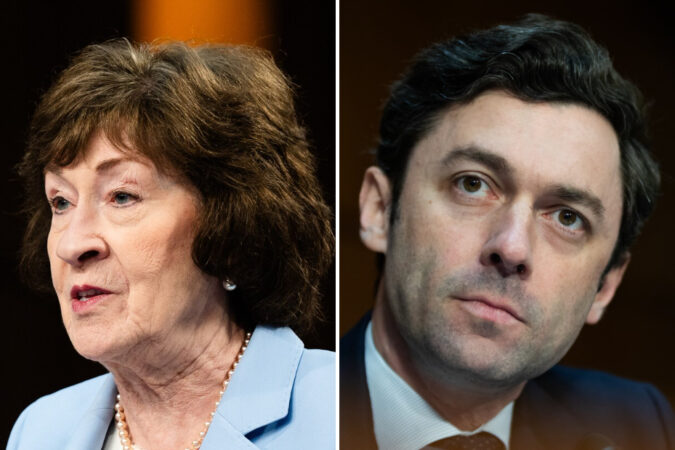
    Sens. Susan Collins (R., Maine) and Jon Ossoff (D., Ga.), two of the most vulnerable members of the Senate facing reelection next year, have little in common politically. But both have reputations for providing strong constituent services, an often overlooked advantage afforded incumbents that could matter on the margins in close races.

    Taking requests for help and working out a solution is one of the most unsung practices in most Senate offices, often overshadowed by committee hearings and Senate floor fights in Washington and by campaign rallies and television ads back home. But no work puts voters in more direct contact with their federal representative.

    Collins’ office helped Juray with tax and insurance issues, as well as securing a disaster relief loan, in the wake of what was Maine’s deadliest mass killing ever, where eight people were killed in 2023 at his Lewiston, Maine, bowling alley.

    Ossoff gave Curry his card after an event at the small business owner’s Augusta, Ga., coffee shop in 2023 and told him to call if he “ever needed anything.” When the business faced serious financial difficulties while waiting for funds to cover a string of bills, he emailed the senator for help.

    “He called me the next day,” said Curry. “It was not long at all before I got an email from the IRS saying that I had a check on the way.”

    In separate interviews with the Washington Post, Collins and Ossoff both said they have worked to create a culture in their offices that prioritizes each interaction with people they represent.

    “I know that I have had an impact,” Collins said when asked to reflect on the constituent service work out of her office. “It’s extremely satisfying … when we’re able to solve a problem for an individual.”

    Ossoff said he wants his constituents “to experience a level of responsiveness and accountability and concern that they have never felt before.”

    Asked why all members of Congress don’t focus as heavily on such services, Ossoff said the current culture in politics is “all about attention.”

    “For a lot of people in Congress, their goal is to become more and more and more famous or infamous, find the cameras, post the viral content,” he said. “That’s just not my approach to the job.”

    Both Collins and Ossoff face competitive reelections next year.

    Collins, who has yet to announce a campaign but has said she intends to run for her sixth Senate term, is the only Republican in the state’s congressional delegation and faces an electorate that has voted for every Democratic presidential nominee since 1992.

    But Collins, a relatively moderate Republican, also faces pressure from her right, with more conservative members of her state bristling at the times she bucks her party and President Donald Trump. Maine Gov. Janet Mills announced a Senate campaign in October. The 77-year-old Democrat faces a primary challenge from a more liberal candidate, Graham Platner, a Marine Corps combat veteran and oyster farmer.

    Ossoff, first elected to the Senate in 2020, faces a similarly competitive election in a state that has only recently been in play statewide for Democrats. Trump won in Georgia by two percentage points in 2024. The Republican primary to face Ossoff is competitive, a sign Republicans view him as vulnerable.

    Collins’ six and Ossoff’s four state offices include case workers whose primary focus is helping constituents solve problems. But other staff in the offices — and in Washington, D.C. — regardless of their primary duties, are also expected to pitch in.

    The work has created scenarios in which people who may disagree with Collins and Ossoff on specific issues are willing to back them for reelection because of the personal level of work their offices have done.

    Juray, the bowling alley owner, offers an example.

    Two people from Collins’ office worked with him following the shooting. Juray said they not only cleared up all the questions with his insurance company and the IRS, but they secured him a disaster relief loan that “helped us get everything put back together” so they could reopen in 2024.

    Juray, a registered Democrat, has voted for Collins in the past. While he hasn’t decided who he will vote for next year, he says he is “leaning” toward the Republican incumbent.

    “Without the senators’ support and without them, I might still be waiting on some of this funding,” Juray said. “It changed the way I saw representation as a whole.”

    Chris Gardner, the head of the port authority in Eastport, Maine, was at a loss after watching the town’s historic decades-old breakwater built to protect the city’s harbor “open up like a zipper” and crumble along the rocky coast early one morning in 2014. The collapse put the livelihoods of countless people at risk.

    Before the sun rose, Gardner recalled, Collins called him and promised to do “whatever it takes” to rebuild the critical infrastructure at the nation’s easternmost port. When the breakwater was rebuilt and reopened in 2017, Collins was there with Gardner, celebrating the achievement and the millions of dollars the senator helped secure for the project.

    Gardner is a registered Republican who at times “hasn’t agreed with some of Senator Collins’ votes.” But he said he tells “anyone who will listen” about the role Collins played in rebuilding the breakwater. “God love her, she is hated by people on both sides of the aisle. … The irony is, she weathers all of that … because she stays focused on doing her job.”

    Collins laughed when asked if she thinks her constituent services work helps temper some of the anger directed at her by people who disagree with her politics. She said that often people come up to her at the grocery store and she can tell that they might not be her typical political supporters.

    “I always find that people come up to me because I’m alone,” she said. “I’m doing exactly what they’re doing. And they will come up to me and thank me for the work that my offices have done.”

    Ossoff, who is far newer to the Senate than Collins, is working to build that kind of reputation.

    Shortly after Ossoff joined the Senate in 2021, he invited an executive from a famed Georgia company — Delta Air Lines — to come speak with his staff on “best practices” for his customer service operation, including suggestions that “maybe are not common in the legislative branch or the federal government.”

    The result? Ossoff calls a handful of people who received assistance from his office each week to check in on their experience. And at the end of every constituent call with his office, Ossoff said the caller is asked whether they would “recommend the service that my office provides for someone else in the same situation as them.”

    For Claven Williams, a retired Navy commander, the answer was yes.

    Williams was exposed to Agent Orange during his service in the Pacific from the 1970s to the 1990s and was diagnosed with non-Hodgkin’s lymphoma. After initially approving his claim for disability in 2024 under the newly passed Pact Act, the Department of Veterans Affairs reduced his disability to 50% in 2025, claiming that he was cured of the ailment. That prompted Williams to contact to Ossoff’s office, which successfully worked with the department to restore his 100% benefit earlier this year.

    “I had dealt with other politicians; they didn’t support you like that, they didn’t go out of your way to help you,” recalled Williams, who voted for Ossoff in 2020.

    The casework provided by Ossoff and Collins has drawn praise from those partisans who have opposed their elections.

    “Their constituent services are second to none,” Brian Robinson, a Republican operative in Georgia, said of Ossoff’s staff during an April radio appearance with the senator, praising him for following in the footsteps of former Republican senator Johnny Isakson.

    Bev Uhlenhake, the former chair of the Maine Democratic Party who opposes Collins’ reelection next year, said the reason Collins has proved difficult to defeat in a blue state is “her relationships throughout the state of Maine.”

    “They are so deep because her staff have helped so many Mainers while in crisis,” Uhlenhake said. “Constituent services in Maine are incredibly important, and she has done it really well.”

  • Public release of Epstein records puts Maxwell under fresh scrutiny amid her claims of innocence

    Public release of Epstein records puts Maxwell under fresh scrutiny amid her claims of innocence

    NEW YORK — Days after Ghislaine Maxwell asked a judge to immediately free her from a 20-year prison sentence, the public release of grand jury transcripts from her sex-trafficking case returned the spotlight to victims whose allegations helped land her behind bars.

    The disclosure of the transcripts as part of the Justice Department’s ongoing release of its investigative files on Maxwell and the late sex offender Jeffrey Epstein exposed how an FBI agent told grand jurors about Maxwell’s critical role in Epstein’s decades-long sexual abuse of girls and young women.

    Maxwell, a British socialite and publishing heir, was convicted of sex trafficking in December 2021 after four women told a federal jury in New York City about how she and Epstein abused them in the 1990s and early 2000s. Epstein never went to trial in that case. He was arrested in July 2019 on sex-trafficking charges and killed himself a month later in his cell at a Manhattan federal jail.

    Two weeks ago, as the Justice Department prepared to begin releasing what are commonly known as the Epstein files, Maxwell filed a habeas petition, asking a federal judge to free her on grounds that “substantial new evidence” has emerged proving that constitutional violations spoiled her trial.

    Maxwell claimed that exonerating information was withheld and that witnesses lied in their testimony. She filed the petition on her own, without the assistance of a lawyer.

    This week, the judge, Paul A. Engelmayer, scolded Maxwell for failing to remove victim names and other identifying information from her court papers. He said future filings must be kept sealed and out of public view until they have been reviewed and redacted to protect victims’ identities.

    Victims fear Maxwell will be pardoned

    Epstein accuser Danielle Bensky said the release of records has only sharpened the focus on Maxwell’s crimes among their victims. Bensky said she has been involved in daily discussions with about two dozen other victims that make clear Maxwell “is a criminal who was 1,000% engaged in sexual acts.”

    “I’ve heard things that would make your blood curdle. I just had a conversation with a survivor last night who said she was the puppeteer,” Bensky said.

    Bensky said she was sexually abused by Epstein two decades ago. She said she was never personally abused by Maxwell.

    Delayed and heavily redacted files

    The transcripts of grand jury proceedings that resulted in Maxwell’s indictment were released this week in accordance with the Epstein Files Transparency Act, a law enacted last month after months of public and political pressure.

    The Justice Department has been posting records periodically after acknowledging it would miss last Friday’s congressionally mandated deadline to release all records. It blamed the delay on the time-consuming process of obscuring victims’ names and other identifying information.

    On Wednesday, the department said it may need a “few more weeks” to release the full trove after suddenly discovering more than a million potentially relevant documents. It was a stunning development after department officials suggested months ago that they had already accounted for the vast universe of Epstein-related materials.

    Some of the Epstein and Maxwell grand jury records were initially released with heavy redactions; a 119-page document marked “Grand Jury-NY” was entirely blacked out. Updated versions were posted over the weekend.

    FBI agent testifies Maxwell manipulated young girl

    An FBI agent’s grand jury testimony, describing interviews conducted with Epstein victims, foreshadowed trial testimony a year later from four women who described Maxwell’s role in their sexual abuse from 1994 to 2004.

    The agent told of a woman who described meeting Maxwell and Epstein as a 14-year-old attending a Michigan summer arts camp in 1994. Flight logs showed Epstein and Maxwell went to the school sponsoring the camp because Epstein was a donor.

    According to the agent, whose name was redacted from the transcript, the girl had a chance encounter with Epstein and Maxwell one day. After learning that the girl was from Palm Beach, Fla., Epstein mentioned that he sometimes gave scholarships to students and they requested her phone number, the agent said.

    Once home, the girl visited Epstein’s estate with her mother for tea and the mother was impressed when Epstein said he provided scholarships, enough so that the mother said Epstein was like a “godfather,” the agent said.

    The agent said the girl began regularly going to the estate as Epstein and Maxwell “groomed” her with gifts and trips to the movies, and Epstein began paying for voice lessons and giving her money that he said she should give to her struggling mother.

    The agent said the girl thought her relationship with Epstein and Maxwell was strange, “but Maxwell normalized it for her. She was like a cool, older sister and made comments like, ‘This is what grownups do.’”

    Eventually, the agent testified, the girl saw Maxwell topless at the pool. After the girl revealed that she hoped to be an actor and a model, Epstein told her that he was best friends with the owner of Victoria’s Secret and that she would have to learn to be comfortable in her underwear and not be a prude, the agent said.

    Then, the agent said, the girl asked Epstein what he meant by that and the financier pulled her into his lap and masturbated. After that, the agent added, the girl’s encounters with Epstein began to include sexual contact, particularly in his massage room.

    Maxwell was sometimes there with other girls, the agent said. One of the girls would begin massaging Epstein and Maxwell would tease the girls, the agent said.

    “She’d grab the girl’s breasts, and she would direct the girls on what to do,” the agent said, relaying the girl’s account. Maxwell’s attitude during the encounters was ”very casual; she acted like this was normal,” the agent said.

    The released testimony appeared to reflect the testimony at Maxwell’s 2021 trial by a woman who testified under the pseudonym “Jane.”

    At trial, Jane said Maxwell also participated in group sessions between multiple females and Epstein that usually began with Epstein or Maxwell leading them all into a bedroom or a massage room at the Palm Beach residence.

  • Wage garnishment for defaulted student loans to resume early next year

    Wage garnishment for defaulted student loans to resume early next year

    The Trump administration will begin seizing the pay of people in default on their student loans early next year, marking the first wave of new wage garnishments since the pandemic, the Education Department confirmed this week.

    Starting the week of Jan. 7, the department told the Washington Post, it will notify about 1,000 defaulted borrowers of plans to withhold a portion of their wages to pay down their past-due debt. After that, the department said, notices will be sent to larger numbers of borrowers each month.

    There were about 5.3 million borrowers who had not made a payment on their federal student loans for at least 360 days as of June 30, according to the latest available data from the Education Department. Many of them were in default before the federal government stopped collecting defaulted loans because of the pandemic nearly six years ago.

    In May, the Trump administration resumed seizing tax refunds and Social Security benefits to recoup past-due student loan debt. At the time, the administration said wage garnishments would restart in the summer.

    While the Education Department started the process over the summer, department spokesperson Ellen Keast said turning on the system after it was dormant for five years took more time than expected. She said the record-long government shutdown further delayed the process.

    There are several steps involved in wage garnishment, including identifying and verifying a borrower’s employer, who is ultimately responsible for withholding the money. By law, the Education Department must notify people in default 30 days before garnishing their wages. During that time, borrowers can request a hearing to challenge the order, pay the balance, or negotiate repayment terms to avoid garnishment.

    The department can withhold up to 15% of a borrower’s disposable, or after-tax, income. The garnishment continues until the defaulted loans are paid off in full or the borrower takes action to get out of default.

    Roughly 6 million people were at least 60 days late on their student loan payments as of August, according to an analysis of credit reporting data by the think tank Urban Institute.

    The rise in delinquencies corresponds with the end of a 12-month grace period, known as the on-ramp, that allowed borrowers to ease their way back into repayment after a pandemic-related pause that lasted more than three years. Since the Biden administration’s policy ended Sept. 30, millions of borrowers have fallen behind on payments. And many of them could wind up in default.

    Student loan borrowers have been spared from the most severe consequences of default since the early days of the pandemic. Back then, President Donald Trump instituted a moratorium on the collection of defaulted student loans that Congress later codified and extended in the 2020 stimulus package.

    President Joe Biden’s administration extended the moratorium several times as part of the broader suspension of student loan payments. Under pressure from liberal lawmakers and student advocates, Biden allowed anyone in default on a federal loan held by the Education Department to rehabilitate the debt through an initiative called Fresh Start. While a portion of borrowers resolved their debt through the initiative, many remained in default.

    Education Secretary Linda McMahon has called Biden’s policies irresponsible and blamed his administration for giving borrowers false hope of loan forgiveness that led to a rise in delinquencies.

    When the Education Department announced the resumption of involuntary collection in April, McMahon said in a statement that “the Biden Administration misled borrowers: the executive branch does not have the constitutional authority to wipe debt away, nor do the loan balances simply disappear.”

    Instead of promoting debt cancellation, McMahon said, the Trump administration will help borrowers return to repayment — “both for the sake of their own financial health and our nation’s economic outlook.”

  • After missing deadline, DOJ says it may need a ‘few more weeks’ to finish release of Epstein files

    After missing deadline, DOJ says it may need a ‘few more weeks’ to finish release of Epstein files

    WASHINGTON — The Justice Department said Wednesday that it may need a “few more weeks” to release all of its records on the late sex offender Jeffrey Epstein after suddenly discovering more than a million potentially relevant documents, further delaying compliance with last Friday’s congressionally mandated deadline.

    The Christmas Eve announcement came hours after a dozen U.S. senators called on the Justice Department’s watchdog to examine its failure to meet the deadline. The group, 11 Democrats and a Republican, told acting Inspector General Don Berthiaume in a letter that victims “deserve full disclosure” and the “peace of mind” of an independent audit.

    The Justice Department said in a social media post that federal prosecutors in Manhattan and the FBI “have uncovered over a million more documents” that could be related to the Epstein case — a stunning 11th hour development after department officials suggested months ago that they had undertaken a comprehensive review that accounted for the vast universe of Epstein-related materials.

    In March, Attorney General Pam Bondi told Fox News that a “truckload of evidence” had been delivered to her after she ordered the Justice Department to “deliver the full and complete Epstein files to my office” — a directive she said she made after learning from an unidentified source that the FBI in New York was “in possession of thousands of pages of documents.”

    In July, the FBI and Justice Department indicated in an unsigned memo that they had undertaken an “exhaustive review” and had determined that no additional evidence should be released — an extraordinary about-face from the Trump administration, which for months had pledged maximum transparency. The memo did not raise the possibility that additional evidence existed that officials were unaware of or had not reviewed.

    Wednesday’s post did not say when the Justice Department was informed of the newly uncovered files.

    In a letter last week, Deputy Attorney General Todd Blanche said Manhattan federal prosecutors already had more than 3.6 million records from sex trafficking investigations into Epstein and his longtime confidant Ghislaine Maxwell, though many were copies of material already turned over by the FBI.

    The Justice Department said its lawyers are “working around the clock” to review the documents and remove victims names and other identifying information as required by the Epstein Files Transparency Act, the law enacted last month that requires the government to open its files on Epstein and Maxwell.

    “We will release the documents as soon as possible,” the department said. “Due to the mass volume of material, this process may take a few more weeks.”

    The announcement came amid increasing scrutiny on the Justice Department’s staggered release of Epstein-related records, including from Epstein victims and members of Congress.

    Republican Rep. Thomas Massie, of Kentucky, one of the chief authors of the law mandating the document release, posted Wednesday on X: “DOJ did break the law by making illegal redactions and by missing the deadline.” Another architect of the law, Rep. Ro Khanna (D., Calif.), said he and Massie will “continue to keep the pressure on” and noted that the Justice Department was releasing more documents after lawmakers threatened contempt.

    “A Christmas Eve news dump of ‘a million more files’ only proves what we already know: Trump is engaged in a massive cover-up,” Senate Minority Leader Chuck Schumer (D., N.Y.) said after DOJ’s announcement. “The question Americans deserve answered is simple: WHAT are they hiding — and WHY?”

    The White House on Wednesday defended the Justice Department’s handling of the Epstein records.

    “President Trump has assembled the greatest cabinet in American history, which includes Attorney General Bondi and her team — like Deputy Attorney General Blanche — who are doing a great job implementing the President’s agenda,” spokeswoman Abigail Jackson said in a statement.

    After releasing an initial wave of records on Friday, the Justice Department posted more batches to its website over the weekend and on Tuesday. The Justice Department has not given any notice when more records might arrive.

    Records that have been released, including photographs, interview transcripts, call logs, court records, and other documents, were either already public or heavily blacked out, and many lacked necessary context. Records that hadn’t been seen before include transcripts of grand jury testimony from FBI agents who described interviews they had with several girls and young women who described being paid to perform sex acts for Epstein.

    Other records made public in recent days include a note from a federal prosecutor from January 2020 that said Trump had flown on the financier’s private plane more often than had been previously known and emails between Maxwell and someone who signs off with the initial “A.” They contain other references that suggest the writer was Britain’s former Prince Andrew. In one, “A” writes: “How’s LA? Have you found me some new inappropriate friends?”

    The senators’ call Wednesday for an inspector general audit comes days after Schumer introduced a resolution that, if passed, would direct the Senate to file or join lawsuits aimed at forcing the Justice Department to comply with the disclosure and deadline requirements. In a statement, he called the staggered, heavily redacted release “a blatant cover-up.”

    Republican Sen. Lisa Murkowski of Alaska joined Sens. Richard Blumenthal (D., Conn.) and Jeff Merkley (D., Ore.) in leading the call for an inspector general audit. Others signing the letter were Democratic Sens. Amy Klobuchar of Minnesota; Adam Schiff of California; Dick Durbin of Illinois; Cory Booker and Andy Kim, both of New Jersey; Gary Peters of Michigan; Chris Van Hollen of Maryland; Mazie Hirono of Hawaii; and Sheldon Whitehouse of Rhode Island.

    “Given the (Trump) Administration’s historic hostility to releasing the files, politicization of the Epstein case more broadly, and failure to comply with the Epstein Files Transparency Act, a neutral assessment of its compliance with the statutory disclosure requirements is essential,” the senators wrote. Full transparency, they said, “is essential in identifying members of our society who enabled and participated in Epstein’s crimes.”

  • 19 states and D.C. sue the U.S. Department of Health and Human Services over a move that could curtail youth gender-affirming care

    19 states and D.C. sue the U.S. Department of Health and Human Services over a move that could curtail youth gender-affirming care

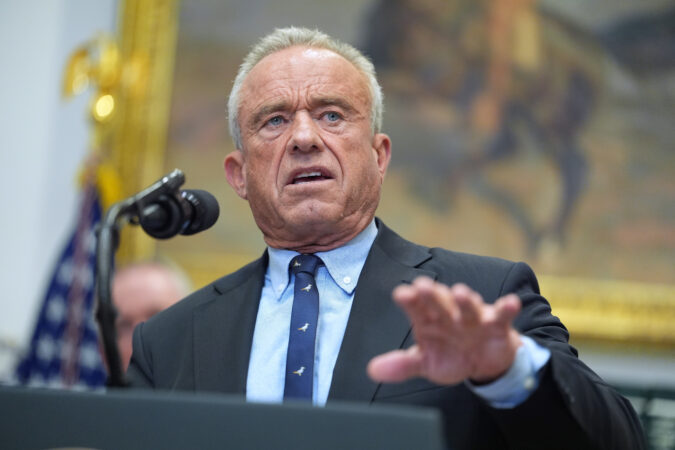
    NEW YORK — Pennsylvania and New Jersey, along with 17 other states and the District of Columbia, on Tuesday sued the U.S. Department of Health and Human Services, its secretary, Robert F. Kennedy Jr., and its inspector general over a declaration that could complicate access to gender-affirming care for young people.

    The declaration issued last Thursday called treatments like puberty blockers, hormone therapy and surgeries unsafe and ineffective for children and adolescents experiencing gender dysphoria, or the distress when someone’s gender expression doesn’t match their sex assigned at birth. It also warned doctors that they could be excluded from federal health programs like Medicare and Medicaid if they provide those types of care.

    The declaration came as HHS also announced proposed rules meant to further curtail gender-affirming care for young people, although the lawsuit doesn’t address those as they are not final.

    Tuesday’s lawsuit, filed in U.S. District Court in Eugene, Ore., alleges that the declaration is inaccurate and unlawful and asks the court to block its enforcement. It’s the latest in a series of clashes between an administration that’s cracking down on transgender healthcare for children, arguing it can be harmful to them, and advocates who say the care is medically necessary and shouldn’t be inhibited.

    “Secretary Kennedy cannot unilaterally change medical standards by posting a document online, and no one should lose access to medically necessary healthcare because their federal government tried to interfere in decisions that belong in doctors’ offices,” New York Attorney General Letitia James, who led the lawsuit, said in a statement Tuesday.

    The lawsuit alleges that HHS’s declaration seeks to coerce providers to stop providing gender-affirming care and circumvent legal requirements for policy changes. It says federal law requires the public to be given notice and an opportunity to comment before substantively changing health policy — neither of which, the suit says, was done before the declaration was issued.

    A spokesperson for HHS declined to comment.

    HHS’s declaration based its conclusions on a peer-reviewed report that the department conducted earlier this year that urged greater reliance on behavioral therapy rather than broad gender-affirming care for youths with gender dysphoria.

    The report questioned standards for the treatment of transgender youth issued by the World Professional Association for Transgender Health and raised concerns that adolescents may be too young to give consent to life-changing treatments that could result in future infertility.

    Major medical groups and those who treat transgender young people have sharply criticized the report as inaccurate, and most major U.S. medical organizations, including the American Medical Association, continue to oppose restrictions on transgender care and services for young people.

    The declaration was announced as part of a multifaceted effort to limit gender-affirming healthcare for children and teenagers — and built on other Trump administration efforts to target the rights of transgender people nationwide.

    HHS on Thursday also unveiled two proposed federal rules — one to cut off federal Medicaid and Medicare funding from hospitals that provide gender-affirming care to children, and another to prohibit federal Medicaid dollars from being used for such procedures.

    The proposals are not yet final or legally binding and must go through a lengthy rulemaking process and public comment before becoming permanent. But they will nonetheless likely further discourage healthcare providers from offering gender-affirming care to children.

    Several major medical providers already have pulled back on gender-affirming care for young patients since Trump returned to office — even in states where the care is legal and protected by state law.

    Medicaid programs in slightly less than half of states currently cover gender-affirming care. At least 27 states have adopted laws restricting or banning the care. The Supreme Court’s recent decision upholding Tennessee’s ban means most other state laws are likely to remain in place.

    Joining James in Tuesday’s lawsuit were Democratic attorneys general from California, Colorado, Connecticut, Delaware, Illinois, Maine, Maryland, Massachusetts, Michigan, Minnesota, New Jersey, New Mexico, Oregon, Rhode Island, Vermont, Wisconsin, Washington and the District of Columbia. Pennsylvania’s Gov. Josh Shapiro also joined.

  • Atlantic City officials, community leaders condemn ‘aggressive’ and ‘appalling’ ICE activity in the area

    Atlantic City officials, community leaders condemn ‘aggressive’ and ‘appalling’ ICE activity in the area

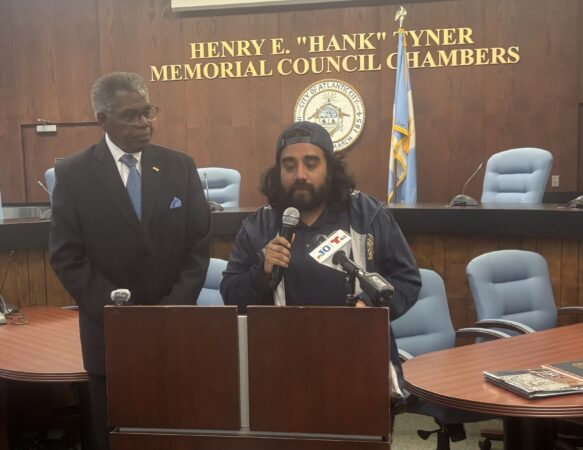
    ATLANTIC CITY — Elected officials, religious leaders, and community activists gathered Tuesday in City Hall to condemn recent “aggressive” and “appalling” U.S. Immigration and Customs Enforcement activity in the resort town.

    “The reason I’m here is because just last week, our community was attacked,” said Alexander Mendoza, a community organizer with advocacy group El Pueblo Unido of Atlantic City. “Fathers, friends, family members, hardworking people were taken away from us by an inhumane system called ICE.”

    El Pueblo has been highlighting recent ICE activity in Atlantic City on its social media, including a car stop on Dec. 12 that led to the detainment of two men, one of whom subsequently missed the birth of his daughter earlier this week after being taken to Delaney Hall. The group called the car stop illegal and said the Mexican Consulate is working to provide the man with legal help.

    “He and his partner had just moved into a new apartment and were ready to begin a new chapter in their lives,” Mendoza said. “That morning changed everything. He was taken by ICE and is now being held at Delaney Hall.”

    Mendoza said this and other recent activity, including ICE agents establishing a base of operations at the city’s Bader Field, the former municipal airport, have left community members fearful and officials alarmed and outraged.

    “There’s a lot of hysteria, a lot of fear in our community, rightly so,” said Cristian Moreno-Rodriguez, executive director of El Pueblo. There were rumors this week that businesses, particularly laundromats, would be targeted this week in Atlantic City and Pleasantville, he said.

    “We strategically placed ourselves throughout different traffic hubs where our community is, our immigrant working-class community,” he said.

    Moreno-Rodriguez said his organization has tracked some of the same ICE vehicles conducting activity in Bridgeton, Cumberland County.

    ICE did not immediately respond to a request for comment regarding activity in the area.

    El Pueblo has been educating community members of their rights and training volunteers to document and respond to reported ICE activity. He said the response time in Pleasantville is about two minutes; in Atlantic City, it’s 4 to 5 minutes.

    Atlantic County is home to about 12,000 undocumented immigrants. Moreno-Rodriguez said the volunteers include non-Hispanic allies and young Latinos, “children who are standing up for their parents and neighbors.”

    City Council Vice President Kaleem Shabazz said the council adopted a resolution last week condemning the ICE activity, which he said had made his constituents wary of leaving their homes without carrying documentation of their citizenship. He said police had not been informed about the raids or the use of Bader Field.

    Moreno-Rodriguez said the city is about 33% Latino or Hispanic, and about 29% immigrant, with most Spanish-speaking immigrants coming from Mexico and the Dominican Republic, and smaller numbers from Honduras, El Salvador, and Guatemala. Nearby Pleasantville is about 50% Hispanic and has a sizable Haitian population, he said.

    Both Moreno-Rodriguez and Shabazz called on businesses, which employ many immigrants, to support their workers. Moreno-Rodriguez said one man who self-deported after being picked up by ICE had worked for one of Atlantic City’s iconic bread bakeries.

    “If you go into any of the small businesses of Atlantic City, they are powered by immigrant labor,” Moreno-Rodriguez said. “And we want to put out a call to action to all the business owners of Atlantic City that if you employ immigrants, please be there for them when they are detained. Please be there for them after they’ve given you hours of labor, years of blood, sweat, and tears to your business.”

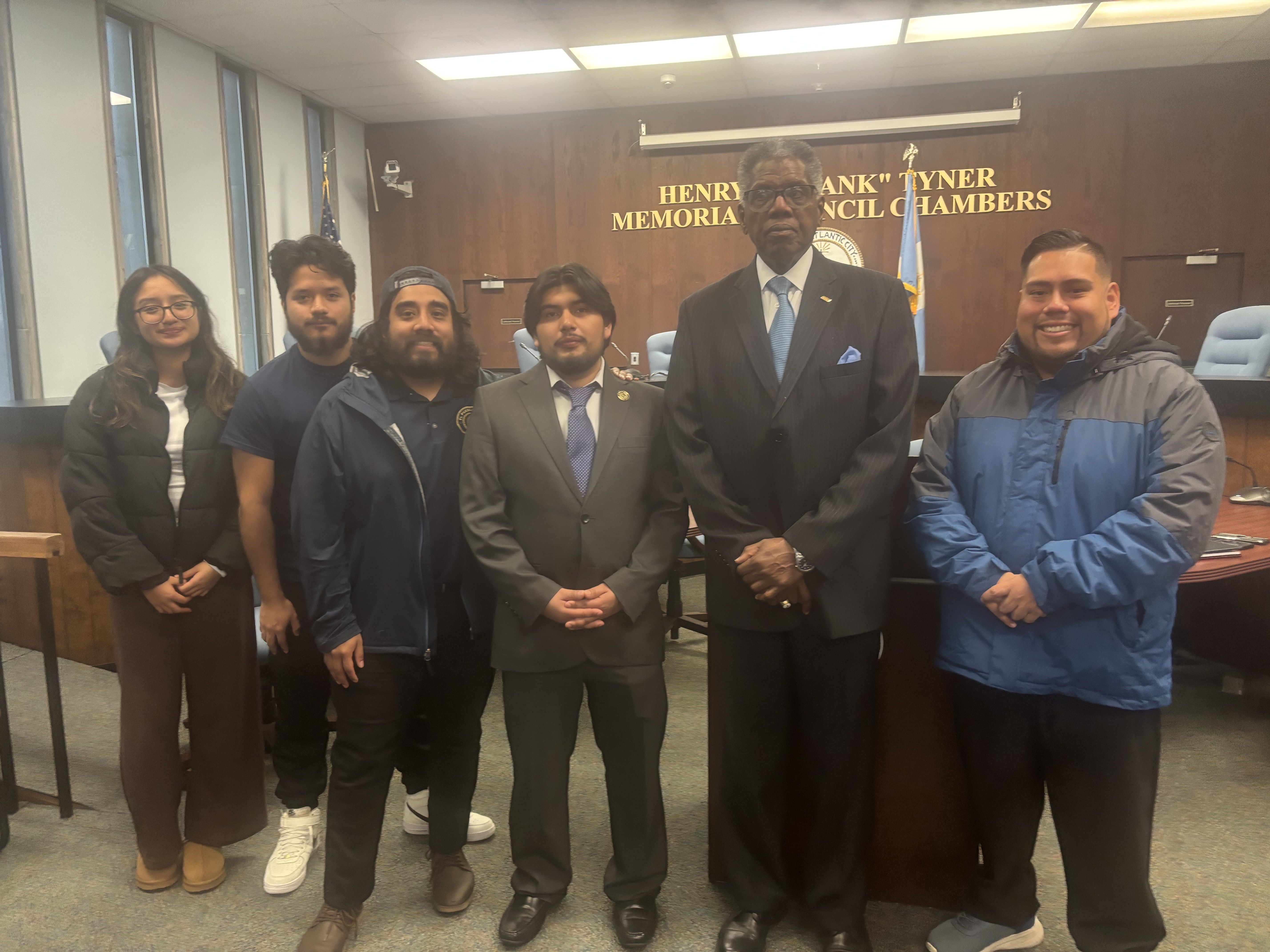
    From left, advocacy group El Pueblo Unido of Atlantic City rapid responders Karen Pelaez-Moreno and Christopher Arellano, executive director Cristian Moreno-Rodriguez, Atlantic City Councilman Kaleem Shabazz, and El Pueblo board president Irvin Moreno-Rodriguez, who was recently appointed a Pleasantville School Board member. The group and elected officials held a press conference Dec. 23, 2025 to condemn recent ICE activity.

    Also attending the news conference were the Rev. Collins Days, an Atlantic County commissioner, and religious leaders Imam Amin Muhammad of Atlantic City’s Masjid Muhammad mosque, Cantor Jackie Menaker of Ventnor’s Shirat Hayam synagogue, and the synagogue’s president, Joe Rodgers, a criminal defense attorney.

    “I am appalled at what’s been happening in our community by ICE,” Days said. “We stand together because an attack on one group is an attack on all groups.”

    “When we see the harms of our government, we are obligated to speak out,” Muhammad said. “We need engagement in the political process to make a change.”

    Mendoza said activists believed the targeted raids of last week were “the beginning of a large raid on our community … a major escalation.”

    “When we drove down Iowa Avenue, we saw an ICE agent and a Border Patrol agent questioning a woman, attempting to extract information in order to detain her,” he said. “When the agents noticed us, they allowed the woman to walk away.”

    One of the agents claimed to be looking for a fugitive, he said.

    Activists followed the man to Bader Field, where they saw a transport van and eight other vehicles. “That’s when we knew this wasn’t a small operation,” he said. “As soon as the agents realized they were being watched, they left quickly and quietly. It just took two Latino organizers standing by, holding cameras, for ICE to retreat from Atlantic City. ICE operates in the shadows. When people know their rights and when there is accountability, they scatter.”

  • Supreme Court keeps Trump’s National Guard deployment blocked in the Chicago area, for now

    Supreme Court keeps Trump’s National Guard deployment blocked in the Chicago area, for now

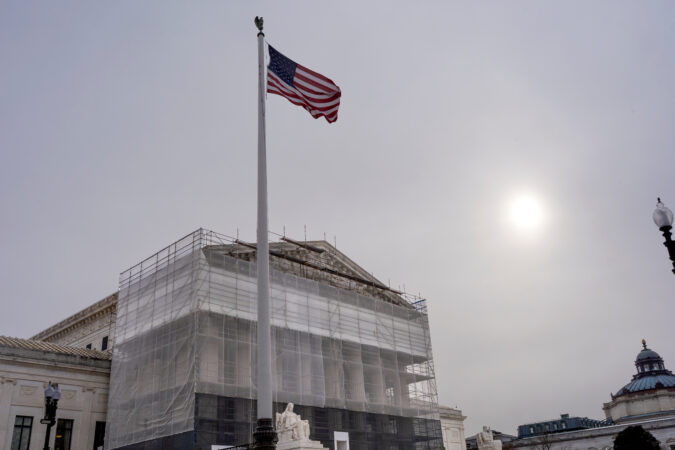
    WASHINGTON — The Supreme Court on Tuesday refused to allow the Trump administration to deploy National Guard troops in the Chicago area to support its immigration crackdown.

    The justices declined the Republican administration’s emergency request to overturn a ruling by U.S. District Judge April Perry that had blocked the deployment of troops. An appeals court also had refused to step in. The Supreme Court took more than two months to act.

    Three justices, Samuel Alito, Clarence Thomas and Neil Gorsuch, publicly dissented.

    The high court order is not a final ruling but it could affect other lawsuits challenging President Donald Trump’s attempts to deploy the military in other Democratic-led cities.

    The outcome is a rare Supreme Court setback for Trump, who had won repeated victories in emergency appeals since he took office again in January. The conservative-dominated court has allowed Trump to ban transgender people from the military, claw back billions of dollars of congressionally approved federal spending, move aggressively against immigrants and fire the Senate-confirmed leaders of independent federal agencies.

    The administration had initially sought the order to allow the deployment of troops from Illinois and Texas, but the Texas contingent of about 200 National Guard troops was later sent home from Chicago.

    The Trump administration has argued that the troops are needed “to protect federal personnel and property from violent resistance against the enforcement of federal immigration laws.”

    But Perry wrote that she found no substantial evidence that a “danger of rebellion” is brewing in Illinois and no reason to believe the protests there had gotten in the way of Trump’s immigration crackdown.

    Perry had initially blocked the deployment for two weeks. But in October, she extended the order indefinitely while the Supreme Court reviewed the case.

    The U.S. Immigration and Customs Enforcement facility in the west Chicago suburb of Broadview has been the site of tense protests, where federal agents have previously used tear gas and other chemical agents on protesters and journalists.

    Last week, authorities arrested 21 protesters and said four officers were injured outside the Broadview facility. Local authorities made the arrests.

    The Illinois case is just one of several legal battles over National Guard deployments.

    District of Columbia Attorney General Brian Schwalb is suing to halt the deployments of more than 2,000 guardsmen in the nation’s capital. Forty-five states have entered filings in federal court in that case, with 23 supporting the administration’s actions and 22 supporting the attorney general’s lawsuit.

    More than 2,200 troops from several Republican-led states remain in Washington, although the crime emergency Trump declared in August ended a month later.

    A federal judge in Oregon has permanently blocked the deployment of National Guard troops there, and all 200 troops from California were being sent home from Oregon, an official said.

    A state court in Tennessee ruled in favor of Democratic officials who sued to stop the ongoing Guard deployment in Memphis, which Trump has called a replica of his crackdown on Washington, D.C.

    In California, a judge in September said deployment in the Los Angeles area was illegal. By that point, just 300 of the thousands of troops sent there remained, and the judge did not order them to leave.

    The Trump administration has appealed the California and Oregon rulings to the 9th U.S. Circuit Court of Appeals.

  • ‘It’s a war’: Inside ICE’s media machine

    ‘It’s a war’: Inside ICE’s media machine

    For the Immigration and Customs Enforcement public affairs team, the nighttime operation across metro Houston in October was a gold mine.

    An ICE video producer shadowed agents as they pulled over and handcuffed more than 120 suspected undocumented immigrants, then sent the footage to a private team chat room.

    — — —

    ICE official 1, Oct. 29, 2:10 p.m.: Arrests are wonderful!

    ICE video producer 1, Oct. 29, 2:13 p.m.: Great shooting!

    — — —

    Across thousands of internal ICE messages reviewed by the Washington Post, this kind of celebration has become commonplace. The messages show how the team has worked closely with the White House, which has urged them to produce videos for social media of immigrant arrests and confrontations to portray its push for mass deportation as critical to protecting the American way of life.

    Before officials could post the Houston video, they had to figure out how to frame it. Officials did not know if all the arrestees had criminal records, they wrote in the chats, undermining a slogan the team had worked to promote on social media: that ICE targeted the “Worst of the Worst.”

    — — —

    ICE video producer 2, Oct. 29, 2:36 p.m.: We made several dozen arrests today very quickly. Not sure if these all had criminal histories beyond being in the U.S. illegally.

    — — —

    After some discussion, the team decided on a compromise.

    — — —

    ICE official 2, Oct. 29, 6:30 p.m.: I’d like to try to put this out without focusing on the aliens or their crimes, but to demonstrate that we’re out working hard.

    — — —

    Instead of arguing they’d snared hardened criminals, officials wrote a caption saying the arrests showed the dangers of “illegal aliens … behind the wheel.”

    Then, to maximize the video’s chances of going viral, they needed a soundtrack.

    — — —

    ICE video producer 1, Oct. 30, 1:13 p.m.: think country songs … this is Houston after all.

    Emily Covington, ICE assistant director for public affairs, Oct. 30, 1:39 p.m.: I feel like we need something a little more hard-core

    — — —

    They settled on a rap song by Nbhd Nick, which his label would later tell the Post was used without permission, that starts, “Oh, you thought this was a game, huh?”

    The video was posted to ICE’s social media channels, where it has been viewed more than 1 million times in total.

    For years, this ICE team had run like a routine government communications shop, dispensing public service announcements and news releases few Americans would see. But during President Donald Trump’s second term, ICE’s public affairs arm has rapidly transformed into an influencer-style media machine, churning out flashy videos of tactical operations and immigration raids.

    The internal communications reviewed by the Post show how the ICE team has coordinated with the White House, working to satisfy Trump aides’ demands to “flood the airwaves,” as one official urged in the messages, with brash content showing immigrants being chased, grabbed and detained.

    They also show federal officials mocking immigrants in crass terms and discussing video edits that might help legitimize the administration’s aggressive stance. The team also knowingly used copyright-protected music without permission from the rights holders, among other techniques designed to boost their online attention.

    Six current or former officials at the Department of Homeland Security, which runs ICE, told the Post that the video effort had broken from the more careful and methodical work of past administrations. They spoke on the condition of anonymity out of fear of retaliation.

    The Post reviewed chats and other materials provided by people familiar with internal discussions. They did so on the condition of anonymity due to the sensitive nature of the disclosures.

    David Lapan, the first DHS press secretary during Trump’s first term and a longtime critic who has argued the second Trump administration politicized the agency, said the current strategy is unrecognizable compared to the more “professional and buttoned-up” operations under past presidents that worked to describe law enforcement activities clinically and apolitically, for fear of inflaming anger against agents in the field.

    “We were supposed to present the facts, not hype things up. But this veers into propaganda, into creating fear,” said Lapan, a retired Marine Corps colonel. “We didn’t have this meme-ification of various serious operations, these things that are life or death. … It’s not a joking matter. But that’s the way they’re treating it now.”

    White House spokeswoman Abigail Jackson said, “President Trump and his entire team are working at breakneck speed to keep our promises, deport criminal illegal aliens, and get information out to the public — that’s a good thing and the American people deserve no less.”

    DHS spokeswoman Tricia McLaughlin said the White House had given the communications wings of DHS and ICE “autonomy to create content that is effectively reaching the American public.” The social media posts that used copyrighted material without permission had been preapproved by administration lawyers, she said.

    DHS public affairs officials, she added, were proud to break with the strategies of past administrations because their work has proved more successful at getting people’s attention.

    “They were irrelevant,” she said, “and we’ve made it matter.”

    ‘Feed the beast’

    Launched after the Sept. 11 attacks, ICE and DHS had always functioned as traditional law enforcement agencies focused on public safety and with minimal tools for self-promotion.

    Their public affairs divisions employed small teams of video producers, mostly for unexceptional tasks: facilitating TV interviews, running the cameras at workforce retirement ceremonies, recording safety commercials for the Super Bowl. Some producers traveled to make videos when DHS agents took down sex abusers or crime rings. Video producers would film targeted operations, a current DHS official said, but immigration enforcement was only a fraction of the workload.

    After the start of Trump’s second term, however, ICE’s ranks swelled as federal agents were diverted to immigration enforcement and the One Big Beautiful Bill tripled the agency’s annual budget to deliver on the White House’s promises to secure the southern border and speed up deportations. ICE’s average arrest count jumped from around 300 a day last year to more than 800 a day since Trump took office, according to a Post analysis of ICE data released by the Deportation Data Project at the University of California at Berkeley.

    DHS’s media operation was no exception. Public affairs teams were injected with a new crew of political appointees who had orders from the White House to treat immigration as their top priority and produce dramatized visuals of ICE operations and arrests to command user attention, the current and former officials told the Post. The video teams’ workload exploded, and immigration became the only topic anyone could pursue, according to interviews.

    “We’re not doing child pornography cases. We’re not doing human trafficking cases,” one current DHS official told the Post. “Everything is immigration.”

    ICE’s public affairs team included several dozen public affairs officers, producers, and strategists, scattered between its Washington headquarters and local field offices across the country, current DHS officials said. Members of ICE’s visual communications team, embedded in the public affairs division and known as “viscom,” began recording in the field more frequently, accompanying officers on raids and removal operations, shooting video day and night, interviews and chats showed. Any video producer who witnessed a particularly cinematic scene was expected to alert their supervisors, so the agency and the White House could promote it on their social media channels. Employees on ICE’s “digital engagement” team then raced to edit and post the footage on social media in hopes of securing a viral win.

    Emily Covington, ICE’s assistant director for public affairs, frequently requested “good arrest videos” and asked the team to devote its energy to capturing “high profile arrests,” the internal messages show. Laszlo Baksay, a deputy assistant director, asked the public affairs team in the chat to flag stories where “aliens with criminal history are being employed,” to counter media reports that the agency was grabbing “ordinary aliens just trying to earn a living.”

    Covington and Baksay declined to comment further on the chat messages.

    The team began working like a professional influencer operation, creating a “social media check list” of caught-on-camera arrests, sharing metrics with senior officials, using paid social media tracking tools and cataloguing all of their Facebook, Instagram, LinkedIn, Threads, and X posts, ranked by impressions and engagement rate.

    Covington pushed the team in internal chats in late May to be more “proactive” in pushing out videos.

    — — —

    Emily Covington, ICE assistant director for public affairs, May 21, 7:52 p.m.: What PR tactics can we deploy that we don’t typically? Should we feed info to an influencer? … Using judgment to ID something likely to go viral or bubble up and gain attention. Right now we are learning from the media, let’s feed the beast first with the good work ICE is doing each and every day.

    — — —

    A week after Covington’s message, in late May, the team got its first viral video. The clip showed ICE agents leaping out of an SUV and confronting men on the curb of a home improvement store in Baltimore. The men were shoved face down onto the street and handcuffed while an agent said, “Calle la boca” — in Spanish, “shut your mouth.” In an X post, ICE called the video “action-packed.”

    — — —

    ICE official 3, May 28, 11:57 a.m.: 2.1M views and nearly 7,000 shares in 13 hours! Awesome work!

    — — —

    But the real celebration came shortly after, when the White House reposted the video on its Instagram and X accounts, labeling it an “EPIC Takedown.”

    — — —

    ICE official 4, May 28, 3:22 p.m.: White House just ran with it!

    — — —

    The post, from one of the team’s political appointees, led to a burst of hearts and shock-face emojis.

    As the media operation ramped up, DHS posted several videos containing clear errors around their operations, using misleading footage that showed scenes recorded thousands of miles away from where the video described, the Post has previously reported.

    Other edits were aimed at presenting events in ways that supported the administration’s narratives. In May, Covington asked, at the White House’s request, whether a video of a deportation flight from Texas could be re-edited so that the clips “don’t feature tons of females?” An ICE official responded that a video producer would “re-edit the b-roll to exclude the females,” the chats show.

    Officials worked to find ways to describe many of the people arrested as the “Worst of the Worst,” a slogan DHS and ICE began using in January to argue that their agents hunted only the most dangerous criminals. When one official asked in the chat what producers should say in their videos when arrestees had no criminal history, another responded that they should work to find something else “newsworthy” to highlight, like an “egregious immigration history.”

    Public affairs officers were told to rewrite their news releases and online posts with stronger, more aggressive language if they wanted the agency’s main communications channels to promote them, one said in an interview. “If the truth of the operation does not match the narrative of the ‘worst of the worst,’ it’s going to be killed,” the official said.

    The team gave right-wing media figures premium access to immigration operations and received favorable coverage. In June, about three months before he was killed, right-wing influencer Charlie Kirk posted what he said was “exclusive footage” of ICE officials arresting a “thug.” Covington highlighted the moment in the team’s chat, thanking one official “for getting great footage on today’s arrest.”

    Right-wing influencers with large followings, including “Dr. Phil” McGraw and Libs of TikTok’s Chaya Raichik, were regularly invited to ride along with law enforcement agents and interview senior officials, according to the Post’s review of their coverage. The pro-Trump influencer Benny Johnson donned a Border Patrol tactical vest to watch a raid at a Walmart in the Chicago area alongside Homeland Security Secretary Kristi L. Noem. His X clip celebrating the “amazing” operation’s “wild scenes” has been viewed 1.6 million times.

    A Libs of TikTok representative declined to comment on the relationship. Representatives for Turning Point USA, the organization founded by Kirk, and Johnson did not respond to requests for comment. A representative of McGraw said he had been invited by White House border czar Tom Homan to document ICE enforcement in Chicago and Los Angeles earlier this year.

    In pursuit of more viral video, DHS brought in new public affairs staff members with atypical backgrounds and authorized them to “go out and capture content,” as a chat message said. A MAGA women’s lifestyle influencer, an L.A.-based wedding videographer and a Canadian-born actor who played a “mountain man” in a cable-TV show joined the team.

    DHS encouraged the hires to become intimately involved with agency affairs, the chats and interviews showed. In June, when ICE agents were raiding farms in rural Missouri, the former actor noted it would be a prime chance to make a video. “Would be great to get something like that on film,” he wrote in the chats, suggesting a tagline: “We are everywhere, we will find you.”

    Later, when ICE officials complained about negative media coverage, he worked to bolster their spirits.

    — — —

    ICE official 4, June 20, 12:18 p.m.: The good news is half the country is seeing it, and equally as frustrated. those in the “middle” are who we will continue to slowly reach … It’s a war!

    ‘Flooding the airwaves’

    By June, the public affairs team had for weeks been showing signs of overwork, with some employees consistently working overtime to help satisfy the White House’s constant demands for more content, the chat messages showed.

    The team had discussed bringing on contract videographers to help address outstanding tasks — like a new request to shadow every operation of ICE’s Special Response Team, the elite SWAT-like unit that handles its most dangerous arrests.

    — — —

    Emily Covington, ICE assistant director for public affairs, May, 9 10:42 a.m.: All- as expected, I am getting pressure now about our video capabilities. I need ALL video our PAOs and videographers have captured this week ASAP in one link. This should be the only priority for right now.

    — — —

    But when protests over mass deportation swept L.A. and Trump ordered the deployment of the National Guard in June, the White House ramped up the pressure yet again. Top officials wanted ICE’s public affairs unit to produce more visuals, messages from June 10 show.

    — — —

    ICE official 5, June 10, 12:33 p.m.: We need all hands on deck to start “flooding the airwaves” per White house direction on ALL ICE arrests nationwide today. The request is to flood social and traditional media with imagery of ICE arrests.

    Laszlo Baksay, ICE deputy assistant director, June 10, 12:41 p.m.: How many socials do we have in the que that we paused from the last 2 days?

    ICE official 6, June 10, 12:42 p.m.: “TONS” He said there’s stuff loaded and ready to go

    Laszlo Baksay, ICE deputy assistant director, June 10, 12:42 p.m.: do we have enough to post every 30 mins? Until midnight?

    — — —

    The National Guard deployment presented a challenge for a unit trained to cover preplanned and targeted operations: a vast, citywide video shoot where clashes with protesters could flare up at any time.

    In the chats, the team strategized how to stretch out its content.

    — — —

    ICE official 5, June 10, 12:45 p.m.: My thought would be for locals to post and the HQ can re-tweet, unless there is something really juicy that would get more push coming from HQ.

    Laszlo Baksay, ICE deputy assistant director, June 10, 12:50 p.m.: fire away!

    — — —

    Around 1 p.m., Covington, the ICE public affairs assistant director, instructed her team to highlight arrests in Los Angeles at the White House’s request.

    — — —

    Emily Covington, ICE assistant director for public affairs, June 10, 1:18 p.m.: On White House Call — we need to be highlighting worst of worst LA arrests across relevant accounts/channels. I will be getting a LOT of content from all federal partners today. All flowing through me now.

    — — —

    ICE began to post a flurry of tweets on X in quick succession — almost every half hour. They included visuals of recent immigration raids and mug shots of people the agency said were undocumented immigrants with a criminal history.

    ICE tweeted 38 times over 11 hours. Earlier in the day, the account had posted only three times.

    Officials also floated more ideas to maximize coverage, including pulling in military videographers, known as “combat cameras,” to offer “direct support of designated hotspots.” One official warned the idea came with too many risks, in part because they had been trained for battle, not protests. “It’s different than war photography in a few distinct ways,” the official said.

    The White House directive around the L.A. protests forced the agency to play more of an “attack-dog” role online to keep up with the administration’s demands, one former worker on the DHS media team told the Post.

    “That was the turning point to get even more aggressive with their messaging, and to paint pictures of these places as war-torn,” he said. “There was a much more blustery edge, and a need to put stuff out as quickly as you can. You’re steamrolling everything.”

    The White House has benefited from this symbiotic relationship: The most-watched video on its TikTok account, with more than 45 million views, included DHS operational footage, a photo of a crying arrestee and the caption, “Ahhh that deportation feeling …” (It has since been removed, but the White House declined to say why.)

    In the weeks after the June 10 directive, many National Guard troops left L.A., but the ICE public affairs team kept working at a rapid pace, the chats showed. As plainclothes ICE agents began ramping up arrests of immigrants at courthouses, an ICE official urged the team to “flood all your local social with the imagery from the arrests!”

    The pace became so demanding that one official complained of overwork.

    — — —

    ICE official 7, June 20, 11:53 a.m.: DHS knows we have very little staff right? I know it has been discussed but there has been no change to our staffing and they keep wanting more and more.

    — — —

    When video producers weren’t available, public affairs officers were sent into the field to record ICE activities on their phones — a footage “force multiplier,” one DHS official said in an interview. Officers were traveling more to fill the White House’s almost insatiable demand for visuals, another official said.

    The push, however, left some of the officials fearful for their safety in the field. In July, DHS said, an ICE public affairs specialist was sent to the emergency room with a bloodied hand after being hit by a thrown rock outside a California marijuana farm.

    During an all-team meeting attended by public affairs officers, an official said he had been sent in a T-shirt to scenes where agents were wearing body armor, an ICE official recalled. (An ICE spokesman said the agency now ensures that public affairs officials have protective equipment, including body armor and first aid kits.)

    Still, public affairs officials have participated in the immigration operations. In September, Covington said in an internal chat message that she had been on a ride-along with federal agents when an immigrant from Venezuela was apprehended. “Target was a runner — I spotted him and we made the arrest,” she wrote.

    She uploaded photos of the man in handcuffs and asked in the chat whether he had been a known gang member, saying he “had some interesting tats.” An ICE legal associate told her their files showed no evidence of gang membership. Some of her colleagues congratulated her nonetheless. “Go [Public Affairs Office] Go!” one replied.

    The White House’s frenzy for more content, and DHS officials’ scramble to produce, led the team to push the boundaries in ways that disturbed some of its employees.

    ICE’s X account posted a video of a bound protester in Portland, Ore., being wheeled into custody face down on a flatbed cart, with the background lyrics, “they see me rollin’.” DHS’s account posted a clip of Illinois protesters and said, “Get a job you imbecilic morons.” It also shared a Halloween-styled montage of arrestees’ mug shots and warned there would be “no sanctuary for creatures & criminals of the night.”

    “They just went nuts,” a recently departed DHS producer told the Post. “It was no limit. … It was like if someone from Reddit took over.”

    Some prosecutors in U.S. attorneys’ offices complained to public affairs officials that the brash social media posts could jeopardize their cases by raising questions about bias or tainting the jury pool, one official said. (McLaughlin, the DHS spokeswoman, said she’d not heard this and said that if officials are so concerned about it, they should convey it to her, not journalists.)

    But that style of crass humor was also common in the ICE team’s internal chats. Four days after Trump’s inauguration, an official shared a meme that read like a warning to migrants inside the country: “Hide Yo Wife. Hide Yo Kids.” Another official poked fun at a migrant’s mug shot, labeling him an “MS13 heart throb” in reference to the gang.

    In June, after Los Angeles Dodgers officials said they had blocked ICE agents from accessing their parking lots, one ICE official made a joke about the team’s Japanese superstar pitcher, who has played for American teams since 2018.

    — — —

    ICE official 8, June 20, 11:41 a.m.: Can we double check Shohei Ohtani’s immigration paperwork???

    — — —

    McLaughlin said that every organization has “conversations that you don’t think are going to get out to the public” but that she is not “going to lose sleep over” anything in the messages.

    ICE’s shifting attitude toward public messaging was especially noticeable in its use of music without the artists’ or labels’ permission, current and former DHS officials said, which past administrations had been far more cautious about. Some officials said in the chat that they were indifferent to the potential perils. When one employee raised concerns about copyright violations, another wrote back, dismissing them.

    At least five DHS and ICE videos have been taken down from X in recent months following complaints from representatives of the comedian Theo Von, the band MGMT, and rappers Jay-Z, Joey Valence, and Chamillionaire. Other companies and creators have complained that their intellectual property was used without permission, including the Pokémon Co., whose cartoon style was mimicked for a DHS video captioned “Gotta Catch ‘Em All.”

    Trump administration officials have defended the intensity of their media operation to reporters by saying it’s what Americans want: visual proof that Trump is fulfilling his promise to deport millions of immigrants nationwide.

    But ICE’s social media onslaught appears to have done little to change Americans’ attitudes en masse. The share of Americans saying immigration is a good thing for the country leaped to 79% in July, a record high, a Gallup poll found in July. About 62% of Americans said they disliked how Trump was handling the issue.

    Despite this, the media operations at DHS show no signs of slowing down. Inside the ICE team, the chats showed, many were proud of their work — and committed for the long haul.

    In August, after an ICE official shared census numbers showing the country’s immigrant population had dropped by 2 million, an ICE legal associate responded simply: “Only 40 million to go.”

  • Lawmaker sues to stop Trump from adding name to Kennedy Center

    Lawmaker sues to stop Trump from adding name to Kennedy Center

    A Democratic congresswoman sued the Kennedy Center’s board of trustees Monday to stop it from adding the president’s name to the institution, arguing that only Congress has the power to do so.

    In a lawsuit filed in the U.S. District Court for the District of Columbia, Rep. Joyce Beatty (D., Ohio) claimed that a vote by the center’s board last week to rename the institution the Trump Kennedy Center exceeded its statutory authority and requested that a judge declare it to be void.

    “Because Congress named the center by statute, changing the Kennedy Center’s name requires an act of Congress,” the lawsuit says.

    The Kennedy Center did not immediately respond to a request for comment sent early Tuesday morning.

    Thursday’s vote by the Kennedy Center’s board to add Trump’s name to the institution — which has sparked concern among legal experts — marked the most overt effort to date by the president and his allies to remold the storied institution in his image. In February, Trump purged members of the board not appointed by him, installed loyalists and became its new chair. Earlier this month, he even hosted its annual honors event. Ticket sales have plummeted since Trump took over, a Washington Post analysis found.

    The lawsuit, which was filed by Democracy Defenders Action and the Washington Litigation Group on behalf of Beatty, requested that a judge order all physical and digital branding changes to be reversed. Trump’s name was added to the exterior of the building Friday, the day after the board’s vote.

    Beatty, who is an ex officio member of the center’s board, said in the suit that she had attended the board meeting virtually and had been unmuted previously, but that when she identified herself and raised concerns about the renaming, she was muted and received a written message that “she would not be unmuted, and therefore she could not participate in the meeting.”

    In 1964, the year after Kennedy was assassinated, Congress passed a statute designating the capital’s National Cultural Center as “the sole national monument to his memory within the city of Washington and its environs” and naming it the John F. Kennedy Center for the Performing Arts.

    In a series of posts on X, the center’s president, Richard Grenell, defended the name change as a reflection of its role as a “bipartisan space.” On Friday, he claimed the memorial to Kennedy was not impacted by the board’s action and “therefore the Board is allowed to change the name.”

    In an email to the Washington Post last week, Roger Colinvaux, a law professor at Catholic University, said the law clearly states that the building’s name is the John F. Kennedy Center for the Performing Arts. “Under the statute, the board that voted to change the name not only does not have the authority, but that each member by so voting violated their duty,” he said.

    On Tuesday, the center’s website prominently referred to itself as the “Trump Kennedy Center,” but in other sections it continued to use the name “the Kennedy Center.”

    Members of the Kennedy family reacted with dismay to last week’s vote. “Some things leave you speechless,” said Maria Shriver, a niece of Kennedy, on X. “It can no sooner be renamed than can someone rename the Lincoln Memorial,” said Joe Kennedy, the former Democratic congressman from Massachusetts whose great-uncle the building was named for.

  • New Epstein files shed more light on his ties to Prince Andrew

    New Epstein files shed more light on his ties to Prince Andrew

    LONDON — The latest batch of Jeffrey Epstein files have cast renewed scrutiny on the links between Andrew Mountbatten-Windsor and Epstein — a relationship that has already sent the former prince into what is widely seen as royal exile.

    Among the newly released material is an email sent from “A” who writes that he is at the royal residence of Balmoral in Scotland, and asking Epstein associate Ghislaine Maxwell whether she had found him some “new inappropriate friends.”

    The documents also include emails and court filings of U.S. authorities seeking to interview the former prince in connection with two separate criminal investigations: one relating to Epstein and another involving Peter Nygard, the Canadian fashion tycoon accused of sexually assaulting multiple women and girls.

    Andrew has repeatedly denied all wrongdoing. The former prince’s office did not respond to a request for comment Tuesday.

    In a 22-page formal request dated April 3, 2020, from the Justice Department, federal prosecutors in New York and the FBI asked U.K. authorities to assist in arranging a voluntary interview with Andrew. U.S. authorities requested that if Andrew declined, that U.K. officials then “conduct a compelled interview of the witness under oath.”

    The request states that investigators wanted to question Andrew over allegations involving Nygard, including claims of an “an international sex trafficking ring victimizing adult women and minor girls” at the Canadian’s estate in the Bahamas, known as “Nygard Cay.”

    According to the document, “the investigation has revealed that, on at least one occasion, Prince Andrew traveled to Nygard Cay in the Bahamas, a location where Nygard is believed to have trafficked minor and adult female victims.”

    U.S. authorities said they wanted to question Andrew about his visits there, as well as any information he might have about Nygard and related individuals. They also said they wanted to ask Andrew whether he “observed any females who appeared to be, or stated that they were, under the age of 18 years old, and the names of any of those females.”

    The document stressed that Andrew was not a target of the investigations and that U.S. authorities had not gathered evidence that he had committed any crime under U.S. law. Nygard was convicted of sexual assault by a Canadian jury in 2023.

    U.S. authorities also sought to question Andrew in connection with the Epstein investigation. The request states that “documentary evidence uncovered during the course of this investigation has revealed information suggesting that Prince Andrew had knowledge that Maxwell recruited females to engage in sex acts with Epstein and other men.”

    It further states that there is “evidence that Prince Andrew engaged in sexual conduct involving one of Epstein’s victims,” while again noting that he was not a target and that investigation had not concluded he had committed a crime under U.S. law.

    While it has been previously reported before that U.S. authorities wanted to interview Andrew, the newly released document makes clear that investigators wanted to question him about two then ongoing criminal investigations and detailed the specific areas they wanted to explore. He was never questioned by U.S. authorities.

    The files also include material from a Florida court case brought under the Crime Victims’ Rights Act. In that case, a woman identified as “Jane Doe #3” — widely understood to be Virginia Giuffre — alleged that she was trafficked as a teenager by Epstein and forced to have sex with Andrew on three occasions: in London, New York, and on Epstein’s private island in the U.S. Virgin Islands. Andrew settled a civil case with Giuffre without an admission of liability in 2022.

    The files also include email exchanges from early 2020 between U.S. prosecutors and Andrew’s lawyer, documenting weeks of back-and-forth over a proposed interview with Andrew. Andrew’s team repeatedly said he wanted to cooperate but never committed to a conversation between prosecutors and their client.

    Shortly after a 2019 interview with BBC’s Newsnight that was widely seen as disastrous for the prince at the time, Andrew said in a news release that he was “willing to help any appropriate law enforcement agency with their investigations, if required.”

    At the end of January 2020 — and after a month of back-and-forth emails between lawyers — Geoffrey Berman, then U.S. attorney for Southern District of New York, made a public statement saying that Andrew had provided “zero cooperation.” His lawyers disputed that characterization.

    The files include emails from Maxwell to someone who signed off as “A” and from an address that used the alias “The Invisible Man.”

    In an August 2001 message, “A” wrote: “I am up here at Balmoral Summer Camp for the Royal Family,” referring to a royal residence of then-Queen Elizabeth II.

    He added: “How’s LA? Have you found me some new inappropriate friends? Let me know when you are coming over as I am free from 25th August until 2nd Sept and want to go somewhere hot and sunny with some fun people before having to put my nose firmly to the grindstone for the Fall.”

    Maxwell replied that she had found only “appropriate friends,” prompting A to respond “Distraught!” The email went on to describe how the writer had just lost his valet. “He had been with me since I was 2. I am a little off balance.”

    The writer also noted that he had left the “RN” — Andrew had left the Royal Navy earlier in the year. “My whole life is in turmoil as I have no one to look after me,” the writer said.

    The controversy surrounding Andrew’s links to Epstein eventually led his brother King Charles III to strip him of his prince title and required him to vacate the Royal Lodge.