House Republicans are considering using a fast-track process to bypass the filibuster and pass President Donald Trump’s sought-after voting restrictions.
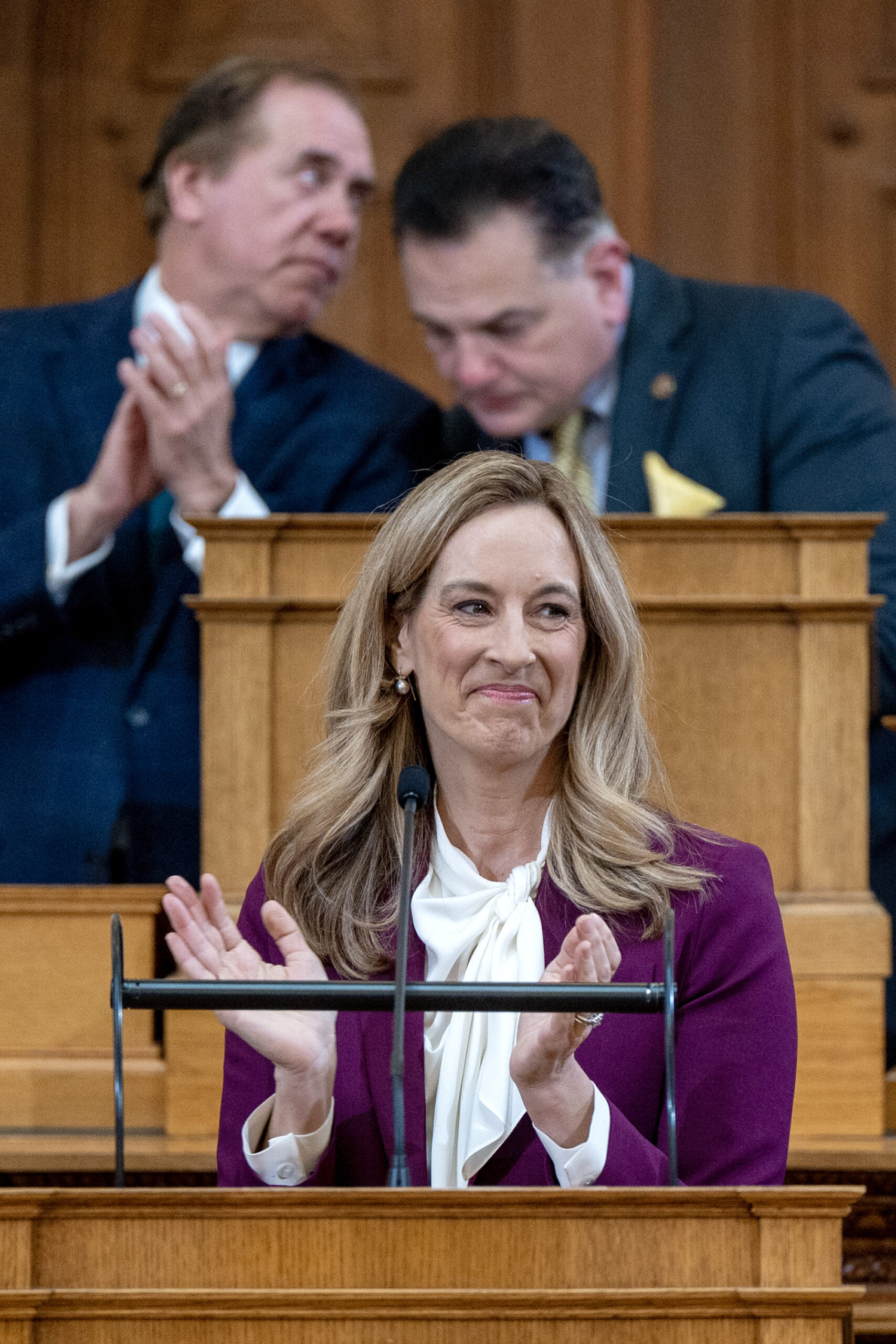
House Speaker Mike Johnson (R-Louisiana) said Monday that Republicans are moving forward with a plan to establish a grant program that would incentivize states to adopt stricter election rules outlined in the Safeguard American Voter Eligibility (Save America) Act, which includes a new requirement to provide documented proof of citizenship and a photo ID at the time of voting.
The move would use the so-called reconciliation process, designed to overcome the filibuster, because it can be passed with a simple majority in both chambers, bypassing Democrats.
“If you put it into a grant program or something similar, then it does make it part of reconciling the budget,” Johnson told reporters Monday, after meeting with Trump at the White House. “It does ultimately work that way.”
“The only way to get that to the president’s desk, we’ve been shown many times, is to put it on reconciliation,” Johnson said.
Doing so, Johnson argued, would allow the Save America Act to comply with Senate rules.
However it’s not clear whether Trump would be on board with voting restrictions administered through a grant program. And many Senate Republicans have expressed doubt about passing more legislation through the fast-track process this year.
Trump has been trying to pressure Republicans to pass the act, including refusing to sign a bipartisan bill aimed at helping Americans with housing, which was sent to his desk Monday.
Speaking at the White House on Monday, Trump said it is “even more important” that Congress passes the Save America Act and said he doesn’t understand why Senate Majority Leader John Thune (R-South Dakota) won’t fire the parliamentarian, a nonelected, independent arbiter who advises the Senate on how to navigate laws and rules.
“[He] has the right to immediately fire her and put somebody else there and it’s not even believable that she’s still there,” Trump complained.
Senate Republican leaders have repeatedly told Trump that the votes are not there to pass his election bill, which would require proof of citizenship to vote in federal elections and restrict mail-in voting, among other provisions. The House passed a version of the bill earlier this year that did not include all the provisions Trump has demanded.
Under this new plan, House Republicans said they believe that establishing a grant program that incentivizes states to implement the new election restrictions — rather than establishing them outright — should comply with Senate rules and allow them to pass the legislation with Republican votes only.
However, Senate rules would likely prevent much of the Save America Act as written from being included as provisions passed through the process must be budgetary.
At least four Republicans in the Senate have expressed opposition to the Save America Act and previously voted against adding the language to another must-pass measure. It is unclear whether these senators would support the new grant provision.
Johnson said House Republicans will first attempt to pass a procedural rule that would merge the Save America Act and the National Defense Authorization Act, which is an annual defense policy bill, upon passage of the latter and send both bills together to Senate.
Rep. Anna Paulina Luna (R-Florida) and a group of GOP hard-liners have been holding up most action on the House floor since last week as a protest against Senate inaction on the Save America Act. They have refused to vote for rules, which are necessary to bring most legislation to the floor.
On Monday evening, Luna said she opposes the merger maneuver, and she also expressed skepticism over the grant program. The Florida Republican said Johnson had not spoken to her about either option.
Melat Kiros was fresh out of Notre Dame Law School in 2023 when she was fired by her New York law firm after publishing a lengthy letter sharply criticizing Israel’s government, raising questions about its historical legitimacy and challenging the firm’s response to law students engaging in pro-Palestinian activism.
In Tuesday’s Democratic primary in Colorado, under the banner of the Democratic Socialists of America, Kiros, 29, is again challenging the establishment. This time, she hopes to defeat Rep. Diana DeGette, 68, a liberal Democrat who was elected to her Denver-area seat a year before Kiros was born.
The showdown is the latest between the mainstream Democratic Party and its ascendant, youthful left wing, but Kiros represents more than the DSA. She is one of several Generation Z candidates this year fueled by the generational frustrations of their pandemic-marred youth, social media-fueled isolation, artificial intelligence and the war in the Gaza Strip.
The upset pulled off by Darializa Avila Chevalier, 32, a socialist doctoral student, over Rep. Adriano Espaillat, 71, in last week’s New York Democratic primary may have only set the stage for the generational and ideological fights to come — on both sides of the political aisle.
Melat Kiros, right, who is running for Congress and hopes to defeat Rep. Diana DeGette (D-Colo.), who was elected to her Denver-area seat a year before Kiros was born, records a video with Eric Cheng of the podcast “Wait, Say More” while campaigning in Denver, June 27, 2026. Kiros is one of several Gen Z candidates this year fueled by the generational frustrations of their pandemic-marred youth, social media-fueled isolation, artificial intelligence and the war in Gaza. (Chet Strange/The New York Times)
“When you’re living through these kinds of moments on such a regular basis, it feels impossible to be able to change course and believe your vote actually makes a difference,” Kiros said.
But, she added, “we’re seeing just how broken the system is, and we’re seeing that no one’s coming to save us but us.”
DeGette sees lawmakers of all ages working together as important, citing her work with younger members of Congress like Alexandria Ocasio-Cortez, 36, and Jake Auchincloss, 38, on “Medicare for All” legislation. But DeGette still believes experience and community involvement are tantamount to age.
“What voters look at in these races is they look at who they think is going to most effectively represent them and who can have the power and leadership to fight against Donald Trump,” she said.
For Generation Z voters, youth and recent history have shaped their views. They did not experience the exhilaration of Barack Obama’s hope-fueled 2008 campaign or George W. Bush’s calls to service after the attacks of Sept. 11, 2001. Instead, they have weathered a decade of Trump’s “American carnage” narrative and the gerontocracy of Joe Biden. Their beefs tend to be less with the other party than their elders.
Generation Z voters express higher levels of party alienation than any other generation; two-thirds of Generation Z respondents in a recent New York Times/Siena poll expressed dissatisfaction with both Democrats and Republicans. Among Generation Z Democrats, 68% said they were unhappy with their own party.
But the rise of Generation Z and young millennial candidates demanding change is not limited to Democrats.
Joe Mitchell, the founder of Run GenZ, an organization aiming to elect young conservatives, is vying to fill the seat of Rep. Ashley Hinson of Iowa, a Republican running for Senate. Mitchell, 29, who runs a real estate development company, represents a brand of young male Republicans inspired by Charlie Kirk, the slain conservative activist, and driven by their Christian faith and by values aligned with Trump’s political movement.
“Everything I do is going to be America first,” said Mitchell, a former state representative. “Everything we do should be focused on, ‘how can we help the American worker?’”
Brendan Trachsel remembered celebrating his 16th birthday as he watched election results come in for Trump’s first presidential win in 2016. Although he grew up in a conservative household in the San Diego suburbs, he said he was in “utter shock that someone who is completely OK with treating people so horribly would get into office.”
After starting at Northern Arizona University in 2019, he registered with the Green Party. Now 25, Trachsel is running for the Arizona House of Representatives in a Democratic-held district near Flagstaff, focusing on labor organizing, data center moratoriums and tighter protections for online privacy.
James Thibault, a state representative in New Hampshire, in Northfield, N.H., June 27, 2026. For Gen Z voters, youth and recent history have shaped their views. (Veasey Conway/The New York Times)
If he wins, Trachsel would be the first third-party official in the Arizona Legislature. He cited Zohran Mamdani’s mayoral campaign in New York as an inspiration.
“It was just so people-focused, so intent on just shutting up and hearing what people needed and want,” Trachsel said.
Startled by Trump’s return in 2024, Leila Staton, 22, and her mother formed the Insufferable Wenches of Iowa, a progressive group designed in part to link like-minded but socially isolated rural residents. No Democrat had filed to run this year against the two-term Republican state legislator representing her district, so Staton, who lives in Stout, population around 200, decided to run herself.
College graduates from rural Iowa tend to leave the state. Staton pointed to a state Legislature, where in 2023 the average age was 54, as unrepresentative of her generation.
Staton has focused her campaign on public education, which has been drained of cash by a new school voucher program; family farms struggling with rising costs and corporate pressure; drinking water that is contaminated with nitrates; and Iowa’s rapidly rising cancer rates.
“There’s a lack of opportunity, prices are rising, wages are stagnant,” she said, “and our cancer crisis has no clear solution.”
Generation Z politicians are also the first largely born after the Columbine massacre in 1999 and raised amid the drumbeat of school shootings that followed.
Tyler Smith, 26, was in a Los Angeles high school when, in 2018, a gunman killed 17 people at Marjory Stoneman Douglas High School in Parkland, Florida. He joined school walkouts and watched as a young breed of activists emerged from Parkland.
While working for a gun control group, Smith decided to run as a Democrat for a Texas House seat this year in the Houston area held by a staunch conservative, insisting, “People right now are sick and tired of the same old, same old.”
Braxton Mitchell, a 26-year-old Montana state representative, also became involved in political activism in 2018. But for him, the gun control walkouts that followed Parkland did not represent his “way of life,” so he spearheaded a counter walkout, against gun control, at his high school in Columbia Falls, Montana. After graduation, he got on a plane for the first time and flew to Washington to meet Kirk, who had been sending him messages of support.
A year and a half later, the state Republican Party chair, Don Kaltschmidt, encouraged Mitchell to run for his local legislative seat, then held by a Democrat. He won and is now running for reelection.
“We need all generations at the table, especially in places like the state legislature, because the decisions being made are going to impact my generation the most,” Mitchell said.
He’s working on a school safety bill to put panic alert systems in rural schools across the state — without gun control.
COVID-19 is another shared experience. James Thibault, the son of a landscaper and a nursing assistant in New Hampshire, had no political aspirations until the pandemic shut down schools. Then politicians reopened them with mask mandates that Thibault, a high school freshman at the time, found onerous and not conducive to learning.
He protested at school board meetings. He was appointed to a youth legislative council. Then he filed to run for state representative before he graduated from high school. He was elected at 18 as a Republican, becoming the youngest state legislator.
“COVID was a wake-up call,” said Thibault, 20, who is running for reelection this year.
In Denver, Kiros also cited the pandemic as consequential to her own politics. “Stagnant” cultural norms that demanded working in offices suddenly gave way to acceptance of remote work, she said. The burning of fossil fuels plunged. Then those social benefits went in reverse.
Her frustrations with current representatives have only grown deeper.
“I don’t know if it’s ego,” Kiros said. “I don’t know if it’s recklessness. There really is just no sense of preparing or leaving the world better than where they found it.”
The state of Florida recently released a new American history high school course with a conservative tilt. Troublingly, it glosses over the relationship between the founders and slavery—a topic that should in 2026 promote a rich understanding of the U.S. past, but one that has also been a subject of controversy, including in Philadelphia at the site of the President’s House. In fact, slavery was central to the economic growth and expansion of the young republic, so much so that it would take a long and brutal war to get rid of it. As Abraham Lincoln, dealing with slavery during the Civil War, put it: “Fellow-citizens, we cannot escape history.”
On the 250th anniversary of the founding of the American republic, it bears repeating that the history of the United States is neither the linear, uninterrupted history of American exceptionalism that the Florida framework promotes nor is it solely an unremitting story of racism and reaction. Students benefit from learning about the brutality of slavery as well as the bravery of those ordinary Americans, men and women, Black and white, who resisted it. Emphasizing just one part of this equation is incomplete and bad history.
The Florida course framework portrays the founding generation of American revolutionists as unanimously antislavery. The truth is more complex. While most of the northern founders like Benjamin Franklin, Alexander Hamilton, and John Jay lent the prestige of their names to abolition societies, most southern founders did not. Their actions reflected the reality on the ground. Between 1779-1804, northern states gradually abolished slavery. But southern slavery not only persisted but expanded considerably in the early American republic. If the founders were unanimous, what explains this divergence?
While Jefferson and Madison professed to abhor slavery in their writings, like most southern enslavers they did not free their slaves. Jefferson made an exception for his own progeny, freeing select enslaved people. During his presidency, George Washington famously pursued his slave Ona Judge, who had escaped enslavement, with a relentless energy. However, New Hampshire authorities refused to render her back to the President—a signal of diverging attitudes and policies about slavery in the early republic.
Washington did become the only prominent member of the so-called Virginia dynasty of Presidents to free his slaves on his death. It was a belated gesture. As the Black abolitionist Reverend Richard Allen noted in his eulogy of Washington in 1799, “he dared to do his duty, and wipe off the only stain with which man could ever reproach him.” While Washington was lauded as the Father of the Nation, few southern slaveholders followed his example, as Allen had hoped.
The Florida history standards also present the U.S. Constitution, which was signed in 1787, ratified in 1788, and went into effect with the launch of the federal government in 1789, as an antislavery document rather than one that contained expedient compromises on the issue of slavery. One particularly egregious example of this relates to the three-fifths clause, which counted the enslaved population at a three-fifths proportion for representation and taxes. The Florida guidelines consider this an antislavery clause because the enslaved population was not counted fully. But this compromise led to southern domination over the federal government until Lincoln’s election as it gave the slave states disproportionate representation in Congress.
The framers of the Constitution were careful not to use the words slavery and slaves in the fundamental legal document of the republic. Instead, they employed euphemisms such as “persons held to service” or “all other persons.” But that did not prevent contemporary abolitionists from bemoaning its fugitive slave clause, a part of the Constitution that gave southern laws of slavery extraterritoriality in the free states—an endless source of political friction between the states—and the continuation of the African slave trade, an execrable commerce whose tortures were well known then, until 1808.
While Florida students under the new guidelines would learn about a debate among abolitionists like William Lloyd Garrison and Frederick Douglass on whether the Constitution was a proslavery or antislavery document, they would miss other important context. For example, the guidelines elide the equally important debate among abolitionists on the extent of the complicity of American churches in upholding slavery. Instead, abolition is framed as a Christian movement—with no mention of the schism over the issue of slavery leading to religious divisions that still exist today, including northern and southern Methodist and Baptist denominations.
The framework also includes words of praise for proslavery theorist John C. Calhoun, a planter politician from South Carolina, as a constitutional thinker. Confederate generals like Robert E. Lee and Thomas “Stonewall” Jackson are portrayed as “honorable,” pious, and militarily skilled with little mention of their cause of human bondage, which Ulysses Grant called “one of the worst for which a people ever fought.” Mississippi’s “Declaration of the Immediate Causes which induce and justify Secession” clearly stated: “Our position is thoroughly identified with the institution of slavery — the greatest material interest of the world.”
Indeed, Lee’s army enslaved free Black people in Pennsylvania while retreating from Gettysburg in 1863—not a very honorable thing to do and explicitly condemned in the Bible as man stealing. But this context is missing in the new Florida guidance.
The histories of Reconstruction and the Progressive era are not particularly well understood by the public. The Florida guidelines portray Lincoln as being at odds with Radical Republicans who implemented Reconstruction. He wasn’t. It also casts Andrew Johnson as continuing his “lenient” policy to the south, a canard that Johnson assiduously promoted to oppose Reconstruction. In fact, before his death, Lincoln became the first U.S. President to endorse Black citizenship and male suffrage, the cornerstone of Reconstruction. Radicals such as Thaddeus Stevens and Charles Sumner as well as moderate Republicans like Lincoln championed the constitutional amendments and federal laws that comprised Reconstruction.
Echoing a viewpoint espoused by white Southern elites at the time, Reconstruction gets short shrift and is deemed a failure in Florida’s new standards. Actually, the Reconstruction amendments and the first federal civil rights laws were tremendous achievements. We know the first 10 amendments to the Constitution as the “Bill of Rights” today because the author of the consequential Fourteenth Amendment that established national citizenship by birthright or naturalization, John Bingham, gave them that moniker and it eventually stuck. And Reconstruction didn’t fail; a systematic campaign of domestic racist terror in the south and reactionary judicial decisions by the United States Supreme Court overthrew it.
The Jim Crow era that followed became a cautionary tale of how quickly and completely a country can lose its democracy and rights gained. But the Florida guidelines casts more than half a century of Jim Crow as a blip or aberration from a national history otherwise committed to democratic ideals.
Students will be better prepared to be citizens of the republic when presented with differentiated historical narratives rather than having sanitized versions of the past served up to them. The Florida standards not only whitewash the past, they evoke an unchanging founding moment and pristine originalism—as though Americans in the founding era did not argue, debate, or change their thinking about slavery over time.
Made By History sponsors. FOR USE ON MADE BY HISTORY STORIES ONLY.
It also distorts how Americans continue to fight to expand—or curtail—access to rights and democracy more broadly. For instance, Progressive era reforms that included government regulation of the economy and working conditions are portrayed as “unbound by traditional constitutional restraints.”
Most historians argue that our modern democracy was founded during Reconstruction, whose seeds later grew in the 20th century and were expanded by the Civil Rights revolution of the 1960s. But, as in previous eras, the fundamental questions remain contested and unsettled. That is both clear in the historical record and the foundational knowledge students must understand to continue to expand or improve our democracy today.
Made by History takes readers beyond the headlines with articles written and edited by professional historians. Opinions expressed do not necessarily reflect the views of The Inquirer.
Rowan University’s nascent veterinary school will get enough funding to “keep the lights on” underthe tentative New Jersey budget deal, according to one South Jersey lawmaker.
It’s among several South Jersey programs with a fate tied to the negotiations ahead of the state’s June 30 budget deadline.
New Jersey Gov. Mikie Sherrill proposed completely slashing state funding for the state’s only vet school in her budget proposal rolled out in March.
The Shreiber School of Veterinary Medicinewas created with state support and its first class just finished its first year. On top of training the next generation of vets and conducting research, the South Jersey institution provides veterinaryservices to the region and helps address a large animal vet shortage.
Since the four-year school only has had only one 75-student class paying tuition so far, the prospect of losing all state funding was potentially devastating.
The state legislature will vote Tuesday on a budget that allocates $6.2 million to the school, a lower number compared to the $8 million it got this year (and much lower than the $20 million it had requested). But the amount will be sufficient enough for the vet school to survive, said Sen. John Burzichelli, a Gloucester County Democrat.
“Will they keep the lights on? Will they continue to grow? I’m confident they can,” he said in a Monday interview.
Veterinary students at Rowan University’s Shreiber School of Veterinary Medicine interact with a group of less than-a-week-old kids (baby goats) brought in by classmate Cana Patterson (back to camera, second from right).
Burzichelli said he and other supporters of the school were trying to allocate $12 million to the school to provide “more resources as they grow out.”
Rowan spokesperson Jose Cardona declined to comment because the deal has not been signed into law.
The legislature is expected to approve the budget Tuesday, the final day before the new fiscal year begins on July 1. Sherrill has the power to veto items in the budget before signing it into law.
As part of her March proposal, Sherrill warned that legislators must provide cuts to equal out any spending they want to add to the budget, a stance she softened more recently.
On Friday, she said in Camden that because of cuts she identified with legislative leaders, there’s money for lawmakers to “really push into their local projects.” The state’s revenue forecasts have also gone up.
Then, on Sunday, legislators advanced a budget with $15 million more than Sherrill’s proposed total earlier this year.
Sherrill has repeatedly touted her budget proposal as” the most fiscally responsible budget New Jersey has seen in years,” though it’s the largest in the state’s history.
Gov. Mikie Sherrill delivers her budget address Tuesday, Mar. 10, 2026, in the Assembly Chamber at the New Jersey State House. Assembly Speaker Craig J. Coughlin (left) and Senate President Nicholas P. Scutari (right) are behind her.
Funding restored for child trauma care in South Jersey
Sherrill’s original proposal also zeroed out funding for a program that provides medical and mental health care to South Jersey children who have experienced abuse in her budget proposal earlier this year. But the legislature restored funding to the same level as the current fiscal year at $1.85 million.
The Rowan-Virtua Child Abuse Research Education and Service Institute (CARES) has locations in Stratford in Camden County and Vineland in Cumberland County. Rowan informed employees oflayoffs across both locations and said the university would be closing down the more rural Vineland location as a result of the cuts.
Cardona, the Rowan spokesperson, declined to say Monday whether the Vineland center will remain open and if the layoffs will be reversed. He said it’s “premature to comment on a budget that has not been approved.”
Dio Tsitouras, the executive director of the American Association of University Professors Biomedical and Health Sciences union — which represents CARES employees — said the union is awaiting “an announcement from Rowan that rescinds all layoffs and indicates that the Vineland office will remain open.”
“We are pleased that the budget the Legislature passed restores critical funding to the CARES program so that our members can continue serving the most vulnerable children of South Jersey,” Tsitouras said.
State Rep. Anthony Angelozzi, a Burlington County Democrat, said his office advocated for CARES, one of dozens of groups at risk of funding cuts that met with his office. He called the program’s work “imperative.”
“There were certain priorities we had to fight for because we are sorta on the ground in our districts in a way sometimes the governor is not,” he said. “There are some programs that legislators realize how profound they are at helping people that the governor may underestimate.”
Staff members observe from back of the room during a workshop at the Hispanic Women’s Resource Center in Camden Thursday, June 11, 2026.
Hispanic Women’s Resource Centers still at risk
New Jersey has one of the largest wage gaps for Hispanic women in the country. Hispanic Women’s Resource Centers were established by the legislature in the early 1990s to help that disparity, providing employment training and other support to Latinas. Sherrill proposed cutting 80% of state funding for these programs, down to just $535,000 statewide.
Legislators restored most of that funding in their tentative budget to nearly $1.8 million but program leaders say it’s still not enough, at almost 30% less than this year’s allocation of $2.5 million.
The Latino Action Network Foundation runs these centers in partnership with six nonprofits across 14 sites, including five in South Jersey in Camden, Vineland, Hammonton, Pennsville, and Rio Grande.
Latino Action Network president Javier Robles said that decrease will still cause the closure of centers and reduce job training, mental health services, and English language classes to thousands of families statewide.
“At a time when Latino families across our state are being targeted by the right-wing Trump anti-immigrant agenda, these cuts will only put additional strain on our community,” Robles added.
As New York Mayor Zohran Mamdani and fellow democratic socialists celebrated a trio of insurgent leftist victories that rocked last week’s House primaries in New York, so did congressional Republicans.
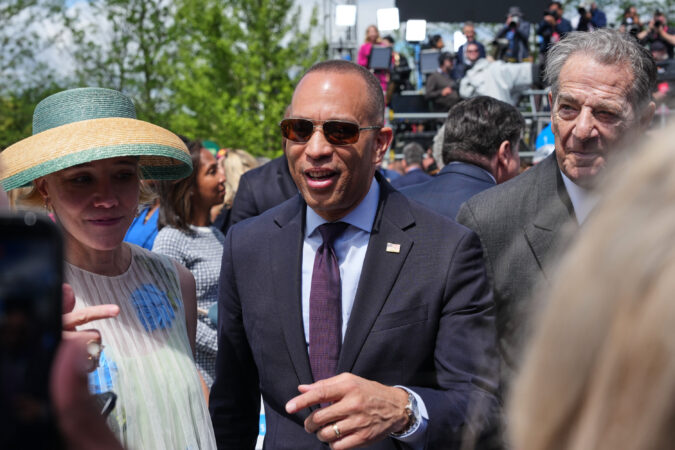
In the days since, the GOP has gleefully speculated that a potential Democratic majority next year could be just as unruly and restive as its own has been, with an ideological battle between liberals and moderates undermining a possible speakership of Minority Leader Hakeem Jeffries (D., N.Y.).
“You can call it the Bolshevik Revolution of 2026,” House Speaker Mike Johnson (R., La.) said following the election results, while the National Republican Congressional Committee facetiously sent Jeffries a sympathy card and flowers.
Jeffries and his Democratic allies have downplayed the tensions, noting that their party held together a broad spectrum of members the last time they were in charge of the House, from 2019 to 2023.
But there are warning signs for Jeffries, who already faces frustration from the Democratic base that he is not fighting back hard enough against President Donald Trump. If Democrats win only a narrow majority in the heavily gerrymandered chamber in November, it will give each vote outsize importance and Jeffries critics more opportunities to stir up trouble.
Two of the challengers backed by Mamdani, Darializa Avila Chevalier and Claire Valdez, defeated Democratic incumbents endorsed by Jeffries; only one of the three, Brad Lander, has committed to vote for him as speaker. Those candidates, all of whom are likely to win their heavily Democratic districts in November, and a handful of others who have prevailed against more moderate Democrats in primaries this year are expected to push for more liberal policies, particularly regarding Israel and Gaza, immigration enforcement, and universal healthcare.
“What I hope will happen is that Democratic leadership will incorporate the lessons that voters are sending into the agenda that we’re going to be fighting for,” Lander said.
Jeffries, for his part, has projected his typical calm and refused to engage with conjecture about how his leadership could be challenged. His office did not respond to a list of questions from the Washington Post but pointed to a CNN interview on the subject.
“What’s in front of us right now is we’ve got to do everything to take back control of the House of Representatives,” Jeffries said in that interview Friday, where he steered every question about the New York primary back to a message of Democratic unity. “That’s actually the moment that we’re in.”
On Saturday, Jeffries congratulated Valdez, Lander, and Avila Chevalier on social media.
Not everyone in the party is ready yet to rally around Jeffries in return. A viral video from Valdez’s watch party on Tuesday night showed a crowd erupting with chants of “you’re next” when Jeffries appeared in news coverage they were watching.
“If he continues to ignore what voters, not only in New York City but across the country, are telling him is important to them, he will do so at his own peril,” said Grace Mausser, co-chairperson of the New York City chapter of the Democratic Socialists of America. “It will weaken his power and ability, not only to control his own caucus, but to fight the right wing.”
It’s not the first time that Democrats have navigated this dynamic.
The wave that carried the party to the House majority in 2018 elected “the Squad,” a group of left-wing newcomers — Reps. Alexandria Ocasio-Cortez (D., N.Y.), Ayanna Pressley (D., Mass.), Rashida Tlaib (D., Mich.), and Ilhan Omar (D., Minn.) — who were more willing to openly challenge party leadership to achieve their aims. Ocasio-Cortez, who also defeated a high-ranking Democratic incumbent in her first primary, notoriously joined a sit-in in then-Speaker Nancy Pelosi’s office during her freshman orientation.
But Pelosi (D., Calif.) wrangled the Squad by simultaneously embracing them and diminishing their power. By 2021, she was delivering historic legislative victories for then-President Joe Biden.
In an interview, Pelosi dismissed the significance of the liberal victories from 2018, which she said “didn’t make that much difference,” and from Tuesday in New York, which she insisted would not be a problem for Jeffries because the Democratic caucus has long maintained ideological diversity.
“I wouldn’t make so much of it,” she said. “You always have to balance. We have Blue Dogs to Squad, and they represent their districts as they ought to be respected. So he’ll be fine.”
Since retaking control in 2023, Republican leaders, who lack Pelosi’s decades of experience, have struggled more to contain their antiestablishment wing: the ultraconservative House Freedom Caucus, whose members have a history of withholding votes unless their demands are addressed. Those rebellions cost former speaker Kevin McCarthy (R., Calif.) the gavel after only nine months and have nearly derailed some of Trump’s legislative priorities.
With a new generation of Democratic leadership confronting a rising populist wing of the party, the Jeffries era could face the same kind of turmoil — a prospect that has Republicans gloating.
“Democrats had a very bad week,” said Rep. James Comer (R., Ky.). “When you’re Hakeem Jeffries and you’re trying to be the next speaker of the House, and you lose three elections in your hometown, that’s a pretty big slap in the face.”
This year’s cohort of left-wing challengers, many of whom come from organizing backgrounds, is already connected to strategize about their campaigns and beyond.
Mai Vang — who finished ahead of Rep. Doris Matsui (D., Calif.) in a primary this month for a Sacramento-area seat — said she regularly speaks with other candidates including Valdez, Avila Chevalier, and Chris Rabb, who won the Democratic primary for a Philadelphia House seat in May.
Under California’s top-two system, Vang will face Matsui again in a November runoff. If she wins, Vang said, she would decide whether to support Jeffries as leader only after a conversation with the other liberal freshman members.
“These election wins in the primaries are mandates from the people,” she said. “Right now, the Democratic Party has to reckon with whether they are bold enough to represent the people.”
Democratic strategist Trip Yang said the disagreement is healthy because it keeps the party more responsive to the public.
“There will be some discord in the House Democratic caucus. Discord is good,” Yang said. Jeffries “is no stranger to hard, necessary conversations.”
Some of the more moderate House Democrats are already bracing themselves. Rep. Gregory W. Meeks (D., N.Y.) warned the insurgent candidates who won Tuesday that “they’re going to have to compromise and work together” once they arrive in Congress.
On social media last week, Rep. Josh Gottheimer (D., N.J.) sounded pessimistic about that prospect.
“The Democratic-Socialists are bomb throwers, not problem solvers,” he said. “They’ve declared war on common sense Democrats, which will only lead to more deadlock, dysfunction, and hard-working families paying the price.”
But publicly, most establishment members of the caucus are generally brushing off the idea that the arrival of more liberal colleagues will complicate their agenda should they win control in November. Rep. Jamie Raskin (D., Md.), the top Democrat on the House Judiciary Committee, plans to launch investigations into the Trump administration’s alleged abuse of the justice system.
“I served opposite James Comer, and I serve opposite Jim Jordan, so I can work with anybody,” Raskin said, citing two of the most conservative members of the House. “There are exciting new generations within the Democratic Party.”
Ocasio-Cortez called the expectation that the incoming class of left-wing members would pose trouble for Jeffries a “double standard.”
“Conversation, negotiation, all of that is the business of governance, and it’s the business of Washington,” she said. “There’s this tendency that when a progressive negotiates, that means that they’re bad, but when a moderate negotiates, that means they’re savvy. And that is a myth. We’re all here doing the same job.”
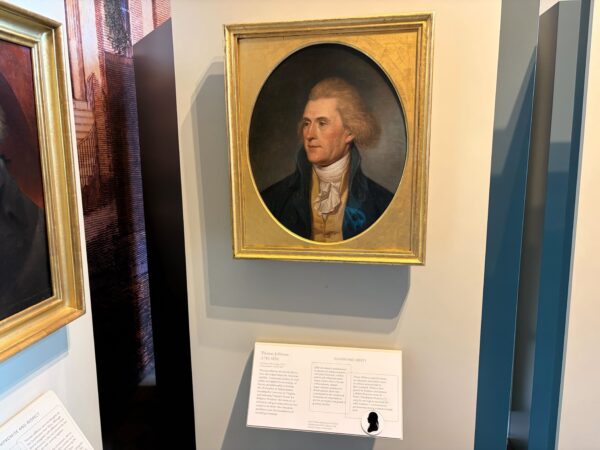
President Donald Trump’s administration has wiped almost all mentions of slavery from a panel accompanying a portrait of Thomas Jefferson at the Second Bank of the United States.
As the Founding Father who wrote the words “all men are created equal” while enslaving more than 600 people throughout his life, Jefferson embodies the paradox at the heart of the revolutionary era.
The description under his iconic portrait attempted to grapple with that tension.
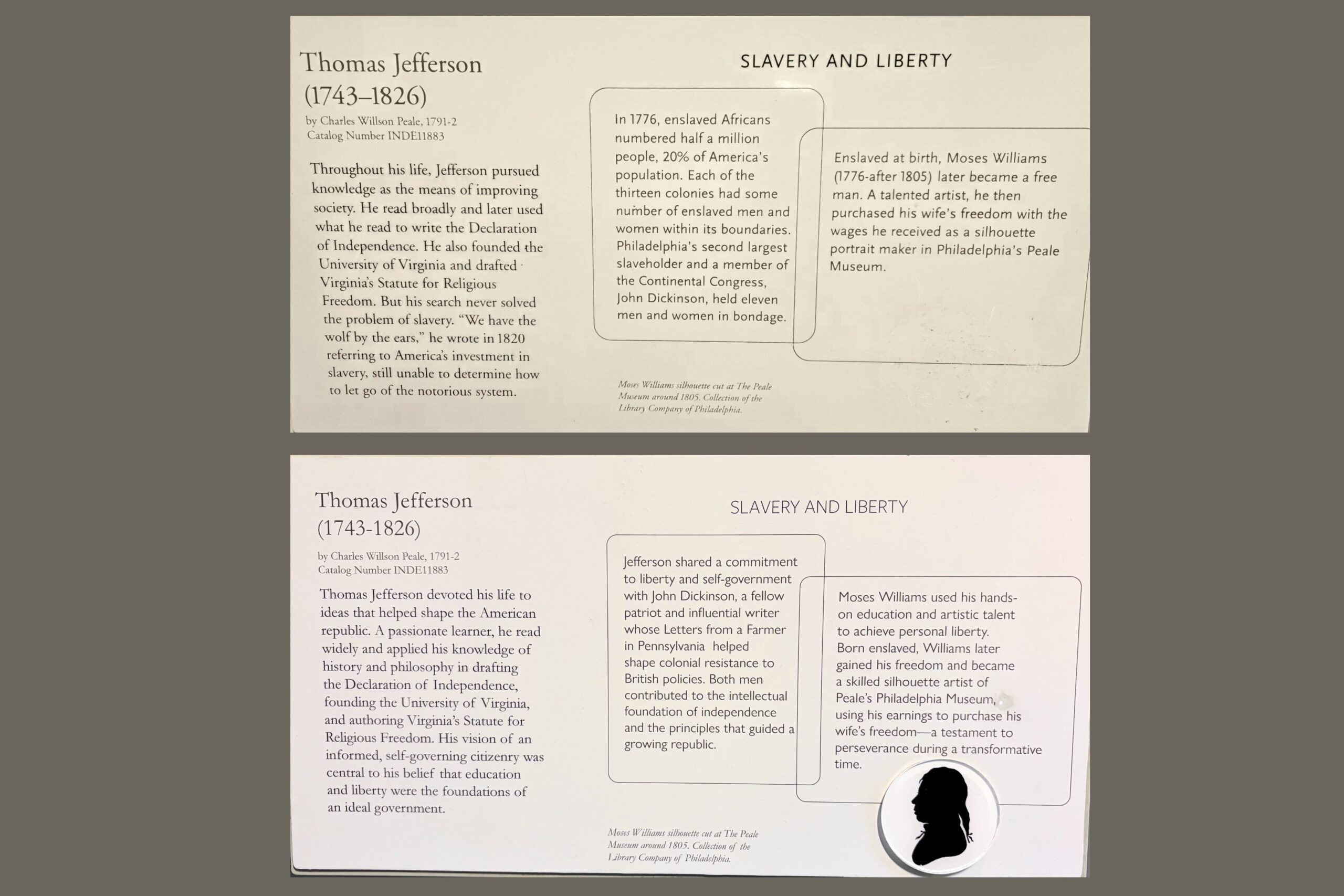
Despite Jefferson’s lifelong pursuit of knowledge, he “never solved the problem of slavery“ and was ”unable to determine how to let go of the notorious system,” the original plaque read.
But a new panel simply states that Jefferson’s “vision of an informed, self-governing citizenry was central to his belief that education and liberty were the foundations of an ideal government,” among other changes.
It’s not the only change the administration has made to exhibits around Philadelphia’s Independence National Historical Park ahead of the 250th anniversary.
A touchscreen with a virtual tour of Independence Hall’s second floor now tells visitors that one of the rooms was used to hold “individuals accused of crimes of the period” before their court hearings.
Who were these individuals? A previous version stated clearly: “accused fugitives from slavery.”
A side by side of the original and new descriptions Thomas Jefferson’s portrait at the Second Bank of the United States. The references to slavery have largely been removed by President Donald Trump’s administration.
While the changes are more subtle than those that took place at the President’s House in January — and the new exhibits the government proposed a few months later — they further underscore the Trump administration’s goal to sanitize U.S. history, as signified by his executive order to review or remove content at national parks that “inappropriately disparage Americans past or living.”
They also show a lack of transparency. The change to the description under Jefferson’s portrait was only acknowledged following a demand by a federal judge in Boston that the National Park Service share a list of all removals the administration undertook to comply with Trump’s “restoring truth and sanity” edict ahead of the country’s 250thcelebration.
In a statement Monday, Avenging the Ancestors Coalition — which has helped lead the efforts to protect the President’s House — said the additional changes were “extremely troubling.”
“The preservation of history requires ongoing vigilance,” the organization said. “Restoring historical interpretation is only one part of the work; protecting it from future revision or erasure is equally important.”
“One of the greatest disappointments of my life, is that we get to the 250th anniversary of this country, and we are still trying to evade the truth of our founding,” LaRoche said.
Among the most blatant examples of the federal government’s desire to retell history has happened at the President’s House, which opened almost two decades ago to memorialize the nine people George Washington enslaved at his Philadelphia home. It also serves as a symbol of exploring the stark juxtaposition of slavery and liberty during the nation’s founding.
But the moves at the Second Bank and Independence Hall signify that the administration is not letting any stone go unturned when it comes to ridding or softening even smaller mentions of slavery at Philadelphia’s most iconic historic sites.
The Department of Interior did not answer repeated questions about the changes.
“No changes have been made,” a spokesperson said via email, citing the President’s House litigation. When an Inquirer reporter pressed again about changes to Independence Hall and the Second Bank, the government spokesperson repeated that there were no changes to the President’s House during the litigation. The Department of Interior did not respond to further inquiries.
At the Second Bank, the panel under Jefferson’s iconicportrait also informed visitors about the population of persons enslaved in 1776, that John Dickinson — a member of the Continental Congress — was an enslaver, and about the life of Moses Williams, an artist who was enslaved at birth and later became a free man.
That’s drastically changed in the new panel.
Jefferson’s grappling with slavery is no longer present and Dickinson is referred to as a “fellow patriot and influential writer. …” The only mention of slavery remaining is Williams’ story, though it’s reworded.
And at Independence Hall, the touchscreen kiosk describing the second floor Committee of Assembly Chamber previously outlined the irony of the space being used for ratifying the U.S. constitution and later housing the office “where accused fugitives from slavery were held before their hearings, right above the room where the Declaration of Independence had been signed.”
A touch screen at the entrance to Independence Hall with photos and descriptions of the building’s second floor. The description of the Committee of the Assembly Chamber has been edited to replace the words “accused fugitives from slavery” to “individuals accused of crimes of the period.”
But the reference to slavery has been removed, among other rewordings.
It remains unclear when these changes were made. The Inquirer reported last summer that these items — and an interactive exhibit at the Benjamin Franklin Museum about the Founding Father’s conflicting views on slavery, which is still intact — were flagged for review.
In addition to the President’s House exhibits, the list says the administration removed a “portrait description” and cites “disparages Americans past or living” as the reason it is gone.
No entry in the list corresponds to the change made at Independence Hall, which Philadelphia owns.
The city did not immediately respond to a request for comment.
All material changes at Independence Hall should be done after consultation with the city, said Cynthia MacLeod, former superintendent of Independence National Historical Park.
“The National Park service has been known for excellent historians and interpreters and its a shame that they are being muzzled now,” MacLeod said. “It’s a shame and a disservice to all the visitors not to have a more complete history told.”
WASHINGTON — With a social media assist from President Donald Trump, House Speaker Mike Johnson is looking this week to ease the divisions in his Republican ranks and make progress on key legislative priorities before this fall’s elections.
Johnson sent lawmakers home early last week after tumult in his conference prevented the House from voting on two spending bills and a measure dealing with veterans’ benefits. Meanwhile, the list of legislative priorities only grew with Trump requesting $87.6 billion in new spending, mostly to cover the cost of the war with Iran.
The week ahead could signal whether Johnson can turn a short summer in Washington into a productive work period that voters will reward in November.
“We have got a lot more to do. We have got to keep it going,” Johnson told Fox News Channel’s Sunday Morning Futures.
Johnson, of Louisiana, went to the White House moments after the House wrapped up its abbreviated workweek and returned with a coveted Trump social media post telling Republicans to quit voting down the procedural rules that allow for final votes on their legislative priorities.
“No more grandstanding, please!” Trump wrote.
Before Trump’s message, Republican and Democratic lawmakers were openly doubting whether the House would even return this week or just follow the Senate’s lead and break for the July Fourth holiday.
“I got to have everybody working here on all cylinders, and I’m excited to bring them back,” Johnson said on Fox.
A promising week quickly turns sour for Republicans
The House began last week with a legislative victory that speaks to voters’ concerns about affordability, passing bipartisan legislation aimed at lowering the cost of housing. It was the culmination of years of work by members on both sides of the political aisle.
But Trump abruptly called off the bill signing ceremony, saying he would not act until Congress passed legislation that requires proof of citizenship for those registering to vote. Johnson said he would send the housing bill to Trump on Monday and hopes the Republican president signs it with the “biggest, boldest marker that he has.”
Hard-liners in the House have also taken up Trump’s demand for the elections bill. More than two dozen of them have signed a letter pledging to vote against any Senate bills unless the elections legislation is attached. Rep. Anna Paulina Luna (R., Fla.) led the blockade that prompted Johnson to send lawmakers home early.
Democrats seized on the Republican gridlock.
”This is the incredibly pathetic Congress,” said Rep. Jim McGovern (D., Mass.). “The fact they can’t get their act together, can’t establish discipline to keep this place running, is stunning. I’ve never seen such incompetence.”
Republicans also voiced their frustration.
“I just think it’s a very self-defeating position for anyone to take, that they’re going to shut everything down over one issue,” said Rep. Brian Fitzpatrick (R., Pa.).
But Rep. Andy Harris (R., Md.) predicted there will be more gridlock ahead unless a bill that includes the elections legislation is sent to Trump. While the House has already passed a version of the measure, it has stalled in the Senate.
“Yeah, I think everything is going to be held up until we come to an agreement on voter ID and especially confirming the citizenship of Americans before they register to vote,” Harris said.
Asked if Americans want Congress to be advancing other priorities besides the voting bill, known as the SAVE America Act, Harris replied. “I think they truly believe that this is a very important bill. I’m not sure they believe that a lot of the other things we’re doing here in Washington are very important.”
The test ahead is on an important defense bill
Trump’s admonition to House Republicans to quit voting down their own procedural rules will be put to the test this week. Leadership is expected to tee up a vote on an annual defense policy bill, must-pass legislation that calls for some of the increased spending that Trump wants for the Pentagon.
Luna, a Trump ally, was making no promises about standing down, even after the president’s social media post. She has proposed attaching the elections legislation to the defense bill. Because of the narrow Republican majority, it takes only a few Republican “no” votes to block a bill from advancing to a final vote.
“If they want my vote, they should entertain it, debate it, and if they block it, then we’ll see. But that’s how you get my vote,” Luna told reporters.
There’s little time left for top GOP priorities
The House is scheduled to be in session for only about 28 days before the midterm elections. The lawmakers are out for virtually all of August and October, giving them additional time to campaign back home for reelection.
In that window, they must pass bills to keep the government running beyond the Sept. 30 end of the budget year. They also aspire to pass a bill on a party-line basis that would include more defense spending, partially paid for by cuts in other programs. Republicans have billed their effort as going after waste and fraud.
It would be the successor to the big tax and spending cut bill that Republicans passed last year. That measure extended the tax cuts passed in Trump’s first term and expanded tax breaks for those who get income through tips and overtime. The bill also focused on boosting immigration enforcement, paid in part through reduced spending on Medicaid and nutrition assistance.
Johnson has talked optimistically about being able to pass such a bill before the August recess. He met with members of the House Budget Committee last week as they try to find a path forward. But Republican senators are not counting on it. There are also doubters in the House, given the difficulty of the process that is required to bypass a filibuster in the Senate.
“I’m just not seeing a path forward on it,” said Republican Rep. David Valadao, who represents a perennial swing district in California’s farm belt.
But Budget Committee Chairperson Jodey Arrington (R., Texas) said members are close to a framework. He predicted it will be politically rewarded if they are able to address election integrity and curb waste and fraud.
“We have to energize our base, and we have to address the enthusiasm gap,” Arrington said.
In a rare public appearance in Philadelphia, Democratic U.S. Sen. John Fetterman joined Republican U.S. Sen. Dave McCormick at a youth basketball camp in Nicetown on Monday to promote Trump Accounts, the new federally backed savings accounts for kids that became law with the president’s signature One Big Beautiful Bill Act.
Fetterman — who did not vote for the GOP-led initiative last year but has more frequently supported President Donald Trump’s policies since then — said he was urging families in deeply Democratic Philadelphia to look past Trump’s name on the program.
“Do not fall into that political trap,” Fetterman said. “This isn’t some radical thing. … Do this for your child.”
The accounts, which launch on July 4, are available to children under 18 — with children born between Jan. 1, 2025 and Dec. 31, 2028 receiving $1,000 in seed money.
All accounts will also receive $250 because of a $6.25 billion donation from tech CEO Michael Dell and wife Susan Dell. Families, businesses, and nonprofits can add up to $5,000 annually. A portion of the funds may be accessed when the child turns 18, with the rest transferred into an IRA retirement account.
“Who is excited about getting $200? Put your hands up,” McCormick asked more than 100 kids gathered on one of the indoor courts at Philadelphia Youth Basketball’s summer camp, at the Alan Horwitz “Sixth Man” Center in Nicetown.
Both McCormick and Fetterman appealed directly to the children during speeches between basketball camp drills.
Despite being 6-foot-8 and palming a basketball as he posed for pictures, Fetterman said his basketball skills weren’t “worth much.” But he told the kids that he was there because he wanted them all to be millionaires someday. And the Trump accounts — which he said he and his wife, Gisele, would open for all three of their children — were a step in that direction.
U.S. Senator John Fetterman palms a basketball Monday, June 29, 2026 as he appears with fellow Pennsylvania Sen. Dave McCormick to promote the savings accounts for kids that were a signature piece of President Trump’s Big Beautiful Bill.
“I am begging your parents to get involved in this,” Fetterman said. “It’s about all of your futures.”
In a joint interview after the event, the senators described the initiative as a groundbreaking effort to build long-term wealth for individuals who don’t typically have access to it.
“This is one of many things that we need to do to think about how we address a fundamental problem — which is, we have a growing concentration of wealth in our country,” said McCormick, a former investment firm CEO and millionaire many times over.
“He was talking almost like a Democrat … a concentration of wealth,” Fetterman quipped, prompting McCormick to laugh.
Fetterman, at the time, joined other Democrats by calling the bill a “disaster” for its cuts to Medicaid spending and other programs like the Supplemental Nutrition Assistance Program, or SNAP.
After voting against the law — or voting “hell no,” as he said at the time — Fetterman has broken with his party to support Trump and Republicans in a number of high-profile moments, and in ways that have deeply frustrated Democratic voters. His appearances at public events in Philadelphia and around Pennsylvania have been extremely rare, and many political observers question whether he will seek re-election in 2028.
At the same time, Fetterman has developed a close working relationship with McCormick, a Republican elected in 2024. The pair frequently partner on issues in Washington and stress the need for bipartisanship, particularly in a purple state like Pennsylvania.
“He and I are in this together,” McCormick, who has stopped in Philadelphia frequently, including for meals with Democratic Mayor Cherelle L. Parker, told the crowd Monday.
Philadelphia Youth Basketball CEO Kenny Holdsman said he had worked with both senators and credited a conversation he had with Fetterman for helping push the organization to keep its doors open for longer hours as safe haven for the 2,400 young people in its programs.
Holdsman said the Trump Accounts would “really help young people and their families in a big way” — from the financial security that comes with a compounding investment account, to the educational and financial literacy aspect that will come with kids having access to their savings.
Invest America founder Brad Gerstner, who had pushed for the idea behind Trump Accounts for years and now leads the nonprofit that manages the initiative, showed the children a screenshot of the app that will display the contents of each account.
“We want kids across the country, when they’re in middle school, to be able to open up this on their phone, so it’s not some abstract notion that I have money. This is the way the teachers in public schools are going to be able to teach them about ownership, compounding, financial literacy, et cetera,” Gerstner said. “It’s hard to teach kids about money when they don’t have any money.”
Bipartisan groups have said the Trump Accounts do not have the same kind of tax-advantaged structure as other investment accounts, such as 529 plans that are specifically used for education. Cato Institute, a conservative think tank, has also criticized the $1,000 contributions for children born in the years around the program’s founding and called the overall plan “a government welfare program rather than a tax-neutral investment vehicle.”
Fetterman said he supported 529s but the Trump Accounts were a “much more versatile vehicle” for investing in children’s futures. McCormick said the program’s ability to accept philanthropic donations made it particularly appealing as other individuals and corporations can buoy the accounts on top of families’ investments. Both also stressed convenience.
“You’re going to share in the prosperity of America,” McCormick said. “It’s easy. You don’t have to overthink it.”
Sen. Fetterman pauses to fist bump a youngster on his way to the more than 100 children attending a summer basketball day camp at the Alan Horwitz “Sixth Man” Center.
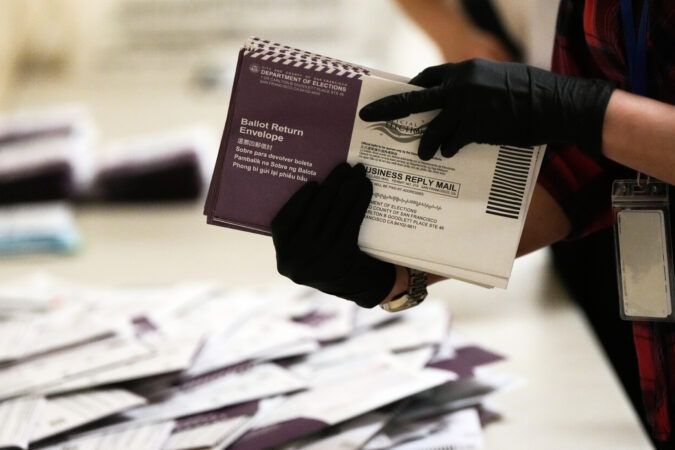
The Supreme Court on Monday upheld a Mississippi law that allows officials to tally mail-in ballots postmarked by Election Day that arrive later, a decision that keeps voting procedures in place in several states as the midterm elections loom.
In an ideologically mixed 5-4 ruling, the justices turned aside a challenge by Republicans and Libertarians, who argued federal law preempts a Mississippi statute that allows the counting of such ballots that arrive up to five days after polls close.
The decision could make less likely similar legal challenges in 14 states that allow the counting of ballots that arrive days or weeks after polls close, and others that allow military members to return ballots later. Most states require mail-in ballots to be received by Election Day.
Justice Amy Coney Barrett delivered the opinion for the majority, which included Chief Justice John G. Roberts Jr. and the court’s three liberals. Barrett said federal election law did not address when ballots should be received.
“The election-day statutes say nothing about ballot receipt, and we cannot add to the words Congress chose,” Barrett wrote.
The ruling came over the objections of four of the court’s conservatives. Justice Samuel A. Alito Jr. wrote the opinion for the group, which included Justices Clarence Thomas, Neil M. Gorsuch, and Brett M. Kavanaugh.
“Not only is today’s decision inconsistent with statutory text, legal context, historical practice, and precedent; it also threatens to produce lamentable consequences,” Alito wrote. “The majority’s holding spawns a slurry of troubling election-law questions and risks further undermining Americans’ confidence in election integrity.”
President Donald Trump and some Republican allies have falsely argued that voter fraud is rampant in mail-in balloting. Trump partly blamed his loss in the 2020 presidential election on mail-in votes and unsuccessfully called on states to stop tallying them during the contest.
Trump called the ruling a “tremendous loss” in a post on Truth Social. He called on Congress to pass the Save America Act, which tightens voter identification laws.
Republicans in a number of states have launched legal challenges to mail-in voting, which has grown in popularity since the onset of the coronavirus pandemic. One study found about 1 in 3 voters voted by mail in 2024, but the practice is more widespread in Democratic-leaning states.
Conservatives in Congress also have introduced legislation to limit mail-in voting.
In March, Trump issued an executive order telling the Postal Service to send ballots only to voters who appear on lists of citizens created by states in conjunction with the federal government. A federal judge in Massachusetts blocked that provision of the executive order last week, saying states — not the president — are responsible for setting election rules.
Despite his criticism of mail-in voting, Trump voted by mail in a special election in Florida earlier this year.
In the case decided by the high court, the Republican National Committee, the Mississippi Republican Party, a state voter, and a county election commissioner had sued Mississippi in 2024, claiming it was illegal to count mail-in ballots that arrive after polls close because federal law sets elections for a specific day. The Libertarian Party later filed a similar suit.
The cases were consolidated by a federal judge, who allowed groups of veterans and retirees to intervene in the suit on behalf of Mississippi. The judge dismissed the case, but the U.S. Court of Appeals for the 5th Circuit reversed that ruling. Mississippi then appealed to the Supreme Court.
During arguments in March, Paul D. Clement, an attorney for the conservatives, told the justices that casting and counting ballots at the same time has long been “intertwined.” He said allowing mail-in ballots to be counted after Election Day could increase fraud and undermine faith in elections, particularly if the winning candidate was not the one ahead when polls closed.
“The losers are going to doubt the result, full stop,” Clement said. “That is bad for our system.”
Mississippi Solicitor General Scott G. Stewart countered that existing law required only that voters fill out their ballots by Election Day. He said mail-in voting has a long history in the United States, pointing to field voting that occurred during the Civil War.
“States have allowed it for over a century, and Congress has respected it,” Stewart said.
This term has been an active one for the justices on voting and election issues. In January, the court allowed a Republican congressman from Illinois to challenge the state’s mail-in balloting laws, finding candidates have inherent standing to sue over election rules.
The case brought by Rep. Mike Bost (R., Ill.) also argues that federal law prohibits ballots from being counted after Election Day. The case was sent back to the lower courts.
The justices also severely limited a key section of the Voting Rights Act, which has cleared the way for a number of Republican-controlled states in the South to carve up districts held mostly by Black Democrats ahead of the midterm elections. Hundreds of other minority officeholders could be redistricted out of their seats in state and local boards.
The court has yet to rule in a case challenging limits on spending coordinated between political parties and candidates that is being pushed by the Republican Party. Striking down the spending limits could give Republicans a big money boost in November.
Fourteen states provide grace periods for all mail ballots, and another 16 provide them for military and overseas voters. Republican-led states have been steering away from ballot grace periods recently, with Kansas, North Dakota, Ohio, and Utah eliminating them last year, according to Voting Rights Lab.
RNC Chairperson Joe Gruters said Republicans would push Congress to pass legislation requiring ballots in all states to be returned by Election Day.
“Democrats are inviting chaos at the ballot box by allowing elections to drag on for days and weeks after voters cast their ballots,” he said in a statement.
Voting rights advocates praised the decision, saying they feared the court could reverse long-standing policies on when ballots are due.
“Good news rarely comes out of this Supreme Court, but today’s ruling is a win for our democracy,” NAACP President Derrick Johnson said. Virginia Kase Solomón, president of Common Cause, said the decision was correct because voters “shouldn’t lose their voice because of mail delays outside their control.”
The decision rejected a Republican-led attack on laws in more than half the states and the District of Columbia that permit mailed ballots to arrive and be counted some number of days after the election, provided they are postmarked by Election Day. The outcome spares officials the headache of changing their ballot rules just a few months before the 2026 midterm congressional elections.
In just over half those states, the more forgiving deadlines apply only to ballots cast by military and overseas voters.
The legal challenge was part of Trump’s broader attack on most mail balloting, which he has said breeds fraud despite strong evidence to the contrary and years of experience in numerous states. Trump has repeatedly claimed that his loss to Joe Biden in 2020 resulted from fraud even though more than 60 court decisions and his own attorney general said that argument had no merit.
The court heard arguments in March in a case from Mississippi pitting the state against Trump’s Republican administration and the Republican and Libertarian parties. At issue was whether federal law sets a single Election Day that requires ballots to be both cast by voters and received by state officials.
The federal appeals court in New Orleans struck down a Mississippi law allowing ballots to be counted if they arrive within five business days of the election and are postmarked by Election Day.