Category: Pennsylvania Politics

  • Trump was welcomed to Pa. by Stacy Garrity. He didn’t mention her at all.

    Trump was welcomed to Pa. by Stacy Garrity. He didn’t mention her at all.

    MACUNGIE, Pa. — President Donald Trump’s speech on manufacturing in a key Pennsylvania swing district repeatedly veered into other topics and musings about elections in other states, like Maine and California.

    It took the president nearly an hour to even reference by name GOP U.S. Rep. Ryan Mackenzie, the vulnerable incumbent whose district Trump was visiting to boost his chances in this year’s midterm elections.

    And GOP gubernatorial nominee Stacy Garrity did not even get a mention during Trump’s speech to roughly 1,500 attendees, including workers at the Mack Trucks facility in Macungie in Lehigh County.

    Trump’s visit came just days after the company received $47 million through a Defense Department contract.

    And while he touted the trucks, he spent just as much time meandering about weight-loss drugs, immigration, firearms, the role of transgender athletes in women’s sports, and the UFC fight recently held on the White House lawn. He also repeated conspiracy theories about the races for Los Angeles mayor and California governor, saying he had asked the U.S. attorney in that state to investigate after conservative mayoral candidate Spencer Pratt did not advance to the general election.

    And he threw jabs at Pennsylvania Gov. Josh Shapiro amid 2028 speculation and appeared to undermine Shapiro’s Republican opponent, Garrity.

    Speaking about recent victories by democratic socialist candidates around the country, Trump quipped that “Shapiro is not that much better, to be honest with you.”

    He referenced the Democratic governor’s potential presidential aspirations, warning that “a guy like Shapiro is going to be forced on the left, otherwise he’s not going to get the nomination.”

    But though he weighed in on Shapiro, the governor’s Republican challenger’s name was noticeably absent from Trump’s list of shout-outs to GOP officials, despite the fact that Garrity spoke earlier in the event.

    Trump instead heaped praised on U.S. Rep. Dan Meuser, a Pennsylvania Republican who considered a run before ultimately opting against it and enabling the state party to coalesce around Garrity.

    “Meuser’s another great guy who was thinking about running for governor. I think he would have won. He was thinking of running for governor, and I said ‘I want you to stay in Congress,’” Trump said.

    Trump endorsed Garrity earlier this year, but the lack of acknowledgment Tuesday was striking given the election year focus of the event and Garrity’s own promises to support Trump’s agenda.

    “We need a governor in Harrisburg who will be a partner with President Trump in Washington, not an opponent in the courtrooms,” she said before Trump took the stage. “We need a governor who will fight for Pennsylvania jobs, like right here at Mack Trucks.”

    State Treasurer and Republican candidate for governor Stacy Garrity is seen on a big screen as she speaks to supporters before the arrival of President Donald Trump at Mack Trucks in Macungie Tuesday, June 23, 2026. Trump did not mention Garrity when he later spoke to the crowd in the Lehigh Valley.

    Trump restated his belief that tariffs have revitalized and would further boost the U.S. economy, though gas prices have reached new heights since he began a war with Iran, stymieing the flow of oil. (The Strait of Hormuz has reopened, following a tentative peace deal struck this month.)

    “I placed a 25% tariff on foreign automobiles and very importantly posed a 25% tariff on medium and heavy-duty trucks, so Mack Trucks could do very well with this factory in Pennsylvania,” he said.

    “They weren’t gonna come in from foreign lands and steal your jobs,” Trump added.

    However, the company cited Trump’s tariffs last year as contributing to its decision to lay off hundreds of workers at its Lehigh Valley operations center, the Pennsylvania Capital-Star reported at the time.

    Tuesday marked Trump’s fourth Pennsylvania appearance in his second term and his first this year ahead of November’s high-stakes midterm elections. The visit was billed as an official event as part of Trump’s American Workers First tour, but the event had the feel of a campaign rally.

    Four U.S. House districts in Pennsylvania are considered competitive, the most of any state, and the event took place in the 7th Congressional District, which is viewed as one of the most likely to flip to Democratic control.

    “We have to reelect a certain congressman,” Trump told the crowd.

    In 2024, Mackenzie won the seat by 1 percentage point, while Trump defeated Democrat Kamala Harris and won Pennsylvania in the presidential race.

    “Workers, like the ones here at Mack, are spearheading the great American comeback,” Mackenzie said.

    Bob Brooks, a union leader and firefighter who won the Democratic nomination to challenge Mackenzie, praised the union workers at Mack ahead of the event for building “the literal engine for the American economy,” but he blasted Trump and Mackenzie for failing to bring down prices.

    “No speech from Mackenzie can change the fact that his time in Congress has been an absolute disaster for the hardworking people of the Lehigh Valley,” Brooks said in a statement ahead of Tuesday’s event.

    Lt. Gov. Austin Davis, in a media call earlier Tuesday, said Trump’s choice to rally at Mack Trucks specifically signals he and his party recognize a “real political danger” because of Trump’s policies.

    “Donald Trump’s agenda is putting Congressman Mackenzie at serious risk,” Davis said. “They’re circling the wagons and trying to save that seat.”

    Affordability is likely to be a key issue on voters’ minds as they choose between Mackenzie and Brooks.

    Steve Leiby, 52, who works for Mack and attended Tuesday’s event, said he understands the tariffs Trump enacted are controversial, but he still supports them.

    “It’s a big risk, if we had a war, that we didn’t make a lot of war supplies in the U.S.,” he said.

    President Donald Trump leaves after a visit to Mack Trucks in Macungie, in the Lehigh Valley Tuesday, June 23, 2026.

    Brent and Francine Stanley, both 60, from New Tripoli, said they support Mackenzie because he shares their conservative values. His office organized an elder-care symposium that Francine Stanley attended because the couple have a 23-year-old child with disabilities, and they were able to get connected to resources.

    But they both know how competitive this election is, noting the stack of pro-Brooks mailers they have already received and predicting that Democrats will be knocking on their doors as November approaches.

    “They’re really persistent, and if you don’t answer, they follow up,” Francine Stanley said. Mackenzie, she said, should consider doing the same.

    Staff reporters Andrea Padilla and Sam Janesch contributed to this article.

  • Trump to visit Pa. on Tuesday as the battle for control of Congress heats up in the Lehigh Valley

    Trump to visit Pa. on Tuesday as the battle for control of Congress heats up in the Lehigh Valley

    President Donald Trump is scheduled to speak Tuesday at a truck manufacturing facility in the Lehigh Valley, where a competitive race for Congress this year could determine which party controls the U.S. House for the second half of his term.

    Trump will deliver remarks at Mack Trucks in Macungie in Lehigh County, according to the White House and two local members of Congress.

    The visit will mark Trump’s fourth Pennsylvania appearance in his second term and his first this year ahead of November’s high-stakes midterm elections.

    Pennsylvania has four competitive U.S. House districts — the most of any state — and the Lehigh Valley-based 7th District is widely considered one of the most likely in the nation to flip from Republican to Democrat.

    GOP U.S. Rep. Ryan Mackenzie won that seat by 1 percentage point in 2024 as Trump defeated Democrat Kamala Harris statewide. Bob Brooks, a union leader and retired firefighter whom many prominent Democrats rallied behind before last month’s competitive primary, is facing Mackenzie in November.

    The event Tuesday is scheduled as an official White House event, not a campaign event, and it could be the first of several trips by the president to the region and across Pennsylvania in the coming months.

    “We’re looking forward to joining President Trump at Mack Trucks — one of our nation’s most iconic manufacturers,” Mackenzie wrote on social media.

    “By investing in American workers and supporting domestic manufacturing, President Trump and Republicans in Congress have helped to put the Lehigh Valley and the Poconos at the forefront of our nation’s industrial revitalization. We appreciate President Trump coming to the region to help us highlight the work we’ve done together to support American workers, families, and industries.”

    Mackenzie spoke Friday at a different Mack facility outside of Allentown to highlight part of a contract the company won from the U.S. Army last year to produce heavy dump trucks. The deal is worth up to $221.8 million, and Mack Defense said it received $47 million in the latest Department of Defense appropriations act.

    A White House spokesperson said Trump will “stand with the American workers he has fought for” during his visit.

    “Under the President’s leadership, key domestic industries are being revitalized, historic investments are pouring back into communities like Macungie, and families across the country are securing new, high-paying jobs,” Liz Huston said. “Pennsylvanians placed their trust in President Trump, and he has delivered for them.”

    Former President Joe Biden visited the same Mack facility in 2021 for a speech focused on supporting American manufacturing.

    Trump last appeared in Pennsylvania in December for a rally at the Mount Airy Casino Resort in Mount Pocono, which is in the neighboring 8th Congressional District where another freshman Republican is looking to fend off a Democratic challenger. Pitched as a speech to address voters’ concerns about affordability, the president repeatedly veered off script and called affordability concerns a “hoax.”

    Some of the president’s former supporters in the region have since said they regretted voting for him, and national Democrats have made the area a priority as they look to win back a seat that Mackenzie flipped two years ago. Brooks, the Democratic nominee, has leaned into his working-class background while saying he understands voters’ financial concerns.

    U.S. Rep. Dan Meuser, a Republican who represents a different neighboring district, said Trump’s visit signals the president’s support for workers.

    “Mack Trucks are a symbol of America’s manufacturing strength,” Meuser said on social media. “Their Lehigh Valley operations are a pillar of the local economy, employing Pennsylvania workers and driving the nation’s trucking industry. Thank you, President Trump, for supporting American workers.”

  • Stacy Garrity on potentially being the first female governor of Pennsylvania: ‘It’s my least favorite thing to talk about’

    Stacy Garrity on potentially being the first female governor of Pennsylvania: ‘It’s my least favorite thing to talk about’

    If elected in November, Stacy Garrity would become Pennsylvania’s first female governor in the state’s 238-year history.

    Even now, she is one of only two women in history to receive the Republican Party’s nomination for the job.

    The state has never had a woman as its governor; no woman has been elected as U.S. senator; and both times a woman ran for president, she lost the state. Over the last two centuries, Pennsylvania’s political glass ceiling has proven stubbornly resistant to cracks.

    But on the campaign trail against Democratic Gov. Josh Shapiro, Garrity, 62, said she doesn’t give that too much thought.

    “It’s my least favorite thing to talk about,” she said. “I was the oldest of four daughters, and we were just told that we were expected to work hard.”

    Navigating gender dynamics in politics can prove to be a particularly fine balance. Republicans, in particular, often emphasize that candidates should rise on their skills and talent, not personal identity.

    Garrity emphasized her attention is on issues like the power grid, education, and reining in spending, though she recognizes the historic significance of a potential win.

    “Republicans, for the most part, are based on merit, and that’s how I was raised,” said Garrity, who spent decades serving in the Army Reserve and as an executive in the manufacturing industry before becoming state treasurer. When she was reelected in 2024, she broke the record in Pennsylvania for the most number of votes cast in her favor for a statewide office, a distinction formerly held by Shapiro.

    In addition to taking on centuries of male-dominated leadership, Garrity will face other challenges in November.

    She is a Republican who has aligned herself closely with President Donald Trump — including campaigning at his Mar-A-Lago Club in Florida — at a time when Trump has been experiencing historic dissatisfaction among voters and the national political environment favors Democrats.

    And she is running against Shapiro, a Democratic incumbent with a rising national star who is popular even among independents. He has $38 million banked as of May, vastly outpacing Garrity’s $2.8 million. Shapiro is also counting on a strong showing in the midterms to help Democrats win the majority in the U.S. House.

    “I think [voters] are excited to have a first female governor, but I don’t think that is the reason anybody would vote for me,” she said.

    In Pennsylvania and 16 other states

    It is hard to be what you can’t see. And for voters who have never experienced a woman at the top of the hierarchy, it is difficult to imagine what that could look like, experts said.

    It has been 300 years since a woman led Pennsylvania — before it was a state.

    Hannah Callowhill Penn led the colony of Pennsylvania, governing first while her husband, William Penn, suffered several strokes, and then alongside a group of trustees after he died. Over 14 years, she settled boundary disputes, appointed and replaced government officials, and navigated relations with the monarchy in England.

    Other Pennsylvania women made attempts to break gender barriers but came up short. Barbara Hafer ran as a Republican against Democratic incumbent Bob Casey Sr. in the 1990 governor’s race, but lost with just 32% of the vote.

    Former U.S. Rep. Allyson Schwartz lost to Tom Wolf during the Democratic primary for governor in 2014, and Laura Ellsworth was defeated by Scott Wagner in the 2018 Republican gubernatorial primary.

    “It could just be a coincidence, but also it’s very hard to break political traditions, and one of those traditions in Pennsylvania, unfortunately, is male leadership,” said Nichola Gutgold, a professor at Pennsylvania State University’s Lehigh Valley campus, who has researched women in politics.

    Pennsylvania, however, is not alone. There are 17 states that have never had a female senator, and 17 states have never had a female governor, according to the Pew Research Center. That distinction spans geographic ranges and party control.

    Still, Pennsylvania is one of just four states that has never had either, along with Idaho, Indiana, and Colorado. Among them, only Colorado went for Democrats Hillary Clinton and Kamala Harris for president.

    “We have certain variables at play in the Commonwealth of Pennsylvania that make it more challenging for women to run for elected office,” said Dana Brown, executive director of the Pennsylvania Center for Women and Politics.

    The role of the parties on the state and county levels means they have a strong influence on recruiting candidates and pushing them up through the pipeline. Historically, recruiting tended to come from more masculine bases — such as fire stations or township supervisor positions.

    Now, though, “both sides of the aisle recognize that women can win here in Pennsylvania, and so Republicans and Democrats have been purposely recruiting more women,” she said.

    Women have made strides in other Pennsylvania elected offices.

    In Harrisburg, State Rep. Joanna McClinton (D., Philadelphia) is the first woman and second Black person to serve as speaker of the Pennsylvania House. Republican State Sen. Kim Ward of Westmoreland County is the first woman in Pennsylvania history to serve as Senate president pro tempore and Senate majority leader.

    When former Democratic U.S. Rep. Susan Wild, the first woman to represent the Lehigh Valley in Congress, was elected in 2018, “it took a real concentrated effort from [political action committees] and from groups that really wanted to see a woman win to make that happen,” Gutgold said.

    In other cases, as in neighboring New Jersey or Virginia, women have ascended with a combination of fortunate timing, skill, experience, and deft campaigning.

    When Gov. Mikie Sherrill last year became the second woman elected to lead New Jersey, Brown said, “it was a change election for New Jersey, and it was a sign of pushing back against what the federal government is doing with ICE and immigration and also with the economy.”

    Even though Sherrill, a Democrat, shares the same party as her predecessor, Phil Murphy, New Jersey’s vote for a woman represents change, Brown said. “She also worked really, really hard for it, as most women do,” she added.

    Sometimes, female candidates succeed by pushing against expected norms for women by emphasizing military experience or work in male-dominated trades, Gutgold said. Garrity has emphasized her military and business experience on the campaign trail, holding a Veterans for Garrity rally last week.

    “I think that, rhetorically speaking, it would be easier to elect a woman who appears to hold more conservative views, because of the way we, the electorate, still views women’s role in society,” Gutgold said.

    Republican women have scored victories in the Deep South by upholding conservative values such as opposition to abortion and support of gun rights. Kay Ivey holds the governor’s mansion in Alabama, and Nikki Haley previously led South Carolina for two terms. In Tennessee, U.S. Sen. Marsha Blackburn has represented the state since 2018 and publicly repudiated gender-specific titles, such as congresswoman vs. congressman.

    Garrity, on the campaign trail, has also vowed to clean up the “boys will be boys” culture in Harrisburg and has criticized Shapiro’s handling of a sexual harassment case involving a longtime aide.

    The aide, Mike Vereb, abruptly stepped down in 2023, while the administration quietly agreed to pay $295,000 to settle claims from an employee in the governor’s office that Vereb had made repeated sexual advances toward her, and made lewd claims about her and other women.

    “We don’t need to settle for a governor who will sweep sexual harassment and abuse charges under the rug. We don’t need to accept that our state government is a cesspool where intimidation is the norm and public employees fear retribution,” Garrity said during a news conference this year.

    Manuel Bonder, a spokesperson for Shapiro, rejected those accusations.

    “Governor Shapiro has a track record of taking on powerful institutions, exposing sexual abuse, and putting predators behind bars — and he continues to fight to deliver real accountability and justice for survivors here in Pennsylvania,” he said.

    Could Pa. women give Garrity a boost?

    Nationally, women voters tend to lean more toward the Democratic Party, Pew Research Center data show, so it’s unlikely that the Republican Party will attract a huge turnover — even with a female candidate on the top of the ticket.

    Sometimes, however, the gender divide can become even more entrenched. In 2024, for example, when the candidates were broadly polling neck-and-neck, Harris saw a 17-point advantage with Pennsylvania women, while Trump led with men in the state by 11 points, according to a Philadelphia Inquirer/New York Times/Siena College poll.

    Garrity said she is putting together agendas that speak to various coalitions of voters, such as veterans, Latinos, and small-business owners.

    “I don’t think we’ve done specifically females, but that might be a good idea,” she said. A campaign spokesperson added that Garrity would be rolling out women-focused events in the coming weeks.

    Campaigns can target women by speaking directly to certain issues. Democrats have often focused their message on support for reproductive access and abortion rights, especially since the 2022 Supreme Court decision overturning Roe v. Wade.

    According to a Pew Research Center report in March, 64% of women and 55% of men say abortion should be legal in all or most cases. But Garrity has been inconsistent on the issue. She said “Roe was wrong from the beginning” on the day the ruling came out and sold T-shirts on her campaign website that opposed abortion. But in an interview last September, Garrity said she would “respect” Pennsylvania’s current abortion law and would not support a state ban.

    Republicans, meanwhile, often promote public safety and have sought to make women’s sports a wedge issue in recent elections by pushing restrictions on the participation of transgender athletes.

    It is a tactic Garrity will use against Shapiro, who has called attempts to silo transgender athletes discriminatory.

    “A lot of people think that he’s moderate because he likes to be all things to all people, and they don’t understand, he is really for boys competing against girls in sports,” Garrity said.

    There are other issues women candidates are often seen as more trusted on, such as education, healthcare, and children’s needs, Gutgold said.

    Amy Widestrom, executive director of the League of Women Voters of Pennsylvania, said top of mind for members of her organization right now is the right to vote. She said some women have expressed concern that requiring documentary proof of citizenship, which Republicans say is meant to ensure immigrants in the country illegally do not vote, could affect those who change their legal name and do not have matching identification records.

    Appealing to women on these issues can pay off, as they represent a significant voting bloc. Among registered voters in Pennsylvania, 52% are female. Of registered Democrats, 59% are female, and 47% of registered Republicans are female. Roughly 40% of unaffiliated voters are female, according to Widestrom, via voter data.

    But Macy Charles of Concerned Women for America, a socially conservative political nonprofit focused on women, said candidates should speak more expansively when courting women voters.

    “It’s pretty offensive to assume that when we’re talking about issues women care about, it’s only women’s specific issues, like abortion,” said Charles, a legislative strategist. “Women care about the economy, women care about the U.S. borders. Because they have maternal instincts, they care about their families, they care about the well-being of America’s future.”

    Rather than leaning into identity, Charles said, Garrity is reinforcing her reputation of competence.

    “More than just her identity as a woman, she is willing to stand up for common sense and truth and really put families first,” she said.

    Still, Garrity recognizes the achievement her potential victory could bring.

    To be Pennsylvania’s first female governor, “I think it would be great,” she said, “but I think it will be because I am absolutely the best candidate.”

  • How Bucks County’s sheriff redefined his office to zero in on domestic violence

    How Bucks County’s sheriff redefined his office to zero in on domestic violence

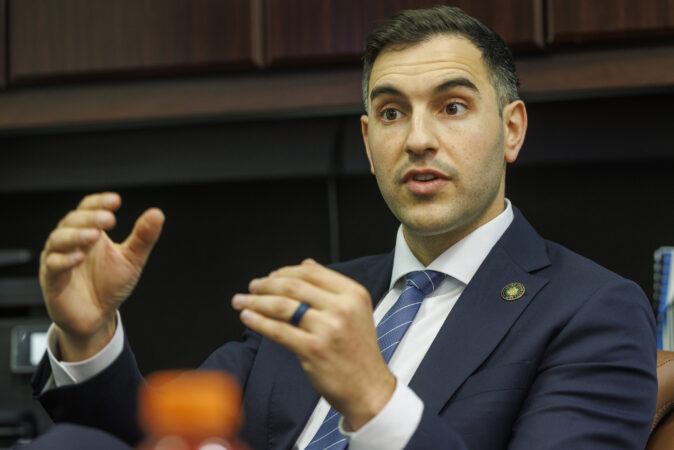
    In January, Danny Ceisler inherited a Bucks County Sheriff’s office that was a lightning rod for debate over deputies’ role in federal immigration enforcement. Now, as he reflects on the changes he’s made in his first six months in office, Ceisler says he is bringing the office back to standard procedure with a shift in staffing to prioritize addressing domestic violence.

    That shift comes amid an increase in the number of warrants — called Protection From Abuse orders — served against alleged perpetrators of domestic violence.

    Between February and May, Ceisler’s office has served 441 PFAs — an increase from the 370 that were served during the same time period last year.

    Ceisler, a Democrat who flipped the seat after four years of GOP control, has dedicated more staffing and resources to ensure those warrants are served in a timely manner, which can often be a life-or-death situation.

    “I view it as one of our real life-saving duties,” Ceisler said. “I mean if we can get an abuser out of a house at 8 p.m. on a Friday instead of 9 a.m. on a Monday — which is kind of what used to happen if they came in on Fridays — you could save a person’s life.”

    Last November, Ceisler ousted former Sheriff Fred Harran, a Republican, who came under scrutiny for his embrace of President Donald Trump’s style of politics and his willingness to commit his office to a controversial agreement to assist U.S. Immigration and Customs Enforcement in federal immigration enforcement in the county.

    In addition, Ceisler has developed a so-called “armory” that holds confiscated weapons and added six people to a round-the-clock unit dedicated to evicting alleged abusers from their homes based on judicial orders.

    In the United States, one in three women and one in four men will experience domestic violence in their lifetime, according to the Pennsylvania Coalition Against Domestic Violence.

    Jen Locker, executive director at A Woman’s Place, a Bucks County-based shelter and community organization for survivors of domestic and intimate partner violence, said that throughout her 13 years working at the nonprofit, the sheriff’s office has always been “really phenomenal” at being present during hearings for PFA warrants and ensuring survivors feel safe. The organization offers court accompaniment services and assistance in filling out PFA petitions.

    But the biggest shift came when A Woman’s Place and the sheriff’s office met early on in Ceisler’s tenure and advocates expressed that one of the biggest challenges survivors face is the delay in serving PFAs.

    Soon after the meeting, Locker said, Ceisler prioritized the eviction unit.

    “Getting the offenders out of the home and getting the weapons out of the home are really, really crucial in maintaining safety for the survivors who are just trying to find a path forward safely,” Locker said.

    Ceisler’s counterparts in the other Philadelphia suburbs say the work he’s doing is one of the core functions of any sheriff’s office.

    And Ceisler argues that he’s bringing the office back to basics, noting that at one point he had to reassign deputies who were tasked with planning firearms training and that the office spent a lot of time on ICE training.

    “One of my predecessor’s issues was he was stepping on the toes of police departments and trying to do more police work or federal, you know, immigration work,” Ceisler said. “We’re just doing what we are statutorily empowered to do, and trying to do it to the very best of our ability.”

    According to data provided by the sheriff’s office, there has been a 94.1% clearance rate for PFAs under Ceisler’s tenure between February and March and a 90.4% rate during that same period last year under Harran. A “cleared” PFA means the warrant was successfully delivered, and any weapons were confiscated.

    In an interview, Harran pushed back on the characterization that the office, under his leadership, was dedicated to anything but local law enforcement issues. And he was adamant that deputies working under him also served PFA warrants, with a dedicated, four-person unit doing that work exclusively.

    “Danny knows the truth: We were never doing the work of immigration. I’ve said it a million times, I’ve testified with my hand on a Bible to it,” he said. “I don’t know what more I could’ve done to tell people that’s not what we were doing.”

    Ceisler’s “armory,” he said, is also not a new concept. Harran said he was in the process of establishing one.

    “Domestic violence is not going away,” he said. “To say he created a new unit, tomato, tomahto, call it whatever you want, we were doing same thing.”

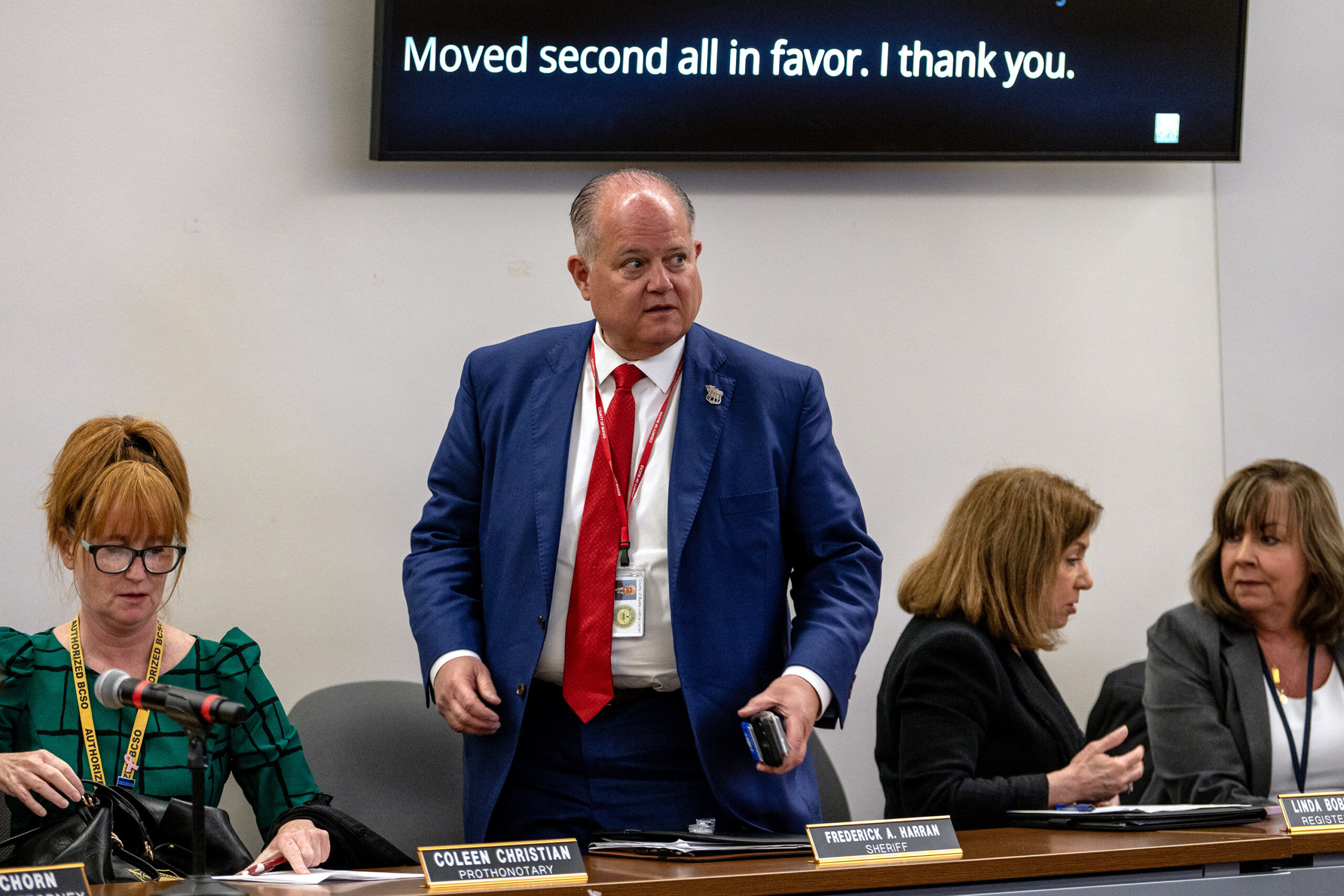
    Former Bucks County Sheriff Fred Harran stands following County Commissioners meeting last year when they approved a resolution opposing his deputies participating in an Immigrations and Customs Enforcement 287(g) program to act as ICE officers.

    In most of the other suburban counties, the sheriffs — all Democrats — say their offices have been serving the vast majority of PFA orders.

    In Chester County, Sheriff Kevin Dykes said his office has processed 247 PFA orders in the first quarter of 2026, as well as recovered eight firearms relinquished through that process. Dykes said his office rarely, if ever, has a backlog of PFA orders waiting to be filed, and works closely with local police departments to avoid that situation.

    “I think where the issue came in with Bucks is that Danny stepped into an office where the person running it had different priorities,” Dykes said. “In this instance, it’s just how the nature of this business is. One day we could have a high-profile trial in the courthouse, and the next we could have a threat on an official. It just changes day-to-day for us.”

    In Montgomery County, Sheriff Sean Kilkenny said his deputies are responsible for serving three-quarters of the PFAs filed. Last year that amounted to about 1,600.

    Kilkenny formerly headed the state’s Sheriff’s Association, and said having those departments take the lead in handling PFAs is the industry standard, one that he said has worked well for counties across Pennsylvania. He added that Ceisler “getting under the hood” of the process is part of the job for a new official.

    In Delaware County, where newly elected Sheriff Saddiq Kamara is wrestling with a staffing shortage, the sheriff’s office one day hopes to use Ceisler’s initiatives as a model.

    Kamara, a former Yeadon Police officer and onetime member of Gov. Josh Shapiro’s security detail, said his office currently has 35 vacancies for deputies. He’s working to reverse that, and has recently hired seven new deputies, but said the shortage has forced him to leave the serving of PFAs to local police departments.

    “It’s something that I really would like for us to do as well, but the Delaware County Sheriff’s Office is the third-busiest in the state,” said Kamara, referring to the number of prisoners they transport daily, as well as applications they receive for gun permits and other filings.

    “We just don’t have the capability of the resources and the man and woman power in our office,” he said. “What Danny is doing I think is a phenomenal idea, and we’re planning to do that in the near future as well.”

  • Philly congressional candidate Ala Stanford dropped out of a live debate, leaving her rivals to face off without her

    Congressional hopeful Ala Stanford on Wednesday morning announced she was dropping out of a WHYY candidates debate two hours before it was scheduled to begin, saying her campaign could not agree with the public radio station on a format for the debate and criticizing her opponents in the race for “misogynistic attacks.”

    “I have never been afraid of a hard room,” Stanford said in a statement. “After engaging in good faith with WHYY, we could not reach terms on a format that would deliver the serious accountability voters in PA-03 deserve.”

    Stanford’s campaign manager emailed the announcement to reporters around 10 a.m., two hours before the debate on WHYY’s Studio 2 was supposed to take place.

    In her statement, Stanford did not clarify what problems she had with the debate format. She also did not provide details on any attacks from her opponents in the Democratic primary for Pennsylvania’s 3rd Congressional District.

    A Stanford spokesperson declined to comment beyond her written statement.

    Stanford’s surprise announcement came less than three weeks before the May 19 primary, and followed a series of missteps for her campaign, including the revelation that a staffer used artificial intelligence to help answer a candidates’ questionnaire and her stumbling through a question about immigration enforcement in an interview with NBC10.

    A recent Inquirer report on her stewardship of the Black Doctors Consortium also found that the organization omitted details about her income that were required to be included on nonprofit tax forms filed with the Internal Revenue Service.

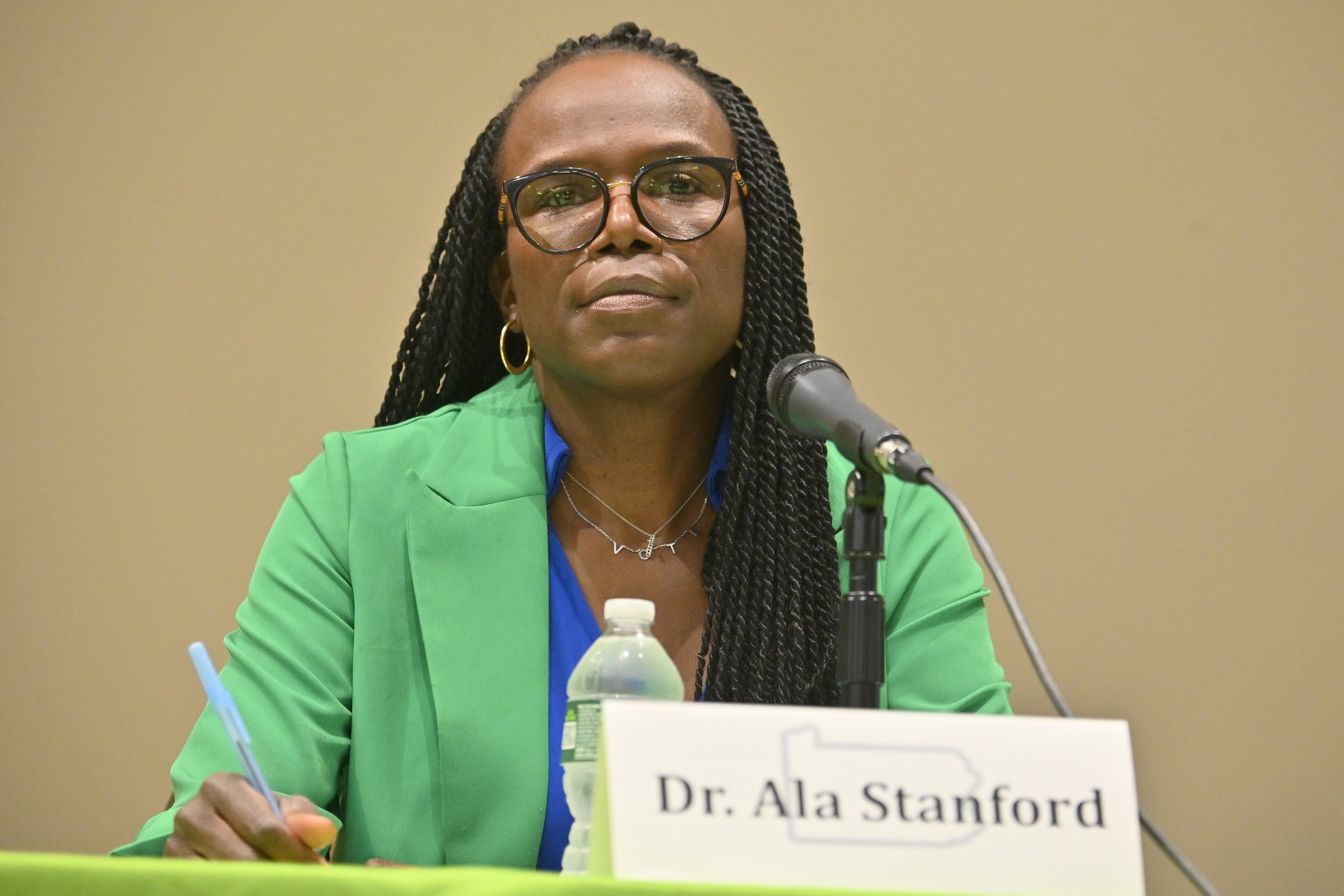
    Ala Stanford, pediatric surgeon and founder of the Black Doctors Consortium, participates in the debate for Pennsylvania’s 3rd Congressional District at Center in the Park in Germantown on Tuesday, April 14, 2026.

    Stanford’s exit from the Wednesday event meant the other two top contenders in the race, State Rep. Chris Rabb and State Sen. Sharif Street, were the only candidates to participate in the debate featured on WHYY’s Studio 2, the highest-profile live and on-air debate thus far.

    It was a relatively subdued affair compared to some of the other more gloves-off style campaign events in the open race. Street and Rabb took questions from moderators and largely agreed on policy, with both saying they support expanding universal healthcare, abolishing U.S. Immigration and Customs Enforcement, and impeaching President Donald Trump.

    The two state lawmakers sought to contrast their styles, with Street portraying himself as a more competent legislator.

    “I get things done,” said Street, the former head of the state Democratic Party. “Rep. Rabb and I share a lot of value propositions. But the difference is I deliver on ideas.”

    Rabb, a progressive who has been endorsed by the Working Families Party, said Street is too closely aligned with the Democratic establishment, and that his ideas are not bold enough.

    “There’s so many people who think we can’t do things big and bold,” he said. “They play around the edges, because that’s what establishment politics does.”

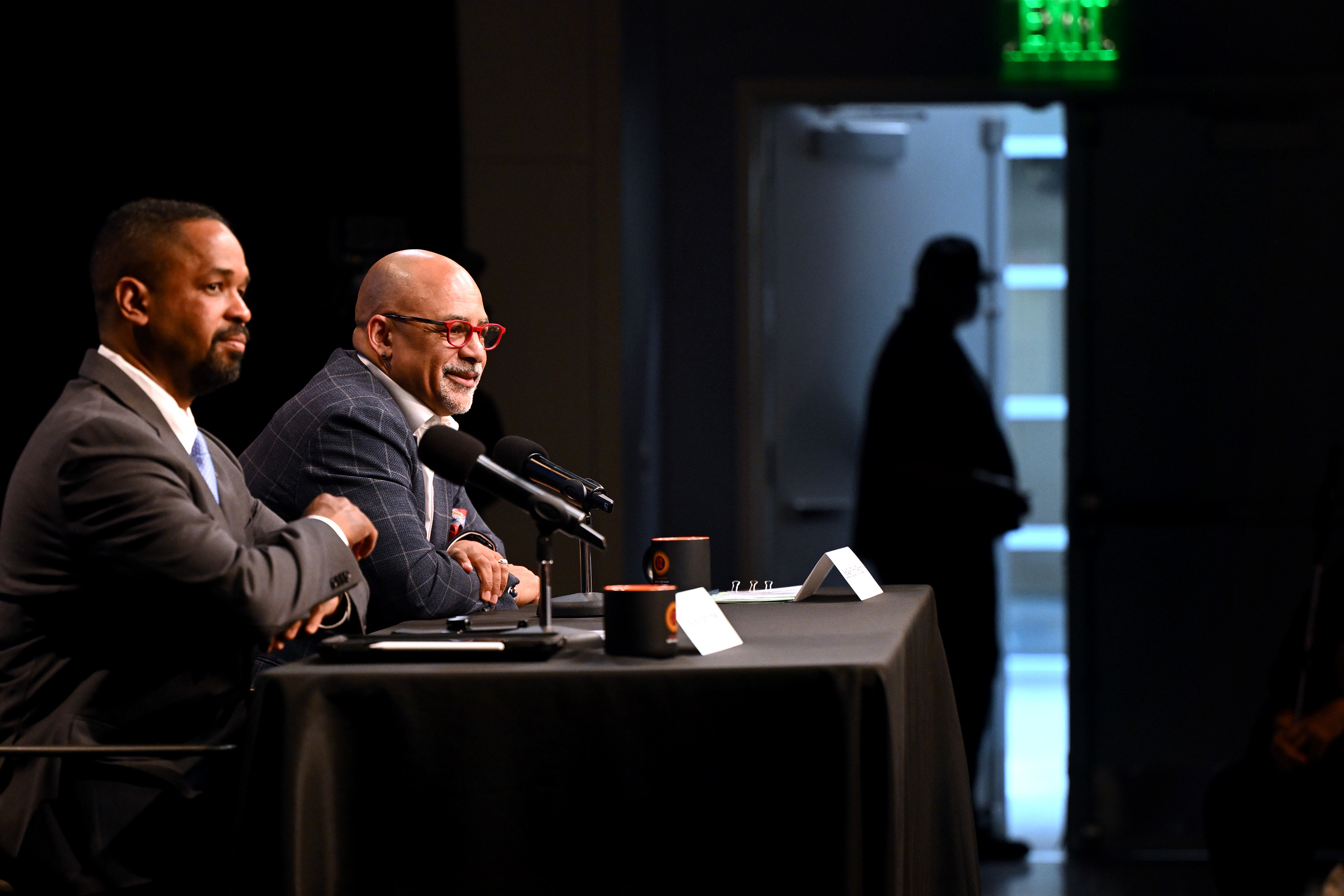
    State Sen. Sharif Street (left) and State Rep. Christopher Rabb (right) wait for the WHYY studio door to close Wednesday, April 29, 2026 before start of their debate in the Democratic primary for the 3rd Congressional District. The third leading candidate, Ala Stanford declined to attend at the last moment.

    Both candidates were also asked about Stanford’s absence and her charge Wednesday that the race has been “marred by misogynistic attacks and lies from both of my opponents.”

    Stanford, a first-time political candidate, is the only woman on the ballot.

    Rabb said he wasn’t sure what she was referring to, but pointed out that when Stanford was recently heckled by some of his own supporters during a candidates forum, he repeatedly told them to let her speak.

    And Street said he has not attacked her directly, but acknowledged that she’s faced criticisms.

    “She has been attacked. I’ve been attacked. Everybody on this campaign, I’m sure, has been attacked at some point,” he said.

    Rabb and Street said their campaigns did not negotiate with WHYY on the format of the event.

    Kevin McCorry, an executive producer and host at the station, said WHYY engaged with Stanford’s campaign “in good faith” and acquiesced to her staff members’ requests, including allowing her to have notes on the table and bring extra staffers to sit in the audience.

    He said WHYY learned that she was pulling out when Stanford’s campaign manager released a statement to reporters from multiple news outlets.

    “We were flexible with her requests,” McCorry said. “At no time did they say, ‘If X doesn’t change, we’re backing out.’”

    State Sen. Sharif Street (left) and State Rep. Christopher Rabb (right) appear in a debate at WHYY studios Wednesday, April 29, 2026 for the Democratic primary in the 3rd Congressional District. The third leading candidate, Ala Stanford declined to attend at the last moment.

    Street spokesperson Anthony Campisi accused Stanford of dropping out to avoid tough questions, adding that “her campaign is in free fall.”

    “Rather than answer these questions in a debate that’s aired on radio and television, she appears to be taking her ball and going home, which is not what Philadelphians expect from their member of Congress,” Campisi said Wednesday. “Philadelphians deserve a member of Congress who is ready to fight for them and against Donald Trump, not someone who runs from a fight.”

    Rabb said that when it comes to campaign events, he and his team “don’t negotiate, we just show up.”

    “Even if I didn’t like the format, which is not uncommon, I still show up,” he said, “because I’m a public servant and I’m a public candidate, and I got to reach people wherever they are.”

    In her statement, Stanford, a physician, noted she has taken the Hippocratic Oath “to first do no harm.”

    “I challenge everyone in this race to join me in promoting the kind of spirited, but serious and meaningful dialogue Philadelphians should expect from those asking to serve,” she said. “In the meantime, I will be where I have always been — on doorsteps, in church basements, and on the corners of the wards that built me.”

    Shaun Griffith, a tax adviser and the fourth candidate in the race, did not participate in the debate because he did not meet WHYY’s criteria, which included a fundraising threshold.

    He attended the event and sat in the audience, and said afterwards that it was “frustrating to be watching other people get to answer questions and not have the opportunity to do so myself.”

  • Gov. Shapiro says dispute over security fence with Abington neighbors has no place in federal court

    Gov. Shapiro says dispute over security fence with Abington neighbors has no place in federal court

    While Gov. Josh Shapiro was showing the Dutch royal couple around Independence Mall this week, his general counsel was taking steps to quell a dispute that hit Pennsylvania’s first couple close to home.

    Shapiro asked a U.S. district judge to dismiss a federal lawsuit filed by his Abington neighbors over a parcel of land between their residences.

    Jeremy and Simone Mock accused the governor and his wife, Lori Shapiro, of illegally occupying part of their yard to build an eight-foot security fence last summer in what the Mocks claim in the lawsuit was an “outrageous abuse of power.”

    On the same February day the Mocks filed their lawsuit, the Shapiros sued their neighbors in Montgomery County Court, asking a judge to declare the disputed 2,900-square-foot strip of lawn as part of their property.

    The Mocks’ lawsuit has no place in federal court, Monday’s filing contends, as a controversy over a property boundary is a common matter for state courts.

    Plus, the Mocks cannot bring a lawsuit against Shapiro as governor or against the Pennsylvania State Police because the couple’s claims are against Shapiro as a property owner, not action he took in his official capacity as governor, according to the filing.

    “That the Shapiros allowed [state police] to access the disputed parcel in a manner similar to that which the Shapiros access that parcel does not magically convert this private dispute to ‘state action,’” the motion says.

    The motion also argues the state police are immune from litigation in federal court as a state agency.

    The Shapiros have lived in the sleepy Montco neighborhood for more than 23 years, with the Mocks as their neighbors for less than a decade.

    The feud began when security updates were proposed to Shapiro’s home after a man firebombed the state-owned governor’s residence in Harrisburg in April 2025 while Shapiro and his family slept inside, according to court filings.

    In response, state police proposed security upgrades to the governor’s personal residence in Abington, which included the installation of an eight-foot fence along the property’s perimeter.

    <div data-analytics-viewport="autotune" data-analytics-label="shapiroyard" id="shapiroyard__graphic" data-iframe-fallback="https://media.inquirer.com/storage/inquirer/ai2html/shapiroyard/fallback-mobile.jpg" style="width: 0; min-width: 100% !important; border: none;" data-iframe-fallback-height="643" data-iframe="https://media.inquirer.com/storage/inquirer/ai2html/shapiroyard/index.html" data-iframe-height="620.999999999999" data-iframe-resizable></div> <script type="text/javascript">(function() { var l = function() { new pym.Parent( 'shapiroyard__graphic', 'https://media.inquirer.com/storage/inquirer/ai2html/shapiroyard/index.html'); }; if(typeof(pym) === 'undefined') { var h = document.getElementsByTagName('head')[0], s = document.createElement('script'); s.type = 'text/javascript'; s.src = 'https://pym.nprapps.org/pym.v1.min.js'; s.onload = l; h.appendChild(s); } else { l(); } })(); </script>

    A land surveyor discovered in summer 2025 that the Mocks actually owned about 2,900 square feet of land that the Shapiros had believed was a part of their property since they bought the home in 2003.

    The Mocks, whose property is adjacent to the Shapiros’, say in their suit that the planned location of the fence is on their property unlawfully and would violate their rights.

    The Shapiros began planting arborvitae-type trees and other plants on the Mocks’ property, flying drones over it, threatening to remove healthy trees, and “chasing away” contractors who came to work in the Mocks’ yard, the Mocks’ suit says.

    The complaint also accuses Shapiro of directing state police to patrol the property. Troopers instructed the Mocks to leave the area of the yard multiple times, calling it a “disputed” area or “security zone,” the suit says.

    The Shapiros say they are the rightful owners of the land through adverse possession, a legal mechanism that extends a person ownership of a property they have actively used for at least 21 years.

    The governor and his wife are asking a Montgomery County Court judge to find them the “legal and equitable owners” of the area in dispute. Until the state judge makes a determination, the federal court should abstain from considering the Mocks’ federal lawsuit, the new filing says.

    Outside of court filings, Shapiro attacked the lawsuit as politically motivated.

    The Mocks are represented by Wally Zimolong, a Delaware County attorney who describes himself on his website as the “‘go-to’ lawyer in Pennsylvania for conservative causes and candidates.” Zimolong previously represented the political campaigns of President Donald Trump and U.S. Sen. Dave McCormick (R., Pa.).

    “The Governor looks forward to a swift resolution and will not be bullied by anyone trying to score cheap political points, especially at the expense of his family’s safety and well-being,” Will Simons, a spokesperson for Shapiro, a Democrat running for reelection, said in a statement in February.

    Zimolong did not comment on the new filing, but previously said the Mocks are open to resolving the dispute outside of court.

    “At base, this is a straightforward defense of the property rights of two innocent owners, who were living peacefully next to the Shapiros for over nine years,” the attorney said in a February statement.

    Staff writer Gillian McGoldrick contributed to this article.
  • Josh Shapiro promises to ‘protect’ mail voting after Trump signs order to restrict it and create national voter list

    Josh Shapiro promises to ‘protect’ mail voting after Trump signs order to restrict it and create national voter list

    Pennsylvania Gov. Josh Shapiro pushed back against President Donald Trump’s executive order to create of a national eligible voter list and restrict mail voting.

    “President Trump can sign whatever the hell he wants to, but it won’t change the Constitution,“ Shapiro, a Democrat, said in a post on X Tuesday night after Trump signed the order. ”The authority to set our election rules belongs to the states — and as Governor, I will protect your right to vote. That includes your right to vote by mail.”

    Trump’s order is the latest of several attempts by the president to nationalize the U.S. voting process and promote his false claims of election fraud.

    Tuesday’s directive instructs the Department of Homeland Security to coordinate with the Social Security Administration to develop a list of eligible voters in each state, according to the executive order signed Tuesday. The list — called “The State Citizenship List” — will be compiled from various government records including citizenship and naturalization and the SSA.

    It also seeks to bar the U.S. Postal Service from sending absentee ballots to those not on each state’s approved list, although the president likely lacks the power to mandate what the Postal Service does. Trump is also calling for ballots to have secure envelopes with unique barcodes for tracking.

    The order is likely to attract swift legal action from officials in Democratic-led states. Shapiro was not explicit in his post on X as to whether he’ll file suit against the Trump administration for the directive. But it wouldn’t be a surprise if he did — the governor, who is running for reelection, has frequently taken the president and other top officials to court over the past year.

    If Shapiro takes legal action, he’d be joining other Democratic officials who have already committed to file suit, including in Arizona and Oregon. Voting law experts told The Associated Press that the order votes the Constitution by attempting to take the power to run elections from the states.

    Tuesday’s order comes after The Department of Justice has sued 28 states, including Pennsylvania and New Jersey for access to voter roll information.

    Pennsylvania officials declined to turn the information over, citing privacy concerns.

    This story includes reporting from the Associated Press.

  • Rep. Madeleine Dean visits Philadelphia ICE facility as fight over DHS funding drags on

    Rep. Madeleine Dean visits Philadelphia ICE facility as fight over DHS funding drags on

    As Congress spends a two-week break no closer to a compromise on Homeland Security funding, U.S. Rep. Madeleine Dean visited the federal detention facility in Center City Tuesday to do some research on the agency at the center of the fight.

    ICE agents have been paid throughout the 46-day shutdown, but most other employees of agencies overseen by the the Department of Homeland Security have gone without pay for the duration.

    But Dean (D., Montgomery) discovered Tuesday that the pay disparity also existed within ICE itself.

    “What I learned there is something I did not fully understand. We all know about TSA not getting paid. But did you know the support staff (for ICE and other agencies) has not been paid?” Dean said.

    “The support staff is often the backbone of any organization and it’s just completely unthinkable, unconscionable — I think it should be illegal — that these folks are not being paid.”

    The four-term lawmaker’s visit came more than six weeks into the Department of Homeland Security shutdown and just days after Congress left Washington for a two-week break without a solution.

    Democrats have remained steadfast in opposing any new funding for Immigration and Customs Enforcement without reforms to the agency’s tactics, following two fatal shootings of civilians in Minneapolis by federal agents in January.

    Many Republicans have bristled at Democrats’ proposals to ban masking by agents and other reforms. And House GOP leaders have refused to consider a larger DHS budget without the ICE funding.

    Dean said her trip to the Philadelphia Federal Detention Center, which she said had 52 immigrant detainees Tuesday morning, was designed for her to learn both about the shutdown’s impacts and the operations of a facility that only began holding immigrants in ICE custody last year.

    She said the pay disparity — support staff not being paid while law enforcement officers continue to be paid to do enforcement work — struck her as unfair, particularly with funding available through President Donald Trump’s One Big Beautiful Bill Act and after Trump authorized payment for Transportation Security Administration workers.

    Trump approved the TSA payments last week as unpaid employees increasingly called out of work, disrupting airport operations and leading to ICE agents being deployed to pick up some of their duties.

    Dean said the decisions made about who to pay and not pay, along with House Republicans’ move last week to reject a compromise plan proposed by the Senate, were “an utter failure to govern.”

    Spokespeople for DHS and ICE did not respond to questions from the Inquirer about which types of federal employees are receiving paychecks during the budget impasse.

    While the Trump administration has occasionally blocked members of Congress — including two from Pennsylvania last year — from entering ICE detention facilities, Dean said she did not have a problem getting access on Tuesday. However, she criticized the current policy that requires a week’s notice.

    Democratic lawmakers have fought in court against the advance-notice policies. The policies have been used, for instance, to block lawmakers looking to visit a facility in Minneapolis after an ICE officer killed U.S. citizen Renee Good, sparking a wave of public backlash. The arrest of nine religious leaders protesting the Philadelphia detention center on Monday was part of a series of protests after the events in Minneapolis.

    “We should have been able to walk right in,” Dean said after giving notice for her Tuesday visit. “We have a responsibility as the appropriators to take a look at these places without any prior approval.”

    Dean described the staff at the Philadelphia facility as cooperative even as they did not answer all of her questions, and declined to let her speak with any of the immigrants who were detained there Tuesday morning.

    The questions she said she entered with — about how long the detainees had been there, and if they had criminal records beyond their immigration status — were left unanswered.

    Dean said she also did not get clarity on how many came from her district, which covers most of Montgomery County and part of Berks County, or about the circumstances around the death of a detainee in January. That detainee, 46-year-old Parady La, was a Cambodian immigrant who ICE said was treated for drug withdrawal and died after being transferred to Thomas Jefferson University Hospital.

    La’s family and groups including the ACLU of Pennsylvania have sought more information. Dean said Tuesday she was unable to learn anything more after speaking with the staff.

    Dean described the conditions at the facility, which also still operates as a federal jail, as “heavy-duty, serious prison” — similar but also different from a much larger detention facility in Texas that she visited earlier in March.

    The facility in Dilley, Texas, holds up to 2,400 people, and Dean has highlighted it as a cautionary exhibit of what could be coming if the Trump administration succeeds in its plans to turn two warehouses — in Berks and Schuylkill counties — into similarly large detention facilities.

    “It was incredibly inhumane and grotesque,” Dean said. “We saw children whose medical needs were being neglected.”

    Dean said she spoke to several detainees who had severe medical issues. An educational area set up for the detained children also appeared to be unused, she said.

    “It was an absolute sham, a joke,” she said. “I’ll do everything in my power to get these centers shut down.”

  • There’s now a ‘Club America’ at Great Valley High School. Turning Point USA says interest grew after Charlie Kirk’s assassination.

    Making his pitch to the Great Valley school board, Jed Lu said he and fellow students seeking to bring slain conservative activist Charlie Kirk’s Turning Point USA organization into their high school weren’t racists or extremists.

    “We simply have a different perspective,” Lu told the board at a late February meeting.

    The Chester County district is one of the latest in the Philadelphia area to approve a Club America chapter — the high school offshoot of Kirk’s group. The organization seeks to mobilize “anti-woke warriors” and has rapidly been adding new local chapters since his assassination in September, provoking debate around right-wing influence in public schools.

    Nationally, chapters have nearly tripled — from 1,200 prior to Kirk’s death, to more than 3,300, according to Turning Point officials. Governors in Republican-led states like Arkansas and Nebraska are partnering with Turning Point to expand clubs throughout their states.

    In eastern Pennsylvania, there were 11 Club America chapters at the end of last school year. Now, “we’re currently approaching 40,” said Nick Cocca, Turning Point’s enterprise director.

    The group’s expansion might be overstated in the Philadelphia region. Seven area high schools listed by Turning Point on its website or Instagram graphics as having Club America chapters said they didn’t have clubs.

    Souderton Area High School, for instance, appears on Turning Point’s map, but doesn’t have a club. The school’s assistant principal, Matthew Haines, said “a student made an inquiry” in September about starting a chapter, but never applied to do so.

    In some schools, like Springfield High School in Delaware County, “we have a few students who started running an after-school student pilot a few months back,” said principal Monica Conlin, but the district doesn’t officially recognize the club. Conlin said new clubs must complete a three-year pilot before gaining district approval.

    Still, the organization has gained traction. In addition to Great Valley, Penncrest High School in Rose Tree Media School District lists Club America among its student clubs; district officials and staff didn’t respond to requests for comment.

    Turning Point says it also has a Club America chapter at Pennsbury High School, and an Instagram account for “Club America at Pennsbury” invited students to a Feb. 25 meeting to discuss the State of the Union and “participate in prayer for law enforcement and our nation.” District officials didn’t respond to requests for comment.

    ‘An outpouring of support’ after Kirk’s death

    A spokesperson for Turning Point couldn’t explain the discrepancy between its list and schools that say they don’t have any Club America chapters.

    The organization was also unable to provide a local student willing to be interviewed.

    Cocca said Turning Point “saw an outpouring of support and outreach from young people across the country” in the wake of Kirk’s Sept. 10 assassination. To support its growth, the organization is hiring more field representatives to work with high school students, Cocca said.

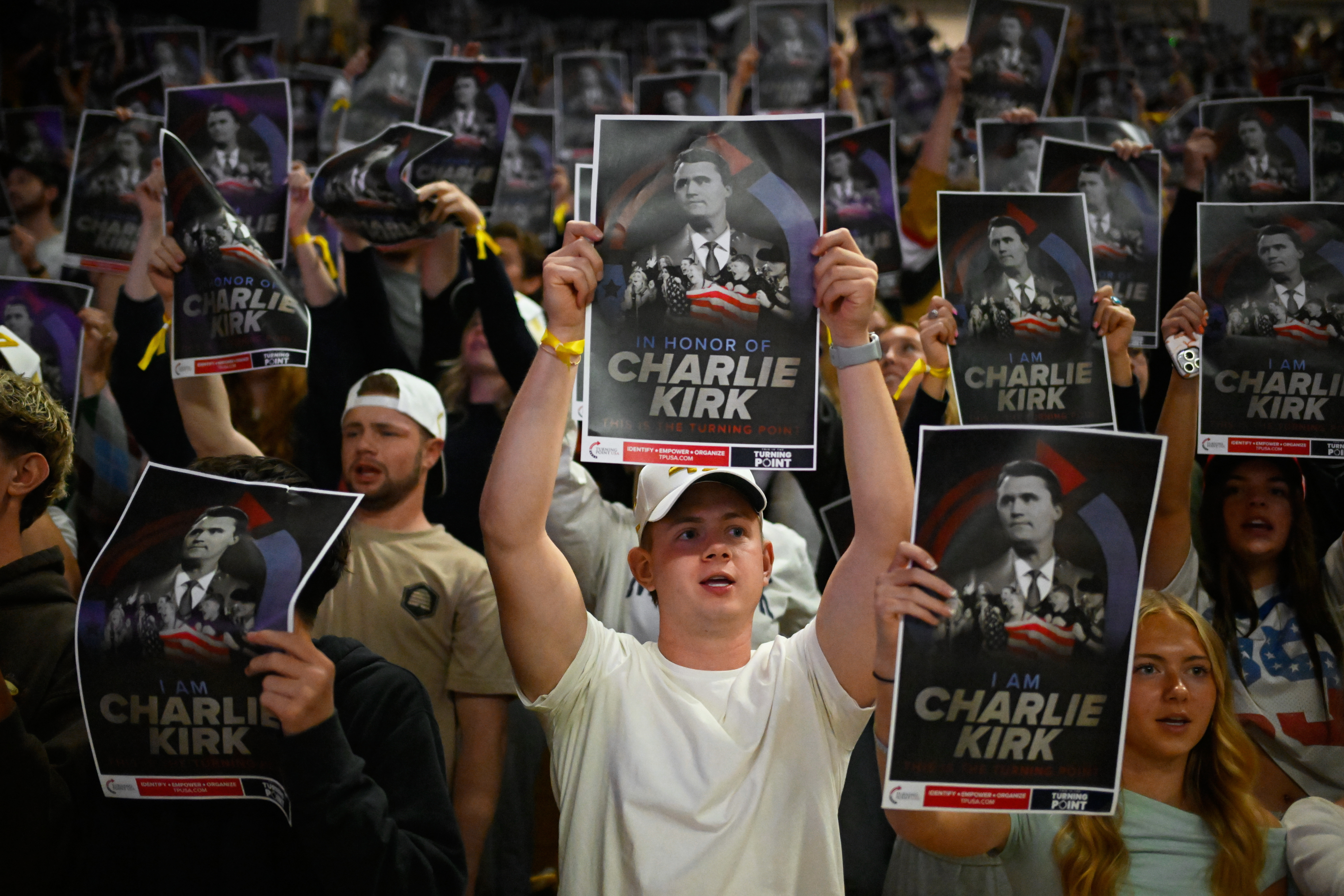
    People hold posters of Charlie Kirk during a Turning Point USA rally at Utah State University, as a part of the organization’s push to memorialize Kirk in Logan, Utah, in September.

    Turning Point, which began as an organization advocating for conservative views on college campuses, had previously been expanding its presence in high schools. (A Turning Point chapter launched years ago at Pennridge High School in Upper Bucks County, for example.)

    Turning Point last July renamed its high school operation Club America. “We wanted a brand that spoke specifically to them,” Cocca said. He said that “when Charlie was alive, he used to say ‘I want a Club America chapter in every high school in America.’”

    The expansion has spurred conflict. Critics have highlighted Kirk’s controversial statements, including referring to the Rev. Dr. Martin Luther King, Jr. as “an awful person” and calling the passage of the 1964 Civil Rights Act a “mistake.”

    Kirk also promoted the so-called “great replacement theory,” framing non-white immigration as a plot to replace white populations.

    “This club is an easy way to incorporate hate and discrimination within our high school. This should not be normalized,” a Change.org petition launched in January against a proposed Club America chapter at West Chester East High School read. An update to the petition later declared that Turning Point “was shut down at West Chester East.”

    Molly Schwemler, a district spokesperson, said that earlier this year, some students expressed interest in starting a Club America chapter.

    But “after discussing the process and need for sponsorship from a teacher with school administration,” students “instead decided to organize independently outside of the school,” Schwemler said. (On its website, Turning Point lists West Chester East as having a chapter.)

    In an Instagram post, the club said it decided to operate independently “because people can’t be mature, open minded or respectful at our school.”

    Activism hubs and kits

    In addition to identifying a teacher adviser, students looking to form clubs often have to supply information to administrators like their purpose, planned activities, and funding needs.

    Schools have little discretion to reject a new club, based on the federal Equal Access Act and First Amendment, said Jeffrey Sultanik, a solicitor for numerous Philadelphia-area districts.

    Districts need “to be viewpoint-neutral,” Sultanik said, noting that “once you open up the door to clubs coming in,” administrators can’t pick and choose which to permit.

    In its handbook for Club America chapters, Turning Point calls it “imperative that every chapter works to become officially recognized by the school,” offering students help if schools deny them.

    Students can form an “activism hub” outside of school for a specific geographic area “as a last resort,” the handbook says.

    In Downingtown — where Turning Point says there is an activism hub — a school district spokesperson said the district has not sponsored any clubs “related to religious or political groups in recent history.” (Some other area schools have official political clubs: Penncrest High School, for instance, lists Penncrest Democrats of America.)

    Turning Point says its Club America chapters are nonpartisan and don’t support specific candidates.

    But the group’s ideology is clear from materials it supplies to student members. Presentations available in Turning Point’s “Activism Library” for students to use have titles including “Taxes Are Shady,” “Socialism Kinda Sus,” and “Big Gov Scares.”

    “Why are those on the left not proud to be Americans?” a presentation titled “Always Love America” asks.

    Kids can order “Activism Kits” from Turning Point with posters and stickers. A “2A” kit features slogans like “Gun rights are women’s rights” and “Guns are the greatest equalizer.”

    Cocca said Turning Point provides students “anything they may need, to promote what they want to promote, and what they want to make their club about” — whether that’s registering students to vote, or learning about the Constitution, he said.

    “Ultimately, it’s up to the students to use those resources the way they want to use them,” he said.

    Opposition to Club America groups

    Critics accuse Turning Point of trying to indoctrinate high schoolers.

    “They are grooming at the high school level, and college level, for a generational change,” said Sherry Lawrence, a parent in Great Valley who opposed the district’s new Club America chapter. “All the red flags are there for people who don’t subscribe to this brand of conservatism, or this brand of Christianity.”

    Lawrence questioned whether adults were driving some efforts to organize Club America chapters.

    In an October Facebook post in a Turning Point Pennsylvania Action group, George Sabo, then a GOP candidate for township supervisor in East Whiteland, said his daughter was starting a chapter at Great Valley High School. “We had discussed it over the summer but pulled the trigger after Charlie’s assassination,” Sabo wrote.

    In a brief phone interview, Sabo said it was his daughter’s idea to start the chapter.

    “My daughter and family, who believe in the Bible, and believe God is king, value those properties and want to see that brought more into the school district,” Sabo said.

    He said that while there had been pushback from other kids, “there’s some support from other kids, too.”

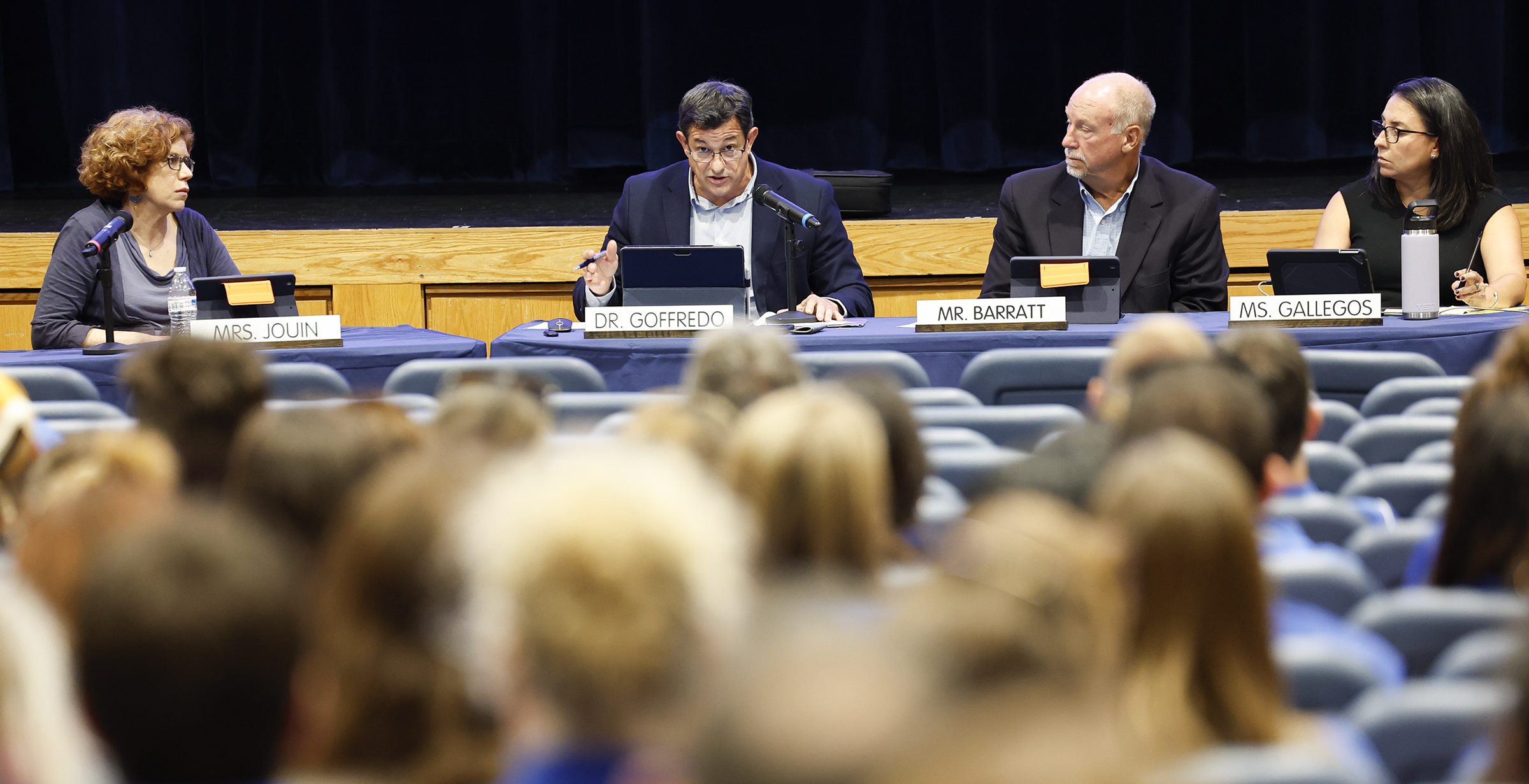
    Great Valley school board members during a meeting at Great Valley High School in Malvern in 2024.

    The Great Valley board approved the club 7-0 at its February meeting.

    At the board meeting, Lu, the club president, said he and the three other club officers had initiated its formation.

    While the club has a “conservative viewpoint,” Lu said, “our purpose is civic debate and civil discussion.” He added that the club is motivated by “the Christian value of love and compassion.”

    The club hopes to be an “impactful addition to Great Valley High School,” Lu said.

  • Nurse charged with allegedly harming a Bensalem child with medical conditions

    Nurse charged with allegedly harming a Bensalem child with medical conditions

    Bucks County authorities have charged a nurse with child endangerment for allegedly harming a Bensalem 3-year-old for whom she was providing in-home services, according to a criminal complaint filed last week.

    The parents of the child reported Cindy Desser to child welfare authorities after seeing home surveillance video footage in which she “smacked and slammed” the child, who was born early and has “multiple medical issues,” according to the complaint filed by Bensalem police.

    The child “lives with a trachea,” according to the complaint, and one video showed the Desser “pull the trach out” and take “her time putting the trachea back in.” The child could be heard “gasping for air,” and Desser, who was the child’s “night nurse,” was recorded saying, “You did this,” the document said.

    An attorney for Desser did not immediately respond to a request for comment.

    The family hired Desser, who lives in Jamison, Pa., through Dynamic Home Health Care, according to the complaint. The company did not respond to a request for comment.

    Desser’s arrest was first reported by 6ABC.

    The parents told the channel they wished to remain anonymous.

    “Thank God my daughter is so strong,” the mother told 6ABC. “It was just horrific. I just couldn’t believe it. It’s like almost like monsters come out at night.”