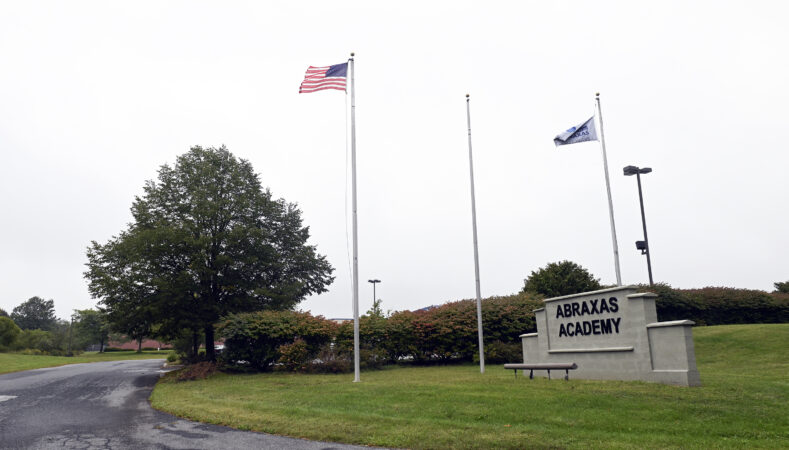
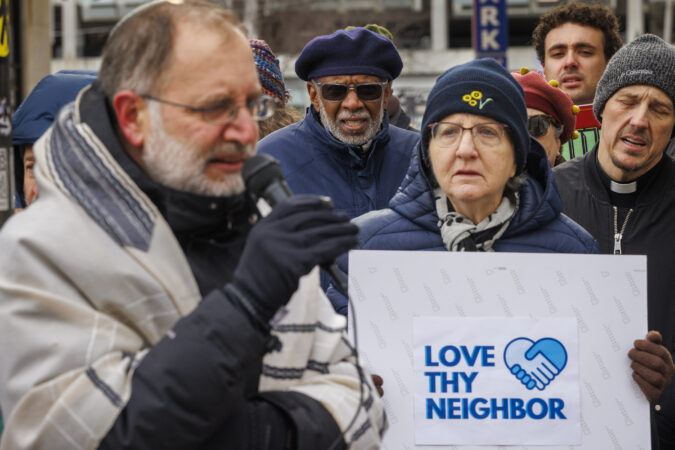
Youth- and immigrant-rights allies called on Gov. Josh Shapiro Wednesday to immediately remove children from a Berks County center that they said harms those held there, including migrant kids who arrived at the U.S. border unaccompanied by parents.
Speakers at an afternoon news conference held near the Abraxas Academy in Morgantown, Pa., asked the governor to issue an emergency removal order ― typically enforced to protect children in imminent danger of physical or emotional abuse.
“Pennsylvania cannot continue to expose these kids to Abraxas’s abuse,” said Evan Feldberg-Bannatyne, an organizer with the youth-advocacy group Care, Not Control. “We need an ERO now.”
The Shapiro administration said Wednesday that the Department of Human Services will continue to closely monitor the situation to determine next steps and ensure the safety of those living there.
If DHS were to issue an ERO, it would not take custody of the young people or direct their placement. Instead, Abraxas would need to notify the federal government for immigrant youths, or the state court for Pennsylvania residents, to find other placements. DHS would monitor the wind-down of operations, which can take time, the administration said.
“The department’s top priority is ensuring the safety of youth in the facilities we license, and it is concerning whenever we receive a report or allegation that a young person was put at risk,” said DHS spokesperson Brandon Cwalina. “When that happens, the Shapiro administration works urgently to ensure that any allegations and potential violations are investigated and handled.”
Pittsburgh-based Abraxas Youth and Family Services said in a statement Friday that it was “aware of the concerns raised regarding Abraxas Academy in Morgantown,” and that “the safety and well-being of those in our care is our highest priority, and we take any allegation or concern seriously.”
“Programs like Abraxas Academy operate within a regulated system with established standards for care and accountability that are in alignment with our state and federal partners and their regulations,” the statement said. “We are committed to meeting those expectations and upholding the responsibilities entrusted to us by families and government.”
The agency website describes the Abraxas Academy as providing secure residential treatment and detention for male young people, ages 14 to 19, who face serious charges or have demonstrated delinquent patterns through multiple placements.
Since October, the federal Office of Refugee Resettlement, which is responsible for “unaccompanied minors,” the migrant children who arrive at the border without parents, has held some teenage boys at the center, which has a documented history of staff physically and sexually abusing juvenile offenders, a Washington Post investigation found.
State inspectors documented at least 15 incidents since 2013 in which they said staff physically mistreated minors at the facility, which mainly holds juveniles facing or convicted of criminal offenses, The Post reported. In at least two incidents, officials documented allegations of staff sexually harassing or sexually abusing young residents, the newspaper reported.
After some incidents, Abraxas suspended or fired staff members and submitted correction plans to state regulators, The Post said.
DHS’s Cwalina noted that in November, the department revoked the license for Abraxas Academy’s Secure Detention Unit. Immigrant youths are not held there. Abraxas appealed and continues to operate the unit while the appeal goes forward.
Abraxas has two other licenses that remain in place, subject to periodic, unannounced inspections. The DHS Office of Children, Youth, and Families is on site weekly — including today — to monitor the center’s operations, he said.
“We do not want detention centers in our state,” said Jasmine Rivera, executive director of the Philadelphia-based Pennsylvania Immigration Coalition. “We fight for the closure of immigrant detention. Our communities do not need more cages.”
Detention is particularly disturbing, she said, when it extends to children who have come to this country seeking shelter and safety.
By law, ORR must provide care for unaccompanied children, defined as those who have no legal immigration status, have not yet turned 18, and have no parent or guardian in the United States. ORR says it tries to find sponsors, most often a close relative in this country, and in the meantime provides care at one of nearly 200 facilities.
However, a 2025 rule change now allows ORR to consider a potential sponsor’s immigration status, and to share that information with enforcement agencies. The Immigrant Legal Resource Center in San Francisco says that discourages undocumented family members from becoming sponsors, leaving children in government custody longer and hurting their well-being.
“It is immoral and unimaginable that in our backyard, children are being held in such violence and unsafe conditions,” said Gaby Lopez, lead organizer in Reading for Make The Road, which works to help immigrants. “Children need to be with their loved ones.”
The United States needs an immigration system that welcomes those who come here to share their talents and be part of the American story, she said, not one that replicates the violence they experienced in their homelands.
“Gov. Shapiro,” she said, “Issue an emergency removal order now, and protect families across Pennsylvania now.”
Pennsylvania Gov. Josh Shapiro joined Democratic leaders from nearly two dozen states in challenging President Donald Trump’s latest global tariffs.
In a lawsuit filed Thursday, Shapiro and the other state leaders argue Trump’s plan to impose 15% tariffs, which comes after the U.S. Supreme Court blocked his last round of global tariffs, oversteps his powers.
“The Supreme Court got it right — but instead of following the law, Trump decided to double down,” Shapiro said in a statement.
“This President’s tariffs have done nothing but cause chaos and raise prices for our farmers, small businesses, and families,” Shapiro said. “I’ve gone to court before to protect Pennsylvanians from the costs of this disastrous trade war — and I’m ready to do it again.”
The suit, which is being led by the attorneys general of Oregon, Arizona, California, and New York, marks the 21st legal action Shapiro has filed or joined against the administration during Trump’s second term, including two suits he has led.
Trump’s first round of tariffs sent shock waves through the U.S. economy as prices rose. Exports, including Pennsylvania’s lumber sales, also suffered.
Shapiro, who is up for reelection this year, has long highlighted his willingness to go up against Trump in court. That record began during Trump’s first term, when Shapiro was state attorney general.
In Trump’s second term, Shapiro has repeatedly stepped in to sue on behalf of Pennsylvania when Republican Attorney General Dave Sunday has not.
Kentucky Gov. Andy Beshear, the only other governor signed onto the case, faces similar circumstances in his Republican-leaning state. Both Beshear and Shapiro are seen as likely contenders for the Democratic nomination in 2028.
New Jersey and Delaware, which have Democratic attorneys general, also joined the suit.
“Tariffs raise prices for hard-working families and businesses across New Jersey,” New Jersey Attorney General Jennifer Davenport said in a statement. “I will keep fighting against the imposition of unnecessary and illegal costs on our consumers. We’re going to court to protect our state from these illogical and illegal tariffs.”
Trump criticized the high court during last week’s State of the Union address, calling the ruling “very unfortunate.” Trump said in the speech that his new tariffs would be “a little more complex but actually probably better.”
Section 122, which had never been invoked, allows the president to impose tariffs of up to 15%. They are limited to five months unless extended by Congress.
The states’ new suit argues that Trump cannot pivot to Section 122 because it was intended to be used only in specific, limited circumstances — not for sweeping import taxes. It also contends the tariffs will drive up costs for states, businesses, and consumers.
Many of those states also had successfully sued over Trump’s tariffs imposed under a different law: the International Emergency Economic Powers Act (IEEPA).
Four days after the Supreme Court struck down his sweeping IEEPA tariffs Feb. 20, Trump invoked Section 122 to slap 10% tariffs on foreign goods. Treasury Secretary Scott Bessent told CNBC on Wednesday that the administration would raise the levies to the 15% limit this week.
The Democratic states and other critics say the president cannot use Section 122 as a replacement for the defunct tariffs to combat the trade deficit.
The Section 122 provision is aimed at what it calls “fundamental international payments problems.’’ At issue is whether that wording covers trade deficits, the gap between what the U.S. sells other countries and what it buys from them.
Section 122 arose from the financial crises that emerged in the 1960s and 1970s, when the U.S. dollar was tied to gold. Other countries were dumping dollars in exchange for gold at a set rate, risking a collapse of the U.S. currency and chaos in financial markets. But the dollar is no longer linked to gold, so critics say Section 122 is obsolete.
Awkwardly for Trump, his own Justice Department argued in a court filing last year that the president needed to invoke the emergency powers act because Section 122 did “not have any obvious application” in fighting trade deficits, which it called “conceptually distinct” from balance-of-payment issues.
Still, some legal analysts say the Trump administration has a stronger case this time.
“The legal reality is that courts will likely provide President Donald Trump substantially more deference regarding Section 122 than they did to his previous tariffs under IEEPA,” Peter Harrell, visiting scholar at Georgetown University’s Institute of International Economic Law, wrote in a commentary Wednesday.
The specialized Court of International Trade in New York, which will hear the states’ lawsuit, wrote last year in its own decision striking down the emergency-powers tariffs that Trump did not need them because Section 122 was available to combat trade deficits.
Trump does have other legal authorities he can use to impose tariffs, and some have already survived court tests. Duties that Trump imposed on Chinese imports during his first term under Section 301 of the same 1974 trade act are still in place.
Staff writer Aliya Schneider contributed to this article, which contains information from the Associated Press.
The Montgomery County commissioners further limited the county’s cooperation with ICE on Thursday when they passed a resolution restricting federal immigration enforcement from using county property or resources for noncriminal investigations.
The measure approved by the Democratic-controlled board bars U.S. Customs and Immigration Enforcement from using county resources for various purposes, including as staging areas, processing locations, or operations bases related to civil immigration operations.
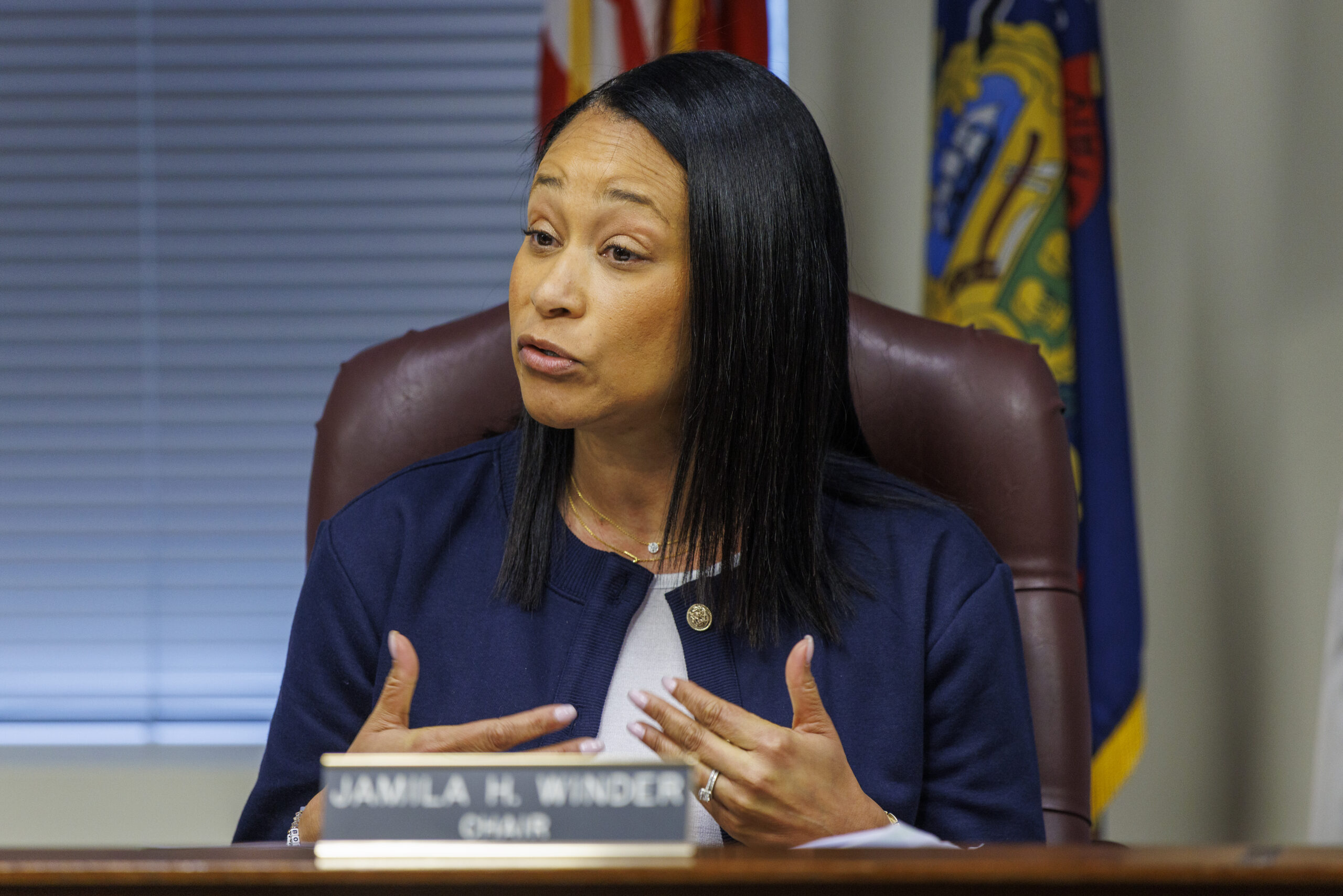
“We’ve seen it elsewhere — the violence, the fear, the separation of families. We want to make sure that here in Montgomery County, we’re doing everything we can to make sure all of our residents can continue to access essential services and live their lives safely,” said Commissioner Jamila Winder, the Democrat who chairs the board.
Jamila H. Winder, Chair, Montgomery County Commissioners on Thursday, March 5, 2026.
The resolution comes as immigration stakeholders in the county have been pushing the commissioners to take further action to protect residents from ICE enforcement as President Donald Trump’s deportation agenda continues to escalate.
Much of the tension occurred under the leadership of Kristi Noem, the Department of Homeland Security secretary whom Trump fired Thursday.
Calls for action escalated nationally in January after federal agents killed U.S. citizens Renee Nicole Good and Alex Pretti in Minnesota. In Montgomery County, ICE has carried out numerous operations, especially in communities with high numbers of Latino residents, such as Norristown, the county seat.
“Let me be clear: The county does not have authority over the federal government’s actions over civil immigration enforcement, and we still do not have the authority over the courts, other elected officials, municipalities, townships, or their law enforcement officers,” Winder said. “That remains unchanged, but what has changed is the environment we’re in.”
The policy to block ICE from using county resources passed 2-1 with Commissioner Tom DiBello, the board’s sole Republican, voting no.
The measure codifies that the county will not enter into a 287(g) agreement, which would allow ICE to use county resources, and that county employees will not comply in federal civil immigration operations without a judicial warrant or subpoena.
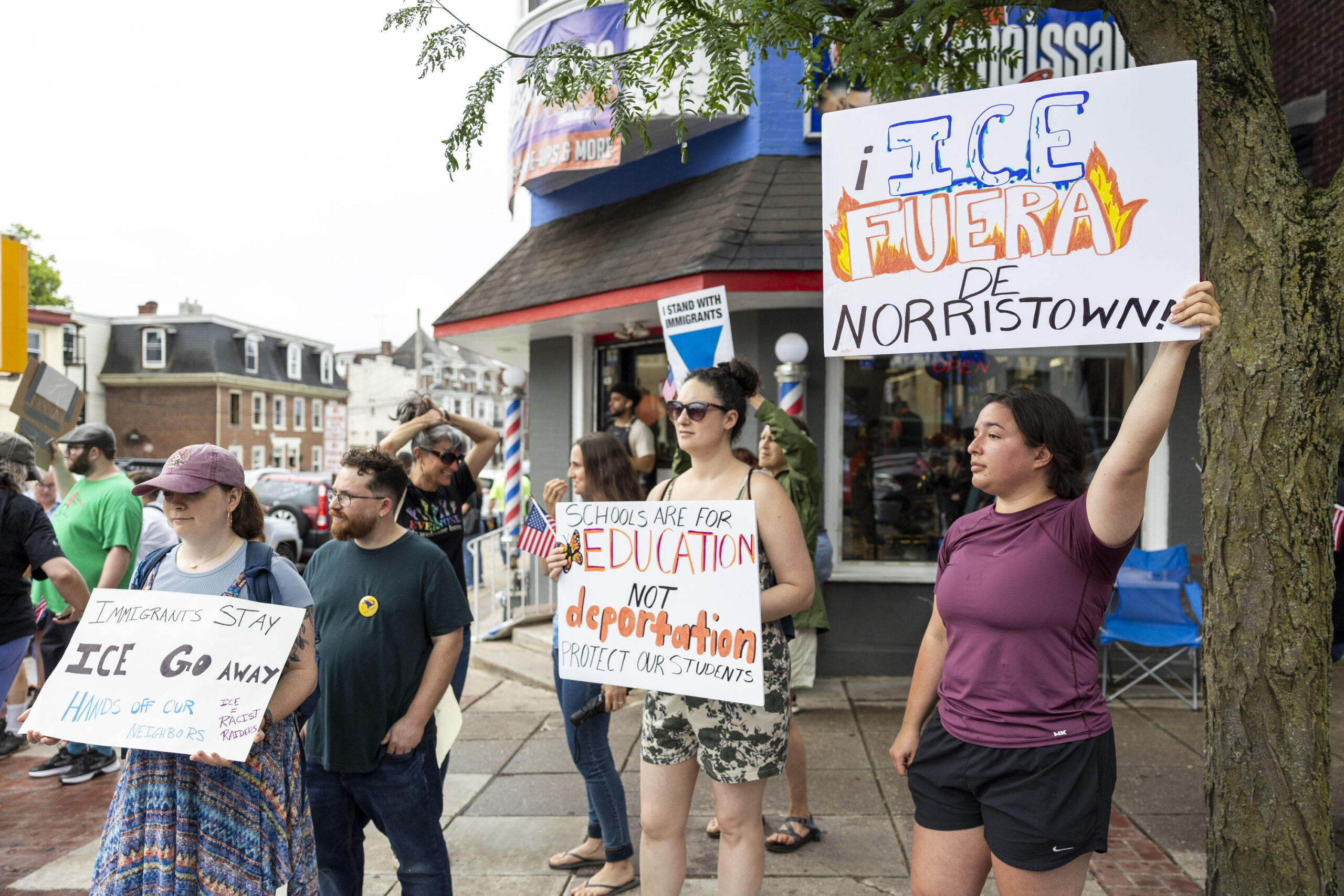
Lydia Villalba, 27, of Souderton, Pa., (right), holds a sign saying “Ice Fuera De Norristown” meaning Ice out of Norristown, during a rally to support immigrants in Norristown, Pa., on Saturday, June 7, 2025.
It does not prohibit ICE from purchasing warehouses for detention centers, as the agency has done in Berks and Schuylkill Counties.
Montgomery County’s resolution denying ICE access to its buildings and lands follows a national trend among Democratic-led jurisdictions. The move has both symbolic and practical impacts.
First, it enables the county government to publicly make clear its opposition and noncooperation. And second, ICE can need big spaces to set up officers, cars, and equipment for operations; banning the use of potential staging areas can complicate the agency’s logistics.
Montgomery County’s Department of Assets and Infrastructure will post signage on county-owned property noting that the area cannot be used for purposes not approved by the county, according to the resolution. Private property owners who wish to restrict civil immigration enforcement activity on their properties can request signs for free.
Megan Alt, a spokesperson for the county, said the hope is that ICE will comply with county law. But if not, the county is prepared to handle violations as it would for any other instances of trespassing.
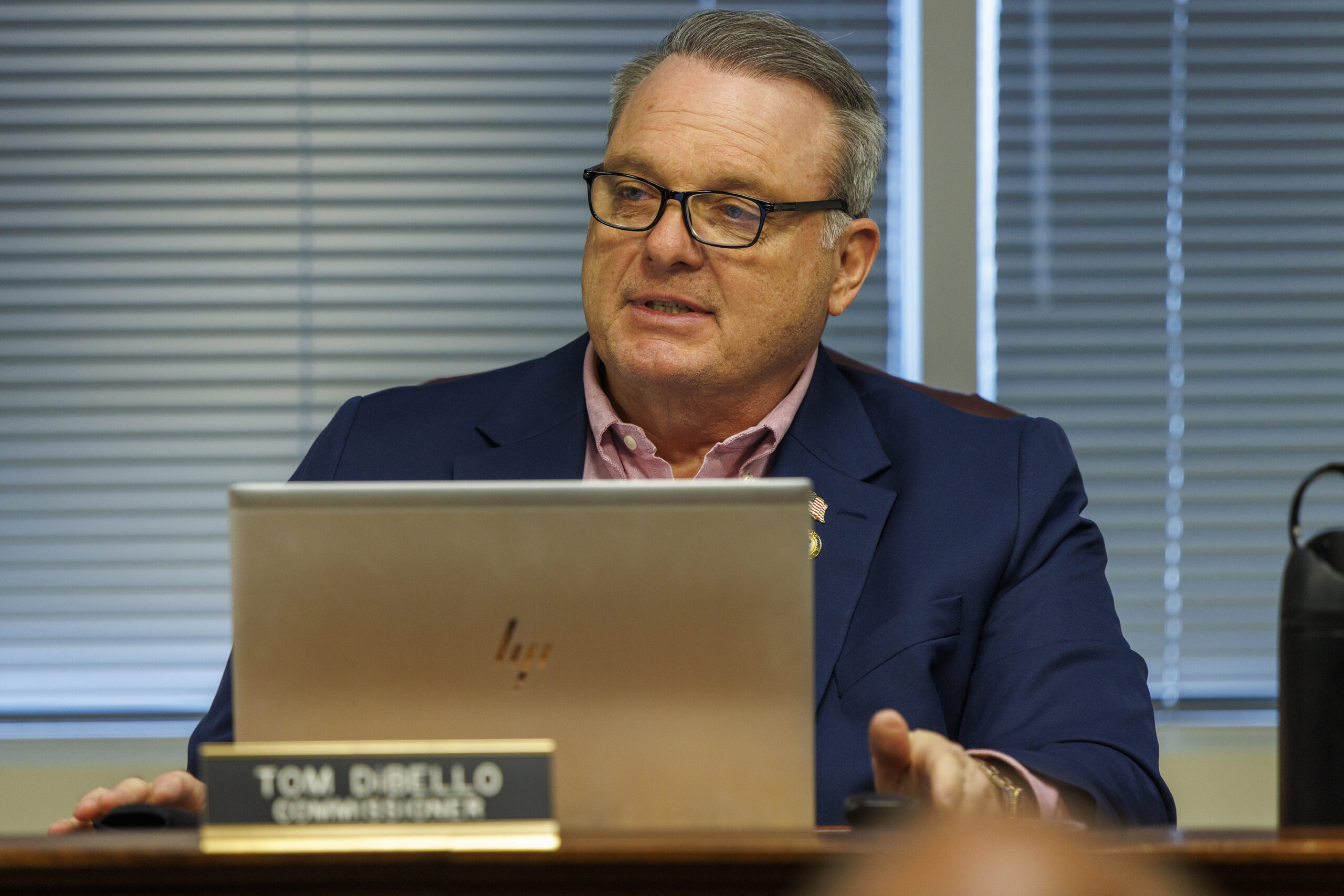
Thomas DiBello, Commissioner, Montgomery County Commissioners on Thursday, March 5, 2026.
DiBello, the lone GOP commissioner, said his opposition has “nothing to do with politics” and criticized the resolution’s references to ICE-related incidents that took place outside Montgomery County. He also said he was concerned that private property owners who do not post signs restricting ICE action on their properties will be targeted as a consequence.
“What’s going to happen then? Is there doxing going to occur? Is there protests outside of businesses?” he asked.
Commissioner Neil Makhija, the board’s vice chair, said the resolution “has nothing to with immigration policy,” but rather was about limiting cooperation with an agency that has used extreme tactics. He cited an ICE arrest last month in Lower Providence Township in which agents broke down a family’s front door.
DiBello responded that Makhija was engaging in “political positioning.”
In the Philadelphia region and elsewhere, ICE’s use of government property has long rankled immigration advocates, who say it amounts to cooperation on the part of local leaders.
For instance, Philadelphia City Council is poised to consider a package of “ICE Out” legislation that would bar the agency from staging or conducting enforcement on property owned or controlled by the city — including garages, parking lots, vacant land, buses, playgrounds, and schools.
Winder said Thursday that Montgomery County’s resolution is not some “newfound desire” to limit cooperation.
“Yes, we have our political affiliations, but we also know the difference between right and wrong, good and evil,” she said.
Gisele Barreto Fetterman‘s social media accounts have been taken down after she spoke out about ICE earlier this year. Her X and Instagram accounts were both inactive as of Thursday morning.
It was unclear on what date the two accounts were removed from the platforms, but she did use her X account to criticize the Trump administration a little more than a month ago.Her Facebook account has not been deactivated, though her last public post was in June.
Barreto Fetterman, who had lived undocumented in the U.S. for more than a decade after emigrating from Brazil, posted about the emotional toll caused by President Donald Trump’s immigration crackdown in Minneapolis and other cities.
“Every day carried the same uncertainty and fear lived in my body — a tight chest, shallow breaths, racing heart,” she said in a post on X in late January, the day after a Border Patrol agent fatally shot civilian Alex Pretti. In the same month, an ICE agent fatally shot civilian Renee Good and the agency detained5-year-old Liam Conejo Ramos.
“What I thought was my private, chronic dread has now become a shared national wound,”she added. “This now-daily violence is not ‘law and order.’ It is terror inflicted on people who contribute, love, and build their lives here. It’s devastatingly cruel and unAmerican.”
Barreto Fetterman’s post preceded a statement from her husband, Sen. John Fetterman (D., Pa.), calling for DHS Secretary Kristi Noem to be fired in the wake of Pretti’s killing. Trump fired Noem on Thursday.
The senator’s office did not comment Thursday about his wife’s social media hiatus.
Fetterman has faced pushback online for aligning with Trump and being at odds with his party on certain issues.
After Fetterman stood out among Democrats for shaking Trump’s hand at the State of the Union last week, U.S. Rep. Brendan Boyle (D., Pa.) derided him as “Trump’s favorite Democrat” in a post on X. The senator in turn criticized his fellow Democrats for not standing to applaud at various moments through Trump’s marathon speech that he believed should have had bipartisan support.
This week, Fetterman was the only Democrat in the Senate to vote against advancing a war powers resolution that would have barred Trump from ordering further strikes on Iran without congressional approval.
While Fetterman has touted his ability to work across the aisle, a recent Quinnipiac University poll found that 62% of Democratic voters in Pennsylvania disapprove of how Fetterman is handling his job (eight points higher than the percentage of Democrats who disapprove of Republican Sen. Dave McCormick).
Barreto Fetterman has temporarily deactivated her online accounts before.
She said in January 2024 that she had recently taken her social media down because she was “bored with it” and it “wasn’t adding anything to my life.” She had been subjected to negative comments on social media over her husband’s views, Newsweek reported.
She previously posted in November 2023 that she was “3 weeks into a social media break that may last another month or forever,” according to news reports.
She also said at the time that “treating someone as simply someone’s spouse is insulting and minimizing … did you know male spouses don’t get treated this way?”
At that point, the senator had been facing pushback for his comments about the war in Gaza and his staunch support of Israel following the country’s response to Hamas’ Oct. 7, 2023, attack.
Barreto Fetterman published a book last year called Radical Tenderness: The Value of Vulnerability in an Often Unkind World. She said in a July interview about the book on WHYY that she considers herself a “softie.”
Barreto Fetterman is also a firefighter and runs a “free store” in Braddock, the Allegheny County town where her husband previously served as mayor. She said in the WHYY interview “every single day is a heartbreak” under Trump’s immigration crackdown.
Pennsylvania voters broadly oppose some of President Donald Trump’s immigration enforcement tactics — but there’s a stark partisan split, according to a new statewide poll of registered voters.
Franklin & Marshall College’s Center for Opinion Research released a wide-ranging poll Thursday that tracked registered Pennsylvania voters’ opinions on America’s 250th anniversary, ICE enforcement tactics, and other issues facing the state and nation ahead of the midterm election.
Trump’s approval ratings have remained consistently low since returning to office last year, with a majority of Pennsylvanians disapproving of his job as president.
Democratic Gov. Josh Shapiro maintains a 50% approval rating heading into the midterm elections later this year.
Pollsters at Franklin & Marshall College surveyed 834 registered Pennsylvania voters, including 353 Democrats, 347 Republicans and 134 independents. The sample error is +/- 4.1 percentage points.
Here are three takeaways from the poll of registered Pennsylvania voters, conducted Feb. 18 through March 1 by phone or online.
Trump is consistently unpopular in Pennsylvania
Trump’s approval ratings among registered Pennsylvania voters remain low, with 61% of voters rating him as doing a “poor” or “fair” job, according to the statewide poll, which also assessed Trump’s performance on immigration, the economy, and other issues.
Trump maintained a net negative approval rating throughout his first term in 2017-2021 and so far in his second term, according to the poll.
Despite winning the state in 2024, he remains divisive with 51% of respondents rating him as doing a “poor” job, and only 10% who rate him as doing a “fair” job. Approximately 39% of registered Pennsylvania voters view Trump as doing an “excellent” or “good” job, according to the poll.
window.addEventListener(“message”,function(a){if(void 0!==a.data[“datawrapper-height”]){var e=document.querySelectorAll(“iframe”);for(var t in a.data[“datawrapper-height”])for(var r,i=0;r=e[i];i++)if(r.contentWindow===a.source){var d=a.data[“datawrapper-height”][t]+”px”;r.style.height=d}}});
Trump’s low approval numbers could have a drag effect on Republicans’ performance in the midterm election, said Berwood Yost, the director of Franklin & Marshall’s poll.
“While there’s still a long way to go until November, [Trump has] got to figure out a way and his party has to find a way to prevent that and earn those voters back,” Yost said.
Trump’s low numbers align with those of former President Barack Obama or George W. Bush’s approvals at the same point in their second term, Yost added. Both of their parties lost seats in the midterms elections those years.
However, Trump’s approval ratings are not the lowest they have been in the state. His approval ratings dropped to their lowest, 70% disapproval, during his first term in September 2017.
Josh Shapiro is still popular
Gov. Josh Shapiro remains popular ahead of his reelection contest this year: 50% of Pennsylvania voterssayhe is doing an “excellent” or “good job,” while another 44% believe he is doing a “fair” or “poor” job leading the nation’s fifth most populous state.
Shapiro is the most popular governor since 2000, when comparing his approval ratings to those of other Pennsylvania governors at the same point during their first terms, Yost said.
Shapiro also maintains a significant lead over his likely GOP challenger, State Treasurer Stacy Garrity. If the midterm elections were to happen today, 48% of voters said they would reelect Shapiro, while 28% said they would vote for Garrity. Another 7% of voters said they would vote for a different candidate, while 17% were undecided or refused to answer the question.
Shapiro’s approval ratings have remained steadily high since taking office in January 2023. A Quinnipiac Universitypoll released last month found similar public opinion toward Shapiro’s reelection, while some voters said they were unsure whether they wanted the rumored 2028 presidential candidate to run for higher office.
Pa. voters broadly oppose some of ICE’s enforcement actions, but are split on others
Approximately three-fourths of Pennsylvania voters believe ICE should not be able to use deadly force against protesters or enter a home without a warrant, in a major pushback to Trump’s immigration enforcement tactics.
Pennsylvania voters’ opinions on immigration enforcement varies significantly based on a person’s political party: While nine in 10 Republicans support ICE tactics, only two in five independents and one in 10 Democrats support them.
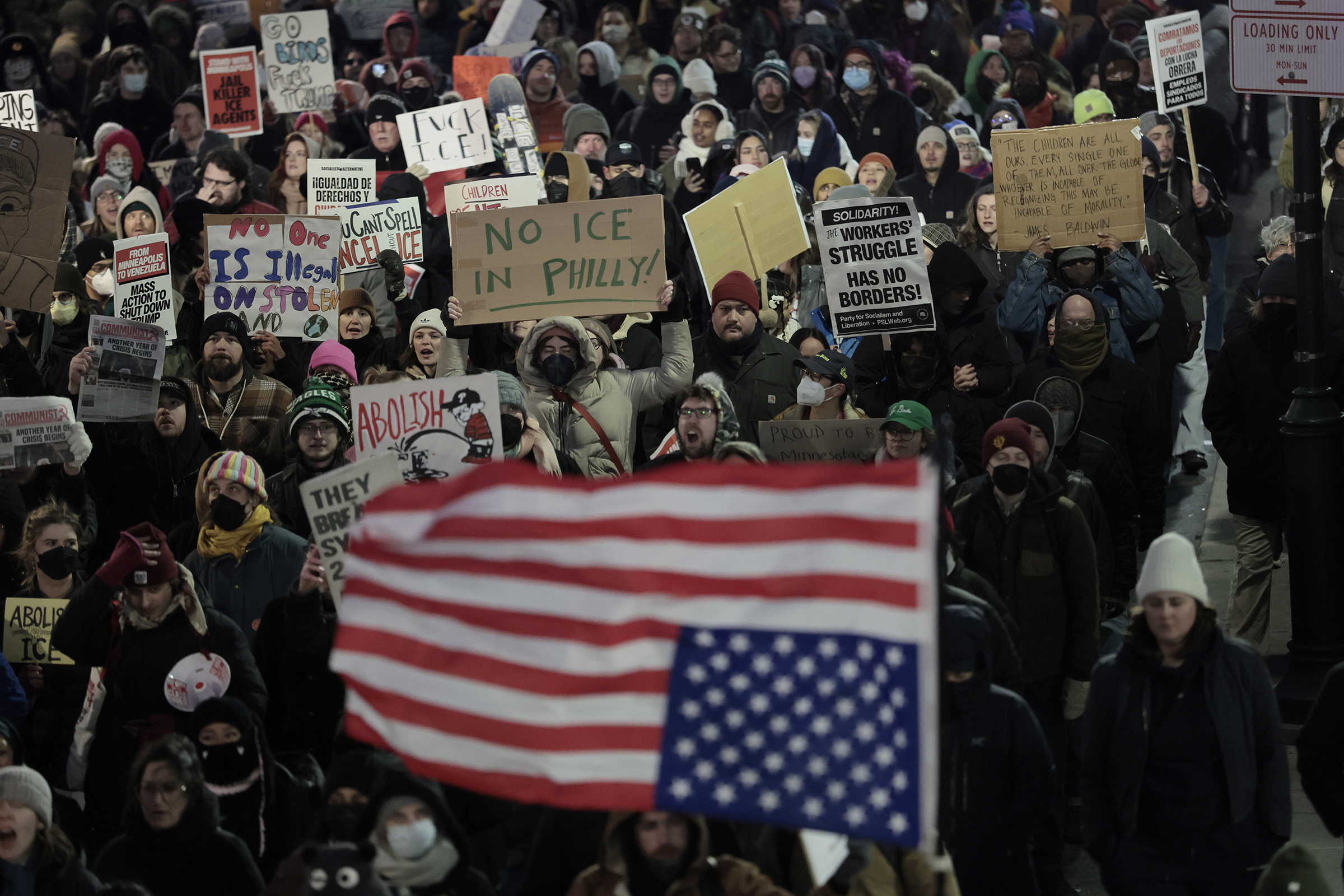
Protesters march up Eighth Street, towards the immigration offices, during the Philly stands with Minneapolis Ice Out For Good protest at Philadelphia’s City Hall on Friday, Jan. 23, 2026.
Republicans support ICE’s use of unmarked vehicles to detain people and their use of masks to hide an agent’s identity at much higher rates than Democrats, while independents are split. On the use of masks, 77% of Republican voters believe agents should be able to wear them, while 40% of independents and only 10% of Democrats do.
“There’s a lot of consensus about the fundamental principles that protect our individual rights like entering a home without a warrant or using force against protesters, whereas there’s a little more partisanship in others,” Yost said.
window.addEventListener(“message”,function(a){if(void 0!==a.data[“datawrapper-height”]){var e=document.querySelectorAll(“iframe”);for(var t in a.data[“datawrapper-height”])for(var r,i=0;r=e[i];i++)if(r.contentWindow===a.source){var d=a.data[“datawrapper-height”][t]+”px”;r.style.height=d}}});
There is also overwhelming support among Pennsylvania voters that non-citizens who are in the U.S. legally — whether by visa,green card, asylum or other protected statuses, or in the process of becoming a citizen — should not be targeted by Immigration and Customs Enforcement for deportation, according to the poll.
However, a majority of Republicans and independent voters believe undocumented immigrants who have been in the United States illegally for any amount of time and have no criminal record should be targeted for deportation, while less than a quarter of Democrats believe they should.
Pennsylvania voters want the 250th anniversary to acknowledge the positives and negatives from American history
As Trump tries to reframe American history for the nation’s 250th anniversary, most Pennsylvanians want the celebrations to acknowledge its positive and negative parts.
Approximately 73% of Pennsylvania voters believe any retelling of American history should include the upsides and downsides of the nation’s founding, while 24% believe only positive aspects should be celebrated.
“Most people, they want to see historical interpretations that include the whole picture,” Yost said.
This finding is of particular interest in Pennsylvania, following the Trump administration’s removal of an exhibit that memorialized the enslaved people who lived in George Washington’s home from the historic President’s House site in Independence National Historical Park. A federal judge ordered the restoration of the exhibit, but the Trump administration is appealing the decision.
A Florida developer who is building data centers in Pennsylvania. A Chicago crypto trader whose company was sued by the Biden administration. And a Southwestern Pennsylvania coal magnate whose firm received a permit from state regulators last year to expand operations — and is now seeking approval to open a new mine.
Shapiro’s gubernatorial campaign raised at least $8.5 million last year from nearly 240 CEOs, founders, business owners, and other top executives, according to an Inquirer analysis of campaign-finance records that were made public last month.
That includes the single biggest donation to the campaign: $2.5 million from billionaire and former New York City Mayor Michael Bloomberg. Shapiro’s haul from top executives represents 50.8% of the $16.8 million he raised from donors who listed their occupation in campaign finance filings.
window.addEventListener(“message”,function(a){if(void 0!==a.data[“datawrapper-height”]){var e=document.querySelectorAll(“iframe”);for(var t in a.data[“datawrapper-height”])for(var r,i=0;r=e[i];i++)if(r.contentWindow===a.source){var d=a.data[“datawrapper-height”][t]+”px”;r.style.height=d}}});
During his first three years in office, Shapiro, 52, has sought to build a profile as a pragmatic, business-friendly governor, focusing on speeding the permitting process and promoting economic development through government grants and tax breaks.
At the same time, the governor has proven adept at raising campaign cash from people who have business interests before state government in Harrisburg. Those include a skill game developer who staved off a major policy defeat this year and a waste coal power plant owner who gave $100,000 to Shapiro two days before the governor pulled out of a multistate program that requires such facilities to pay for their greenhouse gas emissions.
It’s a contrast with the rising populism on both the left and right, marked by a “Fighting Oligarchy” tour by progressive leaders and the MAGA movement’s deep suspicion of elites.
It’s not unusual for corporate executives to make contributions to candidates from both parties. But the practice could invite scrutiny for Shapiro in a White House run — particularly among voters and activists who are dismayed by the role of money in politics.
“We are concerned about any elected leaders taking monetary donations from corporate interests, regardless of who they are,” said Ashley Funk, executive director of the Mountain Watershed Association, a nonprofit that opposes a Shapiro donor’s coal mining expansion.
“I think that it influences decision-making,” she said.
‘The speed of business’
For now, Shapiro’s pledge to make Pennsylvania’s government run “at the speed of business” appears to have won over many executives, helping him build a massive fundraising advantage in his reelection bid. Shapiro raised $23.2 million overall in 2025, compared with the $1.5 million reported by his likely Republican opponent, State Treasurer Stacy Garrity.
“I’ve long admired the way the commonwealth approaches economic development and innovation, and I have deep respect for Gov. Shapiro’s leadership,” said Bob Clark, executive chairman and founder of Clayco, a Chicago-based real estate and construction firm that is redeveloping a site at the industrial hub known as the Bellwether District in South Philadelphia.
Clark gave Shapiro’s campaign $100,000 last year. “I consider him both a trusted colleague and an effective leader,” he said.
In recent weeks, the governor has celebrated pledges by pharmaceutical companies to invest billions of dollars in new facilities in Montgomery County and the Lehigh Valley, secured with tens of millions of dollars in state incentives. And last year, Amazon said it would spend $20 billion in Pennsylvania to build two new artificial intelligence data centers, in what officials called the single largest private investment in state history.
Shapiro’s allies say he stands up to big business, too, highlighting how he successfully prodded PJM Interconnection LLC — the Valley Forge-based regional electric grid operator whose voting members largely consist of companies in the electricity industry — to impose and extend a price cap. He has also received support from organized labor.
Shapiro argues that the way to restore faith in institutions is not by railing against billionaires but by showing that the government can fix real problems — “get s— done,” in his parlance.
Garrity, the Republican state treasurer, says Shapiro’s actions don’t live up to the hype.
“Liberal national donors may be investing in Josh Shapiro’s political vanity project, but hardworking Pennsylvanians are seeing nothing in return,” she said in a statement.
Garrity received nearly $380,000 from more than 60 CEOs and other top business executives. That figure represents about 41% of her contributions from donors who listed their occupation in campaign-finance filings.
Shapiro’s campaign said his coalition is “reflective of a governor who is delivering for all Pennsylvanians — and of a campaign that is fighting to win up and down the ballot.”
window.addEventListener(“message”,function(a){if(void 0!==a.data[“datawrapper-height”]){var e=document.querySelectorAll(“iframe”);for(var t in a.data[“datawrapper-height”])for(var r,i=0;r=e[i];i++)if(r.contentWindow===a.source){var d=a.data[“datawrapper-height”][t]+”px”;r.style.height=d}}});
The governor has “focused on growing our economy and creating jobs, and he has delivered — creating tens of thousands of jobs, winning major deals, and building the only growing economy in the Northeast,” campaign spokesperson Manuel Bonder said in a statement.
Shapiro highlighted one such deal in July, when he appeared alongside executives at defense contractor Rhoads Industries at the Navy Yard in South Philly to announce the firm’s $100 million plan to build a new manufacturing facility, create 450 jobs, and boost production of submarine parts.
“One of the things that Rhoads is known to do is get things done. … We want to turn out product; we want to turn it around; we want to get it done,” president Mike Rhoads said.
Looking toward Shapiro, he said, “Somebody standing to my left has the kind of same attitude.”
Gov. Josh Shapiro (right) with Rhoads Industries CEO Dan Rhoads in July 2025 at the Navy Yard.
Taking his turn at a lectern that read “Rebuilding America’s Fleet,” Shapiro said Rhoads’ investment — with help from the state — would “ensure the future of submarine manufacturing, shipbuilding, and all things important to securing our freedom is going to run right through the Philadelphia Shipyard.”
Three months later, in October, CEO Dan Rhoads contributed $10,000 to Shapiro’s campaign — the single largest donation he made to a candidate for state office in the last decade, records show. Rhoads did not respond to requests for comment.
Data centers and ‘skill games’
Shapiro donors’ business interests include everything from data center construction to state regulation of slot machine-style games and approvals for a nuclear reactor.
Dan Hilferty, CEO of Philadelphia-based Comcast Spectacor — which owns the Flyers and the Xfinity Mobile Arena in South Philly — gave $40,000. A political action committee affiliated with parent company Comcast also gave $50,000. Comcast Spectacor and the 76ers are building a new arena at the South Philadelphia sports complex, and Shapiro last year did not rule out offering state incentives. Hilferty, a former CEO of Independence Blue Cross, previously gave Shapiro’s campaigns $27,500 over the last decade. Other Comcast Spectacor executives contributed about $95,000 during that period.
Top executives at Pace-O-Matic, the Georgia-based developer of so-called skill games that have proliferated across convenience stores and bars, gave $50,000. Operators for Skill, a PAC affiliated with the firm, contributed $10,000. The company successfully fended off a push in 2025 by Shapiro and lawmakers to tax the games at a level the industry considered too high. The governor has renewed a push to regulate the games, which some Philadelphia lawmakers say they would prefer to see banned. Pace-O-Matic contributes to both parties and remains “committed to fighting for fair regulation and taxation of Pennsylvania skill games,” said Mike Barley, chief public affairs officer for Pace-O-Matic.
Joseph Dominguez, president of Baltimore-based Constellation Energy, gave $25,000. The company is seeking to restart a nuclear reactor at Three Mile Island, just outside Harrisburg, and needs state and federal approvals. The plant would supply power to Microsoft to support the tech company’s data centers. “Constellation executives contribute to policymakers on both sides of the aisle who, like Gov. Shapiro, prioritize results and pragmatic solutions over politics,” a company spokesperson said.
Brian Patten, CEO of Next Generation Land Co. LLC, gave $10,000. He is a Florida data center developer who says he is pursuing projects in Pennsylvania. Data centers that power companies’ cloud storage and computing needs have drawn backlash across the U.S. over fears of rising electricity rates. In his February budget address, Shapiro said he wants data centers to supply their own energy and pay for any new generation they need. He has also said the U.S. needs to win the AI race against China.
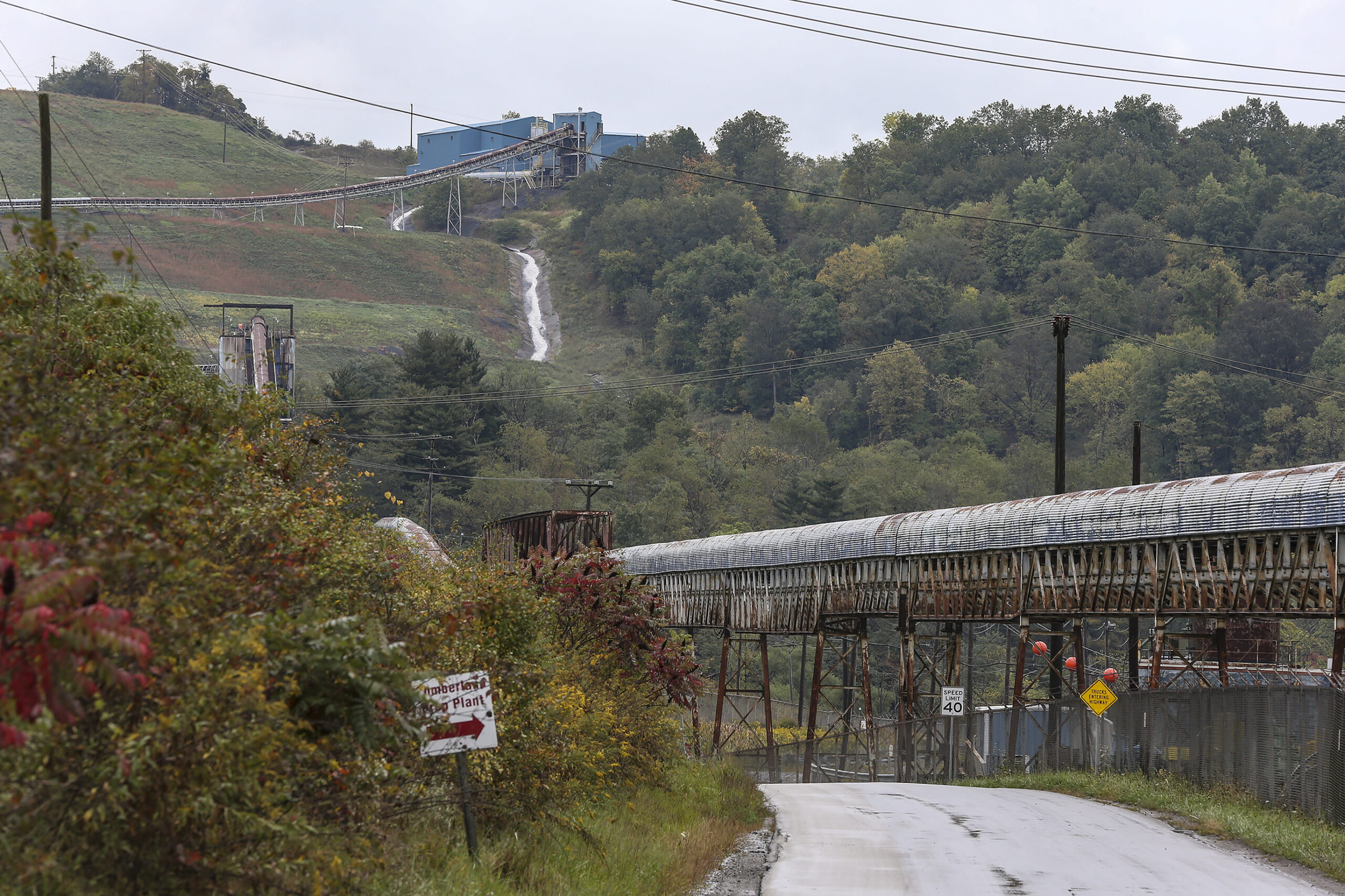
Justin Thompson, CEO of Iron Senergy, a coal operator, gave $10,000. His firm owns the Cumberland Mine in Greene County. When Pennsylvania applied to the U.S. Environmental Protection Agency for a $400 million grant, it mentioned several firms — including Iron Senergy — that could use the money for decarbonization projects, the Pittsburgh Post-Gazette reported in 2024. The EPA awarded the grant, and the Pennsylvania Department of Environmental Protection is tasked with administering it. The state is now reviewing applications, which it says are confidential.
The Cumberland Coal Mine in Greene County seen in 2020.
Local and national donors
Shapiro drew on a mix of executives from local and national firms. In Pennsylvania, he raised money from health system CEOs (Joseph Cacchione of Thomas Jefferson University, $10,000), bankers (Richard J. Green of Philly-based Firstrust Bank, $125,000), and a home remodeler (Asher Raphael of Power Home Remodeling in Chester, $100,000). Josh Kopelman — founder of First Round Capital and chairman emeritus of The Inquirer’s board of directors — and his wife, Rena, each gave $50,000.
There were private equity investors (San Francisco billionaire John Pritzker, cousin of Illinois Gov. JB Pritzker, $50,000), Hollywood producers (Jimmy Miller of talent management and production firm Mosaic, $75,000), professional sports team owners (telecom billionaire Robert Hale, minority owner of the Boston Celtics, $50,000), and a Massachusetts sports betting executive (Jason Robins of DraftKings, $10,000).
For his part, Bloomberg is “a big fan of Gov. Shapiro and a big believer in his leadership, and thinks he’s done a great job for Pennsylvania,” adviser Howard Wolfson told Axios.
At least one donor had ties to President Donald Trump, whom Shapiro often criticizes.
Don Wilson Jr., CEO of Chicago-based trading firm DRW Holdings LLC, gave $10,000 to Shapiro in September.
The Securities and Exchange Commission filed civil charges against a unit of Wilson’s firm while President Joe Biden, a Democrat, was in office. The SEC accused it of operating as an unregistered cryptocurrency dealer.
Biden-era regulators said that firms were dodging that rule by claiming crypto was a commodity, not a security. The enforcers argued this exposed investors to extra risks associated with digital currencies.
Then last March, a couple of months after Trump took office, the new administration dropped the charges against Wilson’s firm. Nine weeks later, Wilson invested $100 million into a Trump bitcoin project, the Financial Times reported.
The company told the newspaper it engages in a “variety of strategies in the crypto ecosystem” and saw value in holding bitcoin. “This transaction was viewed purely through that lens,” it said.
Trump denies having conflicts of interest.
That didn’t stop the Democratic National Committee from flagging the news on its “CORRUPTION WATCH” page.
The Trump administration, the Democrats’ post said, “now appears to be engaged in blatant pay-to-play politics.”
Power plants and coal mines
Among corporate executives, two of the eight biggest donors to Shapiro’s campaign last year were the father-and-son owners of privately held Robindale Energy Services, which owns about 20 companies involved in waste coal reclamation, power generation, mining, and logistics. Robindale’s assets include multiple power plants fueled by waste products from abandoned coal mines.
CEO Scott Kroh and his son Judson, the Latrobe-based company’s president, gave a total of $271,000.
That included a $100,000 contribution from Scott Kroh two days before Shapiro signed the annual budget, which came after a monthslong stalemate. The deal with Senate Republicans included language pulling the state out of the Regional Greenhouse Gas Initiative, a multistate effort to generate cleaner power that Robindale had vocally opposed.
Robindale’s executives did not respond to requests for comment.
In June 2023, Judson Kroh spoke out against RGGI at a public hearing, telling Pennsylvania lawmakers that Robindale’s power plants have enough capacity to power 500,000 homes. “Our main concern is you’ll see a significant decrease in power exports out of the state due to RGGI, as well as a significant decrease in coal production,” Kroh said.
Other energy industry firms, Republican lawmakers, and building trades unions have also long opposed the initiative, which requires power plants to buy allowances to cover their carbon emissions. They call it a job killer and an electricity tax. Environmental groups say it has reduced pollution and led to investments in clean energy in other states.
Shapiro had for years expressed concerns about the greenhouse gas initiative, which Pennsylvania joined under his predecessor but never implemented due to litigation. Shapiro said in 2021 during his first run for governor that “it’s not clear to me” that the program protected jobs, addressed climate change, or ensured energy reliability.
The Kroh family donated a total of $55,000 to his 2022 campaign and $21,000 the following year. Judson Kroh was among the more than 300 people who served on Shapiro’s transition team.
Many of Robindale’s operations are regulated by the state, and the company spent $150,000 lobbying state government officials last year, records show. Company executives in recent years have largely donated to Republicans in Harrisburg, though they have also supported some Democrats, including Shapiro.
window.addEventListener(“message”,function(a){if(void 0!==a.data[“datawrapper-height”]){var e=document.querySelectorAll(“iframe”);for(var t in a.data[“datawrapper-height”])for(var r,i=0;r=e[i];i++)if(r.contentWindow===a.source){var d=a.data[“datawrapper-height”][t]+”px”;r.style.height=d}}});
In addition to its power generation business, Robindale owns coal mines that are subject to state inspections and oversight. When two people died in a Somerset County mine operated by subsidiary LCT Energy, DEP required the company to update its safety protocols. The deaths in 2022 and 2023 came during a time in which there were 20 coal mining fatalities nationwide, according to federal data.
Johnstown-based LCT is currently expanding.
About 30 miles west of Maple Springs, LCT opened another mine in 2018 in Westmoreland County called Rustic Ridge 1, which produces 600,000 tons of coal a year.
The state renewed the permit for the 2,800-acre underground mine in January last year, and from that month through March, the Kroh family donated $70,000 to Shapiro’s campaign.
In April, after a yearslong review, the Pennsylvania Department of Environmental Protection approved a permit authorizing LCT to expand its operations there, adding 1,400 acres under the Pennsylvania Turnpike — the equivalent of 93 Lincoln Financial Fields. The permit allows LCT to mine coal up to 600 feet underground. The company sells the coal for production of steel.
The nonprofit Mountain Watershed Association is appealing the DEP’s approval to the Pennsylvania Environmental Hearing Board — whose judges are appointed by the governor, subject to confirmation by the state Senate — arguing that the expansion could harm groundwater and streams.
Others say the mine supports jobs and helps the local economy. Before opening, the company said in 2014 that it would invest $50 million to develop the mine, according to local news reports.
The state budget Shapiro signed in November expanded a program for expedited permitting involving approvals from the DEP, which reviews 40,000 permits a year. Introduced in 2024, the program is currently available for eligible permits such as air quality, dam safety, and oil and gas erosion and sediment control.
The budget legislation — cheered by Shapiro and GOP lawmakers — added more permit types, including one for mining, “which DEP is in the process of adding to the program,” a department spokesperson said.
Funk — the executive director of the watershed association, which has spent millions of dollars over the last 30 years repairing the environmental damage of legacy coal mining — said she is concerned the Krohs’ political giving “might be having an influence over Shapiro and his administration as we work to permit some of Robindale’s projects such as LCT Energy.”
Shapiro says permitting reform reflects his governing ethos.
“When you think about getting stuff done … it requires focus and speed,” he said in December at a National Governors Association event. “We’ve gotta be speedier as a country.”
It was at the end of last year in the hazy stretch between Christmas and New Year’s when time doesn’t feel real, and some of Philly’s top Democrats were huddled around a secret proposal, racing to meet a deadline.
The group — convened by Mayor Cherelle L. Parker, her aides, and some key Philadelphia boosters — was preparing a lengthy bid to bring the Democratic National Convention back to the city in either 2028 or 2032, a potential economic boon and a chance to show off in front of lawmakers, celebrities, and international media.
The confidential proposal to the Democratic National Committee included everything from the city’s hotel space to police outfitting to nitty-gritty details about the electrical grid and voltage capacity at Xfinity Mobile Arena. SEPTA officials drafted a section about the public transportation Philadelphia could offer visitors, and tourism agencies chipped in with insights on hotels and restaurants.
David L. Cohen, a longtime Democratic fundraiser and the president of the recently formed nonprofit host committee called Pick Pennsylvania, said that while the mayor led the effort, the bid also emphasized the “unity of the region and the commonwealth.”
“She wanted it to be really clear this is more than a Philadelphia bid,” he said. “This is a unified Pennsylvania bid.”
It appears the Democratic National Committee was impressed. On Monday, the DNC announced that it is considering five cities, including Philadelphia, to host the 2028 convention, where a Democratic presidential nominee will be coronated. The party is also looking closely at Atlanta, Denver, Chicago, and Boston to hold the early August event.
What comes next is a campaign to lure the convention to Philly, complete with a carefully coordinated public relations effort and a significant fundraising push. Philadelphia’s host committee for 2016, the last time the city held a presidential nominating convention, raised more than $85 million.
The DNC has asked host cities to raise $5 million before being selected. Philly’s fundraising, Cohen said, “will be substantially higher than that number.”
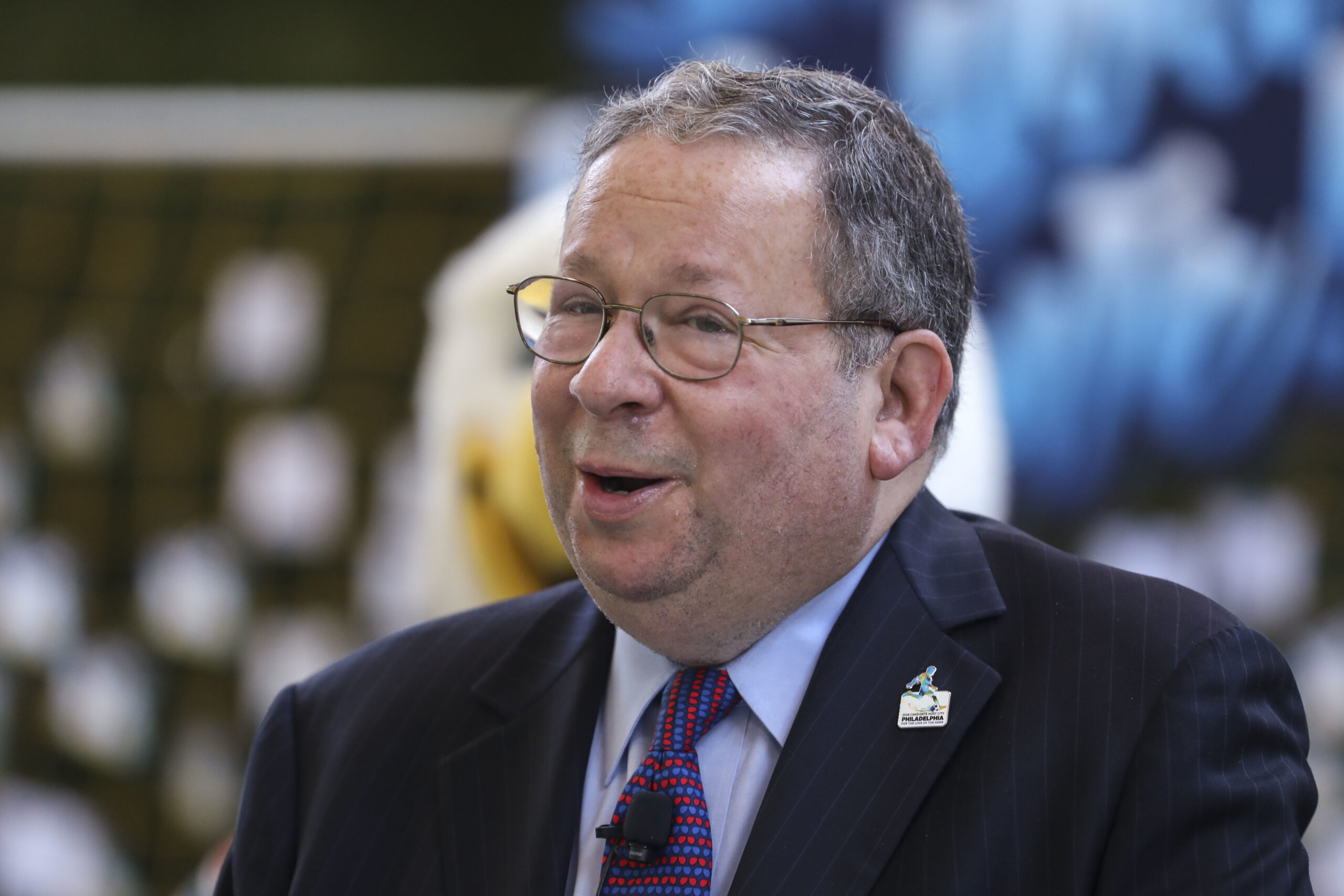
In this 2021 file photo, David L. Cohen speaks as Philadelphia Soccer 2026, the city’s World Cup 2026 bid committee, launched an interactive exhibit at the Independence Visitors Center in Philadelphia. He is now heading an effort to bring the Democratic National Convention to Philadelphia.
Cohen, a former Comcast executive and erstwhile chief of staff to former mayor Ed Rendell, is leading the effort alongside Daniel J. Hilferty, now the CEO of Comcast Spectacor.
Hilferty and Cohen have worked together repeatedly over the last two decades to bring major events to Philadelphia, including a successful bid to become one of a handful of North American cities to host World Cup games this year.
Also involved in coordinating the DNC proposal was Erin Wilson, a Philadelphia native who was a top aide to former Vice President Kamala Harris. She was the national political director for former President Joe Biden’s campaign and planned his 2021 inauguration.
When the DNC comes to town
DNC officials are expected to make a final decision on the 2028 site later this year. That call will likely be made by chair Ken Martin in consultation with top advisers and the committee’s Technical Advisory Group, which assesses logistics and operational matters.
Philadelphia could also have an advocate in State Rep. Malcolm Kenyatta, who represents parts of North Philadelphia and is a DNC vice chair. He is known to have a close relationship with Martin.
Committee officials and the advisory group will tour each of the five finalist cities for a yet-to-be-scheduled site visit this spring.
If history is any indication, the city will roll out the red carpet. In 2014, when 18 members of the DNC came to Philly to check out the city ahead of the 2016 convention, the host committee spent six figures to charm them.
The trip included a tour of Philly’s most popular sites, like Reading Terminal Market and the Philadelphia Museum of Art, as well as a swanky rooftop party and a breakfast at the Comcast Center. Predictably, cheesesteaks were also involved.
“The site visits are as much about feel as they are about technical details,” Cohen said. “After site visits, the teams who are making choices leave here and they have their socks knocked off. They can’t believe how vibrant the city is.”
In this 2014 file photo, Congressman Bob Brady, left, talks with DNC CEO Amy Dacey, center, as they have lunch at Pat’s Steaks in South Philadelphia.
Ryan Boyer, the head of the Philadelphia Building and Construction Trades Council and a close Parker ally, said one of Philadelphia’s best assets might be its mayor. Parker is an unabashed cheerleader for the city and is leading preparations for several major events this year, including World Cup games, the MLB All-Star Game, and the commemoration of America’s 250th anniversary.
“She’s the most effective advocate for bringing people together,” Boyer said, “with just her level of passion, her love of the city, and her love of the job.”
Cohen said he spoke to Parker last year about the potential to bid for the convention, and when she asked him to lead the host committee, he said yes because the city has “a serious chance.”
“As a friend and longtime supporter of hers, if I didn’t think we had a legitimate shot, I would try to talk her out of it,” Cohen said. “If anything, I have poured gasoline on her flames of enthusiasm and said, ‘We should be all in for this.’
”I said, ‘Do what you do best,’” he added. “Get everyone excited about this.’”
That means there is a chance that Shapiro, who was raised in Montgomery County and whose family still lives there, could be nominated in what is essentially his hometown.
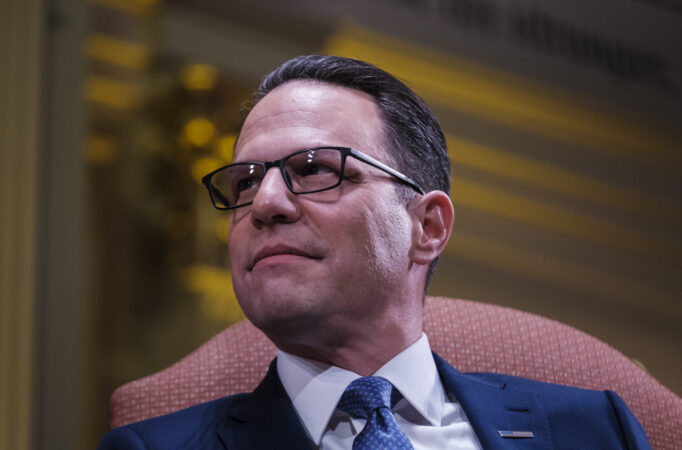
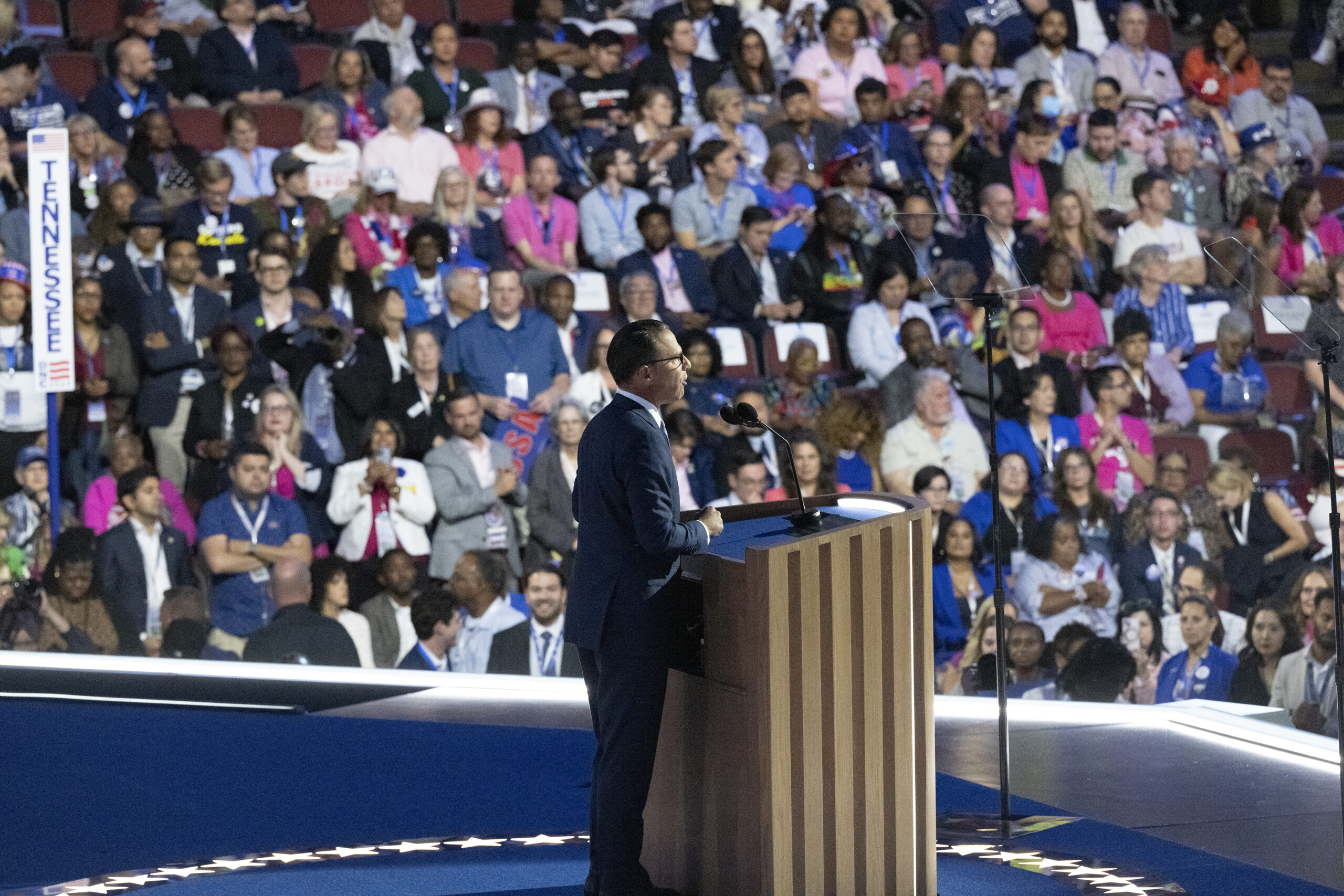
Pennsylvania Gov. Josh Shapiro speaks during the Democratic National Convention Aug. 21, 2024, in Chicago.
In a letter to Martin, Shapiro wrote that Philadelphia “would see substantial economic benefits” from hosting the convention and vowed that the state would be “prepared to ensure our infrastructure, public safety agencies, workforce, and business community are equipped to host thousands of delegates and attendees.”
What’s next: a close look at security and logistics
Behind the pomp of the DNC’s spring site visit will be a serious evaluation of security, transportation, hotels, and arena logistics.
The DNC said in a statement Monday that it will value “new and innovative approaches” to hosting a large-scale event that is likely to bring thousands of tourists. In 2016, the convention drew more than 5,000 attendees and an additional 29,000 visitors — nearly 20,000 of whom were media members.
Nominating conventions are typically designated as National Special Security Events, meaning the federal government leads security because the event is deemed at high risk for terrorism or other criminal activity. That means planners need to know specifics about law enforcement staffing, gear, and other capabilities.
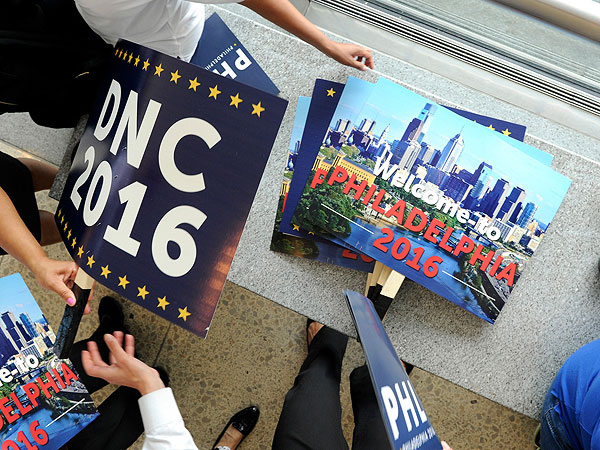
Placards promoting Philadelphia as the host city of the Democratic National Convention in 2016, while the Democratic National Committee was touring the city in August.
Support will also have to come from outside the city. During past conventions, federal law enforcement teamed up with Philadelphia police to secure the venue, and they were joined by officers from across the region.
The DNC also said in its announcement Monday that the committee would prioritize “the importance of forging a strong partnership between the DNC and the host city, including its community, political, and business leaders.”
To that end, the host committee and Parker asked elected officials and civic leaders from across the state to write letters of support that accompanied the city’s bid.
Authors ranged from City Council President Kenyatta Johnson, whose district includes the South Philadelphia stadium complex, to labor leaders to Democrats from the Philadelphia collar counties.
Montgomery County Commissioner Neil Makhija, who wrote a letter to the DNC boosting the bid, said it is important for the committee to see that local governments and law enforcement agencies outside the city are willing to offer support, because “pulling something like this off requires a lot of cooperation on many different fronts.”
“A real concern now when you’re thinking about hosting a political convention is ‘How are we going to manage public safety and a threat environment?’” he said. “There are a number of reasons to point to our region and see a level of collaboration that inspires confidence.”
Military officers will see their tuition assistance cut off at 22 schools and institutions, but the University of Pennsylvania is not among them.
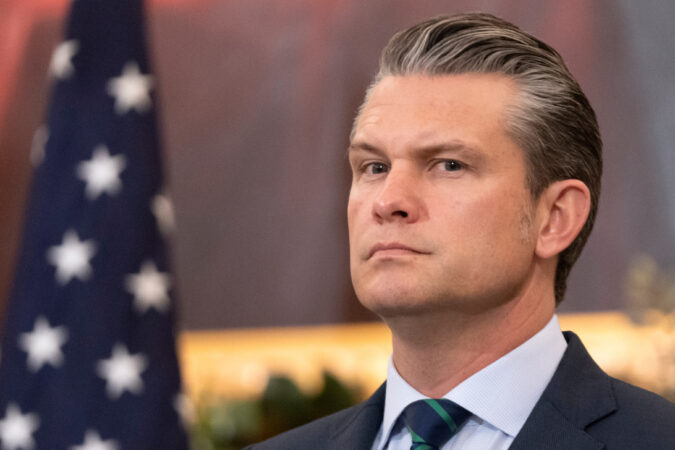
The Ivy League institution, which counts President Donald Trump among its alumni, was on an initial list of 34 schools “at risk” of losing Pentagon-funded tuition assistance. But Penn was not part of the 22-university list released by Defense Secretary Pete Hegseth on Friday.
Penn did not immediately respond to a request for comment Tuesday.
Hegseth previously said he intendedto cut off schools where faculty members have “leftist political leanings” and “openly loathe our military,” but he cited no specific examples of bias or misconduct at the 22 schools that will lose tuition assistance beginning with the 2026-27 academic year.
“We will no longer invest in institutions that fail to sharpen our leaders’ warfighting capabilities or that undermine the very values they are sworn to defend,” Hegseth wrote in a letter released Friday with the final list.
It was not immediately clear why Penn and other schools were removed from the initial draft list.
Among the schools still set to lose access to the tuition-assistance program is Princeton University, where Hegseth obtained a bachelor’s degree in 2003. Carnegie Mellon University in Pittsburgh is also on the list, as is Yale University, where Vice President JD Vance obtained a law degree.
The move means members of the military will be banned from using Department of Defense tuition assistance to pay for Senior Service College Fellowship programs at those schools.
The impact will not be large — the Department of Defense said fewer than 100 military students are enrolled in programs at schools that will lose funding. Military personnel currently enrolled may complete their courses of study, Hegseth said, though it is unclear if they will have to change schools to continue receiving financial assistance.
Hegseth’s announcement did not mention several other financial assistance programs for undergraduates, including the GI Bill, which is administered by the Department of Veterans Affairs.
Here is the full list of schools losing tuition assistance from the Pentagon:
Educational institutions
Harvard University
St. Louis University
Massachusetts Institute of Technology
Tufts University
Georgetown University
Carnegie Mellon University
Brown University
Columbia University
Yale University
Middlebury College
Princeton University
George Washington University
College of William and Mary
International institution
Queen’s University (Canada)
Nonprofit institutions
Center for Strategic and International Studies
New America Foundation
Brookings Institution
Atlantic Council
Center for a New American Security
Council on Foreign Relations
Henry L. Stimson Center
Senior Service College
Johns Hopkins University School of Advanced International Studies West Space Scholars Program
Philadelphia is one of five cities on a list of finalists to host the 2028 Democratic National Convention, a major gathering that could generate millions of dollars in economic impact for the city.
Party officials are also considering Boston, Atlanta, Chicago, and Denver, the Democratic National Committee announced Monday.
The convention will be held from Aug. 7 to Aug. 10, 2028, according to the party. If Philadelphia is selected, the convention would likely be held at the Xfinity Mobile Arena at the South Philly stadium complex, the largest indoor event space in the city.
DNC leaders and advisers are expected to make site visits this spring before selecting a host.
The DNC said in its statement that, in picking a host city, party leaders will consider how each city uses “new and innovative approaches in response to the challenges and opportunities that arise from hosting an event of this magnitude.”
The Republican Party’s 2028 convention will take place in Houston.
Top Philadelphia Democrats and donors formed a host committee — called Pick Pennsylvania — in recent months and, in partnership with Democratic Mayor Cherelle L. Parker, submitted a bid to host the 2028 convention.
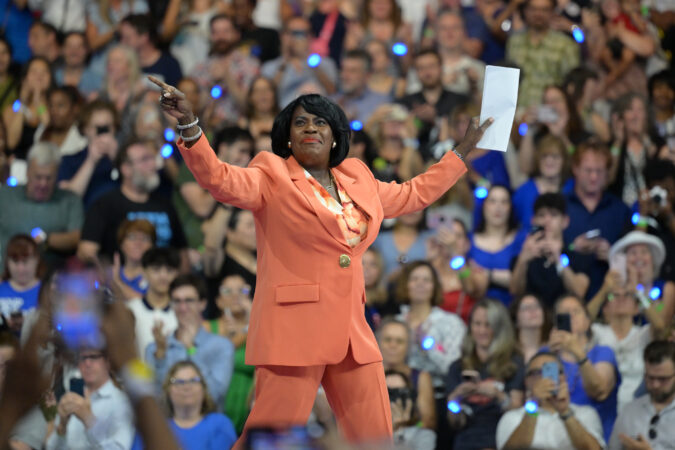
In a statement, Parker said that Philadelphia’s selection as a finalist “reflects the strength of its proposal and the broad coalition of civic, business, labor, and community leaders committed to hosting a convention that is inclusive and memorable.”
Parker, who is up for reelection next year, would no doubt play a major role in planning for an upcoming convention. So would Gov. Josh Shapiro, a Democrat currently running for reelection who is considered a contender for the 2028 presidential nomination.
The president of the Philadelphia host committee is David L. Cohen, a prominent party stalwart, and the chair is Daniel J. Hilferty, the CEO of Comcast Spectacor, which owns the Xfinity Mobile Arena.
He said in a statement that “there is no city more excited, more invested and more prepared than Philadelphia to host the 2028 Democratic National Convention.”
Philadelphia — the largest city in a critical swing state — last hosted a presidential nominating convention in 2016 at the South Philly arena, then called the Wells Fargo Center. Democrats that year nominated former Secretary of State Hillary Clinton, who was later defeated by Republican Donald Trump.
Before 2016, the city hosted major party conventions seven times, including the 2000 Republican National Convention. The GOP that year nominated then-Texas Gov. George W. Bush, who went on to serve two terms in the White House.
Former U.S. Rep. Bob Brady, the chair of the Philadelphia Democratic City Committee, said Monday that he had spoken multiple times to DNC leaders about the prospect of the city hosting the 2028 convention.
“We got a great reputation from the last convention we had,” Brady said. “Plus we’re going to show off the city very well this summer, which will really give us a good look.”
The news that Philadelphia is again a finalist to host the DNC is a welcome development for the city’s tourism and hospitality industry, as party conventions draw thousands of visitors and can be a boon for spending in the city.
The 2016 event generated $230.9 million in economic impact, according to the Philadelphia Convention and Visitors Bureau. Of that, about $132.9 million came from direct convention-related spending, and $11.1 million was generated by state and local taxes. That convention attracted more than 5,000 attendees and some 29,000 other visitors, leading to a record-breaking year for hotels in Center City, the bureau reported.
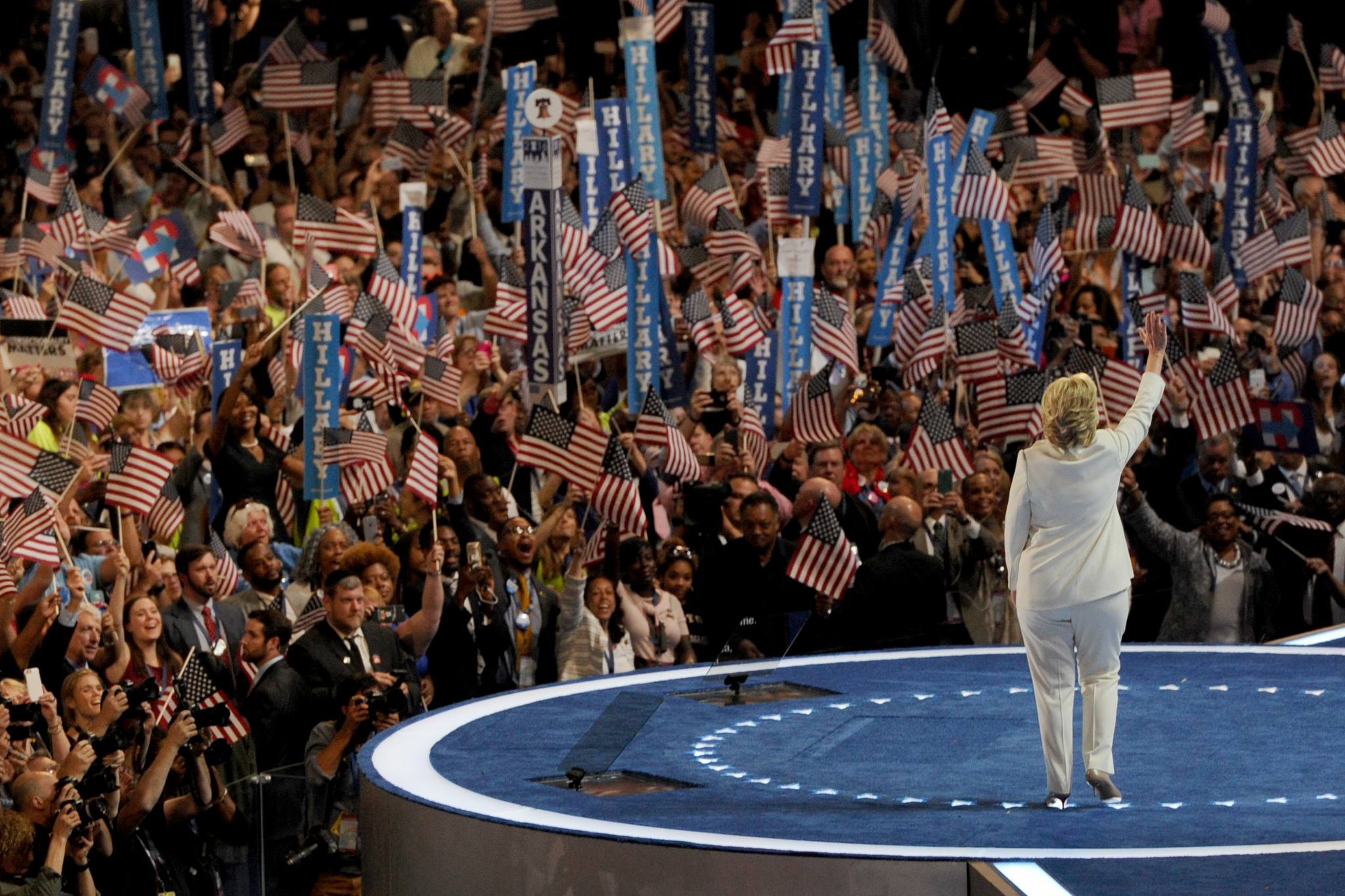
In this July 28, 2016 file photo, then-Democratic presidential nominee Hillary Clinton walks on stage at the arena in South Philly to accept the nomination of her party on the final night of the DNC.
If selected, Philadelphia may be uniquely positioned to host an influx of visitors.
The city’s hotel supply has expanded since the last time it hosted a DNC — and there are more than 19,000 hotel rooms in the city, according to Visit Philadelphia. That’s an increase from about 16,000 available in 2016.
The city has also invested millions of dollars on improvements to public spaces, transit hubs, and security ahead of several major events this year, including World Cup games, the MLB All-Star Game, and the commemoration of the 250th anniversary of America.
Conventions are also major logistical undertakings. Attendees include high-profile politicians and celebrities, and protests often form outside the events. The federal government has over the last two decades designated both parties’ nominating conventions as National Special Security Events, meaning they are deemed at high risk for terrorism and require federally led security.
In Chicago in 2024, the U.S. Secret Service led security planning alongside 16 other public safety entities, according to a local NBC affiliate. The law enforcement and security plan included designated protest zones, airspace monitoring, and traffic control.
Host committees are also responsible for raising millions of dollars to pay for parties, transportation for delegates, construction and venue upgrades, as well as other logistical services such as consultants, accountants, and communications staff.
In 2016, the Philadelphia host committee raised about $85 million — $10 million of which came from taxpayers in the form of a state grant. Other top contributions came from corporations, unions, and wealthy individual donors.
Gov. Josh Shapiro met with leaders in Berks and Schuylkill Counties on Thursday as the communities confront the planned federal conversion of two warehouses into ICE detention centers, and the governor pledged to do everything possible to block the Trump administration’s plans in Pennsylvania.
Shapiro, a Democrat who first publicly announced his opposition to the potential detention centers earlier this month, cited concerns over the impact on local economies, water resources, and residents’ quality of life.
Government warehouse purchases around the country, undertaken as part of a massive ICE expansion of detention capability, have sparked anger, lawsuits — and, in one instance, a suspected arson, when someone attempted to burn down a property in Arizona.
“I’m even more determined to do everything in my power to stop these facilities,” Shapiro said Thursday at a news conference in Berks County.
He spoke on the same day that New Jersey’s two Democratic U.S. senators, Andy Kim and Cory Booker, introduced legislation to ban the federal government from buying or converting warehouses for immigrant detention or processing.
“People across the country are standing up against this inhumanity, and Congress needs to stand with them,” Kim said in a statement.
Shapiro offered few details on how the state government could block the facilities, citing possible legal or regulatory action.
The governor, who is running for reelection, has been increasingly vocal in his opposition to ICE tactics even as his administration retains some cooperation with the agency. Earlier this month, Shapiro wrote a letter to Homeland Security Secretary Kristi Noem promising to “aggressively pursue every option” to block the detention centers from opening in Pennsylvania.
Expanding warehouses
The ICE effort to buy and repurpose warehouses as detention centers has quickly become one of the most contentious issues in immigration enforcement.
The ability to confine and process huge numbers of immigrants is essential to President Donald Trump’s promise to carry out an unprecedented deportation campaign. The number of people currently held has already reached historic highs, topping 70,000 this year, and the administration says it needs more space.
But as Trump’s plan has become public, opposition has been both immediate and fierce. Immigrant advocates call the warehouses “concentration camps” and question how buildings that were built to store consumer and industrial goods can safely and humanely hold thousands of people.
ICE expects to spend $38.3 billion to buy and retrofit warehouses around the nation.
Sixteen buildings would be converted into regional processing centers, each holding 1,000 to 1,500 immigrants. An additional eight detention centers would hold 7,000 to 10,000 detainees and serve as primary sites for deportations.
Shapiro on Thursday sought to send a clear signal to federal officials that he would fight any facilities in Pennsylvania. Following his news conference, Shapiro posted a video to Twitter declaring that Noem “will hear us in Pennsylvania.”
Standing outside the proposed facility location in Berks County, Shapiro outlined the impact detention facilities would have on local communities ― including increased pollution in Berks County and draining of water resources in Schuylkill County.
“I’m pissed,” Shapiro said. “And I’m not going to allow this to happen.”
“If you continue to go forward here, you will face legal and regulatory consequences,” he warned federal officials.
In Bucks County earlier this month, commissioners said that the federal government recently approached warehouse owners in Bensalem Township and Middletown Township about converting the buildings to ICE facilities. Neither owner is going forward with a sale, they said.
In Maryland, Democratic Attorney General Anthony Brown has sued the Trump administration to try to stop plans to hold 1,500 immigrants in a warehouse near Williamsport, about eight miles south of the Pennsylvania border.
Brown and Maryland Democratic Gov. Wes Moore say the project is unlawful, going forward without an environmental review or public input.
ICE purchased the warehouse for $102.4 million in January, the property built as a commercial facility with 825,620 square feet of warehouse space, minimal office facilities, four toilets, and two water fountains, according to the attorney general.
The 1,500 immigrants held there would nearly equal the population of Williamsport, home to about 2,000 people.
Farther south, in Wilson County, Tenn., ICE is examining a two-building complex that would hold a combined 14,000 to 16,000 immigrants, by far the largest immigration detention center in the country, according to Project Salt Box, a Baltimore-based group that tracks ICE warehouse activity.
This month in Surprise, Ariz., someone tried to burn down a warehouse that ICE bought to turn into a 1,500-bed detention center, but the fire was quickly extinguished by the interior sprinkler system, the Arizona Mirror reported, quoting federal officials.
The plan to create a fixed, large-scale network of converted warehouses represents a radical new approach to immigration detention.
Historically, the American Immigration Council noted, ICE’s detention funding has gone almost entirely to contract providers, the private prison companies and state and local governments that lease facilities to the agency. As of February 2025, ICE owned only 10 of the 220 facilities being used to detain immigrants, the council said.
Now, ICE seeks to reengineer a detention system that was not centrally planned, but emerged over decades as Congress gradually increased agency funding, the council said.
ICE currently operates five detention facilities in Pennsylvania, including the 1,876-bed Moshannon Valley Processing Center, the largest detention center in the Northeast. Two more are located in New Jersey, in Elizabeth and Newark, and the Trump administration has been exploring adding a third at Joint Base McGuire-Dix-Lakehurst.