Category: Home & Design

  • A North Philadelphia rowhouse filled to the brim with books

    A North Philadelphia rowhouse filled to the brim with books

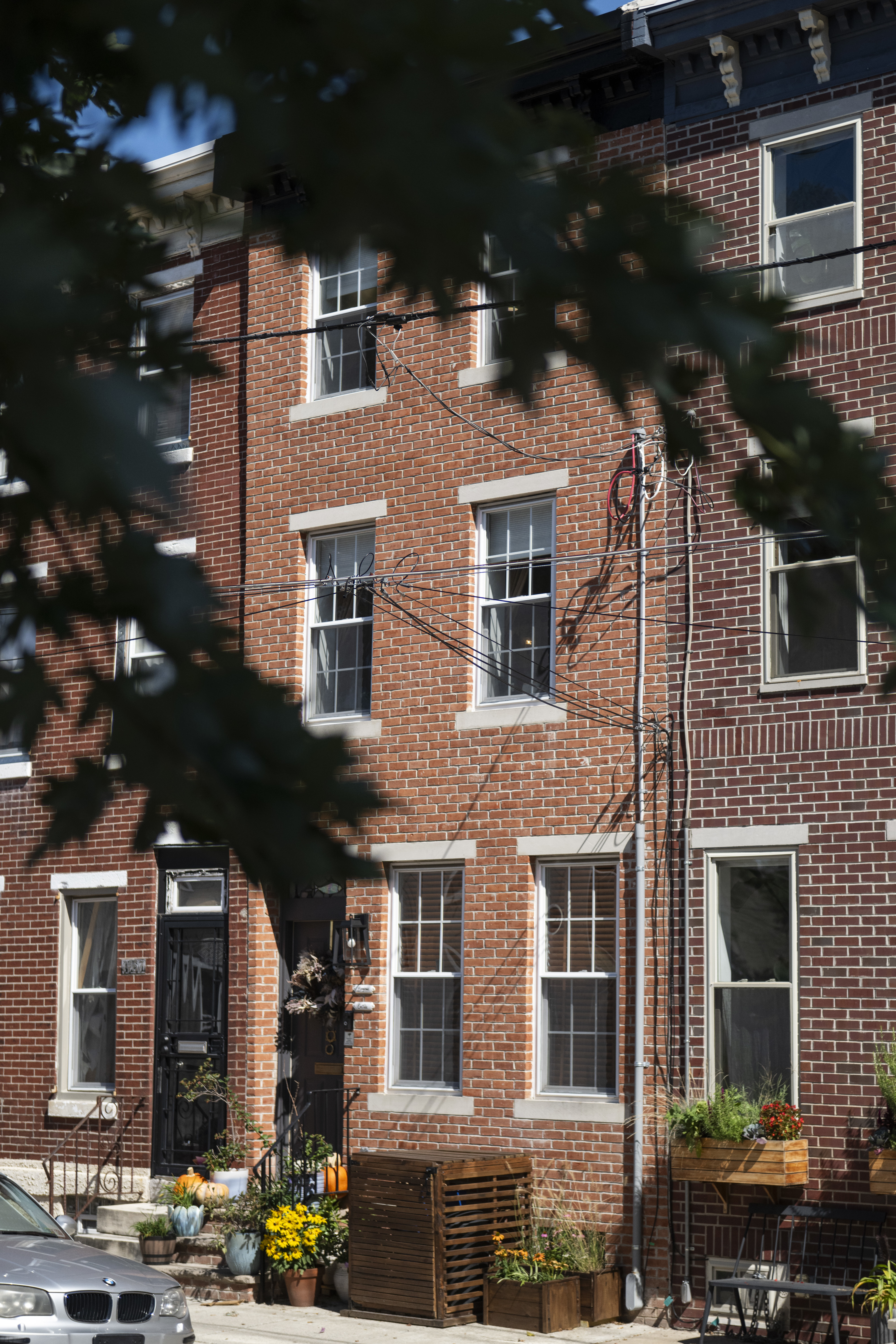
    Before moving into his North Philadelphia home 13 years ago, Abel Tootle Jr. had rented small apartments, all under 800 square feet. He decided to make the leap to homeownership to pursue his passion for interior design and create a space that reflects his personal style.

    “The timing was perfect,” said Tootle. And so, he moved into his circa-1910, three-bedroom, 1,200-square-foot house. Becoming a homeowner meant full freedom in designing his space — and no more lugging clothes to the laundromat, a feature of which he is most appreciative, he said.

    His home’s look has been evolving since.

    “I truly believe a home is never done. I was given every opportunity to paint, carpet, and design as I wish; however, I did not make any structural changes at all,” Tootle said. “My focus remains on creating a very English-country-house feel with special attention to my culture and interests.”

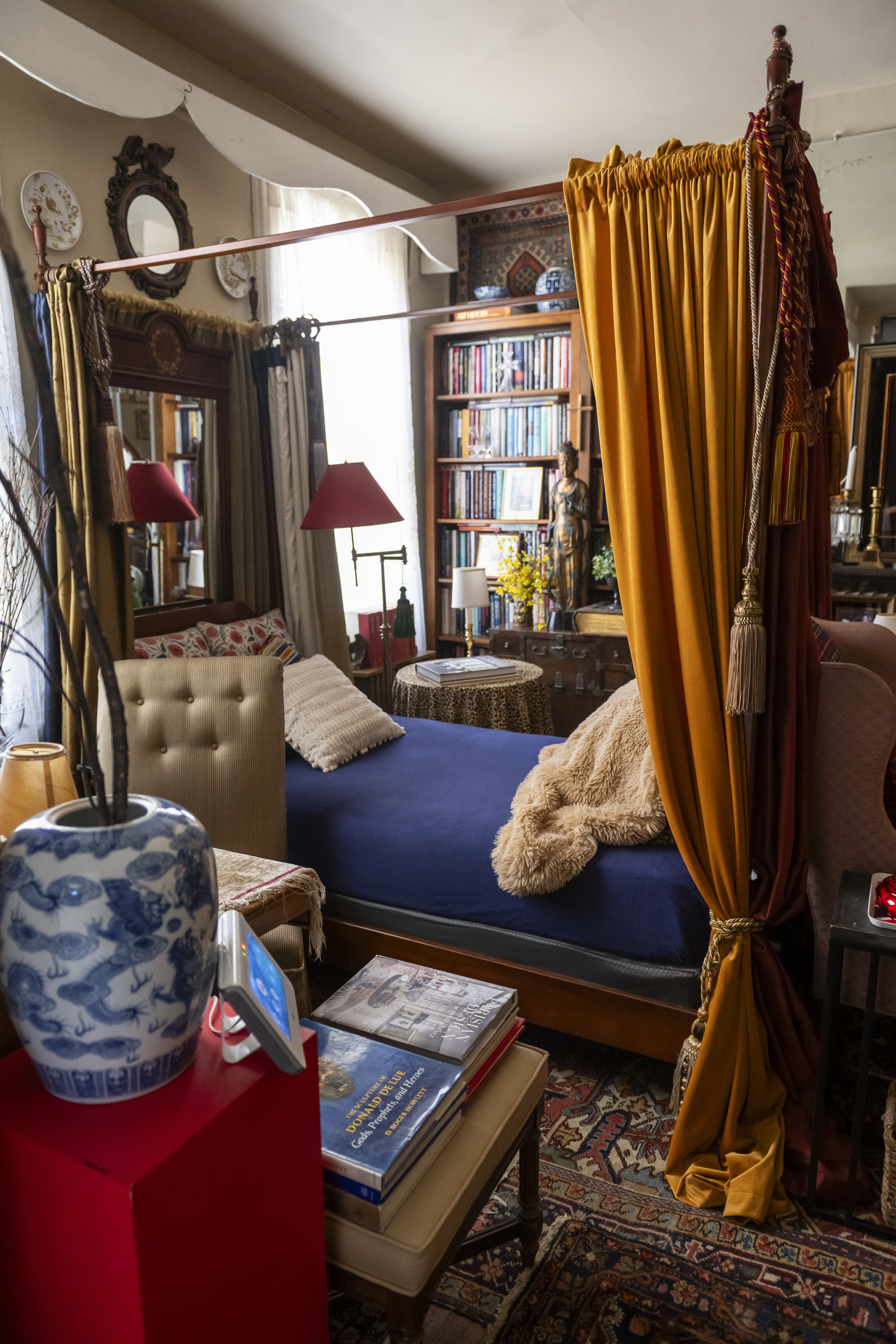
    He favorite design elements include books — there are dozens and dozens displayed throughout the home, not just on shelves but arranged intentionally on and under tables, and stacked in towers rising from the red-pine-hardwood floors — as well as antiques, colorful area rugs in various sizes, art, lighting, and mirrors.
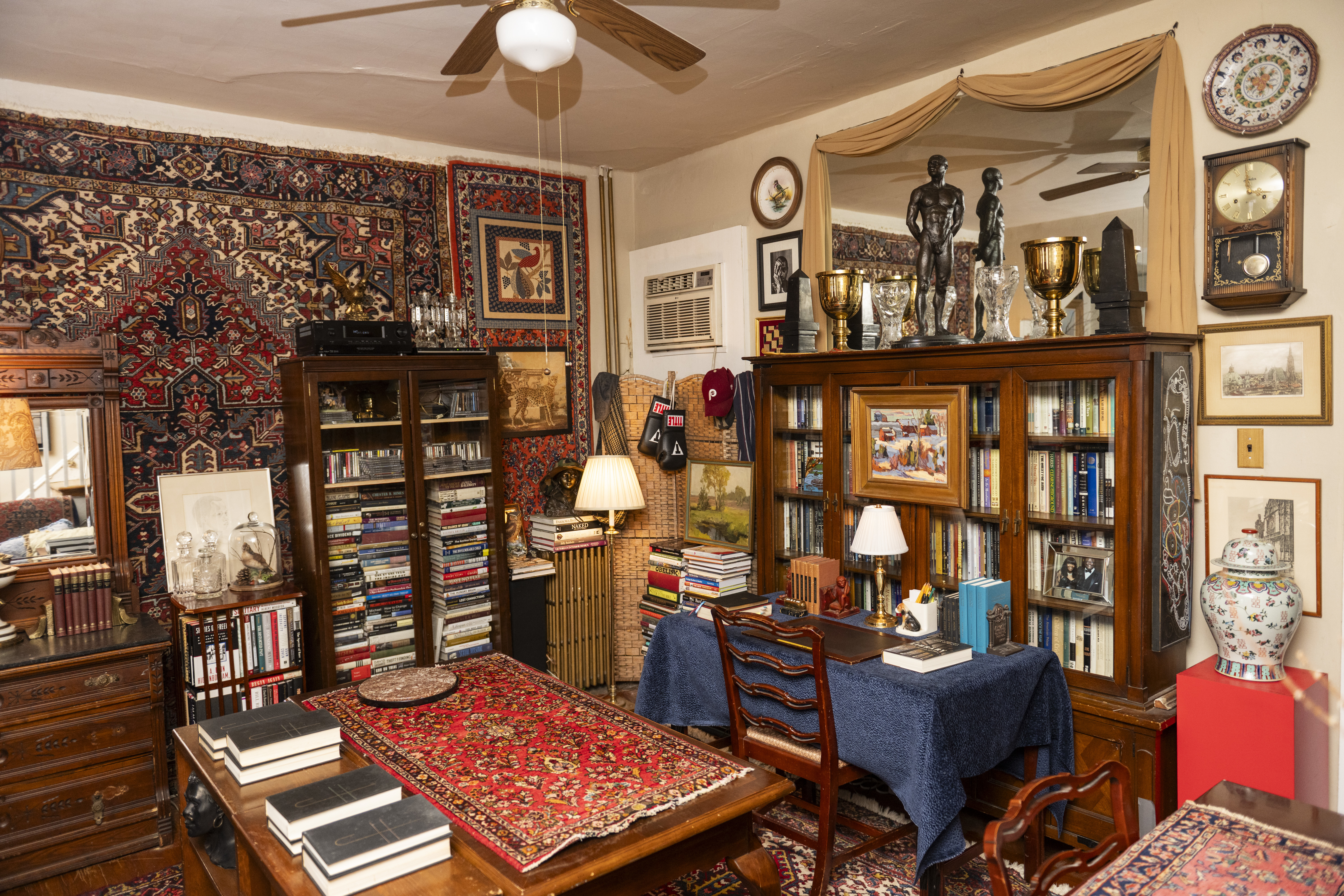
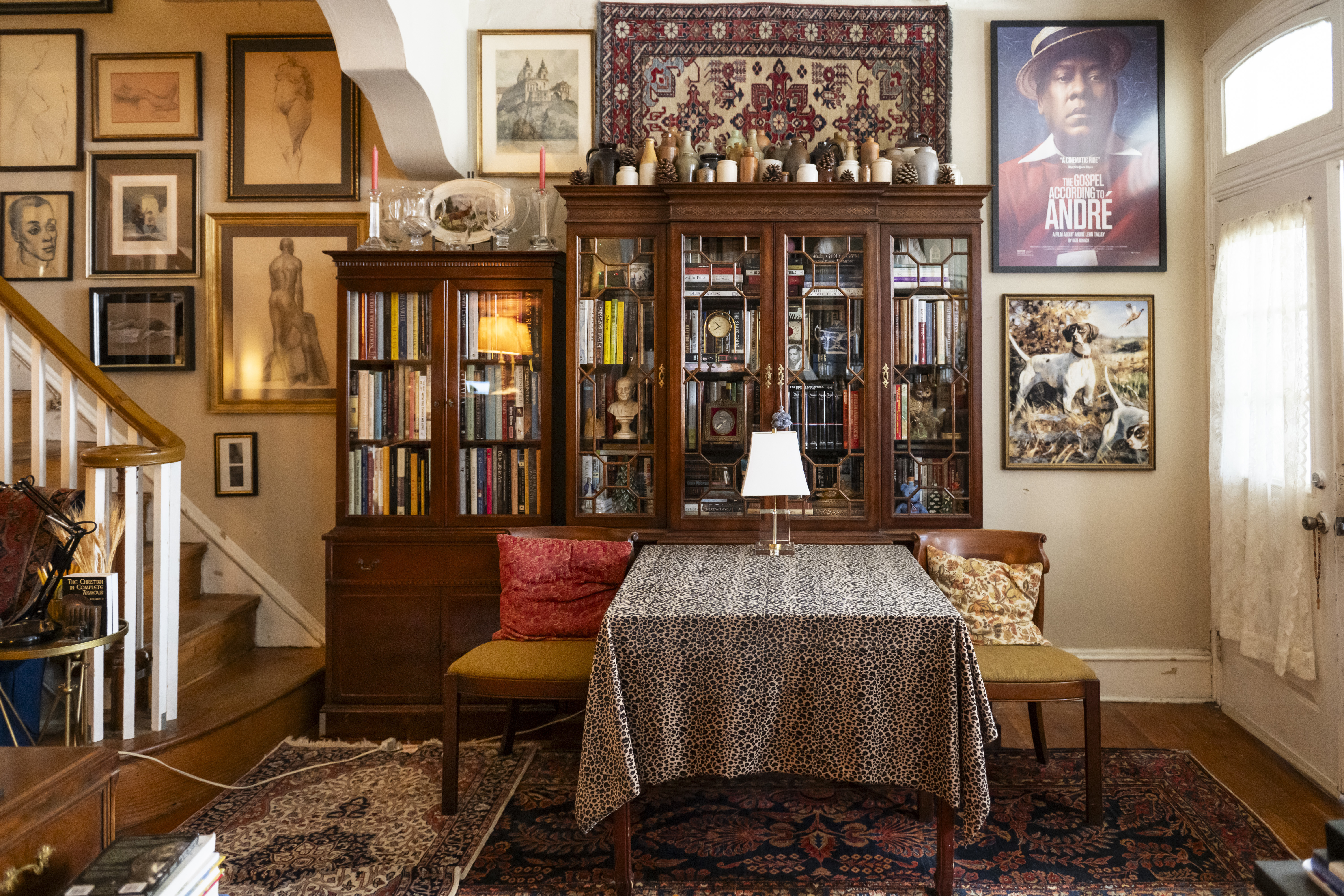
    Colorful patterned rugs adorn not just the floors, but tabletops and walls as well. Tootle says his interior designs are “layered.”
    Books fill a glass-doored cabinet and art covers the wall at the foot of the stairs.
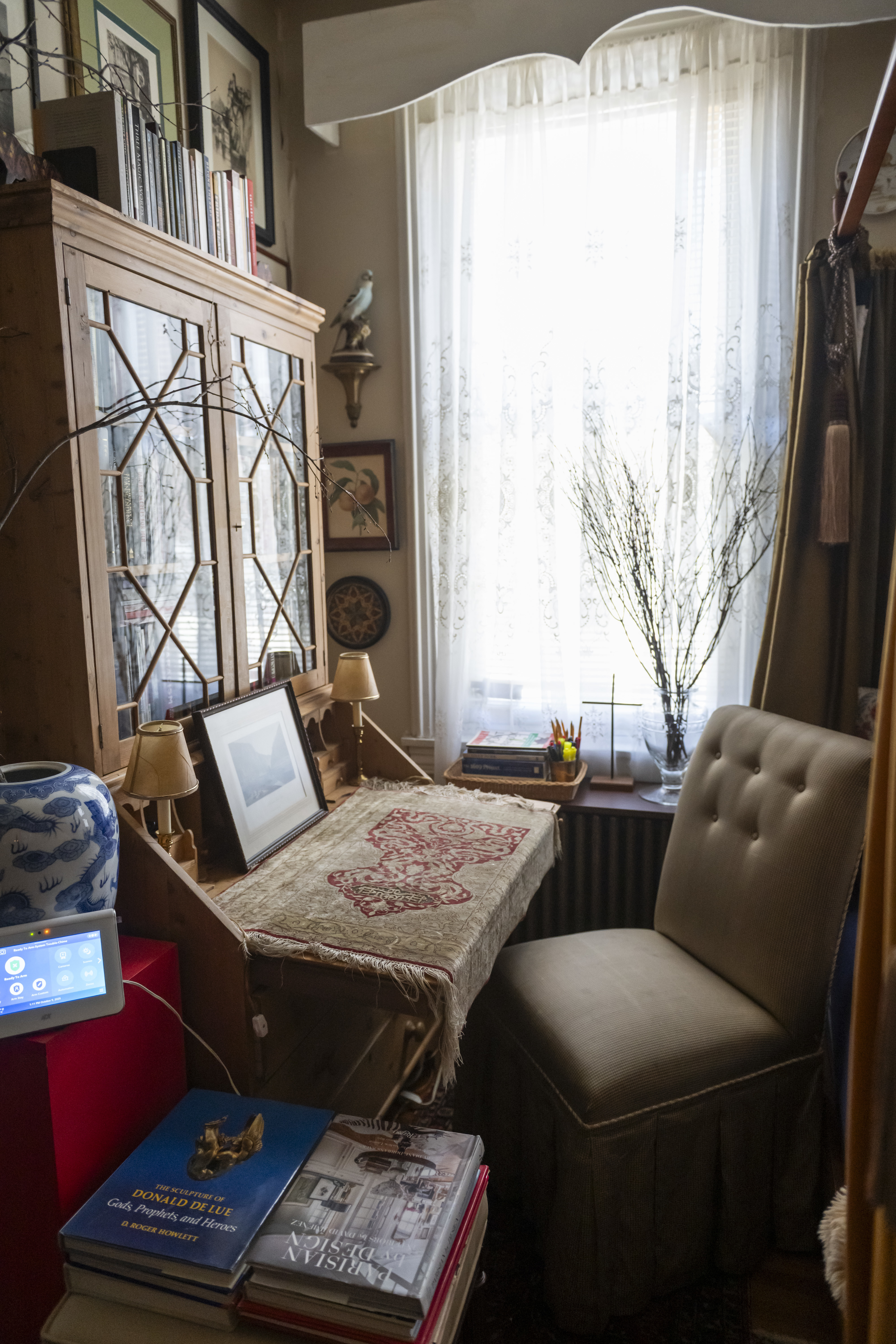
    A desk is topped with a book-filled cabinet, adjacent to the canopy bed.
    The canopy bed in Tootle’s double parlor room in his North Philadelphia home.

    Tootle was initially attracted to his home’s location because he worked at Girard Medical Center. The commute was 15 minutes by bicycle or a 30-minute walk.

    “I was raised not too far from my current address as a teenager; hence, I am very familiar with the neighborhood,” he noted. He also appreciates the sense of community, being minutes from Center City, and the architecture of the neighborhood.

    “The classic brick and stone rowhomes, the spacious interiors of the three-story houses, and the rich history of music, art, and civil rights,” Tootle said. “Shopping, arts, and eateries are other reasons I love where I live, and I especially love the many libraries and museums,” added Tootle.

    Tootle’s career is in social work and he has experience in psychotherapy, individual and group therapy, trauma counseling, grief counseling, and drug and alcohol counseling. In his spare time, he enjoys reading, antiquing, and going to the gym.

    Books are a central focus in his home — he estimates he owns about 3,000.
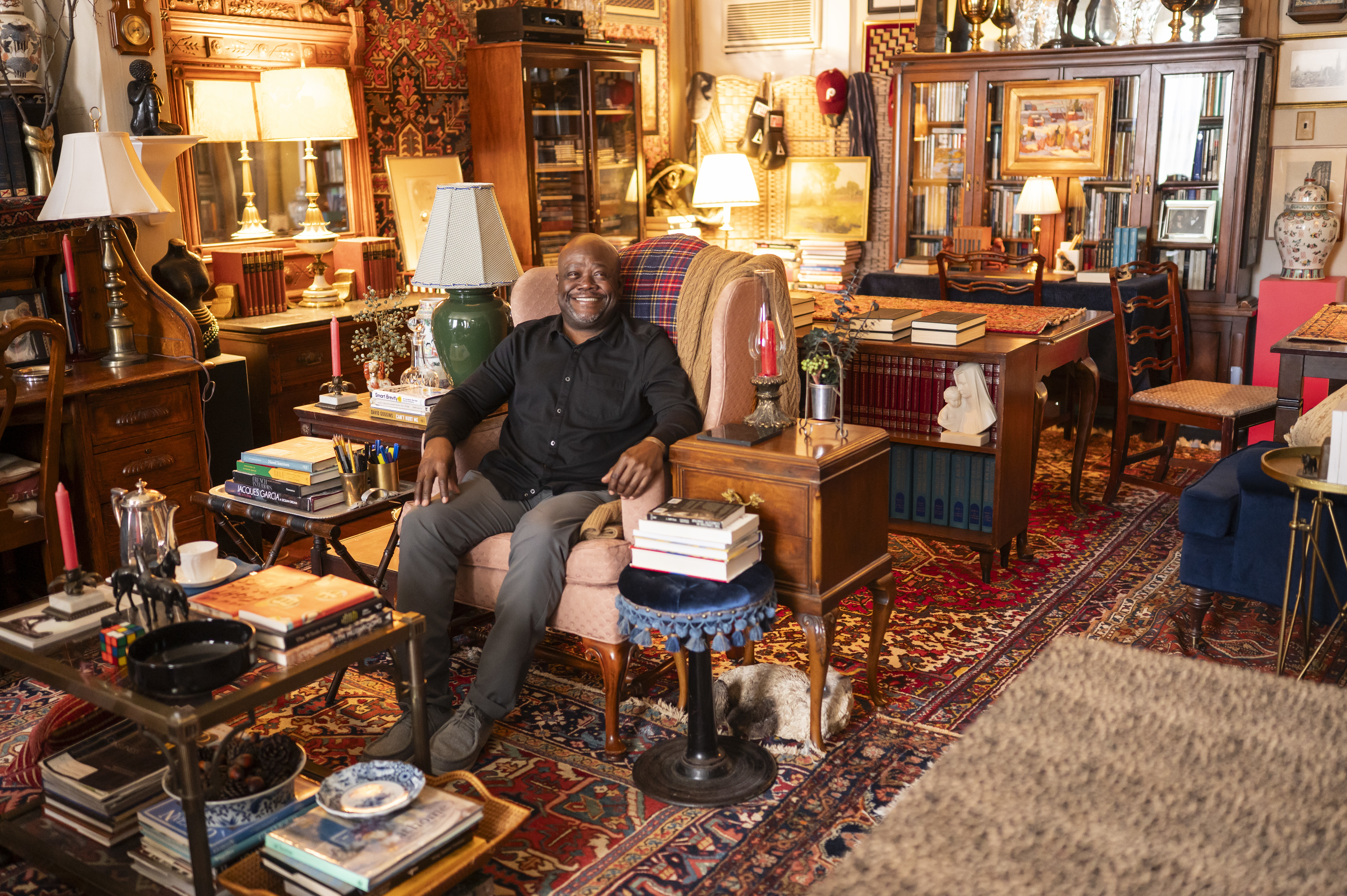
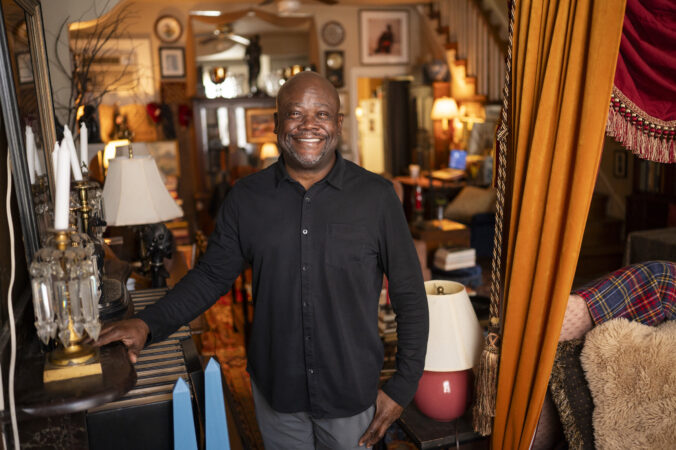
    Tootle sits in his double parlor surrounded by books and antiques.

    “My library is the culmination of 40-plus years of book collecting, trading, and selling. I have purchased books from bookstores, auctions, flea markets, libraries, thrift stores — anywhere books were sold,” he said.

    The bulk of the collection focuses on psychology, spirituality, history, art, and interior design, but it also includes poetry, fiction, and science. His favorite writers include James Baldwin, Toni Morrison, Peter Gomes, Ellen Langer, Carl Jung, and W.E.B. Du Bois, he said.

    “Essentially, I’d like to think my home references the three places I’ve always wanted to live in as a child: a library, a church, and an art gallery or museum — without the pretension,” said Tootle.

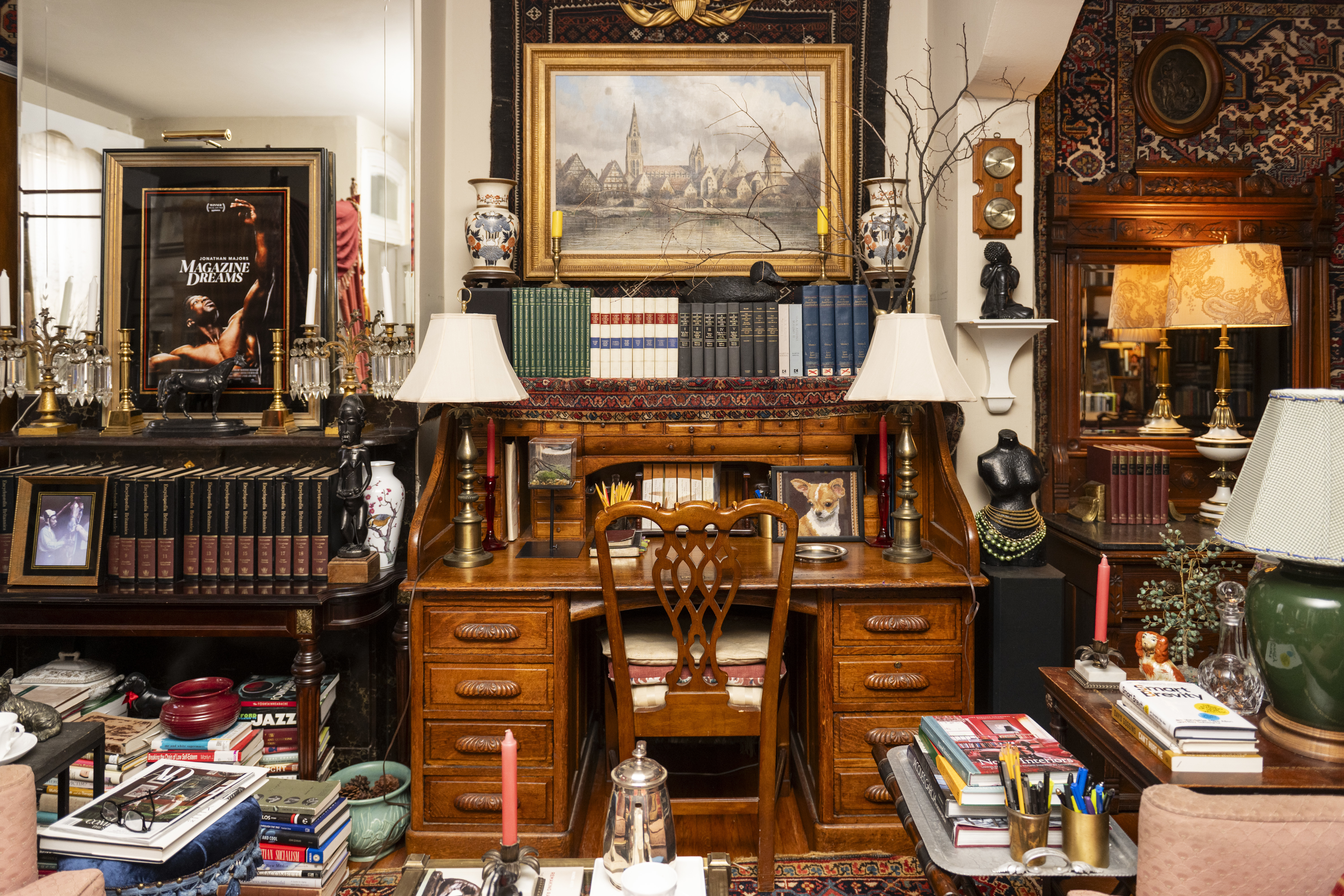
    Stacks of books overflow from the shelves and tables and onto the floor.
    Tootle’s S-rolltop desk is one of his most prized antiques.

    He’s especially fond of 19th-century antiques.

    “I am a sucker for antique lighting and furnishings of this period and have frequently found gems at auctions, estate sales, flea markets, thrift stores, and on the curbs of sidewalks,” he said.

    One special acquisition is an antique 60-inch-wide Tiger Oak S-rolltop desk, which he bought from a dealer in Bucks County. It was produced in the late Victorian Era, he said, in the 1890s.

    Tootle frequently tries different design layouts by rearranging furniture, changing lighting, and experimenting with colors, patterns, and textures.

    “My design ethos is very intentional and, hence, curatorial. I am a maximalist at heart,” continued Tootle. “My interiors are very layered.”

    Also, he’s planning on featuring more theatrical elements.

    “This includes incorporating more velvets, tassels, deep saturated colors, and sculpture — in the tradition of the late Renzo Mongiardino. Not as a copy, but inspiration,” he said.

    In the backyard, he wants to make a mixed-use space.
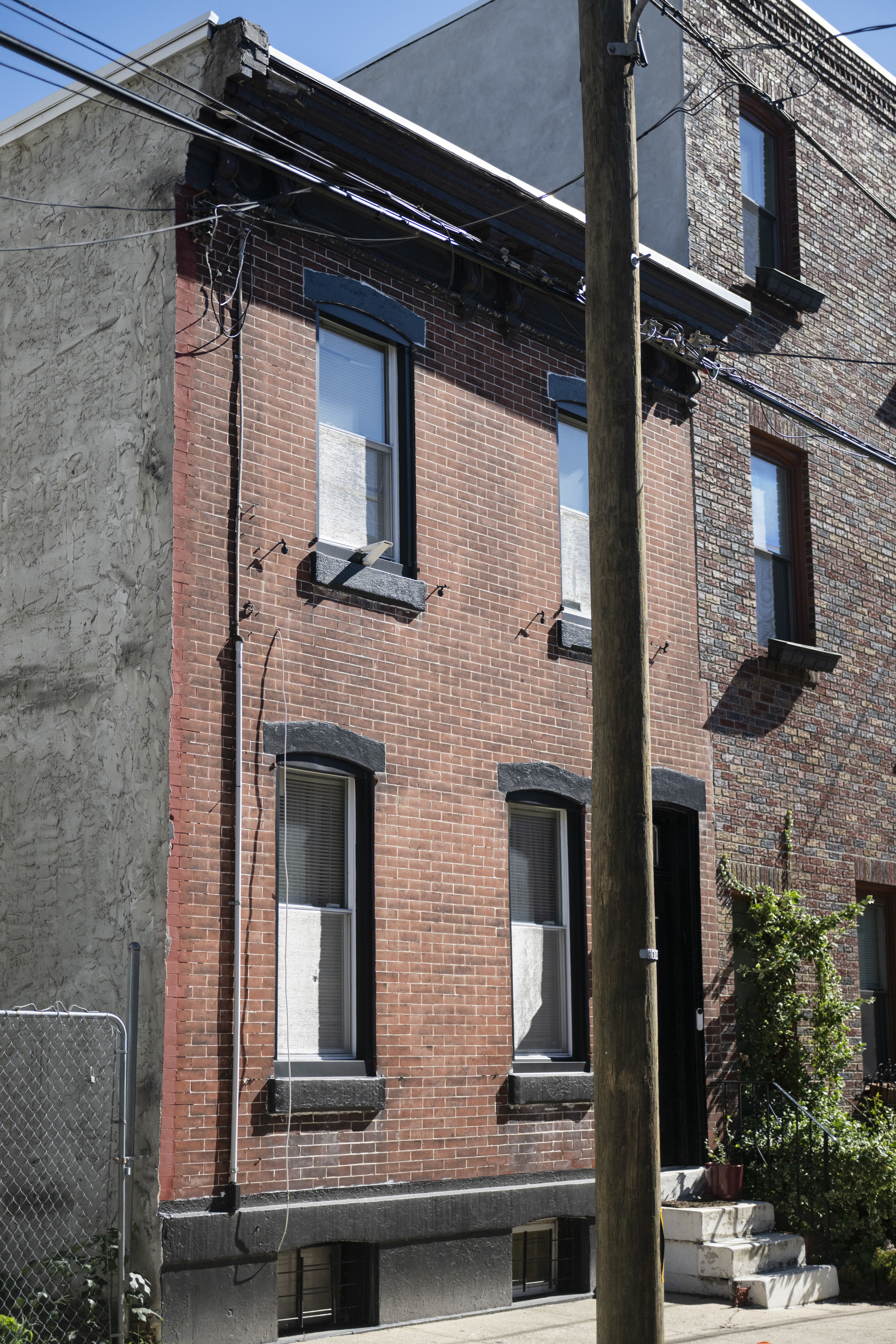
    The exterior of Tootle’s home.

    “I would like to have the soil paved over and start a container garden with trees, shrubs, herbs, and vegetables with a small round table accommodating two to four people,” said Tootle. “I rarely use it as it currently stands.”

    Is your house a Haven? Nominate your home by email (and send some digital photographs) at properties@inquirer.com.

  • Her 105-year-old home near Palmer Cemetery got big updates, while keeping some history

    Her 105-year-old home near Palmer Cemetery got big updates, while keeping some history

    When Nicala La Reau bought a 105-year-old Fishtown home last year, the neighborhood was a major selling point. But she knew it would need “a full gut renovation.”

    “The house had incredible bones, but it was dated both inside and out — everything from the plumbing and electrical systems to the finishes and floor plan needed updating,” she said.

    La Reau appreciates the home’s “rare luxury for city living” with its generously sized backyard. “That’s where my vegetable and herb garden, and my roses all live,” she said.

    Renovations began immediately when she purchased the property in October 2024. It had been a five-bedroom, 1½-bathroom home.

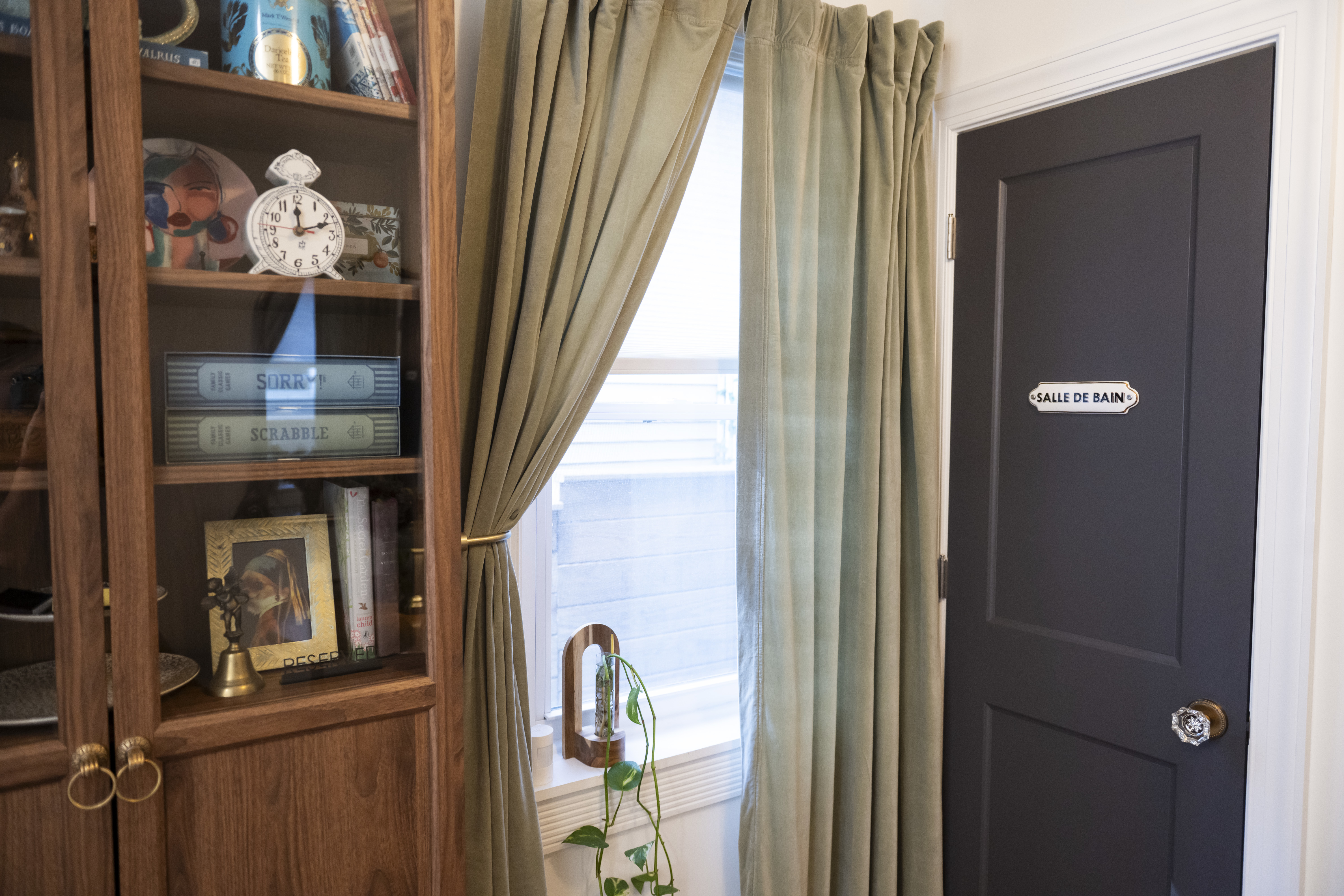
    A half bathroom, so labeled in French, sits off the dining area.
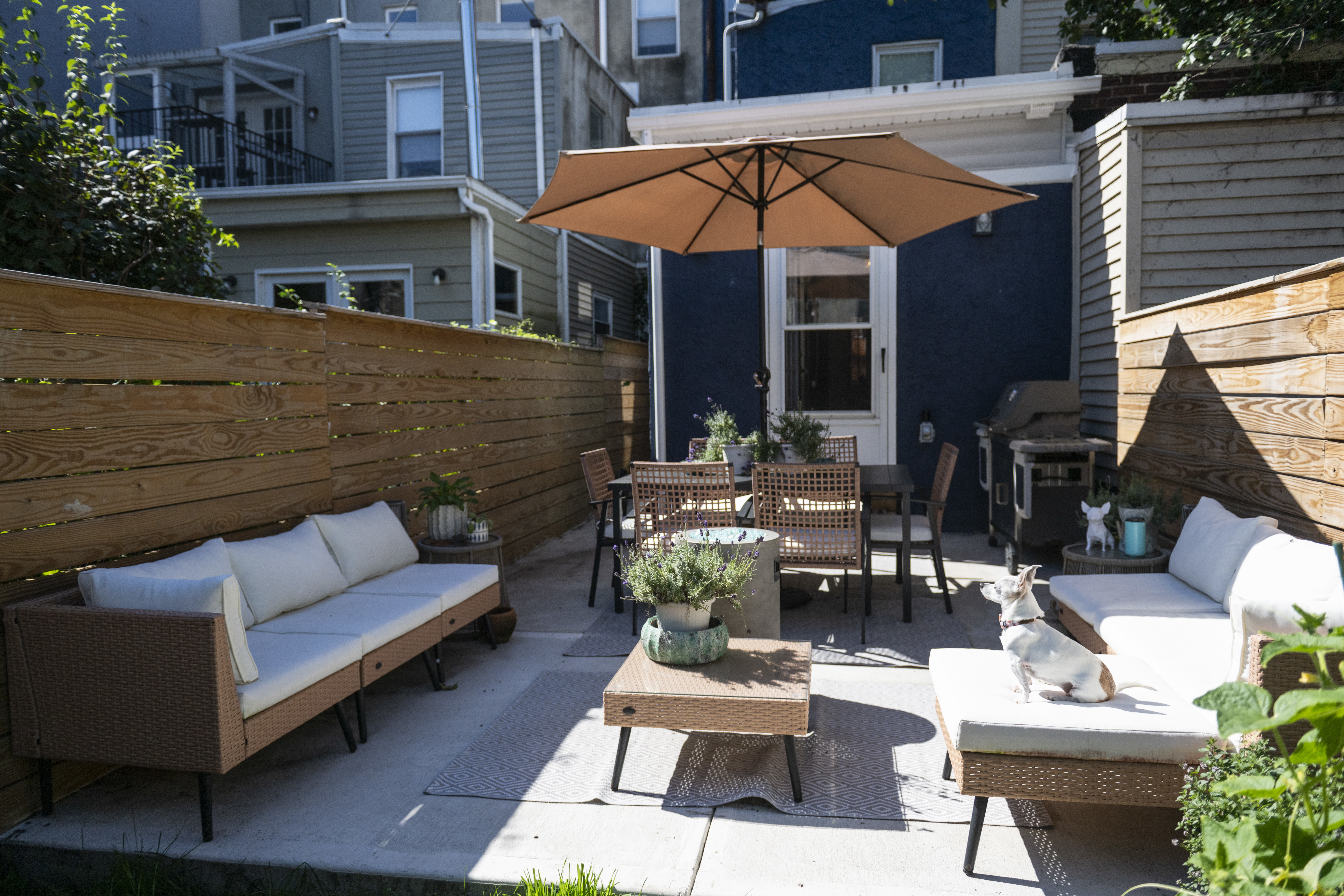
    The backyard, with ample seating and La Reau’s herb garden.
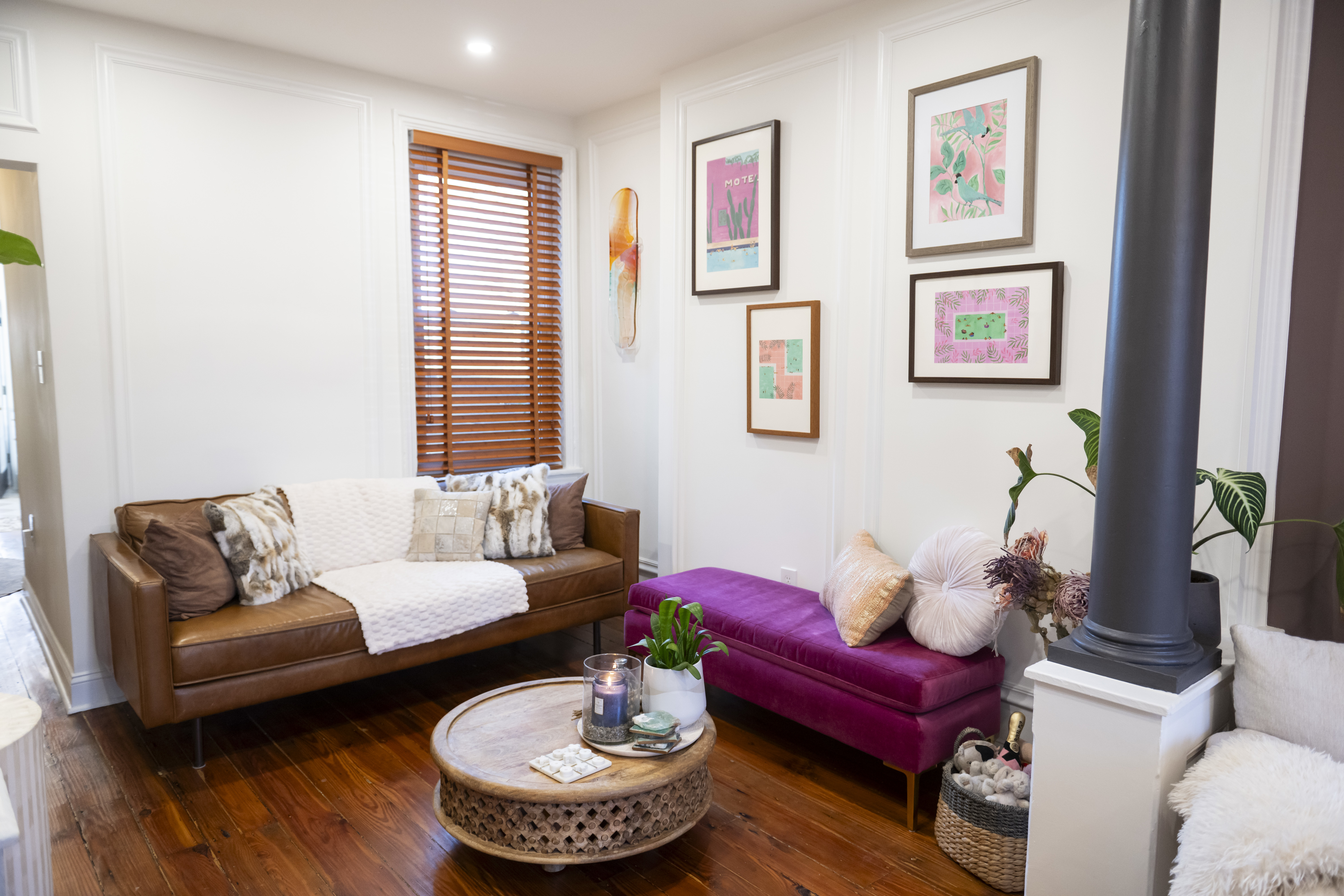
    An extension of the living space, featuring colorful art and a magenta bench.
    The television sits above a wood cabinet with intricate details.

    By the time she was done renovating, about six months later, the new floor plan dropped one bedroom, putting an additional full bathroom in its place. She also expanded the primary bathroom.

    Her goal was to reconfigure the layout to create larger, more functional bathrooms and bedrooms.

    The first floor has an open-concept living, dining, and kitchen area that leads to the backyard. The second floor includes the primary suite with a large bathroom, as well as an additional bedroom, which La Reau uses as a walk-in closet. There’s also a guest bath.

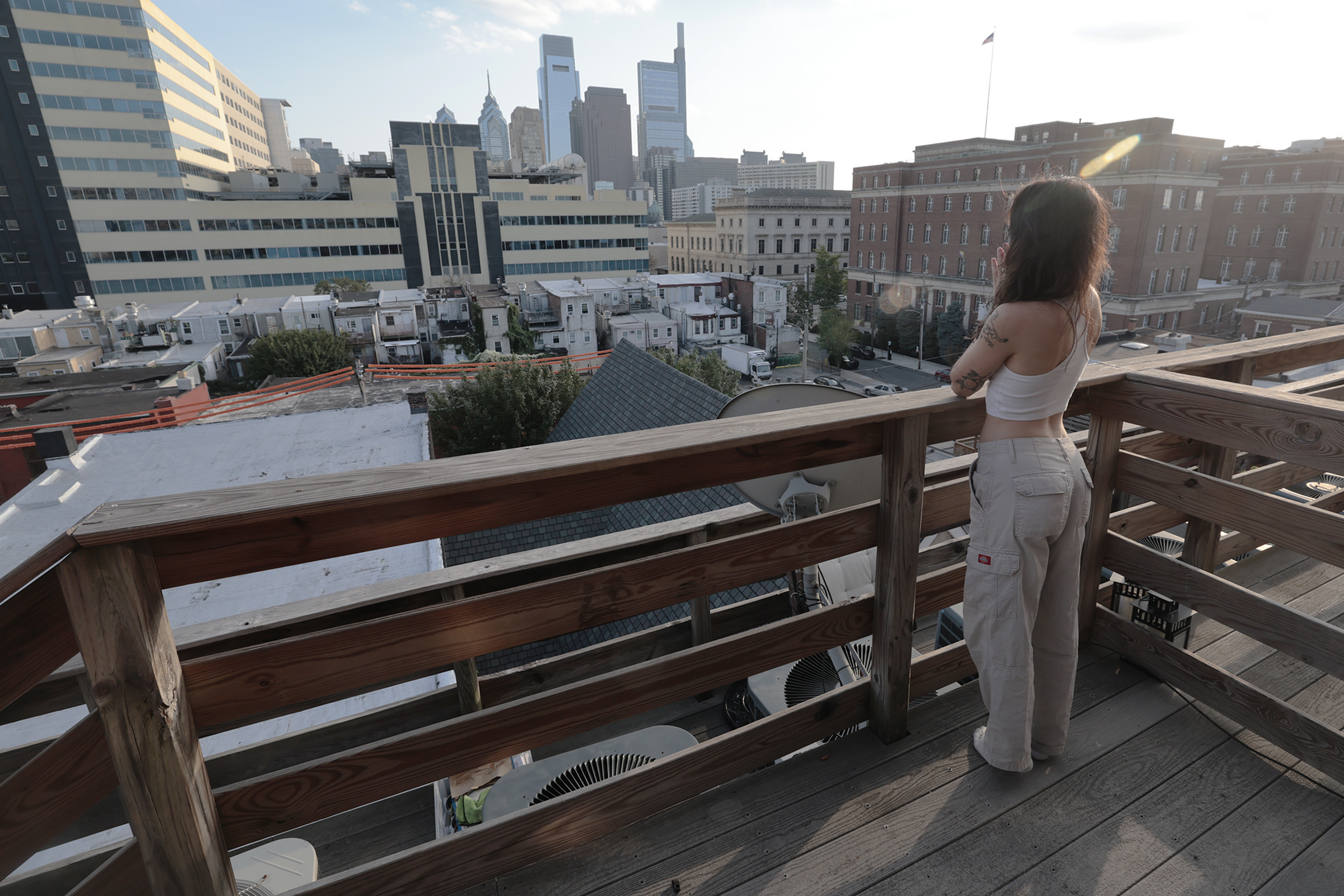
    The third floor has another bedroom, an office, and access to the rooftop deck, which she uses for relaxing and entertaining.

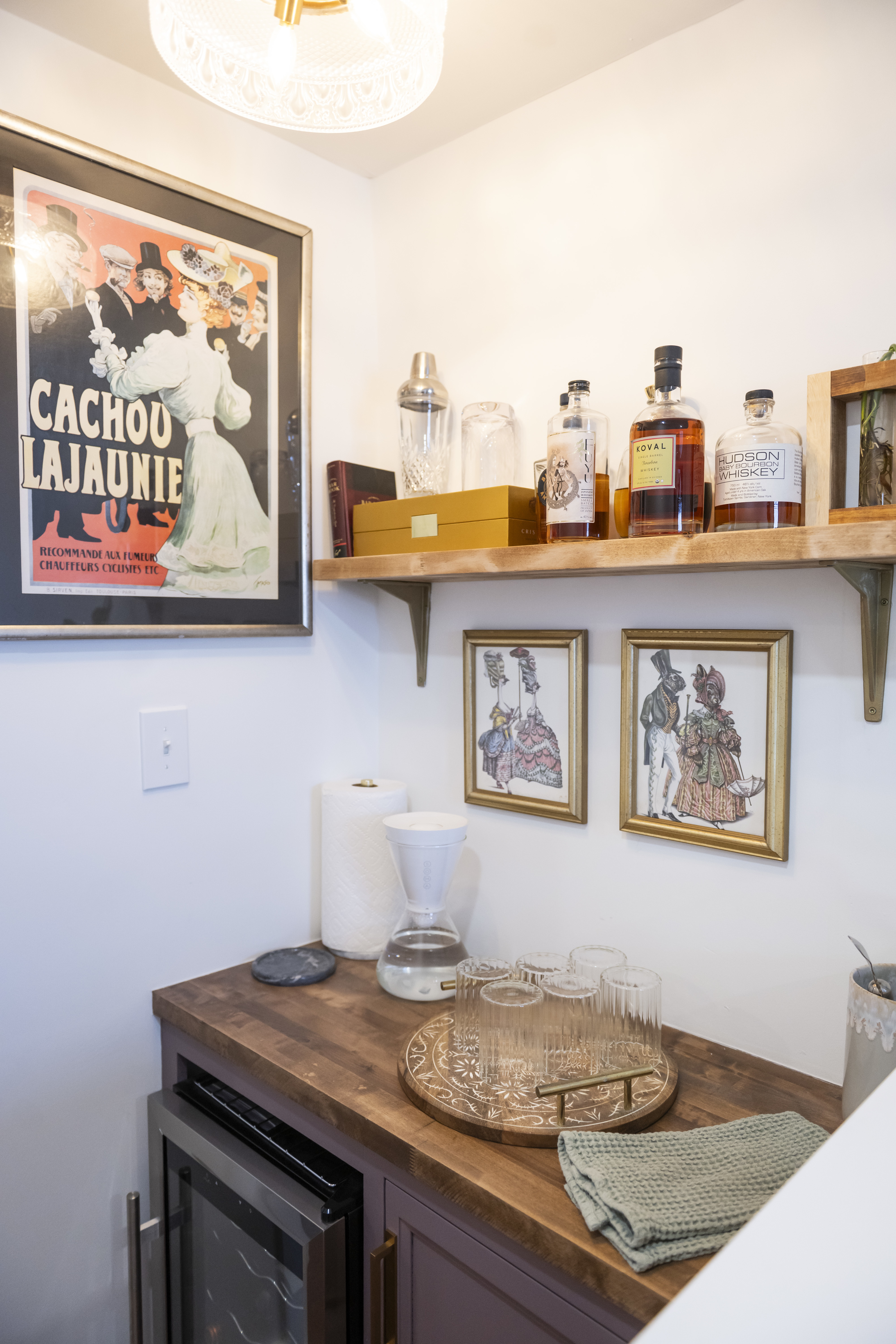
    A wet bar on the third floor, which has access to the rooftop deck.
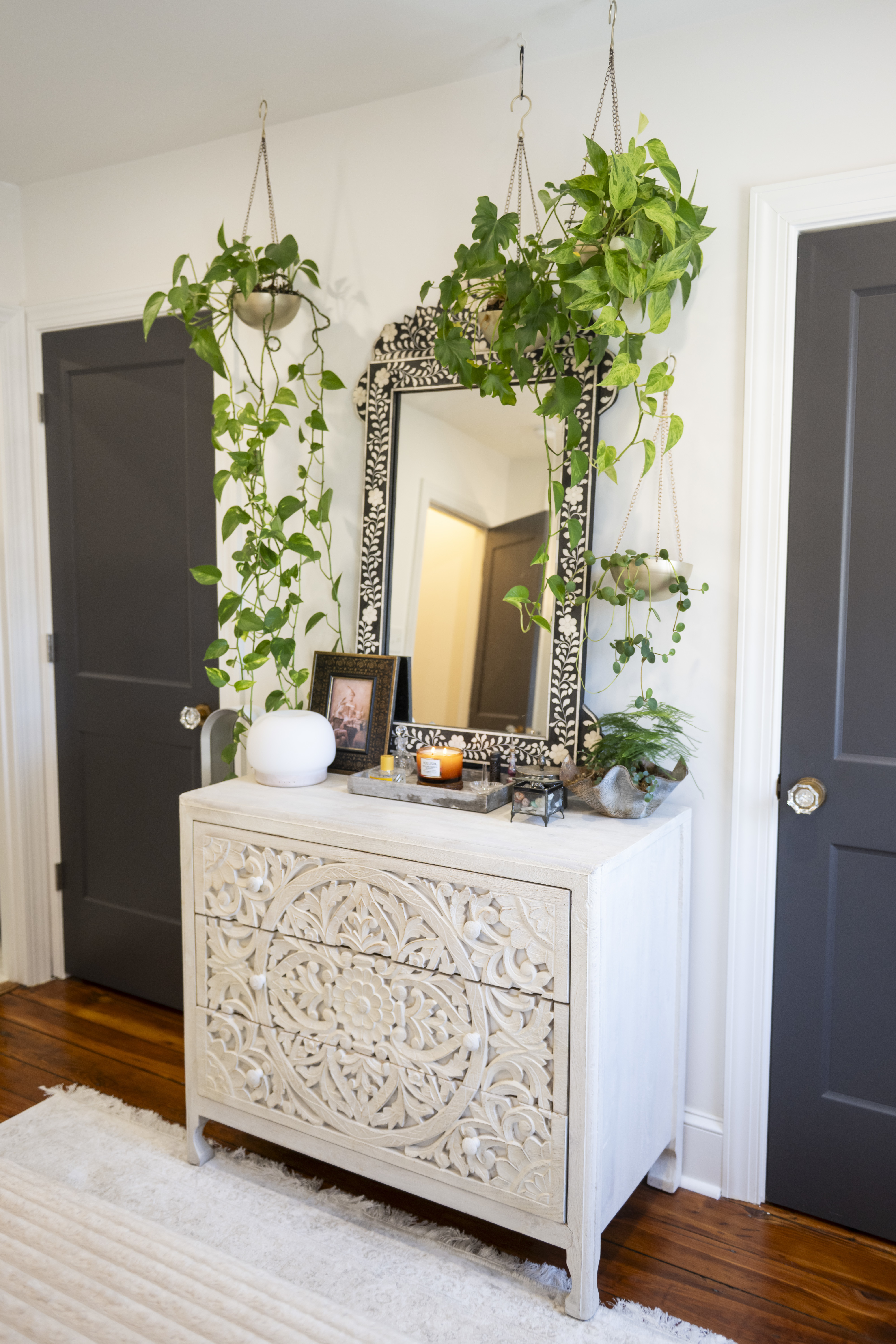
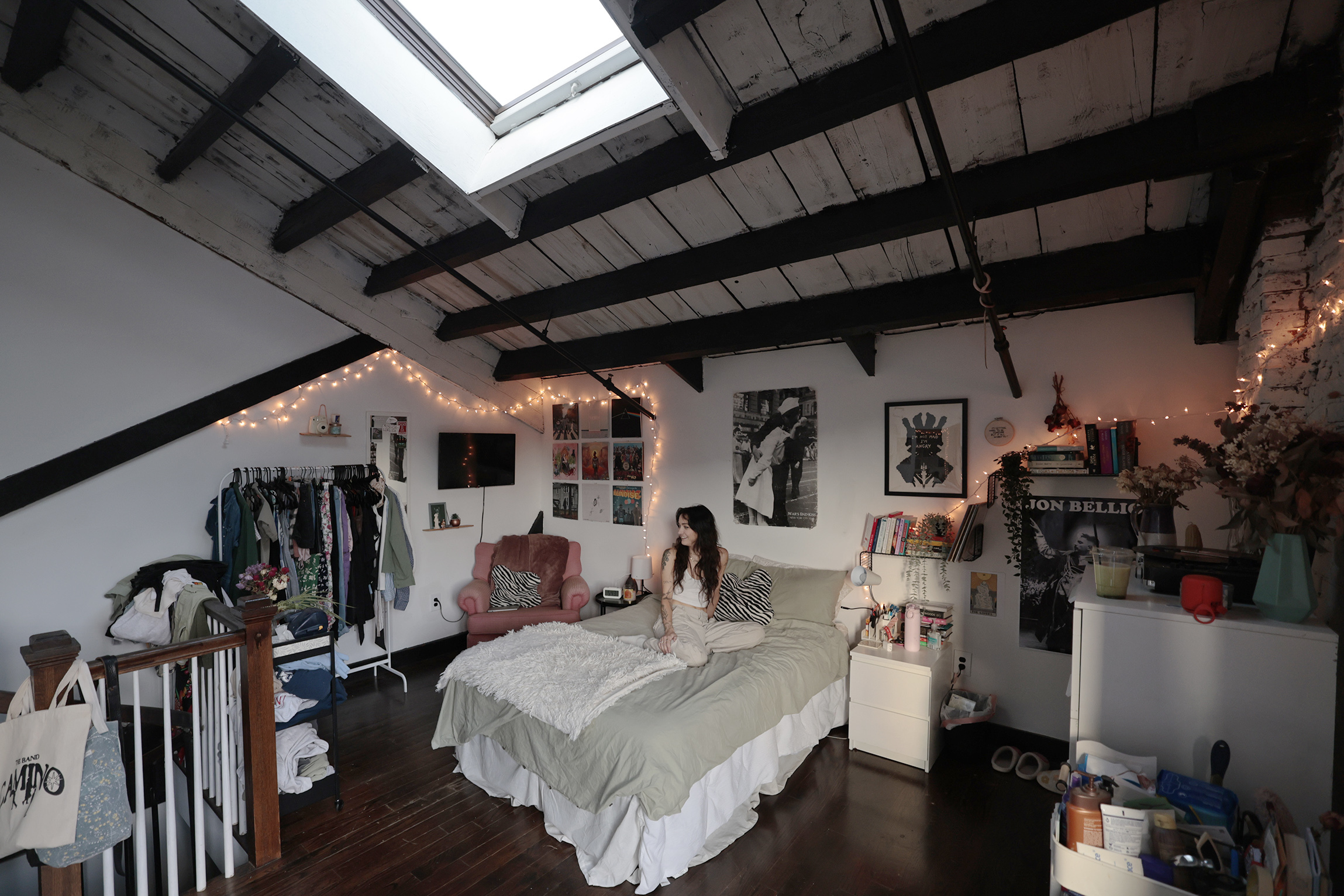
    The bedroom furniture is surrounded by hanging plants.

    “In the warmer months, I use it for everything from morning coffee to evening gatherings and even summer movie nights,” said La Reau.

    The home sits near Palmer Cemetery, a historic location that she believes gives her block “a unique and peaceful character.”

    “What I love most is that the land directly across the street is part of the cemetery, which means there’s a sense of openness and greenery you don’t often get in the city,” La Reau said. “It creates a rare balance of being in an urban neighborhood while still feeling connected to nature.”

    La Reau’s personal style and design flair is evident at every turn in the home. She carefully selected every finish and detail.

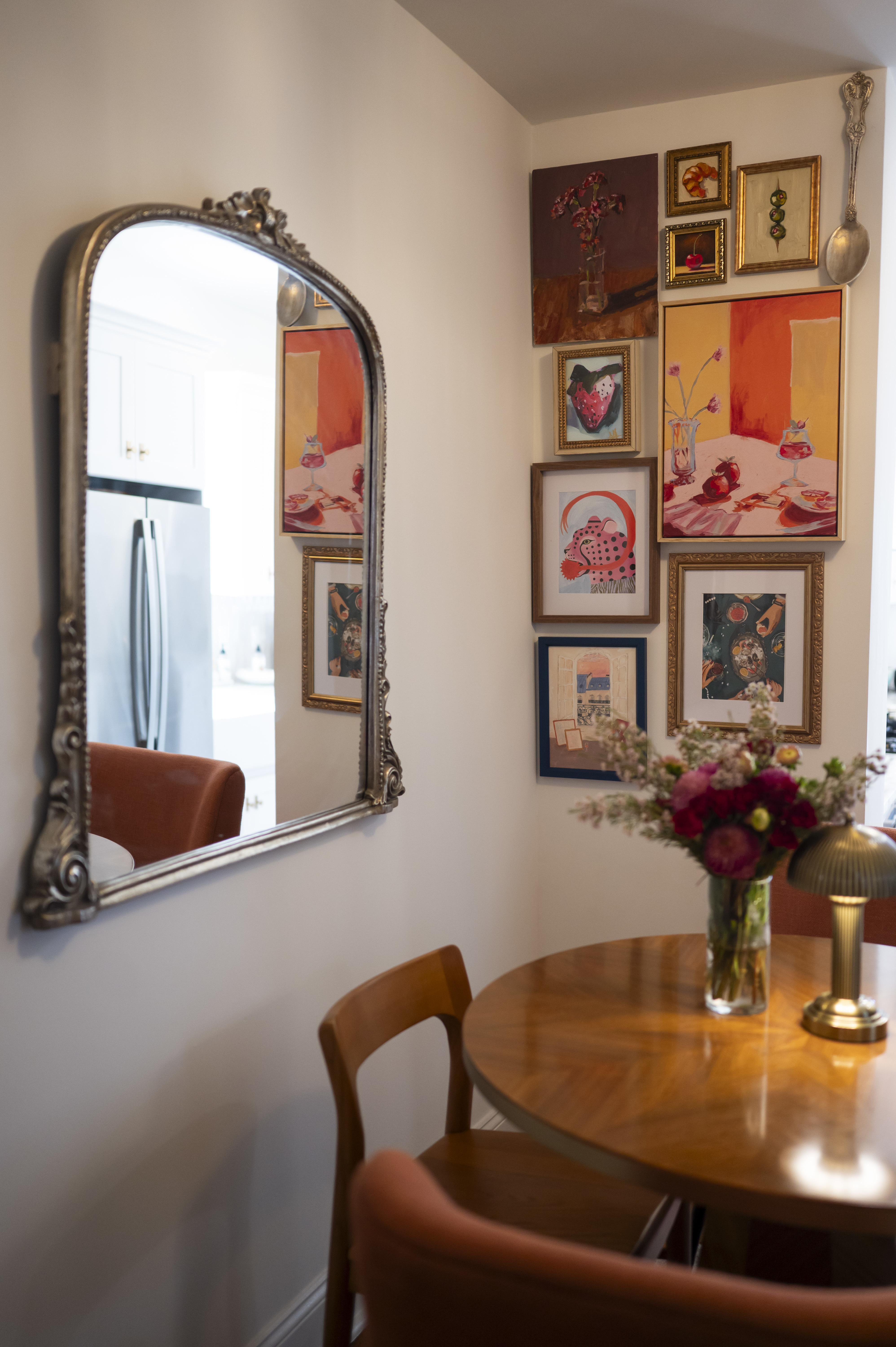
    In the dining area, a collection of art in various shapes and sizes and an intricately framed mirror line the walls.
    The shoe wall in La Reau’s closet.

    “The project was extensive. I completely gutted the kitchen and two existing bathrooms, added an additional full bathroom, and restored many of the home’s original features: hardwood floors, columns, stair treads and railings, as well as the marble fireplace,” she explained. And the renovation included upgrading all of the essential systems, including plumbing, electrical, and structural reinforcements.

    Still, she aimed to preserve the historic charm of the home while layering in modern elements that reflected her personal, eclectic style.

    “Much of my inspiration comes from my travels abroad, especially time spent working in Barcelona, and my family,” La Reau said. La Reau is the marketing director for North America for Pronovias, an international wedding dress designer based in Barcelona, Spain. “Parisian and European influences are woven throughout the design,” she said.

    She opted for neutral finishes to create a timeless, classic foundation that will “age gracefully,” while using accents such as glass knobs and crystal lighting fixtures to honor the home’s vintage character.

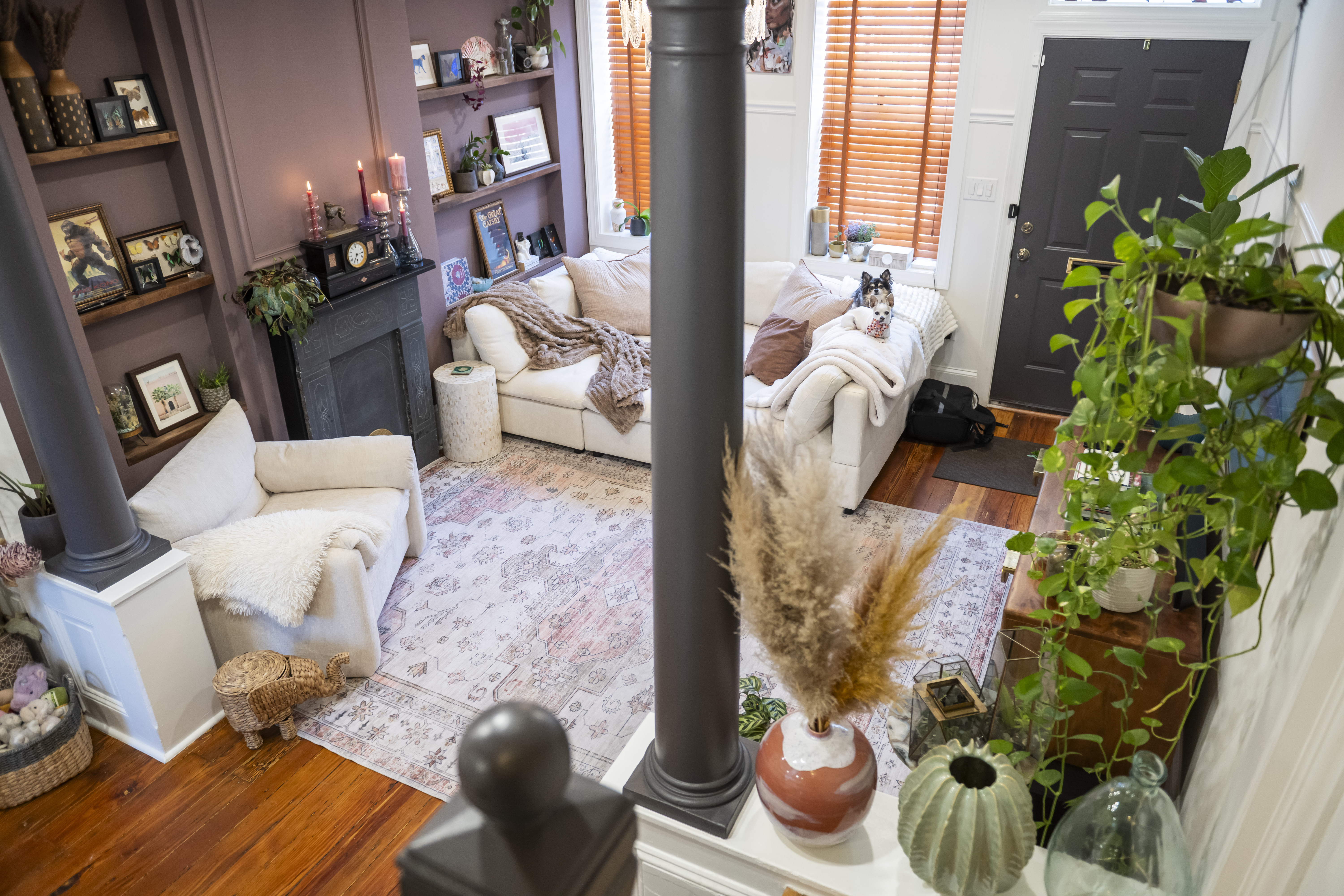
    The living space features a colorful accent wall, purple details, and columns dividing the first-floor spaces.

    In the living room depth and drama were created with a wall in Cinnamon Slate by Benjamin Moore, a balance of heathered plum and velvety brown, framing the restored fireplace and custom-built shelving.

    “I also introduced new molding throughout the primary bedroom and living areas to elevate the architectural character,” she said.

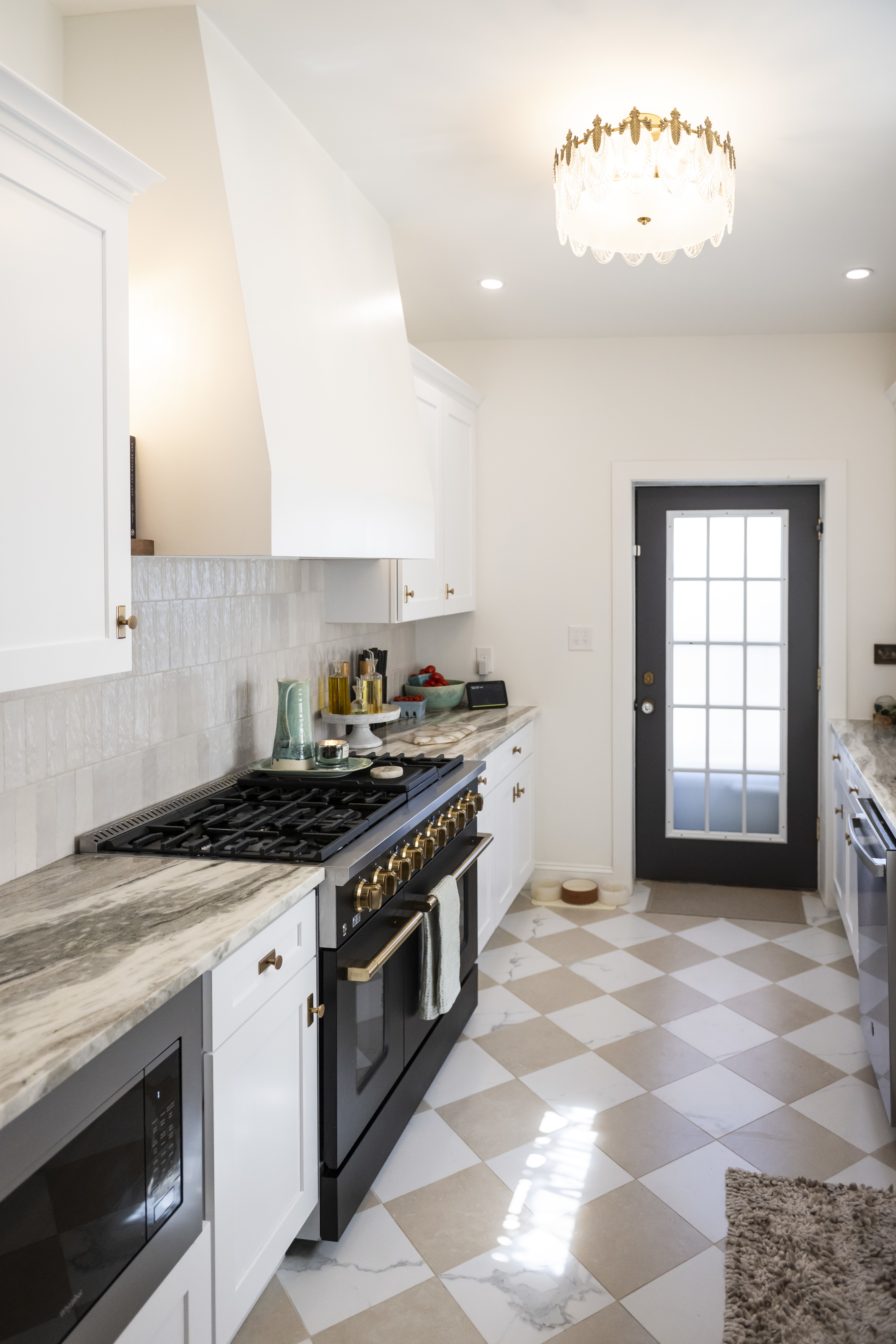
    The kitchen was one of the most important spaces, as La Reau enjoys cooking and baking. The focal point is a Kucht Gemstone KEG Series range in a slate finish with gold accents, featuring an eight-burner, double-oven statement piece that blends luxury and function.

    “To balance its boldness, I selected soft, muted finishes: marble crepe and white flooring rather than a stark black-and-white checkerboard, sandstone backsplash tiles, and granite countertops with subtle gray and brown veining,” she said.

    A Kucht Gemstone KEG Series range is a centerpiece of the kitchen.
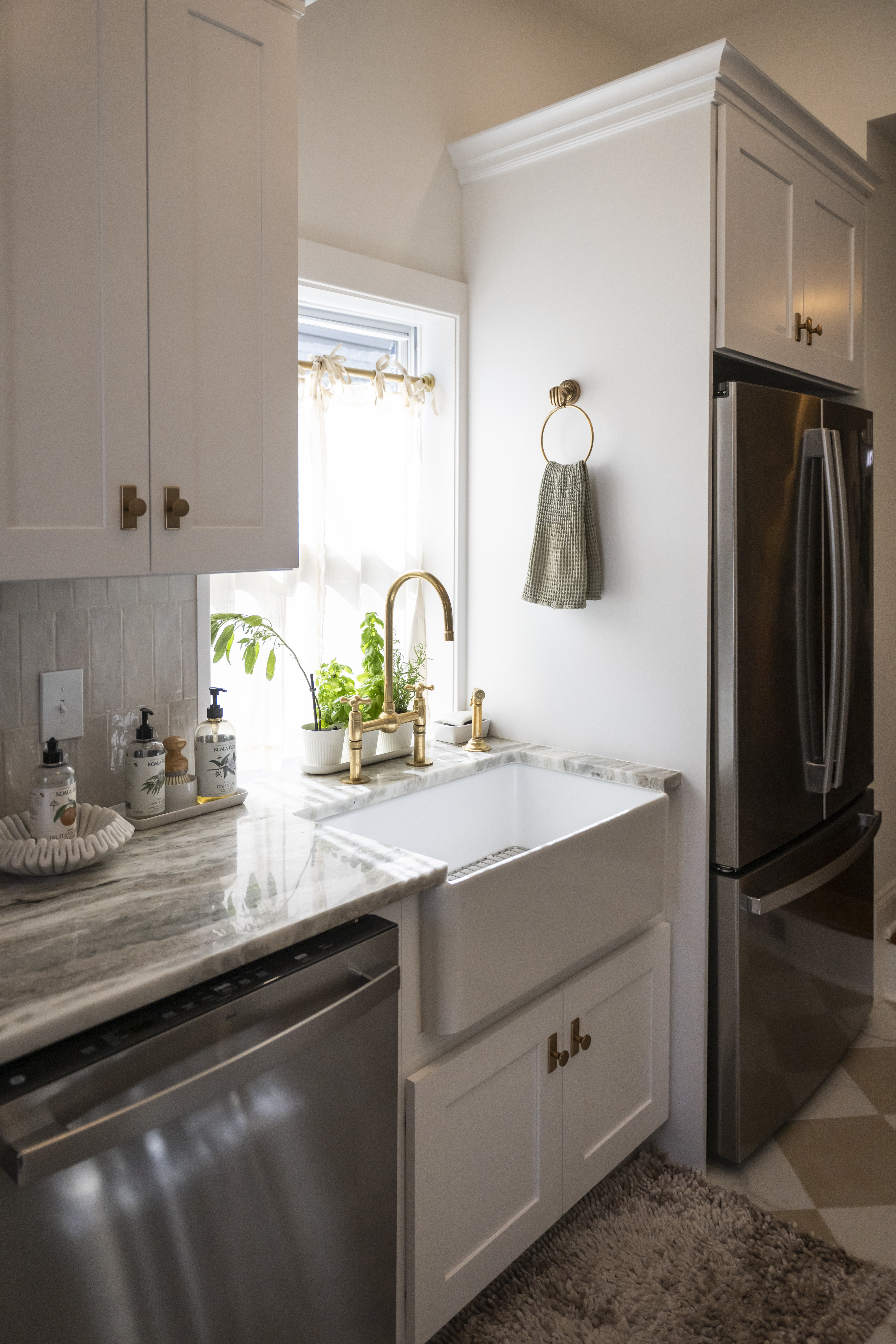
    A large sink and gold details in the kitchen, which was an important space as La Reau loves to cook and bake.

    Throughout the home, splashes of bright color against muted fabrics and warm wood furniture create a layered but cohesive atmosphere.

    “Artwork collected from my travels is thoughtfully placed in each room, allowing every space to tell its own story while still flowing together as a whole,” La Reau said.

    She feels right at home in her community.

    The exterior of Nicala La Reau’s home.

    “The walkability to Frankford Avenue is unbeatable‚” she said. With its evolving culinary scene, she noted, there seems to always be a new restaurant or bar to check out.

    “But beyond that, there’s a neighborliness here — you see people out walking dogs, saying hello, and looking out for one another,” said La Reau. “Fishtown has a balance of growth and rootedness that feels like somewhere I can grow into long term.”

    Is your house a Haven? Nominate your home by email (and send some digital photographs) at properties@inquirer.com.
  • House of the week: A custom-built four-bedroom house in Bucks County for $799,999

    House of the week: A custom-built four-bedroom house in Bucks County for $799,999

    Joann Spatola and her then-husband were living in a Horsham townhouse in 1990 when builder Nicholas Braccia came to them with a proposition.

    He knew of a vacant piece of land near the Chalfont pizzeria the couple owned that would be the perfect place for a contemporary home they could help design.

    “We’d only been married two years, and we wanted something of our own,” she said. So she and Braccia went over blueprints and basically designed the house together.

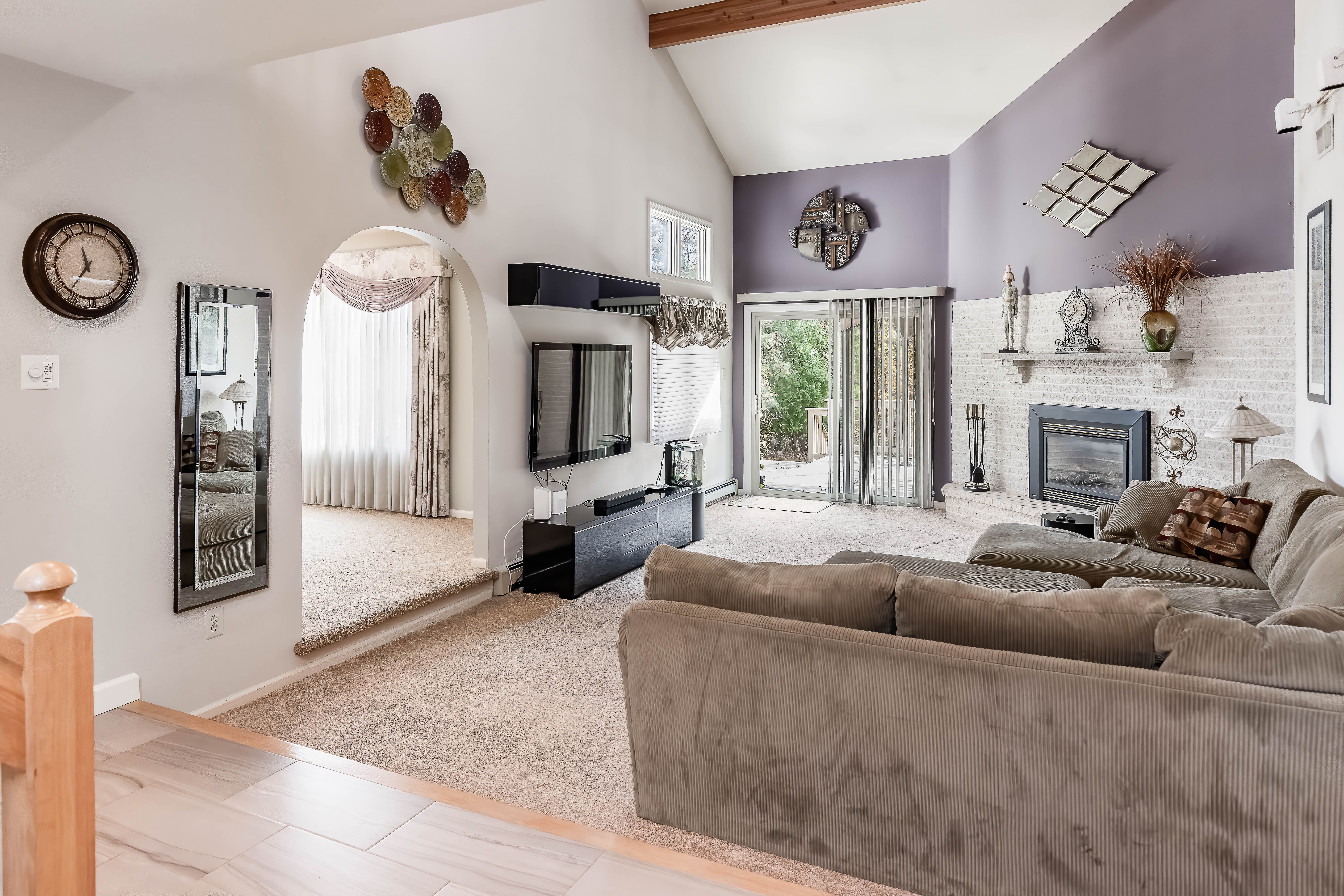
    The great room.

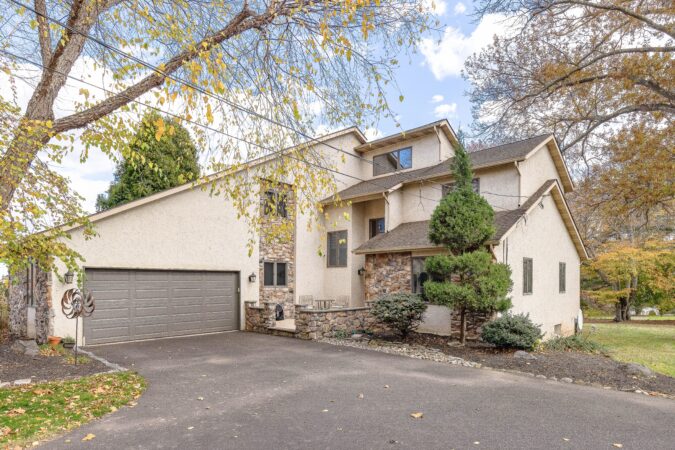
    She has spent 35 years in the four-bedroom, 3½-bathroom home.

    But she is single now, and her kids are grown, so she is ready to downsize to an over-55 community in North Wales.

    The house “has good bones,” she said. “They don’t make them like that any more.”

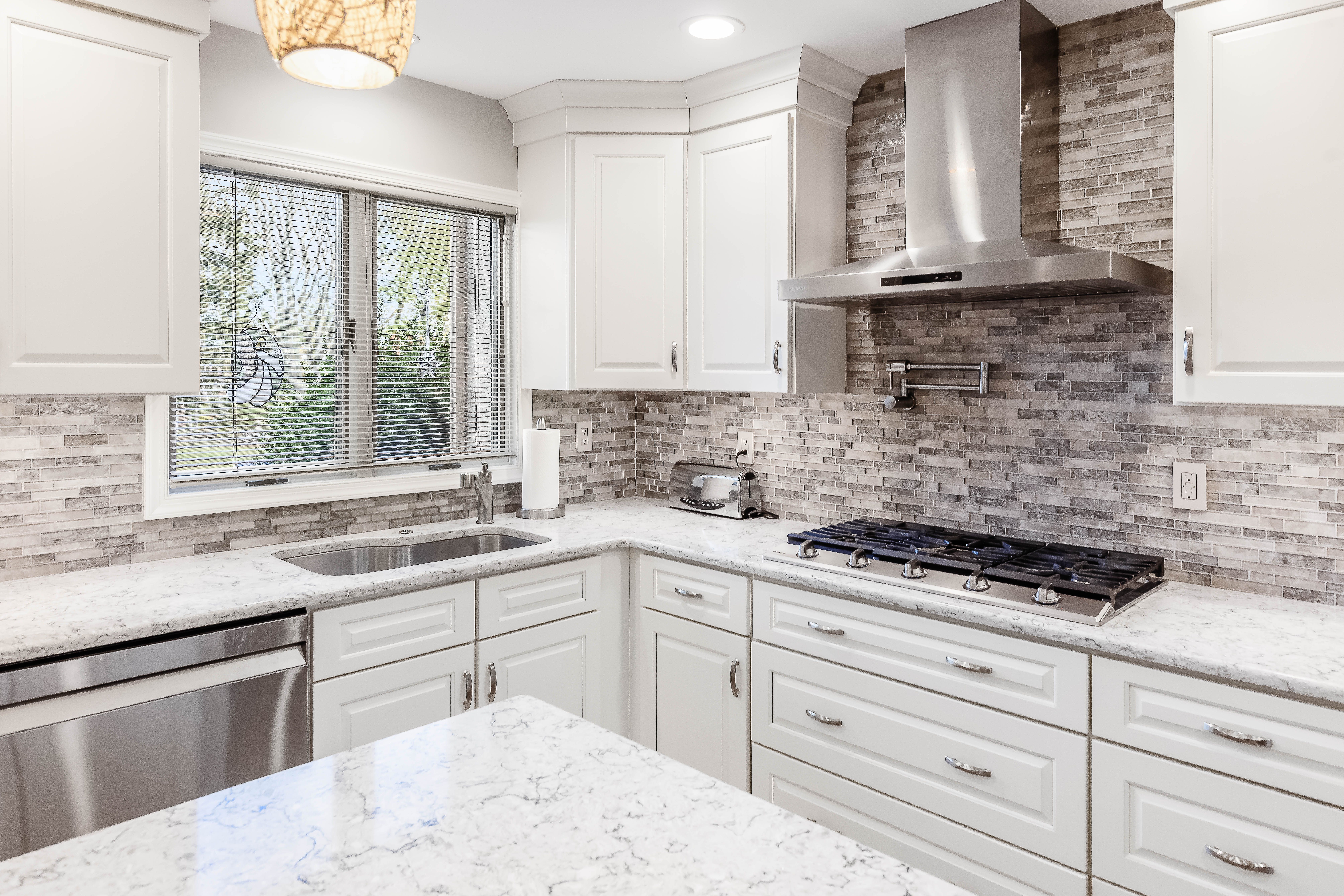
    The kitchen was redesigned five years ago.

    And she is particularly sad to lose the kitchen she helped design five years ago, with its quartz countertops and stainless steel appliances. “But it’s too much upkeep for me,” she said.

    The house has 2,671 square feet and is three stories, including the finished basement, which has been used as a home gym and includes a half bathroom.

    The dining area off the kitchen.

    The first floor has two bedrooms, a great room with a vaulted ceiling, the kitchen and dining room, and a full bathroom.

    The second floor has the primary bedroom and bathroom, with the main closet in the bathroom, as well as a double-bowl vanity and sunken bath tub. There is another bedroom and bathroom on this floor. And there is a walkout attic.

    The deck overlooks a large, landscaped yard with a gazebo.

    Dining room

    All mechanicals have been updated.

    The house is close to parks, schools, and shopping. It is in the Central Bucks West School District.

    It is listed by David Dupell of Coldwell Banker Realty for $799,999.

  • A 29-year-old found his forever home in Point Breeze for less than $400K | How I Bought This House

    A 29-year-old found his forever home in Point Breeze for less than $400K | How I Bought This House

    The buyers: Cameron LaFreniere, 29, software engineer

    The house: a 1,260-square-foot rowhouse in Point Breeze with three bedrooms and 2½ baths, built in 1925.

    The price: originally listed for 350,000; sold for $340,000

    The agent: Rachel Shaw, Philly Home Girls

    The ask: Cameron LaFreniere was looking for a new city to call home and wanted to escape the stress of renting. Originally from Rhode Island, he considered settling down in Providence, but decided on Philadelphia because “the prices are significantly lower,” he said. It’s also easier to get around without a car, which was important to him.

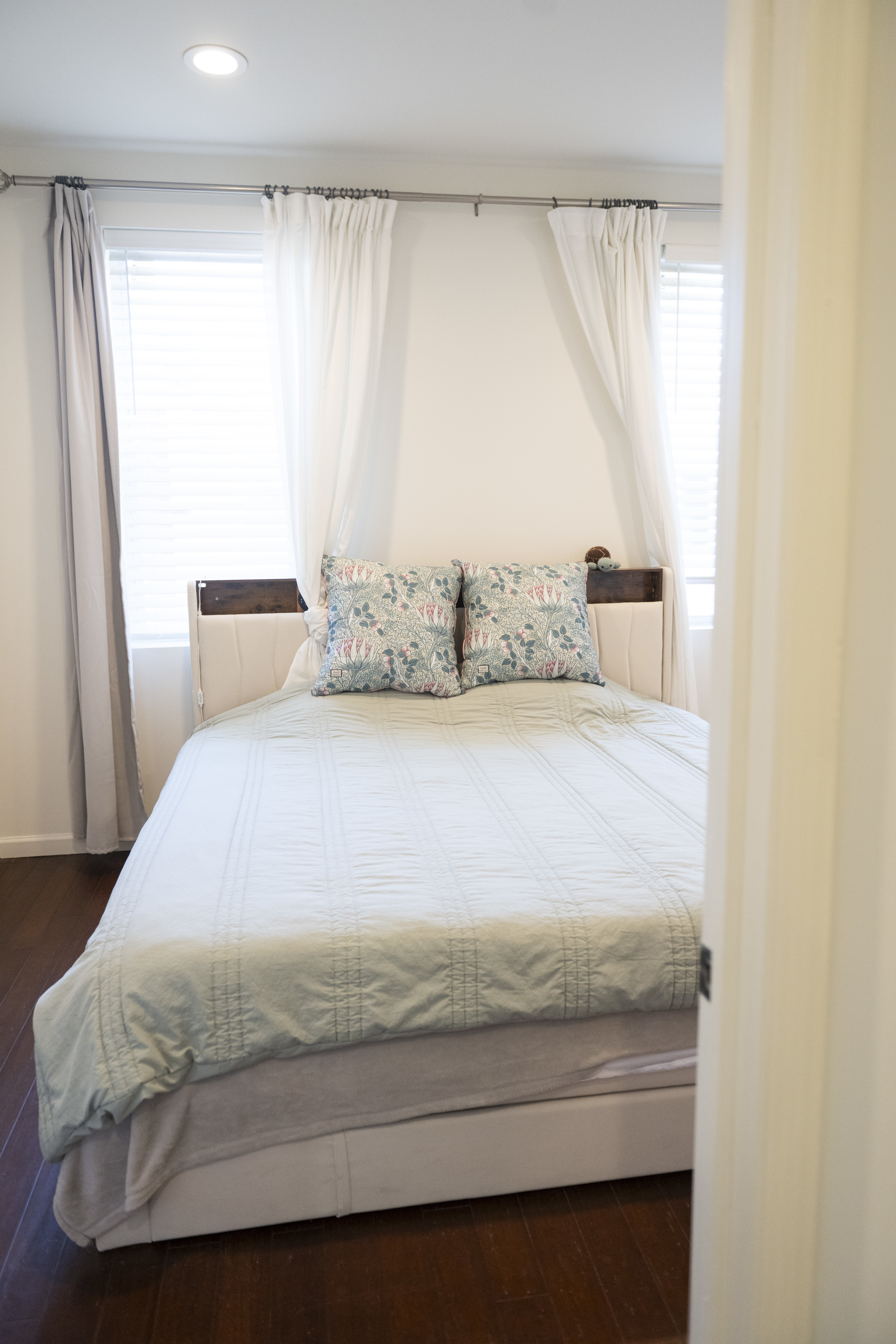
    The primary bedroom at Cameron LaFreniere’s home in Point Breeze.

    He wanted a house that could be big enough for a family one day. “Basically something that could be a forever home if I wanted it to be,” he said. His budget was between $275,000 and $400,000, and he was only interested in historic rowhouses.

    “I would much rather have an old build that’s well taken care of,” said LaFreniere, “because they’re often much more cost-effective in terms of maintenance.” He wanted something recently updated with multiple bathrooms, space for a home office, and within biking distance of Center City.

    The search: LaFreniere began his search in December 2024 and spent months scouring South Philly for the perfect place. “I probably walked at least a third of South Philly,” he said. “I just really wanted to get a feel for the area. It’s one thing to look at something online; it’s another to experience it for yourself.”

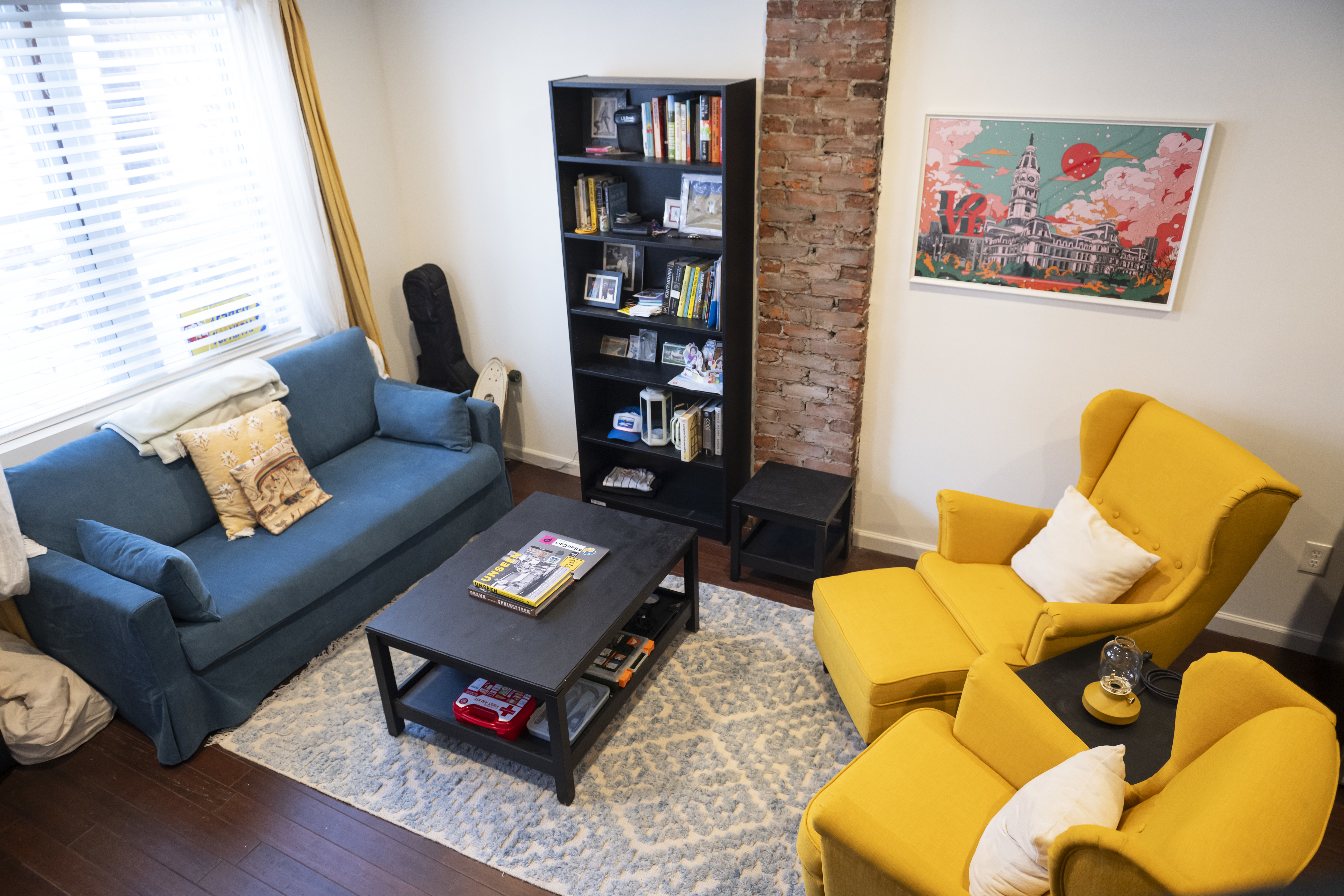
    LaFreniere outfitted the living room with all new furniture.

    Across multiple weekend trips, LaFreniere looked at 25 properties, including eight on the final day of his search. He looked at a few places in Wharton Square and one in Graduate Hospital. He also saw one that was one street over from the house he ultimately bought — it cost $20,000 more. “It had nicer floors and was staged,” he said. As for the house he wanted, “there wasn’t much competition,” LaFreniere said.

    Or it may have something to do with its location. “Point Breeze is a balanced market,” said LaFreniere. “There is a good amount of supply and places being fixed up. It’s a first-time buyer’s ideal situation.”

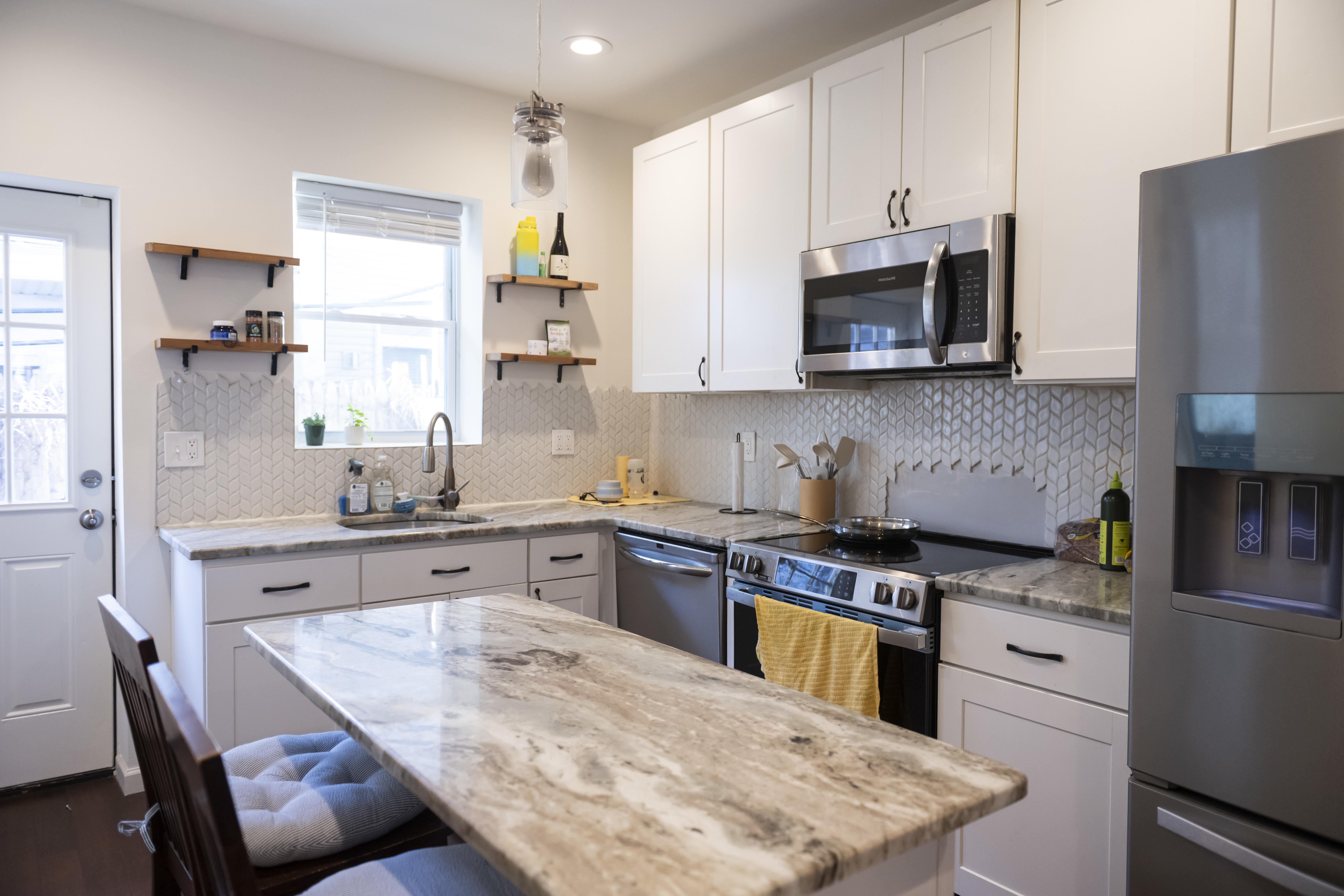
    One of LaFreniere’s favorite rooms in the house is the kitchen, which was updated in 2017.

    The appeal: LaFreniere liked that the house had been updated in 2017. It has central air and heat and the “quality of the kitchen is fantastic,” he said. At the same time, it still has several of its original features, like the staircase. “It’s the best of both worlds,” said LaFreniere.

    The deal: On the afternoon LaFreniere visited, the seller had just dropped the price by $10,000. He decided he wanted it a few hours later and offered the new asking price of $340,000. There weren’t any competing offers, and the seller accepted.

    LaFreniere was concerned about the floors, which he described as “a little beat up,” and asked for money to replace them. The seller said no but agreed to cover $3,000 of whatever issues the inspection turned up.

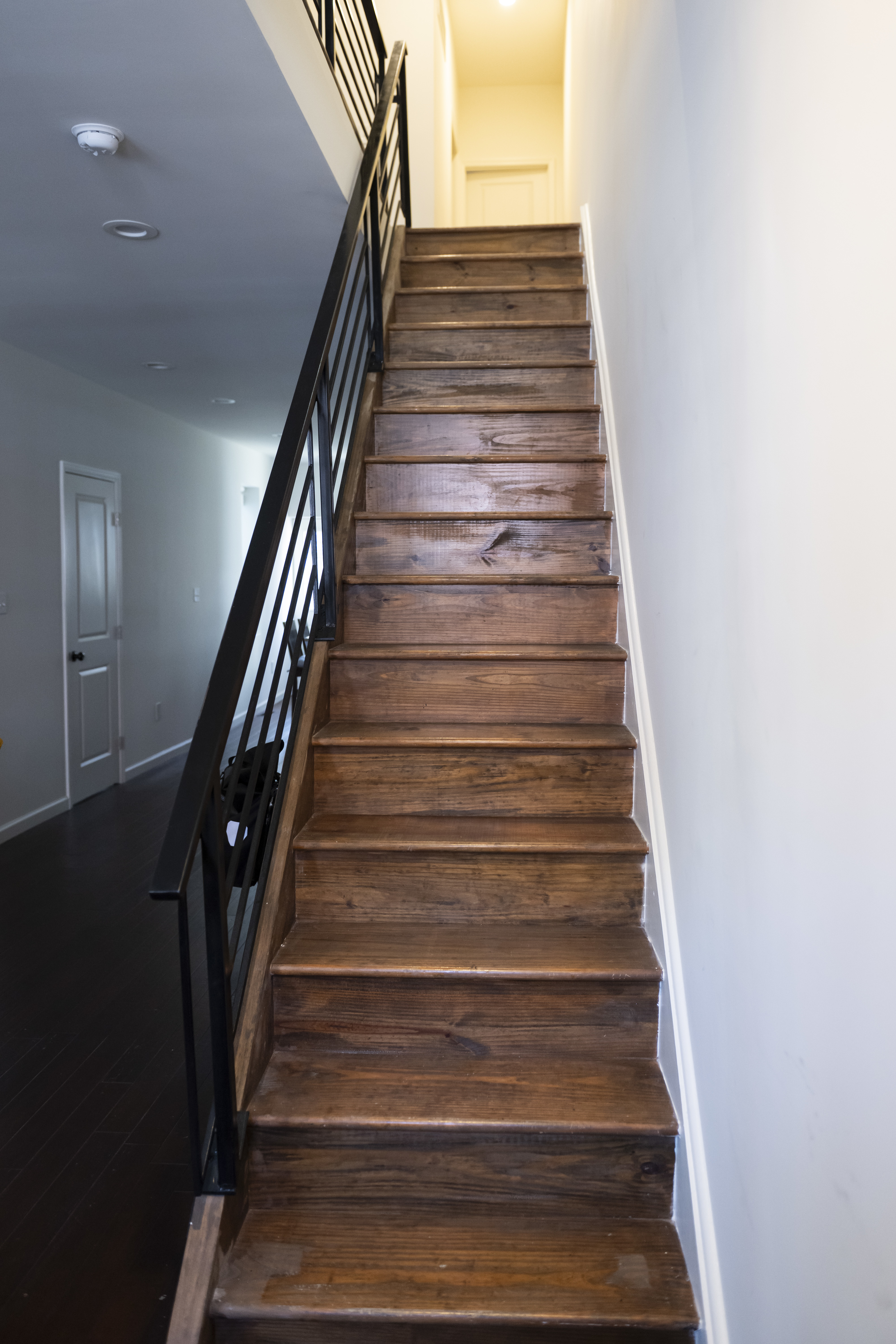
    LaFreniere’s house features original details like the wooden staircase in the living room.

    The money: LaFreniere had $30,000 to spend on the purchase of his home. “I saved this from working in a tech career for the past six years,” he said. It wasn’t always easy. He had significant student loans to pay off as well. To help keep costs down, he lived with roommates.

    Of that $30,000, LaFreniere used $10,200 for a 3% down payment. Because he lived in an eligible census tract, he qualified for community reinvestment financing through OceanFirst’s HelpingHome loan, which allowed him to skip private mortgage insurance and lowered his interest rate from 7% to 6%. It also covered $6,000 of his closing costs.

    The move: LaFreniere didn’t want to lug a bunch of stuff to Philadelphia from Providence, so he donated most of his furniture and half his belongings to local charities and thrift stores. He didn’t hire movers or rent a car. He took the train instead. Come moving day, all he had was a suitcase full of clothes and his bicycle, which he brought with him on the Amtrak. He moved in on June 25.

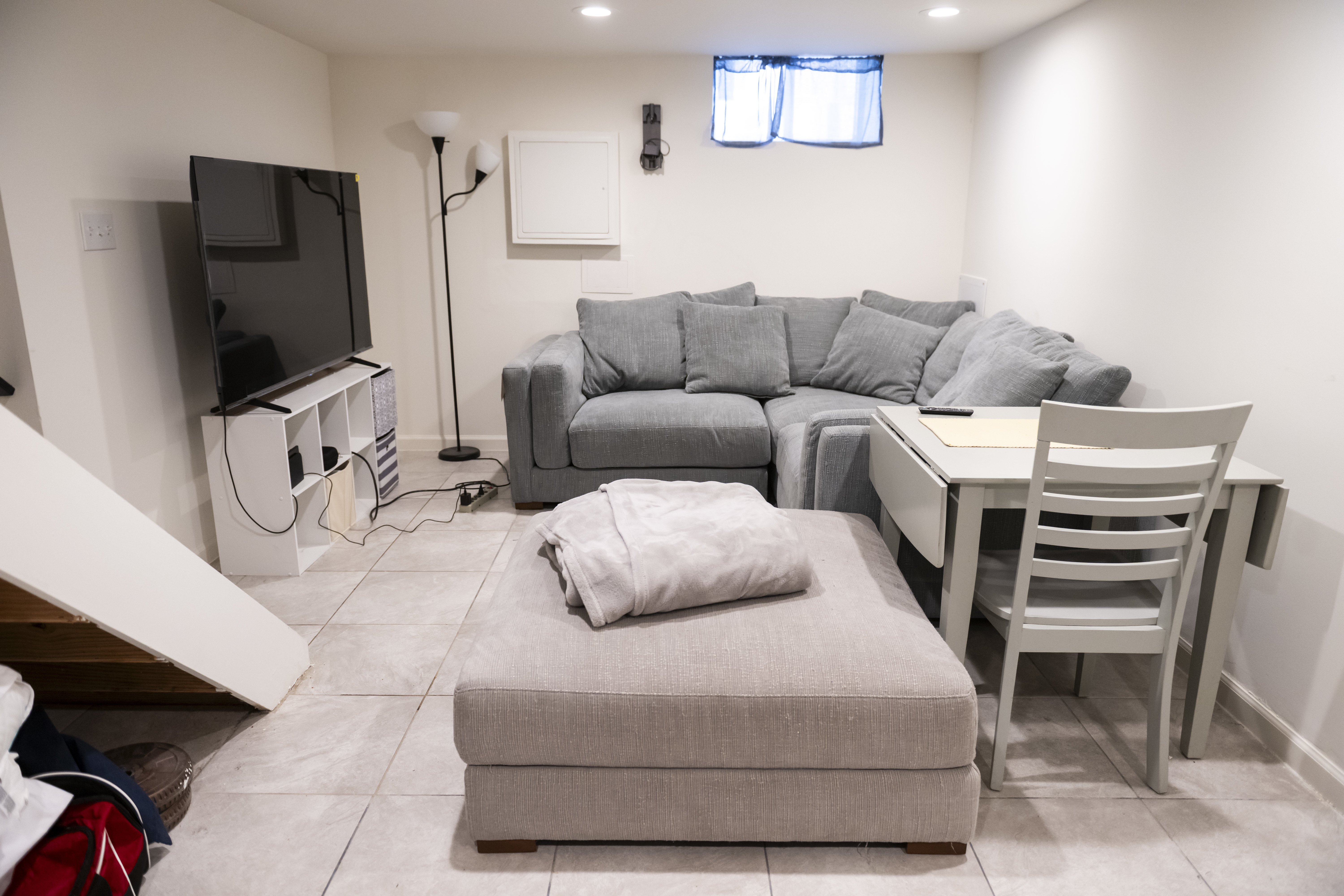
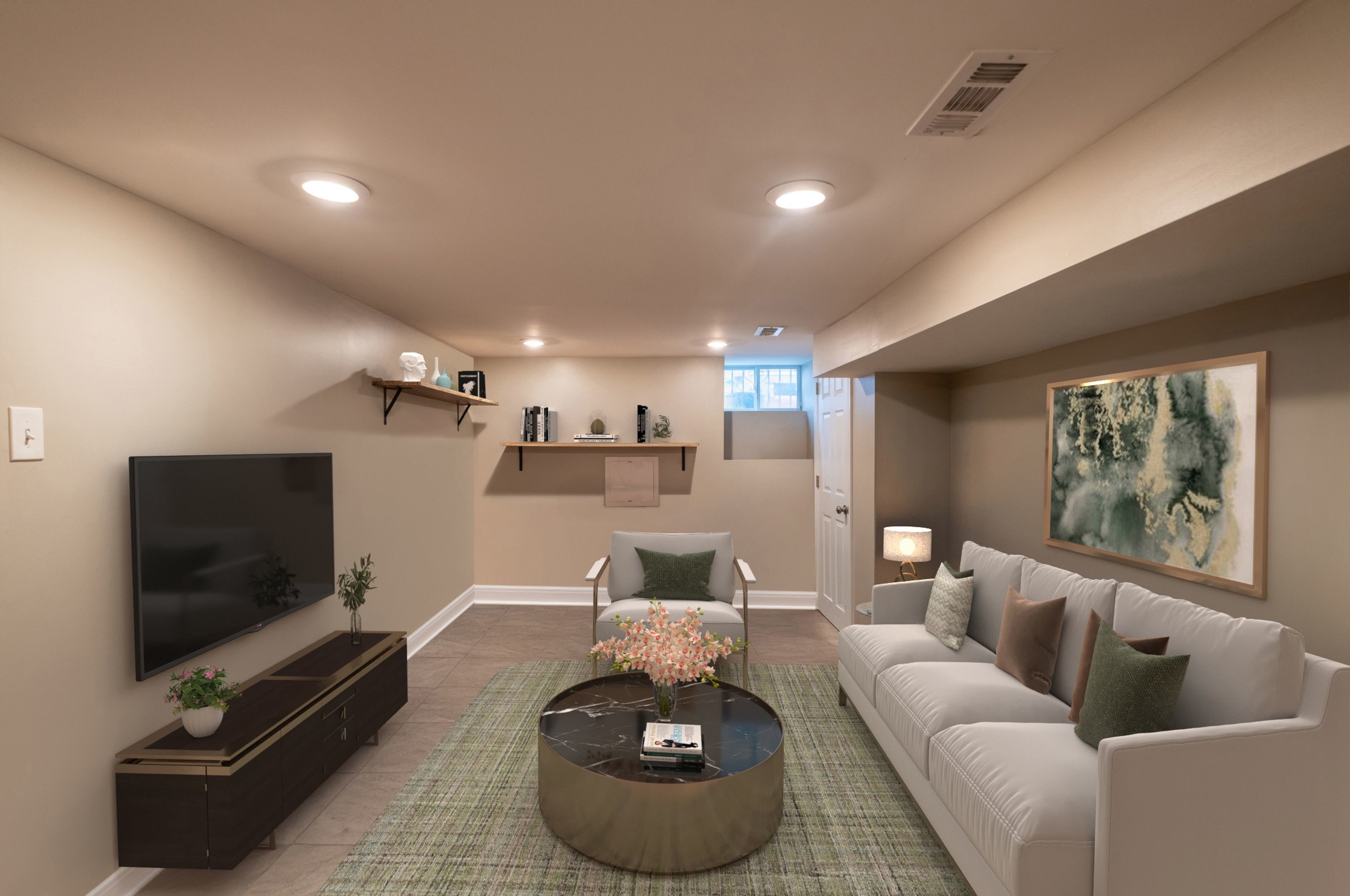
    The basement, also known as the “man cave” at Cameron LaFreniere’s home in Point Breeze.

    Any reservations? LaFreniere says he doesn’t have any regrets. “I knew what I was getting into,” he said. Certain parts of homeownership, like “how to do the trash,” were new to him but didn’t take long to figure out. The only thing he has had to contend with since moving in is cockroaches. But that was just once. “No recurrent pest problems,” he said.

    Life after move: LaFreniere spent the last of his savings, about $10,000, on furniture. “I basically moved with nothing,” he said, “and then bought everything at Ikea.” He thought about redoing the floors but decided against it. The rugs and furniture cover the imperfections.

    Did you recently buy a home? We want to hear about it. Email acovington@inquirer.com.

  • A ‘1980-esque’ Bryn Mawr home got a big renovation

    A ‘1980-esque’ Bryn Mawr home got a big renovation

    When Steven Peikin and Amy Spicer moved back to the Philadelphia area in late 2023 after spending 2½ years in Florida, there weren’t many houses on the market. So when Peikin discovered a 4,100-square-foot, two-story home in Bryn Mawr on a solo trip, he convinced Spicer that he’d found the perfect home.

    “She saw the pictures online,” recalled Peikin, a gastroenterologist at Cooper University Health Care. “I saw it on a Thursday and was told there could be no contingency or inspection, there were four other bidders, and I had to have our best offer in by Sunday.”

    He took the plunge and bought the house, but when Amy saw it, she wasn’t completely sold. She felt the house was dated and she couldn’t get past the yellow exterior.

    “When I saw the inside of the house, it was very 1980-esque and needed considerable remodeling,” said Amy, a pharmaceutical sales rep for Madrigal and a yoga instructor. “Steve found it very charming, but I saw it as my 97-year-old grandma’s house.”

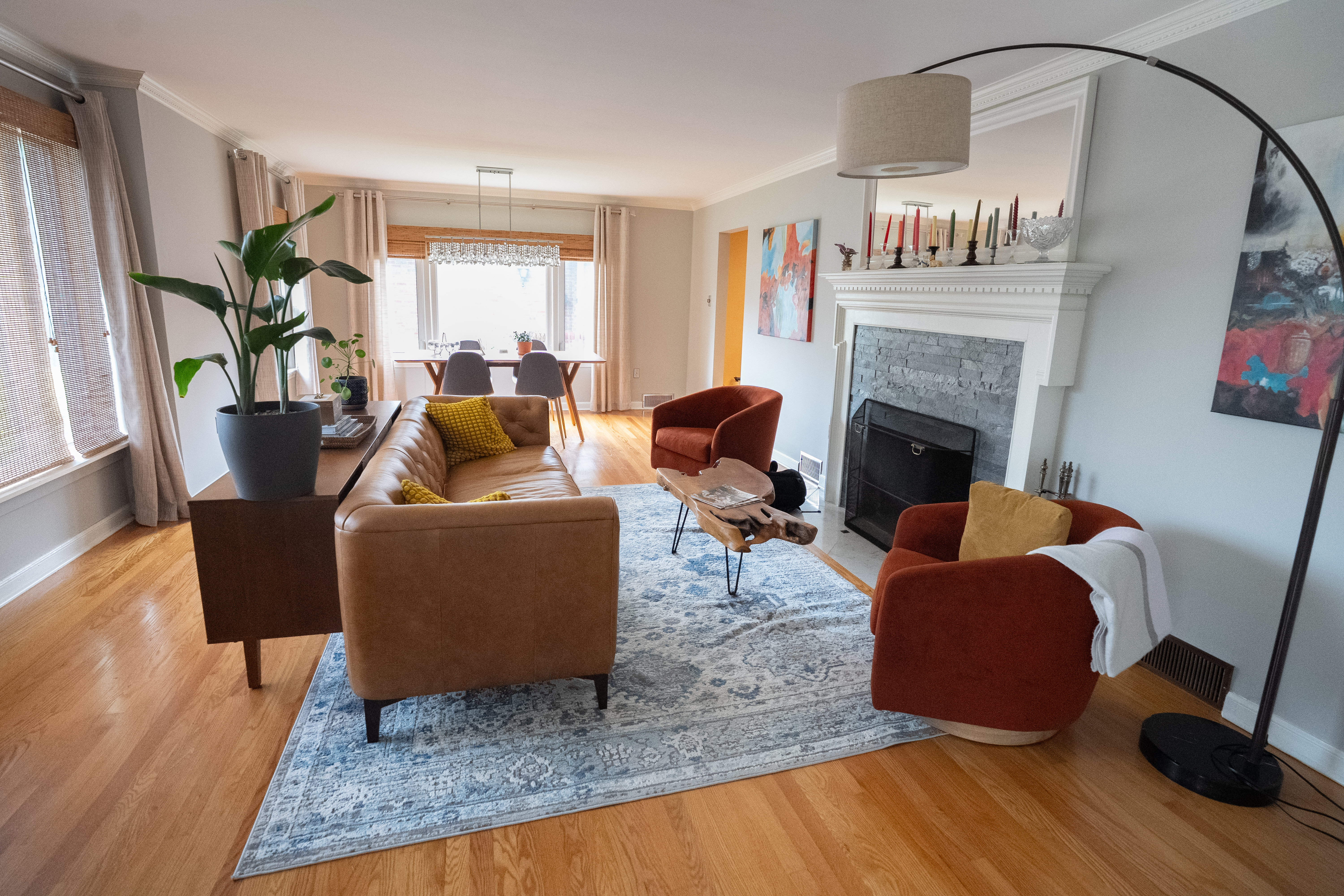
    Steve Peikin and Amy Spicer’s living room was one of the spaces they updated in renovations.
    The kitchen and dining area, which looks out on the backyard.
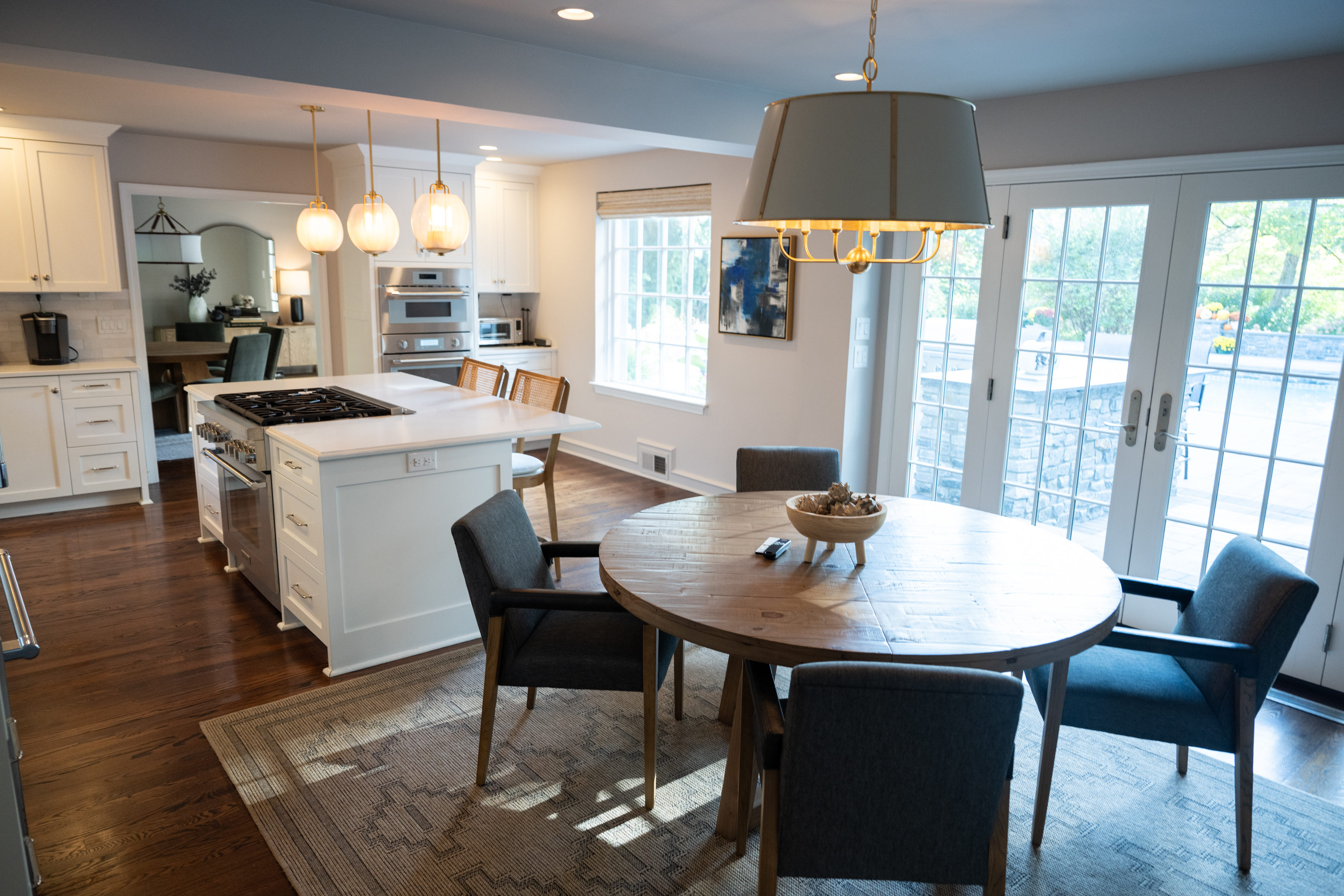
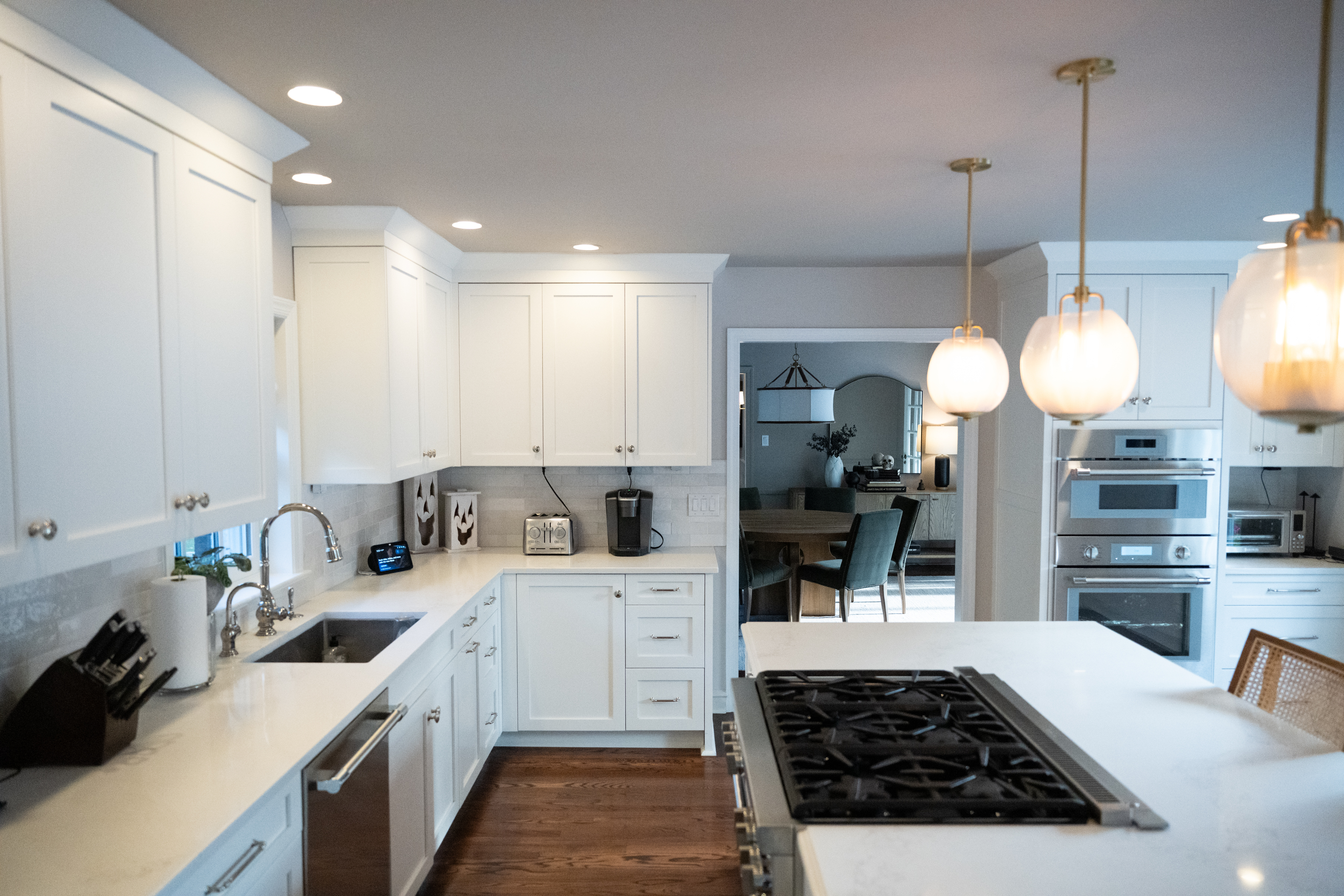
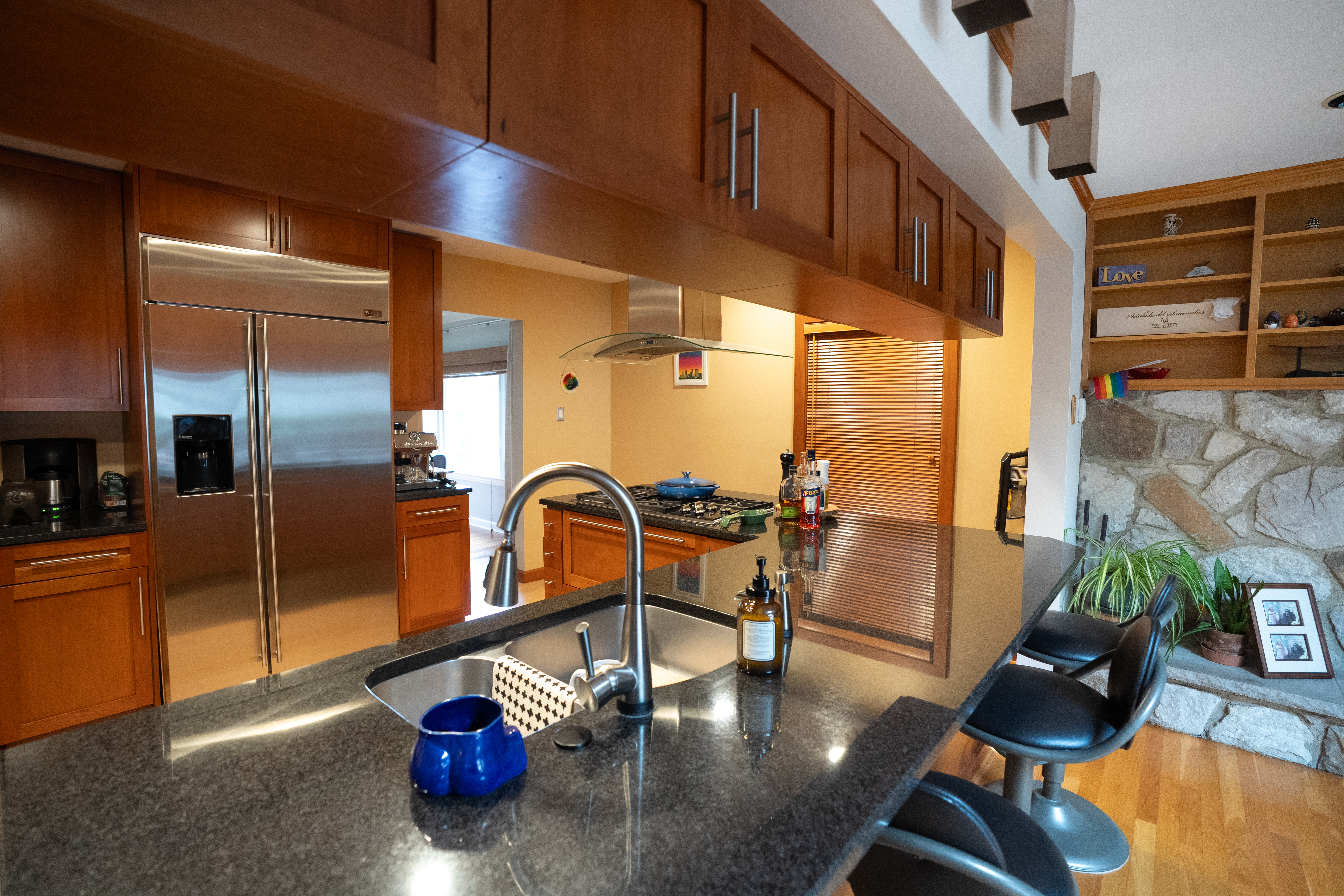
    The renovated kitchen features Thermador appliances and a stone island with a built-in stove.
    Decor in the den.

    The compromise was to make changes that would satisfy them both. The couple stayed in Airbnbs during a four-month renovation, and moved into the home in the spring of 2025.

    With the help of Christina Henck from Manayunk-based Henck Design, they created a cozy, updated English Country style home in warm browns and neutrals.

    “The house was very formal but we created a more natural, laid-back feel,” said Peikin.

    They painted the exterior brownish gray, updated the bathrooms, created a dedicated laundry room, and added architectural elements to the living room and family room.

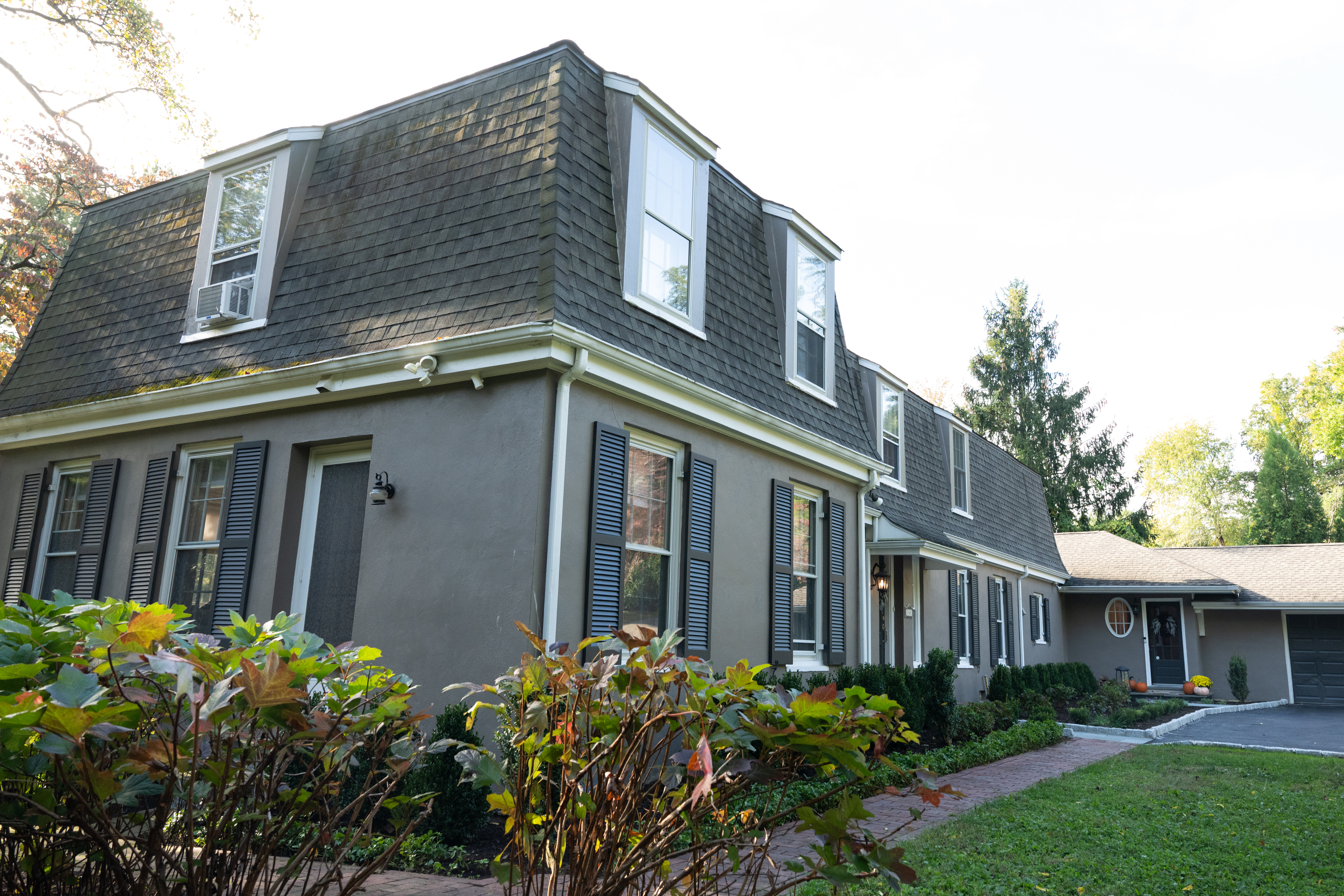
    The outside of the home, which was once yellow, was painted after Spicer and Peikin moved in.

    Those included custom bookshelves, a new metal mantle for the wood-burning stove, and extended ceiling beams. They also replaced all of the original lighting with a combination of recessed lighting and fixtures, swapped out the window treatments, updated the HVAC system, and added pavers to the backyard.

    “Steve has a living room and I have a den,” said Spicer. “Mine is very calm and peaceful and his feels refined and sophisticated.”

    Parts of the house had been renovated a couple of years earlier after a tree fell on the house, resulting in a new kitchen, primary suite, and roof.

    Spicer’s son, Austin, 23, is currently living with the couple. He and his mom enjoy cooking together in their spacious kitchen featuring Thermador appliances and a stone island with a built-in stove. A second stove sits under the microwave. When weather permits, Peikin grills outside and they eat on the patio.

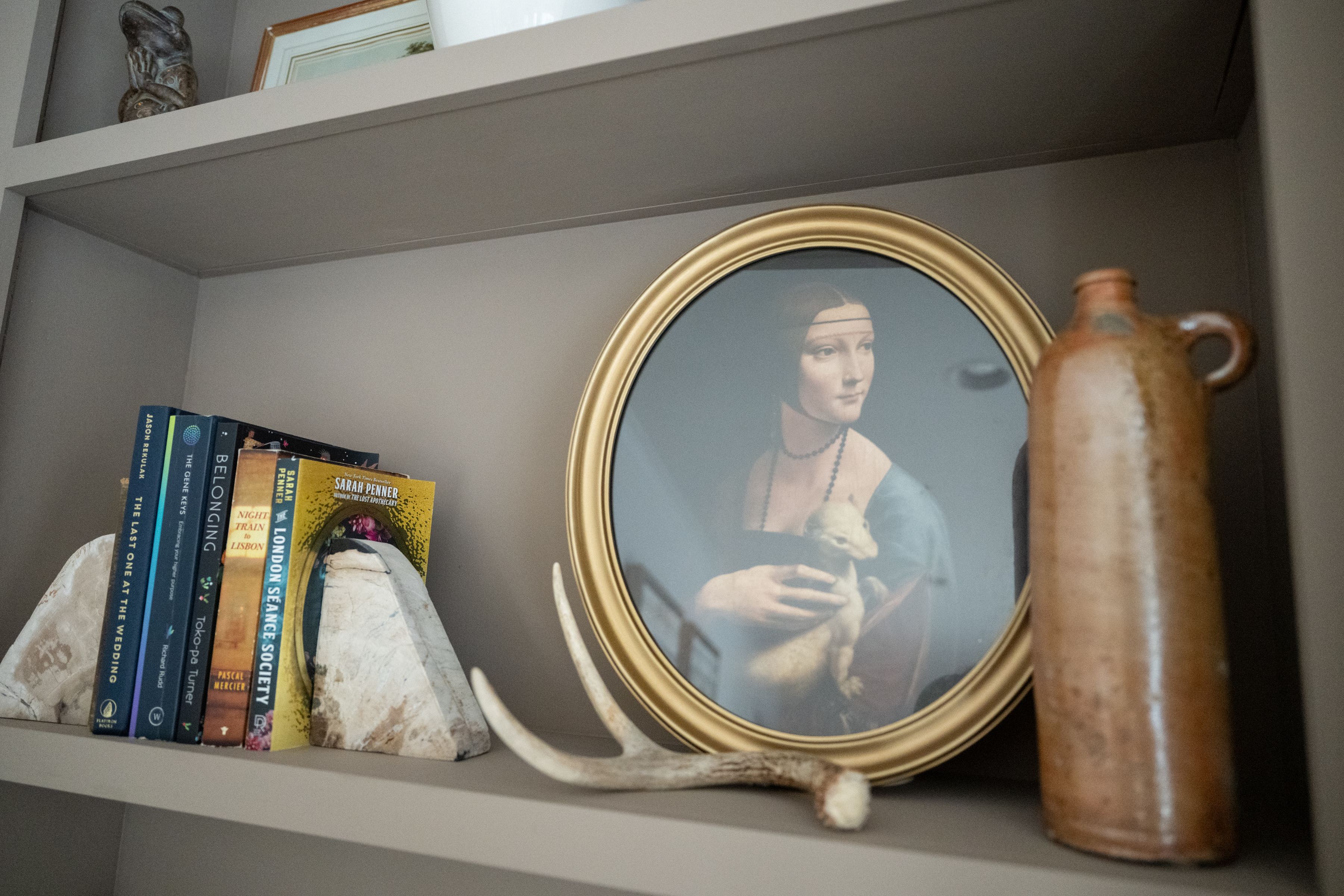
    A reprint of the painting “Lady With an Ermine” by Leonardo da Vinci is pictured on a shelf in the den.
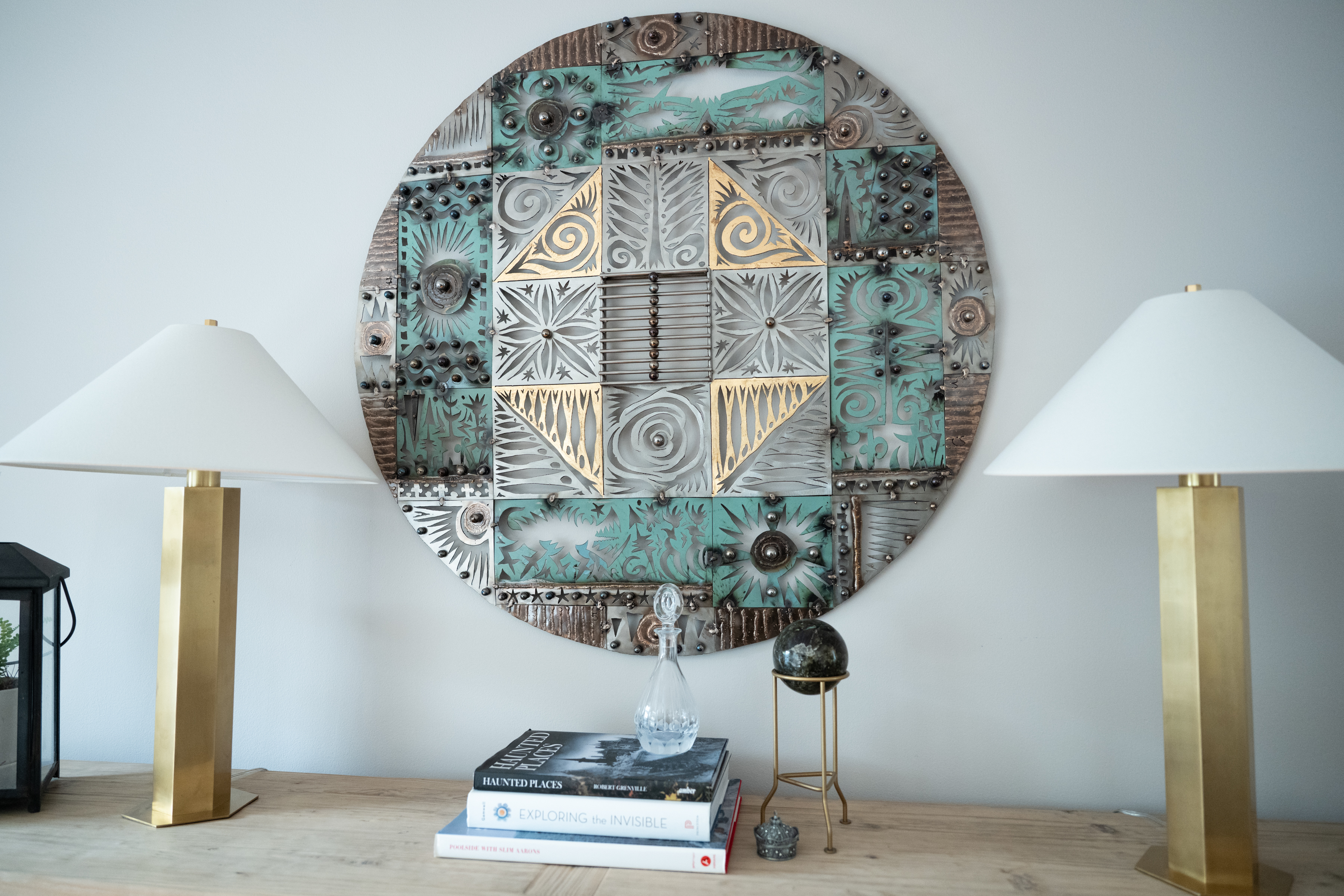
    Metal wall decor hanging on the wall of the den.
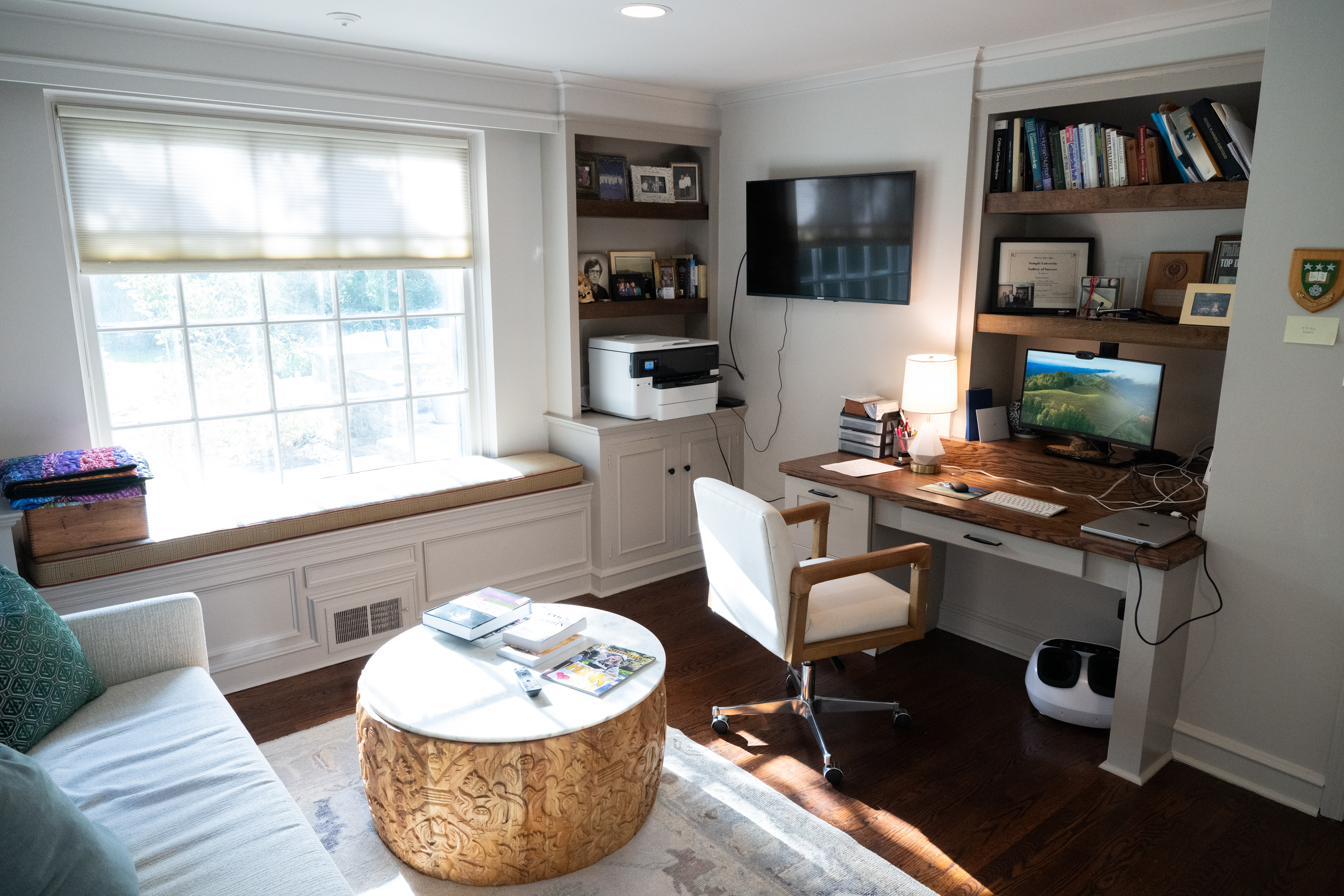
    Steve Peikin’s home office. When they bought the home, the couple wanted space for two home offices.
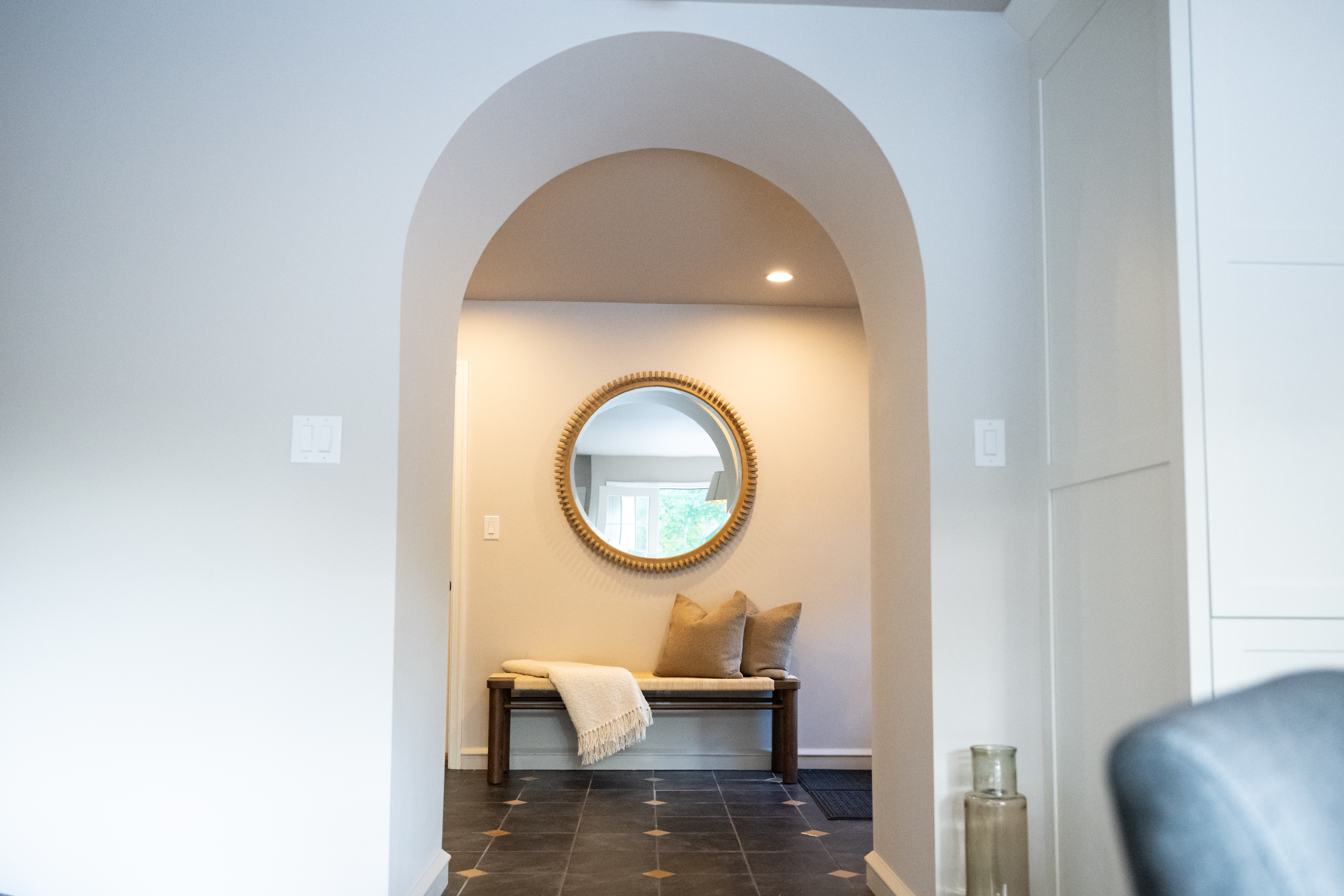
    The mudroom and arched entryway.

    The mudroom off the garage leads to the kitchen through an arched passageway which may have been an addition to the original house built in 1950, Peikin said. The mudroom floor features black and gold tile and a huge inlaid wooden chest that they call the Narnia cabinet — akin to the one in the fantasy novel The Lion, The Witch and The Wardrobe — sits against one wall.

    The primary bedroom suite includes a large window overlooking the tree-lined property.

    “You can watch the deer and other animals in the backyard,” said Spicer. “While our home in Florida was lovely because we stared at water, it was loud. Here it’s quiet and just beautiful.”

    Peikin and Spicer each have dedicated offices. He refers to his first-floor office as his studiolo, which during the Italian Renaissance was a place of study and contemplation. He meets with telemedicine clients there, but it’s also where he watches ballgames and hangs out.

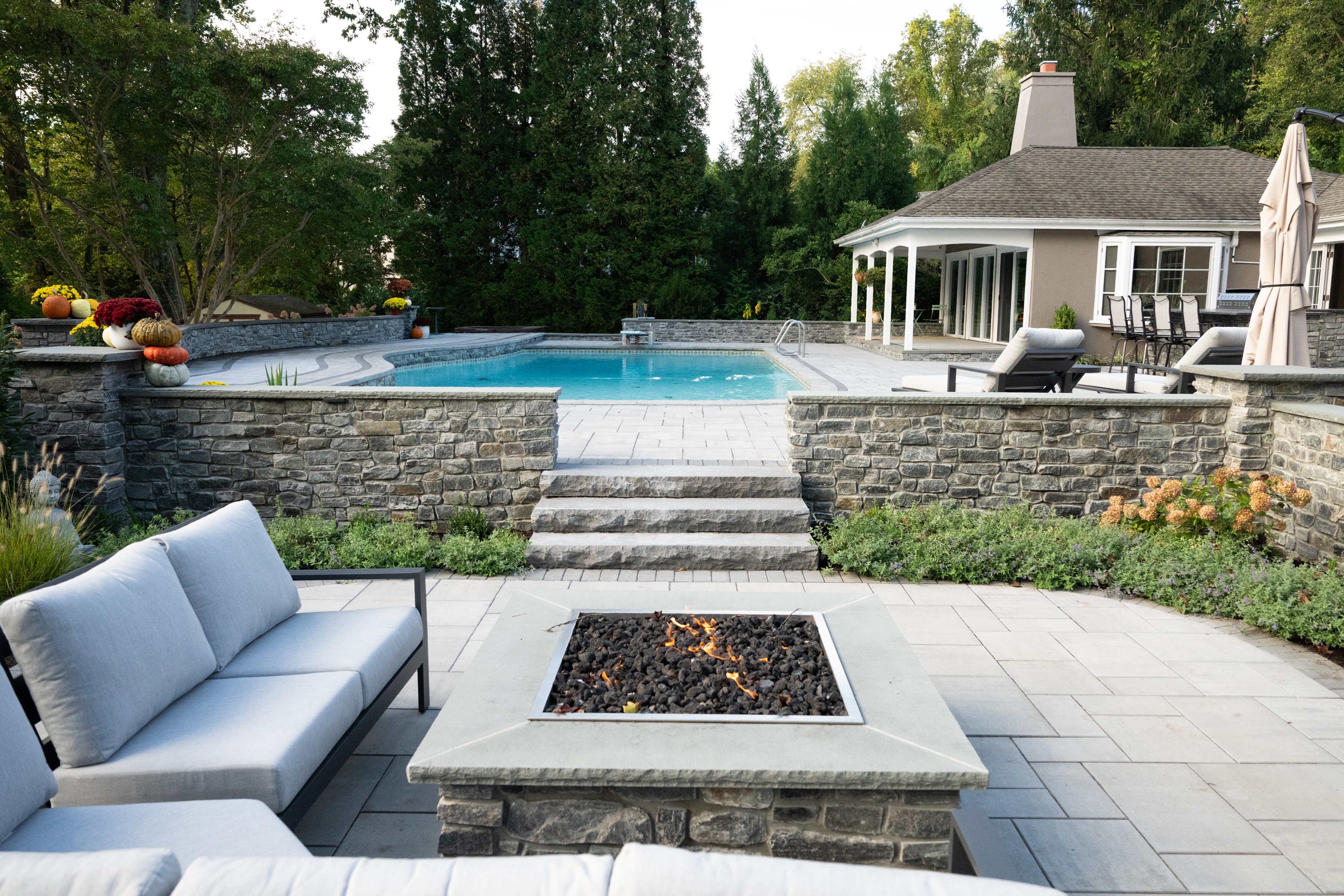
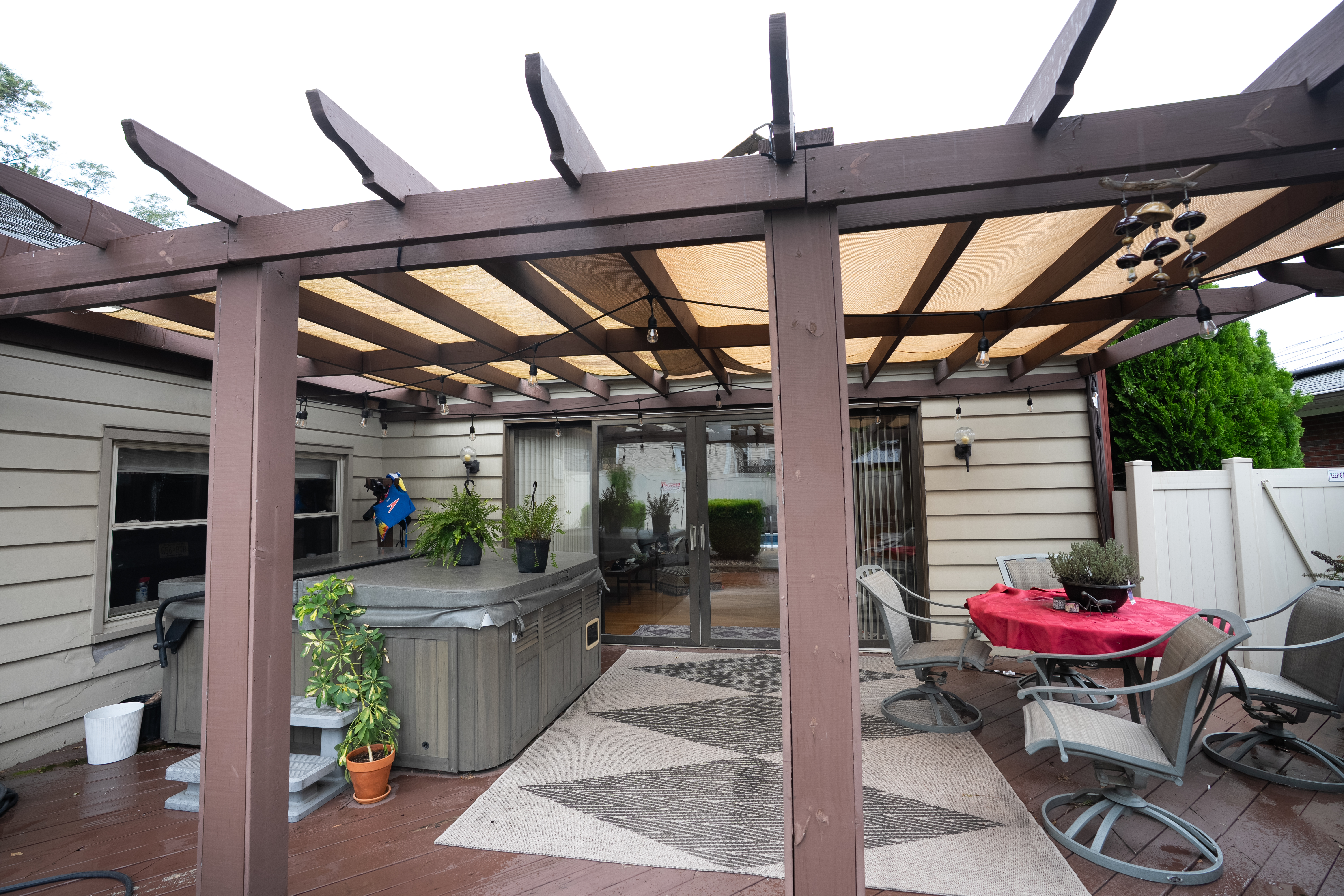
    The backyard, where the couple enjoy swimming, barbecuing, and relaxing.

    Spicer’s office includes an altar featuring a Buddha, a space where she meditates and which she uses as a backdrop for the online yoga classes she teaches.

    The backyard is where the family spends as much time as possible, swimming, hanging in the hot tub, lounging by the pool, warming up at the fire pit, or barbecuing. With help from All Seasons Maintenance & Design, Melady Landscaping, and Bloom Design, they created a cozy, inviting outdoor retreat.

    “The best part of living here is that we are surrounded by a bamboo forest and tall trees, with beautiful crepe myrtle, dogwoods, and magnolias, and we have deer and lots of birds,” said Peikin. “We love the outdoors.”

    Is your house a Haven? Nominate your home by email (and send some digital photographs) at properties@inquirer.com.
    The outdoor kitchen, where Spicer and Peikin prefer to cook dinner when the weather allows.
    Steve Peikin and Amy Spicer pose for a portrait in their backyard.
  • House of the Week: a Passyunk Square home with a famous neighbor for $455,000

    House of the Week: a Passyunk Square home with a famous neighbor for $455,000

    Rebecca Procopio was attracted to the walkability of the two-bedroom, 1½-bathroom home to the eateries, “the vibrant energy,” and other attractions of Passyunk Square.

    But after buying it in 2023, she took particular delight in the view from her front porch of the studio of renowned mosaic artist Isaiah Zagar.

    “I’ve always felt drawn to the unique,” said Procopio, referring to both to the neighborhood and the house. The home “felt a lot more open than the other homes I looked at.”

    Her fiancé, Tyler Griffiths, joined her there last year. But the couple is now headed for Chicago where she has a new job in her field of genetic counseling.

    Primary bedroom

    The house is 1,036 square feet and four stories, including the finished basement.

    The main floor is open concept, with hardwood floors in the living room, dining area, kitchen, and half bathroom. The living room also features an exposed brick wall.

    The kitchen has updated cabinetry, stainless steel appliances, and a marble countertop.

    Kitchen

    The two bedrooms have ample closet space and large windows, letting in plentiful natural light.

    The second bedroom has been serving as a combination guest room and home office.

    Guest bedroom/office

    The primary bathroom has a contemporary design, with ceramic tile and a large shower.

    The basement can be used as a family room, home office, or gym, in addition to storage space and a laundry area with a washer and dryer.

    Basement

    The property has a private outdoor space.

    Public transportation is easily accessible.

    The house is listed by Nancy Alperin of Maxwell Realty Co. for $455,000.

  • Selling a piece of family history in a changing Ocean City

    Selling a piece of family history in a changing Ocean City

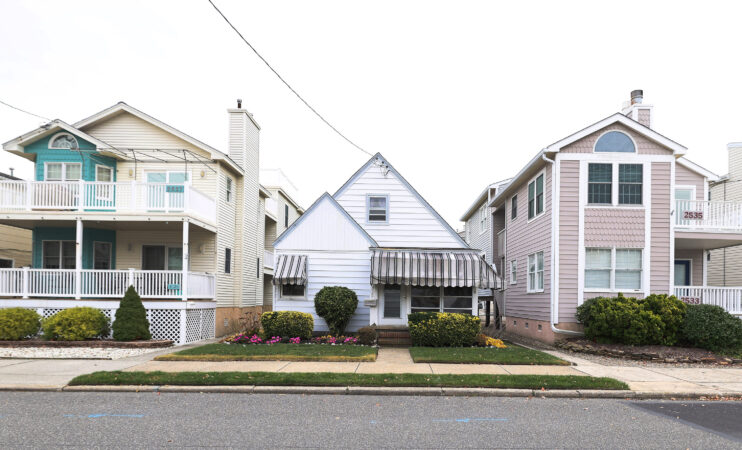
    The wrecking ball is likely coming for 2529 Asbury Ave. in Ocean City, a 957-square-foot, two-bedroom, one-bathroom postwar Cape Cod that’s been in the Smith family for 69 years. The Smiths know demolition is nearly inevitable, but they aren’t happy about it.

    “I’m hopeful somebody would keep it as is, but I think it will probably be torn down,” said David S. Smith, of Summit, N.J., a retired investment banker whose parents bought the house in the 1950s.

    There are currently 1,400 homes over 100 years old in Ocean City, and in 2024, 137 homes were demolished. Though specific details aren’t available about the age or condition of those razed houses, it is fair to say many were older and capable of being restored, said Bill Merritt, president and cofounder of Friends of OCNJ History & Culture, a group dedicated to embracing the rich, historic culture of Ocean City.

    “It’s economic driven, but also regulation driven,” he said. “Ocean City has long been a real estate developer driven place.”

    Over the years, R-2 zoning, which permits a mix of single-family and two-family dwellings, has driven up the number of duplexes.

    “The economics of that are that a single homebuyer wanting to buy an older home and fix it up, absolutely cannot compete against a developer who is going to knock it down and build a duplex,” said Merritt.

    The Smiths’ home went on the market in late October for $1.4 million. They instantly received many offers, mostly from developers.

    A house filled with memories

    Purchased in 1956 by Norman Sr. and Elizabeth Smith — affectionately known as Bole and Lib — for $13,500, the cottage was the summer gathering spot for the whole clan. That included their sons, Norman Jr., John, and David, and eventually four grandchildren and 10 great-grandchildren.

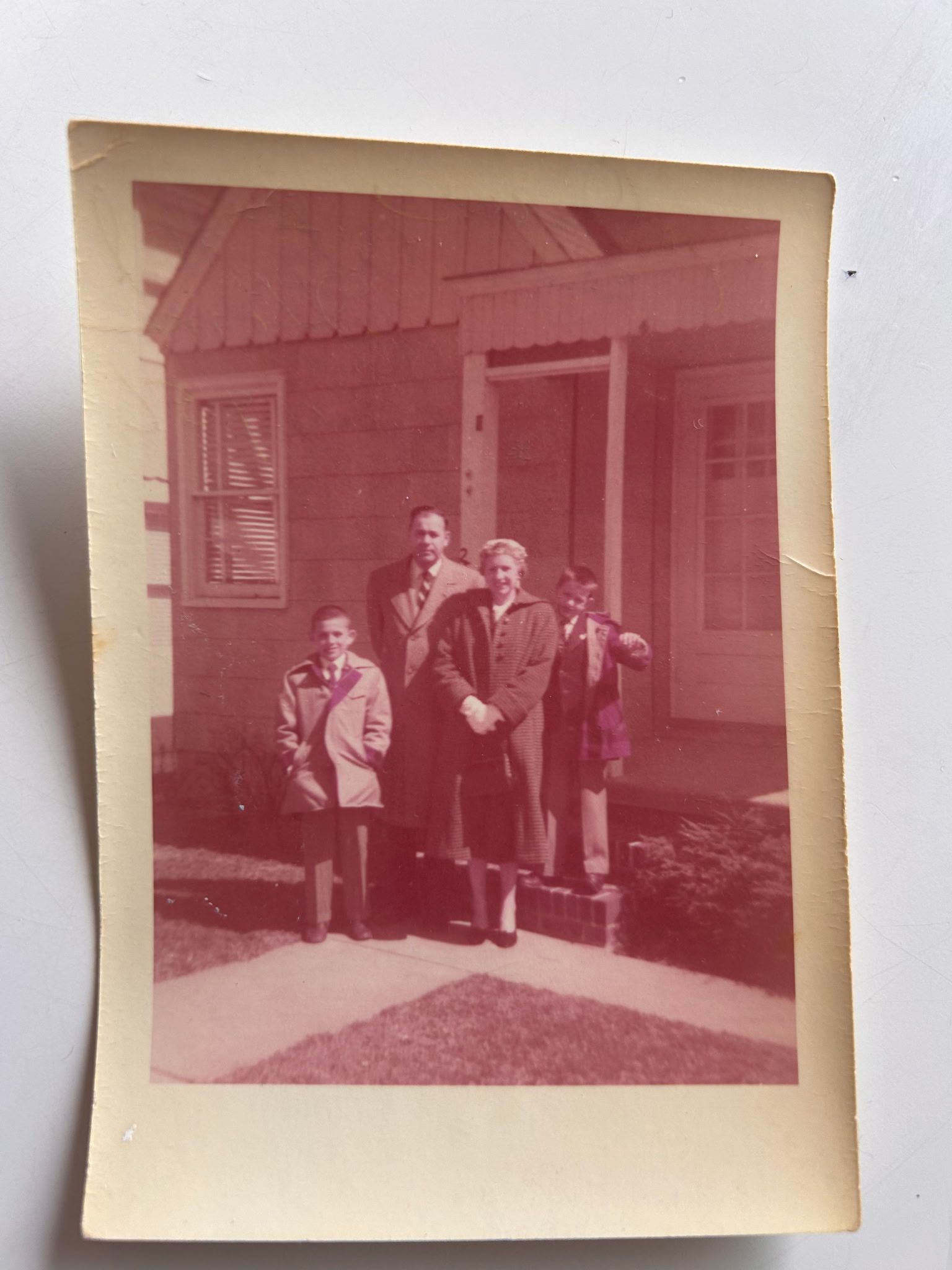
    A family photo of Norman Sr. and Elizabeth Smith and their sons John and David, taken in 1956 in front of 2529 Asbury Ave.
    David Smith and his uncle, David S. Smith, in the Ocean City home that’s been in their family for nearly seven decades.

    After Bole and Lib died in 1994 and 1998 respectively, their son John moved into the home. When John died this past September, the family put the house on the market.

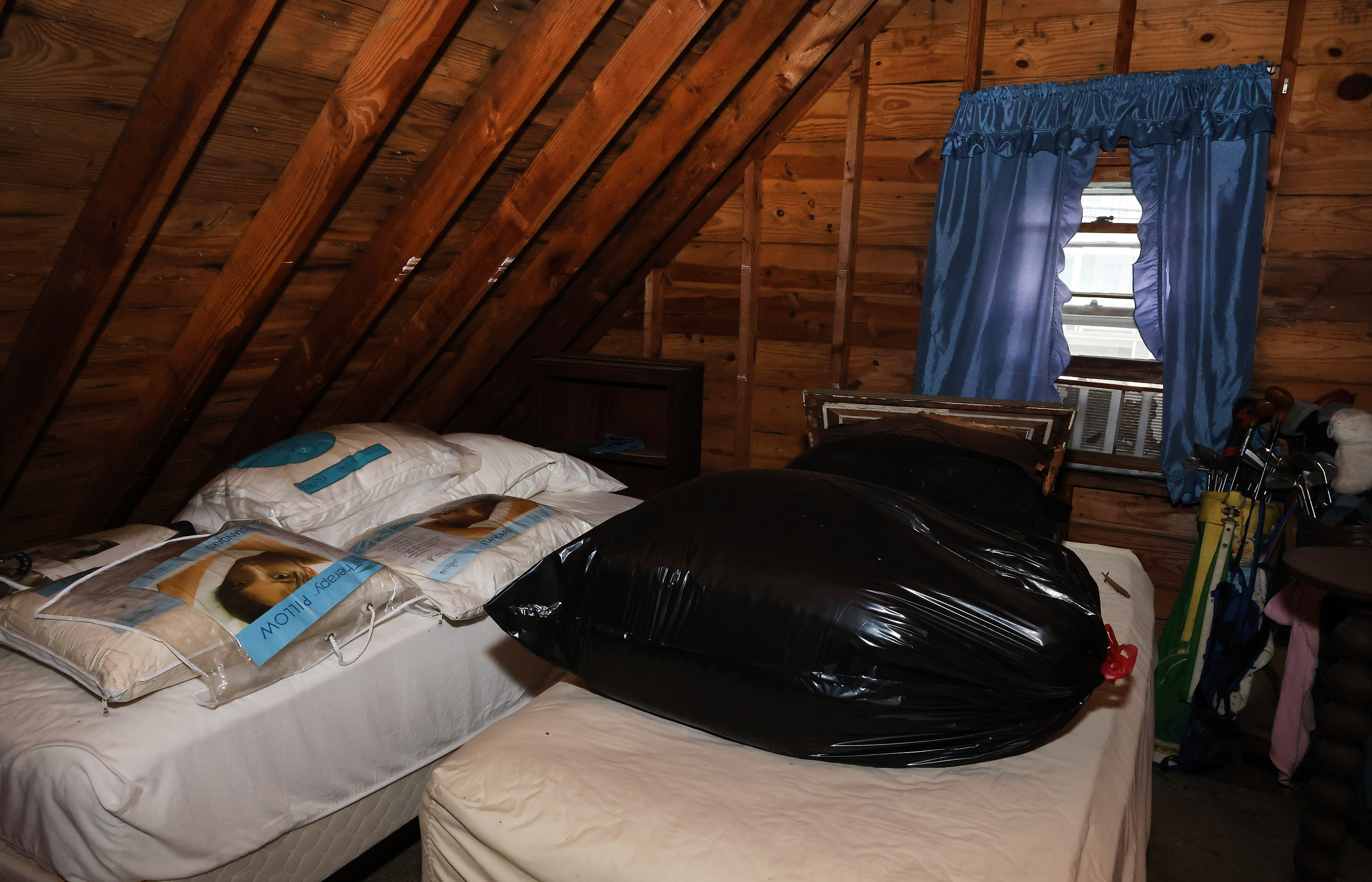
    The house was typical for its time — it had a washing machine but no dryer, an outdoor shower in continuous use because there was only one shower inside the house, a grassy backyard, and an attic crammed with a tangle of sleeping children.

    The cottage was small but the memories loom large.

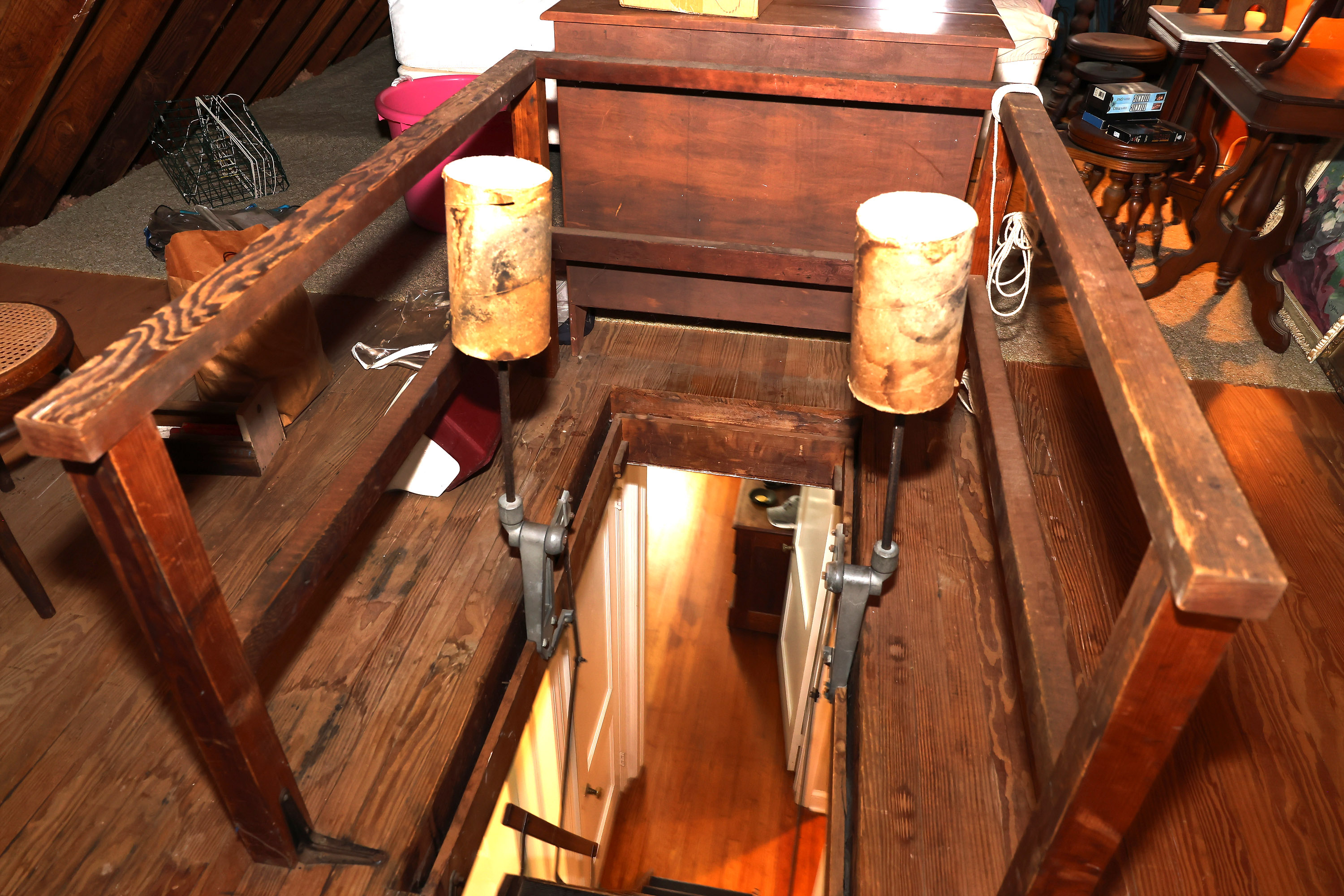
    “The attic had pull-down steps and a window where the breeze came in off the ocean,” recalled David, Bole and Lib’s son. “The oldest would get closest to the window, then the next oldest, and so on, because that’s where you got the most air. There were about four beds lined up and then you had mattresses on the floor.”

    A view from the attic into the main house from the pull-down door.
    Beds sit in the attic, where the children would sleep, sometimes 10 at a time.

    With the whole family together it was not uncommon to have up to 10 people sleeping up there, he said.

    “My parents used to send me down when I was about 8 or 9 on the NJ Transit bus,” said the younger David Smith, one of Lib and Bole’s grandchildren, and nephew of David S. Smith. He’s a Realtor with Coldwell Banker who lives in Wallingford. “I thought riding the bus by myself was the coolest thing!”

    Ocean City is where members of the Smith family formed lifelong friendships and forged their work ethic at their summer jobs. Lib and Boles’ oldest son, Norman Jr., met his wife of 61 years in Ocean City. The younger David Smith is their son.

    All of the family members had typical summer jobs at the Shore, including beach chair rentals, waitressing at the College Grill, manning the ice cream truck, and lifeguarding.

    David S. Smith won the 1968 South Jersey Lifeguard Championships in the doubles rowing event, an annual tradition that continues to this day. He was inducted into the Ocean City Beach Patrol Hall of Fame in 2004.

    He recalls hanging out on the beach with Grace Kelly’s family, who lived nearby. “That whole area was really driven by the connection to the Kelly family and their connection to Ocean City,” he said.

    But David S. Smith himself had connections to Shore royalty of sorts. His wife, Lynn, was elected Miss Ocean City Beach Patrol in 1967 and was on the cover of the book Images of America-Ocean City: 1950-1980 by Fred Miller.

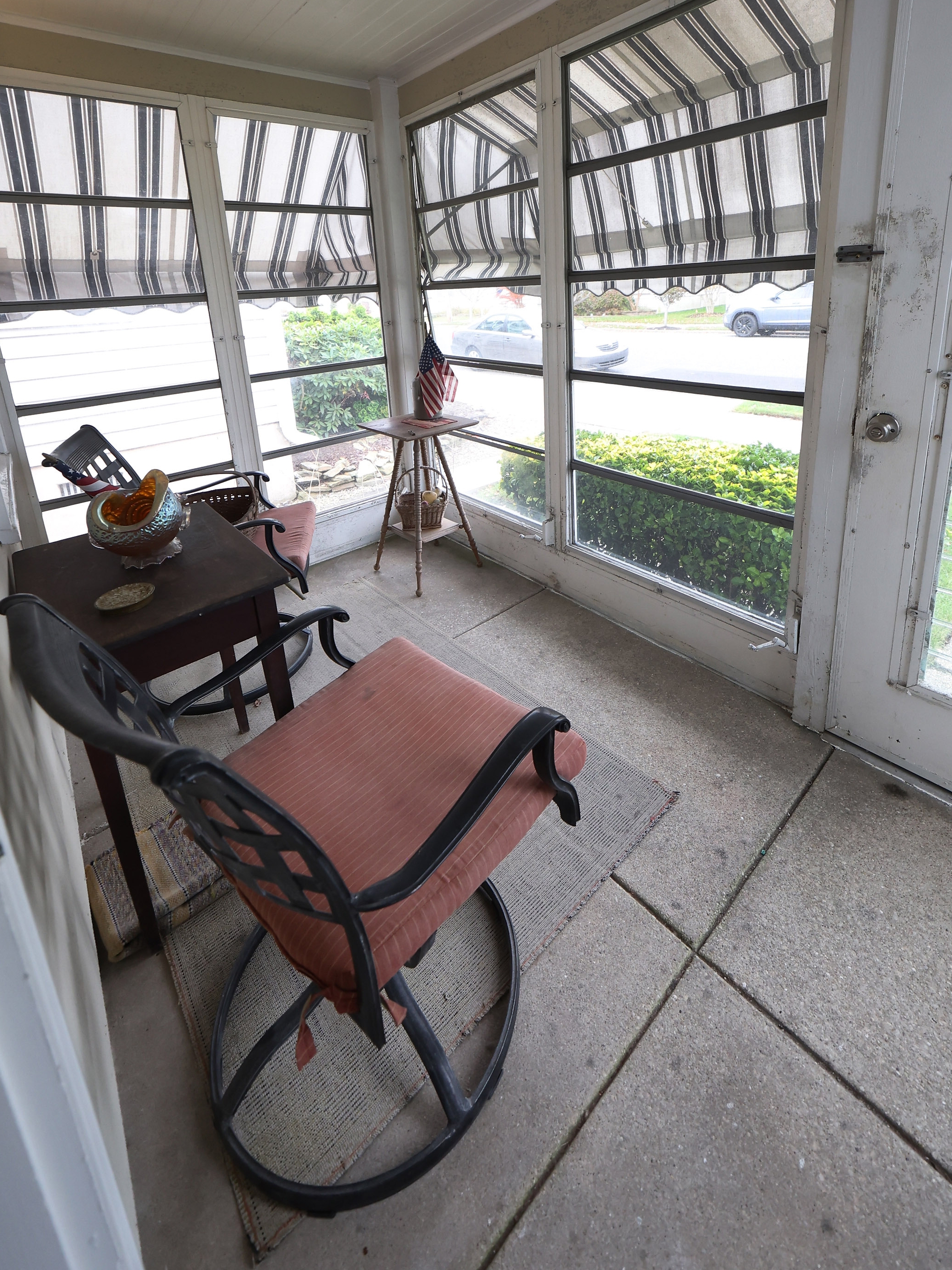
    The covered front porch of the Smiths’ cottage.
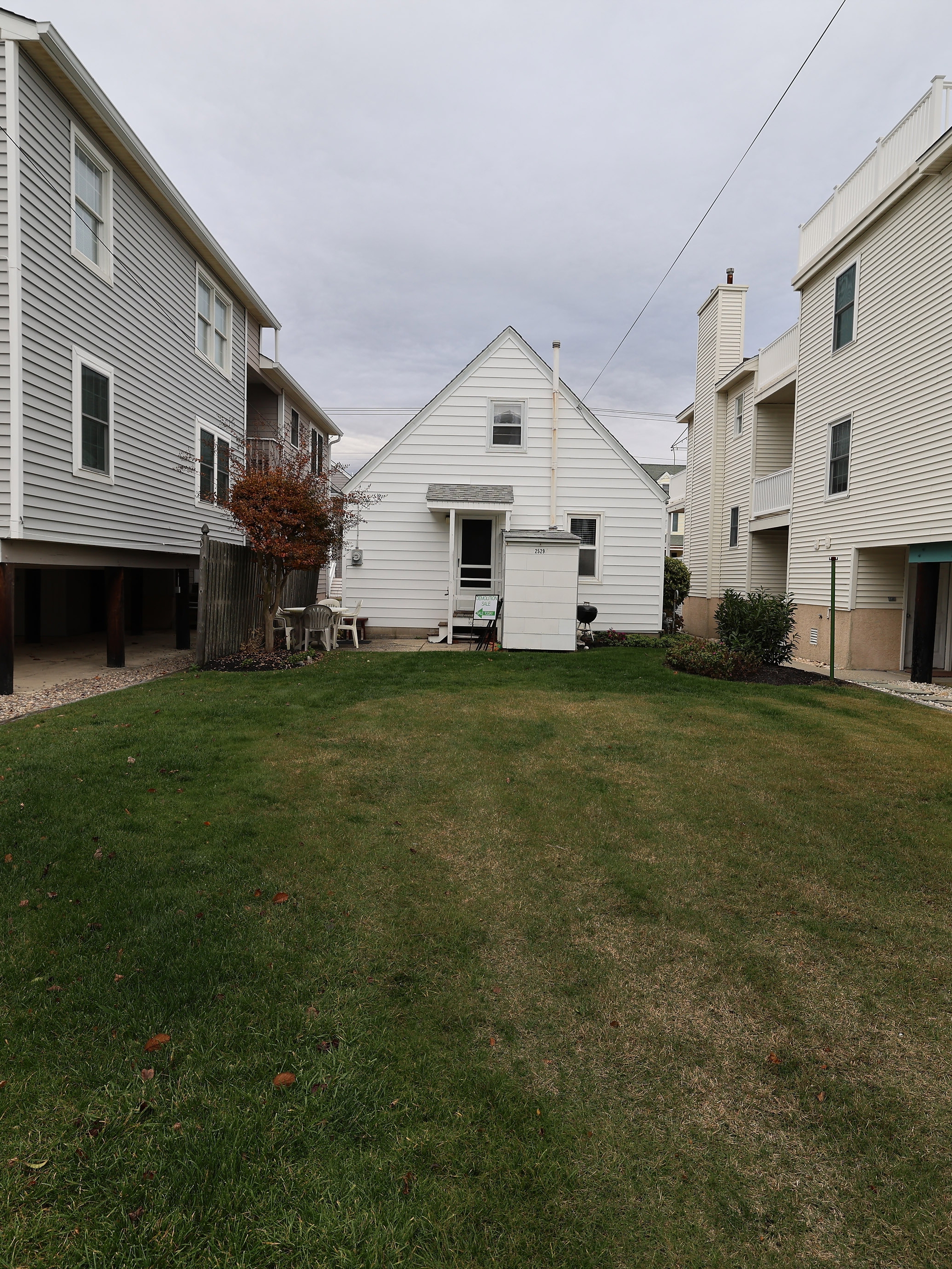
    The cottage sits on a large lot, which still is covered in grass unlike many neighbors.

    Over the decades, the home’s backyard was always in use, as the site for cookouts and quoits, a game similar to horseshoes. Family members of every generation competed while dinner was cooking on the charcoal grill.

    “The backyard of 2529 Asbury is still grass,” David S. Smith said. But at most of the nearby houses “the backyards are all stones.”

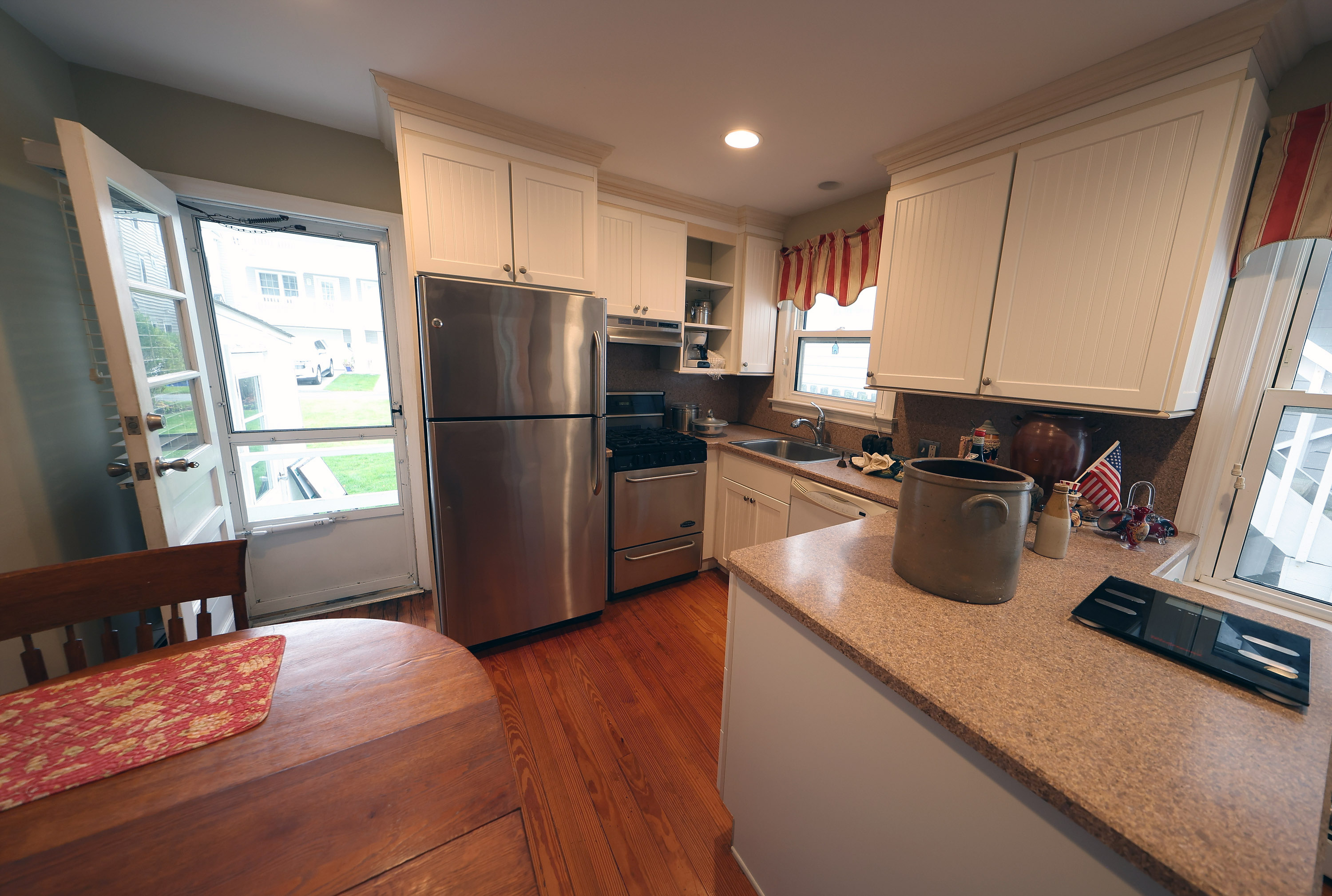
    The smell of frying scrapple was the morning alarm clock — a scent that still brings back a flood of memories for the younger David, Bole and Lib’s grandson.

    The cottage’s kitchen brings back memories of scrapple frying in the morning.
    The house’s one bathroom was used by the whole family, as well as the outdoor shower.

    A different town

    The Smiths witnessed the block transform dramatically over the years. Small cottages were razed and replaced with duplexes.

    “The Jersey Shore has changed so much,” said grandson David. “Now you see all these giant houses.”

    To help protect some of the town’s older homes, the city created a historic district in 1992, primarily between Third and Eighth Streets and Central and Ocean Avenues. That includes many homes with Victorian-era architecture, many built in the late 1800s and early 1900s.

    To maintain the area’s historical integrity, the district is protected by local ordinances that require approval for demolition, new construction, or rehabilitation projects. Merritt’s group hopes to raise awareness of these and other older homes.

    “When you knock down a house, you don’t just lose the house, but you lose the history,” he said.

    David Smith (left) and his uncle, David S. Smith, in the living room of the cottage.

    Merritt’s house, for example, has been rumored to have been owned by the family of Grace Kelly’s boyfriend when they were teens. Merritt was recently greeted at his home by the man’s sister.

    “We had this whole conversation of how her brother took Grace Kelly to the Lifeguard’s Ball, and she showed me the pictures she had,” he recalled. “When you knock these houses down, that connection to the past is severed.”

    Merritt argues that the town loses its identity when these houses disappear.

    While the Smiths have little say in who buys their home, they hope a single-family house will replace it, rather than a duplex, which brings more cars, people, and traffic.

    “It hurts,” David S. Smith said. “We’ve had it for 69 years and there’s a lot of history.”

  • In a church-turned-apartment, four roommates have made a new sanctuary

    In a church-turned-apartment, four roommates have made a new sanctuary

    The four roommates have hosted costumed Halloween parties for more than 80 people in their Spring Garden residence. Last year a guest came as a nun and another came as Jesus. They were, after all, visiting a church.

    Philadelphia Architecture in the 19th Century, described the city’s Spring Garden neighborhood as: “Houses, Quaker in Excelsis with pocket handkerchiefs of terraces and here and there a reticent church where one could sleep comfortably through hour-long sermons.”

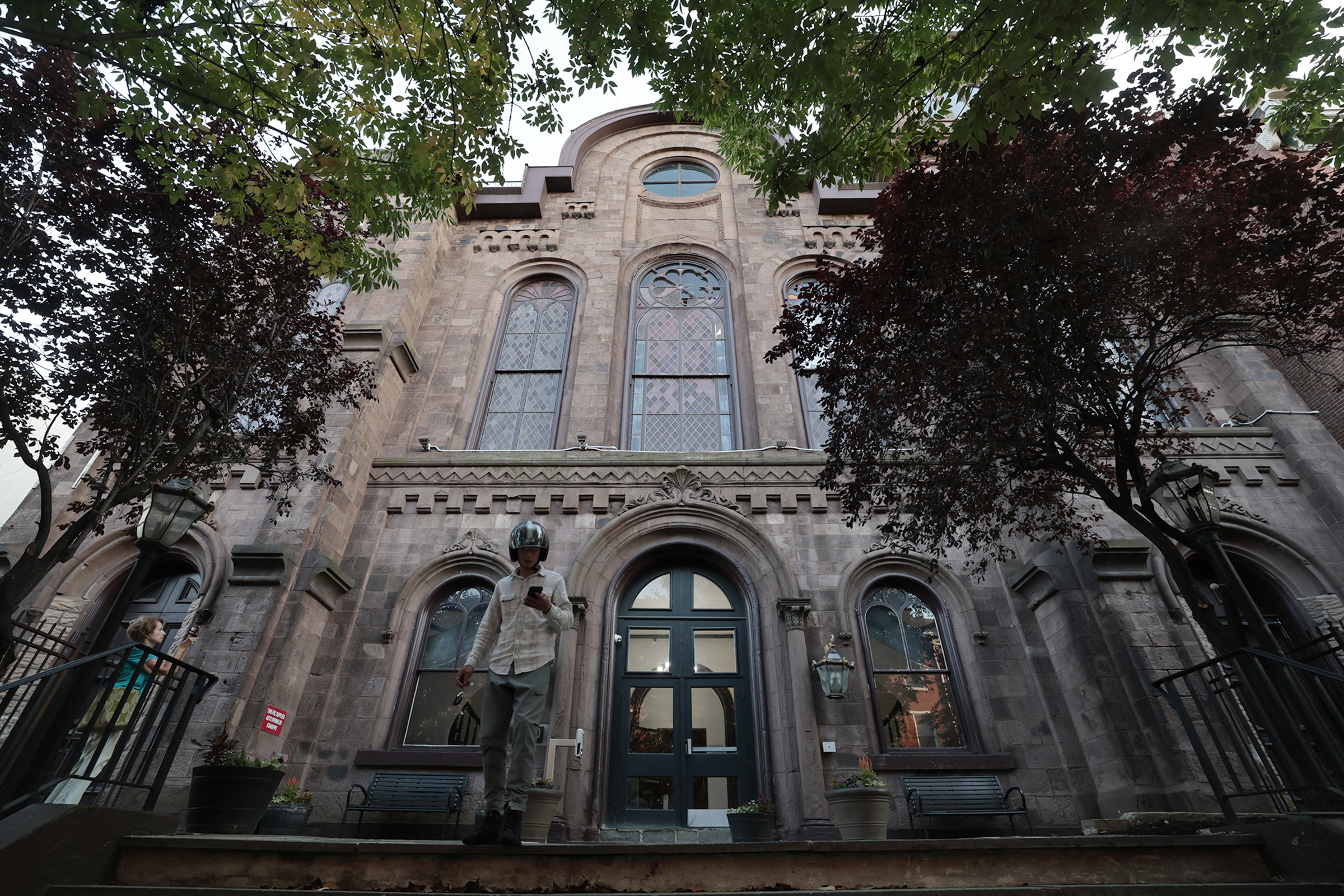
    In that neighborhood, decades later, Corwynne Peterson, Riley Sperger, Ashlee Propst, and Magdalena Becker share a four-level unit in what was once Christ Reformed Church. The Romanesque-style brownstone place of worship was built in 1860 in the middle of a block of terraced houses.

    Times changed, the church’s congregation dwindled. The increasingly deteriorating building was used for several years as a recreation center and for after-school programs. Then in 2003 it was purchased by the Regis Group, a property development company.

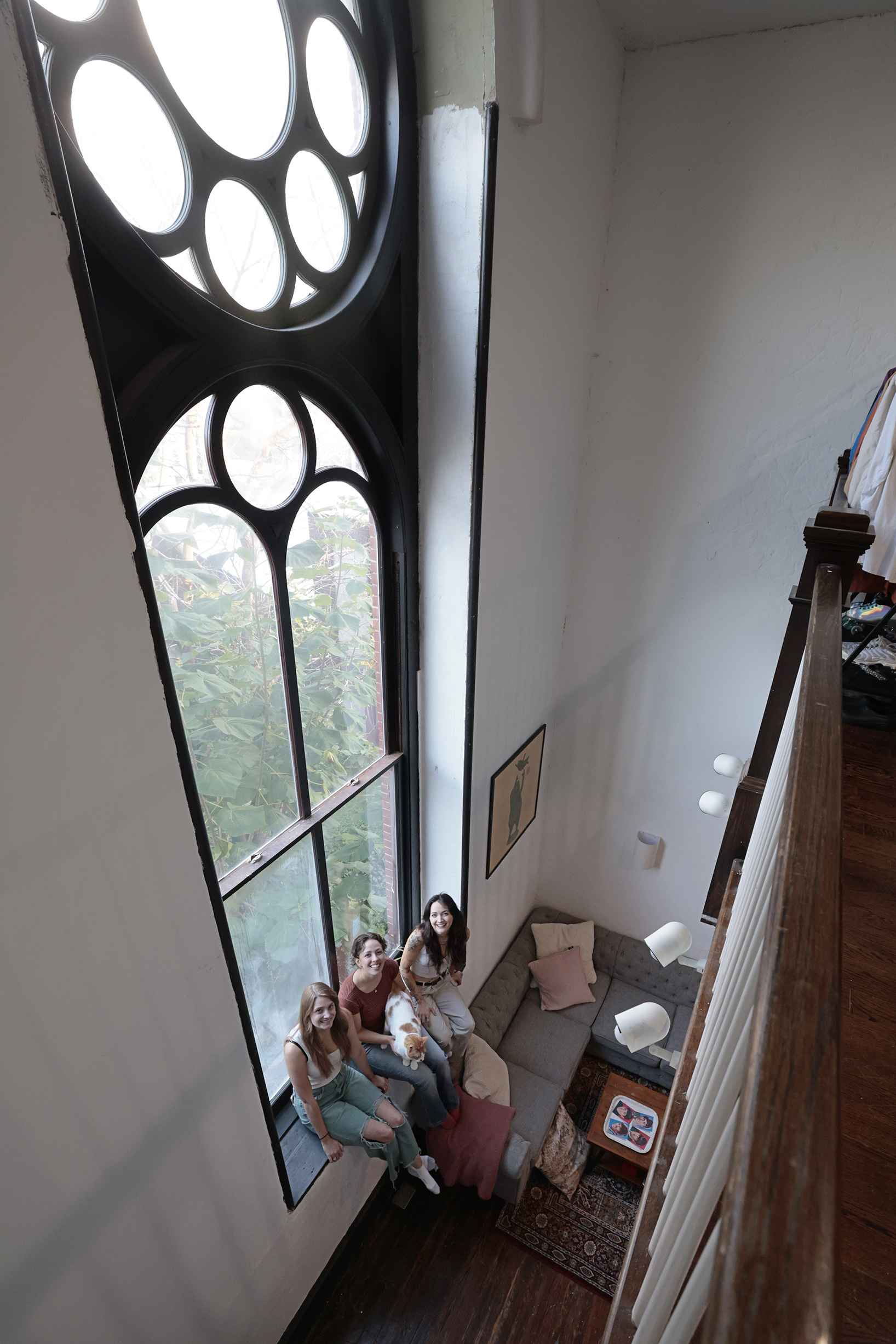
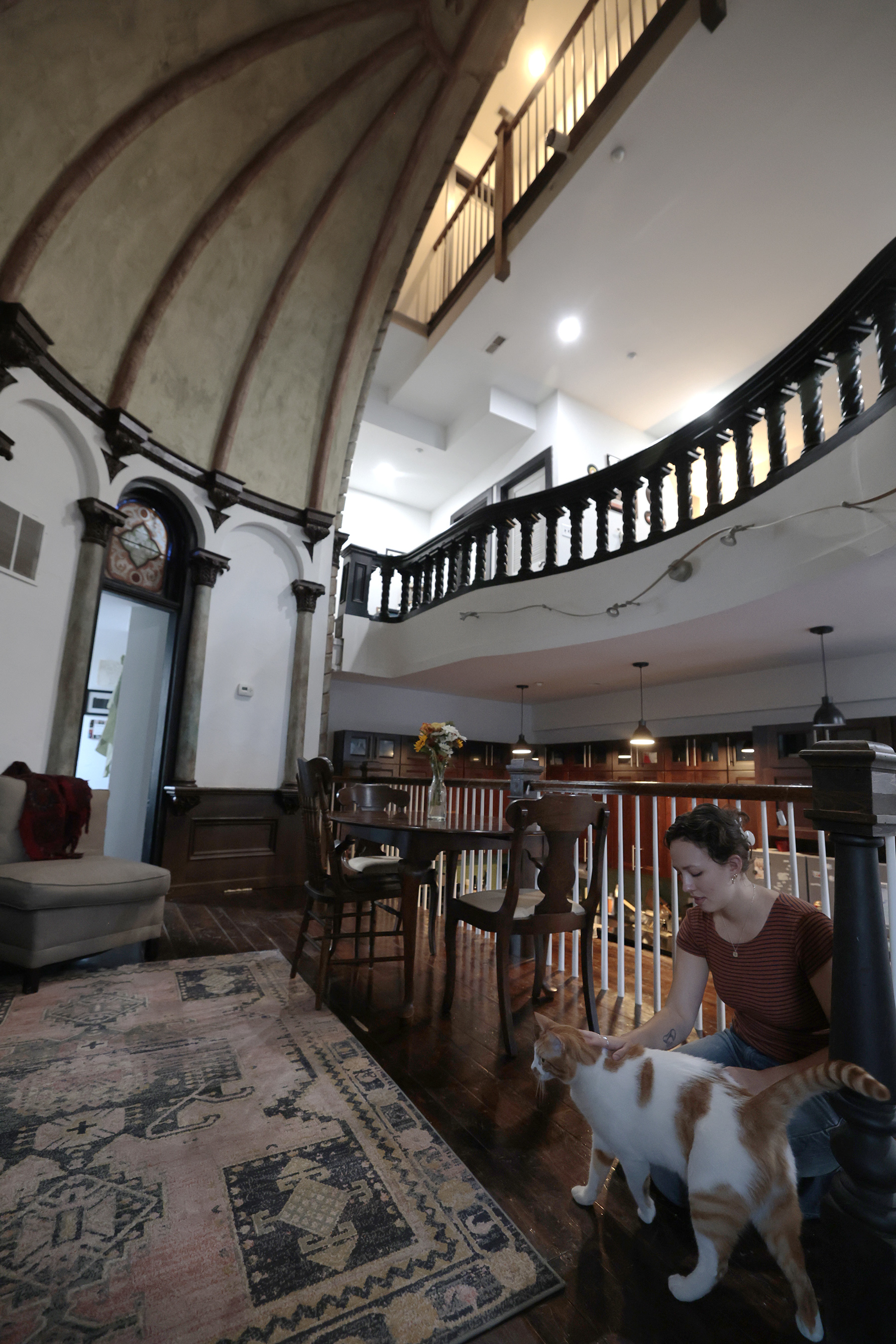
    As seen looking down from the third floor, (from left) Ashlee Propst, Corwynne Peterson, cat Hugo, and Magdalena Becker sit on the window sill in their apartment, formerly a church.
    Peterson shares some affection with her cat, Hugo, on the former church altar.

    Regis converted the church into 17 multilevel rental units, preserving the soaring ceilings, decorative plaster moldings, several leaded glass windows, and pine flooring. The eclectic decor includes whitewashed brick interior walls, new skylights and ceiling fans, exposed pipes and beams. Remnants of ecclesiastical patterned wallpapers still cover the wall near a door leading to the communal courtyard.

    For Halloween the roommates screen It’s the Great Pumpkin, Charlie Brown on the columned dome of what was the church sanctuary. At the top of the dome is a painted gold cross and crown, symbolizing the reward in heaven (crown) after trials on earth (cross).

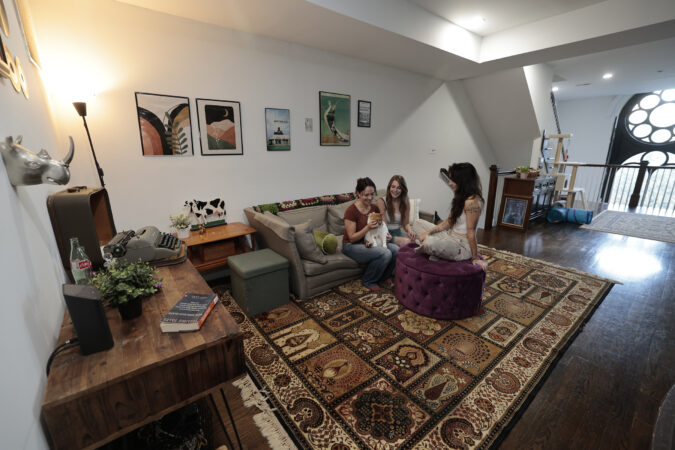
    Peterson said she and her three roommates, all women in their 20s, call the sanctuary “the stage.”

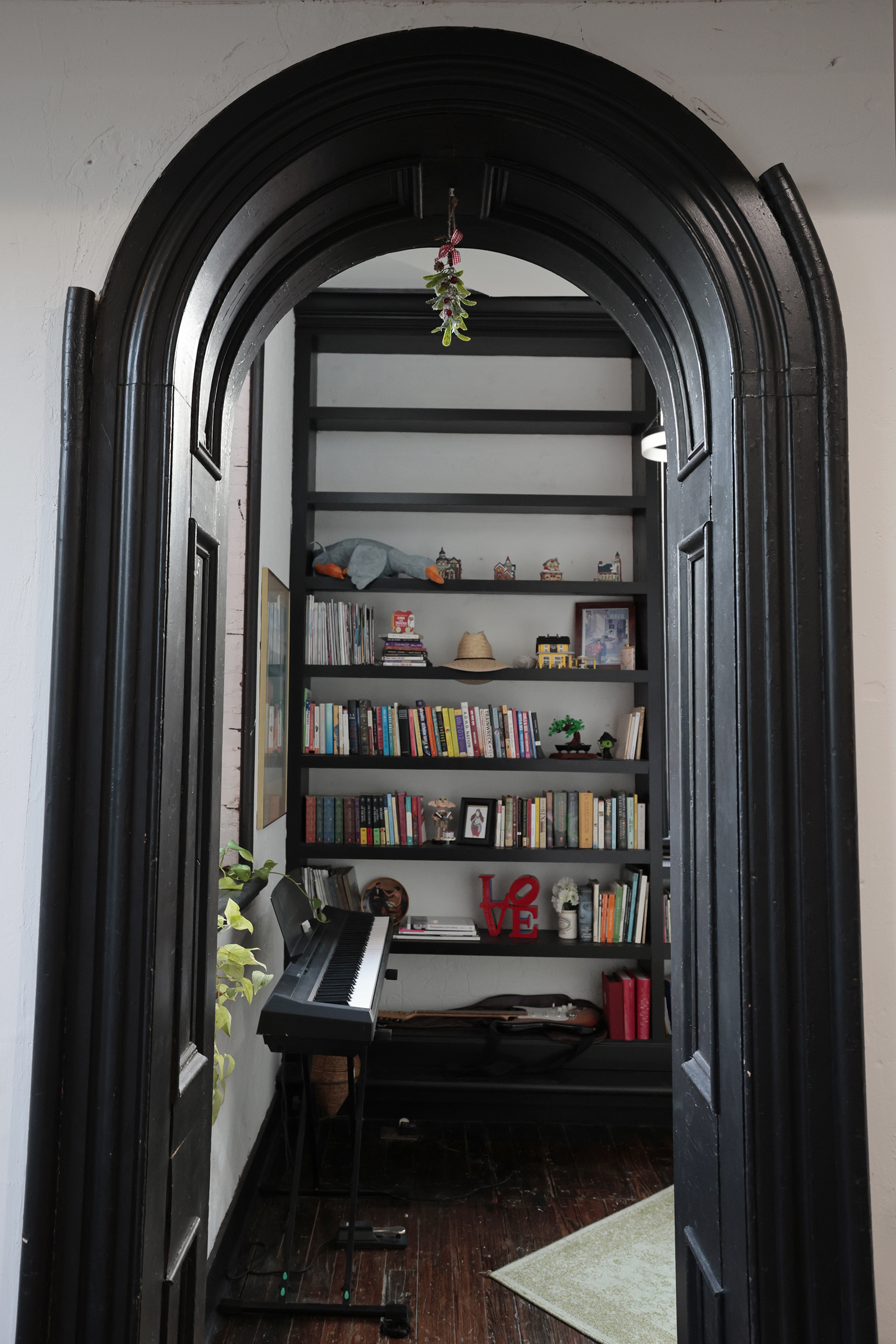
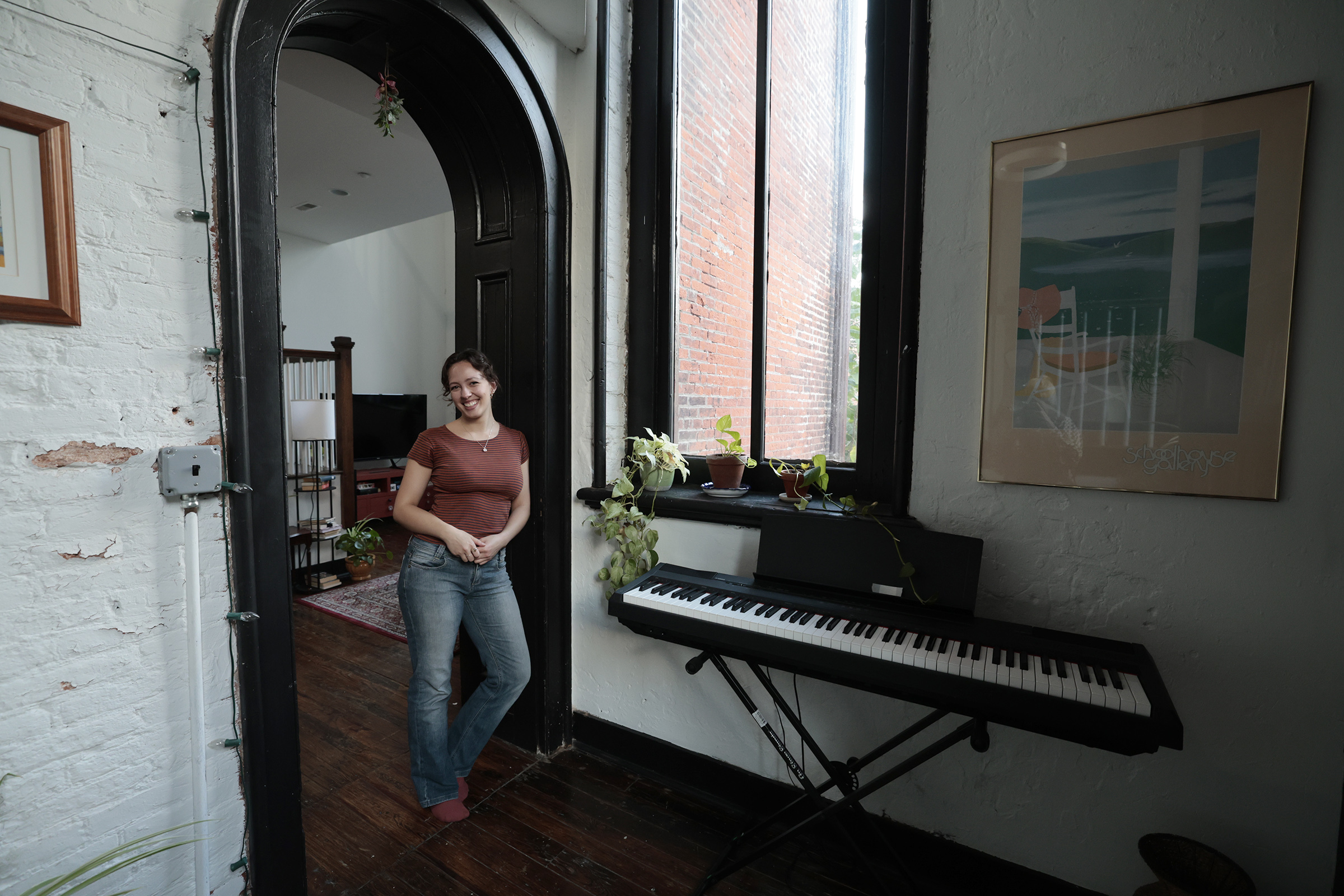
    The sanctuary, furnished with a dining table and chairs, is on a raised platform a few steps above the living room, kitchen, powder room, and “library,” with bookshelves and Peterson’s piano keyboard.

    The exterior of the Homes at Chapel Lofts, built in 1860 as the Christ Reformed Church.
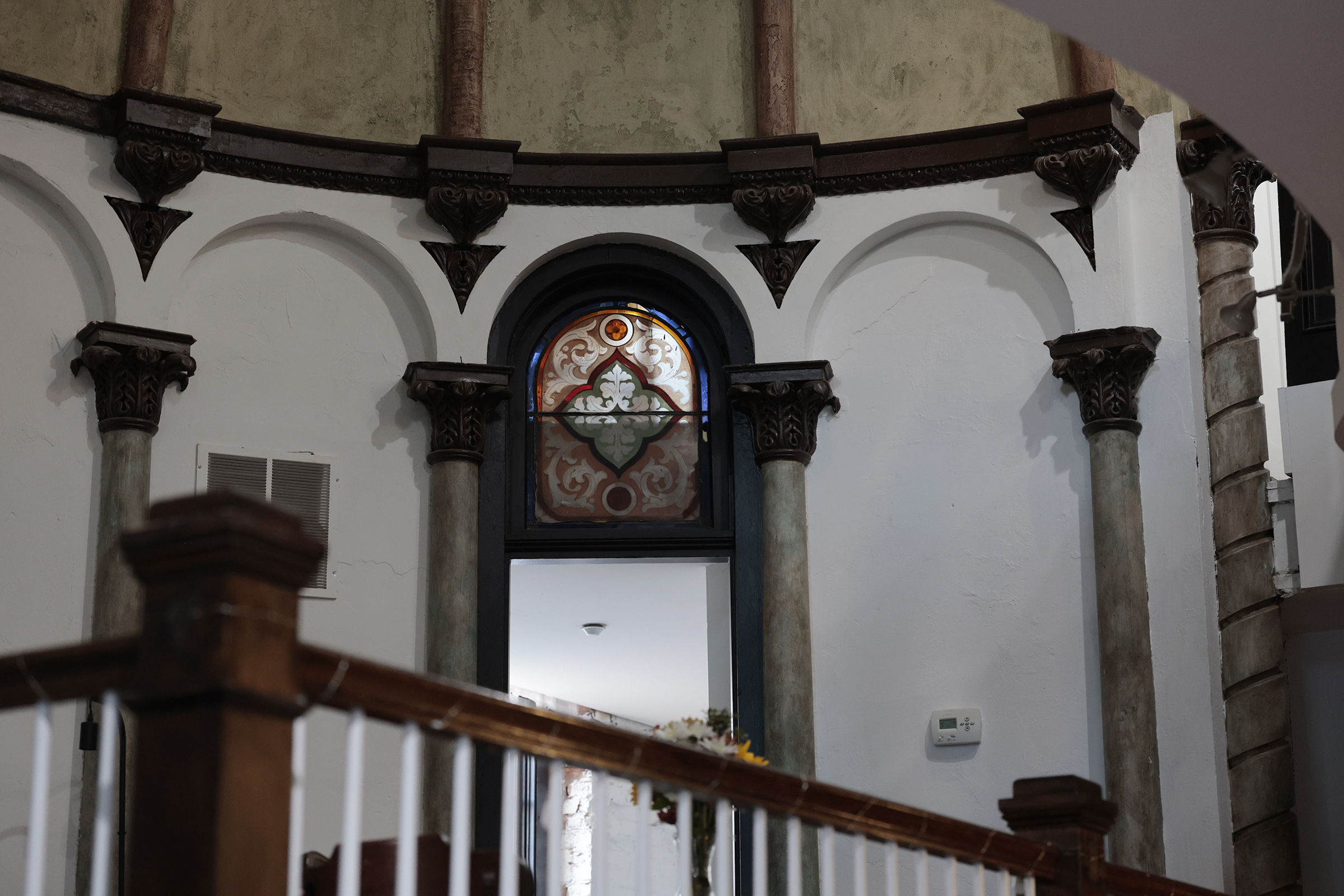
    The remaining original stained-glass window in the apartment.

    On the next level are Peterson’s and Sperger’s bedrooms, a bathroom, and a sitting area. Both women work as restaurant servers.

    An ornately carved oak banister between the bedrooms and overlooking the sanctuary might have once been the church’s Communion rail.

    Propst, a research specialist at the University of Pennsylvania’s Perelman School of Medicine, has the largest bedroom and a private bath on the third level, where there is also a washing machine and dryer the women share.

    Up a spiral staircase on the top level is Becker’s bedroom, adjacent to a rooftop deck. She shares a bathroom with Peterson and Sperger two flights down.

    Entranceway to the apartment’s library.

    A pair of silver stiletto-heeled boots decorate a shelf at the bottom of the stairs. Becker is a writer for Static Media and a dancer, “which is why I have a lot of shoes,” she said.

    The roommates separately found the converted church on Facebook, moving in at different times over the last 2½ years. They collaborated on the furnishings, sourcing the gray sectional in the living room, the gray sitting-area sofa and purple ottoman, and other furniture on Facebook Marketplace. Their parents and grandparents contributed oriental rugs.

    The vintage typewriter, which sits on a desk gifted by a neighbor, was a prop from a play in which Peterson performed. The Vanya poster is from an Off-Broadway, one-man show of the same name autographed for Peterson by the star, Andrew Scott.

    Magdalena Becker in her fourth-floor bedroom, with sun beaming through the skylight above.

    Abstract nature prints came from Etsy, and a Vogue magazine cover, old records, and other art displayed on the walls were purchased at thrift stores. The women’s colorful clothes hang on racks.

    Light streams from a tall window comprising various shapes of clear glass, which replaced disintegrating leaded glass. Some of the arched doorways still have stained-glass transoms.

    The roommates admit they don’t do much communal cooking. They each have their own shelves in the fridge and in the chestnut kitchen cabinets.

    Magdalena Becker stands on the south-facing deck just off of her fourth-floor bedroom.
    Corwynne Peterson stands in the doorway of the library with her piano keyboard.

    But they do host parties together. Besides the Halloween festivities there was a birthday party for Sperger in September.

    For Christmas celebrations, the sanctuary sparkles with green and red lights.

    The women also share affection for the only male in residence, Peterson’s orange and white cat, Hugo. And he is fond of all of them.

    Is your house a Haven? Nominate your home by email (and send some digital photographs) at properties@inquirer.com.
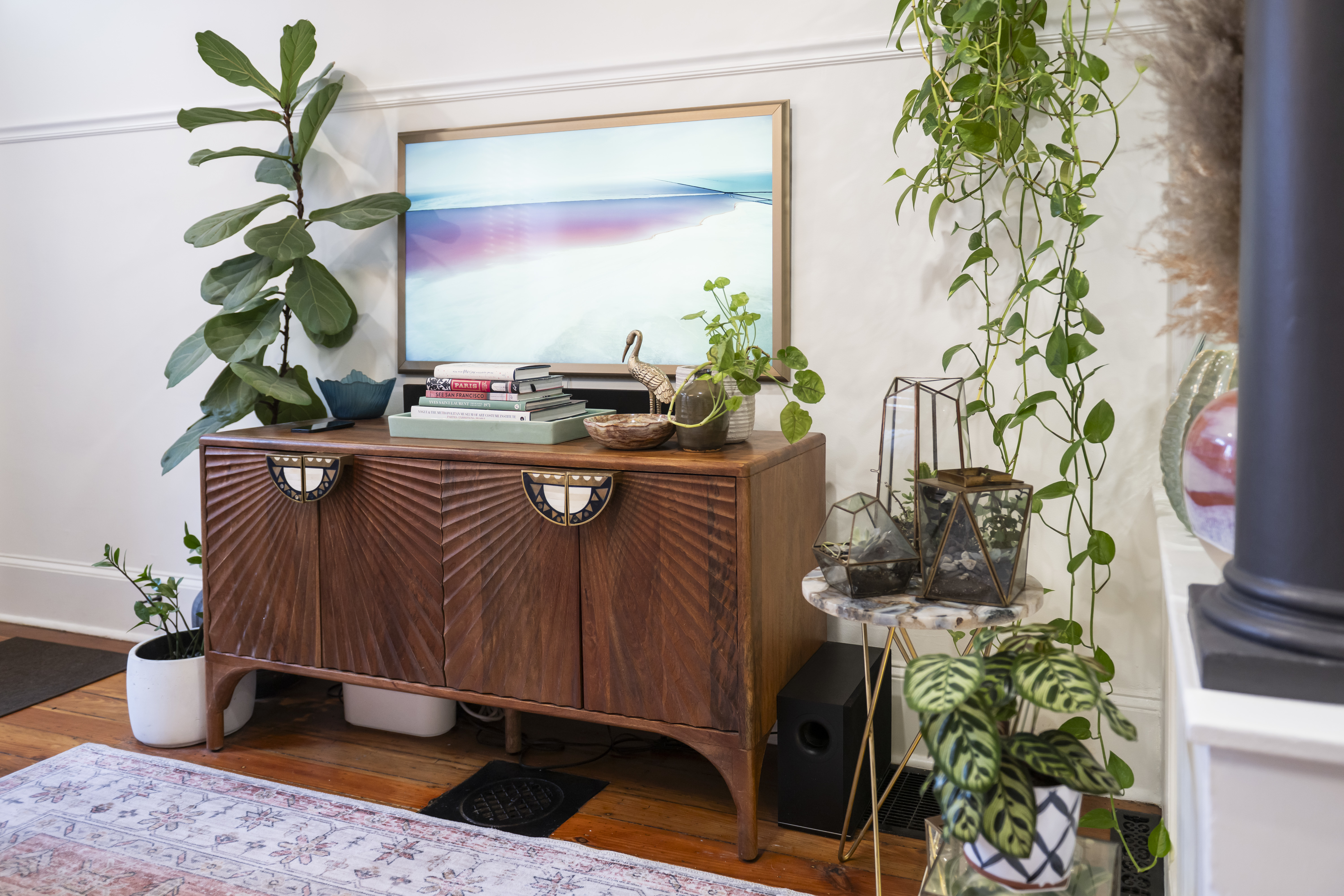
  • House of the week: A trinity down a red-brick path in Bella Vista for $319,000

    House of the week: A trinity down a red-brick path in Bella Vista for $319,000

    “We could walk everywhere,” said Kevin Diehn. “We’d even forget where we’d parked our car.”

    This was Diehn’s tribute to the rich offerings around the Bella Vista trinity he bought in 2012 with his wife, Ariel.

    But perhaps the most unusual is the path leading to their street, with mosaics by the legendary Isaiah Zagar. Diehn says it’s about 70 yards long.

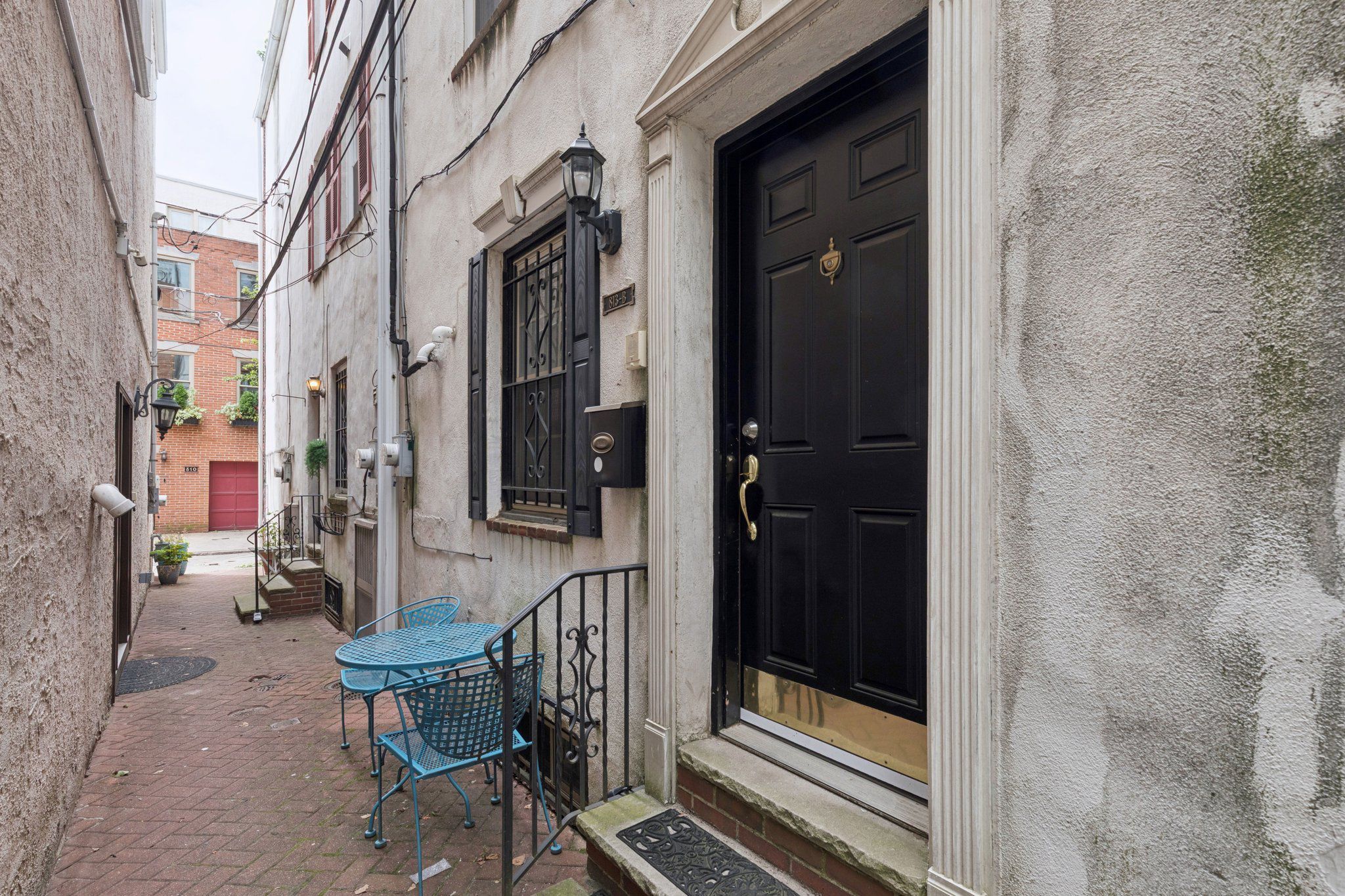
    The outside of the home sits along a brick path.

    And “we loved the proximity to South Street,” he said.

    But now the Diehns — he works in the pharmaceutical industry and she’s a Pilates instructor — have moved to Maryland for work.

    From the 840-square-foot home, the Italian Market, South Street, Washington Square, Penn’s Landing, and Jefferson and Pennsylvania Hospitals are all easily accessible.

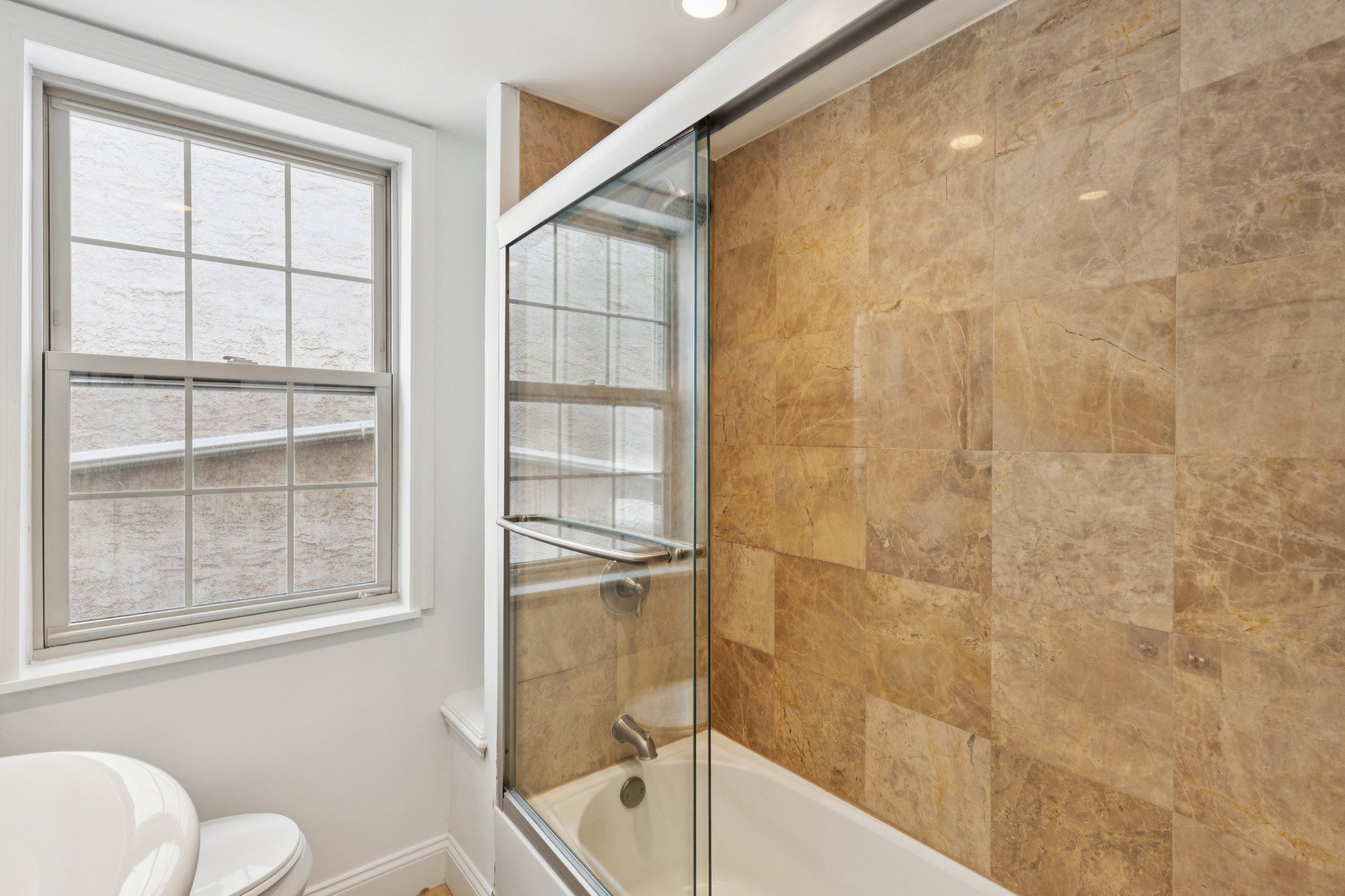
    The bathroom has a tub and a window.

    The two-bedroom, one-bathroom house is tied together by a spiral staircase that wraps around all four floors.

    The living room features exposed brick, wood floors, and a fireplace that could work if refurbished.

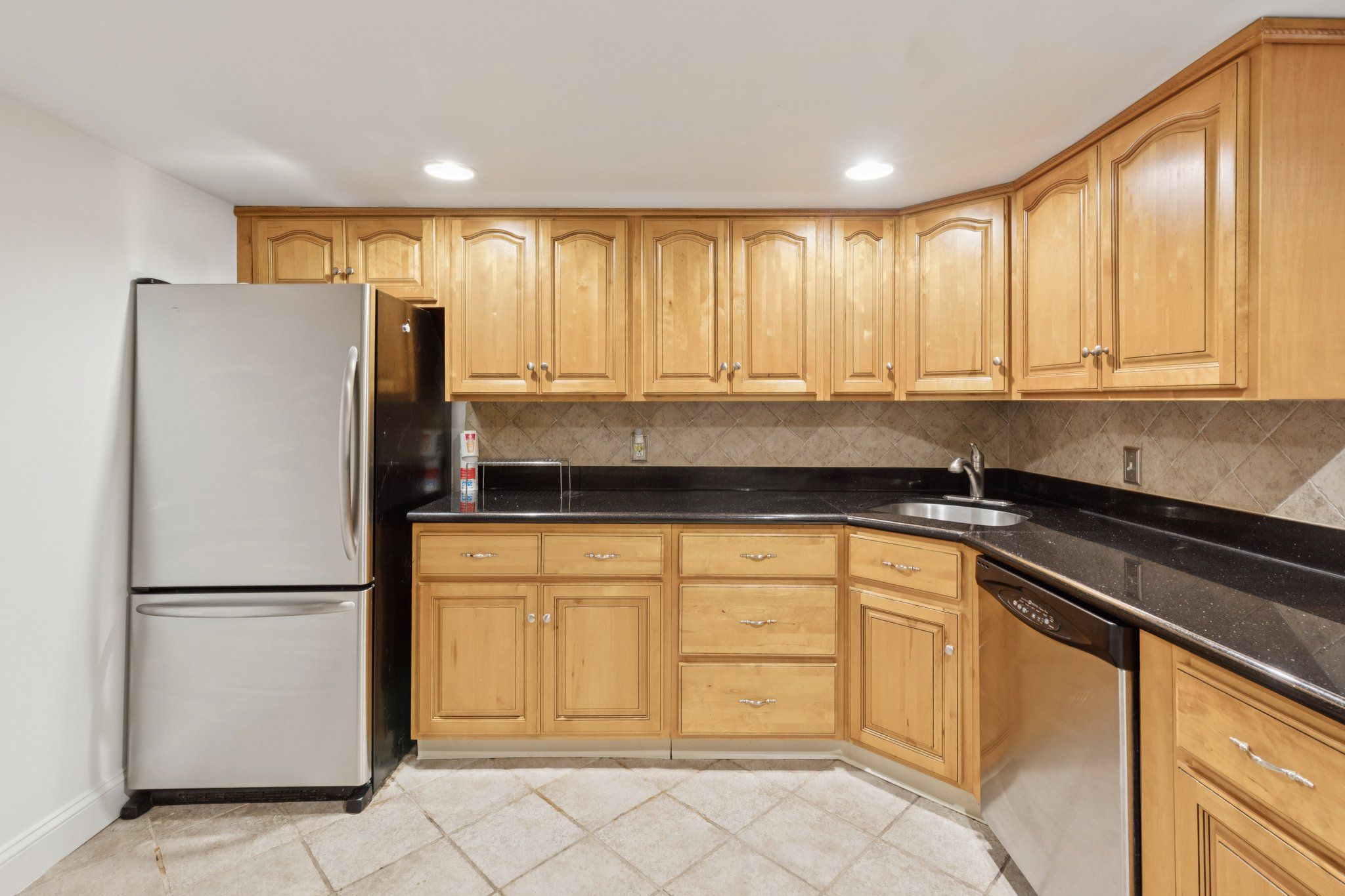
    The kitchen is in the basement and has an adjacent pantry, stainless steel appliances, a gas stove, a laundry area, and tile floor.

    The kitchen is in the basement.

    The winding stairs lead through French doors to the first bedroom and a bathroom with a tub/shower combination and glass enclosure.

    The primary bedroom is on the third floor with vaulted ceilings and two large windows. The upper floors have plentiful exposed brick.

    The house is in the Meredith School catchment area.

    It is listed by Pamela Rosser-Thistle of BHHS Fox & Roach at the Harper Rittenhouse Square for $319,000.

  • The trick these homeowners used to act fast on an in-demand Collingswood rancher with a pool | How I Bought This House

    The trick these homeowners used to act fast on an in-demand Collingswood rancher with a pool | How I Bought This House

    The buyers: Brandon Balcom, 44, vice president of product operations at BCD Travel; Dane Cox, 39, owner of Dane Cox State Farm Insurance Agency

    The house: A 3,767-square-foot, ranch-style home in Collingswood with three bedrooms and three baths built in 1955

    The price: Listed for $695,000; purchased for $735,000

    The agent: Amy Telfair, Telfair Collective

    The Ask: Brandon Balcom and Dane Cox were not looking to buy a new house. They had just purchased a fixer-upper on a beautiful oversized lot in 2021. “It was in the perfect spot,” Balcom said, “and they always say, ‘you can’t move your house.’”

    But it turned out their perfectly located house needed to be rebuilt from the foundation up and the lengthy zoning process was wearing them down. Two years into a renovation with no end in sight, their friend, real estate agent, Amy Telfair, suggested they buy a new house instead. In fact, she knew just the one.

    “We chuckled and rolled our eyes, because she’s a Realtor with vested interest,” said Balcom. But the couple agreed to check out the listing anyway.
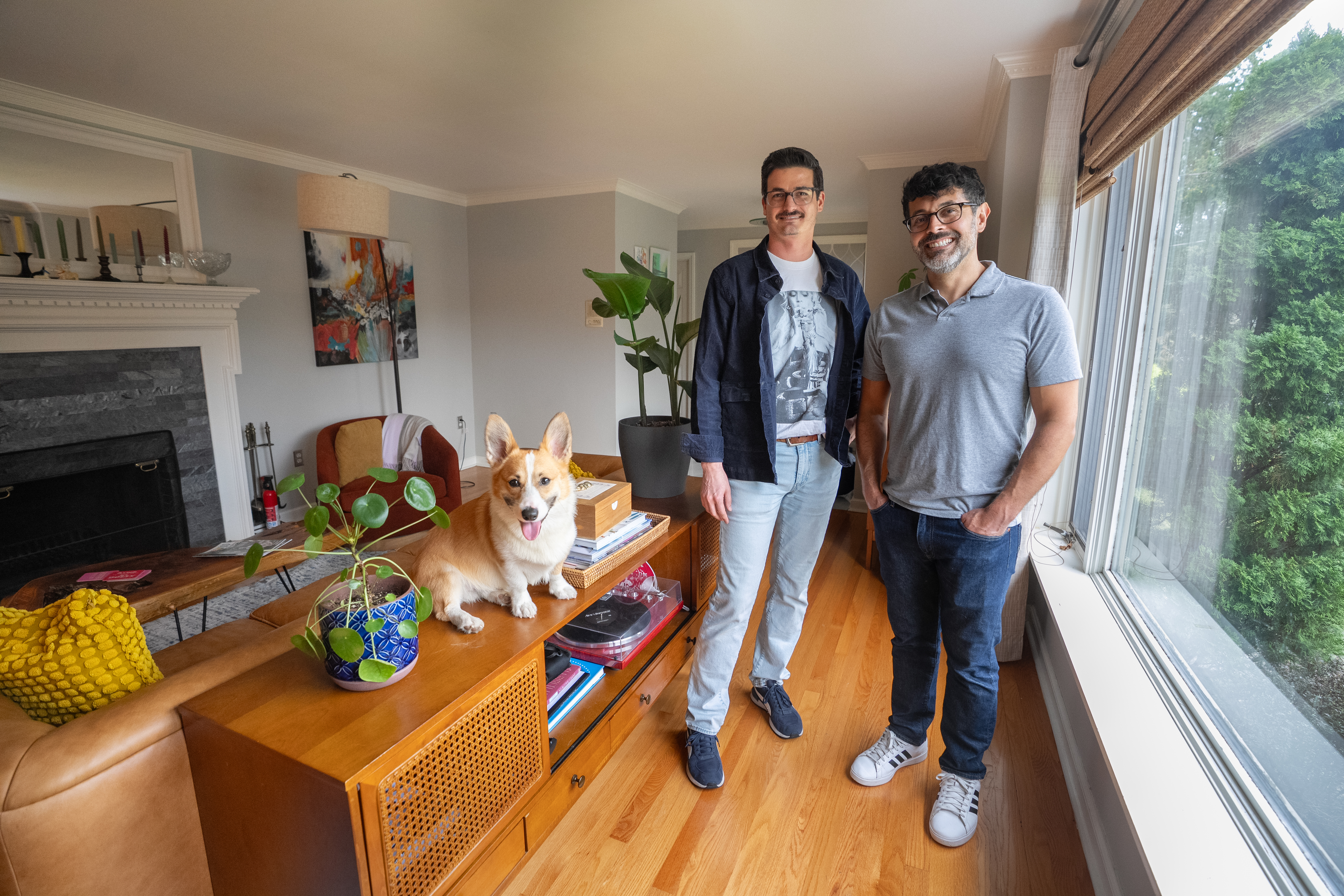
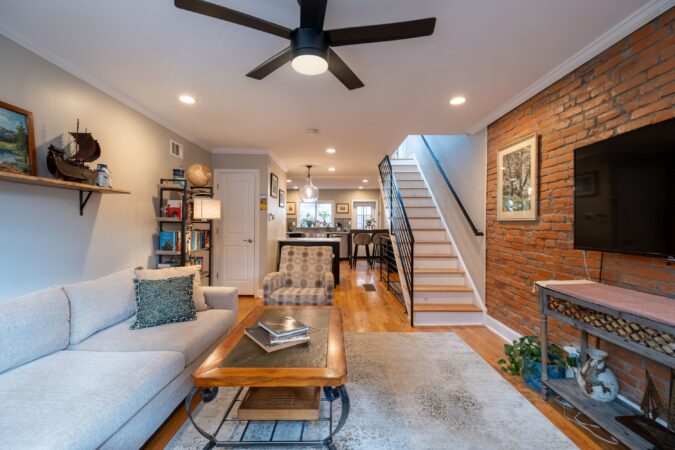
    Dane Cox and Brandon Balcom in their living room with their beloved corgy.

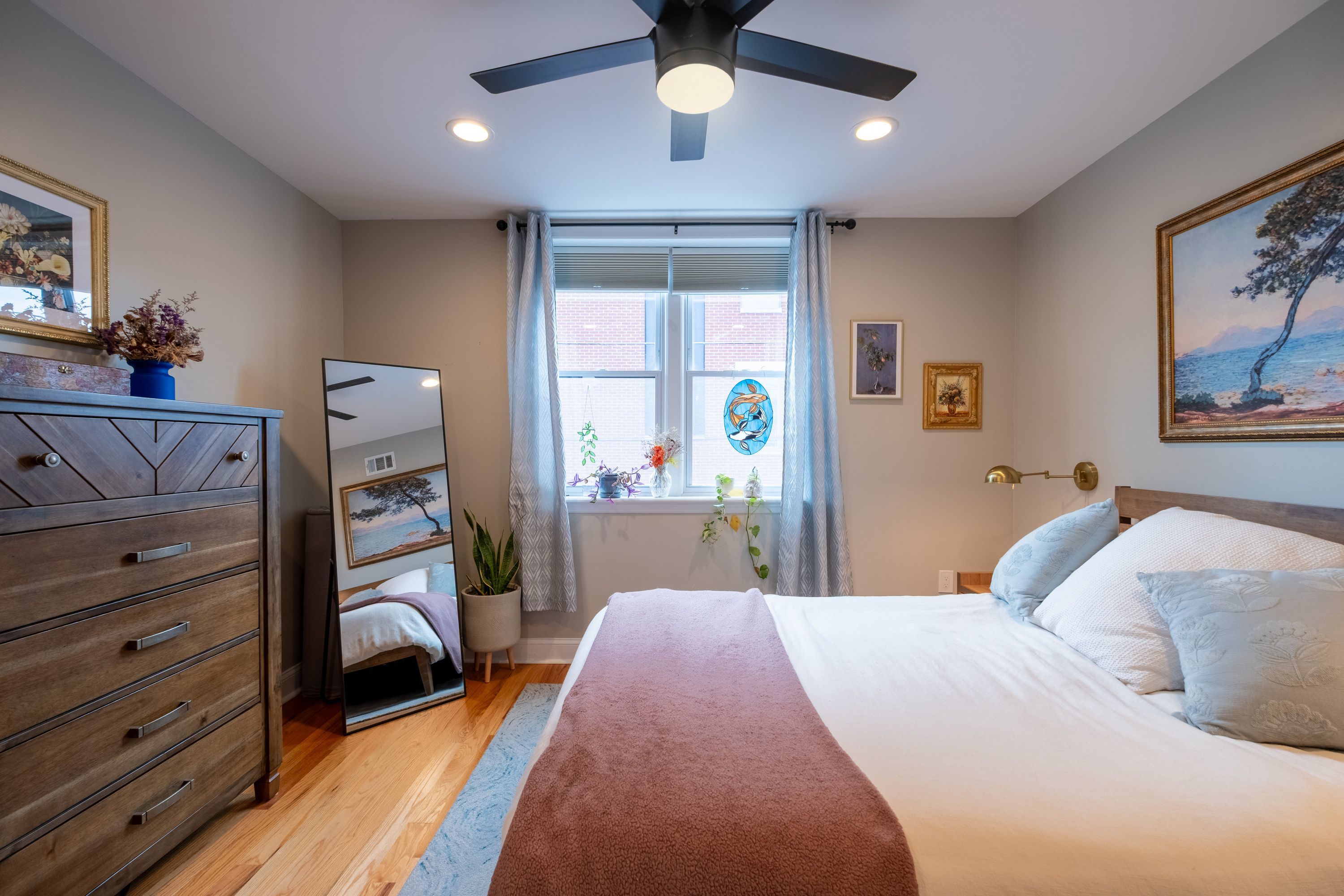
    The appeal: The house was designed in the midcentury style they loved, and, unlike their current place, it didn’t need any work. “We started dreaming very quickly about skipping all these steps,” said Balcom. The new house even had a pool, which Balcom said was part of a “years-down-the-line vision” for their current home.

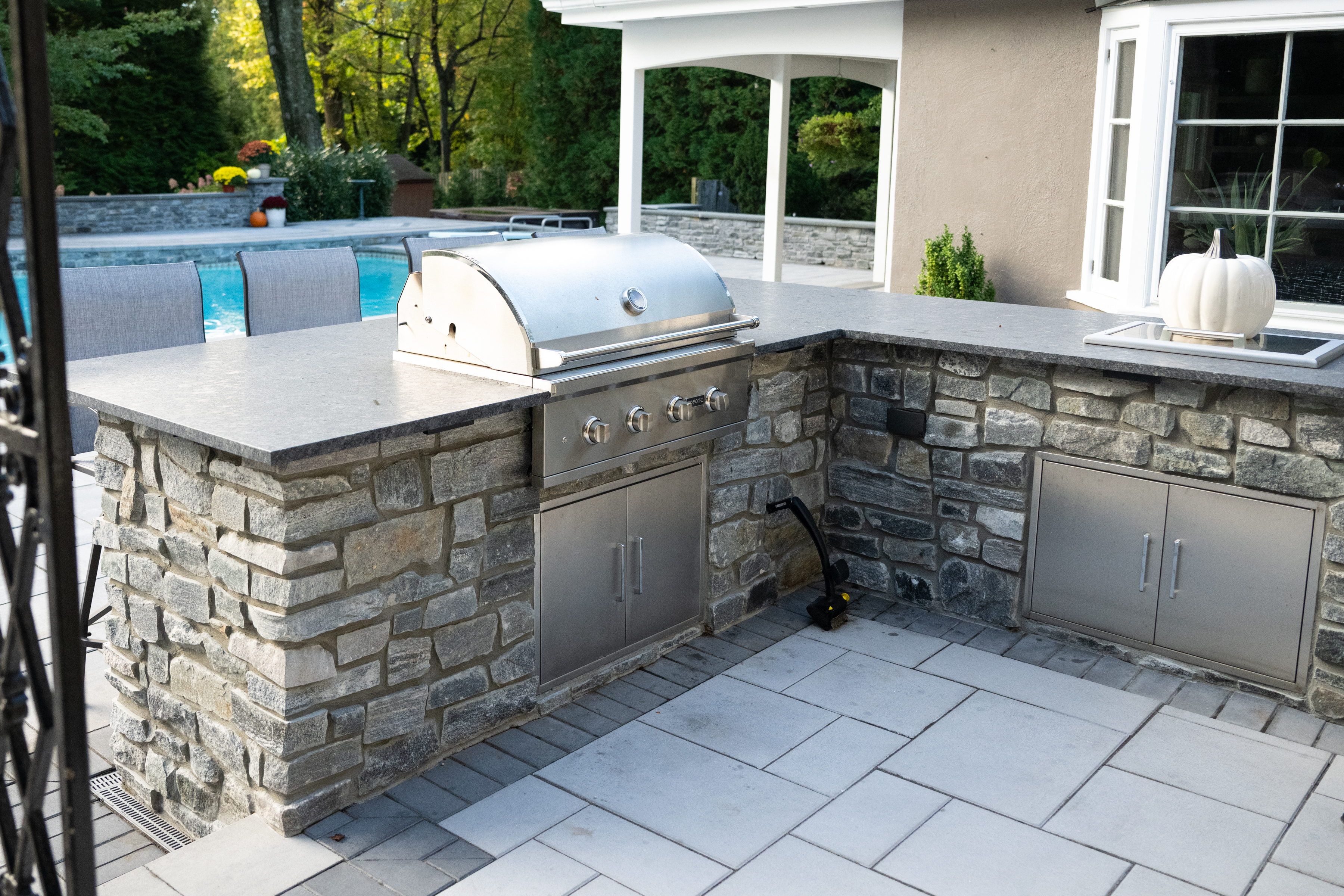
    Balcom’s favorite thing was that it was perfect for entertaining, from the bar in the finished basement to the grand fireplace in the living room. When Cox heard his husband gasp at the fireplace, he knew the deal was done.
    “I was like, ‘There’s nothing I can say at this point that’s going to convince him otherwise,’” Cox said.

    The search: To get ahead of other potential buyers, the couple used a trick they learned while selling their previous house in Minneapolis: they brought their inspector to the showing.

    “We wanted to know when we left that day if there was an issue,” said Balcom. Knocking out the inspection early allowed them to waive it as a contingency, which the couple knew from experience would appeal to the sellers.

    The kitchen of the couple’s home, which is designed in the midcentury style they love.

    The couple’s inspector gave them the go-ahead, so they went to Cox’s office and “started scheming,” said Balcom.

    The deal: The couple called Telfair, whose first instinct was to get the house off the market. She didn’t want the sellers to show it over the weekend, so she asked what it would take to get the listing taken down that day. They requested an all-cash offer of $735,000 — $40,000 above the asking price. Cox and Balcom agreed, and a legal contract that required the seller to cancel upcoming showings was speedily signed.

    The money: Balcom and Cox didn’t have to hand over $750,000 in cash the day they signed the contract. They just needed to “give up any contingency on the need for financing to buy the home,” said Balcom. Documentation showing that they could pay in full would suffice.

    They had over $400,000 in savings and brokerage accounts that they could show as proof of funds, and a letter from their parents confirming another $300,000 was available if needed. “You have to have a promissory note or something from your family that says, ‘I will give this amount for the purchase of the home,” Balcom said.

    One of the main selling points was the giant fireplace in the living room.

    But they didn’t end up borrowing money from their parents. “We just needed it for a moment to show we’ve got cash,” Balcom said.

    Instead, they took out a home-equity loan on their fixer upper. “Between when we signed the contract and when we closed, we had time to pull the equity out of our existing house,” said Balcom. The loan provided them with enough cash to cover the remaining cost of their new home.

    The move: Balcom said the actual close was anticlimactic. The sellers were out of town so they pre-signed everything for the couple, who left for a family vacation the day after the paperwork was done.

    By the time they returned, the sellers had officially moved out. But they left several items that excited Balcom and Cox — including a pool table and a hot tub.

    The couple moved in over two months, taking their time to bring each room “online,” said Balcom. “Once we got the furniture, it was like, ‘OK, now we’re using this room.’”

    Any reservations? Balcom was surprised that several of the house’s nice-looking appliances were 20 years old. The previous owners “kept such good care of things,” he said.

    Some amenities, like the infrared sauna with wireless speakers in the basement, were actually pretty old.

    To listen to music, Balcom has to use the sauna’s built-in CD player, because the speakers were made before Bluetooth technology was common. “It’s like a circa-2000s car stereo,” he said, laughing.

    Balcom was excited that the previous owners left the hot tub, even though it only lasted a few months.

    The hot tub is 20 years old, too. “It ended up failing at the end of winter,” Balcom said. “I was hoping we’d get two years out of it.”

    Life after close: Cox and Balcom haven’t changed anything since they moved in.

    “This house doesn’t need anything,” said Cox. Indeed, that’s why they bought it.

    Did you recently buy a home? We want to hear about it. Emailacovington@inquirer.com.